A Practical Guide To Content Delivery Networks
Gilbert Held download
https://ebookbell.com/product/a-practical-guide-to-content-
delivery-networks-gilbert-held-2613776
Explore and download more ebooks at ebookbell.com
Here are some recommended products that we believe you will be
interested in. You can click the link to download.
A Practical Guide To Content Delivery Ne Held Gilbert
https://ebookbell.com/product/a-practical-guide-to-content-delivery-
ne-held-gilbert-3276752
Going To Live In Spain A Practical Guide To Enjoying A New Lifestyle
In The Sun Harry King
https://ebookbell.com/product/going-to-live-in-spain-a-practical-
guide-to-enjoying-a-new-lifestyle-in-the-sun-harry-king-1917024
Designing Accessible Learning Content A Practical Guide To Applying
Bestpractice Accessibility Standards To Ld Resources Susi Miller
https://ebookbell.com/product/designing-accessible-learning-content-a-
practical-guide-to-applying-bestpractice-accessibility-standards-to-
ld-resources-susi-miller-50787162
Going To Live On The Costa Del Sol Your Practical Guide To Enjoying A
New Lifestyle In The Sun Tom Provan
https://ebookbell.com/product/going-to-live-on-the-costa-del-sol-your-
practical-guide-to-enjoying-a-new-lifestyle-in-the-sun-tom-
provan-2199264
Dealing With Death Funerals Wills And Bereavement What To Do When
Someone Dies A Practical Guide Roger Jones
https://ebookbell.com/product/dealing-with-death-funerals-wills-and-
bereavement-what-to-do-when-someone-dies-a-practical-guide-roger-
jones-2181992
The Early Literacy Handbook Making Sense Of Language Literacy With
Children Birth To Sevena Practical Guide To The Context Christine
Parker Dominic Wyse
https://ebookbell.com/product/the-early-literacy-handbook-making-
sense-of-language-literacy-with-children-birth-to-sevena-practical-
guide-to-the-context-christine-parker-dominic-wyse-48742084
Animation In Context A Practical Guide To Theory And Making 1st
Edition Mark Collington
https://ebookbell.com/product/animation-in-context-a-practical-guide-
to-theory-and-making-1st-edition-mark-collington-57091198
Millimetre Wave Antennas For Gigabit Wireless Communications A
Practical Guide To Design And Analysis In A System Context Kaocheng
Huang
https://ebookbell.com/product/millimetre-wave-antennas-for-gigabit-
wireless-communications-a-practical-guide-to-design-and-analysis-in-a-
system-context-kaocheng-huang-4308288
Act And Applied Behavior Analysis A Practical Guide To Ensuring Better
Behavior Outcomes Using Acceptance And Commitment Training Thomas G
Szabo Phd Bcbad
https://ebookbell.com/product/act-and-applied-behavior-analysis-a-
practical-guide-to-ensuring-better-behavior-outcomes-using-acceptance-
and-commitment-training-thomas-g-szabo-phd-bcbad-52859110
AUERBACH PUBLICATIONS
www.auerbach-publications.com
To Order Call: 1-800-272-7737 • Fax: 1-800-374-3401
E-mail: orders@crcpress.com
Agent-Based Manufacturing and Control
Systems: New Agile Manufacturing
Solutions for Achieving Peak Performance
Massimo Paolucci and Roberto Sacile
ISBN: 1574443364
Curing the Patch Management Headache
Felicia M. Nicastro
ISBN: 0849328543
Cyber Crime Investigator's Field Guide,
Second Edition
Bruce Middleton
ISBN: 0849327687
Disassembly Modeling for Assembly,
Maintenance, Reuse and Recycling
A. J. D. Lambert and Surendra M. Gupta
ISBN: 1574443348
The Ethical Hack: A Framework for
Business Value Penetration Testing
James S. Tiller
ISBN: 084931609X
Fundamentals of DSL Technology
Philip Golden, Herve Dedieu,
and Krista Jacobsen
ISBN: 0849319137
The HIPAA Program Reference Handbook
Ross Leo
ISBN: 0849322111
Implementing the IT Balanced Scorecard:
Aligning IT with Corporate Strategy
Jessica Keyes
ISBN: 0849326214
Information Security Fundamentals
Thomas R. Peltier, Justin Peltier,
and John A. Blackley
ISBN: 0849319579
Information Security Management
Handbook, Fifth Edition, Volume 2
Harold F. Tipton and Micki Krause
ISBN: 0849332109
Introduction to Management
of Reverse Logistics and Closed
Loop Supply Chain Processes
Donald F. Blumberg
ISBN: 1574443607
Maximizing ROI on Software Development
Vijay Sikka
ISBN: 0849323126
Mobile Computing Handbook
Imad Mahgoub and Mohammad Ilyas
ISBN: 0849319714
MPLS for Metropolitan
Area Networks
Nam-Kee Tan
ISBN: 084932212X
Multimedia Security Handbook
Borko Furht and Darko Kirovski
ISBN: 0849327733
Network Design: Management and
Technical Perspectives, Second Edition
Teresa C. Piliouras
ISBN: 0849316081
Network Security Technologies,
Second Edition
Kwok T. Fung
ISBN: 0849330270
Outsourcing Software Development
Offshore: Making It Work
Tandy Gold
ISBN: 0849319439
Quality Management Systems:
A Handbook for Product
Development Organizations
Vivek Nanda
ISBN: 1574443526
A Practical Guide to Security
Assessments
Sudhanshu Kairab
ISBN: 0849317061
The Real-Time Enterprise
Dimitris N. Chorafas
ISBN: 0849327776
Software Testing and Continuous
Quality Improvement,
Second Edition
William E. Lewis
ISBN: 0849325242
Supply Chain Architecture:
A Blueprint for Networking the Flow
of Material, Information, and Cash
William T. Walker
ISBN: 1574443577
The Windows Serial Port
Programming Handbook
Ying Bai
ISBN: 0849322138
OTHER AUERBACH PUBLICATIONS
© 2006 by Taylor & Francis Group, LLC
AU3649-title 8/17/05 12:52 PM Page 1
Boca Raton New York
Gilbert Held
A Practical
Guide to Content
Delivery Networks
© 2006 by Taylor & Francis Group, LLC
Published in 2006 by
Auerbach Publications
Taylor & Francis Group
6000 Broken Sound Parkway NW, Suite 300
Boca Raton, FL 33487-2742
© 2006 by Taylor & Francis Group, LLC
Auerbach is an imprint of Taylor & Francis Group
No claim to original U.S. Government works
Printed in the United States of America on acid-free paper
10 9 8 7 6 5 4 3 2 1
International Standard Book Number-10: 0-8493-3649-X (Hardcover)
International Standard Book Number-13: 978-0-8493-3649-2 (Hardcover)
Library of Congress Card Number 2005044212
This book contains information obtained from authentic and highly regarded sources. Reprinted material is
quoted with permission, and sources are indicated. A wide variety of references are listed. Reasonable efforts
have been made to publish reliable data and information, but the author and the publisher cannot assume
responsibility for the validity of all materials or for the consequences of their use.
No part of this book may be reprinted, reproduced, transmitted, or utilized in any form by any electronic,
mechanical, or other means, now known or hereafter invented, including photocopying, microfilming, and
recording, or in any information storage or retrieval system, without written permission from the publishers.
For permission to photocopy or use material electronically from this work, please access www.copyright.com
(http://www.copyright.com/) or contact the Copyright Clearance Center, Inc. (CCC) 222 Rosewood Drive,
Danvers, MA 01923, 978-750-8400. CCC is a not-for-profit organization that provides licenses and registration
for a variety of users. For organizations that have been granted a photocopy license by the CCC, a separate
system of payment has been arranged.
Trademark Notice: Product or corporate names may be trademarks or registered trademarks, and are used only
for identification and explanation without intent to infringe.
Library of Congress Cataloging-in-Publication Data
Held, Gilbert, 1943-
A practical guide to content delivery networks / Gilbert Held.
p. cm.
Includes bibliographical references and index.
ISBN 0-8493-3649-X (alk. paper)
1. Computer networks. 2. Internetworking (Telecommunication) 3. Internet. I. Title.
TK5105.5H444 2005
004.6--dc22 2005044212
Visit the Taylor & Francis Web site at
http://www.taylorandfrancis.com
and the Auerbach Publications Web site at
http://www.auerbach-publications.com
Taylor & Francis Group
is the Academic Division of T&F Informa plc.
AU3649_Discl.fm Page 1 Tuesday, August 16, 2005 9:17 AM
© 2006 by Taylor & Francis Group, LLC
Dedication
Teaching graduate school courses in various aspects of data communications
over the past decade has been a two way street with respect to the transfer
of knowledge. Thus, it is with a considerable sense of gratitude for their
inquisitive minds that I dedicate this book to the students at Georgia College
and State University.
AU3649_C000.fm Page v Friday, August 19, 2005 11:07 AM
© 2006 by Taylor & Francis Group, LLC
Table of Contents
Preface
Acknowledgments
Chapter 1 Introduction to Content Delivery Networking
1.1 The Modern Content Delivery Network
Advantages
Disadvantages
1.2 Evolution
Client-server computing
Client-to-mainframe data flow
Modern client-server operations
Server network architecture
Two-tier architecture
Three-tier architecture
The road to push technology
Teletext systems
Videotext
Pull technology
Role of caching
Pull limitations
Multicast
Advantages
Addresses
Limitations
Push technology
Evolution
Crawling
Advantages
Disadvantages
1.3 Content Delivery Networking
Client-server operations on the Internet
Client server operating on the same network
Client-server operations on different networks
Peering point
AU3649_C000.fm Page vii Friday, August 19, 2005 11:07 AM
© 2006 by Taylor & Francis Group, LLC
Chapter 2 Client-Server Models
2.1 Overview
2.2 Client Operations
Uniform Resource Locators (URLs
Hyper Text Markup Language (HTML)
Hyper Text links
Hyper Text Transport Protocol (HTTP)
Versions
Operation
Request message
Response message
Hyper Text Transfer Protocol (HTTP) 1.1
State maintenance
Cookies
Types of cookies
Hidden fields
Browser programs
Helpers
Plug-ins
Java
Java bytecodes
The Java Application Programming Interface (Java API)
Java programs
Visual Basic Scripting (VBScript)
ActiveX
2.3 Server Operations
Evolution
Common Web server programs
Web server directories
Server characteristics
Common Gateway Interface (CGI scripts)
Servlets
Internet Server Application Programming Interfaces (ISAPI)
Application servers.
Access
Java application servers
General server tools
2.4 Distance Relationship
Using ping
Using traceroot
Chapter 3 Understanding TCP/IP.
3.1 The Transmission Control Protocol Internet Protocol (TCP/IP)
Suite
Protocol suite components
Physical and data link layers
AU3649_C000.fm Page viii Friday, August 19, 2005 11:07 AM
© 2006 by Taylor & Francis Group, LLC
Media Access Control (MAC) addressing
Layer 3 addressing
Address Resolution Protocol (ARP)
The network layer
Internet Protocol (IP) header
Time-to-Live (TTL) field
Protocol field
Source and destination addresses fields
The transport layer
Transmission Control Protocol (TCP)
Sequence Number
Acknowledgment Number field
Window field
Checksum field
User Datagram Protocol (UDP)
Length field
Checksum field
Port meanings
Destination Port
Source Port
Port numbers ranges
3.2 The Domain Name System
Need for address resolution
Domain name servers
Top-level domain
DNS operation
Configuring your computer
Root name servers
The NSLOOKUP tool
Expediting the name resolution process
DNS resource records
Start of Authority (SOA) resource record
Name Server (NS) Records
Address (A) records
Host Information (HINFO) record
Mail Exchange (MX) records
Carnonical Name (CNAME) Records
Other records
Chapter 4 The CDN Model
4.1 Why Performance Matters
Economics of poor performance
Predictability
Customer loyalty
Scalability
Flexibility
AU3649_C000.fm Page ix Friday, August 19, 2005 11:07 AM
© 2006 by Taylor & Francis Group, LLC
Company perception
Summary
4.2 Examining Internet Bottlenecks
Entry and egress considerations
Access delays
Egress delays
Benefits of edge servers
Peering points
Rationale
Transit and peering operations
Global structure of peering points
Representative peering points
European Internet Exchange (Euro-IX)
The Vienna Internet Exchange (VIX)
Membership costs
Belgian National Internet Exchange (BNIX)
London Internet Exchange, Ltd. (LINX)
Membership costs
Peering point delays.
Using tracert
Propagation delay
4.3 Edge Operations
Operation
The Akamai network
Type of content support
Centralized Web site access
Edge server model
Limitation
Edge Side Includes (ESI)
Edge Side Includes support
Inclusion and conditional inclusion
Environmental variables
Exception and error handling
Language tags
The ESI template
Edge Side Includes for Java
Statistics
4.4 Summary
Chapter 5 Caching and Load Balancing
5.1 Caching
Browser cache
Other types of Web caches
Proxy caches
Gateway caches
Server caches
AU3649_C000.fm Page x Friday, August 19, 2005 11:07 AM
© 2006 by Taylor & Francis Group, LLC
Application caching
Cache operation
Cache control methods
META tags
Types of META tags
Style and format
HTTP headers
Overview
Expires header
Cache-control header
Directive application
Cache-request directive
The no-cache directive
The no-store directive
The max-age directive
The max-stale directive
The min-fresh directive
The no-transform directive
The only-if-cached directive
Cache control extensions
Cache-response directives
The public directive
The private directive
The no-cache directive
The no-store directive
The no-transform directive
The must-revalidate directive
The proxy-revalidate directive
The max-age directive
The s-maxage directive
Cache-extension
Viewing HTTP headers
Considering authentication
Enhancing cacheability
Minimize use of SSL/TLS
Use URLs consistently
Use a common set of images
Store images and pages that change infrequently
Make caches recognize scheduled updates
Do not unnecessarily change files
Only use cookies when necessary
Minimize the use of POST
5.2 Load Balancing
Rationale
Load balancing techniques
DNS load balancing
AU3649_C000.fm Page xi Friday, August 19, 2005 11:07 AM
© 2006 by Taylor & Francis Group, LLC
Internet Protocol address mapping
Virtual Internet Protocol addressing
Load balancing methods
Random allocation
Round-robin allocation
Weighted round-robin allocation
Hardware versus software
DNS load balancing
DNS load sharing methods
Using CNAMES
Using A records
Chapter 6 The CDN Enterprise Model
6.1 Overview
Rationale
Concentrated customer base
Distributed locations available for use
Knowledgeable staff
Control
Economics
6.2 Traffic Analysis
Using Web logs
Using logging strings
Web log analysis
Top referring domains
Web log statistics
Origination country
Originating time zone
Other statistics
Other logging information
Microsoft’s Performance Monitor
Activating Performance Monitor
Adding counters and instances
Working with Performance Monitor
Summary
Using a network analyzer
Other tools to consider
6.3 Content Delivery Models
Single-site, single-server model
Advantages
Disadvantages
Single-site, multiple-servers model
Advantages
Disadvantages
Multiple-sites, single-server per site model
Advantages
AU3649_C000.fm Page xii Friday, August 19, 2005 11:07 AM
© 2006 by Taylor & Francis Group, LLC
Disadvantages
Multiple-site, multiple-server per site model
Advantages
Disadvantages
Chapter 7 Web Hosting Options
7.1 Rationale
Cost elements and total cost
.
Performance elements
Server side language support
Web service tools
Facility location(s)
7.2 Type of Web Hosting Facilities
Dedicated hosting
Shared server hosting
Co-located hosting
7.3 Evaluation Factors
AU3649_C000.fm Page xiii Friday, August 19, 2005 11:07 AM
© 2006 by Taylor & Francis Group, LLC
Preface
The development of the World Wide Web resulted in a considerable effect
on how we purchase items, review financial information from the comfort of
our home, and the manner in which we perform work-related activities. Today,
it is common for Web users to check their stock and bond portfolios, use a
price comparison Web site prior to initiating a work-related purchase, check
the latest results of their favorite sports team, examine weather predictions
for a possible vacation getaway, and perhaps book airfare, hotel, and car
rental all online. While we now consider such activities as a normal part of
our day, what many may not realize is that our ability to perform such
activities in a timely and efficient manner results from a hidden network
within the Internet. That network and its operation and utilization are the
focus of this book.
In this book, we will examine the role of content delivery networking
to facilitate the distribution of various types of Web traffic, ranging from
standard Web pages to streaming video and audio as well as other types of
traffic. Because content delivery networking operations are normally per-
formed by independent organizations, the appropriate use of facilities oper-
ated by different vendors requires knowledge of how content delivery net-
works operate. In this book, we will describe how such networks operate
and the advantages and disadvantages associated with their utilization. In
addition, we will examine Web architecture and the Transmission Control
Protocol Internet Protocol (TCP/IP) because an appreciation of content deliv-
ery networking requires an understanding of both topics. Understanding
Web architecture including the relationship between Web clients, servers,
application servers, and back-end databases will provide us with the knowl-
edge required to ensure the use of a content delivery network satisfies all of
our organizational requirements. By understanding the TCP/IP protocol
suite and the manner in which different applications are both transported
and identified, we will obtain a base of knowledge that enables us to appre-
ciate how content delivery networks operate. Because we can learn from the
past, this author believes the evolution of technology represents an important
aspect of any technology-related book. This book is no exception, thus, we
will examine the development of a variety of technologies that evolved over
the past decade as mechanisms to distribute various types of Web content.
By understanding the advantages and the disadvantages associated with
AU3649_C000.fm Page xv Friday, August 19, 2005 11:07 AM
© 2006 by Taylor & Francis Group, LLC
different types of content distribution technologies, we will obtain an appre-
ciation for how we can use the networks within the Internet operated by
various Internet Service Providers as a mechanism to deliver our organiza-
tion’s Web server–based information in a timely and efficient manner to both
actual and potential users located around the globe.
As a professional author of technology-related topics I highly value
reader feedback. You can either write me via my publisher whose mailing
address is in this book or you can directly send me an email at
gil_held@yahoo.com. Let me know if I spent too much or too little effort
covering a particular topic, if I should have included another aspect of
content delivery networking in this book, or any other comments you wish
to share with me. Because I frequently travel I may not be able to respond
to you overnight, but I will make every effort to respond to your comments
within a reasonable period of time. Because many previous comments and
suggestions concerning other books I wrote made their way into subsequent
editions, it’s quite possible that your comments will have a role in shaping
the scope of coverage of a future edition of this book.
Gilbert Held
Macon, GA
AU3649_C000.fm Page xvi Friday, August 19, 2005 11:07 AM
© 2006 by Taylor & Francis Group, LLC
Acknowledgments
The creation of the book you are reading represents a team effort even though
there is only the name of this author on its binding and cover. From the
acceptance of a proposal to the creation of a manuscript, from the proofing
of the manuscript to the printing of galley pages, and from the correction of
galley page typos and errors to the creation of the cover art and the printing
of this book, many individuals contributed a considerable amount of time
and effort. Thus, I would be remiss if I did not acknowledge the effort of
several persons as well as the CRC Press publication team that resulted in
the book you are reading. I am indebted to Rich O’Hanley, President of
Auerbach Publishers, for agreeing to back another one of this author’s
research and writing projects. Similarly, this author is indebted to Claire
Miller at Auerbach Publishers for her logistical support.
Due to a considerable amount of travel, this author realized many years
ago that it was easier to write a book the old fashioned way using pen and
paper rather than attempt to use a laptop or notebook. Pen and paper were
easier when faced with circular, rectangular, square, and other oddball elec-
trical receptacles that could vary from one side of a city to another. Using a
few pens and a couple of writing pads was preferable to the uncertainty of
the availability of applicable electrical plugs to power a portable computer.
This author is indebted to his wife Beverly for her fine effort in converting
his hand written chapters into a professional manuscript. In concluding this
series of acknowledgments I would like to take the opportunity to thank all
of the behind-the-scenes workers at Auerbach Publishers and CRC Press.
From the creation of galley pages to printing, binding, and cover art, I truly
appreciate all of your efforts.
AU3649_C000.fm Page xvii Friday, August 19, 2005 11:07 AM
© 2006 by Taylor & Francis Group, LLC
chapter one
Introduction to Content
Delivery Networking
The purpose of any introductory chapter is to acquaint readers with the topic
or topics covered by a book. Commencing with a definition of a content
delivery network (CDN) we will describe its evolution. We will examine
several types of networking technologies that were developed to deliver
specific types of content as well as the rationale for the development of the
modern CDN.
1.1 The Modern Content Delivery Network
The modern CDN can be defined very simply as follows: A Content Delivery
Network represents a group of geographically dispersed servers deployed
to facilitate the distribution of information generated by Web publishers in
a timely and efficient manner.
Although this definition is simplistic, it tells us that a CDN represents
a group of servers that facilitate the distribution of information generated
by Web publishers in a timely and efficient manner. To accomplish this task
the servers must be located closer to the ultimate consumer or potential client
operator than the server operated by the Web publisher.
Advantages
There are two key advantages associated with the modern CDN. Both advan-
tages result from the fact that making multiple copies of the content of a
Web publisher and distributing that content across the Internet removes the
necessity for customer requests traversing a large number of routers to
directly access the facilities of the Web publisher. This reduces traffic routed
through the Internet as well as the delays associated with the routing of
traffic. Thus, a CDN can be expected to reduce latency between client and
server.
AU3649_book.fm Page 1 Friday, July 22, 2005 4:36 PM
© 2006 by Taylor & Francis Group, LLC
Disadvantages
Because the Internet is in effect a world wide network, a Web publisher can
have hits that originate from almost anywhere on the globe. This means it
would be impractical for almost all organizations to maintain duplicate
servers strategically located around the world. Thus, most, if not all organi-
zations need to rely on third party CDN operators that have globally dis-
tributed in-place networking equipment whose facilities are connected to
the Internet. Most organizations need to use a third party. This results in
disadvantages to include cost and support. There is also the need to ensure
the CDN provider can update the Web publisher’s server in a timely manner.
Last, but far from the least, you need to verify the CDN provider has loca-
tions that as best as possible, correspond to the locations where potential
groups or clusters of Web clients will access the organization’s server. Now
we have a general level of knowledge concerning what a CDN actually
represents and know a few of the advantages and disadvantages associated
with its use, let’s probe deeper into this topic. We can consider the history
factor whereby we learn from the past and examine the evolution of different
content delivery methods.
1.2 Evolution
Although there were many technical problems associated with the develop-
ment of the World Wide Web (www) series of servers created by academia,
businesses, and government agencies, two problems were directly related to
content delivery. Both problems resulted from the growth in the number of
Web servers in which the total number of Web pages was increasing at an
exponential rate.
The first problem resulted from the literal infinite availability of infor-
mation, making it time consuming for individuals to locate information on
the Internet. While search engines such as Yahoo! and Google facilitated the
location of Web-based information, if a person required access to a series of
data from different locations, he or she would need to spend an inordinate
amount of time repeating the Web page location processes on a daily basis.
The second problem resulted from the global location of Web servers.
Because a client in Chicago could require access to a server located in London,
Web queries would need to flow thousands of miles through a series of
routers to reach their destination. As each query reached the destination
server in London, the computer there would process the request and return
an applicable Web page. That Web page would flow in a reverse manner to
the query, through a series of routers back to the client. Because routers need
a small period of time to examine the header of each data packet as a
mechanism to determine where to send the packet, network delays are
primarily a result of the number of router hops between source and desti-
nation computers. As the number of hops between client and server increases
so do the delays between the client query and server response.
© 2006 by Taylor & Francis Group, LLC
In Chapter 2, we will obtain an appreciation for in depth details of client
server computing. Until that chapter, we can logically note that the additional
flow of traffic through the Internet and delays due to packets having to
traverse a series of routers are impediments that adversely affect the flow
of data. Of the two problems mentioned, the first resulted in the development
of push technology. Because push technology contributed to the flow of data
across the Internet and predated the establishment of CDN, we will discuss
their basic operation as well as the different types of content delivery. How-
ever, prior to doing so lets refresh our knowledge by discussing the basics
of client-server computing and note that it represents a pull technology.
Client-server computing
Although client-server computing represents a term we normally associate
with the introduction of personal computers (PCs) during the l980s, in actu-
ality its origins date to the mainframe computers that were manufactured
beginning in the l950s and 1960s. We will briefly review data flow in the
client to mainframe environment prior to examining modern client-server
operations.
Client-to-mainframe data flow
By the mid-1960s, many mainframe computers had a hierarchical commu-
nications structure, using control units referred to as cluster controllers, to
group the flow of data to and from a number of terminal devices cabled to
each control unit. Control units were in turn either directly cabled to a
channel on the mainframe computer when they were located in the same
building as the mainframe, or communicated via a leased line to a commu-
nications controller when the mainframe was located in a different building
or city. The communications controller, which was also referred to as a front-end
processor, specialized in performing serial-to-parallel, parallel-to-serial data
conversion as well as other communications-related tasks, offloading a
majority of the communications functions previously performed by the
mainframe. This enabled the architecture of the mainframe computer to be
better designed for moving bytes and performing calculations. This in turn
allowed the mainframe to process business and scientific applications more
efficiently. In comparison, the communications controller was designed to
process bits more efficiently, which represents a major portion of the effort
required when taking parallel formed characters and transferring them
bit-by-bit onto a serial line or conversely, receiving a serial data stream and
converting the data stream bit-by-bit into a parallel formed character that
the mainframe would operate on.
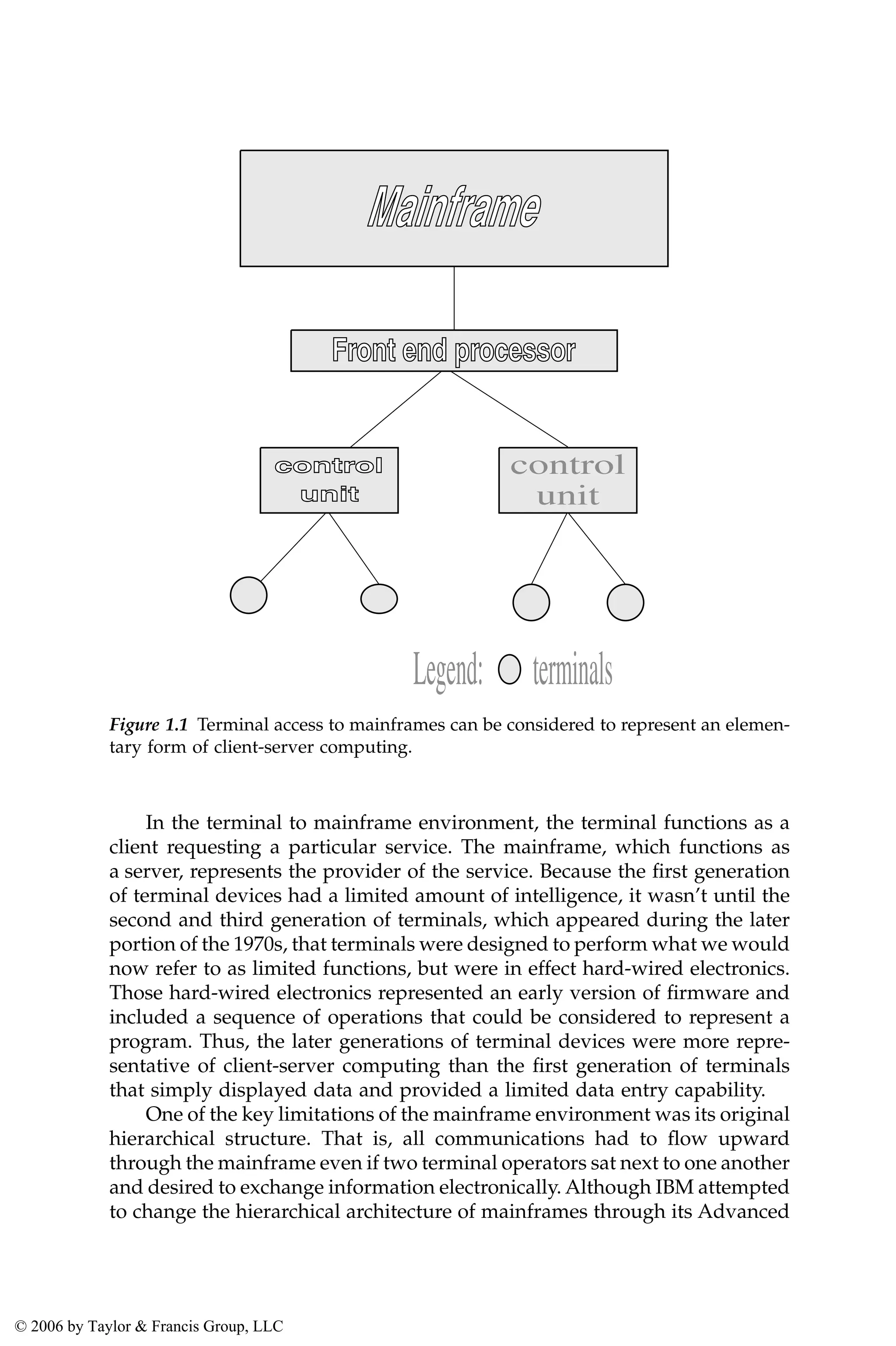
Figure 1.1 illustrates the hierarchical structure of a mainframe-based
network. If you think of the terminal operators as clients and the mainframe
as a server, since it provides access to programs in a manner similar to a
modern day server, then the terminal to mainframe connection could be
considered to represent an elementary form of client-server computing.
© 2006 by Taylor & Francis Group, LLC
In the terminal to mainframe environment, the terminal functions as a
client requesting a particular service. The mainframe, which functions as
a server, represents the provider of the service. Because the first generation
of terminal devices had a limited amount of intelligence, it wasn’t until the
second and third generation of terminals, which appeared during the later
portion of the 1970s, that terminals were designed to perform what we would
now refer to as limited functions, but were in effect hard-wired electronics.
Those hard-wired electronics represented an early version of firmware and
included a sequence of operations that could be considered to represent a
program. Thus, the later generations of terminal devices were more repre-
sentative of client-server computing than the first generation of terminals
that simply displayed data and provided a limited data entry capability.
One of the key limitations of the mainframe environment was its original
hierarchical structure. That is, all communications had to flow upward
through the mainframe even if two terminal operators sat next to one another
and desired to exchange information electronically. Although IBM attempted
to change the hierarchical architecture of mainframes through its Advanced
Figure 1.1 Terminal access to mainframes can be considered to represent an elemen-
tary form of client-server computing.
Legend:
control
unit
control
control
unit
unit
Front end processor
Front end processor
Mainframe
Mainframe
terminals
© 2006 by Taylor & Francis Group, LLC
Other documents randomly have
different content
botanical source being then unknown. Pilocarpus pennatifolius, a
member of the natural order Rutaceae, the plant from which it is
obtained, is a slightly branched shrub about 10 ft. high, growing in
Paraguay and the eastern provinces of Brazil. The leaves, which are
placed alternately on the stem, are often 1½ ft. long, and consist of
from two to five pairs of opposite leaflets, the terminal one having a
longer pedicel than the others. The leaflets are oval, lanceolate,
entire and obtuse, with the apex often slightly indented, from 3 to 4
in. long and 1 to 1½ in. broad in the middle. When held up to the
light they may be observed to have scattered all over them
numerous pellucid dots or receptacles of secretion immersed in the
substance of the leaf. The leaves in size and texture bear some
resemblance to those of the cherry-laurel (Prunus laurocerasus), but
are less polished on the upper surface. The flowers, which are
produced in spring and early summer, are borne on a raceme, 6 or 8
in. long, and the fruit consists of five carpels, of which not more
than two or three usually arrive at maturity. The leaves are the part
of the plant usually imported, although occasionally the stems and
roots are attached to them. The active principle for which the name
pilocarpine, suggested by Holmes, was ultimately adopted, was
discovered almost simultaneously by Hardy in France and Gerrard in
England, but was first obtained in a pure state by Petit of Paris. It is
a liquid alkaloid, slightly soluble in water, and very soluble in alcohol,
ether and chloroform. It strongly rotates the plane of polarization to
the right, and forms crystalline salts of which the nitrate is that
chiefly used in medicine. The nitrate and phosphate are insoluble in
ether, chloroform and benzol, while the hydrochlorate and
hydrobromate dissolve both in these menstrua and in water and
alcohol; the sulphate and acetate being deliquescent are not
employed medicinally. The formula of the alkaloid is C11H16N2O2.
Certain other alkaloids are present in the leaves. They have been
named jaborine, jaboridine and pilocarpidine. The first of these is
the most important and constant. It is possibly derived from
pilocarpine, and has the formula C22H32N4O4. Jaborine resembles
atropine pharmacologically, and is therefore antagonistic to
pilocarpine. The various preparations of jaborandi leaves are
therefore undesirable for therapeutic purposes, and only the nitrate
of pilocarpine itself should be used. This is a white crystalline
powder, soluble in the ratio of about one part in ten of cold water.
The dose is 1⁄20-1⁄2 grain by the mouth, and up to one-third of a
grain hypodermically, in which fashion it is usually given.
Jaborandi—a, leaf (reduced); b, leaflet (natural size); c, flower; d, fruit
(natural size).
The action of this powerful alkaloid closely resembles that of
physostigmine, but whereas the latter is specially active in
influencing the heart, the eye and the spinal cord, pilocarpine
exerts its greatest power on the secretions. It has no external
action. When taken by the mouth the drug is rapidly absorbed
and stimulates the secretions of the entire alimentary tract,
though not of the liver. The action on the salivary glands is the
most marked and the best understood. The great flow of saliva
is due to an action of the drug, after absorption, on the
terminations of the chorda tympani, sympathetic and other
nerves of salivary secretion. The gland cells themselves are
unaffected. The nerves are so violently excited that direct
stimulation of them by electricity adds nothing to the rate of
salivary flow. The action is antagonized by atropine, which
paralyses the nerve terminals. About 1⁄100th of a grain of
atropine antagonizes half a grain of pilocarpine. The circulation
is depressed by the drug, the pulse being slowed and the blood
pressure falling. The cardiac action is due to stimulation of the
vagus, but the dilatation of the blood-vessels does not appear to
be due to a specific action upon them. The drug does not kill by
its action on the heart. Its dangerous action is upon the
bronchial secretion, which is greatly increased. Pilocarpine is not
only the most powerful sialogogue but also the most powerful
diaphoretic known. One dose may cause the flow of nearly a
pint of sweat in an hour. The action is due, as in the case of the
salivation, to stimulation of the terminals of the sudorific nerves.
According to K. Binz there is also in both cases an action on the
medullary centres for these secretions. Just as the saliva is a
true secretion containing a high proportion of ptyalin and salts,
and is not a mere transudation of water, so the perspiration is
found to contain a high ratio of urea and chlorides. The great
diaphoresis and the depression of the circulation usually cause a
fall in temperature of about 2° F. The drug is excreted
unchanged in the urine. It is a mild diuretic. When given
internally or applied locally to the eye it powerfully stimulates
the terminals of the oculomotor nerves in the iris and ciliary
muscle, causing extreme contraction of the pupil and spasm of
accommodation. The tension of the eyeball is at first raised but
afterwards lowered.
The chief therapeutic use of the drug is as a diaphoretic in
chronic Bright’s disease. It is also used to aid the growth of the
hair—in which it is sometimes successful; in cases of inordinate
thirst, when one-tenth of a grain with a little bismuth held in the
mouth may be of much value; in cases of lead and mercury
poisoning, where it aids the elimination of the poison in the
secretions; as a galactagogue; and in cases of atropine
poisoning (though here it is of doubtful value).
JACA, a city of northern Spain, in the province of Huesca, 114
m. by rail N. by W. of Saragossa, on the left bank of the river
Aragon, and among the southern slopes of the Pyrenees, 2380 ft.
above the sea. Pop. (1900), 4934. Jaca is an episcopal see, and was
formerly the capital of the Aragonese county of Sobrarbe. Its
massive Gothic cathedral dates at least from the 11th century, and
possibly from the 9th. The city derives some importance from its
position on the ancient frontier road from Saragossa to Pau. In
August 1904 the French and Spanish governments agreed to
supplement this trade-route by building a railway from Oloron in the
Basses Pyrénées to Jaca. Various frontier defence works were
constructed in the neighbourhood at the close of the 19th century.
The origin of the city is unknown. The Jaccetani (Ἰάκκητανοί) are
mentioned as one of the most celebrated of the numerous small
tribes inhabiting the basin of the Ebro by Strabo, who adds that their
territory was the theatre of the wars which took place in the 1st
century b.c. between Sertorius and Pompey. They are probably
identical with the Lacetani of Livy (xxi. 60, 61) and Caesar (B.C. i.
60). Early in the 8th century Jaca fell into the possession of the
Moors, by whose writers it is referred to under the name of Dyaka as
one of the chief places in the province of Sarkosta (Saragossa). The
date of its reconquest is uncertain, but it must have been before the
time of Ramiro I. of Aragon (1035-1063), who gave it the title of
“city,” and in 1063 held within its walls a council, which, inasmuch as
the people were called in to sanction its decrees, is regarded as of
great importance in the history of the parliamentary institutions of
the Peninsula. In 1705 Jaca supported King Philip V. from whom, in
consequence, it received the title of muy noble, muy leal y
vencedora, “most noble, most loyal and victorious.” During the
Peninsular War it surrendered to the French in 1809, and was
recaptured in 1814.
JACAMAR, a word formed by Brisson from Jacameri, the
Brazilian name of a bird, as given by Marcgrave, and since adopted
in most European tongues for the species to which it was first
applied and others allied to it, forming the family Galbulidae1 of
ornithologists, the precise position of which is uncertain, since the
best authorities differ. All will agree that the jacamars belong to the
great heterogeneous group called by Nitzsch Picariae, but further
into detail it is hardly safe to go. The Galbulidae have zygodactylous
or pair-toed feet, like the Cuculidae, Bucconidae and Picidae, they
also resemble both the latter in laying glossy white eggs, but in this
respect they bear the same resemblance to the Momotidae,
Alcedinidae, Meropidae and some other groups, to which affinity has
been claimed for them. In the opinion of Sclater (A Monograph of
the Jacamars and Puff-birds) the jacamars form two groups—one
consisting of the single genus and species Jacamerops aureus (J.
grandis of most authors), and the other including all the rest, viz.
Urogalba with two species, Galbula with nine, Brachygalba with five,
and Jacamaralcyon and Galbalcyrhynchus with one each. They are
all rather small birds, the largest known being little over 10 in. in
length, with long and sharply pointed bills, and the plumage more or
less resplendent with golden or bronze reflections, but at the same
time comparatively soft. Jacamaralcyon tridactyla differs from all the
rest in possessing but three toes (as its name indicates), on each
foot, the hallux being deficient. With the exception of Galbula
melanogenia, which is found also in Central America and southern
Mexico, all the jacamars inhabit the tropical portions of South
America eastward of the Andes, Galbula ruficauda, however,
extending its range to the islands of Trinidad and Tobago.2 Very little
is known of the habits of any of the species. They are seen sitting
motionless on trees, sometimes solitarily, at other times in
companies, whence they suddenly dart off at any passing insect,
catch it on the wing, and return to their perch. Of their nidification
almost nothing has been recorded, but the species occurring in
Tobago is said by Kirk to make its nest in marl-banks, digging a hole
about an inch and a half in diameter and some 18 in. deep.
(A. N.)
1 Galbula was first applied to Marcgrave’s bird by Moehring. It is
another form of Galgulus, and seems to have been one of the many
names of the golden oriole. See Icterus.
2 The singular appearance, recorded by Canon Tristram (Zoologist, p.
3906), of a bird of this species in Lincolnshire seems to require notice. No
instance seems to be known of any jacamar having been kept in
confinement or brought to this country alive; but expert aviculturists are
often not communicative, and many importations of rare birds have
doubtless passed unrecorded.
JAÇANÁ, the Brazilian name, according to Marcgrave, of
certain birds, since found to have some allies in other parts of the
world, which are also very generally called by the same appellation.
They have been most frequently classed with the water-hens or rails
(Rallidae), but are now recognized by many systematists as forming
a separate family, Parridae,1 whose leaning seems to be rather
towards the Limicolae, as apparently first suggested by Blyth, a view
which is supported by the osteological observations of Parker (Proc.
Zool. Society, 1863, p. 513), though denied by A. Milne-Edwards
(Ois. foss. de la France, ii. p. 110). The most obvious characteristic
of this group of birds is the extraordinary length of their toes and
claws, whereby they are enabled to walk with ease over water-lilies
and other aquatic plants growing in rivers and lakes. The family has
been divided into four genera—of which Parra, as now restricted,
inhabits South America; Metopidius, hardly differing from it, has
representatives in Africa, Madagascar and the Indian region;
Hydralector, also very nearly allied to Parra, belongs to the northern
portion of the Australian region; and Hydrophasianus, the most
extravagant form of the whole, is found in India, Ceylon and China.
In habits the jaçanás have much in common with the water-hens,
but that fact is insufficient to warrant the affinity asserted to exist
between the two groups; for in their osteological structure there is
much difference, and the resemblance seems to be only that of
analogy. The Parridae lay very peculiar eggs of a rich olive-brown
colour, in most cases closely marked with dark lines, thus presenting
an appearance by which they may be readily known from those of
any other birds, though an approach to it is occasionally to be
noticed in those of certain Limicolae, and especially of certain
Charadriidae.
(A. N.)
Pheasant-tailed Jaçaná.
1 The classic Parra is by some authors thought to have been the
golden oriole (see Icterus), while others suppose it was a jay or pie. The
word seems to have been imported into ornithology by Aldrovandus, but
the reason which prompted Linnaeus to apply it, as he seems first to
have done, to a bird of this group, cannot be satisfactorily stated.
JACINI, STEFANO, Count (1827-1891), Italian statesman and
economist, was descended from an old and wealthy Lombard family.
He studied in Switzerland, at Milan, and in German universities.
During the period of the Austrian restoration in Lombardy (1849-
1859) he devoted himself to literary and economic studies. For his
work on La Proprietà fondiaria in Lombardia (Milan, 1856) he
received a prize from the Milanese Società d’incoraggiamento di
scienze e lettere and was made a member of the Istituto Lombardo.
In another work, Sulle condizioni economiche della Valtellina (Milan,
1858, translated into English by W. E. Gladstone), he exposed the
evils of Austrian rule, and he drew up a report on the general
conditions of Lombardy and Venetia for Cavour. He was minister of
Public Works under Cavour in 1860-1861, in 1864 under La
Marmora, and down to 1867 under Ricasoli. In 1866 he presented a
bill favouring Italy’s participation in the construction of the St
Gotthard tunnel. He was instrumental in bringing about the alliance
with Prussia for the war of 1866 against Austria, and in the
organization of the Italian railways. From 1881 to 1886 he was
president of the commission to inquire into the agricultural
conditions of Italy, and edited the voluminous report on the subject.
He was created senator in 1870, and given the title of count in 1880.
He died in 1891.
L. Carpi’s Risorgimento italiano, vol. iv. (Milan, 1888), contains
a short sketch of Jacini’s life.
JACK, a word with a great variety of meanings and applications,
all traceable to the common use of the word as a by-name of a man.
The question has been much discussed whether “Jack” as a name is
an adaptation of Fr. Jacques, i.e. James, from Lat. Jacobus, Gr.
Ἰάκωβος, or whether it is a direct pet formation from John, which is
its earliest and universal use in English. In the History of the
Monastery of St Augustine at Canterbury, 1414, Jack is given as a
form of John—Mos est Saxonum ... verba et nomina transformare ...
ut ... pro Johanne Jankin sive Jacke (see E. W. B. Nicholson, The
Pedigree of Jack and other Allied Names, 1892). “Jack” was early
used as a general term for any man of the common people,
especially in combination with the woman’s name Jill or Gill, as in
the nursery rhyme. The New English Dictionary quotes from the
Coventry Mysteries, 1450: “And I wole kepe the feet this tyde Thow
ther come both Iakke and Gylle.” Familiar examples of this generic
application of the name are Jack or Jack Tar for a sailor, which
seems to date from the 17th century, and such compound uses as
cheap-jack and steeple-jack, or such expressions as “jack in office,”
“jack of all trades,” &c. It is a further extension of this that gives the
name to the knave in a pack of cards, and also to various animals,
as jackdaw, jack-snipe, jack-rabbit (a species of large prairie-hare); it
is also used as a general name for pike.
The many applications of the word “jack” to mechanical devices
and other objects follow two lines of reference, one to objects
somewhat smaller than the ordinary, the other to appliances which
take the place of direct manual labour or assist or save it. Of the first
class may be noticed the use of the term for the small object bowl in
the game of bowls or for jack rafters, those rafters in a building
shorter than the main rafters, especially the end rafters in a hipped
roof. The use of jack as the name for a particular form of ship’s flag
probably arose thus, for it is always a smaller flag than the ensign.
The jack is flown on a staff on the bowsprit of a vessel. In the British
navy the jack is a small Union flag. (The Union flag should not be
styled a Union Jack except when it is flown as a jack.) The jack of
other nations is usually the canton of the ensign, as in the German
and the United States navies, or else is a smaller form of the
national ensign, as in France. (See Flag.)
The more common use of “jack” is for various mechanical and
other devices originally used as substitutes for men or boys. Thus
the origin of the boot-jack and the meat-jack is explained in Isaac
Watts’s Logic, 1724: “So foot boys, who had frequently the common
name of Jack given them, were kept to turn the spit or pull off their
masters’ boots, but when instruments were invented for both these
services, they were both called jacks.” The New English Dictionary
finds a transitional sense in the use of the name “jack” for
mechanical figures which strike the hours on a bell of a clock. Such a
figure in the clock of St Lawrence Church at Reading is called a jack
in the parish accounts for 1498-1499. There are many different
applications of “jack,” to certain levers and other parts of textile
machinery, to metal plugs used for connecting lines in a telephone
exchange, to wooden uprights connecting the levers of the keys with
the strings in the harpsichord and virginal, to a framework forming a
seat or staging which can be fixed outside a window for cleaning or
painting purposes, and to many devices containing a roller or winch,
as in a jack towel, a long towel hung on a roller. The principal
mechanical application of the word, however, is to a machine for
raising weights from below. A jack chain, so called from its use in
meat-jacks, is one in which the links, formed each in a figure of
eight, are set in planes at right angles to each other, so that they are
seen alternately flat or edgeways.
In most European languages the word “jack” in various forms
appears for a short upper outer garment, particularly in the shape of
a sleeveless (quilted) leather jerkin, sometimes with plates or rings
of iron sewn to it. It was the common coat of defence of the infantry
of the middle ages. The word in this case is of French origin and was
an adaptation of the common name Jacques, as being a garment
worn by the common people. In French the word is jaque, and it
appears in Italian as giaco, or giacco, in Dutch jak, Swedish jacka
and German Jacke, still the ordinary name for a short coat, as is the
English jacket, from the diminutive French jaquette. It was probably
from some resemblance to the leather coat that the well-known
leather vessels for holding liquor or for drinking were known as jacks
or black jacks. These drinking vessels, which are often of great size,
were not described as black jacks till the 16th century, though
known as jacks much earlier. Among the important specimens that
have survived to this day is one with the initials and crown of
Charles I. and the date, 1646, which came from Kensington Palace
and is now in the British Museum; one each at Queen’s College and
New College, Oxford; two at Winchester College; one at Eton
College; and six at the Chelsea Hospital. Many specimens are
painted with shields of arms, initials and other devices; they are very
seldom mounted in silver, though spurious specimens with silver
medallions of Cromwell and other prominent personages exist. At
the end of the 17th century a smaller jack of a different form, like an
ordinary drinking mug with a tapering cylindrical body, often
mounted in silver, came into vogue in a limited degree. The black
jack is a distinct type of drinking vessel from the leather botel and
the bombard. The jack-boot, the heavy riding boot with long flap
covering the knee and part of the thigh, and worn by troopers first
during the 17th century, was so called probably from association
with the leather jack or jerkin. The jack-boot is still worn by the
Household Cavalry, and the name is applied to a high riding boot
reaching to the knee as distinguished from the riding boot with tops,
used in full hunting-kit or by grooms or coachmen.
Jack, sometimes spelled jak, is the common name for the fruit of
the tree Artiocarpus integrifolia, found in the East Indies. The word
is an adaptation of the Portuguese jaca from the Malay name
chakka. (See Bread Fruit.)
The word “jackanapes,” now used as an opprobrious term for a
swaggering person with impertinent ways and affected airs and
graces, has a disputed and curious history. According to the New
English Dictionary it first appears in 1450 in reference to William de
la Pole, duke of Suffolk (Political Poems, “Rolls Series,” II. 224),
“Jack Napys with his clogge hath tiede Talbot oure gentille dogge.”
Suffolk’s badge was a clog and chain, such as was often used for an
ape kept in captivity, and he is alluded to (ibid. 222) as “Ape clogge.”
Jack Napes, Jack o’ Napes, Jackanapes, was a common name for a
tame ape from the 16th century, and it seems more likely that the
word is a fanciful name for a monkey than that it is due to the
nickname of Suffolk.
JACKAL (Turk, chakāl), a name properly restricted to Canis
aureus, a wolf-like wild member of the dog family inhabiting eastern
Europe and southern Asia, but extended to include a number of
allied species. Jackals resemble wolves and dogs in their dentition,
the round eye-pupils, the period of gestation, and to a large extent
also in habits. The European species grows to a height of 15 in. at
the shoulders, and to a length of about 2 ft., exclusive of its bushy
tail. Typically the fur is greyish-yellow, darker on the back and lighter
beneath. The range of the common jackal (C. aureus) extends from
Dalmatia to India, the species being represented by several local
races. In Senegal this species is replaced by C. anthus, while in
Egypt occurs the much larger C. lupaster, commonly known as the
Egyptian wolf. Nearly allied to the last is the so-called Indian wolf (C.
pallipes). Other African species are the black-backed jackal (C.
mesomelas), the variegated jackal (C. variegatus), and the dusky
jackal (C. adustus). Jackals are nocturnal animals, concealing
themselves until dusk in woody jungles and other natural lurking
places, and then sallying forth in packs, which sometimes number
two hundred individuals, and visiting farmyards, villages and towns
in search of food. This consists for the most part of the smaller
mammals and poultry; although the association in packs enables
these marauders to hunt down antelopes and sheep. When unable
to obtain living prey, they feed on carrion and refuse of all kinds, and
are thus useful in removing putrescent matter from the streets. They
are also fond of grapes and other fruits, and are thus the pests of
the vineyard as well as the poultry-yard. The cry of the jackal is even
more appalling than that of the hyena, a shriek from one member of
a pack being the signal for a general chorus of screams, which is
kept up during the greater part of the night. In India these animals
are hunted with foxhounds or greyhounds, and from their cunning
and pluck afford excellent sport. Jackals are readily tamed; and
domesticated individuals are said, when called by their masters, to
wag their tails, crouch and throw themselves on the ground, and
otherwise behave in a dog-like fashion. The jackal, like the fox, has
an offensive odour, due to the secretion of a gland at the base of the
tail.
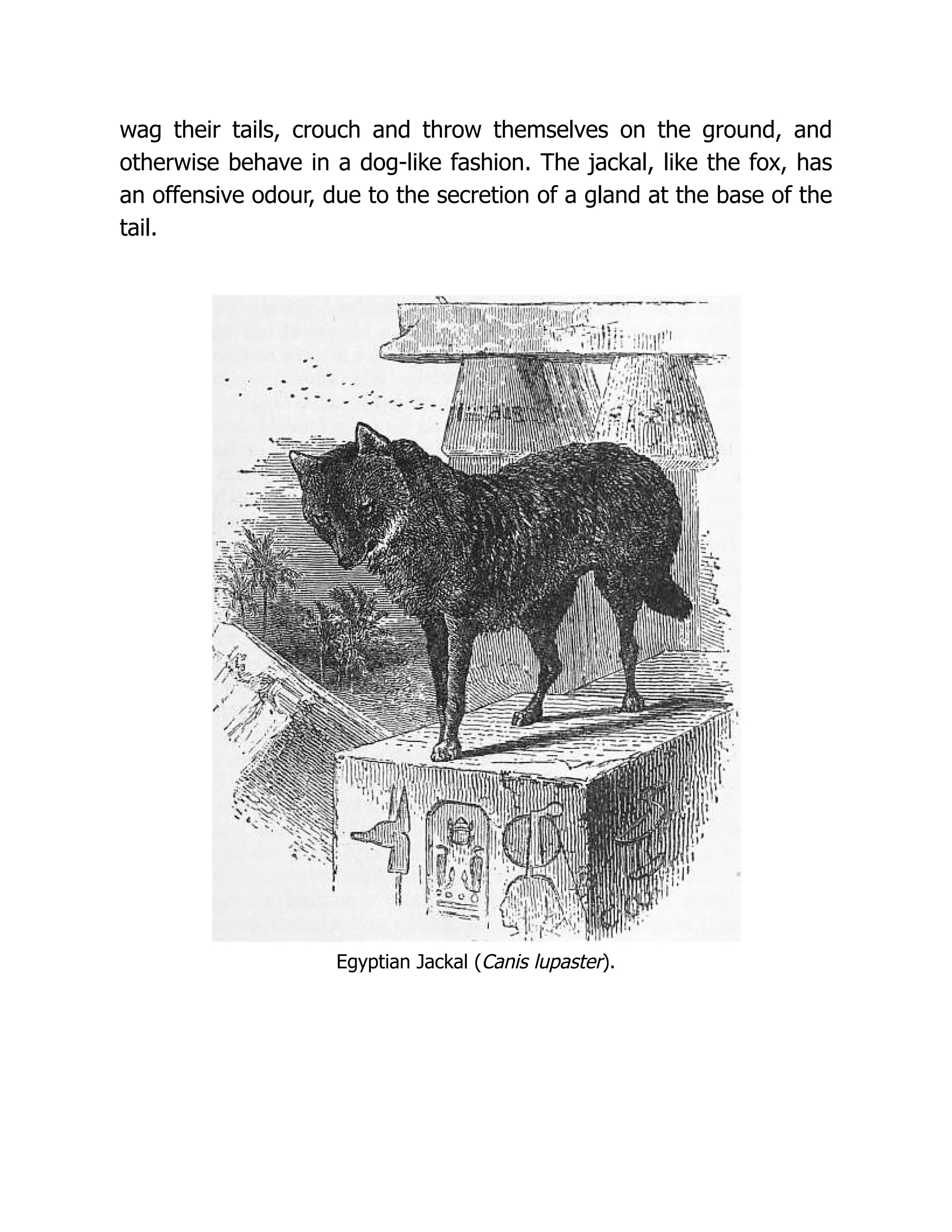
Egyptian Jackal (Canis lupaster).
JACKDAW, or simply Daw (Old Low German, Daha; Dutch,
Kaauw), one of the smallest species of the genus Corvus (see Crow),
and a very well known inhabitant of Europe, the C. monedula of
ornithologists. In some of its habits it much resembles its congener
the rook, with which it constantly associates during a great part of
the year; but, while the rook only exceptionally places its nest
elsewhere than on the boughs of trees and open to the sky, the daw
almost invariably chooses holes, whether in rocks, hollow trees,
rabbit-burrows or buildings. Nearly every church-tower and castle,
ruined or not, is more or less numerously occupied by daws.
Chimneys frequently give them the accommodation they desire,
much to the annoyance of the householder, who finds the funnel
choked by the quantity of sticks brought together by the birds, since
their industry in collecting materials for their nests is as marvellous
as it often is futile. In some cases the stack of loose sticks piled up
by daws in a belfry or tower has been known to form a structure 10
or 12 ft. in height, and hence this species may be accounted one of
the greatest nest-builders in the world. The style of architecture
practised by the daw thus brings it more than the rook into contact
with man, and its familiarity is increased by the boldness of its
disposition which, though tempered by discreet cunning, is hardly
surpassed among birds. Its small size, in comparison with most of its
congeners, alone incapacitates it from inflicting the serious injuries
of which some of them are often the authors, yet its pilferings are
not to be denied, though on the whole its services to the
agriculturist are great, for in the destruction of injurious insects it is
hardly inferior to the rook, and it has the useful habit of ridding
sheep, on whose backs it may be frequently seen perched, of some
of their parasites.
The daw displays the glossy black plumage so characteristic of the
true crows, varied only by the hoary grey of the ear-coverts, and of
the nape and sides of the neck, which is the mark of the adult; but
examples from the east of Europe and western Asia have these parts
much lighter, passing into a silvery white, and hence have been
deemed by some authorities to constitute a distinct species (C.
collaris, Drumm.). Further to the eastward occurs the C. dauuricus of
Pallas, which has not only the collar broader and of a pure white, but
much of the lower parts of the body white also. Japan and northern
China are inhabited also by a form resembling that of western
Europe, but wanting the grey nape of the latter. This is the C.
neglectus of Professor Schlegel, and is said by Dresser, on the
authority of Swinhoe, to interbreed frequently with C. dauuricus.
These are all the birds that seem entitled to be considered daws,
though Dr Bowdler Sharpe (Cat. B. Brit. Museum, iii. 24) associates
with them (under the little-deserved separate generic distinction
Coloeus) the fish-crow of North America, which appears both in
structure and in habits to be a true crow.
(A. N.)
JACKSON, ANDREW (1767-1845), seventh president of the
United States, was born on the 15th of March 1767, at the Waxhaw
or Warsaw settlement, in Union county, North Carolina, or in
Lancaster county, South Carolina, whither his parents had
immigrated from Carrickfergus, Ireland, in 1765. He played a slight
part in the War of Independence, and was taken prisoner in 1781,
his treatment resulting in a lifelong dislike of Great Britain. He
studied law at Salisbury, North Carolina, was admitted to the bar
there in 1787, and began to practise at McLeansville, Guilford county,
North Carolina, where for a time he was a constable and deputy-
sheriff. In 1788, having been appointed prosecuting attorney of the
western district of North Carolina (now the state of Tennessee), he
removed to Nashville, the seat of justice of the district. In 1791 he
married Mrs Rachel Robards (née Donelson), having heard that her
husband had obtained a divorce through the legislature of Virginia.
The legislative act, however, had only authorized the courts to
determine whether or not there were sufficient grounds for a divorce
and to grant or withhold it accordingly. It was more than two years
before the divorce was actually granted, and only on the basis of the
fact that Jackson and Mrs Robards were then living together. On
receiving this information, Jackson had the marriage ceremony
performed a second time.
In 1796 Jackson assisted in framing the constitution of Tennessee.
From December 1796 to March 1797 he represented that state in
the Federal House of Representatives, where he distinguished
himself as an irreconcilable opponent of President Washington, and
was one of the twelve representatives who voted against the
address to him by the House. In 1797 he was elected a United
States senator; but he resigned in the following year. He was judge
of the supreme court of Tennessee from 1798 to 1804. In 1804-1805
he contracted a friendship with Aaron Burr; and at the latter’s trial in
1807 Jackson was one of his conspicuous champions. Up to the time
of his nomination for the presidency, the biographer of Jackson finds
nothing to record but military exploits in which he displayed
perseverance, energy and skill of a very high order, and a succession
of personal acts in which he showed himself ignorant, violent,
perverse, quarrelsome and astonishingly indiscreet. His combative
disposition led him into numerous personal difficulties. In 1795 he
fought a duel with Colonel Waitstill Avery (1745-1821), an opposing
counsel, over some angry words uttered in a court room; but both, it
appears, intentionally fired wild. In 1806 in another duel, after a
long and bitter quarrel, he killed Charles Dickinson, and Jackson
himself received a wound from which he never fully recovered. In
1813 he exchanged shots with Thomas Hart Benton and his brother
Jesse in a Nashville tavern, and received a second wound. Jackson
and Thomas Hart Benton were later reconciled.
In 1813-1814, as major-general of militia, he commanded in the
campaign against the Creek Indians in Georgia and Alabama,
defeated them (at Talladega, on the 9th of November 1813, and at
Tohopeka, on the 29th of March 1814), and thus first attracted
public notice by his talents. In May 1814 he was commissioned as
major-general in the regular army to serve against the British; in
November he captured Pensacola, Florida, then owned by Spain, but
used by the British as a base of operations; and on the 8th of
January 1815 he inflicted a severe defeat on the enemy before New
Orleans, the contestants being unaware that a treaty of peace had
already been signed. During his stay in New Orleans he proclaimed
martial law, and carried out his measures with unrelenting sternness,
banishing from the town a judge who attempted resistance. When
civil law was restored, Jackson was fined $1000 for contempt of
court; in 1844 Congress ordered the fine with interest ($2700) to be
repaid. In 1818 Jackson received the command against the
Seminoles. His conduct in following them up into the Spanish
territory of Florida, in seizing Pensacola, and in arresting and
executing two British subjects, Alexander Arbuthnot and Robert
Ambrister, gave rise to much hostile comment in the cabinet and in
Congress; but the negotiations for the purchase of Florida put an
end to the diplomatic difficulty. In 1821 Jackson was military
governor of the territory of Florida, and there again he came into
collision with the civil authority. From this, as from previous troubles,
John Quincy Adams, then secretary of state, extricated him.
In July 1822 the general assembly of Tennessee nominated
Jackson for president; and in 1823 he was elected to the United
States Senate, from which he resigned in 1825. The rival candidates
for the office of president in the campaign of 1824 were Jackson,
John Quincy Adams, W. H. Crawford and Henry Clay. Jackson
obtained the largest number of votes (99) in the electoral college
(Adams receiving 84, Crawford 41 and Clay 37); but no one had an
absolute majority, and it thus became the duty of the House of
Representatives to choose one of the three candidates—Adams,
Jackson and Crawford—who had received the greatest numbers of
electoral votes. At the election by the house (February 9, 1825)
Adams was chosen, receiving the votes of 13 states, while Jackson
received the votes of 7 and Crawford the votes of 4. Jackson,
however, was recognized by the abler politicians as the coming man.
Martin Van Buren and others, going into opposition under his banner,
waged from the first a relentless and factious war on the
administration. Van Buren was the most adroit politician of his time;
and Jackson was in the hands of very astute men, who advised and
controlled him. He was easy to lead when his mind was in solution;
and he gave his confidence freely where he had once placed it. He
was not suspicious, but if he withdrew his confidence he was
implacable. When his mind crystallized on a notion that had a
personal significance to himself, that notion became a hard fact that
filled his field of vision. When he was told that he had been cheated
in the matter of the presidency,1 he was sure of it, although those
who told him were by no means so.
There was great significance in the election of Jackson in 1828. A
new generation was growing up under new economic and social
conditions. They felt great confidence in themselves and great
independence. They despised tradition and Old World ways and
notions; and they accepted the Jeffersonian dogmas, not only as
maxims, but as social forces—the causes of the material prosperity
of the country. By this generation, therefore, Jackson was recognized
as a man after their own heart. They liked him because he was
vigorous, brusque, uncouth, relentless, straightforward and open.
They made him president in 1828, and he fulfilled all their
expectations. He had 178 votes in the electoral college against 83
given for Adams. Though the work of redistribution of offices began
almost at his inauguration, it is yet an incorrect account of the
matter to say that Jackson corrupted the civil service. His
administration is rather the date at which a system of democracy,
organized by the use of patronage, was introduced into the federal
arena by Van Buren. It was at this time that the Democratic or
Republican party divided, largely along personal lines, into
Jacksonian Democrats and National Republicans, the latter led by
such men as Henry Clay and J. Q. Adams. The administration itself
had two factions in it from the first, the faction of Van Buren, the
secretary of state in 1829-1831, and that of Calhoun, vice-president
in 1829-1832. The refusal of the wives of the cabinet and of Mrs
Calhoun to accord social recognition to Mrs J. H. Eaton brought
about a rupture, and in April 1831 the whole cabinet was
reorganized. Van Buren, a widower, sided with the president in this
affair and grew in his favour. Jackson in the meantime had learned
that Calhoun as secretary of war had wished to censure him for his
actions during the Seminole war in Florida in 1818, and henceforth
he regarded the South Carolina statesman as his enemy. The result
was that Jackson transferred to Van Buren his support for succession
in the presidency. The relations between Jackson and his cabinet
were unlike those existing under his predecessors. Having a military
point of view, he was inclined to look upon the cabinet members as
inferior officers, and when in need of advice he usually consulted a
group of personal friends, who came to be called the “Kitchen
Cabinet.” The principal members of this clique were William B. Lewis
(1784-1866), Amos Kendall and Duff Green, the last named being
editor of the United States Telegraph, the organ of the
administration.
In 1832 Jackson was re-elected by a large majority (219 electoral
votes to 49) over Henry Clay, his chief opponent. The battle raged
mainly around the re-charter of the Bank of the United States. It is
probable that Jackson’s advisers in 1828 had told him, though
erroneously, that the bank had worked against him, and then were
not able to control him. The first message of his first presidency had
contained a severe reflection on the bank; and in the very height of
this second campaign (July 1832) he vetoed the re-charter, which
had been passed in the session of 1831-1832. Jackson interpreted
his re-election as an approval by the people of his war on the bank,
and he pushed it with energy. In September 1833 he ordered the
public deposits in the bank to be transferred to selected local banks,
and entered upon the “experiment” whether these could not act as
fiscal agents for the government, and whether the desire to get the
deposits would not induce the local banks to adopt sound rules of
currency. During the next session the Senate passed a resolution
condemning his conduct. Jackson protested, and after a hard
struggle, in which Jackson’s friends were led by Senator Thomas
Hart Benton, the resolution was ordered to be expunged from the
record, on the 16th of January 1837.
In 1832, when the state of South Carolina attempted to “nullify”
the tariff laws, Jackson at once took steps to enforce the authority of
the federal government, ordering two war vessels to Charleston and
placing troops within convenient distance. He also issued a
proclamation warning the people of South Carolina against the
consequences of their conduct. In the troubles between Georgia and
the Cherokee Indians, however, he took a different stand. Shortly
after his first election Georgia passed an act extending over the
Cherokee country the civil laws of the state. This was contrary to the
rights of the Cherokees under a federal treaty, and the Supreme
Court consequently declared the act void (1832). Jackson, however,
having the frontiersman’s contempt for the Indian, refused to
enforce the decision of the court (see Nullification; Georgia: History).
Jackson was very successful in collecting old claims against
various European nations for spoliations inflicted under Napoleon’s
continental system, especially the French spoliation claims, with
reference to which he acted with aggressiveness and firmness.
Aiming at a currency to consist largely of specie, he caused the
payment of these claims to be received and imported in specie as far
as possible; and in 1836 he ordered land-agents to receive for land
nothing but specie. About the same time a law passed Congress for
distributing among the states some $35,000,000 balance belonging
to the United States, the public debt having all been paid. The eighty
banks of deposit in which it was lying had regarded this sum almost
as a permanent loan, and had inflated credit on the basis of it. The
necessary calling in of their loans in order to meet the drafts in
favour of the states, combining with the breach of the overstrained
credit between America and Europe and the decline in the price of
cotton, brought about a crash which prostrated the whole financial,
industrial and commercial system of the country for six or seven
years. The crash came just as Jackson was leaving office; the whole
burden fell on his successor, Van Buren.
In the 18th century the influences at work in the American
colonies developed democratic notions. In fact, the circumstances
were those which create equality of wealth and condition, as far as
civilized men ever can be equal. The War of Independence was
attended by a grand outburst of political dogmatism of the
democratic type. A class of men were produced who believed in very
broad dogmas of popular power and rights. There were a few rich
men, but they were almost ashamed to differ from their neighbours
and, in some known cases, they affected democracy in order to win
popularity. After the 19th century began the class of rich men rapidly
increased. In the first years of the century a little clique at
Philadelphia became alarmed at the increase of the “money power,”
and at the growing perils to democracy. They attacked with some
violence, but little skill, the first Bank of the United States, and they
prevented its re-charter. The most permanent interest of the history
of the United States is the picture it offers of a primitive democratic
society transformed by prosperity and the acquisition of capital into
a great republican commonwealth. The denunciations of the “money
power” and the reiteration of democratic dogmas deserve earnest
attention. They show the development of classes or parties in the
old undifferentiated mass. Jackson came upon the political stage just
when a wealthy class first existed. It was an industrial and
commercial class greatly interested in the tariff, and deeply
interested also in the then current forms of issue banking. The
southern planters also were rich, but were agriculturists and
remained philosophical Democrats. Jackson was a man of low birth,
uneducated, prejudiced, and marked by strong personal feeling in all
his beliefs and disbeliefs. He showed, in his military work and in his
early political doings, great lack of discipline. The proposal to make
him president won his assent and awakened his ambition. In
anything which he undertook he always wanted to carry his point
almost regardless of incidental effects on himself or others. He soon
became completely engaged in the effort to be made president. The
men nearest to him understood his character and played on it. It
was suggested to him that the money power was against him. That
meant that, to the educated or cultivated class of that day, he did
not seem to be in the class from which a president should be
chosen. He took the idea that the Bank of the United States was
leading the money power against him, and that he was the
champion of the masses of democracy and of the common people.
The opposite party, led by Clay, Adams, Biddle, &c., had schemes for
banks and tariffs, enterprises which were open to severe criticism.
The political struggle was very intense and there were two good
sides to it. Men like Thomas H. Benton, Edward Livingston, Amos
Kendall, and the southern statesmen, found material for strong
attacks on the Whigs. The great mass of voters felt the issue as
Jackson’s managers stated it. That meant that the masses
recognized Jackson as their champion. Therefore, Jackson’s
personality and name became a power on the side opposed to
banks, corporations and other forms of the new growing power of
capital. That Jackson was a typical man of his generation is certain.
He represents the spirit and temper of the free American of that day,
and it was a part of his way of thinking and acting that he put his
whole life and interest into the conflict. He accomplished two things
of great importance in the history: he crushed excessive state-rights
and established the contrary doctrine in fact and in the political
orthodoxy of the democrats; he destroyed the great bank. The
subsequent history of the bank left it without an apologist, and
prejudiced the whole later judgment about it. The way in which
Jackson accomplished these things was such that it cost the country
ten years of the severest liquidation, and left conflicting traditions of
public policy in the Democratic party. After he left Washington,
Jackson fell into discord with his most intimate old friends, and
turned his interest to the cause of slavery, which he thought to be
attacked and in danger.
Jackson is the only president of whom it may be said that he went
out of office far more popular than he was when he entered. When
he went into office he had no political opinions, only some popular
notions. He left his party strong, perfectly organized and enthusiastic
on a platform of low expenditure, payment of the debt, no
expenditure for public improvement or for glory or display in any
Welcome to our website – the perfect destination for book lovers and
knowledge seekers. We believe that every book holds a new world,
offering opportunities for learning, discovery, and personal growth.
That’s why we are dedicated to bringing you a diverse collection of
books, ranging from classic literature and specialized publications to
self-development guides and children's books.
More than just a book-buying platform, we strive to be a bridge
connecting you with timeless cultural and intellectual values. With an
elegant, user-friendly interface and a smart search system, you can
quickly find the books that best suit your interests. Additionally,
our special promotions and home delivery services help you save time
and fully enjoy the joy of reading.
Join us on a journey of knowledge exploration, passion nurturing, and
personal growth every day!
ebookbell.com


A Practical Guide To Content Delivery Networks Gilbert Held

  • 1.
    A Practical GuideTo Content Delivery Networks Gilbert Held download https://ebookbell.com/product/a-practical-guide-to-content- delivery-networks-gilbert-held-2613776 Explore and download more ebooks at ebookbell.com
  • 2.
    Here are somerecommended products that we believe you will be interested in. You can click the link to download. A Practical Guide To Content Delivery Ne Held Gilbert https://ebookbell.com/product/a-practical-guide-to-content-delivery- ne-held-gilbert-3276752 Going To Live In Spain A Practical Guide To Enjoying A New Lifestyle In The Sun Harry King https://ebookbell.com/product/going-to-live-in-spain-a-practical- guide-to-enjoying-a-new-lifestyle-in-the-sun-harry-king-1917024 Designing Accessible Learning Content A Practical Guide To Applying Bestpractice Accessibility Standards To Ld Resources Susi Miller https://ebookbell.com/product/designing-accessible-learning-content-a- practical-guide-to-applying-bestpractice-accessibility-standards-to- ld-resources-susi-miller-50787162 Going To Live On The Costa Del Sol Your Practical Guide To Enjoying A New Lifestyle In The Sun Tom Provan https://ebookbell.com/product/going-to-live-on-the-costa-del-sol-your- practical-guide-to-enjoying-a-new-lifestyle-in-the-sun-tom- provan-2199264
  • 3.
    Dealing With DeathFunerals Wills And Bereavement What To Do When Someone Dies A Practical Guide Roger Jones https://ebookbell.com/product/dealing-with-death-funerals-wills-and- bereavement-what-to-do-when-someone-dies-a-practical-guide-roger- jones-2181992 The Early Literacy Handbook Making Sense Of Language Literacy With Children Birth To Sevena Practical Guide To The Context Christine Parker Dominic Wyse https://ebookbell.com/product/the-early-literacy-handbook-making- sense-of-language-literacy-with-children-birth-to-sevena-practical- guide-to-the-context-christine-parker-dominic-wyse-48742084 Animation In Context A Practical Guide To Theory And Making 1st Edition Mark Collington https://ebookbell.com/product/animation-in-context-a-practical-guide- to-theory-and-making-1st-edition-mark-collington-57091198 Millimetre Wave Antennas For Gigabit Wireless Communications A Practical Guide To Design And Analysis In A System Context Kaocheng Huang https://ebookbell.com/product/millimetre-wave-antennas-for-gigabit- wireless-communications-a-practical-guide-to-design-and-analysis-in-a- system-context-kaocheng-huang-4308288 Act And Applied Behavior Analysis A Practical Guide To Ensuring Better Behavior Outcomes Using Acceptance And Commitment Training Thomas G Szabo Phd Bcbad https://ebookbell.com/product/act-and-applied-behavior-analysis-a- practical-guide-to-ensuring-better-behavior-outcomes-using-acceptance- and-commitment-training-thomas-g-szabo-phd-bcbad-52859110
  • 5.
    AUERBACH PUBLICATIONS www.auerbach-publications.com To OrderCall: 1-800-272-7737 • Fax: 1-800-374-3401 E-mail: orders@crcpress.com Agent-Based Manufacturing and Control Systems: New Agile Manufacturing Solutions for Achieving Peak Performance Massimo Paolucci and Roberto Sacile ISBN: 1574443364 Curing the Patch Management Headache Felicia M. Nicastro ISBN: 0849328543 Cyber Crime Investigator's Field Guide, Second Edition Bruce Middleton ISBN: 0849327687 Disassembly Modeling for Assembly, Maintenance, Reuse and Recycling A. J. D. Lambert and Surendra M. Gupta ISBN: 1574443348 The Ethical Hack: A Framework for Business Value Penetration Testing James S. Tiller ISBN: 084931609X Fundamentals of DSL Technology Philip Golden, Herve Dedieu, and Krista Jacobsen ISBN: 0849319137 The HIPAA Program Reference Handbook Ross Leo ISBN: 0849322111 Implementing the IT Balanced Scorecard: Aligning IT with Corporate Strategy Jessica Keyes ISBN: 0849326214 Information Security Fundamentals Thomas R. Peltier, Justin Peltier, and John A. Blackley ISBN: 0849319579 Information Security Management Handbook, Fifth Edition, Volume 2 Harold F. Tipton and Micki Krause ISBN: 0849332109 Introduction to Management of Reverse Logistics and Closed Loop Supply Chain Processes Donald F. Blumberg ISBN: 1574443607 Maximizing ROI on Software Development Vijay Sikka ISBN: 0849323126 Mobile Computing Handbook Imad Mahgoub and Mohammad Ilyas ISBN: 0849319714 MPLS for Metropolitan Area Networks Nam-Kee Tan ISBN: 084932212X Multimedia Security Handbook Borko Furht and Darko Kirovski ISBN: 0849327733 Network Design: Management and Technical Perspectives, Second Edition Teresa C. Piliouras ISBN: 0849316081 Network Security Technologies, Second Edition Kwok T. Fung ISBN: 0849330270 Outsourcing Software Development Offshore: Making It Work Tandy Gold ISBN: 0849319439 Quality Management Systems: A Handbook for Product Development Organizations Vivek Nanda ISBN: 1574443526 A Practical Guide to Security Assessments Sudhanshu Kairab ISBN: 0849317061 The Real-Time Enterprise Dimitris N. Chorafas ISBN: 0849327776 Software Testing and Continuous Quality Improvement, Second Edition William E. Lewis ISBN: 0849325242 Supply Chain Architecture: A Blueprint for Networking the Flow of Material, Information, and Cash William T. Walker ISBN: 1574443577 The Windows Serial Port Programming Handbook Ying Bai ISBN: 0849322138 OTHER AUERBACH PUBLICATIONS © 2006 by Taylor & Francis Group, LLC
  • 6.
    AU3649-title 8/17/05 12:52PM Page 1 Boca Raton New York Gilbert Held A Practical Guide to Content Delivery Networks © 2006 by Taylor & Francis Group, LLC
  • 7.
    Published in 2006by Auerbach Publications Taylor & Francis Group 6000 Broken Sound Parkway NW, Suite 300 Boca Raton, FL 33487-2742 © 2006 by Taylor & Francis Group, LLC Auerbach is an imprint of Taylor & Francis Group No claim to original U.S. Government works Printed in the United States of America on acid-free paper 10 9 8 7 6 5 4 3 2 1 International Standard Book Number-10: 0-8493-3649-X (Hardcover) International Standard Book Number-13: 978-0-8493-3649-2 (Hardcover) Library of Congress Card Number 2005044212 This book contains information obtained from authentic and highly regarded sources. Reprinted material is quoted with permission, and sources are indicated. A wide variety of references are listed. Reasonable efforts have been made to publish reliable data and information, but the author and the publisher cannot assume responsibility for the validity of all materials or for the consequences of their use. No part of this book may be reprinted, reproduced, transmitted, or utilized in any form by any electronic, mechanical, or other means, now known or hereafter invented, including photocopying, microfilming, and recording, or in any information storage or retrieval system, without written permission from the publishers. For permission to photocopy or use material electronically from this work, please access www.copyright.com (http://www.copyright.com/) or contact the Copyright Clearance Center, Inc. (CCC) 222 Rosewood Drive, Danvers, MA 01923, 978-750-8400. CCC is a not-for-profit organization that provides licenses and registration for a variety of users. For organizations that have been granted a photocopy license by the CCC, a separate system of payment has been arranged. Trademark Notice: Product or corporate names may be trademarks or registered trademarks, and are used only for identification and explanation without intent to infringe. Library of Congress Cataloging-in-Publication Data Held, Gilbert, 1943- A practical guide to content delivery networks / Gilbert Held. p. cm. Includes bibliographical references and index. ISBN 0-8493-3649-X (alk. paper) 1. Computer networks. 2. Internetworking (Telecommunication) 3. Internet. I. Title. TK5105.5H444 2005 004.6--dc22 2005044212 Visit the Taylor & Francis Web site at http://www.taylorandfrancis.com and the Auerbach Publications Web site at http://www.auerbach-publications.com Taylor & Francis Group is the Academic Division of T&F Informa plc. AU3649_Discl.fm Page 1 Tuesday, August 16, 2005 9:17 AM © 2006 by Taylor & Francis Group, LLC

  • 8.
    Dedication Teaching graduate schoolcourses in various aspects of data communications over the past decade has been a two way street with respect to the transfer of knowledge. Thus, it is with a considerable sense of gratitude for their inquisitive minds that I dedicate this book to the students at Georgia College and State University. AU3649_C000.fm Page v Friday, August 19, 2005 11:07 AM © 2006 by Taylor & Francis Group, LLC
  • 9.
    Table of Contents Preface Acknowledgments Chapter1 Introduction to Content Delivery Networking 1.1 The Modern Content Delivery Network Advantages Disadvantages 1.2 Evolution Client-server computing Client-to-mainframe data flow Modern client-server operations Server network architecture Two-tier architecture Three-tier architecture The road to push technology Teletext systems Videotext Pull technology Role of caching Pull limitations Multicast Advantages Addresses Limitations Push technology Evolution Crawling Advantages Disadvantages 1.3 Content Delivery Networking Client-server operations on the Internet Client server operating on the same network Client-server operations on different networks Peering point AU3649_C000.fm Page vii Friday, August 19, 2005 11:07 AM © 2006 by Taylor & Francis Group, LLC
  • 10.
    Chapter 2 Client-ServerModels 2.1 Overview 2.2 Client Operations Uniform Resource Locators (URLs Hyper Text Markup Language (HTML) Hyper Text links Hyper Text Transport Protocol (HTTP) Versions Operation Request message Response message Hyper Text Transfer Protocol (HTTP) 1.1 State maintenance Cookies Types of cookies Hidden fields Browser programs Helpers Plug-ins Java Java bytecodes The Java Application Programming Interface (Java API) Java programs Visual Basic Scripting (VBScript) ActiveX 2.3 Server Operations Evolution Common Web server programs Web server directories Server characteristics Common Gateway Interface (CGI scripts) Servlets Internet Server Application Programming Interfaces (ISAPI) Application servers. Access Java application servers General server tools 2.4 Distance Relationship Using ping Using traceroot Chapter 3 Understanding TCP/IP. 3.1 The Transmission Control Protocol Internet Protocol (TCP/IP) Suite Protocol suite components Physical and data link layers AU3649_C000.fm Page viii Friday, August 19, 2005 11:07 AM © 2006 by Taylor & Francis Group, LLC
  • 11.
    Media Access Control(MAC) addressing Layer 3 addressing Address Resolution Protocol (ARP) The network layer Internet Protocol (IP) header Time-to-Live (TTL) field Protocol field Source and destination addresses fields The transport layer Transmission Control Protocol (TCP) Sequence Number Acknowledgment Number field Window field Checksum field User Datagram Protocol (UDP) Length field Checksum field Port meanings Destination Port Source Port Port numbers ranges 3.2 The Domain Name System Need for address resolution Domain name servers Top-level domain DNS operation Configuring your computer Root name servers The NSLOOKUP tool Expediting the name resolution process DNS resource records Start of Authority (SOA) resource record Name Server (NS) Records Address (A) records Host Information (HINFO) record Mail Exchange (MX) records Carnonical Name (CNAME) Records Other records Chapter 4 The CDN Model 4.1 Why Performance Matters Economics of poor performance Predictability Customer loyalty Scalability Flexibility AU3649_C000.fm Page ix Friday, August 19, 2005 11:07 AM © 2006 by Taylor & Francis Group, LLC
  • 12.
    Company perception Summary 4.2 ExaminingInternet Bottlenecks Entry and egress considerations Access delays Egress delays Benefits of edge servers Peering points Rationale Transit and peering operations Global structure of peering points Representative peering points European Internet Exchange (Euro-IX) The Vienna Internet Exchange (VIX) Membership costs Belgian National Internet Exchange (BNIX) London Internet Exchange, Ltd. (LINX) Membership costs Peering point delays. Using tracert Propagation delay 4.3 Edge Operations Operation The Akamai network Type of content support Centralized Web site access Edge server model Limitation Edge Side Includes (ESI) Edge Side Includes support Inclusion and conditional inclusion Environmental variables Exception and error handling Language tags The ESI template Edge Side Includes for Java Statistics 4.4 Summary Chapter 5 Caching and Load Balancing 5.1 Caching Browser cache Other types of Web caches Proxy caches Gateway caches Server caches AU3649_C000.fm Page x Friday, August 19, 2005 11:07 AM © 2006 by Taylor & Francis Group, LLC
  • 13.
    Application caching Cache operation Cachecontrol methods META tags Types of META tags Style and format HTTP headers Overview Expires header Cache-control header Directive application Cache-request directive The no-cache directive The no-store directive The max-age directive The max-stale directive The min-fresh directive The no-transform directive The only-if-cached directive Cache control extensions Cache-response directives The public directive The private directive The no-cache directive The no-store directive The no-transform directive The must-revalidate directive The proxy-revalidate directive The max-age directive The s-maxage directive Cache-extension Viewing HTTP headers Considering authentication Enhancing cacheability Minimize use of SSL/TLS Use URLs consistently Use a common set of images Store images and pages that change infrequently Make caches recognize scheduled updates Do not unnecessarily change files Only use cookies when necessary Minimize the use of POST 5.2 Load Balancing Rationale Load balancing techniques DNS load balancing AU3649_C000.fm Page xi Friday, August 19, 2005 11:07 AM © 2006 by Taylor & Francis Group, LLC
  • 14.
    Internet Protocol addressmapping Virtual Internet Protocol addressing Load balancing methods Random allocation Round-robin allocation Weighted round-robin allocation Hardware versus software DNS load balancing DNS load sharing methods Using CNAMES Using A records Chapter 6 The CDN Enterprise Model 6.1 Overview Rationale Concentrated customer base Distributed locations available for use Knowledgeable staff Control Economics 6.2 Traffic Analysis Using Web logs Using logging strings Web log analysis Top referring domains Web log statistics Origination country Originating time zone Other statistics Other logging information Microsoft’s Performance Monitor Activating Performance Monitor Adding counters and instances Working with Performance Monitor Summary Using a network analyzer Other tools to consider 6.3 Content Delivery Models Single-site, single-server model Advantages Disadvantages Single-site, multiple-servers model Advantages Disadvantages Multiple-sites, single-server per site model Advantages AU3649_C000.fm Page xii Friday, August 19, 2005 11:07 AM © 2006 by Taylor & Francis Group, LLC
  • 15.
    Disadvantages Multiple-site, multiple-server persite model Advantages Disadvantages Chapter 7 Web Hosting Options 7.1 Rationale Cost elements and total cost . Performance elements Server side language support Web service tools Facility location(s) 7.2 Type of Web Hosting Facilities Dedicated hosting Shared server hosting Co-located hosting 7.3 Evaluation Factors AU3649_C000.fm Page xiii Friday, August 19, 2005 11:07 AM © 2006 by Taylor & Francis Group, LLC
  • 16.
    Preface The development ofthe World Wide Web resulted in a considerable effect on how we purchase items, review financial information from the comfort of our home, and the manner in which we perform work-related activities. Today, it is common for Web users to check their stock and bond portfolios, use a price comparison Web site prior to initiating a work-related purchase, check the latest results of their favorite sports team, examine weather predictions for a possible vacation getaway, and perhaps book airfare, hotel, and car rental all online. While we now consider such activities as a normal part of our day, what many may not realize is that our ability to perform such activities in a timely and efficient manner results from a hidden network within the Internet. That network and its operation and utilization are the focus of this book. In this book, we will examine the role of content delivery networking to facilitate the distribution of various types of Web traffic, ranging from standard Web pages to streaming video and audio as well as other types of traffic. Because content delivery networking operations are normally per- formed by independent organizations, the appropriate use of facilities oper- ated by different vendors requires knowledge of how content delivery net- works operate. In this book, we will describe how such networks operate and the advantages and disadvantages associated with their utilization. In addition, we will examine Web architecture and the Transmission Control Protocol Internet Protocol (TCP/IP) because an appreciation of content deliv- ery networking requires an understanding of both topics. Understanding Web architecture including the relationship between Web clients, servers, application servers, and back-end databases will provide us with the knowl- edge required to ensure the use of a content delivery network satisfies all of our organizational requirements. By understanding the TCP/IP protocol suite and the manner in which different applications are both transported and identified, we will obtain a base of knowledge that enables us to appre- ciate how content delivery networks operate. Because we can learn from the past, this author believes the evolution of technology represents an important aspect of any technology-related book. This book is no exception, thus, we will examine the development of a variety of technologies that evolved over the past decade as mechanisms to distribute various types of Web content. By understanding the advantages and the disadvantages associated with AU3649_C000.fm Page xv Friday, August 19, 2005 11:07 AM © 2006 by Taylor & Francis Group, LLC
  • 17.
    different types ofcontent distribution technologies, we will obtain an appre- ciation for how we can use the networks within the Internet operated by various Internet Service Providers as a mechanism to deliver our organiza- tion’s Web server–based information in a timely and efficient manner to both actual and potential users located around the globe. As a professional author of technology-related topics I highly value reader feedback. You can either write me via my publisher whose mailing address is in this book or you can directly send me an email at gil_held@yahoo.com. Let me know if I spent too much or too little effort covering a particular topic, if I should have included another aspect of content delivery networking in this book, or any other comments you wish to share with me. Because I frequently travel I may not be able to respond to you overnight, but I will make every effort to respond to your comments within a reasonable period of time. Because many previous comments and suggestions concerning other books I wrote made their way into subsequent editions, it’s quite possible that your comments will have a role in shaping the scope of coverage of a future edition of this book. Gilbert Held Macon, GA AU3649_C000.fm Page xvi Friday, August 19, 2005 11:07 AM © 2006 by Taylor & Francis Group, LLC
  • 18.
    Acknowledgments The creation ofthe book you are reading represents a team effort even though there is only the name of this author on its binding and cover. From the acceptance of a proposal to the creation of a manuscript, from the proofing of the manuscript to the printing of galley pages, and from the correction of galley page typos and errors to the creation of the cover art and the printing of this book, many individuals contributed a considerable amount of time and effort. Thus, I would be remiss if I did not acknowledge the effort of several persons as well as the CRC Press publication team that resulted in the book you are reading. I am indebted to Rich O’Hanley, President of Auerbach Publishers, for agreeing to back another one of this author’s research and writing projects. Similarly, this author is indebted to Claire Miller at Auerbach Publishers for her logistical support. Due to a considerable amount of travel, this author realized many years ago that it was easier to write a book the old fashioned way using pen and paper rather than attempt to use a laptop or notebook. Pen and paper were easier when faced with circular, rectangular, square, and other oddball elec- trical receptacles that could vary from one side of a city to another. Using a few pens and a couple of writing pads was preferable to the uncertainty of the availability of applicable electrical plugs to power a portable computer. This author is indebted to his wife Beverly for her fine effort in converting his hand written chapters into a professional manuscript. In concluding this series of acknowledgments I would like to take the opportunity to thank all of the behind-the-scenes workers at Auerbach Publishers and CRC Press. From the creation of galley pages to printing, binding, and cover art, I truly appreciate all of your efforts. AU3649_C000.fm Page xvii Friday, August 19, 2005 11:07 AM © 2006 by Taylor & Francis Group, LLC
  • 19.
    chapter one Introduction toContent Delivery Networking The purpose of any introductory chapter is to acquaint readers with the topic or topics covered by a book. Commencing with a definition of a content delivery network (CDN) we will describe its evolution. We will examine several types of networking technologies that were developed to deliver specific types of content as well as the rationale for the development of the modern CDN. 1.1 The Modern Content Delivery Network The modern CDN can be defined very simply as follows: A Content Delivery Network represents a group of geographically dispersed servers deployed to facilitate the distribution of information generated by Web publishers in a timely and efficient manner. Although this definition is simplistic, it tells us that a CDN represents a group of servers that facilitate the distribution of information generated by Web publishers in a timely and efficient manner. To accomplish this task the servers must be located closer to the ultimate consumer or potential client operator than the server operated by the Web publisher. Advantages There are two key advantages associated with the modern CDN. Both advan- tages result from the fact that making multiple copies of the content of a Web publisher and distributing that content across the Internet removes the necessity for customer requests traversing a large number of routers to directly access the facilities of the Web publisher. This reduces traffic routed through the Internet as well as the delays associated with the routing of traffic. Thus, a CDN can be expected to reduce latency between client and server. AU3649_book.fm Page 1 Friday, July 22, 2005 4:36 PM © 2006 by Taylor & Francis Group, LLC
  • 20.
    Disadvantages Because the Internetis in effect a world wide network, a Web publisher can have hits that originate from almost anywhere on the globe. This means it would be impractical for almost all organizations to maintain duplicate servers strategically located around the world. Thus, most, if not all organi- zations need to rely on third party CDN operators that have globally dis- tributed in-place networking equipment whose facilities are connected to the Internet. Most organizations need to use a third party. This results in disadvantages to include cost and support. There is also the need to ensure the CDN provider can update the Web publisher’s server in a timely manner. Last, but far from the least, you need to verify the CDN provider has loca- tions that as best as possible, correspond to the locations where potential groups or clusters of Web clients will access the organization’s server. Now we have a general level of knowledge concerning what a CDN actually represents and know a few of the advantages and disadvantages associated with its use, let’s probe deeper into this topic. We can consider the history factor whereby we learn from the past and examine the evolution of different content delivery methods. 1.2 Evolution Although there were many technical problems associated with the develop- ment of the World Wide Web (www) series of servers created by academia, businesses, and government agencies, two problems were directly related to content delivery. Both problems resulted from the growth in the number of Web servers in which the total number of Web pages was increasing at an exponential rate. The first problem resulted from the literal infinite availability of infor- mation, making it time consuming for individuals to locate information on the Internet. While search engines such as Yahoo! and Google facilitated the location of Web-based information, if a person required access to a series of data from different locations, he or she would need to spend an inordinate amount of time repeating the Web page location processes on a daily basis. The second problem resulted from the global location of Web servers. Because a client in Chicago could require access to a server located in London, Web queries would need to flow thousands of miles through a series of routers to reach their destination. As each query reached the destination server in London, the computer there would process the request and return an applicable Web page. That Web page would flow in a reverse manner to the query, through a series of routers back to the client. Because routers need a small period of time to examine the header of each data packet as a mechanism to determine where to send the packet, network delays are primarily a result of the number of router hops between source and desti- nation computers. As the number of hops between client and server increases so do the delays between the client query and server response. © 2006 by Taylor & Francis Group, LLC
  • 21.
    In Chapter 2,we will obtain an appreciation for in depth details of client server computing. Until that chapter, we can logically note that the additional flow of traffic through the Internet and delays due to packets having to traverse a series of routers are impediments that adversely affect the flow of data. Of the two problems mentioned, the first resulted in the development of push technology. Because push technology contributed to the flow of data across the Internet and predated the establishment of CDN, we will discuss their basic operation as well as the different types of content delivery. How- ever, prior to doing so lets refresh our knowledge by discussing the basics of client-server computing and note that it represents a pull technology. Client-server computing Although client-server computing represents a term we normally associate with the introduction of personal computers (PCs) during the l980s, in actu- ality its origins date to the mainframe computers that were manufactured beginning in the l950s and 1960s. We will briefly review data flow in the client to mainframe environment prior to examining modern client-server operations. Client-to-mainframe data flow By the mid-1960s, many mainframe computers had a hierarchical commu- nications structure, using control units referred to as cluster controllers, to group the flow of data to and from a number of terminal devices cabled to each control unit. Control units were in turn either directly cabled to a channel on the mainframe computer when they were located in the same building as the mainframe, or communicated via a leased line to a commu- nications controller when the mainframe was located in a different building or city. The communications controller, which was also referred to as a front-end processor, specialized in performing serial-to-parallel, parallel-to-serial data conversion as well as other communications-related tasks, offloading a majority of the communications functions previously performed by the mainframe. This enabled the architecture of the mainframe computer to be better designed for moving bytes and performing calculations. This in turn allowed the mainframe to process business and scientific applications more efficiently. In comparison, the communications controller was designed to process bits more efficiently, which represents a major portion of the effort required when taking parallel formed characters and transferring them bit-by-bit onto a serial line or conversely, receiving a serial data stream and converting the data stream bit-by-bit into a parallel formed character that the mainframe would operate on. Figure 1.1 illustrates the hierarchical structure of a mainframe-based network. If you think of the terminal operators as clients and the mainframe as a server, since it provides access to programs in a manner similar to a modern day server, then the terminal to mainframe connection could be considered to represent an elementary form of client-server computing. © 2006 by Taylor & Francis Group, LLC
  • 22.
    In the terminalto mainframe environment, the terminal functions as a client requesting a particular service. The mainframe, which functions as a server, represents the provider of the service. Because the first generation of terminal devices had a limited amount of intelligence, it wasn’t until the second and third generation of terminals, which appeared during the later portion of the 1970s, that terminals were designed to perform what we would now refer to as limited functions, but were in effect hard-wired electronics. Those hard-wired electronics represented an early version of firmware and included a sequence of operations that could be considered to represent a program. Thus, the later generations of terminal devices were more repre- sentative of client-server computing than the first generation of terminals that simply displayed data and provided a limited data entry capability. One of the key limitations of the mainframe environment was its original hierarchical structure. That is, all communications had to flow upward through the mainframe even if two terminal operators sat next to one another and desired to exchange information electronically. Although IBM attempted to change the hierarchical architecture of mainframes through its Advanced Figure 1.1 Terminal access to mainframes can be considered to represent an elemen- tary form of client-server computing. Legend: control unit control control unit unit Front end processor Front end processor Mainframe Mainframe terminals © 2006 by Taylor & Francis Group, LLC
  • 23.
    Other documents randomlyhave different content
  • 24.
    botanical source beingthen unknown. Pilocarpus pennatifolius, a member of the natural order Rutaceae, the plant from which it is obtained, is a slightly branched shrub about 10 ft. high, growing in Paraguay and the eastern provinces of Brazil. The leaves, which are placed alternately on the stem, are often 1½ ft. long, and consist of from two to five pairs of opposite leaflets, the terminal one having a longer pedicel than the others. The leaflets are oval, lanceolate, entire and obtuse, with the apex often slightly indented, from 3 to 4 in. long and 1 to 1½ in. broad in the middle. When held up to the light they may be observed to have scattered all over them numerous pellucid dots or receptacles of secretion immersed in the substance of the leaf. The leaves in size and texture bear some resemblance to those of the cherry-laurel (Prunus laurocerasus), but are less polished on the upper surface. The flowers, which are produced in spring and early summer, are borne on a raceme, 6 or 8 in. long, and the fruit consists of five carpels, of which not more than two or three usually arrive at maturity. The leaves are the part of the plant usually imported, although occasionally the stems and roots are attached to them. The active principle for which the name pilocarpine, suggested by Holmes, was ultimately adopted, was discovered almost simultaneously by Hardy in France and Gerrard in England, but was first obtained in a pure state by Petit of Paris. It is a liquid alkaloid, slightly soluble in water, and very soluble in alcohol, ether and chloroform. It strongly rotates the plane of polarization to the right, and forms crystalline salts of which the nitrate is that chiefly used in medicine. The nitrate and phosphate are insoluble in ether, chloroform and benzol, while the hydrochlorate and hydrobromate dissolve both in these menstrua and in water and alcohol; the sulphate and acetate being deliquescent are not employed medicinally. The formula of the alkaloid is C11H16N2O2.
  • 25.
    Certain other alkaloidsare present in the leaves. They have been named jaborine, jaboridine and pilocarpidine. The first of these is the most important and constant. It is possibly derived from pilocarpine, and has the formula C22H32N4O4. Jaborine resembles atropine pharmacologically, and is therefore antagonistic to pilocarpine. The various preparations of jaborandi leaves are therefore undesirable for therapeutic purposes, and only the nitrate of pilocarpine itself should be used. This is a white crystalline powder, soluble in the ratio of about one part in ten of cold water. The dose is 1⁄20-1⁄2 grain by the mouth, and up to one-third of a grain hypodermically, in which fashion it is usually given.
  • 26.
    Jaborandi—a, leaf (reduced);b, leaflet (natural size); c, flower; d, fruit (natural size).
  • 27.
    The action ofthis powerful alkaloid closely resembles that of physostigmine, but whereas the latter is specially active in influencing the heart, the eye and the spinal cord, pilocarpine exerts its greatest power on the secretions. It has no external action. When taken by the mouth the drug is rapidly absorbed and stimulates the secretions of the entire alimentary tract, though not of the liver. The action on the salivary glands is the most marked and the best understood. The great flow of saliva is due to an action of the drug, after absorption, on the terminations of the chorda tympani, sympathetic and other nerves of salivary secretion. The gland cells themselves are unaffected. The nerves are so violently excited that direct stimulation of them by electricity adds nothing to the rate of salivary flow. The action is antagonized by atropine, which paralyses the nerve terminals. About 1⁄100th of a grain of atropine antagonizes half a grain of pilocarpine. The circulation is depressed by the drug, the pulse being slowed and the blood pressure falling. The cardiac action is due to stimulation of the vagus, but the dilatation of the blood-vessels does not appear to be due to a specific action upon them. The drug does not kill by its action on the heart. Its dangerous action is upon the bronchial secretion, which is greatly increased. Pilocarpine is not only the most powerful sialogogue but also the most powerful diaphoretic known. One dose may cause the flow of nearly a pint of sweat in an hour. The action is due, as in the case of the salivation, to stimulation of the terminals of the sudorific nerves. According to K. Binz there is also in both cases an action on the medullary centres for these secretions. Just as the saliva is a true secretion containing a high proportion of ptyalin and salts, and is not a mere transudation of water, so the perspiration is
  • 28.
    found to containa high ratio of urea and chlorides. The great diaphoresis and the depression of the circulation usually cause a fall in temperature of about 2° F. The drug is excreted unchanged in the urine. It is a mild diuretic. When given internally or applied locally to the eye it powerfully stimulates the terminals of the oculomotor nerves in the iris and ciliary muscle, causing extreme contraction of the pupil and spasm of accommodation. The tension of the eyeball is at first raised but afterwards lowered. The chief therapeutic use of the drug is as a diaphoretic in chronic Bright’s disease. It is also used to aid the growth of the hair—in which it is sometimes successful; in cases of inordinate thirst, when one-tenth of a grain with a little bismuth held in the mouth may be of much value; in cases of lead and mercury poisoning, where it aids the elimination of the poison in the secretions; as a galactagogue; and in cases of atropine poisoning (though here it is of doubtful value). JACA, a city of northern Spain, in the province of Huesca, 114 m. by rail N. by W. of Saragossa, on the left bank of the river Aragon, and among the southern slopes of the Pyrenees, 2380 ft. above the sea. Pop. (1900), 4934. Jaca is an episcopal see, and was formerly the capital of the Aragonese county of Sobrarbe. Its massive Gothic cathedral dates at least from the 11th century, and
  • 29.
    possibly from the9th. The city derives some importance from its position on the ancient frontier road from Saragossa to Pau. In August 1904 the French and Spanish governments agreed to supplement this trade-route by building a railway from Oloron in the Basses Pyrénées to Jaca. Various frontier defence works were constructed in the neighbourhood at the close of the 19th century. The origin of the city is unknown. The Jaccetani (Ἰάκκητανοί) are mentioned as one of the most celebrated of the numerous small tribes inhabiting the basin of the Ebro by Strabo, who adds that their territory was the theatre of the wars which took place in the 1st century b.c. between Sertorius and Pompey. They are probably identical with the Lacetani of Livy (xxi. 60, 61) and Caesar (B.C. i. 60). Early in the 8th century Jaca fell into the possession of the Moors, by whose writers it is referred to under the name of Dyaka as one of the chief places in the province of Sarkosta (Saragossa). The date of its reconquest is uncertain, but it must have been before the time of Ramiro I. of Aragon (1035-1063), who gave it the title of “city,” and in 1063 held within its walls a council, which, inasmuch as the people were called in to sanction its decrees, is regarded as of great importance in the history of the parliamentary institutions of the Peninsula. In 1705 Jaca supported King Philip V. from whom, in consequence, it received the title of muy noble, muy leal y vencedora, “most noble, most loyal and victorious.” During the Peninsular War it surrendered to the French in 1809, and was recaptured in 1814.
  • 30.
    JACAMAR, a wordformed by Brisson from Jacameri, the Brazilian name of a bird, as given by Marcgrave, and since adopted in most European tongues for the species to which it was first applied and others allied to it, forming the family Galbulidae1 of ornithologists, the precise position of which is uncertain, since the best authorities differ. All will agree that the jacamars belong to the great heterogeneous group called by Nitzsch Picariae, but further into detail it is hardly safe to go. The Galbulidae have zygodactylous or pair-toed feet, like the Cuculidae, Bucconidae and Picidae, they also resemble both the latter in laying glossy white eggs, but in this respect they bear the same resemblance to the Momotidae, Alcedinidae, Meropidae and some other groups, to which affinity has been claimed for them. In the opinion of Sclater (A Monograph of the Jacamars and Puff-birds) the jacamars form two groups—one consisting of the single genus and species Jacamerops aureus (J. grandis of most authors), and the other including all the rest, viz. Urogalba with two species, Galbula with nine, Brachygalba with five, and Jacamaralcyon and Galbalcyrhynchus with one each. They are all rather small birds, the largest known being little over 10 in. in length, with long and sharply pointed bills, and the plumage more or less resplendent with golden or bronze reflections, but at the same time comparatively soft. Jacamaralcyon tridactyla differs from all the rest in possessing but three toes (as its name indicates), on each
  • 31.
    foot, the halluxbeing deficient. With the exception of Galbula melanogenia, which is found also in Central America and southern Mexico, all the jacamars inhabit the tropical portions of South America eastward of the Andes, Galbula ruficauda, however, extending its range to the islands of Trinidad and Tobago.2 Very little is known of the habits of any of the species. They are seen sitting motionless on trees, sometimes solitarily, at other times in companies, whence they suddenly dart off at any passing insect, catch it on the wing, and return to their perch. Of their nidification almost nothing has been recorded, but the species occurring in Tobago is said by Kirk to make its nest in marl-banks, digging a hole about an inch and a half in diameter and some 18 in. deep. (A. N.) 1 Galbula was first applied to Marcgrave’s bird by Moehring. It is another form of Galgulus, and seems to have been one of the many names of the golden oriole. See Icterus. 2 The singular appearance, recorded by Canon Tristram (Zoologist, p. 3906), of a bird of this species in Lincolnshire seems to require notice. No instance seems to be known of any jacamar having been kept in confinement or brought to this country alive; but expert aviculturists are often not communicative, and many importations of rare birds have doubtless passed unrecorded.
  • 32.
    JAÇANÁ, the Brazilianname, according to Marcgrave, of certain birds, since found to have some allies in other parts of the world, which are also very generally called by the same appellation. They have been most frequently classed with the water-hens or rails (Rallidae), but are now recognized by many systematists as forming a separate family, Parridae,1 whose leaning seems to be rather towards the Limicolae, as apparently first suggested by Blyth, a view which is supported by the osteological observations of Parker (Proc. Zool. Society, 1863, p. 513), though denied by A. Milne-Edwards (Ois. foss. de la France, ii. p. 110). The most obvious characteristic of this group of birds is the extraordinary length of their toes and claws, whereby they are enabled to walk with ease over water-lilies and other aquatic plants growing in rivers and lakes. The family has been divided into four genera—of which Parra, as now restricted, inhabits South America; Metopidius, hardly differing from it, has representatives in Africa, Madagascar and the Indian region; Hydralector, also very nearly allied to Parra, belongs to the northern portion of the Australian region; and Hydrophasianus, the most extravagant form of the whole, is found in India, Ceylon and China. In habits the jaçanás have much in common with the water-hens, but that fact is insufficient to warrant the affinity asserted to exist between the two groups; for in their osteological structure there is much difference, and the resemblance seems to be only that of analogy. The Parridae lay very peculiar eggs of a rich olive-brown colour, in most cases closely marked with dark lines, thus presenting an appearance by which they may be readily known from those of any other birds, though an approach to it is occasionally to be noticed in those of certain Limicolae, and especially of certain Charadriidae. (A. N.)
  • 33.
    Pheasant-tailed Jaçaná. 1 Theclassic Parra is by some authors thought to have been the golden oriole (see Icterus), while others suppose it was a jay or pie. The word seems to have been imported into ornithology by Aldrovandus, but the reason which prompted Linnaeus to apply it, as he seems first to have done, to a bird of this group, cannot be satisfactorily stated. JACINI, STEFANO, Count (1827-1891), Italian statesman and economist, was descended from an old and wealthy Lombard family. He studied in Switzerland, at Milan, and in German universities.
  • 34.
    During the periodof the Austrian restoration in Lombardy (1849- 1859) he devoted himself to literary and economic studies. For his work on La Proprietà fondiaria in Lombardia (Milan, 1856) he received a prize from the Milanese Società d’incoraggiamento di scienze e lettere and was made a member of the Istituto Lombardo. In another work, Sulle condizioni economiche della Valtellina (Milan, 1858, translated into English by W. E. Gladstone), he exposed the evils of Austrian rule, and he drew up a report on the general conditions of Lombardy and Venetia for Cavour. He was minister of Public Works under Cavour in 1860-1861, in 1864 under La Marmora, and down to 1867 under Ricasoli. In 1866 he presented a bill favouring Italy’s participation in the construction of the St Gotthard tunnel. He was instrumental in bringing about the alliance with Prussia for the war of 1866 against Austria, and in the organization of the Italian railways. From 1881 to 1886 he was president of the commission to inquire into the agricultural conditions of Italy, and edited the voluminous report on the subject. He was created senator in 1870, and given the title of count in 1880. He died in 1891. L. Carpi’s Risorgimento italiano, vol. iv. (Milan, 1888), contains a short sketch of Jacini’s life.
  • 35.
    JACK, a wordwith a great variety of meanings and applications, all traceable to the common use of the word as a by-name of a man. The question has been much discussed whether “Jack” as a name is an adaptation of Fr. Jacques, i.e. James, from Lat. Jacobus, Gr. Ἰάκωβος, or whether it is a direct pet formation from John, which is its earliest and universal use in English. In the History of the Monastery of St Augustine at Canterbury, 1414, Jack is given as a form of John—Mos est Saxonum ... verba et nomina transformare ... ut ... pro Johanne Jankin sive Jacke (see E. W. B. Nicholson, The Pedigree of Jack and other Allied Names, 1892). “Jack” was early used as a general term for any man of the common people, especially in combination with the woman’s name Jill or Gill, as in the nursery rhyme. The New English Dictionary quotes from the Coventry Mysteries, 1450: “And I wole kepe the feet this tyde Thow ther come both Iakke and Gylle.” Familiar examples of this generic application of the name are Jack or Jack Tar for a sailor, which seems to date from the 17th century, and such compound uses as cheap-jack and steeple-jack, or such expressions as “jack in office,” “jack of all trades,” &c. It is a further extension of this that gives the name to the knave in a pack of cards, and also to various animals, as jackdaw, jack-snipe, jack-rabbit (a species of large prairie-hare); it is also used as a general name for pike. The many applications of the word “jack” to mechanical devices and other objects follow two lines of reference, one to objects somewhat smaller than the ordinary, the other to appliances which take the place of direct manual labour or assist or save it. Of the first class may be noticed the use of the term for the small object bowl in the game of bowls or for jack rafters, those rafters in a building shorter than the main rafters, especially the end rafters in a hipped roof. The use of jack as the name for a particular form of ship’s flag
  • 36.
    probably arose thus,for it is always a smaller flag than the ensign. The jack is flown on a staff on the bowsprit of a vessel. In the British navy the jack is a small Union flag. (The Union flag should not be styled a Union Jack except when it is flown as a jack.) The jack of other nations is usually the canton of the ensign, as in the German and the United States navies, or else is a smaller form of the national ensign, as in France. (See Flag.) The more common use of “jack” is for various mechanical and other devices originally used as substitutes for men or boys. Thus the origin of the boot-jack and the meat-jack is explained in Isaac Watts’s Logic, 1724: “So foot boys, who had frequently the common name of Jack given them, were kept to turn the spit or pull off their masters’ boots, but when instruments were invented for both these services, they were both called jacks.” The New English Dictionary finds a transitional sense in the use of the name “jack” for mechanical figures which strike the hours on a bell of a clock. Such a figure in the clock of St Lawrence Church at Reading is called a jack in the parish accounts for 1498-1499. There are many different applications of “jack,” to certain levers and other parts of textile machinery, to metal plugs used for connecting lines in a telephone exchange, to wooden uprights connecting the levers of the keys with the strings in the harpsichord and virginal, to a framework forming a seat or staging which can be fixed outside a window for cleaning or painting purposes, and to many devices containing a roller or winch, as in a jack towel, a long towel hung on a roller. The principal mechanical application of the word, however, is to a machine for raising weights from below. A jack chain, so called from its use in meat-jacks, is one in which the links, formed each in a figure of eight, are set in planes at right angles to each other, so that they are seen alternately flat or edgeways.
  • 37.
    In most Europeanlanguages the word “jack” in various forms appears for a short upper outer garment, particularly in the shape of a sleeveless (quilted) leather jerkin, sometimes with plates or rings of iron sewn to it. It was the common coat of defence of the infantry of the middle ages. The word in this case is of French origin and was an adaptation of the common name Jacques, as being a garment worn by the common people. In French the word is jaque, and it appears in Italian as giaco, or giacco, in Dutch jak, Swedish jacka and German Jacke, still the ordinary name for a short coat, as is the English jacket, from the diminutive French jaquette. It was probably from some resemblance to the leather coat that the well-known leather vessels for holding liquor or for drinking were known as jacks or black jacks. These drinking vessels, which are often of great size, were not described as black jacks till the 16th century, though known as jacks much earlier. Among the important specimens that have survived to this day is one with the initials and crown of Charles I. and the date, 1646, which came from Kensington Palace and is now in the British Museum; one each at Queen’s College and New College, Oxford; two at Winchester College; one at Eton College; and six at the Chelsea Hospital. Many specimens are painted with shields of arms, initials and other devices; they are very seldom mounted in silver, though spurious specimens with silver medallions of Cromwell and other prominent personages exist. At the end of the 17th century a smaller jack of a different form, like an ordinary drinking mug with a tapering cylindrical body, often mounted in silver, came into vogue in a limited degree. The black jack is a distinct type of drinking vessel from the leather botel and the bombard. The jack-boot, the heavy riding boot with long flap covering the knee and part of the thigh, and worn by troopers first during the 17th century, was so called probably from association
  • 38.
    with the leatherjack or jerkin. The jack-boot is still worn by the Household Cavalry, and the name is applied to a high riding boot reaching to the knee as distinguished from the riding boot with tops, used in full hunting-kit or by grooms or coachmen. Jack, sometimes spelled jak, is the common name for the fruit of the tree Artiocarpus integrifolia, found in the East Indies. The word is an adaptation of the Portuguese jaca from the Malay name chakka. (See Bread Fruit.) The word “jackanapes,” now used as an opprobrious term for a swaggering person with impertinent ways and affected airs and graces, has a disputed and curious history. According to the New English Dictionary it first appears in 1450 in reference to William de la Pole, duke of Suffolk (Political Poems, “Rolls Series,” II. 224), “Jack Napys with his clogge hath tiede Talbot oure gentille dogge.” Suffolk’s badge was a clog and chain, such as was often used for an ape kept in captivity, and he is alluded to (ibid. 222) as “Ape clogge.” Jack Napes, Jack o’ Napes, Jackanapes, was a common name for a tame ape from the 16th century, and it seems more likely that the word is a fanciful name for a monkey than that it is due to the nickname of Suffolk. JACKAL (Turk, chakāl), a name properly restricted to Canis aureus, a wolf-like wild member of the dog family inhabiting eastern
  • 39.
    Europe and southernAsia, but extended to include a number of allied species. Jackals resemble wolves and dogs in their dentition, the round eye-pupils, the period of gestation, and to a large extent also in habits. The European species grows to a height of 15 in. at the shoulders, and to a length of about 2 ft., exclusive of its bushy tail. Typically the fur is greyish-yellow, darker on the back and lighter beneath. The range of the common jackal (C. aureus) extends from Dalmatia to India, the species being represented by several local races. In Senegal this species is replaced by C. anthus, while in Egypt occurs the much larger C. lupaster, commonly known as the Egyptian wolf. Nearly allied to the last is the so-called Indian wolf (C. pallipes). Other African species are the black-backed jackal (C. mesomelas), the variegated jackal (C. variegatus), and the dusky jackal (C. adustus). Jackals are nocturnal animals, concealing themselves until dusk in woody jungles and other natural lurking places, and then sallying forth in packs, which sometimes number two hundred individuals, and visiting farmyards, villages and towns in search of food. This consists for the most part of the smaller mammals and poultry; although the association in packs enables these marauders to hunt down antelopes and sheep. When unable to obtain living prey, they feed on carrion and refuse of all kinds, and are thus useful in removing putrescent matter from the streets. They are also fond of grapes and other fruits, and are thus the pests of the vineyard as well as the poultry-yard. The cry of the jackal is even more appalling than that of the hyena, a shriek from one member of a pack being the signal for a general chorus of screams, which is kept up during the greater part of the night. In India these animals are hunted with foxhounds or greyhounds, and from their cunning and pluck afford excellent sport. Jackals are readily tamed; and domesticated individuals are said, when called by their masters, to
  • 40.
    wag their tails,crouch and throw themselves on the ground, and otherwise behave in a dog-like fashion. The jackal, like the fox, has an offensive odour, due to the secretion of a gland at the base of the tail. Egyptian Jackal (Canis lupaster).
  • 41.
    JACKDAW, or simplyDaw (Old Low German, Daha; Dutch, Kaauw), one of the smallest species of the genus Corvus (see Crow), and a very well known inhabitant of Europe, the C. monedula of ornithologists. In some of its habits it much resembles its congener the rook, with which it constantly associates during a great part of the year; but, while the rook only exceptionally places its nest elsewhere than on the boughs of trees and open to the sky, the daw almost invariably chooses holes, whether in rocks, hollow trees, rabbit-burrows or buildings. Nearly every church-tower and castle, ruined or not, is more or less numerously occupied by daws. Chimneys frequently give them the accommodation they desire, much to the annoyance of the householder, who finds the funnel choked by the quantity of sticks brought together by the birds, since their industry in collecting materials for their nests is as marvellous as it often is futile. In some cases the stack of loose sticks piled up by daws in a belfry or tower has been known to form a structure 10 or 12 ft. in height, and hence this species may be accounted one of the greatest nest-builders in the world. The style of architecture practised by the daw thus brings it more than the rook into contact with man, and its familiarity is increased by the boldness of its disposition which, though tempered by discreet cunning, is hardly surpassed among birds. Its small size, in comparison with most of its congeners, alone incapacitates it from inflicting the serious injuries
  • 42.
    of which someof them are often the authors, yet its pilferings are not to be denied, though on the whole its services to the agriculturist are great, for in the destruction of injurious insects it is hardly inferior to the rook, and it has the useful habit of ridding sheep, on whose backs it may be frequently seen perched, of some of their parasites. The daw displays the glossy black plumage so characteristic of the true crows, varied only by the hoary grey of the ear-coverts, and of the nape and sides of the neck, which is the mark of the adult; but examples from the east of Europe and western Asia have these parts much lighter, passing into a silvery white, and hence have been deemed by some authorities to constitute a distinct species (C. collaris, Drumm.). Further to the eastward occurs the C. dauuricus of Pallas, which has not only the collar broader and of a pure white, but much of the lower parts of the body white also. Japan and northern China are inhabited also by a form resembling that of western Europe, but wanting the grey nape of the latter. This is the C. neglectus of Professor Schlegel, and is said by Dresser, on the authority of Swinhoe, to interbreed frequently with C. dauuricus. These are all the birds that seem entitled to be considered daws, though Dr Bowdler Sharpe (Cat. B. Brit. Museum, iii. 24) associates with them (under the little-deserved separate generic distinction Coloeus) the fish-crow of North America, which appears both in structure and in habits to be a true crow. (A. N.)
  • 43.
    JACKSON, ANDREW (1767-1845),seventh president of the United States, was born on the 15th of March 1767, at the Waxhaw or Warsaw settlement, in Union county, North Carolina, or in Lancaster county, South Carolina, whither his parents had immigrated from Carrickfergus, Ireland, in 1765. He played a slight part in the War of Independence, and was taken prisoner in 1781, his treatment resulting in a lifelong dislike of Great Britain. He studied law at Salisbury, North Carolina, was admitted to the bar there in 1787, and began to practise at McLeansville, Guilford county, North Carolina, where for a time he was a constable and deputy- sheriff. In 1788, having been appointed prosecuting attorney of the western district of North Carolina (now the state of Tennessee), he removed to Nashville, the seat of justice of the district. In 1791 he married Mrs Rachel Robards (née Donelson), having heard that her husband had obtained a divorce through the legislature of Virginia. The legislative act, however, had only authorized the courts to determine whether or not there were sufficient grounds for a divorce and to grant or withhold it accordingly. It was more than two years before the divorce was actually granted, and only on the basis of the fact that Jackson and Mrs Robards were then living together. On receiving this information, Jackson had the marriage ceremony performed a second time.
  • 44.
    In 1796 Jacksonassisted in framing the constitution of Tennessee. From December 1796 to March 1797 he represented that state in the Federal House of Representatives, where he distinguished himself as an irreconcilable opponent of President Washington, and was one of the twelve representatives who voted against the address to him by the House. In 1797 he was elected a United States senator; but he resigned in the following year. He was judge of the supreme court of Tennessee from 1798 to 1804. In 1804-1805 he contracted a friendship with Aaron Burr; and at the latter’s trial in 1807 Jackson was one of his conspicuous champions. Up to the time of his nomination for the presidency, the biographer of Jackson finds nothing to record but military exploits in which he displayed perseverance, energy and skill of a very high order, and a succession of personal acts in which he showed himself ignorant, violent, perverse, quarrelsome and astonishingly indiscreet. His combative disposition led him into numerous personal difficulties. In 1795 he fought a duel with Colonel Waitstill Avery (1745-1821), an opposing counsel, over some angry words uttered in a court room; but both, it appears, intentionally fired wild. In 1806 in another duel, after a long and bitter quarrel, he killed Charles Dickinson, and Jackson himself received a wound from which he never fully recovered. In 1813 he exchanged shots with Thomas Hart Benton and his brother Jesse in a Nashville tavern, and received a second wound. Jackson and Thomas Hart Benton were later reconciled. In 1813-1814, as major-general of militia, he commanded in the campaign against the Creek Indians in Georgia and Alabama, defeated them (at Talladega, on the 9th of November 1813, and at Tohopeka, on the 29th of March 1814), and thus first attracted public notice by his talents. In May 1814 he was commissioned as major-general in the regular army to serve against the British; in
  • 45.
    November he capturedPensacola, Florida, then owned by Spain, but used by the British as a base of operations; and on the 8th of January 1815 he inflicted a severe defeat on the enemy before New Orleans, the contestants being unaware that a treaty of peace had already been signed. During his stay in New Orleans he proclaimed martial law, and carried out his measures with unrelenting sternness, banishing from the town a judge who attempted resistance. When civil law was restored, Jackson was fined $1000 for contempt of court; in 1844 Congress ordered the fine with interest ($2700) to be repaid. In 1818 Jackson received the command against the Seminoles. His conduct in following them up into the Spanish territory of Florida, in seizing Pensacola, and in arresting and executing two British subjects, Alexander Arbuthnot and Robert Ambrister, gave rise to much hostile comment in the cabinet and in Congress; but the negotiations for the purchase of Florida put an end to the diplomatic difficulty. In 1821 Jackson was military governor of the territory of Florida, and there again he came into collision with the civil authority. From this, as from previous troubles, John Quincy Adams, then secretary of state, extricated him. In July 1822 the general assembly of Tennessee nominated Jackson for president; and in 1823 he was elected to the United States Senate, from which he resigned in 1825. The rival candidates for the office of president in the campaign of 1824 were Jackson, John Quincy Adams, W. H. Crawford and Henry Clay. Jackson obtained the largest number of votes (99) in the electoral college (Adams receiving 84, Crawford 41 and Clay 37); but no one had an absolute majority, and it thus became the duty of the House of Representatives to choose one of the three candidates—Adams, Jackson and Crawford—who had received the greatest numbers of electoral votes. At the election by the house (February 9, 1825)
  • 46.
    Adams was chosen,receiving the votes of 13 states, while Jackson received the votes of 7 and Crawford the votes of 4. Jackson, however, was recognized by the abler politicians as the coming man. Martin Van Buren and others, going into opposition under his banner, waged from the first a relentless and factious war on the administration. Van Buren was the most adroit politician of his time; and Jackson was in the hands of very astute men, who advised and controlled him. He was easy to lead when his mind was in solution; and he gave his confidence freely where he had once placed it. He was not suspicious, but if he withdrew his confidence he was implacable. When his mind crystallized on a notion that had a personal significance to himself, that notion became a hard fact that filled his field of vision. When he was told that he had been cheated in the matter of the presidency,1 he was sure of it, although those who told him were by no means so. There was great significance in the election of Jackson in 1828. A new generation was growing up under new economic and social conditions. They felt great confidence in themselves and great independence. They despised tradition and Old World ways and notions; and they accepted the Jeffersonian dogmas, not only as maxims, but as social forces—the causes of the material prosperity of the country. By this generation, therefore, Jackson was recognized as a man after their own heart. They liked him because he was vigorous, brusque, uncouth, relentless, straightforward and open. They made him president in 1828, and he fulfilled all their expectations. He had 178 votes in the electoral college against 83 given for Adams. Though the work of redistribution of offices began almost at his inauguration, it is yet an incorrect account of the matter to say that Jackson corrupted the civil service. His administration is rather the date at which a system of democracy,
  • 47.
    organized by theuse of patronage, was introduced into the federal arena by Van Buren. It was at this time that the Democratic or Republican party divided, largely along personal lines, into Jacksonian Democrats and National Republicans, the latter led by such men as Henry Clay and J. Q. Adams. The administration itself had two factions in it from the first, the faction of Van Buren, the secretary of state in 1829-1831, and that of Calhoun, vice-president in 1829-1832. The refusal of the wives of the cabinet and of Mrs Calhoun to accord social recognition to Mrs J. H. Eaton brought about a rupture, and in April 1831 the whole cabinet was reorganized. Van Buren, a widower, sided with the president in this affair and grew in his favour. Jackson in the meantime had learned that Calhoun as secretary of war had wished to censure him for his actions during the Seminole war in Florida in 1818, and henceforth he regarded the South Carolina statesman as his enemy. The result was that Jackson transferred to Van Buren his support for succession in the presidency. The relations between Jackson and his cabinet were unlike those existing under his predecessors. Having a military point of view, he was inclined to look upon the cabinet members as inferior officers, and when in need of advice he usually consulted a group of personal friends, who came to be called the “Kitchen Cabinet.” The principal members of this clique were William B. Lewis (1784-1866), Amos Kendall and Duff Green, the last named being editor of the United States Telegraph, the organ of the administration. In 1832 Jackson was re-elected by a large majority (219 electoral votes to 49) over Henry Clay, his chief opponent. The battle raged mainly around the re-charter of the Bank of the United States. It is probable that Jackson’s advisers in 1828 had told him, though erroneously, that the bank had worked against him, and then were
  • 48.
    not able tocontrol him. The first message of his first presidency had contained a severe reflection on the bank; and in the very height of this second campaign (July 1832) he vetoed the re-charter, which had been passed in the session of 1831-1832. Jackson interpreted his re-election as an approval by the people of his war on the bank, and he pushed it with energy. In September 1833 he ordered the public deposits in the bank to be transferred to selected local banks, and entered upon the “experiment” whether these could not act as fiscal agents for the government, and whether the desire to get the deposits would not induce the local banks to adopt sound rules of currency. During the next session the Senate passed a resolution condemning his conduct. Jackson protested, and after a hard struggle, in which Jackson’s friends were led by Senator Thomas Hart Benton, the resolution was ordered to be expunged from the record, on the 16th of January 1837. In 1832, when the state of South Carolina attempted to “nullify” the tariff laws, Jackson at once took steps to enforce the authority of the federal government, ordering two war vessels to Charleston and placing troops within convenient distance. He also issued a proclamation warning the people of South Carolina against the consequences of their conduct. In the troubles between Georgia and the Cherokee Indians, however, he took a different stand. Shortly after his first election Georgia passed an act extending over the Cherokee country the civil laws of the state. This was contrary to the rights of the Cherokees under a federal treaty, and the Supreme Court consequently declared the act void (1832). Jackson, however, having the frontiersman’s contempt for the Indian, refused to enforce the decision of the court (see Nullification; Georgia: History).
  • 49.
    Jackson was verysuccessful in collecting old claims against various European nations for spoliations inflicted under Napoleon’s continental system, especially the French spoliation claims, with reference to which he acted with aggressiveness and firmness. Aiming at a currency to consist largely of specie, he caused the payment of these claims to be received and imported in specie as far as possible; and in 1836 he ordered land-agents to receive for land nothing but specie. About the same time a law passed Congress for distributing among the states some $35,000,000 balance belonging to the United States, the public debt having all been paid. The eighty banks of deposit in which it was lying had regarded this sum almost as a permanent loan, and had inflated credit on the basis of it. The necessary calling in of their loans in order to meet the drafts in favour of the states, combining with the breach of the overstrained credit between America and Europe and the decline in the price of cotton, brought about a crash which prostrated the whole financial, industrial and commercial system of the country for six or seven years. The crash came just as Jackson was leaving office; the whole burden fell on his successor, Van Buren. In the 18th century the influences at work in the American colonies developed democratic notions. In fact, the circumstances were those which create equality of wealth and condition, as far as civilized men ever can be equal. The War of Independence was attended by a grand outburst of political dogmatism of the democratic type. A class of men were produced who believed in very broad dogmas of popular power and rights. There were a few rich men, but they were almost ashamed to differ from their neighbours and, in some known cases, they affected democracy in order to win popularity. After the 19th century began the class of rich men rapidly increased. In the first years of the century a little clique at
  • 50.
    Philadelphia became alarmedat the increase of the “money power,” and at the growing perils to democracy. They attacked with some violence, but little skill, the first Bank of the United States, and they prevented its re-charter. The most permanent interest of the history of the United States is the picture it offers of a primitive democratic society transformed by prosperity and the acquisition of capital into a great republican commonwealth. The denunciations of the “money power” and the reiteration of democratic dogmas deserve earnest attention. They show the development of classes or parties in the old undifferentiated mass. Jackson came upon the political stage just when a wealthy class first existed. It was an industrial and commercial class greatly interested in the tariff, and deeply interested also in the then current forms of issue banking. The southern planters also were rich, but were agriculturists and remained philosophical Democrats. Jackson was a man of low birth, uneducated, prejudiced, and marked by strong personal feeling in all his beliefs and disbeliefs. He showed, in his military work and in his early political doings, great lack of discipline. The proposal to make him president won his assent and awakened his ambition. In anything which he undertook he always wanted to carry his point almost regardless of incidental effects on himself or others. He soon became completely engaged in the effort to be made president. The men nearest to him understood his character and played on it. It was suggested to him that the money power was against him. That meant that, to the educated or cultivated class of that day, he did not seem to be in the class from which a president should be chosen. He took the idea that the Bank of the United States was leading the money power against him, and that he was the champion of the masses of democracy and of the common people. The opposite party, led by Clay, Adams, Biddle, &c., had schemes for
  • 51.
    banks and tariffs,enterprises which were open to severe criticism. The political struggle was very intense and there were two good sides to it. Men like Thomas H. Benton, Edward Livingston, Amos Kendall, and the southern statesmen, found material for strong attacks on the Whigs. The great mass of voters felt the issue as Jackson’s managers stated it. That meant that the masses recognized Jackson as their champion. Therefore, Jackson’s personality and name became a power on the side opposed to banks, corporations and other forms of the new growing power of capital. That Jackson was a typical man of his generation is certain. He represents the spirit and temper of the free American of that day, and it was a part of his way of thinking and acting that he put his whole life and interest into the conflict. He accomplished two things of great importance in the history: he crushed excessive state-rights and established the contrary doctrine in fact and in the political orthodoxy of the democrats; he destroyed the great bank. The subsequent history of the bank left it without an apologist, and prejudiced the whole later judgment about it. The way in which Jackson accomplished these things was such that it cost the country ten years of the severest liquidation, and left conflicting traditions of public policy in the Democratic party. After he left Washington, Jackson fell into discord with his most intimate old friends, and turned his interest to the cause of slavery, which he thought to be attacked and in danger. Jackson is the only president of whom it may be said that he went out of office far more popular than he was when he entered. When he went into office he had no political opinions, only some popular notions. He left his party strong, perfectly organized and enthusiastic on a platform of low expenditure, payment of the debt, no expenditure for public improvement or for glory or display in any
  • 52.
    Welcome to ourwebsite – the perfect destination for book lovers and knowledge seekers. We believe that every book holds a new world, offering opportunities for learning, discovery, and personal growth. That’s why we are dedicated to bringing you a diverse collection of books, ranging from classic literature and specialized publications to self-development guides and children's books. More than just a book-buying platform, we strive to be a bridge connecting you with timeless cultural and intellectual values. With an elegant, user-friendly interface and a smart search system, you can quickly find the books that best suit your interests. Additionally, our special promotions and home delivery services help you save time and fully enjoy the joy of reading. Join us on a journey of knowledge exploration, passion nurturing, and personal growth every day! ebookbell.com