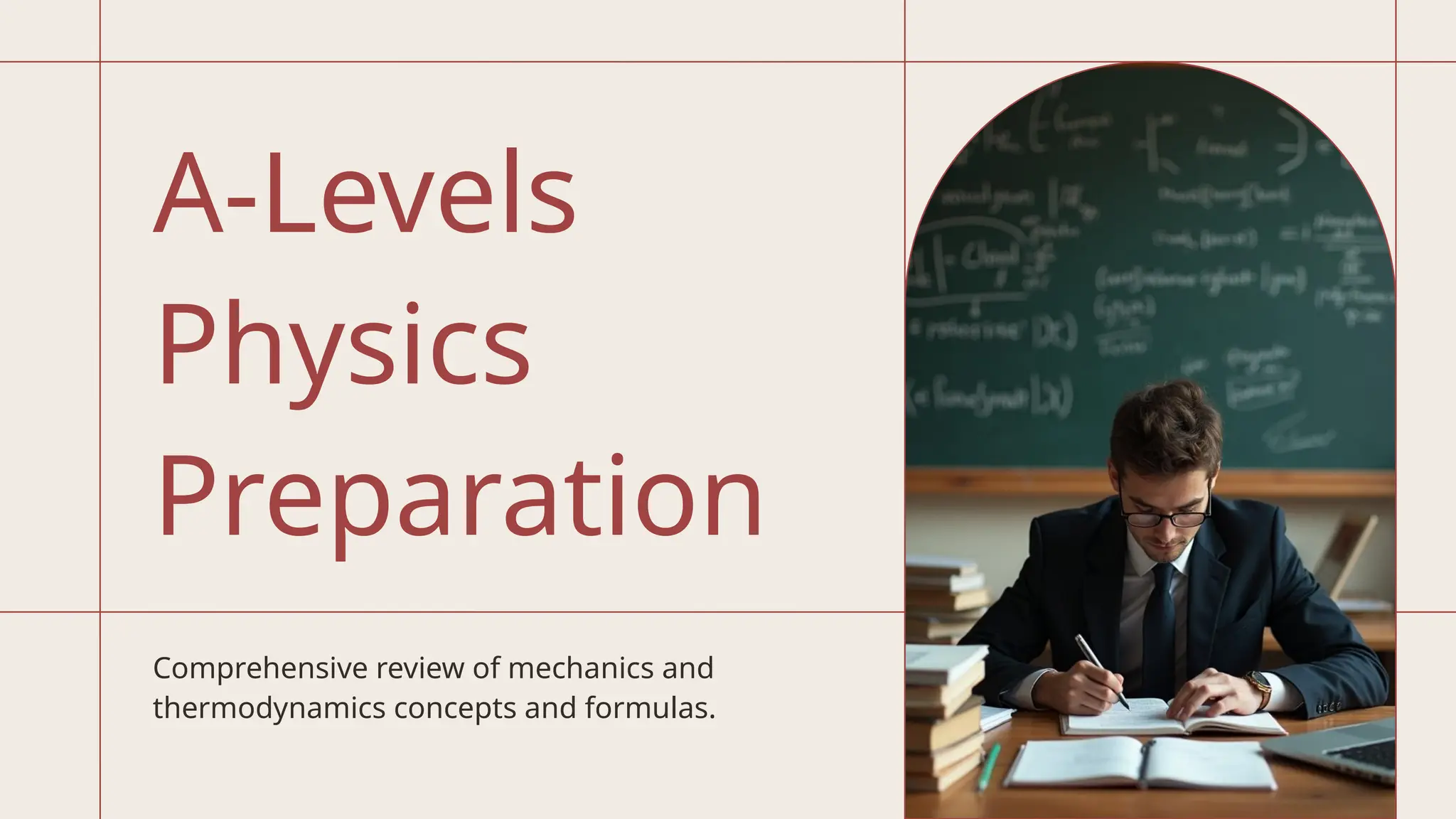
A-Levels
Physics
Preparation
Comprehensive review of mechanics and
thermodynamics concepts and formulas.
Introduction
Mechanics
01
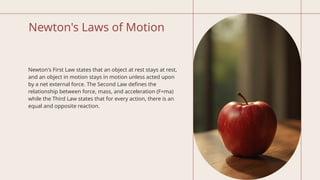
Newton's Laws of Motion
Newton's First Law states that an object at rest stays at rest,
and an object in motion stays in motion unless acted upon
by a net external force. The Second Law defines the
relationship between force, mass, and acceleration (F=ma)
while the Third Law states that for every action, there is an
equal and opposite reaction.
Kinematics Equations
Kinematics equations describe the motion of objects. Key
equations include:
v² = u² + 2as
v = u + at
s = ut + 0.5at², where v is final velocity, u is initial velocity, a is
acceleration, t is time, and s is displacement.
Work, Energy and Power
Work is done when a force causes displacement. The work done
(W) is given by W = Fd cos(θ), where F is the force applied and θ
is the angle between the force and the direction of motion.
Energy is the capacity to do work, while power is the rate of
doing work, defined as P = W/t.
Thermodynamic
s
02
Laws of Thermodynamics
The Zeroth Law defines thermal equilibrium between systems,
the First Law states that energy cannot be created or destroyed
(ΔU = Q - W), the Second Law introduces entropy, indicating that
energy transformations are not 100% efficient, and the Third
Law states that as temperature approaches absolute zero,
entropy approaches a constant minimum.
Heat Transfer Mechanisms
Heat transfer occurs via conduction, convection, and radiation.
Conduction involves direct contact between materials,
convection involves the movement of fluids, and radiation
transfer occurs through electromagnetic waves. Understanding
these mechanisms is crucial for applications like engines and
heat exchangers.
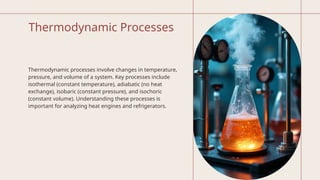
Thermodynamic Processes
Thermodynamic processes involve changes in temperature,
pressure, and volume of a system. Key processes include
isothermal (constant temperature), adiabatic (no heat
exchange), isobaric (constant pressure), and isochoric
(constant volume). Understanding these processes is
important for analyzing heat engines and refrigerators.
Key Formulae
03
Kinematic Formulae
Kinematic formulas describe the motion of objects and are
essential for solving problems related to velocity and
displacement. Key formulas include:
v = u + at
v² = u² + 2as
s = ut + 0.5at², where v is final velocity, u is initial velocity, a is
acceleration, t is time, and s is displacement.
Energy and Work Formulae
Energy and work are critical components in physics. Work done
is calculated as W = Fd cos(θ) where F is force, d is
displacement, and θ is the angle between the force and the
direction of displacement. The kinetic energy formula is KE =
0.5mv² while potential energy is PE = mgh.
Thermodynamic Equations
Key thermodynamic equations include the ideal gas law, PV =
nRT, which relates pressure (P), volume (V), number of moles
(n), gas constant (R), and temperature (T). The First Law of
Thermodynamics is ΔU = Q - W, which indicates the change in
internal energy (ΔU) as a function of heat added (Q) and work
done (W).
Concepts Review
04
Momentum and Impulse
Momentum (p) is the product of mass and velocity (p = mv).
Impulse is the change in momentum resulting from a force
applied over time and is given by Impulse = FΔt. The principle
of conservation of momentum states that in a closed system,
total momentum remains constant when no external forces
act.
Conservation Laws
Conservation laws are essential principles that apply to various
physical phenomena. The law of conservation of energy states
that energy cannot be created or destroyed. Similarly, the law
of conservation of momentum asserts that the total
momentum of a closed system remains constant before and
after interactions, such as collisions.
Heat Engines and Efficiency
Heat engines convert heat energy into mechanical work. The
efficiency of a heat engine is defined as the ratio of work output
to heat input, often expressed as a percentage. Efficiency can
be improved by optimizing the temperature difference between
the heat source and sink, aligning with the Second Law of
Thermodynamics.
Conclusions
In summary, mastering mechanics and thermodynamics is
crucial for A-Level physics students. A firm understanding of
laws, processes, and key equations facilitates the application of
concepts to real-world problems. Effective problem-solving
skills in these areas form the foundation for advanced physics
topics and engineering principles.
CREDITS: This presentation template was created by Slidesgo,
and includes icons, infographics & images by Freepik
Thank you!
Do you have any questions?
+00 000 000 000

A-Levels Physics Preparation for Exams.pptx

  • 1.
    A-Levels Physics Preparation Comprehensive review ofmechanics and thermodynamics concepts and formulas.
  • 2.
  • 3.
  • 4.
    Newton's Laws ofMotion Newton's First Law states that an object at rest stays at rest, and an object in motion stays in motion unless acted upon by a net external force. The Second Law defines the relationship between force, mass, and acceleration (F=ma) while the Third Law states that for every action, there is an equal and opposite reaction.
  • 5.
    Kinematics Equations Kinematics equationsdescribe the motion of objects. Key equations include: v² = u² + 2as v = u + at s = ut + 0.5at², where v is final velocity, u is initial velocity, a is acceleration, t is time, and s is displacement.
  • 6.
    Work, Energy andPower Work is done when a force causes displacement. The work done (W) is given by W = Fd cos(θ), where F is the force applied and θ is the angle between the force and the direction of motion. Energy is the capacity to do work, while power is the rate of doing work, defined as P = W/t.
  • 7.
  • 8.
    Laws of Thermodynamics TheZeroth Law defines thermal equilibrium between systems, the First Law states that energy cannot be created or destroyed (ΔU = Q - W), the Second Law introduces entropy, indicating that energy transformations are not 100% efficient, and the Third Law states that as temperature approaches absolute zero, entropy approaches a constant minimum.
  • 9.
    Heat Transfer Mechanisms Heattransfer occurs via conduction, convection, and radiation. Conduction involves direct contact between materials, convection involves the movement of fluids, and radiation transfer occurs through electromagnetic waves. Understanding these mechanisms is crucial for applications like engines and heat exchangers.
  • 10.
    Thermodynamic Processes Thermodynamic processesinvolve changes in temperature, pressure, and volume of a system. Key processes include isothermal (constant temperature), adiabatic (no heat exchange), isobaric (constant pressure), and isochoric (constant volume). Understanding these processes is important for analyzing heat engines and refrigerators.
  • 11.
  • 12.
    Kinematic Formulae Kinematic formulasdescribe the motion of objects and are essential for solving problems related to velocity and displacement. Key formulas include: v = u + at v² = u² + 2as s = ut + 0.5at², where v is final velocity, u is initial velocity, a is acceleration, t is time, and s is displacement.
  • 13.
    Energy and WorkFormulae Energy and work are critical components in physics. Work done is calculated as W = Fd cos(θ) where F is force, d is displacement, and θ is the angle between the force and the direction of displacement. The kinetic energy formula is KE = 0.5mv² while potential energy is PE = mgh.
  • 14.
    Thermodynamic Equations Key thermodynamicequations include the ideal gas law, PV = nRT, which relates pressure (P), volume (V), number of moles (n), gas constant (R), and temperature (T). The First Law of Thermodynamics is ΔU = Q - W, which indicates the change in internal energy (ΔU) as a function of heat added (Q) and work done (W).
  • 15.
  • 16.
    Momentum and Impulse Momentum(p) is the product of mass and velocity (p = mv). Impulse is the change in momentum resulting from a force applied over time and is given by Impulse = FΔt. The principle of conservation of momentum states that in a closed system, total momentum remains constant when no external forces act.
  • 17.
    Conservation Laws Conservation lawsare essential principles that apply to various physical phenomena. The law of conservation of energy states that energy cannot be created or destroyed. Similarly, the law of conservation of momentum asserts that the total momentum of a closed system remains constant before and after interactions, such as collisions.
  • 18.
    Heat Engines andEfficiency Heat engines convert heat energy into mechanical work. The efficiency of a heat engine is defined as the ratio of work output to heat input, often expressed as a percentage. Efficiency can be improved by optimizing the temperature difference between the heat source and sink, aligning with the Second Law of Thermodynamics.
  • 19.
    Conclusions In summary, masteringmechanics and thermodynamics is crucial for A-Level physics students. A firm understanding of laws, processes, and key equations facilitates the application of concepts to real-world problems. Effective problem-solving skills in these areas form the foundation for advanced physics topics and engineering principles.
  • 20.
    CREDITS: This presentationtemplate was created by Slidesgo, and includes icons, infographics & images by Freepik Thank you! Do you have any questions? +00 000 000 000