Fundamental concepts
Algebra involvesthe study of mathematical symbols and the rules
for manipulating these symbols. It is essential to understand
variables, constants, coefficients, and algebraic expressions.
Familiarity with operations such as addition, subtraction,
multiplication, and division, as well as the properties of equality
and inequalities, form the foundation for solving algebraic
equations.
5.
Equations and inequalities
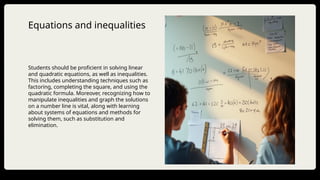
Studentsshould be proficient in solving linear
and quadratic equations, as well as inequalities.
This includes understanding techniques such as
factoring, completing the square, and using the
quadratic formula. Moreover, recognizing how to
manipulate inequalities and graph the solutions
on a number line is vital, along with learning
about systems of equations and methods for
solving them, such as substitution and
elimination.
6.
Functions and theirproperties
Functions are fundamental in mathematics, representing
relationships between sets of elements. Key properties include the
domain, range, and types of functions such as linear, polynomial,
and exponential functions. Understanding the concept of one-to-
one and onto functions, along with transformations like
translations and reflections, is essential for analyzing graphs and
their behaviors.
Limits and continuity
Limitsare critical in calculus, defining the
behavior of functions as they approach specific
points. Understanding left-hand and right-hand
limits, infinite limits, and limits at infinity is
paramount. Continuity indicates whether a
function's graph can be drawn without lifting the
pencil, and it is crucial for applying many
calculus concepts. A function is continuous if it is
defined at a point and the limit exists and equals
the function's value at that point.
9.
Differentiation techniques
Differentiation isthe process of finding the derivative of a
function, representing its rate of change. Techniques include the
power rule, product rule, quotient rule, and chain rule. Mastery of
these rules allows students to differentiate polynomial,
trigonometric, logarithmic, and exponential functions.
Additionally, implicit differentiation and differentiating parametric
equations expand the toolkit for solving complex problems.
10.
Applications of differentiation
Differentiationhas numerous applications in various fields such as
physics, engineering, and economics. Students will learn to find
the slope of tangent lines, optimize functions to find maxima and
minima, and apply derivatives to analyze the behavior of graphs,
including increasing/decreasing intervals and inflection points.
Furthermore, real-world problems, such as motion and growth
rates, highlight the importance of derivatives in practical
scenarios.
11.
Conclusions
In summary, masteringalgebra and calculus
topics is vital for success in A Levels
Mathematics. A solid understanding of
functions, limits, continuity, and differentiation
lays a strong foundation for exam preparation
and future mathematical applications. Students
are encouraged to practice and apply these
concepts to enhance their comprehension and
problem-solving skills.
12.
CREDITS: This presentationtemplate was
created by Slidesgo, and includes icons,
infographics & images by Freepik
Thank you!
Do you have any questions?
w w w .
y o u r
w e b s i
t
e .
c o m