A language of patterns for mathematical learning Yishay Mor, London Knowledge Lab [email_address] 10 April, 2008, Department of Education in Technology and Science, Technion, Haifa
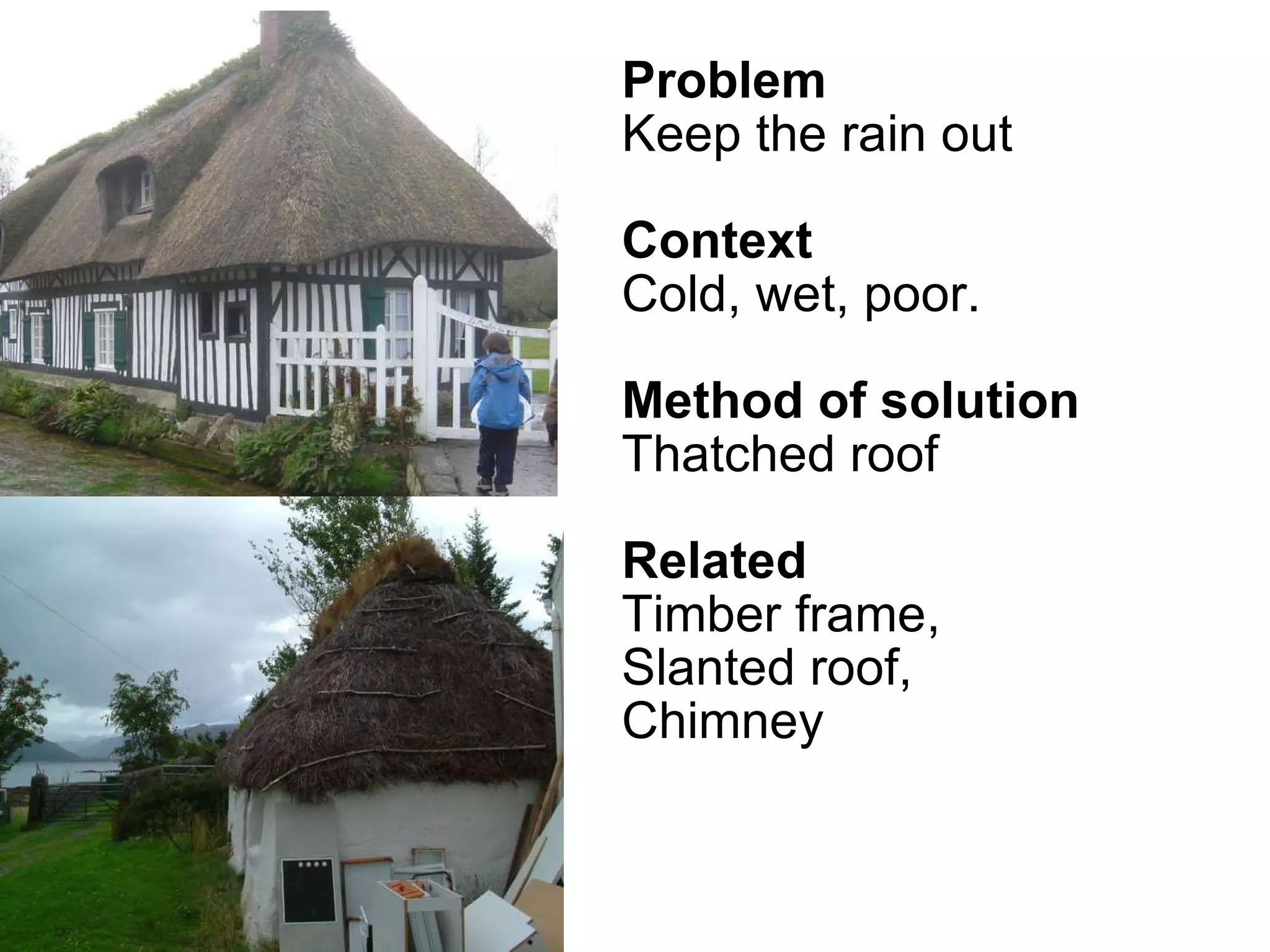
Problem Keep the rain out Context Cold, wet, poor. Method of solution Thatched roof Related Timber frame,  Slanted roof, Chimney
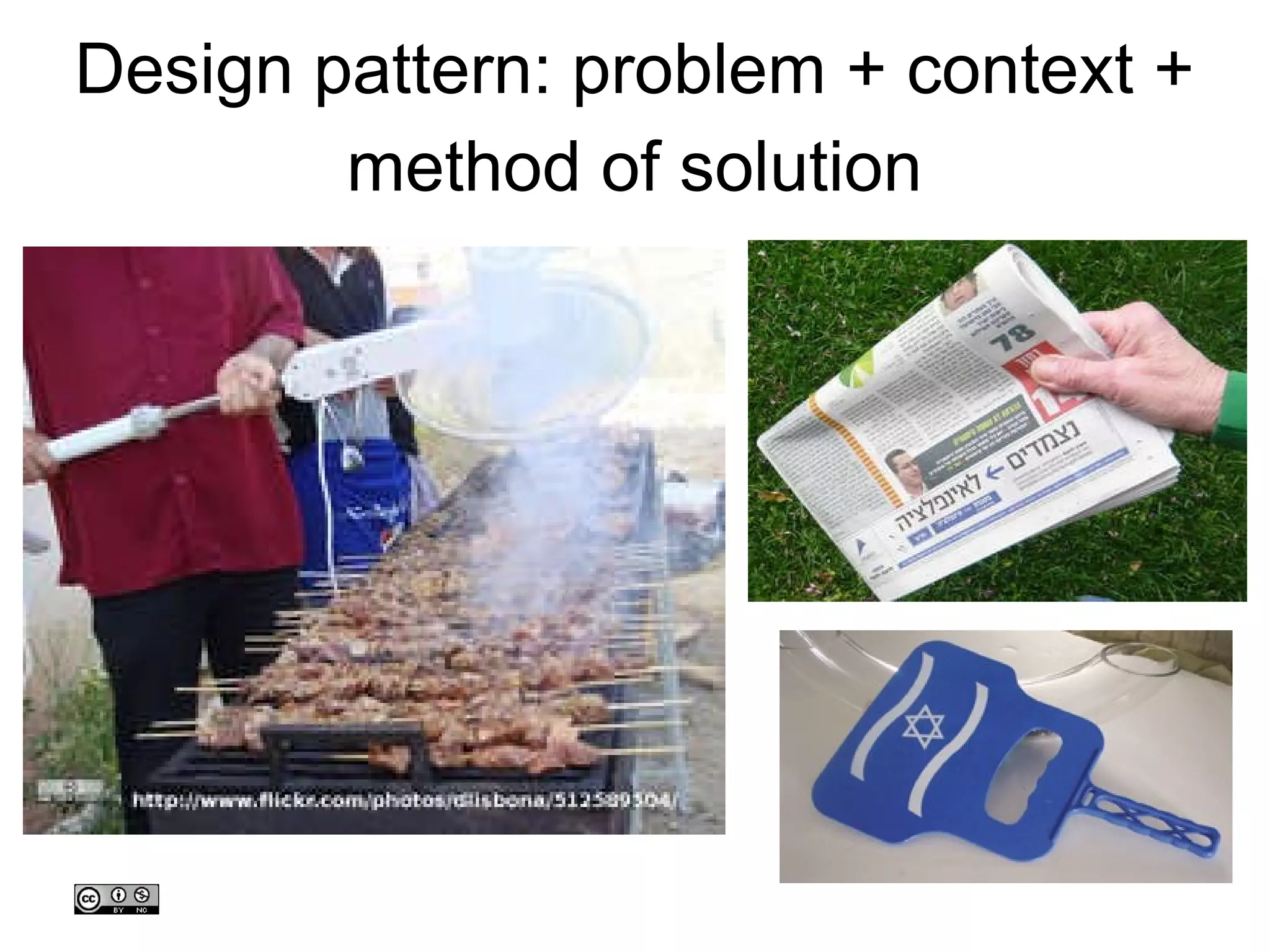
Design pattern: problem + context + method of solution
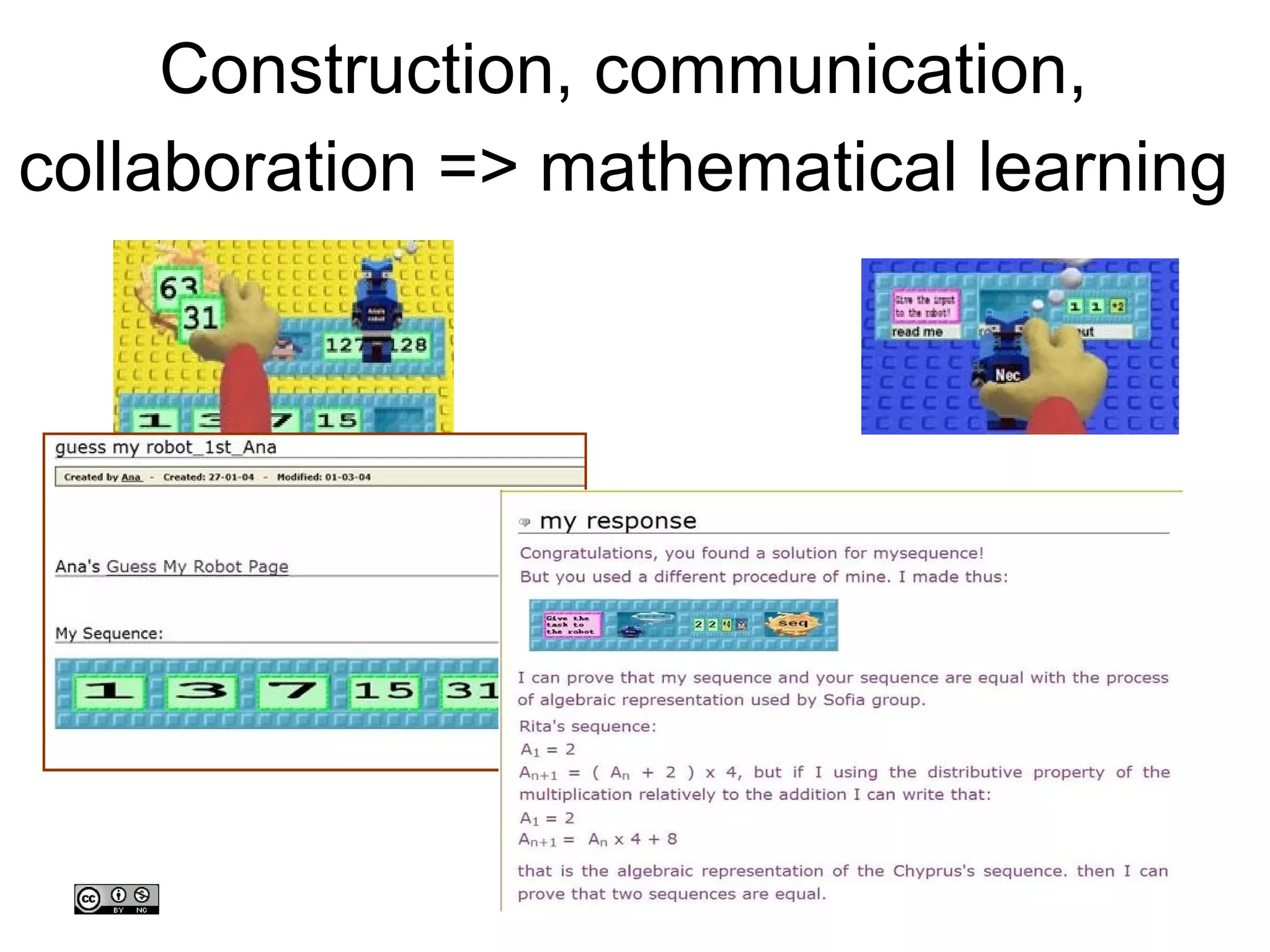
Construction, communication, collaboration => mathematical learning
The Problem Learning mathematics is a complex business. Building technology is a complex business. Building technology for learning mathematics is complex 2 . Even when someone gets it right, success is hard to replicate.
WebLabs ( http://www.weblabs.eu.com )‏ EU  funded, Sept.  2002 –  Sept.  2005,  directed by professors  Richard Noss  and  Celia Hoyles.  Grant # IST-2001-32200. Students & researchers from UK, Italy, Sweden, Bulgaria, Portugal, Cyprus. creating new ways of  representing  and expressing  mathematical and scientific knowledge  in European communities of young learners ( 10 – 14 ).  Our aim was to transform the  web  into a  medium  in which European students  collaboratively construct and critique  each others' evolving knowledge and  working models .
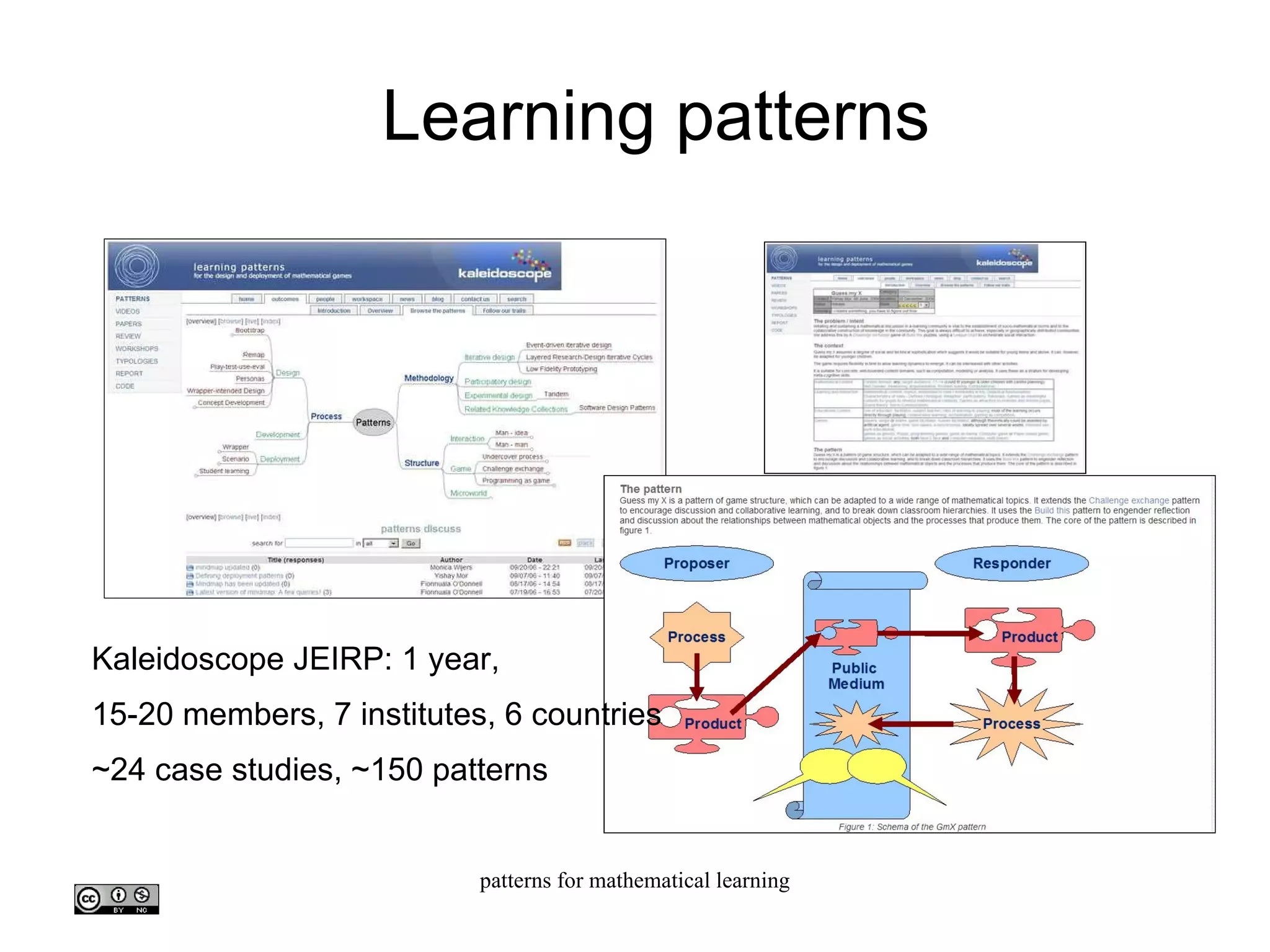
Learning patterns Kaleidoscope JEIRP: 1 year,  15-20 members, 7 institutes, 6 countries ~24 case studies, ~150 patterns
Today's talk Design science and design patterns (the short version). Context – number sequences, construction, collaboration. A bit of theory. Some patterns. Future work.
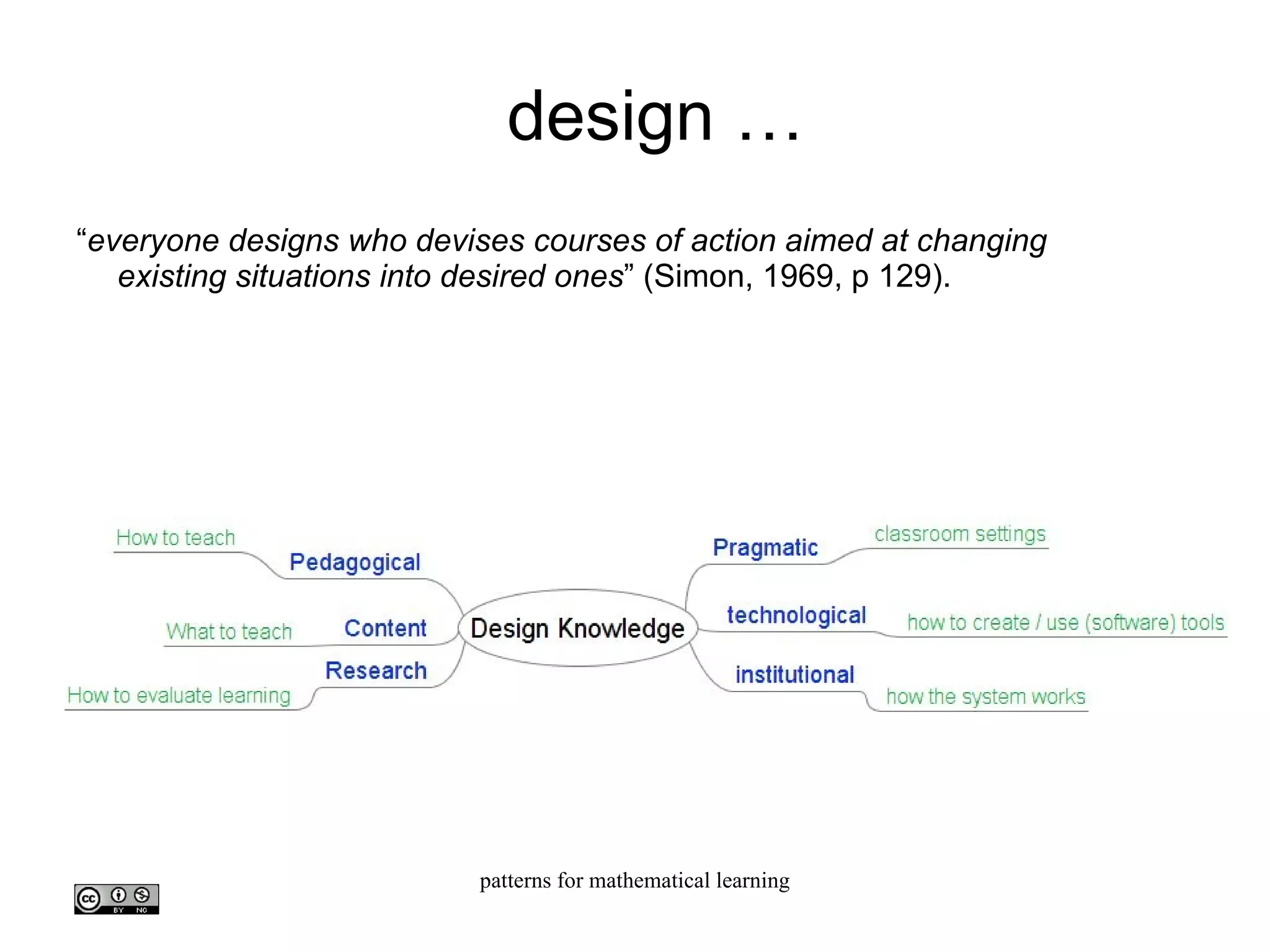
design … “ everyone designs who devises courses of action aimed at changing existing situations into desired ones ” (Simon, 1969, p 129).
…  based research Design based research is a methodology for the study of function. Often referred to as design research or design experiments. Concerned with the design of learning processes, taking account of the involved complexities, multiple levels and contexts of educational settings.  The primary aim is to develop  domain-specific theories  in order to understand the learning process. (Mor & Winters, 2006)‏
Design patterns [describe] a problem which occurs over and over again in our environment, and then describes the core of the solution to that problem, in such a way that you can use this solution a million times over, without ever doing it the same way twice (Alexander et al., 1977)‏
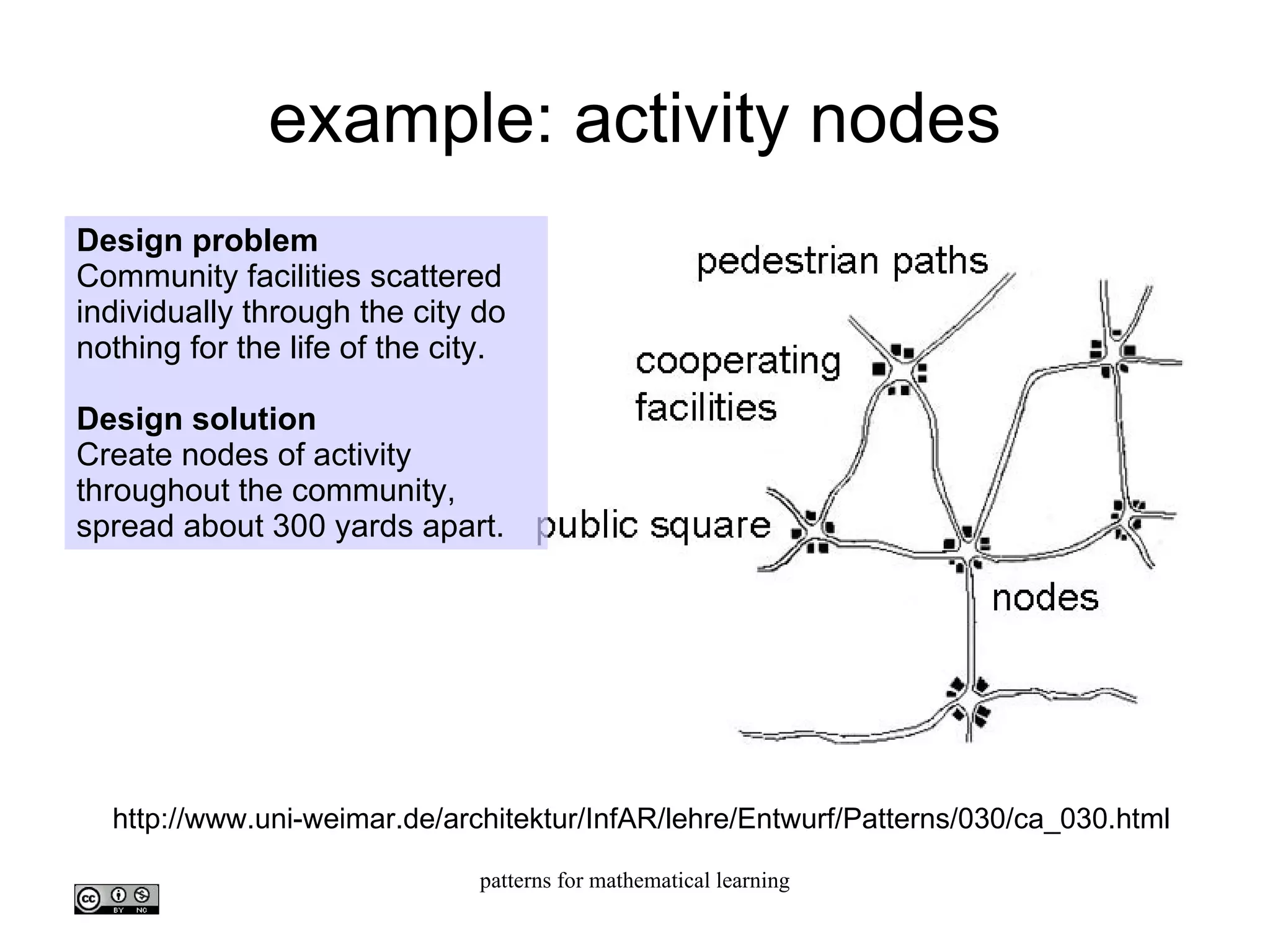
example: activity nodes Design problem Community facilities scattered individually through the city do nothing for the life of the city. Design solution Create nodes of activity throughout the community, spread about 300 yards apart.  http://www.uni-weimar.de/architektur/InfAR/lehre/Entwurf/Patterns/030/ca_030.html
 
pattern structure Problem / intent Context Solution Examples Related patterns Notes
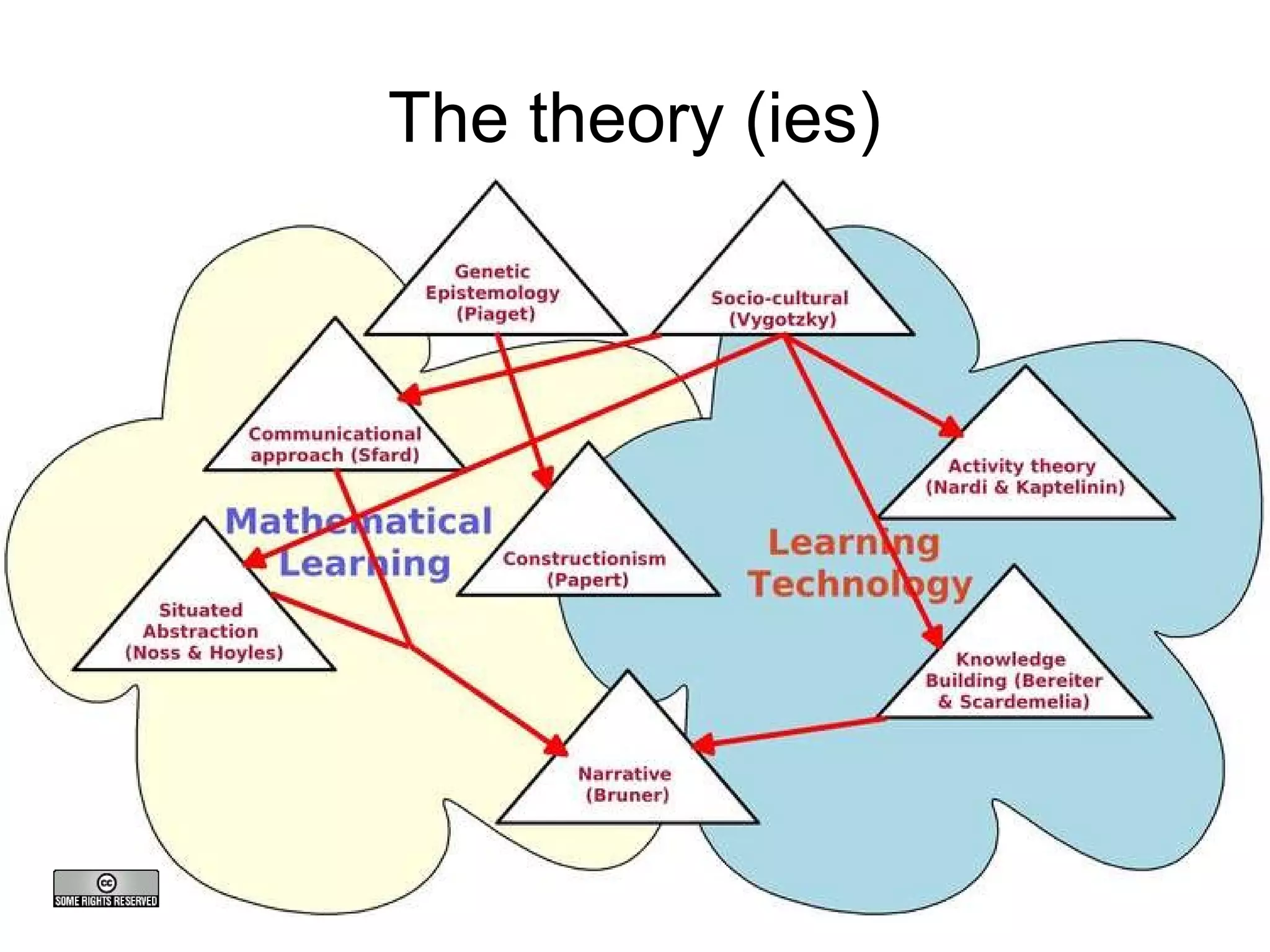
The theory (ies)‏
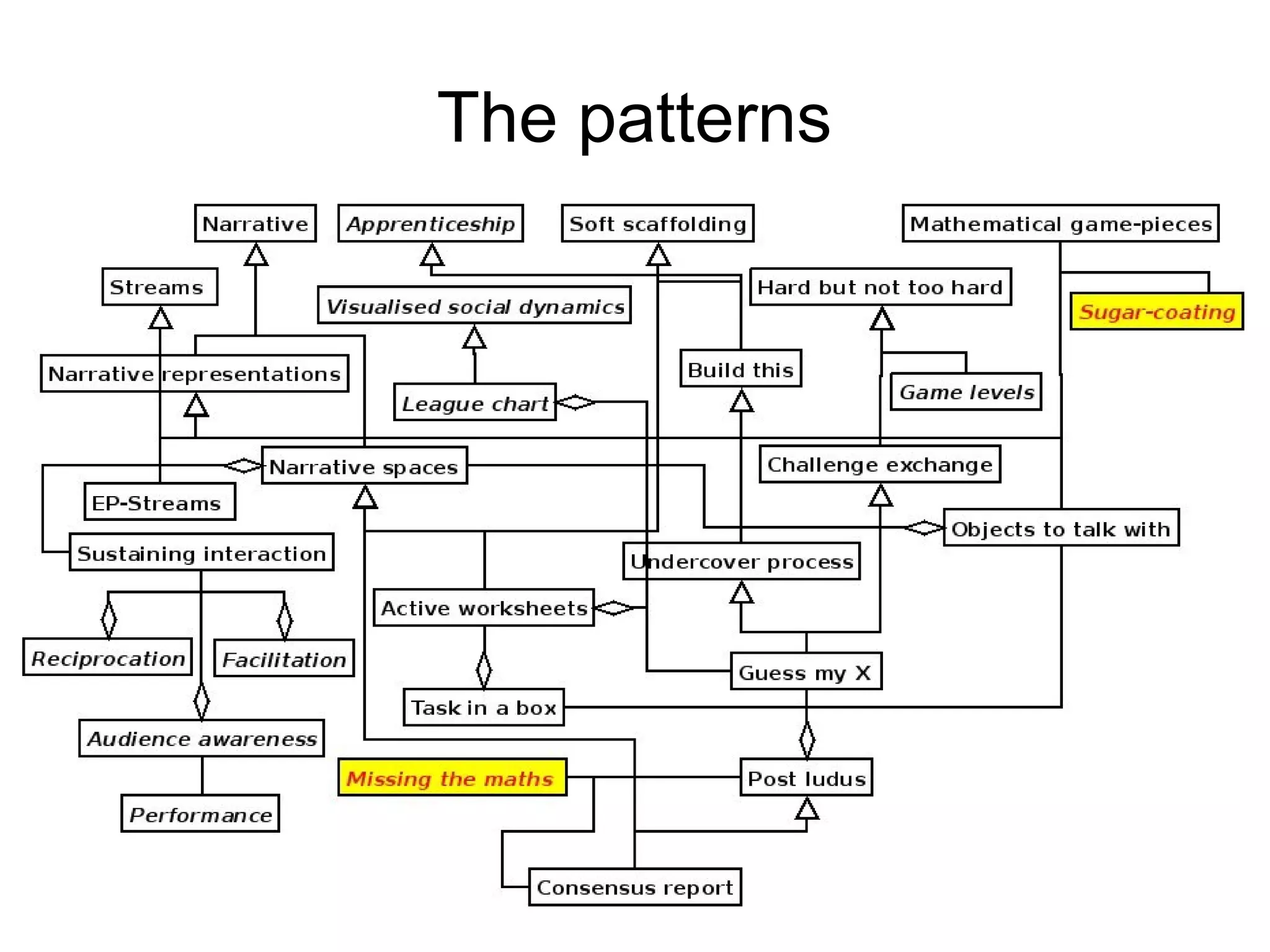
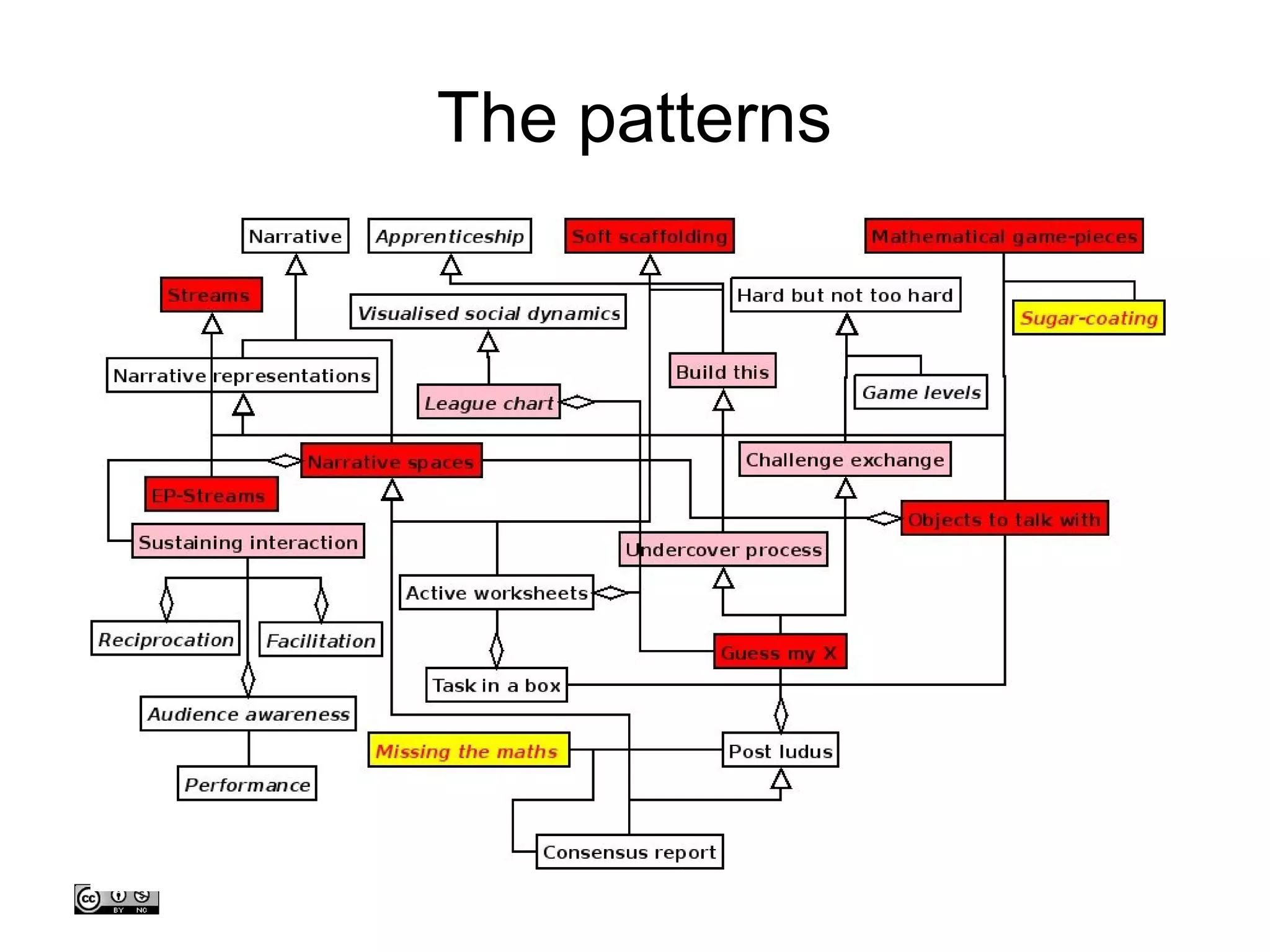
The patterns
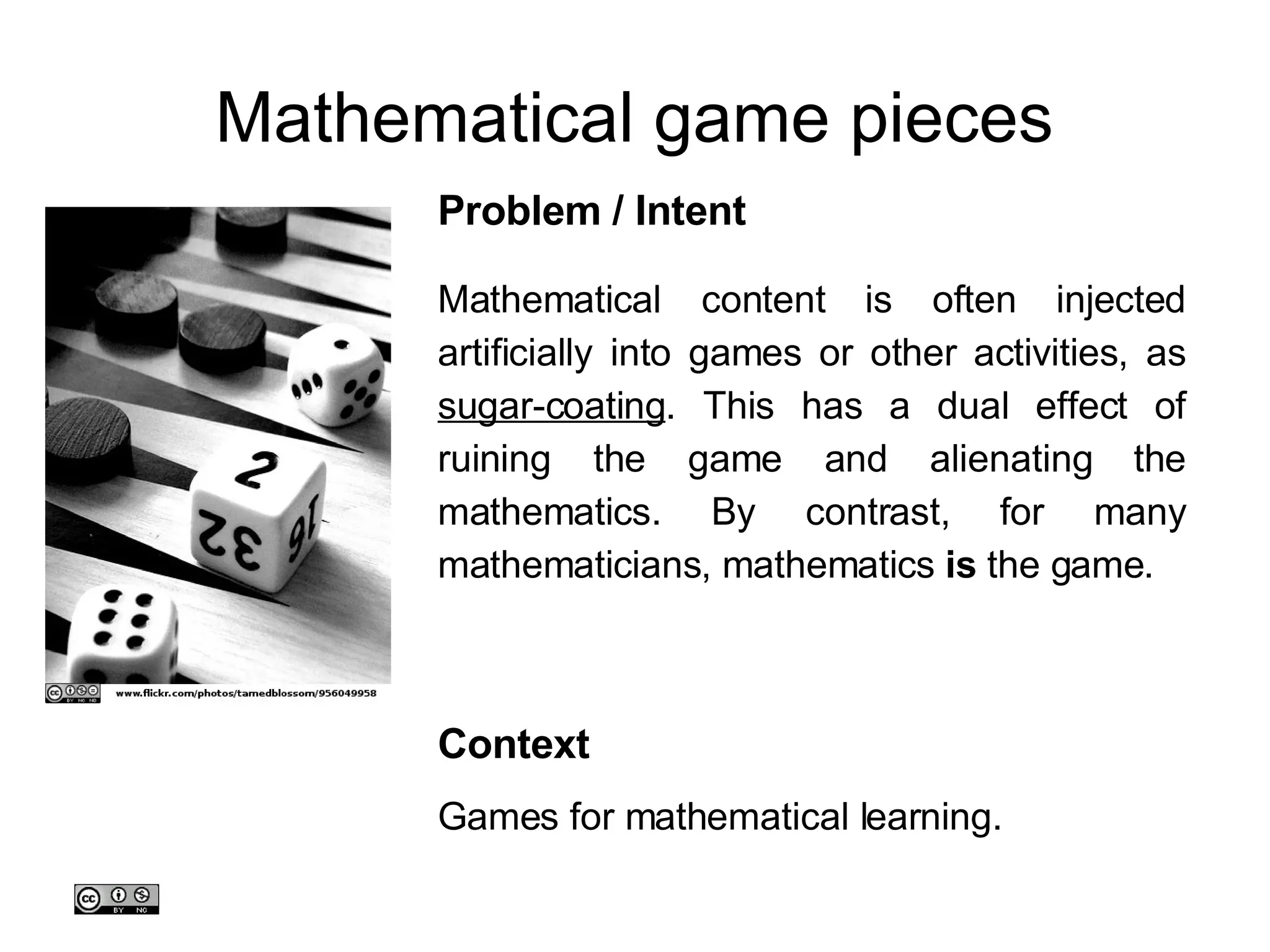
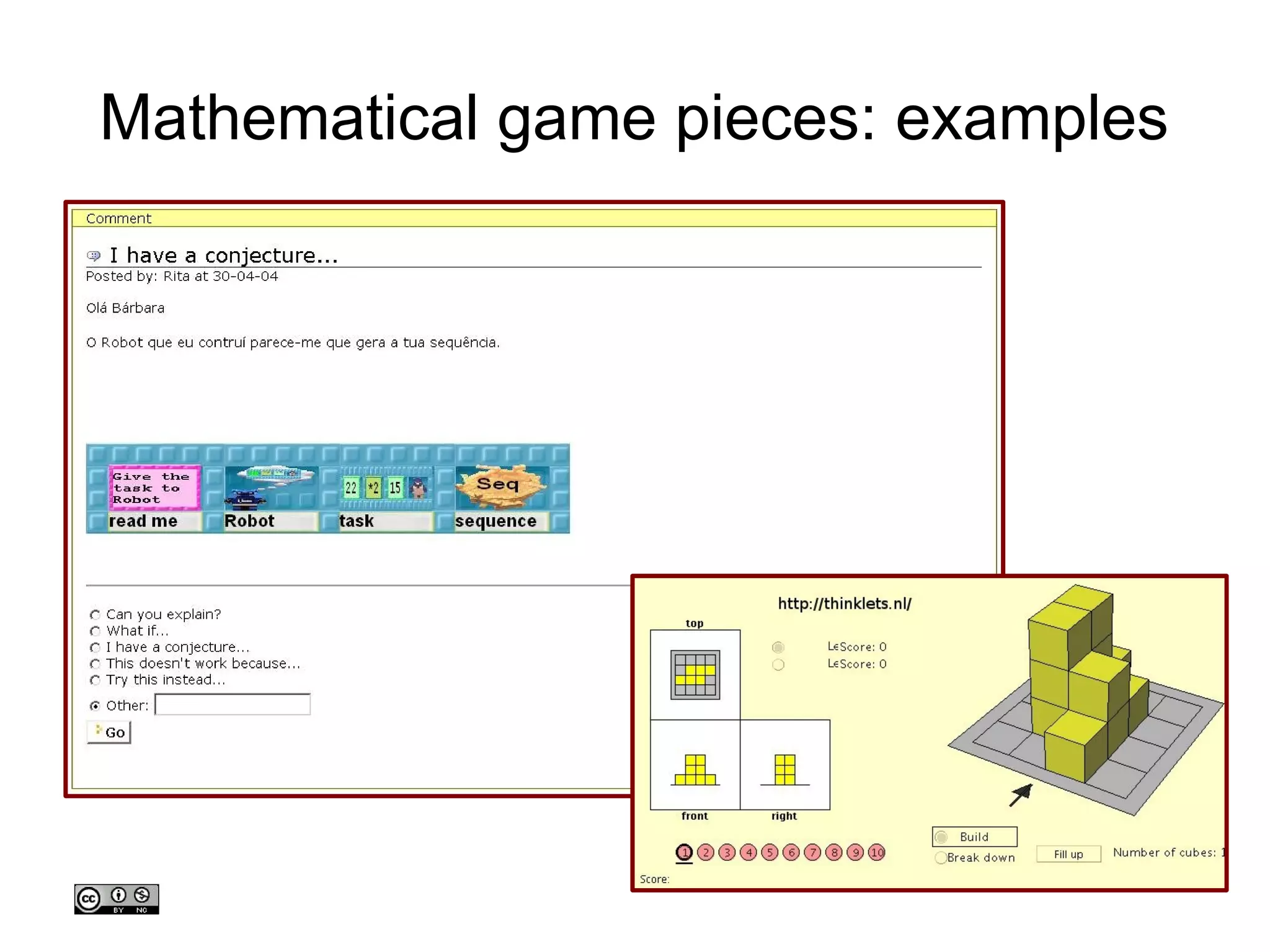
Mathematical game pieces Mathematical content is often injected artificially into games or other activities, as  sugar-coating . This has a dual effect of ruining the game and alienating the mathematics. By contrast, for many mathematicians, mathematics  is  the game.  Problem / Intent Context Games for mathematical learning.
Mathematical game pieces (II)‏ Identify an element of the mathematical content you wish to address in this game. Find a visual, animated or tangible representation of this element which is consistent with the game metaphors. Design your game so that these objects have clear  purpose and utility  as game elements in the gameplay structure.
Mathematical game pieces: examples
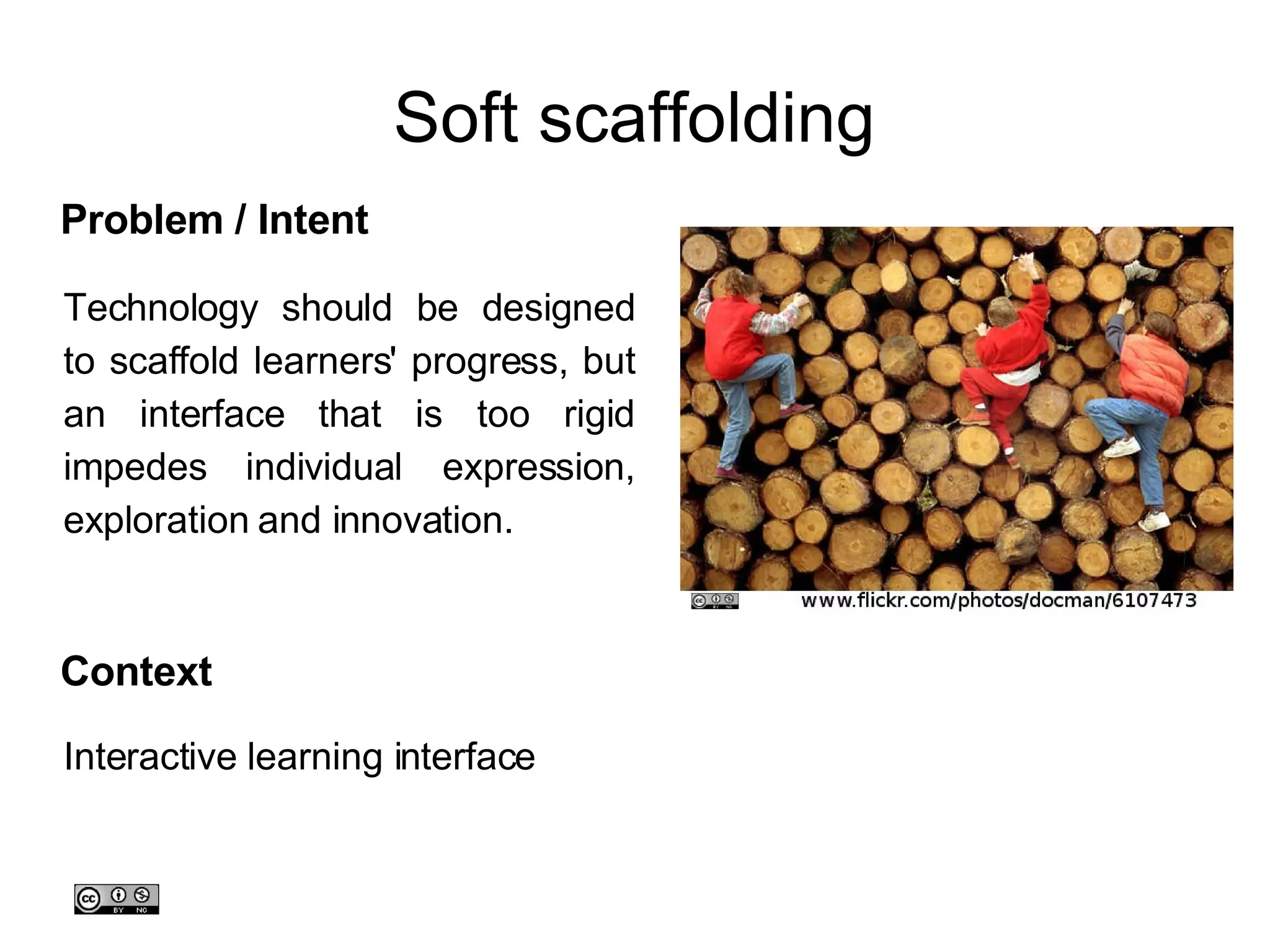
Soft scaffolding Technology should be designed to scaffold learners' progress, but an interface that is too rigid impedes individual expression, exploration and innovation.  Problem / Intent Context Interactive learning interface
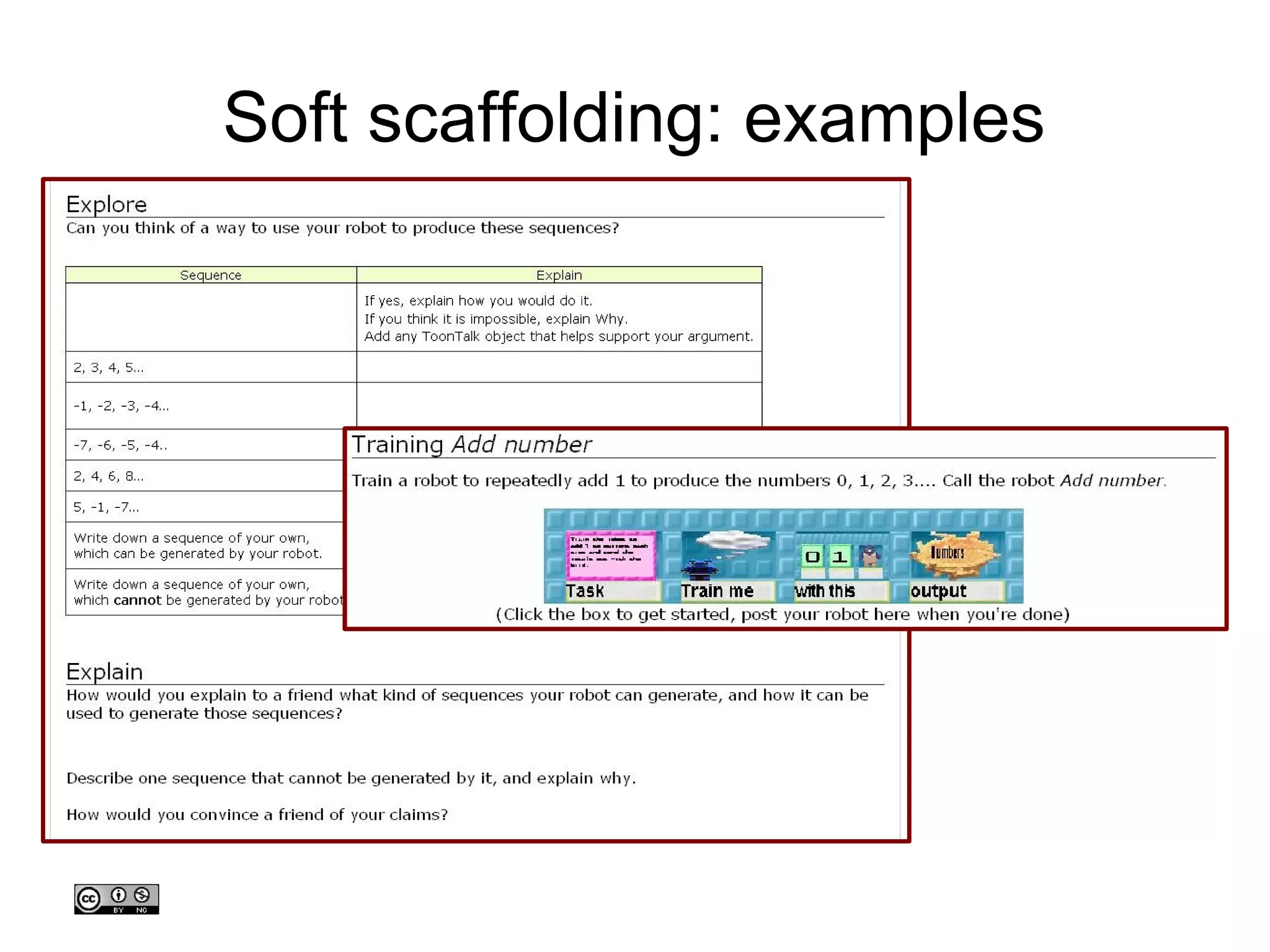
Soft scaffolding (II)‏ Provide scaffolding which can easily be overridden by the learner or by the instructor. Let the scaffolding be a guideline, a recommendation which is easier to follow than not, but leave the choice in the hands of the learner. For example: When providing a multiple-selection interface, always include an open choice, which the user can specify (select 'other' and fill in text box). When the user is about to stray off the desired path of activity, warn her, ask for confirmation, but do not block her.
Soft scaffolding: examples
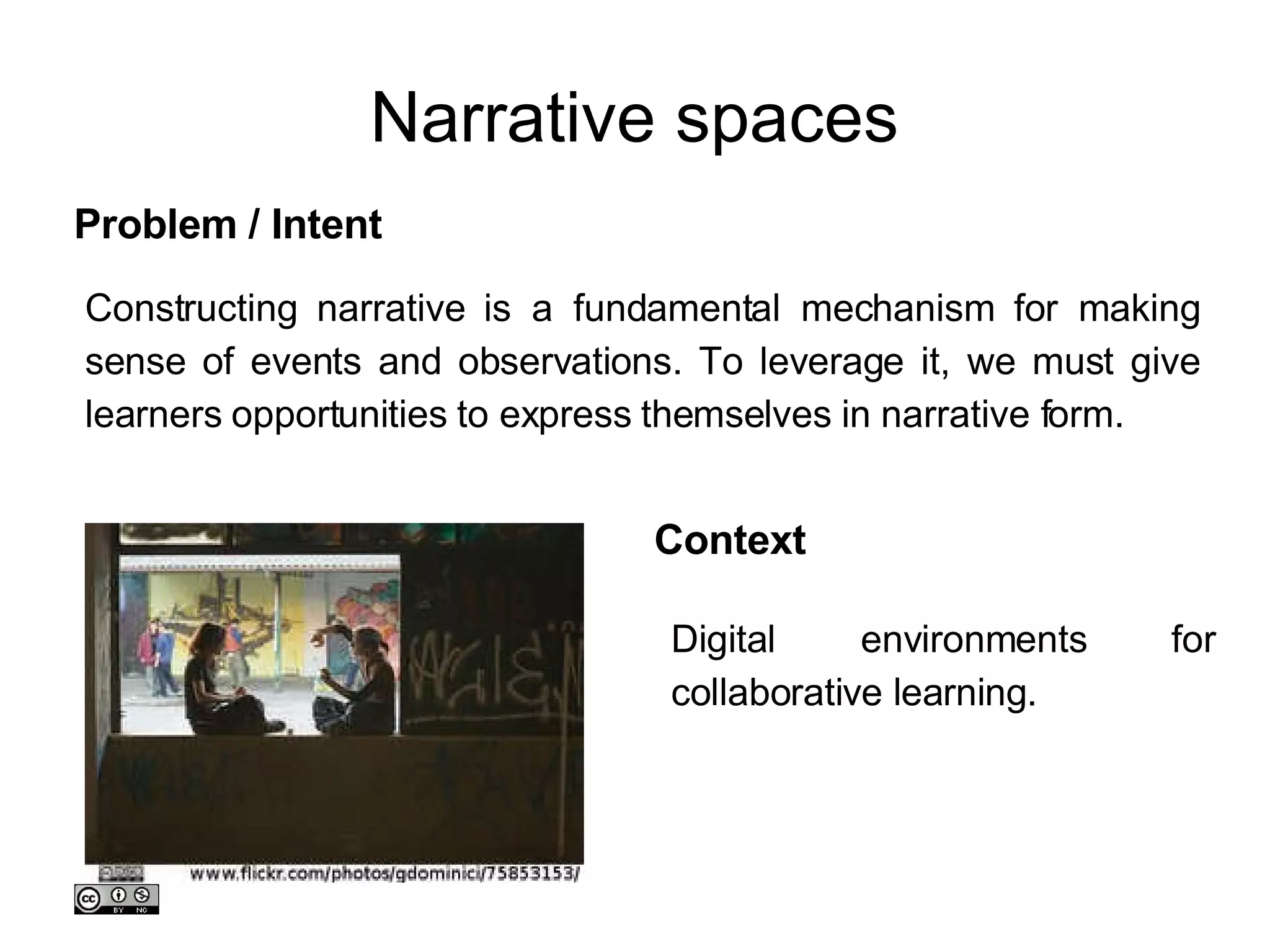
Narrative spaces Constructing narrative is a fundamental mechanism for making sense of events and observations. To leverage it, we must give learners opportunities to express themselves in narrative form.  Problem / Intent Context Digital environments for collaborative learning.
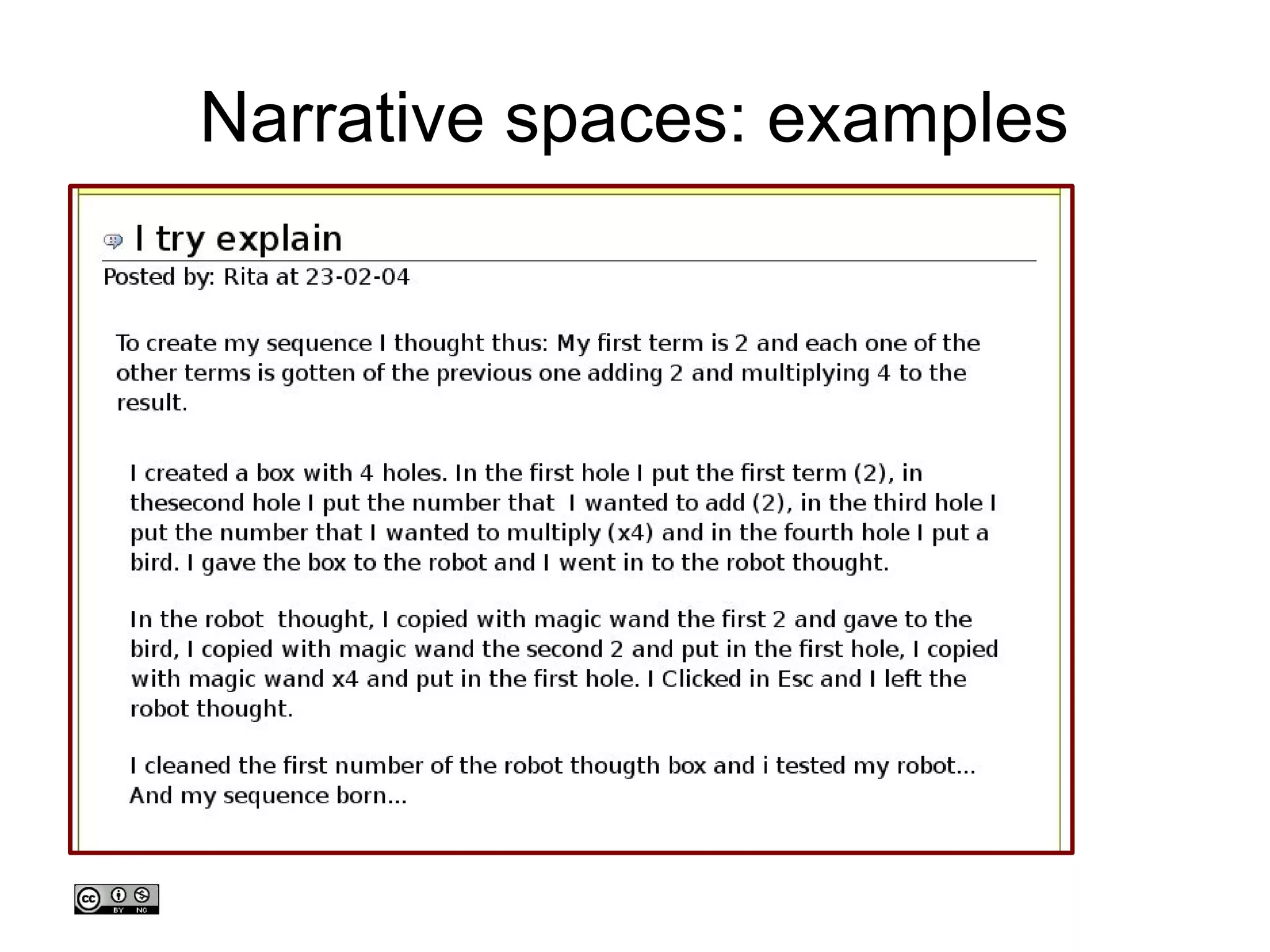
Narrative spaces (II)‏ Provide learners with a narrative space: a medium, integrated with the activity design, which allows learners to express and explore ideas in a narrative form: Allow for free-form text, e.g. by supporting  soft scaffolding . Choose  narrative representations  when possible. Mark narrative elements in the medium:  Clearly mark the speaker / author, to support a sense of voice.  Date contributions to support temporal sequentiality ('plot'). Use  semi-automated meta-data  to provide context.
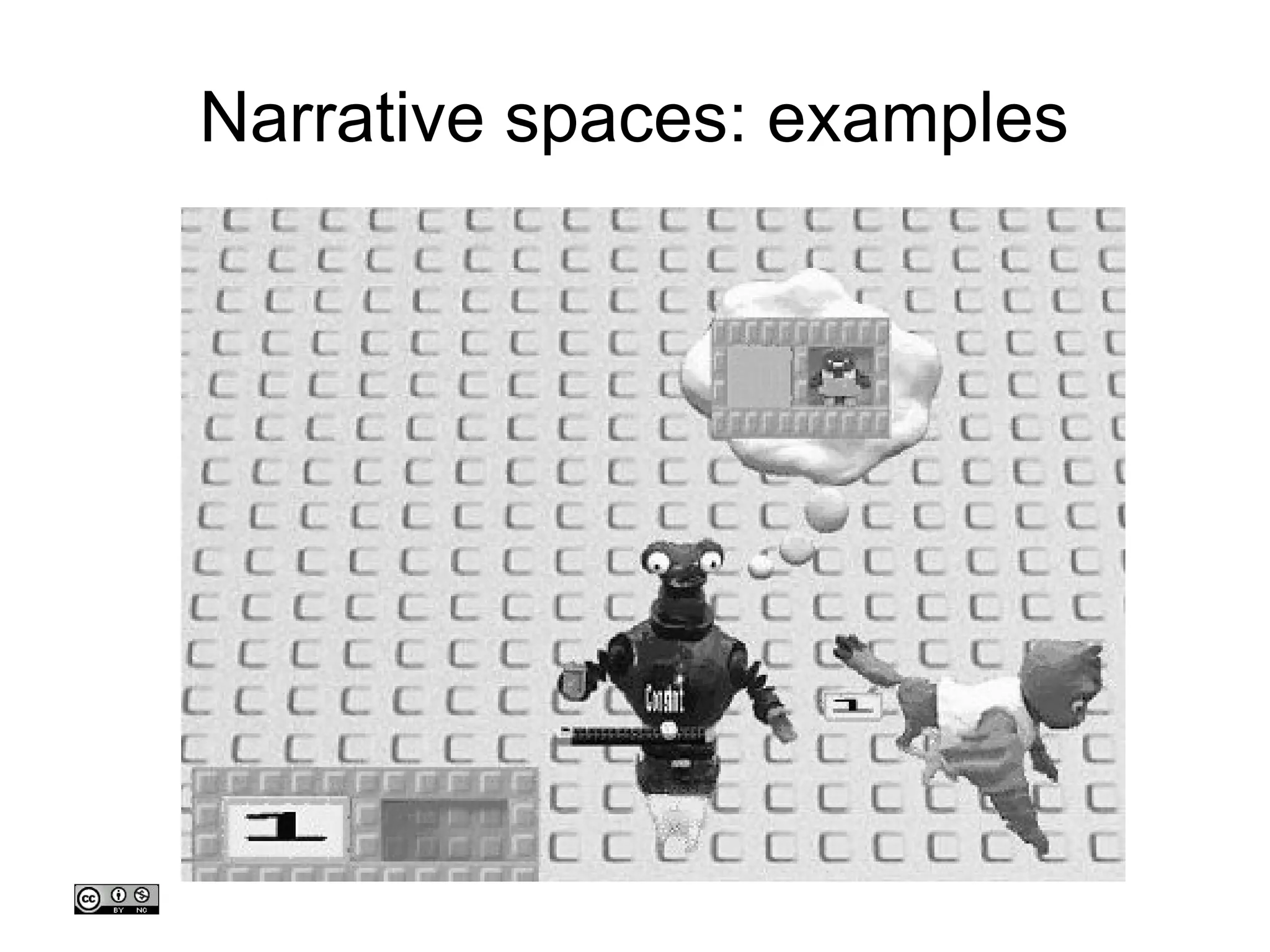
Narrative spaces: examples
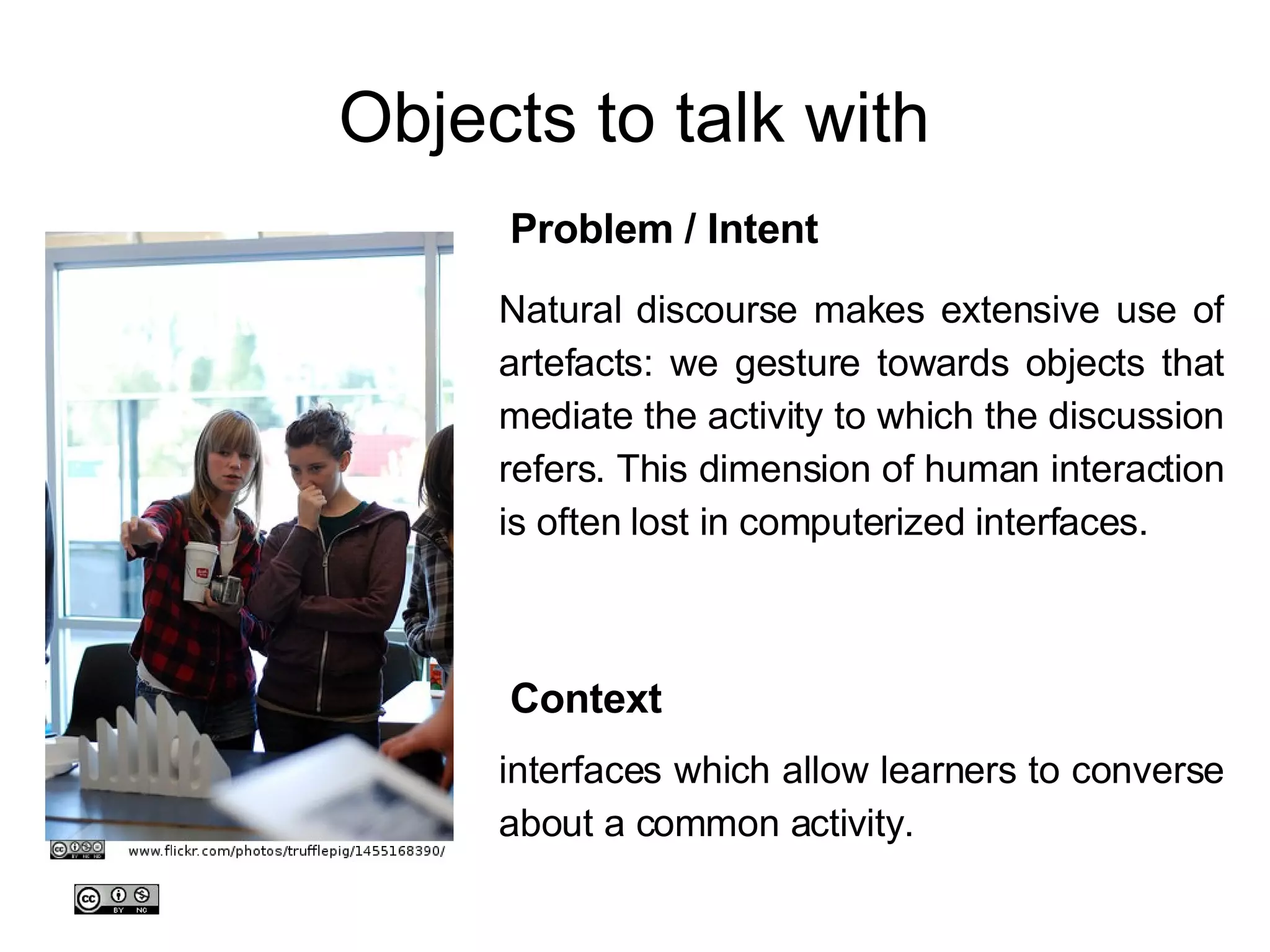
Objects to talk with Natural discourse makes extensive use of artefacts: we gesture towards objects that mediate the activity to which the discussion refers. This dimension of human interaction is often lost in computerized interfaces. Problem / Intent interfaces which allow learners to converse about a common activity.  Context
Objects to talk with (II)‏ Learning activities often involve the use or construction of artefacts. When providing tools for learners to discuss their experience, allow them to easily include these artefacts in the discussion.  If the activity is mediated by or aims to produce digital artefacts, then the discussion medium should allow embedding of these artefacts. The medium should support a visual (graphical, symbolic, animated or simulated) 1:1 representation of these objects.
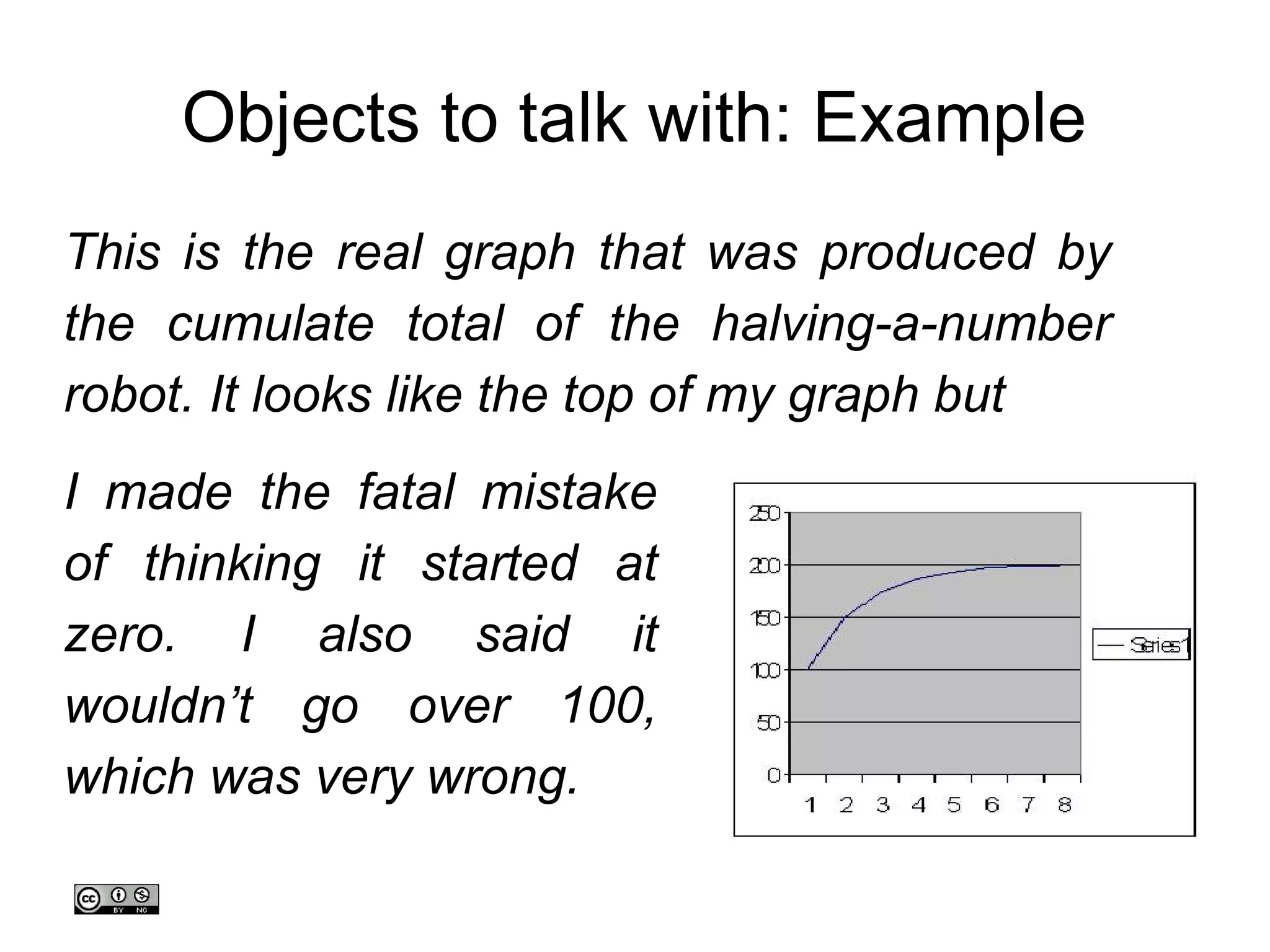
Objects to talk with: Example This is the real graph that was produced by the cumulate total of the halving-a-number robot. It looks like the top of my graph but  I made the fatal mistake of thinking it started at zero. I also said it wouldn’t go over 100, which was very wrong.
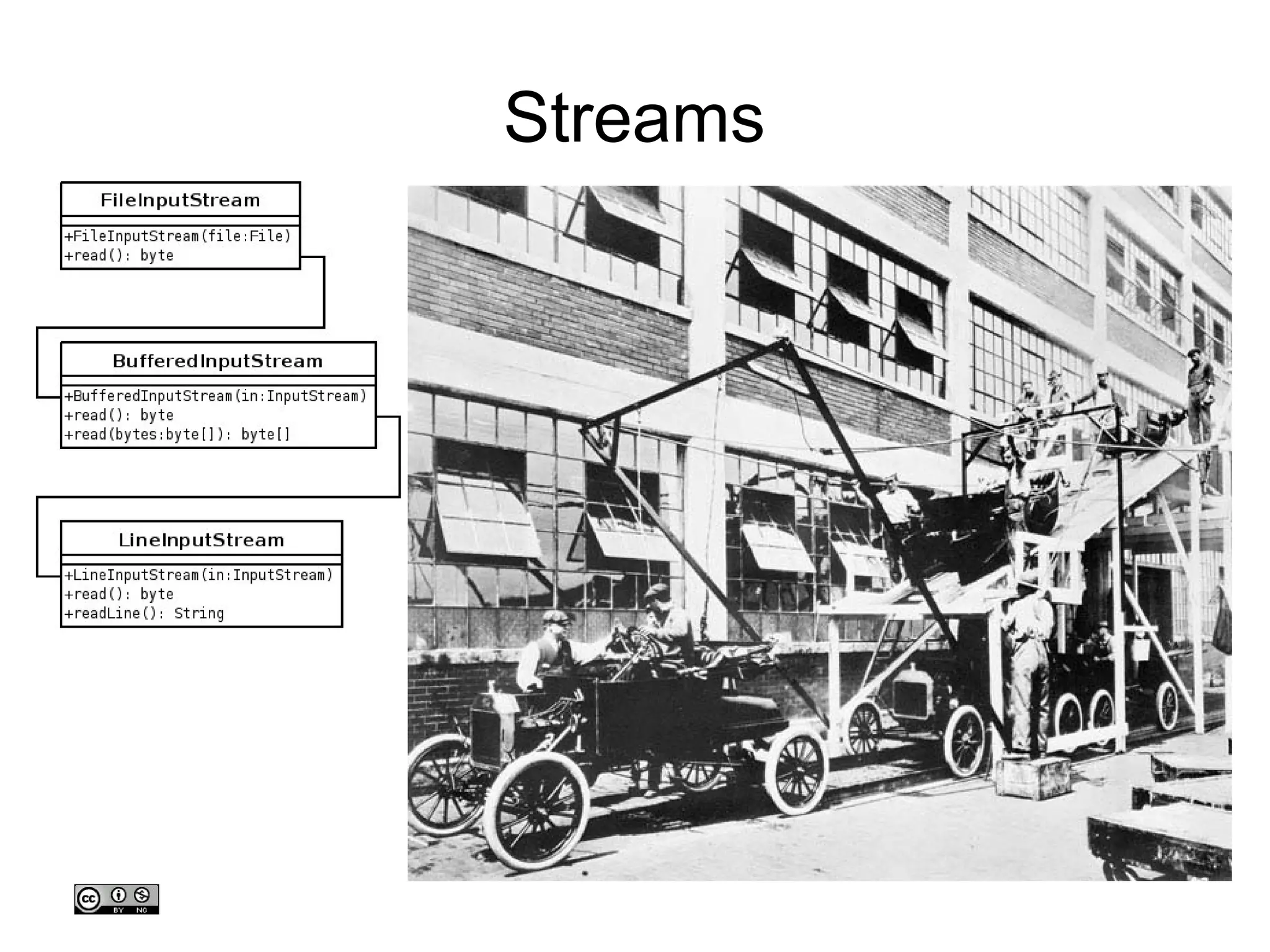
Streams
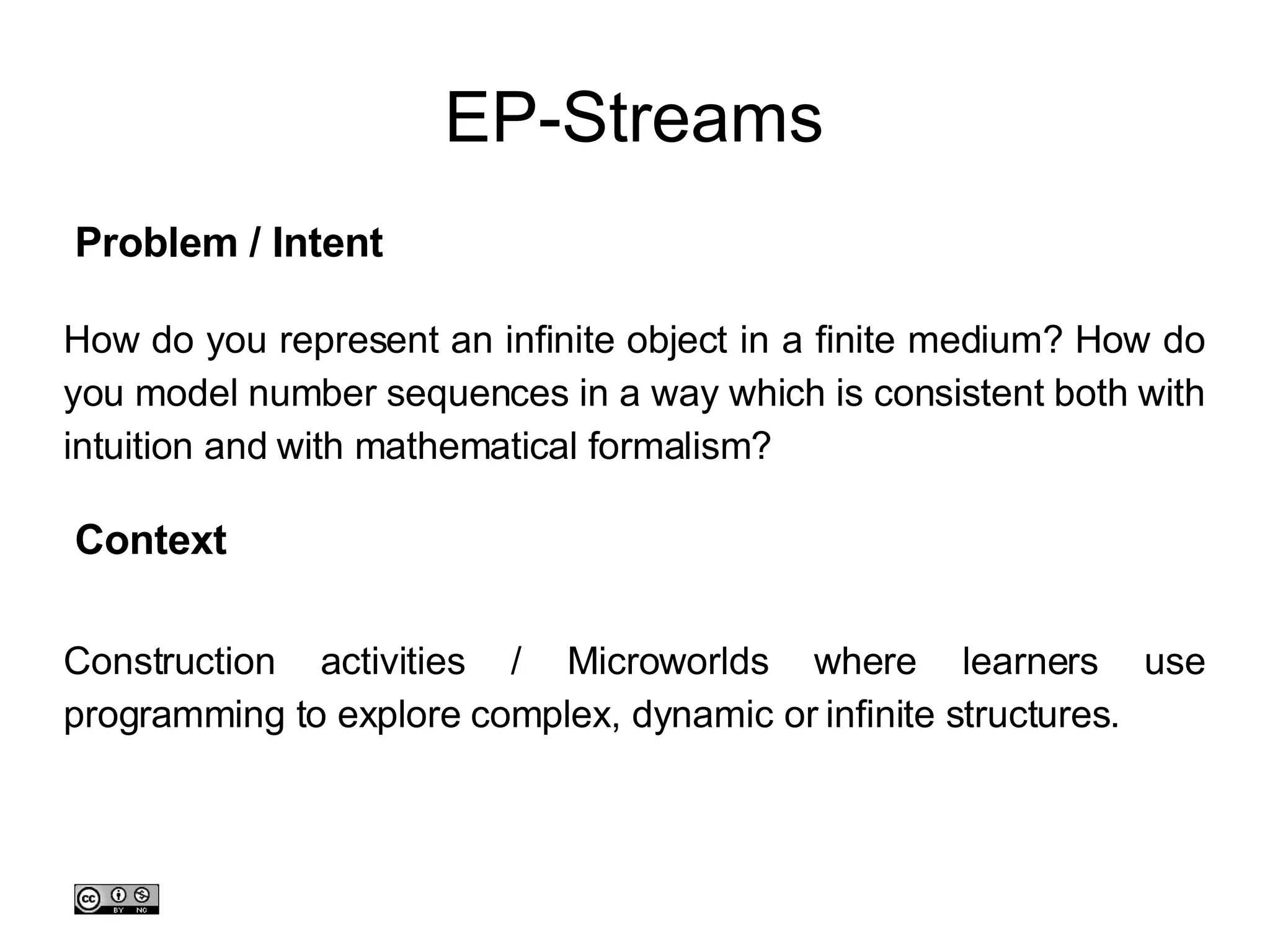
EP-Streams How do you represent an infinite object in a finite medium? How do you model number sequences in a way which is consistent both with intuition and with mathematical formalism? Construction activities / Microworlds where learners use programming to explore complex, dynamic or infinite structures. Problem / Intent Context
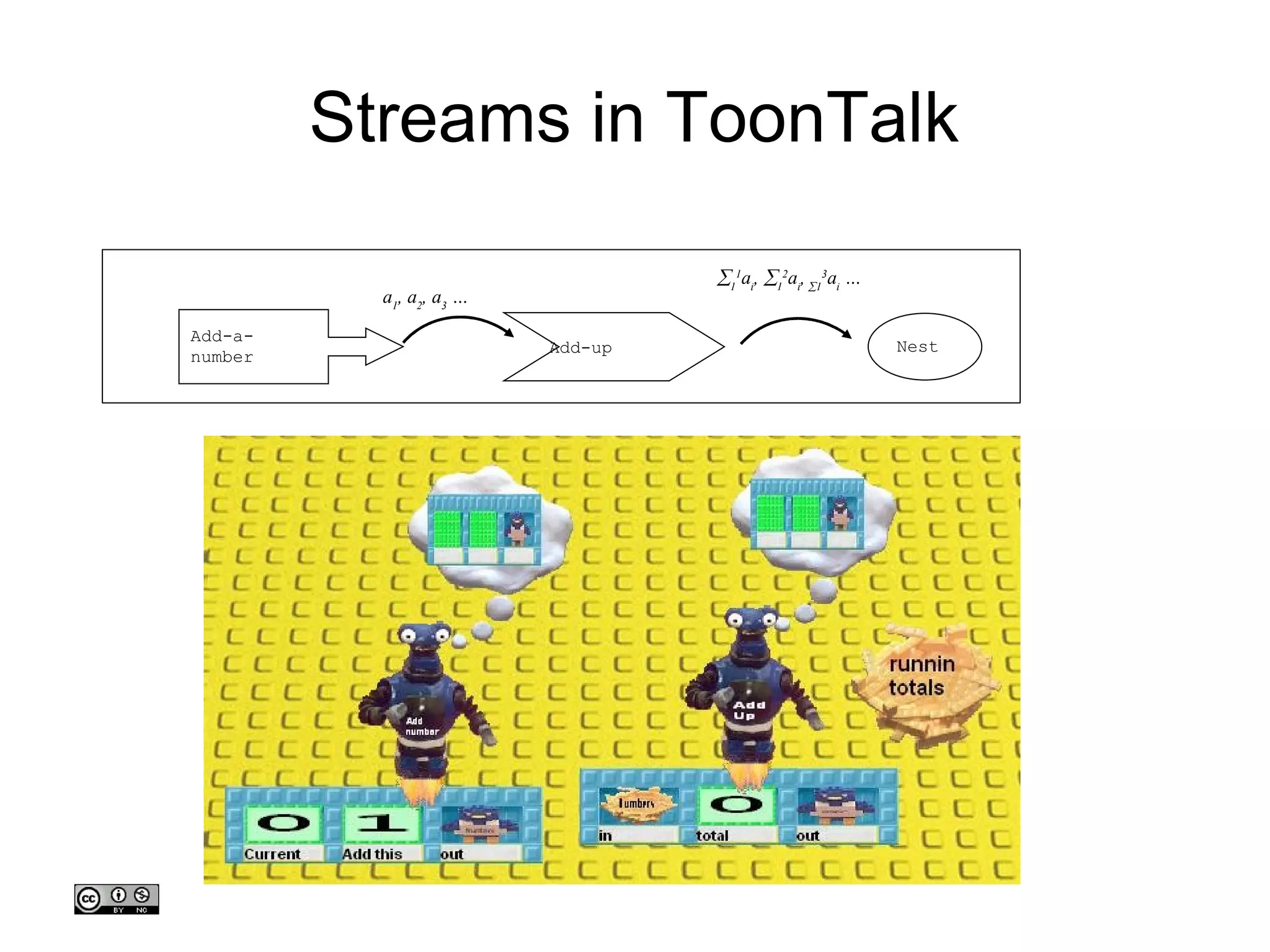
Streams in ToonTalk Add-a-number Add-up Nest a 1 , a 2 , a 3  …  1 1 a i ,   1 2 a i ,    1 3 a i  …
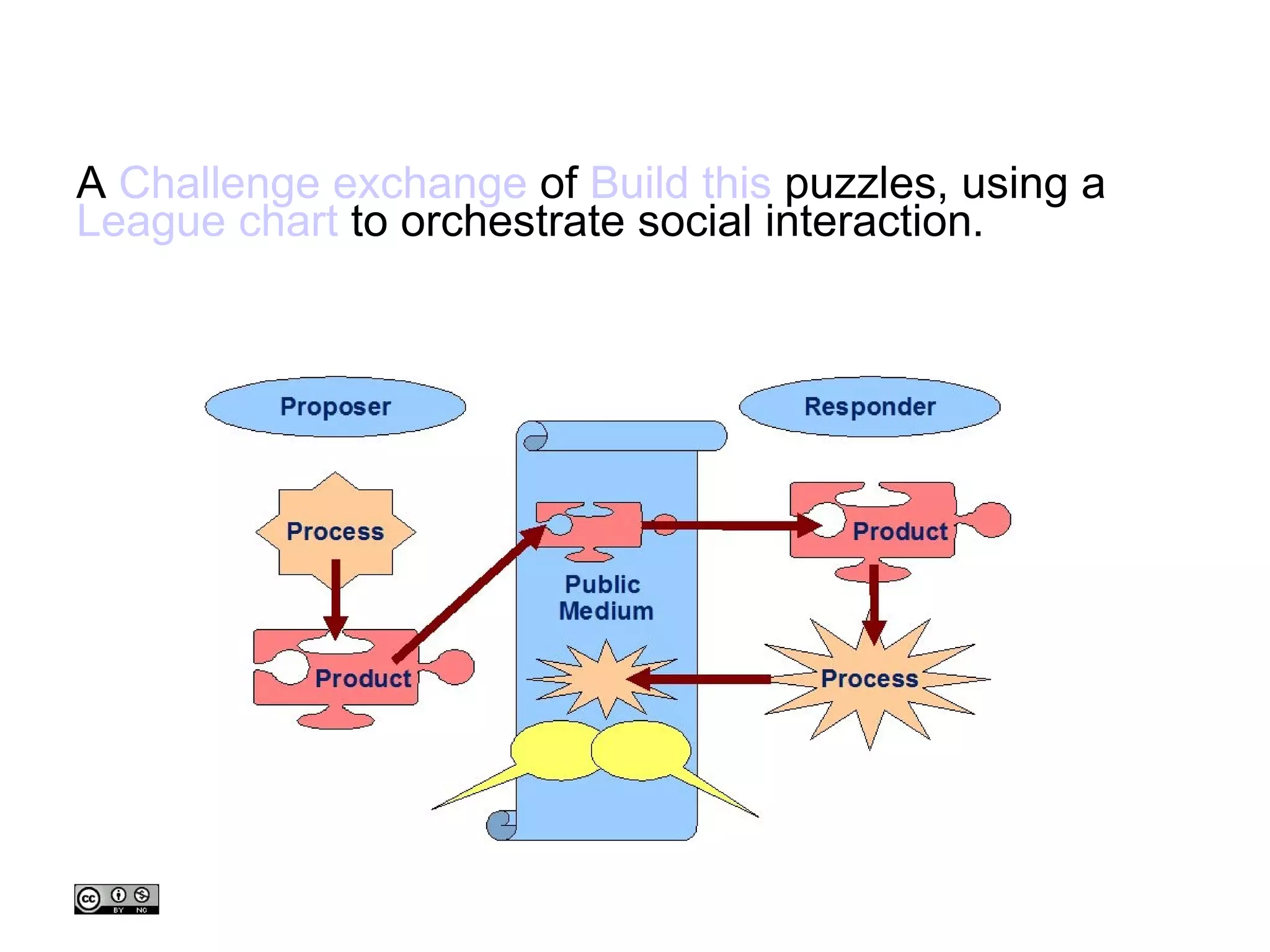
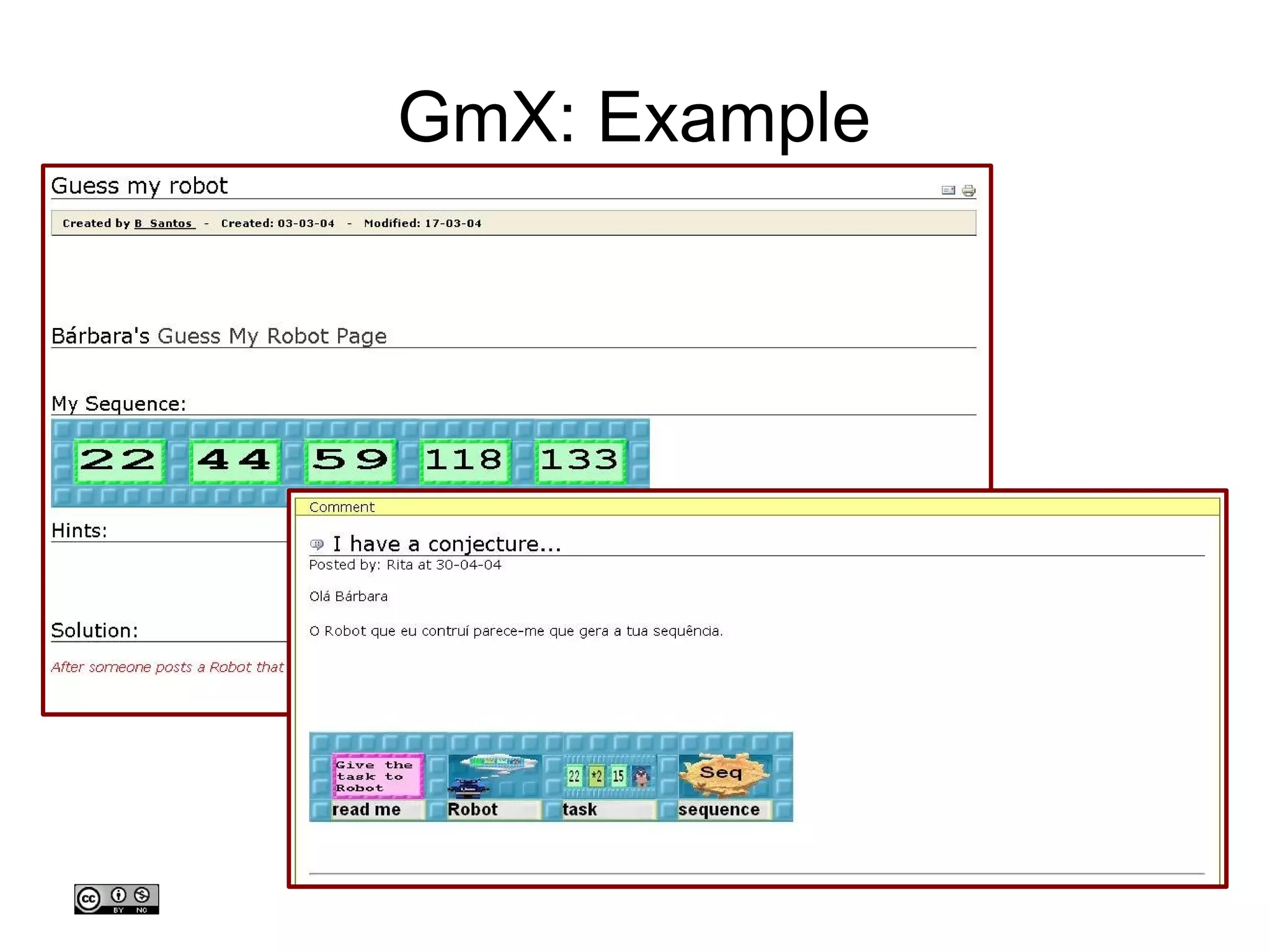
Guess my X Sustaining a mathematical discussion is vital to the establishment of socio-mathematical norms and to the collaborative construction of knowledge in the community. This goal is especially difficult to achieve in geographically distributed communities.  We address this by A  challenge exchange  game of  build this   puzzles, using a  league chart  to orchestrate  sustained social interaction. Problem / Intent
A  Challenge exchange  of  Build this  puzzles, using a  League chart  to orchestrate social interaction.
GmX: Example
The patterns
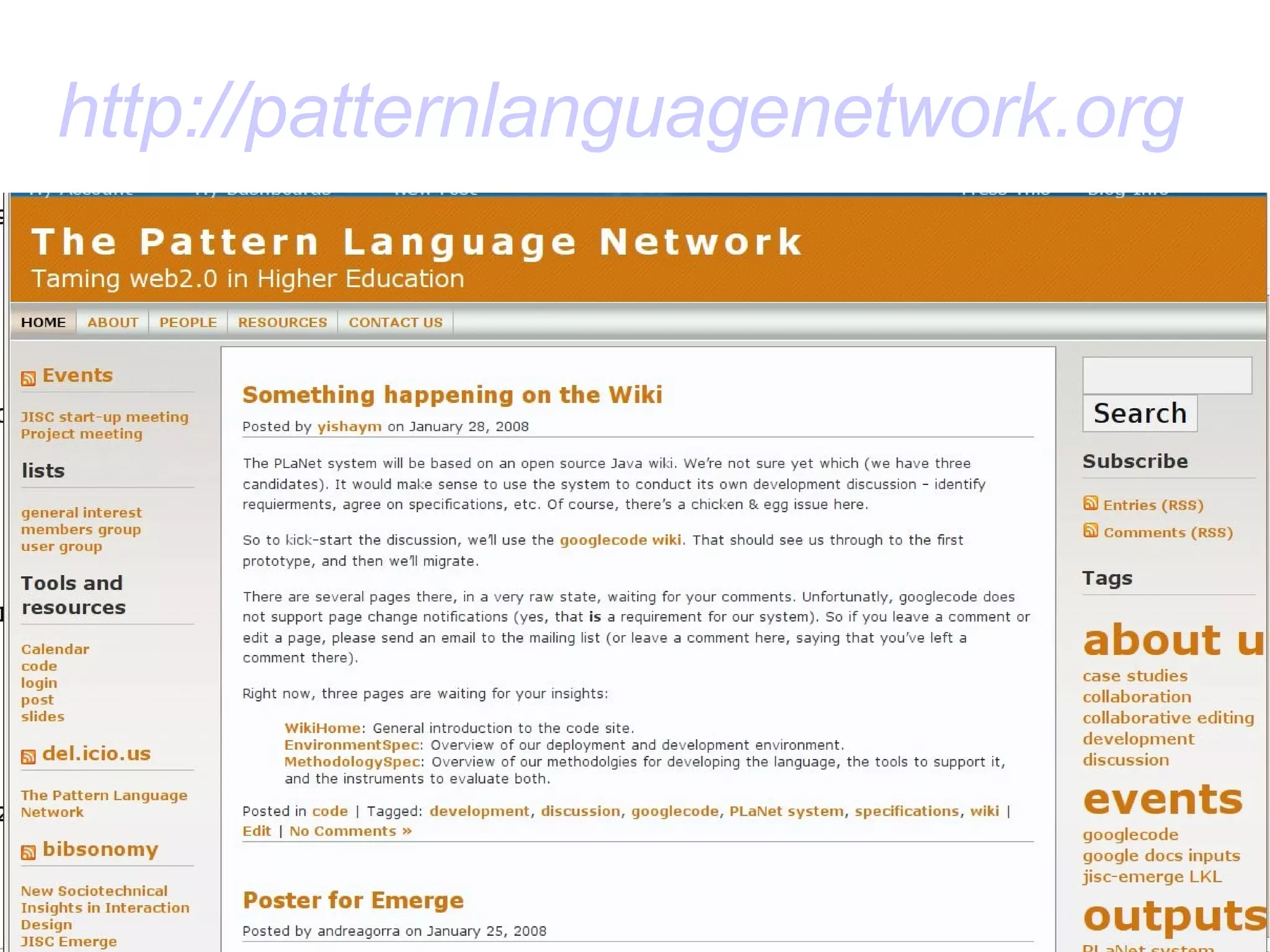
http://patternlanguagenetwork.org
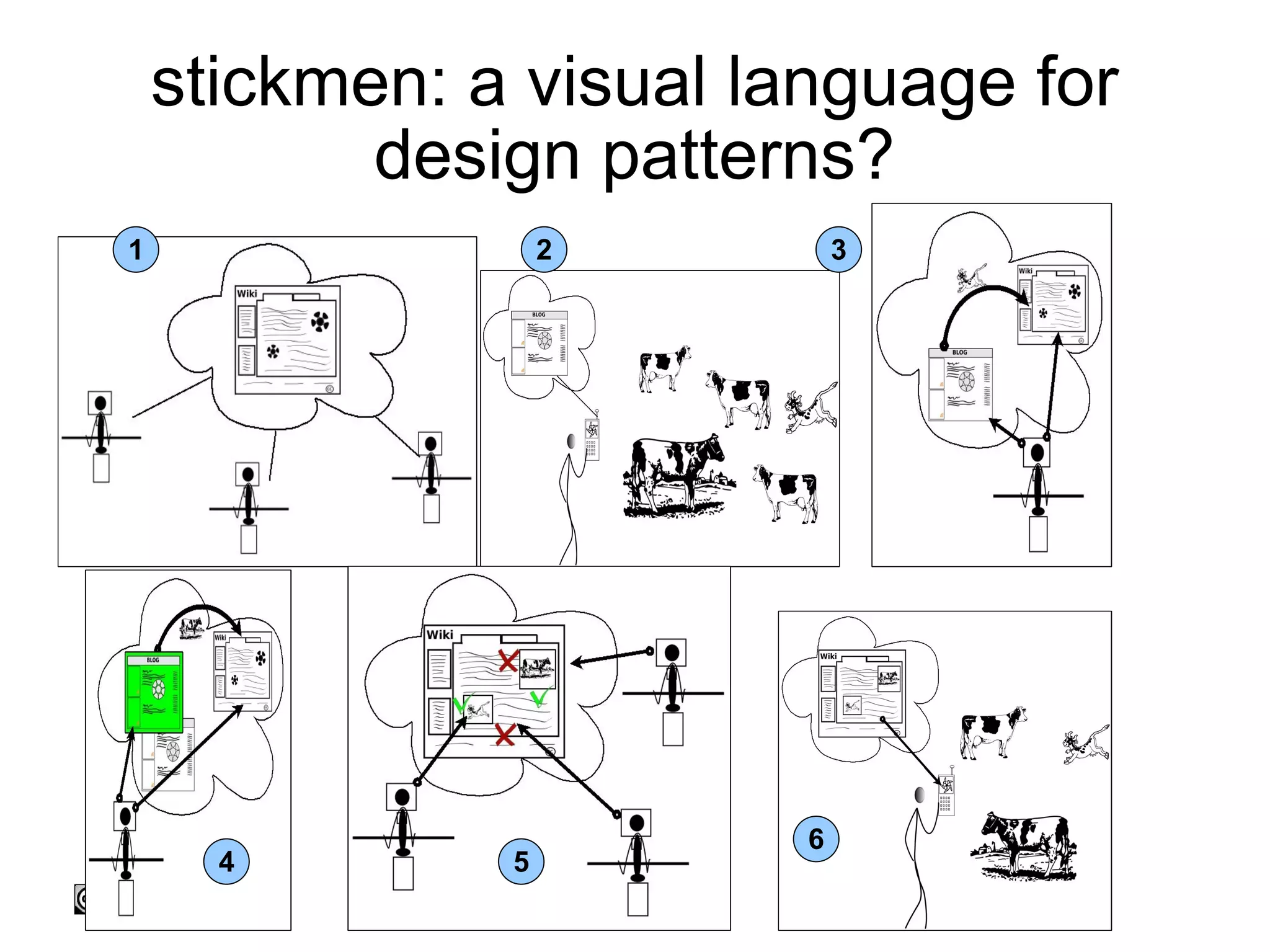
stickmen: a visual language for design patterns? 1 2 3 4 5 6

A Langauge of Patterns for Mathematical Learning

  • 1.
    A language ofpatterns for mathematical learning Yishay Mor, London Knowledge Lab [email_address] 10 April, 2008, Department of Education in Technology and Science, Technion, Haifa
  • 2.
    Problem Keep therain out Context Cold, wet, poor. Method of solution Thatched roof Related Timber frame, Slanted roof, Chimney
  • 3.
    Design pattern: problem+ context + method of solution
  • 4.
  • 5.
    The Problem Learningmathematics is a complex business. Building technology is a complex business. Building technology for learning mathematics is complex 2 . Even when someone gets it right, success is hard to replicate.
  • 6.
    WebLabs ( http://www.weblabs.eu.com)‏ EU funded, Sept. 2002 – Sept. 2005, directed by professors Richard Noss and Celia Hoyles. Grant # IST-2001-32200. Students & researchers from UK, Italy, Sweden, Bulgaria, Portugal, Cyprus. creating new ways of representing and expressing mathematical and scientific knowledge in European communities of young learners ( 10 – 14 ). Our aim was to transform the web into a medium in which European students collaboratively construct and critique each others' evolving knowledge and working models .
  • 7.
    Learning patterns KaleidoscopeJEIRP: 1 year, 15-20 members, 7 institutes, 6 countries ~24 case studies, ~150 patterns
  • 8.
    Today's talk Designscience and design patterns (the short version). Context – number sequences, construction, collaboration. A bit of theory. Some patterns. Future work.
  • 9.
    design … “everyone designs who devises courses of action aimed at changing existing situations into desired ones ” (Simon, 1969, p 129).
  • 10.
    … basedresearch Design based research is a methodology for the study of function. Often referred to as design research or design experiments. Concerned with the design of learning processes, taking account of the involved complexities, multiple levels and contexts of educational settings. The primary aim is to develop domain-specific theories in order to understand the learning process. (Mor & Winters, 2006)‏
  • 11.
    Design patterns [describe]a problem which occurs over and over again in our environment, and then describes the core of the solution to that problem, in such a way that you can use this solution a million times over, without ever doing it the same way twice (Alexander et al., 1977)‏
  • 12.
    example: activity nodesDesign problem Community facilities scattered individually through the city do nothing for the life of the city. Design solution Create nodes of activity throughout the community, spread about 300 yards apart. http://www.uni-weimar.de/architektur/InfAR/lehre/Entwurf/Patterns/030/ca_030.html
  • 13.
  • 14.
    pattern structure Problem/ intent Context Solution Examples Related patterns Notes
  • 15.
  • 16.
  • 17.
    Mathematical game piecesMathematical content is often injected artificially into games or other activities, as sugar-coating . This has a dual effect of ruining the game and alienating the mathematics. By contrast, for many mathematicians, mathematics is the game. Problem / Intent Context Games for mathematical learning.
  • 18.
    Mathematical game pieces(II)‏ Identify an element of the mathematical content you wish to address in this game. Find a visual, animated or tangible representation of this element which is consistent with the game metaphors. Design your game so that these objects have clear purpose and utility as game elements in the gameplay structure.
  • 19.
  • 20.
    Soft scaffolding Technologyshould be designed to scaffold learners' progress, but an interface that is too rigid impedes individual expression, exploration and innovation. Problem / Intent Context Interactive learning interface
  • 21.
    Soft scaffolding (II)‏Provide scaffolding which can easily be overridden by the learner or by the instructor. Let the scaffolding be a guideline, a recommendation which is easier to follow than not, but leave the choice in the hands of the learner. For example: When providing a multiple-selection interface, always include an open choice, which the user can specify (select 'other' and fill in text box). When the user is about to stray off the desired path of activity, warn her, ask for confirmation, but do not block her.
  • 22.
  • 23.
    Narrative spaces Constructingnarrative is a fundamental mechanism for making sense of events and observations. To leverage it, we must give learners opportunities to express themselves in narrative form. Problem / Intent Context Digital environments for collaborative learning.
  • 24.
    Narrative spaces (II)‏Provide learners with a narrative space: a medium, integrated with the activity design, which allows learners to express and explore ideas in a narrative form: Allow for free-form text, e.g. by supporting soft scaffolding . Choose narrative representations when possible. Mark narrative elements in the medium: Clearly mark the speaker / author, to support a sense of voice. Date contributions to support temporal sequentiality ('plot'). Use semi-automated meta-data to provide context.
  • 25.
  • 26.
  • 27.
    Objects to talkwith Natural discourse makes extensive use of artefacts: we gesture towards objects that mediate the activity to which the discussion refers. This dimension of human interaction is often lost in computerized interfaces. Problem / Intent interfaces which allow learners to converse about a common activity. Context
  • 28.
    Objects to talkwith (II)‏ Learning activities often involve the use or construction of artefacts. When providing tools for learners to discuss their experience, allow them to easily include these artefacts in the discussion. If the activity is mediated by or aims to produce digital artefacts, then the discussion medium should allow embedding of these artefacts. The medium should support a visual (graphical, symbolic, animated or simulated) 1:1 representation of these objects.
  • 29.
    Objects to talkwith: Example This is the real graph that was produced by the cumulate total of the halving-a-number robot. It looks like the top of my graph but I made the fatal mistake of thinking it started at zero. I also said it wouldn’t go over 100, which was very wrong.
  • 30.
  • 31.
    EP-Streams How doyou represent an infinite object in a finite medium? How do you model number sequences in a way which is consistent both with intuition and with mathematical formalism? Construction activities / Microworlds where learners use programming to explore complex, dynamic or infinite structures. Problem / Intent Context
  • 32.
    Streams in ToonTalkAdd-a-number Add-up Nest a 1 , a 2 , a 3 …  1 1 a i ,  1 2 a i ,  1 3 a i …
  • 33.
    Guess my XSustaining a mathematical discussion is vital to the establishment of socio-mathematical norms and to the collaborative construction of knowledge in the community. This goal is especially difficult to achieve in geographically distributed communities. We address this by A challenge exchange game of build this puzzles, using a league chart to orchestrate sustained social interaction. Problem / Intent
  • 34.
    A Challengeexchange of Build this puzzles, using a League chart to orchestrate social interaction.
  • 35.
  • 36.
  • 37.
  • 38.
    stickmen: a visuallanguage for design patterns? 1 2 3 4 5 6