A JSR-310 DATE
BEYOND JODA TIME
IN THIS PRESENTATION
• What is JSR-310?
• What’s wrong with Date, Calendar and
DateFormat?
• Why not JODA Time?
• JSR-310 Overview
• What does it mean?
• What does it have?
WHAT IS
JSR-310?
WHAT DOES JSR-310 MEANS?
• A Java Specification Request included on Java 8
WHAT DOES JSR-310 MEANS?
• A Java Specification Request included on Java 8
• A library to handle dates and times
WHAT DOES JSR-310 MEANS?
• A Java Specification Request included on Java 8
• A library to handle dates and times
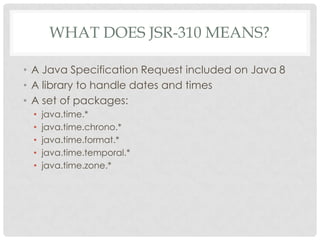
• A set of packages:
•
•
•
•
•

java.time.*
java.time.chrono.*
java.time.format.*
java.time.temporal.*
java.time.zone.*
WHAT DOES JSR-310 HAVE?
•
•
•
•
•
•

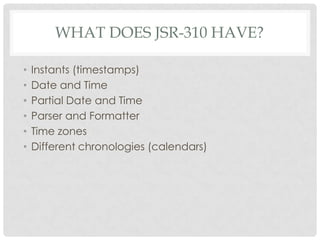
Instants (timestamps)
Date and Time
Partial Date and Time
Parser and Formatter
Time zones
Different chronologies (calendars)
WHAT’S
WRONG
WITH THE
EXISTING
CLASSES?

• Bad Naming
• Historical Issues
• Design Problems
• Deficiencies
BAD NAMING
• Horrible naming decisions
BAD NAMING
• Horrible naming decisions
• Date is not a date, it is an instant in time (a timestamp)
BAD NAMING
• Horrible naming decisions
• Date is not a date, it is an instant in time (a timestamp)
• Date is not a time
• The time field manipulation methods are deprecated
BAD NAMING
• Horrible naming decisions
• Date is not a date, it is an instant in time (a timestamp)
• Date is not a time
• The time field manipulation methods are deprecated

• Calendar is not a calendar, it is a date and time
HISTORICAL ISSUES
• Date has no support for I18N or L10N
HISTORICAL ISSUES
• Date has no support for I18N or L10N
• So Sun added IBM-donated (through Taligent) code
• Calendar
• TimeZone
• SimpleDateFormat
HISTORICAL ISSUES
• Date has no support for I18N or L10N
• So Sun added IBM-donated (through Taligent) code
• Calendar
• TimeZone
• SimpleDateFormat

• Which don’t even play well together
• SimpleDateFormat can’t be used to convert from or to
Calendar
HISTORICAL ISSUES
• Date has no support for I18N or L10N
• So Sun added IBM-donated (through Taligent) code
• Calendar
• TimeZone
• SimpleDateFormat

• Which don’t even play well together
• SimpleDateFormat can’t be used to convert from or to
Calendar

• And still kept months 0-based
• (but at least made years 0-based instead of 1900-based)
DESIGN PROBLEMS
• They are mutable!
DESIGN PROBLEMS
• They are mutable!
• On core, excluding tests, SimpleDateTime is:
• instantiated in 225 places
• a field in 77 places
• usually synchronized (if correct)

• a local variable in 103 places

• Which could be replaced with a dozen immutable
static constants
DESIGN PROBLEMS
• They are mutable!
• On core, excluding tests, SimpleDateTime is:
• instantiated in 225 places
• a field in 77 places
• usually synchronized (if correct)

• a local variable in 103 places

• Which could be replaced with a dozen immutable
static constants
• Calendar stores redundant representations, and
recomputes lazily depending on the method being
called
DEFICIENCIES
• They are limited
• My alarm clock rings at 6:30 AM
DEFICIENCIES
• They are limited
• My alarm clock rings at 6:30 AM (time without date or tz)
• I was born March 23, 1971
DEFICIENCIES
• They are limited
• My alarm clock rings at 6:30 AM (time without date or tz)
• I was born March 23, 1971(date without time)
• My birthday is March 23
DEFICIENCIES
• They are limited
•
•
•
•

My alarm clock rings at 6:30 AM (time without date or tz)
I was born March 23, 1971(date without time)
My birthday is March 23 (date without year)
This presentation is one hour long
DEFICIENCIES
• They are limited
•
•
•
•
•

My alarm clock rings at 6:30 AM (time without date or tz)
I was born March 23, 1971(date without time)
My birthday is March 23 (date without year)
This presentation is one hour long (a duration)
A year has twelve months
DEFICIENCIES
• They are limited
•
•
•
•
•

My alarm clock rings at 6:30 AM (time without date or tz)
I was born March 23, 1971(date without time)
My birthday is March 23 (date without year)
This presentation is one hour long (a duration)
A year has twelve months (a period)
WHY NOT
JODA TIME?

• Why JODA Time?
• Too Flexible
• Bad Internal
Representation
• Null-happy
• JODA Time & JSR310
WHY JODA TIME?
• JODA Time addresses all these issues:
•
•
•
•

It is composed of immutable classes
It handles Instants, Date&Time, Partials, and Durations
It is flexible
It is well designed
TOO FLEXIBLE
• Every class is prepared to handle the most obscure
calendar systems (pluggable chronology)
• But code usually assumes Gregorian Calendar
• (have you ever written code that handles 13 months?)
• int month = dateTime.getMonthOfDay();

• It lacks type safety
BAD INTERNAL REPRESENTATION
• Represents dates as instants
• But a date&time may correspond to more than one
instant
• Overlap hour when daylight savings end

• As well as not have any instant that corresponds to
it at all
• Gap hour when daylight starts

• Has to perform complex computations for simple
operations
NULL-HAPPY
• Accepts nulls as valid values on most of its methods
• Leads to subtle bugs
JODA TIME AND JSR-310
• JODA Time is Not Broken
• But the lessons learned led to a new time library
design
• JSR-310 is inspired by JODA Time, but simpler and
more robust
JSR-310
OVERVIEW

• Basic classes
• Now
• Clocks and Testing
• Parsing and Printing
• Fields and Units
• Java 7 Backport
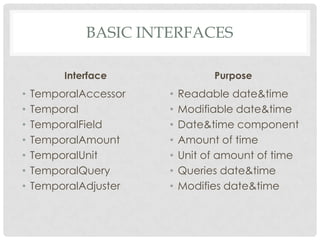
BASIC INTERFACES
Interface

•
•
•
•
•
•
•

TemporalAccessor
Temporal
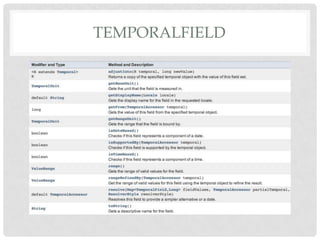
TemporalField
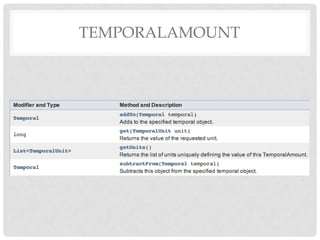
TemporalAmount
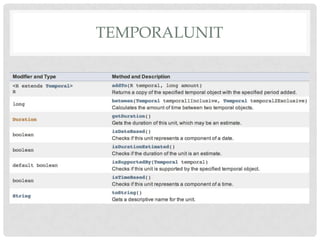
TemporalUnit
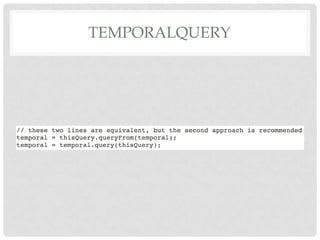
TemporalQuery
TemporalAdjuster

Purpose

•
•
•
•
•
•
•

Readable date&time
Modifiable date&time
Date&time component
Amount of time
Unit of amount of time
Queries date&time
Modifies date&time
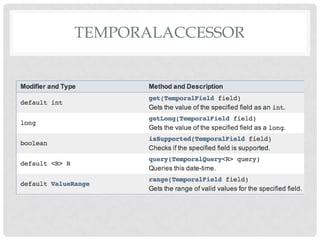
TEMPORALACCESSOR
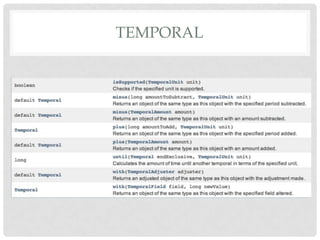
TEMPORAL
TEMPORALFIELD
TEMPORALAMOUNT
TEMPORALUNIT
TEMPORALQUERY
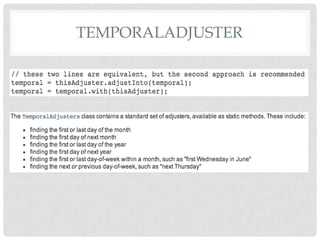
TEMPORALADJUSTER
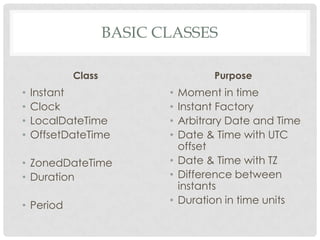
BASIC CLASSES
Class

•
•
•
•

Instant
Clock
LocalDateTime
OffsetDateTime

• ZonedDateTime
• Duration
• Period

Purpose

Moment in time
Instant Factory
Arbitrary Date and Time
Date & Time with UTC
offset
• Date & Time with TZ
• Difference between
instants
• Duration in time units
•
•
•
•
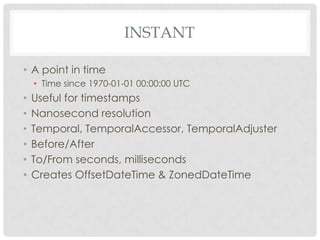
INSTANT
• A point in time
• Time since 1970-01-01 00:00:00 UTC

•
•
•
•
•
•

Useful for timestamps
Nanosecond resolution
Temporal, TemporalAccessor, TemporalAdjuster
Before/After
To/From seconds, milliseconds
Creates OffsetDateTime & ZonedDateTime
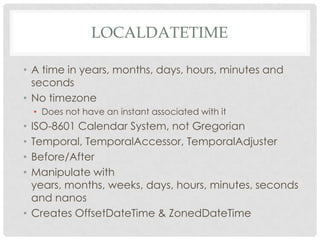
LOCALDATETIME
• A time in years, months, days, hours, minutes and
seconds
• No timezone
• Does not have an instant associated with it

ISO-8601 Calendar System, not Gregorian
Temporal, TemporalAccessor, TemporalAdjuster
Before/After
Manipulate with
years, months, weeks, days, hours, minutes, seconds
and nanos
• Creates OffsetDateTime & ZonedDateTime
•
•
•
•
ZONEDDATETIME/OFFSETDATETIME
• A date and time associated with either a particular
time zone, or a particular time zone offset
• OffsetDateTime always have an associated instant
• ZonedDateTime have gaps and overlaps
• One can get a ZDT that returns either the earlier or the later
time in an overlap

• Temporal, TemporalAccessor
• Before/After
DURATION & PERIOD
•
•
•
•

Represent amounts of time
Duration is an amount of nanoseconds
Period is an amount of years, months and days
Can be computed in absolute terms
• Duration.ofMinutes(10)

• Can be computed from dates and instants
• Period.between(LocalDate.now(), birthDay)

• Can be added of subtracted from instants, dates
and times
PARTIAL DATES AND TIMES
•
•
•
•
•
•
•

LocalDate
LocalTime
DayOfWeek
Month
MonthDay
YearMonth
Year
WHAT TIME IS IT NOW?
• Instant.now()
• default timezone

• Instant.now(ZoneId zone)
• time at a specific time zone

• Instant.now(Clock clock)
• time as generated by a specific clock

•
•
•
•

LocalTime.now()
MonthDay.now(clock)
ZonedDateTime(zone)
etc
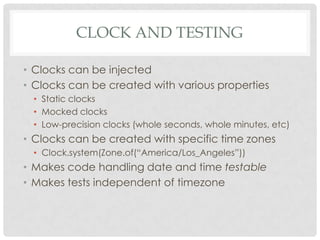
CLOCK AND TESTING
• Clocks can be injected
• Clocks can be created with various properties
• Static clocks
• Mocked clocks
• Low-precision clocks (whole seconds, whole minutes, etc)

• Clocks can be created with specific time zones
• Clock.system(Zone.of(“America/Los_Angeles”))

• Makes code handling date and time testable
• Makes tests independent of timezone
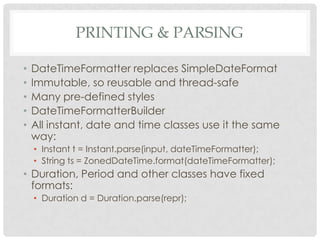
PRINTING & PARSING
•
•
•
•
•

DateTimeFormatter replaces SimpleDateFormat
Immutable, so reusable and thread-safe
Many pre-defined styles
DateTimeFormatterBuilder
All instant, date and time classes use it the same
way:
• Instant t = Instant.parse(input, dateTimeFormatter);
• String ts = ZonedDateTime.format(dateTimeFormatter);

• Duration, Period and other classes have fixed
formats:
• Duration d = Duration.parse(repr);
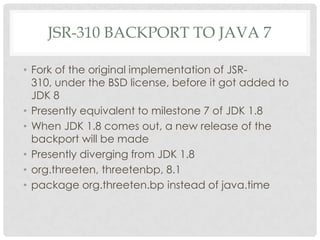
JSR-310 BACKPORT TO JAVA 7
• Fork of the original implementation of JSR310, under the BSD license, before it got added to
JDK 8
• Presently equivalent to milestone 7 of JDK 1.8
• When JDK 1.8 comes out, a new release of the
backport will be made
• Presently diverging from JDK 1.8
• org.threeten, threetenbp, 8.1
• package org.threeten.bp instead of java.time
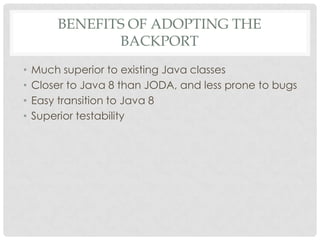
BENEFITS OF ADOPTING THE
BACKPORT
•
•
•
•

Much superior to existing Java classes
Closer to Java 8 than JODA, and less prone to bugs
Easy transition to Java 8
Superior testability
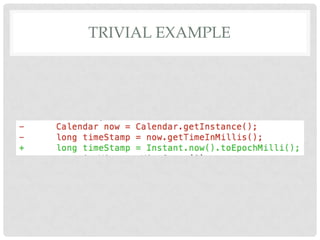
TRIVIAL EXAMPLE
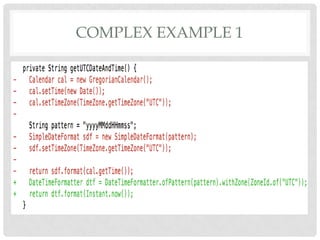
COMPLEX EXAMPLE 1
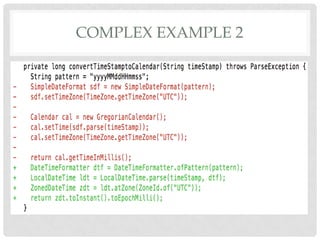
COMPLEX EXAMPLE 2

A JSR-310 Date: Beyond JODA Time

  • 1.
  • 2.
    IN THIS PRESENTATION •What is JSR-310? • What’s wrong with Date, Calendar and DateFormat? • Why not JODA Time? • JSR-310 Overview
  • 3.
    • What doesit mean? • What does it have? WHAT IS JSR-310?
  • 4.
    WHAT DOES JSR-310MEANS? • A Java Specification Request included on Java 8
  • 5.
    WHAT DOES JSR-310MEANS? • A Java Specification Request included on Java 8 • A library to handle dates and times
  • 6.
    WHAT DOES JSR-310MEANS? • A Java Specification Request included on Java 8 • A library to handle dates and times • A set of packages: • • • • • java.time.* java.time.chrono.* java.time.format.* java.time.temporal.* java.time.zone.*
  • 7.
    WHAT DOES JSR-310HAVE? • • • • • • Instants (timestamps) Date and Time Partial Date and Time Parser and Formatter Time zones Different chronologies (calendars)
  • 8.
    WHAT’S WRONG WITH THE EXISTING CLASSES? • BadNaming • Historical Issues • Design Problems • Deficiencies
  • 9.
    BAD NAMING • Horriblenaming decisions
  • 10.
    BAD NAMING • Horriblenaming decisions • Date is not a date, it is an instant in time (a timestamp)
  • 11.
    BAD NAMING • Horriblenaming decisions • Date is not a date, it is an instant in time (a timestamp) • Date is not a time • The time field manipulation methods are deprecated
  • 12.
    BAD NAMING • Horriblenaming decisions • Date is not a date, it is an instant in time (a timestamp) • Date is not a time • The time field manipulation methods are deprecated • Calendar is not a calendar, it is a date and time
  • 13.
    HISTORICAL ISSUES • Datehas no support for I18N or L10N
  • 14.
    HISTORICAL ISSUES • Datehas no support for I18N or L10N • So Sun added IBM-donated (through Taligent) code • Calendar • TimeZone • SimpleDateFormat
  • 15.
    HISTORICAL ISSUES • Datehas no support for I18N or L10N • So Sun added IBM-donated (through Taligent) code • Calendar • TimeZone • SimpleDateFormat • Which don’t even play well together • SimpleDateFormat can’t be used to convert from or to Calendar
  • 16.
    HISTORICAL ISSUES • Datehas no support for I18N or L10N • So Sun added IBM-donated (through Taligent) code • Calendar • TimeZone • SimpleDateFormat • Which don’t even play well together • SimpleDateFormat can’t be used to convert from or to Calendar • And still kept months 0-based • (but at least made years 0-based instead of 1900-based)
  • 17.
  • 18.
    DESIGN PROBLEMS • Theyare mutable! • On core, excluding tests, SimpleDateTime is: • instantiated in 225 places • a field in 77 places • usually synchronized (if correct) • a local variable in 103 places • Which could be replaced with a dozen immutable static constants
  • 19.
    DESIGN PROBLEMS • Theyare mutable! • On core, excluding tests, SimpleDateTime is: • instantiated in 225 places • a field in 77 places • usually synchronized (if correct) • a local variable in 103 places • Which could be replaced with a dozen immutable static constants • Calendar stores redundant representations, and recomputes lazily depending on the method being called
  • 20.
    DEFICIENCIES • They arelimited • My alarm clock rings at 6:30 AM
  • 21.
    DEFICIENCIES • They arelimited • My alarm clock rings at 6:30 AM (time without date or tz) • I was born March 23, 1971
  • 22.
    DEFICIENCIES • They arelimited • My alarm clock rings at 6:30 AM (time without date or tz) • I was born March 23, 1971(date without time) • My birthday is March 23
  • 23.
    DEFICIENCIES • They arelimited • • • • My alarm clock rings at 6:30 AM (time without date or tz) I was born March 23, 1971(date without time) My birthday is March 23 (date without year) This presentation is one hour long
  • 24.
    DEFICIENCIES • They arelimited • • • • • My alarm clock rings at 6:30 AM (time without date or tz) I was born March 23, 1971(date without time) My birthday is March 23 (date without year) This presentation is one hour long (a duration) A year has twelve months
  • 25.
    DEFICIENCIES • They arelimited • • • • • My alarm clock rings at 6:30 AM (time without date or tz) I was born March 23, 1971(date without time) My birthday is March 23 (date without year) This presentation is one hour long (a duration) A year has twelve months (a period)
  • 26.
    WHY NOT JODA TIME? •Why JODA Time? • Too Flexible • Bad Internal Representation • Null-happy • JODA Time & JSR310
  • 27.
    WHY JODA TIME? •JODA Time addresses all these issues: • • • • It is composed of immutable classes It handles Instants, Date&Time, Partials, and Durations It is flexible It is well designed
  • 28.
    TOO FLEXIBLE • Everyclass is prepared to handle the most obscure calendar systems (pluggable chronology) • But code usually assumes Gregorian Calendar • (have you ever written code that handles 13 months?) • int month = dateTime.getMonthOfDay(); • It lacks type safety
  • 29.
    BAD INTERNAL REPRESENTATION •Represents dates as instants • But a date&time may correspond to more than one instant • Overlap hour when daylight savings end • As well as not have any instant that corresponds to it at all • Gap hour when daylight starts • Has to perform complex computations for simple operations
  • 30.
    NULL-HAPPY • Accepts nullsas valid values on most of its methods • Leads to subtle bugs
  • 31.
    JODA TIME ANDJSR-310 • JODA Time is Not Broken • But the lessons learned led to a new time library design • JSR-310 is inspired by JODA Time, but simpler and more robust
  • 32.
    JSR-310 OVERVIEW • Basic classes •Now • Clocks and Testing • Parsing and Printing • Fields and Units • Java 7 Backport
  • 33.
  • 34.
  • 35.
  • 36.
  • 37.
  • 38.
  • 39.
  • 40.
  • 41.
    BASIC CLASSES Class • • • • Instant Clock LocalDateTime OffsetDateTime • ZonedDateTime •Duration • Period Purpose Moment in time Instant Factory Arbitrary Date and Time Date & Time with UTC offset • Date & Time with TZ • Difference between instants • Duration in time units • • • •
  • 42.
    INSTANT • A pointin time • Time since 1970-01-01 00:00:00 UTC • • • • • • Useful for timestamps Nanosecond resolution Temporal, TemporalAccessor, TemporalAdjuster Before/After To/From seconds, milliseconds Creates OffsetDateTime & ZonedDateTime
  • 43.
    LOCALDATETIME • A timein years, months, days, hours, minutes and seconds • No timezone • Does not have an instant associated with it ISO-8601 Calendar System, not Gregorian Temporal, TemporalAccessor, TemporalAdjuster Before/After Manipulate with years, months, weeks, days, hours, minutes, seconds and nanos • Creates OffsetDateTime & ZonedDateTime • • • •
  • 44.
    ZONEDDATETIME/OFFSETDATETIME • A dateand time associated with either a particular time zone, or a particular time zone offset • OffsetDateTime always have an associated instant • ZonedDateTime have gaps and overlaps • One can get a ZDT that returns either the earlier or the later time in an overlap • Temporal, TemporalAccessor • Before/After
  • 45.
    DURATION & PERIOD • • • • Representamounts of time Duration is an amount of nanoseconds Period is an amount of years, months and days Can be computed in absolute terms • Duration.ofMinutes(10) • Can be computed from dates and instants • Period.between(LocalDate.now(), birthDay) • Can be added of subtracted from instants, dates and times
  • 46.
    PARTIAL DATES ANDTIMES • • • • • • • LocalDate LocalTime DayOfWeek Month MonthDay YearMonth Year
  • 47.
    WHAT TIME ISIT NOW? • Instant.now() • default timezone • Instant.now(ZoneId zone) • time at a specific time zone • Instant.now(Clock clock) • time as generated by a specific clock • • • • LocalTime.now() MonthDay.now(clock) ZonedDateTime(zone) etc
  • 48.
    CLOCK AND TESTING •Clocks can be injected • Clocks can be created with various properties • Static clocks • Mocked clocks • Low-precision clocks (whole seconds, whole minutes, etc) • Clocks can be created with specific time zones • Clock.system(Zone.of(“America/Los_Angeles”)) • Makes code handling date and time testable • Makes tests independent of timezone
  • 49.
    PRINTING & PARSING • • • • • DateTimeFormatterreplaces SimpleDateFormat Immutable, so reusable and thread-safe Many pre-defined styles DateTimeFormatterBuilder All instant, date and time classes use it the same way: • Instant t = Instant.parse(input, dateTimeFormatter); • String ts = ZonedDateTime.format(dateTimeFormatter); • Duration, Period and other classes have fixed formats: • Duration d = Duration.parse(repr);
  • 50.
    JSR-310 BACKPORT TOJAVA 7 • Fork of the original implementation of JSR310, under the BSD license, before it got added to JDK 8 • Presently equivalent to milestone 7 of JDK 1.8 • When JDK 1.8 comes out, a new release of the backport will be made • Presently diverging from JDK 1.8 • org.threeten, threetenbp, 8.1 • package org.threeten.bp instead of java.time
  • 51.
    BENEFITS OF ADOPTINGTHE BACKPORT • • • • Much superior to existing Java classes Closer to Java 8 than JODA, and less prone to bugs Easy transition to Java 8 Superior testability
  • 52.
  • 53.
  • 54.