SUCCESS STORIES 
ON 
FAO
CLIMATE-SMART 
AGRICULTURE GROUND ON THE 
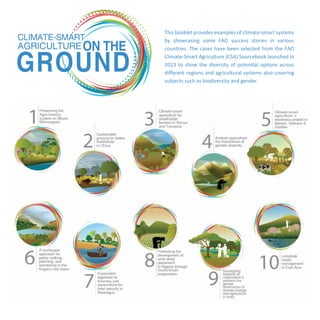
This booklet provides examples of climate-smart systems 
by showcasing some FAO success stories in various 
countries. The cases have been selected from the FAO 
Climate-Smart Agriculture (CSA) Sourcebook launched in 
2013 to show the diversity of potential options across 
different regions and agricultural systems also covering 
subjects such as biodiversity and gender.
CSA SUCCESS STORIES 1 
FAO SUCCESS STORIES ON 
CLIMATE-SMART 
AGRICULTURE 
CSA ON THE GROUND 
UNDERSTANDING THE CHALLENGES OF 
CLIMATE CHANGE AND FOOD SECURITY 
FAO estimates that food production must increase by 
at least 60 percent to respond to the demand of the 9 
billion people that are expected to inhabit the planet by 
2050. Given that one in eight people are currently food 
insecure, ensuring global food security over the next 
decades will be essential. In meeting this challenge, 
there is an opportunity to create sustainable economic 
growth in rural areas of developing countries where 
food security and poverty are most prevalent. 
According to the Fifth Assessment Report of the Intergovernmental 
Panel on Climate Change (IPCC), rising temperatures and increased 
frequency of extreme events will have direct and negative impacts 
on crops, livestock, forestry, fisheries and aquaculture productivity. 
Climate change is a universal and critical challenge for global food 
security. Improving the way we manage agricultural systems and natural 
resources is fundamental for effectively achieving food security. We 
can no longer afford to separate the future of food security from that 
of natural resources, the environment and climate change – they are 
inextricably intertwined and our response must be as well. 
Efforts to reduce food insecurity must include building the resilience of 
rural communities to shocks and strengthening their adaptive capacity to 
cope with increased variability and slow onset changes. The agricultural 
sectors (crops, livestock, forestry, fisheries) must therefore transform 
themselves in order to feed a growing global population and provide the 
basis for economic growth and poverty reduction. This transformation 
must be accomplished without hindering the natural resource base. 
More productive and resilient agriculture requires a major shift in the 
way land, water, soil nutrients and genetic resources are managed to 
ensure that these resources are used more efficiently and sustainably. 
Making this shift requires considerable changes in national and local 
governance, legislation, policies and financial mechanisms. This 
transformation will also involve improving producers’ access to markets.
GAINING TRACTION ON CLIMATE-SMART 
AGRICULTURE 
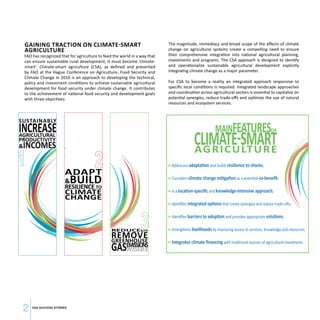
FAO has recognized that for agriculture to feed the world in a way that 
can ensure sustainable rural development, it must become ‘climate-smart‘. 
Climate-smart agriculture (CSA), as defined and presented 
by FAO at the Hague Conference on Agriculture, Food Security and 
Climate Change in 2010 is an approach to developing the technical, 
policy and investment conditions to achieve sustainable agricultural 
development for food security under climate change. It contributes 
to the achievement of national food security and development goals 
with three objectives: 
2 CSA SUCCESS STORIES 
The magnitude, immediacy and broad scope of the effects of climate 
change on agricultural systems create a compelling need to ensure 
their comprehensive integration into national agricultural planning, 
investments and programs. The CSA approach is designed to identify 
and operationalize sustainable agricultural development explicitly 
integrating climate change as a major parameter. 
For CSA to become a reality an integrated approach responsive to 
specific local conditions is required. Integrated landscape approaches 
and coordination across agricultural sectors is essential to capitalize on 
potential synergies, reduce trade-offs and optimize the use of natural 
resources and ecosystem services.
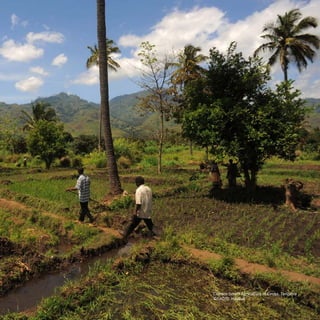
Climate-Smart Agriculture in Kiroka, Tanzania 
©FAO/D. Hayduk 
CSA SUCCESS STORIES 3
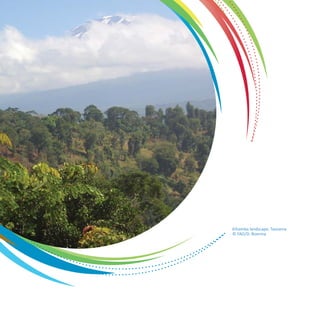
Kihamba landscape, Tanzania 
© FAO/D. Boerma
CSA SUCCESS STORIES 5 
In the slopes of 
Kilimanjaro, 
Tanzania 
120 000ha 
of 
agroforestry 
Include coee cash 
crops that will 
INCREASE 
income by 
25% 
In3 years 
PRESERVING THE AGRO-FORESTRY SYSTEM 
ON MOUNT KILIMANJARO 
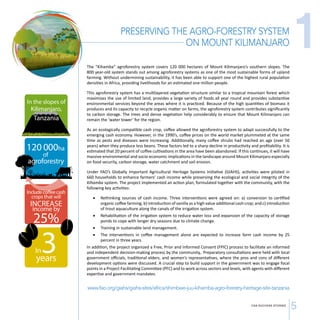
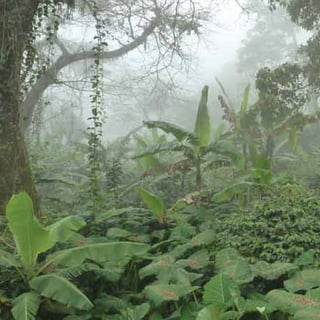
The “Kihamba” agroforestry system covers 120 000 hectares of Mount Kilimanjaro’s southern slopes. The 
800 year-old system stands out among agroforestry systems as one of the most sustainable forms of upland 
farming. Without undermining sustainability, it has been able to support one of the highest rural population 
densities in Africa, providing livelihoods for an estimated one million people. 
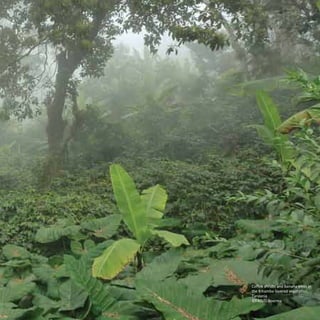
This agroforestry system has a multilayered vegetation structure similar to a tropical mountain forest which 
maximizes the use of limited land, provides a large variety of foods all year round and provides substantive 
environmental services beyond the areas where it is practiced. Because of the high quantities of biomass it 
produces and its capacity to recycle organic matter on farms, the agroforestry system contributes significantly 
to carbon storage. The trees and dense vegetation help considerably to ensure that Mount Kilimanjaro can 
remain the ‘water tower’ for the region. 
As an ecologically compatible cash crop, coffee allowed the agroforestry system to adapt successfully to the 
emerging cash economy. However, in the 1990’s, coffee prices on the world market plummeted at the same 
time as pests and diseases were increasing. Additionally, many coffee shrubs had reached an age (over 50 
years) when they produce less beans. These factors led to a sharp decline in productivity and profitability. It is 
estimated that 20 percent of coffee cultivations in the area have been abandoned. If this continues, it will have 
massive environmental and socio-economic implications in the landscape around Mount Kilimanjaro especially 
on food security, carbon storage, water catchment and soil erosion. 
Under FAO’s Globally Important Agricultural Heritage Systems Initiative (GIAHS), activities were piloted in 
660 households to enhance farmers’ cash income while preserving the ecological and social integrity of the 
Kihamba system. The project implemented an action plan, formulated together with the community, with the 
following key activities: 
• Rethinking sources of cash income. Three interventions were agreed on: a) conversion to certified 
organic coffee farming; b) introduction of vanilla as a high value additional cash crop; and c) introduction 
of trout aquaculture along the canals of the irrigation system. 
• Rehabilitation of the irrigation system to reduce water loss and expansion of the capacity of storage 
ponds to cope with longer dry seasons due to climate change. 
• Training in sustainable land management. 
• The interventions in coffee management alone are expected to increase farm cash income by 25 
percent in three years. 
In addition, the project organized a Free, Prior and Informed Consent (FPIC) process to facilitate an informed 
and independent decision-making process by the community,. Preparatory consultations were held with local 
government officials, traditional elders, and women’s representatives, where the pros and cons of different 
development options were discussed. A crucial step to build support in the government was to engage focal 
points in a Project Facilitating Committee (PFC) and to work across sectors and levels, with agents with different 
expertise and government mandates. 
www.fao.org/giahs/giahs-sites/africa/shimbwe-juu-kihamba-agro-forestry-heritage-site-tanzania 
1
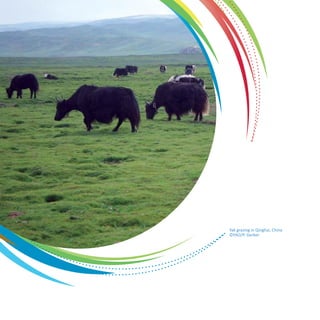
Yak grazing in Qinghai, China 
©FAO/P. Gerber
SUSTAINABLE GRAZING FOR 
BETTER LIVELIHOODS 
IN CHINA 
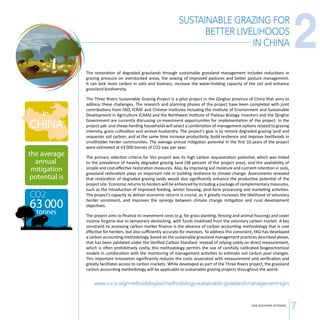
The restoration of degraded grasslands through sustainable grassland management includes reductions in 
grazing pressure on overstocked areas, the sowing of improved pastures and better pasture management. 
It can lock more carbon in soils and biomass, increase the water-holding capacity of the soil and enhance 
grassland biodiversity. 
The Three Rivers Sustainable Grazing Project is a pilot project in the Qinghai province of China that aims to 
address these challenges. The research and planning phases of the project have been completed with joint 
contributions from FAO, ICRAF and Chinese institutes including the Institute of Environment and Sustainable 
Development in Agriculture (CAAS) and the Northwest Institute of Plateau Biology. Investors and the Qinghai 
Government are currently discussing co-investment opportunities for implementation of the project. In the 
project yak- and sheep-herding households will select a combination of management options related to grazing 
intensity, grass cultivation and animal husbandry. The project’s goal is to restore degraded grazing land and 
sequester soil carbon, and at the same time increase productivity, build resilience and improve livelihoods in 
smallholder herder communities. The average annual mitigation potential in the first 10 years of the project 
were estimated at 63 000 tonnes of CO2 eqv. per year. 
The primary selection criteria for this project was its high carbon sequestration potential, which was linked 
to the prevalence of heavily degraded grazing land (38 percent of the project area), and the availability of 
simple and cost-effective restoration measures. Also, by improving soil moisture and nutrient retention in soils, 
grassland restoration plays an important role in building resilience to climate change. Assessments revealed 
that restoration of degraded grazing lands would also significantly enhance the productive potential of the 
project site. Economic returns to herders will be enhanced by including a package of complementary measures, 
such as the introduction of improved feeding, winter housing, post-farm processing and marketing activities. 
The project’s capacity to deliver economic returns is crucial, as it greatly increases the likelihood of voluntary 
herder enrolment, and improves the synergy between climate change mitigation and rural development 
objectives. 
The project aims to finance its investment costs (e.g. for grass planting, fencing and animal housing) and cover 
income forgone due to temporary destocking, with funds mobilized from the voluntary carbon market. A key 
constraint to accessing carbon market finance is the absence of carbon accounting methodology that is cost 
effective for herders, but also sufficiently accurate for investors. To address this constraint, FAO has developed 
a carbon accounting methodology, based on the sustainable grassland management practices described above, 
that has been validated under the Verified Carbon Standard. Instead of relying solely on direct measurement, 
which is often prohibitively costly, this methodology permits the use of carefully calibrated biogeochemical 
models in combination with the monitoring of management activities to estimate soil carbon pool changes. 
This important innovation significantly reduces the costs associated with measurement and verification and 
greatly facilitates access to carbon markets. While developed as part of the Three Rivers project, the grassland 
carbon accounting methodology will be applicable to sustainable grazing projects throughout the world. 
www.v-c-s.org/methodologies/methodology-sustainable-grassland-management-sgm 
2 
CSA SUCCESS STORIES 7
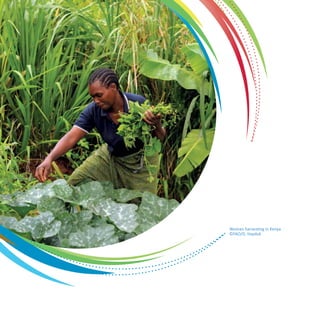
Woman harvesting in Kenya 
©FAO/D. Hayduk
CLIMATE-SMART AGRICULTURE FOR 
SMALLHOLDER FARMERS IN 
KENYA AND TANZANIA 
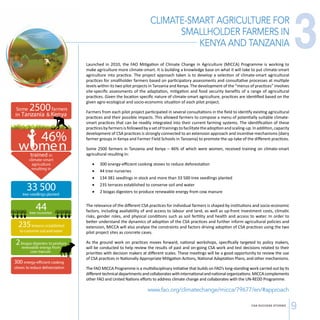
Launched in 2010, the FAO Mitigation of Climate Change in Agriculture (MICCA) Programme is working to 
make agriculture more climate-smart. It is building a knowledge base on what it will take to put climate-smart 
agriculture into practice. The project approach taken is to develop a selection of climate-smart agricultural 
practices for smallholder farmers based on participatory assessments and consultative processes at multiple 
levels within its two pilot projects in Tanzania and Kenya. The development of the “menus of practices” involves 
site-specific assessments of the adaptation, mitigation and food security benefits of a range of agricultural 
practices. Given the location specific nature of climate-smart agriculture, practices are identified based on the 
given agro-ecological and socio-economic situation of each pilot project. 
Farmers from each pilot project participated in several consultations in the field to identify existing agricultural 
practices and their possible impacts. This allowed farmers to compose a menu of potentially suitable climate-smart 
practices that can be readily integrated into their current farming systems. The identification of these 
practices by farmers is followed by a set of trainings to facilitate the adoption and scaling-up. In addition, capacity 
development of CSA practices is strongly connected to an extension approach and incentive mechanisms (dairy 
farmer groups in Kenya and Farmer Field Schools in Tanzania) to promote the up-take of the different practices. 
Some 2500 farmers in Tanzania and Kenya – 46% of which were women, received training on climate-smart 
agricultural resulting in: 
CSA SUCCESS STORIES 9 
• 300 energy-efficient cooking stoves to reduce deforestation 
• 44 tree nurseries 
• 134 381 seedlings in stock and more than 33 500 tree seedlings planted 
• 235 terraces established to conserve soil and water 
• 2 biogas digesters to produce renewable energy from cow manure 
The relevance of the different CSA practices for individual farmers is shaped by institutions and socio-economic 
factors, including availability of and access to labour and land, as well as up-front investment costs, climatic 
risks, gender roles, and physical conditions such as soil fertility and health and access to water. In order to 
better understand the dynamics of adoption of the CSA practices and further inform agricultural policies and 
extension, MICCA will also analyse the constraints and factors driving adoption of CSA practices using the two 
pilot project sites as concrete cases. 
As the ground work on practices moves forward, national workshops, specifically targeted to policy makers, 
will be conducted to help review the results of past and on-going CSA work and test decisions related to their 
priorities with decision makers at different scales. These meetings will be a good opportunity to review the use 
of CSA practices in Nationally Appropriate Mitigation Actions, National Adaptation Plans, and other mechanisms. 
The FAO MICCA Programme is a multidisciplinary initiative that builds on FAO’s long-standing work carried out by its 
different technical departments and collaborates with international and national organizations. MICCA complements 
other FAO and United Nations efforts to address climate change and collaborates with the UN-REDD Programme. 
www.fao.org/climatechange/micca/79677/en/#approach 
3
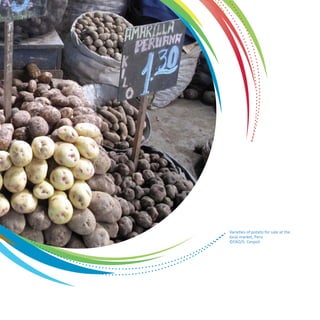
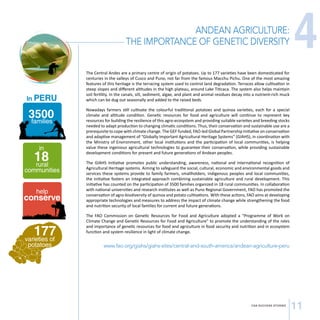
Varieties of potato for sale at the 
local market, Peru 
©FAO/S. Cespoli
ANDEAN AGRICULTURE: 
THE IMPORTANCE OF GENETIC DIVERSITY 
CSA SUCCESS STORIES 11 
In PERU 
3500 families 
in 18 rural 
communities 
help 
conserve 
177 varieties of 
potatoes 
The Central Andes are a primary centre of origin of potatoes. Up to 177 varieties have been domesticated for 
centuries in the valleys of Cusco and Puno, not far from the famous Macchu Pichu. One of the most amazing 
features of this heritage is the terracing system used to control land degradation. Terraces allow cultivation in 
steep slopes and different altitudes in the high plateau, around Lake Titicaca. The system also helps maintain 
soil fertility. In the canals, silt, sediment, algae, and plant and animal residues decay into a nutrient-rich muck 
which can be dug out seasonally and added to the raised beds. 
Nowadays farmers still cultivate the colourful traditional potatoes and quinoa varieties, each for a special 
climate and altitude condition. Genetic resources for food and agriculture will continue to represent key 
resources for building the resilience of this agro-ecosystem and providing suitable varieties and breeding stocks 
needed to adapt production to changing climatic conditions. Thus, their conservation and sustainable use are a 
prerequisite to cope with climate change. The GEF funded, FAO-led Global Partnership Initiative on conservation 
and adaptive management of “Globally Important Agricultural Heritage Systems” (GIAHS), in coordination with 
the Ministry of Environment, other local institutions and the participation of local communities, is helping 
value these ingenious agricultural technologies to guarantee their conservation, while providing sustainable 
development conditions for present and future generations of Andean peoples. 
The GIAHS Initiative promotes public understanding, awareness, national and international recognition of 
Agricultural Heritage systems. Aiming to safeguard the social, cultural, economic and environmental goods and 
services these systems provide to family farmers, smallholders, indigenous peoples and local communities, 
the initiative fosters an integrated approach combining sustainable agriculture and rural development. This 
initiative has counted on the participation of 3500 families organized in 18 rural communities. In collaboration 
with national universities and research institutes as well as Puno Regional Government, FAO has promoted the 
conservation of agro-biodiversity of quinoa and potato cultivations. With these actions, FAO aims at developing 
appropriate technologies and measures to address the impact of climate change while strengthening the food 
and nutrition security of local families for current and future generations. 
The FAO Commission on Genetic Resources for Food and Agriculture adopted a “Programme of Work on 
Climate Change and Genetic Resources for Food and Agriculture” to promote the understanding of the roles 
and importance of genetic resources for food and agriculture in food security and nutrition and in ecosystem 
function and system resilience in light of climate change. 
www.fao.org/giahs/giahs-sites/central-and-south-america/andean-agriculture-peru 
4
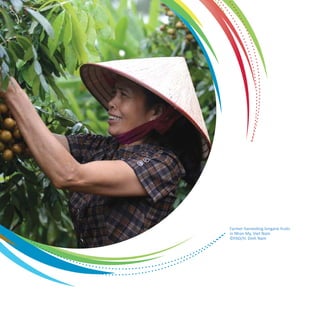
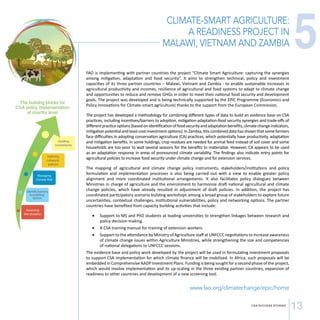
Farmer harvesting longane fruits 
in Nhan My, Viet Nam 
©FAO/H. Dinh Nam
CLIMATE-SMART AGRICULTURE: 
A READINESS PROJECT IN 
MALAWI, VIETNAM AND ZAMBIA 
CSA SUCCESS STORIES 13 
The builidng blocks for 
CSA policy implementation 
at country level 
Guiding 
Investments 
Managing 
Climate Risk 
Identify barriers 
 enabling 
factors 
Assessing 
the situation 
Dening 
coherent 
policies 
FAO is implementing with partner countries the project “Climate Smart Agriculture: capturing the synergies 
among mitigation, adaptation and food security“. It aims to strengthen technical, policy and investment 
capacities of its three partner countries – Malawi, Vietnam and Zambia - to enable sustainable increases in 
agricultural productivity and incomes, resilience of agricultural and food systems to adapt to climate change 
and opportunities to reduce and remove GHGs in order to meet their national food security and development 
goals. The project was developed and is being technically supported by the EPIC Programme (Economics and 
Policy Innovations for Climate-smart agriculture) thanks to the support from the European Commission. 
The project has developed a methodology for combining different types of data to build an evidence base on CSA 
practices, including incentives/barriers to adoption, mitigation-adaptation-food security synergies and trade-offs of 
different practice options (based on identification of food security and adaptation benefits, climate change indicators, 
mitigation potential and least-cost-investment options). In Zambia, this combined data has shown that some farmers 
face difficulties in adopting conservation agriculture (CA) practices, which potentially have productivity, adaptation 
and mitigation benefits. In some holdings, crop residues are needed for animal feed instead of soil cover and some 
households are too poor to wait several seasons for the benefits to materialize. However, CA appears to be used 
as an adaptation response in areas of pronounced climate variability. The findings also indicate entry points for 
agricultural policies to increase food security under climate change and for extension services. 
The mapping of agricultural and climate change policy instruments, stakeholders/institutions and policy 
formulation and implementation processes is also being carried out with a view to enable greater policy 
alignment and more coordinated institutional arrangements. It also facilitates policy dialogues between 
Ministries in charge of agriculture and the environment to harmonize draft national agricultural and climate 
change policies, which have already resulted in adjustment of draft policies. In addition, the project has 
coordinated participatory scenario building workshops among a broad group of stakeholders to explore future 
uncertainties, contextual challenges, institutional vulnerabilities, policy and networking options. The partner 
countries have benefited from capacity building activities that include: 
• Support to MS and PhD students at leading universities to strengthen linkages between research and 
policy decision-making. 
• A CSA training manual for training of extension workers. 
• Support to the attendance by Ministry of Agriculture staff at UNFCCC negotiations to increase awareness 
of climate change issues within Agriculture Ministries, while strengthening the size and competencies 
of national delegations to UNFCCC sessions. 
The evidence base and policy work developed by the project will be used in formulating investment proposals 
to support CSA implementation for which climate finance will be mobilized. In Africa, such proposals will be 
embedded in Comprehensive AADP Investment Plans. Funding is being sought for a second phase of the project, 
which would involve implementation and its up-scaling in the three existing partner countries, expansion of 
readiness to other countries and development of a new screening tool. 
www.fao.org/climatechange/epic/home 
5
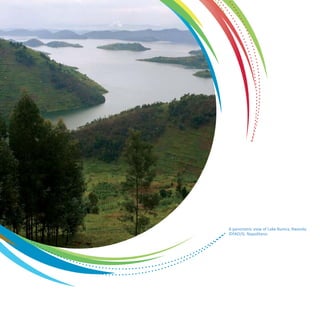
A panoramic view of Lake Burera, Rwanda 
©FAO/G. Napolitano
A LANDSCAPE APPROACH FOR POLICY 
MAKING, PLANNING, AND MONITORING 
IN THE KAGERA RIVER BASIN 
CSA SUCCESS STORIES 15 
A farmer in 
UGANDA 
with 
20 beehives 
1 acre 
fruit trees 
1 acre 
pastures 
10 heads 
of cattle 
Sustainably 
manages his 
land 
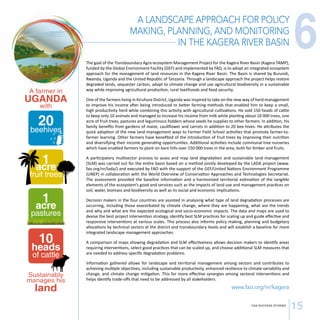
The goal of the Transboundary Agro-ecosystem Management Project for the Kagera River Basin (Kagera TAMP), 
funded by the Global Environment Facility (GEF) and implemented by FAO, is to adopt an integrated ecosystem 
approach for the management of land resources in the Kagera River Basin. The Basin is shared by Burundi, 
Rwanda, Uganda and the United Republic of Tanzania. Through a landscape approach the project helps restore 
degraded lands, sequester carbon, adapt to climate change and use agricultural biodiversity in a sustainable 
way while improving agricultural production, rural livelihoods and food security. 
One of the farmers living in Kiruhura District, Uganda was inspired to take on the new way of herd management 
to improve his income after being introduced to better farming methods that enabled him to keep a small, 
high productivity herd while combining this activity with agricultural cultivations. He sold 150 heads of cattle 
to keep only 10 animals and managed to increase his income from milk while planting about 10 000 trees, one 
acre of fruit trees, pastures and leguminous fodders whose seeds he supplies to other farmers. In addition, his 
family benefits from gardens of maize, cauliflower and carrots in addition to 20 bee hives. He attributes the 
quick adoption of the new land management ways to Farmer Field School activities that promote farmer-to-farmer 
learning. Other farmers have benefited of the introduction of fruit trees by improving their nutrition 
and diversifying their income generating opportunities. Additional activities include communal tree nurseries 
which have enabled farmers to plant on bare hills over 150 000 trees in the area, both for timber and fruits. 
A participatory multisector process to asses and map land degradation and sustainable land management 
(SLM) was carried out for the entire basin based on a method jointly developed by the LADA project (www. 
fao.org/nr/lada/) and executed by FAO with the support of the GEF/United Nations Environment Programme 
(UNEP) in collaboration with the World Overview of Conservation Approaches and Technologies Secretariat. 
The assessment provided the baseline information and a harmonized territorial estimation of the tangible 
elements of the ecosystem’s good and services such as the impacts of land use and management practices on 
soil, water, biomass and biodiversity as well as its social and economic implications. 
Decision makers in the four countries are assisted in analysing what type of land degradation processes are 
occurring, including those exacerbated by climate change, where they are happening, what are the trends 
and why and what are the expected ecological and socio-economic impacts. The data and maps are used to 
devise the best project intervention strategy, identify best SLM practices for scaling up and guide effective and 
responsive interventions at various scales. This process also informs policy making, planning and budgetary 
allocations by technical sectors at the district and transboundary levels and will establish a baseline for more 
integrated landscape management approaches. 
A comparison of maps showing degradation and SLM effectiveness allows decision makers to identify areas 
requiring interventions, select good practices that can be scaled up, and choose additional SLM measures that 
are needed to address specific degradation problems. 
Information gathered allows for landscape and territorial management among sectors and contributes to 
achieving multiple objectives, including sustainable productivity, enhanced resilience to climate variability and 
change, and climate change mitigation. This for more effective synergies among sectoral interventions and 
helps identify trade-offs that need to be addressed by all stakeholders. 
www.fao.org/nr/kagera 
6
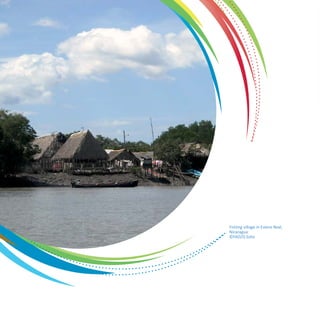
Fishing village in Estero Real, 
Nicaragua 
©FAO/D.Soto
ECOSYSTEM APPROACH TO FISHERIES 
AND AQUACULTURE FOR FOOD 
SECURITY IN NICARAGUA 
CSA SUCCESS STORIES 17 
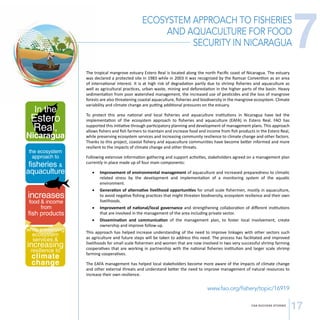
In the 
Estero 
Real, 
Nicaragua 
the ecosystem 
approach to 
fisheries  
aquaculture 
increases 
food  income 
from 
fish products 
while preserving 
ecosystem 
services  
increasing 
resilience to 
climate 
change 
The tropical mangrove estuary Estero Real is located along the north Pacific coast of Nicaragua. The estuary 
was declared a protected site in 1983 while in 2003 it was recognized by the Ramsar Convention as an area 
of international interest. It is at high risk of degradation partly due to shrimp fisheries and aquaculture as 
well as agricultural practices, urban waste, mining and deforestation in the higher parts of the basin. Heavy 
sedimentation from poor watershed management, the increased use of pesticides and the loss of mangrove 
forests are also threatening coastal aquaculture, fisheries and biodiversity in the mangrove ecosystem. Climate 
variability and climate change are putting additional pressures on the estuary. 
To protect this area national and local fisheries and aquaculture institutions in Nicaragua have led the 
implementation of the ecosystem approach to fisheries and aquaculture (EAFA) in Estero Real. FAO has 
supported this initiative through participatory planning and development of management plans. This approach 
allows fishers and fish farmers to maintain and increase food and income from fish products in the Estero Real, 
while preserving ecosystem services and increasing community resilience to climate change and other factors. 
Thanks to this project, coastal fishery and aquaculture communities have become better informed and more 
resilient to the impacts of climate change and other threats. 
Following extensive information gathering and support activities, stakeholders agreed on a management plan 
currently in place made up of four main components: 
• Improvement of environmental management of aquaculture and increased preparedness to climatic 
related stress by the development and implementation of a monitoring system of the aquatic 
environment. 
• Generation of alternative livelihood opportunities for small scale fishermen, mostly in aquaculture, 
to avoid negative fishing practices that might threaten biodiversity, ecosystem resilience and their own 
livelihoods. 
• Improvement of national/local governance and strengthening collaboration of different institutions 
that are involved in the management of the area including private sector. 
• Dissemination and communication of the management plan, to foster local involvement, create 
ownership and improve follow-up. 
This approach has helped increase understanding of the need to improve linkages with other sectors such 
as agriculture and future steps will be taken to address this need. The process has facilitated and improved 
livelihoods for small scale fishermen and women that are now involved in two very successful shrimp farming 
cooperatives that are working in partnership with the national fisheries institution and larger scale shrimp 
farming cooperatives. 
The EAFA management has helped local stakeholders become more aware of the impacts of climate change 
and other external threats and understand better the need to improve management of natural resources to 
increase their own resilience. 
www.fao.org/fishery/topic/16919 
7
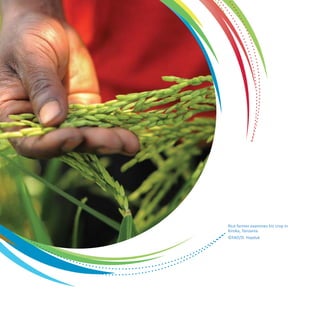
Rice farmer examines his crop in 
Kiroka, Tanzania 
©FAO/D. Hayduk
PROMOTING THE DEVELOPMENT OF UREA 
DEEP PLACEMENT IN NIGERIA THROUGH 
SOUTH/SOUTH COOPERATION 
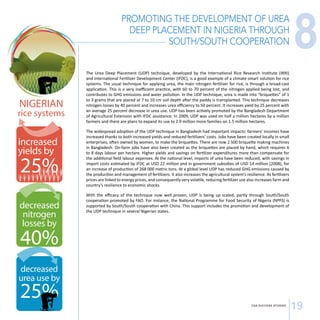
The Urea Deep Placement (UDP) technique, developed by the International Rice Research Institute (IRRI) 
and International Fertilizer Development Center (IFDC), is a good example of a climate-smart solution for rice 
systems. The usual technique for applying urea, the main nitrogen fertilizer for rice, is through a broad-cast 
application. This is a very inefficient practice, with 60 to 70 percent of the nitrogen applied being lost, and 
contributes to GHG emissions and water pollution. In the UDP technique, urea is made into “briquettes” of 1 
to 3 grams that are placed at 7 to 10 cm soil depth after the paddy is transplanted. This technique decreases 
nitrogen losses by 40 percent and increases urea efficiency to 50 percent. It increases yield by 25 percent with 
an average 25 percent decrease in urea use. UDP has been actively promoted by the Bangladesh Department 
of Agricultural Extension with IFDC assistance. In 2009, UDP was used on half a million hectares by a million 
farmers and there are plans to expand its use to 2.9 million more families on 1.5 million hectares. 
The widespread adoption of the UDP technique in Bangladesh had important impacts: farmers’ incomes have 
increased thanks to both increased yields and reduced fertilizers’ costs. Jobs have been created locally in small 
enterprises, often owned by women, to make the briquettes. There are now 2 500 briquette making machines 
in Bangladesh. On-farm jobs have also been created as the briquettes are placed by hand, which requires 6 
to 8 days labour per hectare. Higher yields and savings on fertilizer expenditures more than compensate for 
the additional field labour expenses. At the national level, imports of urea have been reduced, with savings in 
import costs estimated by IFDC at USD 22 million and in government subsidies of USD 14 million (2008), for 
an increase of production of 268 000 metric tons. At a global level UDP has reduced GHG emissions caused by 
the production and management of fertilizers. It also increases the agricultural system’s resilience. As fertilizers 
prices are linked to energy prices, and consequently very volatile, reducing fertilizer use also increases farm and 
country’s resilience to economic shocks. 
With the efficacy of the technique now well proven, UDP is being up scaled, partly through South/South 
cooperation promoted by FAO. For instance, the National Programme for Food Security of Nigeria (NPFS) is 
supported by South/South cooperation with China. This support includes the promotion and development of 
the UDP technique in several Nigerian states. 
8 
CSA SUCCESS STORIES 19
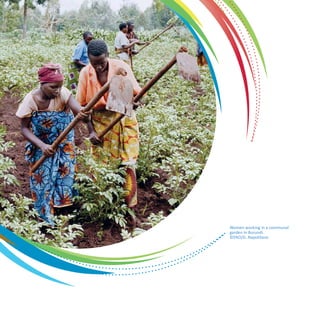
Women working in a communal 
garden in Burundi 
©FAO/G. Napolitano
DEVELOPING CAPACITY TO UNDERSTAND  
ADDRESS THE GENDER DIMENSIONS OF CLIMATE 
CHANGE AND AGRICULTURE IN INDIA 
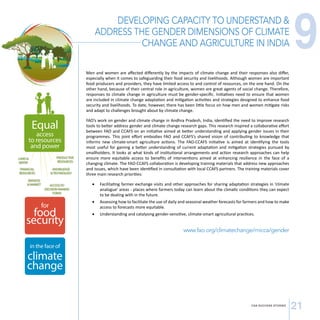
Men and women are affected differently by the impacts of climate change and their responses also differ, 
especially when it comes to safeguarding their food security and livelihoods. Although women are important 
food producers and providers, they have limited access to and control of resources, on the one hand. On the 
other hand, because of their central role in agriculture, women are great agents of social change. Therefore, 
responses to climate change in agriculture must be gender-specific. Initiatives need to ensure that women 
are included in climate change adaptation and mitigation activities and strategies designed to enhance food 
security and livelihoods. To date, however, there has been little focus on how men and women mitigate risks 
and adapt to challenges brought about by climate change. 
FAO’s work on gender and climate change in Andhra Pradesh, India, identified the need to improve research 
tools to better address gender and climate change research gaps. This research inspired a collaborative effort 
between FAO and CCAFS on an initiative aimed at better understanding and applying gender issues in their 
programmes. This joint effort embodies FAO and CCAFS’s shared vision of contributing to knowledge that 
informs new climate-smart agriculture actions. The FAO-CCAFS initiative is aimed at identifying the tools 
most useful for gaining a better understanding of current adaptation and mitigation strategies pursued by 
smallholders. It looks at what kinds of institutional arrangements and action research approaches can help 
ensure more equitable access to benefits of interventions aimed at enhancing resilience in the face of a 
changing climate. The FAO-CCAFS collaboration is developing training materials that address new approaches 
and issues, which have been identified in consultation with local CCAFS partners. The training materials cover 
three main research priorities: 
• Facilitating farmer exchange visits and other approaches for sharing adaptation strategies in ‘climate 
analogue’ areas - places where farmers today can learn about the climatic conditions they can expect 
to be dealing with in the future. 
• Assessing how to facilitate the use of daily and seasonal weather forecasts for farmers and how to make 
CSA SUCCESS STORIES 21 
access to forecasts more equitable. 
• Understanding and catalysing gender-sensitive, climate-smart agricultural practices. 
www.fao.org/climatechange/micca/gender 
9
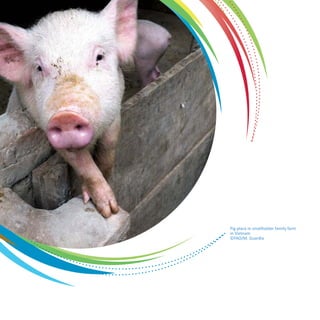
Pig place in smallholder family farm 
in Vietnam 
©FAO/M. Guardia
IN EAST ASIA10 
LIVESTOCK WASTE MANAGEMENT 
CSA SUCCESS STORIES 23 
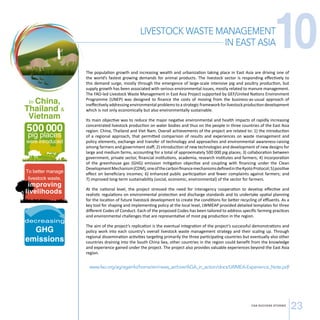
In China, 
Thailand  
Vietnam 
500 000 pig places 
were introduced 
To better manage 
livestock waste, 
improving 
livelihoods 
decreasing 
GHG 
emissions 
The population growth and increasing wealth and urbanization taking place in East Asia are driving one of 
the world’s fastest growing demands for animal products. The livestock sector is responding effectively to 
this demand surge, mostly through the emergence of large-scale intensive pig and poultry production, but 
supply growth has been associated with serious environmental issues, mostly related to manure management. 
The FAO-led Livestock Waste Management in East Asia Project supported by GEF/United Nations Environment 
Programme (UNEP) was designed to finance the costs of moving from the business-as-usual approach of 
ineffectively addressing environmental problems to a strategic framework for livestock production development 
which is not only economically but also environmentally sustainable. 
Its main objective was to reduce the major negative environmental and health impacts of rapidly increasing 
concentrated livestock production on water bodies and thus on the people in three countries of the East Asia 
region: China, Thailand and Viet Nam. Overall achievements of the project are related to: 1) the introduction 
of a regional approach, that permitted comparison of results and experiences on waste management and 
policy elements, exchange and transfer of technology and approaches and environmental awareness-raising 
among farmers and government staff; 2) introduction of new technologies and development of new designs for 
large and medium farms, accounting for a total of approximately 500 000 pig places; 3) collaboration between 
government, private sector, financial institutions, academia, research institutes and farmers; 4) incorporation 
of the greenhouse gas (GHG) emission mitigation objective and coupling with financing under the Clean 
Development Mechanism (CDM), one of the carbon finance mechanisms defined in the Kyoto Protocol; 5) positive 
effect on beneficiary incomes; 6) enhanced public participation and fewer complaints against farmers; and 
7) improved long-term sustainability (social, economic, environmental) of the sector for farmers. 
At the national level, the project stressed the need for interagency cooperation to develop effective and 
realistic regulations on environmental protection and discharge standards and to undertake spatial planning 
for the location of future livestock development to create the conditions for better recycling of effluents. As a 
key tool for shaping and implementing policy at the local level, LWMEAP provided detailed templates for three 
different Codes of Conduct. Each of the proposed Codes has been tailored to address specific farming practices 
and environmental challenges that are representative of most pig production in the region. 
The aim of the project’s replication is the eventual integration of the project’s successful demonstrations and 
policy work into each country’s overall livestock waste management strategy and their scaling up. Through 
regional dissemination activities targeting primarily the three participating countries but eventually also other 
countries draining into the South China Sea, other countries in the region could benefit from the knowledge 
and experience gained under the project. The project also provides valuable experiences beyond the East Asia 
region. 
www.fao.org/ag/againfo/home/en/news_archive/AGA_in_action/docs/LWMEA-Experience_Note.pdf
Coffee shrubs and banana trees in 
the Kihamba layered vegetation, 
Tanzania 
©FAO/D.Boerma
This booklet provides examples of climate-smart 
systems by showcasing some FAO success stories in 
various countries. The cases have been selected from 
the FAO Climate-Smart Agriculture (CSA) Sourcebook 
launched in 2013 to show the diversity of potential 
options across different regions and agricultural systems 
also covering subjects such as biodiversity and gender. 
www.fao.org/climatechange/climatesmart 
climate-change@fao.org 
©FAO 2014 Cover photos: © FAO / C.Dowsett, G. Napolitano  I. Balderi 
I3817E/1/05.14

A i3817e

  • 1.
  • 2.
    CLIMATE-SMART AGRICULTURE GROUNDON THE This booklet provides examples of climate-smart systems by showcasing some FAO success stories in various countries. The cases have been selected from the FAO Climate-Smart Agriculture (CSA) Sourcebook launched in 2013 to show the diversity of potential options across different regions and agricultural systems also covering subjects such as biodiversity and gender.
  • 3.
    CSA SUCCESS STORIES1 FAO SUCCESS STORIES ON CLIMATE-SMART AGRICULTURE CSA ON THE GROUND UNDERSTANDING THE CHALLENGES OF CLIMATE CHANGE AND FOOD SECURITY FAO estimates that food production must increase by at least 60 percent to respond to the demand of the 9 billion people that are expected to inhabit the planet by 2050. Given that one in eight people are currently food insecure, ensuring global food security over the next decades will be essential. In meeting this challenge, there is an opportunity to create sustainable economic growth in rural areas of developing countries where food security and poverty are most prevalent. According to the Fifth Assessment Report of the Intergovernmental Panel on Climate Change (IPCC), rising temperatures and increased frequency of extreme events will have direct and negative impacts on crops, livestock, forestry, fisheries and aquaculture productivity. Climate change is a universal and critical challenge for global food security. Improving the way we manage agricultural systems and natural resources is fundamental for effectively achieving food security. We can no longer afford to separate the future of food security from that of natural resources, the environment and climate change – they are inextricably intertwined and our response must be as well. Efforts to reduce food insecurity must include building the resilience of rural communities to shocks and strengthening their adaptive capacity to cope with increased variability and slow onset changes. The agricultural sectors (crops, livestock, forestry, fisheries) must therefore transform themselves in order to feed a growing global population and provide the basis for economic growth and poverty reduction. This transformation must be accomplished without hindering the natural resource base. More productive and resilient agriculture requires a major shift in the way land, water, soil nutrients and genetic resources are managed to ensure that these resources are used more efficiently and sustainably. Making this shift requires considerable changes in national and local governance, legislation, policies and financial mechanisms. This transformation will also involve improving producers’ access to markets.
  • 4.
    GAINING TRACTION ONCLIMATE-SMART AGRICULTURE FAO has recognized that for agriculture to feed the world in a way that can ensure sustainable rural development, it must become ‘climate-smart‘. Climate-smart agriculture (CSA), as defined and presented by FAO at the Hague Conference on Agriculture, Food Security and Climate Change in 2010 is an approach to developing the technical, policy and investment conditions to achieve sustainable agricultural development for food security under climate change. It contributes to the achievement of national food security and development goals with three objectives: 2 CSA SUCCESS STORIES The magnitude, immediacy and broad scope of the effects of climate change on agricultural systems create a compelling need to ensure their comprehensive integration into national agricultural planning, investments and programs. The CSA approach is designed to identify and operationalize sustainable agricultural development explicitly integrating climate change as a major parameter. For CSA to become a reality an integrated approach responsive to specific local conditions is required. Integrated landscape approaches and coordination across agricultural sectors is essential to capitalize on potential synergies, reduce trade-offs and optimize the use of natural resources and ecosystem services.
  • 5.
    Climate-Smart Agriculture inKiroka, Tanzania ©FAO/D. Hayduk CSA SUCCESS STORIES 3
  • 6.
    Kihamba landscape, Tanzania © FAO/D. Boerma
  • 7.
    CSA SUCCESS STORIES5 In the slopes of Kilimanjaro, Tanzania 120 000ha of agroforestry Include coee cash crops that will INCREASE income by 25% In3 years PRESERVING THE AGRO-FORESTRY SYSTEM ON MOUNT KILIMANJARO The “Kihamba” agroforestry system covers 120 000 hectares of Mount Kilimanjaro’s southern slopes. The 800 year-old system stands out among agroforestry systems as one of the most sustainable forms of upland farming. Without undermining sustainability, it has been able to support one of the highest rural population densities in Africa, providing livelihoods for an estimated one million people. This agroforestry system has a multilayered vegetation structure similar to a tropical mountain forest which maximizes the use of limited land, provides a large variety of foods all year round and provides substantive environmental services beyond the areas where it is practiced. Because of the high quantities of biomass it produces and its capacity to recycle organic matter on farms, the agroforestry system contributes significantly to carbon storage. The trees and dense vegetation help considerably to ensure that Mount Kilimanjaro can remain the ‘water tower’ for the region. As an ecologically compatible cash crop, coffee allowed the agroforestry system to adapt successfully to the emerging cash economy. However, in the 1990’s, coffee prices on the world market plummeted at the same time as pests and diseases were increasing. Additionally, many coffee shrubs had reached an age (over 50 years) when they produce less beans. These factors led to a sharp decline in productivity and profitability. It is estimated that 20 percent of coffee cultivations in the area have been abandoned. If this continues, it will have massive environmental and socio-economic implications in the landscape around Mount Kilimanjaro especially on food security, carbon storage, water catchment and soil erosion. Under FAO’s Globally Important Agricultural Heritage Systems Initiative (GIAHS), activities were piloted in 660 households to enhance farmers’ cash income while preserving the ecological and social integrity of the Kihamba system. The project implemented an action plan, formulated together with the community, with the following key activities: • Rethinking sources of cash income. Three interventions were agreed on: a) conversion to certified organic coffee farming; b) introduction of vanilla as a high value additional cash crop; and c) introduction of trout aquaculture along the canals of the irrigation system. • Rehabilitation of the irrigation system to reduce water loss and expansion of the capacity of storage ponds to cope with longer dry seasons due to climate change. • Training in sustainable land management. • The interventions in coffee management alone are expected to increase farm cash income by 25 percent in three years. In addition, the project organized a Free, Prior and Informed Consent (FPIC) process to facilitate an informed and independent decision-making process by the community,. Preparatory consultations were held with local government officials, traditional elders, and women’s representatives, where the pros and cons of different development options were discussed. A crucial step to build support in the government was to engage focal points in a Project Facilitating Committee (PFC) and to work across sectors and levels, with agents with different expertise and government mandates. www.fao.org/giahs/giahs-sites/africa/shimbwe-juu-kihamba-agro-forestry-heritage-site-tanzania 1
  • 8.
    Yak grazing inQinghai, China ©FAO/P. Gerber
  • 9.
    SUSTAINABLE GRAZING FOR BETTER LIVELIHOODS IN CHINA The restoration of degraded grasslands through sustainable grassland management includes reductions in grazing pressure on overstocked areas, the sowing of improved pastures and better pasture management. It can lock more carbon in soils and biomass, increase the water-holding capacity of the soil and enhance grassland biodiversity. The Three Rivers Sustainable Grazing Project is a pilot project in the Qinghai province of China that aims to address these challenges. The research and planning phases of the project have been completed with joint contributions from FAO, ICRAF and Chinese institutes including the Institute of Environment and Sustainable Development in Agriculture (CAAS) and the Northwest Institute of Plateau Biology. Investors and the Qinghai Government are currently discussing co-investment opportunities for implementation of the project. In the project yak- and sheep-herding households will select a combination of management options related to grazing intensity, grass cultivation and animal husbandry. The project’s goal is to restore degraded grazing land and sequester soil carbon, and at the same time increase productivity, build resilience and improve livelihoods in smallholder herder communities. The average annual mitigation potential in the first 10 years of the project were estimated at 63 000 tonnes of CO2 eqv. per year. The primary selection criteria for this project was its high carbon sequestration potential, which was linked to the prevalence of heavily degraded grazing land (38 percent of the project area), and the availability of simple and cost-effective restoration measures. Also, by improving soil moisture and nutrient retention in soils, grassland restoration plays an important role in building resilience to climate change. Assessments revealed that restoration of degraded grazing lands would also significantly enhance the productive potential of the project site. Economic returns to herders will be enhanced by including a package of complementary measures, such as the introduction of improved feeding, winter housing, post-farm processing and marketing activities. The project’s capacity to deliver economic returns is crucial, as it greatly increases the likelihood of voluntary herder enrolment, and improves the synergy between climate change mitigation and rural development objectives. The project aims to finance its investment costs (e.g. for grass planting, fencing and animal housing) and cover income forgone due to temporary destocking, with funds mobilized from the voluntary carbon market. A key constraint to accessing carbon market finance is the absence of carbon accounting methodology that is cost effective for herders, but also sufficiently accurate for investors. To address this constraint, FAO has developed a carbon accounting methodology, based on the sustainable grassland management practices described above, that has been validated under the Verified Carbon Standard. Instead of relying solely on direct measurement, which is often prohibitively costly, this methodology permits the use of carefully calibrated biogeochemical models in combination with the monitoring of management activities to estimate soil carbon pool changes. This important innovation significantly reduces the costs associated with measurement and verification and greatly facilitates access to carbon markets. While developed as part of the Three Rivers project, the grassland carbon accounting methodology will be applicable to sustainable grazing projects throughout the world. www.v-c-s.org/methodologies/methodology-sustainable-grassland-management-sgm 2 CSA SUCCESS STORIES 7
  • 10.
    Woman harvesting inKenya ©FAO/D. Hayduk
  • 11.
    CLIMATE-SMART AGRICULTURE FOR SMALLHOLDER FARMERS IN KENYA AND TANZANIA Launched in 2010, the FAO Mitigation of Climate Change in Agriculture (MICCA) Programme is working to make agriculture more climate-smart. It is building a knowledge base on what it will take to put climate-smart agriculture into practice. The project approach taken is to develop a selection of climate-smart agricultural practices for smallholder farmers based on participatory assessments and consultative processes at multiple levels within its two pilot projects in Tanzania and Kenya. The development of the “menus of practices” involves site-specific assessments of the adaptation, mitigation and food security benefits of a range of agricultural practices. Given the location specific nature of climate-smart agriculture, practices are identified based on the given agro-ecological and socio-economic situation of each pilot project. Farmers from each pilot project participated in several consultations in the field to identify existing agricultural practices and their possible impacts. This allowed farmers to compose a menu of potentially suitable climate-smart practices that can be readily integrated into their current farming systems. The identification of these practices by farmers is followed by a set of trainings to facilitate the adoption and scaling-up. In addition, capacity development of CSA practices is strongly connected to an extension approach and incentive mechanisms (dairy farmer groups in Kenya and Farmer Field Schools in Tanzania) to promote the up-take of the different practices. Some 2500 farmers in Tanzania and Kenya – 46% of which were women, received training on climate-smart agricultural resulting in: CSA SUCCESS STORIES 9 • 300 energy-efficient cooking stoves to reduce deforestation • 44 tree nurseries • 134 381 seedlings in stock and more than 33 500 tree seedlings planted • 235 terraces established to conserve soil and water • 2 biogas digesters to produce renewable energy from cow manure The relevance of the different CSA practices for individual farmers is shaped by institutions and socio-economic factors, including availability of and access to labour and land, as well as up-front investment costs, climatic risks, gender roles, and physical conditions such as soil fertility and health and access to water. In order to better understand the dynamics of adoption of the CSA practices and further inform agricultural policies and extension, MICCA will also analyse the constraints and factors driving adoption of CSA practices using the two pilot project sites as concrete cases. As the ground work on practices moves forward, national workshops, specifically targeted to policy makers, will be conducted to help review the results of past and on-going CSA work and test decisions related to their priorities with decision makers at different scales. These meetings will be a good opportunity to review the use of CSA practices in Nationally Appropriate Mitigation Actions, National Adaptation Plans, and other mechanisms. The FAO MICCA Programme is a multidisciplinary initiative that builds on FAO’s long-standing work carried out by its different technical departments and collaborates with international and national organizations. MICCA complements other FAO and United Nations efforts to address climate change and collaborates with the UN-REDD Programme. www.fao.org/climatechange/micca/79677/en/#approach 3
  • 12.
    Varieties of potatofor sale at the local market, Peru ©FAO/S. Cespoli
  • 13.
    ANDEAN AGRICULTURE: THEIMPORTANCE OF GENETIC DIVERSITY CSA SUCCESS STORIES 11 In PERU 3500 families in 18 rural communities help conserve 177 varieties of potatoes The Central Andes are a primary centre of origin of potatoes. Up to 177 varieties have been domesticated for centuries in the valleys of Cusco and Puno, not far from the famous Macchu Pichu. One of the most amazing features of this heritage is the terracing system used to control land degradation. Terraces allow cultivation in steep slopes and different altitudes in the high plateau, around Lake Titicaca. The system also helps maintain soil fertility. In the canals, silt, sediment, algae, and plant and animal residues decay into a nutrient-rich muck which can be dug out seasonally and added to the raised beds. Nowadays farmers still cultivate the colourful traditional potatoes and quinoa varieties, each for a special climate and altitude condition. Genetic resources for food and agriculture will continue to represent key resources for building the resilience of this agro-ecosystem and providing suitable varieties and breeding stocks needed to adapt production to changing climatic conditions. Thus, their conservation and sustainable use are a prerequisite to cope with climate change. The GEF funded, FAO-led Global Partnership Initiative on conservation and adaptive management of “Globally Important Agricultural Heritage Systems” (GIAHS), in coordination with the Ministry of Environment, other local institutions and the participation of local communities, is helping value these ingenious agricultural technologies to guarantee their conservation, while providing sustainable development conditions for present and future generations of Andean peoples. The GIAHS Initiative promotes public understanding, awareness, national and international recognition of Agricultural Heritage systems. Aiming to safeguard the social, cultural, economic and environmental goods and services these systems provide to family farmers, smallholders, indigenous peoples and local communities, the initiative fosters an integrated approach combining sustainable agriculture and rural development. This initiative has counted on the participation of 3500 families organized in 18 rural communities. In collaboration with national universities and research institutes as well as Puno Regional Government, FAO has promoted the conservation of agro-biodiversity of quinoa and potato cultivations. With these actions, FAO aims at developing appropriate technologies and measures to address the impact of climate change while strengthening the food and nutrition security of local families for current and future generations. The FAO Commission on Genetic Resources for Food and Agriculture adopted a “Programme of Work on Climate Change and Genetic Resources for Food and Agriculture” to promote the understanding of the roles and importance of genetic resources for food and agriculture in food security and nutrition and in ecosystem function and system resilience in light of climate change. www.fao.org/giahs/giahs-sites/central-and-south-america/andean-agriculture-peru 4
  • 14.
    Farmer harvesting longanefruits in Nhan My, Viet Nam ©FAO/H. Dinh Nam
  • 15.
    CLIMATE-SMART AGRICULTURE: AREADINESS PROJECT IN MALAWI, VIETNAM AND ZAMBIA CSA SUCCESS STORIES 13 The builidng blocks for CSA policy implementation at country level Guiding Investments Managing Climate Risk Identify barriers enabling factors Assessing the situation Dening coherent policies FAO is implementing with partner countries the project “Climate Smart Agriculture: capturing the synergies among mitigation, adaptation and food security“. It aims to strengthen technical, policy and investment capacities of its three partner countries – Malawi, Vietnam and Zambia - to enable sustainable increases in agricultural productivity and incomes, resilience of agricultural and food systems to adapt to climate change and opportunities to reduce and remove GHGs in order to meet their national food security and development goals. The project was developed and is being technically supported by the EPIC Programme (Economics and Policy Innovations for Climate-smart agriculture) thanks to the support from the European Commission. The project has developed a methodology for combining different types of data to build an evidence base on CSA practices, including incentives/barriers to adoption, mitigation-adaptation-food security synergies and trade-offs of different practice options (based on identification of food security and adaptation benefits, climate change indicators, mitigation potential and least-cost-investment options). In Zambia, this combined data has shown that some farmers face difficulties in adopting conservation agriculture (CA) practices, which potentially have productivity, adaptation and mitigation benefits. In some holdings, crop residues are needed for animal feed instead of soil cover and some households are too poor to wait several seasons for the benefits to materialize. However, CA appears to be used as an adaptation response in areas of pronounced climate variability. The findings also indicate entry points for agricultural policies to increase food security under climate change and for extension services. The mapping of agricultural and climate change policy instruments, stakeholders/institutions and policy formulation and implementation processes is also being carried out with a view to enable greater policy alignment and more coordinated institutional arrangements. It also facilitates policy dialogues between Ministries in charge of agriculture and the environment to harmonize draft national agricultural and climate change policies, which have already resulted in adjustment of draft policies. In addition, the project has coordinated participatory scenario building workshops among a broad group of stakeholders to explore future uncertainties, contextual challenges, institutional vulnerabilities, policy and networking options. The partner countries have benefited from capacity building activities that include: • Support to MS and PhD students at leading universities to strengthen linkages between research and policy decision-making. • A CSA training manual for training of extension workers. • Support to the attendance by Ministry of Agriculture staff at UNFCCC negotiations to increase awareness of climate change issues within Agriculture Ministries, while strengthening the size and competencies of national delegations to UNFCCC sessions. The evidence base and policy work developed by the project will be used in formulating investment proposals to support CSA implementation for which climate finance will be mobilized. In Africa, such proposals will be embedded in Comprehensive AADP Investment Plans. Funding is being sought for a second phase of the project, which would involve implementation and its up-scaling in the three existing partner countries, expansion of readiness to other countries and development of a new screening tool. www.fao.org/climatechange/epic/home 5
  • 16.
    A panoramic viewof Lake Burera, Rwanda ©FAO/G. Napolitano
  • 17.
    A LANDSCAPE APPROACHFOR POLICY MAKING, PLANNING, AND MONITORING IN THE KAGERA RIVER BASIN CSA SUCCESS STORIES 15 A farmer in UGANDA with 20 beehives 1 acre fruit trees 1 acre pastures 10 heads of cattle Sustainably manages his land The goal of the Transboundary Agro-ecosystem Management Project for the Kagera River Basin (Kagera TAMP), funded by the Global Environment Facility (GEF) and implemented by FAO, is to adopt an integrated ecosystem approach for the management of land resources in the Kagera River Basin. The Basin is shared by Burundi, Rwanda, Uganda and the United Republic of Tanzania. Through a landscape approach the project helps restore degraded lands, sequester carbon, adapt to climate change and use agricultural biodiversity in a sustainable way while improving agricultural production, rural livelihoods and food security. One of the farmers living in Kiruhura District, Uganda was inspired to take on the new way of herd management to improve his income after being introduced to better farming methods that enabled him to keep a small, high productivity herd while combining this activity with agricultural cultivations. He sold 150 heads of cattle to keep only 10 animals and managed to increase his income from milk while planting about 10 000 trees, one acre of fruit trees, pastures and leguminous fodders whose seeds he supplies to other farmers. In addition, his family benefits from gardens of maize, cauliflower and carrots in addition to 20 bee hives. He attributes the quick adoption of the new land management ways to Farmer Field School activities that promote farmer-to-farmer learning. Other farmers have benefited of the introduction of fruit trees by improving their nutrition and diversifying their income generating opportunities. Additional activities include communal tree nurseries which have enabled farmers to plant on bare hills over 150 000 trees in the area, both for timber and fruits. A participatory multisector process to asses and map land degradation and sustainable land management (SLM) was carried out for the entire basin based on a method jointly developed by the LADA project (www. fao.org/nr/lada/) and executed by FAO with the support of the GEF/United Nations Environment Programme (UNEP) in collaboration with the World Overview of Conservation Approaches and Technologies Secretariat. The assessment provided the baseline information and a harmonized territorial estimation of the tangible elements of the ecosystem’s good and services such as the impacts of land use and management practices on soil, water, biomass and biodiversity as well as its social and economic implications. Decision makers in the four countries are assisted in analysing what type of land degradation processes are occurring, including those exacerbated by climate change, where they are happening, what are the trends and why and what are the expected ecological and socio-economic impacts. The data and maps are used to devise the best project intervention strategy, identify best SLM practices for scaling up and guide effective and responsive interventions at various scales. This process also informs policy making, planning and budgetary allocations by technical sectors at the district and transboundary levels and will establish a baseline for more integrated landscape management approaches. A comparison of maps showing degradation and SLM effectiveness allows decision makers to identify areas requiring interventions, select good practices that can be scaled up, and choose additional SLM measures that are needed to address specific degradation problems. Information gathered allows for landscape and territorial management among sectors and contributes to achieving multiple objectives, including sustainable productivity, enhanced resilience to climate variability and change, and climate change mitigation. This for more effective synergies among sectoral interventions and helps identify trade-offs that need to be addressed by all stakeholders. www.fao.org/nr/kagera 6
  • 18.
    Fishing village inEstero Real, Nicaragua ©FAO/D.Soto
  • 19.
    ECOSYSTEM APPROACH TOFISHERIES AND AQUACULTURE FOR FOOD SECURITY IN NICARAGUA CSA SUCCESS STORIES 17 In the Estero Real, Nicaragua the ecosystem approach to fisheries aquaculture increases food income from fish products while preserving ecosystem services increasing resilience to climate change The tropical mangrove estuary Estero Real is located along the north Pacific coast of Nicaragua. The estuary was declared a protected site in 1983 while in 2003 it was recognized by the Ramsar Convention as an area of international interest. It is at high risk of degradation partly due to shrimp fisheries and aquaculture as well as agricultural practices, urban waste, mining and deforestation in the higher parts of the basin. Heavy sedimentation from poor watershed management, the increased use of pesticides and the loss of mangrove forests are also threatening coastal aquaculture, fisheries and biodiversity in the mangrove ecosystem. Climate variability and climate change are putting additional pressures on the estuary. To protect this area national and local fisheries and aquaculture institutions in Nicaragua have led the implementation of the ecosystem approach to fisheries and aquaculture (EAFA) in Estero Real. FAO has supported this initiative through participatory planning and development of management plans. This approach allows fishers and fish farmers to maintain and increase food and income from fish products in the Estero Real, while preserving ecosystem services and increasing community resilience to climate change and other factors. Thanks to this project, coastal fishery and aquaculture communities have become better informed and more resilient to the impacts of climate change and other threats. Following extensive information gathering and support activities, stakeholders agreed on a management plan currently in place made up of four main components: • Improvement of environmental management of aquaculture and increased preparedness to climatic related stress by the development and implementation of a monitoring system of the aquatic environment. • Generation of alternative livelihood opportunities for small scale fishermen, mostly in aquaculture, to avoid negative fishing practices that might threaten biodiversity, ecosystem resilience and their own livelihoods. • Improvement of national/local governance and strengthening collaboration of different institutions that are involved in the management of the area including private sector. • Dissemination and communication of the management plan, to foster local involvement, create ownership and improve follow-up. This approach has helped increase understanding of the need to improve linkages with other sectors such as agriculture and future steps will be taken to address this need. The process has facilitated and improved livelihoods for small scale fishermen and women that are now involved in two very successful shrimp farming cooperatives that are working in partnership with the national fisheries institution and larger scale shrimp farming cooperatives. The EAFA management has helped local stakeholders become more aware of the impacts of climate change and other external threats and understand better the need to improve management of natural resources to increase their own resilience. www.fao.org/fishery/topic/16919 7
  • 20.
    Rice farmer examineshis crop in Kiroka, Tanzania ©FAO/D. Hayduk
  • 21.
    PROMOTING THE DEVELOPMENTOF UREA DEEP PLACEMENT IN NIGERIA THROUGH SOUTH/SOUTH COOPERATION The Urea Deep Placement (UDP) technique, developed by the International Rice Research Institute (IRRI) and International Fertilizer Development Center (IFDC), is a good example of a climate-smart solution for rice systems. The usual technique for applying urea, the main nitrogen fertilizer for rice, is through a broad-cast application. This is a very inefficient practice, with 60 to 70 percent of the nitrogen applied being lost, and contributes to GHG emissions and water pollution. In the UDP technique, urea is made into “briquettes” of 1 to 3 grams that are placed at 7 to 10 cm soil depth after the paddy is transplanted. This technique decreases nitrogen losses by 40 percent and increases urea efficiency to 50 percent. It increases yield by 25 percent with an average 25 percent decrease in urea use. UDP has been actively promoted by the Bangladesh Department of Agricultural Extension with IFDC assistance. In 2009, UDP was used on half a million hectares by a million farmers and there are plans to expand its use to 2.9 million more families on 1.5 million hectares. The widespread adoption of the UDP technique in Bangladesh had important impacts: farmers’ incomes have increased thanks to both increased yields and reduced fertilizers’ costs. Jobs have been created locally in small enterprises, often owned by women, to make the briquettes. There are now 2 500 briquette making machines in Bangladesh. On-farm jobs have also been created as the briquettes are placed by hand, which requires 6 to 8 days labour per hectare. Higher yields and savings on fertilizer expenditures more than compensate for the additional field labour expenses. At the national level, imports of urea have been reduced, with savings in import costs estimated by IFDC at USD 22 million and in government subsidies of USD 14 million (2008), for an increase of production of 268 000 metric tons. At a global level UDP has reduced GHG emissions caused by the production and management of fertilizers. It also increases the agricultural system’s resilience. As fertilizers prices are linked to energy prices, and consequently very volatile, reducing fertilizer use also increases farm and country’s resilience to economic shocks. With the efficacy of the technique now well proven, UDP is being up scaled, partly through South/South cooperation promoted by FAO. For instance, the National Programme for Food Security of Nigeria (NPFS) is supported by South/South cooperation with China. This support includes the promotion and development of the UDP technique in several Nigerian states. 8 CSA SUCCESS STORIES 19
  • 22.
    Women working ina communal garden in Burundi ©FAO/G. Napolitano
  • 23.
    DEVELOPING CAPACITY TOUNDERSTAND ADDRESS THE GENDER DIMENSIONS OF CLIMATE CHANGE AND AGRICULTURE IN INDIA Men and women are affected differently by the impacts of climate change and their responses also differ, especially when it comes to safeguarding their food security and livelihoods. Although women are important food producers and providers, they have limited access to and control of resources, on the one hand. On the other hand, because of their central role in agriculture, women are great agents of social change. Therefore, responses to climate change in agriculture must be gender-specific. Initiatives need to ensure that women are included in climate change adaptation and mitigation activities and strategies designed to enhance food security and livelihoods. To date, however, there has been little focus on how men and women mitigate risks and adapt to challenges brought about by climate change. FAO’s work on gender and climate change in Andhra Pradesh, India, identified the need to improve research tools to better address gender and climate change research gaps. This research inspired a collaborative effort between FAO and CCAFS on an initiative aimed at better understanding and applying gender issues in their programmes. This joint effort embodies FAO and CCAFS’s shared vision of contributing to knowledge that informs new climate-smart agriculture actions. The FAO-CCAFS initiative is aimed at identifying the tools most useful for gaining a better understanding of current adaptation and mitigation strategies pursued by smallholders. It looks at what kinds of institutional arrangements and action research approaches can help ensure more equitable access to benefits of interventions aimed at enhancing resilience in the face of a changing climate. The FAO-CCAFS collaboration is developing training materials that address new approaches and issues, which have been identified in consultation with local CCAFS partners. The training materials cover three main research priorities: • Facilitating farmer exchange visits and other approaches for sharing adaptation strategies in ‘climate analogue’ areas - places where farmers today can learn about the climatic conditions they can expect to be dealing with in the future. • Assessing how to facilitate the use of daily and seasonal weather forecasts for farmers and how to make CSA SUCCESS STORIES 21 access to forecasts more equitable. • Understanding and catalysing gender-sensitive, climate-smart agricultural practices. www.fao.org/climatechange/micca/gender 9
  • 24.
    Pig place insmallholder family farm in Vietnam ©FAO/M. Guardia
  • 25.
    IN EAST ASIA10 LIVESTOCK WASTE MANAGEMENT CSA SUCCESS STORIES 23 In China, Thailand Vietnam 500 000 pig places were introduced To better manage livestock waste, improving livelihoods decreasing GHG emissions The population growth and increasing wealth and urbanization taking place in East Asia are driving one of the world’s fastest growing demands for animal products. The livestock sector is responding effectively to this demand surge, mostly through the emergence of large-scale intensive pig and poultry production, but supply growth has been associated with serious environmental issues, mostly related to manure management. The FAO-led Livestock Waste Management in East Asia Project supported by GEF/United Nations Environment Programme (UNEP) was designed to finance the costs of moving from the business-as-usual approach of ineffectively addressing environmental problems to a strategic framework for livestock production development which is not only economically but also environmentally sustainable. Its main objective was to reduce the major negative environmental and health impacts of rapidly increasing concentrated livestock production on water bodies and thus on the people in three countries of the East Asia region: China, Thailand and Viet Nam. Overall achievements of the project are related to: 1) the introduction of a regional approach, that permitted comparison of results and experiences on waste management and policy elements, exchange and transfer of technology and approaches and environmental awareness-raising among farmers and government staff; 2) introduction of new technologies and development of new designs for large and medium farms, accounting for a total of approximately 500 000 pig places; 3) collaboration between government, private sector, financial institutions, academia, research institutes and farmers; 4) incorporation of the greenhouse gas (GHG) emission mitigation objective and coupling with financing under the Clean Development Mechanism (CDM), one of the carbon finance mechanisms defined in the Kyoto Protocol; 5) positive effect on beneficiary incomes; 6) enhanced public participation and fewer complaints against farmers; and 7) improved long-term sustainability (social, economic, environmental) of the sector for farmers. At the national level, the project stressed the need for interagency cooperation to develop effective and realistic regulations on environmental protection and discharge standards and to undertake spatial planning for the location of future livestock development to create the conditions for better recycling of effluents. As a key tool for shaping and implementing policy at the local level, LWMEAP provided detailed templates for three different Codes of Conduct. Each of the proposed Codes has been tailored to address specific farming practices and environmental challenges that are representative of most pig production in the region. The aim of the project’s replication is the eventual integration of the project’s successful demonstrations and policy work into each country’s overall livestock waste management strategy and their scaling up. Through regional dissemination activities targeting primarily the three participating countries but eventually also other countries draining into the South China Sea, other countries in the region could benefit from the knowledge and experience gained under the project. The project also provides valuable experiences beyond the East Asia region. www.fao.org/ag/againfo/home/en/news_archive/AGA_in_action/docs/LWMEA-Experience_Note.pdf
  • 27.
    Coffee shrubs andbanana trees in the Kihamba layered vegetation, Tanzania ©FAO/D.Boerma
  • 28.
    This booklet providesexamples of climate-smart systems by showcasing some FAO success stories in various countries. The cases have been selected from the FAO Climate-Smart Agriculture (CSA) Sourcebook launched in 2013 to show the diversity of potential options across different regions and agricultural systems also covering subjects such as biodiversity and gender. www.fao.org/climatechange/climatesmart climate-change@fao.org ©FAO 2014 Cover photos: © FAO / C.Dowsett, G. Napolitano I. Balderi I3817E/1/05.14