Boosting
Agricultural
Productivity
“Agriculture not only gives
riches to a nation, but the
only riches she can call her
own.”
Overview
 Nearly 800 million people literally go hungry every
day, with more than a third of earth’s population-
2 million men and women- malnourished one way
or another, according to the United Nations Food
and Agriculture Organization.
 Food production need to be doubled by 2050 to
meet the UN Millennium Development goals on
hunger.
 The World Bank estimates that cereal production
needs to be increased by 50 per cent between
2000 and 2030 to meet the demand.
 Furthermore, it estimated that by 2025 one hectare of land
will need to feed five people whereas in 1960 one hectare
was required to feed only two people.
 This needs to be achieved in a world where suitable
agricultural land is limited and climate change is predicted
to have an adverse impact on food production.
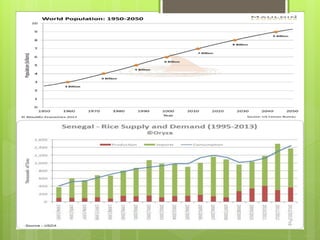
 A rapidly increasing global demand for food means we
have no alternative but to significantly and sustainably
increase agricultural productivity to provide food and feed.
 Agriculture contributes about 13.7 per cent to India’s gross
domestic product (GDP) and employs about 51 per cent of
the country’s population.
Causes
 Degradation and loss of productive farmlands:
Due to factors such as erosion, water-logging and nutrient
depletion.
 Emerging and resistant strains of pests:
Up to 40 per cent of agricultural productivity would be lost without
effective use of crop protection chemicals
 Quantity and quality of water available for agriculture.
 Varying structural, chemical and microbiological composition of
soil and its interactions with plants and the environment.
 Inadequate storage facility:
20-40 percent of the food grown in developing countries is wasted
due to inadequate storage technology, lack of rural transportation,
and underdeveloped markets.
 Changes in ecology, sea level and other environmental factors.
To improve agricultural
productivity, a number of
things must be accomplished:
 More efficient methods must be utilized to prevent water shortages,
as only 45% of irrigation water is actually absorbed by plants. Drip
irrigation and other efficient delivery systems, better water
distribution systems, improved control systems, and raising crops
suited to the climate and soil will aid in this endeavor.
 Avoiding Excessive or continual irrigation which can lead to
salinization and waterlogging of the soil.
Precise agriculture at the field level should be practiced.
Optimizing farming practices by understanding the biochemistry of
soil ecosystems, for example, the mobility of chemicals within the
soil.
 New high-potency, more targeted agrochemicals with new modes
of action should be brought into use. These must be safe to use,
overcome resistant pests and environmentally benign. And a
consistent effective dose delivery at the right time and in the right
quantity should be ensured.
 Reducing chemical crop protection strategies through GM seeds.
 Improving the understanding of methane oxidation by bacteria in soil to help
in developing methane-fixing technologies.
 Maintaining an adequate, quality water supply is essential for agricultural
productivity.
Adopting Strategies for conserving water supplies which include using 'grey
water' of sufficient quality and more targeted water in irrigation systems, such
as through drip delivery (more 'crop per drop').
 Development of rapid in situ biosensor systems that can monitor soil quality,
crop condition and water availability to pinpoint problems.
 Analysis of climate change parameters in order to be able to predict
changing conditions for agronomy.
Thomas Adam Lumpkin, the director-general of International Maize and
Wheat Improvement Centre, Mexico said: “With changes in ecology, sea
level is going to rise coupled with erratic monsoon, which will lead to increase
in frequency and intensity of flood.” he also highlighted that in coming years
India has to face big problem in per capita availability of freshwater, 63 per
cent of India’s total agriculture is rain-fed and the groundwater is depleting in
Punjab and other regions.
Improving grain storage
structures:
 40% of all fruits and vegetables produced in India perish
due to inadequate storage facilities.
 The storage of goods, from the time of production to the
time of consumption not only ensures a continuous flow of
goods in the market but also provides employment and
income through price advantages.
 We can adopt following storage structures for these
purposes:
• For small-scale storage :
 PAU bin: This is a galvanized metal iron structure. It s capacity
ranges from 1.5 to 15 quintals. Designed by Punjab Agricultural
University.
 PUSA bin: This is a storage structure is made of mud or bricks with
a polythene film embedded within the walls.
 Hapur tekka: It is a cylindrical rubberized cloth structure supported
by bamboo poles on a metal tube base, and has a small hole in
the bottom through which grain can be removed.
 For large scale storage:
 CAP Storage (Cover and Plinth) It involves the construction of
brick pillars to a height of 14" from the ground, with grooves into
which wooden crates are fixed for the stacking of bags of food
grains. The structure can be fabricated in less than 3 weeks. It is
an economical way of storage on a large scale.
 Silos In these structures, the grains in bulk are unloaded on the
conveyor belts and, through mechanical operations, are
carried to the storage structure. The storage capacity of each
of these silos is around 25,000 tonns.
The effort can be catalyzed
by:
 Reformation of policies relating to water
management, allocation, and distribution. For
instance, governments will frequently subsidize water
use for agriculture, reducing incentives for water
conservation.
 Increasing yield and controlling secondary
metabolism by better understanding plant science:
 Understanding and exploiting biochemical plant signals
for developing new crop defence technologies.
 Exploiting the outputs of this understanding using
biotechnology
 Diversification to higher value crops, and developing
value chains to reduce marketing costs.
 Reforming and strengthening of India’s agricultural
research and extension systems: These services
have declined over time due to chronic
underfunding of infrastructure and operations and
no replacement of aging researchers.
 Piped conveyance, better on-farm management
of water, and use of more efficient delivery
mechanisms such as drip irrigation are among the
actions that could be taken.
 The Government support can make a huge
change in this direction:
liberalizing constraints to marketing, transport, export
and processing.

rablg

  • 1.
    Boosting Agricultural Productivity “Agriculture not onlygives riches to a nation, but the only riches she can call her own.”
  • 2.
    Overview  Nearly 800million people literally go hungry every day, with more than a third of earth’s population- 2 million men and women- malnourished one way or another, according to the United Nations Food and Agriculture Organization.  Food production need to be doubled by 2050 to meet the UN Millennium Development goals on hunger.  The World Bank estimates that cereal production needs to be increased by 50 per cent between 2000 and 2030 to meet the demand.
  • 3.
     Furthermore, itestimated that by 2025 one hectare of land will need to feed five people whereas in 1960 one hectare was required to feed only two people.  This needs to be achieved in a world where suitable agricultural land is limited and climate change is predicted to have an adverse impact on food production.  A rapidly increasing global demand for food means we have no alternative but to significantly and sustainably increase agricultural productivity to provide food and feed.  Agriculture contributes about 13.7 per cent to India’s gross domestic product (GDP) and employs about 51 per cent of the country’s population.
  • 5.
    Causes  Degradation andloss of productive farmlands: Due to factors such as erosion, water-logging and nutrient depletion.  Emerging and resistant strains of pests: Up to 40 per cent of agricultural productivity would be lost without effective use of crop protection chemicals  Quantity and quality of water available for agriculture.  Varying structural, chemical and microbiological composition of soil and its interactions with plants and the environment.  Inadequate storage facility: 20-40 percent of the food grown in developing countries is wasted due to inadequate storage technology, lack of rural transportation, and underdeveloped markets.  Changes in ecology, sea level and other environmental factors.
  • 6.
    To improve agricultural productivity,a number of things must be accomplished:  More efficient methods must be utilized to prevent water shortages, as only 45% of irrigation water is actually absorbed by plants. Drip irrigation and other efficient delivery systems, better water distribution systems, improved control systems, and raising crops suited to the climate and soil will aid in this endeavor.  Avoiding Excessive or continual irrigation which can lead to salinization and waterlogging of the soil. Precise agriculture at the field level should be practiced. Optimizing farming practices by understanding the biochemistry of soil ecosystems, for example, the mobility of chemicals within the soil.  New high-potency, more targeted agrochemicals with new modes of action should be brought into use. These must be safe to use, overcome resistant pests and environmentally benign. And a consistent effective dose delivery at the right time and in the right quantity should be ensured.  Reducing chemical crop protection strategies through GM seeds.
  • 7.
     Improving theunderstanding of methane oxidation by bacteria in soil to help in developing methane-fixing technologies.  Maintaining an adequate, quality water supply is essential for agricultural productivity. Adopting Strategies for conserving water supplies which include using 'grey water' of sufficient quality and more targeted water in irrigation systems, such as through drip delivery (more 'crop per drop').  Development of rapid in situ biosensor systems that can monitor soil quality, crop condition and water availability to pinpoint problems.  Analysis of climate change parameters in order to be able to predict changing conditions for agronomy. Thomas Adam Lumpkin, the director-general of International Maize and Wheat Improvement Centre, Mexico said: “With changes in ecology, sea level is going to rise coupled with erratic monsoon, which will lead to increase in frequency and intensity of flood.” he also highlighted that in coming years India has to face big problem in per capita availability of freshwater, 63 per cent of India’s total agriculture is rain-fed and the groundwater is depleting in Punjab and other regions.
  • 8.
    Improving grain storage structures: 40% of all fruits and vegetables produced in India perish due to inadequate storage facilities.  The storage of goods, from the time of production to the time of consumption not only ensures a continuous flow of goods in the market but also provides employment and income through price advantages.  We can adopt following storage structures for these purposes: • For small-scale storage :  PAU bin: This is a galvanized metal iron structure. It s capacity ranges from 1.5 to 15 quintals. Designed by Punjab Agricultural University.  PUSA bin: This is a storage structure is made of mud or bricks with a polythene film embedded within the walls.
  • 9.
     Hapur tekka:It is a cylindrical rubberized cloth structure supported by bamboo poles on a metal tube base, and has a small hole in the bottom through which grain can be removed.  For large scale storage:  CAP Storage (Cover and Plinth) It involves the construction of brick pillars to a height of 14" from the ground, with grooves into which wooden crates are fixed for the stacking of bags of food grains. The structure can be fabricated in less than 3 weeks. It is an economical way of storage on a large scale.  Silos In these structures, the grains in bulk are unloaded on the conveyor belts and, through mechanical operations, are carried to the storage structure. The storage capacity of each of these silos is around 25,000 tonns.
  • 10.
    The effort canbe catalyzed by:  Reformation of policies relating to water management, allocation, and distribution. For instance, governments will frequently subsidize water use for agriculture, reducing incentives for water conservation.  Increasing yield and controlling secondary metabolism by better understanding plant science:  Understanding and exploiting biochemical plant signals for developing new crop defence technologies.  Exploiting the outputs of this understanding using biotechnology  Diversification to higher value crops, and developing value chains to reduce marketing costs.
  • 11.
     Reforming andstrengthening of India’s agricultural research and extension systems: These services have declined over time due to chronic underfunding of infrastructure and operations and no replacement of aging researchers.  Piped conveyance, better on-farm management of water, and use of more efficient delivery mechanisms such as drip irrigation are among the actions that could be taken.  The Government support can make a huge change in this direction: liberalizing constraints to marketing, transport, export and processing.