Comments in SlideShare: A Four-Pronged Study of Their ImpactAli Anani and Bas de Baar
BeforeA previous publication on “Comments on SlideShare: Their Impact and Value-Added” triggered more comments.  The richness of comments triggered the publication of their detailed analysis using a four-pronged approach.
Techniques and Tools
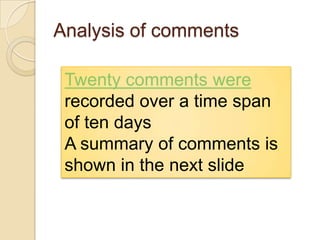
Analysis of CommentsTwenty comments were recorded over a ten days time span. These comments were recorded. A summary of these comments in their chronological order is shown in the next slide
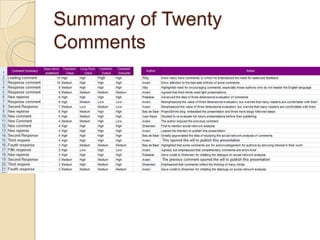
Summary of Twenty Comments
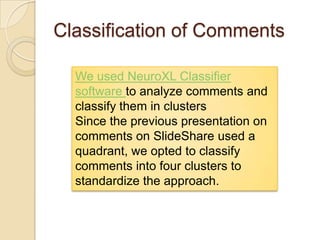
Classification of CommentsWe used NeuroXL Classifier software to analyze comments and classify them in four clusters.  Since the previous publication on comments on SlideShare used a quadrant, we opted to classify comments into four clusters to standardize the approach.
Four Clusters of CommentsTo be able to classify comments into four clusters we had first to turn the twenty judgmental comments into values.We did this by assigning the following values:High 8 and aboveMedium >6 and <8Low <5The results are shown in the next slide
Clusters of Comments
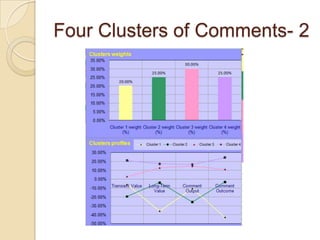
Clusters 1 and 2Clusters 1 and 2 share the starting value of low-impacting comments. However; the two clusters have opposite paths. When one cluster is low the other cluster is high.Initial comments with low impacting value mostly end up having low or very moderate outcomes.
Clusters 3 and 4Clusters 3 and 4 share having a high-impacting value at their initiation.  They both end up having high impact on commentators.Initial high-value comments may lead to building new relations, generating new publications and opening new social structures. As we have a case in which the initial comment carried weight we decided to follow its impact over a ten-days period.
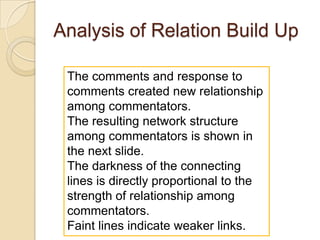
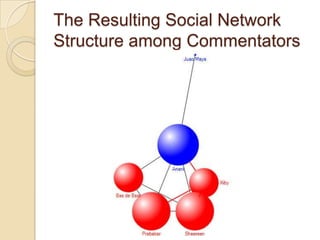
Analysis of Relation Build-upThe comments and responses to them created new relationships among commentators. The next slide shows the resulting network structure. The darkness of the connecting lines is directly proportional to the strength of relationships among commentators. Faint lines indicate weak ties.
Social Network Structure among Commentators.
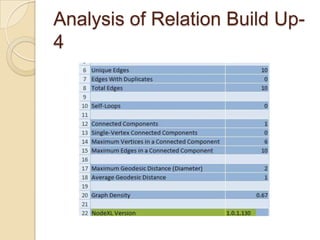
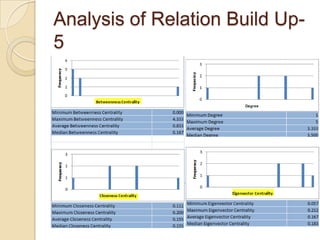
Statistics of Social Network StructureWe used NodeXL software to analyze the emerging structure. The next few slides highlight the important statistics for those  readers who might be interested.
General Statistics
More Statistics on the Resulting SNA
The Spiral Structure of CommentsWe used Goalscape software to study the spiral build-up of comments. Comments grow naturally and may have a spiral-like structure.
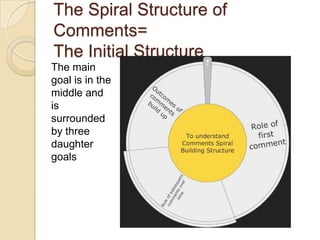
Initial StructureThe main goal (highlighted in yellow) is surrounded by three daughter goals.
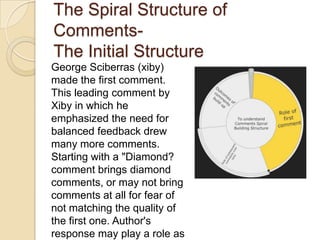
Explanation of the Initial StructureGeorge Sciberras (xiby) made the first comment. Xiby emphasized the need for balanced feedback of comments. This comment invited for many more comments, Starting with a “diamond” comment may bring more valuable comments, or may stop later commentators from making comments for fear they would not match the first one. It is a two-edged sword.
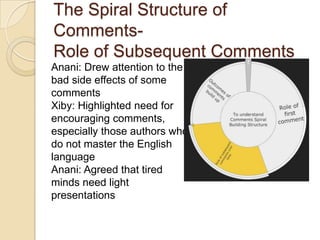
Role of Subsequent CommetsAnani drew attention to the harmful side effects of some commentsXiby  highlighted the need to encourage new authors, and especially those who do not master the English languageAnani concurred with xiby that tired minds nee light presentations
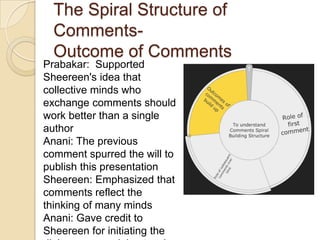
Outcome of CommentsPrabakar supported Sheereen’s idea that collective minds work better that a single mind. Comments are the work of mind networkThese comments spurred Anani to write this presentation with Bas de Baar
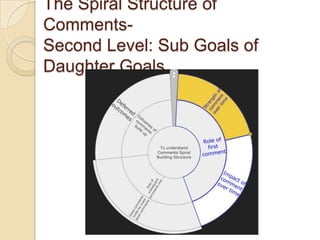
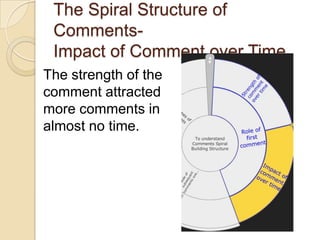
Subgoals of Daughter Goals- Building the Spiral Structure
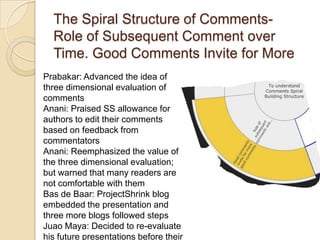
Good Comments Invite for MorePrabakar advanced the idea of three dimensional evaluation of ideasAnani welcomed the idea, but showed concern that not all people are happy with three dimensional analysisJuao Maya decided to reevaluate his presentations prior to their publicationprojectShrink and three other sites embedded the presentation
Deferred OutcomesAnani and Prabakar decided to publish a joint presentation for SlidsShareAnani and bas de Baar will work together to expand the use of spiral structures
Third Level of the Spiral Structure
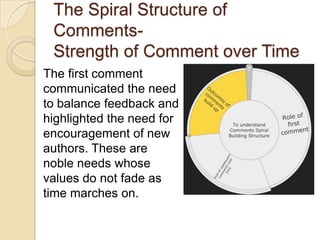
The Momentum of Comments Is RisingThese comments reflected increased intensions for working together and reinforcing the social network structure of the participating commentators
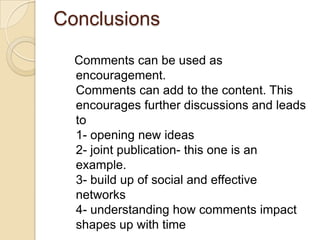
Conclusion

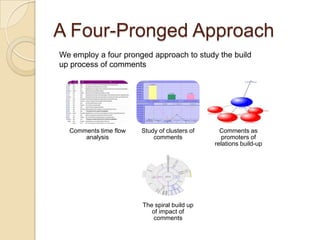
A Four-Pronged Approach to Study Comments on SlideShare

  • 1.
    Comments in SlideShare:A Four-Pronged Study of Their ImpactAli Anani and Bas de Baar
  • 2.
    BeforeA previous publicationon “Comments on SlideShare: Their Impact and Value-Added” triggered more comments. The richness of comments triggered the publication of their detailed analysis using a four-pronged approach.
  • 3.
  • 4.
    Analysis of CommentsTwentycomments were recorded over a ten days time span. These comments were recorded. A summary of these comments in their chronological order is shown in the next slide
  • 5.
  • 6.
    Classification of CommentsWeused NeuroXL Classifier software to analyze comments and classify them in four clusters. Since the previous publication on comments on SlideShare used a quadrant, we opted to classify comments into four clusters to standardize the approach.
  • 7.
    Four Clusters ofCommentsTo be able to classify comments into four clusters we had first to turn the twenty judgmental comments into values.We did this by assigning the following values:High 8 and aboveMedium >6 and <8Low <5The results are shown in the next slide
  • 8.
  • 9.
    Clusters 1 and2Clusters 1 and 2 share the starting value of low-impacting comments. However; the two clusters have opposite paths. When one cluster is low the other cluster is high.Initial comments with low impacting value mostly end up having low or very moderate outcomes.
  • 10.
    Clusters 3 and4Clusters 3 and 4 share having a high-impacting value at their initiation. They both end up having high impact on commentators.Initial high-value comments may lead to building new relations, generating new publications and opening new social structures. As we have a case in which the initial comment carried weight we decided to follow its impact over a ten-days period.
  • 11.
    Analysis of RelationBuild-upThe comments and responses to them created new relationships among commentators. The next slide shows the resulting network structure. The darkness of the connecting lines is directly proportional to the strength of relationships among commentators. Faint lines indicate weak ties.
  • 12.
    Social Network Structureamong Commentators.
  • 13.
    Statistics of SocialNetwork StructureWe used NodeXL software to analyze the emerging structure. The next few slides highlight the important statistics for those readers who might be interested.
  • 14.
  • 15.
    More Statistics onthe Resulting SNA
  • 16.
    The Spiral Structureof CommentsWe used Goalscape software to study the spiral build-up of comments. Comments grow naturally and may have a spiral-like structure.
  • 17.
    Initial StructureThe maingoal (highlighted in yellow) is surrounded by three daughter goals.
  • 18.
    Explanation of theInitial StructureGeorge Sciberras (xiby) made the first comment. Xiby emphasized the need for balanced feedback of comments. This comment invited for many more comments, Starting with a “diamond” comment may bring more valuable comments, or may stop later commentators from making comments for fear they would not match the first one. It is a two-edged sword.
  • 19.
    Role of SubsequentCommetsAnani drew attention to the harmful side effects of some commentsXiby highlighted the need to encourage new authors, and especially those who do not master the English languageAnani concurred with xiby that tired minds nee light presentations
  • 20.
    Outcome of CommentsPrabakarsupported Sheereen’s idea that collective minds work better that a single mind. Comments are the work of mind networkThese comments spurred Anani to write this presentation with Bas de Baar
  • 21.
    Subgoals of DaughterGoals- Building the Spiral Structure
  • 22.
    Good Comments Invitefor MorePrabakar advanced the idea of three dimensional evaluation of ideasAnani welcomed the idea, but showed concern that not all people are happy with three dimensional analysisJuao Maya decided to reevaluate his presentations prior to their publicationprojectShrink and three other sites embedded the presentation
  • 23.
    Deferred OutcomesAnani andPrabakar decided to publish a joint presentation for SlidsShareAnani and bas de Baar will work together to expand the use of spiral structures
  • 24.
    Third Level ofthe Spiral Structure
  • 25.
    The Momentum ofComments Is RisingThese comments reflected increased intensions for working together and reinforcing the social network structure of the participating commentators
  • 26.