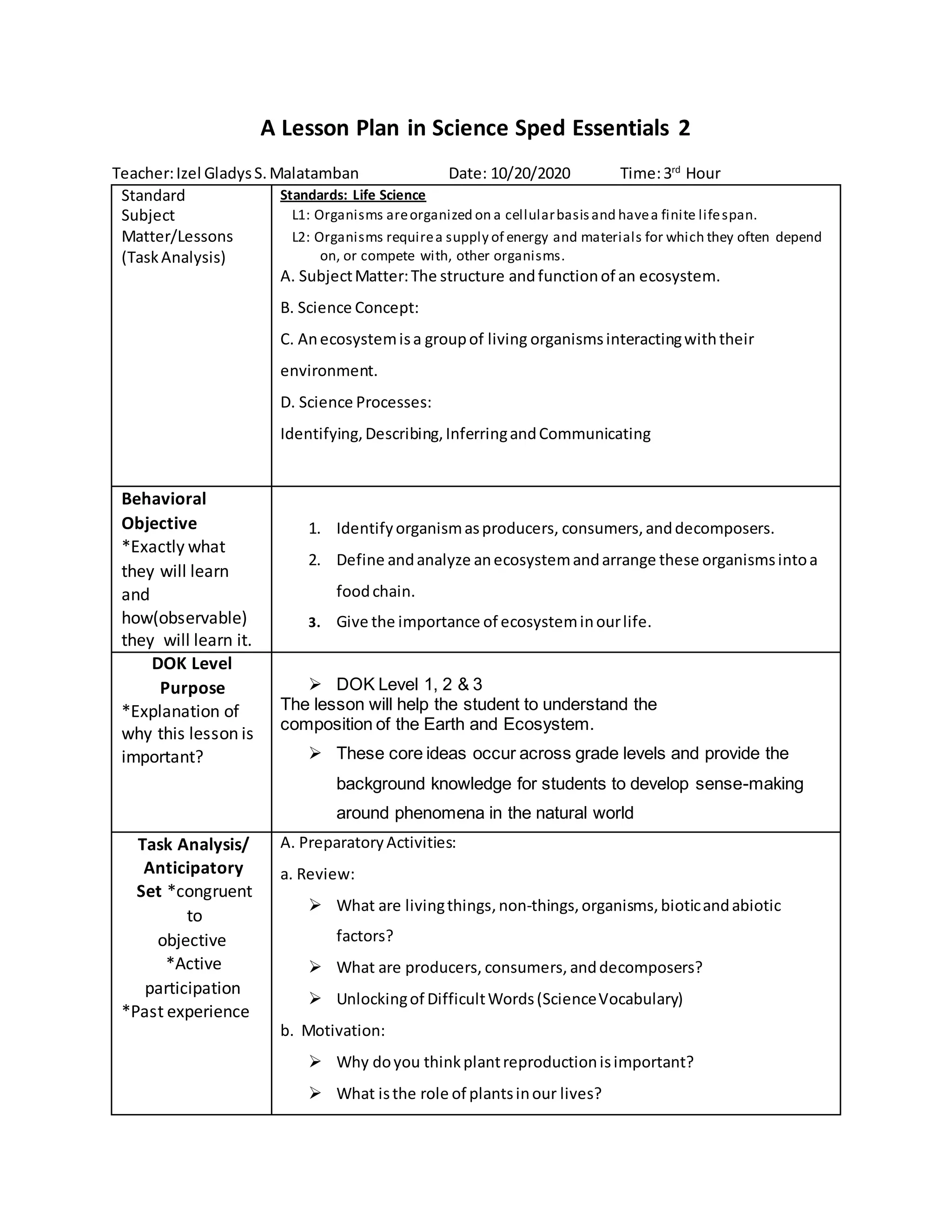
A Lesson Plan in Science Sped Essentials 2
Teacher:Izel GladysS.Malatamban Date: 10/20/2020 Time:3rd
Hour
Standard
Subject
Matter/Lessons
(TaskAnalysis)
Standards: Life Science
L1: Organisms areorganized on a cellularbasisand havea finite lifespan.
L2: Organisms requirea supply of energy and materials for which they often depend
on, or compete with, other organisms.
A. SubjectMatter:The structure andfunctionof an ecosystem.
B. Science Concept:
C. Anecosystemisa groupof living organismsinteractingwiththeir
environment.
D. Science Processes:
Identifying,Describing,InferringandCommunicating
Behavioral
Objective
*Exactly what
they will learn
and
how(observable)
they will learn it.
1. Identifyorganismasproducers, consumers,anddecomposers.
2. Define andanalyze anecosystemandarrange these organismsintoa
foodchain.
3. Give the importance of ecosysteminourlife.
DOK Level
Purpose
*Explanation of
why this lesson is
important?
 DOK Level 1, 2 & 3
The lesson will help the student to understand the
composition of the Earth and Ecosystem.
 These core ideas occur across grade levels and provide the
background knowledge for students to develop sense-making
around phenomena in the natural world
Task Analysis/
Anticipatory
Set *congruent
to
objective
*Active
participation
*Past experience
A. PreparatoryActivities:
a. Review:
 What are livingthings, non-things,organisms,bioticandabiotic
factors?
 What are producers, consumers, anddecomposers?
 Unlockingof DifficultWords(ScienceVocabulary)
b. Motivation:
 Why doyou thinkplantreproductionisimportant?
 What isthe role of plantsinour lives?
 How doyou call theirinteractionof organismsintheirenvironment?
LearningActivities A. “I Do”
 Group the classinto three inpreparationforthe activity.
 Watchinga videoaboutecosystem,foodwebandfoodchain.
 Discussthe different modelsof anecosystem.
Guided Practice
B. “We Do”
Concept Formation: (Utilizing the Team Modeling Strategy
(Round Robin)
(Group Activity)
 The identified model of each group will roam around every
group and discuss what they have learned. The member in each
group is encouraged to ask questions.
C. Special Education Accommodation:
Teacher is going to provide different meta cards for questions
and answers.
Possible questions:
1. What is an ecosystem?
2. What are the kinds of ecosystem?
3. What is a food chain?
4. What are involve in an ecosystem?
5. How important is role of the producer, consumer,
decomposers?
6. What is a food web?
7. What is the difference of a food web and food chain?
8. How does ecosystem benefit the human?
Closure
(Checkfor
Understanding)
D. “YouDo”
Independent working time
(GroupActivity) (ThinkPairShare)
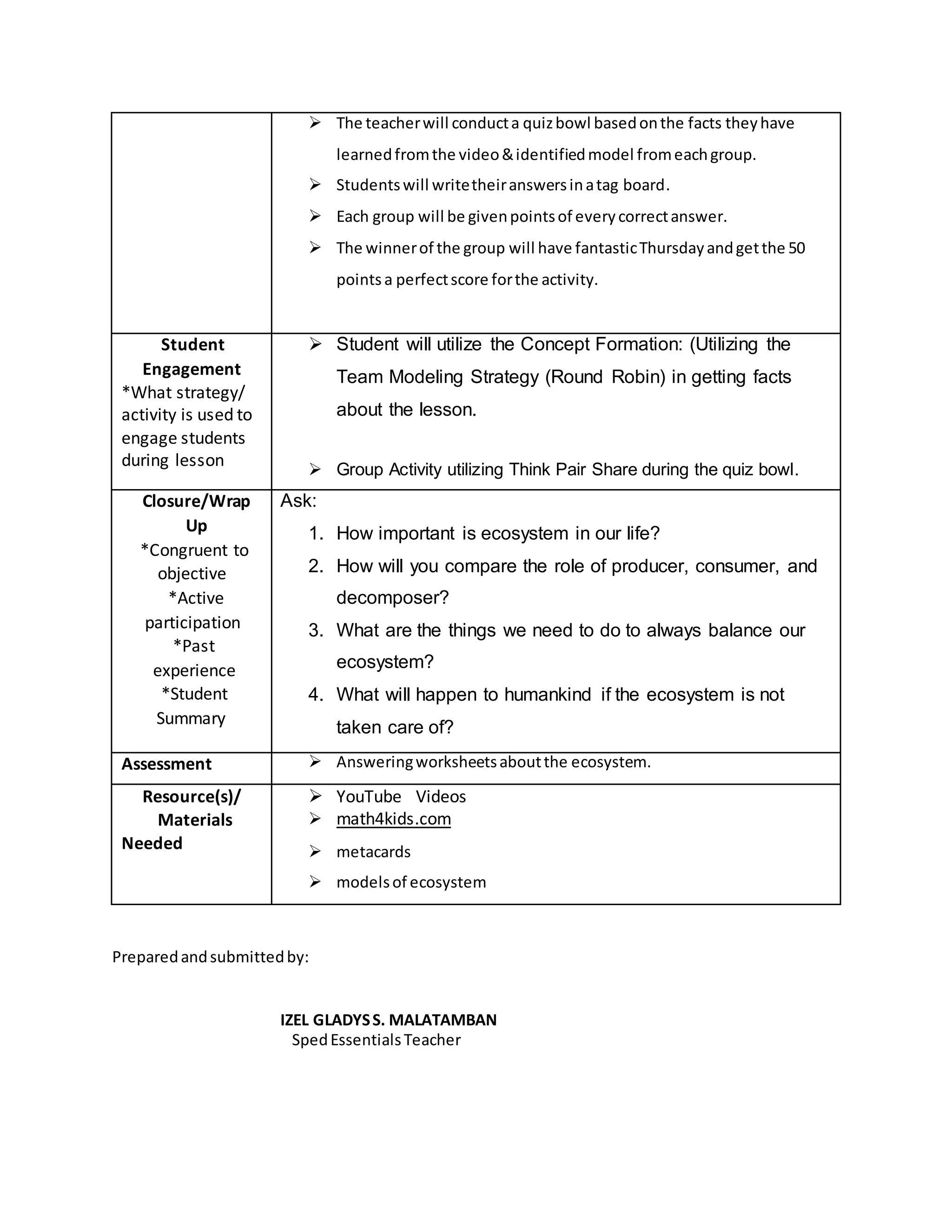
 The teacherwill conducta quizbowl basedonthe facts theyhave
learnedfromthe video&identifiedmodel fromeachgroup.
 Studentswill writetheiranswersinatag board.
 Each group will be givenpointsof everycorrectanswer.
 The winnerof the group will have fantasticThursdayandgetthe 50
pointsa perfectscore forthe activity.
Student
Engagement
*What strategy/
activity is used to
engage students
during lesson
 Student will utilize the Concept Formation: (Utilizing the
Team Modeling Strategy (Round Robin) in getting facts
about the lesson.
 Group Activity utilizing Think Pair Share during the quiz bowl.
Closure/Wrap
Up
*Congruent to
objective
*Active
participation
*Past
experience
*Student
Summary
Ask:
1. How important is ecosystem in our life?
2. How will you compare the role of producer, consumer, and
decomposer?
3. What are the things we need to do to always balance our
ecosystem?
4. What will happen to humankind if the ecosystem is not
taken care of?
Assessment  Answeringworksheetsaboutthe ecosystem.
Resource(s)/
Materials
Needed
 YouTube Videos
 math4kids.com
 metacards
 modelsof ecosystem
Preparedandsubmittedby:
IZEL GLADYSS. MALATAMBAN
SpedEssentialsTeacher

A demo lesson plan in science sped essentials 2021

  • 1.
    A Lesson Planin Science Sped Essentials 2 Teacher:Izel GladysS.Malatamban Date: 10/20/2020 Time:3rd Hour Standard Subject Matter/Lessons (TaskAnalysis) Standards: Life Science L1: Organisms areorganized on a cellularbasisand havea finite lifespan. L2: Organisms requirea supply of energy and materials for which they often depend on, or compete with, other organisms. A. SubjectMatter:The structure andfunctionof an ecosystem. B. Science Concept: C. Anecosystemisa groupof living organismsinteractingwiththeir environment. D. Science Processes: Identifying,Describing,InferringandCommunicating Behavioral Objective *Exactly what they will learn and how(observable) they will learn it. 1. Identifyorganismasproducers, consumers,anddecomposers. 2. Define andanalyze anecosystemandarrange these organismsintoa foodchain. 3. Give the importance of ecosysteminourlife. DOK Level Purpose *Explanation of why this lesson is important?  DOK Level 1, 2 & 3 The lesson will help the student to understand the composition of the Earth and Ecosystem.  These core ideas occur across grade levels and provide the background knowledge for students to develop sense-making around phenomena in the natural world Task Analysis/ Anticipatory Set *congruent to objective *Active participation *Past experience A. PreparatoryActivities: a. Review:  What are livingthings, non-things,organisms,bioticandabiotic factors?  What are producers, consumers, anddecomposers?  Unlockingof DifficultWords(ScienceVocabulary) b. Motivation:  Why doyou thinkplantreproductionisimportant?  What isthe role of plantsinour lives?
  • 2.
     How doyoucall theirinteractionof organismsintheirenvironment? LearningActivities A. “I Do”  Group the classinto three inpreparationforthe activity.  Watchinga videoaboutecosystem,foodwebandfoodchain.  Discussthe different modelsof anecosystem. Guided Practice B. “We Do” Concept Formation: (Utilizing the Team Modeling Strategy (Round Robin) (Group Activity)  The identified model of each group will roam around every group and discuss what they have learned. The member in each group is encouraged to ask questions. C. Special Education Accommodation: Teacher is going to provide different meta cards for questions and answers. Possible questions: 1. What is an ecosystem? 2. What are the kinds of ecosystem? 3. What is a food chain? 4. What are involve in an ecosystem? 5. How important is role of the producer, consumer, decomposers? 6. What is a food web? 7. What is the difference of a food web and food chain? 8. How does ecosystem benefit the human? Closure (Checkfor Understanding) D. “YouDo” Independent working time (GroupActivity) (ThinkPairShare)
  • 3.
     The teacherwillconducta quizbowl basedonthe facts theyhave learnedfromthe video&identifiedmodel fromeachgroup.  Studentswill writetheiranswersinatag board.  Each group will be givenpointsof everycorrectanswer.  The winnerof the group will have fantasticThursdayandgetthe 50 pointsa perfectscore forthe activity. Student Engagement *What strategy/ activity is used to engage students during lesson  Student will utilize the Concept Formation: (Utilizing the Team Modeling Strategy (Round Robin) in getting facts about the lesson.  Group Activity utilizing Think Pair Share during the quiz bowl. Closure/Wrap Up *Congruent to objective *Active participation *Past experience *Student Summary Ask: 1. How important is ecosystem in our life? 2. How will you compare the role of producer, consumer, and decomposer? 3. What are the things we need to do to always balance our ecosystem? 4. What will happen to humankind if the ecosystem is not taken care of? Assessment  Answeringworksheetsaboutthe ecosystem. Resource(s)/ Materials Needed  YouTube Videos  math4kids.com  metacards  modelsof ecosystem Preparedandsubmittedby: IZEL GLADYSS. MALATAMBAN SpedEssentialsTeacher