A Complete Guide to the Canadian Student
Visa
Canada remains one of the most sought-after destinations for international students due to its high-
quality education, diverse culture, and post-graduation opportunities. However, securing a Canadian
student visa, officially known as a study permit, involves a structured process with specific eligibility
criteria. With recent changes in immigration policies, including a cap on student permits, it's crucial to
stay updated on the latest requirements.
Understanding the Canadian Study Permit
A study permit is an official document issued by Immigration, Refugees, and Citizenship Canada (IRCC)
that allows foreign nationals to study at designated learning institutions (DLIs) in Canada. While a study
permit is mandatory, applicants may also require a temporary resident visa (TRV) or an electronic travel
authorization (eTA) to enter the country.
Eligibility Requirements for Canada Student Visa
To apply for a Canadian study permit, international students must:
 Have an acceptance letter from a Designated Learning Institution (DLI)
 Prove they have enough financial resources to cover tuition fees, living expenses, and return
transportation
 Provide a clean criminal record (Police Clearance Certificate may be required)
 Undergo a medical examination, if necessary
 Convince immigration officers that they will leave Canada upon permit expiration
Application Process for a Canadian Student Visa
Step 1: Obtain an Acceptance Letter
Before applying for a study permit, students must secure admission from a DLI-approved institution.
The acceptance letter should include program details, tuition fees, and the institution’s official
letterhead.
Step 2: Gather Required Documents
Applicants must collect and submit the following:
 A valid passport
 Letter of acceptance from a DLI
 Proof of financial support (bank statements, scholarship confirmation, etc.)
 Statement of Purpose (SOP) explaining study plans
 Recent passport-sized photographs
 Immigration Medical Examination (IME) results, if applicable
 Police clearance certificate (if required by IRCC)
Step 3: Submit an Online or Paper Application
The application for a study permit can be submitted online through the IRCC portal or in person at a Visa
Application Centre (VAC). Online applications are generally processed faster.
Step 4: Biometrics and Interview (if required)
Applicants from specific countries must submit biometrics (fingerprints and photographs). Additionally,
an interview may be scheduled if further clarification is needed.
Step 5: Wait for Processing and Receive Decision
The processing time for a Canadian student visa varies based on the applicant’s country of residence.
Once approved, applicants will receive a Letter of Introduction and, if applicable, a TRV or eTA.
Recent Changes to the Canadian Study Permit System
In response to concerns about rising population pressures, housing shortages, and increased demand for
public services, Canada has decided to limit the number of international student permits in 2025.
Canada’s Study Permit Cap for 2025
 In 2025, Canada will reduce the number of study permits to 437,000, marking a 10% decrease
from the 2024 cap.
 This decision follows a trend that started in 2024 when the government first introduced a limit
on student permits.
 The cap aims to ease pressure on housing, healthcare, and public services caused by rapid
immigration growth.
 In 2023, over 650,000 study permits were issued, resulting in a total of more than one million
international students—a threefold increase compared to a decade ago.
New Requirements for Master’s and Post-Doctoral Students
Starting in 2024, master’s and post-doctoral students must submit a Provincial or Territorial Attestation
Letter as part of their study permit application. This document confirms their inclusion within the
federal permit cap and is an essential requirement for those applying in 2025.
The Economic Impact of International Students
Despite the new restrictions, international students continue to play a significant role in Canada’s
economy. They contribute billions of dollars annually through tuition fees, living expenses, and job
market participation. However, the Canadian government stresses the importance of balancing these
economic benefits with adequate infrastructure and public services.
Prime Minister’s Stance on Immigration Policy
Prime Minister Justin Trudeau, who plans to step down in March 2025, had committed to reducing
immigration levels due to declining public support. The new measures on study permits align with his
administration’s broader efforts to control immigration numbers and manage economic and social
challenges.
Tuition Fees and Financial Considerations
International students in Canada typically pay higher tuition fees than domestic students. The annual
tuition fees for international students vary depending on the program and institution:
 Undergraduate programs: CAD 20,000 - CAD 50,000 per year
 Graduate programs: CAD 17,000 - CAD 35,000 per year
 MBA programs: CAD 30,000 - CAD 80,000 per year
Apart from tuition, students must budget for living expenses, health insurance, and additional fees
related to accommodation, transportation, and books.
Work Opportunities for International Students
Canada allows international students to work part-time during their studies to support their expenses.
Students can:
 Work up to 20 hours per week during regular academic sessions
 Work full-time during scheduled breaks (e.g., summer or winter holidays)
Post-graduation, students may apply for a Post-Graduation Work Permit (PGWP), allowing them to stay
and gain Canadian work experience, which can eventually lead to permanent residency under programs
like the Canadian Experience Class (CEC).
Conclusion
Canada remains a top choice for international students due to its excellent education system and post-
study opportunities. However, with new restrictions on study permits in 2025, students must carefully
plan their applications and stay updated with policy changes. While the reduction in permits may pose
challenges, Canada continues to welcome international students who contribute to its economy and
workforce.
Are you planning to study in Canada? The Canadian student visa is your gateway to pursuing higher
education in one of the world's top academic destinations. With world-class universities, excellent
research opportunities, and a high quality of life, Canada attracts thousands of international students
each year.

A Complete Guide to the Canadian Student Visa.docx

  • 1.
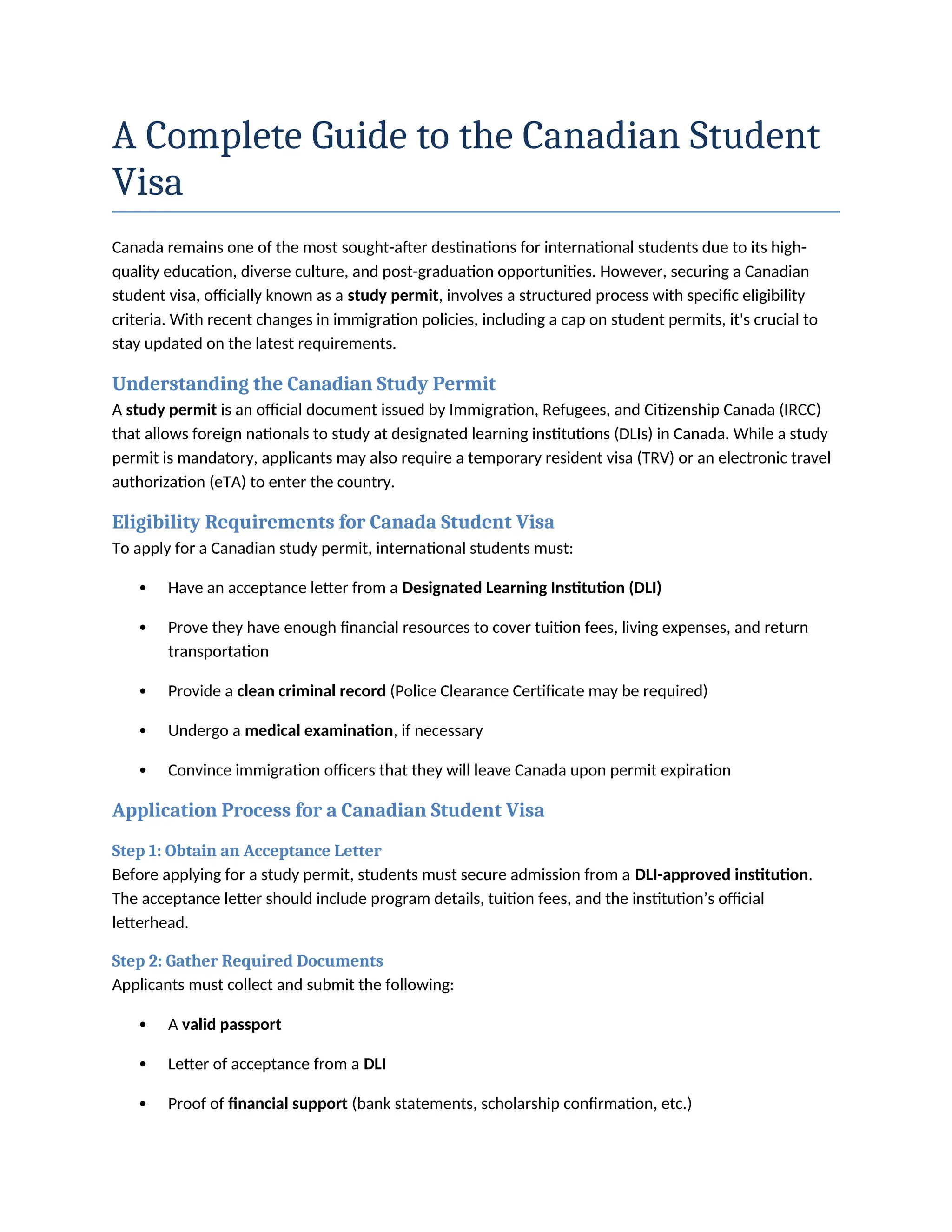
    A Complete Guideto the Canadian Student Visa Canada remains one of the most sought-after destinations for international students due to its high- quality education, diverse culture, and post-graduation opportunities. However, securing a Canadian student visa, officially known as a study permit, involves a structured process with specific eligibility criteria. With recent changes in immigration policies, including a cap on student permits, it's crucial to stay updated on the latest requirements. Understanding the Canadian Study Permit A study permit is an official document issued by Immigration, Refugees, and Citizenship Canada (IRCC) that allows foreign nationals to study at designated learning institutions (DLIs) in Canada. While a study permit is mandatory, applicants may also require a temporary resident visa (TRV) or an electronic travel authorization (eTA) to enter the country. Eligibility Requirements for Canada Student Visa To apply for a Canadian study permit, international students must:  Have an acceptance letter from a Designated Learning Institution (DLI)  Prove they have enough financial resources to cover tuition fees, living expenses, and return transportation  Provide a clean criminal record (Police Clearance Certificate may be required)  Undergo a medical examination, if necessary  Convince immigration officers that they will leave Canada upon permit expiration Application Process for a Canadian Student Visa Step 1: Obtain an Acceptance Letter Before applying for a study permit, students must secure admission from a DLI-approved institution. The acceptance letter should include program details, tuition fees, and the institution’s official letterhead. Step 2: Gather Required Documents Applicants must collect and submit the following:  A valid passport  Letter of acceptance from a DLI  Proof of financial support (bank statements, scholarship confirmation, etc.)
  • 2.
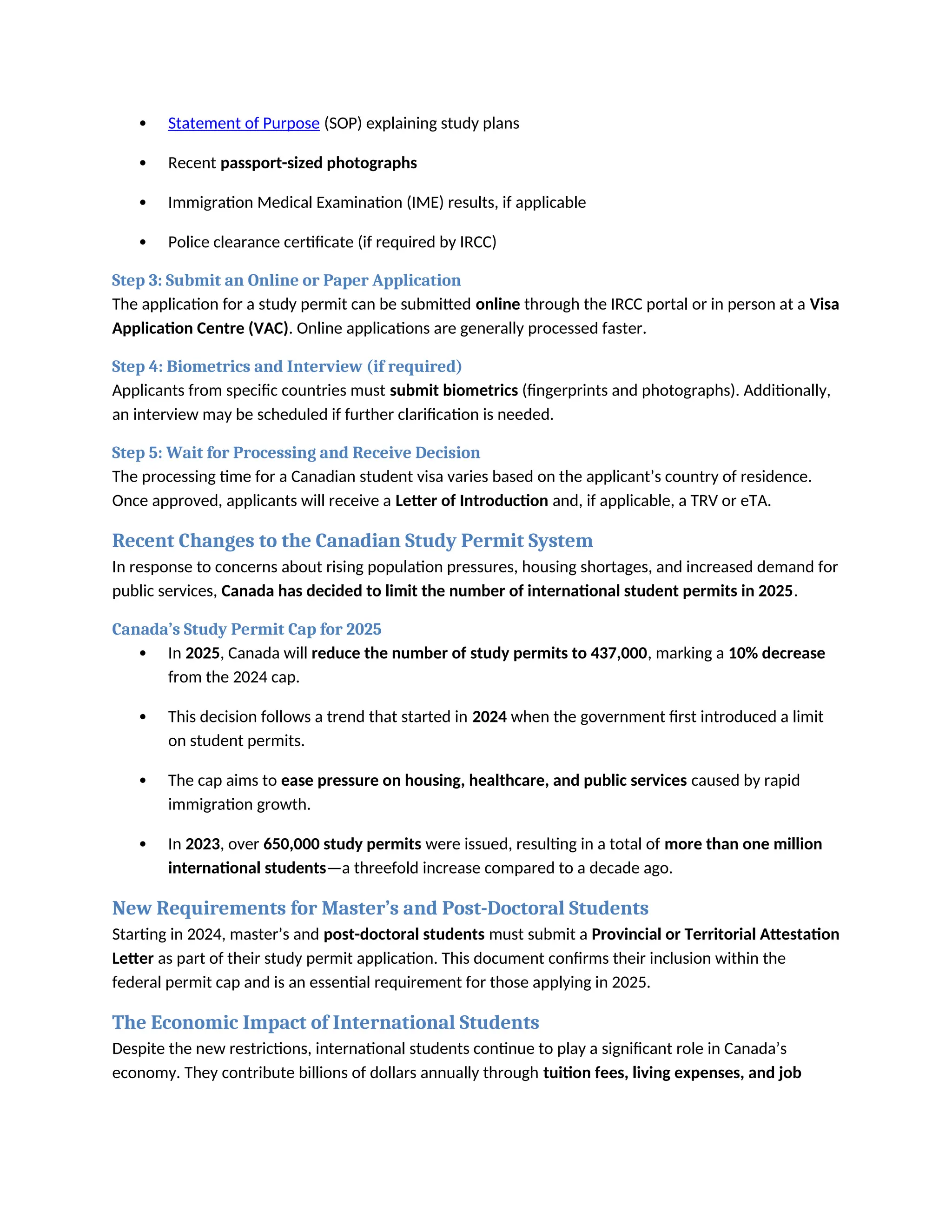
     Statement ofPurpose (SOP) explaining study plans  Recent passport-sized photographs  Immigration Medical Examination (IME) results, if applicable  Police clearance certificate (if required by IRCC) Step 3: Submit an Online or Paper Application The application for a study permit can be submitted online through the IRCC portal or in person at a Visa Application Centre (VAC). Online applications are generally processed faster. Step 4: Biometrics and Interview (if required) Applicants from specific countries must submit biometrics (fingerprints and photographs). Additionally, an interview may be scheduled if further clarification is needed. Step 5: Wait for Processing and Receive Decision The processing time for a Canadian student visa varies based on the applicant’s country of residence. Once approved, applicants will receive a Letter of Introduction and, if applicable, a TRV or eTA. Recent Changes to the Canadian Study Permit System In response to concerns about rising population pressures, housing shortages, and increased demand for public services, Canada has decided to limit the number of international student permits in 2025. Canada’s Study Permit Cap for 2025  In 2025, Canada will reduce the number of study permits to 437,000, marking a 10% decrease from the 2024 cap.  This decision follows a trend that started in 2024 when the government first introduced a limit on student permits.  The cap aims to ease pressure on housing, healthcare, and public services caused by rapid immigration growth.  In 2023, over 650,000 study permits were issued, resulting in a total of more than one million international students—a threefold increase compared to a decade ago. New Requirements for Master’s and Post-Doctoral Students Starting in 2024, master’s and post-doctoral students must submit a Provincial or Territorial Attestation Letter as part of their study permit application. This document confirms their inclusion within the federal permit cap and is an essential requirement for those applying in 2025. The Economic Impact of International Students Despite the new restrictions, international students continue to play a significant role in Canada’s economy. They contribute billions of dollars annually through tuition fees, living expenses, and job
  • 3.
    market participation. However,the Canadian government stresses the importance of balancing these economic benefits with adequate infrastructure and public services. Prime Minister’s Stance on Immigration Policy Prime Minister Justin Trudeau, who plans to step down in March 2025, had committed to reducing immigration levels due to declining public support. The new measures on study permits align with his administration’s broader efforts to control immigration numbers and manage economic and social challenges. Tuition Fees and Financial Considerations International students in Canada typically pay higher tuition fees than domestic students. The annual tuition fees for international students vary depending on the program and institution:  Undergraduate programs: CAD 20,000 - CAD 50,000 per year  Graduate programs: CAD 17,000 - CAD 35,000 per year  MBA programs: CAD 30,000 - CAD 80,000 per year Apart from tuition, students must budget for living expenses, health insurance, and additional fees related to accommodation, transportation, and books. Work Opportunities for International Students Canada allows international students to work part-time during their studies to support their expenses. Students can:  Work up to 20 hours per week during regular academic sessions  Work full-time during scheduled breaks (e.g., summer or winter holidays) Post-graduation, students may apply for a Post-Graduation Work Permit (PGWP), allowing them to stay and gain Canadian work experience, which can eventually lead to permanent residency under programs like the Canadian Experience Class (CEC). Conclusion Canada remains a top choice for international students due to its excellent education system and post- study opportunities. However, with new restrictions on study permits in 2025, students must carefully plan their applications and stay updated with policy changes. While the reduction in permits may pose challenges, Canada continues to welcome international students who contribute to its economy and workforce. Are you planning to study in Canada? The Canadian student visa is your gateway to pursuing higher education in one of the world's top academic destinations. With world-class universities, excellent research opportunities, and a high quality of life, Canada attracts thousands of international students each year.