A Comparsion of
Databasesand
Data Warehouses
Name: Liliana Livorová
Subject: Distributed Data
Processing
2.
Content
Concept Definitionsof Databases,Data
Warehouses
Database models
History
Databases
Data Warehouses
OLTP vs. Data Warehouse
3.
Concept Definition
Database
astructured collection of
records or data
Data Warehouse
a logical collection of
information, gathered
from many different
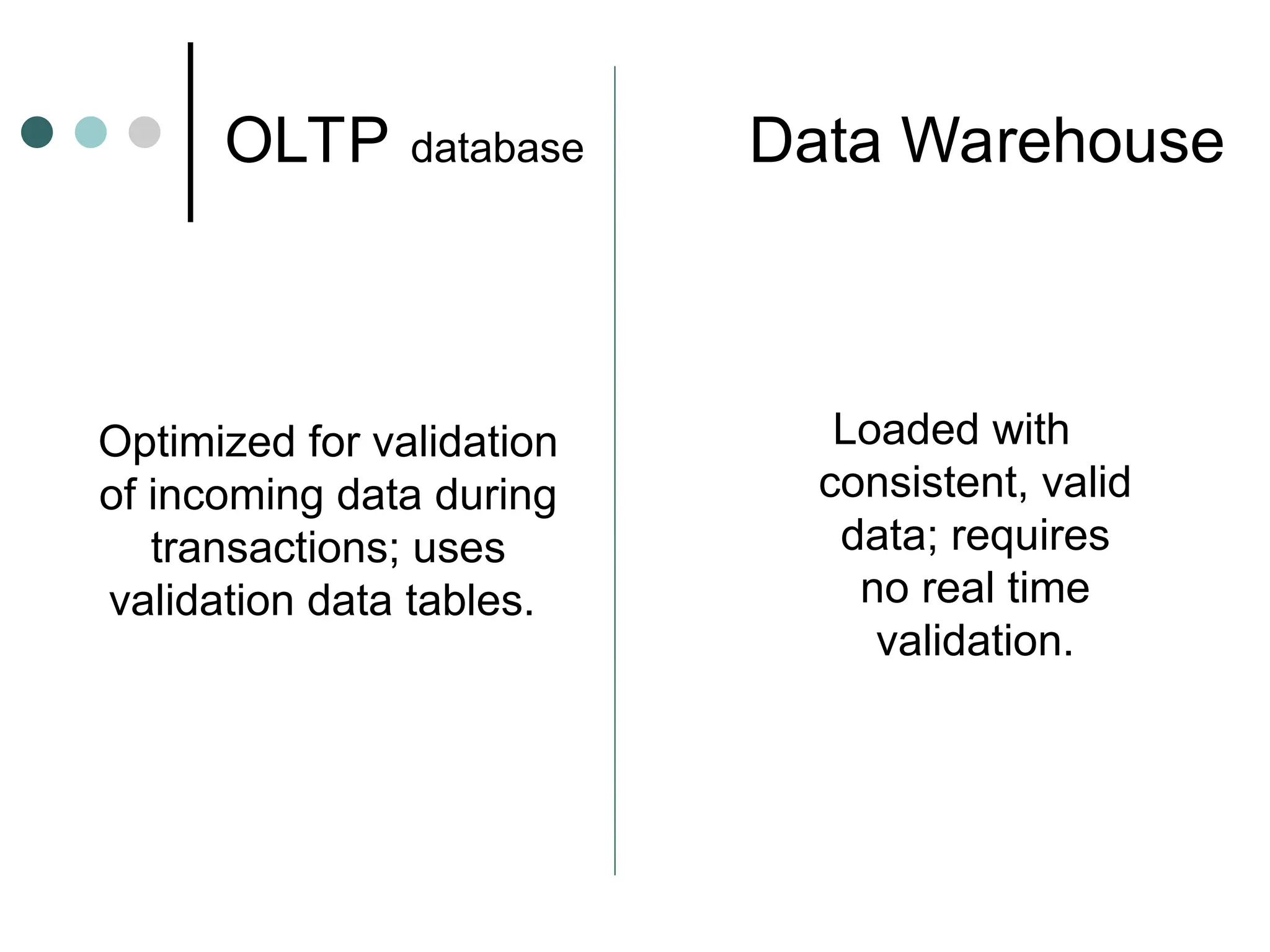
operational databases,
that supports business
analysis activities and
decision-making tasks
4.
Database models
isthe structure or format of a database, described in a
formal language supported by the database management
system
Database models
relational
flat
hierarchical
network
dimensional
object database
Data Warehouse
• relational database
model
5.
History
Database
1960 -the first database
management system
1970 - the first relational
model
1980 - distributed
database systems and
database machines
1990 - object-oriented
databases
2000 - XML database
Data Warehouse
It became a distinct type of
computer database during
the late 1980s and early
1990s
6.
Database
collection ofrelated data
database management system (DBMS) is a collection
of programs that enables users to create and maintain
a database
used in many applications
used in all e-commerce sites to store product inventory
and customer information
7.
Data Warehouses
“A datawarehouse is simply a single,
complete, and consistent store of data
obtained from a variety of sources and
made available to end users in a way
they can understand and use it in a
business context.”
-- Barry Devlin, IBM Consultant
8.
Data Warehouses
arecord of an enterprise's past
transactional and operational information
designed to favor efficient data analysis and
reporting
data warehousing is not meant for current
"live" data
9.
Data Warehouses
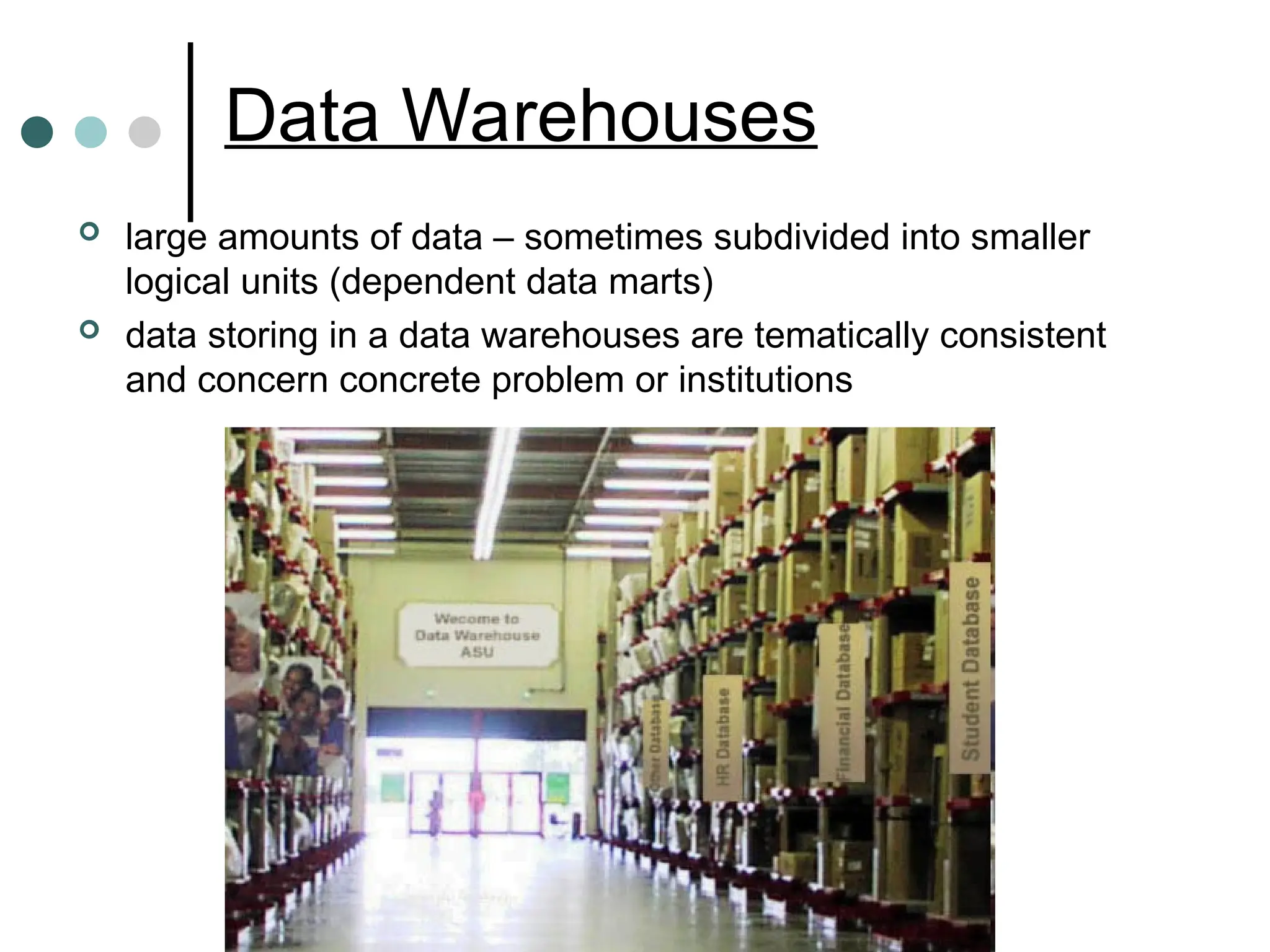
largeamounts of data – sometimes subdivided into smaller
logical units (dependent data marts)
data storing in a data warehouses are tematically consistent
and concern concrete problem or institutions
10.
Data Warehouses
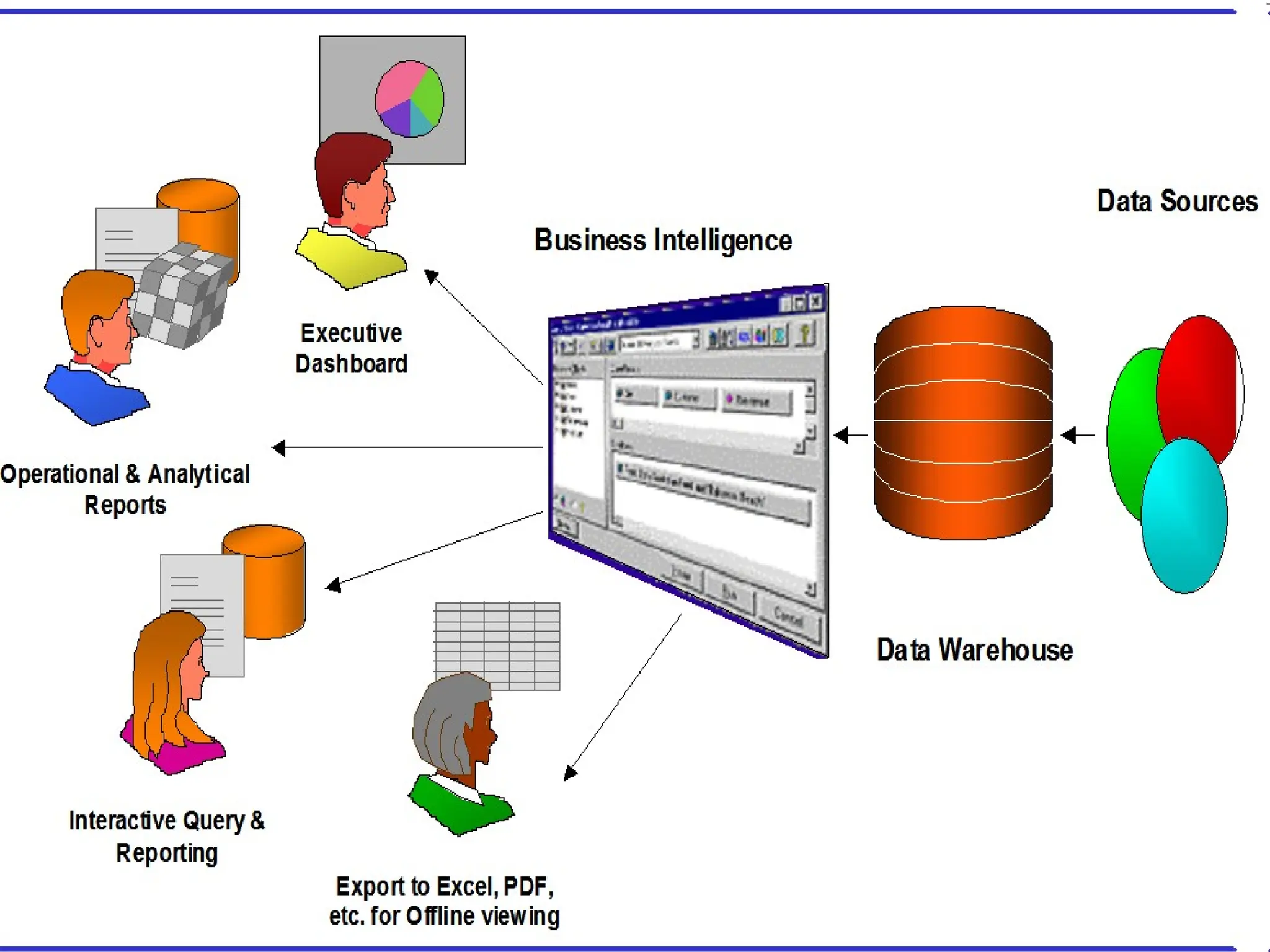
Components ofa data
warehouse:
Sources -> Data Source Interaction
Data Transformation
Data Warehouse (Data Storage)
Reporting (Data Presentation)
Metadata
12.
Data Warehouses
ADVANTAGES
complete controlover the four main areas of data
management systems:
Clean data
Query processing: multiple options
Indexes: multiple types
Security: data and access
13.
Data Warehouses
DISADVANTAGES
Addingnew data sources takes time and associated
high cost
Data owners lose control over their data, raising
ownership, security and privacy issues
Long initial implementation time and associated high
cost
Difficult to accommodate changes in data types and
ranges, data source schema, indexes and queries
14.
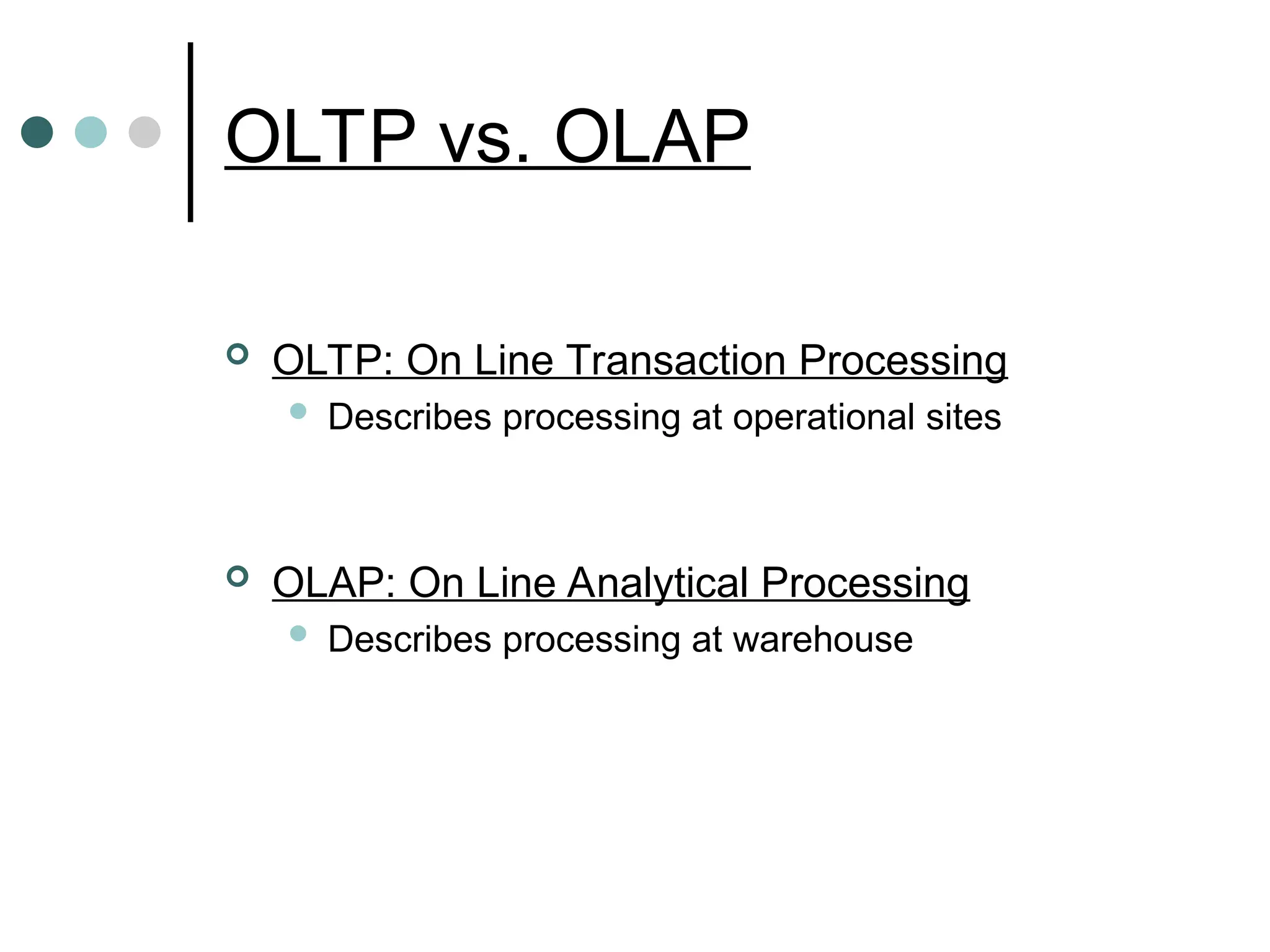
OLTP vs. OLAP
OLTP: On Line Transaction Processing
Describes processing at operational sites
OLAP: On Line Analytical Processing
Describes processing at warehouse
15.
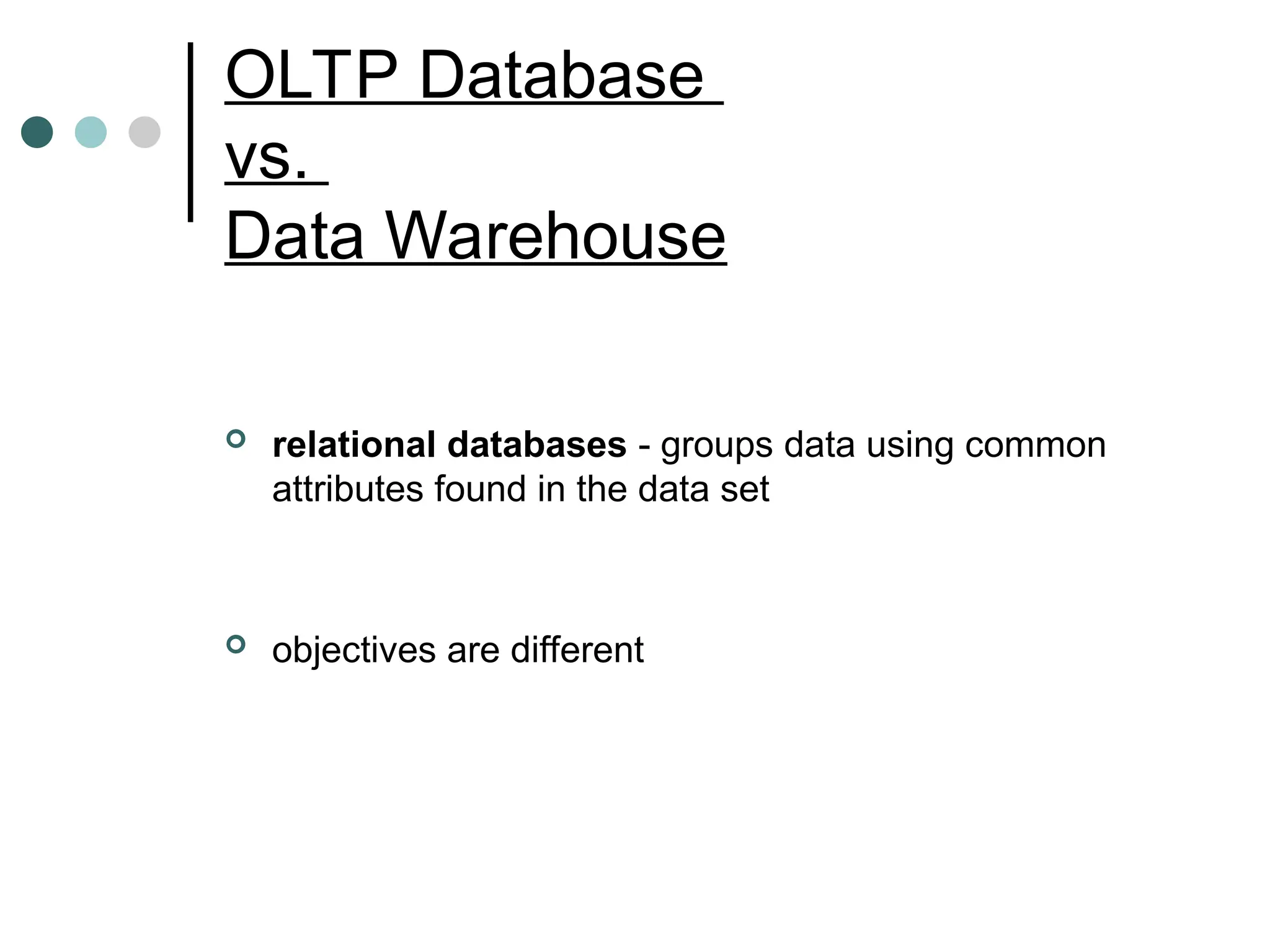
OLTP Database
vs.
Data Warehouse
relational databases - groups data using common
attributes found in the data set
objectives are different
16.
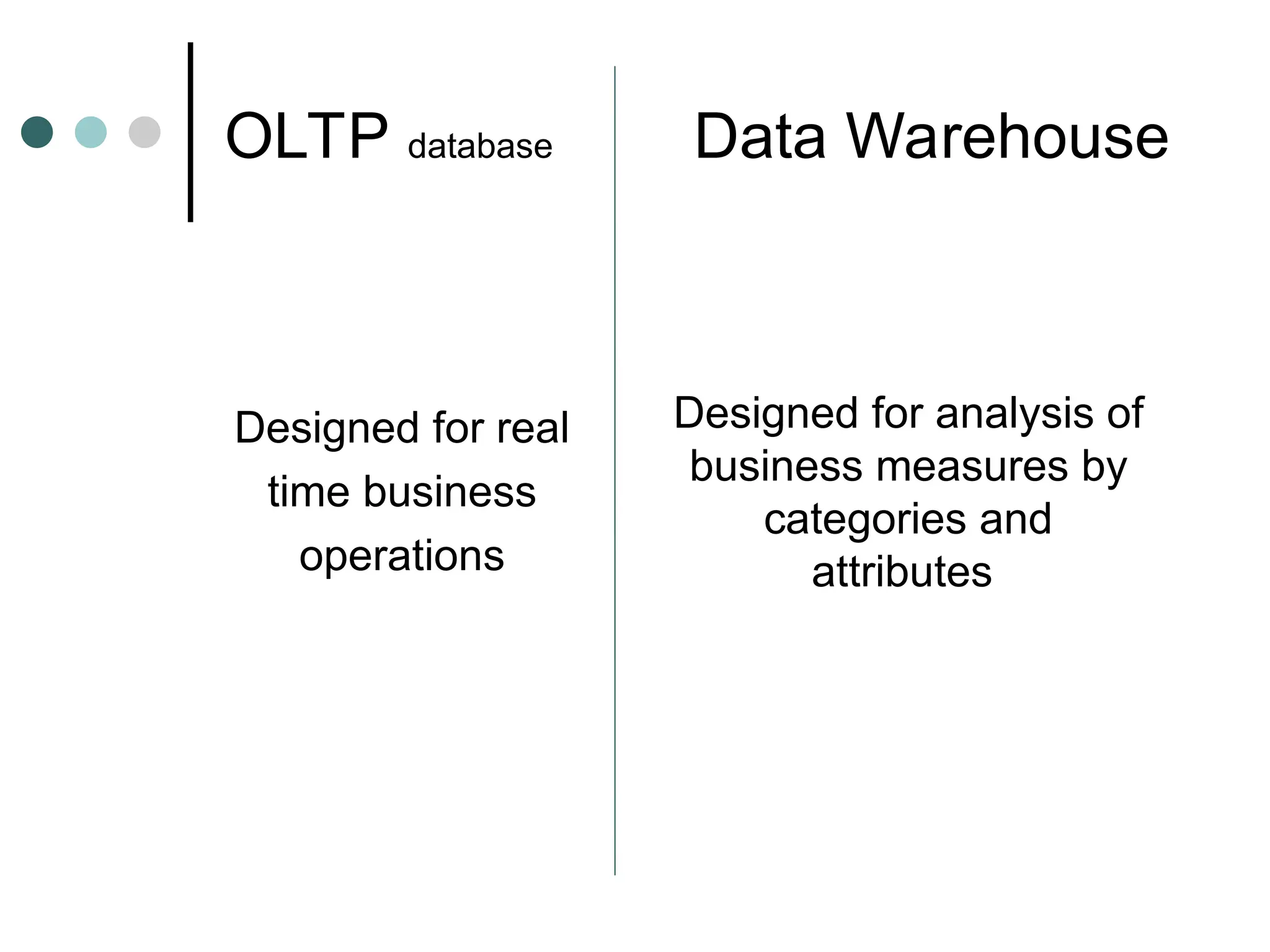
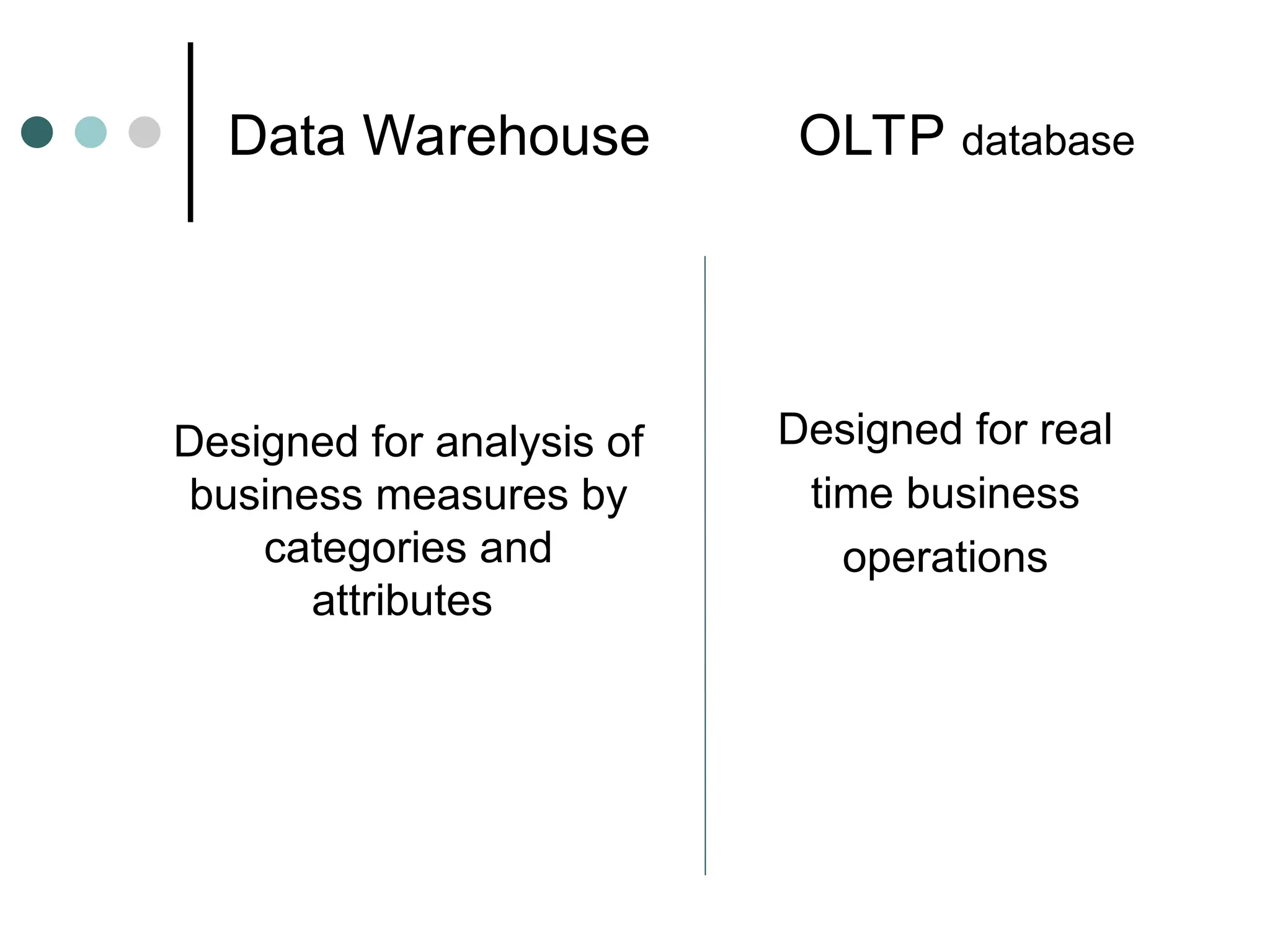
OLTP database DataWarehouse
Designed for real
time business
operations
Designed for analysis of
business measures by
categories and
attributes
17.
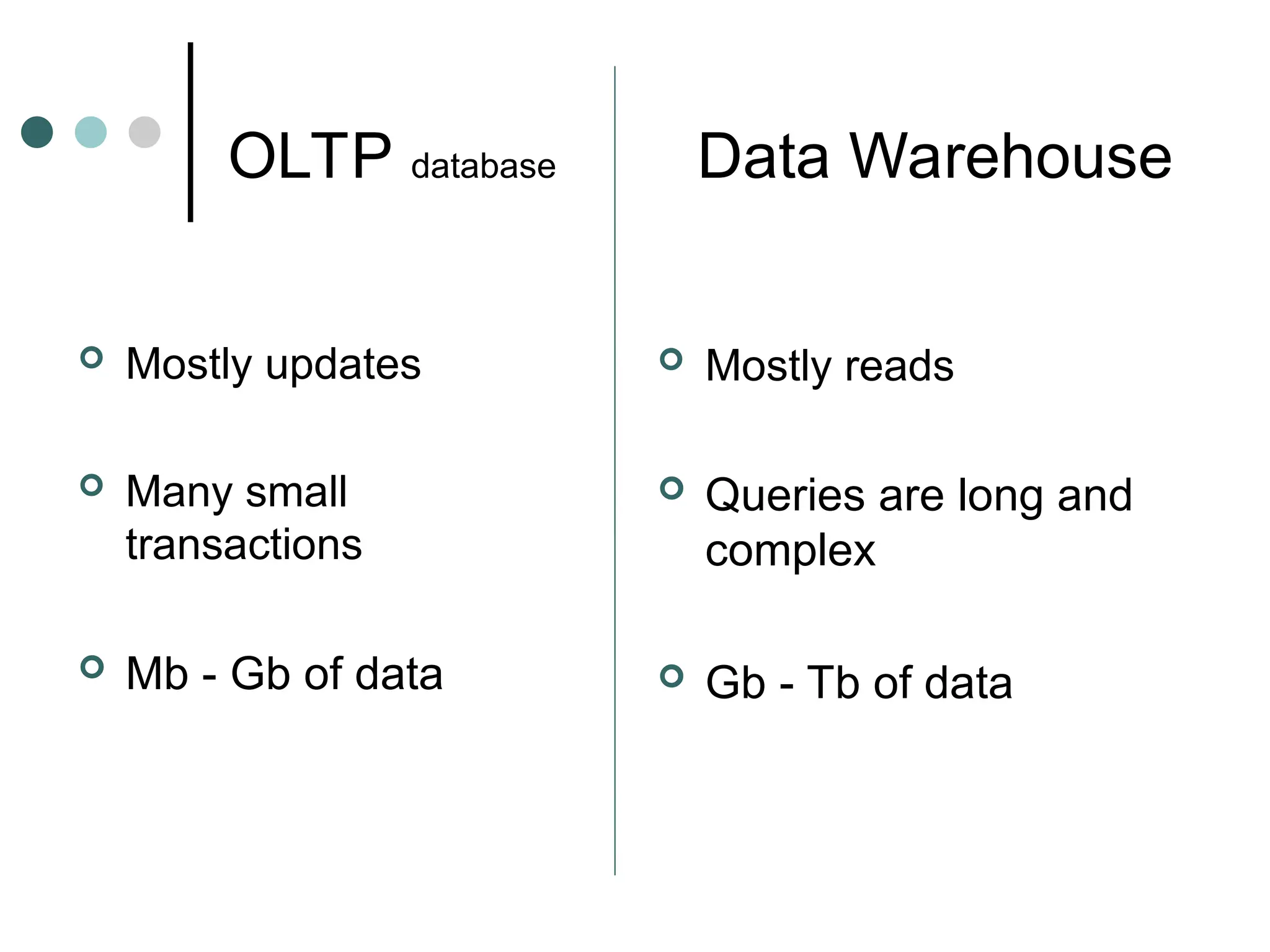
OLTP database DataWarehouse
Mostly updates
Many small
transactions
Mb - Gb of data
Mostly reads
Queries are long and
complex
Gb - Tb of data
18.
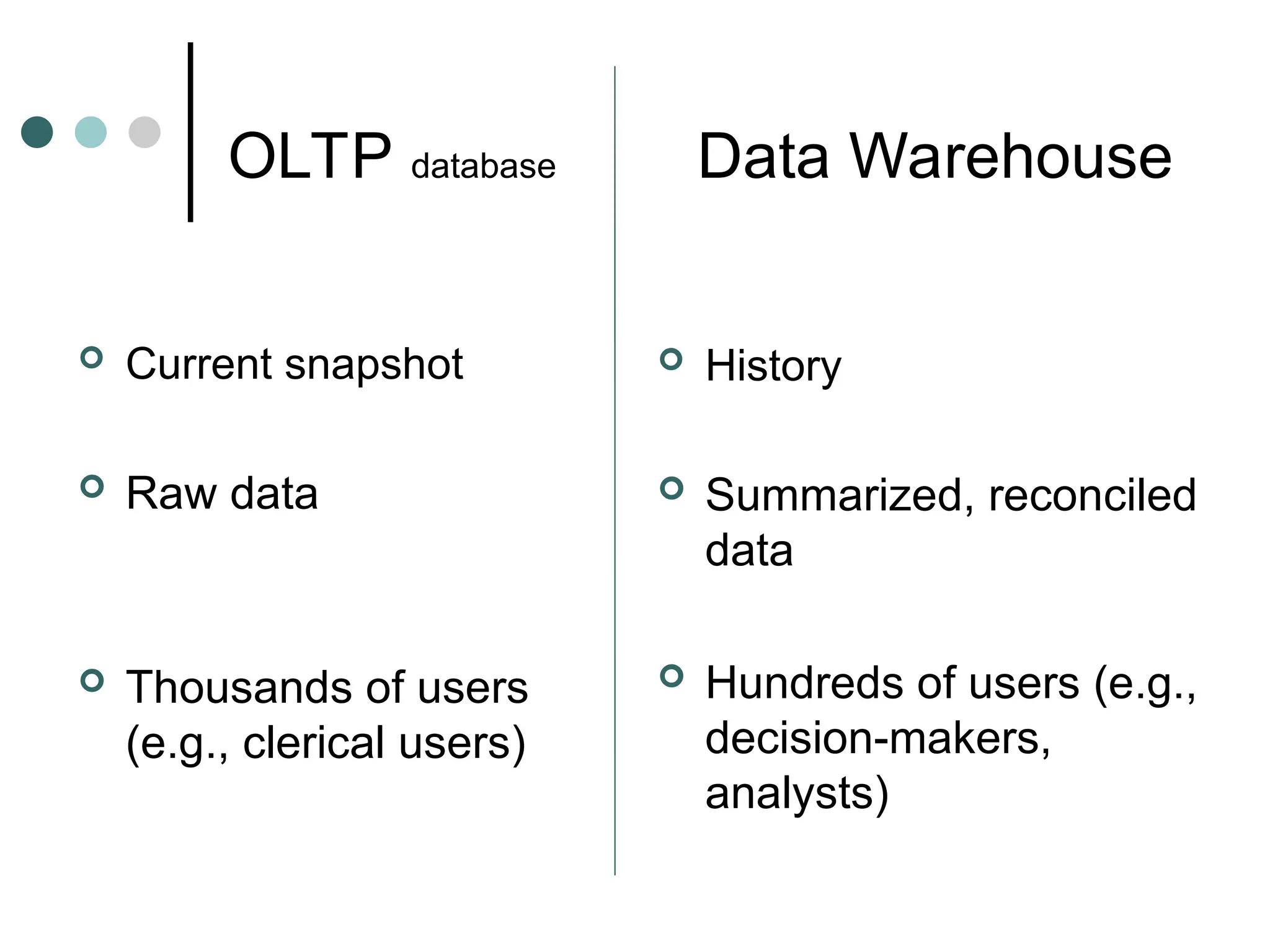
OLTP database DataWarehouse
Current snapshot
Raw data
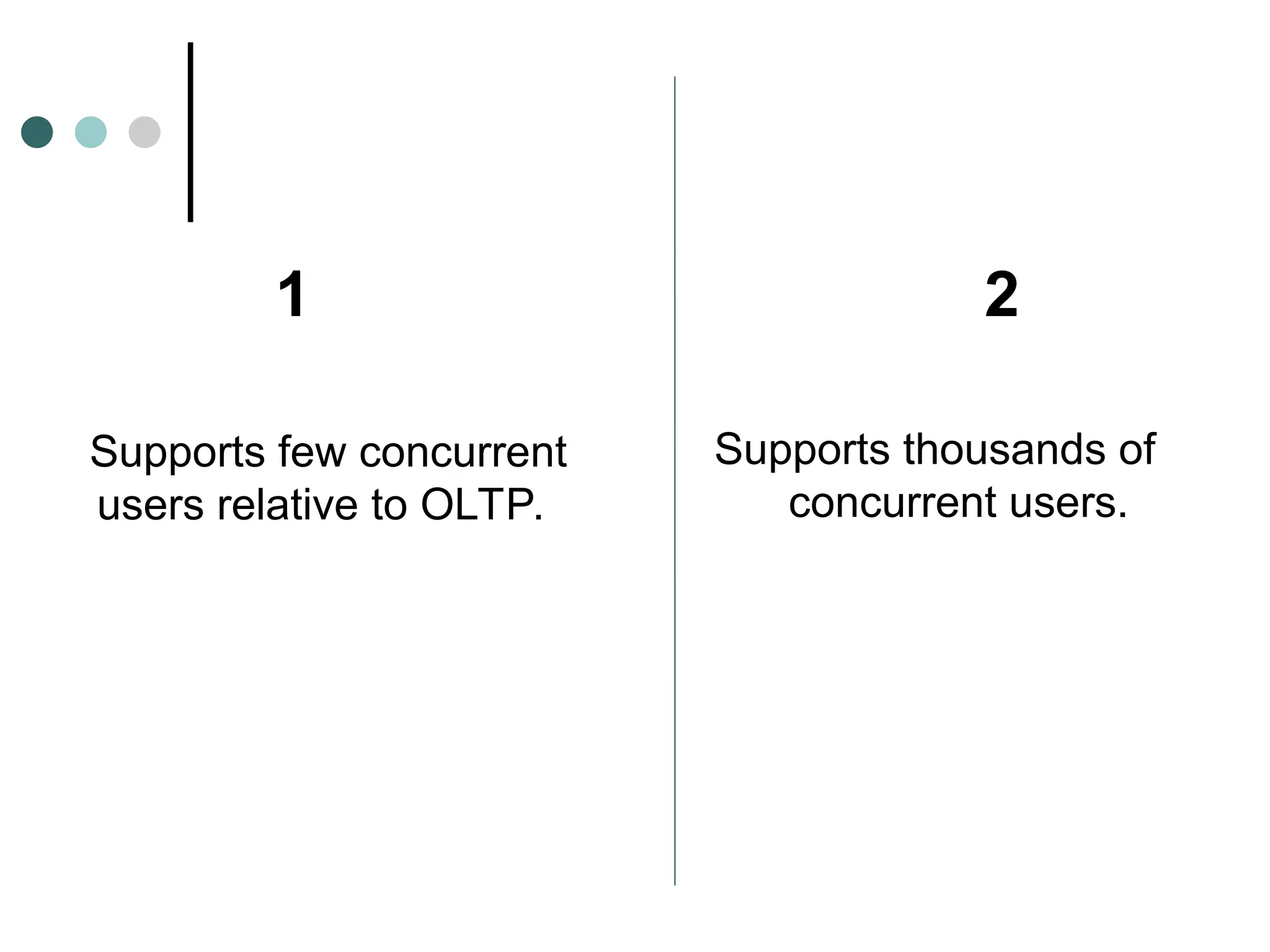
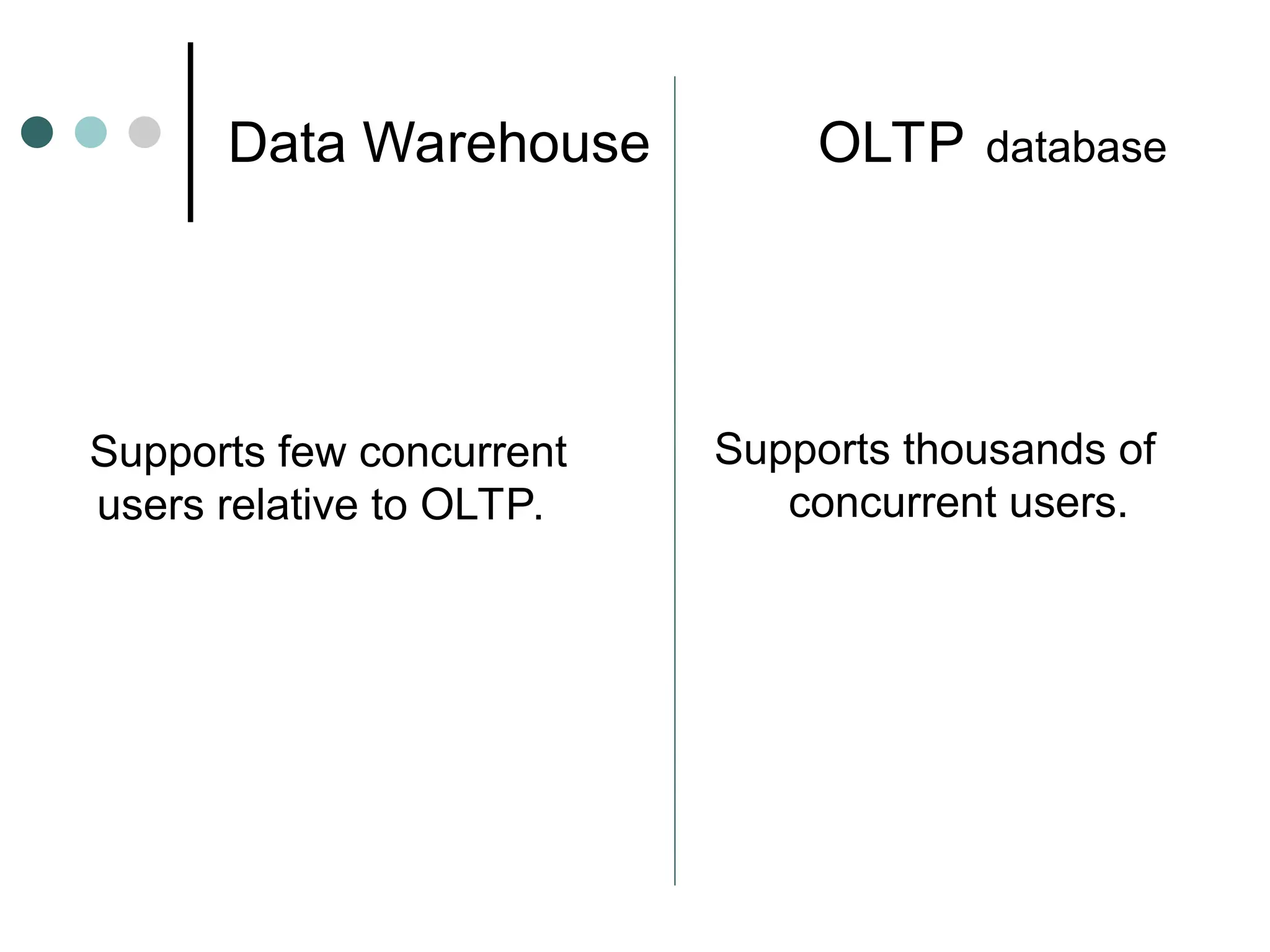
Thousands of users
(e.g., clerical users)
History
Summarized, reconciled
data
Hundreds of users (e.g.,
decision-makers,
analysts)
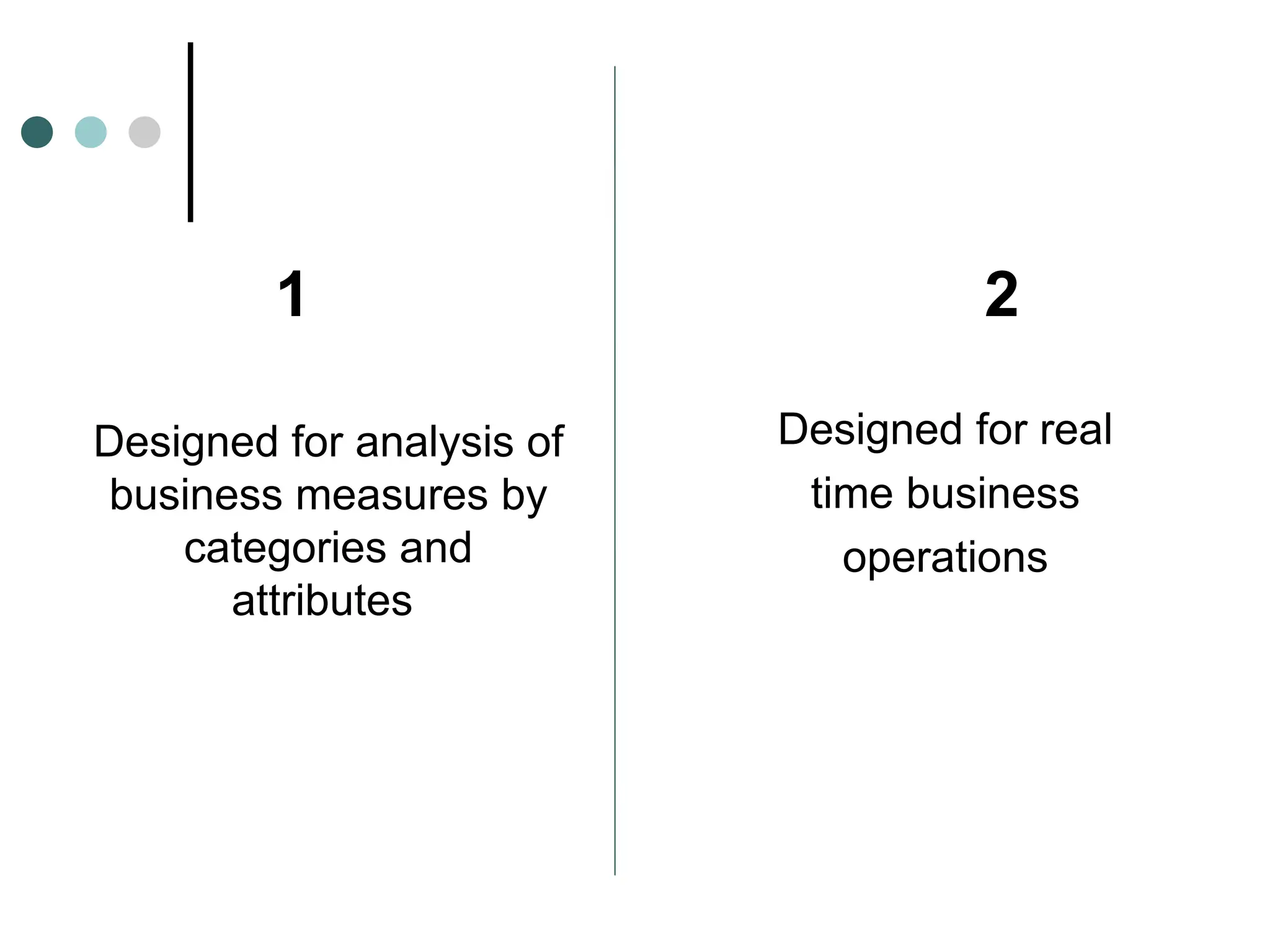
Designed for real
timebusiness
operations
Designed for analysis of
business measures by
categories and
attributes
1 2
21.
Designed for real
timebusiness
operations
Designed for analysis of
business measures by
categories and
attributes
Data Warehouse OLTP database
22.
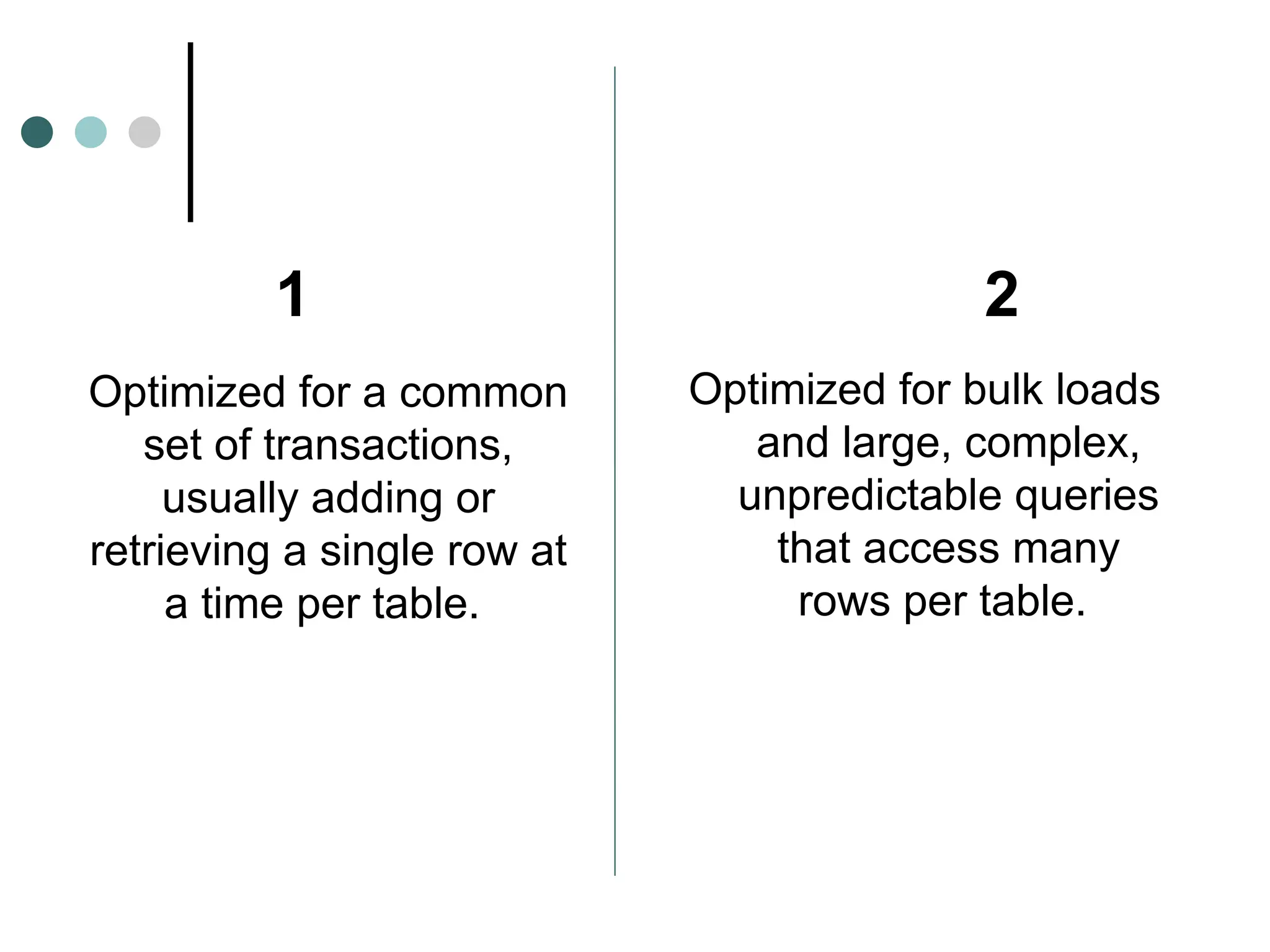
Optimized for bulkloads
and large, complex,
unpredictable queries
that access many
rows per table.
Optimized for a common
set of transactions,
usually adding or
retrieving a single row at
a time per table.
1 2
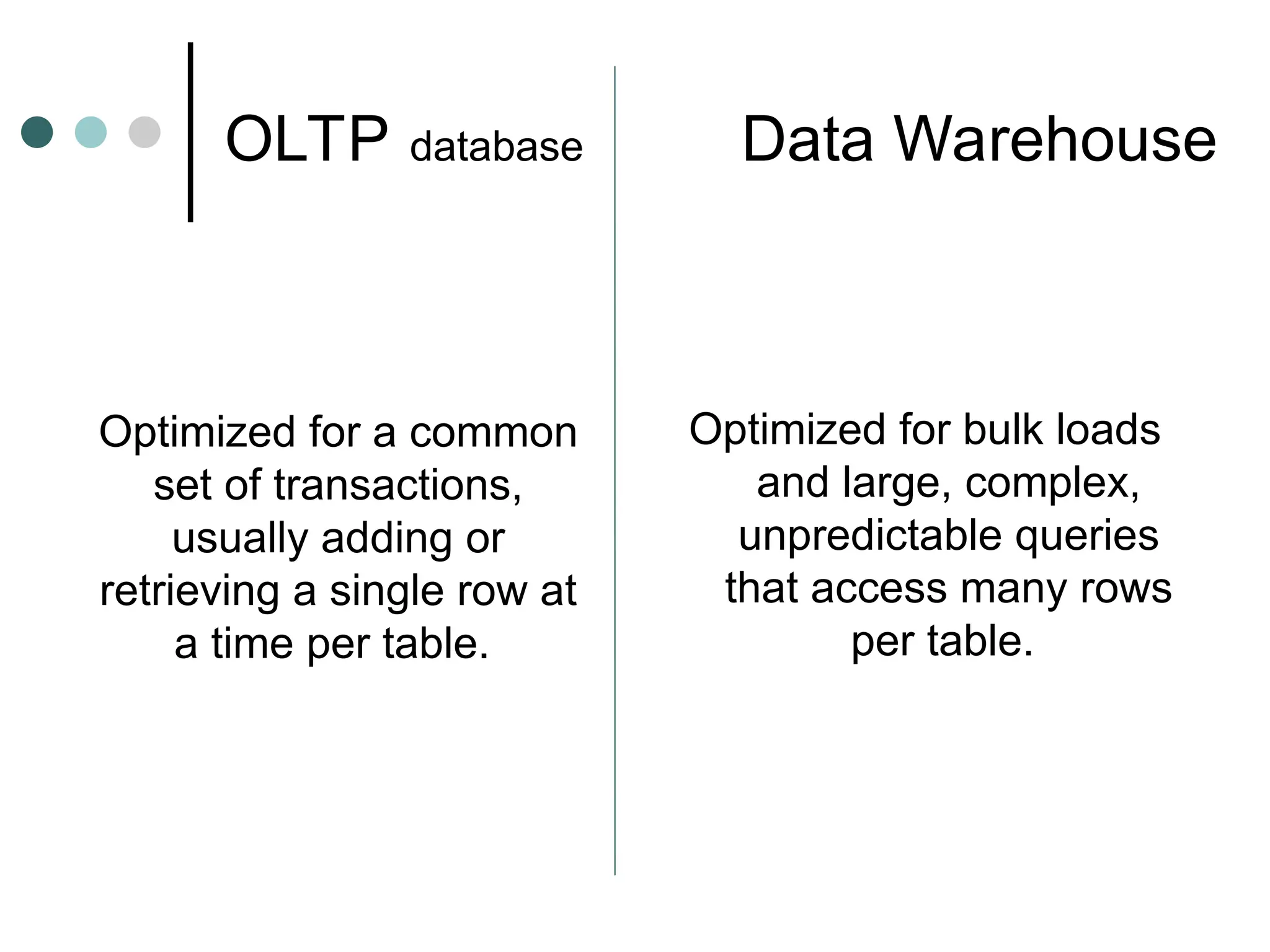
23.
Optimized for bulkloads
and large, complex,
unpredictable queries
that access many rows
per table.
Optimized for a common
set of transactions,
usually adding or
retrieving a single row at
a time per table.
OLTP database Data Warehouse
24.
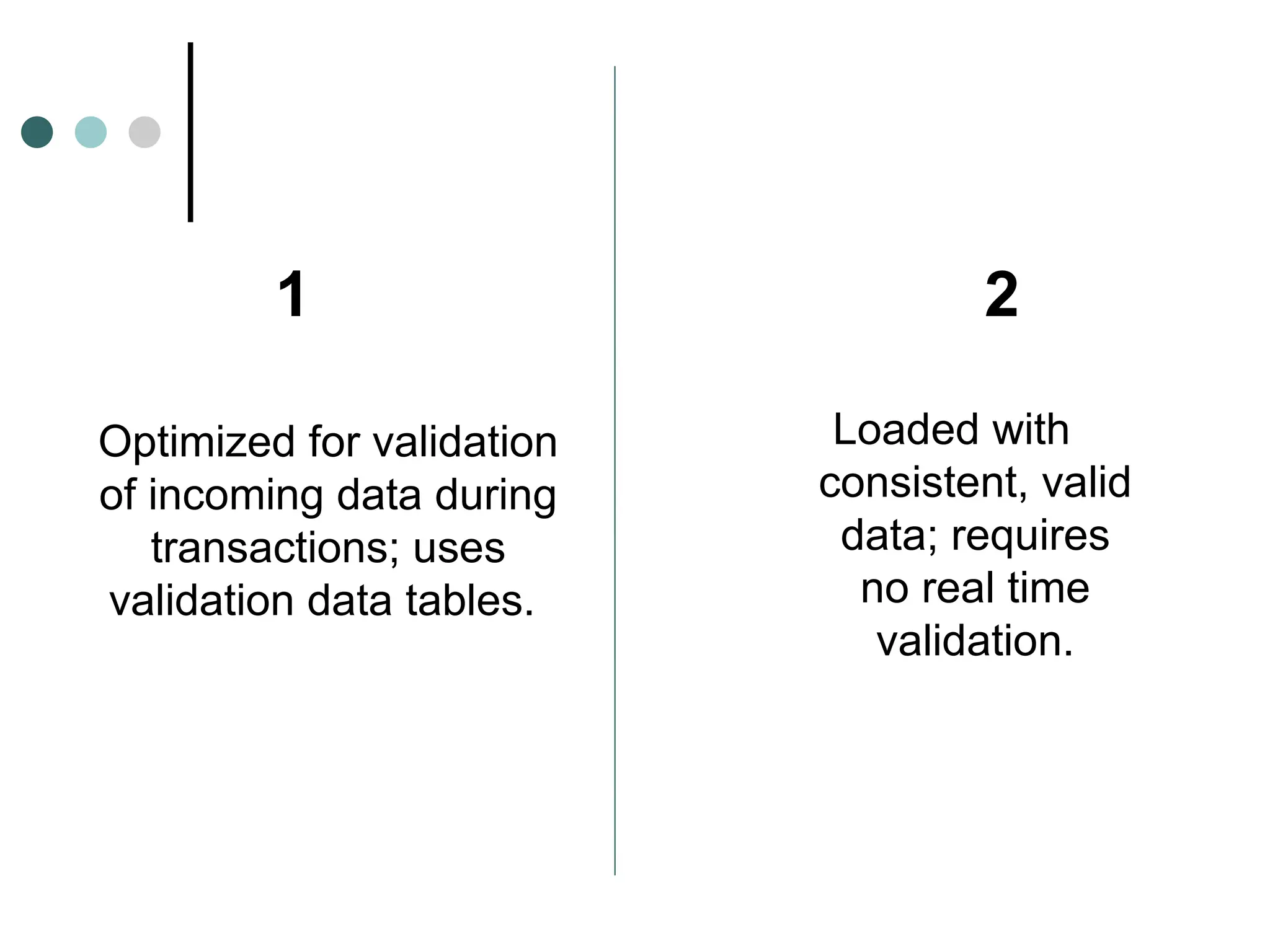
Loaded with
consistent, valid
data;requires
no real time
validation.
Optimized for validation
of incoming data during
transactions; uses
validation data tables.
1 2
25.
Loaded with
consistent, valid
data;requires
no real time
validation.
Optimized for validation
of incoming data during
transactions; uses
validation data tables.
OLTP database Data Warehouse


![[DSC Europe 25] Jon Dajci - Bridging TradFi and DeFi: Building the Future of ...](https://cdn.slidesharecdn.com/ss_thumbnails/fqmhfvlbqhkihjvqvhmu-7-251211083849-6af7e325-thumbnail.jpg?width=640&height=640&fit=bounds)


![[DSC Europe 25] Marko Krstic - Understanding the AI Threat Landscape - Risks,...](https://cdn.slidesharecdn.com/ss_thumbnails/tiyim1ins5jvbrvzpzla-2-251209104645-c69d3553-thumbnail.jpg?width=640&height=640&fit=bounds)
![[DSC Europe 25] Marija Vlajkovic & Andrea Radonjanin - Integration of AI tool...](https://cdn.slidesharecdn.com/ss_thumbnails/qf1jrglttoc3bm8s3aop-final-integration-of-ai-tools-251208151905-394f3a6a-thumbnail.jpg?width=640&height=640&fit=bounds)

![[DSC Europe 25] Aleksandra Dragicevic - AI-Boosted Research in Healthcare: Fr...](https://cdn.slidesharecdn.com/ss_thumbnails/iqwngszurf2r7pi1lnnj-4-aleksandra-dragicevic-ad-dsc-europe-conference-20-251208151905-37c3238a-thumbnail.jpg?width=640&height=640&fit=bounds)
![[DSC Europe 25] Milan Sekuloski - Data, Defence, and Development: Cybersecuri...](https://cdn.slidesharecdn.com/ss_thumbnails/dfrkwwx4qly6atqpbl4z-4-251209104645-c3d4b0ca-thumbnail.jpg?width=640&height=640&fit=bounds)


![[DSC Europe 25] Katherine Forrest - AI NOW: Understanding the Velocity of Cha...](https://cdn.slidesharecdn.com/ss_thumbnails/wvvbruqfrci0sfq9xwgb-4-251212104007-e5ad1987-thumbnail.jpg?width=640&height=640&fit=bounds)


![[DSC Europe 25] Vladimir Jelic - The AI-Driven Security Shift From Reactive D...](https://cdn.slidesharecdn.com/ss_thumbnails/6g5gj25mtjwayniqem1t-6-251209104645-7a5a5fc6-thumbnail.jpg?width=640&height=640&fit=bounds)
![[DSC Europe 25] Bassam Maharmeh - Artificial Intelligence: Opportunities and ...](https://cdn.slidesharecdn.com/ss_thumbnails/thhfmr2fqpawzj7hsjpg-5-251211083048-2c23204f-thumbnail.jpg?width=640&height=640&fit=bounds)