Introduction
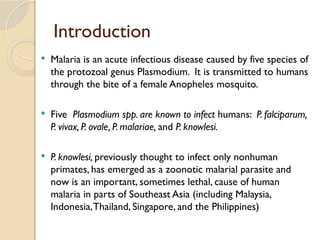
 Malaria is an acute infectious disease caused by five species of
the protozoal genus Plasmodium. It is transmitted to humans
through the bite of a female Anopheles mosquito.
 Five Plasmodium spp. are known to infect humans: P. falciparum,
P. vivax, P. ovale, P. malariae, and P. knowlesi.
 P. knowlesi, previously thought to infect only nonhuman
primates, has emerged as a zoonotic malarial parasite and
now is an important, sometimes lethal, cause of human
malaria in parts of Southeast Asia (including Malaysia,
Indonesia,Thailand, Singapore, and the Philippines)
Introduction
 P. falciparum and P. vivax cause most of the malarial infections
worldwide. Of these, P. falciparum accounts for the majority of
the burden of malaria in sub-Saharan Africa and is associated
with the most severe disease.
 Plasmodium falciparum is the most dangerous species, causing an
acute, rapidly fulminating disease that is characterized by
persistent high fever, orthostatic hypotension, and massive
erythrocytosis (an abnormal elevation in the number of red
blood cells accompanied by swollen, reddish limbs)
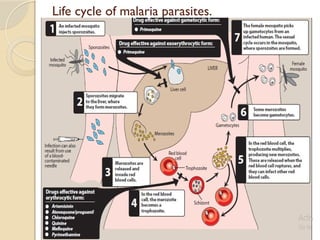
Life cycle of malaria parasites.
Clinical Manifestations of Malaria
 The cardinal signs and symptoms of malaria are :
-high, spiking fevers (with or without periodicity),
-chills,
-headaches,
-myalgias,
-malaise,
and GI symptoms.
 P. vivax malaria is characterized by relapses caused by the
reactivation of latent tissue forms.
 P. ovale causes a clinical syndrome similar to that of P. vivax but
may be milder with lower levels of parasitemia
Diagnosis
 The World Health Organization (WHO) provides
guidelines for the diagnosis of malaria using a standard
approach.The recommended methods for diagnosis of
malaria according toWHO standards are as follows :
1. Microscopic examination of blood smear
2. Rapid diagnostic tests
3. Molecular diagnostic tests
4. Clinical assessment
Uncomplicated malaria
 Non specific symptoms - fever, lethargy,
malaise, nausea, abdominal pain, vomiting
and dairrhoae. Often no distinct fever
parttern. Patient may also have
hepatoslenomegaly.
Severe malaria
 Respiratory distress
 Hypoglycemia
 Cerebral malaria; reduced GCS, siezures,
altered respiration.
Indicators of severe or complicated
malaria
 Impared conciounsness or seizure
 Respiratory distress or acidosis (PH less
than 7.3)
 Hypoglycemia (BGL less than 2.2mmol/l)
 Severe anemia(hemoglobin less than 80g/l)
 Prostraction
 Parasitemia greater than 2% red blood
cells parasized
Management
 Admit patient for minimum of 24 hours
 Perform four hourly observation and
blood sugar monitoring
 Repeaet thick film for parasitemia after
12-24 hours or sooner of there is clinical
deterioration
Treatment (uncomplicated malaria)
 Oral artemether with lumefantrine
Initial dose is after 8hours then
subsequently after 12 hours.
• If oral artemether and lumefantrine is not
available use oral atovaquone with
proguanil hydrochloride.
Treatment for severe or complicated
malaria
 IV artesunate.Wt 20kg and above give
2.4mg/kg while wt less than 20kg give 3mg
mg/kg
 All are 3 doses at time 0hrs, 12hrs and
24hrs loading dose followed by
maintenance dose once daily.
 After 24hrs of iv treatment it can be
switched to oral artemether and
lumefantrine
Conti….
 The artesunate solution most be used
within one hour once reconstituted
 If artesunate is unavailable use IV quinine
for all patient loading dose 20mg/kg max
1.4g starting at time 0hrs
 Days 1-2(at time 8hrs) 10mg/kg max 700mg
8 hourly for 48 hours.
 Maintenance 10mg /kg max 700mg every 12
hours
 Administer all IV as an infusion over 4hours
Discharge and follow up
 Patients may be discharged if they show
clinical improvement with falling
parasitaemia less than 2% or stable blood
count.
 For follow up FBC and malaria film should
be carried out after 2weeks. For patients
receiving artesunate additional follow up
at 4-5 weeks may be required
Advice to parent or care givers
 To re-present if patients has a fever in the
following 3 months
 To use anti malaria prophylaxis if future
travel to malaria endemic area.
Clinical case
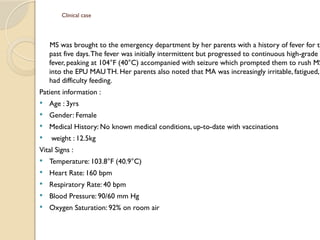
MS was brought to the emergency department by her parents with a history of fever for th
past five days.The fever was initially intermittent but progressed to continuous high-grade
fever, peaking at 104°F (40°C) accompanied with seizure which prompted them to rush MS
into the EPU MAU TH. Her parents also noted that MA was increasingly irritable, fatigued,
had difficulty feeding.
Patient information :
 Age : 3yrs
 Gender: Female
 Medical History: No known medical conditions, up-to-date with vaccinations
 weight : 12.5kg
Vital Signs :
 Temperature: 103.8°F (40.9°C)
 Heart Rate: 160 bpm
 Respiratory Rate: 40 bpm
 Blood Pressure: 90/60 mm Hg
 Oxygen Saturation: 92% on room air
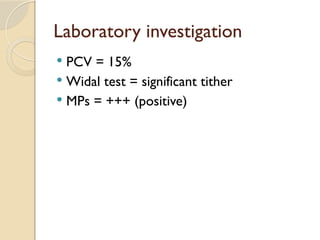
Laboratory investigation
 PCV = 15%
 Widal test = significant tither
 MPs = +++ (positive)
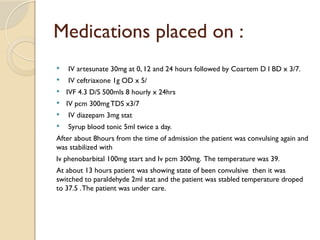
Medications placed on :
 IV artesunate 30mg at 0, 12 and 24 hours followed by Coartem D I BD x 3/7.
 IV ceftriaxone 1g OD x 5/
 IVF 4.3 D/S 500mls 8 hourly x 24hrs
 IV pcm 300mgTDS x3/7
 IV diazepam 3mg stat
 Syrup blood tonic 5ml twice a day.
After about 8hours from the time of admission the patient was convulsing again and
was stabilized with
Iv phenobarbital 100mg start and Iv pcm 300mg. The temperature was 39.
At about 13 hours patient was showing state of been convulsive then it was
switched to paraldehyde 2ml stat and the patient was stabled temperature droped
to 37.5 .The patient was under care.
Thank You

A brief presentation on malaria therapy.

  • 1.
    Introduction  Malaria isan acute infectious disease caused by five species of the protozoal genus Plasmodium. It is transmitted to humans through the bite of a female Anopheles mosquito.  Five Plasmodium spp. are known to infect humans: P. falciparum, P. vivax, P. ovale, P. malariae, and P. knowlesi.  P. knowlesi, previously thought to infect only nonhuman primates, has emerged as a zoonotic malarial parasite and now is an important, sometimes lethal, cause of human malaria in parts of Southeast Asia (including Malaysia, Indonesia,Thailand, Singapore, and the Philippines)
  • 2.
    Introduction  P. falciparumand P. vivax cause most of the malarial infections worldwide. Of these, P. falciparum accounts for the majority of the burden of malaria in sub-Saharan Africa and is associated with the most severe disease.  Plasmodium falciparum is the most dangerous species, causing an acute, rapidly fulminating disease that is characterized by persistent high fever, orthostatic hypotension, and massive erythrocytosis (an abnormal elevation in the number of red blood cells accompanied by swollen, reddish limbs)
  • 3.
    Life cycle ofmalaria parasites.
  • 4.
    Clinical Manifestations ofMalaria  The cardinal signs and symptoms of malaria are : -high, spiking fevers (with or without periodicity), -chills, -headaches, -myalgias, -malaise, and GI symptoms.  P. vivax malaria is characterized by relapses caused by the reactivation of latent tissue forms.  P. ovale causes a clinical syndrome similar to that of P. vivax but may be milder with lower levels of parasitemia
  • 5.
    Diagnosis  The WorldHealth Organization (WHO) provides guidelines for the diagnosis of malaria using a standard approach.The recommended methods for diagnosis of malaria according toWHO standards are as follows : 1. Microscopic examination of blood smear 2. Rapid diagnostic tests 3. Molecular diagnostic tests 4. Clinical assessment
  • 6.
    Uncomplicated malaria  Nonspecific symptoms - fever, lethargy, malaise, nausea, abdominal pain, vomiting and dairrhoae. Often no distinct fever parttern. Patient may also have hepatoslenomegaly.
  • 7.
    Severe malaria  Respiratorydistress  Hypoglycemia  Cerebral malaria; reduced GCS, siezures, altered respiration.
  • 8.
    Indicators of severeor complicated malaria  Impared conciounsness or seizure  Respiratory distress or acidosis (PH less than 7.3)  Hypoglycemia (BGL less than 2.2mmol/l)  Severe anemia(hemoglobin less than 80g/l)  Prostraction  Parasitemia greater than 2% red blood cells parasized
  • 9.
    Management  Admit patientfor minimum of 24 hours  Perform four hourly observation and blood sugar monitoring  Repeaet thick film for parasitemia after 12-24 hours or sooner of there is clinical deterioration
  • 10.
    Treatment (uncomplicated malaria) Oral artemether with lumefantrine Initial dose is after 8hours then subsequently after 12 hours. • If oral artemether and lumefantrine is not available use oral atovaquone with proguanil hydrochloride.
  • 11.
    Treatment for severeor complicated malaria  IV artesunate.Wt 20kg and above give 2.4mg/kg while wt less than 20kg give 3mg mg/kg  All are 3 doses at time 0hrs, 12hrs and 24hrs loading dose followed by maintenance dose once daily.  After 24hrs of iv treatment it can be switched to oral artemether and lumefantrine
  • 12.
    Conti….  The artesunatesolution most be used within one hour once reconstituted  If artesunate is unavailable use IV quinine for all patient loading dose 20mg/kg max 1.4g starting at time 0hrs  Days 1-2(at time 8hrs) 10mg/kg max 700mg 8 hourly for 48 hours.  Maintenance 10mg /kg max 700mg every 12 hours  Administer all IV as an infusion over 4hours
  • 13.
    Discharge and followup  Patients may be discharged if they show clinical improvement with falling parasitaemia less than 2% or stable blood count.  For follow up FBC and malaria film should be carried out after 2weeks. For patients receiving artesunate additional follow up at 4-5 weeks may be required
  • 14.
    Advice to parentor care givers  To re-present if patients has a fever in the following 3 months  To use anti malaria prophylaxis if future travel to malaria endemic area.
  • 15.
    Clinical case MS wasbrought to the emergency department by her parents with a history of fever for th past five days.The fever was initially intermittent but progressed to continuous high-grade fever, peaking at 104°F (40°C) accompanied with seizure which prompted them to rush MS into the EPU MAU TH. Her parents also noted that MA was increasingly irritable, fatigued, had difficulty feeding. Patient information :  Age : 3yrs  Gender: Female  Medical History: No known medical conditions, up-to-date with vaccinations  weight : 12.5kg Vital Signs :  Temperature: 103.8°F (40.9°C)  Heart Rate: 160 bpm  Respiratory Rate: 40 bpm  Blood Pressure: 90/60 mm Hg  Oxygen Saturation: 92% on room air
  • 16.
    Laboratory investigation  PCV= 15%  Widal test = significant tither  MPs = +++ (positive)
  • 17.
    Medications placed on:  IV artesunate 30mg at 0, 12 and 24 hours followed by Coartem D I BD x 3/7.  IV ceftriaxone 1g OD x 5/  IVF 4.3 D/S 500mls 8 hourly x 24hrs  IV pcm 300mgTDS x3/7  IV diazepam 3mg stat  Syrup blood tonic 5ml twice a day. After about 8hours from the time of admission the patient was convulsing again and was stabilized with Iv phenobarbital 100mg start and Iv pcm 300mg. The temperature was 39. At about 13 hours patient was showing state of been convulsive then it was switched to paraldehyde 2ml stat and the patient was stabled temperature droped to 37.5 .The patient was under care.
  • 18.

Editor's Notes

  • #2 P. falciparum infection can lead to capillary obstruction and death without prompt treatment