CLASS-10
SUBJECT – ENGLISH
(FIRST FLIGHT)
A BAKER FROM GOA
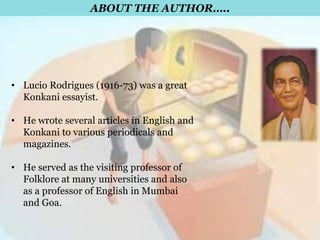
• Lucio Rodrigues (1916-73) was a great
Konkani essayist.
• He wrote several articles in English and
Konkani to various periodicals and
magazines.
• He served as the visiting professor of
Folklore at many universities and also
as a professor of English in Mumbai
and Goa.
ABOUT THE AUTHOR…..
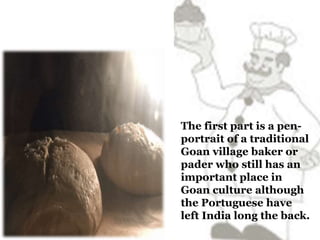
The first part is a pen-
portrait of a traditional
Goan village baker or
pader who still has an
important place in
Goan culture although
the Portuguese have
left India long the back.
UNFAMILIAR WORDS :
Reminiscing nostalgically - thinking fondly of
the past
Heralding - announcing
Pader- word for baker in Portuguese language
'Paskine' or 'Bastine‘ - name of the maid-
servant of the house
• This is a pen portrait of the traditional Goan village baker, who is
still remembered by Goans.
• A Baker from Goa’ revolves around the relevance of a baker in the
Goan culture which dates back to the time when Portuguese ruled
over the city of Goa.
• The Portuguese may have left but the bread-makers continue to
have an inevitable stature.
• In this story, the author recalls his childhood days and their
excitement on seeing the baker.
• The mixers, moulders and their time-tested furnaces continue to
serve the people of Goa with their famous bread loaves.
• It was the maid-servant of the house who collected the loaves
while children sorted out the bread bangles for themselves.
VALUE POINTS
UNFAMILIAR WORDS :
Bol – a wedding sweet
(a kind of cookies)
Bolinhas - cake-like
cookies
VALUE POINTS
• They were enthusiastic to the point that they would run to
him as soon as they woke up without even brushing their
teeth.
• They talk how the importance of bakers is still maintained in
their villages even after the Portuguese have left. They are
known as ‘Paders’ in Goa.
• Bakery products have importance in the culture and
traditions of Goa.
• Bol or sweet bread is a part of marriage gifts, cakes and
Bolinhas or coconut cookies are eaten at every festival and the
lady of the house prepares sandwiches at her daughter’s
engagement.
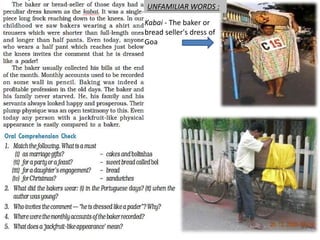
Kabai - The baker or
bread seller's dress of
Goa
UNFAMILIAR WORDS :
VALUE POINTS
• Earlier bakers wore a unique frock of knee-length known
as ‘kabai’ but during the narrator’s childhood days, they
wore a shirt and trousers of length slightly shorter than
the usual ones.
• They generally collected their bills at the end of every
month.
• Bakery has continued to be a profitable profession,
managing to keep their families joyous and prosperous.
• The Portuguese in Goa were lovers of bread.
• Those eaters of bread have now gone but its makers still
exist.
• During the childhood days of the narrator, a baker used to be
their friend, companion and guide.
• The baker came twice a day- once in the morning and again
while returning home after finishing his selling.
• The jingling thud of the baker’s bamboo woke up the
sleeping children.
• The loaves were delivered to the servants of the house.
SUMMARY
• The children would peep into the baker’s basket for the
bread bangles. The children would eat bread with hot tea.
• The marriages were incomplete without the popular bol
bread.
• Bolinhas was a must during Christmas and all other
festivals.
• The bakers wore a particular knee length frock known as
kabai.
• Baking was a profitable profession. Bakers had a plump
physique testifying to this.
• The bakers collected their bills at the end of the month.
SUMMARY
ASSIGNMENT
1. What did the bakers wear when the
author was young ?
2. How did the baker attract the children ?
3. Give reasons to support author’s view that
Baking was considered essential in a
traditional Goan village.
I. Answer the following questions in 20-30
words :
I. Answer the following questions in 100-
120 words :
ASSIGNMENT
1. Describe the childhood memories of the
author’s time in Goa and his fondness for
breads and cakes ?
2. How can a baker be recognized? Comment
on the significance of a bread baker in a
traditional Goan village ?
THANK YOU
STAY SAFE ………
STAY HEALTHY……..

A BAKER FROM GOA.pptx

  • 1.
    CLASS-10 SUBJECT – ENGLISH (FIRSTFLIGHT) A BAKER FROM GOA
  • 4.
    • Lucio Rodrigues(1916-73) was a great Konkani essayist. • He wrote several articles in English and Konkani to various periodicals and magazines. • He served as the visiting professor of Folklore at many universities and also as a professor of English in Mumbai and Goa. ABOUT THE AUTHOR…..
  • 5.
    The first partis a pen- portrait of a traditional Goan village baker or pader who still has an important place in Goan culture although the Portuguese have left India long the back.
  • 7.
    UNFAMILIAR WORDS : Reminiscingnostalgically - thinking fondly of the past Heralding - announcing Pader- word for baker in Portuguese language 'Paskine' or 'Bastine‘ - name of the maid- servant of the house
  • 8.
    • This isa pen portrait of the traditional Goan village baker, who is still remembered by Goans. • A Baker from Goa’ revolves around the relevance of a baker in the Goan culture which dates back to the time when Portuguese ruled over the city of Goa. • The Portuguese may have left but the bread-makers continue to have an inevitable stature. • In this story, the author recalls his childhood days and their excitement on seeing the baker. • The mixers, moulders and their time-tested furnaces continue to serve the people of Goa with their famous bread loaves. • It was the maid-servant of the house who collected the loaves while children sorted out the bread bangles for themselves. VALUE POINTS
  • 9.
    UNFAMILIAR WORDS : Bol– a wedding sweet (a kind of cookies) Bolinhas - cake-like cookies
  • 10.
    VALUE POINTS • Theywere enthusiastic to the point that they would run to him as soon as they woke up without even brushing their teeth. • They talk how the importance of bakers is still maintained in their villages even after the Portuguese have left. They are known as ‘Paders’ in Goa. • Bakery products have importance in the culture and traditions of Goa. • Bol or sweet bread is a part of marriage gifts, cakes and Bolinhas or coconut cookies are eaten at every festival and the lady of the house prepares sandwiches at her daughter’s engagement.
  • 11.
    Kabai - Thebaker or bread seller's dress of Goa UNFAMILIAR WORDS :
  • 12.
    VALUE POINTS • Earlierbakers wore a unique frock of knee-length known as ‘kabai’ but during the narrator’s childhood days, they wore a shirt and trousers of length slightly shorter than the usual ones. • They generally collected their bills at the end of every month. • Bakery has continued to be a profitable profession, managing to keep their families joyous and prosperous.
  • 13.
    • The Portuguesein Goa were lovers of bread. • Those eaters of bread have now gone but its makers still exist. • During the childhood days of the narrator, a baker used to be their friend, companion and guide. • The baker came twice a day- once in the morning and again while returning home after finishing his selling. • The jingling thud of the baker’s bamboo woke up the sleeping children. • The loaves were delivered to the servants of the house. SUMMARY
  • 14.
    • The childrenwould peep into the baker’s basket for the bread bangles. The children would eat bread with hot tea. • The marriages were incomplete without the popular bol bread. • Bolinhas was a must during Christmas and all other festivals. • The bakers wore a particular knee length frock known as kabai. • Baking was a profitable profession. Bakers had a plump physique testifying to this. • The bakers collected their bills at the end of the month. SUMMARY
  • 15.
    ASSIGNMENT 1. What didthe bakers wear when the author was young ? 2. How did the baker attract the children ? 3. Give reasons to support author’s view that Baking was considered essential in a traditional Goan village. I. Answer the following questions in 20-30 words :
  • 16.
    I. Answer thefollowing questions in 100- 120 words : ASSIGNMENT 1. Describe the childhood memories of the author’s time in Goa and his fondness for breads and cakes ? 2. How can a baker be recognized? Comment on the significance of a bread baker in a traditional Goan village ?
  • 17.
    THANK YOU STAY SAFE……… STAY HEALTHY……..