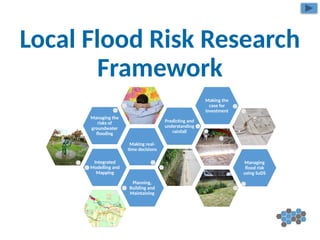
Local Flood Risk Research
Framework
Integrated
Modelling and
Mapping
Making real-
time decisions
Managing the
risks of
groundwater
flooding
Predicting and
understanding
rainfall
Making the
case for
investment
Managing
flood risk
using SuDS
Planning,
Building and
Maintaining
Contents
1. Vision of the research roadmap
2. Who is this research roadmap for?
3. Background information
4. Ensuring research delivers outcomes
5. How has the roadmap been developed?
6. Background about research projects
7. Research projects:
a) Managing the risks of groundwater fl
ooding
b) Integrated Modelling and Mapping
c) Making the case for investment
d) Planning, building and maintaining
e) Predicting and Understanding Rainfall
f) Making decisions in real-time
g) Using SuDS to manage flood risk
8. Engagement Plan
10. How can I get involved?
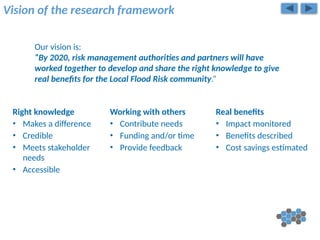
Vision of the research framework
Our vision is:
“By 2020, risk management authorities and partners will have
worked together to develop and share the right knowledge to give
real benefits for the Local Flood Risk community.”
Working with others
• Contribute needs
• Funding and/or time
• Provide feedback
Right knowledge
• Makes a difference
• Credible
• Meets stakeholder
needs
• Accessible
Real benefits
• Impact monitored
• Benefits described
• Cost savings estimated
This framework has been developed to identify the research
needs of the local flood risk management community, to ensure
we deliver the right knowledge and real benefits from research.
The framework builds upon the previous Integrated Urban
Drainage Framework (2009). It has also been developed with
reference to the UKWIR Sustainable Drainage Roadmap, the
Living with Environmental Change (LWEC) strategy, and the
Working with Natural Processes framework.
We have identified both practitioner focussed research projects
and strategic research questions. There are over 30 practitioner
focussed research projects identified in this research framework
which are considered essential to enhance knowledge and
understanding and improve efficiency. Many of the research
projects will need to be delivered in partnership with local
authorities, water companies, research institutions and
universities, amongst others.
We have identified more than 15 strategic research questions.
These strategic research needs will be addressed primarily
through university-led research. Further engagement is
required to develop these proposals.
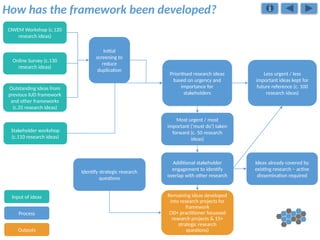
This framework has been developed through close collaborative
working and engagement. More than 300 research ideas were
proposed. These have been filtered and prioritised to focus on
the most important and most urgent over the next 5 years, and
grouped into topic areas. Research priorities and proposals will
evolve and merge over time. In future years new ideas or
research may become a higher priority because of additional
flooding incidents, new policy, new technologies, and
collaboration across different research sectors. Our ongoing
monitoring will we are delivering the right research for the local
flood risk management community in a timely manner.
This document is a summary of the research framework. More
detail is provided in the technical report and accompanying
appendices.
This document is not the end. We will continue to improve and
refine the framework to meet the changing needs of the Local
Flood Risk community.
Background information
What is
covered in
this
framework?
Flooding
from ordinary
watercourses
Surface water
flooding
Interaction
with public
sewer
network
Interaction
with Main
Rivers
Groundwater
flooding
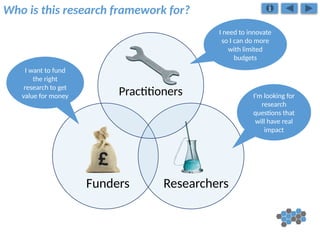
Who is this research framework for?
Funders Researchers
Practitioners I’m looking for
research
questions that
will have real
impact
I need to innovate
so I can do more
with limited
budgets
I want to fund
the right
research to get
value for money
Ensuring research delivers outcomes
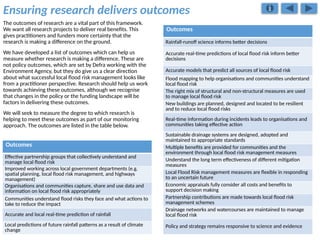
The outcomes of research are a vital part of this framework.
We want all research projects to deliver real benefits. This
gives practitioners and funders more certainty that the
research is making a difference on the ground.
We have developed a list of outcomes which can help us
measure whether research is making a difference. These are
not policy outcomes, which are set by Defra working with the
Environment Agency, but they do give us a clear direction
about what successful local flood risk management looks like
from a practitioner perspective. Research should help us work
towards achieving these outcomes, although we recognise
that changes in the policy or the funding landscape will be
factors in delivering these outcomes.
We will seek to measure the degree to which research is
helping to meet these outcomes as part of our monitoring
approach. The outcomes are listed in the table below.
Outcomes
Effective partnership groups that collectively understand and
manage local flood risk
Improved working across local government departments (e.g.
spatial planning, local flood risk management, and highways
management)
Organisations and communities capture, share and use data and
information on local flood risk appropriately
Communities understand flood risks they face and what actions to
take to reduce the impact
Accurate and local real-time prediction of rainfall
Local predictions of future rainfall patterns as a result of climate
change
Outcomes
Rainfall-runoff science informs better decisions
Accurate real-time predictions of local flood risk inform better
decisions
Accurate models that predict all sources of local flood risk
Flood mapping to help organisations and communities understand
local flood risk
The right mix of structural and non-structural measures are used
to manage local flood risk
New buildings are planned, designed and located to be resilient
and to reduce local flood risks
Real-time information during incidents leads to organisations and
communities taking effective action
Sustainable drainage systems are designed, adopted and
maintained to appropriate standards
Multiple benefits are provided for communities and the
environment through local flood risk management measures
Understand the long term effectiveness of different mitigation
measures
Local Flood Risk management measures are flexible in responding
to an uncertain future
Economic appraisals fully consider all costs and benefits to
support decision making
Partnership contributions are made towards local flood risk
management schemes
Drainage networks and watercourses are maintained to manage
local flood risk
Policy and strategy remains responsive to science and evidence
CIWEM Workshop (c.120
research ideas)
Online Survey (c.130
research ideas)
Outstanding ideas from
previous IUD framework
and other frameworks
(c.35 research ideas)
Stakeholder workshop
(c.110 research ideas)
Initial
screening to
reduce
duplication
Less urgent / less
important ideas kept for
future reference (c. 100
research ideas)
Most urgent / most
important (‘must do’) taken
forward (c. 50 research
ideas)
Prioritised research ideas
based on urgency and
importance for
stakeholders
Additional stakeholder
engagement to identify
overlap with other research
Ideas already covered by
existing research – active
dissemination required
Remaining ideas developed
into research projects for
framework
(30+ practitioner focussed
research projects & 15+
strategic research
questions)
Input of ideas
Process
Outputs
How has the framework been developed?
Identify strategic research
questions
The following slides present the local flood risk research
projects which are considered the most urgent and important.
They have been grouped together into the following topics:
• Managing the risks of groundwater flooding
• Integrated Modelling and Mapping
• Making the case for investment
• Planning, building and maintaining
• Predicting and Understanding Rainfall
• Making decisions in real-time
• Using SuDS to manage flooding
For each topic there is a blue box which explains the problem
or issue which is currently facing those in the local flood risk
community. We have identified one or more practitioner
focussed research project which can help to partially or fully
address the problem or issue.
We have spoken to experts to identify the strategic research
questions. These have been identified to support the
practitioner focussed research projects, and ensure the
framework is considering the long term local flood risk
management research needs.
We have developed a mini proposal for each practitioner
focussed research project, which provides further details on
why the research is needed, a description of the project, the
benefits it will bring, duration, partners, and approximate
budget. The mini-proposals are published in the appendices to
the technical report to encourage discussion on how to deliver
these projects.
Some research projects are ongoing or have already been
approved for funding to start in 2015/16. These projects are
identified with a  in the following slides.
Background about research projects
Practitioner-focussed research:
Typically more near market, so the outputs are useable to the
local flood risk community immediately. More often this type of
research is delivered by a research programme such as UKWIR,
the Joint Defra/Environment Agency R&D programme, or
Highways Agency research, for example.
Strategic research questions:
Typically longer term programmes. Final outputs are less likely
to be immediately useable by practitioners, but would underpin
the tools practitioners use. More often this research will be
funded by research councils and universities.
Practitioner focussed research projects
My drainage
keeps filling up
with
groundwater
• Evaluation of costs to Risk
Management Authorities in
managing flooding from high
groundwater, and the
economics of alternative
approaches (Yr 3-5)
• Assess current and emerging
technologies to reduce
groundwater inundation into
drainage networks (Yr 2)
I don’t know
where and when
groundwater
flooding will
happen
• Modelling groundwater
effects in urban drainage
systems (Yr 1-2)
I don’t know
how to manage
groundwater
flooding
 Groundwater evidence base
WP1: flood risk mapping -
method, mandate and pilots.
WP2: Good practice guidance
for LLFAs (and LRFs) on
managing groundwater flood
risk (Yr 1)
Projects: Managing the risks of groundwater
flooding
Strategic research questions
• How can we manage
groundwater flooding more
cost effectively across a
catchment?
• What better ways are there to
model the interaction and
combined effect of all sources
of flooding?
• Can we develop accurate
systems that identify where
infiltration occurs when pipes
are fully surcharged?
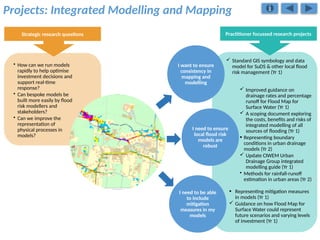
Practitioner focussed research projects
Strategic research questions
I want to ensure
consistency in
mapping and
modelling
 Standard GIS symbology and data
model for SuDS & other local flood
risk management (Yr 1)
I need to ensure
local flood risk
models are
robust
 Improved guidance on
drainage rates and percentage
runoff for Flood Map for
Surface Water (Yr 1)
 A scoping document exploring
the costs, benefits and risks of
integrated modelling of all
sources of flooding (Yr 1)
• Representing boundary
conditions in urban drainage
models (Yr 2)
 Update CIWEM Urban
Drainage Group integrated
modelling guide (Yr 1)
• Methods for rainfall-runoff
estimation in urban areas (Yr 2)
I need to be able
to include
mitigation
measures in my
models
• Representing mitigation measures
in models (Yr 1)
 Guidance on how Flood Map for
Surface Water could represent
future scenarios and varying levels
of investment (Yr 1)
Projects: Integrated Modelling and Mapping
• How can we run models
rapidly to help optimise
investment decisions and
support real-time
response?
• Can bespoke models be
built more easily by flood
risk modellers and
stakeholders?
• Can we improve the
representation of
physical processes in
models?
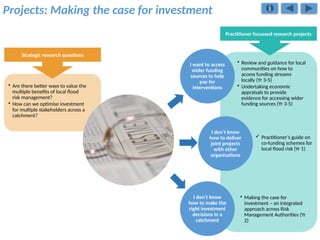
Practitioner focussed research projects
Strategic research needs/questions
I want to access
wider funding
sources to help
pay for
interventions
• Review and guidance for local
communities on how to
access funding streams
locally (Yr 3-5)
• Undertaking economic
appraisals to provide
evidence for accessing wider
funding sources (Yr 3-5)
I don’t know
how to deliver
joint projects
with other
organisations
 Practitioner’s guide on
co-funding schemes for
local flood risk (Yr 1)
I don’t know
how to make the
right investment
decisions in a
catchment
• Making the case for
investment – an integrated
approach across Risk
Management Authorities (Yr
2)
Projects: Making the case for investment
• Are there better ways to value the
multiple benefits of local flood
risk management?
• How can we optimise investment
for multiple stakeholders across a
catchment?
Strategic research questions
Practitioner focussed research projects
Strategic research questions
I want to make
sure we use the
best flooding
information for
planning
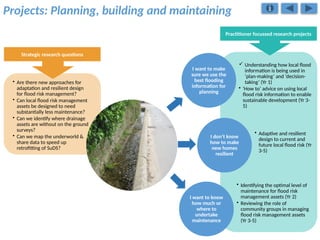
 Understanding how local flood
information is being used in
‘plan-making’ and ‘decision-
taking’ (Yr 1)
• 'How to’ advice on using local
flood risk information to enable
sustainable development (Yr 3-
5)
I don’t know
how to make
new homes
resilient
• Adaptive and resilient
design to current and
future local flood risk (Yr
3-5)
I want to know
how much or
where to
undertake
maintenance
• Identifying the optimal level of
maintenance for flood risk
management assets (Yr 2)
• Reviewing the role of
community groups in managing
flood risk management assets
(Yr 3-5)
Projects: Planning, building and maintaining
• Are there new approaches for
adaptation and resilient design
for flood risk management?
• Can local flood risk management
assets be designed to need
substantially less maintenance?
• Can we identify where drainage
assets are without on the ground
surveys?
• Can we map the underworld &
share data to speed up
retrofitting of SuDS?
Practitioner focussed research projects
Strategic research questions
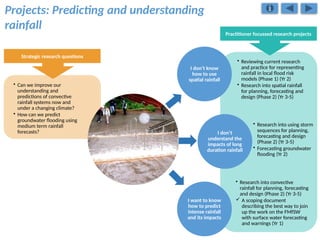
I don’t know
how to use
spatial rainfall
• Reviewing current research
and practice for representing
rainfall in local flood risk
models (Phase 1) (Yr 2)
• Research into spatial rainfall
for planning, forecasting and
design (Phase 2) (Yr 3-5)
I don’t
understand the
impacts of long
duration rainfall
• Research into using storm
sequences for planning,
forecasting and design
(Phase 2) (Yr 3-5)
• Forecasting groundwater
flooding (Yr 2)
I want to know
how to predict
intense rainfall
and its impacts
• Research into convective
rainfall for planning, forecasting
and design (Phase 2) (Yr 3-5)
 A scoping document
describing the best way to join
up the work on the FMfSW
with surface water forecasting
and warnings (Yr 1)
Projects: Predicting and understanding
rainfall
• Can we improve our
understanding and
predictions of convective
rainfall systems now and
under a changing climate?
• How can we predict
groundwater flooding using
medium term rainfall
forecasts?
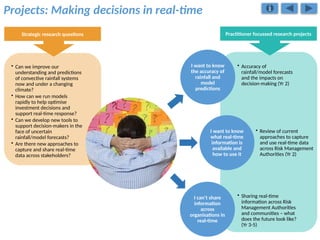
I want to know
the accuracy of
rainfall and
model
predictions
• Accuracy of
rainfall/model forecasts
and the impacts on
decision-making (Yr 2)
I want to know
what real-time
information is
available and
how to use it
• Review of current
approaches to capture
and use real-time data
across Risk Management
Authorities (Yr 2)
I can’t share
information
across
organisations in
real-time
• Sharing real-time
information across Risk
Management Authorities
and communities – what
does the future look like?
(Yr 3-5)
Projects: Making decisions in real-time
Practitioner focussed research projects
Strategic research questions
• Can we improve our
understanding and predictions
of convective rainfall systems
now and under a changing
climate?
• How can we run models
rapidly to help optimise
investment decisions and
support real-time response?
• Can we develop new tools to
support decision-makers in the
face of uncertain
rainfall/model forecasts?
• Are there new approaches to
capture and share real-time
data across stakeholders?
Practitioner focussed research projects
Strategic research questions
I don’t know
how
effective
SUDS are
 Understanding SuDS
performance (Yr 1)
 Understanding SuDS
performance through time
and under differing
maintenance regimes (Yr 1)
How can I
fund retrofit
surface
water
measures
• Incentivisation for SuDS
[including options for
private finance] (Yr 3-5)
I can’t
explain the
costs and
benefits of
SUDS
• Whole Life cost benefits
analysis (CBA) for SuDS (Yr
3-5)
• Cost benefit analysis (CBA)
for joint delivery of
schemes (Yr 3-5)
There is a
poor
perception
of SUDS
• Understanding public
perception (Yr 3-5)
• SuDS for small spaces (Yr
3-5)
Projects: Managing flood risk using SuDS
• Can local flood risk
management assets be
designed to need substantially
less maintenance?
• Are there better ways to value
the multiple benefits of SuDS?
• How do we understand societal
perception and engagement
about new approaches to
managing stormwater?
• What new SuDS technologies
do we need to develop?
Photo courtesy of SUSDRAIN
Dissemination of existing research outputs
We have found that telling people about where to find existing research is just as important as commissioning new research
projects. Stakeholders told us about research needs that were urgent and important, some of which are already addressed by
existing research outputs. Some examples of these high priority projects are outlined below and will need to be disseminated
across the local flood risk management community to ensure wider uptake.
Research need Link to specific topic (where
relevant)
Existing research which meets the need
Communicating uncertainties in flood mapping Integrated Modelling and
Mapping
RISKMAP
Raising community awareness and educating
communities on flood risk management
- Communicating Local Flood Risk, FD2664, and
Working with Natural Processes (WWNP) framework
Review of National Planning Policy Framework (NPPF) Planning, Building and
Maintaining
Communities for Local Government
review of the NPPF (ongoing Autumn as of 2014)
Government's response to Pitt
Evaluation and Post-implementation review of the
Flood and Water Management Act
- Defra review of Pitt Review implementation and
Flood and Water Management Act (ongoing Autumn
as of 2014)
Valuing the wider benefits of flood risk management Making the case for investment WWNP framework
Best practice guidance on surface water separation
techniques and approaches
Tackling flooding at source Guidance on retrofitting stormwater
management measures
Valuing the multiple benefits of Sustainable Drainage Tackling flooding at source SC100003
Best practice guidance on practicalities of securing
funding for local flood risk management
Making the case for investment FD2643
Impacts of land management and agricultural
techniques on local flood risk
- FD2120, FD2114, SC060092, WWNP Framework
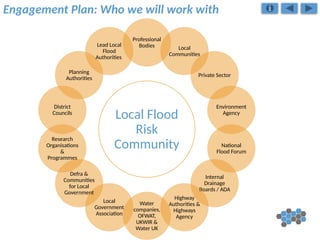
Local Flood
Risk
Community
Professional
Bodies Local
Communities
Private Sector
Environment
Agency
National
Flood Forum
Internal
Drainage
Boards / ADA
Highway
Authorities &
Highways
Agency
Water
companies,
OFWAT,
UKWIR &
Water UK
Local
Government
Association
Defra &
Communities
for Local
Government
Research
Organisations
&
Programmes
District
Councils
Planning
Authorities
Lead Local
Flood
Authorities
Engagement Plan: Who we will work with
Stage 1 –
Awareness
Raising
• Raise awareness and generate interest across the local flood risk management
community about the preparation of the new research framework and identify
opportunities to get involved
Stage 2 -
Collaboration
during roadmap
preparation
• Generate ideas towards development of the research framework from across the
local flood risk management community, and identify how people could get
involved in future research projects
Stage 3 –
Promote
roadmap
• Promote the framework, the benefits to the local flood risk community and
opportunities for collaboration, within the first six months of publication
Stage 4 –
Implement the
roadmap
• Ensure ongoing engagement with the local flood risk management community to
engage with research projects, determine future research needs and promote
outputs to practitioners. To monitor the benefits of research to the local flood risk
management community.
Completed
during
development
of research
framework
November
2013 -
November
2014
November
2014 – April
2015
Ongoing during
period of the
research
framework
Engagement Plan: How we will engage
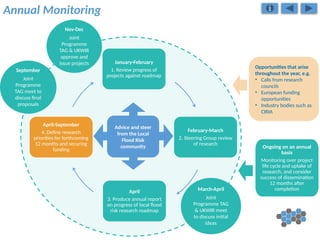
January-February
1. Review progress of
projects against roadmap
February-March
2. Steering Group review
of research
April
3. Produce annual report
on progress of local flood
risk research roadmap
April-September
4. Define research
priorities for forthcoming
12 months and securing
funding
Annual Monitoring
September
Joint
Programme
TAG meet to
discuss final
proposals
Nov-Dec
Joint
Programme
TAG & UKWIR
approve and
issue projects
March-April
Joint
Programme TAG
& UKWIR meet
to discuss initial
ideas
Opportunities that arise
throughout the year, e.g.
• Calls from research
councils
• European funding
opportunities
• Industry bodies such as
CIRIA
Advice and steer
from the Local
Flood Risk
community Ongoing on an annual
basis
Monitoring over project
life cycle and uptake of
research, and consider
success of dissemination
12 months after
completion
How can I get involved?
Are you a funding body seeking value from research? A
researcher who is looking for the next big project? Or, a
practitioner who is trying to improve and innovate?
This framework is just the start of the journey, and we
want you to be involved in setting the direction of research
and delivering outputs that meet the needs of the local
flood risk community.
We look forward to hearing from you,
adam.baylis@environment-agency.gov.uk
bit.ly/LocalFloodRiskResearch

_Local_Flood_Risk_Research_Roadmap_Summary_Document (1).ppt

  • 1.
    Local Flood RiskResearch Framework Integrated Modelling and Mapping Making real- time decisions Managing the risks of groundwater flooding Predicting and understanding rainfall Making the case for investment Managing flood risk using SuDS Planning, Building and Maintaining
  • 2.
    Contents 1. Vision ofthe research roadmap 2. Who is this research roadmap for? 3. Background information 4. Ensuring research delivers outcomes 5. How has the roadmap been developed? 6. Background about research projects 7. Research projects: a) Managing the risks of groundwater fl ooding b) Integrated Modelling and Mapping c) Making the case for investment d) Planning, building and maintaining e) Predicting and Understanding Rainfall f) Making decisions in real-time g) Using SuDS to manage flood risk 8. Engagement Plan 10. How can I get involved?
  • 3.
    Vision of theresearch framework Our vision is: “By 2020, risk management authorities and partners will have worked together to develop and share the right knowledge to give real benefits for the Local Flood Risk community.” Working with others • Contribute needs • Funding and/or time • Provide feedback Right knowledge • Makes a difference • Credible • Meets stakeholder needs • Accessible Real benefits • Impact monitored • Benefits described • Cost savings estimated
  • 4.
    This framework hasbeen developed to identify the research needs of the local flood risk management community, to ensure we deliver the right knowledge and real benefits from research. The framework builds upon the previous Integrated Urban Drainage Framework (2009). It has also been developed with reference to the UKWIR Sustainable Drainage Roadmap, the Living with Environmental Change (LWEC) strategy, and the Working with Natural Processes framework. We have identified both practitioner focussed research projects and strategic research questions. There are over 30 practitioner focussed research projects identified in this research framework which are considered essential to enhance knowledge and understanding and improve efficiency. Many of the research projects will need to be delivered in partnership with local authorities, water companies, research institutions and universities, amongst others. We have identified more than 15 strategic research questions. These strategic research needs will be addressed primarily through university-led research. Further engagement is required to develop these proposals. This framework has been developed through close collaborative working and engagement. More than 300 research ideas were proposed. These have been filtered and prioritised to focus on the most important and most urgent over the next 5 years, and grouped into topic areas. Research priorities and proposals will evolve and merge over time. In future years new ideas or research may become a higher priority because of additional flooding incidents, new policy, new technologies, and collaboration across different research sectors. Our ongoing monitoring will we are delivering the right research for the local flood risk management community in a timely manner. This document is a summary of the research framework. More detail is provided in the technical report and accompanying appendices. This document is not the end. We will continue to improve and refine the framework to meet the changing needs of the Local Flood Risk community. Background information What is covered in this framework? Flooding from ordinary watercourses Surface water flooding Interaction with public sewer network Interaction with Main Rivers Groundwater flooding
  • 5.
    Who is thisresearch framework for? Funders Researchers Practitioners I’m looking for research questions that will have real impact I need to innovate so I can do more with limited budgets I want to fund the right research to get value for money
  • 6.
    Ensuring research deliversoutcomes The outcomes of research are a vital part of this framework. We want all research projects to deliver real benefits. This gives practitioners and funders more certainty that the research is making a difference on the ground. We have developed a list of outcomes which can help us measure whether research is making a difference. These are not policy outcomes, which are set by Defra working with the Environment Agency, but they do give us a clear direction about what successful local flood risk management looks like from a practitioner perspective. Research should help us work towards achieving these outcomes, although we recognise that changes in the policy or the funding landscape will be factors in delivering these outcomes. We will seek to measure the degree to which research is helping to meet these outcomes as part of our monitoring approach. The outcomes are listed in the table below. Outcomes Effective partnership groups that collectively understand and manage local flood risk Improved working across local government departments (e.g. spatial planning, local flood risk management, and highways management) Organisations and communities capture, share and use data and information on local flood risk appropriately Communities understand flood risks they face and what actions to take to reduce the impact Accurate and local real-time prediction of rainfall Local predictions of future rainfall patterns as a result of climate change Outcomes Rainfall-runoff science informs better decisions Accurate real-time predictions of local flood risk inform better decisions Accurate models that predict all sources of local flood risk Flood mapping to help organisations and communities understand local flood risk The right mix of structural and non-structural measures are used to manage local flood risk New buildings are planned, designed and located to be resilient and to reduce local flood risks Real-time information during incidents leads to organisations and communities taking effective action Sustainable drainage systems are designed, adopted and maintained to appropriate standards Multiple benefits are provided for communities and the environment through local flood risk management measures Understand the long term effectiveness of different mitigation measures Local Flood Risk management measures are flexible in responding to an uncertain future Economic appraisals fully consider all costs and benefits to support decision making Partnership contributions are made towards local flood risk management schemes Drainage networks and watercourses are maintained to manage local flood risk Policy and strategy remains responsive to science and evidence
  • 7.
    CIWEM Workshop (c.120 researchideas) Online Survey (c.130 research ideas) Outstanding ideas from previous IUD framework and other frameworks (c.35 research ideas) Stakeholder workshop (c.110 research ideas) Initial screening to reduce duplication Less urgent / less important ideas kept for future reference (c. 100 research ideas) Most urgent / most important (‘must do’) taken forward (c. 50 research ideas) Prioritised research ideas based on urgency and importance for stakeholders Additional stakeholder engagement to identify overlap with other research Ideas already covered by existing research – active dissemination required Remaining ideas developed into research projects for framework (30+ practitioner focussed research projects & 15+ strategic research questions) Input of ideas Process Outputs How has the framework been developed? Identify strategic research questions
  • 8.
    The following slidespresent the local flood risk research projects which are considered the most urgent and important. They have been grouped together into the following topics: • Managing the risks of groundwater flooding • Integrated Modelling and Mapping • Making the case for investment • Planning, building and maintaining • Predicting and Understanding Rainfall • Making decisions in real-time • Using SuDS to manage flooding For each topic there is a blue box which explains the problem or issue which is currently facing those in the local flood risk community. We have identified one or more practitioner focussed research project which can help to partially or fully address the problem or issue. We have spoken to experts to identify the strategic research questions. These have been identified to support the practitioner focussed research projects, and ensure the framework is considering the long term local flood risk management research needs. We have developed a mini proposal for each practitioner focussed research project, which provides further details on why the research is needed, a description of the project, the benefits it will bring, duration, partners, and approximate budget. The mini-proposals are published in the appendices to the technical report to encourage discussion on how to deliver these projects. Some research projects are ongoing or have already been approved for funding to start in 2015/16. These projects are identified with a  in the following slides. Background about research projects Practitioner-focussed research: Typically more near market, so the outputs are useable to the local flood risk community immediately. More often this type of research is delivered by a research programme such as UKWIR, the Joint Defra/Environment Agency R&D programme, or Highways Agency research, for example. Strategic research questions: Typically longer term programmes. Final outputs are less likely to be immediately useable by practitioners, but would underpin the tools practitioners use. More often this research will be funded by research councils and universities.
  • 9.
    Practitioner focussed researchprojects My drainage keeps filling up with groundwater • Evaluation of costs to Risk Management Authorities in managing flooding from high groundwater, and the economics of alternative approaches (Yr 3-5) • Assess current and emerging technologies to reduce groundwater inundation into drainage networks (Yr 2) I don’t know where and when groundwater flooding will happen • Modelling groundwater effects in urban drainage systems (Yr 1-2) I don’t know how to manage groundwater flooding  Groundwater evidence base WP1: flood risk mapping - method, mandate and pilots. WP2: Good practice guidance for LLFAs (and LRFs) on managing groundwater flood risk (Yr 1) Projects: Managing the risks of groundwater flooding Strategic research questions • How can we manage groundwater flooding more cost effectively across a catchment? • What better ways are there to model the interaction and combined effect of all sources of flooding? • Can we develop accurate systems that identify where infiltration occurs when pipes are fully surcharged?
  • 10.
    Practitioner focussed researchprojects Strategic research questions I want to ensure consistency in mapping and modelling  Standard GIS symbology and data model for SuDS & other local flood risk management (Yr 1) I need to ensure local flood risk models are robust  Improved guidance on drainage rates and percentage runoff for Flood Map for Surface Water (Yr 1)  A scoping document exploring the costs, benefits and risks of integrated modelling of all sources of flooding (Yr 1) • Representing boundary conditions in urban drainage models (Yr 2)  Update CIWEM Urban Drainage Group integrated modelling guide (Yr 1) • Methods for rainfall-runoff estimation in urban areas (Yr 2) I need to be able to include mitigation measures in my models • Representing mitigation measures in models (Yr 1)  Guidance on how Flood Map for Surface Water could represent future scenarios and varying levels of investment (Yr 1) Projects: Integrated Modelling and Mapping • How can we run models rapidly to help optimise investment decisions and support real-time response? • Can bespoke models be built more easily by flood risk modellers and stakeholders? • Can we improve the representation of physical processes in models?
  • 11.
    Practitioner focussed researchprojects Strategic research needs/questions I want to access wider funding sources to help pay for interventions • Review and guidance for local communities on how to access funding streams locally (Yr 3-5) • Undertaking economic appraisals to provide evidence for accessing wider funding sources (Yr 3-5) I don’t know how to deliver joint projects with other organisations  Practitioner’s guide on co-funding schemes for local flood risk (Yr 1) I don’t know how to make the right investment decisions in a catchment • Making the case for investment – an integrated approach across Risk Management Authorities (Yr 2) Projects: Making the case for investment • Are there better ways to value the multiple benefits of local flood risk management? • How can we optimise investment for multiple stakeholders across a catchment? Strategic research questions
  • 12.
    Practitioner focussed researchprojects Strategic research questions I want to make sure we use the best flooding information for planning  Understanding how local flood information is being used in ‘plan-making’ and ‘decision- taking’ (Yr 1) • 'How to’ advice on using local flood risk information to enable sustainable development (Yr 3- 5) I don’t know how to make new homes resilient • Adaptive and resilient design to current and future local flood risk (Yr 3-5) I want to know how much or where to undertake maintenance • Identifying the optimal level of maintenance for flood risk management assets (Yr 2) • Reviewing the role of community groups in managing flood risk management assets (Yr 3-5) Projects: Planning, building and maintaining • Are there new approaches for adaptation and resilient design for flood risk management? • Can local flood risk management assets be designed to need substantially less maintenance? • Can we identify where drainage assets are without on the ground surveys? • Can we map the underworld & share data to speed up retrofitting of SuDS?
  • 13.
    Practitioner focussed researchprojects Strategic research questions I don’t know how to use spatial rainfall • Reviewing current research and practice for representing rainfall in local flood risk models (Phase 1) (Yr 2) • Research into spatial rainfall for planning, forecasting and design (Phase 2) (Yr 3-5) I don’t understand the impacts of long duration rainfall • Research into using storm sequences for planning, forecasting and design (Phase 2) (Yr 3-5) • Forecasting groundwater flooding (Yr 2) I want to know how to predict intense rainfall and its impacts • Research into convective rainfall for planning, forecasting and design (Phase 2) (Yr 3-5)  A scoping document describing the best way to join up the work on the FMfSW with surface water forecasting and warnings (Yr 1) Projects: Predicting and understanding rainfall • Can we improve our understanding and predictions of convective rainfall systems now and under a changing climate? • How can we predict groundwater flooding using medium term rainfall forecasts?
  • 14.
    I want toknow the accuracy of rainfall and model predictions • Accuracy of rainfall/model forecasts and the impacts on decision-making (Yr 2) I want to know what real-time information is available and how to use it • Review of current approaches to capture and use real-time data across Risk Management Authorities (Yr 2) I can’t share information across organisations in real-time • Sharing real-time information across Risk Management Authorities and communities – what does the future look like? (Yr 3-5) Projects: Making decisions in real-time Practitioner focussed research projects Strategic research questions • Can we improve our understanding and predictions of convective rainfall systems now and under a changing climate? • How can we run models rapidly to help optimise investment decisions and support real-time response? • Can we develop new tools to support decision-makers in the face of uncertain rainfall/model forecasts? • Are there new approaches to capture and share real-time data across stakeholders?
  • 15.
    Practitioner focussed researchprojects Strategic research questions I don’t know how effective SUDS are  Understanding SuDS performance (Yr 1)  Understanding SuDS performance through time and under differing maintenance regimes (Yr 1) How can I fund retrofit surface water measures • Incentivisation for SuDS [including options for private finance] (Yr 3-5) I can’t explain the costs and benefits of SUDS • Whole Life cost benefits analysis (CBA) for SuDS (Yr 3-5) • Cost benefit analysis (CBA) for joint delivery of schemes (Yr 3-5) There is a poor perception of SUDS • Understanding public perception (Yr 3-5) • SuDS for small spaces (Yr 3-5) Projects: Managing flood risk using SuDS • Can local flood risk management assets be designed to need substantially less maintenance? • Are there better ways to value the multiple benefits of SuDS? • How do we understand societal perception and engagement about new approaches to managing stormwater? • What new SuDS technologies do we need to develop? Photo courtesy of SUSDRAIN
  • 16.
    Dissemination of existingresearch outputs We have found that telling people about where to find existing research is just as important as commissioning new research projects. Stakeholders told us about research needs that were urgent and important, some of which are already addressed by existing research outputs. Some examples of these high priority projects are outlined below and will need to be disseminated across the local flood risk management community to ensure wider uptake. Research need Link to specific topic (where relevant) Existing research which meets the need Communicating uncertainties in flood mapping Integrated Modelling and Mapping RISKMAP Raising community awareness and educating communities on flood risk management - Communicating Local Flood Risk, FD2664, and Working with Natural Processes (WWNP) framework Review of National Planning Policy Framework (NPPF) Planning, Building and Maintaining Communities for Local Government review of the NPPF (ongoing Autumn as of 2014) Government's response to Pitt Evaluation and Post-implementation review of the Flood and Water Management Act - Defra review of Pitt Review implementation and Flood and Water Management Act (ongoing Autumn as of 2014) Valuing the wider benefits of flood risk management Making the case for investment WWNP framework Best practice guidance on surface water separation techniques and approaches Tackling flooding at source Guidance on retrofitting stormwater management measures Valuing the multiple benefits of Sustainable Drainage Tackling flooding at source SC100003 Best practice guidance on practicalities of securing funding for local flood risk management Making the case for investment FD2643 Impacts of land management and agricultural techniques on local flood risk - FD2120, FD2114, SC060092, WWNP Framework
  • 17.
    Local Flood Risk Community Professional Bodies Local Communities PrivateSector Environment Agency National Flood Forum Internal Drainage Boards / ADA Highway Authorities & Highways Agency Water companies, OFWAT, UKWIR & Water UK Local Government Association Defra & Communities for Local Government Research Organisations & Programmes District Councils Planning Authorities Lead Local Flood Authorities Engagement Plan: Who we will work with
  • 18.
    Stage 1 – Awareness Raising •Raise awareness and generate interest across the local flood risk management community about the preparation of the new research framework and identify opportunities to get involved Stage 2 - Collaboration during roadmap preparation • Generate ideas towards development of the research framework from across the local flood risk management community, and identify how people could get involved in future research projects Stage 3 – Promote roadmap • Promote the framework, the benefits to the local flood risk community and opportunities for collaboration, within the first six months of publication Stage 4 – Implement the roadmap • Ensure ongoing engagement with the local flood risk management community to engage with research projects, determine future research needs and promote outputs to practitioners. To monitor the benefits of research to the local flood risk management community. Completed during development of research framework November 2013 - November 2014 November 2014 – April 2015 Ongoing during period of the research framework Engagement Plan: How we will engage
  • 19.
    January-February 1. Review progressof projects against roadmap February-March 2. Steering Group review of research April 3. Produce annual report on progress of local flood risk research roadmap April-September 4. Define research priorities for forthcoming 12 months and securing funding Annual Monitoring September Joint Programme TAG meet to discuss final proposals Nov-Dec Joint Programme TAG & UKWIR approve and issue projects March-April Joint Programme TAG & UKWIR meet to discuss initial ideas Opportunities that arise throughout the year, e.g. • Calls from research councils • European funding opportunities • Industry bodies such as CIRIA Advice and steer from the Local Flood Risk community Ongoing on an annual basis Monitoring over project life cycle and uptake of research, and consider success of dissemination 12 months after completion
  • 20.
    How can Iget involved? Are you a funding body seeking value from research? A researcher who is looking for the next big project? Or, a practitioner who is trying to improve and innovate? This framework is just the start of the journey, and we want you to be involved in setting the direction of research and delivering outputs that meet the needs of the local flood risk community. We look forward to hearing from you, adam.baylis@environment-agency.gov.uk bit.ly/LocalFloodRiskResearch