Brand Busters 7 Common Mistakes Marketers Make By Chris Wirthwein Brad Stamulis
7 Common Mistakes Marketers Make Talking “Needs” Instead of Wants Falling in Love with Your Product Instead of Your Customer Believing that Marketing is a Science or an Art Trying to Please Everyone Forgetting that People Forget Believing Your Price is Too High – Without Proof Believing you Must Sell Your Product on an Economic Basis
1)  Talking “Needs” Instead of “Wants” Need  –  Most Overused Word  in technical marketing People Buy What They  Want Marketing is all about  Choice,  which means it’s about  wants – not needs . Needs speak to features, while wants speak to benefits.  Maslow’s needs hierarchy – you aren’t thinking about realizing your fullest potential if you’re cold and hungry. When it comes to Selling,  Emotion  – not  logic  – is primary . Regardless of who your selling to: People buy with their hearts not their heads in most cases.
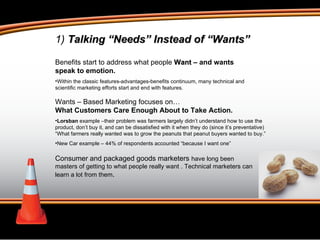
Benefits start to address what people  Want  – and wants speak to emotion.  Within the classic features-advantages-benefits continuum, many technical and scientific marketing efforts start and end with features. Wants – Based Marketing focuses on…   What Customers Care Enough About to Take Action.  Lorsban  example –their problem was farmers largely didn’t understand how to use the product, don’t buy it, and can be dissatisfied with it when they do (since it’s preventative)  “What farmers really wanted was to grow the peanuts that peanut buyers wanted to buy.” New Car example – 44% of respondents accounted “because I want one” Consumer and packaged goods marketers  have long been masters of getting to what people really want . Technical marketers can learn a lot from them .  1)  Talking “Needs” Instead of “Wants”
2)  Falling in Love with Your Product Instead of Your Customer Talk like a Real Person, Farmers are People Too 2 common misconceptions –  that farmers are different than any other people on the planet , and  that the product is so good that all you have to do is put it in front of them and they will beat down the doors to have it. More often than not casual and conversational rule the day. Communicate succinctly, tell them one thing. Respect their time and intelligence.  The problem of “selling the steak and not the sizzle” McDonalds example, They happen to sell hamburgers but the benefit is happy kids.  You may need love from all the people you work with, engineers and salespeople, but when it’s time to go to market....  Love Your Customer.  Most common misconception,  “Any Advertising, is Good Advertising.”  Studies show your advertising can actually have a negative impact  on your sales.
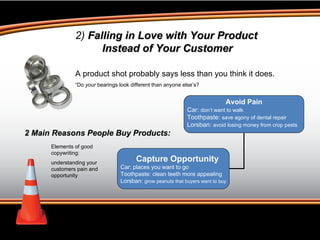
2)  Falling in Love with Your Product Instead of Your Customer A product shot probably says less than you think it does.  “ Do  your  bearings look different than anyone else’s? 2 Main Reasons People Buy Products: Elements of good copywriting:  understanding your customers pain and opportunity Capture Opportunity Car: places you want to go Toothpaste: clean teeth more appealing Lorsban:  grow peanuts that buyers want to buy Avoid Pain Car:  don’t want to walk Toothpaste:  save agony of dental repair Lorsban:  avoid losing money from crop pests
3)  Believing that Marketing is a  Science or an Art Marketing is Bigger than Art  or  Science, it’s something that Encompasses Both.  “Veer too far in one direction and you become silly or irrelevant.” Merriam-Webster defines marketing as:  the process or technique of promoting, selling and distributing a product or service. Science  - should play a huge role in your advertising , market research can tell you amazing things about your audience,  including your products' worth and whether your message is reaching them. Marketers with limited budgets must consider at what point does the cost of research and analysis outweigh the benefits?
Art - Recent research showed  an increase in the size of a picture didn’t increase attention to the ad  as a whole. However, there is no magic formula to creating a great ad. Most importantly, is the message relevant and believable to the target audience? Resist the temptation after testing your ads to combine all of the best elements of the ad into one “super ad”. Build the Sandbox, and let them Play You can’t drop them in the middle of the Sahara and ask them to make a sandcastle it’s too big. If you build them a sandbox you don’t care what kind of sandcastle as long as it fits inside the box (meets objectives)  Think  outside the box, but execute  inside. meaning  the wild idea must meet the objective or it’s not just a wild idea, it’s a bad idea) 3)  Believing that Marketing is a  Science or an Art
4)  Trying to Please Everyone In trying to appeal to everyone, marketers  weaken their messages to the point where they  end up appealing to no one. Studies show  if you make a lot of claims in your ads your inviting greater skepticism  than if you make just one strong claim. Narrow your focus. You want the sharpest tallest nail to make the strongest impression possible. Unlike Sales ,  marketing is as much about saying “No” as it is about saying “Yes”.  You must weed out the people for whom the offer is not really right. Find the Strengths of your brand that really  resonate with your customers. Many great brands focus in on one point: you don’t buy a hummer for gas mileage, you don’t buy an iPod to play CD’s.
5)  Forgetting that People Forget Without frequent repetition of your marketing messages people forget about you .  The Ebbinghaus curve suggests  we forget 75% of new info we learn after 7 days ,  and 95% after 30 days. People Prefer things they’re Familiar with. The longer people were exposed to patterns, or heard the same music the more they preferred it. Expect your ads to build awareness and consideration and move them along through their minds’  universe set, to awareness set, to decision set. Building Awareness is only a Step on the Road to Preference. Studies show your brand must, at least initially, achieve fairly high levels of awareness to achieve even modest levels of preference.  Brain must go through 3 sets form above whether it’s 2 sec like gum example or 2 months like telescope example.
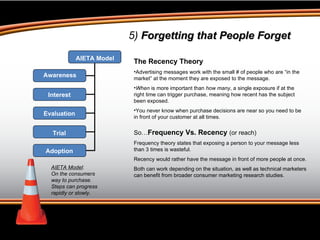
5)  Forgetting that People Forget AIETA Model :  On the consumers way to purchase. Steps can progress rapidly or slowly. The Recency Theory Advertising messages work with the small # of people who are “in the market” at the moment they are exposed to the message.  When  is more important than  how many , a single exposure if at the right time can trigger purchase, meaning how recent has the subject been exposed.  You never know when purchase decisions are near so you need to be in front of your customer at all times. So… Frequency Vs. Recency  (or reach) Frequency theory states that exposing a person to your message less than 3 times is wasteful. Recency would rather have the message in front of more people at once. Both can work depending on the situation, as well as technical marketers can benefit from broader consumer marketing research studies.  AIETA Model Awareness Interest Evaluation Trial Adoption
6)  Believing Your Price is too High- Without Proof Price is usually a consideration, but it’s far from the most important factor  in most purchase decisions, especially in B2B  purchase decisions. Airline example of devastating losses due to price cutting wars In most cases high Price, suggests high Value. Customers expect to get more with a high priced product. A higher price can help you attract  and keep customers. High Price also drives High Profits,  which can help you drive better quality, employee satisfaction,  and happy customers.  The Low price product has it’s advantages too.  “ We’re the low-price leader”  is a clear and focused market position to own.  But it also has  disadvantages ; A low price makes it difficult if not impossible to own the marketing power positions: reliability, performance, and innovation.
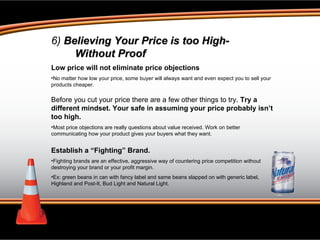
6)  Believing Your Price is too High- Without Proof Low price will not eliminate price objections  No matter how low your price, some buyer will always want and even expect you to sell your products cheaper. Before you cut your price there are a few other things to try.  Try a different mindset. Your safe in assuming your price probably isn’t too high.  Most price objections are really questions about value received. Work on better communicating how your product gives your buyers what they want. Establish a “Fighting” Brand.  Fighting brands are an effective, aggressive way of countering price competition without destroying your brand or your profit margin.  Ex: green beans in can with fancy label and same beans slapped on with generic label, Highland and Post-It, Bud Light and Natural Light.
7)  Believing You Must Sell Your  Product on an Economic Basis Other Factors  – ease of use, dependability, performance, innovation, or even profit –  will trump ROI and actually lead to a sale.  Successful Economic argument always starts with building the case for a category, not a specific brand.  Businesses look at purchases from the state of category reasonableness, ex. Should we buy a building or not? Should we buy ____ or can we get by with the resources we currently have? Ultimately, The brand that gives them what they  Want , ends up the Winner. And in most cases what they “Want” is way beyond money and way beyond the numbers.
7)  Believing You Must Sell Your  Product on an Economic Basis ROI is an assumption used to justify spending. Not to choose a brand Most ROI calculations are based on assumptions, especially in the cost savings side of the equation, for the express purpose of justifying spending the money. Agriculture example  of not making decisions on an economic basis; Purdue study:  top agricultural producers in the nation revealed that when surveyed the #1 goal was not to reduce costs or make more money, but to have more free time. Address the economics when you have to,  then quickly move to other aspects of your product that truly address the customer’s pain or problem.
Three Classic Rules of Great Marketing Classic Rule #1: People Forget Some people forget the most important dates of their lives, i.e. anniversaries etc, they need to be constantly reminded of your marketing pitch. Think Frequency. Think Recency. Classic Rule #2: Me First Make personal appeals and keep their actual desires in mind. They may seem to want the complicated features our products have but what they really want is derived from emotion, which leads to… Classic Rule #3: Emotion Rules People don’t respond with their heads. The closer you get to the sale then the more details matter. Marketing's purpose is to gain awareness and consideration so that we are in your head when it becomes time to make the sale.

Brand Busters PPT

  • 1.
    Brand Busters 7Common Mistakes Marketers Make By Chris Wirthwein Brad Stamulis
  • 2.
    7 Common MistakesMarketers Make Talking “Needs” Instead of Wants Falling in Love with Your Product Instead of Your Customer Believing that Marketing is a Science or an Art Trying to Please Everyone Forgetting that People Forget Believing Your Price is Too High – Without Proof Believing you Must Sell Your Product on an Economic Basis
  • 3.
    1) Talking“Needs” Instead of “Wants” Need – Most Overused Word in technical marketing People Buy What They Want Marketing is all about Choice, which means it’s about wants – not needs . Needs speak to features, while wants speak to benefits. Maslow’s needs hierarchy – you aren’t thinking about realizing your fullest potential if you’re cold and hungry. When it comes to Selling, Emotion – not logic – is primary . Regardless of who your selling to: People buy with their hearts not their heads in most cases.
  • 4.
    Benefits start toaddress what people Want – and wants speak to emotion. Within the classic features-advantages-benefits continuum, many technical and scientific marketing efforts start and end with features. Wants – Based Marketing focuses on… What Customers Care Enough About to Take Action. Lorsban example –their problem was farmers largely didn’t understand how to use the product, don’t buy it, and can be dissatisfied with it when they do (since it’s preventative) “What farmers really wanted was to grow the peanuts that peanut buyers wanted to buy.” New Car example – 44% of respondents accounted “because I want one” Consumer and packaged goods marketers have long been masters of getting to what people really want . Technical marketers can learn a lot from them . 1) Talking “Needs” Instead of “Wants”
  • 5.
    2) Fallingin Love with Your Product Instead of Your Customer Talk like a Real Person, Farmers are People Too 2 common misconceptions – that farmers are different than any other people on the planet , and that the product is so good that all you have to do is put it in front of them and they will beat down the doors to have it. More often than not casual and conversational rule the day. Communicate succinctly, tell them one thing. Respect their time and intelligence. The problem of “selling the steak and not the sizzle” McDonalds example, They happen to sell hamburgers but the benefit is happy kids. You may need love from all the people you work with, engineers and salespeople, but when it’s time to go to market.... Love Your Customer. Most common misconception, “Any Advertising, is Good Advertising.” Studies show your advertising can actually have a negative impact on your sales.
  • 6.
    2) Fallingin Love with Your Product Instead of Your Customer A product shot probably says less than you think it does. “ Do your bearings look different than anyone else’s? 2 Main Reasons People Buy Products: Elements of good copywriting: understanding your customers pain and opportunity Capture Opportunity Car: places you want to go Toothpaste: clean teeth more appealing Lorsban: grow peanuts that buyers want to buy Avoid Pain Car: don’t want to walk Toothpaste: save agony of dental repair Lorsban: avoid losing money from crop pests
  • 7.
    3) Believingthat Marketing is a Science or an Art Marketing is Bigger than Art or Science, it’s something that Encompasses Both. “Veer too far in one direction and you become silly or irrelevant.” Merriam-Webster defines marketing as: the process or technique of promoting, selling and distributing a product or service. Science - should play a huge role in your advertising , market research can tell you amazing things about your audience, including your products' worth and whether your message is reaching them. Marketers with limited budgets must consider at what point does the cost of research and analysis outweigh the benefits?
  • 8.
    Art - Recentresearch showed an increase in the size of a picture didn’t increase attention to the ad as a whole. However, there is no magic formula to creating a great ad. Most importantly, is the message relevant and believable to the target audience? Resist the temptation after testing your ads to combine all of the best elements of the ad into one “super ad”. Build the Sandbox, and let them Play You can’t drop them in the middle of the Sahara and ask them to make a sandcastle it’s too big. If you build them a sandbox you don’t care what kind of sandcastle as long as it fits inside the box (meets objectives) Think outside the box, but execute inside. meaning the wild idea must meet the objective or it’s not just a wild idea, it’s a bad idea) 3) Believing that Marketing is a Science or an Art
  • 9.
    4) Tryingto Please Everyone In trying to appeal to everyone, marketers weaken their messages to the point where they end up appealing to no one. Studies show if you make a lot of claims in your ads your inviting greater skepticism than if you make just one strong claim. Narrow your focus. You want the sharpest tallest nail to make the strongest impression possible. Unlike Sales , marketing is as much about saying “No” as it is about saying “Yes”. You must weed out the people for whom the offer is not really right. Find the Strengths of your brand that really resonate with your customers. Many great brands focus in on one point: you don’t buy a hummer for gas mileage, you don’t buy an iPod to play CD’s.
  • 10.
    5) Forgettingthat People Forget Without frequent repetition of your marketing messages people forget about you . The Ebbinghaus curve suggests we forget 75% of new info we learn after 7 days , and 95% after 30 days. People Prefer things they’re Familiar with. The longer people were exposed to patterns, or heard the same music the more they preferred it. Expect your ads to build awareness and consideration and move them along through their minds’ universe set, to awareness set, to decision set. Building Awareness is only a Step on the Road to Preference. Studies show your brand must, at least initially, achieve fairly high levels of awareness to achieve even modest levels of preference. Brain must go through 3 sets form above whether it’s 2 sec like gum example or 2 months like telescope example.
  • 11.
    5) Forgettingthat People Forget AIETA Model : On the consumers way to purchase. Steps can progress rapidly or slowly. The Recency Theory Advertising messages work with the small # of people who are “in the market” at the moment they are exposed to the message. When is more important than how many , a single exposure if at the right time can trigger purchase, meaning how recent has the subject been exposed. You never know when purchase decisions are near so you need to be in front of your customer at all times. So… Frequency Vs. Recency (or reach) Frequency theory states that exposing a person to your message less than 3 times is wasteful. Recency would rather have the message in front of more people at once. Both can work depending on the situation, as well as technical marketers can benefit from broader consumer marketing research studies. AIETA Model Awareness Interest Evaluation Trial Adoption
  • 12.
    6) BelievingYour Price is too High- Without Proof Price is usually a consideration, but it’s far from the most important factor in most purchase decisions, especially in B2B purchase decisions. Airline example of devastating losses due to price cutting wars In most cases high Price, suggests high Value. Customers expect to get more with a high priced product. A higher price can help you attract and keep customers. High Price also drives High Profits, which can help you drive better quality, employee satisfaction, and happy customers. The Low price product has it’s advantages too. “ We’re the low-price leader” is a clear and focused market position to own. But it also has disadvantages ; A low price makes it difficult if not impossible to own the marketing power positions: reliability, performance, and innovation.
  • 13.
    6) BelievingYour Price is too High- Without Proof Low price will not eliminate price objections No matter how low your price, some buyer will always want and even expect you to sell your products cheaper. Before you cut your price there are a few other things to try. Try a different mindset. Your safe in assuming your price probably isn’t too high. Most price objections are really questions about value received. Work on better communicating how your product gives your buyers what they want. Establish a “Fighting” Brand. Fighting brands are an effective, aggressive way of countering price competition without destroying your brand or your profit margin. Ex: green beans in can with fancy label and same beans slapped on with generic label, Highland and Post-It, Bud Light and Natural Light.
  • 14.
    7) BelievingYou Must Sell Your Product on an Economic Basis Other Factors – ease of use, dependability, performance, innovation, or even profit – will trump ROI and actually lead to a sale. Successful Economic argument always starts with building the case for a category, not a specific brand. Businesses look at purchases from the state of category reasonableness, ex. Should we buy a building or not? Should we buy ____ or can we get by with the resources we currently have? Ultimately, The brand that gives them what they Want , ends up the Winner. And in most cases what they “Want” is way beyond money and way beyond the numbers.
  • 15.
    7) BelievingYou Must Sell Your Product on an Economic Basis ROI is an assumption used to justify spending. Not to choose a brand Most ROI calculations are based on assumptions, especially in the cost savings side of the equation, for the express purpose of justifying spending the money. Agriculture example of not making decisions on an economic basis; Purdue study: top agricultural producers in the nation revealed that when surveyed the #1 goal was not to reduce costs or make more money, but to have more free time. Address the economics when you have to, then quickly move to other aspects of your product that truly address the customer’s pain or problem.
  • 16.
    Three Classic Rulesof Great Marketing Classic Rule #1: People Forget Some people forget the most important dates of their lives, i.e. anniversaries etc, they need to be constantly reminded of your marketing pitch. Think Frequency. Think Recency. Classic Rule #2: Me First Make personal appeals and keep their actual desires in mind. They may seem to want the complicated features our products have but what they really want is derived from emotion, which leads to… Classic Rule #3: Emotion Rules People don’t respond with their heads. The closer you get to the sale then the more details matter. Marketing's purpose is to gain awareness and consideration so that we are in your head when it becomes time to make the sale.