GAMES
INDUSTRY
STRUCTURE
Developer
Consumer
Retailer
Distributor
Platform
Publisher
The people who
make the game
Responsible for
the marketing
and promotion of
the game
Sorts out the
logistics and
delivery of the
game to retail
and/or consumers
The console/
machine/format
you play your
game on
The ‘audience’ -
or the people who
buy the games.
The outlet where
consumers
exchange money
for the product
FOR EXAMPLE:
Big budget ‘Triple A’ game
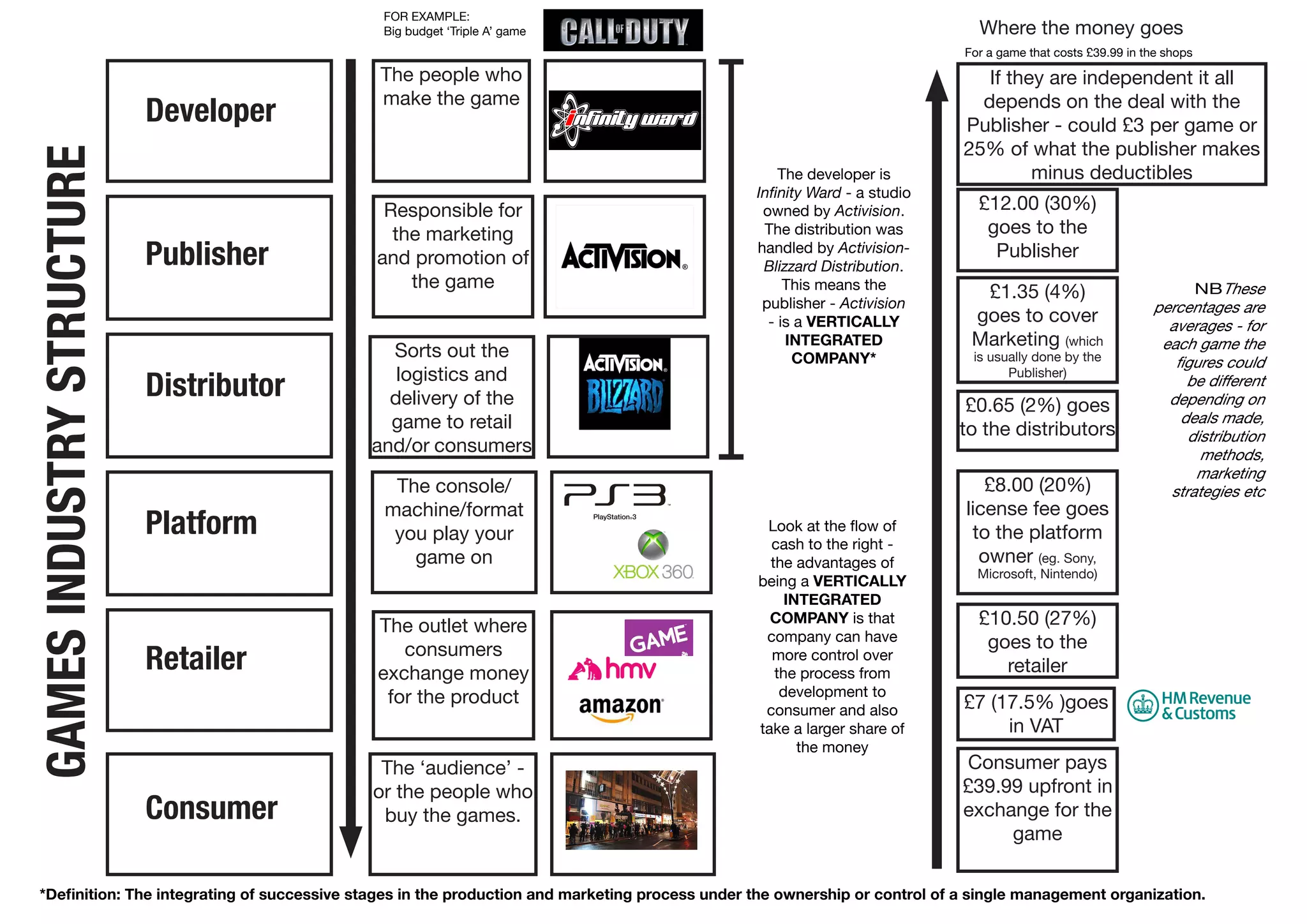
The developer is
Infinity Ward - a studio
owned by Activision.
The distribution was
handled by Activision-
Blizzard Distribution.
This means the
publisher - Activision
- is a VERTICALLY
INTEGRATED
COMPANY*
*Definition: The integrating of successive stages in the production and marketing process under the ownership or control of a single management organization.
Where the money goes
For a game that costs £39.99 in the shops
If they are independent it all
depends on the deal with the
Publisher - could £3 per game or
25% of what the publisher makes
minus deductibles
£12.00 (30%)
goes to the
Publisher
£0.65 (2%) goes
to the distributors
£8.00 (20%)
license fee goes
to the platform
owner (eg. Sony,
Microsoft, Nintendo)
£10.50 (27%)
goes to the
retailer
Consumer pays
£39.99 upfront in
exchange for the
game
£7 (17.5% )goes
in VAT
£1.35 (4%)
goes to cover
Marketing (which
is usually done by the
Publisher)
Look at the flow of
cash to the right -
the advantages of
being a VERTICALLY
INTEGRATED
COMPANY is that
company can have
more control over
the process from
development to
consumer and also
take a larger share of
the money
NBThese
percentages are
averages - for
each game the
figures could
be different
depending on
deals made,
distribution
methods,
marketing
strategies etc

9842464 basic stucture-games

  • 1.
    GAMES INDUSTRY STRUCTURE Developer Consumer Retailer Distributor Platform Publisher The people who makethe game Responsible for the marketing and promotion of the game Sorts out the logistics and delivery of the game to retail and/or consumers The console/ machine/format you play your game on The ‘audience’ - or the people who buy the games. The outlet where consumers exchange money for the product FOR EXAMPLE: Big budget ‘Triple A’ game The developer is Infinity Ward - a studio owned by Activision. The distribution was handled by Activision- Blizzard Distribution. This means the publisher - Activision - is a VERTICALLY INTEGRATED COMPANY* *Definition: The integrating of successive stages in the production and marketing process under the ownership or control of a single management organization. Where the money goes For a game that costs £39.99 in the shops If they are independent it all depends on the deal with the Publisher - could £3 per game or 25% of what the publisher makes minus deductibles £12.00 (30%) goes to the Publisher £0.65 (2%) goes to the distributors £8.00 (20%) license fee goes to the platform owner (eg. Sony, Microsoft, Nintendo) £10.50 (27%) goes to the retailer Consumer pays £39.99 upfront in exchange for the game £7 (17.5% )goes in VAT £1.35 (4%) goes to cover Marketing (which is usually done by the Publisher) Look at the flow of cash to the right - the advantages of being a VERTICALLY INTEGRATED COMPANY is that company can have more control over the process from development to consumer and also take a larger share of the money NBThese percentages are averages - for each game the figures could be different depending on deals made, distribution methods, marketing strategies etc