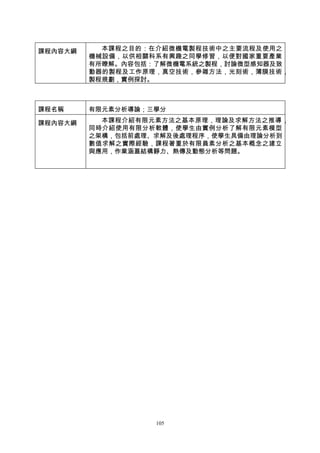
在微機電元件之測試及檢測技術中,因範圍廣大所以須有不同領域的專家
來參與,方能達成其最佳的應用及效能。
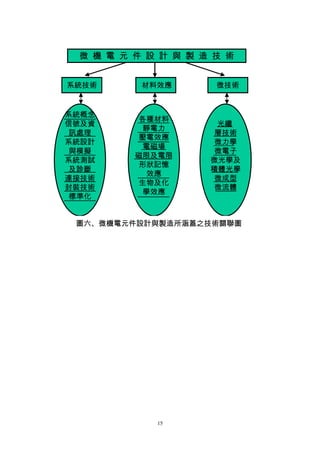
由上述的說明可知本研究團隊對於微機電元件之理論分析設計、微機
電製程技術、高階特殊微機電製程技術、生物/醫學測試檢驗及微感測器於生
環境上的檢驗之應用等之相關技術均具有相當之水準,應用於『微機電元
件設計與製造特色實驗室』之教學上必定可得到相當好的成果。
(a) Glass substrate cleaning 1500
m)
(h
1000
o
(b) Electron-beam evaporation of Pt/Cr
500
tance
Re
0
s
is
(c) Electron-beam evaporation of Au/Cr
0 20 40 60 80
Formaldehyde Concentration (ppm)
(d) NiO sputtering
圖十六、VOC sensor 的 NiO 薄膜感測層,在 300℃時對甲醛之檢測。
67
68.
主要研究成果
1.薩支高 (Sah,Jy-Gau)
1. 利用觸媒提升電動力法處理受 BTEX 污染土壤效率之研究,中國農業化學會誌,
43(4): 304-312,2005
2. 電化學觸媒在電動法復育技術上之應用,技術學刊,18(3):337-344,2003
3. Nitrogen Removal in Leachate Using Carrousel Activated Sludge Treatment Process,
Journal of Environmental Science and Health, Part A—Toxic/Hazardous Substances &
Environmental Engineering, 37(9), 2002, (SCI)
4. 受柴油污染土壤電動法復育技術參數之建立,國立屏東科技大學學報
11(4):277-285(2002)
5. Electrokinetic study on copper contaminated soils, Journal of Environmental Science and
Health-Part A,35 (7), 2000 (SCI)
6. 以電動法移除土壤中鋅的初步研究,中國農業化學會誌,37(1): 54-62,1999
7. 不同因子對土壤中鎘的電動法移除效率影響,土壤與環境,2(2): 171-186,1999
8. 鹼化處理對土壤中廢機油清除之影響,技術學刊,14(3):405-409,1999
9. 由鎘及鉛存在形態來探討萃取法及電動法土壤復育效率,技術學刊 13(4): 641
-646,1998
10. Study of the electrokinetic process on Cd and Pb spiked soils,Journal of Hazardous
Materials,58(1-3): 309-322,1998 (SCI)
11. 以 EDTA 萃取配合物理序列沉降法復育受鎘及鉛污染土壤之初步研究,中國農業
化學會誌,36(6): 565-575 ,1998
12. 模擬長期風化系統對含銅及鉛固化污泥物化特性的影響,屏東科技大學學報,
7(1):21-29,1998
13. 以不同消化方法探討本省南部及東部農業區與都會區數種土壤中重金屬含量及其
存在形態的差異,土壤與環境,1(1):31-43,1998
14. 高雄都會公園土壤與植體重金屬調查分析,國家公園學報,8(2):134-154,1998
15. 含銅及鉛工業污泥水泥系固化體特性的初步研究,屏東科技大學學報,6(4):
68
69.
283-291,1997
2.林傑(Lin,Chieh)
(1)ChiehLin , Yung-Feng Lai , Yung-Chung Chen , Jin-Yu Tsai and Yin-Yan
Lee . 2000. Correlation between the Operation Parameters and the
Products of Incomplete Combustion in a Laborator y Scale Spouted Bed
Incinerator . Proceedings of the Second International Conference on
Solid Waste Management . pp . 323-331.
(2)Chieh Lin , Yung-Feng Lai , Yung-Chung Chen , Jin-Yu Tsai and Yin-Yan
th
Lee . 1999. The Analysis of VOC and SVOC from Superfund Sites. Proceedings 14
Waste Management Technology Conference. pp4-16~4-19.
(3) Chieh Lin, Yin-Yan Lee, Shun-Hua Dun, Ya-Lynn Huang. 1999. Application of Relative
Comparison Approach to Analyze PCBs from the Extraction of Insulation Oil.
Proceedings 14th Waste Management Technology Conference. Pp 8-38~8-43.
(4) Che-Kuan Chen,Chieh Lin*,Lin-Chi Wang,Guo-Ping Chang-Chien, “Size Distribution of
Polychlorinated Dibenzo-p-dioxins and Dibenzofurans in the Bottom Ash of Municipal
Solid Waste Incinerators” , Chemosphere,(2006) In Press.
(5) Kai Hsien Chi, Moo Been Chang,*, Guo Ping Chang-Chien, Chieh Lin, “Characteristics
of PCDD/F congener distributions in gas/particulate phases and emissions from two
municipal solid waste incinerators in Taiwan” ,Science of the Total Environment, 347,
pp148– 162 (2005).
(6) Wei-Shan Lee, Guo-Ping Chang-Chien, Lin-Chi Wang, Wen-Jhy Lee, Perng-Jy Tsai,
Kuen-Yuh Wu and Chieh Lin, “Source Identification of PCDD/Fs for Various
Atmospheric Environments in a Highly Industrialized City” ,Environ. Sci. Technol., 38,
pp4937-4944 (2004).
(7) Wei-Shan Lee, Chung-Shin Yuan, Lin-Chi Wang, Che-Kuan Chen, Chieh Lin and Guo-
Ping Chang-Chien, “Evaluating the Influence of PCDD/F Emission from Municipal Solid
Waste Incinerators on Ambient Air by PCDD/F Concentration Isopleths and Principal
Component Analysis” ,Journal of the Chinese Institute of Environmental Engineering,
Vol. 14, No. 2, pp107-116 (2004).
(8) Chi, K. H., Chang, M. B., Chang-Chien, G. P. and Lin C., “Characteristic of PCDD/F
Congener Distributions in Gas/Particulate Phases and Emission from Two Municipal
Solid Waste Incinerators in Taiwan” , The Science of Total Environment (Accepted in
press).
(9) Y.J. Lin, Chieh Lin, K.J. Yeh, and A. Lee, “Photodegradation of the Herbicides Butachlor
and Ronstar Using Natural Sunlight and Diethylamine”, Bulletin of Environmental
Contamination and Toxicology, 64(6) pp780-785 (2000).
69
70.
(10) Chieh Lin,Wen-Shyong Li, Shui-Jen Chen, and Chen-Pin Chan,“Formation and
Destruction of the Aromatic Products of Incomplete Combustor(PICs) During the
Chlorinated Organic Compounds Incineration in a Lab-Scale Combustor”, Journal of the
Air & Waste Management Association (Submitted).
(11) Chieh Lin, M. B. Chang, G. P. Chang-Chien, and Y. H. Chan, “PCDD/Fs Conversion and
Reformation onto the Catalytic Fly Ash Matrix”, Environment International (Submitted).
70
71.
3.葉桂君 (Yeh, K.J.)
(1)Yeh, C. K-J., Novak, J. T., 1994, Anaerobic biodegradation of gasoline oxygenates in soils,
Water Environment Research, 66:744-752.(SCI)
(2) Yeh ,C. K-J., Novak, J. T., 1995, The effects of hydrogen peroxide on the degradation of
methyl and ethyl tert-butyl ether in soils, Water Environment Research, 67:828-834.(SCI)
(3) Lin, Y. J., Lin, C., Yeh, C. K-J., Lee, A., 2000, Photodegradation of the herbicides
butachlor and Ranstar using natural sunlight and diethylamine, Bulletin of Environmental
Contamination and Toxicology, 64:780-785. (SCI)
(4) Wang, Y. M., Chen, T. C., Yeh, K-J., Shu, M.F., 2001, Stabilization of an elevated heavy
metal contaminated site. Journal of Hazardous Materials, B88:63-74. (SCI)
(5) Yeh, C. K-J. Kao, Y-A., Cheng, C-P., 2002, Oxidation of chlorophenols in soil at natural
pH by catalyzed hydrogen peroxide: the effect of soil organic matter. Chemosphere,
46:67-73. (SCI)
(6) Yeh, C. K-J. , Peng, S-L. Hsu, I-Y., 2002, Co-surfactant of ethoxylated sorbitan ester
(Tween) and sorbitan monooleate (Span 80) for enhanced flushing of PCE. Chemosphere,
49:421-430 (SCI)
(7) Yeh, C. K-J., Wu, H-M., Chen, T-C., 2003, Chemical oxidation of chlorinated non-
aqueous phase liquid by hydrogen peroxide in natural sand systems, Journal of Hazardous
Materials, B96: 29-51. (SCI)
(8) Yeh, C. K-J., Lin, L-C., 2003, Sorption and desorption kinetics of surfactants
TX-100 and DPC on different fractions of soils. Journal of Environmental Science and
Health Part A-Toxic/Hazardous Substances & Environmental Engineering, A38:
1145-1157. (SCI)
(9) Yeh, C. K-J., Young, C-C., 2003, Effects of fine fractions and surfactant sorption on the
reduction of contaminants in coarse fractions during soil washing, Journal of
Environmental Science and Health Part A-Toxic/Hazardous Substances & Environmental
Engineering, A38: 2697-2790. (SCI)
(10) Yeh, C. K-J., Chen, W-S., Chen W-Y., 2004, Production of hydroxyl radicals from the
decomposition of hydrogen peroxide catalyzed by various iron oxides at pH 7, ASCE
Practice Periodical of Toxic, Hazardous and Radioactive Waste Management. (EI) (In
press)
71
72.
4.郭文健 (Kuo, W.C.)
(1)Kuo, W.C., and Parkin, G.F. , 1996 , “ Characterization of Soluble Microbial Products
From Anaerobic Treatment by Molecular Weight Distribution and Nickel-Chelating
Properties,” Water Research, 30, pp. 9l5–922. (SCI)
(2) Kuo, W.C., Sneve, M.A., and Parkin, G.F., 1996, “Production of Soluble Microbial
Products During Anaerobic Treatment, “ Water Environment Research, 68, pp. 279-285.
(SCI)
(3) Kuo, W.C. and Shu, T.Y., 2002, “Biological Pre-treatment of Wastewater Containing
Sulfate Using Anaerobic Immobilized Cells,” Submitted to Journal of Hazardous
Materials.
(4) Kuo, W.C. and Shu, T.Y., 2004, “Biological Pre-treatment of Wastewater Containing
Sulfate Using Anaerobic Immobilized Cells,” B113, 147-155, Journal of Hazardous
Materials. (SCI)
(5) Wen-Chien Kuo and Kae-Yiin Cheng, 2005, Application of respirometer in process and
toxicity evaluation of thermophilic anaerobic digestion treating kitchen waste, submitted
to Journal of Bioresource Technology.
5.張國慶 (Chang, Kuo-Ching)
(1) Shieh, S.S., Chen, J.S., and Chang, K.C., 1998, April 22-24, “Application of Tubular
Plasma Torch to the Treatment of Hazardous Liquid Wastes”, Pacific Basin Conference on
Hazardous Waste, Honolulu, Hawaii, U.S.A., pp.213-219.
(2) Chang, K. C., et al. 1999. Treatment and Recovery of Waste Printed Circuit Boards.
Proceedings of 14th Waste Management Technology Conference, Taoyuang, Taiwan.
pp.1-31~1-38.
6 黃益助 (Huang, Y.C.)
(1) Huang, Yi-Chu and Sefa S. Koseoglu, "Separation of Heavy Metals from
Industrial Waste Streams by Membrane Separation Technology." Waste
Management, 13:481-501 (1993). (SCI)
(2) Huang, Y.C., B. Batchelor and S.S. Koseoglu, "Cross-Flow Surfactant-Based
Ultrafiltration of Heavy Metals from Waste Streams," Separation Science
Technology, 29(15):1979-1998 (1994). (SCI)
(3) Huang, Yi-Chu , Bill Batchelor and S.S. Koseoglu, "Surfactant-Based Ultrafiltration of
Heavy Metals with Pilot-Scale Membrane System." Hazardous Waste and Hazardous
72
73.
Material, 11(3):385-395 (1994).(SCI)
(4) Huang, Yi-Chu, S, Ahmadi and S.S. Koseoglu. "Comparison of the Binding of
Heavy Metals to Derivatives of Cholesterol and Sodium Dodecyl Sulfate." ASCE: Journal
of Environmental Engineering, 121(9):645-652 (1995). (SCI)
(5) Huang, Yi-Chu, S, Ahmadi and S.S. Koseoglu. "Study of the binding of Sodium Dodecyl
Sulfate to Heavy Metals Using a Diafiltration Method." Journal of Chinese Environmental
Engineering, 7(1):49-58 (1997)。
(6) Shui-Jen Chen, Wei-Jian Jian, Yi-Chu, Huang, Chu-Chin Hsieh, Meei-Fang Shue,
and Bai-Luh Wei. "PAHs and Aerosol Carbons in the Exhaust of a Gasoline
Powered Engine." Aerosol and Air Quality Research, 1(1):57-68(2001).[NSC
88-2211-E-020-013]
(7) Yi-Chu Huang, Shun-Yi Huang. "Tween 80-Enhanced Permanganate Oxidation
of Trichloroethylene in a Sandbox." Journal of Chinese Environmental Engineering
(2005) (accepted)
(8) T.N. Wu, Y.C. Huang, M.S. Lee and C.M. Kao. "Source Identification of
Groundwater Pollution with the Aid of Multivariate Statistical Analysis." Water
Science and Technology (2005) (accepted).(SCI)
(9) Ting-Nien Wu, Yi-Chu Huang. "Case Study: Detection of Illegal Dump Deposit with the
Tool of Ground-Penetrating-Radar (GPR)." ASCE: Practice Periodical of Hazardous,
Toxic, and Radioactive Waste Management, (2005) (accepted). (EI)
7.林耀堅 (Lin, Y.J.)
(1) Lin YJ, Gupta G, Baker J. (1995) Photodegradation of Polychlorinated Biphenyl
Congeners Using Simulated Sunlight and Diethylamine. Chemosphere 31(5):3323-3344,
(SCI)
(2) Gupta G, Lin YJ. (1995) Toxicity of Methyl Tertiary Butyl Ether to Daphnia magna and
Photobacterium phosphoreum. Bulletin of Environmental Contamination and Toxicology.
55: 618-620, (SCI)
(3) Shaw A, Lin YJ, Pfeil E. (1996) Effect of Abrasion on Protective Properties of Polyester
and Cotton/Polyester Blend Fabrics. Bulletin of Environmental Contamination and
Toxicology. 56:935-941, (SCI)
(4) Lin YJ, Gupta G, Baker J. (1996) Photodegradation of Aroclor 1254 Using Simulated
Sunlight and Various Sensitizers. Bulletin of Environmental Contamination and
Toxicology. 56: 566-570, (SCI)
(5) Lin YJ, Gupta G Baker J. (1996) Photodegradation of Aroclor 1254 Using Diethylamine
and Simulated Sunlight. Journal of Hazardous Materials. 45: 259-264, (SCI)
73
74.
(6) Shaw A,Lin YJ, Pfeil E. (1997) Qualitative and Quantitative Analysis of Diazinon in
Fabric Exposed to Various Simulated Sunlight and Humidity Conditions. Bulletin of
Environmental Contamination and Toxicology. 59 (3): 389-395, (SCI)
(7) Lin YJ, Karuppiah M, Shaw A, Gupta G. (1999) Effect of Simulated Sunlight on Atrazine
and Metolachlor Toxicity of Surface Waters. Ecotoxicology and Environmental Safety.
43:35-37.(SCI)
(8) Lin YJ, Lin C, Yeh KJ, Lee A. (2000) Photodegradation of the Herbicides Butachlor and
Ronstar Using Natural Sunlight and Diethylamine. Bulletin of Environmental
Contamination and Toxicology. 64 (6): 780-785. (NSC88-2212-E020-006) (SCI)
(9) Shaw A, Lin YJ. (2001) Effects of Laundering upon the Removal of Atrazine and
Metolachlor from Cotton, Cotton/Polyester, and Polyester Fabrics Treated with
Fluorochemical Finishes. Bulletin of Environmental Contamination and Toxicology. 66
(3): 319-325 (SCI)
(10) Lin YJ, Lee A, Teng LS, Lin HT. 2002. Effect of experimental factors on
nitrobenzaldehyde photoisomerization. Chemosphere 48 (1): 1-8 (NSC89-2211-
E020-007) (SCI)
(11) Lin YJ, Teng LS, Lee A, Chen YL. 2003. Effect of photosensitizer diethylamine on the
photodegradation of polychlorinated biphenyls. Chemosphere 55(6):879-884
(NSC89-2211-E020-013) (SCI).
(12)Y.J. Lin, H.C. Lin, Z.Y. Hseu and W. J. Wu. “Study of Transportation and distribution of
PCBs using an ecologically simulated growth chamber 2006. Chemosphere. In Press.
9.陳瑞仁 (Chen, Shui-Jen)
(1) Kang-Shin Chen, Y. T. Ho, C. H. Lai, Y. A. Tsai and Shui-Jen Chen, “Trends in
Concentration of Ground-Level Ozone and Meteorological Conditions during
High Ozone Episodes in Kao-Ping Airshed, Taiwan ”, Journal of Air and Waste
Management Association, Vol.54,pp.36~48,2004.(SCI)
(2) Shui-Jen Chen, Ming-Cheng Hung, Kuo-Lin Huang and Wen-Ing Hwang, “Emission of
Heavy Metals from Animal Carcass Incinerators in Taiwan”, Chemosphere, Vol.55,
pp.1197~1205,2004.(SCI)
(3) Wei-Shan Lee, Guo-Ping Chang-Chien, Shui-Jen Chen, Lin-Chi Wang, Wen-Jhy
Lee and Ya-Hsin Wang “Removal of Polychlorinated Dibenzo-p-dioxins and
Dibenzofurans in the Flue Gases by Venturi Scrubber and Bag Filter ”, Aerosol
and Air Quality Research, Vol.4, No.1, pp.24~34, 2004.
(4) Shui-Jen Chen, Wei-Shan Lee,Guo-Ping Chang-Chien, Lin-Chi Wang, Wen-Jhy
74
75.
Lee, Jen-Ho Kuoand Ming-Tsan Hu “Characterizing Polychlorinated Dibenzo-p-dioxins
and Dibenzofurans in the Surrounding Environment and Workplace of a Secondary
Aluminum Smelter ”, Atmospheric Environment, Vol.38, pp.3729~3732,2004.(SCI)
(5) Shui-Jen Chen, Lien-Te Hsieh, Mau-Jen Kao, Wen-Yin Lin, Kuo-Lin Huang and
Chih-Chung Lin, “Characteristics of particles sampled in southern Taiwan during
the Asian dust-storm periods in 2000 and 2001”, Atmospheric Environment, Vol.38,
pp.5925~5934,2004.(SCI)
(6) Shui-Jen Chen, Shang-Yi Cheng, Meei-Fang Shue, Kuo-Lin Huang, Peng-Jy Tsai
and Chih-Chung Lin, “The cytotoxicities induced by PM10 and particle-bound water-
soluble species”, The Science of the Total Environment, In Press,2005. (SCI)
(7) Chih-Chung Lin, Shui-Jen Chen*, Kuo-Lin Huang, Wen-Ing Hwang, Guo-Ping Chang-
Chien, and Wen-Yinn Lin “Characteristics of metals in nano/ultrafine/fine/coarse particles
collected beside a heavily trafficked road”,
Environmental Science and Technology, Vol 39, No.21, In Press, 2005.(SCI)
(8) Shui-Jen Chen, Lien-Te Hsieh, Wen-Ing Hwang, He-Cheng Xu and Jen-Ho Kao,
“Abatement of Odor Emissions from Landfills Using Natural Effective Microorganism
Enzyme”, Aerosol and Air Quality Research, Vol.3,No.1,pp.87-99,2003.
(9) Shui-Jen Chen, Lien-Te Hsieh, Shi-Cheng Tsai, and Guro-Cheng Fang “Characterization
of Atmosperic PM10 and Related Chemical Species in Southern Taiwan during the Episode
Days”, Chemosphere, Vol.53,pp.29~41,2003.(SCI)
(10) Shui-Jen Chen, Lien-Te Hsieh, and Shui-Chi Chiu “Emission of polycyclic aromatic
hydrocarbons from animal carcass incinerators”, The Science of the Total Environment,
Vol.313,pp.61~76,2003.(SCI)
(11) Wen-Jhy Lee, Soon-Onn Lai, Shui-Jen Chen, and Hung-Junt Hsueh “PAH
Emission from the Steel and Iron Industries”, Air Pollution,45:357-366,1999.
(12) Shui-Jen Chen, Wei-Jain Jian,Chu-chin Hsieh,Meei-Fang Shue and Bai-Luh Wei“PAHs
and Aerosol Carbons in the Exhaust of a Gasoline Powered Engine”, Aerosol and Air Quality
Research,Vol.1,No.1,pp.57-67 ,2001.
(13) Shui-Jen Chen, Chi-Cheng Tsai, Meei-Fang Shue and Guor-Cheng Fang “Contribution of
Secondary Aerosol to PM10 in Kaoping Metropolitan Area over Southern Taiwan”, Journal of
the Chinese Institute of Environmental Engineering,Vol.11, No.2,pp.105-113,2001.
(14) Lin-Chi Wang, Wen-Jhy Lee, Perng-Jy Tsai and Shui-Jen Chen, “Potential Method for
75
76.
Reducing Emissions ofPolycyclic Aromatic Hydrocarbons from the Incineration of
Biological Sludge for the Terephthalic Acid Manufacturing Industry”, Environmental Science
and Technology, Vol 36,No.15,pp.3420-3425, 2002.(SCI)
(15) Shui-Jen Chen, Lien-Te Hsieh, and Shui-Chi Chiu, “Characteristics of the PAH
Emissions from the Incineration of Livestock Wastes with/without APCD”, Environment
International,Vol.28, No 7,pp.659-668,2003. (SCI)
(16) Shui-Jen Chen, Chih-Chung Lin and Shui-Chi Chiu “Dry Deposition Modeling of
Nitrate and Sulfate by Using Particle Size Distribution Data”, Journal of Environmental
Science and Health Part A- Environmental Science and Engineering, Vol. 33A, No. 2, pp.
307-334, 1998.(SCI)
(17) Hsiao-Hsuan Mi, Wen-Jhy Lee, Shui-Jen Chen, Ta-Chang Lin, Tsung-Lin Wu, and Jen-
Chieh Hu “Effect of the Gasoline Additives on PAH Emission”, Chemosphere, Vol. 36, No. 9,
pp. 2031-2041, 1998.(SCI)
(18) His-Hsien Yang, Wen-Jhy Lee, Shui-Jen Chen and Soon-Onn Lai “PAH Emission from
Various Industrial Stacks”, Journal of Hazardous Material, Vol. 60, pp.159-174, 1998.
(SCI)
(19) Lien-Te Hsieh, Wen-Jhy Lee Chuh-Yung Chen Yo-Ping Greg Wu, Shui-Jen Chen and
Ya-Fen Wang “Decomposition of Methyl Chloride by Using an RF Plasma Reactor”,
Journal of Hazardous Material, Vol. B63, pp.69-90, 1998.(SCI)
(20) Shui-Jen Chen, Wen-Jhy Lee,W. C. Chien and S. H. Liao (Sept.1998)
“Characterization of PAHs and Carbons in the Exhaust of a Gasoline-Powered
Engine”, Journal of Aerosol Science, Vol. 29, Supp1.1,pp.S355-S356. (SCI)
10.廖秋榮
(1) Lee, Chi-Yuan, Chun-Chih Lee, Fang-Yin Lee, Szu-Kung Tseng, Chiu-Jung Liao, 2004.
Performance of Subsurface Flow Contructed Wetland Taking Pretreated Swine Effluent
under Heavy Loads. Bioresource Technology 92: 173-179.(SCI)
(2) Tin, C.S., T. Kerh, and C.J. Liao. 1998. Estimation of groundwater recharge using the
chloride mass-balance method, Pingtung Plain, Taiwan. Hydrogeology Journal 6:282-292.
11.王萬拱
76
77.
(1) Wan-Kung Wang*and Sheng-Hsu Zee, 1980, A New Process for the Synthesis of
Fentany1. J. Chin. Chem. Soc. 27,147-149.(SCI)
(2) Wan-Kung Wang* and Shang-Da Huang, 1988, Solvent Sublation and Adsorptive
Flotation/Sublation of Diphenyl. Sep. Sci. Technol., 23(4&5), 375-85.(SCI)
(3) Wan-Kung Wang* and Shang-Da Huang, 1989,Rapid Determination of Seven Herbicides
in Water or Isooctane Using C18 and Florisil Sep-Pak Cartridges and Electron-Capture
Detection. J. Chromatography, 483,121-129.(SCI)
(4) Wan-Kung Wang* and Shang-Da Hung, 1989, Adsorbing Colloid Flotation of Zn(II) with
Fe(OH)3. Sep. Sci. Technol., 24(13), 1179-89.(SCI)
(5) Wan-Kung Wang* and Shang-Da Huang, 1989, Analysis of Seven Herbicides by Gas-
Liquid Chromatography. J. Chin. Chem. Soc. 36,531-537.(SCI)
(6) Wan-Kung Wang* and Shung-Da Huang, 1994, Determination of Organophosphorus
Pesticides in Water Using C18 or Florisil Sep-Pak Cartridge and Gas Chromatography
with Flame-Photometric Detection. J. Chin. Chem. Soc., 41, 109-113.(SCI)
(7) Wan-Kung Wang* ; Inn-Kye Shih ; Weh-Der Chiang ; Chih-Ann Chang , Paper
Capillary Simultaneous Removal Of Ni(Ⅱ) , Zn(Ⅱ) , Cd(Ⅱ) , Cu(Ⅱ) And Cr(Ⅲ) From
Aqueous Solutions. J. Chin. Colloid & Interface Soc., 2000, 22, 1-9.
(8) Wan-Kung Wang*;Yung-Chang Tseng;Tseh-Hsien Hsieh,Paper Capillary Permeation
Colloid Adsorption In The Separation Of Methyl Violet, Methylene Blue And Congo Red
From Aqueous Solutions And Their Desorptions From Papers. J. Chin. Colloid &
Interface Soc. 2001, 23, 25-34.
(9) Wang, W. K.; Cheng, H.; Huang, L. Removal of dispersion dyes from aqueous solutions
by cellulosic paper. Bull. National Pingtung University of Science and Technology
2001,10(3), 221-227.
(10) Wang, W. K. Paper capillary permeation adsorption separation of Cr(II), Cu(II), and
Zn(II) from aqueous solutions. Bull. National Pingtung University of Science and
Technology 2001,10(4), 315-320.
(11) Wang, W. K.; Zhou, W. Z.; Huang, W. L. Separation of dyes from aqueous solutions by
paper adsorption. J. Chin. Chem. Soc. 2002, 49, 999-1002.(SCI)
(12) Wang, W. K. Separation of herbicides from aqueous solutions by paper adsorption. J.
Chin. Chem. Soc. 2003, 50, 403-406.(SCI)
(13) Wang, W. K.; Liu, C. H. Cetyltrimethylammonium bromide as a regulator in paper
separation of pentachlorophenol herbicide and methyl orange dye. J. Chin. Chem. Soc.
2003, 50, 1247-1250.(SCI)
(14) Wang, W. K.; Liu, C. H. Cetyltrimethylammonium bromide as a surface modifier in
77
78.
paper separation of2,4-D and silvex herbicides from aqueous solutions. J. Chin. Chem.
Soc. 2004, 51(accepted).(SCI)
12.邱春惠
(1) Chuen-Huey Chiu, Tsair-Fah Lin and Chiu-Chung Young. 2003. Water, Air and Soil
Pollution 144(1) 223-241.
13.黃武章 (Wu-Jang, Huang)
(1) WuJang Huang* and SueyChun Chu, “A Study on the Leaching Fluctuation of Lead(II)
from Municipal Solid Waste Incineration Fly Ash”, Cement and oncrete Research, 2006,
Submitted. (SCI) (NSC 922113M020001)
(2) WuJang Huang * and HungShao Huang, “Using an Old Cement Additive as the Lead
Stabilizer for High Alkali and Porous MSWI Fly Ash: Fume Silica”, Journal of
Hazardous Material, 2006, Submitted. (SCI) (NSC 922211M020001.)
(3) WuJang Huang* and ChunJu Lee, “Study on Mechanism of Sunshinning Darkling of
Inorganic Leachate from an Industrial Waste Landfill Facility”, Water Research, 2006,
Submitted. (SCI)
(4) JiaTwn Lee, YunChun Cheng and WuJang Huang*, “Preliminary Study on the Preparation
of Refuse Derived Fuel (RDF) from Recycled Wasted Plastic”, ournal of The Chinese
Institute of Environmental Engineering, 2006, Submitted.
(5) WuJang Huang* and ChungChien Li, “Coleaching Mechanism of Baghouse Ash/Scrubber
Residue Binary Mixtures”, Journal of The Chinese Institute of Environmental
Engineering, 2005, 15(3), Revised. (NSC 912113M020001)
(6) WuJang Huang*, ShuenYuan Chang, InPo Wang, JeYang Lin, and WeiChiuan
Chen, “An Opportunity for Recycling Semidry Scrubber Residues Directly from
Municipal Solid Waste Incineration Plants without Concern of Leaching Toxicity”,
Journal of Chinese Chemical Society, 2006, In press. (SCI) (NSC 922113M020001)
(Impact factor: 0.593, 78th /125 in ChemistryMultidisciplinary)
(7) ChihFeng Huang, ShiaoWei Kuo, FangJu Lin, WuJang Huang, ChihFeng Wang and
FengChih Chang*, “Influence of PMMAchainend tethered polhedral oligomeric
silsesquioxanes (POSS) on the miscibility and specific interaction with phenolic blends”,
Macromolecules, 2006, 39, In prsss. (SCI) (Impact factor: 3.898, 3rd / 75 in Polymer
Science)
(8) ShiaoWei Kuo, HanChing Lin, WuJang Huang, ChihFeng Huang and FengChih
Chang*, “Hydrogen bonding interaction between phenolic resin and octa(acetoxystyryl)
polhedral oligomeric silsesquioxanes (ASPOSS) anocomposites”, Journal of Polymer
78
79.
Science: Polymer PhysicsEdition, 2006, 44, In press. (SCI) (Impact factor: 1.391, 22 th /
75 in Polymer Science)
(9) ShiaoWei Kuo, ChihFeng Huang, PaoHsiang Tung WuJang Huang, JienMing
Huang and FengChih Chang*, “Synthesis, thermal properties, and specific interactions of
high Tg increase in poly(2,6dimethyl1,4phenylene oxide)blockpolystyrene copolymers”,
Polymer, 2005, 46, pp. 93489361. (SCI/EI)(Impact factor: 2.433, 7th/ 75 in Polymer
Science)
(10) WuJang Huang* and SueyChun Chu, “Coleaching behavior of lead of incineration ash
wastes mixtures”, Cement and Concrete Research, 2005, Vol 35(6), pp. 10381041. (SCI)
(NSC 912113M020001) (Impact factor: 0.834, 3rd /31 in Construction & Building
Technology)
(11) WuJang Huang* and JuiShih Lo, “Synthesis and Efficiency of a New Fixation Agent for
Stabilizing MSWI Fly Ash”, Journal of Hazardous Material, 2004, B112, pp. 7986. (SCI)
(NSC 902218E020005) (Impact factor: 1.433, 2nd /79 in EngineeringCivil)
(12) WuJang Huang* and ChenMin Chiu, "Hydrogen Chloride Improved Selectivity of Lead
Ionic Selective Electrode (ISE) under High Calcium Concentration”, Journal of Chinese
Chemical Society, 2004, 51(3), pp. 233237. (SCI)( NSC 922211E02000) (Impact factor:
0.593, 78th /125 in ChemistryMultidisciplinary)
(13) WuJang Huang* WeiCheng Chen, GuanChang Chou and SueyChun Chu, "Chemical
Speciation of Amphoteric Ions on Semidry Scrubber Residue and Baghouse Ash from
MSWI", Journal of Chinese Chemical Society, 2004, 51(1), pp. 233237. (SCI)( NSC
922113M020001) (Impact factor: 0.593, 78th /125 in ChemistryMultidisciplinary)
(14) WuJang Huang*, "A Lead Stabilizer Agent of Fly Ash From MSWI with a Function of
Reduction of Hydration Heat", Journal of The Chinese Institute of Civil and Hydraulic
Engineering, 2004,16(1), pp.187190. ( NSC 902211E020005)
(15) YuanJyh Lee, ShiaoWei Kuo, WuJang Huang, HungYen Lee and FengChih Chang*,
"Miscibility, Specific Interaction and SelfAssembly Behaviors of Phenolic/Polyhedral
Oligomeric Silsesquioxane Hybrids”, Journal of Polymer Science: Polymer Physics
Edition, 2004, 42, pp. 11271136. (SCI) (Impact factor: 1.391, 22 th / 75 in Polymer
Science)
(16) ShiaoWei Kuo, WuJang Huang and FengChih Chang*, "Miscibility, Specific Interaction
and SelfAssembly Behaviors in PS/PEO and PSbPEO Systems”, Macromolecules, 2004,
37, pp. 41644173. (SCI) (Impact factor: 3.898, 3rd / 75 in Polymer Science)
(17) ChihFeng Huang, ShihKai Wang, ShiaoWei Kuo, WuJang Huang and FengChih Chang*,
“Homopolymerization and Copolymerization of TertButyl Methacrylate and Norbornene
with Nibased/ MAO Catalysts”, Journal of Applied Polymer Science, 2004, 92, pp.
18241833. (SCI/EI) (Impact factor: 1.021 34 th / 75 in Polymer Science)
(18) WuJang Huang* and SueyChun Chu, “A Study on the Cementlike Properties of
79
80.
Municipal Waste IncinerationAshes", Cement and Concrete Research, 2003, Vol. 33(11),
pp. 17951799.(SCI) (NSC 902113M020001) (Impact factor: 0.834, 3rd /31 in Construction
& Building Technology)
(19) WuJang Huang*, YuCha Huang and ChuanChen Lee, "Pb(II) Diffusivity in Cement
Solidified MSWI Fabric Filter Precipitator Ash with a Column Leaching Test
Measurement", Journal of Chinese Institute of Environmental Engineering, 2003, Vol. 13
(3), pp. 178185. ( NSC 902211E02000)
(20) WuJang Huang* and FengChih Chang, "Physical Aging of Cyclic Olefin
Copolymer (COC)", Journal of Polymer Research, 2003, Vol. 10(3), pp. 195200.(SCI)
(Impact factor: 0.375, 64 th / 75 in Polymer Science)
(21) ShiaoWei Kuo, WuJang Huang, SiBo Huang and FengChih Chang*, "Synthesis and
Characterization of InSitu Blended Metallocence Polyethylene/Clay Nanocomposites",
Polymer, 2003, 44, 77097719.(SCI/EI)(Impact factor: 2.433, 7th/ 75 in Polymer Science)
(22) WuJang Huang*, U.W. Tasi, S. C. Chen, “Survey on Disposal of Wasted Fish Net”,
Bulletin of National Pingtung University of Science and Technology, 11(4), 002, pp.13.
( 90 農科1.4.5 漁F5(1))
(23) M.H. Yang*, W.J. Huang, T. C. Chien, C.M. Chen, H.Y. Chang, Y.S. Chang and C. Chou,
"Synthesis and Thermal Properties of Diphenylsiloxane Block Copolymers", Polymer 42
(21) 2001, pp.88418846. (SCI/EI) (Impact factor: 2.433, 7th/ 75 in Polymer Science)
14. 陳庭堅 (Chen, Ting-Chien)
1. Chen, Fu-An; Shue, Meei-Fang; Chen, Ting-Chien, 2004, “Evaluation on estrogenicity
and oxidative hepatotoxicity of fossil fuel industrial wastewater before and after the
powdered activated treatment,” Chemosphere, 55:1377-1385.
2. Yeh, Y.-L. and Chen, T.-C. 2004, “Grey degree and grey prediction of groundwater head,”
Stochastic Environmental Research, 18:1-13.
3. Yeh, Yi-Lung and Chen, Ting-Chien, 2004, “Application of grey correlation analysis for
evaluating the artificial lake site in Pingtung Plain, Taiwan,” Can. J. Civ. Eng., 31:56-64.
4. Yeh, Carol Kuei-Jyum; Wu, Hung-Ming; Chen, Ting-Chien, 2003, “Chemical oxidation of
chlorinated non-aqueous phase liquid by hydrogen peroxide in natural sand systems,”
Journal of Hazardous Materials, B96:29-51.
5. Chiang, Hung-Luang, Chen, T.-C., Tsai, M.-C., Chen, Y.L., 2003, “Adsorption
characteristics of benzene on biosolid adsorbent,” Water Science and Technology,
47(1):83-87.
6. 高華聲,陳庭堅,2003,”1999 集集地震發生前地下水位異常變動之分析”,技術
學刊,18(2):173-179.
80
81.
7. 葉一隆, 許美芳,陳庭堅, 黃國禎, 鄒禕, 2002, “休耕水稻田蓄水對土壤肥力的影響試
驗,” 水科學進展, 13(4):478-483.
15.許正一 (Zeng-Yei HSEU)
(1) Tsai, H, W.S. Huang, Z.Y. Hseu*, and Z.S. Chen. 2005. Pedogenesis of a soil
chronosequence on the river terraces of Pakua tableland in central Taiwan. Soil Science
(Revised on May 3, 2005). *corresponding author
(2) Tsai, H, Z.Y. Hseu W.S. Huang, and Z.S. Chen. 2005. Pedogenic approach to the
geomorphic study on river terraces of the Pakua tableland in Taiwan. Geomorphology
(Revised on May 15, 2005).
(3) Hseu, Z.Y. 2005. Concentration and distribution of chromium and nickel fractions in the
soils along a serpentinitic toposequence. Water, Air, and Soil Pollution (Revised on Jun. 2,
2005).
(4) Hseu, Z.Y. 2005. Extractability and bioavailability of zinc over time in three tropical soils
incubated with biosolids. Chemosphere (Accepted).
(5) Hseu, Z.Y. and C. C. Huang. 2005. Nitrogen mineralization potentials in three tropical
soils treated with biosolids. Chemosphere 59(3):447-454.
(6) Kao, P.H., F.Y. Lee and Z.Y. Hseu *. 2005. Sorption and biodegradation of phthalic acid
esters in freshwater sediments. Journal of Environmental Science and Health, Part A
Toxic/Hazardous Substances and Environmental Engineering 40(1):103-115.
(7) Jien, S. H., Z. Y. Hseu, and Z. S. Chen. 2004. Relations between morphological color
index and soil wetness condition of anthraquic soils in Taiwan. Soil Science 169(12) (In
press).
(8) Hseu, Z.Y., C.C. Tsai, C.W. Lin, and Z.S. Chen. 2004. Transitional soil characteristics
between Ultisols and Spodosols in the subalpine forest of Taiwan. Soil Science
169(6):457-467.
(9) Hseu, Z.Y. 2004. Evaluation of heavy metal contents by four digestion methods for nine
composts. Bioresource Technology 95(1):53-59.
(10) Hseu, Z.Y. C. C. Huang, and S.F. Cheng. 2003. Influence of chemical amendments on
HCl-extractability and sequential extraction of Cu and Zn in a contaminated rice-growing
soil. Food Science and Agricultural Chemistry 5(2):66-71.
(11) Hseu, Z. Y., S. H. Jien and S. F. Cheng. 2003. Sorption of Paraquat on Clay Components
in A Taiwan ¦ s Oxi sol.Journal of Environmental Science and Health, Part B Pesticides, Food
Contaminants and Agricultural Wastes 38(4): 441-449.
(12) Hseu, Z. Y., Z. S. Chen, C. C.Tsai, and C. C. Tsui. 2002. Baseline concentration of ten
metals in the freshwater sediments of a watershed in Taiwan. Journal of
Environmental Science and Health, Part A Toxic/Hazardous Substances and
81
82.
Environmental Engineering 37(9):1633-1647.
(13)Lin, C.W., Z. Y. Hseu, and Z. S. Chen. 2002. Clay mineralogy of Spodosols with fine
textures in the subalpine forests of Taiwan. Clays and Clay Minerals 50 :726-735.
(14) Hseu, Z. Y., S. F. Cheng, and C. C. Pong. 2002. Using Natural Soils as Immobilizing
Agents to Reduce the Transfer of Cr, Cu and Zn from Contaminated Soil to Cabbage.
Journal of the Chinese Institute of Environmental Engineering 12(2):151-156.
(15) Hseu, Z. Y., Z. S. Chen, C. C.Tsai, C. C. Tsui, S. F. Cheng, C. L. Liu, and H. T. Lin.
2002. Different digestion methods on the total contents of heavy metals in sediments and
soils. Water, Air, and Soil Pollution 141:189-205.
(16) Cheng, S. F. and Z. Y. Hseu. 2002. In-situ immobilization of cadmium and lead by
different amendments in two contaminated soils. Water, Air, and Soil Pollution
140:73-84.
(17) Hseu, Z. Y., and Z. S. Chen. 2001. Quantifying soil hydromorphology of a rice-growing
Ultisol toposequence in Taiwan. Soil Science Society of American Journal 65(1):270-278.
(18) Hseu, Z. Y., and Z. S. Chen. 2000. Monitoring the changes of redox potential, pH and
electrical conductivity of the mangrove soils in northern Taiwan. Proceedings of
National Scientific Council, ROC (Part B: Life science) 24:143-150.
(18) Hseu, Z. Y., Z. S. Chen, and I. Y. Leu. 2000. Soil solution composition, water tables, and
redox potentials of Anthraquic Ultisols in a toposequence. Soil Science 165(Sep.):869-880.
(19) Hseu, Z. Y., and Z. S. Chen. 1999. Characterization of placic horizons in two subalpine
forest Inceptisols. Soil Science Society of American Journal 63:941-947.
(20) Hseu, Z. Y., and Z. S. Chen. 1999. Micromorphology of Redoximorphic Features of
Subtropical Anthraquic Ultisols. Food Science and Agricultural Chemistry1:194-202.
(21) Hseu, Z. Y, and Z. S. Chen. 1997. Soil hydrology and micromorphology of illuvial clay
in an Ultisol hydrosequence. Journal of Chinese Agricultural Chemistry Society
35:503-512.
(26) Chen, Z. S., and Z. Y. Hseu. 1997. Organic carbon storage in soils of Taiwan.
Proceedings of National Science Council, ROC (Part B: Life science) 21:120-127.
(22) Hseu, Z. Y, and Z. S. Chen. 1996. Saturation, reduction, and redox morphology of
seasonally flooded Alfisols in Taiwan. Soil Science Society of American Journal
60:941-949.
(23) Hseu, Z. Y, I. Y. Leu, and Z. S. Chen. 1996. Properties and classification of mangrove
soils in northern Taiwan. Soils and Fertilizer in Taiwan (1996 issues):35-50.
(24) Hseu, Z. Y, and Z. S. Chen. 1995. Redox processes of rice-growing Alfisols with
different wet conditions. Journal of Chinese Agricultural Chemistry Society 33(3):333-344.
(25) Hseu, Z. Y, and Z. S. Chen. 1994. Micromorphology of rice-growing Alfisols with
different wetness conditions in Taiwan. Journal of Chinese Agricultural Chemistry
Society 32(6):647-656.
82
83.
(26) Hseu, Z.Y, Y. H. Nei, H. Y. Guo, M. K. Wang, and Z. S. Chen. 1994. Benchmark soils
selected from arable and slopelands of Taiwan. Soils and Fertilizer in Taiwan (1994
issues):1-27.
16. 趙浩然 (Chao How-Ran)
(1) Wen-Jhy Lee *, Chun-Ching Su, Hwey-Lin Sheu, Yi-Chin Fan, How-Ran Chao, Guor-
Cheng Fang (1996) “Monitoring and Modeling of PCB Dry Deposition in Urban Area”,
Journal of Hazardous Materials, 49,p. 57-88 (Impact Factor=1.433).
(2) Hwey-Lin Sheu, Wen-Jhy Lee *, Chun-Ching Su, How-Ran Chao, Yi-Chin Fan (1996)
“Dry Deposition of Polycyclic Aromatic Hydrocarbons in Ambient Air”, Journal of
Environmental Engineering-ASCE, December, pp.1101-1109 (Impact Factor=0.845).
(3) Hwey-Lin Sheu, Wen-Jhy Lee *, Jiun-Horng Tsai, Yi-Chin Fan, Chun-Ching Su, How-
Ran Chao (1996) “ParticleSize Distribution of Polycyclic Aromatic Hydrocarbons in the
Ambient Air of a Traffic Intersection”, Journal of Environmental Science and Health,
A31(6), pp.1293-1316 (Impact Factor=0.501).
(4) Hsiao-Hsuan Mi, Wen-Jhy Lee *, Tsung-Lin Wu, Ta-Chang Lin, Lin-Chi Wu, How-Ran
Chao (1996) “PAH Emission from a Gasoline-Powered Engine”, Journal of
Environmental Science and Health, A31(8), pp.1981-2003 (Impact Factor=0.501).
(5) How-Ran Chao, Ta-Chang Lin *, Jue-Hsien Hsieh (1997) “Composition and
Characteristics of PAH Emission from Taiwanese Temples”, Journal of Aerosol Science,
Vol. 28, Suppl. 1, p. S303-S304 (Impact Factor=1.861).
(6) How-Ran Chao, Ta-Chang Lin *, Tsung-Lin Wu (1997) “Emission Characteristics of a
Gasoline-Powered Engine Using Additives”, Journal of Aerosol Science, Vol. 28, Suppl.
1, p. S53-S54 (Impact Factor=1.861).
(7) Feng-Hsiang Chang, Ta-Chang Lin *, Chao-I Huang, How-Ran Chao, Tsu-Yen Chang,
Chung-Shin Lu (1999) “Emission Characteristics of VOCs from Athletic Tracks” Journal
of Hazardous Materials A70, pp. 1-20 (Impact Factor=1.433).
(8) How-Ran Chao, Ta-Chang Lin *, Mu-Rong Chao, Feng-Hsiang Chang, Chao-I Huang,
Chung-Bang Chen (2000) “Effect of Methanol-Containing Additive on the Emission of
Carbonyl Compounds from a Heavy-Duty Diesel Engine” Journal of Hazardous Materials
B73, pp. 39-54 (Impact Factor=1.433).
(9) Feng-Hsiang Chang, Ta-Chang Lin *, How-Ran Chao, Mu-Rong Chao(2001)” A Study on
Losses of PAH During Sample Concentration for Chromatographic Analysis: Evaporation
with a Stream of Nitrogen.” International Journal of Environmental Analytical Chemistry,
80 (1), pp. 13-26 (Impact Factor=0.691).
(10) Mu-Rong Chao, Ta-Chang Lin *, How-Ran Chao, Feng-Hsiang Chang, Chung-Bang
Chen (2001) “Effect of Methanol-Containting Diesel Additives on Emission
83
84.
Characteristics of aHeavy-Duty Diesel Engine” Science of the Total Environment, 279
(1-3), pp. 167-179 (Impact Factor=1.925).
(11) Ta-Chang Lin *, Feng-Hsiang Chang, Jue-Hsien Hsieh, How-Ran Chao, Mu-Rong Chao
(2001) “Environmental Exposure to Polycyclic Aromatic Hydrocarbons and Total
Suspended Particulates in a Taiwanese Temple” Bulletin of Environmental Contamination
and Toxicology, 67, pp. 332-338 (Impact Factor=0.528).
(12) Ta-Chang Lin *, Feng-Hsiang Chang, Jue-Hsien Hsieh, How-Ran Chao, Mu-Rong Chao
(2002) “Characteristics of polycyclic aromatic hydrocarbons and total suspended
particulate in indoor and outdoor atmosphere of a Taiwanese temple “Journal of
Hazardous Materials 95, pp.1-12 (Impact Factor=1.433).
(13) How-Ran Chao, Shu-Li Wang *, Ling-Yau Lin, Hei-Yen Yu, Yu-Kai Lu, Wei-Ling Chou,
Yue-Liang Guo, Louis W. Chang (2003) “PolychlorinatedBiphenyls in Taiwanese
Primipara Human Milk and Associated Factors”Bulletin of Environmental Contamination
and Toxicology 70, pp. 1097-1103 (Impact Factor=0.528).
(14) How-Ran Chao, Shu.-Li Wang *, Ching-Chang Lee, Hei.-Yen. Yu, Olaf Päpke, Yu-Kai
Lu (2004) “Human milk level of polychlorinated dibenzo-p-dioxins, dibenzofurans and
biphenyls (PCDD/Fs, PCBs) and its input to infant body burden”Food and chemical
Toxicology, 42, pp. 1299-1308 (Impact Factor=2.341).
(15) How-Ran Chao, Shu-Li Wang, Pen-Hua Su, Hui-Yen Yu, Sheng-Tsung Yu and Olaf
Päpke (2005) “Levels of polychlorinated dibenzo-p-dioxins and dibenzofurans in
primipara breast milk from Taiwan: estimation of dioxins and furans intake for breastfed
infants” Journal of Hazardous Materials, 121(1-3), 1-10 (Impact Factor=1.433).
(16) Chun Tsou,* Szu Ching Yeh, Eing-Mei Tsai, Feng-Yuan Tsai, How-Ran Chao, Louis W.
Chang (2005) “Arsenite enhances tumor necrosis factor-α-induced expression of vascular
cell adhesion molecule-1” Toxicology and Applied Pharmacology in press (Impact
Factor=2.618).
(17) Cheng-Hsien Tsai*, Kuo-Lin Huang, Lien-Te Hsieh, How-Ran Chao (2005) “New
approach for methane conversion using a rf discharge reactor. 2. Characteristic of PAHs
emission”Industrial & Engineering Chemistry Research in press (Impact Factor=1.424).
(18) Yue-Jeen Huang*, Chiu-Hui Tu, How-Ran Chao, Hung-Ta Chen (2005) “Pyrolysis and
oxidation kinetics of medical wastes”Environmental Technology in press (Impact
Factor=0.507).
(19) How-Ran Chao, Shu-Li Wang*, Ta-Chang Lin, Xu-Hui Chung (2005) “Persistent
organochlorine pesticide residues in human milk from central Taiwan” Chemosphere in
press. (Impact Factor=2.359).
(20) Shu-Li Wang*, Yu-Chen Chang, How-Ran Chao, Chien-Ming Li, Yueliang Leon Guo,
Olaf Päpke. (2005) “Estrogen catabolism and the relations to body burden of dioxins and
polychlorinated biphenyls (PCBs)” submitted to Environmental Health Perspectives
84
85.
(Impact Factor=3.929).
(21) How-RanChao, Shu-Li Wang*, Long-Yue Lin, Hui-Yen Yu, and Olaf Päpke (2005)
“Placental levels of polychlorinated dibenzo-p-dioxins, dibenzofurans, and biphenyls in
central Taiwan and the related physiological factors”submitted to Food and Chemical
Toxicology (Impact Factor=2.341).
(22) Meng-Chuan Huang, Shu-Li Wang*, Hsin-Chia Hung, Yao-Sheng Wang, How-Ran
Chao, Wen-Harn Pan. (2005) “Associations of diet with body burden of dibenzo-p-dioxin
and dibenzofuran (PCDD/Fs) and dioxin-like polychlorinated biphenyls (PCBs) -
Observations from pregnant women from central Taiwan”submitted to Environmental
Research (Impact Factor=1.793).
(23) How-Ran Chao, Tsui-Chun Tsou (2005) “Arsenic inhibition of chemical-acitivated
luciferase expression (CALUX) luciferase acitivity by 2,3,7,8-tetrachloronated dibenzo-p-
dioxin”in preparation to Journal of Hazardous Materials.
17.余伍洲
1.土壤中重金屬擴散性分級評估初擬-以屏東縣為例(2004)
2.垃圾掩埋場滲漏水有機質之傳輸及污染地下水質評估研究
18.陳冠中(Chen, Kuan-Chung)
1. Kuan-chung Chen and Suan J. Masten, Journal of the Chinsne Institute of Enviornmental
Engineering (2005), In Press.
2. B. S. Karnik, S. H. R. Davies, K. C. Chen, D. R. Jaglowski, M. J. Baumann and S. J.
Masten, Water Research (2005), 39, pp. 728-734.
3. A. A. Yavich, K.-H. Lee, K.-C. Chen, L. Pape and S. J. Mastern, Water Research (2004),
38, pp. 28398-2846.
19.黃國林(KL Huang)
1. KL Huang, TM Holsen, JR Selman, Impurity partitioning in Nafion and ceramic
separators used for electrolytic purification of spent chromium plating solutions. J.
Membrane Science, 210 (Dec. 2002) 137-145. (SCI: 2.108)
2. KL Huang, TM Holsen, TC Chou, JR Selman, Comparing Nafion and ceramic
separators used in electrochemical purification of spent chromium plating solutions:
cationic impurity removal and transport. Environmental Science & Technology, 37(9)
85
86.
(May 2003) 1992-1998.(SCI: 3.557)
3. CT Li, YJ Huang, KL Huang, WJ Lee, Characterization of slags and ingots from the
vitrification of MSW incineration ashes. Industrial & Engineering Chemistry
Research, 42(11) (May 2003) 2306-2313. (SCI: 1.424)
4. KL Huang, TM Holsen, JR Selman, Anion partitioning in and diffusion through a
Nafion membrane. Industrial & Engineering Chemistry Research, 42 (July 2003)
3620-3625. (SCI: 1.424)
5. KL Huang, TM Holsen, JR Selman, Impurity diffusion through Nafion and ceramic
separators used for electrolytic purification of spent chromium plating solutions. J.
Membrane Science, 221(1-2) (Aug. 2003) 135-146. (SCI: 2.108)
6. YF Wang, KL Huang, CT Li, HH Mi, JH Luo, PJ Tsai, Emissions of metal contents
from diesel vehicle engines. Atmospheric Environment, 37 (33) (Sep. 2003)
4637-4643. (SCI: 2.562)
7. KL Huang*, TM Holsen, TC Chou, MC Yang, The use of air fuel cell cathodes to
remove contaminants from spent chromium plating solutions. Environmental
Technology, 25 (Jan. 2004) 39-49. (SCI: 0.507)
8. SJ Chen, MC Hung, KL Huang, WI Hwang, Emission of heavy metals from animal
carcass incinerators in Taiwan. Chemosphere, 55(9) (June 2004) 1197-1205. (SCI:
2.359)
9. SJ Chen, LT Hsieh, MJ Kao, WY Lin, KL Huang, Characteristics of particles sampled
in southern Taiwan during the Asian dust-storm periods in 2000 and 2001.
Atmospheric Environment, 38(35) (Nov. 2004) 5925–5934. (SCI: 2.562)
10. JJ Lee, KL Huang, YY Yu, SC Yang, Laboratory retention of vapor-phase PAHs using
XAD adsorbents. Atmospheric Environment, 38(36) (Dec. 2004) 6185–6193. (SCI:
2.562)
11. SJ Chen, SY Cheng, MF Shue, KL Huang, PJ Tsai, CC Lin, The cytotoxicities induced
by PM10 and particle-bound water-soluble species. In press, Science of the Total
Environment (April 2005) (SCI: 1.925)
12. KL Huang*, TM Holsen, JR Selman, TC Chou, The Electrochemical characteristics of
air fuel cell electrodes used in an electrolytic system for spent chromium plating
solution regeneration. J. Power Sources, 142(1/2) (March 2005) 243-252. (SCI: 2.513)
13. KL Huang*, YC Lai, CH Tsai, Effects of sputtering parameters on the performance of
electrodes fabricated for proton exchange membrane fuel cells, In press, J. Power
Sources, (May 2005). (SCI: 2.513) (NSC-92-2211-E-309-002)
14. CH Tsai, KL Huang, LT Hsieh, HR Chao, KC Fang, New approach for methane
conversion using an rf discharge reactor. 2. Characteristic of polycyclic aromatic
hydrocarbon emissions, Accepted, Ind. Eng. Chem. Res., (June 2005). (SCI: 1.424)
(NSC 91-2218-E-151-001).
86
87.
15. CC Lin,SJ Chen, KL Huang, WI Hwang, GP Chang-Chien, WY Lin, Characteristics
of metals in nano/ultrafine/fine/coarse particles collected beside a heavily-trafficked
road. Accepted, Environmental Science & Technology, (July 2005) (SCI: 3.592).
20.邱瑞宇(J. Y. Chiu)
1.史盟秀、李芳胤、郭文健、邱瑞宇,2002,BTEX在幾種台灣土壤中之吸附與降解作用,
土壤與環境,5:289-300。
2.J.Chiu, S,Liao, B.Chang, 2003, Bioremediation of Pentachlorophenol Contaminated Soil
with a cclimated PCP Degradation Microbial Community, 103rd General Meeting of
American Society for Microbiology, Washington, D.C..Q008:515.
3.J. Y. Chiu, W. C. Kau, C. H. Chiu, C. Y. Huang, 2004, Assessing the Biodegradation of
Pentachlorophenol in Water System with the Acclimated Microbial Consortia by
Respirometer, 10th International symposium on Microbial Ecology, Mexico, p.270.
21.謝季吟 (Chi-Ying Hsieh)
1. Fu-An Chen, An-Bang Wu, Pochuen Shieh, Daih-Huang Kuo and Chi-Ying Hsieh*.
Evaluation of antioxidant activity of Ruellia Tuberosa. Food Chemistry. 94:14-18, 2006.
2. Chi-Ying Hsieh and Oscar C. Pancorbo*. Bioassay Directed Toxic Chemical Monitoring
and Assessment in the Watersheds of Massachusetts. (submitted to Journal of
Environmental Quality).
3. 賴文亮、林建宏、謝季吟、張志文、楊博名、林保瑞.” 生物可分解有機物含量之測定”自
來水季刊. Feb. 2005.
4 Chi-Ying Hsieh*, Meng-Hsiun Tsai, David K. Ryan, and Oscar C. Pancorbo, Toxicity of
87
88.
the 13 priorityPollutants to Vibrio fisheri in the Microtox® Chronic Toxicity Test. The
Science of the Total Environment. 320(1):37-50 (2005). 【SCI】
5 Chi-Ying Hsieh*, Meng-Hsiun Tsai, David K. Ryan, and Oscar C. Pancorbo, Toxic
Responses of Selected Organic Pollutants in the Microtox® Chronic Toxicity Test.
Bulletin of Environmental Contamination and Toxicology. (in press)
6 Meei-Fang Shue, Fu-An Chen, Chi-Ying Hsieh, Hideo Utsumi and Chau-Yang Chen, Determination of
Potential Ecotoxicological Effects of Sewage in Wang-Nian River by in Vitro Bioassay
Methods. Environmental Sciences 9(2~3), pp168-169 (2002).
7 Chien-Hsiung Chang, Chi-Ying Hsieh and Shang-Shyng Yang, Effect of Cultural Media
on the Phosphate – Solubilizing Activity of Thermo-Tolerant Microbes. Journal of the
Biomass Energy Society of China 20(3~4). p79-90 (2001).
8 Shang-Yi Jen, Tai-Chen Yao, and Chi-Ying Hsieh.* The Chemical Characteristics of Wet
Deposition in Ping-Tung Area. Tajen Journal, 20, pp115-122 (2001).
拾貳、預期成效及影響:
若本計劃順利之實施,在微機電元件設計與製造技術 方面可預期之成
效為:
1. ”微感測器製造及測試中心”及“室內空氣微量污染物檢測中
心” 並通過國家認證。
88
附錄二、微機電元件第一年研究團隊研究成果
本計畫「微機電元件設計與製造教學暨研究特色實驗室」的第一年計畫中,主要是以建
構實驗設備及理論分析為主,因此所參與的共同主持人之背景以機械類居多,但所參
與的共同主持人相當的踴躍,其中含車輛工程系的戴昌賢教授、林秋豐教授、蔡健雄副
教授、陳勇全副教授及陳立文副教授,機械系吳德和教授,材料所陳文照教授、盧威華
助理教授及傅龍明助理教授,以及外校中山大學機電系林哲信助理教授、 大葉大學機械
與自動化系李佳言助理教授、 樹德科技大學室內設計系周伯丞助理教授及成功大學建築
系江哲銘教授等。 2005 年至今(2006/4)我們團隊所發表有關微機電元件的國際期刊
從
已刊登及被接受的文章有 SCI:17 篇、 EI:4 篇、審查中的有 7 篇(皆為 SCI)、專利申請有
2 件,其詳細資料如下的參考資料,從參考資料中可以發現上述所列的所有共同主持
人皆有參與此計畫之執行,而在當初計畫書中所列的共同主持人有 17 位,目前有研究
成果的有 13 位,而其餘的共同主持人並非沒有參與此計畫,而是因為其專長較適合計
畫執行的第二與第三年度。 而在專題計畫及產學合作部份,大部分的共同主持人皆有申
請 1 至 2 個計畫,但因 95 年國科會計畫尚未供佈,因此此部分也無法完整說明。
參考資料(2005~2006/4)
Accepted paper
Chien-Hsiung Tsai( 蔡健雄), Chang-Hsien Tai( 戴昌賢), Lung-Ming Fu * ( 傅龍明) and Fu-
Bin Wu, “Experimental and Numerical Analysis of the Geometry Effects of Low-
Dispersion Turns in Microfluidic Systems,” Journal of Micromechanics and
Microengineering, 15, 377-385, 2005. (SCI)
Chien-Hsiung Tsai(蔡健雄), Ruey-Jen Yang, Chang-Hsien Tai(戴昌賢) and Lung-Ming Fu
*
( 傅 龍 明 ), “Numerical Simulation of Electrokinetic Injection Techniques in
Capillary Electrophoresis Microchips,” Electrophoresis, 26, 674-686, 2005. (SCI)
Lung-Ming Fu(傅龍明), Ruey-Jen Yang and Che-Hsin Lin*(林哲信) and Yu-Sheng Chien,
“A Novel Microfluidic Mixer Utilizing Electrokinetic Driving Forces under Low
Switching Frequency,” Electrophoresis, 26, 1814-1824, 2005. (SCI)
Che-Hsin Lin( 林 哲 信 ), Chien-Hsiung Tsai( 蔡 健 雄 ), and Lung-Ming Fu * ( 傅 龍 明 ), “A
Rapid 3-Dimensional Vortex Micromixer Utilizing Self-Rotation Effect under Low
Reynolds Number Conditions,” Journal of Micromechanics and
Microengineering, 15, 935-943, 2005. (SCI)
94
95.
Y. N. Wang,Chiu Feng Lin( 林秋豐), S.T. Wu, C.L. Chang, H. T. Chen, Chien-Hsiung Tsai *
( 蔡 健 雄 ), Che-Hsin Lin( 林 哲 信 ) and Lung-Ming Fu * ( 傅 龍 明 ), Experimental
Investigation of High-resolution Injection Technique in Microfluidic Chips,”
95
96.
Materials Science Forum,Vol. 505-507, 409-414, 2006. (SCI)
Chia-Yen Lee(李佳言), Chin-Feng Lin(林秋豐), M.F. Hung, R.H. Ma, Chien-Hsiung Tsai(蔡
健 雄 ), Che-Hsin Lin( 林 哲 信 ) and Lung-Ming Fu * ( 傅 龍 明 ), “Experimental and
Numerical Investigation into Mixing Efficiency of Micromixers with Different
Geometric Barriers,” Materials Science Forum, Vol. 505-507, 391-396, 2006.
(SCI)
Lung-Ming Fu( 傅 龍 明 ) and Che-Hsin Lin * ( 林 哲 信 ), “Fabrication Techniques and
Computational Simulations in Micro Capillary Electrophoresis Chips,” Current
Analytical Chemistry, Accepted for Publishing, 2006. (SCI)
C.H. Tai( 戴昌賢), C.L. Chang, C.F. Lin( 林秋豐), C.H. Tsai( 蔡健雄), C.Y. Lee( 李佳言), C.H.
Lin( 林 哲 信 ) and L.M. Fu*( 傅 龍 明 ), “Numerical Analysis into the Mixing
Performance of Electrokinetically Pulsatile Microfluidic Mixers,” Journal of the
Chinese Society Mechanical Engineers, Accepted for Publishing, 2006. (EI)
Chia-Yen Lee( 李佳言), Chien-Hsiung Tsai( 蔡健雄), Li-Wen Chen( 陳立文), Lung-Ming
Fu( 傅龍明) and Yung-Chuan Chen * ( 陳勇全), “Elastic-Plastic Modeling of Heat-
Treated Bimorph Micro-Cantilevers,” Microsystem Technologies, Accepted for
Publishing, 2006. (SCI)
Chia-Yen Lee( 李佳言), Che-Hsin Lin( 林哲信), Po-Cheng Chou, Lung-Ming Fu( 傅龍明),
Ping-Ru Hsieh and Che-Ming Chiang*( 江 哲 銘 ), “MEMS-based Formaldehyde
Gas Sensor Integrated with a Micro-hotplate,” Microsystem Technologies,
Accepted for Publishing, 2006. (SCI)
李佳言) * 林哲信)
Chia-Yen Lee( , C. M. Chen, Guan-Liang Chang, Che-Hsin Lin ( and Lung-
Ming Fu * ( 傅 龍 明 ), “Fabrication and Characterization of Semicircular Detection
Electrodes for Contactless Conductivity Detector – Capillary Electrophoresis
Microchips,” Electrophoresis, Accepted for Publishing, 2006. (SCI)
Chang-Hsien Tai( 戴昌賢), Che-Hsin Lin( 林哲信), Ruey-Jen Yang, Min-Zhong Huang, C.
* 蔡健雄) 傅龍明)
W. Liu, Chien-Hsiung Tsai ( and Lung-Ming Fu * ( , “Micromixer
Utilizing Electrokinetic Instability Induced Shedding Effect,” Electrophoresis,
96
97.
Accepted for Publishing,2006. (SCI)
Chien-Hsiung Tsai( 蔡 健 雄 ), M. F. Hung, Li-Wen Chen( 陳 立 文 ), Chin-Lung Chang and
Lung-Ming Fu*( 傅 龍 明 ), “Optimal Configuration of CE Microchip with
Expansion Chamber in Separation Channel,” Journal of Chromatography A,
Accepted for Publishing, 2006. (SCI)
Chien-Hsiung Tsai( 蔡健雄), Yao-Nan Wang, Chiu-Feng Lin( 林秋豐), Ruey-Jen Yang, and
Lung-Ming Fu*( 傅 龍 明 ), “Experimental and Numerical Analysis of Leakage
Effect for Injectors in Microfluidic Device,” Electrophoresis, Accepted for
Publishing, 2006. (SCI)
Lung-Ming Fu(傅龍明), Chang-Hsien Tai(戴昌賢), Chine-Hsiung Tsai(蔡健雄), Che-Hsin
Lin( 林哲信) and Chia-Yen Lee*, “Fabrication of Micromixers Utilizing Shedding
Effect Induced by electrokinetic Instability,” Journal of Physics, Accepted for
Publishing, 2006. (EI)
Chia-Yen Lee( 李佳言), Che-Hsin Lin( 林哲信) and Lung-Ming Fu*( 傅龍明), “Design and
Fabriaction of Contactless-Type Detector for Microchip Capillary Elecrophoresis,”
Journal of Physics, Accepted for Publishing, 2006. (EI)
Chien-Hsiung Tsai( 蔡健雄), Y. N. Wang, H. T. Chen, Che-Hsin Lin*( 林哲信) and Lung-
Ming Fu * ( 傅 龍 明 ), “Capabilities and Limitations of 2-Dimensinal and 3-
Dimensional Numerical Methods in Modeling the Fluid Flow in Sudden Expansion
Microchannels,” Microfluidics and Nanofluidics, Accepted for Publishing, 2006.
(SCI)
D.H. Wu( 吳德和), H.H. Chen, C.S. Chen, “Resonant Frequency Analysis for a Fixed-Free
Single-Walled Carbon Nanotube based Mass Sensor,” Sensors and Actuators:
Physics, Accepted for Publishing, 2006. (SCI)
D.H. Wu( 吳 德 和 ), W.T Chien, Y.J.Tsai, “Applying Taguchi dynamic characteristics to
robust design of piezoelectric sensor,” IEEE Transactions on Ultrasonics,
Ferroelectrics, and Frequency Control, Accepted for Publishing, 2006. (SCI)
D.H. Wu( 吳 德 和 ), “Coupled-field analysis of piezoelectric beam actuator using FEM,”
Sensors and Actuators: Physics, Accepted for Publishing, 2006. (SCI)
97
98.
D.H. Wu(吳德和), Y.H.Lin, “Directional response analysis of tractor-trailer with multi-axle-
steering carrying liquid load,” SAE Technical paper 0415, 2005 (EI)
Submitted paper
Che-Hsin Lin( 林哲信), Lung-Ming Fu * ( 傅龍明) and Min-Zhong Huang, “A Novel Fast
DNA Digestion System,” submitted to Nucleic Acids Research, 2006. (SCI, IF
=7.26)
Chia-Yen Lee( 李佳言 ), Chien-Hsiung Tsai( 蔡健雄), Che-Hsin Lin*( 林哲信) and Lung-
Ming Fu * ( 傅 龍 明 ), “Interactively Time-Pulsed Microfluidic Mixers in Microchip,”
submitted to Chemical Engineering Journal, 2006. (SCI)
Lung-Ming Fu( 傅龍明), Che-Hsin Lin * ( 林哲信), Yu-Sheng Chien and Tsung-Yao Chang,
“A Novel Pinched-Switching T-form Mixer for Fast DNA Digestion,” submitted to
Lab on a Chip, 2006. (SCI)
Che-Hsin Lin( 林哲信), Chien-Hsiung Tsai( 蔡健雄) and Lung-Ming Fu*( 傅龍明), “Rapid
Circular Microfluidic Mixer Utilizing Unbalance Driving Force,” submitted to
Biomedical Microdevices, 2006. (SCI)
Min-Zhong Huang, Ruey-Jen Yang, Chang-Hsien Tai( 戴昌賢), Chien-Hsiung Tsai*( 蔡健
雄 ), Lung-Ming Fu*( 傅 龍 明 ), “Application of electrokinetic instability flow for
enhanced micromixing in cross-shaped microchannel,” submitted to Biomedical
Microdevices, 2006. (SCI)
Rong-Hua Ma, Chia-Yen Lee( 李佳言), Yu-Hsiang Wang, Lung-Ming Fu( 傅龍明), Chien-
Hsiung Tsai(蔡健雄), Po-Chen Chou(周伯丞), “A Pt-based Piezoresistive Gas Flow
Meter Utilizing a Micro-cantilever Structure,” submitted to Biosensor sand
Bioelectronics, 2006. (SCI)
Chien-Hsiung Tsai( 蔡健雄), Chin-Lung Chang and Lung-Ming Fu*( 傅龍明), “Design of
High-resolution Analysis Technique for Capillary Electrophoresis Microchip,”
submitted to Applied Physics Letters, 2006. (SCI; IF =4.308)
98
99.
Patent
“自旋微型混合器及其製造方法, Self-rotating micromixerand the method of making the
same,” ROC patent pending, filed, 2005, with the filing no. 094101730. 中華民國
ROC IPO,發明人:林哲信 ,傅龍明 ,林岳鋒,蔡建雄
“ 一種以電滲透流驅動之微流體混合器 ” Filed on February, April 20, 2005 with the
filing no. 093111002, 中華民國 ROC IPO,發明人: 林 哲 信 , 傅 龍 明 ,簡育
生 (已獲準 )
99















![Material, 11(3):385-395 (1994). (SCI)
(4) Huang, Yi-Chu, S, Ahmadi and S.S. Koseoglu. "Comparison of the Binding of
Heavy Metals to Derivatives of Cholesterol and Sodium Dodecyl Sulfate." ASCE: Journal
of Environmental Engineering, 121(9):645-652 (1995). (SCI)
(5) Huang, Yi-Chu, S, Ahmadi and S.S. Koseoglu. "Study of the binding of Sodium Dodecyl
Sulfate to Heavy Metals Using a Diafiltration Method." Journal of Chinese Environmental
Engineering, 7(1):49-58 (1997)。
(6) Shui-Jen Chen, Wei-Jian Jian, Yi-Chu, Huang, Chu-Chin Hsieh, Meei-Fang Shue,
and Bai-Luh Wei. "PAHs and Aerosol Carbons in the Exhaust of a Gasoline
Powered Engine." Aerosol and Air Quality Research, 1(1):57-68(2001).[NSC
88-2211-E-020-013]
(7) Yi-Chu Huang, Shun-Yi Huang. "Tween 80-Enhanced Permanganate Oxidation
of Trichloroethylene in a Sandbox." Journal of Chinese Environmental Engineering
(2005) (accepted)
(8) T.N. Wu, Y.C. Huang, M.S. Lee and C.M. Kao. "Source Identification of
Groundwater Pollution with the Aid of Multivariate Statistical Analysis." Water
Science and Technology (2005) (accepted).(SCI)
(9) Ting-Nien Wu, Yi-Chu Huang. "Case Study: Detection of Illegal Dump Deposit with the
Tool of Ground-Penetrating-Radar (GPR)." ASCE: Practice Periodical of Hazardous,
Toxic, and Radioactive Waste Management, (2005) (accepted). (EI)
7.林耀堅 (Lin, Y.J.)
(1) Lin YJ, Gupta G, Baker J. (1995) Photodegradation of Polychlorinated Biphenyl
Congeners Using Simulated Sunlight and Diethylamine. Chemosphere 31(5):3323-3344,
(SCI)
(2) Gupta G, Lin YJ. (1995) Toxicity of Methyl Tertiary Butyl Ether to Daphnia magna and
Photobacterium phosphoreum. Bulletin of Environmental Contamination and Toxicology.
55: 618-620, (SCI)
(3) Shaw A, Lin YJ, Pfeil E. (1996) Effect of Abrasion on Protective Properties of Polyester
and Cotton/Polyester Blend Fabrics. Bulletin of Environmental Contamination and
Toxicology. 56:935-941, (SCI)
(4) Lin YJ, Gupta G, Baker J. (1996) Photodegradation of Aroclor 1254 Using Simulated
Sunlight and Various Sensitizers. Bulletin of Environmental Contamination and
Toxicology. 56: 566-570, (SCI)
(5) Lin YJ, Gupta G Baker J. (1996) Photodegradation of Aroclor 1254 Using Diethylamine
and Simulated Sunlight. Journal of Hazardous Materials. 45: 259-264, (SCI)
73](https://image.slidesharecdn.com/94-091224093614-phpapp01/85/slide-73-320.jpg)