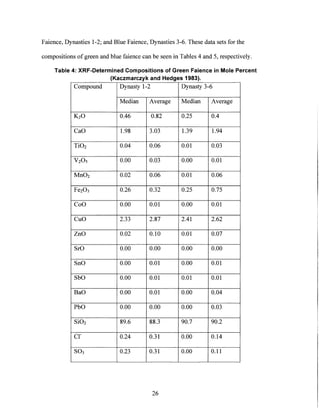
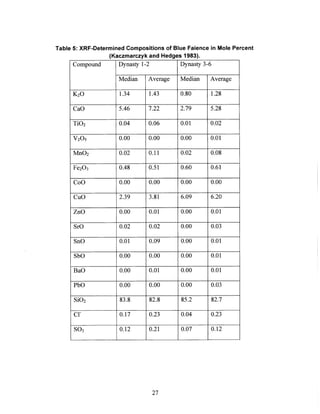
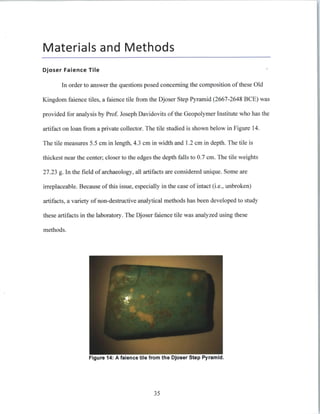
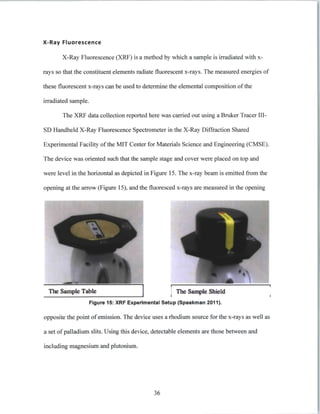
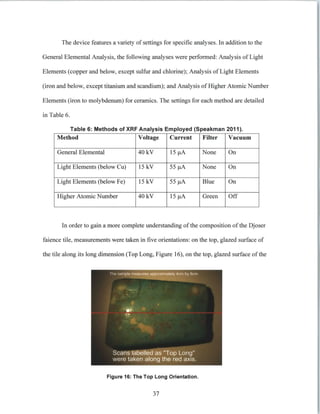
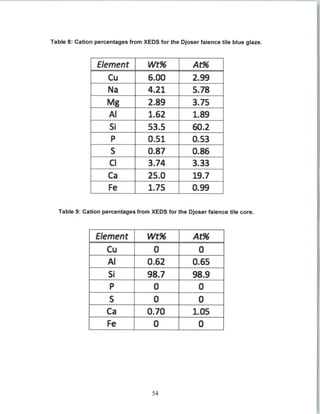
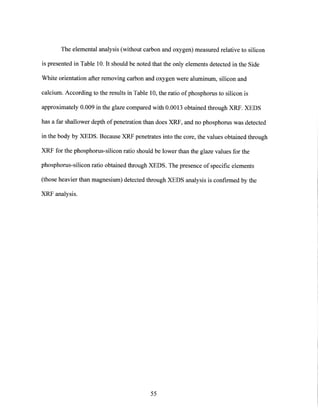
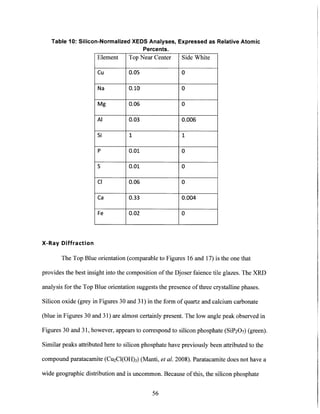
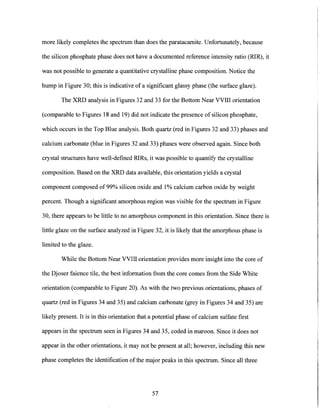
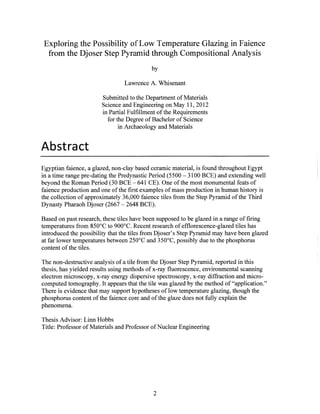
This document analyzes a faience tile from the Djoser Step Pyramid through non-destructive testing methods to explore the possibility of low-temperature glazing. X-ray fluorescence, environmental scanning electron microscopy, x-ray energy dispersive spectroscopy, x-ray diffraction, and micro-computed tomography were used to analyze the tile's composition and microstructure. The results provide some evidence that may support hypotheses of low-temperature glazing, though the phosphorus content alone does not fully explain the phenomena. The glazing method appears to be application and further research is needed.

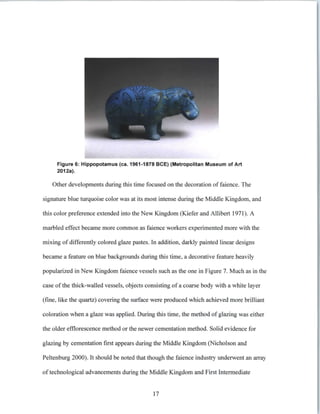
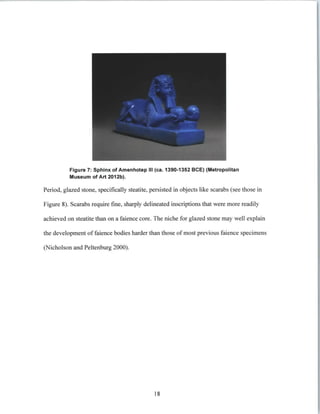
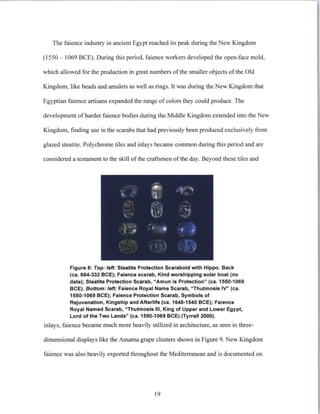
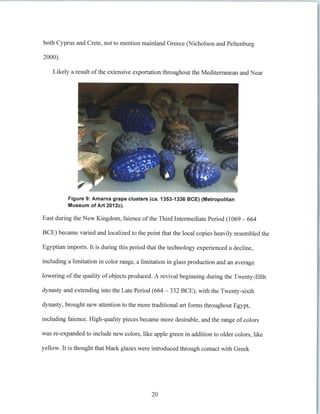
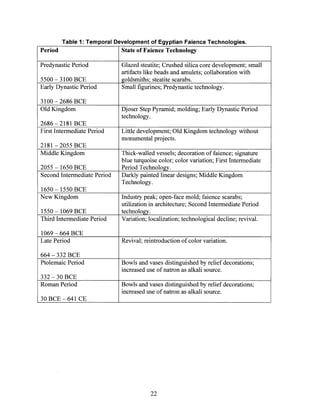
![Compositionally, each type offaience is unique. The compositions for each type
of faience can be seen in Table 3. In the case of standard faience and in the case ofthe
glazed steatite, the glaze appears to form at 950'C based on reproductive experiments
(Noble 1969).
Table 3: Faience Compositions (Noble 1969).
Component Mass in Mass in Mass in Mass in
Standard Semi-Glass Semi-Glass Steatite
Faience [g] Faience [g] Glaze [g] Glaze [g]
Feldspar 40 0 0 35
(KAlSi3 O8 - NaAlSi3O8 -
CaAl2Si2O8)
Flint 20 20 0 35
(SiO 2 )
Fine white sand 8 8 0 0
(Si0 2)
Na2CO 3 6 3 35 40
NaHCO3 6 3 0 40
Whiting 5 0 0 0
(CaCO 3)
Bentonite (clay) 2 2 0 0
(A12 03-4SiO2-H20)
Copper (II) oxide 3 1.5 7 10
(CuO)
Kaolin (clay) 0 0 4 14
(A12 03-2SiO2-2H20)
Dextine (a modified starch) 0 0 18 26
Soda Ash 0 0 35 0
(Na2O)
One of the most comprehensive studies on the composition of faience was carried
out by A. Kaczmarczyk and R.E.M. Hedges (1983). In their study, Kaczmarczyk and
Hedges (1983) present data separated by element and organized by time period and
dynasty. For the study of Third Dynasty Blue-Green faience, the data to consider most
heavily include: Green Faience, Dynasties 1-2; Green Faience, Dynasties 3-6; Blue
25](https://image.slidesharecdn.com/329ba455-12c6-4163-b401-4133110d5b40-150531183656-lva1-app6892/85/821215570-MIT-25-320.jpg)