cisi.org
CISI – Financial Products, Markets & Services
Topic – Equities
(4.1.11, 4.1.12 and 4.1.13) Trading and Settlement
cisi.org
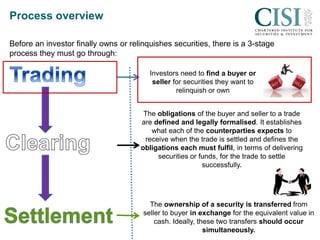
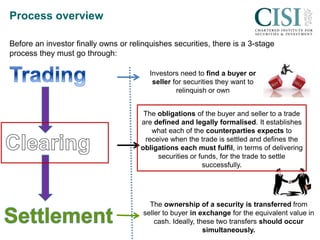
Process overview
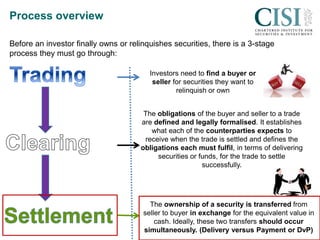
Before an investor finally owns or relinquishes securities, there is a 3-stage
process they must go through:
Investors need to find a buyer or
seller for securities they want to
relinquish or own
The obligations of the buyer and seller to a trade
are defined and legally formalised. It establishes
what each of the counterparties expects to
receive when the trade is settled and defines the
obligations each must fulfil, in terms of delivering
securities or funds, for the trade to settle
successfully.
The ownership of a security is transferred from
seller to buyer in exchange for the equivalent value in
cash. Ideally, these two transfers should occur
simultaneously.
cisi.org
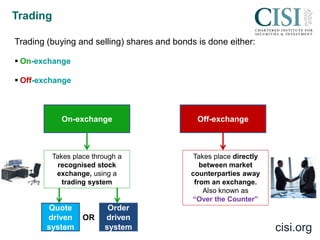
Trading
Trading (buying and selling) shares and bonds is done either:
 On-exchange
 Off-exchange
On-exchange Off-exchange
Takes place through a
recognised stock
exchange, using a
trading system
Takes place directly
between market
counterparties away
from an exchange.
Also known as
“Over the Counter”
Quote
driven
system
Order
driven
system
OR
cisi.org
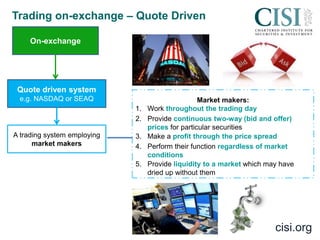
Trading on-exchange – Quote Driven
Quote driven system
e.g. NASDAQ or SEAQ
On-exchange
A trading system employing
market makers
Market makers:
1. Work throughout the trading day
2. Provide continuous two-way (bid and offer)
prices for particular securities
3. Make a profit through the price spread
4. Perform their function regardless of market
conditions
5. Provide liquidity to a market which may have
dried up without them
cisi.org
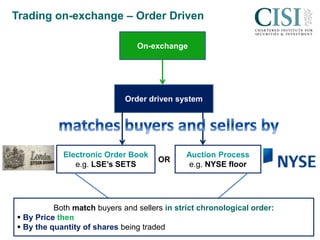
Trading on-exchange – Order Driven
Order driven system
On-exchange
Electronic Order Book
e.g. LSE’s SETS
OR
Auction Process
e.g. NYSE floor
Both match buyers and sellers in strict chronological order:
 By Price then
 By the quantity of shares being traded
cisi.org
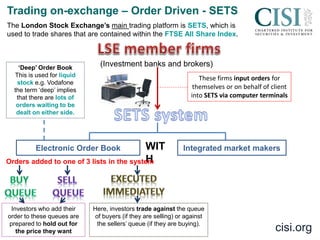
Trading on-exchange – Order Driven - SETS
The London Stock Exchange’s main trading platform is SETS, which is
used to trade shares that are contained within the FTSE All Share Index.
Electronic Order Book Integrated market makers
WIT
H
(Investment banks and brokers)
These firms input orders for
themselves or on behalf of client
into SETS via computer terminals
Investors who add their
order to these queues are
prepared to hold out for
the price they want
Orders added to one of 3 lists in the system
Here, investors trade against the queue
of buyers (if they are selling) or against
the sellers’ queue (if they are buying).
‘Deep’ Order Book
This is used for liquid
stock e.g. Vodafone
the term ‘deep’ implies
that there are lots of
orders waiting to be
dealt on either side.
cisi.org
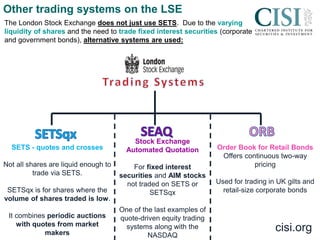
SETS - quotes and crosses
Not all shares are liquid enough to
trade via SETS.
SETSqx is for shares where the
volume of shares traded is low.
It combines periodic auctions
with quotes from market
makers
Stock Exchange
Automated Quotation
For fixed interest
securities and AIM stocks
not traded on SETS or
SETSqx
One of the last examples of
quote-driven equity trading
systems along with the
NASDAQ
Order Book for Retail Bonds
Offers continuous two-way
pricing
Used for trading in UK gilts and
retail-size corporate bonds
Other trading systems on the LSE
The London Stock Exchange does not just use SETS. Due to the varying
liquidity of shares and the need to trade fixed interest securities (corporate
and government bonds), alternative systems are used:
cisi.org
Process overview
Before an investor finally owns or relinquishes securities, there is a 3-stage
process they must go through:
Investors need to find a buyer or
seller for securities they want to
relinquish or own
The obligations of the buyer and seller to a trade
are defined and legally formalised. It establishes
what each of the counterparties expects to
receive when the trade is settled and defines the
obligations each must fulfil, in terms of delivering
securities or funds, for the trade to settle
successfully.
The ownership of a security is transferred from
seller to buyer in exchange for the equivalent value in
cash. Ideally, these two transfers should occur
simultaneously.
cisi.org
Process overview
Before an investor finally owns or relinquishes securities, there is a 3-stage
process they must go through:
Investors need to find a buyer or
seller for securities they want to
relinquish or own
The obligations of the buyer and seller to a trade
are defined and legally formalised. It establishes
what each of the counterparties expects to
receive when the trade is settled and defines the
obligations each must fulfil, in terms of delivering
securities or funds, for the trade to settle
successfully.
The ownership of a security is transferred from
seller to buyer in exchange for the equivalent value in
cash. Ideally, these two transfers should occur
simultaneously. (Delivery versus Payment or DvP)
cisi.org
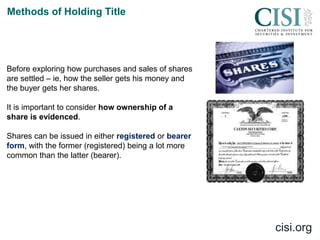
Methods of Holding Title
Before exploring how purchases and sales of shares
are settled – ie, how the seller gets his money and
the buyer gets her shares.
It is important to consider how ownership of a
share is evidenced.
Shares can be issued in either registered or bearer
form, with the former (registered) being a lot more
common than the latter (bearer).
cisi.org
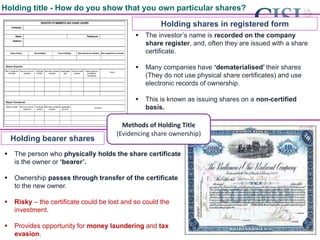
Holding title - How do you show that you own particular shares?
Holding bearer shares
Methods of Holding Title
(Evidencing share ownership)
 The person who physically holds the share certificate
is the owner or ‘bearer’.
 Ownership passes through transfer of the certificate
to the new owner.
 Risky – the certificate could be lost and so could the
investment.
 Provides opportunity for money laundering and tax
evasion.
 The investor’s name is recorded on the company
share register, and, often they are issued with a share
certificate.
 Many companies have ‘dematerialised’ their shares
(They do not use physical share certificates) and use
electronic records of ownership.
 This is known as issuing shares on a non-certified
basis.
Holding shares in registered form
cisi.org
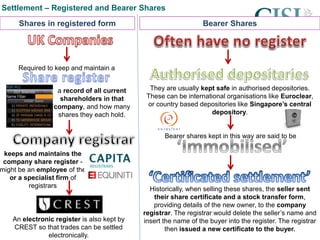
Settlement – Registered and Bearer Shares
Shares in registered form
Required to keep and maintain a
a record of all current
shareholders in that
company, and how many
shares they each hold.
keeps and maintains the
company share register -
might be an employee of the
or a specialist firm of
registrars
An electronic register is also kept by
CREST so that trades can be settled
electronically.
They are usually kept safe in authorised depositories.
These can be international organisations like Euroclear,
or country based depositories like Singapore’s central
depository.
Bearer shares kept in this way are said to be
Bearer Shares
Historically, when selling these shares, the seller sent
their share certificate and a stock transfer form,
providing details of the new owner, to the company
registrar. The registrar would delete the seller’s name and
insert the name of the buyer into the register. The registrar
then issued a new certificate to the buyer.
cisi.org
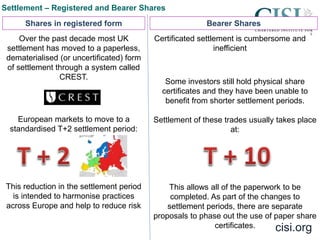
Settlement – Registered and Bearer Shares
Shares in registered form Bearer Shares
Certificated settlement is cumbersome and
inefficient
Over the past decade most UK
settlement has moved to a paperless,
dematerialised (or uncertificated) form
of settlement through a system called
CREST.
European markets to move to a
standardised T+2 settlement period:
This reduction in the settlement period
is intended to harmonise practices
across Europe and help to reduce risk
Some investors still hold physical share
certificates and they have been unable to
benefit from shorter settlement periods.
Settlement of these trades usually takes place
at:
This allows all of the paperwork to be
completed. As part of the changes to
settlement periods, there are separate
proposals to phase out the use of paper share
certificates.

7-trading-and-settlement (1).pptx

  • 1.
    cisi.org CISI – FinancialProducts, Markets & Services Topic – Equities (4.1.11, 4.1.12 and 4.1.13) Trading and Settlement
  • 2.
    cisi.org Process overview Before aninvestor finally owns or relinquishes securities, there is a 3-stage process they must go through: Investors need to find a buyer or seller for securities they want to relinquish or own The obligations of the buyer and seller to a trade are defined and legally formalised. It establishes what each of the counterparties expects to receive when the trade is settled and defines the obligations each must fulfil, in terms of delivering securities or funds, for the trade to settle successfully. The ownership of a security is transferred from seller to buyer in exchange for the equivalent value in cash. Ideally, these two transfers should occur simultaneously.
  • 3.
    cisi.org Trading Trading (buying andselling) shares and bonds is done either:  On-exchange  Off-exchange On-exchange Off-exchange Takes place through a recognised stock exchange, using a trading system Takes place directly between market counterparties away from an exchange. Also known as “Over the Counter” Quote driven system Order driven system OR
  • 4.
    cisi.org Trading on-exchange –Quote Driven Quote driven system e.g. NASDAQ or SEAQ On-exchange A trading system employing market makers Market makers: 1. Work throughout the trading day 2. Provide continuous two-way (bid and offer) prices for particular securities 3. Make a profit through the price spread 4. Perform their function regardless of market conditions 5. Provide liquidity to a market which may have dried up without them
  • 5.
    cisi.org Trading on-exchange –Order Driven Order driven system On-exchange Electronic Order Book e.g. LSE’s SETS OR Auction Process e.g. NYSE floor Both match buyers and sellers in strict chronological order:  By Price then  By the quantity of shares being traded
  • 6.
    cisi.org Trading on-exchange –Order Driven - SETS The London Stock Exchange’s main trading platform is SETS, which is used to trade shares that are contained within the FTSE All Share Index. Electronic Order Book Integrated market makers WIT H (Investment banks and brokers) These firms input orders for themselves or on behalf of client into SETS via computer terminals Investors who add their order to these queues are prepared to hold out for the price they want Orders added to one of 3 lists in the system Here, investors trade against the queue of buyers (if they are selling) or against the sellers’ queue (if they are buying). ‘Deep’ Order Book This is used for liquid stock e.g. Vodafone the term ‘deep’ implies that there are lots of orders waiting to be dealt on either side.
  • 7.
    cisi.org SETS - quotesand crosses Not all shares are liquid enough to trade via SETS. SETSqx is for shares where the volume of shares traded is low. It combines periodic auctions with quotes from market makers Stock Exchange Automated Quotation For fixed interest securities and AIM stocks not traded on SETS or SETSqx One of the last examples of quote-driven equity trading systems along with the NASDAQ Order Book for Retail Bonds Offers continuous two-way pricing Used for trading in UK gilts and retail-size corporate bonds Other trading systems on the LSE The London Stock Exchange does not just use SETS. Due to the varying liquidity of shares and the need to trade fixed interest securities (corporate and government bonds), alternative systems are used:
  • 8.
    cisi.org Process overview Before aninvestor finally owns or relinquishes securities, there is a 3-stage process they must go through: Investors need to find a buyer or seller for securities they want to relinquish or own The obligations of the buyer and seller to a trade are defined and legally formalised. It establishes what each of the counterparties expects to receive when the trade is settled and defines the obligations each must fulfil, in terms of delivering securities or funds, for the trade to settle successfully. The ownership of a security is transferred from seller to buyer in exchange for the equivalent value in cash. Ideally, these two transfers should occur simultaneously.
  • 9.
    cisi.org Process overview Before aninvestor finally owns or relinquishes securities, there is a 3-stage process they must go through: Investors need to find a buyer or seller for securities they want to relinquish or own The obligations of the buyer and seller to a trade are defined and legally formalised. It establishes what each of the counterparties expects to receive when the trade is settled and defines the obligations each must fulfil, in terms of delivering securities or funds, for the trade to settle successfully. The ownership of a security is transferred from seller to buyer in exchange for the equivalent value in cash. Ideally, these two transfers should occur simultaneously. (Delivery versus Payment or DvP)
  • 10.
    cisi.org Methods of HoldingTitle Before exploring how purchases and sales of shares are settled – ie, how the seller gets his money and the buyer gets her shares. It is important to consider how ownership of a share is evidenced. Shares can be issued in either registered or bearer form, with the former (registered) being a lot more common than the latter (bearer).
  • 11.
    cisi.org Holding title -How do you show that you own particular shares? Holding bearer shares Methods of Holding Title (Evidencing share ownership)  The person who physically holds the share certificate is the owner or ‘bearer’.  Ownership passes through transfer of the certificate to the new owner.  Risky – the certificate could be lost and so could the investment.  Provides opportunity for money laundering and tax evasion.  The investor’s name is recorded on the company share register, and, often they are issued with a share certificate.  Many companies have ‘dematerialised’ their shares (They do not use physical share certificates) and use electronic records of ownership.  This is known as issuing shares on a non-certified basis. Holding shares in registered form
  • 12.
    cisi.org Settlement – Registeredand Bearer Shares Shares in registered form Required to keep and maintain a a record of all current shareholders in that company, and how many shares they each hold. keeps and maintains the company share register - might be an employee of the or a specialist firm of registrars An electronic register is also kept by CREST so that trades can be settled electronically. They are usually kept safe in authorised depositories. These can be international organisations like Euroclear, or country based depositories like Singapore’s central depository. Bearer shares kept in this way are said to be Bearer Shares Historically, when selling these shares, the seller sent their share certificate and a stock transfer form, providing details of the new owner, to the company registrar. The registrar would delete the seller’s name and insert the name of the buyer into the register. The registrar then issued a new certificate to the buyer.
  • 13.
    cisi.org Settlement – Registeredand Bearer Shares Shares in registered form Bearer Shares Certificated settlement is cumbersome and inefficient Over the past decade most UK settlement has moved to a paperless, dematerialised (or uncertificated) form of settlement through a system called CREST. European markets to move to a standardised T+2 settlement period: This reduction in the settlement period is intended to harmonise practices across Europe and help to reduce risk Some investors still hold physical share certificates and they have been unable to benefit from shorter settlement periods. Settlement of these trades usually takes place at: This allows all of the paperwork to be completed. As part of the changes to settlement periods, there are separate proposals to phase out the use of paper share certificates.