Global Manpower Development
SERV1869
793F Off-Highway Truck
Module 3 - Engine
Text Reference
793F Off-Highway Truck
ENGINE
MODULE 3 - TEXT REFERENCE
© 2009 Caterpillar Inc.
Caterpillar: Confidential Yellow
Print Instructor Pages Print Participant Pages
SERV1869 - 09/09 Module 3 - Engine-2-
© 2009 Caterpillar Inc.
INTRODUCTION
The visual above shows the right side view of the 16 cylinder C175 engine in the
793F trucks. The C175 replaces the current 3516 Series engine that was used in
the 793D.
The C175 is a metric engine. Some of the component weights have increased, such
as the cylinder head, which is approximately 50 percent heavier than the 3500 and
will require a lifting device.
Care must be taken when working on or around the high pressure fuel system as
pressures can be as high as 180 MPa (26,100 psi).
Cleanliness during service is critical because the fuel system is very sensitive to
debris as compared to 3500 / 3600 products.
The following lists the key features for the C175 engine:
High pressure common rail fuel system--
Air to Air AfterCooler (ATAAC)--
Increased horsepower--
Two-piece single camshaft--
Electronic Unit Injectors (EUI)--
• C175 Engine
• Engine features
2_1
SERV1869 - 09/09 Module 3 - Engine-3-
© 2009 Caterpillar Inc.
The following specifications are for the C175 16 cylinder engine:
Serial No. Prefix: B7B
Performance Specs: 0K7437--
Gross Power: 1977 kw (2651 hp) @ 1750 rpm--
Maximum Altitude: 3353 m (11000 ft)--
High Idle rpm: 1960 rpm--
Full Load rpm: 1750 rpm--
T/C Stall Speed: 1500 ± 10 rpm--
Boost at Full Load RPM: 200 ± 20 kPa (29 ± 3 psi) at sea level--
SERV1869 - 09/09 Module 3 - Engine-4-
© 2009 Caterpillar Inc.
This illustration shows the main components on the right side of the engine:
High pressure fuel rail (1)--
Intake manifold (2)--
High pressure fuel pump (3)--
Air conditioning compressor (4)--
Fuel priming pump (5)--
Secondary fuel filter base (6)--
Engine oil filters (7)--
Pump drive (8)--
• Right side of engine:
High pressure fuel rail1.	
Intake manifold2.	
High pressure fuel pump3.	
Air conditioning compressor4.	
Fuel priming pump5.	
Secondary fuel filter base6.	
Engine oil filters7.	
Pump drive8.	
4_1
3
4
1
8 5
7
6
2
SERV1869 - 09/09 Module 3 - Engine-5-
© 2009 Caterpillar Inc.
This illustration shows the main components on the left side of the engine:
Coolant pump (1)--
Engine oil pump (2)--
Engine oil pan sight glass (3)--
Engine oil S•O•S port (4)--
Engine coolant S•O•S port (5)--
Engine oil coolers (6)--
• Left side of engine:
Coolant pump1.	
Engine oil pump2.	
Engine oil pan sight glass3.	
Engine oil S•O•S port4.	
Engine coolant S•O•S port5.	
Engine oil coolers6.	
5_1
1
4
2 6
5
3
SERV1869 - 09/09 Module 3 - Engine-6-
© 2009 Caterpillar Inc.
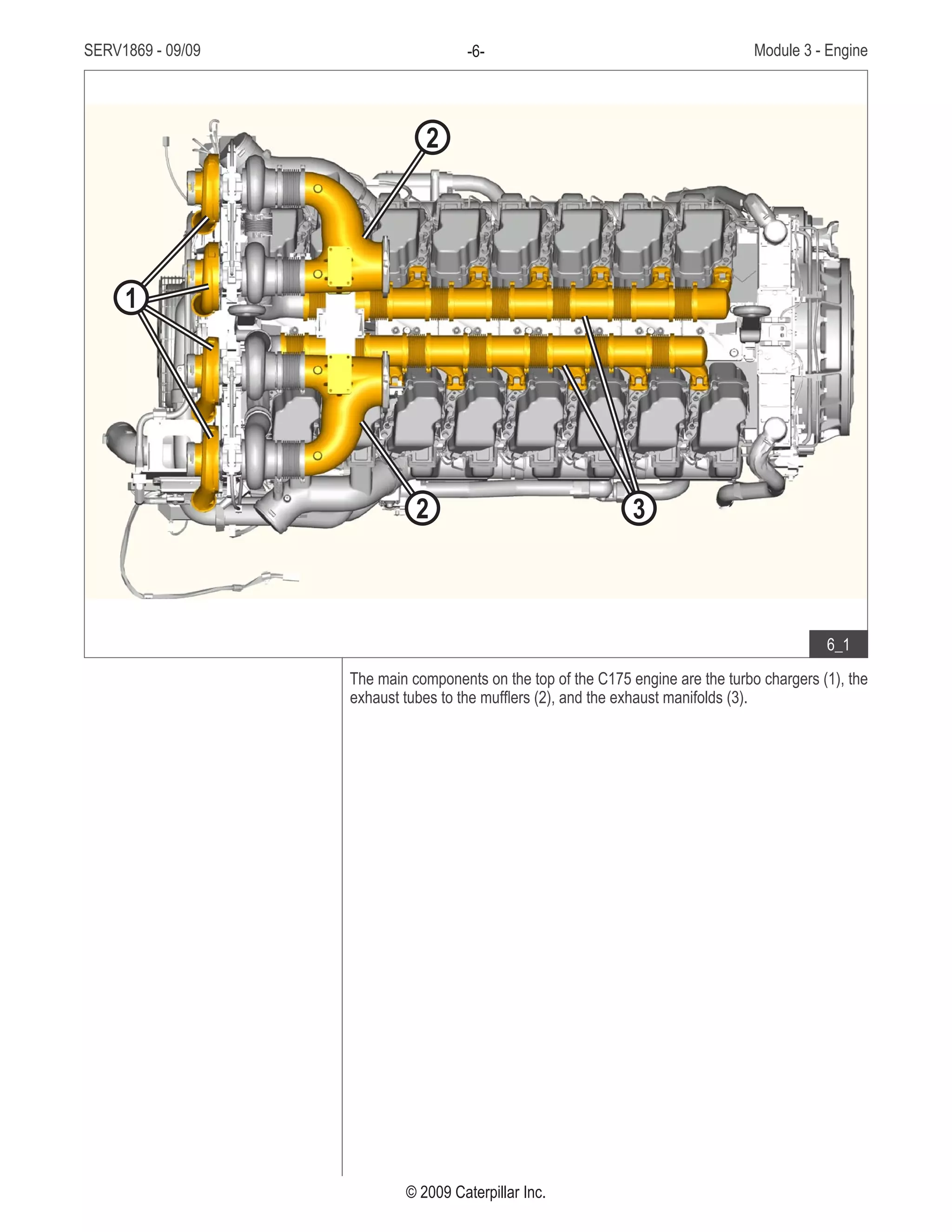
The main components on the top of the C175 engine are the turbo chargers (1), the
exhaust tubes to the mufflers (2), and the exhaust manifolds (3).
• Top of engine:
Turbo chargers1.	
Mufflers2.	
Exhaust manifolds3.	
6_1
1
2
2
3
SERV1869 - 09/09 Module 3 - Engine-7-
© 2009 Caterpillar Inc.
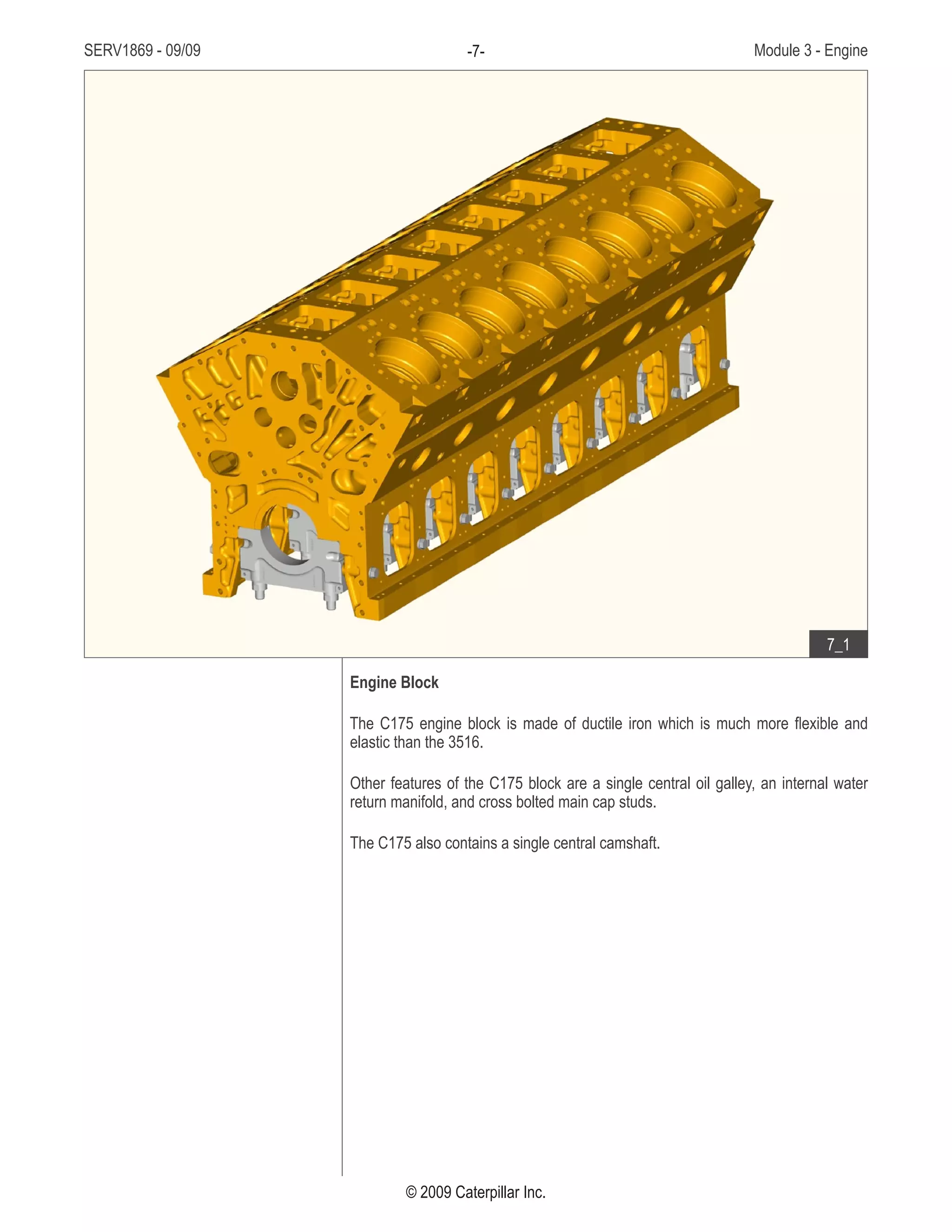
Engine Block
The C175 engine block is made of ductile iron which is much more flexible and
elastic than the 3516.
Other features of the C175 block are a single central oil galley, an internal water
return manifold, and cross bolted main cap studs.
The C175 also contains a single central camshaft.
• Ductile iron
• Features
7_1
SERV1869 - 09/09 Module 3 - Engine-8-
© 2009 Caterpillar Inc.
Piston and Connecting Rod
A single piece piston of forged steel design in the C175 includes the following
features:
high strength--
light weight--
rectangular rings that conform to the liner--
improved oil control--
reduced blow-by--
less liner wear--
a threaded hole for pulling the piston--
The connecting rod end is too large to pass through the liner so the cylinder pack,
piston, and rod assembly must be removed from the cylinder block.
A special tool is available to remove the cylinder pack from the block.
The rod and cap includes a fractured joint (1) which must be protected by a special
tool when removing the cylinder rod.
A connecting rod numbering system (2) is used to identify the rods. There is a
specialized serial number specific to each connecting rod to ensure the correct
bottom cap is used.
• Piston and connecting rod
components:
Fractured joint1.	
Connecting rod numbering2.	
system
8_1
8_2
1
2
SERV1869 - 09/09 Module 3 - Engine-9-
© 2009 Caterpillar Inc.
Special Tools
The Cylinder Pack Installation Tool (322-3564) (1) is available to remove and install
the C175 cylinder pack which includes the cylinder liner, piston, and connecting
rod.
The Connecting Rod Guides Tool (274-5875) (2) is used to protect the fractured
connecting rods during removal.
There are odd and even rods that are installed in the odd and even cylinders.
• Special tools:
Cylinder pack installation tool1.	
(322-3564)
Connecting rod guides tool2.	
(274-5875)
9_1
9_2
1
2
SERV1869 - 09/09 Module 3 - Engine-10-
© 2009 Caterpillar Inc.
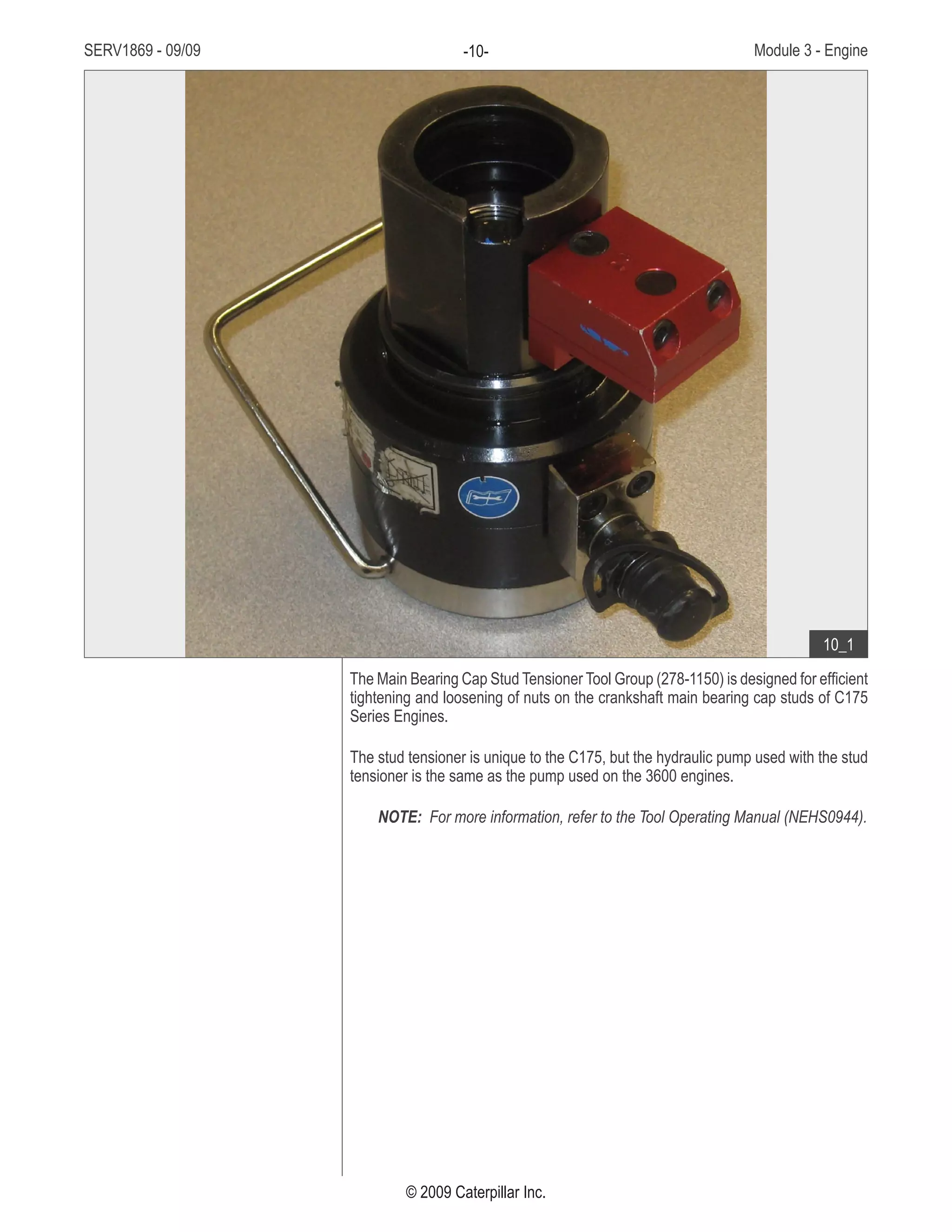
The Main Bearing Cap Stud Tensioner Tool Group (278-1150) is designed for efficient
tightening and loosening of nuts on the crankshaft main bearing cap studs of C175
Series Engines.
The stud tensioner is unique to the C175, but the hydraulic pump used with the stud
tensioner is the same as the pump used on the 3600 engines.
NOTE: For more information, refer to the Tool Operating Manual (NEHS0944).
• Main Bearing Cap Stud Tensioner
Tool Group
10_1
SERV1869 - 09/09 Module 3 - Engine-11-
© 2009 Caterpillar Inc.
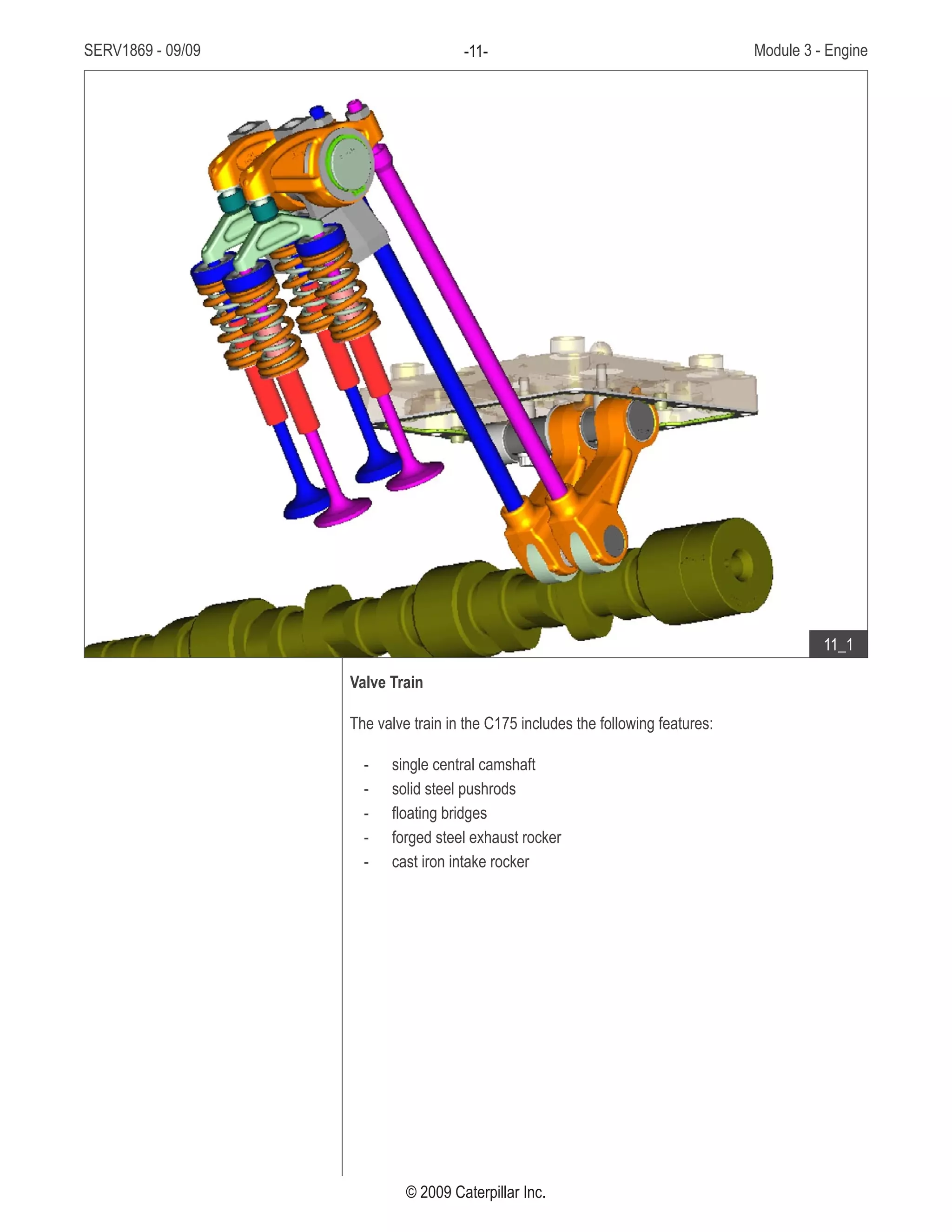
Valve Train
The valve train in the C175 includes the following features:
single central camshaft--
solid steel pushrods--
floating bridges--
forged steel exhaust rocker--
cast iron intake rocker--
• Valve train features
11_1
SERV1869 - 09/09 Module 3 - Engine-12-
© 2009 Caterpillar Inc.
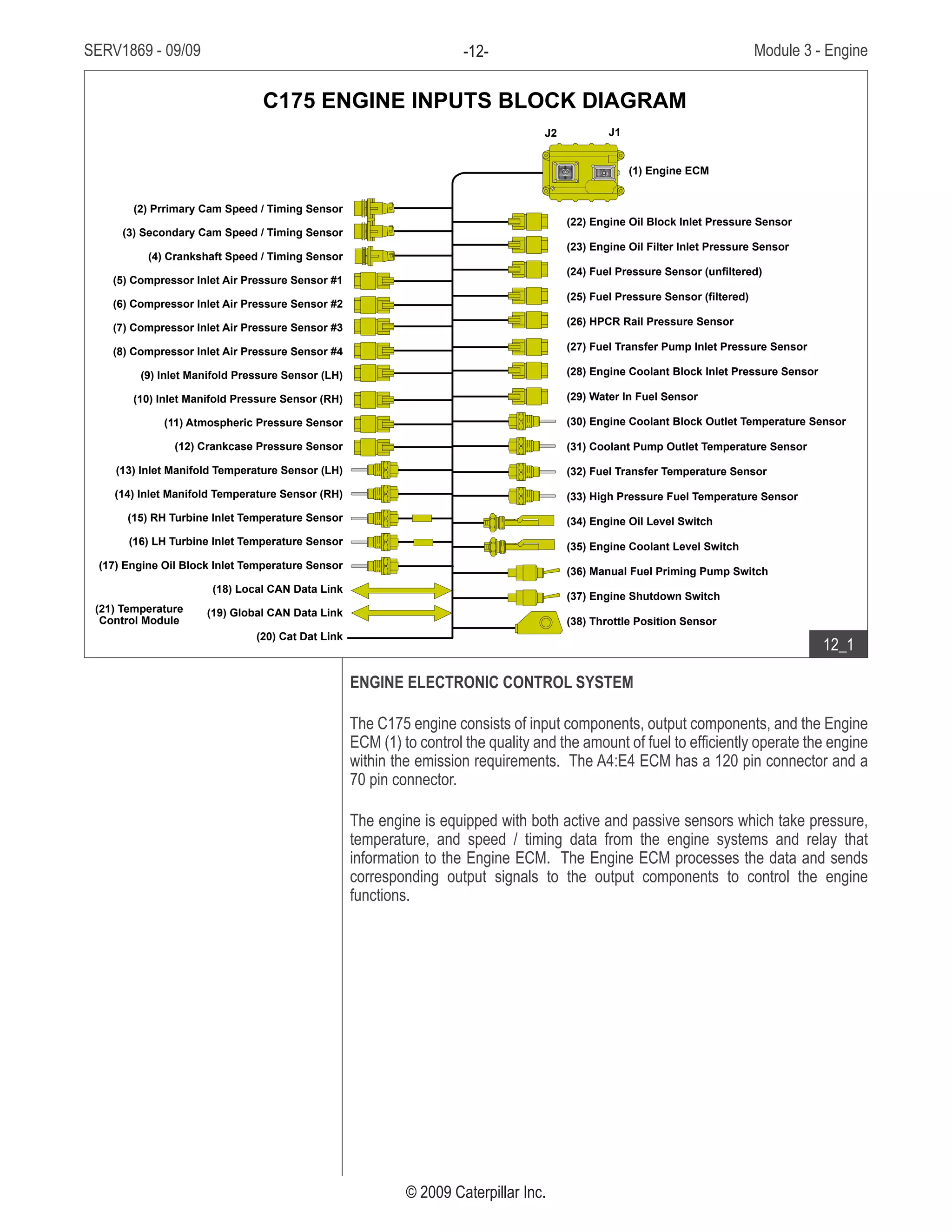
ENGINE ELECTRONIC CONTROL SYSTEM
The C175 engine consists of input components, output components, and the Engine
ECM (1) to control the quality and the amount of fuel to efficiently operate the engine
within the emission requirements. The A4:E4 ECM has a 120 pin connector and a
70 pin connector.
The engine is equipped with both active and passive sensors which take pressure,
temperature, and speed / timing data from the engine systems and relay that
information to the Engine ECM. The Engine ECM processes the data and sends
corresponding output signals to the output components to control the engine
functions.
• Engine electronic control system
inputs
(2) Prrimary Cam Speed / Timing Sensor
(3) Secondary Cam Speed / Timing Sensor
(4) Crankshaft Speed / Timing Sensor
(5) Compressor Inlet Air Pressure Sensor #1
(6) Compressor Inlet Air Pressure Sensor #2
(7) Compressor Inlet Air Pressure Sensor #3
(8) Compressor Inlet Air Pressure Sensor #4
(9) Inlet Manifold Pressure Sensor (LH)
(10) Inlet Manifold Pressure Sensor (RH)
(11) Atmospheric Pressure Sensor
(12) Crankcase Pressure Sensor
(13) Inlet Manifold Temperature Sensor (LH)
(14) Inlet Manifold Temperature Sensor (RH)
(15) RH Turbine Inlet Temperature Sensor
(16) LH Turbine Inlet Temperature Sensor
(17) Engine Oil Block Inlet Temperature Sensor
(18) Local CAN Data Link
(19) Global CAN Data Link
(20) Cat Dat Link
(22) Engine Oil Block Inlet Pressure Sensor
(23) Engine Oil Filter Inlet Pressure Sensor
(24) Fuel Pressure Sensor (unfiltered)
(25) Fuel Pressure Sensor (filtered)
(26) HPCR Rail Pressure Sensor
(27) Fuel Transfer Pump Inlet Pressure Sensor
(28) Engine Coolant Block Inlet Pressure Sensor
(29) Water In Fuel Sensor
(30) Engine Coolant Block Outlet Temperature Sensor
(31) Coolant Pump Outlet Temperature Sensor
(32) Fuel Transfer Temperature Sensor
(33) High Pressure Fuel Temperature Sensor
(34) Engine Oil Level Switch
(35) Engine Coolant Level Switch
(36) Manual Fuel Priming Pump Switch
(37) Engine Shutdown Switch
(38) Throttle Position Sensor
(21) Temperature
Control Module
(1) Engine ECM
C175 ENGINE INPUTS BLOCK DIAGRAM
J2 J1
12_1
SERV1869 - 09/09 Module 3 - Engine-13-
© 2009 Caterpillar Inc.
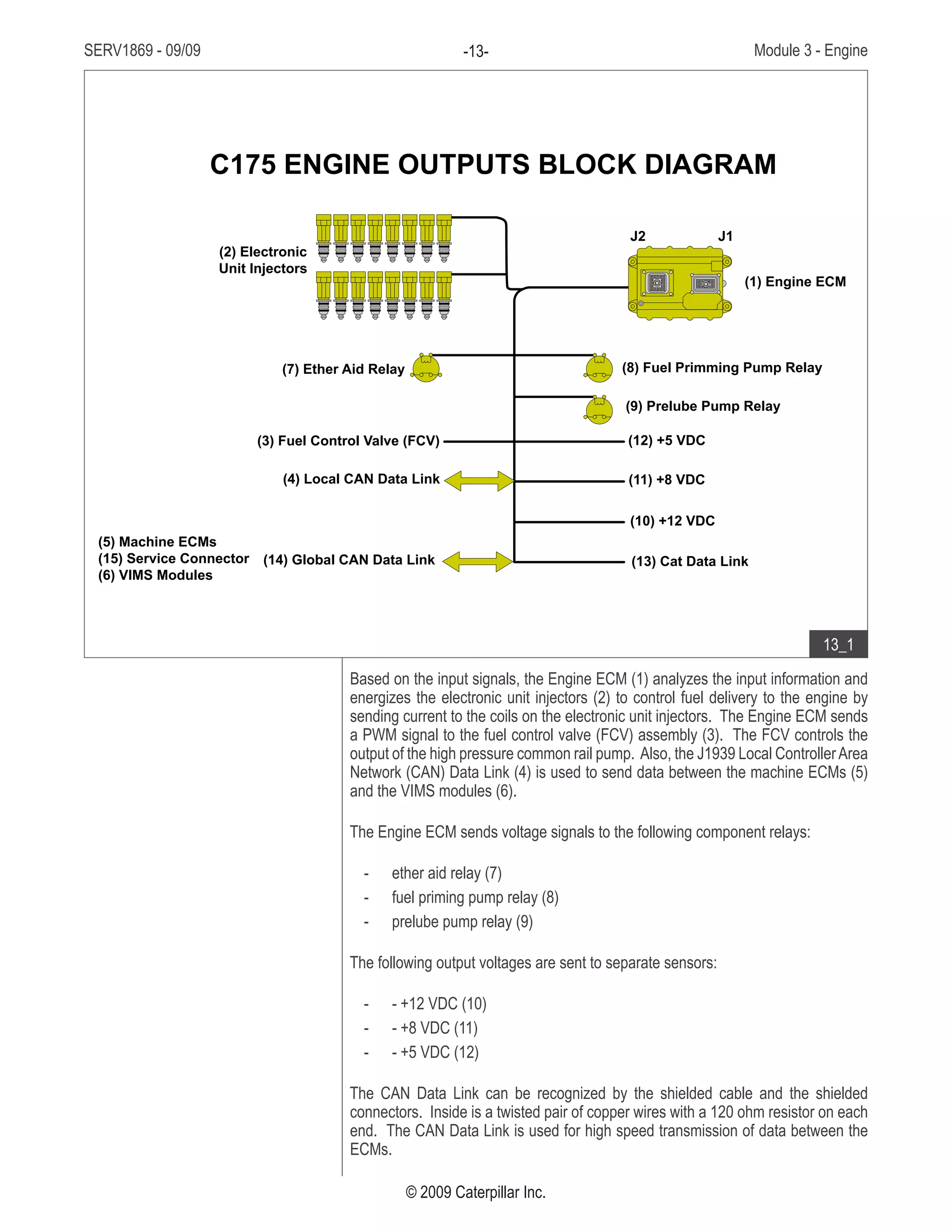
Based on the input signals, the Engine ECM (1) analyzes the input information and
energizes the electronic unit injectors (2) to control fuel delivery to the engine by
sending current to the coils on the electronic unit injectors. The Engine ECM sends
a PWM signal to the fuel control valve (FCV) assembly (3). The FCV controls the
output of the high pressure common rail pump. Also, the J1939 Local ControllerArea
Network (CAN) Data Link (4) is used to send data between the machine ECMs (5)
and the VIMS modules (6).
The Engine ECM sends voltage signals to the following component relays:
ether aid relay (7)--
fuel priming pump relay (8)--
prelube pump relay (9)--
The following output voltages are sent to separate sensors:
- +12 VDC (10)--
- +8 VDC (11)--
- +5 VDC (12)--
The CAN Data Link can be recognized by the shielded cable and the shielded
connectors. Inside is a twisted pair of copper wires with a 120 ohm resistor on each
end. The CAN Data Link is used for high speed transmission of data between the
ECMs.
• Engine electronic control system
outputs
• Relays
• Output voltages
• CAN Data Link
C175 ENGINE OUTPUTS BLOCK DIAGRAM
(2) Electronic
Unit Injectors
(7) Ether Aid Relay
(3) Fuel Control Valve (FCV)
(8) Fuel Primming Pump Relay
(1) Engine ECM
(9) Prelube Pump Relay
(12) +5 VDC
J2 J1
(11) +8 VDC
(10) +12 VDC
(13) Cat Data Link(14) Global CAN Data Link
(4) Local CAN Data Link
(5) Machine ECMs
(15) Service Connector
(6) VIMS Modules
13_1
SERV1869 - 09/09 Module 3 - Engine-14-
© 2009 Caterpillar Inc.
Fuel injection and system monitoring are controlled by the A4:E4 Engine ECM (1)
which is located at the front of the engine. The Engine ECM is equipped with a 120
pin connector (J2) and a 70 pin connector (J1).
The Engine ECM responds to engine inputs by sending a signal to the appropriate
output component to initiate an action. For example, the Engine ECM receives a high
coolant temperature signal. The Engine ECM interprets the input signal, evaluates
the current operating status, and derates the fuel supply under load.
The Engine ECM receives three different types of input signals:
1. Switch input: Provides the signal line to battery, ground, or open.
2. PWM input: Provides the signal line with a rectangular wave of a specific
frequency and a varying positive duty cycle.
3. Speed signal: Provides the signal line with either a repeating, fixed voltage
level pattern signal, or a sine wave of varying level and frequency.
• Front of engine:
Engine ECM1.	
Atmospheric pressure sensor2.	
14_1
1
2
SERV1869 - 09/09 Module 3 - Engine-15-
© 2009 Caterpillar Inc.
The Engine ECM has three types of output drivers:
1. ON/OFF driver: Provides the output device with a signal level of +Battery
voltage (ON) or less than one Volt (OFF).
2. PWM driver: Provides the output device with a rectangular wave of fixed
frequency and a varying positive duty cycle.
3. Controlled current output driver: The ECM will energize the solenoid
with pull-up current for a specific duration and then decrease the level
to hold-in current for a specific duration of the on time. The initial higher
amperage gives the actuator rapid response and the decreased level is
sufficient to hold the solenoid in the correct position. An added benefit is
an increase in the life of the solenoid.
Engine ECM has built-in diagnostic capabilities. As the Engine ECM detects fault
conditions in the power train system, the ECM logs events in memory and diagnostic
codes for troubleshooting and displays them through Cat ET.
The atmospheric pressure sensor (2) is located in the control panel next to
the Engine ECM. The function of the atmospheric pressure sensor is to supply
information relative to high altitude back to the Engine ECM along with calculated
gauge pressure for all the pressure sensors to the ECM. Losing the signal from the
atmospheric pressure sensor will initiate a 10% derate and the parameter will be set
to a default value that is stored in the ECM.
Normally, at 0 rpm and 2 seconds after the engine starts, the Engine ECM reads
each pressure sensor to ensure the pressure is within tolerance of a specified value.
If the value is within tolerance, the Engine ECM compares the value of the pressure
sensors with the atmospheric sensor and assigns a specific offset value to each
sensor for calibration.
NOTE: The signal from the atmospheric pressure sensor is used by the Engine
ECM to calculate a number of pressure measurements in most electronic
engines. The signal from the atmospheric pressure sensor is compared to
the signal from the other engine pressure sensors to calibrate the pressure
sensors. When the Engine ECM is powered up, the ECM uses the signal from
the atmospheric pressure sensor as a reference point for calibration of the other
pressure sensors on the engine.
SERV1869 - 09/09 Module 3 - Engine-16-
© 2009 Caterpillar Inc.
CAN Networks
This illustration shows the signal paths for the Controller Area Network (CAN) for the
“F” Series trucks. The signal paths are a common set of signal wires connected to
multiple controllers. The common set of signal wires allows many different pieces of
information to be shared between many different devices over a few signal wires.
The paths are two twisted shielded wires with a 120 ohm terminal resistor (1) at
each end of the network. The terminal resistors prevent electrical interference
on the CAN Network. The designation of the CAN wires are CAN + and CAN -
with a third connection denoted as CAN_SHLD (shield). Two terminal resistors
are located near the Engine ECM (2); one resistor is installed near the electronic
thermostat (E-Stat) (3), and one resistor is installed near the fuel control valve
(FCV) (4). The E-Stat is located between the engine and the radiator.
The truck chassis has one data link. The Engine ECM has two data links: 1) Global
CAN, which has paths with the Machine ECMs and external components (Advisor,
E-Stat, and the Service Connector); and, 2) the Engine ECM which is connected to
the fuel control valve (FCV) through the Local CAN data link.
The 120 pin connector for the Engine ECM contains the Local CAN Data Link. The
70 pin Engine ECM connector contains the Global CAN Data Link.
• CAN signal paths
OK
120 ohm120 ohm
(1) Terminal Resistor
(1) Terminal Resistor (1) Terminal
Resistor 120 ohm
(3) Electronic
Thermostat (E-Stat)
120 oh m
(22) Local CAN
(6) Chassis
ECM
(7) Transmission
ECM
(8) Brake
ECM
(9) VIMS 3G
Main
Module
(10) VIMS 3G
Application
Module
(11) Advisor
Module
(12) Product
Link Module
(13) Smart
Signal
Module
(17) CAN +
(18) CAN -
(19) CAN Shield
(14) Machine
Security
System
(15) Cat ET
Service
Connector
(20) Engine Group (21) Radiator Group
(5) Global CAN
(16) Cab Group
(2) Engine ECM
(4) Fuel Control
Valve
CAN NETWORKS
16_1
SERV1869 - 09/09 Module 3 - Engine-17-
© 2009 Caterpillar Inc.
The top left illustration shows the location of the terminal resistors in relationship to
the Engine ECM (1). The terminal resistors (not visible) are attached to the wire
harness (2) below the ECM. One resistor is for the Global CAN and one resistor is
for the Local CAN. When determining which is the global terminal resistor and which
is the local terminal resistor, always check the wiring numbers.
The top right illustration shows the location of the global CAN terminal resistor (3)
located near the E-stat (4) on the left side of the radiator group.
The bottom left illustration shows the location of the other local CAN terminal
resistor (5). The resistor is located behind the right intake manifold above the high
pressure fuel pump.
The lower right illustration shows a schematic of the terminating resistors at the
Engine ECM.
• Terminal resistors:
Engine ECM1.	
Terminal resistor2.	
Global CAN terminating3.	
resistor
E-stat4.	
Local CAN terminating5.	
resistor
(8) A - Can +
(9) B - Can -
(10) C - Can Shield
(6) Global CAN Data Link
(7) Local CAN Data Link
TERMINAL RESISTORS
A
B
C
A
B
C
A
B
C
A
B
C
A
B
C
A
B
C
Y959-E44 YL-19
Y960-E45 GN-19
Y961-E21 SHLD-19
Y959-E251 YL-19
Y960-E252 GN-19
Y961-E253 SHLD-19
Y956-E170 YL-19
Y967-E1542 GN-19
Y968-E180 SHLD-19
Y956-E170 YL-19
Y967-E1542 GN-19
Y968-E180 SHLD-19
17_1 17_2
17_417_3
1
2
34
5
SERV1869 - 09/09 Module 3 - Engine-18-
© 2009 Caterpillar Inc.
Engine Position Sensing
Engine position sensing is the function that determines the actual crankshaft and
camshaft positions versus time so that engine speed can be calculated. Engine
position sensing also allows for the delivery of synchronous outputs, including fuel
injection timing and ignition timing. Engine position sensing is a critical process for
accurate fuel delivery, reliability of operation, and emission control performance.
The crankshaft speed / timing sensor connector (1) is bolted to a cover (2) on
the rear left side of the engine, behind the starter (not shown). The crankshaft
speed / timing sensor (3) is located behind the cover. The speed / timing sensor
sends a fixed voltage level signal to the Engine ECM indicating the engine speed,
direction, and timing. The crankshaft sensor is the primary speed / timing sensor
reporting to the Engine ECM to determine engine speed and crankshaft position.
The speed sensor detects the reference for engine speed and timing from a unique
pattern on the respective gear. Normally, the crankshaft speed / timing sensor
identifies the timing during starting and determines when the No. 1 cylinder is at the
top of the stroke. Once the timing is established, the crankshaft timing sensor is
used to relay the engine speed and the camshaft sensor signal is ignored.
If the engine is running and the signal from the crankshaft is lost, a slight change in
performance is noticed during change over to the camshaft speed / timing sensor.
The sensor adjustment is preset so no adjustment is necessary.
• Left side of engine:
Crankshaft speed / timing1.	
sensor connector
Cover2.	
Crankshaft speed / timing3.	
sensor
18_1
18_2
12
3
SERV1869 - 09/09 Module 3 - Engine-19-
© 2009 Caterpillar Inc.
In case of a crankshaft speed / timing sensor failure, the Engine ECM follows the
following process:
a crankshaft sensor diagnostic code is logged--
the Engine ECM switches to the primary camshaft speed / timing sensor--
the Engine ECM uses the stored rotation as the engine rotation if the sensor--
fails during a pattern lock
The crankshaft speed / timing sensor serves four functions:
engine speed measurement--
engine timing measurement--
TDC location and cylinder number identification--
reverse rotation protection--
The crankshaft speed / timing sensor is not adjustable.
If the engine is running for three seconds and the pattern from the timing ring is
lost for two seconds, the Engine ECM will log a Diagnostic Code for the crankshaft
speed / timing sensor.
SERV1869 - 09/09 Module 3 - Engine-20-
© 2009 Caterpillar Inc.
The C175 has two speed / timing sensors that indicate camshaft speed. The primary
camshaft speed / timing sensor (1) is used to synchronize fuel delivery with the
engine cycle and provides a backup if the crankshaft speed / timing sensor fails. If
the crankshaft speed / timing sensor fails, the Engine ECM will use the primary
camshaft speed / timing sensor to keep the engine running, but the fuel delivery may
be less accurate. The speed of the camshaft target wheel is half that of the crankshaft
gear.
The secondary camshaft speed / timing sensor (2) is a backup to the primary
camshaft speed / timing sensor when the primary sensor has failed. The sensor
adjustment is preset so no adjustment is necessary.
• Rear of engine:
Primary camshaft speed /1.	
timing sensor
Secondary camshaft speed /2.	
timing sensor
20_1
2 1
SERV1869 - 09/09 Module 3 - Engine-21-
© 2009 Caterpillar Inc.
The camshaft timing pin (1) and the flywheel timing pin (2) are shown in the stowed
position. The camshaft timing pin is inserted in the camshaft timing pin hole (3) when
performing camshaft timing. The flywheel timing pin is inserted in the flywheel timing
hole (4) when it is necessary to find engine top dead center (TDC).
• Rear of engine:
Camshaft timing pin1.	
Flywheel timing pin2.	
Camshaft timing pin hole3.	
Flywheel timing pin hole4.	
21_1
4
1
3
2
SERV1869 - 09/09 Module 3 - Engine-22-
© 2009 Caterpillar Inc.
The top illustration shows the engine timing gear train. At engine start-up, the
crankshaft speed / timing sensor (1) synchronizes with the primary camshaft
speed / timing sensor (2) and the secondary camshaft speed / timing sensor (3). The
crankshaft gear (4) rotates two times for every one rotation of the camshaft gear (5).
The crankshaft gear and the camshaft gear are the same size with an equal amount
of teeth.
The idler gear (6) is a combination gear with the larger gear having twice as many
teeth as the smaller gear. The larger gear is driven by the crankshaft and the smaller
idler gear drives the camshaft gear.
When the engine is cranked, the crankshaft sensor looks for the notch (7) cut into one
tooth of the crankshaft gear to determine position. When the Engine ECM locates
the signal from the sensor by detecting the notch, the Engine ECM then looks for a
signal from the cam sensor.
When the cam sensor locates the notch (8) cut into one tooth of the camshaft gear,
and after the crankshaft sensor locates a notch, the Engine ECM then waits for a
second notch to verify the pattern. The Engine ECM sends the signal for a more
accurate injection cycle, if rail pressure is present.
The bottom illustration shows a notch (9), cut into one of the gear teeth, that is used
to determine engine position.
• Timing gear train:
Crankshaft speed / timing1.	
sensor
Primary camshaft speed /2.	
timing sensor
Secondary camshaft speed /3.	
timing sensor
Crankshaft gear4.	
Camshaft gear5.	
Idler gear6.	
Notch (crankshaft gear)7.	
Notch (camshaft gear)8.	
Notch in gear9.	
ENGINE TIMING GEAR TRAIN
(7) Notch
(8) Notch
(1) Crankshaft
Speed / Timing
Sensor
(6) Idler Gear
(3) Secondary Cam
Speed / Timing
Sensor
(2) Primary Cam
Speed / Timing
Sensor
(4) Crankshaft
Gear
(5) Crankshaft
Gear
22_1
22_2
9
SERV1869 - 09/09 Module 3 - Engine-23-
© 2009 Caterpillar Inc.
The C175 engines are electronically timed and no longer require the timing calibration
probe for speed / timing calibrations. The Engine ECM uses inputs from all three
engine speed / timing sensors to assist in calculating more accurate timing within the
software during engine start-up.
The software application in the Engine ECM compares the tooth angle between the
crank and cam gears. The Engine ECM looks for a stable rpm above 700 rpm. The
revolutions per minute must be ± 5 rpm for one second to be considered stable.
The Engine ECM takes fifty samples of the leading edge of the camshaft teeth angle
position and compares each to the nearest crankshaft tooth. The ECM compares the
measured difference to the theoretical tooth difference of each sample, and averages
the tooth errors. This average difference between the camshaft actual position and
the camshaft theoretical position determines the offset angle. The offset angle is
used by the ECM for calibration. Timing calibration is performed at each engine start
after an ECM power cycle.
• C175 is electronically timed
SERV1869 - 09/09 Module 3 - Engine-24-
© 2009 Caterpillar Inc.
Crankcase Pressure Sensor
The crankcase pressure sensor (1) is used to measure the pressure in the crankcase
and is located on the right side of the engine below the intake manifold (2). The
crankcase pressure sensor detects impending piston seizures, and indicates cylinder
blow-by.
The crankcase pressure sensor will initiate a Level 1 Warning when the crankcase
pressure reaches 4 kPa (0.6 psi).
• Right side of engine:
Crankcase pressure sensor1.	
Intake manifold2.	
24_1
1
2
SERV1869 - 09/09 Module 3 - Engine-25-
© 2009 Caterpillar Inc.
ENGINE COOLING SYSTEM
This illustration shows the cooling system on a 793F truck with standard retarding.
The coolant pump (1) pulls coolant from the radiator (2) and sends the coolant
through the engine oil coolers (3) to the engine block (4).
After leaving the block, the coolant flows through the turbos (5), into one return line,
and to the shunt tank (6) of the radiator. The coolant from the block also flows to
the power train oil cooler (7), the steering / fan oil cooler (8), and then through the
rectangular front and rear brake oil coolers (9) to the Electronic Thermostat (E-stat)
(10). Depending on the temperature of the coolant, the E-stat directs the coolant
to the radiator or through the bypass line (11) and back to the inlet of the coolant
pump.
The coolant pump outlet temperature sensor (12) sends a signal to the temperature
control module (13) on the E-Stat.
The engine coolant block inlet pressure sensor (14) and the engine coolant block
outlet temperature sensor (15) send signals directly to the Engine ECM (16). The
engine coolant block outlet temperature sensor is used as one of the key target
temperatures for the hydraulic fan system.
The coolant level sensor (17) sends a signal to the Engine ECM indicating the
coolant level.
NOTE: This illustration shows the majority of the coolant bypassing the
radiator.
• Engine cooling system with
standard retarding
(1) Coolant
Pump
(12) Coolant Pump
Outlet Temperature Sensor
(17)
Coolant
Level
Sensor
(14) Engine Coolant Block
Inlet Pressure Sensor
(15) Engine
Coolant Block
Outlet
Temperature
Sensor
(2) Radiator
(18) Piston
(11) Bypass
Line
(3) Engine
Oil Coolers
(7) Transmission
(16) Engine
ECM
Oil Cooler
(8) Steering/Fan
Oil Cooler
(9) Front
and Rear
Brake
Oil Coolers
(6) Shunt
Tank
(5) Turbos
(4) Engine Block
(17) CAN (J1939)
(10) E-Stat
(13) Temperature
Control Module
ENGINE COOLING SYSTEM
STANDARD RETARDING
25_1
SERV1869 - 09/09 Module 3 - Engine-26-
© 2009 Caterpillar Inc.
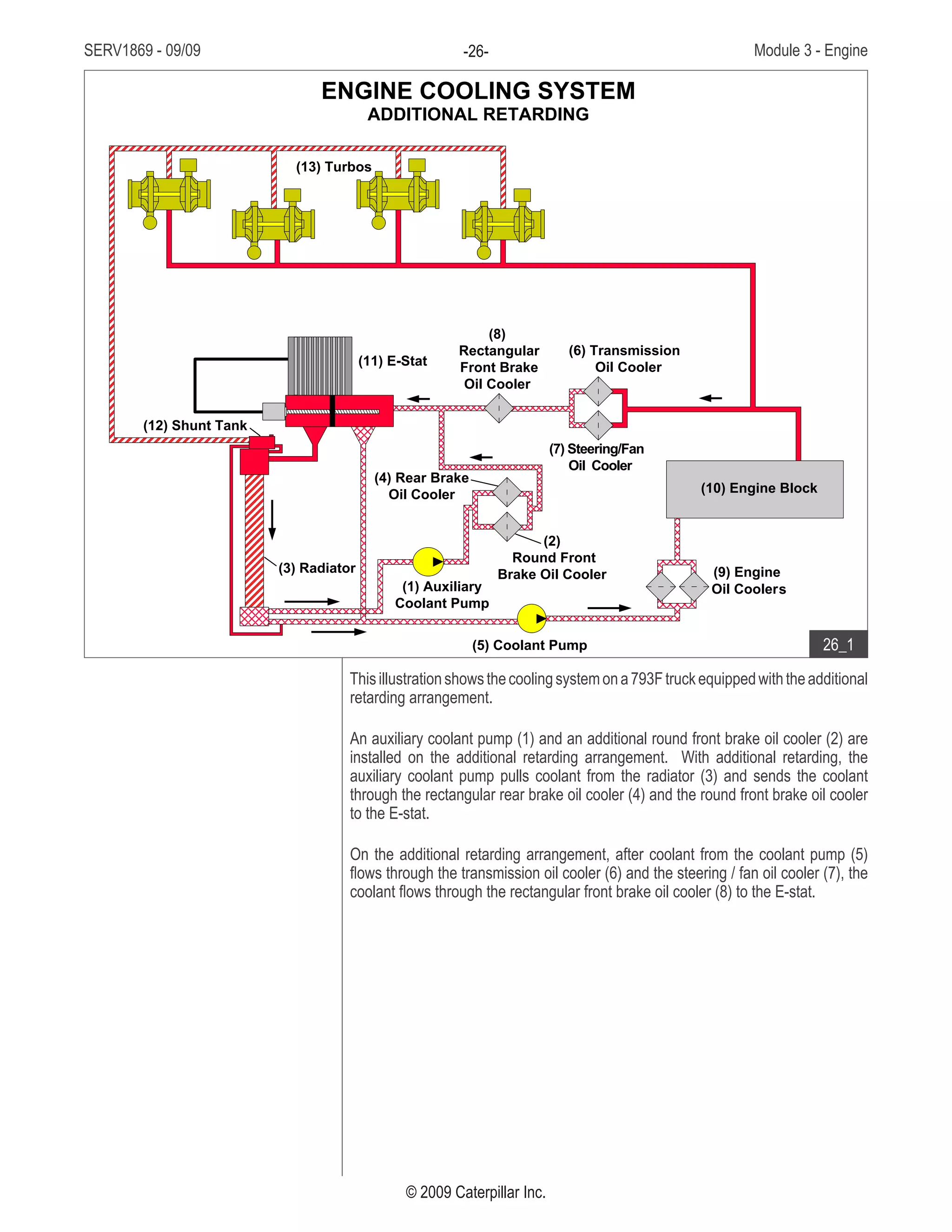
Thisillustrationshowsthecoolingsystemona793Ftruckequippedwiththeadditional
retarding arrangement.
An auxiliary coolant pump (1) and an additional round front brake oil cooler (2) are
installed on the additional retarding arrangement. With additional retarding, the
auxiliary coolant pump pulls coolant from the radiator (3) and sends the coolant
through the rectangular rear brake oil cooler (4) and the round front brake oil cooler
to the E-stat.
On the additional retarding arrangement, after coolant from the coolant pump (5)
flows through the transmission oil cooler (6) and the steering / fan oil cooler (7), the
coolant flows through the rectangular front brake oil cooler (8) to the E-stat.
• Cooling system with additional
retarding
(13) Turbos
(3) Radiator (9) Engine
Oil Coolers
(6) Transmission
Oil Cooler
(7) Steering/Fan
Oil Cooler
(8)
Rectangular
Front Brake
Oil Cooler
(2)
Round Front
Brake Oil Cooler
(4) Rear Brake
Oil Cooler
(12) Shunt Tank
(10) Engine Block
(11) E-Stat
(1) Auxiliary
Coolant Pump
(5) Coolant Pump
ENGINE COOLING SYSTEM
ADDITIONAL RETARDING
26_1
SERV1869 - 09/09 Module 3 - Engine-27-
© 2009 Caterpillar Inc.
The primary coolant pump (1) is located at the front left side of the engine. The
primary coolant pump supplies coolant to the engine oil coolers, the engine block,
the transmission oil cooler, and the steering / fan oil cooler. The primary coolant
pump also supplies coolant to the front and rear brake rectangular oil coolers if the
truck is equipped with the standard retarding arrangement.
If the truck is equipped with the additional retarding arrangement, the auxiliary
coolant pump (2) located at the front right side of the engine supplies coolant to the
rectangular rear brake oil cooler and the round front brake oil cooler.
• Front of engine:
Primary coolant pump1.	
Auxiliary coolant pump2.	
27_1
1
2
SERV1869 - 09/09 Module 3 - Engine-28-
© 2009 Caterpillar Inc.
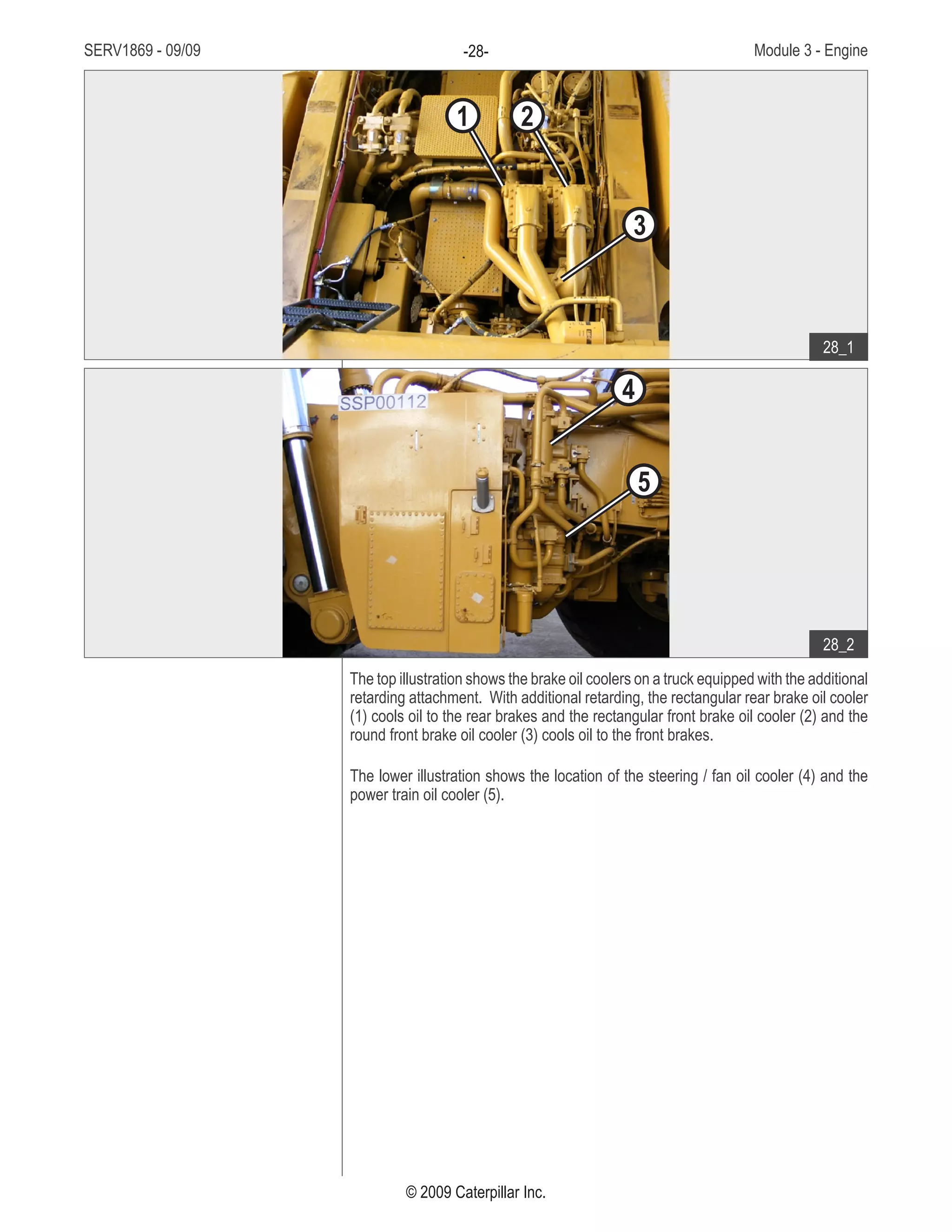
The top illustration shows the brake oil coolers on a truck equipped with the additional
retarding attachment. With additional retarding, the rectangular rear brake oil cooler
(1) cools oil to the rear brakes and the rectangular front brake oil cooler (2) and the
round front brake oil cooler (3) cools oil to the front brakes.
The lower illustration shows the location of the steering / fan oil cooler (4) and the
power train oil cooler (5).
• Oil coolers:
Rectangular rear brake oil1.	
cooler
Rectangular front brake oil2.	
cooler
Round front brake oil cooler3.	
Steering / fan oil cooler4.	
Power train oil cooler5.	
28_1
28_2
1 2
3
4
5
SERV1869 - 09/09 Module 3 - Engine-29-
© 2009 Caterpillar Inc.
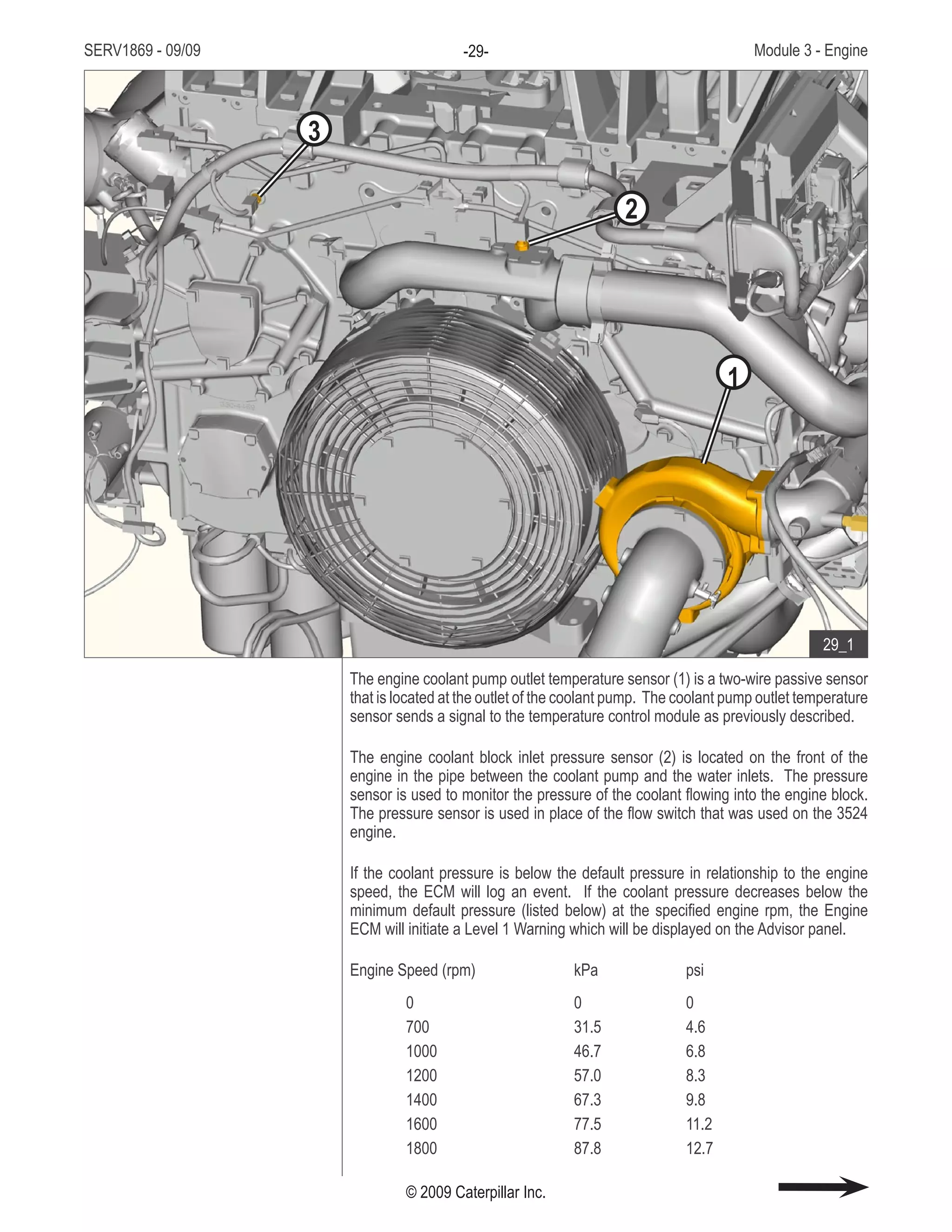
The engine coolant pump outlet temperature sensor (1) is a two-wire passive sensor
that is located at the outlet of the coolant pump. The coolant pump outlet temperature
sensor sends a signal to the temperature control module as previously described.
The engine coolant block inlet pressure sensor (2) is located on the front of the
engine in the pipe between the coolant pump and the water inlets. The pressure
sensor is used to monitor the pressure of the coolant flowing into the engine block.
The pressure sensor is used in place of the flow switch that was used on the 3524
engine.
If the coolant pressure is below the default pressure in relationship to the engine
speed, the ECM will log an event. If the coolant pressure decreases below the
minimum default pressure (listed below) at the specified engine rpm, the Engine
ECM will initiate a Level 1 Warning which will be displayed on the Advisor panel.
Engine Speed (rpm)		 kPa		 psi
	 0			 0		 0
	 700			 31.5		 4.6
	 1000			 46.7		 6.8
	 1200			 57.0		 8.3
	 1400			 67.3		 9.8
	 1600			 77.5		 11.2
	 1800			 87.8		 12.7
• Cooling system components:
Engine coolant pump outlet1.	
temperature sensor
Engine coolant block inlet2.	
pressure sensor
Engine coolant block outlet3.	
temperature sensor
29_1
3
2
1
SERV1869 - 09/09 Module 3 - Engine-30-
© 2009 Caterpillar Inc.
The engine coolant block outlet temperature sensor (3) is located on the right front
side of the engine. The block outlet temperature sensor is used to monitor the
coolant temperature exiting the engine block. The temperature sensor is an input to
the Engine ECM and is used for various control and protection strategies (i.e. engine
overheating, engine damage due to cylinder overpressure, and engine wear due to
overcooling).
SERV1869 - 09/09 Module 3 - Engine-31-
© 2009 Caterpillar Inc.
This illustration shows the percent of engine derate as the engine temperature
increases.
The engine coolant block outlet temperature sensor measures the temperature of
the coolant.
When the temperature of the coolant exceeds 100° C (212° F), the Engine ECM will
initiate a Level 1 Warning.
When the temperature of the coolant exceeds 101° C (213° F), the Engine ECM will
initiate a Level 2 Warning and a 25% derate. At 104° C (219° F), the derate will be
50%. At 107° C (225° F), the derate will be 75%. At 110° C (230° F), the derate will
be 100% and the Engine ECM will initiate a Level 3 Warning. A 100% derate equals
approximately a 50% horsepower derate.
• High coolant temperature engine
derate
• Engine coolant block outlet
temperature sensor
• Level 1 Warning
• Derate temperatures
100
100
80
(1)%Derate
(2) Coolant Temperature in °C
HIGH COOLANT TEMPERATURE DERATE
(3) Level 1 Warning (4) Level 2 Warning / Derates
60
40
20
0
120
101 102 103 104 105 106 107 108 109 110
31_1
SERV1869 - 09/09 Module 3 - Engine-32-
© 2009 Caterpillar Inc.
The low coolant level switch (1) is located in the shunt tank (2) mounted on top of the
radiator. The switch is behind the removable cover between the radiator and the
engine. The low coolant level switch sends a signal to the Engine ECM indicating
coolant level. With the key in the ON position and the coolant level below the low
coolant level switch for more than 3 seconds, the Engine ECM will initiate a Level 2
Warning to the Advisor panel. When the engine is running and the coolant is below
the low coolant level switch for more than 17 seconds, the Engine ECM will initiate a
Level 3 Warning through the Advisor panel.
• Top of radiator:
Low coolant level switch1.	
Shunt tank2.	
32_1
2
1
SERV1869 - 09/09 Module 3 - Engine-33-
© 2009 Caterpillar Inc.
The Electronic Thermostat (E-Stat) is mounted to a bracket near the left side of the
radiator and includes the stepper motor (1) and the temperature control module (2).
A piston, which is driven by the stepper motor, is located inside the valve (3).
The valve controls the coolant flow to the bypass line and the radiator. The piston
(not shown) movement within the valve, alters the coolant flow through a lead screw
driven by the stepper motor.
• E-stat components:
Stepper motor1.	
Temperature control module2.	
Valve3.	
33_1
3
1
2
SERV1869 - 09/09 Module 3 - Engine-34-
© 2009 Caterpillar Inc.
The coolant pump outlet temperature sensor (1) measures the temperature of the
coolant flowing into the engine oil coolers (2) and sends a signal to the temperature
control module (3).
As the coolant temperature increases, the temperature control module sends a
current to the stepper motor (4) to move the piston (5), which closes the coolant
bypass (6) and allows more coolant flow through the radiator (7). As the coolant
temperature decreases, the temperature control module sends a current to the
stepper motor to move the piston, which opens the coolant bypass and allows less
coolant flow to the radiator.
At engine start-up, the stepper motor / piston position needs to be reset. The stepper
motor drives the piston to the configured stop. As the piston reaches the stop, a
ratcheting sound occurs indicating that the piston has hit the stop.
NOTE: If the engine shuts down and is restarted in less than 4 minutes, the
stepper motor / piston position does not reset, so there will be no ratcheting
noise.
• E-Stat operation
(8) Engine
ECM
(10) Front Brake
Oil Coolers
(11) Coolant
Pump
(9) CAN (J1939)
(3) Temperature
Control Module
(4) Stepper
Motor
(5) Piston
(6) Bypass Line
(7) Radiator
(2) Engine Oil
Coolers(1) Coolant Pump Outlet
Temperature Sensor
E-Stat
Operation
34_1
SERV1869 - 09/09 Module 3 - Engine-35-
© 2009 Caterpillar Inc.
ENGINE LUBRICATION SYSTEM
This illustration shows the oil flow through the C175 engine. Oil is drawn from the
engine sump (1) through a screen (2) by the engine oil pump (3). The oil pump
sends oil to the pressure regulator (4), which directs oil to the engine oil coolers (5)
or through the engine oil cooler bypass valve (6) to the engine sump if the oil pressure
is too high.
Oil flows from the oil coolers or bypass valve to the engine oil filters (7). The unfiltered
oil pressure sensor (8) and the oil pressure sensor (filtered oil) (9) calculate the
restriction in the oil filters.
From the engine oil filters, the oil enters the engine block and flows through the
main oil galley to lubricate the internal engine components and the turbos (10). The
filtered oil is also directed to the high pressure fuel pump (11) for lubrication.
If the engine oil pressure increases above approximately 550 kPa (80 psi), the
pressure in the signal line from the oil galley acts on the top of the regulator and
moves the regulator down against spring force. The regulator directs oil flow to the
sump.
Located in the front section of the pan is the scavenge pump (12). The scavenge
pump draws oil from the rear pan section and returns it to the main sump.
• Engine oil flow
(18) Engine
Front
Cover
(10)
Turbos
(10)
Turbos
(11) High
Pressure
Fuel Pump
(18) Engine
Front
Cover
(4) Pressure
Regulator
(2) Screen (3) Engine
Oil Pump
ENGINE LUBRICATION SYSTEM
(14) Relief
Valve
(12) Scavenge
Pump
(1) Sump
(17) Oil
Temperature
Sensor
(9) Oil
Pressure
Sensor
(13) Prelube Pump
and Electric Motor
(7) Engine
Oil Filters
(16) Check
Valve
(8) Unfiltered
Oil Pressure
Sensor
(5) Engine Oil Coolers
(6) Engine Oil Cooler Bypass
(15) S•O•S
Port
35_1
SERV1869 - 09/09 Module 3 - Engine-36-
© 2009 Caterpillar Inc.
The prelube pump (13) supplies lubrication oil to the system and is connected
between the pressure regulator and the engine oil coolers.
Also, installed in the line from the engine oil pump is a relief valve (14) which limits
the system pressure to 875 kPa (127 psi).
A S•O•S port (15) is also installed at the engine oil cooler bypass housing.
SERV1869 - 09/09 Module 3 - Engine-37-
© 2009 Caterpillar Inc.
This illustration shows the location of the engine lubrication system components on
the left side of the engine:
relief valve and oil pressure regulator (1)--
engine oil pump (2)--
engine oil cooler bypass valve (3)--
engine oil S•O•S port (4)--
engine oil coolers (5)--
The engine oil tube (6) provides a flow path to the engine oil filters on the right side
of the engine.
The fast fill level switch (7) provides an engine oil level indication to the engine oil full
indicator on the Caterpillar Fast Fill Panel.
The engine oil low level switch (8) provides an engine oil level indication to the
Engine ECM.
The engine oil level sight gauge (9) allows the technician to check the oil level from
ground level.
• Left side of engine:
Relief valve and oil pressure1.	
regulator
Engine oil pump2.	
Engine oil cooler bypass3.	
valve
Engine oil S•O•S port4.	
Engine oil coolers5.	
Engine oil tube6.	
Caterpillar fast fill level switch7.	
Engine oil low level switch8.	
Engine oil level sight gauge9.	
37_1
1
2 3
4
7
9
8
5 6
SERV1869 - 09/09 Module 3 - Engine-38-
© 2009 Caterpillar Inc.
This illustration shows the location of the engine lubrication system components on
the right side of the engine.
The engine oil pump sends oil through the coolers, below the engine through the
lower engine oil tube (1), and into the engine oil filter base (2). Filtered oil flows into
the engine block through the upper engine oil tube (3) and oil filters (4).
Engine oil flowing into the block is monitored by the engine oil temperature
sensor (5) and the filtered oil pressure sensor (6). The filtered oil pressure sensor
monitors the pressure from the discharge side of the filter base and works together
with the unfiltered oil pressure sensor (7) to determine engine oil filter blockage.
The unfiltered oil pressure sensor monitors the oil pressure at the inlet of the filter
group.
The filtered oil pressure sensor initiates a plugged oil filter Level 1 Warning, with a
warning sent to the Advisor panel to advise the operator. The filtered oil pressure
sensor data that is sent to the Engine ECM is also used as the determining pressure
for the low engine oil pressure event control.
The engine oil temperature sensor is used to monitor the engine oil temperature for
engine protection strategies. The oil temperature must be monitored to inform the
operator through the Advisor panel that the oil temperature is above the limit. There
is no oil temperature sensor for the oil that is leaving the engine block.
• Right side of engine:
Lower engine oil tube1.	
Engine oil filter base2.	
Upper engine oil tube3.	
Oil filters4.	
Engine oil temperature sensor5.	
Filtered oil pressure sensor6.	
Unfiltered oil pressure sensor7.	
38_1
1
3
2
5
6
7
4
SERV1869 - 09/09 Module 3 - Engine-39-
© 2009 Caterpillar Inc.
At 108° C (226° F), the Engine ECM initiates a Level 1 Warning (1). When the
engine oil temperature rises above 110° C (230° F), the engine power is derated by
3% and the Engine ECM initiates a Level 2 Warning (2). This derate will increase at
a rate of 3% through the temperature of 113° C (235° F). At 114° C (237° F), the
derate increases to 25%; at 115° C (239° F), the derate increases to 50%; and, at
116° C (240° F), the derate increases to 75%.
At a temperature above 115° C (239° F), the Engine ECM sends a shutdown (3)
message to the VIMS module alarming the operator to SAFELY shutdown the
engine.
The following conditions must be met for a safe engine shutdown:
the engine speed must be less than 1300 rpm--
the transmission must be in NEUTRAL--
the parking brake is engaged--
the machine is at ZERO ground speed--
• Engine oil temperature derate
• Safe engine shutdown
100
80
(5)%Derate
60
40
20
0
120
108
(4) Engine Oil Temperature in °C
110 111 112 113 114 115 116 117
HIGH ENGINE OIL TEMPERATURE DERATE
(1) Level 1 Warning (3) Shutdown(2) Level 2 Warning / Derates
39_1
SERV1869 - 09/09 Module 3 - Engine-40-
© 2009 Caterpillar Inc.
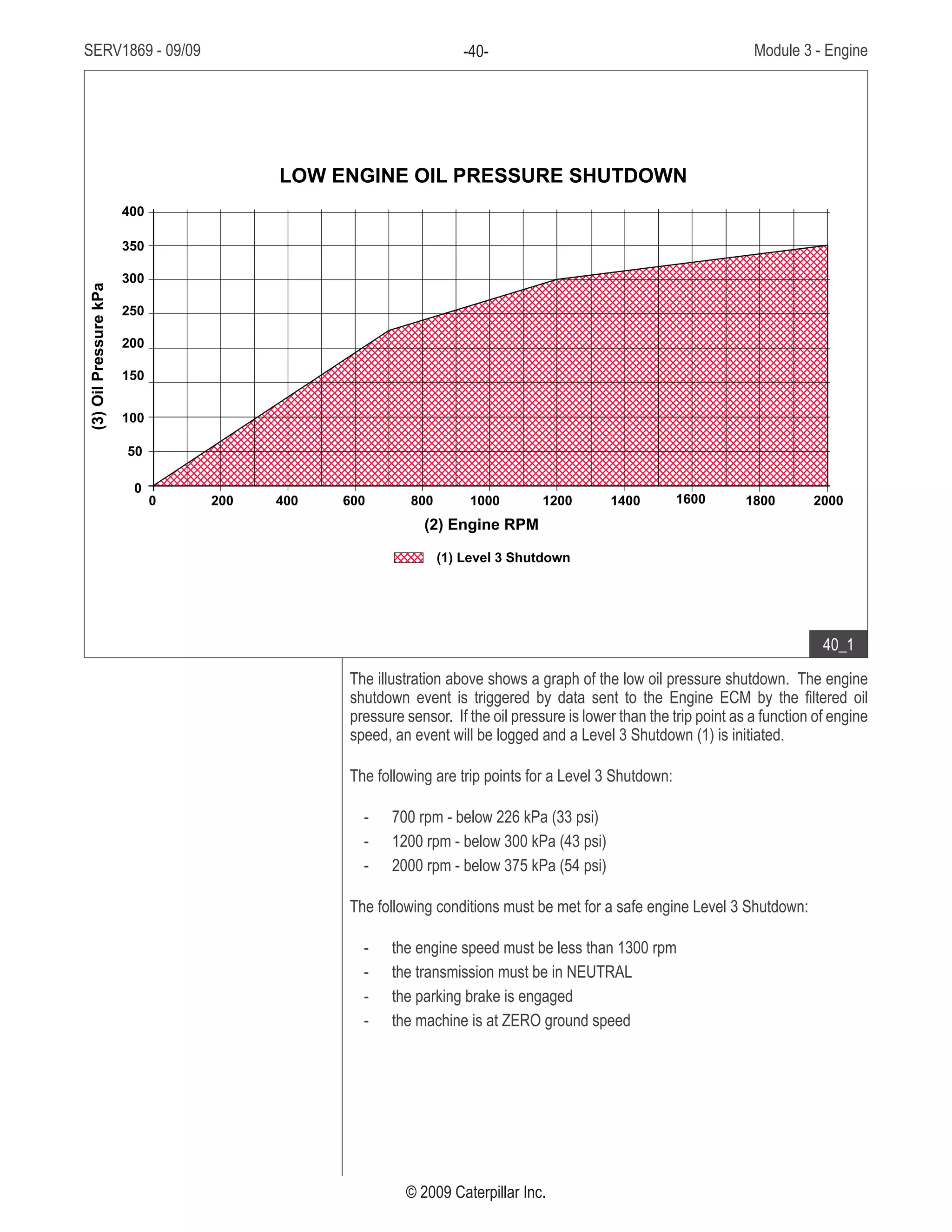
The illustration above shows a graph of the low oil pressure shutdown. The engine
shutdown event is triggered by data sent to the Engine ECM by the filtered oil
pressure sensor. If the oil pressure is lower than the trip point as a function of engine
speed, an event will be logged and a Level 3 Shutdown (1) is initiated.
The following are trip points for a Level 3 Shutdown:
700 rpm - below 226 kPa (33 psi)--
1200 rpm - below 300 kPa (43 psi)--
2000 rpm - below 375 kPa (54 psi)--
The following conditions must be met for a safe engine Level 3 Shutdown:
the engine speed must be less than 1300 rpm--
the transmission must be in NEUTRAL--
the parking brake is engaged--
the machine is at ZERO ground speed--
• Low oil pressure shutdown
• Level 3 Shutdown trip points
• Safe engine Level 3 Shutdown
(3)OilPressurekPa
400
400
(1) Level 3 Shutdown
(2) Engine RPM
600 800 1000 1200 1400 1600 1800 2000
350
300
250
200
200
150
100
50
0
0
LOW ENGINE OIL PRESSURE SHUTDOWN
40_1
SERV1869 - 09/09 Module 3 - Engine-41-
© 2009 Caterpillar Inc.
Engine Prelube
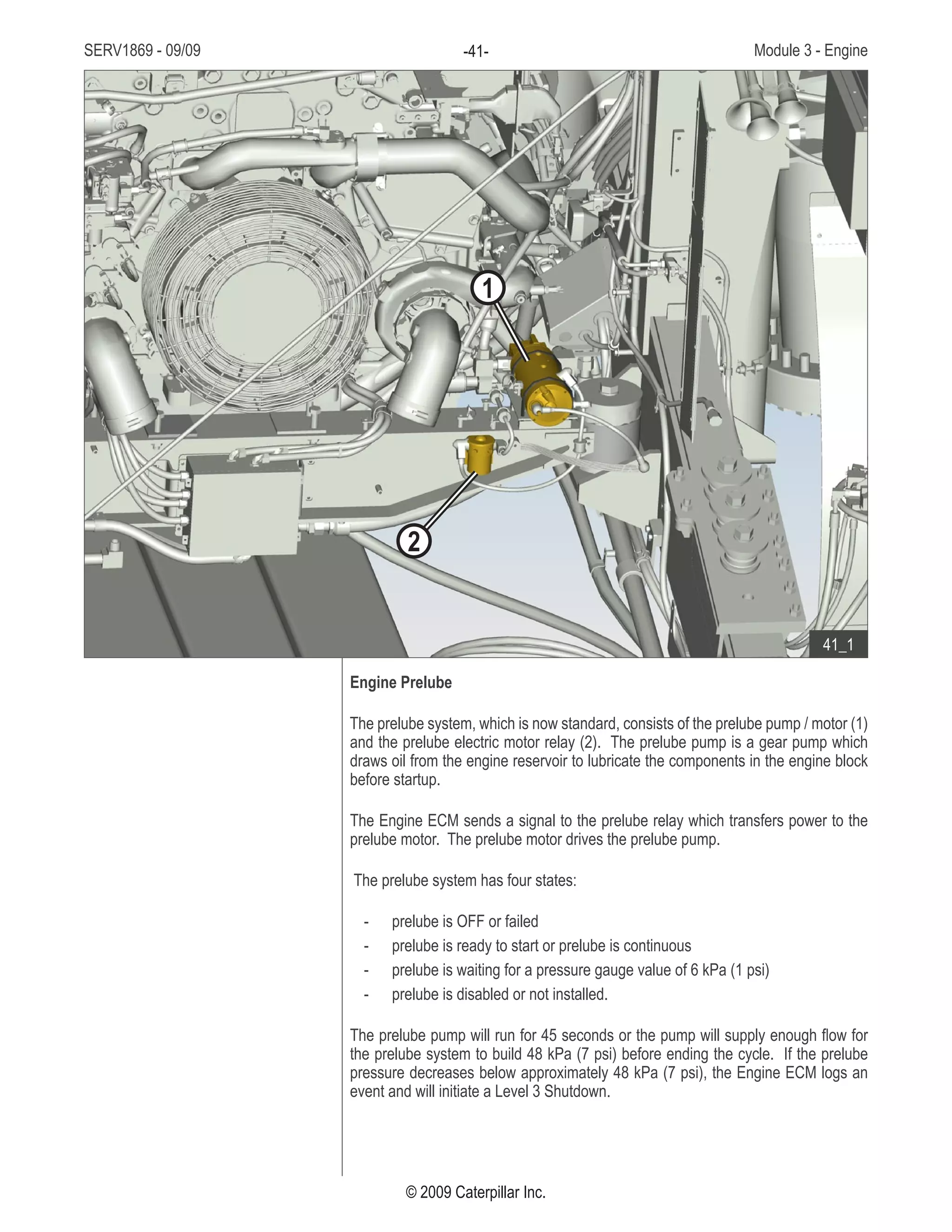
The prelube system, which is now standard, consists of the prelube pump / motor (1)
and the prelube electric motor relay (2). The prelube pump is a gear pump which
draws oil from the engine reservoir to lubricate the components in the engine block
before startup.
The Engine ECM sends a signal to the prelube relay which transfers power to the
prelube motor. The prelube motor drives the prelube pump.
The prelube system has four states:
prelube is OFF or failed--
prelube is ready to start or prelube is continuous--
prelube is waiting for a pressure gauge value of 6 kPa (1 psi)--
prelube is disabled or not installed.--
The prelube pump will run for 45 seconds or the pump will supply enough flow for
the prelube system to build 48 kPa (7 psi) before ending the cycle. If the prelube
pressure decreases below approximately 48 kPa (7 psi), the Engine ECM logs an
event and will initiate a Level 3 Shutdown.
• In front of the engine on the left
side:
Prelube pump / motor1.	
Prelube electric motor relay2.	
41_1
1
2
SERV1869 - 09/09 Module 3 - Engine-42-
© 2009 Caterpillar Inc.
Coolant and Lubrication Oil Line Clamps
These illustrations show the coolant and lubrication oil line clamps. The clamps are
similar to the clamps used on the 3600 engines.
The bottom illustrations show the placement of the non-metalic alignment ring (blue)
and the o-rings (green). When installing the clamp, ensure the non-metallic alignment
ring lip fully seats as shown in the bottom right illustration.
Evenly hand tighten the bolts and then torque the bolts to the correct specification.
NOTE: Refer to the Disassembly and Assembly manual for complete
disassembly and assembly service procedures.
• Oil line clamps similar to 3600
engine clamps
• Ensure blue alignment ring is
seated
• Hand tighten and then torque
bolts
42_1
42_242_2 42_3
SERV1869 - 09/09 Module 3 - Engine-43-
© 2009 Caterpillar Inc.
ENGINE FUEL SYSTEM
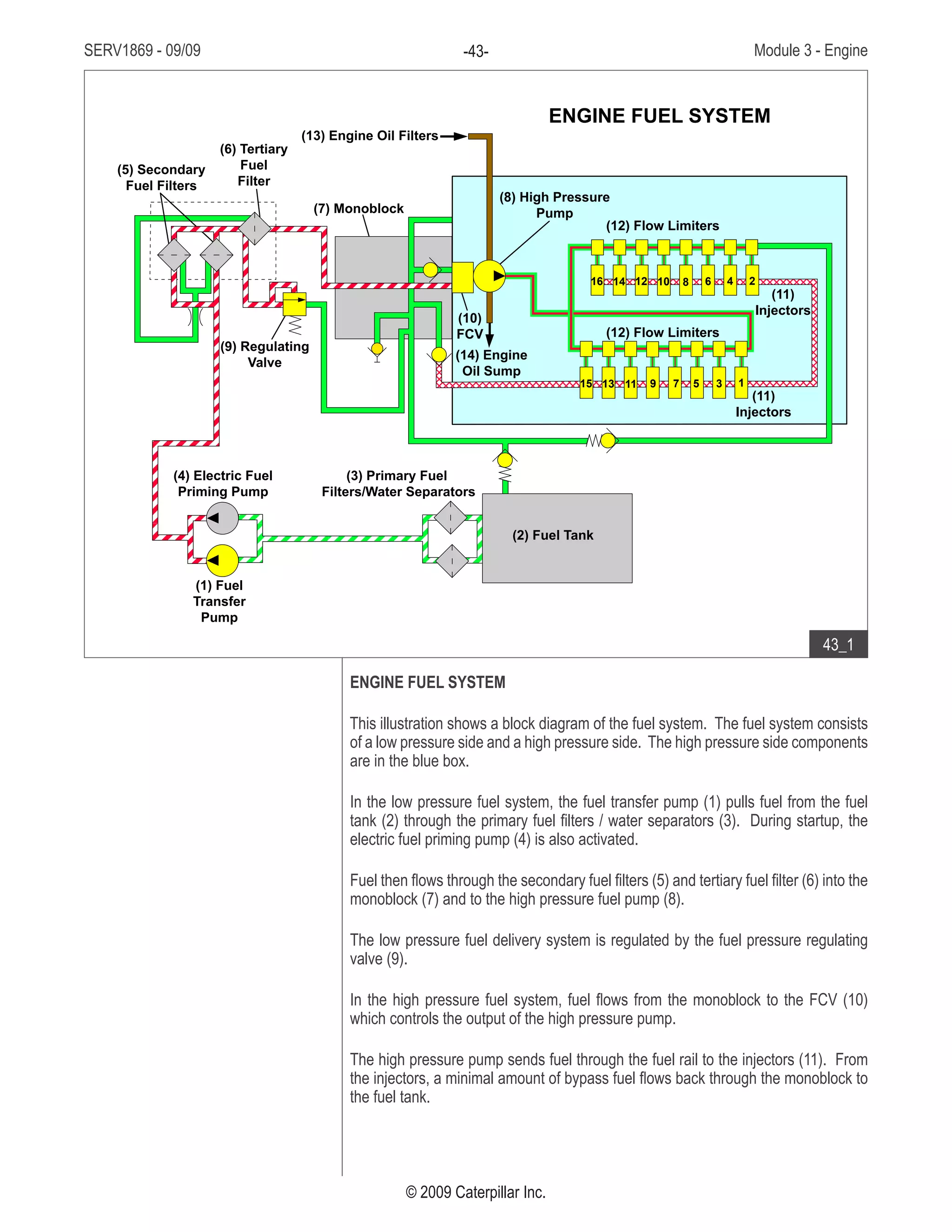
This illustration shows a block diagram of the fuel system. The fuel system consists
of a low pressure side and a high pressure side. The high pressure side components
are in the blue box.
In the low pressure fuel system, the fuel transfer pump (1) pulls fuel from the fuel
tank (2) through the primary fuel filters / water separators (3). During startup, the
electric fuel priming pump (4) is also activated.
Fuel then flows through the secondary fuel filters (5) and tertiary fuel filter (6) into the
monoblock (7) and to the high pressure fuel pump (8).
The low pressure fuel delivery system is regulated by the fuel pressure regulating
valve (9).
In the high pressure fuel system, fuel flows from the monoblock to the FCV (10)
which controls the output of the high pressure pump.
The high pressure pump sends fuel through the fuel rail to the injectors (11). From
the injectors, a minimal amount of bypass fuel flows back through the monoblock to
the fuel tank.
• Fuel system block diagram
• Low pressure fuel system
• High pressure fuel system
(8) High Pressure
Pump
(5) Secondary
Fuel Filters
(6) Tertiary
Fuel
Filter
(13) Engine Oil Filters
(11)
Injectors
(11)
Injectors
13579111315
(3) Primary Fuel
Filters/Water Separators
(1) Fuel
Transfer
Pump
(4) Electric Fuel
Priming Pump
(14) Engine
Oil Sump
(2) Fuel Tank
(12) Flow Limiters
(12) Flow Limiters
(10)
FCV
(7) Monoblock
(9) Regulating
Valve
1416 24681012
ENGINE FUEL SYSTEM
43_1
SERV1869 - 09/09 Module 3 - Engine-44-
© 2009 Caterpillar Inc.
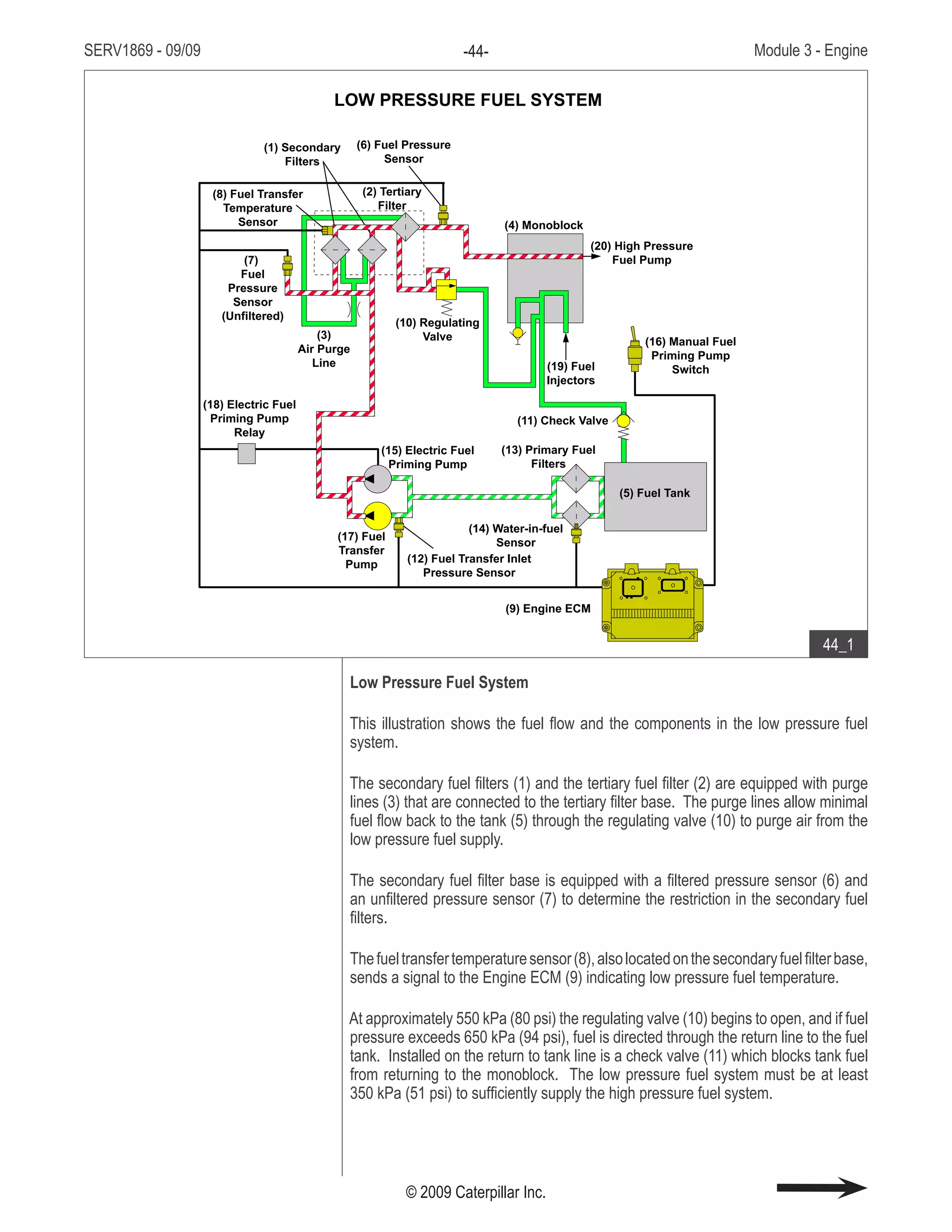
Low Pressure Fuel System
This illustration shows the fuel flow and the components in the low pressure fuel
system.
The secondary fuel filters (1) and the tertiary fuel filter (2) are equipped with purge
lines (3) that are connected to the tertiary filter base. The purge lines allow minimal
fuel flow back to the tank (5) through the regulating valve (10) to purge air from the
low pressure fuel supply.
The secondary fuel filter base is equipped with a filtered pressure sensor (6) and
an unfiltered pressure sensor (7) to determine the restriction in the secondary fuel
filters.
Thefueltransfertemperaturesensor(8),alsolocatedonthesecondaryfuelfilterbase,
sends a signal to the Engine ECM (9) indicating low pressure fuel temperature.
At approximately 550 kPa (80 psi) the regulating valve (10) begins to open, and if fuel
pressure exceeds 650 kPa (94 psi), fuel is directed through the return line to the fuel
tank. Installed on the return to tank line is a check valve (11) which blocks tank fuel
from returning to the monoblock. The low pressure fuel system must be at least
350 kPa (51 psi) to sufficiently supply the high pressure fuel system.
• Fuel flow and components
• Secondary fuel filters and sensors
• Regulating valve
(1) Secondary
Filters
(2) Tertiary
Filter
(6) Fuel Pressure
Sensor
(20) High Pressure
Fuel Pump
(19) Fuel
Injectors
(9) Engine ECM
(14) Water-in-fuel
Sensor
(13) Primary Fuel
Filters
(12) Fuel Transfer Inlet
Pressure Sensor
(3)
Air Purge
Line
(8) Fuel Transfer
Temperature
Sensor
(7)
Fuel
Pressure
Sensor
(Unfiltered)
(17) Fuel
Transfer
Pump
(15) Electric Fuel
Priming Pump
(18) Electric Fuel
Priming Pump
Relay
(5) Fuel Tank
(16) Manual Fuel
Priming Pump
Switch
(11) Check Valve
(4) Monoblock
(10) Regulating
Valve
LOW PRESSURE FUEL SYSTEM
44_1
SERV1869 - 09/09 Module 3 - Engine-45-
© 2009 Caterpillar Inc.
The fuel transfer inlet pressure sensor (12) sends a signal to the Engine ECM
indicating a restriction in the primary fuel filters (13). The primary fuel filters are
equipped with a water-in-fuel sensor (14) which sends a signal to the Engine ECM
indicating excessive water in the fuel.
The electric fuel priming pump (15) is initiated by the Engine ECM and/or the manual
fuel priming pump switch (16). When the fuel system has been serviced, the fuel
priming pump is used to prime the fuel system.
• Primary filters and sensors
• Priming pump
SERV1869 - 09/09 Module 3 - Engine-46-
© 2009 Caterpillar Inc.
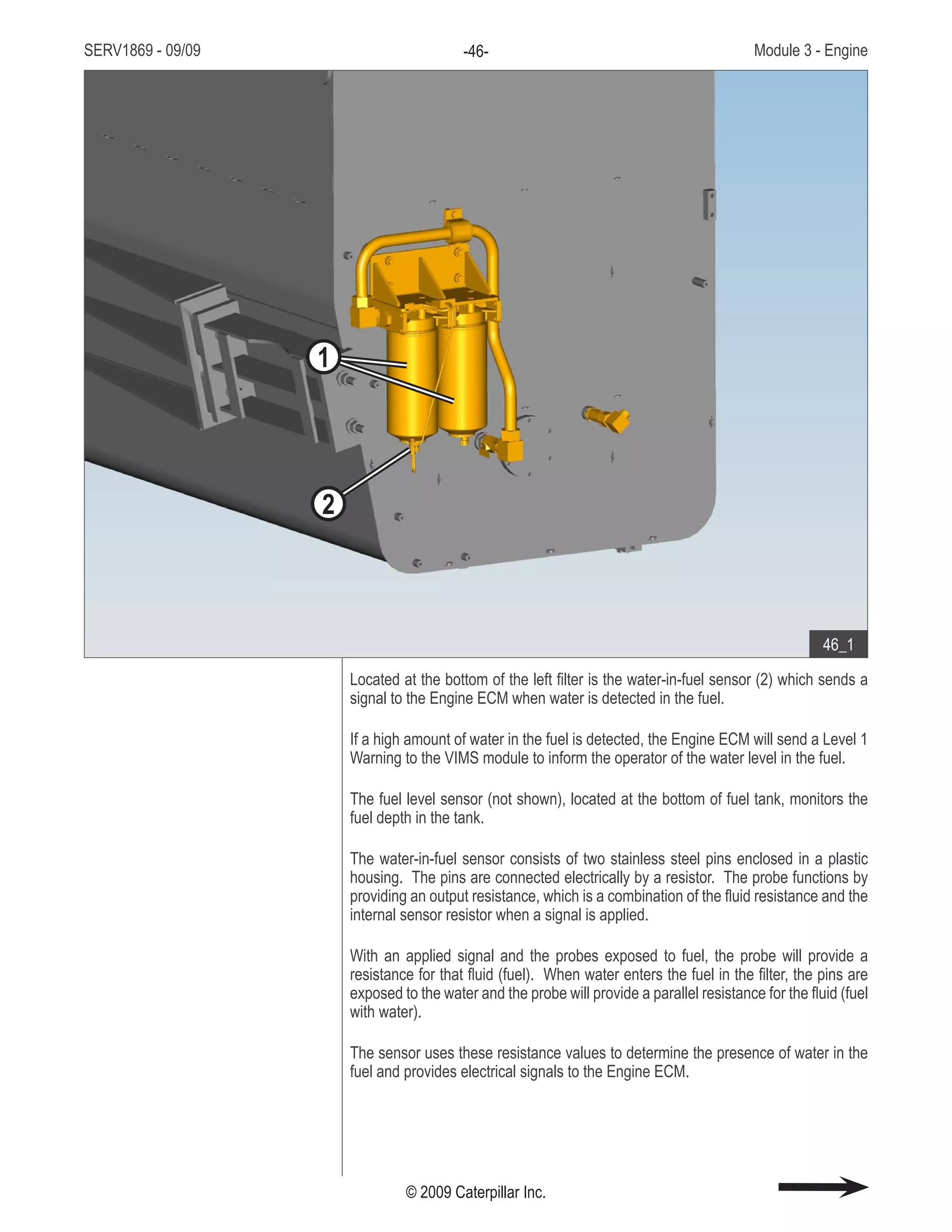
The primary fuel filters / water separators (1) are located between the fuel tank and
the fuel transfer pump on the back of the fuel tank.
Located at the bottom of the left filter is the water-in-fuel sensor (2) which sends a
signal to the Engine ECM when water is detected in the fuel.
If a high amount of water in the fuel is detected, the Engine ECM will send a Level 1
Warning to the VIMS module to inform the operator of the water level in the fuel.
The fuel level sensor (not shown), located at the bottom of fuel tank, monitors the
fuel depth in the tank.
The water-in-fuel sensor consists of two stainless steel pins enclosed in a plastic
housing. The pins are connected electrically by a resistor. The probe functions by
providing an output resistance, which is a combination of the fluid resistance and the
internal sensor resistor when a signal is applied.
With an applied signal and the probes exposed to fuel, the probe will provide a
resistance for that fluid (fuel). When water enters the fuel in the filter, the pins are
exposed to the water and the probe will provide a parallel resistance for the fluid (fuel
with water).
The sensor uses these resistance values to determine the presence of water in the
fuel and provides electrical signals to the Engine ECM.
• Back of fuel tank:
Primary fuel filters / water1.	
separators
Water-in-fuel sensor2.	
46_1
1
2
SERV1869 - 09/09 Module 3 - Engine-47-
© 2009 Caterpillar Inc.
NOTE: For additional information about troubleshooting the water-in-fuel
sensor, refer to the Service MagazineArticle “Troubleshooting the Water-in-Fuel
Sensor” 1400-0079-2006.
SERV1869 - 09/09 Module 3 - Engine-48-
© 2009 Caterpillar Inc.
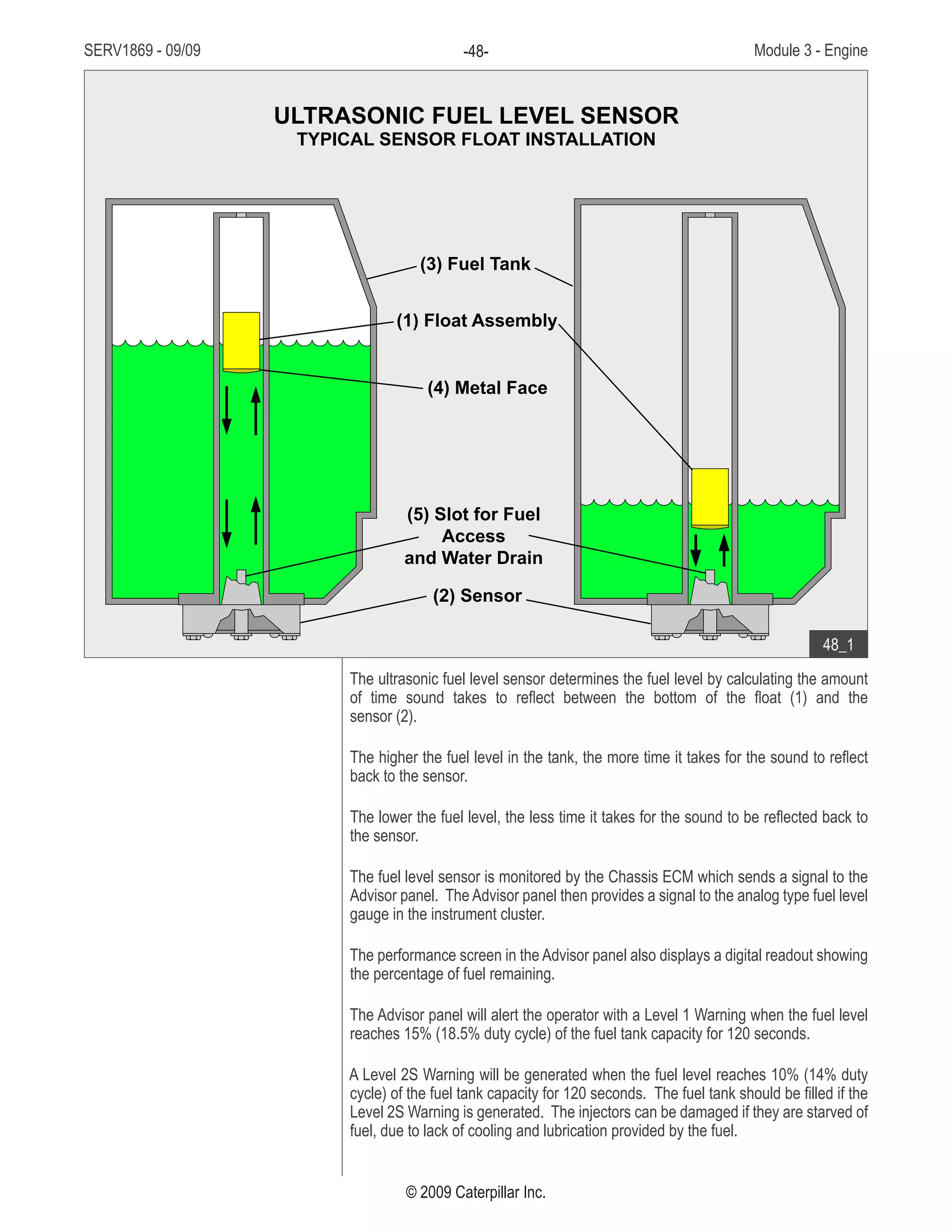
The ultrasonic fuel level sensor determines the fuel level by calculating the amount
of time sound takes to reflect between the bottom of the float (1) and the
sensor (2).
The higher the fuel level in the tank, the more time it takes for the sound to reflect
back to the sensor.
The lower the fuel level, the less time it takes for the sound to be reflected back to
the sensor.
The fuel level sensor is monitored by the Chassis ECM which sends a signal to the
Advisor panel. The Advisor panel then provides a signal to the analog type fuel level
gauge in the instrument cluster.
The performance screen in the Advisor panel also displays a digital readout showing
the percentage of fuel remaining.
The Advisor panel will alert the operator with a Level 1 Warning when the fuel level
reaches 15% (18.5% duty cycle) of the fuel tank capacity for 120 seconds.
A Level 2S Warning will be generated when the fuel level reaches 10% (14% duty
cycle) of the fuel tank capacity for 120 seconds. The fuel tank should be filled if the
Level 2S Warning is generated. The injectors can be damaged if they are starved of
fuel, due to lack of cooling and lubrication provided by the fuel.
• Fuel level sensor
• Monitored by Chassis ECM
• Advisor displays fuel level
• Level 1 Warning
• Level 2S Warning
(2) Sensor
(5) Slot for Fuel
Access
and Water Drain
(4) Metal Face
(1) Float Assembly
(3) Fuel Tank
ULTRASONIC FUEL LEVEL SENSOR
TYPICAL SENSOR FLOAT INSTALLATION
48_1
SERV1869 - 09/09 Module 3 - Engine-49-
© 2009 Caterpillar Inc.
The fuel transfer pump (1) and the monoblock (2) are mounted to the high pressure
fuel pump (3). The transfer pump pulls fuel from the tank and sends the fuel to the
secondary fuel filter base.
The regulating valve is located in the secondary fuel filter base.
The fuel transfer inlet pressure sensor (4) sends a signal to the Engine ECM indicating
a restriction in the primary fuel filters.
• Right side of engine:
Fuel transfer pump1.	
Monoblock2.	
High pressure fuel pump3.	
Fuel transfer inlet pressure4.	
sensor
49_1
2
3
14
SERV1869 - 09/09 Module 3 - Engine-50-
© 2009 Caterpillar Inc.
The C175 engine is equipped with a new larger volume fuel priming pump (1) and
motor (2).
The electric fuel priming pump is initiated by the Engine ECM via a fuel pump relay in
the cab or the manual fuel priming pump switch (3). The manual fuel priming pump
switch is used to prime the fuel system after changing fuel filters.
NOTE: If the engine is 100 rpm below the rated idle specification, the Engine
ECM will shut off the electric priming pump and the fuel transfer pump will supply
the fuel to the low pressure fuel system.
• Right side near front of engine:
Fuel priming pump1.	
Motor2.	
Manual fuel priming pump3.	
switch
50_1
2
3
1
SERV1869 - 09/09 Module 3 - Engine-51-
© 2009 Caterpillar Inc.
The secondary fuel filters (1) and the tertiary fuel filter (2) are located on the right side
of the engine.
The fuel pressure sensor (3) on the front secondary fuel filter base monitors the
unfiltered fuel pressure.
The fuel pressure sensor (4) on the tertiary fuel filter base monitors the fuel pressure
after the fuel filters. The fuel pressure sensors work together to determine the
restriction in the secondary fuel filters.
• Right side near front of engine:
Secondary fuel filters1.	
Tertiary fuel filter2.	
Fuel pressure sensor on front3.	
secondary fuel filter base
Fuel pressure sensor on4.	
tertiary fuel filter base
51_1
4
2
3
1
SERV1869 - 09/09 Module 3 - Engine-52-
© 2009 Caterpillar Inc.
This illustration shows a graph of the fuel filter warning derate.
The Engine ECM uses the pressure differential between the sensors to indicate a
restriction in the fuel filters. When a fuel filter differential pressure of 104 kPa (15 psi)
exists for a two-minute duration, the Engine ECM logs a Level 1 Warning (1).
After a five-minute duration of a 124 kPa (18 psi) pressure differential, a Level 2
Warning (2) derate of 17.5% is initiated. After one additional second, another 17.5%
derate will be added to the initial derate, totaling 35%.
• Fuel filter warning derate
• Level 1 Warning
• Level 2 Warning
50
40
(4)%Derate
30
20
10
0
0
60
FUEL FILTER RESTRICTION DERATE
PRESSURE ABOVE 124 kPa (18 psi)
(1) Level 1 Warning (2) Level 2 Warning / Derates
(3) Time
1 min 2 min 3 min 4 min 5 min 5 min
1 sec
52_1
SERV1869 - 09/09 Module 3 - Engine-53-
© 2009 Caterpillar Inc.
The fuel transfer temperature sensor (1) is located on the base of the rear secondary
fuel filter (2) and monitors the fuel temperature in the low pressure fuel system.
• Rear of secondary filter base:
Fuel transfer temperature1.	
sensor
Rear secondary fuel filter2.	
53_1
1
2
SERV1869 - 09/09 Module 3 - Engine-54-
© 2009 Caterpillar Inc.
High Pressure Fuel System
The high pressure fuel system requires special handling to ensure personnel safety
and proper function of the components. The system contains spherical ball and
conical sealing joints. The system is designed to operate at approximately 180 MPa
(26,100 psi) fuel pressure with a system relief of 205 MPa (29,700 psi).
Before opening a high pressure fuel system line or removing components, ensure
that the fuel pressure is relieved or purged. Connect Cat ET and observe the fuel
pressure. When fuel pressure decreases below 1000 kPa (145 psi), wait 15 minutes
before opening the high pressure lines.
Be aware that the fuel temperature may be warm enough to cause a burn to the
skin.
Be prepared to collect and contain all fluids during service procedures.
Keep all parts protected from contamination.
NOTE: The plastic bag that is shown has a Caterpillar® part number and is fuel
breakdown resistant. Refer to the Special Publication, NENG2500, “Caterpillar
Tools and Shop Products Guide” for tools and supplies to collect and contain
fluids on Caterpillar products. Dispose of all fluids according to local regulations
and mandates.
• High pressures
• Relieve fuel pressure before
servicing
• Collect and contain fluids
• Protect parts
54_1
54_2
SERV1869 - 09/09 Module 3 - Engine-55-
© 2009 Caterpillar Inc.
Fuel flows into the monoblock (1) and to the FCV from the low pressure fuel system.
The FCV controls the output of the high pressure pump (2).
The high pressure pump sends fuel through the fuel rail (3) and quill tubes (4) to the
injectors. From the injectors, the bypassed fuel flows back through the monoblock
to the fuel tank.
• High pressure fuel components:
Monoblock1.	
High pressure pump2.	
Fuel rail3.	
Quill tubes4.	
55_1
4
3
1
2
SERV1869 - 09/09 Module 3 - Engine-56-
© 2009 Caterpillar Inc.
This illustration shows the return line (green) from the injectors.• Injector return line (green)
56_1
SERV1869 - 09/09 Module 3 - Engine-57-
© 2009 Caterpillar Inc.
The top illustration shows the high pressure pump (1) on the right side of the engine.
The FCV (2) is installed at the rear of the fuel pump.
The FCV receives a PWM voltage signal from the Engine ECM which controls the
fuel inlet throttling to the high pressure pump.
Also shown is the FCV suppressor module (3) and the fuel transfer pump (4).
The suppressor module protects the FCV from voltage spikes.
• Front right side of engine:
High pressure pump1.	
FCV2.	
FCV suppressor module3.	
Fuel transfer pump4.	
57_1
57_2
1
4
3
2
SERV1869 - 09/09 Module 3 - Engine-58-
© 2009 Caterpillar Inc.
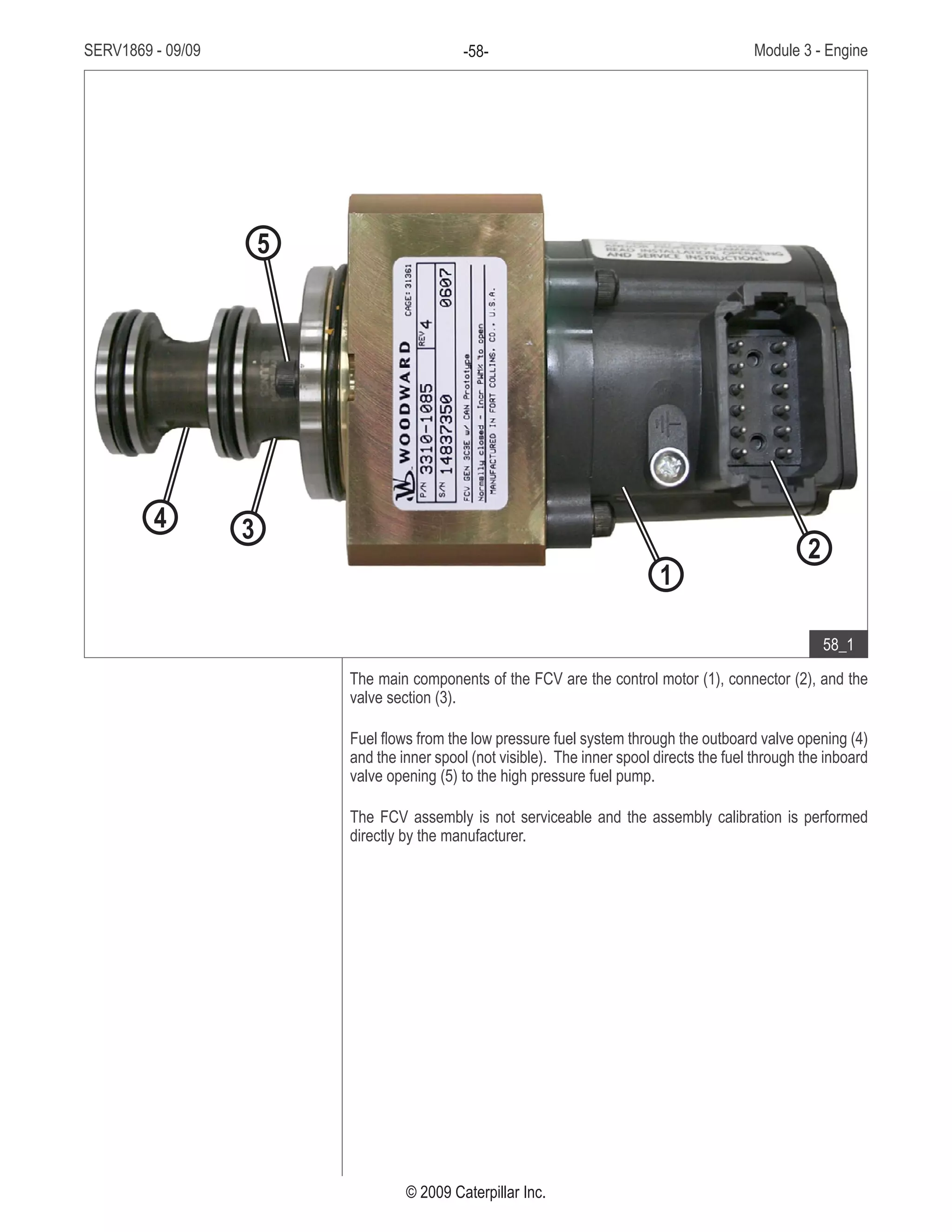
The main components of the FCV are the control motor (1), connector (2), and the
valve section (3).
Fuel flows from the low pressure fuel system through the outboard valve opening (4)
and the inner spool (not visible). The inner spool directs the fuel through the inboard
valve opening (5) to the high pressure fuel pump.
The FCV assembly is not serviceable and the assembly calibration is performed
directly by the manufacturer.
• FCV:
Control motor1.	
Connector2.	
Valve section3.	
Outboard valve opening4.	
Inboard valve opening5.	
58_1
5
4 3
1
2
SERV1869 - 09/09 Module 3 - Engine-59-
© 2009 Caterpillar Inc.
When the FCV is commanded by the Engine ECM to increase the high pressure
pump fuel flow, the inner spool (1) with the triangle shaped throttling valve rotates
upward.
As the inner spool rotates upward, the throttling valve opening increases and directs
additional fuel flow to the high pressure pump.
Fuel flows through the throttling valve and metered fuel flow passes into the center
hole (not shown) of the inner spool and out of the valve through the round hole (2) to
the high pressure common rail pump.
When the Engine ECM commands no flow to the high pressure pump, the throttling
section is in the closed (OFF) position. The inner spool rotates in the opposite
direction until the throttling valve is closed.
The throttling valve is shown in the HIGH IDLE position (3), the LOW IDLE
position (4), and the OFF position (5).
• FCV inner spool rotates
• Throttling valve opening
increases
• Fuel flows to high pressure pump
• OFF position
• Throttling valve positions
(3) High Idle
(1) Inner Spool (2) Round Hole
FUEL CONTROL VALVE
SPOOL POSITION
(4) Low Idle
(5) Off
59_1
SERV1869 - 09/09 Module 3 - Engine-60-
© 2009 Caterpillar Inc.
High pressure fuel temperature is monitored by the high pressure fuel temperature
sensor (1) in the top of the fuel pump.
The fuel pressure is monitored by the high pressure fuel sensor (2) located in the fuel
rail. Both sensors send an input signal to the Engine ECM.
• High pressure fuel sensors:
High pressure fuel1.	
temperature sensor
High pressure fuel sensor2.	
60_1 60_2
60_460_3
2
2
1
1
SERV1869 - 09/09 Module 3 - Engine-61-
© 2009 Caterpillar Inc.
This illustration shows the internal components of the high pressure fuel pump. Fuel
flows from the monoblock (1) to the FCV (2).
The FCV directs fuel flow to the fuel pump pistons. The pistons are driven by the
lobes on the shaft. There are two lobes for each piston so there are two compression
strokes for each shaft revolution.
As the pistons move down, fuel is drawn into the barrels. As the roller for the pistons
moves up on the lobe, the fuel is pushed out to the common fuel passage. Fuel exits
the pump at the outlet (3) and flows to the high pressure fuel rail.
If the fuel pressure in the high pressure fuel system increases above 205 MPa
(29,733psi),areliefvalveopensandallexcessfuelflowsbackthroughthemonoblock
to the fuel tank.
• High pressure pump components:
Monoblock1.	
FCV2.	
Outlet3.	
61_1
3
21
SERV1869 - 09/09 Module 3 - Engine-62-
© 2009 Caterpillar Inc.
Fuel from the high pressure rail (1) enters the flow limiter (2) and flows around the
outside of the piston (3) through the quill tube (4) to the injector (5). The flow limiter
prevents over fueling of the cylinder. If an injector has excessive leakage, the
increased flow acting on the bottom of the piston from the high pressure fuel rail will
cause the piston to move up against spring force. As the piston moves up, less fuel
is sent through the quill tube to the injector.
The high pressure fuel rail system contains spherical ball and conical sealing
joints (6).
Double wall tubing (bottom left illustration) is designed to hold the high pressure fuel.
The leak path (7) allows the fuel to flow back to the fuel tank.
• Fuel flow:
High pressure rail1.	
Flow limiter2.	
Piston3.	
Quill tube4.	
Injector5.	
Sealing joints6.	
Leak path7.	
62_1 62_2
62_462_3
4
2
4
7
4
1
6
3 5
5
6
SERV1869 - 09/09 Module 3 - Engine-63-
© 2009 Caterpillar Inc.
There should be a sealing band around the ends of the tubes and the mating
surfaces as shown in this illustration. The joint end on the left shows an off white/
light gray color band that is approximately 1 mm (.04 inch) wide. The left joint end
should not leak fuel.
The joint end in the center shows some minimal scratches in the end of the tube
which do not interfere with the sealing band. The center joint end should not leak
fuel.
The joint end on the right shows minimal scratches that are interfering with the
sealing band which could cause leaking. The right joint end should be replaced to
eliminate possible fuel leakage.
• Joint end in the left
	 illustration should not leak fuel
•	Joint end in the center
	 illustration should not leak fuel
•	Joint end in the right
	 illustration may leak fuel
63_1
SERV1869 - 09/09 Module 3 - Engine-64-
© 2009 Caterpillar Inc.
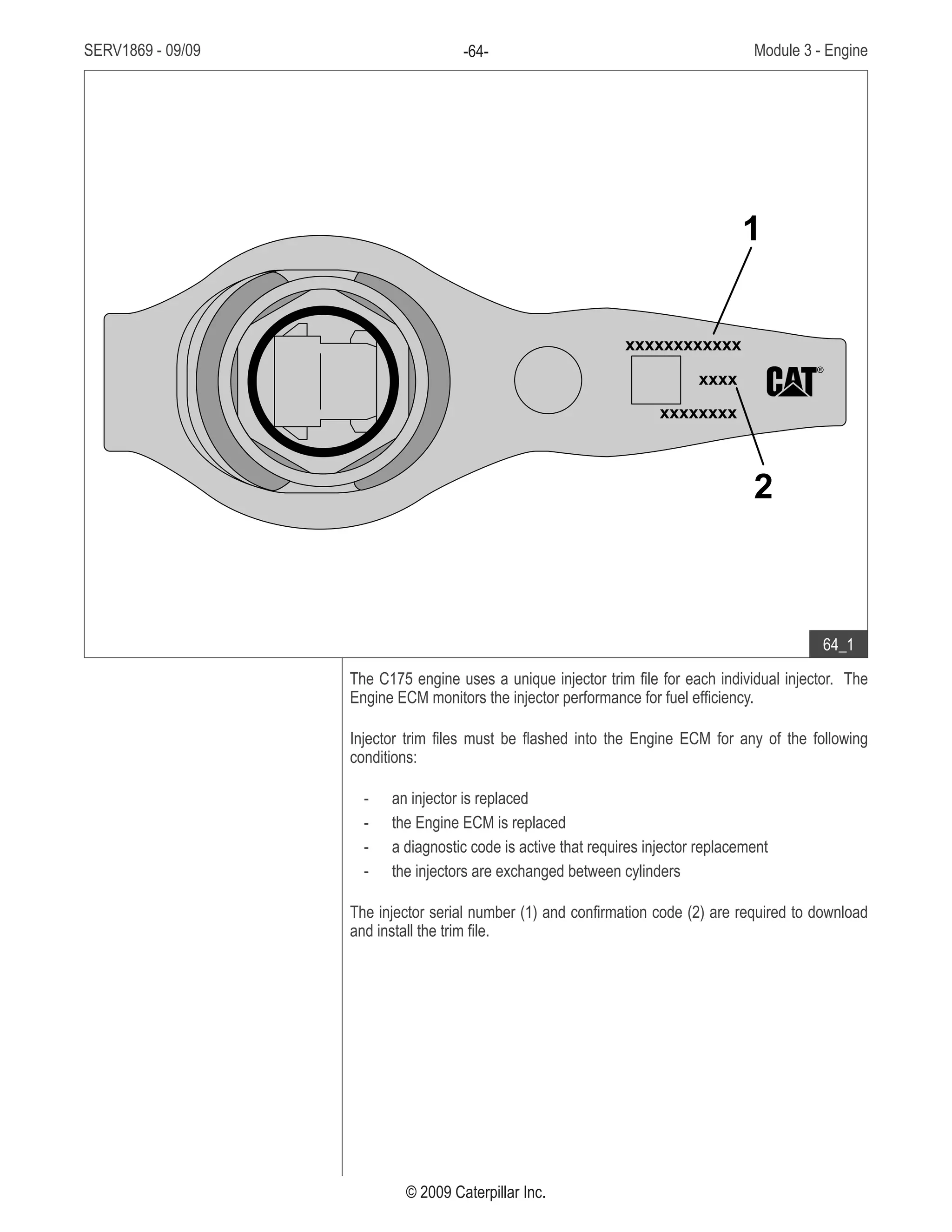
The C175 engine uses a unique injector trim file for each individual injector. The
Engine ECM monitors the injector performance for fuel efficiency.
Injector trim files must be flashed into the Engine ECM for any of the following
conditions:
an injector is replaced--
the Engine ECM is replaced--
a diagnostic code is active that requires injector replacement--
the injectors are exchanged between cylinders--
The injector serial number (1) and confirmation code (2) are required to download
and install the trim file.
• Fuel injector:
Injector serial number1.	
Confirmation code2.	
xxxxxxxxxxxx
xxxxxxxx
xxxx
1
2
64_1
SERV1869 - 09/09 Module 3 - Engine-65-
© 2009 Caterpillar Inc.
When troubleshooting the high pressure fuel system, check the status screen in Cat
ET to help determine what fuel system component to troubleshoot.
The Engine ECM commands the desired fuel rail pressure (1). The actual fuel
rail pressure (2) is displayed based upon a signal from the high pressure fuel rail
sensor.
The fuel actuator position command (3) is sent from the ECM to the FCV. The
percent fuel position (4) indicates the actual position of the FCV.
The fuel pressure (5) indicates the actual fuel pressure in the low pressure fuel
system.
The parameters in this illustration show the high pressure fuel pump producing the
required amount of fuel flow to the injector.
• Cat ET status screen:
Desired fuel rail pressure1.	
Actual fuel rail pressure2.	
Fuel actuator position3.	
command
Percent fuel position4.	
Fuel pressure5.	
65_1
1
2
3
4
5
SERV1869 - 09/09 Module 3 - Engine-66-
© 2009 Caterpillar Inc.
The 793F truck is equipped with an Air to Air AfterCooler (ATAAC) replacing the
Separate Circuit AfterCooler (SCAC).
Air is drawn into the system through four air cleaners (1) and four intake air tubes (2),
into the compressor side of the four turbochargers (3).
Clean air from the compressor section of the turbos is directed through two turbo
outlet tubes (4) into the ATAACs (5) where the air is cooled.
From the ATAACs, the cooled air is directed through two ATAAC outlet tubes (6) into
the right and left intake manifolds.
• Air and exhaust system
components:
Air cleaners1.	
Intake air tubes2.	
Turbochargers3.	
Turbo outlet tubes4.	
ATAACs5.	
ATAAC outlet tubes6.	
66_1
1
4
1
2
6
2
3
5
SERV1869 - 09/09 Module 3 - Engine-67-
© 2009 Caterpillar Inc.
This schematic shows the air flow through the air induction and exhaust system.
Clean air flows through the air filters (1) and enters the compressor side of the
turbos.
The compressed air from the compressor side of the turbos is directed through the
aftercoolers (2) to the intake manifold and the individual cylinders. The air combines
with the fuel for combustion.
The turbos are driven by the exhaust gas from the cylinders which enters the turbine
side of the turbos. The exhaust gasses flow through the turbochargers, the exhaust
tubing, and out through the mufflers.
The four compressor inlet air pressure sensors (3), the two intake manifold air
temperature sensors (4), the two intake manifold air pressure sensors (5), and the
two turbo inlet air temperature sensors (6) report to the Engine ECM (7).
• Air flow through the air induction
and exhaust system.
• Pressure and temperature
sensors
(1) Air
Filters
(1) Air
Filters
(1) Air
Filters
(1) Air
Filters
(2) Aftercooler
(2) Aftercooler
(3) Compressor Inlet
Pressure Sensor
(3) Compressor Inlet
Pressure Sensor
(3) Compressor Inlet
Pressure Sensor
(3) Compressor Inlet
Pressure Sensor
(6) Turbo Inlet
Temperature Sensor
(6) Turbo Inlet
Temperature SensorTemperature Sensor
(4) Intake Manifold
(4) Intake Manifold
Temperature Sensor
(8) Muffler
(8) Muffler
(7) Engine
ECM
(5) Intake Manifold
Pressure Sensor
(5) Intake Manifold
Pressure Sensor
AIR INDUCTION AND EXHAUST SYSTEM
67_1
SERV1869 - 09/09 Module 3 - Engine-68-
© 2009 Caterpillar Inc.
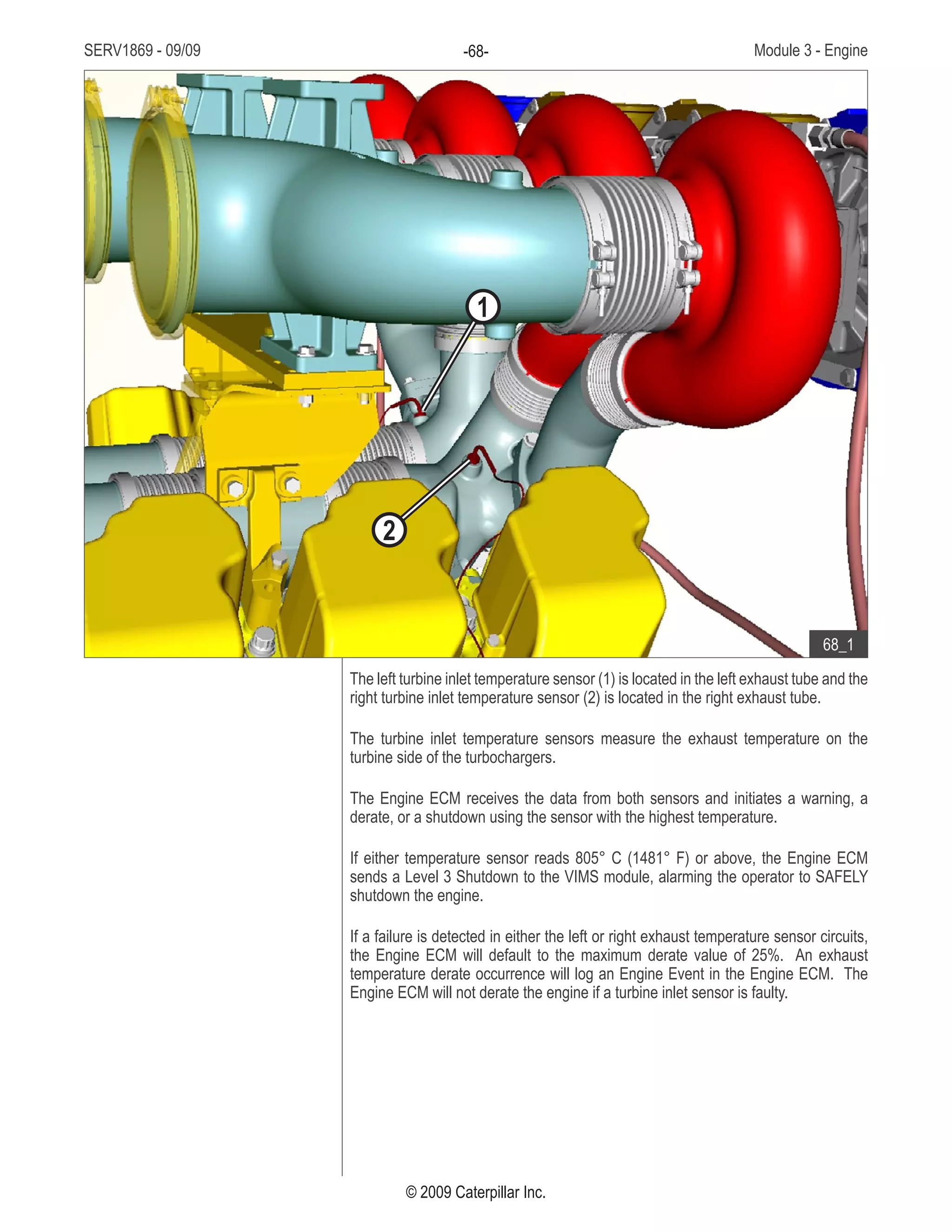
The left turbine inlet temperature sensor (1) is located in the left exhaust tube and the
right turbine inlet temperature sensor (2) is located in the right exhaust tube.
The turbine inlet temperature sensors measure the exhaust temperature on the
turbine side of the turbochargers.
The Engine ECM receives the data from both sensors and initiates a warning, a
derate, or a shutdown using the sensor with the highest temperature.
If either temperature sensor reads 805° C (1481° F) or above, the Engine ECM
sends a Level 3 Shutdown to the VIMS module, alarming the operator to SAFELY
shutdown the engine.
If a failure is detected in either the left or right exhaust temperature sensor circuits,
the Engine ECM will default to the maximum derate value of 25%. An exhaust
temperature derate occurrence will log an Engine Event in the Engine ECM. The
Engine ECM will not derate the engine if a turbine inlet sensor is faulty.
• Top front of engine:
Left turbine inlet temperature1.	
sensor
Right turbine inlet2.	
temperature sensor
68_1
1
2
SERV1869 - 09/09 Module 3 - Engine-69-
© 2009 Caterpillar Inc.
The engine power will be derated when the turbine inlet sensor temperatures reach
a critical level that may cause engine damage.
In this illustration, 0% engine derate equates to a temperature of 725º C (1337º F) for
less than 5 seconds.
Whenthehighesttemperatureofeithertherightorleftturbineinletsensortemperature
rises above 725º C (1337º F) for a period of 5 seconds, the percentage of power
derate will increase by 2%. This will continue in 2% increments with each increment
lasting 5 seconds until the temperature drops below 725º C (1337º F) or the maximum
derate of 25% is reached.
If the condition reoccurs and the Engine ECM has not been powered down, the
percentage of derate will be the same as the last derate.
• Turbine inlet temperature derates
• 0% derate
• 20% maximum derate
22
20
18
16
14
12
10
8
6
4
2
0
0 5 10 15 20 25 30 35
(1) Time (Sec)
TURBINE INLET TEMPERATURE DERATE(2)EngineDerate(%)
40 45 50 55 60 65
24
26
69_1
SERV1869 - 09/09 Module 3 - Engine-70-
© 2009 Caterpillar Inc.
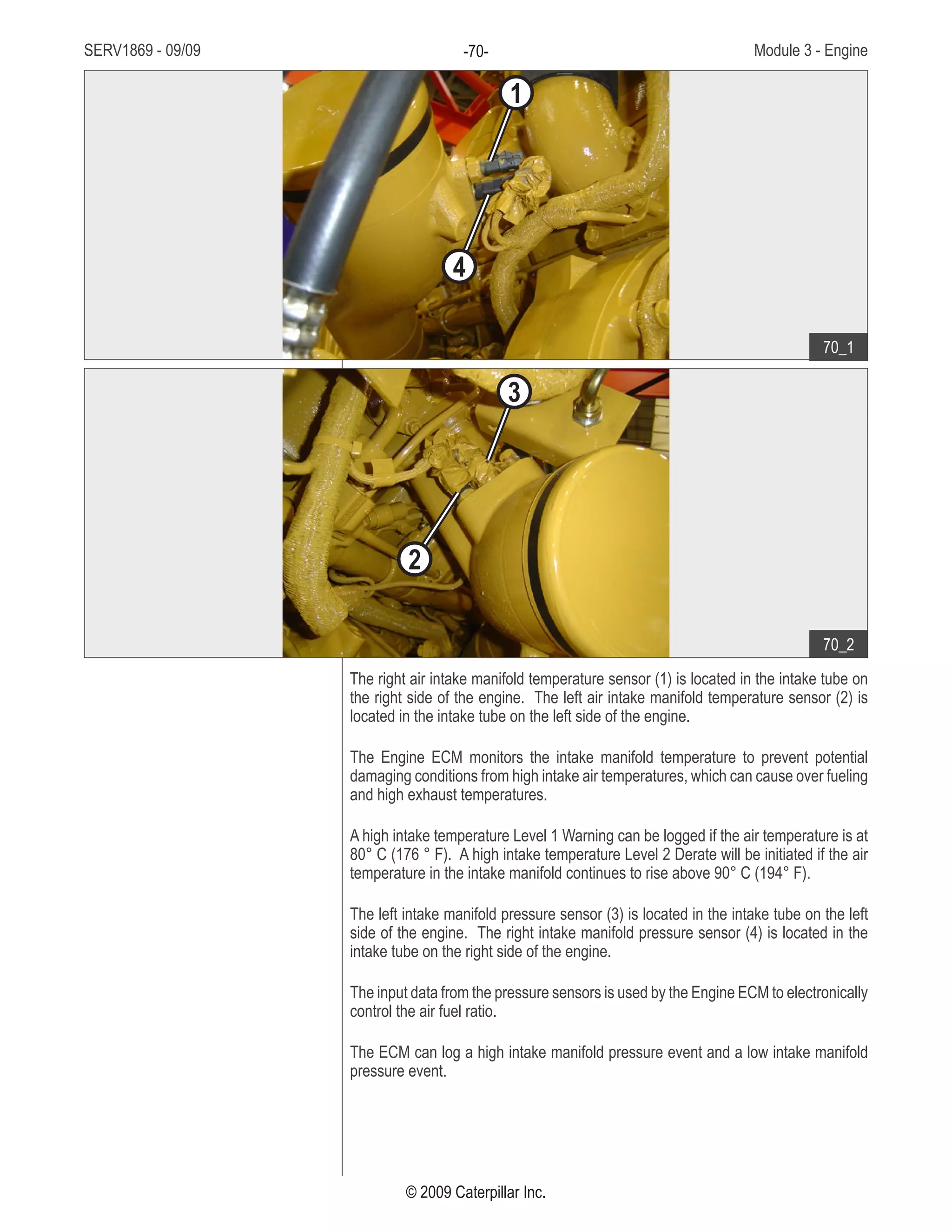
The right air intake manifold temperature sensor (1) is located in the intake tube on
the right side of the engine. The left air intake manifold temperature sensor (2) is
located in the intake tube on the left side of the engine.
The Engine ECM monitors the intake manifold temperature to prevent potential
damaging conditions from high intake air temperatures, which can cause over fueling
and high exhaust temperatures.
A high intake temperature Level 1 Warning can be logged if the air temperature is at
80° C (176 ° F). A high intake temperature Level 2 Derate will be initiated if the air
temperature in the intake manifold continues to rise above 90° C (194° F).
The left intake manifold pressure sensor (3) is located in the intake tube on the left
side of the engine. The right intake manifold pressure sensor (4) is located in the
intake tube on the right side of the engine.
The input data from the pressure sensors is used by the Engine ECM to electronically
control the air fuel ratio.
The ECM can log a high intake manifold pressure event and a low intake manifold
pressure event.
• Intake tubes at front of engine:
Right air intake manifold1.	
temperature sensor
Left air intake manifold2.	
temperature sensor
Left intake manifold pressure3.	
sensor
Right intake manifold4.	
pressure sensor
70_1
70_2
1
3
4
2
SERV1869 - 09/09 Module 3 - Engine-71-
© 2009 Caterpillar Inc.
The compressor inlet pressure sensors (arrows) are installed in the tubing between
the air filters and the turbochargers. The inlet pressure sensors measure the air
pressure at each individual turbo compressor inlet.
The compressor inlet pressure sensor reads the highest inlet restriction and initiates
a warning or derates the engine. The derates will increase as the restriction
increases.
• Compressor inlet pressure
sensors (arrows)
71_1
71_2
SERV1869 - 09/09 Module 3 - Engine-72-
© 2009 Caterpillar Inc.
Each compressor inlet pressure sensor measures the restriction of the particular air
filter. The Engine ECM will initiate a Level 2 Warning when one of the sensors reads
a pressure greater than 7.5 kPa (1.1 psi). The Engine ECM will also initiate a Level
2 Derate of 2% when one of the sensors reads a pressure greater than 10 kPa (1.5
psi). The Engine ECM will send a signal to the VIMS module with the derate
information.
For every 1 kPa (0.15 psi) of additional restriction, the derate map will increase by
2% up to 10%.
• Level 2 Derate
• 10% maximum derate
(2)EngineDerate(%)
COMPRESSOR INLET PRESSURE RESTRICTION DERATE
12
11
10
9
8
7
6
5
4
3
2
1
0
(1) Inlet Restriction (kPa)
0 1 2 3 4 5 6 7 8 9 10 11 12 13 14 15 16 17 18 19 20
72_1
SERV1869 - 09/09 Module 3 - Engine-73-
© 2009 Caterpillar Inc.
This illustration shows the air flow within the cylinder head. The C175 cross flow
design is a change in the air flow through the head, improving performance, power
density, and efficiency.
Air enters the intake manifold through the intake passage (1) and flows into the
cylinder. From the cylinder, exhaust air flows out through the exhaust passage (2)
and into the exhaust manifold.
The cross flow cylinder head provides separation between both the intake and
exhaust ports. The taller head has an increased valve lift of 22 mm (.866 inch)
compared to 18 mm (.71 inch) on the 3524 engine. The improved air flow enables a
greater amount of air in and out of the engine.
The intake and exhaust passages are rounded which decreases air restriction and
increases the air movement. The exhaust passage follows the same type curve
as the intake passage. The valves and passages are precisely rotated to provide
excellent air flow characteristics.
• Sectional view of cylinder head:
Intake passage1.	
Exhaust passage2.	
73_1
12
SERV1869 - 09/09 Module 3 - Engine-74-
© 2009 Caterpillar Inc.
The C175 engine Pressurizer Assembly (321-6022) is used to detect leaks in the air
intake system.
A Pressurizer Assembly (1) is required at each filter in the section of the intake
system being tested. One of the pressurizer assemblies includes a regulator (2) to
adjust pressure and flow. The other pressurizer assembly is plugged to block air flow
out of the remaining filter.
When the air system is pressurized, soap and water is used to detect any leaks as
shown in the bottom right illustration.
• Air leak detection:
Pressurizer assembly1.	
Regulator2.	
Engine Pressurizer
Assembly
74_1 74_2
74_474_3
1
1
2

793 f m03_engine_en_txt

  • 1.
    Global Manpower Development SERV1869 793FOff-Highway Truck Module 3 - Engine Text Reference 793F Off-Highway Truck ENGINE MODULE 3 - TEXT REFERENCE © 2009 Caterpillar Inc. Caterpillar: Confidential Yellow Print Instructor Pages Print Participant Pages
  • 2.
    SERV1869 - 09/09Module 3 - Engine-2- © 2009 Caterpillar Inc. INTRODUCTION The visual above shows the right side view of the 16 cylinder C175 engine in the 793F trucks. The C175 replaces the current 3516 Series engine that was used in the 793D. The C175 is a metric engine. Some of the component weights have increased, such as the cylinder head, which is approximately 50 percent heavier than the 3500 and will require a lifting device. Care must be taken when working on or around the high pressure fuel system as pressures can be as high as 180 MPa (26,100 psi). Cleanliness during service is critical because the fuel system is very sensitive to debris as compared to 3500 / 3600 products. The following lists the key features for the C175 engine: High pressure common rail fuel system-- Air to Air AfterCooler (ATAAC)-- Increased horsepower-- Two-piece single camshaft-- Electronic Unit Injectors (EUI)-- • C175 Engine • Engine features 2_1
  • 3.
    SERV1869 - 09/09Module 3 - Engine-3- © 2009 Caterpillar Inc. The following specifications are for the C175 16 cylinder engine: Serial No. Prefix: B7B Performance Specs: 0K7437-- Gross Power: 1977 kw (2651 hp) @ 1750 rpm-- Maximum Altitude: 3353 m (11000 ft)-- High Idle rpm: 1960 rpm-- Full Load rpm: 1750 rpm-- T/C Stall Speed: 1500 ± 10 rpm-- Boost at Full Load RPM: 200 ± 20 kPa (29 ± 3 psi) at sea level--
  • 4.
    SERV1869 - 09/09Module 3 - Engine-4- © 2009 Caterpillar Inc. This illustration shows the main components on the right side of the engine: High pressure fuel rail (1)-- Intake manifold (2)-- High pressure fuel pump (3)-- Air conditioning compressor (4)-- Fuel priming pump (5)-- Secondary fuel filter base (6)-- Engine oil filters (7)-- Pump drive (8)-- • Right side of engine: High pressure fuel rail1. Intake manifold2. High pressure fuel pump3. Air conditioning compressor4. Fuel priming pump5. Secondary fuel filter base6. Engine oil filters7. Pump drive8. 4_1 3 4 1 8 5 7 6 2
  • 5.
    SERV1869 - 09/09Module 3 - Engine-5- © 2009 Caterpillar Inc. This illustration shows the main components on the left side of the engine: Coolant pump (1)-- Engine oil pump (2)-- Engine oil pan sight glass (3)-- Engine oil S•O•S port (4)-- Engine coolant S•O•S port (5)-- Engine oil coolers (6)-- • Left side of engine: Coolant pump1. Engine oil pump2. Engine oil pan sight glass3. Engine oil S•O•S port4. Engine coolant S•O•S port5. Engine oil coolers6. 5_1 1 4 2 6 5 3
  • 6.
    SERV1869 - 09/09Module 3 - Engine-6- © 2009 Caterpillar Inc. The main components on the top of the C175 engine are the turbo chargers (1), the exhaust tubes to the mufflers (2), and the exhaust manifolds (3). • Top of engine: Turbo chargers1. Mufflers2. Exhaust manifolds3. 6_1 1 2 2 3
  • 7.
    SERV1869 - 09/09Module 3 - Engine-7- © 2009 Caterpillar Inc. Engine Block The C175 engine block is made of ductile iron which is much more flexible and elastic than the 3516. Other features of the C175 block are a single central oil galley, an internal water return manifold, and cross bolted main cap studs. The C175 also contains a single central camshaft. • Ductile iron • Features 7_1
  • 8.
    SERV1869 - 09/09Module 3 - Engine-8- © 2009 Caterpillar Inc. Piston and Connecting Rod A single piece piston of forged steel design in the C175 includes the following features: high strength-- light weight-- rectangular rings that conform to the liner-- improved oil control-- reduced blow-by-- less liner wear-- a threaded hole for pulling the piston-- The connecting rod end is too large to pass through the liner so the cylinder pack, piston, and rod assembly must be removed from the cylinder block. A special tool is available to remove the cylinder pack from the block. The rod and cap includes a fractured joint (1) which must be protected by a special tool when removing the cylinder rod. A connecting rod numbering system (2) is used to identify the rods. There is a specialized serial number specific to each connecting rod to ensure the correct bottom cap is used. • Piston and connecting rod components: Fractured joint1. Connecting rod numbering2. system 8_1 8_2 1 2
  • 9.
    SERV1869 - 09/09Module 3 - Engine-9- © 2009 Caterpillar Inc. Special Tools The Cylinder Pack Installation Tool (322-3564) (1) is available to remove and install the C175 cylinder pack which includes the cylinder liner, piston, and connecting rod. The Connecting Rod Guides Tool (274-5875) (2) is used to protect the fractured connecting rods during removal. There are odd and even rods that are installed in the odd and even cylinders. • Special tools: Cylinder pack installation tool1. (322-3564) Connecting rod guides tool2. (274-5875) 9_1 9_2 1 2
  • 10.
    SERV1869 - 09/09Module 3 - Engine-10- © 2009 Caterpillar Inc. The Main Bearing Cap Stud Tensioner Tool Group (278-1150) is designed for efficient tightening and loosening of nuts on the crankshaft main bearing cap studs of C175 Series Engines. The stud tensioner is unique to the C175, but the hydraulic pump used with the stud tensioner is the same as the pump used on the 3600 engines. NOTE: For more information, refer to the Tool Operating Manual (NEHS0944). • Main Bearing Cap Stud Tensioner Tool Group 10_1
  • 11.
    SERV1869 - 09/09Module 3 - Engine-11- © 2009 Caterpillar Inc. Valve Train The valve train in the C175 includes the following features: single central camshaft-- solid steel pushrods-- floating bridges-- forged steel exhaust rocker-- cast iron intake rocker-- • Valve train features 11_1
  • 12.
    SERV1869 - 09/09Module 3 - Engine-12- © 2009 Caterpillar Inc. ENGINE ELECTRONIC CONTROL SYSTEM The C175 engine consists of input components, output components, and the Engine ECM (1) to control the quality and the amount of fuel to efficiently operate the engine within the emission requirements. The A4:E4 ECM has a 120 pin connector and a 70 pin connector. The engine is equipped with both active and passive sensors which take pressure, temperature, and speed / timing data from the engine systems and relay that information to the Engine ECM. The Engine ECM processes the data and sends corresponding output signals to the output components to control the engine functions. • Engine electronic control system inputs (2) Prrimary Cam Speed / Timing Sensor (3) Secondary Cam Speed / Timing Sensor (4) Crankshaft Speed / Timing Sensor (5) Compressor Inlet Air Pressure Sensor #1 (6) Compressor Inlet Air Pressure Sensor #2 (7) Compressor Inlet Air Pressure Sensor #3 (8) Compressor Inlet Air Pressure Sensor #4 (9) Inlet Manifold Pressure Sensor (LH) (10) Inlet Manifold Pressure Sensor (RH) (11) Atmospheric Pressure Sensor (12) Crankcase Pressure Sensor (13) Inlet Manifold Temperature Sensor (LH) (14) Inlet Manifold Temperature Sensor (RH) (15) RH Turbine Inlet Temperature Sensor (16) LH Turbine Inlet Temperature Sensor (17) Engine Oil Block Inlet Temperature Sensor (18) Local CAN Data Link (19) Global CAN Data Link (20) Cat Dat Link (22) Engine Oil Block Inlet Pressure Sensor (23) Engine Oil Filter Inlet Pressure Sensor (24) Fuel Pressure Sensor (unfiltered) (25) Fuel Pressure Sensor (filtered) (26) HPCR Rail Pressure Sensor (27) Fuel Transfer Pump Inlet Pressure Sensor (28) Engine Coolant Block Inlet Pressure Sensor (29) Water In Fuel Sensor (30) Engine Coolant Block Outlet Temperature Sensor (31) Coolant Pump Outlet Temperature Sensor (32) Fuel Transfer Temperature Sensor (33) High Pressure Fuel Temperature Sensor (34) Engine Oil Level Switch (35) Engine Coolant Level Switch (36) Manual Fuel Priming Pump Switch (37) Engine Shutdown Switch (38) Throttle Position Sensor (21) Temperature Control Module (1) Engine ECM C175 ENGINE INPUTS BLOCK DIAGRAM J2 J1 12_1
  • 13.
    SERV1869 - 09/09Module 3 - Engine-13- © 2009 Caterpillar Inc. Based on the input signals, the Engine ECM (1) analyzes the input information and energizes the electronic unit injectors (2) to control fuel delivery to the engine by sending current to the coils on the electronic unit injectors. The Engine ECM sends a PWM signal to the fuel control valve (FCV) assembly (3). The FCV controls the output of the high pressure common rail pump. Also, the J1939 Local ControllerArea Network (CAN) Data Link (4) is used to send data between the machine ECMs (5) and the VIMS modules (6). The Engine ECM sends voltage signals to the following component relays: ether aid relay (7)-- fuel priming pump relay (8)-- prelube pump relay (9)-- The following output voltages are sent to separate sensors: - +12 VDC (10)-- - +8 VDC (11)-- - +5 VDC (12)-- The CAN Data Link can be recognized by the shielded cable and the shielded connectors. Inside is a twisted pair of copper wires with a 120 ohm resistor on each end. The CAN Data Link is used for high speed transmission of data between the ECMs. • Engine electronic control system outputs • Relays • Output voltages • CAN Data Link C175 ENGINE OUTPUTS BLOCK DIAGRAM (2) Electronic Unit Injectors (7) Ether Aid Relay (3) Fuel Control Valve (FCV) (8) Fuel Primming Pump Relay (1) Engine ECM (9) Prelube Pump Relay (12) +5 VDC J2 J1 (11) +8 VDC (10) +12 VDC (13) Cat Data Link(14) Global CAN Data Link (4) Local CAN Data Link (5) Machine ECMs (15) Service Connector (6) VIMS Modules 13_1
  • 14.
    SERV1869 - 09/09Module 3 - Engine-14- © 2009 Caterpillar Inc. Fuel injection and system monitoring are controlled by the A4:E4 Engine ECM (1) which is located at the front of the engine. The Engine ECM is equipped with a 120 pin connector (J2) and a 70 pin connector (J1). The Engine ECM responds to engine inputs by sending a signal to the appropriate output component to initiate an action. For example, the Engine ECM receives a high coolant temperature signal. The Engine ECM interprets the input signal, evaluates the current operating status, and derates the fuel supply under load. The Engine ECM receives three different types of input signals: 1. Switch input: Provides the signal line to battery, ground, or open. 2. PWM input: Provides the signal line with a rectangular wave of a specific frequency and a varying positive duty cycle. 3. Speed signal: Provides the signal line with either a repeating, fixed voltage level pattern signal, or a sine wave of varying level and frequency. • Front of engine: Engine ECM1. Atmospheric pressure sensor2. 14_1 1 2
  • 15.
    SERV1869 - 09/09Module 3 - Engine-15- © 2009 Caterpillar Inc. The Engine ECM has three types of output drivers: 1. ON/OFF driver: Provides the output device with a signal level of +Battery voltage (ON) or less than one Volt (OFF). 2. PWM driver: Provides the output device with a rectangular wave of fixed frequency and a varying positive duty cycle. 3. Controlled current output driver: The ECM will energize the solenoid with pull-up current for a specific duration and then decrease the level to hold-in current for a specific duration of the on time. The initial higher amperage gives the actuator rapid response and the decreased level is sufficient to hold the solenoid in the correct position. An added benefit is an increase in the life of the solenoid. Engine ECM has built-in diagnostic capabilities. As the Engine ECM detects fault conditions in the power train system, the ECM logs events in memory and diagnostic codes for troubleshooting and displays them through Cat ET. The atmospheric pressure sensor (2) is located in the control panel next to the Engine ECM. The function of the atmospheric pressure sensor is to supply information relative to high altitude back to the Engine ECM along with calculated gauge pressure for all the pressure sensors to the ECM. Losing the signal from the atmospheric pressure sensor will initiate a 10% derate and the parameter will be set to a default value that is stored in the ECM. Normally, at 0 rpm and 2 seconds after the engine starts, the Engine ECM reads each pressure sensor to ensure the pressure is within tolerance of a specified value. If the value is within tolerance, the Engine ECM compares the value of the pressure sensors with the atmospheric sensor and assigns a specific offset value to each sensor for calibration. NOTE: The signal from the atmospheric pressure sensor is used by the Engine ECM to calculate a number of pressure measurements in most electronic engines. The signal from the atmospheric pressure sensor is compared to the signal from the other engine pressure sensors to calibrate the pressure sensors. When the Engine ECM is powered up, the ECM uses the signal from the atmospheric pressure sensor as a reference point for calibration of the other pressure sensors on the engine.
  • 16.
    SERV1869 - 09/09Module 3 - Engine-16- © 2009 Caterpillar Inc. CAN Networks This illustration shows the signal paths for the Controller Area Network (CAN) for the “F” Series trucks. The signal paths are a common set of signal wires connected to multiple controllers. The common set of signal wires allows many different pieces of information to be shared between many different devices over a few signal wires. The paths are two twisted shielded wires with a 120 ohm terminal resistor (1) at each end of the network. The terminal resistors prevent electrical interference on the CAN Network. The designation of the CAN wires are CAN + and CAN - with a third connection denoted as CAN_SHLD (shield). Two terminal resistors are located near the Engine ECM (2); one resistor is installed near the electronic thermostat (E-Stat) (3), and one resistor is installed near the fuel control valve (FCV) (4). The E-Stat is located between the engine and the radiator. The truck chassis has one data link. The Engine ECM has two data links: 1) Global CAN, which has paths with the Machine ECMs and external components (Advisor, E-Stat, and the Service Connector); and, 2) the Engine ECM which is connected to the fuel control valve (FCV) through the Local CAN data link. The 120 pin connector for the Engine ECM contains the Local CAN Data Link. The 70 pin Engine ECM connector contains the Global CAN Data Link. • CAN signal paths OK 120 ohm120 ohm (1) Terminal Resistor (1) Terminal Resistor (1) Terminal Resistor (1) Terminal Resistor 120 ohm (3) Electronic Thermostat (E-Stat) 120 oh m (22) Local CAN (6) Chassis ECM (7) Transmission ECM (8) Brake ECM (9) VIMS 3G Main Module (10) VIMS 3G Application Module (11) Advisor Module (12) Product Link Module (13) Smart Signal Module (17) CAN + (18) CAN - (19) CAN Shield (14) Machine Security System (15) Cat ET Service Connector (20) Engine Group (21) Radiator Group (5) Global CAN (16) Cab Group (2) Engine ECM (4) Fuel Control Valve CAN NETWORKS 16_1
  • 17.
    SERV1869 - 09/09Module 3 - Engine-17- © 2009 Caterpillar Inc. The top left illustration shows the location of the terminal resistors in relationship to the Engine ECM (1). The terminal resistors (not visible) are attached to the wire harness (2) below the ECM. One resistor is for the Global CAN and one resistor is for the Local CAN. When determining which is the global terminal resistor and which is the local terminal resistor, always check the wiring numbers. The top right illustration shows the location of the global CAN terminal resistor (3) located near the E-stat (4) on the left side of the radiator group. The bottom left illustration shows the location of the other local CAN terminal resistor (5). The resistor is located behind the right intake manifold above the high pressure fuel pump. The lower right illustration shows a schematic of the terminating resistors at the Engine ECM. • Terminal resistors: Engine ECM1. Terminal resistor2. Global CAN terminating3. resistor E-stat4. Local CAN terminating5. resistor (8) A - Can + (9) B - Can - (10) C - Can Shield (6) Global CAN Data Link (7) Local CAN Data Link TERMINAL RESISTORS A B C A B C A B C A B C A B C A B C Y959-E44 YL-19 Y960-E45 GN-19 Y961-E21 SHLD-19 Y959-E251 YL-19 Y960-E252 GN-19 Y961-E253 SHLD-19 Y956-E170 YL-19 Y967-E1542 GN-19 Y968-E180 SHLD-19 Y956-E170 YL-19 Y967-E1542 GN-19 Y968-E180 SHLD-19 17_1 17_2 17_417_3 1 2 34 5
  • 18.
    SERV1869 - 09/09Module 3 - Engine-18- © 2009 Caterpillar Inc. Engine Position Sensing Engine position sensing is the function that determines the actual crankshaft and camshaft positions versus time so that engine speed can be calculated. Engine position sensing also allows for the delivery of synchronous outputs, including fuel injection timing and ignition timing. Engine position sensing is a critical process for accurate fuel delivery, reliability of operation, and emission control performance. The crankshaft speed / timing sensor connector (1) is bolted to a cover (2) on the rear left side of the engine, behind the starter (not shown). The crankshaft speed / timing sensor (3) is located behind the cover. The speed / timing sensor sends a fixed voltage level signal to the Engine ECM indicating the engine speed, direction, and timing. The crankshaft sensor is the primary speed / timing sensor reporting to the Engine ECM to determine engine speed and crankshaft position. The speed sensor detects the reference for engine speed and timing from a unique pattern on the respective gear. Normally, the crankshaft speed / timing sensor identifies the timing during starting and determines when the No. 1 cylinder is at the top of the stroke. Once the timing is established, the crankshaft timing sensor is used to relay the engine speed and the camshaft sensor signal is ignored. If the engine is running and the signal from the crankshaft is lost, a slight change in performance is noticed during change over to the camshaft speed / timing sensor. The sensor adjustment is preset so no adjustment is necessary. • Left side of engine: Crankshaft speed / timing1. sensor connector Cover2. Crankshaft speed / timing3. sensor 18_1 18_2 12 3
  • 19.
    SERV1869 - 09/09Module 3 - Engine-19- © 2009 Caterpillar Inc. In case of a crankshaft speed / timing sensor failure, the Engine ECM follows the following process: a crankshaft sensor diagnostic code is logged-- the Engine ECM switches to the primary camshaft speed / timing sensor-- the Engine ECM uses the stored rotation as the engine rotation if the sensor-- fails during a pattern lock The crankshaft speed / timing sensor serves four functions: engine speed measurement-- engine timing measurement-- TDC location and cylinder number identification-- reverse rotation protection-- The crankshaft speed / timing sensor is not adjustable. If the engine is running for three seconds and the pattern from the timing ring is lost for two seconds, the Engine ECM will log a Diagnostic Code for the crankshaft speed / timing sensor.
  • 20.
    SERV1869 - 09/09Module 3 - Engine-20- © 2009 Caterpillar Inc. The C175 has two speed / timing sensors that indicate camshaft speed. The primary camshaft speed / timing sensor (1) is used to synchronize fuel delivery with the engine cycle and provides a backup if the crankshaft speed / timing sensor fails. If the crankshaft speed / timing sensor fails, the Engine ECM will use the primary camshaft speed / timing sensor to keep the engine running, but the fuel delivery may be less accurate. The speed of the camshaft target wheel is half that of the crankshaft gear. The secondary camshaft speed / timing sensor (2) is a backup to the primary camshaft speed / timing sensor when the primary sensor has failed. The sensor adjustment is preset so no adjustment is necessary. • Rear of engine: Primary camshaft speed /1. timing sensor Secondary camshaft speed /2. timing sensor 20_1 2 1
  • 21.
    SERV1869 - 09/09Module 3 - Engine-21- © 2009 Caterpillar Inc. The camshaft timing pin (1) and the flywheel timing pin (2) are shown in the stowed position. The camshaft timing pin is inserted in the camshaft timing pin hole (3) when performing camshaft timing. The flywheel timing pin is inserted in the flywheel timing hole (4) when it is necessary to find engine top dead center (TDC). • Rear of engine: Camshaft timing pin1. Flywheel timing pin2. Camshaft timing pin hole3. Flywheel timing pin hole4. 21_1 4 1 3 2
  • 22.
    SERV1869 - 09/09Module 3 - Engine-22- © 2009 Caterpillar Inc. The top illustration shows the engine timing gear train. At engine start-up, the crankshaft speed / timing sensor (1) synchronizes with the primary camshaft speed / timing sensor (2) and the secondary camshaft speed / timing sensor (3). The crankshaft gear (4) rotates two times for every one rotation of the camshaft gear (5). The crankshaft gear and the camshaft gear are the same size with an equal amount of teeth. The idler gear (6) is a combination gear with the larger gear having twice as many teeth as the smaller gear. The larger gear is driven by the crankshaft and the smaller idler gear drives the camshaft gear. When the engine is cranked, the crankshaft sensor looks for the notch (7) cut into one tooth of the crankshaft gear to determine position. When the Engine ECM locates the signal from the sensor by detecting the notch, the Engine ECM then looks for a signal from the cam sensor. When the cam sensor locates the notch (8) cut into one tooth of the camshaft gear, and after the crankshaft sensor locates a notch, the Engine ECM then waits for a second notch to verify the pattern. The Engine ECM sends the signal for a more accurate injection cycle, if rail pressure is present. The bottom illustration shows a notch (9), cut into one of the gear teeth, that is used to determine engine position. • Timing gear train: Crankshaft speed / timing1. sensor Primary camshaft speed /2. timing sensor Secondary camshaft speed /3. timing sensor Crankshaft gear4. Camshaft gear5. Idler gear6. Notch (crankshaft gear)7. Notch (camshaft gear)8. Notch in gear9. ENGINE TIMING GEAR TRAIN (7) Notch (8) Notch (1) Crankshaft Speed / Timing Sensor (6) Idler Gear (3) Secondary Cam Speed / Timing Sensor (2) Primary Cam Speed / Timing Sensor (4) Crankshaft Gear (5) Crankshaft Gear 22_1 22_2 9
  • 23.
    SERV1869 - 09/09Module 3 - Engine-23- © 2009 Caterpillar Inc. The C175 engines are electronically timed and no longer require the timing calibration probe for speed / timing calibrations. The Engine ECM uses inputs from all three engine speed / timing sensors to assist in calculating more accurate timing within the software during engine start-up. The software application in the Engine ECM compares the tooth angle between the crank and cam gears. The Engine ECM looks for a stable rpm above 700 rpm. The revolutions per minute must be ± 5 rpm for one second to be considered stable. The Engine ECM takes fifty samples of the leading edge of the camshaft teeth angle position and compares each to the nearest crankshaft tooth. The ECM compares the measured difference to the theoretical tooth difference of each sample, and averages the tooth errors. This average difference between the camshaft actual position and the camshaft theoretical position determines the offset angle. The offset angle is used by the ECM for calibration. Timing calibration is performed at each engine start after an ECM power cycle. • C175 is electronically timed
  • 24.
    SERV1869 - 09/09Module 3 - Engine-24- © 2009 Caterpillar Inc. Crankcase Pressure Sensor The crankcase pressure sensor (1) is used to measure the pressure in the crankcase and is located on the right side of the engine below the intake manifold (2). The crankcase pressure sensor detects impending piston seizures, and indicates cylinder blow-by. The crankcase pressure sensor will initiate a Level 1 Warning when the crankcase pressure reaches 4 kPa (0.6 psi). • Right side of engine: Crankcase pressure sensor1. Intake manifold2. 24_1 1 2
  • 25.
    SERV1869 - 09/09Module 3 - Engine-25- © 2009 Caterpillar Inc. ENGINE COOLING SYSTEM This illustration shows the cooling system on a 793F truck with standard retarding. The coolant pump (1) pulls coolant from the radiator (2) and sends the coolant through the engine oil coolers (3) to the engine block (4). After leaving the block, the coolant flows through the turbos (5), into one return line, and to the shunt tank (6) of the radiator. The coolant from the block also flows to the power train oil cooler (7), the steering / fan oil cooler (8), and then through the rectangular front and rear brake oil coolers (9) to the Electronic Thermostat (E-stat) (10). Depending on the temperature of the coolant, the E-stat directs the coolant to the radiator or through the bypass line (11) and back to the inlet of the coolant pump. The coolant pump outlet temperature sensor (12) sends a signal to the temperature control module (13) on the E-Stat. The engine coolant block inlet pressure sensor (14) and the engine coolant block outlet temperature sensor (15) send signals directly to the Engine ECM (16). The engine coolant block outlet temperature sensor is used as one of the key target temperatures for the hydraulic fan system. The coolant level sensor (17) sends a signal to the Engine ECM indicating the coolant level. NOTE: This illustration shows the majority of the coolant bypassing the radiator. • Engine cooling system with standard retarding (1) Coolant Pump (12) Coolant Pump Outlet Temperature Sensor (17) Coolant Level Sensor (14) Engine Coolant Block Inlet Pressure Sensor (15) Engine Coolant Block Outlet Temperature Sensor (2) Radiator (18) Piston (11) Bypass Line (3) Engine Oil Coolers (7) Transmission (16) Engine ECM Oil Cooler (8) Steering/Fan Oil Cooler (9) Front and Rear Brake Oil Coolers (6) Shunt Tank (5) Turbos (4) Engine Block (17) CAN (J1939) (10) E-Stat (13) Temperature Control Module ENGINE COOLING SYSTEM STANDARD RETARDING 25_1
  • 26.
    SERV1869 - 09/09Module 3 - Engine-26- © 2009 Caterpillar Inc. Thisillustrationshowsthecoolingsystemona793Ftruckequippedwiththeadditional retarding arrangement. An auxiliary coolant pump (1) and an additional round front brake oil cooler (2) are installed on the additional retarding arrangement. With additional retarding, the auxiliary coolant pump pulls coolant from the radiator (3) and sends the coolant through the rectangular rear brake oil cooler (4) and the round front brake oil cooler to the E-stat. On the additional retarding arrangement, after coolant from the coolant pump (5) flows through the transmission oil cooler (6) and the steering / fan oil cooler (7), the coolant flows through the rectangular front brake oil cooler (8) to the E-stat. • Cooling system with additional retarding (13) Turbos (3) Radiator (9) Engine Oil Coolers (6) Transmission Oil Cooler (7) Steering/Fan Oil Cooler (8) Rectangular Front Brake Oil Cooler (2) Round Front Brake Oil Cooler (4) Rear Brake Oil Cooler (12) Shunt Tank (10) Engine Block (11) E-Stat (1) Auxiliary Coolant Pump (5) Coolant Pump ENGINE COOLING SYSTEM ADDITIONAL RETARDING 26_1
  • 27.
    SERV1869 - 09/09Module 3 - Engine-27- © 2009 Caterpillar Inc. The primary coolant pump (1) is located at the front left side of the engine. The primary coolant pump supplies coolant to the engine oil coolers, the engine block, the transmission oil cooler, and the steering / fan oil cooler. The primary coolant pump also supplies coolant to the front and rear brake rectangular oil coolers if the truck is equipped with the standard retarding arrangement. If the truck is equipped with the additional retarding arrangement, the auxiliary coolant pump (2) located at the front right side of the engine supplies coolant to the rectangular rear brake oil cooler and the round front brake oil cooler. • Front of engine: Primary coolant pump1. Auxiliary coolant pump2. 27_1 1 2
  • 28.
    SERV1869 - 09/09Module 3 - Engine-28- © 2009 Caterpillar Inc. The top illustration shows the brake oil coolers on a truck equipped with the additional retarding attachment. With additional retarding, the rectangular rear brake oil cooler (1) cools oil to the rear brakes and the rectangular front brake oil cooler (2) and the round front brake oil cooler (3) cools oil to the front brakes. The lower illustration shows the location of the steering / fan oil cooler (4) and the power train oil cooler (5). • Oil coolers: Rectangular rear brake oil1. cooler Rectangular front brake oil2. cooler Round front brake oil cooler3. Steering / fan oil cooler4. Power train oil cooler5. 28_1 28_2 1 2 3 4 5
  • 29.
    SERV1869 - 09/09Module 3 - Engine-29- © 2009 Caterpillar Inc. The engine coolant pump outlet temperature sensor (1) is a two-wire passive sensor that is located at the outlet of the coolant pump. The coolant pump outlet temperature sensor sends a signal to the temperature control module as previously described. The engine coolant block inlet pressure sensor (2) is located on the front of the engine in the pipe between the coolant pump and the water inlets. The pressure sensor is used to monitor the pressure of the coolant flowing into the engine block. The pressure sensor is used in place of the flow switch that was used on the 3524 engine. If the coolant pressure is below the default pressure in relationship to the engine speed, the ECM will log an event. If the coolant pressure decreases below the minimum default pressure (listed below) at the specified engine rpm, the Engine ECM will initiate a Level 1 Warning which will be displayed on the Advisor panel. Engine Speed (rpm) kPa psi 0 0 0 700 31.5 4.6 1000 46.7 6.8 1200 57.0 8.3 1400 67.3 9.8 1600 77.5 11.2 1800 87.8 12.7 • Cooling system components: Engine coolant pump outlet1. temperature sensor Engine coolant block inlet2. pressure sensor Engine coolant block outlet3. temperature sensor 29_1 3 2 1
  • 30.
    SERV1869 - 09/09Module 3 - Engine-30- © 2009 Caterpillar Inc. The engine coolant block outlet temperature sensor (3) is located on the right front side of the engine. The block outlet temperature sensor is used to monitor the coolant temperature exiting the engine block. The temperature sensor is an input to the Engine ECM and is used for various control and protection strategies (i.e. engine overheating, engine damage due to cylinder overpressure, and engine wear due to overcooling).
  • 31.
    SERV1869 - 09/09Module 3 - Engine-31- © 2009 Caterpillar Inc. This illustration shows the percent of engine derate as the engine temperature increases. The engine coolant block outlet temperature sensor measures the temperature of the coolant. When the temperature of the coolant exceeds 100° C (212° F), the Engine ECM will initiate a Level 1 Warning. When the temperature of the coolant exceeds 101° C (213° F), the Engine ECM will initiate a Level 2 Warning and a 25% derate. At 104° C (219° F), the derate will be 50%. At 107° C (225° F), the derate will be 75%. At 110° C (230° F), the derate will be 100% and the Engine ECM will initiate a Level 3 Warning. A 100% derate equals approximately a 50% horsepower derate. • High coolant temperature engine derate • Engine coolant block outlet temperature sensor • Level 1 Warning • Derate temperatures 100 100 80 (1)%Derate (2) Coolant Temperature in °C HIGH COOLANT TEMPERATURE DERATE (3) Level 1 Warning (4) Level 2 Warning / Derates 60 40 20 0 120 101 102 103 104 105 106 107 108 109 110 31_1
  • 32.
    SERV1869 - 09/09Module 3 - Engine-32- © 2009 Caterpillar Inc. The low coolant level switch (1) is located in the shunt tank (2) mounted on top of the radiator. The switch is behind the removable cover between the radiator and the engine. The low coolant level switch sends a signal to the Engine ECM indicating coolant level. With the key in the ON position and the coolant level below the low coolant level switch for more than 3 seconds, the Engine ECM will initiate a Level 2 Warning to the Advisor panel. When the engine is running and the coolant is below the low coolant level switch for more than 17 seconds, the Engine ECM will initiate a Level 3 Warning through the Advisor panel. • Top of radiator: Low coolant level switch1. Shunt tank2. 32_1 2 1
  • 33.
    SERV1869 - 09/09Module 3 - Engine-33- © 2009 Caterpillar Inc. The Electronic Thermostat (E-Stat) is mounted to a bracket near the left side of the radiator and includes the stepper motor (1) and the temperature control module (2). A piston, which is driven by the stepper motor, is located inside the valve (3). The valve controls the coolant flow to the bypass line and the radiator. The piston (not shown) movement within the valve, alters the coolant flow through a lead screw driven by the stepper motor. • E-stat components: Stepper motor1. Temperature control module2. Valve3. 33_1 3 1 2
  • 34.
    SERV1869 - 09/09Module 3 - Engine-34- © 2009 Caterpillar Inc. The coolant pump outlet temperature sensor (1) measures the temperature of the coolant flowing into the engine oil coolers (2) and sends a signal to the temperature control module (3). As the coolant temperature increases, the temperature control module sends a current to the stepper motor (4) to move the piston (5), which closes the coolant bypass (6) and allows more coolant flow through the radiator (7). As the coolant temperature decreases, the temperature control module sends a current to the stepper motor to move the piston, which opens the coolant bypass and allows less coolant flow to the radiator. At engine start-up, the stepper motor / piston position needs to be reset. The stepper motor drives the piston to the configured stop. As the piston reaches the stop, a ratcheting sound occurs indicating that the piston has hit the stop. NOTE: If the engine shuts down and is restarted in less than 4 minutes, the stepper motor / piston position does not reset, so there will be no ratcheting noise. • E-Stat operation (8) Engine ECM (10) Front Brake Oil Coolers (11) Coolant Pump (9) CAN (J1939) (3) Temperature Control Module (4) Stepper Motor (5) Piston (6) Bypass Line (7) Radiator (2) Engine Oil Coolers(1) Coolant Pump Outlet Temperature Sensor E-Stat Operation 34_1
  • 35.
    SERV1869 - 09/09Module 3 - Engine-35- © 2009 Caterpillar Inc. ENGINE LUBRICATION SYSTEM This illustration shows the oil flow through the C175 engine. Oil is drawn from the engine sump (1) through a screen (2) by the engine oil pump (3). The oil pump sends oil to the pressure regulator (4), which directs oil to the engine oil coolers (5) or through the engine oil cooler bypass valve (6) to the engine sump if the oil pressure is too high. Oil flows from the oil coolers or bypass valve to the engine oil filters (7). The unfiltered oil pressure sensor (8) and the oil pressure sensor (filtered oil) (9) calculate the restriction in the oil filters. From the engine oil filters, the oil enters the engine block and flows through the main oil galley to lubricate the internal engine components and the turbos (10). The filtered oil is also directed to the high pressure fuel pump (11) for lubrication. If the engine oil pressure increases above approximately 550 kPa (80 psi), the pressure in the signal line from the oil galley acts on the top of the regulator and moves the regulator down against spring force. The regulator directs oil flow to the sump. Located in the front section of the pan is the scavenge pump (12). The scavenge pump draws oil from the rear pan section and returns it to the main sump. • Engine oil flow (18) Engine Front Cover (10) Turbos (10) Turbos (11) High Pressure Fuel Pump (18) Engine Front Cover (4) Pressure Regulator (2) Screen (3) Engine Oil Pump ENGINE LUBRICATION SYSTEM (14) Relief Valve (12) Scavenge Pump (1) Sump (17) Oil Temperature Sensor (9) Oil Pressure Sensor (13) Prelube Pump and Electric Motor (7) Engine Oil Filters (16) Check Valve (8) Unfiltered Oil Pressure Sensor (5) Engine Oil Coolers (6) Engine Oil Cooler Bypass (15) S•O•S Port 35_1
  • 36.
    SERV1869 - 09/09Module 3 - Engine-36- © 2009 Caterpillar Inc. The prelube pump (13) supplies lubrication oil to the system and is connected between the pressure regulator and the engine oil coolers. Also, installed in the line from the engine oil pump is a relief valve (14) which limits the system pressure to 875 kPa (127 psi). A S•O•S port (15) is also installed at the engine oil cooler bypass housing.
  • 37.
    SERV1869 - 09/09Module 3 - Engine-37- © 2009 Caterpillar Inc. This illustration shows the location of the engine lubrication system components on the left side of the engine: relief valve and oil pressure regulator (1)-- engine oil pump (2)-- engine oil cooler bypass valve (3)-- engine oil S•O•S port (4)-- engine oil coolers (5)-- The engine oil tube (6) provides a flow path to the engine oil filters on the right side of the engine. The fast fill level switch (7) provides an engine oil level indication to the engine oil full indicator on the Caterpillar Fast Fill Panel. The engine oil low level switch (8) provides an engine oil level indication to the Engine ECM. The engine oil level sight gauge (9) allows the technician to check the oil level from ground level. • Left side of engine: Relief valve and oil pressure1. regulator Engine oil pump2. Engine oil cooler bypass3. valve Engine oil S•O•S port4. Engine oil coolers5. Engine oil tube6. Caterpillar fast fill level switch7. Engine oil low level switch8. Engine oil level sight gauge9. 37_1 1 2 3 4 7 9 8 5 6
  • 38.
    SERV1869 - 09/09Module 3 - Engine-38- © 2009 Caterpillar Inc. This illustration shows the location of the engine lubrication system components on the right side of the engine. The engine oil pump sends oil through the coolers, below the engine through the lower engine oil tube (1), and into the engine oil filter base (2). Filtered oil flows into the engine block through the upper engine oil tube (3) and oil filters (4). Engine oil flowing into the block is monitored by the engine oil temperature sensor (5) and the filtered oil pressure sensor (6). The filtered oil pressure sensor monitors the pressure from the discharge side of the filter base and works together with the unfiltered oil pressure sensor (7) to determine engine oil filter blockage. The unfiltered oil pressure sensor monitors the oil pressure at the inlet of the filter group. The filtered oil pressure sensor initiates a plugged oil filter Level 1 Warning, with a warning sent to the Advisor panel to advise the operator. The filtered oil pressure sensor data that is sent to the Engine ECM is also used as the determining pressure for the low engine oil pressure event control. The engine oil temperature sensor is used to monitor the engine oil temperature for engine protection strategies. The oil temperature must be monitored to inform the operator through the Advisor panel that the oil temperature is above the limit. There is no oil temperature sensor for the oil that is leaving the engine block. • Right side of engine: Lower engine oil tube1. Engine oil filter base2. Upper engine oil tube3. Oil filters4. Engine oil temperature sensor5. Filtered oil pressure sensor6. Unfiltered oil pressure sensor7. 38_1 1 3 2 5 6 7 4
  • 39.
    SERV1869 - 09/09Module 3 - Engine-39- © 2009 Caterpillar Inc. At 108° C (226° F), the Engine ECM initiates a Level 1 Warning (1). When the engine oil temperature rises above 110° C (230° F), the engine power is derated by 3% and the Engine ECM initiates a Level 2 Warning (2). This derate will increase at a rate of 3% through the temperature of 113° C (235° F). At 114° C (237° F), the derate increases to 25%; at 115° C (239° F), the derate increases to 50%; and, at 116° C (240° F), the derate increases to 75%. At a temperature above 115° C (239° F), the Engine ECM sends a shutdown (3) message to the VIMS module alarming the operator to SAFELY shutdown the engine. The following conditions must be met for a safe engine shutdown: the engine speed must be less than 1300 rpm-- the transmission must be in NEUTRAL-- the parking brake is engaged-- the machine is at ZERO ground speed-- • Engine oil temperature derate • Safe engine shutdown 100 80 (5)%Derate 60 40 20 0 120 108 (4) Engine Oil Temperature in °C 110 111 112 113 114 115 116 117 HIGH ENGINE OIL TEMPERATURE DERATE (1) Level 1 Warning (3) Shutdown(2) Level 2 Warning / Derates 39_1
  • 40.
    SERV1869 - 09/09Module 3 - Engine-40- © 2009 Caterpillar Inc. The illustration above shows a graph of the low oil pressure shutdown. The engine shutdown event is triggered by data sent to the Engine ECM by the filtered oil pressure sensor. If the oil pressure is lower than the trip point as a function of engine speed, an event will be logged and a Level 3 Shutdown (1) is initiated. The following are trip points for a Level 3 Shutdown: 700 rpm - below 226 kPa (33 psi)-- 1200 rpm - below 300 kPa (43 psi)-- 2000 rpm - below 375 kPa (54 psi)-- The following conditions must be met for a safe engine Level 3 Shutdown: the engine speed must be less than 1300 rpm-- the transmission must be in NEUTRAL-- the parking brake is engaged-- the machine is at ZERO ground speed-- • Low oil pressure shutdown • Level 3 Shutdown trip points • Safe engine Level 3 Shutdown (3)OilPressurekPa 400 400 (1) Level 3 Shutdown (2) Engine RPM 600 800 1000 1200 1400 1600 1800 2000 350 300 250 200 200 150 100 50 0 0 LOW ENGINE OIL PRESSURE SHUTDOWN 40_1
  • 41.
    SERV1869 - 09/09Module 3 - Engine-41- © 2009 Caterpillar Inc. Engine Prelube The prelube system, which is now standard, consists of the prelube pump / motor (1) and the prelube electric motor relay (2). The prelube pump is a gear pump which draws oil from the engine reservoir to lubricate the components in the engine block before startup. The Engine ECM sends a signal to the prelube relay which transfers power to the prelube motor. The prelube motor drives the prelube pump. The prelube system has four states: prelube is OFF or failed-- prelube is ready to start or prelube is continuous-- prelube is waiting for a pressure gauge value of 6 kPa (1 psi)-- prelube is disabled or not installed.-- The prelube pump will run for 45 seconds or the pump will supply enough flow for the prelube system to build 48 kPa (7 psi) before ending the cycle. If the prelube pressure decreases below approximately 48 kPa (7 psi), the Engine ECM logs an event and will initiate a Level 3 Shutdown. • In front of the engine on the left side: Prelube pump / motor1. Prelube electric motor relay2. 41_1 1 2
  • 42.
    SERV1869 - 09/09Module 3 - Engine-42- © 2009 Caterpillar Inc. Coolant and Lubrication Oil Line Clamps These illustrations show the coolant and lubrication oil line clamps. The clamps are similar to the clamps used on the 3600 engines. The bottom illustrations show the placement of the non-metalic alignment ring (blue) and the o-rings (green). When installing the clamp, ensure the non-metallic alignment ring lip fully seats as shown in the bottom right illustration. Evenly hand tighten the bolts and then torque the bolts to the correct specification. NOTE: Refer to the Disassembly and Assembly manual for complete disassembly and assembly service procedures. • Oil line clamps similar to 3600 engine clamps • Ensure blue alignment ring is seated • Hand tighten and then torque bolts 42_1 42_242_2 42_3
  • 43.
    SERV1869 - 09/09Module 3 - Engine-43- © 2009 Caterpillar Inc. ENGINE FUEL SYSTEM This illustration shows a block diagram of the fuel system. The fuel system consists of a low pressure side and a high pressure side. The high pressure side components are in the blue box. In the low pressure fuel system, the fuel transfer pump (1) pulls fuel from the fuel tank (2) through the primary fuel filters / water separators (3). During startup, the electric fuel priming pump (4) is also activated. Fuel then flows through the secondary fuel filters (5) and tertiary fuel filter (6) into the monoblock (7) and to the high pressure fuel pump (8). The low pressure fuel delivery system is regulated by the fuel pressure regulating valve (9). In the high pressure fuel system, fuel flows from the monoblock to the FCV (10) which controls the output of the high pressure pump. The high pressure pump sends fuel through the fuel rail to the injectors (11). From the injectors, a minimal amount of bypass fuel flows back through the monoblock to the fuel tank. • Fuel system block diagram • Low pressure fuel system • High pressure fuel system (8) High Pressure Pump (5) Secondary Fuel Filters (6) Tertiary Fuel Filter (13) Engine Oil Filters (11) Injectors (11) Injectors 13579111315 (3) Primary Fuel Filters/Water Separators (1) Fuel Transfer Pump (4) Electric Fuel Priming Pump (14) Engine Oil Sump (2) Fuel Tank (12) Flow Limiters (12) Flow Limiters (10) FCV (7) Monoblock (9) Regulating Valve 1416 24681012 ENGINE FUEL SYSTEM 43_1
  • 44.
    SERV1869 - 09/09Module 3 - Engine-44- © 2009 Caterpillar Inc. Low Pressure Fuel System This illustration shows the fuel flow and the components in the low pressure fuel system. The secondary fuel filters (1) and the tertiary fuel filter (2) are equipped with purge lines (3) that are connected to the tertiary filter base. The purge lines allow minimal fuel flow back to the tank (5) through the regulating valve (10) to purge air from the low pressure fuel supply. The secondary fuel filter base is equipped with a filtered pressure sensor (6) and an unfiltered pressure sensor (7) to determine the restriction in the secondary fuel filters. Thefueltransfertemperaturesensor(8),alsolocatedonthesecondaryfuelfilterbase, sends a signal to the Engine ECM (9) indicating low pressure fuel temperature. At approximately 550 kPa (80 psi) the regulating valve (10) begins to open, and if fuel pressure exceeds 650 kPa (94 psi), fuel is directed through the return line to the fuel tank. Installed on the return to tank line is a check valve (11) which blocks tank fuel from returning to the monoblock. The low pressure fuel system must be at least 350 kPa (51 psi) to sufficiently supply the high pressure fuel system. • Fuel flow and components • Secondary fuel filters and sensors • Regulating valve (1) Secondary Filters (2) Tertiary Filter (6) Fuel Pressure Sensor (20) High Pressure Fuel Pump (19) Fuel Injectors (9) Engine ECM (14) Water-in-fuel Sensor (13) Primary Fuel Filters (12) Fuel Transfer Inlet Pressure Sensor (3) Air Purge Line (8) Fuel Transfer Temperature Sensor (7) Fuel Pressure Sensor (Unfiltered) (17) Fuel Transfer Pump (15) Electric Fuel Priming Pump (18) Electric Fuel Priming Pump Relay (5) Fuel Tank (16) Manual Fuel Priming Pump Switch (11) Check Valve (4) Monoblock (10) Regulating Valve LOW PRESSURE FUEL SYSTEM 44_1
  • 45.
    SERV1869 - 09/09Module 3 - Engine-45- © 2009 Caterpillar Inc. The fuel transfer inlet pressure sensor (12) sends a signal to the Engine ECM indicating a restriction in the primary fuel filters (13). The primary fuel filters are equipped with a water-in-fuel sensor (14) which sends a signal to the Engine ECM indicating excessive water in the fuel. The electric fuel priming pump (15) is initiated by the Engine ECM and/or the manual fuel priming pump switch (16). When the fuel system has been serviced, the fuel priming pump is used to prime the fuel system. • Primary filters and sensors • Priming pump
  • 46.
    SERV1869 - 09/09Module 3 - Engine-46- © 2009 Caterpillar Inc. The primary fuel filters / water separators (1) are located between the fuel tank and the fuel transfer pump on the back of the fuel tank. Located at the bottom of the left filter is the water-in-fuel sensor (2) which sends a signal to the Engine ECM when water is detected in the fuel. If a high amount of water in the fuel is detected, the Engine ECM will send a Level 1 Warning to the VIMS module to inform the operator of the water level in the fuel. The fuel level sensor (not shown), located at the bottom of fuel tank, monitors the fuel depth in the tank. The water-in-fuel sensor consists of two stainless steel pins enclosed in a plastic housing. The pins are connected electrically by a resistor. The probe functions by providing an output resistance, which is a combination of the fluid resistance and the internal sensor resistor when a signal is applied. With an applied signal and the probes exposed to fuel, the probe will provide a resistance for that fluid (fuel). When water enters the fuel in the filter, the pins are exposed to the water and the probe will provide a parallel resistance for the fluid (fuel with water). The sensor uses these resistance values to determine the presence of water in the fuel and provides electrical signals to the Engine ECM. • Back of fuel tank: Primary fuel filters / water1. separators Water-in-fuel sensor2. 46_1 1 2
  • 47.
    SERV1869 - 09/09Module 3 - Engine-47- © 2009 Caterpillar Inc. NOTE: For additional information about troubleshooting the water-in-fuel sensor, refer to the Service MagazineArticle “Troubleshooting the Water-in-Fuel Sensor” 1400-0079-2006.
  • 48.
    SERV1869 - 09/09Module 3 - Engine-48- © 2009 Caterpillar Inc. The ultrasonic fuel level sensor determines the fuel level by calculating the amount of time sound takes to reflect between the bottom of the float (1) and the sensor (2). The higher the fuel level in the tank, the more time it takes for the sound to reflect back to the sensor. The lower the fuel level, the less time it takes for the sound to be reflected back to the sensor. The fuel level sensor is monitored by the Chassis ECM which sends a signal to the Advisor panel. The Advisor panel then provides a signal to the analog type fuel level gauge in the instrument cluster. The performance screen in the Advisor panel also displays a digital readout showing the percentage of fuel remaining. The Advisor panel will alert the operator with a Level 1 Warning when the fuel level reaches 15% (18.5% duty cycle) of the fuel tank capacity for 120 seconds. A Level 2S Warning will be generated when the fuel level reaches 10% (14% duty cycle) of the fuel tank capacity for 120 seconds. The fuel tank should be filled if the Level 2S Warning is generated. The injectors can be damaged if they are starved of fuel, due to lack of cooling and lubrication provided by the fuel. • Fuel level sensor • Monitored by Chassis ECM • Advisor displays fuel level • Level 1 Warning • Level 2S Warning (2) Sensor (5) Slot for Fuel Access and Water Drain (4) Metal Face (1) Float Assembly (3) Fuel Tank ULTRASONIC FUEL LEVEL SENSOR TYPICAL SENSOR FLOAT INSTALLATION 48_1
  • 49.
    SERV1869 - 09/09Module 3 - Engine-49- © 2009 Caterpillar Inc. The fuel transfer pump (1) and the monoblock (2) are mounted to the high pressure fuel pump (3). The transfer pump pulls fuel from the tank and sends the fuel to the secondary fuel filter base. The regulating valve is located in the secondary fuel filter base. The fuel transfer inlet pressure sensor (4) sends a signal to the Engine ECM indicating a restriction in the primary fuel filters. • Right side of engine: Fuel transfer pump1. Monoblock2. High pressure fuel pump3. Fuel transfer inlet pressure4. sensor 49_1 2 3 14
  • 50.
    SERV1869 - 09/09Module 3 - Engine-50- © 2009 Caterpillar Inc. The C175 engine is equipped with a new larger volume fuel priming pump (1) and motor (2). The electric fuel priming pump is initiated by the Engine ECM via a fuel pump relay in the cab or the manual fuel priming pump switch (3). The manual fuel priming pump switch is used to prime the fuel system after changing fuel filters. NOTE: If the engine is 100 rpm below the rated idle specification, the Engine ECM will shut off the electric priming pump and the fuel transfer pump will supply the fuel to the low pressure fuel system. • Right side near front of engine: Fuel priming pump1. Motor2. Manual fuel priming pump3. switch 50_1 2 3 1
  • 51.
    SERV1869 - 09/09Module 3 - Engine-51- © 2009 Caterpillar Inc. The secondary fuel filters (1) and the tertiary fuel filter (2) are located on the right side of the engine. The fuel pressure sensor (3) on the front secondary fuel filter base monitors the unfiltered fuel pressure. The fuel pressure sensor (4) on the tertiary fuel filter base monitors the fuel pressure after the fuel filters. The fuel pressure sensors work together to determine the restriction in the secondary fuel filters. • Right side near front of engine: Secondary fuel filters1. Tertiary fuel filter2. Fuel pressure sensor on front3. secondary fuel filter base Fuel pressure sensor on4. tertiary fuel filter base 51_1 4 2 3 1
  • 52.
    SERV1869 - 09/09Module 3 - Engine-52- © 2009 Caterpillar Inc. This illustration shows a graph of the fuel filter warning derate. The Engine ECM uses the pressure differential between the sensors to indicate a restriction in the fuel filters. When a fuel filter differential pressure of 104 kPa (15 psi) exists for a two-minute duration, the Engine ECM logs a Level 1 Warning (1). After a five-minute duration of a 124 kPa (18 psi) pressure differential, a Level 2 Warning (2) derate of 17.5% is initiated. After one additional second, another 17.5% derate will be added to the initial derate, totaling 35%. • Fuel filter warning derate • Level 1 Warning • Level 2 Warning 50 40 (4)%Derate 30 20 10 0 0 60 FUEL FILTER RESTRICTION DERATE PRESSURE ABOVE 124 kPa (18 psi) (1) Level 1 Warning (2) Level 2 Warning / Derates (3) Time 1 min 2 min 3 min 4 min 5 min 5 min 1 sec 52_1
  • 53.
    SERV1869 - 09/09Module 3 - Engine-53- © 2009 Caterpillar Inc. The fuel transfer temperature sensor (1) is located on the base of the rear secondary fuel filter (2) and monitors the fuel temperature in the low pressure fuel system. • Rear of secondary filter base: Fuel transfer temperature1. sensor Rear secondary fuel filter2. 53_1 1 2
  • 54.
    SERV1869 - 09/09Module 3 - Engine-54- © 2009 Caterpillar Inc. High Pressure Fuel System The high pressure fuel system requires special handling to ensure personnel safety and proper function of the components. The system contains spherical ball and conical sealing joints. The system is designed to operate at approximately 180 MPa (26,100 psi) fuel pressure with a system relief of 205 MPa (29,700 psi). Before opening a high pressure fuel system line or removing components, ensure that the fuel pressure is relieved or purged. Connect Cat ET and observe the fuel pressure. When fuel pressure decreases below 1000 kPa (145 psi), wait 15 minutes before opening the high pressure lines. Be aware that the fuel temperature may be warm enough to cause a burn to the skin. Be prepared to collect and contain all fluids during service procedures. Keep all parts protected from contamination. NOTE: The plastic bag that is shown has a Caterpillar® part number and is fuel breakdown resistant. Refer to the Special Publication, NENG2500, “Caterpillar Tools and Shop Products Guide” for tools and supplies to collect and contain fluids on Caterpillar products. Dispose of all fluids according to local regulations and mandates. • High pressures • Relieve fuel pressure before servicing • Collect and contain fluids • Protect parts 54_1 54_2
  • 55.
    SERV1869 - 09/09Module 3 - Engine-55- © 2009 Caterpillar Inc. Fuel flows into the monoblock (1) and to the FCV from the low pressure fuel system. The FCV controls the output of the high pressure pump (2). The high pressure pump sends fuel through the fuel rail (3) and quill tubes (4) to the injectors. From the injectors, the bypassed fuel flows back through the monoblock to the fuel tank. • High pressure fuel components: Monoblock1. High pressure pump2. Fuel rail3. Quill tubes4. 55_1 4 3 1 2
  • 56.
    SERV1869 - 09/09Module 3 - Engine-56- © 2009 Caterpillar Inc. This illustration shows the return line (green) from the injectors.• Injector return line (green) 56_1
  • 57.
    SERV1869 - 09/09Module 3 - Engine-57- © 2009 Caterpillar Inc. The top illustration shows the high pressure pump (1) on the right side of the engine. The FCV (2) is installed at the rear of the fuel pump. The FCV receives a PWM voltage signal from the Engine ECM which controls the fuel inlet throttling to the high pressure pump. Also shown is the FCV suppressor module (3) and the fuel transfer pump (4). The suppressor module protects the FCV from voltage spikes. • Front right side of engine: High pressure pump1. FCV2. FCV suppressor module3. Fuel transfer pump4. 57_1 57_2 1 4 3 2
  • 58.
    SERV1869 - 09/09Module 3 - Engine-58- © 2009 Caterpillar Inc. The main components of the FCV are the control motor (1), connector (2), and the valve section (3). Fuel flows from the low pressure fuel system through the outboard valve opening (4) and the inner spool (not visible). The inner spool directs the fuel through the inboard valve opening (5) to the high pressure fuel pump. The FCV assembly is not serviceable and the assembly calibration is performed directly by the manufacturer. • FCV: Control motor1. Connector2. Valve section3. Outboard valve opening4. Inboard valve opening5. 58_1 5 4 3 1 2
  • 59.
    SERV1869 - 09/09Module 3 - Engine-59- © 2009 Caterpillar Inc. When the FCV is commanded by the Engine ECM to increase the high pressure pump fuel flow, the inner spool (1) with the triangle shaped throttling valve rotates upward. As the inner spool rotates upward, the throttling valve opening increases and directs additional fuel flow to the high pressure pump. Fuel flows through the throttling valve and metered fuel flow passes into the center hole (not shown) of the inner spool and out of the valve through the round hole (2) to the high pressure common rail pump. When the Engine ECM commands no flow to the high pressure pump, the throttling section is in the closed (OFF) position. The inner spool rotates in the opposite direction until the throttling valve is closed. The throttling valve is shown in the HIGH IDLE position (3), the LOW IDLE position (4), and the OFF position (5). • FCV inner spool rotates • Throttling valve opening increases • Fuel flows to high pressure pump • OFF position • Throttling valve positions (3) High Idle (1) Inner Spool (2) Round Hole FUEL CONTROL VALVE SPOOL POSITION (4) Low Idle (5) Off 59_1
  • 60.
    SERV1869 - 09/09Module 3 - Engine-60- © 2009 Caterpillar Inc. High pressure fuel temperature is monitored by the high pressure fuel temperature sensor (1) in the top of the fuel pump. The fuel pressure is monitored by the high pressure fuel sensor (2) located in the fuel rail. Both sensors send an input signal to the Engine ECM. • High pressure fuel sensors: High pressure fuel1. temperature sensor High pressure fuel sensor2. 60_1 60_2 60_460_3 2 2 1 1
  • 61.
    SERV1869 - 09/09Module 3 - Engine-61- © 2009 Caterpillar Inc. This illustration shows the internal components of the high pressure fuel pump. Fuel flows from the monoblock (1) to the FCV (2). The FCV directs fuel flow to the fuel pump pistons. The pistons are driven by the lobes on the shaft. There are two lobes for each piston so there are two compression strokes for each shaft revolution. As the pistons move down, fuel is drawn into the barrels. As the roller for the pistons moves up on the lobe, the fuel is pushed out to the common fuel passage. Fuel exits the pump at the outlet (3) and flows to the high pressure fuel rail. If the fuel pressure in the high pressure fuel system increases above 205 MPa (29,733psi),areliefvalveopensandallexcessfuelflowsbackthroughthemonoblock to the fuel tank. • High pressure pump components: Monoblock1. FCV2. Outlet3. 61_1 3 21
  • 62.
    SERV1869 - 09/09Module 3 - Engine-62- © 2009 Caterpillar Inc. Fuel from the high pressure rail (1) enters the flow limiter (2) and flows around the outside of the piston (3) through the quill tube (4) to the injector (5). The flow limiter prevents over fueling of the cylinder. If an injector has excessive leakage, the increased flow acting on the bottom of the piston from the high pressure fuel rail will cause the piston to move up against spring force. As the piston moves up, less fuel is sent through the quill tube to the injector. The high pressure fuel rail system contains spherical ball and conical sealing joints (6). Double wall tubing (bottom left illustration) is designed to hold the high pressure fuel. The leak path (7) allows the fuel to flow back to the fuel tank. • Fuel flow: High pressure rail1. Flow limiter2. Piston3. Quill tube4. Injector5. Sealing joints6. Leak path7. 62_1 62_2 62_462_3 4 2 4 7 4 1 6 3 5 5 6
  • 63.
    SERV1869 - 09/09Module 3 - Engine-63- © 2009 Caterpillar Inc. There should be a sealing band around the ends of the tubes and the mating surfaces as shown in this illustration. The joint end on the left shows an off white/ light gray color band that is approximately 1 mm (.04 inch) wide. The left joint end should not leak fuel. The joint end in the center shows some minimal scratches in the end of the tube which do not interfere with the sealing band. The center joint end should not leak fuel. The joint end on the right shows minimal scratches that are interfering with the sealing band which could cause leaking. The right joint end should be replaced to eliminate possible fuel leakage. • Joint end in the left illustration should not leak fuel • Joint end in the center illustration should not leak fuel • Joint end in the right illustration may leak fuel 63_1
  • 64.
    SERV1869 - 09/09Module 3 - Engine-64- © 2009 Caterpillar Inc. The C175 engine uses a unique injector trim file for each individual injector. The Engine ECM monitors the injector performance for fuel efficiency. Injector trim files must be flashed into the Engine ECM for any of the following conditions: an injector is replaced-- the Engine ECM is replaced-- a diagnostic code is active that requires injector replacement-- the injectors are exchanged between cylinders-- The injector serial number (1) and confirmation code (2) are required to download and install the trim file. • Fuel injector: Injector serial number1. Confirmation code2. xxxxxxxxxxxx xxxxxxxx xxxx 1 2 64_1
  • 65.
    SERV1869 - 09/09Module 3 - Engine-65- © 2009 Caterpillar Inc. When troubleshooting the high pressure fuel system, check the status screen in Cat ET to help determine what fuel system component to troubleshoot. The Engine ECM commands the desired fuel rail pressure (1). The actual fuel rail pressure (2) is displayed based upon a signal from the high pressure fuel rail sensor. The fuel actuator position command (3) is sent from the ECM to the FCV. The percent fuel position (4) indicates the actual position of the FCV. The fuel pressure (5) indicates the actual fuel pressure in the low pressure fuel system. The parameters in this illustration show the high pressure fuel pump producing the required amount of fuel flow to the injector. • Cat ET status screen: Desired fuel rail pressure1. Actual fuel rail pressure2. Fuel actuator position3. command Percent fuel position4. Fuel pressure5. 65_1 1 2 3 4 5
  • 66.
    SERV1869 - 09/09Module 3 - Engine-66- © 2009 Caterpillar Inc. The 793F truck is equipped with an Air to Air AfterCooler (ATAAC) replacing the Separate Circuit AfterCooler (SCAC). Air is drawn into the system through four air cleaners (1) and four intake air tubes (2), into the compressor side of the four turbochargers (3). Clean air from the compressor section of the turbos is directed through two turbo outlet tubes (4) into the ATAACs (5) where the air is cooled. From the ATAACs, the cooled air is directed through two ATAAC outlet tubes (6) into the right and left intake manifolds. • Air and exhaust system components: Air cleaners1. Intake air tubes2. Turbochargers3. Turbo outlet tubes4. ATAACs5. ATAAC outlet tubes6. 66_1 1 4 1 2 6 2 3 5
  • 67.
    SERV1869 - 09/09Module 3 - Engine-67- © 2009 Caterpillar Inc. This schematic shows the air flow through the air induction and exhaust system. Clean air flows through the air filters (1) and enters the compressor side of the turbos. The compressed air from the compressor side of the turbos is directed through the aftercoolers (2) to the intake manifold and the individual cylinders. The air combines with the fuel for combustion. The turbos are driven by the exhaust gas from the cylinders which enters the turbine side of the turbos. The exhaust gasses flow through the turbochargers, the exhaust tubing, and out through the mufflers. The four compressor inlet air pressure sensors (3), the two intake manifold air temperature sensors (4), the two intake manifold air pressure sensors (5), and the two turbo inlet air temperature sensors (6) report to the Engine ECM (7). • Air flow through the air induction and exhaust system. • Pressure and temperature sensors (1) Air Filters (1) Air Filters (1) Air Filters (1) Air Filters (2) Aftercooler (2) Aftercooler (3) Compressor Inlet Pressure Sensor (3) Compressor Inlet Pressure Sensor (3) Compressor Inlet Pressure Sensor (3) Compressor Inlet Pressure Sensor (6) Turbo Inlet Temperature Sensor (6) Turbo Inlet Temperature SensorTemperature Sensor (4) Intake Manifold (4) Intake Manifold Temperature Sensor (8) Muffler (8) Muffler (7) Engine ECM (5) Intake Manifold Pressure Sensor (5) Intake Manifold Pressure Sensor AIR INDUCTION AND EXHAUST SYSTEM 67_1
  • 68.
    SERV1869 - 09/09Module 3 - Engine-68- © 2009 Caterpillar Inc. The left turbine inlet temperature sensor (1) is located in the left exhaust tube and the right turbine inlet temperature sensor (2) is located in the right exhaust tube. The turbine inlet temperature sensors measure the exhaust temperature on the turbine side of the turbochargers. The Engine ECM receives the data from both sensors and initiates a warning, a derate, or a shutdown using the sensor with the highest temperature. If either temperature sensor reads 805° C (1481° F) or above, the Engine ECM sends a Level 3 Shutdown to the VIMS module, alarming the operator to SAFELY shutdown the engine. If a failure is detected in either the left or right exhaust temperature sensor circuits, the Engine ECM will default to the maximum derate value of 25%. An exhaust temperature derate occurrence will log an Engine Event in the Engine ECM. The Engine ECM will not derate the engine if a turbine inlet sensor is faulty. • Top front of engine: Left turbine inlet temperature1. sensor Right turbine inlet2. temperature sensor 68_1 1 2
  • 69.
    SERV1869 - 09/09Module 3 - Engine-69- © 2009 Caterpillar Inc. The engine power will be derated when the turbine inlet sensor temperatures reach a critical level that may cause engine damage. In this illustration, 0% engine derate equates to a temperature of 725º C (1337º F) for less than 5 seconds. Whenthehighesttemperatureofeithertherightorleftturbineinletsensortemperature rises above 725º C (1337º F) for a period of 5 seconds, the percentage of power derate will increase by 2%. This will continue in 2% increments with each increment lasting 5 seconds until the temperature drops below 725º C (1337º F) or the maximum derate of 25% is reached. If the condition reoccurs and the Engine ECM has not been powered down, the percentage of derate will be the same as the last derate. • Turbine inlet temperature derates • 0% derate • 20% maximum derate 22 20 18 16 14 12 10 8 6 4 2 0 0 5 10 15 20 25 30 35 (1) Time (Sec) TURBINE INLET TEMPERATURE DERATE(2)EngineDerate(%) 40 45 50 55 60 65 24 26 69_1
  • 70.
    SERV1869 - 09/09Module 3 - Engine-70- © 2009 Caterpillar Inc. The right air intake manifold temperature sensor (1) is located in the intake tube on the right side of the engine. The left air intake manifold temperature sensor (2) is located in the intake tube on the left side of the engine. The Engine ECM monitors the intake manifold temperature to prevent potential damaging conditions from high intake air temperatures, which can cause over fueling and high exhaust temperatures. A high intake temperature Level 1 Warning can be logged if the air temperature is at 80° C (176 ° F). A high intake temperature Level 2 Derate will be initiated if the air temperature in the intake manifold continues to rise above 90° C (194° F). The left intake manifold pressure sensor (3) is located in the intake tube on the left side of the engine. The right intake manifold pressure sensor (4) is located in the intake tube on the right side of the engine. The input data from the pressure sensors is used by the Engine ECM to electronically control the air fuel ratio. The ECM can log a high intake manifold pressure event and a low intake manifold pressure event. • Intake tubes at front of engine: Right air intake manifold1. temperature sensor Left air intake manifold2. temperature sensor Left intake manifold pressure3. sensor Right intake manifold4. pressure sensor 70_1 70_2 1 3 4 2
  • 71.
    SERV1869 - 09/09Module 3 - Engine-71- © 2009 Caterpillar Inc. The compressor inlet pressure sensors (arrows) are installed in the tubing between the air filters and the turbochargers. The inlet pressure sensors measure the air pressure at each individual turbo compressor inlet. The compressor inlet pressure sensor reads the highest inlet restriction and initiates a warning or derates the engine. The derates will increase as the restriction increases. • Compressor inlet pressure sensors (arrows) 71_1 71_2
  • 72.
    SERV1869 - 09/09Module 3 - Engine-72- © 2009 Caterpillar Inc. Each compressor inlet pressure sensor measures the restriction of the particular air filter. The Engine ECM will initiate a Level 2 Warning when one of the sensors reads a pressure greater than 7.5 kPa (1.1 psi). The Engine ECM will also initiate a Level 2 Derate of 2% when one of the sensors reads a pressure greater than 10 kPa (1.5 psi). The Engine ECM will send a signal to the VIMS module with the derate information. For every 1 kPa (0.15 psi) of additional restriction, the derate map will increase by 2% up to 10%. • Level 2 Derate • 10% maximum derate (2)EngineDerate(%) COMPRESSOR INLET PRESSURE RESTRICTION DERATE 12 11 10 9 8 7 6 5 4 3 2 1 0 (1) Inlet Restriction (kPa) 0 1 2 3 4 5 6 7 8 9 10 11 12 13 14 15 16 17 18 19 20 72_1
  • 73.
    SERV1869 - 09/09Module 3 - Engine-73- © 2009 Caterpillar Inc. This illustration shows the air flow within the cylinder head. The C175 cross flow design is a change in the air flow through the head, improving performance, power density, and efficiency. Air enters the intake manifold through the intake passage (1) and flows into the cylinder. From the cylinder, exhaust air flows out through the exhaust passage (2) and into the exhaust manifold. The cross flow cylinder head provides separation between both the intake and exhaust ports. The taller head has an increased valve lift of 22 mm (.866 inch) compared to 18 mm (.71 inch) on the 3524 engine. The improved air flow enables a greater amount of air in and out of the engine. The intake and exhaust passages are rounded which decreases air restriction and increases the air movement. The exhaust passage follows the same type curve as the intake passage. The valves and passages are precisely rotated to provide excellent air flow characteristics. • Sectional view of cylinder head: Intake passage1. Exhaust passage2. 73_1 12
  • 74.
    SERV1869 - 09/09Module 3 - Engine-74- © 2009 Caterpillar Inc. The C175 engine Pressurizer Assembly (321-6022) is used to detect leaks in the air intake system. A Pressurizer Assembly (1) is required at each filter in the section of the intake system being tested. One of the pressurizer assemblies includes a regulator (2) to adjust pressure and flow. The other pressurizer assembly is plugged to block air flow out of the remaining filter. When the air system is pressurized, soap and water is used to detect any leaks as shown in the bottom right illustration. • Air leak detection: Pressurizer assembly1. Regulator2. Engine Pressurizer Assembly 74_1 74_2 74_474_3 1 1 2