G O O D
G OV E R N A N C E
GOOD GOVERNANCE AND SOCIAL RESPONSIBILITY
• CORPORATE GOVERNANCE​
• WHAT DOES CORPORATE GOVERNANCE LOOK
LIKE​
• IN PURSUIT OF CORPORATE GOVERNANCE​
• TWO GOVERNANCE METHODOLOGIES​
• EFFECTIVE CORPORATE GOVERNANCE​
CORPORATE GOVERNANCE?
W H AT I S
• Is the system of rules, practices, and processes by
which a firm is directed and controlled. Corporate
governance essentially involves balancing the
interests of a company's many stakeholders, such
as shareholders, senior management executives,
customers, suppliers, financiers, the government,
and the community.
​
• Since corporate governance provides the
framework for attaining a company's objectives, it
encompasses practically every sphere of
management, from action plans and internal
controls to performance measurement and
corporate disclosure.​
D I F F E R E N C E B E T W E E N
GOOD CORPORATE GOVERNANCE POOR CORPORATE GOVERNANCE
• Plays a vital role in underpinning the integrity and efficiency
of financial markets​
.
• Ensures that an organization's board of directors meets
regularly, retains control over the business, and has clearly
defined responsibilities.
• Ensures a robust risk management system. Corporate
governance is one of the cornerstones of any good business
• Weakens a company’s potential and can lead to
financial difficulties.
• This can lead to issues such as corruption,
negligence, fraud, and lack of accountability.
• Domination by a single individual. Sometimes the
single individual may bypass the board to action
their own interests.
K E Y TA K E AWAY S
• Corporate governance is the structure of rules, practices, and processes used to direct and
manage a company.​
• A company's board of directors is the primary force influencing corporate governance.​
• Corporate governance covers the areas of environmental awareness, ethical behavior
, corporate
strategy, compensation, and risk management.​
• The basic principles of corporate governance are accountability, transparency, fairness,
responsibility, and risk management.​
W H AT D O E S CO R P O R AT E G OV E R N A N C E LO O K L I K E ?
OWNERS BOARD OF DIRECTORS
• Supply equity or risk capital to the company by
purchasing shares in the corporation​
• One person who is in control of the operational
and monetary aspects of a business.
• The owners are often responsible for the highest
level of governance.
• Group of individuals who oversee the
governance of an organization​
• Elected by a vote of shareholders at the
annual general meeting (AGM)​
AUDIT AND
COMPENSATION
COMMITTEES
• Operating committees are staffed by members
of the board of directors plus independent or
outside directors.​
• Within an organization, there are three types
of committees made up of board members
which they can create to micro-manage certain
aspects of the company in terms of corporate
governance. ​
A U D I T CO M M I T T E E S
• Are responsible for monitoring the financial policies and procedures of
the organization.​
• Corporations must also be aware of financial regulations, this is important
because legal action can be taken against corporations that do not follow
set financial laws. In order to follow all accounting policies and internal
controls a company will institute an audit committee.
• This is composed of the board of directors and independent consultants,
it is important you trust all parties involved in the audit committee
because they are in charge of all financial implications on a macro level. ​
CO M P E N S AT I O N CO M M I T T E E S
• Are responsible for setting the compensation for the CEO
and other senior executives.​
• Corporations must incorporate a compensation
committee in order to avoid unethical wealth distribution
within a company.
• This committee is responsible for the high-level executives
in regard to determining who is paid what from salaries to
bonuses to full compensation packages. ​
• Monitors the ethical performance of the
corporation.​
• Oversees compliance with the company’s
internal code of ethics as well as any
federal and state regulation on corporate
conduct.​
• This committee evaluates how ethical a
corporation is and makes sure that all
regulations are being followed in regards to
the three listed areas. ​
CO R P O R AT E G OV E R N A N C E
CO M M I T T E E ​
CO R P O R AT E G OV E R N A N C E
CO M M I T T E E ​
I N P U R S U I T O F
CO R P O R AT E
G OV E R N A N C E​
GOOD GOVERNANCE AND SOCIAL RESPONSIBILITY
• Is a report created by a committee led by
Mervyn King who is a "corporate lawyer,
former High Court Judge, and current
governor of the Bank of England"​
• Report was recognized as advocating the
highest standards of corporate governance.​
• Took a more integrated approach to the
topic of corporate governance.​
K I N G I R E P O R T
• By recognizing the involvement of all the corporation’s stakeholders
in the efficient and appropriate operation of the organization.​
• Move the stakeholder model forward.​
• Consider a triple bottom line as opposed to the
traditional single bottom line of profitability.​
• Tripple's bottom line recognizes the economic,
environmental, and social aspects of a company’s
activities ​
• ​
Successful governance in the world in the 21st
century requires companies to adopt an inclusive
and not exclusive approach.​
• The company must be open to institutional
activism and should emphasize the sustainable or
non-financial aspects of its performance.
K I N G I I R E P O R T
F O M A L LY R E CO G N I Z E D T H E N E E D TO :​
• Boards must apply the tests of fairness,
accountability, responsibility, and transparency to
all acts and be accountable to the company and its
stakeholders​
• A correct balance between conformance with
governance principles and performance in an
entrepreneurial market economy must be found.
K I N G I I R E P O R T
F O M A L LY R E CO G N I Z E D T H E N E E D TO :​
GOVERNANCE METHODOLOGIES
CO M P LY O R E X P L A I N
M E T H O D
• Set of guidelines that require companies to abide by
a set of operating standards or explain why they
choose not to.​
• Businesses/individuals will lobby for "comply or
explain" because they want to express their opinion
and the reason they didn’t follow the set
regulations.
• This approach creates vague guidelines and lots of
room for error which cannot affect a company's
corporate governance in terms of efficiency and
effectiveness leaving it fairly ineffective.​
GOVERNANCE METHODOLOGIES
CO M P LY O R E L S E M E T H O D
• Set of guidelines that require
companies to abide by a set of
operating standards or face stiff
financial penalties.​
• Which leaves no room for explanation
or error in compliance with company
guidelines.​
EFFECTIVE CORPORATE GOVERNANCE
• Requiresdedicatedfocusonthepartofdirectors,theCEOandseniormanagementtotheirownresponsibilities
and,togetherwiththecorporation’sshareholders,tothesharedgoalofbuildinglong-termvalue.​
• Toservethepurposeinsettingtheoperationaltonefortheorganization,theboardshouldbe:​
• Comprisedofmemberswhorepresentprofessionalconduct​
• Grantedproperauthoritytofulfilltheirresponsibilitiesofoversight,guidance,andapproval.​
• Willingtoworkwiththeexecutiveleadershiptoprovidefeedbackandguidanceinadetailedandtimelymanner
.​
STEPS TO HAVE
EFFECTIVE
CORPORATE
GOVERNANCE​
GOOD GOVERNANCE AND SOCIAL RESPONSIBILITY
STEPS TO HAVE EFFECTIVE CORPORATE GOVERNANCE​
STEP 1: CREATE A CLIMATE OF TRUST
AND CANDOR​
This essentially means that the
board needs to work together
on issues and there can be no
animosity amongst all those
involved with the committee​
STEP 2: FOSTER A CULTURE OF
OPEN DISSENT​
The board needs to be open
with each other. The board
must talk everything over
thoroughly and think about
every option before coming to
a conclusion.​
STEP 3: MIX UP ROLES ​
Change up
responsibilities within
the committee and
keep ideas fresh. ​
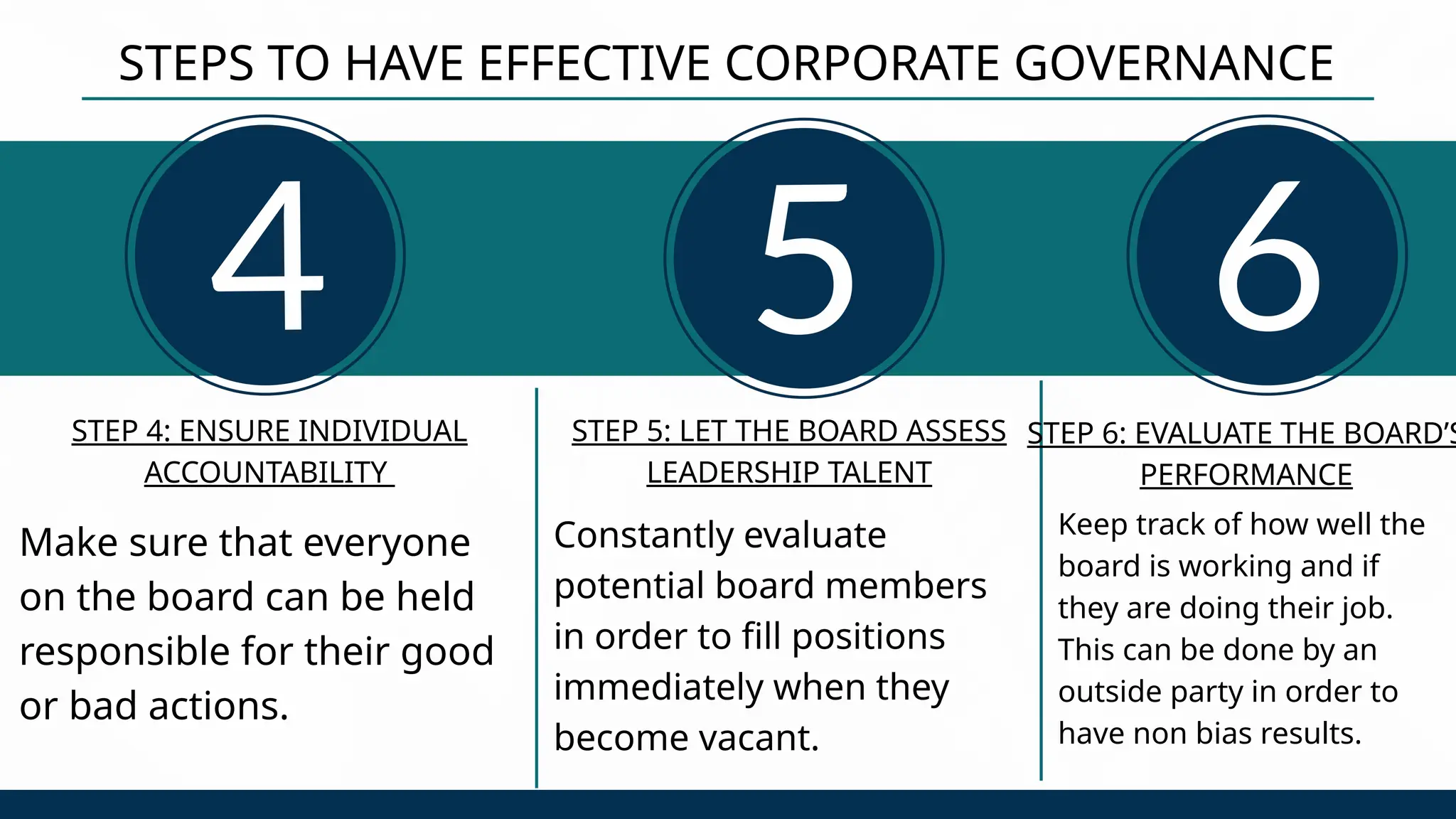
STEP 4: ENSURE INDIVIDUAL
ACCOUNTABILITY ​
Constantly evaluate
potential board members
in order to fill positions
immediately when they
become vacant.​
STEPS TO HAVE EFFECTIVE CORPORATE GOVERNANCE​
Make sure that everyone
on the board can be held
responsible for their good
or bad actions. ​
STEP 5: LET THE BOARD ASSESS
LEADERSHIP TALENT​
STEP 6: EVALUATE THE BOARD’S
PERFORMANCE​
Keep track of how well the
board is working and if
they are doing their job.
This can be done by an
outside party in order to
have non bias results.​
THANK
YOU
GOOD GOVERNANCE AND SOCIAL RESPONSIBILITY

780247984-Good-Governance-Powerpoint-presentation.pptx

  • 1.
    G O OD G OV E R N A N C E GOOD GOVERNANCE AND SOCIAL RESPONSIBILITY
  • 2.
    • CORPORATE GOVERNANCE​ •WHAT DOES CORPORATE GOVERNANCE LOOK LIKE​ • IN PURSUIT OF CORPORATE GOVERNANCE​ • TWO GOVERNANCE METHODOLOGIES​ • EFFECTIVE CORPORATE GOVERNANCE​
  • 3.
    CORPORATE GOVERNANCE? W HAT I S • Is the system of rules, practices, and processes by which a firm is directed and controlled. Corporate governance essentially involves balancing the interests of a company's many stakeholders, such as shareholders, senior management executives, customers, suppliers, financiers, the government, and the community. ​ • Since corporate governance provides the framework for attaining a company's objectives, it encompasses practically every sphere of management, from action plans and internal controls to performance measurement and corporate disclosure.​
  • 4.
    D I FF E R E N C E B E T W E E N GOOD CORPORATE GOVERNANCE POOR CORPORATE GOVERNANCE • Plays a vital role in underpinning the integrity and efficiency of financial markets​ . • Ensures that an organization's board of directors meets regularly, retains control over the business, and has clearly defined responsibilities. • Ensures a robust risk management system. Corporate governance is one of the cornerstones of any good business • Weakens a company’s potential and can lead to financial difficulties. • This can lead to issues such as corruption, negligence, fraud, and lack of accountability. • Domination by a single individual. Sometimes the single individual may bypass the board to action their own interests.
  • 5.
    K E YTA K E AWAY S • Corporate governance is the structure of rules, practices, and processes used to direct and manage a company.​ • A company's board of directors is the primary force influencing corporate governance.​ • Corporate governance covers the areas of environmental awareness, ethical behavior , corporate strategy, compensation, and risk management.​ • The basic principles of corporate governance are accountability, transparency, fairness, responsibility, and risk management.​
  • 6.
    W H ATD O E S CO R P O R AT E G OV E R N A N C E LO O K L I K E ? OWNERS BOARD OF DIRECTORS • Supply equity or risk capital to the company by purchasing shares in the corporation​ • One person who is in control of the operational and monetary aspects of a business. • The owners are often responsible for the highest level of governance. • Group of individuals who oversee the governance of an organization​ • Elected by a vote of shareholders at the annual general meeting (AGM)​
  • 7.
    AUDIT AND COMPENSATION COMMITTEES • Operatingcommittees are staffed by members of the board of directors plus independent or outside directors.​ • Within an organization, there are three types of committees made up of board members which they can create to micro-manage certain aspects of the company in terms of corporate governance. ​
  • 8.
    A U DI T CO M M I T T E E S • Are responsible for monitoring the financial policies and procedures of the organization.​ • Corporations must also be aware of financial regulations, this is important because legal action can be taken against corporations that do not follow set financial laws. In order to follow all accounting policies and internal controls a company will institute an audit committee. • This is composed of the board of directors and independent consultants, it is important you trust all parties involved in the audit committee because they are in charge of all financial implications on a macro level. ​ CO M P E N S AT I O N CO M M I T T E E S • Are responsible for setting the compensation for the CEO and other senior executives.​ • Corporations must incorporate a compensation committee in order to avoid unethical wealth distribution within a company. • This committee is responsible for the high-level executives in regard to determining who is paid what from salaries to bonuses to full compensation packages. ​
  • 9.
    • Monitors theethical performance of the corporation.​ • Oversees compliance with the company’s internal code of ethics as well as any federal and state regulation on corporate conduct.​ • This committee evaluates how ethical a corporation is and makes sure that all regulations are being followed in regards to the three listed areas. ​ CO R P O R AT E G OV E R N A N C E CO M M I T T E E ​
  • 10.
    CO R PO R AT E G OV E R N A N C E CO M M I T T E E ​
  • 11.
    I N PU R S U I T O F CO R P O R AT E G OV E R N A N C E​ GOOD GOVERNANCE AND SOCIAL RESPONSIBILITY
  • 12.
    • Is areport created by a committee led by Mervyn King who is a "corporate lawyer, former High Court Judge, and current governor of the Bank of England"​ • Report was recognized as advocating the highest standards of corporate governance.​ • Took a more integrated approach to the topic of corporate governance.​ K I N G I R E P O R T • By recognizing the involvement of all the corporation’s stakeholders in the efficient and appropriate operation of the organization.​
  • 13.
    • Move thestakeholder model forward.​ • Consider a triple bottom line as opposed to the traditional single bottom line of profitability.​ • Tripple's bottom line recognizes the economic, environmental, and social aspects of a company’s activities ​ • ​ Successful governance in the world in the 21st century requires companies to adopt an inclusive and not exclusive approach.​ • The company must be open to institutional activism and should emphasize the sustainable or non-financial aspects of its performance. K I N G I I R E P O R T F O M A L LY R E CO G N I Z E D T H E N E E D TO :​
  • 14.
    • Boards mustapply the tests of fairness, accountability, responsibility, and transparency to all acts and be accountable to the company and its stakeholders​ • A correct balance between conformance with governance principles and performance in an entrepreneurial market economy must be found. K I N G I I R E P O R T F O M A L LY R E CO G N I Z E D T H E N E E D TO :​
  • 15.
    GOVERNANCE METHODOLOGIES CO MP LY O R E X P L A I N M E T H O D • Set of guidelines that require companies to abide by a set of operating standards or explain why they choose not to.​ • Businesses/individuals will lobby for "comply or explain" because they want to express their opinion and the reason they didn’t follow the set regulations. • This approach creates vague guidelines and lots of room for error which cannot affect a company's corporate governance in terms of efficiency and effectiveness leaving it fairly ineffective.​
  • 16.
    GOVERNANCE METHODOLOGIES CO MP LY O R E L S E M E T H O D • Set of guidelines that require companies to abide by a set of operating standards or face stiff financial penalties.​ • Which leaves no room for explanation or error in compliance with company guidelines.​
  • 17.
    EFFECTIVE CORPORATE GOVERNANCE •Requiresdedicatedfocusonthepartofdirectors,theCEOandseniormanagementtotheirownresponsibilities and,togetherwiththecorporation’sshareholders,tothesharedgoalofbuildinglong-termvalue.​ • Toservethepurposeinsettingtheoperationaltonefortheorganization,theboardshouldbe:​ • Comprisedofmemberswhorepresentprofessionalconduct​ • Grantedproperauthoritytofulfilltheirresponsibilitiesofoversight,guidance,andapproval.​ • Willingtoworkwiththeexecutiveleadershiptoprovidefeedbackandguidanceinadetailedandtimelymanner .​
  • 18.
    STEPS TO HAVE EFFECTIVE CORPORATE GOVERNANCE​ GOODGOVERNANCE AND SOCIAL RESPONSIBILITY
  • 19.
    STEPS TO HAVEEFFECTIVE CORPORATE GOVERNANCE​ STEP 1: CREATE A CLIMATE OF TRUST AND CANDOR​ This essentially means that the board needs to work together on issues and there can be no animosity amongst all those involved with the committee​ STEP 2: FOSTER A CULTURE OF OPEN DISSENT​ The board needs to be open with each other. The board must talk everything over thoroughly and think about every option before coming to a conclusion.​ STEP 3: MIX UP ROLES ​ Change up responsibilities within the committee and keep ideas fresh. ​
  • 20.
    STEP 4: ENSUREINDIVIDUAL ACCOUNTABILITY ​ Constantly evaluate potential board members in order to fill positions immediately when they become vacant.​ STEPS TO HAVE EFFECTIVE CORPORATE GOVERNANCE​ Make sure that everyone on the board can be held responsible for their good or bad actions. ​ STEP 5: LET THE BOARD ASSESS LEADERSHIP TALENT​ STEP 6: EVALUATE THE BOARD’S PERFORMANCE​ Keep track of how well the board is working and if they are doing their job. This can be done by an outside party in order to have non bias results.​
  • 21.
    THANK YOU GOOD GOVERNANCE ANDSOCIAL RESPONSIBILITY