7 Ways To Avoid  Bad Debt
Riskdisk helps thousands of companies to avoid bad debts by allowing them to check the credit status of all their customers.  However, if you’re not yet using our system, the next best way to protect yourself is to use the following guidelines. We hope you find them useful. www.riskdisk.com
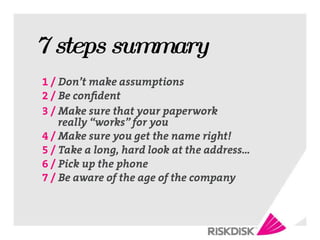
7 steps summary
1. Don’t assume… They’ll be O.K. After all, they are a limited company/PLC. We’ve heard they’re doing really well. They’re massive. They’re part of a huge group.
1. Don’t assume… They’re a household name. (The most frequently checked companies are the largest) Just look at their prestigious address - even the building is named after them.
2. Be confident… You have every right to ask: 1.  Who/what are you dealing with? 2.  Where are they located? 3.  Do they have the money to pay? 4.  Are they prepared to part with it    promptly?
If you give credit to a customer, you are investing in their business.
3. Paperwork Customers should always fill out a credit application form that includes your terms of trading. Ensure that: They are presented in fluent, unambiguous English. They apply to all sales. They include a Retention of Title clause. They stipulate when payment is due.
3. Paperwork They supersede any terms imposed by the purchaser.  They define the point at which ownership (and risk) passes from you to your purchaser. They state any interest you wish to charge on overdue accounts.
4. Get the name right Check spelling Get it typed, not handwritten Don’t be tempted to shorten names in correspondence Don’t be fooled by a fancy name   [Trotter’s International Traders Ltd?]
5. Check the address Make sure that all addresses completed on your application form are legible. Beware residential addresses, check suitability with line of business. PO box number and town = extreme caution.  Don’t forget a full postcode. Beware of ex-directory  listings.
6. Phone them… Beware phones that are: permanently serviced by answering machines. never answered. permanently engaged. answered merely with a number. answered with only a “yes” or “hello”. answered with a different name altogether!
7. Check their age… Note that: 40% of all businesses fail within 2 years New companies are often most stretched after 5 months, when the initial capital typically begins to run out Financial information on new limited companies may not be published for 22 months
7. Check their age… But young doesn’t mean unreliable. However, if there is no financial history, you may want to insist on: A guarantee from one or more of the directors. A guarantee from the parent company (if there is one). A guarantee from the ultimate holding company (if there is one).
The best bet is to check the credit of every customer with a reputable credit agency. Visit us at  www.riskdisk.co.uk  or call us on 0844 473 0054 to find out how easy and affordable it can be.

7 Steps For Avoiding Bad Debts

  • 1.
    7 Ways ToAvoid Bad Debt
  • 2.
    Riskdisk helps thousandsof companies to avoid bad debts by allowing them to check the credit status of all their customers. However, if you’re not yet using our system, the next best way to protect yourself is to use the following guidelines. We hope you find them useful. www.riskdisk.com
  • 3.
  • 4.
    1. Don’t assume…They’ll be O.K. After all, they are a limited company/PLC. We’ve heard they’re doing really well. They’re massive. They’re part of a huge group.
  • 5.
    1. Don’t assume…They’re a household name. (The most frequently checked companies are the largest) Just look at their prestigious address - even the building is named after them.
  • 6.
    2. Be confident…You have every right to ask: 1. Who/what are you dealing with? 2. Where are they located? 3. Do they have the money to pay? 4. Are they prepared to part with it promptly?
  • 7.
    If you givecredit to a customer, you are investing in their business.
  • 8.
    3. Paperwork Customersshould always fill out a credit application form that includes your terms of trading. Ensure that: They are presented in fluent, unambiguous English. They apply to all sales. They include a Retention of Title clause. They stipulate when payment is due.
  • 9.
    3. Paperwork Theysupersede any terms imposed by the purchaser. They define the point at which ownership (and risk) passes from you to your purchaser. They state any interest you wish to charge on overdue accounts.
  • 10.
    4. Get thename right Check spelling Get it typed, not handwritten Don’t be tempted to shorten names in correspondence Don’t be fooled by a fancy name [Trotter’s International Traders Ltd?]
  • 11.
    5. Check theaddress Make sure that all addresses completed on your application form are legible. Beware residential addresses, check suitability with line of business. PO box number and town = extreme caution. Don’t forget a full postcode. Beware of ex-directory listings.
  • 12.
    6. Phone them…Beware phones that are: permanently serviced by answering machines. never answered. permanently engaged. answered merely with a number. answered with only a “yes” or “hello”. answered with a different name altogether!
  • 13.
    7. Check theirage… Note that: 40% of all businesses fail within 2 years New companies are often most stretched after 5 months, when the initial capital typically begins to run out Financial information on new limited companies may not be published for 22 months
  • 14.
    7. Check theirage… But young doesn’t mean unreliable. However, if there is no financial history, you may want to insist on: A guarantee from one or more of the directors. A guarantee from the parent company (if there is one). A guarantee from the ultimate holding company (if there is one).
  • 15.
    The best betis to check the credit of every customer with a reputable credit agency. Visit us at www.riskdisk.co.uk or call us on 0844 473 0054 to find out how easy and affordable it can be.