7 Productivity Tips,
Backed by Science
1. Procrastinate
Complex tasks are often better
handled in the back of our
minds
Adam Grant - Organizational Psychologist
Why?
2. Remember Why
You’re Doing What
You’re Doing
Once we start asking why (we’re
doing something), small tasks
become a larger constellation of
meaningful projects, goals, and
values.
Charles Duhigg - Author of Smarter, Better, Faster
Why?
3. Go With Your Instincts
Our judgments don’t improve
as we are given more and more
info – in fact, our decisions
often become worse!
Malcolm Gladwell - Author of the Tipping Point
Why?
4. Put Your
Happiness First
If you’re more positive, your brain
will have a “happiness advantage.”
That means it’ll perform significantly
better than it would at a negative,
neutral, or stressed state.
Shawn Anchor - Author of The Happiness Advantage
Why?
5. Create a
15-Minute List
When you feel the tug of
procrastination. You can quickly
complete a task, which gives you a
little energy boost, helping you
transition into working on a more
challenging or complex project.
Carson Tate - Psychologist, founder of Working Simply
Why?
6. Do Something
You Love
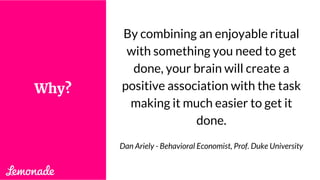
By combining an enjoyable ritual
with something you need to get
done, your brain will create a
positive association with the task
making it much easier to get it
done.
Dan Ariely - Behavioral Economist, Prof. Duke University
Why?
7. Notice Your
Energy Levels
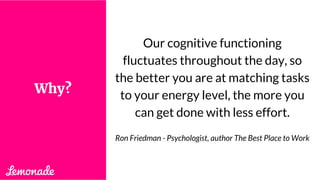
Our cognitive functioning
fluctuates throughout the day, so
the better you are at matching tasks
to your energy level, the more you
can get done with less effort.
Ron Friedman - Psychologist, author The Best Place to Work
Why?
Read the Full Article Here
#lifehacks
Practical tips to simplify + improve your everyday life by Lemonade
Thank us later ; )

7 Productivity Tips, Backed by Science

  • 1.
  • 2.
  • 3.
    Complex tasks areoften better handled in the back of our minds Adam Grant - Organizational Psychologist Why?
  • 4.
    2. Remember Why You’reDoing What You’re Doing
  • 5.
    Once we startasking why (we’re doing something), small tasks become a larger constellation of meaningful projects, goals, and values. Charles Duhigg - Author of Smarter, Better, Faster Why?
  • 6.
    3. Go WithYour Instincts
  • 7.
    Our judgments don’timprove as we are given more and more info – in fact, our decisions often become worse! Malcolm Gladwell - Author of the Tipping Point Why?
  • 8.
  • 9.
    If you’re morepositive, your brain will have a “happiness advantage.” That means it’ll perform significantly better than it would at a negative, neutral, or stressed state. Shawn Anchor - Author of The Happiness Advantage Why?
  • 10.
  • 11.
    When you feelthe tug of procrastination. You can quickly complete a task, which gives you a little energy boost, helping you transition into working on a more challenging or complex project. Carson Tate - Psychologist, founder of Working Simply Why?
  • 12.
  • 13.
    By combining anenjoyable ritual with something you need to get done, your brain will create a positive association with the task making it much easier to get it done. Dan Ariely - Behavioral Economist, Prof. Duke University Why?
  • 14.
  • 15.
    Our cognitive functioning fluctuatesthroughout the day, so the better you are at matching tasks to your energy level, the more you can get done with less effort. Ron Friedman - Psychologist, author The Best Place to Work Why?
  • 16.
    Read the FullArticle Here
  • 17.
    #lifehacks Practical tips tosimplify + improve your everyday life by Lemonade Thank us later ; )