Climate Change:
How it happens and how it affects us.
Outline
●What is climate?
●What makes the climate change?
●How has climate changed in the past?
●Human caused climate change: the greenhouse effect.
●Have we changed the climate?
●What will the future climate look like?
●How will climate change affect people?
What is climate?
Climate is an average of weather (Temperature, Rainfall...)
over a “long” time (more than 2-3 weeks).
weather
climate (average min/max)
Weather and Climate in Seattle:
What makes climate change?
●Changes in the sun
●Changes in the earth's orbit
●Changes in the clouds
●Changes in ice sheets
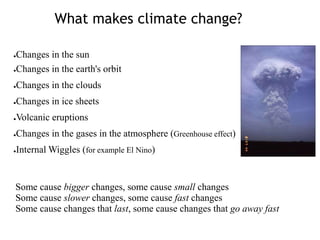
●Volcanic eruptions
●Changes in the gases in the atmosphere (Greenhouse effect)
●Internal Wiggles (for example El Nino)
Some cause bigger changes, some cause small changes
Some cause slower changes, some cause fast changes
Some cause changes that last, some cause changes that go away fast
How has climate changed in the past?
●Ice Ages
●Big swings in climate over 100,000 yrs
●Occurred over last million years
●Advance and retreat of ice sheets
●We are in between ice ages right now
Now
21 thousand
years ago
●Eocene Warm Period
●50 million years ago
●Palm trees in Puget Sound
●Crocodiles in the Arctic
How has climate changed in the past?
Human-Forced Climate Change
● Climate changes can be natural or human caused.
● Humans can affect
the climate by
changing the gases
in the atmosphere.
(greenhouse
effect).
The Greenhouse Effect
●Carbon Dioxide (CO2) is a major greenhouse gas
●Human burning of fossil fuels, and plants releases CO2
Human influence on climate: the
greenhouse effect
Have we changed the climate?
Changes in global temperature over the last 125 years
Have we changed the climate?
Changes in global temperature over the last 1,000 years
Have we changed the climate?
Everywhere (almost) is warming!
1928
2000
The South Cascade glacier
retreated dramatically in the
20th century
Courtesy of the USGS glacier group
Have we changed the climate?
Glaciers are retreating all over the world
Have we changed the climate?
Global Climate Models
●Use a computer to make a “model” of the earth
●Tell the computer how to force the climate
●Use science to come up with equations at points on the earth that
tell what the Temperature, Winds,.. are and how they change
●Change things around and see what happens!!!
Natural Climate Influence All Climate Influences
Have we changed the climate?
Climate models capture the last 100 year's warming only if we
include the human effects
What will the future climate look like?
●Global warming due to greenhouse gases will continue for many years
even if we stop releasing CO2
●How much warming occurs depends on what societies and businesses
decide about how much fuel they burn
●We use climate models to predict what might happen in different cases
IPCC (www.ipcc.ch)
What will the future climate look like?
● Changes are greater in far north / south
● Changes in rain and snow are likely, but not as well understood
● In WA snow will melt earlier
How will climate change affect people?
Understanding: Good
Everywhere:
●Sea-level rise
●Ecosystem change
●effect on species
●effect on farming
●Melting of polar ice
●effect on shipping
●effect on wildlife
●Coral death
WA:
●Less mountain snow
●Less water to go
around in the summer
●Coastal flooding
(Olympia)
●Harder for Salmon to
survive in freshwater
US Geological Survey
How will climate change affect people?
Understanding: Medium
Everywhere:
●Increase in intensity of hurricanes
●Increase in droughts in some places
●Increase in intense rain in some
places
WA:
●Changes in how well forests grow
●Increased habitat for pests
●Farming: some crops will grow
better, some will grow worse
How will climate change affect people?
Understanding: Low
Everywhere:
●How will humans react
●Surprise changes
WA
●Increased winter flooding
●Increased landslides
●Overall forest health
●Coastal erosion
6thgrade_climatechange.ppt

6thgrade_climatechange.ppt

  • 1.
    Climate Change: How ithappens and how it affects us.
  • 2.
    Outline ●What is climate? ●Whatmakes the climate change? ●How has climate changed in the past? ●Human caused climate change: the greenhouse effect. ●Have we changed the climate? ●What will the future climate look like? ●How will climate change affect people?
  • 3.
  • 4.
    Climate is anaverage of weather (Temperature, Rainfall...) over a “long” time (more than 2-3 weeks). weather climate (average min/max) Weather and Climate in Seattle:
  • 5.
    What makes climatechange? ●Changes in the sun ●Changes in the earth's orbit ●Changes in the clouds ●Changes in ice sheets ●Volcanic eruptions ●Changes in the gases in the atmosphere (Greenhouse effect) ●Internal Wiggles (for example El Nino) Some cause bigger changes, some cause small changes Some cause slower changes, some cause fast changes Some cause changes that last, some cause changes that go away fast
  • 6.
    How has climatechanged in the past? ●Ice Ages ●Big swings in climate over 100,000 yrs ●Occurred over last million years ●Advance and retreat of ice sheets ●We are in between ice ages right now Now 21 thousand years ago
  • 7.
    ●Eocene Warm Period ●50million years ago ●Palm trees in Puget Sound ●Crocodiles in the Arctic How has climate changed in the past?
  • 8.
    Human-Forced Climate Change ●Climate changes can be natural or human caused. ● Humans can affect the climate by changing the gases in the atmosphere. (greenhouse effect).
  • 9.
  • 10.
    ●Carbon Dioxide (CO2)is a major greenhouse gas ●Human burning of fossil fuels, and plants releases CO2 Human influence on climate: the greenhouse effect
  • 11.
    Have we changedthe climate? Changes in global temperature over the last 125 years
  • 12.
    Have we changedthe climate? Changes in global temperature over the last 1,000 years
  • 13.
    Have we changedthe climate? Everywhere (almost) is warming!
  • 14.
    1928 2000 The South Cascadeglacier retreated dramatically in the 20th century Courtesy of the USGS glacier group Have we changed the climate? Glaciers are retreating all over the world
  • 15.
    Have we changedthe climate? Global Climate Models ●Use a computer to make a “model” of the earth ●Tell the computer how to force the climate ●Use science to come up with equations at points on the earth that tell what the Temperature, Winds,.. are and how they change ●Change things around and see what happens!!!
  • 16.
    Natural Climate InfluenceAll Climate Influences Have we changed the climate? Climate models capture the last 100 year's warming only if we include the human effects
  • 17.
    What will thefuture climate look like? ●Global warming due to greenhouse gases will continue for many years even if we stop releasing CO2 ●How much warming occurs depends on what societies and businesses decide about how much fuel they burn ●We use climate models to predict what might happen in different cases
  • 18.
    IPCC (www.ipcc.ch) What willthe future climate look like?
  • 19.
    What will thefuture climate look like? ● Changes are greater in far north / south ● Changes in rain and snow are likely, but not as well understood ● In WA snow will melt earlier
  • 20.
    How will climatechange affect people? Understanding: Good Everywhere: ●Sea-level rise ●Ecosystem change ●effect on species ●effect on farming ●Melting of polar ice ●effect on shipping ●effect on wildlife ●Coral death WA: ●Less mountain snow ●Less water to go around in the summer ●Coastal flooding (Olympia) ●Harder for Salmon to survive in freshwater
  • 21.
    US Geological Survey Howwill climate change affect people? Understanding: Medium Everywhere: ●Increase in intensity of hurricanes ●Increase in droughts in some places ●Increase in intense rain in some places WA: ●Changes in how well forests grow ●Increased habitat for pests ●Farming: some crops will grow better, some will grow worse
  • 23.
    How will climatechange affect people? Understanding: Low Everywhere: ●How will humans react ●Surprise changes WA ●Increased winter flooding ●Increased landslides ●Overall forest health ●Coastal erosion

Editor's Notes

  • #10 The greenhouse effect: certain “greenhouse” gases in the atmosphere permit sunlight to pass through the atmosphere, but absorb much of the infrared (heat) radiation from Earth’s surface. The atmosphere warms, and radiates additional heat to the surface. The planet’s temperature is therefore higher than it would be without greenhouse gases, and it stands to reason that adding more greenhouse gases to the atmosphere is likely to warm the planet.
  • #13 This figure, taken from the IPCC report, compares the instrumental record of northern hemisphere temperature (red) with temperature reconstructed using data from tree rings and other “proxy” data. Viewed in this context, the warming of the 20th century appears to be well outside the natural range of variability – indeed, the IPCC said that the 20th century warming is “likely [judged 66-90% chance of being true] to have been the largest of any century during the past 1,000 years.”
  • #15 These pictures show the South Cascade glacier in 1928 and 2000. The glacier has retreated and thinned substantially, leaving a glacial lake in its place. Glacial retreats have occurred around the world.
  • #17 Various groups of researchers have attempted to simulate the 20th century climate using “climate models”, sophisticated computer programs that represent the laws of physics as they apply to the Earth’s atmosphere, ocean, land, and ice. This figure shows one such study in which a climate model was run several times with natural climate influences (solar variations, volcanic eruptions), human climate influences (greenhouse gases and sulfate aerosols), and both kinds of influences. The best simulation of the 20th century climate uses all climate influences. In particular, the warming of the last 30 years (when human climate influence is expected to have grown strongest)
  • #19 The IPCC came up with a range of future scenarios of CO2 emissions, leading to a wide range of projected temperature changes. At the top end (5.8C) you have to assume extreme growth in CO2 emissions combined with very high sensitivity of climate to greenhouse gases, more than what is consistent with the observed 20th century warming. Likewise, the low end is probably also unrealistic without significant policy efforts. Mid-century the likely warming is about 1C. Beyond that the envelope widens substantially, dependent largely on socioeconomic development. The warming continues beyond 2100. Stabilizing greenhouse gases in the atmosphere does not immediately stabilize climate: that would take many more decades.