Post Assessment test
The Big Review!
Grading
4 points for each section (The test has 6 sections)
4: Answered all/most questions and shows an
understanding of these topics.
3: Answered more than half of the questions
and shows an understanding of these topics.
2: Answered half or less of the questions
and shows an understanding of some of `the
topics.
1: Shows little or no understanding.
Part 1: Elements of Art
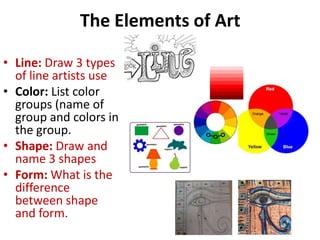
The Elements of Art
• Line: Draw 3 types
of line artists use
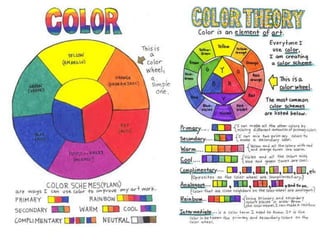
• Color: List color
groups (name of
group and colors in
the group.
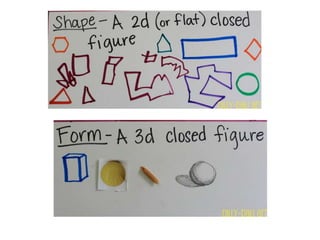
• Shape: Draw and
name 3 shapes
• Form: What is the
difference
between shape
and form.
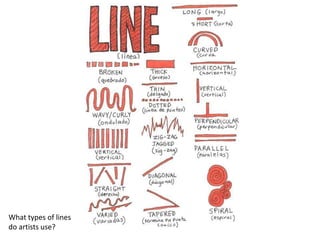
What types of lines
do artists use?
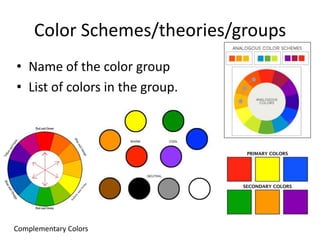
Color Schemes/theories/groups
• Name of the color group
• List of colors in the group.
Complementary Colors
The Sensory elements of Art
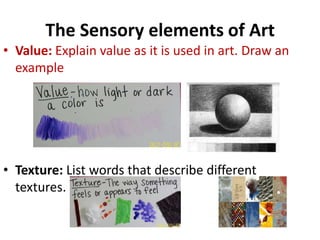
• Value: Explain value as it is used in art. Draw an
example
• Texture: List words that describe different
textures.
The Sensory elements of Art
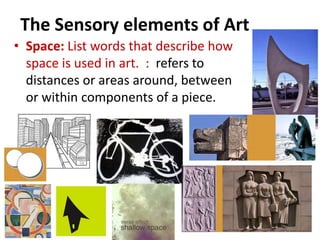
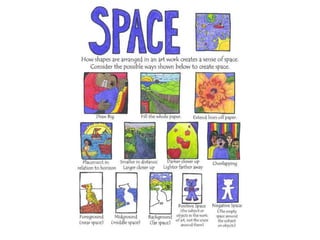
• Space: List words that describe how
space is used in art. : refers to
distances or areas around, between
or within components of a piece.
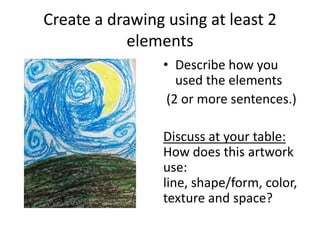
Create a drawing using at least 2
elements
• Describe how you
used the elements
(2 or more sentences.)
Discuss at your table:
How does this artwork
use:
line, shape/form, color,
texture and space?
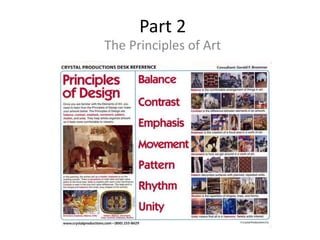
Part 2
The Principles of Art
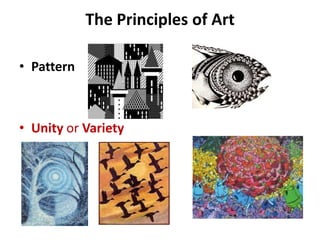
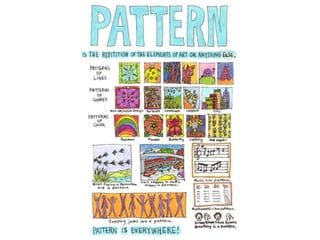
• Pattern
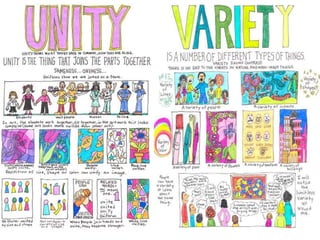
• Unity or Variety
The Principles of Art
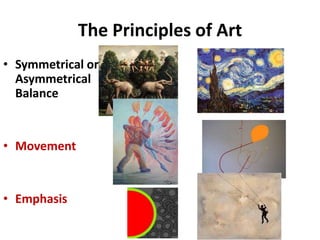
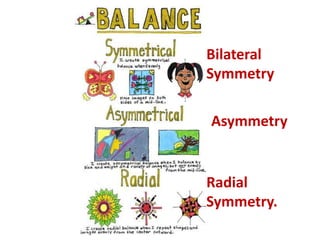
• Symmetrical or
Asymmetrical
Balance
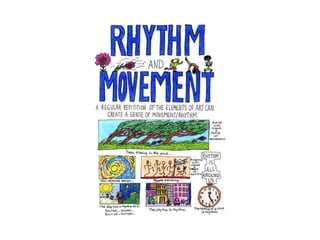
• Movement
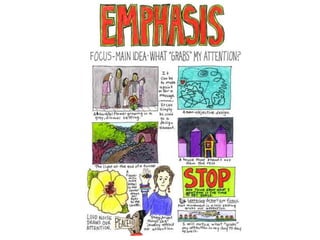
• Emphasis
Radial
Symmetry.
Bilateral
Symmetry
Asymmetry
Part 3
The Style Characteristics of Western
and Non- Western Art
• Non-Western art refers to any art objects originating from the
cultures and societies outside of the Western world.
• The West includes the cultures of Europe and the arts utilizing
European aesthetics.
• Arts of colonized areas such as the United States, Australia, New
Zealand and Canada are considered the West,
• but the arts from the native peoples of these countries are
referred to as non-Western art.
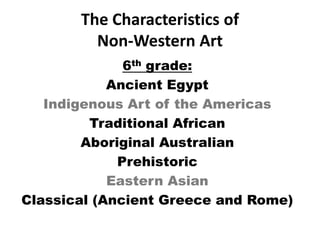
The Characteristics of
Non-Western Art
6th grade:
Ancient Egypt
Indigenous Art of the Americas
Traditional African
Aboriginal Australian
Prehistoric
Eastern Asian
Classical (Ancient Greece and Rome)
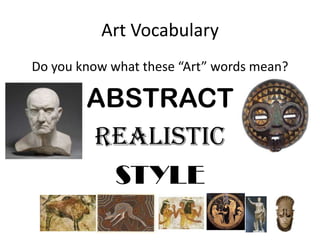
Art Vocabulary
Do you know what these “Art” words mean?
ABSTRACT
REALISTIC
STYLE
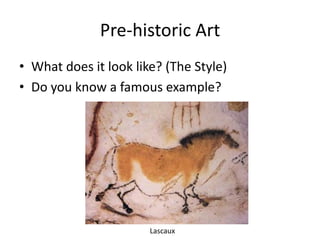
Pre-historic Art
• What does it look like? (The Style)
• Do you know a famous example?
Lascaux
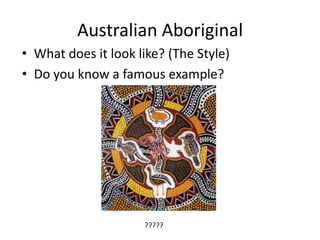
Australian Aboriginal
• What does it look like? (The Style)
• Do you know a famous example?
?????
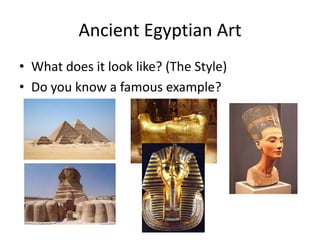
Ancient Egyptian Art
• What does it look like? (The Style)
• Do you know a famous example?
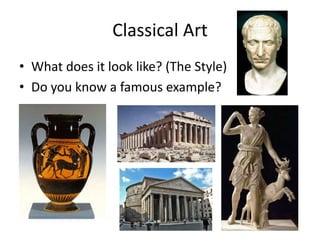
Classical Art
• What does it look like? (The Style)
• Do you know a famous example?
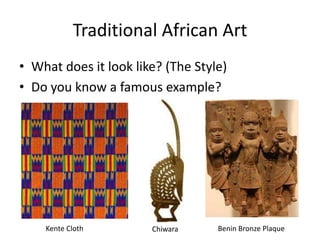
Traditional African Art
• What does it look like? (The Style)
• Do you know a famous example?
Kente Cloth Chiwara Benin Bronze Plaque
Part 4
Demonstrate the characteristics of
tools, materials and techniques used in
creating art.
Demonstrate the characteristics of
Tools, materials and techniques used
in creating art.
• Material?
• Tools used with that material?
• 3 or more Techniques used with the material?
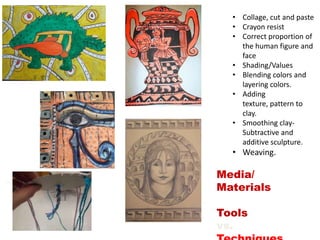
• Collage, cut and paste
• Crayon resist
• Correct proportion of
the human figure and
face
• Shading/Values
• Blending colors and
layering colors.
• Adding
texture, pattern to
clay.
• Smoothing clay-
Subtractive and
additive sculpture.
• Weaving.
Media/
Materials
Tools
vs.
(above)
Demonstrate the characteristics of
Tools, materials and techniques used
in creating art.
Discuss at your table:
• What are some types of two dimensional art?
• What are some types of three dimensional
art?
Part 5
Compare and Contrast connections
in Art.
List your favorite
work of Visual Art.
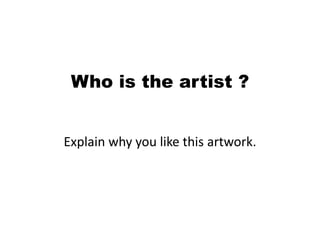
Who is the artist ?
Explain why you like this artwork.
Compare and Contrast connections in
Art.
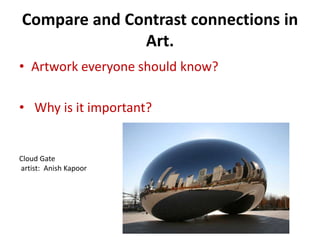
• Artwork everyone should know?
• Why is it important?
Cloud Gate
artist: Anish Kapoor
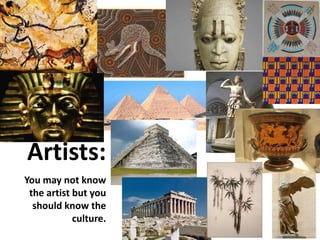
Artists:
You may not know
the artist but you
should know the
culture.
Frida Kahlo
Self-Portrait
Rembrandt
Lucretia
Franz Marc
Large Blue Horses
Edvard Munch
The Scream
Frank Lloyd Wright
Fallingwater
Michelangelo
Sistine Chapel
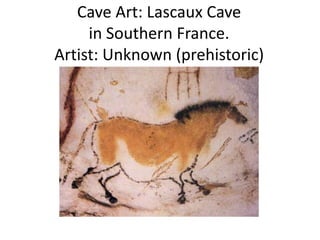
Cave Art: Lascaux Cave
in Southern France.
Artist: Unknown (prehistoric)
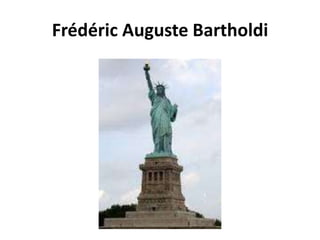
Frédéric Auguste Bartholdi
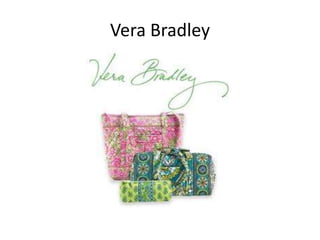
Vera Bradley
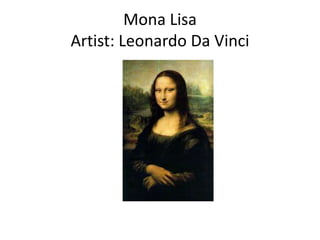
Mona Lisa
Artist: Leonardo Da Vinci
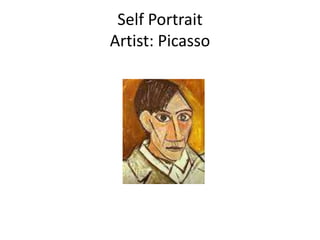
Self Portrait
Artist: Picasso
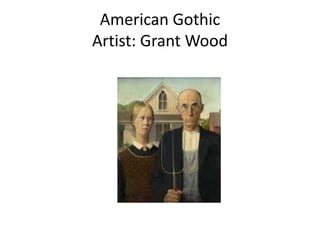
American Gothic
Artist: Grant Wood
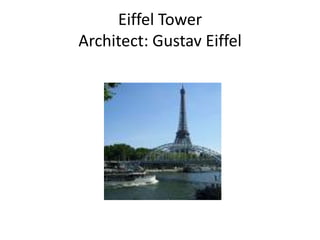
Eiffel Tower
Architect: Gustav Eiffel
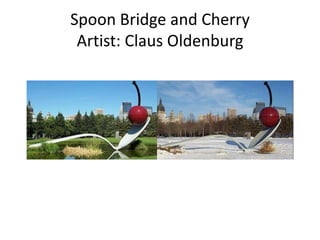
Spoon Bridge and Cherry
Artist: Claus Oldenburg
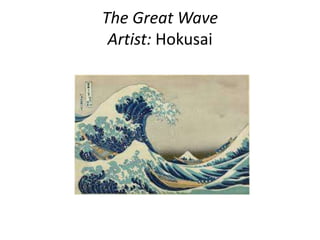
The Great Wave
Artist: Hokusai
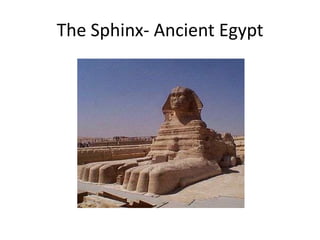
The Sphinx- Ancient Egypt
Part 6
Analyze the meaning and function of
art.
Analyze the meaning and function of
art.
• What is art?
• What is good art?
• DO YOU HAVE ANYTHING TO ADD OR
CHANGE?
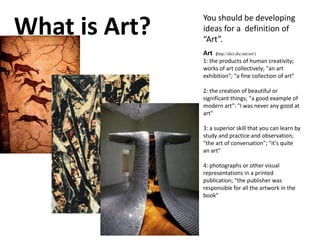
What is Art?
You should be developing
ideas for a definition of
“Art”.
Art (http://dict.die.net/art/)
1: the products of human creativity;
works of art collectively; "an art
exhibition"; "a fine collection of art"
2: the creation of beautiful or
significant things; "a good example of
modern art": "I was never any good at
art"
3: a superior skill that you can learn by
study and practice and observation;
"the art of conversation"; "it's quite
an art"
4: photographs or other visual
representations in a printed
publication; "the publisher was
responsible for all the artwork in the
book"
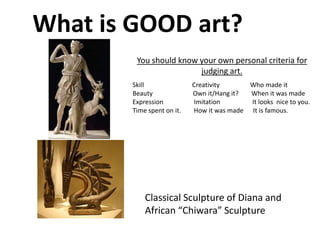
What is GOOD art?
Classical Sculpture of Diana and
African “Chiwara” Sculpture
You should know your own personal criteria for
judging art.
Skill Creativity Who made it
Beauty Own it/Hang it? When it was made
Expression Imitation It looks nice to you.
Time spent on it. How it was made It is famous.
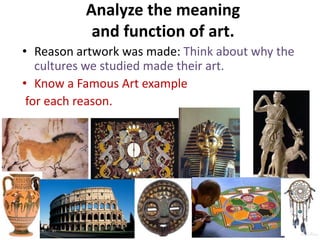
Analyze the meaning
and function of art.
• Reason artwork was made: Think about why the
cultures we studied made their art.
• Know a Famous Art example
for each reason.
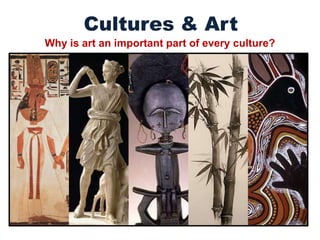
Cultures & Art
Why is art an important part of every culture?
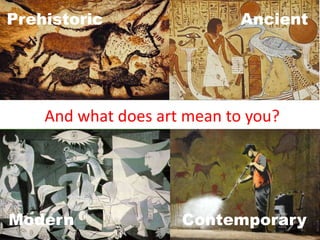
Prehistoric Ancient
ContemporaryModern
And what does art mean to you?

6th grade the big review kh

  • 1.
  • 2.
    Grading 4 points foreach section (The test has 6 sections) 4: Answered all/most questions and shows an understanding of these topics. 3: Answered more than half of the questions and shows an understanding of these topics. 2: Answered half or less of the questions and shows an understanding of some of `the topics. 1: Shows little or no understanding.
  • 3.
  • 4.
    The Elements ofArt • Line: Draw 3 types of line artists use • Color: List color groups (name of group and colors in the group. • Shape: Draw and name 3 shapes • Form: What is the difference between shape and form.
  • 5.
    What types oflines do artists use?
  • 7.
    Color Schemes/theories/groups • Nameof the color group • List of colors in the group. Complementary Colors
  • 9.
    The Sensory elementsof Art • Value: Explain value as it is used in art. Draw an example • Texture: List words that describe different textures.
  • 10.
    The Sensory elementsof Art • Space: List words that describe how space is used in art. : refers to distances or areas around, between or within components of a piece.
  • 12.
    Create a drawingusing at least 2 elements • Describe how you used the elements (2 or more sentences.) Discuss at your table: How does this artwork use: line, shape/form, color, texture and space?
  • 13.
  • 14.
    The Principles ofArt • Pattern • Unity or Variety
  • 17.
    The Principles ofArt • Symmetrical or Asymmetrical Balance • Movement • Emphasis
  • 18.
  • 21.
    Part 3 The StyleCharacteristics of Western and Non- Western Art • Non-Western art refers to any art objects originating from the cultures and societies outside of the Western world. • The West includes the cultures of Europe and the arts utilizing European aesthetics. • Arts of colonized areas such as the United States, Australia, New Zealand and Canada are considered the West, • but the arts from the native peoples of these countries are referred to as non-Western art.
  • 22.
    The Characteristics of Non-WesternArt 6th grade: Ancient Egypt Indigenous Art of the Americas Traditional African Aboriginal Australian Prehistoric Eastern Asian Classical (Ancient Greece and Rome)
  • 23.
    Art Vocabulary Do youknow what these “Art” words mean? ABSTRACT REALISTIC STYLE
  • 24.
    Pre-historic Art • Whatdoes it look like? (The Style) • Do you know a famous example? Lascaux
  • 25.
    Australian Aboriginal • Whatdoes it look like? (The Style) • Do you know a famous example? ?????
  • 26.
    Ancient Egyptian Art •What does it look like? (The Style) • Do you know a famous example?
  • 27.
    Classical Art • Whatdoes it look like? (The Style) • Do you know a famous example?
  • 28.
    Traditional African Art •What does it look like? (The Style) • Do you know a famous example? Kente Cloth Chiwara Benin Bronze Plaque
  • 29.
    Part 4 Demonstrate thecharacteristics of tools, materials and techniques used in creating art.
  • 30.
    Demonstrate the characteristicsof Tools, materials and techniques used in creating art. • Material? • Tools used with that material? • 3 or more Techniques used with the material?
  • 31.
    • Collage, cutand paste • Crayon resist • Correct proportion of the human figure and face • Shading/Values • Blending colors and layering colors. • Adding texture, pattern to clay. • Smoothing clay- Subtractive and additive sculpture. • Weaving. Media/ Materials Tools vs. (above)
  • 32.
    Demonstrate the characteristicsof Tools, materials and techniques used in creating art. Discuss at your table: • What are some types of two dimensional art? • What are some types of three dimensional art?
  • 33.
    Part 5 Compare andContrast connections in Art.
  • 34.
  • 35.
    Who is theartist ? Explain why you like this artwork.
  • 36.
    Compare and Contrastconnections in Art. • Artwork everyone should know? • Why is it important? Cloud Gate artist: Anish Kapoor
  • 37.
    Artists: You may notknow the artist but you should know the culture. Frida Kahlo Self-Portrait Rembrandt Lucretia Franz Marc Large Blue Horses Edvard Munch The Scream Frank Lloyd Wright Fallingwater Michelangelo Sistine Chapel
  • 38.
    Cave Art: LascauxCave in Southern France. Artist: Unknown (prehistoric)
  • 39.
  • 40.
  • 41.
  • 42.
  • 43.
  • 44.
  • 45.
    Spoon Bridge andCherry Artist: Claus Oldenburg
  • 46.
  • 47.
  • 48.
    Part 6 Analyze themeaning and function of art.
  • 49.
    Analyze the meaningand function of art. • What is art? • What is good art? • DO YOU HAVE ANYTHING TO ADD OR CHANGE?
  • 50.
    What is Art? Youshould be developing ideas for a definition of “Art”. Art (http://dict.die.net/art/) 1: the products of human creativity; works of art collectively; "an art exhibition"; "a fine collection of art" 2: the creation of beautiful or significant things; "a good example of modern art": "I was never any good at art" 3: a superior skill that you can learn by study and practice and observation; "the art of conversation"; "it's quite an art" 4: photographs or other visual representations in a printed publication; "the publisher was responsible for all the artwork in the book"
  • 51.
    What is GOODart? Classical Sculpture of Diana and African “Chiwara” Sculpture You should know your own personal criteria for judging art. Skill Creativity Who made it Beauty Own it/Hang it? When it was made Expression Imitation It looks nice to you. Time spent on it. How it was made It is famous.
  • 52.
    Analyze the meaning andfunction of art. • Reason artwork was made: Think about why the cultures we studied made their art. • Know a Famous Art example for each reason.
  • 53.
    Cultures & Art Whyis art an important part of every culture?
  • 54.

Editor's Notes

  • #53 Some/One, the art piece, created by contemporary Korean artist Do-Ho Suh,