Software Quality Models
M. Asif Afzal
Introduction to Software Quality Models
• Software Quality Models provide a systematic framework to assess
and improve the quality of software products.
• They help us evaluate various dimensions of software quality, identify
areas for improvement, and implement best practices.
Importance of Software Quality
High-quality software is essential to meet customer expectations, deliver value, and
maintain a competitive edge.
It enhances user satisfaction, reduces maintenance costs, improves productivity,
and minimizes risks associated with software defects or failures.
Software Quality Models guide organizations in achieving these goals by providing a
structured approach to quality assessment and improvement.
Software Quality Models
ISO 25000 Quality Model:
• ISO 25000, also known as the Software Product Quality Requirements and Evaluation (SQuaRE) series
• a comprehensive set of quality characteristics, such as functionality, reliability, usability, efficiency, maintainability,
and portability.
• This defines a structured approach to measure, evaluate, and improve software quality based on these
characteristics.
The Capability Maturity Model Integration (CMMI):
The CMMI is a widely adopted model for assessing and improving an organization’s software development processes.
• It focuses on process maturity levels and helps organizations optimize their processes to achieve higher quality
outcomes.
• It provides a roadmap for process improvement, emphasizing best practices, efficiency, and consistency throughout
the SDLC.
The Six Sigma Approach to Software Quality:
• Originally developed in the manufacturing industry,
• the Six Sigma approach has been adapted to software development to minimize defects and improve quality.
• It relies on statistical analysis and process improvement methodologies to measure and reduce variation, ensuring
that software meets or exceeds customer expectations.
Software Quality Models
The ISO 9126 Quality Model:
• ISO 9126 is a quality model that focuses on software product characteristics and quality attributes.
• It encompasses six primary characteristics: functionality, reliability, usability, efficiency, maintainability, and portability.
• Each characteristic is further divided into sub-characteristics, providing a comprehensive framework to evaluate and
improve software quality.
The Quality Assurance Model:
• The Quality Assurance (QA) model emphasizes the proactive measures and processes required to ensure software quality
throughout the development lifecycle.
• It involves establishing quality standards, defining processes, conducting reviews and audits, and implementing preventive
measures to identify and resolve issues early.
The Software Testing and Verification Model:
• It focus on validating software through rigorous testing practices.
• They involve designing test cases, executing tests, identifying and reporting defects, and verifying that software meets
specified requirements.
• These models encompass a variety of testing techniques, such as unit testing, integration testing, system testing, and
acceptance testing, to ensure the quality and reliability of software.
Software Quality Models
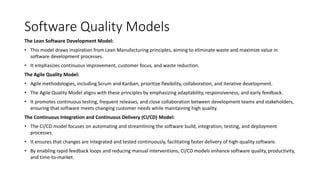
The Lean Software Development Model:
• This model draws inspiration from Lean Manufacturing principles, aiming to eliminate waste and maximize value in
software development processes.
• It emphasizes continuous improvement, customer focus, and waste reduction.
The Agile Quality Model:
• Agile methodologies, including Scrum and Kanban, prioritize flexibility, collaboration, and iterative development.
• The Agile Quality Model aligns with these principles by emphasizing adaptability, responsiveness, and early feedback.
• It promotes continuous testing, frequent releases, and close collaboration between development teams and stakeholders,
ensuring that software meets changing customer needs while maintaining high quality.
The Continuous Integration and Continuous Delivery (CI/CD) Model:
• The CI/CD model focuses on automating and streamlining the software build, integration, testing, and deployment
processes.
• It ensures that changes are integrated and tested continuously, facilitating faster delivery of high-quality software.
• By enabling rapid feedback loops and reducing manual interventions, CI/CD models enhance software quality, productivity,
and time-to-market.
Software Quality Models
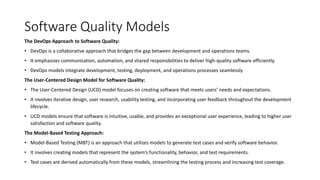
The DevOps Approach to Software Quality:
• DevOps is a collaborative approach that bridges the gap between development and operations teams.
• It emphasizes communication, automation, and shared responsibilities to deliver high-quality software efficiently.
• DevOps models integrate development, testing, deployment, and operations processes seamlessly
The User-Centered Design Model for Software Quality:
• The User-Centered Design (UCD) model focuses on creating software that meets users’ needs and expectations.
• It involves iterative design, user research, usability testing, and incorporating user feedback throughout the development
lifecycle.
• UCD models ensure that software is intuitive, usable, and provides an exceptional user experience, leading to higher user
satisfaction and software quality.
The Model-Based Testing Approach:
• Model-Based Testing (MBT) is an approach that utilizes models to generate test cases and verify software behavior.
• It involves creating models that represent the system’s functionality, behavior, and test requirements.
• Test cases are derived automatically from these models, streamlining the testing process and increasing test coverage.
Software Quality Models
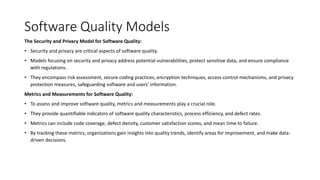
The Security and Privacy Model for Software Quality:
• Security and privacy are critical aspects of software quality.
• Models focusing on security and privacy address potential vulnerabilities, protect sensitive data, and ensure compliance
with regulations.
• They encompass risk assessment, secure coding practices, encryption techniques, access control mechanisms, and privacy
protection measures, safeguarding software and users’ information.
Metrics and Measurements for Software Quality:
• To assess and improve software quality, metrics and measurements play a crucial role.
• They provide quantifiable indicators of software quality characteristics, process efficiency, and defect rates.
• Metrics can include code coverage, defect density, customer satisfaction scores, and mean time to failure.
• By tracking these metrics, organizations gain insights into quality trends, identify areas for improvement, and make data-
driven decisions.

6. Software Quality Models for quality assurance.pptx

  • 1.
  • 2.
    Introduction to SoftwareQuality Models • Software Quality Models provide a systematic framework to assess and improve the quality of software products. • They help us evaluate various dimensions of software quality, identify areas for improvement, and implement best practices.
  • 3.
    Importance of SoftwareQuality High-quality software is essential to meet customer expectations, deliver value, and maintain a competitive edge. It enhances user satisfaction, reduces maintenance costs, improves productivity, and minimizes risks associated with software defects or failures. Software Quality Models guide organizations in achieving these goals by providing a structured approach to quality assessment and improvement.
  • 4.
    Software Quality Models ISO25000 Quality Model: • ISO 25000, also known as the Software Product Quality Requirements and Evaluation (SQuaRE) series • a comprehensive set of quality characteristics, such as functionality, reliability, usability, efficiency, maintainability, and portability. • This defines a structured approach to measure, evaluate, and improve software quality based on these characteristics. The Capability Maturity Model Integration (CMMI): The CMMI is a widely adopted model for assessing and improving an organization’s software development processes. • It focuses on process maturity levels and helps organizations optimize their processes to achieve higher quality outcomes. • It provides a roadmap for process improvement, emphasizing best practices, efficiency, and consistency throughout the SDLC. The Six Sigma Approach to Software Quality: • Originally developed in the manufacturing industry, • the Six Sigma approach has been adapted to software development to minimize defects and improve quality. • It relies on statistical analysis and process improvement methodologies to measure and reduce variation, ensuring that software meets or exceeds customer expectations.
  • 5.
    Software Quality Models TheISO 9126 Quality Model: • ISO 9126 is a quality model that focuses on software product characteristics and quality attributes. • It encompasses six primary characteristics: functionality, reliability, usability, efficiency, maintainability, and portability. • Each characteristic is further divided into sub-characteristics, providing a comprehensive framework to evaluate and improve software quality. The Quality Assurance Model: • The Quality Assurance (QA) model emphasizes the proactive measures and processes required to ensure software quality throughout the development lifecycle. • It involves establishing quality standards, defining processes, conducting reviews and audits, and implementing preventive measures to identify and resolve issues early. The Software Testing and Verification Model: • It focus on validating software through rigorous testing practices. • They involve designing test cases, executing tests, identifying and reporting defects, and verifying that software meets specified requirements. • These models encompass a variety of testing techniques, such as unit testing, integration testing, system testing, and acceptance testing, to ensure the quality and reliability of software.
  • 6.
    Software Quality Models TheLean Software Development Model: • This model draws inspiration from Lean Manufacturing principles, aiming to eliminate waste and maximize value in software development processes. • It emphasizes continuous improvement, customer focus, and waste reduction. The Agile Quality Model: • Agile methodologies, including Scrum and Kanban, prioritize flexibility, collaboration, and iterative development. • The Agile Quality Model aligns with these principles by emphasizing adaptability, responsiveness, and early feedback. • It promotes continuous testing, frequent releases, and close collaboration between development teams and stakeholders, ensuring that software meets changing customer needs while maintaining high quality. The Continuous Integration and Continuous Delivery (CI/CD) Model: • The CI/CD model focuses on automating and streamlining the software build, integration, testing, and deployment processes. • It ensures that changes are integrated and tested continuously, facilitating faster delivery of high-quality software. • By enabling rapid feedback loops and reducing manual interventions, CI/CD models enhance software quality, productivity, and time-to-market.
  • 7.
    Software Quality Models TheDevOps Approach to Software Quality: • DevOps is a collaborative approach that bridges the gap between development and operations teams. • It emphasizes communication, automation, and shared responsibilities to deliver high-quality software efficiently. • DevOps models integrate development, testing, deployment, and operations processes seamlessly The User-Centered Design Model for Software Quality: • The User-Centered Design (UCD) model focuses on creating software that meets users’ needs and expectations. • It involves iterative design, user research, usability testing, and incorporating user feedback throughout the development lifecycle. • UCD models ensure that software is intuitive, usable, and provides an exceptional user experience, leading to higher user satisfaction and software quality. The Model-Based Testing Approach: • Model-Based Testing (MBT) is an approach that utilizes models to generate test cases and verify software behavior. • It involves creating models that represent the system’s functionality, behavior, and test requirements. • Test cases are derived automatically from these models, streamlining the testing process and increasing test coverage.
  • 8.
    Software Quality Models TheSecurity and Privacy Model for Software Quality: • Security and privacy are critical aspects of software quality. • Models focusing on security and privacy address potential vulnerabilities, protect sensitive data, and ensure compliance with regulations. • They encompass risk assessment, secure coding practices, encryption techniques, access control mechanisms, and privacy protection measures, safeguarding software and users’ information. Metrics and Measurements for Software Quality: • To assess and improve software quality, metrics and measurements play a crucial role. • They provide quantifiable indicators of software quality characteristics, process efficiency, and defect rates. • Metrics can include code coverage, defect density, customer satisfaction scores, and mean time to failure. • By tracking these metrics, organizations gain insights into quality trends, identify areas for improvement, and make data- driven decisions.