Overview of Selected Writers from
World Literature
 To be able to define what constitutes world
literature
 To become familiar with some of the works
of exemplary writers in world literature
Learning Objectives
 Knowing what constitutes world literature, as
well as the exemplary works of writers in world
literature
Key Understanding
 What constitutes world literature?
 Who are some of the exemplary writers of
world literature and what are some of their great
works?
Key Questions
What is World Literature?
World Literature refers to any written
literary genre that exemplifies the most
outstanding characteristics of particular
national literatures. It is harder to define and
only few regional or national writers can also
be classified as belonging to world literature.
Elements of World Literature
• Tackles universal theme to which wider
audiences/readers can relate or identify with
 love and romance
 family and marriages
 individual struggles toward success (Cinderella and
underdog stories)
 humanitarian values
 coping with tragedy (wars, famine, disasters, etc.)
 life cycles
English World Literature
William Shakespeare
(England) was a poet and
playwright considered as “the
father of the modern English
language”. He is credited for
pioneering the couplet and the
Shakespearean sonnet style.
Image Credit: https://covers.openlibrary.org/w/id/405165-M.jpg
Shakespeare and Modern Dramas
Today in any part of the globe, people are
addicted to English soap operas, Hispanic
telenovelas and Koreanovelas. But it can be
rightfully said that with his 37 plays tackling
any topic under the sun (the most popular
being Romeo and Juliet), Shakespeare invented
all of these modern dramas that entertain
TV and movie audiences nowadays.
Literary Reflection
Shakespeare, in his stage play As You Like It,
popularized these verses: “All the world's a stage,
And all the men and women merely players; They have
their exits and their entrances, And one man in his time
plays many parts, His acts being seven ages.”
In a journal notebook, make an
interpretation of the possible meanings of the
verses.
French World Literature
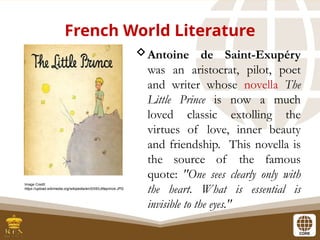
Antoine de Saint-Exupéry
was an aristocrat, pilot, poet
and writer whose novella The
Little Prince is now a much
loved classic extolling the
virtues of love, inner beauty
and friendship. This novella is
the source of the famous
quote: "One sees clearly only with
the heart. What is essential is
invisible to the eyes."
Image Credit:
https://upload.wikimedia.org/wikipedia/en/0/05/Littleprince.JPG
African World Literature
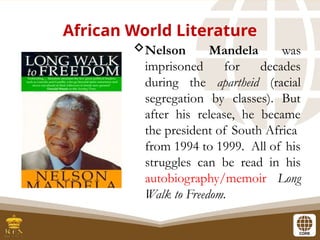
Nelson Mandela was
imprisoned for decades
during the apartheid (racial
segregation by classes). But
after his release, he became
the president of South Africa
from 1994 to 1999. All of his
struggles can be read in his
autobiography/memoir Long
Walk to Freedom.
Asian World Literature
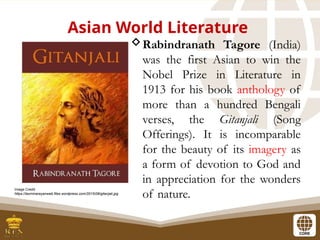
Rabindranath Tagore (India)
was the first Asian to win the
Nobel Prize in Literature in
1913 for his book anthology of
more than a hundred Bengali
verses, the Gitanjali (Song
Offerings). It is incomparable
for the beauty of its imagery as
a form of devotion to God and
in appreciation for the wonders
of nature.
Image Credit:
https://laxminarayanweb.files.wordpress.com/2015/08/gitanjali.jpg
Mexican World Literature
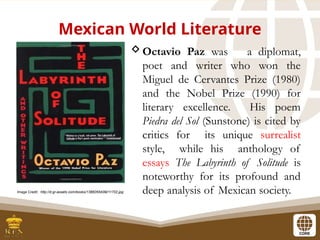
Octavio Paz was a diplomat,
poet and writer who won the
Miguel de Cervantes Prize (1980)
and the Nobel Prize (1990) for
literary excellence. His poem
Piedra del Sol (Sunstone) is cited by
critics for its unique surrealist
style, while his anthology of
essays The Labyrinth of Solitude is
noteworthy for its profound and
deep analysis of Mexican society.
Image Credit: http://d.gr-assets.com/books/1388265409l/11702.jpg
American World Literature
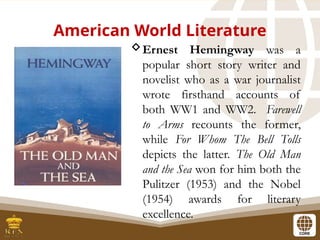
Ernest Hemingway was a
popular short story writer and
novelist who as a war journalist
wrote firsthand accounts of
both WW1 and WW2. Farewell
to Arms recounts the former,
while For Whom The Bell Tolls
depicts the latter. The Old Man
and the Sea won for him both the
Pulitzer (1953) and the Nobel
(1954) awards for literary
excellence.
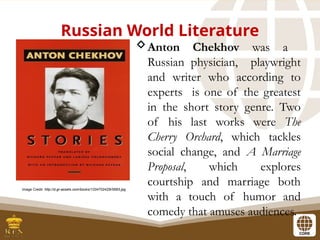
Russian World Literature
Anton Chekhov was a
Russian physician, playwright
and writer who according to
experts is one of the greatest
in the short story genre. Two
of his last works were The
Cherry Orchard, which tackles
social change, and A Marriage
Proposal, which explores
courtship and marriage both
with a touch of humor and
comedy that amuses audiences.
Image Credit: http://d.gr-assets.com/books/1334702425l/5693.jpg
Choose one among the authors discussed in
this presentation and make a critique about
any of their works. How was the universal
theme portrayed in your chosen work? Also
comment on the style, characterization,
setting and story elements ‒ plot, climax,
tension, denouement.
Culminating Activity

5_Overview_Selected_Writers_from_World_Literature.pptx

  • 1.
    Overview of SelectedWriters from World Literature
  • 2.
     To beable to define what constitutes world literature  To become familiar with some of the works of exemplary writers in world literature Learning Objectives
  • 3.
     Knowing whatconstitutes world literature, as well as the exemplary works of writers in world literature Key Understanding  What constitutes world literature?  Who are some of the exemplary writers of world literature and what are some of their great works? Key Questions
  • 4.
    What is WorldLiterature? World Literature refers to any written literary genre that exemplifies the most outstanding characteristics of particular national literatures. It is harder to define and only few regional or national writers can also be classified as belonging to world literature.
  • 5.
    Elements of WorldLiterature • Tackles universal theme to which wider audiences/readers can relate or identify with  love and romance  family and marriages  individual struggles toward success (Cinderella and underdog stories)  humanitarian values  coping with tragedy (wars, famine, disasters, etc.)  life cycles
  • 6.
    English World Literature WilliamShakespeare (England) was a poet and playwright considered as “the father of the modern English language”. He is credited for pioneering the couplet and the Shakespearean sonnet style. Image Credit: https://covers.openlibrary.org/w/id/405165-M.jpg
  • 7.
    Shakespeare and ModernDramas Today in any part of the globe, people are addicted to English soap operas, Hispanic telenovelas and Koreanovelas. But it can be rightfully said that with his 37 plays tackling any topic under the sun (the most popular being Romeo and Juliet), Shakespeare invented all of these modern dramas that entertain TV and movie audiences nowadays.
  • 8.
    Literary Reflection Shakespeare, inhis stage play As You Like It, popularized these verses: “All the world's a stage, And all the men and women merely players; They have their exits and their entrances, And one man in his time plays many parts, His acts being seven ages.” In a journal notebook, make an interpretation of the possible meanings of the verses.
  • 9.
    French World Literature Antoinede Saint-Exupéry was an aristocrat, pilot, poet and writer whose novella The Little Prince is now a much loved classic extolling the virtues of love, inner beauty and friendship. This novella is the source of the famous quote: "One sees clearly only with the heart. What is essential is invisible to the eyes." Image Credit: https://upload.wikimedia.org/wikipedia/en/0/05/Littleprince.JPG
  • 10.
    African World Literature NelsonMandela was imprisoned for decades during the apartheid (racial segregation by classes). But after his release, he became the president of South Africa from 1994 to 1999. All of his struggles can be read in his autobiography/memoir Long Walk to Freedom.
  • 11.
    Asian World Literature RabindranathTagore (India) was the first Asian to win the Nobel Prize in Literature in 1913 for his book anthology of more than a hundred Bengali verses, the Gitanjali (Song Offerings). It is incomparable for the beauty of its imagery as a form of devotion to God and in appreciation for the wonders of nature. Image Credit: https://laxminarayanweb.files.wordpress.com/2015/08/gitanjali.jpg
  • 12.
    Mexican World Literature OctavioPaz was a diplomat, poet and writer who won the Miguel de Cervantes Prize (1980) and the Nobel Prize (1990) for literary excellence. His poem Piedra del Sol (Sunstone) is cited by critics for its unique surrealist style, while his anthology of essays The Labyrinth of Solitude is noteworthy for its profound and deep analysis of Mexican society. Image Credit: http://d.gr-assets.com/books/1388265409l/11702.jpg
  • 13.
    American World Literature ErnestHemingway was a popular short story writer and novelist who as a war journalist wrote firsthand accounts of both WW1 and WW2. Farewell to Arms recounts the former, while For Whom The Bell Tolls depicts the latter. The Old Man and the Sea won for him both the Pulitzer (1953) and the Nobel (1954) awards for literary excellence.
  • 14.
    Russian World Literature AntonChekhov was a Russian physician, playwright and writer who according to experts is one of the greatest in the short story genre. Two of his last works were The Cherry Orchard, which tackles social change, and A Marriage Proposal, which explores courtship and marriage both with a touch of humor and comedy that amuses audiences. Image Credit: http://d.gr-assets.com/books/1334702425l/5693.jpg
  • 15.
    Choose one amongthe authors discussed in this presentation and make a critique about any of their works. How was the universal theme portrayed in your chosen work? Also comment on the style, characterization, setting and story elements ‒ plot, climax, tension, denouement. Culminating Activity

Editor's Notes

  • #5 You may opt to give specific examples of stories in each set of elements or you may the students to give examples.
  • #6 Elaborate on the Shakespeare sonnet style including its unique couplet and then narrate the basic plot of Romeo and Juliet.
  • #7 Ask the class what dramas and telenovelas they like to watch on television.
  • #8 You may give this as an assignment after which presentation can be ended for the meantime.
  • #9 Ask the class to define a novella. Then as a form of participatory class recitation, ask the students about their reaction to the famous quote above.
  • #10 Ask the class to define autobiography and memoir.
  • #11 Ask the class to define anthology and imagery.
  • #12 Ask the students to define essay and surrealism. Afterwards ask the students about what Philippine novel is the equivalent of Octavio Paz’ The Labyrinth of Solitude for its profound analysis of Philippine society.
  • #13 You may tell the students, as a piece of trivia, that Ernest Hemingway once went to the Philippines in 1941 and stayed at the Manila Hotel.