Binary Arithmetic
• Adding Binary numbers
• Overflow conditions
• How does it all work?
• AND, OR and NOT
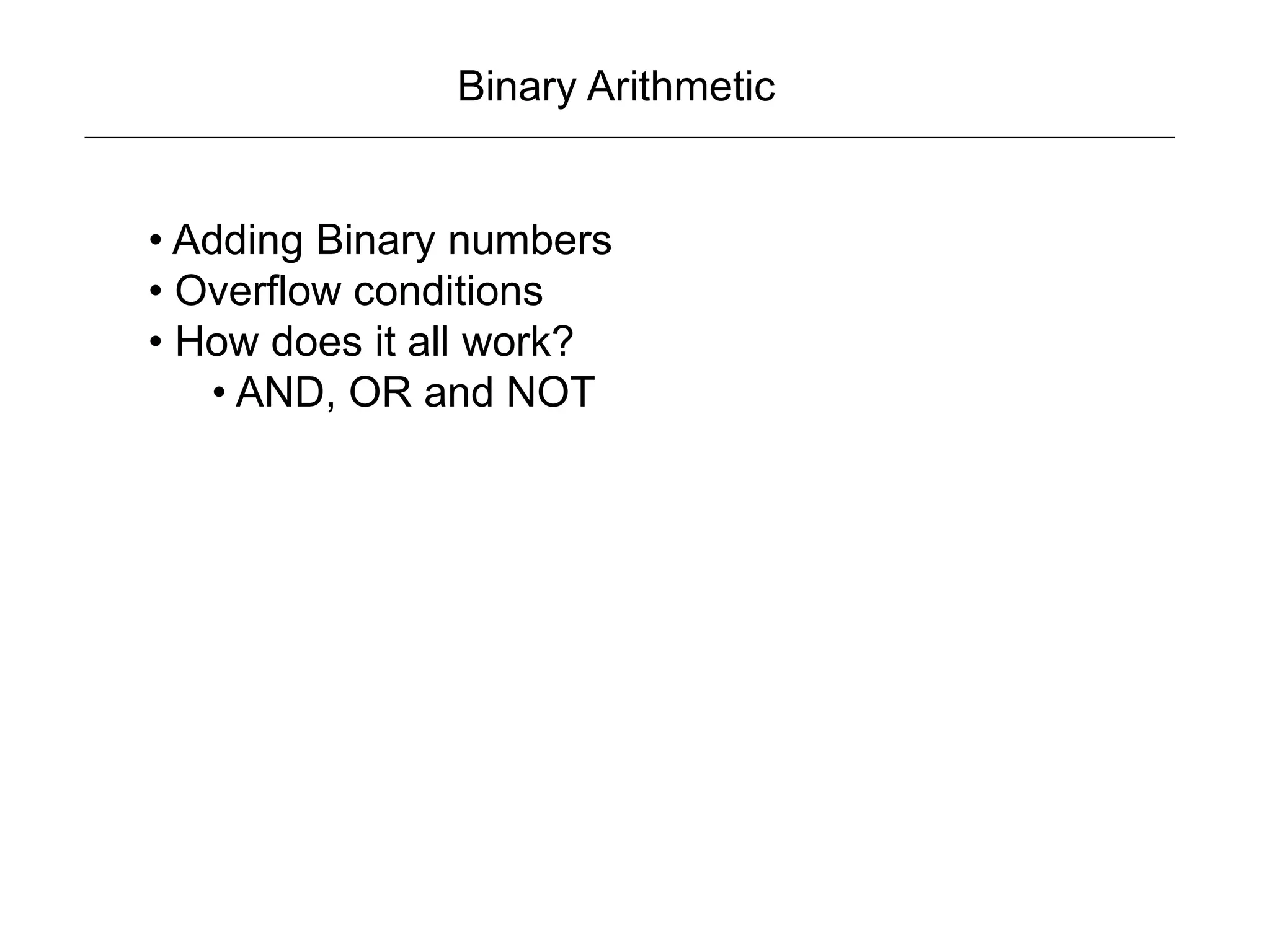
Decimal Addition
• You are probably already familiar with adding
decimal numbers
7
+2
9
5
+1
6
2
+3
5
• You also know that when the addition of two
numbers exceeds the base, a value is “carried” over
to the next column
7
+ 5
1 2
1 Carry the “1”
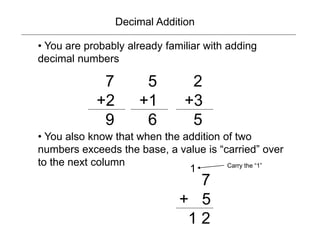
Binary Addition
• Adding binary numbers employs the same
procedures as adding decimal numbers:
00
+00
00
01
+00
01
00
+01
01
• As with decimal addition, when the addition of two
numbers exceeds the base value, the value is
“carried” over to the next column
01
+01
10
1 Carry the “1”
Binary Addition Examples
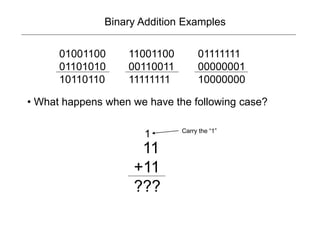
01001100
01101010
10110110
11001100
00110011
11111111
01111111
00000001
10000000
• What happens when we have the following case?
11
+11
???
1 Carry the “1”
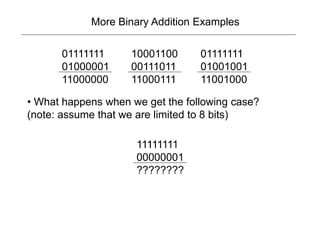
More Binary Addition Examples
01111111
01000001
11000000
10001100
00111011
11000111
01111111
01001001
11001000
11111111
00000001
????????
• What happens when we get the following case?
(note: assume that we are limited to 8 bits)
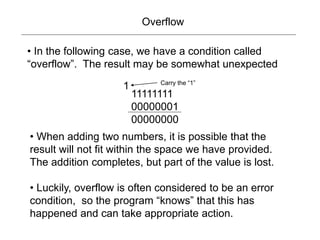
Overflow
11111111
00000001
00000000
• In the following case, we have a condition called
“overflow”. The result may be somewhat unexpected
1 Carry the “1”
• When adding two numbers, it is possible that the
result will not fit within the space we have provided.
The addition completes, but part of the value is lost.
• Luckily, overflow is often considered to be an error
condition, so the program “knows” that this has
happened and can take appropriate action.
How does it all work?
• In the first week of lectures, we discussed vacuum
tubes, relays, and transistors
• As we went through the discussion, I asked, “How
could you add two numbers using switches?”
• I didn’t expect an answer, but I did show how switches
could be set up to implement the AND function and the
OR function.
AND, OR and NOT
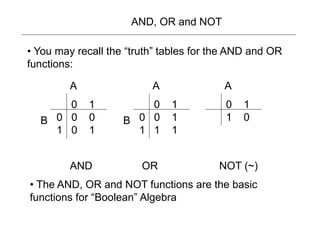
• You may recall the “truth” tables for the AND and OR
functions:
0 1
0 0 0
1 0 1
0 1
0 0 1
1 1 1
A
B
A
B
AND OR
• The AND, OR and NOT functions are the basic
functions for “Boolean” Algebra
0 1
1 0
A
NOT (~)
Binary Arithmetic/AND and OR
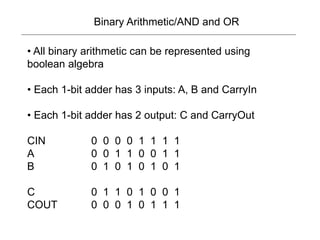
• All binary arithmetic can be represented using
boolean algebra
• Each 1-bit adder has 3 inputs: A, B and CarryIn
• Each 1-bit adder has 2 output: C and CarryOut
CIN 0 0 0 0 1 1 1 1
A 0 0 1 1 0 0 1 1
B 0 1 0 1 0 1 0 1
C 0 1 1 0 1 0 0 1
COUT 0 0 0 1 0 1 1 1
Boolean Equations for Addition
CIN 0 0 0 0 1 1 1 1
A 0 0 1 1 0 0 1 1
B 0 1 0 1 0 1 0 1
C 0 1 1 0 1 0 0 1
COUT 0 0 0 1 0 1 1 1
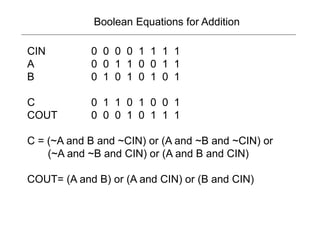
C = (~A and B and ~CIN) or (A and ~B and ~CIN) or
(~A and ~B and CIN) or (A and B and CIN)
COUT= (A and B) or (A and CIN) or (B and CIN)

5941981.ppt

  • 1.
    Binary Arithmetic • AddingBinary numbers • Overflow conditions • How does it all work? • AND, OR and NOT
  • 2.
    Decimal Addition • Youare probably already familiar with adding decimal numbers 7 +2 9 5 +1 6 2 +3 5 • You also know that when the addition of two numbers exceeds the base, a value is “carried” over to the next column 7 + 5 1 2 1 Carry the “1”
  • 3.
    Binary Addition • Addingbinary numbers employs the same procedures as adding decimal numbers: 00 +00 00 01 +00 01 00 +01 01 • As with decimal addition, when the addition of two numbers exceeds the base value, the value is “carried” over to the next column 01 +01 10 1 Carry the “1”
  • 4.
    Binary Addition Examples 01001100 01101010 10110110 11001100 00110011 11111111 01111111 00000001 10000000 •What happens when we have the following case? 11 +11 ??? 1 Carry the “1”
  • 5.
    More Binary AdditionExamples 01111111 01000001 11000000 10001100 00111011 11000111 01111111 01001001 11001000 11111111 00000001 ???????? • What happens when we get the following case? (note: assume that we are limited to 8 bits)
  • 6.
    Overflow 11111111 00000001 00000000 • In thefollowing case, we have a condition called “overflow”. The result may be somewhat unexpected 1 Carry the “1” • When adding two numbers, it is possible that the result will not fit within the space we have provided. The addition completes, but part of the value is lost. • Luckily, overflow is often considered to be an error condition, so the program “knows” that this has happened and can take appropriate action.
  • 7.
    How does itall work? • In the first week of lectures, we discussed vacuum tubes, relays, and transistors • As we went through the discussion, I asked, “How could you add two numbers using switches?” • I didn’t expect an answer, but I did show how switches could be set up to implement the AND function and the OR function.
  • 8.
    AND, OR andNOT • You may recall the “truth” tables for the AND and OR functions: 0 1 0 0 0 1 0 1 0 1 0 0 1 1 1 1 A B A B AND OR • The AND, OR and NOT functions are the basic functions for “Boolean” Algebra 0 1 1 0 A NOT (~)
  • 9.
    Binary Arithmetic/AND andOR • All binary arithmetic can be represented using boolean algebra • Each 1-bit adder has 3 inputs: A, B and CarryIn • Each 1-bit adder has 2 output: C and CarryOut CIN 0 0 0 0 1 1 1 1 A 0 0 1 1 0 0 1 1 B 0 1 0 1 0 1 0 1 C 0 1 1 0 1 0 0 1 COUT 0 0 0 1 0 1 1 1
  • 10.
    Boolean Equations forAddition CIN 0 0 0 0 1 1 1 1 A 0 0 1 1 0 0 1 1 B 0 1 0 1 0 1 0 1 C 0 1 1 0 1 0 0 1 COUT 0 0 0 1 0 1 1 1 C = (~A and B and ~CIN) or (A and ~B and ~CIN) or (~A and ~B and CIN) or (A and B and CIN) COUT= (A and B) or (A and CIN) or (B and CIN)