For more than 20 years, Duarte has developed visual stories for the world’s leading corporate brands, thought leadership forums, and an Academy Award-winning documentary. Now they bring you… FIVE RULES FOR CREATING GREAT PRESENTATIONS
To View This PresentationFIRSTTurn Up Your VolumeSECONDLaunch Self-Running Slide Show
D
RULES5
RULES5FORWORLDCREATINGPRESENTATIONSCHANGING
TREATYOURAUDIENCEKINGAS
WHYWHYTHETHETHEYTHEYWHATWHATSTEPSSTEPSYOUYOUTHEYNEEDTOTHEYNEEDTOSHOULDADOPTSHOULDADOPTYOURYOURFOLLOWFOLLOWCANDOFORCANDOFORTHEMTHEMTOTAKETOTAKEVIEWVIEWACTIONACTION
$
SPREAD2IDEASANDMOVEPEOPLE
BLAHBLAHBLAHBLAHBLAHBLAHBLAH
ANOTHERMEETING
WHICHPRODUCTHASITALL?
HELPTHEM3SEEWHATYOUARESAYING
CANSTHERECYCLEDPROCESS= 1000 CANSMARCHFEBRUARYJANUARY
4PRACTICEDESIGNNOTDECORATION
5CULTIVATEHEALTHYRELATIONSHIPS
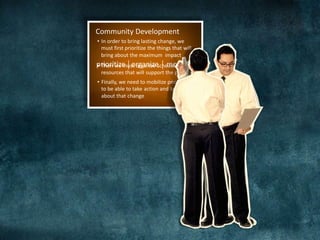
Community DevelopmentIn order to bring lasting change, wemust first prioritize the things that willbring about the maximum  impact
Then we must organize schedules andresources that will support the priorities
Finally, we need to mobilize people to beable to take action and bringabout that changeCommunity DevelopmentIn order to bring lasting change, wemust first prioritize the things that willbring about the maximum  impact
Then we must organize schedules andresources that will support the priorities
Finally, we need to mobilize people to beable to take action and bringabout that changeCommunityDevelopmentIn order to bring lastingchange, wemust firstprioritizethe things that willmaximum  impact  bring about theThen we mustorganize schedules andresources that willsupport the prioritiesFinally, we need tomobilizepeopleto be able to takeaction and bringabout that change
CommunityDevelopmentIn order to bring lastingchange, wemust firstprioritizethe things that willmaximum  impact  bring about themobilizeprioritizeorganize Then we mustschedules andorganize resources that willsupport the prioritiesmobilizeFinally, we need topeopleto be able to takeaction and bringabout that change
prioritizeorganize mobilize
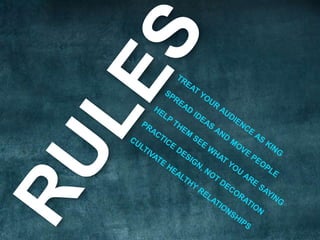
RULESTREAT YOUR AUDIENCE AS KINGSPREAD IDEAS AND MOVE PEOPLEHELP THEM SEE WHAT YOU ARE SAYINGPRACTICE DESIGN, NOT DECORATIONCULTIVATE HEALTHY RELATIONSHIPS
RULES5
prioritizeorganize mobilize
www.duarte.comfiverules@duarte.comfor details about the features used to make this presentation, see next slides
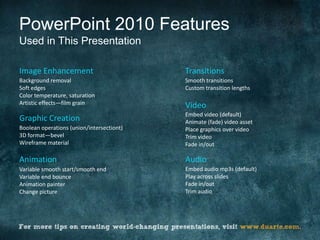
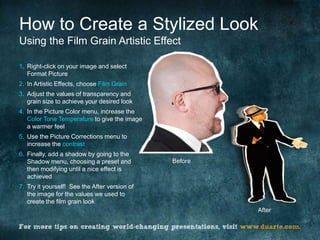
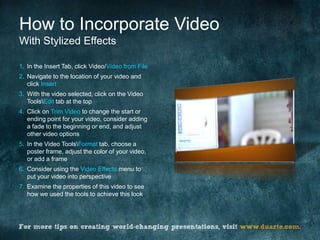
PowerPoint 2010 Features Used in This PresentationTransitionsImage EnhancementSmooth transitionsCustom transition lengthsBackground removalSoft edgesColor temperature, saturationArtistic effects—film grainVideoEmbed video (default)Animate (fade) video assetPlace graphics over videoTrim video Fade in/outGraphic CreationBoolean operations (union/intersectiont)3D format—bevelWireframe materialAnimationAudioEmbed audio mp3s (default)Play across slidesFade in/outTrim audioVariable smooth start/smooth endVariable end bounceAnimation painterChange picture
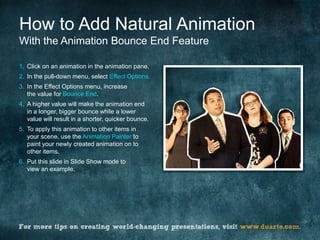
How to Add Natural AnimationWith the Animation Bounce End FeatureClick on an animation in the animation pane.In the pull-down menu, select Effect Options.In the Effect Options menu, increase the value for Bounce End.A higher value will make the animation endin a longer, bigger bounce while a lower value will result in a shorter, quicker bounce.To apply this animation to other items in your scene, use the Animation Painter to paint your newly created animation on to other items.Put this slide in Slide Show mode to view an example.

5 Rules

Editor's Notes

  • #2 To view this presentation, first, turn up your volume and second, launch the self-running slide show.
  • #3 To view this presentation, first, turn up your volume and second, launch the self-running slide show.
  • #4 Presentations are a powerful communication medium.
  • #5 For more than 20 years, Duarte has developed presentations…
  • #6 …to launch products,
  • #7 …align employees,
  • #8 …increase company value,
  • #9 …and propel
  • #10 …global causes.
  • #11 Along the way we’ve discovered…
  • #12 …five simple rules for creating world-changing presentations.
  • #13 The first rule is: Treat your audience as king.
  • #14 Your audience deserves to be treated like royalty. Design a presentation that meets their needs, not just yours.
  • #15 Audiences want to know what you can do for them, why they should adopt your view, and the steps they need to follow to take action.
  • #16 Give them those things in a clear, easily understandable way…
  • #17 …and you will undoubtedly find favor with the king.
  • #18 The second rule is: Spread ideas and move people.
  • #19 Your audience didn’t show up to read your 60 page on screen dissertation.
  • #20 They’re there to see you. To be inspired by your message…
  • #21 …and witness the quality of your thought.
  • #22 You are not giving your presentation to have another meeting. You are there to covey meaning.
  • #23 So, consider including imagery that powerfully illustrates your point.
  • #24 Sometimes moving images can inspire in a way that static slides cannot. A slow moving animation creates a sense of nostalgia.



  • #25 A sequential build adds a sense of suspense.
  • #26 And a thought-provoking video moves your audience in a way that can change not only minds, but hearts.
  • #27 The next rule is: Help them see what you are saying.
  • #28 Half of the people in your audience are verbal thinkers and the other half are visual.
  • #29 Combining minimal text with meaningful visuals means that you’ll reach everyone.
  • #30 Brainstorm graphics that will effectively communicate your message…
  • #31 …and replace those words with a picture, chart or diagram. Then apply a consistent treatment to your graphics to give your whole presentation a unified look so that your audience is attracted to, rather than distracted from, your message.
  • #32 Rule number 4: Practice design, not decoration.
  • #33 As tempting as it is to fill your slides with stuff, often de-decorating is the best policy.
  • #34 Any writer or designer will tell you that 90% of the creative process…
  • #35 …is destructive.
  • #36 Do you have a main point? Consider putting just one word on the slide by itself. Want them to remember a few items? Don’t show everything at once. Instead, show one item at a time. Have a picture that expresses your idea? Scale that picture so that it fills the slide. Have a quote that says it all? Let it say it and remove everything else.
  • #37 The last rule is: Cultivate healthy relationships (with your slides and your audience)
  • #38 Letting go is hard, we know.
  • #39 But don’t hide behind your slides.
  • #40 Breaking your dependence on your slides can do a world of good for your relationship with your audience.
  • #41 Reduce the amount of text to a few key words. Put the rest into your notes.
  • #42 And practice, practice, practice.
  • #43 Thinking of your slides as digital scenery,
  • #44 Allows you to connect eye-to-eye with your audience in a meaningful way.
  • #45 So there are the rules.
  • #46 But the question remains—Why go to all this trouble?
  • #47 Why not do it the way you are used to?
  • #48 The answer is simple. Because everyone else does it that way, too. You need to stand apart and be different.
  • #49 When you apply these rules,
  • #50 and keep the audience’s needs top of mind,
  • #51 your presentation will not only hold their attention,
  • #52 But also change the world. (Well, at least your part of the world.)
  • #53 For more information, go to www.duarte.com or email us at fiverules@duarte.com.