Sponsored By
Exploring 5G: Performance Targets,
Technologies & Timelines
Today’s Presenters
Gabriel Brown
Senior Analyst
Heavy Reading
Shahram Niri
Independent Technologist
(& Former General Manager for the 5G
Innovation Center)
Moderator Presenter
• Introduction to 5G
• 5G Market Activity
• 5G Technologies
• Q&A
Agenda
5G Introduction
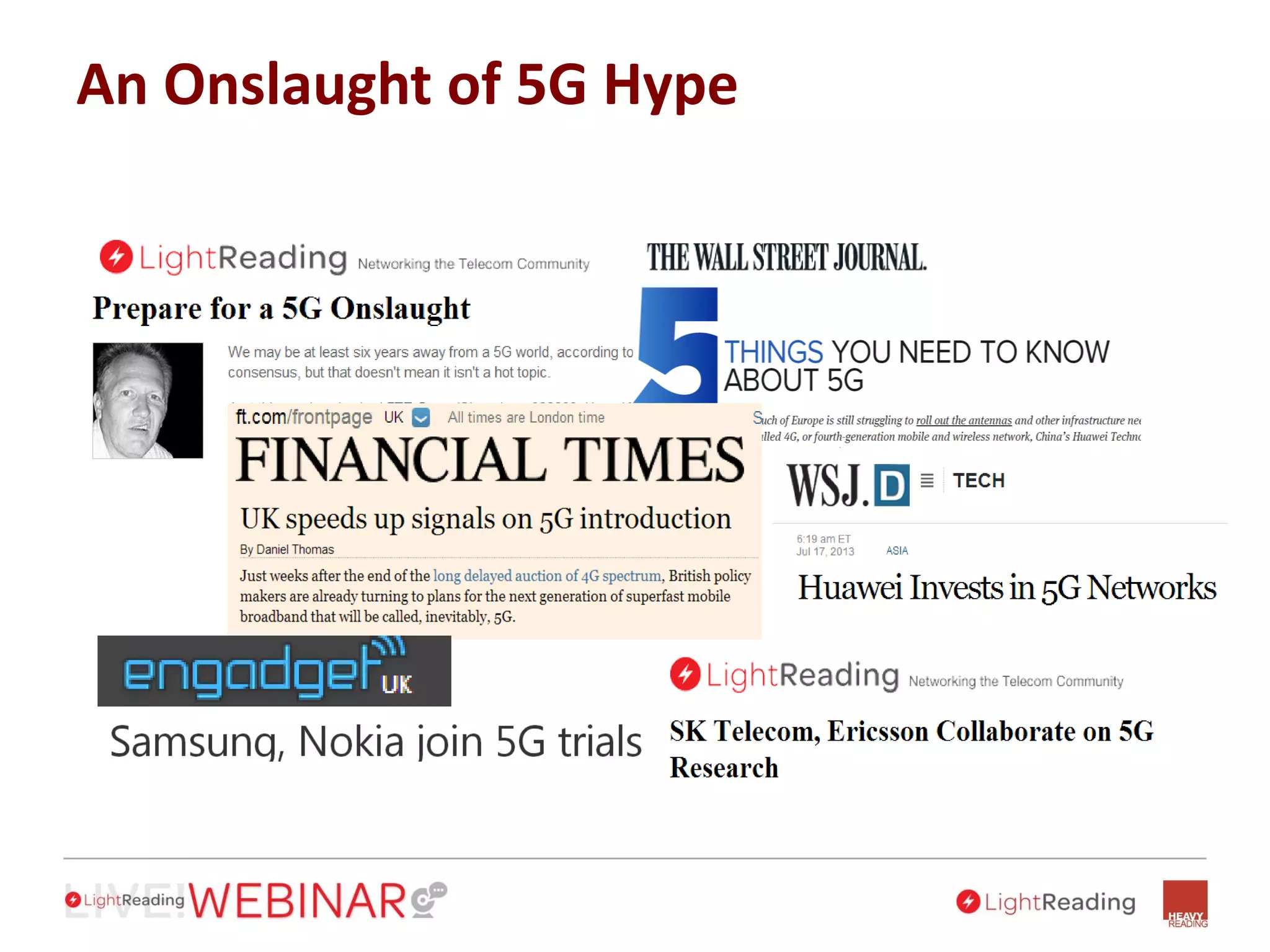
An Onslaught of 5G Hype
Why is the Industry Focusing on 5G?
1. To secure funding for R&D work
2. To gain influence in the specification process
3. To attract development partners
4. To highlight IPR portfolios
5. To earn marketing advantage
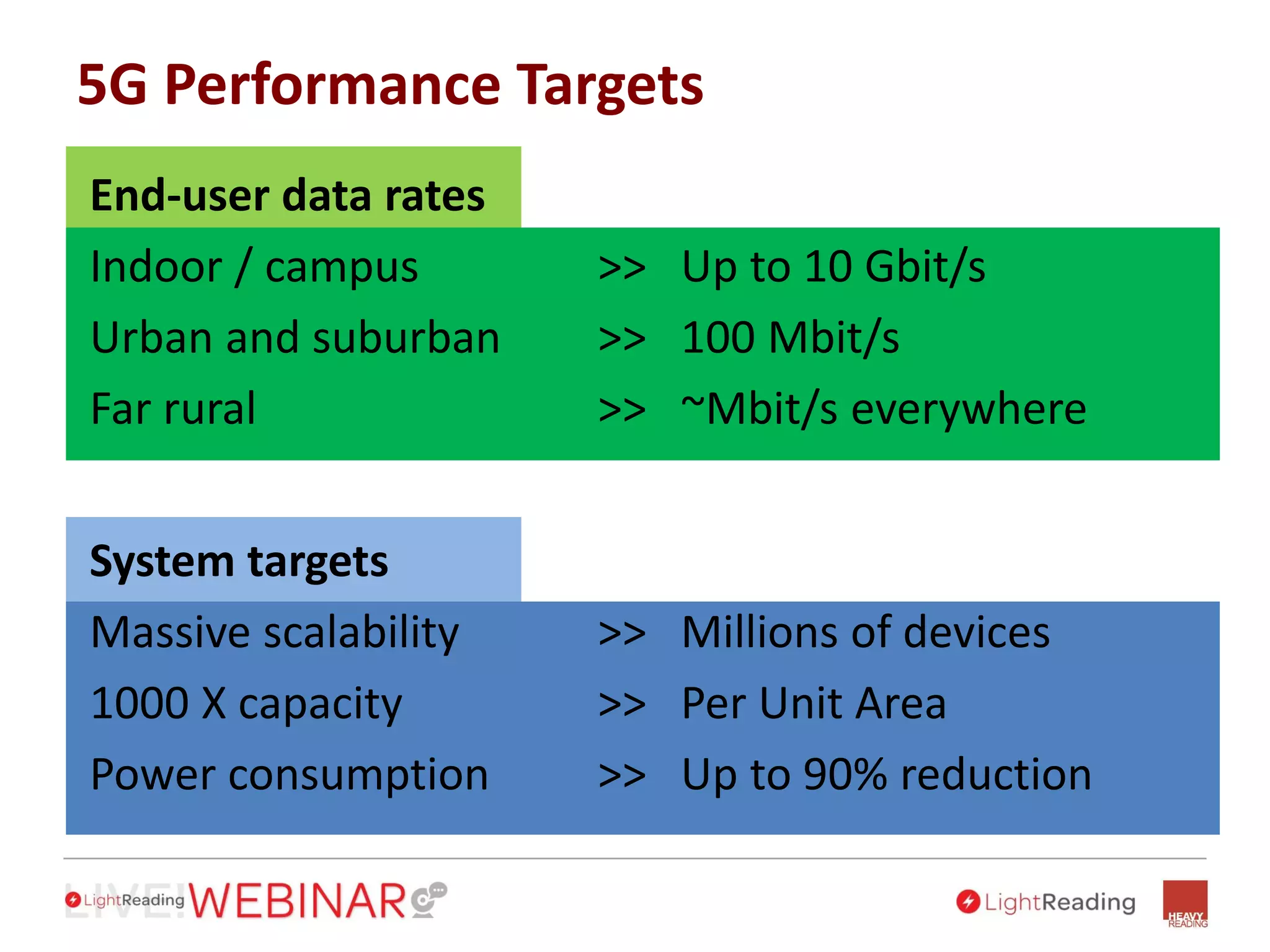
5G Performance Targets
End-user data rates
Indoor / campus >> Up to 10 Gbit/s
Urban and suburban >> 100 Mbit/s
Far rural >> ~Mbit/s everywhere
System targets
Massive scalability >> Millions of devices
1000 X capacity >> Per Unit Area
Power consumption >> Up to 90% reduction
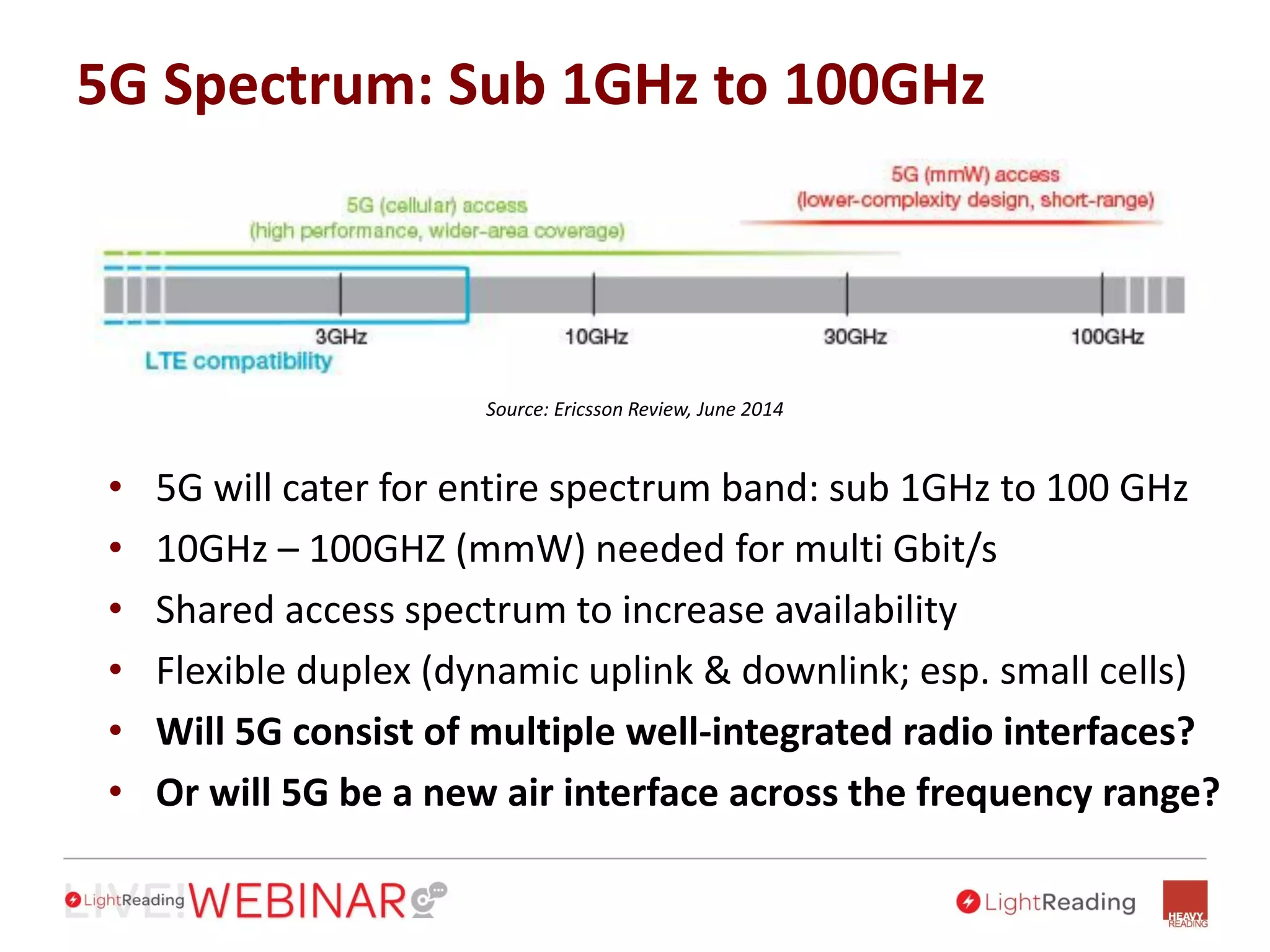
5G Spectrum: Sub 1GHz to 100GHz
• 5G will cater for entire spectrum band: sub 1GHz to 100 GHz
• 10GHz – 100GHZ (mmW) needed for multi Gbit/s
• Shared access spectrum to increase availability
• Flexible duplex (dynamic uplink & downlink; esp. small cells)
• Will 5G consist of multiple well-integrated radio interfaces?
• Or will 5G be a new air interface across the frequency range?
Source: Ericsson Review, June 2014
A Wide Range of Use-cases for 5G
• 5G platform should support many service-types
• Risky to define 5G technology according to a pre-defined
view of the eventual services
Source: Huawei Source: Ericsson
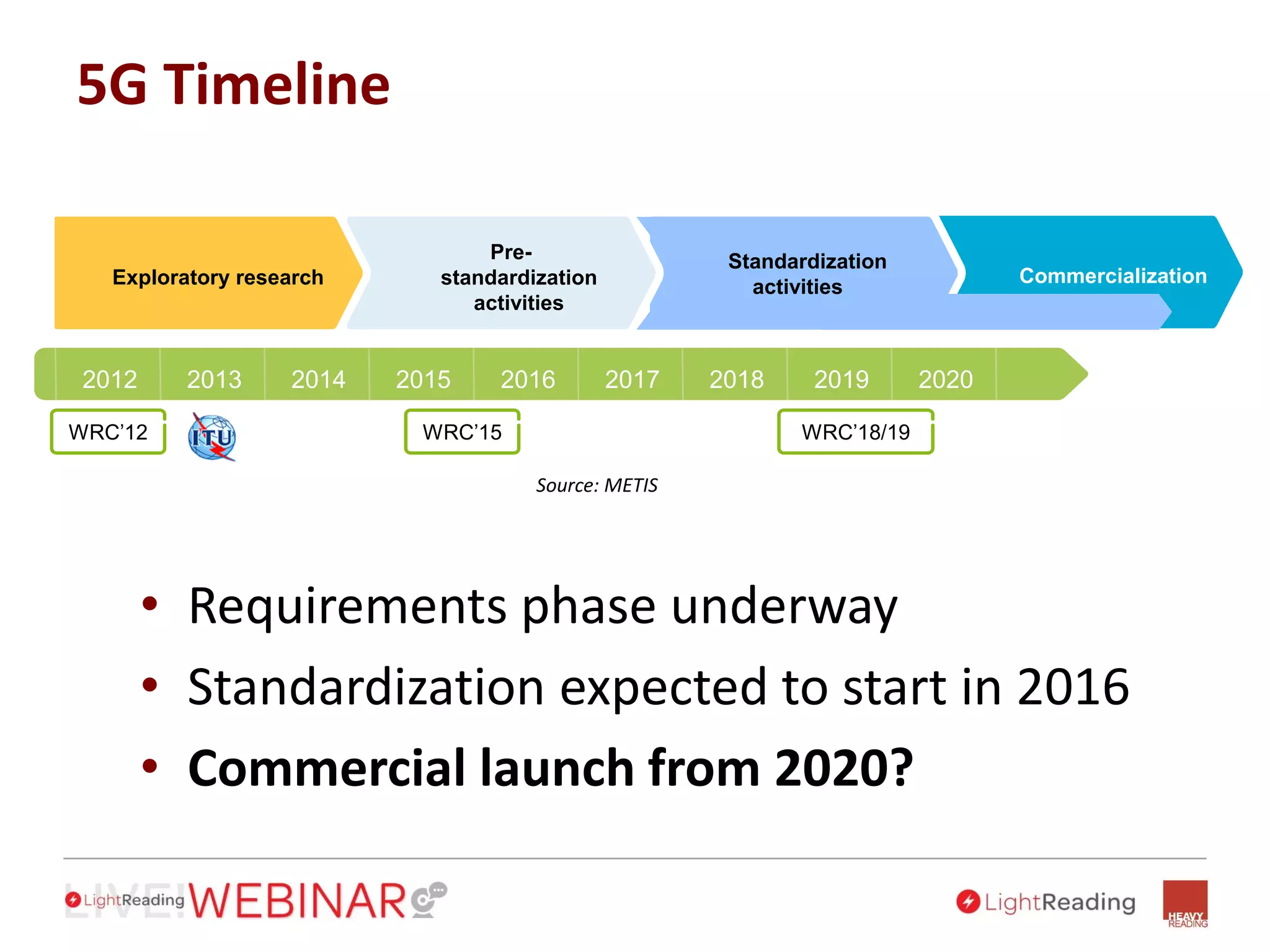
5G Timeline
• Requirements phase underway
• Standardization expected to start in 2016
• Commercial launch from 2020?
2012 2013 2014 2015 2016 2017 2018 2019 2020
WRC’12 WRC’15 WRC’18/19
Exploratory research
Pre-
standardization
activities
Commercialization
Standardization
activities
Source: METIS
5G Market Activity
• DOCOMO to conduct 5G experimental trials with
six leading technology vendors
– Alcatel-Lucent, Ericsson, Fujitsu, NEC, Nokia, Samsung
NTT DoCoMo
• Outdoor field trials planned for 2015 ahead of the
start of specification work in 2016
Google – Investigating 5G Wireless?
• History of investigation of next-gen wireless
technologies
• Alpanetal acquisition for self-organizing, low
power Gigabit wireless technology
– Extend fiber optics using 60GHz mmWave radio
– Potentially part of a 5G type solution for LOS
indoor or outdoor applications
• Google now influential on spectrum allocation
• Is 5G a point of disruption for market entry?
• Important that cars can communicate with each
other and with other participants in the city
• Highlights role of 5G in the “Gigabit Cities” concept
BMW – “5G is key to self-driving car”
• Requires ultra-reliable,
low-latency, networks that
work everywhere
• Device-to-device
communication when out
of operator range
• Radio is interface is the critical part of 5G, but apps
will have many other performance dependencies
• Major RAN vendors will be critical players
– Depth of R&D expertise
– Accumulated radio interface technologies
– Will position 5G as a smooth upgrade from LTE-A?
• China will be a critical actor in 5G
– Assuming a leadership role not seen in 3G & 4G
– Backing itself with vast R&D investment
– A net positive for 5G technology development
Other Market Activity
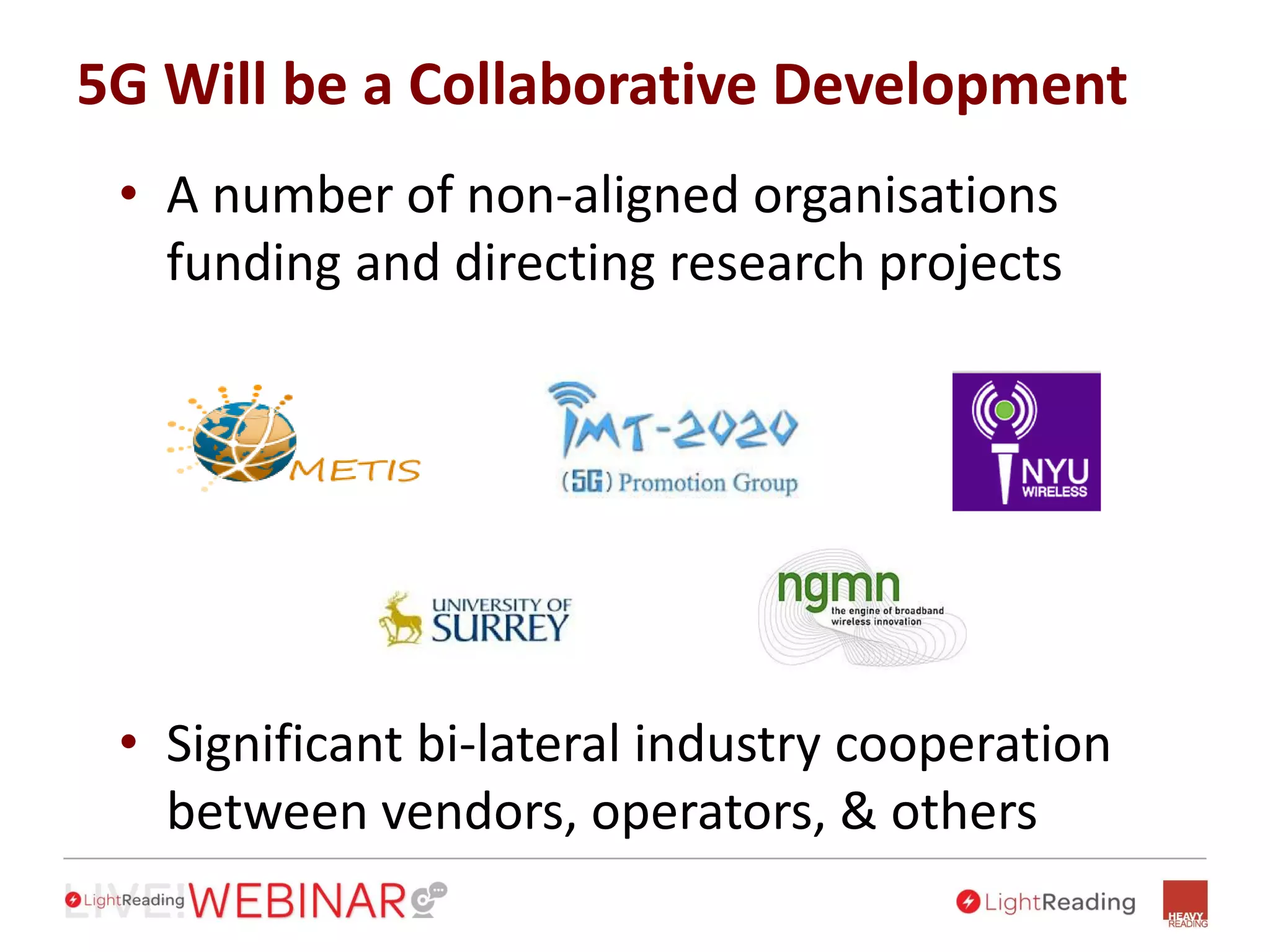
5G Will be a Collaborative Development
• A number of non-aligned organisations
funding and directing research projects
• Significant bi-lateral industry cooperation
between vendors, operators, & others
5G Technologies
Drivers For Next Generation (5G)
Growing Population
Hyper Connectivity
Limited Resources
Higher Capacity
Green Technology
Cost Efficiency
Quality of Experience
Number of connections and also the volume of data over
wireless networks continuously growing at a significant rate
Users more demanding on quality & price
Capacity challenge is real particularly in radio
Radio spectrum the blood line of wireless is a finite resources,
scarce and expensive
The data volume growth will continue but dependent on the
service quality offered by the NW and of course the data tariffs
Sustainability of mobile broadband business - Ever increasing
traffic, higher TCO and flattening ARPU
3G & 4G both promised improvements in NW capacity, data rate,
efficiency, cost and quality. 5G will be no exception but the sheer
scale of the challenges this time makes 5G research different.
Dr Shahram G Niri, July 2014 18
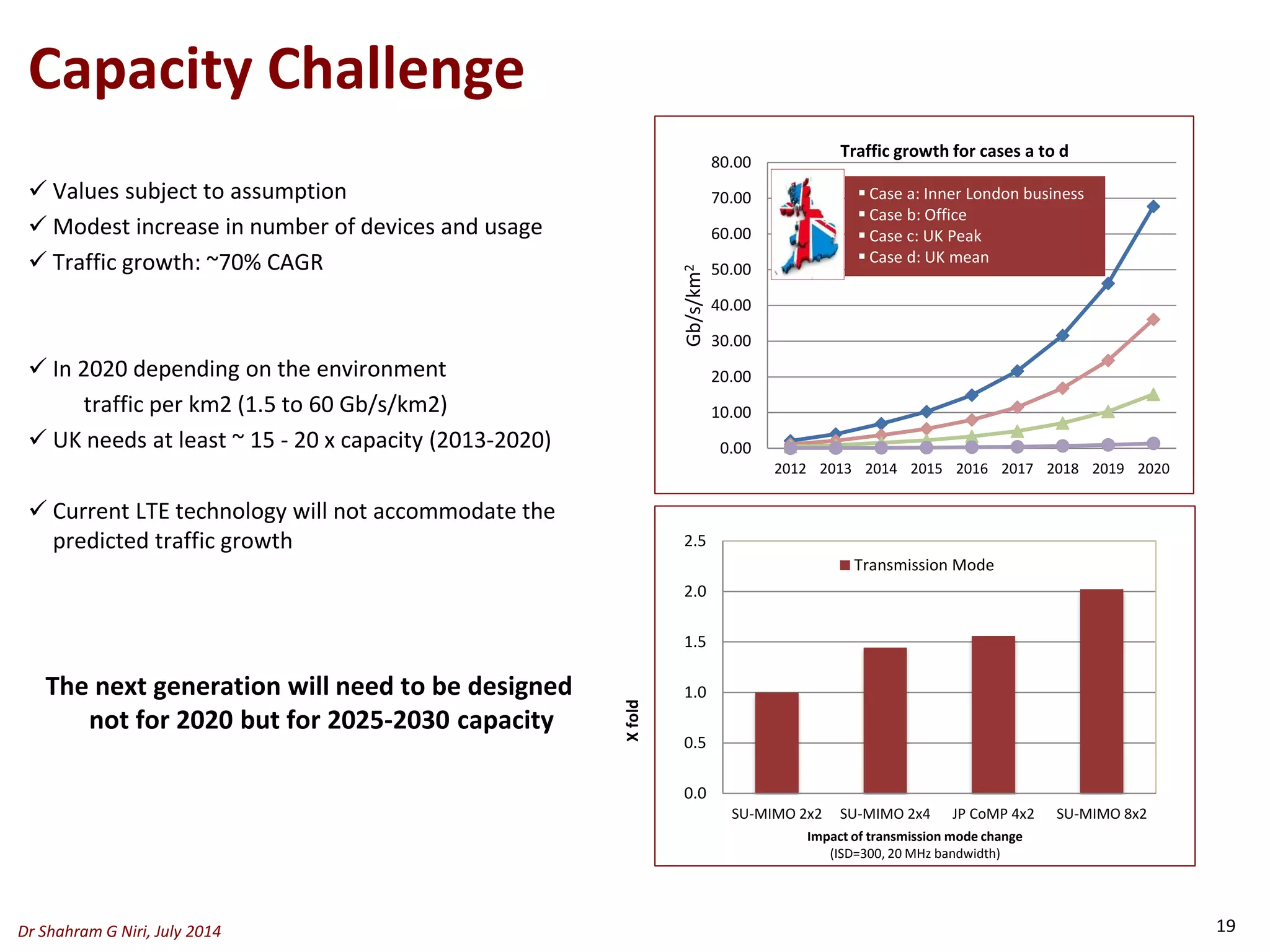
 Values subject to assumption
 Modest increase in number of devices and usage
 Traffic growth: ~70% CAGR
 In 2020 depending on the environment
traffic per km2 (1.5 to 60 Gb/s/km2)
 UK needs at least ~ 15 - 20 x capacity (2013-2020)
 Current LTE technology will not accommodate the
predicted traffic growth
The next generation will need to be designed
not for 2020 but for 2025-2030 capacity
Capacity Challenge
0.00
10.00
20.00
30.00
40.00
50.00
60.00
70.00
80.00
2012 2013 2014 2015 2016 2017 2018 2019 2020
Gb/s/km2
Traffic growth for cases a to d
 Case a: Inner London business
 Case b: Office
 Case c: UK Peak
 Case d: UK mean
Impact of transmission mode change
(ISD=300, 20 MHz bandwidth)
Xfold
0.0
0.5
1.0
1.5
2.0
2.5
SU-MIMO 2x2 SU-MIMO 2x4 JP CoMP 4x2 SU-MIMO 8x2
Transmission Mode
Dr Shahram G Niri, July 2014 19
Significant air interface capacity
-Focus on area NOT JUST link spectral efficiency
-Designed for small Cells (capacity), extended to coverage
-More spectrum (Licensed & unlicensed operation, spectrum
sharing & other sources)
Super low latency
- Sub 1 ms, TTI: 10-25 ms
-Faster signaling for higher data rate, in line with data rate
-U plan latency: frame structure, control signal timing, HARQ
-For new services (MTC, gaming, ….)
-For distributed control
Super reliable
-For new services and applications
-Smart transport, e-health, intelligent control, …
The higher capacity and lower latency necessary for wide
range of services BUT not all the services required in the
same location, at the same time nor by the same air interface
May need tradeoffs in
capacity, coverage and data rate
Air Interface Performance
X10
(Faster than 4G) X100+
(Connections)
X1000+
(Capacity)
10 100 1000
Sub 1 ms latency
99.99% reliability & availability
Tech 3G HSPA+ LTE LTE-A 5G
Bandwidth
MHz
5 5 20 100 100+
SE
b/Hz/cell
0.5 2 4 ~8 10+
Peak Rate
Mb/s
2 42 &
11
326 &
86
1000 &
375
10000 &
5000
Latency
ms
50 20 10 10 0.1-1
ASE
Gb/s/km2
?
Dr Shahram G Niri, July 2014 20
OPEX
60%
CAPEX
40%
Greener Telecom Lower CTO
Greener technology (energy efficiency)
-Current 2% ICT share of CO2 emission is likely to increase
-Power consumption doubled in past 5 years
-More power efficient HW & SW, needed
-Reducing signaling through intelligent O&M and SON
-Alternative energy sources
Reduced Total Cost of Ownership
-For x1000 need to achieve 1/1000 delivery cost per bit!?
-Deliver cost will need to be recalculated as cost per bit/km2
- Saving through energy consumption
-Saving through lower cost of operation (Plug & Play, Self
managed NW, Zero touch)
-Spectrum and infrastructure sharing
-Longer HW life cycle time
-New business models -> new revenue models
Efficiency & Cost Requirements
Dr Shahram G Niri, July 2014 21
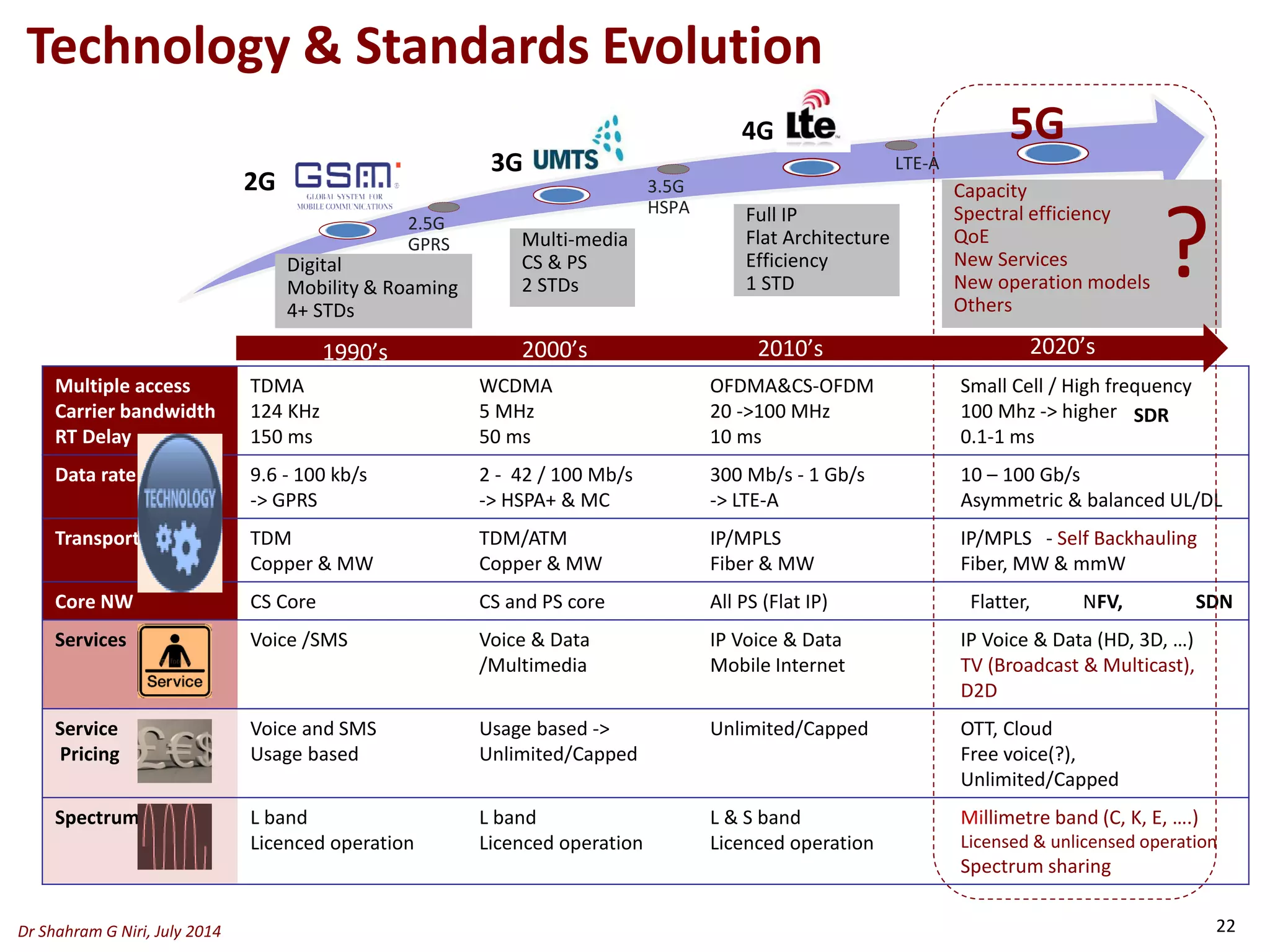
Multiple access
Carrier bandwidth
RT Delay
TDMA
124 KHz
150 ms
WCDMA
5 MHz
50 ms
OFDMA&CS-OFDM
20 ->100 MHz
10 ms
Small Cell / High frequency
100 Mhz -> higher
0.1-1 ms
Data rate 9.6 - 100 kb/s
-> GPRS
2 - 42 / 100 Mb/s
-> HSPA+ & MC
300 Mb/s - 1 Gb/s
-> LTE-A
10 – 100 Gb/s
Asymmetric & balanced UL/DL
Transport TDM
Copper & MW
TDM/ATM
Copper & MW
IP/MPLS
Fiber & MW
IP/MPLS - Self Backhauling
Fiber, MW & mmW
Core NW CS Core CS and PS core All PS (Flat IP) Flatter, NFV, SDN
Services Voice /SMS Voice & Data
/Multimedia
IP Voice & Data
Mobile Internet
IP Voice & Data (HD, 3D, …)
TV (Broadcast & Multicast),
D2D
Service
Pricing
Voice and SMS
Usage based
Usage based ->
Unlimited/Capped
Unlimited/Capped OTT, Cloud
Free voice(?),
Unlimited/Capped
Spectrum L band
Licenced operation
L band
Licenced operation
L & S band
Licenced operation
Millimetre band (C, K, E, ….)
Licensed & unlicensed operation
Spectrum sharing
2G
3G
4G
Full IP
Flat Architecture
Efficiency
1 STD
Capacity
Spectral efficiency
QoE
New Services
New operation models
Others
Digital
Mobility & Roaming
4+ STDs
2.5G
GPRS
3.5G
HSPA
LTE-A
Multi-media
CS & PS
2 STDs
5G
1990’s 2000’s 2010’s 2020’s
SDR
Technology & Standards Evolution
?
Dr Shahram G Niri, July 2014 22
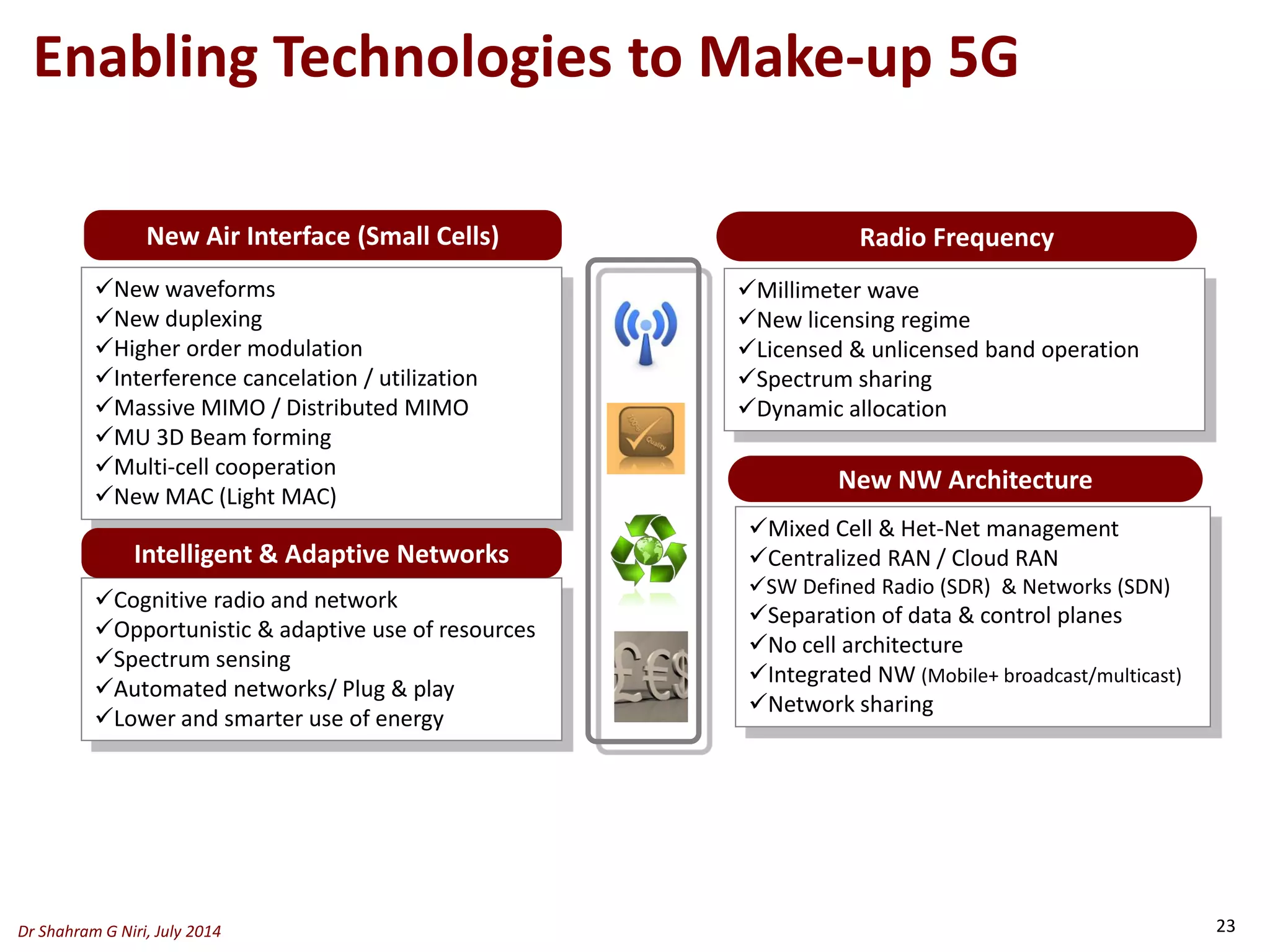
New Air Interface (Small Cells)
New waveforms
New duplexing
Higher order modulation
Interference cancelation / utilization
Massive MIMO / Distributed MIMO
MU 3D Beam forming
Multi-cell cooperation
New MAC (Light MAC)
Radio Frequency
Millimeter wave
New licensing regime
Licensed & unlicensed band operation
Spectrum sharing
Dynamic allocation
Cognitive radio and network
Opportunistic & adaptive use of resources
Spectrum sensing
Automated networks/ Plug & play
Lower and smarter use of energy
Mixed Cell & Het-Net management
Centralized RAN / Cloud RAN
SW Defined Radio (SDR) & Networks (SDN)
Separation of data & control planes
No cell architecture
Integrated NW (Mobile+ broadcast/multicast)
Network sharing
Enabling Technologies to Make-up 5G
New NW Architecture
Intelligent & Adaptive Networks
Dr Shahram G Niri, July 2014 23
,
interference 0
log 1
j k
k
i
i j
P
C W
P N
  
       
  

 
Multi-cell Cooperation
Coordinated Scheduling
3D Beam forming
Higher order modulation
More Spectrum
Carrier Aggregation
Full-duplex radio
Cognitive Radio
Dynamic Spectrum Sharing
Non-orthogonal transmission
More Antennas (Large MIMO)
Interference cancelation / utilization
Higher capacity to be delivered by a combination of several
techniques AND densification of network (Small Cells)
New Air Interface For 5G
Simplified air interface capacity equation
-Much higher spectral efficiency
-Enhanced frequency and time synchronisation
-Better interference cancelation / utilisation
-Higher order modulation and better coding
-Transmit and receive simultaneously
-More resilient to channel estimation error
-Better use of highly fragmented spectrum
-A much better radio resource management
-Multi cell operation
-Cooperative transmission in uplink and downlink
-More antennas (larger MIMO)
-Separation control and data plane
-Designed for small cells
-A more suitable MAC protocol for small cell
-Much higher energy efficient
-Enable new services
-Scalable for various traffic requirements
-AND more!
24Dr Shahram G Niri, July 2014
New generations are mainly defined by new air interfaces / waveforms
A new air interface / new physical layer not for a few dB gain but a total
overhaul of the physical layer
Business
Model
5G
Lowering TCO (cost per bit / km2)
Greener telecommunications
Increasing life time of the products
(delivering technology through SW)
New air interface
Spectrum & radio frequency
 Millimetre wave
New NW architecture
Intelligent & adaptive network
“Perception of infinite capacity
for users”
Quality of Experience (Latency &
Reliability)
New services, e.g. Device 2 device
Rethinking spectrum allocation
 Dynamic Allocation
 Spectrum sharing
Licensed & unlicensed operation
Integrated NW & services
(Mobile+ Broadcast/Multicast)
New business models
Network sharing
New revenue models
B2C, B2B, B2B2C, C2C
Utility service type operation
An Opportunity to Rethink the Mobile Business
5G success depends not only the technology but also rethinking
business models, policies and economics of radio spectrum regulation
Dr Shahram G Niri, July 2014 25
2G, 3G, 4G
5G (?)
5G
5G
BW: 100+BW: 100+
Licensed Unlicensed / Soft Licensed
BW: <100
1GHz 3GHz 30GHz 60GHz 90Ghz
Bandwidth (GHz)
Cell Size (m)
Speed (Gb/s)*
Frequency Band
1-10 10-100
Licensed Unlicensed
Shared
Best use of low (below 6Ghz) & high frequencies (mmWave) - Sub
6GHz as core spectrum, mmWave (10-100 GHz) for ultra dense
access & backhaul, Supplementary Services
Ideally 100+ MHz channel bandwidth
Dynamic Spectrum Allocation
Coordinated Shared Access
 Use of temporal & local availability of spectrum
Carrier Aggregation
Core Spectrum
Supplementary Spectrum
Spectrum remains a challenge for 5G and for the wireless industry
5G & Spectrum
Dr Shahram G Niri, July 2014 26
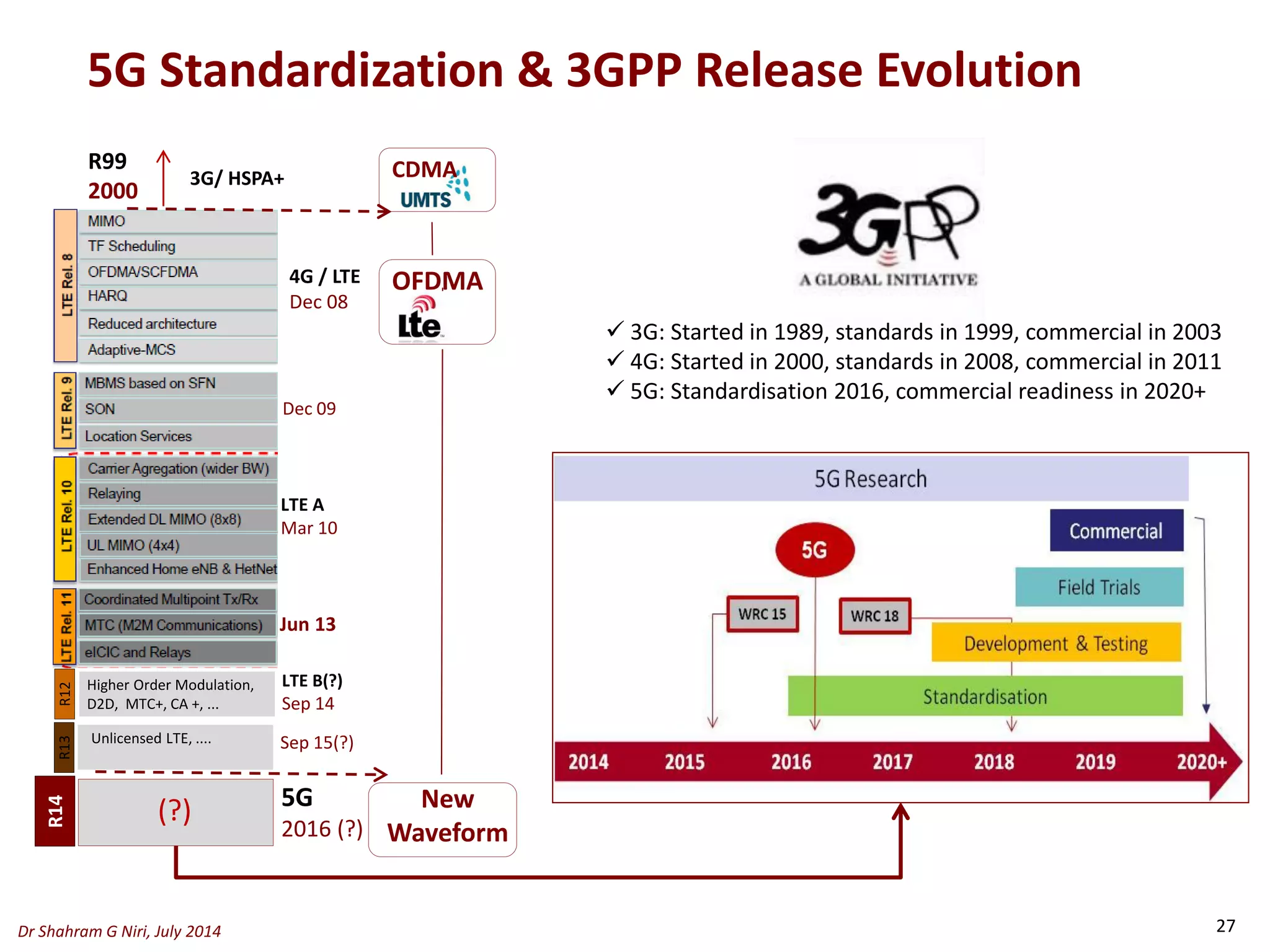
LTE A
Mar 10
3G/ HSPA+
LTE B(?)
Sep 14
R12
4G / LTE
Dec 08
Dec 09
Jun 13
R99
2000
R13R14
Sep 15(?)
5G
2016 (?)
(?)
Higher Order Modulation,
D2D, MTC+, CA +, ...
Unlicensed LTE, ....
CDMA
New
Waveform
OFDMA
5G Standardization & 3GPP Release Evolution
Dr Shahram G Niri, July 2014
 3G: Started in 1989, standards in 1999, commercial in 2003
 4G: Started in 2000, standards in 2008, commercial in 2011
 5G: Standardisation 2016, commercial readiness in 2020+
27
• Rethink the Architecture: Network-Centric to User-Centric
The “No Cell” Network
Source: China Mobile Research
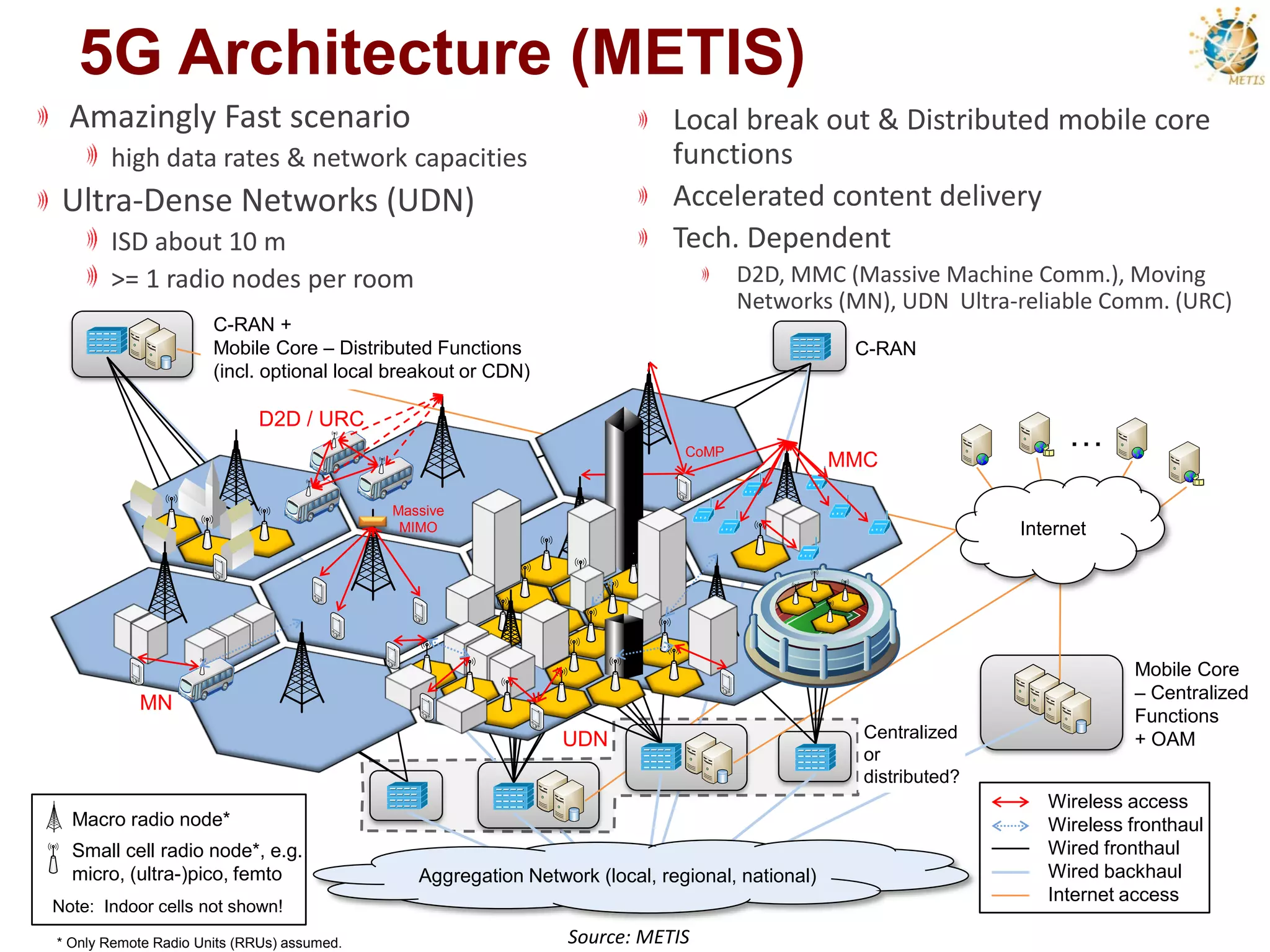
5G Architecture (METIS)
Internet
MMC
D2D / URC
MN
UDN
Aggregation Network (local, regional, national)
Massive
MIMO
Wireless access
Wireless fronthaul
Wired fronthaul
Wired backhaul
Internet access
C-RAN
CoMP
Mobile Core
– Centralized
Functions
+ OAM
C-RAN +
Mobile Core – Distributed Functions
(incl. optional local breakout or CDN)
Macro radio node*
Small cell radio node*, e.g.
micro, (ultra-)pico, femto
Note: Indoor cells not shown!
…
Centralized
or
distributed?
* Only Remote Radio Units (RRUs) assumed.
Local break out & Distributed mobile core
functions
Accelerated content delivery
Tech. Dependent
D2D, MMC (Massive Machine Comm.), Moving
Networks (MN), UDN Ultra-reliable Comm. (URC)
Amazingly Fast scenario
high data rates & network capacities
Ultra-Dense Networks (UDN)
ISD about 10 m
>= 1 radio nodes per room
Source: METIS
• 5G will consist of a combination of techniques &
technologies
• 5G will change the system architecture, especially the RAN
• A much denser network (small cells) will be key to 5G
design
• Spectrum remains a challenge for the wireless industry;
spectrum sharing will be critical
• A greater degree of network sharing may be needed in 5G
• 5G success depends rethinking business models, policies
and economics of radio spectrum regulation
Concluding Remarks
Q&A
Thank You!

5 g webinar slides

  • 1.
    Sponsored By Exploring 5G:Performance Targets, Technologies & Timelines
  • 2.
    Today’s Presenters Gabriel Brown SeniorAnalyst Heavy Reading Shahram Niri Independent Technologist (& Former General Manager for the 5G Innovation Center) Moderator Presenter
  • 3.
    • Introduction to5G • 5G Market Activity • 5G Technologies • Q&A Agenda
  • 4.
  • 5.
  • 6.
    Why is theIndustry Focusing on 5G? 1. To secure funding for R&D work 2. To gain influence in the specification process 3. To attract development partners 4. To highlight IPR portfolios 5. To earn marketing advantage
  • 7.
    5G Performance Targets End-userdata rates Indoor / campus >> Up to 10 Gbit/s Urban and suburban >> 100 Mbit/s Far rural >> ~Mbit/s everywhere System targets Massive scalability >> Millions of devices 1000 X capacity >> Per Unit Area Power consumption >> Up to 90% reduction
  • 8.
    5G Spectrum: Sub1GHz to 100GHz • 5G will cater for entire spectrum band: sub 1GHz to 100 GHz • 10GHz – 100GHZ (mmW) needed for multi Gbit/s • Shared access spectrum to increase availability • Flexible duplex (dynamic uplink & downlink; esp. small cells) • Will 5G consist of multiple well-integrated radio interfaces? • Or will 5G be a new air interface across the frequency range? Source: Ericsson Review, June 2014
  • 9.
    A Wide Rangeof Use-cases for 5G • 5G platform should support many service-types • Risky to define 5G technology according to a pre-defined view of the eventual services Source: Huawei Source: Ericsson
  • 10.
    5G Timeline • Requirementsphase underway • Standardization expected to start in 2016 • Commercial launch from 2020? 2012 2013 2014 2015 2016 2017 2018 2019 2020 WRC’12 WRC’15 WRC’18/19 Exploratory research Pre- standardization activities Commercialization Standardization activities Source: METIS
  • 11.
  • 12.
    • DOCOMO toconduct 5G experimental trials with six leading technology vendors – Alcatel-Lucent, Ericsson, Fujitsu, NEC, Nokia, Samsung NTT DoCoMo • Outdoor field trials planned for 2015 ahead of the start of specification work in 2016
  • 13.
    Google – Investigating5G Wireless? • History of investigation of next-gen wireless technologies • Alpanetal acquisition for self-organizing, low power Gigabit wireless technology – Extend fiber optics using 60GHz mmWave radio – Potentially part of a 5G type solution for LOS indoor or outdoor applications • Google now influential on spectrum allocation • Is 5G a point of disruption for market entry?
  • 14.
    • Important thatcars can communicate with each other and with other participants in the city • Highlights role of 5G in the “Gigabit Cities” concept BMW – “5G is key to self-driving car” • Requires ultra-reliable, low-latency, networks that work everywhere • Device-to-device communication when out of operator range • Radio is interface is the critical part of 5G, but apps will have many other performance dependencies
  • 15.
    • Major RANvendors will be critical players – Depth of R&D expertise – Accumulated radio interface technologies – Will position 5G as a smooth upgrade from LTE-A? • China will be a critical actor in 5G – Assuming a leadership role not seen in 3G & 4G – Backing itself with vast R&D investment – A net positive for 5G technology development Other Market Activity
  • 16.
    5G Will bea Collaborative Development • A number of non-aligned organisations funding and directing research projects • Significant bi-lateral industry cooperation between vendors, operators, & others
  • 17.
  • 18.
    Drivers For NextGeneration (5G) Growing Population Hyper Connectivity Limited Resources Higher Capacity Green Technology Cost Efficiency Quality of Experience Number of connections and also the volume of data over wireless networks continuously growing at a significant rate Users more demanding on quality & price Capacity challenge is real particularly in radio Radio spectrum the blood line of wireless is a finite resources, scarce and expensive The data volume growth will continue but dependent on the service quality offered by the NW and of course the data tariffs Sustainability of mobile broadband business - Ever increasing traffic, higher TCO and flattening ARPU 3G & 4G both promised improvements in NW capacity, data rate, efficiency, cost and quality. 5G will be no exception but the sheer scale of the challenges this time makes 5G research different. Dr Shahram G Niri, July 2014 18
  • 19.
     Values subjectto assumption  Modest increase in number of devices and usage  Traffic growth: ~70% CAGR  In 2020 depending on the environment traffic per km2 (1.5 to 60 Gb/s/km2)  UK needs at least ~ 15 - 20 x capacity (2013-2020)  Current LTE technology will not accommodate the predicted traffic growth The next generation will need to be designed not for 2020 but for 2025-2030 capacity Capacity Challenge 0.00 10.00 20.00 30.00 40.00 50.00 60.00 70.00 80.00 2012 2013 2014 2015 2016 2017 2018 2019 2020 Gb/s/km2 Traffic growth for cases a to d  Case a: Inner London business  Case b: Office  Case c: UK Peak  Case d: UK mean Impact of transmission mode change (ISD=300, 20 MHz bandwidth) Xfold 0.0 0.5 1.0 1.5 2.0 2.5 SU-MIMO 2x2 SU-MIMO 2x4 JP CoMP 4x2 SU-MIMO 8x2 Transmission Mode Dr Shahram G Niri, July 2014 19
  • 20.
    Significant air interfacecapacity -Focus on area NOT JUST link spectral efficiency -Designed for small Cells (capacity), extended to coverage -More spectrum (Licensed & unlicensed operation, spectrum sharing & other sources) Super low latency - Sub 1 ms, TTI: 10-25 ms -Faster signaling for higher data rate, in line with data rate -U plan latency: frame structure, control signal timing, HARQ -For new services (MTC, gaming, ….) -For distributed control Super reliable -For new services and applications -Smart transport, e-health, intelligent control, … The higher capacity and lower latency necessary for wide range of services BUT not all the services required in the same location, at the same time nor by the same air interface May need tradeoffs in capacity, coverage and data rate Air Interface Performance X10 (Faster than 4G) X100+ (Connections) X1000+ (Capacity) 10 100 1000 Sub 1 ms latency 99.99% reliability & availability Tech 3G HSPA+ LTE LTE-A 5G Bandwidth MHz 5 5 20 100 100+ SE b/Hz/cell 0.5 2 4 ~8 10+ Peak Rate Mb/s 2 42 & 11 326 & 86 1000 & 375 10000 & 5000 Latency ms 50 20 10 10 0.1-1 ASE Gb/s/km2 ? Dr Shahram G Niri, July 2014 20
  • 21.
    OPEX 60% CAPEX 40% Greener Telecom LowerCTO Greener technology (energy efficiency) -Current 2% ICT share of CO2 emission is likely to increase -Power consumption doubled in past 5 years -More power efficient HW & SW, needed -Reducing signaling through intelligent O&M and SON -Alternative energy sources Reduced Total Cost of Ownership -For x1000 need to achieve 1/1000 delivery cost per bit!? -Deliver cost will need to be recalculated as cost per bit/km2 - Saving through energy consumption -Saving through lower cost of operation (Plug & Play, Self managed NW, Zero touch) -Spectrum and infrastructure sharing -Longer HW life cycle time -New business models -> new revenue models Efficiency & Cost Requirements Dr Shahram G Niri, July 2014 21
  • 22.
    Multiple access Carrier bandwidth RTDelay TDMA 124 KHz 150 ms WCDMA 5 MHz 50 ms OFDMA&CS-OFDM 20 ->100 MHz 10 ms Small Cell / High frequency 100 Mhz -> higher 0.1-1 ms Data rate 9.6 - 100 kb/s -> GPRS 2 - 42 / 100 Mb/s -> HSPA+ & MC 300 Mb/s - 1 Gb/s -> LTE-A 10 – 100 Gb/s Asymmetric & balanced UL/DL Transport TDM Copper & MW TDM/ATM Copper & MW IP/MPLS Fiber & MW IP/MPLS - Self Backhauling Fiber, MW & mmW Core NW CS Core CS and PS core All PS (Flat IP) Flatter, NFV, SDN Services Voice /SMS Voice & Data /Multimedia IP Voice & Data Mobile Internet IP Voice & Data (HD, 3D, …) TV (Broadcast & Multicast), D2D Service Pricing Voice and SMS Usage based Usage based -> Unlimited/Capped Unlimited/Capped OTT, Cloud Free voice(?), Unlimited/Capped Spectrum L band Licenced operation L band Licenced operation L & S band Licenced operation Millimetre band (C, K, E, ….) Licensed & unlicensed operation Spectrum sharing 2G 3G 4G Full IP Flat Architecture Efficiency 1 STD Capacity Spectral efficiency QoE New Services New operation models Others Digital Mobility & Roaming 4+ STDs 2.5G GPRS 3.5G HSPA LTE-A Multi-media CS & PS 2 STDs 5G 1990’s 2000’s 2010’s 2020’s SDR Technology & Standards Evolution ? Dr Shahram G Niri, July 2014 22
  • 23.
    New Air Interface(Small Cells) New waveforms New duplexing Higher order modulation Interference cancelation / utilization Massive MIMO / Distributed MIMO MU 3D Beam forming Multi-cell cooperation New MAC (Light MAC) Radio Frequency Millimeter wave New licensing regime Licensed & unlicensed band operation Spectrum sharing Dynamic allocation Cognitive radio and network Opportunistic & adaptive use of resources Spectrum sensing Automated networks/ Plug & play Lower and smarter use of energy Mixed Cell & Het-Net management Centralized RAN / Cloud RAN SW Defined Radio (SDR) & Networks (SDN) Separation of data & control planes No cell architecture Integrated NW (Mobile+ broadcast/multicast) Network sharing Enabling Technologies to Make-up 5G New NW Architecture Intelligent & Adaptive Networks Dr Shahram G Niri, July 2014 23
  • 24.
    , interference 0 log 1 jk k i i j P C W P N                  Multi-cell Cooperation Coordinated Scheduling 3D Beam forming Higher order modulation More Spectrum Carrier Aggregation Full-duplex radio Cognitive Radio Dynamic Spectrum Sharing Non-orthogonal transmission More Antennas (Large MIMO) Interference cancelation / utilization Higher capacity to be delivered by a combination of several techniques AND densification of network (Small Cells) New Air Interface For 5G Simplified air interface capacity equation -Much higher spectral efficiency -Enhanced frequency and time synchronisation -Better interference cancelation / utilisation -Higher order modulation and better coding -Transmit and receive simultaneously -More resilient to channel estimation error -Better use of highly fragmented spectrum -A much better radio resource management -Multi cell operation -Cooperative transmission in uplink and downlink -More antennas (larger MIMO) -Separation control and data plane -Designed for small cells -A more suitable MAC protocol for small cell -Much higher energy efficient -Enable new services -Scalable for various traffic requirements -AND more! 24Dr Shahram G Niri, July 2014 New generations are mainly defined by new air interfaces / waveforms A new air interface / new physical layer not for a few dB gain but a total overhaul of the physical layer
  • 25.
    Business Model 5G Lowering TCO (costper bit / km2) Greener telecommunications Increasing life time of the products (delivering technology through SW) New air interface Spectrum & radio frequency  Millimetre wave New NW architecture Intelligent & adaptive network “Perception of infinite capacity for users” Quality of Experience (Latency & Reliability) New services, e.g. Device 2 device Rethinking spectrum allocation  Dynamic Allocation  Spectrum sharing Licensed & unlicensed operation Integrated NW & services (Mobile+ Broadcast/Multicast) New business models Network sharing New revenue models B2C, B2B, B2B2C, C2C Utility service type operation An Opportunity to Rethink the Mobile Business 5G success depends not only the technology but also rethinking business models, policies and economics of radio spectrum regulation Dr Shahram G Niri, July 2014 25
  • 26.
    2G, 3G, 4G 5G(?) 5G 5G BW: 100+BW: 100+ Licensed Unlicensed / Soft Licensed BW: <100 1GHz 3GHz 30GHz 60GHz 90Ghz Bandwidth (GHz) Cell Size (m) Speed (Gb/s)* Frequency Band 1-10 10-100 Licensed Unlicensed Shared Best use of low (below 6Ghz) & high frequencies (mmWave) - Sub 6GHz as core spectrum, mmWave (10-100 GHz) for ultra dense access & backhaul, Supplementary Services Ideally 100+ MHz channel bandwidth Dynamic Spectrum Allocation Coordinated Shared Access  Use of temporal & local availability of spectrum Carrier Aggregation Core Spectrum Supplementary Spectrum Spectrum remains a challenge for 5G and for the wireless industry 5G & Spectrum Dr Shahram G Niri, July 2014 26
  • 27.
    LTE A Mar 10 3G/HSPA+ LTE B(?) Sep 14 R12 4G / LTE Dec 08 Dec 09 Jun 13 R99 2000 R13R14 Sep 15(?) 5G 2016 (?) (?) Higher Order Modulation, D2D, MTC+, CA +, ... Unlicensed LTE, .... CDMA New Waveform OFDMA 5G Standardization & 3GPP Release Evolution Dr Shahram G Niri, July 2014  3G: Started in 1989, standards in 1999, commercial in 2003  4G: Started in 2000, standards in 2008, commercial in 2011  5G: Standardisation 2016, commercial readiness in 2020+ 27
  • 28.
    • Rethink theArchitecture: Network-Centric to User-Centric The “No Cell” Network Source: China Mobile Research
  • 29.
    5G Architecture (METIS) Internet MMC D2D/ URC MN UDN Aggregation Network (local, regional, national) Massive MIMO Wireless access Wireless fronthaul Wired fronthaul Wired backhaul Internet access C-RAN CoMP Mobile Core – Centralized Functions + OAM C-RAN + Mobile Core – Distributed Functions (incl. optional local breakout or CDN) Macro radio node* Small cell radio node*, e.g. micro, (ultra-)pico, femto Note: Indoor cells not shown! … Centralized or distributed? * Only Remote Radio Units (RRUs) assumed. Local break out & Distributed mobile core functions Accelerated content delivery Tech. Dependent D2D, MMC (Massive Machine Comm.), Moving Networks (MN), UDN Ultra-reliable Comm. (URC) Amazingly Fast scenario high data rates & network capacities Ultra-Dense Networks (UDN) ISD about 10 m >= 1 radio nodes per room Source: METIS
  • 30.
    • 5G willconsist of a combination of techniques & technologies • 5G will change the system architecture, especially the RAN • A much denser network (small cells) will be key to 5G design • Spectrum remains a challenge for the wireless industry; spectrum sharing will be critical • A greater degree of network sharing may be needed in 5G • 5G success depends rethinking business models, policies and economics of radio spectrum regulation Concluding Remarks
  • 31.
  • 32.