Typeset by Disha DTP Team
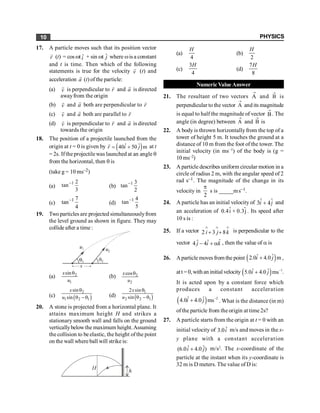
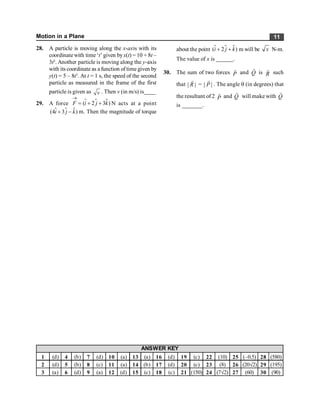
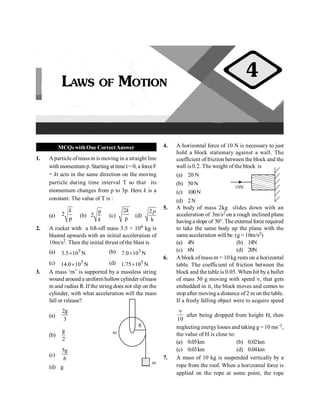
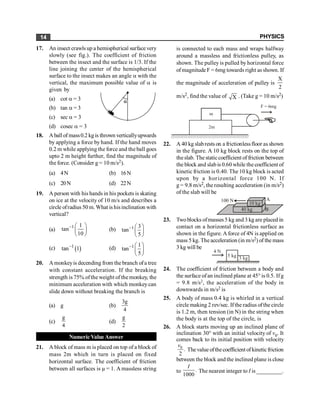
No part of this publication may be reproduced in
any form without prior permission of the publisher.
The author and the publisher do not take any legal
responsibility for any errors or misrepresentations
that might have crept in. We have tried and made
our best efforts to provide accurate up-to-date
information in this book.
DISHA PUBLICATION
45, 2nd Floor, Maharishi Dayanand Marg,
Corner Market, Malviya Nagar, New Delhi - 110017
Tel : 49842349 / 49842350
feedback_disha@aiets.co.in
Write to us at
www.dishapublication.com www.mylearninggraph.com
Books & ebooks
for School &
Competitive
Exams
Etests
for
Competitive
Exams
All Right Reserved
Corporate
Office
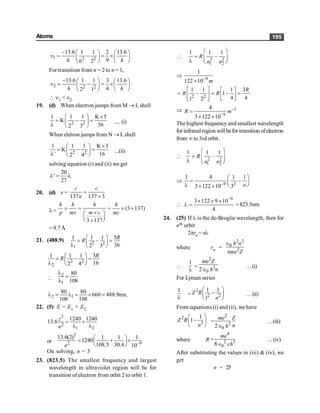
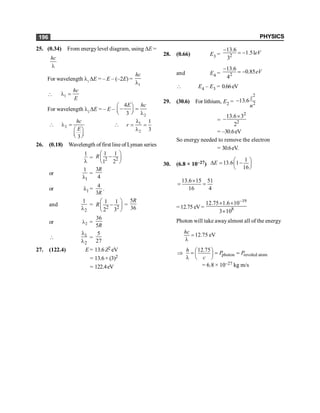
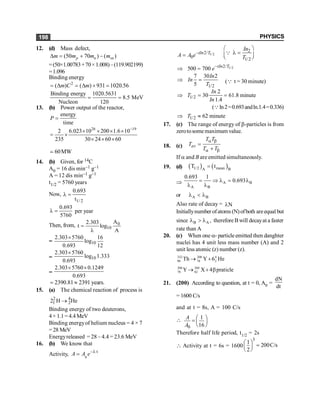
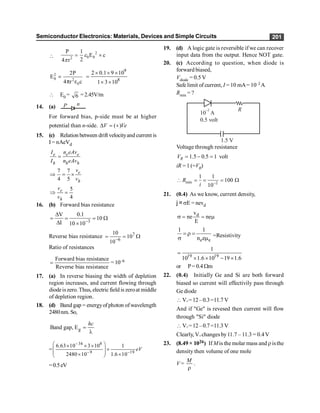
©
Copyright
Disha
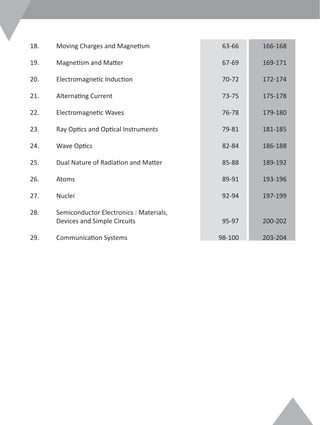
S.no.	 Chapter Name	 Page no.
	 	 Questions	 Solutions
1.	 Physical world, Units and Measurements	 1-3	 101-103
2.	 Motion in a Straight Line	 4-7	 104-107
3.	 Motion in a Plane	 8-11	 108-111
4.	 Laws of Motion	 12-15	 112-115
5.	 Work, Energy and Power	 16-19	 116-120
6.	 System of Particles and Rotational Motion	 20-23	 121-124
7.	 Gravitation	 24-27	 125-127
8.	 Mechanical Properties of Solids	 28-30	 128-130
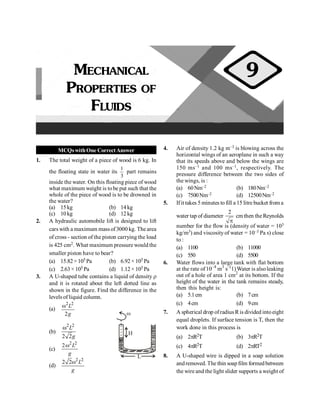
9.	 Mechanical Properties of Fluids	 31-34	 131-134
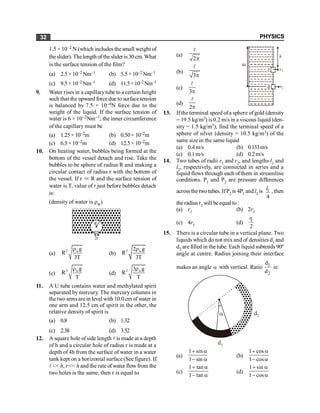
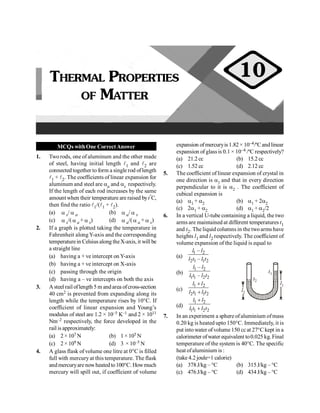
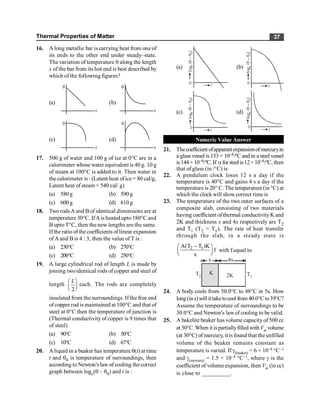
10.	 Thermal Properties of Matter	 35-38	 135-138
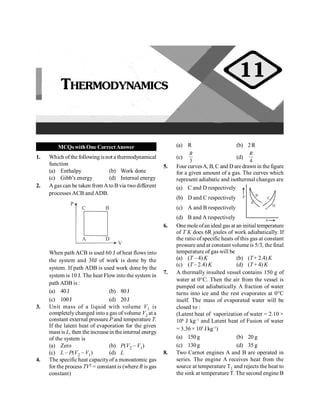
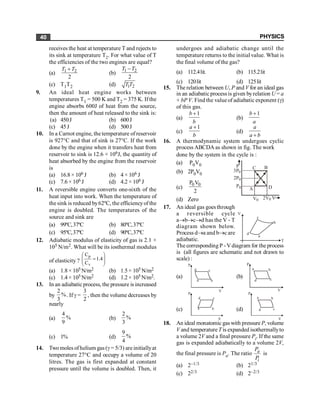
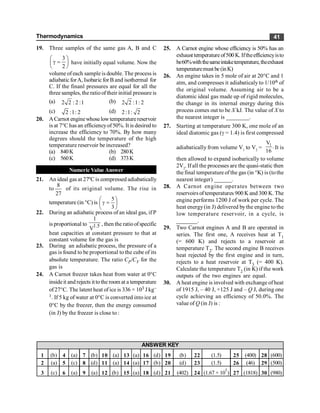
11.	 Thermodynamics	 39-41	 139-142
12.	 Kinetic Theory	 42-44	 143-145
13.	 Oscillations	 45-48	 146-149
14.	 Waves	 49-51	 150-153
15.	 Electric Charges and Fields	 52-55	 154-158
16.	 Electrostatic Potential and Capacitance	 56-58	 159-161
17.	 Current Electricity	 59-62	 162-165
Contents
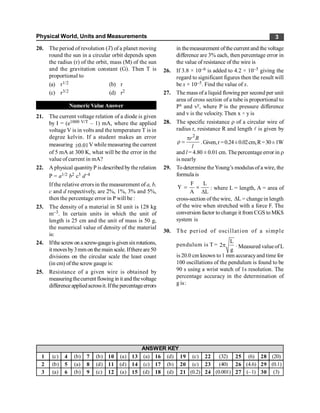
18.	 Moving Charges and Magnetism	 63-66	 166-168
19.	 Magnetism and Matter	 67-69	 169-171
20.	 Electromagnetic Induction	 70-72	 172-174
21.	 Alternating Current	 73-75	 175-178
22.	 Electromagnetic Waves	 76-78	 179-180
23.	 Ray Optics and Optical Instruments	 79-81	 181-185
24.	 Wave Optics	 82-84	 186-188
25.	 Dual Nature of Radiation and Matter	 85-88	 189-192
26.	 Atoms	 89-91	 193-196
27.	 Nuclei	 92-94	 197-199
28.	 Semiconductor Electronics : Materials,
	 Devices and Simple Circuits	 95-97	 200-202
29.	 Communication Systems	 98-100	 203-204
MCQswithOne CorrectAnswer
1. If x = at + bt2, where x is the distance travelled
by the body in kilometers while t is the time in
seconds, then the unit of b is
(a) km/s (b) kms
(c) km/s2 (d) kms2
2. A metal sample carrying a current along X-axis
with densityJx issubjected toa magneticfield Bz
(alongz-axis). TheelectricfieldEydevelopedalong
Y-axis is directlyproportional to Jx as well as Bz.
The constant of proportionality has SI unit.
(a)
2
m
A
(b)
3
m
As
(c)
2
m
As
(d) 3
As
m
3. The refractive index of water measured by the
relation m =
real depth
apparent depth
is found to have
values of 1.34, 1.38, 1.32 and 1.36; the mean
value of refractiveindex with percentage error is
(a) 1.35± 1.48 % (b) 1.35 ± 0 %
(c) 1.36 ± 6 % (d) 1.36 ± 0 %
4. Write the dimensions of a × b in the relation
2
-
=
b x
E
at
, where E is the energy, x is the
displacement and t is time
(a) ML2T (b) M–1L2T1
(c) ML2T–2 (d) MLT–2
5. In the relation P
z
k
e
a
-
q
a
=
b
where P is pressure,
Z is distance, k is Boltzmann constants and q is
the temperature. The dimensional formula of b
will be
(a) [M0L2T0] (b) [M1L2T1]
(c) [M1L0T–1] (d) [M0L2T–1]
6. In a new system of units, the fundamental
quantities mass, length and time are replaced by
acceleration ‘a’, density ‘r’ and frequency ‘f’.
The dimensional formula for force in this system
is
(a) [ra4 f ] (b) [ra4 f –6]
(c) [r–1a–4f 6] (d) [r–1a–4 f –1]
7. A formula is given as
3
. .
1
.
b k t
P
a m a
q
= +
where P = pressure; k = Boltzmann’s constant;
q = temperature; t = time; ‘a’ and ‘b’ are
constants.
Dimensional formula of ‘b’ is same as
(a) Force
(b) Linearmomentum
(c) Angular momentum
(d) Torque
8. The pair of physical quantities that has the
different dimensions is :
(a) Reynolds number and coefficient offriction
(b) Curie and frequency of a light wave
(c) Latent heat and gravitational potential
(d) Planck’s constant and torque
PHYSICAL WORLD,
UNITS AND
MEASUREMENTS
1
PHYSICS
2
9. ForceF is given in terms oftime t and distancex
byF =Asin (Ct) + Bcos (Dx). Then, dimensions
of
A
B
and
C
D
are
(a) [M0 L0 T0], [M0 L0 T–1]
(b) [M L T–2], [M0 L–1 T0]
(c) [M0 L0 T0], [M0 L T–1]
(d) [M0 L1 T–1], [M0 L0 T0]
10. The respective number ofsignificant figures for
the numbers 23.023, 0.0003and 2.1 × 10⁻³ are
(a) 5,1, 2 (b) 5,1, 5
(c) 5,5, 2 (d) 4,4, 2
11. N divisionson the main scale of a vernier calliper
coincidewith (N+1)divisionsofthe vernierscale.
Ifeach division of main scale is ‘a’units, then the
least count of the instrument is
(a) a (b)
a
N
(c)
1
N
a
N
´
+
(d)
1
a
N +
12. Given that K = energy, V = velocity, T = time. If
they are chosen as the fundamental units, then
what is dimensional formula for surface tension?
(a) [KV–2T–2] (b) [K2V2T–2]
(c) [K2V–2T–2] (d) [KV2T2]
13. In the formula X = 5YZ2, X and Z have
dimensions of capacitance and magnetic field,
respectively. What are the dimensions of Y in
SI units ?
(a) [M–3 L–2 T8 A4] (b) [M–1L–2T4 A2]
(c) [M–2 L0 T–4 A–2] (d) [M–2L–2T6 A3]
14. The relative error in the determination of the
surface area of a sphere is a. Then the relative
error in the determination of its volume is
(a)
2
3
a (b)
2
3
a
(c)
3
2
a (d) a
15. In an experiment the angles are required to be
measured using an instrument, 29 divisions of
the main scale exactly coincide with the 30
divisions of the vernier scale. If the smallest
division of the main scale is half- a degree
(= 0.5°), then theleast count ofthe instrument is:
(a) halfminute (b) one degree
(c) halfdegree (d) oneminute
16. In SI units, the dimensions of
0
0
Î
m
is:
(a) A–1TML3 (b) AT2 M–1L–1
(c) AT–3ML3/2 (d) A2T3 M–1L–2
17. From the following combinations of physical
constants (expressed through their usual
symbols) the only combination, that would have
the same value in different systems of units, is:
(a) 2
o
ch
2pe
(b)
2
2
o e
e
2 Gm
pe
(me = mass of electron)
(c)
o o
2 2
G
c he
m e
(d)
o o
2
2 h
G
ce
p m e
18. A student measuring the diameter of a pencil of
circular cross-section with the help of a vernier
scale records the following four readings 5.50
mm,5.55mm, 5.45mm,5.65mm, Theaverageof
these four reading is 5.5375 mm and the stan-
dard deviation of the data is 0.07395 mm. The
average diameter of the pencil should therefore
be recorded as :
(a) (5.5375±0.0739)mm
(b) (5.5375±0.0740)mm
(c) (5.538±0.074)mm
(d) (5.54±0.07)mm
19. A quantity x is given by (IFv2/WL4) in terms of
moment of inertia I, force F, velocity v, work W
and Length L. The dimensional formula for x is
same as that of :
(a) planck’s constant
(b) force constant
(c) energy density
(d) coefficient of viscosity
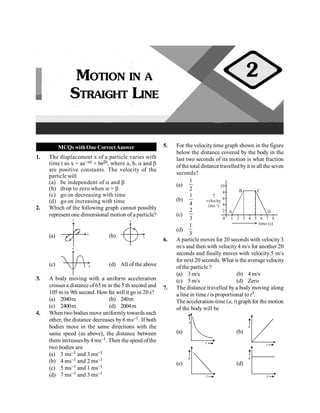
Physical World, Units and Measurements 3
20. The period of revolution (T) of a planet moving
round the sun in a circular orbit depends upon
the radius (r) of the orbit, mass (M) of the sun
and the gravitation constant (G). Then T is
proportional to
(a) r1/2 (b) r
(c) r3/2 (d) r2
Numeric Value Answer
21. The current voltage relation of a diode is given
by I = (e1000 V/T – 1) mA, where the applied
voltage V is in volts and the temperature T is in
degree kelvin. If a student makes an error
measuring 0.01
± V while measuring the current
of 5 mA at 300 K, what will be the error in the
value of current in mA?
22. A physical quantityP is described bytherelation
P = a1/2 b2 c3 d–4
If the relative errors in the measurement of a, b,
c and d respectively, are 2%, 1%, 3% and 5%,
then the percentage error in P will be :
23. The density of a material in SI unit is 128 kg
m–3. In certain units in which the unit of
length is 25 cm and the unit of mass is 50 g,
the numerical value of density of the material
is:
24. Ifthescrewon ascrew-gaugeisgivensixrotations,
itmovesby3mmon the main scale. Ifthere are50
divisions on the circular scale the least count
(in cm) ofthe screw gauge is:
25. Resistance of a given wire is obtained by
measuringthecurrent flowing in it and thevoltage
differenceappliedacrossit.Ifthe percentageerrors
in themeasurement ofthe current and the voltage
difference are 3% each, then percentage error in
the value of resistance of the wire is
26. If 3.8 × 10⁻⁶ is added to 4.2 × 10⁻⁵ giving the
regard to significant figures then the result will
be x × 10–5. Find the value of x.
27. The mass of a liquid flowing per second per unit
area of cross section of a tube is proportional to
Px and vy, where P is the pressure difference
and v is the velocity. Then x ÷ y is
28. The specific resistance r of a circular wire of
radius r, resistance R and length l is given by
2
p
r =
r R
l
.Given,r =0.24±0.02cm,R=30±1W
and l = 4.80 ± 0.01 cm. Thepercentageerror in r
is nearly
29. To determine theYoung’s modulus of a wire, the
formula is
F L
Y
A L
= ´
D
: where L = length, A = area of
cross-section of the wire, L
D = change in length
of the wire when stretched with a force F. The
conversion factor to change it from CGS toMKS
system is
30. The period of oscillation of a simple
pendulum is T =
L
2
g
p . Measured valueofL
is 20.0 cm known to1 mm accuracyand time for
100 oscillations of the pendulum is found to be
90 s using a wrist watch of 1s resolution. The
percentage accuracy in the determination of
g is:
1 (c) 4 (b) 7 (b) 10 (a) 13 (a) 16 (d) 19 (c) 22 (32) 25 (6) 28 (20)
2 (b) 5 (a) 8 (d) 11 (d) 14 (c) 17 (b) 20 (c) 23 (40) 26 (4.6) 29 (0.1)
3 (a) 6 (b) 9 (c) 12 (a) 15 (d) 18 (d) 21 (0.2) 24 (0.001) 27 (–1) 30 (3)
ANSWER KEY
PHYSICS
4
MCQswithOne CorrectAnswer
1. The displacement x of a particle varies with
time t as x = ae-at + bebt, where a, b, a and b
are positive constants. The velocity of the
particle will
(a) be independent of a and b
(b) drop to zero when a = b
(c) go on decreasing with time
(d) go on increasing with time
2. Which of the following graph cannot possibly
represent one dimensional motion of a particle?
(a) t
x
(b)
v
t
(c) t
v
(d) All of the above
3. A body moving with a uniform acceleration
crosses a distance of65 m in the 5 th second and
105 m in 9th second. How far will it go in 20 s?
(a) 2040m (b) 240m
(c) 2400m (d) 2004m
4. When two bodies move uniformly towards each
other, the distance decreases by 6 ms–1. If both
bodies move in the same directions with the
same speed (as above), the distance between
them increases by4 ms–1. Then the speed ofthe
two bodies are
(a) 3 ms–1 and 3 ms–1
(b) 4 ms–1 and 2 ms–1
(c) 5 ms–1 and 1 ms–1
(d) 7 ms–1 and 3 ms–1
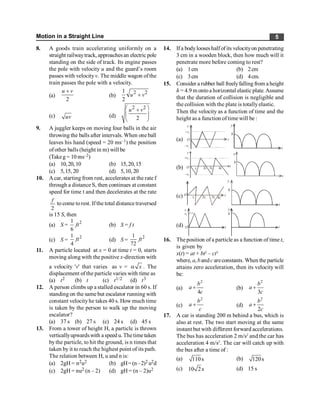
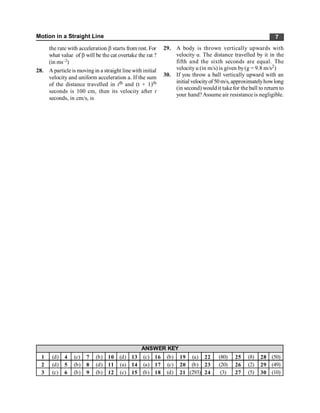
5. For the velocity time graph shown in the figure
below the distance covered by the body in the
last two seconds of its motion is what fraction
ofthe total distance travelledbyit in all the seven
seconds?
(a)
2
1
(b)
4
1
10
8
6
4
2
0 1 2 3 4 5 6 7 8
B C
D
A
­
(ms )
velocity
–1
time (s)
(c)
3
2
(d)
3
1
6. A particle moves for 20 seconds with velocity 3
m/s and then with velocity 4 m/s for another 20
seconds and finally moves with velocity 5 m/s
for next 20 seconds. What is the average velocity
of the particle ?
(a) 3 m/s (b) 4 m/s
(c) 5 m/s (d) Zero
7. The distance travelled by a body moving along
a line in time t is proportional to t3.
The acceleration-time (a, t) graph for the motion
of the body will be
(a)
a
t
(b)
a
t
(c)
a
t
(d)
a
t
MOTION IN A
STRAIGHT LINE
2
Motion in a Straight Line 5
8. A goods train accelerating uniformly on a
straight railwaytrack,approachesan electric pole
standing on the side of track. Its engine passes
the pole with velocity u and the guard’s room
passes with velocityv. The middle wagon ofthe
train passes the pole with a velocity.
(a)
2
u v
+
(b)
2 2
1
2
u v
+
(c) uv (d)
2 2
2
u v
æ ö
+
ç ÷
è ø
9. A juggler keeps on moving four balls in the air
throwing the balls after intervals. When one ball
leaves his hand (speed = 20 ms–1) the position
ofother balls (height in m) will be
(Takeg = 10 ms–2)
(a) 10,20, 10 (b) 15,20,15
(c) 5,15, 20 (d) 5,10, 20
10. Acar, starting from rest, accelerates at the rate f
through a distance S, then continues at constant
speed for time t and then decelerates at the rate
2
f
to come torest. Ifthe total distance traversed
is 15 S, then
(a) S = 2
1
6
ft (b) S = f t
(c) S =
2
1
4
ft (d) S =
2
1
72
ft
11. A particle located at x = 0 at time t = 0, starts
moving along with the positive x-direction with
a velocity 'v' that varies as v = x
a . The
displacement of the particle varies with time as
(a) t2 (b) t (c) t1/2 (d) t3
12. A person climbs up a stalled escalator in 60 s. If
standing on the same but escalator running with
constant velocityhe takes 40 s. How much time
is taken by the person to walk up the moving
escalator?
(a) 37 s (b) 27 s (c) 24 s (d) 45 s
13. From a tower of height H, a particle is thrown
verticallyupwardswith aspeed u. Thetimetaken
bythe particle, to hit the ground, is n times that
taken by it to reach the highest point of its path.
The relation between H, u and n is:
(a) 2gH = n2u2 (b) gH=(n –2)2 u2d
(c) 2gH = nu2 (n – 2) (d) gH = (n – 2)u2
14. Ifa bodylooses halfofits velocityon penetrating
3 cm in a wooden block, then how much will it
penetrate more before coming to rest?
(a) 1cm (b) 2cm
(c) 3cm (d) 4cm.
15. Consider a rubber ball freelyfallingfrom a height
h = 4.9 m ontoa horizontal elastic plate.Assume
that the duration of collision is negligible and
the collision with the plate is totallyelastic.
Then the velocity as a function of time and the
height as a function of time will be :
(a) t
+v1
v
O
–v1
y
h
t
(b)
v
+v1
O
–v1
t1 2t1 4t1
t
t
y
h
t
(c) t
t1 2t1
O
y
h
t
(d)
v1
v
O t t
y
h
16. The position of a particle as a function of time t,
is given by
x(t) = at + bt2
– ct3
where, a, bandc areconstants. When the particle
attains zero acceleration, then its velocity will
be:
(a)
2
4
+
b
a
c
(b)
2
3
b
a
c
+
(c)
2
b
a
c
+ (d)
2
2
b
a
c
+
17. A car is standing 200 m behind a bus, which is
also at rest. The two start moving at the same
instant but with different forward accelerations.
The bus has acceleration 2 m/s2
and the car has
acceleration 4 m/s2
. The car will catch up with
the bus after a time of :
(a) 110s (b) 120s
(c) 10 2s (d) 15 s
PHYSICS
6
18. A person standing on an open ground hears the
sound of a jet aeroplane, coming from north at
an angle 60º with ground level. But he finds the
aeroplane right vertically above his position. If
v is the speed of sound, speed of the plane is:
(a)
3
2
v (b)
2
3
v
(c) v (d)
2
v
19. Apassenger train oflength 60 m travelsat a speed
of80km/hr.Another freight train oflength 120m
travels at a speed of 30 km/h. The ratio of times
taken by the passenger train to completelycross
thefreight train when: (i) theyare movingin same
direction, and (ii) in the opposite directions is:
(a)
11
5
(b)
5
2
(c)
3
2
(d)
25
11
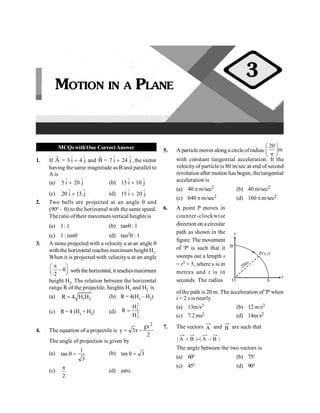
20. The graph shown in figure shows the velocityv
versus time t for a body.
Which of the graphs
represents the
corresponding
acceleration versus time
graphs?
(a) t
a
(b) t
a
(c) t
a
(d) t
a
Numeric Value Answer
21. Aparachutistafterbailingoutfalls50mwithoutfriction.
When parachute opens, it deceleratesat 2 m/s2 . He
reaches the ground with a speed of 3 m/s. At what
height(inm),didhebailout?
22. An automobiletravelling with a speedof 60km/
h, can brake to stop within a distance of 20m. If
the car is going twice as fast i.e., 120 km/h, the
stopping distance (in m) will be
23. The speed verses time graph for a particle is
shown in the figure. The distance travelled (in
m) bytheparticleduring thetime interval t = 0 to
t = 5 s will be __________.
1 2 3 4 5
2
4
6
8
10
u
(ms )
–1
time
( )
s
24. The distance x covered by a particle in one
dimensional motion varies with time t as x2
= at2
+ 2bt + c. If the acceleration of the particle
depends on x as x–n
, where n is an integer, the
value of n is ______.
25. A ball is dropped from the top of a 100 m high
tower on a planet. In the last
1
2
s before hitting
the ground, it covers a distance of 19 m.
Acceleration due to gravity (in ms–2
) near the
surface on that planet is _______.
26. An object, moving with a speed of 6.25 m/s, is
decelerated at a rate given by
2.5
= -
dv
v
dt
where v is the instantaneous
speed. The time (in second) taken bythe object,
to come to rest, would be:
27. A cat, on seeing a rat at a distant of d = 5 m,
starts with velocity u = 5 ms–1 and moves with
acceleration a=2.5ms–2 in order to catch it, while
Motion in a Straight Line 7
the rate with acceleration b starts from rest. For
what value of b will be the cat overtake the rat ?
(in ms–2)
28. A particle is moving in a straight line with initial
velocity and uniform acceleration a. If the sum
of the distance travelled in tth and (t + 1)th
seconds is 100 cm, then its velocity after t
seconds, in cm/s, is
1 (d) 4 (c) 7 (b) 10 (d) 13 (c) 16 (b) 19 (a) 22 (80) 25 (8) 28 (50)
2 (d) 5 (b) 8 (d) 11 (a) 14 (a) 17 (c) 20 (b) 23 (20) 26 (2) 29 (49)
3 (c) 6 (b) 9 (b) 12 (c) 15 (b) 18 (d) 21 (293) 24 (3) 27 (5) 30 (10)
ANSWER KEY
29. A body is thrown vertically upwards with
velocity u. The distance travelled by it in the
fifth and the sixth seconds are equal. The
velocity u (in m/s) is given by(g = 9.8 m/s2)
30. If you throw a ball vertically upward with an
initial velocityof 50 m/s, approximatelyhowlong
(in second) would it takefor the ball to return to
your hand?Assume air resistance is negligible.
PHYSICS
8
MCQswithOne CorrectAnswer
1. If A
r
= 3 i 4 j
Ù Ù
+ and B
r
= 7 i 24 j
Ù Ù
+ , thevector
having the same magnitude as B and parallel to
A is
(a) 5 i 20 j
Ù Ù
+ (b) 15 i 10 j
Ù Ù
+
(c) 20 i 15 j
Ù Ù
+ (d) 15 i 20 j
Ù Ù
+
2. Two balls are projected at an angle q and
(90º – q) to the horizontal with the same speed.
Theratio oftheir maximum vertical heights is
(a) 1: 1 (b) tanq : 1
(c) 1 : tanq (d) tan2q : 1
3. A stone projected with a velocity u at an angle q
with the horizontal reaches maximum height H1.
When it is projected with velocity u at an angle
2
p
æ ö
-q
ç ÷
è ø with thehorizontal, it reachesmaximum
height H2. The relation between the horizontal
range R of the projectile, heights H1 and H2 is
(a) 1 2
R 4 H H
= (b) R = 4(H1 – H2)
(c) R = 4 (H1 + H2) (d)
2
1
2
2
H
R
H
=
4. The equation of a projectile is
2
gx
x
3
y
2
-
=
The angle of projection is given by
(a)
3
1
tan =
q (b) 3
tan =
q
(c)
2
p
(d) zero.
5. A particle moves along a circleofradius m
20
÷
ø
ö
ç
è
æ
p
with constant tangential acceleration. It the
velocity of particle is 80 m/sec at end of second
revolution after motion has begun, thetangential
acceleration is
(a) 40 pm/sec2 (b) 40 m/sec2
(c) 640 pm/sec2 (d) 160 pm/sec2
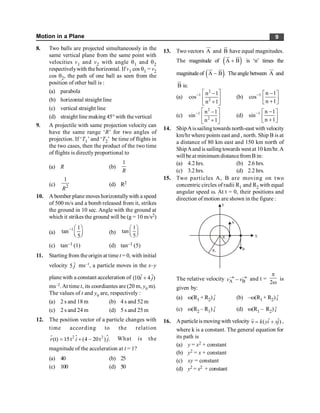
6. A point P moves in
counter-clockwise
direction on a circular
path as shown in the
figure. The movement
of 'P' is such that it
sweeps out a length s
= t3 + 5, where s is in
metres and t is in
seconds. The radius
P(x,y)
O A
x
B
y
20m
ofthe path is 20 m. The acceleration of 'P' when
t = 2 s is nearly.
(a) 13m/s2 (b) 12 m/s2
(c) 7.2 ms2 (d) 14m/s2
7. The vectors A and B are such that
|
B
A
|
|
B
A
| -
=
+
The angle between the two vectors is
(a) 60° (b) 75°
(c) 45° (d) 90°
MOTION IN A PLANE
3
Motion in a Plane 9
8. Two balls are projected simultaneously in the
same vertical plane from the same point with
velocities v1 and v2 with angle q1 and q2
respectivelywith the horizontal. If v1 cos q1 = v2
cos q2, the path of one ball as seen from the
position of other ball is :
(a) parabola
(b) horizontal straight line
(c) vertical straight line
(d) straight line making 45° with thevertical
9. A projectile with same projection velocity can
have the same range ‘R’ for two angles of
projection. If ‘T1’ and ‘T2’ be time of flights in
the two cases, then the product of the two time
of flights is directly proportional to
(a) R (b)
1
R
(c) 2
1
R
(d) R2
10. A bomber plane moves horizontallywith a speed
of 500 m/s and a bomb released from it, strikes
the ground in 10 sec. Angle with the ground at
which it strikes the ground will be (g = 10 m/s2)
(a)
1 1
tan
5
- æ ö
ç ÷
è ø
(b)
1
tan
5
æ ö
ç ÷
è ø
(c) tan–1 (1) (d) tan–1 (5)
11. Starting from the origin at time t = 0, with initial
velocity ˆ
5 j ms–1, a particle moves in the x–y
plane with a constant acceleration of ˆ ˆ
(10 4 )
i j
+
ms–2. At time t, its coordiantes are (20 m, y0 m).
The values of t and y0 are, respectively :
(a) 2 s and 18 m (b) 4 s and 52 m
(c) 2 s and 24 m (d) 5 s and 25 m
12. The position vector of a particle changes with
time according to the relation
$
2 2
(t) 15t (4 20t ) .
r i j
= + -
r
$ What is the
magnitude of the acceleration at t = 1?
(a) 40 (b) 25
(c) 100 (d) 50
13. Two vectors A
ur
and B
u
r
have equal magnitudes.
The magnitude of ( )
A B
+
ur u
r
is ‘n’ times the
magnitudeof ( )
A B .
-
ur u
r
Theangle between A
ur
and
B
u
r
is:
(a)
2
1
2
n 1
cos
n 1
- é ù
-
ê ú
+
ë û
(b) 1 n 1
cos
n 1
- -
é ù
ê ú
+
ë û
(c)
2
1
2
n 1
sin
n 1
- é ù
-
ê ú
+
ë û
(d) 1 n 1
sin
n 1
- -
é ù
ê ú
+
ë û
14. ShipAissailingtowards north-east with velocity
km/hr where points east and , north. Ship B is at
a distance of 80 km east and 150 km north of
ShipAand is sailing towards west at 10 km/hr.A
will be at minimum distancefrom B in:
(a) 4.2 hrs. (b) 2.6 hrs.
(c) 3.2 hrs. (d) 2.2 hrs.
15. Two particles A, B are moving on two
concentric circles of radii R1 and R2 with equal
angular speed w. At t = 0, their positions and
direction of motion are shown in the figure :
B
A
Y
X
R1
R2
The relative velocity A B
® ®
-
v v and t =
2
p
w
is
given by:
(a) w(R1 + R2) ˆ
i (b) –w(R1 + R2) ˆ
i
(c) w(R2 – R1) ˆ
i (d) w(R1 – R2) ˆ
i
16. Aparticleismovingwith velocity ˆ ˆ
( )
k yi xj
n = +
r
,
where k is a constant. The general equation for
its path is
(a) y = x2 + constant
(b) y2 = x + constant
(c) xy = constant
(d) y2 = x2 + constant
PHYSICS
10
17. A particle moves such that its position vector
r
r
(t) = cos wt ˆ
i + sin wt ĵ where wis a constant
and t is time. Then which of the following
statements is true for the velocity v
r
(t) and
acceleration a
r
(t) ofthe particle:
(a) v
r
is perpendicular to r
r
and a
r
is directed
awayfrom the origin
(b) v
r
and a
r
both are perpendicular to r
r
(c) v
r
and a
r
both are parallel to r
r
(d) v
r
is perpendicular to r
r
and a
r
is directed
towards the origin
18. The position of a projectile launched from the
origin at t = 0 is given by ( )
ˆ ˆ
40 50 m
r i j
= +
r
at t
= 2s. Ifthe projectile was launched at an angle q
from the horizontal, then q is
(take g = 10 ms–2)
(a)
1 2
tan
3
-
(b)
1 3
tan
2
-
(c)
1 7
tan
4
-
(d)
1 4
tan
5
-
19. Two particles are projected simultaneouslyfrom
the level ground as shown in figure. They may
collide after a time :
(a) 2
1
sin
x
u
q
(b) 2
2
cos
x
u
q
(c) ( )
2
1 2 1
sin
sin
x
u
q
q - q (d) ( )
1
2 2 1
2 sin
sin
q
q - q
x
u
20. A stone is projected from a horizontal plane. It
attains maximum height H and strikes a
stationary smooth wall and falls on the ground
verticallybelowthe maximum height.Assuming
the collision to be elastic, the height ofthe point
on the wall where ball will strike is:
(a)
4
H
(b)
2
H
(c)
3
4
H
(d)
7
8
H
Numeric Value Answer
21. The resultant of two vectors A
®
and B
®
is
perpendicular to the vector A
®
and its magnitude
is equal to half the magnitude of vector B
®
. The
angle (in degree) between A
®
and B
®
is
22. A body is thrown horizontallyfrom the top of a
tower of height 5 m. It touches the ground at a
distance of 10 m from the foot of the tower. The
initial velocity (in ms–1) of the body is (g =
10 ms–2)
23. A particle describes uniform circular motion in a
circle of radius 2 m, with the angular speed of 2
rad s–1. The magnitude of the change in its
velocity in
2
p
s is _____ms–1.
24. A particle has an initial velocity of ˆ ˆ
3 4
+
i j and
an acceleration of 0.4i + 0.3j
ˆ ˆ . Its speed after
10 s is :
25. If a vector 2 3 8
i j k
Ù Ù Ù
+ + is perpendicular to the
vector ˆ
ˆ ˆ
4 4
j i k
- + a , then the value of a is
26. Aparticle movesfrom the point ( )
ˆ ˆ
2.0 4.0 m
i j
+ ,
att = 0,withan initial velocity ( ) 1
ˆ ˆ
5.0 4.0 ms
i j -
+ .
It is acted upon by a constant force which
produces a constant acceleration
( ) 2
ˆ ˆ
4.0 4.0 ms
i j -
+ . What is the distance (in m)
ofthe particle from the origin at time 2s?
27. A particle starts from the origin at t = 0 with an
initial velocity of ˆ
3.0i m/s and moves in the x-
y plane with a constant acceleration
ˆ ˆ
(6.0 4.0 )
i j
+ m/s2
. The x-coordinate of the
particle at the instant when its y-coordinate is
32 m is D meters. The value of D is:
Motion in a Plane 11
28. A particle is moving along the x-axis with its
coordinate with time ‘t’ given byx(t) = 10 + 8t –
3t2
. Another particle is moving along the y-axis
with its coordinate as a function of time given by
y(t) = 5 – 8t3
. At t = 1 s, the speed of the second
particle as measured in the frame of the first
particle is given as v . Then v (in m/s) is____
29. A force $ $
( 2 3 )
F i j k
®
= + +
$ N acts at a point
$ $
(4 3 )
i j k
+ -
$ m. Then the magnitude of torque
about the point $ $
( 2 )
i j k
+ +
$ m will be x N-m.
The value of x is ______.
30. The sum of two forces P
r
and Q
r
is R
r
such
that | |
R
r
= | |
P
r
. The angle q (in degrees) that
the resultant of 2 P
r
and Q
r
will make with Q
r
is _______.
1 (d) 4 (b) 7 (d) 10 (a) 13 (a) 16 (d) 19 (c) 22 (10) 25 (–0.5) 28 (580)
2 (d) 5 (b) 8 (c) 11 (a) 14 (b) 17 (d) 20 (c) 23 (8) 26 (20Ö2) 29 (195)
3 (a) 6 (d) 9 (a) 12 (d) 15 (c) 18 (c) 21 (150) 24 (7Ö2) 27 (60) 30 (90)
ANSWER KEY
PHYSICS
12
MCQswithOne CorrectAnswer
1. A particle ofmass m is moving in a straight line
with momentum p. Starting at time t= 0, a forceF
= kt acts in the same direction on the moving
particle during time interval T so that its
momentum changes from p to 3p. Here k is a
constant. The value of T is :
(a) 2
p
k
(b)
p
2
k
(c)
2
p
k
(d)
2
k
p
2. A rocket with a lift-off mass 3.5 × 10⁴ kg is
blasted upwards with an initial acceleration of
10m/s2. Then the initial thrust of the blast is
(a) N
10
5
.
3 5
´ (b) N
10
0
.
7 5
´
(c) N
10
0
.
14 5
´ (d) N
10
75
.
1 5
´
3. A mass ‘m’ is supported by a massless string
wound around a uniform hollowcylinder ofmass
m and radius R. If the string does not slip on the
cylinder, with what acceleration will the mass
fall or release?
(a)
2g
3
m
R
m
(b)
g
2
(c)
5g
6
(d) g
4. A horizontal force of 10 N is necessary to just
hold a block stationary against a wall. The
coefficient of friction between the block and the
wall is 0.2. The weight of the block is
(a) 20 N
10N
(b) 50N
(c) 100N
(d) 2N
5. A body of mass 2kg slides down with an
acceleration of 3m/s2 on a rough inclined plane
havinga slope of 30°. The externalforce required
to take the same body up the plane with the
same acceleration will be: (g = 10m/s2)
(a) 4N (b) 14N
(c) 6N (d) 20N
6. A block of mass m = 10 kg rests on a horizontal
table. The coefficient of friction between the
block and the table is 0.05. When hit by a bullet
of mass 50 g moving with speed n, that gets
embedded in it, the block moves and comes to
stop after moving a distance of 2 m on the table.
If a freely falling object were to acquire speed
10
n
after being dropped from height H, then
neglecting energylosses and taking g = 10 ms–2,
the value of H is close to:
(a) 0.05km (b) 0.02km
(c) 0.03km (d) 0.04km
7. A mass of 10 kg is suspended vertically by a
rope from the roof. When a horizontal force is
applied on the rope at some point, the rope
LAWS OF MOTION
4
Laws of Motion 13
deviated at an angle of 45°at the roof point. If
the suspended mass is at equilibrium, the
magnitude of the force applied is (g = 10 ms–2
)
(a) 200 N (b) 140 N
(c) 70 N (d) 100 N
8. Aconical pendulum oflength 1 m makesan angle
q = 45° w.r.t. Z-axis and moves in a circle in the
XY plane.The radius ofthecircle is0.4 m and its
centre is vertically below O. The speed of the
pendulum, in its circular path, will be :
(Take g = 10 ms–2
)
(a) 0.4 m/s
q
O
Z
C
(b) 4 m/s
(c) 0.2m/s
(d) 2 m/s
9. A particle of mass 0.3 kg subject to a force
F = – kx with k = 15 N/m .What will beits initial
acceleration if it is released from a point 20 cm
awayfrom the origin ?
(a) 15 m/s2 (b) 3 m/s2
(c) 10 m/s2 (d) 5 m/s2
10. When forces F1, F2, F3 are acting on a particle
of mass m such that F2 and F3 are mutually
perpendicular, then the particle remains
stationary. If the force F1 is now removed then
the acceleration of the particle is
(a) F1/m (b) F2F3 /mF1
(c) (F2 - F3)/m (d) F2 /m.
11. Alift is moving down with acceleration a.Aman
in the lift drops a ball inside the lift. The
acceleration of the ball as observed by the man
in the lift and a man standing stationary on the
ground are respectively
(a) g, g (b) g – a, g – a
(c) g – a, g (d) a, g
12. Two blocks m1 = 5 gm and m2 = 10 gm are hung
vertically over a light frictionless pulley as
shown here. What is the velocity of separation
of the masses after 1 second when they are left
free? [take g = 10 m/s2]
(a) 20/3 m/s
m1
m2
(b) 10/3 m/s
(c) 5/3m/s
(d) 2/3m/s
13. A block of mass m is connected to another block
of mass M by a spring (massless) of spring
constant k. The block are kept on a smooth
horizontal plane. Initially the blocks are at rest
and the spring is unstretched. Then a constant
force F starts acting on the block of mass M to
pull it. Find the force on the block of mass m.
(a)
( )
+
MF
m M
(b)
mF
M
(c) ( )
+
M m F
m
(d)
( )
+
mF
m M
14. A stringof negligible mass going over a clamped
pulley of mass m supports a block of mass M as
shown in the figure. The force on the pulley by
the clamp is given by
(a) 2 Mg
m
M
(b) 2 mg
(c) ( ) g
m
m
M 2
2
+
+
(d) ( ) g
M
m
M 2
2
+
+
15. A car is moving along a straight horizontal road
with a speed v0. If the coefficient of friction
between the tyres and the road is m, The shortest
distance in which the car can be stopped is
(a)
2
0
v
2 g
m
(b)
0
v
g
m
(c)
2
0
v
g
æ ö
ç ÷
è ø
m
(d)
0
v
m
16. A uniform metal chain is placed on a rough table
such that one end of chain hangs down over the
edge of the table. When one-third of its length
hangs down over the edge, the chain starts
sliding. Then the value of coefficient of static
friction is
(a)
3
4
(b)
1
4
(c)
2
3
(d)
1
2
PHYSICS
14
17. An insect crawlsup a hemispherical surfacevery
slowly (see fig.). The coefficient of friction
between the insect and the surface is 1/3. If the
line joining the center of the hemispherical
surface to the insect makes an angle a with the
vertical, the maximum possible value of a is
given by
(a) cot a = 3 a
(b) tan a = 3
(c) sec a = 3
(d) cosec a = 3
18. Aball of mass0.2 kg is thrown verticallyupwards
by applying a force by hand. If the hand moves
0.2 m while applying the force and the ball goes
upto 2 m height further, find the magnitude of
the force. (Consider g = 10 m/s2).
(a) 4N (b) 16N
(c) 20N (d) 22N
19. A person with his hands in his pockets is skating
on ice at the velocity of 10 m/s and describes a
circle ofradius 50 m. What is hisinclination with
vertical?
(a)
1 1
tan
10
- æ ö
ç ÷
è ø
(b) 1 3
tan
5
- æ ö
ç ÷
è ø
(c) ( )
1
tan 1
- (d) 1 1
tan
5
- æ ö
ç ÷
è ø
20. A monkeyis decending from the branch ofa tree
with constant acceleration. If the breaking
strength is 75% ofthe weight of the monkey, the
minimum acceleration with which monkeycan
slide down without breaking the branch is
(a) g (b)
4
g
3
(c)
4
g
(d)
2
g
Numeric Value Answer
21. A block of mass m is placed on top of a block of
mass 2m which in turn is placed on fixed
horizontal surface. The coefficient of friction
between all surfaces is µ = 1. A massless string
is connected to each mass and wraps halfway
around a massless and frictionless pulley, as
shown. The pulley is pulled by horizontal force
ofmagnitude F = 6mg towards right as shown. If
the magnitude of acceleration of pulley is
X
2
m/s2, find the value of X . (Take g = 10 m/s2)
/////////////////////////////////////////////////////////////
m
2m
F = 6mg
22. A 40 kg slabrests on a frictionlessfloor as shown
in the figure. A 10 kg block rests on the top of
theslab. The staticcoefficient of friction between
the block and slabis 0.60 while the coefficient of
kinetic friction is 0.40. The 10 kg block is acted
upon by a horizontal force 100 N. If
g = 9.8 m/s2, the resulting acceleration (in m/s2)
of the slab will be
40 kg
10 kg
B
A
100 N
23. Twoblocks ofmasses 5 kg and 3 kg are placed in
contact on a horizontal frictionless surface as
shown in the figure. Aforce of 4N is applied on
mass 5 kg. The acceleration (in m/s2) of the mass
3 kg will be
4 N
5 kg
3 kg
24. The coefficient of friction between a body and
the surface ofan inclined plane at 45° is 0.5. Ifg
= 9.8 m/s2, the acceleration of the body in
downwards in m/s2 is
25. A body of mass 0.4 kg is whirled in a vertical
circle making 2 rev/sec. Ifthe radius ofthe circle
is 1.2 m, then tension (in N) in the string when
the body is at the top of the circle, is
26. A block starts moving up an inclined plane of
inclination 30° with an initial velocity of v0. It
comes back to its initial position with velocity
0
.
2
v
Thevalue ofthecoefficient of kineticfriction
between the block and the inclined plane is close
to .
1000
I
The nearest integer to I is _________.
Laws of Motion 15
27. The minimum velocity(in ms-1)with which a car
driver must traverse a flat curve of radius 150 m
and coefficient of friction 0.6 to avoid skidding is
28. The minimum force required to start pushing a
bodyup rough (frictional coefficient m) inclined
plane is F1 while the minimum force needed to
prevent it from sliding down is F2. If theinclined
planemakesan angle q from the horizontal such
that tan q = 2m then the ratio 1
2
F
F
is
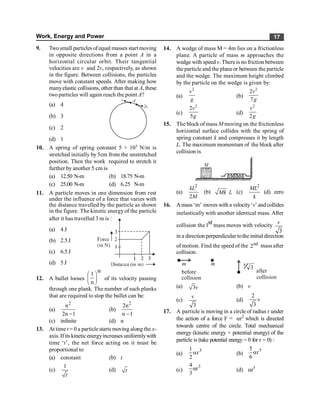
29. Two blocks of mass M1 = 20 kg
and M2 = 12 kg are connected
bya metal rod ofmass 8 kg. The
system is pulled verticallyup by
applying a force of 480 N as
shown. The tension (in N) at the
mid-point ofthe rod is :
M1
M2
480 N
30. A spring balance is attached to the ceiling of a
lift. A man hangs his bag on the spring and the
spring reads 49 N, when the lift is stationary. If
the lift moves downward with an acceleration of
5 m/s2, the reading (in N) of the spring balance
will be
1 (b) 4 (d) 7 (d) 10 (a) 13 (d) 16 (d) 19 (d) 22 (0.98) 25 (71.8) 28 (3)
2 (b) 5 (d) 8 (d) 11 (c) 14 (d) 17 (a) 20 (c) 23 (0.5) 26 (346) 29 (192)
3 (b) 6 (d) 9 (c) 12 (a) 15 (a) 18 (d) 21 (5) 24 (3.47) 27 (30) 30 (24.5)
ANSWER KEY
PHYSICS
16
MCQswithOne CorrectAnswer
1. Aparticlemovesin a straight line with retardation
proportional to its displacement. Its loss of
kinetic energy for any displacement x is
proportional to
(a) x (b) ex
(c) x2 (d) loge x
2. A body is moved along a straight line by a
machine delivering constant power. The
distance moved by the body in time ‘t’ is
proportional to
(a) t3/4 (b) t3/2 (c) t1/4 (d) t1/2
3. A ball is let to fall from a height h0. There are n
collisions with the earth. If the velocity of
rebound after n collisions is vn and the ball rises
to a height hn then coefficient of restitution e is
given by
(a)
0
n n
h
e
h
= (b)
0
n
n
h
e
h
=
(c)
0
n
h
ne
h
= (d)
0
n
h
ne
h
=
4. Velocity–time graph for a bodyof mass 10 kg is
shown in figure. Work–done on the body in first
two seconds of the motion is :
(a) –9300J
10s t(s)
50 ms
-1
v (m/s)
(0,0)
(b) 12000J
(c) –4500J
(d) –12000J
5. A uniform chain of length 2 m is kept on a table
such that a length of60 cm hangs freely from the
edge of the table. The total mass of the chain is
4 kg. What isthe work done in pulling the entire
chain (hanging portion) on the table ?
(a) 12J (b) 3.6J
(c) 7.2J (d) 1200J
6. The potential energy function for the force
between two atoms in a diatomic molecule is
approximatelygiven by 12 6
a b
U(x) –
x x
= where
a and bareconstantsandx isthe distancebetween
the atoms. If the dissociation energy of the
molecule is D= [U(x = ¥) – Uatequilibrium], D is
(a)
2
4
b
a
(b)
2
2
b
a
(c)
2
12
b
a
(d)
2
6
b
a
7. In the figure shown, a particle of mass m is
released from the position A on a smooth track.
When the particle reaches at B, then normal
reaction on it by the track is
(a) mg A
B
h
3h
(b) 2mg
(c)
2
mg
3
(d)
2
m g
h
8. A10 H.P. motor pumps out water from a well of
depth 20 mandfills a watertankofvolume22380
litres at a height of 10 m from the ground. The
running time of themotor tofill the emptywater
tank is (g = 10ms–2)
(a) 5 minutes (b) 10 minutes
(c) 15 minutes (d) 20 minutes
WORK, ENERGY AND
POWER
5
Work, Energy and Power 17
9. Twosmall particles ofequal masses start moving
in opposite directions from a point A in a
horizontal circular orbit. Their tangential
velocities are v and 2v, respectively, as shown
in the figure. Between collisions, the particles
move with constant speeds. After making how
manyelastic collisions, other than that at A, these
two particles will again reach the point A?
(a) 4
v
2v
A
(b) 3
(c) 2
(d) 1
10. A spring of spring constant 5 × 10³ N/m is
stretched initially by 5cm from the unstretched
position. Then the work required to stretch it
further by another 5 cm is
(a) 12.50 N-m (b) 18.75 N-m
(c) 25.00 N-m (d) 6.25 N-m
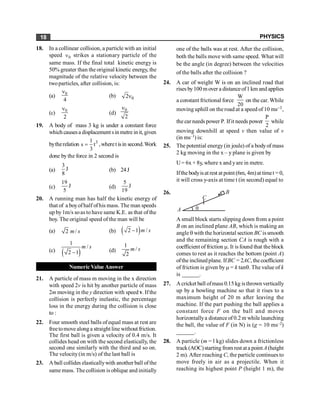
11. A particle moves in one dimension from rest
under the influence of a force that varies with
the distance travelled by the particle as shown
in the figure. The kinetic energyof the particle
after it has travelled 3 m is :
(a) 4 J
(b) 2.5J
(c) 6.5J
(d) 5 J
12. A bullet looses
th
1
n
æ ö
ç ÷
è ø
of its velocity passing
through one plank. The number of such planks
that are required to stop the bullet can be:
(a)
2
n
2n 1
-
(b)
2
2n
n 1
-
(c) infinite (d) n
13. At time t = 0 a particlestarts moving along the x-
axis. If itskineticenergyincreases uniformlywith
time ‘t’, the net force acting on it must be
proportional to
(a) constant (b) t
(c)
1
t
(d) t
14. A wedge of mass M = 4m lies on a frictionless
plane. A particle of mass m approaches the
wedge with speed v. Thereis no friction between
the particle and the plane or between the particle
and the wedge. The maximum height climbed
by the particle on the wedge is given by:
(a)
2
v
g
(b)
2
2
7
v
g
(c)
2
2
5
v
g
(d)
2
2
v
g
15. The block of mass M moving on the frictionless
horizontal surface collides with the spring of
spring constant k and compresses it by length
L. The maximum momentum of the block after
collision is
M
(a)
2
2
kL
M
(b) Mk L (c)
2
ML
k
(d) zero
16. Amass ‘m’ moves with a velocity‘v’andcollides
inelastically with another identical mass. After
collision the lst mass moves with velocity
3
v
in a direction perpendicular tothe initial direction
of motion. Find the speed of the nd
2 mass after
collision.
A
collision
m m
before
3
Aafter
collision
v
(a) 3v (b) v
(c)
3
v
(d)
2
3
v
17. A particle is moving in a circle of radius r under
the action of a force F = ar2
which is directed
towards centre of the circle. Total mechanical
energy (kinetic energy + potential energy) of the
particle is (take potential energy = 0 for r = 0) :
(a)
1
2
3
r
a (b)
5
6
3
r
a
(c)
3
4
αr
3
(d) ar3
PHYSICS
18
18. In a collinear collision, a particle with an initial
speed 0
n strikes a stationary particle of the
same mass. If the final total kinetic energy is
50% greater than the original kinetic energy, the
magnitude of the relative velocity between the
twoparticles, after collision, is:
(a) 0
4
n
(b) 0
2n
(c) 0
2
n
(d)
0
2
n
19. A body of mass 3 kg is under a constant force
which causesa displacement sin metre in it, given
bytherelation 3
1
s t
3
= ,wheret isin second.Work
done by the force in 2 second is
(a) J
8
3
(b) 24J
(c) J
5
19
(d) J
19
5
20. A running man has half the kinetic energy of
that of a boyofhalf ofhis mass. The man speeds
up by1m/s soas to have same K.E. as that of the
boy. The original speed of the man will be
(a) 2 /
m s (b) ( )
2 1 /
- m s
(c)
( )
1
/
2 1
-
m s
(d)
1
/
2
m s
Numeric Value Answer
21. A particle of mass m moving in the x direction
with speed 2v is hit by another particle of mass
2m moving in the y direction with speed v. Ifthe
collision is perfectly inelastic, the percentage
loss in the energy during the collision is close
to :
22. Four smooth steel balls of equal mass at rest are
freetomove alonga straight line without friction.
The first ball is given a velocity of 0.4 m/s. It
collides head on with the second elastically, the
second one similarly with the third and so on.
The velocity(in m/s) of the last ball is
23. A ball collides elasticallywith another ball ofthe
same mass. The collision is oblique and initially
one of the balls was at rest. After the collision,
both the balls move with same speed. What will
be the angle (in degree) between the velocities
of the balls after the collision ?
24. A car of weight W is on an inclined road that
rises by100 m over a distanceof1 km and applies
a constant frictional force
W
20
on the car. While
moving uphill on the road at a speed of 10 ms–1,
thecar needs power P. Ifit needs power
P
2
while
moving downhill at speed v then value of v
(in ms–1) is:
25. The potential energy (in joule) of a bodyof mass
2 kg moving in the x – y plane is given by
U= 6x + 8y, where x and yare in metre.
Ifthe bodyisat rest at point (6m, 4m)at timet = 0,
it will cross y-axis at time t (in second) equal to
26.
C
B
A q
A small block starts slipping down from a point
B on an inclined plane AB, which is making an
angle q with the horizontal section BC issmooth
and the remaining section CA is rough with a
coefficient of friction m. It is found that the block
comes to rest as it reaches the bottom (point A)
ofthe inclinedplane. IfBC = 2AC, the coefficient
of friction is given by m = k tanq. The value of k
is ______.
27. Acricket ball ofmass 0.15 kg isthrown vertically
up by a bowling machine so that it rises to a
maximum height of 20 m after leaving the
machine. If the part pushing the ball applies a
constant force F on the ball and moves
horizontallya distance of 0.2 m while launching
the ball, the value of F (in N) is (g = 10 ms–2)
______.
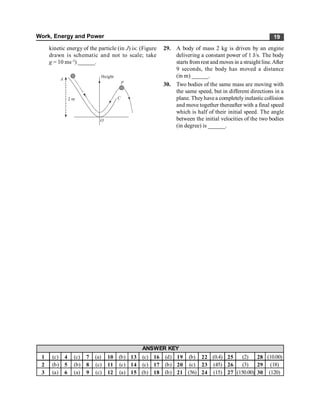
28. A particle (m = l kg) slides down a frictionless
track(AOC)starting from rest at a point A (height
2 m). After reaching C, the particle continues to
move freely in air as a projectile. When it
reaching its highest point P (height 1 m), the
Work, Energy and Power 19
kinetic energy of the particle (in J) is: (Figure
drawn is schematic and not to scale; take
g = 10 ms–2
) ______.
O
P
Height
C
2 m
A
29. A body of mass 2 kg is driven by an engine
delivering a constant power of 1 J/s. The body
starts from rest and moves in a straight line.After
9 seconds, the body has moved a distance
(in m) ______.
30. Two bodies of the same mass are moving with
the same speed, but in different directions in a
plane. Theyhavea completelyinelastic collision
and move together thereafter with a final speed
which is half of their initial speed. The angle
between the initial velocities of the two bodies
(in degree) is ______.
1 (c) 4 (c) 7 (a) 10 (b) 13 (c) 16 (d) 19 (b) 22 (0.4) 25 (2) 28 (10.00)
2 (b) 5 (b) 8 (c) 11 (c) 14 (c) 17 (b) 20 (c) 23 (45) 26 (3) 29 (18)
3 (a) 6 (a) 9 (c) 12 (a) 15 (b) 18 (b) 21 (56) 24 (15) 27 (150.00) 30 (120)
ANSWER KEY
PHYSICS
20
MCQs withOne CorrectAnswer
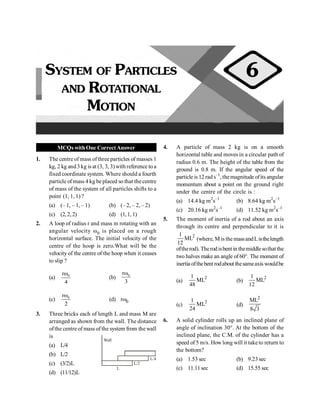
1. The centre of mass ofthree particles of masses 1
kg, 2 kg and3 kg is at (3, 3, 3)with reference to a
fixed coordinate system. Where should a fourth
particle of mass 4 kg be placed so that the centre
of mass of the system of all particles shifts to a
point (1, 1, 1) ?
(a) (– 1, – 1, – 1) (b) (– 2, – 2, – 2)
(c) (2,2, 2) (d) (1,1, 1)
2. A loop of radius r and mass m rotating with an
angular velocity w0 is placed on a rough
horizontal surface. The initial velocity of the
centre of the hoop is zero.What will be the
velocity of the centre of the hoop when it ceases
to slip ?
(a) 0
r
4
w
(b) 0
r
3
w
(c) 0
r
2
w
(d) rw0
3. Three bricks each of length L and mass M are
arranged as shown from the wall. The distance
ofthe centre of mass of the system from the wall
is
(a) L/4
L/4
L/2
Wall
L
(b) L/2
(c) (3/2)L
(d) (11/12)L
4. A particle of mass 2 kg is on a smooth
horizontal table and moves in a circular path of
radius 0.6 m. The height of the table from the
ground is 0.8 m. If the angular speed of the
particle is 12 rad s–1
, themagnitude ofits angular
momentum about a point on the ground right
under the centre of the circle is :
(a) 14.4 kg m2
s–1
(b) 8.64 kg m2
s–1
(c) 20.16 kg m2
s–1
(d) 11.52 kg m2
s–1
5. The moment of inertia of a rod about an axis
through its centre and perpendicular to it is
2
1
ML
12
(where, M is the massandListhelength
oftherod). Therodisbent in themiddlesothatthe
two halves make an angle of 60°. The moment of
inertia ofthebent rodabout thesameaxis wouldbe
(a)
2
1
ML
48
(b)
2
1
ML
12
(c)
2
1
ML
24
(d)
2
ML
8 3
6. A solid cylinder rolls up an inclined plane of
angle of inclination 30°. At the bottom of the
inclined plane, the C.M. of the cylinder has a
speed of 5 m/s. How long will it taketo return to
the bottom?
(a) 1.53 sec (b) 9.23 sec
(c) 11.11sec (d) 15.55 sec
SYSTEM OF PARTICLES
AND ROTATIONAL
MOTION
6
System of Particles and Rotational Motion 21
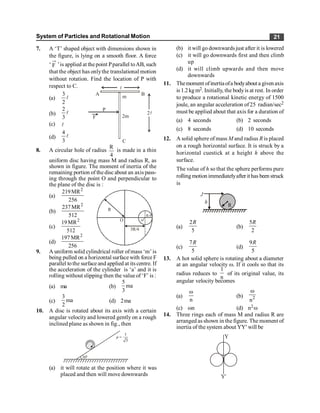
7. A ‘T’ shaped object with dimensions shown in
the figure, is lying on a smooth floor. A force
‘ F ’is applied at the point Pparallel toAB, such
that the object has onlythe translational motion
without rotation. Find the location of P with
respect to C.
(a) l
2
3
C
F
A
2
B
l
P
l
m
2m
(b) l
3
2
(c) l
(d) l
3
4
8. A circular hole of radius
R
4
is made in a thin
uniform disc having mass M and radius R, as
shown in figure. The moment of inertia of the
remaining portion of the disc about an axis pass-
ing through the point O and perpendicular to
the plane of the disc is :
(a)
2
219MR
256
O
R
o'
R/4
3R/4
(b)
2
237MR
512
(c)
2
19MR
512
(d)
2
197 MR
256
9. A uniform solid cylindrical roller ofmass ‘m’ is
being pulled on a horizontal surfacewith force F
parallel tothe surface and applied at itscentre. If
the acceleration of the cylinder is ‘a’ and it is
rolling without slipping then the value of ‘F’ is :
(a) ma (b)
5
ma
3
(c)
3
ma
2
(d) 2ma
10. A disc is rotated about its axis with a certain
angular velocityand lowered gently on a rough
inclined plane as shown in fig., then
30º
1
3
µ =
(a) it will rotate at the position where it was
placed and then will move downwards
(b) it will go downwards just after it is lowered
(c) it will go downwards first and then climb
up
(d) it will climb upwards and then move
downwards
11. Themoment ofinertiaofa bodyabouta givenaxis
is 1.2 kg m2. Initially, the bodyis at rest. In order
to produce a rotational kinetic energy of 1500
joule, an angular acceleration of25 radian/sec2
must be applied about that axis for a duration of
(a) 4 seconds (b) 2 seconds
(c) 8 seconds (d) 10 seconds
12. A solid sphere of mass M and radius R is placed
on a rough horizontal surface. It is struck by a
horizontal cuestick at a height h above the
surface.
The value of h so that the sphere performs pure
rolling motion immediatelyafter it has been struck
is
R
h
J
(a)
2
5
R
(b)
5
2
R
(c)
7
5
R
(d)
9
5
R
13. A hot solid sphere is rotating about a diameter
at an angular velocity w. If it cools so that its
radius reduces to
1
n
of its original value, its
angular velocity becomes
(a)
n
w
(b) 2
n
w
(c) wn (d) n2w
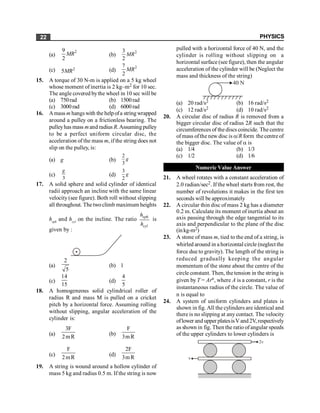
14. Three rings each of mass M and radius R are
arranged as shown in the figure. The moment of
inertia of the system about YY¢ will be
Y¢
Y
PHYSICS
22
(a)
2
9
2
MR (b)
2
3
2
MR
(c) 2
5MR (d)
2
7
2
MR
15. A torque of 30 N-m is applied on a 5 kg wheel
whose moment of inertia is 2 kg–m2 for 10 sec.
The angle covered bythe wheel in 10 sec will be
(a) 750rad (b) 1500rad
(c) 3000rad (d) 6000rad
16. Amass m hangswith the helpofa stringwrapped
around a pulley on a frictionless bearing. The
pulleyhas mass mand radius R.Assumingpulley
to be a perfect uniform circular disc, the
acceleration of the mass m, if the string does not
slip on the pulley, is:
(a) g (b)
2
3
g
(c)
3
g
(d)
3
2
g
17. A solid sphere and solid cylinder of identical
radii approach an incline with the same linear
velocity (see figure). Both roll without slipping
all throughout. The twoclimb maximum heights
hsph
and hcyl
on the incline. The ratio sph
cyl
h
h
is
given by :
(a)
2
5
(b) 1
(c)
14
15
(d)
4
5
18. A homogeneous solid cylindrical roller of
radius R and mass M is pulled on a cricket
pitch by a horizontal force. Assuming rolling
without slipping, angular acceleration of the
cylinder is:
(a)
3F
2mR
(b)
F
3mR
(c)
F
2mR
(d)
2F
3mR
19. A string is wound around a hollow cylinder of
mass 5 kg and radius 0.5 m. If the string is now
pulled with a horizontal force of 40 N, and the
cylinder is rolling without slipping on a
horizontal surface (see figure), then the angular
acceleration of the cylinder will be (Neglect the
mass and thickness of the string)
40 N
(a) 20 rad/s2 (b) 16 rad/s2
(c) 12 rad/s2 (d) 10 rad/s2
20. A circular disc of radius R is removed from a
bigger circular disc of radius 2R such that the
circumferences of the discs coincide. The centre
ofmass ofthe new disc is a/R form the centre of
the bigger disc. The value of a is
(a) 1/4 (b) 1/3
(c) 1/2 (d) 1/6
Numeric Value Answer
21. A wheel rotates with a constant acceleration of
2.0 radian/sec2. If thewheel starts from rest, the
number of revolutions it makes in the first ten
seconds will be approximately
22. A circular thin disc of mass 2 kg has a diameter
0.2 m. Calculate its moment of inertia about an
axis passing through the edge tangential to its
axis and perpendicular to the plane of the disc
(inkg-m2)
23. A stone of mass m, tied to the end of a string, is
whirled around in a horizontal circle (neglect the
force due to gravity). The length of the string is
reduced gradually keeping the angular
momentum of the stone about the centre of the
circle constant. Then, the tension in the string is
given by T = Arn, where A is a constant, r is the
instantaneous radius of the circle. The value of
n is equal to
24. A system of uniform cylinders and plates is
shown in fig. All the cylinders are identical and
there is no slipping at any contact. The velocity
oflower and upper platesisVand2V,respectively
as shown in fig. Then the ratio ofangular speeds
of the upper cylinders to lower cylinders is
v
2v
System of Particles and Rotational Motion 23
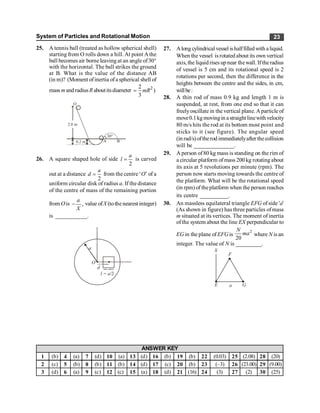
25. A tennis ball (treated as hollow spherical shell)
starting from O rolls down a hill. At point Athe
ball becomes air borne leaving at an angle of30°
with the horizontal. The ball strikes the ground
at B. What is the value of the distance AB
(in m)? (Moment ofinertia ofa spherical shell of
mass mand radiusR aboutitsdiameter 2
2
)
3
= mR
O
0.2 m A
30°
B
2.0 m
26. A square shaped hole of side
2
a
l = is carved
out at a distance
2
a
d = from the centre ‘O’ of a
uniform circular disk of radius a. If the distance
of the centre of mass of the remaining portion
from Ois ,
a
X
- value ofX (tothe nearest integer)
is ___________.
O
a
d
l = a/2
27. Along cylindrical vessel ishalffilled with aliquid.
When the vessel is rotated about its own vertical
axis,the liquidrises upnear thewall.Iftheradius
of vessel is 5 cm and its rotational speed is 2
rotations per second, then the difference in the
heights between the centre and the sides, in cm,
willbe:
28. A thin rod of mass 0.9 kg and length 1 m is
suspended, at rest, from one end so that it can
freelyoscillate in the vertical plane.Aparticle of
move0.1kgmovingin astraightlinewithvelocity
80 m/s hits the rod at its bottom most point and
sticks to it (see figure). The angular speed
(in rad/s) oftherod immediatelyafter thecollision
will be ______________.
29. A person of80 kg mass is standing on the rim of
a circular platform of mass 200 kg rotating about
its axis at 5 revolutions per minute (rpm). The
person now starts moving towards the centre of
the platform. What will be the rotational speed
(in rpm) of theplatform when the person reaches
its centre __________.
30. An massless equilateral triangle EFG of side 'a'
(As shown in figure) has three particles ofmass
m situated at its vertices. The moment of inertia
ofthe system about the line EX perpendicular to
EG in the plane ofEFGis
2
20
N
ma where N is an
integer. The value of N is _________.
X
F
E G
a
1 (b) 4 (a) 7 (d) 10 (a) 13 (d) 16 (b) 19 (b) 22 (0.03) 25 (2.08) 28 (20)
2 (c) 5 (b) 8 (b) 11 (b) 14 (d) 17 (c) 20 (b) 23 (–3) 26 (23.00) 29 (9.00)
3 (d) 6 (a) 9 (c) 12 (c) 15 (a) 18 (d) 21 (16) 24 (3) 27 (2) 30 (25)
ANSWER KEY
PHYSICS
24
MCQs withOne CorrectAnswer
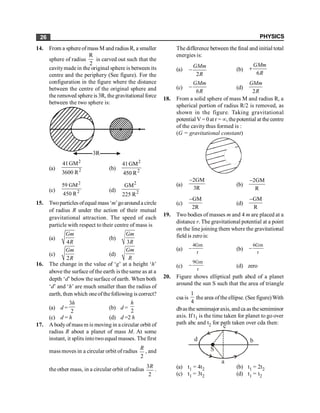
1. Suppose the gravitational force varies inversely
as the nth power of distance. Then the time
period of a planet in circular orbit of radius ‘R’
around the sun will be proportional to
(a) Rn (b)
÷
ø
ö
ç
è
æ -
2
1
n
R
(c)
÷
ø
ö
ç
è
æ +
2
1
n
R (d)
÷
ø
ö
ç
è
æ -
2
2
n
R
2. A straight rod of length L extends from x = a tox
= L + a. Find the gravitational force it exerts on a
point mass m at x = 0 if the linear density of rod
µ =A + Bx2
.
(a) G
A
m BL
a
é ù
+
ê ú
ë û
(b)
1 1
Gm A BL
a a L
é ù
æ ö
- +
ç ÷
ê ú
è ø
+
ë û
(c)
A
Gm BL
a L
é ù
+
ê ú
+
ë û
(d) G
A
m BL
a
é ù
-
ê ú
ë û
3. Two concentric uniform shells of mass M1 and
M2 are as shown in the figure. Aparticle ofmass
m is located just within the shell M2 on its inner
surface. Gravitational force on ‘m’ due toM1 and
M2 will be
b
a M1
M2
m
(a) zero
(b) 1
2
G
b
M m
(c) 1 2
2
G ( )
b
M M m
+
(d) None of these
4. The mass density of a spherical body is given
by r (r) =
k
r
for r < R and r (r) = 0 for r > R,
where r is the distance from the centre.
The correct graph that describes qualitatively
the acceleration due to gravity, g of a test
particle as a function of r is :
(a)
R r
g
(b)
R r
g
(c)
R r
g
(d)
R r
g
5. The change in potential energy, when a body of
mass m is raised to a height nR from the earth’s
surface is (R = radius of earth)
(a)
÷
÷
ø
ö
ç
ç
è
æ
1
–
n
n
mgR (b) nmgR
(c)
÷
÷
ø
ö
ç
ç
è
æ
+1
n
n
mgR
2
2
(d) ÷
ø
ö
ç
è
æ
+1
n
n
mgR
6. Which of the following most closely depicts
the correct variation of the gravitational
potential V(r) due to a large planet of radius R
and uniform mass density ? (figures are not
drawn to scale)
GRAVITATION
7
Gravitation 25
(a)
V(r)
r
O
(b) r
O
V(r)
(c)
V(r)
r
O (d)
V(r) r
O
7. A satellite of mass m revolves around the earth
ofradius R at a height ‘x’ from its surface. If g is
the acceleration due to gravityon the surface of
the earth, the orbital speed of the satellite is
(a)
x
R
gR2
+
(b)
x
R
gR
-
(c) gx (d)
2
/
1
x
R
gR2
÷
÷
ø
ö
ç
ç
è
æ
+
8. Three equal masses (each m) are placed at the
cornersofan equilateral triangleofside‘a’. Then
the escape velocity of an object from the
circumcentre P of triangleis :
(a) 2 3 Gm
a
(b) 3 Gm
a
(c) 6 3 Gm
a
(d)
3 3 Gm
a
9. Two rings each of radius ‘a’are coaxial and the
distance between their centres is a. The masses
of the rings are M1 and M2. The work done in
transporting a particle of a small mass m from
centre C1 to C2 is :
a
a a
M1 M2
C1 C2
(a) 2 1
( )
Gm M M
a
-
(b) 2 1
( )
( 2 1)
2
Gm M M
a
-
+
(c) 2 1
( )
( 2 1)
2
Gm M M
a
-
-
(d) 2 1
( )
2
Gm M M
a
-
10. The depth d at which the value of acceleration
due to gravity becomes
1
n
times the value at the
surface of the earth, is [R = radius of the earth]
(a)
R
n
(b)
1
n
R
n
-
æ ö
ç ÷
è ø
(c) 2
R
n
(d)
1
n
R
n
æ ö
ç ÷
+
è ø
11. A particle of mass M is situated at the centre of
a spherical shell ofsame mass and radius a. The
gravitational potential at a point situated at
4
a
distance from the centre, will be:
(a)
5GM
a
- (b)
2GM
a
-
(c)
GM
a
- (d)
4GM
a
-
12. If the gravitational force between two objects
were proportional to 1/R(and not as 1/R2) where
R is separation between them, then a particle in
circular orbit under such a force would have its
orbital speed v proportional to
(a) 1/R2 (b) R0
(c) R1 (d) 1/R
13. A satellite is moving with a constant speed ‘V’
in a circular orbit about the earth. An object of
mass ‘m’ is ejected from the satellite such that it
just escapes from the gravitational pull of the
earth. At the time of its ejection, the kinetic
energy of the object is
(a)
2
1
2
mV (b) mV 2
(c)
2
3
2
mV (d) 2
2mV
PHYSICS
26
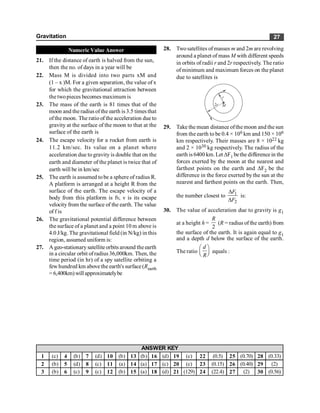
14. From a sphereofmass M and radius R, a smaller
sphere of radius
R
2
is carved out such that the
cavitymadein the original sphere is between its
centre and the periphery (See figure). For the
configuration in the figure where the distance
between the centre of the original sphere and
the removed sphere is 3R, the gravitational force
between the two sphere is:
3R
(a)
2
2
41GM
3600 R
(b)
2
2
41GM
450 R
(c)
2
2
59 GM
450 R
(d)
2
2
GM
225 R
15. Twoparticles ofequal mass‘m’goarounda circle
of radius R under the action of their mutual
gravitational attraction. The speed of each
particle with respect to their centre of mass is
(a)
4
Gm
R
(b)
3
Gm
R
(c)
2
Gm
R
(d)
Gm
R
16. The change in the value of ‘g’ at a height ‘h’
above the surface of the earth is thesame as at a
depth ‘d’ below the surface of earth. When both
‘d’ and ‘h’ are much smaller than the radius of
earth, then which oneofthefollowing is correct?
(a) d =
3
2
h
(b) d =
2
h
(c) d = h (d) d =2 h
17. A body of mass m is moving in a circular orbit of
radius R about a planet of mass M. At some
instant, it splits into two equal masses. The first
mass moves in a circular orbit of radius
2
R
, and
the other mass, in a circular orbit ofradius
3
2
R
.
The difference between the final and initial total
energies is:
(a)
2
GMm
R
- (b)
6
GMm
R
+
(c)
6
GMm
R
- (d)
2
GMm
R
18. From a solid sphere of mass M and radius R, a
spherical portion of radius R/2 is removed, as
shown in the figure. Taking gravitational
potential V = 0at r = ¥, thepotential at the centre
of the cavity thus formed is :
(G = gravitational constant)
(a)
2GM
3R
-
(b)
2GM
R
-
(c)
GM
2R
-
(d)
GM
R
-
19. Two bodies of masses m and 4 m are placed at a
distance r. The gravitational potential at a point
on the line joining them where the gravitational
field is zerois:
(a)
4Gm
r
- (b)
6Gm
r
-
(c)
9Gm
r
- (d) zero
20. Figure shows elliptical path abcd of a planet
around the sun S such that the area of triangle
csa is
1
4
the area ofthe ellipse. (See figure)With
dbasthe semimajor axis, and ca asthesemiminor
axis. If t1 is the time taken for planet to go over
path abc and t2 for path taken over cda then:
c
d
a
b
S
(a) t1 = 4t2 (b) t1 = 2t2
(c) t1 = 3t2 (d) t1 = t2
Gravitation 27
Numeric Value Answer
21. If the distance of earth is halved from the sun,
then the no. of days in a year will be
22. Mass M is divided into two parts xM and
(1 – x )M. For a given separation, the value of x
for which the gravitational attraction between
the twopieces becomes maximum is
23. The mass of the earth is 81 times that of the
moon and the radius ofthe earth is3.5 times that
ofthe moon. The ratio of the acceleration due to
gravity at the surface of the moon to that at the
surface of the earth is
24. The escape velocity for a rocket from earth is
11.2 km/sec. Its value on a planet where
acceleration due to gravity is double that on the
earth and diameter of the planet is twice that of
earth will be in km/sec
25. The earth is assumed tobe a sphere of radius R.
A platform is arranged at a height R from the
surface of the earth. The escape velocity of a
body from this platform is fv, v is its escape
velocity from the surface of the earth. The value
of f is
26. The gravitational potential difference between
the surface of a planet and a point 10 m above is
4.0 J/kg. The gravitational field (in N/kg) in this
region, assumed uniform is:
27. A geo-stationary satellite orbits around the earth
in a circular orbit ofradius 36,000km. Then, the
time period (in hr) of a spy satellite orbiting a
few hundred km abovethe earth's surface(Rearth
= 6,400km) will approximatelybe
28. Twosatellites of masses m and 2m are revolving
around a planet of mass M with different speeds
in orbits of radii r and 2r respectively. The ratio
ofminimum and maximum forces on the planet
due to satellites is
r
2r M
29. Take the mean distance ofthe moon and the sun
from the earth to be 0.4 × 10⁶ km and 150 × 106
km respectively. Their masses are 8 × 10²² kg
and 2 × 1030 kg respectively. The radius of the
earth is 6400 km. Let DF1 bethe difference in the
forces exerted by the moon at the nearest and
farthest points on the earth and DF2 be the
difference in the force exerted by the sun at the
nearest and farthest points on the earth. Then,
the number closest to 1
2
F
F
D
D
is:
30. The value of acceleration due to gravity is g1
at a height h =
2
R
(R = radius of the earth) from
the surface of the earth. It is again equal to g1
and a depth d below the surface of the earth.
The ratio
d
R
æ ö
ç ÷
è ø
equals :
1 (c) 4 (b) 7 (d) 10 (b) 13 (b) 16 (d) 19 (c) 22 (0.5) 25 (0.70) 28 (0.33)
2 (b) 5 (d) 8 (c) 11 (a) 14 (a) 17 (c) 20 (c) 23 (0.15) 26 (0.40) 29 (2)
3 (b) 6 (c) 9 (c) 12 (b) 15 (a) 18 (d) 21 (129) 24 (22.4) 27 (2) 30 (0.56)
ANSWER KEY
PHYSICS
28
MCQs withOne CorrectAnswer
1. The upper end of a wire of diameter 12mm and
length 1m is clamped and its other end is twisted
through an angle of 30°. The angle of shear is
(a) 18° (b) 0.18°
(c) 36° (d) 0.36°
2. What will be the density of ocean water at a
depth where the pressure is 80 atm? [Given that
its density at the surface is 1.03 × 10³ kg/m3,
compressibility of water = 45.8 ×10⁻¹¹/Pa.
Given: 1 atm = 1.013 × 10⁵ Pa.]
(a) 1.03 × 10³ kg/m3 (b) 5.03×10³ kg/m3
(c) 8.03 × 10³ kg/m3 (d) 9.03×10³ kg/m3
3. The value of tan (90° – q) in the graph gives
q
Strain
Stress
(a) Young's modulus
of elasticity
(b) compressibility
(c) shear strain
(d) tensile strength
4. Two wires are made of the same material and
have the same volume. However wire 1 has
cross-sectional area A and wire 2 has cross-
sectional area 3A.Ifthelength ofwire1 increases
by Dx on applying force F, how much force is
needed to stretch wire 2 by the same amount?
(a) 4 F (b) 6 F
(c) 9 F (d) F
5. A beam of metal supported at the two edges is
loaded at the centre. The depression at the
centre is proportional to
(a) Y2 (b) Y
(c) 1/Y (d) 1/Y 2
6. The adjacent graph shows the extension (Dl) of
a wire of length 1m suspended from the top of a
roof at one end with a load W connected to the
other end. If the cross-sectional area of the wire
is 10–6m2, calculate theYoung’s modulus ofthe
material of the wire.
(a) 2 × 10¹¹ N/m2
1
2
3
4
20 40 60 80 W(N)
(
×10
)m
l
–
4
(b) 2 × 10–11 N/m2
(c) 2 × 10–12 N/m2
(d) 2 × 10–13 N/m2
7. The force required to stretch a steel wire of
1 cm2 cross-section to1.1 times its length would
be [Y = 2 × 10¹¹ Nm–2]
(a) 2 × 10⁶ N (b) 2 × 10³ N
(c) 2 × 10⁻⁶ N (d) 2 × 10⁻⁷ N
8. A steel ring ofradius r and cross-section area 'A'
is fitted on toa wooden discofradius R(R > r). If
Young'smodulus be E, then the force with which
the steel ring is expanded is
(a)
R
AE
r
(b)
R r
AE
r
-
æ ö
ç ÷
è ø
(c)
E R r
A A
-
æ ö
ç ÷
è ø
(d)
Er
AR
9. One end of a uniform wire of length L and of
weight W is attached rigidly to a point in the
roof and W1 weight is suspended from lower
end. IfAis area of cross-section of the wire, the
stress in the wire at a height
4
L
from the upper
end is
(a) 1
W W
A
+ (b) 1
W 3W / 4
A
+
(c) 1
W W / 4
A
+
(d) 1
4W 3W
A
+
MECHANICAL
PROPERTIES OF SOLIDS
8
Mechanical Properties of Solids 29
10. Thelength ofa metal wire is l1 when the tension
in it is T1 and is l2 when the tension is T2. The
original length of the wire is
(a)
2
2
1 l
l +
(b)
1 2 2 1
1 2
T T
T T
+
+
l l
(c)
1 2 2 1
2 1
T T
T T
-
-
l l
(d) 1 2 1 2
T T l l
11. If the ratio of diameters, lengths and Young’s
modulus of steel and copper wires shown in the
figure are p, q and s respectively,
then the corresponding ratio of
increase in their lengths would be
Steel
2m
Copper
5m
(a)
7
(5 )
q
sp (b) 2
5
(7 )
q
sp
(c) 2
7
(5 )
q
sp
(d)
2
(5 )
q
sp
12. A 14.5 kg mass, fastenedtotheend ofa steel wire
of unstretched length 1m, is whirled in a vertical
circle with an angular velocity of 2 rev/s at the
bottom of the circle. The cross-sectional area
of the wire is 0.065 cm2. The elongation of the
wire when the mass is at the lowest point of
its path is [Ysteel = 2 × 10¹¹ N/m2]
(a) 9.67mm (b) 6.67mm
(c) 1.87mm (d) 0.12mm
13. The elongation of the steel and brass wire in
the adjacent figure are respectively. [Unloaded
length of steel wire is 1.5 m and of brass wire
is 1m, diameter of each wire
= 0.25 cm. Young's modulus of steel is 2 × 10¹¹
Pa and that of brass is 0.91 × 10¹¹ Pa.]
(a) 1.49 × 10⁻⁴ m, 1.3 × 10⁻⁴ m 1.5 m
1 m
Steel
Brass
4 kg
6 kg
(b) 2.94× 10⁻⁴ m, 2.3 × 10⁻⁴ m
(c) 5.12× 10⁻⁴ m, 3.2 × 10⁻⁴ m
(d) 1.12× 10⁻⁴ m, 6.2 × 10⁻⁴ m
14. The edge of an aluminium cube is 10 cm long.
One face of the cube is firmlyfixed to a vertical
wall. A mass of 100 kg is then attached to the
opposite face of the cube. The shear modulus
of aluminium is 25 G Pa. What is the vertical
deflection of this face?
(1Pa = 1N/m2) (g = 10 m/s2).
(a) 4 × 10⁻⁷ m (b) 3 × 10⁻⁷ m
(c) 2 × 10⁻⁷ m (d) 1 × 10⁻⁷ m
15. Four identical hollowcylindrical columns ofmild
steel support a big structure of mass 50,000 kg.
The inner and outer radii of each column are
30 cm and 60 cm respectively. Assuming the
load distribution to be uniform, the
compressional strain in each column is [The
Young's modulus of steel is 2 × 10¹¹ Pa.]
(a) 2.31 × 10⁻⁷ (b) 4.12 × 10⁻⁷
(c) 7.21 × 10⁻⁷ (d) 9.93 × 10⁻⁷
16. Two blocks of masses m and M are connected
bymeans of a metal wire of cross-sectional area
A passing over a frictionless fixed pulley as
shown in the figure. The system is then released.
If M = 2 m, then the stress produced in the wire
is :
(a)
2mg
3A
M
m
T
T
(b)
4mg
3A
(c)
mg
A
(d)
3mg
4A
17. Two strips of metal are riveted together at their
ends by four rivets, each of diameter 6 mm.
What is the maximum tension that can be
exerted by the riveted strip if the shearing stress
on therivet is nottoexceed 6.9× 10⁷ Pa?Assume
that each rivet is to carry one quarter of the
load.
(a) 7800N (b) 7000N
(c) 9000N (d) 1000N
18. Consider a long steel bar under a tensile stress
due to forces F acting at the edges along the
length of the bar (figure). Consider a plane
making an angle q with the length. The tensile
and shearing stresses on this plane are
respectively a
a
q
F F
(a)
2
F F
cos , sin2
A 2A
q q
(b) 2
F F
sin , sin4
5A 2A
q q
(c)
3
F F
sin , sin5
9A 3A
q q
(d) None of these
PHYSICS
30
19. A bottle has an opening of radius a and length
b. A cork of length b and radius (a + Da) where
(Da < < a) is compressed to fit into the opening
completely (see figure). If the bulk modulus of
cork is B and frictional coefficient between the
bottle and cork is m then the force needed to
push the cork into the bottle is :
(a) (pmBb) a
a
b
(b) (2pmBb)Da
(c) (pmBb) Da
(d) (4 pmBb)Da
20. A copper wire oflength 1.0 m and a steel wire of
length 0.5 m having equal cross-sectional areas
are joined end to end. The composite wire is
stretched by a certain load which stretches the
copper wire by 1 mm. If the Young’s modulii of
copper and steel are respectively1.0 × 1011 Nm–2
and 2.0 × 10¹¹ Nm–2, the total extension of the
composite wire is :
(a) 1.75mm (b) 2.0mm
(c) 1.50mm (d) 1.25mm
Numeric Value Answer
21. A2 m long rod ofradius 1 cm which is fixedfrom
one end is given a twist of0.8 radians. The shear
strain developed will be
22. Ifa rubber ball is taken at the depth of 200 m in a
pool, its volume decreases by 0.1%. If the
density of the water is 1 × 10³ kg/m3 and g =
10m/s2, then the volume elasticity in
N/m2 will be
23. A uniform cube is subjected to volume
compression. If each side is decreased by 1%,
then bulk strain is
24. What is the bulk modulus (in Pa) of water for
the given data : Initial volume = 100 litre,
pressureincrease=100atmosphere,final volume=
100.5 litre (1 atmosphere = 1.013 × 10⁵ Pa)
25. The breaking stress of the material of a wire is
6 × 10⁶ Nm–2. Then density r ofthe material is
3 × 10³ kg m–3. If the wire is to break under its
own weight, thelength ofthewire(in m) madeof
that material should be (take g = 10 ms–2)
26. Abodyofmassm =10 kgisattachedtooneendof
awireoflength0.3m.Themaximumangularspeed
(in rad s–1) with which it can be rotated about its
other end in space station is (Breaking stress of
wire= 4.8 × 10⁷ Nm–2 and area ofcross-section of
thewire = 10–2 cm2)is_______.
27. A steel wire can sustain 100 kg weight without
breaking. If the wire is cut into two equal parts,
each part can sustain a weight (in kg) of
28. Two steel wires having same length are
suspended from a ceiling under the same load.
Iftheratio oftheir energystored per unit volume
is 1 : 4, the ratio of their diameters is:
29. Young’s moduli of two wiresA and B are in the
ratio 7 : 4. WireAis 2 m long and has radius R.
Wire Bis 1.5 m long and has radius 2 mm. If the
two wires stretch bythe same length for a given
load, then the value of R (in mm) is close to :
30. Theelasticlimit ofbrassis379 MPa. What should
bethe minimum diameter (in mm) ofa brass rodif
it is tosupport a 400 N load without exceedingits
elasticlimit?
1 (b) 4 (c) 7 (a) 10 (c) 13 (a) 16 (b) 19 (d) 22 (2×10
9
) 25 (200) 28 (1.41)
2 (a) 5 (c) 8 (b) 11 (c) 14 (a) 17 (a) 20 (d) 23 (0.03) 26 (4) 29 (1.75)
3 (a) 6 (a) 9 (b) 12 (c) 15 (c) 18 (a) 21 (0.04) 24 (2.026×10
9
) 27 (100) 30 (1.15)
ANSWER KEY
MCQswithOne CorrectAnswer
1. The total weight of a piece of wood is 6 kg. In
the floating state in water its
3
1
part remains
inside the water. On this floating piece of wood
what maximum weight is tobe put such that the
whole of the piece of wood is to be drowned in
the water?
(a) 15kg (b) 14kg
(c) 10kg (d) 12kg
2. A hydraulic automobile lift is designed to lift
cars with a maximum mass of3000 kg. Thearea
of cross - section of the piston carrying the load
is 425 cm2. What maximum pressure would the
smaller piston have to bear?
(a) 15.82×10⁵ Pa (b) 6.92× 10⁵ Pa
(c) 2.63× 10⁵ Pa (d) 1.12× 10⁵ Pa
3. A U-shaped tube contains a liquid of density r
and it is rotated about the left dotted line as
shown in the figure. Find the difference in the
levels of liquid column.
(a)
2 2
2
w L
g
L
H
w
(b)
2 2
2 2
w L
g
(c)
2 2
2 L
g
w
(d)
2 2
2 2 L
g
w
4. Air of density 1.2 kg m–3 is blowing across the
horizontal wings of an aeroplane in such a way
that its speeds above and below the wings are
150 ms–1 and 100 ms–1, respectively. The
pressure difference between the two sides of
the wings, is :
(a) 60Nm–2 (b) 180Nm–2
(c) 7500Nm–2 (d) 12500Nm–2
5. Ifit takes 5 minutes to fill a 15 litre bucket from a
water tap of diameter
2
p
cm then the Reynolds
number for the flow is (density of water = 103
kg/m3) and viscosityof water = 10–3 Pa s) close
to :
(a) 1100 (b) 11000
(c) 550 (d) 5500
6. Water flows into a large tank with flat bottom
at the rate of10–4
m3
s–(
1)Water is alsoleaking
out of a hole of area 1 cm2
at its bottom. If the
height of the water in the tank remains steady,
then this height is:
(a) 5.1cm (b) 7cm
(c) 4cm (d) 9cm
7. A spherical drop ofradius Ris divided intoeight
equal droplets. If surface tension is T, then the
work done in this process is
(a) 2pR2T (b) 3pR2T
(c) 4pR2T (d) 2pRT2
8. A U-shaped wire is dipped in a soap solution
andremoved. The thin soapfilm formedbetween
the wire and the light slider supports a weight of
MECHANICAL
PROPERTIES OF
FLUIDS
9
PHYSICS
32
1.5 × 10⁻² N (which includes the small weight of
theslider). Thelength of the slider is 30 cm.What
is the surface tension of the film?
(a) 2.5×10⁻² Nm–1 (b) 5.5×10⁻² Nm–1
(c) 9.5×10⁻² Nm–1 (d) 11.5×10⁻²Nm–1
9. Water rises in a capillarytube to a certain height
such that the upward force due to surface tension
is balanced by 7.5 × 10⁻⁴N force due to the
weight of the liquid. If the surface tension of
water is 6 × 10⁻²Nm–1, the inner circumference
of the capillary must be
(a) 1.25× 10⁻²m (b) 0.50× 10⁻²m
(c) 6.5×10⁻²m (d) 12.5× 10⁻²m
10. On heating water, bubbles being formed at the
bottom of the vessel detach and rise. Take the
bubbles to be sphere of radius R and making a
circular contact of radius r with the bottom of
the vessel. If r << R and the surface tension of
water is T, value of r just before bubbles detach
is:
(density of water is rw)
R
2r
(a)
2 wg
R
3T
r
(b)
2 w
2 g
R
3T
r
(c)
2 wg
R
T
r
(d)
2 w
3 g
R
T
r
11. A U tube contains water and methylated spirit
separated by mercury. The mercury columns in
thetwo armsare in level with 10.0 cm of water in
one arm and 12.5 cm of spirit in the other, the
relative density of spirit is
(a) 0.8 (b) 1.32
(c) 2.38 (d) 3.52
12. A square hole ofside length l is made at a depth
of h and a circular hole of radius r is made at a
depth of 4h from the surface of water in a water
tank kept on a horizontal surface(See figure). If
l << h, r << h and the rateof water flow from the
two holes is the same, then r is equal to
(a)
2p
l
4h
v1
v2
h
A
B
(b)
3p
l
(c)
3p
l
(d)
2p
l
13. Ifthe terminal speed ofa sphere ofgold (density
= 19.5 kg/m3) is0.2 m/sin a viscous liquid (den-
sity = 1.5 kg/m3), find the terminal speed of a
sphere of silver (density = 10.5 kg/m3) of the
same size in the same liquid
(a) 0.4 m/s (b) 0.133m/s
(c) 0.1m/s (d) 0.2m/s
14. Two tubes of radii r1 and r2, and lengths l1 and
l2, respectively, are connected in series and a
liquid flows through each ofthem in streamline
conditions. P1 and P2 are pressure differences
acrossthe twotubes. IfP2 is 4P1 andl2 is 1
4
l , then
theradius r2 will beequal to:
(a) r1 (b) 2r1
(c) 4r1 (d)
1
2
r
15. There is a circular tube in a vertical plane. Two
liquids which do not mix and of densities d1 and
d2 are filled in the tube. Each liquid subtends 90º
angle at centre. Radius joining their interface
makes an angle a with vertical. Ratio 1
2
d
d
is:
d2
a
d1
(a)
1 sin
1 sin
+ a
- a
(b)
1 cos
1 cos
+ a
- a
(c)
1 tan
1 tan
+ a
- a
(d)
1 sin
1 cos
+ a
- a
Mechanical Properties of Fluids 33
16. A spherical solid ball of volume V is made of a
material of densityr1. It isfallingthrough a liquid
of density r1 (r2< r1). Assume that the liquid
applies a viscous force on the ball that is
proportional to the square of its speed
v, i.e., Fviscous = –kv2 (k > 0).The terminal speed of
the ball is
(a) 1 2
( – )
Vg
k
r r
(b) 1
Vg
k
r
(c) 1
Vg
k
r
(d)
1 2
( – )
Vg
k
r r
17. Ajar isfilled with two non-mixing liquids1 and 2
having densities r1 and, r2 respectively. A solid
ball, made ofa material of densityr3, is dropped
in the jar. It comes to equilibrium in theposition
shown in the figure.Which of the following is
true for r1, r2and r3?
r1
r3
(a) r3 < r1 < r2 (b)r1 > r3 > r2
(c) r1 < r2 < r3 (d)r1 < r3 < r2
18. A thin uniform tube is bent into a circle ofradius
r in the vertical plane. Equal volumes of two
immiscible liquids, whosedensities are r1 and r1
(r1 > r2) fill half the circle. The angleq between
the radius vector passing through the common
interfaceandtheverticalis
(a)
1 1 2
1 2
tan
2
- é ù
æ ö
p r -r
q = ê ú
ç ÷
r +r
è ø
ë û
(b)
1 1 2
1 2
tan
2
- æ ö
p r -r
q = ç ÷
r +r
è ø
(c) 1 1
2
tan- æ ö
r
q = pç ÷
r
è ø
(d) None of above
19. A body of density '
r is dropped from rest at a
height h into a lake of density r where '
r
>
r
neglecting all dissipative forces, calculate the
maximum depth to which the bodysinks.
(a)
'
h
r
-
r
(b)
r
r'
h
(c)
'
'
h
r
-
r
r
(d)
'
h
r
-
r
r
20. A homogeneous solid cylinder of length L (L <
H/2) cross-sectional area A/5 is immersed such
that it floats with its axis vertical at the liquid-
liquid interface with length L/4 in the denser
liquid as shown in the fig. The lower density
liquid is open to atmosphere having pressure
P0. Then densityofsolid (material of cylinder) D
is given by
(a)
5
4
d
L 3 4
L/
d
2d
H/2
H/2
(b)
4
5
d
(c) d
(d)
5
d
Numeric Value Answer
21. A cylindrical vessel of height 500 mm has an
orifice (small hole) at its bottom. The orifice is
initially closed and water is filled in it up to
height H. Now the top is completely sealed with
a cap and the orifice at the bottom is opened.
Some water comes out from the orifice and the
water level in the vessel becomes steady with
height ofwater column being 200 mm. Find the
fall in height (in mm)ofwater level due toopening
of the orifice.
[Take atmospheric pressure = 1.0 × 10⁵ N/m2,
density of water = 1000 kg/m3 and g = 10 m/s2.
Neglect any effect of surface tension.]
22. When a ball is released from rest in a very long
column of viscous liquid, its downward
acceleration is ‘a’ (just after release). Its
acceleration when it has acquired two third of
the maximum velocity is a/X. Find the value of
X.
23. An isolated and charged spherical soap bubble
has a radius r and the pressure inside is
atmospheric. If T is the surface tension of soap
solution, then charge on drop is 0
X r 2rT
p e
find the value of X.
PHYSICS
34
24. A 20 cm long capillary tube is dipped in water.
The water rises up to 8 cm. If the entire
arrangement is put in a freelyfalling elevator the
length (in m) of water column in the capillary
tube will be
25. A cylinder of height 20 m is completely filled
with water. The velocity of efflux of water (in
ms–1) through a small holeon theside wall ofthe
cylinder near its bottom is
26. Two identical charged spheres are suspended
bystrings of equal lengths. The strings makean
angle of 30° with each other. When suspended
in a liquid ofdensity0.8g cm–3, the angleremains
thesame. If densityofthematerial of the sphere
is 1.6 g cm–3, the dielectricconstant of the liquid
is
27. When a long glass capillarytube of radius 0.015
cm is dipped in a liquid, theliquid risesto aheight
of 15 cm within it. If the contact angle between
the liquid and glass to close to 0°, the surface
tension oftheliquid, in milliNewton m–1,is[r(liquid)
= 900 kgm–3, g = 10 ms–2](Giveanswer in closest
integer) __________.
28. An air bubbleofradius0.1 cmisin a liquidhaving
surfacetension 0.06 N/m and density103 kg/m3.
The pressure inside the bubble is 1100 Nm–2
greater than the atmospheric pressure. At what
depth (in m) is the bubble below the surface of
the liquid?(g = 9.8 ms–2)
29. An open glass tube is immersed in mercury in
such a way that a length of 8 cm extends above
the mercury level. The open end of the tube is
then closed and sealed and the tube is raised
vertically up by additional 46 cm. What will be
length (in cm) oftheair column above mercuryin
the tube now?
(Atmospheric pressure = 76 cm of Hg)
30. The velocity of water in a river is 18 km/h near
the surface. If the river is 5 m deep, find the
shearing stress (in N/m2) between the horizontal
layers of water. The co-efficient of viscosity of
water = 10–2 poise.
1 (d) 4 (c) 7 (c) 10 (b) 13 (c) 16 (a) 19 (c) 22 (3) 25 (20) 28 (0.1)
2 (b) 5 (d) 8 (a) 11 (a) 14 (d) 17 (d) 20 (a) 23 (8) 26 (2) 29 (16)
3 (a) 6 (a) 9 (a) 12 (a) 15 (c) 18 (d) 21 (6) 24 (20) 27 (101) 30 (10
–2
)
ANSWER KEY
MCQs withOne CorrectAnswer
1. Two rods, one of aluminum and the other made
of steel, having initial length l1 and l2 are
connected together to form a single rod oflength
l1 + l2. The coefficients of linear expansion for
aluminum and steel are aa and as respectively.
If the length of each rod increases by the same
amount when their temperature are raised byt°C,
then find the ratio l1/(l1 + l2).
(a) a s/ a a (b) a a/ a s
(c) a s/( a a + a s) (d) a a/( a a + a s)
2. If a graph is plotted taking the temperature in
Fahrenheit alongY-axis and the corresponding
temperaturein Celsius along theX-axis, it will be
a straight line
(a) having a + ve intercept on Y-axis
(b) having a + ve intercept on X-axis
(c) passing through the origin
(d) having a – ve intercepts on both the axis
3. Asteel railoflength 5 m andarea ofcross-section
40 cm2 is prevented from expanding along its
length while the temperature rises by 10°C. If
coefficient of linear expansion and Young’s
modulus of steel are 1.2 × 10⁻⁵ K–1 and 2 × 10¹¹
Nm–2 respectively, the force developed in the
rail is approximately:
(a) 2 × 10⁷ N (b) 1 × 10⁵ N
(c) 2 × 10⁹ N (d) 3 × 10⁻⁵ N
4. A glass flask of volume one litre at 0°C is filled
full with mercury at this temperature. The flask
andmercuryarenowheatedto100°C. Howmuch
mercury will spill out, if coefficient of volume
expansion of mercuryis 1.82 × 10⁻⁴/ºCand linear
expansion of glass is 0.1 × 10⁻⁴ /ºC respectively?
(a) 21.2 cc (b) 15.2 cc
(c) 1.52 cc (d) 2.12 cc
5. The coefficient of linear expansion of crystal in
one direction is a1 and that in every direction
perpendicular to it is a2 . The coefficient of
cubical expansion is
(a) a1 + a2 (b) a1 + 2a2
(c) 2a1 + a2 (d) a1 + a2/2
6. In a vertical U-tube containing a liquid, the two
arms are maintained at different temperatures t1
and t2. The liquid columns in the twoarms have
heights l1 and l2 respectively. The coefficient of
volume expansion of the liquid is equal to
(a)
1 2
2 1 1 2
–
–
l l
l t l t
(b)
1 2
1 1 2 2
–
–
l l
l t l t
l1
l2
t1
t2
(c)
1 2
2 1 1 2
l l
l t l t
+
+
(d)
1 2
1 1 2 2
l l
l t l t
+
+
7. In an experiment a sphere ofaluminium ofmass
0.20 kg is heated upto 150°C. Immediately, it is
put into water ofvolume 150 cc at 27°C kept in a
calorimeter ofwater equivalent to0.025 kg. Final
temperature of the system is 40°C. The specific
heat ofaluminium is :
(take 4.2 joule=1 calorie)
(a) 378J/kg – °C (b) 315J/kg – °C
(c) 476J/kg – °C (d) 434J/kg – °C
THERMAL PROPERTIES
OF MATTER
10
PHYSICS
36
8. A black body at 1227°C emits radiations with
maximum intensityat a wavelength of 5000Å. If
the temperature of the body is increased by
1000°C, the maximum intensitywill be observed
at
(a) 5000Å (b) 6000Å
(c) 3000Å (d) 4000Å
9. Tworods of same length transfer a given amount
of heat in 12 second, when they are joined as
shown in figure (i). But when they are joined as
shown in figure (ii), then theywill transfer same
heat in same conditions in
l
l l
Fig. (i) Fig. (ii)
(a) 24 s (b) 13 s
(c) 15 s (d) 48 s
10. Two rigid boxes containing different ideal gases
are placed on a table. Box A contains one mole
of nitrogen at temperature T0, while Box B
contains one mole of helium at temperature
0
7
3
T
æ ö
ç ÷
è ø . The boxes are then put into thermal
contact with each other, and heat flows between
them until the gases reach a common final
temperature (ignore the heat capacity of boxes).
Then, the final temperature of the gases, Tf in
terms of T0 is
(a) 0
3
7
f
T T
= (b) 0
7
3
f
T T
=
(c) 0
3
2
f
T T
= (d) 0
5
2
f
T T
=
11. A bullet ofmass10gm moving with a speed of20
m/s hits an ice block of mass 990gm kept on a
frictionless floor and gets stuck in it. How much
ice will melt if 50% of the lost KE goes to ice ?
(Initial temperature oftheice block = 0°C, J = 4.2
J/cal and latent heat of ice = 80 cal/g)
(a) 0.001gm (b) 0.002gm
(c) 0.003gm (d) None of these
12. Three rods of same dimensions are arranged as
shown in figure. They have thermal
conductivities K1, K2 and K3 . The points P and
Q are maintained at different temperatures for
the heat to flow at the same rate along PRQ and
PQ then which ofthefollowing option is correct?
R
K2
K1
K3
P Q
(a) 3 1 2
1
( )
2
K K K
= +
(b) 3 1 2
K K K
= +
(c)
1 2
3
1 2
K K
K
K K
=
+
(d) 3 1 2
2( )
= +
K K K
13. A copper sphere cools from 62°C to 50°C in 10
minutes and to 42°C in the next 10 minutes.
Calculate the temperature of the surroundings.
(a) 28°C (b) 26°C
(c) 32°C (d) 62°C
14. The figure shows a system of two concentric
spheres of radii r1 and r2 kept at temperatures
T1 and T2, respectively. The radial rate of flowof
heat in a substance between the two concentric
spheres is proportional to
(a)
2
1
æ ö
ç ÷
è ø
l
r
n
r
2
1
1
2
T
r
T
r
(b) 2 1
1 2
( )
( )
r r
r r
-
(c) (r2 – r1)
(d) 1 2
2 1
( )
r r
r r
-
15. A thermometer graduated according to a linear
scale reads a value x0 when in contact with
boiling water, and x0/3 when in contact with ice.
What is the temperature ofan object in °C, ifthis
thermometer in the contact with the object reads
x0/2?
(a) 25 (b) 60
(c) 40 (d) 35
Thermal Properties of Matter 37
16. A long metallic bar is carrying heat from one of
its ends to the other end under steady–state.
The variation of temperature q along the length
x of the bar from its hot end is best described by
which of the following figures?
(a)
q
x
(b)
q
x
(c)
q
x
(d)
q
x
17. 500 g of water and 100 g of ice at 0°C are in a
calorimeter whosewater equivalent is 40 g. 10 g
of steam at 100°C is added to it. Then water in
the calorimeter is : (Latent heat ofice = 80 cal/g,
Latent heat of steam = 540 cal/ g)
(a) 580g (b) 590g
(c) 600g (d) 610g
18. TworodsAand Bof identical dimensions are at
temperature 30°C. IfAis heated upto 180°C and
B upto T°C, then the new lengths are the same.
If the ratio of the coefficients of linear expansion
of Aand B is 4 : 3, then the value of T is :
(a) 230°C (b) 270°C
(c) 200°C (d) 250°C
19. A large cylindrical rod of length L is made by
joining twoidentical rods of copper and steel of
length
2
L
æ ö
ç ÷
è ø
each. The rods are completely
insulated from the surroundings. If the free end
ofcopper rod is maintained at 100°C and that of
steel at 0°C then the temperature of junction is
(Thermal conductivity of copper is 9 times that
of steel)
(a) 90°C (b) 50°C
(c) 10°C (d) 67°C
20. A liquid in a beaker has temperature q(t) at time
t and q0 is temperature of surroundings, then
according to Newton's law of cooling the correct
graph between loge(q – q0) and t is :
(a)
0
log
(
–
)
e
0
q
q
t
(b)
0
log
(
–
)
e
0
q
q
t
(c)
0
log
(
–
)
e
0
q
q
t
(d)
0
log
(
–
)
e
0
q
q
t
Numeric Value Answer
21. Thecoefficientofapparentexpansionofmercuryin
a glass vessel is 153 × 10–6/ºC and in a steel vessel
is144×10–6/ºC.If afor steelis12×10–6/ºC, then
that of glass (in /°C) is
22. A pendulum clock loses 12 s a day if the
temperature is 40°C and gains 4 s a day if the
temperature is 20° C. The temperature (in °C) at
which the clock will showcorrect time is
23. The temperature of the two outer surfaces of a
composite slab, consisting of two materials
having coefficient ofthermal conductivityK and
2K and thickness x and 4x respectively are T2
and T1 (T2 > T1). The rate of heat transfer
through the slab, in a steady state is
2 1
A(T T )K
f
x
-
æ ö
ç ÷
è ø
with f equal to
x 4x
2K
K
T2 T1
24. A body cools from 50.0°C to 48°C in 5s. How
long(in s)will ittaketocool from 40.0°Cto39°C?
Assume the temperature of surroundings to be
30.0°C and Newton's lawof cooling to be valid.
25. A bakelite beaker has volume capacityof 500 cc
at 30°C.When it ispartiallyfilled with Vm volume
(at 30°C) of mercury, it is found that the unfilled
volume of the beaker remains constant as
temperature is varied. If g(beaker) = 6 × 10⁻⁶ °C–1
and g(mercury) = 1.5 × 10⁻⁴ °C–1, where g is the
coefficient of volume expansion, then Vm (in cc)
is close to __________.
PHYSICS
38
1 (c) 4 (b) 7 (d) 10 (c) 13 (b) 16 (a) 19 (a) 22 (25) 25 (20) 28 (64)
2 (a) 5 (b) 8 (c) 11 (c) 14 (d) 17 (b) 20 (a) 23 (0.33) 26 (40) 29 (1)
3 (b) 6 (a) 9 (d) 12 (c) 15 (a) 18 (a) 21 (9×10
–6
) 24 (10) 27 (1) 30 (6.28)
ANSWER KEY
26. M grams ofsteam at 100°C is mixed with 200 g
ofice at itsmelting point in a thermallyinsulated
container. If it producesliquid water at 40°C [heat
ofvaporization ofwater is 540 cal/ g and heat of
fusion of ice is 80 cal/g], the value of M (in g) is
________.
27. AccordingtoNewton’s lawofcooling, the rateof
cooling ofa bodyis proportional to (Dq)n, where
Dq isthe differenceofthetemperature ofthe body
and the surroundings, and n is equal to
28. If the temperature of the sun were to increase
from Tto2Tand its radius from R to 2R, then the
ratio of the radiant energy received on earth to
what it was previously will be
29. Two spheres of the same material have radii 1 m
and 4 m and temperatures 4000 K and 2000 K
respectively. The ratio of the energy radiated
per second by the first sphere to that by the
second is
30. At 40o
C, a brass wire of 1 mm radius is hung
from the ceiling. Asmall mass, M is hung from
the free end ofthe wire. When the wire is cooled
down from 40o
C to 20o
C it regains its original
length of 0.2 m. The value of M (in kg) is close
to: (Coefficientoflinear expansion andYoung’s
modulus of brass are 10–5
/o
C and 1011
N/m2
,
respectively; g = 10 ms–2
)
MCQswithOne CorrectAnswer
1. Which of the followingisnot a thermodynamical
function
(a) Enthalpy (b) Work done
(c) Gibb’s energy (d) Internal energy
2. Agas can be taken fromAto B via two different
processes ACB and ADB.
B
C
P
A D
V
When path ACB is used 60 J of heat flows into
the system and 30J of work is done by the
system. If path ADB is used work done by the
system is 10 J. The heat Flow into the system in
path ADB is :
(a) 40J (b) 80J
(c) 100J (d) 20J
3. Unit mass of a liquid with volume V1 is
completelychanged into a gas of volume V2 at a
constant external pressure P and temperature T.
If the latent heat of evaporation for the given
mass is L, then the increasein the internal energy
of the system is
(a) Zero (b) P(V2 – V1)
(c) L – P(V2 – V1) (d) L
4. The specific heat capacityof a monoatomic gas
for the process TV2 = constant is (where R is gas
constant)
(a) R (b) 2R
(c)
3
R
(d)
4
R
5. Four curvesA, B, C and D are drawn in thefigure
for a given amount of a gas. The curves which
represent adiabatic and isothermal changes are
(a) C and D respectively
V
P
A
B
C
D
(b) D and C respectively
(c) A and B respectively
(d) B and A respectively
6. One moleofan ideal gas at an initial temperature
of T K does 6R joules of work adiabatically. If
the ratio of specific heats of this gas at constant
pressure and at constant volumeis 5/3, the final
temperature of gas will be
(a) (T – 4) K (b) (T+ 2.4) K
(c) (T – 2.4) K (d) (T + 4) K
7. A thermally insulted vessel contains 150 g of
water at 0°C. Then the air from the vessel is
pumped out adiabatically. A fraction of water
turns into ice and the rest evaporates at 0°C
itself. The mass of evaporated water will be
closed to :
(Latent heat of vaporization of water = 2.10 ×
106
J kg–1
and Latent heat of Fusion of water
= 3.36 × 10⁵
J kg–1
)
(a) 150g (b) 20 g
(c) 130g (d) 35 g
8. Two Carnot engines A and B are operated in
series. The engine A receives heat from the
source at temperature T1 and rejects the heat to
the sink at temperature T. The second engine B
THERMODYNAMICS
11
PHYSICS
40
receives the heat at temperature T and rejects to
its sink at temperature T2. For what value of T
the efficiencies of the two engines are equal?
(a) 1 2
2
T T
+
(b) 1 2
2
T T
-
(c) T1T2 (d) 1 2
T T
9. An ideal heat engine works between
temperatures T1 = 500 K and T2 = 375 K. If the
engine absorbs 600J of heat from the source,
then the amount of heat released to the sink is:
(a) 450J (b) 600J
(c) 45J (d) 500J
10. In a Carnot engine, the temperature of reservoir
is 927°C and that of sink is 27°C. If the work
done by the engine when it transfers heat from
reservoir to sink is 12.6 × 10⁶J, the quantity of
heat absorbed by the engine from the reservoir
is
(a) 16.8 × 10⁶ J (b) 4 × 10⁶ J
(c) 7.6 × 10⁶ J (d) 4.2 × 10⁶ J
11. A reversible engine converts one-sixth of the
heat input into work. When the temperature of
the sink is reduced by62ºC, the efficiencyofthe
engine is doubled. The temperatures of the
source and sink are
(a) 99ºC,37ºC (b) 80ºC,37ºC
(c) 95ºC,37ºC (d) 90ºC,37ºC
12. Adiabatic modulus of elasticity of gas is 2.1 ×
105 N/m2. What will be its iosthermal modulus
of elasticity ? ÷
÷
ø
ö
ç
ç
è
æ
= 4
.
1
C
C
v
p
(a) 1.8 × 10⁵ N/m2 (b) 1.5 × 10⁵ N/m2
(c) 1.4 × 10⁵ N/m2 (d) 1.2 × 10⁵ N/m2.
13. In an adiabatic process, the pressure is increased
by
2
%
3
. If g =
3
2
, then the volume decreases by
nearly
(a)
4
%
9
(b)
2
%
3
(c) 1% (d)
9
%
4
14. Two moles of helium gas (g = 5/3) are initiallyat
temperature 27°C and occupy a volume of 20
litres. The gas is first expanded at constant
pressure until the volume is doubled. Then, it
undergoes and adiabatic change until the
temperature returns to the initial value. What is
the final volume of the gas?
(a) 112.4lit. (b) 115.2lit
(c) 120lit (d) 125lit
15. The relation between U, P and V for an ideal gas
in an adiabatic process is given byrelation U = a
+ bP V. Find the valueof adiabatic exponent (g)
of this gas.
(a)
1
b
b
+
(b)
1
b
a
+
(c)
1
a
b
+
(d)
a
a b
+
16. A thermodynamic system undergoes cyclic
process ABCDA as shown in fig. The work
done by the system in the cycle is :
(a) P0V0 P C B
D
A
V0 2V0 V
P0
2P0
3P0
(b) 2P0V0
(c)
0 0
P V
2
(d) Zero
17. An ideal gas goes through
a reversible cycle
a®b®c®d has the V - T
diagram shown below.
Process d®a and b®c are
adiabatic.
V
T
a
b
c
d
The corresponding P - Vdiagram for the process
is (all figures are schematic and not drawn to
scale) :
(a)
V
P
a b
c
d
(b)
V
P
a b
c
d
(c)
V
P
a b
c
d
(d)
V
P
a b
c
d
18. An ideal monatomic gas with pressure P, volume
V and temperature T is expanded isothermallyto
a volume 2V and a final pressure Pi. If the same
gas is expanded adiabatically to a volume 2V,
the final pressure is Pa. The ratio a
i
P
P
is
(a) 2–1/3 (b) 21/3
(c) 22/3 (d) 2–2/3
Thermodynamics 41
19. Three samples of the same gas A, B and C
3
2
æ ö
g =
ç ÷
è ø
have initially equal volume. Now the
volume ofeach sample is double. The process is
adiabatic forA, Isobaric for B and isothermal for
C. If the finanl pressures are equal for all the
three samples, the ratiooftheir initial pressure is
(a) 2 2 : 2 :1 (b) 2 2 :1: 2
(c) 2 :1: 2 (d) 2:1: 2
20. ACarnot enginewhoselowtemperaturereservoir
is at 7°C has an efficiencyof50%. It is desired to
increase the efficiency to 70%. By how many
degrees should the temperature of the high
temperature reservoir be increased?
(a) 840K (b) 280K
(c) 560K (d) 373K
Numeric Value Answer
21. An ideal gas at 27ºC is compressed adiabatically
to
27
8
of its original volume. The rise in
temperature (in °C) is ÷
ø
ö
ç
è
æ
=
g
3
5
22. During an adiabatic process of an ideal gas, if P
is proportional to 1.5
1
V
, then the ratioofspecific
heat capacities at constant pressure to that at
constant volume for the gas is
23. During an adiabatic process, the pressure of a
gas is found to be proportional to the cube of its
absolute temperature. The ratio CP/CV for the
gas is
24. A Carnot freezer takes heat from water at 0°C
insideit and rejects ittothe room at a temperature
of27°C. The latent heat of ice is 336 × 103 J kg–
1. If 5 kg of water at 0°C is converted into ice at
0°C by the freezer, then the energy consumed
(in J) by the freezer is close to :
25. A Carnot engine whose efficiency is 50% has an
exhaust temperature of500 K. Iftheefficiencyisto
be60%withthesameintaketemperature,theexhaust
temperaturemustbe (inK)
26. An engine takes in 5 mole of air at 20°C and 1
atm, and compresses it adiabaticaly to 1/10th of
the original volume. Assuming air to be a
diatomic ideal gas made up of rigid molecules,
the change in its internal energy during this
process comes out to be X kJ. The value of X to
the nearest integer is ________.
27. Starting at temperature 300 K, one mole of an
ideal diatomic gas (g = 1.4) is first compressed
adiabatically from volume V1
to V2
=
1
V
.
16
It is
then allowed to expand isobarically to volume
2V2
. If all the processes are the quasi-static then
the final temperature ofthe gas (in °K) is (tothe
nearest integer) ______.
28. A Carnot engine operates between two
reservoirs oftemperatures 900 K and 300 K. The
engine performs 1200 J of work per cycle. The
heat energy(in J) delivered bythe engine to the
low temperature reservoir, in a cycle, is
_______.
29. Two Carnot engines A and B are operated in
series. The first one, A receives heat at T1
(= 600 K) and rejects to a reservoir at
temperature T2. The second engine B receives
heat rejected by the first engine and in turn,
rejects to a heat reservoir at T3 (= 400 K).
Calculate the temperature T2 (in K) if the work
outputs of the two engines are equal.
30. A heat engine is involved with exchange of heat
of 1915 J, – 40 J, +125 J and – Q J, during one
cycle achieving an efficiency of 50.0%. The
value of Q (in J) is :
1 (b) 4 (a) 7 (b) 10 (a) 13 (a) 16 (d) 19 (b) 22 (1.5) 25 (400) 28 (600)
2 (a) 5 (c) 8 (d) 11 (a) 14 (a) 17 (b) 20 (d) 23 (1.5) 26 (46) 29 (500)
3 (c) 6 (a) 9 (a) 12 (b) 15 (a) 18 (d) 21 (402) 24 (1.67 × 10
5
) 27 (1818) 30 (980)
ANSWER KEY
PHYSICS
42
MCQs withOne CorrectAnswer
1. The pressure is P, volume V and temperature T
ofa gas in the jar A and the other gas in the jar B
is at pressure 2P, volume V/4 and temperature
2T, then the ratio of the number ofmolecules in
the jar A and B will be
(a) 1: 1 (b) 1: 2
(c) 2: 1 (d) 4: 1
2. Which one the following graphs represents the
behaviour of an ideal gas at constant
temperature?
(a)
V
PV
(b)
V
PV
(c)
V
PV
(d)
V
PV
3. One mole of an ideal gas undergoes a process
0
2
0
P
P
V
1
V
=
æ ö
+ ç ÷
è ø
Here P0 and V0 are constant. Change in
temperature of the gas when volume is changed
fromV =V0 toV =2V0
(a) 0 0
2P V
5R
-
(b) 0 0
11P V
10R
(c)
0 0
5P V
4R
-
(d) P0V0
4. Work done bya system under isothermal change
from a volume V1 to V2 for a gas which obeys
Vander Waal's equation
2
2
( )
æ ö
a
-b + =
ç ÷
ç ÷
è ø
n
V n P nRT
V
is
(a)
2
2 1 2
1 1 2
loge
V n V V
nRT n
V n V V
æ ö æ ö
- b -
+ a
ç ÷ ç ÷
- b
è ø è ø
(b)
2
2 1 2
10
1 1 2
log –
æ ö æ ö
- b -
a
ç ÷ ç ÷
- b
è ø è ø
V n V V
nRT n
V n V V
(c) 2
2 1 2
1 1 2
log
æ ö æ ö
- b -
+b
ç ÷ ç ÷
- b
è ø è ø
e
V n V V
nRT n
V n V V
(d) 2
1 1 2
2 1 2
log
–
e
V n V V
nRT n
V n V V
æ ö æ ö
- b
+ a
ç ÷ ç ÷
- b
è ø è ø
5. Ahorizontal uniform glass tubeof100 cm, length
sealed at both ends contain 10 cm mercury
column in the middle. The temperature and
pressure of air on either side of mercurycolumn
are respectively 31°C and 76 cm of mercury. If
the air column at one end is kept at 0°C and the
other end at 273°C, find the pressure ofmercury
ofair which is at 0°C. (in cm of Hg)
(a) 194.32 cm
10 cm
100 cm
Hg
(b) 181.5cm
(c) 173.2cm
(d) 102.4cm
6. A gaseous mixture consists of 16 g of helium
and16 gofoxygen. The ratio p
v
C
C
ofthemixture
is
(a) 1.62 (b) 1.59
(c) 1.54 (d) 1.4
KINETIC THEORY
12
Kinetic Theory 43
7. Twogases-argon (atomic radius 0.07 nm, atomic
weight 40) and xenon (atomic radius 0.1 nm,
atomic weight 140) have the same number
density and are at the same temperature. The
ratiooftheir respective mean free times is closest
to:
(a) 3.67 (b) 1.83
(c) 1.09 (d) 4.67
8. The adjoining figure shows graph of pressure
and volume of a gas at two tempertures T1 and
T2. Which ofthefollowing inferencesiscorrect?
(a) T1 > T2
T2
T1
V
P
(b) T1 = T2
(c) T1 < T2
(d) None of these
9. A jar has a mixture of hydrogen and oxygen
gases in the ratio of 1 : 5. The ratio of mean
kinetic energies of hydrogen and oxygen
molecules is
(a) 1:16 (b) 1: 4
(c) 1: 5 (d) 1: 1
10. In the isothermal expansion of 10g of gas from
volumeV to2V thework done bythegas is 575J.
What is the change in root mean square speed
of the molecules of the gas at the end of the
process?
(a) 398m/s (b) 520m/s
(c) 0 (d) 532m/s
11. The kinetic theory of gases states that the
average squared velocity of molecules varies
linearly with the mean molecular weight of the
gas. If the root mean square (rms) velocity of
oxygen molecules at a certain temperature is 0.5
km/sec.Thermsvelocityfor hydrogen molecules
at the same temperature will be :
(a) 2 km/sec (b) 4 km/sec
(c) 8 km/sec (d) 16 km/sec
12. The root mean square speed of hydrogen
molecules at 300 K is 1930 m/s. Then the root
mean square speed of oxygen molecules at 900
K will be.
(a) 1930 3m/s (b) 836m/s
(c) 643m/s (d)
1930
m s
3
/
13. A gas molecule of mass M at the surface of the
Earth has kinetic energyequivalent to 0°C. If it
were to go up straight without colliding with
any other molecules, how high it would rise?
Assume that the height attained is much less
than radius of the earth. (kB is Boltzmann
constant).
(a) 0 (b)
B
273k
2Mg
(c) B
546k
3Mg
(d)
B
819k
2Mg
14. Four mole of hydrogen, two mole of helium and
one mole of water vapour form an ideal gas
mixture. What is the molar specific heat at
constant pressure of mixture?
(a)
16
R
7
(b)
7
R
16
(c) R (d)
23
R
7
15. One mole of an ideal monatomic gas undergoes
a process described by the equaton PV3
=
constant. The heat capacity of the gas during
this process is
(a) R (b)
3
2
R
(c)
5
2
R (d) 2 R
16. The temperature, at which the root mean square
velocity of hydrogen molecules equals their
escape velocity from the earth, is closest to :
[Boltzmann Constant kB = 1.38 × 10⁻²³ J/K
AvogadroNumber NA = 6.02 × 1026 /kg
Radius of Earth : 6.4 × 10⁶ m
Gravitational acceleration on Earth = 10 ms–2]
(a) 800K (b) 3 × 10⁵ K
(c) 104 K (d) 650K
17. A gas molecule of mass M at the surface of the
Earth has kinetic energyequivalent to 0°C. If it
were to go up straight without colliding with
any other molecules, how high it would rise?
Assume that the height attained is much less
than radius of the earth. (kB is Boltzmann
constant).
(a) 0 (b)
B
273k
2Mg
(c) B
546k
3Mg
(d)
B
819k
2Mg
18. For the P-V diagram given for an ideal gas,
V
P
1
P =
Constant
V
2
PHYSICS
44
Which one correctlyrepresents theT-Pdiagram?
(a)
P
T
1
2
(b)
P
T
1
2
(c)
P
T
1
2
(d)
P
T
1 2
19. At room temperature a diatomic gas is found to
have an r.m.s. speed of 1930 ms–1. The gas is:
(a) H2 (b) Cl2 (c) O2 (d) F2
20. Three perfect gases at absolute temperatures T1,
T2 and T3 are mixed. Themassesofmoleculesare
m1, m2 and m3 and the number of molecules are
n1, n2 and n3 respectively. Assuming no loss of
energy, thefinal temperature ofthe mixture is :
(a)
1 1 2 2 3 3
1 2 3
+ +
+ +
n T n T n T
n n n
(b)
2 2 2
1 1 2 2 3 3
1 1 2 2 3 3
+ +
+ +
n T n T n T
n T n T n T
(c)
2 2 2 2 2 2
1 1 2 2 3 3
1 1 2 2 3 3
+ +
+ +
n T n T n T
n T n T n T
(d)
( )
1 2 3
3
+ +
T T T
Numeric Value Answer
21. Acylinder rollswithout slipping down an inclined
plane, the number ofdegrees offreedom it has is
22. Internal energy of n1 mol of hydrogen of
temperature T is equal to the internal energy of
n2 mol of helium at temperature 2T. The ratio
1
2
n
n
is :
23. One mole of ideal monatomic gas (g = 5/3) is
mixed with one mole of diatomic gas (g = 7/5).
What is g for the mixture?g denotes the ratio of
specific heat at constant pressure, to that at
constant volume
24. Using equipartition of energy, the specific heat
(in J kg–1
K–1
) of aluminium at room
temperature can be estimated to be (atomic
weight of aluminium = 27)
25. Thetemperatureofanopenroom ofvolume30m3
increases from 17°Cto27°C duetosunshine. The
atmosphericpressurein theroom remains1 ×105
Pa. If ni and nf are thenumber ofmolecules in the
room before and after heating, then nf– ni will be:
26. Initiallya gas ofdiatomic molecules is contained
in a cylinder of volume V1 at a pressure P1 and
temperature 250 K. Assuming that 25% of the
molecules get dissociated causing a change in
number of moles. The pressure of the resulting
gas at temperature 2000 K, when contained in a
volume 2V1 is given by P2. The ratio P2/P1 is
______.
27. The change in the magnitude of the volume of
an ideal gas when a small additional pressure
DP is applied at a constant temperature, is the
same as the change when the temperature is
reduced by a small quantity DT at constant
pressure. The initial temperature and pressure
ofthe gas were 300 K and 2 atm. respectively. If
| | | |
T C P
D = D , then value of C in (K/atm.) is
__________.
28. Nitrogen gas is at 300°C temperature. The
temperature (in K) at which the rms speed of a
H2 molecule would be equal to the rms speed of
a nitrogen molecule, is _____________. (Molar
mass of N2 gas 28 g);
29. A mixture of 2 moles ofhelium gas (atomic mass
= 4u), and 1 mole of argon gas (atomic mass =
40u) is kept at 300 K in a container. The ratio of
their rms speeds
( )
( )
V helium
rms
V argon
rms
é ù
ê ú
ë û
is close to :
30. Aclosed vessel contains0.1mole ofa monatomic
ideal gasat 200K. If0.05 mole of the same gas at
400 K is added to it, the final equilibrium
temperature (in K) of the gas in the vessel will be
close to _________.
1 (d) 4 (a) 7 (c) 10 (c) 13 (d) 16 (c) 19 (a) 22 (1.2) 25 (–2.5×10
25
) 28 (41)
2 (b) 5 (d) 8 (c) 11 (a) 14 (d) 17 (d) 20 (a) 23 (1.5) 26 (5) 29 (3.16)
3 (b) 6 (a) 9 (d) 12 (b) 15 (a) 18 (c) 21 (2) 24 (925) 27 (150) 30 (266.67)
ANSWER KEY
Oscillations 45
MCQswithOne CorrectAnswer
1. The motion of a particle is given byx =Asinwt+
B coswt. The motion of the particle is
(a) not simple harmonic
(b) simple harmonic with amplitude(A–B)/2
(c) simpleharmonic with amplitude (A + B)/2
(d) simpleharmonicwith amplitude 2
2
B
A +
2. Two particles P and Q start from origin and
execute simple harmonic motion along X-axis
with same amplitudebut with periods 3 seconds
and 6 seconds respectively. The ratio of the
velocities of P and Q when they meet at mean
position is
(a) 1: 2 (b) 2: 1
(c) 2: 3 (d) 3: 2
3. Aboy is executing Simple Harmonic Motion.At
a displacement x its potential energy is E1 and at
a displacement yits potential energyis E2. If the
potential energyisE at displacement (x+ y) then:
(a) 1 2
E E E
= -
(b) 1 2
E E E
= +
(c) 1 2
E E E
= +
(d) 1 2
E E E
= -
4. Two masses m1 and m2 are suspended together
by a massless spring of force constant k, as
shown in figure. When the masses are in
equilibrium, mass m1 is removed without
disturbing the system. The angular frequency
of oscillation of mass m2 is
(a)
2
k
m (b)
1
k
m
m2
m1
(c)
1
2
2
km
m
(d)
2
2
1
km
m
5. In damped oscillations, the amplitude of
oscillations is reduced to one-third of its inital
value a0 at the end of 100 oscillations. When the
oscillator completes 200 oscillations, its
amplitude must be
(a) a0/2 (b) a0/4
(c) a0/6 (d) a0/9
6. Thedisplacement y(t)= A sin (wt + f)ofa particle
executing S.H.M. for
2
3
p
f = is correctly
represented by
(a)
t
y
(b)
t
y
(c)
t
y
(d)
t
y
7. A particle of mass 1 kg is placed on a platform
and the platform executes S.H.M. along vertical
line, along with particle. The amplitude of
oscillation is 5 cm and at topmost position
OSCILLATIONS
13
PHYSICS
46
particle is just weightless. Maximum speed of
particle is [in m/s]
(a)
3
2 5
(b)
1
2
(c)
2 7
p
(d)
1
2 7
8. Two particles are performing simple harmonic
motion in a straight line about the same
equilibriumpoint. Theamplitudeand timeperiod
for both particles are same and equal toAandT,
respectively. At time t=0 one particle has
displacement A while the other one has
displacement
A
2
-
and they are moving
towards each other. If they cross each other at
time t, then t is:
(a)
5T
6
(b)
T
3
(c)
T
4
(d)
T
6
9. A rod of length l is in motion such that its ends
A and B are moving along x-axis and y-axis
respectively. It is given that
d
2
dt
q
= rad/sec
always. P is a fixed point on the rod.
B
x
y
P
A
M
q
Let M be the projection of P on
x-axis. For the time interval in which q changes
from 0 to
2
p
, choose the correct statement.
(a) The speed of M is always directed towards
right
(b) M executes S.H.M.
(c) M moves with constant speed
(d) M moves with constant velocity
10. Figure shows the circular motion of a particle.
The radius of the circle, the period, sense of
revolution and the initial position are indicated
on the figure. The simple harmonic motion of
the x-projection of the radius vector of the
rotating particle P is [radius = B]
(a)
2
( ) sin
30
t
x t B
p
æ ö
= ç ÷
è ø
y
x
B O
p t
( = 0)
T = 30s
(b) ( ) cos
15
t
x t B
p
æ ö
= ç ÷
è ø
(c) ( ) sin
15 3
p p
æ ö
= +
ç ÷
è ø
t
x t B
(d) ( ) cos
15 3
p p
æ ö
= +
ç ÷
è ø
t
x t B
11. Apoint particle ofmass0.1kg isexecutingS.H.M.
of amplitude of 0.1 m. When the particlepasses
through the mean position, its kinetic energy is
8 × 10⁻³ joule. Obtain the equation of motion of
this particle if this initial phase of oscillation is
45º.
(a) y 0.1sin 4t
4
p
æ ö
= +
ç ÷
è ø
(b) y 0.2sin 4t
4
p
æ ö
= +
ç ÷
è ø
(c) y 0.1sin 2t
4
p
æ ö
= +
ç ÷
è ø
(d) y 0.2sin 2t
4
p
æ ö
= +
ç ÷
è ø
12. What do you conclude from the graph about
the frequency of KE, PE and SHM ?
B
t
0
A
Energy
T/4 2T/4 3T/4 4T/4
Total energy
KE
PE
(a) Frequency of KE and PE is double the
frequency of SHM
(b) Frequency of KE and PE is four times the
frequency SHM.
(c) Frequency of PE is double the frequency
ofK.E.
(d) Frequency of KE and PE is equal to the
frequency of SHM.
Oscillations 47
13. A particle which is simultaneouslysubjected to
two perpendicular simple harmonic motions
represented by; x = a1 cos wt and y = a2 cos 2 wt
traces a curve given by:
(a) O
x
y
a1
a2
(b) O
x
y
a1
a2
(c) O
x
y
a1
a2
(d) O
x
y
a1
a2
14. A flat horizontal board moves up and down
(vertically) in SHM with amplitudeA. Then the
shortest permissible time period of the vibration
such that an object placed on the board maynot
loose contact with the board is
(a)
g
2
A
p (b)
A
2
g
p
(c)
2A
2
g
p (d)
A
2 g
p
15. The bob of a simple pendulum executes simple
harmonic motion in water with a period t, while
the period of oscillation of the bob is t0 in air.
Nglecting frictional force ofwater and given that
the densityof thebob is(4/3) × 1000 kg/m3. What
relationship between t and t0 is true
(a) t = 2t0 (b) t = t0/2
(c) t = t0 (d) t = 4t0
16. A particle of mass m is attached to a spring (of
spring constant k) and has a natural angular
frequencyw0.An external force F(t) proportional
to cos wt(w¹ w0) is applied to the oscillator. The
displacement of theoscillator will beproportional
to
(a) 2 2
0
1
( )
w + w
m
(b) 2 2
0
1
( )
w - w
m
(c) 2 2
0
w - w
m
(d) 2 2
0
( )
w + w
m
17. A pendulum with time period of 1s is losing
energy. At certain time its energy is 45 J. If
after completing 15 oscillations, its energy has
become 15 J, its damping constant (in s–1) is:
(a)
1
2
(b)
1
ln3
30
(c) 2 (d)
1
ln3
15
18. What is the ratio of the frequencies in the
following arrangement of springs?
(i)
m
k1 k2
(ii)
m
k1
k2
(a)
1 2
1 2
+
k k
k k (b)
1 2
1 2
–
k k
k k
(c)
1 2 1
1 2
–
+
k k k
k k (d)
( )
2 1 2
1 2
–
+
k k k
k k
19. A particle of mass m oscillates with a potential
energy U = U0 + a x2, where U0 and a are
constants and x is the displacement of particle
from equilibrium position. The time period of
oscillation is
(a)
m
2p
a
(b)
m
2
2
p
a
(c)
2m
p
a
(d) 2
m
2p
a
20. A pendulum made of a uniform wire of cross
sectional area A has time period T. When an
additional mass M is added to its bob, the time
period changes to TM. If the Young's modulus
of the material of the wire is Y then
1
Y
is equal
to: (g = gravitational acceleration)
(a)
2
M
T 2A
1
T Mg
é ù
æ ö
-
ê ú
ç ÷
è ø
ë û
(b)
2
M
T 2A
1
T Mg
é ù
æ ö
-
ê ú
ç ÷
ê ú
è ø
ë û
PHYSICS
48
(c)
2
M
T A
1
T Mg
é ù
æ ö
ê ú
-
ç ÷
è ø
ë û
(d)
2
M
T Mg
1
T 2A
é ù
æ ö
-
ê ú
ç ÷
è ø
ë û
Numeric Value Answer
21. Abodyofmass0.01kgexecutessimpleharmonic
motion about x = 0 under the influence of a force
as shown in figure. The time period (in s) of
S.H.M. is
80
–80
0.2
–0.2
F(N)
x(m)
22. In an engine the piston undergoes vertical
simple harmonic motion with amplitude7 cm.A
washer rests on top of the piston and moves
with it. The motor speed is slowly increased.
The frequency(in Hz) ofthe piston at which the
washer no longer stays in contact with the
piston, is close to :
23. A forced oscillation is acted upon by a force
F = F0 sin wt. Theamplitudeof oscillation isgiven
by 2
55 2 36 9.
w - w + The resonant angular
frequency is
24. A particleundergoing simpleharmonic motion
has time dependent displacement given by
( ) Asin .
90
t
x t
p
= The ratioofkinetic topotential
energyof this particle at t = 210s will be :
25. A block ofmass 0.1 kg is connected to an elastic
spring of spring constant 640 Nm–1 and
oscillates in a medium of constant 10–2 kg s–1.
The system dissipates its energy gradually. The
time taken for its mechanical energyofvibration
to drop to half of its initial value, is closest to :
26. The displacement of a damped harmonic
oscillator is given byx(t) = e–0.1t. cos(10pt + j).
Here t is in seconds.
The time taken for its amplitude of vibration to
drop to half of its initial value is close to :
27. The amplitude of a damped oscillator decreases
to 0.9 times its original magnitude in 5s. In
another 10s it will decrease toatimes its original
magnitude, where a equals
28. A rod of mass 'M' and length '2L' is suspended
at its middle by a wire. It exhibits torsional
oscillations; If two masses each of 'm' are
attached at distance 'L/2' from its centre on both
sides, it reduces the oscillation frequency by
20%. The value of ratio m/M is close to :
29. In an experiment to determine the period of a
simple pendulum of length 1 m, it is attached to
different spherical bobs of radii r1 and r2. The
two spherical bobs have uniform mass distribu-
tion. If the relative difference in the periods, is
found to be 5 × 10⁻⁴ s, the difference in radii,
|r1– r2| is best given by:
30. The displacement ofa particle varies according
totherelation x =4(cospt + sin pt).Theamplitude
of the particle is
1 (d) 4 (a) 7 (b) 10 (a) 13 (a) 16 (b) 19 (b) 22 (1.9) 25 (3.5) 28 (0.37)
2 (b) 5 (d) 8 (d) 11 (a) 14 (b) 17 (d) 20 (c) 23 (9) 26 (7) 29 (0.1)
3 (b) 6 (a) 9 (b) 12 (a) 15 (a) 18 (a) 21 (0.0314) 24 (0.33) 27 (0.729) 30 (4Ö2)
ANSWER KEY
Waves 49
MCQs withOne CorrectAnswer
1. A wave travelling along the x-axis is described
by the equation y(x, t) = 0.005 cos (a x – bt). If
the wavelength and the time period of the wave
are 0.08 m and 2.0s, respectively, then a and b in
appropriate units are
(a) a= 25.00p, b = p
(b)
0.08 2.0
,
a = b =
p p
(c)
0.04 1.0
,
a = b =
p p
(d) 12.50 ,
2.0
p
a = p b =
2. A tuning fork of unknown frequency makes 3
beats/sec with a standard fork of frequency 384
Hz. The beat frequencydecreases when a small
pieceof wax is put on the prong ofthe first. The
frequency of the fork is:
(a) 387Hz (b) 381Hz
(c) 384Hz (d) 390Hz
3. A car emitting sound offrequency500 Hz speeds
towards a fixed wall at 4 m/s. An observer in the
car hears both the source frequency as well as
the frequency of sound reflected from the wall.
If he hears 10 beats per second between the two
sounds, the velocity of sound in air will be
(a) 330m/s (b) 387m/s
(c) 404m/s (d) 340m/s
4. 26 tuning forks are placed in a series such that
each tuning fork produces 4 beats with its
previous tuning fork. If the frequency of last
tuning fork be three times the frequency of first
tuning forkthen the frequencyoffirst tuningfork
willbe
(a) 76Hz (b) 75Hz
(c) 50Hz (d) 25Hz
5. Two trains are moving towards each other with
speeds of 20m/s and 15 m/s relative to the
ground. The first train sounds a whistle of
frequency600 Hz. The frequencyof the whistle
heard by a passenger in the second train before
the train meets, is (the speed of sound in air is
340m/s)
(a) 600Hz (b) 585Hz
(c) 645Hz (d) 666Hz
6. A progressive sound wave of frequency 500 Hz
is travelling through air with a speed of350 ms–1.
A compression maximum appears at a place at a
given instant. The minimum time interval after
which the rarefraction maximum occurs at the
same point, is
(a) 200 s (b) s
250
1
(c) s
500
1
(d) s
1000
1
7. When a wave travel in a medium, the particle
displacement is given by the equation y = a sin
2p (bt– cx) where a, b and c are constants. The
maximum particle velocitywill be twice thewave
velocity if
(a)
1
c
a
=
p
(b) c = pa
(c) b = ac (d)
1
b
ac
=
8. The number of possible natural oscillation of air
column in a pipe closed at one end of length
85 cm whose frequencies lie below1250 Hz are :
(velocity of sound = 340 ms– 1)
(a) 4 (b) 5
(c) 7 (d) 6
WAVES
14
PHYSICS
50
9. A hollow pipe of length 0.8 m is closed at one
end. At its open end a 0.5 m long uniform string
is vibrating in its second harmonic and it
resonates with the fundamental frequency of the
pipe. If the tension in the wire is 50 N and the
speed of sound is 320 ms–1, the mass of the
string is
(a) 5 grams (b) 10grams
(c) 20grams (d) 40grams
10. Auniform tube oflength 60.5cm isheld vertically
with itslower end dippedin water. A sound source
of frequency 500 Hz sends sound waves into the
tube. When the length of tube above water is 16
cm and again when it is 50cm, the tube resonates
with the sourceofsound. Two lowest frequencies
(in Hz), to which tube will resonate when it is
taken out of water, are (approximately).
(a) 281,562 (b) 281,843
(c) 276,552 (d) 272,544
11. Two wires W1 and W2 have the same radius r
and respective densities r1 and r2 such that r2
= 4r1. Theyare joined together at the point O, as
shown in the figure. Thecombination is usedas a
sonometer wire and kept under tension T. The
point Ois midwaybetween thetwo bridges. When
a stationarywaves isset up in the compositewire,
the joint is found to be a node. The ratio of the
number of antinodes formed in W1 and W2 is :
W1
O W2
r1 r2
(a) 1: 1 (b) 1: 2
(c) 1: 3 (d) 4: 1
12. Twoengines pass each other moving in opposite
directions with uniform speed of 30 m/s. One of
them is blowing a whistle of frequency 540 Hz.
Calculate the frequency heard by driver of
second engine before they pass each other.
Speed of sound is 330 m/sec:
(a) 450Hz (b) 540Hz
(c) 270Hz (d) 648Hz
13. A motor cycle starts from rest and accelerates
along a straight path at 2m/s2. At the starting
point of the motor cycle there is a stationary
electric siren. How far has the motor cycle gone
when the driver hears the frequencyof the siren
at 94% of its value when the motor cycle was at
rest? (Speed of sound = 330 ms–1)
(a) 98m (b) 147m
(c) 196m (d) 49m
14. A small speaker delivers 2 W of audio output.
At what distancefrom thespeaker will onedetect
120 dB intensity sound ? [Given reference
intensity of sound as 10–12
W/m2
]
(a) 40cm (b) 20cm
(c) 10cm (d) 30cm
15. A travelling wave represented by
y = A sin (wt – kx) is superimposed on another
wave represented by y = A sin (wt + kx). The
resultant is
(a) A wave travelling along + x direction
(b) A wave travelling along – x direction
(c) A standing wave having nodes at
, 0,1,2....
2
n
x n
l
= =
(d) A standing wave having nodes at
1
; 0,1,2....
2 2
x n n
l
æ ö
= + =
ç ÷
è ø
16. A wire of length L and mass per unit length
6.0 × 10⁻³
kgm–1
is put under tension of 540 N.
Two consecutive frequencies that it resonates
at are: 420 Hz and 490 Hz. Then Lin meters is:
(a) 2.1m (b) 1.1m
(c) 8.1m (d) 5.1m
17. An air column in a pipe, which is closed at one
end, will be in resonance wtih a vibrating tuning
fork of frequency 264 Hz if the length of the
column in cm is (velocity ofsound = 330 m/s)
(a) 125.00 (b) 93.75
(c) 62.50 (d) 187.50
18. When two sound waves travel in the same
direction in a medium, the displacements of a
particle located at 'x' at time ‘t’ is given by:
y1 = 0.05 cos (0.50 px – 100 pt)
y2 = 0.05 cos (0.46 px – 92 pt)
where y1, y2 and x arein meters and t in seconds.
The speed of sound in the medium is :
(a) 92m/s (b) 200m/s
(c) 100m/s (d) 332m/s
19. A source of sound emits sound waves at
frequency f0. It is moving towards an observer
with fixed speed vs (vs < v, where v is the
speed of sound in air). If the observer were to
move towards the source with speed v0, one
of the following two graphs (A and B) will
given the correct variation of the frequency f
heard by the observer as v0 is changed.
Waves 51
v0
f
(A)
1/v0
f
(B)
The variation of f with v0 is given correctly by:
(a) graph A with slope = 0
s
f
(v + v )
(b) graph B with slope =
0
s
f
(v – v )
(c) graph A with slope = 0
s
f
(v – v )
(d) graph B with slope = 0
s
f
(v + v )
20. A string is stretched between fixed points
separated by 75.0 cm. It is observed to have
resonant frequenciesof420Hz and315 Hz. There
are no other resonant frequencies between these
two. Then, the lowest resonant frequency for
this string is
(a) 105Hz (b) 1.05Hz
(c) 1050Hz (d) 10.5Hz
Numeric Value Answer
21. Equation of a stationaryand a travelling waves
are as follows y1 = a sin kx cos wt and y2 = a sin
(wt – kx). The phase difference between two
points 1
3
x
k
p
= and 2
3
2
x
k
p
= is f1 in the
standing wave (y1) and is f2 in travelling wave
(y2) then ratio 1
2
f
f
is
22. The amplitude of a wave disturbance
propagating in the positive y-direction is given
by
2
1
1
y
x
=
+
at time t = 0 and
( )2
1
1 1
y
x
=
é ù
+ -
ë û
at t = 2 s, where x and y are in
meters. The shape of the wave disturbance does
not change during the propagation. The velocity
of wave in m/s is
23. An organ pipe P1 closed at one end vibrating in
its first overtone and another pipe P2 open at
both ends vibrating in third overtone are in
resonance with a given tuning fork. The ratioof
the length of P1 to that of P2 is
24. A string of length 0.4 m and mass 10–2 kg is
clamped at its ends. The tension in the string
is1.6 N. Identical wave pulses are generated at
one end at regular intervals of time, Dt. The
minimum value of Dt, so that a constructive
interference takes place between successive
pulses is
25. A source of sound offrequency256Hz is moving
rapidly towards a wall with a velocity of 5m/s.
Thespeed of sound is 330 m/s. Ifthe observer is
between the wall and the source, then beats per
second heard will be
26. A bat moving at 10 ms–1 towards a wall sends a
sound signal of 8000 Hz towards it. On reflection
it hears a sound of frequency f. The value of f in
Hz is close to (speed of sound = 320 ms–1)
27. Two whistles A and B produce tones of
frequencies 660 Hz and 596 Hz respectively.
There is a listener at the mid-point of the line
joining them. Now the whistle Band the listener
both start moving with speed 30 m/s awayfrom
the whistle A. If the speed of sound be 330 m/s,
how many beats will be heard by the listener?
28. A wire of density 9 × 10⁻³ kg cm–3 is stretched
between two clamps 1 m apart. The resulting
strain in the wire is 4.9 × 10⁻⁴. The lowest
frequency (in Hz) ofthe transverse vibrations in
the wire is
(Young’s modulus of wire Y = 9 × 10¹⁰ Nm–2),
(to the nearest integer), ___________.
29. A one metre long (both ends open) organ pipe
is kept in a gas that has double the density of
air at STP. Assuming the speed of sound in air
at STP is 300 m/s, the frequency difference
between the fundamental and second harmonic
of this pipe is ______ Hz.
30. Two identical strings X and Z made of same
material have tension TX and TZ in them. Iftheir
fundamental frequencies are450Hz and 300Hz,
respectively, then the ratio TX/TZ is:
1 (a) 4 (c) 7 (a) 10 (d) 13 (a) 16 (a) 19 (c) 22 (0.5) 25 (7.7) 28 (35.00)
2 (a) 5 (d) 8 (d) 11 (b) 14 (a) 17 (b) 20 (a) 23 (0.375) 26 (8516) 29 (106)
3 (c) 6 (d) 9 (b) 12 (d) 15 (d) 18 (b) 21 (0.85) 24 (0.1) 27 (4) 30 (2.25)
ANSWER KEY
PHYSICS
52
MCQswithOne CorrectAnswer
1. A solid conducting sphere of
radius a has a net positive charge
2Q. A conducting spherical shell
of inner radius b and outer radius
c is concentric with the solid
sphere and hasa net charge– Q.
a
b
c
Thesurface charge density on the inner and outer
surfaces of the spherical shell will be
(a) 2 2
2
,
4 4
Q Q
b c
-
p p
(b) 2 2
,
4 4
Q Q
b c
-
p p
(c) 2
0,
4
Q
c
p
(d) Noneoftheabove
2. Twospheres carrying charges +6µC and + 9µC,
separated bya distance d, experiences a force of
repulsion F. when a charge of – 3µC is given to
both the sphere and kept at the same distance
as before, the new force of repulsion is
(a) 3 F (b) F/9
(c) F (d) F/3
3. Two equallycharged, identical metal spheresA
and B repel each other with a force ‘F’. The
spheres are kept fixed with a distance ‘r’ between
them. A third identical, but uncharged sphere C
is brought in contact with A and then placed at
the mid point of the line joining A and B. The
magnitude of the net electric force on C is
(a) F (b)
4
F
3
(c)
2
F
(d)
4
F
4. Five point charges, each of value +q, are placed
on five vertices of a regular hexagon of side L.
The magnitude of the force on a point charge of
value –q coulomb placed at the center of the
hexagon is
(a)
2
0
1 q
L
æ ö
ç ÷
è ø
pe
(b)
2
0
2 q
L
æ ö
ç ÷
è ø
pe
(c)
2
0
1 q
2 L
æ ö
ç ÷
è ø
pe
(d)
2
0
1 q
4 L
æ ö
ç ÷
è ø
pe
5. Two balls of same mass and carrying equal
charge are hung from a fixed support of length l.
At electrostatic equilibrium, assuming that
angles made by each thread is small, the
separation, x between the balls is proportional
to :
(a) l (b) l 2
(c) l2/3 (d) l1/3
6. Three charges +Q1, +Q2 and q are placed on a
straight line such that q is somewhere in
between +Q1 and +Q2. If this system of charges
is in equilibrium, what should be he magnitude
and sign of charge q?
(a)
( )
1 2
2
1 2
Q Q
,
Q Q
+
+
(b)
1 2
Q Q
,–
2
+
(c)
( )
1 2
2
1 2
Q Q
,–
Q Q
+
(d)
1 2
Q Q
,–
2
+
ELECTRIC CHARGES
AND FIELDS
15
Electric Charges and Fields 53
7. Three point charges +q, –2q and +q are placed
atpoints(x=0,y=a,z=0), (x=0,y=0, z =0)and
(x = a, y= 0, z = 0) respectively. The magnitude
and direction of the electric dipole moment
vector of this charge assembly are
(a) 2qa along the line joining points (x = 0,
y= 0, z = 0) and (x = a, y= a, z = 0)
(b) qa along the linejoining points (x = 0, y = 0,
z = 0) and (x = a, y= a, z = 0)
(c) 2qa along +ve x direction
(d) 2qa along +ve y direction
8. Three identical point charge, each of mass m
and charge q, hang from three strings as shown
in Fig. The value of q in terms of m, L and q is
+q +q +q
L
q
g
q
L
m
m
m
(a) ( ) 2 2
0
q 16 /5 mgL sin tan
= pe q q
(b) ( ) 2 2
0
q 16 /15 mgL sin tan
= pe q q
(c) ( ) 2 2
0
q 15/16 mgL sin tan
= pe q q
(d) None of these
9. The electric field at a distance
3
2
R
from the
centre of a charged conducting spherical shell
of radius R is E. The electric field at a distance
2
R
from the centre of the sphere is
(a)
2
E
(b) zero
(c) E (d)
2
E
10. Threeconcentric metallic spherical shells ofradii
R, 2R, 3R, are given charges Q1, Q2, Q3,
respectively. It is found that the surface charge
densities on the outer surfaces of the shells are
equal. Then, the ratio of the charges given to
the shells, Q1 : Q2 : Q3, is
(a) 1:2 :3 (b) 1:3 :5
(c) 1:4 :9 (d) 1:8:18
11. Threepositive charges ofequal valueqareplaced
at vertices ofan equilateral triangle. Theresulting
lines of force should be sketched as in
(a) (b)
(c) (d)
12. Two point charges + 8q and –2q are located at x
= 0 and x = L respectively. The location of a
point on the x-axis at which the net electric field
due to these two point charges is zero
(a) 8L (b) 4L
(c) 2L (d)
4
L
13. A thin disc of radius b = 2a has a concentric
hole of radius ‘a’ in it (see figure). It carries
uniform surface charge ‘s’ on it. If the electric
field on its axis at height ‘h’ (h << a) from its
centre is given as ‘Ch’ then value of ‘C’ is :
(a)
0
4a
s
Î
(b)
0
8a
s
Î
(c)
0
a
s
Î
(d)
0
2a
s
Î
14. A square surface ofside L metres is in the plane
ofthepaper.Auniformelectricfield E (volt /m),
also in the plane of the paper, is limited only to
the lower half of the square surface (see figure).
The electric flux in SI units associated with the
surface is
(a) EL2/2
E
(b) zero
(c) EL2
(d) EL2 / (2e0)
PHYSICS
54
15. Consider an electric field 0 ˆ
E E x
=
r
where E0is a
constant. The flux through the shaded area (as
shown in the figure) due to this field is
( )
a,a,a
( ,0, )
a a
z
x
(0,0,0) (0, ,0)
a
y
(a) 2E0a2 (b) 2
0
2E a
(c) E0 a2 (d)
2
0
2
E a
16. Asimplependulum oflength Lis placed between
the plates of a parallel plate capacitor having
electric field E, as shown in figure. Its bob has
mass m and charge q. The time period of the
pendulum is given by :
(a) 2
L
qE
g
m
p
æ ö
+
ç ÷
è ø
(b)
2 2
2
2
2
L
q E
g
m
p
-
(c) 2
L
qE
g
m
p
æ ö
-
ç ÷
è ø
(d)
2
2
2
L
qE
g
m
p
æ ö
+ ç ÷
è ø
17. A charged ball B hangs from a
silk thread S, which makes an
angle q with a large charged q
S
B
P
conducting sheet P, as shown
in the figure. The surface charge
density s of the sheet is
proportional to
(a) cot q (b) cos q
(c) tan q (d) sin q
18. Twopoint dipoles of dipole moment 1
u
r
p and 2
u
r
p
are at a distance x from each other and 1 2
||
u
r u
r
p p .
The force between the dipoles is :
(a) 1 2
4
0
4
1
4
p p
x
pe
(b) 1 2
3
0
3
1
4
p p
x
pe
(c) 1 2
4
0
6
1
4
p p
x
pe
(d)
1 2
4
0
8
1
4
p p
x
pe
19. Iftheelectricfluxenteringandleaving anenclosed
surfacerespectivelyis f1 andf2,theelectriccharge
insidethe surfacewill be
(a) (f2 – f1)eo (b) (f1 – f2)/eo
(c) (f2 – f1)/eo (d) (f1 – f2)eo
20. An electric dipole is placed at an angle of 30° to
a non-uniform electric field. The dipole will
experience
(a) a translational force onlyin the direction of
the field
(b) a translational force only in a direction
normal to the direction of the field
(c) a torque as well as a translational force
(d) a torque only
Numeric Value Answer
21. An electric dipole, consisting of two opposite
charges of 2 × 10⁻⁶ C each separated by a
distance 3 cm is placed in an electric field of
2 × 10⁵ N/C. Maximum torque (in Nm) acting on
the dipole is
22. A pendulum bobof mass 30.7 × 10⁻⁶ kgcarrying
a charge 2 × 10⁻⁸ C is at rest in a horizontal
uniform electric field of20000 V/m. The tension
(in N) in the thread of the pendulum is (g = 9.8
m/s2)
Electric Charges and Fields 55
23. A liquid drop having 6 excess electrons is kept
stationary under a uniform electric field of
25.5 kVm–1.Thedensityofliquid is1.26× 103 kg
m–3. The radius (in m) of the drop is (neglect
buoyancy).
24. The electric field in a region of space is given
by, o o
ˆ ˆ
E E i 2E j
= +
r
where Eo = 100 N/C. The
flux (in Nm2/C) of the field through a circular
surface ofradius 0.02m parallel to the Y-Z plane
is nearly:
25. A charge Q is placed at each of the opposite
corners of a square. Acharge q is placed at each
oftheother twocorners.Ifthenet electricalforce
on Q is zero, then Q/q equals:
26. A sphere of radius Rcarries charge such that its
volume charge density is proportional to the
square of the distance from the center. What is
the ratio of the magnitude of the eletric field at a
distance 2R from the center to the magnitude of
the electric field at a distance of R/2 from the
center?
27. The surface charge density of a thin charged
disc of radius R is s. The value of the electric
field at the centre of the disc is
0
2
s
Î
. With
respect tothe field at thecentre, the electric field
along the axis at a distance R from the centre of
the disc reduces by %
28. A solid sphere of radius R has a charge Q
distributed in its volume with a charge densityr
= kr a, where k and a are constants and r is the
distance from its centre.
If the electric field at
1
is
2 8
=
R
r times that at r
= R, find the value of a.
29. Figure shows five charged lumps of plastic. The
cross-section of Gaussian surface S is indicated.
Assumingq1 =q4 =3.1nC,q2 =q5 =–5.9nC,and
q3 = – 3.1 nC, the net electric flux (in Nm2/C)
through the surface is
q1 q3
q2
q5
q4
S
30. Consider a sphere of radius R which carries a
uniform charge density r. If a sphere of radius
R
2
is carved out ofit, asshown, the ratio
A
B
E
E
u
r
u
r
of magnitude of electric field A
E
u
r
and B
E
u
r
,
respectively, at points A and B due to the
remaining portion is:
1 (a) 4 (d) 7 (a) 10 (b) 13 (a) 16 (d) 19 (a) 22 (5 × 10
–4
) 25 28 (2)
2 (d) 5 (d) 8 (a) 11 (c) 14 (b) 17 (c) 20 (c) 23 (7.8× 10
–7
) 26 (2) 29 (–670)
3 (a) 6 (c) 9 (b) 12 (c) 15 (c) 18 (c) 21 (12 ×10
–3
) 24 (0.125) 27 (70.7%) 30 (0.53)
ANSWER KEY
(–2 2)
PHYSICS
56
MCQs withOne CorrectAnswer
1. Three charges 2 q, – q and – q are located at the
vertices of an equilateral triangle. At the centre
of the triangle
(a) the field is zero but potential is non-zero
(b) the field is non-zero, but potential is zero
(c) both field and potential are zero
(d) both field and potential are non-zero
2. The 1000 small droplets ofwater each of radius r
and chargeQ, make a big drop ofspherical shape.
The potential of big drop is how manytimes the
potential of one small droplet ?
(a) 1 (b) 10
(c) 100 (d) 1000
3. Three charges Q, + q and + q are placed at the
vertices of a right-angle isosceles triangle as
shown below. The net electrostatic energy of
the configuration is zero, if the value of Q is :
Q
+q +q
(a) + q (b)
2q
2 1
-
+
(c)
q
1 2
-
+
(d) –2q
4. The electric potential V(in Volt) varies with x (in
metres) according to the relation V = (5 + 4x2).
The force experienced by a negative charge of
2 × 10⁻⁶ C located at x = 0.5 m is
(a) 2 × 10⁻⁶ N (b) 4 × 10⁻⁶ N
(c) 6 × 10⁻⁶ N (d) 8 × 10⁻⁶ N
5. The electric potential V at anypoint O (x, y, z all
in metres) in space is given byV = 4x2 volt. The
electric field at the point (1 m, 0, 2 m) in
volt/metre is
(a) 8 along negative X-axis
(b) 8 along positive X-axis
(c) 16 along negative X-axis
(d) 16 along positive Z-axis
6. Two conducting spheres of radii R1 and R2
having charges Q1 and Q2 respectively are
connected to each other. There is
(a) no change in the energy of the system
(b) an increase in the energy of the system
(c) always a decrease in the energy of the
system
(d) a decrease in the energy of the system
unless Q1R2 = Q2R1
7. The potential to which a conductor is raised,
depends on
(a) The amount of charge
(b) Geometry and size of the conductor
(c) Both (a) and (b)
(d) None of these
8. Calculate the area of the plates of a one farad
parallel plate capacitor if separation between
plates is 1 mm and plates are in vacuum
(a) 18 × 108 m2 (b) 0.3 × 10⁸ m2
(c) 1.3 × 10⁸ m2 (d) 1.13 × 10⁸ m2
ELECTROSTATIC
POTENTIAL AND
CAPACITANCE
16
Electrostatic Potential and Capacitance 57
9. A parallel plate capacitor is charged and then
isolated. What is the effect ofincreasing the plate
separation on charge, potential, capacitance,
respectively?
(a) Constant, decreases, decreases
(b) Increases, decreases, decreases
(c) Constant, decreases, increases
(d) Constant, increases, decreases
10. Three capacitors C1, C2 and C3 are connected
toa batteryas shown. With symbols having their
usual meanings, the correct conditions are
V
3
V
2
V
1
V
3
Q
2
Q
1
Q
3
C
2
C
1
C
(a) Q1 = Q2 = Q3 and V1 = V2 = V
(b) V1 = V2 = V3 =V
(c) Q1 = Q2 + Q3 and V = V1 + V2
(d) Q2 =Q3 and V = V2+V3
11. A capacitor with capacitance 5mF is charged to
5 mC. If the plates are pulled apart to reduce the
capacitance to 2	¼F, how much work is done?
(a) 6.25 × 10⁻⁶ J (b) 3.75 × 10⁻⁶ J
(c) 2.16 × 10⁻⁶ J (d) 2.55 × 10⁻⁶ J
12. Four equal point charges Q each are placed in
the xy plane at (0, 2), (4, 2), (4, – 2) and
(0, – 2). The work required to put a fifth
charge Q at the origin of the coordinate
system will be:
(a)
2
0
Q 1
1
4 3
æ ö
+
ç ÷
pe è ø
(b)
2
0
Q 1
1
4 5
æ ö
+
ç ÷
pe è ø
(c)
2
0
Q
2 2 pe
(d)
2
0
Q
4pe
13. A parallel plate capacitor is made of two square
plates of side ‘a’, separated by a distance d
(d<<a). The lower triangular portion is filled with
a dielectric of dielectric constant K, as shown in
the figure. Capacitance of this capacitor is:
a
d
K
(a)
2
0
K a
2d (K 1)
Î
+
(b)
2
0
K a
In K
d (K –1)
Î
(c)
2
0
K a
In K
d
Î
(d)
2
0
K a
1
2 d
Î
14. A parallel plate capacitor having capacitance
12 pF is charged by a battery to a potential
difference of 10 V between its plates. The
charging battery is now disconnected and a
porcelain slab of dielectric constant 6.5 is
slipped between the plates. The work done by
the capacitor on the slab is:
(a) 692pJ (b) 508pJ
(c) 560pJ (d) 600pJ
15. A capacitor C is fully charged with voltage V0.
After disconnecting the voltage source, it is
connected in parallel with another uncharged
capacitor of capacitance .
2
C
The energy loss in
the process after the charge is distributed
between the two capacitors is :
(a) 2
0
1
2
CV (b) 2
0
1
3
CV
(c) 2
0
1
4
CV (d) 2
0
1
6
CV
16. Concentricmetallic hollowspheresofradii R and
4R hold charges Q1 and Q2 respectively. Given
that surface charge densities of the concentric
spheres are equal, the potential difference V(R)
– V(4R) is :
(a) 1
0
3
16
Q
R
pe
(b) 2
0
3
4
Q
R
pe
(c) 2
0
4
Q
R
pe
(d) 1
0
3
4
Q
R
pe
PHYSICS
58
17. A solid conducting sphere, having a charge Q,
is surrounded by an uncharged conducting
hollow spherical shell. Let the potential
difference between the surface of the solid
sphere and that of the outer surface of the
hollow shell be V. If the shell is now given a
charge of – 4 Q, the new potential difference
between the same two surfaces is :
(a) –2V (b) 2V
(c) 4V (d) V
Numeric Value Answer
18. In the figure shown below, the charge on the left
plateofthe10 mFcapacitor is–30mC. Thecharge
(in mC) on the right plate of the 6mF capacitor is:
2 F
m
4 F
m
10 F
m
6 F
m
19. Voltage rating of a parallel plate capacitor is
500 V. Its dielectric can withstand a maximum
electric field of 106
V/m. The plate area is
10–4
m2
. What is the dielectric constant if the
capacitance is 15 pF ?
(given Î0 = 8.86 × 10⁻¹²
C2
m2
)
20. A parallel plate capacitor has 1mF capacitance.
One of its two plates is given +2mC charge
and the other plate, +4mC charge. The potential
difference (in volt) developed across the
capacitor is :
21. The electric field in a region is given by
( )ˆ
E A B
x i
= +
u
r
, where E is in NC–1
and x is in
metres. The values of constants areA= 20 SI unit
and B = 10 SI unit. If the potential at x = 1 is V1
and that at x = –5 is V2, then V1 – V2 (in volt)
is :
22. Determine the charge (in coulomb) on the
capacitor in the following circuit:
23. The 1000 small droplets ofwater each of radius r
and chargeQ, make a big drop ofspherical shape.
The potential of big drop is how manytimes the
potential of one small droplet ?
24. A hollowmetal sphere ofradius 5 cm is charged
such that the potential on its surface is 10 V. The
potential (in volt) at a distance of 2 cm from the
centre of the sphere is
25. A solid conducting sphere of radius a is
surrounded by a thin uncharged concentric
conducting shell of radius 2a. A point charge q
is placed at a distance 4a from common centre of
conducting sphere and shell. The inner sphere
is then grounded. The charge on solid sphere is
q
x
. Find the value of x.
2a
a q
1 (b) 4 (d) 7 (c) 10 (c) 13 (b) 16 (a) 19 (8.5) 22 (200) 25 (4)
2 (c) 5 (a) 8 (d) 11 (b) 14 (b) 17 (d) 20 (1) 23 (100)
3 (b) 6 (d) 9 (d) 12 (b) 15 (d) 18 (18) 21 (180) 24 (10)
ANSWER KEY
Current Electricity 59
MCQswithOne CorrectAnswer
1. At what temperature will the resistance of a
copper wire becomes three timesitsvalue at 0°C?
(Temperature coefficient of resistance of copper
is4 × 10–3/°C)
(a) 600°C (b) 500°C
(c) 450°C (d) 400°C
2. The voltage V and current I
graphs for a conductor at two
different temperatures T1 and
T2 are shown in the figure. The
relation between T1 and T2 is
I
V
O
T2
T1
(a) T1 > T2 (b) T1 < T2
(c) T1 = T2 (d) T1 =
2
1
T
3. A cell of emf E is connected across a resistance
R. Thepotential differencebetween theterminals
ofthe cell is foundto be V volt. Then the internal
resistance of the cell must be
(a) (E– V) R (b) R
V
)
V
E
( -
(c)
E
R
)
V
E
(
2 -
(d)
R
V
)
V
E
(
2 -
4. Fortyelectric bulbs areconnected in seriesacross
a 220 V supply. After one bulb is fused the
remaining 39 are connected again in series
across the same supply. The illumination will be
(a) more with 40 bulbs than with 39
(b) more with 39 bulbs than with 40
(c) equal in both the cases
(d) None of these
5. In a Wheatstone's bridge, three resistances P, Q
and R connected in the three arms and the fourth
arm is formed by two resistances S1 and S2
connected in parallel. The condition for the
bridge to be balanced will be
(a)
1 2
2
P R
Q S S
=
+ (b)
1 2
1 2
( )
R S S
P
Q S S
+
=
(c)
1 2
1 2
( )
2
R S S
P
Q S S
+
= (d)
1 2
P R
Q S S
=
+
6. Figure shows two squares, X and Y, Cut from a
sheet of metal of uniform thickness t. X and Y
have sides of length L and 2 L, respectively.
2L
Y
2L
t
(b)
L
X
(a)
t
L
The resistance Rx and Ry of the squares are
measured between the opposite faces shaded
in Fig. What is the value of Rx/Ry?
(a) 1/4 (b) 1/2
(c) 1 (d) 2
7. Two different conductors have same resistance
at 0°C. It is found that the resistance of the first
conductor at t1°C is equal to the resistance of
the second conductor at t2°C. The ratio of the
temperature coefficients of resistance of
the conductors, 1
2
a
a
is
(a)
1
2
t
t (b)
2 1
2
t t
t
-
(c)
2 1
1
t t
t
-
(d)
2
1
t
t
CURRENT ELECTRICITY
17
PHYSICS
60
8. An electrical cable of copper has just one wire
ofradius 9mm. Itsresistance is5 ohm. Thissingle
copper wire of the cableis replaced by6 different
well insulated copper wires of same length in
parallel, each of radius3 mm. The total resistance
of the cable will now be equal to
(a) 7.5ohm (b) 45ohm
(c) 90ohm (d) 270ohm
9. A cylindrical solid of length L and radius a is
having varying resistivity given by r = r0x,
where r0 is a positive constant and x is
measured from left end of solid. The cell shown
in the figure is having emf V and negligible
internalresistance. Themagnitudeofelectricfield
as a function of x is best described by
x
r r
= x
0
V
(a)
2
2V
x
L
(b) 2
0
2V
x
L
r
(c)
2
V
x
L
(d) None of these
10. Inthenetworkshown,eachresistanceisequal toR.
Theequivalentresistancebetweenadjacentcorners
AandDis
(a) R
(b)
2
R
3
(c)
3
R
7
(d)
8
R
15
11. A current source drives a current in a coil of
resistance R1 for a timet. The samesource drives
current in another coil ofresistance R2 for same
time. If heat generated is same, find internal
resistance of source. [given R1 > R2]
(a)
2
1
2
1
R
R
R
R
+
(b) 2
1 R
R +
(c) zero (d) 2
1R
R
12. The length of a wire of a potentiometer is 100
cm, and the e. m.f. ofits standardcell is E volt. It
is employed to measure the e.m.f. of a battery
whose internal resistance is 0.5W. Ifthe balance
point is obtained at l = 30 cm from the positive
end, the e.m.f. of the battery is
(a)
30
100.5
E
(b) ( )
30
100 0.5
E
i
-
(c)
( )
30 0.5
100
E i
-
(d)
30
100
E
where i is the current in the potentiometer wire.
13. Two electric bulbs rated P1 watt V volts and P2
watt V volts areconnected in parallel and V volts
are applied to it. The total power will be
(a) ( )
1 2
P P watt
+ (b) ( )
1 2
P P watt
(c)
1 2
1 2
P P
watt
P P
æ ö
ç ÷
+
è ø
(d)
1 2
1 2
P P
watt
P P
æ ö
+
ç ÷
è ø
14. In an experiment ofpotentiometer for measuring
the internal resistanceofprimarycell a balancing
length l is obtained on the potentiometer wire
when the cell is open circuit. Now the cell is
short circuited by a resistance R. If R is to be
equal to the internal resistance of the cell the
balancing length on the potentiometer wire will
be
(a) l (b) 2l
(c) l/2 (d) l/4
15. In a conductor, if the number of conduction
electrons per unit volume is 8.5 × 1028 m–3 and
mean free time is 25 fs (femto second), it’s
approximate resistivityis: (me = 9.1 × 10⁻³¹ kg)
(a) 10–6 W m (b) 10–7 Wm
(c) 10–8 Wm (d) 10–5 Wm
16. Drift speed of electrons, when 1.5 A of current
flows in a copper wire of cross section 5 mm2,
is v. If the electron density in copper is 9 ×
1028/m3 the value of v in mm/s close to (Take
charge of electron to be = 1.6 × 10⁻¹⁹C)
(a) 0.02 (b) 3
(c) 2 (d) 0.2
17. A cell of internal resistance r drives current
through an external resistance R. The power
delivered by the cell to the external resistance
will be maximum when :
(a) R = 0.001 r (b) R = 1000 r
(c) R = 2r (d) R = r
Current Electricity 61
18. In the given circuit the cells have zero internal
resistance. The currents (in Amperes) passing
through resistance R1 and R2 respectively,
are:
(a) 1, 2 (b) 2, 2
(c) 0.5, 0 (d) 0, 1
19. In a building there are 15 bulbs of 45 W, 15
bulbs of 100 W, 15 small fans of 10 W and 2
heaters of 1 kW. The voltage of electric main
is 220 V. The minimum fuse capacity (rated
value) of the building will be:
(a) 10 A (b) 25 A
(c) 15 A (d) 20 A
20. In a meter bridge, the wire of length 1 m has a
non-uniform cross-section such that, the
variation
dR
dl
of its resistance R with length l is
dR
dl
µ
1
l
. Two equal resistances are
connected as shown in the figure. The
galvanometer has zero deflection when the
jockey is at point P. What is the length AP?
G
P
l 1 l
R' R'
(a) 0.2m (b) 0.3m
(c) 0.25m (d) 0.35m
Numeric Value Answer
21. When the switch S, in the circuit shown, is
closed then the value of current i (in ampere)
will be:
V = 0
S
2 W
4 W
2 W
C
20 V 10 V
i2
i
A B
i1
22. A 100 watt bulb working on 200 volt has
resistance Rand a 200watt bulb working on 100
volt has resistance S. If the R/S is
8
x
. Find the
value of x.
23. A copper wire is stretched to make it 0.5%
longer. The percentage change in its electrical
resistance if its volume remains unchanged is:
24. In the given circuit the internal resistance of
the 18 V cell is negligible. If R1 = 400W, R3 =
100 W and R4 = 500 W and the reading of an
ideal voltmeter across R4 is 5V, then the value
of R2 (in W) will be:
R3 R4
R1
R2
18 V
25. A uniform metallic wire has a resistance of 18
W and is bent into an equilateral triangle.
Then, the resistance (in W) between any two
vertices of the triangle is:
26. A 2 W carbon resistor is color coded with
green, black, red and brown respectively. The
maximum current (in mA) which can be passed
through this resistor is:
PHYSICS
62
27. A current of 2 mA was passed through an
unknown resistor which dissipated a power of
4.4 W. Dissipated power (in watt) when an
ideal power supply of 11 V is connected
across it is:
28. The amount ofcharge Q passed in time t through
a cross-section of a wire is Q = (5 t2 + 3 t + 1)
coulomb.
Thevalue of current (in ampere) at timet = 5 s is
1 (b) 4 (b) 7 (d) 10 (d) 13 (a) 16 (a) 19 (d) 22 (1) 25 (4) 28 (53)
2 (a) 5 (b) 8 (a) 11 (d) 14 (c) 17 (d) 20 (c) 23 (1) 26 (20) 29 (6.25×10
15
)
3 (b) 6 (c) 9 (a) 12 (d) 15 (c) 18 (c) 21 (5) 24 (300) 27 (11×10
–5
) 30 (3.6)
ANSWER KEY
29. A current of 1 mA flows through a copper
wire. How many electrons will pass through
a given point in each second?
30. In the circuit shown in Fig, the current in 4 W
resistance is 1.2 A. What is the potential
difference (in volt) between B and C?
4W
2W
8W
A
B
C
i
i1
i2
Moving Charges and Magnetism 63
MCQswithOne CorrectAnswer
1. A beam of electrons is moving with constant
velocity in a region having simultaneous
perpendicular electric and magnetic fields of
strength 20 Vm–1 and 0.5 T respectively at right
angles tothedirection ofmotion of theelectrons.
Then the velocity of electrons must be
(a) 8 m/s (b) 20m/s
(c) 40m/s (d) s
/
m
40
1
2. Aringof radiusR, madeof an insulating material
carries a charge Q uniformlydistributed on it. If
the ring rotates about the axis passing through
its centre and normal to plane of the ring with
constant angular speed w, then the magnitude
of the magnetic moment of the ring is
(a) QwR2 (b)
2
1
2
w
Q R
(c) Qw2R (d)
2
1
2
w
Q R
3. If a particle of charge 10–12 coulomb moving
along the ˆ -
x direction with a velocity 105 m/s
experiences a force of 10–10 newton in
ˆ -
y direction due to magnetic field, then the
minimummagnetic fieldis
(a) 6.25 × 10³ Tesla (b) 10–15 Tesla
(c) 6.25 × 10⁻³ Tesla (d) 10–3 Tesla
4. The magnetic induction at the centre O in the
figure shown is
R1
R2
O
(a)
0
1 2
1 1
4
i
R R
m æ ö
-
ç ÷
è ø
(b)
0
1 2
1 1
4
i
R R
m æ ö
+
ç ÷
è ø
(c) ( )
0
1 2
4
i
R R
m
- (d) ( )
0
1 2
4
i
R R
m
+
5. Two concentric circular coils of ten turns each
are situated in the same plane. Their radii are 20
and 40 cm and they carry respectively 0.2 and
0.4 ampere current in opposite direction. The
magnetic field in weber/m2 at the centre is
(a) m0/80 (b) 7m0/80
(c) (5/4)m0 (d) zero
6. Circular loop of a wire and a long straight wire
carrycurrents lc and le, respectivelyas shown in
figure. Assuming that these are placed in the
same plane. The magnetic fields will be zero at
the centre of the loop when the separation H is
(a)
e
c
I R
I p
H
Ie
Ic
R
Wire
Straight
(b)
c
e
I R
I p
(c)
c
e
I
I R
p
(d)
e
c
I
I R
p
MOVING CHARGES AND
MAGNETISM
18
PHYSICS
64
7. A solenoid of length 1.5 m and 4 cm diameter
possesses 10 turns per cm. A current of 5A is
flowingthrough it, themagneticinduction at axis
inside the solenoid is
(m0 = 4p × 10–7 weber amp–1 m–1)
(a) 4p ×10–5 gauss (b) 2p ×10–5 gauss
(c) 4p×10–5 tesla (d) 2p×10–3 tesla
8. Two long conductors, separated by a distance d
carrycurrent I1 and I2 in the samedirection. They
exert a force
r
F on each other. Nowthe current in
one of them is increased to two times and its
direction is reversed. The distance is also
increased to 3d. The new value of the force
between them is
(a)
2
3
-
r
F
(b)
3
r
F
(c) – 2
r
F (d)
3
-
r
F
9. A 5 cm × 12 cm coil with number of turns 600 is
placed in a magnetic field of strength 0.10 Tesla.
Themaximummagnetictorqueactingonitwhena
current of 10-5 Aisflowing through it will be
(a) 3.6 × 10⁻⁶ N-m
(b) 3.6 × 10⁻⁶ dyne-cm
(c) 3.6×10⁶ N-m
(d) 3.6 × 10⁶ dyne-m
10. A galvanometer of 50 ohm resistance has 25
divisions. A current of 4 × 10⁻⁴ ampere gives a
deflection of one division. To convert this
galvanometer into a voltmeter having a range of
25 volts, it should be connected with a resistance
of
(a) 2450 W in series (b) 2500 Win series.
(c) 245 W in parallel (d) 2550Winparallel
11. In a mass spectrometer used for measuring the
masses of ions, the ions are initiallyaccelerated
by an electric potential V and then made to
describe semicircular path of radius R using a
magnetic field B. If V and B are kept constant,
the ratio
charge on the ion
mass of the ion
æ ö
ç ÷
è ø
will be
proportional to
(a) 1/R2 (b) R2
(c) R (d) 1/R
12. A proton (mass m)
accelerated by a potential
difference V flies through a
uniform transverse magnetic
B
d
a
field B. The field occupies a
region of space by width ‘d’.
If a be the angle of deviation of proton from
initial direction ofmotion (see figure), the value
of sin a will be :
(a)
Bd
qV
2m
(b)
B qd
2 mV
(c)
B q
d 2mV
(d)
q
Bd
2mV
13. Proton, deuteron and alpha particle of same
kineticenergyare moving in circular trajectories
in a constant magnetic field. The radii of proton,
deuteron and alpha particle are respectively rp,
rd and ra. Which one ofthe following relation is
correct?
(a) ra = rp = rd (b) ra = rp < rd
(c) ra > rd > rp (d) ra = rd > rp
14. Twoidentical particles having same mass m and
charges +q and – q separated by a distance d
enter in a uniform magnetic field B directed
perpendicular to paper inwardswith speedv1 and
v2 asshown in figure. The particles definetelywill
definetelynot collideif
(a) d ³
m
Bq
(v1 + v2)
×
×
×
×
×
×
×
×
×
×
×
×
×
×
×
×
×
×
×
×
Å
d
v1
v2
–
(b) d £
m
Bq
(v1 + v2)
(c) d >
2m
Bq
(v1 + v2)
(d) d <
2m
Bq
(v1 + v2)
15. Two long parallel wires carrycurrents i1 andn i2
such that i1 > i2. When the currents are in the
same direction, the magnetic field at a point
midway between the wires is 6 × 10⁻⁶ T. If the
direction of i2 is reversed, the field becomes
3 × 10⁻⁵ T. The ratio of 1
2
i
i
is
(a)
1
2
(b) 2
(c)
2
3
(d)
3
2
Moving Charges and Magnetism 65
16. An electron moving in a circular orbit of radius
r makes n rotations per second. The magnetic
field produced at the centre has a magnitude of
(a)
0
2
ne
r
m
(b)
2
0
2
n e
r
m
(c)
0
2
ne
r
m
p
(d) Zero
17. A solenoid of 0.4 m length with 500 turnscarries
a current of 3 A. A small coil of 10 turns and of
radius 0.01 mcarries a currentof0.4A.Thetorque
requiredtoholdthecoilwith itsaxisatrightangles
tothat of solenoid in the middle part ofit, is
(a) 6p2 × 10–7 Nm (b) 3p2 × 10–7 Nm
(c) 9p2 × 10–7 Nm (d) 12p2 ×10–7 Nm
18. The region between y = 0 and y = d contains a
magnetic field ˆ
B = Bz
r
.Aparticle ofmass m and
chargeqenters theregion with a velocity ˆ
v vi
=
r
.
if
m
d
2qB
v
= , the acceleration of the charged
particle at the point ofits emergence at the other
side is :
(a)
q B 1 3
ˆ ˆ
m 2 2
v
i j
æ ö
-
ç ÷
è ø
(b)
q B 3 1
ˆ ˆ
m 2 2
v
i j
æ ö
+
ç ÷
è ø
(c)
ˆ ˆ
q B
m 2
v j i
æ ö
- +
ç ÷
è ø
(d)
ˆ ˆ
q B
m 2
v i j
æ ö
+
ç ÷
è ø
19. Acircular coil having Nturnsand radiusrcarries
a current I. It isheld in the XZplanein a magnetic
field B. The torque on the coil due to the
magnetic field is :
(a)
2
Br I
N
p
(b) Bpr2IN
(c)
2
B r I
N
p
(d) Zero
20. Two long straight parallel wires, carrying
(adjustable) current I1
and I2
, are kept at a
distance d apart. If the force ‘F’ between the
two wires is taken as ‘positive’ when the wires
repel each other and ‘negative’ when the wires
attract each other, the graph showing the
dependence of ‘F’, on the product I1
I2
, would
be :
(a)
I I2
1
F
O
(b)
I I2
1
F
O
(c)
F
I I2
1
O
(d)
I I2
1
F
O
Numeric Value Answer
21. An insulating rod of length l carries a charge q
distributed uniformlyon it. The rod is pivoted at
its mid point and is rotated at a frequency fabout
a fixed axis perpendicular to rod and passing
through the pivot. The magnetic moment of the
rod system is
2
1
qf
2a
l
p . Find the value of a.
22. Auniformmagneticfieldof
magnitude 1T exists in
region y ³ 0 is along k̂
direction as shown. A
y
x
B=1T
(– 3, –1)
particle of charge 1C is
projected from point
( 3, 1)
- - towards origin with speed 1 m/sec. If
mass of particle is 1 kg, then co-ordinates of
centre of circle in which particle moves are
1 b
,
a 2
æ ö
-
ç ÷
ç ÷
è ø
then find the value of (a + b).
PHYSICS
66
23. An electric current is flowing through a circular
coil of radius R. The ratio ofthe magnetic field at
the centre ofthe coil and that at a distance 2 2R
from the centre of the coil and on its axis is :
24. Two concentric coils each of radius equal to
2 p cm areplaced at right angles to each other. 3
ampere and 4 ampere are the currents flowing in
each coil respectively. The magnetic induction
in Weber/m2 at the centre of the coils will be
( )
7
0 4 10 / A.m
Wb
-
m = p ´
25. A long straight wire, carrying current I, is bent at
its midpoint to form an angle of 45°. Magnitude
ofmagnetic field at point P, distant R from point
of bending is equal to 0
( a c) I
b R
- m
p
then find
the value of (a + b + c)
R
P
45°
26. Two infinitely long linear conductors are
arranged perpendicular to each other and are in
mutually perpendicular planes as shown in
figure. If I1 = 2A along the y-axis and I2 = 3A
along –ve z-axis andAP=AB= 1 cm. The value
of magnetic field strength B
r
at P is
5 5
ˆ ˆ
(a 10 T) j (b 10 T) k
- -
´ + ´ then find thevalue
of (a + b).
P A
I2
B
y
x
z
I1
27. A particle having the same charge as of
electron moves in a circular path of radius 0.5
cm under the influence of a magnetic field of
0.5T. If an electric field of 100V/m makes it to
move in a straight path then the mass (in kg)
of the particle is
(Given charge of electron = 1.6 × 10⁻¹⁹C)
28. A beam of protons with speed 4 × 10⁵ ms–1 enters
a uniform magnetic field of 0.3 T at an angle of
60° to the magneticfield. The pitch (in cm) ofthe
resulting helical path of protons is close to :
(Mass of the proton = 1.67 × 10⁻²⁷ kg, charge of
the proton = 1.69 × 10⁻¹⁹ C)
29. Magnitude of magnetic field (in SI units) at the
centre of a hexagonal shape coil of side 10 cm,
50 turns and carrying current I (Ampere)in units
of 0 I
m
p
is :
30. A galvanometer coil has 500 turns and each turn
has an averagearea of 3 × 10⁻⁴ m2. If a torque of
1.5 Nm is required to keep this coil parallel to a
magnetic field when a current of 0.5 Ais flowing
through it, the strength of the field (in T) is
__________.
1 (c) 4 (a) 7 (d) 10 (a) 13 (b) 16 (a) 19 (b) 22 (5) 25 (7) 28 (4)
2 (b) 5 (d) 8 (a) 11 (a) 14 (c) 17 (a) 20 (a) 23 (27) 26 (7) 29
3 (d) 6 (a) 9 (a) 12 (d) 15 (d) 18 (Bonus) 21 (6) 24 (5×10
–5
) 27 (2×10
–24
) 30 (20)
ANSWER KEY
(500 3)
MCQs withOne CorrectAnswer
1. A small bar magnet placed with its axis at 30°
with an external field of 0.06 T experiences a
torqueof0.018Nm.Theminimum workrequired
torotate it from its stable to unstable equilibrium
position is :
(a) 6.4 × 10⁻² J (b) 9.2 × 10⁻³J
(c) 7.2 × 10⁻² J (d) 11.7× 10⁻³ J
2. A paramagnetic material has 1028 atoms/m3. Its
magnetic susceptibility at temperature 350 K is
2.8 × 10⁻⁴. Its susceptibilityat 300 K is:
(a) 3.267× 10⁻⁴ (b) 3.672× 10⁻⁴
(c) 3.726× 10⁻⁴ (d) 2.672× 10 –4
3. A paramagnetic substance in the form of a cube
with sides 1 cm has a magnetic dipolemoment of
20 × 10–6 J/T when a magnetic intensityof 60 ×
103 A/m is applied. Its magnetic susceptibility
is:
(a) 3.3 × 10⁻² (b) 4.3 × 10 –2
(c) 2.3 × 10⁻² (d) 3.3 × 10⁻⁴
4. A bar magnet is demagnetized by inserthing it
inside a solenoid of length 0.2 m, 100 turns, and
carrying a current of 5.2A. The coercivityof the
bar magnet is:
(a) 285A/m (b) 2600A/m
(c) 520A/m (d) 1200A/m
5. A magnetic compass needle oscillates 30 times
per minute at a place where the dip is 45o
, and 40
times per minute where the dip is 30o
. If B1
and
B2
are respectively the total magnetic field due
to the earth and the two places, then the ratio
B1
/B2
is best given by :
(a) 1.8 (b) 0.7
(c) 3.6 (d) 2.2
6. Thematerialssuitable for making electromagnets
should have
(a) high retentivity and low coercivity
(b) low retentivity and low coercivity
(c) high retentivity and high coercivity
(d) low retentivity and high coercivity
7.
The figure gives experimentally measured B vs.
H variation in a ferromagnetic material. The
retentivity, co-ercivity and saturation,
respectively, ofthe material are:
(a) 1.5T, 50A/m and 1.0T
(b) 1.5T, 50A/m and 1.0T
(c) 150A/m, 1.0Tand 1.5T
(d) 1.0T, 50A/m and 1.5T
8. An iron rod of volume 10–3 m3 and relative
permeability1000 is placed as core in a solenoid
with 10 turns/cm. If a current of 0.5 Ais passed
through the solenoid, then the magneticmoment
of the rod will be :
(a) 50 × 102Am2 (b) 5 × 10² Am2
(c) 500 × 102 Am2 (d) 0.5 × 10²Am2
MAGNETISM AND
MATTER
19
PHYSICS
68
9. A paramagnetic sample shows a net
magnetisation of 6 A/m when it is placed in an
external magnetic field of0.4 T at a temperature
of4 K. When the sample is placed in an external
magnetic field of 0.3 T at a temperature of 24 K,
then the magnetisation will be :
(a) 1A/m (b) 4A/m
(c) 2.25A/m (d) 0.75A/m
10. A perfectly diamagnetic sphere has a small
spherical cavityat its centre, which is filled with
a paramagnetic substance. The whole system is
placed in a uniform magnetic field .
B
r
Then the
field inside the paramagnetic substance is :
P
(a) B
r
(b) zero
(c) much large than | |
B
r
and parallel to B
r
(d) much large than | |
B
r
but opposite to B
r
11. A bar magnet having a magnetic moment of
2 × 10⁴ JT–1 is free torotate in a horizontal plane.
A horizontal magnetic fieldB = 6 × 10⁻⁴ T exists
in the space. Thework donein takingthe magnet
slowlyfrom a direction parallel to the field to a
direction 60° from the field is
(a) 12J (b) 6 J
(c) 2 J (d) 0.6J
12. The angle of dip at a certain place is 30°. If the
horizontal component of the earth’s magnetic
field is H, the intensityofthe total magnetic field
is
(a)
H
2
(b)
2H
3
(c) H 2 (d) H 3
13. If the dipole moment ofmagnet is 0.4 amp – m2
and the force acting on each pole in a uniform
magnetic field ofinduction 3.2 × 10⁻⁵ Weber/m2
is 5.12 × 10⁻⁵ N, the distance between the poles
of the magnet is
(a) 25cm (b) 16cm
(c) 12.5cm (d) 12cm
14. Theangle of dip at a place is 37° and the vertical
component of the earth’s magnetic field is
6 × 10⁻⁵T.Theearth’smagneticfieldat thisplace
is (tan 37° = 3/4)
(a) 7 × 10⁻⁵ T (b) 6 × 10⁻⁵ T
(c) 5 × 10⁻⁵ T (d) 10–4 T
15. Abar magnet ofmoment ofinertia 9 × l0–5 kgm2
placed in a vibration magnetometer and
oscillatingin auniformmagneticfieldl6p2 ×l0–5T
makes 20 oscillations in 15 s. The magnetic
moment of the bar magnet is
(a) 3Am2 (b) 2Am2
(c) 5Am2 (d) 4Am2
16. The work done in turning a magnet ofmagnetic
moment M byan angleof 90° from the meridian,
is n times the corresponding work done to turn
it through an angle of 60°. The value of n is
given by
(a) 2 (b) 1
(c) 0.5 (d) 0.25
17. The magnetic dipole moment of a coil is
5.4 × 10⁻⁶ joule/tesla and it is lined up with an
external magnetic field whosestrength is 0.80T.
Then the work done in rotating the coil (for q =
180º)is
(a) 4.32mJ (b) 2.16mJ
(c) 8.6mJ (d) None of these
18. A bar magnet of length 6 cm has a magnetic
moment of4 J T–1. Find the strength ofmagnetic
field at a distance of 200 cm from the centre of
the magnet along its equatorial line.
(a) 4 × 10⁻⁶ tesla (b) 3.5 × 10⁻⁷ tesla
(c) 5 × 10⁻⁸ tesla (d) 3 × 10⁻³ tesla
19. A bar magnet has a length 8 cm. The magnetic
field at a point at a distance 3 cm from thecentre
in the broad side-on position is found to be
4 × 10⁻⁶ T. The pole strength of the magnet is
(a) 6.25 × 10⁻²Am (b) 5 × 10⁻⁵ Am
(c) 2 × 10⁻⁴ Am (d) 3 × 10⁻⁴ Am
20. A bar magnet of length 0.2 m and pole strength
5 Am is kept in a uniform magnetic induction
field of strength 15Wbm–2 making an angle of
30º with the field. Find the couple acting on it
(a) 7.5Nm (b) 4.5Nm
(c) 5.5Nm (d) 6.5Nm
Magnetism and Matter 69
Numeric Value Answer
21. A bar magnet is demagnetized by inserthing it
inside a solenoid of length 0.2 m, 100 turns,
and carrying a current of 5.2 A. The coercivity
(in A/m) of the bar magnet is:
22. Atsomelocationon earththehorizontalcomponent
of earth’s magnetic field is 18 × 10–6
T. At this
location, magnetic needle of length 0.12 m and
pole strength 1.8 Am is suspended from its
mid-point using a thread, it makes 45° angle
with horizontal in equilibrium. To keep this
needle horizontal, the vertical force (in N) that
should be applied at one of its ends is:
23. A paramagnetic substance in the form of a cube
with sides 1 cm has a magnetic dipolemoment of
20 × 10–6 J/T when a magnetic intensity of
60 × 103 A/m is applied. Its magnetic
susceptibility is:
24. A paramagnetic material has 1028 atoms/m3. Its
magnetic susceptibility at temperature 350 K is
2.8 × 10⁻⁴. Its susceptibilityat 300 K is:
25. If the dipole moment of magnet is 0.4 amp – m2
and the force acting on each pole in a uniform
magnetic field ofinduction 3.2 × 10⁻⁵ Weber/m2
is 5.12 × 10⁻⁵ N, the distance (in cm) between
the poles of the magnet is
26. Two short bar magnets of magnetic moments
1000 Am2 are placed as shown at the corners of
a square of side 10 cm. The net magnetic
induction (in Tesla) at Pis
N S
N S
P
27. The magnetic field of earth at the equator is
approximately4 × 10–5 T. The radius of earth is
6.4 × 10⁶ m. Then the dipole moment (in A-m2)
of the earth will be nearly of the order of
28. Two tangent galvanometers having coils of the
same radius are connected in series. A current
flowing in them produces deflections of 60º and
45º respectively. The ratioofthe number ofturns
in the coils is
29. Two short magnets with their axes horizontal
and perpendicular to the magnetic maridian are
placed with their centres 40 cm east and 50 cm
west of magnetic needle. If the needle remains
undeflected, the ratio of their magnetic
moments M1 : M2 is
30. A certain amount of current when flowing in a
properly set tangent galvanometer, produces a
deflection of 45°. If the current be reduced by a
factor of 3 , the deflection (in degree) would
decrease by
1 (c) 4 (b) 7 (d) 10 (b) 13 (a) 16 (a) 19 (a) 22 (6.5×10
–5
) 25 (25) 28 ( )
2 (a) 5 (Bonus) 8 (b) 11 (b) 14 (d) 17 (c) 20 (a) 23 (3.3×10
–4
) 26 (0.1) 29 (0.51)
3 (d) 6 (b) 9 (d) 12 (b) 15 (d) 18 (c) 21 (2600) 24 (3.266×10
–4
) 27 (10
23
) 30 (15)
ANSWER KEY
3
PHYSICS
70
MCQswithOne CorrectAnswer
1. A long solenoid has 500 turns. When a current
of 2 ampere is passed through it, the resulting
magnetic flux linked with each turn of the
solenoid is 4 ×10⁻³ Wb. The self- inductance of
the solenoid is
(a) 2.5 henry (b) 2.0 henry
(c) 1.0 henry (d) 40 henry
2. A very small square loop of wire of side l is
placed inside a large square loop of wire of side
L (L ? l). The loop are coplanar and their centre
coincide. The mutual inductance of the system
is equal to
(a) 0
4
m
p
(l/ L) (b) 0 8 2
4
m
p
(l2 / L)
(c) 0
4
m
p
(L / l) (d) 0
3 2
4
m
p
(L2 / l)
3. A metal rod of length l moves perpendicularly
across a uniform magnetic fieldBwith a velocity
v. If the resistance of the circuit ofwhich the rod
forms a part is r, then the force required to move
therod uniformlyis
(a)
2 2
B l v
r
(b)
Blv
r
(c)
2
B lv
r
(d)
2 2 2
B l v
r
4. A copper rod of length l is rotated about one
end perpendicular to the magnetic field B with
constant angular velocityw. The induced e.m.f.
between the two ends is
(a)
2
1
2
B l
w (b)
2
3
4
B l
w
(c) Bwl2 (d) 2Bwl2
5. A wire of length 1 m is moving at a speed of
2ms–1 perpendicular to its length in a uniform
magnetic field of 0.5 T. The ends ofthe wire are
joined to a circuit of resistance 6W. The rate at
which workis beingdonetokeep thewiremoving
at constant speed is
(a)
1
12
W (b)
1
6
W
(c)
1
3
W (d) 1W
6. Consider the situation shown in figure. If the
switch is closed and after some time it is opened
again, the closed loop will show [Just after the
closing and opening the switch]
(a) a clockwise current
pulse
(b) an anticlockwise current
pulse
(c) an anticlockwisecurrent and then clockwise
pulse
(d) aclockwisecurrentandthenan anticlockwise
current pulse.
7. A coil having 100 turns and area of0.001 metre2
is free to rotate about an axis. The coil is placed
perpendicular to a magnetic field of 1.0 weber/
metre2. If the coil is rotate rapidly through an
angleof180°, howmuchchargewill flowthrough
the coil? The resistance of the coil is 10 ohm.
(a) 0.02 coulomb (b) 0.2 coulomb
(c) 3 coulomb (d) 2 coulomb
ELECTROMAGNETIC
INDUCTION
20
Electromagnetic Induction 71
8. Athin circular ring of areaA is perpendicular to
uniform magnetic field of induction B. Asmall
cut is made in the ring and a galvanometer is
connected across the ends such that the total
resistance of circuit is R. When the ring is
suddenly squeezed to zero area, the charge
flowing through the galvanometer is
(a)
BR
A
(b)
AB
R
(c) ABR (d) B2
A/R2
9. An electron moves along the line PQ as shown
which lies in the same plane as a circular loop of
conducting wireas shown in figure. What will be
thedirection ofthe induced current initiallyin the
loop when electron comes closer to loop?
(a) Anticlockwise loop
P Q
(b) Clockwise
(c) Direction
can not be predicted
(d) No current will beinduced
10. A straight conductor of length 2m moves at a
speed of 20 m/s. When the conductor makes an
angle of 30° with the direction of magnetic field
of induction of 0.1 wbm2 then induced emf
(a) 4V (b) 3V (c) 1V (d) 2V
11. The self induced emf of a coil is 25 volts.
When the current in it is changed at uniiform
rate from 10 A to 25 A in 1s, the change in the
energy of the inductance is:
(a) 740 J (b) 437.5 J(c) 540 J (d) 637.5J
12. In a coil of resistance 100W, a current is induced
by changing the magnetic flux through it as
shown in the figure. The magnitude of change
in flux through the coil is
(a) 250 Wb
(b) 275 Wb
(c) 200 Wb
(d) 225 Wb
13. When current in a coil changes from 5Ato 2 A
in 0.1 s, average voltage of 50 V is produced.
The self - inductance of the coil is :
(a) 6H (b) 0.67H (c) 3H (d) 1.67H
14. A solid metal cube of edge length 2 cm is
moving in a positive y-direction at a constant
speed of 6 m/s. There is a uniform magnetic
field of 0.1 T in the positive z-direction. The
potential difference between the two faces of
the cube perpendicular to the x-axis, is:
(a) 12mV(b) 6mV (c) 1mV (d) 2mV
15. A horizontal straight wire 20 m long extending
from east towest falling with a speed of 5.0 m/s, at
right angles to the horizontal component of the
earth’s magnetic field 0.30 × 10⁻⁴ Wb/m2. The
instantaneous value of the e.m.f. induced in the
wirewill be
(a) 3mV (b) 4.5mV (c) 1.5mV (d) 6.0mV
16. There are two long co-axial solenoids of same
length l. The inner and outer coils have radii r1
and r2 and number of turns per unit length n1
and n2, respectively. The ratio of mutual
inductance to the self-inductance of the inner-
coil is :
(a)
1
2
n
n
(b)
2 1
1 2
n r
n r
×
(c)
2
2 2
2
1 1
n r
n r
× (d)
2
1
n
n
17. Two coils ‘P’ and ‘Q’ are separated by some
distance. When a current of 3A flows through
coil ‘P’, a magnetic flux of 10–3
Wb passes
through ‘Q’. No current is passed through ‘Q’.
When no current passes through ‘P’ and a
current of 2A passes through ‘Q’, the flux
through ‘P’ is:
(a) 6.67 × 10⁻⁴
Wb (b) 3.67 × 10⁻³
Wb
(c) 6.67 × 10⁻³
Wb (d) 3.67 × 10⁻⁴
Wb
18. An insulating thin rod of length l has a linear
charge density r(x) = 0
x
l
r on it. The rod is
rotated about an axis passing through the
origin (x = 0) and perpendicular to the rod. If
the rod makes n rotations per second, then the
time averaged magnetic moment of the rod is:
(a) p n r l3
(b)
3
n
3
l
p
r
(c)
3
n
4
l
p
r (d) n r l3
19. A square frame ofside 10 cm and a long straight
wire carrying current 1 A are in the plate of the
paper. Starting from close tothe wire, the frame
moves towards the right with a constant speed
of 10 ms–1 (see figure).
10 cm
I = 1A
v
x
PHYSICS
72
The e.m.f induced at the time the left arm of the
frame is at x = 10 cm fromthe wireis:
(a) 2mV (b) 1mV
(c) 0.75mV (d) 0.5mV
20. Acoil of cross-sectional areaAhaving n turns is
placed in a uniform magnetic field B. When it is
rotatedwith an angular velocityw, themaximum
e.m.f. induced in the coil will be
(a) nBAw (b)
3
nBA
2
w
(c) 3nBAw (d)
1
nBA
2
w
Numeric Value Answer
21. Twoconcentric coplanar circular loops made of
wire, with resistance per unit length 10W/m have
diameters0.2 m and 2m.Atimevarying potential
difference (4 + 2.5 t) volt is applied to the larger
loop. Calculate the current (in A) in the smaller
loop.
22. The current in a coil ofself-induction 2.0 henry
is increasing according to i = 2 sin t2 ampere.
Find the amount ofenergy(in joule) spent during
the period when the current changes from 0 to 2
ampere.
23. The self induced emf of a coil is 25 volts. When
the current in it is changed at uniform rate from
10 A to 25 A in 1s, the change in the energy
(in joule) of the inductance is:
24. A 10 m long horizontal wire extends from North
East to South West. It is falling with a speed of
5.0 ms–1, at right angles to the horizontal
component of the earth’s magnetic field, of
0.3 × 10⁻⁴ Wb/m2. The valueofthe induced emf
(in V)in wireis:
25. A conducting circular loop having a radius of
5.0 cm, is placed perpendicular to a magnetic
fieldof0.50T.It isremoved fromthefieldin 0.50s.
Find the average emf(in V) produced in the loop
during this time.
26. A uniform magnetic field B exists in a direction
perpendicular to the plane of a square frame
made of copper wire. The wire has a diameter of
2 mm and a total length of40 cm. The magnetic
field changes with time at a steady rate
0.02
dB T
dt s
= . Find the current (inA) induced in
the frame. Resistivity of copper = 1.7 × 10⁻⁸
W-m.
27. A coil of inductance 1 H and resistance 10W is
connected to a resistanceless battery of emf 50
V at time t = 0. Calculate the ratio of the rate at
which magnetic energy is stored in the coil to
the rate at which energy is supplied by the
battery at t = 0.1 s.
28. Alongsolenoid having200turnsper cm carriesa
current of 1.5 amp. At the centre of it is placed a
coil of 100 turns of cross-sectional area 3.14 ×
10–4 m2 having its axis parallel to the field
produced by the solenoid. When the direction of
currentin the solenoid isreversedwithin 0.05sec,
the induced e.m.f. (in V) in the coil is
29. An air plane, with a20 mwingspreadis plyingat
250 m/s straight south parallel toearth¢s surface.
The earth¢s magnetic field has a horizontal
component of 2 × 10⁻⁵ Wb/m2 and angle of dip
is 60°. Calculate the induced emf (in V) between
the plane tips.
30. If the rod is moving with a constant velocity of
12 cm/s then the power (in watt) that must be
supplied by an external force in maintaining the
speed will be
× × × × ×
× × × × ×
× × × × ×
× × × × ×
× × × × ×
× × × × ×
A
v
B
Ammeter
(Given B = 0.5 Tesla, l = 15 cm, v = 12 cm/s,
Resistance of rod RAB = 9.0 mW)
1 (c) 4 (a) 7 (a) 10 (d) 13 (d) 16 (d) 19 (b) 22 (4) 25 (7.85 ×10
–2
) 28 (0.048)
2 (b) 5 (b) 8 (b) 11 (b) 14 (a) 17 (a) 20 (a) 23 (437.5) 26 (9.3× 10
–2
) 29 (0.173)
3 (a) 6 (d) 9 (a) 12 (a) 15 (a) 18 (c) 21 (1.25) 24 (1.5 × 10
–3
) 27 (0.36) 30 (9 × 10
–3
)
ANSWER KEY
Alternating Current 73
MCQs withOne CorrectAnswer
1. The current I passed in anyinstrument in alter-
nating current circuit is I = 2 sin wt amp and
potential difference applied is given by V = 5
cos wt volt then power loss over a complete cycle
is in instrument is
(a) 2.5watt (b) 5 watt
(c) 10 watt (d) zero
2. An alternating e.m.f. of angular frequency w is
applied across an inductance. The instantaneous
power developed in the circuit has an angular
frequency [take phase difference between emf
and current is
2
p
]
(a)
4
w
(b)
2
w
(c) w (d) 2w
3. A resistance 'R' draws power 'P' when connected
to an AC source. If an inductance is now placed
in series with the resistance, such that the
impedance of the circuit becomes 'Z', the power
drawn will be
(a)
R
P
Z
(b)
R
P
Z
æ ö
ç ÷
è ø
(c) P (d)
2
R
P
Z
æ ö
ç ÷
è ø
4. Which one of the following curves represents
the variation of impedance (Z) with frequencyf
in series LCRcircuit?
(a)
Z
f
(b)
Z
f
(c)
Z
f
(d)
Z
f
5. For a series RLC circuit R = XL = 2XC. The
impedance of the circuit and phase difference
between V and I respectivelywill be
(a) 1
5R
,tan (2)
3
-
(b)
5R
,
2
tan–1(1/2)
(c) 1
C
5X , tan (2)
- (d) 1
5R,tan (1/ 3)
-
6. In an a.c. circuit V and I are given by
V = 100 sin (100 t) volt
I = 100 sin (100 t + p/3) mA
The power dissipated in the circuit is
(a) 104 watt (b) 10 watt
(c) 2.5watt (d) 5.0watt
7. An LCR circuit as shown in the figure is
connected to a voltage source Vac whose
frequency can be varied.
V
~
24 H 2 µF 15 W
ac 0
V V sin t
= w
The frequency,
at which the
voltage across
the resistor is
maximum,is:
(a) 902Hz (b) 143Hz
(c) 23Hz (d) 345Hz
ALTERNATING CURRENT
21
PHYSICS
74
8. The primary winding of a transformer has 500
turns whereas its secondaryhas 5000 turns. The
primaryis connected to an A.C. supply of 20 V,
50 Hz. The secondary will have an output of
(a) 2V,5Hz (b) 200V, 500Hz
(c) 2V,50 Hz (d) 200V, 50Hz
9. In an LCR circuit shown in the following figure,
what will be the readings ofthe voltmeter across
the resistor andammeter if an a.c. source of220V
and 100 Hz is connected to it as shown?
V V V A
300V 300 V VR
220 V, 100 Hz
L C 100 W
(a) 800V, 8A (b) 110V,1.1A
(c) 300V,3A (d) 220V,2.2A
10. The primaryand secondarycoil of a transformer
have 50 and 1500 turns respectively. If the
magnetic flux f linked with the primary coil is
given byf= f0 + 4t, wherefisin webers, t istime
in seconds and f0 is a constant, the output
voltage across the secondary coil is
(a) 120 volt (b) 220 volt
(c) 30 volt (d) 90 volt
11. An ACcircuit has R =100 W, C =2 mF and L=80
mH, connected in series. The quality factor of
the circuit is :
(a) 2 (b) 0.5
(c) 20 (d) 400
12. In LC circuit the inductance L = 40 mH and
capacitance C = 100 mF. If a voltage V(t) = 10
sin(314 t) is applied to the circuit, the current
in the circuit is given as:
(a) 0.52 cos 314 t (b) 10 cos 314 t
(c) 5.2 cos 314 t (d) 0.52 sin 314 t
13. A power transmission line feeds input power
at 2300 V to a step down transformer with its
primary windings having 4000 turns. The
output power is delivered at 230 V by the
transformer. If the current in the primaryof the
transformer is 5A and its efficiencyis 90%, the
output current would be:
(a) 50 A (b) 45 A
(c) 35 A (d) 25 A
14. The power factor of an AC circuit having
resistance (R) and inductance (L) connected in
series and an angular velocity wis
(a) R/ wL (b) R/(R2 + w2L2)1/2
(c) wL/R (d) R/(R2 – w2L2)1/2
15. An alternating voltage v(t) = 220 sin 100Àt volt
is applied to a purely resistive load of 50W. The
time taken for the current to rise from half of
the peak value to the peak value is :
(a) 5 ms (b) 2.2 ms
(c) 7.2 ms (d) 3.3 ms
16. An emf of 20 V is applied at time t = 0 to a
circuit containing in series 10 mH inductor and
5 W resistor. The ratio of the currents at time
t = ¥ and at t = 40 s is close to:
(Take e2 = 7.389)
(a) 1.06 (b) 1.15
(c) 1.46 (d) 0.84
17. For an RLC circuit driven with voltage of
amplitude vm and frequency w0 =
1
LC
the
current exhibits resonance. The qualityfactor, Q
is given by:
(a) 0L
R
w
(b) 0R
L
w
(c)
0
R
( C)
w
(d)
0
CR
w
18. A coil of inductance 300 mH and resistance 2 W
is connected to a source of voltage 2V. The
current reaches half of its steady state value in
(a) 0.1 s (b) 0.05s
(c) 0.3 s (d) 0.15s
19. A series AC circuit containing an inductor (20
mH), a capacitor (120 mF) and a resistor (60 W)
is driven by an AC source of 24 V/50 Hz. The
energy dissipated in the circuit in 60 s is:
(a) 5.65 × 10²
J (b) 2.26 × 10³
J
(c) 5.17 × 10²
J (d) 3.39 × 10³
J
Alternating Current 75
20. In a series resonant LCR circuit, the voltage
across R is 100 volts and R = 1 kW with C = 2mF.
The resonant frequency w is 200 rad/s. At
resonance the voltage across L is
(a) 2.5× 10⁻² V (b) 40V
(c) 250V (d) 4× 10⁻³ V
Numeric Value Answer
21. A series AC circuit containing an inductor (20
mH), a capacitor (120 mF) and a resistor (60 W)
is driven by an AC source of 24 V/50 Hz. The
energy (in joule) dissipated in the circuit in 60
s is:
22. A power transmission line feeds input power
at 2300 V to a step down transformer with its
primary windings having 4000 turns. The
output power is delivered at 230 V by the
transformer. If the current in the primaryof the
transformer is 5A and its efficiencyis 90%, the
output current (in ampere) would be:
23. An alternating voltage v(t) = 220 sin 100pt volt
is applied to a purely resistive load of 50 W.
The time taken (in ms) for the current to rise
from half of the peak value to the peak value
is :
24. An inductor of inductance 100 mH is connected
in series with a resistance, a variable capacitance
and an AC source of frequency 2.0 kHz. What
should bethe value of the capacitance (in farad)
sothat maximum current maybe drawn into the
circuit ?
25. A 60 Hz AC voltage of 160 V impressed across
an LR-circuit results in a current of 2 A. If the
power dissipation is 200 W, calculate the
maximum value of the back emf(in volt) arising
in the inductance.
26. A 100 V AC source of frequency 500 Hz is
connected to LCR circuit with L = 8.1 mH, C =
12.5 mF and R = 10W, all connected in series.
Find the potential (in volt) across the resistance.
27. A coil has a resistance of10W and an inductance
of 0.4 henry. It is connected to an AC source of
6.5 V,
30
.
Hz
p
Find the average power (in watt)
consumed in the circuit.
28. If i1 = 3 sin wt, i2 = 4 cos wt, and i3 = i0 sin (wt +
53°), find the value of i0.
i1 i2
i3
29. Given LCRcircuit has L= 5 H, C= 80 mF, R= 40
W and variable frequency source of 200 V. The
source frequency(in Hz) which drives the circuit
at resonance is
x
p
. Find the value of x.
R
C
L
~
30. An LCR series circuit with 100W resistance is
connected to an AC source of200 Vand angular
frequency300 rad/s. When only the capacitance
is removed, the current lags behind the voltage
by 60°. When only the inductance is removed,
the current leads the voltage by 60°. Calculate
the current (in ampere) in the LCR circuit.
1 (d) 4 (c) 7 (c) 10 (a) 13 (b) 16 (a) 19 (c) 22 (45) 25 (125) 28 (5)
2 (d) 5 (b) 8 (d) 11 (a) 14 (b) 17 (a) 20 (c) 23 (3.3) 26 (100) 29 (25)
3 (d) 6 (c) 9 (d) 12 (a) 15 (d) 18 (a) 21 (5.17×10
2
) 24 (65×10
–9
) 27 (0.625) 30 (2)
ANSWER KEY
PHYSICS
76
MCQs withOne CorrectAnswer
1. If E
r
and B
r
represent electric and magnetic
field vectors ofthe electromagnetic waves, then
the direction of propagation of the waves will
be along
(a) B E
´
r r
(b) E
r
(c) B
r
(d) E B
´
r r
2. In an apparatus, the electric field was found to
oscillate with an amplitude of 24 V/m. The
amplitude of the oscillating magnetic field will
be
(a) 6 × 10⁻⁶ T (b) 2 × 10⁻⁸ T
(c) 8 × 10⁻⁸ T (d) 12 × 10–6 T
3. A plane electromagnetic wave of wave intensity
10 W/m2 strikes a small mirror of area 20 cm2,
heldperpendicular totheapproaching wave. The
radiation force on themirror will be
(a) 6.6 × 10⁻¹¹ N (b) 1.33 × 10⁻¹¹ N
(c) 1.33 × 10⁻¹⁰ N (d) 6.6 × 10⁻¹⁰ N
4. Given below is a list of E.M spectrum and its
use. Which one does not match?
(a) U.V. rays — finger prints detection
(b) I.R.. rays — for taking photographyduring
the fog
(c) X- rays — atomic structure
(d) Microwaves — forged document detection
5. A point sourceof electromagnetic radiation has
an averagepower outputof800W.Themaximum
valueofelectricfield at a distance 4.0 m from the
source is
(a) 64.7V/m (b) 97.8V/m
(c) 86.72V/m (d) 54.77V/m
6. Which of the following has/have zero average
value in a plane electromagnetic wave?
(a) Both magnetic and electric fields
(b) Electric field only
(c) Magnetic field only
(d) Magnetic energy
7. Which of the following is correct about the
electromagnetic waves?
(a) they are transverse waves
(b) they have rest mass
(c) theyrequire medium to propagate
(d) they travel at varying speed through
vaccum
8. In an electromagneticwave
(a) power is transmitted along the magnetic
field
(b) power is transmitted along the electricfield
(c) power is equally transferred along the
electric and magnetic fields
(d) power is transmitted in a direction
perpendicular to both the fields
ELECTROMAGNETIC
WAVES
22
Electromagnetic Waves 77
9. An electro magnetic wave travels along z-axis.
Which of the following pairs of space and time
varying fields would generate such a wave
(a) Ex, By (b) Ey, Bx
(c) Ez, Bx (d) Ey,Bz
10. Which of the following statements is true?
(a) The frequency of microwaves is greater
than that of UV-rays
(b) The wavelength of IR rays is lesser than
that of UV-rays
(c) The wavelength of microwaves is lesser
than that of IR rays
(d) Gamma rays has least wavelength in the
electromagnetic spectrum.
11. For a plane electromagnetic wave, the magnetic
field at a point x and time t is
7 3
B( , ) [1.2 10 sin(0.5 10
x t x
®
-
= ´ ´
$
11
1.5 10 ) ]T
t k
+ ´
The instantaneous electric field E
®
corresponding to B
®
is:
(speed of light c = 3 × 10⁸
ms–1
)
(a)
$
3
11
E( , ) [ 36sin(0.5 10
V
1.5 10 ) ]
m
x t x
t j
®
= - ´
+ ´
(b) $
3 11 V
E( , ) [36sin(1 10 0.5 10 ) ]
m
x t x t j
®
= ´ + ´
(c) $
3 11 V
E( , ) [36sin(0.5 10 1.5 10 ) ]
m
x t x t k
®
= ´ + ´
(d) 3 11 V
E( , ) [36sin(1 10 1.5 10 ) ]
m
x t x t i
®
= ´ + ´ $
12. The energy associated with electric field is
(UE) and with magnetic fields is (UB) for an
electromagnetic wave in free space. Then :
(a) B
E
U
U
2
= (b) UE > UB
(c) UE < UB (d) UE = UB
13. An electromagnetic wave of frequency1 × 1014
hertz is propagatingalong z-axis. The amplitude
ofelectricfieldis4V/m.Ife0=8.8×10–12C2/N-m2,
then average energydensityofelectric field will
be:
(a) 35.2 × 10⁻¹⁰ J/m3
(b) 35.2 × 10⁻¹¹ J/m3
(c) 35.2 × 10⁻¹² J/m3
(d) 35.2 × 10⁻¹³ J/m3
14. A plane electromagnetic wavein a non-magnetic
dielectric medium is given by
0
7
(4 10 50 )
E E x t
-
= ´ -
ur ur
with distance being in
meter and time in seconds. The dielectric
constant of the medium is :
(a) 2.4 (b) 5.8
(c) 8.2 (d) 4.8
15. An electromagnetic wave in vacuum has the
electric and magnetic field
r
E and
r
B , which are
always perpendicular to each other. The
direction of polarization is given by
r
X and that
of wave propagation by
r
k . Then
(a)
r
X |
|
r
B and
r
k |
| ´
r r
B E
(b)
r
X |
|
r
E and
r
k |
| ´
r r
E B
(c)
r
X |
|
r
B and
r
k |
| ´
r r
E B
(d)
r
X |
|
r
E and
r
k |
| ´
r r
B E
16. Chosse the correct option relating wavelengths
of different parts of electromagnetic wave
spectrum :
(a) visible micro waves radio waves rays
X -
l < l < l < l
(b) radio waves micro waves visible rays
x-
l > l > l > l
(c) rays micro waves radio waves visible
x-
l < l < l < l
(d) visible rays radio waves micro waves
x-
l > l > l > l
17. Photons of an electromagnetic radiation has an
energy11 keV each. To which region of
electromagnetic spectrum does it belong ?
(a) X-rayregion
(b) Ultra violet region
(c) Infrared region
(d) Visible region
18. The mean intensity of radiation on the surface
of the Sun is about 108 W/m2. The rms value of
the corresponding magnetic field is closest to :
(a) 1T (b) 102 T
(c) 10–2 T (d) 10–4 T
PHYSICS
78
19. Arrangethefollowing electromagneticradiations
per quantum in the order of increasing energy:
A : Blue light B: Yellowlight
C: X-ray D : Radiowave.
(a) C, A, B, D (b) B, A, D, C
(c) D, B, A, C (d) A, B, D, C
20. The frequency of X-rays; g-rays and ultraviolet
rays are respectively a, b and c then
(a) a < b; b > c (b) a > b ; b > c
(c) a < b < c (d) a = b = c
Numeric Value Answer
21. A plane electromagnetic wave of frequency 50
MHz travels in free space along the positive x-
direction. At a particular point in space and time,
ˆ
E 6.3 V / m.
=
r
j The corresponding magnetic
field B
r
, at that point is x × 10–8
k̂T. Find the
value of x.
22. If the magnetic field of a plane
electromagnetic wave is given by (The
speed of light = 3 × 10⁸
m/s)
B = 100 × 10–6
sin
15
2 2 10
c
x
t
é ù
æ ö
p´ ´ -
ç ÷
ê ú
è ø
ë û
then the maximum electric field (in N/C)
associated with it is:
23. A 27 mW laser beam has a cross-sectional area
of10mm2.Themagnitudeofthemaximumelectric
field (in kV/m) in this electromagnetic wave is
given by :
[Given permittivity of space Î0 = 9 × 10 –12 SI
units, Speed of light c = 3 × 10⁸ m/s]
24. The mean intensity of radiation on the surface
of the Sun is about 108 W/m2. The rms value of
the corresponding magnetic field (in tesla) is :
25. The magnetic field of a plane electromagnetic
wave is given by:
( )
[ ]
0 cos –
B B i kz t
= w
r
$ $ ( )
1 cos
B j kz t
+ + w
Where B0 = 3 × 10⁻⁵
T and B1 = 2 × 10⁻⁶
T.
The rms value of the force (in newton)
experienced by a stationary charge Q = 10–4
C at z = 0 is :
26. 50 W/m2
energydensityof sunlight is normally
incident on the surface of a solar panel. Some
part of incident energy (25%) is reflected from
the surface and the rest is absorbed. The
force (in newton) exerted on 1m2
surface area
will be (c = 3 × 10⁸
m/s):
27. A light beam travelling in the x-direction is
described by the electric field
300sin .
y
x
E t
c
æ ö
= w -
ç ÷
è ø
An electron is
constrained to move along the y-direction with
aspeedof2.0×107 m/s.Findthemaximumelectric
force (in newton) on the electron.
28. A plane electromagnetic wave of wave intensity
10 W/m2 strikes a small mirror of area 20 cm2,
heldperpendicular totheapproaching wave. The
radiation force (in newton) on the mirror will be
29. The magnetic field in a travelling
electromagnetic wave has a peak value of 20
nT. The peak value of electric field strength (in
volt m–1) is
30. Light is incident normally on a completely
absorbing surface with an energy flux of 25
Wcm–2
. If the surface has an area of 25 cm2
,
the momentum (in Ns) transferred to the
surface in 40 min time duration will be:
1 (d) 4 (d) 7 (a) 10 (d) 13 (c) 16 (b) 19 (c) 22 (3×10
4
) 25 (0.64) 28 (1.33×10
–10
)
2 (c) 5 (d) 8 (d) 11 (a) 14 (b) 17 (a) 20 (a) 23 (1.4) 26 (20×10
–8
) 29 (6)
3 (c) 6 (a) 9 (a) 12 (d) 15 (b) 18 (d) 21 (2.1) 24 (6×10
–4
) 27 (4.8×10
–7
) 30 (5×10
–3
)
ANSWER KEY
MCQs withOne CorrectAnswer
1. A vessel is half filled with a liquid of refractive
index m. The other halfof the vessel is filled with
an immiscible liquidofrefrative index 1.5 m. The
apparent depth of the vessel is 50% ofthe actual
depth. Then m is
(a) 1.4 (b) 1.5
(c) 1.6 (d) 1.67
2. A convex lens is in contact with concave lens.
The magnitude of the ratiooftheir powers is 2/3.
Their equivalent focal length is 30 cm. What are
their individual focal lengths (in cm)?
(a) –15,10 (b) –10,15
(c) 75,50 (d) –75,50
3. A plano-convex lens of refractive index 1.5 and
radius ofcurvature 30 cm issilvered at thecurved
surface. Now this lens has been used to form the
image of an object. At what distance from this
lens an object be placed in order to have a real
image of size of the object?
(a) 60cm (b) 30cm
(c) 20cm (d) 80cm
4. A light ray is incident perpendicularly to one
face of the prism shown in figure and is totally
reflectedifq = 45°,weconcludethat therefractive
index n oftheprism
(a)
1
2
n >
(b) 2
n > q
q
45°
(c)
1
2
n <
(d) 2
n <
5. The focal lengths of the objective and the
eyepiece of the reflecting telescope are 225 cm
and 5 cm respectively. The magnifying power of
the telescope will be
(a) 49 (b) 45
(c) 35 (d) 60
6. Arayoflight passesthrough an equilateral prism
such that the angle of incidence is equal to the
angle of emergence and the latter is equal to
3
4
th ofangle of prism. The angle ofdeviation is
(a) 25° (b) 30°
(c) 45° (d) 35°
7. An object is placed at a distance of40 cm from a
convex mirror of radius of curvature 20 cm. At
what distance from the object a plane mirror be
placed so that image in the convex mirror and
plane mirror coincides?
(a) 20cm (b) 24cm
(c) 28cm (d) 32cm
8. Light propagates with speed of 2.2×10⁸ m/s and
2.4×10⁸ m/s in the medium Pand Qrespectively.
The eritical angle between them is
(a) ÷
ø
ö
ç
è
æ
-
11
1
sin 1
(b) ÷
ø
ö
ç
è
æ
-
12
11
sin 1
(c) ÷
ø
ö
ç
è
æ
-
12
5
sin 1
(d) ÷
ø
ö
ç
è
æ
-
11
5
sin 1
9. A plano-convex lens fits exactly into a plano-
concave lens. Their plane surfaces are parallel
to each other. If lenses are made of different
materials of refractive indices m1 and m2 and Ris
the radius of curvature of the curved surface of
the lenses, then the focal length of the
combination is
RAY OPTICS AND
OPTICAL INSTRUMENTS
23
PHYSICS
80
(a)
( )
1 2
2
R
m -m
(b)
( )
1 2
R
m -m
(c)
( )
2 1
2R
m -m
(d)
( )
1 2
2 m + m
R
10. A thin prism P1 with angle 4° and made from
glass of refractive index 1.54 is combined with
another prism P2 made ofglassof refractiveindex
1.72 to produce dispersion without deviation.
The angle of prism P2 is
(a) 5.33° (b) 4°
(c) 2.6° (d) 3°
11. A thin lens made ofglass (refractive index = 1.5)
of focal length f = 16 cm is immersed in a liquid
ofrefractiveindex 1.42. Ifitsfocal length in liquid
is fl ,then the ratio fl /f is closest to the integer:
(a) 1 (b) 9
(c) 5 (d) 17
12. A convex lens of focal length 20 cm produces
images of the same magnification 2 when an
object is kept at two distances x1 and x2 (x1 > x2)
from the lens. The ratio of x1 and x2 is:
(a) 2: 1 (b) 3: 1
(c) 5: 3 (d) 4: 3
13. Two lenses of power –15 D and +5 D are in
contact with each other. The focal length of the
combination is
(a) +10cm (b) – 20 cm
(c) – 10 cm (d) +20cm
14. A ray of light AO in vacuum is incident on a
glass slab at angle 60o and refracted at angle
30o along OB as shown in the figure. The optical
path length of light ray from A to B
is :
(a)
2 3
2b
a
+
(b)
2b
2a
3
+
(c)
2b
2a
3
+
(d) 2a + 2b
15. If we need a magnification of 375 from a
compound microscope of tube length 150 mm
and an objective of focal length 5 mm, the focal
length of the eye-piece, should be close to:
(a) 22mm (b) 12mm
(c) 2mm (d) 33mm
16. A double convex lens has power P and same
radii of curvature R of both the surfaces. The
radius of curvature of a surface of a plano-
convex lens made of the same material with
power 1.5 P is :
(a) 2R (b)
2
R
(c)
3
2
R
(d)
3
R
17. In a compound microscope, the focal length of
objective lens is 1.2 cm and focal length of eye
pieceis3.0 cm.When object iskept at 1.25 cm in
front ofobjective, final imageisformed atinfinity.
Magnifying power of the compound microscope
should be:
(a) 200 (b) 100
(c) 400 (d) 150
18. Light is incident from a medium into air at two
possible anglesof incidence (A) 20° and (B) 40°.
In the medium light travels 3.0 cm in 0.2 ns. The
raywill :
(a) suffer total internal reflection in both cases
(A) and (B)
(b) suffer total internal reflection in case (B)
only
(c) have partial reflection and partial
transmission in case (B)
(d) have 100% transmission in case (A)
19. Toget three images ofa single object, one should
have two plane mirrors at an angle of
(a) 60º (b) 90º
(c) 120º (d) 30º
20. The refractive index of a glass is 1.520 for red
light and 1.525 for blue light. Let D1 and D2 be
angles of minimum deviation for red and blue
light respectivelyin a prism of this glass. Then,
(a) D1 < D2
(b) D1 = D2
(c) D1 can be less than or greater than D2
depending upon the angle of prism
(d) D1 > D2
Numeric Value Answer
21. A convex lens (of focal length 20 cm) and a
concave mirror, having their principal axes
along the same lines, are kept 80 cm apart from
each other. The concave mirror is to the right
of the convex lens. When an object is kept at
Ray Optics and Optical Instruments 81
a distance of 30 cm to the left of the convex
lens, its image remains at the same position
even if the concave mirror is removed. The
maximum distance (in cm) of the object for
which this concave mirror, by itself would
produce a virtual image would be :
22. In figure, the optical fiber is l = 2 m long and
has a diameter of d = 20 mm. If a ray of light
is incident on one end of the fiber at angle q1
= 40°, the number of reflections it makes before
emerging from the other end is : (refractive
index of fiber is 1.31 and sin 40° = 0.64)
40°
q2
d
23. A concave mirror for face viewing has focal
length of 0.4 m. The distance (in metre) at
which you hold the mirror from your face in
order to see your image upright with a
magnification of 5 is:
24. A concave mirror has radius of curvature of 40
cm. It is at the bottom of a glass that has water
filled up to 5 cm (see figure).
Ifa small particle is floating
on the surface of water, its
image as seen, from
directly above the glass, 5 cm
particle
is at a distance d from the
surface of water. The value
of d (in cm) is :
(Refractive index of water = 1.33)
25. A ray of light falls on a glass plate of refractive
index µ = 1.5. What is the angle of incidence (in
degree) of the ray if the angle between the
reflected and refracted rays is 90°?
26. The monochromatic beam of light is incident
at 60° on one face of an equilateral prism of
refractive index n and emerges from the
opposite face making an angle q(n) with the
normal (see the figure). For n = 3 the value of
q is 60° and
d
dn
q
= m. The value of m is
60° q
27. The magnifying power of a microscope with an
objective of5 mm focal length is 40. The length
ofits tube is 20 cm. Then the focal length (in cm)
of the eye-piece is
28. A glass sphere ofradius 5 cm has a small bubble
2 cm from its centre. The bubble is viewed along
a diameter of the sphere from the side on which
it lies. How far (in cm) from the surface will it
appear. Refractive index of glass is 1.5.
29. A converging beam of rays is incident on a
diverging lens. Having passed through the lens
the rays intersect at a point 15 cm from the lens.
If the lens is removed the point where the rays
meet will move 5 cm closer to the mounting that
holds the lens. Find focal length (in cm) of the
lens.
30. A prism ABC of angle 30° has its face AC
silvered.Arayoflight incident at an angle of45°
at the face AB retraces its path after refraction at
face AB and reflection at face AC. The refractive
index of the material of the prism is
45°
Silvered
A
B C
1 (d) 4 (b) 7 (b) 10 (d) 13 (c) 16 (d) 19 (b) 22 (57000) 25 (57) 28 (2.5)
2 (a) 5 (b) 8 (b) 11 (b) 14 (d) 17 (a) 20 (a) 23 (0.32) 26 (2) 29 (30)
3 (c) 6 (b) 9 (b) 12 (b) 15 (a) 18 (b) 21 (10) 24 (8.8) 27 (2.5) 30 ( )
ANSWER KEY
2
PHYSICS
82
MCQs withOne CorrectAnswer
1. If two waves represented by y1
= 4 sin wt and
y2
= 3 sin t
3
p
æ ö
w +
ç ÷
è ø
interfere at a point, then the
amplitude of the resulting wave will be about
(a) 7.99 (b) 6.08
(c) 5.00 (d) 3.50
2. In a double slit experiment, the screen is placed
at a distance of 1.25 m from the slits. When the
apparatus is immersed in water (µw = 4/3), the
angular width of a fringe is found to be 0.2°.
When the experiment is performed in air with
same set up, the angular width of the fringe is
(a) 0.4° (b) 0.27°
(c) 0.35° (d) 0.15°
3. A rayoflight is incident from a denser to a rarer
medium. The critical angle for total internal
reflection is qiC andBrewster’s angleofincidence
is qiB, such that sin qiC/sin qiB = h = 1.28. The
relative refractive index of the two media is:
(a) 0.2 (b) 1.4
(c) 0.8 (d) 0.12
4. In a Young’s double-slit experiment, let b be the
fringe width, and I0 be the intensityat the central
bright fringe. At a distance x from the central
bright fringe, the intensityis
(a) ÷
÷
ø
ö
ç
ç
è
æ
b
I
x
cos
0 (b) ÷
÷
ø
ö
ç
ç
è
æ
b
I
x
cos2
0
(c) ÷
÷
ø
ö
ç
ç
è
æ
b
p
I
x
cos2
0 (d) ÷
÷
ø
ö
ç
ç
è
æ
b
p
÷
ø
ö
ç
è
æ I x
cos
4
2
0
5. Unpolarised light is incident on a dielectric of
refractive index 3 . What is the angle of
incidence if the reflected beam is completely
polarised?
(a) 30° (b) 45°
(c) 60° (d) 75°
6. A ray of light is incident on thesurfaceof a glass
plateat an angleofincidence equal toBrewster’s
angel f. Ifmrepresents therefractiveindexofglass
with respect to air, then the angle between the
reflected and the refracted rays is
(a) 90°+f (b) sin–1(m cos f)
(c) 90º (d) 90° – sin–1
sin
æ ö
f
ç ÷
m
è ø
7. Unpolarized light is incident on a plane sheet on
water surface. The angle of incidence for which
thereflected andrefracted raysareperpendicular
to each other is
4
of water =
3
æ ö
m
ç ÷
è ø
(a) –1 4
sin
3
æ ö
ç ÷
è ø
(b) –1 3
tan
4
æ ö
ç ÷
è ø
(c) –1 4
tan
3
æ ö
ç ÷
è ø
(d) –1 1
sin
3
æ ö
ç ÷
è ø
8. Two coherent sources of sound, S1 and S2,
produce sound waves of the same wavelength,
l= 1m, in phase. S1 and S2 areplaced 1.5 m apart
(see fig.).Alistener, located at L, directlyin front
of S2 finds that the intensity is at a minimum
when he is2 m awayfrom S2. Thelistener moves
awayfrom S1, keepinghis distance fromS2 fixed.
The adjacent maximum of intensityis observed
when the listener is at a distancedfrom S1. Then,
d is :
WAVE OPTICS 24
Wave Optics 83
(a) 12 m
2 m
2 m
L
S2
S1
1.5 m d
(b) 5m
(c) 2m
(d) 3m
9. Wavelength of light used in an optical instrument
are l1 = 4000 Å and l2 = 5000 Å, then ratio of
their respective resolving powers l1 = 4000 Å
(corresponding to l1 and l2) is
(a) 16:25 (b) 9: 1
(c) 4: 5 (d) 5: 4
10. Consider a tank made of glass (refractive index
1.5) with a thick bottom. It isfilled with a liquid
of refractive index m. A student finds that,
irrespective of what the incident angle i (see
figure) is for a beam oflight entering the liquid,
the light reflected from the liquid glass interface
is never completelypolarized. For this tohappen,
theminimum value ofm is:
(a)
5
3
(b)
3
5
(c)
5
3
(d)
4
3
11. For the twoparallel rays AB and DE shown here,
BD is the wavefront. For what value of
wavelength ofrays destructive interferencetakes
place between ray DE and reflected ray CD ?
(a) 3 x
E
A
D
B
x
60°
F C Mirror
(b) 2 x
(c) x
(d) 2 x
12. A beam of natural light falls on a system of 5
polaroids, which arranged in succession such
that the pass axis of each polaroid is turned
through 60° with respect to the preceding one.
The fraction of the incident light intensity that
passes through the system is
(a)
1
64
(b)
1
32
(c)
1
256
(d)
1
512
13. Two polaroids are oriented with their planes
perpendicular toincident light and transmission
axismaking an angleof30o with eachother.What
fraction of incident unpolarised light is
transmitted?
(a) 15.2% (b) 9.2%
(c) 11.6% (d) 37.5%
14. Twoideal slits S1 and S2 are at a distance d apart,
and illuminated bylight ofwavelength l passing
through an ideal source slit S placed on the line
through S2 as shown. The distance between the
planes of slits and the sourceslit is D.Ascreen is
held at a distance D from the plane of the slits.
Theminimumvalueofdforwhichthereisdarkness
at O is
(a)
3
2
D
l
(b) D
l
(c)
2
D
l
(d) 3 D
l
15. A parallel beam of light of wavelength l is
incident normallyon a narrow slit. Adiffraction
pattern is formed on a screen placed
perpendicular to the direction of the incident
beam.At the second minimum of the diffraction
pattern, the phase difference between the rays
coming from the two edges of slit is
(a) p (b) 2p (c) 3p (d) 4p
16. In a Young’sdouble slit experiment, the distance
between the two identical slits is 6.1 times larger
than theslit width. Then the number ofintensity
maxima observed within thecentral maximum of
the single slit diffraction pattern is:
(a) 3 (b) 6 (c) 12 (d) 24
17. A single slit ofwidth 0.1 mm is illuminated bya
parallel beam of light of wavelength 6000 Å and
diffraction bands are observed on a screen 0.5 m
from the slit. The distance ofthe third dark band
from the central bright band is :
(a) 3mm (b) 9mm
(c) 4.5mm (d) 1.5mm
18. In the ideal double-slit experiment, when a glass-
plate (refractive index 1.5) of thickness t is
introduced in the path of one of the interfering
beams (wavelength l), the intensity at the
position where the central maximum occurred
PHYSICS
84
previously remains unchanged. The minimum
thickness of the glass-plate is
(a) 2l (b)
2
3
l
(c)
3
l
(d) l
19. At the first minimum adjacent to the central
maximum of a single-slit diffraction pattern, the
phase difference between the Huygen’s wavelet
from the edge of the slit and the wavelet from
the midpoint of the slit is
(a) radian
2
p
(b) pradian
(c) radian
8
p
(d) radian
4
p
20. A parallel beam of monochromatic light of
wavelength 5000Å is incident normally on a
singlenarrowslit ofwidth 0.001 mm. Thelight is
focussed by a convex lens on a screen placed in
focal plane. The first minimum will be formed for
the angle of diffraction equal to
(a) 0° (b) 15° (c) 30° (d) 50°
Numeric Value Answer
21. In a Young's double slit experiment, the slits
are placed 0.320 mm apart. Light ofwavelength
l = 500 nm is incident on the slits. The total
number of bright fringes that are observed in
the angular range – 30° £ q £ 30° is
22. In a Young’s double slit experiment, the path
difference, at a certain point on the screen,
betwen two interfering waves is
1
th
8
of
wavelength. The ratio of the intensity at this
point to that at the centre of a bright fringe is
23. In a double-slit experiment, green light (5303Å)
falls on a double slit having a separation of19.44
µm and a width of4.05 µm. Thenumber ofbright
fringes between the first and the second
diffraction minima is:
24. Calculate the limit of resolution (in radian) of
a telescope objective having a diameter of 200
cm, if it has to detect light of wavelength 500
nm coming from a star.
25. The value of numerical aperature of the
objective lens of a microscope is 1.25. If light
of wavelength 5000 Å is used, the minimum
separation (in µm) between two points, to be
seen as distinct, will be :
26. There are two sources kept at distances 2l. A
large screen is perpendicular to line joining the
sources. Number of maximas on the screen in
this case is (l = wavelength of light)
S1 S2
2l
¥
¥
27. A Young's double slit interference arrangement
with slits S1 and S2 isimmersed inwater (refractive
index =
4
3
) as shown in the figure. The positions
ofmaximum on the surface of water are given by
x2 = p2m2l2 – d2, where l is the wavelength of
light in air (refractive index = 1), 2d is the
separation between the slits and m is an integer.
The value of p is
S1
d
S2
x Air
Water
d
28. Two waves of the same frequency have
amplitudes2and 4. Theyinterfereat apoint where
their phase difference is 60°. Find their resultant
amplitude.
29. Diameter of the objective lens of a telescope
is 250 cm. For light of wavelength 600 nm,
coming from a distant object, the limit of
resolution of the telescope (in radian) is
30. In an interference pattern, at apoint thereobserve
16th order maximum for l1 = 6000 Å. What order
will be visible here if the source is replaced by
light of wavelength l2 = 4800 Å?
1 (b) 4 (c) 7 (c) 10 (b) 13 (d) 16 (c) 19 (b) 22 (0.85) 25 (0.24) 28 ( )
2 (b) 5 (c) 8 (d) 11 (a) 14 (c) 17 (b) 20 (c) 23 (5) 26 (3) 29 (3 × 10
–7
)
3 (c) 6 (c) 9 (d) 12 (d) 15 (d) 18 (a) 21 (641) 24 (305 × 10
–9
) 27 (3) 30 (20)
ANSWER KEY
28
Dual Nature of Radiation and Matter 85
MCQswithOne CorrectAnswer
1. Which of the following figures represent the
variation of particle momentum and the
associated de-Broglie wavelength?
(a)
p
l
(b)
p
l
(c)
p
l
(d)
p
l
2. When ultraviolet light ofenergy6.2 eV incidents
on a aluminimum surface, it emitsphotoelectrons.
Ifwork function for aluminium surface is 4.2 eV,
then kinetic energy of emitted electrons is
(a) 3.2 × 10⁻¹⁹ J (b) 3.2 × 10⁻¹⁷ J
(c) 3.2 × 10⁻¹⁶ J (d) 3.2 × 10⁻¹¹ J
3. A small photocell is placed at a distance of 4 m
from a photosensitive surface. When light falls
on the surface the current is 5 mA.If the distance
ofcell is decreasedto1 m, thecurrent will become
(a) 10mA (b) 40 mA
(c) 20mA (d) 80mA
4. A and B are two metals with threshold
frequencies 1.8 × 10¹⁴ Hz and 2.2 × 10¹⁴ Hz.Two
identical photons of energy 0.825 eV each are
incident on them. Then photoelectrons are
emitted in (Take h = 6.6 × 10⁻³⁴ Js)
(a) B alone (b) A alone
(c) neither Anor B (d) both A and B
5. Which is theincorrect statement of thefollowing
(a) Photon is a particle with zero rest mass
(b) Photon is a particle with zero mementum
(c) Photon travel with velocity of light in
vacuum
(d) Photon even feel the pull of gravity
6. An electron (mass m) with initial velocity
0 0
ˆ ˆ
v v i v j
= +
r
is in an electric field
0 0
ˆ. If
E E k
= - l
r
isinitial de-Broglie wavelength
of electron, its de-Broglie wave length at time t
is given by:
(a)
0
2 2 2
2 2
0
2
1
e E t
m v
l
+
(b)
0
2 2 2
0
2 2
0
1
e E t
m v
l
+
(c) 0
2 2 2
2 2
0
1
2
e E t
m v
l
+
(d) 0
2 2 2
2 2
0
2
e E t
m v
l
+
7. A particle ‘P’ is formed due to a completely
inelastic collision of particles ‘x’ and ‘y’ having
de-Broglie wavelengths ‘gx
’and ‘gy
’respectively.
If x and y were moving in opposite directions,
then the de-Broglie wavelength of ‘P’ is:
(a)
x y
x y
+
g g
g g (b) | |
x y
x y
-
g g
g g
(c) x y
-
g g (d) x y
+
g g
DUAL NATURE OF
RADIATION AND MATTER
25
PHYSICS
86
8. The stopping potential V0
(in volt) as a function
of frequency(v) for a sodium emitter, is shown in
thefigure. The work function ofsodium, from the
data plotted in thefigure, will be:
(Given : Planck’s constant (h) = 6.63 × 10⁻³⁴
Js,
electron charge e = 1.6 × 10⁻¹⁹
C)
(a) 1.82 eV
(b) 1.66eV
(c) 1.95eV
(d) 2.12eV
9. A metal plate of area 1 × 10⁻⁴
m2
is illuminated
bya radiation of intensity 16 mW/m2
. The work
function of the metal is 5 eV. The energy of the
incident photons is 10 eV and only 10% of it
produces photo electrons. The number of
emitted photo electrons per second and their
maximum energy, respectively, will be:
[1 eV = 1.6 × 10⁻¹⁹
J]
(a) 1014
and 10 eV (b) 1012
and 5 eV
(c) 1011
and 5 eV (d) 1010
and 5 eV
10. Two particles move at right angle to each other.
Their de Broglie wavelengths are l1
and l2
respectively. The particles suffer perfectly
inelastic collision. The de Broglie wavelength
l, of the final particle, is given by:
(a) 2 2 2
1 2
1 1 1
= +
l l l
(b) l= 1 2
l l
(c) l= 2 2
2
l + l
(d)
1 2
2 1 1
= +
l l l
11. The magnetic field associated with a light
wave is given at the origin by
B = B0 [sin(3.14 × 10⁷
)ct + sin(6.28 × 10⁷
)ct].
If this light falls on a silver plate having a work
function of 4.7 eV, what will be the maximum
kinetic energy of the photoelectrons?
(c = 3 × 10⁸
ms–1
, h = 6.6 × 10⁻³⁴
J-s)
(a) 6.82 eV (b) 12.5 eV
(c) 8.52 eV (d) 7.72 eV
12. In an experiment on photoelectric effect, a
student plots stopping potential V0 against
reciprocal of the wavelength l of the incident
light for two different metalsAand B. These are
shown in the figure.
Metal A
Metal B
V0
1/l
Looking at the graphs, you can most
appropriately say that:
(a) Workfunction of metal Bis greater than that
ofmetalA
(b) For light of certain wavelength falling on
both metal, maximum kinetic energy of
electronsemitted fromAwill be greater than
those emitted from B.
(c) Work function ofmetalAisgreater than that
ofmetal B
(d) Students data is not correct
13. The threshold frequency for a metallic surface
corresponds to an energy of 6.2 eV and the
stopping potential for a radiation incident on
this surface is 5 V. The incident radiation lies in
(a) ultra-violet region (b) infra-red region
(c) visible region (d) X-rayregion
14. According to Einstein’s photoelectric equation,
the plot of thekinetic energyof the emitted photo
electrons from a metal Versus the frequency, of
the incident radiation gives a straight line whose
slope
(a) depends both on the intensity of the
radiation and the metal used
(b) depends on the intensity of the radiation
(c) depends on the nature of the metal used
(d) isthesamefortheallmetalsandindependent
of the intensity of the radiation
Dual Nature of Radiation and Matter 87
15. Photoelectrons are ejected from a metal when
light offrequencyufalls on it. Pickout thewrong
statement from the following.
(a) No electrons are emitted if u is less than
W/h, where W is the work function of the
metal
(b) The ejection of the photoelectrons is
instantaneous.
(c) Themaximum energyofthephotoelectrons
is hu.
(d) Themaximum energyofthephotoelectrons
is independent of the intensityof the light.
16. When photonsof energyhn fall on an aluminium
plate (of work function E0), photoelectrons of
maximum kinetic energy K are ejected. If the
frequency of the radiation is doubled, the
maximum kinetic energy of the ejected
photoelectrons will be
(a) 2K (b) K
(c) K + hn (d) K+ E0
17. A Laser light of wavelength 660 nm is used to
weldRetinadetachment. Ifa Laser pulse ofwidth
60 ms and power 0.5 kW is usedthe approximate
number of photons in the pulse are : [Take
Planck’s constant h = 6.62 × 10⁻³⁴ Js]
(a) 1020 (b) 1018
(c) 1022 (d) 1019
18. When a metallic surface is illuminated by a light
of wavelength l, the stopping potential for the
photoelectric current is 3 V. When the same
surface is illuminated bylight of wavelength 2l,
the stopping potential is 1V. The threshold
wavelength for this surface is
(a) 4l (b) 3.5l
(c) 3l (d) 2.75l
19. Photoelectric emission is observed from a
metallic surface for frequencies v1 and v2 ofthe
incident light rays (v1 > v2). If the maximum
values of kinetic energy of the photoelectrons
emitted in the two cases are in the ratio of 1 : k,
then the threshold frequency of the metallic
surface is
(a) 1 2
v v
k 1
-
-
(b) 1 2
kv v
k 1
-
-
(c) 2 1
kv v
k 1
-
-
(d) 2 1
v v
k
-
20. The work functions of metals A and B are in the
raio1:2.
Iflight offrequencies fand 2fare incident on the
surfaces ofA and B respectively, the ratio of the
maximum kinetic energies of photoelectrons
emitted is (f is greater than threshold frequency
ofA, 2f is greater than threshold frequencyof B)
(a) 1: 1 (b) 1: 2
(c) 1: 3 (d) 1: 4
Numeric Value Answer
21. Surface of certain metal is first illuminated with
light of wavelength l1 = 350 nm and then, by
light of wavelength l2 = 540 nm. It is found
that the maximum speed of the photo electrons
in the two cases differ by a factor of (2) The
work function of the metal (in eV) is
(Energy of photon =
( )
1240
eV
in nm
l
)
22. The magnetic field associated with a light
wave is given at the origin by
B = B0 [sin(3.14 × 10⁷
)ct + sin(6.28 × 10⁷
)ct].
If this light falls on a silver plate having a work
function of 4.7 eV, what will be the maximum
kinetic energy (in eV) of the photoelectrons?
(c = 3 × 10⁸
ms–1
, h = 6.6 × 10⁻³⁴
J-s)
23. A metal plateof area 1 × 10⁻⁴
m2
is illuminated
by a radiation of intensity 16 mW/m2
. The
work function of the metal is 5 eV. The energy
of the incident photons is 10 eV and only 10%
of it produces photo electrons. The number of
emitted photo electrons per second is
[1 eV = 1.6 × 10⁻¹⁹
J]
24. If the deBroglie wavelength of an electron is
equal to 10–3 times the wavelength of a photon
offrequency 6 × 10¹⁴ Hz, then the speed (in m/s)
of electron is equal to :
(Speed of light = 3 × 10⁸ m/s)
Planck’s constant = 6.63 × 10⁻³⁴J.s
Mass of electron = 9.1 × 10⁻³¹ kg)
PHYSICS
88
25. In a photoelectric experiment, the wavelength of
thelight incident on a metal is changedfrom 300
nm to 400 nm. The decrease in the stopping
potential (in V) is
hc
1240 nm-V
e
æ ö
=
ç ÷
è ø
26. A particle A of mass ‘m’ and charge ‘q’ is
accelerated by a potential difference of 50v
Another particle B ofmass ‘4m’ and charge‘q’ is
accelerated by a potential differnce of 2500V.
The ratio of de-Broglie wavelength A
B
l
l
is
27. A monochromatic source of light operating at
200W emits 4 × 10²⁰ photons per second. Find
the wavelength (in nm) of the light.
28. A 2 mW laser operates at a wavelength of 500
nm. The number of photons that will be
emitted per second is :
[Given Planck’s constant h = 6.6 × 10⁻³⁴
Js,
speed of light c = 3.0 × 10⁸
m/s]
29. Light ofwavelength 180 nm ejects photoelectron
from a plateof a metal whose work function is 2
eV. If a uniform magnetic field of 5 × 10⁻⁵ T is
appliedparallel to plate, what wouldbe theradius
(in metre) of the path followed by electrons
ejected normally from the plate with maximum
energy ?
30. In a photoelectric effect experiment the
threshold wavelength of light is 380 nm. If the
wavelength of incident light is 260 nm, the
maximum kinetic energy (in eV) of emitted
electrons will be:
Given E (in eV) =
1237
(in nm)
l
1 (a) 4 (b) 7 (b) 10 (a) 13 (a) 16 (c) 19 (b) 22 (7.7) 25 (1) 28 (5 × 10
15
)
2 (a) 5 (b) 8 (b) 11 (d) 14 (d) 17 (a) 20 (b) 23 (10
11
) 26 (14.14) 29 (0.149)
3 (d) 6 (c) 9 (c) 12 (d) 15 (c) 18 (a) 21 (1.8) 24 (1.45 × 10
6
) 27 (400) 30 (1.5)
ANSWER KEY
Atoms 89
MCQs withOne CorrectAnswer
1. The significant result deduced from the
Rutherford's scattering experiment is that
(a) whole of thepositive charge isconcentrated
at the centre of atom
(b) there are neutrons inside the nucleus
(c) a-particles are helium nuclei
(d) electrons are embedded in the atom
2. An a-particleofenergy5MeVisscatteredthrough
180º bya fixed uranium nucleus. The distance of
closest approach is of the order of
(a) 10–12 cm (b) 10–10 cm
(c) 10–20 cm (d) 10–15 cm
3. The energy of electron in the nth orbit of
hydrogen atom is expressed as n 2
13.6
E eV.
n
-
=
The shortest wavelength ofLyman series will be
(a) 910Å (b) 5463Å
(c) 1315Å (d) None of these
4. Consider an electron in the nth orbit of a
hydrogen atom in the Bohr’s model. The
circumference of the orbit can be expressed in
terms of the de Broglie wavelength l of that
electron as
(a) 0.529nl (b) λ
n
(c) (13.6)l (d) nl
5. In Rutherford’s scattering experiment, the
number of a-particles scattered at 60° is 5 × 10⁶.
The number ofa-particles scattered at 120° will
be
(a) 15 ×106 (b)
3
5
× 106
(c)
5
9
× 106 (d) None of these
6. In the Rutherford experiment, a-particles are
scattered from a nucleus as shown. Out of the
four paths, which path is not possible?
(a) D
A
B
C
D
(b) B
(c) C
(d) A
7. Electrons in a certain energy level n = n1, can
emit 3 spectral lines. When they are in another
energy level, n = n2. They can emit 6 spectral
lines. The orbital speed of the electrons in the
two orbits are in the ratio of
(a) 4: 3 (b) 3: 4
(c) 2: 1 (d) 1: 2
8. Ionization energy of hydrogen atom is 13.6eV.
Hydrogen atoms in the ground state are excited
by monochromatic radiation of photon energy
12.1 eV. According to Bohr’s theory, the spectral
lines emitted byhydrogen will be
(a) three (b) four
(c) one (d) fwo
9. The ionisation energy of hydrogen is 13.6 eV.
The energyrequired to excite the electron from
the first to the third orbit is approximately
(a) 10.2J (b) 12.09 × 10⁻⁶J
(c) 19.94 J (d) 19.34 × 10⁻¹⁹J
ATOMS
26
PHYSICS
90
10. The energy levels of the hydrogen spectrum is
shown in figure. There are some transitions A,
B, C, D andE.TransitionA,Band C respectively
represent
n = 5
n = 4
n = 3
n = 2
n = 6
n = 1
n = ¥ – 0.00 eV
– 0.36 eV
– 0.54 eV
– 0.85 eV
– 1.51 eV
– 3.39 eV
– 13.5 eV
A
B
C
D
E
(a) first member ofLyman series, third spectral
lineofBalmer seriesand the second spectral
line of Paschen series
(b) ionization potential of hydrogen, second
spectral line ofBalmer series, third spectral
line of Paschen series
(c) series limit of Lyman series, third spectral
line of Balmer series and second spectral
line of Paschen series
(d) serieslimit ofLyman series, second spectral
line of Balmer series and third spectral line
of Paschen series
11. An alpha nucleus of energy
2
1
2
mv bombards a
heavy nuclear target of charge Ze. Then the
distance of closest approach for the alpha
nucleus will be proportional to
(a) v2 (b)
1
m
(c) 2
1
v
(d)
Ze
1
12. The energy required to ionise a hydrogen like
ion in its ground state is 9 Rydbergs. What is
the wavelength of the radiation emitted when
the electron in this ion jumps from the second
excited state to the ground state?
(a) 24.2nm (b) 11.4nm
(c) 35.8nm (d) 8.6 nm
13. In a hydrogen atom the electron makes a
transition from (n + 1)th level to the nth level. If
n >> 1, the frequency of radiation emitted is
proportional to :
(a)
1
n
(b) 3
1
n
(c) 2
1
n
(d) 4
1
n
14. The energyrequired to remove the electron from
a singly ionized Helium atom is 2.2 times the
energy required to remove an electron from
Helium atom. The total energyrequired toionize
theHelium atom completelyis:
(a) 20eV (b) 79eV
(c) 109eV (d) 34eV
15. The binding energyofthe electron in a hydrogen
atom is 13.6 eV, the energy required to remove
theelectron from thefirst excited state ofLi++ is:
(a) 122.4eV (b) 30.6eV
(c) 13.6eV (d) 3.4eV
16. The electron of a hydrogen atom makes a
transition from the (n + 1)th orbit to the nth orbit.
For large n the wavelength of the emitted
radiation is proportional to
(a) n (b) n3
(c) n4 (d) n2
17. The transition from the state n = 4 to n = 3 in a
hydrogen like atom results in ultraviolet
radiation. Infrared radiation will be obtained in
the transition from :
(a) 3 ® 2 (b) 4 ® 2
(c) 5 ® 4 (d) 2 ® 1
18. Which of the following transitions in hydrogen
atoms emit photons of highest frequency?
(a) n = 1 to n = 2 (b) n = 2 to n = 6
(c) n = 6 to n = 2 (d) n = 2 to n = 1
19. In a hydrogen like atom, when an electron jumps
from the M-shell to the L-shell, the wavelength
ofemittedradiation isl. Ifan electron jumpsfrom
N-shell to the L-shell, the wavelength ofemitted
radiation will be:
(a)
27
20
l (b)
16
25
l
(c)
25
16
l (d)
20
27
l
20. Consider an electron in a hydrogen atom,
revolving in its second excited state (having
radius 4.65 Å). The de-Broglie wavelength of
this electron is :
(a) 3.5 Å (b) 6.6 Å
(c) 12.9 Å (d) 9.7 Å
Atoms 91
Numeric Value Answer
21. Taking the wavelength of first Balmer line in
hydrogen spectrum (n = 3 to n = 2) as 660 nm,
the wavelength (in nm) of the 2nd Balmer line
(n = 4 to n = 2) will be;
22. An excited He+ ion emits two photons in
succession, with wavelengths 108.5 nm and
30.4 nm, in making a transition to ground state.
The quantum number n, corresponding to its
initial excited state is (for photon of wavelength
l, energy E =
1240
(in nm)
eV
l
23. The largest wavelength in the ultraviolet region
ofthehydrogen spectrum is122nm. The smallest
wavelength in the infrared region of the
hydrogen spectrum (to the nearest integer) is
24. An electron in hydrogen like atom makes a
transition from nth orbit and emits radiation
corresponding to Lyman series. If de-Broglie
wavelength of electron in nth orbit is equal to
the wavelength of radiation emitted, find the
value of n. The atomicnumber of atom is 11.
25. Some energy levels of a molecule are shown in
the figure. The ratio of the wavelengths
1 2
/
r = l l , is given by
26. Ratio of the wavelengths of first line of Lyman
series and first line of Balmer series is
27. As per Bohr model, the minimum energy(in eV)
required to remove an electron from the ground
state of doublyionized Li atom (Z = 3) is
28. The ionisation energyof hydrogen atom is 13.6
eV. Following Bohr¢s theory, the energy(in eV)
corresponding to a transition between the 3rd
and the 4th orbit is
29. If the binding energy(in eV) ofthe electron in a
hydrogen atom is 13.6 eV, the energy (in eV)
required to remove the electron from the first
excited state of Li++ is
30. Anelectronin hydrogenatomjumpsfroma leveln
= 4 to n = 1. The momentum (in kg m/s) of the
recoiled atom is
1 (a) 4 (d) 7 (a) 10 (c) 13 (b) 16 (b) 19 (d) 22 (5) 25 (0.34) 28 (0.66)
2 (a) 5 (c) 8 (a) 11 (b) 14 (b) 17 (c) 20 (d) 23 (823.5) 26 (0.18) 29 (30.6)
3 (a) 6 (c) 9 (d) 12 (b) 15 (b) 18 (d) 21 (488.9) 24 (25) 27 (122.4) 30 (6.8 × 10
–27
)
ANSWER KEY
PHYSICS
92
MCQswithOne CorrectAnswer
1. If radius of the 27
12 Al nucleus is taken to be RAl,
then the radius of 125
53 Te nucleus is nearly:
(a) Al
5
R
3
(b) Al
3
R
5
(c)
1/3
Al
13
R
53
æ ö
ç ÷
è ø
(d)
1/3
Al
53
R
13
æ ö
ç ÷
è ø
2. When a U238 nucleus originally at rest, decays
byemitting an alpha particle having a speed ‘u’,
the recoil speed of the residual nucleus is
(a) 4
238
u (b) 4
234
u
-
(c)
4
234
u
(d) 4
238
u
-
3. At any instant, the ratio of the amount of
radioactive substances is 2 : 1. If their half lives
be respectively 12 and 16 hours, then after two
days, what will be the ratio of the substances ?
(a) 1: 1 (b) 2: 1
(c) 1: 2 (d) 1: 4
4. A nucleus disintegrates into two nuclear parts
which have their velocities in the ratio2: 1.Ratio
oftheir nuclear sizes will be
(a) 21/3 : 1 (b) 1 : 31/2
(c) 31/2 : 1 (d) 1 : 21/3
5. The nuclear radius of a nucleus with nucleon
number 16 is 3 × 10–15
m. Then, the nuclear
radius of a nucleus with nucleon number 128 is
(a) 3× 10–15
m (b) 1.5×10⁻¹⁵
m
(c) 6× 10–15
m (d) 4.5 × 10⁻¹⁵
m
6. If MO is the mass of an oxygen isotope 8O17,
MP and MN are the masses of a proton and a
neutron respectively, the nuclear binding energy
of the isotope is
(a) (MO – 17MN)c2
(b) (MO – 8MP)c2
(c) (8MP + 9MN – MO)c2
(d) MOc2
7. If the nucleus 27
13 Al has nuclear radius ofabout
3.6 fm, then 125
32 Te would have its radius
approximatelyas
(a) 9.6fm (b) 12.0fm
(c) 4.8fm (d) 6.0fm.
8. Which of the following nuclei has lowest value
of the binding energy per nucleon :
(a) 4
2 He (b) 52
24Cr
(c) 152
62 Sm (d) 100
80 Hg
9. Half lives for a and b emission of a radioactive
material are 16 years and 48 years respectively.
When material decays giving a and b emission
simultaneously, time in which 3/4th material
decays is
(a) 29 years (b) 24 years
(c) 64 years (d) 12 years
NUCLEI
27
Nuclei 93
10. The initial activity of a certain radioactive
isotope was measured as 16000 counts min–1
and its activity after 12 h was 2100 counts
min–1
, its half-life, in hours, is nearest to [Given
loge
(7.2) = 2]
(a) 9.0 (b) 6.0
(c) 4.0 (d) 3.0
11. The radius R of a nucleus of mass number A can
be estimated by the formula R = (1.3 × 10⁻¹⁵)
A1/3 m. It follows that the mass density of a
nucleus is of the order of :
27
prot. neut.
( 1.67 10 kg)
M M -
@ ´
;
(a) 103 kgm–3 (b) 1010 kgm–3
(c) 1024 kgm–3 (d) 1017 kgm–3
12. Find the Binding energyper neucleon for 120
50 Sn.
Mass of proton mp = 1.00783 U, mass of neutron
mn = 1.00867 U and mass of tin nucleus mSn =
119.902199U. (take1U= 931MeV)
(a) 7.5MeV (b) 9.0MeV
(c) 8.0MeV (d) 8.5MeV
13. In a reactor, 2 kg of92U235 fuel is fullyused up in
30 days. The energy released per fission is 200
MeV.Given that theAvogadronumber,N =6.023
× 1026 per kilomole and 1 eV= 1.6 × 10⁻¹⁹ J. The
power output of the reactor is close to:
(a) 35 MW (b) 60 MW
(c) 125 MW (d) 54 MW
14. A piece ofbone ofan animal from a ruin is found
to have 14C activity of 12 disintegrations per
minute per gm of its carbon content. The 14C
activity of a living animal is 16 disintegrations
per minute per gm. Howlong ago nearlydid the
animal die? (Given half life of 14C is t1/2 = 5760
years)
(a) 1672 years (b) 2391 years
(c) 3291 years (d) 4453 years
15. The binding energy per nucleon of deuteron
( )
2
1 H and helium nucleus ( )
4
2 He is 1.1 MeV
and 7 MeV respectively. If two deuteron nuclei
react to form a single helium nucleus, then the
energy released is
(a) 23.6MeV (b) 26.9MeV
(c) 13.9MeV (d) 19.2MeV
16. The activity of a radioactive sample falls from
700 s –1
to 500 s –1
in 30 minutes. Its half life is
close to:
(a) 72min (b) 62min
(c) 66min (d) 52min
17. Theenergyspectrum ofb-particles[number N(E)
as a function of b-energy E] emitted from a
radioactive source is
(a) N(E)
E0
E
(b) N(E)
E0
E
(c) N(E)
E0
E
(d) N(E)
E0
E
18. The decay constants of a radioactive substance
for a and b emission are la and lb respectively.
If the substance emits a and b simultaneously,
then the average half life of the material will be
(a)
2T T
T T
a b
a b
+ (b) T T
a b
+
(c)
T T
T T
a b
a b
+ (d) ( )
1
2
T T
a b
+
19. The half-life of a radioactive element A is the
same as the mean-life of another radioactive
element B. Initially both substances have the
same number of atoms, then :
(a) A and B decay at the same rate always.
(b) Aand B decayat the same rate initially.
(c) A will decay at a faster rate than B.
(d) B will decayat a faster rate than A.
PHYSICS
94
20. In a radioactive decay chain, the initial nucleus
is 232
90 Th .At the end there are 6 a-particles and
4 b-particles which areemitted.Iftheendnucleus
is A
Z X ,Aand Zare given by:
(a) A = 208; Z= 80 (b) A = 202; Z = 80
(c) A = 208; Z= 82 (d) A=200; Z= 81
Numeric Value Answer
21. Using a nuclear counter the count rate of
emitted particles from a radioactive source is
measured. At t = 0 it was 1600 counts per
second and t = 8 seconds it was 100 counts
per second. The count rate observed, as
counts per second, at t = 6 seconds is
22. The ratio of the mass densities of nuclei of
40
Ca and 16
O is
23. The activity of a freshly prepared radioactive
sample is 1010
disintegrations per second, whose
mean life is 109
s. The mass of an atom of this
radioisotope is 10–25
kg. The mass (in mg) of the
radioactive sample is
24. The half lifeofradon is 3.8days.After howmany
days will only one twentieth of radon sample be
left over?
25. The count rate from a radioactive sample falls
from 4.0× 10⁶ per second to 1 × 10⁶ per second
in 20 hour.What will be thecount rateper second
100 hour after the beginning?
26. In an ore containing uranium, the ratio of U238
to Pb206 nuclei is 3. Calculate the age ofthe ore,
(in year) assuming that all the lead present in the
ore in the final stable product of U238. Take the
half life of U238 to be 4.5 × 10⁹ year.
27. In a nuclear reactor U235 undergoes fission
liberating 200 MeV of energy. The reactor has
10% efficiency and produces 1000 MW power.
If the reactor is to function for 10 year, find the
total mass (in kg) of the uranium required.
28. The disintegration rate of a certain radioactive
sample at anyinstant is 4750 disintegrations per
minute. Five minuteslater therate becomes2700
disintegrations per minute. Calculate half life of
thesample (in minute)
29. The mass defect for the nucleus of helium is
0.0303 a.m.u. What is the binding energy per
nucleon for helium in MeV?
30. If the radius of a nucleus 256X is 8 fermi, then
the radius (in fermi) of 4He nucleus will be
1 (a) 4 (d) 7 (d) 10 (c) 13 (b) 16 (b) 19 (d) 22 (1) 25 (3.91 × 10
3
) 28 (6.1)
2 (c) 5 (c) 8 (a) 11 (d) 14 (b) 17 (c) 20 (c) 23 (1) 26 (1.868 × 10
9
) 29 (7)
3 (a) 6 (c) 9 (b) 12 (d) 15 (a) 18 (c) 21 (200) 24 (16.45) 27 (3.8 × 10
4
) 30 (2)
ANSWER KEY
Semiconductor Electronics: Materials, Devices and Simple Circuits 95
MCQs withOne CorrectAnswer
1. In a p-type semiconductor the acceptor level is
situated 60 meV above the valence band. The
maximum wavelength of light required to
produce a hole will be
(a) 0.207×10⁻⁵ m (b) 2.07× 10⁻⁵ m
(c) 20.7× 10⁻⁵ m (d) 2075×10–5 m
2. A half-wave rectifier is being used to rectify an
alternating voltage of frequency 50 Hz. The
number of pulses of rectified current obtained in
one second is
(a) 50 (b) 25
(c) 100 (d) 2000
3. Which of the junction diodes shown below are
forward biased?
(a)
–10 V
R
–5 V
(b)
+10 V
R
+5 V
(c)
–10 V
R
(d)
–5 V
R
4. The current gain in the common emitter mode of
a transistor is 10. The input impedance is 20kW
and load of resistance is100kW. The power gain
is
(a) 300 (b) 500
(c) 200 (d) 100
5. The following circut represents
Y
B
A
(a) OR gate (b) AND gate
(c) NAND gate (d) None of these
6. What is the conductivity (in mho m–1)of a
semiconductor if electron density = 5 × 10¹²/
cm3 and hole density =8 × 10¹³/cm3 (µe=2.3m2
V–1 s–1, µh = 0.01 m2V–1 s–1)
(a) 5.634 (b) 1.968
(c) 3.421 (d) 8.964
7. In the energy band diagram ofa material shown
below, the open circles and filled circles denote
holes and electrons respectively.
Thematerial is
Eg
Ev
Ec
EA
(a) an insulator
(b) a metal
(c) an n-type
semiconductor
(d) a p-type
semiconductor
8. A potential barrier of 0.50 V exists across a p-n
junction. If the depletion region is 5.0 × 10⁻⁷ m
wide, the intensity of the electric field in this
region is
(a) 1.0× 10⁶ V/m (b) 1.0× 10⁵ V/m
(c) 2.0× 10⁵ V/m (d) 2.0× 10⁶ V/m
SEMICONDUCTOR
ELECTRONICS:
MATERIALS, DEVICES
AND SIMPLE CIRCUITS
28
PHYSICS
96
9. In case ofa common emitter transistor amplifier,
the ratio of the collector current to the emitter
current Ic /Ie is 0.96. The current gain of the
amplifier is
(a) 6 (b) 48
(c) 24 (d) 12
10. Incommonemitter amplifier,thecurrentgain is62.
Thecollector resistanceandinputresistance are5
kW an 500 W respectively. If the input voltage is
0.01 V, the output voltage is
(a) 0.62V (b) 6.2V
(c) 62V (d) 620V
11. With increasing biasing voltage of a
photodiode, the photocurrent magnitude :
(a) remains constant
(b) increases initially and after attaining
certain value, it decreases
(c) Increases linearly
(d) increases initially and saturates finally
12. Ifa semiconductor photodiodecan detect a photon
with a maximum wavelength of 400 nm, then its
band gap energy is:
Planck's constant, h = 6.63 × 10⁻³⁴ J.s.
Speed of light, c = 3 × 10⁸ m/s
(a) 1.1eV (b) 2.0eV
(c) 1.5eV (d) 3.1eV
13. A red LED emits light at 0.1 watt uniformly
around it. The amplitude of the electric field of
the light at a distance of 1 m from the diode is :
(a) 5.48V/m (b) 7.75V/m
(c) 1.73V/m (d) 2.45V/m
14. The forward biased diode connection is:
(a)
+2V –2V
(b)
–3V –3V
(c)
2V 4V
(d)
–2V +2V
15. If the ratio of the concentration of electrons to
that of holes in a semiconductor is
5
7
and the
ratio of currents is
4
7
, then what is the ratio of
their drift velocities?
(a)
8
5
(b)
5
4
(c)
4
5
(d)
7
4
16. The V–I characteristic ofa diode is shown in the
figure. The ratio of forward to reverse bias
resistance is :
I(mA)
20
15
10
–10
1 A
m
.7 .8 V (Volt)
(a) 10 (b) 10–6
(c) 106 (d) 100
17. In the middleof the depletion layer of a reverse-
biased p-n junction, the
(a) electric field is zero
(b) potentialis maximum
(c) electricfield ismaximum
(d) potential is zero
18. The electrical conductivity of a semiconductor
increases when electromagnetic radiation of
wavelength shorter than 2480 nm is incident on
it. The band gap in (eV) for the semiconductor is
(a) 2.5eV (b) 1.1eV
(c) 0.7eV (d) 0.5eV
19. Which of the following gives a reversible
operation?
(a)
(b)
(c)
(d)
20. When a diode is forward biased, it has a voltage
drop of 0.5 V. The safe limit of current through
the diode is 10 mA. If a battery of emf 1.5 V is
used in the circuit, the value of minimum
resistance to be connected in series with the
diode so that the current does not exceed the safe
limitis:
(a) 300W (b) 50 W
(c) 100W (d) 200W
Semiconductor Electronics: Materials, Devices and Simple Circuits 97
Numeric Value Answer
21. Mobility of electrons in a semiconductor is
defined as the ratio of their drift velocity to
the applied electric field. If, for an n-type
semiconductor, the density of electrons is
1019
m –3
and their mobility is 1.6m2
/(V.s)
then the resistivity (in W m) of the
semiconductor (since it is an n-type
semiconductor contribution of holes is
ignored) is
22. Ge and Si diodes start conducting at 0.3 V
and 0.7 V respectively. In the following figure
if Ge diode connection are reversed, the value
of Vo (in volt) changes by : (assume that the
Ge diode has large breakdown voltage)
Vo
Ge
Si 5 K
12 V
23. Copper, a monovalent, has molar mass 63.54 g/
mol and density 8.96 g/cm3. What is the number
density n (in m–3) of conduction electron in
copper?
24. An LED is constructed from a p-n junction
based on a certain Ga-As -P semiconducting
material whose energy gap is 1.9 eV. What is
the wavelength (in nm) of the emitted light?
25. For the circuit shown below, the current (in
mA) through the Zener diode is:
5 kW
10 kW
120 V 50 V
26. In half-wave rectification, what is the output
frequency (in Hz) if the input frequency is 50
Hz?
27. In a photodiode, the conductivity increases
when the material is exposed to light. It is found
that the conductivity changes only if the
wavelength is less than 620nm. What istheband
gap (in eV)?
28. When the base current in a transistor is changed
from 30 µA to 80 µA, the collector current is
changedfrom 1.0 mAto3.5mA. Findthecurrent
gain b.
29. The transfer characteristic curve of a transistor,
having input and output resistance 100 W and
100 k W respectively, is shown in the figure.
The Voltage gain is
30. The circuit shown below contains two ideal
diodes,each with a forward resistanceof 50 W. If
the batteryvoltage is 6V, the current through the
100 Wresistance(inAmpere) is :
D2
D1 150 W
75 W
100 W
6 V
1 (b) 4 (b) 7 (d) 10 (b) 13 (d) 16 (b) 19 (d) 22 (0.04) 25 (9) 28 (50)
2 (b) 5 (d) 8 (a) 11 (d) 14 (a) 17 (a) 20 (c) 23 (8.49 × 10
26
) 26 (50) 29 (20 × 10
3
)
3 (a) 6 (b) 9 (c) 12 (d) 15 (c) 18 (d) 21 (0.04) 24 (650) 27 (2.0) 30 (0.02)
ANSWER KEY
PHYSICS
98
MCQswithOne CorrectAnswer
1. 100% modulation in FM means
(a) actual frequency deviation > maximum
allowed frequency deviation
(b) actual frequency deviation = maximum
allowed frequency deviation
(c) actual frequency deviation ³ maximum
allowed frequency deviation
(d) actual frequency deviation < maximum
allowed frequency deviation
2. If a carrier wave c(t) = A sin wct is amplitude
modulated by a modulator signal m(t) = A sin
wmt then the equation of modulated signal
[Cm(t)] and itsmodulation index are respectively
(a) Cm (t) = A (1 + sin wm t) sin wc t and 2
(b) Cm (t) = A (1 + sin wm t) sin wm t and 1
(c) Cm (t) = A (1 + sin wm t) sin wc t and 1
(d) Cm (t) = A (1 + sin wc t) sin wm t and 2
3. Themaximum line-of-sight distance dM between
two antennas having heights hT and hR above
the earth is
(a) ( )
T R
R h h
+ (b) ( )
T R
2R h h
+
(c) T R
Rh 2Rh
+ (d) T R
2Rh 2Rh
+
4. Given the electric field of a complete amplitude
modulated wave as
ˆ 1 cos cos
® æ ö
= + w w
ç ÷
è ø
m
c m c
c
E
E iE t t
E
.
Where the subscript c stands for the carrier wave
and m for themodulating signal. Thefrequencies
present in the modulated wave are
(a) 2 2
and
c c m
w w + w
(b) , and
c c m c m
w w + w w - w
(c) c
w and m
w
(d) c
w and c m
w w
5. The fundamental radio antenna is a metal rod
which has a length equal to
(a) l in free space at the frequencyofoperation
(b) l/2 in free space at the frequency of
operation
(c) l/4 in free space at the frequency of
operation
(d) 3l/4 in free space at the frequency of
operation
6. An audio signal represented as25 sin 2p(2000 t)
amplitude modulated by a carrier wave : 60 sin
2p(100, 000)t. The modulation index of the
modulated signal is
(a) 25% (b) 41.6%
(c) 50% (d) 75%
7. Intensity of electric field obtained at receiver
antenna for a space wave propagation is
(a) directlyproportional to the perpendicular-
distance from transmitter to antenna
(b) inverselyproportional to the perpendicular-
distance from transmitter to antenna
(c) directly proportional to the square
perpendicular-distance from transmitter to
antenna
(d) inversely proportional to the square
perpendicular-distance from transmitter to
antenna
COMMUNICATION
SYSTEMS
29
Communication Systems 99
8. For sky wave propagation of a 10 MHz signal,
what should be the minimum electron densityin
ionosphere
(a) ~ 1.2 × 10¹² m–3 (b) ~ 106 m–3
(c) ~ 1014 m–3 (d) ~ 1022 m–3
9. An amplitude modulated wave is represented
bytheexpression vm =5(1+0.6 cos6280t)sin(211
× 104t) volts
The minimum and maximum amplitudes ofthe
amplitude modulated wave are, respectively:
(a)
3
2
V, 5V
V (b)
5
2
V, 8V
V
(c) 5V,8V (d) 3V,5V
10. In an amplitude modulator circuit, the carrier
wave is given by, C(t) = 4 sin (20000 pt) while
modulating signal is given by, m(t) = 2 sin (2000
pt). The values of modulation index and lower
side band frequency are :
(a) 0.5 and 10 kHz (b) 0.4 and 10 kHz
(c) 0.3and 9kHz (d) 0.5and 9kHz
11. Television signals on earth cannot be received
at distances greater than 100 km from the
transmission station. The reason behind this is
that
(a) the receiver antenna is unable to detect
the signal at a disance greater than 100 km
(b) theTV programmeconsistsofboth audioand
video signals
(c) the TV signals are less powerful than radio
signals
(d) the surface of earth is curved like a sphere
12. Sinusoidal carrier voltage offrequency1.5 MHz
and amplitude 50 V is amplitude modulated by
sinusoidal voltage of frequency 10 kHz
producing50% modulation. Thelower and upper
side-band frequencies in kHz are
(a) 1490,1510 (b) 1510,1490
(c)
1 1
,
1490 1510
(d)
1 1
,
1510 1490
13. A radio station has two channels. One is AM at
1020 kHz and the other FM at 89.5 MHz. For
good results you will use
(a) longerantennafortheAMchannelandshorter
fortheFM
(b) shorterantennafortheAMchannelandlonger
fortheFM
(c) same length antenna will work for both
(d) information given is not enough to say
which one to use for which
14. An AM- signal is given as
xAM (t) = 100 [p(t) + 0.5g(t)] cos wct
in interval 0 £ t £ 1. One set of possible values of
the modulating signal and modulation index
would be
(a) t,0.5 (b) t,1.0
(c) t,1.5 (d) t2
, 2.0
15. A device with input x(t) and outputy(t) is
characterized by: y(t) = x2.
An FM signal with frequency deviation of 90
kHz and modulating signal bandwidth of 5 kHz
is applid to this device. The bandwidth of the
output signal is
(a) 370kHz (b) 190kHz
(c) 380kHz (d) 95kHz.
16. Asinusoidal carrier voltage offrequency10 MHz
and amplitude 200 volts is amplitude modulated
by a sinusoidal voltage of frequency 10 kHz
producing 40% modulation. Calculate the
frequency of upper and lower sidebands.
(a) 10010kHz,9990kHz
(b) 1010kHz, 990kHz
(c) 10100Hz,9990 Hz
(d) 1010MHz, 990MHz
17. A modulated signal Cm(t) has the form Cm(t) =
30 sin 300pt + 10 (cos 200pt – cos 400pt). The
carrier frequency fc, the modulating frequency
(message frequency) fwandthe modulation indix
m are respectively given by :
(a) fc = 200 Hz; fw = 50 Hz; m =
1
2
(b) fc = 150 Hz; fw = 50 Hz; m =
2
3
(c) fc = 150 Hz; fw = 30 Hz; m =
1
3
(d) fc = 200 Hz; fw = 30 Hz; m =
1
2
18. Long range radio transmission is possible when
the radio waves are reflected from the
ionosphere. For this to happen the frequency of
the radio waves must be in the range:
(a) 80- 150MHz (b) 8 - 25 MHz
(c) 1 - 3 MHz (d) 150-1500kHz
PHYSICS
100
19. An AM wave is expressed as e = 10 (1 + 0.6 cos
2000 p t) cos 2 × 10⁸ pt volts, the minimum and
maximum value of modulated carrier wave are
respectively.
(a) 10Vand20V (b) 4Vand 8V
(c) 16Vand 4V (d) 8Vand 20V
20. When radio waves passes through ionosphere,
phase difference between space current and
capacitive displacement current is
(a) 0 rad (b) (3p/2)rad
(c) (p/2)rad (d) prad
Numeric Value Answer
21. The electron density of a layer of ionosphere at
a height 150 km from the earth's surface is 9 ×
109 per m3. For the sky transmission from this
layer up to a range of 250 km, the critical
frequency(in MHz) of the layer is
22. An amplitude modulated voltage is expressed
as e = 10 (1 + 0.8 cos 2000 pt) cos 3 × 10⁶ pt volt
The peak value (in V) of carrier wave is
23. The rms value of a carrier voltage is 100 volts.
Compute its rms value (in V) when it has been
amplitude modulated by a sinusoidal audio
voltage to a depth of 30%.
24. The electron density of a layer of ionosphere at
a height 150 km from the earth's surface is 9 ×
109 per m3. For the sky transmission from this
layer up to a range of 250 km, the critical
frequency(in MHz) of the layer is
25. Consider the following amplitude modulated
(AM) signal , where fm < B
xAM (t) = 10 (1 + 0.5 sin 2pfmt) cos 2pfct
The average side-band power for the AM signal
given above is
26. An audio signal consists of two distinct sounds:
one a human speech signal in the frequency
band of 200 Hz to 2700 Hz, while the other is a
high frequency music signal in the frequency
band of 10200 Hz to 15200 Hz. The ratio of the
AM signal bandwidth required to send both the
signals together to the AM signal bandwidth
requried to send just the human speech is :
27. For an AM wave, the maximum voltage was
found to be 10 Vand minimum voltage was 4V.
The modulation index of the wave is
28. A broadcast radio transmitter radiates 12 kW
when percentage ofmodulation is 50%, then the
unmodulated carrier power (in kW) is
29. The area (in km2) of the region covered by the
TV broadcast by a TV tower of 100 m height is
(Radius of theearth = 6.4 × 10⁶ m)
30. 12 signals each band limited to 5 kHz are to be
transmitted byfrequency-division multiplexer. If
AM-SSBmodulation guard band of1 kHz is used
then the bandwidth (in kHz) of multiplexed signal
is
1 (b) 4 (b) 7 (d) 10 (d) 13 (b) 16 (a) 19 (c) 22 (10) 25 (6.25) 28 (9.6)
2 (c) 5 (c) 8 (a) 11 (d) 14 (a) 17 (b) 20 (a) 23 (104.5) 26 (6) 29
3 (d) 6 (b) 9 (b) 12 (a) 15 (c) 18 (b) 21 (2.7) 24 (2.7) 27 (0.43) 30 (71)
ANSWER KEY
3
(1.28 10 )
p´
Physical World, Units and Measurements 101
1. (c) [x] = [bt2]. Hence [b] = [x /t2] = km/s2.
2. (b) According to question
y x Z
E J B
µ
 Constant of proportionality
3
y
Z x x
E C m
K
B J J As
= = =
[As
E
C
B
= (speed of light) and
I
J
Area
= ]
3. (a) The mean value ofrefractive index,
1.34 1.38 1.32 1.36
1.35
4
+ + +
m = =
and
| (1.35 1.34) | | (1.35 1.38) | | (1.35 1.32) |
| (1.35 1.36) |
4
- + - + -
+ -
Dm =
= 0.02
Thus 100
Dm
´
m
=
0.02
100 1.48
1.35
´ =
4. (b) Here, band x2 = L2 have same dimensions
Also,
( )
2 2
1 1
2 2
-
-
= = =
´
x L
a M T
E t M L T T
a × b = [M–1 L2T1]
5. (a)
6. (b) F = ma = r volume ‘a’
Towrite volume in terms of‘a’and ‘f ’
Volume= L3 =
3
6 3 6
2
L
T a f
T
-
æ ö
=
ç ÷
è ø
 F = r a4 f –6
7. (b)
8. (d) Reynold’s number
= Coefficient of friction = [M0L0T0]
Curie isthe unit ofradioactivity(number ofatoms
decaying per second) and frequency also has
the unit per second.
Latent heat =
Q
m
and Gravitation potential = .
W
m
9. (c)
0 0 0
Force
Force
é ù
= = ë û
A
M L T
B
Ct = angle Þ
1
angle 1
time
-
= = =
C T
T
Dx = angle Þ
1
angle 1
distance
-
= = =
D L
L
1
0 1
1
-
-
-
é ù
 = = ë û
C T
M LT
D L
10. (a) Number of significant figures in 23.023
= 5
Number of significant figures in 0.0003 = 1
Number ofsignificant figures in 2.1 × 10–3 = 2
So, the radiation belongs to X-rays part of the
spectrum.
11. (d) No. of divisions on main scale = N
No. of divisions on vernier scale = N + 1
size of main scale division = a
Let size of vernier scale division be b
then we have
aN = b (N + 1) Þ b =
1
aN
N +
Least count is a – b = a –
1
aN
N +
=
1
1
N N
a
N
+ -
é ù
ê ú
+
ë û
=
1
a
N +
12. (a) Surface tension,
2
2
. .
= =
l
l l l
F F T
T
T
(As, F.l = K (energy);
2
2
2
-
=
l
T
V )
Therefore, surface tension = [KV–2T–2]
13. (a) X=5YZ2
2
X
Y
Z
Þ µ ...(i)
2 2 2
2 2
[ ]
Capacitance =
V [ ]
Q Q A T
X
W ML T -
= = =
X = [M–1L–2T4A2]
F
Z B
IL
= = [Q F= ILB]
CHAPTER
1
Physical World, Units and
Measurements
PHYSICS
102
Z = [MT–2A–1]
1 2 4 2
2 1 2
[ ]
[ ]
M L T A
Y
MT A
- -
- -
=
Y = [M–3L–2T8A4] (Using (i))
14. (c) Relative error in Surfacearea,
s r
2
s r
D D
= ´ = a and relative error in volume,
v r
3
v r
D D
= ´
 Relative error in volume w.r.t. relative error in
area,
v 3
v 2
D
= a
15. (d) 30 Divisions of V.S. coincide with 29
divisions of M.S.
1V.S.D =
29
30
MSD
L.C.=1 MSD–1VSD
= 1 MSD
29
3 0
- MSD
=
1
MSD
30
=
1
0.5
30
´ ° = 1 minute.
16. (d)
2
0 0 0
0 0 0 0 0
é ù
é ù
e e e
= = ê ú
ê ú
m m e m e
ê ú ê ú
ë û ë û
= e0C[LT–1]×[e0]
0 0
1
C
é ù
=
ê ú
m e
ê ú
ë û
Q
2
2
0
4
q
F
r
=
pe
Q
2
2 1 3 4
0 2 2
[ ]
[ ] [ ]
[ ] [ ]
AT
A M L T
MLT L
- -
-
Þ e = =
´
1 2 1 3 4
0
0
[ ] [ ]
LT A M L T
- - -
é ù
e
 = ´
ê ú
m
ê ú
ë û
1 2 3 2
[ ]
M L T A
- -
=
17. (b) The dimensional formulae of
0 0 1 1
e M L T A
é ù
=
ë û
1 3 4 2
0 M L T A
-
é ù
e =
ë û
1 3 2
G M L T
- -
é ù
=
ë û and
1 0 0
e
m M L T
é ù
=
ë û
Now,
2
2
0 e
e
2 Gm
pe
=
2
0 0 1 1
2
1 3 4 2 1 3 2 1 0 0
M L T A
2 M L T A M L T M L T
- - - -
é ù
ë û
é ù é ù é ù
p
ë û ë û ë û
=
2 2
1 1 2 3 3 4 2 2
T A
2 M L T A
- - + - + -
é ù
ë û
é ù
p
ë û
=
2 2
0 0 2 2
T A
2 M L T A
é ù
ë û
é ù
p
ë û
=
1
2p
Q
1
2p
is dimensionless thus the combination
2
2
0 e
e
2 Gm
pe
would have the same value in
different systems of units.
18. (d) Averagediameter, dav = 5.5375 mm
Deviation of data, Dd= 0.07395 mm
As the measured data are upto two digits after
decimal, therefore answer should be in twodigits
after decimal.
(5.54 0.07) mm
d
 = ±
19. (c) Dimension of Force F = M1L1T–2
Dimension of velocity V = L1T–1
Dimension of work = M1L2T–2
Dimension of length = L
Moment of inertia = ML2
2
4
IFv
x
WL
 =
1 2 1 1 2 1 2 2
1 2 2 4
(M L )(M L T )(L T )
(M L T )(L )
- -
-
=
1 2 2
1 1 2
3
M L T
M L T
L
- -
- -
= = = Energydensity
20. (c) Take T µ ra Mb Gc and solving we get
3
a .
2
=
Physical World, Units and Measurements 103
21. (0.2) The current voltage relation of diode is
1000 /
( 1)
= -
V T
I e mA (given)
When, 1000 /
5 , 6
V T
I mA e mA
= =
Also, 1000 / 1000
( )
= ´
V T
dI e
T
Error = ± 0.01 (Byexponential function)
=
1000
(6 ) (0.01)
300
´ ´
mA =0.2mA
22. (32) Given, P = a1/2 b2 c2 d–4,
Maximumrelativeerror,
P 1 a b c d
2 3 4
P 2 a b c d
D D D D D
= + + +
1
2 2 1 3 3 4 5
2
= ´ + ´ + ´ + ´ = 32%
23. (40) Densityof material in SI unit,
= 3
128kg
m
Densityof material in new system
=
( )( )
( ) ( )
3 3
128 50g 20
25cm 4
= ( )
128
20 40units
64
=
24. (0.001) When screw on a screw-gauge is given
six rotations, it moves by3mm on themain scale

3
Pitch 0.5mm
6
= =
 Least count L.C.
Pitch 0.5mm
50
CSD
= =
1
mm 0.01 0.001cm
100
mm
= = =
25. (6) According to ohm’s law, V = IR
R=
V
I
 Percentage error =
2
Absolute error
10
Measurement
´
where, 100
V
V
D
´ = 100
I
I
D
´ = 3%
then, 100
R
R
D
´ =
2 2
10 10
V I
V I
D D
´ + ´
= 3% + 3% = 6%
26. (4.6) We have
–6 –5
3.8 10 4.2 10
´ + ´
= 0.38 ×10⁻⁵ + 4.2 ×10–5 = 4.58 ×10–5
= 4.6 × 10⁻⁵ (upto 2 significant figures)
27. (–1)
2 1
- -
µ Þ
x y
M
P v M L T
At
1 2 1 1
- - -
é ù é ù
= ë û
ë û
x y
M L T L T
2
- + - -
= x x y x y
M L T
x = 1, –x + y = –2 and –2x – y = –1
From here, we get y = –1. Thus, x ÷ y = –1
28. (20) Required percentage
0.02
2 100
0.24
= ´ ´
1 0.01
100 100
30 4.80
+ + ´
=16.7 +3.3+0.2 =20%
29. (0.1)
5
2 4 2
F L dyne 10 N
Y .
A L cm 10 m
-
-
= = =
D
2
0.1 N / m
=
30. (3) As, g = 2
2
4
L
T
p
So, 100 100 2 100
g L T
g L T
D D D
´ = ´ + ´
=
0.1 1
100 2 100
20 90
´ + ´ ´ = 2.72 ; 3%
PHYSICS
104
1. (d) Given x = ae–at + bebt
Velocity, v =
dx
dt
= –aae–at + bbebt
= - +
a
e
b e
t
t
a
b
a
b
i.e., goon increasing with time.
2. (d) In (a), at the same time particle has two
positions which is not possible. In (b), particle
has twovelocities at the same time. In (c), speed
is negative which is not possible.
3. (c) We have, n
S u (2n 1)
2
a
= + -
or 65 u (2 5 1)
2
a
= + ´ -
or
9
65 u
2
a
= + .....(1)
Also, 105 u (2 9 1)
2
a
= + ´ -
or
17
105 u
2
a
= + .....(2)
Equation (2) – (1) gives,
17 9
40 4
2 2
a a a
= - = or a = 10 m/s2.
Substitute this value in (1) we get,
9
u 65 10 65 45 20 m /s
2
= - ´ = - =
 The distance travelled by the body in 20 s is,
2
1
s ut t
2
a
= + 2
1
20 20 10 (20)
2
= ´ + ´ ´
=400 +2000=2400m.
4. (c) Let A
v and B
v are the velocities of two
bodies.
In first case, A
v + B
v = 6m/s .....(1)
In second case, A
v – B
v = 4m/s .....(2)
From (1) &(2)weget, A
v =5m/s and B
v =1m/s.
5. (b) Distance in last two second
=
2
1
×10× 2 =10m.
Total distance =
2
1
× 10 × (6 + 2) = 40 m.
6. (b) Average velocity
1 2 3
v 3 4 5
= 4 m/s
3 3
+ + + +
= =
v v
7. (b) Distance along a line i.e., displacement (s)
= t3 (Q s µ t3 given)
Bydouble differentiation ofdisplacement, we get
acceleration.
3
2
3
ds dt
V t
dt dt
= = = and
2
3
6
dv d t
a t
dt dt
= = =
a = 6t or a µ t
8. (d) Let 'S' be the distance between two ends
'a' be the constant acceleration
As we know v2 – u2 = 2aS
or, aS =
2 2
2
-
v u
Let v be velocity at mid point.
Therefore,
2 2
2
2
- =
c
S
v u a
2 2
2 2
2
-
= +
c
v u
v u Þ vc =
2 2
2
u v
+
9. (b) Time taken by same ball to return to the
hands of juggler
2 2 20
4
10
´
= = =
u
g
s. So he is
throwing the balls after each 1 s. Let at some
instant he is throwing ball number 4. Before 1 s
of it he throws ball. So height of ball 3 :
h3 = 20× 1 –
1
2
10(1)2 = 15m
Before 2s, he throws ball 2. So height ofball 2 :
h2 = 20× 2 –
1
2
10(2)2 = 20m
Before3 s, he throws ball 1. Soheight of ball 1 :
h1 = 20× 3 –
1
2
10(3)2 = 15m
10. (d) Distance from A to B = S =
2
1
1
2
ft
Distance from B to C = 1
( )
ft t
Distance from C to D =
2
2
1
( )
2 2( /2)
ft
u
a f
=
2
1 2
ft S
= =
CHAPTER
2 Motion in a Straight Line
Motion in a Straight Line 105
t
1
t 1
t
2
f 2
/
f
15 S
A B C D
Þ 1 2 15
S f t t S S
+ + =
Þ 1 12
f t t S
= .............(i)
2
1
1
2
f t S
= ............(ii)
Dividing (i) by (ii), weget 1
t =
6
t
Þ
2 2
1
2 6 72
t f t
S f
æ ö
= =
ç ÷
è ø
11. (a) v x
= a ,
Þ
dx
x
dt
= a Þ
dx
dt
x
= a
Integrating both sides,
0 0
x t
dx
dt
x
= a
ò ò ; 0
0
2
[ ]
1
x
t
x
t
é ù
= a
ê ú
ë û
2 x t
Þ = a
2
2
4
x t
a
Þ =
12. (c) Person’s speed walking only is
1 "escalator"
60 second
Standing the escalator without walking the speed
is
1 "escalator"
40 second
Walking with the escalator going, the speed add.
So, the person’s speed is
1 1 15
60 40 120
+ =
"escalator"
second
So, the time to go up the escalator
120
t
5
= = 24
second.
13. (c) Speed on reaching ground u
H
v = 2
2
+
u gh
Now, v = u + at
Þ 2
2
+ = - +
u gh u gt
Time taken to reach highest point is
u
t
g
= ,
Þ
2
2
+ +
= =
u u gH nu
t
g g
(from question)
Þ 2gH = n(n –2)u2
14. (a) In first case
u1 = u ; v1 =
2
u
, s1 = 3 cm, a1 = ?
Using, 2 2
1 1 1 1
2
- =
v u a s ...(i)
2
2
2
æ ö
-
ç ÷
è ø
u
u = 2 × a × 3
Þ a =
2
–
8
u
In second case:Assuming the same retardation
u2 = u /2 ; v2 = 0 ; s2 = ?;
2
2
8
-
=
u
a
2 2
2 2 2 2
2
- = ´
v u a s ...(ii)

2 2
2
–
0 2
4 8
æ ö
- = ´
ç ÷
è ø
u u
s
Þ s2 = 1 cm
15. (b) For downward motion v = –gt
The velocity of the rubber ball increases in
downward direction and we get a straight line
between v and t with a negative slope.
Also applying 0
-
y y =
2
1
2
+
ut at
We get
2
1
2
y h gt
- = - 2
1
2
y h gt
Þ = -
The graph between y and t is a parabola with y =
h at t = 0. As time increases y decreases.
For upward motion.
The ball suffer elastic collision with the
horizontal elastic plate therefore the direction of
velocity is reversed and the magnitude remains
the same.
Here v = u – gt where u is the velocity just after
collision.
As t increases, v decreases. We get a straight line
between v and t with negative slope.
Also
2
1
2
= -
y ut gt
All these characteristics are represented by
graph (b).
16. (b) x = at + bt2
– ct3
Velocity,
2 3
( )
dx d
v at bt ct
dt dt
= = + +
= a + 2bt – 3ct2
PHYSICS
106
Acceleration,
2
( 2 3 )
dv d
a bt ct
dt dt
= + -
or 0 = 2b – 3c × 2t
3
b
t
c
æ ö
 = ç ÷
è ø
and v =
2
2 3
3 3
b b
a b c
c c
æ ö æ ö
+ -
ç ÷ ç ÷
è ø è ø
2
3
b
a
c
æ ö
= +
ç ÷
è ø
17. (c)
Car Bus
200 m
4 m/sec2
2 m/sec2
Given, uC
= uB
= 0, aC
= 4 m/s2
, aB
= 2 m/s2
hence relative acceleration, aCB
= 2 m/sec2
Now, we know, 2
1
s ut at
2
= +
2
1
200 2t u 0
2
= ´ =
Q
Hence, the car will catch up with the bus after
time
t 10 2 second
=
18. (d) Distance, PQ = vp × t (Distance = speed
×time)
Distance, QR =V.t
PQ
cos60
QR
° =
R (Observer)
v
vP P
60
o
Q
p
p
v t
1 v
v
2 V.t 2
´
= Þ =
19. (a)
20. (b) The slope of v-t graph is constant and
velocity decreasing for first half. It is positive
and constant over next half.
21. (293) Initial velocity of parachute
after bailing out,
u = 2gh
u = 50
8
.
9
2 ´
´ = 5
14
The velocity at ground,
s
/
m
2
a -
=
s
/
m
3
v
m
50
2
v = 3m/s
S =
2 2
2 2
-
´
v u
=
4
980
32
-
» 243 m
Initiallyhe has fallen 50 m.
 Total height from where
he bailed out = 243 + 50 = 293 m
22. (80) In first case speed,
5 50
60 m/s m/s
18 3
u = ´ =
d=20m,
Let retardation be a then
(0)2 – u2 = –2ad
or u2 = 2ad …(i)
In second case speed, u¢ =
5
120
18
´
=
100
m/s
3
and (0)2 – u¢2 = –2ad¢
or u¢2 = 2ad¢ …(ii)
(ii) divided by (i) gives,
'
4 ' 4 20 80m
d
d
d
= Þ = ´ =
23. (20)
u
t
A
B
5
8
O
Distance travelled = Area of speed-time graph
1
5 8 20 m
2
= ´ ´ =
24. (3) Distance X varies with time t as
x2
= at2
+ 2bt + c
2 2 2
dx
x at b
dt
Þ = +
( )
dx dx at b
x at b
dt dt x
+
Þ = + Þ =
2
2
2
d x dx
x a
dt
dt
æ ö
Þ + =
ç ÷
è ø
2 2
2
2
dx at b
a a
d x dt x
x x
dt
+
æ ö æ ö
- -
ç ÷ ç ÷
è ø è ø
Þ = =
( )
2 2
3 3
ax at b ac b
x x
2
- + -
= =
Þ a µx–3
Hence, n = 3
Motion in a Straight Line 107
25. (08.00) Let the ball takes time t to reach the
ground
Using,
2
1
2
S ut gt
= +
2
1
0
2
S t gt
Þ = ´ +
Þ 200 = gt2
[ 2 100 ]
S m
=
Q
200
t
g
Þ = …(i)
In last
1
2
s, body travels a distance of 19 m, soin
1
–
2
t
æ ö
ç ÷
è ø
distance travelled = 81
Now,
2
1 1
– 81
2 2
g t
æ ö
=
ç ÷
è ø
2
1
– 81 2
2
g t
æ ö
 = ´
ç ÷
è ø
1 81 2
–
2
t
g
´
æ ö
Þ =
ç ÷
è ø
1 1
( 200 – 81 2)
2 g
 = ´ using (i)
2(10 2 – 9 2)
g
Þ =
2 2
g
Þ =
 g = 8 m/s2
26. (2) Given, 2.5
= -
dv
v
dt
Þ
dv
v
= – 2.5 dt
Integrating,
0 ½
6.25 0
2.5
-
= -
ò ò
t
v dv dt
Þ [ ]
0
½
0
6.25
2.5
(½)
+
é ù
= -
ê ú
ê ú
ë û
t
v
t
Þ –2(6.25)½ = –2.5t
Þ – 2 × 2.5 = –2.5t
Þ t = 2s
27. (5) For rat 2
1
2
= b
s t ....(i)
for cat
2
1
2
= = + a
s d ut t .... (ii)
Solving (i) and (ii) fot t to be real
2
,
2
u
d
b = a +
2
2
5
2.5 5 ms
2 5
-
Þb= + =
´
28. (50) The distance travel in nth second is
Sn = u + ½ (2n–1)a ....(1)
so distance travel in tth & (t+1)th second are
St = u +½ (2t–1)a ....(2)
St+1= u+½ (2t+1)a ....(3)
As per question,
St+St+1 = 100 = 2(u + at) ....(4)
Now from first equation of motion the velocity,
of particle after time t, if it moves with an
accleration a is
v = u + a t ....(5)
where u is initial velocity
Sofrom eq(4) and (5), we get v = 50cm./sec.
29. (49) Sn = Distance covered in nth sec
Þ n
a
S u (2n 1)
2
= + -
Putting a = – g and n = 5, we get
2
g
9
u
9
2
g
u
S5 -
=
´
-
=
Þ ...(1)
Distance covered in two continuous seconds
can only be equal when the body reaches the
highest point after the fifth second and comes
down in the sixth second for which u = 0 and
n = 1.
2
g
)
1
1
2
(
2
g
0
S6 =
-
´
+
=
Þ ...(2)
Equating (1) and (2)
or, s
/
m
49
2
g
10
u
2
g
2
g
9
u =
=
Þ
=
-
30. (10) Theonlyforceacting on theball is theforce
of gravity. The ball will ascend until gravity
reduces its velocity to zero and then it will
descend. Find the time it takes for the ball to
reach its maximum height and then double the
time to cover the round trip.
Using vat maximum height = v0 + at = v0 – gt, we
get:
0 m/s = 50 m/s – (9.8 m/s2) t
Therefore,
t = (50 m/s)/(9.8 m/s2) ~ (50 m/s)/ (10 m/s2) ~ 5s
This is the time it takes the ball to reach its
maximum height. The total round trip time is
2t ~ 10s.
PHYSICS
108
1. (d) | B| = 2 2
7 24
+ ( ) = 625 = 25
Unit vector in the direction of A will be
3 i 4 j
A
5
Ù Ù
Ù +
=
So, required vector
=25
3 i 4 j
15 i 20 j
5
Ù Ù
Ù Ù
æ ö
+
ç ÷ = +
ç ÷
è ø
2. (d)
2 2
2
1
2 2
2
H u sin / 2g
tan
H u sin (90º ) / 2g
q
= = q
-q
3. (a)
2 2
1
u sin
H
2g
q
=
and
2 2 2 2
2
u sin (90 ) u cos
H
2g 2g
° - q q
= =
2 2 2 2 2 2 2
1 2 2
sin cos ( sin2 )
2 2 16
16
u u u R
H H
g g g
= ´ = =
q q q
1 2
4
R H H
 =
4. (b) Comparing the given equation with
2
2 2
gx
y x tan
2u cos
= q -
q
, we get
3
tan =
q or q = 60°.
5. (b) Circumferenceofcircleis 2pr = 40m
Total distance travelled in tworevolution is 80m.
Initial velocityu = 0, final veloctiyv= 80 m/sec
so from v2 = u2 + 2as
Þ (80)2 = 02 + 2 × 80 × a Þ a = 40 m/sec2
6. (d) s = t3 + 5
Þ velocity, 2
3
ds
v t
dt
= =
Tangential acceleration at = 6
dv
t
dt
=
Radial acceleration ac =
2 4
9
v t
R R
=
At t = 2s, 6 2 12
t
a = ´ = m/s2
9 16
7.2
20
c
a
´
= = m/s2
 Resultant acceleration
= 2 2
t c
a a
+ = 2 2
(12) (7.2)
+ = 144 51.84
+
= 195.84 = 14 m/s2
7. (d) 2
| A B |
+
ur uu
r 2 2
| A | | B| 2A . B
= + +
ur uu
r
r r
2 2
A B 2AB cos
= + + q
2 2 2
| A B| | A | | B | 2A . B
- = + -
uu
r ur uu
r
r r
r
q
-
+
= cos
AB
2
B
A 2
2
So, A2 + B2 + 2AB cosq =A2 + B2 – 2AB cos q
0
cos
0
cos
AB
4 =
q
Þ
=
q  º
90
=
q
So, angle between A& B is 90º.
8. (c)
9. (a) The angle for which the ranges are same is
complementary.
Let one angle be q, then other is 90° – q
1 2
2 sin 2 cos
,
u u
T T
g g
q q
= =
2
1 2
4 sin cos
u
T T
g
q q
= =2R (Q
2 2
sin
u
R
g
q
= )
Hence it is proportional to R.
10. (a) Horizontal component of velocity vx = 500
m/s and vertical component of velocity while
striking the ground.
uv = 0 + 10 × 10 = 100 m/s
A
B q
u = 500 m/s
500 m/s
CHAPTER
3 Motion in a Plane
Motion in a Plane 109
Angle with which it strikes the ground
1 1 1
100 1
tan tan tan
500 5
- - -
æ ö æ ö æ ö
q = = =
ç ÷ ç ÷
ç ÷ è ø è ø
è ø
v
x
u
u
11. (a) Given : ˆ
5 m/s
u j
=
r
Acceleration, ˆ ˆ
10 4
a i j
= +
r
and
final coordinate (20, y0) in time t.
2
1
2
x x x
S u t a t
= + [ 0]
x
u =
Q
2
1
20 0 10 2 s
2
t t
Þ = + ´ ´ Þ =
2
1
2
y y y
S u t a t
= ´ +
2
0
1
5 2 4 2 18 m
2
y = ´ + ´ ´ =
12. (d) 2 2
ˆ ˆ
15 (4 20 )
r t i t j
®
= + -
ˆ ˆ
30 40
d r
v ti tj
dt
®
®
= = -
Acceleration, ˆ ˆ
30 40
d v
a i j
dt
®
®
= = -
2 2 2
30 40 50m/s
a
 = + =
13. (a) Let magnitude oftwo vectors A
r
and B
r
= a
2 2 2
| A B| a a 2a cos and
+ = + + q
r r
( )
2 2 2
| A – B| a a – 2a cos 180 –
= + ° q
é ù
ë û
r r
= 2 2 2
a a –2a cos
+ q
and accroding to question,
| A B| n | A – B |
+ =
r r
r r
or,
2 2 2
2
2 2 2
a a 2a cos
n
a a – 2a cos
+ + q
=
+ q
2
a
Þ
( )
2
1 1 2cos
a
+ + q
( )
2
n
1 1– 2cos
+ q
( )
( )
2
1 cos
n
1–cos
+ q
Þ =
q
using componendo and dividendo theorem, we
get
2
–1
2
n –1
cos
n 1
æ ö
q= ç ÷
+
è ø
14. (b)
ˆ
i (East)
(North)
ĵ
B
A
r
BA
ˆ ˆ
30 50 km/hr
A
v i j
= +
r
ˆ
( 10 ) km/hr
B
v i
= -
r
ˆ ˆ
(80 150 ) km
BA
r i j
= +
ˆ ˆ ˆ ˆ ˆ
10 30 50 40 50
BA B A
v v v i i i i j
= - = - - - = -
r r r
tminimum
( )( )
( )
2
·
BA BA
BA
r v
v
=
r r
r
2
ˆ ˆ ˆ ˆ
(80 150 )( 40 50 )
(10 41)
i j i j
+ - -
=
10700 107
2.6 hrs.
41
10 41 10 41
t
 = = =
´
15. (c) From, q = wt = w
2 2
p p
=
w
So, both have completed quater circle
wR1 A
B
wR2
X
Relative velocity,
( ) ( ) ( )
A B 1 2 2 1
ˆ
v – v R –i R –i R – R i
=w -w =w
16. (d) v = k(yi + xj)
v = kyi + kxj
dx
dt
= ky,
dy
dt
= kx
dy
dx
=
dy dt
dt dx
´
dy
dx
=
kx
ky
ydy = xdx ...(i)
PHYSICS
110
Integrating equation (i)
ydy
ò = x dx
×
ò
y2 = x2 + c
17. (d) Given, Position vector,
ˆ ˆ
cos sin
r ti t j
= w + w
r
Velocity, ˆ ˆ
(–sin cos )
dr
v ti t j
dt
= = w w + w
r
r
Acceleration,
2 ˆ ˆ
(cos sin )
d v
a ti t j
dt
= = - w w + w
r
r
2
a r
= -w
r r
a

r
is antiparallel to r
r
Also . 0
v r =
r r
v r
 ^
r r
Thus, the particle is performing uniform circular
motion.
18. (c) From question,
Horizontal velocity(initial),
40
20m/s
2
= =
x
u
Vertical velocity(initial), 50 = uy t +
1
2
gt2
Þ uy × 2 +
1
2
(–10) ×4 or,
, 50 = 2uy – 20
or, uy =
70
35m /s
2
=

35 7
tan
20 4
q = = =
y
x
u
u
Þ Angle q = tan–1 7
4
19. (c) x + u2cos q2t = u1 cos q1 t
 t =
1 1 2 2
cos cos
x
u u
q - q
...(i)
Also u1 sinq1 = u2 sin q2 ...(ii)
After solving above equations, we get
t =
2
1 2 1
sin
sin( )
x
u
q
q - q
.
20. (c)
21. (150)
2 2
B
A B 2ABcos
2
= + + q ...(i)
 tan 90° =
Bsin
A B cos
q
+ q
Þ A + B cos q = 0
 cos q = –
A
B
Hence, from (i)
2
B
4
=A
A2 +B2 –2A2
Þ A=
B
3
2
Þ cos q = –
A
B
= –
3
2
 q = 150°
22. (10)
2 5
10 2
10
h
S u u
g
= ´ Þ = ´
10m/s
u
Þ =
23. (8) Given, w= 2 rad s–1, r = 2 m, t = s
2
p
Angular displacement, q = wt 2 rad
2
p
= ´ = p
Linear velocity, v=r ×w=2×2=4ms–1
 change in velocity, Dv = 2v = 2 × 4 = 8 m s–1
24. ( 7 2 ) Given ˆ ˆ
3 4 ,
= +
r
u i j ˆ ˆ
0.4 0.3
= +
r
a i j ,
t = 10 s
ˆ ˆ ˆ ˆ
3 4 (0.4 0.3 ) 10
v u at i j i j
= + = + + + ´
r r r
ˆ ˆ
7 7
i j
= +
 2 2
| | 7 7 7 2
= + =
r
v units
25. (–0.5) For two vectors to be perpendicular to
each other
A B
® ®
× = 0
( 2 3 8
i j k
Ù Ù Ù
+ + ) · ( 4 4
j i k
Ù Ù Ù
- + a )= 0
–8 + 12 + 8a =0
a = - = -
4
8
1
2
26. ( 20 2 ) As 2
1
S ut at
2
= +
r r
r
1
ˆ ˆ ˆ ˆ
S (5i 4j)2 (4i 4 j)4
2
= + + +
r
ˆ ˆ ˆ ˆ
10i 8j 8i 8 j
= + + +
f i
ˆ ˆ
r r 18i 16j
- = +
r r
f i
[ass change in position r r ]
= = -
r r r
r
ˆ ˆ
r 20i 20j
= +
r
r
| r | 20 2
=
r
Motion in a Plane 111
27. (60) Using
2
1
2
S ut at
= +
2
1
(along Axis)
2
y y
y u t a t y
= +
2
1
32 0 (4)
2
t t
Þ = ´ +
2
1
4 32
2
t
Þ ´ ´ =
Þ t = 4 s
2
1
2
x x x
S u t a t
= +
(Along x Axis)
2
1
3 4 6 4 60
2
x
Þ = ´ + ´ ´ =
28. (580) For pariticle ‘A’ For particle ‘B’
XA
= –3t2
+ 8t + 10 YB
= 5 – 8t3
ˆ
(8 – 6 )
A
V t i
=
r 2 ˆ
–24
B
V t j
=
r
ˆ
–6
A
a i
=
r ˆ
48
B
a tj
= -
r
At t = 1 sec
ˆ ˆ ˆ
(8 – 6 ) 2 and –24
A B
V t i i v j
= = =
r r
/
ˆ ˆ
– –2 – 24
A B
B A
V v v i j
 = + =
r r r
 Speed of B w.r.t. A, v 2 2
2 24
= +
4 576 580
= + =
 v = 580 (m/s)
29. (195) Given : ˆ
ˆ ˆ
( 2 3 )
F i j k
= + +
r
N
And, ˆ ˆ
ˆ ˆ ˆ ˆ
[(4 3 ) ( 2 )]
r i j k i j k
= + - - + +
r
ˆ
ˆ ˆ
3 2
i j k
= + -
Torque,
ˆ ˆ
ˆ ˆ ˆ ˆ
(3 2 ) ( 2 3 )
r F i j k i j k
t = ´ = + - ´ + +
r
r
ˆ
ˆ ˆ
ˆ
ˆ ˆ
3 1 2 7 11 5
1 2 3
i j k
i j k
t = - = - +
Magnitude of torque, | | 195.
t =
r
30. (90) Given, R P P Q P
= Þ + =
r
r r r r
q
a
2P Q
+
2P
Q
P2
+ Q2
+ 2PQ. cosq = P2
Þ Q + 2P cosq = 0
cos –
2
Q
P
Þ q = ..(i)
2 sin
tan ( 2P cos 0)
2 cos
P
Q
Q P
q
a = = ¥ q + =
+ q
Q
Þ a=90°
PHYSICS
112
1. (b) From Newton’s second law
dp
F kt
dt
= =
Integrating both sides we get,
[ ]
T
2
3p T 3p
p
p 0
0
t
dp ktdt p k
2
é ù
= Þ = ê ú
ê ú
ë û
ò ò
2
kT p
2p T 2
2 k
Þ = Þ =
2. (b) In theabsence ofair resistance, if therocket
moves up with an acceleration a,
then thrust
F = mg + ma
a
Thrust ( )
F
mg
 F = m ( g + a)
= 3.5 ×10⁴ ( 10 + 10)
= 7 × 10⁵ N
3. (b) From figure,
R
m a
a
mg
T
T
Acceleration a = Ra …(i)
and mg – T = ma …(ii)
From equation (i) and (ii)
T × R = mR2a = mR2
æ ö
ç ÷
è ø
a
R
or T = ma
Þ mg – ma = ma
Þ
2
=
g
a
4. (d) Horizontal force, N= 10 N.
Coefficient of
friction m=0.2.
W
10N 10N
10N
f = N
m
The block will be
stationary so long as
Force of friction = weight of block
 mN= W
Þ 0.2 × 10=W
Þ W = 2N
5. (d) Equation of motion when the mass slides
down
Mg sin q – f = Ma
Þ 10 – f = 6
(M = 2 kg, a = 3 m/s2,
q = 30° given)
 f = 4N
A
B
C
30°
q
2
kg
Ma
f
Equation of motion when the block is pushed up
Let the external force required to take the block
up the plane with same acceleration be F
F – Mg sin q – f = Ma
A
B
C
30°
q
2
kg
F
f
Ma
Þ F – 10 – 4 = 6
F = 20N
6. (d) f = µ(M + m) g
f
a
M m
=
+
µ( )
µ
( )
M m g
g
M m
+
= =
+
= 0.05 × 10 = 0.5 ms–2
0
Initialmomentum 0.05
( ) 10.05
V
V
M m
= =
+
M = 10 kg
V0
m = 50g
n
v2 – u2 = 2as
0 – u2 = 2as
u2 = 2as
2
0.05
2 0.5 2
10.05
v
æ ö
= ´ ´
ç ÷
è ø
Solving we get v 201 2
=
Object falling from height H.
2
10
V
gH
=
CHAPTER
4 Laws of Motion
Laws of Motion 113
201 2
2 10
10
H
= ´ ´
H = 40 m = 0.04 km
7. (d) At equilibrium, 45
o
45o
100 N
F
tan 45° =
mg 100
F F
=
 F= 100N
8. (d) Given, q = 45°, r = 0.4 m, g = 10 m/s2
2
mv
Tsin
r
q = ......(i)
Tcos mg
q = ......(ii)
From equation (i) &(ii) we have,
2
v
tan
rg
q =
T q
v2
= rg Q q = 45°
Hence, speed of the pendulum in its circular
path,
v rg 0.4 10
= = ´ = 2 m/s
9. (c) Mass (m) = 0.3 kg
Force, F = m.a = –kx
Þ ma = –15x
Þ 0.3a = –15x
Þ a =
15 150
– 50
0.3 3
x x x
-
= = -
a = –50 × 0.2 = 10m/s2
10. (a) When forces F1, F2 and F3 are acting on
the particle, it remains in equilibrium. Force F2
and F3 are perpendicular to each other,
F1 = F2 + F3
 F1 = 2 2
2 3
F F
+
The force F1 is now removed, so, resultant of F2
and F3 will now make the particle move with
force equal to F1.
Then, acceleration, a = 1
F
m
11. (c) • For the man standing in the lift, the
acceleration of the ball
= -
r r r
bm b m
a a a Þ abm = g – a
Where 'a' is the acceleration ofthemass (because
the acceleration of the lift is 'a' )
• For the man standing on the ground, the
acceleration of the ball
= -
r r r
bm b m
a a a Þ abm = g – 0 = g
12. (a) Let T be the tension in the string.
 10g – T = 10a ....(i)
T – 5g = 5a ....(ii)
5g
10g
T
T
Adding (i) and (ii),
5g = 15a Þ 2
s
/
m
3
g
a =
So, relative acceleration of separation
2g
3
=
So, velocity of separation = v
= 0 +
2g 2g
1
3 3
æ ö
´ =
ç ÷
è ø
= 20/3 m/s
13. (d) Making free body-diagrams for m & M,
m
mg
m
M
M
Mg
F
F
K
T T
a
N N
we get T = ma and F – T = Ma
where T is force due to spring
Þ F – ma = Ma or,
, F = Ma + ma
 =
+
F
a
M m
.
Now, force acting on the block of mass m is
ma =
æ ö
ç ÷
è ø
+
F
m
M m
=
+
mF
m M
.
14. (d) At equilibrium T = Mg
mg
Mg
T
T
T
T=Mg
F
F m M g
1=( + )
F.B.D. of pulley F1 = (m + M) g
The resultant force on pulley is
F = 2 2
1 +
F T =
2 2
[ ( ) ]
+ +
m M M g
15. (a) 16. (d)
s
Length of the chain hanging from the table
µ
Length of the chain lying on the table
=
/ 3 /3 1
/ 3 2 / 3 2
= = =
-
l l
l l l
PHYSICS
114
17. (a) For the maximum possible value of a,
mg sin a will also be maximum and equal to the
frictional force.
In this case f is the limiting friction. The two
forces acting on the insect are mg and N. Let us
resolve mg into two components.
mg cos a balances N.
mg sin a is balanced by the frictional force.
 N = mg cos a
f = mg sin a
a
m=1/3
f N
mgcosa
a
mg mgsina
But f = µN
= µ mg cos a
 µ mg cos a = mg sin a Þ cot a =
1
µ
Þ cot a = 3
18. (d) Let the velocity of the ball just when it
leaves the hand is u then applying,
v2 – u2 = 2as for upward journey
2 2
2( 10) 2 40
Þ - = - ´ Þ =
u u
Again applying v2 – u2 = 2as for the upward
journeyof the ball, when the ball is in the hands
of the thrower,
v2 – u2 = 2as
2
40 0 2 ( ) 0.2 100 m/s
Þ - = Þ =
a a
0.2 100 20
 = = ´ =
F ma N
20 20 2 22
Þ - = Þ = + =
N mg N N
19. (d) The inclination of person from vertical is
given by
2 2
1
(10) 1
tan tan (1/5)
50 10 5
v
rg
-
q = = = q =
´
20. (c) Let T be the tension in the branch of a tree
when monkey is descending with acceleration
a. Then mg – T = ma; and T = 75% of weight of
monkey
mg –
75
mg ma
100
=
1 g
mg ma a
4 4
Þ = Þ =
21. (b) The F.B.D. of both blocks is as shown.
m
f =mg
1
a1
3mg
2m
f = mg
2 3
a2
f =mg
1
3mg
2
1
3mg mg
a 20 m / s
m
-
= =
2
2
4mg 3mg
a 5 m / s
2m
-
= =
1 2
pulley
a a 25 X
a
2 2 2
+
 = = =
Hence, X = 25 Þ 5
=
X
22. (0.98) Limiting friction between block and slab
= µsmAg=0.6×10× 9.8=58.8N
But applied force on block A is 100 N. So the
block will slip over a slab.
Now kinetic friction works between block and
slab
Fk = µkmAg=0.4 ×10× 9.8= 39.2N
This kinetic friction helps to move the slab
 Acceleration of slab
2
B
39.2 39.2
0.98 m / s
m 40
= = =
23. (0.5) Both blocks will move with same
acceleration (a) given by
1 2
F
a
m m
=
+
2
4 4
0.5 m/s
5 3 8
= = =
+
24. (3.47) a g(sin µcos )
= q- q
9.8(sin45 0.5cos45 )
= °- °
2
4.9
m/sec
2
=
25. (71.8) Tension in the string when thebody is at
the top of the circle (T)
= mg
r
mv2
- =71.8N
26. (346) Acceleration of block while moving up
an inclined plane,
1 sin cos
a g g
= q+ m q
1 sin30 cos30
a g g
Þ = °+ m °
3
2 2
g g
m
= + ...(i) (Q q = 30o)
Laws of Motion 115
Using 2 2
2 ( )
v u a s
- =
2 2
0 1
0 2 ( )
v a s
Þ - = (Q u = 0)
2
0 1
2 ( ) 0
v a s
Þ - =
2
0
1
v
s
a
Þ = ...(ii)
Acceleration while moving down an inclined
plane
2 sin cos
a g g
= q-m q
2 sin30 cos30
a g g
Þ = °-m °
2
3
2 2
g
a g
m
Þ = - ...(iii)
Usingagain 2 2
2
v u as
- = for downwardmotion
2 2
0 0
2
2
2 ( )
2 4
v v
a s s
a
æ ö
Þ = Þ =
ç ÷
è ø
...(iv)
Equating equation (ii) and (iv)
2 2
0 0
1 2
1 2
4
4
v v
a a
a a
= Þ =
3 3
4
2 2 2 2
g g g
æ ö
m m
Þ + = -
ç ÷
ç ÷
è ø
5 5 3 4(5 5 3 )
Þ + m = - m
(Substituting, g = 10 m/s2)
5 5 3 20 20 3 25 3 15
Þ + m = - m Þ m =
3 346
0.346
5 1000
Þ m = = =
So,
346
1000 1000
I
=
27. (30) The maximum velocityofthe car is
vmax = rg
m
Here m= 0.6, r= 150 m, g=9.8
vmax = 0.6 150 9.8 30m / s
´ ´ ;
28. (3)
q mg
sinq
mg
cosq
mg
1
N 1
F
f1
q mg
sinq
mg
cosq
mg
2
N
2
F
f2
When the bodyslides up the inclined plane, then
mg sin q + f1 = F1
or, F1 = mg sin q + mmg cos q
When the body slides down the inclined plane,
then
mg sin q – 2 2
f F
=
or 2
F = mg sin q – mmg cos q

1
2
F
F
=
sin cos
sin cos
q + m q
q - m q
Þ
1
2
tan 2 3
3
tan 2
F
F
q+ m m +m m
= = = =
q -m m -m m
29. (192) Acceleration produced in upward
direction
1 2
F
a
M M Mass of metal rod
=
+ +
2
480
12 ms
20 12 8
-
= =
+ +
Tension at the mid point
2
Mass of rod
T M a
2
æ ö
= +
ç ÷
è ø
= (12 + 4) ×12 =192 N
30. (24.5) When lift is stationary, W1 = mg ...(i)
When the lift descends with acceleration, a
W2 = m(g – a)
W2 =
49
(10 – 5) 24.5
10
N
=
mg
a
T
PHYSICS
116
1. (c) Given : retardation µ displacement
i.e., = -
a kx But
dv
a v
dx
=
k = proportional constant
2
1 0
 = - Þ = -
ò ò
v x
v
vdv
kx v dv kxdx
dx
( )
2
2 2
2 1
2
- = -
kx
v v
( )
2
2 2
2 1
1 1
2 2 2
æ ö
-
Þ - = ç ÷
è ø
x
m v v m k
 Loss in kinetic energy, 2
D µ
K x
2. (b) We know that F × v = Power
F v c
 ´ = where c = constant
dv mdv
m v c F ma
dt dt
æ ö
 ´ =  = =
ç ÷
è ø
0 0
v t
m vdv c dt
 =
ò ò
2
1
2
mv ct
 =
1
2
2c
v t
m
 = ´
1
2
2
where
dx c dx
t v
dt m dt
 = ´ =
1
2
0 0
2
x t
c
dx t dt
m
 = ´
ò ò
3
2
2 2
3
c t
x
m
= ´
3
2
x t
Þ µ
3. (a) In the question, the velocity of the earth
before and after the collision may be assumed
zero. Hence, coefficient ofrestitution will be,
3
1 2
0 1 2 1
n n
n
e .......
u u
u u
< ´ ´ ´ ´
u u u u ,
=
0
u
u
n
where un is the velocity after nth rebounding
and u0 is the velocitywith which the ball strikes
theearth first time.
Hence,
0 0
2
2
n
n n gh
e
gh
u
< <
u
where hn is the height to which the ball rises
after nth rebounding.
Hence,
0 0
n n n
h
e
h
u
< <
u
4. (c) Acceleration (a)
v – u
t
=
=
2
(0 50)
5 m / s
(10 0)
,
< ,
,
u = 50 m/s
 v = u + at = 50 – 5t
Velocity in first two seconds t = 2
(at t 2)
v 40 m / s
< < ;
2 2
v u
s
2a
-
=
2 2
v u
W F.s ma
2a
-
= =
2 2
1
W (40 50 ) 10 4500 J
2
< , ´ <,
5. (b) Work done in fulling the hanging portion
(L/n) on the table W =
2
2
2
mgL
n
; mass of hanging
portion of chain
m =
M
L
Putting the values and solving we
get, W= 3.6J
6. (a) 12 6
–
a B
U
x x
=
1/6
13 7
6 2
– 12 – 0
dU a b a
F x
dx b
x x
æ ö
= =+ = Þ =ç ÷
è ø
U(x= ¥)=0
Uequilibrium =
2
2
– –
2 4
2
=
æ ö
æ ö ç ÷
ç ÷ è ø
è ø
a b b
a a
a
b
b
 U (x = ¥) – Uequilibrium = 0 –
2 2
.
4 4
b b
a a
æ ö
= =
ç ÷
ç ÷
è ø
CHAPTER
5 Work, Energy and Power
Work, Energy and Power 117
7. (a) By conservation of energy
mg (3h) = mg (2h) + 2
1
mv
2
(v= velocityat B)
2
1
mgh mv
2
= Þ v 2gh
=
From free bodydiagram of block at B
N
B
mg
mv
h
2
2
mv
N mg 2mg
h
+ = = ;
N = mg
8. (c) Volumeofwater to raise= 22380 l =22380×
10–3m3
r r
= = Þ =
mgh V gh V gh
P t
t t P
3 3
22380 10 10 10 30
15 min
10 746
t
-
´ ´ ´ ´
= =
´
9. (c) Let the radius of the circle be r. Then the
two distance travelled by the two particles
before first collision is 2pr. Therefore
2v × t + v × t = 2pr
A
v 2v
where t isthetimetaken for first collision tooccur.

2
3
p
=
r
t
v
 Distance travelled byparticle
with velocity v is equal to
2 2
.
3 3
p p
´ =
r r
v
v
Therefore the collision occurs at B.
A
v
2v
B
120°
A
v
2v
B
120°
C
As the collision is elastic and the particles have
equal masses, the velocities will interchange as
shown in the figure. According to the same
reasoning as above, the 2nd collision will take
place at C and the velocities will again
interchange.
With the same reasoning the 3rd collision will
occur at thepoint A. Thusthere will be twoelastic
collisions before the particles again reach at A.
10. (b) Spring constant, k = 5 × 10³ N/m
Let x1 and x2 be the initial and final stretched
position of the spring, then
Work done, ( )
2 2
2 1
1
2
W k x x
= -
3 2 2
1
5 10 (0.1) (0.05)
2
é ù
= ´ ´ -
ë û
5000
0.15 0.05 18.75 Nm
2
= ´ ´ =
11. (c) We know area under F-x graph gives the
work done by the body
1
(3 2) (3 2) 2 2
2
W
 = ´ + ´ - + ´
= 2.5 + 4 = 6.5 J
Using work energytheorem,
D K.E = work done
 DK.E = 6.5 J
12. (a) Let u be the initial velocity of the bullet of
mass m.
After passing through a plank of width x, its
velocity decreases to v.
 u – v =
4
n
or,
4 u(n 1)
v u
n n
-
= - =
IfF be the retarding force applied byeach plank,
then using work – energy theorem,
Fx =
1
2
mu2 –
1
2
mv2 =
1
2
mu2 –
1
2
mu2
( )2
2
n 1
n
-
=
( )2
2
2
1 n 1
1
mu
2 n
é ù
- -
ê ú
ê ú
ë û
2
2
1 2n 1
Fx mu
2 n
-
æ ö
= ç ÷
è ø
Let P be the number of planks required to stop
the bullet.
Total distance travelled by the bullet before
coming torest = Px
PHYSICS
118
Using work-energy theorem again,
( ) 2
1
F Px mu 0
2
= -
or, ( )
( )
2 2
2
2n 1
1 1
P Fx P mu mu
2 2
n
-
é ù
= =
ê ú
ë û

2
n
P
2n 1
=
-
13. (c) K.E. µt
K.E. = ct [Here, c = constant]
Þ
2
1
2
=
mv ct
Þ
2
( )
2
mv
m
= ct
Þ
2
2
p
ct
m
= (Q p = mv)
Þ 2ctm
p =
Þ F =
dp
dt
=
( )
2
d ctm
dt
Þ F =
1
2 cm
2
´
t
Þ F
1
t
µ
14. (c) mv = (m + M)V’
or v =
4 5
mv mv v
m M m m
= =
+ +
Using conservation of ME, we have
( )
2
2
1 1
4
2 2 5
v
mv m m mgh
æ ö
= + +
ç ÷
è ø
2
2
or
5
v
h
g
=
15. (b) When the spring gets compressed by
length L.
K.E. lost by mass M = P.E. stored in the
compressed spring.
2 2
1 1
2 2
Mv k L
=
Þ
k
v L
M
= ×
M
Momentum of the block, = M × v
= M ×
k
L
M
× = kM L
×
16. (d) Considering conservation of momentum
along x-direction,
mv = mv1 cos q ...(1)
where v1 is the velocity of second mass
In y-direction,
1
0 sin
3
= - q
mv
mv
or 1 1 sin
3
q =
mv
m v ...(2)
m v
q
v1 sinq
v1 cosq
v1
v
v / 3
Squaringand addingeqns.(1)and(2)weget
2
2 2
1 1
2
3 3
= + Þ =
v
v v v v
17. (b) As we know, dU = F.dr
3
2
0
3
r
ar
U r dr
= a =
ò ...(i)
As,
2
2
mv
r
r
= a
m2
v2
= mar3
or, 2m(KE) =
3
1
2
r
a ...(ii)
Total energy = Potential energy + kinetic
energy
Now, from eqn (i) and (ii)
Total energy = K.E. + P.E.
=
3 3
3
5
3 2 6
r r
r
a a
+ = a
18. (b)
Before Collision
m
V0
m Þ m
V1
m
V2
Stationary
After Collision
2 2 2
1 2 0
1 1 3 1
mv mv mv
2 2 2 2
æ ö
+ = ç ÷
è ø
2 2 2
2 0
1
3
v v v
2
Þ + = ....(i)
From momentum conservation
mv0 = m(v1 + v2) ....(ii)
Work, Energy and Power 119
Squarring both sides,
(v1 + v2)2 = v0
2
Þ v1
2 + v2
2 + 2v1v2 = v0
2
2
0
1 2
v
2v v
2
= -
2
2 2 2 2 0
1 2 1 2 1 2 0
v
3
(v v ) v v 2v v v
2 2
- = + - = +
Solving we get relative velocity between the two
particles
1 2 0
v v 2v
- =
19. (b) Acceleration
2
2
d s
2t
dt
= = 2
ms
2 2 2
0 0
ma.ds 3 2t t dt
w = = ´ ´
ò ò
Solving we get
w= 24J
20. (c) Let m = mass of boy, M = mass of man
v = velocity of boy, V = velocity of man
2 2
1 1 1
2 2 2
é ù
= ê ú
ë û
MV mv ...(i)
( )2 2
1 1
1 1
2 2
é ù
+ = ê ú
ë û
M V mv ...(ii)
Dividing eq (i) by(ii) we get, V =
1
2 1
-
21. (56)
X
V
Y
p =3 m
f
v
2v
m
2m
45°
pi
Initial momentum of the system
pi = 2 2
[m(2V) 2m(2V) ]
´
= 2m 2V
´
Final momentum ofthe system = 3mV
Bythe law of conservation of momentum
2 2m 3mV
v = combined
2 2
V
3
v
Þ =
Loss in energy
2 2 2
1 1 2 2 1 2 combined
1 1 1
E m V m V (m m )V
2 2 2
D = + - +
2 2 2
4 5
E 3mv mv mv
3 3
D = - = =55.55%
Percentagelossinenergyduringthecollision ; 56%
22. (0.4) In an elastic head-on collision, oftwoequal
masses their kinetic energies or velocities are
exchanged. Hence when the first ball collides
with the second ball at rest, the second ball
attains the speed of 0.4 m/s and the first ball
comes to rest. This process continues. Thus the
velocity of the last ball is 0.4 ms–1.
23. (45) q1
q2
u
m m
v
v
® ®
Applying law of conservation of momentum
along horizontal and vertical directions, we get,
mv sin q1 – mv sin q2 = 0
i.e., q1 = q2 .......(i)
Also, mu = mv (cos q1 + cos q2)
= 2 mv cos q
[q1 = q2 = q (say)]
cos
2
u
v
π < ......(ii)
According to law of conservation of KE,
2 2 2
1 1 1
2 2 2
mu mv mv
< ∗
or ∋ (
2 2
2 or 2
u v u v
< < .....(iii)
From eqn. (ii)and eqn. (iii),
∋ (
2
cos
2
v
v
π <
or
1
cos or =45°
2
π < π
Hence, q1 = q2 = 45°
24. (15) While moving uphill power
w
P wsin 10
20
æ ö
= +
ç ÷
è ø
q [Q q is very small]
w w 3w
P 10
10 20 2
æ ö
= + =
ç ÷
è ø
tanq =
1
10
wcosq
PHYSICS
120
While moving downhill,
P 3w w w
V
2 4 10 20
æ ö
= = -
ç ÷
è ø
3 v
v 15 m / s
4 20
= Þ =
 Speed ofcar whilemoving downhillv= 15m/s.
25. (2) U= 6x + 8y
2
x x
U
F 6 a 3 m / s
x

= - = - Þ = -

t = 0, x = 6 ; t = t0, x = 0 (i.e. at y-axis)
2
x
1
0 6 a t
2
- = - [
2
0
1
s s ut at
2
= + + ]
2
12
t
3
= Þ t = 2 sec.
Note: Although the particle will haveacceleration
along y-direction alsobut timewill be same.
26. (3) If AC = l then according to question, BC =
2l and AB = 3l.
q
Rough
Smooth
B
A
m
C 3 sin
l q
Here, work done by all the forces is zero.
Wfriction + Wmg = 0
(3 )sin cos ( ) 0
q - m q =
mg l mg l
cos 3 sin
mg l mgl
Þ m q = q
3tan tan
k
Þ m = q = q
3
k
 =
27. (150.00) From work energytheorem,
2
1
2
W F s KE mv
= × = D =
Here 2
2
V gh
=
2 1 15
2 10 20
10 2 100
F s F
 × = ´ = ´ ´ ´ ´
150 N.
F
 =
28. (10.00) Kinetic energy = change in potential
energy of the particle,
KE= mgDh
Given, m =1 kg,
Dh = h2
– h1
= 2 – 1 = 1m
 KE = 1 × 10 × 1 = 10 J
29. (18) Given, Mass of the body, m = 2 kg
Power delivered by engine, P = 1 J/s
Time, t = 9 seconds
Power, P = Fv
P mav
Þ = [ ]
F ma
=
Q
dv
m v P
dt
Þ =
dv
a
dt
æ ö
=
ç ÷
è ø
Q
P
v dv dt
m
Þ =
Integrating both sides we get
0 0
v t
P
v dv dt
m
Þ =
ò ò
1/ 2
2
2
2
v Pt Pt
v
m m
æ ö
Þ = Þ = ç ÷
è ø
1/ 2
2
dx P dx
t v
dt m dt
æ ö
Þ = =
ç ÷
è ø
Q
1/2
0 0
2
x t
P
dx t dt
m
Þ =
ò ò
 Distance,
3/2
3/2
2 2 2
3/ 2 3
P t P
x t
m m
= = ´
3/2
2 1 2 2
9 27 18.
2 3 3
x
´
Þ = ´ ´ = ´ =
30. (120)
v0
v0
v0/2
q
q
2m
m
m
Momentum conservation along x direction,
0
0
2 cos 2
2
v
mv m
q =
1
cos
2
Þ q = or 60
q = °
Hence angle between the initial velocities of the
two bodies
60 60 120 .
= q + q = ° + ° = °
System of Particles and Rotational Motion 121
1. (b) 1 1 2 2 3 3
cm
1 2 3
m x m x m x
x
m m m
+ +
=
+ +
Þ m1x1 + m2x2 + m3x3 = xcm (m1 + m2 +m3)
Similarly,
m1y1 + m2y2 + m3y3 = ycm (m1 + m2 + m3)
m1z1 + m2z2 + m3z3 = zcm (m1 + m2 + m3)
Given, m1 = 1kg, m2 = 2kg, m3 =3kg
xcm = ycm = zcm = 3m
 x1 + 2x2 + 3x3 = 18
y1 + 2y2 + 3y3 = 18
z1 + 2z2 + 3z3 = 18
Now, if m4 = 4 kg is introduced in the system,
xcm
1 2 3 4
x 2x 3x 4x
1
1 2 3 4
+ + +
= =
+ + +
Þ 4
18 4x
1
10
+
= Þ x4 = – 2
Similarly, y4 = – 2; z4 = – 2
2. (c)
r
o
o
From conservation of angular momentum about
any fix point on the surface,
mr2w0 = 2mr2w
Þ w= w0/2 Þ
0
2
r
v
w
= [ ]
v r
= w
Q
3. (d)
L
x1
x2
x3
L
2
L
4
1 2 3
L 5L
x , x L, x
2 4
= = =
1 1 2 2 3 3
CM
1 2 3
m x m x m x
X
m m m
+ +
 =
+ +
L 5L
M M L M
2 4
M M M
´ + ´ + ´
=
+ +
11L
12
=
4. (a) Angular momentum,
L0 = mvx sin 90°
= 2 × 0.6 × 12 × 1 × 1
[As V = rw, sin 90° = 1,
r = 0.6 m, w = 12 rad/s]
So, L0 = 14.4 kgm2
/s
0.6m
0.8m 1 m = x
O
o
5. (b) As the rod is bent at the middle.
L
2
L
2
A
O
60°
B
Moment of intertia of
each part about one
end O,
2
1 M L
3 2 2
æ ö æ ö
= ç ÷ ç ÷
è ø è ø
Thus total moment of
inertia through the
middlepointO
2 2
1 M L 1 M L
3 2 2 3 2 2
æ ö æ ö æ ö æ ö
= +
ç ÷ ç ÷ ç ÷ ç ÷
è ø è ø è ø è ø
2
ML
12
=
6. (a) Given, q = 30°, v = 5 m/s
Let h be the height on the plane upto which
the cylinder will go up.
 From conservation of energy,
Total K.E = P.E Þ 2 2
1 1
mgh
2 2
mv I
+ w =
Þ 2 2 2
1 1 1
2 2 2
mv mr mgh
æ ö
+ w =
ç ÷
è ø
2
cyl
1
2
I mr
é ù
=
ê ú
ë û
Þ 2
3
4
mv mgh
= [using v = rw]
Þ h =
2 2
3 3 5
4 4 9.8
v
g
´
=
´
= 1.913 m.
CHAPTER
6
System of Particles and
Rotational Motion
PHYSICS
122
Let, s = distance moved up by the cylinder on
the inclined plane.
 sin
h
s
q =
h
s
q
5m/s
Þ
sin
h
s =
q
=
°
30
sin
913
.
1
= 3.826 m
Time taken to return to the bottom = t
=
2
2
2 1
sin
k
s
r
g
æ ö
+
ç ÷
ç ÷
è ø
q
=
1
2 3.826 1
2
9.8sin30
æ ö
´ +
ç ÷
è ø
°
= 1.53s.
7. (d) l
l
2
A B
C
)
,
0
( l
P
F
)
0, 2
(
To have linear motion, the force F has to be
applied at centre of mass.
i.e. the point ‘P’has to be at the centre of mass
1 1 2 2
CM
1 2
m y m y m 2 2m 4
y
m m 3m 3
+ ´ + ´
= = =
+
l l l
8. (b) Moment of Inertia of complete disc about
'O'
2
total
MR
I
2
=
Radius of removed disc = R/4
 Mass of removed disc= M/16 [As M µ R2
]
M.I of removed disc about its own axis (O')
2 2
1 M R MR
2 16 4 512
æ ö
= =
ç ÷
è ø
M.I of removed disc about O
Iremoved disc
= Icm
+ mx2
2
2
MR M 3R
512 16 4
æ ö
= + ç ÷
è ø
2
19 MR
512
=
M.I of remaining disc
Iremaining
2
2
MR 19
MR
2 512
= - 2
237
MR
512
=
9. (c) From figure,
ma = F – f ....(i)
a
F
O
f
Mass = m
And, torque t = Ia
2
2
mR
fR
a =
2
2
mR a
fR
R
=
a
R
é ù
a =
ê ú
ë û
Q
2
ma
f
= ...(ii)
Put this value in equation (i),
ma = –
2
ma
F or
3
2
ma
F =
10. (a) Here kinetic friction force will balance the
force of gravity. So it will rotate at its initial
position and its angular velocity becomes zero
(friction also becomes zero), so it will move
downwards.
30º
B
N
f = µN = mg/2
2
mg
11. (b) I= 1.2 kg m2, Er =1500J,
a = 25 rad/sec2, w1 = 0, t = ?
As Er
2
1
I ,
2
= w
r
2E
I
w = sec
/
rad
50
2
.
1
1500
2
=
´
=
From 2 1 t
w = w + a
50= 0 +25t,  t = 2 seconds
12. (c) Let v be the velocity of the centre of mass
of the sphere and w be the angular velocity of
the body about an axis passing through the
centre of mass.
J = Mv
J(h – R) =
2
5
MR2 × w
From the above two equations, v(h – R) =
2
5
r2w
From the condition of pure rolling, v = Rw
2 7
5 5
- = Þ =
R R
h R h
13. (d) Byconservation of angular momentum,
1 1 2 2
I I
w = w
2
1 1
2
I mR
5
= ;
2
2 2
2
I mR
5
=
2
1
2
R
2
I m
5 n
æ ö
= ç ÷
è ø
Þ 2 1
2
1
I I
n
= Þ 2
1
2
I
n
I
=
 1 1
2
2
I
I
w
w = 2 2
1
n n
= w = w [ Q w1 = w]
System of Particles and Rotational Motion 123
14. (d) Moment of inertia of system about YY'
I = I1 + I2 + I3
2 2 2
1 3 3
2 2 2
= + +
MR MR MR
2
7
2
= MR
1
2 3
Y
Y'
15. (a) 2
30
15rad /s
2
t
a = = =
I
2 2
0
1 1
0 (15) (10) 750
2 2
 q = w + a = + ´ ´ =
t t rad
16. (b) For translational motion,
mg – T = ma .....(1)
For rotational motion,
T.R= Ia
R
m
T
m
mg
Þ T.R=
2
1
2
mR a
Also, acceleration, a = Ra
1 1
2 2
T mR ma
 = a =
Substituting the value of T is equation (1) weget
mg-
1 2
2 3
ma ma a g
= Þ =
17. (c) For sphere,
1
2
mv2
+ Iw2
=
1
2
mgh
or
1
2
mv2
+
1
2
2
2
2
2
5
v
mR mgh
R
æ ö
=
ç ÷
è ø
or h =
2
7
10
v
g
For cylinder
2
2
1 1
'
2 2 2
mR
mv mgh
æ ö
+ =
ç ÷
ç ÷
è ø
or
2
3
'
4
v
h
g
=

2
2
7 /10 14
' 15
3 / 4
h v g
h v g
= =
18. (d)
F – fr = ma ...(i)
fr
R= Ia =
2
2
mR
a ...(ii)
for pure rolling
a = aR ...(iii)
from(1)(2) and(3)
–
2
mR
F m R
a
= a
3
2
F mR
= a
2
3
F
mR
a =
19. (b) 40
f
P
O
a =Ra
From newton’s second law
40+f=m(Ra) .....(i)
Taking torque about 0 we get
40 × R – f× R = Ia
40 × R – f× R = mR2 a
40 – f= mRa ...(ii)
Solving equation (i) and (ii)
2
40
16rad / s
mR
a= =
20. (b) Let s be the mass per unit area of the disc.
Then the mass of the complete
disc= s(p(2R)2)
R
O
2R
The mass of the removed
disc 2 2
( )
R R
= s p = ps
Let us consider the above situation to be a
complete disc of radius 2R on which a disc of
radius R of negative mass is superimposed. Let
O be the origin. Then the above figure can be
redrawn keeping in mind the concept of centre
of mass as :
O
4 R
ps
2
– R
ps
2
R
( )
( ) ( )
( )
2 2
. 2 2
6 2 0 6
4
c m
R R R
x
R R
p ´ + - p
=
ps - ps
2
. 2
3
c m
R R
x
R
-ps ´
 =
ps
.
3
c m
R
x
 = -
1
R
3
= a Þ a =
21. (16)
2
0
1
100rad
2
q = w + a Þ q =
t t
 Number of revolutions =
100
16(approx.)
2
=
p
PHYSICS
124
22. (0.03) Required M.I.
2
2
MR
MR
2
= +
=
2 2 2
3 3
MR 2 (0.1) 0.03 kgm
2 2
= ´ ´ =
23. (–3)
24. (3)
upper
cylinder
A
B
v
lower
cylinder
v = 0
D
B
v
wup wlower
2v
up
3
2
v
R
w = ; lower
2
v
R
w = Þ
up
lower
3
w
=
w
25. (2.08)
26. (23.00) Let s be the mass density of circular
disc.
Original mass of the disc, 2
0
m a
= p s
Removed mass,
2
4
a
m = s
Remaining, mass,
2
2
'
4
a
m a
æ ö
= p - s
ç ÷
è ø
2 4 1
4
a
p -
æ ö
= s
ç ÷
è ø
X
Y
1
a
2
a
2
New position of centre of mass 2
2
0 0
2
0 2
0
4 2
4
CM
a a
a
m x mx
X
m m a
a
p ´ - ´
-
= =
-
p -
3
2
/8
1 2(4 1) 8 2 23
4
a a a a
a
- - -
= = = = -
p - p -
æ ö
p -
ç ÷
è ø
23
x
 =
27. (2) Using v2 = u2 + 2gy [u= 0 at (0,0)]
v2 = 2gy [v= wx]
Þ
Y
y
X
(0,0)
w
2 2 2 2
x (2 2 ) (0.05)
y 2cm
2g 20
w ´ p ´
Þ = = ;
28. (20) w
( )
M, L
m v
Before collision After collision
Using principal of conservation of angular
momentum we have
i f
L L mvL I
= Þ = w
r r
2
2
3
ML
mvL mL
æ ö
Þ = + w
ç ÷
è ø
2
2
0.9 1
0.1 80 1 0.1 1
3
æ ö
´
Þ ´ ´ = + ´ w
ç ÷
è ø
3 1 4
8 8
10 10 10
æ ö
Þ = + w Þ = w
ç ÷
è ø
20
Þ w = rad/sec.
29. (9.00) Here M0 = 200 kg, m = 80 kg
Using conservation of angular momentum,
Li = Lf
m
M0
1 1 2 2
I I
w = w
2
2
0
1 ( )
2
M m
M R
I I I mR
æ ö
= + = +
ç ÷
è ø
2
2 0
1
2
I M R
= and 1 5
w = rpm
2
2
0
2 2
0
5
2
2
M R
mR
M R
æ ö
w = + ´
ç ÷
ç ÷
è ø
2
2
5 (80 100)
9
100
R
R
+
= ´ = rpm.
30. (25) Moment of inertia of the system about axis
XE.
rF
F
X
a a
a
E G
rG
60°
E F G
I I I I
= + +
2 2 2
( ) ( ) ( )
E F G
I m r m r m r
Þ = + +
2
2 2 2 2
5 25
0
2 4 20
a
I m m ma ma ma
æ ö
Þ = ´ + + = =
ç ÷
è ø
25.
N
 =
Gravitation 125
1. (c) F = KR–n = MRw2 Þ w2 = KR–(n+1)
or 2
)
1
n
(
R
'
K
+
-
=
w [where K' = K1/2, a constant]
2
)
1
n
(
R
T
2
+
-
a
p
(n 1)
2
T R
+
 a
2. (b)
( )
2
Gm dx
dF
x
Q
m
=
x
x
dx
( )
2
G
L a
a
F m A Bx dx
+
= +
ò
1 1
G
F m A BL
a a L
é ù
æ ö
= - +
ç ÷
ê ú
+
è ø
ë û
3. (b) Gravitational force will be due to M1 only.
4. (b)
5. (d) ÷
ø
ö
ç
è
æ
-
-
+
-
=
-
=
D
R
GMm
h
nR
GMm
U
U
U i
f
n GMm n
. mgR
n 1 R n 1
æ ö
= = ç ÷
+ +
è ø
6. (c)
7. (d) 2
2
)
x
R
(
GmM
)
x
R
(
mv
+
=
+ also 2
R
GM
g =
2 2
2 2
mv GM R
m
(R x) R (R x)
æ ö
 = ç ÷
è ø
+ +
2
2
2
)
x
R
(
R
mg
)
x
R
(
mv
+
=
+

x
R
gR
v
2
2
+
=
 Þ
2
/
1
2
x
R
gR
v
÷
÷
ø
ö
ç
ç
è
æ
+
=
8. (c) 2
' 1
3 '
2
e
Gmm
m v
r
-
´ + = 0
or 2
3 1
2
( /cos30 )
2
e
Gm
v
a
-
+
°
= 0
ve =
6 3Gm
a
.
9. (c) W = m (V2 – V1)
when, V1 =
1 2
2
GM GM
a a
é ù
- +
ê ú
ë û
,
V2 =
2 1
2
GM GM
a a
é ù
- +
ê ú
ë û
 W =
2 1
( )
( 2 1)
2
Gm M M
a
-
- .
10. (b) ' 1 1
d g d
g g g
R n R
æ ö æ ö
= - Þ = -
ç ÷ ç ÷
è ø è ø
1
n
d R
n
-
æ ö
Þ = ç ÷
è ø
11. (a) Potential at the given point = Potential at the
point due to the shell + Potential due to the particle
=
4
- -
GM GM
a a
=
5
-
GM
a
12. (b)
13. (b) V is the orbital velocity. If Ve is the escape
velocity then Ve = 2V . The kinetic energy at
the time of ejection
2 2 2
1 1
( 2 )
2 2
e
KE mV m V mV
= = =
14. (a) Volume of removed sphere
Vremo =
3
3
4 4 1
3 2 3 8
R
R
æ ö æ ö
p = p
ç ÷ ç ÷
è ø è ø
Volume ofthe sphere (remaining)
Vremain =
3 3
4 4 1
3 3 8
R R
æ ö
p - p ç ÷
è ø
=
3
4 7
3 8
R
æ ö
p ç ÷
è ø
CHAPTER
7 Gravitation
PHYSICS
126
Therefore mass ofsphere carved and remaining
sphere are at respectively
1
8
M and
7
8
M.
Therefore, gravitational force between these two
sphere,
F = 2
G m
r
M
=
2
2 2
7 1
7
8 8
64 9
(3 )
M
G M
GM
R R
´
=
´
2
2
41 G
3600 R
M
;
15. (a) As two masses revolve about the common
centre of mass O.
 Mutual gravitational attraction = centripetal
force
R
m
m
O
( )
2
2
2
2
Gm
m R
R
= w
Þ
2
3
4
Gm
R
= w
Þ 3
4
Gm
R
w =
If the velocity of the two particles with respect
to the centre of gravity is v then
v = wR
3
4
= ´
Gm
v R
R
=
4
Gm
R
16. (d) Value of g with altitude is,
2
1 ;
é ù
= -
ê ú
ë û
h
h
g g
R
Value of g at depth d below earth’s surface,
1
é ù
= -
ê ú
ë û
d
d
g g
R
Equating gh and gd, we get d = 2h
17. (c) Initial gravitational potential energy, Ei =
–
2
GMm
R
Final gravitational potential energy,
Ef =
/ 2 / 2
– –
3
2 2
2 2
GMm GMm
R R
æ ö æ ö
ç ÷ ç ÷
è ø è ø
= – –
2 6
GMm GMm
R R
=
4 2
–
6 3
= -
GMm GMm
R R
 Difference between initial and final energy,
Ef – Ei =
2 1
–
3 2
GMm
R
æ ö
+
ç ÷
è ø
= –
6
GMm
R
18. (d) Due to complete solid sphere, potential at
point P
2
2
sphere 3
GM R
V 3R
2
2R
é ù
- æ ö
= ê - ú
ç ÷
è ø
ê ú
ë û
2
3
GM 11R GM
11
4 8R
2R
æ ö
-
= = -
ç ÷
ç ÷
è ø
P
Cavity
Solid
sphere
Due to cavity part potential at point P
cavity
GM
3 3GM
8
V
R
2 8R
2
= - = -
So potential at the centre of cavity
sphere cavity
V V
= -
11GM 3 GM GM
8R 8 R R
-
æ ö
= - - - =
ç ÷
è ø
19. (c) Let P be the point where gravitational field
is zero.
 2 2
4
( )
=
-
Gm Gm
x r x
Þ
1 2
=
-
x r x
Þ r – x = 2x Þ
3
=
r
x
x
P
m 4m
r
Gravitational potential at P,
4 9
2
3 3
= - - = -
Gm Gm Gm
V
r r r
20. (c) Let area of ellipse abcd = x
Area of SabcS =
x x
(i.e.,ar of abca SacS)
2 4
+ +
(Area of halfellipse +Area of triangle)
3x
4
=
Gravitation 127
a
b
c
d
S
Area of SadcS =
3x x
x
4 4
- =
Area of SabcS
Area of SadcS
=
1
2
t
3x / 4
x / 4 t
=
1
2
t
3
t
= or, t1
= 3t2
21. (129) From Kepler's law ofperiods,
T2
= T1
3/2
2
1
R
R
æ ö
ç ÷
è ø
=365
3/2
R / 2
R
æ ö
ç ÷
è ø
= 365 ×
1
2 2
= 129 days.
22. (0.5) 2
M (1– )M M (1 )
F x x x x
µ ´ = -
For maximumforce, 0
dF
dx
=
Þ
2 2
M 2 M 0 1/ 2
= - = Þ =
dF
x x
dx
23. (0.15) 2
GM
g
R
=
(Given Me = 81 Mm, Re = 3.5 Rm)
Substituting the above values, 0.15
m
e
g
g
=
24. (22.4)
25. (0.70) Potential energyat height
GMm
R
2R
= -
ve be the escape velocity, then
R
GM
v
m
.
R
2
GM
mv
2
1
e
2
e =
Þ
=
or, gR
ve =
Now, v gR ' v 2gR
= Þ = [ R ' 2R]
=
Q
So, e
v 2v
= or,
2
v
ve =
Comparing it with given equation,
2
1
f = .
26. (0.40)
27. (2)
28. (0.33) Fmin = 2 2
(2 )
(2 )
G M m GM m
r r
- = 2
2
GMm
r
and Fmax = 2
GMm
r
+ 2
(2 )
(2 )
GM m
r
= 2
3
2
GMm
r

min
max
F
F =
1
3
.
29. (2) Aswe know, Gravitational force ofattraction,
2
GMm
F
R
=
e e s
1 2
2 2
1 2
GM m GM M
F and F
r r
= =
e e s
1 1 2 2
3 3
1 2
2GM m GM M
F r and F r
r r
D = D D = D
3 3
1 1 2 2 1
3 3
2 s 2 s 2
1 1
F m r r r r
m
F M r M r
r r
æ ö
æ ö æ ö
D D D
= = ç ÷ ç ÷
ç ÷
D D D
è ø
è ø è ø
Using Dr1 = Dr2 = 2 Rearth; m = 8 × 10²² kg;
Ms = 2 × 1030 kg
r1 = 0.4 × 10⁶ km and r2 = 150 ×106 km
3
22 6
1
30 6
2
F 8 10 150 10
1 2
F 2 10 0.4 10
æ ö æ ö
D ´ ´
= ´ @
ç ÷ ç ÷
D ´ ´
è ø è ø
30. (0.56) According to question, 1
h d
g g g
= =
h R/
= 2
d
( )
R-d
2
2
h
GM
g
R
R
=
æ ö
+
ç ÷
è ø
and 3
( )
d
GM R d
g
R
-
=
2 3
( ) 4 ( )
9
3
2
GM GM R d R d
R
R
R
- -
= Þ =
æ ö
ç ÷
è ø
4 9 9 5 9
R R d R d
Þ = - Þ =
5
9
d
R
 =
PHYSICS
128
1. (b)
r 6mm 30
r 0.18
1m
q ´ °
q = f Þ f = = = °
l
l
2. (a) P = 80 atm = 80 × 1.013 × 105 Pa
Compressibility=
1
B
= 45.8 × 10⁻¹¹/Pa; Density
of water at the surface = r = 1.03 × 10³ kg/m3
Let r' = density of water at a given depth;
V' = Vol. of water of mass M at given depth
V = Vol. of same mass of water at the surface

M
V =
r
and '
'
M
V =
r
Vol. strain =
V
V
D
=
'
1
r
r
- = 1 –
'
10
03
.
1 3
r
´
Also
/
P
B
V V
=
D

V P
V B
D
=
= 80 ×1.013 ×105 × 45.8 ×10–11 = 3.712 ×10⁻³

'
10
03
.
1
1
3
r
´
- = 3.712 × 10⁻³
Þ 3
3
10
712
.
3
1
10
03
.
1
'
-
´
-
´
=
r = 1.034 × 10³ kg/m3
3. (a)
stress
tan(90 )
strain
°- q =
4. (c) As shown in the figure, the wires will have
the same Young’s modulus (same material) and
the length of the wire of area ofcross-section 3A
will be l/3 (same volume as wire 1).
Y
l
A
Wire (1)
Wire (2)
3A Y
l/3
'
3 3
´ = ´
D D
l l
F F
A x A x
' 9
Þ =
F F
5. (c)
6. (a) From the graph l = 10–4m, F= 20 N
A= 10–6m2, L=1m

6 4
20 1
10 10
FL
Y
Al - -
´
= =
´
10 11 2
20 10 2 10 N/m
= ´ = ´
7. (a) Force, F =A×Y × strain
= 1 × 10–4 × 2 × 1011 × 0.1
= 2 × 10⁶ N
8. (b) Initial length (circumference) of the ring
= 2pr
Final length (circumference) ofthe ring = 2pR
Change in length = 2pR– 2pr
change in length
strain =
original length
2 (R–r)
=
2 r
R r
r
p -
=
p
Now Young's modulus
/ /
/ ( )/
F A F A
E
l L R r r
= =
-

R r
F AE
r
-
æ ö
= ç ÷
è ø
9. (b)
10. (c) If l is the original length of wire, then
change in length of wire with tension T1,
)
( 1
1 l
l
l -
=
D
Change in length of wire with tension T2,
)
( 2
2 l
l
l -
=
D
Now, 1 2
1 2
= ´ = ´
D D
l l
l l
T T
Y
A A
Þ 2 1 1 2
2 1
-
=
-
l l
l
T T
T T
11. (c) From formula,
Increase in length 2
4
FL FL
L
AY D Y
D = =
p
2
S S C C S
C C S S C
L F D Y L
L F D Y L
æ ö
D
= ç ÷
D è ø
=
2
7 1 1
5
q
p s
æ ö æ ö
´ç ÷ ç ÷
è ø
è ø
= 2
7
(5 )
q
sp
CHAPTER
8 Mechanical Properties of Solids
Mechanical Properties of Solids 129
12. (c) Here,
m = 14.5 kg, l = r = 1m,
w = 2rps = 2 × 2p rad/s
A = 0.065 × 10⁻⁴ m2
Tension in the wire at the lowest position on
the vertical circle = F = mg + mrw2
= 14.5 × 9.8 + 14.5 × 1 × 4 ×
2
7
22
÷
ø
ö
ç
è
æ
× 4
= 142.1 + 2291.6 = 2433.7 N
Fl
Y
A l
=
D
Þ
Fl
l
AY
D = = 11
4
10
2
10
065
.
0
1
7
.
2433
´
´
´
´
-
= 1.87 × 10⁻³ m = 1.87 mm
13. (a) For steel wire: Total force = F1 = (4 + 6)
kgwt. = 10 kg wt = 10 × 9.8N
1 1.5m
l = , r1 =
2
25
.
0
cm = 0.125 × 10⁻² m;
Y1 = 2 × 10¹¹ Pa, 1
l
D = ?
For brass wire, F2 = 6 kg wt. = 6 × 9.8N,
r2 = 0.125 × 10⁻²m
Y2 = 0.91 × 10¹¹ Pa, 2 1m
l =
Q Fl
Y
A l
=
D

Fl
l
AY
D = = 2
Fl
r Y
p
For steel,
1
l
D = 1 1
2
1 1
F l
r Y
p
= 2 2 11
10 9.8 1.5 7
22 (0.125 10 ) 2 10
-
´ ´ ´
´ ´ ´ ´
= 1.49 × 10⁻⁴ m
For Brass,
2 2
2 2
2 2
F l
l
r Y
D =
p
= 11
2
2
10
91
.
0
)
10
125
.
0
(
22
7
1
8
.
9
6
´
´
´
´
´
´
´
-
= 1.3 × 10⁻⁴ m
14. (a) Given:
A = 0.1 × 0.1 = 10–2 m2 F = mg = 100 × 10N;
Shearing strain =
L
L
D
=
Shearing stress
Shear modulus
 /
L F A
L
D
=
h
Þ
FL
L
A
D =
h
=
9
2
10
25
10
1
.
0
10
100
´
´
´
´
-
Þ L
D = 4 × 10⁻⁷ m
15. (c) Load on each column
4
mg
F =
= N
4
8
.
9
000
,
50 ´
A = p (r2
2 – r1
2) =
7
22
[(0.60)2 – (0.30)2]
Compressional strain =
stress
Y
=
F/A
Y
=
F
AY
=
11
2
2
10
2
]
)
30
.
0
(
)
60
.
0
[(
7
22
4
8
.
9
000
,
50
´
´
-
´
´
´
= 7.21× 10⁻⁷
16. (b) Tension in the wire,
2mM
T g
m M
æ ö
=ç ÷
+
è ø
Stress =
Force / Tension 2mM
g
Area A(m M)
=
+
2(m 2m)g
A(m 2m)
´
=
+
4mg
3A
= (M = 2 m given)
17. (a) Here,
6
2
r = = 3mm = 3 × 10⁻³m;
Max. stress = 6.9 × 10⁷ Pa
Max. load on a rivet
= Max. stress × area of cross section
= 6.9 × 107 ×
7
22
× (3 × 10–3)2
 Max. tension = 4 × max. load
= 4 × 6.9 × 107 ×
7
22
× 9 × 10–6
= 7.8 × 10³ N
18. (a)
19. (d)
Normal force
Stress
Area
<
N N
A (2 a)b
p
< <
Stress = B×strain
2
N 2 a a b
B
(2 a)b a b
p
p p
Χ ≥
<
2 2
2
(2 a) ab
N B
a b
p
p
Χ
Þ <
Force needed to push the cork.
f N 4 b aB
m m p
< < Χ = (4pmBb)Da
20. (d) c c c s s s
Y ( L / L ) Y ( L / L )
´ D = ´ D
Þ
3
11 11 s
L
1 10
1 10 2 10
1 0.5
-
æ ö D
´ æ ö
´ ´ = ´ ´
ç ÷ ç ÷
ç ÷ è ø
è ø
PHYSICS
130

3
s
0.5 10
L 0.25 mm
2
-
´
D = =
Therefore, total extension ofthe composite wire
= c s
L L
D + D =1mm+0.25mm=1.25mm
21. (0.04) 2
10 0.8 2
r L -
q = f Þ ´ = ´f
0.004
Þ f =
22. (2 × 10⁹)
/ /
P h g
K
V V V V
r
= =
D D
3
200 10 10
0.1/100
´ ´
= 9
2 10
= ´
23. (0.03) If side of the cube is L then
3
3
dV dL
V L
V L
= Þ =
% changein volume= 3× (%change in length)
= 3 × 1% = 3%
 Bulk strain 0.03
V
V
D
=
24. (2.026 × 10⁹) Here,
DV = 100.5 – 100 = 0.5 litre = 0.5 × 10⁻³ m3;
P = 100 atm = 100 × 1.013 × 105 Pa
V = 100 litre = 100 × 10–3m3
Bulk modulus =
/
P
B
V V
=
D
=
V
PV
D
= 3
3
5
10
5
.
0
10
100
10
013
.
1
100
-
-
´
´
´
´
´
Þ B = 2.026 × 10⁹ Pa
25. (200) Breaking stress =
Force
area
The breaking force will be its own weight.
F mg V g
= = r = area × g
r
l
Breaking stress =
area
g
area
10
6 6 r
´
´
=
´
l
or
6
3
6 10
200m.
3 10 10
´
= =
´ ´
l
26. (4) Given : Wire length, l = 0.3 m
Mass of the body, m = 10 kg
Breaking stress, s = 4.8 × 10⁷
Nm–2
Area of cross-section, a = 10–2
cm2
Maximum angular speed w= ?
T = Mlw2
2
T ml
A A
w
s = =
2
7
48 10
ml
A
w
£ ´
( )
7
2
48 10 A
ml
´
Þ w £
( )( )
7 6
2
48 10 10
16
10 3
-
´
Þ w £ =
´
Þ wmax
= 4 rad/s
27. (100) Breaking force a area of cross section
of wire
Load hold by wire is independent of length of
the wire.
28. (1.41) If force F acts along the length L of the
wire of cross-section A, then energy stored in
unit volume of wire is given by
Energy density =
1
2
stress × strain
1
2
F F
A AY
= ´ ´
stress and strain =
F X
A AY
æ ö
=
ç ÷
è ø
Q
2 2 2
2 2 2 4
1 1 16 1 16
2 2 2
( )
F F F
A Y d Y d Y
´ ´
= = =
p p
If u1
and u2
are the densities of two wires, then
4
1 2
2 1
u d
u d
æ ö
= ç ÷
è ø
( )1 4
1 1
2 2
4 2 :1
d d
d d
Þ = Þ =
29. (1.75) D1
= D2
or
1 2
2 2
1 1 2 2
Fl Fl
r y r y
=
p p
or 2 2
2 1.5
7 2 4
R
=
´ ´
 R=1.75mm
30. (1.15) Stress =
6 2
2
400 4
379 10 N/m
´
= = ´
p
F
A d
2
6
400 4
379 10
´
Þ =
´ p
d
d=1.15mm
Mechanical Properties of Fluids 131
1. (d) Weight of submerged part of the block
1
W v
3
= (Density of water) g ...(i)
Excess weight, = weight of water having
2
3
volume of the block.
2
W' v
3
= (Densityof water) g ...(ii)
Dividing (ii) by(i),
W ' 2 /3
W 1/3
=
 W ' 2W
= Þ W' 2 6 12 kg
= ´ =
2. (b) Themaximum force, which the bigger piston
can bear, m = 3000 kg, F= 3000 × 9.8 N
Area of piston,A= 425 cm2 = 425 × 10–4 m2
 Maximum pressure on the bigger piston,
P =
F
A
= 4
3000 9.8
425 10,
´
´
= 6.92 × 10⁵ Pa
 The maximum pressure the smaller piston
can bear is 6.92 × 10⁵ Pa.
3. (a)
4. (c) ( )
2 2
2 1 2 1
1
P P v v
2
- = r - = 7500 Nm–2
5. (d) Reynold's no. NR =
vd
r
h
and 2
4Q
V
d
=
p
6. (a)
Qout
h
Qin
Since height of water column is constant
therefore, water inflow rate (Qin
)
= water outflow rate
Qin
= 10–4
m3
s–1
Qout
= Au = 10–4
× 2gh
 10–4
= 10–4
× 20 h
´
 h =
1
20
m= 5cm
7. (c) Volume of 8 small droplets = Volume of 1
big drop
3
3
R
3
4
8
r
3
4
p
=
´
p
Þ 3
/
1
)
8
(
R
r =
Þ
Work done = (Change in area) × surfacetension
= T
)
R
4
n
r
4
( 2
2
p
-
p
= T
R
4
8
)
8
(
R
4 2
3
/
2
2
ï
þ
ï
ý
ü
ï
î
ï
í
ì
p
-
´
÷
÷
ø
ö
ç
ç
è
æ
p = T
R
4 2
p
8. (a) Since, soap film has two free surfaces, so
total length ofthefilm = 2l=2 ×30=60 cm=0.6
m.
Total force on the slider due to surface tension,
F = S × 2l= S × 0.6 N
In equilibrium, F = mg
 S × 0.6= 1.5 ×10⁻² Þ S =
2
1.5 10
0.6
,
´
= 2.5
×10–2 Nm–1
9. (a) Weight of the liquid column = T cosq × 2pr.
For water q= 0°. Here weight of liquid column
W = 7.5 × 10⁻⁴N and T = 6 × 10⁻²N/m. Then
circumference, 2pr =W/T = 1.25 ×10⁻²m
10. (b) When the bubble gets detached,
Bouyant force = force due to surface tension
3
4
2 rTsin R g
3
w
p q = p r
CHAPTER
9
Mechanical Properties
of Fluids
PHYSICS
132
r
R q
T(2 r)
p sinq
3
r 4
T 2 r R g
R 3
w
Þ ´ ´ p = p r
or,
3
2
2 4
( )
3
= w
T R
r g
R T
p
p r
Þ 2 2
3
= wg
r R
T
r
11. (a)
12. (a) As 1 1 2 2
=
A v A v (Principle of continuity)
or, 2 2
2 2 4
= p ´
l gh r g h
(Efflux velocity = 2gh )

2
2
2
=
p
l
r or
2
2 2
= =
p p
l l
r
13. (c) Given,
Density of gold, rG= 19.5 kg/m3
Densityof silver, r5= 10.5kg/m3
Densityof liquid, s = 1.5kg/m3
Terminal velocity,
2
2 ( )
9
T
r g
v
r - s
=
h
2 (10.5 1.5)
0.2 (19.5 1.5)
T
v -
 =
- 2
9
0.2
18
T
v
Þ = ´
2
0.1 m/s
T
v
 =
14. (d) The volume of liquid flowing through both
the tubes i.e., rate of flow of liquid is same.
Therefore, V = V1
=V2
i.e.,
4 4
1 1 2 2
1 2
P r P r
8 8
p p
=
h h
l l
or
4 4
1 1 2 2
1 2
P r P r
=
l l
Q P2
= 4 P1
and l2
= l1
/4
4 4 4
4
1 1 1 2 1
2
1 1
P r 4P r r
r
4 16
= Þ =
l l
2 1
r r 2
=
15. (c) Pressure at interface A must be same from
both the sides to be in equilibrium.
R
A
R
d2
d1
a Rsina
– Rsin a
Rsina
a a
Rcos
 2
( cos sin )
R R d g
a a
+
1
( cos sin )
R R d g
a a
= -
Þ
1
2
cos sin 1 tan
cos sin 1 tan
a a a
a a a
+ +
= =
- -
d
d
16. (a) When the ball attains terminal velocity
Weight of the ball = Buoyant force + Viscous
force
Fv
B=V g
r2
W=V g
1
r
( )
2 2
1 2 1 2
–
t t
V g V g kv Vg g kv
 r = r + Þ r r =
1 2
( )
t
Vg
v
k
-
Þ =
r r
17. (d) As liquid 1 floats over liquid 2. The lighter
liquid floats over heavier liquid. So, 1 2
r < r
Also r3 < r2 because the ball of density r3 does
not sink to the bottom of the jar.
Also r3 > r1 otherwise the ball would have
floated in liquid 1. we conclude that
r1 < r3 < r2.
18. (d) Pressure at interface A must be same from
both the sides to be in equilibrium.
R
A
R
d2
d1
q
Rsinq
– Rsin q
Rsina
q q
Rcos
 2
(R cos R sin ) g
q+ q r
Mechanical Properties of Fluids 133
1
(Rcos Rsin ) g
= q- q r
Þ
1
2
d cos sin 1 tan
d cos sin 1 tan
q + q + q
= =
q - q - q
Þ r 1 – r1 tan q = r2 + r2 tan q
Þ (r1 + r2) tan q = r1 – r2
 q = –1 1 2
1 2
–
tan
æ ö
r r
ç ÷
r + r
è ø
19. (c)
20. (a) Weight of cylinder = upthrust due to both
liquids
3
2
5 4 5 4
A A L
V D g L d g d g
æ ö æ ö
´ ´ = ´ ´ ´ + ´ ´ ´
ç ÷ ç ÷
è ø è ø
Þ
5 4 5 4
A A L d g D d
L D g
´ ´ ´
æ ö
´ ´ ´ = Þ =
ç ÷
è ø
5
4
D d
 =
21. (6) Initially, the pressure of air column above
water is P1 = 105 Nm–2 and volume
1 (500 )
V H A
= - , where A is the area of cross-
section of the vessel.
Finally, the volume ofair column above water is
300 A. If P2 is the pressure of air then
5
2 10
P gh
+r =  3 5
2
200
10 10 10
1000
P + ´ ´ =
 4 2
2 9.8 10 /
P N m
= ´
As the temperature remains constant
5 4
10 (500 ) (9.8 10 ) 300
H A A
´ - = ´ ´
Þ H=206mm
 The fall of height of water level due to the
opening oforifice = 206 – 200 = 6 mm
22. (3)
Weff
=
Weff
Weff
vf
vf
f eff
2 2
v W
3 3
=
When the
ball is released
When the ball attains
terminal velocity When the ball attains
2/3 of terminal velocity
When the ball is just released, the net force on
ball is eff
W ( mg buoyant force)
= -
The terminal velocity vf of the ball is attained
when net force on the ball is zero.
 Viscous force f eff
6 r v W
ph =
When the ball acquires
2
rd
3
of its maximum
velocity vf the viscous force is = eff
2
W
3
Hence net force is eff eff eff
2 1
W W W
3 3
- =
 Required acceleration is a/3
23. (8) Inside pressure must be
4T
r
greater than outside pressure in bubble.
pa
pa
This excess pressure is provided by charge on
bubble.
2
0
4T
r 2
s
=
e
Þ
2
2 4
0
4T Q
r 16 r 2
=
p ´ e 2
Q
4 r
é ù
s =
ê ú
p
ë û
0
Q 8 r 2rT
= p e
24. (20) Water fills the tube entirely in gravityless
condition i.e., 20 cm.
25. (20) Given, Height of cylinder, h=20 cm
Acceleration due to gravity, g=10 ms–2
Velocityof efflux
v = 2gh
Where h is the height of the free surface ofliquid
from th e hole
Þ v = 2 10 20 20m/s
´ ´ =
26. (2)
30°
T
T cos 30°
T sin 30°
mg
Fe
PHYSICS
134
sin30
e
F T
= °
cos30
mg T
= °
Þ tan30 e
F
mg
° = ...(1)
In liquid,
' 'sin30
e
F T
= ° ...(A)
'cos30
B
mg F T
= + °
But FB = Buoyant force
30°
T¢
T¢ cos 30°
T¢ sin 30°
mg
F¢e
FB
= ( )
V d g
-r (1.6 0.8)
V g
= - = 0.8 Vg
=
0.8
0.8
1.6 2
m mg mg
g
d
= =
 'cos30
2
mg
mg T
= + °
Þ 'cos30
2
mg
T
= ° ...(B)
From (A) and (B),
'
2
tan 30 e
F
mg
° =
From (1) and (2)
'
2
e e
F F
mg mg
= (2)
Þ '
2
e e
F F
=
If K be the dielectric constant, then
' e
e
F
F
K
=

2 e
e
F
F
K
= Þ K = 2
27. (101)
Given : Radius of capillarytube,
r= 0.015cm=15 ×10–5 mm
h = 15cm=15 ×10–2 mm
Using,
2 cos
T
h
gr
q
=
r
[cos cos0 1]
q = ° =
Surface tension,
5 2
15 10 15 10 900 10
2 2
rh g
T
- -
r ´ ´ ´ ´ ´
= =
= 101 milli newton m–1
28. (0.1) Given: Radius ofair bubble,
r=0.1 cm=10–3 m
Surface tension of liquid,
S = 0.06N/m=6 ×10–2 N/m
Densityof liquid, r = 103 kg/m3
Excess pressure inside the bubble,
rexe = 1100 Nm–2
Depth of bubble below the liquid surface,
h = ?
As we know,
rExcess = hrg +
2s
r
Þ 1100 = h× 103 × 9.8 +
2
3
2 6 10
10
-
-
´ ´
Þ 1100 =9800 h+120
Þ 9800h=1100 –120
Þ h =
980
9800
= 0.1m
29. (16)
8 cm
(54– )
x
x
54 cm P
Hg
Length of the air column above mercury in the
tube is,
P + x = P0
Þ P = (76 – x)
Þ 8 × A × 76 = (76 – x) × A × (54 – x)
 x = 38
Thus, length of air column
= 54 – 38 = 16 cm.
30. (10–2) h = 10–2 poise; v =18 km/h=
18000
3600
=5
m/s, l = 5 m
Strain rate =
v
l
 Shearing stress = h × strain rate
=
2 5
10
5
-
´ = 10–2 Nm–2
Thermal Properties of Matter 135
1. (c) The lengths of each rod increases by the
same amount
 Dla = Dls Þ l1aat = l2ast
Þ 1
1 2
s
a s
a
=
+ a + a
l
l l
2. (a) We know that,
C F 32 9
or F C 32
100 180 5
-
= = +
Equation of straight lines is,
y = mx + c
Hence, m = (9/5), positive
and c = 32 positive.
The graph is
shown in figure.
X
O C ®
Y
F
­
3. (b) Young's modulus
Thermal stress F A
Strain L L
= =
D
F
Y
A. .
=
a Dq
L
L
D
æ ö
= a Dq
ç ÷
è ø
Q
Force developed in the rail F = YAaDq
= 2 × 1011 × 40× 10–4 × 1.2 × 10–5 ×10
= 9.6 × 10⁴ ;1 × 10⁵ N
4. (b) Due to volume expansion ofboth liquid and
vessel, the change in volumeofliquid relative to
container is given by
0[ ]
L g
V V
D = g - g Dq
Given 4
0 1000 , 0.1 10 /
g
V cc C
-
= a = ´ °
4
3 3 0.1 10 /
g g C
-
g = a = ´ ´ °
4
0.3 10 / C
-
= ´ °
4 4
1000[1.82 10 0.3 10 ] 100
V - -
D = ´ - ´ ´
15.2cc
=
5. (b)
6. (a) Suppose, height ofliquid in each arm before
rising the temperature is l.
l1
l2
t1
t2
l
t1
t2
l
With temperature rises height of liquid in each
arm increases i.e, l1 > l and l2 > l
Also 1 2
1 2
1 1
l l
l
t t
= =
+ g + g
1 2
1 1 2 2 2 1
2 1 1 2
–
.
–
l l
l l t l l t
l t l t
Þ + g = + g Þ g =
7. (d) According toprinciple ofcalorimetry,
Qgiven = Qused
0.2 × S× (150 – 40) = 150 × 1 ×(40 – 27)
+25× (40–27)
13 25 7
S 434
0.2 110
´ ´
= =
´
J/kg-°C
8. (c) Applying Wein's displacement law,
lmT = constant
5000 Å ×(1227+ 273) = (2227+273) ×lm
m
5000 1500
3000Å
2500
´
l = =
9. (d)
2
t andt'
A A / 2
µ µ
l l
Þ
t / A
4
t / A
¢
=
l
l
t¢ = 4 × t Þ t¢ = 48s
10. (c) Heat lost by He = Heat gained by N2
1 2
1 1 2 2
v v
n C T n C T
D = D
0 0
3 7 5
2 3 2
f f
R T T R T T
é ù é ù
- = -
ê ú ë û
ë û
0 0
7 3 5 5
f f
T T T T
- = - 0
3
2
f
T T
Þ = .
11. (c)
CHAPTER
10 Thermal Properties of Matter
PHYSICS
136
12. (c)
H1
H1
H2
H H
The given arrangement of rods can be redrawn
as follows
l l
K3
K1 K2
K =
2K1K2
K1+K2
It is given that H1 = H2
3 1 2
1 2 ( )
( )
2
q -q
q -q
Þ =
K A
KA
l l
1 2
3
1 2
2
K K
K
K
K K
Þ = =
+
13. (b) By Newton's law of cooling,
1 2 1 2
0
k
t 2
q -q q + q
é ù
= - -q
ê ú
ë û
....(1)
A sphere cools from 62°C to 50°C in 10 min.
0
62 50 62 50
k
10 2
- +
é ù
= - -q
ê ú
ë û
....(2)
Now, sphere cools from 50°C to 42°C in next
10min.
0
50 42 50 42
k
10 2
- +
é ù
= - -q
ê ú
ë û
....(3)
Dividing eqn. (2) by(3) we get,
0
0
56 1.2
46 0.8
- q
=
-q or 0.4q0 = 10.4 hence q0 = 26°C
14. (d) Consider a concentric spherical shell of
thickness (dr) and of radiius (r) and let the
temperature of inner and outer surfaces of this
shell be T and (T – dT) respectively.
dQ
dt
= rate of flow of heat through it
=
[( ) ]
KA T dT T
dr
- - dT
T -
r
dr
2
r
·
1
r
1
T
2
T
=
KAdT
dr
-
= 2
4
dT
Kr
dr
- p
2
( 4 )
A r
= p
Q
Tomeasurethe radial rateofheat flow, integration
technique is used, since the area of the surface
through which heat will flow is not constant.
Then,
2 2
1 1
2
1
4
r T
r T
dQ
dr K dT
dt r
æ ö
= - p
ç ÷
è ø ò ò
[ ]
2 1
1 2
1 1
4
dQ
K T T
dt r r
é ù
- = - p -
ê ú
ë û
or 1 2 2 1
2 1
4 ( )
( )
Kr r T T
dQ
dt r r
- p -
=
-
1 2
2 1
( )
r r
dQ
dt r r
 µ
-
15. (a) Let required temperature = T°C
M.P.
0 C
o
T C
o
B.P.
100 C
o
x
3
0
x
2
0
x0
x
6
0
0 0 0
x x x
T C –
2 3 6
Þ ° = =
0
0
x
& x – (100– 0 C)
3
æ ö
= °
ç ÷
è ø
0
0
2x 300
100 x
3 2
Þ = Þ =
0
x 150
T C 25 C
6 6
Þ ° = = = °
16. (a) Let Q be the temperature at a distance x
from hot end of bar. Let Q is the temperature of
hot end.
Thermal Properties of Matter 137
The heat flow rate is given by
1
( )
kA
dQ
dt x
q - q
=
Þ
1
x dQ
kA dt
q - q = Þ 1
x dQ
kA dt
q = q -
Thus, thegraph ofQ versus x isastraight linewith
a positiveintercept and a negative slope.
The above equation can be graphically
represented by option (a).
17. (b) As 1g of steam at 100°C melts 8g of ice at
0°C.
10 g of steam will melt 8× 10 g ofice at 0°C
Water in calorimeter = 500 + 80 + 10g = 590g
18. (a) Change in length in both rods are same i.e.
1 2
D =D
l l
1 1 2 2
a Dq = a Dq
l l
1 2 1
2 1 2
4
3
é ù
a Dq a
= =
ê ú
a Dq a
ë û
Q
4 –30
3 180–30
q
=
q=230°C
19. (a) L
L/2 L/2
0°C
100°C Copper Steel
Let conductivity of steel Ksteel = k then from
question
Conductivity of copper Kcopper = 9k
qcopper = 100°C
qsteel = 0°C
lsteel = lcopper =
2
L
From formula temperature of junction;
q =
copper copper steel steel steel copper
copper steel steel copper
K l K l
K l K l
q + q
+
=
9 100 0
2 2
9
2 2
L L
k k
L L
k k
´ ´ + ´ ´
´ + ´
=
900
2
10
2
kL
kL
= 90°C
20. (a) According to newton's law of cooling
0
( )
d
k
dt
q
= - q -q
Þ
q
= -
q - q0
( )
d
kdt
Þ
0
0
( )
t
d
k dt
q
q q
q
= -
q - q
ò ò
Þ q-q = - +
0
log( ) kt c
Which represents an equation of straight line.
Thus the option (a) is correct.
21. (9 × 10⁻⁶) real app. vessel
g = g + g
So app. vessel glass app vessel steel
( ) ( )
g + g = g + g
Þ
6
vessel glass
153 10 ( )
-
´ + g
6
vessel steel
144 10 ( )
-
= ´ + g
Further,
6
vessel steel
( ) 3 3 (12 10 )
-
g = a = ´ ´
6
36 10 / C
-
= ´ °
Þ
6
vessel glass
153 10 ( )
-
´ + g
6 6
144 10 36 10
- -
= ´ + ´
6
vessel glass
( ) 3 27 10 / C
-
Þ g = a = ´ °
6
9 10 / C
-
Þ a = ´ °
22. (25) Time lost/gained per day
1
86400
2
= aDq´
second
1
12 (40 – ) 86400
2
= a q ´ ....(i)
1
4 ( – 20) 86400
2
= a q ´ ....(ii)
On dividing we get,
40 –
3
– 20
q
=
q
3q – 60 = 40 – q
4q= 100Þq =25°C
23. (0.33) For slab in series, we have
Req = R1 + R2
x 4x 3x
KA 2KA KA
= + =
Now, in a steady state rate of heat transfer
through the slab is given by
2 1 2 1
eq
T T (T T )
dQ
KA
dt R 3x
- -
= = …(i)
PHYSICS
138
Given
2 1
A(T T )K
dQ
f
dt x
-
æ ö
= ç ÷
è ø
…(ii)
Comparing (i) and (ii), we get f = 1/3
24. (10) Rate of cooling µ temperature difference
between system and surrounding.
As the temperature difference is halved, so the
rate of cooling will also be halved.
So time taken will be doubled
25. (20.00)
Volume capacityof beaker, V0 = 500 cc
0 0 beaker
b
V V V T
= + g D
When beaker ispartiallyfilledwith Vm volume of
mercury,
1
b m m m
V V V T
= + g D
Unfilled volume 1
0
( ) ( )
m b m
V V V V
- = -
0 beaker m M
V V
Þ g = g
0 beaker
m
M
V
V
g
 =
g
or,
6
4
500 6 10
20
1.5 10
m
V
-
-
´ ´
= =
´
cc.
26. (40) Using the principal of calorimetry
Mice
Lf
+ mice
(40 – 0) Cw
= mstream
Lv
+ mstream
(100 – 40) Cw
Þ M (540) + M × 1 × (100 – 40)
= 200 × 80 + 200 × 1 × 40
Þ600 M=24000
Þ M = 40g
27. (1) From Newton’s law of cooling
dQ
( )
dt
- µ Dq
28. (64) From stefan's law, energy radiated by sun
per second
4
E AT
= s ;
2
2 4
A R
E R T
 µ
 µ
2 4
2 2 2
2 4
1 1 1
E R T
E R T
 =
put R2 = 2R, R1 = R ; T2 = 2T, T1 = T
2 4
2
2 4
1
(2 ) (2 )
64
E R T
E R T
Þ = =
29. (1) From stefan's law, the energy radiated per
second is given by E = esT4 A
Here, T = temperature of the body
A = surface area of the body
For same material e is same.s is stefan'sconstant
Let T1 and T2 be the temperature of twospheres.
A1 and A2 be the area of two spheres.
4 4 2
1 1 1 1 1
4 4 2
2 2 2 2 2
4
4
E T A T r
E T A T r
p
 = =
p
4 2
4 2
(4000) 1 1
1
(2000) 4
´
= =
´
30. (6.28) Dtemp
= Dload
and A = pr2
= p(10–3
)2
= p× 10–6
L a DT =
FL
AY
or 0.2 × 10–5
× 20 = 6 11
0.2
( 10 ) 10
F
-
´
p ´ ´
 F = 20pN
f
m
g
 = = 2p= 6.28 kg
Thermodynamics 139
1. (b) Work done is not a thermodynamical
function.
2. (a)
DU remains same for both pathsACB and ADB
DQACB = DWACB + DUACB
Þ 60 J = 30 J + DUACB
Þ UACB = 30 J
 DUADB = DUACB = 30 J
DQADB = DUADB + DWADB
= 10 J + 30 J = 40 J
3. (c) Q = mL = 1 × L = L; W= P(V2 – V1)
Now Q = DU + W
or L = DU + P(V2 – V1)
 DU = L – P(V2 – V1)
4. (a) dQ = dU + dW
or nCdT = nCvdT + PdV
 C = v
P dV
C
n dT
æ ö
+ ç ÷
è ø
Differentiating TV2 = constant, w.r.t. T, we get
dV
dT
= –
2
V
T
Also, PV = nRT Þ
P
n
=
RT
V
Now, C = –
2
RT V
Cv
V T
æ ö
+ ´ç ÷
è ø
=
3
–
2 2
R R
= R.
5. (c) CurveA, B shows expansion. For expansion
of a gas,
Wisothermal > Wadiabatic
Pisothermal > Padiabatic
Tisothermal > Tadiabatic
6. (a) T1 = T, W = 6R joules,
5
3
g =
W =
1 1 2 2 1 2
1 1
PV P V nRT nRT
- -
=
g - g -
1 2
( )
1
nR T T
-
=
g -
n = 1, T1 = T Þ
2
( )
6
5 / 3 1
R T T
R
-
=
-
Þ T2 = (T – 4)K
7. (b) Suppose amount of water evaporated be M
gram.
Then (150 – M) gram water converted into ice.
So, heat consumed in evoporation = Heat
released in fusion
M × Lv = (150 – M) × Ls
M × 2.1 × 106 = (150 – M) × 3.36 × 10⁵
Þ M ; 20 g
8. (d) Efficiencyof engine A, 1
1
1 ,
T
T
h = -
Efficiencyof engine B, 2
2 1
T
T
h = -
Here, h1 = h2 
2
1
T
T
T T
= Þ 1 2
T T T
=
9. (a)
2 2
1 1
Q T
Q T
=
or 2 1
2
1
T Q 375 600
Q 450 J
T 500
´
= = =
10. (a)
11. (a) Initiallythe efficiencyofthe engine was
1
6
which increases to
1
3
when the sink temperature
reduces by 62ºC.
2
1
1
1
6
T
T
h = = - , when T2 = sink temperature
T1 = source temperature
Þ T2 = 1
5
6
T
Secondly,
1
3
= 2 2
1 1 1 1
62 62 5 62
1 1 1
6
T T
T T T T
-
- = - + = - +
or, T1 =62×6= 372K=372–273=99ºC
& T2 =
5
372
6
´ =310K =310–273 =37°C
CHAPTER
11 Thermodynamics
PHYSICS
140
12. (b) Adiabatic modulus of elasticity of gas,
a
K P
= -g
Isothermal, Ki = – P
 Ki = a a
p v
K K
C / C
=
g
=
5
5 2
2.1 10
1.5 10 N / m
1.4
´
= ´ .
p
v
C
C
é ù
g =
ê ú
ë û
Q
13. (a) PV3/2 = K,
3
log P log V log K
2
+ =
P 3 V
0
P 2 V
D D
+ =
V 2 P
V 3 P
D D
= - or
V 2 2 4
V 3 3 9
D æ ö æ ö
= - = -
ç ÷ ç ÷
è ø è ø
14. (a) For a perfect gas, PV = µRT
1
µRT
P
V
= 3
2 8.31 (273 27)
20 10-
´ ´ +
=
´
P1 = 2.5 ×10⁵ N/m2
At constant pressure,
1 2
1 2
V V
T T
=

2
2 1
1
V
T T 2 300 600 K
V
æ ö
= = ´ =
ç ÷
è ø
The gas now undergoes an adiabatic change.
T1 = 600 K, T2 = 300 K, V1 = 40 lit., V2 = ?
g – 1 = 5/3 – 1 = 2/3
T1 V1
g – 1 = T2 V2
g – 1
600 (40)2/3 = 300(V2)2/3
(2)3/2 × 40 = V2 or V2 = 112.4 lit.
15. (a) U = a + bPV
In adiabatic change,
dU = – dW = 2 1
( )
1
nR
T T
-
g -
= ( )
1
nR
d T
g -

1 1
.
1
b
b
b
=
+
Þ g =
g -
16. (d) Work done by the system in the cycle
=Area under P-V curve andV-axis
= 0 0 0 0
1
(2P P )(2V V )
2
- - +
0 0 0 0
1
(3P 2P )(2V V )
2
é ù
æ ö
- - -
ç ÷
ê ú
è ø
ë û
=
0 0 0 0
P V P V
0
2 2
- =
17. (b) In VT graph
ab-process : Isobaric, temperature increases.
bc process : Adiabatic, pressure decreases.
cd process : Isobaric, volume decreases.
da process : Adiabatic, pressure increases.
The above processes correctly represented in
P-V diagram (b).
18. (d) For isothermal process :
PV = Pi .2V
P = 2Pi ...(i)
For adiabatic process PVg = Pa (2V)g
(Q for monatomic gas g= 5 3 )
or,
5 5
3 3
i
2P V (2V)
a
P
= [From (i)]
Þ 5
3
2
2
a
i
P
P
= Þ
2
3
2
a
i
P
P
-
=
19. (b) Let the initial pressure of the three samples
be PA, PB and PC then
( ) ( ) ( )
3/ 2 3/ 2
2
A B
P V V P P P
= =
Q
or PA = P(2)3/2
PC(V)=P(2V) or PC = 2P  PA : P: PC
( )3/2
2 :1: 2 2 2 :1: 2
= =
20. (d) T2 =7°C =(7+ 273) =280K
h
-
=
Þ
-
=
h 1
T
T
T
T
1
1
2
1
2
2
1
100
50
100
50
1 =
=
-
=
 T1 = 2 × T2 = 2 × 280 =560 K
Newefficiency, %
70
'=
h
10
3
100
30
100
70
1
'
1
T
T
1
2 =
=
-
=
h
-
=

K
3
.
933
3
2800
280
3
10
T'
1 =
=
´
=

 Increase in the temperature of high temp.
reservoir = 933.3–560= 373.3K
21. (402) T =27°C = 300K
3
5
=
g ; 2 1
8
27
V V
= ;
1
2
27
8
V
V
=
Thermodynamics 141
From adiabatic process we know that
1 1
1 2
1 2
T V T V
g - g -
=
5
1 1
3
2 1
1 2
27
8
T V
T V
g - -
æ ö æ ö
= = ç ÷
ç ÷ è ø
è ø
2
2 1
1
9 9 9
300 675
4 4 4
T
T T K
T
= Þ = ´ = ´ =
T2 =675–273°C=402°C
22. (1.5) 1.5
1
As P
V
µ , So PV1.5 = constant
 g = 1.5 (QProcess is adiabatic)
As we know,
p
v
C
C
= g
p
v
C
1.5
C
 =
23. (1.5) 3 3
constant
P T PT -
µ Þ = ....(i)
But for an adiabatic process, the pressure
temperature relationship is given by
1
constant
P T
-g g
=
1
PT
g
-g
Þ = constt. ....(ii)
From (i)and(ii)
3
1
g
= -
- g
3
3 3
2
Þ g = - + g Þ g =
24. (1.67 × 10⁵) DH= mL= 5 × 336 × 103 = Qsink
sink sink
source source
Q T
Q T
<
source
source sink
sink
T
Q Q
T
[ < ´
Energy consumed by freezer
output source sink
w Q Q
[ < ,
source
sink
sink
T
Q 1
T
æ ö
= -
ç ÷
è ø
Given: source
T 27 C 273 300K,
< ° ∗ <
sink
T 0 C 273 273
< ° ∗ < k
Woutput =
3 5
300
5 336 10 1 1.67 10 J
273
æ ö
´ ´ - = ´
ç ÷
è ø
25. (400)
2
1
1
T
T
h = - or
1
50 500
1
100 T
= -
Þ 1 1000
T K
=
Also,
2
60
1
100 1000
T
= - Þ 2 400
T K
=
26. (46) For adiabatic process, 1
TV g -
= constant
or, 1 1
1 2
1 2
TV T V
g - g -
=
1 20 C 273 293 K
T = ° + = , 1
2
10
V
V = and
7
5
g =
1
1 1
1 1 2
( )
10
V
T V T
g -
g - æ ö
= ç ÷
è ø
2/5
2/5
2 2
1
293 293(10) 736 K
10
T T
æ ö
Þ = Þ =
ç ÷
è ø
;
736 293 443 K
T
D = - =
During the process, change in internal energy
5
5 8.3 443
2
V
U NC T
D = D = ´ ´ ´
3
46 10 J = kJ
X
´
;
46
X
 = .
27. (1818) For an adiabatic process,
TVg–1 = constant
1
–1 –1
1 2 2
T V T V
g g
 =
Þ
1.4 1
1
2
1
(300)
16
V
T
V
-
æ ö
ç ÷
= ´ç ÷
ç ÷
ç ÷
è ø
Þ T2=300×(16)0.4
Ideal gas equation, PV = nRT
nRT
V
P
 =
Þ V = kT (since pressure is constant for
isobaric process)
So, during isobaric process
V2 = kT2 ...(i)
2V2 = kTf ...(ii)
Dividing (i) by(ii)
2
1
2 f
T
T
=
Tf = 2T2 = 300 × 2 × (16)0.4 =1818 K
PHYSICS
142
28. (600.00)
Given; T1 = 900 K, T2 = 300K, W= 1200 J
Using,
2
1 1
1–
T W
T Q
=
1
300 1200
1–
900 Q
Þ =
1
1
2 1200
1800
3
Q
Q
Þ = Þ =
Therefore heat energy delivered by the engine
to the low temperature reservoir, Q2 = Q1 – W
= 1800–1200= 600.00J
29. (500) 1 2 A
A
l 1
T – T w
T Q
h = =
and, 2 3 B
B
2 2
T – T W
T Q
h = =
According to question,
WA = WB
2 3
1 1 1
2 2 1 2 2
T T
Q T T
Q T T T T
-
 = ´ =
-
l 3
2
T T
T
2
+
 =
600 400
2
+
=
=500K
30. (980) Efficiency,
Work done
Heat absorbed
W
Q
h = =
S
1 2 3 4
1 3
0.5
Q Q Q Q
Q Q
+ + +
= =
+
Here, Q1 = 1915 J, Q2 = – 40 J and Q3 = 125 J
4
1915 40 125
0.5
1915 125
Q
- + +
 =
+
4
1915 40 125 1020
Q
Þ - + + =
4 1020 2000
Q
Þ = -
4 980 J
Q Q
Þ = - = -
980 J
Q
Þ =
Kinetic Theory 143
1. (d) A A A B
B B B A
N P V T
PV NkT
N P V T
= Þ = ´
(2 ) 4
1
2
4
A
B
N P V T
V
N P T
´ ´
Þ = =
´ ´
2. (b) For an ideal gas PV = constant i.e. PV
doesn’t varywith V.
3. (b)
4. (a) According togiven Vander Waal's equation
2
2
nRT n
P
V n V
a
= -
- b
Work done,
2 2 2
1 1 1
2
2
V V V
V V V
dV dV
W PdV nRT n
V n V
= = - a
- b
ò ò ò
[ ]
2
2
1
1
2 1
log ( )
V
V
e V
V
nRT V n n
V
é ù
= - b + a ê ú
ë û
2
2 1 2
1 1 2
loge
V n V V
nRT n
V n V V
æ ö é ù
- b -
= + a
ç ÷ ê ú
- b
è ø ë û
5. (d) Length of air column on both side is
100 –10
2
= 45 cm when one side is at 0°C and
the other is at 273°C
The pressure must be same on both sides. Hence
1 2 1 2 2
1
1 2 273 (273 273) 2
= Þ = Þ =
+
l l l l l
l
T T
Also l1 + l2 = 90 cm Þ l1 = 30 cm
and l2 = 60 cm
Applying gas equation to the side at 0°C, we get
1 1 1
1
30 76 45
273 273 31
P l P
Pl
T T
´ ´
= Þ =
+
1 102.4 cm
P
Þ = of Hg.
6. (a) For mixture of gas, 1 2
1 2
1 2
v v
v
n C n C
C
n n
+
=
+
3 1 5 5
4 6
2 2 2 4
9
1
4
2
2
R R R R
´ + ´ +
= =
æ ö
+
ç ÷
è ø
29 2
9 4
R´
=
´
29
18
R
=
and 1 2
1 2
1 2
5 1 7
4
2 2 2
1
( )
4
2
p p
p
R R
n C n C
C
n n
´ + ´
+
= =
+ æ ö
+
ç ÷
è ø
7
10
47
4
9 18
2
R R
R
+
= =

47 18
1.62
18 29
p
v
C R
C R
Þ = ´ =
7. (c) Mean free path of a gas molecule is given
by
2
1
2 d n
l =
p
Here, n = number of collisions per unit volume
d = diameter of the molecule
If average speed of molecule is v then
Mean free time,
v
l
t =
2 2
1 1
3
2 2
M
RT
nd v nd
Þ t = =
p p
3RT
v
M
æ ö
=
ç ÷
è ø
Q
2
M
d
 t µ
2
1
1 2
2
2 2
1
M d
M
d
t
 = ´
t
2
40 0.1
1.09
140 0.07
æ ö
= ´ =
ç ÷
è ø
8. (c) For a given pressure volume will be moreif
temperature is more (charles’s law) From graph
V2
> V1
T2
> T1
9. (d) K.E. of molecules is dependends on
temperature. Since,
1
:
1
1
1
T
T
T
T
E
E
2
1
k
k
2
1
=
=
=
=
(Since temperature of jar is same)
Hence K.E. of H2 and O2 will be found in ratio
1:1.
10. (c) As temperature is constant during the
process, Þ Vrms remains constant so DVrms = 0
CHAPTER
12 Kinetic Theory
PHYSICS
144
11. (a) When temperature is same according to
kinetic theory of gases, kinetic energy of
molecules will be same.
K.E.=
2
2
1 1 1
32 2 v
2 2 2
æ ö
´ ´ = ´ ´
ç ÷
è ø
RMS velocity of hydrogen molecules
= 2 km/sec.
12. (b)
13. (d) Kinetic energyof each molecule,
B
3
K.E. K T
2
=
In the given problem,
Temperature, T = 0°C = 273 K
Height attained by the gas molecule, h = ?
( ) B
B
819K
3
K.E. K 273
2 2
= =
K.E.= P.E.
Þ B
819K
Mgh
2
= or B
819K
h
2Mg
=
14. (d) Cv for hydrogen =
5
R
2
;
Cv for helium =
3R
2
Cv for water vapour =
6R
2
= 3R
 (Cv)mix =
5 3
4 R 2 R 1 3R 16
2 2 R
4 2 1 7
´ + ´ + ´
=
+ +
 Cp = Cv + R
p
16
C R R
7
= + or p
23
C R
7
=
15. (a)
16. (c) vrms
= ve
3
3
11.2 10
RT
M
= ´ or
3
3
11.2 10
kT
m
= ´
or
23
3
3
3 1.38 10
11.2 10
2 10
T
-
-
´ ´
= ´
´
 v =104
K
17. (d) Kinetic energyof each molecule,
B
3
K.E. K T
2
=
In the given problem,
Temperature, T = 0°C = 273 K
Height attained by the gas molecule, h = ?
( ) B
B
819K
3
K.E. K 273
2 2
= =
K.E.= P.E.
Þ B
819K
Mgh
2
= or B
819K
h
2Mg
=
18. (c) From P-V graph,
1
P ,
V
µ T = constant
and Pressure is increasing from 2 to 1
19. (a) Q
3RT
C
M
=
( )2 3 8.314 300
1930
M
´ ´
=
3
3 8.314 300
M 2 10 kg
1930 1930
-
´ ´
= » ´
´
The gas is H2.
20. (a) Number of moles of first gas =
1
A
n
N
Number of moles of second gas =
2
A
n
N
Number of moles of third gas =
3
A
n
N
If there is no loss of energy then
P1V1 +P2V2 +P3V3 =PV
3
1 2
1 2 3
+ +
A A A
n
n n
RT RT RT
N N N
=
1 2 3
+ +
mix
A
n n n
RT
N
Tmix =
1 1 2 2 3 3
1 2 3
+ +
+ +
n T n T n T
n n n
21. (2) Degree of freedom is the number of inde-
pendent variables required to define body’s
motion completely. Here f= 2(1 translational + 1
rotational)
22. (1.2)Internal energyof n moles ofan ideal gas at
temperature T is given by
2
f
U nRT
= (f = degrees of freedom)
U1 = U2 Þ f1n1T1 = f2n2T2

1 2 2
2 1 1
3 2 6
5 1 5
n f T
n f T
´
= = =
´
Heref2 = degrees of freedom of He = 3
and f1 = degrees of freedom of H2 = 5
Kinetic Theory 145
23. (1.5) 1 2
5 7
3 5
g = g =
n1 = 1, n2 = 1
1 2 1 2
1 2
1 1 1
n n n n
+
= +
g - g - g -
1 1 1 1 3 5
4
5 7
1 2 2
1 1
3 5
+
Þ = + = + =
g - - -
2 3
4
1 2
 = Þ g =
g -
24. (925) Using equipartition of energy, we have
6
2
=
KT mCT
–23 23
–3
3 1.38 10 6.02 10
27 10
C
´ ´ ´ ´
=
´
 C = 925 J/kgK
25. (–2.5 × 1025) Given: Temperature Ti = 17 + 273
= 290 K
Temperature Tf = 27 + 273 = 300 K
Atmospheric pressure, P0 = 1 × 10⁵ Pa
Volume of room, V0 = 30 m3
Difference in number of molecules, nf – ni = ?
Using ideal gas equation, PV = nRT(N0),
N0 = Avogadro's number
Þ =
PV
n
RT
(N0)
 nf – ni =
0 0 1 1
æ ö
-
ç ÷
è ø
f i
P V
R T T
N0
=
5
23
1 10 30 1 1
6.023 10
8.314 300 290
´ ´ æ ö
´ ´ -
ç ÷
è ø
= – 2.5 × 1025
26. (5) Using ideal gas equation, PV nRT
=
1 1 250
PV nR
Þ = ´ 1
[ 250 K]
T =
Q ...(i)
2 1
5
(2 2000
4
n
P V R
= ´
2
[ 2000 K]
T =
Q ...(ii)
Dividing eq. (i) by(ii),
1 1
2 2
4 250 1
2 5 2000 5
P P
P P
´
= Þ =
´
2
1
5.
P
P
 =
27. (150) In first case,
From ideal gas equation
PV = nRT
0
P V V P
D + D = (As temperature is constant)
P
V V
P
D
D = - ...(i)
In second case, using ideal gas equation again
P V nR T
D = - D
nR T
V
P
D
D = - ...(ii)
Equating (i) and (ii), we get
nR T P
V
P P
D D
= -
V
T P
nR
Þ D = D
Comparing the above equation with
| | | |
T C P
D = D , we have
300 K
150 K/atm
2 atm
V T
C
nR P
D
= = = =
D
28. (41) Room mean square speed is given by
3
rms
RT
v
M
=
Here, M = Molar mass of gas molecule
T = temperature ofthe gas molecule
We have given 2 2
N H
v v
=
2 2
2 2
N H
N H
3 3
M
RT RT
M
 =
2
H 573
2 28
T
Þ = 2
H 41 K
T
Þ =
29. (3.16) Using
1rms
2rms
V
V =
2
1
M
M
( )
( )
rms
rms
V He
V Ar
=
Ar
He
M
M =
40
4
= 3.16
30. (266.67) Here work done on gas and heat
supplied to the gas are zero.
Let T be the final equilibrium temperature of the
gas in the vessel.
Total internal energyof gases remain same.
i.e., 1 2 1 2
' '
+ = +
u u u u
or, 1 1 2 2 1 2
( )
D + D = +
v v v
n C T n C T n n C T
(0.1) (200) (0.05) (400) (0.15)
Þ + =
v v v
C C C T
800
266.67 K
3
 = =
T
PHYSICS
146
1. (d) The motion of particle is S.H.M. with
x =A sin wt + B cos wt
= a sin (wt + q)
Where 2
2
B
A
a +
= , A = a cosq, B = a sinq,
q = tan–1 B/A.
2. (b) The particles will meet at the mean position
when P completes one oscillation and Q
completes half an oscillation
So
6 2
3 1
Q
P P
Q Q P
T
v a
v a T
w
w
= = = =
3. (b)
2 2
1 2
1 2
2 2
1 1
,
2 2
= Þ = = Þ =
E E
E kx x E ky y
k k
and
2 2
( )
2
1
= + Þ + =
E
E k x y x y
k
1 2
1 2
2 2 2
E E E
E E E
k k k
Þ + = Þ + =
4. (a) When the mass m1 is removed, only mass
m2 remains. Therefore, its angular frequencyis
2
k
m
w =
5. (d) In damped oscillation, amplitude goes on
decaying exponentially.
a = a0e–bt where b = damping coefficient.
Initially, 0
3
a
= a0e –b×100T, T = time of one
oscillation or
1
3
= e–100bT
Finally, a = a0e–b×200T or a = a0[e–100bT]2
or a =
2
0
1
3
é ù
´ ê ú
ë û
a [from(i)] or a = a0/9.
6. (a) Displacement y(t) = A sin (wt + f)
[Given]
For f =
2
3
p
at t = 0; y = A sin f = A sin
2
3
p
= A sin 120° = 0.87 A [Q sin 120° ; 0.866]
Graph (a) depicts y = 0.87A at t = 0
7. (b) At the topmost position normal reaction
=0
 amax = g
Þ w2A = g
g
A
Þw =
g
0.05
=
now, vmax = wA=
g
0.05
0.05
´
1
m / s
2
=
8. (d)
9. (b)
d
2 2t
dt
q
=  q =
Let BP = a,
 x = OM = a sin q = a sin (2t)
dx
a 2cos(2t)
dt
Þ = ´
2
2
d x
– 4asin 2t
dt
Þ =
Hence M executes SHM within the given time
period and its acceleration is opposite to x that
means towards left.
10. (a) As the particle (P) is executing circular
motion with radiusB.
Consider angular velocity
of the particle executing
circular motion is w and
when it is at Q makes an
angle q as shown in the
diagram.
BR
x
y
p t
( =0)
Q
q
q
r
90–q
O
Clearly, t
q = w
Now, we can write
cos(90 – )
OR OQ
= q ( )
OR X
=
Q
CHAPTER
13 Oscillations
Oscillations 147
sin sin
x OQ OQ t
= q = w
sin
r t
= w [ ]
OQ r
=
Q
2 2
sin sin
30
x B t B t
T
p p
æ ö
 = = ç ÷
è ø
Þ
2
sin
30
x B t
p
æ ö
= ç ÷
è ø
Hence, this equation represents SHM.
11. (a) The displacement of a particle in S.H.M. is
given by :
y= a sin (wt + f)
velocity=
dy
dt
= wa cos (wt + f)
given f=
4
p
The velocity is maximum when the particle
passes through the mean position i.e.,
max
dy
dt
æ ö
ç ÷
è ø
= wa
The kinetic energy at this instant is given by
1
2
m
2
max
dy
dt
æ ö
ç ÷
è ø =
1
2
mw2 a2 = 8 × 10⁻³ joule
or
1
2
× (0.1) w2 × (0.1)2 = 8 ×10⁻³ Þ
w= ±4
Substituting the values of a, w and f in the
equation ofS.H.M., we get y= 0.1 sin (± 4t + p /
4)metre.
12. (a) KE and PE completestwovibration in a time
during which SHM completes one vibration.
Thus frequency of PE or KE is double than that
of SHM.
13. (a) Twoperpendicular S.H.Ms are
x = a1 cos wt ....(1)
and y = a2 cos2 wt ....(2)
From eqn (1)
1
x
cos t
a
= w
and from eqn (2)
2
2
y
cos2 t [2cos t –1]
a
= w = w
y =
2
2 2
2a –a
æ ö
ç ÷
è ø
1
x
a
14. (b) Minimum normal reaction is, N = mg –
mAw2
For N = 0,
g A
, T 2
A g
w = = p
For N to be positive, T must be greater than
A
2
g
p
15. (a)
eff
2
= p
l
t
g
; 0 2
= p
l
t
g
Vg
1000
3
4
´
Weight
Buoyant
force 1000 Vg
Net force
4
1 1000 Vg
3
æ ö
= - ´
ç ÷
è ø
1000
Vg
3
=
eff
1000 Vg
4 4
3 1000V
3
= =
´ ´
g
g
2
/ 4
 = p
l
t
g
Þ t = 2t0
16. (b) Equation of displacement is given by x = A
sin(wt + f)
where A = 0
2 2 2
0
( )
w - w
F
m
= 0
2 2
0
( )
w - w
F
m
here damping effect is considered to be zero
2 2
0
1
( )
 µ
w - w
x
m
17. (d) As we know,
–
0
bt
m
E E e
=
Þ
15
–
15 45
=
b
m
e
[As no. of oscillations = 15 so t = 15sec]
15
–
1
3
=
b
m
e
Taking log on both sides
1
n 3
15
= l
b
m
18. (a) (i) Restoring force = –k1x – k2x;
keq = k1 + k2  1 2
1
2
k k
f
m
+
=
p
PHYSICS
148
(ii) Here, extensions are different. Total
extension = x
= x1 + x2
Þ
1 2
1 1 1
eq
k k k
= +
 1 2
1 2
1
2 ( )
k k
f
m k k
=
p +
So, ratio =
1 2
1 2
k k
k k
+
19. (b) 2
0
U U x
= + a Þ
dU
F 2 x
dx
= - = - a
F 2
a x
m m
a
= = -
Þ
2 2 2 m
T 2
m 2
a p
w = Þ = = p
w a
20. (c) As we know, time period, T 2
g
= p
l
When additional mass M is added then
M
T 2
g
+ D
= p
l l
M
T
T
+ D
=
l l
l
or
2
M
T
T
+ D
æ ö
=
ç ÷
è ø
l l
l
or,
2
M
T Mg
1
T Ay
æ ö
= +
ç ÷
è ø
Mg
Ay
é ù
D =
ê ú
ë û
l
Q l

2
M
T
1 A
1
y T Mg
é ù
æ ö
ê ú
= -
ç ÷
ê ú
è ø
ë û
21. (0.0314) Slope of F - x curve = – k =
80
0.2
- Þ
k=400N/m,
Timeperiod, T = 2p
m
k
= 0.0314 sec.
22. (1.9) Washer contact with piston Þ N = 0
GivenAmplitudeA=7 cm= 0.07m.
amax = g = w2A
The frequency of piston
ω g 1 1000 1
f 1.9 Hz.
2π A 2π 7 2p
< < < <
23. (9) At resonance, amplitude of oscillation is
maximum.
Þ 2 w2 – 36 w + 9 is minimum Þ derivative
must be zero
Þ 4 w– 36 = 0 (Q derivative is zero)
Þ w=9
24. (0.33) Kinetic energy, 2 2 2
1
k m A cos t
2
= w w
Potential energy, 2 2 2
1
U m A sin t
2
= w w
2 2
k 1
cot t cot (210)
U 90 3
p
= w = =
25. (3.5)Since system dissipates its energygradually,
and henceamplitudewill also decreaseswith time
according to
a = a0 e–bt/m ....... (i)
Q Energyofvibration drop tohalfof its initial
value (E0), as E µ a2 Þ a µ E
0
a
a
2
= Þ
2
bt 10 t t
m 0.1 10
-
= =
From eqn (i),
t 10
0
0
a
a e
2
-
=
t 10
1
e
2
-
= or
t
10
2 e
=
t
ln 2
10
=  t = 3.5 seconds
26. (7)Amplitude of vibration at time t = 0 is given
by
A = A0e –0.1× 0 = 1 × A0 = A0
also at t = t, if 0
A
A
2
=
–0.1t
1
e
2
Þ =
t = 10 ln 2 ;7s
27. (0.729)
bt
2m
0
A A e
-
=
Q
(where,A0 = maximum amplitude)
According to the questions, after 5 second,
b(5)
2m
0 0
0.9A A e
-
= …(i)
After 10 more second,
b(15)
2m
0
A A e
-
= …(ii)
From eqns (i) and (ii)
A= 0.729A0
 a= 0.729
Oscillations 149
28. (0.37)
M
m m
L/2
L/2
L – X – L
1
1
=
2 1
C
f
p
...(i)
2
1 3
2
C
ML
=
2
2
1
2
3 2
C
f
M M
L
=
p æ ö
+
ç ÷
è ø
...(ii)
As frequency reduces by 80%
 f2 = 0.8 f1 Þ
2
1
0.8
f
f
= ...(iii)
Solving equations(i), (ii) & (iii)
m
Ratio = 0.37
M
29. (0.1) As we know, Time-period of simple
pendulum, T µ l
differentiating both side,
T 1
T 2
D D
=
l
l
Q change in length Dl = r1 – r2
4 1 2
r r
1
5 10
2 1
- -
´ =
r1 – r2 = 10 × 10–4
10–3 m =10–1 cm= 0.1cm
30. ( 4 2 ) Displacement, x = 4(cos pt + sin pt)
sin cos
2 4
2 2
p p
æ ö
= ´ +
ç ÷
è ø
t t
4 2(sin cos45 cos sin 45 )
= p ° + p °
t t
4 2 sin( 45 )
= p + °
x t
On comparing it with standard equation
x = A sin(wt + f)
we get 4 2
=
A
PHYSICS
150
1. (a) y(x,t) 0.005 cos ( x t)
= a -b (Given)
Comparing it with the standardequation ofwave
y(x,t) a cos (kx t)
= -w we get
k =a and w= b
But
2
k
p
=
l
and
2
T
p
w =
2p
Þ = a
l
and
2
T
p
= b
Given that l= 0.08 m and T = 2.0s
2
25
0.08
p
 a = = p and
2
2
p
b = = p
2. (a)
3. (c) The frequency that the observer receives
directly from the source has frequency n1 =
500 Hz. As the observer and source both move
towards the fixed wall with velocity u, the
apparent frequency of the reflected wave
coming from the wall to the observer will have
frequency
2 500Hz
–
V
n
V u
æ ö
=ç ÷
è ø
where V is the velocity of sound wave in air.
The apparent frequency of this reflected wave
as heard by the observer will then be
3 2 500 500
– –
V u V u V V u
n n
V V V u V u
æ ö æ ö
+ + +
æ ö æ ö
= = =
ç ÷ ç ÷
ç ÷ ç ÷
è ø è øè ø è ø
It is given, that the number of beat per second
is n3 – n1 = 10
 (n3 – n1) = 10 = 500 –500
–
V u
V u
æ ö
+
ç ÷
è ø
Þ 10 = 500 –1
–
é ù
+
ê ú
ë û
V u
V u
Þ 10 =
2 500
–
u
V u
´ ´
Hence, 10V = 1000u + 10u = 1010u
Putting u = 4 m/s,
we have
1
[4040] 404 / 400 /
10
V m s ms
= = ;
4. (c) Using nLast = nFirst + (N – 1) x
Þ 3n = n + (26 – 1) × 4
Þ n = 50 Hz
5. (d) o
S
v v
'
v – v
æ ö
+
n = nç ÷
è ø
Here, n = 600 Hz, n o = 15 m/s
vs = 20 m/s, v= 340 m/s

355
v' 600
320
æ ö
= »
ç ÷
è ø
666Hz
6. (d)
1 1
T s;
f 500
= =
Since compression alternates with rarefaction so
again compression appears after
T 1
t s
2 1000
= =
7. (a) Equation of the harmonic progressive wave
given by :
y = a sin 2p (bt – cx).
Here u = b
2
2
k c
p
= = p
l
take,
1
c
=
l
 Velocity of the wave =
1 b
b
c c
ul = =
dy
dt
= a2pb cos 2p(bt – cx)= awcos (wt–kx)
Maximum particle velocity = aw= a2pb= 2pab
given this is 2
b
c
´ i.e.
2
2 a
c
p = or
1
c
a
=
p
8. (d) In case of closed organ pipe frequency,
fn = (2n + 1)
4
v
l
CHAPTER
14 Waves
Waves 151
for n = 0, f0 = 100 Hz; n = 1, f1 = 300 Hz
n = 2, f2 = 500 Hz; n = 3, f3 = 700 Hz
n = 4, f4 = 900 Hz; n = 5, f5 = 1100 Hz
n = 6, f6 = 1300 Hz
Hence possible natural oscillation whose
frequencies < 1250 Hz= 6(n = 0, 1, 2, 3, 4, 5)
9. (b) Frequency of 2nd harmonic of string =
Fundamental frequency produced in the pipe
0.8 m
0.5 m
1 2
1
2
2 4
é ù
 ´ =
ê ú
m
ë û
T v
l l
1 50 320
0.5 4 0.8
 =
m ´
m = 0.02 kg m–1
Themassofthestring =ml1 = 0.02×0.5kg =10g
10. (d)
11. (b) n1 = n2, T ® Same, r ® Same, l ® Same
Frequency of vibration
2
p T
n
2 r
=
p r
l
AsT, r, and l are same for both the wires; n1 = n2
1 2
1 2
p p
=
r r
Þ 1
2
p 1
p 2
= Q r2 = 4 r1
12. (d) We know that the apperent frequency
0
s
v v
f ' f
v v
æ ö
-
= ç ÷
-
è ø
from Doppler's effect
where v0 = vs = 30 m/s, velocity of observer
and source
Speed of sound v = 330 m/s

330 30
f ' 540
330 30
∗
< ´
,
=648Hz.
(Q Frequency ofwhistle (f) = 540 Hz.)
13. (a) 2 2
v 2
- =
m u as
 2
v 2 2
= ´ ´
m s
u = 0
Electric
siren
Motor
cycle
s
a = 2m/s
2
vm
 v 2
m s
=
According to Doppler’s effect
v v
'
v
m
v v
-
é ù
= ê ú
ë û
330 2
0.94
330
é ù
-
= ê ú
ë û
s
v v Þ s= 98.01 m
14. (a) Using, b = 10
or 120 = 10 12
log10
10
I
-
æ ö
ç ÷
è ø ...(i)
Also I = 2 2
2
4 4
P
r r
=
p p
...(ii)
On solving above equations, we get
r = 40cm.
15. (d) y = A sin (wt – kx) + A sin (wt + kx)
y = 2A sin wt cos kx
This isan equation ofstanding wave. For position
of nodes
cos kx = 0
Þ
2
. (2 1)
2
x n
p p
= +
l
Þ
( )
2 1
, 0,1,2,3,...........
4
n
x n
+ l
= =
16. (a) Fundamental frequency, f = 70 Hz.
The fundamental frequency of wire vibrating
under tension T is given by
1
2
T
f
L
=
m
Here, µ = mass per unit length of the wire
L = length of wire
3
1 540
70
2 6 10
L -
=
´
ÞL »2.14m
17. (b) Given : Frequency of tuning fork, n = 264
Hz
Length of column L = ?
For closed organ pipe
n =
4
v
l
Þ l =
4
v
n
=
330
4 264
´
= 0.3125
or, l = 0.3125 × 100 = 31.25 cm
In case of closed organ pipe only odd
harmonics are possible.
PHYSICS
152
Therefore value of l will be (2n – 1) l
Hence option (b) i.e. 3 × 31.25 = 93.75 cm is
correct.
18. (b) Standard equation
y(x, t) Acos x t
V
w
æ ö
= - w
ç ÷
è ø
From any of the displacement equation
Say y1
0.50
V
w
= p and 100
w = p

100
0.5
V
p
= p

100
V 200m/s
0.5
p
= =
p
19. (c) According to Doppler’s effect,
Apparent, frequency
0
0
– S
V V
f f
V V
æ ö
+
= ç ÷
è ø
Now,
0 0
0
– –
S s
f V f
f V
V V V V
æ ö
= +
ç ÷
è ø
So, slope
0
–
=
S
f
V V
Hence, option (c) is the correct answer.
20. (a) It is given that 315 Hz and 420 Hz are two
resonant frequencies, let these be nth and (n +
1)th harmonies, then we have nv
315
2
=
l
and 420
2
v
)
1
n
( =
+
l
1 420
315
3
n
n
n
+
Þ =
Þ =
Hence 3 315
2
v
´ =
l
105
2
v
Hz
Þ =
l
The lowest resonant frequency is when
n = 1
Therefore lowest resonant frequency
=105Hz.
21. (0.85) x1 and x2 are in successive loops of
stationary waves.
So 1
f = p and ( )
2 K x
f = D
3 7
2 3 6
p p p
æ ö
= - =
ç ÷
è ø
k
k k
1
2
6
7
f
= =
f
22. (0.5) The equation of wave at any time is
obtained by putting X = x – vt
y = 2
1
1+X
= 2
1
1 ( )
x vt
+ -
...(i)
We know at t = 2 sec,
y = 2
1
1 ( 1)
x
+ -
...(ii)
On comparing (i) and (ii) we get vt = 1;
v =
1
t
As t = 2 sec  v =
1
2
=0.5 m/s.
23. (0.375)
0
c 2
v
4
4
v
3
l
l
´
=
´ or
8
3
v
4
2
4
v
3
0
c
=
´
=
l
l
24. (0.1) Velocity of wave on string /
T µ
=
= 8 m/s
The pulse gets inverted after reflection from the
fixed end, sofor constructive interference totake
place between successive pulses, the first pulse
has to undergo two reflections from the fixed
end.
2L 2 0.4
t 0.1s
v 8
´
D = = =
25. (7.7) When the source S is between the wall
(W) and the observer (O) For direct sound the
source is moving away from the observer,
therefore the apparent frequency
n¢¢ =
s
v
v v
+
n =
330
330 5
+
× 256 = 252.2
and frequency of reflected sound
n¢=
s
v
v v
-
n =
330
330 5
-
× 256 = 259.9
Number of beats/sec= n¢– n¢¢= 259– 252.2 = 7.7
26. (8516) Reflected frequency of sound reaching
bat
= 0
( )
s
V V
V V
é ù
- -
ê ú
-
ë û
f = 0
s
V V
V V
é ù
+
ê ú
-
ë û
f =
10
10
V
V
+
-
f
=
320 10
8000
320 10
+
æ ö
´
ç ÷
-
è ø
; 8516 Hz
27. (4) For observer, tone of B will not change due
tozero relative motion.
Observed frequency of sound produced by A
(330 30)
660 600
330
-
= = Hz
 No.ofbeats=600–596=4
Waves 153
28. (35.00) Given,
Denisty of wire, 3
9 10-
s = ´ kg cm–3
Young's modulus of wire, Y = 9 × 10¹⁰ Nm–2
Strain = 4.9 × 10⁻⁴
Stress /
Strain Strain
T A
Y = =
Strain
T
Y
A
 = ´ =9 ×109 × 4.9 × 10–4
Also, mass of wire, m Al
= s
Mass per unit length,
m
A
J
m = = s
Fundamental frequencyin the string
1 1
2 2
T T
f
l l A
= =
m s
9 4
3
1 9 10 4.9 10
2 1 9 10
-
´ ´ ´
=
´ ´
9 4 3
1 1
49 10 70 35 Hz
2 2
- -
= ´ = ´ =
29. (106) Given : Vair
= 300 m/s, rgas
= 2 rair
Using,
B
V =
r
gas air
air
air
2
B
V
V B
r
=
r
air
gas
300
150 2m/s
2 2
V
V
Þ = = =
And fnth
harmonic
2
nv
L
= (in open organ pipe)
(L = 1 metre given)
 f2nd
harmonic – ffundamental
2
–
2 1 2 1 2
v v v
= =
´ ´
 f2n
harmonic – ffundamental
150 2 150
106
2 2
Hz
= = »
30. (2.25) Using
1
2
T
f =
m
l
,
where, T = tension and
mass
length
m =
1
2
x
x
T
f =
m
l
and
1
2
z
z
T
f =
m
l
450
300
x x
z z
f T
f T
= =
9
2.25.
4
x
z
T
T
 = =
PHYSICS
154
1. (a) Surface charge density(s) =
Charge
Surface area
So inner 2
2
4
Q
b
-
s =
p a b
c
+2Q
–2Q
– Q + 2Q = Q
and Outer 2
4
s =
p
Q
c
2. (d)
3. (a) Initial force between the two spheres
carrying charge (say q) is,
2
2
0 r
q
4
1
F
pe
= (r is the distance between them)
Further when an uncharged sphere is kept in
touch with the sphere ofcharge q, the net charge
on both become
2
q
2
0
q
=
+
.
Forceon the 3rdcharge, when placed in center of
the 1st two,
B A
C
2
/
r 2
/
r
2
/
q 2
/
q
q
2
2
0
2
0
3
2
r
2
q
4
1
2
r
2
q
q
4
1
F
÷
ø
ö
ç
è
æ
÷
ø
ö
ç
è
æ
pe
-
÷
ø
ö
ç
è
æ
÷
ø
ö
ç
è
æ
pe
=
F
]
1
2
[
r
q
4
1
2
2
0
=
-
pe
=
4. (d) If there had been a sixth charge +q at the
remaining vertex of haxagon, force dueto all the
six charges on – q at O will be zero.
O
A B
C
D
E
F
Now if f is the force due to the sixth charge and
F due to the remaining five charge then,
F f 0 i.e., F f
+ = = -
r r
r r
2
2
0 0
1 q q 1 q
F f
4 4 L
L
´ æ ö
= = = ç ÷
è ø
pe pe
r
r
5. (d) In equilibrium, e
F Tsin
= q
mg Tcos
= q
l
q
mg
Fe
Tcos q
Tsin q
q
q
q
x
T
e
F
tan
mg
q =
2
2
0
q
4 x mg
=
p Î ´
also
x / 2
tan sin
q » q=
l
Hence,
2
2
0
x q
2 4 x mg
=
pÎ ´
l
2
3
0
2q
x
4 mg
Þ =
pÎ
l

1/3
2
0
q
x
2 mg
æ ö
= ç ÷
ç ÷
pÎ
è ø
l
Therefore, x µ l1/3
6. (c) Force on Q2 is zero (q should be negative)
R
Q1
R – x
Q2
q
x
1 2 2
2 2
1 1
q
kQ Q kqQ x q
or
R Q Q
R x
= = =
CHAPTER
15
Electric Charges
and Fields
Electric Charges and Fields 155
Force on q is zero,
( )
1 2
2 2
kQ q kqQ
x
R x
=
-
or
1
2
Q
R x
x Q
-
=
or
1 1
2 1 2
2 2
Q Q Q Q
Q
R
or
x Q q Q
+ +
= =
or
( )
1 2
2
1 2
Q Q
q
Q Q
=
+
7. (a) Three point charges +q, –2q and +q are
placed at points B (x = 0, y= a, z = 0), O (x = 0, y
=0,z =0)
andA(x = a, y= 0, z = 0)
The system consists of two dipole moment
vectors due to (+q and –q) and again due to (+q
and –q) charges having equal magnitudes qa
units i one along OA
uuur
and other along OB
uuu
r
.
Hence, net dipole moment,
2 2
net
p (qa) (qa) 2qa
= + = along OP
uuu
r
at an
angle45° with positive X-axis.
45°
O
x
y
z
(0, 0, 0)
(–2q)
+q(a, 0, 0)
+q(0, a, 0)
B
A
A
B
P
O
(a, a, 0)
(0, 0, 0)
8. (a) Fe = F2 + F3
( ) ( )
2 2
2 2
kq kq
Lsin 2Lsin
= +
q q
+q +q +q
q
q
1 2 3
F2
F3
T
mg
L
2
e 2 2
5 kq
F
4 L sin
=
q
...(i)
T sin q = Fe ...(ii)
T cos q = mg ...(iii)
From (i), (ii), and (iii)
2 2
0
16
q mgL sin tan
5
= pe q q
9. (b) Electric field at a point inside a charged
conducting spherical shell is zero.
10. (b) Due to induction net charge on outer
surfaces of shpere
1 2 3
1 1 2
2 2 2
Q Q Q
Q Q Q
4 R 4 (2R) 4 (3R)
+ +
+
s = = =
p p p
1 2 3
1 2
1
Q Q Q
Q Q
Q
4 9
+ +
+
Þ = =
Þ Q2= 3Q1 and Q3= 5Q1
Þ Q1: Q2: Q3 = 1 : 3 : 5
11. (c)
12. (c) E1 = E2 or
2 2
0 0
1 8 1 2
4 4
( )
q q
L x x
=
p Î p Î
+
 x = L
Thus distance from origin is = L + L = 2L
8q –2q
L x
13. (a) Electric field due to complete disc (R = 2a)
at a distance x and on its axis
1
2 2
0
1–
2
x
E
R x
é ù
s
= ê ú
e ê ú
+
ë û
1
2 2
0
1–
2 4
h
E
a h
é ù
s
= ê ú
e ê ú
+
ë û
2a
a
o
0
here =
1– and, 2
2 2
h x h
R a
a
s é ù é ù
= ê ú =
ê ú
ë û
e ë û
Similarly, electric field due to disc (R = a)
2
0
1–
2
h
E
a
s æ ö
= ç ÷
e è ø
Electric field due to given disc
E = E1 – E2
0 0
1– – 1–
2 2 2
h h
a a
s s
é ù é ù
ê ú ê ú
e e
ë û ë û
=
0
4
h
a
s
e
Hence,
0
4
c
a
s
=
e
PHYSICS
156
14. (b) Flux E . A.
=
uu
r ur
E
uu
r
is electric field vector & A is area vector.
.
Here, angle between E & A
uu
r ur
is 90º.
So, E . A 0
=
uu
r ur
; Flux = 0
15. (c) Given ˆ
o
E E x
=
r
This shows that the electric field acts along + x
direction and is a constant. The area vector
makes an angle of 45° with the electric field.
Therefore the electric flux through the shaded
portion whose area is
2
2 2
a a a
´ = is . cos
f = = q
r
r
E A EA 2
0
E ( 2a )
=
cos 45° =
2
0
1
( 2 )
2
E a ´ = E0a2
(a,0,a)
z
(a,a,a) q = 45°
(0,a,0)
(0,0,0)
x
y
2a
E
A
q
16. (d) Time period of the pendulum (T) is given
by
eff
2
L
T
g
= p
2 2
eff
( ) ( )
mg qE
g
m
+
=
2
2
eff
gE
g g
m
æ ö
Þ = + ç ÷
è ø
2
2
2
L
T
qE
g
m
Þ = p
æ ö
+ç ÷
è ø
17. (c)
T
q
q
cos
T
q
sin
T
mg
q
Eq
F
0
e
s
=
=
P
K
T sin q = qE ....(i)
T cos q = mg ....(ii)
Dividing (i) by(ii),
0 0
tan
.
qE q q
mg mg K K mg
s s
æ ö
q = = ç ÷
e e
è ø
 s µ tan q
18. (c) Force of interaction
1 2
4
0
6p p
1
F .
4 r
=
pÎ
+q
–q
+q
–q
p1 p2
r
19. (a) The electric flux f1 entering an enclosed
surface is taken as negative and the electric flux
f2 leaving the surface is taken as positive, by
convention. Therefore the net flux leaving the
enclosed surface, f= f2 – f1
According to Gauss theorem
f=
0
q
Î
Þ q = Î0f= Î0(f2 – f1)
20. (c)
E1
E2
F1
F2
+q
–q
As the dipole is placed in non-uniform field, so
theforce acting on the dipole will not cancel each
other. This will result in a force as well as torque.
21. (12 × 10–3) Charges (q) = 2 × 10⁻⁶ C, Distance
(d) = 3 cm = 3 × 10⁻² m and electric field (E) = 2
× 105 N/C. Torque (t) = q.d.E
t = (2 × 10–6) × (3 × 10–2) × (2 × 105)
= 12 × 10–3 N–m.
22. (5 × 10⁻⁴) At equilibrium
mg
qE
q
T
E
q
Electric Charges and Fields 157
T cos q = mg and T sin q = qE
mg = 30.7 × 10–6 × 9.8 = 3 ×10⁻⁴ N
qE = 2 × 10–8 × 20,000= 4 × 10⁻⁴ N
2
4
2
4
)
10
4
(
)
10
3
(
T -
-
´
+
´
=
 =5×10⁻⁴ N
23. (7.8× 10⁻⁷)F=qE=mg(q=6e=6×1.6×10–19)
Density (d) =
3
mass m
4
volume
r
3
=
p
or 3 m
r
4
d
3
=
p
Putting the value of d and m
qE
g
æ ö
=
ç ÷
è ø
and solv-
ing we get r = 7.8 × 10⁻⁷m
24. (0.125) 0 0
ˆ ˆ
E E i 2E j
®
= +
Given, 0
E 100N / c
=
So, ˆ ˆ
E 100i 200j
®
= +
Radius of circular surface = 0.02 m
Area =
2 22
r 0.02 0.02
7
p = ´ ´
=
3 2
ˆ
1.25 10 i m
-
´ [LoopisparalleltoY-Zplane]
Now, flux (f) = EAcosq
= ( ) 3
ˆ ˆ ˆ
100i 200j .1.25 10 i cos
-
+ ´ q° [q= 0°]
= 125 × 10–3 Nm2/C= 0.125 Nm2/C
25. ( –2 2 ) It is given that A B D
F F F 0
+ + =
r r r
Where A
F
r
, B
F
r
and D
F
r
are the forces applied
by charges placed at A, B and D on the charge
placed at C.
B D A
F F F
Þ + = -
r r r
A a B
D C
a 2
B D 2
KqQ
| F F | 2
a
+ =
r r
Þ
2
A 2
KQ
| F |
2a
=
r
2
2 2
KqQ KQ
2
a 2a
 = -
Q
2 2
q
Þ = -
26. (2) r = Cr2
r r
2 4
0 0
q 4 r dr 4 Cr dr
= p r = p
ò ò 5
4
Cr
5
= p
( )
( )
( ) 5
r R
r 2R 2 2
kq k 4 /5 CR
E
4R
2R
=
=
p
= =
( )
( )
( ) ( )
( )
5
r R
r 2 2
kq
R k 4 / 5 C R / 2
E
2 R / 2 R/2
= p
= = =
Now solve to get
r 2R
r R / 2
E
2
E
=
=
=
27. (70.7%) Electric field intensityat the centre of
the disc.
0
E
2
s
=
Î
(given)
Electric field along the axis at any distance x
from the centre of the disc
2 2
0
x
E' 1
2 x R
æ ö
s
ç ÷
= -
ç ÷
Î +
è ø
From question, x = R(radius of disc)

2 2
0
R
E' 1
2 R R
æ ö
s
ç ÷
= -
ç ÷
Î +
è ø
0
2R R
2 2R
æ ö
s -
= ç ÷
ç ÷
Î è ø
4
E
14
;
 % reduction in the value of electric field
4
E E 100
1000
14
% 70.7%
E 14
æ ö
- ´
ç ÷
è ø
= = ;
28. (2) Let us consider a spherical shell of radius x
and thickness dx. The volume of this shell is
4px2(dx). The charge enclosed in this spherical
shell is
x
dx
PHYSICS
158
dq = (4px2)dx × kxa
 dq = 4pkx2+a dx.
For r = R :
The total charge enclosed in the sphere ofradius
R is
3
2
0
4 4
(3 )
+
+
= p = p
+
ò
R a
a R
Q k x dx k
a
.
 The electric field at r = R is
3
1
1 2
0 0
1 4 1 4
4 4 (3 )
(3 )
+
+
p p
= =
pe pe +
+
a
a
kR k
E R
a
a R
For r = R/2 :
The total charge enclosed in the sphere ofradius
R/2 is
/2 3
2
0
4 ( / 2)
' 4
(3 )
+
+ p
= p =
+
ò
R a
a k R
Q k x dx
a
 The electric field at r = R/2 is
1
3
2 2
0 0
1 4 ( / 2) 1 4
4 3 4 (3 ) 2
( / 2)
+
+
p p æ ö
= = ç ÷
è ø
pe + pe +
a
a
k R k R
E
a a
R
Given, 2 1
1
8
E E
=

1
1
3
0 0
1 4 1 1 4
4 (3 ) 2 4 (3 )
2
+
+
p p
æ ö
= ´
ç ÷
è ø
pe + pe +
a
a
k R k
R
a a
Þ 1 + a = 3 Þ a = 2
29. (–670)
30. (0.53) Electric field at A '
2
R
R
æ ö
=
ç ÷
è ø
0
.
A
q
E ds =
e
3
2
0
4
3 2
4
2
A
R
E
R
æ ö
r´ pç ÷
è ø
Þ =
æ ö
e × pç ÷
è ø
r
B A
3
2
R
R/2
( )
0 0
/ 2
3 6
A
R R
E
s æ ö
s
Þ = = ç ÷
e e
è ø
r
Electric fields at ‘B’
3
3
2 2
4
4
3 2
3
3
2
B
R
k
k R
E
R R
æ ö
´r´ p
´r´ p ç ÷
è ø
= -
æ ö
ç ÷
è ø
r
( ) 3
2
0 0
1 4
3 4 3 2
3
2
B
R R
E
R
s
æ ö
s p æ ö
Þ = -ç ÷ ç ÷
e pe è ø
è ø æ ö
ç ÷
è ø
r
0 0
3 54
B
R R
E
s s
Þ = -
e e
r
0
17
54
B
R
E
æ ö
s
Þ = ç ÷
e
è ø
1 54 9 9 2 18
6 17 17 17 2 34
A
B
E
E
´ æ ö
= = = ´ =
ç ÷
´ è ø
Electrostatic Potential and Capacitance 159
1. (b) Potential at the centre of the triangle,
0
r
4
q
q
q
2
r
4
q
V
0
0
=
e
p
-
-
=
e
p
å
=
Obviously, 0
E ¹
2. (c) Volumeof big drop = 1000 × volumeofeach
small drop
3 3
4 4
R 1000 r
3 3
p = ´ p Þ R= 10r
Q kq
V
r
= and
kq
V' 1000
R
= ´
Total charge on onesmall droplet is q and on the
big drop is 1000q.
Þ
V' 1000r 1000
100
V R 10
= = =
 V' =100V
3. (b) Net electrostatic energy for the system
2
q Qq Qq
U K 0
a a a 2
é ù
= + + =
ê ú
ê ú
ë û
2
1
q Q 1
é ù
Þ = - +
ê ú
ë û
+q
Q
a
a a
+q
2
q 2
Q
2+1
-
Þ =
4. (d) 2
V 5 4x
= + 
dV
8x
dx
= ...(1)
Force on a charge is
dV
F qE q
dx
æ ö
= = -
ç ÷
è ø ( )
q 8x ;
= - from (1)
6
2 10 (–8 0.5)
-
= - ´ ´ ´ 6
8 10 N
-
= ´
5. (a) The electric potential V(x, y, z) = 4 x2 volt
Now ˆ
ˆ ˆ
V V V
E i j k
x y z
æ ö
¶ ¶ 
= + +
ç ÷
¶ ¶ 
è ø
r
Now 8 , 0
V V
x
x y
¶ 
= =
¶ 
and 0
V
z

=

Hence ˆ
8
E xi
= -
r
, so at point (1m, 0, 2m)
ˆ
8
E i
= -
r
volt/metre or 8 along negative X-axis.
6. (d) Current will flow in connecting wire so
that energy decreases in the form of heat
through the connecting wire.
7. (c)
8. (d) For a parallel plate capacitor C =
0 A
d
e
 A =
0
Cd
e =
3
12
1 10
8.85 10
-
-
´
´
= 1.13 ×10⁸ m2
This corresponds to area of square of side 10.6
km which shows that one farad is verylarge unit
of capacitance.
9. (d) As system is isolated so charge remains
constant,
0A
C
d
e
=
so, if d increases then C decreases.
Now, for keeping the charge constant V
increases.
10. (c) C2 and C3 are parallel so V2 = V3
C1 and combination of C2 & C3 is in series.
So, V = V2 + V1 or V = V3 + V1
and also Q1 = Q2 + Q3
11. (b)
1 1
2
æ ö
w = w - = -
ç ÷
ç ÷
è ø
f i
f i
q
v
C C
2
6
(5 10) 1 1
10
2 2 5
´ æ ö
= - ´
ç ÷
è ø
= 3.75 × 10⁻⁶
J
39. (b)
(O, – 2 ) Q
(O,2 ) Q Q
Q
(4, + 2)
(4, – 2)
Potential at origin
v =
KQ KQ KQ KQ
2 2 20 20
+ + +
and potential at ¥ = 0 = KQ
1
1
5
æ ö
+
ç ÷
è ø
CHAPTER
16
Electrostatic Potential and
Capacitance
PHYSICS
160
 Work required to put a fifth charge Q at origin
W= VQ =
2
0
Q 1
1
4 5
æ ö
+
ç ÷
pe è ø
13. (b)
x dx
y
d
a
a
k
From figure,
y d d
y x
x a a
= Þ =
d
dy (dx)
a
= Þ
0 0
1 y (d y)
dc K adx adx
-
= +
e e
0
1 y y
d y
dc abx k
æ ö
= + -
ç ÷
è ø
e
0adx
dc
y
d y
k
e
=
+ -
ò ò
or,
d
0
0
a dy
c a.
1
d
d y 1
k
= e
æ ö
+ -
ç ÷
è ø
ò
d
2
0
0
a 1
n d y 1
1 k
1 d
k
é ù
e æ ö
æ ö
= + -
ê ú
ç ÷
ç ÷
è ø
è ø
æ ö ë û
-
ç ÷
è ø
l
( )
2
0
1
d d 1
k a k
n
1 k d d
æ ö
æ ö
+ -
ç ÷
ç ÷
Î è ø
ç ÷
=
- ç ÷
ç ÷
è ø
l
( ) ( )
2 2
0 0
k a k a nk
1
n
1 k d k k 1 d
Î Î
æ ö
= =
ç ÷
è ø
- -
l
l
14. (b) W = – Du
( )
( ) ( )
2 2
c c
1
2kc 2c
e e
= - -
2
c k 1
2 k
e -
=
= 508 J
15. (d) When two capacitors with capacitance C1
and C2 at potential V1 and V2 connected to each
other bywire, charge begins toflow from higher
to lower potential till they acquire common
potential. Here, some loss of energy takes place
which is given by.
Heat loss,
2
1 2
1 2
1 2
( )
2( )
C C
H V V
C C
= -
+
In the equation, put V2 = 0, V1 = V0
C1 = C, 2
2
C
C =
Loss of heat
2 2
0 0
2 ( 0)
6
2
2
C
C
C
V V
C
C
´
= - =
æ ö
+
ç ÷
è ø
2
0
1
6
H CV
=
16. (a) We have given twometallic hollowspheres
of radii R and 4R having charges Q1 and Q2
respectively.
Potential on the surface of inner sphere (at A)
1 2
4
A
kQ kQ
V
R R
= +
Potential on the surface of outer sphere (at B)
1 2
4 4
B
kQ kQ
V
R R
= +
0
1
Here, k =
4
æ ö
ç ÷
pe
è ø
4R
R
Q1 Q2
B
A
Potential difference,
1 1
0
3 3
4 16
A B
kQ Q
V V V
R R
D = - = × = ×
p Î
17. (d) When charge Q is on inner solid
conducting sphere
+Q
–Q +Q
E
Electric field between spherical surface
2
.
KQ
E So E dr V given
r
= =
ò
r r r
Now when a charge – 4Q is given to hollow
shell
Electrostatic Potential and Capacitance 161
+Q
–Q –3Q
Electricfieldbetween surfaceremain unchanged.
2
KQ
E
r
=
r
as, field inside the hollow spherical shell = 0
 Potential difference between them remain
unchanged
i.e. .
E dr V
=
ò
r r
18. (18)
30mC
10mF
- +
2mF
- +
4mF
- +
6mF
- +
Asgiven inthefigure, 6µF and4µFare in parallel.
Now using charge conservation
Charge on 6µF capacitor
6
30
6 4
= ´
+
= 18µC
Since charge is asked on right plate therefore
is+18µC
19. (8.5) Capacitance of a capacitor with a
dielectric of dielectric constant k is given by
0
k A
C
d
Î
=
V
E
d
=
Q 0
k AE
C
V
Î
 =
12 4 6
12 8.86 10 10 10
15 10
500
k - -
- ´ ´ ´ ´
´ =
k = 8.5
20. (1) V =
Q
C
1 2
2
Q Q
C
-
æ ö
= ç ÷
è ø
Q1 Q2
( )
1 2
1 2
2 2
Q Q
Q Q -
-
-
=
4 2
2 1
-
æ ö
ç ÷
´
è ø
= 1 V
21. (180) Given, ( )ˆ
E Ax B i
= +
uu
r
or E = 20x + 10
Using V Edx
= ò , we have
V2 – V1 = ( )
1
5
20 10
x dx
-
+
ò = – 180 V
or V1 – V2 = 180 V
22. (200) At steady state, there is no current in
capacitor.
2W and 10W are in series. There equivalent
resistance is 12W. This 12W is in parallel with
4W and there combined resistance is 12 × 4/
(12 + 4). This resistance is in series with 6W.
Therefore, current drawn from battery
72
8
12 4
6
12 4
V
i A
R
æ ö
ç ÷
= = =
ç ÷
´
ç ÷
+
è + ø
10 F
6
72 V
4 10
2
i
series parallel
Current in 10W resistor
4
' 8 2
4 12
i A
æ ö
= =
ç ÷
+
è ø
Pd across capacitor, V = i’ R = 2 × 10 = 20V
 Charge on the capacitor, q = CV
= 10 × 20 = 200 mC.
23. (100) Volume of big drop = 1000 × volume of
each small drop
3 3
4 4
R 1000 r
3 3
p = ´ p Þ R= 10r
Q kq
V
r
= and
kq
V' 1000
R
= ´
Total charge on onesmall droplet is q and on the
big drop is 1000q.
Þ
V' 1000r 1000
100
V R 10
= = =
 V' =100V
24. (10) Potential at any point inside the sphere
= potential at the surface of the sphere = 10V.
25. (4) The inner sphere is grounded, hence its
potential iszero. Thenet chargeon isolated outer
sphere is zero.
Let the charge on inner sphere be q'.
 Potential at centre of inner sphere is
=
0 0
1 q 1 q
0 0
4 a 4 4a
¢
+ + =
pe pe
q
q
4
 = -
¢
PHYSICS
162
1. (b) Rt = R0(1 + at) at t°C Rt = 3R0
a = 4 × 10⁻³ /°C
3R0 = R0 (1 + 4 × 10⁻³ × t)
 3 – 1 = 4 × 10⁻³t  t = 3
2
500 C
4 10-
= °
´
2. (a) The slope of V – I graph gives the
resistance of a conductor at a given
temperature.
I
V
O
T2
T1
From the graph, it follows
that resistance of a
conductor at temperature
T1 is greater than at
temperature T2 As the
resistance of a conductor
is more at higher temperature and less at lower
temperature, hence T1 > T2
3. (b)
E
I
R r
=
+
Þ V=
E
R.
R r
+
[ ]
V IR
=
Q
Þ r =
(E V)
R
V
-
.
4. (b) Since, the voltage is same for the two
combinations, therefore
R
1
H µ . Hence, the
combination of 39 bulbs will glow more.
5. (b)
P R
Q S
= where 1 2
1 2
S S
S
S S
=
+
6. (c) The resistance of the square Y is given by
( )
Y
2L
R
2L t t
r
= r =
same as before. Hence, Rx/RY = 1
7. (d) R1 0 1 1
1
R (1 )
= + a t
0
2 2 2
2
R R (1 )
t
= + a
As R1 = R2 and 0 0
1 2
R R ,
= Þ 1 2
2 1
t
t
a
=
a
8. (a) Let the resistance of single copper wire be
R1. If r is the specific resistance of copper wire,
then
2
1
1
1
r
A
R
p
´
r
=
´
r
=
l
l
...(1)
When the wire is replaced by six wires, let the
resistance of each wire be R2. Then
2
2
2
2
r
A
R
p
´
r
=
´
r
=
l
l
...(2)
From eqs. (1) and (2), we get
2 3 2
1 2
2 3 2
2 2
1
R r 5 (3 10 )
or
R R
r (9 10 )
-
-
´
= =
´
; W
= 45
R2
Thesesix wiresare in parallel. Hencetherequired
resistance would be R2 = 7.5 W
9. (a) Consider an element part of solid at a
distance x from left end of width dx.
x
dx
V
Resistance of this elemental part is,
0
2 2
xdx
dx
dR
a a
r
r
= =
p p
L 2
0 0
2 2
0
xdx L
R dR
a 2 a
r r
= = =
p p
ò ò
Current through cylinder is, I =
2
2
0
V V 2 a
R L
´ p
=
r
Potential drop across element is, dV = I dR =
2
2V
xdx
L
2
dV 2V
E(x) x
dx L
= =
CHAPTER
17 Current Electricity
Current Electricity 163
10. (d) The equivalent circuitis as shown in figure.
Theresistance ofarmAOD(= R+ R) is in parallel
to the resistance R of arm AD.
Their effective resistance
1
2R R 2
R R
2R R 3
´
= =
+
The resistance of armsAB, BC and CD is
2
2 8
R R R R R
3 3
= + + =
The resistance R1 and R2 are in parallel. The
effective resistance between A and D is
1 2
3
1 2
2 8
R R
R R 8
3 3
R R.
2 8
R R 15
R R
3 3
´
´
= = =
+
+
11. (d) Let internal resistance of source = R
Current in coil of resistance 1
R = 1
I =
1
R
R
V
+
Current in coil of resistance 2
R = 2
I =
2
R
R
V
+
Further, as heat generated is same, so
t
R
I
t
R
I 2
2
2
1
2
1 =
or 1
2
1
R
R
R
V
÷
÷
ø
ö
ç
ç
è
æ
+
= 2
2
2
R
R
R
V
÷
÷
ø
ö
ç
ç
è
æ
+
Þ 2
2
1 )
R
R
(
R + = 2
1
2 )
R
R
(
R +
Þ )
R
R
(
R
R
)
R
R
(
R 2
1
2
1
2
1
2
-
=
-
Þ R = 2
1R
R
12. (d) From the principle ofpotentiometer, Vµ l
V
;
E L
Þ =
l
where
i
i
E'
r
V
V = emf of battery,
E = emf of standard cell.
L=length ofpotentiometer wire
E 30E
V
L 100
= =
l
13. (a)
14. (c) Balancing length l will give emf of cell
 E = Kl
Here K is potential gradient.
If the cell is short circuited by resistance 'R'
Let balancing length obtained be l¢ then
V = kl¢
r =
E V
R
V
-
æ ö
ç ÷
è ø
Þ V = E – V Þ 2V = E [Q r = R given]
or, 2Kl¢ = Kl  l¢ =
2
l
15. (c) 2
m
ne
r =
t
31
28 19 2 15
9.1 10
8.5 10 (1.6 10 ) 25 10
-
- -
´
=
´ ´ ´ ´ ´
= 10–8 W-m
16. (a) Using, I = neAvd
d
1
Driftspeed v
neA
 =
28 19 6
1.5
9 10 1.6 10 5 10
- -
´ ´ ´ ´ ´
= 0.02 mms–1
17. (d) i
R r
e
æ ö
= ç ÷
+
è ø
Power delivered to R.
P = i2R =
2
R
R r
e
æ ö
ç ÷
+
è ø
PHYSICS
164
P to be maximum, 0
dP
dR
=
or
2
0
d
R
dR R r
é ù
e
æ ö
ê ú =
ç ÷
+
è ø
ê ú
ë û
or R = r
18. (c) Current passing through resistance R1,
1
1
v 10
i 0.5A
R 20
= = =
and, i2 = 0
19. (d) Net Power, P
= 15 × 45 + 15 × 100 + 15 × 10 + 2 × 1000
= 15 × 155 + 2000 W
Power, P = VI
P
I
V
Þ =
main
15 155 2000
19.66 20
220
I A A
´ +
 = = »
20. (c) We have given
dR 1 dR 1
k
d d
µ Þ = ´
l l
l l
(where k is
constant)
dR=
d
k
l
l
Let R1 and R2 be the resistance of AP and PB
respectively.
Using wheatstone bridge principle
 1
1 2
2
R
R'
or R R
R' R
= =
Now,
d
dR k
=
ò ò
l
l
1 2
1
0
R k d k.2.
-
 = =
ò
l
l l l
1
1 2
2
R k d k.(2 2 )
-
= = -
ò
l
l l l
Putting R1 = R2
k2 k(2 2 )
= -
l l
2 1
 =
l
1
2
=
l
i.e.,
1
m 0.25 m
4
= Þ
l
21. (5)
20V
2W
A
xV
4W B
i2 10 V
i
2W
O
i1
C
Let voltageat C = xV
From kirchhoff's current law,
KCL: i1 + i2 = i
20 x 10 x x 0
2 4 2
- - -
+ = Þ x = 10
 i =
V
R
=
X
R
=
10
2
=5A
22. (1) P = V2/R
Þ R = V2/P × 104 / 100 = 400 W
S = 104/200 = 0.5 × 102 = 50 W
R / S = 8
23. (1) Resistance, R
A
r
=
l
R
2
A V
r
= r ´ =
l l
l
l
[QVolume(V)=A
Al.]
Since resistivity and volume remains constant
therefore % change in resistance
R 2
2 (0.5) 1%
R
D D
= = ´ =
l
l
Current Electricity 165
24. (300) R = 100
3 W R4= 500W
R1= 400W
R2
18V
i
i2
i1
Across R4 reading of voltmeter, V4 = 5V
Current, i4= 4
4
V
0.01A
R
=
V3 = i1 R3 = 1V
V3+ V4 =6V=V2
V1 +V3 +V4 =18V
1
V 12V
Þ =
1
1
V
i 0.03A
R
= =
i = i1 + i2 2
i , 0.03–0.01A 0.02A
Þ = = =
i – i
2
2
2
V 6
R 300
i 0.02
 = = = W
25. (4)
6W
B
A 6W
6W
Resistance, R µ l so resistance of each side of
the equilateral triangle = 6 W
Resistance Req between any two vertices
eq.
eq
1 1 1
= + R 4
R 12 6
Þ = W
26. (20) Colour code for carbon resistor
Bl, Br, R, O, Y
, G, Blue, V
, Gr, W
0 1 2 3 4 5 6 7 8 9
Resistance, R =AB × C ± D
 Resistance, R = 50 × 102W
Nowusing formula, Power, P=i2R
 i =
P
R
= 2
2
50 10
´
= 20mA
27. (11 × 10–5) Power, P = I2R
4.4= 4 × 10⁻⁶ ×R
Þ R= 1.1 × 10⁶W
When supply of 11 v is connected
Power, P’=
2
v
R
=
2 2
–6
11 11
10
1.1 1.1
´ ´ = 11 × 10–5 W
W
28. (53)
dQ
10t 3
dt
I= = + = 10× 5+ 3 = 53A
A
29. (6.25 × 10¹⁵) Current, I =
Charge
Time
;
as charge q = n × 1.6 × 10⁻¹⁹
19
3 n×1.6×10
10 amp
1 sec
-
-
= Þ n = 6.25 × 10¹⁵
30. (3.6) The potential difference across 4W
resistance is given by V = 4 × i1 = 4 × 1.2 = 4.8
volt
So, the potential across 8W resistance is also 4.8
volt.
Current 2
V 4.8
i 0.6amp
8 8
= = =
Current in 2W resistance i = i1 + i2
i= 1.2+0.6= 1.8amp
Potential difference across 2W resistance
VBC = 1.8 × 2 = 3.6 volts
PHYSICS
166
1. (c) As electron move with constant velocity
without deflection. Hence, force due tomagnetic
field is equal and opposite to force duetoelectric
field.
qvB = qE Þ v = s
/
m
40
5
.
0
20
B
E
=
=
2. (b) 2
= = ´ p
M iA i R
also
2
1
2 2
w
= Þ = w
p
Q
i M Q R
é ù
=
ê ú
ë û
Q
Q
i
t
3. (d) sin
sin
= q Þ =
q
F
F qvB B
qv
min
F
B
qv
= (when q= 90°)
10
3
12 5
10
10
10 10
-
-
-
= =
´
Tesla
4. (a)
5. (d)
2
2
0
1
1
0
r
ni
2
.
4
r
ni
2
.
4
B
p
p
m
-
p
p
m
=
0 1 2
1 2
2
ni ni
r r
é ù
m
= -
ê ú
ë û
6. (a) 0 0
2 2
c e e
c
I I I R
H
R H I
m m
= Þ =
p p
7. (d) 0
B n
= m I
8. (a) Force between two long conductor carrying
current,
0 1 2
2
4
I I
F
d
m
= ´
p
l ;
0 1 2
2(2 )
'
4 3
µ I I
F
d
= -
p
l
' 2
3
F
F
-
 =
9. (a) tmax = MB= niAB= ni(l× b) B
tmax = 600× 10–5 × 5 × 10–2 ×12×
10–2 × 0.10 = 3.6 × 10⁻⁶ N-m.
10. (a) Rg = 50W, Ig = 25 × 4 × 10–4W = 10–2 A
Range of V = 25 volts
V = Ig(HR + Rg)
A B
R
HR Rg
Ig
W
=
-
=
 2450
R
I
V
HR g
g
11. (a) In mass spectrometer, when ions are
accelerated through potential V
2
1
mv qV
2
= ..........(i)
As the magnetic field curves the path ofthe ions
in a semicircular orbit
2
mv BqR
Bqv v
R m
= Þ = ..........(ii)
Substituting (ii) in (i)
2
1 BqR
m qV
2 m
é ù
=
ê ú
ë û
or 2 2
q 2V
m B R
=
Since V and B are constants, 2
q 1
m R
 µ
12. (d) From figure,
sin a = d/R
a
a
d
R
we know,
2
mv
R
= qvB
Þ R =
mv
qB
 sin a =
dqB
mv
sin a = Bd
2
q
mV
2
1
2
qV mv
é ù
=
ê ú
ë û
Q
13. (b)
2
=
mv
qvB
r
Þ =
B
mv
r
q
Þ =
p
p p
p
B
m v
r
q
; =
d
d d
d
B
m v
r
q
;
a
a a
a =
B
m v
r
q
4 ,
a = p
m m 2
=
d p
m m
CHAPTER
18
Moving Charges and
Magnetism
Moving Charges and Magnetism 167
2
a = p
q q , =
d p
q q
From the problem
2
1
2
a
= = =
p d p p
E E E m v 2 2
1 1
2 2
a a
= =
d d
m v m v
Þ 2 2 2
2 4 a
= =
p d
v v v
Thus we have, a = <
p d
r r r
14. (c) The particles will not collideif
–
Å v2
v1
2r1
2r2
d
× × × × ×
× × × ×
× × × × ×
× × × ×
× × × × ×
d > (2r1 + 2r2)
d > 2 (r1 + r2)
1 2
mv mv
d 2
qB qB
æ ö
> +
ç ÷
è ø
or 1 2
2m
d (v v )
qB
> +
15. (d)
0 1 0 2 0
1 2 1
– ( – )
2 / 2 2 / 2
m m m
= + =
p p p
i i
B i i
r r r
–6
6 10 T
= ´ ...(i)
When the current is reversed in I2,
B2 =– –5
0 1 2 0 1 2
( ) ( )
– 3 10 T
2 / 2
i i i i
r r
m + m +
= = ´
p p
...(ii)
Dividing (ii) by (i) we get
1 2
2 1
–( ) 30
5
– 6
i i
i i
+
= =
– (i1 + i2) = 5i2 – 5i1 Þ 6i2 = 4i1
1
2
3
2
i
i
=
16. (a)
17. (a) Bsolenoid = m0 ns is = 0 S S
S
N i
L
m
,
t = BS iNA=
2
0 S S
S
N i iN r
L
m p
7 2
4 10 500 3 0.4 10 (0.01)
0.4
-
p ´ ´ ´ ´ ´ ´ p ´
t =
= 6p2 × 10–7 N-m.
18. (Bonus) Assuming particle enters from (0, d)
mv r
r , d
qB 2
= =
(0, d)
r/2
(0, 0) 30°
Fm
V
r
C
qVB 3i j
a
m 2
é ù
- -
= ê ú
ë û
this option is not given in the all above four
choices.
19. (b) | | | B|
t = m ´
r
r r
[m = NIA]
=NIA × B sin 90o [A= pr2]
Þt=NIpr2B
20. (a) I1
I2
= Positive
(attract) F = Negative
I1
I2
= Negative
(repell) F = Positive
Hence, option (a) is the correct answer.
21. (6) At a distance x consider small element of
width dx.
Magnetic moment ofthe small element is
2
q
dx
dm . x
2
æ ö
w
ç ÷
è ø
= p
p
l
x
dx
/ 2
2
/ 2
q
M x dx
2
-
w
= ò
l
l
l ;
2 2
q q f
M
24 12
w p
= =
l l
22. (5) The centre will be at C as shown :
y
x
B=1T
(– 3–1) C
60°30°
PHYSICS
168
Coordinates of the centre are (r cos 60°, – r sin
60°)
where r = radius ofcircle
=
mv 1 1
1
Bq 1 1
´
= =
´
i.e.,
1 3
,
2 2
æ ö
-
ç ÷
è ø
23. (27) Given : Radius= R; Distance x 2 2R
=
3/2 3/2
2 2
centre
2 2
axis
B x (2 2R)
1 1
B R R
æ ö æ ö
= + = +
ç ÷ ç ÷
ç ÷ ç ÷
è ø è ø
= (9)3/2 = 27
24. (5 × 10⁻⁵) The magnetic fielddueto circular coil,
B1
2
0 1 0 1 0
2
µ 3 10
2 4
2(2 10 )
i i
r -
m m ´ ´
= = =
p
p ´
0 2
2 2
2(2 10 )
i
B
-
m
=
p´
2
0 4 10
4
m ´ ´
=
p
(1)
(2)
B =
2 2
1 2
B B
+ =
p
m
4
0
. 5 × 10²
Þ B = 2
7
10
5
10 ´
´
- Þ B = 5 × 10⁻⁵ Wb/ m2
25. (7) B=
0I
(sin90 sin135 )
R
4
2
m
° + °
p
=
0I
( 2 1)
4 R
m
-
p
26. (7) Magnetic field strength at P due to I1
7
0 1
1 2
I 4 10 2
ˆ ˆ
B k k
2 (AP) 2 1 10
-
-
m p´ ´
= =
p p´ ´
r
5 ˆ
(4 10 T) k
-
= ´
Magnetic field strength at P due to I2
7
0 2
2 2
I 4 10 3
ˆ ˆ
B j j
2 (BP) 2 2 10
-
-
m p´ ´
= =
p p´ ´
r
5 ˆ
(3 10 T) j
-
= ´
Hence, 5 5
ˆ ˆ
B (3 10 T) j (4 10 T) k
- -
= ´ + ´
r
27. (2 × 10–24) As particle is moving along a circular
path
mv
R
qB
 = ...(i)
Path is straight line, then
qE = qvB
E = vB
E
v
B
Þ = ....(ii)
From equation (i) and (ii)
( )2
–19 –2
2 1.6 10 0.5 0.5 10
qB R
m
E 100
´ ´ ´ ´
= =
 m = 2.0 ×10⁻²⁴ kg
28. (4) Pitch ( cos )
v T
= q and
2 m
T
qB
p
=
 Pitch
2
( cos )
m
V
qB
p
= q
27
5
19
2 1.67 10
(4 10 cos60 )
0.3 1.69 10
-
-
æ ö
p ´
= ´ ° ç ÷
ç ÷
´
è ø
=4cm
29. (500 3 )
I
30°
30°
a
3
2
a
Magnetic field due to one side of hexagon
0
(sin30 sin30 )
3
4
2
I
B
a
m
= ° + °
p
0 0
1 1
2 2
2 3 2 3
I I
B
a a
m m
æ ö
Þ = + =
ç ÷
è ø p
Now, magnetic field due to one hexagon coil
0
6
2 3
I
B
a
m
= ´
p
Again magnetic field at the centre of hexagonal
shape coil of 50 turns,
0
50 6
2 3
I
B
a
m
= ´ ´
p
10
0.1 m
100
a
é ù
= =
ê ú
ë û
Q
or, 0 0
150
500 3
3 0.1
I I
B
m m
= =
p
´ ´ p
30. (20) Given,
Area of galvanometer coil, A = 3 × 10⁻⁴ m2
Number of turns in the coil, N = 500
Current in the coil, I = 0.5A
Torque | | sin(90 )
M B NiAB NiAB
t = ´ = ° =
r r
4
1.5
20
500 0.5 3 10
B T
NiA -
t
Þ = = =
´ ´ ´
Magnetism and Matter 169
1. (c) Here, 30 ,
q = ° t= 0.018 N-m, B =0.06T
Torque on a bar magnet :
sin
t = q
MB
0.018 0.06 sin 30
= ´ ´ °
M
2
1
0.018 0.06 0.6 A-m
2
Þ = ´ ´ Þ =
M M
Position of stable equilibrium (q = 0°)
Position of unstable equilibrium (q = 180°)
Minimumworkrequiredtorotatebar magnetfrom
stable to unstable equilibrium
cos180 ( cos0 )
D = - = - °- - °
f i
U U U MB MB
2 2 0.6 0.06
= = ´ ´
W MB
2
7.2 10 J
W -
 = ´
2. (a) According to Curie law for paramagnetic
substance,
c µ
C
1
T
Þ 1
2
c
c
=
2
1
C
C
T
T
–4
2
2.8 10
´
c
=
300
350
c2 =
–4
2.8 350 10
300
´ ´
= 3.266 × 10⁻⁴
3. (d) Magnetic susceptibility,
I
H
c=
where,
Magneticmoment
I
Volume
=
–6
–6
20 10
10
´
=
= 20 N/m2
Now,
–3 –4
3
20 1
10 3.3 10
3
60 10
c = = ´ = ´
´
4. (b) Corecivity,
0
B
H =
m
and 0
N
B ni n
æ ö
= m =
ç ÷
è ø
l
or, H =
N
i
l
=
100
0.2
× 5.2 = 2600 A/m
5. (Bonus) We have, T = 2
x
I
MB
p

2
1
2
1
2
2
Bx
T
Bx
T
=
or
2
2 2
1 1
cos45 2
2
1.5 cos30 2 3
B B
B B
° ´
æ ö
= =
ç ÷
è ø ° ´ ´
2
2
1
4 2
3 6
B
B
æ ö
= ´
ç ÷
è ø

1
2
9
8 6
B
B
= = 0.46
6. (b) Electromagnet should be amenable to
magnetisation & demagnetization.
 Materials suitable for making electromagnets
should have low retentivity and low coercivity
should be low.
7. (d)
8. (b) Given,
Volume of iron rod, 3
10
V -
= m3
Relative permeability, 1000
r
m =
Number of turns per unit length, n = 10
Magnetic moment of an iron core solenoid,
( 1)
r
M NiA
= m - ´
( 1)
r
V
M Ni
l
Þ = m - ´ ( 1)
r
N
M iV
l
Þ = m - ´
3
2
10
999 0.5 10 499.5 500.
10
M -
-
Þ = ´ ´ ´ = »
CHAPTER
19 Magnetism and Matter
PHYSICS
170
9. (d) For paramagnetic material. According to
curies law
1
T
c µ
For two temperatures T1 and T2
1 1 2 2
T T
c = c
But
I
B
c =
1 2
1 2
1 2
I I
T T
B B
 =
2
2
6 0.3
4 24 0.75 A/m
0.4 0.3 0.4
I
I
Þ ´ = ´ Þ = =
10. (b) When magnetic field is applied to a
diamagnetic substance, it produces magnetic
field in opposite direction so net magnetic field
inside the cavity ofsphere will be zero. So, field
inside the paramagnetic substance kept inside
the cavity is zero.
11. (b) Work done
= MB (cos q1 – cos q2)
= MB (cos 0° – cos 60°)
= MB
4 –4
1 2 10 6 10
1–
2 2
´ ´ ´
æ ö
=
ç ÷
è ø
= 6 J
12. (b)
13. (a)
14. (d) tan
V 3
H 4
q = =
3
tan37º
4
é ù
=
ê ú
ë û
Q

3
V H
4
=
V = 6 × 10⁻⁵ T
H=
–5 –5
4
6 10 T 8 10 T
3
´ ´ = ´
 Btotal = 2 2 –5
V H (36 64) 10
+ = + ´
= 10 × 10–5 = 10–4T.
15. (d) Given, I=9 ×10⁻⁵ kg m2, B = 16p2 ×10–5 T
T =
15 3
s
20 4
=
In a vibration magnetometer
Time period, T = 2
I
MB
p or M =
2
2
4 I
BT
p
M =
2 5
2
2
2 5
4 9 10
4 A m
3
16 10
4
-
-
p ´ ´
=
æ ö
p ´ ´ ç ÷
è ø
16. (a) W = MB [1– cosq]
W90
o = MB
W60
o = MB
1
2
æ ö
ç ÷
è ø
MB
2
Þ
Þ MB=nMB/2 Þ n = 2
17. (c) The potential energy of a magnetic dipole
m placed in an external magnetic dipole is
U m.B
= -
r
r
.
Therefore, work done in rotating the dipole is-
W = DU= 2mB= 2 × 5.4 ×10-6 × 0.8
= 8.6 × 10⁻⁶ Joule.
18. (c) Along the equatorial line, magnetic field
strength
( )
0
3/2
2 2
4
m
=
p
+ l
M
B
r
Given: M = 4JT–1 r= 200 cm = 2 m
l =
6cm
2
= 3 cm = 3 × 10⁻² m
 B =
( )
7
3/2
2
2 2
4 10 4
4
2 3 10
-
-
p´
´
p é ù
+ ´
ê ú
ë û
Solving we get, B = 5 × 10⁻⁸ tesla
19. (a) Magnetic field due to a bar magnet in the
broad-side on position is given by
B=
0
3/2
2
2
4
4
µ M
r
p é ù
+
ê ú
ë û
l
; M m
= l .
20. (a) Couple acting on a bar magnet of dipole
moment M when placed in a magnetic field, is
given by t = MB sin q
where q is the angle made bythe axis of magnet
with the direction of field.
Giventhem=5Am,2l= 0.2m,q=30º
and B= 15 Wbm–2
 t =MB sinq = (m × 2l) B sin q
= 5 ×0.2 × 15 ×
1
2
=7.5Nm.
21. (2600) Corecivity,
0
B
H =
m
and 0
N
B ni n
æ ö
= m =
ç ÷
è ø
l
or, H =
N
i
l
=
100
0.2
× 5.2 = 2600 A/m
Magnetism and Matter 171
22. (6.5 × 10⁻⁵) Using, MB sinq = F l Sinq (t)
B
45°
m
F
MBsin 45° = F sin45
2
°
l
F = 2MB= 2 × 1.8× 18 ×10–6 = 6.5 × 10⁻⁵N
23. (3.3 × 10⁻⁴) Magnetic susceptibility,
I
H
c=
where,
Magneticmoment
I
Volume
=
–6
–6
20 10
10
´
=
= 20N/m2
Now,
–3 –4
3
20 1
10 3.3 10
3
60 10
c = = ´ = ´
´
24. (3.266 × 10⁻⁴) According to Curie law for
paramagnetic substance,
c a
C
1
T
1
2
c
c
=
2
1
C
C
T
T
–4
2
2.8 10
´
c
=
300
350
c2 =
–4
2.8 350 10
300
´ ´
= 3.266 × 10⁻⁴
25. (25)
26. (0.1)
27. (1023) Given, B = 4 × 10⁻⁵ T
RE = 6.4 × 10⁶ m
Dipole moment ofthe earth M = ?
B= 0
3
M
4 d
m
p
( )
7
5
3
6
4 10 M
4 10
4 6.4 10
-
- p´ ´
´ =
p´ ´
 M @ 1023 Am2
28. ( 3 ) In the first galvanometer
i1 = K1 tanq1 = K1 tan60o = 1
K 3
In the second galvanometes,
i2 = K2 tanq2 = K2 tan45o = K2
In series 1 2 1 2
i i K 3 K
= Þ =
1
2
K 1
K 3
Þ =
But, 1 2
2 1
K n
1
K
n K n
a Þ = 1
2
n 3
n 1
 =
29. (0.51) For null deflection,
3 3
1 1
2 2
40 64
50 125
M d
M d
æ ö æ ö
= = =
ç ÷ ç ÷
è ø
è ø
30. (15) In tangent galvanometer, I a tan q
1 1
2 2
I tan
I tan
q
=
q Þ 1
2
2
I tan 45
tan
I / 3
=
q
q2 = 30o
so, deflection will decrease by 45o–30o = 15o
PHYSICS
172
1. (c) Total number of turns in the solenoid,
N = 500; I =2A.
Magnetic flux linked with each turn
= 4 × 10⁻³ Wb
As, N f= LI Þ
N
L
1
f
= = 1 H.
2. (b) total
f = large small
B A
=
2
2
0 0 8 2
(2sin45 ) 4
4 / 2 4 ( )
m m ´
é ù
° ´ ´ =
ê ú
p p´
ë û
l
l
i
i
L L
On comparing with total Mi
f = , we get
2
0 8 2
.
4
m
=
p
l
M
L
3. (a) Emf induced |e| = Blv
B v
I
r
=
l
Force act on the rod due to magnetic field in
opposite direction of velocity
2 2
B v
F BI
r
= =
l
l
Therefore, an equal force must be provided to
move the rod with velocity v.
4. (a) Take a verysmall elementdx at a distance x
from one end then
2
0
1
B xdx B
2
e = - w = - w
ò
l
l
5. (b) Rate ofwork = ;
W
P Fv
t
= =
also
Bvl
F Bil B l
R
æ ö
= = ç ÷
è ø
2 2 2 2 2 2
(0.5) (2) (1) 1
6 6
´ ´
Þ = = =
B v l
P W
R
[Here W = Watts]
6. (d) According to Lenz's law, when switch is
closed, the flux in the loop increases out of plane
of paper, so induced current will be clockwise
andsimillarlyanticlockwise when switch will be
open.
7. (a) Theflux linked with the coilwhen the plane
ofthe coil is perpendicular to the magnetic field
is
f= nAB cos q = nAB.
the change in flux on rotating the coil by180° is
df= nAB– (–nAB) = 2nAB
 induced charge =
d
R
f
=
2nAB
R
=
2 100 0.001 1
10
´ ´ ´
 Induced charge = 0.02 C.
8. (b)
2 1 BA 0 BA
Q
R R R R
f - f
Df -
= = = =
9. (a) The direction of current in the loop will be
such as to oppose the increase in the magnetic
field.
10. (d) |e|= BlVsin q=0.1×2 ×20 sin 30
o
=2volt
11. (b) According to faraday’s law of electromag-
netic induction,
d
e
dt
- f
=
di 15
L 25 L 25
dt 1
´ = Þ ´ = or
5
L H
3
=
Change in the energy of the inductance,
( )
2 2 2 2
1 2
1 1 5
E L i –i (25 –10 )
2 2 3
D = = ´ ´
5
525 437.5J
6
= ´ =
12. (a) According to Faraday's law of
electromagnetic induction,
f
e =
d
dt
Also, e = iR

f
=
d
iR
dt
Þ f =
ò ò
d R idt
CHAPTER
20 Electromagnetic Induction
Electromagnetic Induction 173
Magnitudeof changein flux (df)= R ×area under
current vs time graph
or, df=
1 1
100 10
2 2
´ ´ ´ = 250 Wb
13. (d) According to Faraday’s law of
electromagnetic induction,
Induced emf, e =
Ldi
dt
5 – 2
50
0.1sec
L
æ ö
= ç ÷
è ø
Þ
50 0.1 5
3 3
L
´
= = = 1.67 H
14. (a) Potential difference between two faces
perpendicular to x-axis
= lV.B –2
2 10 (6 0.1) 12mV
= ´ ´ =
15. (a) Induced, emF, e = Bvl
= 0.3 × 10–4 ×5 ×20
=3×10⁻³V=3mV.
16. (d) The rate of mutual inductance is given by
M = m0n1n2
2
1
r
p ...(i)
The rate of self inductance is given by
2 2
0 1 1
L n r
= m p ...(ii)
Dividing (i) by(ii) 2
1
n
M
L n
Þ =
17. (a) coil ( )
Q NQ i
= µ
So,
1 1
2 2
Q i
Q i
= 3
2
=
or
3
2 1
2 2
10
3 3
Q Q -
= = ´ = 6.67 × 10⁻⁴ Wb
18. (c)
Magnetic moment, M = NIA
dQ = rdx
dI = .
2
dQ
w
p
dM = dI × A
=
2
0
. .
2
x x dx
r
w
p
p l
Þ M =
3
0
0
n x dx
r
p ò
l
l
=
3
.
4
n
p
rl
19. (b) In the given question,
Current flowing through the wire, I = 1A
Speed of the frame, v = 10 ms–1
Side of square loop, l = 10 cm
Distance of square frame from current carrying
wires x=10cm.
We have to find, e.m.f induced e = ?
According to Biot-Savart’s law
0
2
Idlsin
B
4 x
m q
=
p
=
( )
7 1
2
1
4 10 1 10
4
10
- -
-
p´ ´
´
p
= 10–6
Induced e.m.f. e = Blv
= 10–6 × 10–1 × 10 = 1 mv
20. (a) Induced emfin a coil,
d
e NBAsin t
dt
f
= - = w
Also, e = e0 sin wt
 Maximum emfinduced, e0 = nBAw
21. (1.25) The resistance of the loops,
R1 = 2pr1 ×10 =2p×0.1 ×10
=6.28W.
and R2 = 2pr2 = 2p×1 ×10
=62.8W.
Flux in the smaller loop, f= B2A1
=
2
0 2
1
2
2
i
r
r
m
p
=
2
0 1
2
2
2
V
r
R
r
é ù
m p
ê ú
ë û
=
2
0 1
2
2
[4 2.5 ]
2
t
r
R
r
+
m p
The induced current, i1 =
1 1
[ / ]
e d dt
R R
f
=
After substituting the value and simplifying we
get
i = 1.25A.
PHYSICS
174
22. (4) For 0 = 2 sin t2 Þ t = 0
and 2=
2 2
2sin
2
t t
p
Þ = ,

2
t
p
=
The energy spent, E =
2
1
2
Li
=
2 2
1
(2sin )
2
L t
= 2L sin2 t
= 2 × 2 sin2 p/2 = 4J.
23. (437.5) According to faraday’s law of
electromagnetic induction,
d
e
dt
- f
=
di 15
L 25 L 25
dt 1
´ = Þ ´ =
or,
5
L H
3
=
Change in the energy of the inductance,
( )
2 2 2 2
1 2
1 1 5
E L i –i (25 –10 )
2 2 3
D = = ´ ´
5
525 437.5J
6
= ´ =
24. (1.5 × 10⁻³) Induced emf, e = Bvl
= 0.3 × 10–4 ×5 ×10
= 1.5 × 10⁻³ V
25. (7.85 × 10⁻²) The magnetic flux,
fB = BA = B × pr2
The induced emf, |e| =
2
B B r
t t
Df ´ p
=
D D
=
2
0.50 (0.05)
0.50
´ p
= 7.85 × 10⁻² V
26. (9.3 × 10⁻²) The resistance of the wire
R =
8
2 3 2
(1.7 10 ) (0.40)
(10 )
r
-
-
´ ´
r
=
p p
l
= 2.16 × 10⁻³ W
The area ofthe loop = 0.10 × 0.10 = 10–2 m2.
The induced emf, |e| =
dB
A
dt
æ ö
ç ÷
è ø
= 10–2 × (0.02)= 2× 10⁻⁴ V
The induced current, i =
4
3
2 10
2.16 10
e
R
-
-
´
=
´
= 9.3 × 10⁻² A.
27. (0.36) The required ratio, stored
Supplied
E
E
=
2
2
0
/
/
V R
V R
=
2 /
2
0
2 2
0 0
(1 )
t
V e
V
V V
- t
-
=
= (1 – e–t/t)2
=
2
0.1 10
1
1 e
´
æ ö
-ç ÷
è ø
é ù
ê ú
-
ë û
=0.36
28. (0.048) i
n
B 0
m
=
5
.
1
)
10
200
(
)
10
4
( 2
7
´
´
´
p
= -
-
= 3.8 × 10⁻² Wb / m2
Magnetic flux through each turn of the coil
f = BA= (3.8 × 10⁻²)(3.14 × 10⁻⁴)
= 1.2 × 10⁻⁵ weber
When the current in the solenoid is reversed,
the change in magnetic flux
weber
10
4
.
2
)
10
2
.
1
(
2 5
5 -
-
´
=
´
´
=
Induced e.m.f.
.
V
048
.
0
05
.
0
10
4
.
2
100
dt
d
N
5
=
´
´
=
f
=
-
29. (0.173) We have, tan q = V
H
B
B
 BV = BH tan q
= 2 × 10⁻⁵ × tan 60°
= 5
2 3 10 T
-
´
The induced emf, e = Bvvl
= 5
(2 3 10 ) 250 20
-
´ ´ ´
=0.173V
30. (9 × 10⁻³) Power =
2 2 2
B v
R
l
=
8
3
0.5 0.5 12 12 15 15 10
9 10
-
-
´ ´ ´ ´ ´ ´
´
= 9 × 10⁻³ watt
Alternating Current 175
1. (d) I = 2 sin wt
V 5cos t
= w = 5sin t
2
p
æ ö
- w
ç ÷
è ø
Since, there is a phase difference of
2
p
between
the current and voltage
 Average power over a complete cycle is zero.
2. (d)
3. (d)
V
R
Vs
Pure resistor
V
R
V
L
L-R series circuit
For pure resistor circuit, power
2
2
V
P V PR
R
= Þ =
q
R
Z XL
Phasor diagram
Z = impedance
R
cos
Z
q =
For L-R series circuit, power
2
2 2
1
2
V V R PR R
P cos . . R P
Z Z Z Z
Z
æ ö
= q = = = ç ÷
è ø
4. (c) Impedance at resonant frequency is
minimum in series LCRcircuit.
So,
2
2
fC
2
1
fL
2
R
Z ÷
ø
ö
ç
è
æ
p
-
p
+
=
5. (b) R= XL = 2XC
2 2
L C
Z R (X X )
= + -
= 2 2
C C C
(2X ) (2X X )
+ -
= 2 2
C C
4X X
+
f
Z
R
X –XC
L
C
5R
5X
2
= =
L C C C
C
X X 2X X
tan
R 2X
- -
f = =
Þ
1 1
tan
2
- æ ö
f = ç ÷
è ø
6. (c) f
´
I
´
= cos
V
P s
.
m
.
r
s
.
m
.
r f
I
= cos
V
2
1
0
0
3
1
100 (100 10 )cos / 3
2
-
= ´ ´ ´ p
2.5W
=
7. (c) Frequency
1
f
2 LC
=
p
6
1
2 3.14 24 2 10-
=
´ ´ ´
23Hz
;
8. (d) The transformer convertsA.C. high voltage
intoA.C. low voltage, but it does not cause any
change in frequency. The formula for voltage is
s
s
p
N
E
N
= × Ep
5000
20 200V
500
= ´ =
Thus, output has voltage 200 V and frequency
50Hz.
9. (d) In case of series RLC circuit,
Equation of voltage is given by
( )2
2 2
V = + -
R L C
V V V
Here, V = 220 V; VL = VC = 300 V
CHAPTER
21 Alternating Current
PHYSICS
176
 2
220V
= =
R
V V
Current i =
220
2.2A
100
= =
V
R
10. (a) Since
s s
p p
V N
V N
=
Where
Np = 50 Ns=1500
and p 0
d d
V ( 4t)
dt dt
f
= = f + = 4
s
1500
V 4 120 V
50
Þ = ´ =
11. (a) Qualityfactor,
3
6
1 1 80 10
100 2 10
L
Q
R C
-
-
´
= =
´
3
1 200
40 10 2
100 100
= ´ = =
12. (a) Given, Inductance, L= 40 mH
Capacitance, C = 100 mF
Impedance, Z = XC – XL
Þ
1 1
– and
æ ö
= w = = w
ç ÷
w w
è ø
Q c L
Z L X X L
C C
–3
–6
1
–314 40 10
314 100 10
= ´ ´
´ ´
= 19.28W
Current,
0
sin( / 2)
V
i t
Z
= w + p
10
cos
19.28
i t
Þ = w = 0.52 cos (314 t)
13. (b) Efficiency, out s s
in p p
P V I
P V I
h= =
s
230 I
0.9
2300 5
´
Þ =
´
s
I 0.9 50 45A
Þ = ´ =
Output current = 45A
14. (b) Resistance of the inductor, XL = wL
The impedance triangle for resistance (R) and
inductor (L) connected in series is shown in the
figure.
X = L
w
L
R
f
R
+
L
2
2
w
2
Net impedance of circuit Z = 2 2
L
X R
+
Power factor, cos f=
R
Z
Þ cos f =
2 2 2
R
R L
+ w
15. (d) As V(t) = 220 sin 100 pt
so, I(t) =
220
50
sin 100 pt
i.e., I = Im = sin (100 pt)
For I = Im
1
1 1
sec.
2 100 200
t
p
= ´ =
p
and for
2
m
I
I =
2
sin(100 )
2
m
m
I
I t
Þ = p 2
100
6
t
p
Þ = p
2
1
600
t s
Þ =
req
1 1 2 1
3.3 ms
200 600 600 300
t s
 = - = = =
16. (a) The current (I) in LR series circuit is given
by
–
1–
tR
L
V
I e
R
æ ö
ç ÷
=
ç ÷
è ø
At t = ¥,
–
/
20
– 4
5
L R
I I e
¥
¥
æ ö
ç ÷
= =
ç ÷
è ø
...(i)
At t = 40s,
–20,000
–3
–40 5
1– 4(1– )
10 10
e e
´
æ ö
=
ç ÷
è ø
´
...(ii)
Dividing (i) by (ii) we get
–20,000
40
1
,
1–
I
I e
¥
Þ =
Alternating Current 177
17. (a) Qualityfactor
0 0L
Q
2 R
w w
= =
Dw
18. (a) Current in inductor circuit is given by,
( )
0 1
-
= -
Rt
L
i i e
0
0(1 )
2
Rt
L
i
i e
-
= - Þ
1
2
Rt
L
e
-
=
Taking log on both the sides,
log1 log2
Rt
L
- = -
Þ t =
3
300 10
log2 0.69
2
L
R
-
´
= ´
Þ t = 0.1 sec.
19. (c) Given: R = 60W, f= 50 Hz, w= 2 pf= 100 p
and v = 24v
C= 120 mf= 120 × 10–6f
C 6
1 1
x 26.52
C 100 120 10-
= = = W
w p ´ ´
xL = wL= 100p× 20× 10–3 = 2pW
xC –xL= 20.24 »20
f
R = 60W
Z
( )
2
2
C L
z R x – x
= +
z 20 10
= W
R 60 3
cos
z 20 10 10
f= = =
avg
v
P VIcos ,I
z
= f =
2
v
cos 8.64watt
z
= f=
Energydissipated (Q) in time t = 60s is
Q= P.t = 8.64 × 60 = 5.17 × 10²J
20. (c) Across resistor, I =
100
0.1
1000
V
A
R
= =
At resonance,
6
1 1
2500
200 2 10
L C
X X
C -
= = = =
w ´ ´
Voltage across L is
0.1 2500 250V
L
I X = ´ =
21. (5.17× 10²) Given: R= 60W, f= 50 Hz, w= 2 pf
= 100 pand v = 24v
C= 120 mf= 120 × 10–6f
6
1 1
26.52
100 120 10
C
x
C -
= = = W
w p´ ´
xL = wL= 100p× 20× 10–3 = 2pW
xC –xL= 20.24 »20
f
R = 60W
Z
( )2
2
–
C L
z R x x
= +
20 10
z= W
60 3
cos
20 10 10
R
z
f= = =
avg cos ,
v
P VI I
z
= f =
2
cos 8.64watt
v
z
= f=
Energydissipated (Q) in time t = 60s is
Q= P.t = 8.64 × 60 = 5.17 × 10²J
22. (45) Efficiency, out
in
s s
p p
P V I
P V I
h= =
230
0.9
2300 5
s
I
´
Þ =
´
0.9 50 45
s
I A
Þ = ´ =
Output current = 45A
23. (3.3) As V(t) = 220 sin 100 pt
so, I(t) =
220
50
sin 100 pt
i.e., I = Im = sin (100 pt)
For I = Im
1
1 1
sec.
2 100 200
t
p
= ´ =
p
and for
2
m
I
I =
Þ 2
sin(100 )
2
m
m
I
I t
= p
Þ 2
100
6
t
p
= p Þ 2
1
600
t s
=
 req
1 1 2 1
3.3 ms
200 600 600 300
t s
= - = = =
PHYSICS
178
24. (63×10–9) For the maximum current,
XC = XL
or
1
C
w
= wL
 C = 2 2
1 1
(2 )
L f L
=
w p
= 3 2 3
1
(2 2 10 ) 100 10-
p´ ´ ´ ´
= 63 × 10–9 F
25. (125) The impedance, Z =
160
80
2
rms
V
i
= = W
We know that,Power,
P =
2
rms
2
V R
Z
or 200=
2
2
160
80
R
´
 R = 50 W
We know that, Z = 2 2
L
R X
+
or 80= 2 2
50 L
X
+
 XL = 62.5 W
The back emf, VL = iXL = 2 × 62.5 = 125 V.
26. (100) XL = wL= (2p× 500) ×8.1 = 25.4W
and 6
1 1
(2 500) (12.5 10 )
C
X
C -
= =
w p´ ´ ´
25.4
= W
As XL = XC, so resonance will occur and
VR =100V.
27. (0.625) Average power consumed is given by
P =
2
rms
2
V R
Z
,
where Z = 2 2
( )
+ w
R L
=
2 2
30
10 (2 0.4)
+ p´ ´
p
= 26 W
 P =
2
2
6.5 10
0.625W
26
´
=
28. (5) From Kirchoff’s current law,
3 1 2 3sin 4sin ( 90 )
i i i t t
= + = w + w + °
Þ i3 = i0 sin (wt + f)
where i0 = 2 2
3 4 2(3)(4)cos90
+ + °
and
4sin90 4
tan
3 4cos90 3
°
f = =
+ °
 i3 = 5 sin (wt + 53°)
29. (25)
6
1 2 25
2 2 5 80 10
f Hz
LC -
= = =
p
p p ´ ´
30. (2) If first case,tan 60° = L
X
R
L
R
w
=
or 3 =
300
100
L
 L =0.58 H
In second case, tan 60° =
1
C
X
R CR
=
w
or 3 =
1
300 100
C ´
 C = 19.2 µF
The impedance of the circuit is
Z =
2
2 1
R L
C
æ ö
+ w -
ç ÷
w
è ø
=
2
2
6
1
300 0.58
100
300 19.2 10-
æ ö
´ -
+ ç ÷
´ ´
è ø
= 100 W
Current, i =
V
Z
=
200
2A
100
=
Electromagnetic Waves 179
1. (d) Direction of propagation of electro-
magnetic waves is perpendicular to Electric field
and Magnetic field. Hence, direction is given by
Poynting vector
0
E B
S E H
´
= ´ =
m
ur ur
u
r ur uu
r
.
2. (c)
–8
8
E E 24
= c B = = = 8×10 T
B c 3 10
Þ
´
3. (c)
4. (d) Ultravoilet radiations are used in the
detection of invisible writing, forged
documents, finger prints in forensic lab. While
microwaves are used in microwave oven.
5. (d) Intensity of EM wave is given by
2
av 0 0
2
P 1
I U .c E c
2
4 R
= = = e ´
p
0 2
0
P
E
2 R c
Þ =
p e
2 12 8
800
2 3.14 (4) 8.85 10 3 10
-
=
´ ´ ´ ´ ´ ´
=
V
54.77
m
6. (a) Both magnetic and electric fields havezero
average value in a plane e.m. wave.
7. (a)
8. (d) The power per unit area carried by an E.M.
wave i.e., energytransported per unit time across
a unit crossection area is perpendicular to the
direction of both electric and magnetic field i.e.
in the direction of which the wave is travelling.
9. (a)
10. (d) G> X>U> V>I >M >R[frequencyorder]
reverse is true for wavelength
11. (a) Relation between electric field E0 and
magneticfield B0 ofan electromagnetic wave is
given by
0
0
E
c
B
= (Here, c = Speed of light)
7 8
0 0 1.2 10 3 10 36
E B c -
Þ = ´ = ´ ´ ´ =
As the wave is propagating along x-direction,
magnetic field is along z-direction
and ˆ
ˆ ˆ
( ) ||
E B C
´
E

r
should be along y-direction.
So, electric field 0 sin ( , )
E E E x t
= ×
r r
3 11 ˆ
[ 36sin(0.5 10 1.5 10 ) ]
V
x t j
m
= - ´ + ´
12. (d) Average energy density of magnetic field,
2
0
B
0
B
u
4
=
m
.
Average energy density of electric field,
2
0 0
E
E
u
4
e
=
Now, E0 = CB0 and C2 =
0 0
1
m Î
uE =
2 2
0
0
C B
4
e
´
2
2
0 0
0 B
0 0 0
B
1
B u
4 4
e
= ´ ´ = =
m e m
 uE = uB
Since energy density of electric and magnetic
field is same, so energy associated with equal
volume will be equal i.e., uE = uB
13. (c) Given:Amplitude of electricfield,
E0 = 4 v/m
Absolute permitivity, e0 = 8.8 × 10⁻¹² c2/N-m2
Average energy density uE = ?
Applying formula,
Average energy density uE =
2
0
1
4
E
e
ÞuE =
12 2
1
8.8 10 (4)
4
-
´ ´ ´ =35.2 ×10⁻¹² J/m3
14. (b)
15. (b) Q The E.M. wave are transverse in nature
i.e.,
=
k E
H
´
=
m
r r
r
…(i)
where =
m
r
r B
H
and
´
= -
we
r r
r
k H
E …(ii)
CHAPTER
22 Electromagnetic Waves
PHYSICS
180
r
k is ^
r
H and
r
k is also ^ to
r
E
The direction of wave propagation is parallel to
.
E B
´
r r
The direction ofpolarization isparallel toelectric
field.
16. (b) The orderlyarrangement of different parts
of EM wave in decreasing order of wavelength
is as follows:
radiowaves microwaves visible X-rays
l > l > l > l
17. (a)
hc
E =
l
Þ
hc
E
l = Þ
34 8
19
6.6 10 3 10
11 1000 1.6 10
-
-
´ ´ ´
l =
´ ´ ´
= 12.4 Å
x-rays u-v rays visible Infrared
Increasing order of frequency
wavelength range of visible region is 4000Å to
7800Å.
18. (d)
2
0
0
B
I ·C
2µ
=
2
0 0
B Iµ
2 C
Þ =
0
rms
Iµ
B
C
Þ =
8 7
8
10 4 10
3 10
-
´ p ´
=
´
; 6 × 10⁻⁴ T
Which is closest to 10–4.
19. (c)
E, Decreases
g-rays X-rays uv-rays Visible rays
VIBGYOR
IR rays Radio
waves
Microwaves
Radiowave < yellowlight < blue light < X-rays
(Increasing order of energy)
20. (a) Frequency range of g-ray,
b = 1018 – 1023 Hz
Frequency range of X-ray, a = 1016 – 1020 Hz
Frequency range of ultraviolet ray,
c = 1015 – 1017 Hz  a < b; b > c
21. (2.1) As we know,
8
8
| E | 6.3
| B| 2.1 10 T
C 3 10
-
= = = ´
´
r
r
and ˆ
ˆ ˆ
E B C
´ =
ˆ
ˆ ˆ
J B i
´ = [Q EM wave travels along +(ve)
x-direction.]
 ˆ
B̂ k
= or –8 ˆ
B 2.1 10 kT
= ´
r
22. (3 × 10⁴
N/C) Using, formula E0 = B0 × C
= 100 × 10–6
× 3 × 108
= 3 × 10⁴
N/C
Here we assumed that
B0 = 100 × 10–6
is in tesla (T) units
23. (1.4) EM wave intensity
Þ
2
0 0
Power 1
I E c
Area 2
= = e
[where E0= maximum electricfield]
–3
–12 2 8
0
–6
27 10 1
9 10 E 3 10
2
10 10
´
Þ = ´ ´ ´ ´ ´
´
3
0
E 2 10 kV / m 1.4kV / m
Þ = ´ =
24. (6 × 10⁻⁴)
2
0
0
B
I ·C
2µ
=
2
0 0
B Iµ
2 C
Þ =
0
rms
Iµ
B
C
Þ =
8 7
8
10 4 10
3 10
-
´ p ´
=
´
; 6 × 10⁻⁴ T
25. (0.64) 2 2 2 2 6
0 0 1 30 2 10
B B B -
= + = + ´
» 30 × 10–6
T 8 6
0 3 10 30 10
E cB -
 = = ´ ´ ´
= 9 × 10³
V/m
Erms=
3
0 9
10 /
2 2
E
V m
= ´
Force on the charge,
3 4
9
10 10 0.64
2
rms
F E Q N
-
= = ´ ´ ;
26. (20 × 10–8
) (1 )
IA
F r
C
= +
8
(1 0.25) 50 1
3 10
+ ´ ´
=
´
8
20 10 N
-
´
;
27. (4.8 × 10⁻⁷
) E0 = 300V/m,
 B0= 6
0
8
300
1 10 N/A-m
3 10
E
C
-
= = ´
´
Themaximum electricforce,
F0 = E0q = 300× 1.6 × 10–19 = 4.8 × 10⁻⁷ N.
28. (1.33 × 10⁻¹⁰)
29. (6) E0 = B0C = 20 × 10–9 × 3 × 108 =6 v/m
30. (5 × 10⁻³
) Pressure,
I
P
C
=
Þ
F I
A C
= Þ
p
IA
F
C t
D
= =
D
Þ
I
p A t
C
D = D
4 –4
8
(25 25) 10 10 40 60
N-s
3 10
´ ´ ´ ´ ´
=
´
= 5 × 10⁻³
N-s
Ray Optics and Optical Instruments 181
1. (d) Let d be the depth of two liquids.
Then apparant depth
2
d
5
.
1
)
2
/
d
(
)
2
/
d
(
=
m
+
m
or 1
3
2
1
=
m
+
m
Solving we get m = 1.671
2. (a)
1
2
| | 2
| | 3
P
P
= Þ 2
1
2
3
f
f
= ...(i)
Focal length of their combination
1 2
1 1 1
f f f
= - Þ
1 1
1 1 1 3
30 2
f f
´
= -
from (i)
Þ
1 1
1 1 3 1 1
1
30 2 2
f f
é ù æ ö
= - = ´ -
ç ÷
ê ú è ø
ë û
 f1 = – 15 cm and
 2 1
2 2
15 10cm
3 3
f f
= ´ = ´ =
3. (c) The focal length(F) ofthe final mirror is
m
1 2 1
F f f
= +
l
Here
1 2
1 1 1
( 1)
µ
f R R
æ ö
= - -
ç ÷
è ø
l
1 1 1
(1.5 1)
30 60
é ù
= - - =
ê ú
¥ -
ë û
1 1 1
2
60 30/ 2 10
F
1
 = ´ + =  F = 10cm
The combination acts as a converging mirror.
For the object to be of the same size of mirror,
u = 2F= 20 cm
4. (b) Incident angle > critical angle, i > ic
sin sin c
i i
 > sin 45 sin c
or i
>
1
sin c
i
n
=
1 1 1
sin 45
2
or
n n
 ° > > 2
n
Þ >
5. (b) Magnifying power of telescope is
0
e
f 225
M
f 5
= = Þ M = 45 cm.
6. (b) From the fig.
Angle of deviation,
i e A
d = + -
Here, e = i
A
i
d
e
and
3
4
e A
=

3 3
–
4 4 2
A
A A A
d = + =
For equilateral prism,A=60°

60
30
2
°
d = = °
7. (b)
//////////////
/
/
/
/
/
/
/
/
/
/
/
/
/
/
/
/
/
/
/
/
/
/
/
/
Object Image
24cm.
40cm.
8cm.
1 1 1
f u v
= + Þ
1 1 1
10 40 v
= +
-
Þ
1 4 1
v 40
+
=
Þ v = 8 cm.
Hence, plane mirror must be at 24cm.
8. (b)
8
P
8
Q
V 2.2 10 m / sec 11
Sin C
V 12
2.4 10 m / sec
´
= = =
´
Þ C= 1 11
sin
12
- æ ö
ç ÷
è ø
CHAPTER
23
Ray Optics and Optical
Instruments
PHYSICS
182
9. (b)
m2
m1
Þ
Plano-convex Plano-concave
Combination
1
f
=
1
1
f
+
2
1
f
= (m1 – 1)
1 1
R
æ ö
-
ç ÷
è ø
¥ -
+ (m2 – 1)
1 1
–R
æ ö
-
ç ÷
¥
è ø
Solving we get, f =
1 2
R
m -m
10. (d) The deviation produced as light passes
through a thin prism of angle A and refractive
index m is d = A(m – 1). We want deviation
produced by both prism to be zero.
'
d = d
Þ A( 1) A'( ' 1)
m - = m -
Þ
4 (1.54 1)
A' 4 0.75 3
(1.72 1)
´ -
= = ´ = °
-
11. (b) Using lens maker’s formula
1 2
1 1 1
–1 –
g
a
f R R
m
æ öé ù
=ç ÷ê ú
ç ÷
m ë û
è ø
Here, mg and ma are the refractive index of glass
and air respectively
1 2
1 1 1
(1.5 –1) –
f R R
æ ö
Þ = ç ÷
è ø
...(i)
When immersed in liquid
1 2
1 1 1
–1 –
g
l l
f R R
m
æ öæ ö
=ç ÷ç ÷
ç ÷
m è ø
è ø
[Here, ml = refractive index of liquid]
1 2
1 1.5 1 1
–1 –
1.42
l
f R R
æ ö
æ ö
Þ = ç ÷
ç ÷
è øè ø
...(ii)
Dividing (i) by(ii)
(1.5 –1)1.42 1.42 142
9
0.08 0.16 16
l
f
f
Þ = = = »
12. (b) Using,
v
M
u
<
or
1
1 1
1
2 2
v
v x
x
, < Þ < ,
We have
1 1 1
v u f
, <
or
1 1
1 1 1
2 20
x x
, <
,
x1 = 30 cm
And
2 2
1 1 1
2 20
x x
, <
or x2 = – 10 cm
So,
1
2
30
3
10
x
x
< <
13. (c) When two thin lenses are in contact
coaxially, power of combination is given by
P= P1 + P2
=(–15+5)D
=–10D.
Also, P =
1
f
Þ
1 1
10
f
P
= =
-
metre

1
100 cm 10 cm.
10
f
æ ö
= - ´ = -
ç ÷
è ø
14. (d) From the given figure
As sin 60o = m sin 30o
Þ m =
o
o
sin60
3
sin 30
=
o
a
cos60 AO 2a
AO
= Þ =
o
b 2b
cos30 BO
BO 3
= Þ =
Optical path length =AO + mBO
2b
2a ( 3) 2a 2b
3
= + = +
Ray Optics and Optical Instruments 183
15. (a) According question, M = 375
L= 150 mm, f0 = 5 mm andfe =?
Using, magnification,
0
1
e
L D
M
f f
æ ö
+
ç ÷
è ø
;
150 250
375 1
5 e
f
æ ö
Þ = +
ç ÷
è ø
(QD=25cm=250mm)
250
12.5 1
e
f
Þ = +
250
21.7 22
11.5
e
f mm
Þ = = »
16. (d) Given, using lens maker's formula
1 2
1 1 1
( 1)
k
f R R
æ ö
= - -
ç ÷
è ø
Here, R1 = R2 = R (For double convex lens)
1 1 1
( 1)
f R R
æ ö
 = m - -
ç ÷
è ø
-
1 2
( 1)
P
f R
Þ = = m - ...(i)
For plano convex lens,
1 2
',
R R R
= = ¥
Using lens maker's formula again, we have
( )
1 1
1.5 1
'
P
R
æ ö
= m - -
ç ÷
è ø
¥
...(ii)
3 1
2 '
P
R
m -
Þ =
From(i)and(ii),
3 '
'
2 2 3
R R
R
R
= Þ =
17. (a) Given : f0 = 1.2 cm; fe = 3.0 cm
u0 = 1.25 cm; M¥ = ?
From
0 0 0
1 1 1
f v u
= -
Þ
0
1 1 1
1.2 ( 1.25)
= -
-
v
Þ
0
1 1 1
1.2 1.25
= -
v
Þ v0 = 30 cm
Magnification at infinity,
¥
M = 0
0
- ´
e
v D
u f
=
30 25
1.25 3
´
(Q D = 25cm least distance of distinct vision)
=200
Hence the magnifying power of the compound
microscope is 200
18. (b) Velocityoflight in medium
Vmed =
2
9
3cm 3 10 m
0.2ns 0.2 10 s
-
-
´
=
´
= 1.5 m/s
Refractive index of themedium
8
air
med
V 3 10
2m/s
V 1.5
´
m = = =
As
1
µ
sin C
=

1 1
sin C 30
2
= = = °
m
Condition of TIR is angle of incidence i must be
greater than critical angle. Hence ray will suffer
TIR in caseof (B) (i = 40° > 30°) only.
19. (b) The number of images formed is given by
360
n 1
= -
q
Þ
360
1 3
- =
q
360
90
4
°
Þ q = = °
20. (a) When angleof prism is small,
Angle of deviation, D = (m – 1) A
Since lb < lr
Þ mr < mb Þ D1 < D2
PHYSICS
184
21. (10) For lens
30 cm 80 cm
I
O
1 1 1
v u f
- =
or
1 1 1
30 20
v
- =
-
 v = + 60 cm
According to the condition, image formed by
lens should be the centre of curvature of the
mirror, and so
2f’ = 20 or f’ = 10 cm
22. (57000) Using Snell’s law of refraction,
1 × sin 40° = 1.31 sin q
Þ
0.64
sin 0.49 0.5
1.31
q = = »
Þ q = 30°
x
40°
q
20 m
m
x = 20 µm × cot q
 Number of reflections 6
2
20 10 cot
-
=
´ ´ q
6
2 10
57735 57000
20 3
´
= = »
´
23. (0.32) 5 5
v
v u
u
+ = - Þ = -
Using
1 1 1
v u f
+ = Þ
1 1 1
5 0.4
u u
-
+ =
-
 u = – 0.32 m.
24. (8.8)If v is the distance of image formed by
mirror, then
1 1 1
v u f
+ =
or
1 1 1
5 20
v
+ =
- -
 v =
20
cm
3
Distance of this image from water surface
=
20 35
5 cm
3 3
+ =
Using,
RD
AD
= µ
 AD = d =
(35 / 3)
1.33
RD
=
m = 8.8 cm
25. (57) If i and r are the angleofincident and angle
of refraction respectively, then
i + r= 90°
 r = 90° – i
i
i 90°
r
m = 1.5
BySnell's law,
sin
sin
i
r
= µ
or
sin
sin(90 – )
i
i
° = µ
or
sin
cos
i
i
= µ
or tan i = µ
 i = tan–1
(m) = tan–1
(1.5)
; 57°
26. (2) Here ÐMPQ + ÐMQP = 60°. IfÐMPQ = r
then ÐMQP = 60 – r
Ray Optics and Optical Instruments 185
Applying Snell’s law at P
sin60° = n sin r ...(i)
Differentiating w.r.t ‘n’ we get
O = sin r + n cos r ×
dr
dn
...(ii)
60°
60°–r
r
r
M
Q
P
60° q
Applying Snell’s law at Q
sin q = n sin (60° – r) ...(iii)
Differentiating the above equation w.r.t ‘n’ we
get
cos q
d
dn
q
= sin (60° – r) + n cos (60° – r) –
dr
dn
é ù
ê ú
ë û
cos q
d
dn
q
= sin (60° – r) – n cos (60° – r)
tan
–
r
n
é ù
ê ú
ë û
[from (ii)]

1
cos
d
dn
q
=
q
[sin (60°–r) +cos(60°–r)tan r]
...(iv)
From eq. (i), substituting 3
n = we get r = 30°
From eq (iii), substituting 3
n = , r = 30°
we get q = 60°
On substituting the values of r and q in eq (iv)
we get
1
cos 60
d
dn
q
=
° [sin 30° + cos 30° tan 30°] = 2
27. (2.5) M =
0
– 1
e
L D
f f
æ ö
+
ç ÷
è ø
or – 40 =
20 25
1
5 e
f
æ ö
- +
ç ÷
è ø
or fe = 2.5 cm
28. (2.5) For the object O,
u = – (PO)
= – 3 cm
Byrefraction formula,
2 1
v u
m m
- = 2 1,
R
m -m
we have
µ1 = 1.5, µ2 = 1, and R = – 5cm

1 1.5
–3
v
- =
1 1.5
–5
-
Þ v = –2.5 cm
29. (30) For concave lens, u = + 10 cm
(virtual object)
and v =+ 15cm
We have
1 1
15 10
-
+ +
=
1
f
 f = –30cm.
30. ( 2 )
45°
30°
30°
µ =
sin 45
sin 30
°
°
=
1/ 2
1/2
= 2 .
PHYSICS
186
1. (b)
3
p
f = , a1 = 4, a2 = 3
So, A= 2 2
1 2 1 2
a a 2a a cos 6
+ + f »
2. (b) Here, D = 1.25m, mw = 4/3, qw =0.2º
a
w
w
4
3
l
m = =
l
...(i)
Angular width a a
a
( D/d)
D D d
l l
b
q = = =
As d remains the same
 a a
w w
q l
=
q l
or a
a w
w
4
0.2º
3
l
q = q ´ = ´
l
= 0.27º
3. (c) Let µ1 be refractive index of denser
medium and that of rarer medium be µ2 for
total internal reflection,
2
1 iC 2 iC
1
sin sin
m
m q = m Þ q =
m
Brewsters angle
1 2 2
iB iB
1 1
tan tan
- æ ö
m m
q = Þ q =
ç ÷
m m
è ø
iC iB
sin tan
Þ q = q
iC iB
iB iB
sin tan
1.28 1.28
sin sin
q q
= Þ =
q q
iB
1
cos
1.28
Þ q =
Relative refractive index
2
2 iB
iB
1 iB
1
1
sin 1.28
tan
1
cos
1.28
-
m q
= = q = =
m q
=0.624×1.28=0.8
4. (c)
D
d
x
=
D , where D is path difference
between two waves.
 phase difference .
2
D
l
p
=
f
=
Let a = amplitude at the screen due to each slit.
 I0 = k (2a)2 = 4ka2, where k is a constant.
For phase difference f,
amplitude=A= 2acos(f/2).
[Since, f
+
+
= cos
a
a
2
a
a
a 2
1
2
2
2
1
2
,herea1 =a2]
Intensity I,
2 2 2 2
0
x
Ι kA k(4a )cos ( / 2) Ι cos
æ ö
p
= = f = D
ç ÷
è b ø
2 2
0 0
xd x
Ι cos . Ι cos
D
æ ö
p p
æ ö
= =
ç ÷ ç ÷
è ø
l è b ø
5. (c) m = tan i
1 1
i tan ( ) tan ( 3) 60 .
- -
Þ = m = = °
6. (c) Q ip = f, therefore, angle between reflected
and refracted rays is 90º.
7. (c) Given, refractive index,
4
3
m =
According to Brewster’s law when unpolarised
light strikes at polarising angleip on an interface
then reflected and refracted rays are normal to
each other and is given by :
p
tani = m 
1
p
4
i tan
3
- æ ö
= ç ÷
è ø
8. (d) Initially, 2 2 m
=
S L
2
2
1
3 5
2 2.5 m
2 2
æ ö
= + = =
ç ÷
è ø
S L
Path difference, 1 2 0.5 m=
2
x S L S L
l
D = - =
L
L'
2 N/c
2 N/c
S2
S1
d
When the listner move from L, first maxima will
appear if path difference is integral multiple of
wavelength.
For example
1
D = l = l
x n (n= 1 for first maxima)
CHAPTER
24 Wave Optics
Wave Optics 187
 1 2
'
D = l = -
x S L S L
1 2 3 m
Þ = - Þ =
d d
9. (d) The resolving power of an optical
instrument is inversely proportional to the
wavelength of light used.
1 2
2 1
( . ) 5
( . ) 4
R P
R P
l
= =
l
10. (b) According to Brewster’s law, refractive in-
dexofmaterial (m)is equal totangent ofpolarising
angle
b
1.5
tani μ
μ
= =
Q
( )
( )
c b
2
2
1 1.5
sin i sin i
μ μ 1.5
< <
+
Q
( )
b 2
2
1.5
sini
μ 1.5
 =
+
or, ( )
2
2
μ + 1.5 1.5 μ
< ´
( ) ( )
2 2
2
μ + 1.5 < μ×1.5
Þ
3
μ
5
Þ < i.e.minimum valueofmshouldbe
3
5
11. (a) kx x (2n 1) k x 2n
D + p = + p Þ D = p
2n 2n
x n
k 2
p p
Þ D = = ´ l = l
p
x
x n but x BC CD 3x
3
D = l D = + = =
So,
3x
3x n
n
= l Þ l =
for n = 1
3x
l =
12. (d) Let I0 be theintensityofincident light. Then
the intensity of light from the 1st polaroid is
0
1
I
I
2
=
Intensity of light from the 2nd polaroid is
I2 = I1 cos2 60° =
2
0 0
I I
1
2 2 8
æ ö
=
ç ÷
è ø
Intensityof light from the third polaroid is :
2
2 0 0
3 2
I I
1
I I cos 60
8 2 32
æ ö
= ° = =
ç ÷
è ø
Intensity of light from the 4th polaroid is
2
2 0 0
4 3
I I
1
I I cos 60
32 2 128
æ ö
= ° = =
ç ÷
è ø
Intensity of light from 5th polaroid is
2
2 0 0
5 4
I I
1
I I cos 60
128 2 512
æ ö
= ° = =
ç ÷
è ø
13. (d) If unpolarised light is passed through a
polaroid P1, its intensitywill become half.
So 0
1
I
I
2
=
Now this light will pass through the second
polaroid P2 whose axis is inclined at an angleof
30° to the axis of P1 and hence, vibrations of I1.
So in accordance with Malus law, the intensity
oflight emerging from P2 will be
2
2
2 1 0 0
1 3 3
I I cos 30 I I
2 2 8
æ ö
æ ö
= ° = =
ç ÷ ç ÷
è ø è ø
Sothe fractional transmitted light
2
0
I 3
100 100 37.5%
I 8
´ = ´ =
14. (c) x
D = 1 10 2 20
( ) ( )
SS S SS S
+ - +
or
2
l
= 2 2
2 2
D d D
+ -
 d =
2
D
l
15. (d) Conditions for diffraction minima are
Path diff. Dx = nl and Phase diff. df= 2np
Path diff. = nl =2l
Phase diff. = 2np= 4p(Q n= 2)
16. (c)
17. (b) a =0.1 mm=10–4 cm,
l = 6000 × 10–10 cm =6 ×10⁻⁷ cm, D= 0.5 m
for 3rd dark band, a sin q = 3 l
or
3 x
sin
a D
l
q = =
The distance of the third dark band from the
central bright band
3 D
x
a
l
=
7
4
3 6 10 0.5
9 mm
10
-
-
´ ´ ´
= =
18. (a)
19. (b)
20. (c) For first minimum, a sin q= nl=1l
PHYSICS
188
–10
–3
5000 10
sin 0.5
0.001 10
a
l ´
q = = =
´
q =30°
21. (641) For 'n' number ofmaximas
d sin q = nl
0.32 ´ 10–3 sin 30° = n ´ 500 ´ 10–9
 n =
3
9
0.32 10 1
320
2
500 10
-
-
´
´ =
´
Hence total no. of maximas observed in angular
range – 30° £ q £ 30°
=320 +1+320 =641
22. (0.85) Given, path difference, x
8
l
D =
Phase difference (Df) is given by
2
( x)
p
Df = D
l
( )
2
8 4
p l p
Df = =
l
For two sources in different phases,
2
0
I I cos
8
p
æ ö
= ç ÷
è ø
2
0
I
cos
I 8
p
æ ö
= ç ÷
è ø
1
1
1 cos
2
4 0.85
2 2
p +
+
= = =
23. (5)
24. (305 × 10–9)
9
1.22 1.22 500 10
2
d
-
l ´ ´
q = =
= 305 × 10–9 rad.
25. (0.24) x =
1.22
2µsin
l
q
= 0.24 µm
26. (3) max
x
D = 0 and max
x
D = 2 l
Theortical maximas are = 2n+ 1 = 2× 2+ 1= 5
But on the screen therewill be three maximas.
27. (3) Formaxima
Path defference = ml
 S2A – S1A = ml
x A
S1
S2
d
2 2
x d
+

2 2 2 2 2 2
( 1) –
é ù
- + + + -
ê ú
ë û
n d x d x d x = ml
 (n – 1) 2 2
( )
+
d x = ml

2 2
4
–1
3
æ ö
+
ç ÷
è ø
d x = ml
 2 2
+
d x =3ml
 d2 + x2 = 9m2l2
 x2 = 9m2l2 – d2
 p2 = 9 Þ p = 3
28. ( 28) The resultant amplitude is given by
R = 2 2 1/2
1 2 1 2
( 2 cos )
a a a a
+ + f
= 2 2 1/ 2
(2 4 2 2 4cos60 )
+ + ´ ´ °
= 28 .
29. (3 × 10⁻⁷)
9
2
1.22 1.22 600 10
250 10
-
-
l ´ ´
q = =
´
d
= 3.0 × 10⁻⁷ rad
30. (20) The distance of nth maxima from central
maxima is given by
yn =
D
n
d
l
,
For yn to be constant, nl = constant. Thus
n1l1 = n2l2
 n2 =
2
1 1
n l
l
=
16 6000
20
4800
´
=
Dual Nature of Radiation and Matter 189
1. (a) According to De-broglie
h
p =
l
or
1
P µ
l
1
P µ
l
represents rectangular hyperbola.
2. (a) Ek = E – f0 =6.2 – 4.2=2.0eV,
Ek = 2 × 1.6 × 10–19 = 3.2 × 10⁻¹⁹ J
3. (d)
2
d
1
I µ
4. (b) Photoelectrons are emitted in A alone.
Energy of electron needed if emitted from
h
A eV
e
u
=
( ) ( )
34 14
A 19
6.6 10 1.8 10
E 0.74eV
1.6 10
-
-
´ ´ ´
 = =
´
( ) ( )
34 14
B 19
6.6 10 2.2 10
E 0.91 eV
1.6 10
-
-
´ ´ ´
= =
´
Incident energy0.825 eV isgreater than EA
(0.74 eV) but less than EB (0.91 eV).
5. (b) The momentum of the photon is energy/
speed of light. In black holes the gravity pull is
so high that even photon cannot escapes.
6. (c) Given, Initial velocity, 0 0
ˆ ˆ
u v i v j
= +
Acceleration,
0 0
qE eE
a
m m
= =
Using v = u + at
0
0 0
ˆ
ˆ ˆ eE
v v i v j tk
m
= + +
2
2 0
0
| | 2
eE t
v v
m
æ ö
 = +ç ÷
è ø
r
de-Broglie wavelength,
h
p
l =
h
mv
Þ l = (Q p = mv)
Initial wavelength, 0
0 2
h
mv
l =
Final wavelength,
2
2 0
0
2
m
h
eE t
v
m
l =
æ ö
+ ç ÷
è ø
2
0
0
0
1
1
2
eE t
mv
l
=
l
æ ö
+ ç ÷
ç ÷
è ø
0
2 2 2
0
2 2
0
1
2
e E t
m v
l
Þ l =
+
7. (b) P1
– P2
= (P1
+ P2
) = P
As
1
P µ
l
1 1 1
or
x y
- =
l l l
1
or
y x
x y
l - l
=
l l l
8. (b) f0
= 4 × 10¹⁴
Hz
W0
= hf0
= 6.63 × 10–34
× (4 × 1014
)J
=
34 14
19
(6.63 10 ) (4 10 )
1.6 10
-
-
´ ´ ´
´
=1.66eV
9. (c) using, intensity
nE
I
At
=
n = no. of photoelectrons
–19
–3
–4
n 10 1.6 10
16 10
t 10
´ ´
æ ö
Þ ´ = ´
ç ÷
è ø
or,
12
n
10
t
=
So, effective number of photoelectrons ejected
per unit time = 1012 × 10/100 = 1011
CHAPTER
25
Dual Nature of Radiation
and Matter
PHYSICS
190
10. (a) From the de-Broglie relation,
1
1
h
p =
l
2
2
h
p =
l
Momentum of the final particle (pf
) is given by
 2 2
1 2
f
p p p
= +
2 2
2 2
1 2
h h h
Þ = +
l l l
2 2 2
1 2
1 1 1
Þ = +
l l l
11. (d) According to question, there are two EM
waves with different frequency,
B1 = B0 sin (p × 107c)t
and B2 = B0 sin (2p × 107c)t
To get maximum kinetic energy we take the
photon with higher frequency
using, B = B0 sin wt and w= 2 pv Þv =
2
w
p
B1 = B0sin (p × 107c)t Þ v1 =
7
10
c
2
´
B2 = B0sin (2p × 107c)t Þ v2 = 107c
where c is speed of light c = 3 × 10⁸ m/s
Clearly, v2 > v1
so KE of photoelectron will be maximum for
photon of higher energy.
v2= 107c Hz
hv = f+ KEmax
energy of photon
Eph = hv = 6.6 × 10–34 × 107 × 3 × 109
Eph = 6.6 × 3× 10–19J
–19
–19
6.6 3 10
eV 12.375eV
1.6 10
´ ´
= =
´
KEmax = Eph–f
= 12.375 – 4.7 = 7.675 eV » 7.7 eV
12. (d) 0
hc
eV
- f =
l
0
hc
v
e e
f
= -
l
For metal A For metal B
A 1
hc
f
=
l
B 1
hc
f
=
l
As the value of
1
l
(increasing and decreasing)
is not specified hence we cannot saythat which
metal has comparatively greater or lesser work
function (f).
13. (a) Work function,f=6.2eV=6.2×1.6×10–19 J
Stopping potential, V = 5 volt
From the Einstein’s photoelectric equation
0
eV
hc
- f =
l
0
hc
eV
Þ l =
f +
34 8
7
19
6.6 10 3 10
10 m
1.6 10 (6.2 5)
-
-
-
´ ´ ´
= »
´ +
This range lies in ultra violet range.
14. (d) FromtheEinstein photoelectricequation K.E.
= hn – f
Here, f= work function of metal
h = Plank's constant
slope of graph of K.E. & n is h(Plank’sconstant)
which is same for all metals.
15. (c) According to photo-electric equation :
K.Emax = hv – hv0 (Work function)
Some sort of energy is used in ejecting the
photoelectrons.
16. (c) Applying Einstein's formula for photo-
electricity
2
1
2
h mv
n = f + ; h K
n = f + ; f= hn – K
Ifwe use 2n frequencythen let the kineticenergy
becomes K'
So, h × 2n = f+ K' Þ 2hn = hn – K + K'
Þ K' = hn + K
Dual Nature of Radiation and Matter 191
17. (a) Given, l=660nm,Power=0.5kW,t=60ms
Power
nhc p t
P n
t hc
l
= Þ =
l
= 1020
18. (a) As we know, hu = hu0 + K.E.max
or s
incident 0
hc hc
eV
= +
l l
when lincident= l, Vs = 3V and for lincident = 2l,
V5 =1V.

0
hc hc
3eV
= +
l l
...(i)and
0
hc hc
1eV
2
= +
l l
...(ii)
On simplifying (i) and(ii)
0
0
2hc 1 hc
4 .
2
= Þ l = l
l l
19. (b) By using hv – hv0 = Kmax
Þ h (v1 – v0) = K1 ..... (i)
And h(v2 – v0) = K2 ..... (ii)
1 0 1 1 2
0
2 0 2
v v K kv v
1
, Hence v .
v v K K K 1
- -
Þ = = =
- -
20. (b) E = W0 + Kmax Þ hf= WA + KA ...(i)
and 2hf = WB + KB = 2WA + KB ...(ii)
A
B
W 1
W 2
æ ö
=
ç ÷
è ø
Q
Dividing equation (i) by(ii)
A
B
K 1
K 2
=
21. (1.8) From Einstein's photoelectric equation,
1
hc
l = ( )2
1
m 2v
2
f + ....(i)
and
2
hc
l
=
2
1
mv
2
f + ....(ii)
As per question, maximum speed of
photoelectrons in two cases differ by a factor 2
From eqn. (i) & (ii)
1
1 2
2
hc
hc 4hc
4 4
hc
- f
l
Þ = Þ - f = - f
l l
- f
l
2 1
4hc hc
3
Þ - = f
l l 2 1
1 4 1
hc
3
æ ö
Þ f = -
ç ÷
l l
è ø
1 4 350 540
1240
3 350 540
´ -
æ ö
= ´ ç ÷
´
è ø
= 1.8eV
22. (7.7) According to question, there are twoEM
waves with different frequency,
B1 = B0 sin (p × 107c)t
and B2 = B0 sin (2p × 107c)t
To get maximum kinetic energy we take the
photon with higher frequency
using, B = B0 sin wt and w= 2 pv Þv =
2
w
p
B1 = B0sin (p × 107c)t Þ v1 =
7
10
c
2
´
B2 = B0sin (2p × 107c)t Þ v2 = 107c
where c is speed of light c = 3 × 10⁸ m/s
Clearly, v2 > v1
so KE of photoelectron will be maximum for
photon of higher energy.
v2= 107c Hz
hv = f+ KEmax
energy of photon
Eph = hv = 6.6 × 10–34 × 107 × 3 × 109
Eph = 6.6 × 3× 10–19J
–19
–19
6.6 3 10
eV 12.375eV
1.6 10
´ ´
= =
´
KEmax = Eph–f
= 12.375 – 4.7 = 7.675 eV » 7.7 eV
23. (1011) Using, intensity
nE
I
At
=
n = no. of photoelectrons
–19
–3
–4
n 10 1.6 10
16 10
t 10
´ ´
æ ö
Þ ´ = ´
ç ÷
è ø
or,
12
n
10
t
=
So, effective number of photoelectrons ejected
per unit time = 1012 × 10/100 = 1011
24. (1.45 × 10⁶) de-Brogliewavelength,
8
3
14
h 3 10
10
mv 6 10
-
æ ö
´
l = = ç ÷
´
è ø
c
v
é ù
l =
ê ú
ë û
Q
34 14
31 5
6.63 10 6 10
v
9.1 10 3 10
-
-
´ ´ ´
=
´ ´ ´
v= 1.45 × 10⁶ m/s
PHYSICS
192
25. (1) Let f= work function ofthe metal,
1
1
hc
eV
=f+
l ......(i)
2
2
hc
eV
=f+
l ......(ii)
Sutracting (ii) from (i) we get
1 2
1 2
1 1
hc – e(V –V )
æ ö
=
ç ÷
l l
è ø
2 1
1 2
1 2
–
hc
V – V
e ·
æ ö
l l
Þ = ç ÷
l l
è ø
l
2
300nm
400nm
hc
1240nm – V
e
é ù
ê ú
l =
ê ú
l =
ê ú
ê ú
ê ú
=
ë û
100nm
(1240nm –v)
300 nm 400nm
æ ö
= ç ÷
´
è ø
=1.03V»1V
26. (14.14) de-Broglie wavelength (l) is given by
K= qV
( )
h h h
p 2mK
p 2mK 2mqV
l = = = =
Q
Substituting the values we get
B B B
A
B A A A
2m q V 4m.q.2500
m.q.50
2m q V
l
 = =
l
2 50 2 7.07 14.14
= = ´ =
27. (400) If E is the energy of each photon, then
nE = P
 E =
P
n
=
20
20
200
50 10
4 10
J
-
= ´
´
If l is the wavelength of light, then
E =
hc
l
 l =
hc
E
=
34 8
20
(6.63 10 ) (3 10 )
500 10
-
-
´ ´ ´
´
; 400 nm
28. (5 × 10¹⁵
) Energy of photon (E) is given by
hc
E =
l
Number of photons of wavelength l emitted in
t second from laser of power P is given by
Pt
n
hc
l
=
Þ
2
n
hc
´ l
= =
3 7
25
2 10 5 10
2 10
- -
-
´ ´ ´
´
(Q t = 1S)
Þ n = 5 × 10¹⁵
29. (0.149) If vmax is the speed of the fastest
electron emitted from the metal surface, then
hc
l
=
2
0 max
1
2
W mv
+
34 8
9
(6.63 10 ) (3 10 )
(180 10 )
-
-
´ ´ ´
´
=
19 31 2
max
1
2 (1.6 10 ) (9.1 10 )
2
v
- -
´ ´ + ´
 v =1.31 × 10⁶ m/s
The radius of the electron is given by
r =
31 6
19 9
(9.1 10 ) (1.31 10 )
(1.6 10 ) (5 10 )
mv
qB
-
- -
´ ´ ´
=
´ ´ ´
=0.149m
30. (1.5) KEmax= E – f0
(where E = energy of incident light f0 = work
function)
0
hc hc
= -
l l
1 1
1237
260 380
é ù
= -
ê ú
ë û
1237 120
1.5
380 260
eV
´
= =
´
Atoms 193
1. (a) The significant result deduced from the
Rutherford's scatter ing is that whole of the
positive charge is concentrated at the centre of
atom i.e. nucleus.
2. (a) Distance of closest approach
0
2
0
(2 )
1
4
2
Ze e
r
mv
=
æ ö
pe ç ÷
è ø
Energy, E = 6 19
5 10 1.6 10-
´ ´ ´ J
 r0
9 19 19
6 19
9 10 (92 1.6 10 ) (2 1.6 10 )
5 10 1.6 10
- -
-
´ ´ ´ ´ ´ ´
=
´ ´ ´
14
5.2 10
r m
-
Þ = ´ = 5.3 × 10⁻¹² cm.
3. (a)
2
min
n
[ n 1forLymenseries]
R
l = =
Q
min
1
910Å
R
l = ;
4. (d) Circumference, 2prn =nl
5. (c)
4
1
N
sin / 2
µ
q
;
4
2 1
4
1 2
N sin ( / 2)
N sin ( / 2)
q
=
q
or
4
2
6 4
N sin (60 / 2)
5 10 sin (120 / 2)
°
=
´ °
or
4
2
6 4
N sin 30
5 10 sin 60
°
=
´ °
or
4
4
6 6
2
1 2 5
N 5 10 10
2 9
3
æ ö
æ ö
= ´ ´ = ´
ç ÷ ç ÷
è ø è ø
6. (c) As a-particles are doubly ionised helium
He++ i.e. Positivelycharged and nucleus is also
positivelycharged andweknowthat like charges
repel each other.
7. (a) Number of emission spectral lines
n(n 1)
N
2
-
= 1 1
n (n 1)
3 ,
2
-
 = in first case.
Or
2
1 1 1 1
n n 6 0 or (n 3)(n 2) 0
- - = - + =
Take positive root.  n1 = 3
Again, 2 2
n (n 1)
6 ,
2
-
= in second case.
Or 2
2 2 2 2
n n 12 0 or (n 4)(n 3) 0.
- - = - + =
Take positive root, or n2 = 4
Now velocity of electron,
2
2 KZe
nh
p
=
v
1 2
2 1
n 4
.
n 3
 = =
v
v
8. (a) Energyof ground state 13.6 eV
Energyoffirst excited state eV
4
.
3
4
6
.
13
-
=
-
=
Energy of second excited state
13.6
1.5 eV
9
= - = -
Difference between ground state and 2nd excited
state = 13.6 –1.5 = 12.1 eV
So, electron can be excited upto 3rd orbit
No. of possible transition
3 ® 2, 3 ®1, 2 ® 1
So, three lines are possible.
9. (d) [E = – 13.6/n2]
13.6 8
E 13.6– 13.6 eV
9 9
D = = ´
=12.08eV
= 12.08 × 1.6 × 10–19
=19.34 × 10⁻¹⁹ J
10. (c) Transition A (n = ¥ to 1) : Series lime of
Lyman series
Transition B (n = 5 to n = 2) : Third spectral line
ofBalmer series
Transition C (n = 5 to n = 3) : Second spectral
line of Paschen series.
11. (b) Work done to stop the a particle is equal to
K.E.
2 2
1 ( ) 1
2 2
K Ze
qV mv q mv
r
 = Þ ´ =
CHAPTER
26 Atoms
PHYSICS
194
2
2 2
2(2 ) ( ) 4
e K Ze KZe
r
mv mv
Þ = =
2
1
r
v
Þ µ and
1
r
m
µ .
12. (b) According to Bohr's Theory the
wavelength of the radiation emitted from
hydrogen atom is given by
2
2 2
1 2
1 1 1
–
RZ
n n
é ù
= ê ú
l ê ú
ë û
Q Z= 3
1 1
9 1–
9
R
æ ö
 = ç ÷
è ø
l
1 1
8 8 10973731.6
R
Þ l = =
´
(R=10973731.6m–1)
Þ l= 11.39 nm
13. (b) Total energy of electron in nth orbit of
hydrogen atom
2
n
Rhc
E
n
= -
Total energy of electron in (n + 1)th level of
hydrogen atom
1 2
( 1)
n
Rhc
E
n
+ = -
+
When electron makes a transition from (n + 1)th
level to nth level
Change in energy,
1
n n
E E E
+
D = -
2 2
1 1
( 1)
h Rhc
n n
é ù
n = × -
ê ú
+
ë û
(Q E = hn)
2 2
2 2
( 1)
( 1)
n n
R c
n n
é ù
+ -
n = × ê ú
+
ë û
2 2
1 2
( 1)
n
R c
n n
é ù
+
n = × ê ú
+
ë û
For n > > 1
2 2 3
2 2
n RC
R c
n n n
é ù
Þ n = × =
ê ú
´
ë û
3
1
n
Þ n µ
14. (b) Energy required to remove e– from singly
ionized helium atom
2
2
(13.6)
1
Z
= = 54.4 eV
(QZ= 2)
Energyrequired to remove e– from helium atom
=xeV
According to question, 54.4 eV = 2.2x
Þx=24.73eV
Therefore, energyrequired toionize helium atom
=(54.4 +24.73)eV= 79.12eV
15. (b) For first excited state, n = 2 and for Li + +
Z= 3
2
n 2
13.6
E Z
n
= ´ =
13.6
9
4
´ = 30.6 eV
16. (b) If n1 = n and n2 = n + 1
Maximum wavelength lmax =
( )
( )
2
2
1
2 1
+
+
n n
n R
Therefore, for large n, 3
max
l µ n
17. (c) It is given that transition from the state
n = 4 to n = 3 in a hydrogen like atom result in
ultraviolet radiation. For infrared radiation
2 2
1 2
1 1
–
n n
æ ö
ç ÷
è ø
should be less. The only option is
5 ®4.
n = 5
n = 4
n = 3
n = 2
n = 1
Increasing
Energy
18. (d) We have to find the frequency of emitted
photons. For emission of photons electron
should makes a transition from higher energy
level tolower energylevel. so, option (a) and (b)
areincorrect.
Frequency of emitted photon is given by
2 2
2 1
1 1
13.6
h
n n
æ ö
n = - -
ç ÷
ç ÷
è ø
For transition from n = 6 to n = 2,
Atoms 195
1 2 2
13.6 1 1 2 13.6
9
6 2
h h
- æ ö æ ö
n = - = ´ç ÷
ç ÷
è ø
è ø
For transition from n = 2 to n = 1,
2 2 2
13.6 1 1 3 13.6
4
2 1
h h
- æ ö æ ö
n = - = ´ç ÷
ç ÷
è ø
è ø
.
 n1 < n2
19. (d) When electron jumps from M ® L shell
2 2
1 1 1 K 5
K
36
2 3
´
æ ö
= - =
ç ÷
l è ø
.....(i)
When eletron jumps from N ® L shell
2 2
1 1 1 K 3
K
' 16
2 4
´
æ ö
= - =
ç ÷
l è ø
....(ii)
solving equation (i) and (ii) we get
20
'
27
l = l
20. (d) v =
137 137 3
c c
n
=
´
l= (3 137)
3 137
h h h h
m c
p mv mc
= = = ´ ´
´
æ ö
ç ÷
è ø
´
= 9.7 Å
21. (488.9)
2 2
1
1 1 1 5
36
2 3
R
R
æ ö
= - =
ç ÷
l è ø
2 2
2
1 1 1 3
16
2 4
R
R
æ ö
= - =
ç ÷
l è ø

2
1
80
108
l
=
l
2 1
80 80
660 488.9nm.
108 108
l = l = ´ =
22. (5) E = E1 + E2
2
2
1 2
1240 1240
13.6
z
n
= +
l l
or
2
2 9
13.6(2) 1 1 1
1240
108.5 30.4 10
n -
æ ö
= + ´
ç ÷
è ø
On solving, n = 5
23. (823.5) The smallest frequency and largest
wavelength in ultraviolet region will be for
transition of electron from orbit 2 to orbit 1.
 2 2
1 2
1 1 1
–
R
n n
æ ö
= ç ÷
l è ø
Þ –9
1
122 10 m
´
2 2
1 1 1 3
– 1–
4 4
1 2
R
R R
é ù é ù
= = =
ê ú ê ú
ë û
ë û
Þ –1
–9
4
3 122 10
R m
=
´ ´
The highest frequency and smallest wavelength
for infrared region willbefor transition ofelectron
from ¥ to3rd orbit.
 2 2
1 2
1 1 1
–
R
n n
æ ö
= ç ÷
l è ø
Þ –9 2
1 4 1 1
–
3 122 10 3
æ ö
= ç ÷
è ø
l ¥
´ ´

–9
3 122 9 10
4
´ ´ ´
l = =823.5nm
24. (25) If l is the de-Broglie wavelength, then for
nth orbit
2prn = nl
where rn =
2 2
0
2
h n
me Z
Î
p

1
l
=
2
2
0
2
me Z
h n
Î
…(i)
For Lyman series
1
l
=
2
2 2
1 1
1
Z R
n
æ ö
-
ç ÷
è ø
…(ii)
From equations (i) and (ii), we have
2
2
1
1
Z R
n
æ ö
-
ç ÷
è ø
=
2
2
0
2
me Z
n
h
Î
…(iii)
where R =
4
2 3
0
8
me
ch
Î
…(iv)
After substituting the values in (iii) & (iv), we
get
n = 25
PHYSICS
196
25. (0.34) From energylevel diagram, using DE =
l
hc
For wavelength l1
DE = – E – (–2E) =
1
l
hc
 1
l =
hc
E
For wavelength l2
DE = – E –
2
4
3
æ ö
- =
ç ÷
è ø l
E hc
 2
3
l =
æ ö
ç ÷
è ø
hc
E
 1
2
1
3
r
l
= =
l
26. (0.18) Wavelength of first line of Lyman series
1
l
= 2 2
1 1
1 2
R
æ ö
-
ç ÷
è ø
or
1
1
l
=
3
4
R
or l1 =
4
3R
.
and
2
1
l
= 2 2
1 1
2 3
R
æ ö
-
ç ÷
è ø
=
5
36
R
or 2
l =
36
5R
 1
2
l
l
=
5
27
27. (122.4) E = 13.6 Z2 eV
= 13.6× (3)2
= 122.4eV
28. (0.66) E3 = 2
13.6
1.51
3
eV
-
= -
and E4 = 2
13.6
0.85
4
eV
-
= -
 E4 – E3 = 0.66eV
29. (30.6) For lithium, E2 =
2
2
13.6
z
n
-
=
2
2
13.6 3
2
´
-
= –30.6eV
So energy needed to remove the electron
= 30.6eV.
30. (6.8 × 10⁻²⁷)
1
13.6 1
16
E æ ö
D = -
ç ÷
è ø
13.6 15 51
16 4
´
= =
= 12.75 eV=
19
8
12.75 1.6 10
3 10
-
´ ´
´
Photon will take awayalmost all of the energy
12.75 eV
hc
=
l
photon revoled atom
12.75
h
P P
c
æ ö
Þ = = =
ç ÷
l è ø
= 6.8 × 10⁻²⁷ kg m/s
Nuclei 197
1. (a) As we know, R = R0 (A)1/3
whereA= mass number
RAl = R0 (27)1/3 = 3R0
RTe = R0 (125)1/3 = 5R0 =
5
3
RAl
2. (c) Here, conservation oflinear momentum can
be applied
238 × 0 = 4 u + 234v
4
234
v u
 = -
4
speed | |
234
v u
 = =
r
3. (a) For substance A :
48/12
0 0
0 A 0 3
N N
1
2N N 2N
2 8
2
æ ö
® = = =
ç ÷
è ø
For substance B :
48/16
0 0
0 B 0 3
N N
1
N N N
2 8
2
æ ö
® = = =
ç ÷
è ø
NA : NB =1 :1
4. (d) p1 = p2 Þ m1v1 = m2v2
2m1 =m2
3 3
1 2
4 4
2 . R . R
3 3
r p = r p ;
3
1
3
2
R
1: 2
R
= ;
R1 : R2 = 1 : 21/3
5. (c) Radius R of a nucleus changes with the
nucleon number A of the nucleus as
R = 1.3 × 10⁻¹⁵ ×A1/3 m
Hence,
( )
1/3 1/3
1/3
2 2
1 1
R A 128
8 2
R A 16
æ ö æ ö
= = = =
ç ÷
ç ÷ è ø
è ø
 R2 = 2R1 = 2 (3 × 10–15)m = 6 × 10–15 m
6. (c) Binding energy
= [ZMP + (A – Z)MN – M]c2
= [8MP + (17 – 8)MN – M]c2
= [8MP + 9MN – M]c2
= [8MP + 9MN – Mo]c2
7. (d) It has been known that a nucleus of mass
number A has radius
R = R0A1/3,
where R0 = 1.2 × 10⁻¹⁵m and A = mass number
In case of 27
13 ,
Al let nuclear radius be R1
and for 125
32 ,
Te nuclear radius be R2
For 27 1/3
13 1 0 0
, (27) 3
Al R R R
= =
For 125 1/3
32 2 0 0
, (125) 5
Te R R R
= =
0
2
2 1
1 0
5 5 5
3.6 6fm.
3 3 3
= Þ = = ´ =
R
R
R R
R R
8. (a) The binding energy per nucleon is lowest
for very light nuclei such as 4
2 He and is greatest
around A = 56, and then decreases with
increasingA.
9. (b) Effective halflife is calculated as
1 2
1 1 1
T T T
= +
1 1 1
T 12 years
T 16 48
= + Þ =
Time in which
3
4
will decay is 2 half lives
= 24 years
10. (c) t
0
A A e ;
-l
=
12 12
2100 16000e e 7.6
- l l
= ® =
Þ e
2 1
12 log 7.6 2
12 6
l = = Þ l = =

0.6931 6
T 4
1
´
= =
11. (d) Densityofnucleus,
Mass
Volume
r = =
3
4
3
mA
R
p
1/3 3
0
4
( )
3
mA
R A
Þ r =
p
1/3
0
( )
R R A
=
Q
Here m = mass of a nucleon
27
15 3
3 1.67 10
4 3.14 (1.3 10 )
-
-
´ ´
r =
´ ´ ´
(Given, R0 = 1.3 ×10⁻¹⁵)
17 3
2.38 10 kg/m
Þ r = ´
CHAPTER
27 Nuclei
PHYSICS
198
12. (d) Mass defect,
(50 70 ) ( )
p n sn
m m m m
D = + -
=(50×1.00783+70×1.008)–(119.902199)
=1.096
Binding energy
2
( ) ( ) 931 1020.56
m C m
= D = D ´ =
Binding energy 1020.5631
8.5 MeV
Nucleon 120
= =
13. (b) Power output of the reactor,
energy
time
P =
26 19
2 6.023 10 200 1.6 10
235 30 24 60 60
-
´ ´ ´ ´
= ´
´ ´ ´
60MW
;
14. (b) Given, for 14C
A0 = 16 dis min–1 g–1
A = 12 dis min–1 g–1
t1/2 = 5760 years
Now,
1/ 2
0.693
t
l =
0.693
5760
l = per year
Then, from, 0
10
A
2.303
t log
A
=
l
= 10
2.303 5760 16
log
0.693 12
´
= 10
2.303 5760
log 1.333
0.693
´
=
2.303 5760 0.1249
0.693
´ ´
2390.81 2391 years.
= »
15. (a) The chemical reaction of process is
2 4
1 2
2 H He
®
Binding energy of two deuterons,
4×1.1=4.4MeV
Binding energyof helium nucleus = 4 × 7
=28 MeV
Energyreleased = 28 – 4.4 = 23.6 MeV
16. (b) We know that
Activity, 0
– t
A A e l
=
1/2
– 2/
0
tIn T
A A e
=
2
1/2
In
T
æ ö
l =
ç ÷
è ø
Q
1/2
2/
500 700 tIn T
e-
Þ =
1/2
7 30 2
5
In
In
T
Þ = (Q t = 30 minute)
1/2
2
30 61.8 minute
1.4
In
T
In
Þ = =
(Qln2=0.693andln.1.4=0.336)
1/2 62 minute
T
Þ »
17. (c) The range of energy of b-particles is from
zerotosomemaximum value.
18. (c) av
T T
T
T T
a b
a b
=
+
If a and B are emitted simultaneously.
19. (d) ( ) ( )
1/2 mean
A B
T t
=
Þ A B
A B
0.693 1
0.693
= Þ l = l
l l
or A B
l < l
Also rate of decay = N
l
Initiallynumber ofatoms (N)ofboth areequal but
since B A ,
l > l therefore Bwill decayata faster
rate than A
20. (c) When one a- particle emitted then danghter
nuclei has 4 unit less mass number (A) and 2
unit less atomic (z) number (z).
232 208 4
90 78 2
Th Y 6 He
® +
208 208
78 82
Y X 4 praticle
® + b
21. (200) According to question, at t = 0, A0 =
dN
dt
= 1600 C/s
and at t = 8s, A = 100 C/s

0
1
16
A
A
æ ö
= ç ÷
è ø
Therefore half life period, t1/2 = 2s
 Activity at t = 6s = 1600
3
1
200C/s
2
æ ö =
ç ÷
è ø
Nuclei 199
22. (1) Nuclear density is independent of atomic
number.
23. (1) We know that,
mean
1
dN
N N
dt T
= l =
 10
9
1
10
10
N
= ´
 N =1019
i.e. 1019 radioactive atoms are present in the
freshlyprepared sample.
Themassofthesample= 1019 ×10–25 kg=10–6kg
=1mg.
24. (16.45) Disintegration constant
l =
1/2
0.693 0.693
0.182 per day
3.8
t
= =
The number of particles left after timet
N = N0e–lt
or 0
20
N
= N0e–lt
or elt =20
or t =
ln 20
l
=
ln 20
16.45 days
0.182
=
25. (3.91 × 10³) If A0 is the initial activityof radio-
active sample, then activity at any time
A = A0e–lt
or 1 × 106 = 4 × 10⁶ e–l ×20
or e–20l =
1
4
The count rate after 100 hour is given by
A¢ = A0e–l×100 = A0e–100l
= A0[e–20l]5
=
5
6 1
4 10
4
é ù
´
ê ú
ë û
= 3.91 × 10³ per second
26. (1.868 × 10⁹) Suppose x is the number of Pb206
nulei. Thenumber ofU238 nuclei will be3x, Thus
3x + x = N0
We know that N = N0e–lt
or 3x = 4xe–lt
 elt =
4
3
or t =
1/2
ln 4 / 3 ln 4 / 3
(0.693 / )
t
=
l
= 9
ln 4 / 3
(0.693 / 4.5 10 )
´
= 1.868 × 10⁹ year.
27. (3.8 × 10⁴) If m kg is the required mass of the
uranium, then number of nuclei
=
23
( 1000) 6.02 10
235
m´ ´ ´
Each U235 nucleus releases energy200 MeV,
 total energy released in 10 years
Ein =
26
6.02 10
200
235
m´ ´
´
Energyrequired in 10 years, Eour= Pt
=(1000×106)×(10×365×24×3600)
Efficiencyh =
out
in
E
E
Substituting the values, we get
m =3.8 ×10⁴ kg.
28. (6.1) Weknow that the rate of integration
dN
dt
-
= A
A= A0e–lt
or 2700=4750e–l×5
or l=0.1131per minute
Halflife t1/2 =
0.693
l
=
0.693
0.1131
= 6.1 minute
29. (7)
Binding energy 0.0303 931
7
Nucleon 4
´
= »
30. (2) R = R0(A)1/3
1/3 1/3
1 1
2 2
256
4
4
R A
R A
æ ö æ ö
 = = =
ç ÷
ç ÷
è ø
è ø
1
2 2
4
R
R = = fermi
PHYSICS
200
1. (b)
E
hc
=
l
= m
10
07
.
2
)
10
6
.
1
10
60
(
10
3
10
62
.
6 5
19
3
8
34
-
-
-
-
´
=
´
´
´
´
´
´
2. (b) In half wave rectifier only half of the wave
is rectified.
3. (a) Positive terminal is at higher potential (–
5V) and negative terminal is at lower potential –
10V.
4. (b) The power gain in case of CE amplifier,
Power gain = b2 × Resistance gain
2 o
i
R
R
= b ´ = (10)2 × 5 = 500.
5. (d) Output of upper AND gate = B
A
Output of lower AND gate = AB
 Output of OR gate, A
B
B
A
Y +
=
This is boolean expression for XOR gate.
6. (b) Given : µe = 2.3 m2 V–1 s–1
µh = 0.01 m2 V–1 s–1, ne = 5 × 10¹² / cm3
= 5 × 10¹⁸/m3, nh = 8 × 10¹³/cm3 = 8 × 10¹⁹/m3.
Conductivity s = e[neµe + nhµh]
= 1.6× 10⁻¹⁹ [5 × 1018 × 2.3+ 8 ×1019 × 0.01]
= 1.6 × 10⁻¹ [11.5 + 0.8]
= 1.6 × 10–1 × 12.3 = 1.968 W–1 m–1.
7. (d) For a p-type semiconductor, the acceptor
energylevel, as shown in the diagram, is slightly
above the top Ev of the valence band. With very
small supply of energy an electron from the
valence band can jump tothe level EA and ionise
acceptor negatively
8. (a)
V
E
d
=
–7
.50
V / m
5 10
0
=
´
=1.0×10⁶V/m
9. (c) 96
.
0
I
I
e
c
=
e
c I
96
.
0
I =
Þ
But b
e
b
c
e I
I
96
.
0
I
I
I +
=
+
=
Þ e
b I
04
.
0
I =
CHAPTER
28
Semiconductor Electronics: Mate-
rials, Devices and Simple Circuits
 Current gain, 24
I
04
.
0
I
96
.
0
I
I
e
e
b
c
=
=
=
b
10. (b)
3
o o
in in
V R 5 10 62
V R 500
´ ´
= ´b =
10 62 620
= ´ =
Vo=620×Vin=620×0.01=6.2V
Vo = 6.2volt.
11. (d) I-V characteristic of a photodiode is as
follows :
mA
mA
V
Reverse bias
On increasing the biasing voltage of a
photodiode, the magnitude of photocurrent first
increases and then attains a saturation.
12. (d) Given,
Wavelength of photon, 400
l = nm
A photodiode can detect a wavelength
corresponding to the energy of band gap. If the
signal is having wavelength greater than this
value, photodiode cannot detect it.
1237.5
Band gap 3.09 eV
400
g
hc
E
 = = =
l
13. (d) Using Uav =
2
0 0
1
E
2
e
But av 2
P
U
4 r c
=
´
p
Semiconductor Electronics: Materials, Devices and Simple Circuits 201

2
0 0
2
P 1
E c
2
4 r
= ´
e
p
2
0 2
0
2P
E
4 r c
=
p e
9
8
2 0.1 9 10
1 3 10
´ ´ ´
=
´ ´
 E0 = 6 =2.45V/m
14. (a) n
P
For forward bias, p-side must be at higher
potential than n-side. ( )
D = +
V Ve
15. (c) Relation between drift velocityand current is
I = nAeVd
e e e
h h h
I n eAv
I n eAv
=
7 7
4 5
e
h
v
v
Þ = ´
5
4
e
h
v
v
Þ =
16. (b) Forward bias resistance
3
V 0.1
10
I 10 10-
D
= = = W
D ´
Reverse bias resistance 7
6
10
10
10-
= = W
Ratio of resistances
Forward bias resistance
Reverse bias resistance
= =10–6
17. (a) In reverse biasing the width of depletion
region increases, and current flowing through
diodeiszero. Thus, electric field is zeroat middle
of depletion region.
18. (d) Band gap = energyofphoton ofwavelength
2480nm. So,
g
Band gap, E
hc
=
l
=
34 8
9 19
6.63 10 3 10 1
2480 10 1.6 10
eV
-
- -
æ ö
´ ´ ´
´
ç ÷
ç ÷
´ ´
è ø
=0.5eV
19. (d) A logic gate is reversible if we can recover
input data from the output. Hence NOT gate.
20. (c) According to question, when diode is
forward biased,
Vdiode = 0.5 V
Safe limit of current, I = 10 mA= 10–2 A
Rmin = ?
1.5 V
0.5 volt
10 A
–2 R
Voltage through resistance
1.5 0.5 1
R
V = - = volt
iR = 1 (=VR)
min 2
1 1
100
10
R
i -
 = = = W
21. (0.4) As we know, current density,
j =sE = nevd
d
v
ne ne
E
s = = m
e e
1 1
n e
=r =
s m =Resistivity
19 19
1
10 1.6 10 19 1.6
=
´ ´ - ´
or P= 0.4 Wm
22. (0.4) Initially Ge and Si are both forward
biased so current will effectivily pass through
Ge diode
 V°=12–0.3=11.7 V
And if "Ge" is revesed then current will flow
through "Si" diode
 V°=12–0.7=11.3 V
Clearly, V°changes by11.7 – 11.3 = 0.4V
23. (8.49 × 1026) If Mis the molar mass and risthe
density then volume of one mole
V =
M
r
.
PHYSICS
202
The number of atoms per unit volume
=
/
A A A
N N N
V M M
r
= =
r
=
23
(6.02 10 ) (8.96)
63.54
´ ´
= 22
8.49 10
´ cm–3
= 8.49 × 1028 m–3
As each copper (monovalent) atom has one
electron, so number ofelectrons per unit volume
= 8.49 × 1026 m–3
24. (650) If l is the wavelength of emitted light,
then
Eg =
hc
l
or l =
g
hc
E
=
34 8
19
(6.63 10 ) (3 10 )
(1.9) (1.60 10 )
-
-
´ ´ ´
´ ´
= 6.5 × 10⁻⁷ m = 650 nm
25. (9) The voltage across zener diode is constant
R2
5k (R )
W 1
i –i1
10kW
i
120V
2
–3
(R ) 3
V 50
i 5 10 A
R 10 10
= = = ´
´
1
–3
(R ) 3 3
V 120–50 70
i 14 10 A
R 5 10 5 10
= = = ´
´ ´
 izenerdiode= 14 × 10–3 – 5 × 10–3 = 9 × 10⁻³ A
= 9mA
26. (50) In halfwave rectification, output frequency
remainssame as input i.e., 50Hz.
27. (2.0) The band gap
Eg =
34 8
9
(6.63 10 ) (3 10 )
620 10
-
-
´ ´ ´
=
l ´
hc
= 3.2 × 10⁻¹⁹ J
= 2.0 eV.
28. (50) We know thatb=
D
D
c
B
i
i
=
3
6
(3.5 –1.0) 10
50
(80 – 30) 10
-
-
´
=
´
.
29. (20 × 103)
200 100
20
10 5
D -
b = = =
D -
c
b
i
i
Voltage gain =
3
2
1
20 100 10
100
´ ´
b =
R
R
= 20 × 103
30. (0.02) As D2 is reversed biased, so no current
through 75W resistor.
now Req= 150 + 50 + 100= 300 W
So, required current I =
BatteryVoltage
300
6
I 0.02
300
= =
Communication Systems 203
1. (b)
actualfrequency deviation
m 100%
max.allowedfrequencydeviation
= ´
( f)actual
100%
( f )max
D
= ´
D
if (Df) actual = (Df) max
m=100%
2. (c) Modulation index
m
a
c
E A
m 1
E A
= = =
Equation of modulated signal [Cm(t)]
= E(C) + maE(C) sin wmt
= A (1+ sin wCt) sin wmt (As E(C) = AsinwCt)
3. (d)
4. (b) The frequencies present in amplitude
modulated wave are :
Carrier frequency = wc
Upper side band frequency = wc + wm
Lower side band frequency = wc – wm.
5. (c)
6. (b) Modulation index
B
A
=
B=25, A= 60
Þ M.I.
25
0.416
60
= = Þ m% 41.6%
=
7. (d)
8. (a) The critical frequency of a sky wave for
reflection from a layer ofatmosphere is given by
fc = 9(Nmax)1/2
Þ 10 × 106 = 9(Nmax)1/2
2
6
12 –3
max
10 10
1.2 10 m
9
æ ö
´
Þ = ´
ç ÷
è ø
;
N
9. (b) From the given expression,
Vm = 5 (1 + 0.6 cos 6280t) sin(211 × 104t)
Modulation index, m = 0.6
= m
Q m c
A A
max min
5
2
c
A A
A
+
= = ...(i)
max min
3
2
m
A A
A
-
= = ...(ii)
Fromequation (i) + (ii),
Maximumamplitude, Amax =8.
From equation (i) –(ii),
MinimumamplitudeAmin = 2.
10. (d) Modulation index, µ=
2
4
m
c
A
A
= = 0.5
Given, fe =
20000
2
p
p
= 10000 Hz.
andfm =
2000
2
p
p
= 1000 Hz.
LSB=fe – fm = 10000–1000= 9000Hz.
11. (d)
12. (a) Here, fc = 1.5MHz= 1500kHz, fm=10kHz
 Low side band frequency
= fc – fm = 1500 kHz – 10 kHz = 1490 kHz
Upper side band frequency
= fc + fm= 1500 kHz + 10 kHz = 1510 kHz
13. (b) The frequency ofAM channel is 1020 kHz
whereas for the FM it is 89.5 MHz (given). For
higher frequencies (MHz), space wave
communication is needed. Very tall towers are
used as antennas.
14. (a) Comparing(xAM)t=100[1+0.5t]coswctfor
0<t<1
with standardAM signal x AM
= Ec [1 + ma cos wmt] cos wct
We have modulating signal t and ma = 0.5.
15. (c) For x(t), BW= 2(Dw+ w)
Dw is deviation and w is the band width of
modulating signal.
 BW= 2(90 + 5) = 190
For x2 (t), BW= 2 × 190 = 380
16. (a) Modulating signal frequency® 10kHz
Carrier signal frequency® 10 MHz
 Side band frequency are
USB=10 MHz+10kHz =10010kHz
LSB=10MHz –10kHz= 9990kHz
CHAPTER
29 Communication Systems
PHYSICS
204
17. (b) Comparing the given equation with
standard modulated signalwaveequation,m =Ac
sin wc t+ c
A
2
m
cos (wc – ws) t
–
c
A
2
m
cos (wc + ws) t
2
10
2 3
c
A
m = Þ m = (modulation index)
Ac = 30
wc – ws = 200p
wc + ws =400p
Þ fc = 150, fs = 50 Hz.
18. (b) Frequency of radio waves for sky wave
propagation is 2 MHz to 30 MHz.
19. (c) E max =(1+ma) Ec=(1+0.6)× 10=16V
Emin =( 1–ma) Ec =(1–0.6) ×10=4V.
20. (a)
21. (2.7) 10
c m
f 9 N 9 9 10
= = ´ ´
6
2.7 10 Hz 2.7 MHz
= ´ =
22. (10) Comparing given expression with
(e)AM = Ec
(1 + ma cos wmt) cos wct
peak valueof carrier wave, Ec= 10V.
23. (104.5)
2
a
t c
m
P P 1
2
é ù
= +
ê ú
ë û
2 2 2
rms c a
V V m
1
2 2 2
é ù
Þ = +
ê ú
ë û
2
2 2 a
rms c
m
V V 1
2
é ù
= +
ê ú
ë û
2
a
rms c
m
V V 1
2
Þ = +
2
rms
(0.3)
V 100 1
2
Þ = +
= 104.5 volts.
24. (2.7) 10
c m
f 9 N 9 9 10
= = ´ ´
6
2.7 10 Hz 2.7 MHz
= ´ =
25. (6.25) Average side-band power 2
a
av c
m
P P
4
=
Here ma =0.5
Pc = 10
av
0.5 10 10
P 6.25
4
´ ´
 = =
26. (6) Ratio ofAM signal Bandwidths
15200 200 15000
6.
2700 200 2500
-
= = =
-
27. (0.43)
max min
a
max min
V V 10 4 6
m 0.43
V V 10 4 14
- -
= = = =
+ +
28. (9.6)
( )
t
c 2 2
a
P 12 12
P
1.25
m 0.5
1 1
2 2
= = =
+ +
9.6 kW
=
29. (1.28p × 103) Area covered by T.V. signals
A=2phR=2×3.14×100×6.4×106 =128p×108
Þ A= 1.28p× 103km2
30. (71) Total signal B.W= 12 5 60 kHz
´ =
11 guard band are required between 12 signal
 guard bandwidth = 11 × 1 kHz = 11 kHz
 total bandwidth = 6 + 11 = 71 kHz
@unacademyplusdiscounts_link
https://telegram.me/Unacademyplusdiscounts_link
Join Us Now For all study Materials for free

4_5773932244926204496.pdf

  • 2.
    Typeset by DishaDTP Team No part of this publication may be reproduced in any form without prior permission of the publisher. The author and the publisher do not take any legal responsibility for any errors or misrepresentations that might have crept in. We have tried and made our best efforts to provide accurate up-to-date information in this book. DISHA PUBLICATION 45, 2nd Floor, Maharishi Dayanand Marg, Corner Market, Malviya Nagar, New Delhi - 110017 Tel : 49842349 / 49842350 feedback_disha@aiets.co.in Write to us at www.dishapublication.com www.mylearninggraph.com Books & ebooks for School & Competitive Exams Etests for Competitive Exams All Right Reserved Corporate Office © Copyright Disha
  • 3.
    S.no. Chapter Name Page no. Questions Solutions 1. Physical world, Units and Measurements 1-3 101-103 2. Motion in a Straight Line 4-7 104-107 3. Motion in a Plane 8-11 108-111 4. Laws of Motion 12-15 112-115 5. Work, Energy and Power 16-19 116-120 6. System of Particles and Rotational Motion 20-23 121-124 7. Gravitation 24-27 125-127 8. Mechanical Properties of Solids 28-30 128-130 9. Mechanical Properties of Fluids 31-34 131-134 10. Thermal Properties of Matter 35-38 135-138 11. Thermodynamics 39-41 139-142 12. Kinetic Theory 42-44 143-145 13. Oscillations 45-48 146-149 14. Waves 49-51 150-153 15. Electric Charges and Fields 52-55 154-158 16. Electrostatic Potential and Capacitance 56-58 159-161 17. Current Electricity 59-62 162-165 Contents
  • 4.
    18. Moving Chargesand Magnetism 63-66 166-168 19. Magnetism and Matter 67-69 169-171 20. Electromagnetic Induction 70-72 172-174 21. Alternating Current 73-75 175-178 22. Electromagnetic Waves 76-78 179-180 23. Ray Optics and Optical Instruments 79-81 181-185 24. Wave Optics 82-84 186-188 25. Dual Nature of Radiation and Matter 85-88 189-192 26. Atoms 89-91 193-196 27. Nuclei 92-94 197-199 28. Semiconductor Electronics : Materials, Devices and Simple Circuits 95-97 200-202 29. Communication Systems 98-100 203-204
  • 5.
    MCQswithOne CorrectAnswer 1. Ifx = at + bt2, where x is the distance travelled by the body in kilometers while t is the time in seconds, then the unit of b is (a) km/s (b) kms (c) km/s2 (d) kms2 2. A metal sample carrying a current along X-axis with densityJx issubjected toa magneticfield Bz (alongz-axis). TheelectricfieldEydevelopedalong Y-axis is directlyproportional to Jx as well as Bz. The constant of proportionality has SI unit. (a) 2 m A (b) 3 m As (c) 2 m As (d) 3 As m 3. The refractive index of water measured by the relation m = real depth apparent depth is found to have values of 1.34, 1.38, 1.32 and 1.36; the mean value of refractiveindex with percentage error is (a) 1.35± 1.48 % (b) 1.35 ± 0 % (c) 1.36 ± 6 % (d) 1.36 ± 0 % 4. Write the dimensions of a × b in the relation 2 - = b x E at , where E is the energy, x is the displacement and t is time (a) ML2T (b) M–1L2T1 (c) ML2T–2 (d) MLT–2 5. In the relation P z k e a - q a = b where P is pressure, Z is distance, k is Boltzmann constants and q is the temperature. The dimensional formula of b will be (a) [M0L2T0] (b) [M1L2T1] (c) [M1L0T–1] (d) [M0L2T–1] 6. In a new system of units, the fundamental quantities mass, length and time are replaced by acceleration ‘a’, density ‘r’ and frequency ‘f’. The dimensional formula for force in this system is (a) [ra4 f ] (b) [ra4 f –6] (c) [r–1a–4f 6] (d) [r–1a–4 f –1] 7. A formula is given as 3 . . 1 . b k t P a m a q = + where P = pressure; k = Boltzmann’s constant; q = temperature; t = time; ‘a’ and ‘b’ are constants. Dimensional formula of ‘b’ is same as (a) Force (b) Linearmomentum (c) Angular momentum (d) Torque 8. The pair of physical quantities that has the different dimensions is : (a) Reynolds number and coefficient offriction (b) Curie and frequency of a light wave (c) Latent heat and gravitational potential (d) Planck’s constant and torque PHYSICAL WORLD, UNITS AND MEASUREMENTS 1
  • 6.
    PHYSICS 2 9. ForceF isgiven in terms oftime t and distancex byF =Asin (Ct) + Bcos (Dx). Then, dimensions of A B and C D are (a) [M0 L0 T0], [M0 L0 T–1] (b) [M L T–2], [M0 L–1 T0] (c) [M0 L0 T0], [M0 L T–1] (d) [M0 L1 T–1], [M0 L0 T0] 10. The respective number ofsignificant figures for the numbers 23.023, 0.0003and 2.1 × 10⁻³ are (a) 5,1, 2 (b) 5,1, 5 (c) 5,5, 2 (d) 4,4, 2 11. N divisionson the main scale of a vernier calliper coincidewith (N+1)divisionsofthe vernierscale. Ifeach division of main scale is ‘a’units, then the least count of the instrument is (a) a (b) a N (c) 1 N a N ´ + (d) 1 a N + 12. Given that K = energy, V = velocity, T = time. If they are chosen as the fundamental units, then what is dimensional formula for surface tension? (a) [KV–2T–2] (b) [K2V2T–2] (c) [K2V–2T–2] (d) [KV2T2] 13. In the formula X = 5YZ2, X and Z have dimensions of capacitance and magnetic field, respectively. What are the dimensions of Y in SI units ? (a) [M–3 L–2 T8 A4] (b) [M–1L–2T4 A2] (c) [M–2 L0 T–4 A–2] (d) [M–2L–2T6 A3] 14. The relative error in the determination of the surface area of a sphere is a. Then the relative error in the determination of its volume is (a) 2 3 a (b) 2 3 a (c) 3 2 a (d) a 15. In an experiment the angles are required to be measured using an instrument, 29 divisions of the main scale exactly coincide with the 30 divisions of the vernier scale. If the smallest division of the main scale is half- a degree (= 0.5°), then theleast count ofthe instrument is: (a) halfminute (b) one degree (c) halfdegree (d) oneminute 16. In SI units, the dimensions of 0 0 Î m is: (a) A–1TML3 (b) AT2 M–1L–1 (c) AT–3ML3/2 (d) A2T3 M–1L–2 17. From the following combinations of physical constants (expressed through their usual symbols) the only combination, that would have the same value in different systems of units, is: (a) 2 o ch 2pe (b) 2 2 o e e 2 Gm pe (me = mass of electron) (c) o o 2 2 G c he m e (d) o o 2 2 h G ce p m e 18. A student measuring the diameter of a pencil of circular cross-section with the help of a vernier scale records the following four readings 5.50 mm,5.55mm, 5.45mm,5.65mm, Theaverageof these four reading is 5.5375 mm and the stan- dard deviation of the data is 0.07395 mm. The average diameter of the pencil should therefore be recorded as : (a) (5.5375±0.0739)mm (b) (5.5375±0.0740)mm (c) (5.538±0.074)mm (d) (5.54±0.07)mm 19. A quantity x is given by (IFv2/WL4) in terms of moment of inertia I, force F, velocity v, work W and Length L. The dimensional formula for x is same as that of : (a) planck’s constant (b) force constant (c) energy density (d) coefficient of viscosity
  • 7.
    Physical World, Unitsand Measurements 3 20. The period of revolution (T) of a planet moving round the sun in a circular orbit depends upon the radius (r) of the orbit, mass (M) of the sun and the gravitation constant (G). Then T is proportional to (a) r1/2 (b) r (c) r3/2 (d) r2 Numeric Value Answer 21. The current voltage relation of a diode is given by I = (e1000 V/T – 1) mA, where the applied voltage V is in volts and the temperature T is in degree kelvin. If a student makes an error measuring 0.01 ± V while measuring the current of 5 mA at 300 K, what will be the error in the value of current in mA? 22. A physical quantityP is described bytherelation P = a1/2 b2 c3 d–4 If the relative errors in the measurement of a, b, c and d respectively, are 2%, 1%, 3% and 5%, then the percentage error in P will be : 23. The density of a material in SI unit is 128 kg m–3. In certain units in which the unit of length is 25 cm and the unit of mass is 50 g, the numerical value of density of the material is: 24. Ifthescrewon ascrew-gaugeisgivensixrotations, itmovesby3mmon the main scale. Ifthere are50 divisions on the circular scale the least count (in cm) ofthe screw gauge is: 25. Resistance of a given wire is obtained by measuringthecurrent flowing in it and thevoltage differenceappliedacrossit.Ifthe percentageerrors in themeasurement ofthe current and the voltage difference are 3% each, then percentage error in the value of resistance of the wire is 26. If 3.8 × 10⁻⁶ is added to 4.2 × 10⁻⁵ giving the regard to significant figures then the result will be x × 10–5. Find the value of x. 27. The mass of a liquid flowing per second per unit area of cross section of a tube is proportional to Px and vy, where P is the pressure difference and v is the velocity. Then x ÷ y is 28. The specific resistance r of a circular wire of radius r, resistance R and length l is given by 2 p r = r R l .Given,r =0.24±0.02cm,R=30±1W and l = 4.80 ± 0.01 cm. Thepercentageerror in r is nearly 29. To determine theYoung’s modulus of a wire, the formula is F L Y A L = ´ D : where L = length, A = area of cross-section of the wire, L D = change in length of the wire when stretched with a force F. The conversion factor to change it from CGS toMKS system is 30. The period of oscillation of a simple pendulum is T = L 2 g p . Measured valueofL is 20.0 cm known to1 mm accuracyand time for 100 oscillations of the pendulum is found to be 90 s using a wrist watch of 1s resolution. The percentage accuracy in the determination of g is: 1 (c) 4 (b) 7 (b) 10 (a) 13 (a) 16 (d) 19 (c) 22 (32) 25 (6) 28 (20) 2 (b) 5 (a) 8 (d) 11 (d) 14 (c) 17 (b) 20 (c) 23 (40) 26 (4.6) 29 (0.1) 3 (a) 6 (b) 9 (c) 12 (a) 15 (d) 18 (d) 21 (0.2) 24 (0.001) 27 (–1) 30 (3) ANSWER KEY
  • 8.
    PHYSICS 4 MCQswithOne CorrectAnswer 1. Thedisplacement x of a particle varies with time t as x = ae-at + bebt, where a, b, a and b are positive constants. The velocity of the particle will (a) be independent of a and b (b) drop to zero when a = b (c) go on decreasing with time (d) go on increasing with time 2. Which of the following graph cannot possibly represent one dimensional motion of a particle? (a) t x (b) v t (c) t v (d) All of the above 3. A body moving with a uniform acceleration crosses a distance of65 m in the 5 th second and 105 m in 9th second. How far will it go in 20 s? (a) 2040m (b) 240m (c) 2400m (d) 2004m 4. When two bodies move uniformly towards each other, the distance decreases by 6 ms–1. If both bodies move in the same directions with the same speed (as above), the distance between them increases by4 ms–1. Then the speed ofthe two bodies are (a) 3 ms–1 and 3 ms–1 (b) 4 ms–1 and 2 ms–1 (c) 5 ms–1 and 1 ms–1 (d) 7 ms–1 and 3 ms–1 5. For the velocity time graph shown in the figure below the distance covered by the body in the last two seconds of its motion is what fraction ofthe total distance travelledbyit in all the seven seconds? (a) 2 1 (b) 4 1 10 8 6 4 2 0 1 2 3 4 5 6 7 8 B C D A ­ (ms ) velocity –1 time (s) (c) 3 2 (d) 3 1 6. A particle moves for 20 seconds with velocity 3 m/s and then with velocity 4 m/s for another 20 seconds and finally moves with velocity 5 m/s for next 20 seconds. What is the average velocity of the particle ? (a) 3 m/s (b) 4 m/s (c) 5 m/s (d) Zero 7. The distance travelled by a body moving along a line in time t is proportional to t3. The acceleration-time (a, t) graph for the motion of the body will be (a) a t (b) a t (c) a t (d) a t MOTION IN A STRAIGHT LINE 2
  • 9.
    Motion in aStraight Line 5 8. A goods train accelerating uniformly on a straight railwaytrack,approachesan electric pole standing on the side of track. Its engine passes the pole with velocity u and the guard’s room passes with velocityv. The middle wagon ofthe train passes the pole with a velocity. (a) 2 u v + (b) 2 2 1 2 u v + (c) uv (d) 2 2 2 u v æ ö + ç ÷ è ø 9. A juggler keeps on moving four balls in the air throwing the balls after intervals. When one ball leaves his hand (speed = 20 ms–1) the position ofother balls (height in m) will be (Takeg = 10 ms–2) (a) 10,20, 10 (b) 15,20,15 (c) 5,15, 20 (d) 5,10, 20 10. Acar, starting from rest, accelerates at the rate f through a distance S, then continues at constant speed for time t and then decelerates at the rate 2 f to come torest. Ifthe total distance traversed is 15 S, then (a) S = 2 1 6 ft (b) S = f t (c) S = 2 1 4 ft (d) S = 2 1 72 ft 11. A particle located at x = 0 at time t = 0, starts moving along with the positive x-direction with a velocity 'v' that varies as v = x a . The displacement of the particle varies with time as (a) t2 (b) t (c) t1/2 (d) t3 12. A person climbs up a stalled escalator in 60 s. If standing on the same but escalator running with constant velocityhe takes 40 s. How much time is taken by the person to walk up the moving escalator? (a) 37 s (b) 27 s (c) 24 s (d) 45 s 13. From a tower of height H, a particle is thrown verticallyupwardswith aspeed u. Thetimetaken bythe particle, to hit the ground, is n times that taken by it to reach the highest point of its path. The relation between H, u and n is: (a) 2gH = n2u2 (b) gH=(n –2)2 u2d (c) 2gH = nu2 (n – 2) (d) gH = (n – 2)u2 14. Ifa bodylooses halfofits velocityon penetrating 3 cm in a wooden block, then how much will it penetrate more before coming to rest? (a) 1cm (b) 2cm (c) 3cm (d) 4cm. 15. Consider a rubber ball freelyfallingfrom a height h = 4.9 m ontoa horizontal elastic plate.Assume that the duration of collision is negligible and the collision with the plate is totallyelastic. Then the velocity as a function of time and the height as a function of time will be : (a) t +v1 v O –v1 y h t (b) v +v1 O –v1 t1 2t1 4t1 t t y h t (c) t t1 2t1 O y h t (d) v1 v O t t y h 16. The position of a particle as a function of time t, is given by x(t) = at + bt2 – ct3 where, a, bandc areconstants. When the particle attains zero acceleration, then its velocity will be: (a) 2 4 + b a c (b) 2 3 b a c + (c) 2 b a c + (d) 2 2 b a c + 17. A car is standing 200 m behind a bus, which is also at rest. The two start moving at the same instant but with different forward accelerations. The bus has acceleration 2 m/s2 and the car has acceleration 4 m/s2 . The car will catch up with the bus after a time of : (a) 110s (b) 120s (c) 10 2s (d) 15 s
  • 10.
    PHYSICS 6 18. A personstanding on an open ground hears the sound of a jet aeroplane, coming from north at an angle 60º with ground level. But he finds the aeroplane right vertically above his position. If v is the speed of sound, speed of the plane is: (a) 3 2 v (b) 2 3 v (c) v (d) 2 v 19. Apassenger train oflength 60 m travelsat a speed of80km/hr.Another freight train oflength 120m travels at a speed of 30 km/h. The ratio of times taken by the passenger train to completelycross thefreight train when: (i) theyare movingin same direction, and (ii) in the opposite directions is: (a) 11 5 (b) 5 2 (c) 3 2 (d) 25 11 20. The graph shown in figure shows the velocityv versus time t for a body. Which of the graphs represents the corresponding acceleration versus time graphs? (a) t a (b) t a (c) t a (d) t a Numeric Value Answer 21. Aparachutistafterbailingoutfalls50mwithoutfriction. When parachute opens, it deceleratesat 2 m/s2 . He reaches the ground with a speed of 3 m/s. At what height(inm),didhebailout? 22. An automobiletravelling with a speedof 60km/ h, can brake to stop within a distance of 20m. If the car is going twice as fast i.e., 120 km/h, the stopping distance (in m) will be 23. The speed verses time graph for a particle is shown in the figure. The distance travelled (in m) bytheparticleduring thetime interval t = 0 to t = 5 s will be __________. 1 2 3 4 5 2 4 6 8 10 u (ms ) –1 time ( ) s 24. The distance x covered by a particle in one dimensional motion varies with time t as x2 = at2 + 2bt + c. If the acceleration of the particle depends on x as x–n , where n is an integer, the value of n is ______. 25. A ball is dropped from the top of a 100 m high tower on a planet. In the last 1 2 s before hitting the ground, it covers a distance of 19 m. Acceleration due to gravity (in ms–2 ) near the surface on that planet is _______. 26. An object, moving with a speed of 6.25 m/s, is decelerated at a rate given by 2.5 = - dv v dt where v is the instantaneous speed. The time (in second) taken bythe object, to come to rest, would be: 27. A cat, on seeing a rat at a distant of d = 5 m, starts with velocity u = 5 ms–1 and moves with acceleration a=2.5ms–2 in order to catch it, while
  • 11.
    Motion in aStraight Line 7 the rate with acceleration b starts from rest. For what value of b will be the cat overtake the rat ? (in ms–2) 28. A particle is moving in a straight line with initial velocity and uniform acceleration a. If the sum of the distance travelled in tth and (t + 1)th seconds is 100 cm, then its velocity after t seconds, in cm/s, is 1 (d) 4 (c) 7 (b) 10 (d) 13 (c) 16 (b) 19 (a) 22 (80) 25 (8) 28 (50) 2 (d) 5 (b) 8 (d) 11 (a) 14 (a) 17 (c) 20 (b) 23 (20) 26 (2) 29 (49) 3 (c) 6 (b) 9 (b) 12 (c) 15 (b) 18 (d) 21 (293) 24 (3) 27 (5) 30 (10) ANSWER KEY 29. A body is thrown vertically upwards with velocity u. The distance travelled by it in the fifth and the sixth seconds are equal. The velocity u (in m/s) is given by(g = 9.8 m/s2) 30. If you throw a ball vertically upward with an initial velocityof 50 m/s, approximatelyhowlong (in second) would it takefor the ball to return to your hand?Assume air resistance is negligible.
  • 12.
    PHYSICS 8 MCQswithOne CorrectAnswer 1. IfA r = 3 i 4 j Ù Ù + and B r = 7 i 24 j Ù Ù + , thevector having the same magnitude as B and parallel to A is (a) 5 i 20 j Ù Ù + (b) 15 i 10 j Ù Ù + (c) 20 i 15 j Ù Ù + (d) 15 i 20 j Ù Ù + 2. Two balls are projected at an angle q and (90º – q) to the horizontal with the same speed. Theratio oftheir maximum vertical heights is (a) 1: 1 (b) tanq : 1 (c) 1 : tanq (d) tan2q : 1 3. A stone projected with a velocity u at an angle q with the horizontal reaches maximum height H1. When it is projected with velocity u at an angle 2 p æ ö -q ç ÷ è ø with thehorizontal, it reachesmaximum height H2. The relation between the horizontal range R of the projectile, heights H1 and H2 is (a) 1 2 R 4 H H = (b) R = 4(H1 – H2) (c) R = 4 (H1 + H2) (d) 2 1 2 2 H R H = 4. The equation of a projectile is 2 gx x 3 y 2 - = The angle of projection is given by (a) 3 1 tan = q (b) 3 tan = q (c) 2 p (d) zero. 5. A particle moves along a circleofradius m 20 ÷ ø ö ç è æ p with constant tangential acceleration. It the velocity of particle is 80 m/sec at end of second revolution after motion has begun, thetangential acceleration is (a) 40 pm/sec2 (b) 40 m/sec2 (c) 640 pm/sec2 (d) 160 pm/sec2 6. A point P moves in counter-clockwise direction on a circular path as shown in the figure. The movement of 'P' is such that it sweeps out a length s = t3 + 5, where s is in metres and t is in seconds. The radius P(x,y) O A x B y 20m ofthe path is 20 m. The acceleration of 'P' when t = 2 s is nearly. (a) 13m/s2 (b) 12 m/s2 (c) 7.2 ms2 (d) 14m/s2 7. The vectors A and B are such that | B A | | B A | - = + The angle between the two vectors is (a) 60° (b) 75° (c) 45° (d) 90° MOTION IN A PLANE 3
  • 13.
    Motion in aPlane 9 8. Two balls are projected simultaneously in the same vertical plane from the same point with velocities v1 and v2 with angle q1 and q2 respectivelywith the horizontal. If v1 cos q1 = v2 cos q2, the path of one ball as seen from the position of other ball is : (a) parabola (b) horizontal straight line (c) vertical straight line (d) straight line making 45° with thevertical 9. A projectile with same projection velocity can have the same range ‘R’ for two angles of projection. If ‘T1’ and ‘T2’ be time of flights in the two cases, then the product of the two time of flights is directly proportional to (a) R (b) 1 R (c) 2 1 R (d) R2 10. A bomber plane moves horizontallywith a speed of 500 m/s and a bomb released from it, strikes the ground in 10 sec. Angle with the ground at which it strikes the ground will be (g = 10 m/s2) (a) 1 1 tan 5 - æ ö ç ÷ è ø (b) 1 tan 5 æ ö ç ÷ è ø (c) tan–1 (1) (d) tan–1 (5) 11. Starting from the origin at time t = 0, with initial velocity ˆ 5 j ms–1, a particle moves in the x–y plane with a constant acceleration of ˆ ˆ (10 4 ) i j + ms–2. At time t, its coordiantes are (20 m, y0 m). The values of t and y0 are, respectively : (a) 2 s and 18 m (b) 4 s and 52 m (c) 2 s and 24 m (d) 5 s and 25 m 12. The position vector of a particle changes with time according to the relation $ 2 2 (t) 15t (4 20t ) . r i j = + - r $ What is the magnitude of the acceleration at t = 1? (a) 40 (b) 25 (c) 100 (d) 50 13. Two vectors A ur and B u r have equal magnitudes. The magnitude of ( ) A B + ur u r is ‘n’ times the magnitudeof ( ) A B . - ur u r Theangle between A ur and B u r is: (a) 2 1 2 n 1 cos n 1 - é ù - ê ú + ë û (b) 1 n 1 cos n 1 - - é ù ê ú + ë û (c) 2 1 2 n 1 sin n 1 - é ù - ê ú + ë û (d) 1 n 1 sin n 1 - - é ù ê ú + ë û 14. ShipAissailingtowards north-east with velocity km/hr where points east and , north. Ship B is at a distance of 80 km east and 150 km north of ShipAand is sailing towards west at 10 km/hr.A will be at minimum distancefrom B in: (a) 4.2 hrs. (b) 2.6 hrs. (c) 3.2 hrs. (d) 2.2 hrs. 15. Two particles A, B are moving on two concentric circles of radii R1 and R2 with equal angular speed w. At t = 0, their positions and direction of motion are shown in the figure : B A Y X R1 R2 The relative velocity A B ® ® - v v and t = 2 p w is given by: (a) w(R1 + R2) ˆ i (b) –w(R1 + R2) ˆ i (c) w(R2 – R1) ˆ i (d) w(R1 – R2) ˆ i 16. Aparticleismovingwith velocity ˆ ˆ ( ) k yi xj n = + r , where k is a constant. The general equation for its path is (a) y = x2 + constant (b) y2 = x + constant (c) xy = constant (d) y2 = x2 + constant
  • 14.
    PHYSICS 10 17. A particlemoves such that its position vector r r (t) = cos wt ˆ i + sin wt ĵ where wis a constant and t is time. Then which of the following statements is true for the velocity v r (t) and acceleration a r (t) ofthe particle: (a) v r is perpendicular to r r and a r is directed awayfrom the origin (b) v r and a r both are perpendicular to r r (c) v r and a r both are parallel to r r (d) v r is perpendicular to r r and a r is directed towards the origin 18. The position of a projectile launched from the origin at t = 0 is given by ( ) ˆ ˆ 40 50 m r i j = + r at t = 2s. Ifthe projectile was launched at an angle q from the horizontal, then q is (take g = 10 ms–2) (a) 1 2 tan 3 - (b) 1 3 tan 2 - (c) 1 7 tan 4 - (d) 1 4 tan 5 - 19. Two particles are projected simultaneouslyfrom the level ground as shown in figure. They may collide after a time : (a) 2 1 sin x u q (b) 2 2 cos x u q (c) ( ) 2 1 2 1 sin sin x u q q - q (d) ( ) 1 2 2 1 2 sin sin q q - q x u 20. A stone is projected from a horizontal plane. It attains maximum height H and strikes a stationary smooth wall and falls on the ground verticallybelowthe maximum height.Assuming the collision to be elastic, the height ofthe point on the wall where ball will strike is: (a) 4 H (b) 2 H (c) 3 4 H (d) 7 8 H Numeric Value Answer 21. The resultant of two vectors A ® and B ® is perpendicular to the vector A ® and its magnitude is equal to half the magnitude of vector B ® . The angle (in degree) between A ® and B ® is 22. A body is thrown horizontallyfrom the top of a tower of height 5 m. It touches the ground at a distance of 10 m from the foot of the tower. The initial velocity (in ms–1) of the body is (g = 10 ms–2) 23. A particle describes uniform circular motion in a circle of radius 2 m, with the angular speed of 2 rad s–1. The magnitude of the change in its velocity in 2 p s is _____ms–1. 24. A particle has an initial velocity of ˆ ˆ 3 4 + i j and an acceleration of 0.4i + 0.3j ˆ ˆ . Its speed after 10 s is : 25. If a vector 2 3 8 i j k Ù Ù Ù + + is perpendicular to the vector ˆ ˆ ˆ 4 4 j i k - + a , then the value of a is 26. Aparticle movesfrom the point ( ) ˆ ˆ 2.0 4.0 m i j + , att = 0,withan initial velocity ( ) 1 ˆ ˆ 5.0 4.0 ms i j - + . It is acted upon by a constant force which produces a constant acceleration ( ) 2 ˆ ˆ 4.0 4.0 ms i j - + . What is the distance (in m) ofthe particle from the origin at time 2s? 27. A particle starts from the origin at t = 0 with an initial velocity of ˆ 3.0i m/s and moves in the x- y plane with a constant acceleration ˆ ˆ (6.0 4.0 ) i j + m/s2 . The x-coordinate of the particle at the instant when its y-coordinate is 32 m is D meters. The value of D is:
  • 15.
    Motion in aPlane 11 28. A particle is moving along the x-axis with its coordinate with time ‘t’ given byx(t) = 10 + 8t – 3t2 . Another particle is moving along the y-axis with its coordinate as a function of time given by y(t) = 5 – 8t3 . At t = 1 s, the speed of the second particle as measured in the frame of the first particle is given as v . Then v (in m/s) is____ 29. A force $ $ ( 2 3 ) F i j k ® = + + $ N acts at a point $ $ (4 3 ) i j k + - $ m. Then the magnitude of torque about the point $ $ ( 2 ) i j k + + $ m will be x N-m. The value of x is ______. 30. The sum of two forces P r and Q r is R r such that | | R r = | | P r . The angle q (in degrees) that the resultant of 2 P r and Q r will make with Q r is _______. 1 (d) 4 (b) 7 (d) 10 (a) 13 (a) 16 (d) 19 (c) 22 (10) 25 (–0.5) 28 (580) 2 (d) 5 (b) 8 (c) 11 (a) 14 (b) 17 (d) 20 (c) 23 (8) 26 (20Ö2) 29 (195) 3 (a) 6 (d) 9 (a) 12 (d) 15 (c) 18 (c) 21 (150) 24 (7Ö2) 27 (60) 30 (90) ANSWER KEY
  • 16.
    PHYSICS 12 MCQswithOne CorrectAnswer 1. Aparticle ofmass m is moving in a straight line with momentum p. Starting at time t= 0, a forceF = kt acts in the same direction on the moving particle during time interval T so that its momentum changes from p to 3p. Here k is a constant. The value of T is : (a) 2 p k (b) p 2 k (c) 2 p k (d) 2 k p 2. A rocket with a lift-off mass 3.5 × 10⁴ kg is blasted upwards with an initial acceleration of 10m/s2. Then the initial thrust of the blast is (a) N 10 5 . 3 5 ´ (b) N 10 0 . 7 5 ´ (c) N 10 0 . 14 5 ´ (d) N 10 75 . 1 5 ´ 3. A mass ‘m’ is supported by a massless string wound around a uniform hollowcylinder ofmass m and radius R. If the string does not slip on the cylinder, with what acceleration will the mass fall or release? (a) 2g 3 m R m (b) g 2 (c) 5g 6 (d) g 4. A horizontal force of 10 N is necessary to just hold a block stationary against a wall. The coefficient of friction between the block and the wall is 0.2. The weight of the block is (a) 20 N 10N (b) 50N (c) 100N (d) 2N 5. A body of mass 2kg slides down with an acceleration of 3m/s2 on a rough inclined plane havinga slope of 30°. The externalforce required to take the same body up the plane with the same acceleration will be: (g = 10m/s2) (a) 4N (b) 14N (c) 6N (d) 20N 6. A block of mass m = 10 kg rests on a horizontal table. The coefficient of friction between the block and the table is 0.05. When hit by a bullet of mass 50 g moving with speed n, that gets embedded in it, the block moves and comes to stop after moving a distance of 2 m on the table. If a freely falling object were to acquire speed 10 n after being dropped from height H, then neglecting energylosses and taking g = 10 ms–2, the value of H is close to: (a) 0.05km (b) 0.02km (c) 0.03km (d) 0.04km 7. A mass of 10 kg is suspended vertically by a rope from the roof. When a horizontal force is applied on the rope at some point, the rope LAWS OF MOTION 4
  • 17.
    Laws of Motion13 deviated at an angle of 45°at the roof point. If the suspended mass is at equilibrium, the magnitude of the force applied is (g = 10 ms–2 ) (a) 200 N (b) 140 N (c) 70 N (d) 100 N 8. Aconical pendulum oflength 1 m makesan angle q = 45° w.r.t. Z-axis and moves in a circle in the XY plane.The radius ofthecircle is0.4 m and its centre is vertically below O. The speed of the pendulum, in its circular path, will be : (Take g = 10 ms–2 ) (a) 0.4 m/s q O Z C (b) 4 m/s (c) 0.2m/s (d) 2 m/s 9. A particle of mass 0.3 kg subject to a force F = – kx with k = 15 N/m .What will beits initial acceleration if it is released from a point 20 cm awayfrom the origin ? (a) 15 m/s2 (b) 3 m/s2 (c) 10 m/s2 (d) 5 m/s2 10. When forces F1, F2, F3 are acting on a particle of mass m such that F2 and F3 are mutually perpendicular, then the particle remains stationary. If the force F1 is now removed then the acceleration of the particle is (a) F1/m (b) F2F3 /mF1 (c) (F2 - F3)/m (d) F2 /m. 11. Alift is moving down with acceleration a.Aman in the lift drops a ball inside the lift. The acceleration of the ball as observed by the man in the lift and a man standing stationary on the ground are respectively (a) g, g (b) g – a, g – a (c) g – a, g (d) a, g 12. Two blocks m1 = 5 gm and m2 = 10 gm are hung vertically over a light frictionless pulley as shown here. What is the velocity of separation of the masses after 1 second when they are left free? [take g = 10 m/s2] (a) 20/3 m/s m1 m2 (b) 10/3 m/s (c) 5/3m/s (d) 2/3m/s 13. A block of mass m is connected to another block of mass M by a spring (massless) of spring constant k. The block are kept on a smooth horizontal plane. Initially the blocks are at rest and the spring is unstretched. Then a constant force F starts acting on the block of mass M to pull it. Find the force on the block of mass m. (a) ( ) + MF m M (b) mF M (c) ( ) + M m F m (d) ( ) + mF m M 14. A stringof negligible mass going over a clamped pulley of mass m supports a block of mass M as shown in the figure. The force on the pulley by the clamp is given by (a) 2 Mg m M (b) 2 mg (c) ( ) g m m M 2 2 + + (d) ( ) g M m M 2 2 + + 15. A car is moving along a straight horizontal road with a speed v0. If the coefficient of friction between the tyres and the road is m, The shortest distance in which the car can be stopped is (a) 2 0 v 2 g m (b) 0 v g m (c) 2 0 v g æ ö ç ÷ è ø m (d) 0 v m 16. A uniform metal chain is placed on a rough table such that one end of chain hangs down over the edge of the table. When one-third of its length hangs down over the edge, the chain starts sliding. Then the value of coefficient of static friction is (a) 3 4 (b) 1 4 (c) 2 3 (d) 1 2
  • 18.
    PHYSICS 14 17. An insectcrawlsup a hemispherical surfacevery slowly (see fig.). The coefficient of friction between the insect and the surface is 1/3. If the line joining the center of the hemispherical surface to the insect makes an angle a with the vertical, the maximum possible value of a is given by (a) cot a = 3 a (b) tan a = 3 (c) sec a = 3 (d) cosec a = 3 18. Aball of mass0.2 kg is thrown verticallyupwards by applying a force by hand. If the hand moves 0.2 m while applying the force and the ball goes upto 2 m height further, find the magnitude of the force. (Consider g = 10 m/s2). (a) 4N (b) 16N (c) 20N (d) 22N 19. A person with his hands in his pockets is skating on ice at the velocity of 10 m/s and describes a circle ofradius 50 m. What is hisinclination with vertical? (a) 1 1 tan 10 - æ ö ç ÷ è ø (b) 1 3 tan 5 - æ ö ç ÷ è ø (c) ( ) 1 tan 1 - (d) 1 1 tan 5 - æ ö ç ÷ è ø 20. A monkeyis decending from the branch ofa tree with constant acceleration. If the breaking strength is 75% ofthe weight of the monkey, the minimum acceleration with which monkeycan slide down without breaking the branch is (a) g (b) 4 g 3 (c) 4 g (d) 2 g Numeric Value Answer 21. A block of mass m is placed on top of a block of mass 2m which in turn is placed on fixed horizontal surface. The coefficient of friction between all surfaces is µ = 1. A massless string is connected to each mass and wraps halfway around a massless and frictionless pulley, as shown. The pulley is pulled by horizontal force ofmagnitude F = 6mg towards right as shown. If the magnitude of acceleration of pulley is X 2 m/s2, find the value of X . (Take g = 10 m/s2) ///////////////////////////////////////////////////////////// m 2m F = 6mg 22. A 40 kg slabrests on a frictionlessfloor as shown in the figure. A 10 kg block rests on the top of theslab. The staticcoefficient of friction between the block and slabis 0.60 while the coefficient of kinetic friction is 0.40. The 10 kg block is acted upon by a horizontal force 100 N. If g = 9.8 m/s2, the resulting acceleration (in m/s2) of the slab will be 40 kg 10 kg B A 100 N 23. Twoblocks ofmasses 5 kg and 3 kg are placed in contact on a horizontal frictionless surface as shown in the figure. Aforce of 4N is applied on mass 5 kg. The acceleration (in m/s2) of the mass 3 kg will be 4 N 5 kg 3 kg 24. The coefficient of friction between a body and the surface ofan inclined plane at 45° is 0.5. Ifg = 9.8 m/s2, the acceleration of the body in downwards in m/s2 is 25. A body of mass 0.4 kg is whirled in a vertical circle making 2 rev/sec. Ifthe radius ofthe circle is 1.2 m, then tension (in N) in the string when the body is at the top of the circle, is 26. A block starts moving up an inclined plane of inclination 30° with an initial velocity of v0. It comes back to its initial position with velocity 0 . 2 v Thevalue ofthecoefficient of kineticfriction between the block and the inclined plane is close to . 1000 I The nearest integer to I is _________.
  • 19.
    Laws of Motion15 27. The minimum velocity(in ms-1)with which a car driver must traverse a flat curve of radius 150 m and coefficient of friction 0.6 to avoid skidding is 28. The minimum force required to start pushing a bodyup rough (frictional coefficient m) inclined plane is F1 while the minimum force needed to prevent it from sliding down is F2. If theinclined planemakesan angle q from the horizontal such that tan q = 2m then the ratio 1 2 F F is 29. Two blocks of mass M1 = 20 kg and M2 = 12 kg are connected bya metal rod ofmass 8 kg. The system is pulled verticallyup by applying a force of 480 N as shown. The tension (in N) at the mid-point ofthe rod is : M1 M2 480 N 30. A spring balance is attached to the ceiling of a lift. A man hangs his bag on the spring and the spring reads 49 N, when the lift is stationary. If the lift moves downward with an acceleration of 5 m/s2, the reading (in N) of the spring balance will be 1 (b) 4 (d) 7 (d) 10 (a) 13 (d) 16 (d) 19 (d) 22 (0.98) 25 (71.8) 28 (3) 2 (b) 5 (d) 8 (d) 11 (c) 14 (d) 17 (a) 20 (c) 23 (0.5) 26 (346) 29 (192) 3 (b) 6 (d) 9 (c) 12 (a) 15 (a) 18 (d) 21 (5) 24 (3.47) 27 (30) 30 (24.5) ANSWER KEY
  • 20.
    PHYSICS 16 MCQswithOne CorrectAnswer 1. Aparticlemovesina straight line with retardation proportional to its displacement. Its loss of kinetic energy for any displacement x is proportional to (a) x (b) ex (c) x2 (d) loge x 2. A body is moved along a straight line by a machine delivering constant power. The distance moved by the body in time ‘t’ is proportional to (a) t3/4 (b) t3/2 (c) t1/4 (d) t1/2 3. A ball is let to fall from a height h0. There are n collisions with the earth. If the velocity of rebound after n collisions is vn and the ball rises to a height hn then coefficient of restitution e is given by (a) 0 n n h e h = (b) 0 n n h e h = (c) 0 n h ne h = (d) 0 n h ne h = 4. Velocity–time graph for a bodyof mass 10 kg is shown in figure. Work–done on the body in first two seconds of the motion is : (a) –9300J 10s t(s) 50 ms -1 v (m/s) (0,0) (b) 12000J (c) –4500J (d) –12000J 5. A uniform chain of length 2 m is kept on a table such that a length of60 cm hangs freely from the edge of the table. The total mass of the chain is 4 kg. What isthe work done in pulling the entire chain (hanging portion) on the table ? (a) 12J (b) 3.6J (c) 7.2J (d) 1200J 6. The potential energy function for the force between two atoms in a diatomic molecule is approximatelygiven by 12 6 a b U(x) – x x = where a and bareconstantsandx isthe distancebetween the atoms. If the dissociation energy of the molecule is D= [U(x = ¥) – Uatequilibrium], D is (a) 2 4 b a (b) 2 2 b a (c) 2 12 b a (d) 2 6 b a 7. In the figure shown, a particle of mass m is released from the position A on a smooth track. When the particle reaches at B, then normal reaction on it by the track is (a) mg A B h 3h (b) 2mg (c) 2 mg 3 (d) 2 m g h 8. A10 H.P. motor pumps out water from a well of depth 20 mandfills a watertankofvolume22380 litres at a height of 10 m from the ground. The running time of themotor tofill the emptywater tank is (g = 10ms–2) (a) 5 minutes (b) 10 minutes (c) 15 minutes (d) 20 minutes WORK, ENERGY AND POWER 5
  • 21.
    Work, Energy andPower 17 9. Twosmall particles ofequal masses start moving in opposite directions from a point A in a horizontal circular orbit. Their tangential velocities are v and 2v, respectively, as shown in the figure. Between collisions, the particles move with constant speeds. After making how manyelastic collisions, other than that at A, these two particles will again reach the point A? (a) 4 v 2v A (b) 3 (c) 2 (d) 1 10. A spring of spring constant 5 × 10³ N/m is stretched initially by 5cm from the unstretched position. Then the work required to stretch it further by another 5 cm is (a) 12.50 N-m (b) 18.75 N-m (c) 25.00 N-m (d) 6.25 N-m 11. A particle moves in one dimension from rest under the influence of a force that varies with the distance travelled by the particle as shown in the figure. The kinetic energyof the particle after it has travelled 3 m is : (a) 4 J (b) 2.5J (c) 6.5J (d) 5 J 12. A bullet looses th 1 n æ ö ç ÷ è ø of its velocity passing through one plank. The number of such planks that are required to stop the bullet can be: (a) 2 n 2n 1 - (b) 2 2n n 1 - (c) infinite (d) n 13. At time t = 0 a particlestarts moving along the x- axis. If itskineticenergyincreases uniformlywith time ‘t’, the net force acting on it must be proportional to (a) constant (b) t (c) 1 t (d) t 14. A wedge of mass M = 4m lies on a frictionless plane. A particle of mass m approaches the wedge with speed v. Thereis no friction between the particle and the plane or between the particle and the wedge. The maximum height climbed by the particle on the wedge is given by: (a) 2 v g (b) 2 2 7 v g (c) 2 2 5 v g (d) 2 2 v g 15. The block of mass M moving on the frictionless horizontal surface collides with the spring of spring constant k and compresses it by length L. The maximum momentum of the block after collision is M (a) 2 2 kL M (b) Mk L (c) 2 ML k (d) zero 16. Amass ‘m’ moves with a velocity‘v’andcollides inelastically with another identical mass. After collision the lst mass moves with velocity 3 v in a direction perpendicular tothe initial direction of motion. Find the speed of the nd 2 mass after collision. A collision m m before 3 Aafter collision v (a) 3v (b) v (c) 3 v (d) 2 3 v 17. A particle is moving in a circle of radius r under the action of a force F = ar2 which is directed towards centre of the circle. Total mechanical energy (kinetic energy + potential energy) of the particle is (take potential energy = 0 for r = 0) : (a) 1 2 3 r a (b) 5 6 3 r a (c) 3 4 αr 3 (d) ar3
  • 22.
    PHYSICS 18 18. In acollinear collision, a particle with an initial speed 0 n strikes a stationary particle of the same mass. If the final total kinetic energy is 50% greater than the original kinetic energy, the magnitude of the relative velocity between the twoparticles, after collision, is: (a) 0 4 n (b) 0 2n (c) 0 2 n (d) 0 2 n 19. A body of mass 3 kg is under a constant force which causesa displacement sin metre in it, given bytherelation 3 1 s t 3 = ,wheret isin second.Work done by the force in 2 second is (a) J 8 3 (b) 24J (c) J 5 19 (d) J 19 5 20. A running man has half the kinetic energy of that of a boyofhalf ofhis mass. The man speeds up by1m/s soas to have same K.E. as that of the boy. The original speed of the man will be (a) 2 / m s (b) ( ) 2 1 / - m s (c) ( ) 1 / 2 1 - m s (d) 1 / 2 m s Numeric Value Answer 21. A particle of mass m moving in the x direction with speed 2v is hit by another particle of mass 2m moving in the y direction with speed v. Ifthe collision is perfectly inelastic, the percentage loss in the energy during the collision is close to : 22. Four smooth steel balls of equal mass at rest are freetomove alonga straight line without friction. The first ball is given a velocity of 0.4 m/s. It collides head on with the second elastically, the second one similarly with the third and so on. The velocity(in m/s) of the last ball is 23. A ball collides elasticallywith another ball ofthe same mass. The collision is oblique and initially one of the balls was at rest. After the collision, both the balls move with same speed. What will be the angle (in degree) between the velocities of the balls after the collision ? 24. A car of weight W is on an inclined road that rises by100 m over a distanceof1 km and applies a constant frictional force W 20 on the car. While moving uphill on the road at a speed of 10 ms–1, thecar needs power P. Ifit needs power P 2 while moving downhill at speed v then value of v (in ms–1) is: 25. The potential energy (in joule) of a bodyof mass 2 kg moving in the x – y plane is given by U= 6x + 8y, where x and yare in metre. Ifthe bodyisat rest at point (6m, 4m)at timet = 0, it will cross y-axis at time t (in second) equal to 26. C B A q A small block starts slipping down from a point B on an inclined plane AB, which is making an angle q with the horizontal section BC issmooth and the remaining section CA is rough with a coefficient of friction m. It is found that the block comes to rest as it reaches the bottom (point A) ofthe inclinedplane. IfBC = 2AC, the coefficient of friction is given by m = k tanq. The value of k is ______. 27. Acricket ball ofmass 0.15 kg isthrown vertically up by a bowling machine so that it rises to a maximum height of 20 m after leaving the machine. If the part pushing the ball applies a constant force F on the ball and moves horizontallya distance of 0.2 m while launching the ball, the value of F (in N) is (g = 10 ms–2) ______. 28. A particle (m = l kg) slides down a frictionless track(AOC)starting from rest at a point A (height 2 m). After reaching C, the particle continues to move freely in air as a projectile. When it reaching its highest point P (height 1 m), the
  • 23.
    Work, Energy andPower 19 kinetic energy of the particle (in J) is: (Figure drawn is schematic and not to scale; take g = 10 ms–2 ) ______. O P Height C 2 m A 29. A body of mass 2 kg is driven by an engine delivering a constant power of 1 J/s. The body starts from rest and moves in a straight line.After 9 seconds, the body has moved a distance (in m) ______. 30. Two bodies of the same mass are moving with the same speed, but in different directions in a plane. Theyhavea completelyinelastic collision and move together thereafter with a final speed which is half of their initial speed. The angle between the initial velocities of the two bodies (in degree) is ______. 1 (c) 4 (c) 7 (a) 10 (b) 13 (c) 16 (d) 19 (b) 22 (0.4) 25 (2) 28 (10.00) 2 (b) 5 (b) 8 (c) 11 (c) 14 (c) 17 (b) 20 (c) 23 (45) 26 (3) 29 (18) 3 (a) 6 (a) 9 (c) 12 (a) 15 (b) 18 (b) 21 (56) 24 (15) 27 (150.00) 30 (120) ANSWER KEY
  • 24.
    PHYSICS 20 MCQs withOne CorrectAnswer 1.The centre of mass ofthree particles of masses 1 kg, 2 kg and3 kg is at (3, 3, 3)with reference to a fixed coordinate system. Where should a fourth particle of mass 4 kg be placed so that the centre of mass of the system of all particles shifts to a point (1, 1, 1) ? (a) (– 1, – 1, – 1) (b) (– 2, – 2, – 2) (c) (2,2, 2) (d) (1,1, 1) 2. A loop of radius r and mass m rotating with an angular velocity w0 is placed on a rough horizontal surface. The initial velocity of the centre of the hoop is zero.What will be the velocity of the centre of the hoop when it ceases to slip ? (a) 0 r 4 w (b) 0 r 3 w (c) 0 r 2 w (d) rw0 3. Three bricks each of length L and mass M are arranged as shown from the wall. The distance ofthe centre of mass of the system from the wall is (a) L/4 L/4 L/2 Wall L (b) L/2 (c) (3/2)L (d) (11/12)L 4. A particle of mass 2 kg is on a smooth horizontal table and moves in a circular path of radius 0.6 m. The height of the table from the ground is 0.8 m. If the angular speed of the particle is 12 rad s–1 , themagnitude ofits angular momentum about a point on the ground right under the centre of the circle is : (a) 14.4 kg m2 s–1 (b) 8.64 kg m2 s–1 (c) 20.16 kg m2 s–1 (d) 11.52 kg m2 s–1 5. The moment of inertia of a rod about an axis through its centre and perpendicular to it is 2 1 ML 12 (where, M is the massandListhelength oftherod). Therodisbent in themiddlesothatthe two halves make an angle of 60°. The moment of inertia ofthebent rodabout thesameaxis wouldbe (a) 2 1 ML 48 (b) 2 1 ML 12 (c) 2 1 ML 24 (d) 2 ML 8 3 6. A solid cylinder rolls up an inclined plane of angle of inclination 30°. At the bottom of the inclined plane, the C.M. of the cylinder has a speed of 5 m/s. How long will it taketo return to the bottom? (a) 1.53 sec (b) 9.23 sec (c) 11.11sec (d) 15.55 sec SYSTEM OF PARTICLES AND ROTATIONAL MOTION 6
  • 25.
    System of Particlesand Rotational Motion 21 7. A ‘T’ shaped object with dimensions shown in the figure, is lying on a smooth floor. A force ‘ F ’is applied at the point Pparallel toAB, such that the object has onlythe translational motion without rotation. Find the location of P with respect to C. (a) l 2 3 C F A 2 B l P l m 2m (b) l 3 2 (c) l (d) l 3 4 8. A circular hole of radius R 4 is made in a thin uniform disc having mass M and radius R, as shown in figure. The moment of inertia of the remaining portion of the disc about an axis pass- ing through the point O and perpendicular to the plane of the disc is : (a) 2 219MR 256 O R o' R/4 3R/4 (b) 2 237MR 512 (c) 2 19MR 512 (d) 2 197 MR 256 9. A uniform solid cylindrical roller ofmass ‘m’ is being pulled on a horizontal surfacewith force F parallel tothe surface and applied at itscentre. If the acceleration of the cylinder is ‘a’ and it is rolling without slipping then the value of ‘F’ is : (a) ma (b) 5 ma 3 (c) 3 ma 2 (d) 2ma 10. A disc is rotated about its axis with a certain angular velocityand lowered gently on a rough inclined plane as shown in fig., then 30º 1 3 µ = (a) it will rotate at the position where it was placed and then will move downwards (b) it will go downwards just after it is lowered (c) it will go downwards first and then climb up (d) it will climb upwards and then move downwards 11. Themoment ofinertiaofa bodyabouta givenaxis is 1.2 kg m2. Initially, the bodyis at rest. In order to produce a rotational kinetic energy of 1500 joule, an angular acceleration of25 radian/sec2 must be applied about that axis for a duration of (a) 4 seconds (b) 2 seconds (c) 8 seconds (d) 10 seconds 12. A solid sphere of mass M and radius R is placed on a rough horizontal surface. It is struck by a horizontal cuestick at a height h above the surface. The value of h so that the sphere performs pure rolling motion immediatelyafter it has been struck is R h J (a) 2 5 R (b) 5 2 R (c) 7 5 R (d) 9 5 R 13. A hot solid sphere is rotating about a diameter at an angular velocity w. If it cools so that its radius reduces to 1 n of its original value, its angular velocity becomes (a) n w (b) 2 n w (c) wn (d) n2w 14. Three rings each of mass M and radius R are arranged as shown in the figure. The moment of inertia of the system about YY¢ will be Y¢ Y
  • 26.
    PHYSICS 22 (a) 2 9 2 MR (b) 2 3 2 MR (c) 2 5MR(d) 2 7 2 MR 15. A torque of 30 N-m is applied on a 5 kg wheel whose moment of inertia is 2 kg–m2 for 10 sec. The angle covered bythe wheel in 10 sec will be (a) 750rad (b) 1500rad (c) 3000rad (d) 6000rad 16. Amass m hangswith the helpofa stringwrapped around a pulley on a frictionless bearing. The pulleyhas mass mand radius R.Assumingpulley to be a perfect uniform circular disc, the acceleration of the mass m, if the string does not slip on the pulley, is: (a) g (b) 2 3 g (c) 3 g (d) 3 2 g 17. A solid sphere and solid cylinder of identical radii approach an incline with the same linear velocity (see figure). Both roll without slipping all throughout. The twoclimb maximum heights hsph and hcyl on the incline. The ratio sph cyl h h is given by : (a) 2 5 (b) 1 (c) 14 15 (d) 4 5 18. A homogeneous solid cylindrical roller of radius R and mass M is pulled on a cricket pitch by a horizontal force. Assuming rolling without slipping, angular acceleration of the cylinder is: (a) 3F 2mR (b) F 3mR (c) F 2mR (d) 2F 3mR 19. A string is wound around a hollow cylinder of mass 5 kg and radius 0.5 m. If the string is now pulled with a horizontal force of 40 N, and the cylinder is rolling without slipping on a horizontal surface (see figure), then the angular acceleration of the cylinder will be (Neglect the mass and thickness of the string) 40 N (a) 20 rad/s2 (b) 16 rad/s2 (c) 12 rad/s2 (d) 10 rad/s2 20. A circular disc of radius R is removed from a bigger circular disc of radius 2R such that the circumferences of the discs coincide. The centre ofmass ofthe new disc is a/R form the centre of the bigger disc. The value of a is (a) 1/4 (b) 1/3 (c) 1/2 (d) 1/6 Numeric Value Answer 21. A wheel rotates with a constant acceleration of 2.0 radian/sec2. If thewheel starts from rest, the number of revolutions it makes in the first ten seconds will be approximately 22. A circular thin disc of mass 2 kg has a diameter 0.2 m. Calculate its moment of inertia about an axis passing through the edge tangential to its axis and perpendicular to the plane of the disc (inkg-m2) 23. A stone of mass m, tied to the end of a string, is whirled around in a horizontal circle (neglect the force due to gravity). The length of the string is reduced gradually keeping the angular momentum of the stone about the centre of the circle constant. Then, the tension in the string is given by T = Arn, where A is a constant, r is the instantaneous radius of the circle. The value of n is equal to 24. A system of uniform cylinders and plates is shown in fig. All the cylinders are identical and there is no slipping at any contact. The velocity oflower and upper platesisVand2V,respectively as shown in fig. Then the ratio ofangular speeds of the upper cylinders to lower cylinders is v 2v
  • 27.
    System of Particlesand Rotational Motion 23 25. A tennis ball (treated as hollow spherical shell) starting from O rolls down a hill. At point Athe ball becomes air borne leaving at an angle of30° with the horizontal. The ball strikes the ground at B. What is the value of the distance AB (in m)? (Moment ofinertia ofa spherical shell of mass mand radiusR aboutitsdiameter 2 2 ) 3 = mR O 0.2 m A 30° B 2.0 m 26. A square shaped hole of side 2 a l = is carved out at a distance 2 a d = from the centre ‘O’ of a uniform circular disk of radius a. If the distance of the centre of mass of the remaining portion from Ois , a X - value ofX (tothe nearest integer) is ___________. O a d l = a/2 27. Along cylindrical vessel ishalffilled with aliquid. When the vessel is rotated about its own vertical axis,the liquidrises upnear thewall.Iftheradius of vessel is 5 cm and its rotational speed is 2 rotations per second, then the difference in the heights between the centre and the sides, in cm, willbe: 28. A thin rod of mass 0.9 kg and length 1 m is suspended, at rest, from one end so that it can freelyoscillate in the vertical plane.Aparticle of move0.1kgmovingin astraightlinewithvelocity 80 m/s hits the rod at its bottom most point and sticks to it (see figure). The angular speed (in rad/s) oftherod immediatelyafter thecollision will be ______________. 29. A person of80 kg mass is standing on the rim of a circular platform of mass 200 kg rotating about its axis at 5 revolutions per minute (rpm). The person now starts moving towards the centre of the platform. What will be the rotational speed (in rpm) of theplatform when the person reaches its centre __________. 30. An massless equilateral triangle EFG of side 'a' (As shown in figure) has three particles ofmass m situated at its vertices. The moment of inertia ofthe system about the line EX perpendicular to EG in the plane ofEFGis 2 20 N ma where N is an integer. The value of N is _________. X F E G a 1 (b) 4 (a) 7 (d) 10 (a) 13 (d) 16 (b) 19 (b) 22 (0.03) 25 (2.08) 28 (20) 2 (c) 5 (b) 8 (b) 11 (b) 14 (d) 17 (c) 20 (b) 23 (–3) 26 (23.00) 29 (9.00) 3 (d) 6 (a) 9 (c) 12 (c) 15 (a) 18 (d) 21 (16) 24 (3) 27 (2) 30 (25) ANSWER KEY
  • 28.
    PHYSICS 24 MCQs withOne CorrectAnswer 1.Suppose the gravitational force varies inversely as the nth power of distance. Then the time period of a planet in circular orbit of radius ‘R’ around the sun will be proportional to (a) Rn (b) ÷ ø ö ç è æ - 2 1 n R (c) ÷ ø ö ç è æ + 2 1 n R (d) ÷ ø ö ç è æ - 2 2 n R 2. A straight rod of length L extends from x = a tox = L + a. Find the gravitational force it exerts on a point mass m at x = 0 if the linear density of rod µ =A + Bx2 . (a) G A m BL a é ù + ê ú ë û (b) 1 1 Gm A BL a a L é ù æ ö - + ç ÷ ê ú è ø + ë û (c) A Gm BL a L é ù + ê ú + ë û (d) G A m BL a é ù - ê ú ë û 3. Two concentric uniform shells of mass M1 and M2 are as shown in the figure. Aparticle ofmass m is located just within the shell M2 on its inner surface. Gravitational force on ‘m’ due toM1 and M2 will be b a M1 M2 m (a) zero (b) 1 2 G b M m (c) 1 2 2 G ( ) b M M m + (d) None of these 4. The mass density of a spherical body is given by r (r) = k r for r < R and r (r) = 0 for r > R, where r is the distance from the centre. The correct graph that describes qualitatively the acceleration due to gravity, g of a test particle as a function of r is : (a) R r g (b) R r g (c) R r g (d) R r g 5. The change in potential energy, when a body of mass m is raised to a height nR from the earth’s surface is (R = radius of earth) (a) ÷ ÷ ø ö ç ç è æ 1 – n n mgR (b) nmgR (c) ÷ ÷ ø ö ç ç è æ +1 n n mgR 2 2 (d) ÷ ø ö ç è æ +1 n n mgR 6. Which of the following most closely depicts the correct variation of the gravitational potential V(r) due to a large planet of radius R and uniform mass density ? (figures are not drawn to scale) GRAVITATION 7
  • 29.
    Gravitation 25 (a) V(r) r O (b) r O V(r) (c) V(r) r O(d) V(r) r O 7. A satellite of mass m revolves around the earth ofradius R at a height ‘x’ from its surface. If g is the acceleration due to gravityon the surface of the earth, the orbital speed of the satellite is (a) x R gR2 + (b) x R gR - (c) gx (d) 2 / 1 x R gR2 ÷ ÷ ø ö ç ç è æ + 8. Three equal masses (each m) are placed at the cornersofan equilateral triangleofside‘a’. Then the escape velocity of an object from the circumcentre P of triangleis : (a) 2 3 Gm a (b) 3 Gm a (c) 6 3 Gm a (d) 3 3 Gm a 9. Two rings each of radius ‘a’are coaxial and the distance between their centres is a. The masses of the rings are M1 and M2. The work done in transporting a particle of a small mass m from centre C1 to C2 is : a a a M1 M2 C1 C2 (a) 2 1 ( ) Gm M M a - (b) 2 1 ( ) ( 2 1) 2 Gm M M a - + (c) 2 1 ( ) ( 2 1) 2 Gm M M a - - (d) 2 1 ( ) 2 Gm M M a - 10. The depth d at which the value of acceleration due to gravity becomes 1 n times the value at the surface of the earth, is [R = radius of the earth] (a) R n (b) 1 n R n - æ ö ç ÷ è ø (c) 2 R n (d) 1 n R n æ ö ç ÷ + è ø 11. A particle of mass M is situated at the centre of a spherical shell ofsame mass and radius a. The gravitational potential at a point situated at 4 a distance from the centre, will be: (a) 5GM a - (b) 2GM a - (c) GM a - (d) 4GM a - 12. If the gravitational force between two objects were proportional to 1/R(and not as 1/R2) where R is separation between them, then a particle in circular orbit under such a force would have its orbital speed v proportional to (a) 1/R2 (b) R0 (c) R1 (d) 1/R 13. A satellite is moving with a constant speed ‘V’ in a circular orbit about the earth. An object of mass ‘m’ is ejected from the satellite such that it just escapes from the gravitational pull of the earth. At the time of its ejection, the kinetic energy of the object is (a) 2 1 2 mV (b) mV 2 (c) 2 3 2 mV (d) 2 2mV
  • 30.
    PHYSICS 26 14. From asphereofmass M and radius R, a smaller sphere of radius R 2 is carved out such that the cavitymadein the original sphere is between its centre and the periphery (See figure). For the configuration in the figure where the distance between the centre of the original sphere and the removed sphere is 3R, the gravitational force between the two sphere is: 3R (a) 2 2 41GM 3600 R (b) 2 2 41GM 450 R (c) 2 2 59 GM 450 R (d) 2 2 GM 225 R 15. Twoparticles ofequal mass‘m’goarounda circle of radius R under the action of their mutual gravitational attraction. The speed of each particle with respect to their centre of mass is (a) 4 Gm R (b) 3 Gm R (c) 2 Gm R (d) Gm R 16. The change in the value of ‘g’ at a height ‘h’ above the surface of the earth is thesame as at a depth ‘d’ below the surface of earth. When both ‘d’ and ‘h’ are much smaller than the radius of earth, then which oneofthefollowing is correct? (a) d = 3 2 h (b) d = 2 h (c) d = h (d) d =2 h 17. A body of mass m is moving in a circular orbit of radius R about a planet of mass M. At some instant, it splits into two equal masses. The first mass moves in a circular orbit of radius 2 R , and the other mass, in a circular orbit ofradius 3 2 R . The difference between the final and initial total energies is: (a) 2 GMm R - (b) 6 GMm R + (c) 6 GMm R - (d) 2 GMm R 18. From a solid sphere of mass M and radius R, a spherical portion of radius R/2 is removed, as shown in the figure. Taking gravitational potential V = 0at r = ¥, thepotential at the centre of the cavity thus formed is : (G = gravitational constant) (a) 2GM 3R - (b) 2GM R - (c) GM 2R - (d) GM R - 19. Two bodies of masses m and 4 m are placed at a distance r. The gravitational potential at a point on the line joining them where the gravitational field is zerois: (a) 4Gm r - (b) 6Gm r - (c) 9Gm r - (d) zero 20. Figure shows elliptical path abcd of a planet around the sun S such that the area of triangle csa is 1 4 the area ofthe ellipse. (See figure)With dbasthe semimajor axis, and ca asthesemiminor axis. If t1 is the time taken for planet to go over path abc and t2 for path taken over cda then: c d a b S (a) t1 = 4t2 (b) t1 = 2t2 (c) t1 = 3t2 (d) t1 = t2
  • 31.
    Gravitation 27 Numeric ValueAnswer 21. If the distance of earth is halved from the sun, then the no. of days in a year will be 22. Mass M is divided into two parts xM and (1 – x )M. For a given separation, the value of x for which the gravitational attraction between the twopieces becomes maximum is 23. The mass of the earth is 81 times that of the moon and the radius ofthe earth is3.5 times that ofthe moon. The ratio of the acceleration due to gravity at the surface of the moon to that at the surface of the earth is 24. The escape velocity for a rocket from earth is 11.2 km/sec. Its value on a planet where acceleration due to gravity is double that on the earth and diameter of the planet is twice that of earth will be in km/sec 25. The earth is assumed tobe a sphere of radius R. A platform is arranged at a height R from the surface of the earth. The escape velocity of a body from this platform is fv, v is its escape velocity from the surface of the earth. The value of f is 26. The gravitational potential difference between the surface of a planet and a point 10 m above is 4.0 J/kg. The gravitational field (in N/kg) in this region, assumed uniform is: 27. A geo-stationary satellite orbits around the earth in a circular orbit ofradius 36,000km. Then, the time period (in hr) of a spy satellite orbiting a few hundred km abovethe earth's surface(Rearth = 6,400km) will approximatelybe 28. Twosatellites of masses m and 2m are revolving around a planet of mass M with different speeds in orbits of radii r and 2r respectively. The ratio ofminimum and maximum forces on the planet due to satellites is r 2r M 29. Take the mean distance ofthe moon and the sun from the earth to be 0.4 × 10⁶ km and 150 × 106 km respectively. Their masses are 8 × 10²² kg and 2 × 1030 kg respectively. The radius of the earth is 6400 km. Let DF1 bethe difference in the forces exerted by the moon at the nearest and farthest points on the earth and DF2 be the difference in the force exerted by the sun at the nearest and farthest points on the earth. Then, the number closest to 1 2 F F D D is: 30. The value of acceleration due to gravity is g1 at a height h = 2 R (R = radius of the earth) from the surface of the earth. It is again equal to g1 and a depth d below the surface of the earth. The ratio d R æ ö ç ÷ è ø equals : 1 (c) 4 (b) 7 (d) 10 (b) 13 (b) 16 (d) 19 (c) 22 (0.5) 25 (0.70) 28 (0.33) 2 (b) 5 (d) 8 (c) 11 (a) 14 (a) 17 (c) 20 (c) 23 (0.15) 26 (0.40) 29 (2) 3 (b) 6 (c) 9 (c) 12 (b) 15 (a) 18 (d) 21 (129) 24 (22.4) 27 (2) 30 (0.56) ANSWER KEY
  • 32.
    PHYSICS 28 MCQs withOne CorrectAnswer 1.The upper end of a wire of diameter 12mm and length 1m is clamped and its other end is twisted through an angle of 30°. The angle of shear is (a) 18° (b) 0.18° (c) 36° (d) 0.36° 2. What will be the density of ocean water at a depth where the pressure is 80 atm? [Given that its density at the surface is 1.03 × 10³ kg/m3, compressibility of water = 45.8 ×10⁻¹¹/Pa. Given: 1 atm = 1.013 × 10⁵ Pa.] (a) 1.03 × 10³ kg/m3 (b) 5.03×10³ kg/m3 (c) 8.03 × 10³ kg/m3 (d) 9.03×10³ kg/m3 3. The value of tan (90° – q) in the graph gives q Strain Stress (a) Young's modulus of elasticity (b) compressibility (c) shear strain (d) tensile strength 4. Two wires are made of the same material and have the same volume. However wire 1 has cross-sectional area A and wire 2 has cross- sectional area 3A.Ifthelength ofwire1 increases by Dx on applying force F, how much force is needed to stretch wire 2 by the same amount? (a) 4 F (b) 6 F (c) 9 F (d) F 5. A beam of metal supported at the two edges is loaded at the centre. The depression at the centre is proportional to (a) Y2 (b) Y (c) 1/Y (d) 1/Y 2 6. The adjacent graph shows the extension (Dl) of a wire of length 1m suspended from the top of a roof at one end with a load W connected to the other end. If the cross-sectional area of the wire is 10–6m2, calculate theYoung’s modulus ofthe material of the wire. (a) 2 × 10¹¹ N/m2 1 2 3 4 20 40 60 80 W(N) ( ×10 )m l – 4 (b) 2 × 10–11 N/m2 (c) 2 × 10–12 N/m2 (d) 2 × 10–13 N/m2 7. The force required to stretch a steel wire of 1 cm2 cross-section to1.1 times its length would be [Y = 2 × 10¹¹ Nm–2] (a) 2 × 10⁶ N (b) 2 × 10³ N (c) 2 × 10⁻⁶ N (d) 2 × 10⁻⁷ N 8. A steel ring ofradius r and cross-section area 'A' is fitted on toa wooden discofradius R(R > r). If Young'smodulus be E, then the force with which the steel ring is expanded is (a) R AE r (b) R r AE r - æ ö ç ÷ è ø (c) E R r A A - æ ö ç ÷ è ø (d) Er AR 9. One end of a uniform wire of length L and of weight W is attached rigidly to a point in the roof and W1 weight is suspended from lower end. IfAis area of cross-section of the wire, the stress in the wire at a height 4 L from the upper end is (a) 1 W W A + (b) 1 W 3W / 4 A + (c) 1 W W / 4 A + (d) 1 4W 3W A + MECHANICAL PROPERTIES OF SOLIDS 8
  • 33.
    Mechanical Properties ofSolids 29 10. Thelength ofa metal wire is l1 when the tension in it is T1 and is l2 when the tension is T2. The original length of the wire is (a) 2 2 1 l l + (b) 1 2 2 1 1 2 T T T T + + l l (c) 1 2 2 1 2 1 T T T T - - l l (d) 1 2 1 2 T T l l 11. If the ratio of diameters, lengths and Young’s modulus of steel and copper wires shown in the figure are p, q and s respectively, then the corresponding ratio of increase in their lengths would be Steel 2m Copper 5m (a) 7 (5 ) q sp (b) 2 5 (7 ) q sp (c) 2 7 (5 ) q sp (d) 2 (5 ) q sp 12. A 14.5 kg mass, fastenedtotheend ofa steel wire of unstretched length 1m, is whirled in a vertical circle with an angular velocity of 2 rev/s at the bottom of the circle. The cross-sectional area of the wire is 0.065 cm2. The elongation of the wire when the mass is at the lowest point of its path is [Ysteel = 2 × 10¹¹ N/m2] (a) 9.67mm (b) 6.67mm (c) 1.87mm (d) 0.12mm 13. The elongation of the steel and brass wire in the adjacent figure are respectively. [Unloaded length of steel wire is 1.5 m and of brass wire is 1m, diameter of each wire = 0.25 cm. Young's modulus of steel is 2 × 10¹¹ Pa and that of brass is 0.91 × 10¹¹ Pa.] (a) 1.49 × 10⁻⁴ m, 1.3 × 10⁻⁴ m 1.5 m 1 m Steel Brass 4 kg 6 kg (b) 2.94× 10⁻⁴ m, 2.3 × 10⁻⁴ m (c) 5.12× 10⁻⁴ m, 3.2 × 10⁻⁴ m (d) 1.12× 10⁻⁴ m, 6.2 × 10⁻⁴ m 14. The edge of an aluminium cube is 10 cm long. One face of the cube is firmlyfixed to a vertical wall. A mass of 100 kg is then attached to the opposite face of the cube. The shear modulus of aluminium is 25 G Pa. What is the vertical deflection of this face? (1Pa = 1N/m2) (g = 10 m/s2). (a) 4 × 10⁻⁷ m (b) 3 × 10⁻⁷ m (c) 2 × 10⁻⁷ m (d) 1 × 10⁻⁷ m 15. Four identical hollowcylindrical columns ofmild steel support a big structure of mass 50,000 kg. The inner and outer radii of each column are 30 cm and 60 cm respectively. Assuming the load distribution to be uniform, the compressional strain in each column is [The Young's modulus of steel is 2 × 10¹¹ Pa.] (a) 2.31 × 10⁻⁷ (b) 4.12 × 10⁻⁷ (c) 7.21 × 10⁻⁷ (d) 9.93 × 10⁻⁷ 16. Two blocks of masses m and M are connected bymeans of a metal wire of cross-sectional area A passing over a frictionless fixed pulley as shown in the figure. The system is then released. If M = 2 m, then the stress produced in the wire is : (a) 2mg 3A M m T T (b) 4mg 3A (c) mg A (d) 3mg 4A 17. Two strips of metal are riveted together at their ends by four rivets, each of diameter 6 mm. What is the maximum tension that can be exerted by the riveted strip if the shearing stress on therivet is nottoexceed 6.9× 10⁷ Pa?Assume that each rivet is to carry one quarter of the load. (a) 7800N (b) 7000N (c) 9000N (d) 1000N 18. Consider a long steel bar under a tensile stress due to forces F acting at the edges along the length of the bar (figure). Consider a plane making an angle q with the length. The tensile and shearing stresses on this plane are respectively a a q F F (a) 2 F F cos , sin2 A 2A q q (b) 2 F F sin , sin4 5A 2A q q (c) 3 F F sin , sin5 9A 3A q q (d) None of these
  • 34.
    PHYSICS 30 19. A bottlehas an opening of radius a and length b. A cork of length b and radius (a + Da) where (Da < < a) is compressed to fit into the opening completely (see figure). If the bulk modulus of cork is B and frictional coefficient between the bottle and cork is m then the force needed to push the cork into the bottle is : (a) (pmBb) a a b (b) (2pmBb)Da (c) (pmBb) Da (d) (4 pmBb)Da 20. A copper wire oflength 1.0 m and a steel wire of length 0.5 m having equal cross-sectional areas are joined end to end. The composite wire is stretched by a certain load which stretches the copper wire by 1 mm. If the Young’s modulii of copper and steel are respectively1.0 × 1011 Nm–2 and 2.0 × 10¹¹ Nm–2, the total extension of the composite wire is : (a) 1.75mm (b) 2.0mm (c) 1.50mm (d) 1.25mm Numeric Value Answer 21. A2 m long rod ofradius 1 cm which is fixedfrom one end is given a twist of0.8 radians. The shear strain developed will be 22. Ifa rubber ball is taken at the depth of 200 m in a pool, its volume decreases by 0.1%. If the density of the water is 1 × 10³ kg/m3 and g = 10m/s2, then the volume elasticity in N/m2 will be 23. A uniform cube is subjected to volume compression. If each side is decreased by 1%, then bulk strain is 24. What is the bulk modulus (in Pa) of water for the given data : Initial volume = 100 litre, pressureincrease=100atmosphere,final volume= 100.5 litre (1 atmosphere = 1.013 × 10⁵ Pa) 25. The breaking stress of the material of a wire is 6 × 10⁶ Nm–2. Then density r ofthe material is 3 × 10³ kg m–3. If the wire is to break under its own weight, thelength ofthewire(in m) madeof that material should be (take g = 10 ms–2) 26. Abodyofmassm =10 kgisattachedtooneendof awireoflength0.3m.Themaximumangularspeed (in rad s–1) with which it can be rotated about its other end in space station is (Breaking stress of wire= 4.8 × 10⁷ Nm–2 and area ofcross-section of thewire = 10–2 cm2)is_______. 27. A steel wire can sustain 100 kg weight without breaking. If the wire is cut into two equal parts, each part can sustain a weight (in kg) of 28. Two steel wires having same length are suspended from a ceiling under the same load. Iftheratio oftheir energystored per unit volume is 1 : 4, the ratio of their diameters is: 29. Young’s moduli of two wiresA and B are in the ratio 7 : 4. WireAis 2 m long and has radius R. Wire Bis 1.5 m long and has radius 2 mm. If the two wires stretch bythe same length for a given load, then the value of R (in mm) is close to : 30. Theelasticlimit ofbrassis379 MPa. What should bethe minimum diameter (in mm) ofa brass rodif it is tosupport a 400 N load without exceedingits elasticlimit? 1 (b) 4 (c) 7 (a) 10 (c) 13 (a) 16 (b) 19 (d) 22 (2×10 9 ) 25 (200) 28 (1.41) 2 (a) 5 (c) 8 (b) 11 (c) 14 (a) 17 (a) 20 (d) 23 (0.03) 26 (4) 29 (1.75) 3 (a) 6 (a) 9 (b) 12 (c) 15 (c) 18 (a) 21 (0.04) 24 (2.026×10 9 ) 27 (100) 30 (1.15) ANSWER KEY
  • 35.
    MCQswithOne CorrectAnswer 1. Thetotal weight of a piece of wood is 6 kg. In the floating state in water its 3 1 part remains inside the water. On this floating piece of wood what maximum weight is tobe put such that the whole of the piece of wood is to be drowned in the water? (a) 15kg (b) 14kg (c) 10kg (d) 12kg 2. A hydraulic automobile lift is designed to lift cars with a maximum mass of3000 kg. Thearea of cross - section of the piston carrying the load is 425 cm2. What maximum pressure would the smaller piston have to bear? (a) 15.82×10⁵ Pa (b) 6.92× 10⁵ Pa (c) 2.63× 10⁵ Pa (d) 1.12× 10⁵ Pa 3. A U-shaped tube contains a liquid of density r and it is rotated about the left dotted line as shown in the figure. Find the difference in the levels of liquid column. (a) 2 2 2 w L g L H w (b) 2 2 2 2 w L g (c) 2 2 2 L g w (d) 2 2 2 2 L g w 4. Air of density 1.2 kg m–3 is blowing across the horizontal wings of an aeroplane in such a way that its speeds above and below the wings are 150 ms–1 and 100 ms–1, respectively. The pressure difference between the two sides of the wings, is : (a) 60Nm–2 (b) 180Nm–2 (c) 7500Nm–2 (d) 12500Nm–2 5. Ifit takes 5 minutes to fill a 15 litre bucket from a water tap of diameter 2 p cm then the Reynolds number for the flow is (density of water = 103 kg/m3) and viscosityof water = 10–3 Pa s) close to : (a) 1100 (b) 11000 (c) 550 (d) 5500 6. Water flows into a large tank with flat bottom at the rate of10–4 m3 s–( 1)Water is alsoleaking out of a hole of area 1 cm2 at its bottom. If the height of the water in the tank remains steady, then this height is: (a) 5.1cm (b) 7cm (c) 4cm (d) 9cm 7. A spherical drop ofradius Ris divided intoeight equal droplets. If surface tension is T, then the work done in this process is (a) 2pR2T (b) 3pR2T (c) 4pR2T (d) 2pRT2 8. A U-shaped wire is dipped in a soap solution andremoved. The thin soapfilm formedbetween the wire and the light slider supports a weight of MECHANICAL PROPERTIES OF FLUIDS 9
  • 36.
    PHYSICS 32 1.5 × 10⁻²N (which includes the small weight of theslider). Thelength of the slider is 30 cm.What is the surface tension of the film? (a) 2.5×10⁻² Nm–1 (b) 5.5×10⁻² Nm–1 (c) 9.5×10⁻² Nm–1 (d) 11.5×10⁻²Nm–1 9. Water rises in a capillarytube to a certain height such that the upward force due to surface tension is balanced by 7.5 × 10⁻⁴N force due to the weight of the liquid. If the surface tension of water is 6 × 10⁻²Nm–1, the inner circumference of the capillary must be (a) 1.25× 10⁻²m (b) 0.50× 10⁻²m (c) 6.5×10⁻²m (d) 12.5× 10⁻²m 10. On heating water, bubbles being formed at the bottom of the vessel detach and rise. Take the bubbles to be sphere of radius R and making a circular contact of radius r with the bottom of the vessel. If r << R and the surface tension of water is T, value of r just before bubbles detach is: (density of water is rw) R 2r (a) 2 wg R 3T r (b) 2 w 2 g R 3T r (c) 2 wg R T r (d) 2 w 3 g R T r 11. A U tube contains water and methylated spirit separated by mercury. The mercury columns in thetwo armsare in level with 10.0 cm of water in one arm and 12.5 cm of spirit in the other, the relative density of spirit is (a) 0.8 (b) 1.32 (c) 2.38 (d) 3.52 12. A square hole ofside length l is made at a depth of h and a circular hole of radius r is made at a depth of 4h from the surface of water in a water tank kept on a horizontal surface(See figure). If l << h, r << h and the rateof water flow from the two holes is the same, then r is equal to (a) 2p l 4h v1 v2 h A B (b) 3p l (c) 3p l (d) 2p l 13. Ifthe terminal speed ofa sphere ofgold (density = 19.5 kg/m3) is0.2 m/sin a viscous liquid (den- sity = 1.5 kg/m3), find the terminal speed of a sphere of silver (density = 10.5 kg/m3) of the same size in the same liquid (a) 0.4 m/s (b) 0.133m/s (c) 0.1m/s (d) 0.2m/s 14. Two tubes of radii r1 and r2, and lengths l1 and l2, respectively, are connected in series and a liquid flows through each ofthem in streamline conditions. P1 and P2 are pressure differences acrossthe twotubes. IfP2 is 4P1 andl2 is 1 4 l , then theradius r2 will beequal to: (a) r1 (b) 2r1 (c) 4r1 (d) 1 2 r 15. There is a circular tube in a vertical plane. Two liquids which do not mix and of densities d1 and d2 are filled in the tube. Each liquid subtends 90º angle at centre. Radius joining their interface makes an angle a with vertical. Ratio 1 2 d d is: d2 a d1 (a) 1 sin 1 sin + a - a (b) 1 cos 1 cos + a - a (c) 1 tan 1 tan + a - a (d) 1 sin 1 cos + a - a
  • 37.
    Mechanical Properties ofFluids 33 16. A spherical solid ball of volume V is made of a material of densityr1. It isfallingthrough a liquid of density r1 (r2< r1). Assume that the liquid applies a viscous force on the ball that is proportional to the square of its speed v, i.e., Fviscous = –kv2 (k > 0).The terminal speed of the ball is (a) 1 2 ( – ) Vg k r r (b) 1 Vg k r (c) 1 Vg k r (d) 1 2 ( – ) Vg k r r 17. Ajar isfilled with two non-mixing liquids1 and 2 having densities r1 and, r2 respectively. A solid ball, made ofa material of densityr3, is dropped in the jar. It comes to equilibrium in theposition shown in the figure.Which of the following is true for r1, r2and r3? r1 r3 (a) r3 < r1 < r2 (b)r1 > r3 > r2 (c) r1 < r2 < r3 (d)r1 < r3 < r2 18. A thin uniform tube is bent into a circle ofradius r in the vertical plane. Equal volumes of two immiscible liquids, whosedensities are r1 and r1 (r1 > r2) fill half the circle. The angleq between the radius vector passing through the common interfaceandtheverticalis (a) 1 1 2 1 2 tan 2 - é ù æ ö p r -r q = ê ú ç ÷ r +r è ø ë û (b) 1 1 2 1 2 tan 2 - æ ö p r -r q = ç ÷ r +r è ø (c) 1 1 2 tan- æ ö r q = pç ÷ r è ø (d) None of above 19. A body of density ' r is dropped from rest at a height h into a lake of density r where ' r > r neglecting all dissipative forces, calculate the maximum depth to which the bodysinks. (a) ' h r - r (b) r r' h (c) ' ' h r - r r (d) ' h r - r r 20. A homogeneous solid cylinder of length L (L < H/2) cross-sectional area A/5 is immersed such that it floats with its axis vertical at the liquid- liquid interface with length L/4 in the denser liquid as shown in the fig. The lower density liquid is open to atmosphere having pressure P0. Then densityofsolid (material of cylinder) D is given by (a) 5 4 d L 3 4 L/ d 2d H/2 H/2 (b) 4 5 d (c) d (d) 5 d Numeric Value Answer 21. A cylindrical vessel of height 500 mm has an orifice (small hole) at its bottom. The orifice is initially closed and water is filled in it up to height H. Now the top is completely sealed with a cap and the orifice at the bottom is opened. Some water comes out from the orifice and the water level in the vessel becomes steady with height ofwater column being 200 mm. Find the fall in height (in mm)ofwater level due toopening of the orifice. [Take atmospheric pressure = 1.0 × 10⁵ N/m2, density of water = 1000 kg/m3 and g = 10 m/s2. Neglect any effect of surface tension.] 22. When a ball is released from rest in a very long column of viscous liquid, its downward acceleration is ‘a’ (just after release). Its acceleration when it has acquired two third of the maximum velocity is a/X. Find the value of X. 23. An isolated and charged spherical soap bubble has a radius r and the pressure inside is atmospheric. If T is the surface tension of soap solution, then charge on drop is 0 X r 2rT p e find the value of X.
  • 38.
    PHYSICS 34 24. A 20cm long capillary tube is dipped in water. The water rises up to 8 cm. If the entire arrangement is put in a freelyfalling elevator the length (in m) of water column in the capillary tube will be 25. A cylinder of height 20 m is completely filled with water. The velocity of efflux of water (in ms–1) through a small holeon theside wall ofthe cylinder near its bottom is 26. Two identical charged spheres are suspended bystrings of equal lengths. The strings makean angle of 30° with each other. When suspended in a liquid ofdensity0.8g cm–3, the angleremains thesame. If densityofthematerial of the sphere is 1.6 g cm–3, the dielectricconstant of the liquid is 27. When a long glass capillarytube of radius 0.015 cm is dipped in a liquid, theliquid risesto aheight of 15 cm within it. If the contact angle between the liquid and glass to close to 0°, the surface tension oftheliquid, in milliNewton m–1,is[r(liquid) = 900 kgm–3, g = 10 ms–2](Giveanswer in closest integer) __________. 28. An air bubbleofradius0.1 cmisin a liquidhaving surfacetension 0.06 N/m and density103 kg/m3. The pressure inside the bubble is 1100 Nm–2 greater than the atmospheric pressure. At what depth (in m) is the bubble below the surface of the liquid?(g = 9.8 ms–2) 29. An open glass tube is immersed in mercury in such a way that a length of 8 cm extends above the mercury level. The open end of the tube is then closed and sealed and the tube is raised vertically up by additional 46 cm. What will be length (in cm) oftheair column above mercuryin the tube now? (Atmospheric pressure = 76 cm of Hg) 30. The velocity of water in a river is 18 km/h near the surface. If the river is 5 m deep, find the shearing stress (in N/m2) between the horizontal layers of water. The co-efficient of viscosity of water = 10–2 poise. 1 (d) 4 (c) 7 (c) 10 (b) 13 (c) 16 (a) 19 (c) 22 (3) 25 (20) 28 (0.1) 2 (b) 5 (d) 8 (a) 11 (a) 14 (d) 17 (d) 20 (a) 23 (8) 26 (2) 29 (16) 3 (a) 6 (a) 9 (a) 12 (a) 15 (c) 18 (d) 21 (6) 24 (20) 27 (101) 30 (10 –2 ) ANSWER KEY
  • 39.
    MCQs withOne CorrectAnswer 1.Two rods, one of aluminum and the other made of steel, having initial length l1 and l2 are connected together to form a single rod oflength l1 + l2. The coefficients of linear expansion for aluminum and steel are aa and as respectively. If the length of each rod increases by the same amount when their temperature are raised byt°C, then find the ratio l1/(l1 + l2). (a) a s/ a a (b) a a/ a s (c) a s/( a a + a s) (d) a a/( a a + a s) 2. If a graph is plotted taking the temperature in Fahrenheit alongY-axis and the corresponding temperaturein Celsius along theX-axis, it will be a straight line (a) having a + ve intercept on Y-axis (b) having a + ve intercept on X-axis (c) passing through the origin (d) having a – ve intercepts on both the axis 3. Asteel railoflength 5 m andarea ofcross-section 40 cm2 is prevented from expanding along its length while the temperature rises by 10°C. If coefficient of linear expansion and Young’s modulus of steel are 1.2 × 10⁻⁵ K–1 and 2 × 10¹¹ Nm–2 respectively, the force developed in the rail is approximately: (a) 2 × 10⁷ N (b) 1 × 10⁵ N (c) 2 × 10⁹ N (d) 3 × 10⁻⁵ N 4. A glass flask of volume one litre at 0°C is filled full with mercury at this temperature. The flask andmercuryarenowheatedto100°C. Howmuch mercury will spill out, if coefficient of volume expansion of mercuryis 1.82 × 10⁻⁴/ºCand linear expansion of glass is 0.1 × 10⁻⁴ /ºC respectively? (a) 21.2 cc (b) 15.2 cc (c) 1.52 cc (d) 2.12 cc 5. The coefficient of linear expansion of crystal in one direction is a1 and that in every direction perpendicular to it is a2 . The coefficient of cubical expansion is (a) a1 + a2 (b) a1 + 2a2 (c) 2a1 + a2 (d) a1 + a2/2 6. In a vertical U-tube containing a liquid, the two arms are maintained at different temperatures t1 and t2. The liquid columns in the twoarms have heights l1 and l2 respectively. The coefficient of volume expansion of the liquid is equal to (a) 1 2 2 1 1 2 – – l l l t l t (b) 1 2 1 1 2 2 – – l l l t l t l1 l2 t1 t2 (c) 1 2 2 1 1 2 l l l t l t + + (d) 1 2 1 1 2 2 l l l t l t + + 7. In an experiment a sphere ofaluminium ofmass 0.20 kg is heated upto 150°C. Immediately, it is put into water ofvolume 150 cc at 27°C kept in a calorimeter ofwater equivalent to0.025 kg. Final temperature of the system is 40°C. The specific heat ofaluminium is : (take 4.2 joule=1 calorie) (a) 378J/kg – °C (b) 315J/kg – °C (c) 476J/kg – °C (d) 434J/kg – °C THERMAL PROPERTIES OF MATTER 10
  • 40.
    PHYSICS 36 8. A blackbody at 1227°C emits radiations with maximum intensityat a wavelength of 5000Å. If the temperature of the body is increased by 1000°C, the maximum intensitywill be observed at (a) 5000Å (b) 6000Å (c) 3000Å (d) 4000Å 9. Tworods of same length transfer a given amount of heat in 12 second, when they are joined as shown in figure (i). But when they are joined as shown in figure (ii), then theywill transfer same heat in same conditions in l l l Fig. (i) Fig. (ii) (a) 24 s (b) 13 s (c) 15 s (d) 48 s 10. Two rigid boxes containing different ideal gases are placed on a table. Box A contains one mole of nitrogen at temperature T0, while Box B contains one mole of helium at temperature 0 7 3 T æ ö ç ÷ è ø . The boxes are then put into thermal contact with each other, and heat flows between them until the gases reach a common final temperature (ignore the heat capacity of boxes). Then, the final temperature of the gases, Tf in terms of T0 is (a) 0 3 7 f T T = (b) 0 7 3 f T T = (c) 0 3 2 f T T = (d) 0 5 2 f T T = 11. A bullet ofmass10gm moving with a speed of20 m/s hits an ice block of mass 990gm kept on a frictionless floor and gets stuck in it. How much ice will melt if 50% of the lost KE goes to ice ? (Initial temperature oftheice block = 0°C, J = 4.2 J/cal and latent heat of ice = 80 cal/g) (a) 0.001gm (b) 0.002gm (c) 0.003gm (d) None of these 12. Three rods of same dimensions are arranged as shown in figure. They have thermal conductivities K1, K2 and K3 . The points P and Q are maintained at different temperatures for the heat to flow at the same rate along PRQ and PQ then which ofthefollowing option is correct? R K2 K1 K3 P Q (a) 3 1 2 1 ( ) 2 K K K = + (b) 3 1 2 K K K = + (c) 1 2 3 1 2 K K K K K = + (d) 3 1 2 2( ) = + K K K 13. A copper sphere cools from 62°C to 50°C in 10 minutes and to 42°C in the next 10 minutes. Calculate the temperature of the surroundings. (a) 28°C (b) 26°C (c) 32°C (d) 62°C 14. The figure shows a system of two concentric spheres of radii r1 and r2 kept at temperatures T1 and T2, respectively. The radial rate of flowof heat in a substance between the two concentric spheres is proportional to (a) 2 1 æ ö ç ÷ è ø l r n r 2 1 1 2 T r T r (b) 2 1 1 2 ( ) ( ) r r r r - (c) (r2 – r1) (d) 1 2 2 1 ( ) r r r r - 15. A thermometer graduated according to a linear scale reads a value x0 when in contact with boiling water, and x0/3 when in contact with ice. What is the temperature ofan object in °C, ifthis thermometer in the contact with the object reads x0/2? (a) 25 (b) 60 (c) 40 (d) 35
  • 41.
    Thermal Properties ofMatter 37 16. A long metallic bar is carrying heat from one of its ends to the other end under steady–state. The variation of temperature q along the length x of the bar from its hot end is best described by which of the following figures? (a) q x (b) q x (c) q x (d) q x 17. 500 g of water and 100 g of ice at 0°C are in a calorimeter whosewater equivalent is 40 g. 10 g of steam at 100°C is added to it. Then water in the calorimeter is : (Latent heat ofice = 80 cal/g, Latent heat of steam = 540 cal/ g) (a) 580g (b) 590g (c) 600g (d) 610g 18. TworodsAand Bof identical dimensions are at temperature 30°C. IfAis heated upto 180°C and B upto T°C, then the new lengths are the same. If the ratio of the coefficients of linear expansion of Aand B is 4 : 3, then the value of T is : (a) 230°C (b) 270°C (c) 200°C (d) 250°C 19. A large cylindrical rod of length L is made by joining twoidentical rods of copper and steel of length 2 L æ ö ç ÷ è ø each. The rods are completely insulated from the surroundings. If the free end ofcopper rod is maintained at 100°C and that of steel at 0°C then the temperature of junction is (Thermal conductivity of copper is 9 times that of steel) (a) 90°C (b) 50°C (c) 10°C (d) 67°C 20. A liquid in a beaker has temperature q(t) at time t and q0 is temperature of surroundings, then according to Newton's law of cooling the correct graph between loge(q – q0) and t is : (a) 0 log ( – ) e 0 q q t (b) 0 log ( – ) e 0 q q t (c) 0 log ( – ) e 0 q q t (d) 0 log ( – ) e 0 q q t Numeric Value Answer 21. Thecoefficientofapparentexpansionofmercuryin a glass vessel is 153 × 10–6/ºC and in a steel vessel is144×10–6/ºC.If afor steelis12×10–6/ºC, then that of glass (in /°C) is 22. A pendulum clock loses 12 s a day if the temperature is 40°C and gains 4 s a day if the temperature is 20° C. The temperature (in °C) at which the clock will showcorrect time is 23. The temperature of the two outer surfaces of a composite slab, consisting of two materials having coefficient ofthermal conductivityK and 2K and thickness x and 4x respectively are T2 and T1 (T2 > T1). The rate of heat transfer through the slab, in a steady state is 2 1 A(T T )K f x - æ ö ç ÷ è ø with f equal to x 4x 2K K T2 T1 24. A body cools from 50.0°C to 48°C in 5s. How long(in s)will ittaketocool from 40.0°Cto39°C? Assume the temperature of surroundings to be 30.0°C and Newton's lawof cooling to be valid. 25. A bakelite beaker has volume capacityof 500 cc at 30°C.When it ispartiallyfilled with Vm volume (at 30°C) of mercury, it is found that the unfilled volume of the beaker remains constant as temperature is varied. If g(beaker) = 6 × 10⁻⁶ °C–1 and g(mercury) = 1.5 × 10⁻⁴ °C–1, where g is the coefficient of volume expansion, then Vm (in cc) is close to __________.
  • 42.
    PHYSICS 38 1 (c) 4(b) 7 (d) 10 (c) 13 (b) 16 (a) 19 (a) 22 (25) 25 (20) 28 (64) 2 (a) 5 (b) 8 (c) 11 (c) 14 (d) 17 (b) 20 (a) 23 (0.33) 26 (40) 29 (1) 3 (b) 6 (a) 9 (d) 12 (c) 15 (a) 18 (a) 21 (9×10 –6 ) 24 (10) 27 (1) 30 (6.28) ANSWER KEY 26. M grams ofsteam at 100°C is mixed with 200 g ofice at itsmelting point in a thermallyinsulated container. If it producesliquid water at 40°C [heat ofvaporization ofwater is 540 cal/ g and heat of fusion of ice is 80 cal/g], the value of M (in g) is ________. 27. AccordingtoNewton’s lawofcooling, the rateof cooling ofa bodyis proportional to (Dq)n, where Dq isthe differenceofthetemperature ofthe body and the surroundings, and n is equal to 28. If the temperature of the sun were to increase from Tto2Tand its radius from R to 2R, then the ratio of the radiant energy received on earth to what it was previously will be 29. Two spheres of the same material have radii 1 m and 4 m and temperatures 4000 K and 2000 K respectively. The ratio of the energy radiated per second by the first sphere to that by the second is 30. At 40o C, a brass wire of 1 mm radius is hung from the ceiling. Asmall mass, M is hung from the free end ofthe wire. When the wire is cooled down from 40o C to 20o C it regains its original length of 0.2 m. The value of M (in kg) is close to: (Coefficientoflinear expansion andYoung’s modulus of brass are 10–5 /o C and 1011 N/m2 , respectively; g = 10 ms–2 )
  • 43.
    MCQswithOne CorrectAnswer 1. Whichof the followingisnot a thermodynamical function (a) Enthalpy (b) Work done (c) Gibb’s energy (d) Internal energy 2. Agas can be taken fromAto B via two different processes ACB and ADB. B C P A D V When path ACB is used 60 J of heat flows into the system and 30J of work is done by the system. If path ADB is used work done by the system is 10 J. The heat Flow into the system in path ADB is : (a) 40J (b) 80J (c) 100J (d) 20J 3. Unit mass of a liquid with volume V1 is completelychanged into a gas of volume V2 at a constant external pressure P and temperature T. If the latent heat of evaporation for the given mass is L, then the increasein the internal energy of the system is (a) Zero (b) P(V2 – V1) (c) L – P(V2 – V1) (d) L 4. The specific heat capacityof a monoatomic gas for the process TV2 = constant is (where R is gas constant) (a) R (b) 2R (c) 3 R (d) 4 R 5. Four curvesA, B, C and D are drawn in thefigure for a given amount of a gas. The curves which represent adiabatic and isothermal changes are (a) C and D respectively V P A B C D (b) D and C respectively (c) A and B respectively (d) B and A respectively 6. One moleofan ideal gas at an initial temperature of T K does 6R joules of work adiabatically. If the ratio of specific heats of this gas at constant pressure and at constant volumeis 5/3, the final temperature of gas will be (a) (T – 4) K (b) (T+ 2.4) K (c) (T – 2.4) K (d) (T + 4) K 7. A thermally insulted vessel contains 150 g of water at 0°C. Then the air from the vessel is pumped out adiabatically. A fraction of water turns into ice and the rest evaporates at 0°C itself. The mass of evaporated water will be closed to : (Latent heat of vaporization of water = 2.10 × 10⁶ J kg–1 and Latent heat of Fusion of water = 3.36 × 10⁵ J kg–1 ) (a) 150g (b) 20 g (c) 130g (d) 35 g 8. Two Carnot engines A and B are operated in series. The engine A receives heat from the source at temperature T1 and rejects the heat to the sink at temperature T. The second engine B THERMODYNAMICS 11
  • 44.
    PHYSICS 40 receives the heatat temperature T and rejects to its sink at temperature T2. For what value of T the efficiencies of the two engines are equal? (a) 1 2 2 T T + (b) 1 2 2 T T - (c) T1T2 (d) 1 2 T T 9. An ideal heat engine works between temperatures T1 = 500 K and T2 = 375 K. If the engine absorbs 600J of heat from the source, then the amount of heat released to the sink is: (a) 450J (b) 600J (c) 45J (d) 500J 10. In a Carnot engine, the temperature of reservoir is 927°C and that of sink is 27°C. If the work done by the engine when it transfers heat from reservoir to sink is 12.6 × 10⁶J, the quantity of heat absorbed by the engine from the reservoir is (a) 16.8 × 10⁶ J (b) 4 × 10⁶ J (c) 7.6 × 10⁶ J (d) 4.2 × 10⁶ J 11. A reversible engine converts one-sixth of the heat input into work. When the temperature of the sink is reduced by62ºC, the efficiencyofthe engine is doubled. The temperatures of the source and sink are (a) 99ºC,37ºC (b) 80ºC,37ºC (c) 95ºC,37ºC (d) 90ºC,37ºC 12. Adiabatic modulus of elasticity of gas is 2.1 × 10⁵ N/m2. What will be its iosthermal modulus of elasticity ? ÷ ÷ ø ö ç ç è æ = 4 . 1 C C v p (a) 1.8 × 10⁵ N/m2 (b) 1.5 × 10⁵ N/m2 (c) 1.4 × 10⁵ N/m2 (d) 1.2 × 10⁵ N/m2. 13. In an adiabatic process, the pressure is increased by 2 % 3 . If g = 3 2 , then the volume decreases by nearly (a) 4 % 9 (b) 2 % 3 (c) 1% (d) 9 % 4 14. Two moles of helium gas (g = 5/3) are initiallyat temperature 27°C and occupy a volume of 20 litres. The gas is first expanded at constant pressure until the volume is doubled. Then, it undergoes and adiabatic change until the temperature returns to the initial value. What is the final volume of the gas? (a) 112.4lit. (b) 115.2lit (c) 120lit (d) 125lit 15. The relation between U, P and V for an ideal gas in an adiabatic process is given byrelation U = a + bP V. Find the valueof adiabatic exponent (g) of this gas. (a) 1 b b + (b) 1 b a + (c) 1 a b + (d) a a b + 16. A thermodynamic system undergoes cyclic process ABCDA as shown in fig. The work done by the system in the cycle is : (a) P0V0 P C B D A V0 2V0 V P0 2P0 3P0 (b) 2P0V0 (c) 0 0 P V 2 (d) Zero 17. An ideal gas goes through a reversible cycle a®b®c®d has the V - T diagram shown below. Process d®a and b®c are adiabatic. V T a b c d The corresponding P - Vdiagram for the process is (all figures are schematic and not drawn to scale) : (a) V P a b c d (b) V P a b c d (c) V P a b c d (d) V P a b c d 18. An ideal monatomic gas with pressure P, volume V and temperature T is expanded isothermallyto a volume 2V and a final pressure Pi. If the same gas is expanded adiabatically to a volume 2V, the final pressure is Pa. The ratio a i P P is (a) 2–1/3 (b) 21/3 (c) 22/3 (d) 2–2/3
  • 45.
    Thermodynamics 41 19. Threesamples of the same gas A, B and C 3 2 æ ö g = ç ÷ è ø have initially equal volume. Now the volume ofeach sample is double. The process is adiabatic forA, Isobaric for B and isothermal for C. If the finanl pressures are equal for all the three samples, the ratiooftheir initial pressure is (a) 2 2 : 2 :1 (b) 2 2 :1: 2 (c) 2 :1: 2 (d) 2:1: 2 20. ACarnot enginewhoselowtemperaturereservoir is at 7°C has an efficiencyof50%. It is desired to increase the efficiency to 70%. By how many degrees should the temperature of the high temperature reservoir be increased? (a) 840K (b) 280K (c) 560K (d) 373K Numeric Value Answer 21. An ideal gas at 27ºC is compressed adiabatically to 27 8 of its original volume. The rise in temperature (in °C) is ÷ ø ö ç è æ = g 3 5 22. During an adiabatic process of an ideal gas, if P is proportional to 1.5 1 V , then the ratioofspecific heat capacities at constant pressure to that at constant volume for the gas is 23. During an adiabatic process, the pressure of a gas is found to be proportional to the cube of its absolute temperature. The ratio CP/CV for the gas is 24. A Carnot freezer takes heat from water at 0°C insideit and rejects ittothe room at a temperature of27°C. The latent heat of ice is 336 × 103 J kg– 1. If 5 kg of water at 0°C is converted into ice at 0°C by the freezer, then the energy consumed (in J) by the freezer is close to : 25. A Carnot engine whose efficiency is 50% has an exhaust temperature of500 K. Iftheefficiencyisto be60%withthesameintaketemperature,theexhaust temperaturemustbe (inK) 26. An engine takes in 5 mole of air at 20°C and 1 atm, and compresses it adiabaticaly to 1/10th of the original volume. Assuming air to be a diatomic ideal gas made up of rigid molecules, the change in its internal energy during this process comes out to be X kJ. The value of X to the nearest integer is ________. 27. Starting at temperature 300 K, one mole of an ideal diatomic gas (g = 1.4) is first compressed adiabatically from volume V1 to V2 = 1 V . 16 It is then allowed to expand isobarically to volume 2V2 . If all the processes are the quasi-static then the final temperature ofthe gas (in °K) is (tothe nearest integer) ______. 28. A Carnot engine operates between two reservoirs oftemperatures 900 K and 300 K. The engine performs 1200 J of work per cycle. The heat energy(in J) delivered bythe engine to the low temperature reservoir, in a cycle, is _______. 29. Two Carnot engines A and B are operated in series. The first one, A receives heat at T1 (= 600 K) and rejects to a reservoir at temperature T2. The second engine B receives heat rejected by the first engine and in turn, rejects to a heat reservoir at T3 (= 400 K). Calculate the temperature T2 (in K) if the work outputs of the two engines are equal. 30. A heat engine is involved with exchange of heat of 1915 J, – 40 J, +125 J and – Q J, during one cycle achieving an efficiency of 50.0%. The value of Q (in J) is : 1 (b) 4 (a) 7 (b) 10 (a) 13 (a) 16 (d) 19 (b) 22 (1.5) 25 (400) 28 (600) 2 (a) 5 (c) 8 (d) 11 (a) 14 (a) 17 (b) 20 (d) 23 (1.5) 26 (46) 29 (500) 3 (c) 6 (a) 9 (a) 12 (b) 15 (a) 18 (d) 21 (402) 24 (1.67 × 10 5 ) 27 (1818) 30 (980) ANSWER KEY
  • 46.
    PHYSICS 42 MCQs withOne CorrectAnswer 1.The pressure is P, volume V and temperature T ofa gas in the jar A and the other gas in the jar B is at pressure 2P, volume V/4 and temperature 2T, then the ratio of the number ofmolecules in the jar A and B will be (a) 1: 1 (b) 1: 2 (c) 2: 1 (d) 4: 1 2. Which one the following graphs represents the behaviour of an ideal gas at constant temperature? (a) V PV (b) V PV (c) V PV (d) V PV 3. One mole of an ideal gas undergoes a process 0 2 0 P P V 1 V = æ ö + ç ÷ è ø Here P0 and V0 are constant. Change in temperature of the gas when volume is changed fromV =V0 toV =2V0 (a) 0 0 2P V 5R - (b) 0 0 11P V 10R (c) 0 0 5P V 4R - (d) P0V0 4. Work done bya system under isothermal change from a volume V1 to V2 for a gas which obeys Vander Waal's equation 2 2 ( ) æ ö a -b + = ç ÷ ç ÷ è ø n V n P nRT V is (a) 2 2 1 2 1 1 2 loge V n V V nRT n V n V V æ ö æ ö - b - + a ç ÷ ç ÷ - b è ø è ø (b) 2 2 1 2 10 1 1 2 log – æ ö æ ö - b - a ç ÷ ç ÷ - b è ø è ø V n V V nRT n V n V V (c) 2 2 1 2 1 1 2 log æ ö æ ö - b - +b ç ÷ ç ÷ - b è ø è ø e V n V V nRT n V n V V (d) 2 1 1 2 2 1 2 log – e V n V V nRT n V n V V æ ö æ ö - b + a ç ÷ ç ÷ - b è ø è ø 5. Ahorizontal uniform glass tubeof100 cm, length sealed at both ends contain 10 cm mercury column in the middle. The temperature and pressure of air on either side of mercurycolumn are respectively 31°C and 76 cm of mercury. If the air column at one end is kept at 0°C and the other end at 273°C, find the pressure ofmercury ofair which is at 0°C. (in cm of Hg) (a) 194.32 cm 10 cm 100 cm Hg (b) 181.5cm (c) 173.2cm (d) 102.4cm 6. A gaseous mixture consists of 16 g of helium and16 gofoxygen. The ratio p v C C ofthemixture is (a) 1.62 (b) 1.59 (c) 1.54 (d) 1.4 KINETIC THEORY 12
  • 47.
    Kinetic Theory 43 7.Twogases-argon (atomic radius 0.07 nm, atomic weight 40) and xenon (atomic radius 0.1 nm, atomic weight 140) have the same number density and are at the same temperature. The ratiooftheir respective mean free times is closest to: (a) 3.67 (b) 1.83 (c) 1.09 (d) 4.67 8. The adjoining figure shows graph of pressure and volume of a gas at two tempertures T1 and T2. Which ofthefollowing inferencesiscorrect? (a) T1 > T2 T2 T1 V P (b) T1 = T2 (c) T1 < T2 (d) None of these 9. A jar has a mixture of hydrogen and oxygen gases in the ratio of 1 : 5. The ratio of mean kinetic energies of hydrogen and oxygen molecules is (a) 1:16 (b) 1: 4 (c) 1: 5 (d) 1: 1 10. In the isothermal expansion of 10g of gas from volumeV to2V thework done bythegas is 575J. What is the change in root mean square speed of the molecules of the gas at the end of the process? (a) 398m/s (b) 520m/s (c) 0 (d) 532m/s 11. The kinetic theory of gases states that the average squared velocity of molecules varies linearly with the mean molecular weight of the gas. If the root mean square (rms) velocity of oxygen molecules at a certain temperature is 0.5 km/sec.Thermsvelocityfor hydrogen molecules at the same temperature will be : (a) 2 km/sec (b) 4 km/sec (c) 8 km/sec (d) 16 km/sec 12. The root mean square speed of hydrogen molecules at 300 K is 1930 m/s. Then the root mean square speed of oxygen molecules at 900 K will be. (a) 1930 3m/s (b) 836m/s (c) 643m/s (d) 1930 m s 3 / 13. A gas molecule of mass M at the surface of the Earth has kinetic energyequivalent to 0°C. If it were to go up straight without colliding with any other molecules, how high it would rise? Assume that the height attained is much less than radius of the earth. (kB is Boltzmann constant). (a) 0 (b) B 273k 2Mg (c) B 546k 3Mg (d) B 819k 2Mg 14. Four mole of hydrogen, two mole of helium and one mole of water vapour form an ideal gas mixture. What is the molar specific heat at constant pressure of mixture? (a) 16 R 7 (b) 7 R 16 (c) R (d) 23 R 7 15. One mole of an ideal monatomic gas undergoes a process described by the equaton PV3 = constant. The heat capacity of the gas during this process is (a) R (b) 3 2 R (c) 5 2 R (d) 2 R 16. The temperature, at which the root mean square velocity of hydrogen molecules equals their escape velocity from the earth, is closest to : [Boltzmann Constant kB = 1.38 × 10⁻²³ J/K AvogadroNumber NA = 6.02 × 1026 /kg Radius of Earth : 6.4 × 10⁶ m Gravitational acceleration on Earth = 10 ms–2] (a) 800K (b) 3 × 10⁵ K (c) 104 K (d) 650K 17. A gas molecule of mass M at the surface of the Earth has kinetic energyequivalent to 0°C. If it were to go up straight without colliding with any other molecules, how high it would rise? Assume that the height attained is much less than radius of the earth. (kB is Boltzmann constant). (a) 0 (b) B 273k 2Mg (c) B 546k 3Mg (d) B 819k 2Mg 18. For the P-V diagram given for an ideal gas, V P 1 P = Constant V 2
  • 48.
    PHYSICS 44 Which one correctlyrepresentstheT-Pdiagram? (a) P T 1 2 (b) P T 1 2 (c) P T 1 2 (d) P T 1 2 19. At room temperature a diatomic gas is found to have an r.m.s. speed of 1930 ms–1. The gas is: (a) H2 (b) Cl2 (c) O2 (d) F2 20. Three perfect gases at absolute temperatures T1, T2 and T3 are mixed. Themassesofmoleculesare m1, m2 and m3 and the number of molecules are n1, n2 and n3 respectively. Assuming no loss of energy, thefinal temperature ofthe mixture is : (a) 1 1 2 2 3 3 1 2 3 + + + + n T n T n T n n n (b) 2 2 2 1 1 2 2 3 3 1 1 2 2 3 3 + + + + n T n T n T n T n T n T (c) 2 2 2 2 2 2 1 1 2 2 3 3 1 1 2 2 3 3 + + + + n T n T n T n T n T n T (d) ( ) 1 2 3 3 + + T T T Numeric Value Answer 21. Acylinder rollswithout slipping down an inclined plane, the number ofdegrees offreedom it has is 22. Internal energy of n1 mol of hydrogen of temperature T is equal to the internal energy of n2 mol of helium at temperature 2T. The ratio 1 2 n n is : 23. One mole of ideal monatomic gas (g = 5/3) is mixed with one mole of diatomic gas (g = 7/5). What is g for the mixture?g denotes the ratio of specific heat at constant pressure, to that at constant volume 24. Using equipartition of energy, the specific heat (in J kg–1 K–1 ) of aluminium at room temperature can be estimated to be (atomic weight of aluminium = 27) 25. Thetemperatureofanopenroom ofvolume30m3 increases from 17°Cto27°C duetosunshine. The atmosphericpressurein theroom remains1 ×105 Pa. If ni and nf are thenumber ofmolecules in the room before and after heating, then nf– ni will be: 26. Initiallya gas ofdiatomic molecules is contained in a cylinder of volume V1 at a pressure P1 and temperature 250 K. Assuming that 25% of the molecules get dissociated causing a change in number of moles. The pressure of the resulting gas at temperature 2000 K, when contained in a volume 2V1 is given by P2. The ratio P2/P1 is ______. 27. The change in the magnitude of the volume of an ideal gas when a small additional pressure DP is applied at a constant temperature, is the same as the change when the temperature is reduced by a small quantity DT at constant pressure. The initial temperature and pressure ofthe gas were 300 K and 2 atm. respectively. If | | | | T C P D = D , then value of C in (K/atm.) is __________. 28. Nitrogen gas is at 300°C temperature. The temperature (in K) at which the rms speed of a H2 molecule would be equal to the rms speed of a nitrogen molecule, is _____________. (Molar mass of N2 gas 28 g); 29. A mixture of 2 moles ofhelium gas (atomic mass = 4u), and 1 mole of argon gas (atomic mass = 40u) is kept at 300 K in a container. The ratio of their rms speeds ( ) ( ) V helium rms V argon rms é ù ê ú ë û is close to : 30. Aclosed vessel contains0.1mole ofa monatomic ideal gasat 200K. If0.05 mole of the same gas at 400 K is added to it, the final equilibrium temperature (in K) of the gas in the vessel will be close to _________. 1 (d) 4 (a) 7 (c) 10 (c) 13 (d) 16 (c) 19 (a) 22 (1.2) 25 (–2.5×10 25 ) 28 (41) 2 (b) 5 (d) 8 (c) 11 (a) 14 (d) 17 (d) 20 (a) 23 (1.5) 26 (5) 29 (3.16) 3 (b) 6 (a) 9 (d) 12 (b) 15 (a) 18 (c) 21 (2) 24 (925) 27 (150) 30 (266.67) ANSWER KEY
  • 49.
    Oscillations 45 MCQswithOne CorrectAnswer 1.The motion of a particle is given byx =Asinwt+ B coswt. The motion of the particle is (a) not simple harmonic (b) simple harmonic with amplitude(A–B)/2 (c) simpleharmonic with amplitude (A + B)/2 (d) simpleharmonicwith amplitude 2 2 B A + 2. Two particles P and Q start from origin and execute simple harmonic motion along X-axis with same amplitudebut with periods 3 seconds and 6 seconds respectively. The ratio of the velocities of P and Q when they meet at mean position is (a) 1: 2 (b) 2: 1 (c) 2: 3 (d) 3: 2 3. Aboy is executing Simple Harmonic Motion.At a displacement x its potential energy is E1 and at a displacement yits potential energyis E2. If the potential energyisE at displacement (x+ y) then: (a) 1 2 E E E = - (b) 1 2 E E E = + (c) 1 2 E E E = + (d) 1 2 E E E = - 4. Two masses m1 and m2 are suspended together by a massless spring of force constant k, as shown in figure. When the masses are in equilibrium, mass m1 is removed without disturbing the system. The angular frequency of oscillation of mass m2 is (a) 2 k m (b) 1 k m m2 m1 (c) 1 2 2 km m (d) 2 2 1 km m 5. In damped oscillations, the amplitude of oscillations is reduced to one-third of its inital value a0 at the end of 100 oscillations. When the oscillator completes 200 oscillations, its amplitude must be (a) a0/2 (b) a0/4 (c) a0/6 (d) a0/9 6. Thedisplacement y(t)= A sin (wt + f)ofa particle executing S.H.M. for 2 3 p f = is correctly represented by (a) t y (b) t y (c) t y (d) t y 7. A particle of mass 1 kg is placed on a platform and the platform executes S.H.M. along vertical line, along with particle. The amplitude of oscillation is 5 cm and at topmost position OSCILLATIONS 13
  • 50.
    PHYSICS 46 particle is justweightless. Maximum speed of particle is [in m/s] (a) 3 2 5 (b) 1 2 (c) 2 7 p (d) 1 2 7 8. Two particles are performing simple harmonic motion in a straight line about the same equilibriumpoint. Theamplitudeand timeperiod for both particles are same and equal toAandT, respectively. At time t=0 one particle has displacement A while the other one has displacement A 2 - and they are moving towards each other. If they cross each other at time t, then t is: (a) 5T 6 (b) T 3 (c) T 4 (d) T 6 9. A rod of length l is in motion such that its ends A and B are moving along x-axis and y-axis respectively. It is given that d 2 dt q = rad/sec always. P is a fixed point on the rod. B x y P A M q Let M be the projection of P on x-axis. For the time interval in which q changes from 0 to 2 p , choose the correct statement. (a) The speed of M is always directed towards right (b) M executes S.H.M. (c) M moves with constant speed (d) M moves with constant velocity 10. Figure shows the circular motion of a particle. The radius of the circle, the period, sense of revolution and the initial position are indicated on the figure. The simple harmonic motion of the x-projection of the radius vector of the rotating particle P is [radius = B] (a) 2 ( ) sin 30 t x t B p æ ö = ç ÷ è ø y x B O p t ( = 0) T = 30s (b) ( ) cos 15 t x t B p æ ö = ç ÷ è ø (c) ( ) sin 15 3 p p æ ö = + ç ÷ è ø t x t B (d) ( ) cos 15 3 p p æ ö = + ç ÷ è ø t x t B 11. Apoint particle ofmass0.1kg isexecutingS.H.M. of amplitude of 0.1 m. When the particlepasses through the mean position, its kinetic energy is 8 × 10⁻³ joule. Obtain the equation of motion of this particle if this initial phase of oscillation is 45º. (a) y 0.1sin 4t 4 p æ ö = + ç ÷ è ø (b) y 0.2sin 4t 4 p æ ö = + ç ÷ è ø (c) y 0.1sin 2t 4 p æ ö = + ç ÷ è ø (d) y 0.2sin 2t 4 p æ ö = + ç ÷ è ø 12. What do you conclude from the graph about the frequency of KE, PE and SHM ? B t 0 A Energy T/4 2T/4 3T/4 4T/4 Total energy KE PE (a) Frequency of KE and PE is double the frequency of SHM (b) Frequency of KE and PE is four times the frequency SHM. (c) Frequency of PE is double the frequency ofK.E. (d) Frequency of KE and PE is equal to the frequency of SHM.
  • 51.
    Oscillations 47 13. Aparticle which is simultaneouslysubjected to two perpendicular simple harmonic motions represented by; x = a1 cos wt and y = a2 cos 2 wt traces a curve given by: (a) O x y a1 a2 (b) O x y a1 a2 (c) O x y a1 a2 (d) O x y a1 a2 14. A flat horizontal board moves up and down (vertically) in SHM with amplitudeA. Then the shortest permissible time period of the vibration such that an object placed on the board maynot loose contact with the board is (a) g 2 A p (b) A 2 g p (c) 2A 2 g p (d) A 2 g p 15. The bob of a simple pendulum executes simple harmonic motion in water with a period t, while the period of oscillation of the bob is t0 in air. Nglecting frictional force ofwater and given that the densityof thebob is(4/3) × 1000 kg/m3. What relationship between t and t0 is true (a) t = 2t0 (b) t = t0/2 (c) t = t0 (d) t = 4t0 16. A particle of mass m is attached to a spring (of spring constant k) and has a natural angular frequencyw0.An external force F(t) proportional to cos wt(w¹ w0) is applied to the oscillator. The displacement of theoscillator will beproportional to (a) 2 2 0 1 ( ) w + w m (b) 2 2 0 1 ( ) w - w m (c) 2 2 0 w - w m (d) 2 2 0 ( ) w + w m 17. A pendulum with time period of 1s is losing energy. At certain time its energy is 45 J. If after completing 15 oscillations, its energy has become 15 J, its damping constant (in s–1) is: (a) 1 2 (b) 1 ln3 30 (c) 2 (d) 1 ln3 15 18. What is the ratio of the frequencies in the following arrangement of springs? (i) m k1 k2 (ii) m k1 k2 (a) 1 2 1 2 + k k k k (b) 1 2 1 2 – k k k k (c) 1 2 1 1 2 – + k k k k k (d) ( ) 2 1 2 1 2 – + k k k k k 19. A particle of mass m oscillates with a potential energy U = U0 + a x2, where U0 and a are constants and x is the displacement of particle from equilibrium position. The time period of oscillation is (a) m 2p a (b) m 2 2 p a (c) 2m p a (d) 2 m 2p a 20. A pendulum made of a uniform wire of cross sectional area A has time period T. When an additional mass M is added to its bob, the time period changes to TM. If the Young's modulus of the material of the wire is Y then 1 Y is equal to: (g = gravitational acceleration) (a) 2 M T 2A 1 T Mg é ù æ ö - ê ú ç ÷ è ø ë û (b) 2 M T 2A 1 T Mg é ù æ ö - ê ú ç ÷ ê ú è ø ë û
  • 52.
    PHYSICS 48 (c) 2 M T A 1 T Mg éù æ ö ê ú - ç ÷ è ø ë û (d) 2 M T Mg 1 T 2A é ù æ ö - ê ú ç ÷ è ø ë û Numeric Value Answer 21. Abodyofmass0.01kgexecutessimpleharmonic motion about x = 0 under the influence of a force as shown in figure. The time period (in s) of S.H.M. is 80 –80 0.2 –0.2 F(N) x(m) 22. In an engine the piston undergoes vertical simple harmonic motion with amplitude7 cm.A washer rests on top of the piston and moves with it. The motor speed is slowly increased. The frequency(in Hz) ofthe piston at which the washer no longer stays in contact with the piston, is close to : 23. A forced oscillation is acted upon by a force F = F0 sin wt. Theamplitudeof oscillation isgiven by 2 55 2 36 9. w - w + The resonant angular frequency is 24. A particleundergoing simpleharmonic motion has time dependent displacement given by ( ) Asin . 90 t x t p = The ratioofkinetic topotential energyof this particle at t = 210s will be : 25. A block ofmass 0.1 kg is connected to an elastic spring of spring constant 640 Nm–1 and oscillates in a medium of constant 10–2 kg s–1. The system dissipates its energy gradually. The time taken for its mechanical energyofvibration to drop to half of its initial value, is closest to : 26. The displacement of a damped harmonic oscillator is given byx(t) = e–0.1t. cos(10pt + j). Here t is in seconds. The time taken for its amplitude of vibration to drop to half of its initial value is close to : 27. The amplitude of a damped oscillator decreases to 0.9 times its original magnitude in 5s. In another 10s it will decrease toatimes its original magnitude, where a equals 28. A rod of mass 'M' and length '2L' is suspended at its middle by a wire. It exhibits torsional oscillations; If two masses each of 'm' are attached at distance 'L/2' from its centre on both sides, it reduces the oscillation frequency by 20%. The value of ratio m/M is close to : 29. In an experiment to determine the period of a simple pendulum of length 1 m, it is attached to different spherical bobs of radii r1 and r2. The two spherical bobs have uniform mass distribu- tion. If the relative difference in the periods, is found to be 5 × 10⁻⁴ s, the difference in radii, |r1– r2| is best given by: 30. The displacement ofa particle varies according totherelation x =4(cospt + sin pt).Theamplitude of the particle is 1 (d) 4 (a) 7 (b) 10 (a) 13 (a) 16 (b) 19 (b) 22 (1.9) 25 (3.5) 28 (0.37) 2 (b) 5 (d) 8 (d) 11 (a) 14 (b) 17 (d) 20 (c) 23 (9) 26 (7) 29 (0.1) 3 (b) 6 (a) 9 (b) 12 (a) 15 (a) 18 (a) 21 (0.0314) 24 (0.33) 27 (0.729) 30 (4Ö2) ANSWER KEY
  • 53.
    Waves 49 MCQs withOneCorrectAnswer 1. A wave travelling along the x-axis is described by the equation y(x, t) = 0.005 cos (a x – bt). If the wavelength and the time period of the wave are 0.08 m and 2.0s, respectively, then a and b in appropriate units are (a) a= 25.00p, b = p (b) 0.08 2.0 , a = b = p p (c) 0.04 1.0 , a = b = p p (d) 12.50 , 2.0 p a = p b = 2. A tuning fork of unknown frequency makes 3 beats/sec with a standard fork of frequency 384 Hz. The beat frequencydecreases when a small pieceof wax is put on the prong ofthe first. The frequency of the fork is: (a) 387Hz (b) 381Hz (c) 384Hz (d) 390Hz 3. A car emitting sound offrequency500 Hz speeds towards a fixed wall at 4 m/s. An observer in the car hears both the source frequency as well as the frequency of sound reflected from the wall. If he hears 10 beats per second between the two sounds, the velocity of sound in air will be (a) 330m/s (b) 387m/s (c) 404m/s (d) 340m/s 4. 26 tuning forks are placed in a series such that each tuning fork produces 4 beats with its previous tuning fork. If the frequency of last tuning fork be three times the frequency of first tuning forkthen the frequencyoffirst tuningfork willbe (a) 76Hz (b) 75Hz (c) 50Hz (d) 25Hz 5. Two trains are moving towards each other with speeds of 20m/s and 15 m/s relative to the ground. The first train sounds a whistle of frequency600 Hz. The frequencyof the whistle heard by a passenger in the second train before the train meets, is (the speed of sound in air is 340m/s) (a) 600Hz (b) 585Hz (c) 645Hz (d) 666Hz 6. A progressive sound wave of frequency 500 Hz is travelling through air with a speed of350 ms–1. A compression maximum appears at a place at a given instant. The minimum time interval after which the rarefraction maximum occurs at the same point, is (a) 200 s (b) s 250 1 (c) s 500 1 (d) s 1000 1 7. When a wave travel in a medium, the particle displacement is given by the equation y = a sin 2p (bt– cx) where a, b and c are constants. The maximum particle velocitywill be twice thewave velocity if (a) 1 c a = p (b) c = pa (c) b = ac (d) 1 b ac = 8. The number of possible natural oscillation of air column in a pipe closed at one end of length 85 cm whose frequencies lie below1250 Hz are : (velocity of sound = 340 ms– 1) (a) 4 (b) 5 (c) 7 (d) 6 WAVES 14
  • 54.
    PHYSICS 50 9. A hollowpipe of length 0.8 m is closed at one end. At its open end a 0.5 m long uniform string is vibrating in its second harmonic and it resonates with the fundamental frequency of the pipe. If the tension in the wire is 50 N and the speed of sound is 320 ms–1, the mass of the string is (a) 5 grams (b) 10grams (c) 20grams (d) 40grams 10. Auniform tube oflength 60.5cm isheld vertically with itslower end dippedin water. A sound source of frequency 500 Hz sends sound waves into the tube. When the length of tube above water is 16 cm and again when it is 50cm, the tube resonates with the sourceofsound. Two lowest frequencies (in Hz), to which tube will resonate when it is taken out of water, are (approximately). (a) 281,562 (b) 281,843 (c) 276,552 (d) 272,544 11. Two wires W1 and W2 have the same radius r and respective densities r1 and r2 such that r2 = 4r1. Theyare joined together at the point O, as shown in the figure. Thecombination is usedas a sonometer wire and kept under tension T. The point Ois midwaybetween thetwo bridges. When a stationarywaves isset up in the compositewire, the joint is found to be a node. The ratio of the number of antinodes formed in W1 and W2 is : W1 O W2 r1 r2 (a) 1: 1 (b) 1: 2 (c) 1: 3 (d) 4: 1 12. Twoengines pass each other moving in opposite directions with uniform speed of 30 m/s. One of them is blowing a whistle of frequency 540 Hz. Calculate the frequency heard by driver of second engine before they pass each other. Speed of sound is 330 m/sec: (a) 450Hz (b) 540Hz (c) 270Hz (d) 648Hz 13. A motor cycle starts from rest and accelerates along a straight path at 2m/s2. At the starting point of the motor cycle there is a stationary electric siren. How far has the motor cycle gone when the driver hears the frequencyof the siren at 94% of its value when the motor cycle was at rest? (Speed of sound = 330 ms–1) (a) 98m (b) 147m (c) 196m (d) 49m 14. A small speaker delivers 2 W of audio output. At what distancefrom thespeaker will onedetect 120 dB intensity sound ? [Given reference intensity of sound as 10–12 W/m2 ] (a) 40cm (b) 20cm (c) 10cm (d) 30cm 15. A travelling wave represented by y = A sin (wt – kx) is superimposed on another wave represented by y = A sin (wt + kx). The resultant is (a) A wave travelling along + x direction (b) A wave travelling along – x direction (c) A standing wave having nodes at , 0,1,2.... 2 n x n l = = (d) A standing wave having nodes at 1 ; 0,1,2.... 2 2 x n n l æ ö = + = ç ÷ è ø 16. A wire of length L and mass per unit length 6.0 × 10⁻³ kgm–1 is put under tension of 540 N. Two consecutive frequencies that it resonates at are: 420 Hz and 490 Hz. Then Lin meters is: (a) 2.1m (b) 1.1m (c) 8.1m (d) 5.1m 17. An air column in a pipe, which is closed at one end, will be in resonance wtih a vibrating tuning fork of frequency 264 Hz if the length of the column in cm is (velocity ofsound = 330 m/s) (a) 125.00 (b) 93.75 (c) 62.50 (d) 187.50 18. When two sound waves travel in the same direction in a medium, the displacements of a particle located at 'x' at time ‘t’ is given by: y1 = 0.05 cos (0.50 px – 100 pt) y2 = 0.05 cos (0.46 px – 92 pt) where y1, y2 and x arein meters and t in seconds. The speed of sound in the medium is : (a) 92m/s (b) 200m/s (c) 100m/s (d) 332m/s 19. A source of sound emits sound waves at frequency f0. It is moving towards an observer with fixed speed vs (vs < v, where v is the speed of sound in air). If the observer were to move towards the source with speed v0, one of the following two graphs (A and B) will given the correct variation of the frequency f heard by the observer as v0 is changed.
  • 55.
    Waves 51 v0 f (A) 1/v0 f (B) The variationof f with v0 is given correctly by: (a) graph A with slope = 0 s f (v + v ) (b) graph B with slope = 0 s f (v – v ) (c) graph A with slope = 0 s f (v – v ) (d) graph B with slope = 0 s f (v + v ) 20. A string is stretched between fixed points separated by 75.0 cm. It is observed to have resonant frequenciesof420Hz and315 Hz. There are no other resonant frequencies between these two. Then, the lowest resonant frequency for this string is (a) 105Hz (b) 1.05Hz (c) 1050Hz (d) 10.5Hz Numeric Value Answer 21. Equation of a stationaryand a travelling waves are as follows y1 = a sin kx cos wt and y2 = a sin (wt – kx). The phase difference between two points 1 3 x k p = and 2 3 2 x k p = is f1 in the standing wave (y1) and is f2 in travelling wave (y2) then ratio 1 2 f f is 22. The amplitude of a wave disturbance propagating in the positive y-direction is given by 2 1 1 y x = + at time t = 0 and ( )2 1 1 1 y x = é ù + - ë û at t = 2 s, where x and y are in meters. The shape of the wave disturbance does not change during the propagation. The velocity of wave in m/s is 23. An organ pipe P1 closed at one end vibrating in its first overtone and another pipe P2 open at both ends vibrating in third overtone are in resonance with a given tuning fork. The ratioof the length of P1 to that of P2 is 24. A string of length 0.4 m and mass 10–2 kg is clamped at its ends. The tension in the string is1.6 N. Identical wave pulses are generated at one end at regular intervals of time, Dt. The minimum value of Dt, so that a constructive interference takes place between successive pulses is 25. A source of sound offrequency256Hz is moving rapidly towards a wall with a velocity of 5m/s. Thespeed of sound is 330 m/s. Ifthe observer is between the wall and the source, then beats per second heard will be 26. A bat moving at 10 ms–1 towards a wall sends a sound signal of 8000 Hz towards it. On reflection it hears a sound of frequency f. The value of f in Hz is close to (speed of sound = 320 ms–1) 27. Two whistles A and B produce tones of frequencies 660 Hz and 596 Hz respectively. There is a listener at the mid-point of the line joining them. Now the whistle Band the listener both start moving with speed 30 m/s awayfrom the whistle A. If the speed of sound be 330 m/s, how many beats will be heard by the listener? 28. A wire of density 9 × 10⁻³ kg cm–3 is stretched between two clamps 1 m apart. The resulting strain in the wire is 4.9 × 10⁻⁴. The lowest frequency (in Hz) ofthe transverse vibrations in the wire is (Young’s modulus of wire Y = 9 × 10¹⁰ Nm–2), (to the nearest integer), ___________. 29. A one metre long (both ends open) organ pipe is kept in a gas that has double the density of air at STP. Assuming the speed of sound in air at STP is 300 m/s, the frequency difference between the fundamental and second harmonic of this pipe is ______ Hz. 30. Two identical strings X and Z made of same material have tension TX and TZ in them. Iftheir fundamental frequencies are450Hz and 300Hz, respectively, then the ratio TX/TZ is: 1 (a) 4 (c) 7 (a) 10 (d) 13 (a) 16 (a) 19 (c) 22 (0.5) 25 (7.7) 28 (35.00) 2 (a) 5 (d) 8 (d) 11 (b) 14 (a) 17 (b) 20 (a) 23 (0.375) 26 (8516) 29 (106) 3 (c) 6 (d) 9 (b) 12 (d) 15 (d) 18 (b) 21 (0.85) 24 (0.1) 27 (4) 30 (2.25) ANSWER KEY
  • 56.
    PHYSICS 52 MCQswithOne CorrectAnswer 1. Asolid conducting sphere of radius a has a net positive charge 2Q. A conducting spherical shell of inner radius b and outer radius c is concentric with the solid sphere and hasa net charge– Q. a b c Thesurface charge density on the inner and outer surfaces of the spherical shell will be (a) 2 2 2 , 4 4 Q Q b c - p p (b) 2 2 , 4 4 Q Q b c - p p (c) 2 0, 4 Q c p (d) Noneoftheabove 2. Twospheres carrying charges +6µC and + 9µC, separated bya distance d, experiences a force of repulsion F. when a charge of – 3µC is given to both the sphere and kept at the same distance as before, the new force of repulsion is (a) 3 F (b) F/9 (c) F (d) F/3 3. Two equallycharged, identical metal spheresA and B repel each other with a force ‘F’. The spheres are kept fixed with a distance ‘r’ between them. A third identical, but uncharged sphere C is brought in contact with A and then placed at the mid point of the line joining A and B. The magnitude of the net electric force on C is (a) F (b) 4 F 3 (c) 2 F (d) 4 F 4. Five point charges, each of value +q, are placed on five vertices of a regular hexagon of side L. The magnitude of the force on a point charge of value –q coulomb placed at the center of the hexagon is (a) 2 0 1 q L æ ö ç ÷ è ø pe (b) 2 0 2 q L æ ö ç ÷ è ø pe (c) 2 0 1 q 2 L æ ö ç ÷ è ø pe (d) 2 0 1 q 4 L æ ö ç ÷ è ø pe 5. Two balls of same mass and carrying equal charge are hung from a fixed support of length l. At electrostatic equilibrium, assuming that angles made by each thread is small, the separation, x between the balls is proportional to : (a) l (b) l 2 (c) l2/3 (d) l1/3 6. Three charges +Q1, +Q2 and q are placed on a straight line such that q is somewhere in between +Q1 and +Q2. If this system of charges is in equilibrium, what should be he magnitude and sign of charge q? (a) ( ) 1 2 2 1 2 Q Q , Q Q + + (b) 1 2 Q Q ,– 2 + (c) ( ) 1 2 2 1 2 Q Q ,– Q Q + (d) 1 2 Q Q ,– 2 + ELECTRIC CHARGES AND FIELDS 15
  • 57.
    Electric Charges andFields 53 7. Three point charges +q, –2q and +q are placed atpoints(x=0,y=a,z=0), (x=0,y=0, z =0)and (x = a, y= 0, z = 0) respectively. The magnitude and direction of the electric dipole moment vector of this charge assembly are (a) 2qa along the line joining points (x = 0, y= 0, z = 0) and (x = a, y= a, z = 0) (b) qa along the linejoining points (x = 0, y = 0, z = 0) and (x = a, y= a, z = 0) (c) 2qa along +ve x direction (d) 2qa along +ve y direction 8. Three identical point charge, each of mass m and charge q, hang from three strings as shown in Fig. The value of q in terms of m, L and q is +q +q +q L q g q L m m m (a) ( ) 2 2 0 q 16 /5 mgL sin tan = pe q q (b) ( ) 2 2 0 q 16 /15 mgL sin tan = pe q q (c) ( ) 2 2 0 q 15/16 mgL sin tan = pe q q (d) None of these 9. The electric field at a distance 3 2 R from the centre of a charged conducting spherical shell of radius R is E. The electric field at a distance 2 R from the centre of the sphere is (a) 2 E (b) zero (c) E (d) 2 E 10. Threeconcentric metallic spherical shells ofradii R, 2R, 3R, are given charges Q1, Q2, Q3, respectively. It is found that the surface charge densities on the outer surfaces of the shells are equal. Then, the ratio of the charges given to the shells, Q1 : Q2 : Q3, is (a) 1:2 :3 (b) 1:3 :5 (c) 1:4 :9 (d) 1:8:18 11. Threepositive charges ofequal valueqareplaced at vertices ofan equilateral triangle. Theresulting lines of force should be sketched as in (a) (b) (c) (d) 12. Two point charges + 8q and –2q are located at x = 0 and x = L respectively. The location of a point on the x-axis at which the net electric field due to these two point charges is zero (a) 8L (b) 4L (c) 2L (d) 4 L 13. A thin disc of radius b = 2a has a concentric hole of radius ‘a’ in it (see figure). It carries uniform surface charge ‘s’ on it. If the electric field on its axis at height ‘h’ (h << a) from its centre is given as ‘Ch’ then value of ‘C’ is : (a) 0 4a s Î (b) 0 8a s Î (c) 0 a s Î (d) 0 2a s Î 14. A square surface ofside L metres is in the plane ofthepaper.Auniformelectricfield E (volt /m), also in the plane of the paper, is limited only to the lower half of the square surface (see figure). The electric flux in SI units associated with the surface is (a) EL2/2 E (b) zero (c) EL2 (d) EL2 / (2e0)
  • 58.
    PHYSICS 54 15. Consider anelectric field 0 ˆ E E x = r where E0is a constant. The flux through the shaded area (as shown in the figure) due to this field is ( ) a,a,a ( ,0, ) a a z x (0,0,0) (0, ,0) a y (a) 2E0a2 (b) 2 0 2E a (c) E0 a2 (d) 2 0 2 E a 16. Asimplependulum oflength Lis placed between the plates of a parallel plate capacitor having electric field E, as shown in figure. Its bob has mass m and charge q. The time period of the pendulum is given by : (a) 2 L qE g m p æ ö + ç ÷ è ø (b) 2 2 2 2 2 L q E g m p - (c) 2 L qE g m p æ ö - ç ÷ è ø (d) 2 2 2 L qE g m p æ ö + ç ÷ è ø 17. A charged ball B hangs from a silk thread S, which makes an angle q with a large charged q S B P conducting sheet P, as shown in the figure. The surface charge density s of the sheet is proportional to (a) cot q (b) cos q (c) tan q (d) sin q 18. Twopoint dipoles of dipole moment 1 u r p and 2 u r p are at a distance x from each other and 1 2 || u r u r p p . The force between the dipoles is : (a) 1 2 4 0 4 1 4 p p x pe (b) 1 2 3 0 3 1 4 p p x pe (c) 1 2 4 0 6 1 4 p p x pe (d) 1 2 4 0 8 1 4 p p x pe 19. Iftheelectricfluxenteringandleaving anenclosed surfacerespectivelyis f1 andf2,theelectriccharge insidethe surfacewill be (a) (f2 – f1)eo (b) (f1 – f2)/eo (c) (f2 – f1)/eo (d) (f1 – f2)eo 20. An electric dipole is placed at an angle of 30° to a non-uniform electric field. The dipole will experience (a) a translational force onlyin the direction of the field (b) a translational force only in a direction normal to the direction of the field (c) a torque as well as a translational force (d) a torque only Numeric Value Answer 21. An electric dipole, consisting of two opposite charges of 2 × 10⁻⁶ C each separated by a distance 3 cm is placed in an electric field of 2 × 10⁵ N/C. Maximum torque (in Nm) acting on the dipole is 22. A pendulum bobof mass 30.7 × 10⁻⁶ kgcarrying a charge 2 × 10⁻⁸ C is at rest in a horizontal uniform electric field of20000 V/m. The tension (in N) in the thread of the pendulum is (g = 9.8 m/s2)
  • 59.
    Electric Charges andFields 55 23. A liquid drop having 6 excess electrons is kept stationary under a uniform electric field of 25.5 kVm–1.Thedensityofliquid is1.26× 103 kg m–3. The radius (in m) of the drop is (neglect buoyancy). 24. The electric field in a region of space is given by, o o ˆ ˆ E E i 2E j = + r where Eo = 100 N/C. The flux (in Nm2/C) of the field through a circular surface ofradius 0.02m parallel to the Y-Z plane is nearly: 25. A charge Q is placed at each of the opposite corners of a square. Acharge q is placed at each oftheother twocorners.Ifthenet electricalforce on Q is zero, then Q/q equals: 26. A sphere of radius Rcarries charge such that its volume charge density is proportional to the square of the distance from the center. What is the ratio of the magnitude of the eletric field at a distance 2R from the center to the magnitude of the electric field at a distance of R/2 from the center? 27. The surface charge density of a thin charged disc of radius R is s. The value of the electric field at the centre of the disc is 0 2 s Î . With respect tothe field at thecentre, the electric field along the axis at a distance R from the centre of the disc reduces by % 28. A solid sphere of radius R has a charge Q distributed in its volume with a charge densityr = kr a, where k and a are constants and r is the distance from its centre. If the electric field at 1 is 2 8 = R r times that at r = R, find the value of a. 29. Figure shows five charged lumps of plastic. The cross-section of Gaussian surface S is indicated. Assumingq1 =q4 =3.1nC,q2 =q5 =–5.9nC,and q3 = – 3.1 nC, the net electric flux (in Nm2/C) through the surface is q1 q3 q2 q5 q4 S 30. Consider a sphere of radius R which carries a uniform charge density r. If a sphere of radius R 2 is carved out ofit, asshown, the ratio A B E E u r u r of magnitude of electric field A E u r and B E u r , respectively, at points A and B due to the remaining portion is: 1 (a) 4 (d) 7 (a) 10 (b) 13 (a) 16 (d) 19 (a) 22 (5 × 10 –4 ) 25 28 (2) 2 (d) 5 (d) 8 (a) 11 (c) 14 (b) 17 (c) 20 (c) 23 (7.8× 10 –7 ) 26 (2) 29 (–670) 3 (a) 6 (c) 9 (b) 12 (c) 15 (c) 18 (c) 21 (12 ×10 –3 ) 24 (0.125) 27 (70.7%) 30 (0.53) ANSWER KEY (–2 2)
  • 60.
    PHYSICS 56 MCQs withOne CorrectAnswer 1.Three charges 2 q, – q and – q are located at the vertices of an equilateral triangle. At the centre of the triangle (a) the field is zero but potential is non-zero (b) the field is non-zero, but potential is zero (c) both field and potential are zero (d) both field and potential are non-zero 2. The 1000 small droplets ofwater each of radius r and chargeQ, make a big drop ofspherical shape. The potential of big drop is how manytimes the potential of one small droplet ? (a) 1 (b) 10 (c) 100 (d) 1000 3. Three charges Q, + q and + q are placed at the vertices of a right-angle isosceles triangle as shown below. The net electrostatic energy of the configuration is zero, if the value of Q is : Q +q +q (a) + q (b) 2q 2 1 - + (c) q 1 2 - + (d) –2q 4. The electric potential V(in Volt) varies with x (in metres) according to the relation V = (5 + 4x2). The force experienced by a negative charge of 2 × 10⁻⁶ C located at x = 0.5 m is (a) 2 × 10⁻⁶ N (b) 4 × 10⁻⁶ N (c) 6 × 10⁻⁶ N (d) 8 × 10⁻⁶ N 5. The electric potential V at anypoint O (x, y, z all in metres) in space is given byV = 4x2 volt. The electric field at the point (1 m, 0, 2 m) in volt/metre is (a) 8 along negative X-axis (b) 8 along positive X-axis (c) 16 along negative X-axis (d) 16 along positive Z-axis 6. Two conducting spheres of radii R1 and R2 having charges Q1 and Q2 respectively are connected to each other. There is (a) no change in the energy of the system (b) an increase in the energy of the system (c) always a decrease in the energy of the system (d) a decrease in the energy of the system unless Q1R2 = Q2R1 7. The potential to which a conductor is raised, depends on (a) The amount of charge (b) Geometry and size of the conductor (c) Both (a) and (b) (d) None of these 8. Calculate the area of the plates of a one farad parallel plate capacitor if separation between plates is 1 mm and plates are in vacuum (a) 18 × 108 m2 (b) 0.3 × 10⁸ m2 (c) 1.3 × 10⁸ m2 (d) 1.13 × 10⁸ m2 ELECTROSTATIC POTENTIAL AND CAPACITANCE 16
  • 61.
    Electrostatic Potential andCapacitance 57 9. A parallel plate capacitor is charged and then isolated. What is the effect ofincreasing the plate separation on charge, potential, capacitance, respectively? (a) Constant, decreases, decreases (b) Increases, decreases, decreases (c) Constant, decreases, increases (d) Constant, increases, decreases 10. Three capacitors C1, C2 and C3 are connected toa batteryas shown. With symbols having their usual meanings, the correct conditions are V 3 V 2 V 1 V 3 Q 2 Q 1 Q 3 C 2 C 1 C (a) Q1 = Q2 = Q3 and V1 = V2 = V (b) V1 = V2 = V3 =V (c) Q1 = Q2 + Q3 and V = V1 + V2 (d) Q2 =Q3 and V = V2+V3 11. A capacitor with capacitance 5mF is charged to 5 mC. If the plates are pulled apart to reduce the capacitance to 2 ¼F, how much work is done? (a) 6.25 × 10⁻⁶ J (b) 3.75 × 10⁻⁶ J (c) 2.16 × 10⁻⁶ J (d) 2.55 × 10⁻⁶ J 12. Four equal point charges Q each are placed in the xy plane at (0, 2), (4, 2), (4, – 2) and (0, – 2). The work required to put a fifth charge Q at the origin of the coordinate system will be: (a) 2 0 Q 1 1 4 3 æ ö + ç ÷ pe è ø (b) 2 0 Q 1 1 4 5 æ ö + ç ÷ pe è ø (c) 2 0 Q 2 2 pe (d) 2 0 Q 4pe 13. A parallel plate capacitor is made of two square plates of side ‘a’, separated by a distance d (d<<a). The lower triangular portion is filled with a dielectric of dielectric constant K, as shown in the figure. Capacitance of this capacitor is: a d K (a) 2 0 K a 2d (K 1) Î + (b) 2 0 K a In K d (K –1) Î (c) 2 0 K a In K d Î (d) 2 0 K a 1 2 d Î 14. A parallel plate capacitor having capacitance 12 pF is charged by a battery to a potential difference of 10 V between its plates. The charging battery is now disconnected and a porcelain slab of dielectric constant 6.5 is slipped between the plates. The work done by the capacitor on the slab is: (a) 692pJ (b) 508pJ (c) 560pJ (d) 600pJ 15. A capacitor C is fully charged with voltage V0. After disconnecting the voltage source, it is connected in parallel with another uncharged capacitor of capacitance . 2 C The energy loss in the process after the charge is distributed between the two capacitors is : (a) 2 0 1 2 CV (b) 2 0 1 3 CV (c) 2 0 1 4 CV (d) 2 0 1 6 CV 16. Concentricmetallic hollowspheresofradii R and 4R hold charges Q1 and Q2 respectively. Given that surface charge densities of the concentric spheres are equal, the potential difference V(R) – V(4R) is : (a) 1 0 3 16 Q R pe (b) 2 0 3 4 Q R pe (c) 2 0 4 Q R pe (d) 1 0 3 4 Q R pe
  • 62.
    PHYSICS 58 17. A solidconducting sphere, having a charge Q, is surrounded by an uncharged conducting hollow spherical shell. Let the potential difference between the surface of the solid sphere and that of the outer surface of the hollow shell be V. If the shell is now given a charge of – 4 Q, the new potential difference between the same two surfaces is : (a) –2V (b) 2V (c) 4V (d) V Numeric Value Answer 18. In the figure shown below, the charge on the left plateofthe10 mFcapacitor is–30mC. Thecharge (in mC) on the right plate of the 6mF capacitor is: 2 F m 4 F m 10 F m 6 F m 19. Voltage rating of a parallel plate capacitor is 500 V. Its dielectric can withstand a maximum electric field of 106 V/m. The plate area is 10–4 m2 . What is the dielectric constant if the capacitance is 15 pF ? (given Î0 = 8.86 × 10⁻¹² C2 m2 ) 20. A parallel plate capacitor has 1mF capacitance. One of its two plates is given +2mC charge and the other plate, +4mC charge. The potential difference (in volt) developed across the capacitor is : 21. The electric field in a region is given by ( )ˆ E A B x i = + u r , where E is in NC–1 and x is in metres. The values of constants areA= 20 SI unit and B = 10 SI unit. If the potential at x = 1 is V1 and that at x = –5 is V2, then V1 – V2 (in volt) is : 22. Determine the charge (in coulomb) on the capacitor in the following circuit: 23. The 1000 small droplets ofwater each of radius r and chargeQ, make a big drop ofspherical shape. The potential of big drop is how manytimes the potential of one small droplet ? 24. A hollowmetal sphere ofradius 5 cm is charged such that the potential on its surface is 10 V. The potential (in volt) at a distance of 2 cm from the centre of the sphere is 25. A solid conducting sphere of radius a is surrounded by a thin uncharged concentric conducting shell of radius 2a. A point charge q is placed at a distance 4a from common centre of conducting sphere and shell. The inner sphere is then grounded. The charge on solid sphere is q x . Find the value of x. 2a a q 1 (b) 4 (d) 7 (c) 10 (c) 13 (b) 16 (a) 19 (8.5) 22 (200) 25 (4) 2 (c) 5 (a) 8 (d) 11 (b) 14 (b) 17 (d) 20 (1) 23 (100) 3 (b) 6 (d) 9 (d) 12 (b) 15 (d) 18 (18) 21 (180) 24 (10) ANSWER KEY
  • 63.
    Current Electricity 59 MCQswithOneCorrectAnswer 1. At what temperature will the resistance of a copper wire becomes three timesitsvalue at 0°C? (Temperature coefficient of resistance of copper is4 × 10–3/°C) (a) 600°C (b) 500°C (c) 450°C (d) 400°C 2. The voltage V and current I graphs for a conductor at two different temperatures T1 and T2 are shown in the figure. The relation between T1 and T2 is I V O T2 T1 (a) T1 > T2 (b) T1 < T2 (c) T1 = T2 (d) T1 = 2 1 T 3. A cell of emf E is connected across a resistance R. Thepotential differencebetween theterminals ofthe cell is foundto be V volt. Then the internal resistance of the cell must be (a) (E– V) R (b) R V ) V E ( - (c) E R ) V E ( 2 - (d) R V ) V E ( 2 - 4. Fortyelectric bulbs areconnected in seriesacross a 220 V supply. After one bulb is fused the remaining 39 are connected again in series across the same supply. The illumination will be (a) more with 40 bulbs than with 39 (b) more with 39 bulbs than with 40 (c) equal in both the cases (d) None of these 5. In a Wheatstone's bridge, three resistances P, Q and R connected in the three arms and the fourth arm is formed by two resistances S1 and S2 connected in parallel. The condition for the bridge to be balanced will be (a) 1 2 2 P R Q S S = + (b) 1 2 1 2 ( ) R S S P Q S S + = (c) 1 2 1 2 ( ) 2 R S S P Q S S + = (d) 1 2 P R Q S S = + 6. Figure shows two squares, X and Y, Cut from a sheet of metal of uniform thickness t. X and Y have sides of length L and 2 L, respectively. 2L Y 2L t (b) L X (a) t L The resistance Rx and Ry of the squares are measured between the opposite faces shaded in Fig. What is the value of Rx/Ry? (a) 1/4 (b) 1/2 (c) 1 (d) 2 7. Two different conductors have same resistance at 0°C. It is found that the resistance of the first conductor at t1°C is equal to the resistance of the second conductor at t2°C. The ratio of the temperature coefficients of resistance of the conductors, 1 2 a a is (a) 1 2 t t (b) 2 1 2 t t t - (c) 2 1 1 t t t - (d) 2 1 t t CURRENT ELECTRICITY 17
  • 64.
    PHYSICS 60 8. An electricalcable of copper has just one wire ofradius 9mm. Itsresistance is5 ohm. Thissingle copper wire of the cableis replaced by6 different well insulated copper wires of same length in parallel, each of radius3 mm. The total resistance of the cable will now be equal to (a) 7.5ohm (b) 45ohm (c) 90ohm (d) 270ohm 9. A cylindrical solid of length L and radius a is having varying resistivity given by r = r0x, where r0 is a positive constant and x is measured from left end of solid. The cell shown in the figure is having emf V and negligible internalresistance. Themagnitudeofelectricfield as a function of x is best described by x r r = x 0 V (a) 2 2V x L (b) 2 0 2V x L r (c) 2 V x L (d) None of these 10. Inthenetworkshown,eachresistanceisequal toR. Theequivalentresistancebetweenadjacentcorners AandDis (a) R (b) 2 R 3 (c) 3 R 7 (d) 8 R 15 11. A current source drives a current in a coil of resistance R1 for a timet. The samesource drives current in another coil ofresistance R2 for same time. If heat generated is same, find internal resistance of source. [given R1 > R2] (a) 2 1 2 1 R R R R + (b) 2 1 R R + (c) zero (d) 2 1R R 12. The length of a wire of a potentiometer is 100 cm, and the e. m.f. ofits standardcell is E volt. It is employed to measure the e.m.f. of a battery whose internal resistance is 0.5W. Ifthe balance point is obtained at l = 30 cm from the positive end, the e.m.f. of the battery is (a) 30 100.5 E (b) ( ) 30 100 0.5 E i - (c) ( ) 30 0.5 100 E i - (d) 30 100 E where i is the current in the potentiometer wire. 13. Two electric bulbs rated P1 watt V volts and P2 watt V volts areconnected in parallel and V volts are applied to it. The total power will be (a) ( ) 1 2 P P watt + (b) ( ) 1 2 P P watt (c) 1 2 1 2 P P watt P P æ ö ç ÷ + è ø (d) 1 2 1 2 P P watt P P æ ö + ç ÷ è ø 14. In an experiment ofpotentiometer for measuring the internal resistanceofprimarycell a balancing length l is obtained on the potentiometer wire when the cell is open circuit. Now the cell is short circuited by a resistance R. If R is to be equal to the internal resistance of the cell the balancing length on the potentiometer wire will be (a) l (b) 2l (c) l/2 (d) l/4 15. In a conductor, if the number of conduction electrons per unit volume is 8.5 × 1028 m–3 and mean free time is 25 fs (femto second), it’s approximate resistivityis: (me = 9.1 × 10⁻³¹ kg) (a) 10–6 W m (b) 10–7 Wm (c) 10–8 Wm (d) 10–5 Wm 16. Drift speed of electrons, when 1.5 A of current flows in a copper wire of cross section 5 mm2, is v. If the electron density in copper is 9 × 1028/m3 the value of v in mm/s close to (Take charge of electron to be = 1.6 × 10⁻¹⁹C) (a) 0.02 (b) 3 (c) 2 (d) 0.2 17. A cell of internal resistance r drives current through an external resistance R. The power delivered by the cell to the external resistance will be maximum when : (a) R = 0.001 r (b) R = 1000 r (c) R = 2r (d) R = r
  • 65.
    Current Electricity 61 18.In the given circuit the cells have zero internal resistance. The currents (in Amperes) passing through resistance R1 and R2 respectively, are: (a) 1, 2 (b) 2, 2 (c) 0.5, 0 (d) 0, 1 19. In a building there are 15 bulbs of 45 W, 15 bulbs of 100 W, 15 small fans of 10 W and 2 heaters of 1 kW. The voltage of electric main is 220 V. The minimum fuse capacity (rated value) of the building will be: (a) 10 A (b) 25 A (c) 15 A (d) 20 A 20. In a meter bridge, the wire of length 1 m has a non-uniform cross-section such that, the variation dR dl of its resistance R with length l is dR dl µ 1 l . Two equal resistances are connected as shown in the figure. The galvanometer has zero deflection when the jockey is at point P. What is the length AP? G P l 1 l R' R' (a) 0.2m (b) 0.3m (c) 0.25m (d) 0.35m Numeric Value Answer 21. When the switch S, in the circuit shown, is closed then the value of current i (in ampere) will be: V = 0 S 2 W 4 W 2 W C 20 V 10 V i2 i A B i1 22. A 100 watt bulb working on 200 volt has resistance Rand a 200watt bulb working on 100 volt has resistance S. If the R/S is 8 x . Find the value of x. 23. A copper wire is stretched to make it 0.5% longer. The percentage change in its electrical resistance if its volume remains unchanged is: 24. In the given circuit the internal resistance of the 18 V cell is negligible. If R1 = 400W, R3 = 100 W and R4 = 500 W and the reading of an ideal voltmeter across R4 is 5V, then the value of R2 (in W) will be: R3 R4 R1 R2 18 V 25. A uniform metallic wire has a resistance of 18 W and is bent into an equilateral triangle. Then, the resistance (in W) between any two vertices of the triangle is: 26. A 2 W carbon resistor is color coded with green, black, red and brown respectively. The maximum current (in mA) which can be passed through this resistor is:
  • 66.
    PHYSICS 62 27. A currentof 2 mA was passed through an unknown resistor which dissipated a power of 4.4 W. Dissipated power (in watt) when an ideal power supply of 11 V is connected across it is: 28. The amount ofcharge Q passed in time t through a cross-section of a wire is Q = (5 t2 + 3 t + 1) coulomb. Thevalue of current (in ampere) at timet = 5 s is 1 (b) 4 (b) 7 (d) 10 (d) 13 (a) 16 (a) 19 (d) 22 (1) 25 (4) 28 (53) 2 (a) 5 (b) 8 (a) 11 (d) 14 (c) 17 (d) 20 (c) 23 (1) 26 (20) 29 (6.25×10 15 ) 3 (b) 6 (c) 9 (a) 12 (d) 15 (c) 18 (c) 21 (5) 24 (300) 27 (11×10 –5 ) 30 (3.6) ANSWER KEY 29. A current of 1 mA flows through a copper wire. How many electrons will pass through a given point in each second? 30. In the circuit shown in Fig, the current in 4 W resistance is 1.2 A. What is the potential difference (in volt) between B and C? 4W 2W 8W A B C i i1 i2
  • 67.
    Moving Charges andMagnetism 63 MCQswithOne CorrectAnswer 1. A beam of electrons is moving with constant velocity in a region having simultaneous perpendicular electric and magnetic fields of strength 20 Vm–1 and 0.5 T respectively at right angles tothedirection ofmotion of theelectrons. Then the velocity of electrons must be (a) 8 m/s (b) 20m/s (c) 40m/s (d) s / m 40 1 2. Aringof radiusR, madeof an insulating material carries a charge Q uniformlydistributed on it. If the ring rotates about the axis passing through its centre and normal to plane of the ring with constant angular speed w, then the magnitude of the magnetic moment of the ring is (a) QwR2 (b) 2 1 2 w Q R (c) Qw2R (d) 2 1 2 w Q R 3. If a particle of charge 10–12 coulomb moving along the ˆ - x direction with a velocity 105 m/s experiences a force of 10–10 newton in ˆ - y direction due to magnetic field, then the minimummagnetic fieldis (a) 6.25 × 10³ Tesla (b) 10–15 Tesla (c) 6.25 × 10⁻³ Tesla (d) 10–3 Tesla 4. The magnetic induction at the centre O in the figure shown is R1 R2 O (a) 0 1 2 1 1 4 i R R m æ ö - ç ÷ è ø (b) 0 1 2 1 1 4 i R R m æ ö + ç ÷ è ø (c) ( ) 0 1 2 4 i R R m - (d) ( ) 0 1 2 4 i R R m + 5. Two concentric circular coils of ten turns each are situated in the same plane. Their radii are 20 and 40 cm and they carry respectively 0.2 and 0.4 ampere current in opposite direction. The magnetic field in weber/m2 at the centre is (a) m0/80 (b) 7m0/80 (c) (5/4)m0 (d) zero 6. Circular loop of a wire and a long straight wire carrycurrents lc and le, respectivelyas shown in figure. Assuming that these are placed in the same plane. The magnetic fields will be zero at the centre of the loop when the separation H is (a) e c I R I p H Ie Ic R Wire Straight (b) c e I R I p (c) c e I I R p (d) e c I I R p MOVING CHARGES AND MAGNETISM 18
  • 68.
    PHYSICS 64 7. A solenoidof length 1.5 m and 4 cm diameter possesses 10 turns per cm. A current of 5A is flowingthrough it, themagneticinduction at axis inside the solenoid is (m0 = 4p × 10–7 weber amp–1 m–1) (a) 4p ×10–5 gauss (b) 2p ×10–5 gauss (c) 4p×10–5 tesla (d) 2p×10–3 tesla 8. Two long conductors, separated by a distance d carrycurrent I1 and I2 in the samedirection. They exert a force r F on each other. Nowthe current in one of them is increased to two times and its direction is reversed. The distance is also increased to 3d. The new value of the force between them is (a) 2 3 - r F (b) 3 r F (c) – 2 r F (d) 3 - r F 9. A 5 cm × 12 cm coil with number of turns 600 is placed in a magnetic field of strength 0.10 Tesla. Themaximummagnetictorqueactingonitwhena current of 10-5 Aisflowing through it will be (a) 3.6 × 10⁻⁶ N-m (b) 3.6 × 10⁻⁶ dyne-cm (c) 3.6×10⁶ N-m (d) 3.6 × 10⁶ dyne-m 10. A galvanometer of 50 ohm resistance has 25 divisions. A current of 4 × 10⁻⁴ ampere gives a deflection of one division. To convert this galvanometer into a voltmeter having a range of 25 volts, it should be connected with a resistance of (a) 2450 W in series (b) 2500 Win series. (c) 245 W in parallel (d) 2550Winparallel 11. In a mass spectrometer used for measuring the masses of ions, the ions are initiallyaccelerated by an electric potential V and then made to describe semicircular path of radius R using a magnetic field B. If V and B are kept constant, the ratio charge on the ion mass of the ion æ ö ç ÷ è ø will be proportional to (a) 1/R2 (b) R2 (c) R (d) 1/R 12. A proton (mass m) accelerated by a potential difference V flies through a uniform transverse magnetic B d a field B. The field occupies a region of space by width ‘d’. If a be the angle of deviation of proton from initial direction ofmotion (see figure), the value of sin a will be : (a) Bd qV 2m (b) B qd 2 mV (c) B q d 2mV (d) q Bd 2mV 13. Proton, deuteron and alpha particle of same kineticenergyare moving in circular trajectories in a constant magnetic field. The radii of proton, deuteron and alpha particle are respectively rp, rd and ra. Which one ofthe following relation is correct? (a) ra = rp = rd (b) ra = rp < rd (c) ra > rd > rp (d) ra = rd > rp 14. Twoidentical particles having same mass m and charges +q and – q separated by a distance d enter in a uniform magnetic field B directed perpendicular to paper inwardswith speedv1 and v2 asshown in figure. The particles definetelywill definetelynot collideif (a) d ³ m Bq (v1 + v2) × × × × × × × × × × × × × × × × × × × × Å d v1 v2 – (b) d £ m Bq (v1 + v2) (c) d > 2m Bq (v1 + v2) (d) d < 2m Bq (v1 + v2) 15. Two long parallel wires carrycurrents i1 andn i2 such that i1 > i2. When the currents are in the same direction, the magnetic field at a point midway between the wires is 6 × 10⁻⁶ T. If the direction of i2 is reversed, the field becomes 3 × 10⁻⁵ T. The ratio of 1 2 i i is (a) 1 2 (b) 2 (c) 2 3 (d) 3 2
  • 69.
    Moving Charges andMagnetism 65 16. An electron moving in a circular orbit of radius r makes n rotations per second. The magnetic field produced at the centre has a magnitude of (a) 0 2 ne r m (b) 2 0 2 n e r m (c) 0 2 ne r m p (d) Zero 17. A solenoid of 0.4 m length with 500 turnscarries a current of 3 A. A small coil of 10 turns and of radius 0.01 mcarries a currentof0.4A.Thetorque requiredtoholdthecoilwith itsaxisatrightangles tothat of solenoid in the middle part ofit, is (a) 6p2 × 10–7 Nm (b) 3p2 × 10–7 Nm (c) 9p2 × 10–7 Nm (d) 12p2 ×10–7 Nm 18. The region between y = 0 and y = d contains a magnetic field ˆ B = Bz r .Aparticle ofmass m and chargeqenters theregion with a velocity ˆ v vi = r . if m d 2qB v = , the acceleration of the charged particle at the point ofits emergence at the other side is : (a) q B 1 3 ˆ ˆ m 2 2 v i j æ ö - ç ÷ è ø (b) q B 3 1 ˆ ˆ m 2 2 v i j æ ö + ç ÷ è ø (c) ˆ ˆ q B m 2 v j i æ ö - + ç ÷ è ø (d) ˆ ˆ q B m 2 v i j æ ö + ç ÷ è ø 19. Acircular coil having Nturnsand radiusrcarries a current I. It isheld in the XZplanein a magnetic field B. The torque on the coil due to the magnetic field is : (a) 2 Br I N p (b) Bpr2IN (c) 2 B r I N p (d) Zero 20. Two long straight parallel wires, carrying (adjustable) current I1 and I2 , are kept at a distance d apart. If the force ‘F’ between the two wires is taken as ‘positive’ when the wires repel each other and ‘negative’ when the wires attract each other, the graph showing the dependence of ‘F’, on the product I1 I2 , would be : (a) I I2 1 F O (b) I I2 1 F O (c) F I I2 1 O (d) I I2 1 F O Numeric Value Answer 21. An insulating rod of length l carries a charge q distributed uniformlyon it. The rod is pivoted at its mid point and is rotated at a frequency fabout a fixed axis perpendicular to rod and passing through the pivot. The magnetic moment of the rod system is 2 1 qf 2a l p . Find the value of a. 22. Auniformmagneticfieldof magnitude 1T exists in region y ³ 0 is along k̂ direction as shown. A y x B=1T (– 3, –1) particle of charge 1C is projected from point ( 3, 1) - - towards origin with speed 1 m/sec. If mass of particle is 1 kg, then co-ordinates of centre of circle in which particle moves are 1 b , a 2 æ ö - ç ÷ ç ÷ è ø then find the value of (a + b).
  • 70.
    PHYSICS 66 23. An electriccurrent is flowing through a circular coil of radius R. The ratio ofthe magnetic field at the centre ofthe coil and that at a distance 2 2R from the centre of the coil and on its axis is : 24. Two concentric coils each of radius equal to 2 p cm areplaced at right angles to each other. 3 ampere and 4 ampere are the currents flowing in each coil respectively. The magnetic induction in Weber/m2 at the centre of the coils will be ( ) 7 0 4 10 / A.m Wb - m = p ´ 25. A long straight wire, carrying current I, is bent at its midpoint to form an angle of 45°. Magnitude ofmagnetic field at point P, distant R from point of bending is equal to 0 ( a c) I b R - m p then find the value of (a + b + c) R P 45° 26. Two infinitely long linear conductors are arranged perpendicular to each other and are in mutually perpendicular planes as shown in figure. If I1 = 2A along the y-axis and I2 = 3A along –ve z-axis andAP=AB= 1 cm. The value of magnetic field strength B r at P is 5 5 ˆ ˆ (a 10 T) j (b 10 T) k - - ´ + ´ then find thevalue of (a + b). P A I2 B y x z I1 27. A particle having the same charge as of electron moves in a circular path of radius 0.5 cm under the influence of a magnetic field of 0.5T. If an electric field of 100V/m makes it to move in a straight path then the mass (in kg) of the particle is (Given charge of electron = 1.6 × 10⁻¹⁹C) 28. A beam of protons with speed 4 × 10⁵ ms–1 enters a uniform magnetic field of 0.3 T at an angle of 60° to the magneticfield. The pitch (in cm) ofthe resulting helical path of protons is close to : (Mass of the proton = 1.67 × 10⁻²⁷ kg, charge of the proton = 1.69 × 10⁻¹⁹ C) 29. Magnitude of magnetic field (in SI units) at the centre of a hexagonal shape coil of side 10 cm, 50 turns and carrying current I (Ampere)in units of 0 I m p is : 30. A galvanometer coil has 500 turns and each turn has an averagearea of 3 × 10⁻⁴ m2. If a torque of 1.5 Nm is required to keep this coil parallel to a magnetic field when a current of 0.5 Ais flowing through it, the strength of the field (in T) is __________. 1 (c) 4 (a) 7 (d) 10 (a) 13 (b) 16 (a) 19 (b) 22 (5) 25 (7) 28 (4) 2 (b) 5 (d) 8 (a) 11 (a) 14 (c) 17 (a) 20 (a) 23 (27) 26 (7) 29 3 (d) 6 (a) 9 (a) 12 (d) 15 (d) 18 (Bonus) 21 (6) 24 (5×10 –5 ) 27 (2×10 –24 ) 30 (20) ANSWER KEY (500 3)
  • 71.
    MCQs withOne CorrectAnswer 1.A small bar magnet placed with its axis at 30° with an external field of 0.06 T experiences a torqueof0.018Nm.Theminimum workrequired torotate it from its stable to unstable equilibrium position is : (a) 6.4 × 10⁻² J (b) 9.2 × 10⁻³J (c) 7.2 × 10⁻² J (d) 11.7× 10⁻³ J 2. A paramagnetic material has 1028 atoms/m3. Its magnetic susceptibility at temperature 350 K is 2.8 × 10⁻⁴. Its susceptibilityat 300 K is: (a) 3.267× 10⁻⁴ (b) 3.672× 10⁻⁴ (c) 3.726× 10⁻⁴ (d) 2.672× 10 –4 3. A paramagnetic substance in the form of a cube with sides 1 cm has a magnetic dipolemoment of 20 × 10–6 J/T when a magnetic intensityof 60 × 103 A/m is applied. Its magnetic susceptibility is: (a) 3.3 × 10⁻² (b) 4.3 × 10 –2 (c) 2.3 × 10⁻² (d) 3.3 × 10⁻⁴ 4. A bar magnet is demagnetized by inserthing it inside a solenoid of length 0.2 m, 100 turns, and carrying a current of 5.2A. The coercivityof the bar magnet is: (a) 285A/m (b) 2600A/m (c) 520A/m (d) 1200A/m 5. A magnetic compass needle oscillates 30 times per minute at a place where the dip is 45o , and 40 times per minute where the dip is 30o . If B1 and B2 are respectively the total magnetic field due to the earth and the two places, then the ratio B1 /B2 is best given by : (a) 1.8 (b) 0.7 (c) 3.6 (d) 2.2 6. Thematerialssuitable for making electromagnets should have (a) high retentivity and low coercivity (b) low retentivity and low coercivity (c) high retentivity and high coercivity (d) low retentivity and high coercivity 7. The figure gives experimentally measured B vs. H variation in a ferromagnetic material. The retentivity, co-ercivity and saturation, respectively, ofthe material are: (a) 1.5T, 50A/m and 1.0T (b) 1.5T, 50A/m and 1.0T (c) 150A/m, 1.0Tand 1.5T (d) 1.0T, 50A/m and 1.5T 8. An iron rod of volume 10–3 m3 and relative permeability1000 is placed as core in a solenoid with 10 turns/cm. If a current of 0.5 Ais passed through the solenoid, then the magneticmoment of the rod will be : (a) 50 × 102Am2 (b) 5 × 10² Am2 (c) 500 × 102 Am2 (d) 0.5 × 10²Am2 MAGNETISM AND MATTER 19
  • 72.
    PHYSICS 68 9. A paramagneticsample shows a net magnetisation of 6 A/m when it is placed in an external magnetic field of0.4 T at a temperature of4 K. When the sample is placed in an external magnetic field of 0.3 T at a temperature of 24 K, then the magnetisation will be : (a) 1A/m (b) 4A/m (c) 2.25A/m (d) 0.75A/m 10. A perfectly diamagnetic sphere has a small spherical cavityat its centre, which is filled with a paramagnetic substance. The whole system is placed in a uniform magnetic field . B r Then the field inside the paramagnetic substance is : P (a) B r (b) zero (c) much large than | | B r and parallel to B r (d) much large than | | B r but opposite to B r 11. A bar magnet having a magnetic moment of 2 × 10⁴ JT–1 is free torotate in a horizontal plane. A horizontal magnetic fieldB = 6 × 10⁻⁴ T exists in the space. Thework donein takingthe magnet slowlyfrom a direction parallel to the field to a direction 60° from the field is (a) 12J (b) 6 J (c) 2 J (d) 0.6J 12. The angle of dip at a certain place is 30°. If the horizontal component of the earth’s magnetic field is H, the intensityofthe total magnetic field is (a) H 2 (b) 2H 3 (c) H 2 (d) H 3 13. If the dipole moment ofmagnet is 0.4 amp – m2 and the force acting on each pole in a uniform magnetic field ofinduction 3.2 × 10⁻⁵ Weber/m2 is 5.12 × 10⁻⁵ N, the distance between the poles of the magnet is (a) 25cm (b) 16cm (c) 12.5cm (d) 12cm 14. Theangle of dip at a place is 37° and the vertical component of the earth’s magnetic field is 6 × 10⁻⁵T.Theearth’smagneticfieldat thisplace is (tan 37° = 3/4) (a) 7 × 10⁻⁵ T (b) 6 × 10⁻⁵ T (c) 5 × 10⁻⁵ T (d) 10–4 T 15. Abar magnet ofmoment ofinertia 9 × l0–5 kgm2 placed in a vibration magnetometer and oscillatingin auniformmagneticfieldl6p2 ×l0–5T makes 20 oscillations in 15 s. The magnetic moment of the bar magnet is (a) 3Am2 (b) 2Am2 (c) 5Am2 (d) 4Am2 16. The work done in turning a magnet ofmagnetic moment M byan angleof 90° from the meridian, is n times the corresponding work done to turn it through an angle of 60°. The value of n is given by (a) 2 (b) 1 (c) 0.5 (d) 0.25 17. The magnetic dipole moment of a coil is 5.4 × 10⁻⁶ joule/tesla and it is lined up with an external magnetic field whosestrength is 0.80T. Then the work done in rotating the coil (for q = 180º)is (a) 4.32mJ (b) 2.16mJ (c) 8.6mJ (d) None of these 18. A bar magnet of length 6 cm has a magnetic moment of4 J T–1. Find the strength ofmagnetic field at a distance of 200 cm from the centre of the magnet along its equatorial line. (a) 4 × 10⁻⁶ tesla (b) 3.5 × 10⁻⁷ tesla (c) 5 × 10⁻⁸ tesla (d) 3 × 10⁻³ tesla 19. A bar magnet has a length 8 cm. The magnetic field at a point at a distance 3 cm from thecentre in the broad side-on position is found to be 4 × 10⁻⁶ T. The pole strength of the magnet is (a) 6.25 × 10⁻²Am (b) 5 × 10⁻⁵ Am (c) 2 × 10⁻⁴ Am (d) 3 × 10⁻⁴ Am 20. A bar magnet of length 0.2 m and pole strength 5 Am is kept in a uniform magnetic induction field of strength 15Wbm–2 making an angle of 30º with the field. Find the couple acting on it (a) 7.5Nm (b) 4.5Nm (c) 5.5Nm (d) 6.5Nm
  • 73.
    Magnetism and Matter69 Numeric Value Answer 21. A bar magnet is demagnetized by inserthing it inside a solenoid of length 0.2 m, 100 turns, and carrying a current of 5.2 A. The coercivity (in A/m) of the bar magnet is: 22. Atsomelocationon earththehorizontalcomponent of earth’s magnetic field is 18 × 10–6 T. At this location, magnetic needle of length 0.12 m and pole strength 1.8 Am is suspended from its mid-point using a thread, it makes 45° angle with horizontal in equilibrium. To keep this needle horizontal, the vertical force (in N) that should be applied at one of its ends is: 23. A paramagnetic substance in the form of a cube with sides 1 cm has a magnetic dipolemoment of 20 × 10–6 J/T when a magnetic intensity of 60 × 103 A/m is applied. Its magnetic susceptibility is: 24. A paramagnetic material has 1028 atoms/m3. Its magnetic susceptibility at temperature 350 K is 2.8 × 10⁻⁴. Its susceptibilityat 300 K is: 25. If the dipole moment of magnet is 0.4 amp – m2 and the force acting on each pole in a uniform magnetic field ofinduction 3.2 × 10⁻⁵ Weber/m2 is 5.12 × 10⁻⁵ N, the distance (in cm) between the poles of the magnet is 26. Two short bar magnets of magnetic moments 1000 Am2 are placed as shown at the corners of a square of side 10 cm. The net magnetic induction (in Tesla) at Pis N S N S P 27. The magnetic field of earth at the equator is approximately4 × 10–5 T. The radius of earth is 6.4 × 10⁶ m. Then the dipole moment (in A-m2) of the earth will be nearly of the order of 28. Two tangent galvanometers having coils of the same radius are connected in series. A current flowing in them produces deflections of 60º and 45º respectively. The ratioofthe number ofturns in the coils is 29. Two short magnets with their axes horizontal and perpendicular to the magnetic maridian are placed with their centres 40 cm east and 50 cm west of magnetic needle. If the needle remains undeflected, the ratio of their magnetic moments M1 : M2 is 30. A certain amount of current when flowing in a properly set tangent galvanometer, produces a deflection of 45°. If the current be reduced by a factor of 3 , the deflection (in degree) would decrease by 1 (c) 4 (b) 7 (d) 10 (b) 13 (a) 16 (a) 19 (a) 22 (6.5×10 –5 ) 25 (25) 28 ( ) 2 (a) 5 (Bonus) 8 (b) 11 (b) 14 (d) 17 (c) 20 (a) 23 (3.3×10 –4 ) 26 (0.1) 29 (0.51) 3 (d) 6 (b) 9 (d) 12 (b) 15 (d) 18 (c) 21 (2600) 24 (3.266×10 –4 ) 27 (10 23 ) 30 (15) ANSWER KEY 3
  • 74.
    PHYSICS 70 MCQswithOne CorrectAnswer 1. Along solenoid has 500 turns. When a current of 2 ampere is passed through it, the resulting magnetic flux linked with each turn of the solenoid is 4 ×10⁻³ Wb. The self- inductance of the solenoid is (a) 2.5 henry (b) 2.0 henry (c) 1.0 henry (d) 40 henry 2. A very small square loop of wire of side l is placed inside a large square loop of wire of side L (L ? l). The loop are coplanar and their centre coincide. The mutual inductance of the system is equal to (a) 0 4 m p (l/ L) (b) 0 8 2 4 m p (l2 / L) (c) 0 4 m p (L / l) (d) 0 3 2 4 m p (L2 / l) 3. A metal rod of length l moves perpendicularly across a uniform magnetic fieldBwith a velocity v. If the resistance of the circuit ofwhich the rod forms a part is r, then the force required to move therod uniformlyis (a) 2 2 B l v r (b) Blv r (c) 2 B lv r (d) 2 2 2 B l v r 4. A copper rod of length l is rotated about one end perpendicular to the magnetic field B with constant angular velocityw. The induced e.m.f. between the two ends is (a) 2 1 2 B l w (b) 2 3 4 B l w (c) Bwl2 (d) 2Bwl2 5. A wire of length 1 m is moving at a speed of 2ms–1 perpendicular to its length in a uniform magnetic field of 0.5 T. The ends ofthe wire are joined to a circuit of resistance 6W. The rate at which workis beingdonetokeep thewiremoving at constant speed is (a) 1 12 W (b) 1 6 W (c) 1 3 W (d) 1W 6. Consider the situation shown in figure. If the switch is closed and after some time it is opened again, the closed loop will show [Just after the closing and opening the switch] (a) a clockwise current pulse (b) an anticlockwise current pulse (c) an anticlockwisecurrent and then clockwise pulse (d) aclockwisecurrentandthenan anticlockwise current pulse. 7. A coil having 100 turns and area of0.001 metre2 is free to rotate about an axis. The coil is placed perpendicular to a magnetic field of 1.0 weber/ metre2. If the coil is rotate rapidly through an angleof180°, howmuchchargewill flowthrough the coil? The resistance of the coil is 10 ohm. (a) 0.02 coulomb (b) 0.2 coulomb (c) 3 coulomb (d) 2 coulomb ELECTROMAGNETIC INDUCTION 20
  • 75.
    Electromagnetic Induction 71 8.Athin circular ring of areaA is perpendicular to uniform magnetic field of induction B. Asmall cut is made in the ring and a galvanometer is connected across the ends such that the total resistance of circuit is R. When the ring is suddenly squeezed to zero area, the charge flowing through the galvanometer is (a) BR A (b) AB R (c) ABR (d) B2 A/R2 9. An electron moves along the line PQ as shown which lies in the same plane as a circular loop of conducting wireas shown in figure. What will be thedirection ofthe induced current initiallyin the loop when electron comes closer to loop? (a) Anticlockwise loop P Q (b) Clockwise (c) Direction can not be predicted (d) No current will beinduced 10. A straight conductor of length 2m moves at a speed of 20 m/s. When the conductor makes an angle of 30° with the direction of magnetic field of induction of 0.1 wbm2 then induced emf (a) 4V (b) 3V (c) 1V (d) 2V 11. The self induced emf of a coil is 25 volts. When the current in it is changed at uniiform rate from 10 A to 25 A in 1s, the change in the energy of the inductance is: (a) 740 J (b) 437.5 J(c) 540 J (d) 637.5J 12. In a coil of resistance 100W, a current is induced by changing the magnetic flux through it as shown in the figure. The magnitude of change in flux through the coil is (a) 250 Wb (b) 275 Wb (c) 200 Wb (d) 225 Wb 13. When current in a coil changes from 5Ato 2 A in 0.1 s, average voltage of 50 V is produced. The self - inductance of the coil is : (a) 6H (b) 0.67H (c) 3H (d) 1.67H 14. A solid metal cube of edge length 2 cm is moving in a positive y-direction at a constant speed of 6 m/s. There is a uniform magnetic field of 0.1 T in the positive z-direction. The potential difference between the two faces of the cube perpendicular to the x-axis, is: (a) 12mV(b) 6mV (c) 1mV (d) 2mV 15. A horizontal straight wire 20 m long extending from east towest falling with a speed of 5.0 m/s, at right angles to the horizontal component of the earth’s magnetic field 0.30 × 10⁻⁴ Wb/m2. The instantaneous value of the e.m.f. induced in the wirewill be (a) 3mV (b) 4.5mV (c) 1.5mV (d) 6.0mV 16. There are two long co-axial solenoids of same length l. The inner and outer coils have radii r1 and r2 and number of turns per unit length n1 and n2, respectively. The ratio of mutual inductance to the self-inductance of the inner- coil is : (a) 1 2 n n (b) 2 1 1 2 n r n r × (c) 2 2 2 2 1 1 n r n r × (d) 2 1 n n 17. Two coils ‘P’ and ‘Q’ are separated by some distance. When a current of 3A flows through coil ‘P’, a magnetic flux of 10–3 Wb passes through ‘Q’. No current is passed through ‘Q’. When no current passes through ‘P’ and a current of 2A passes through ‘Q’, the flux through ‘P’ is: (a) 6.67 × 10⁻⁴ Wb (b) 3.67 × 10⁻³ Wb (c) 6.67 × 10⁻³ Wb (d) 3.67 × 10⁻⁴ Wb 18. An insulating thin rod of length l has a linear charge density r(x) = 0 x l r on it. The rod is rotated about an axis passing through the origin (x = 0) and perpendicular to the rod. If the rod makes n rotations per second, then the time averaged magnetic moment of the rod is: (a) p n r l3 (b) 3 n 3 l p r (c) 3 n 4 l p r (d) n r l3 19. A square frame ofside 10 cm and a long straight wire carrying current 1 A are in the plate of the paper. Starting from close tothe wire, the frame moves towards the right with a constant speed of 10 ms–1 (see figure). 10 cm I = 1A v x
  • 76.
    PHYSICS 72 The e.m.f inducedat the time the left arm of the frame is at x = 10 cm fromthe wireis: (a) 2mV (b) 1mV (c) 0.75mV (d) 0.5mV 20. Acoil of cross-sectional areaAhaving n turns is placed in a uniform magnetic field B. When it is rotatedwith an angular velocityw, themaximum e.m.f. induced in the coil will be (a) nBAw (b) 3 nBA 2 w (c) 3nBAw (d) 1 nBA 2 w Numeric Value Answer 21. Twoconcentric coplanar circular loops made of wire, with resistance per unit length 10W/m have diameters0.2 m and 2m.Atimevarying potential difference (4 + 2.5 t) volt is applied to the larger loop. Calculate the current (in A) in the smaller loop. 22. The current in a coil ofself-induction 2.0 henry is increasing according to i = 2 sin t2 ampere. Find the amount ofenergy(in joule) spent during the period when the current changes from 0 to 2 ampere. 23. The self induced emf of a coil is 25 volts. When the current in it is changed at uniform rate from 10 A to 25 A in 1s, the change in the energy (in joule) of the inductance is: 24. A 10 m long horizontal wire extends from North East to South West. It is falling with a speed of 5.0 ms–1, at right angles to the horizontal component of the earth’s magnetic field, of 0.3 × 10⁻⁴ Wb/m2. The valueofthe induced emf (in V)in wireis: 25. A conducting circular loop having a radius of 5.0 cm, is placed perpendicular to a magnetic fieldof0.50T.It isremoved fromthefieldin 0.50s. Find the average emf(in V) produced in the loop during this time. 26. A uniform magnetic field B exists in a direction perpendicular to the plane of a square frame made of copper wire. The wire has a diameter of 2 mm and a total length of40 cm. The magnetic field changes with time at a steady rate 0.02 dB T dt s = . Find the current (inA) induced in the frame. Resistivity of copper = 1.7 × 10⁻⁸ W-m. 27. A coil of inductance 1 H and resistance 10W is connected to a resistanceless battery of emf 50 V at time t = 0. Calculate the ratio of the rate at which magnetic energy is stored in the coil to the rate at which energy is supplied by the battery at t = 0.1 s. 28. Alongsolenoid having200turnsper cm carriesa current of 1.5 amp. At the centre of it is placed a coil of 100 turns of cross-sectional area 3.14 × 10⁻⁴ m2 having its axis parallel to the field produced by the solenoid. When the direction of currentin the solenoid isreversedwithin 0.05sec, the induced e.m.f. (in V) in the coil is 29. An air plane, with a20 mwingspreadis plyingat 250 m/s straight south parallel toearth¢s surface. The earth¢s magnetic field has a horizontal component of 2 × 10⁻⁵ Wb/m2 and angle of dip is 60°. Calculate the induced emf (in V) between the plane tips. 30. If the rod is moving with a constant velocity of 12 cm/s then the power (in watt) that must be supplied by an external force in maintaining the speed will be × × × × × × × × × × × × × × × × × × × × × × × × × × × × × × A v B Ammeter (Given B = 0.5 Tesla, l = 15 cm, v = 12 cm/s, Resistance of rod RAB = 9.0 mW) 1 (c) 4 (a) 7 (a) 10 (d) 13 (d) 16 (d) 19 (b) 22 (4) 25 (7.85 ×10 –2 ) 28 (0.048) 2 (b) 5 (b) 8 (b) 11 (b) 14 (a) 17 (a) 20 (a) 23 (437.5) 26 (9.3× 10 –2 ) 29 (0.173) 3 (a) 6 (d) 9 (a) 12 (a) 15 (a) 18 (c) 21 (1.25) 24 (1.5 × 10 –3 ) 27 (0.36) 30 (9 × 10 –3 ) ANSWER KEY
  • 77.
    Alternating Current 73 MCQswithOne CorrectAnswer 1. The current I passed in anyinstrument in alter- nating current circuit is I = 2 sin wt amp and potential difference applied is given by V = 5 cos wt volt then power loss over a complete cycle is in instrument is (a) 2.5watt (b) 5 watt (c) 10 watt (d) zero 2. An alternating e.m.f. of angular frequency w is applied across an inductance. The instantaneous power developed in the circuit has an angular frequency [take phase difference between emf and current is 2 p ] (a) 4 w (b) 2 w (c) w (d) 2w 3. A resistance 'R' draws power 'P' when connected to an AC source. If an inductance is now placed in series with the resistance, such that the impedance of the circuit becomes 'Z', the power drawn will be (a) R P Z (b) R P Z æ ö ç ÷ è ø (c) P (d) 2 R P Z æ ö ç ÷ è ø 4. Which one of the following curves represents the variation of impedance (Z) with frequencyf in series LCRcircuit? (a) Z f (b) Z f (c) Z f (d) Z f 5. For a series RLC circuit R = XL = 2XC. The impedance of the circuit and phase difference between V and I respectivelywill be (a) 1 5R ,tan (2) 3 - (b) 5R , 2 tan–1(1/2) (c) 1 C 5X , tan (2) - (d) 1 5R,tan (1/ 3) - 6. In an a.c. circuit V and I are given by V = 100 sin (100 t) volt I = 100 sin (100 t + p/3) mA The power dissipated in the circuit is (a) 104 watt (b) 10 watt (c) 2.5watt (d) 5.0watt 7. An LCR circuit as shown in the figure is connected to a voltage source Vac whose frequency can be varied. V ~ 24 H 2 µF 15 W ac 0 V V sin t = w The frequency, at which the voltage across the resistor is maximum,is: (a) 902Hz (b) 143Hz (c) 23Hz (d) 345Hz ALTERNATING CURRENT 21
  • 78.
    PHYSICS 74 8. The primarywinding of a transformer has 500 turns whereas its secondaryhas 5000 turns. The primaryis connected to an A.C. supply of 20 V, 50 Hz. The secondary will have an output of (a) 2V,5Hz (b) 200V, 500Hz (c) 2V,50 Hz (d) 200V, 50Hz 9. In an LCR circuit shown in the following figure, what will be the readings ofthe voltmeter across the resistor andammeter if an a.c. source of220V and 100 Hz is connected to it as shown? V V V A 300V 300 V VR 220 V, 100 Hz L C 100 W (a) 800V, 8A (b) 110V,1.1A (c) 300V,3A (d) 220V,2.2A 10. The primaryand secondarycoil of a transformer have 50 and 1500 turns respectively. If the magnetic flux f linked with the primary coil is given byf= f0 + 4t, wherefisin webers, t istime in seconds and f0 is a constant, the output voltage across the secondary coil is (a) 120 volt (b) 220 volt (c) 30 volt (d) 90 volt 11. An ACcircuit has R =100 W, C =2 mF and L=80 mH, connected in series. The quality factor of the circuit is : (a) 2 (b) 0.5 (c) 20 (d) 400 12. In LC circuit the inductance L = 40 mH and capacitance C = 100 mF. If a voltage V(t) = 10 sin(314 t) is applied to the circuit, the current in the circuit is given as: (a) 0.52 cos 314 t (b) 10 cos 314 t (c) 5.2 cos 314 t (d) 0.52 sin 314 t 13. A power transmission line feeds input power at 2300 V to a step down transformer with its primary windings having 4000 turns. The output power is delivered at 230 V by the transformer. If the current in the primaryof the transformer is 5A and its efficiencyis 90%, the output current would be: (a) 50 A (b) 45 A (c) 35 A (d) 25 A 14. The power factor of an AC circuit having resistance (R) and inductance (L) connected in series and an angular velocity wis (a) R/ wL (b) R/(R2 + w2L2)1/2 (c) wL/R (d) R/(R2 – w2L2)1/2 15. An alternating voltage v(t) = 220 sin 100Àt volt is applied to a purely resistive load of 50W. The time taken for the current to rise from half of the peak value to the peak value is : (a) 5 ms (b) 2.2 ms (c) 7.2 ms (d) 3.3 ms 16. An emf of 20 V is applied at time t = 0 to a circuit containing in series 10 mH inductor and 5 W resistor. The ratio of the currents at time t = ¥ and at t = 40 s is close to: (Take e2 = 7.389) (a) 1.06 (b) 1.15 (c) 1.46 (d) 0.84 17. For an RLC circuit driven with voltage of amplitude vm and frequency w0 = 1 LC the current exhibits resonance. The qualityfactor, Q is given by: (a) 0L R w (b) 0R L w (c) 0 R ( C) w (d) 0 CR w 18. A coil of inductance 300 mH and resistance 2 W is connected to a source of voltage 2V. The current reaches half of its steady state value in (a) 0.1 s (b) 0.05s (c) 0.3 s (d) 0.15s 19. A series AC circuit containing an inductor (20 mH), a capacitor (120 mF) and a resistor (60 W) is driven by an AC source of 24 V/50 Hz. The energy dissipated in the circuit in 60 s is: (a) 5.65 × 10² J (b) 2.26 × 10³ J (c) 5.17 × 10² J (d) 3.39 × 10³ J
  • 79.
    Alternating Current 75 20.In a series resonant LCR circuit, the voltage across R is 100 volts and R = 1 kW with C = 2mF. The resonant frequency w is 200 rad/s. At resonance the voltage across L is (a) 2.5× 10⁻² V (b) 40V (c) 250V (d) 4× 10⁻³ V Numeric Value Answer 21. A series AC circuit containing an inductor (20 mH), a capacitor (120 mF) and a resistor (60 W) is driven by an AC source of 24 V/50 Hz. The energy (in joule) dissipated in the circuit in 60 s is: 22. A power transmission line feeds input power at 2300 V to a step down transformer with its primary windings having 4000 turns. The output power is delivered at 230 V by the transformer. If the current in the primaryof the transformer is 5A and its efficiencyis 90%, the output current (in ampere) would be: 23. An alternating voltage v(t) = 220 sin 100pt volt is applied to a purely resistive load of 50 W. The time taken (in ms) for the current to rise from half of the peak value to the peak value is : 24. An inductor of inductance 100 mH is connected in series with a resistance, a variable capacitance and an AC source of frequency 2.0 kHz. What should bethe value of the capacitance (in farad) sothat maximum current maybe drawn into the circuit ? 25. A 60 Hz AC voltage of 160 V impressed across an LR-circuit results in a current of 2 A. If the power dissipation is 200 W, calculate the maximum value of the back emf(in volt) arising in the inductance. 26. A 100 V AC source of frequency 500 Hz is connected to LCR circuit with L = 8.1 mH, C = 12.5 mF and R = 10W, all connected in series. Find the potential (in volt) across the resistance. 27. A coil has a resistance of10W and an inductance of 0.4 henry. It is connected to an AC source of 6.5 V, 30 . Hz p Find the average power (in watt) consumed in the circuit. 28. If i1 = 3 sin wt, i2 = 4 cos wt, and i3 = i0 sin (wt + 53°), find the value of i0. i1 i2 i3 29. Given LCRcircuit has L= 5 H, C= 80 mF, R= 40 W and variable frequency source of 200 V. The source frequency(in Hz) which drives the circuit at resonance is x p . Find the value of x. R C L ~ 30. An LCR series circuit with 100W resistance is connected to an AC source of200 Vand angular frequency300 rad/s. When only the capacitance is removed, the current lags behind the voltage by 60°. When only the inductance is removed, the current leads the voltage by 60°. Calculate the current (in ampere) in the LCR circuit. 1 (d) 4 (c) 7 (c) 10 (a) 13 (b) 16 (a) 19 (c) 22 (45) 25 (125) 28 (5) 2 (d) 5 (b) 8 (d) 11 (a) 14 (b) 17 (a) 20 (c) 23 (3.3) 26 (100) 29 (25) 3 (d) 6 (c) 9 (d) 12 (a) 15 (d) 18 (a) 21 (5.17×10 2 ) 24 (65×10 –9 ) 27 (0.625) 30 (2) ANSWER KEY
  • 80.
    PHYSICS 76 MCQs withOne CorrectAnswer 1.If E r and B r represent electric and magnetic field vectors ofthe electromagnetic waves, then the direction of propagation of the waves will be along (a) B E ´ r r (b) E r (c) B r (d) E B ´ r r 2. In an apparatus, the electric field was found to oscillate with an amplitude of 24 V/m. The amplitude of the oscillating magnetic field will be (a) 6 × 10⁻⁶ T (b) 2 × 10⁻⁸ T (c) 8 × 10⁻⁸ T (d) 12 × 10–6 T 3. A plane electromagnetic wave of wave intensity 10 W/m2 strikes a small mirror of area 20 cm2, heldperpendicular totheapproaching wave. The radiation force on themirror will be (a) 6.6 × 10⁻¹¹ N (b) 1.33 × 10⁻¹¹ N (c) 1.33 × 10⁻¹⁰ N (d) 6.6 × 10⁻¹⁰ N 4. Given below is a list of E.M spectrum and its use. Which one does not match? (a) U.V. rays — finger prints detection (b) I.R.. rays — for taking photographyduring the fog (c) X- rays — atomic structure (d) Microwaves — forged document detection 5. A point sourceof electromagnetic radiation has an averagepower outputof800W.Themaximum valueofelectricfield at a distance 4.0 m from the source is (a) 64.7V/m (b) 97.8V/m (c) 86.72V/m (d) 54.77V/m 6. Which of the following has/have zero average value in a plane electromagnetic wave? (a) Both magnetic and electric fields (b) Electric field only (c) Magnetic field only (d) Magnetic energy 7. Which of the following is correct about the electromagnetic waves? (a) they are transverse waves (b) they have rest mass (c) theyrequire medium to propagate (d) they travel at varying speed through vaccum 8. In an electromagneticwave (a) power is transmitted along the magnetic field (b) power is transmitted along the electricfield (c) power is equally transferred along the electric and magnetic fields (d) power is transmitted in a direction perpendicular to both the fields ELECTROMAGNETIC WAVES 22
  • 81.
    Electromagnetic Waves 77 9.An electro magnetic wave travels along z-axis. Which of the following pairs of space and time varying fields would generate such a wave (a) Ex, By (b) Ey, Bx (c) Ez, Bx (d) Ey,Bz 10. Which of the following statements is true? (a) The frequency of microwaves is greater than that of UV-rays (b) The wavelength of IR rays is lesser than that of UV-rays (c) The wavelength of microwaves is lesser than that of IR rays (d) Gamma rays has least wavelength in the electromagnetic spectrum. 11. For a plane electromagnetic wave, the magnetic field at a point x and time t is 7 3 B( , ) [1.2 10 sin(0.5 10 x t x ® - = ´ ´ $ 11 1.5 10 ) ]T t k + ´ The instantaneous electric field E ® corresponding to B ® is: (speed of light c = 3 × 10⁸ ms–1 ) (a) $ 3 11 E( , ) [ 36sin(0.5 10 V 1.5 10 ) ] m x t x t j ® = - ´ + ´ (b) $ 3 11 V E( , ) [36sin(1 10 0.5 10 ) ] m x t x t j ® = ´ + ´ (c) $ 3 11 V E( , ) [36sin(0.5 10 1.5 10 ) ] m x t x t k ® = ´ + ´ (d) 3 11 V E( , ) [36sin(1 10 1.5 10 ) ] m x t x t i ® = ´ + ´ $ 12. The energy associated with electric field is (UE) and with magnetic fields is (UB) for an electromagnetic wave in free space. Then : (a) B E U U 2 = (b) UE > UB (c) UE < UB (d) UE = UB 13. An electromagnetic wave of frequency1 × 1014 hertz is propagatingalong z-axis. The amplitude ofelectricfieldis4V/m.Ife0=8.8×10–12C2/N-m2, then average energydensityofelectric field will be: (a) 35.2 × 10⁻¹⁰ J/m3 (b) 35.2 × 10⁻¹¹ J/m3 (c) 35.2 × 10⁻¹² J/m3 (d) 35.2 × 10⁻¹³ J/m3 14. A plane electromagnetic wavein a non-magnetic dielectric medium is given by 0 7 (4 10 50 ) E E x t - = ´ - ur ur with distance being in meter and time in seconds. The dielectric constant of the medium is : (a) 2.4 (b) 5.8 (c) 8.2 (d) 4.8 15. An electromagnetic wave in vacuum has the electric and magnetic field r E and r B , which are always perpendicular to each other. The direction of polarization is given by r X and that of wave propagation by r k . Then (a) r X | | r B and r k | | ´ r r B E (b) r X | | r E and r k | | ´ r r E B (c) r X | | r B and r k | | ´ r r E B (d) r X | | r E and r k | | ´ r r B E 16. Chosse the correct option relating wavelengths of different parts of electromagnetic wave spectrum : (a) visible micro waves radio waves rays X - l < l < l < l (b) radio waves micro waves visible rays x- l > l > l > l (c) rays micro waves radio waves visible x- l < l < l < l (d) visible rays radio waves micro waves x- l > l > l > l 17. Photons of an electromagnetic radiation has an energy11 keV each. To which region of electromagnetic spectrum does it belong ? (a) X-rayregion (b) Ultra violet region (c) Infrared region (d) Visible region 18. The mean intensity of radiation on the surface of the Sun is about 108 W/m2. The rms value of the corresponding magnetic field is closest to : (a) 1T (b) 102 T (c) 10–2 T (d) 10–4 T
  • 82.
    PHYSICS 78 19. Arrangethefollowing electromagneticradiations perquantum in the order of increasing energy: A : Blue light B: Yellowlight C: X-ray D : Radiowave. (a) C, A, B, D (b) B, A, D, C (c) D, B, A, C (d) A, B, D, C 20. The frequency of X-rays; g-rays and ultraviolet rays are respectively a, b and c then (a) a < b; b > c (b) a > b ; b > c (c) a < b < c (d) a = b = c Numeric Value Answer 21. A plane electromagnetic wave of frequency 50 MHz travels in free space along the positive x- direction. At a particular point in space and time, ˆ E 6.3 V / m. = r j The corresponding magnetic field B r , at that point is x × 10–8 k̂T. Find the value of x. 22. If the magnetic field of a plane electromagnetic wave is given by (The speed of light = 3 × 10⁸ m/s) B = 100 × 10–6 sin 15 2 2 10 c x t é ù æ ö p´ ´ - ç ÷ ê ú è ø ë û then the maximum electric field (in N/C) associated with it is: 23. A 27 mW laser beam has a cross-sectional area of10mm2.Themagnitudeofthemaximumelectric field (in kV/m) in this electromagnetic wave is given by : [Given permittivity of space Î0 = 9 × 10 –12 SI units, Speed of light c = 3 × 10⁸ m/s] 24. The mean intensity of radiation on the surface of the Sun is about 108 W/m2. The rms value of the corresponding magnetic field (in tesla) is : 25. The magnetic field of a plane electromagnetic wave is given by: ( ) [ ] 0 cos – B B i kz t = w r $ $ ( ) 1 cos B j kz t + + w Where B0 = 3 × 10⁻⁵ T and B1 = 2 × 10⁻⁶ T. The rms value of the force (in newton) experienced by a stationary charge Q = 10–4 C at z = 0 is : 26. 50 W/m2 energydensityof sunlight is normally incident on the surface of a solar panel. Some part of incident energy (25%) is reflected from the surface and the rest is absorbed. The force (in newton) exerted on 1m2 surface area will be (c = 3 × 10⁸ m/s): 27. A light beam travelling in the x-direction is described by the electric field 300sin . y x E t c æ ö = w - ç ÷ è ø An electron is constrained to move along the y-direction with aspeedof2.0×107 m/s.Findthemaximumelectric force (in newton) on the electron. 28. A plane electromagnetic wave of wave intensity 10 W/m2 strikes a small mirror of area 20 cm2, heldperpendicular totheapproaching wave. The radiation force (in newton) on the mirror will be 29. The magnetic field in a travelling electromagnetic wave has a peak value of 20 nT. The peak value of electric field strength (in volt m–1) is 30. Light is incident normally on a completely absorbing surface with an energy flux of 25 Wcm–2 . If the surface has an area of 25 cm2 , the momentum (in Ns) transferred to the surface in 40 min time duration will be: 1 (d) 4 (d) 7 (a) 10 (d) 13 (c) 16 (b) 19 (c) 22 (3×10 4 ) 25 (0.64) 28 (1.33×10 –10 ) 2 (c) 5 (d) 8 (d) 11 (a) 14 (b) 17 (a) 20 (a) 23 (1.4) 26 (20×10 –8 ) 29 (6) 3 (c) 6 (a) 9 (a) 12 (d) 15 (b) 18 (d) 21 (2.1) 24 (6×10 –4 ) 27 (4.8×10 –7 ) 30 (5×10 –3 ) ANSWER KEY
  • 83.
    MCQs withOne CorrectAnswer 1.A vessel is half filled with a liquid of refractive index m. The other halfof the vessel is filled with an immiscible liquidofrefrative index 1.5 m. The apparent depth of the vessel is 50% ofthe actual depth. Then m is (a) 1.4 (b) 1.5 (c) 1.6 (d) 1.67 2. A convex lens is in contact with concave lens. The magnitude of the ratiooftheir powers is 2/3. Their equivalent focal length is 30 cm. What are their individual focal lengths (in cm)? (a) –15,10 (b) –10,15 (c) 75,50 (d) –75,50 3. A plano-convex lens of refractive index 1.5 and radius ofcurvature 30 cm issilvered at thecurved surface. Now this lens has been used to form the image of an object. At what distance from this lens an object be placed in order to have a real image of size of the object? (a) 60cm (b) 30cm (c) 20cm (d) 80cm 4. A light ray is incident perpendicularly to one face of the prism shown in figure and is totally reflectedifq = 45°,weconcludethat therefractive index n oftheprism (a) 1 2 n > (b) 2 n > q q 45° (c) 1 2 n < (d) 2 n < 5. The focal lengths of the objective and the eyepiece of the reflecting telescope are 225 cm and 5 cm respectively. The magnifying power of the telescope will be (a) 49 (b) 45 (c) 35 (d) 60 6. Arayoflight passesthrough an equilateral prism such that the angle of incidence is equal to the angle of emergence and the latter is equal to 3 4 th ofangle of prism. The angle ofdeviation is (a) 25° (b) 30° (c) 45° (d) 35° 7. An object is placed at a distance of40 cm from a convex mirror of radius of curvature 20 cm. At what distance from the object a plane mirror be placed so that image in the convex mirror and plane mirror coincides? (a) 20cm (b) 24cm (c) 28cm (d) 32cm 8. Light propagates with speed of 2.2×10⁸ m/s and 2.4×10⁸ m/s in the medium Pand Qrespectively. The eritical angle between them is (a) ÷ ø ö ç è æ - 11 1 sin 1 (b) ÷ ø ö ç è æ - 12 11 sin 1 (c) ÷ ø ö ç è æ - 12 5 sin 1 (d) ÷ ø ö ç è æ - 11 5 sin 1 9. A plano-convex lens fits exactly into a plano- concave lens. Their plane surfaces are parallel to each other. If lenses are made of different materials of refractive indices m1 and m2 and Ris the radius of curvature of the curved surface of the lenses, then the focal length of the combination is RAY OPTICS AND OPTICAL INSTRUMENTS 23
  • 84.
    PHYSICS 80 (a) ( ) 1 2 2 R m-m (b) ( ) 1 2 R m -m (c) ( ) 2 1 2R m -m (d) ( ) 1 2 2 m + m R 10. A thin prism P1 with angle 4° and made from glass of refractive index 1.54 is combined with another prism P2 made ofglassof refractiveindex 1.72 to produce dispersion without deviation. The angle of prism P2 is (a) 5.33° (b) 4° (c) 2.6° (d) 3° 11. A thin lens made ofglass (refractive index = 1.5) of focal length f = 16 cm is immersed in a liquid ofrefractiveindex 1.42. Ifitsfocal length in liquid is fl ,then the ratio fl /f is closest to the integer: (a) 1 (b) 9 (c) 5 (d) 17 12. A convex lens of focal length 20 cm produces images of the same magnification 2 when an object is kept at two distances x1 and x2 (x1 > x2) from the lens. The ratio of x1 and x2 is: (a) 2: 1 (b) 3: 1 (c) 5: 3 (d) 4: 3 13. Two lenses of power –15 D and +5 D are in contact with each other. The focal length of the combination is (a) +10cm (b) – 20 cm (c) – 10 cm (d) +20cm 14. A ray of light AO in vacuum is incident on a glass slab at angle 60o and refracted at angle 30o along OB as shown in the figure. The optical path length of light ray from A to B is : (a) 2 3 2b a + (b) 2b 2a 3 + (c) 2b 2a 3 + (d) 2a + 2b 15. If we need a magnification of 375 from a compound microscope of tube length 150 mm and an objective of focal length 5 mm, the focal length of the eye-piece, should be close to: (a) 22mm (b) 12mm (c) 2mm (d) 33mm 16. A double convex lens has power P and same radii of curvature R of both the surfaces. The radius of curvature of a surface of a plano- convex lens made of the same material with power 1.5 P is : (a) 2R (b) 2 R (c) 3 2 R (d) 3 R 17. In a compound microscope, the focal length of objective lens is 1.2 cm and focal length of eye pieceis3.0 cm.When object iskept at 1.25 cm in front ofobjective, final imageisformed atinfinity. Magnifying power of the compound microscope should be: (a) 200 (b) 100 (c) 400 (d) 150 18. Light is incident from a medium into air at two possible anglesof incidence (A) 20° and (B) 40°. In the medium light travels 3.0 cm in 0.2 ns. The raywill : (a) suffer total internal reflection in both cases (A) and (B) (b) suffer total internal reflection in case (B) only (c) have partial reflection and partial transmission in case (B) (d) have 100% transmission in case (A) 19. Toget three images ofa single object, one should have two plane mirrors at an angle of (a) 60º (b) 90º (c) 120º (d) 30º 20. The refractive index of a glass is 1.520 for red light and 1.525 for blue light. Let D1 and D2 be angles of minimum deviation for red and blue light respectivelyin a prism of this glass. Then, (a) D1 < D2 (b) D1 = D2 (c) D1 can be less than or greater than D2 depending upon the angle of prism (d) D1 > D2 Numeric Value Answer 21. A convex lens (of focal length 20 cm) and a concave mirror, having their principal axes along the same lines, are kept 80 cm apart from each other. The concave mirror is to the right of the convex lens. When an object is kept at
  • 85.
    Ray Optics andOptical Instruments 81 a distance of 30 cm to the left of the convex lens, its image remains at the same position even if the concave mirror is removed. The maximum distance (in cm) of the object for which this concave mirror, by itself would produce a virtual image would be : 22. In figure, the optical fiber is l = 2 m long and has a diameter of d = 20 mm. If a ray of light is incident on one end of the fiber at angle q1 = 40°, the number of reflections it makes before emerging from the other end is : (refractive index of fiber is 1.31 and sin 40° = 0.64) 40° q2 d 23. A concave mirror for face viewing has focal length of 0.4 m. The distance (in metre) at which you hold the mirror from your face in order to see your image upright with a magnification of 5 is: 24. A concave mirror has radius of curvature of 40 cm. It is at the bottom of a glass that has water filled up to 5 cm (see figure). Ifa small particle is floating on the surface of water, its image as seen, from directly above the glass, 5 cm particle is at a distance d from the surface of water. The value of d (in cm) is : (Refractive index of water = 1.33) 25. A ray of light falls on a glass plate of refractive index µ = 1.5. What is the angle of incidence (in degree) of the ray if the angle between the reflected and refracted rays is 90°? 26. The monochromatic beam of light is incident at 60° on one face of an equilateral prism of refractive index n and emerges from the opposite face making an angle q(n) with the normal (see the figure). For n = 3 the value of q is 60° and d dn q = m. The value of m is 60° q 27. The magnifying power of a microscope with an objective of5 mm focal length is 40. The length ofits tube is 20 cm. Then the focal length (in cm) of the eye-piece is 28. A glass sphere ofradius 5 cm has a small bubble 2 cm from its centre. The bubble is viewed along a diameter of the sphere from the side on which it lies. How far (in cm) from the surface will it appear. Refractive index of glass is 1.5. 29. A converging beam of rays is incident on a diverging lens. Having passed through the lens the rays intersect at a point 15 cm from the lens. If the lens is removed the point where the rays meet will move 5 cm closer to the mounting that holds the lens. Find focal length (in cm) of the lens. 30. A prism ABC of angle 30° has its face AC silvered.Arayoflight incident at an angle of45° at the face AB retraces its path after refraction at face AB and reflection at face AC. The refractive index of the material of the prism is 45° Silvered A B C 1 (d) 4 (b) 7 (b) 10 (d) 13 (c) 16 (d) 19 (b) 22 (57000) 25 (57) 28 (2.5) 2 (a) 5 (b) 8 (b) 11 (b) 14 (d) 17 (a) 20 (a) 23 (0.32) 26 (2) 29 (30) 3 (c) 6 (b) 9 (b) 12 (b) 15 (a) 18 (b) 21 (10) 24 (8.8) 27 (2.5) 30 ( ) ANSWER KEY 2
  • 86.
    PHYSICS 82 MCQs withOne CorrectAnswer 1.If two waves represented by y1 = 4 sin wt and y2 = 3 sin t 3 p æ ö w + ç ÷ è ø interfere at a point, then the amplitude of the resulting wave will be about (a) 7.99 (b) 6.08 (c) 5.00 (d) 3.50 2. In a double slit experiment, the screen is placed at a distance of 1.25 m from the slits. When the apparatus is immersed in water (µw = 4/3), the angular width of a fringe is found to be 0.2°. When the experiment is performed in air with same set up, the angular width of the fringe is (a) 0.4° (b) 0.27° (c) 0.35° (d) 0.15° 3. A rayoflight is incident from a denser to a rarer medium. The critical angle for total internal reflection is qiC andBrewster’s angleofincidence is qiB, such that sin qiC/sin qiB = h = 1.28. The relative refractive index of the two media is: (a) 0.2 (b) 1.4 (c) 0.8 (d) 0.12 4. In a Young’s double-slit experiment, let b be the fringe width, and I0 be the intensityat the central bright fringe. At a distance x from the central bright fringe, the intensityis (a) ÷ ÷ ø ö ç ç è æ b I x cos 0 (b) ÷ ÷ ø ö ç ç è æ b I x cos2 0 (c) ÷ ÷ ø ö ç ç è æ b p I x cos2 0 (d) ÷ ÷ ø ö ç ç è æ b p ÷ ø ö ç è æ I x cos 4 2 0 5. Unpolarised light is incident on a dielectric of refractive index 3 . What is the angle of incidence if the reflected beam is completely polarised? (a) 30° (b) 45° (c) 60° (d) 75° 6. A ray of light is incident on thesurfaceof a glass plateat an angleofincidence equal toBrewster’s angel f. Ifmrepresents therefractiveindexofglass with respect to air, then the angle between the reflected and the refracted rays is (a) 90°+f (b) sin–1(m cos f) (c) 90º (d) 90° – sin–1 sin æ ö f ç ÷ m è ø 7. Unpolarized light is incident on a plane sheet on water surface. The angle of incidence for which thereflected andrefracted raysareperpendicular to each other is 4 of water = 3 æ ö m ç ÷ è ø (a) –1 4 sin 3 æ ö ç ÷ è ø (b) –1 3 tan 4 æ ö ç ÷ è ø (c) –1 4 tan 3 æ ö ç ÷ è ø (d) –1 1 sin 3 æ ö ç ÷ è ø 8. Two coherent sources of sound, S1 and S2, produce sound waves of the same wavelength, l= 1m, in phase. S1 and S2 areplaced 1.5 m apart (see fig.).Alistener, located at L, directlyin front of S2 finds that the intensity is at a minimum when he is2 m awayfrom S2. Thelistener moves awayfrom S1, keepinghis distance fromS2 fixed. The adjacent maximum of intensityis observed when the listener is at a distancedfrom S1. Then, d is : WAVE OPTICS 24
  • 87.
    Wave Optics 83 (a)12 m 2 m 2 m L S2 S1 1.5 m d (b) 5m (c) 2m (d) 3m 9. Wavelength of light used in an optical instrument are l1 = 4000 Å and l2 = 5000 Å, then ratio of their respective resolving powers l1 = 4000 Å (corresponding to l1 and l2) is (a) 16:25 (b) 9: 1 (c) 4: 5 (d) 5: 4 10. Consider a tank made of glass (refractive index 1.5) with a thick bottom. It isfilled with a liquid of refractive index m. A student finds that, irrespective of what the incident angle i (see figure) is for a beam oflight entering the liquid, the light reflected from the liquid glass interface is never completelypolarized. For this tohappen, theminimum value ofm is: (a) 5 3 (b) 3 5 (c) 5 3 (d) 4 3 11. For the twoparallel rays AB and DE shown here, BD is the wavefront. For what value of wavelength ofrays destructive interferencetakes place between ray DE and reflected ray CD ? (a) 3 x E A D B x 60° F C Mirror (b) 2 x (c) x (d) 2 x 12. A beam of natural light falls on a system of 5 polaroids, which arranged in succession such that the pass axis of each polaroid is turned through 60° with respect to the preceding one. The fraction of the incident light intensity that passes through the system is (a) 1 64 (b) 1 32 (c) 1 256 (d) 1 512 13. Two polaroids are oriented with their planes perpendicular toincident light and transmission axismaking an angleof30o with eachother.What fraction of incident unpolarised light is transmitted? (a) 15.2% (b) 9.2% (c) 11.6% (d) 37.5% 14. Twoideal slits S1 and S2 are at a distance d apart, and illuminated bylight ofwavelength l passing through an ideal source slit S placed on the line through S2 as shown. The distance between the planes of slits and the sourceslit is D.Ascreen is held at a distance D from the plane of the slits. Theminimumvalueofdforwhichthereisdarkness at O is (a) 3 2 D l (b) D l (c) 2 D l (d) 3 D l 15. A parallel beam of light of wavelength l is incident normallyon a narrow slit. Adiffraction pattern is formed on a screen placed perpendicular to the direction of the incident beam.At the second minimum of the diffraction pattern, the phase difference between the rays coming from the two edges of slit is (a) p (b) 2p (c) 3p (d) 4p 16. In a Young’sdouble slit experiment, the distance between the two identical slits is 6.1 times larger than theslit width. Then the number ofintensity maxima observed within thecentral maximum of the single slit diffraction pattern is: (a) 3 (b) 6 (c) 12 (d) 24 17. A single slit ofwidth 0.1 mm is illuminated bya parallel beam of light of wavelength 6000 Å and diffraction bands are observed on a screen 0.5 m from the slit. The distance ofthe third dark band from the central bright band is : (a) 3mm (b) 9mm (c) 4.5mm (d) 1.5mm 18. In the ideal double-slit experiment, when a glass- plate (refractive index 1.5) of thickness t is introduced in the path of one of the interfering beams (wavelength l), the intensity at the position where the central maximum occurred
  • 88.
    PHYSICS 84 previously remains unchanged.The minimum thickness of the glass-plate is (a) 2l (b) 2 3 l (c) 3 l (d) l 19. At the first minimum adjacent to the central maximum of a single-slit diffraction pattern, the phase difference between the Huygen’s wavelet from the edge of the slit and the wavelet from the midpoint of the slit is (a) radian 2 p (b) pradian (c) radian 8 p (d) radian 4 p 20. A parallel beam of monochromatic light of wavelength 5000Å is incident normally on a singlenarrowslit ofwidth 0.001 mm. Thelight is focussed by a convex lens on a screen placed in focal plane. The first minimum will be formed for the angle of diffraction equal to (a) 0° (b) 15° (c) 30° (d) 50° Numeric Value Answer 21. In a Young's double slit experiment, the slits are placed 0.320 mm apart. Light ofwavelength l = 500 nm is incident on the slits. The total number of bright fringes that are observed in the angular range – 30° £ q £ 30° is 22. In a Young’s double slit experiment, the path difference, at a certain point on the screen, betwen two interfering waves is 1 th 8 of wavelength. The ratio of the intensity at this point to that at the centre of a bright fringe is 23. In a double-slit experiment, green light (5303Å) falls on a double slit having a separation of19.44 µm and a width of4.05 µm. Thenumber ofbright fringes between the first and the second diffraction minima is: 24. Calculate the limit of resolution (in radian) of a telescope objective having a diameter of 200 cm, if it has to detect light of wavelength 500 nm coming from a star. 25. The value of numerical aperature of the objective lens of a microscope is 1.25. If light of wavelength 5000 Å is used, the minimum separation (in µm) between two points, to be seen as distinct, will be : 26. There are two sources kept at distances 2l. A large screen is perpendicular to line joining the sources. Number of maximas on the screen in this case is (l = wavelength of light) S1 S2 2l ¥ ¥ 27. A Young's double slit interference arrangement with slits S1 and S2 isimmersed inwater (refractive index = 4 3 ) as shown in the figure. The positions ofmaximum on the surface of water are given by x2 = p2m2l2 – d2, where l is the wavelength of light in air (refractive index = 1), 2d is the separation between the slits and m is an integer. The value of p is S1 d S2 x Air Water d 28. Two waves of the same frequency have amplitudes2and 4. Theyinterfereat apoint where their phase difference is 60°. Find their resultant amplitude. 29. Diameter of the objective lens of a telescope is 250 cm. For light of wavelength 600 nm, coming from a distant object, the limit of resolution of the telescope (in radian) is 30. In an interference pattern, at apoint thereobserve 16th order maximum for l1 = 6000 Å. What order will be visible here if the source is replaced by light of wavelength l2 = 4800 Å? 1 (b) 4 (c) 7 (c) 10 (b) 13 (d) 16 (c) 19 (b) 22 (0.85) 25 (0.24) 28 ( ) 2 (b) 5 (c) 8 (d) 11 (a) 14 (c) 17 (b) 20 (c) 23 (5) 26 (3) 29 (3 × 10 –7 ) 3 (c) 6 (c) 9 (d) 12 (d) 15 (d) 18 (a) 21 (641) 24 (305 × 10 –9 ) 27 (3) 30 (20) ANSWER KEY 28
  • 89.
    Dual Nature ofRadiation and Matter 85 MCQswithOne CorrectAnswer 1. Which of the following figures represent the variation of particle momentum and the associated de-Broglie wavelength? (a) p l (b) p l (c) p l (d) p l 2. When ultraviolet light ofenergy6.2 eV incidents on a aluminimum surface, it emitsphotoelectrons. Ifwork function for aluminium surface is 4.2 eV, then kinetic energy of emitted electrons is (a) 3.2 × 10⁻¹⁹ J (b) 3.2 × 10⁻¹⁷ J (c) 3.2 × 10⁻¹⁶ J (d) 3.2 × 10⁻¹¹ J 3. A small photocell is placed at a distance of 4 m from a photosensitive surface. When light falls on the surface the current is 5 mA.If the distance ofcell is decreasedto1 m, thecurrent will become (a) 10mA (b) 40 mA (c) 20mA (d) 80mA 4. A and B are two metals with threshold frequencies 1.8 × 10¹⁴ Hz and 2.2 × 10¹⁴ Hz.Two identical photons of energy 0.825 eV each are incident on them. Then photoelectrons are emitted in (Take h = 6.6 × 10⁻³⁴ Js) (a) B alone (b) A alone (c) neither Anor B (d) both A and B 5. Which is theincorrect statement of thefollowing (a) Photon is a particle with zero rest mass (b) Photon is a particle with zero mementum (c) Photon travel with velocity of light in vacuum (d) Photon even feel the pull of gravity 6. An electron (mass m) with initial velocity 0 0 ˆ ˆ v v i v j = + r is in an electric field 0 0 ˆ. If E E k = - l r isinitial de-Broglie wavelength of electron, its de-Broglie wave length at time t is given by: (a) 0 2 2 2 2 2 0 2 1 e E t m v l + (b) 0 2 2 2 0 2 2 0 1 e E t m v l + (c) 0 2 2 2 2 2 0 1 2 e E t m v l + (d) 0 2 2 2 2 2 0 2 e E t m v l + 7. A particle ‘P’ is formed due to a completely inelastic collision of particles ‘x’ and ‘y’ having de-Broglie wavelengths ‘gx ’and ‘gy ’respectively. If x and y were moving in opposite directions, then the de-Broglie wavelength of ‘P’ is: (a) x y x y + g g g g (b) | | x y x y - g g g g (c) x y - g g (d) x y + g g DUAL NATURE OF RADIATION AND MATTER 25
  • 90.
    PHYSICS 86 8. The stoppingpotential V0 (in volt) as a function of frequency(v) for a sodium emitter, is shown in thefigure. The work function ofsodium, from the data plotted in thefigure, will be: (Given : Planck’s constant (h) = 6.63 × 10⁻³⁴ Js, electron charge e = 1.6 × 10⁻¹⁹ C) (a) 1.82 eV (b) 1.66eV (c) 1.95eV (d) 2.12eV 9. A metal plate of area 1 × 10⁻⁴ m2 is illuminated bya radiation of intensity 16 mW/m2 . The work function of the metal is 5 eV. The energy of the incident photons is 10 eV and only 10% of it produces photo electrons. The number of emitted photo electrons per second and their maximum energy, respectively, will be: [1 eV = 1.6 × 10⁻¹⁹ J] (a) 1014 and 10 eV (b) 1012 and 5 eV (c) 1011 and 5 eV (d) 1010 and 5 eV 10. Two particles move at right angle to each other. Their de Broglie wavelengths are l1 and l2 respectively. The particles suffer perfectly inelastic collision. The de Broglie wavelength l, of the final particle, is given by: (a) 2 2 2 1 2 1 1 1 = + l l l (b) l= 1 2 l l (c) l= 2 2 2 l + l (d) 1 2 2 1 1 = + l l l 11. The magnetic field associated with a light wave is given at the origin by B = B0 [sin(3.14 × 10⁷ )ct + sin(6.28 × 10⁷ )ct]. If this light falls on a silver plate having a work function of 4.7 eV, what will be the maximum kinetic energy of the photoelectrons? (c = 3 × 10⁸ ms–1 , h = 6.6 × 10⁻³⁴ J-s) (a) 6.82 eV (b) 12.5 eV (c) 8.52 eV (d) 7.72 eV 12. In an experiment on photoelectric effect, a student plots stopping potential V0 against reciprocal of the wavelength l of the incident light for two different metalsAand B. These are shown in the figure. Metal A Metal B V0 1/l Looking at the graphs, you can most appropriately say that: (a) Workfunction of metal Bis greater than that ofmetalA (b) For light of certain wavelength falling on both metal, maximum kinetic energy of electronsemitted fromAwill be greater than those emitted from B. (c) Work function ofmetalAisgreater than that ofmetal B (d) Students data is not correct 13. The threshold frequency for a metallic surface corresponds to an energy of 6.2 eV and the stopping potential for a radiation incident on this surface is 5 V. The incident radiation lies in (a) ultra-violet region (b) infra-red region (c) visible region (d) X-rayregion 14. According to Einstein’s photoelectric equation, the plot of thekinetic energyof the emitted photo electrons from a metal Versus the frequency, of the incident radiation gives a straight line whose slope (a) depends both on the intensity of the radiation and the metal used (b) depends on the intensity of the radiation (c) depends on the nature of the metal used (d) isthesamefortheallmetalsandindependent of the intensity of the radiation
  • 91.
    Dual Nature ofRadiation and Matter 87 15. Photoelectrons are ejected from a metal when light offrequencyufalls on it. Pickout thewrong statement from the following. (a) No electrons are emitted if u is less than W/h, where W is the work function of the metal (b) The ejection of the photoelectrons is instantaneous. (c) Themaximum energyofthephotoelectrons is hu. (d) Themaximum energyofthephotoelectrons is independent of the intensityof the light. 16. When photonsof energyhn fall on an aluminium plate (of work function E0), photoelectrons of maximum kinetic energy K are ejected. If the frequency of the radiation is doubled, the maximum kinetic energy of the ejected photoelectrons will be (a) 2K (b) K (c) K + hn (d) K+ E0 17. A Laser light of wavelength 660 nm is used to weldRetinadetachment. Ifa Laser pulse ofwidth 60 ms and power 0.5 kW is usedthe approximate number of photons in the pulse are : [Take Planck’s constant h = 6.62 × 10⁻³⁴ Js] (a) 1020 (b) 1018 (c) 1022 (d) 1019 18. When a metallic surface is illuminated by a light of wavelength l, the stopping potential for the photoelectric current is 3 V. When the same surface is illuminated bylight of wavelength 2l, the stopping potential is 1V. The threshold wavelength for this surface is (a) 4l (b) 3.5l (c) 3l (d) 2.75l 19. Photoelectric emission is observed from a metallic surface for frequencies v1 and v2 ofthe incident light rays (v1 > v2). If the maximum values of kinetic energy of the photoelectrons emitted in the two cases are in the ratio of 1 : k, then the threshold frequency of the metallic surface is (a) 1 2 v v k 1 - - (b) 1 2 kv v k 1 - - (c) 2 1 kv v k 1 - - (d) 2 1 v v k - 20. The work functions of metals A and B are in the raio1:2. Iflight offrequencies fand 2fare incident on the surfaces ofA and B respectively, the ratio of the maximum kinetic energies of photoelectrons emitted is (f is greater than threshold frequency ofA, 2f is greater than threshold frequencyof B) (a) 1: 1 (b) 1: 2 (c) 1: 3 (d) 1: 4 Numeric Value Answer 21. Surface of certain metal is first illuminated with light of wavelength l1 = 350 nm and then, by light of wavelength l2 = 540 nm. It is found that the maximum speed of the photo electrons in the two cases differ by a factor of (2) The work function of the metal (in eV) is (Energy of photon = ( ) 1240 eV in nm l ) 22. The magnetic field associated with a light wave is given at the origin by B = B0 [sin(3.14 × 10⁷ )ct + sin(6.28 × 10⁷ )ct]. If this light falls on a silver plate having a work function of 4.7 eV, what will be the maximum kinetic energy (in eV) of the photoelectrons? (c = 3 × 10⁸ ms–1 , h = 6.6 × 10⁻³⁴ J-s) 23. A metal plateof area 1 × 10⁻⁴ m2 is illuminated by a radiation of intensity 16 mW/m2 . The work function of the metal is 5 eV. The energy of the incident photons is 10 eV and only 10% of it produces photo electrons. The number of emitted photo electrons per second is [1 eV = 1.6 × 10⁻¹⁹ J] 24. If the deBroglie wavelength of an electron is equal to 10–3 times the wavelength of a photon offrequency 6 × 10¹⁴ Hz, then the speed (in m/s) of electron is equal to : (Speed of light = 3 × 10⁸ m/s) Planck’s constant = 6.63 × 10⁻³⁴J.s Mass of electron = 9.1 × 10⁻³¹ kg)
  • 92.
    PHYSICS 88 25. In aphotoelectric experiment, the wavelength of thelight incident on a metal is changedfrom 300 nm to 400 nm. The decrease in the stopping potential (in V) is hc 1240 nm-V e æ ö = ç ÷ è ø 26. A particle A of mass ‘m’ and charge ‘q’ is accelerated by a potential difference of 50v Another particle B ofmass ‘4m’ and charge‘q’ is accelerated by a potential differnce of 2500V. The ratio of de-Broglie wavelength A B l l is 27. A monochromatic source of light operating at 200W emits 4 × 10²⁰ photons per second. Find the wavelength (in nm) of the light. 28. A 2 mW laser operates at a wavelength of 500 nm. The number of photons that will be emitted per second is : [Given Planck’s constant h = 6.6 × 10⁻³⁴ Js, speed of light c = 3.0 × 10⁸ m/s] 29. Light ofwavelength 180 nm ejects photoelectron from a plateof a metal whose work function is 2 eV. If a uniform magnetic field of 5 × 10⁻⁵ T is appliedparallel to plate, what wouldbe theradius (in metre) of the path followed by electrons ejected normally from the plate with maximum energy ? 30. In a photoelectric effect experiment the threshold wavelength of light is 380 nm. If the wavelength of incident light is 260 nm, the maximum kinetic energy (in eV) of emitted electrons will be: Given E (in eV) = 1237 (in nm) l 1 (a) 4 (b) 7 (b) 10 (a) 13 (a) 16 (c) 19 (b) 22 (7.7) 25 (1) 28 (5 × 10 15 ) 2 (a) 5 (b) 8 (b) 11 (d) 14 (d) 17 (a) 20 (b) 23 (10 11 ) 26 (14.14) 29 (0.149) 3 (d) 6 (c) 9 (c) 12 (d) 15 (c) 18 (a) 21 (1.8) 24 (1.45 × 10 6 ) 27 (400) 30 (1.5) ANSWER KEY
  • 93.
    Atoms 89 MCQs withOneCorrectAnswer 1. The significant result deduced from the Rutherford's scattering experiment is that (a) whole of thepositive charge isconcentrated at the centre of atom (b) there are neutrons inside the nucleus (c) a-particles are helium nuclei (d) electrons are embedded in the atom 2. An a-particleofenergy5MeVisscatteredthrough 180º bya fixed uranium nucleus. The distance of closest approach is of the order of (a) 10–12 cm (b) 10–10 cm (c) 10–20 cm (d) 10–15 cm 3. The energy of electron in the nth orbit of hydrogen atom is expressed as n 2 13.6 E eV. n - = The shortest wavelength ofLyman series will be (a) 910Å (b) 5463Å (c) 1315Å (d) None of these 4. Consider an electron in the nth orbit of a hydrogen atom in the Bohr’s model. The circumference of the orbit can be expressed in terms of the de Broglie wavelength l of that electron as (a) 0.529nl (b) λ n (c) (13.6)l (d) nl 5. In Rutherford’s scattering experiment, the number of a-particles scattered at 60° is 5 × 10⁶. The number ofa-particles scattered at 120° will be (a) 15 ×106 (b) 3 5 × 10⁶ (c) 5 9 × 10⁶ (d) None of these 6. In the Rutherford experiment, a-particles are scattered from a nucleus as shown. Out of the four paths, which path is not possible? (a) D A B C D (b) B (c) C (d) A 7. Electrons in a certain energy level n = n1, can emit 3 spectral lines. When they are in another energy level, n = n2. They can emit 6 spectral lines. The orbital speed of the electrons in the two orbits are in the ratio of (a) 4: 3 (b) 3: 4 (c) 2: 1 (d) 1: 2 8. Ionization energy of hydrogen atom is 13.6eV. Hydrogen atoms in the ground state are excited by monochromatic radiation of photon energy 12.1 eV. According to Bohr’s theory, the spectral lines emitted byhydrogen will be (a) three (b) four (c) one (d) fwo 9. The ionisation energy of hydrogen is 13.6 eV. The energyrequired to excite the electron from the first to the third orbit is approximately (a) 10.2J (b) 12.09 × 10⁻⁶J (c) 19.94 J (d) 19.34 × 10⁻¹⁹J ATOMS 26
  • 94.
    PHYSICS 90 10. The energylevels of the hydrogen spectrum is shown in figure. There are some transitions A, B, C, D andE.TransitionA,Band C respectively represent n = 5 n = 4 n = 3 n = 2 n = 6 n = 1 n = ¥ – 0.00 eV – 0.36 eV – 0.54 eV – 0.85 eV – 1.51 eV – 3.39 eV – 13.5 eV A B C D E (a) first member ofLyman series, third spectral lineofBalmer seriesand the second spectral line of Paschen series (b) ionization potential of hydrogen, second spectral line ofBalmer series, third spectral line of Paschen series (c) series limit of Lyman series, third spectral line of Balmer series and second spectral line of Paschen series (d) serieslimit ofLyman series, second spectral line of Balmer series and third spectral line of Paschen series 11. An alpha nucleus of energy 2 1 2 mv bombards a heavy nuclear target of charge Ze. Then the distance of closest approach for the alpha nucleus will be proportional to (a) v2 (b) 1 m (c) 2 1 v (d) Ze 1 12. The energy required to ionise a hydrogen like ion in its ground state is 9 Rydbergs. What is the wavelength of the radiation emitted when the electron in this ion jumps from the second excited state to the ground state? (a) 24.2nm (b) 11.4nm (c) 35.8nm (d) 8.6 nm 13. In a hydrogen atom the electron makes a transition from (n + 1)th level to the nth level. If n >> 1, the frequency of radiation emitted is proportional to : (a) 1 n (b) 3 1 n (c) 2 1 n (d) 4 1 n 14. The energyrequired to remove the electron from a singly ionized Helium atom is 2.2 times the energy required to remove an electron from Helium atom. The total energyrequired toionize theHelium atom completelyis: (a) 20eV (b) 79eV (c) 109eV (d) 34eV 15. The binding energyofthe electron in a hydrogen atom is 13.6 eV, the energy required to remove theelectron from thefirst excited state ofLi++ is: (a) 122.4eV (b) 30.6eV (c) 13.6eV (d) 3.4eV 16. The electron of a hydrogen atom makes a transition from the (n + 1)th orbit to the nth orbit. For large n the wavelength of the emitted radiation is proportional to (a) n (b) n3 (c) n4 (d) n2 17. The transition from the state n = 4 to n = 3 in a hydrogen like atom results in ultraviolet radiation. Infrared radiation will be obtained in the transition from : (a) 3 ® 2 (b) 4 ® 2 (c) 5 ® 4 (d) 2 ® 1 18. Which of the following transitions in hydrogen atoms emit photons of highest frequency? (a) n = 1 to n = 2 (b) n = 2 to n = 6 (c) n = 6 to n = 2 (d) n = 2 to n = 1 19. In a hydrogen like atom, when an electron jumps from the M-shell to the L-shell, the wavelength ofemittedradiation isl. Ifan electron jumpsfrom N-shell to the L-shell, the wavelength ofemitted radiation will be: (a) 27 20 l (b) 16 25 l (c) 25 16 l (d) 20 27 l 20. Consider an electron in a hydrogen atom, revolving in its second excited state (having radius 4.65 Å). The de-Broglie wavelength of this electron is : (a) 3.5 Å (b) 6.6 Å (c) 12.9 Å (d) 9.7 Å
  • 95.
    Atoms 91 Numeric ValueAnswer 21. Taking the wavelength of first Balmer line in hydrogen spectrum (n = 3 to n = 2) as 660 nm, the wavelength (in nm) of the 2nd Balmer line (n = 4 to n = 2) will be; 22. An excited He+ ion emits two photons in succession, with wavelengths 108.5 nm and 30.4 nm, in making a transition to ground state. The quantum number n, corresponding to its initial excited state is (for photon of wavelength l, energy E = 1240 (in nm) eV l 23. The largest wavelength in the ultraviolet region ofthehydrogen spectrum is122nm. The smallest wavelength in the infrared region of the hydrogen spectrum (to the nearest integer) is 24. An electron in hydrogen like atom makes a transition from nth orbit and emits radiation corresponding to Lyman series. If de-Broglie wavelength of electron in nth orbit is equal to the wavelength of radiation emitted, find the value of n. The atomicnumber of atom is 11. 25. Some energy levels of a molecule are shown in the figure. The ratio of the wavelengths 1 2 / r = l l , is given by 26. Ratio of the wavelengths of first line of Lyman series and first line of Balmer series is 27. As per Bohr model, the minimum energy(in eV) required to remove an electron from the ground state of doublyionized Li atom (Z = 3) is 28. The ionisation energyof hydrogen atom is 13.6 eV. Following Bohr¢s theory, the energy(in eV) corresponding to a transition between the 3rd and the 4th orbit is 29. If the binding energy(in eV) ofthe electron in a hydrogen atom is 13.6 eV, the energy (in eV) required to remove the electron from the first excited state of Li++ is 30. Anelectronin hydrogenatomjumpsfroma leveln = 4 to n = 1. The momentum (in kg m/s) of the recoiled atom is 1 (a) 4 (d) 7 (a) 10 (c) 13 (b) 16 (b) 19 (d) 22 (5) 25 (0.34) 28 (0.66) 2 (a) 5 (c) 8 (a) 11 (b) 14 (b) 17 (c) 20 (d) 23 (823.5) 26 (0.18) 29 (30.6) 3 (a) 6 (c) 9 (d) 12 (b) 15 (b) 18 (d) 21 (488.9) 24 (25) 27 (122.4) 30 (6.8 × 10 –27 ) ANSWER KEY
  • 96.
    PHYSICS 92 MCQswithOne CorrectAnswer 1. Ifradius of the 27 12 Al nucleus is taken to be RAl, then the radius of 125 53 Te nucleus is nearly: (a) Al 5 R 3 (b) Al 3 R 5 (c) 1/3 Al 13 R 53 æ ö ç ÷ è ø (d) 1/3 Al 53 R 13 æ ö ç ÷ è ø 2. When a U238 nucleus originally at rest, decays byemitting an alpha particle having a speed ‘u’, the recoil speed of the residual nucleus is (a) 4 238 u (b) 4 234 u - (c) 4 234 u (d) 4 238 u - 3. At any instant, the ratio of the amount of radioactive substances is 2 : 1. If their half lives be respectively 12 and 16 hours, then after two days, what will be the ratio of the substances ? (a) 1: 1 (b) 2: 1 (c) 1: 2 (d) 1: 4 4. A nucleus disintegrates into two nuclear parts which have their velocities in the ratio2: 1.Ratio oftheir nuclear sizes will be (a) 21/3 : 1 (b) 1 : 31/2 (c) 31/2 : 1 (d) 1 : 21/3 5. The nuclear radius of a nucleus with nucleon number 16 is 3 × 10–15 m. Then, the nuclear radius of a nucleus with nucleon number 128 is (a) 3× 10–15 m (b) 1.5×10⁻¹⁵ m (c) 6× 10–15 m (d) 4.5 × 10⁻¹⁵ m 6. If MO is the mass of an oxygen isotope 8O17, MP and MN are the masses of a proton and a neutron respectively, the nuclear binding energy of the isotope is (a) (MO – 17MN)c2 (b) (MO – 8MP)c2 (c) (8MP + 9MN – MO)c2 (d) MOc2 7. If the nucleus 27 13 Al has nuclear radius ofabout 3.6 fm, then 125 32 Te would have its radius approximatelyas (a) 9.6fm (b) 12.0fm (c) 4.8fm (d) 6.0fm. 8. Which of the following nuclei has lowest value of the binding energy per nucleon : (a) 4 2 He (b) 52 24Cr (c) 152 62 Sm (d) 100 80 Hg 9. Half lives for a and b emission of a radioactive material are 16 years and 48 years respectively. When material decays giving a and b emission simultaneously, time in which 3/4th material decays is (a) 29 years (b) 24 years (c) 64 years (d) 12 years NUCLEI 27
  • 97.
    Nuclei 93 10. Theinitial activity of a certain radioactive isotope was measured as 16000 counts min–1 and its activity after 12 h was 2100 counts min–1 , its half-life, in hours, is nearest to [Given loge (7.2) = 2] (a) 9.0 (b) 6.0 (c) 4.0 (d) 3.0 11. The radius R of a nucleus of mass number A can be estimated by the formula R = (1.3 × 10⁻¹⁵) A1/3 m. It follows that the mass density of a nucleus is of the order of : 27 prot. neut. ( 1.67 10 kg) M M - @ ´ ; (a) 103 kgm–3 (b) 1010 kgm–3 (c) 1024 kgm–3 (d) 1017 kgm–3 12. Find the Binding energyper neucleon for 120 50 Sn. Mass of proton mp = 1.00783 U, mass of neutron mn = 1.00867 U and mass of tin nucleus mSn = 119.902199U. (take1U= 931MeV) (a) 7.5MeV (b) 9.0MeV (c) 8.0MeV (d) 8.5MeV 13. In a reactor, 2 kg of92U235 fuel is fullyused up in 30 days. The energy released per fission is 200 MeV.Given that theAvogadronumber,N =6.023 × 1026 per kilomole and 1 eV= 1.6 × 10⁻¹⁹ J. The power output of the reactor is close to: (a) 35 MW (b) 60 MW (c) 125 MW (d) 54 MW 14. A piece ofbone ofan animal from a ruin is found to have 14C activity of 12 disintegrations per minute per gm of its carbon content. The 14C activity of a living animal is 16 disintegrations per minute per gm. Howlong ago nearlydid the animal die? (Given half life of 14C is t1/2 = 5760 years) (a) 1672 years (b) 2391 years (c) 3291 years (d) 4453 years 15. The binding energy per nucleon of deuteron ( ) 2 1 H and helium nucleus ( ) 4 2 He is 1.1 MeV and 7 MeV respectively. If two deuteron nuclei react to form a single helium nucleus, then the energy released is (a) 23.6MeV (b) 26.9MeV (c) 13.9MeV (d) 19.2MeV 16. The activity of a radioactive sample falls from 700 s –1 to 500 s –1 in 30 minutes. Its half life is close to: (a) 72min (b) 62min (c) 66min (d) 52min 17. Theenergyspectrum ofb-particles[number N(E) as a function of b-energy E] emitted from a radioactive source is (a) N(E) E0 E (b) N(E) E0 E (c) N(E) E0 E (d) N(E) E0 E 18. The decay constants of a radioactive substance for a and b emission are la and lb respectively. If the substance emits a and b simultaneously, then the average half life of the material will be (a) 2T T T T a b a b + (b) T T a b + (c) T T T T a b a b + (d) ( ) 1 2 T T a b + 19. The half-life of a radioactive element A is the same as the mean-life of another radioactive element B. Initially both substances have the same number of atoms, then : (a) A and B decay at the same rate always. (b) Aand B decayat the same rate initially. (c) A will decay at a faster rate than B. (d) B will decayat a faster rate than A.
  • 98.
    PHYSICS 94 20. In aradioactive decay chain, the initial nucleus is 232 90 Th .At the end there are 6 a-particles and 4 b-particles which areemitted.Iftheendnucleus is A Z X ,Aand Zare given by: (a) A = 208; Z= 80 (b) A = 202; Z = 80 (c) A = 208; Z= 82 (d) A=200; Z= 81 Numeric Value Answer 21. Using a nuclear counter the count rate of emitted particles from a radioactive source is measured. At t = 0 it was 1600 counts per second and t = 8 seconds it was 100 counts per second. The count rate observed, as counts per second, at t = 6 seconds is 22. The ratio of the mass densities of nuclei of 40 Ca and 16 O is 23. The activity of a freshly prepared radioactive sample is 1010 disintegrations per second, whose mean life is 109 s. The mass of an atom of this radioisotope is 10–25 kg. The mass (in mg) of the radioactive sample is 24. The half lifeofradon is 3.8days.After howmany days will only one twentieth of radon sample be left over? 25. The count rate from a radioactive sample falls from 4.0× 10⁶ per second to 1 × 10⁶ per second in 20 hour.What will be thecount rateper second 100 hour after the beginning? 26. In an ore containing uranium, the ratio of U238 to Pb206 nuclei is 3. Calculate the age ofthe ore, (in year) assuming that all the lead present in the ore in the final stable product of U238. Take the half life of U238 to be 4.5 × 10⁹ year. 27. In a nuclear reactor U235 undergoes fission liberating 200 MeV of energy. The reactor has 10% efficiency and produces 1000 MW power. If the reactor is to function for 10 year, find the total mass (in kg) of the uranium required. 28. The disintegration rate of a certain radioactive sample at anyinstant is 4750 disintegrations per minute. Five minuteslater therate becomes2700 disintegrations per minute. Calculate half life of thesample (in minute) 29. The mass defect for the nucleus of helium is 0.0303 a.m.u. What is the binding energy per nucleon for helium in MeV? 30. If the radius of a nucleus 256X is 8 fermi, then the radius (in fermi) of 4He nucleus will be 1 (a) 4 (d) 7 (d) 10 (c) 13 (b) 16 (b) 19 (d) 22 (1) 25 (3.91 × 10 3 ) 28 (6.1) 2 (c) 5 (c) 8 (a) 11 (d) 14 (b) 17 (c) 20 (c) 23 (1) 26 (1.868 × 10 9 ) 29 (7) 3 (a) 6 (c) 9 (b) 12 (d) 15 (a) 18 (c) 21 (200) 24 (16.45) 27 (3.8 × 10 4 ) 30 (2) ANSWER KEY
  • 99.
    Semiconductor Electronics: Materials,Devices and Simple Circuits 95 MCQs withOne CorrectAnswer 1. In a p-type semiconductor the acceptor level is situated 60 meV above the valence band. The maximum wavelength of light required to produce a hole will be (a) 0.207×10⁻⁵ m (b) 2.07× 10⁻⁵ m (c) 20.7× 10⁻⁵ m (d) 2075×10–5 m 2. A half-wave rectifier is being used to rectify an alternating voltage of frequency 50 Hz. The number of pulses of rectified current obtained in one second is (a) 50 (b) 25 (c) 100 (d) 2000 3. Which of the junction diodes shown below are forward biased? (a) –10 V R –5 V (b) +10 V R +5 V (c) –10 V R (d) –5 V R 4. The current gain in the common emitter mode of a transistor is 10. The input impedance is 20kW and load of resistance is100kW. The power gain is (a) 300 (b) 500 (c) 200 (d) 100 5. The following circut represents Y B A (a) OR gate (b) AND gate (c) NAND gate (d) None of these 6. What is the conductivity (in mho m–1)of a semiconductor if electron density = 5 × 10¹²/ cm3 and hole density =8 × 10¹³/cm3 (µe=2.3m2 V–1 s–1, µh = 0.01 m2V–1 s–1) (a) 5.634 (b) 1.968 (c) 3.421 (d) 8.964 7. In the energy band diagram ofa material shown below, the open circles and filled circles denote holes and electrons respectively. Thematerial is Eg Ev Ec EA (a) an insulator (b) a metal (c) an n-type semiconductor (d) a p-type semiconductor 8. A potential barrier of 0.50 V exists across a p-n junction. If the depletion region is 5.0 × 10⁻⁷ m wide, the intensity of the electric field in this region is (a) 1.0× 10⁶ V/m (b) 1.0× 10⁵ V/m (c) 2.0× 10⁵ V/m (d) 2.0× 10⁶ V/m SEMICONDUCTOR ELECTRONICS: MATERIALS, DEVICES AND SIMPLE CIRCUITS 28
  • 100.
    PHYSICS 96 9. In caseofa common emitter transistor amplifier, the ratio of the collector current to the emitter current Ic /Ie is 0.96. The current gain of the amplifier is (a) 6 (b) 48 (c) 24 (d) 12 10. Incommonemitter amplifier,thecurrentgain is62. Thecollector resistanceandinputresistance are5 kW an 500 W respectively. If the input voltage is 0.01 V, the output voltage is (a) 0.62V (b) 6.2V (c) 62V (d) 620V 11. With increasing biasing voltage of a photodiode, the photocurrent magnitude : (a) remains constant (b) increases initially and after attaining certain value, it decreases (c) Increases linearly (d) increases initially and saturates finally 12. Ifa semiconductor photodiodecan detect a photon with a maximum wavelength of 400 nm, then its band gap energy is: Planck's constant, h = 6.63 × 10⁻³⁴ J.s. Speed of light, c = 3 × 10⁸ m/s (a) 1.1eV (b) 2.0eV (c) 1.5eV (d) 3.1eV 13. A red LED emits light at 0.1 watt uniformly around it. The amplitude of the electric field of the light at a distance of 1 m from the diode is : (a) 5.48V/m (b) 7.75V/m (c) 1.73V/m (d) 2.45V/m 14. The forward biased diode connection is: (a) +2V –2V (b) –3V –3V (c) 2V 4V (d) –2V +2V 15. If the ratio of the concentration of electrons to that of holes in a semiconductor is 5 7 and the ratio of currents is 4 7 , then what is the ratio of their drift velocities? (a) 8 5 (b) 5 4 (c) 4 5 (d) 7 4 16. The V–I characteristic ofa diode is shown in the figure. The ratio of forward to reverse bias resistance is : I(mA) 20 15 10 –10 1 A m .7 .8 V (Volt) (a) 10 (b) 10–6 (c) 106 (d) 100 17. In the middleof the depletion layer of a reverse- biased p-n junction, the (a) electric field is zero (b) potentialis maximum (c) electricfield ismaximum (d) potential is zero 18. The electrical conductivity of a semiconductor increases when electromagnetic radiation of wavelength shorter than 2480 nm is incident on it. The band gap in (eV) for the semiconductor is (a) 2.5eV (b) 1.1eV (c) 0.7eV (d) 0.5eV 19. Which of the following gives a reversible operation? (a) (b) (c) (d) 20. When a diode is forward biased, it has a voltage drop of 0.5 V. The safe limit of current through the diode is 10 mA. If a battery of emf 1.5 V is used in the circuit, the value of minimum resistance to be connected in series with the diode so that the current does not exceed the safe limitis: (a) 300W (b) 50 W (c) 100W (d) 200W
  • 101.
    Semiconductor Electronics: Materials,Devices and Simple Circuits 97 Numeric Value Answer 21. Mobility of electrons in a semiconductor is defined as the ratio of their drift velocity to the applied electric field. If, for an n-type semiconductor, the density of electrons is 1019 m –3 and their mobility is 1.6m2 /(V.s) then the resistivity (in W m) of the semiconductor (since it is an n-type semiconductor contribution of holes is ignored) is 22. Ge and Si diodes start conducting at 0.3 V and 0.7 V respectively. In the following figure if Ge diode connection are reversed, the value of Vo (in volt) changes by : (assume that the Ge diode has large breakdown voltage) Vo Ge Si 5 K 12 V 23. Copper, a monovalent, has molar mass 63.54 g/ mol and density 8.96 g/cm3. What is the number density n (in m–3) of conduction electron in copper? 24. An LED is constructed from a p-n junction based on a certain Ga-As -P semiconducting material whose energy gap is 1.9 eV. What is the wavelength (in nm) of the emitted light? 25. For the circuit shown below, the current (in mA) through the Zener diode is: 5 kW 10 kW 120 V 50 V 26. In half-wave rectification, what is the output frequency (in Hz) if the input frequency is 50 Hz? 27. In a photodiode, the conductivity increases when the material is exposed to light. It is found that the conductivity changes only if the wavelength is less than 620nm. What istheband gap (in eV)? 28. When the base current in a transistor is changed from 30 µA to 80 µA, the collector current is changedfrom 1.0 mAto3.5mA. Findthecurrent gain b. 29. The transfer characteristic curve of a transistor, having input and output resistance 100 W and 100 k W respectively, is shown in the figure. The Voltage gain is 30. The circuit shown below contains two ideal diodes,each with a forward resistanceof 50 W. If the batteryvoltage is 6V, the current through the 100 Wresistance(inAmpere) is : D2 D1 150 W 75 W 100 W 6 V 1 (b) 4 (b) 7 (d) 10 (b) 13 (d) 16 (b) 19 (d) 22 (0.04) 25 (9) 28 (50) 2 (b) 5 (d) 8 (a) 11 (d) 14 (a) 17 (a) 20 (c) 23 (8.49 × 10 26 ) 26 (50) 29 (20 × 10 3 ) 3 (a) 6 (b) 9 (c) 12 (d) 15 (c) 18 (d) 21 (0.04) 24 (650) 27 (2.0) 30 (0.02) ANSWER KEY
  • 102.
    PHYSICS 98 MCQswithOne CorrectAnswer 1. 100%modulation in FM means (a) actual frequency deviation > maximum allowed frequency deviation (b) actual frequency deviation = maximum allowed frequency deviation (c) actual frequency deviation ³ maximum allowed frequency deviation (d) actual frequency deviation < maximum allowed frequency deviation 2. If a carrier wave c(t) = A sin wct is amplitude modulated by a modulator signal m(t) = A sin wmt then the equation of modulated signal [Cm(t)] and itsmodulation index are respectively (a) Cm (t) = A (1 + sin wm t) sin wc t and 2 (b) Cm (t) = A (1 + sin wm t) sin wm t and 1 (c) Cm (t) = A (1 + sin wm t) sin wc t and 1 (d) Cm (t) = A (1 + sin wc t) sin wm t and 2 3. Themaximum line-of-sight distance dM between two antennas having heights hT and hR above the earth is (a) ( ) T R R h h + (b) ( ) T R 2R h h + (c) T R Rh 2Rh + (d) T R 2Rh 2Rh + 4. Given the electric field of a complete amplitude modulated wave as ˆ 1 cos cos ® æ ö = + w w ç ÷ è ø m c m c c E E iE t t E . Where the subscript c stands for the carrier wave and m for themodulating signal. Thefrequencies present in the modulated wave are (a) 2 2 and c c m w w + w (b) , and c c m c m w w + w w - w (c) c w and m w (d) c w and c m w w 5. The fundamental radio antenna is a metal rod which has a length equal to (a) l in free space at the frequencyofoperation (b) l/2 in free space at the frequency of operation (c) l/4 in free space at the frequency of operation (d) 3l/4 in free space at the frequency of operation 6. An audio signal represented as25 sin 2p(2000 t) amplitude modulated by a carrier wave : 60 sin 2p(100, 000)t. The modulation index of the modulated signal is (a) 25% (b) 41.6% (c) 50% (d) 75% 7. Intensity of electric field obtained at receiver antenna for a space wave propagation is (a) directlyproportional to the perpendicular- distance from transmitter to antenna (b) inverselyproportional to the perpendicular- distance from transmitter to antenna (c) directly proportional to the square perpendicular-distance from transmitter to antenna (d) inversely proportional to the square perpendicular-distance from transmitter to antenna COMMUNICATION SYSTEMS 29
  • 103.
    Communication Systems 99 8.For sky wave propagation of a 10 MHz signal, what should be the minimum electron densityin ionosphere (a) ~ 1.2 × 10¹² m–3 (b) ~ 106 m–3 (c) ~ 1014 m–3 (d) ~ 1022 m–3 9. An amplitude modulated wave is represented bytheexpression vm =5(1+0.6 cos6280t)sin(211 × 104t) volts The minimum and maximum amplitudes ofthe amplitude modulated wave are, respectively: (a) 3 2 V, 5V V (b) 5 2 V, 8V V (c) 5V,8V (d) 3V,5V 10. In an amplitude modulator circuit, the carrier wave is given by, C(t) = 4 sin (20000 pt) while modulating signal is given by, m(t) = 2 sin (2000 pt). The values of modulation index and lower side band frequency are : (a) 0.5 and 10 kHz (b) 0.4 and 10 kHz (c) 0.3and 9kHz (d) 0.5and 9kHz 11. Television signals on earth cannot be received at distances greater than 100 km from the transmission station. The reason behind this is that (a) the receiver antenna is unable to detect the signal at a disance greater than 100 km (b) theTV programmeconsistsofboth audioand video signals (c) the TV signals are less powerful than radio signals (d) the surface of earth is curved like a sphere 12. Sinusoidal carrier voltage offrequency1.5 MHz and amplitude 50 V is amplitude modulated by sinusoidal voltage of frequency 10 kHz producing50% modulation. Thelower and upper side-band frequencies in kHz are (a) 1490,1510 (b) 1510,1490 (c) 1 1 , 1490 1510 (d) 1 1 , 1510 1490 13. A radio station has two channels. One is AM at 1020 kHz and the other FM at 89.5 MHz. For good results you will use (a) longerantennafortheAMchannelandshorter fortheFM (b) shorterantennafortheAMchannelandlonger fortheFM (c) same length antenna will work for both (d) information given is not enough to say which one to use for which 14. An AM- signal is given as xAM (t) = 100 [p(t) + 0.5g(t)] cos wct in interval 0 £ t £ 1. One set of possible values of the modulating signal and modulation index would be (a) t,0.5 (b) t,1.0 (c) t,1.5 (d) t2 , 2.0 15. A device with input x(t) and outputy(t) is characterized by: y(t) = x2. An FM signal with frequency deviation of 90 kHz and modulating signal bandwidth of 5 kHz is applid to this device. The bandwidth of the output signal is (a) 370kHz (b) 190kHz (c) 380kHz (d) 95kHz. 16. Asinusoidal carrier voltage offrequency10 MHz and amplitude 200 volts is amplitude modulated by a sinusoidal voltage of frequency 10 kHz producing 40% modulation. Calculate the frequency of upper and lower sidebands. (a) 10010kHz,9990kHz (b) 1010kHz, 990kHz (c) 10100Hz,9990 Hz (d) 1010MHz, 990MHz 17. A modulated signal Cm(t) has the form Cm(t) = 30 sin 300pt + 10 (cos 200pt – cos 400pt). The carrier frequency fc, the modulating frequency (message frequency) fwandthe modulation indix m are respectively given by : (a) fc = 200 Hz; fw = 50 Hz; m = 1 2 (b) fc = 150 Hz; fw = 50 Hz; m = 2 3 (c) fc = 150 Hz; fw = 30 Hz; m = 1 3 (d) fc = 200 Hz; fw = 30 Hz; m = 1 2 18. Long range radio transmission is possible when the radio waves are reflected from the ionosphere. For this to happen the frequency of the radio waves must be in the range: (a) 80- 150MHz (b) 8 - 25 MHz (c) 1 - 3 MHz (d) 150-1500kHz
  • 104.
    PHYSICS 100 19. An AMwave is expressed as e = 10 (1 + 0.6 cos 2000 p t) cos 2 × 10⁸ pt volts, the minimum and maximum value of modulated carrier wave are respectively. (a) 10Vand20V (b) 4Vand 8V (c) 16Vand 4V (d) 8Vand 20V 20. When radio waves passes through ionosphere, phase difference between space current and capacitive displacement current is (a) 0 rad (b) (3p/2)rad (c) (p/2)rad (d) prad Numeric Value Answer 21. The electron density of a layer of ionosphere at a height 150 km from the earth's surface is 9 × 10⁹ per m3. For the sky transmission from this layer up to a range of 250 km, the critical frequency(in MHz) of the layer is 22. An amplitude modulated voltage is expressed as e = 10 (1 + 0.8 cos 2000 pt) cos 3 × 10⁶ pt volt The peak value (in V) of carrier wave is 23. The rms value of a carrier voltage is 100 volts. Compute its rms value (in V) when it has been amplitude modulated by a sinusoidal audio voltage to a depth of 30%. 24. The electron density of a layer of ionosphere at a height 150 km from the earth's surface is 9 × 10⁹ per m3. For the sky transmission from this layer up to a range of 250 km, the critical frequency(in MHz) of the layer is 25. Consider the following amplitude modulated (AM) signal , where fm < B xAM (t) = 10 (1 + 0.5 sin 2pfmt) cos 2pfct The average side-band power for the AM signal given above is 26. An audio signal consists of two distinct sounds: one a human speech signal in the frequency band of 200 Hz to 2700 Hz, while the other is a high frequency music signal in the frequency band of 10200 Hz to 15200 Hz. The ratio of the AM signal bandwidth required to send both the signals together to the AM signal bandwidth requried to send just the human speech is : 27. For an AM wave, the maximum voltage was found to be 10 Vand minimum voltage was 4V. The modulation index of the wave is 28. A broadcast radio transmitter radiates 12 kW when percentage ofmodulation is 50%, then the unmodulated carrier power (in kW) is 29. The area (in km2) of the region covered by the TV broadcast by a TV tower of 100 m height is (Radius of theearth = 6.4 × 10⁶ m) 30. 12 signals each band limited to 5 kHz are to be transmitted byfrequency-division multiplexer. If AM-SSBmodulation guard band of1 kHz is used then the bandwidth (in kHz) of multiplexed signal is 1 (b) 4 (b) 7 (d) 10 (d) 13 (b) 16 (a) 19 (c) 22 (10) 25 (6.25) 28 (9.6) 2 (c) 5 (c) 8 (a) 11 (d) 14 (a) 17 (b) 20 (a) 23 (104.5) 26 (6) 29 3 (d) 6 (b) 9 (b) 12 (a) 15 (c) 18 (b) 21 (2.7) 24 (2.7) 27 (0.43) 30 (71) ANSWER KEY 3 (1.28 10 ) p´
  • 105.
    Physical World, Unitsand Measurements 101 1. (c) [x] = [bt2]. Hence [b] = [x /t2] = km/s2. 2. (b) According to question y x Z E J B µ Constant of proportionality 3 y Z x x E C m K B J J As = = = [As E C B = (speed of light) and I J Area = ] 3. (a) The mean value ofrefractive index, 1.34 1.38 1.32 1.36 1.35 4 + + + m = = and | (1.35 1.34) | | (1.35 1.38) | | (1.35 1.32) | | (1.35 1.36) | 4 - + - + - + - Dm = = 0.02 Thus 100 Dm ´ m = 0.02 100 1.48 1.35 ´ = 4. (b) Here, band x2 = L2 have same dimensions Also, ( ) 2 2 1 1 2 2 - - = = = ´ x L a M T E t M L T T a × b = [M–1 L2T1] 5. (a) 6. (b) F = ma = r volume ‘a’ Towrite volume in terms of‘a’and ‘f ’ Volume= L3 = 3 6 3 6 2 L T a f T - æ ö = ç ÷ è ø F = r a4 f –6 7. (b) 8. (d) Reynold’s number = Coefficient of friction = [M0L0T0] Curie isthe unit ofradioactivity(number ofatoms decaying per second) and frequency also has the unit per second. Latent heat = Q m and Gravitation potential = . W m 9. (c) 0 0 0 Force Force é ù = = ë û A M L T B Ct = angle Þ 1 angle 1 time - = = = C T T Dx = angle Þ 1 angle 1 distance - = = = D L L 1 0 1 1 - - - é ù = = ë û C T M LT D L 10. (a) Number of significant figures in 23.023 = 5 Number of significant figures in 0.0003 = 1 Number ofsignificant figures in 2.1 × 10–3 = 2 So, the radiation belongs to X-rays part of the spectrum. 11. (d) No. of divisions on main scale = N No. of divisions on vernier scale = N + 1 size of main scale division = a Let size of vernier scale division be b then we have aN = b (N + 1) Þ b = 1 aN N + Least count is a – b = a – 1 aN N + = 1 1 N N a N + - é ù ê ú + ë û = 1 a N + 12. (a) Surface tension, 2 2 . . = = l l l l F F T T T (As, F.l = K (energy); 2 2 2 - = l T V ) Therefore, surface tension = [KV–2T–2] 13. (a) X=5YZ2 2 X Y Z Þ µ ...(i) 2 2 2 2 2 [ ] Capacitance = V [ ] Q Q A T X W ML T - = = = X = [M–1L–2T4A2] F Z B IL = = [Q F= ILB] CHAPTER 1 Physical World, Units and Measurements
  • 106.
    PHYSICS 102 Z = [MT–2A–1] 12 4 2 2 1 2 [ ] [ ] M L T A Y MT A - - - - = Y = [M–3L–2T8A4] (Using (i)) 14. (c) Relative error in Surfacearea, s r 2 s r D D = ´ = a and relative error in volume, v r 3 v r D D = ´ Relative error in volume w.r.t. relative error in area, v 3 v 2 D = a 15. (d) 30 Divisions of V.S. coincide with 29 divisions of M.S. 1V.S.D = 29 30 MSD L.C.=1 MSD–1VSD = 1 MSD 29 3 0 - MSD = 1 MSD 30 = 1 0.5 30 ´ ° = 1 minute. 16. (d) 2 0 0 0 0 0 0 0 0 é ù é ù e e e = = ê ú ê ú m m e m e ê ú ê ú ë û ë û = e0C[LT–1]×[e0] 0 0 1 C é ù = ê ú m e ê ú ë û Q 2 2 0 4 q F r = pe Q 2 2 1 3 4 0 2 2 [ ] [ ] [ ] [ ] [ ] AT A M L T MLT L - - - Þ e = = ´ 1 2 1 3 4 0 0 [ ] [ ] LT A M L T - - - é ù e = ´ ê ú m ê ú ë û 1 2 3 2 [ ] M L T A - - = 17. (b) The dimensional formulae of 0 0 1 1 e M L T A é ù = ë û 1 3 4 2 0 M L T A - é ù e = ë û 1 3 2 G M L T - - é ù = ë û and 1 0 0 e m M L T é ù = ë û Now, 2 2 0 e e 2 Gm pe = 2 0 0 1 1 2 1 3 4 2 1 3 2 1 0 0 M L T A 2 M L T A M L T M L T - - - - é ù ë û é ù é ù é ù p ë û ë û ë û = 2 2 1 1 2 3 3 4 2 2 T A 2 M L T A - - + - + - é ù ë û é ù p ë û = 2 2 0 0 2 2 T A 2 M L T A é ù ë û é ù p ë û = 1 2p Q 1 2p is dimensionless thus the combination 2 2 0 e e 2 Gm pe would have the same value in different systems of units. 18. (d) Averagediameter, dav = 5.5375 mm Deviation of data, Dd= 0.07395 mm As the measured data are upto two digits after decimal, therefore answer should be in twodigits after decimal. (5.54 0.07) mm d = ± 19. (c) Dimension of Force F = M1L1T–2 Dimension of velocity V = L1T–1 Dimension of work = M1L2T–2 Dimension of length = L Moment of inertia = ML2 2 4 IFv x WL = 1 2 1 1 2 1 2 2 1 2 2 4 (M L )(M L T )(L T ) (M L T )(L ) - - - = 1 2 2 1 1 2 3 M L T M L T L - - - - = = = Energydensity 20. (c) Take T µ ra Mb Gc and solving we get 3 a . 2 =
  • 107.
    Physical World, Unitsand Measurements 103 21. (0.2) The current voltage relation of diode is 1000 / ( 1) = - V T I e mA (given) When, 1000 / 5 , 6 V T I mA e mA = = Also, 1000 / 1000 ( ) = ´ V T dI e T Error = ± 0.01 (Byexponential function) = 1000 (6 ) (0.01) 300 ´ ´ mA =0.2mA 22. (32) Given, P = a1/2 b2 c2 d–4, Maximumrelativeerror, P 1 a b c d 2 3 4 P 2 a b c d D D D D D = + + + 1 2 2 1 3 3 4 5 2 = ´ + ´ + ´ + ´ = 32% 23. (40) Densityof material in SI unit, = 3 128kg m Densityof material in new system = ( )( ) ( ) ( ) 3 3 128 50g 20 25cm 4 = ( ) 128 20 40units 64 = 24. (0.001) When screw on a screw-gauge is given six rotations, it moves by3mm on themain scale 3 Pitch 0.5mm 6 = = Least count L.C. Pitch 0.5mm 50 CSD = = 1 mm 0.01 0.001cm 100 mm = = = 25. (6) According to ohm’s law, V = IR R= V I Percentage error = 2 Absolute error 10 Measurement ´ where, 100 V V D ´ = 100 I I D ´ = 3% then, 100 R R D ´ = 2 2 10 10 V I V I D D ´ + ´ = 3% + 3% = 6% 26. (4.6) We have –6 –5 3.8 10 4.2 10 ´ + ´ = 0.38 ×10⁻⁵ + 4.2 ×10–5 = 4.58 ×10–5 = 4.6 × 10⁻⁵ (upto 2 significant figures) 27. (–1) 2 1 - - µ Þ x y M P v M L T At 1 2 1 1 - - - é ù é ù = ë û ë û x y M L T L T 2 - + - - = x x y x y M L T x = 1, –x + y = –2 and –2x – y = –1 From here, we get y = –1. Thus, x ÷ y = –1 28. (20) Required percentage 0.02 2 100 0.24 = ´ ´ 1 0.01 100 100 30 4.80 + + ´ =16.7 +3.3+0.2 =20% 29. (0.1) 5 2 4 2 F L dyne 10 N Y . A L cm 10 m - - = = = D 2 0.1 N / m = 30. (3) As, g = 2 2 4 L T p So, 100 100 2 100 g L T g L T D D D ´ = ´ + ´ = 0.1 1 100 2 100 20 90 ´ + ´ ´ = 2.72 ; 3%
  • 108.
    PHYSICS 104 1. (d) Givenx = ae–at + bebt Velocity, v = dx dt = –aae–at + bbebt = - + a e b e t t a b a b i.e., goon increasing with time. 2. (d) In (a), at the same time particle has two positions which is not possible. In (b), particle has twovelocities at the same time. In (c), speed is negative which is not possible. 3. (c) We have, n S u (2n 1) 2 a = + - or 65 u (2 5 1) 2 a = + ´ - or 9 65 u 2 a = + .....(1) Also, 105 u (2 9 1) 2 a = + ´ - or 17 105 u 2 a = + .....(2) Equation (2) – (1) gives, 17 9 40 4 2 2 a a a = - = or a = 10 m/s2. Substitute this value in (1) we get, 9 u 65 10 65 45 20 m /s 2 = - ´ = - = The distance travelled by the body in 20 s is, 2 1 s ut t 2 a = + 2 1 20 20 10 (20) 2 = ´ + ´ ´ =400 +2000=2400m. 4. (c) Let A v and B v are the velocities of two bodies. In first case, A v + B v = 6m/s .....(1) In second case, A v – B v = 4m/s .....(2) From (1) &(2)weget, A v =5m/s and B v =1m/s. 5. (b) Distance in last two second = 2 1 ×10× 2 =10m. Total distance = 2 1 × 10 × (6 + 2) = 40 m. 6. (b) Average velocity 1 2 3 v 3 4 5 = 4 m/s 3 3 + + + + = = v v 7. (b) Distance along a line i.e., displacement (s) = t3 (Q s µ t3 given) Bydouble differentiation ofdisplacement, we get acceleration. 3 2 3 ds dt V t dt dt = = = and 2 3 6 dv d t a t dt dt = = = a = 6t or a µ t 8. (d) Let 'S' be the distance between two ends 'a' be the constant acceleration As we know v2 – u2 = 2aS or, aS = 2 2 2 - v u Let v be velocity at mid point. Therefore, 2 2 2 2 - = c S v u a 2 2 2 2 2 - = + c v u v u Þ vc = 2 2 2 u v + 9. (b) Time taken by same ball to return to the hands of juggler 2 2 20 4 10 ´ = = = u g s. So he is throwing the balls after each 1 s. Let at some instant he is throwing ball number 4. Before 1 s of it he throws ball. So height of ball 3 : h3 = 20× 1 – 1 2 10(1)2 = 15m Before 2s, he throws ball 2. So height ofball 2 : h2 = 20× 2 – 1 2 10(2)2 = 20m Before3 s, he throws ball 1. Soheight of ball 1 : h1 = 20× 3 – 1 2 10(3)2 = 15m 10. (d) Distance from A to B = S = 2 1 1 2 ft Distance from B to C = 1 ( ) ft t Distance from C to D = 2 2 1 ( ) 2 2( /2) ft u a f = 2 1 2 ft S = = CHAPTER 2 Motion in a Straight Line
  • 109.
    Motion in aStraight Line 105 t 1 t 1 t 2 f 2 / f 15 S A B C D Þ 1 2 15 S f t t S S + + = Þ 1 12 f t t S = .............(i) 2 1 1 2 f t S = ............(ii) Dividing (i) by (ii), weget 1 t = 6 t Þ 2 2 1 2 6 72 t f t S f æ ö = = ç ÷ è ø 11. (a) v x = a , Þ dx x dt = a Þ dx dt x = a Integrating both sides, 0 0 x t dx dt x = a ò ò ; 0 0 2 [ ] 1 x t x t é ù = a ê ú ë û 2 x t Þ = a 2 2 4 x t a Þ = 12. (c) Person’s speed walking only is 1 "escalator" 60 second Standing the escalator without walking the speed is 1 "escalator" 40 second Walking with the escalator going, the speed add. So, the person’s speed is 1 1 15 60 40 120 + = "escalator" second So, the time to go up the escalator 120 t 5 = = 24 second. 13. (c) Speed on reaching ground u H v = 2 2 + u gh Now, v = u + at Þ 2 2 + = - + u gh u gt Time taken to reach highest point is u t g = , Þ 2 2 + + = = u u gH nu t g g (from question) Þ 2gH = n(n –2)u2 14. (a) In first case u1 = u ; v1 = 2 u , s1 = 3 cm, a1 = ? Using, 2 2 1 1 1 1 2 - = v u a s ...(i) 2 2 2 æ ö - ç ÷ è ø u u = 2 × a × 3 Þ a = 2 – 8 u In second case:Assuming the same retardation u2 = u /2 ; v2 = 0 ; s2 = ?; 2 2 8 - = u a 2 2 2 2 2 2 2 - = ´ v u a s ...(ii) 2 2 2 – 0 2 4 8 æ ö - = ´ ç ÷ è ø u u s Þ s2 = 1 cm 15. (b) For downward motion v = –gt The velocity of the rubber ball increases in downward direction and we get a straight line between v and t with a negative slope. Also applying 0 - y y = 2 1 2 + ut at We get 2 1 2 y h gt - = - 2 1 2 y h gt Þ = - The graph between y and t is a parabola with y = h at t = 0. As time increases y decreases. For upward motion. The ball suffer elastic collision with the horizontal elastic plate therefore the direction of velocity is reversed and the magnitude remains the same. Here v = u – gt where u is the velocity just after collision. As t increases, v decreases. We get a straight line between v and t with negative slope. Also 2 1 2 = - y ut gt All these characteristics are represented by graph (b). 16. (b) x = at + bt2 – ct3 Velocity, 2 3 ( ) dx d v at bt ct dt dt = = + + = a + 2bt – 3ct2
  • 110.
    PHYSICS 106 Acceleration, 2 ( 2 3) dv d a bt ct dt dt = + - or 0 = 2b – 3c × 2t 3 b t c æ ö = ç ÷ è ø and v = 2 2 3 3 3 b b a b c c c æ ö æ ö + - ç ÷ ç ÷ è ø è ø 2 3 b a c æ ö = + ç ÷ è ø 17. (c) Car Bus 200 m 4 m/sec2 2 m/sec2 Given, uC = uB = 0, aC = 4 m/s2 , aB = 2 m/s2 hence relative acceleration, aCB = 2 m/sec2 Now, we know, 2 1 s ut at 2 = + 2 1 200 2t u 0 2 = ´ = Q Hence, the car will catch up with the bus after time t 10 2 second = 18. (d) Distance, PQ = vp × t (Distance = speed ×time) Distance, QR =V.t PQ cos60 QR ° = R (Observer) v vP P 60 o Q p p v t 1 v v 2 V.t 2 ´ = Þ = 19. (a) 20. (b) The slope of v-t graph is constant and velocity decreasing for first half. It is positive and constant over next half. 21. (293) Initial velocity of parachute after bailing out, u = 2gh u = 50 8 . 9 2 ´ ´ = 5 14 The velocity at ground, s / m 2 a - = s / m 3 v m 50 2 v = 3m/s S = 2 2 2 2 - ´ v u = 4 980 32 - » 243 m Initiallyhe has fallen 50 m. Total height from where he bailed out = 243 + 50 = 293 m 22. (80) In first case speed, 5 50 60 m/s m/s 18 3 u = ´ = d=20m, Let retardation be a then (0)2 – u2 = –2ad or u2 = 2ad …(i) In second case speed, u¢ = 5 120 18 ´ = 100 m/s 3 and (0)2 – u¢2 = –2ad¢ or u¢2 = 2ad¢ …(ii) (ii) divided by (i) gives, ' 4 ' 4 20 80m d d d = Þ = ´ = 23. (20) u t A B 5 8 O Distance travelled = Area of speed-time graph 1 5 8 20 m 2 = ´ ´ = 24. (3) Distance X varies with time t as x2 = at2 + 2bt + c 2 2 2 dx x at b dt Þ = + ( ) dx dx at b x at b dt dt x + Þ = + Þ = 2 2 2 d x dx x a dt dt æ ö Þ + = ç ÷ è ø 2 2 2 2 dx at b a a d x dt x x x dt + æ ö æ ö - - ç ÷ ç ÷ è ø è ø Þ = = ( ) 2 2 3 3 ax at b ac b x x 2 - + - = = Þ a µx–3 Hence, n = 3
  • 111.
    Motion in aStraight Line 107 25. (08.00) Let the ball takes time t to reach the ground Using, 2 1 2 S ut gt = + 2 1 0 2 S t gt Þ = ´ + Þ 200 = gt2 [ 2 100 ] S m = Q 200 t g Þ = …(i) In last 1 2 s, body travels a distance of 19 m, soin 1 – 2 t æ ö ç ÷ è ø distance travelled = 81 Now, 2 1 1 – 81 2 2 g t æ ö = ç ÷ è ø 2 1 – 81 2 2 g t æ ö = ´ ç ÷ è ø 1 81 2 – 2 t g ´ æ ö Þ = ç ÷ è ø 1 1 ( 200 – 81 2) 2 g = ´ using (i) 2(10 2 – 9 2) g Þ = 2 2 g Þ = g = 8 m/s2 26. (2) Given, 2.5 = - dv v dt Þ dv v = – 2.5 dt Integrating, 0 ½ 6.25 0 2.5 - = - ò ò t v dv dt Þ [ ] 0 ½ 0 6.25 2.5 (½) + é ù = - ê ú ê ú ë û t v t Þ –2(6.25)½ = –2.5t Þ – 2 × 2.5 = –2.5t Þ t = 2s 27. (5) For rat 2 1 2 = b s t ....(i) for cat 2 1 2 = = + a s d ut t .... (ii) Solving (i) and (ii) fot t to be real 2 , 2 u d b = a + 2 2 5 2.5 5 ms 2 5 - Þb= + = ´ 28. (50) The distance travel in nth second is Sn = u + ½ (2n–1)a ....(1) so distance travel in tth & (t+1)th second are St = u +½ (2t–1)a ....(2) St+1= u+½ (2t+1)a ....(3) As per question, St+St+1 = 100 = 2(u + at) ....(4) Now from first equation of motion the velocity, of particle after time t, if it moves with an accleration a is v = u + a t ....(5) where u is initial velocity Sofrom eq(4) and (5), we get v = 50cm./sec. 29. (49) Sn = Distance covered in nth sec Þ n a S u (2n 1) 2 = + - Putting a = – g and n = 5, we get 2 g 9 u 9 2 g u S5 - = ´ - = Þ ...(1) Distance covered in two continuous seconds can only be equal when the body reaches the highest point after the fifth second and comes down in the sixth second for which u = 0 and n = 1. 2 g ) 1 1 2 ( 2 g 0 S6 = - ´ + = Þ ...(2) Equating (1) and (2) or, s / m 49 2 g 10 u 2 g 2 g 9 u = = Þ = - 30. (10) Theonlyforceacting on theball is theforce of gravity. The ball will ascend until gravity reduces its velocity to zero and then it will descend. Find the time it takes for the ball to reach its maximum height and then double the time to cover the round trip. Using vat maximum height = v0 + at = v0 – gt, we get: 0 m/s = 50 m/s – (9.8 m/s2) t Therefore, t = (50 m/s)/(9.8 m/s2) ~ (50 m/s)/ (10 m/s2) ~ 5s This is the time it takes the ball to reach its maximum height. The total round trip time is 2t ~ 10s.
  • 112.
    PHYSICS 108 1. (d) |B| = 2 2 7 24 + ( ) = 625 = 25 Unit vector in the direction of A will be 3 i 4 j A 5 Ù Ù Ù + = So, required vector =25 3 i 4 j 15 i 20 j 5 Ù Ù Ù Ù æ ö + ç ÷ = + ç ÷ è ø 2. (d) 2 2 2 1 2 2 2 H u sin / 2g tan H u sin (90º ) / 2g q = = q -q 3. (a) 2 2 1 u sin H 2g q = and 2 2 2 2 2 u sin (90 ) u cos H 2g 2g ° - q q = = 2 2 2 2 2 2 2 1 2 2 sin cos ( sin2 ) 2 2 16 16 u u u R H H g g g = ´ = = q q q 1 2 4 R H H = 4. (b) Comparing the given equation with 2 2 2 gx y x tan 2u cos = q - q , we get 3 tan = q or q = 60°. 5. (b) Circumferenceofcircleis 2pr = 40m Total distance travelled in tworevolution is 80m. Initial velocityu = 0, final veloctiyv= 80 m/sec so from v2 = u2 + 2as Þ (80)2 = 02 + 2 × 80 × a Þ a = 40 m/sec2 6. (d) s = t3 + 5 Þ velocity, 2 3 ds v t dt = = Tangential acceleration at = 6 dv t dt = Radial acceleration ac = 2 4 9 v t R R = At t = 2s, 6 2 12 t a = ´ = m/s2 9 16 7.2 20 c a ´ = = m/s2 Resultant acceleration = 2 2 t c a a + = 2 2 (12) (7.2) + = 144 51.84 + = 195.84 = 14 m/s2 7. (d) 2 | A B | + ur uu r 2 2 | A | | B| 2A . B = + + ur uu r r r 2 2 A B 2AB cos = + + q 2 2 2 | A B| | A | | B | 2A . B - = + - uu r ur uu r r r r q - + = cos AB 2 B A 2 2 So, A2 + B2 + 2AB cosq =A2 + B2 – 2AB cos q 0 cos 0 cos AB 4 = q Þ = q º 90 = q So, angle between A& B is 90º. 8. (c) 9. (a) The angle for which the ranges are same is complementary. Let one angle be q, then other is 90° – q 1 2 2 sin 2 cos , u u T T g g q q = = 2 1 2 4 sin cos u T T g q q = =2R (Q 2 2 sin u R g q = ) Hence it is proportional to R. 10. (a) Horizontal component of velocity vx = 500 m/s and vertical component of velocity while striking the ground. uv = 0 + 10 × 10 = 100 m/s A B q u = 500 m/s 500 m/s CHAPTER 3 Motion in a Plane
  • 113.
    Motion in aPlane 109 Angle with which it strikes the ground 1 1 1 100 1 tan tan tan 500 5 - - - æ ö æ ö æ ö q = = = ç ÷ ç ÷ ç ÷ è ø è ø è ø v x u u 11. (a) Given : ˆ 5 m/s u j = r Acceleration, ˆ ˆ 10 4 a i j = + r and final coordinate (20, y0) in time t. 2 1 2 x x x S u t a t = + [ 0] x u = Q 2 1 20 0 10 2 s 2 t t Þ = + ´ ´ Þ = 2 1 2 y y y S u t a t = ´ + 2 0 1 5 2 4 2 18 m 2 y = ´ + ´ ´ = 12. (d) 2 2 ˆ ˆ 15 (4 20 ) r t i t j ® = + - ˆ ˆ 30 40 d r v ti tj dt ® ® = = - Acceleration, ˆ ˆ 30 40 d v a i j dt ® ® = = - 2 2 2 30 40 50m/s a = + = 13. (a) Let magnitude oftwo vectors A r and B r = a 2 2 2 | A B| a a 2a cos and + = + + q r r ( ) 2 2 2 | A – B| a a – 2a cos 180 – = + ° q é ù ë û r r = 2 2 2 a a –2a cos + q and accroding to question, | A B| n | A – B | + = r r r r or, 2 2 2 2 2 2 2 a a 2a cos n a a – 2a cos + + q = + q 2 a Þ ( ) 2 1 1 2cos a + + q ( ) 2 n 1 1– 2cos + q ( ) ( ) 2 1 cos n 1–cos + q Þ = q using componendo and dividendo theorem, we get 2 –1 2 n –1 cos n 1 æ ö q= ç ÷ + è ø 14. (b) ˆ i (East) (North) ĵ B A r BA ˆ ˆ 30 50 km/hr A v i j = + r ˆ ( 10 ) km/hr B v i = - r ˆ ˆ (80 150 ) km BA r i j = + ˆ ˆ ˆ ˆ ˆ 10 30 50 40 50 BA B A v v v i i i i j = - = - - - = - r r r tminimum ( )( ) ( ) 2 · BA BA BA r v v = r r r 2 ˆ ˆ ˆ ˆ (80 150 )( 40 50 ) (10 41) i j i j + - - = 10700 107 2.6 hrs. 41 10 41 10 41 t = = = ´ 15. (c) From, q = wt = w 2 2 p p = w So, both have completed quater circle wR1 A B wR2 X Relative velocity, ( ) ( ) ( ) A B 1 2 2 1 ˆ v – v R –i R –i R – R i =w -w =w 16. (d) v = k(yi + xj) v = kyi + kxj dx dt = ky, dy dt = kx dy dx = dy dt dt dx ´ dy dx = kx ky ydy = xdx ...(i)
  • 114.
    PHYSICS 110 Integrating equation (i) ydy ò= x dx × ò y2 = x2 + c 17. (d) Given, Position vector, ˆ ˆ cos sin r ti t j = w + w r Velocity, ˆ ˆ (–sin cos ) dr v ti t j dt = = w w + w r r Acceleration, 2 ˆ ˆ (cos sin ) d v a ti t j dt = = - w w + w r r 2 a r = -w r r a r is antiparallel to r r Also . 0 v r = r r v r ^ r r Thus, the particle is performing uniform circular motion. 18. (c) From question, Horizontal velocity(initial), 40 20m/s 2 = = x u Vertical velocity(initial), 50 = uy t + 1 2 gt2 Þ uy × 2 + 1 2 (–10) ×4 or, , 50 = 2uy – 20 or, uy = 70 35m /s 2 = 35 7 tan 20 4 q = = = y x u u Þ Angle q = tan–1 7 4 19. (c) x + u2cos q2t = u1 cos q1 t t = 1 1 2 2 cos cos x u u q - q ...(i) Also u1 sinq1 = u2 sin q2 ...(ii) After solving above equations, we get t = 2 1 2 1 sin sin( ) x u q q - q . 20. (c) 21. (150) 2 2 B A B 2ABcos 2 = + + q ...(i) tan 90° = Bsin A B cos q + q Þ A + B cos q = 0 cos q = – A B Hence, from (i) 2 B 4 =A A2 +B2 –2A2 Þ A= B 3 2 Þ cos q = – A B = – 3 2 q = 150° 22. (10) 2 5 10 2 10 h S u u g = ´ Þ = ´ 10m/s u Þ = 23. (8) Given, w= 2 rad s–1, r = 2 m, t = s 2 p Angular displacement, q = wt 2 rad 2 p = ´ = p Linear velocity, v=r ×w=2×2=4ms–1 change in velocity, Dv = 2v = 2 × 4 = 8 m s–1 24. ( 7 2 ) Given ˆ ˆ 3 4 , = + r u i j ˆ ˆ 0.4 0.3 = + r a i j , t = 10 s ˆ ˆ ˆ ˆ 3 4 (0.4 0.3 ) 10 v u at i j i j = + = + + + ´ r r r ˆ ˆ 7 7 i j = + 2 2 | | 7 7 7 2 = + = r v units 25. (–0.5) For two vectors to be perpendicular to each other A B ® ® × = 0 ( 2 3 8 i j k Ù Ù Ù + + ) · ( 4 4 j i k Ù Ù Ù - + a )= 0 –8 + 12 + 8a =0 a = - = - 4 8 1 2 26. ( 20 2 ) As 2 1 S ut at 2 = + r r r 1 ˆ ˆ ˆ ˆ S (5i 4j)2 (4i 4 j)4 2 = + + + r ˆ ˆ ˆ ˆ 10i 8j 8i 8 j = + + + f i ˆ ˆ r r 18i 16j - = + r r f i [ass change in position r r ] = = - r r r r ˆ ˆ r 20i 20j = + r r | r | 20 2 = r
  • 115.
    Motion in aPlane 111 27. (60) Using 2 1 2 S ut at = + 2 1 (along Axis) 2 y y y u t a t y = + 2 1 32 0 (4) 2 t t Þ = ´ + 2 1 4 32 2 t Þ ´ ´ = Þ t = 4 s 2 1 2 x x x S u t a t = + (Along x Axis) 2 1 3 4 6 4 60 2 x Þ = ´ + ´ ´ = 28. (580) For pariticle ‘A’ For particle ‘B’ XA = –3t2 + 8t + 10 YB = 5 – 8t3 ˆ (8 – 6 ) A V t i = r 2 ˆ –24 B V t j = r ˆ –6 A a i = r ˆ 48 B a tj = - r At t = 1 sec ˆ ˆ ˆ (8 – 6 ) 2 and –24 A B V t i i v j = = = r r / ˆ ˆ – –2 – 24 A B B A V v v i j = + = r r r Speed of B w.r.t. A, v 2 2 2 24 = + 4 576 580 = + = v = 580 (m/s) 29. (195) Given : ˆ ˆ ˆ ( 2 3 ) F i j k = + + r N And, ˆ ˆ ˆ ˆ ˆ ˆ [(4 3 ) ( 2 )] r i j k i j k = + - - + + r ˆ ˆ ˆ 3 2 i j k = + - Torque, ˆ ˆ ˆ ˆ ˆ ˆ (3 2 ) ( 2 3 ) r F i j k i j k t = ´ = + - ´ + + r r ˆ ˆ ˆ ˆ ˆ ˆ 3 1 2 7 11 5 1 2 3 i j k i j k t = - = - + Magnitude of torque, | | 195. t = r 30. (90) Given, R P P Q P = Þ + = r r r r r q a 2P Q + 2P Q P2 + Q2 + 2PQ. cosq = P2 Þ Q + 2P cosq = 0 cos – 2 Q P Þ q = ..(i) 2 sin tan ( 2P cos 0) 2 cos P Q Q P q a = = ¥ q + = + q Q Þ a=90°
  • 116.
    PHYSICS 112 1. (b) FromNewton’s second law dp F kt dt = = Integrating both sides we get, [ ] T 2 3p T 3p p p 0 0 t dp ktdt p k 2 é ù = Þ = ê ú ê ú ë û ò ò 2 kT p 2p T 2 2 k Þ = Þ = 2. (b) In theabsence ofair resistance, if therocket moves up with an acceleration a, then thrust F = mg + ma a Thrust ( ) F mg F = m ( g + a) = 3.5 ×10⁴ ( 10 + 10) = 7 × 10⁵ N 3. (b) From figure, R m a a mg T T Acceleration a = Ra …(i) and mg – T = ma …(ii) From equation (i) and (ii) T × R = mR2a = mR2 æ ö ç ÷ è ø a R or T = ma Þ mg – ma = ma Þ 2 = g a 4. (d) Horizontal force, N= 10 N. Coefficient of friction m=0.2. W 10N 10N 10N f = N m The block will be stationary so long as Force of friction = weight of block mN= W Þ 0.2 × 10=W Þ W = 2N 5. (d) Equation of motion when the mass slides down Mg sin q – f = Ma Þ 10 – f = 6 (M = 2 kg, a = 3 m/s2, q = 30° given) f = 4N A B C 30° q 2 kg Ma f Equation of motion when the block is pushed up Let the external force required to take the block up the plane with same acceleration be F F – Mg sin q – f = Ma A B C 30° q 2 kg F f Ma Þ F – 10 – 4 = 6 F = 20N 6. (d) f = µ(M + m) g f a M m = + µ( ) µ ( ) M m g g M m + = = + = 0.05 × 10 = 0.5 ms–2 0 Initialmomentum 0.05 ( ) 10.05 V V M m = = + M = 10 kg V0 m = 50g n v2 – u2 = 2as 0 – u2 = 2as u2 = 2as 2 0.05 2 0.5 2 10.05 v æ ö = ´ ´ ç ÷ è ø Solving we get v 201 2 = Object falling from height H. 2 10 V gH = CHAPTER 4 Laws of Motion
  • 117.
    Laws of Motion113 201 2 2 10 10 H = ´ ´ H = 40 m = 0.04 km 7. (d) At equilibrium, 45 o 45o 100 N F tan 45° = mg 100 F F = F= 100N 8. (d) Given, q = 45°, r = 0.4 m, g = 10 m/s2 2 mv Tsin r q = ......(i) Tcos mg q = ......(ii) From equation (i) &(ii) we have, 2 v tan rg q = T q v2 = rg Q q = 45° Hence, speed of the pendulum in its circular path, v rg 0.4 10 = = ´ = 2 m/s 9. (c) Mass (m) = 0.3 kg Force, F = m.a = –kx Þ ma = –15x Þ 0.3a = –15x Þ a = 15 150 – 50 0.3 3 x x x - = = - a = –50 × 0.2 = 10m/s2 10. (a) When forces F1, F2 and F3 are acting on the particle, it remains in equilibrium. Force F2 and F3 are perpendicular to each other, F1 = F2 + F3 F1 = 2 2 2 3 F F + The force F1 is now removed, so, resultant of F2 and F3 will now make the particle move with force equal to F1. Then, acceleration, a = 1 F m 11. (c) • For the man standing in the lift, the acceleration of the ball = - r r r bm b m a a a Þ abm = g – a Where 'a' is the acceleration ofthemass (because the acceleration of the lift is 'a' ) • For the man standing on the ground, the acceleration of the ball = - r r r bm b m a a a Þ abm = g – 0 = g 12. (a) Let T be the tension in the string. 10g – T = 10a ....(i) T – 5g = 5a ....(ii) 5g 10g T T Adding (i) and (ii), 5g = 15a Þ 2 s / m 3 g a = So, relative acceleration of separation 2g 3 = So, velocity of separation = v = 0 + 2g 2g 1 3 3 æ ö ´ = ç ÷ è ø = 20/3 m/s 13. (d) Making free body-diagrams for m & M, m mg m M M Mg F F K T T a N N we get T = ma and F – T = Ma where T is force due to spring Þ F – ma = Ma or, , F = Ma + ma = + F a M m . Now, force acting on the block of mass m is ma = æ ö ç ÷ è ø + F m M m = + mF m M . 14. (d) At equilibrium T = Mg mg Mg T T T T=Mg F F m M g 1=( + ) F.B.D. of pulley F1 = (m + M) g The resultant force on pulley is F = 2 2 1 + F T = 2 2 [ ( ) ] + + m M M g 15. (a) 16. (d) s Length of the chain hanging from the table µ Length of the chain lying on the table = / 3 /3 1 / 3 2 / 3 2 = = = - l l l l l
  • 118.
    PHYSICS 114 17. (a) Forthe maximum possible value of a, mg sin a will also be maximum and equal to the frictional force. In this case f is the limiting friction. The two forces acting on the insect are mg and N. Let us resolve mg into two components. mg cos a balances N. mg sin a is balanced by the frictional force. N = mg cos a f = mg sin a a m=1/3 f N mgcosa a mg mgsina But f = µN = µ mg cos a µ mg cos a = mg sin a Þ cot a = 1 µ Þ cot a = 3 18. (d) Let the velocity of the ball just when it leaves the hand is u then applying, v2 – u2 = 2as for upward journey 2 2 2( 10) 2 40 Þ - = - ´ Þ = u u Again applying v2 – u2 = 2as for the upward journeyof the ball, when the ball is in the hands of the thrower, v2 – u2 = 2as 2 40 0 2 ( ) 0.2 100 m/s Þ - = Þ = a a 0.2 100 20 = = ´ = F ma N 20 20 2 22 Þ - = Þ = + = N mg N N 19. (d) The inclination of person from vertical is given by 2 2 1 (10) 1 tan tan (1/5) 50 10 5 v rg - q = = = q = ´ 20. (c) Let T be the tension in the branch of a tree when monkey is descending with acceleration a. Then mg – T = ma; and T = 75% of weight of monkey mg – 75 mg ma 100 = 1 g mg ma a 4 4 Þ = Þ = 21. (b) The F.B.D. of both blocks is as shown. m f =mg 1 a1 3mg 2m f = mg 2 3 a2 f =mg 1 3mg 2 1 3mg mg a 20 m / s m - = = 2 2 4mg 3mg a 5 m / s 2m - = = 1 2 pulley a a 25 X a 2 2 2 + = = = Hence, X = 25 Þ 5 = X 22. (0.98) Limiting friction between block and slab = µsmAg=0.6×10× 9.8=58.8N But applied force on block A is 100 N. So the block will slip over a slab. Now kinetic friction works between block and slab Fk = µkmAg=0.4 ×10× 9.8= 39.2N This kinetic friction helps to move the slab Acceleration of slab 2 B 39.2 39.2 0.98 m / s m 40 = = = 23. (0.5) Both blocks will move with same acceleration (a) given by 1 2 F a m m = + 2 4 4 0.5 m/s 5 3 8 = = = + 24. (3.47) a g(sin µcos ) = q- q 9.8(sin45 0.5cos45 ) = °- ° 2 4.9 m/sec 2 = 25. (71.8) Tension in the string when thebody is at the top of the circle (T) = mg r mv2 - =71.8N 26. (346) Acceleration of block while moving up an inclined plane, 1 sin cos a g g = q+ m q 1 sin30 cos30 a g g Þ = °+ m ° 3 2 2 g g m = + ...(i) (Q q = 30o)
  • 119.
    Laws of Motion115 Using 2 2 2 ( ) v u a s - = 2 2 0 1 0 2 ( ) v a s Þ - = (Q u = 0) 2 0 1 2 ( ) 0 v a s Þ - = 2 0 1 v s a Þ = ...(ii) Acceleration while moving down an inclined plane 2 sin cos a g g = q-m q 2 sin30 cos30 a g g Þ = °-m ° 2 3 2 2 g a g m Þ = - ...(iii) Usingagain 2 2 2 v u as - = for downwardmotion 2 2 0 0 2 2 2 ( ) 2 4 v v a s s a æ ö Þ = Þ = ç ÷ è ø ...(iv) Equating equation (ii) and (iv) 2 2 0 0 1 2 1 2 4 4 v v a a a a = Þ = 3 3 4 2 2 2 2 g g g æ ö m m Þ + = - ç ÷ ç ÷ è ø 5 5 3 4(5 5 3 ) Þ + m = - m (Substituting, g = 10 m/s2) 5 5 3 20 20 3 25 3 15 Þ + m = - m Þ m = 3 346 0.346 5 1000 Þ m = = = So, 346 1000 1000 I = 27. (30) The maximum velocityofthe car is vmax = rg m Here m= 0.6, r= 150 m, g=9.8 vmax = 0.6 150 9.8 30m / s ´ ´ ; 28. (3) q mg sinq mg cosq mg 1 N 1 F f1 q mg sinq mg cosq mg 2 N 2 F f2 When the bodyslides up the inclined plane, then mg sin q + f1 = F1 or, F1 = mg sin q + mmg cos q When the body slides down the inclined plane, then mg sin q – 2 2 f F = or 2 F = mg sin q – mmg cos q 1 2 F F = sin cos sin cos q + m q q - m q Þ 1 2 tan 2 3 3 tan 2 F F q+ m m +m m = = = = q -m m -m m 29. (192) Acceleration produced in upward direction 1 2 F a M M Mass of metal rod = + + 2 480 12 ms 20 12 8 - = = + + Tension at the mid point 2 Mass of rod T M a 2 æ ö = + ç ÷ è ø = (12 + 4) ×12 =192 N 30. (24.5) When lift is stationary, W1 = mg ...(i) When the lift descends with acceleration, a W2 = m(g – a) W2 = 49 (10 – 5) 24.5 10 N = mg a T
  • 120.
    PHYSICS 116 1. (c) Given: retardation µ displacement i.e., = - a kx But dv a v dx = k = proportional constant 2 1 0 = - Þ = - ò ò v x v vdv kx v dv kxdx dx ( ) 2 2 2 2 1 2 - = - kx v v ( ) 2 2 2 2 1 1 1 2 2 2 æ ö - Þ - = ç ÷ è ø x m v v m k Loss in kinetic energy, 2 D µ K x 2. (b) We know that F × v = Power F v c ´ = where c = constant dv mdv m v c F ma dt dt æ ö ´ = = = ç ÷ è ø 0 0 v t m vdv c dt = ò ò 2 1 2 mv ct = 1 2 2c v t m = ´ 1 2 2 where dx c dx t v dt m dt = ´ = 1 2 0 0 2 x t c dx t dt m = ´ ò ò 3 2 2 2 3 c t x m = ´ 3 2 x t Þ µ 3. (a) In the question, the velocity of the earth before and after the collision may be assumed zero. Hence, coefficient ofrestitution will be, 3 1 2 0 1 2 1 n n n e ....... u u u u < ´ ´ ´ ´ u u u u , = 0 u u n where un is the velocity after nth rebounding and u0 is the velocitywith which the ball strikes theearth first time. Hence, 0 0 2 2 n n n gh e gh u < < u where hn is the height to which the ball rises after nth rebounding. Hence, 0 0 n n n h e h u < < u 4. (c) Acceleration (a) v – u t = = 2 (0 50) 5 m / s (10 0) , < , , u = 50 m/s v = u + at = 50 – 5t Velocity in first two seconds t = 2 (at t 2) v 40 m / s < < ; 2 2 v u s 2a - = 2 2 v u W F.s ma 2a - = = 2 2 1 W (40 50 ) 10 4500 J 2 < , ´ <, 5. (b) Work done in fulling the hanging portion (L/n) on the table W = 2 2 2 mgL n ; mass of hanging portion of chain m = M L Putting the values and solving we get, W= 3.6J 6. (a) 12 6 – a B U x x = 1/6 13 7 6 2 – 12 – 0 dU a b a F x dx b x x æ ö = =+ = Þ =ç ÷ è ø U(x= ¥)=0 Uequilibrium = 2 2 – – 2 4 2 = æ ö æ ö ç ÷ ç ÷ è ø è ø a b b a a a b b U (x = ¥) – Uequilibrium = 0 – 2 2 . 4 4 b b a a æ ö = = ç ÷ ç ÷ è ø CHAPTER 5 Work, Energy and Power
  • 121.
    Work, Energy andPower 117 7. (a) By conservation of energy mg (3h) = mg (2h) + 2 1 mv 2 (v= velocityat B) 2 1 mgh mv 2 = Þ v 2gh = From free bodydiagram of block at B N B mg mv h 2 2 mv N mg 2mg h + = = ; N = mg 8. (c) Volumeofwater to raise= 22380 l =22380× 10–3m3 r r = = Þ = mgh V gh V gh P t t t P 3 3 22380 10 10 10 30 15 min 10 746 t - ´ ´ ´ ´ = = ´ 9. (c) Let the radius of the circle be r. Then the two distance travelled by the two particles before first collision is 2pr. Therefore 2v × t + v × t = 2pr A v 2v where t isthetimetaken for first collision tooccur. 2 3 p = r t v Distance travelled byparticle with velocity v is equal to 2 2 . 3 3 p p ´ = r r v v Therefore the collision occurs at B. A v 2v B 120° A v 2v B 120° C As the collision is elastic and the particles have equal masses, the velocities will interchange as shown in the figure. According to the same reasoning as above, the 2nd collision will take place at C and the velocities will again interchange. With the same reasoning the 3rd collision will occur at thepoint A. Thusthere will be twoelastic collisions before the particles again reach at A. 10. (b) Spring constant, k = 5 × 10³ N/m Let x1 and x2 be the initial and final stretched position of the spring, then Work done, ( ) 2 2 2 1 1 2 W k x x = - 3 2 2 1 5 10 (0.1) (0.05) 2 é ù = ´ ´ - ë û 5000 0.15 0.05 18.75 Nm 2 = ´ ´ = 11. (c) We know area under F-x graph gives the work done by the body 1 (3 2) (3 2) 2 2 2 W = ´ + ´ - + ´ = 2.5 + 4 = 6.5 J Using work energytheorem, D K.E = work done DK.E = 6.5 J 12. (a) Let u be the initial velocity of the bullet of mass m. After passing through a plank of width x, its velocity decreases to v. u – v = 4 n or, 4 u(n 1) v u n n - = - = IfF be the retarding force applied byeach plank, then using work – energy theorem, Fx = 1 2 mu2 – 1 2 mv2 = 1 2 mu2 – 1 2 mu2 ( )2 2 n 1 n - = ( )2 2 2 1 n 1 1 mu 2 n é ù - - ê ú ê ú ë û 2 2 1 2n 1 Fx mu 2 n - æ ö = ç ÷ è ø Let P be the number of planks required to stop the bullet. Total distance travelled by the bullet before coming torest = Px
  • 122.
    PHYSICS 118 Using work-energy theoremagain, ( ) 2 1 F Px mu 0 2 = - or, ( ) ( ) 2 2 2 2n 1 1 1 P Fx P mu mu 2 2 n - é ù = = ê ú ë û 2 n P 2n 1 = - 13. (c) K.E. µt K.E. = ct [Here, c = constant] Þ 2 1 2 = mv ct Þ 2 ( ) 2 mv m = ct Þ 2 2 p ct m = (Q p = mv) Þ 2ctm p = Þ F = dp dt = ( ) 2 d ctm dt Þ F = 1 2 cm 2 ´ t Þ F 1 t µ 14. (c) mv = (m + M)V’ or v = 4 5 mv mv v m M m m = = + + Using conservation of ME, we have ( ) 2 2 1 1 4 2 2 5 v mv m m mgh æ ö = + + ç ÷ è ø 2 2 or 5 v h g = 15. (b) When the spring gets compressed by length L. K.E. lost by mass M = P.E. stored in the compressed spring. 2 2 1 1 2 2 Mv k L = Þ k v L M = × M Momentum of the block, = M × v = M × k L M × = kM L × 16. (d) Considering conservation of momentum along x-direction, mv = mv1 cos q ...(1) where v1 is the velocity of second mass In y-direction, 1 0 sin 3 = - q mv mv or 1 1 sin 3 q = mv m v ...(2) m v q v1 sinq v1 cosq v1 v v / 3 Squaringand addingeqns.(1)and(2)weget 2 2 2 1 1 2 3 3 = + Þ = v v v v v 17. (b) As we know, dU = F.dr 3 2 0 3 r ar U r dr = a = ò ...(i) As, 2 2 mv r r = a m2 v2 = mar3 or, 2m(KE) = 3 1 2 r a ...(ii) Total energy = Potential energy + kinetic energy Now, from eqn (i) and (ii) Total energy = K.E. + P.E. = 3 3 3 5 3 2 6 r r r a a + = a 18. (b) Before Collision m V0 m Þ m V1 m V2 Stationary After Collision 2 2 2 1 2 0 1 1 3 1 mv mv mv 2 2 2 2 æ ö + = ç ÷ è ø 2 2 2 2 0 1 3 v v v 2 Þ + = ....(i) From momentum conservation mv0 = m(v1 + v2) ....(ii)
  • 123.
    Work, Energy andPower 119 Squarring both sides, (v1 + v2)2 = v0 2 Þ v1 2 + v2 2 + 2v1v2 = v0 2 2 0 1 2 v 2v v 2 = - 2 2 2 2 2 0 1 2 1 2 1 2 0 v 3 (v v ) v v 2v v v 2 2 - = + - = + Solving we get relative velocity between the two particles 1 2 0 v v 2v - = 19. (b) Acceleration 2 2 d s 2t dt = = 2 ms 2 2 2 0 0 ma.ds 3 2t t dt w = = ´ ´ ò ò Solving we get w= 24J 20. (c) Let m = mass of boy, M = mass of man v = velocity of boy, V = velocity of man 2 2 1 1 1 2 2 2 é ù = ê ú ë û MV mv ...(i) ( )2 2 1 1 1 1 2 2 é ù + = ê ú ë û M V mv ...(ii) Dividing eq (i) by(ii) we get, V = 1 2 1 - 21. (56) X V Y p =3 m f v 2v m 2m 45° pi Initial momentum of the system pi = 2 2 [m(2V) 2m(2V) ] ´ = 2m 2V ´ Final momentum ofthe system = 3mV Bythe law of conservation of momentum 2 2m 3mV v = combined 2 2 V 3 v Þ = Loss in energy 2 2 2 1 1 2 2 1 2 combined 1 1 1 E m V m V (m m )V 2 2 2 D = + - + 2 2 2 4 5 E 3mv mv mv 3 3 D = - = =55.55% Percentagelossinenergyduringthecollision ; 56% 22. (0.4) In an elastic head-on collision, oftwoequal masses their kinetic energies or velocities are exchanged. Hence when the first ball collides with the second ball at rest, the second ball attains the speed of 0.4 m/s and the first ball comes to rest. This process continues. Thus the velocity of the last ball is 0.4 ms–1. 23. (45) q1 q2 u m m v v ® ® Applying law of conservation of momentum along horizontal and vertical directions, we get, mv sin q1 – mv sin q2 = 0 i.e., q1 = q2 .......(i) Also, mu = mv (cos q1 + cos q2) = 2 mv cos q [q1 = q2 = q (say)] cos 2 u v π < ......(ii) According to law of conservation of KE, 2 2 2 1 1 1 2 2 2 mu mv mv < ∗ or ∋ ( 2 2 2 or 2 u v u v < < .....(iii) From eqn. (ii)and eqn. (iii), ∋ ( 2 cos 2 v v π < or 1 cos or =45° 2 π < π Hence, q1 = q2 = 45° 24. (15) While moving uphill power w P wsin 10 20 æ ö = + ç ÷ è ø q [Q q is very small] w w 3w P 10 10 20 2 æ ö = + = ç ÷ è ø tanq = 1 10 wcosq
  • 124.
    PHYSICS 120 While moving downhill, P3w w w V 2 4 10 20 æ ö = = - ç ÷ è ø 3 v v 15 m / s 4 20 = Þ = Speed ofcar whilemoving downhillv= 15m/s. 25. (2) U= 6x + 8y 2 x x U F 6 a 3 m / s x ¶ = - = - Þ = - ¶ t = 0, x = 6 ; t = t0, x = 0 (i.e. at y-axis) 2 x 1 0 6 a t 2 - = - [ 2 0 1 s s ut at 2 = + + ] 2 12 t 3 = Þ t = 2 sec. Note: Although the particle will haveacceleration along y-direction alsobut timewill be same. 26. (3) If AC = l then according to question, BC = 2l and AB = 3l. q Rough Smooth B A m C 3 sin l q Here, work done by all the forces is zero. Wfriction + Wmg = 0 (3 )sin cos ( ) 0 q - m q = mg l mg l cos 3 sin mg l mgl Þ m q = q 3tan tan k Þ m = q = q 3 k = 27. (150.00) From work energytheorem, 2 1 2 W F s KE mv = × = D = Here 2 2 V gh = 2 1 15 2 10 20 10 2 100 F s F × = ´ = ´ ´ ´ ´ 150 N. F = 28. (10.00) Kinetic energy = change in potential energy of the particle, KE= mgDh Given, m =1 kg, Dh = h2 – h1 = 2 – 1 = 1m KE = 1 × 10 × 1 = 10 J 29. (18) Given, Mass of the body, m = 2 kg Power delivered by engine, P = 1 J/s Time, t = 9 seconds Power, P = Fv P mav Þ = [ ] F ma = Q dv m v P dt Þ = dv a dt æ ö = ç ÷ è ø Q P v dv dt m Þ = Integrating both sides we get 0 0 v t P v dv dt m Þ = ò ò 1/ 2 2 2 2 v Pt Pt v m m æ ö Þ = Þ = ç ÷ è ø 1/ 2 2 dx P dx t v dt m dt æ ö Þ = = ç ÷ è ø Q 1/2 0 0 2 x t P dx t dt m Þ = ò ò Distance, 3/2 3/2 2 2 2 3/ 2 3 P t P x t m m = = ´ 3/2 2 1 2 2 9 27 18. 2 3 3 x ´ Þ = ´ ´ = ´ = 30. (120) v0 v0 v0/2 q q 2m m m Momentum conservation along x direction, 0 0 2 cos 2 2 v mv m q = 1 cos 2 Þ q = or 60 q = ° Hence angle between the initial velocities of the two bodies 60 60 120 . = q + q = ° + ° = °
  • 125.
    System of Particlesand Rotational Motion 121 1. (b) 1 1 2 2 3 3 cm 1 2 3 m x m x m x x m m m + + = + + Þ m1x1 + m2x2 + m3x3 = xcm (m1 + m2 +m3) Similarly, m1y1 + m2y2 + m3y3 = ycm (m1 + m2 + m3) m1z1 + m2z2 + m3z3 = zcm (m1 + m2 + m3) Given, m1 = 1kg, m2 = 2kg, m3 =3kg xcm = ycm = zcm = 3m x1 + 2x2 + 3x3 = 18 y1 + 2y2 + 3y3 = 18 z1 + 2z2 + 3z3 = 18 Now, if m4 = 4 kg is introduced in the system, xcm 1 2 3 4 x 2x 3x 4x 1 1 2 3 4 + + + = = + + + Þ 4 18 4x 1 10 + = Þ x4 = – 2 Similarly, y4 = – 2; z4 = – 2 2. (c) r o o From conservation of angular momentum about any fix point on the surface, mr2w0 = 2mr2w Þ w= w0/2 Þ 0 2 r v w = [ ] v r = w Q 3. (d) L x1 x2 x3 L 2 L 4 1 2 3 L 5L x , x L, x 2 4 = = = 1 1 2 2 3 3 CM 1 2 3 m x m x m x X m m m + + = + + L 5L M M L M 2 4 M M M ´ + ´ + ´ = + + 11L 12 = 4. (a) Angular momentum, L0 = mvx sin 90° = 2 × 0.6 × 12 × 1 × 1 [As V = rw, sin 90° = 1, r = 0.6 m, w = 12 rad/s] So, L0 = 14.4 kgm2 /s 0.6m 0.8m 1 m = x O o 5. (b) As the rod is bent at the middle. L 2 L 2 A O 60° B Moment of intertia of each part about one end O, 2 1 M L 3 2 2 æ ö æ ö = ç ÷ ç ÷ è ø è ø Thus total moment of inertia through the middlepointO 2 2 1 M L 1 M L 3 2 2 3 2 2 æ ö æ ö æ ö æ ö = + ç ÷ ç ÷ ç ÷ ç ÷ è ø è ø è ø è ø 2 ML 12 = 6. (a) Given, q = 30°, v = 5 m/s Let h be the height on the plane upto which the cylinder will go up. From conservation of energy, Total K.E = P.E Þ 2 2 1 1 mgh 2 2 mv I + w = Þ 2 2 2 1 1 1 2 2 2 mv mr mgh æ ö + w = ç ÷ è ø 2 cyl 1 2 I mr é ù = ê ú ë û Þ 2 3 4 mv mgh = [using v = rw] Þ h = 2 2 3 3 5 4 4 9.8 v g ´ = ´ = 1.913 m. CHAPTER 6 System of Particles and Rotational Motion
  • 126.
    PHYSICS 122 Let, s =distance moved up by the cylinder on the inclined plane. sin h s q = h s q 5m/s Þ sin h s = q = ° 30 sin 913 . 1 = 3.826 m Time taken to return to the bottom = t = 2 2 2 1 sin k s r g æ ö + ç ÷ ç ÷ è ø q = 1 2 3.826 1 2 9.8sin30 æ ö ´ + ç ÷ è ø ° = 1.53s. 7. (d) l l 2 A B C ) , 0 ( l P F ) 0, 2 ( To have linear motion, the force F has to be applied at centre of mass. i.e. the point ‘P’has to be at the centre of mass 1 1 2 2 CM 1 2 m y m y m 2 2m 4 y m m 3m 3 + ´ + ´ = = = + l l l 8. (b) Moment of Inertia of complete disc about 'O' 2 total MR I 2 = Radius of removed disc = R/4 Mass of removed disc= M/16 [As M µ R2 ] M.I of removed disc about its own axis (O') 2 2 1 M R MR 2 16 4 512 æ ö = = ç ÷ è ø M.I of removed disc about O Iremoved disc = Icm + mx2 2 2 MR M 3R 512 16 4 æ ö = + ç ÷ è ø 2 19 MR 512 = M.I of remaining disc Iremaining 2 2 MR 19 MR 2 512 = - 2 237 MR 512 = 9. (c) From figure, ma = F – f ....(i) a F O f Mass = m And, torque t = Ia 2 2 mR fR a = 2 2 mR a fR R = a R é ù a = ê ú ë û Q 2 ma f = ...(ii) Put this value in equation (i), ma = – 2 ma F or 3 2 ma F = 10. (a) Here kinetic friction force will balance the force of gravity. So it will rotate at its initial position and its angular velocity becomes zero (friction also becomes zero), so it will move downwards. 30º B N f = µN = mg/2 2 mg 11. (b) I= 1.2 kg m2, Er =1500J, a = 25 rad/sec2, w1 = 0, t = ? As Er 2 1 I , 2 = w r 2E I w = sec / rad 50 2 . 1 1500 2 = ´ = From 2 1 t w = w + a 50= 0 +25t, t = 2 seconds 12. (c) Let v be the velocity of the centre of mass of the sphere and w be the angular velocity of the body about an axis passing through the centre of mass. J = Mv J(h – R) = 2 5 MR2 × w From the above two equations, v(h – R) = 2 5 r2w From the condition of pure rolling, v = Rw 2 7 5 5 - = Þ = R R h R h 13. (d) Byconservation of angular momentum, 1 1 2 2 I I w = w 2 1 1 2 I mR 5 = ; 2 2 2 2 I mR 5 = 2 1 2 R 2 I m 5 n æ ö = ç ÷ è ø Þ 2 1 2 1 I I n = Þ 2 1 2 I n I = 1 1 2 2 I I w w = 2 2 1 n n = w = w [ Q w1 = w]
  • 127.
    System of Particlesand Rotational Motion 123 14. (d) Moment of inertia of system about YY' I = I1 + I2 + I3 2 2 2 1 3 3 2 2 2 = + + MR MR MR 2 7 2 = MR 1 2 3 Y Y' 15. (a) 2 30 15rad /s 2 t a = = = I 2 2 0 1 1 0 (15) (10) 750 2 2 q = w + a = + ´ ´ = t t rad 16. (b) For translational motion, mg – T = ma .....(1) For rotational motion, T.R= Ia R m T m mg Þ T.R= 2 1 2 mR a Also, acceleration, a = Ra 1 1 2 2 T mR ma = a = Substituting the value of T is equation (1) weget mg- 1 2 2 3 ma ma a g = Þ = 17. (c) For sphere, 1 2 mv2 + Iw2 = 1 2 mgh or 1 2 mv2 + 1 2 2 2 2 2 5 v mR mgh R æ ö = ç ÷ è ø or h = 2 7 10 v g For cylinder 2 2 1 1 ' 2 2 2 mR mv mgh æ ö + = ç ÷ ç ÷ è ø or 2 3 ' 4 v h g = 2 2 7 /10 14 ' 15 3 / 4 h v g h v g = = 18. (d) F – fr = ma ...(i) fr R= Ia = 2 2 mR a ...(ii) for pure rolling a = aR ...(iii) from(1)(2) and(3) – 2 mR F m R a = a 3 2 F mR = a 2 3 F mR a = 19. (b) 40 f P O a =Ra From newton’s second law 40+f=m(Ra) .....(i) Taking torque about 0 we get 40 × R – f× R = Ia 40 × R – f× R = mR2 a 40 – f= mRa ...(ii) Solving equation (i) and (ii) 2 40 16rad / s mR a= = 20. (b) Let s be the mass per unit area of the disc. Then the mass of the complete disc= s(p(2R)2) R O 2R The mass of the removed disc 2 2 ( ) R R = s p = ps Let us consider the above situation to be a complete disc of radius 2R on which a disc of radius R of negative mass is superimposed. Let O be the origin. Then the above figure can be redrawn keeping in mind the concept of centre of mass as : O 4 R ps 2 – R ps 2 R ( ) ( ) ( ) ( ) 2 2 . 2 2 6 2 0 6 4 c m R R R x R R p ´ + - p = ps - ps 2 . 2 3 c m R R x R -ps ´ = ps . 3 c m R x = - 1 R 3 = a Þ a = 21. (16) 2 0 1 100rad 2 q = w + a Þ q = t t Number of revolutions = 100 16(approx.) 2 = p
  • 128.
    PHYSICS 124 22. (0.03) RequiredM.I. 2 2 MR MR 2 = + = 2 2 2 3 3 MR 2 (0.1) 0.03 kgm 2 2 = ´ ´ = 23. (–3) 24. (3) upper cylinder A B v lower cylinder v = 0 D B v wup wlower 2v up 3 2 v R w = ; lower 2 v R w = Þ up lower 3 w = w 25. (2.08) 26. (23.00) Let s be the mass density of circular disc. Original mass of the disc, 2 0 m a = p s Removed mass, 2 4 a m = s Remaining, mass, 2 2 ' 4 a m a æ ö = p - s ç ÷ è ø 2 4 1 4 a p - æ ö = s ç ÷ è ø X Y 1 a 2 a 2 New position of centre of mass 2 2 0 0 2 0 2 0 4 2 4 CM a a a m x mx X m m a a p ´ - ´ - = = - p - 3 2 /8 1 2(4 1) 8 2 23 4 a a a a a - - - = = = = - p - p - æ ö p - ç ÷ è ø 23 x = 27. (2) Using v2 = u2 + 2gy [u= 0 at (0,0)] v2 = 2gy [v= wx] Þ Y y X (0,0) w 2 2 2 2 x (2 2 ) (0.05) y 2cm 2g 20 w ´ p ´ Þ = = ; 28. (20) w ( ) M, L m v Before collision After collision Using principal of conservation of angular momentum we have i f L L mvL I = Þ = w r r 2 2 3 ML mvL mL æ ö Þ = + w ç ÷ è ø 2 2 0.9 1 0.1 80 1 0.1 1 3 æ ö ´ Þ ´ ´ = + ´ w ç ÷ è ø 3 1 4 8 8 10 10 10 æ ö Þ = + w Þ = w ç ÷ è ø 20 Þ w = rad/sec. 29. (9.00) Here M0 = 200 kg, m = 80 kg Using conservation of angular momentum, Li = Lf m M0 1 1 2 2 I I w = w 2 2 0 1 ( ) 2 M m M R I I I mR æ ö = + = + ç ÷ è ø 2 2 0 1 2 I M R = and 1 5 w = rpm 2 2 0 2 2 0 5 2 2 M R mR M R æ ö w = + ´ ç ÷ ç ÷ è ø 2 2 5 (80 100) 9 100 R R + = ´ = rpm. 30. (25) Moment of inertia of the system about axis XE. rF F X a a a E G rG 60° E F G I I I I = + + 2 2 2 ( ) ( ) ( ) E F G I m r m r m r Þ = + + 2 2 2 2 2 5 25 0 2 4 20 a I m m ma ma ma æ ö Þ = ´ + + = = ç ÷ è ø 25. N =
  • 129.
    Gravitation 125 1. (c)F = KR–n = MRw2 Þ w2 = KR–(n+1) or 2 ) 1 n ( R ' K + - = w [where K' = K1/2, a constant] 2 ) 1 n ( R T 2 + - a p (n 1) 2 T R + a 2. (b) ( ) 2 Gm dx dF x Q m = x x dx ( ) 2 G L a a F m A Bx dx + = + ò 1 1 G F m A BL a a L é ù æ ö = - + ç ÷ ê ú + è ø ë û 3. (b) Gravitational force will be due to M1 only. 4. (b) 5. (d) ÷ ø ö ç è æ - - + - = - = D R GMm h nR GMm U U U i f n GMm n . mgR n 1 R n 1 æ ö = = ç ÷ + + è ø 6. (c) 7. (d) 2 2 ) x R ( GmM ) x R ( mv + = + also 2 R GM g = 2 2 2 2 mv GM R m (R x) R (R x) æ ö = ç ÷ è ø + + 2 2 2 ) x R ( R mg ) x R ( mv + = + x R gR v 2 2 + = Þ 2 / 1 2 x R gR v ÷ ÷ ø ö ç ç è æ + = 8. (c) 2 ' 1 3 ' 2 e Gmm m v r - ´ + = 0 or 2 3 1 2 ( /cos30 ) 2 e Gm v a - + ° = 0 ve = 6 3Gm a . 9. (c) W = m (V2 – V1) when, V1 = 1 2 2 GM GM a a é ù - + ê ú ë û , V2 = 2 1 2 GM GM a a é ù - + ê ú ë û W = 2 1 ( ) ( 2 1) 2 Gm M M a - - . 10. (b) ' 1 1 d g d g g g R n R æ ö æ ö = - Þ = - ç ÷ ç ÷ è ø è ø 1 n d R n - æ ö Þ = ç ÷ è ø 11. (a) Potential at the given point = Potential at the point due to the shell + Potential due to the particle = 4 - - GM GM a a = 5 - GM a 12. (b) 13. (b) V is the orbital velocity. If Ve is the escape velocity then Ve = 2V . The kinetic energy at the time of ejection 2 2 2 1 1 ( 2 ) 2 2 e KE mV m V mV = = = 14. (a) Volume of removed sphere Vremo = 3 3 4 4 1 3 2 3 8 R R æ ö æ ö p = p ç ÷ ç ÷ è ø è ø Volume ofthe sphere (remaining) Vremain = 3 3 4 4 1 3 3 8 R R æ ö p - p ç ÷ è ø = 3 4 7 3 8 R æ ö p ç ÷ è ø CHAPTER 7 Gravitation
  • 130.
    PHYSICS 126 Therefore mass ofspherecarved and remaining sphere are at respectively 1 8 M and 7 8 M. Therefore, gravitational force between these two sphere, F = 2 G m r M = 2 2 2 7 1 7 8 8 64 9 (3 ) M G M GM R R ´ = ´ 2 2 41 G 3600 R M ; 15. (a) As two masses revolve about the common centre of mass O. Mutual gravitational attraction = centripetal force R m m O ( ) 2 2 2 2 Gm m R R = w Þ 2 3 4 Gm R = w Þ 3 4 Gm R w = If the velocity of the two particles with respect to the centre of gravity is v then v = wR 3 4 = ´ Gm v R R = 4 Gm R 16. (d) Value of g with altitude is, 2 1 ; é ù = - ê ú ë û h h g g R Value of g at depth d below earth’s surface, 1 é ù = - ê ú ë û d d g g R Equating gh and gd, we get d = 2h 17. (c) Initial gravitational potential energy, Ei = – 2 GMm R Final gravitational potential energy, Ef = / 2 / 2 – – 3 2 2 2 2 GMm GMm R R æ ö æ ö ç ÷ ç ÷ è ø è ø = – – 2 6 GMm GMm R R = 4 2 – 6 3 = - GMm GMm R R Difference between initial and final energy, Ef – Ei = 2 1 – 3 2 GMm R æ ö + ç ÷ è ø = – 6 GMm R 18. (d) Due to complete solid sphere, potential at point P 2 2 sphere 3 GM R V 3R 2 2R é ù - æ ö = ê - ú ç ÷ è ø ê ú ë û 2 3 GM 11R GM 11 4 8R 2R æ ö - = = - ç ÷ ç ÷ è ø P Cavity Solid sphere Due to cavity part potential at point P cavity GM 3 3GM 8 V R 2 8R 2 = - = - So potential at the centre of cavity sphere cavity V V = - 11GM 3 GM GM 8R 8 R R - æ ö = - - - = ç ÷ è ø 19. (c) Let P be the point where gravitational field is zero. 2 2 4 ( ) = - Gm Gm x r x Þ 1 2 = - x r x Þ r – x = 2x Þ 3 = r x x P m 4m r Gravitational potential at P, 4 9 2 3 3 = - - = - Gm Gm Gm V r r r 20. (c) Let area of ellipse abcd = x Area of SabcS = x x (i.e.,ar of abca SacS) 2 4 + + (Area of halfellipse +Area of triangle) 3x 4 =
  • 131.
    Gravitation 127 a b c d S Area ofSadcS = 3x x x 4 4 - = Area of SabcS Area of SadcS = 1 2 t 3x / 4 x / 4 t = 1 2 t 3 t = or, t1 = 3t2 21. (129) From Kepler's law ofperiods, T2 = T1 3/2 2 1 R R æ ö ç ÷ è ø =365 3/2 R / 2 R æ ö ç ÷ è ø = 365 × 1 2 2 = 129 days. 22. (0.5) 2 M (1– )M M (1 ) F x x x x µ ´ = - For maximumforce, 0 dF dx = Þ 2 2 M 2 M 0 1/ 2 = - = Þ = dF x x dx 23. (0.15) 2 GM g R = (Given Me = 81 Mm, Re = 3.5 Rm) Substituting the above values, 0.15 m e g g = 24. (22.4) 25. (0.70) Potential energyat height GMm R 2R = - ve be the escape velocity, then R GM v m . R 2 GM mv 2 1 e 2 e = Þ = or, gR ve = Now, v gR ' v 2gR = Þ = [ R ' 2R] = Q So, e v 2v = or, 2 v ve = Comparing it with given equation, 2 1 f = . 26. (0.40) 27. (2) 28. (0.33) Fmin = 2 2 (2 ) (2 ) G M m GM m r r - = 2 2 GMm r and Fmax = 2 GMm r + 2 (2 ) (2 ) GM m r = 2 3 2 GMm r min max F F = 1 3 . 29. (2) Aswe know, Gravitational force ofattraction, 2 GMm F R = e e s 1 2 2 2 1 2 GM m GM M F and F r r = = e e s 1 1 2 2 3 3 1 2 2GM m GM M F r and F r r r D = D D = D 3 3 1 1 2 2 1 3 3 2 s 2 s 2 1 1 F m r r r r m F M r M r r r æ ö æ ö æ ö D D D = = ç ÷ ç ÷ ç ÷ D D D è ø è ø è ø Using Dr1 = Dr2 = 2 Rearth; m = 8 × 10²² kg; Ms = 2 × 1030 kg r1 = 0.4 × 10⁶ km and r2 = 150 ×106 km 3 22 6 1 30 6 2 F 8 10 150 10 1 2 F 2 10 0.4 10 æ ö æ ö D ´ ´ = ´ @ ç ÷ ç ÷ D ´ ´ è ø è ø 30. (0.56) According to question, 1 h d g g g = = h R/ = 2 d ( ) R-d 2 2 h GM g R R = æ ö + ç ÷ è ø and 3 ( ) d GM R d g R - = 2 3 ( ) 4 ( ) 9 3 2 GM GM R d R d R R R - - = Þ = æ ö ç ÷ è ø 4 9 9 5 9 R R d R d Þ = - Þ = 5 9 d R =
  • 132.
    PHYSICS 128 1. (b) r 6mm30 r 0.18 1m q ´ ° q = f Þ f = = = ° l l 2. (a) P = 80 atm = 80 × 1.013 × 105 Pa Compressibility= 1 B = 45.8 × 10⁻¹¹/Pa; Density of water at the surface = r = 1.03 × 10³ kg/m3 Let r' = density of water at a given depth; V' = Vol. of water of mass M at given depth V = Vol. of same mass of water at the surface M V = r and ' ' M V = r Vol. strain = V V D = ' 1 r r - = 1 – ' 10 03 . 1 3 r ´ Also / P B V V = D V P V B D = = 80 ×1.013 ×105 × 45.8 ×10–11 = 3.712 ×10⁻³ ' 10 03 . 1 1 3 r ´ - = 3.712 × 10⁻³ Þ 3 3 10 712 . 3 1 10 03 . 1 ' - ´ - ´ = r = 1.034 × 10³ kg/m3 3. (a) stress tan(90 ) strain °- q = 4. (c) As shown in the figure, the wires will have the same Young’s modulus (same material) and the length of the wire of area ofcross-section 3A will be l/3 (same volume as wire 1). Y l A Wire (1) Wire (2) 3A Y l/3 ' 3 3 ´ = ´ D D l l F F A x A x ' 9 Þ = F F 5. (c) 6. (a) From the graph l = 10–4m, F= 20 N A= 10–6m2, L=1m 6 4 20 1 10 10 FL Y Al - - ´ = = ´ 10 11 2 20 10 2 10 N/m = ´ = ´ 7. (a) Force, F =A×Y × strain = 1 × 10–4 × 2 × 1011 × 0.1 = 2 × 10⁶ N 8. (b) Initial length (circumference) of the ring = 2pr Final length (circumference) ofthe ring = 2pR Change in length = 2pR– 2pr change in length strain = original length 2 (R–r) = 2 r R r r p - = p Now Young's modulus / / / ( )/ F A F A E l L R r r = = - R r F AE r - æ ö = ç ÷ è ø 9. (b) 10. (c) If l is the original length of wire, then change in length of wire with tension T1, ) ( 1 1 l l l - = D Change in length of wire with tension T2, ) ( 2 2 l l l - = D Now, 1 2 1 2 = ´ = ´ D D l l l l T T Y A A Þ 2 1 1 2 2 1 - = - l l l T T T T 11. (c) From formula, Increase in length 2 4 FL FL L AY D Y D = = p 2 S S C C S C C S S C L F D Y L L F D Y L æ ö D = ç ÷ D è ø = 2 7 1 1 5 q p s æ ö æ ö ´ç ÷ ç ÷ è ø è ø = 2 7 (5 ) q sp CHAPTER 8 Mechanical Properties of Solids
  • 133.
    Mechanical Properties ofSolids 129 12. (c) Here, m = 14.5 kg, l = r = 1m, w = 2rps = 2 × 2p rad/s A = 0.065 × 10⁻⁴ m2 Tension in the wire at the lowest position on the vertical circle = F = mg + mrw2 = 14.5 × 9.8 + 14.5 × 1 × 4 × 2 7 22 ÷ ø ö ç è æ × 4 = 142.1 + 2291.6 = 2433.7 N Fl Y A l = D Þ Fl l AY D = = 11 4 10 2 10 065 . 0 1 7 . 2433 ´ ´ ´ ´ - = 1.87 × 10⁻³ m = 1.87 mm 13. (a) For steel wire: Total force = F1 = (4 + 6) kgwt. = 10 kg wt = 10 × 9.8N 1 1.5m l = , r1 = 2 25 . 0 cm = 0.125 × 10⁻² m; Y1 = 2 × 10¹¹ Pa, 1 l D = ? For brass wire, F2 = 6 kg wt. = 6 × 9.8N, r2 = 0.125 × 10⁻²m Y2 = 0.91 × 10¹¹ Pa, 2 1m l = Q Fl Y A l = D Fl l AY D = = 2 Fl r Y p For steel, 1 l D = 1 1 2 1 1 F l r Y p = 2 2 11 10 9.8 1.5 7 22 (0.125 10 ) 2 10 - ´ ´ ´ ´ ´ ´ ´ = 1.49 × 10⁻⁴ m For Brass, 2 2 2 2 2 2 F l l r Y D = p = 11 2 2 10 91 . 0 ) 10 125 . 0 ( 22 7 1 8 . 9 6 ´ ´ ´ ´ ´ ´ ´ - = 1.3 × 10⁻⁴ m 14. (a) Given: A = 0.1 × 0.1 = 10–2 m2 F = mg = 100 × 10N; Shearing strain = L L D = Shearing stress Shear modulus / L F A L D = h Þ FL L A D = h = 9 2 10 25 10 1 . 0 10 100 ´ ´ ´ ´ - Þ L D = 4 × 10⁻⁷ m 15. (c) Load on each column 4 mg F = = N 4 8 . 9 000 , 50 ´ A = p (r2 2 – r1 2) = 7 22 [(0.60)2 – (0.30)2] Compressional strain = stress Y = F/A Y = F AY = 11 2 2 10 2 ] ) 30 . 0 ( ) 60 . 0 [( 7 22 4 8 . 9 000 , 50 ´ ´ - ´ ´ ´ = 7.21× 10⁻⁷ 16. (b) Tension in the wire, 2mM T g m M æ ö =ç ÷ + è ø Stress = Force / Tension 2mM g Area A(m M) = + 2(m 2m)g A(m 2m) ´ = + 4mg 3A = (M = 2 m given) 17. (a) Here, 6 2 r = = 3mm = 3 × 10⁻³m; Max. stress = 6.9 × 10⁷ Pa Max. load on a rivet = Max. stress × area of cross section = 6.9 × 107 × 7 22 × (3 × 10–3)2 Max. tension = 4 × max. load = 4 × 6.9 × 107 × 7 22 × 9 × 10–6 = 7.8 × 10³ N 18. (a) 19. (d) Normal force Stress Area < N N A (2 a)b p < < Stress = B×strain 2 N 2 a a b B (2 a)b a b p p p Χ ≥ < 2 2 2 (2 a) ab N B a b p p Χ Þ < Force needed to push the cork. f N 4 b aB m m p < < Χ = (4pmBb)Da 20. (d) c c c s s s Y ( L / L ) Y ( L / L ) ´ D = ´ D Þ 3 11 11 s L 1 10 1 10 2 10 1 0.5 - æ ö D ´ æ ö ´ ´ = ´ ´ ç ÷ ç ÷ ç ÷ è ø è ø
  • 134.
    PHYSICS 130 3 s 0.5 10 L 0.25mm 2 - ´ D = = Therefore, total extension ofthe composite wire = c s L L D + D =1mm+0.25mm=1.25mm 21. (0.04) 2 10 0.8 2 r L - q = f Þ ´ = ´f 0.004 Þ f = 22. (2 × 10⁹) / / P h g K V V V V r = = D D 3 200 10 10 0.1/100 ´ ´ = 9 2 10 = ´ 23. (0.03) If side of the cube is L then 3 3 dV dL V L V L = Þ = % changein volume= 3× (%change in length) = 3 × 1% = 3% Bulk strain 0.03 V V D = 24. (2.026 × 10⁹) Here, DV = 100.5 – 100 = 0.5 litre = 0.5 × 10⁻³ m3; P = 100 atm = 100 × 1.013 × 105 Pa V = 100 litre = 100 × 10–3m3 Bulk modulus = / P B V V = D = V PV D = 3 3 5 10 5 . 0 10 100 10 013 . 1 100 - - ´ ´ ´ ´ ´ Þ B = 2.026 × 10⁹ Pa 25. (200) Breaking stress = Force area The breaking force will be its own weight. F mg V g = = r = area × g r l Breaking stress = area g area 10 6 6 r ´ ´ = ´ l or 6 3 6 10 200m. 3 10 10 ´ = = ´ ´ l 26. (4) Given : Wire length, l = 0.3 m Mass of the body, m = 10 kg Breaking stress, s = 4.8 × 10⁷ Nm–2 Area of cross-section, a = 10–2 cm2 Maximum angular speed w= ? T = Mlw2 2 T ml A A w s = = 2 7 48 10 ml A w £ ´ ( ) 7 2 48 10 A ml ´ Þ w £ ( )( ) 7 6 2 48 10 10 16 10 3 - ´ Þ w £ = ´ Þ wmax = 4 rad/s 27. (100) Breaking force a area of cross section of wire Load hold by wire is independent of length of the wire. 28. (1.41) If force F acts along the length L of the wire of cross-section A, then energy stored in unit volume of wire is given by Energy density = 1 2 stress × strain 1 2 F F A AY = ´ ´ stress and strain = F X A AY æ ö = ç ÷ è ø Q 2 2 2 2 2 2 4 1 1 16 1 16 2 2 2 ( ) F F F A Y d Y d Y ´ ´ = = = p p If u1 and u2 are the densities of two wires, then 4 1 2 2 1 u d u d æ ö = ç ÷ è ø ( )1 4 1 1 2 2 4 2 :1 d d d d Þ = Þ = 29. (1.75) D1 = D2 or 1 2 2 2 1 1 2 2 Fl Fl r y r y = p p or 2 2 2 1.5 7 2 4 R = ´ ´ R=1.75mm 30. (1.15) Stress = 6 2 2 400 4 379 10 N/m ´ = = ´ p F A d 2 6 400 4 379 10 ´ Þ = ´ p d d=1.15mm
  • 135.
    Mechanical Properties ofFluids 131 1. (d) Weight of submerged part of the block 1 W v 3 = (Density of water) g ...(i) Excess weight, = weight of water having 2 3 volume of the block. 2 W' v 3 = (Densityof water) g ...(ii) Dividing (ii) by(i), W ' 2 /3 W 1/3 = W ' 2W = Þ W' 2 6 12 kg = ´ = 2. (b) Themaximum force, which the bigger piston can bear, m = 3000 kg, F= 3000 × 9.8 N Area of piston,A= 425 cm2 = 425 × 10–4 m2 Maximum pressure on the bigger piston, P = F A = 4 3000 9.8 425 10, ´ ´ = 6.92 × 10⁵ Pa The maximum pressure the smaller piston can bear is 6.92 × 10⁵ Pa. 3. (a) 4. (c) ( ) 2 2 2 1 2 1 1 P P v v 2 - = r - = 7500 Nm–2 5. (d) Reynold's no. NR = vd r h and 2 4Q V d = p 6. (a) Qout h Qin Since height of water column is constant therefore, water inflow rate (Qin ) = water outflow rate Qin = 10–4 m3 s–1 Qout = Au = 10–4 × 2gh 10–4 = 10–4 × 20 h ´ h = 1 20 m= 5cm 7. (c) Volume of 8 small droplets = Volume of 1 big drop 3 3 R 3 4 8 r 3 4 p = ´ p Þ 3 / 1 ) 8 ( R r = Þ Work done = (Change in area) × surfacetension = T ) R 4 n r 4 ( 2 2 p - p = T R 4 8 ) 8 ( R 4 2 3 / 2 2 ï þ ï ý ü ï î ï í ì p - ´ ÷ ÷ ø ö ç ç è æ p = T R 4 2 p 8. (a) Since, soap film has two free surfaces, so total length ofthefilm = 2l=2 ×30=60 cm=0.6 m. Total force on the slider due to surface tension, F = S × 2l= S × 0.6 N In equilibrium, F = mg S × 0.6= 1.5 ×10⁻² Þ S = 2 1.5 10 0.6 , ´ = 2.5 ×10⁻² Nm–1 9. (a) Weight of the liquid column = T cosq × 2pr. For water q= 0°. Here weight of liquid column W = 7.5 × 10⁻⁴N and T = 6 × 10⁻²N/m. Then circumference, 2pr =W/T = 1.25 ×10⁻²m 10. (b) When the bubble gets detached, Bouyant force = force due to surface tension 3 4 2 rTsin R g 3 w p q = p r CHAPTER 9 Mechanical Properties of Fluids
  • 136.
    PHYSICS 132 r R q T(2 r) psinq 3 r 4 T 2 r R g R 3 w Þ ´ ´ p = p r or, 3 2 2 4 ( ) 3 = w T R r g R T p p r Þ 2 2 3 = wg r R T r 11. (a) 12. (a) As 1 1 2 2 = A v A v (Principle of continuity) or, 2 2 2 2 4 = p ´ l gh r g h (Efflux velocity = 2gh ) 2 2 2 = p l r or 2 2 2 = = p p l l r 13. (c) Given, Density of gold, rG= 19.5 kg/m3 Densityof silver, r5= 10.5kg/m3 Densityof liquid, s = 1.5kg/m3 Terminal velocity, 2 2 ( ) 9 T r g v r - s = h 2 (10.5 1.5) 0.2 (19.5 1.5) T v - = - 2 9 0.2 18 T v Þ = ´ 2 0.1 m/s T v = 14. (d) The volume of liquid flowing through both the tubes i.e., rate of flow of liquid is same. Therefore, V = V1 =V2 i.e., 4 4 1 1 2 2 1 2 P r P r 8 8 p p = h h l l or 4 4 1 1 2 2 1 2 P r P r = l l Q P2 = 4 P1 and l2 = l1 /4 4 4 4 4 1 1 1 2 1 2 1 1 P r 4P r r r 4 16 = Þ = l l 2 1 r r 2 = 15. (c) Pressure at interface A must be same from both the sides to be in equilibrium. R A R d2 d1 a Rsina – Rsin a Rsina a a Rcos 2 ( cos sin ) R R d g a a + 1 ( cos sin ) R R d g a a = - Þ 1 2 cos sin 1 tan cos sin 1 tan a a a a a a + + = = - - d d 16. (a) When the ball attains terminal velocity Weight of the ball = Buoyant force + Viscous force Fv B=V g r2 W=V g 1 r ( ) 2 2 1 2 1 2 – t t V g V g kv Vg g kv r = r + Þ r r = 1 2 ( ) t Vg v k - Þ = r r 17. (d) As liquid 1 floats over liquid 2. The lighter liquid floats over heavier liquid. So, 1 2 r < r Also r3 < r2 because the ball of density r3 does not sink to the bottom of the jar. Also r3 > r1 otherwise the ball would have floated in liquid 1. we conclude that r1 < r3 < r2. 18. (d) Pressure at interface A must be same from both the sides to be in equilibrium. R A R d2 d1 q Rsinq – Rsin q Rsina q q Rcos 2 (R cos R sin ) g q+ q r
  • 137.
    Mechanical Properties ofFluids 133 1 (Rcos Rsin ) g = q- q r Þ 1 2 d cos sin 1 tan d cos sin 1 tan q + q + q = = q - q - q Þ r 1 – r1 tan q = r2 + r2 tan q Þ (r1 + r2) tan q = r1 – r2 q = –1 1 2 1 2 – tan æ ö r r ç ÷ r + r è ø 19. (c) 20. (a) Weight of cylinder = upthrust due to both liquids 3 2 5 4 5 4 A A L V D g L d g d g æ ö æ ö ´ ´ = ´ ´ ´ + ´ ´ ´ ç ÷ ç ÷ è ø è ø Þ 5 4 5 4 A A L d g D d L D g ´ ´ ´ æ ö ´ ´ ´ = Þ = ç ÷ è ø 5 4 D d = 21. (6) Initially, the pressure of air column above water is P1 = 105 Nm–2 and volume 1 (500 ) V H A = - , where A is the area of cross- section of the vessel. Finally, the volume ofair column above water is 300 A. If P2 is the pressure of air then 5 2 10 P gh +r = 3 5 2 200 10 10 10 1000 P + ´ ´ = 4 2 2 9.8 10 / P N m = ´ As the temperature remains constant 5 4 10 (500 ) (9.8 10 ) 300 H A A ´ - = ´ ´ Þ H=206mm The fall of height of water level due to the opening oforifice = 206 – 200 = 6 mm 22. (3) Weff = Weff Weff vf vf f eff 2 2 v W 3 3 = When the ball is released When the ball attains terminal velocity When the ball attains 2/3 of terminal velocity When the ball is just released, the net force on ball is eff W ( mg buoyant force) = - The terminal velocity vf of the ball is attained when net force on the ball is zero. Viscous force f eff 6 r v W ph = When the ball acquires 2 rd 3 of its maximum velocity vf the viscous force is = eff 2 W 3 Hence net force is eff eff eff 2 1 W W W 3 3 - = Required acceleration is a/3 23. (8) Inside pressure must be 4T r greater than outside pressure in bubble. pa pa This excess pressure is provided by charge on bubble. 2 0 4T r 2 s = e Þ 2 2 4 0 4T Q r 16 r 2 = p ´ e 2 Q 4 r é ù s = ê ú p ë û 0 Q 8 r 2rT = p e 24. (20) Water fills the tube entirely in gravityless condition i.e., 20 cm. 25. (20) Given, Height of cylinder, h=20 cm Acceleration due to gravity, g=10 ms–2 Velocityof efflux v = 2gh Where h is the height of the free surface ofliquid from th e hole Þ v = 2 10 20 20m/s ´ ´ = 26. (2) 30° T T cos 30° T sin 30° mg Fe
  • 138.
    PHYSICS 134 sin30 e F T = ° cos30 mgT = ° Þ tan30 e F mg ° = ...(1) In liquid, ' 'sin30 e F T = ° ...(A) 'cos30 B mg F T = + ° But FB = Buoyant force 30° T¢ T¢ cos 30° T¢ sin 30° mg F¢e FB = ( ) V d g -r (1.6 0.8) V g = - = 0.8 Vg = 0.8 0.8 1.6 2 m mg mg g d = = 'cos30 2 mg mg T = + ° Þ 'cos30 2 mg T = ° ...(B) From (A) and (B), ' 2 tan 30 e F mg ° = From (1) and (2) ' 2 e e F F mg mg = (2) Þ ' 2 e e F F = If K be the dielectric constant, then ' e e F F K = 2 e e F F K = Þ K = 2 27. (101) Given : Radius of capillarytube, r= 0.015cm=15 ×10–5 mm h = 15cm=15 ×10–2 mm Using, 2 cos T h gr q = r [cos cos0 1] q = ° = Surface tension, 5 2 15 10 15 10 900 10 2 2 rh g T - - r ´ ´ ´ ´ ´ = = = 101 milli newton m–1 28. (0.1) Given: Radius ofair bubble, r=0.1 cm=10–3 m Surface tension of liquid, S = 0.06N/m=6 ×10–2 N/m Densityof liquid, r = 103 kg/m3 Excess pressure inside the bubble, rexe = 1100 Nm–2 Depth of bubble below the liquid surface, h = ? As we know, rExcess = hrg + 2s r Þ 1100 = h× 103 × 9.8 + 2 3 2 6 10 10 - - ´ ´ Þ 1100 =9800 h+120 Þ 9800h=1100 –120 Þ h = 980 9800 = 0.1m 29. (16) 8 cm (54– ) x x 54 cm P Hg Length of the air column above mercury in the tube is, P + x = P0 Þ P = (76 – x) Þ 8 × A × 76 = (76 – x) × A × (54 – x) x = 38 Thus, length of air column = 54 – 38 = 16 cm. 30. (10–2) h = 10–2 poise; v =18 km/h= 18000 3600 =5 m/s, l = 5 m Strain rate = v l Shearing stress = h × strain rate = 2 5 10 5 - ´ = 10–2 Nm–2
  • 139.
    Thermal Properties ofMatter 135 1. (c) The lengths of each rod increases by the same amount Dla = Dls Þ l1aat = l2ast Þ 1 1 2 s a s a = + a + a l l l 2. (a) We know that, C F 32 9 or F C 32 100 180 5 - = = + Equation of straight lines is, y = mx + c Hence, m = (9/5), positive and c = 32 positive. The graph is shown in figure. X O C ® Y F ­ 3. (b) Young's modulus Thermal stress F A Strain L L = = D F Y A. . = a Dq L L D æ ö = a Dq ç ÷ è ø Q Force developed in the rail F = YAaDq = 2 × 1011 × 40× 10–4 × 1.2 × 10–5 ×10 = 9.6 × 10⁴ ;1 × 10⁵ N 4. (b) Due to volume expansion ofboth liquid and vessel, the change in volumeofliquid relative to container is given by 0[ ] L g V V D = g - g Dq Given 4 0 1000 , 0.1 10 / g V cc C - = a = ´ ° 4 3 3 0.1 10 / g g C - g = a = ´ ´ ° 4 0.3 10 / C - = ´ ° 4 4 1000[1.82 10 0.3 10 ] 100 V - - D = ´ - ´ ´ 15.2cc = 5. (b) 6. (a) Suppose, height ofliquid in each arm before rising the temperature is l. l1 l2 t1 t2 l t1 t2 l With temperature rises height of liquid in each arm increases i.e, l1 > l and l2 > l Also 1 2 1 2 1 1 l l l t t = = + g + g 1 2 1 1 2 2 2 1 2 1 1 2 – . – l l l l t l l t l t l t Þ + g = + g Þ g = 7. (d) According toprinciple ofcalorimetry, Qgiven = Qused 0.2 × S× (150 – 40) = 150 × 1 ×(40 – 27) +25× (40–27) 13 25 7 S 434 0.2 110 ´ ´ = = ´ J/kg-°C 8. (c) Applying Wein's displacement law, lmT = constant 5000 Å ×(1227+ 273) = (2227+273) ×lm m 5000 1500 3000Å 2500 ´ l = = 9. (d) 2 t andt' A A / 2 µ µ l l Þ t / A 4 t / A ¢ = l l t¢ = 4 × t Þ t¢ = 48s 10. (c) Heat lost by He = Heat gained by N2 1 2 1 1 2 2 v v n C T n C T D = D 0 0 3 7 5 2 3 2 f f R T T R T T é ù é ù - = - ê ú ë û ë û 0 0 7 3 5 5 f f T T T T - = - 0 3 2 f T T Þ = . 11. (c) CHAPTER 10 Thermal Properties of Matter
  • 140.
    PHYSICS 136 12. (c) H1 H1 H2 H H Thegiven arrangement of rods can be redrawn as follows l l K3 K1 K2 K = 2K1K2 K1+K2 It is given that H1 = H2 3 1 2 1 2 ( ) ( ) 2 q -q q -q Þ = K A KA l l 1 2 3 1 2 2 K K K K K K Þ = = + 13. (b) By Newton's law of cooling, 1 2 1 2 0 k t 2 q -q q + q é ù = - -q ê ú ë û ....(1) A sphere cools from 62°C to 50°C in 10 min. 0 62 50 62 50 k 10 2 - + é ù = - -q ê ú ë û ....(2) Now, sphere cools from 50°C to 42°C in next 10min. 0 50 42 50 42 k 10 2 - + é ù = - -q ê ú ë û ....(3) Dividing eqn. (2) by(3) we get, 0 0 56 1.2 46 0.8 - q = -q or 0.4q0 = 10.4 hence q0 = 26°C 14. (d) Consider a concentric spherical shell of thickness (dr) and of radiius (r) and let the temperature of inner and outer surfaces of this shell be T and (T – dT) respectively. dQ dt = rate of flow of heat through it = [( ) ] KA T dT T dr - - dT T - r dr 2 r · 1 r 1 T 2 T = KAdT dr - = 2 4 dT Kr dr - p 2 ( 4 ) A r = p Q Tomeasurethe radial rateofheat flow, integration technique is used, since the area of the surface through which heat will flow is not constant. Then, 2 2 1 1 2 1 4 r T r T dQ dr K dT dt r æ ö = - p ç ÷ è ø ò ò [ ] 2 1 1 2 1 1 4 dQ K T T dt r r é ù - = - p - ê ú ë û or 1 2 2 1 2 1 4 ( ) ( ) Kr r T T dQ dt r r - p - = - 1 2 2 1 ( ) r r dQ dt r r µ - 15. (a) Let required temperature = T°C M.P. 0 C o T C o B.P. 100 C o x 3 0 x 2 0 x0 x 6 0 0 0 0 x x x T C – 2 3 6 Þ ° = = 0 0 x & x – (100– 0 C) 3 æ ö = ° ç ÷ è ø 0 0 2x 300 100 x 3 2 Þ = Þ = 0 x 150 T C 25 C 6 6 Þ ° = = = ° 16. (a) Let Q be the temperature at a distance x from hot end of bar. Let Q is the temperature of hot end.
  • 141.
    Thermal Properties ofMatter 137 The heat flow rate is given by 1 ( ) kA dQ dt x q - q = Þ 1 x dQ kA dt q - q = Þ 1 x dQ kA dt q = q - Thus, thegraph ofQ versus x isastraight linewith a positiveintercept and a negative slope. The above equation can be graphically represented by option (a). 17. (b) As 1g of steam at 100°C melts 8g of ice at 0°C. 10 g of steam will melt 8× 10 g ofice at 0°C Water in calorimeter = 500 + 80 + 10g = 590g 18. (a) Change in length in both rods are same i.e. 1 2 D =D l l 1 1 2 2 a Dq = a Dq l l 1 2 1 2 1 2 4 3 é ù a Dq a = = ê ú a Dq a ë û Q 4 –30 3 180–30 q = q=230°C 19. (a) L L/2 L/2 0°C 100°C Copper Steel Let conductivity of steel Ksteel = k then from question Conductivity of copper Kcopper = 9k qcopper = 100°C qsteel = 0°C lsteel = lcopper = 2 L From formula temperature of junction; q = copper copper steel steel steel copper copper steel steel copper K l K l K l K l q + q + = 9 100 0 2 2 9 2 2 L L k k L L k k ´ ´ + ´ ´ ´ + ´ = 900 2 10 2 kL kL = 90°C 20. (a) According to newton's law of cooling 0 ( ) d k dt q = - q -q Þ q = - q - q0 ( ) d kdt Þ 0 0 ( ) t d k dt q q q q = - q - q ò ò Þ q-q = - + 0 log( ) kt c Which represents an equation of straight line. Thus the option (a) is correct. 21. (9 × 10⁻⁶) real app. vessel g = g + g So app. vessel glass app vessel steel ( ) ( ) g + g = g + g Þ 6 vessel glass 153 10 ( ) - ´ + g 6 vessel steel 144 10 ( ) - = ´ + g Further, 6 vessel steel ( ) 3 3 (12 10 ) - g = a = ´ ´ 6 36 10 / C - = ´ ° Þ 6 vessel glass 153 10 ( ) - ´ + g 6 6 144 10 36 10 - - = ´ + ´ 6 vessel glass ( ) 3 27 10 / C - Þ g = a = ´ ° 6 9 10 / C - Þ a = ´ ° 22. (25) Time lost/gained per day 1 86400 2 = aDq´ second 1 12 (40 – ) 86400 2 = a q ´ ....(i) 1 4 ( – 20) 86400 2 = a q ´ ....(ii) On dividing we get, 40 – 3 – 20 q = q 3q – 60 = 40 – q 4q= 100Þq =25°C 23. (0.33) For slab in series, we have Req = R1 + R2 x 4x 3x KA 2KA KA = + = Now, in a steady state rate of heat transfer through the slab is given by 2 1 2 1 eq T T (T T ) dQ KA dt R 3x - - = = …(i)
  • 142.
    PHYSICS 138 Given 2 1 A(T T)K dQ f dt x - æ ö = ç ÷ è ø …(ii) Comparing (i) and (ii), we get f = 1/3 24. (10) Rate of cooling µ temperature difference between system and surrounding. As the temperature difference is halved, so the rate of cooling will also be halved. So time taken will be doubled 25. (20.00) Volume capacityof beaker, V0 = 500 cc 0 0 beaker b V V V T = + g D When beaker ispartiallyfilledwith Vm volume of mercury, 1 b m m m V V V T = + g D Unfilled volume 1 0 ( ) ( ) m b m V V V V - = - 0 beaker m M V V Þ g = g 0 beaker m M V V g = g or, 6 4 500 6 10 20 1.5 10 m V - - ´ ´ = = ´ cc. 26. (40) Using the principal of calorimetry Mice Lf + mice (40 – 0) Cw = mstream Lv + mstream (100 – 40) Cw Þ M (540) + M × 1 × (100 – 40) = 200 × 80 + 200 × 1 × 40 Þ600 M=24000 Þ M = 40g 27. (1) From Newton’s law of cooling dQ ( ) dt - µ Dq 28. (64) From stefan's law, energy radiated by sun per second 4 E AT = s ; 2 2 4 A R E R T µ µ 2 4 2 2 2 2 4 1 1 1 E R T E R T = put R2 = 2R, R1 = R ; T2 = 2T, T1 = T 2 4 2 2 4 1 (2 ) (2 ) 64 E R T E R T Þ = = 29. (1) From stefan's law, the energy radiated per second is given by E = esT4 A Here, T = temperature of the body A = surface area of the body For same material e is same.s is stefan'sconstant Let T1 and T2 be the temperature of twospheres. A1 and A2 be the area of two spheres. 4 4 2 1 1 1 1 1 4 4 2 2 2 2 2 2 4 4 E T A T r E T A T r p = = p 4 2 4 2 (4000) 1 1 1 (2000) 4 ´ = = ´ 30. (6.28) Dtemp = Dload and A = pr2 = p(10–3 )2 = p× 10–6 L a DT = FL AY or 0.2 × 10–5 × 20 = 6 11 0.2 ( 10 ) 10 F - ´ p ´ ´ F = 20pN f m g = = 2p= 6.28 kg
  • 143.
    Thermodynamics 139 1. (b)Work done is not a thermodynamical function. 2. (a) DU remains same for both pathsACB and ADB DQACB = DWACB + DUACB Þ 60 J = 30 J + DUACB Þ UACB = 30 J DUADB = DUACB = 30 J DQADB = DUADB + DWADB = 10 J + 30 J = 40 J 3. (c) Q = mL = 1 × L = L; W= P(V2 – V1) Now Q = DU + W or L = DU + P(V2 – V1) DU = L – P(V2 – V1) 4. (a) dQ = dU + dW or nCdT = nCvdT + PdV C = v P dV C n dT æ ö + ç ÷ è ø Differentiating TV2 = constant, w.r.t. T, we get dV dT = – 2 V T Also, PV = nRT Þ P n = RT V Now, C = – 2 RT V Cv V T æ ö + ´ç ÷ è ø = 3 – 2 2 R R = R. 5. (c) CurveA, B shows expansion. For expansion of a gas, Wisothermal > Wadiabatic Pisothermal > Padiabatic Tisothermal > Tadiabatic 6. (a) T1 = T, W = 6R joules, 5 3 g = W = 1 1 2 2 1 2 1 1 PV P V nRT nRT - - = g - g - 1 2 ( ) 1 nR T T - = g - n = 1, T1 = T Þ 2 ( ) 6 5 / 3 1 R T T R - = - Þ T2 = (T – 4)K 7. (b) Suppose amount of water evaporated be M gram. Then (150 – M) gram water converted into ice. So, heat consumed in evoporation = Heat released in fusion M × Lv = (150 – M) × Ls M × 2.1 × 106 = (150 – M) × 3.36 × 10⁵ Þ M ; 20 g 8. (d) Efficiencyof engine A, 1 1 1 , T T h = - Efficiencyof engine B, 2 2 1 T T h = - Here, h1 = h2 2 1 T T T T = Þ 1 2 T T T = 9. (a) 2 2 1 1 Q T Q T = or 2 1 2 1 T Q 375 600 Q 450 J T 500 ´ = = = 10. (a) 11. (a) Initiallythe efficiencyofthe engine was 1 6 which increases to 1 3 when the sink temperature reduces by 62ºC. 2 1 1 1 6 T T h = = - , when T2 = sink temperature T1 = source temperature Þ T2 = 1 5 6 T Secondly, 1 3 = 2 2 1 1 1 1 62 62 5 62 1 1 1 6 T T T T T T - - = - + = - + or, T1 =62×6= 372K=372–273=99ºC & T2 = 5 372 6 ´ =310K =310–273 =37°C CHAPTER 11 Thermodynamics
  • 144.
    PHYSICS 140 12. (b) Adiabaticmodulus of elasticity of gas, a K P = -g Isothermal, Ki = – P Ki = a a p v K K C / C = g = 5 5 2 2.1 10 1.5 10 N / m 1.4 ´ = ´ . p v C C é ù g = ê ú ë û Q 13. (a) PV3/2 = K, 3 log P log V log K 2 + = P 3 V 0 P 2 V D D + = V 2 P V 3 P D D = - or V 2 2 4 V 3 3 9 D æ ö æ ö = - = - ç ÷ ç ÷ è ø è ø 14. (a) For a perfect gas, PV = µRT 1 µRT P V = 3 2 8.31 (273 27) 20 10- ´ ´ + = ´ P1 = 2.5 ×10⁵ N/m2 At constant pressure, 1 2 1 2 V V T T = 2 2 1 1 V T T 2 300 600 K V æ ö = = ´ = ç ÷ è ø The gas now undergoes an adiabatic change. T1 = 600 K, T2 = 300 K, V1 = 40 lit., V2 = ? g – 1 = 5/3 – 1 = 2/3 T1 V1 g – 1 = T2 V2 g – 1 600 (40)2/3 = 300(V2)2/3 (2)3/2 × 40 = V2 or V2 = 112.4 lit. 15. (a) U = a + bPV In adiabatic change, dU = – dW = 2 1 ( ) 1 nR T T - g - = ( ) 1 nR d T g - 1 1 . 1 b b b = + Þ g = g - 16. (d) Work done by the system in the cycle =Area under P-V curve andV-axis = 0 0 0 0 1 (2P P )(2V V ) 2 - - + 0 0 0 0 1 (3P 2P )(2V V ) 2 é ù æ ö - - - ç ÷ ê ú è ø ë û = 0 0 0 0 P V P V 0 2 2 - = 17. (b) In VT graph ab-process : Isobaric, temperature increases. bc process : Adiabatic, pressure decreases. cd process : Isobaric, volume decreases. da process : Adiabatic, pressure increases. The above processes correctly represented in P-V diagram (b). 18. (d) For isothermal process : PV = Pi .2V P = 2Pi ...(i) For adiabatic process PVg = Pa (2V)g (Q for monatomic gas g= 5 3 ) or, 5 5 3 3 i 2P V (2V) a P = [From (i)] Þ 5 3 2 2 a i P P = Þ 2 3 2 a i P P - = 19. (b) Let the initial pressure of the three samples be PA, PB and PC then ( ) ( ) ( ) 3/ 2 3/ 2 2 A B P V V P P P = = Q or PA = P(2)3/2 PC(V)=P(2V) or PC = 2P PA : P: PC ( )3/2 2 :1: 2 2 2 :1: 2 = = 20. (d) T2 =7°C =(7+ 273) =280K h - = Þ - = h 1 T T T T 1 1 2 1 2 2 1 100 50 100 50 1 = = - = T1 = 2 × T2 = 2 × 280 =560 K Newefficiency, % 70 '= h 10 3 100 30 100 70 1 ' 1 T T 1 2 = = - = h - = K 3 . 933 3 2800 280 3 10 T' 1 = = ´ = Increase in the temperature of high temp. reservoir = 933.3–560= 373.3K 21. (402) T =27°C = 300K 3 5 = g ; 2 1 8 27 V V = ; 1 2 27 8 V V =
  • 145.
    Thermodynamics 141 From adiabaticprocess we know that 1 1 1 2 1 2 T V T V g - g - = 5 1 1 3 2 1 1 2 27 8 T V T V g - - æ ö æ ö = = ç ÷ ç ÷ è ø è ø 2 2 1 1 9 9 9 300 675 4 4 4 T T T K T = Þ = ´ = ´ = T2 =675–273°C=402°C 22. (1.5) 1.5 1 As P V µ , So PV1.5 = constant g = 1.5 (QProcess is adiabatic) As we know, p v C C = g p v C 1.5 C = 23. (1.5) 3 3 constant P T PT - µ Þ = ....(i) But for an adiabatic process, the pressure temperature relationship is given by 1 constant P T -g g = 1 PT g -g Þ = constt. ....(ii) From (i)and(ii) 3 1 g = - - g 3 3 3 2 Þ g = - + g Þ g = 24. (1.67 × 10⁵) DH= mL= 5 × 336 × 103 = Qsink sink sink source source Q T Q T < source source sink sink T Q Q T [ < ´ Energy consumed by freezer output source sink w Q Q [ < , source sink sink T Q 1 T æ ö = - ç ÷ è ø Given: source T 27 C 273 300K, < ° ∗ < sink T 0 C 273 273 < ° ∗ < k Woutput = 3 5 300 5 336 10 1 1.67 10 J 273 æ ö ´ ´ - = ´ ç ÷ è ø 25. (400) 2 1 1 T T h = - or 1 50 500 1 100 T = - Þ 1 1000 T K = Also, 2 60 1 100 1000 T = - Þ 2 400 T K = 26. (46) For adiabatic process, 1 TV g - = constant or, 1 1 1 2 1 2 TV T V g - g - = 1 20 C 273 293 K T = ° + = , 1 2 10 V V = and 7 5 g = 1 1 1 1 1 2 ( ) 10 V T V T g - g - æ ö = ç ÷ è ø 2/5 2/5 2 2 1 293 293(10) 736 K 10 T T æ ö Þ = Þ = ç ÷ è ø ; 736 293 443 K T D = - = During the process, change in internal energy 5 5 8.3 443 2 V U NC T D = D = ´ ´ ´ 3 46 10 J = kJ X ´ ; 46 X = . 27. (1818) For an adiabatic process, TVg–1 = constant 1 –1 –1 1 2 2 T V T V g g = Þ 1.4 1 1 2 1 (300) 16 V T V - æ ö ç ÷ = ´ç ÷ ç ÷ ç ÷ è ø Þ T2=300×(16)0.4 Ideal gas equation, PV = nRT nRT V P = Þ V = kT (since pressure is constant for isobaric process) So, during isobaric process V2 = kT2 ...(i) 2V2 = kTf ...(ii) Dividing (i) by(ii) 2 1 2 f T T = Tf = 2T2 = 300 × 2 × (16)0.4 =1818 K
  • 146.
    PHYSICS 142 28. (600.00) Given; T1= 900 K, T2 = 300K, W= 1200 J Using, 2 1 1 1– T W T Q = 1 300 1200 1– 900 Q Þ = 1 1 2 1200 1800 3 Q Q Þ = Þ = Therefore heat energy delivered by the engine to the low temperature reservoir, Q2 = Q1 – W = 1800–1200= 600.00J 29. (500) 1 2 A A l 1 T – T w T Q h = = and, 2 3 B B 2 2 T – T W T Q h = = According to question, WA = WB 2 3 1 1 1 2 2 1 2 2 T T Q T T Q T T T T - = ´ = - l 3 2 T T T 2 + = 600 400 2 + = =500K 30. (980) Efficiency, Work done Heat absorbed W Q h = = S 1 2 3 4 1 3 0.5 Q Q Q Q Q Q + + + = = + Here, Q1 = 1915 J, Q2 = – 40 J and Q3 = 125 J 4 1915 40 125 0.5 1915 125 Q - + + = + 4 1915 40 125 1020 Q Þ - + + = 4 1020 2000 Q Þ = - 4 980 J Q Q Þ = - = - 980 J Q Þ =
  • 147.
    Kinetic Theory 143 1.(d) A A A B B B B A N P V T PV NkT N P V T = Þ = ´ (2 ) 4 1 2 4 A B N P V T V N P T ´ ´ Þ = = ´ ´ 2. (b) For an ideal gas PV = constant i.e. PV doesn’t varywith V. 3. (b) 4. (a) According togiven Vander Waal's equation 2 2 nRT n P V n V a = - - b Work done, 2 2 2 1 1 1 2 2 V V V V V V dV dV W PdV nRT n V n V = = - a - b ò ò ò [ ] 2 2 1 1 2 1 log ( ) V V e V V nRT V n n V é ù = - b + a ê ú ë û 2 2 1 2 1 1 2 loge V n V V nRT n V n V V æ ö é ù - b - = + a ç ÷ ê ú - b è ø ë û 5. (d) Length of air column on both side is 100 –10 2 = 45 cm when one side is at 0°C and the other is at 273°C The pressure must be same on both sides. Hence 1 2 1 2 2 1 1 2 273 (273 273) 2 = Þ = Þ = + l l l l l l T T Also l1 + l2 = 90 cm Þ l1 = 30 cm and l2 = 60 cm Applying gas equation to the side at 0°C, we get 1 1 1 1 30 76 45 273 273 31 P l P Pl T T ´ ´ = Þ = + 1 102.4 cm P Þ = of Hg. 6. (a) For mixture of gas, 1 2 1 2 1 2 v v v n C n C C n n + = + 3 1 5 5 4 6 2 2 2 4 9 1 4 2 2 R R R R ´ + ´ + = = æ ö + ç ÷ è ø 29 2 9 4 R´ = ´ 29 18 R = and 1 2 1 2 1 2 5 1 7 4 2 2 2 1 ( ) 4 2 p p p R R n C n C C n n ´ + ´ + = = + æ ö + ç ÷ è ø 7 10 47 4 9 18 2 R R R + = = 47 18 1.62 18 29 p v C R C R Þ = ´ = 7. (c) Mean free path of a gas molecule is given by 2 1 2 d n l = p Here, n = number of collisions per unit volume d = diameter of the molecule If average speed of molecule is v then Mean free time, v l t = 2 2 1 1 3 2 2 M RT nd v nd Þ t = = p p 3RT v M æ ö = ç ÷ è ø Q 2 M d t µ 2 1 1 2 2 2 2 1 M d M d t = ´ t 2 40 0.1 1.09 140 0.07 æ ö = ´ = ç ÷ è ø 8. (c) For a given pressure volume will be moreif temperature is more (charles’s law) From graph V2 > V1 T2 > T1 9. (d) K.E. of molecules is dependends on temperature. Since, 1 : 1 1 1 T T T T E E 2 1 k k 2 1 = = = = (Since temperature of jar is same) Hence K.E. of H2 and O2 will be found in ratio 1:1. 10. (c) As temperature is constant during the process, Þ Vrms remains constant so DVrms = 0 CHAPTER 12 Kinetic Theory
  • 148.
    PHYSICS 144 11. (a) Whentemperature is same according to kinetic theory of gases, kinetic energy of molecules will be same. K.E.= 2 2 1 1 1 32 2 v 2 2 2 æ ö ´ ´ = ´ ´ ç ÷ è ø RMS velocity of hydrogen molecules = 2 km/sec. 12. (b) 13. (d) Kinetic energyof each molecule, B 3 K.E. K T 2 = In the given problem, Temperature, T = 0°C = 273 K Height attained by the gas molecule, h = ? ( ) B B 819K 3 K.E. K 273 2 2 = = K.E.= P.E. Þ B 819K Mgh 2 = or B 819K h 2Mg = 14. (d) Cv for hydrogen = 5 R 2 ; Cv for helium = 3R 2 Cv for water vapour = 6R 2 = 3R (Cv)mix = 5 3 4 R 2 R 1 3R 16 2 2 R 4 2 1 7 ´ + ´ + ´ = + + Cp = Cv + R p 16 C R R 7 = + or p 23 C R 7 = 15. (a) 16. (c) vrms = ve 3 3 11.2 10 RT M = ´ or 3 3 11.2 10 kT m = ´ or 23 3 3 3 1.38 10 11.2 10 2 10 T - - ´ ´ = ´ ´ v =104 K 17. (d) Kinetic energyof each molecule, B 3 K.E. K T 2 = In the given problem, Temperature, T = 0°C = 273 K Height attained by the gas molecule, h = ? ( ) B B 819K 3 K.E. K 273 2 2 = = K.E.= P.E. Þ B 819K Mgh 2 = or B 819K h 2Mg = 18. (c) From P-V graph, 1 P , V µ T = constant and Pressure is increasing from 2 to 1 19. (a) Q 3RT C M = ( )2 3 8.314 300 1930 M ´ ´ = 3 3 8.314 300 M 2 10 kg 1930 1930 - ´ ´ = » ´ ´ The gas is H2. 20. (a) Number of moles of first gas = 1 A n N Number of moles of second gas = 2 A n N Number of moles of third gas = 3 A n N If there is no loss of energy then P1V1 +P2V2 +P3V3 =PV 3 1 2 1 2 3 + + A A A n n n RT RT RT N N N = 1 2 3 + + mix A n n n RT N Tmix = 1 1 2 2 3 3 1 2 3 + + + + n T n T n T n n n 21. (2) Degree of freedom is the number of inde- pendent variables required to define body’s motion completely. Here f= 2(1 translational + 1 rotational) 22. (1.2)Internal energyof n moles ofan ideal gas at temperature T is given by 2 f U nRT = (f = degrees of freedom) U1 = U2 Þ f1n1T1 = f2n2T2 1 2 2 2 1 1 3 2 6 5 1 5 n f T n f T ´ = = = ´ Heref2 = degrees of freedom of He = 3 and f1 = degrees of freedom of H2 = 5
  • 149.
    Kinetic Theory 145 23.(1.5) 1 2 5 7 3 5 g = g = n1 = 1, n2 = 1 1 2 1 2 1 2 1 1 1 n n n n + = + g - g - g - 1 1 1 1 3 5 4 5 7 1 2 2 1 1 3 5 + Þ = + = + = g - - - 2 3 4 1 2 = Þ g = g - 24. (925) Using equipartition of energy, we have 6 2 = KT mCT –23 23 –3 3 1.38 10 6.02 10 27 10 C ´ ´ ´ ´ = ´ C = 925 J/kgK 25. (–2.5 × 1025) Given: Temperature Ti = 17 + 273 = 290 K Temperature Tf = 27 + 273 = 300 K Atmospheric pressure, P0 = 1 × 10⁵ Pa Volume of room, V0 = 30 m3 Difference in number of molecules, nf – ni = ? Using ideal gas equation, PV = nRT(N0), N0 = Avogadro's number Þ = PV n RT (N0) nf – ni = 0 0 1 1 æ ö - ç ÷ è ø f i P V R T T N0 = 5 23 1 10 30 1 1 6.023 10 8.314 300 290 ´ ´ æ ö ´ ´ - ç ÷ è ø = – 2.5 × 1025 26. (5) Using ideal gas equation, PV nRT = 1 1 250 PV nR Þ = ´ 1 [ 250 K] T = Q ...(i) 2 1 5 (2 2000 4 n P V R = ´ 2 [ 2000 K] T = Q ...(ii) Dividing eq. (i) by(ii), 1 1 2 2 4 250 1 2 5 2000 5 P P P P ´ = Þ = ´ 2 1 5. P P = 27. (150) In first case, From ideal gas equation PV = nRT 0 P V V P D + D = (As temperature is constant) P V V P D D = - ...(i) In second case, using ideal gas equation again P V nR T D = - D nR T V P D D = - ...(ii) Equating (i) and (ii), we get nR T P V P P D D = - V T P nR Þ D = D Comparing the above equation with | | | | T C P D = D , we have 300 K 150 K/atm 2 atm V T C nR P D = = = = D 28. (41) Room mean square speed is given by 3 rms RT v M = Here, M = Molar mass of gas molecule T = temperature ofthe gas molecule We have given 2 2 N H v v = 2 2 2 2 N H N H 3 3 M RT RT M = 2 H 573 2 28 T Þ = 2 H 41 K T Þ = 29. (3.16) Using 1rms 2rms V V = 2 1 M M ( ) ( ) rms rms V He V Ar = Ar He M M = 40 4 = 3.16 30. (266.67) Here work done on gas and heat supplied to the gas are zero. Let T be the final equilibrium temperature of the gas in the vessel. Total internal energyof gases remain same. i.e., 1 2 1 2 ' ' + = + u u u u or, 1 1 2 2 1 2 ( ) D + D = + v v v n C T n C T n n C T (0.1) (200) (0.05) (400) (0.15) Þ + = v v v C C C T 800 266.67 K 3 = = T
  • 150.
    PHYSICS 146 1. (d) Themotion of particle is S.H.M. with x =A sin wt + B cos wt = a sin (wt + q) Where 2 2 B A a + = , A = a cosq, B = a sinq, q = tan–1 B/A. 2. (b) The particles will meet at the mean position when P completes one oscillation and Q completes half an oscillation So 6 2 3 1 Q P P Q Q P T v a v a T w w = = = = 3. (b) 2 2 1 2 1 2 2 2 1 1 , 2 2 = Þ = = Þ = E E E kx x E ky y k k and 2 2 ( ) 2 1 = + Þ + = E E k x y x y k 1 2 1 2 2 2 2 E E E E E E k k k Þ + = Þ + = 4. (a) When the mass m1 is removed, only mass m2 remains. Therefore, its angular frequencyis 2 k m w = 5. (d) In damped oscillation, amplitude goes on decaying exponentially. a = a0e–bt where b = damping coefficient. Initially, 0 3 a = a0e –b×100T, T = time of one oscillation or 1 3 = e–100bT Finally, a = a0e–b×200T or a = a0[e–100bT]2 or a = 2 0 1 3 é ù ´ ê ú ë û a [from(i)] or a = a0/9. 6. (a) Displacement y(t) = A sin (wt + f) [Given] For f = 2 3 p at t = 0; y = A sin f = A sin 2 3 p = A sin 120° = 0.87 A [Q sin 120° ; 0.866] Graph (a) depicts y = 0.87A at t = 0 7. (b) At the topmost position normal reaction =0 amax = g Þ w2A = g g A Þw = g 0.05 = now, vmax = wA= g 0.05 0.05 ´ 1 m / s 2 = 8. (d) 9. (b) d 2 2t dt q = q = Let BP = a, x = OM = a sin q = a sin (2t) dx a 2cos(2t) dt Þ = ´ 2 2 d x – 4asin 2t dt Þ = Hence M executes SHM within the given time period and its acceleration is opposite to x that means towards left. 10. (a) As the particle (P) is executing circular motion with radiusB. Consider angular velocity of the particle executing circular motion is w and when it is at Q makes an angle q as shown in the diagram. BR x y p t ( =0) Q q q r 90–q O Clearly, t q = w Now, we can write cos(90 – ) OR OQ = q ( ) OR X = Q CHAPTER 13 Oscillations
  • 151.
    Oscillations 147 sin sin xOQ OQ t = q = w sin r t = w [ ] OQ r = Q 2 2 sin sin 30 x B t B t T p p æ ö = = ç ÷ è ø Þ 2 sin 30 x B t p æ ö = ç ÷ è ø Hence, this equation represents SHM. 11. (a) The displacement of a particle in S.H.M. is given by : y= a sin (wt + f) velocity= dy dt = wa cos (wt + f) given f= 4 p The velocity is maximum when the particle passes through the mean position i.e., max dy dt æ ö ç ÷ è ø = wa The kinetic energy at this instant is given by 1 2 m 2 max dy dt æ ö ç ÷ è ø = 1 2 mw2 a2 = 8 × 10⁻³ joule or 1 2 × (0.1) w2 × (0.1)2 = 8 ×10⁻³ Þ w= ±4 Substituting the values of a, w and f in the equation ofS.H.M., we get y= 0.1 sin (± 4t + p / 4)metre. 12. (a) KE and PE completestwovibration in a time during which SHM completes one vibration. Thus frequency of PE or KE is double than that of SHM. 13. (a) Twoperpendicular S.H.Ms are x = a1 cos wt ....(1) and y = a2 cos2 wt ....(2) From eqn (1) 1 x cos t a = w and from eqn (2) 2 2 y cos2 t [2cos t –1] a = w = w y = 2 2 2 2a –a æ ö ç ÷ è ø 1 x a 14. (b) Minimum normal reaction is, N = mg – mAw2 For N = 0, g A , T 2 A g w = = p For N to be positive, T must be greater than A 2 g p 15. (a) eff 2 = p l t g ; 0 2 = p l t g Vg 1000 3 4 ´ Weight Buoyant force 1000 Vg Net force 4 1 1000 Vg 3 æ ö = - ´ ç ÷ è ø 1000 Vg 3 = eff 1000 Vg 4 4 3 1000V 3 = = ´ ´ g g 2 / 4 = p l t g Þ t = 2t0 16. (b) Equation of displacement is given by x = A sin(wt + f) where A = 0 2 2 2 0 ( ) w - w F m = 0 2 2 0 ( ) w - w F m here damping effect is considered to be zero 2 2 0 1 ( ) µ w - w x m 17. (d) As we know, – 0 bt m E E e = Þ 15 – 15 45 = b m e [As no. of oscillations = 15 so t = 15sec] 15 – 1 3 = b m e Taking log on both sides 1 n 3 15 = l b m 18. (a) (i) Restoring force = –k1x – k2x; keq = k1 + k2 1 2 1 2 k k f m + = p
  • 152.
    PHYSICS 148 (ii) Here, extensionsare different. Total extension = x = x1 + x2 Þ 1 2 1 1 1 eq k k k = + 1 2 1 2 1 2 ( ) k k f m k k = p + So, ratio = 1 2 1 2 k k k k + 19. (b) 2 0 U U x = + a Þ dU F 2 x dx = - = - a F 2 a x m m a = = - Þ 2 2 2 m T 2 m 2 a p w = Þ = = p w a 20. (c) As we know, time period, T 2 g = p l When additional mass M is added then M T 2 g + D = p l l M T T + D = l l l or 2 M T T + D æ ö = ç ÷ è ø l l l or, 2 M T Mg 1 T Ay æ ö = + ç ÷ è ø Mg Ay é ù D = ê ú ë û l Q l 2 M T 1 A 1 y T Mg é ù æ ö ê ú = - ç ÷ ê ú è ø ë û 21. (0.0314) Slope of F - x curve = – k = 80 0.2 - Þ k=400N/m, Timeperiod, T = 2p m k = 0.0314 sec. 22. (1.9) Washer contact with piston Þ N = 0 GivenAmplitudeA=7 cm= 0.07m. amax = g = w2A The frequency of piston ω g 1 1000 1 f 1.9 Hz. 2π A 2π 7 2p < < < < 23. (9) At resonance, amplitude of oscillation is maximum. Þ 2 w2 – 36 w + 9 is minimum Þ derivative must be zero Þ 4 w– 36 = 0 (Q derivative is zero) Þ w=9 24. (0.33) Kinetic energy, 2 2 2 1 k m A cos t 2 = w w Potential energy, 2 2 2 1 U m A sin t 2 = w w 2 2 k 1 cot t cot (210) U 90 3 p = w = = 25. (3.5)Since system dissipates its energygradually, and henceamplitudewill also decreaseswith time according to a = a0 e–bt/m ....... (i) Q Energyofvibration drop tohalfof its initial value (E0), as E µ a2 Þ a µ E 0 a a 2 = Þ 2 bt 10 t t m 0.1 10 - = = From eqn (i), t 10 0 0 a a e 2 - = t 10 1 e 2 - = or t 10 2 e = t ln 2 10 = t = 3.5 seconds 26. (7)Amplitude of vibration at time t = 0 is given by A = A0e –0.1× 0 = 1 × A0 = A0 also at t = t, if 0 A A 2 = –0.1t 1 e 2 Þ = t = 10 ln 2 ;7s 27. (0.729) bt 2m 0 A A e - = Q (where,A0 = maximum amplitude) According to the questions, after 5 second, b(5) 2m 0 0 0.9A A e - = …(i) After 10 more second, b(15) 2m 0 A A e - = …(ii) From eqns (i) and (ii) A= 0.729A0 a= 0.729
  • 153.
    Oscillations 149 28. (0.37) M mm L/2 L/2 L – X – L 1 1 = 2 1 C f p ...(i) 2 1 3 2 C ML = 2 2 1 2 3 2 C f M M L = p æ ö + ç ÷ è ø ...(ii) As frequency reduces by 80% f2 = 0.8 f1 Þ 2 1 0.8 f f = ...(iii) Solving equations(i), (ii) & (iii) m Ratio = 0.37 M 29. (0.1) As we know, Time-period of simple pendulum, T µ l differentiating both side, T 1 T 2 D D = l l Q change in length Dl = r1 – r2 4 1 2 r r 1 5 10 2 1 - - ´ = r1 – r2 = 10 × 10–4 10–3 m =10–1 cm= 0.1cm 30. ( 4 2 ) Displacement, x = 4(cos pt + sin pt) sin cos 2 4 2 2 p p æ ö = ´ + ç ÷ è ø t t 4 2(sin cos45 cos sin 45 ) = p ° + p ° t t 4 2 sin( 45 ) = p + ° x t On comparing it with standard equation x = A sin(wt + f) we get 4 2 = A
  • 154.
    PHYSICS 150 1. (a) y(x,t)0.005 cos ( x t) = a -b (Given) Comparing it with the standardequation ofwave y(x,t) a cos (kx t) = -w we get k =a and w= b But 2 k p = l and 2 T p w = 2p Þ = a l and 2 T p = b Given that l= 0.08 m and T = 2.0s 2 25 0.08 p a = = p and 2 2 p b = = p 2. (a) 3. (c) The frequency that the observer receives directly from the source has frequency n1 = 500 Hz. As the observer and source both move towards the fixed wall with velocity u, the apparent frequency of the reflected wave coming from the wall to the observer will have frequency 2 500Hz – V n V u æ ö =ç ÷ è ø where V is the velocity of sound wave in air. The apparent frequency of this reflected wave as heard by the observer will then be 3 2 500 500 – – V u V u V V u n n V V V u V u æ ö æ ö + + + æ ö æ ö = = = ç ÷ ç ÷ ç ÷ ç ÷ è ø è øè ø è ø It is given, that the number of beat per second is n3 – n1 = 10 (n3 – n1) = 10 = 500 –500 – V u V u æ ö + ç ÷ è ø Þ 10 = 500 –1 – é ù + ê ú ë û V u V u Þ 10 = 2 500 – u V u ´ ´ Hence, 10V = 1000u + 10u = 1010u Putting u = 4 m/s, we have 1 [4040] 404 / 400 / 10 V m s ms = = ; 4. (c) Using nLast = nFirst + (N – 1) x Þ 3n = n + (26 – 1) × 4 Þ n = 50 Hz 5. (d) o S v v ' v – v æ ö + n = nç ÷ è ø Here, n = 600 Hz, n o = 15 m/s vs = 20 m/s, v= 340 m/s 355 v' 600 320 æ ö = » ç ÷ è ø 666Hz 6. (d) 1 1 T s; f 500 = = Since compression alternates with rarefaction so again compression appears after T 1 t s 2 1000 = = 7. (a) Equation of the harmonic progressive wave given by : y = a sin 2p (bt – cx). Here u = b 2 2 k c p = = p l take, 1 c = l Velocity of the wave = 1 b b c c ul = = dy dt = a2pb cos 2p(bt – cx)= awcos (wt–kx) Maximum particle velocity = aw= a2pb= 2pab given this is 2 b c ´ i.e. 2 2 a c p = or 1 c a = p 8. (d) In case of closed organ pipe frequency, fn = (2n + 1) 4 v l CHAPTER 14 Waves
  • 155.
    Waves 151 for n= 0, f0 = 100 Hz; n = 1, f1 = 300 Hz n = 2, f2 = 500 Hz; n = 3, f3 = 700 Hz n = 4, f4 = 900 Hz; n = 5, f5 = 1100 Hz n = 6, f6 = 1300 Hz Hence possible natural oscillation whose frequencies < 1250 Hz= 6(n = 0, 1, 2, 3, 4, 5) 9. (b) Frequency of 2nd harmonic of string = Fundamental frequency produced in the pipe 0.8 m 0.5 m 1 2 1 2 2 4 é ù ´ = ê ú m ë û T v l l 1 50 320 0.5 4 0.8 = m ´ m = 0.02 kg m–1 Themassofthestring =ml1 = 0.02×0.5kg =10g 10. (d) 11. (b) n1 = n2, T ® Same, r ® Same, l ® Same Frequency of vibration 2 p T n 2 r = p r l AsT, r, and l are same for both the wires; n1 = n2 1 2 1 2 p p = r r Þ 1 2 p 1 p 2 = Q r2 = 4 r1 12. (d) We know that the apperent frequency 0 s v v f ' f v v æ ö - = ç ÷ - è ø from Doppler's effect where v0 = vs = 30 m/s, velocity of observer and source Speed of sound v = 330 m/s 330 30 f ' 540 330 30 ∗ < ´ , =648Hz. (Q Frequency ofwhistle (f) = 540 Hz.) 13. (a) 2 2 v 2 - = m u as 2 v 2 2 = ´ ´ m s u = 0 Electric siren Motor cycle s a = 2m/s 2 vm v 2 m s = According to Doppler’s effect v v ' v m v v - é ù = ê ú ë û 330 2 0.94 330 é ù - = ê ú ë û s v v Þ s= 98.01 m 14. (a) Using, b = 10 or 120 = 10 12 log10 10 I - æ ö ç ÷ è ø ...(i) Also I = 2 2 2 4 4 P r r = p p ...(ii) On solving above equations, we get r = 40cm. 15. (d) y = A sin (wt – kx) + A sin (wt + kx) y = 2A sin wt cos kx This isan equation ofstanding wave. For position of nodes cos kx = 0 Þ 2 . (2 1) 2 x n p p = + l Þ ( ) 2 1 , 0,1,2,3,........... 4 n x n + l = = 16. (a) Fundamental frequency, f = 70 Hz. The fundamental frequency of wire vibrating under tension T is given by 1 2 T f L = m Here, µ = mass per unit length of the wire L = length of wire 3 1 540 70 2 6 10 L - = ´ ÞL »2.14m 17. (b) Given : Frequency of tuning fork, n = 264 Hz Length of column L = ? For closed organ pipe n = 4 v l Þ l = 4 v n = 330 4 264 ´ = 0.3125 or, l = 0.3125 × 100 = 31.25 cm In case of closed organ pipe only odd harmonics are possible.
  • 156.
    PHYSICS 152 Therefore value ofl will be (2n – 1) l Hence option (b) i.e. 3 × 31.25 = 93.75 cm is correct. 18. (b) Standard equation y(x, t) Acos x t V w æ ö = - w ç ÷ è ø From any of the displacement equation Say y1 0.50 V w = p and 100 w = p 100 0.5 V p = p 100 V 200m/s 0.5 p = = p 19. (c) According to Doppler’s effect, Apparent, frequency 0 0 – S V V f f V V æ ö + = ç ÷ è ø Now, 0 0 0 – – S s f V f f V V V V V æ ö = + ç ÷ è ø So, slope 0 – = S f V V Hence, option (c) is the correct answer. 20. (a) It is given that 315 Hz and 420 Hz are two resonant frequencies, let these be nth and (n + 1)th harmonies, then we have nv 315 2 = l and 420 2 v ) 1 n ( = + l 1 420 315 3 n n n + Þ = Þ = Hence 3 315 2 v ´ = l 105 2 v Hz Þ = l The lowest resonant frequency is when n = 1 Therefore lowest resonant frequency =105Hz. 21. (0.85) x1 and x2 are in successive loops of stationary waves. So 1 f = p and ( ) 2 K x f = D 3 7 2 3 6 p p p æ ö = - = ç ÷ è ø k k k 1 2 6 7 f = = f 22. (0.5) The equation of wave at any time is obtained by putting X = x – vt y = 2 1 1+X = 2 1 1 ( ) x vt + - ...(i) We know at t = 2 sec, y = 2 1 1 ( 1) x + - ...(ii) On comparing (i) and (ii) we get vt = 1; v = 1 t As t = 2 sec v = 1 2 =0.5 m/s. 23. (0.375) 0 c 2 v 4 4 v 3 l l ´ = ´ or 8 3 v 4 2 4 v 3 0 c = ´ = l l 24. (0.1) Velocity of wave on string / T µ = = 8 m/s The pulse gets inverted after reflection from the fixed end, sofor constructive interference totake place between successive pulses, the first pulse has to undergo two reflections from the fixed end. 2L 2 0.4 t 0.1s v 8 ´ D = = = 25. (7.7) When the source S is between the wall (W) and the observer (O) For direct sound the source is moving away from the observer, therefore the apparent frequency n¢¢ = s v v v + n = 330 330 5 + × 256 = 252.2 and frequency of reflected sound n¢= s v v v - n = 330 330 5 - × 256 = 259.9 Number of beats/sec= n¢– n¢¢= 259– 252.2 = 7.7 26. (8516) Reflected frequency of sound reaching bat = 0 ( ) s V V V V é ù - - ê ú - ë û f = 0 s V V V V é ù + ê ú - ë û f = 10 10 V V + - f = 320 10 8000 320 10 + æ ö ´ ç ÷ - è ø ; 8516 Hz 27. (4) For observer, tone of B will not change due tozero relative motion. Observed frequency of sound produced by A (330 30) 660 600 330 - = = Hz No.ofbeats=600–596=4
  • 157.
    Waves 153 28. (35.00)Given, Denisty of wire, 3 9 10- s = ´ kg cm–3 Young's modulus of wire, Y = 9 × 10¹⁰ Nm–2 Strain = 4.9 × 10⁻⁴ Stress / Strain Strain T A Y = = Strain T Y A = ´ =9 ×109 × 4.9 × 10–4 Also, mass of wire, m Al = s Mass per unit length, m A J m = = s Fundamental frequencyin the string 1 1 2 2 T T f l l A = = m s 9 4 3 1 9 10 4.9 10 2 1 9 10 - ´ ´ ´ = ´ ´ 9 4 3 1 1 49 10 70 35 Hz 2 2 - - = ´ = ´ = 29. (106) Given : Vair = 300 m/s, rgas = 2 rair Using, B V = r gas air air air 2 B V V B r = r air gas 300 150 2m/s 2 2 V V Þ = = = And fnth harmonic 2 nv L = (in open organ pipe) (L = 1 metre given) f2nd harmonic – ffundamental 2 – 2 1 2 1 2 v v v = = ´ ´ f2n harmonic – ffundamental 150 2 150 106 2 2 Hz = = » 30. (2.25) Using 1 2 T f = m l , where, T = tension and mass length m = 1 2 x x T f = m l and 1 2 z z T f = m l 450 300 x x z z f T f T = = 9 2.25. 4 x z T T = =
  • 158.
    PHYSICS 154 1. (a) Surfacecharge density(s) = Charge Surface area So inner 2 2 4 Q b - s = p a b c +2Q –2Q – Q + 2Q = Q and Outer 2 4 s = p Q c 2. (d) 3. (a) Initial force between the two spheres carrying charge (say q) is, 2 2 0 r q 4 1 F pe = (r is the distance between them) Further when an uncharged sphere is kept in touch with the sphere ofcharge q, the net charge on both become 2 q 2 0 q = + . Forceon the 3rdcharge, when placed in center of the 1st two, B A C 2 / r 2 / r 2 / q 2 / q q 2 2 0 2 0 3 2 r 2 q 4 1 2 r 2 q q 4 1 F ÷ ø ö ç è æ ÷ ø ö ç è æ pe - ÷ ø ö ç è æ ÷ ø ö ç è æ pe = F ] 1 2 [ r q 4 1 2 2 0 = - pe = 4. (d) If there had been a sixth charge +q at the remaining vertex of haxagon, force dueto all the six charges on – q at O will be zero. O A B C D E F Now if f is the force due to the sixth charge and F due to the remaining five charge then, F f 0 i.e., F f + = = - r r r r 2 2 0 0 1 q q 1 q F f 4 4 L L ´ æ ö = = = ç ÷ è ø pe pe r r 5. (d) In equilibrium, e F Tsin = q mg Tcos = q l q mg Fe Tcos q Tsin q q q q x T e F tan mg q = 2 2 0 q 4 x mg = p Î ´ also x / 2 tan sin q » q= l Hence, 2 2 0 x q 2 4 x mg = pÎ ´ l 2 3 0 2q x 4 mg Þ = pÎ l 1/3 2 0 q x 2 mg æ ö = ç ÷ ç ÷ pÎ è ø l Therefore, x µ l1/3 6. (c) Force on Q2 is zero (q should be negative) R Q1 R – x Q2 q x 1 2 2 2 2 1 1 q kQ Q kqQ x q or R Q Q R x = = = CHAPTER 15 Electric Charges and Fields
  • 159.
    Electric Charges andFields 155 Force on q is zero, ( ) 1 2 2 2 kQ q kqQ x R x = - or 1 2 Q R x x Q - = or 1 1 2 1 2 2 2 Q Q Q Q Q R or x Q q Q + + = = or ( ) 1 2 2 1 2 Q Q q Q Q = + 7. (a) Three point charges +q, –2q and +q are placed at points B (x = 0, y= a, z = 0), O (x = 0, y =0,z =0) andA(x = a, y= 0, z = 0) The system consists of two dipole moment vectors due to (+q and –q) and again due to (+q and –q) charges having equal magnitudes qa units i one along OA uuur and other along OB uuu r . Hence, net dipole moment, 2 2 net p (qa) (qa) 2qa = + = along OP uuu r at an angle45° with positive X-axis. 45° O x y z (0, 0, 0) (–2q) +q(a, 0, 0) +q(0, a, 0) B A A B P O (a, a, 0) (0, 0, 0) 8. (a) Fe = F2 + F3 ( ) ( ) 2 2 2 2 kq kq Lsin 2Lsin = + q q +q +q +q q q 1 2 3 F2 F3 T mg L 2 e 2 2 5 kq F 4 L sin = q ...(i) T sin q = Fe ...(ii) T cos q = mg ...(iii) From (i), (ii), and (iii) 2 2 0 16 q mgL sin tan 5 = pe q q 9. (b) Electric field at a point inside a charged conducting spherical shell is zero. 10. (b) Due to induction net charge on outer surfaces of shpere 1 2 3 1 1 2 2 2 2 Q Q Q Q Q Q 4 R 4 (2R) 4 (3R) + + + s = = = p p p 1 2 3 1 2 1 Q Q Q Q Q Q 4 9 + + + Þ = = Þ Q2= 3Q1 and Q3= 5Q1 Þ Q1: Q2: Q3 = 1 : 3 : 5 11. (c) 12. (c) E1 = E2 or 2 2 0 0 1 8 1 2 4 4 ( ) q q L x x = p Î p Î + x = L Thus distance from origin is = L + L = 2L 8q –2q L x 13. (a) Electric field due to complete disc (R = 2a) at a distance x and on its axis 1 2 2 0 1– 2 x E R x é ù s = ê ú e ê ú + ë û 1 2 2 0 1– 2 4 h E a h é ù s = ê ú e ê ú + ë û 2a a o 0 here = 1– and, 2 2 2 h x h R a a s é ù é ù = ê ú = ê ú ë û e ë û Similarly, electric field due to disc (R = a) 2 0 1– 2 h E a s æ ö = ç ÷ e è ø Electric field due to given disc E = E1 – E2 0 0 1– – 1– 2 2 2 h h a a s s é ù é ù ê ú ê ú e e ë û ë û = 0 4 h a s e Hence, 0 4 c a s = e
  • 160.
    PHYSICS 156 14. (b) FluxE . A. = uu r ur E uu r is electric field vector & A is area vector. . Here, angle between E & A uu r ur is 90º. So, E . A 0 = uu r ur ; Flux = 0 15. (c) Given ˆ o E E x = r This shows that the electric field acts along + x direction and is a constant. The area vector makes an angle of 45° with the electric field. Therefore the electric flux through the shaded portion whose area is 2 2 2 a a a ´ = is . cos f = = q r r E A EA 2 0 E ( 2a ) = cos 45° = 2 0 1 ( 2 ) 2 E a ´ = E0a2 (a,0,a) z (a,a,a) q = 45° (0,a,0) (0,0,0) x y 2a E A q 16. (d) Time period of the pendulum (T) is given by eff 2 L T g = p 2 2 eff ( ) ( ) mg qE g m + = 2 2 eff gE g g m æ ö Þ = + ç ÷ è ø 2 2 2 L T qE g m Þ = p æ ö +ç ÷ è ø 17. (c) T q q cos T q sin T mg q Eq F 0 e s = = P K T sin q = qE ....(i) T cos q = mg ....(ii) Dividing (i) by(ii), 0 0 tan . qE q q mg mg K K mg s s æ ö q = = ç ÷ e e è ø s µ tan q 18. (c) Force of interaction 1 2 4 0 6p p 1 F . 4 r = pÎ +q –q +q –q p1 p2 r 19. (a) The electric flux f1 entering an enclosed surface is taken as negative and the electric flux f2 leaving the surface is taken as positive, by convention. Therefore the net flux leaving the enclosed surface, f= f2 – f1 According to Gauss theorem f= 0 q Î Þ q = Î0f= Î0(f2 – f1) 20. (c) E1 E2 F1 F2 +q –q As the dipole is placed in non-uniform field, so theforce acting on the dipole will not cancel each other. This will result in a force as well as torque. 21. (12 × 10–3) Charges (q) = 2 × 10⁻⁶ C, Distance (d) = 3 cm = 3 × 10⁻² m and electric field (E) = 2 × 10⁵ N/C. Torque (t) = q.d.E t = (2 × 10–6) × (3 × 10–2) × (2 × 105) = 12 × 10–3 N–m. 22. (5 × 10⁻⁴) At equilibrium mg qE q T E q
  • 161.
    Electric Charges andFields 157 T cos q = mg and T sin q = qE mg = 30.7 × 10–6 × 9.8 = 3 ×10⁻⁴ N qE = 2 × 10–8 × 20,000= 4 × 10⁻⁴ N 2 4 2 4 ) 10 4 ( ) 10 3 ( T - - ´ + ´ = =5×10⁻⁴ N 23. (7.8× 10⁻⁷)F=qE=mg(q=6e=6×1.6×10–19) Density (d) = 3 mass m 4 volume r 3 = p or 3 m r 4 d 3 = p Putting the value of d and m qE g æ ö = ç ÷ è ø and solv- ing we get r = 7.8 × 10⁻⁷m 24. (0.125) 0 0 ˆ ˆ E E i 2E j ® = + Given, 0 E 100N / c = So, ˆ ˆ E 100i 200j ® = + Radius of circular surface = 0.02 m Area = 2 22 r 0.02 0.02 7 p = ´ ´ = 3 2 ˆ 1.25 10 i m - ´ [LoopisparalleltoY-Zplane] Now, flux (f) = EAcosq = ( ) 3 ˆ ˆ ˆ 100i 200j .1.25 10 i cos - + ´ q° [q= 0°] = 125 × 10–3 Nm2/C= 0.125 Nm2/C 25. ( –2 2 ) It is given that A B D F F F 0 + + = r r r Where A F r , B F r and D F r are the forces applied by charges placed at A, B and D on the charge placed at C. B D A F F F Þ + = - r r r A a B D C a 2 B D 2 KqQ | F F | 2 a + = r r Þ 2 A 2 KQ | F | 2a = r 2 2 2 KqQ KQ 2 a 2a = - Q 2 2 q Þ = - 26. (2) r = Cr2 r r 2 4 0 0 q 4 r dr 4 Cr dr = p r = p ò ò 5 4 Cr 5 = p ( ) ( ) ( ) 5 r R r 2R 2 2 kq k 4 /5 CR E 4R 2R = = p = = ( ) ( ) ( ) ( ) ( ) 5 r R r 2 2 kq R k 4 / 5 C R / 2 E 2 R / 2 R/2 = p = = = Now solve to get r 2R r R / 2 E 2 E = = = 27. (70.7%) Electric field intensityat the centre of the disc. 0 E 2 s = Î (given) Electric field along the axis at any distance x from the centre of the disc 2 2 0 x E' 1 2 x R æ ö s ç ÷ = - ç ÷ Î + è ø From question, x = R(radius of disc) 2 2 0 R E' 1 2 R R æ ö s ç ÷ = - ç ÷ Î + è ø 0 2R R 2 2R æ ö s - = ç ÷ ç ÷ Î è ø 4 E 14 ; % reduction in the value of electric field 4 E E 100 1000 14 % 70.7% E 14 æ ö - ´ ç ÷ è ø = = ; 28. (2) Let us consider a spherical shell of radius x and thickness dx. The volume of this shell is 4px2(dx). The charge enclosed in this spherical shell is x dx
  • 162.
    PHYSICS 158 dq = (4px2)dx× kxa dq = 4pkx2+a dx. For r = R : The total charge enclosed in the sphere ofradius R is 3 2 0 4 4 (3 ) + + = p = p + ò R a a R Q k x dx k a . The electric field at r = R is 3 1 1 2 0 0 1 4 1 4 4 4 (3 ) (3 ) + + p p = = pe pe + + a a kR k E R a a R For r = R/2 : The total charge enclosed in the sphere ofradius R/2 is /2 3 2 0 4 ( / 2) ' 4 (3 ) + + p = p = + ò R a a k R Q k x dx a The electric field at r = R/2 is 1 3 2 2 0 0 1 4 ( / 2) 1 4 4 3 4 (3 ) 2 ( / 2) + + p p æ ö = = ç ÷ è ø pe + pe + a a k R k R E a a R Given, 2 1 1 8 E E = 1 1 3 0 0 1 4 1 1 4 4 (3 ) 2 4 (3 ) 2 + + p p æ ö = ´ ç ÷ è ø pe + pe + a a k R k R a a Þ 1 + a = 3 Þ a = 2 29. (–670) 30. (0.53) Electric field at A ' 2 R R æ ö = ç ÷ è ø 0 . A q E ds = e 3 2 0 4 3 2 4 2 A R E R æ ö r´ pç ÷ è ø Þ = æ ö e × pç ÷ è ø r B A 3 2 R R/2 ( ) 0 0 / 2 3 6 A R R E s æ ö s Þ = = ç ÷ e e è ø r Electric fields at ‘B’ 3 3 2 2 4 4 3 2 3 3 2 B R k k R E R R æ ö ´r´ p ´r´ p ç ÷ è ø = - æ ö ç ÷ è ø r ( ) 3 2 0 0 1 4 3 4 3 2 3 2 B R R E R s æ ö s p æ ö Þ = -ç ÷ ç ÷ e pe è ø è ø æ ö ç ÷ è ø r 0 0 3 54 B R R E s s Þ = - e e r 0 17 54 B R E æ ö s Þ = ç ÷ e è ø 1 54 9 9 2 18 6 17 17 17 2 34 A B E E ´ æ ö = = = ´ = ç ÷ ´ è ø
  • 163.
    Electrostatic Potential andCapacitance 159 1. (b) Potential at the centre of the triangle, 0 r 4 q q q 2 r 4 q V 0 0 = e p - - = e p å = Obviously, 0 E ¹ 2. (c) Volumeof big drop = 1000 × volumeofeach small drop 3 3 4 4 R 1000 r 3 3 p = ´ p Þ R= 10r Q kq V r = and kq V' 1000 R = ´ Total charge on onesmall droplet is q and on the big drop is 1000q. Þ V' 1000r 1000 100 V R 10 = = = V' =100V 3. (b) Net electrostatic energy for the system 2 q Qq Qq U K 0 a a a 2 é ù = + + = ê ú ê ú ë û 2 1 q Q 1 é ù Þ = - + ê ú ë û +q Q a a a +q 2 q 2 Q 2+1 - Þ = 4. (d) 2 V 5 4x = + dV 8x dx = ...(1) Force on a charge is dV F qE q dx æ ö = = - ç ÷ è ø ( ) q 8x ; = - from (1) 6 2 10 (–8 0.5) - = - ´ ´ ´ 6 8 10 N - = ´ 5. (a) The electric potential V(x, y, z) = 4 x2 volt Now ˆ ˆ ˆ V V V E i j k x y z æ ö ¶ ¶ ¶ = + + ç ÷ ¶ ¶ ¶ è ø r Now 8 , 0 V V x x y ¶ ¶ = = ¶ ¶ and 0 V z ¶ = ¶ Hence ˆ 8 E xi = - r , so at point (1m, 0, 2m) ˆ 8 E i = - r volt/metre or 8 along negative X-axis. 6. (d) Current will flow in connecting wire so that energy decreases in the form of heat through the connecting wire. 7. (c) 8. (d) For a parallel plate capacitor C = 0 A d e A = 0 Cd e = 3 12 1 10 8.85 10 - - ´ ´ = 1.13 ×10⁸ m2 This corresponds to area of square of side 10.6 km which shows that one farad is verylarge unit of capacitance. 9. (d) As system is isolated so charge remains constant, 0A C d e = so, if d increases then C decreases. Now, for keeping the charge constant V increases. 10. (c) C2 and C3 are parallel so V2 = V3 C1 and combination of C2 & C3 is in series. So, V = V2 + V1 or V = V3 + V1 and also Q1 = Q2 + Q3 11. (b) 1 1 2 æ ö w = w - = - ç ÷ ç ÷ è ø f i f i q v C C 2 6 (5 10) 1 1 10 2 2 5 ´ æ ö = - ´ ç ÷ è ø = 3.75 × 10⁻⁶ J 39. (b) (O, – 2 ) Q (O,2 ) Q Q Q (4, + 2) (4, – 2) Potential at origin v = KQ KQ KQ KQ 2 2 20 20 + + + and potential at ¥ = 0 = KQ 1 1 5 æ ö + ç ÷ è ø CHAPTER 16 Electrostatic Potential and Capacitance
  • 164.
    PHYSICS 160 Work requiredto put a fifth charge Q at origin W= VQ = 2 0 Q 1 1 4 5 æ ö + ç ÷ pe è ø 13. (b) x dx y d a a k From figure, y d d y x x a a = Þ = d dy (dx) a = Þ 0 0 1 y (d y) dc K adx adx - = + e e 0 1 y y d y dc abx k æ ö = + - ç ÷ è ø e 0adx dc y d y k e = + - ò ò or, d 0 0 a dy c a. 1 d d y 1 k = e æ ö + - ç ÷ è ø ò d 2 0 0 a 1 n d y 1 1 k 1 d k é ù e æ ö æ ö = + - ê ú ç ÷ ç ÷ è ø è ø æ ö ë û - ç ÷ è ø l ( ) 2 0 1 d d 1 k a k n 1 k d d æ ö æ ö + - ç ÷ ç ÷ Î è ø ç ÷ = - ç ÷ ç ÷ è ø l ( ) ( ) 2 2 0 0 k a k a nk 1 n 1 k d k k 1 d Î Î æ ö = = ç ÷ è ø - - l l 14. (b) W = – Du ( ) ( ) ( ) 2 2 c c 1 2kc 2c e e = - - 2 c k 1 2 k e - = = 508 J 15. (d) When two capacitors with capacitance C1 and C2 at potential V1 and V2 connected to each other bywire, charge begins toflow from higher to lower potential till they acquire common potential. Here, some loss of energy takes place which is given by. Heat loss, 2 1 2 1 2 1 2 ( ) 2( ) C C H V V C C = - + In the equation, put V2 = 0, V1 = V0 C1 = C, 2 2 C C = Loss of heat 2 2 0 0 2 ( 0) 6 2 2 C C C V V C C ´ = - = æ ö + ç ÷ è ø 2 0 1 6 H CV = 16. (a) We have given twometallic hollowspheres of radii R and 4R having charges Q1 and Q2 respectively. Potential on the surface of inner sphere (at A) 1 2 4 A kQ kQ V R R = + Potential on the surface of outer sphere (at B) 1 2 4 4 B kQ kQ V R R = + 0 1 Here, k = 4 æ ö ç ÷ pe è ø 4R R Q1 Q2 B A Potential difference, 1 1 0 3 3 4 16 A B kQ Q V V V R R D = - = × = × p Î 17. (d) When charge Q is on inner solid conducting sphere +Q –Q +Q E Electric field between spherical surface 2 . KQ E So E dr V given r = = ò r r r Now when a charge – 4Q is given to hollow shell
  • 165.
    Electrostatic Potential andCapacitance 161 +Q –Q –3Q Electricfieldbetween surfaceremain unchanged. 2 KQ E r = r as, field inside the hollow spherical shell = 0 Potential difference between them remain unchanged i.e. . E dr V = ò r r 18. (18) 30mC 10mF - + 2mF - + 4mF - + 6mF - + Asgiven inthefigure, 6µF and4µFare in parallel. Now using charge conservation Charge on 6µF capacitor 6 30 6 4 = ´ + = 18µC Since charge is asked on right plate therefore is+18µC 19. (8.5) Capacitance of a capacitor with a dielectric of dielectric constant k is given by 0 k A C d Î = V E d = Q 0 k AE C V Î = 12 4 6 12 8.86 10 10 10 15 10 500 k - - - ´ ´ ´ ´ ´ = k = 8.5 20. (1) V = Q C 1 2 2 Q Q C - æ ö = ç ÷ è ø Q1 Q2 ( ) 1 2 1 2 2 2 Q Q Q Q - - - = 4 2 2 1 - æ ö ç ÷ ´ è ø = 1 V 21. (180) Given, ( )ˆ E Ax B i = + uu r or E = 20x + 10 Using V Edx = ò , we have V2 – V1 = ( ) 1 5 20 10 x dx - + ò = – 180 V or V1 – V2 = 180 V 22. (200) At steady state, there is no current in capacitor. 2W and 10W are in series. There equivalent resistance is 12W. This 12W is in parallel with 4W and there combined resistance is 12 × 4/ (12 + 4). This resistance is in series with 6W. Therefore, current drawn from battery 72 8 12 4 6 12 4 V i A R æ ö ç ÷ = = = ç ÷ ´ ç ÷ + è + ø 10 F 6 72 V 4 10 2 i series parallel Current in 10W resistor 4 ' 8 2 4 12 i A æ ö = = ç ÷ + è ø Pd across capacitor, V = i’ R = 2 × 10 = 20V Charge on the capacitor, q = CV = 10 × 20 = 200 mC. 23. (100) Volume of big drop = 1000 × volume of each small drop 3 3 4 4 R 1000 r 3 3 p = ´ p Þ R= 10r Q kq V r = and kq V' 1000 R = ´ Total charge on onesmall droplet is q and on the big drop is 1000q. Þ V' 1000r 1000 100 V R 10 = = = V' =100V 24. (10) Potential at any point inside the sphere = potential at the surface of the sphere = 10V. 25. (4) The inner sphere is grounded, hence its potential iszero. Thenet chargeon isolated outer sphere is zero. Let the charge on inner sphere be q'. Potential at centre of inner sphere is = 0 0 1 q 1 q 0 0 4 a 4 4a ¢ + + = pe pe q q 4 = - ¢
  • 166.
    PHYSICS 162 1. (b) Rt= R0(1 + at) at t°C Rt = 3R0 a = 4 × 10⁻³ /°C 3R0 = R0 (1 + 4 × 10⁻³ × t) 3 – 1 = 4 × 10⁻³t t = 3 2 500 C 4 10- = ° ´ 2. (a) The slope of V – I graph gives the resistance of a conductor at a given temperature. I V O T2 T1 From the graph, it follows that resistance of a conductor at temperature T1 is greater than at temperature T2 As the resistance of a conductor is more at higher temperature and less at lower temperature, hence T1 > T2 3. (b) E I R r = + Þ V= E R. R r + [ ] V IR = Q Þ r = (E V) R V - . 4. (b) Since, the voltage is same for the two combinations, therefore R 1 H µ . Hence, the combination of 39 bulbs will glow more. 5. (b) P R Q S = where 1 2 1 2 S S S S S = + 6. (c) The resistance of the square Y is given by ( ) Y 2L R 2L t t r = r = same as before. Hence, Rx/RY = 1 7. (d) R1 0 1 1 1 R (1 ) = + a t 0 2 2 2 2 R R (1 ) t = + a As R1 = R2 and 0 0 1 2 R R , = Þ 1 2 2 1 t t a = a 8. (a) Let the resistance of single copper wire be R1. If r is the specific resistance of copper wire, then 2 1 1 1 r A R p ´ r = ´ r = l l ...(1) When the wire is replaced by six wires, let the resistance of each wire be R2. Then 2 2 2 2 r A R p ´ r = ´ r = l l ...(2) From eqs. (1) and (2), we get 2 3 2 1 2 2 3 2 2 2 1 R r 5 (3 10 ) or R R r (9 10 ) - - ´ = = ´ ; W = 45 R2 Thesesix wiresare in parallel. Hencetherequired resistance would be R2 = 7.5 W 9. (a) Consider an element part of solid at a distance x from left end of width dx. x dx V Resistance of this elemental part is, 0 2 2 xdx dx dR a a r r = = p p L 2 0 0 2 2 0 xdx L R dR a 2 a r r = = = p p ò ò Current through cylinder is, I = 2 2 0 V V 2 a R L ´ p = r Potential drop across element is, dV = I dR = 2 2V xdx L 2 dV 2V E(x) x dx L = = CHAPTER 17 Current Electricity
  • 167.
    Current Electricity 163 10.(d) The equivalent circuitis as shown in figure. Theresistance ofarmAOD(= R+ R) is in parallel to the resistance R of arm AD. Their effective resistance 1 2R R 2 R R 2R R 3 ´ = = + The resistance of armsAB, BC and CD is 2 2 8 R R R R R 3 3 = + + = The resistance R1 and R2 are in parallel. The effective resistance between A and D is 1 2 3 1 2 2 8 R R R R 8 3 3 R R. 2 8 R R 15 R R 3 3 ´ ´ = = = + + 11. (d) Let internal resistance of source = R Current in coil of resistance 1 R = 1 I = 1 R R V + Current in coil of resistance 2 R = 2 I = 2 R R V + Further, as heat generated is same, so t R I t R I 2 2 2 1 2 1 = or 1 2 1 R R R V ÷ ÷ ø ö ç ç è æ + = 2 2 2 R R R V ÷ ÷ ø ö ç ç è æ + Þ 2 2 1 ) R R ( R + = 2 1 2 ) R R ( R + Þ ) R R ( R R ) R R ( R 2 1 2 1 2 1 2 - = - Þ R = 2 1R R 12. (d) From the principle ofpotentiometer, Vµ l V ; E L Þ = l where i i E' r V V = emf of battery, E = emf of standard cell. L=length ofpotentiometer wire E 30E V L 100 = = l 13. (a) 14. (c) Balancing length l will give emf of cell E = Kl Here K is potential gradient. If the cell is short circuited by resistance 'R' Let balancing length obtained be l¢ then V = kl¢ r = E V R V - æ ö ç ÷ è ø Þ V = E – V Þ 2V = E [Q r = R given] or, 2Kl¢ = Kl l¢ = 2 l 15. (c) 2 m ne r = t 31 28 19 2 15 9.1 10 8.5 10 (1.6 10 ) 25 10 - - - ´ = ´ ´ ´ ´ ´ = 10–8 W-m 16. (a) Using, I = neAvd d 1 Driftspeed v neA = 28 19 6 1.5 9 10 1.6 10 5 10 - - ´ ´ ´ ´ ´ = 0.02 mms–1 17. (d) i R r e æ ö = ç ÷ + è ø Power delivered to R. P = i2R = 2 R R r e æ ö ç ÷ + è ø
  • 168.
    PHYSICS 164 P to bemaximum, 0 dP dR = or 2 0 d R dR R r é ù e æ ö ê ú = ç ÷ + è ø ê ú ë û or R = r 18. (c) Current passing through resistance R1, 1 1 v 10 i 0.5A R 20 = = = and, i2 = 0 19. (d) Net Power, P = 15 × 45 + 15 × 100 + 15 × 10 + 2 × 1000 = 15 × 155 + 2000 W Power, P = VI P I V Þ = main 15 155 2000 19.66 20 220 I A A ´ + = = » 20. (c) We have given dR 1 dR 1 k d d µ Þ = ´ l l l l (where k is constant) dR= d k l l Let R1 and R2 be the resistance of AP and PB respectively. Using wheatstone bridge principle 1 1 2 2 R R' or R R R' R = = Now, d dR k = ò ò l l 1 2 1 0 R k d k.2. - = = ò l l l l 1 1 2 2 R k d k.(2 2 ) - = = - ò l l l l Putting R1 = R2 k2 k(2 2 ) = - l l 2 1 = l 1 2 = l i.e., 1 m 0.25 m 4 = Þ l 21. (5) 20V 2W A xV 4W B i2 10 V i 2W O i1 C Let voltageat C = xV From kirchhoff's current law, KCL: i1 + i2 = i 20 x 10 x x 0 2 4 2 - - - + = Þ x = 10 i = V R = X R = 10 2 =5A 22. (1) P = V2/R Þ R = V2/P × 104 / 100 = 400 W S = 104/200 = 0.5 × 102 = 50 W R / S = 8 23. (1) Resistance, R A r = l R 2 A V r = r ´ = l l l l [QVolume(V)=A Al.] Since resistivity and volume remains constant therefore % change in resistance R 2 2 (0.5) 1% R D D = = ´ = l l
  • 169.
    Current Electricity 165 24.(300) R = 100 3 W R4= 500W R1= 400W R2 18V i i2 i1 Across R4 reading of voltmeter, V4 = 5V Current, i4= 4 4 V 0.01A R = V3 = i1 R3 = 1V V3+ V4 =6V=V2 V1 +V3 +V4 =18V 1 V 12V Þ = 1 1 V i 0.03A R = = i = i1 + i2 2 i , 0.03–0.01A 0.02A Þ = = = i – i 2 2 2 V 6 R 300 i 0.02 = = = W 25. (4) 6W B A 6W 6W Resistance, R µ l so resistance of each side of the equilateral triangle = 6 W Resistance Req between any two vertices eq. eq 1 1 1 = + R 4 R 12 6 Þ = W 26. (20) Colour code for carbon resistor Bl, Br, R, O, Y , G, Blue, V , Gr, W 0 1 2 3 4 5 6 7 8 9 Resistance, R =AB × C ± D Resistance, R = 50 × 102W Nowusing formula, Power, P=i2R i = P R = 2 2 50 10 ´ = 20mA 27. (11 × 10–5) Power, P = I2R 4.4= 4 × 10⁻⁶ ×R Þ R= 1.1 × 10⁶W When supply of 11 v is connected Power, P’= 2 v R = 2 2 –6 11 11 10 1.1 1.1 ´ ´ = 11 × 10–5 W W 28. (53) dQ 10t 3 dt I= = + = 10× 5+ 3 = 53A A 29. (6.25 × 10¹⁵) Current, I = Charge Time ; as charge q = n × 1.6 × 10⁻¹⁹ 19 3 n×1.6×10 10 amp 1 sec - - = Þ n = 6.25 × 10¹⁵ 30. (3.6) The potential difference across 4W resistance is given by V = 4 × i1 = 4 × 1.2 = 4.8 volt So, the potential across 8W resistance is also 4.8 volt. Current 2 V 4.8 i 0.6amp 8 8 = = = Current in 2W resistance i = i1 + i2 i= 1.2+0.6= 1.8amp Potential difference across 2W resistance VBC = 1.8 × 2 = 3.6 volts
  • 170.
    PHYSICS 166 1. (c) Aselectron move with constant velocity without deflection. Hence, force due tomagnetic field is equal and opposite to force duetoelectric field. qvB = qE Þ v = s / m 40 5 . 0 20 B E = = 2. (b) 2 = = ´ p M iA i R also 2 1 2 2 w = Þ = w p Q i M Q R é ù = ê ú ë û Q Q i t 3. (d) sin sin = q Þ = q F F qvB B qv min F B qv = (when q= 90°) 10 3 12 5 10 10 10 10 - - - = = ´ Tesla 4. (a) 5. (d) 2 2 0 1 1 0 r ni 2 . 4 r ni 2 . 4 B p p m - p p m = 0 1 2 1 2 2 ni ni r r é ù m = - ê ú ë û 6. (a) 0 0 2 2 c e e c I I I R H R H I m m = Þ = p p 7. (d) 0 B n = m I 8. (a) Force between two long conductor carrying current, 0 1 2 2 4 I I F d m = ´ p l ; 0 1 2 2(2 ) ' 4 3 µ I I F d = - p l ' 2 3 F F - = 9. (a) tmax = MB= niAB= ni(l× b) B tmax = 600× 10–5 × 5 × 10–2 ×12× 10–2 × 0.10 = 3.6 × 10⁻⁶ N-m. 10. (a) Rg = 50W, Ig = 25 × 4 × 10–4W = 10–2 A Range of V = 25 volts V = Ig(HR + Rg) A B R HR Rg Ig W = - = 2450 R I V HR g g 11. (a) In mass spectrometer, when ions are accelerated through potential V 2 1 mv qV 2 = ..........(i) As the magnetic field curves the path ofthe ions in a semicircular orbit 2 mv BqR Bqv v R m = Þ = ..........(ii) Substituting (ii) in (i) 2 1 BqR m qV 2 m é ù = ê ú ë û or 2 2 q 2V m B R = Since V and B are constants, 2 q 1 m R µ 12. (d) From figure, sin a = d/R a a d R we know, 2 mv R = qvB Þ R = mv qB sin a = dqB mv sin a = Bd 2 q mV 2 1 2 qV mv é ù = ê ú ë û Q 13. (b) 2 = mv qvB r Þ = B mv r q Þ = p p p p B m v r q ; = d d d d B m v r q ; a a a a = B m v r q 4 , a = p m m 2 = d p m m CHAPTER 18 Moving Charges and Magnetism
  • 171.
    Moving Charges andMagnetism 167 2 a = p q q , = d p q q From the problem 2 1 2 a = = = p d p p E E E m v 2 2 1 1 2 2 a a = = d d m v m v Þ 2 2 2 2 4 a = = p d v v v Thus we have, a = < p d r r r 14. (c) The particles will not collideif – Å v2 v1 2r1 2r2 d × × × × × × × × × × × × × × × × × × × × × × × d > (2r1 + 2r2) d > 2 (r1 + r2) 1 2 mv mv d 2 qB qB æ ö > + ç ÷ è ø or 1 2 2m d (v v ) qB > + 15. (d) 0 1 0 2 0 1 2 1 – ( – ) 2 / 2 2 / 2 m m m = + = p p p i i B i i r r r –6 6 10 T = ´ ...(i) When the current is reversed in I2, B2 =– –5 0 1 2 0 1 2 ( ) ( ) – 3 10 T 2 / 2 i i i i r r m + m + = = ´ p p ...(ii) Dividing (ii) by (i) we get 1 2 2 1 –( ) 30 5 – 6 i i i i + = = – (i1 + i2) = 5i2 – 5i1 Þ 6i2 = 4i1 1 2 3 2 i i = 16. (a) 17. (a) Bsolenoid = m0 ns is = 0 S S S N i L m , t = BS iNA= 2 0 S S S N i iN r L m p 7 2 4 10 500 3 0.4 10 (0.01) 0.4 - p ´ ´ ´ ´ ´ ´ p ´ t = = 6p2 × 10–7 N-m. 18. (Bonus) Assuming particle enters from (0, d) mv r r , d qB 2 = = (0, d) r/2 (0, 0) 30° Fm V r C qVB 3i j a m 2 é ù - - = ê ú ë û this option is not given in the all above four choices. 19. (b) | | | B| t = m ´ r r r [m = NIA] =NIA × B sin 90o [A= pr2] Þt=NIpr2B 20. (a) I1 I2 = Positive (attract) F = Negative I1 I2 = Negative (repell) F = Positive Hence, option (a) is the correct answer. 21. (6) At a distance x consider small element of width dx. Magnetic moment ofthe small element is 2 q dx dm . x 2 æ ö w ç ÷ è ø = p p l x dx / 2 2 / 2 q M x dx 2 - w = ò l l l ; 2 2 q q f M 24 12 w p = = l l 22. (5) The centre will be at C as shown : y x B=1T (– 3–1) C 60°30°
  • 172.
    PHYSICS 168 Coordinates of thecentre are (r cos 60°, – r sin 60°) where r = radius ofcircle = mv 1 1 1 Bq 1 1 ´ = = ´ i.e., 1 3 , 2 2 æ ö - ç ÷ è ø 23. (27) Given : Radius= R; Distance x 2 2R = 3/2 3/2 2 2 centre 2 2 axis B x (2 2R) 1 1 B R R æ ö æ ö = + = + ç ÷ ç ÷ ç ÷ ç ÷ è ø è ø = (9)3/2 = 27 24. (5 × 10⁻⁵) The magnetic fielddueto circular coil, B1 2 0 1 0 1 0 2 µ 3 10 2 4 2(2 10 ) i i r - m m ´ ´ = = = p p ´ 0 2 2 2 2(2 10 ) i B - m = p´ 2 0 4 10 4 m ´ ´ = p (1) (2) B = 2 2 1 2 B B + = p m 4 0 . 5 × 10² Þ B = 2 7 10 5 10 ´ ´ - Þ B = 5 × 10⁻⁵ Wb/ m2 25. (7) B= 0I (sin90 sin135 ) R 4 2 m ° + ° p = 0I ( 2 1) 4 R m - p 26. (7) Magnetic field strength at P due to I1 7 0 1 1 2 I 4 10 2 ˆ ˆ B k k 2 (AP) 2 1 10 - - m p´ ´ = = p p´ ´ r 5 ˆ (4 10 T) k - = ´ Magnetic field strength at P due to I2 7 0 2 2 2 I 4 10 3 ˆ ˆ B j j 2 (BP) 2 2 10 - - m p´ ´ = = p p´ ´ r 5 ˆ (3 10 T) j - = ´ Hence, 5 5 ˆ ˆ B (3 10 T) j (4 10 T) k - - = ´ + ´ r 27. (2 × 10–24) As particle is moving along a circular path mv R qB = ...(i) Path is straight line, then qE = qvB E = vB E v B Þ = ....(ii) From equation (i) and (ii) ( )2 –19 –2 2 1.6 10 0.5 0.5 10 qB R m E 100 ´ ´ ´ ´ = = m = 2.0 ×10⁻²⁴ kg 28. (4) Pitch ( cos ) v T = q and 2 m T qB p = Pitch 2 ( cos ) m V qB p = q 27 5 19 2 1.67 10 (4 10 cos60 ) 0.3 1.69 10 - - æ ö p ´ = ´ ° ç ÷ ç ÷ ´ è ø =4cm 29. (500 3 ) I 30° 30° a 3 2 a Magnetic field due to one side of hexagon 0 (sin30 sin30 ) 3 4 2 I B a m = ° + ° p 0 0 1 1 2 2 2 3 2 3 I I B a a m m æ ö Þ = + = ç ÷ è ø p Now, magnetic field due to one hexagon coil 0 6 2 3 I B a m = ´ p Again magnetic field at the centre of hexagonal shape coil of 50 turns, 0 50 6 2 3 I B a m = ´ ´ p 10 0.1 m 100 a é ù = = ê ú ë û Q or, 0 0 150 500 3 3 0.1 I I B m m = = p ´ ´ p 30. (20) Given, Area of galvanometer coil, A = 3 × 10⁻⁴ m2 Number of turns in the coil, N = 500 Current in the coil, I = 0.5A Torque | | sin(90 ) M B NiAB NiAB t = ´ = ° = r r 4 1.5 20 500 0.5 3 10 B T NiA - t Þ = = = ´ ´ ´
  • 173.
    Magnetism and Matter169 1. (c) Here, 30 , q = ° t= 0.018 N-m, B =0.06T Torque on a bar magnet : sin t = q MB 0.018 0.06 sin 30 = ´ ´ ° M 2 1 0.018 0.06 0.6 A-m 2 Þ = ´ ´ Þ = M M Position of stable equilibrium (q = 0°) Position of unstable equilibrium (q = 180°) Minimumworkrequiredtorotatebar magnetfrom stable to unstable equilibrium cos180 ( cos0 ) D = - = - °- - ° f i U U U MB MB 2 2 0.6 0.06 = = ´ ´ W MB 2 7.2 10 J W - = ´ 2. (a) According to Curie law for paramagnetic substance, c µ C 1 T Þ 1 2 c c = 2 1 C C T T –4 2 2.8 10 ´ c = 300 350 c2 = –4 2.8 350 10 300 ´ ´ = 3.266 × 10⁻⁴ 3. (d) Magnetic susceptibility, I H c= where, Magneticmoment I Volume = –6 –6 20 10 10 ´ = = 20 N/m2 Now, –3 –4 3 20 1 10 3.3 10 3 60 10 c = = ´ = ´ ´ 4. (b) Corecivity, 0 B H = m and 0 N B ni n æ ö = m = ç ÷ è ø l or, H = N i l = 100 0.2 × 5.2 = 2600 A/m 5. (Bonus) We have, T = 2 x I MB p 2 1 2 1 2 2 Bx T Bx T = or 2 2 2 1 1 cos45 2 2 1.5 cos30 2 3 B B B B ° ´ æ ö = = ç ÷ è ø ° ´ ´ 2 2 1 4 2 3 6 B B æ ö = ´ ç ÷ è ø 1 2 9 8 6 B B = = 0.46 6. (b) Electromagnet should be amenable to magnetisation & demagnetization. Materials suitable for making electromagnets should have low retentivity and low coercivity should be low. 7. (d) 8. (b) Given, Volume of iron rod, 3 10 V - = m3 Relative permeability, 1000 r m = Number of turns per unit length, n = 10 Magnetic moment of an iron core solenoid, ( 1) r M NiA = m - ´ ( 1) r V M Ni l Þ = m - ´ ( 1) r N M iV l Þ = m - ´ 3 2 10 999 0.5 10 499.5 500. 10 M - - Þ = ´ ´ ´ = » CHAPTER 19 Magnetism and Matter
  • 174.
    PHYSICS 170 9. (d) Forparamagnetic material. According to curies law 1 T c µ For two temperatures T1 and T2 1 1 2 2 T T c = c But I B c = 1 2 1 2 1 2 I I T T B B = 2 2 6 0.3 4 24 0.75 A/m 0.4 0.3 0.4 I I Þ ´ = ´ Þ = = 10. (b) When magnetic field is applied to a diamagnetic substance, it produces magnetic field in opposite direction so net magnetic field inside the cavity ofsphere will be zero. So, field inside the paramagnetic substance kept inside the cavity is zero. 11. (b) Work done = MB (cos q1 – cos q2) = MB (cos 0° – cos 60°) = MB 4 –4 1 2 10 6 10 1– 2 2 ´ ´ ´ æ ö = ç ÷ è ø = 6 J 12. (b) 13. (a) 14. (d) tan V 3 H 4 q = = 3 tan37º 4 é ù = ê ú ë û Q 3 V H 4 = V = 6 × 10⁻⁵ T H= –5 –5 4 6 10 T 8 10 T 3 ´ ´ = ´ Btotal = 2 2 –5 V H (36 64) 10 + = + ´ = 10 × 10–5 = 10–4T. 15. (d) Given, I=9 ×10⁻⁵ kg m2, B = 16p2 ×10–5 T T = 15 3 s 20 4 = In a vibration magnetometer Time period, T = 2 I MB p or M = 2 2 4 I BT p M = 2 5 2 2 2 5 4 9 10 4 A m 3 16 10 4 - - p ´ ´ = æ ö p ´ ´ ç ÷ è ø 16. (a) W = MB [1– cosq] W90 o = MB W60 o = MB 1 2 æ ö ç ÷ è ø MB 2 Þ Þ MB=nMB/2 Þ n = 2 17. (c) The potential energy of a magnetic dipole m placed in an external magnetic dipole is U m.B = - r r . Therefore, work done in rotating the dipole is- W = DU= 2mB= 2 × 5.4 ×10-6 × 0.8 = 8.6 × 10⁻⁶ Joule. 18. (c) Along the equatorial line, magnetic field strength ( ) 0 3/2 2 2 4 m = p + l M B r Given: M = 4JT–1 r= 200 cm = 2 m l = 6cm 2 = 3 cm = 3 × 10⁻² m B = ( ) 7 3/2 2 2 2 4 10 4 4 2 3 10 - - p´ ´ p é ù + ´ ê ú ë û Solving we get, B = 5 × 10⁻⁸ tesla 19. (a) Magnetic field due to a bar magnet in the broad-side on position is given by B= 0 3/2 2 2 4 4 µ M r p é ù + ê ú ë û l ; M m = l . 20. (a) Couple acting on a bar magnet of dipole moment M when placed in a magnetic field, is given by t = MB sin q where q is the angle made bythe axis of magnet with the direction of field. Giventhem=5Am,2l= 0.2m,q=30º and B= 15 Wbm–2 t =MB sinq = (m × 2l) B sin q = 5 ×0.2 × 15 × 1 2 =7.5Nm. 21. (2600) Corecivity, 0 B H = m and 0 N B ni n æ ö = m = ç ÷ è ø l or, H = N i l = 100 0.2 × 5.2 = 2600 A/m
  • 175.
    Magnetism and Matter171 22. (6.5 × 10⁻⁵) Using, MB sinq = F l Sinq (t) B 45° m F MBsin 45° = F sin45 2 ° l F = 2MB= 2 × 1.8× 18 ×10–6 = 6.5 × 10⁻⁵N 23. (3.3 × 10⁻⁴) Magnetic susceptibility, I H c= where, Magneticmoment I Volume = –6 –6 20 10 10 ´ = = 20N/m2 Now, –3 –4 3 20 1 10 3.3 10 3 60 10 c = = ´ = ´ ´ 24. (3.266 × 10⁻⁴) According to Curie law for paramagnetic substance, c a C 1 T 1 2 c c = 2 1 C C T T –4 2 2.8 10 ´ c = 300 350 c2 = –4 2.8 350 10 300 ´ ´ = 3.266 × 10⁻⁴ 25. (25) 26. (0.1) 27. (1023) Given, B = 4 × 10⁻⁵ T RE = 6.4 × 10⁶ m Dipole moment ofthe earth M = ? B= 0 3 M 4 d m p ( ) 7 5 3 6 4 10 M 4 10 4 6.4 10 - - p´ ´ ´ = p´ ´ M @ 1023 Am2 28. ( 3 ) In the first galvanometer i1 = K1 tanq1 = K1 tan60o = 1 K 3 In the second galvanometes, i2 = K2 tanq2 = K2 tan45o = K2 In series 1 2 1 2 i i K 3 K = Þ = 1 2 K 1 K 3 Þ = But, 1 2 2 1 K n 1 K n K n a Þ = 1 2 n 3 n 1 = 29. (0.51) For null deflection, 3 3 1 1 2 2 40 64 50 125 M d M d æ ö æ ö = = = ç ÷ ç ÷ è ø è ø 30. (15) In tangent galvanometer, I a tan q 1 1 2 2 I tan I tan q = q Þ 1 2 2 I tan 45 tan I / 3 = q q2 = 30o so, deflection will decrease by 45o–30o = 15o
  • 176.
    PHYSICS 172 1. (c) Totalnumber of turns in the solenoid, N = 500; I =2A. Magnetic flux linked with each turn = 4 × 10⁻³ Wb As, N f= LI Þ N L 1 f = = 1 H. 2. (b) total f = large small B A = 2 2 0 0 8 2 (2sin45 ) 4 4 / 2 4 ( ) m m ´ é ù ° ´ ´ = ê ú p p´ ë û l l i i L L On comparing with total Mi f = , we get 2 0 8 2 . 4 m = p l M L 3. (a) Emf induced |e| = Blv B v I r = l Force act on the rod due to magnetic field in opposite direction of velocity 2 2 B v F BI r = = l l Therefore, an equal force must be provided to move the rod with velocity v. 4. (a) Take a verysmall elementdx at a distance x from one end then 2 0 1 B xdx B 2 e = - w = - w ò l l 5. (b) Rate ofwork = ; W P Fv t = = also Bvl F Bil B l R æ ö = = ç ÷ è ø 2 2 2 2 2 2 (0.5) (2) (1) 1 6 6 ´ ´ Þ = = = B v l P W R [Here W = Watts] 6. (d) According to Lenz's law, when switch is closed, the flux in the loop increases out of plane of paper, so induced current will be clockwise andsimillarlyanticlockwise when switch will be open. 7. (a) Theflux linked with the coilwhen the plane ofthe coil is perpendicular to the magnetic field is f= nAB cos q = nAB. the change in flux on rotating the coil by180° is df= nAB– (–nAB) = 2nAB induced charge = d R f = 2nAB R = 2 100 0.001 1 10 ´ ´ ´ Induced charge = 0.02 C. 8. (b) 2 1 BA 0 BA Q R R R R f - f Df - = = = = 9. (a) The direction of current in the loop will be such as to oppose the increase in the magnetic field. 10. (d) |e|= BlVsin q=0.1×2 ×20 sin 30 o =2volt 11. (b) According to faraday’s law of electromag- netic induction, d e dt - f = di 15 L 25 L 25 dt 1 ´ = Þ ´ = or 5 L H 3 = Change in the energy of the inductance, ( ) 2 2 2 2 1 2 1 1 5 E L i –i (25 –10 ) 2 2 3 D = = ´ ´ 5 525 437.5J 6 = ´ = 12. (a) According to Faraday's law of electromagnetic induction, f e = d dt Also, e = iR f = d iR dt Þ f = ò ò d R idt CHAPTER 20 Electromagnetic Induction
  • 177.
    Electromagnetic Induction 173 Magnitudeofchangein flux (df)= R ×area under current vs time graph or, df= 1 1 100 10 2 2 ´ ´ ´ = 250 Wb 13. (d) According to Faraday’s law of electromagnetic induction, Induced emf, e = Ldi dt 5 – 2 50 0.1sec L æ ö = ç ÷ è ø Þ 50 0.1 5 3 3 L ´ = = = 1.67 H 14. (a) Potential difference between two faces perpendicular to x-axis = lV.B –2 2 10 (6 0.1) 12mV = ´ ´ = 15. (a) Induced, emF, e = Bvl = 0.3 × 10–4 ×5 ×20 =3×10⁻³V=3mV. 16. (d) The rate of mutual inductance is given by M = m0n1n2 2 1 r p ...(i) The rate of self inductance is given by 2 2 0 1 1 L n r = m p ...(ii) Dividing (i) by(ii) 2 1 n M L n Þ = 17. (a) coil ( ) Q NQ i = µ So, 1 1 2 2 Q i Q i = 3 2 = or 3 2 1 2 2 10 3 3 Q Q - = = ´ = 6.67 × 10⁻⁴ Wb 18. (c) Magnetic moment, M = NIA dQ = rdx dI = . 2 dQ w p dM = dI × A = 2 0 . . 2 x x dx r w p p l Þ M = 3 0 0 n x dx r p ò l l = 3 . 4 n p rl 19. (b) In the given question, Current flowing through the wire, I = 1A Speed of the frame, v = 10 ms–1 Side of square loop, l = 10 cm Distance of square frame from current carrying wires x=10cm. We have to find, e.m.f induced e = ? According to Biot-Savart’s law 0 2 Idlsin B 4 x m q = p = ( ) 7 1 2 1 4 10 1 10 4 10 - - - p´ ´ ´ p = 10–6 Induced e.m.f. e = Blv = 10–6 × 10–1 × 10 = 1 mv 20. (a) Induced emfin a coil, d e NBAsin t dt f = - = w Also, e = e0 sin wt Maximum emfinduced, e0 = nBAw 21. (1.25) The resistance of the loops, R1 = 2pr1 ×10 =2p×0.1 ×10 =6.28W. and R2 = 2pr2 = 2p×1 ×10 =62.8W. Flux in the smaller loop, f= B2A1 = 2 0 2 1 2 2 i r r m p = 2 0 1 2 2 2 V r R r é ù m p ê ú ë û = 2 0 1 2 2 [4 2.5 ] 2 t r R r + m p The induced current, i1 = 1 1 [ / ] e d dt R R f = After substituting the value and simplifying we get i = 1.25A.
  • 178.
    PHYSICS 174 22. (4) For0 = 2 sin t2 Þ t = 0 and 2= 2 2 2sin 2 t t p Þ = , 2 t p = The energy spent, E = 2 1 2 Li = 2 2 1 (2sin ) 2 L t = 2L sin2 t = 2 × 2 sin2 p/2 = 4J. 23. (437.5) According to faraday’s law of electromagnetic induction, d e dt - f = di 15 L 25 L 25 dt 1 ´ = Þ ´ = or, 5 L H 3 = Change in the energy of the inductance, ( ) 2 2 2 2 1 2 1 1 5 E L i –i (25 –10 ) 2 2 3 D = = ´ ´ 5 525 437.5J 6 = ´ = 24. (1.5 × 10⁻³) Induced emf, e = Bvl = 0.3 × 10–4 ×5 ×10 = 1.5 × 10⁻³ V 25. (7.85 × 10⁻²) The magnetic flux, fB = BA = B × pr2 The induced emf, |e| = 2 B B r t t Df ´ p = D D = 2 0.50 (0.05) 0.50 ´ p = 7.85 × 10⁻² V 26. (9.3 × 10⁻²) The resistance of the wire R = 8 2 3 2 (1.7 10 ) (0.40) (10 ) r - - ´ ´ r = p p l = 2.16 × 10⁻³ W The area ofthe loop = 0.10 × 0.10 = 10–2 m2. The induced emf, |e| = dB A dt æ ö ç ÷ è ø = 10–2 × (0.02)= 2× 10⁻⁴ V The induced current, i = 4 3 2 10 2.16 10 e R - - ´ = ´ = 9.3 × 10⁻² A. 27. (0.36) The required ratio, stored Supplied E E = 2 2 0 / / V R V R = 2 / 2 0 2 2 0 0 (1 ) t V e V V V - t - = = (1 – e–t/t)2 = 2 0.1 10 1 1 e ´ æ ö -ç ÷ è ø é ù ê ú - ë û =0.36 28. (0.048) i n B 0 m = 5 . 1 ) 10 200 ( ) 10 4 ( 2 7 ´ ´ ´ p = - - = 3.8 × 10⁻² Wb / m2 Magnetic flux through each turn of the coil f = BA= (3.8 × 10⁻²)(3.14 × 10⁻⁴) = 1.2 × 10⁻⁵ weber When the current in the solenoid is reversed, the change in magnetic flux weber 10 4 . 2 ) 10 2 . 1 ( 2 5 5 - - ´ = ´ ´ = Induced e.m.f. . V 048 . 0 05 . 0 10 4 . 2 100 dt d N 5 = ´ ´ = f = - 29. (0.173) We have, tan q = V H B B BV = BH tan q = 2 × 10⁻⁵ × tan 60° = 5 2 3 10 T - ´ The induced emf, e = Bvvl = 5 (2 3 10 ) 250 20 - ´ ´ ´ =0.173V 30. (9 × 10⁻³) Power = 2 2 2 B v R l = 8 3 0.5 0.5 12 12 15 15 10 9 10 - - ´ ´ ´ ´ ´ ´ ´ = 9 × 10⁻³ watt
  • 179.
    Alternating Current 175 1.(d) I = 2 sin wt V 5cos t = w = 5sin t 2 p æ ö - w ç ÷ è ø Since, there is a phase difference of 2 p between the current and voltage Average power over a complete cycle is zero. 2. (d) 3. (d) V R Vs Pure resistor V R V L L-R series circuit For pure resistor circuit, power 2 2 V P V PR R = Þ = q R Z XL Phasor diagram Z = impedance R cos Z q = For L-R series circuit, power 2 2 2 1 2 V V R PR R P cos . . R P Z Z Z Z Z æ ö = q = = = ç ÷ è ø 4. (c) Impedance at resonant frequency is minimum in series LCRcircuit. So, 2 2 fC 2 1 fL 2 R Z ÷ ø ö ç è æ p - p + = 5. (b) R= XL = 2XC 2 2 L C Z R (X X ) = + - = 2 2 C C C (2X ) (2X X ) + - = 2 2 C C 4X X + f Z R X –XC L C 5R 5X 2 = = L C C C C X X 2X X tan R 2X - - f = = Þ 1 1 tan 2 - æ ö f = ç ÷ è ø 6. (c) f ´ I ´ = cos V P s . m . r s . m . r f I = cos V 2 1 0 0 3 1 100 (100 10 )cos / 3 2 - = ´ ´ ´ p 2.5W = 7. (c) Frequency 1 f 2 LC = p 6 1 2 3.14 24 2 10- = ´ ´ ´ 23Hz ; 8. (d) The transformer convertsA.C. high voltage intoA.C. low voltage, but it does not cause any change in frequency. The formula for voltage is s s p N E N = × Ep 5000 20 200V 500 = ´ = Thus, output has voltage 200 V and frequency 50Hz. 9. (d) In case of series RLC circuit, Equation of voltage is given by ( )2 2 2 V = + - R L C V V V Here, V = 220 V; VL = VC = 300 V CHAPTER 21 Alternating Current
  • 180.
    PHYSICS 176 2 220V = = R VV Current i = 220 2.2A 100 = = V R 10. (a) Since s s p p V N V N = Where Np = 50 Ns=1500 and p 0 d d V ( 4t) dt dt f = = f + = 4 s 1500 V 4 120 V 50 Þ = ´ = 11. (a) Qualityfactor, 3 6 1 1 80 10 100 2 10 L Q R C - - ´ = = ´ 3 1 200 40 10 2 100 100 = ´ = = 12. (a) Given, Inductance, L= 40 mH Capacitance, C = 100 mF Impedance, Z = XC – XL Þ 1 1 – and æ ö = w = = w ç ÷ w w è ø Q c L Z L X X L C C –3 –6 1 –314 40 10 314 100 10 = ´ ´ ´ ´ = 19.28W Current, 0 sin( / 2) V i t Z = w + p 10 cos 19.28 i t Þ = w = 0.52 cos (314 t) 13. (b) Efficiency, out s s in p p P V I P V I h= = s 230 I 0.9 2300 5 ´ Þ = ´ s I 0.9 50 45A Þ = ´ = Output current = 45A 14. (b) Resistance of the inductor, XL = wL The impedance triangle for resistance (R) and inductor (L) connected in series is shown in the figure. X = L w L R f R + L 2 2 w 2 Net impedance of circuit Z = 2 2 L X R + Power factor, cos f= R Z Þ cos f = 2 2 2 R R L + w 15. (d) As V(t) = 220 sin 100 pt so, I(t) = 220 50 sin 100 pt i.e., I = Im = sin (100 pt) For I = Im 1 1 1 sec. 2 100 200 t p = ´ = p and for 2 m I I = 2 sin(100 ) 2 m m I I t Þ = p 2 100 6 t p Þ = p 2 1 600 t s Þ = req 1 1 2 1 3.3 ms 200 600 600 300 t s = - = = = 16. (a) The current (I) in LR series circuit is given by – 1– tR L V I e R æ ö ç ÷ = ç ÷ è ø At t = ¥, – / 20 – 4 5 L R I I e ¥ ¥ æ ö ç ÷ = = ç ÷ è ø ...(i) At t = 40s, –20,000 –3 –40 5 1– 4(1– ) 10 10 e e ´ æ ö = ç ÷ è ø ´ ...(ii) Dividing (i) by (ii) we get –20,000 40 1 , 1– I I e ¥ Þ =
  • 181.
    Alternating Current 177 17.(a) Qualityfactor 0 0L Q 2 R w w = = Dw 18. (a) Current in inductor circuit is given by, ( ) 0 1 - = - Rt L i i e 0 0(1 ) 2 Rt L i i e - = - Þ 1 2 Rt L e - = Taking log on both the sides, log1 log2 Rt L - = - Þ t = 3 300 10 log2 0.69 2 L R - ´ = ´ Þ t = 0.1 sec. 19. (c) Given: R = 60W, f= 50 Hz, w= 2 pf= 100 p and v = 24v C= 120 mf= 120 × 10–6f C 6 1 1 x 26.52 C 100 120 10- = = = W w p ´ ´ xL = wL= 100p× 20× 10–3 = 2pW xC –xL= 20.24 »20 f R = 60W Z ( ) 2 2 C L z R x – x = + z 20 10 = W R 60 3 cos z 20 10 10 f= = = avg v P VIcos ,I z = f = 2 v cos 8.64watt z = f= Energydissipated (Q) in time t = 60s is Q= P.t = 8.64 × 60 = 5.17 × 10²J 20. (c) Across resistor, I = 100 0.1 1000 V A R = = At resonance, 6 1 1 2500 200 2 10 L C X X C - = = = = w ´ ´ Voltage across L is 0.1 2500 250V L I X = ´ = 21. (5.17× 10²) Given: R= 60W, f= 50 Hz, w= 2 pf = 100 pand v = 24v C= 120 mf= 120 × 10–6f 6 1 1 26.52 100 120 10 C x C - = = = W w p´ ´ xL = wL= 100p× 20× 10–3 = 2pW xC –xL= 20.24 »20 f R = 60W Z ( )2 2 – C L z R x x = + 20 10 z= W 60 3 cos 20 10 10 R z f= = = avg cos , v P VI I z = f = 2 cos 8.64watt v z = f= Energydissipated (Q) in time t = 60s is Q= P.t = 8.64 × 60 = 5.17 × 10²J 22. (45) Efficiency, out in s s p p P V I P V I h= = 230 0.9 2300 5 s I ´ Þ = ´ 0.9 50 45 s I A Þ = ´ = Output current = 45A 23. (3.3) As V(t) = 220 sin 100 pt so, I(t) = 220 50 sin 100 pt i.e., I = Im = sin (100 pt) For I = Im 1 1 1 sec. 2 100 200 t p = ´ = p and for 2 m I I = Þ 2 sin(100 ) 2 m m I I t = p Þ 2 100 6 t p = p Þ 2 1 600 t s = req 1 1 2 1 3.3 ms 200 600 600 300 t s = - = = =
  • 182.
    PHYSICS 178 24. (63×10–9) Forthe maximum current, XC = XL or 1 C w = wL C = 2 2 1 1 (2 ) L f L = w p = 3 2 3 1 (2 2 10 ) 100 10- p´ ´ ´ ´ = 63 × 10–9 F 25. (125) The impedance, Z = 160 80 2 rms V i = = W We know that,Power, P = 2 rms 2 V R Z or 200= 2 2 160 80 R ´ R = 50 W We know that, Z = 2 2 L R X + or 80= 2 2 50 L X + XL = 62.5 W The back emf, VL = iXL = 2 × 62.5 = 125 V. 26. (100) XL = wL= (2p× 500) ×8.1 = 25.4W and 6 1 1 (2 500) (12.5 10 ) C X C - = = w p´ ´ ´ 25.4 = W As XL = XC, so resonance will occur and VR =100V. 27. (0.625) Average power consumed is given by P = 2 rms 2 V R Z , where Z = 2 2 ( ) + w R L = 2 2 30 10 (2 0.4) + p´ ´ p = 26 W P = 2 2 6.5 10 0.625W 26 ´ = 28. (5) From Kirchoff’s current law, 3 1 2 3sin 4sin ( 90 ) i i i t t = + = w + w + ° Þ i3 = i0 sin (wt + f) where i0 = 2 2 3 4 2(3)(4)cos90 + + ° and 4sin90 4 tan 3 4cos90 3 ° f = = + ° i3 = 5 sin (wt + 53°) 29. (25) 6 1 2 25 2 2 5 80 10 f Hz LC - = = = p p p ´ ´ 30. (2) If first case,tan 60° = L X R L R w = or 3 = 300 100 L L =0.58 H In second case, tan 60° = 1 C X R CR = w or 3 = 1 300 100 C ´ C = 19.2 µF The impedance of the circuit is Z = 2 2 1 R L C æ ö + w - ç ÷ w è ø = 2 2 6 1 300 0.58 100 300 19.2 10- æ ö ´ - + ç ÷ ´ ´ è ø = 100 W Current, i = V Z = 200 2A 100 =
  • 183.
    Electromagnetic Waves 179 1.(d) Direction of propagation of electro- magnetic waves is perpendicular to Electric field and Magnetic field. Hence, direction is given by Poynting vector 0 E B S E H ´ = ´ = m ur ur u r ur uu r . 2. (c) –8 8 E E 24 = c B = = = 8×10 T B c 3 10 Þ ´ 3. (c) 4. (d) Ultravoilet radiations are used in the detection of invisible writing, forged documents, finger prints in forensic lab. While microwaves are used in microwave oven. 5. (d) Intensity of EM wave is given by 2 av 0 0 2 P 1 I U .c E c 2 4 R = = = e ´ p 0 2 0 P E 2 R c Þ = p e 2 12 8 800 2 3.14 (4) 8.85 10 3 10 - = ´ ´ ´ ´ ´ ´ = V 54.77 m 6. (a) Both magnetic and electric fields havezero average value in a plane e.m. wave. 7. (a) 8. (d) The power per unit area carried by an E.M. wave i.e., energytransported per unit time across a unit crossection area is perpendicular to the direction of both electric and magnetic field i.e. in the direction of which the wave is travelling. 9. (a) 10. (d) G> X>U> V>I >M >R[frequencyorder] reverse is true for wavelength 11. (a) Relation between electric field E0 and magneticfield B0 ofan electromagnetic wave is given by 0 0 E c B = (Here, c = Speed of light) 7 8 0 0 1.2 10 3 10 36 E B c - Þ = ´ = ´ ´ ´ = As the wave is propagating along x-direction, magnetic field is along z-direction and ˆ ˆ ˆ ( ) || E B C ´ E r should be along y-direction. So, electric field 0 sin ( , ) E E E x t = × r r 3 11 ˆ [ 36sin(0.5 10 1.5 10 ) ] V x t j m = - ´ + ´ 12. (d) Average energy density of magnetic field, 2 0 B 0 B u 4 = m . Average energy density of electric field, 2 0 0 E E u 4 e = Now, E0 = CB0 and C2 = 0 0 1 m Î uE = 2 2 0 0 C B 4 e ´ 2 2 0 0 0 B 0 0 0 B 1 B u 4 4 e = ´ ´ = = m e m uE = uB Since energy density of electric and magnetic field is same, so energy associated with equal volume will be equal i.e., uE = uB 13. (c) Given:Amplitude of electricfield, E0 = 4 v/m Absolute permitivity, e0 = 8.8 × 10⁻¹² c2/N-m2 Average energy density uE = ? Applying formula, Average energy density uE = 2 0 1 4 E e ÞuE = 12 2 1 8.8 10 (4) 4 - ´ ´ ´ =35.2 ×10⁻¹² J/m3 14. (b) 15. (b) Q The E.M. wave are transverse in nature i.e., = k E H ´ = m r r r …(i) where = m r r B H and ´ = - we r r r k H E …(ii) CHAPTER 22 Electromagnetic Waves
  • 184.
    PHYSICS 180 r k is ^ r Hand r k is also ^ to r E The direction of wave propagation is parallel to . E B ´ r r The direction ofpolarization isparallel toelectric field. 16. (b) The orderlyarrangement of different parts of EM wave in decreasing order of wavelength is as follows: radiowaves microwaves visible X-rays l > l > l > l 17. (a) hc E = l Þ hc E l = Þ 34 8 19 6.6 10 3 10 11 1000 1.6 10 - - ´ ´ ´ l = ´ ´ ´ = 12.4 Å x-rays u-v rays visible Infrared Increasing order of frequency wavelength range of visible region is 4000Å to 7800Å. 18. (d) 2 0 0 B I ·C 2µ = 2 0 0 B Iµ 2 C Þ = 0 rms Iµ B C Þ = 8 7 8 10 4 10 3 10 - ´ p ´ = ´ ; 6 × 10⁻⁴ T Which is closest to 10–4. 19. (c) E, Decreases g-rays X-rays uv-rays Visible rays VIBGYOR IR rays Radio waves Microwaves Radiowave < yellowlight < blue light < X-rays (Increasing order of energy) 20. (a) Frequency range of g-ray, b = 1018 – 1023 Hz Frequency range of X-ray, a = 1016 – 1020 Hz Frequency range of ultraviolet ray, c = 1015 – 1017 Hz a < b; b > c 21. (2.1) As we know, 8 8 | E | 6.3 | B| 2.1 10 T C 3 10 - = = = ´ ´ r r and ˆ ˆ ˆ E B C ´ = ˆ ˆ ˆ J B i ´ = [Q EM wave travels along +(ve) x-direction.] ˆ B̂ k = or –8 ˆ B 2.1 10 kT = ´ r 22. (3 × 10⁴ N/C) Using, formula E0 = B0 × C = 100 × 10–6 × 3 × 108 = 3 × 10⁴ N/C Here we assumed that B0 = 100 × 10–6 is in tesla (T) units 23. (1.4) EM wave intensity Þ 2 0 0 Power 1 I E c Area 2 = = e [where E0= maximum electricfield] –3 –12 2 8 0 –6 27 10 1 9 10 E 3 10 2 10 10 ´ Þ = ´ ´ ´ ´ ´ ´ 3 0 E 2 10 kV / m 1.4kV / m Þ = ´ = 24. (6 × 10⁻⁴) 2 0 0 B I ·C 2µ = 2 0 0 B Iµ 2 C Þ = 0 rms Iµ B C Þ = 8 7 8 10 4 10 3 10 - ´ p ´ = ´ ; 6 × 10⁻⁴ T 25. (0.64) 2 2 2 2 6 0 0 1 30 2 10 B B B - = + = + ´ » 30 × 10–6 T 8 6 0 3 10 30 10 E cB - = = ´ ´ ´ = 9 × 10³ V/m Erms= 3 0 9 10 / 2 2 E V m = ´ Force on the charge, 3 4 9 10 10 0.64 2 rms F E Q N - = = ´ ´ ; 26. (20 × 10–8 ) (1 ) IA F r C = + 8 (1 0.25) 50 1 3 10 + ´ ´ = ´ 8 20 10 N - ´ ; 27. (4.8 × 10⁻⁷ ) E0 = 300V/m, B0= 6 0 8 300 1 10 N/A-m 3 10 E C - = = ´ ´ Themaximum electricforce, F0 = E0q = 300× 1.6 × 10–19 = 4.8 × 10⁻⁷ N. 28. (1.33 × 10⁻¹⁰) 29. (6) E0 = B0C = 20 × 10–9 × 3 × 108 =6 v/m 30. (5 × 10⁻³ ) Pressure, I P C = Þ F I A C = Þ p IA F C t D = = D Þ I p A t C D = D 4 –4 8 (25 25) 10 10 40 60 N-s 3 10 ´ ´ ´ ´ ´ = ´ = 5 × 10⁻³ N-s
  • 185.
    Ray Optics andOptical Instruments 181 1. (d) Let d be the depth of two liquids. Then apparant depth 2 d 5 . 1 ) 2 / d ( ) 2 / d ( = m + m or 1 3 2 1 = m + m Solving we get m = 1.671 2. (a) 1 2 | | 2 | | 3 P P = Þ 2 1 2 3 f f = ...(i) Focal length of their combination 1 2 1 1 1 f f f = - Þ 1 1 1 1 1 3 30 2 f f ´ = - from (i) Þ 1 1 1 1 3 1 1 1 30 2 2 f f é ù æ ö = - = ´ - ç ÷ ê ú è ø ë û f1 = – 15 cm and 2 1 2 2 15 10cm 3 3 f f = ´ = ´ = 3. (c) The focal length(F) ofthe final mirror is m 1 2 1 F f f = + l Here 1 2 1 1 1 ( 1) µ f R R æ ö = - - ç ÷ è ø l 1 1 1 (1.5 1) 30 60 é ù = - - = ê ú ¥ - ë û 1 1 1 2 60 30/ 2 10 F 1 = ´ + = F = 10cm The combination acts as a converging mirror. For the object to be of the same size of mirror, u = 2F= 20 cm 4. (b) Incident angle > critical angle, i > ic sin sin c i i > sin 45 sin c or i > 1 sin c i n = 1 1 1 sin 45 2 or n n ° > > 2 n Þ > 5. (b) Magnifying power of telescope is 0 e f 225 M f 5 = = Þ M = 45 cm. 6. (b) From the fig. Angle of deviation, i e A d = + - Here, e = i A i d e and 3 4 e A = 3 3 – 4 4 2 A A A A d = + = For equilateral prism,A=60° 60 30 2 ° d = = ° 7. (b) ////////////// / / / / / / / / / / / / / / / / / / / / / / / / Object Image 24cm. 40cm. 8cm. 1 1 1 f u v = + Þ 1 1 1 10 40 v = + - Þ 1 4 1 v 40 + = Þ v = 8 cm. Hence, plane mirror must be at 24cm. 8. (b) 8 P 8 Q V 2.2 10 m / sec 11 Sin C V 12 2.4 10 m / sec ´ = = = ´ Þ C= 1 11 sin 12 - æ ö ç ÷ è ø CHAPTER 23 Ray Optics and Optical Instruments
  • 186.
    PHYSICS 182 9. (b) m2 m1 Þ Plano-convex Plano-concave Combination 1 f = 1 1 f + 2 1 f =(m1 – 1) 1 1 R æ ö - ç ÷ è ø ¥ - + (m2 – 1) 1 1 –R æ ö - ç ÷ ¥ è ø Solving we get, f = 1 2 R m -m 10. (d) The deviation produced as light passes through a thin prism of angle A and refractive index m is d = A(m – 1). We want deviation produced by both prism to be zero. ' d = d Þ A( 1) A'( ' 1) m - = m - Þ 4 (1.54 1) A' 4 0.75 3 (1.72 1) ´ - = = ´ = ° - 11. (b) Using lens maker’s formula 1 2 1 1 1 –1 – g a f R R m æ öé ù =ç ÷ê ú ç ÷ m ë û è ø Here, mg and ma are the refractive index of glass and air respectively 1 2 1 1 1 (1.5 –1) – f R R æ ö Þ = ç ÷ è ø ...(i) When immersed in liquid 1 2 1 1 1 –1 – g l l f R R m æ öæ ö =ç ÷ç ÷ ç ÷ m è ø è ø [Here, ml = refractive index of liquid] 1 2 1 1.5 1 1 –1 – 1.42 l f R R æ ö æ ö Þ = ç ÷ ç ÷ è øè ø ...(ii) Dividing (i) by(ii) (1.5 –1)1.42 1.42 142 9 0.08 0.16 16 l f f Þ = = = » 12. (b) Using, v M u < or 1 1 1 1 2 2 v v x x , < Þ < , We have 1 1 1 v u f , < or 1 1 1 1 1 2 20 x x , < , x1 = 30 cm And 2 2 1 1 1 2 20 x x , < or x2 = – 10 cm So, 1 2 30 3 10 x x < < 13. (c) When two thin lenses are in contact coaxially, power of combination is given by P= P1 + P2 =(–15+5)D =–10D. Also, P = 1 f Þ 1 1 10 f P = = - metre 1 100 cm 10 cm. 10 f æ ö = - ´ = - ç ÷ è ø 14. (d) From the given figure As sin 60o = m sin 30o Þ m = o o sin60 3 sin 30 = o a cos60 AO 2a AO = Þ = o b 2b cos30 BO BO 3 = Þ = Optical path length =AO + mBO 2b 2a ( 3) 2a 2b 3 = + = +
  • 187.
    Ray Optics andOptical Instruments 183 15. (a) According question, M = 375 L= 150 mm, f0 = 5 mm andfe =? Using, magnification, 0 1 e L D M f f æ ö + ç ÷ è ø ; 150 250 375 1 5 e f æ ö Þ = + ç ÷ è ø (QD=25cm=250mm) 250 12.5 1 e f Þ = + 250 21.7 22 11.5 e f mm Þ = = » 16. (d) Given, using lens maker's formula 1 2 1 1 1 ( 1) k f R R æ ö = - - ç ÷ è ø Here, R1 = R2 = R (For double convex lens) 1 1 1 ( 1) f R R æ ö = m - - ç ÷ è ø - 1 2 ( 1) P f R Þ = = m - ...(i) For plano convex lens, 1 2 ', R R R = = ¥ Using lens maker's formula again, we have ( ) 1 1 1.5 1 ' P R æ ö = m - - ç ÷ è ø ¥ ...(ii) 3 1 2 ' P R m - Þ = From(i)and(ii), 3 ' ' 2 2 3 R R R R = Þ = 17. (a) Given : f0 = 1.2 cm; fe = 3.0 cm u0 = 1.25 cm; M¥ = ? From 0 0 0 1 1 1 f v u = - Þ 0 1 1 1 1.2 ( 1.25) = - - v Þ 0 1 1 1 1.2 1.25 = - v Þ v0 = 30 cm Magnification at infinity, ¥ M = 0 0 - ´ e v D u f = 30 25 1.25 3 ´ (Q D = 25cm least distance of distinct vision) =200 Hence the magnifying power of the compound microscope is 200 18. (b) Velocityoflight in medium Vmed = 2 9 3cm 3 10 m 0.2ns 0.2 10 s - - ´ = ´ = 1.5 m/s Refractive index of themedium 8 air med V 3 10 2m/s V 1.5 ´ m = = = As 1 µ sin C = 1 1 sin C 30 2 = = = ° m Condition of TIR is angle of incidence i must be greater than critical angle. Hence ray will suffer TIR in caseof (B) (i = 40° > 30°) only. 19. (b) The number of images formed is given by 360 n 1 = - q Þ 360 1 3 - = q 360 90 4 ° Þ q = = ° 20. (a) When angleof prism is small, Angle of deviation, D = (m – 1) A Since lb < lr Þ mr < mb Þ D1 < D2
  • 188.
    PHYSICS 184 21. (10) Forlens 30 cm 80 cm I O 1 1 1 v u f - = or 1 1 1 30 20 v - = - v = + 60 cm According to the condition, image formed by lens should be the centre of curvature of the mirror, and so 2f’ = 20 or f’ = 10 cm 22. (57000) Using Snell’s law of refraction, 1 × sin 40° = 1.31 sin q Þ 0.64 sin 0.49 0.5 1.31 q = = » Þ q = 30° x 40° q 20 m m x = 20 µm × cot q Number of reflections 6 2 20 10 cot - = ´ ´ q 6 2 10 57735 57000 20 3 ´ = = » ´ 23. (0.32) 5 5 v v u u + = - Þ = - Using 1 1 1 v u f + = Þ 1 1 1 5 0.4 u u - + = - u = – 0.32 m. 24. (8.8)If v is the distance of image formed by mirror, then 1 1 1 v u f + = or 1 1 1 5 20 v + = - - v = 20 cm 3 Distance of this image from water surface = 20 35 5 cm 3 3 + = Using, RD AD = µ AD = d = (35 / 3) 1.33 RD = m = 8.8 cm 25. (57) If i and r are the angleofincident and angle of refraction respectively, then i + r= 90° r = 90° – i i i 90° r m = 1.5 BySnell's law, sin sin i r = µ or sin sin(90 – ) i i ° = µ or sin cos i i = µ or tan i = µ i = tan–1 (m) = tan–1 (1.5) ; 57° 26. (2) Here ÐMPQ + ÐMQP = 60°. IfÐMPQ = r then ÐMQP = 60 – r
  • 189.
    Ray Optics andOptical Instruments 185 Applying Snell’s law at P sin60° = n sin r ...(i) Differentiating w.r.t ‘n’ we get O = sin r + n cos r × dr dn ...(ii) 60° 60°–r r r M Q P 60° q Applying Snell’s law at Q sin q = n sin (60° – r) ...(iii) Differentiating the above equation w.r.t ‘n’ we get cos q d dn q = sin (60° – r) + n cos (60° – r) – dr dn é ù ê ú ë û cos q d dn q = sin (60° – r) – n cos (60° – r) tan – r n é ù ê ú ë û [from (ii)] 1 cos d dn q = q [sin (60°–r) +cos(60°–r)tan r] ...(iv) From eq. (i), substituting 3 n = we get r = 30° From eq (iii), substituting 3 n = , r = 30° we get q = 60° On substituting the values of r and q in eq (iv) we get 1 cos 60 d dn q = ° [sin 30° + cos 30° tan 30°] = 2 27. (2.5) M = 0 – 1 e L D f f æ ö + ç ÷ è ø or – 40 = 20 25 1 5 e f æ ö - + ç ÷ è ø or fe = 2.5 cm 28. (2.5) For the object O, u = – (PO) = – 3 cm Byrefraction formula, 2 1 v u m m - = 2 1, R m -m we have µ1 = 1.5, µ2 = 1, and R = – 5cm 1 1.5 –3 v - = 1 1.5 –5 - Þ v = –2.5 cm 29. (30) For concave lens, u = + 10 cm (virtual object) and v =+ 15cm We have 1 1 15 10 - + + = 1 f f = –30cm. 30. ( 2 ) 45° 30° 30° µ = sin 45 sin 30 ° ° = 1/ 2 1/2 = 2 .
  • 190.
    PHYSICS 186 1. (b) 3 p f =, a1 = 4, a2 = 3 So, A= 2 2 1 2 1 2 a a 2a a cos 6 + + f » 2. (b) Here, D = 1.25m, mw = 4/3, qw =0.2º a w w 4 3 l m = = l ...(i) Angular width a a a ( D/d) D D d l l b q = = = As d remains the same a a w w q l = q l or a a w w 4 0.2º 3 l q = q ´ = ´ l = 0.27º 3. (c) Let µ1 be refractive index of denser medium and that of rarer medium be µ2 for total internal reflection, 2 1 iC 2 iC 1 sin sin m m q = m Þ q = m Brewsters angle 1 2 2 iB iB 1 1 tan tan - æ ö m m q = Þ q = ç ÷ m m è ø iC iB sin tan Þ q = q iC iB iB iB sin tan 1.28 1.28 sin sin q q = Þ = q q iB 1 cos 1.28 Þ q = Relative refractive index 2 2 iB iB 1 iB 1 1 sin 1.28 tan 1 cos 1.28 - m q = = q = = m q =0.624×1.28=0.8 4. (c) D d x = D , where D is path difference between two waves. phase difference . 2 D l p = f = Let a = amplitude at the screen due to each slit. I0 = k (2a)2 = 4ka2, where k is a constant. For phase difference f, amplitude=A= 2acos(f/2). [Since, f + + = cos a a 2 a a a 2 1 2 2 2 1 2 ,herea1 =a2] Intensity I, 2 2 2 2 0 x Ι kA k(4a )cos ( / 2) Ι cos æ ö p = = f = D ç ÷ è b ø 2 2 0 0 xd x Ι cos . Ι cos D æ ö p p æ ö = = ç ÷ ç ÷ è ø l è b ø 5. (c) m = tan i 1 1 i tan ( ) tan ( 3) 60 . - - Þ = m = = ° 6. (c) Q ip = f, therefore, angle between reflected and refracted rays is 90º. 7. (c) Given, refractive index, 4 3 m = According to Brewster’s law when unpolarised light strikes at polarising angleip on an interface then reflected and refracted rays are normal to each other and is given by : p tani = m 1 p 4 i tan 3 - æ ö = ç ÷ è ø 8. (d) Initially, 2 2 m = S L 2 2 1 3 5 2 2.5 m 2 2 æ ö = + = = ç ÷ è ø S L Path difference, 1 2 0.5 m= 2 x S L S L l D = - = L L' 2 N/c 2 N/c S2 S1 d When the listner move from L, first maxima will appear if path difference is integral multiple of wavelength. For example 1 D = l = l x n (n= 1 for first maxima) CHAPTER 24 Wave Optics
  • 191.
    Wave Optics 187 1 2 ' D = l = - x S L S L 1 2 3 m Þ = - Þ = d d 9. (d) The resolving power of an optical instrument is inversely proportional to the wavelength of light used. 1 2 2 1 ( . ) 5 ( . ) 4 R P R P l = = l 10. (b) According to Brewster’s law, refractive in- dexofmaterial (m)is equal totangent ofpolarising angle b 1.5 tani μ μ = = Q ( ) ( ) c b 2 2 1 1.5 sin i sin i μ μ 1.5 < < + Q ( ) b 2 2 1.5 sini μ 1.5 = + or, ( ) 2 2 μ + 1.5 1.5 μ < ´ ( ) ( ) 2 2 2 μ + 1.5 < μ×1.5 Þ 3 μ 5 Þ < i.e.minimum valueofmshouldbe 3 5 11. (a) kx x (2n 1) k x 2n D + p = + p Þ D = p 2n 2n x n k 2 p p Þ D = = ´ l = l p x x n but x BC CD 3x 3 D = l D = + = = So, 3x 3x n n = l Þ l = for n = 1 3x l = 12. (d) Let I0 be theintensityofincident light. Then the intensity of light from the 1st polaroid is 0 1 I I 2 = Intensity of light from the 2nd polaroid is I2 = I1 cos2 60° = 2 0 0 I I 1 2 2 8 æ ö = ç ÷ è ø Intensityof light from the third polaroid is : 2 2 0 0 3 2 I I 1 I I cos 60 8 2 32 æ ö = ° = = ç ÷ è ø Intensity of light from the 4th polaroid is 2 2 0 0 4 3 I I 1 I I cos 60 32 2 128 æ ö = ° = = ç ÷ è ø Intensity of light from 5th polaroid is 2 2 0 0 5 4 I I 1 I I cos 60 128 2 512 æ ö = ° = = ç ÷ è ø 13. (d) If unpolarised light is passed through a polaroid P1, its intensitywill become half. So 0 1 I I 2 = Now this light will pass through the second polaroid P2 whose axis is inclined at an angleof 30° to the axis of P1 and hence, vibrations of I1. So in accordance with Malus law, the intensity oflight emerging from P2 will be 2 2 2 1 0 0 1 3 3 I I cos 30 I I 2 2 8 æ ö æ ö = ° = = ç ÷ ç ÷ è ø è ø Sothe fractional transmitted light 2 0 I 3 100 100 37.5% I 8 ´ = ´ = 14. (c) x D = 1 10 2 20 ( ) ( ) SS S SS S + - + or 2 l = 2 2 2 2 D d D + - d = 2 D l 15. (d) Conditions for diffraction minima are Path diff. Dx = nl and Phase diff. df= 2np Path diff. = nl =2l Phase diff. = 2np= 4p(Q n= 2) 16. (c) 17. (b) a =0.1 mm=10–4 cm, l = 6000 × 10–10 cm =6 ×10⁻⁷ cm, D= 0.5 m for 3rd dark band, a sin q = 3 l or 3 x sin a D l q = = The distance of the third dark band from the central bright band 3 D x a l = 7 4 3 6 10 0.5 9 mm 10 - - ´ ´ ´ = = 18. (a) 19. (b) 20. (c) For first minimum, a sin q= nl=1l
  • 192.
    PHYSICS 188 –10 –3 5000 10 sin 0.5 0.00110 a l ´ q = = = ´ q =30° 21. (641) For 'n' number ofmaximas d sin q = nl 0.32 ´ 10–3 sin 30° = n ´ 500 ´ 10–9 n = 3 9 0.32 10 1 320 2 500 10 - - ´ ´ = ´ Hence total no. of maximas observed in angular range – 30° £ q £ 30° =320 +1+320 =641 22. (0.85) Given, path difference, x 8 l D = Phase difference (Df) is given by 2 ( x) p Df = D l ( ) 2 8 4 p l p Df = = l For two sources in different phases, 2 0 I I cos 8 p æ ö = ç ÷ è ø 2 0 I cos I 8 p æ ö = ç ÷ è ø 1 1 1 cos 2 4 0.85 2 2 p + + = = = 23. (5) 24. (305 × 10–9) 9 1.22 1.22 500 10 2 d - l ´ ´ q = = = 305 × 10–9 rad. 25. (0.24) x = 1.22 2µsin l q = 0.24 µm 26. (3) max x D = 0 and max x D = 2 l Theortical maximas are = 2n+ 1 = 2× 2+ 1= 5 But on the screen therewill be three maximas. 27. (3) Formaxima Path defference = ml S2A – S1A = ml x A S1 S2 d 2 2 x d + 2 2 2 2 2 2 ( 1) – é ù - + + + - ê ú ë û n d x d x d x = ml (n – 1) 2 2 ( ) + d x = ml 2 2 4 –1 3 æ ö + ç ÷ è ø d x = ml 2 2 + d x =3ml d2 + x2 = 9m2l2 x2 = 9m2l2 – d2 p2 = 9 Þ p = 3 28. ( 28) The resultant amplitude is given by R = 2 2 1/2 1 2 1 2 ( 2 cos ) a a a a + + f = 2 2 1/ 2 (2 4 2 2 4cos60 ) + + ´ ´ ° = 28 . 29. (3 × 10⁻⁷) 9 2 1.22 1.22 600 10 250 10 - - l ´ ´ q = = ´ d = 3.0 × 10⁻⁷ rad 30. (20) The distance of nth maxima from central maxima is given by yn = D n d l , For yn to be constant, nl = constant. Thus n1l1 = n2l2 n2 = 2 1 1 n l l = 16 6000 20 4800 ´ =
  • 193.
    Dual Nature ofRadiation and Matter 189 1. (a) According to De-broglie h p = l or 1 P µ l 1 P µ l represents rectangular hyperbola. 2. (a) Ek = E – f0 =6.2 – 4.2=2.0eV, Ek = 2 × 1.6 × 10–19 = 3.2 × 10⁻¹⁹ J 3. (d) 2 d 1 I µ 4. (b) Photoelectrons are emitted in A alone. Energy of electron needed if emitted from h A eV e u = ( ) ( ) 34 14 A 19 6.6 10 1.8 10 E 0.74eV 1.6 10 - - ´ ´ ´ = = ´ ( ) ( ) 34 14 B 19 6.6 10 2.2 10 E 0.91 eV 1.6 10 - - ´ ´ ´ = = ´ Incident energy0.825 eV isgreater than EA (0.74 eV) but less than EB (0.91 eV). 5. (b) The momentum of the photon is energy/ speed of light. In black holes the gravity pull is so high that even photon cannot escapes. 6. (c) Given, Initial velocity, 0 0 ˆ ˆ u v i v j = + Acceleration, 0 0 qE eE a m m = = Using v = u + at 0 0 0 ˆ ˆ ˆ eE v v i v j tk m = + + 2 2 0 0 | | 2 eE t v v m æ ö = +ç ÷ è ø r de-Broglie wavelength, h p l = h mv Þ l = (Q p = mv) Initial wavelength, 0 0 2 h mv l = Final wavelength, 2 2 0 0 2 m h eE t v m l = æ ö + ç ÷ è ø 2 0 0 0 1 1 2 eE t mv l = l æ ö + ç ÷ ç ÷ è ø 0 2 2 2 0 2 2 0 1 2 e E t m v l Þ l = + 7. (b) P1 – P2 = (P1 + P2 ) = P As 1 P µ l 1 1 1 or x y - = l l l 1 or y x x y l - l = l l l 8. (b) f0 = 4 × 10¹⁴ Hz W0 = hf0 = 6.63 × 10–34 × (4 × 1014 )J = 34 14 19 (6.63 10 ) (4 10 ) 1.6 10 - - ´ ´ ´ ´ =1.66eV 9. (c) using, intensity nE I At = n = no. of photoelectrons –19 –3 –4 n 10 1.6 10 16 10 t 10 ´ ´ æ ö Þ ´ = ´ ç ÷ è ø or, 12 n 10 t = So, effective number of photoelectrons ejected per unit time = 1012 × 10/100 = 1011 CHAPTER 25 Dual Nature of Radiation and Matter
  • 194.
    PHYSICS 190 10. (a) Fromthe de-Broglie relation, 1 1 h p = l 2 2 h p = l Momentum of the final particle (pf ) is given by 2 2 1 2 f p p p = + 2 2 2 2 1 2 h h h Þ = + l l l 2 2 2 1 2 1 1 1 Þ = + l l l 11. (d) According to question, there are two EM waves with different frequency, B1 = B0 sin (p × 107c)t and B2 = B0 sin (2p × 107c)t To get maximum kinetic energy we take the photon with higher frequency using, B = B0 sin wt and w= 2 pv Þv = 2 w p B1 = B0sin (p × 107c)t Þ v1 = 7 10 c 2 ´ B2 = B0sin (2p × 107c)t Þ v2 = 107c where c is speed of light c = 3 × 10⁸ m/s Clearly, v2 > v1 so KE of photoelectron will be maximum for photon of higher energy. v2= 107c Hz hv = f+ KEmax energy of photon Eph = hv = 6.6 × 10–34 × 107 × 3 × 109 Eph = 6.6 × 3× 10–19J –19 –19 6.6 3 10 eV 12.375eV 1.6 10 ´ ´ = = ´ KEmax = Eph–f = 12.375 – 4.7 = 7.675 eV » 7.7 eV 12. (d) 0 hc eV - f = l 0 hc v e e f = - l For metal A For metal B A 1 hc f = l B 1 hc f = l As the value of 1 l (increasing and decreasing) is not specified hence we cannot saythat which metal has comparatively greater or lesser work function (f). 13. (a) Work function,f=6.2eV=6.2×1.6×10–19 J Stopping potential, V = 5 volt From the Einstein’s photoelectric equation 0 eV hc - f = l 0 hc eV Þ l = f + 34 8 7 19 6.6 10 3 10 10 m 1.6 10 (6.2 5) - - - ´ ´ ´ = » ´ + This range lies in ultra violet range. 14. (d) FromtheEinstein photoelectricequation K.E. = hn – f Here, f= work function of metal h = Plank's constant slope of graph of K.E. & n is h(Plank’sconstant) which is same for all metals. 15. (c) According to photo-electric equation : K.Emax = hv – hv0 (Work function) Some sort of energy is used in ejecting the photoelectrons. 16. (c) Applying Einstein's formula for photo- electricity 2 1 2 h mv n = f + ; h K n = f + ; f= hn – K Ifwe use 2n frequencythen let the kineticenergy becomes K' So, h × 2n = f+ K' Þ 2hn = hn – K + K' Þ K' = hn + K
  • 195.
    Dual Nature ofRadiation and Matter 191 17. (a) Given, l=660nm,Power=0.5kW,t=60ms Power nhc p t P n t hc l = Þ = l = 1020 18. (a) As we know, hu = hu0 + K.E.max or s incident 0 hc hc eV = + l l when lincident= l, Vs = 3V and for lincident = 2l, V5 =1V. 0 hc hc 3eV = + l l ...(i)and 0 hc hc 1eV 2 = + l l ...(ii) On simplifying (i) and(ii) 0 0 2hc 1 hc 4 . 2 = Þ l = l l l 19. (b) By using hv – hv0 = Kmax Þ h (v1 – v0) = K1 ..... (i) And h(v2 – v0) = K2 ..... (ii) 1 0 1 1 2 0 2 0 2 v v K kv v 1 , Hence v . v v K K K 1 - - Þ = = = - - 20. (b) E = W0 + Kmax Þ hf= WA + KA ...(i) and 2hf = WB + KB = 2WA + KB ...(ii) A B W 1 W 2 æ ö = ç ÷ è ø Q Dividing equation (i) by(ii) A B K 1 K 2 = 21. (1.8) From Einstein's photoelectric equation, 1 hc l = ( )2 1 m 2v 2 f + ....(i) and 2 hc l = 2 1 mv 2 f + ....(ii) As per question, maximum speed of photoelectrons in two cases differ by a factor 2 From eqn. (i) & (ii) 1 1 2 2 hc hc 4hc 4 4 hc - f l Þ = Þ - f = - f l l - f l 2 1 4hc hc 3 Þ - = f l l 2 1 1 4 1 hc 3 æ ö Þ f = - ç ÷ l l è ø 1 4 350 540 1240 3 350 540 ´ - æ ö = ´ ç ÷ ´ è ø = 1.8eV 22. (7.7) According to question, there are twoEM waves with different frequency, B1 = B0 sin (p × 107c)t and B2 = B0 sin (2p × 107c)t To get maximum kinetic energy we take the photon with higher frequency using, B = B0 sin wt and w= 2 pv Þv = 2 w p B1 = B0sin (p × 107c)t Þ v1 = 7 10 c 2 ´ B2 = B0sin (2p × 107c)t Þ v2 = 107c where c is speed of light c = 3 × 10⁸ m/s Clearly, v2 > v1 so KE of photoelectron will be maximum for photon of higher energy. v2= 107c Hz hv = f+ KEmax energy of photon Eph = hv = 6.6 × 10–34 × 107 × 3 × 109 Eph = 6.6 × 3× 10–19J –19 –19 6.6 3 10 eV 12.375eV 1.6 10 ´ ´ = = ´ KEmax = Eph–f = 12.375 – 4.7 = 7.675 eV » 7.7 eV 23. (1011) Using, intensity nE I At = n = no. of photoelectrons –19 –3 –4 n 10 1.6 10 16 10 t 10 ´ ´ æ ö Þ ´ = ´ ç ÷ è ø or, 12 n 10 t = So, effective number of photoelectrons ejected per unit time = 1012 × 10/100 = 1011 24. (1.45 × 10⁶) de-Brogliewavelength, 8 3 14 h 3 10 10 mv 6 10 - æ ö ´ l = = ç ÷ ´ è ø c v é ù l = ê ú ë û Q 34 14 31 5 6.63 10 6 10 v 9.1 10 3 10 - - ´ ´ ´ = ´ ´ ´ v= 1.45 × 10⁶ m/s
  • 196.
    PHYSICS 192 25. (1) Letf= work function ofthe metal, 1 1 hc eV =f+ l ......(i) 2 2 hc eV =f+ l ......(ii) Sutracting (ii) from (i) we get 1 2 1 2 1 1 hc – e(V –V ) æ ö = ç ÷ l l è ø 2 1 1 2 1 2 – hc V – V e · æ ö l l Þ = ç ÷ l l è ø l 2 300nm 400nm hc 1240nm – V e é ù ê ú l = ê ú l = ê ú ê ú ê ú = ë û 100nm (1240nm –v) 300 nm 400nm æ ö = ç ÷ ´ è ø =1.03V»1V 26. (14.14) de-Broglie wavelength (l) is given by K= qV ( ) h h h p 2mK p 2mK 2mqV l = = = = Q Substituting the values we get B B B A B A A A 2m q V 4m.q.2500 m.q.50 2m q V l = = l 2 50 2 7.07 14.14 = = ´ = 27. (400) If E is the energy of each photon, then nE = P E = P n = 20 20 200 50 10 4 10 J - = ´ ´ If l is the wavelength of light, then E = hc l l = hc E = 34 8 20 (6.63 10 ) (3 10 ) 500 10 - - ´ ´ ´ ´ ; 400 nm 28. (5 × 10¹⁵ ) Energy of photon (E) is given by hc E = l Number of photons of wavelength l emitted in t second from laser of power P is given by Pt n hc l = Þ 2 n hc ´ l = = 3 7 25 2 10 5 10 2 10 - - - ´ ´ ´ ´ (Q t = 1S) Þ n = 5 × 10¹⁵ 29. (0.149) If vmax is the speed of the fastest electron emitted from the metal surface, then hc l = 2 0 max 1 2 W mv + 34 8 9 (6.63 10 ) (3 10 ) (180 10 ) - - ´ ´ ´ ´ = 19 31 2 max 1 2 (1.6 10 ) (9.1 10 ) 2 v - - ´ ´ + ´ v =1.31 × 10⁶ m/s The radius of the electron is given by r = 31 6 19 9 (9.1 10 ) (1.31 10 ) (1.6 10 ) (5 10 ) mv qB - - - ´ ´ ´ = ´ ´ ´ =0.149m 30. (1.5) KEmax= E – f0 (where E = energy of incident light f0 = work function) 0 hc hc = - l l 1 1 1237 260 380 é ù = - ê ú ë û 1237 120 1.5 380 260 eV ´ = = ´
  • 197.
    Atoms 193 1. (a)The significant result deduced from the Rutherford's scatter ing is that whole of the positive charge is concentrated at the centre of atom i.e. nucleus. 2. (a) Distance of closest approach 0 2 0 (2 ) 1 4 2 Ze e r mv = æ ö pe ç ÷ è ø Energy, E = 6 19 5 10 1.6 10- ´ ´ ´ J r0 9 19 19 6 19 9 10 (92 1.6 10 ) (2 1.6 10 ) 5 10 1.6 10 - - - ´ ´ ´ ´ ´ ´ = ´ ´ ´ 14 5.2 10 r m - Þ = ´ = 5.3 × 10⁻¹² cm. 3. (a) 2 min n [ n 1forLymenseries] R l = = Q min 1 910Å R l = ; 4. (d) Circumference, 2prn =nl 5. (c) 4 1 N sin / 2 µ q ; 4 2 1 4 1 2 N sin ( / 2) N sin ( / 2) q = q or 4 2 6 4 N sin (60 / 2) 5 10 sin (120 / 2) ° = ´ ° or 4 2 6 4 N sin 30 5 10 sin 60 ° = ´ ° or 4 4 6 6 2 1 2 5 N 5 10 10 2 9 3 æ ö æ ö = ´ ´ = ´ ç ÷ ç ÷ è ø è ø 6. (c) As a-particles are doubly ionised helium He++ i.e. Positivelycharged and nucleus is also positivelycharged andweknowthat like charges repel each other. 7. (a) Number of emission spectral lines n(n 1) N 2 - = 1 1 n (n 1) 3 , 2 - = in first case. Or 2 1 1 1 1 n n 6 0 or (n 3)(n 2) 0 - - = - + = Take positive root. n1 = 3 Again, 2 2 n (n 1) 6 , 2 - = in second case. Or 2 2 2 2 2 n n 12 0 or (n 4)(n 3) 0. - - = - + = Take positive root, or n2 = 4 Now velocity of electron, 2 2 KZe nh p = v 1 2 2 1 n 4 . n 3 = = v v 8. (a) Energyof ground state 13.6 eV Energyoffirst excited state eV 4 . 3 4 6 . 13 - = - = Energy of second excited state 13.6 1.5 eV 9 = - = - Difference between ground state and 2nd excited state = 13.6 –1.5 = 12.1 eV So, electron can be excited upto 3rd orbit No. of possible transition 3 ® 2, 3 ®1, 2 ® 1 So, three lines are possible. 9. (d) [E = – 13.6/n2] 13.6 8 E 13.6– 13.6 eV 9 9 D = = ´ =12.08eV = 12.08 × 1.6 × 10–19 =19.34 × 10⁻¹⁹ J 10. (c) Transition A (n = ¥ to 1) : Series lime of Lyman series Transition B (n = 5 to n = 2) : Third spectral line ofBalmer series Transition C (n = 5 to n = 3) : Second spectral line of Paschen series. 11. (b) Work done to stop the a particle is equal to K.E. 2 2 1 ( ) 1 2 2 K Ze qV mv q mv r = Þ ´ = CHAPTER 26 Atoms
  • 198.
    PHYSICS 194 2 2 2 2(2 )( ) 4 e K Ze KZe r mv mv Þ = = 2 1 r v Þ µ and 1 r m µ . 12. (b) According to Bohr's Theory the wavelength of the radiation emitted from hydrogen atom is given by 2 2 2 1 2 1 1 1 – RZ n n é ù = ê ú l ê ú ë û Q Z= 3 1 1 9 1– 9 R æ ö = ç ÷ è ø l 1 1 8 8 10973731.6 R Þ l = = ´ (R=10973731.6m–1) Þ l= 11.39 nm 13. (b) Total energy of electron in nth orbit of hydrogen atom 2 n Rhc E n = - Total energy of electron in (n + 1)th level of hydrogen atom 1 2 ( 1) n Rhc E n + = - + When electron makes a transition from (n + 1)th level to nth level Change in energy, 1 n n E E E + D = - 2 2 1 1 ( 1) h Rhc n n é ù n = × - ê ú + ë û (Q E = hn) 2 2 2 2 ( 1) ( 1) n n R c n n é ù + - n = × ê ú + ë û 2 2 1 2 ( 1) n R c n n é ù + n = × ê ú + ë û For n > > 1 2 2 3 2 2 n RC R c n n n é ù Þ n = × = ê ú ´ ë û 3 1 n Þ n µ 14. (b) Energy required to remove e– from singly ionized helium atom 2 2 (13.6) 1 Z = = 54.4 eV (QZ= 2) Energyrequired to remove e– from helium atom =xeV According to question, 54.4 eV = 2.2x Þx=24.73eV Therefore, energyrequired toionize helium atom =(54.4 +24.73)eV= 79.12eV 15. (b) For first excited state, n = 2 and for Li + + Z= 3 2 n 2 13.6 E Z n = ´ = 13.6 9 4 ´ = 30.6 eV 16. (b) If n1 = n and n2 = n + 1 Maximum wavelength lmax = ( ) ( ) 2 2 1 2 1 + + n n n R Therefore, for large n, 3 max l µ n 17. (c) It is given that transition from the state n = 4 to n = 3 in a hydrogen like atom result in ultraviolet radiation. For infrared radiation 2 2 1 2 1 1 – n n æ ö ç ÷ è ø should be less. The only option is 5 ®4. n = 5 n = 4 n = 3 n = 2 n = 1 Increasing Energy 18. (d) We have to find the frequency of emitted photons. For emission of photons electron should makes a transition from higher energy level tolower energylevel. so, option (a) and (b) areincorrect. Frequency of emitted photon is given by 2 2 2 1 1 1 13.6 h n n æ ö n = - - ç ÷ ç ÷ è ø For transition from n = 6 to n = 2,
  • 199.
    Atoms 195 1 22 13.6 1 1 2 13.6 9 6 2 h h - æ ö æ ö n = - = ´ç ÷ ç ÷ è ø è ø For transition from n = 2 to n = 1, 2 2 2 13.6 1 1 3 13.6 4 2 1 h h - æ ö æ ö n = - = ´ç ÷ ç ÷ è ø è ø . n1 < n2 19. (d) When electron jumps from M ® L shell 2 2 1 1 1 K 5 K 36 2 3 ´ æ ö = - = ç ÷ l è ø .....(i) When eletron jumps from N ® L shell 2 2 1 1 1 K 3 K ' 16 2 4 ´ æ ö = - = ç ÷ l è ø ....(ii) solving equation (i) and (ii) we get 20 ' 27 l = l 20. (d) v = 137 137 3 c c n = ´ l= (3 137) 3 137 h h h h m c p mv mc = = = ´ ´ ´ æ ö ç ÷ è ø ´ = 9.7 Å 21. (488.9) 2 2 1 1 1 1 5 36 2 3 R R æ ö = - = ç ÷ l è ø 2 2 2 1 1 1 3 16 2 4 R R æ ö = - = ç ÷ l è ø 2 1 80 108 l = l 2 1 80 80 660 488.9nm. 108 108 l = l = ´ = 22. (5) E = E1 + E2 2 2 1 2 1240 1240 13.6 z n = + l l or 2 2 9 13.6(2) 1 1 1 1240 108.5 30.4 10 n - æ ö = + ´ ç ÷ è ø On solving, n = 5 23. (823.5) The smallest frequency and largest wavelength in ultraviolet region will be for transition of electron from orbit 2 to orbit 1. 2 2 1 2 1 1 1 – R n n æ ö = ç ÷ l è ø Þ –9 1 122 10 m ´ 2 2 1 1 1 3 – 1– 4 4 1 2 R R R é ù é ù = = = ê ú ê ú ë û ë û Þ –1 –9 4 3 122 10 R m = ´ ´ The highest frequency and smallest wavelength for infrared region willbefor transition ofelectron from ¥ to3rd orbit. 2 2 1 2 1 1 1 – R n n æ ö = ç ÷ l è ø Þ –9 2 1 4 1 1 – 3 122 10 3 æ ö = ç ÷ è ø l ¥ ´ ´ –9 3 122 9 10 4 ´ ´ ´ l = =823.5nm 24. (25) If l is the de-Broglie wavelength, then for nth orbit 2prn = nl where rn = 2 2 0 2 h n me Z Î p 1 l = 2 2 0 2 me Z h n Î …(i) For Lyman series 1 l = 2 2 2 1 1 1 Z R n æ ö - ç ÷ è ø …(ii) From equations (i) and (ii), we have 2 2 1 1 Z R n æ ö - ç ÷ è ø = 2 2 0 2 me Z n h Î …(iii) where R = 4 2 3 0 8 me ch Î …(iv) After substituting the values in (iii) & (iv), we get n = 25
  • 200.
    PHYSICS 196 25. (0.34) Fromenergylevel diagram, using DE = l hc For wavelength l1 DE = – E – (–2E) = 1 l hc 1 l = hc E For wavelength l2 DE = – E – 2 4 3 æ ö - = ç ÷ è ø l E hc 2 3 l = æ ö ç ÷ è ø hc E 1 2 1 3 r l = = l 26. (0.18) Wavelength of first line of Lyman series 1 l = 2 2 1 1 1 2 R æ ö - ç ÷ è ø or 1 1 l = 3 4 R or l1 = 4 3R . and 2 1 l = 2 2 1 1 2 3 R æ ö - ç ÷ è ø = 5 36 R or 2 l = 36 5R 1 2 l l = 5 27 27. (122.4) E = 13.6 Z2 eV = 13.6× (3)2 = 122.4eV 28. (0.66) E3 = 2 13.6 1.51 3 eV - = - and E4 = 2 13.6 0.85 4 eV - = - E4 – E3 = 0.66eV 29. (30.6) For lithium, E2 = 2 2 13.6 z n - = 2 2 13.6 3 2 ´ - = –30.6eV So energy needed to remove the electron = 30.6eV. 30. (6.8 × 10⁻²⁷) 1 13.6 1 16 E æ ö D = - ç ÷ è ø 13.6 15 51 16 4 ´ = = = 12.75 eV= 19 8 12.75 1.6 10 3 10 - ´ ´ ´ Photon will take awayalmost all of the energy 12.75 eV hc = l photon revoled atom 12.75 h P P c æ ö Þ = = = ç ÷ l è ø = 6.8 × 10⁻²⁷ kg m/s
  • 201.
    Nuclei 197 1. (a)As we know, R = R0 (A)1/3 whereA= mass number RAl = R0 (27)1/3 = 3R0 RTe = R0 (125)1/3 = 5R0 = 5 3 RAl 2. (c) Here, conservation oflinear momentum can be applied 238 × 0 = 4 u + 234v 4 234 v u = - 4 speed | | 234 v u = = r 3. (a) For substance A : 48/12 0 0 0 A 0 3 N N 1 2N N 2N 2 8 2 æ ö ® = = = ç ÷ è ø For substance B : 48/16 0 0 0 B 0 3 N N 1 N N N 2 8 2 æ ö ® = = = ç ÷ è ø NA : NB =1 :1 4. (d) p1 = p2 Þ m1v1 = m2v2 2m1 =m2 3 3 1 2 4 4 2 . R . R 3 3 r p = r p ; 3 1 3 2 R 1: 2 R = ; R1 : R2 = 1 : 21/3 5. (c) Radius R of a nucleus changes with the nucleon number A of the nucleus as R = 1.3 × 10⁻¹⁵ ×A1/3 m Hence, ( ) 1/3 1/3 1/3 2 2 1 1 R A 128 8 2 R A 16 æ ö æ ö = = = = ç ÷ ç ÷ è ø è ø R2 = 2R1 = 2 (3 × 10–15)m = 6 × 10–15 m 6. (c) Binding energy = [ZMP + (A – Z)MN – M]c2 = [8MP + (17 – 8)MN – M]c2 = [8MP + 9MN – M]c2 = [8MP + 9MN – Mo]c2 7. (d) It has been known that a nucleus of mass number A has radius R = R0A1/3, where R0 = 1.2 × 10⁻¹⁵m and A = mass number In case of 27 13 , Al let nuclear radius be R1 and for 125 32 , Te nuclear radius be R2 For 27 1/3 13 1 0 0 , (27) 3 Al R R R = = For 125 1/3 32 2 0 0 , (125) 5 Te R R R = = 0 2 2 1 1 0 5 5 5 3.6 6fm. 3 3 3 = Þ = = ´ = R R R R R R 8. (a) The binding energy per nucleon is lowest for very light nuclei such as 4 2 He and is greatest around A = 56, and then decreases with increasingA. 9. (b) Effective halflife is calculated as 1 2 1 1 1 T T T = + 1 1 1 T 12 years T 16 48 = + Þ = Time in which 3 4 will decay is 2 half lives = 24 years 10. (c) t 0 A A e ; -l = 12 12 2100 16000e e 7.6 - l l = ® = Þ e 2 1 12 log 7.6 2 12 6 l = = Þ l = = 0.6931 6 T 4 1 ´ = = 11. (d) Densityofnucleus, Mass Volume r = = 3 4 3 mA R p 1/3 3 0 4 ( ) 3 mA R A Þ r = p 1/3 0 ( ) R R A = Q Here m = mass of a nucleon 27 15 3 3 1.67 10 4 3.14 (1.3 10 ) - - ´ ´ r = ´ ´ ´ (Given, R0 = 1.3 ×10⁻¹⁵) 17 3 2.38 10 kg/m Þ r = ´ CHAPTER 27 Nuclei
  • 202.
    PHYSICS 198 12. (d) Massdefect, (50 70 ) ( ) p n sn m m m m D = + - =(50×1.00783+70×1.008)–(119.902199) =1.096 Binding energy 2 ( ) ( ) 931 1020.56 m C m = D = D ´ = Binding energy 1020.5631 8.5 MeV Nucleon 120 = = 13. (b) Power output of the reactor, energy time P = 26 19 2 6.023 10 200 1.6 10 235 30 24 60 60 - ´ ´ ´ ´ = ´ ´ ´ ´ 60MW ; 14. (b) Given, for 14C A0 = 16 dis min–1 g–1 A = 12 dis min–1 g–1 t1/2 = 5760 years Now, 1/ 2 0.693 t l = 0.693 5760 l = per year Then, from, 0 10 A 2.303 t log A = l = 10 2.303 5760 16 log 0.693 12 ´ = 10 2.303 5760 log 1.333 0.693 ´ = 2.303 5760 0.1249 0.693 ´ ´ 2390.81 2391 years. = » 15. (a) The chemical reaction of process is 2 4 1 2 2 H He ® Binding energy of two deuterons, 4×1.1=4.4MeV Binding energyof helium nucleus = 4 × 7 =28 MeV Energyreleased = 28 – 4.4 = 23.6 MeV 16. (b) We know that Activity, 0 – t A A e l = 1/2 – 2/ 0 tIn T A A e = 2 1/2 In T æ ö l = ç ÷ è ø Q 1/2 2/ 500 700 tIn T e- Þ = 1/2 7 30 2 5 In In T Þ = (Q t = 30 minute) 1/2 2 30 61.8 minute 1.4 In T In Þ = = (Qln2=0.693andln.1.4=0.336) 1/2 62 minute T Þ » 17. (c) The range of energy of b-particles is from zerotosomemaximum value. 18. (c) av T T T T T a b a b = + If a and B are emitted simultaneously. 19. (d) ( ) ( ) 1/2 mean A B T t = Þ A B A B 0.693 1 0.693 = Þ l = l l l or A B l < l Also rate of decay = N l Initiallynumber ofatoms (N)ofboth areequal but since B A , l > l therefore Bwill decayata faster rate than A 20. (c) When one a- particle emitted then danghter nuclei has 4 unit less mass number (A) and 2 unit less atomic (z) number (z). 232 208 4 90 78 2 Th Y 6 He ® + 208 208 78 82 Y X 4 praticle ® + b 21. (200) According to question, at t = 0, A0 = dN dt = 1600 C/s and at t = 8s, A = 100 C/s 0 1 16 A A æ ö = ç ÷ è ø Therefore half life period, t1/2 = 2s Activity at t = 6s = 1600 3 1 200C/s 2 æ ö = ç ÷ è ø
  • 203.
    Nuclei 199 22. (1)Nuclear density is independent of atomic number. 23. (1) We know that, mean 1 dN N N dt T = l = 10 9 1 10 10 N = ´ N =1019 i.e. 1019 radioactive atoms are present in the freshlyprepared sample. Themassofthesample= 1019 ×10–25 kg=10–6kg =1mg. 24. (16.45) Disintegration constant l = 1/2 0.693 0.693 0.182 per day 3.8 t = = The number of particles left after timet N = N0e–lt or 0 20 N = N0e–lt or elt =20 or t = ln 20 l = ln 20 16.45 days 0.182 = 25. (3.91 × 10³) If A0 is the initial activityof radio- active sample, then activity at any time A = A0e–lt or 1 × 106 = 4 × 10⁶ e–l ×20 or e–20l = 1 4 The count rate after 100 hour is given by A¢ = A0e–l×100 = A0e–100l = A0[e–20l]5 = 5 6 1 4 10 4 é ù ´ ê ú ë û = 3.91 × 10³ per second 26. (1.868 × 10⁹) Suppose x is the number of Pb206 nulei. Thenumber ofU238 nuclei will be3x, Thus 3x + x = N0 We know that N = N0e–lt or 3x = 4xe–lt elt = 4 3 or t = 1/2 ln 4 / 3 ln 4 / 3 (0.693 / ) t = l = 9 ln 4 / 3 (0.693 / 4.5 10 ) ´ = 1.868 × 10⁹ year. 27. (3.8 × 10⁴) If m kg is the required mass of the uranium, then number of nuclei = 23 ( 1000) 6.02 10 235 m´ ´ ´ Each U235 nucleus releases energy200 MeV, total energy released in 10 years Ein = 26 6.02 10 200 235 m´ ´ ´ Energyrequired in 10 years, Eour= Pt =(1000×106)×(10×365×24×3600) Efficiencyh = out in E E Substituting the values, we get m =3.8 ×10⁴ kg. 28. (6.1) Weknow that the rate of integration dN dt - = A A= A0e–lt or 2700=4750e–l×5 or l=0.1131per minute Halflife t1/2 = 0.693 l = 0.693 0.1131 = 6.1 minute 29. (7) Binding energy 0.0303 931 7 Nucleon 4 ´ = » 30. (2) R = R0(A)1/3 1/3 1/3 1 1 2 2 256 4 4 R A R A æ ö æ ö = = = ç ÷ ç ÷ è ø è ø 1 2 2 4 R R = = fermi
  • 204.
    PHYSICS 200 1. (b) E hc = l = m 10 07 . 2 ) 10 6 . 1 10 60 ( 10 3 10 62 . 65 19 3 8 34 - - - - ´ = ´ ´ ´ ´ ´ ´ 2. (b) In half wave rectifier only half of the wave is rectified. 3. (a) Positive terminal is at higher potential (– 5V) and negative terminal is at lower potential – 10V. 4. (b) The power gain in case of CE amplifier, Power gain = b2 × Resistance gain 2 o i R R = b ´ = (10)2 × 5 = 500. 5. (d) Output of upper AND gate = B A Output of lower AND gate = AB Output of OR gate, A B B A Y + = This is boolean expression for XOR gate. 6. (b) Given : µe = 2.3 m2 V–1 s–1 µh = 0.01 m2 V–1 s–1, ne = 5 × 10¹² / cm3 = 5 × 10¹⁸/m3, nh = 8 × 10¹³/cm3 = 8 × 10¹⁹/m3. Conductivity s = e[neµe + nhµh] = 1.6× 10⁻¹⁹ [5 × 1018 × 2.3+ 8 ×1019 × 0.01] = 1.6 × 10⁻¹ [11.5 + 0.8] = 1.6 × 10–1 × 12.3 = 1.968 W–1 m–1. 7. (d) For a p-type semiconductor, the acceptor energylevel, as shown in the diagram, is slightly above the top Ev of the valence band. With very small supply of energy an electron from the valence band can jump tothe level EA and ionise acceptor negatively 8. (a) V E d = –7 .50 V / m 5 10 0 = ´ =1.0×10⁶V/m 9. (c) 96 . 0 I I e c = e c I 96 . 0 I = Þ But b e b c e I I 96 . 0 I I I + = + = Þ e b I 04 . 0 I = CHAPTER 28 Semiconductor Electronics: Mate- rials, Devices and Simple Circuits Current gain, 24 I 04 . 0 I 96 . 0 I I e e b c = = = b 10. (b) 3 o o in in V R 5 10 62 V R 500 ´ ´ = ´b = 10 62 620 = ´ = Vo=620×Vin=620×0.01=6.2V Vo = 6.2volt. 11. (d) I-V characteristic of a photodiode is as follows : mA mA V Reverse bias On increasing the biasing voltage of a photodiode, the magnitude of photocurrent first increases and then attains a saturation. 12. (d) Given, Wavelength of photon, 400 l = nm A photodiode can detect a wavelength corresponding to the energy of band gap. If the signal is having wavelength greater than this value, photodiode cannot detect it. 1237.5 Band gap 3.09 eV 400 g hc E = = = l 13. (d) Using Uav = 2 0 0 1 E 2 e But av 2 P U 4 r c = ´ p
  • 205.
    Semiconductor Electronics: Materials,Devices and Simple Circuits 201 2 0 0 2 P 1 E c 2 4 r = ´ e p 2 0 2 0 2P E 4 r c = p e 9 8 2 0.1 9 10 1 3 10 ´ ´ ´ = ´ ´ E0 = 6 =2.45V/m 14. (a) n P For forward bias, p-side must be at higher potential than n-side. ( ) D = + V Ve 15. (c) Relation between drift velocityand current is I = nAeVd e e e h h h I n eAv I n eAv = 7 7 4 5 e h v v Þ = ´ 5 4 e h v v Þ = 16. (b) Forward bias resistance 3 V 0.1 10 I 10 10- D = = = W D ´ Reverse bias resistance 7 6 10 10 10- = = W Ratio of resistances Forward bias resistance Reverse bias resistance = =10–6 17. (a) In reverse biasing the width of depletion region increases, and current flowing through diodeiszero. Thus, electric field is zeroat middle of depletion region. 18. (d) Band gap = energyofphoton ofwavelength 2480nm. So, g Band gap, E hc = l = 34 8 9 19 6.63 10 3 10 1 2480 10 1.6 10 eV - - - æ ö ´ ´ ´ ´ ç ÷ ç ÷ ´ ´ è ø =0.5eV 19. (d) A logic gate is reversible if we can recover input data from the output. Hence NOT gate. 20. (c) According to question, when diode is forward biased, Vdiode = 0.5 V Safe limit of current, I = 10 mA= 10–2 A Rmin = ? 1.5 V 0.5 volt 10 A –2 R Voltage through resistance 1.5 0.5 1 R V = - = volt iR = 1 (=VR) min 2 1 1 100 10 R i - = = = W 21. (0.4) As we know, current density, j =sE = nevd d v ne ne E s = = m e e 1 1 n e =r = s m =Resistivity 19 19 1 10 1.6 10 19 1.6 = ´ ´ - ´ or P= 0.4 Wm 22. (0.4) Initially Ge and Si are both forward biased so current will effectivily pass through Ge diode V°=12–0.3=11.7 V And if "Ge" is revesed then current will flow through "Si" diode V°=12–0.7=11.3 V Clearly, V°changes by11.7 – 11.3 = 0.4V 23. (8.49 × 1026) If Mis the molar mass and risthe density then volume of one mole V = M r .
  • 206.
    PHYSICS 202 The number ofatoms per unit volume = / A A A N N N V M M r = = r = 23 (6.02 10 ) (8.96) 63.54 ´ ´ = 22 8.49 10 ´ cm–3 = 8.49 × 1028 m–3 As each copper (monovalent) atom has one electron, so number ofelectrons per unit volume = 8.49 × 1026 m–3 24. (650) If l is the wavelength of emitted light, then Eg = hc l or l = g hc E = 34 8 19 (6.63 10 ) (3 10 ) (1.9) (1.60 10 ) - - ´ ´ ´ ´ ´ = 6.5 × 10⁻⁷ m = 650 nm 25. (9) The voltage across zener diode is constant R2 5k (R ) W 1 i –i1 10kW i 120V 2 –3 (R ) 3 V 50 i 5 10 A R 10 10 = = = ´ ´ 1 –3 (R ) 3 3 V 120–50 70 i 14 10 A R 5 10 5 10 = = = ´ ´ ´ izenerdiode= 14 × 10–3 – 5 × 10–3 = 9 × 10⁻³ A = 9mA 26. (50) In halfwave rectification, output frequency remainssame as input i.e., 50Hz. 27. (2.0) The band gap Eg = 34 8 9 (6.63 10 ) (3 10 ) 620 10 - - ´ ´ ´ = l ´ hc = 3.2 × 10⁻¹⁹ J = 2.0 eV. 28. (50) We know thatb= D D c B i i = 3 6 (3.5 –1.0) 10 50 (80 – 30) 10 - - ´ = ´ . 29. (20 × 103) 200 100 20 10 5 D - b = = = D - c b i i Voltage gain = 3 2 1 20 100 10 100 ´ ´ b = R R = 20 × 103 30. (0.02) As D2 is reversed biased, so no current through 75W resistor. now Req= 150 + 50 + 100= 300 W So, required current I = BatteryVoltage 300 6 I 0.02 300 = =
  • 207.
    Communication Systems 203 1.(b) actualfrequency deviation m 100% max.allowedfrequencydeviation = ´ ( f)actual 100% ( f )max D = ´ D if (Df) actual = (Df) max m=100% 2. (c) Modulation index m a c E A m 1 E A = = = Equation of modulated signal [Cm(t)] = E(C) + maE(C) sin wmt = A (1+ sin wCt) sin wmt (As E(C) = AsinwCt) 3. (d) 4. (b) The frequencies present in amplitude modulated wave are : Carrier frequency = wc Upper side band frequency = wc + wm Lower side band frequency = wc – wm. 5. (c) 6. (b) Modulation index B A = B=25, A= 60 Þ M.I. 25 0.416 60 = = Þ m% 41.6% = 7. (d) 8. (a) The critical frequency of a sky wave for reflection from a layer ofatmosphere is given by fc = 9(Nmax)1/2 Þ 10 × 106 = 9(Nmax)1/2 2 6 12 –3 max 10 10 1.2 10 m 9 æ ö ´ Þ = ´ ç ÷ è ø ; N 9. (b) From the given expression, Vm = 5 (1 + 0.6 cos 6280t) sin(211 × 104t) Modulation index, m = 0.6 = m Q m c A A max min 5 2 c A A A + = = ...(i) max min 3 2 m A A A - = = ...(ii) Fromequation (i) + (ii), Maximumamplitude, Amax =8. From equation (i) –(ii), MinimumamplitudeAmin = 2. 10. (d) Modulation index, µ= 2 4 m c A A = = 0.5 Given, fe = 20000 2 p p = 10000 Hz. andfm = 2000 2 p p = 1000 Hz. LSB=fe – fm = 10000–1000= 9000Hz. 11. (d) 12. (a) Here, fc = 1.5MHz= 1500kHz, fm=10kHz Low side band frequency = fc – fm = 1500 kHz – 10 kHz = 1490 kHz Upper side band frequency = fc + fm= 1500 kHz + 10 kHz = 1510 kHz 13. (b) The frequency ofAM channel is 1020 kHz whereas for the FM it is 89.5 MHz (given). For higher frequencies (MHz), space wave communication is needed. Very tall towers are used as antennas. 14. (a) Comparing(xAM)t=100[1+0.5t]coswctfor 0<t<1 with standardAM signal x AM = Ec [1 + ma cos wmt] cos wct We have modulating signal t and ma = 0.5. 15. (c) For x(t), BW= 2(Dw+ w) Dw is deviation and w is the band width of modulating signal. BW= 2(90 + 5) = 190 For x2 (t), BW= 2 × 190 = 380 16. (a) Modulating signal frequency® 10kHz Carrier signal frequency® 10 MHz Side band frequency are USB=10 MHz+10kHz =10010kHz LSB=10MHz –10kHz= 9990kHz CHAPTER 29 Communication Systems
  • 208.
    PHYSICS 204 17. (b) Comparingthe given equation with standard modulated signalwaveequation,m =Ac sin wc t+ c A 2 m cos (wc – ws) t – c A 2 m cos (wc + ws) t 2 10 2 3 c A m = Þ m = (modulation index) Ac = 30 wc – ws = 200p wc + ws =400p Þ fc = 150, fs = 50 Hz. 18. (b) Frequency of radio waves for sky wave propagation is 2 MHz to 30 MHz. 19. (c) E max =(1+ma) Ec=(1+0.6)× 10=16V Emin =( 1–ma) Ec =(1–0.6) ×10=4V. 20. (a) 21. (2.7) 10 c m f 9 N 9 9 10 = = ´ ´ 6 2.7 10 Hz 2.7 MHz = ´ = 22. (10) Comparing given expression with (e)AM = Ec (1 + ma cos wmt) cos wct peak valueof carrier wave, Ec= 10V. 23. (104.5) 2 a t c m P P 1 2 é ù = + ê ú ë û 2 2 2 rms c a V V m 1 2 2 2 é ù Þ = + ê ú ë û 2 2 2 a rms c m V V 1 2 é ù = + ê ú ë û 2 a rms c m V V 1 2 Þ = + 2 rms (0.3) V 100 1 2 Þ = + = 104.5 volts. 24. (2.7) 10 c m f 9 N 9 9 10 = = ´ ´ 6 2.7 10 Hz 2.7 MHz = ´ = 25. (6.25) Average side-band power 2 a av c m P P 4 = Here ma =0.5 Pc = 10 av 0.5 10 10 P 6.25 4 ´ ´ = = 26. (6) Ratio ofAM signal Bandwidths 15200 200 15000 6. 2700 200 2500 - = = = - 27. (0.43) max min a max min V V 10 4 6 m 0.43 V V 10 4 14 - - = = = = + + 28. (9.6) ( ) t c 2 2 a P 12 12 P 1.25 m 0.5 1 1 2 2 = = = + + 9.6 kW = 29. (1.28p × 103) Area covered by T.V. signals A=2phR=2×3.14×100×6.4×106 =128p×108 Þ A= 1.28p× 103km2 30. (71) Total signal B.W= 12 5 60 kHz ´ = 11 guard band are required between 12 signal guard bandwidth = 11 × 1 kHz = 11 kHz total bandwidth = 6 + 11 = 71 kHz
  • 209.