GreedyBTS 
– 
Hacking 
Adventures 
in 
GSM
GreedyBTS 
– 
Hacking 
Adventures 
in 
GSM 
Agenda 
• Who 
am 
I? 
• Technical 
overview 
of 
2.5G 
environments 
• Cellular 
environment 
diagnosAcs 
and 
tools 
• Security 
vulnerabiliAes 
in 
GSM 
• CreaAng 
an 
open-­‐source 
2.5G 
simulaAon 
environment 
for 
analysis. 
• ImplementaAons 
of 
GSM 
aOacks 
• Demo 
© 
2014 
MDSec 
ConsulAng 
Ltd. 
All 
rights 
reserved.
2.5G 
Technical 
Overview 
IntroducAon 
to 
GSM 
• June 
2008 
– 
2.9 
BILLION 
© 
2014 
MDSec 
ConsulAng 
Ltd. 
All 
rights 
reserved. 
subscribers 
use 
GSM. 
• Replaced 
Analogue 
“Total 
Access 
CommunicaAon 
System” 
in 
the 
UK. 
(TACS) 
• GSM 
is 
a 
European 
Wide 
Standard 
started 
in 
1982 
by 
Groupe 
Spécial 
Mobile. 
• Digital 
standard 
with 
new 
Security 
aOempAng 
to 
address 
losses 
due 
to 
Fraud. 
• GPRS 
created 
to 
work 
with 
GSM 
and 
address 
data 
needs, 
2.5G. 
• UMTS 
and 
LTE, 
3rd 
and 
4th 
generaAon 
networks 
have 
arrived 
– 
2.5G 
sAll 
here. 
• How 
vulnerable 
are 
2.5G 
networks 
& 
GSM 
communicaAons 
today?
2.5G 
Technical 
Overview 
GSM 
Architecture 
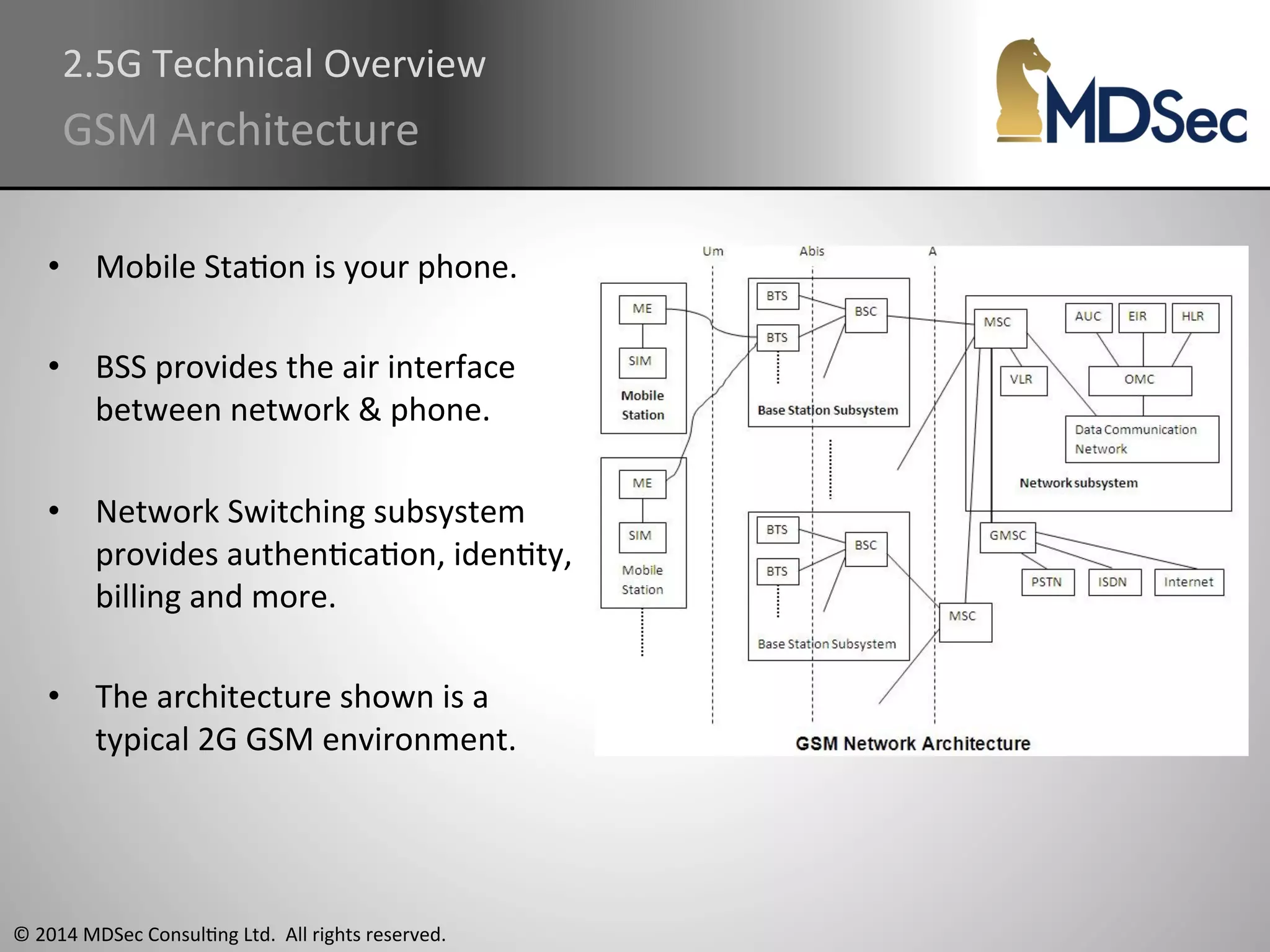
• Mobile 
StaAon 
is 
your 
phone. 
• BSS 
provides 
the 
air 
interface 
between 
network 
& 
phone. 
• Network 
Switching 
subsystem 
provides 
authenAcaAon, 
idenAty, 
billing 
and 
more. 
• The 
architecture 
shown 
is 
a 
typical 
2G 
GSM 
environment. 
© 
2014 
MDSec 
ConsulAng 
Ltd. 
All 
rights 
reserved.
2.5G 
Technical 
Overview 
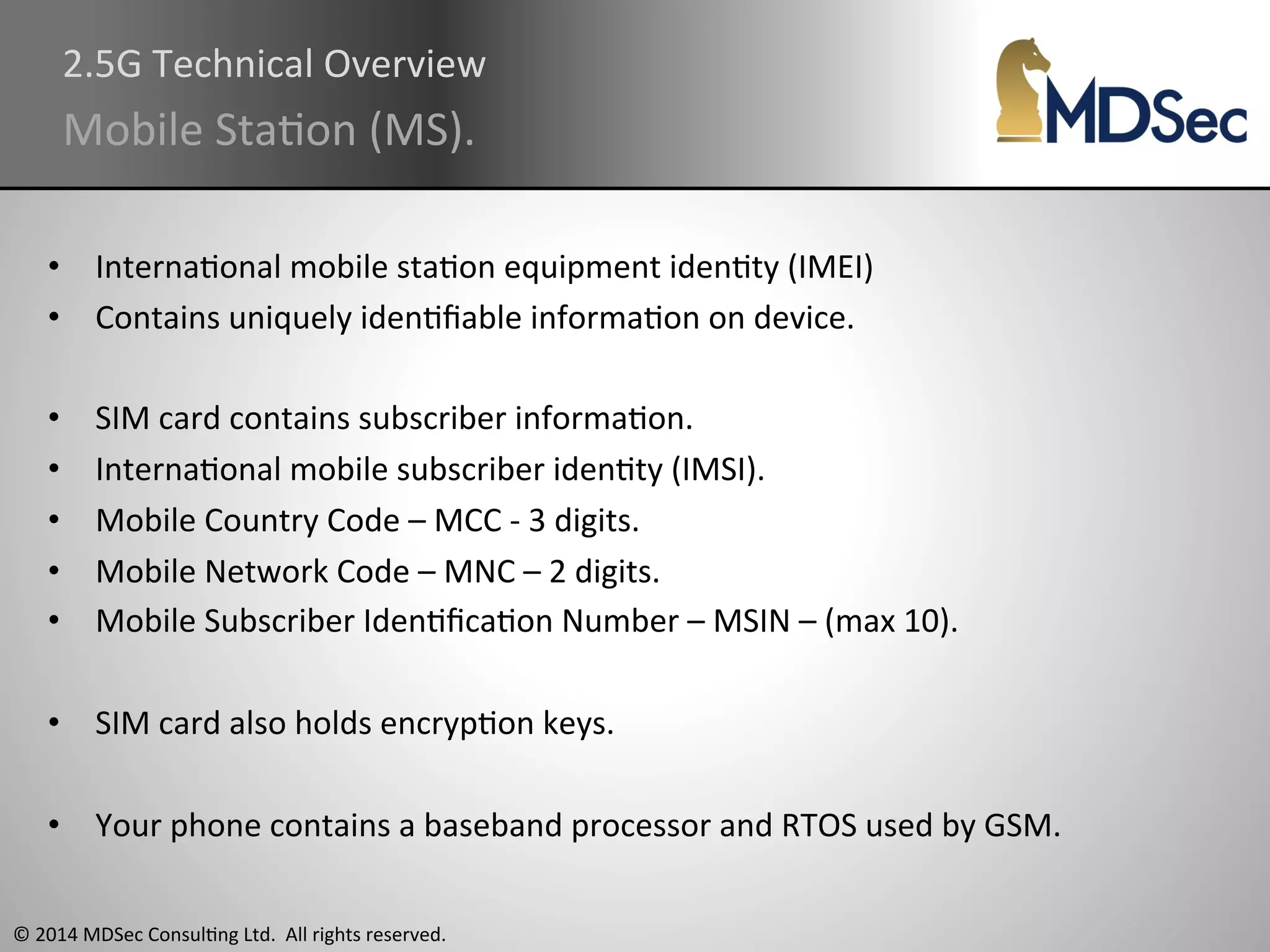
Mobile 
StaAon 
(MS). 
• InternaAonal 
mobile 
staAon 
equipment 
idenAty 
(IMEI) 
• Contains 
uniquely 
idenAfiable 
informaAon 
on 
device. 
• SIM 
card 
contains 
subscriber 
informaAon. 
• InternaAonal 
mobile 
subscriber 
idenAty 
(IMSI). 
• Mobile 
Country 
Code 
– 
MCC 
-­‐ 
3 
digits. 
• Mobile 
Network 
Code 
– 
MNC 
– 
2 
digits. 
• Mobile 
Subscriber 
IdenAficaAon 
Number 
– 
MSIN 
– 
(max 
10). 
• SIM 
card 
also 
holds 
encrypAon 
keys. 
• Your 
phone 
contains 
a 
baseband 
processor 
and 
RTOS 
used 
by 
GSM. 
© 
2014 
MDSec 
ConsulAng 
Ltd. 
All 
rights 
reserved.
2.5G 
Technical 
Overview 
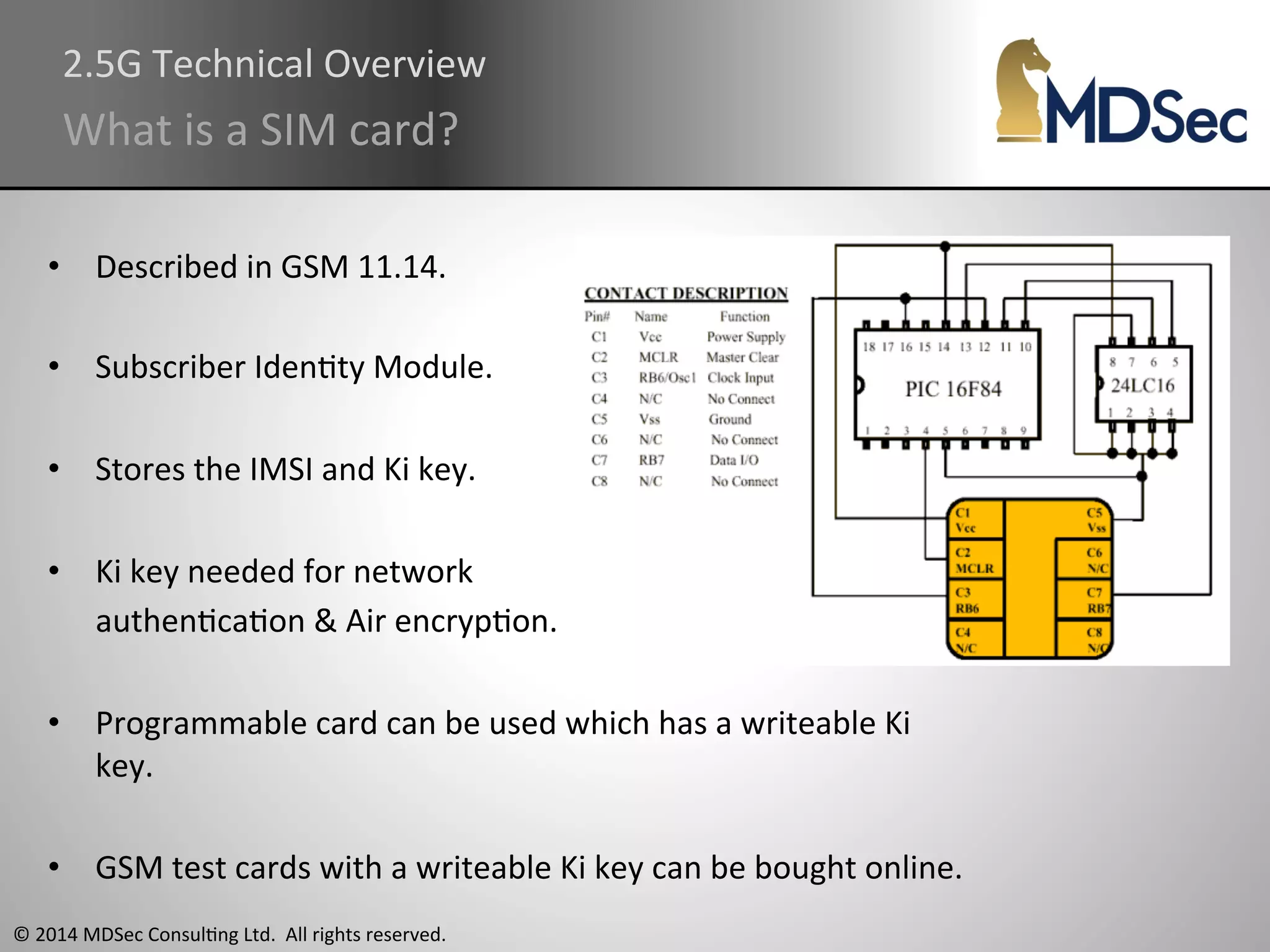
What 
is 
a 
SIM 
card? 
• Described 
in 
GSM 
11.14. 
• Subscriber 
IdenAty 
Module. 
• Stores 
the 
IMSI 
and 
Ki 
key. 
• Ki 
key 
needed 
for 
network 
authenAcaAon 
& 
Air 
encrypAon. 
• Programmable 
card 
can 
be 
used 
which 
has 
a 
writeable 
Ki 
key. 
• GSM 
test 
cards 
with 
a 
writeable 
Ki 
key 
can 
be 
bought 
online. 
© 
2014 
MDSec 
ConsulAng 
Ltd. 
All 
rights 
reserved.
2.5G 
Technical 
Overview 
ISO7816 
& 
SIM 
Toolkit 
• ISO7816 
defines 
a 
physical 
smart 
card 
standard. 
• SIM 
ApplicaAon 
Toolkit 
(STK) 
is 
implemented 
by 
GSM 
smart 
cards. 
• GSM 
applicaAon 
provides 
authenAcaAon 
APDU's. 
• COMP128v1 
is 
an 
encrypAon 
algorithm 
that 
was 
found 
to 
be 
flawed. 
• A 
“stop” 
condiAon 
was 
found 
that 
allows 
Ki 
to 
be 
brute 
forced. 
• COMP128v1 
aOack 
takes 
12-­‐24 
hours 
and 
requires 
physical 
card. 
• COMP128v3 
is 
used 
more 
widely 
today 
and 
COMP128v1 
is 
rare. 
• Chinese 
vendors 
sell 
cheap 
COMP128v1 
mulA-­‐SIM 
cards 
& 
cloner. 
• SIM 
Trace 
hOp://bb.osmocom.org/trac/wiki/SIMtrace 
• For 
more 
informaAon 
on 
SIM 
aOacks 
THC 
have 
a 
SIM 
Toolkit 
Research 
Group 
project 
that 
contains 
a 
lot 
more 
informaAon! 
© 
2014 
MDSec 
ConsulAng 
Ltd. 
All 
rights 
reserved.
2.5G 
Technical 
Overview 
What’s 
a 
Base 
Transceiver 
System 
(BTS)? 
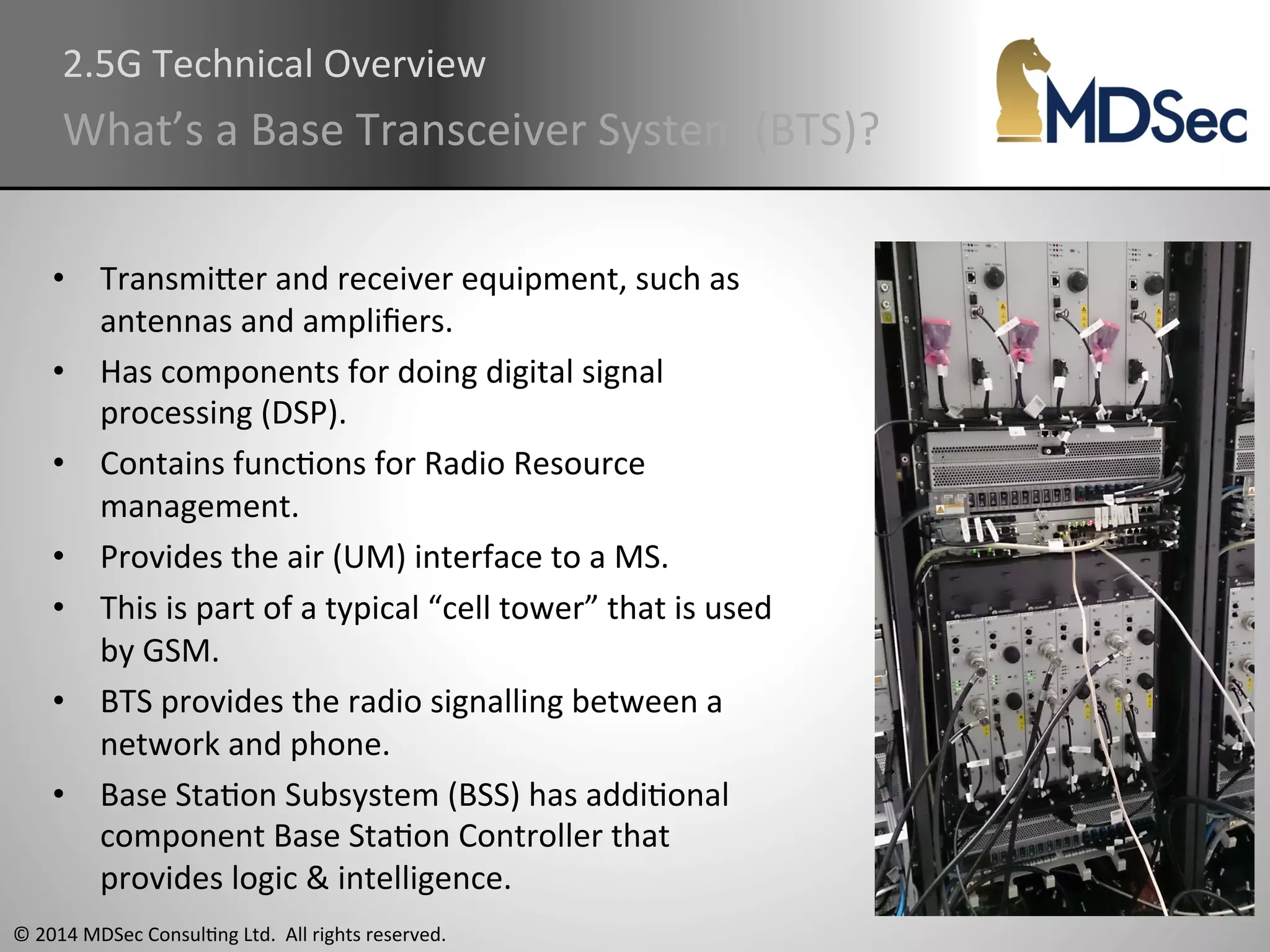
• TransmiOer 
and 
receiver 
equipment, 
such 
as 
antennas 
and 
amplifiers. 
• Has 
components 
for 
doing 
digital 
signal 
processing 
(DSP). 
• Contains 
funcAons 
for 
Radio 
Resource 
management. 
• Provides 
the 
air 
(UM) 
interface 
to 
a 
MS. 
• This 
is 
part 
of 
a 
typical 
“cell 
tower” 
that 
is 
used 
by 
GSM. 
• BTS 
provides 
the 
radio 
signalling 
between 
a 
network 
and 
phone. 
• Base 
StaAon 
Subsystem 
(BSS) 
has 
addiAonal 
component 
Base 
StaAon 
Controller 
that 
provides 
logic 
& 
intelligence. 
© 
2014 
MDSec 
ConsulAng 
Ltd. 
All 
rights 
reserved.
2.5G 
Technical 
Overview 
Radio 
& 
Cellular? 
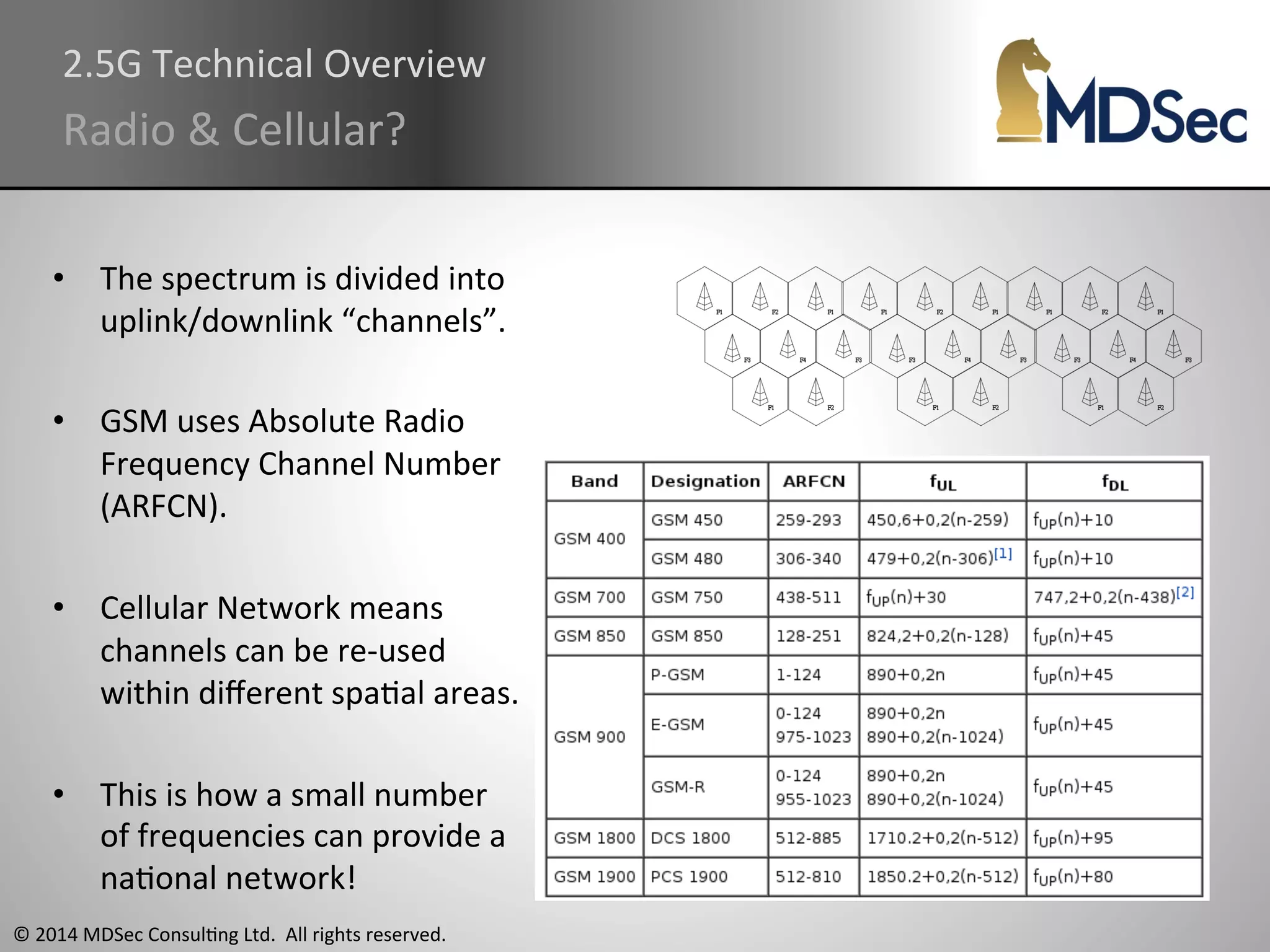
• The 
spectrum 
is 
divided 
into 
uplink/downlink 
“channels”. 
• GSM 
uses 
Absolute 
Radio 
Frequency 
Channel 
Number 
(ARFCN). 
• Cellular 
Network 
means 
channels 
can 
be 
re-­‐used 
within 
different 
spaAal 
areas. 
• This 
is 
how 
a 
small 
number 
of 
frequencies 
can 
provide 
a 
naAonal 
network! 
© 
2014 
MDSec 
ConsulAng 
Ltd. 
All 
rights 
reserved.
2.5G 
Technical 
Overview 
Physical 
Interface 
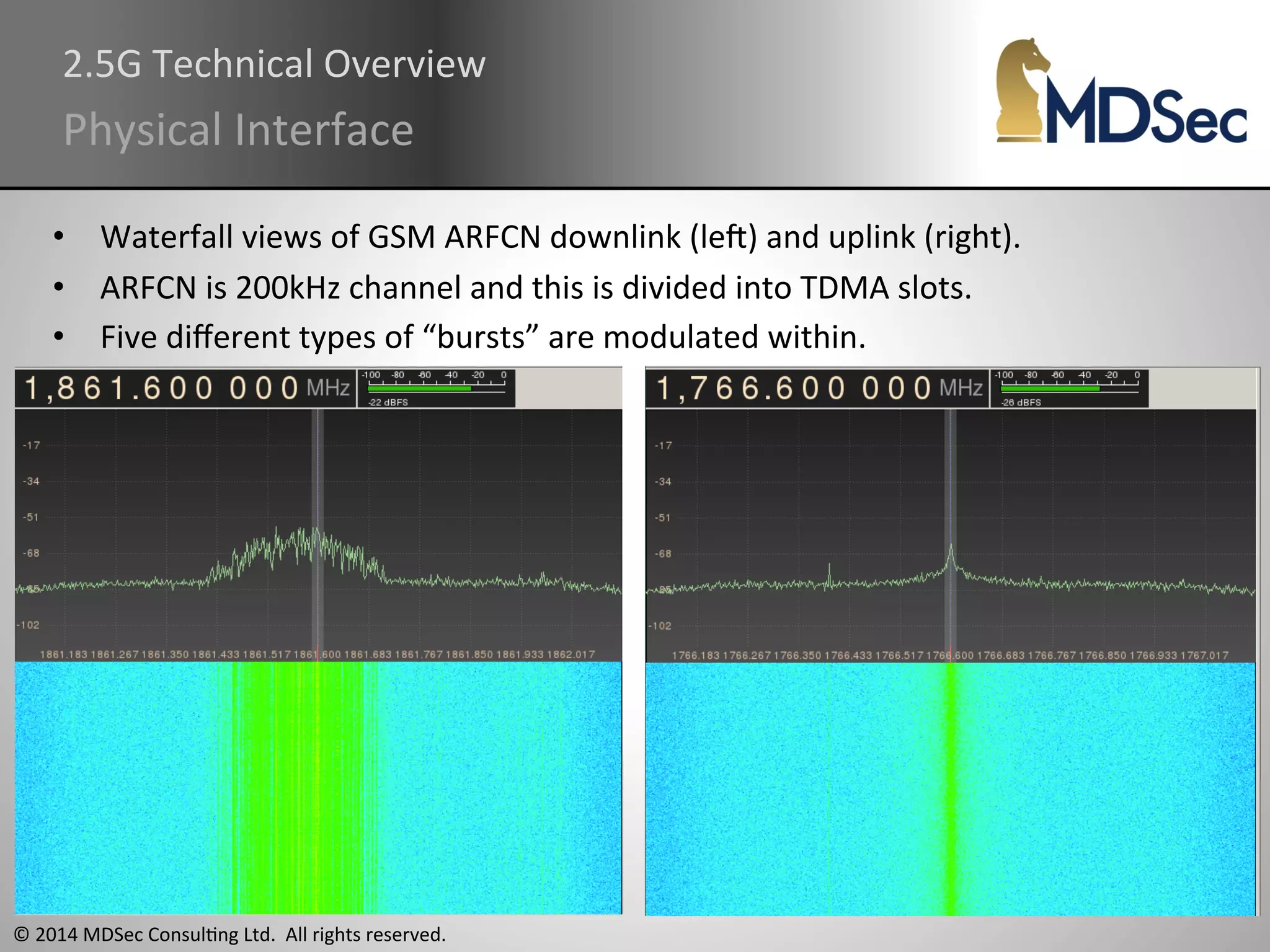
• Waterfall 
views 
of 
GSM 
ARFCN 
downlink 
(leq) 
and 
uplink 
(right). 
• ARFCN 
is 
200kHz 
channel 
and 
this 
is 
divided 
into 
TDMA 
slots. 
• Five 
different 
types 
of 
“bursts” 
are 
modulated 
within. 
© 
2014 
MDSec 
ConsulAng 
Ltd. 
All 
rights 
reserved.
2.5G 
Technical 
Overview 
Radio 
& 
Cellular? 
• GSM 
communicates 
using 
Time 
Division 
MulAple 
Access 
/ 
Frequency 
Division 
MulAple 
Access 
(TDMA/ 
FDMA) 
principles. 
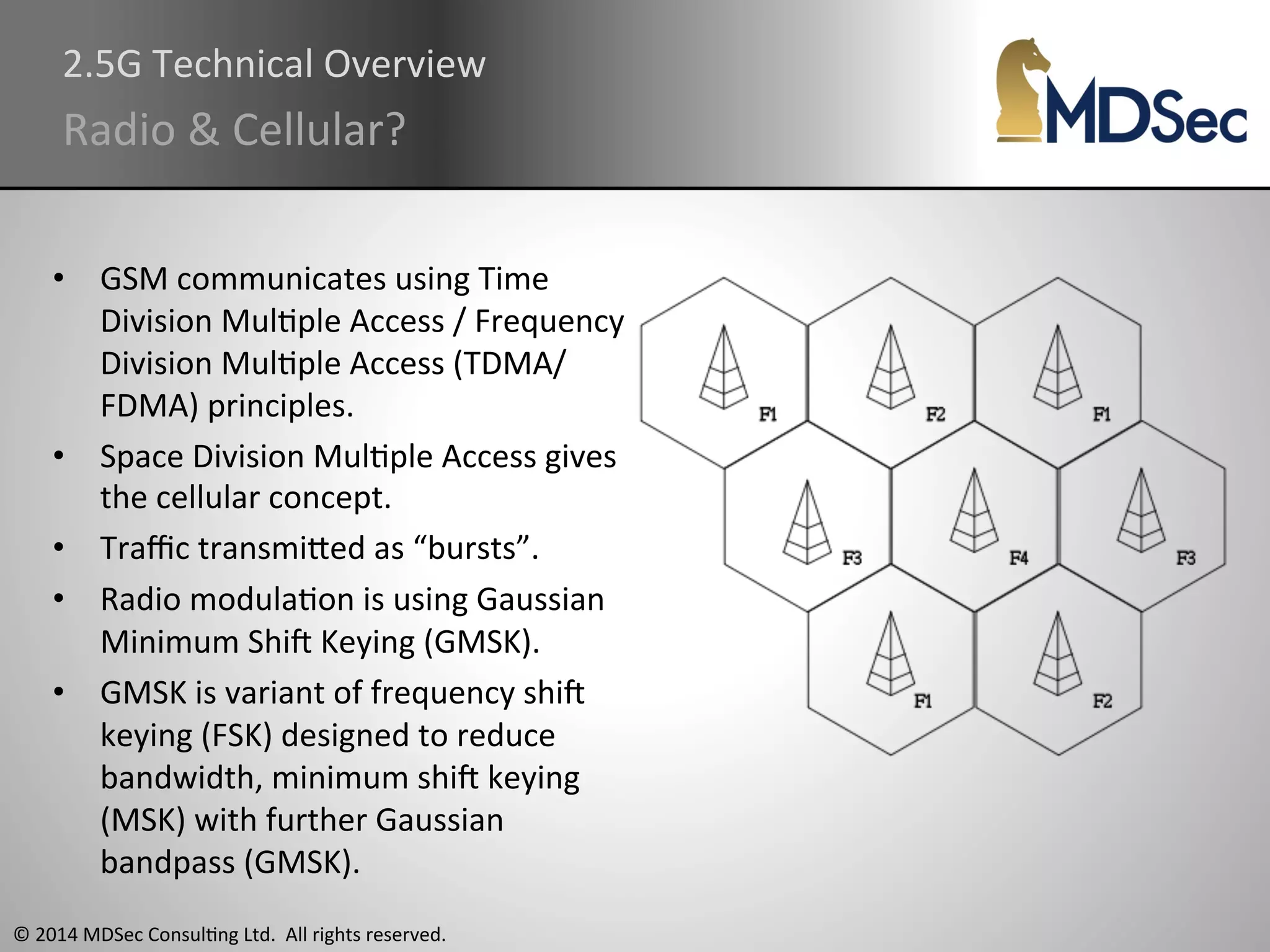
• Space 
Division 
MulAple 
Access 
gives 
the 
cellular 
concept. 
• Traffic 
transmiOed 
as 
“bursts”. 
• Radio 
modulaAon 
is 
using 
Gaussian 
Minimum 
Shiq 
Keying 
(GMSK). 
• GMSK 
is 
variant 
of 
frequency 
shiq 
keying 
(FSK) 
designed 
to 
reduce 
bandwidth, 
minimum 
shiq 
keying 
(MSK) 
with 
further 
Gaussian 
bandpass 
(GMSK). 
© 
2014 
MDSec 
ConsulAng 
Ltd. 
All 
rights 
reserved.
2.5G 
Technical 
Overview 
Network 
Switching 
Subsystem 
• The 
GSM 
core 
network 
components 
usually 
not 
visible 
to 
aOacker. 
• Mobile 
Switching 
Centre 
(MSC). 
• Home 
Locality 
Registrar 
(HLR). 
• Visitor 
Locality 
Registrar 
(VLR). 
• Equipment 
IdenAty 
Registrar 
(EIR). 
• These 
are 
components 
or 
databases 
that 
handle 
subscribers 
informaAon, 
IMSI/ 
encrypAon 
keys 
and 
perform 
processes 
like 
billing. 
• Also 
where 
the 
call 
switching 
and 
rouAng 
takes 
place 
and 
connecAng 
to 
other 
networks 
e.g. 
PSTN. 
© 
2014 
MDSec 
ConsulAng 
Ltd. 
All 
rights 
reserved.
2.5G 
Technical 
Overview 
GSM 
Logical 
Channels 
• GSM 
implements 
logical 
channels 
to 
allow 
for 
signalling 
between 
handset 
and 
network. 
• There 
is 
a 
defined 
Traffic 
Channel 
(TCH) 
– 
Full-­‐rate 
and 
Half-­‐rate 
channels 
are 
available 
as 
TCH/F 
(Bm), 
TCH/H 
(Lm). 
• There 
are 
Signalling 
channels 
(Dm). 
• Many 
exploitable 
weaknesses 
in 
GSM 
are 
due 
to 
“in-­‐band” 
signalling. 
• This 
same 
class 
of 
vulnerability 
is 
what 
allows 
phreaker 
“blue 
boxes” 
to 
funcAon 
and 
responsible 
for 
“format 
string 
aOacks.” 
– 
where 
management 
capability 
is 
accessible 
it 
has 
potenAal 
for 
subverAng. 
© 
2014 
MDSec 
ConsulAng 
Ltd. 
All 
rights 
reserved.
2.5G 
Technical 
Overview 
Broadcast 
Channel 
(BCH) 
• The 
BCH 
is 
used 
by 
a 
MS 
to 
synchronize 
it’s 
oscillator 
and 
frequency 
with 
the 
BTS. 
• The 
BCH 
consists 
of 
sub-­‐channels 
that 
assist 
with 
this 
process. 
• Broadcast 
Control 
-­‐ 
BCCH 
• Frequency 
CorrecAon 
-­‐ 
FCCH 
• SynchronizaAon 
– 
SCH 
• The 
channels 
are 
used 
during 
the 
preliminary 
stages 
of 
a 
MS 
being 
powered 
on 
and 
are 
integral 
part 
of 
“geung 
a 
signal”. 
© 
2014 
MDSec 
ConsulAng 
Ltd. 
All 
rights 
reserved.
2.5G 
Technical 
Overview 
Common 
Control 
Channel 
-­‐ 
CCCH 
• The 
CCCH 
is 
used 
by 
MS 
and 
BTS 
for 
communicaAng 
requests 
for 
resources 
with 
network 
and 
handset 
such 
as 
when 
a 
call 
aOempt 
is 
placed. 
• Random 
Access 
Channel 
-­‐ 
RACH 
• Access 
Grant 
Channel 
-­‐ 
AGCH 
• Paging 
Channel 
-­‐ 
PCH 
• NoAficaAon 
Channel 
– 
NCH 
• Temporary 
Mobile 
Subscriber 
IdenAty 
(TMSI) 
is 
used 
to 
help 
prevent 
tracking 
of 
a 
GSM 
user, 
can 
be 
frequently 
changed 
and 
has 
a 
lifeAme 
limit. 
© 
2014 
MDSec 
ConsulAng 
Ltd. 
All 
rights 
reserved.
2.5G 
Technical 
Overview 
Dedicated 
Control 
Channels 
-­‐ 
DCCH 
• The 
DCCH 
and 
it’s 
associated 
sub-­‐channels 
perform 
authenAcaAon 
requests, 
cipher 
selecAon 
& 
signalling 
of 
call 
compleAon. 
• Standalone 
dedicated 
control 
-­‐ 
SDCCH 
• Slow 
associated 
control 
-­‐ 
SACCH 
• Fast 
associated 
control 
– 
FACCH 
• Summary 
of 
the 
three 
control 
channels 
and 
purpose 
of 
each. 
• AOacker 
could 
exploit 
GSM 
signalling 
weaknesses 
to 
access 
subscriber 
mobile 
usage. 
We 
will 
look 
at 
this 
in 
more 
detail. 
© 
2014 
MDSec 
ConsulAng 
Ltd. 
All 
rights 
reserved.
2.5G 
Technical 
Overview 
What 
about 
Over-­‐the-­‐Air 
EncrypAon? 
• Several 
over-­‐the-­‐air 
(OTA) 
encrypAon 
algorithms 
exist. 
These 
are 
used 
to 
encrypt 
*some* 
of 
the 
GSM 
logical 
channels 
data 
(such 
as 
TCH). 
• A5/1 
– 
publicly 
broken, 
rainbow 
tables 
exist. 
• A5/2 
– 
offers 
no 
real 
security. 
• A5/3 
– 
KASUMI 
Cipher, 
although 
some 
man-­‐in-­‐the-­‐middle 
aOacks 
are 
known 
– 
it 
has 
not 
yet 
been 
publicly 
broken 
in 
GSM. 
• A3/A8 
-­‐ 
used 
during 
the 
authenAcaAon 
process. 
• AOacker 
can 
aOempt 
to 
“passively” 
analyse 
traffic 
looking 
for 
weak 
encrypAon 
or 
perform 
man-­‐in-­‐the-­‐middle 
aOacks 
against 
subscriber 
MS 
and 
BTS. 
© 
2014 
MDSec 
ConsulAng 
Ltd. 
All 
rights 
reserved.
2.5G 
Technical 
Overview 
General 
Packet 
Radio 
Service 
• Uses 
exisAng 
GSM 
concepts, 
e.g. 
Ameslots. 
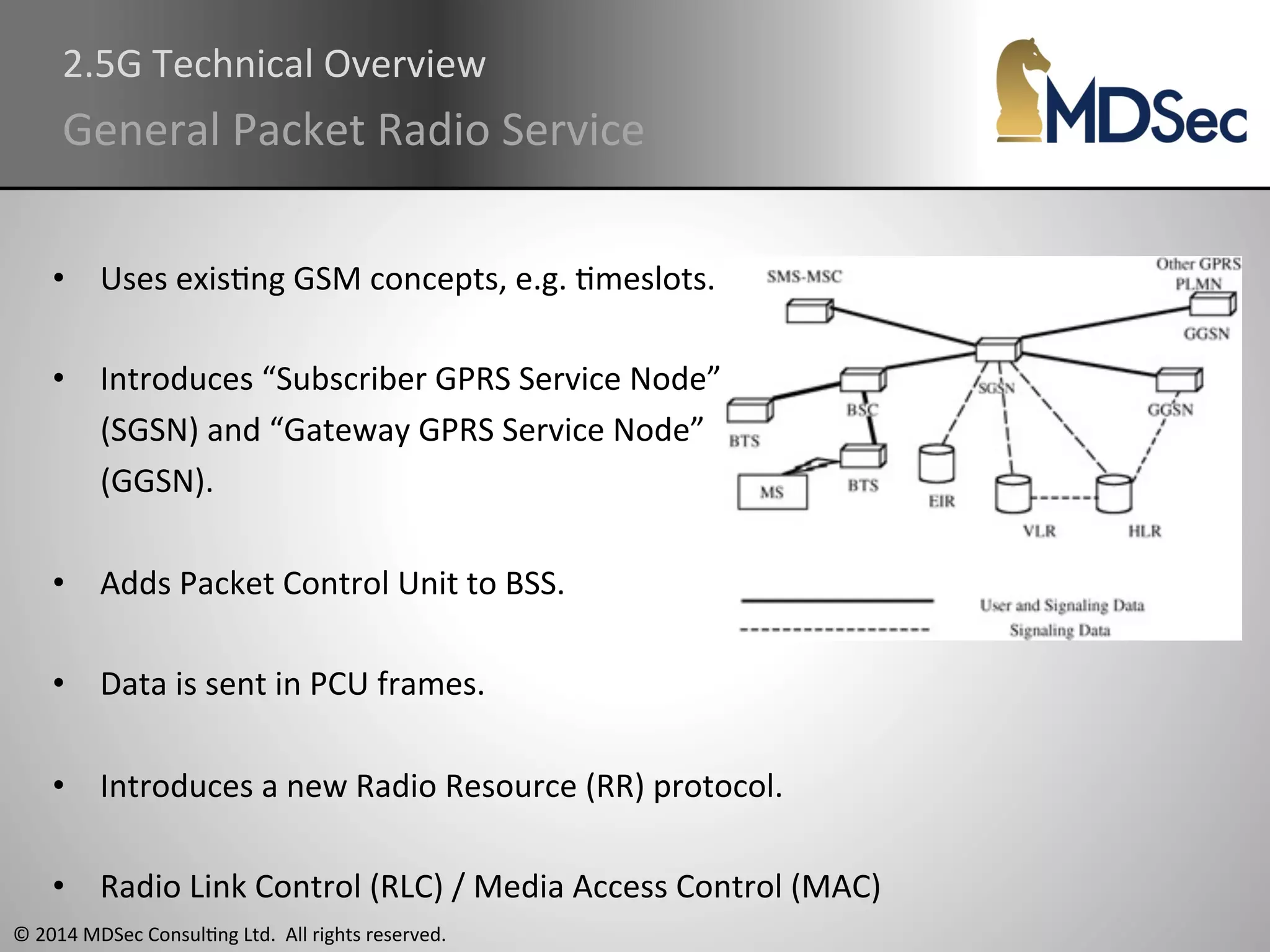
• Introduces 
“Subscriber 
GPRS 
Service 
Node” 
(SGSN) 
and 
“Gateway 
GPRS 
Service 
Node” 
(GGSN). 
• Adds 
Packet 
Control 
Unit 
to 
BSS. 
• Data 
is 
sent 
in 
PCU 
frames. 
• Introduces 
a 
new 
Radio 
Resource 
(RR) 
protocol. 
• Radio 
Link 
Control 
(RLC) 
/ 
Media 
Access 
Control 
(MAC) 
© 
2014 
MDSec 
ConsulAng 
Ltd. 
All 
rights 
reserved.
Cell 
DiagnosAcs 
& 
Tools 
Nokia 
NetMonitor 
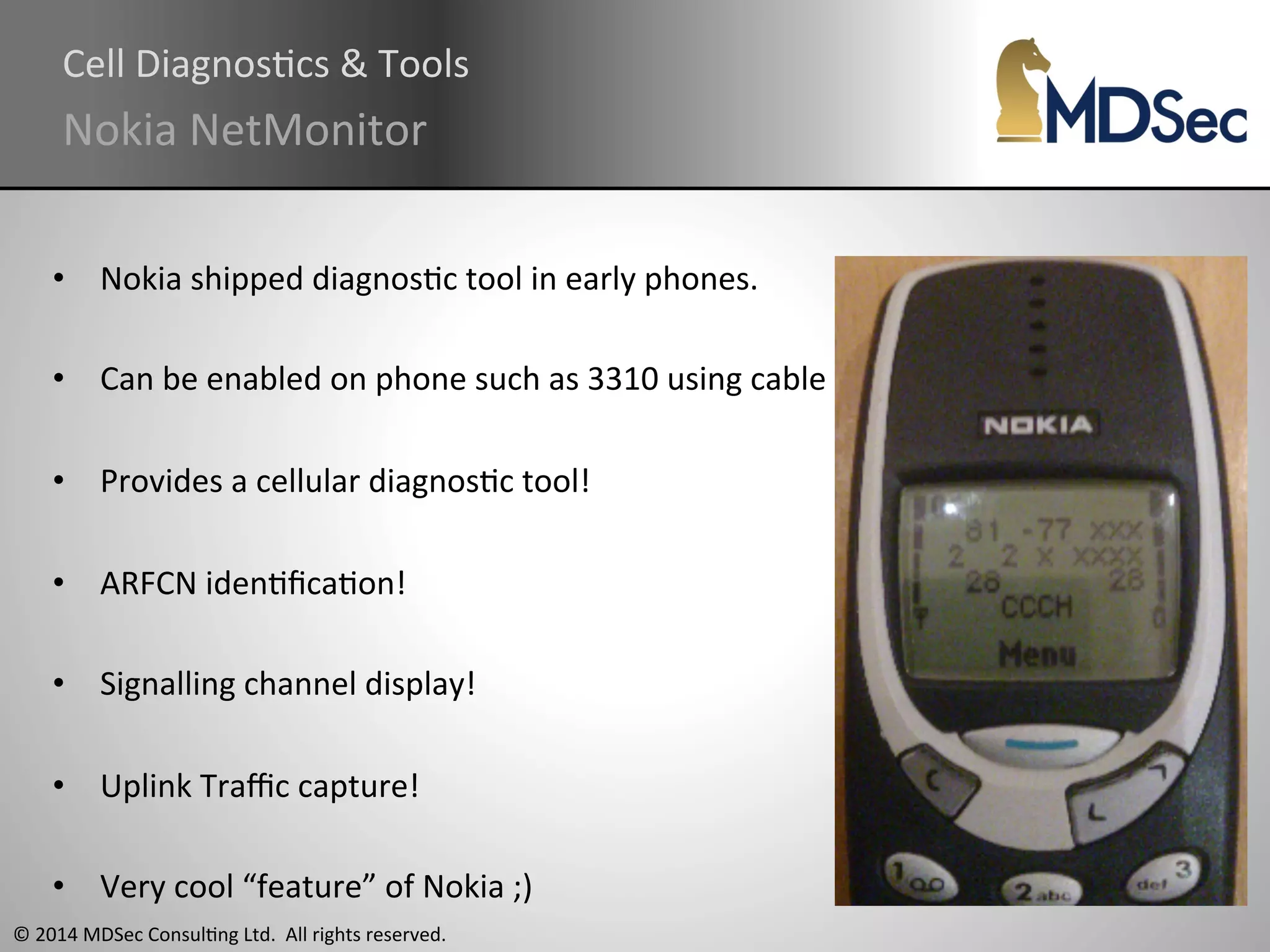
• Nokia 
shipped 
diagnosAc 
tool 
in 
early 
phones. 
• Can 
be 
enabled 
on 
phone 
such 
as 
3310 
using 
cable 
• Provides 
a 
cellular 
diagnosAc 
tool! 
• ARFCN 
idenAficaAon! 
• Signalling 
channel 
display! 
• Uplink 
Traffic 
capture! 
• Very 
cool 
“feature” 
of 
Nokia 
;) 
© 
2014 
MDSec 
ConsulAng 
Ltd. 
All 
rights 
reserved.
Cell 
DiagnosAcs 
& 
Tools 
Dedicated 
Test 
Hardware 
• eBay 
is 
your 
friend. 
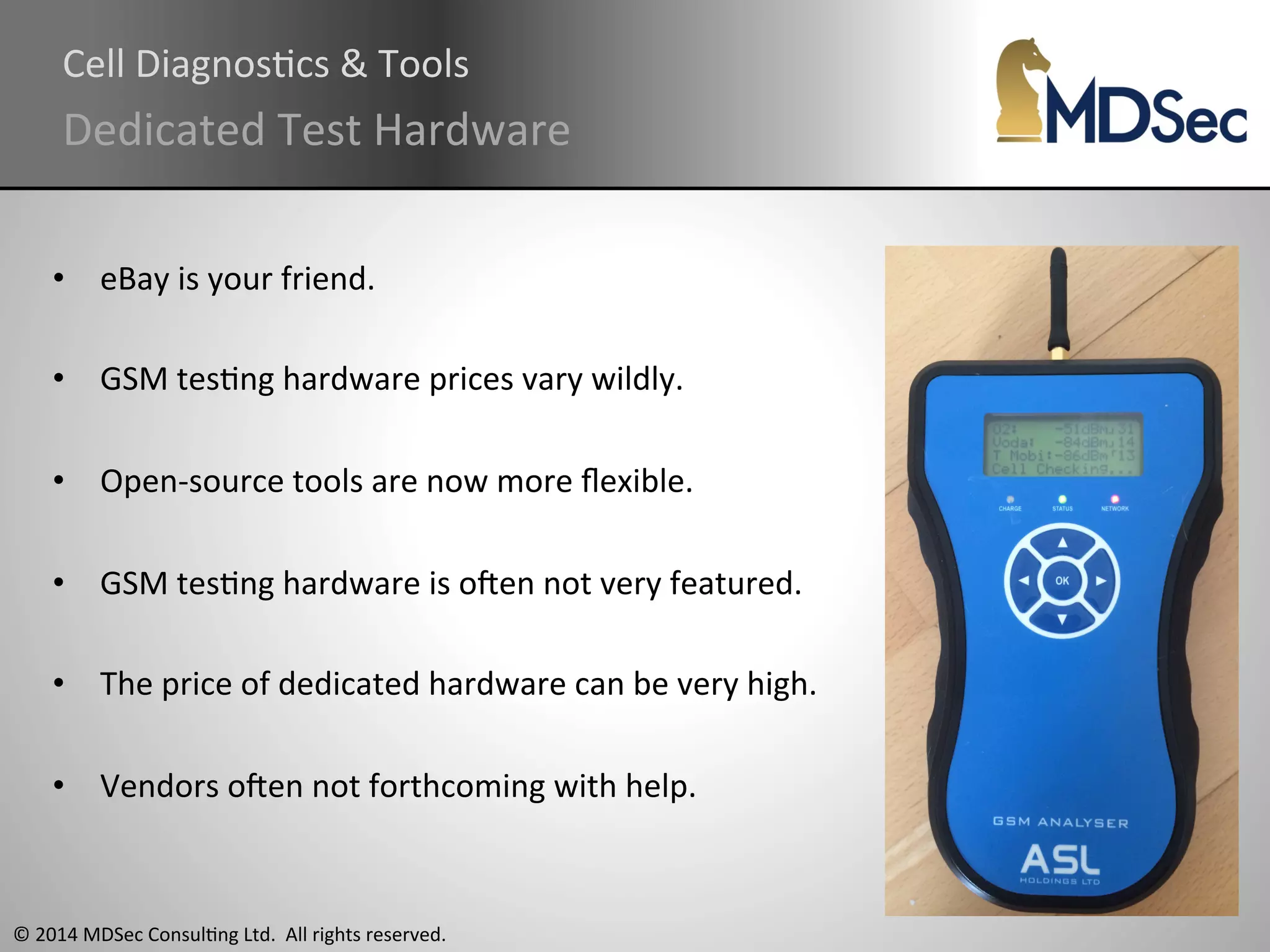
• GSM 
tesAng 
hardware 
prices 
vary 
wildly. 
• Open-­‐source 
tools 
are 
now 
more 
flexible. 
• GSM 
tesAng 
hardware 
is 
oqen 
not 
very 
featured. 
• The 
price 
of 
dedicated 
hardware 
can 
be 
very 
high. 
• Vendors 
oqen 
not 
forthcoming 
with 
help. 
© 
2014 
MDSec 
ConsulAng 
Ltd. 
All 
rights 
reserved.
Cell 
DiagnosAcs 
& 
Tools 
Osmocom-­‐bb 
& 
GNU/Plot 
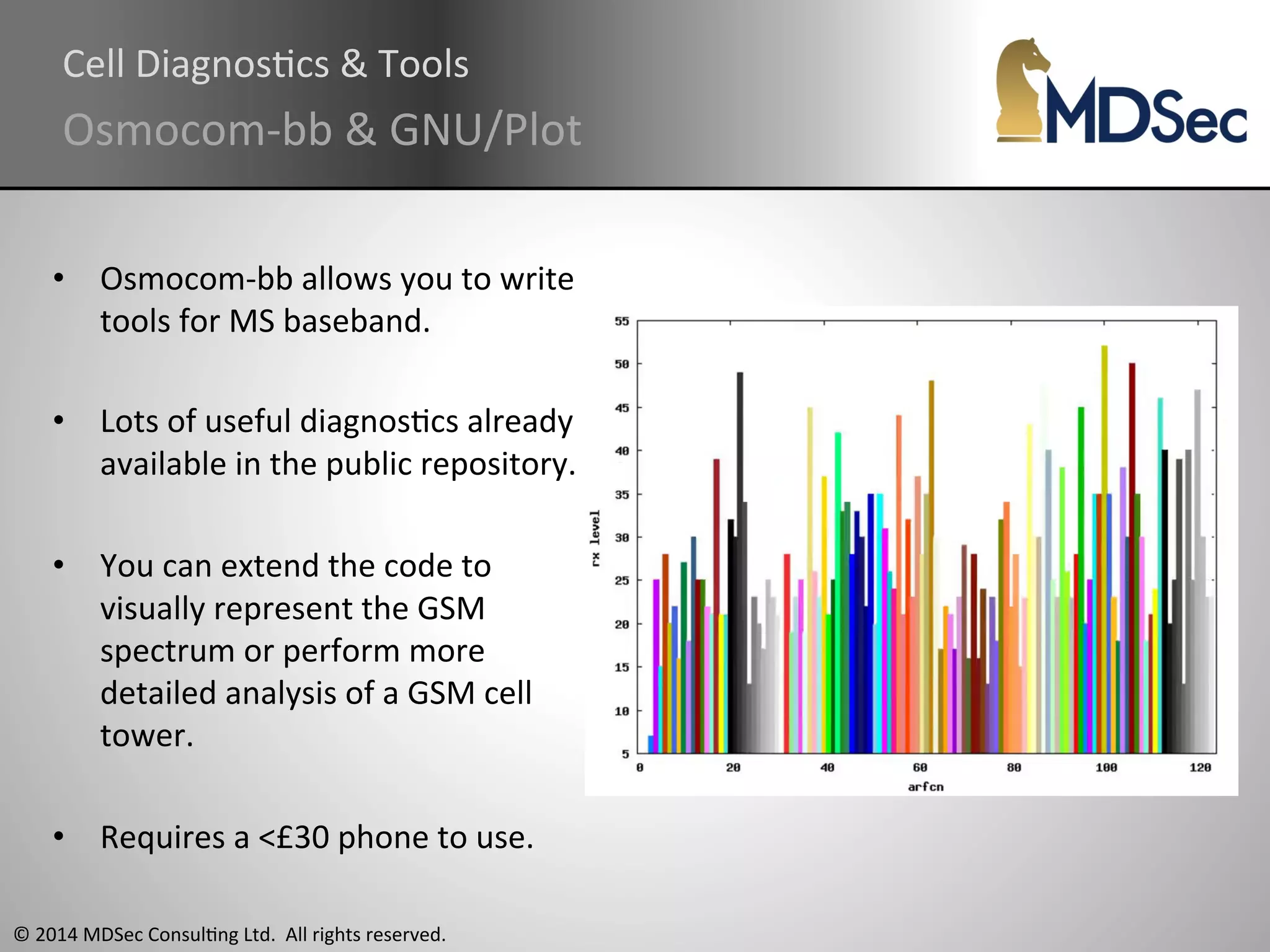
• Osmocom-­‐bb 
allows 
you 
to 
write 
tools 
for 
MS 
baseband. 
• Lots 
of 
useful 
diagnosAcs 
already 
available 
in 
the 
public 
repository. 
• You 
can 
extend 
the 
code 
to 
visually 
represent 
the 
GSM 
spectrum 
or 
perform 
more 
detailed 
analysis 
of 
a 
GSM 
cell 
tower. 
• Requires 
a 
<£30 
phone 
to 
use. 
© 
2014 
MDSec 
ConsulAng 
Ltd. 
All 
rights 
reserved.
Cell 
DiagnosAcs 
& 
Tools 
GSMTAP 
• Useful 
to 
debug 
the 
radio 
interface. 
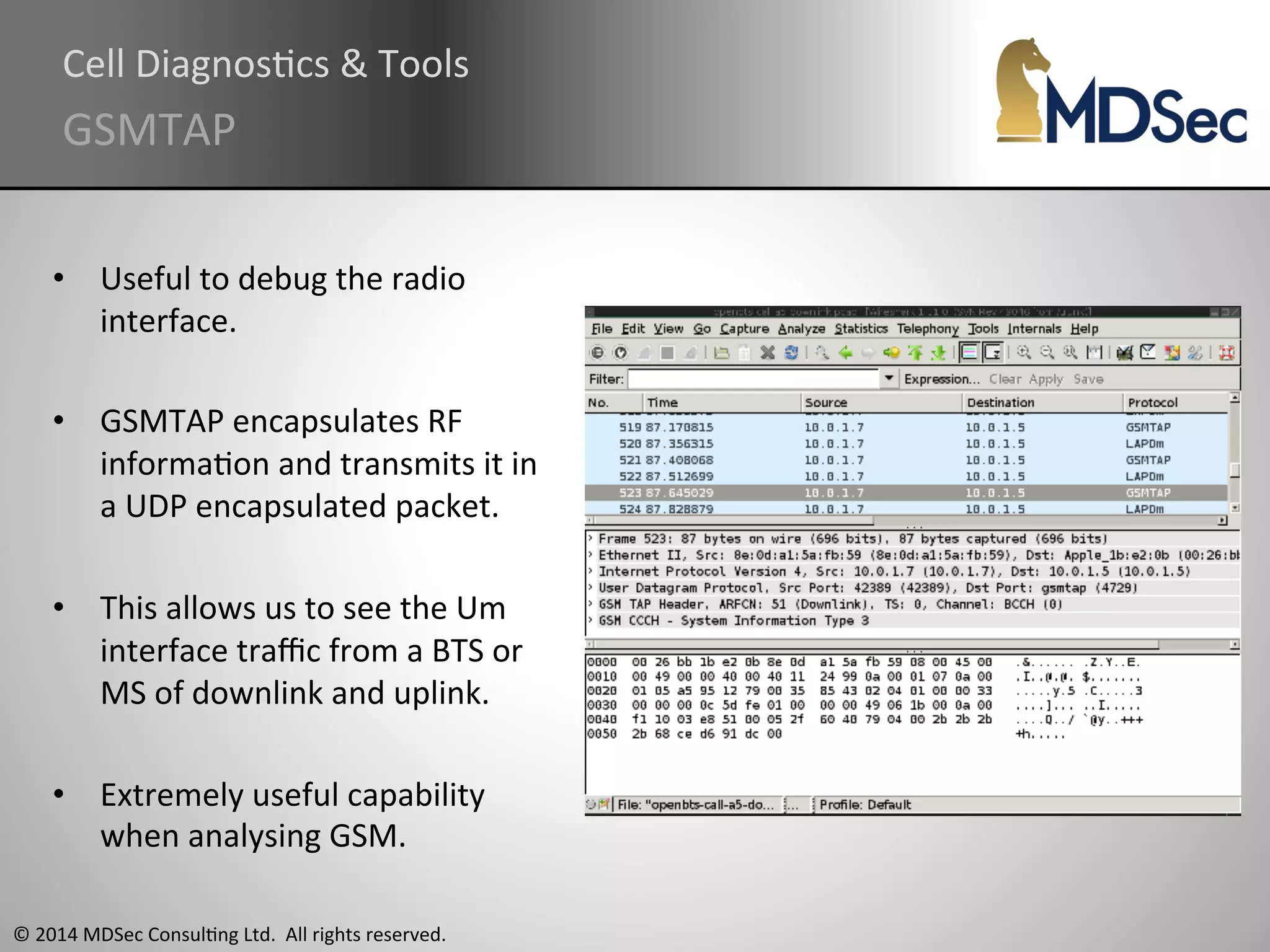
• GSMTAP 
encapsulates 
RF 
informaAon 
and 
transmits 
it 
in 
a 
UDP 
encapsulated 
packet. 
• This 
allows 
us 
to 
see 
the 
Um 
interface 
traffic 
from 
a 
BTS 
or 
MS 
of 
downlink 
and 
uplink. 
• Extremely 
useful 
capability 
when 
analysing 
GSM. 
© 
2014 
MDSec 
ConsulAng 
Ltd. 
All 
rights 
reserved.
Cell 
DiagnosAcs 
& 
Tools 
AirProbe 
& 
Sniffing 
• GNU/Radio 
is 
used 
to 
capture 
the 
RF 
of 
a 
GSM 
ARFCN. 
• GSM 
receiver 
and 
toolkit 
exists 
for 
doing 
capture 
of 
GSM 
bursts 
& 
decoding 
of 
the 
data. 
• £20< 
RTLSDR 
dongles 
can 
be 
used 
to 
capture 
GSM 
traffic. 
• Purely 
passive 
analysis 
allows 
for 
idenAficaAon 
of 
call 
requests. 
TCH 
channel 
should 
use 
encrypAon. 
• Kraken 
tool 
can 
decrypt 
A5/1 
on 
TCH, 
requires 
1.6TB 
rainbow 
tables. 
• Wireshark 
can 
parse 
the 
GSMTAP 
output 
and 
sniff 
the 
air 
interface. 
© 
2014 
MDSec 
ConsulAng 
Ltd. 
All 
rights 
reserved.
GSM 
Security 
MS 
Power-­‐On 
Process 
• MS 
starts 
a 
search 
for 
BCCH 
carriers 
performing 
RSSI 
measurements. 
• Aqer 
idenAfying 
the 
BCCH, 
the 
phone 
probes 
for 
presence 
of 
FCCH. 
• The 
phone 
“syncs” 
and 
obtains 
informaAon 
about 
the 
BTS 
it 
has 
idenAfied. 
• The 
phone 
now 
knows 
to 
monitor 
“neighbour 
cells” 
it 
has 
decoded 
from 
the 
transmission. 
• This 
process 
is 
what 
is 
exploited 
by 
IMSI 
capture 
devices 
and 
fake 
BTS 
aOack 
tools. 
© 
2014 
MDSec 
ConsulAng 
Ltd. 
All 
rights 
reserved.
GSM 
Security 
IMSI 
Capture 
& 
DetecAon 
• During 
a 
Public 
Land 
Network 
Mobile 
(PLNM) 
Search(PLNMS) 
this 
is 
trivial. 
Only 
performed 
during 
MS 
Power-­‐on 
& 
if 
no 
service 
can 
be 
found. 
• MS 
has 
path 
loss 
criterion 
C1 
and 
reselecAon 
criterion 
C2. 
These 
are 
dynamic 
variables 
used 
by 
the 
phone 
to 
determine 
if 
a 
“neighbour 
cell” 
has 
beOer 
radio 
condiAons. 
These 
variables 
are 
taken 
dynamically 
and 
frequently. 
• ManipulaAng 
C1 
and 
C2 
can 
force 
an 
MS 
to 
join 
our 
BTS 
without 
requiring 
the 
phone 
to 
perform 
a 
PLMNS. 
• The 
network 
can 
also 
request 
an 
IMEI 
during 
this 
update 
locaAon 
request. 
© 
2014 
MDSec 
ConsulAng 
Ltd. 
All 
rights 
reserved.
GSM 
Security 
IMEI 
& 
Device 
Fingerprint 
IMEI 
TAC 
TAC 
(FAC) 
Serial 
(Luhn 
Checksum) 
IMEI 
013035 
00 
561434 
0 
• IMEI 
AA 
BB 
BB 
BB 
CC 
CC 
CC 
D 
or 
EE 
contains 
Type 
AllocaAon 
Code 
(TAC), 
serial 
number 
and 
checksum. 
• TAC 
starts 
with 
two 
digit 
ReporAng 
Body 
IdenAfier 
(RBI), 
determines 
country. 
• Remaining 
six 
digits 
of 
TAC 
idenAfy 
vendor 
who 
produced 
the 
device. 
• RBI: 
01 
Org: 
PTCRB 
Country: 
United 
States 
• TAC: 
01303500 
Manufacturer: 
Apple 
Model: 
iPhone 
4S 
model 
MD239B/A 
© 
2014 
MDSec 
ConsulAng 
Ltd. 
All 
rights 
reserved.
GSM 
Security 
LocaAon 
Update 
Request 
© 
2014 
MDSec 
ConsulAng 
Ltd. 
All 
rights 
reserved.
GSM 
Security 
Clone 
a 
BTS 
• AOacker 
needs 
to 
simulate 
condiAon 
to 
enAce 
MS 
to 
fake 
BTS. 
• Locates 
the 
MCC 
/ 
MNC 
of 
target 
phone 
provider 
or 
roaming 
agreement. 
• IdenAfies 
the 
Neighbor 
ARFCN 
for 
target 
MS 
by 
performing 
PLMN 
locally. 
• Creates 
a 
BTS 
using 
the 
MCC, 
MNC, 
ARFCN, 
LAC 
and 
any 
other 
parameters 
to 
match 
a 
weak 
signal 
ARFCN 
BTS 
to 
reduce 
interference. 
• This 
will 
create 
an 
environment 
where 
target 
in 
close 
physical 
proximity 
to 
the 
BTS 
will 
trigger 
cell 
re-­‐selecAon 
as 
MS 
sees 
a 
beOer 
RF 
environment. 
• Cell 
diagnosAcs 
tools 
need 
to 
be 
used 
to 
obtain 
this 
data 
for 
aOacker 
to 
use. 
© 
2014 
MDSec 
ConsulAng 
Ltd. 
All 
rights 
reserved.
GSM 
Security 
Clone 
a 
BTS 
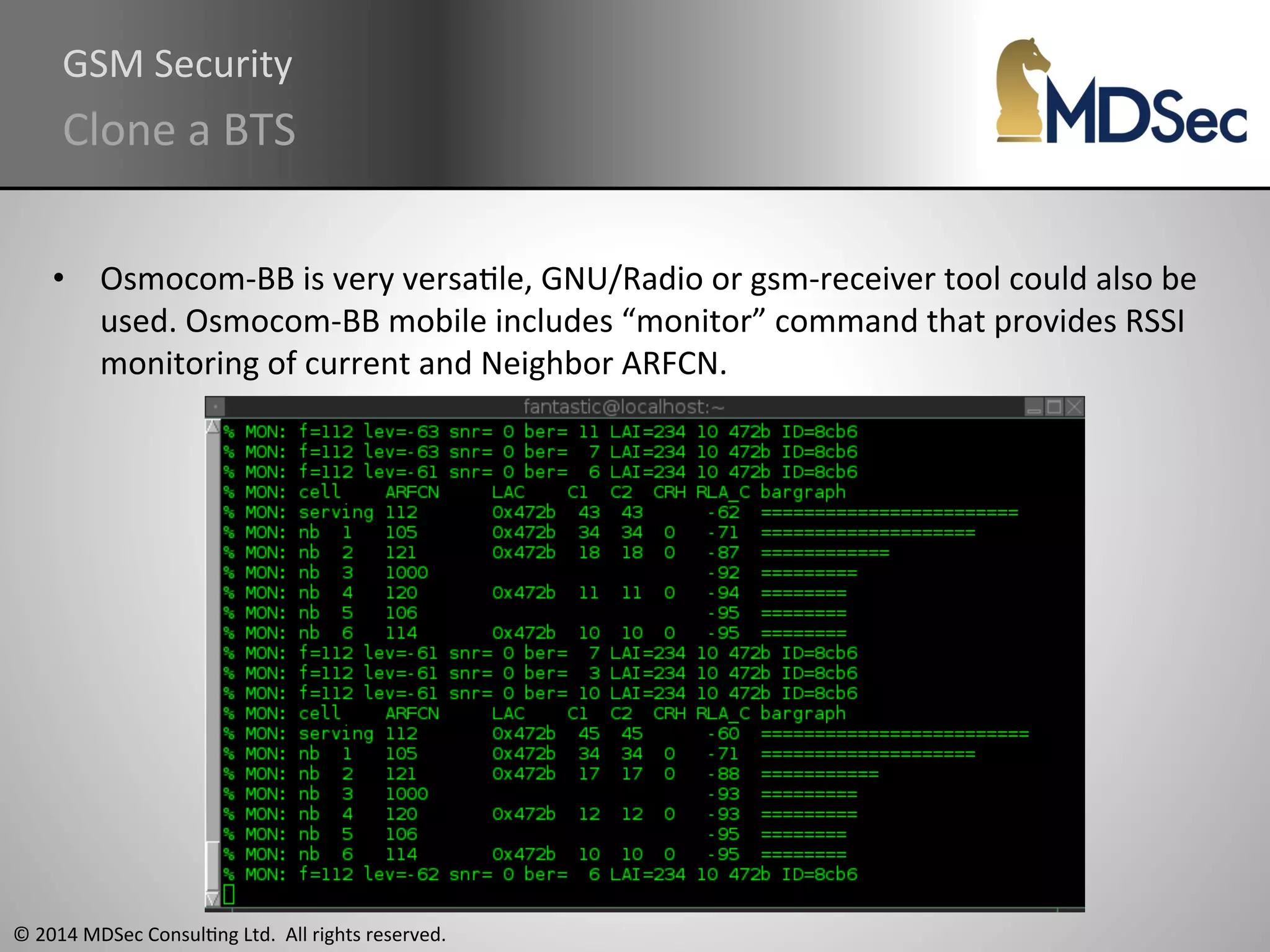
• Osmocom-­‐BB 
is 
very 
versaAle, 
GNU/Radio 
or 
gsm-­‐receiver 
tool 
could 
also 
be 
used. 
Osmocom-­‐BB 
mobile 
includes 
“monitor” 
command 
that 
provides 
RSSI 
monitoring 
of 
current 
and 
Neighbor 
ARFCN. 
© 
2014 
MDSec 
ConsulAng 
Ltd. 
All 
rights 
reserved.
GSM 
Security 
RACH 
& 
TMSI 
Paging 
AOacks 
• Random 
Access 
requests 
have 
a 
finite 
resource. 
• AOacker 
can 
conAnually 
request 
resources 
via 
RACH 
prevenAng 
users 
being 
able 
to 
place 
new 
calls 
once 
all 
available 
resources 
are 
consumed. 
• TMSI 
is 
vulnerable 
to 
a 
race 
condiAon 
when 
the 
BTS 
is 
paging, 
aOacker 
can 
answer 
all 
pages 
prevenAng 
legiAmate 
communicaAon. 
• An 
aOacker 
responds 
to 
pages 
made 
by 
the 
BTS 
to 
idenAfy 
a 
parAcular 
phone 
causing 
the 
original 
request 
to 
be 
unanswered. 
• Both 
aOacks 
can 
be 
implemented 
in 
osmocom-­‐bb. 
• Both 
aOacks 
could 
be 
used 
to 
perform 
a 
“DoS” 
of 
a 
BTS. 
© 
2014 
MDSec 
ConsulAng 
Ltd. 
All 
rights 
reserved.
GSM 
Security 
Downgrade 
& 
Jamming 
• LTE, 
UMTS 
and 
GSM 
can 
be 
“jammed” 
to 
downgrade/force 
connecAons. 
• Overpower 
the 
analogue 
components 
of 
a 
radio 
with 
a 
stronger 
signal. 
• Asian 
devices 
are 
oqen 
mulA-­‐band 
1-­‐10WaO 
radios 
and 
go 
against 
EMC. 
• Protocols 
aOempt 
to 
address 
“noise” 
or 
“sawtooth” 
jamming. 
• None 
suitable 
for 
researchers 
or 
tesAng. 
• Effect 
can 
be 
simulated 
by 
disabling 
4G/3G. 
• Wireless 
& 
Telegraphy 
Act 
in 
UK 
forbids 
use. 
© 
2014 
MDSec 
ConsulAng 
Ltd. 
All 
rights 
reserved.
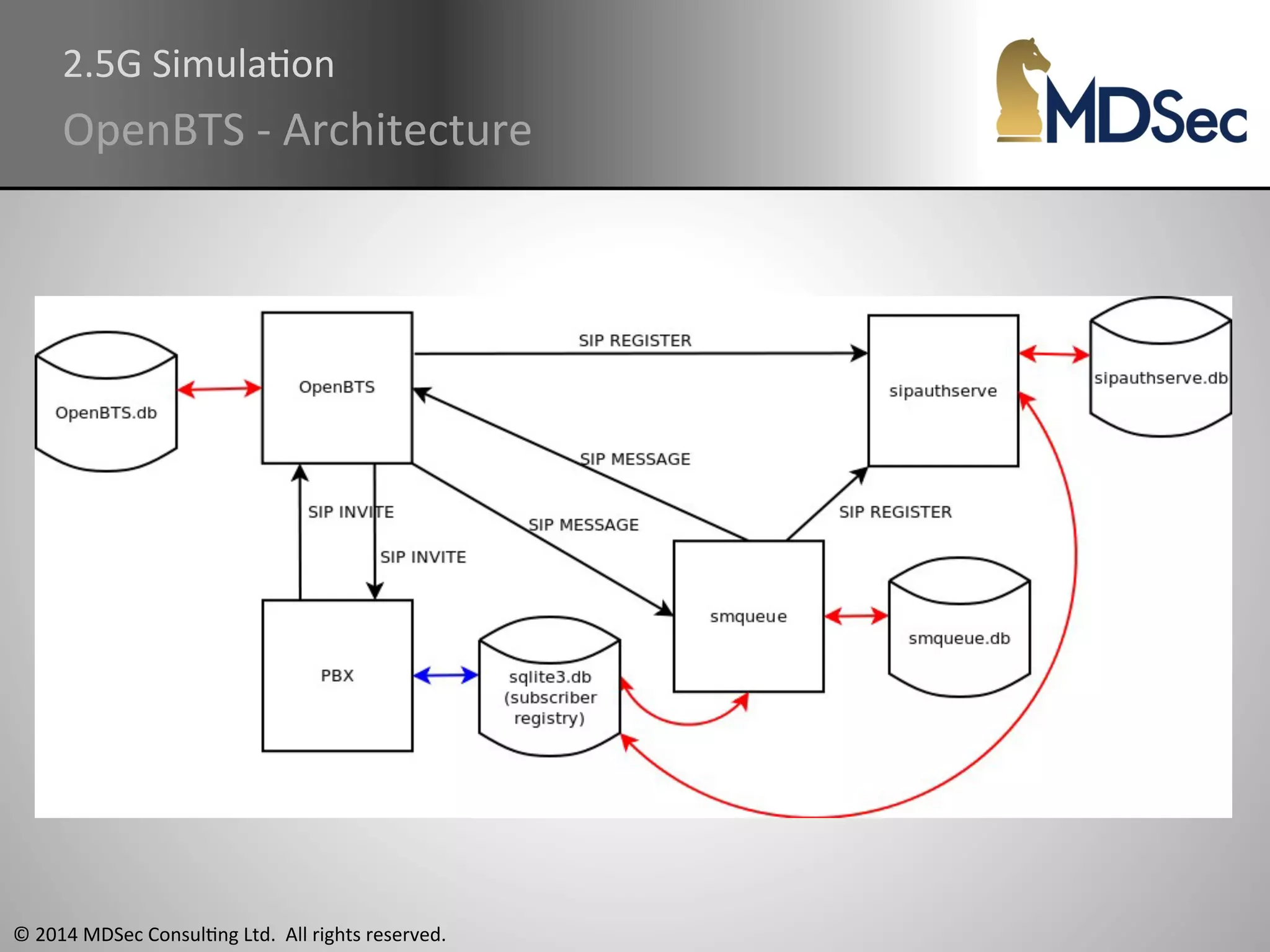
2.5G 
SimulaAon 
OpenBTS 
-­‐ 
Architecture 
© 
2014 
MDSec 
ConsulAng 
Ltd. 
All 
rights 
reserved.
ImplementaAon 
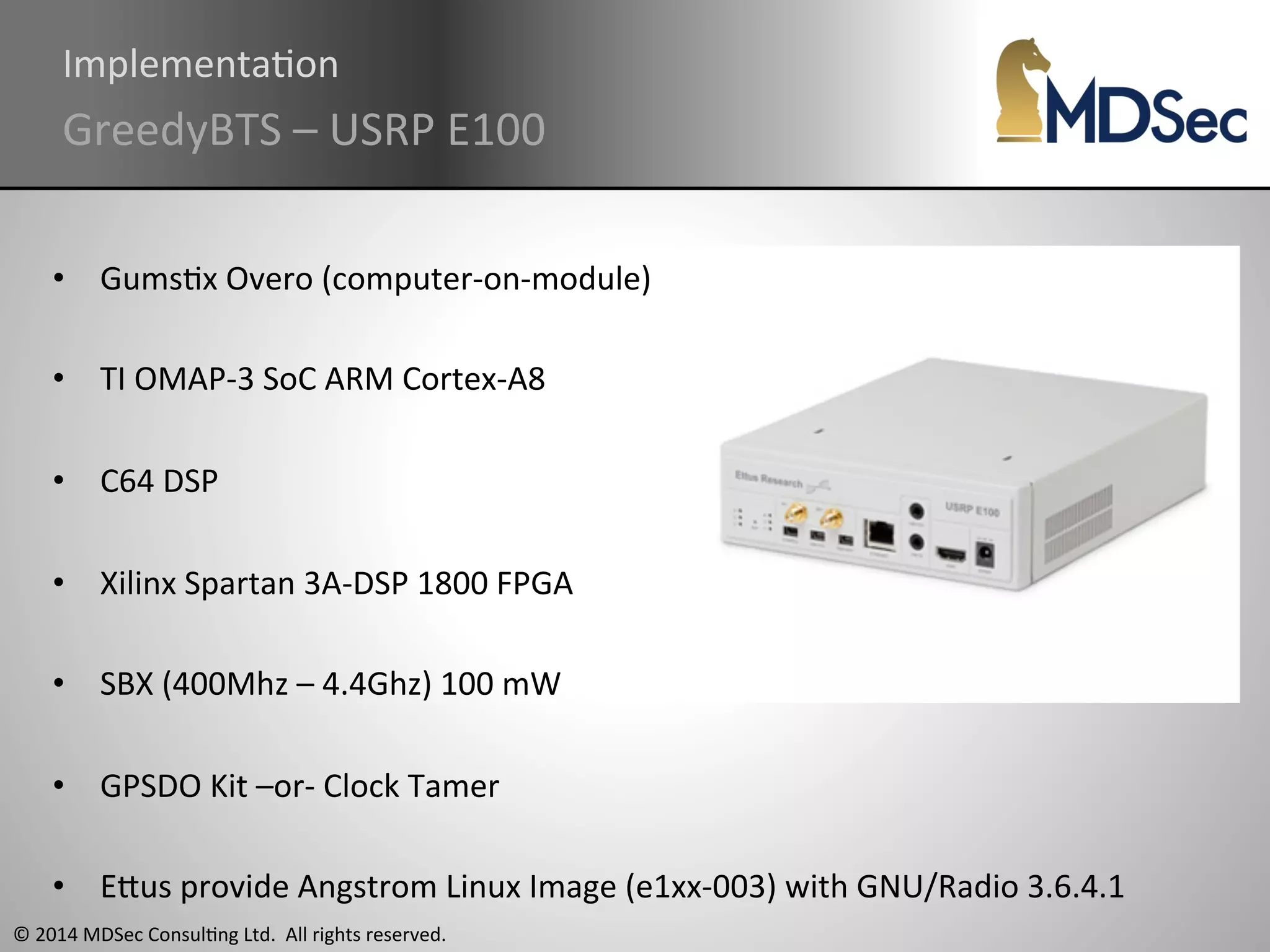
GreedyBTS 
– 
USRP 
E100 
• GumsAx 
Overo 
(computer-­‐on-­‐module) 
• TI 
OMAP-­‐3 
SoC 
ARM 
Cortex-­‐A8 
• C64 
DSP 
• Xilinx 
Spartan 
3A-­‐DSP 
1800 
FPGA 
• SBX 
(400Mhz 
– 
4.4Ghz) 
100 
mW 
• GPSDO 
Kit 
–or-­‐ 
Clock 
Tamer 
• EOus 
provide 
Angstrom 
Linux 
Image 
(e1xx-­‐003) 
with 
GNU/Radio 
3.6.4.1 
© 
2014 
MDSec 
ConsulAng 
Ltd. 
All 
rights 
reserved.
2.5G 
SimulaAon 
EMC 
& 
Shielding 
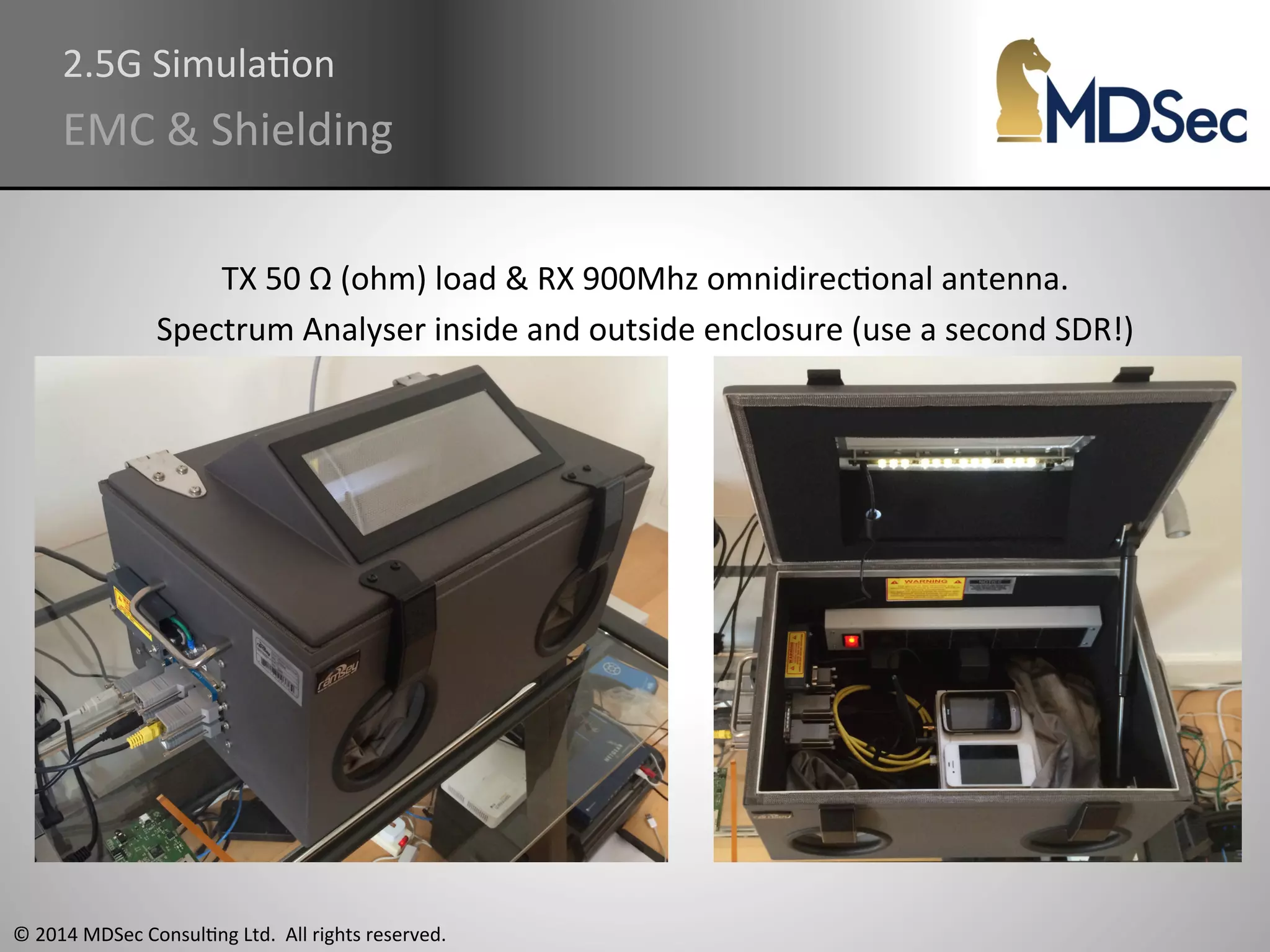
TX 
50 
Ω 
(ohm) 
load 
& 
RX 
900Mhz 
omnidirecAonal 
antenna. 
Spectrum 
Analyser 
inside 
and 
outside 
enclosure 
(use 
a 
second 
SDR!) 
© 
2014 
MDSec 
ConsulAng 
Ltd. 
All 
rights 
reserved.
2.5G 
SimulaAon 
EMC 
& 
Shielding 
© 
2014 
MDSec 
ConsulAng 
Ltd. 
All 
rights 
reserved.
ImplementaAon 
GreedyBTS 
– 
E100 
firmware 
• Spent 
a 
lot 
of 
Ame 
trying 
to 
build 
Angstrom 
for 
USRP 
E-­‐1xx 
from 
scratch 
with 
limited 
success. 
• Used 
EOus 
E1xx_3 
firmware, 
cross-­‐compiled 
new 
Kernel 
(no 
ne}ilter 
support 
or 
IP 
forwarding) 
and 
built 
packages 
from 
source 
with 
addiAonal 
opAons 
such 
as 
ODBC 
and 
SQLite 
support. 
• OpenBTS 
5.0 
and 
OpenBTS 
2.8 
(with 
mini-­‐SGSN 
GPRS 
support) 
both 
installed. 
• OpenBTS 
transceiver 
applicaAon 
has 
been 
broken 
for 
E1xx, 
modified 
for 
5.0. 
• I 
made 
minor 
patches 
to 
OpenBTS 
for 
more 
stealth 
operaAon 
(i.e. 
no 
welcome 
messages), 
increased 
logging 
in 
L3 
Mobility 
Management 
events 
and 
disable 
SGSN 
firewalling 
for 
GPRS 
aOacks. 
• Asterisk 
configured 
with 
real-­‐Ame 
SQLite 
support 
and 
automaAc 
logging 
via 
monitor(). 
• Console 
interface 
script 
for 
interacAng 
with 
components 
and 
BTS. 
• Integrated 
DB 
for 
IMEI 
fingerprinAng 
(50000+ 
devices) 
& 
MCC/MNC 
search. 
© 
2014 
MDSec 
ConsulAng 
Ltd. 
All 
rights 
reserved.
ImplementaAon 
GreedyBTS 
– 
E100 
firmware 
© 
2014 
MDSec 
ConsulAng 
Ltd. 
All 
rights 
reserved.
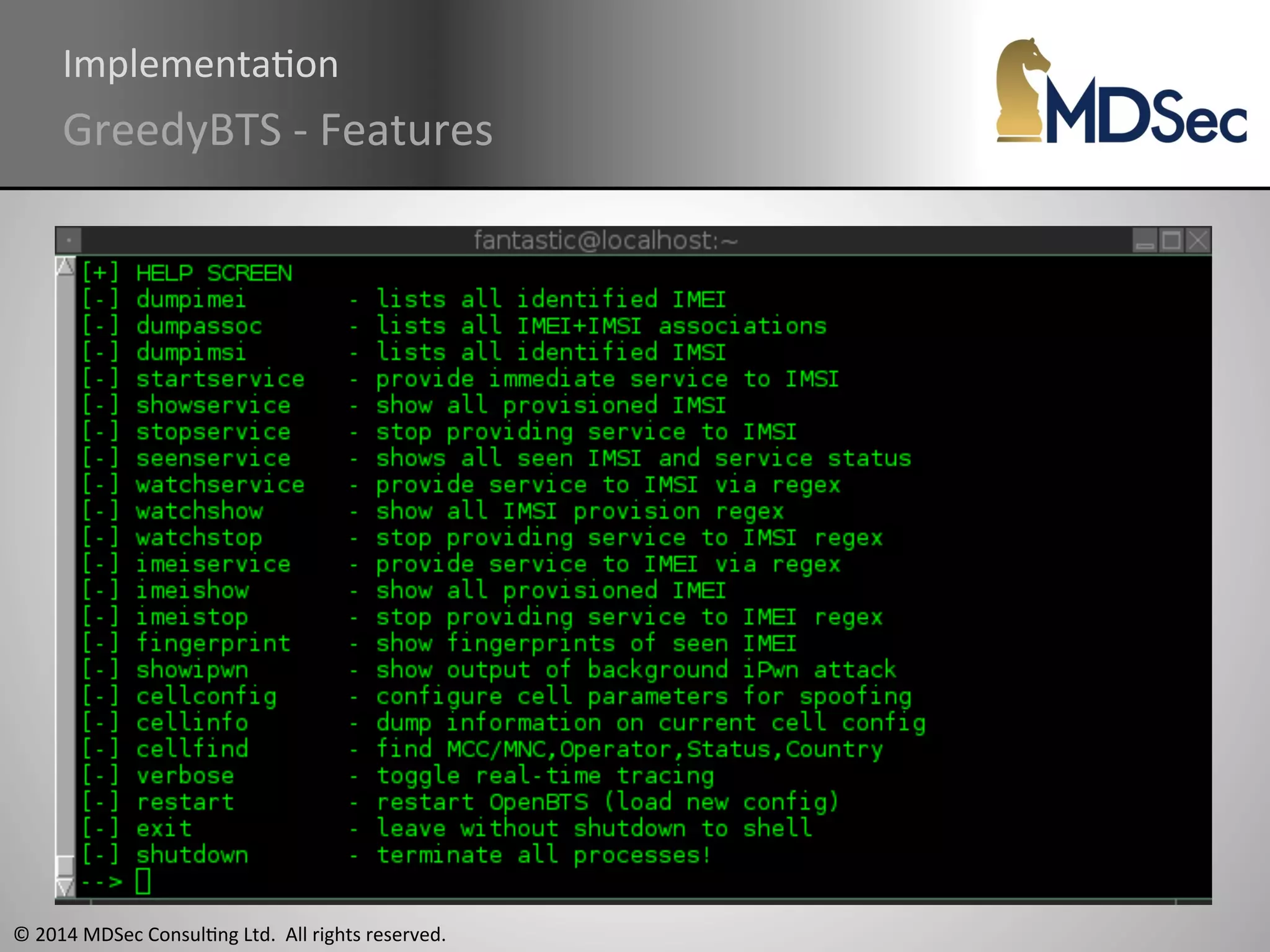
ImplementaAon 
GreedyBTS 
-­‐ 
Features 
• Useful 
events 
are 
sent 
to 
“greedyBTS.log” 
for 
logging 
and 
use 
by 
console 
app. 
• Can 
dynamically 
provision 
a 
phone 
based 
on 
regex 
of 
IMSI 
or 
IMEI. 
• Use’s 
real-­‐Ame 
configuraAon, 
can 
be 
leq 
to 
run 
“headless” 
in 
target 
area. 
• Useful 
uAliAes 
(airprobe, 
osmo-­‐arfcn, 
tshark, 
tcpdump, 
libpcap) 
built. 
• CDR 
records 
keep 
detail 
of 
subscriber 
communicaAon 
aOempts. 
• Call 
content 
is 
automaAcally 
recorded 
to 
“call-­‐recordings” 
directory. 
• Can 
use 
Asterisk 
for 
connecAng 
users 
to 
PSTN 
or 
amusement. 
• GPRS 
is 
auto-­‐configured, 
if 
the 
BTS 
has 
an 
internet 
connecAon 
so 
does 
phone. 
• Example 
background 
exploit 
iPwn 
aOacks 
MS 
over 
GPRS. 
• Designed 
to 
be 
used 
against 
a 
specific 
target 
(1 
or 
2 
users) 
in 
a 
small 
geographical 
area. 
• Clone 
the 
BTS 
environment 
of 
CEO 
office, 
enter 
RegEx 
of 
CEO 
IMEI 
and 
wait 
;-­‐) 
• It’s 
Linux! 
You 
can 
roll 
your 
own 
aOacks 
/ 
backdoors 
on-­‐top. 
© 
2014 
MDSec 
ConsulAng 
Ltd. 
All 
rights 
reserved.
ImplementaAon 
GreedyBTS 
-­‐ 
Features 
© 
2014 
MDSec 
ConsulAng 
Ltd. 
All 
rights 
reserved.
ImplementaAon 
GreedyBTS 
+ 
iPwn 
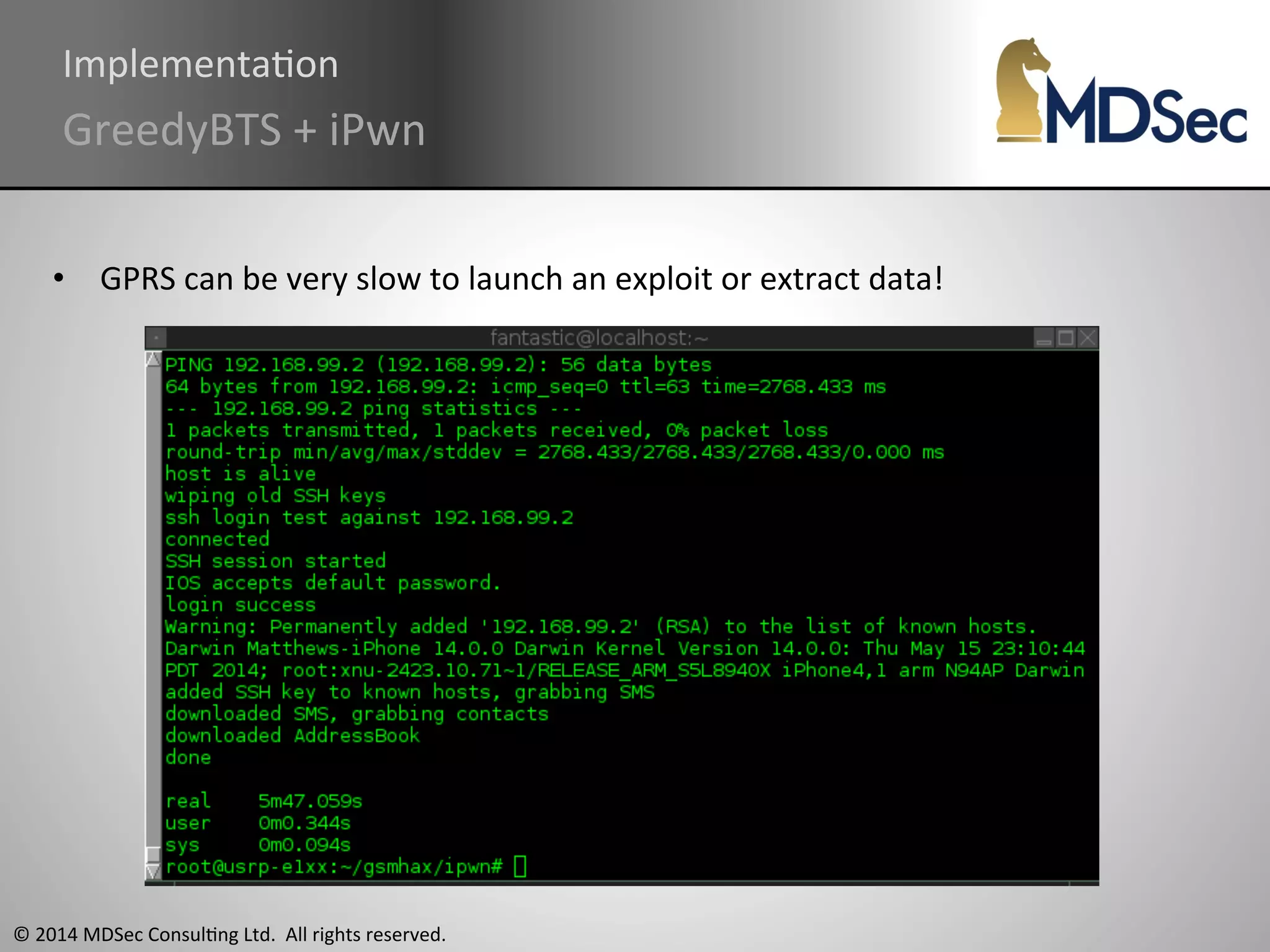
• GPRS 
can 
be 
very 
slow 
to 
launch 
an 
exploit 
or 
extract 
data! 
© 
2014 
MDSec 
ConsulAng 
Ltd. 
All 
rights 
reserved.
ImplementaAon 
Download 
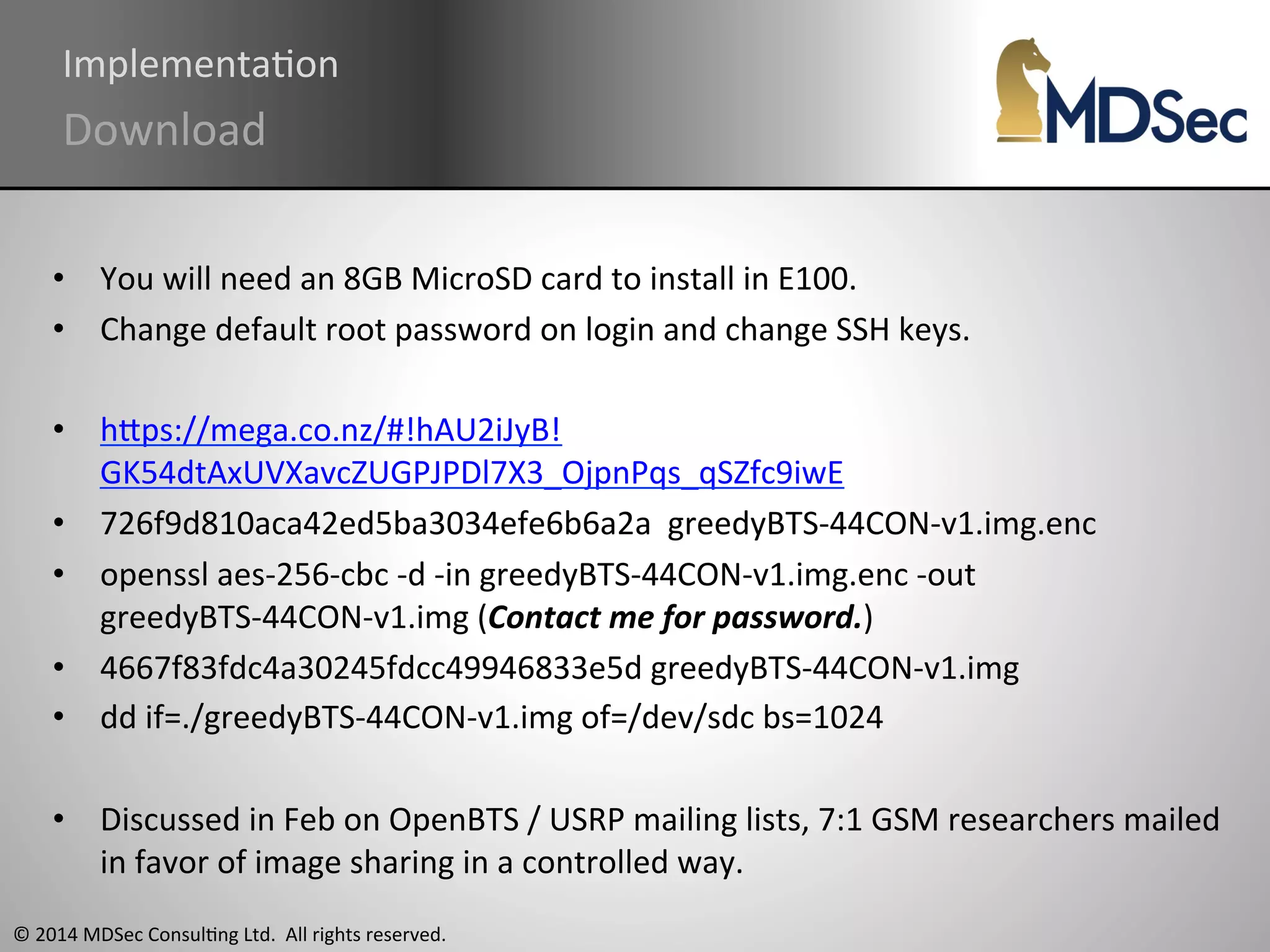
• You 
will 
need 
an 
8GB 
MicroSD 
card 
to 
install 
in 
E100. 
• Change 
default 
root 
password 
on 
login 
and 
change 
SSH 
keys. 
• hOps://mega.co.nz/#!hAU2iJyB! 
GK54dtAxUVXavcZUGPJPDl7X3_OjpnPqs_qSZfc9iwE 
• 726f9d810aca42ed5ba3034efe6b6a2a 
© 
2014 
MDSec 
ConsulAng 
Ltd. 
All 
rights 
reserved. 
greedyBTS-­‐44CON-­‐v1.img.enc 
• openssl 
aes-­‐256-­‐cbc 
-­‐d 
-­‐in 
greedyBTS-­‐44CON-­‐v1.img.enc 
-­‐out 
greedyBTS-­‐44CON-­‐v1.img 
(Contact 
me 
for 
password.) 
• 4667f83fdc4a30245fdcc49946833e5d 
greedyBTS-­‐44CON-­‐v1.img 
• dd 
if=./greedyBTS-­‐44CON-­‐v1.img 
of=/dev/sdc 
bs=1024 
• Discussed 
in 
Feb 
on 
OpenBTS 
/ 
USRP 
mailing 
lists, 
7:1 
GSM 
researchers 
mailed 
in 
favor 
of 
image 
sharing 
in 
a 
controlled 
way.
ImplementaAon 
Example 
traffic 
• Interested 
in 
GSM? 
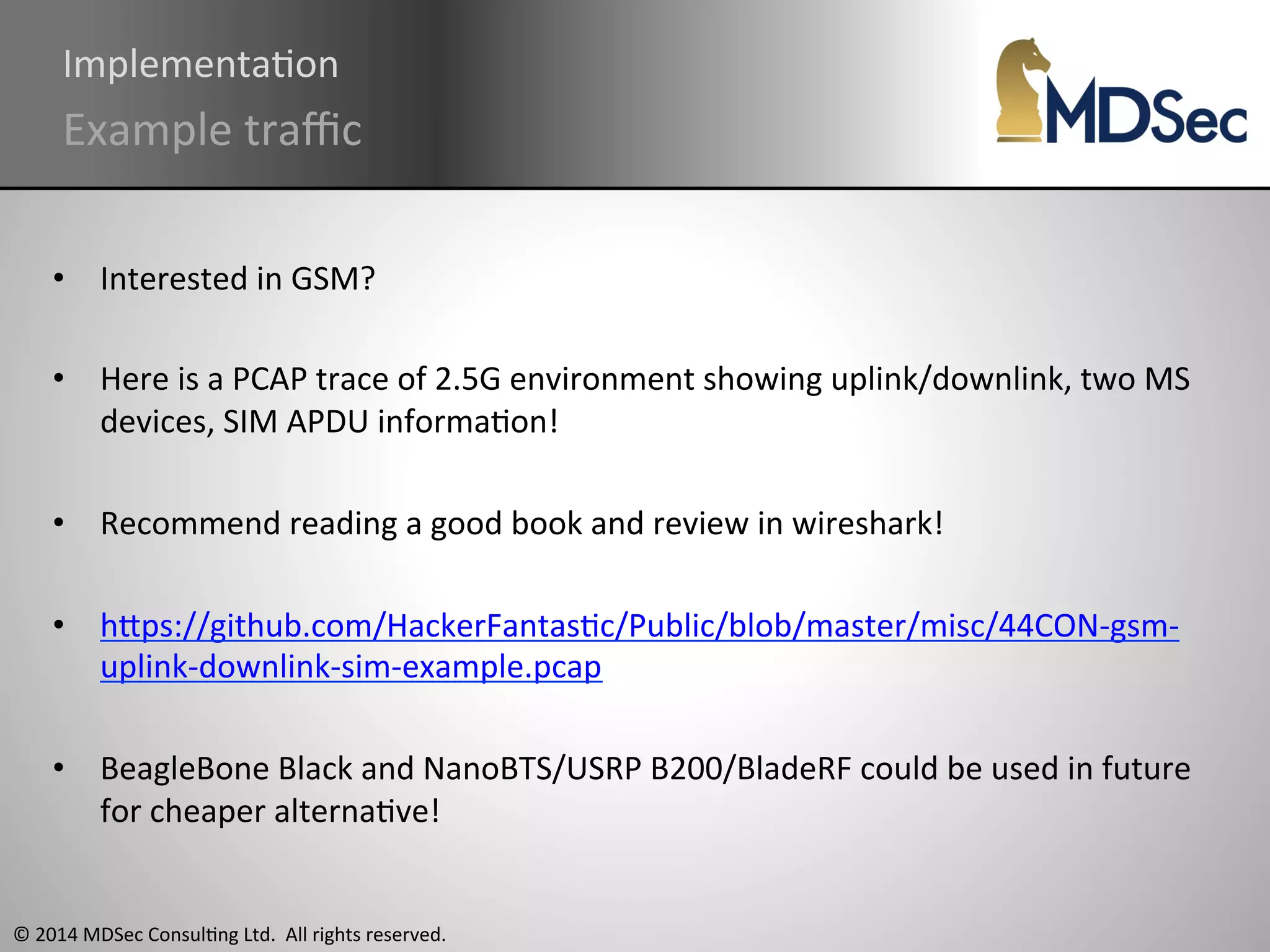
• Here 
is 
a 
PCAP 
trace 
of 
2.5G 
environment 
showing 
uplink/downlink, 
two 
MS 
devices, 
SIM 
APDU 
informaAon! 
• Recommend 
reading 
a 
good 
book 
and 
review 
in 
wireshark! 
• hOps://github.com/HackerFantasAc/Public/blob/master/misc/44CON-­‐gsm-­‐ 
uplink-­‐downlink-­‐sim-­‐example.pcap 
• BeagleBone 
Black 
and 
NanoBTS/USRP 
B200/BladeRF 
could 
be 
used 
in 
future 
for 
cheaper 
alternaAve! 
© 
2014 
MDSec 
ConsulAng 
Ltd. 
All 
rights 
reserved.
ImplementaAon 
Demo 
© 
2014 
MDSec 
ConsulAng 
Ltd. 
All 
rights 
reserved. 
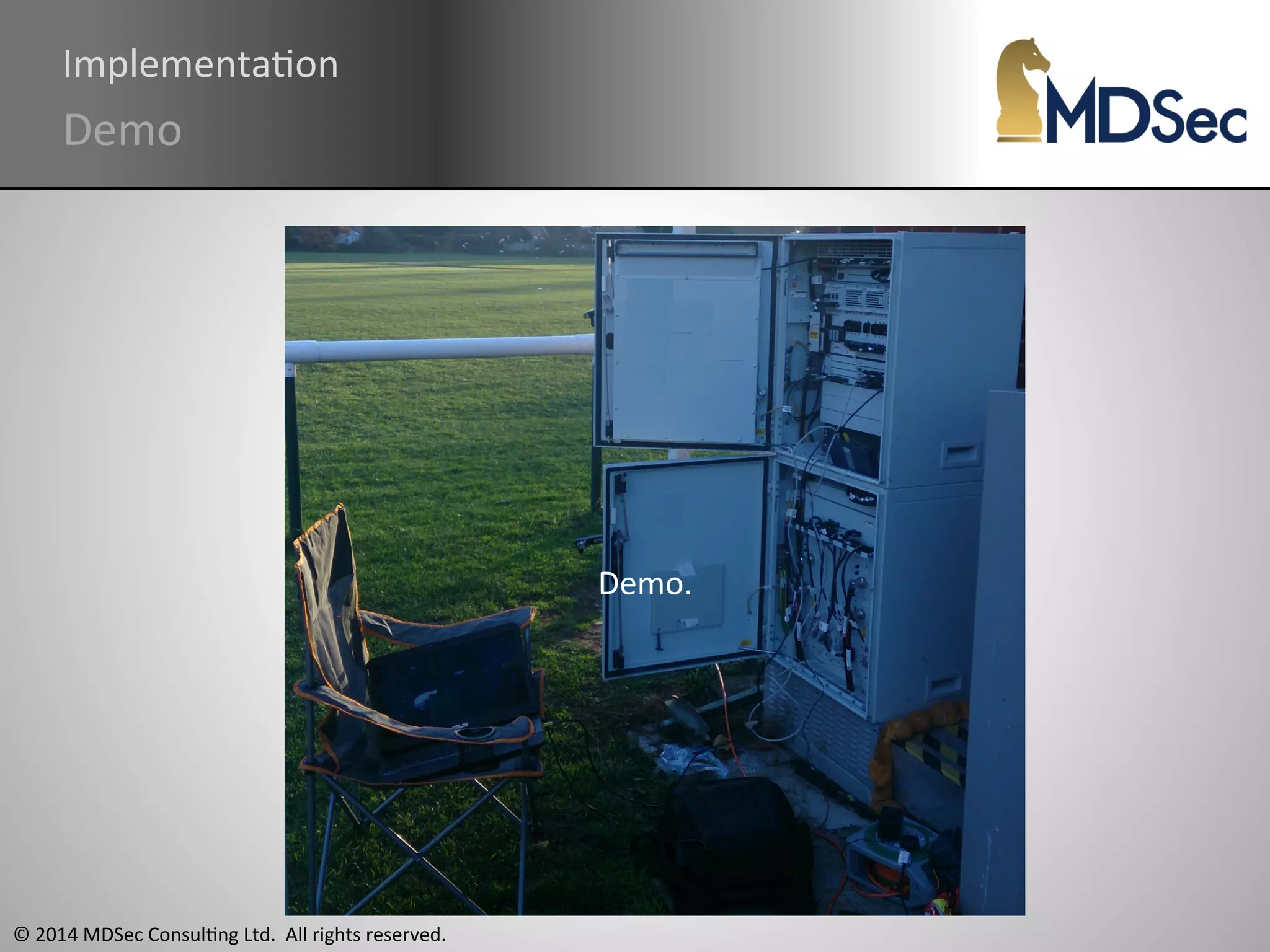
Demo.
GreedyBTS 
– 
Hacking 
Adventures 
in 
GSM 
Conclusions 
• InformaAon 
sent 
over 
your 
mobile 
phone 
may 
not 
be 
as 
secure 
as 
you 
think. 
• DetecAon 
of 
GSM 
aOacks 
is 
sAll 
in 
it’s 
infancy, 
some 
tools 
are 
beginning 
to 
surface 
which 
detect 
greedyBTS 
but 
they 
will 
require 
“acAve” 
use 
and 
aimed 
at 
power 
users. 
• If 
you 
are 
transmiung 
sensiAve 
informaAon 
such 
as 
usernames 
or 
passwords 
consider 
using 
a 
non-­‐wireless 
technology. 
• An 
aOacker 
can 
launch 
aOacks 
against 
your 
mobile 
device 
without 
you 
being 
aware 
using 
2.5G, 
we 
need 
baseband 
security 
enhancements 
and 
access 
to 
cell 
data. 
© 
2014 
MDSec 
ConsulAng 
Ltd. 
All 
rights 
reserved. 
E-­‐mail: 
hackerfantasAc@riseup.net 
TwiOer: 
@HackerFantasAc 
hOps://github.com/hackerfantasAc/public
QuesAons? 
Thank 
you 
for 
all 
the 
hard 
work 
done 
by 
members 
of 
the 
open-­‐source 
and 
security 
research 
communiAes 
in 
making 
2.5G 
networks 
more 
© 
2014 
MDSec 
ConsulAng 
Ltd. 
All 
rights 
reserved. 
accessible 
for 
analysis. 
TwiOer: 
@MDSecLabs 
Blog: 
hOp://blog.mdsec.co.uk

44CON 2014 - GreedyBTS: Hacking Adventures in GSM, Hacker Fantastic

  • 1.
    GreedyBTS – Hacking Adventures in GSM
  • 2.
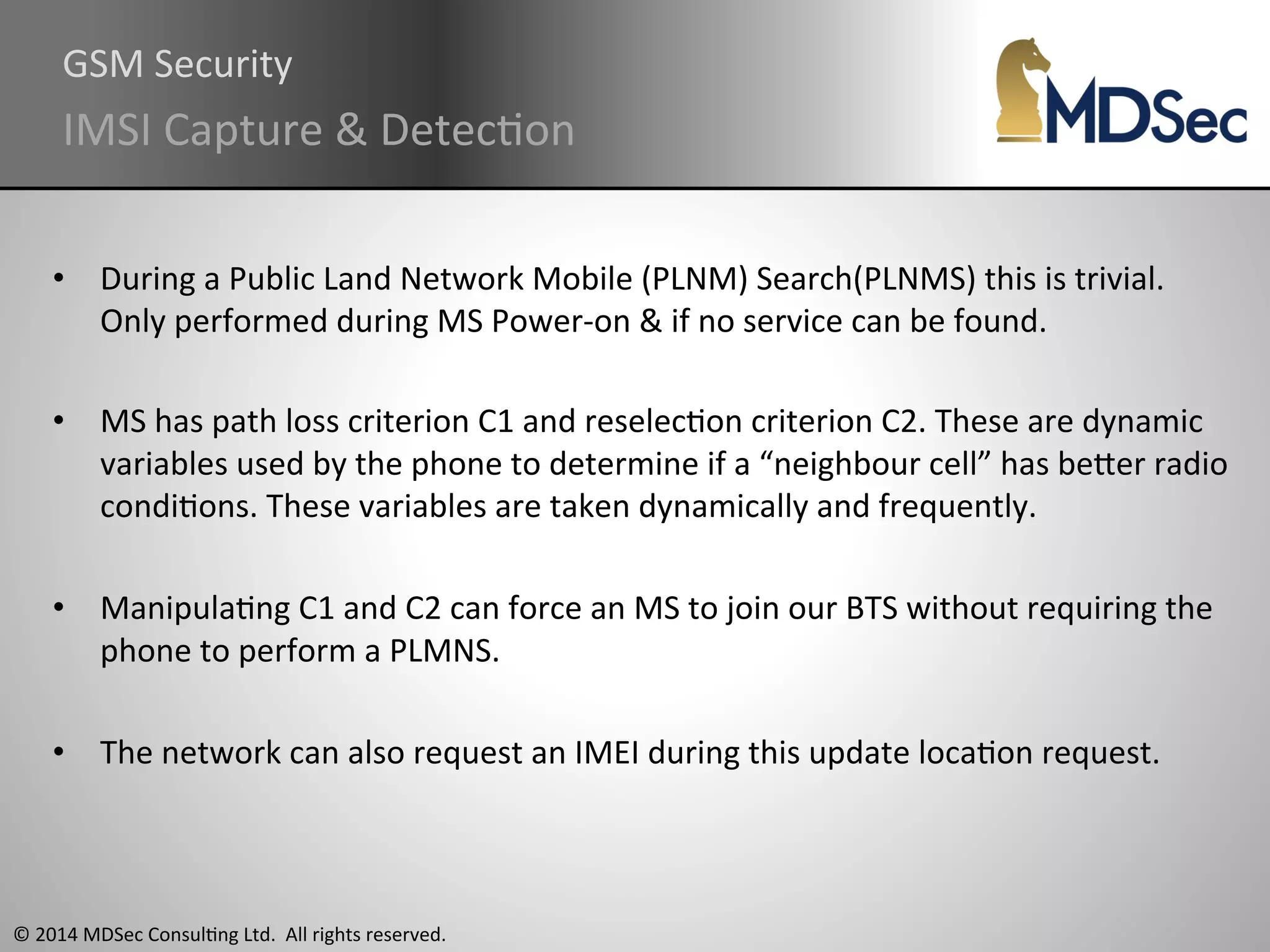
    GreedyBTS – Hacking Adventures in GSM Agenda • Who am I? • Technical overview of 2.5G environments • Cellular environment diagnosAcs and tools • Security vulnerabiliAes in GSM • CreaAng an open-­‐source 2.5G simulaAon environment for analysis. • ImplementaAons of GSM aOacks • Demo © 2014 MDSec ConsulAng Ltd. All rights reserved.
  • 3.
    2.5G Technical Overview IntroducAon to GSM • June 2008 – 2.9 BILLION © 2014 MDSec ConsulAng Ltd. All rights reserved. subscribers use GSM. • Replaced Analogue “Total Access CommunicaAon System” in the UK. (TACS) • GSM is a European Wide Standard started in 1982 by Groupe Spécial Mobile. • Digital standard with new Security aOempAng to address losses due to Fraud. • GPRS created to work with GSM and address data needs, 2.5G. • UMTS and LTE, 3rd and 4th generaAon networks have arrived – 2.5G sAll here. • How vulnerable are 2.5G networks & GSM communicaAons today?
  • 4.
    2.5G Technical Overview GSM Architecture • Mobile StaAon is your phone. • BSS provides the air interface between network & phone. • Network Switching subsystem provides authenAcaAon, idenAty, billing and more. • The architecture shown is a typical 2G GSM environment. © 2014 MDSec ConsulAng Ltd. All rights reserved.
  • 5.
    2.5G Technical Overview Mobile StaAon (MS). • InternaAonal mobile staAon equipment idenAty (IMEI) • Contains uniquely idenAfiable informaAon on device. • SIM card contains subscriber informaAon. • InternaAonal mobile subscriber idenAty (IMSI). • Mobile Country Code – MCC -­‐ 3 digits. • Mobile Network Code – MNC – 2 digits. • Mobile Subscriber IdenAficaAon Number – MSIN – (max 10). • SIM card also holds encrypAon keys. • Your phone contains a baseband processor and RTOS used by GSM. © 2014 MDSec ConsulAng Ltd. All rights reserved.
  • 6.
    2.5G Technical Overview What is a SIM card? • Described in GSM 11.14. • Subscriber IdenAty Module. • Stores the IMSI and Ki key. • Ki key needed for network authenAcaAon & Air encrypAon. • Programmable card can be used which has a writeable Ki key. • GSM test cards with a writeable Ki key can be bought online. © 2014 MDSec ConsulAng Ltd. All rights reserved.
  • 7.
    2.5G Technical Overview ISO7816 & SIM Toolkit • ISO7816 defines a physical smart card standard. • SIM ApplicaAon Toolkit (STK) is implemented by GSM smart cards. • GSM applicaAon provides authenAcaAon APDU's. • COMP128v1 is an encrypAon algorithm that was found to be flawed. • A “stop” condiAon was found that allows Ki to be brute forced. • COMP128v1 aOack takes 12-­‐24 hours and requires physical card. • COMP128v3 is used more widely today and COMP128v1 is rare. • Chinese vendors sell cheap COMP128v1 mulA-­‐SIM cards & cloner. • SIM Trace hOp://bb.osmocom.org/trac/wiki/SIMtrace • For more informaAon on SIM aOacks THC have a SIM Toolkit Research Group project that contains a lot more informaAon! © 2014 MDSec ConsulAng Ltd. All rights reserved.
  • 8.
    2.5G Technical Overview What’s a Base Transceiver System (BTS)? • TransmiOer and receiver equipment, such as antennas and amplifiers. • Has components for doing digital signal processing (DSP). • Contains funcAons for Radio Resource management. • Provides the air (UM) interface to a MS. • This is part of a typical “cell tower” that is used by GSM. • BTS provides the radio signalling between a network and phone. • Base StaAon Subsystem (BSS) has addiAonal component Base StaAon Controller that provides logic & intelligence. © 2014 MDSec ConsulAng Ltd. All rights reserved.
  • 9.
    2.5G Technical Overview Radio & Cellular? • The spectrum is divided into uplink/downlink “channels”. • GSM uses Absolute Radio Frequency Channel Number (ARFCN). • Cellular Network means channels can be re-­‐used within different spaAal areas. • This is how a small number of frequencies can provide a naAonal network! © 2014 MDSec ConsulAng Ltd. All rights reserved.
  • 10.
    2.5G Technical Overview Physical Interface • Waterfall views of GSM ARFCN downlink (leq) and uplink (right). • ARFCN is 200kHz channel and this is divided into TDMA slots. • Five different types of “bursts” are modulated within. © 2014 MDSec ConsulAng Ltd. All rights reserved.
  • 11.
    2.5G Technical Overview Radio & Cellular? • GSM communicates using Time Division MulAple Access / Frequency Division MulAple Access (TDMA/ FDMA) principles. • Space Division MulAple Access gives the cellular concept. • Traffic transmiOed as “bursts”. • Radio modulaAon is using Gaussian Minimum Shiq Keying (GMSK). • GMSK is variant of frequency shiq keying (FSK) designed to reduce bandwidth, minimum shiq keying (MSK) with further Gaussian bandpass (GMSK). © 2014 MDSec ConsulAng Ltd. All rights reserved.
  • 12.
    2.5G Technical Overview Network Switching Subsystem • The GSM core network components usually not visible to aOacker. • Mobile Switching Centre (MSC). • Home Locality Registrar (HLR). • Visitor Locality Registrar (VLR). • Equipment IdenAty Registrar (EIR). • These are components or databases that handle subscribers informaAon, IMSI/ encrypAon keys and perform processes like billing. • Also where the call switching and rouAng takes place and connecAng to other networks e.g. PSTN. © 2014 MDSec ConsulAng Ltd. All rights reserved.
  • 13.
    2.5G Technical Overview GSM Logical Channels • GSM implements logical channels to allow for signalling between handset and network. • There is a defined Traffic Channel (TCH) – Full-­‐rate and Half-­‐rate channels are available as TCH/F (Bm), TCH/H (Lm). • There are Signalling channels (Dm). • Many exploitable weaknesses in GSM are due to “in-­‐band” signalling. • This same class of vulnerability is what allows phreaker “blue boxes” to funcAon and responsible for “format string aOacks.” – where management capability is accessible it has potenAal for subverAng. © 2014 MDSec ConsulAng Ltd. All rights reserved.
  • 14.
    2.5G Technical Overview Broadcast Channel (BCH) • The BCH is used by a MS to synchronize it’s oscillator and frequency with the BTS. • The BCH consists of sub-­‐channels that assist with this process. • Broadcast Control -­‐ BCCH • Frequency CorrecAon -­‐ FCCH • SynchronizaAon – SCH • The channels are used during the preliminary stages of a MS being powered on and are integral part of “geung a signal”. © 2014 MDSec ConsulAng Ltd. All rights reserved.
  • 15.
    2.5G Technical Overview Common Control Channel -­‐ CCCH • The CCCH is used by MS and BTS for communicaAng requests for resources with network and handset such as when a call aOempt is placed. • Random Access Channel -­‐ RACH • Access Grant Channel -­‐ AGCH • Paging Channel -­‐ PCH • NoAficaAon Channel – NCH • Temporary Mobile Subscriber IdenAty (TMSI) is used to help prevent tracking of a GSM user, can be frequently changed and has a lifeAme limit. © 2014 MDSec ConsulAng Ltd. All rights reserved.
  • 16.
    2.5G Technical Overview Dedicated Control Channels -­‐ DCCH • The DCCH and it’s associated sub-­‐channels perform authenAcaAon requests, cipher selecAon & signalling of call compleAon. • Standalone dedicated control -­‐ SDCCH • Slow associated control -­‐ SACCH • Fast associated control – FACCH • Summary of the three control channels and purpose of each. • AOacker could exploit GSM signalling weaknesses to access subscriber mobile usage. We will look at this in more detail. © 2014 MDSec ConsulAng Ltd. All rights reserved.
  • 17.
    2.5G Technical Overview What about Over-­‐the-­‐Air EncrypAon? • Several over-­‐the-­‐air (OTA) encrypAon algorithms exist. These are used to encrypt *some* of the GSM logical channels data (such as TCH). • A5/1 – publicly broken, rainbow tables exist. • A5/2 – offers no real security. • A5/3 – KASUMI Cipher, although some man-­‐in-­‐the-­‐middle aOacks are known – it has not yet been publicly broken in GSM. • A3/A8 -­‐ used during the authenAcaAon process. • AOacker can aOempt to “passively” analyse traffic looking for weak encrypAon or perform man-­‐in-­‐the-­‐middle aOacks against subscriber MS and BTS. © 2014 MDSec ConsulAng Ltd. All rights reserved.
  • 18.
    2.5G Technical Overview General Packet Radio Service • Uses exisAng GSM concepts, e.g. Ameslots. • Introduces “Subscriber GPRS Service Node” (SGSN) and “Gateway GPRS Service Node” (GGSN). • Adds Packet Control Unit to BSS. • Data is sent in PCU frames. • Introduces a new Radio Resource (RR) protocol. • Radio Link Control (RLC) / Media Access Control (MAC) © 2014 MDSec ConsulAng Ltd. All rights reserved.
  • 19.
    Cell DiagnosAcs & Tools Nokia NetMonitor • Nokia shipped diagnosAc tool in early phones. • Can be enabled on phone such as 3310 using cable • Provides a cellular diagnosAc tool! • ARFCN idenAficaAon! • Signalling channel display! • Uplink Traffic capture! • Very cool “feature” of Nokia ;) © 2014 MDSec ConsulAng Ltd. All rights reserved.
  • 20.
    Cell DiagnosAcs & Tools Dedicated Test Hardware • eBay is your friend. • GSM tesAng hardware prices vary wildly. • Open-­‐source tools are now more flexible. • GSM tesAng hardware is oqen not very featured. • The price of dedicated hardware can be very high. • Vendors oqen not forthcoming with help. © 2014 MDSec ConsulAng Ltd. All rights reserved.
  • 21.
    Cell DiagnosAcs & Tools Osmocom-­‐bb & GNU/Plot • Osmocom-­‐bb allows you to write tools for MS baseband. • Lots of useful diagnosAcs already available in the public repository. • You can extend the code to visually represent the GSM spectrum or perform more detailed analysis of a GSM cell tower. • Requires a <£30 phone to use. © 2014 MDSec ConsulAng Ltd. All rights reserved.
  • 22.
    Cell DiagnosAcs & Tools GSMTAP • Useful to debug the radio interface. • GSMTAP encapsulates RF informaAon and transmits it in a UDP encapsulated packet. • This allows us to see the Um interface traffic from a BTS or MS of downlink and uplink. • Extremely useful capability when analysing GSM. © 2014 MDSec ConsulAng Ltd. All rights reserved.
  • 23.
    Cell DiagnosAcs & Tools AirProbe & Sniffing • GNU/Radio is used to capture the RF of a GSM ARFCN. • GSM receiver and toolkit exists for doing capture of GSM bursts & decoding of the data. • £20< RTLSDR dongles can be used to capture GSM traffic. • Purely passive analysis allows for idenAficaAon of call requests. TCH channel should use encrypAon. • Kraken tool can decrypt A5/1 on TCH, requires 1.6TB rainbow tables. • Wireshark can parse the GSMTAP output and sniff the air interface. © 2014 MDSec ConsulAng Ltd. All rights reserved.
  • 24.
    GSM Security MS Power-­‐On Process • MS starts a search for BCCH carriers performing RSSI measurements. • Aqer idenAfying the BCCH, the phone probes for presence of FCCH. • The phone “syncs” and obtains informaAon about the BTS it has idenAfied. • The phone now knows to monitor “neighbour cells” it has decoded from the transmission. • This process is what is exploited by IMSI capture devices and fake BTS aOack tools. © 2014 MDSec ConsulAng Ltd. All rights reserved.
  • 25.
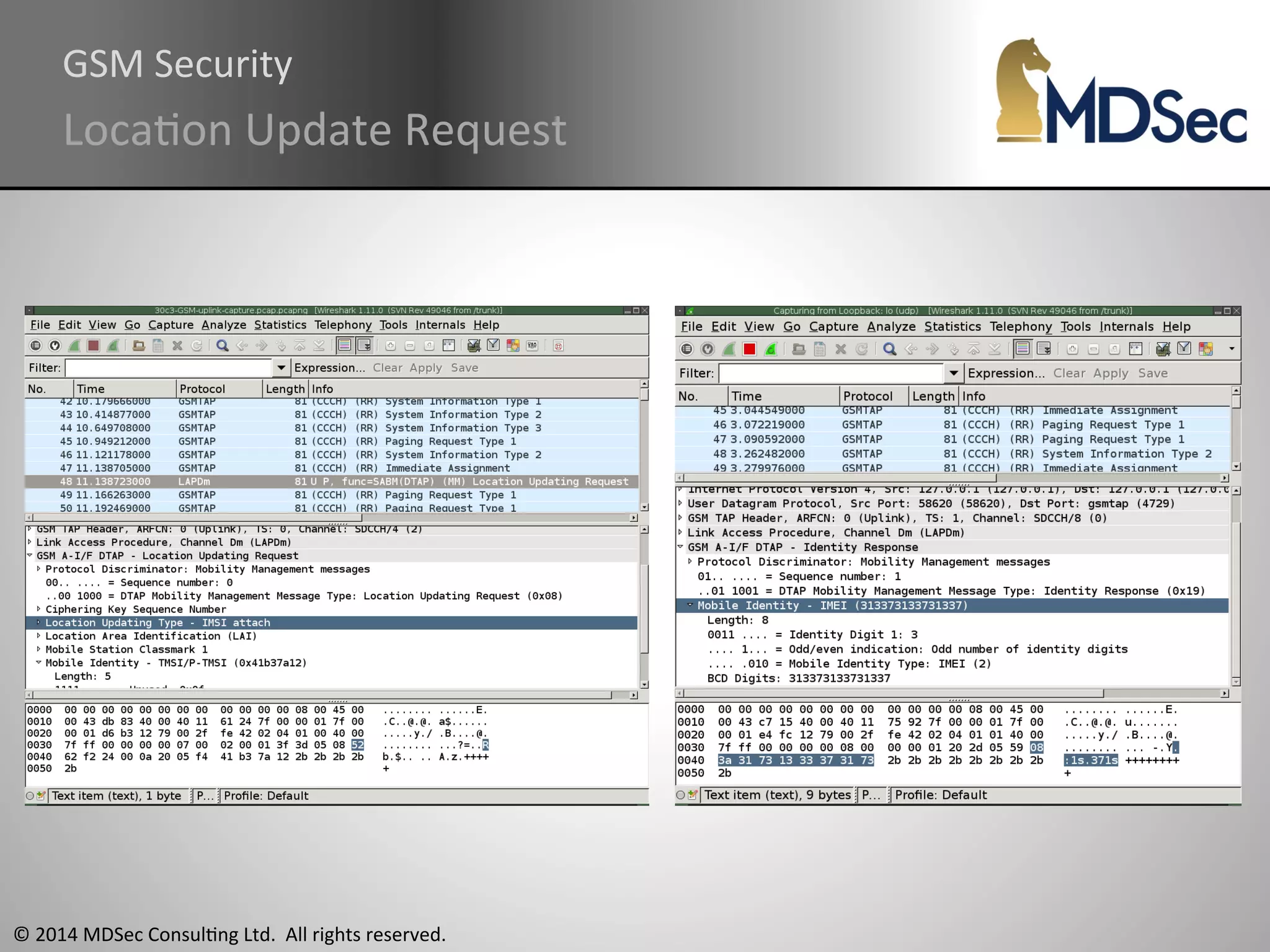
    GSM Security IMSI Capture & DetecAon • During a Public Land Network Mobile (PLNM) Search(PLNMS) this is trivial. Only performed during MS Power-­‐on & if no service can be found. • MS has path loss criterion C1 and reselecAon criterion C2. These are dynamic variables used by the phone to determine if a “neighbour cell” has beOer radio condiAons. These variables are taken dynamically and frequently. • ManipulaAng C1 and C2 can force an MS to join our BTS without requiring the phone to perform a PLMNS. • The network can also request an IMEI during this update locaAon request. © 2014 MDSec ConsulAng Ltd. All rights reserved.
  • 26.
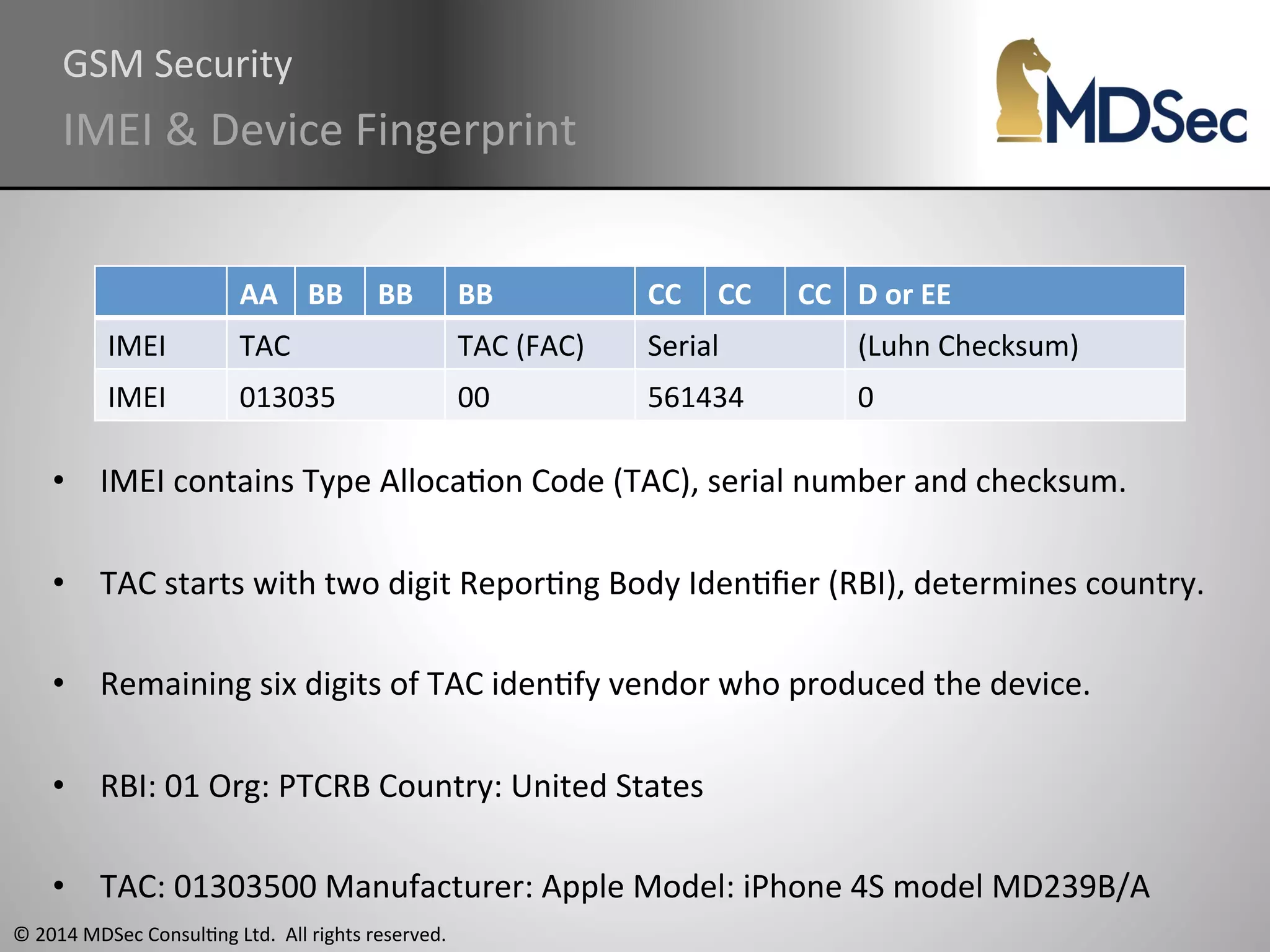
    GSM Security IMEI & Device Fingerprint IMEI TAC TAC (FAC) Serial (Luhn Checksum) IMEI 013035 00 561434 0 • IMEI AA BB BB BB CC CC CC D or EE contains Type AllocaAon Code (TAC), serial number and checksum. • TAC starts with two digit ReporAng Body IdenAfier (RBI), determines country. • Remaining six digits of TAC idenAfy vendor who produced the device. • RBI: 01 Org: PTCRB Country: United States • TAC: 01303500 Manufacturer: Apple Model: iPhone 4S model MD239B/A © 2014 MDSec ConsulAng Ltd. All rights reserved.
  • 27.
    GSM Security LocaAon Update Request © 2014 MDSec ConsulAng Ltd. All rights reserved.
  • 28.
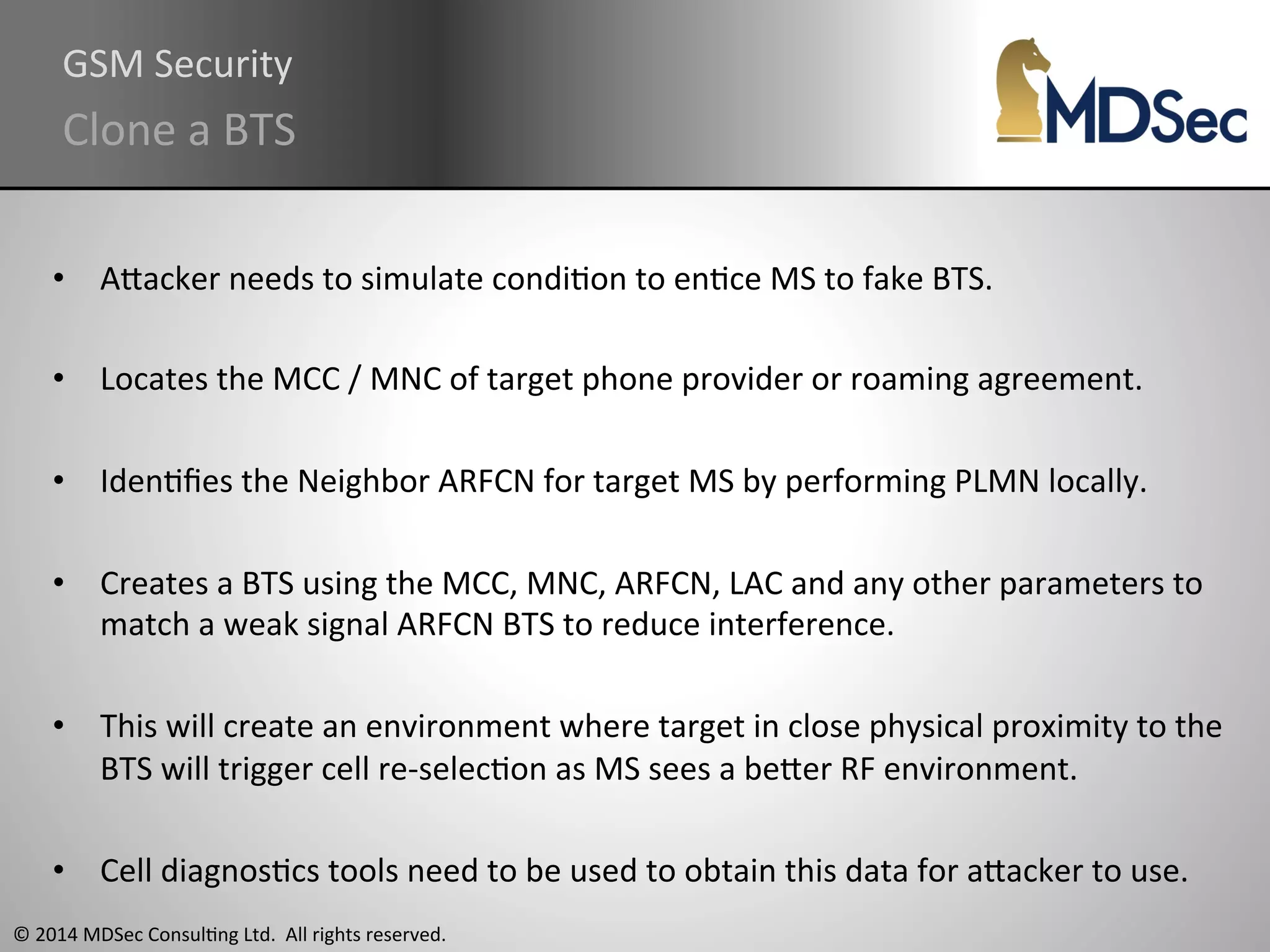
    GSM Security Clone a BTS • AOacker needs to simulate condiAon to enAce MS to fake BTS. • Locates the MCC / MNC of target phone provider or roaming agreement. • IdenAfies the Neighbor ARFCN for target MS by performing PLMN locally. • Creates a BTS using the MCC, MNC, ARFCN, LAC and any other parameters to match a weak signal ARFCN BTS to reduce interference. • This will create an environment where target in close physical proximity to the BTS will trigger cell re-­‐selecAon as MS sees a beOer RF environment. • Cell diagnosAcs tools need to be used to obtain this data for aOacker to use. © 2014 MDSec ConsulAng Ltd. All rights reserved.
  • 29.
    GSM Security Clone a BTS • Osmocom-­‐BB is very versaAle, GNU/Radio or gsm-­‐receiver tool could also be used. Osmocom-­‐BB mobile includes “monitor” command that provides RSSI monitoring of current and Neighbor ARFCN. © 2014 MDSec ConsulAng Ltd. All rights reserved.
  • 30.
    GSM Security RACH & TMSI Paging AOacks • Random Access requests have a finite resource. • AOacker can conAnually request resources via RACH prevenAng users being able to place new calls once all available resources are consumed. • TMSI is vulnerable to a race condiAon when the BTS is paging, aOacker can answer all pages prevenAng legiAmate communicaAon. • An aOacker responds to pages made by the BTS to idenAfy a parAcular phone causing the original request to be unanswered. • Both aOacks can be implemented in osmocom-­‐bb. • Both aOacks could be used to perform a “DoS” of a BTS. © 2014 MDSec ConsulAng Ltd. All rights reserved.
  • 31.
    GSM Security Downgrade & Jamming • LTE, UMTS and GSM can be “jammed” to downgrade/force connecAons. • Overpower the analogue components of a radio with a stronger signal. • Asian devices are oqen mulA-­‐band 1-­‐10WaO radios and go against EMC. • Protocols aOempt to address “noise” or “sawtooth” jamming. • None suitable for researchers or tesAng. • Effect can be simulated by disabling 4G/3G. • Wireless & Telegraphy Act in UK forbids use. © 2014 MDSec ConsulAng Ltd. All rights reserved.
  • 32.
    2.5G SimulaAon OpenBTS -­‐ Architecture © 2014 MDSec ConsulAng Ltd. All rights reserved.
  • 33.
    ImplementaAon GreedyBTS – USRP E100 • GumsAx Overo (computer-­‐on-­‐module) • TI OMAP-­‐3 SoC ARM Cortex-­‐A8 • C64 DSP • Xilinx Spartan 3A-­‐DSP 1800 FPGA • SBX (400Mhz – 4.4Ghz) 100 mW • GPSDO Kit –or-­‐ Clock Tamer • EOus provide Angstrom Linux Image (e1xx-­‐003) with GNU/Radio 3.6.4.1 © 2014 MDSec ConsulAng Ltd. All rights reserved.
  • 34.
    2.5G SimulaAon EMC & Shielding TX 50 Ω (ohm) load & RX 900Mhz omnidirecAonal antenna. Spectrum Analyser inside and outside enclosure (use a second SDR!) © 2014 MDSec ConsulAng Ltd. All rights reserved.
  • 35.
    2.5G SimulaAon EMC & Shielding © 2014 MDSec ConsulAng Ltd. All rights reserved.
  • 36.
    ImplementaAon GreedyBTS – E100 firmware • Spent a lot of Ame trying to build Angstrom for USRP E-­‐1xx from scratch with limited success. • Used EOus E1xx_3 firmware, cross-­‐compiled new Kernel (no ne}ilter support or IP forwarding) and built packages from source with addiAonal opAons such as ODBC and SQLite support. • OpenBTS 5.0 and OpenBTS 2.8 (with mini-­‐SGSN GPRS support) both installed. • OpenBTS transceiver applicaAon has been broken for E1xx, modified for 5.0. • I made minor patches to OpenBTS for more stealth operaAon (i.e. no welcome messages), increased logging in L3 Mobility Management events and disable SGSN firewalling for GPRS aOacks. • Asterisk configured with real-­‐Ame SQLite support and automaAc logging via monitor(). • Console interface script for interacAng with components and BTS. • Integrated DB for IMEI fingerprinAng (50000+ devices) & MCC/MNC search. © 2014 MDSec ConsulAng Ltd. All rights reserved.
  • 37.
    ImplementaAon GreedyBTS – E100 firmware © 2014 MDSec ConsulAng Ltd. All rights reserved.
  • 38.
    ImplementaAon GreedyBTS -­‐ Features • Useful events are sent to “greedyBTS.log” for logging and use by console app. • Can dynamically provision a phone based on regex of IMSI or IMEI. • Use’s real-­‐Ame configuraAon, can be leq to run “headless” in target area. • Useful uAliAes (airprobe, osmo-­‐arfcn, tshark, tcpdump, libpcap) built. • CDR records keep detail of subscriber communicaAon aOempts. • Call content is automaAcally recorded to “call-­‐recordings” directory. • Can use Asterisk for connecAng users to PSTN or amusement. • GPRS is auto-­‐configured, if the BTS has an internet connecAon so does phone. • Example background exploit iPwn aOacks MS over GPRS. • Designed to be used against a specific target (1 or 2 users) in a small geographical area. • Clone the BTS environment of CEO office, enter RegEx of CEO IMEI and wait ;-­‐) • It’s Linux! You can roll your own aOacks / backdoors on-­‐top. © 2014 MDSec ConsulAng Ltd. All rights reserved.
  • 39.
    ImplementaAon GreedyBTS -­‐ Features © 2014 MDSec ConsulAng Ltd. All rights reserved.
  • 40.
    ImplementaAon GreedyBTS + iPwn • GPRS can be very slow to launch an exploit or extract data! © 2014 MDSec ConsulAng Ltd. All rights reserved.
  • 41.
    ImplementaAon Download •You will need an 8GB MicroSD card to install in E100. • Change default root password on login and change SSH keys. • hOps://mega.co.nz/#!hAU2iJyB! GK54dtAxUVXavcZUGPJPDl7X3_OjpnPqs_qSZfc9iwE • 726f9d810aca42ed5ba3034efe6b6a2a © 2014 MDSec ConsulAng Ltd. All rights reserved. greedyBTS-­‐44CON-­‐v1.img.enc • openssl aes-­‐256-­‐cbc -­‐d -­‐in greedyBTS-­‐44CON-­‐v1.img.enc -­‐out greedyBTS-­‐44CON-­‐v1.img (Contact me for password.) • 4667f83fdc4a30245fdcc49946833e5d greedyBTS-­‐44CON-­‐v1.img • dd if=./greedyBTS-­‐44CON-­‐v1.img of=/dev/sdc bs=1024 • Discussed in Feb on OpenBTS / USRP mailing lists, 7:1 GSM researchers mailed in favor of image sharing in a controlled way.
  • 42.
    ImplementaAon Example traffic • Interested in GSM? • Here is a PCAP trace of 2.5G environment showing uplink/downlink, two MS devices, SIM APDU informaAon! • Recommend reading a good book and review in wireshark! • hOps://github.com/HackerFantasAc/Public/blob/master/misc/44CON-­‐gsm-­‐ uplink-­‐downlink-­‐sim-­‐example.pcap • BeagleBone Black and NanoBTS/USRP B200/BladeRF could be used in future for cheaper alternaAve! © 2014 MDSec ConsulAng Ltd. All rights reserved.
  • 43.
    ImplementaAon Demo © 2014 MDSec ConsulAng Ltd. All rights reserved. Demo.
  • 44.
    GreedyBTS – Hacking Adventures in GSM Conclusions • InformaAon sent over your mobile phone may not be as secure as you think. • DetecAon of GSM aOacks is sAll in it’s infancy, some tools are beginning to surface which detect greedyBTS but they will require “acAve” use and aimed at power users. • If you are transmiung sensiAve informaAon such as usernames or passwords consider using a non-­‐wireless technology. • An aOacker can launch aOacks against your mobile device without you being aware using 2.5G, we need baseband security enhancements and access to cell data. © 2014 MDSec ConsulAng Ltd. All rights reserved. E-­‐mail: hackerfantasAc@riseup.net TwiOer: @HackerFantasAc hOps://github.com/hackerfantasAc/public
  • 45.
    QuesAons? Thank you for all the hard work done by members of the open-­‐source and security research communiAes in making 2.5G networks more © 2014 MDSec ConsulAng Ltd. All rights reserved. accessible for analysis. TwiOer: @MDSecLabs Blog: hOp://blog.mdsec.co.uk