Second approach: “Classical” approach
based on a priori criteria
2014
Page
1
18
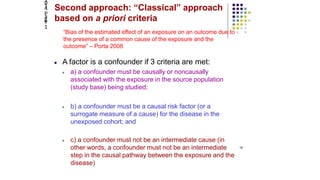
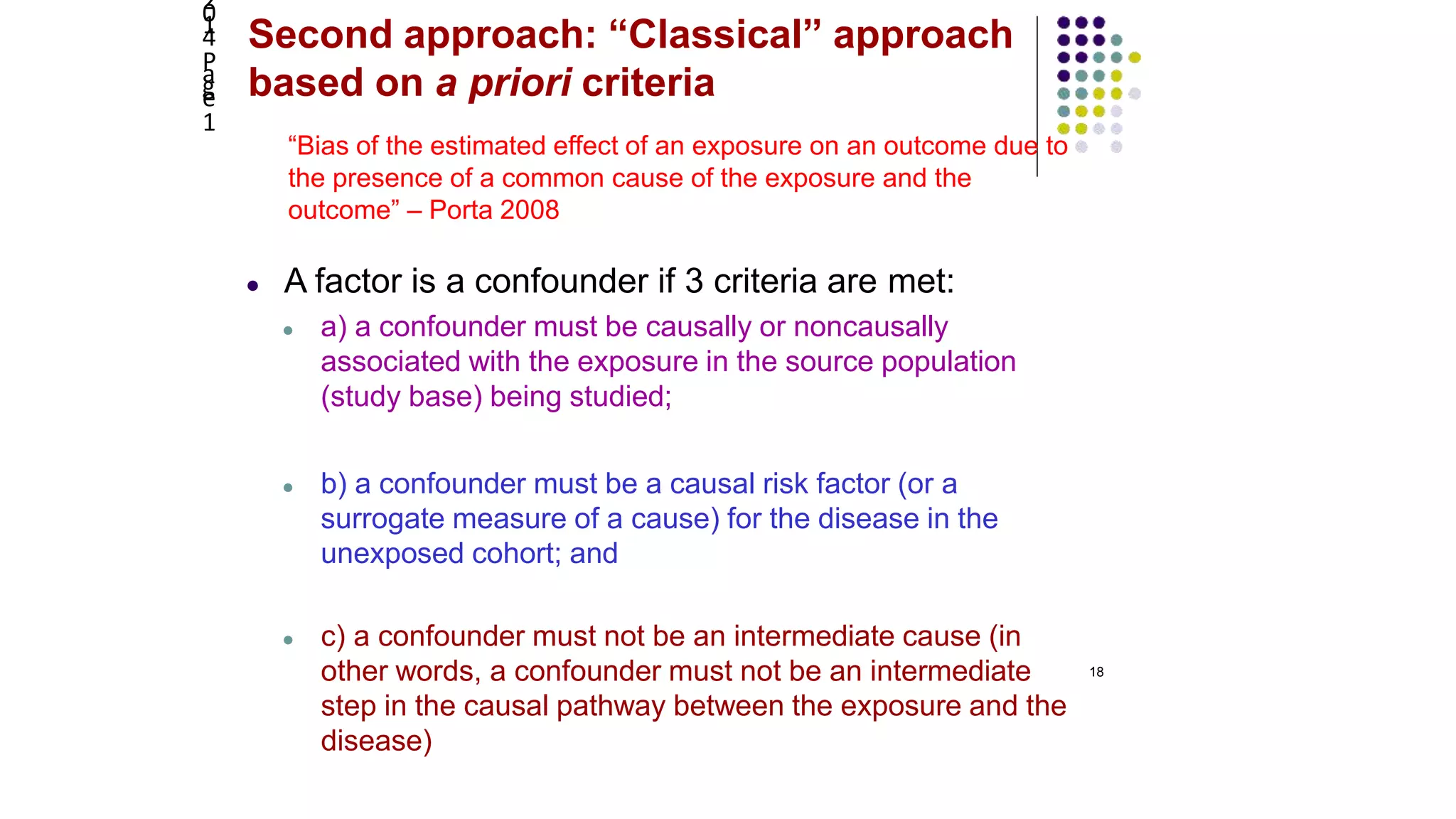
“Bias of the estimated effect of an exposure on an outcome due to
the presence of a common cause of the exposure and the
outcome” – Porta 2008
● A factor is a confounder if 3 criteria are met:
● a) a confounder must be causally or noncausally
associated with the exposure in the source population
(study base) being studied;
● b) a confounder must be a causal risk factor (or a
surrogate measure of a cause) for the disease in the
unexposed cohort; and
● c) a confounder must not be an intermediate cause (in
other words, a confounder must not be an intermediate
step in the causal pathway between the exposure and the
disease)
19
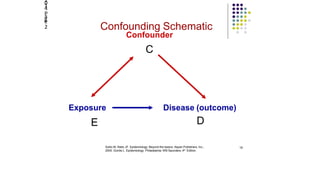
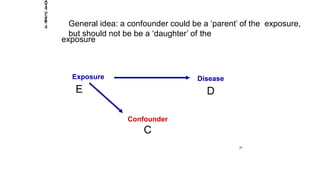
Exposure
E
2014
Page
2
Disease (outcome)
D
Confounder
C
Confounding Schematic
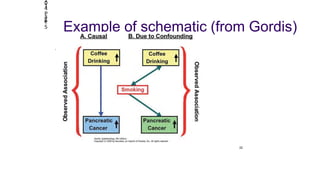
Szklo M, Nieto JF. Epidemiology: Beyond the basics. Aspen Publishers, Inc.,
2000. Gordis L. Epidemiology. Philadelphia: WB Saunders, 4th Edition.
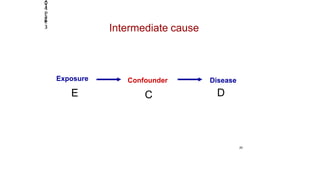
Exposure
E
Confounder
C
Intermediate cause
Disease
D
20
2014
Page
3
Exposure
E
Confounder
C
General idea: a confounder could be a ‘parent’ of the exposure,
but should not be be a ‘daughter’ of the
exposure
Disease
D
21
2014
Page
4
Example of schematic (from Gordis)
22
2014
Page
5
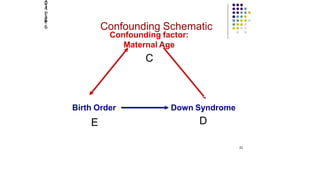
Birth Order
E
2014
Page
6
23
Down Syndrome
D
Confounding factor:
Maternal Age
C
Confounding Schematic
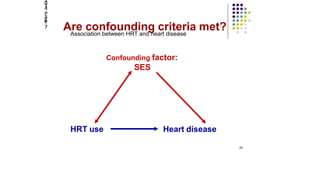
HRT use Heart disease
Association between HRT and heart disease
Confounding factor:
SES
2014
Page
7
24
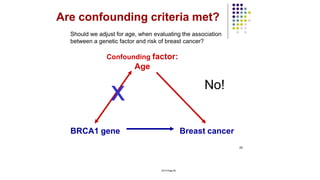
Are confounding criteria met?
BRCA1 gene Breast cancer
Confounding factor:
Age
x
2014 Page 30
25
Are confounding criteria met?
Should we adjust for age, when evaluating the association
between a genetic factor and risk of breast cancer?
No!
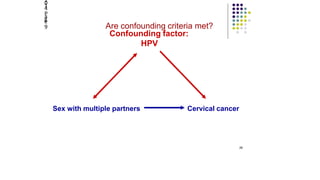
Sex with multiple partners Cervical cancer
Confounding factor:
HPV
Are confounding criteria met?
2014
Page
9
26
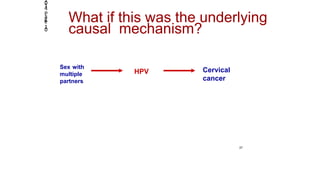
Sex with
multiple
partners
HPV Cervical
cancer
2014
Page
10
27
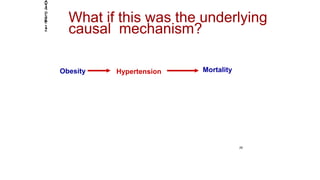
What if this was the underlying
causal mechanism?
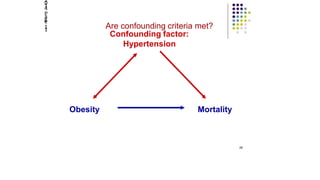
Obesity Mortality
Are confounding criteria met?
2014
Page
11
Confounding factor:
Hypertension
28
Obesity Hypertension Mortality
2014
Page
12
29
What if this was the underlying
causal mechanism?
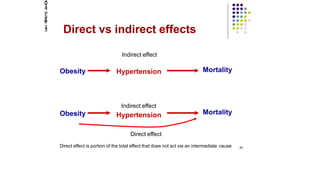
Direct vs indirect effects
Obesity Hypertension Mortality
Obesity
Indirect effect
Hypertension Mortality
Direct effect
2014
Page
13
Direct effect is portion of the total effect that does not act via an intermediate cause 30
Indirect effect
Hernan MA, et al. Causal knowledge as a prerequisite for confounding evaluation: an
appl3ic3ation to birth defects epidemiology. Am J Epidemiol 2002;155(2):176-84.
2014
Page
14 Simple causal
graphs
DC E
Maternal age (C) can confound the association
between multivitamin use (E) and the risk of certain
birth defects (D)
34
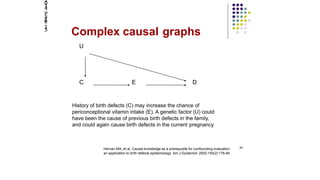
Complex causal graphs
Hernan MA, et al. Causal knowledge as a prerequisite for confounding evaluation:
an application to birth defects epidemiology. Am J Epidemiol 2002;155(2):176-84.
E DC
U
History of birth defects (C) may increase the chance of
periconceptional vitamin intake (E). A genetic factor (U) could
have been the cause of previous birth defects in the family,
and could again cause birth defects in the current pregnancy
2014
Page
15
35
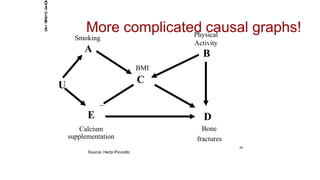
Smoking
A
E
Calcium
D
Bone
fractures
C
BMI
supplementation
U
Physical
Activity
B
2014
Page
16
Source: Hertz-Picciotto
More complicated causal graphs!
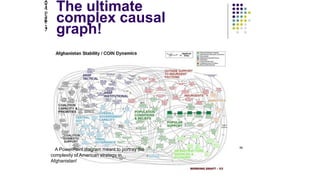
The ultimate
complex causal
graph!
36
A PowerPoint diagram meant to portray the
complexity of American strategy in
Afghanistan!
2014
Page
17

4.2.2. confounding classical approach