Association & Causation
A BASIC CONCEPT IN EPIDEMIOLOGY
DR SHYAM ASHTEKAR, SMBT MED COLLEGE
DEC 2016
1
12/21/2016
2
Is Nota-bandi
cause of Q deaths?
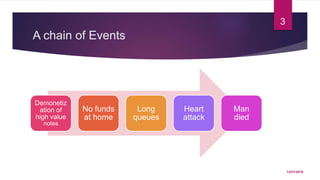
A chain of Events
Demonetiz
ation of
high value
notes
No funds
at home
Long
queues
Heart
attack
Man
died
12/21/2016
3
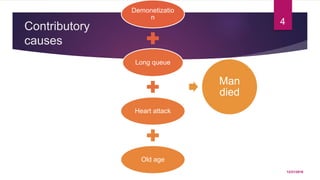
Contributory
causes
Demonetizatio
n
Long queue
Heart attack
Old age
Man
died
12/21/2016
4
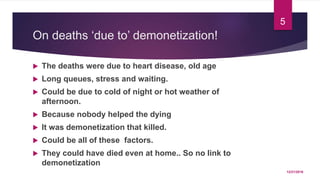
On deaths ‘due to’ demonetization!
 The deaths were due to heart disease, old age
 Long queues, stress and waiting.
 Could be due to cold of night or hot weather of
afternoon.
 Because nobody helped the dying
 It was demonetization that killed.
 Could be all of these factors.
 They could have died even at home.. So no link to
demonetization
12/21/2016
5
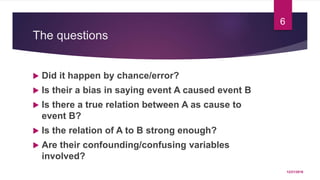
The questions
 Did it happen by chance/error?
 Is their a bias in saying event A caused event B
 Is there a true relation between A as cause to
event B?
 Is the relation of A to B strong enough?
 Are their confounding/confusing variables
involved?
12/21/2016
6
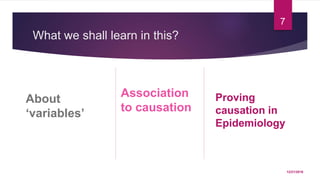
What we shall learn in this?
About
‘variables’
Proving
causation in
Epidemiology
Association
to causation
12/21/2016
7
It is all about
Variables/Factors/Events
8
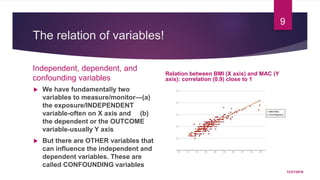
The relation of variables!
Independent, dependent, and
confounding variables
 We have fundamentally two
variables to measure/monitor—(a)
the exposure/INDEPENDENT
variable-often on X axis and (b)
the dependent or the OUTCOME
variable-usually Y axis
 But there are OTHER variables that
can influence the independent and
dependent variables. These are
called CONFOUNDING variables
Relation between BMI (X axis) and MAC (Y
axis): correlation (0.9) close to 1
12/21/2016
9
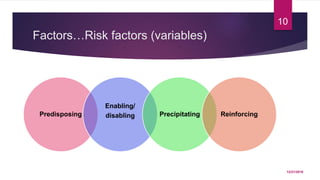
Factors…Risk factors (variables)
Predisposing
Enabling/
disabling Precipitating Reinforcing
12/21/2016
10
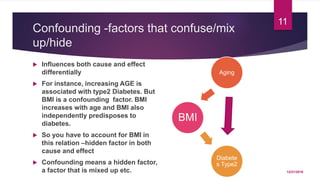
Confounding -factors that confuse/mix
up/hide
 Influences both cause and effect
differentially
 For instance, increasing AGE is
associated with type2 Diabetes. But
BMI is a confounding factor. BMI
increases with age and BMI also
independently predisposes to
diabetes.
 So you have to account for BMI in
this relation –hidden factor in both
cause and effect
 Confounding means a hidden factor,
a factor that is mixed up etc.
BMI
Aging
Diabete
s Type2
12/21/2016
11
About Association &
Causation
IMPORTANT CONCEPTS
12
Why is Association & Causation important?
 To decide if a factor A causes disease B or not!
 Is the link true or only facile?
 Is it true or by chance?
 If we know the cause(s) we can cure/treat
/prevent/minimize the illness. (in a patient or the society)
12/21/2016
13
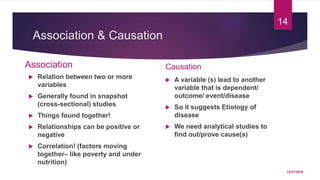
Association & Causation
Association
 Relation between two or more
variables
 Generally found in snapshot
(cross-sectional) studies
 Things found together!
 Relationships can be positive or
negative
 Correlation! (factors moving
together– like poverty and under
nutrition)
Causation
 A variable (s) lead to another
variable that is dependent/
outcome/ event/disease
 So it suggests Etiology of
disease
 We need analytical studies to
find out/prove cause(s)
12/21/2016
14
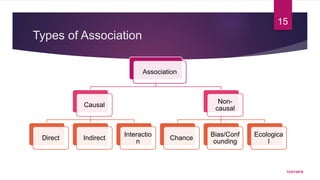
Types of Association
Association
Causal
Direct Indirect
Interactio
n
Non-
causal
Chance
Bias/Conf
ounding
Ecologica
l
12/21/2016
15
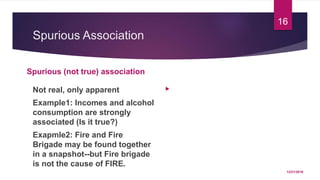
Spurious Association
Spurious (not true) association
Not real, only apparent
Example1: Incomes and alcohol
consumption are strongly
associated (Is it true?)
Exapmle2: Fire and Fire
Brigade may be found together
in a snapshot--but Fire brigade
is not the cause of FIRE.

12/21/2016
16
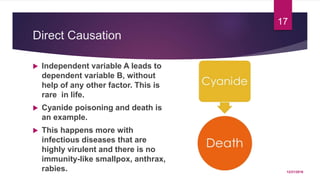
Direct Causation
 Independent variable A leads to
dependent variable B, without
help of any other factor. This is
rare in life.
 Cyanide poisoning and death is
an example.
 This happens more with
infectious diseases that are
highly virulent and there is no
immunity-like smallpox, anthrax,
rabies. 12/21/2016
17
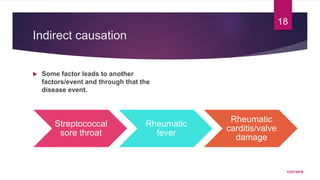
Indirect causation
 Some factor leads to another
factors/event and through that the
disease event.
Streptococcal
sore throat
Rheumatic
fever
Rheumatic
carditis/valve
damage
12/21/2016
18
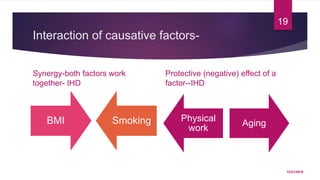
Interaction of causative factors-
Synergy-both factors work
together- IHD
BMI Smoking
Protective (negative) effect of a
factor--IHD
Physical
work
Aging
12/21/2016
19
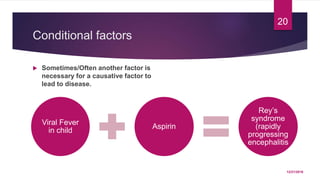
Conditional factors
 Sometimes/Often another factor is
necessary for a causative factor to
lead to disease.
Viral Fever
in child
Aspirin
Rey’s
syndrome
(rapidly
progressing
encephalitis
12/21/2016
20
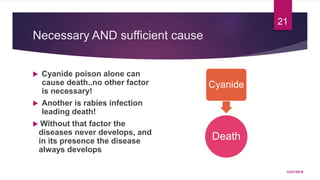
Necessary AND sufficient cause
 Cyanide poison alone can
cause death..no other factor
is necessary!
 Another is rabies infection
leading death!
 Without that factor the
diseases never develops, and
in its presence the disease
always develops
Death
Cyanide
12/21/2016
21
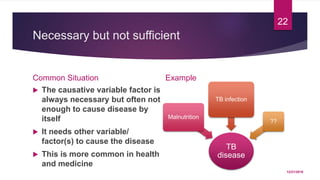
Necessary but not sufficient
Common Situation
 The causative variable factor is
always necessary but often not
enough to cause disease by
itself
 It needs other variable/
factor(s) to cause the disease
 This is more common in health
and medicine
Example
TB
disease
Malnutrition
TB infection
??
12/21/2016
22
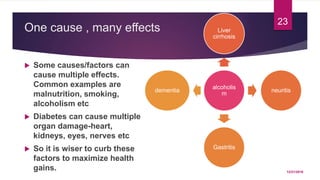
One cause , many effects
 Some causes/factors can
cause multiple effects.
Common examples are
malnutrition, smoking,
alcoholism etc
 Diabetes can cause multiple
organ damage-heart,
kidneys, eyes, nerves etc
 So it is wiser to curb these
factors to maximize health
gains. 12/21/2016
23
alcoholis
m
Liver
cirrhosis
neuritis
Gastritis
dementia
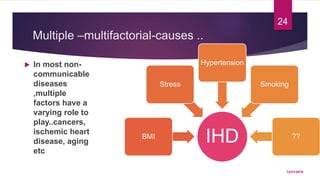
Multiple –multifactorial-causes ..
 In most non-
communicable
diseases
,multiple
factors have a
varying role to
play..cancers,
ischemic heart
disease, aging
etc
12/21/2016
24
IHDBMI
Stress
Hypertension
Smoking
??
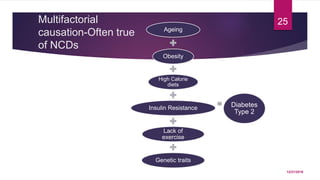
Multifactorial
causation-Often true
of NCDs
Ageing
Obesity
High Calorie
diets
Insulin Resistance
Lack of
exercise
Genetic traits
Diabetes
Type 2
12/21/2016
25
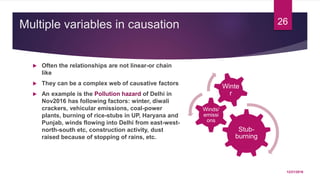
Multiple variables in causation
 Often the relationships are not linear-or chain
like
 They can be a complex web of causative factors
 An example is the Pollution hazard of Delhi in
Nov2016 has following factors: winter, diwali
crackers, vehicular emissions, coal-power
plants, burning of rice-stubs in UP, Haryana and
Punjab, winds flowing into Delhi from east-west-
north-south etc, construction activity, dust
raised because of stopping of rains, etc.
Stub-
burning
Winds/
emissi
ons
Winte
r
12/21/2016
26
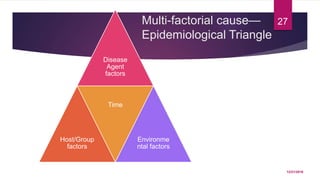
Multi-factorial cause—
Epidemiological Triangle
Disease
Agent
factors
Host/Group
factors
Time
Environme
ntal factors
12/21/2016
27
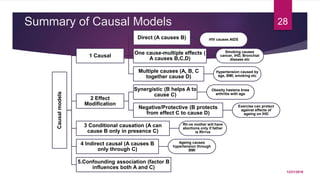
Summary of Causal Models
Causalmodels
1 Causal
Direct (A causes B) HIV causes AIDS
One cause-multiple effects (
A causes B,C,D)
Smoking causes
cancer, IHD, Bronchial
disease etc
Multiple causes (A, B, C
together cause D)
Hypertension caused by
age, BMI, smoking etc
2 Effect
Modification
Synergistic (B helps A to
cause C)
Obesity hastens knee
arthritis with age
Negative/Protective (B protects
from effect C to cause D)
Exercise can protect
against effects of
ageing on IHD
3 Conditional causation (A can
cause B only in presence C)
Rh-ve mother will have
abortions only if father
is Rh+ve
4 Indirect causal (A causes B
only through C)
Ageing causes
hypertension through
BMI
5.Confounding association (factor B
influences both A and C)
12/21/2016
28
Proving
association/
causation
12/21/2016
29
Problems of proving causal relation
 Correlation may not be equal to CAUSATION-it could be coincidence!
 There could be multiple causes of an effect/event
 Factors operating in Communicable and Non-communicable diseases are
different
 May be a time lag between cause and effect– eg occupational chemical
exposures. (or Silicosis)
 Bias in study design--selecting wrong sample!
 Confounders--factors that influence cause and effect/underlying factors
 There is no statistical method to prove cause from association, we suggest
only probability and strength of association.
12/21/2016
30
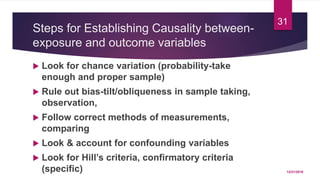
Steps for Establishing Causality between-
exposure and outcome variables
 Look for chance variation (probability-take
enough and proper sample)
 Rule out bias-tilt/obliqueness in sample taking,
observation,
 Follow correct methods of measurements,
comparing
 Look & account for confounding variables
 Look for Hill’s criteria, confirmatory criteria
(specific) 12/21/2016
31
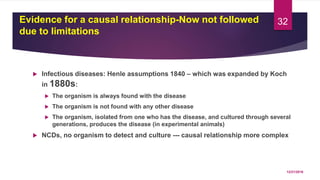
Evidence for a causal relationship-Now not followed
due to limitations
 Infectious diseases: Henle assumptions 1840 – which was expanded by Koch
in 1880s:
 The organism is always found with the disease
 The organism is not found with any other disease
 The organism, isolated from one who has the disease, and cultured through several
generations, produces the disease (in experimental animals)
 NCDs, no organism to detect and culture --- causal relationship more complex
12/21/2016
32
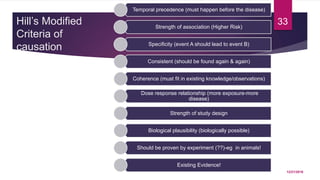
Hill’s Modified
Criteria of
causation
Temporal precedence (must happen before the disease)
Strength of association (Higher Risk)
Specificity (event A should lead to event B)
Consistent (should be found again & again)
Coherence (must fit in existing knowledge/observations)
Dose response relationship (more exposure-more
disease)
Strength of study design
Biological plausibility (biologically possible)
Should be proven by experiment (??)-eg in animals!
Existing Evidence!
12/21/2016
33
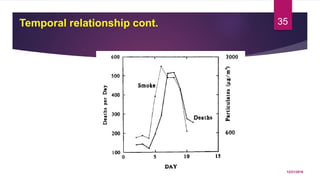
Temporal relationship
 Exposure to the factor must occur before the disease
developed
 It is easy to establish a temporal relationship in a
prospective cohort study than case control and
retrospective cohort
 Length of the interval between the exposure and disease
(asbestos in lung cancer)
12/21/2016
34
Temporal relationship cont.
12/21/2016
35
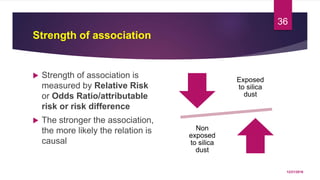
Strength of association
 Strength of association is
measured by Relative Risk
or Odds Ratio/attributable
risk or risk difference
 The stronger the association,
the more likely the relation is
causal
Exposed
to silica
dust
Non
exposed
to silica
dust
12/21/2016
36
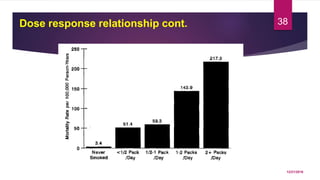
Dose response relationship
 As the dose of exposure increase, the
risk of disease also increases
 If a dose response relationship is
present, it is strong evidence for a
causal relationship
 In some cases a threshold may exist
 Sometimes it could be a J shaped
relation
12/21/2016
37
Dose response relationship cont.
12/21/2016
38
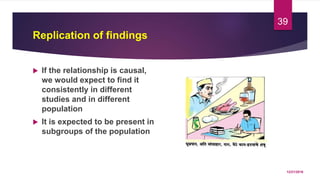
Replication of findings
 If the relationship is causal,
we would expect to find it
consistently in different
studies and in different
population
 It is expected to be present in
subgroups of the population
12/21/2016
39
Biologic plausibility
 Coherence with the current body of biologic knowledge
 Sometimes, epidemiological observation preceded biologic
knowledge
 E.g. Gregg’s observation on Rubella and congenital cataracts preceded any
knowledge of teratogenic viruses
 If epidemiological findings are not consistent with the existing
knowledge – interpreting the meaning of observed association
might be difficult
12/21/2016
40
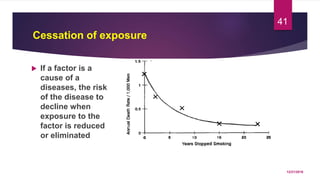
Cessation of exposure
 If a factor is a
cause of a
diseases, the risk
of the disease to
decline when
exposure to the
factor is reduced
or eliminated
12/21/2016
41
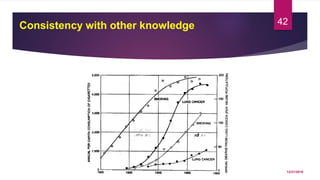
Consistency with other knowledge
12/21/2016
42
Specificity of the association
 An association is specific when a certain exposure is
associated with only one disease
 This is the weakest point of the Hills criteria –
 Smoking is linked with lung, pancreatic & bladder cancers;
hearth disease, emphysema …
 Specificity of an association provides additional support for a
causal inference
12/21/2016
43
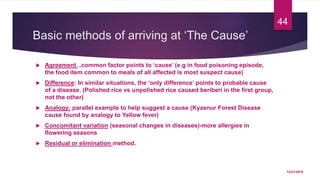
Basic methods of arriving at ‘The Cause’
 Agreement ..common factor points to ‘cause’ (e.g in food poisoning episode,
the food item common to meals of all affected is most suspect cause)
 Difference: In similar situations, the ‘only difference’ points to probable cause
of a disease. (Polished rice vs unpolished rice caused beriberi in the first group,
not the other)
 Analogy: parallel example to help suggest a cause (Kyasnur Forest Disease
cause found by analogy to Yellow fever)
 Concomitant variation (seasonal changes in diseases)-more allergies in
flowering seasons
 Residual or elimination method.
12/21/2016
44
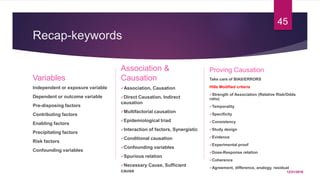
Recap-keywords
Variables
Independent or exposure variable
Dependent or outcome variable
Pre-disposing factors
Contributing factors
Enabling factors
Precipitating factors
Risk factors
Confounding variables
Association &
Causation
Association, Causation
Direct Causation, Indirect
causation
Multifactorial causation
Epidemiological triad
Interaction of factors, Synergistic
Conditional causation
Confounding variables
Spurious relation
Necessary Cause, Sufficient
cause
Proving Causation
Take care of BIAS/ERRORS
Hills Modified criteria
Strength of Association (Relative Risk/Odds
ratio)
Temporality
Specificity
Consistency
Study design
Evidence
Experimental proof
Dose-Response relation
Coherence
Agreement, difference, analogy, residual
12/21/2016
45

Association & causation (2016)

  • 1.
    Association & Causation ABASIC CONCEPT IN EPIDEMIOLOGY DR SHYAM ASHTEKAR, SMBT MED COLLEGE DEC 2016 1
  • 2.
  • 3.
    A chain ofEvents Demonetiz ation of high value notes No funds at home Long queues Heart attack Man died 12/21/2016 3
  • 4.
  • 5.
    On deaths ‘dueto’ demonetization!  The deaths were due to heart disease, old age  Long queues, stress and waiting.  Could be due to cold of night or hot weather of afternoon.  Because nobody helped the dying  It was demonetization that killed.  Could be all of these factors.  They could have died even at home.. So no link to demonetization 12/21/2016 5
  • 6.
    The questions  Didit happen by chance/error?  Is their a bias in saying event A caused event B  Is there a true relation between A as cause to event B?  Is the relation of A to B strong enough?  Are their confounding/confusing variables involved? 12/21/2016 6
  • 7.
    What we shalllearn in this? About ‘variables’ Proving causation in Epidemiology Association to causation 12/21/2016 7
  • 8.
    It is allabout Variables/Factors/Events 8
  • 9.
    The relation ofvariables! Independent, dependent, and confounding variables  We have fundamentally two variables to measure/monitor—(a) the exposure/INDEPENDENT variable-often on X axis and (b) the dependent or the OUTCOME variable-usually Y axis  But there are OTHER variables that can influence the independent and dependent variables. These are called CONFOUNDING variables Relation between BMI (X axis) and MAC (Y axis): correlation (0.9) close to 1 12/21/2016 9
  • 10.
  • 11.
    Confounding -factors thatconfuse/mix up/hide  Influences both cause and effect differentially  For instance, increasing AGE is associated with type2 Diabetes. But BMI is a confounding factor. BMI increases with age and BMI also independently predisposes to diabetes.  So you have to account for BMI in this relation –hidden factor in both cause and effect  Confounding means a hidden factor, a factor that is mixed up etc. BMI Aging Diabete s Type2 12/21/2016 11
  • 12.
  • 13.
    Why is Association& Causation important?  To decide if a factor A causes disease B or not!  Is the link true or only facile?  Is it true or by chance?  If we know the cause(s) we can cure/treat /prevent/minimize the illness. (in a patient or the society) 12/21/2016 13
  • 14.
    Association & Causation Association Relation between two or more variables  Generally found in snapshot (cross-sectional) studies  Things found together!  Relationships can be positive or negative  Correlation! (factors moving together– like poverty and under nutrition) Causation  A variable (s) lead to another variable that is dependent/ outcome/ event/disease  So it suggests Etiology of disease  We need analytical studies to find out/prove cause(s) 12/21/2016 14
  • 15.
    Types of Association Association Causal DirectIndirect Interactio n Non- causal Chance Bias/Conf ounding Ecologica l 12/21/2016 15
  • 16.
    Spurious Association Spurious (nottrue) association Not real, only apparent Example1: Incomes and alcohol consumption are strongly associated (Is it true?) Exapmle2: Fire and Fire Brigade may be found together in a snapshot--but Fire brigade is not the cause of FIRE.  12/21/2016 16
  • 17.
    Direct Causation  Independentvariable A leads to dependent variable B, without help of any other factor. This is rare in life.  Cyanide poisoning and death is an example.  This happens more with infectious diseases that are highly virulent and there is no immunity-like smallpox, anthrax, rabies. 12/21/2016 17
  • 18.
    Indirect causation  Somefactor leads to another factors/event and through that the disease event. Streptococcal sore throat Rheumatic fever Rheumatic carditis/valve damage 12/21/2016 18
  • 19.
    Interaction of causativefactors- Synergy-both factors work together- IHD BMI Smoking Protective (negative) effect of a factor--IHD Physical work Aging 12/21/2016 19
  • 20.
    Conditional factors  Sometimes/Oftenanother factor is necessary for a causative factor to lead to disease. Viral Fever in child Aspirin Rey’s syndrome (rapidly progressing encephalitis 12/21/2016 20
  • 21.
    Necessary AND sufficientcause  Cyanide poison alone can cause death..no other factor is necessary!  Another is rabies infection leading death!  Without that factor the diseases never develops, and in its presence the disease always develops Death Cyanide 12/21/2016 21
  • 22.
    Necessary but notsufficient Common Situation  The causative variable factor is always necessary but often not enough to cause disease by itself  It needs other variable/ factor(s) to cause the disease  This is more common in health and medicine Example TB disease Malnutrition TB infection ?? 12/21/2016 22
  • 23.
    One cause ,many effects  Some causes/factors can cause multiple effects. Common examples are malnutrition, smoking, alcoholism etc  Diabetes can cause multiple organ damage-heart, kidneys, eyes, nerves etc  So it is wiser to curb these factors to maximize health gains. 12/21/2016 23 alcoholis m Liver cirrhosis neuritis Gastritis dementia
  • 24.
    Multiple –multifactorial-causes .. In most non- communicable diseases ,multiple factors have a varying role to play..cancers, ischemic heart disease, aging etc 12/21/2016 24 IHDBMI Stress Hypertension Smoking ??
  • 25.
    Multifactorial causation-Often true of NCDs Ageing Obesity HighCalorie diets Insulin Resistance Lack of exercise Genetic traits Diabetes Type 2 12/21/2016 25
  • 26.
    Multiple variables incausation  Often the relationships are not linear-or chain like  They can be a complex web of causative factors  An example is the Pollution hazard of Delhi in Nov2016 has following factors: winter, diwali crackers, vehicular emissions, coal-power plants, burning of rice-stubs in UP, Haryana and Punjab, winds flowing into Delhi from east-west- north-south etc, construction activity, dust raised because of stopping of rains, etc. Stub- burning Winds/ emissi ons Winte r 12/21/2016 26
  • 27.
  • 28.
    Summary of CausalModels Causalmodels 1 Causal Direct (A causes B) HIV causes AIDS One cause-multiple effects ( A causes B,C,D) Smoking causes cancer, IHD, Bronchial disease etc Multiple causes (A, B, C together cause D) Hypertension caused by age, BMI, smoking etc 2 Effect Modification Synergistic (B helps A to cause C) Obesity hastens knee arthritis with age Negative/Protective (B protects from effect C to cause D) Exercise can protect against effects of ageing on IHD 3 Conditional causation (A can cause B only in presence C) Rh-ve mother will have abortions only if father is Rh+ve 4 Indirect causal (A causes B only through C) Ageing causes hypertension through BMI 5.Confounding association (factor B influences both A and C) 12/21/2016 28
  • 29.
  • 30.
    Problems of provingcausal relation  Correlation may not be equal to CAUSATION-it could be coincidence!  There could be multiple causes of an effect/event  Factors operating in Communicable and Non-communicable diseases are different  May be a time lag between cause and effect– eg occupational chemical exposures. (or Silicosis)  Bias in study design--selecting wrong sample!  Confounders--factors that influence cause and effect/underlying factors  There is no statistical method to prove cause from association, we suggest only probability and strength of association. 12/21/2016 30
  • 31.
    Steps for EstablishingCausality between- exposure and outcome variables  Look for chance variation (probability-take enough and proper sample)  Rule out bias-tilt/obliqueness in sample taking, observation,  Follow correct methods of measurements, comparing  Look & account for confounding variables  Look for Hill’s criteria, confirmatory criteria (specific) 12/21/2016 31
  • 32.
    Evidence for acausal relationship-Now not followed due to limitations  Infectious diseases: Henle assumptions 1840 – which was expanded by Koch in 1880s:  The organism is always found with the disease  The organism is not found with any other disease  The organism, isolated from one who has the disease, and cultured through several generations, produces the disease (in experimental animals)  NCDs, no organism to detect and culture --- causal relationship more complex 12/21/2016 32
  • 33.
    Hill’s Modified Criteria of causation Temporalprecedence (must happen before the disease) Strength of association (Higher Risk) Specificity (event A should lead to event B) Consistent (should be found again & again) Coherence (must fit in existing knowledge/observations) Dose response relationship (more exposure-more disease) Strength of study design Biological plausibility (biologically possible) Should be proven by experiment (??)-eg in animals! Existing Evidence! 12/21/2016 33
  • 34.
    Temporal relationship  Exposureto the factor must occur before the disease developed  It is easy to establish a temporal relationship in a prospective cohort study than case control and retrospective cohort  Length of the interval between the exposure and disease (asbestos in lung cancer) 12/21/2016 34
  • 35.
  • 36.
    Strength of association Strength of association is measured by Relative Risk or Odds Ratio/attributable risk or risk difference  The stronger the association, the more likely the relation is causal Exposed to silica dust Non exposed to silica dust 12/21/2016 36
  • 37.
    Dose response relationship As the dose of exposure increase, the risk of disease also increases  If a dose response relationship is present, it is strong evidence for a causal relationship  In some cases a threshold may exist  Sometimes it could be a J shaped relation 12/21/2016 37
  • 38.
    Dose response relationshipcont. 12/21/2016 38
  • 39.
    Replication of findings If the relationship is causal, we would expect to find it consistently in different studies and in different population  It is expected to be present in subgroups of the population 12/21/2016 39
  • 40.
    Biologic plausibility  Coherencewith the current body of biologic knowledge  Sometimes, epidemiological observation preceded biologic knowledge  E.g. Gregg’s observation on Rubella and congenital cataracts preceded any knowledge of teratogenic viruses  If epidemiological findings are not consistent with the existing knowledge – interpreting the meaning of observed association might be difficult 12/21/2016 40
  • 41.
    Cessation of exposure If a factor is a cause of a diseases, the risk of the disease to decline when exposure to the factor is reduced or eliminated 12/21/2016 41
  • 42.
    Consistency with otherknowledge 12/21/2016 42
  • 43.
    Specificity of theassociation  An association is specific when a certain exposure is associated with only one disease  This is the weakest point of the Hills criteria –  Smoking is linked with lung, pancreatic & bladder cancers; hearth disease, emphysema …  Specificity of an association provides additional support for a causal inference 12/21/2016 43
  • 44.
    Basic methods ofarriving at ‘The Cause’  Agreement ..common factor points to ‘cause’ (e.g in food poisoning episode, the food item common to meals of all affected is most suspect cause)  Difference: In similar situations, the ‘only difference’ points to probable cause of a disease. (Polished rice vs unpolished rice caused beriberi in the first group, not the other)  Analogy: parallel example to help suggest a cause (Kyasnur Forest Disease cause found by analogy to Yellow fever)  Concomitant variation (seasonal changes in diseases)-more allergies in flowering seasons  Residual or elimination method. 12/21/2016 44
  • 45.
    Recap-keywords Variables Independent or exposurevariable Dependent or outcome variable Pre-disposing factors Contributing factors Enabling factors Precipitating factors Risk factors Confounding variables Association & Causation Association, Causation Direct Causation, Indirect causation Multifactorial causation Epidemiological triad Interaction of factors, Synergistic Conditional causation Confounding variables Spurious relation Necessary Cause, Sufficient cause Proving Causation Take care of BIAS/ERRORS Hills Modified criteria Strength of Association (Relative Risk/Odds ratio) Temporality Specificity Consistency Study design Evidence Experimental proof Dose-Response relation Coherence Agreement, difference, analogy, residual 12/21/2016 45

Editor's Notes

  • #43 The absence of such consistency would not completely rule out this hypothesis