Energy of Void in FCC Copper Crystal Under
Uniaxial Tensile Deformation
LAMMPS
Tammy Tancharoensuksavai

MTSE 4040 Final Project
LAMMPS
• Large Scale Atomic/Molecular Massively Parallel
Simulator
• uses neighbor lists to keep track of nearby particles
which are optimized for systems with particles that are
repulsive at short distances
• Open source! ✨"✨
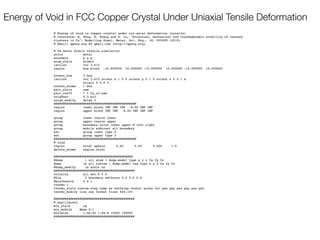
Energy of Void in FCC Copper Crystal Under Uniaxial Tensile Deformation
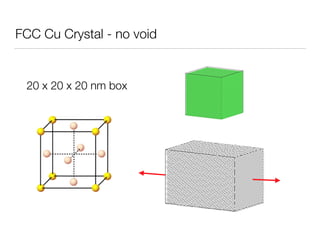
FCC Cu Crystal - no void
20 x 20 x 20 nm box
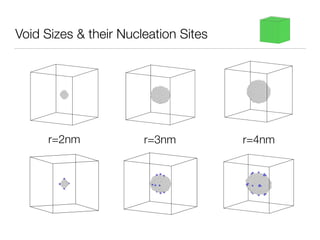
Void Sizes & their Nucleation Sites
r=2nm r=3nm r=4nm
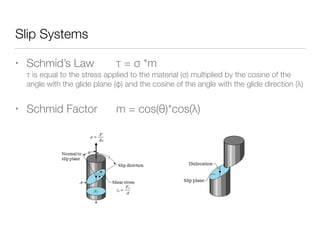
Slip Systems
• Schmid’s Law τ = σ *m

τ is equal to the stress applied to the material (σ) multiplied by the cosine of the
angle with the glide plane (φ) and the cosine of the angle with the glide direction (λ)
• Schmid Factor m = cos(θ)*cos(λ)
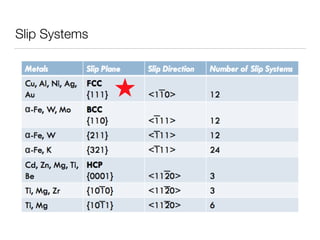
Slip Systems
Dislocations
• Dislocation motion in FCC crystals is governed by the
critical resolved shear stress via Schmid’s law
• Stacking fault energy has been used to predict energy at
a crack tip
• Homogeneous nucleation depends on both Schmid &
non-Schmid normal factor
• together they represent resolved shear stress in the
direction of slip and resolved tensile stress normal to
the slip plane
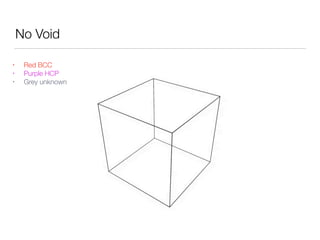
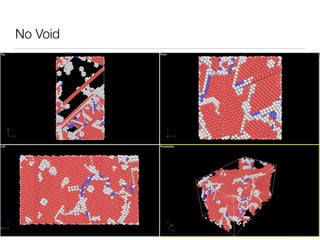
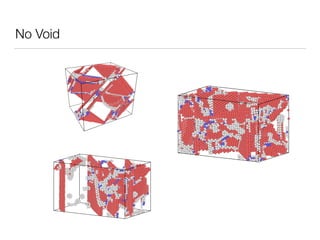
No Void
• Red BCC
• Purple HCP
• Grey unknown
No Void
No Void
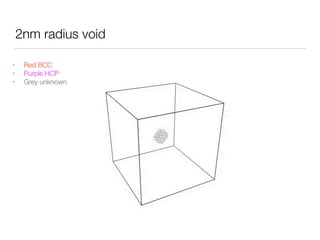
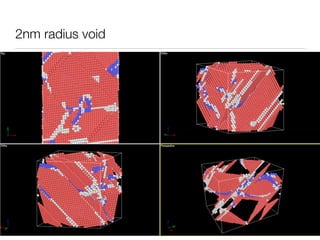
2nm radius void
• Red BCC
• Purple HCP
• Grey unknown
2nm radius void
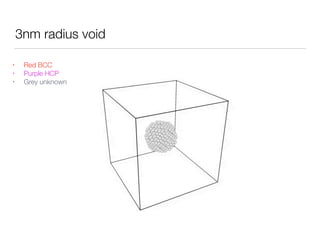
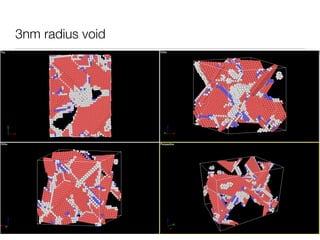
3nm radius void
• Red BCC
• Purple HCP
• Grey unknown
3nm radius void
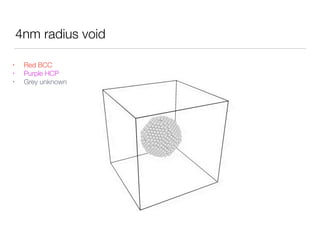
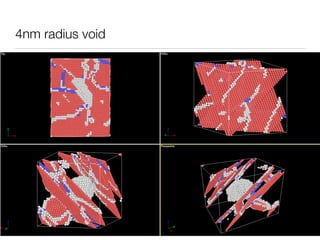
4nm radius void
• Red BCC
• Purple HCP
• Grey unknown
4nm radius void
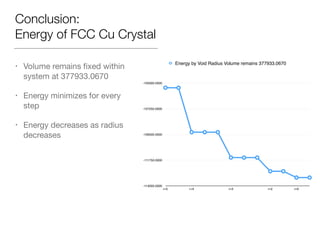
Conclusion:
Energy of FCC Cu Crystal
• Volume remains fixed within
system at 377933.0670

• Energy minimizes for every
step

• Energy decreases as radius
decreases
-114000.0000
-111750.0000
-109500.0000
-107250.0000
-105000.0000
r=5 r=4 r=3 r=2 r=0
Energy by Void Radius Volume remains 377933.0670
References
(1)Das, Ashis, and Gaurav Singh. "Plastic Deformation and Failure Studies near a Void for Copper-
aluminium Alloy via Molecular Dynamics Simulation." Thesis. Department of Metallurgical and
Materials Engineering National Institute of Technology, Rourkela, 2014. Print.
(2)Tschopp, M., Spearot, D., & Mcdowell, D. (2007). Atomistic simulations of homogeneous dislocation
nucleation in single crystal copper. Modelling and Simulation in Materials Science and Engineering,
693-709.
(3)Wang, T., Wang, Y., Hsieh, T., Chang, S., & Cheng, Y. (n.d.). Copper voids improvement for the
copper dual damascene interconnection process. Journal of Physics and Chemistry of Solids,
566-571.
– #
“😩😅😁😸😊😁”

4040 Presentation LAMMPS Tammy pdf

  • 1.
    Energy of Voidin FCC Copper Crystal Under Uniaxial Tensile Deformation LAMMPS Tammy Tancharoensuksavai MTSE 4040 Final Project
  • 2.
    LAMMPS • Large ScaleAtomic/Molecular Massively Parallel Simulator • uses neighbor lists to keep track of nearby particles which are optimized for systems with particles that are repulsive at short distances • Open source! ✨"✨
  • 3.
    Energy of Voidin FCC Copper Crystal Under Uniaxial Tensile Deformation
  • 4.
    FCC Cu Crystal- no void 20 x 20 x 20 nm box
  • 5.
    Void Sizes &their Nucleation Sites r=2nm r=3nm r=4nm
  • 6.
    Slip Systems • Schmid’sLaw τ = σ *m
 τ is equal to the stress applied to the material (σ) multiplied by the cosine of the angle with the glide plane (φ) and the cosine of the angle with the glide direction (λ) • Schmid Factor m = cos(θ)*cos(λ)
  • 7.
  • 8.
    Dislocations • Dislocation motionin FCC crystals is governed by the critical resolved shear stress via Schmid’s law • Stacking fault energy has been used to predict energy at a crack tip • Homogeneous nucleation depends on both Schmid & non-Schmid normal factor • together they represent resolved shear stress in the direction of slip and resolved tensile stress normal to the slip plane
  • 9.
    No Void • RedBCC • Purple HCP • Grey unknown
  • 10.
  • 11.
  • 12.
    2nm radius void •Red BCC • Purple HCP • Grey unknown
  • 13.
  • 14.
    3nm radius void •Red BCC • Purple HCP • Grey unknown
  • 15.
  • 16.
    4nm radius void •Red BCC • Purple HCP • Grey unknown
  • 17.
  • 18.
    Conclusion: Energy of FCCCu Crystal • Volume remains fixed within system at 377933.0670 • Energy minimizes for every step • Energy decreases as radius decreases -114000.0000 -111750.0000 -109500.0000 -107250.0000 -105000.0000 r=5 r=4 r=3 r=2 r=0 Energy by Void Radius Volume remains 377933.0670
  • 19.
    References (1)Das, Ashis, andGaurav Singh. "Plastic Deformation and Failure Studies near a Void for Copper- aluminium Alloy via Molecular Dynamics Simulation." Thesis. Department of Metallurgical and Materials Engineering National Institute of Technology, Rourkela, 2014. Print. (2)Tschopp, M., Spearot, D., & Mcdowell, D. (2007). Atomistic simulations of homogeneous dislocation nucleation in single crystal copper. Modelling and Simulation in Materials Science and Engineering, 693-709. (3)Wang, T., Wang, Y., Hsieh, T., Chang, S., & Cheng, Y. (n.d.). Copper voids improvement for the copper dual damascene interconnection process. Journal of Physics and Chemistry of Solids, 566-571.
  • 20.