The Circles ofSexuality
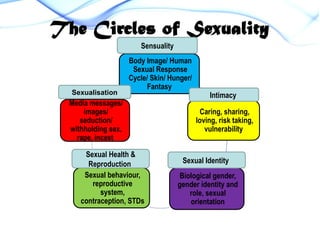
Body Image/ Human
Sexual Response
Cycle/ Skin/ Hunger/
Fantasy
Caring, sharing,
loving, risk taking,
vulnerability
Biological gender,
gender identity and
role, sexual
orientation
Sexual behaviour,
reproductive
system,
contraception, STDs
Media messages/
images/
seduction/
withholding sex,
rape, incest
Sensuality
Intimacy
Sexual Identity
Sexual Health &
Reproduction
Sexualisation
3.
Sexuality
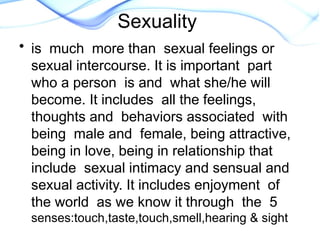
• is muchmore than sexual feelings or
sexual intercourse. It is important part
who a person is and what she/he will
become. It includes all the feelings,
thoughts and behaviors associated with
being male and female, being attractive,
being in love, being in relationship that
include sexual intimacy and sensual and
sexual activity. It includes enjoyment of
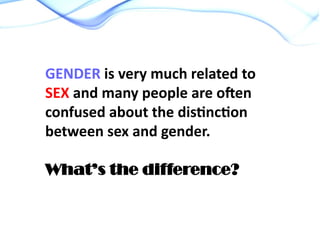
the world as we know it through the 5
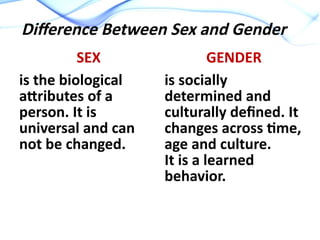
senses:touch,taste,touch,smell,hearing & sight
4.
Sensuality involves ourlevel of awareness,
acceptance and enjoyment of our own or
others’ bodies.
It gives us the confidence and good feeling of our own
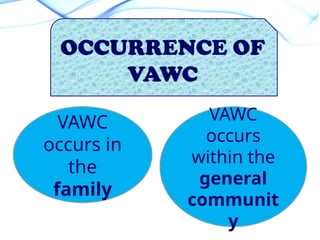
body and how its part functions as in human nature.
Sensuality also give us the opportunity to enjoy and
satisfy our own or others body’s pleasures .
SENSUALITY
Body Image/ Human Sexual Response Cycle/
Skin/ Hunger/ Fantasy
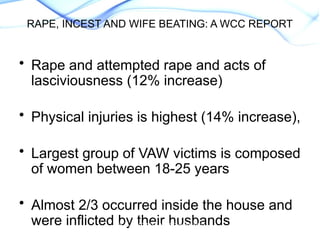
5.
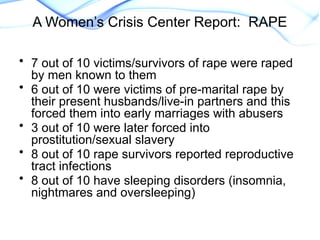
This part ofour sexuality affects
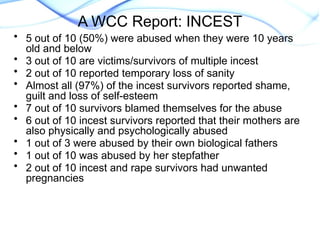
our behavior in several ways:
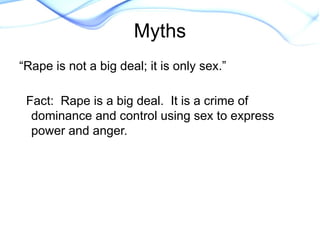
1. Body image- Physical characteristics of
an individual and how it influences many
aspects of our lives.
EXAMPLE: Teenagers who usually admire some
media personality and they try mimicking the way
their idol looks or appearance, gestures etc. And
they feel frustrated is they cannot imitate them and
give themselves their own disappointment.
6.
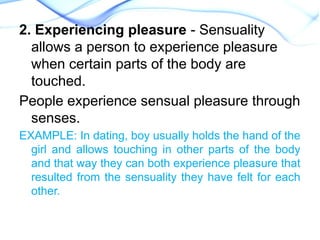
2. Experiencing pleasure- Sensuality
allows a person to experience pleasure
when certain parts of the body are
touched.
People experience sensual pleasure through
senses.
EXAMPLE: In dating, boy usually holds the hand of the
girl and allows touching in other parts of the body
and that way they can both experience pleasure that
resulted from the sensuality they have felt for each
other.
7.
3. Satisfying skinhunger
skin hunger - need to be touched and held
by others in loving, caring ways.
EXAMPLE: About the time that teenagers enter
school, children begin to move outside the family
and make friends with others of the same age.
Teenagers usually receive less touch from their
parents than their younger siblings do. To satisfy
their skin hunger they usually done this through
physical contact with their peers.
Sexual intercourse sometimes resulted from
the teen’s need to be held and care of and
not from sexual desire.
8.
4. Feeling physicalattraction for
another person – the center of
sensuality and attraction to others is
the BRAIN and NOT in genitals.
Brain is considered as the most
important “sex organ”.
9.
5. Fantasy—The brainalso gives people the
capacity to have fantasies about sexual
behaviors and experiences.
Children often need help understanding that
sexual fantasy is normal and that one
does not have to act upon sexual
fantasies.
10.
• Intimacy isthe ability to be emotionally
close to another human being and to
accept closeness in return.
Several aspects of intimacy include:
1. Sharing- Sharing intimacy is what makes
personal relationships rich.
Because if the feeling is mutual and both couple is
willing to share what they really feel about each
other by then they can further understand their self
INTIMACY
Caring, sharing, loving, risk
taking, vulnerability
11.
Reminder: sensuality isabout physical
closeness while intimacy focuses on
emotional closeness.
2. Caring- Caring about others means
feeling their joy and their pain. It means
being open to emotions that may not be
comfortable or convenient.
Intimate relationship will be possible only
when we care.
We should always take care of our love ones and let
them feel that we are always there to support and love
them unconditionally. We should let them feel that we
feel they same way as they feel.
12.
3. Liking orloving another person-
Having emotional attachment or
connection to others is a manifestation of
intimacy.
Loving or liking is a way of connecting your thoughts
and feelings to someone who also having the same
or mutual feeling as yours.
13.
4. Emotional risk-taking-To have true
intimacy with others, a person must open
up and share feelings and personal
information.
EXAMPLE: Sharing of personal information to your
boyfriend or girlfriend such as facebook password
and other personal data is risky because your
partner may not have they same feeling towards
you. There is an emotional risk-taking because what
if you fight and then you boyfriend knows your fb
password he can open it any time and post some
malicious or anything that can ruin your name. But
we should also remember that we need to be honest
and open to our partner .
14.
5. Vulnerability- Tohave intimacy means
that we share and care, like or love, and
take emotional risks. That makes us
vulnerable—the person with whom we
share, about whom we care, and whom
we like or love, has the power to hurt us
emotionally. Intimacy requires vulnerability,
on the part of each person in the
relationship.
15.
Sexual identity isa person's understanding
of who she/he is sexually, including the
sense of being male or of being female.
SEXUAL IDENTITY
Biological gender, gender identity and role, sexual
orientation
16.
1. Gender identity—
Knowingwhether
one is male or
female. Most young
children determine
their own gender
identity by age two.
Sometime, a
person's biological
gender is not the
same as his/her
gender identity—this
is called
being transgender.
17.
The source ofthe role models
of the children includes their
parents, peers, and the
media wherein when if these
models behave sexually,
children tend to imitate
sexual behavior since it is
what they observed.
18.
2. Gender role—Identifyingactions and/or
behaviors for each gender. Some things
are determined by the way male and
female bodies are built or function.
EXAMPLE: only women menstruate and
only men produce sperm.
Other gender roles are culturally
determined.
19.
3. Sexual orientation-Whether a person's
primary attraction is to people of the other
gender or to the same gender or to both
genders defines his/her sexual orientation.
Heterosexuality -sexual relations between opposite
sexes.
Homosexuality - attraction to same sex
Bisexuality - attraction to both sexes
Sexual orientation begins to emerge by
adolescence although many gay and
lesbian youth say they knew they felt
same sex attraction by age 10 or 11.to
both genders.
20.
Heterosexual, gay, lesbian,and bisexual
youth can all experience same-gender
sexual attraction and/or activity around
puberty.
Such behavior includes:
sexual play with same-gender peers
crushes on same-gender adults
sexual fantasies about same-gender
It is normal for pre-teens and young teens to
experience such behavoir but that does not
necessarily related to sexual orientation.
21.
• These area person's capacity to
reproduce and the behaviors and attitudes
that make sexual relationships healthy and
enjoyable.
Reproduction and Sexual
Health
Sexual Health and Reproduction
22.
1. Factual informationabout
reproduction
it is necessary to understand the anatomy
and physiology of the reproductive
system as well as how conception and
STD infection occurs.
Teenager needs information so they can
make informed decisions about sexual
expression and protect their health.
23.
2. Feelings andattitudes—Are wide-
ranging when it comes to sexual
expression, reproduction and to
sexual health-related topics such as:
STD infection (HIV and AIDS)
Contraceptive use
Abortion
Pregnancy
Childbirth
24.
3.Sexual intercourse
- isone of the most common behaviors
among humans. Sexual intercourse is
a behavior that may produce sexual
pleasure that often culminates in
orgasm in females and in males.
Sexual intercourse may also result in
pregnancy and/or STDs.
25.
4. Reproductive andsexual anatomy
male and female body and the ways in
which they actually function is a part of
sexual health
It also includes information about all the
effective methods of contraception
currently available, how they work, where
to obtain them, their effectiveness, and
their side effects.
Examples of contraceptives: condoms, pills or
calendar method etc.
26.
5. Sexual reproduction
Theactual processes of
conception, pregnancy,
delivery, and recovery
following childbirth are
important parts of sexuality.
27.
Sexualisation is thataspect of sexuality in
which people behave sexually to influence,
manipulate, or control other people.
spans behaviors that range from the
relatively harmless to the sadistically
violent, cruel, and criminal
Teens need to know that no one has the
right to exploit them sexually and that they
do not have the right to exploit anyone
else sexually.
Sexualisation
Media messages/ images/ seduction/
withholding sex, rape, incest
28.
1. Flirting—Is arelatively harmless
sexualization behavior. Nevertheless,
upon occasion it is an attempt to
manipulate someone else, and it can
cause the person manipulated to feel
hurt, humiliation, and shame.
EXAMPLE: Flirting with someone in public or flirting
somebody who have already commitment.
29.
2. Seduction—Is theact of enticing
someone to engage in sexual activity. The
act of seduction implies manipulation that
at times may prove harmful for the one
who is seduced.
30.
3. Sexual harassment—Isan illegal
behavior. Sexual harassment means
harassing someone else because of
her/his gender.
EXAMPLES:
a) making personal embarrassing remarks
about someone's appearance, especially
characteristics associated with sexual
maturity, (size of a woman's breasts or of
a man's testicles and penis).
b) unwanted touching, such as hugging a
subordinate or patting someone's bottom
31.
c. demands bya teacher, supervisor, or
other person in authority for sexual
intercourse in exchange for grades,
promotion, hiring, raises, etc.
32.
4. Rape -forcing someone else to have
genital contact with another.
Sexual assault can includes:
o forced petting
o forced sexual intercourse
use of overpowering strength, threats,
and/or implied threats that arouse fear in
the person raped.
Youth need to know that rape is always illegal and
always cruel. The cause of force petting and sexual
intercourse are the used of overpowering strength,
33.
Youth should knowthat they are legally
entitled to the protection of the criminal
justice system if they are the victims of
rape and that they may be prosecuted if
they force anyone else to have genital
contact with them for any reason. Refusing
to accept no and forcing the other person
to have sexual intercourse always means
rape.
34.
5. Incest -forcing sexual contact on any
minor who is related to the perpetrator by
birth or marriage
Incest is always illegal and extremely
cruel because it betrays the trust that
children and youth give to their families.
35.
Body Image/
Human Sexual
ResponseCycle/
Skin/ Hunger/
Fantasy
Caring, sharing,
loving, risk taking,
vulnerability
Biological gender,
gender identity and
role, sexual
orientation
Sexual behaviour,
reproductive
system,
contraception,
STDs
Media messages/
images/ seduction/
withholding sex,
rape, incest
Sensuality involves our level
of awareness, acceptance
and enjoyment of our own or
others’ bodies
Intimacy is the ability &
need to experience
emotional closeness to
another person & have it
returned.
Sexual Identity is the
development of a sense of
who one is sexually,
including a sense of
maleness and femaleness
Sexual Health &
Reproduction attitudes &
behaviours towards our
health & the consequences
of sexual activity
Sexualisation is the
use of sexuality to
influence, control or
manipulate others
36.
1.Women give birthto babies, men do not.
2.Women can breast feed babies, men cannot
3.Little girls are gentle, boys are tough.
4.In schools, boys are appointed presidents, girls are
secretaries
5.Boys are sargeant-at- arms, girls are muses.
Activity
Sex or Gender?
37.
6.Girls have longhair and men have short hair.
7.Girls have monthly menstruation
8.Girls perform better in home economics while
boys in technology and practical arts
9.Body hair is OK for men, but women have to
remove it
10.Male voice break at puberty
Sex or Gender?
38.
GENDER is verymuch related to
SEX and many people are often
confused about the distinction
between sex and gender.
What’s the difference?
39.
Difference Between Sexand Gender
SEX GENDER
is the biological
attributes of a
person. It is
universal and can
not be changed.
is socially
determined and
culturally defined. It
changes across time,
age and culture.
It is a learned
behavior.
Gender Based Violence
•range of abuses committed
against women and men that
stem from gender inequality and
belief about traditional gender
roles
42.
• "any actof gender-based violence that
results in, or is likely to result in, physical,
sexual or mental harm or suffering to
women, including threats of such acts,
coercion or arbitrary deprivation of liberty,
whether occurring in public or in private
life."
Declaration on the Elimination
of Violence Against Women.New
Violence Against Women (VAW)
43.
• encompasses, "physical,sexual
and psychological violence
occurring in the family and in the
general community
Declaration on the Elimination
of Violence Against Women
VAWC
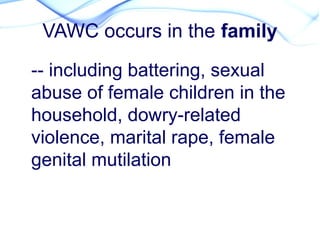
VAWC occurs inthe family
-- including battering, sexual
abuse of female children in the
household, dowry-related
violence, marital rape, female
genital mutilation
46.
VAWC occurs withinthe
general community
- includes date rape, sexual
harassment, intimidation at work,
in educational institutions and
elsewhere, trafficking in women
and forced prostitution
47.
– physical assault
–homicide
– sexual assault/abuse
– rape
– hate crimes
– sexual coercion
– stalking
– forced prostitution/trafficking
– genital mutilation
– sexual harassment
– incest
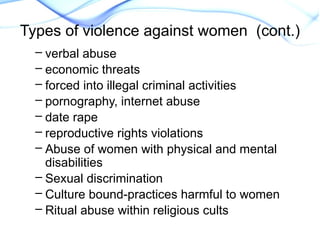
Types of violence against women
48.
– verbal abuse
–economic threats
– forced into illegal criminal activities
– pornography, internet abuse
– date rape
– reproductive rights violations
– Abuse of women with physical and mental
disabilities
– Sexual discrimination
– Culture bound-practices harmful to women
– Ritual abuse within religious cults
Types of violence against women (cont.)
49.
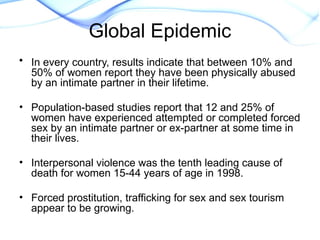
• In everycountry, results indicate that between 10% and
50% of women report they have been physically abused
by an intimate partner in their lifetime.
• Population-based studies report that 12 and 25% of
women have experienced attempted or completed forced
sex by an intimate partner or ex-partner at some time in
their lives.
• Interpersonal violence was the tenth leading cause of
death for women 15-44 years of age in 1998.
• Forced prostitution, trafficking for sex and sex tourism
appear to be growing.
WHO. Fact Sheet No. 239,June
2000
Global Epidemic
50.
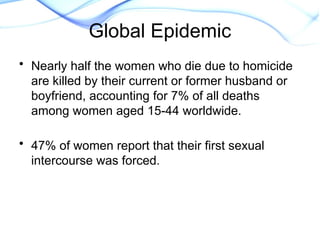
• Nearly halfthe women who die due to homicide
are killed by their current or former husband or
boyfriend, accounting for 7% of all deaths
among women aged 15-44 worldwide.
• 47% of women report that their first sexual
intercourse was forced.
World Report on Violence and
Health, WHo. 2002
Global Epidemic
51.
• Rape andattempted rape and acts of
lasciviousness (12% increase)
• Physical injuries is highest (14% increase),
• Largest group of VAW victims is composed
of women between 18-25 years
• Almost 2/3 occurred inside the house and
were inflicted by their husbands
WCC. Feminist Action Research
on the Impact of VAW on
RAPE, INCEST AND WIFE BEATING: A WCC REPORT
52.
• 7 outof 10 victims/survivors of rape were raped
by men known to them
• 6 out of 10 were victims of pre-marital rape by
their present husbands/live-in partners and this
forced them into early marriages with abusers
• 3 out of 10 were later forced into
prostitution/sexual slavery
• 8 out of 10 rape survivors reported reproductive
tract infections
• 8 out of 10 have sleeping disorders (insomnia,
nightmares and oversleeping)
WCC. Feminist Action Research
on the Impact of VAW on
A Women’s Crisis Center Report: RAPE
53.
• 5 outof 10 (50%) were abused when they were 10 years
old and below
• 3 out of 10 are victims/survivors of multiple incest
• 2 out of 10 reported temporary loss of sanity
• Almost all (97%) of the incest survivors reported shame,
guilt and loss of self-esteem
• 7 out of 10 survivors blamed themselves for the abuse
• 6 out of 10 incest survivors reported that their mothers are
also physically and psychologically abused
• 1 out of 3 were abused by their own biological fathers
• 1 out of 10 was abused by her stepfather
• 2 out of 10 incest and rape survivors had unwanted
pregnancies
A WCC Report: INCEST
54.
“Rape is nota big deal; it is only sex.”
Fact: Rape is a big deal. It is a crime of
dominance and control using sex to express
power and anger.
Myths
55.
“Rape only happensto teenagers or young
women.”
Fact: Rapists attack infants, senior citizens
and teens. They attack women, men, girls
and boys.
Myths
56.
“Rape only happensif you ask for it. Women who
are provocative are the only victims of rape.”
Fact: Women’s behavior is irrelevant. To act
provocative or to wear sexy clothing does not
mean you are asking to be raped.
Myths
57.
“Some women dreamor fantasize about
being raped.”
Fact: Rape occurs when an attacker takes
control of a woman in reality.
Myths
58.
“A woman cannotbe raped if she keeps her
legs crossed or keeps moving. No man
alone can rape a woman.”
Fact: One man alone can rape a woman
and it is a common occurrence.
Myths
59.
“Rapists are mostlypsychotic men. You can
identify a rapist by the way he looks.”
Fact: Most rapists are men with no obvious signs
of mental illness. In study after study,
researchers are unable to find any significant
psychological difference between men who rape
and men who do not rape.
Myths
60.
“Men rape becausethey need sex.”
Fact: Men do not rape because they need a
sexual partner. Men rape in order to
humiliate and dominate a woman. In fact,
most men who rape are either married or
have regular sexual partners.
Myths
61.
“Most rapes arespontaneous. A man sees
a woman and has to have her.”
Fact: Most rapes are planned. A man may
watch a particular woman for a while and
try to learn her daily routine.
Myth
62.
“It is impossiblefor a man to rape his wife.”
Fact: A husband can rape his wife and a
boyfriend can rape is girlfriend.
Myth
63.
“Rape only happensif you are out on the
street late at night.”
Fact: Rapes occurs at all times of the day
and majority cases of rape/sexual assault
incidents occurred in the survivor’s home
or at the home of a friend, relative or
neighbor.
Myth
64.
• There arepatterns of sexual abuse and/or
harassment of girls by both male students
and teachers.
Men are more authoritarian, when it comes in group
activity, girls usually appointed as a secretary.
Some teacher usually make commands to the
students either girl or boy to record some of data
such as attendance as well as grades of students
• School children engaged in
commercialization/exploitation
-Child labor- and other related economic exploitation
School Level Indicators: Explicit
65.
Teacher toleranceof male students’ domination of classroom space
at the expense of girls’ participation in lessons;
The celebration of masculine competitiveness; the allocation higher
status tasks and responsibilities to male students and teachers, and
domestic-related ones to female students and teachers
the acceptance of bullying and verbal abuse as a natural part of
growing up
Teachers’ unofficial use of free student labour, especially that of girls
School Level Indicators: Implicit
66.
Other School-Level Indicators
◦Gender fair language
◦ School Facilities
- common toilets/lactines and
locker rooms
◦ Textbooks and reference materials highlight male
heroes and personalities and gender
stereotyping
◦ Participation
-leadership roles (PTCAs, Teacher Association,
School Councils)
-in school and educational projects
67.
School-Level Indicators
• Teaching-LearningProcess
Socialization process (classroom
groupings, seating arrangements,
assigning of roles, participation in
school activities)
68.
These taken-for-granted routine
practicesin school all too often
teach children that masculinity is
associated with aggression, while
femininity requires obedience,
acquiescence and making oneself
attractive to boys
69.
• The structuresand practices that fill the
school day with explicit and implicit rules
and norms serve to guide and regulate
behaviour;
• in so doing, they reinforce the unequal
gender relations already reproduced in
the home and perpetuate notions of male
superiority and dominance
(Dunne et al., 2006).
70.
GAD Education Principles
•Recognize the problem is rooted in cultural
attitudes and social structures that
prioritize men’s needs over those of
women
• Recognize the link between violence
prevention and increasing gender equity
• Teach young people to engage in
respectful and emotionally healthy
relationships
71.
GAD Education Principles
•Empower young people with useful
knowledge, skills and understanding and
promoting positive, non-violent
relationships based on equality and
respect
• Create an atmosphere where violence
(such as bullying) and the use of
aggression to resolve conflicts is not
tolerated
72.
GAD Education Principles
•Help young people critically examine
gender roles away from strict dichotomies
of masculine and feminine towards more
inclusive definitions of human potential
and diversity
• Create atmosphere of moral tolerance and
respect for difference
73.
GAD Education Principles
•Give out specific information on
– Prevalence and incidence
– different forms of VAW
– Misconceptions and myths about rape, incest,
sexual harassment and violence
– Resources available to those who have been
victimized
– Law, rules, regulations and procedures
74.
• Promote gender-sensitivelearning (classroom
structure, groupings, learning processes, gender
fair language and examples)
• Provide strong support services to ALL teachers and
students
• Generate correct sex-disaggregated data
• Provide school facilities – esp. toilets, locker rooms
• Ensure fair resource allocation for all
• Intensify guidance and counseling programs
• Protect our students from all forms of abuse
• Promote personal protection, hygiene and good grooming
Our Responsibilities
75.
Application:
◦ ListGBV you must have observed in schools and identify
measures/interventions on how your school can prevent or
minimize gender-based violence
How Can Our Schools Prevent GBV?
GBV
Incidents
Who are
Involved
Preventive
Measures
Editor's Notes
#21 Negative social messages and homophobia in the culture can mean that young adolescents who are experiencing sexual attraction to and romantic feelings for someone of their own gender need support so they can clarify their feelings and accept their sexuality.
#46 Examples are battering, sexual abuse of children, dowry-related violence, rape, female genital mutilation and other traditional practices harmful to women, non-spousal violence and violence related to exploitation, sexual harassment and intimidation at work, in educational institutions and elsewhere, trafficking in women, forced prostitution, and violence perpetrated or condoned by the state."
#58 Sex is between two consenting partners, while rape is an aggressive act using sex as a weapon. To be raped is to be violated and stripped of control and self-determination.
#60 The rapist chooses to rape and he is solely responsible for that choice.
#62 A man may use physical violence, threats, manipulation, confusion or a weapon to force a woman to have sex with him.
#65 Many men also test women’s reactions to hostile or sexual remarks to see if they can intimidate her.
#66 Even if a woman has had consensual sex with someone in the past, that person can rape her if he forces her to have sex when she does not want to.
#68 Both girls and boys repeatedly indicate that some teachers in their school abused their position of authority to demand
sexual favours, often in exchange for good grades, preferential treatment in class or
money.