Spatial Econometrics Example
Ani Katchova
© 2013 by Ani Katchova. All rights reserved.
Spatial Econometrics Example
.
 We want to study if household income and home values have an effect on crime rates for
different city neighborhoods.
 We use Anselin’s Columbus data for crime rates of neighborhoods in Columbus, Ohio, USA.
 Two spatial weight matrices are considered: based on contiguity and on distance.
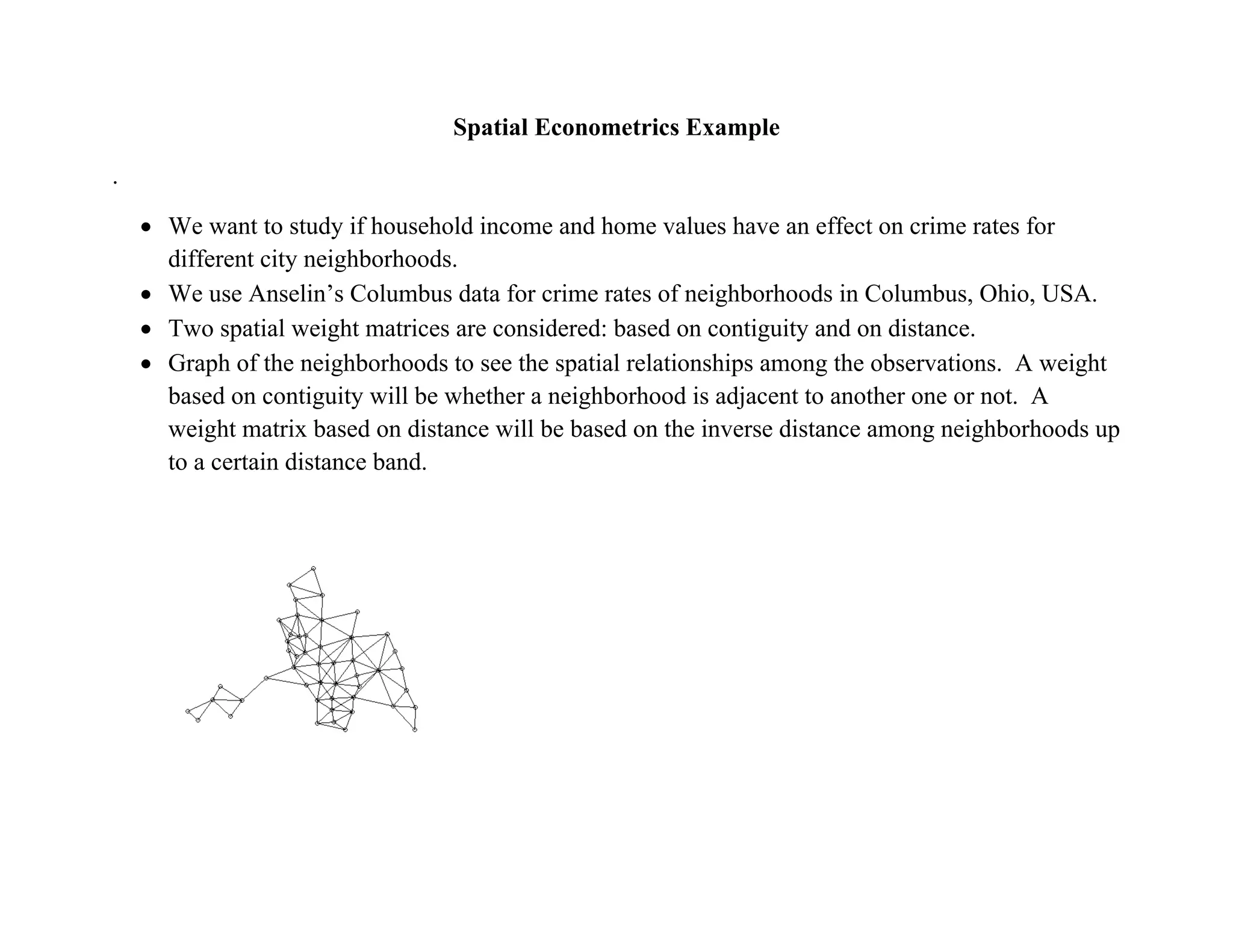
 Graph of the neighborhoods to see the spatial relationships among the observations. A weight
based on contiguity will be whether a neighborhood is adjacent to another one or not. A
weight matrix based on distance will be based on the inverse distance among neighborhoods up
to a certain distance band.
We estimate two models:
The spatial error model:
The spatial lag model:
Here y is crime rate and x are household income and home values.
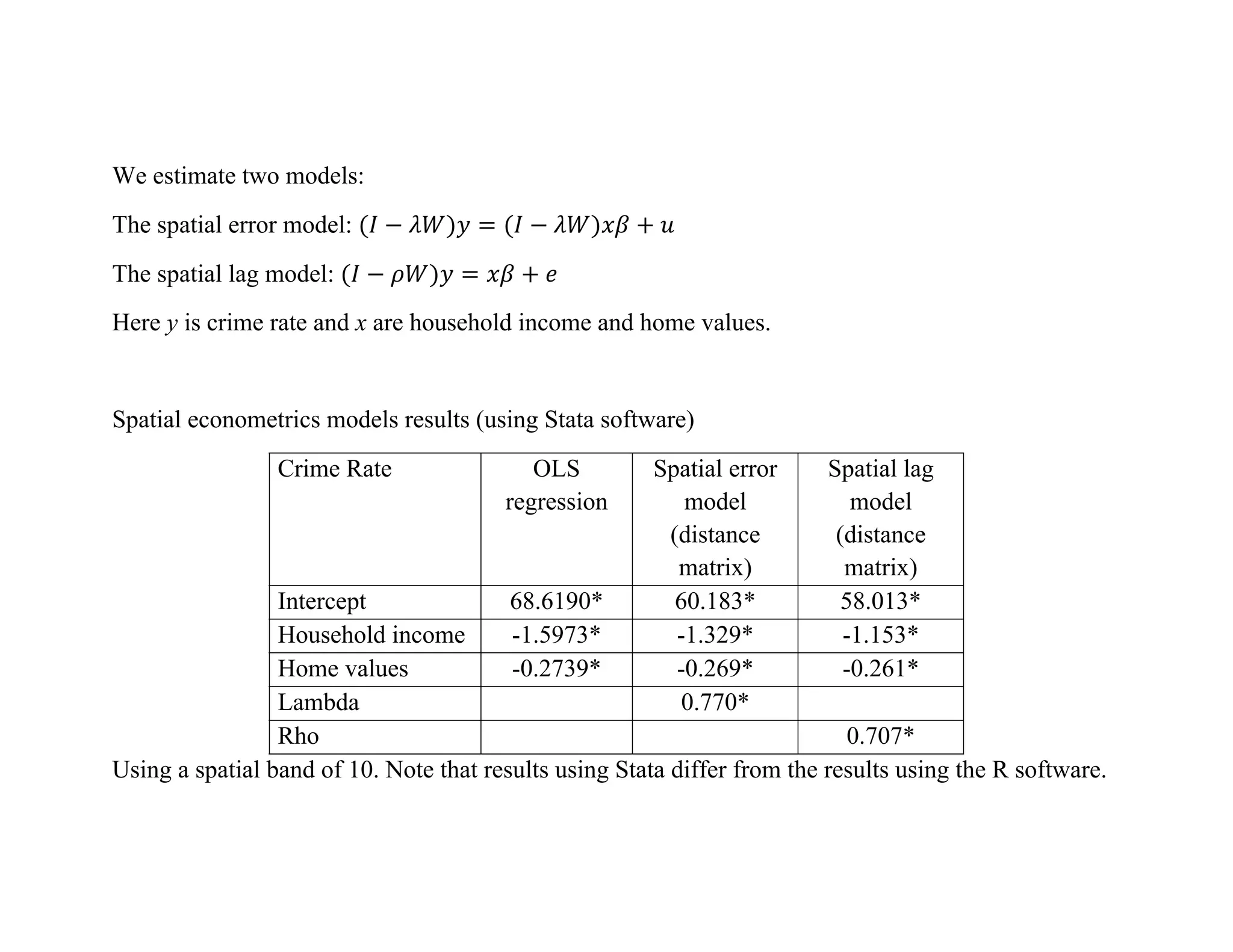
Spatial econometrics models results (using Stata software)
Crime Rate OLS
regression
Spatial error
model
(distance
matrix)
Spatial lag
model
(distance
matrix)
Intercept 68.6190* 60.183* 58.013*
Household income -1.5973* -1.329* -1.153*
Home values -0.2739* -0.269* -0.261*
Lambda 0.770*
Rho 0.707*
Using a spatial band of 10. Note that results using Stata differ from the results using the R software.
Spatial econometrics models results (using R software)
Crime Rate OLS
regression
Spatial error
model
(contiguity
matrix)
Spatial lag
model
(contiguity
matrix)
Spatial error
model
(distance
matrix)
Spatial lag
model
(distance
matrix)
Intercept 68.6190* 61.054* 46.851* 67.311* 51.627*
Household income -1.5973* -0.995* -1.074* -1.538* -1.385*
Home values -0.2739* -0.308* -0.270* -0.268* -0.281*
Lambda 0.52* 0.182
Rho 0.40* 0.37
Using a spatial band of 10.
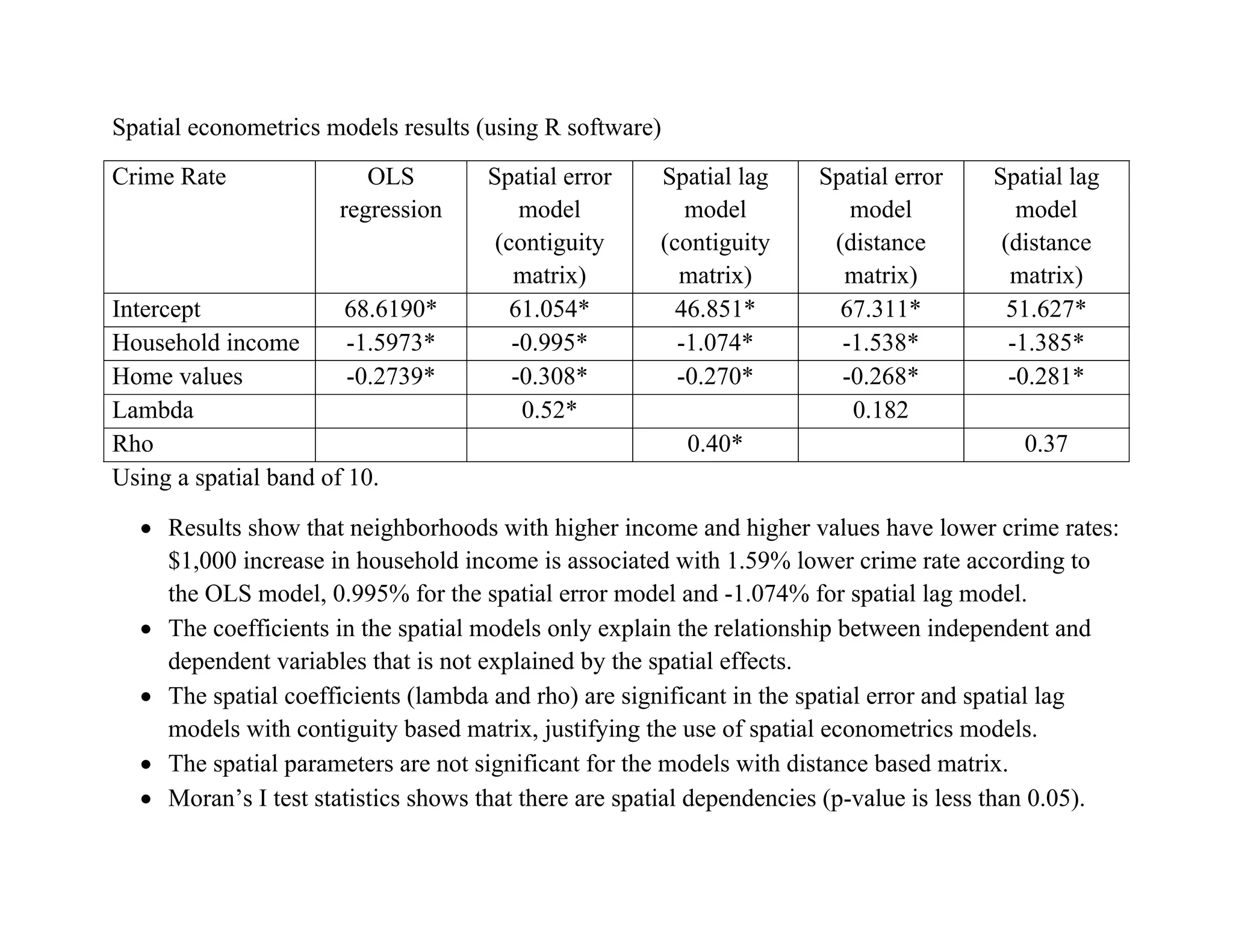
 Results show that neighborhoods with higher income and higher values have lower crime rates:
$1,000 increase in household income is associated with 1.59% lower crime rate according to
the OLS model, 0.995% for the spatial error model and -1.074% for spatial lag model.
 The coefficients in the spatial models only explain the relationship between independent and
dependent variables that is not explained by the spatial effects.
 The spatial coefficients (lambda and rho) are significant in the spatial error and spatial lag
models with contiguity based matrix, justifying the use of spatial econometrics models.
 The spatial parameters are not significant for the models with distance based matrix.
 Moran’s I test statistics shows that there are spatial dependencies (p-value is less than 0.05).
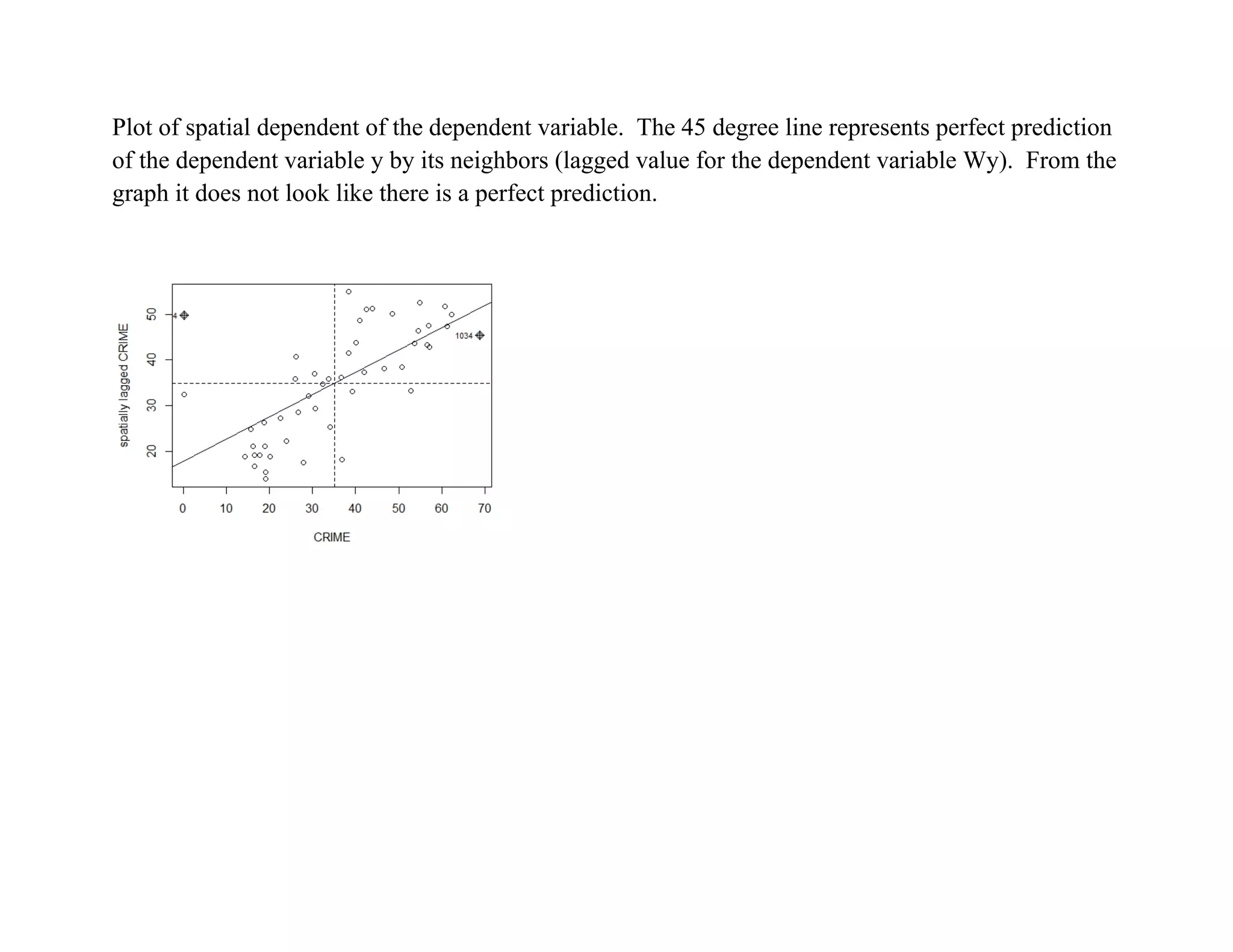
Plot of spatial dependent of the dependent variable. The 45 degree line represents perfect prediction
of the dependent variable y by its neighbors (lagged value for the dependent variable Wy). From the
graph it does not look like there is a perfect prediction.

349300455 spatial-econometrics-example

  • 1.
    Spatial Econometrics Example AniKatchova © 2013 by Ani Katchova. All rights reserved.
  • 2.
    Spatial Econometrics Example . We want to study if household income and home values have an effect on crime rates for different city neighborhoods.  We use Anselin’s Columbus data for crime rates of neighborhoods in Columbus, Ohio, USA.  Two spatial weight matrices are considered: based on contiguity and on distance.  Graph of the neighborhoods to see the spatial relationships among the observations. A weight based on contiguity will be whether a neighborhood is adjacent to another one or not. A weight matrix based on distance will be based on the inverse distance among neighborhoods up to a certain distance band.
  • 3.
    We estimate twomodels: The spatial error model: The spatial lag model: Here y is crime rate and x are household income and home values. Spatial econometrics models results (using Stata software) Crime Rate OLS regression Spatial error model (distance matrix) Spatial lag model (distance matrix) Intercept 68.6190* 60.183* 58.013* Household income -1.5973* -1.329* -1.153* Home values -0.2739* -0.269* -0.261* Lambda 0.770* Rho 0.707* Using a spatial band of 10. Note that results using Stata differ from the results using the R software.
  • 4.
    Spatial econometrics modelsresults (using R software) Crime Rate OLS regression Spatial error model (contiguity matrix) Spatial lag model (contiguity matrix) Spatial error model (distance matrix) Spatial lag model (distance matrix) Intercept 68.6190* 61.054* 46.851* 67.311* 51.627* Household income -1.5973* -0.995* -1.074* -1.538* -1.385* Home values -0.2739* -0.308* -0.270* -0.268* -0.281* Lambda 0.52* 0.182 Rho 0.40* 0.37 Using a spatial band of 10.  Results show that neighborhoods with higher income and higher values have lower crime rates: $1,000 increase in household income is associated with 1.59% lower crime rate according to the OLS model, 0.995% for the spatial error model and -1.074% for spatial lag model.  The coefficients in the spatial models only explain the relationship between independent and dependent variables that is not explained by the spatial effects.  The spatial coefficients (lambda and rho) are significant in the spatial error and spatial lag models with contiguity based matrix, justifying the use of spatial econometrics models.  The spatial parameters are not significant for the models with distance based matrix.  Moran’s I test statistics shows that there are spatial dependencies (p-value is less than 0.05).
  • 5.
    Plot of spatialdependent of the dependent variable. The 45 degree line represents perfect prediction of the dependent variable y by its neighbors (lagged value for the dependent variable Wy). From the graph it does not look like there is a perfect prediction.