‫الرحيم‬ ‫الرحمن‬ ‫هللا‬ ‫بسم‬
Introduction to
Biostatistics
Dr. Moataza Mahmoud Abdel Wahab
Lecturer of Biostatistics
High Institute of Public Health
University of Alexandria
Biostatistics
(a portmanteau word made from biology and
statistics)
The application of statistics to a wide range of topics
in biology.
Biostatistics
It is the science which deals with development and
application of the most appropriate methods for
the:
Collection of data.
Presentation of the collected data.
Analysis and interpretation of the results.
Making decisions on the basis of such analysis
Other definitions for “Statistics”
 Frequently used in referral to recorded data
 Denotes characteristics calculated for a set of data :
sample mean
Role of statisticians
 To guide the design of an experiment or survey
prior to data collection
 To analyze data using proper statistical
procedures and techniques
 To present and interpret the results to researchers
and other decision makers
Sources of
data
Records Surveys Experiments
Comprehensive Sample
Types of data
Constant
Variables
Quantitative
continuous
Types of variables
Quantitative variables Qualitative variables
Quantitative
descrete
Qualitative
nominal
Qualitative
ordinal
 Numerical presentation
 Graphical presentation
 Mathematical presentation
Methods of presentation of data
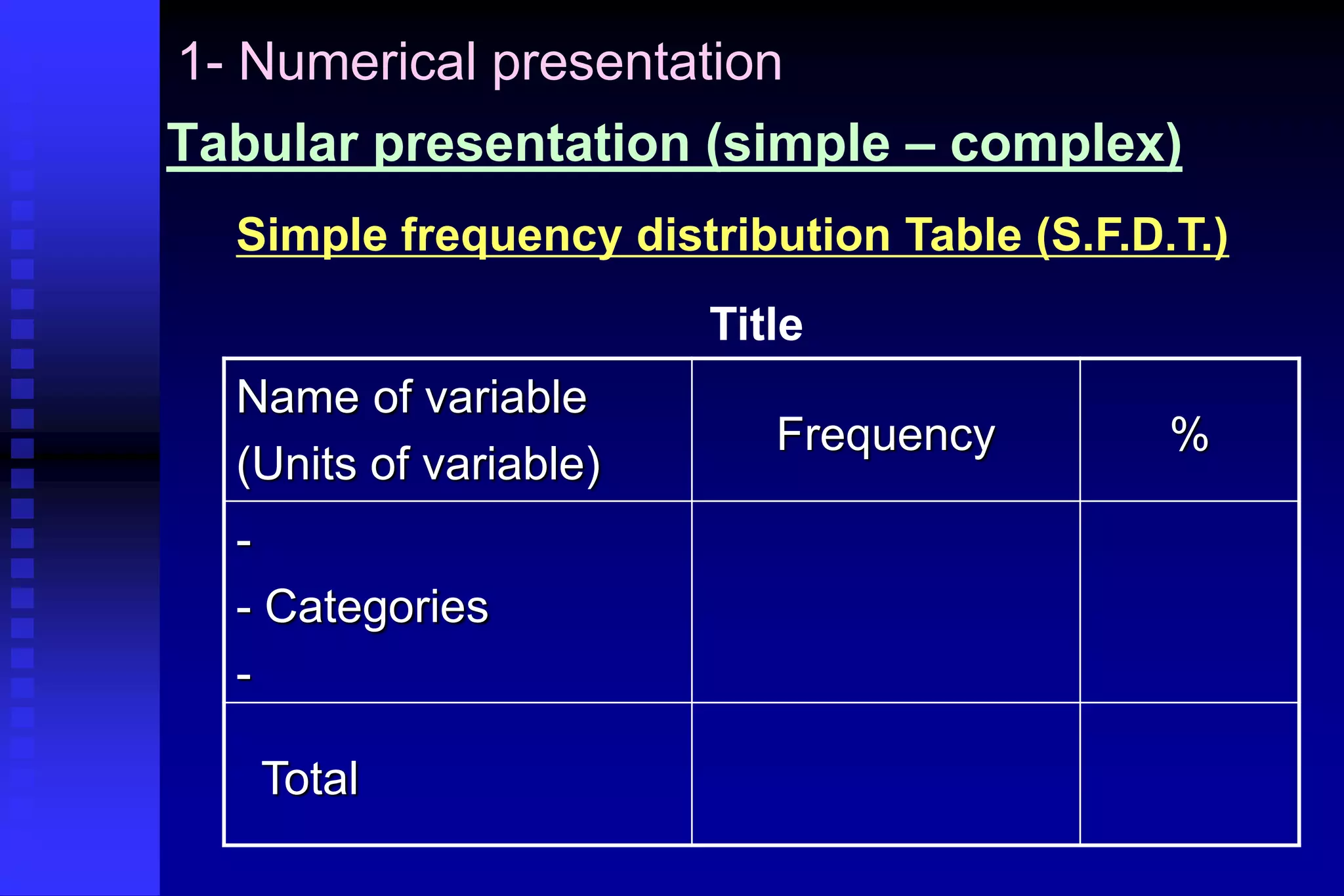
1- Numerical presentation
Tabular presentation (simple – complex)
Simple frequency distribution Table (S.F.D.T.)
Title
Name of variable
(Units of variable)
Frequency %
-
- Categories
-
Total
Table (I): Distribution of 50 patients at the surgical
department of Alexandria hospital in May 2008 according
to their ABO blood groups
Blood group Frequency %
A
B
AB
O
12
18
5
15
24
36
10
30
Total 50 100
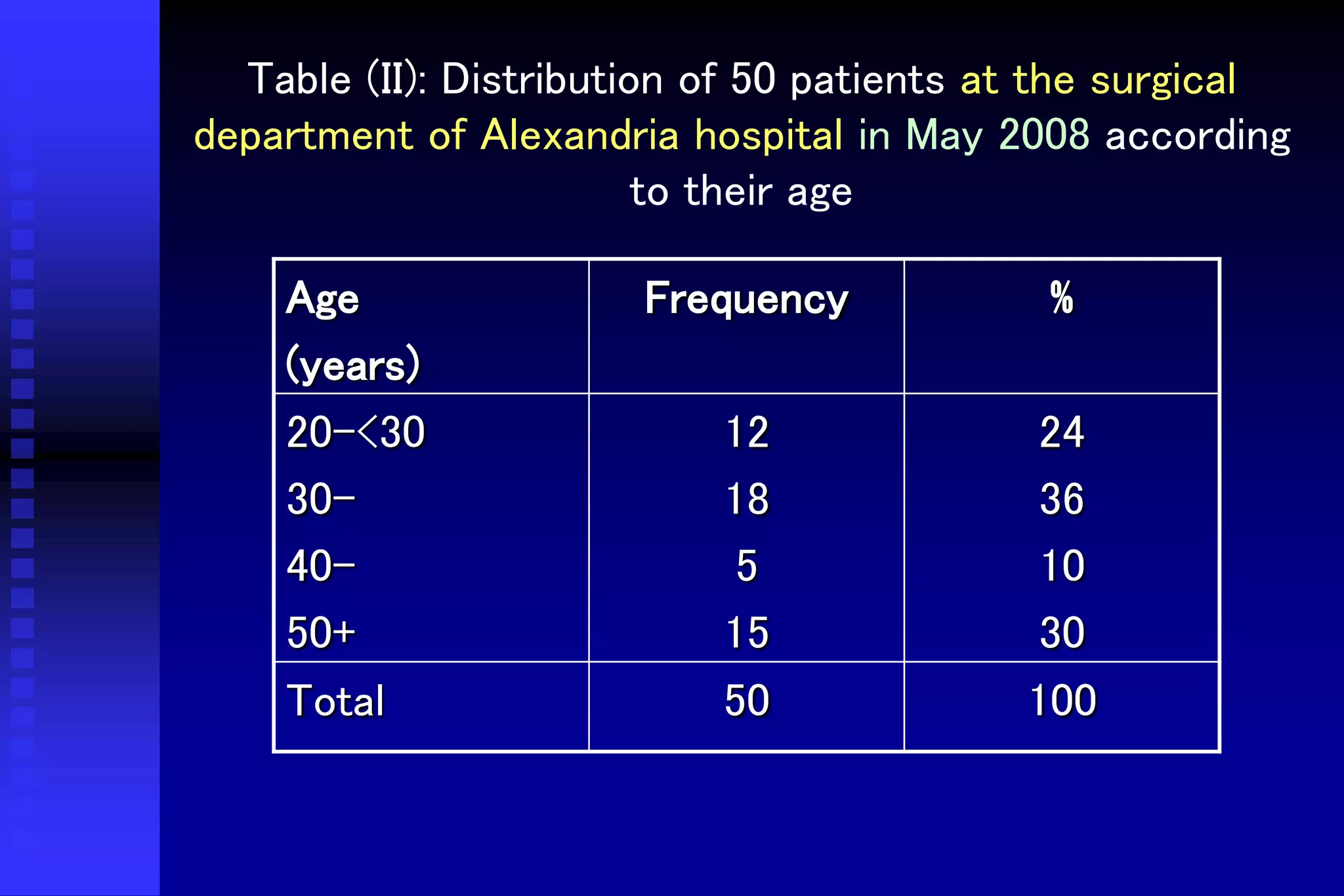
Table (II): Distribution of 50 patients at the surgical
department of Alexandria hospital in May 2008 according
to their age
Age
(years)
Frequency %
20-<30
30-
40-
50+
12
18
5
15
24
36
10
30
Total 50 100
Complex frequency distribution Table
Table (III): Distribution of 20 lung cancer patients at the chest department
of Alexandria hospital and 40 controls in May 2008 according to smoking
Smoking
Lung cancer
Total
Cases Control
No. % No. % No. %
Smoker 15 75% 8 20% 23 38.33
Non
smoker 5 25% 32 80% 37 61.67
Total 20 100 40 100 60 100
Complex frequency distribution Table
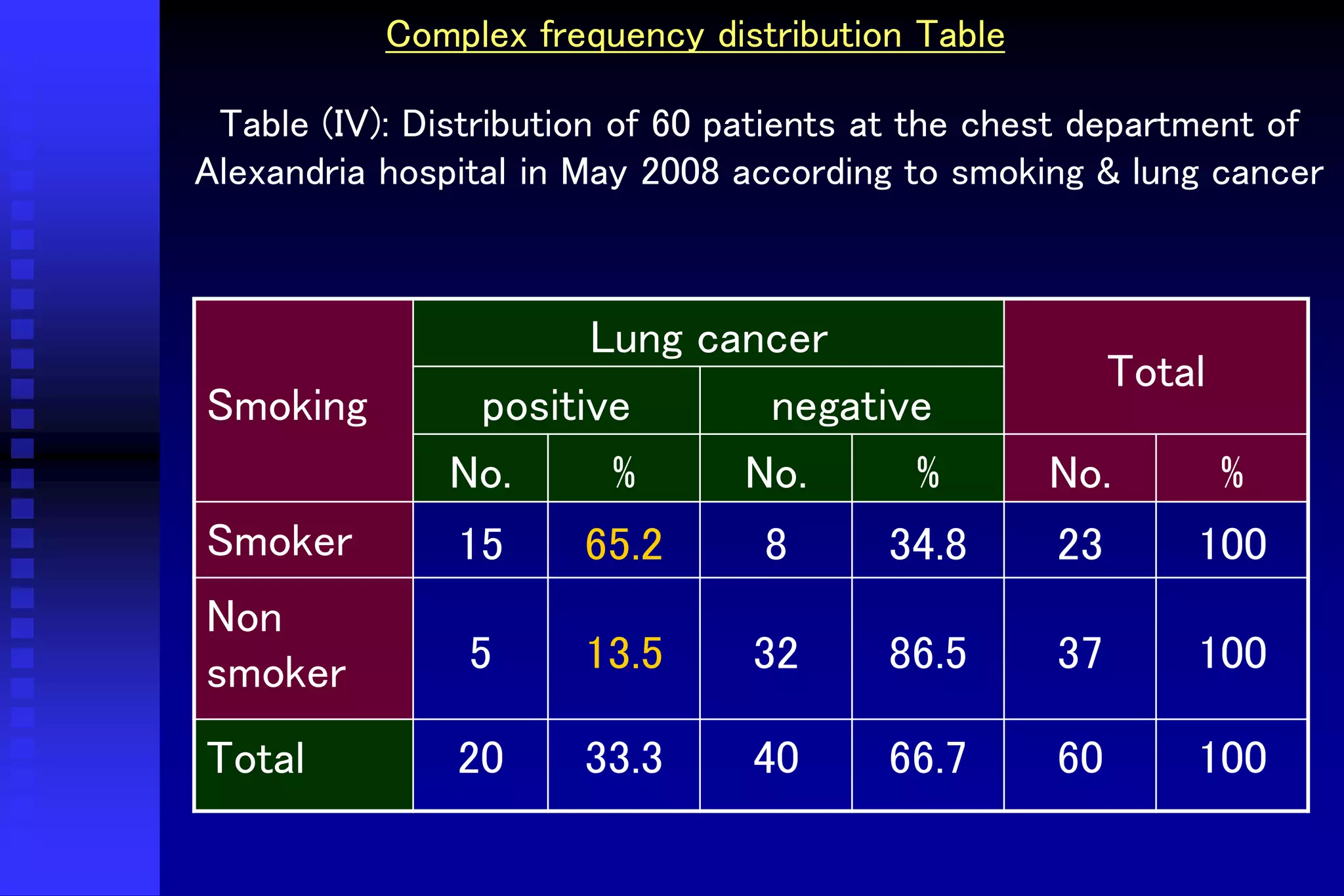
Table (IV): Distribution of 60 patients at the chest department of
Alexandria hospital in May 2008 according to smoking & lung cancer
Smoking
Lung cancer
Total
positive negative
No. % No. % No. %
Smoker 15 65.2 8 34.8 23 100
Non
smoker 5 13.5 32 86.5 37 100
Total 20 33.3 40 66.7 60 100
2- Graphical presentation
 Graphs drawn using Cartesian
coordinates
• Line graph
• Frequency polygon
• Frequency curve
• Histogram
• Bar graph
• Scatter plot
 Pie chart
 Statistical maps
rules
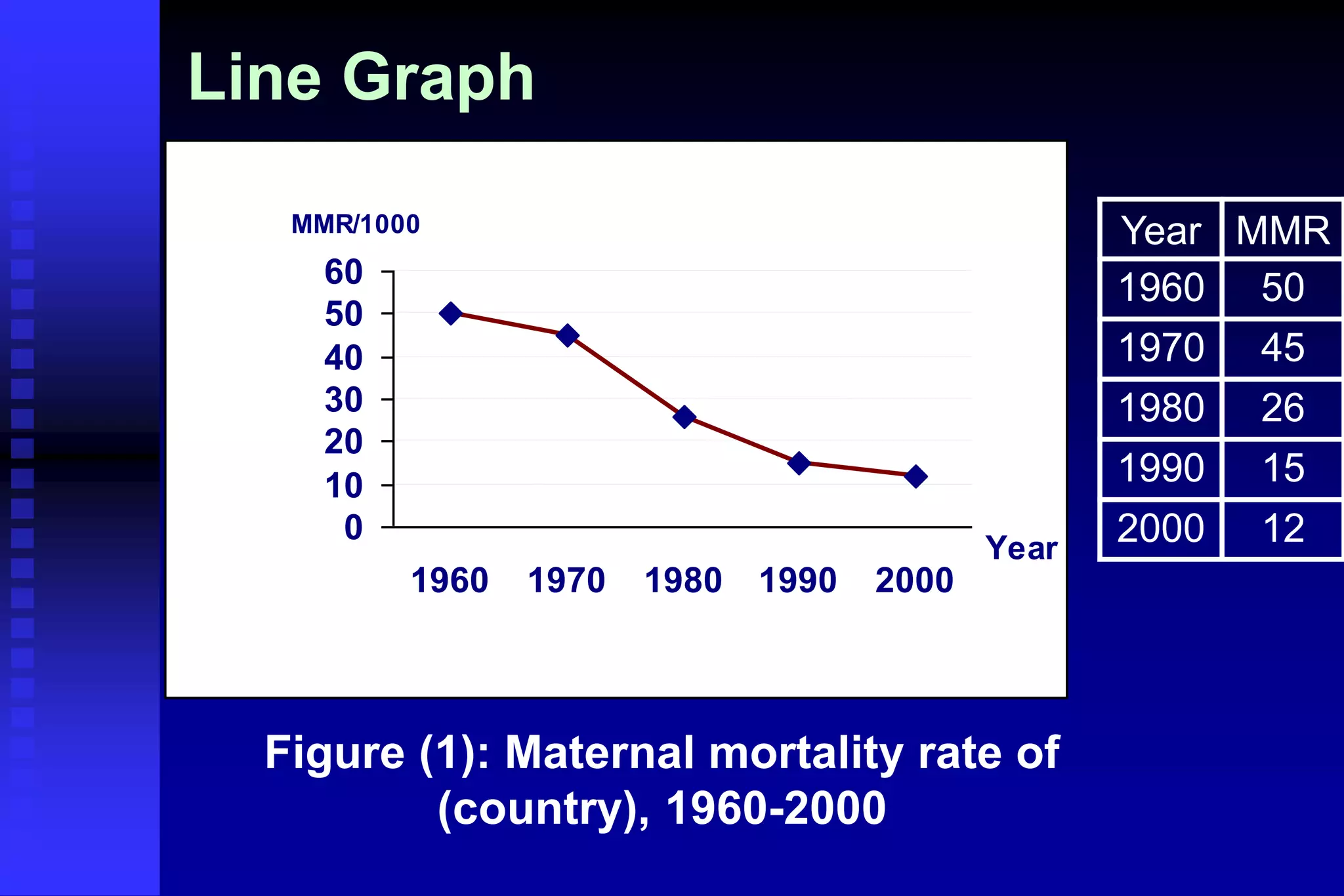
Line Graph
0
10
20
30
40
50
60
1960 1970 1980 1990 2000
Year
MMR/1000 Year MMR
1960 50
1970 45
1980 26
1990 15
2000 12
Figure (1): Maternal mortality rate of
(country), 1960-2000
Frequency polygon
Age
(years)
Sex Mid-point of interval
Males Females
20 - 3 (12%) 2 (10%) (20+30) / 2 = 25
30 - 9 (36%) 6 (30%) (30+40) / 2 = 35
40- 7 (8%) 5 (25%) (40+50) / 2 = 45
50 - 4 (16%) 3 (15%) (50+60) / 2 = 55
60 - 70 2 (8%) 4 (20%) (60+70) / 2 = 65
Total 25(100%) 20(100%)
Frequency polygon
Age
Sex
M-P
M F
20- (12%) (10%) 25
30- (36%) (30%) 35
40- (8%) (25%) 45
50- (16%) (15%) 55
60-70 (8%) (20%) 65
0
5
10
15
20
25
30
35
40
25 35 45 55 65
Age
%
Males Females
Figure (2): Distribution of 45 patients at (place) , in
(time) by age and sex
0
1
2
3
4
5
6
7
8
9
20- 30- 40- 50- 60-69
Age in years
Frequency
Female
Male
Frequency curve
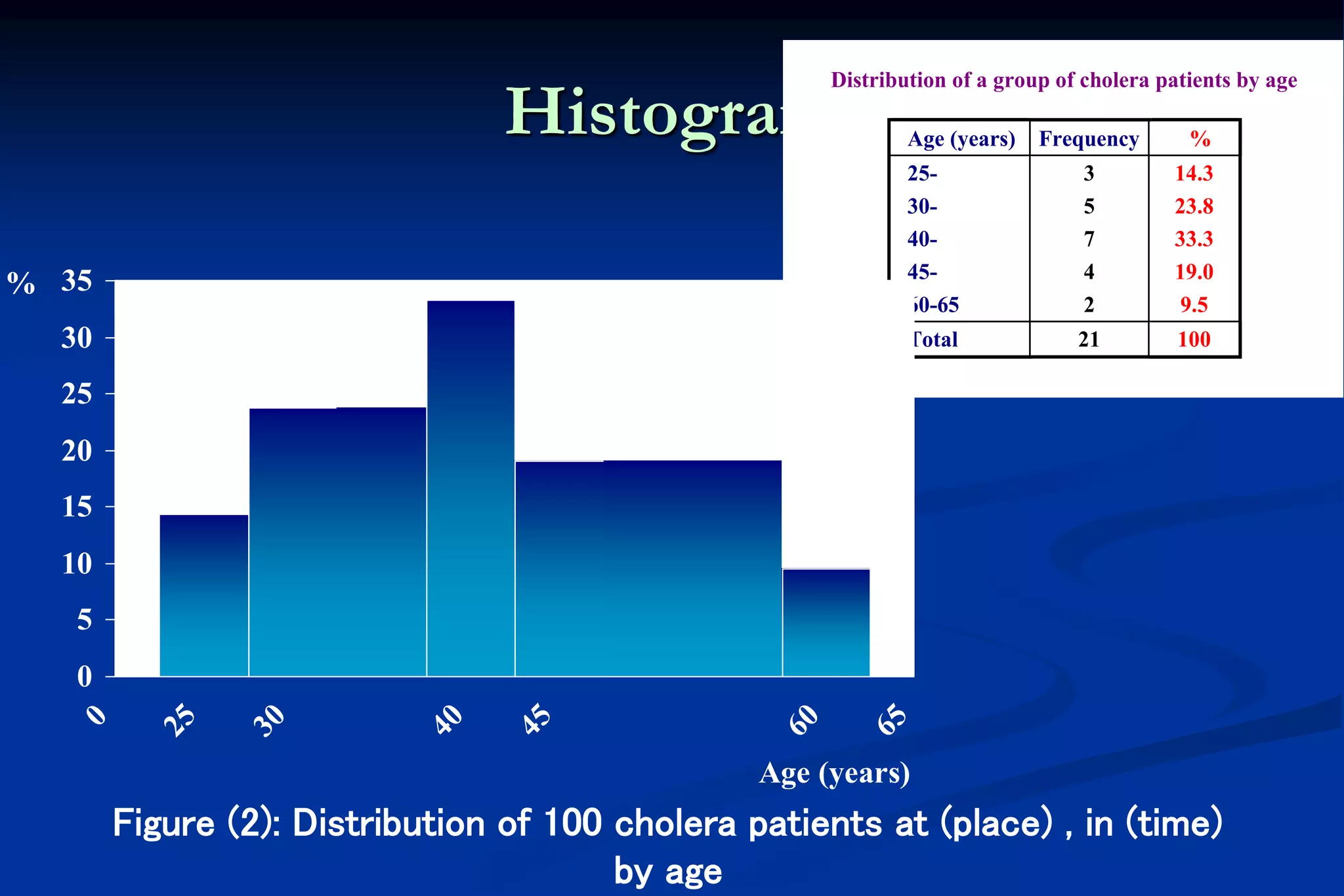
Histogram
Distribution of a group of cholera patients by age
Age (years) Frequency %
25-
30-
40-
45-
60-65
3
5
7
4
2
14.3
23.8
33.3
19.0
9.5
Total 21 100
0
5
10
15
20
25
30
35
0
2
5
3
0
4
0
4
5
6
0
6
5
Age (years)
%
Figure (2): Distribution of 100 cholera patients at (place) , in (time)
by age
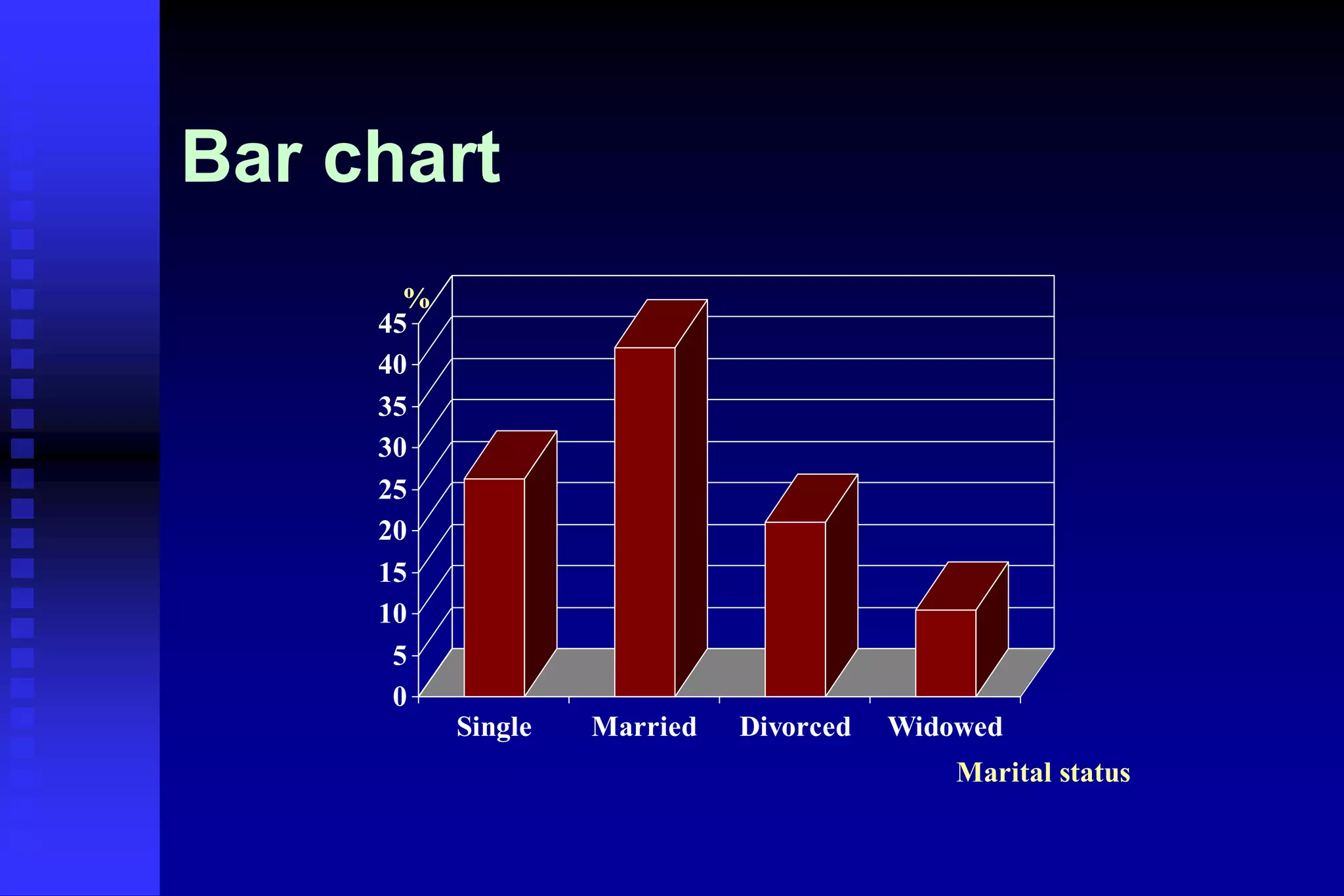
Bar chart
0
5
10
15
20
25
30
35
40
45
%
Single Married Divorced Widowed
Marital status
Bar chart
0
10
20
30
40
50
%
Single Married Divorced Widowed
Marital status
Male
Female
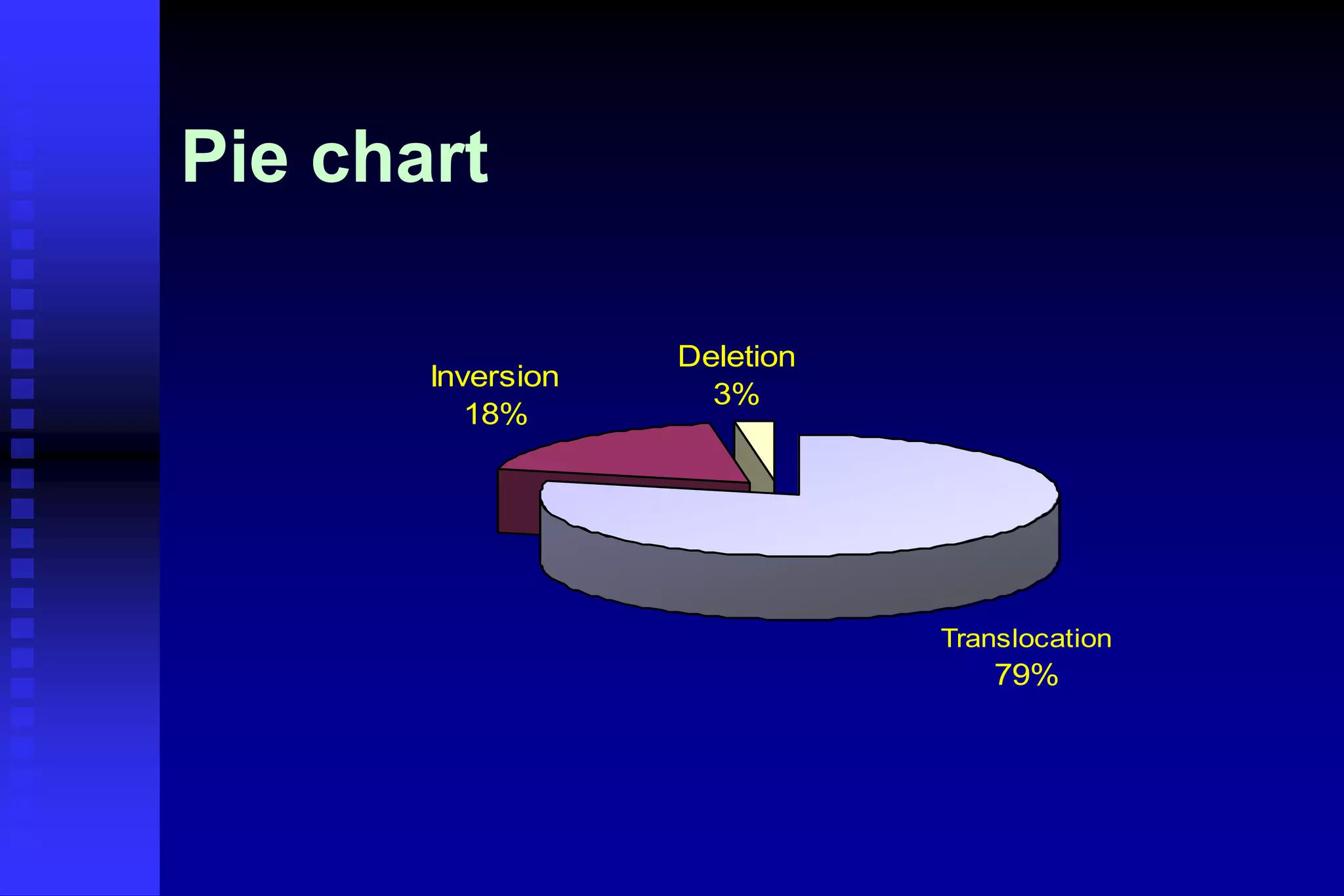
Pie chart
Deletion
3%
Inversion
18%
Translocation
79%
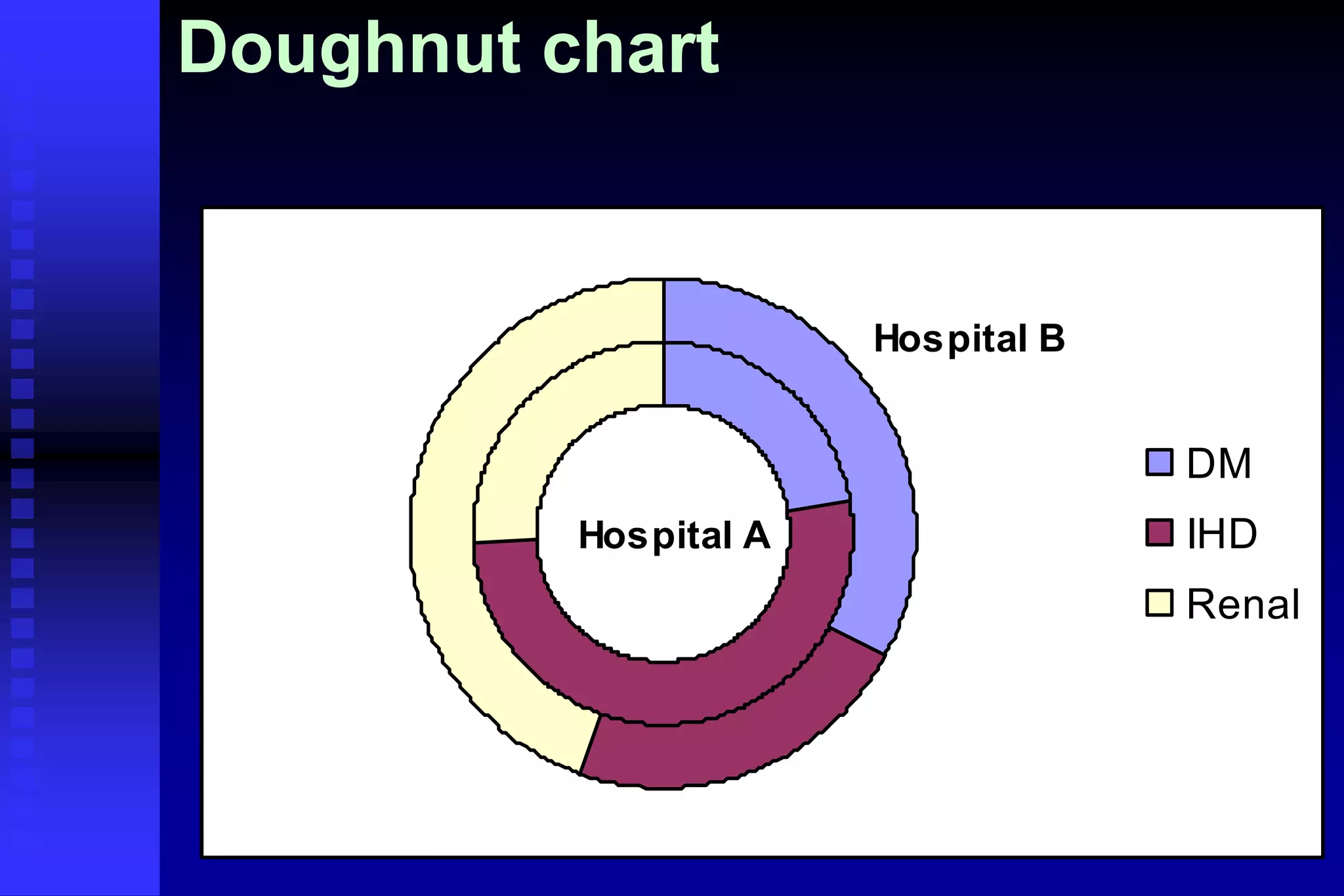
Doughnut chart
Hospital A
Hospital B
DM
IHD
Renal
3-Mathematical presentation
Summery statistics
Measures of location
1- Measures of central tendency
2- Measures of non central locations
(Quartiles, Percentiles )
Measures of dispersion
1- Measures of central tendency (averages)
Midrange
Smallest observation + Largest observation
2
Mode
the value which occurs with the greatest
frequency i.e. the most common value
Summery statistics
1- Measures of central tendency (cont.)
 Median
the observation which lies in the middle of
the ordered observation.
 Arithmetic mean (mean)
Sum of all observations
Number of observations
Summery statistics
Measures of dispersion
 Range
 Variance
 Standard deviation
 Semi-interquartile range
 Coefficient of variation
 “Standard error”
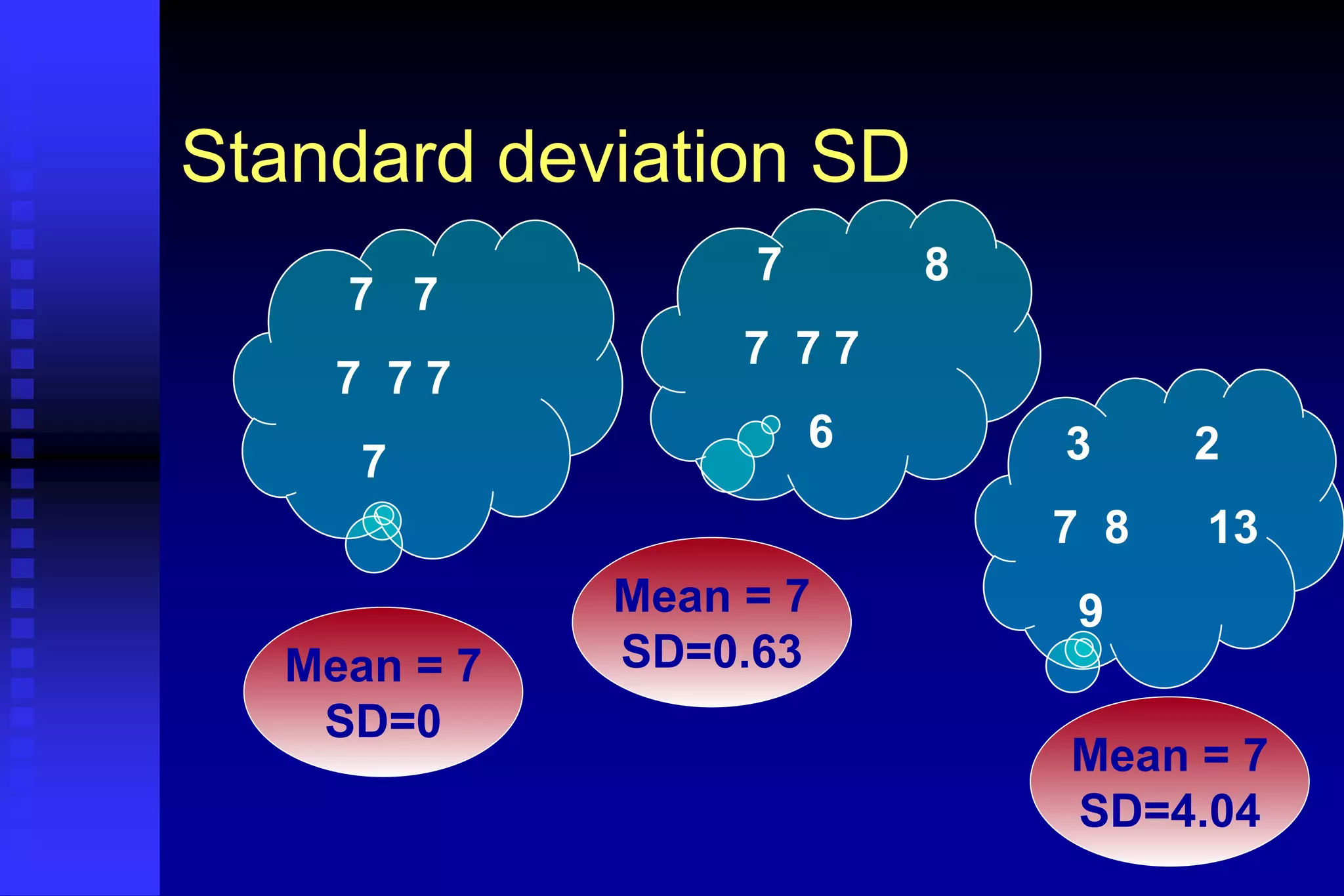
Standard deviation SD
7 7
7 7 7
7
7 8
7 7 7
6 3 2
7 8 13
9
Mean = 7
SD=0
Mean = 7
SD=0.63
Mean = 7
SD=4.04
Standard error of mean SE
A measure of variability among means of samples
selected from certain population
SE (Mean) =
S
n
33861.ppt

33861.ppt

  • 1.
  • 2.
    Introduction to Biostatistics Dr. MoatazaMahmoud Abdel Wahab Lecturer of Biostatistics High Institute of Public Health University of Alexandria
  • 3.
    Biostatistics (a portmanteau wordmade from biology and statistics) The application of statistics to a wide range of topics in biology.
  • 4.
    Biostatistics It is thescience which deals with development and application of the most appropriate methods for the: Collection of data. Presentation of the collected data. Analysis and interpretation of the results. Making decisions on the basis of such analysis
  • 5.
    Other definitions for“Statistics”  Frequently used in referral to recorded data  Denotes characteristics calculated for a set of data : sample mean
  • 6.
    Role of statisticians To guide the design of an experiment or survey prior to data collection  To analyze data using proper statistical procedures and techniques  To present and interpret the results to researchers and other decision makers
  • 7.
    Sources of data Records SurveysExperiments Comprehensive Sample
  • 8.
  • 9.
    Quantitative continuous Types of variables Quantitativevariables Qualitative variables Quantitative descrete Qualitative nominal Qualitative ordinal
  • 10.
     Numerical presentation Graphical presentation  Mathematical presentation Methods of presentation of data
  • 11.
    1- Numerical presentation Tabularpresentation (simple – complex) Simple frequency distribution Table (S.F.D.T.) Title Name of variable (Units of variable) Frequency % - - Categories - Total
  • 12.
    Table (I): Distributionof 50 patients at the surgical department of Alexandria hospital in May 2008 according to their ABO blood groups Blood group Frequency % A B AB O 12 18 5 15 24 36 10 30 Total 50 100
  • 13.
    Table (II): Distributionof 50 patients at the surgical department of Alexandria hospital in May 2008 according to their age Age (years) Frequency % 20-<30 30- 40- 50+ 12 18 5 15 24 36 10 30 Total 50 100
  • 14.
    Complex frequency distributionTable Table (III): Distribution of 20 lung cancer patients at the chest department of Alexandria hospital and 40 controls in May 2008 according to smoking Smoking Lung cancer Total Cases Control No. % No. % No. % Smoker 15 75% 8 20% 23 38.33 Non smoker 5 25% 32 80% 37 61.67 Total 20 100 40 100 60 100
  • 15.
    Complex frequency distributionTable Table (IV): Distribution of 60 patients at the chest department of Alexandria hospital in May 2008 according to smoking & lung cancer Smoking Lung cancer Total positive negative No. % No. % No. % Smoker 15 65.2 8 34.8 23 100 Non smoker 5 13.5 32 86.5 37 100 Total 20 33.3 40 66.7 60 100
  • 16.
    2- Graphical presentation Graphs drawn using Cartesian coordinates • Line graph • Frequency polygon • Frequency curve • Histogram • Bar graph • Scatter plot  Pie chart  Statistical maps rules
  • 17.
    Line Graph 0 10 20 30 40 50 60 1960 19701980 1990 2000 Year MMR/1000 Year MMR 1960 50 1970 45 1980 26 1990 15 2000 12 Figure (1): Maternal mortality rate of (country), 1960-2000
  • 18.
    Frequency polygon Age (years) Sex Mid-pointof interval Males Females 20 - 3 (12%) 2 (10%) (20+30) / 2 = 25 30 - 9 (36%) 6 (30%) (30+40) / 2 = 35 40- 7 (8%) 5 (25%) (40+50) / 2 = 45 50 - 4 (16%) 3 (15%) (50+60) / 2 = 55 60 - 70 2 (8%) 4 (20%) (60+70) / 2 = 65 Total 25(100%) 20(100%)
  • 19.
    Frequency polygon Age Sex M-P M F 20-(12%) (10%) 25 30- (36%) (30%) 35 40- (8%) (25%) 45 50- (16%) (15%) 55 60-70 (8%) (20%) 65 0 5 10 15 20 25 30 35 40 25 35 45 55 65 Age % Males Females Figure (2): Distribution of 45 patients at (place) , in (time) by age and sex
  • 20.
    0 1 2 3 4 5 6 7 8 9 20- 30- 40-50- 60-69 Age in years Frequency Female Male Frequency curve
  • 21.
    Histogram Distribution of agroup of cholera patients by age Age (years) Frequency % 25- 30- 40- 45- 60-65 3 5 7 4 2 14.3 23.8 33.3 19.0 9.5 Total 21 100 0 5 10 15 20 25 30 35 0 2 5 3 0 4 0 4 5 6 0 6 5 Age (years) % Figure (2): Distribution of 100 cholera patients at (place) , in (time) by age
  • 22.
  • 23.
    Bar chart 0 10 20 30 40 50 % Single MarriedDivorced Widowed Marital status Male Female
  • 24.
  • 25.
  • 26.
    3-Mathematical presentation Summery statistics Measuresof location 1- Measures of central tendency 2- Measures of non central locations (Quartiles, Percentiles ) Measures of dispersion
  • 27.
    1- Measures ofcentral tendency (averages) Midrange Smallest observation + Largest observation 2 Mode the value which occurs with the greatest frequency i.e. the most common value Summery statistics
  • 28.
    1- Measures ofcentral tendency (cont.)  Median the observation which lies in the middle of the ordered observation.  Arithmetic mean (mean) Sum of all observations Number of observations Summery statistics
  • 29.
    Measures of dispersion Range  Variance  Standard deviation  Semi-interquartile range  Coefficient of variation  “Standard error”
  • 30.
    Standard deviation SD 77 7 7 7 7 7 8 7 7 7 6 3 2 7 8 13 9 Mean = 7 SD=0 Mean = 7 SD=0.63 Mean = 7 SD=4.04
  • 31.
    Standard error ofmean SE A measure of variability among means of samples selected from certain population SE (Mean) = S n