Cost
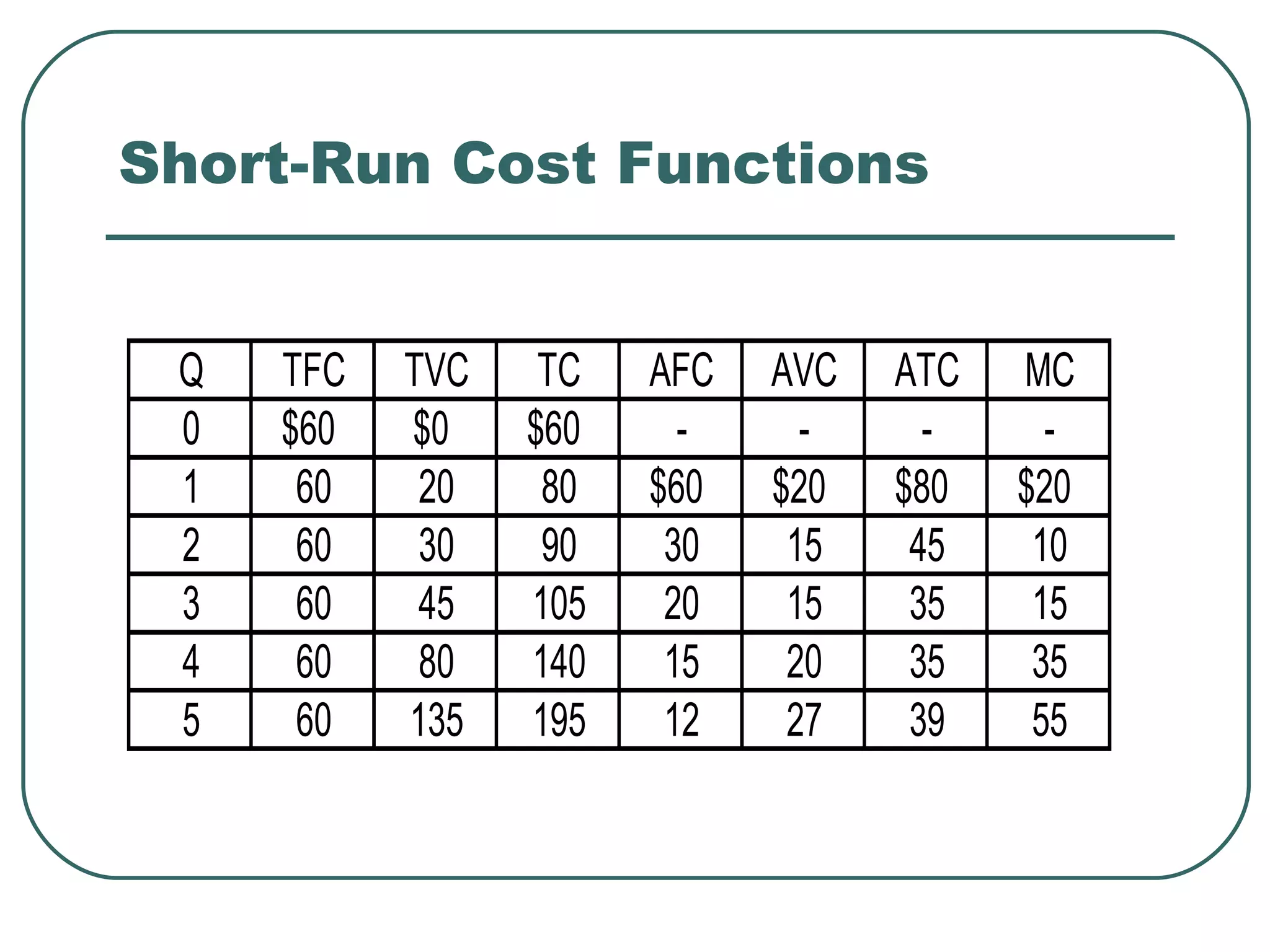
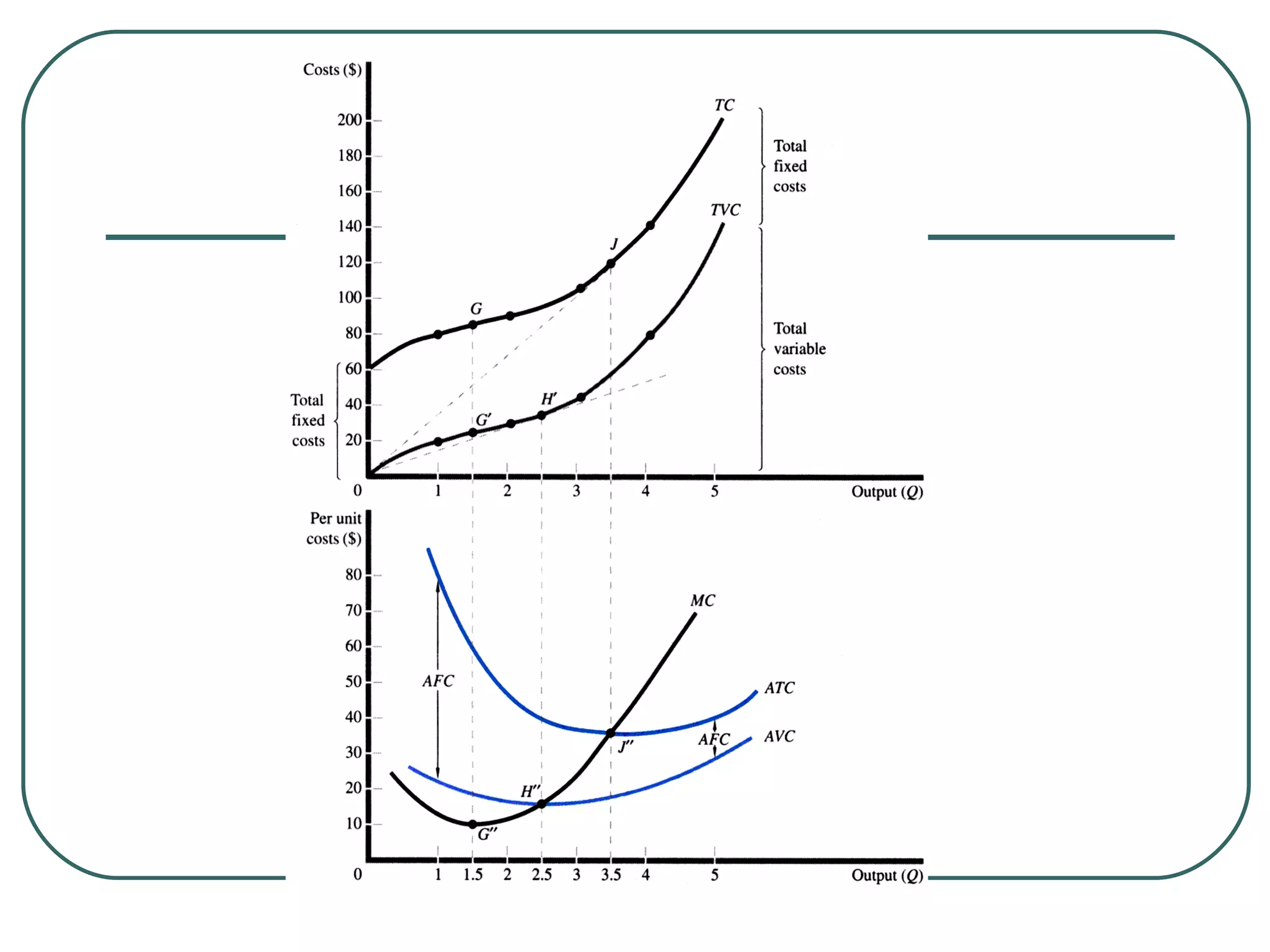
Short-Run Cost Functions Total Cost = TC = f(Q) Total Fixed Cost = TFC Total Variable Cost = TVC TC = TFC + TVC
Short-Run Cost Functions Average Total Cost = ATC = TC/Q Average Fixed Cost = AFC = TFC/Q Average Variable Cost = AVC = TVC/Q ATC = AFC + AVC Marginal Cost =   TC/  Q =   TVC/  Q
Short-Run Cost Functions
 
Long-Run Cost Curves The Long-run Average Cost (LAC) curve is the cost curve showing the average cost of production at different levels of output, turned out by different sized plants.
Long-Run Cost Curves Long-Run Total Cost = LTC = f(Q) Long-Run Average Cost = LAC = LTC/Q Long-Run Marginal Cost = LMC =   LTC/  Q
Relationship Between Long-Run and Short-Run Average Cost Curves
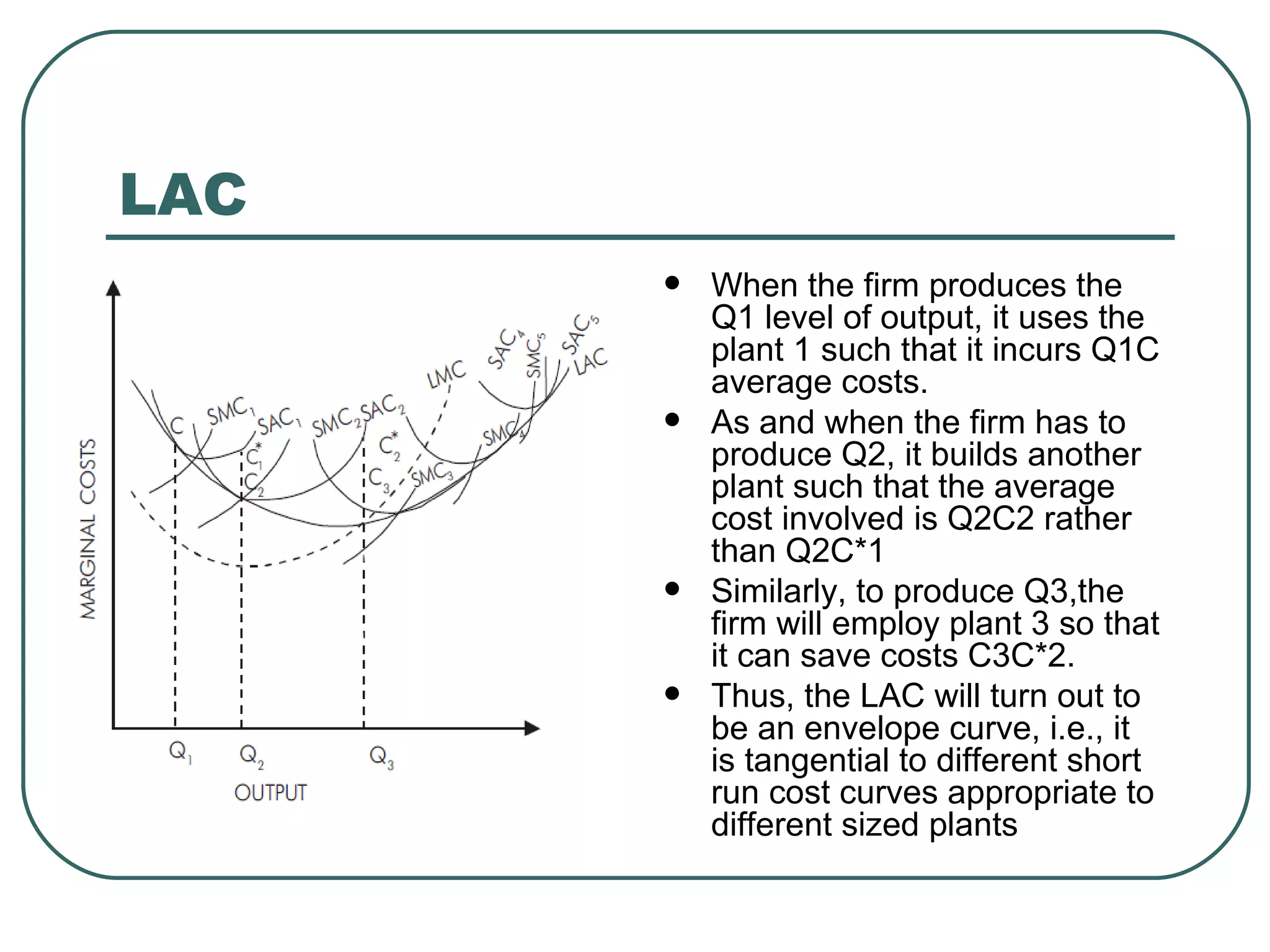
LAC When the firm produces the Q1 level of output, it uses the plant 1 such that it incurs Q1C average costs.  As and when the firm has to produce Q2, it builds another plant such that the average cost involved is Q2C2 rather than Q2C*1 Similarly, to produce Q3,the firm will employ plant 3 so that it can save costs C3C*2.  Thus, the LAC will turn out to be an envelope curve, i.e., it is tangential to different short run cost curves appropriate to different sized plants
Economies and Diseconomies of Scale Internal Economies and Diseconomies When a firm expands in size by increasing the scale of its output, certain cost advantages accrue to the firm, those are called internal economies. External Economies and Diseconomies of Scale The external economies occur when there are physical and cost advantages that result from the general development of the industry. When the industry expands, it offers scope for specialisation and skill formation and for lateral and vertical integration.
Internalised External Economies However, when railway line  (external)  is available due to public investment, a firm may undertake private investment to construct its own feeder line to get better advantage of public rail line Externalised Internal Diseconomies Many chemical plants produce a lot of pollutants (i.e., internal diseconomies) and then discharge the same in either water or air (i.e., externalisation).

3 cost curves

  • 1.
  • 2.
    Short-Run Cost FunctionsTotal Cost = TC = f(Q) Total Fixed Cost = TFC Total Variable Cost = TVC TC = TFC + TVC
  • 3.
    Short-Run Cost FunctionsAverage Total Cost = ATC = TC/Q Average Fixed Cost = AFC = TFC/Q Average Variable Cost = AVC = TVC/Q ATC = AFC + AVC Marginal Cost =  TC/  Q =  TVC/  Q
  • 4.
  • 5.
  • 6.
    Long-Run Cost CurvesThe Long-run Average Cost (LAC) curve is the cost curve showing the average cost of production at different levels of output, turned out by different sized plants.
  • 7.
    Long-Run Cost CurvesLong-Run Total Cost = LTC = f(Q) Long-Run Average Cost = LAC = LTC/Q Long-Run Marginal Cost = LMC =  LTC/  Q
  • 8.
    Relationship Between Long-Runand Short-Run Average Cost Curves
  • 9.
    LAC When thefirm produces the Q1 level of output, it uses the plant 1 such that it incurs Q1C average costs. As and when the firm has to produce Q2, it builds another plant such that the average cost involved is Q2C2 rather than Q2C*1 Similarly, to produce Q3,the firm will employ plant 3 so that it can save costs C3C*2. Thus, the LAC will turn out to be an envelope curve, i.e., it is tangential to different short run cost curves appropriate to different sized plants
  • 10.
    Economies and Diseconomiesof Scale Internal Economies and Diseconomies When a firm expands in size by increasing the scale of its output, certain cost advantages accrue to the firm, those are called internal economies. External Economies and Diseconomies of Scale The external economies occur when there are physical and cost advantages that result from the general development of the industry. When the industry expands, it offers scope for specialisation and skill formation and for lateral and vertical integration.
  • 11.
    Internalised External EconomiesHowever, when railway line (external) is available due to public investment, a firm may undertake private investment to construct its own feeder line to get better advantage of public rail line Externalised Internal Diseconomies Many chemical plants produce a lot of pollutants (i.e., internal diseconomies) and then discharge the same in either water or air (i.e., externalisation).