EVALUATING THE EFFICACY OF
MULTISPECTRAL DATA FOR DETECTING AND
ESTIMATING PATCH SIZES OF PARTHENIUM
WEED: Preliminary results
Mahlatse Kganyago, John Odindi & Clement
Adjorlolo
AARSE conference 2014
- Parthenium hysterophorus (Asteraceae) – commonly: Famine weed,
ragweed (Astralia), (Ethiopia-sign off and leave your land), Congress
grass, ‘‘Scourge of India’’, etc.
- Native: Gulf of Mexico, central and South America (Kumar et al. 2009).
- Highly aggressive & colonises disturbed sites (road sides, railway-tracks,
waste lands, croplands, building peripheries, irrigation canals, & cultivated
fields (Chatterjee, 2006)
- Top 7 problematic, devastating and hazardous weeds in the globe (Patel et
al. 2011).
- Fast & sporadic growth in wet (>500mm) and warm (10 to 250C) summer
conditions (Dogra et al. 2011)
- A seed bank which can survive for many years, e.g. recorded
1880 prevalent in the 1980s, after cyclone Demoina.
- 25 000 dark brown, light weight seeds /plant - can dispersed by vehicles,
water, animals, farm machinery, water and wind (Javaid et al. 2009;
Mcconnachie et al. 2010; Dogra et al. 2011).
Introduction
Distribution of Parthenium weed
CLIMAX – climatic suitability model
Mcconnachie et al. 2010
Phenological stages
1. Juvenile –
sporadic growth
2. Adult/vegetative
– whitish, hairy
stem &
bipinnate leaves
3. Mature – (>97
flowers per
plant)
Structural & Phenological characteristics of Parthenium weed
Impacts of Parthenium weed
• Reduces density of grass
(Dhileepan 2007; Nigatu
et al. 2010) – reduced
pasture production
• Sheep and buffalo, it
causes degenerative
changes in liver and
kidney (Patel, 2011) –
death in 30 days (10%-
50%)
Biodiversity
• Health problems, incl.
hay fever, bronchitis,
dermatitis, allergic
rhinitis, black spots,
diarrhoea, skin
inflammation and
asthma (Mcconnachie et
al. 2010, Lalitha et al.
2012)
• Increased Poverty
Society
• Inhibiting germination
and growth of pasture
grasses, legumes,
cereals, vegetables,
other weeds, and trees
(Mcconnachie et al.
2010)
• Tainted milk and meat
products – below
standard quality livestock
products
Agriculture
• Increases in food
prices
• Increased health
investment
• Total investment in
the infested areas
since 2005 - R248
130 000 (Braack ,
2014)
Economy
• An attractive option - capabilities to provide detailed, quantitative
characteristics of the land surface information, frequent revisits, local to
global scales
• Integration of mathematical and statistical models – provides an
objective and powerful ways to monitor the dynamics in the landscape
composition (IAS)
• Plant characteristics such as, e.g., chlorophyll content, nutrients
deficiency, water content and stress, distribution of leaves, and
phenology, can be derived through remote sensing techniques.
• An understanding of distribution & patch sizes of Parthenium will
enable proper allocation of eradication and containment resources.
Remote sensing of IAS
Objectives
• (i) To determine the distribution and patch
sizes P. hysterophorus,
• (ii) To assess the efficacy of multispectral
sensors in detecting P. hysterophorus,
and
Objectives of the study
Study Area
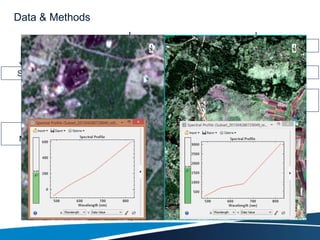
Data & Methods
Data collection
Pre-processing
Training Validation
SPOT 6 Landsat 8 GPS presence
Uncertainty Reject
Alternative
Aerial Photos
Digitisation
Visual
interpretation
GE
Confusion
Matrix
SVM
classification
FLAASH-
MODTRAN4
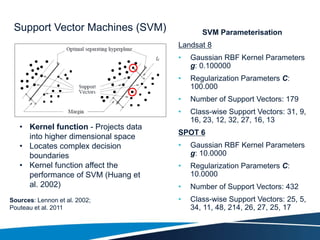
Support Vector Machines (SVM)
• Kernel function - Projects data
into higher dimensional space
• Locates complex decision
boundaries
• Kernel function affect the
performance of SVM (Huang et
al. 2002)
Sources: Lennon et al. 2002;
Pouteau et al. 2011
SVM Parameterisation
Landsat 8
• Gaussian RBF Kernel Parameters
g: 0.100000
• Regularization Parameters C:
100.000
• Number of Support Vectors: 179
• Class-wise Support Vectors: 31, 9,
16, 23, 12, 32, 27, 16, 13
SPOT 6
• Gaussian RBF Kernel Parameters
g: 10.0000
• Regularization Parameters C:
10.0000
• Number of Support Vectors: 432
• Class-wise Support Vectors: 25, 5,
34, 11, 48, 214, 26, 27, 25, 17
Preliminary Results
Photo: Kay Montgomery
Preliminary Results…
Photo: Kay Montgomery
Preliminary Results…
• The total area infested
• 11,748.2848 Hectares (7.18%; SPOT 6)
• 21,845.340 Hectares (13.31%; Landsat 8)
• Patch sizes
• Minimum: 0.036 hectares Maximum: 7.15 hectares (SPOT 6)
• Minimum: 0.09 hectares Maximum:56.43 hectares (Landsat 8)
• Estimates of patch sizes would enable proper allocation of resources
• Detection is possible, optimisation is needed for correct patch size
• The species spectral variability, can be accounted for. Spectral
separability with other inactive veg. unknown.
• Landsat 8 suitable for detecting large patches, SPOT 6 – can detect
smaller patches
• SVM - robust algorithm, works well with small training data & can be
used effectively to detect Patches of Parthenium weed
Discussion and Conclusion
Future Work
• Multi-temporal datasets will be incorporated, the possibility for early detection
• Ground reference datasets for training and validation using RS “rules of thumb”
• Pontius Matrix for accuracy assessment –AD & QD
• Statistical comparisons of maps using McNemar’s test
• The Author acknowledges financial
support through a sponsorship from the
South African National Space Agency
(SANSA)
• I also acknowledge the data provided by
Ian Ruthworth (Ezemvelo Wildlife);
Lesley Henderson (ARC-Plant
Protection Institute); and Kay
Montgomery (Environmental
Programmes-Biosecurity Unit)
Acknowledgements
Thank you
Email: mkganyago@sansa.org.za
Tel: 012 844 0424

2.m_kganyago_subm_id_187

  • 1.
    EVALUATING THE EFFICACYOF MULTISPECTRAL DATA FOR DETECTING AND ESTIMATING PATCH SIZES OF PARTHENIUM WEED: Preliminary results Mahlatse Kganyago, John Odindi & Clement Adjorlolo AARSE conference 2014
  • 2.
    - Parthenium hysterophorus(Asteraceae) – commonly: Famine weed, ragweed (Astralia), (Ethiopia-sign off and leave your land), Congress grass, ‘‘Scourge of India’’, etc. - Native: Gulf of Mexico, central and South America (Kumar et al. 2009). - Highly aggressive & colonises disturbed sites (road sides, railway-tracks, waste lands, croplands, building peripheries, irrigation canals, & cultivated fields (Chatterjee, 2006) - Top 7 problematic, devastating and hazardous weeds in the globe (Patel et al. 2011). - Fast & sporadic growth in wet (>500mm) and warm (10 to 250C) summer conditions (Dogra et al. 2011) - A seed bank which can survive for many years, e.g. recorded 1880 prevalent in the 1980s, after cyclone Demoina. - 25 000 dark brown, light weight seeds /plant - can dispersed by vehicles, water, animals, farm machinery, water and wind (Javaid et al. 2009; Mcconnachie et al. 2010; Dogra et al. 2011). Introduction
  • 3.
  • 4.
    CLIMAX – climaticsuitability model Mcconnachie et al. 2010
  • 5.
    Phenological stages 1. Juvenile– sporadic growth 2. Adult/vegetative – whitish, hairy stem & bipinnate leaves 3. Mature – (>97 flowers per plant) Structural & Phenological characteristics of Parthenium weed
  • 6.
    Impacts of Partheniumweed • Reduces density of grass (Dhileepan 2007; Nigatu et al. 2010) – reduced pasture production • Sheep and buffalo, it causes degenerative changes in liver and kidney (Patel, 2011) – death in 30 days (10%- 50%) Biodiversity • Health problems, incl. hay fever, bronchitis, dermatitis, allergic rhinitis, black spots, diarrhoea, skin inflammation and asthma (Mcconnachie et al. 2010, Lalitha et al. 2012) • Increased Poverty Society • Inhibiting germination and growth of pasture grasses, legumes, cereals, vegetables, other weeds, and trees (Mcconnachie et al. 2010) • Tainted milk and meat products – below standard quality livestock products Agriculture • Increases in food prices • Increased health investment • Total investment in the infested areas since 2005 - R248 130 000 (Braack , 2014) Economy
  • 7.
    • An attractiveoption - capabilities to provide detailed, quantitative characteristics of the land surface information, frequent revisits, local to global scales • Integration of mathematical and statistical models – provides an objective and powerful ways to monitor the dynamics in the landscape composition (IAS) • Plant characteristics such as, e.g., chlorophyll content, nutrients deficiency, water content and stress, distribution of leaves, and phenology, can be derived through remote sensing techniques. • An understanding of distribution & patch sizes of Parthenium will enable proper allocation of eradication and containment resources. Remote sensing of IAS
  • 8.
    Objectives • (i) Todetermine the distribution and patch sizes P. hysterophorus, • (ii) To assess the efficacy of multispectral sensors in detecting P. hysterophorus, and Objectives of the study
  • 9.
  • 10.
    Data & Methods Datacollection Pre-processing Training Validation SPOT 6 Landsat 8 GPS presence Uncertainty Reject Alternative Aerial Photos Digitisation Visual interpretation GE Confusion Matrix SVM classification FLAASH- MODTRAN4
  • 11.
    Support Vector Machines(SVM) • Kernel function - Projects data into higher dimensional space • Locates complex decision boundaries • Kernel function affect the performance of SVM (Huang et al. 2002) Sources: Lennon et al. 2002; Pouteau et al. 2011 SVM Parameterisation Landsat 8 • Gaussian RBF Kernel Parameters g: 0.100000 • Regularization Parameters C: 100.000 • Number of Support Vectors: 179 • Class-wise Support Vectors: 31, 9, 16, 23, 12, 32, 27, 16, 13 SPOT 6 • Gaussian RBF Kernel Parameters g: 10.0000 • Regularization Parameters C: 10.0000 • Number of Support Vectors: 432 • Class-wise Support Vectors: 25, 5, 34, 11, 48, 214, 26, 27, 25, 17
  • 12.
  • 13.
  • 14.
  • 15.
    • The totalarea infested • 11,748.2848 Hectares (7.18%; SPOT 6) • 21,845.340 Hectares (13.31%; Landsat 8) • Patch sizes • Minimum: 0.036 hectares Maximum: 7.15 hectares (SPOT 6) • Minimum: 0.09 hectares Maximum:56.43 hectares (Landsat 8) • Estimates of patch sizes would enable proper allocation of resources • Detection is possible, optimisation is needed for correct patch size • The species spectral variability, can be accounted for. Spectral separability with other inactive veg. unknown. • Landsat 8 suitable for detecting large patches, SPOT 6 – can detect smaller patches • SVM - robust algorithm, works well with small training data & can be used effectively to detect Patches of Parthenium weed Discussion and Conclusion
  • 16.
    Future Work • Multi-temporaldatasets will be incorporated, the possibility for early detection • Ground reference datasets for training and validation using RS “rules of thumb” • Pontius Matrix for accuracy assessment –AD & QD • Statistical comparisons of maps using McNemar’s test
  • 17.
    • The Authoracknowledges financial support through a sponsorship from the South African National Space Agency (SANSA) • I also acknowledge the data provided by Ian Ruthworth (Ezemvelo Wildlife); Lesley Henderson (ARC-Plant Protection Institute); and Kay Montgomery (Environmental Programmes-Biosecurity Unit) Acknowledgements
  • 18.