Agents of Socialization
 persons or institutions which influence
our thoughts and behaviors.
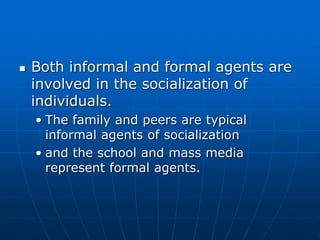
 Both informal and formal agents are
involved in the socialization of
individuals.
• The family and peers are typical
informal agents of socialization
• and the school and mass media
represent formal agents.
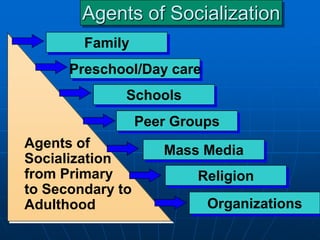
Agents of Socialization
Family
Preschool/Day care
Schools
Peer Groups
Mass Media
Religion
Organizations
Agents of
Socialization
from Primary
to Secondary to
Adulthood
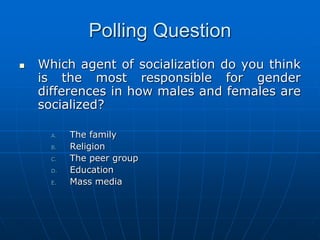
Polling Question
 Which agent of socialization do you think
is the most responsible for gender
differences in how males and females are
socialized?
A. The family
B. Religion
C. The peer group
D. Education
E. Mass media
Family
• 1st group to have impact on individual
• Give basic sense of self
• most important of the agents of socialization
• responsible for, among other things,
 determining one's attitudes toward religion
 establishing career goals
• help children internalize the norms of the
society in which they live.
• Provides:
 social position
 emotional support
 physical support
 role models
Much about the family has changed:
 Decline of the nuclear family
 Single parent households
 Divorce
 Decline of extended family
Religion
• Influences values, what is right/wrong
School
• Manifest and latent functions
 transmit knowledge and skills
• agency responsible for socializing
groups of young people in particular
skills and values in society
• Individuals of roughly the same age
connected by common interests
• who share other social characteristics
(e.g., students in a college class).
• Standards of peer groups dominate our
lives
Peer groups
Mass Media
 Types of mass media:
• movies, television
• print- magazines and newspapers,
books, etc.
• music
• electronic communications
Mass Media Functions to
socialize:
 provides information
 contact with others
 viewpoints on issues
 access to consumer culture
 entertainment
 education?
Internet Addiction
 While we are accustomed to complaints
that children (or adults) watch too much
television, a new mass media problem has
emerged since 1994-
• Internet Addiction.
 The American Psychiatric Association has
recognized Internet Addiction Disorder.
Some indications include:
• 1.Tolerance- needing more time online to
achieve satisfaction.
• 2. Withdrawal symptoms that develop
within a few days to a month after reducing or
stopping use. The resumption of use decreases
the symptoms.
• 3. Use of the Internet more often for longer
periods of time. And spending time on Internet
related activities (reading books, trying out
software, etc.)
• 4. Neglect of other important life activities.
• 5. Excessive use impacts negatively on job,
relationship, or other role obligations.
 Some research has indicated that middle
aged women and people already prone to
depression and bipolar disorders are most
likely to develop this disorder.
 The subject has been studied by
psychologists.

2-agents-of-socialization.ppt

  • 1.
    Agents of Socialization persons or institutions which influence our thoughts and behaviors.
  • 2.
     Both informaland formal agents are involved in the socialization of individuals. • The family and peers are typical informal agents of socialization • and the school and mass media represent formal agents.
  • 3.
    Agents of Socialization Family Preschool/Daycare Schools Peer Groups Mass Media Religion Organizations Agents of Socialization from Primary to Secondary to Adulthood
  • 4.
    Polling Question  Whichagent of socialization do you think is the most responsible for gender differences in how males and females are socialized? A. The family B. Religion C. The peer group D. Education E. Mass media
  • 5.
    Family • 1st groupto have impact on individual • Give basic sense of self • most important of the agents of socialization • responsible for, among other things,  determining one's attitudes toward religion  establishing career goals • help children internalize the norms of the society in which they live. • Provides:  social position  emotional support  physical support  role models
  • 6.
    Much about thefamily has changed:  Decline of the nuclear family  Single parent households  Divorce  Decline of extended family
  • 7.
  • 8.
    School • Manifest andlatent functions  transmit knowledge and skills • agency responsible for socializing groups of young people in particular skills and values in society
  • 9.
    • Individuals ofroughly the same age connected by common interests • who share other social characteristics (e.g., students in a college class). • Standards of peer groups dominate our lives Peer groups
  • 10.
    Mass Media  Typesof mass media: • movies, television • print- magazines and newspapers, books, etc. • music • electronic communications
  • 11.
    Mass Media Functionsto socialize:  provides information  contact with others  viewpoints on issues  access to consumer culture  entertainment  education?
  • 12.
    Internet Addiction  Whilewe are accustomed to complaints that children (or adults) watch too much television, a new mass media problem has emerged since 1994- • Internet Addiction.  The American Psychiatric Association has recognized Internet Addiction Disorder. Some indications include: • 1.Tolerance- needing more time online to achieve satisfaction. • 2. Withdrawal symptoms that develop within a few days to a month after reducing or stopping use. The resumption of use decreases the symptoms.
  • 13.
    • 3. Useof the Internet more often for longer periods of time. And spending time on Internet related activities (reading books, trying out software, etc.) • 4. Neglect of other important life activities. • 5. Excessive use impacts negatively on job, relationship, or other role obligations.  Some research has indicated that middle aged women and people already prone to depression and bipolar disorders are most likely to develop this disorder.  The subject has been studied by psychologists.