ICAER - 2 0 1 3

INDIAN INSTITUTE OF TECHNOLOGY,
BOMBAY

BIODIESEL OBTAINED USING COTTONSEED OIL –
PRODUCTION AND ANALYSIS
SAKET SANJAY KASHETTIWAR
&
SUMEDH SUDHIR BEKNALKAR
MASS TRANSFER LABORATORY
C H E M I C A L E N G I N E E R I N G D IV I S I O N
SCHOOL OF MECHANICAL AND BUILDING SCIENCES
The roadmap







1

Introduction
Methods and Materials
Results and Discussions
Conclusions
References
INTRODUCTION
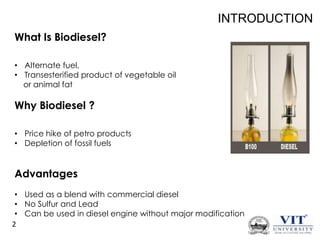
What Is Biodiesel?
• Alternate fuel,
• Transesterified product of vegetable oil
or animal fat

Why Biodiesel ?
• Price hike of petro products
• Depletion of fossil fuels

Advantages
• Used as a blend with commercial diesel
• No Sulfur and Lead
• Can be used in diesel engine without major modification
2
METHODS & MATERIALS
•

•

3

Vegetable oils

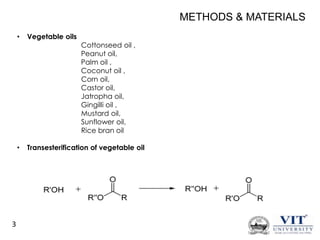
Transesterification of vegetable oil

Cottonseed oil ,
Peanut oil,
Palm oil ,
Coconut oil ,
Corn oil,
Castor oil,
Jatropha oil,
Gingilli oil ,
Mustard oil,
Sunflower oil,
Rice bran oil
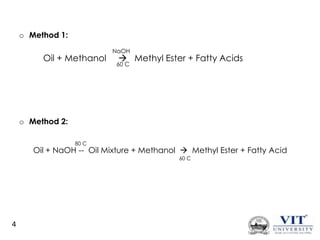
o Method 1:

Oil + Methanol

NaOH

 Methyl Ester + Fatty Acids

60 C

o Method 2:
80 C

Oil + NaOH -- Oil Mixture + Methanol  Methyl Ester + Fatty Acid
60 C

4
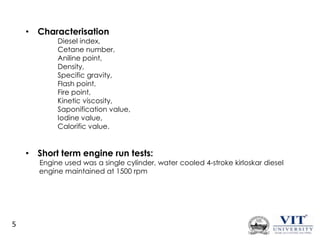
• Characterisation

Diesel index,
Cetane number,
Aniline point,
Density,
Specific gravity,
Flash point,
Fire point,
Kinetic viscosity,
Saponification value,
Iodine value,
Calorific value.

• Short term engine run tests:

Engine used was a single cylinder, water cooled 4-stroke kirloskar diesel
engine maintained at 1500 rpm

5
RESULTS AND DISCUSSIONS

6
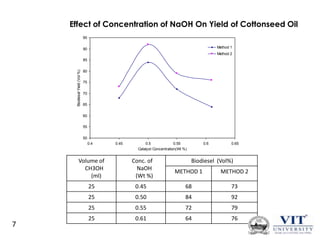
Effect of Concentration of NaOH On Yield of Cottonseed Oil
95
Method 1

90

Method 2

Biodiesel Yield (Vol %)

85
80
75
70
65
60
55
50
0.4

0.45

0.5
0.55
Catalyst Concentration(Wt %)

Volume of
CH3OH
(ml)

Conc. of
NaOH
(Wt %)

25

0.6

0.65

Biodiesel (Vol%)
METHOD 2

0.45

68

73

25

0.50

84

92

25

7

METHOD 1

0.55

72

79

25

0.61

64

76
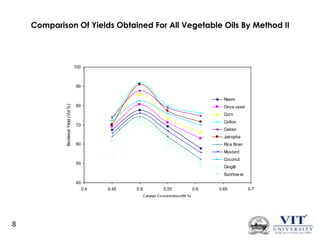
Comparison Of Yields Obtained For All Vegetable Oils By Method II

100

90

Biodiesel Yield (Vol %)

Neem
80

Once used
Corn
Cotton

70

Castor
Jatropha
60

Rice Bran
Mustard
Coconut

50

Gingilli
Sunflow er

40
0.4

0.45

0.5

0.55
Catalyst Co ncentratio n(Wt %)

8

0.6

0.65

0.7
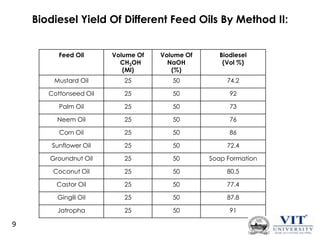
Biodiesel Yield Of Different Feed Oils By Method II:
Feed Oil

Volume Of
NaOH
(%)

Biodiesel
(Vol %)

Mustard Oil

25

50

74.2

Cottonseed Oil

25

50

92

Palm Oil

25

50

73

Neem Oil

25

50

76

Corn Oil

25

50

86

Sunflower Oil

25

50

72.4

Groundnut Oil

25

50

Soap Formation

Coconut Oil

25

50

80.5

Castor Oil

25

50

77.4

Gingili Oil

25

50

87.8

Jatropha

9

Volume Of
CH3OH
(Ml)

25

50

91
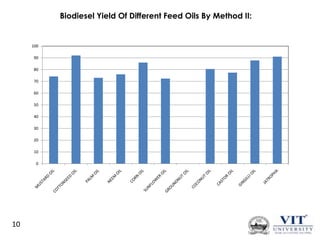
Biodiesel Yield Of Different Feed Oils By Method II:

100
90
80
70
60
50
40
30
20
10
0

10
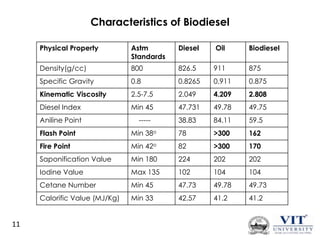
Characteristics of Biodiesel
Physical Property

Astm
Standards

Diesel

Oil

Biodiesel

Density(g/cc)

800

826.5

911

875

Specific Gravity

0.8

0.8265

0.911

0.875

Kinematic Viscosity

2.5-7.5

2.049

4.209

2.808

Diesel Index

Min 45

47.731

49.78

49.75

38.83

84.11

59.5

Aniline Point

-----

Flash Point

78

>300

162

Fire Point

Min 42o

82

>300

170

Saponification Value

Min 180

224

202

202

Iodine Value

Max 135

102

104

104

Cetane Number

Min 45

47.73

49.78

49.73

Calorific Value (MJ/Kg)

11

Min 38o

Min 33

42.57

41.2

41.2
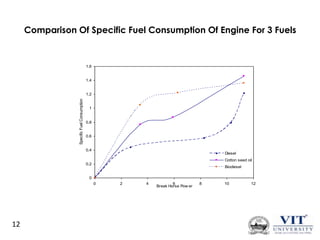
Comparison Of Specific Fuel Consumption Of Engine For 3 Fuels

1.6

1.4

Specific Fuel Consumption

1.2

1

0.8

0.6

0.4

Diesel
Cotton seed oil

0.2

Biodiesel

0
0

12

2

4

6
Break Horse Pow er

8

10

12
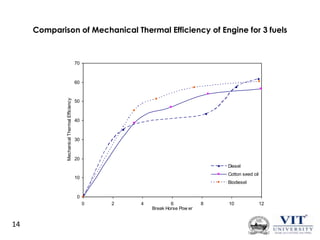
Comparison of Brake Thermal Efficiency of Engine for 3 Fuels

25

Break Thermal Efficiency

20

15

10

Diesel

5

Cotton seed oil
Biodiesel
0
0

2

4

6
Break Horse Pow er

13

8

10

12
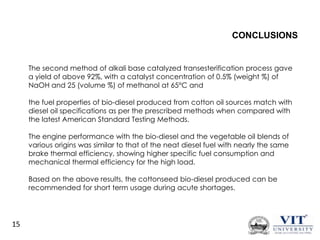
Comparison of Mechanical Thermal Efficiency of Engine for 3 fuels

70

Mechanical Thermal Efficiency

60

50

40

30

20
Diesel
Cotton seed oil

10

Biodiesel
0
0

14

2

4

6
Break Horse Pow er

8

10

12
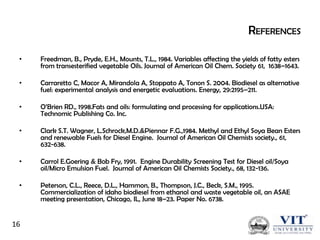
CONCLUSIONS

The second method of alkali base catalyzed transesterification process gave
a yield of above 92%, with a catalyst concentration of 0.5% (weight %) of
NaOH and 25 (volume %) of methanol at 65°C and
the fuel properties of bio-diesel produced from cotton oil sources match with
diesel oil specifications as per the prescribed methods when compared with
the latest American Standard Testing Methods.
The engine performance with the bio-diesel and the vegetable oil blends of
various origins was similar to that of the neat diesel fuel with nearly the same
brake thermal efficiency, showing higher specific fuel consumption and
mechanical thermal efficiency for the high load.
Based on the above results, the cottonseed bio-diesel produced can be
recommended for short term usage during acute shortages.

15
REFERENCES
•

Freedman, B., Pryde, E.H., Mounts, T.L., 1984. Variables affecting the yields of fatty esters
from transesterified vegetable Oils. Journal of American Oil Chem. Society 61, 1638–1643.

•

Carraretto C, Macor A, Mirandola A, Stoppato A, Tonon S. 2004. Biodiesel as alternative
fuel: experimental analysis and energetic evaluations. Energy, 29:2195–211.

•

O’Brien RD., 1998.Fats and oils: formulating and processing for applications.USA:
Technomic Publishing Co. Inc.

•

Clark S.T. Wagner, L.Schrock,M.D.&Piennar F.G.,1984. Methyl and Ethyl Soya Bean Esters
and renewable Fuels for Diesel Engine. Journal of American Oil Chemists society., 61,
632-638.

•

Carrol E.Goering & Bob Fry, 1991. Engine Durability Screening Test for Diesel oil/Soya
oil/Micro Emulsion Fuel. Journal of American Oil Chemists Society., 68, 132-136.

•

Peterson, C.L., Reece, D.L., Hammon, B., Thompson, J.C., Beck, S.M., 1995.
Commercialization of idaho biodiesel from ethanol and waste vegetable oil, an ASAE
meeting presentation, Chicago, IL, June 18–23. Paper No. 6738.

16
REFERENCES
•

M.A. Fazal, A.S.M.A. Haseeb, H.H. Masjuki ―Biodiesel feasibility study: An evaluation of material
compatibility; performance; emission and engine durability‖ Renewable and Sustainable Energy
Reviews 15 (2011) 1314–1324.

•

J.M. Encinar, J.F. González, A. Pardal ―Transesterification of castor oil under ultrasonic irradiation
conditions.Preliminary results‖ Fuel Processing Technology‖ 103 (2012) 9–15.

•

H. An, W.M. Yang, S.K. Chou, K.J. Chua ―Combustion and emissions characteristics of diesel engine
fueled by biodiesel at partial load conditions‖ Applied Energy 99 (2012) 363–371.

•

Sheehan, J., Cambreco, V., Duffield, J., Garboski, M., Shapouri, H., 1998a. An overview of biodiesel and
petroleum diesel life cycles. A report by US Department of Agriculture and Energy, pp. 1–35.

•

Sheehan, J., Dunahay, T., Benemann, J., Roessler, P., 1998b. A look back at the US Department of
Energy’s aquatic species program—biodiesel from Algae. National Renewable Energy Laboratory
(NREL) Report: NREL/TP-580-24190, Golden, CO.

•

Sensoz, S., Angin, D., Yorgun, S., 2000. Influence of particle size on the pyrolysis of rapeseed (Brassica
napus L.): fuel properties of bio-oil.Biomass and Bioenergy 19, 271–279.

•

PS.Pryde, Vegetable Oil as Fuel Alternatives, 1994. Journal of American Oil Chemists Society., 71, 162178.

•

J.M. Marchetti, V.U. Miguel and A.F. Errazu, 2007. Possible
production, Renewable and Sustainable Energy Reviews 11, 1300–1311.

17

methods

for

bio-diesel
REFERENCES
•

Y. Shimada, Y.Watanabe, T. Samukawa, A. Sugihara, H. Noda, H. Fukuda, Y. Tominaga, 1999.
Conversion of vegetable oil biodiesel using immobilized Candida antarctica lipase, J. Am. Oil Chem. Soc.
76, 789–793.

•

Hanna, M.A., Isom, L., Campbell, J., 2005. Biodiesel: current perspectives and future. Journal of Scientific
and Industrial Research 64, 854–857.

•

Dowaki, K., Ohta, T., Kasahara, Y., Kameyama, M., Sakawaki, K.,Mori, S., 2007. An economic and energy
analysis on bio-hydrogen fuel using a gasification process. Renewable Energy 32, 80–94.

•

Gemma Vicente, Mercedes Martınez and Jose Aracil, 2007. Optimisation of integrated bio-diesel
production. Part I. A studyof the bio-diesel purity and yield, Bioresource Technology 98, 1724–1733.

•

Demirbas A. 2003. Biodiesel fuels from vegetable oils via catalytic and non-catalytic supercritical alcohol
transesterifications and other methods: a survey. Energy Convers Manag 44:2093–109.

•

ASTM. American Standards for Testing of Materials. D 189-01, D 240-02, D 4052-96, D 445-03, D 482-74,
D 5555-95, D 6751-02, D 93-02a, D 95-990, D 97-02. St. Joseph, MI: ASAE; 2003.

•

Kanit krishnangura, 1994. Estimation of Heat of Combustion of Triglycerides and Fatty acid Methyl Ester,
Journal of American Oil Chemists Society.,71,56-68.

•

Meher, L.C., Vidya Sagar, D., Naik, S.N., 2006. Technical aspects of biodiesel production by
transesterification—a review. Renewable and Sustainable Energy Reviews 10, 248–268.

18
T HANK Y OU

19

28 saket

  • 1.
    ICAER - 20 1 3 INDIAN INSTITUTE OF TECHNOLOGY, BOMBAY BIODIESEL OBTAINED USING COTTONSEED OIL – PRODUCTION AND ANALYSIS SAKET SANJAY KASHETTIWAR & SUMEDH SUDHIR BEKNALKAR MASS TRANSFER LABORATORY C H E M I C A L E N G I N E E R I N G D IV I S I O N SCHOOL OF MECHANICAL AND BUILDING SCIENCES
  • 2.
    The roadmap      1 Introduction Methods andMaterials Results and Discussions Conclusions References
  • 3.
    INTRODUCTION What Is Biodiesel? •Alternate fuel, • Transesterified product of vegetable oil or animal fat Why Biodiesel ? • Price hike of petro products • Depletion of fossil fuels Advantages • Used as a blend with commercial diesel • No Sulfur and Lead • Can be used in diesel engine without major modification 2
  • 4.
    METHODS & MATERIALS • • 3 Vegetableoils Transesterification of vegetable oil Cottonseed oil , Peanut oil, Palm oil , Coconut oil , Corn oil, Castor oil, Jatropha oil, Gingilli oil , Mustard oil, Sunflower oil, Rice bran oil
  • 5.
    o Method 1: Oil+ Methanol NaOH  Methyl Ester + Fatty Acids 60 C o Method 2: 80 C Oil + NaOH -- Oil Mixture + Methanol  Methyl Ester + Fatty Acid 60 C 4
  • 6.
    • Characterisation Diesel index, Cetanenumber, Aniline point, Density, Specific gravity, Flash point, Fire point, Kinetic viscosity, Saponification value, Iodine value, Calorific value. • Short term engine run tests: Engine used was a single cylinder, water cooled 4-stroke kirloskar diesel engine maintained at 1500 rpm 5
  • 7.
  • 8.
    Effect of Concentrationof NaOH On Yield of Cottonseed Oil 95 Method 1 90 Method 2 Biodiesel Yield (Vol %) 85 80 75 70 65 60 55 50 0.4 0.45 0.5 0.55 Catalyst Concentration(Wt %) Volume of CH3OH (ml) Conc. of NaOH (Wt %) 25 0.6 0.65 Biodiesel (Vol%) METHOD 2 0.45 68 73 25 0.50 84 92 25 7 METHOD 1 0.55 72 79 25 0.61 64 76
  • 9.
    Comparison Of YieldsObtained For All Vegetable Oils By Method II 100 90 Biodiesel Yield (Vol %) Neem 80 Once used Corn Cotton 70 Castor Jatropha 60 Rice Bran Mustard Coconut 50 Gingilli Sunflow er 40 0.4 0.45 0.5 0.55 Catalyst Co ncentratio n(Wt %) 8 0.6 0.65 0.7
  • 10.
    Biodiesel Yield OfDifferent Feed Oils By Method II: Feed Oil Volume Of NaOH (%) Biodiesel (Vol %) Mustard Oil 25 50 74.2 Cottonseed Oil 25 50 92 Palm Oil 25 50 73 Neem Oil 25 50 76 Corn Oil 25 50 86 Sunflower Oil 25 50 72.4 Groundnut Oil 25 50 Soap Formation Coconut Oil 25 50 80.5 Castor Oil 25 50 77.4 Gingili Oil 25 50 87.8 Jatropha 9 Volume Of CH3OH (Ml) 25 50 91
  • 11.
    Biodiesel Yield OfDifferent Feed Oils By Method II: 100 90 80 70 60 50 40 30 20 10 0 10
  • 12.
    Characteristics of Biodiesel PhysicalProperty Astm Standards Diesel Oil Biodiesel Density(g/cc) 800 826.5 911 875 Specific Gravity 0.8 0.8265 0.911 0.875 Kinematic Viscosity 2.5-7.5 2.049 4.209 2.808 Diesel Index Min 45 47.731 49.78 49.75 38.83 84.11 59.5 Aniline Point ----- Flash Point 78 >300 162 Fire Point Min 42o 82 >300 170 Saponification Value Min 180 224 202 202 Iodine Value Max 135 102 104 104 Cetane Number Min 45 47.73 49.78 49.73 Calorific Value (MJ/Kg) 11 Min 38o Min 33 42.57 41.2 41.2
  • 13.
    Comparison Of SpecificFuel Consumption Of Engine For 3 Fuels 1.6 1.4 Specific Fuel Consumption 1.2 1 0.8 0.6 0.4 Diesel Cotton seed oil 0.2 Biodiesel 0 0 12 2 4 6 Break Horse Pow er 8 10 12
  • 14.
    Comparison of BrakeThermal Efficiency of Engine for 3 Fuels 25 Break Thermal Efficiency 20 15 10 Diesel 5 Cotton seed oil Biodiesel 0 0 2 4 6 Break Horse Pow er 13 8 10 12
  • 15.
    Comparison of MechanicalThermal Efficiency of Engine for 3 fuels 70 Mechanical Thermal Efficiency 60 50 40 30 20 Diesel Cotton seed oil 10 Biodiesel 0 0 14 2 4 6 Break Horse Pow er 8 10 12
  • 16.
    CONCLUSIONS The second methodof alkali base catalyzed transesterification process gave a yield of above 92%, with a catalyst concentration of 0.5% (weight %) of NaOH and 25 (volume %) of methanol at 65°C and the fuel properties of bio-diesel produced from cotton oil sources match with diesel oil specifications as per the prescribed methods when compared with the latest American Standard Testing Methods. The engine performance with the bio-diesel and the vegetable oil blends of various origins was similar to that of the neat diesel fuel with nearly the same brake thermal efficiency, showing higher specific fuel consumption and mechanical thermal efficiency for the high load. Based on the above results, the cottonseed bio-diesel produced can be recommended for short term usage during acute shortages. 15
  • 17.
    REFERENCES • Freedman, B., Pryde,E.H., Mounts, T.L., 1984. Variables affecting the yields of fatty esters from transesterified vegetable Oils. Journal of American Oil Chem. Society 61, 1638–1643. • Carraretto C, Macor A, Mirandola A, Stoppato A, Tonon S. 2004. Biodiesel as alternative fuel: experimental analysis and energetic evaluations. Energy, 29:2195–211. • O’Brien RD., 1998.Fats and oils: formulating and processing for applications.USA: Technomic Publishing Co. Inc. • Clark S.T. Wagner, L.Schrock,M.D.&Piennar F.G.,1984. Methyl and Ethyl Soya Bean Esters and renewable Fuels for Diesel Engine. Journal of American Oil Chemists society., 61, 632-638. • Carrol E.Goering & Bob Fry, 1991. Engine Durability Screening Test for Diesel oil/Soya oil/Micro Emulsion Fuel. Journal of American Oil Chemists Society., 68, 132-136. • Peterson, C.L., Reece, D.L., Hammon, B., Thompson, J.C., Beck, S.M., 1995. Commercialization of idaho biodiesel from ethanol and waste vegetable oil, an ASAE meeting presentation, Chicago, IL, June 18–23. Paper No. 6738. 16
  • 18.
    REFERENCES • M.A. Fazal, A.S.M.A.Haseeb, H.H. Masjuki ―Biodiesel feasibility study: An evaluation of material compatibility; performance; emission and engine durability‖ Renewable and Sustainable Energy Reviews 15 (2011) 1314–1324. • J.M. Encinar, J.F. González, A. Pardal ―Transesterification of castor oil under ultrasonic irradiation conditions.Preliminary results‖ Fuel Processing Technology‖ 103 (2012) 9–15. • H. An, W.M. Yang, S.K. Chou, K.J. Chua ―Combustion and emissions characteristics of diesel engine fueled by biodiesel at partial load conditions‖ Applied Energy 99 (2012) 363–371. • Sheehan, J., Cambreco, V., Duffield, J., Garboski, M., Shapouri, H., 1998a. An overview of biodiesel and petroleum diesel life cycles. A report by US Department of Agriculture and Energy, pp. 1–35. • Sheehan, J., Dunahay, T., Benemann, J., Roessler, P., 1998b. A look back at the US Department of Energy’s aquatic species program—biodiesel from Algae. National Renewable Energy Laboratory (NREL) Report: NREL/TP-580-24190, Golden, CO. • Sensoz, S., Angin, D., Yorgun, S., 2000. Influence of particle size on the pyrolysis of rapeseed (Brassica napus L.): fuel properties of bio-oil.Biomass and Bioenergy 19, 271–279. • PS.Pryde, Vegetable Oil as Fuel Alternatives, 1994. Journal of American Oil Chemists Society., 71, 162178. • J.M. Marchetti, V.U. Miguel and A.F. Errazu, 2007. Possible production, Renewable and Sustainable Energy Reviews 11, 1300–1311. 17 methods for bio-diesel
  • 19.
    REFERENCES • Y. Shimada, Y.Watanabe,T. Samukawa, A. Sugihara, H. Noda, H. Fukuda, Y. Tominaga, 1999. Conversion of vegetable oil biodiesel using immobilized Candida antarctica lipase, J. Am. Oil Chem. Soc. 76, 789–793. • Hanna, M.A., Isom, L., Campbell, J., 2005. Biodiesel: current perspectives and future. Journal of Scientific and Industrial Research 64, 854–857. • Dowaki, K., Ohta, T., Kasahara, Y., Kameyama, M., Sakawaki, K.,Mori, S., 2007. An economic and energy analysis on bio-hydrogen fuel using a gasification process. Renewable Energy 32, 80–94. • Gemma Vicente, Mercedes Martınez and Jose Aracil, 2007. Optimisation of integrated bio-diesel production. Part I. A studyof the bio-diesel purity and yield, Bioresource Technology 98, 1724–1733. • Demirbas A. 2003. Biodiesel fuels from vegetable oils via catalytic and non-catalytic supercritical alcohol transesterifications and other methods: a survey. Energy Convers Manag 44:2093–109. • ASTM. American Standards for Testing of Materials. D 189-01, D 240-02, D 4052-96, D 445-03, D 482-74, D 5555-95, D 6751-02, D 93-02a, D 95-990, D 97-02. St. Joseph, MI: ASAE; 2003. • Kanit krishnangura, 1994. Estimation of Heat of Combustion of Triglycerides and Fatty acid Methyl Ester, Journal of American Oil Chemists Society.,71,56-68. • Meher, L.C., Vidya Sagar, D., Naik, S.N., 2006. Technical aspects of biodiesel production by transesterification—a review. Renewable and Sustainable Energy Reviews 10, 248–268. 18
  • 20.
    T HANK YOU 19