Experimental analysis of 1400 cc
diesel engine car converted into
Hybrid Electric Vehicle by using
BLDC hub motors
by

Prof. Sudhir Gupte

Automobile Engineering Department

A.D.Patel Institute of Technology

IV th International Conference on
Advances in Energy Research
12 Dec' 2013

1
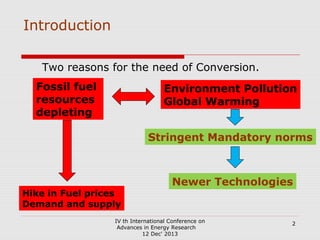
Introduction
Two reasons for the need of Conversion.
Fossil fuel
resources
depleting

Environment Pollution
Global Warming
Stringent Mandatory norms

Hike in Fuel prices
Demand and supply

Newer Technologies

IV th International Conference on
Advances in Energy Research
12 Dec' 2013

2
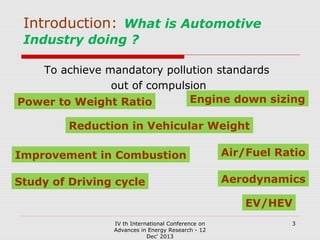
Introduction: What is Automotive
Industry doing ?
To achieve mandatory pollution standards
out of compulsion
Engine down sizing
Power to Weight Ratio
Reduction in Vehicular Weight
Improvement in Combustion

Air/Fuel Ratio

Study of Driving cycle

Aerodynamics
EV/HEV

IV th International Conference on
Advances in Energy Research - 12
Dec' 2013

3
Mild, Micro etc. Hybrids. But all these comes at
very high development cost and complicated &
expensive installations on the vehicle.
BUT
If per capita consumption is not reduced
drastically and if alternate energy vehicles are
not developed, they will not be able to sustain
the market conditions in the near future.

IV th International Conference on
Advances in Energy Research - 12
Dec' 2013

4
Integrated holistic approach to
improve Quality of air





Improvement in Roads and traffic conditions
Fuel Quality standards
Bio Fuels & Alternate energy sources.
Electric vehicle mission plan declared by Govt. India 9th
Jan, 2012.

IV th International Conference on
Advances in Energy Research - 12
Dec' 2013

5
However
Those Millions of old vehicles will be still
guzzling unwanted, harmful pollutants in the
atmosphere at an alarming rate, still
contributing towards the menace of global
warming, which will continue, if they are not
converted into hybrid electric vehicles.

IV th International Conference on
Advances in Energy Research - 12
Dec' 2013

6
Hence

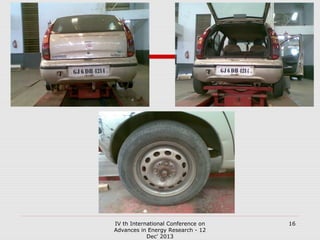
1400 cc diesel engine car converted
into Hybrid Electric Vehicle by using
BLDC hub motors –
An Experimental analysis

IV th International Conference on
Advances in Energy Research - 12
Dec' 2013

7
Following points were considered while attempting to contribute
towards improving the quality of air or reduce further damage
being created by the existing /old gasoline and /or diesel vehicles.

 conversion should be economical and affordable.
 Conversion
should
be
easy.
An
unskilled
worker/mechanic should be able to carry out the
conversion within 4 to 5 hours, after receiving necessary
one day training.
 Minimum requirement of special tools.
 Return on investment should be measurable and
attractive for the user.
 Convenient to use by the customer.
 Hassel free service. Ease of maintenance.
 Ease of implementation even for vehicle manufacturer
on the similar new models.
 Satisfactory performance.
IV th International Conference on
Advances in Energy Research - 12
Dec' 2013

8
Concept : Proposed Hybrid system
 Using the existing IC engine as main source.
 Electric motors providing driving force as
Auxiliary power source.
 Can be used as four wheel drive as and when
necessary.
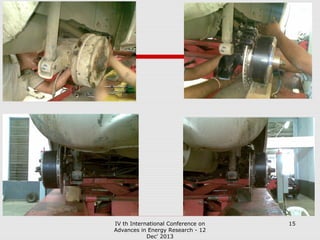
 All four wheels disc brake system.
 No/Minimum modifications in the existing drive
train.

IV th International Conference on
Advances in Energy Research - 12
Dec' 2013

9
Concept : Proposed Hybrid system

…

Cont.

 On board Energy flow: Separate Battery pack
for Existing engine and for electric motors.
 Plug-in type charging system for Electric motor
batteries and existing alternator charging
system for the vehicular battery.
 Regenerative braking system not adopted,
because, under most ideal conditions,
efficiency of loop, battery to kinetic and kinetic
to battery charging is no greater than 50 %.
Also, it adds to cost, which may prohibit
customers for conversion.
IV th International Conference on
Advances in Energy Research - 12
Dec' 2013

10
Models Applicable:





Maruti: M800, Alto, Zen
Tata: Indica
Hundai: Santro
All “B segment” cars with Front Transverse
Engine.

IV th International Conference on
Advances in Energy Research - 12
Dec' 2013

11
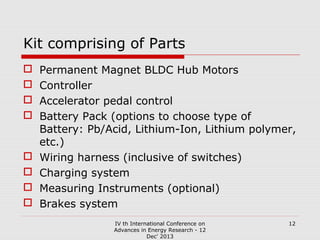
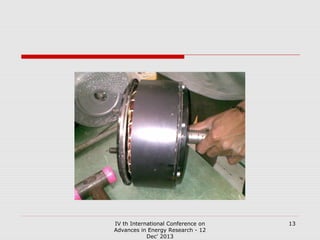
Kit comprising of Parts










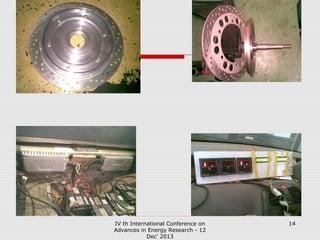
Permanent Magnet BLDC Hub Motors
Controller
Accelerator pedal control
Battery Pack (options to choose type of
Battery: Pb/Acid, Lithium-Ion, Lithium polymer,
etc.)
Wiring harness (inclusive of switches)
Charging system
Measuring Instruments (optional)
Brakes system
IV th International Conference on
Advances in Energy Research - 12
Dec' 2013

12
IV th International Conference on
Advances in Energy Research - 12
Dec' 2013

13
IV th International Conference on
Advances in Energy Research - 12
Dec' 2013

14
IV th International Conference on
Advances in Energy Research - 12
Dec' 2013

15
IV th International Conference on
Advances in Energy Research - 12
Dec' 2013

16
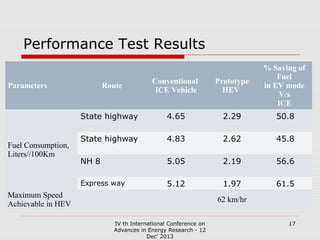
Performance Test Results
Conventional
ICE Vehicle

Prototype
HEV

% Saving of
Fuel
in EV mode
V/s
ICE

State highway

4.65

2.29

50.8

State highway

4.83

2.62

45.8

NH 8

5.05

2.19

56.6

Express way

5.12

1.97

61.5

Parameters

Fuel Consumption,
Liters//100Km

Route

Maximum Speed
Achievable in HEV

62 km/hr
IV th International Conference on
Advances in Energy Research - 12
Dec' 2013

17
Conventional
ICE Vehicle

HEV after
Conversion

52 PS @ 5000

52PS

85 @ 2500 rpm

85 @ 2500 rpm

-

2.5+2.5 = 5 kw

-

150 Ah

150 Kg

150 Kg

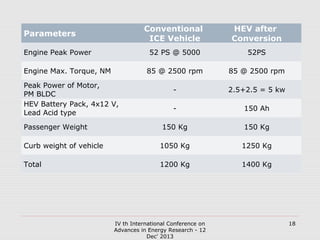
Curb weight of vehicle

1050 Kg

1250 Kg

Total

1200 Kg

1400 Kg

Parameters
Engine Peak Power
Engine Max. Torque, NM
Peak Power of Motor,
PM BLDC
HEV Battery Pack, 4x12 V,
Lead Acid type
Passenger Weight

IV th International Conference on
Advances in Energy Research - 12
Dec' 2013

18
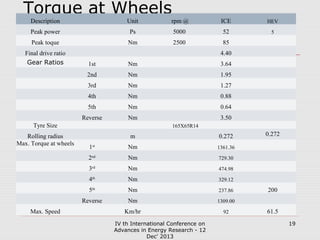
Torque at Wheels
Description

Unit

rpm @

ICE

HEV

Peak power

Ps

5000

52

5

Peak toque

Nm

2500

85

Final drive ratio
Gear Ratios

4.40
1st

Nm

3.64

2nd

Nm

1.95

3rd

Nm

1.27

4th

Nm

0.88

5th

Nm

0.64

Reverse

Nm

3.50

Tyre Size
Rolling radius
Max. Torque at wheels

165X65R14

0.272

1st

Nm
Nm

729.30

3rd

Nm

474.98

4th

Nm

329.12

5th

Nm

237.86

Reverse

Nm

1309.00

Km/hr

92

0.272

1361.36

2nd

Max. Speed

m

IV th International Conference on
Advances in Energy Research - 12
Dec' 2013

200
61.5
19
Why change EV driving cycle
 Prius changes to EV during congested traffic
conditions and runs on ICE on highways. OK for
urban driving cycles in Metro cities.
 In other cities car users are driving in cities for
10 % distances and remaining on highways.
 High speed running on highway obviously fuel
consumption is high.
 With low powered, light weight PMBLDC hub
motors, it is proposed to run vehicle on ICE in
city traffic conditions and switching on to EV on
highway.
IV th International Conference on
Advances in Energy Research - 12
Dec' 2013

20
Results and Discussions
 By using proposed lower power Hub Motors, up to
61 % saving is achievable on the existing cars.
 Peak performance of the available drive line is
retained / assured.
 Veh. existing electrical system is not disturbed.
 Existing Hyd. Brakes with Disc brakes in rear.
 No additional Instrumentation required.
 Power Steering and A/c are driven by ICE, hence
ICE has to run on idling while running in EV mode.

IV th International Conference on
Advances in Energy Research - 12
Dec' 2013

21
Results and Discussions

…Cont.

 Appropriate torque capacity of PM BLDC hub
motors can be selected for the particular
vehicle for conversion in to HEV, for deriving
optimum results.
 Advantage of hub motors is that the output is
directly driving the wheels; hence the motors
efficiency is the only loss. Geared hub motors
add to varying torque reqyuirement.
 Well to wheel energy efficiency for Prototype
HEV is measures at 0.87 km/MJ as against
0.64 for Insight and 0.56 for Prius models but
1.14 for Tesla (pure EV).
IV th International Conference on
Advances in Energy Research - 12
Dec' 2013

22
Conclusions
 Proposed method is expected to reduce the fuel
consumption by 45 % to 61 % (with A/c & P/S).
 Results can improve further, if the high Ah, light
weight batteries are utilized.
 Possible to convert majority of the old cars with
front engine front wheel drive vehicles in to
Hybrid Electric car, without much of difficulty and
at reasonable cost.
 Easy to implement in new veh. models –
Existing/introduced in future, by the vehicle
manufacturers.
IV th International Conference on
Advances in Energy Research - 12
Dec' 2013

23
Conclusions
…Contd.

 Serviceability and life of components is
improved.
 Increase Service life of ICE and driveline
components.
 Reduced maintenance cost of ICE and driveline
assembly components.
 ROI from 11 to 15 months @ 3000 km per
month.

IV th International Conference on
Advances in Energy Research - 12
Dec' 2013

24
THANK YOU

IV th International Conference on
Advances in Energy Research - 12
Dec' 2013

25

103 sudhir

  • 1.
    Experimental analysis of1400 cc diesel engine car converted into Hybrid Electric Vehicle by using BLDC hub motors by Prof. Sudhir Gupte Automobile Engineering Department A.D.Patel Institute of Technology IV th International Conference on Advances in Energy Research 12 Dec' 2013 1
  • 2.
    Introduction Two reasons forthe need of Conversion. Fossil fuel resources depleting Environment Pollution Global Warming Stringent Mandatory norms Hike in Fuel prices Demand and supply Newer Technologies IV th International Conference on Advances in Energy Research 12 Dec' 2013 2
  • 3.
    Introduction: What isAutomotive Industry doing ? To achieve mandatory pollution standards out of compulsion Engine down sizing Power to Weight Ratio Reduction in Vehicular Weight Improvement in Combustion Air/Fuel Ratio Study of Driving cycle Aerodynamics EV/HEV IV th International Conference on Advances in Energy Research - 12 Dec' 2013 3
  • 4.
    Mild, Micro etc.Hybrids. But all these comes at very high development cost and complicated & expensive installations on the vehicle. BUT If per capita consumption is not reduced drastically and if alternate energy vehicles are not developed, they will not be able to sustain the market conditions in the near future. IV th International Conference on Advances in Energy Research - 12 Dec' 2013 4
  • 5.
    Integrated holistic approachto improve Quality of air     Improvement in Roads and traffic conditions Fuel Quality standards Bio Fuels & Alternate energy sources. Electric vehicle mission plan declared by Govt. India 9th Jan, 2012. IV th International Conference on Advances in Energy Research - 12 Dec' 2013 5
  • 6.
    However Those Millions ofold vehicles will be still guzzling unwanted, harmful pollutants in the atmosphere at an alarming rate, still contributing towards the menace of global warming, which will continue, if they are not converted into hybrid electric vehicles. IV th International Conference on Advances in Energy Research - 12 Dec' 2013 6
  • 7.
    Hence 1400 cc dieselengine car converted into Hybrid Electric Vehicle by using BLDC hub motors – An Experimental analysis IV th International Conference on Advances in Energy Research - 12 Dec' 2013 7
  • 8.
    Following points wereconsidered while attempting to contribute towards improving the quality of air or reduce further damage being created by the existing /old gasoline and /or diesel vehicles.  conversion should be economical and affordable.  Conversion should be easy. An unskilled worker/mechanic should be able to carry out the conversion within 4 to 5 hours, after receiving necessary one day training.  Minimum requirement of special tools.  Return on investment should be measurable and attractive for the user.  Convenient to use by the customer.  Hassel free service. Ease of maintenance.  Ease of implementation even for vehicle manufacturer on the similar new models.  Satisfactory performance. IV th International Conference on Advances in Energy Research - 12 Dec' 2013 8
  • 9.
    Concept : ProposedHybrid system  Using the existing IC engine as main source.  Electric motors providing driving force as Auxiliary power source.  Can be used as four wheel drive as and when necessary.  All four wheels disc brake system.  No/Minimum modifications in the existing drive train. IV th International Conference on Advances in Energy Research - 12 Dec' 2013 9
  • 10.
    Concept : ProposedHybrid system … Cont.  On board Energy flow: Separate Battery pack for Existing engine and for electric motors.  Plug-in type charging system for Electric motor batteries and existing alternator charging system for the vehicular battery.  Regenerative braking system not adopted, because, under most ideal conditions, efficiency of loop, battery to kinetic and kinetic to battery charging is no greater than 50 %. Also, it adds to cost, which may prohibit customers for conversion. IV th International Conference on Advances in Energy Research - 12 Dec' 2013 10
  • 11.
    Models Applicable:     Maruti: M800,Alto, Zen Tata: Indica Hundai: Santro All “B segment” cars with Front Transverse Engine. IV th International Conference on Advances in Energy Research - 12 Dec' 2013 11
  • 12.
    Kit comprising ofParts         Permanent Magnet BLDC Hub Motors Controller Accelerator pedal control Battery Pack (options to choose type of Battery: Pb/Acid, Lithium-Ion, Lithium polymer, etc.) Wiring harness (inclusive of switches) Charging system Measuring Instruments (optional) Brakes system IV th International Conference on Advances in Energy Research - 12 Dec' 2013 12
  • 13.
    IV th InternationalConference on Advances in Energy Research - 12 Dec' 2013 13
  • 14.
    IV th InternationalConference on Advances in Energy Research - 12 Dec' 2013 14
  • 15.
    IV th InternationalConference on Advances in Energy Research - 12 Dec' 2013 15
  • 16.
    IV th InternationalConference on Advances in Energy Research - 12 Dec' 2013 16
  • 17.
    Performance Test Results Conventional ICEVehicle Prototype HEV % Saving of Fuel in EV mode V/s ICE State highway 4.65 2.29 50.8 State highway 4.83 2.62 45.8 NH 8 5.05 2.19 56.6 Express way 5.12 1.97 61.5 Parameters Fuel Consumption, Liters//100Km Route Maximum Speed Achievable in HEV 62 km/hr IV th International Conference on Advances in Energy Research - 12 Dec' 2013 17
  • 18.
    Conventional ICE Vehicle HEV after Conversion 52PS @ 5000 52PS 85 @ 2500 rpm 85 @ 2500 rpm - 2.5+2.5 = 5 kw - 150 Ah 150 Kg 150 Kg Curb weight of vehicle 1050 Kg 1250 Kg Total 1200 Kg 1400 Kg Parameters Engine Peak Power Engine Max. Torque, NM Peak Power of Motor, PM BLDC HEV Battery Pack, 4x12 V, Lead Acid type Passenger Weight IV th International Conference on Advances in Energy Research - 12 Dec' 2013 18
  • 19.
    Torque at Wheels Description Unit rpm@ ICE HEV Peak power Ps 5000 52 5 Peak toque Nm 2500 85 Final drive ratio Gear Ratios 4.40 1st Nm 3.64 2nd Nm 1.95 3rd Nm 1.27 4th Nm 0.88 5th Nm 0.64 Reverse Nm 3.50 Tyre Size Rolling radius Max. Torque at wheels 165X65R14 0.272 1st Nm Nm 729.30 3rd Nm 474.98 4th Nm 329.12 5th Nm 237.86 Reverse Nm 1309.00 Km/hr 92 0.272 1361.36 2nd Max. Speed m IV th International Conference on Advances in Energy Research - 12 Dec' 2013 200 61.5 19
  • 20.
    Why change EVdriving cycle  Prius changes to EV during congested traffic conditions and runs on ICE on highways. OK for urban driving cycles in Metro cities.  In other cities car users are driving in cities for 10 % distances and remaining on highways.  High speed running on highway obviously fuel consumption is high.  With low powered, light weight PMBLDC hub motors, it is proposed to run vehicle on ICE in city traffic conditions and switching on to EV on highway. IV th International Conference on Advances in Energy Research - 12 Dec' 2013 20
  • 21.
    Results and Discussions By using proposed lower power Hub Motors, up to 61 % saving is achievable on the existing cars.  Peak performance of the available drive line is retained / assured.  Veh. existing electrical system is not disturbed.  Existing Hyd. Brakes with Disc brakes in rear.  No additional Instrumentation required.  Power Steering and A/c are driven by ICE, hence ICE has to run on idling while running in EV mode. IV th International Conference on Advances in Energy Research - 12 Dec' 2013 21
  • 22.
    Results and Discussions …Cont. Appropriate torque capacity of PM BLDC hub motors can be selected for the particular vehicle for conversion in to HEV, for deriving optimum results.  Advantage of hub motors is that the output is directly driving the wheels; hence the motors efficiency is the only loss. Geared hub motors add to varying torque reqyuirement.  Well to wheel energy efficiency for Prototype HEV is measures at 0.87 km/MJ as against 0.64 for Insight and 0.56 for Prius models but 1.14 for Tesla (pure EV). IV th International Conference on Advances in Energy Research - 12 Dec' 2013 22
  • 23.
    Conclusions  Proposed methodis expected to reduce the fuel consumption by 45 % to 61 % (with A/c & P/S).  Results can improve further, if the high Ah, light weight batteries are utilized.  Possible to convert majority of the old cars with front engine front wheel drive vehicles in to Hybrid Electric car, without much of difficulty and at reasonable cost.  Easy to implement in new veh. models – Existing/introduced in future, by the vehicle manufacturers. IV th International Conference on Advances in Energy Research - 12 Dec' 2013 23
  • 24.
    Conclusions …Contd.  Serviceability andlife of components is improved.  Increase Service life of ICE and driveline components.  Reduced maintenance cost of ICE and driveline assembly components.  ROI from 11 to 15 months @ 3000 km per month. IV th International Conference on Advances in Energy Research - 12 Dec' 2013 24
  • 25.
    THANK YOU IV thInternational Conference on Advances in Energy Research - 12 Dec' 2013 25