
A
Paper Presentation for ICAER 2013
on

Experimental Studies on Low Temperature Operability of High FFA
Oil Biodiesel
by

Mr. K. A. Sorate, Research Scholar &
Dr. P.V. Bhale, Assistant Professor

Department of Mechanical Engineering,
S. V. National Institute of Technology, Surat, Gujarat
Outline of Presentation
•
•
•
•
•
•
•
•
•

Introduction
Objectives of the Study
What is low temperature properties of biodiesel?
Failures due to poor cold flow properties
Experimentation
Cold flow measurement
Cold flow improvement
Results and discussions
Conclusions

ICAFICE 2013
Mr.
K.A.Sorate & Dr.P.V.Bhale, MED, SVNIT

7th2/25
February 13
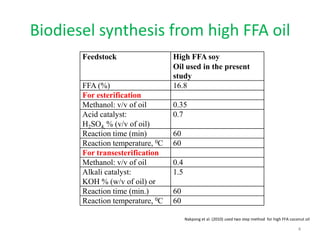
Biodiesel synthesis from high FFA oil
Feedstock

FFA (%)
For esterification
Methanol: v/v of oil
Acid catalyst:
H2SO4, % (v/v of oil)
Reaction time (min)
Reaction temperature, 0C
For transesterification
Methanol: v/v of oil
Alkali catalyst:
KOH % (w/v of oil) or
Reaction time (min.)
Reaction temperature, 0C

High FFA soy
Oil used in the present
study
16.8
0.35
0.7

60
60
0.4
1.5

60
60
Nakpong et al. (2010) used two step method for high FFA coconut oil

4
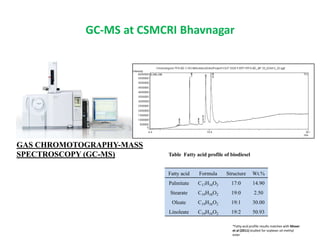
GC-MS at CSMCRI Bhavnagar

GAS CHROMOTOGRAPHY-MASS
SPECTROSCOPY (GC-MS)

Table Fatty acid profile of biodiesel

Fatty acid

Formula

Structure

Wt.%

Palmitate

C17H34O2

17:0

14.90

Stearate

C19H38O2

19:0

2.50

Oleate

C19H36O2

19:1

30.00

Linoleate

C19H34O2

19:2

50.93

*Fatty acid profile results matches with Moser
et al (2011) studied for soybean oil methyl
ester
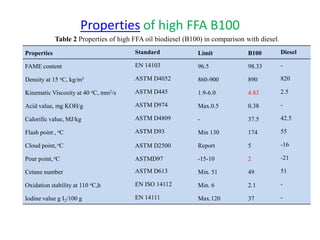
Properties of high FFA B100
Table 2 Properties of high FFA oil biodiesel (B100) in comparison with diesel.
Properties

Standard

Limit

B100

Diesel

FAME content

EN 14103

96.5

98.33

-

Density at 15 oC, kg/m3

ASTM D4052

860-900

890

820

Kinematic Viscosity at 40 oC, mm2/s

ASTM D445

1.9-6.0

4.83

2.5

Acid value, mg KOH/g

ASTM D974

Max.0.5

0.38

-

Calorific value, MJ/kg

ASTM D4809

-

37.5

42.5

Flash point , oC

ASTM D93

Min 130

174

55

Cloud point, oC

ASTM D2500

Report

5

-16

Pour point, oC

ASTMD97

-15-10

2

-21

Cetane number

ASTM D613

Min. 51

49

51

Oxidation stability at 110 oC,h

EN ISO 14112

Min. 6

2.1

-

Iodine value g I2/100 g

EN 14111

Max.120

37

-
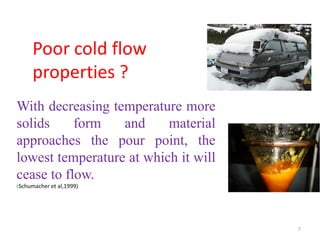
Poor cold flow
properties ?
With decreasing temperature more
solids
form
and
material
approaches the pour point, the
lowest temperature at which it will
cease to flow.
(Schumacher et al,1999)

7
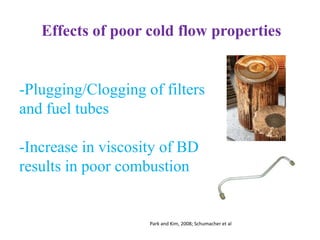
Effects of poor cold flow properties

-Plugging/Clogging of filters
and fuel tubes
-Increase in viscosity of BD
results in poor combustion

Park and Kim, 2008; Schumacher et al
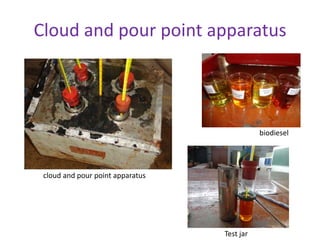
Cloud and pour point apparatus

biodiesel

cloud and pour point apparatus

Test jar
The following samples were tested to improve Pour
Point and Cloud Point
1.
2.
3.
4.
5.

High FFA oil biodiesel (B100) blended with ethanol
High FFA oil biodiesel (B100) blended with methanol
High FFA oil biodiesel (B100) blended with kerosene
High FFA oil biodiesel (B100) blended with diesel
High FFA oil biodiesel (B100) blended with castor
biodiesel
6. High FFA oil biodiesel (B100) blended with jatropha
biodiesel and
7. High FFA oil biodiesel (B100) doped with diesel fuel
antigel additive.
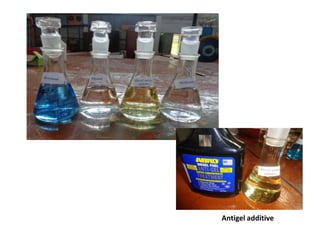
Antigel additive
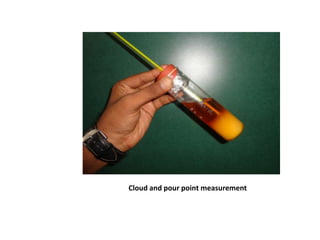
Cloud and pour point measurement
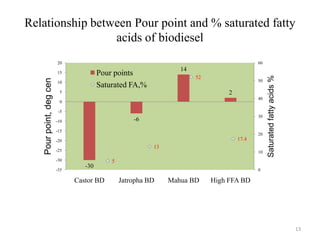
Relationship between Pour point and % saturated fatty
acids of biodiesel
20

60

10

52

50

2

5

40

0
-5

30

-6

-10
-15

20

17.4

-20

13

-25

10

-30
-35

-30

Castor BD

Saturated fatty acids %

Pour point, deg cen

14

Pour points
Saturated FA,%

15

5
0

Jatropha BD

Mahua BD

High FFA BD

13
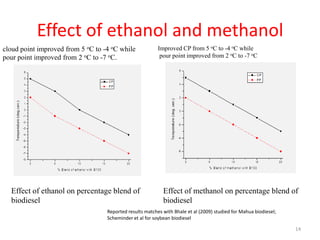
Effect of ethanol and methanol
cloud point improved from 5 oC to -4 oC while
pour point improved from 2 oC to -7 oC.

Effect of ethanol on percentage blend of
biodiesel

Improved CP from 5 oC to -4 oC while
pour point improved from 2 oC to -7 oC

Effect of methanol on percentage blend of
biodiesel

Reported results matches with Bhale et al (2009) studied for Mahua biodiesel;
Scheminder et al for soybean biodiesel
14
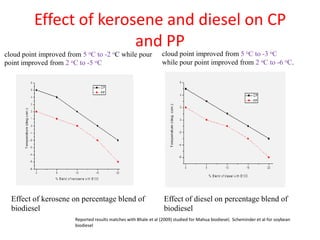
Effect of kerosene and diesel on CP
and PP
cloud point improved from 5 oC to -2 oC while pour
point improved from 2 oC to -5 oC

cloud point improved from 5 oC to -3 oC
while pour point improved from 2 oC to -6 oC.

Effect of kerosene on percentage blend of
biodiesel

Effect of diesel on percentage blend of
biodiesel

Reported results matches with Bhale et al (2009) studied for Mahua biodiesel; Scheminder et al for soybean
biodiesel
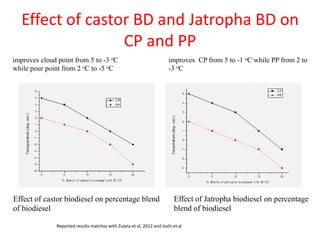
Effect of castor BD and Jatropha BD on
CP and PP
improves cloud point from 5 to -3 oC
while pour point from 2 oC to -5 oC

Effect of castor biodiesel on percentage blend
of biodiesel

improves CP from 5 to -1 oC while PP from 2 to
-3 oC

Effect of Jatropha biodiesel on percentage
blend of biodiesel

Reported results matches with Zuleta et al, 2012 and Joshi et al
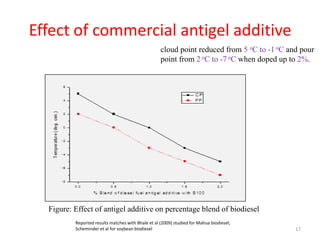
Effect of commercial antigel additive
cloud point reduced from 5 oC to -1 oC and pour
point from 2 oC to -7 oC when doped up to 2%.

Figure: Effect of antigel additive on percentage blend of biodiesel
Reported results matches with Bhale et al (2009) studied for Mahua biodiesel;
Scheminder et al for soybean biodiesel

17
Effect of additives on viscosity in low
temp region
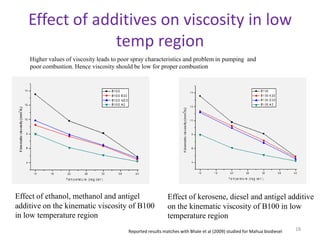
Higher values of viscosity leads to poor spray characteristics and problem in pumping and
poor combustion. Hence viscosity should be low for proper combustion

Effect of ethanol, methanol and antigel
additive on the kinematic viscosity of B100
in low temperature region

Effect of kerosene, diesel and antigel additive
on the kinematic viscosity of B100 in low
temperature region

Reported results matches with Bhale et al (2009) studied for Mahua biodiesel

18
Effect of additives on viscosity in low
temp region

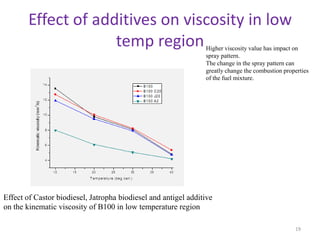
Higher viscosity value has impact on
spray pattern.
The change in the spray pattern can
greatly change the combustion properties
of the fuel mixture.

Effect of Castor biodiesel, Jatropha biodiesel and antigel additive
on the kinematic viscosity of B100 in low temperature region
19
•
•

•

•

•

Conclusions
Based on the cold flow experimental results, the following conclusions have been
summarized;
Due to addition of ethanol up to 20%, there is significant improvement in cold flow
properties of biodiesel have been noticed. However, the addition of ethanol
should be restricted due to its lower Cetane number.
Similarly, blending of kerosene up to 20% in biodiesel improves cold flow
properties of biodiesel considerably. However, higher blends of kerosene should
be limited due to its poor lubricity, which may reduce the lubricity of biodiesel.
In comparison with ethanol and kerosene, less improvement in cloud and pour
point were observed when biodiesel blended with diesel up to 20 %. Compared to
ethanol and kerosene, less improvement in cloud and pour point were observed
when biodiesel blended with castor biodiesel and jatropha biodiesel. The effect of
2% commercial additive was found significant compared to other blended
materials. The improved low temperature performance of biodiesel (B100)
blended with alcohol, fossil based fuels; biodiesel in biodiesel blend; and with
commercial Antigel additive shows its use under diverse cold climate temperatures
where it is usable.
Therefore, from all of these results, lower cost high FFA oil has a bigger potential
as a feedstock for biodiesel production.
20

131 sorate

  • 1.
    A Paper Presentation forICAER 2013 on Experimental Studies on Low Temperature Operability of High FFA Oil Biodiesel by Mr. K. A. Sorate, Research Scholar & Dr. P.V. Bhale, Assistant Professor Department of Mechanical Engineering, S. V. National Institute of Technology, Surat, Gujarat
  • 2.
    Outline of Presentation • • • • • • • • • Introduction Objectivesof the Study What is low temperature properties of biodiesel? Failures due to poor cold flow properties Experimentation Cold flow measurement Cold flow improvement Results and discussions Conclusions ICAFICE 2013 Mr. K.A.Sorate & Dr.P.V.Bhale, MED, SVNIT 7th2/25 February 13
  • 4.
    Biodiesel synthesis fromhigh FFA oil Feedstock FFA (%) For esterification Methanol: v/v of oil Acid catalyst: H2SO4, % (v/v of oil) Reaction time (min) Reaction temperature, 0C For transesterification Methanol: v/v of oil Alkali catalyst: KOH % (w/v of oil) or Reaction time (min.) Reaction temperature, 0C High FFA soy Oil used in the present study 16.8 0.35 0.7 60 60 0.4 1.5 60 60 Nakpong et al. (2010) used two step method for high FFA coconut oil 4
  • 5.
    GC-MS at CSMCRIBhavnagar GAS CHROMOTOGRAPHY-MASS SPECTROSCOPY (GC-MS) Table Fatty acid profile of biodiesel Fatty acid Formula Structure Wt.% Palmitate C17H34O2 17:0 14.90 Stearate C19H38O2 19:0 2.50 Oleate C19H36O2 19:1 30.00 Linoleate C19H34O2 19:2 50.93 *Fatty acid profile results matches with Moser et al (2011) studied for soybean oil methyl ester
  • 6.
    Properties of highFFA B100 Table 2 Properties of high FFA oil biodiesel (B100) in comparison with diesel. Properties Standard Limit B100 Diesel FAME content EN 14103 96.5 98.33 - Density at 15 oC, kg/m3 ASTM D4052 860-900 890 820 Kinematic Viscosity at 40 oC, mm2/s ASTM D445 1.9-6.0 4.83 2.5 Acid value, mg KOH/g ASTM D974 Max.0.5 0.38 - Calorific value, MJ/kg ASTM D4809 - 37.5 42.5 Flash point , oC ASTM D93 Min 130 174 55 Cloud point, oC ASTM D2500 Report 5 -16 Pour point, oC ASTMD97 -15-10 2 -21 Cetane number ASTM D613 Min. 51 49 51 Oxidation stability at 110 oC,h EN ISO 14112 Min. 6 2.1 - Iodine value g I2/100 g EN 14111 Max.120 37 -
  • 7.
    Poor cold flow properties? With decreasing temperature more solids form and material approaches the pour point, the lowest temperature at which it will cease to flow. (Schumacher et al,1999) 7
  • 8.
    Effects of poorcold flow properties -Plugging/Clogging of filters and fuel tubes -Increase in viscosity of BD results in poor combustion Park and Kim, 2008; Schumacher et al
  • 9.
    Cloud and pourpoint apparatus biodiesel cloud and pour point apparatus Test jar
  • 10.
    The following sampleswere tested to improve Pour Point and Cloud Point 1. 2. 3. 4. 5. High FFA oil biodiesel (B100) blended with ethanol High FFA oil biodiesel (B100) blended with methanol High FFA oil biodiesel (B100) blended with kerosene High FFA oil biodiesel (B100) blended with diesel High FFA oil biodiesel (B100) blended with castor biodiesel 6. High FFA oil biodiesel (B100) blended with jatropha biodiesel and 7. High FFA oil biodiesel (B100) doped with diesel fuel antigel additive.
  • 11.
  • 12.
    Cloud and pourpoint measurement
  • 13.
    Relationship between Pourpoint and % saturated fatty acids of biodiesel 20 60 10 52 50 2 5 40 0 -5 30 -6 -10 -15 20 17.4 -20 13 -25 10 -30 -35 -30 Castor BD Saturated fatty acids % Pour point, deg cen 14 Pour points Saturated FA,% 15 5 0 Jatropha BD Mahua BD High FFA BD 13
  • 14.
    Effect of ethanoland methanol cloud point improved from 5 oC to -4 oC while pour point improved from 2 oC to -7 oC. Effect of ethanol on percentage blend of biodiesel Improved CP from 5 oC to -4 oC while pour point improved from 2 oC to -7 oC Effect of methanol on percentage blend of biodiesel Reported results matches with Bhale et al (2009) studied for Mahua biodiesel; Scheminder et al for soybean biodiesel 14
  • 15.
    Effect of keroseneand diesel on CP and PP cloud point improved from 5 oC to -2 oC while pour point improved from 2 oC to -5 oC cloud point improved from 5 oC to -3 oC while pour point improved from 2 oC to -6 oC. Effect of kerosene on percentage blend of biodiesel Effect of diesel on percentage blend of biodiesel Reported results matches with Bhale et al (2009) studied for Mahua biodiesel; Scheminder et al for soybean biodiesel
  • 16.
    Effect of castorBD and Jatropha BD on CP and PP improves cloud point from 5 to -3 oC while pour point from 2 oC to -5 oC Effect of castor biodiesel on percentage blend of biodiesel improves CP from 5 to -1 oC while PP from 2 to -3 oC Effect of Jatropha biodiesel on percentage blend of biodiesel Reported results matches with Zuleta et al, 2012 and Joshi et al
  • 17.
    Effect of commercialantigel additive cloud point reduced from 5 oC to -1 oC and pour point from 2 oC to -7 oC when doped up to 2%. Figure: Effect of antigel additive on percentage blend of biodiesel Reported results matches with Bhale et al (2009) studied for Mahua biodiesel; Scheminder et al for soybean biodiesel 17
  • 18.
    Effect of additiveson viscosity in low temp region Higher values of viscosity leads to poor spray characteristics and problem in pumping and poor combustion. Hence viscosity should be low for proper combustion Effect of ethanol, methanol and antigel additive on the kinematic viscosity of B100 in low temperature region Effect of kerosene, diesel and antigel additive on the kinematic viscosity of B100 in low temperature region Reported results matches with Bhale et al (2009) studied for Mahua biodiesel 18
  • 19.
    Effect of additiveson viscosity in low temp region Higher viscosity value has impact on spray pattern. The change in the spray pattern can greatly change the combustion properties of the fuel mixture. Effect of Castor biodiesel, Jatropha biodiesel and antigel additive on the kinematic viscosity of B100 in low temperature region 19
  • 20.
    • • • • • Conclusions Based on thecold flow experimental results, the following conclusions have been summarized; Due to addition of ethanol up to 20%, there is significant improvement in cold flow properties of biodiesel have been noticed. However, the addition of ethanol should be restricted due to its lower Cetane number. Similarly, blending of kerosene up to 20% in biodiesel improves cold flow properties of biodiesel considerably. However, higher blends of kerosene should be limited due to its poor lubricity, which may reduce the lubricity of biodiesel. In comparison with ethanol and kerosene, less improvement in cloud and pour point were observed when biodiesel blended with diesel up to 20 %. Compared to ethanol and kerosene, less improvement in cloud and pour point were observed when biodiesel blended with castor biodiesel and jatropha biodiesel. The effect of 2% commercial additive was found significant compared to other blended materials. The improved low temperature performance of biodiesel (B100) blended with alcohol, fossil based fuels; biodiesel in biodiesel blend; and with commercial Antigel additive shows its use under diverse cold climate temperatures where it is usable. Therefore, from all of these results, lower cost high FFA oil has a bigger potential as a feedstock for biodiesel production. 20

Editor's Notes

  • #3 Outline of PresentationWhat is low temperature properties of biodieselFailures due to poor cold flow propertiesExperimentationCold flow measurementCold flow improvementResults and discussionsConclusionsReferences
  • #4 High FFA oil,by product of vegetable oil refinery, which is available at low cost. At present it has very limited application in soap industries.
  • #5 Nakpong et al. (2010) for high FFA coconut oil
  • #6 Reported results matches with Moser et al (2011) for soybean oil methyl ester
  • #7 Ghadage et al (2005) for high FFA Mahua oil biodieselNaik et al (2005) for FFA Karanja oil biodieselNakpong et al (2010) for high FFA coconut oil biodiesel
  • #9 Park and Kim, 2008; Schumacher et al
  • #10 Test jar cloud and pour point apparatus biodiesel
  • #12 Antiigel additive
  • #13 Cloud point measurement
  • #15 Reported results matches with Bhale et al (2009) studied for Mahua biodiesel