21CS72-module-5-textbook.pdf VTU notes for Bachelors' of engineering
1.
CHAPTER
9
Cloud Platforms inIndustry
Cloud computing allows end users and developers to leverage large distributed computing
infrastructures. This is made possible thanks to infrastructure management software and dis-
tributed computing platforms offering on-demand compute, storage, and, on top of these,
more advanced services. There are several different options for building enterprise cloud
computing applications or for using cloud computing technologies to integrate and extend
existing industrial applications. An overview of a few prominent cloud computing platforms
and a brief description of the types of service they offer are shown in Table 9.1. A cloud
computing system can be developed using either a single technology and vendor or a combi-
nation of them.
This chapter presents some of the representative cloud computing solutions offered as
Infrastructure-as-a-Service (IaaS) and Platform-as-a-Service (PaaS) services in the market. It pro-
vides some insights into and practical issues surrounding the architecture of the major cloud com-
puting technologies and their service offerings.
9.1 Amazon web services
Amazon Web Services (AWS) is a platform that allows the development of flexible applications by
providing solutions for elastic infrastructure scalability, messaging, and data storage. The platform
is accessible through SOAP or RESTful Web service interfaces and provides a Web-based console
where users can handle administration and monitoring of the resources required, as well as their
expenses computed on a pay-as-you-go basis.
Figure 9.1 shows all the services available in the AWS ecosystem. At the base of the solution
stack are services that provide raw compute and raw storage: Amazon Elastic Compute (EC2) and
Amazon Simple Storage Service (S3). These are the two most popular services, which are generally
complemented with other offerings for building a complete system. At the higher level, Elastic
MapReduce and AutoScaling provide additional capabilities for building smarter and more elastic
computing systems. On the data side, Elastic Block Store (EBS), Amazon SimpleDB, Amazon RDS,
and Amazon ElastiCache provide solutions for reliable data snapshots and the management of struc-
tured and semistructured data. Communication needs are covered at the networking level by
Amazon Virtual Private Cloud (VPC), Elastic Load Balancing, Amazon Route 53, and Amazon
Direct Connect. More advanced services for connecting applications are Amazon Simple Queue
315
MODULE 5
2.
Service (SQS), AmazonSimple Notification Service (SNS), and Amazon Simple E-mail Service
(SES). Other services include:
• Amazon CloudFront content delivery network solution
• Amazon CloudWatch monitoring solution for several Amazon services
• Amazon Elastic BeanStalk and CloudFormation flexible application packaging and deployment
As shown, AWS comprise a wide set of services. We discuss the most important services by
examining the solutions proposed by AWS regarding compute, storage, communication, and com-
plementary services.
9.1.1 Compute services
Compute services constitute the fundamental element of cloud computing systems. The fundamen-
tal service in this space is Amazon EC2, which delivers an IaaS solution that has served as a refer-
ence model for several offerings from other vendors in the same market segment. Amazon EC2
allows deploying servers in the form of virtual machines created as instances of a specific image.
Images come with a preinstalled operating system and a software stack, and instances can be con-
figured for memory, number of processors, and storage. Users are provided with credentials to
remotely access the instance and further configure or install software if needed.
9.1.1.1 Amazon machine images
Amazon Machine Images (AMIs) are templates from which it is possible to create a virtual machine.
They are stored in Amazon S3 and identified by a unique identifier in the form of ami-xxxxxx and
Table 9.1 Some Example Cloud Computing Offerings
Vendor/Product
Service
Type Description
Amazon Web
Services
IaaS, PaaS,
SaaS
Amazon Web Services (AWS) is a collection of Web services that
provides developers with compute, storage, and more advanced
services. AWS is mostly popular for IaaS services and primarily for its
elastic compute service EC2.
Google AppEngine PaaS Google AppEngine is a distributed and scalable runtime for developing
scalable Web applications based on Java and Python runtime
environments. These are enriched with access to services that simplify
the development of applications in a scalable manner.
Microsoft Azure PaaS Microsoft Azure is a cloud operating system that provides services for
developing scalable applications based on the proprietary Hyper-V
virtualization technology and the .NET framework.
SalesForce.com and
Force.com
SaaS, PaaS SalesForce.com is a Software-as-a-Service solution that allows
prototyping of CRM applications. It leverages the Force.com platform,
which is made available for developing new components and
capabilities for CRM applications.
Heroku PaaS Heroku is a scalable runtime environment for building applications
based on Ruby.
RightScale IaaS Rightscale is a cloud management platform with a single dashboard to
manage public and hybrid clouds.
316 CHAPTER 9 Cloud Platforms in Industry
3.
a manifest XMLfile. An AMI contains a physical file system layout with a predefined operating
system installed. These are specified by the Amazon Ramdisk Image (ARI, id: ari-yyyyyy) and the
Amazon Kernel Image (AKI, id: aki-zzzzzz), which are part of the configuration of the template.
AMIs are either created from scratch or “bundled” from existing EC2 instances. A common prac-
tice is to prepare new AMIs to create an instance from a preexisting AMI, log into it once it is
booted and running, and install all the software needed. Using the tools provided by Amazon, we
can convert the instance into a new image. Once an AMI is created, it is stored in an S3 bucket and
the user can decide whether to make it available to other users or keep it for personal use. Finally,
it is also possible to associate a product code with a given AMI, thus allowing the owner of the
AMI to get revenue every time this AMI is used to create EC2 instances.
9.1.1.2 EC2 instances
EC2 instances represent virtual machines. They are created using AMI as templates, which are spe-
cialized by selecting the number of cores, their computing power, and the installed memory. The
processing power is expressed in terms of virtual cores and EC2 Compute Units (ECUs). The ECU
Communication Services
Amazon Simple Queue
Service (SQS)
Amazon Simple
Notification Service
(EBS)
Amazon Simple Email
Service (SES)
Amazon Route 53
Amazon Virtual Private
Cloud (VPC)
Amazon Direct
Connect
Amazon Elastic Load
Balancing
Storage Services
Amazon Simple
Storage Service (S3)
Amazon Elastic Block
Store (EBS)
Amazon ElastiCache
Amazon SimpleDB
Amazon Relational
Database Service (RDS)
Amazon CloudFront
Amazon
Import/Export
Compute Services
Amazon Elastic
Compute Cloud (EC2)
Amazon Elastic
MapReduce
AWS Elastic Beanstalk
AWS Cloudformation
Autoscaling
Amazon AWS Platform
Additional Services
Amazon GovCloud
Amazon Flexible
Payment Service (FPS)
Amazon DevPay
Amazon Fullfillment
Web Service (FWS)
Amazon Mechanical
Turk
Alexa Web Information
Service
Amazon CloudWatch
Alexa Top Sites
FIGURE 9.1
Amazon Web Services ecosystem.
317
9.1 Amazon web services
4.
is a measureof the computing power of a virtual core; it is used to express a predictable quantity
of real CPU power that is allocated to an instance. By using compute units instead of real fre-
quency values, Amazon can change over time the mapping of such units to the underlying real
amount of computing power allocated, thus keeping the performance of EC2 instances consistent
with standards set by the times. Over time, the hardware supporting the underlying infrastructure
will be replaced by more powerful hardware, and the use of ECUs helps give users a consistent
view of the performance offered by EC2 instances. Since users rent computing capacity rather than
buying hardware, this approach is reasonable. One ECU is defined as giving the same performance
as a 1.01.2 GHz 2007 Opteron or 2007 Xeon processor.1
Table 9.2 shows all the currently available configurations for EC2 instances. We can identify
six major categories:
• Standard instances. This class offers a set of configurations that are suitable for most applications.
EC2 provides three different categories of increasing computing power, storage, and memory.
• Micro instances. This class is suitable for those applications that consume a limited amount of
computing power and memory and occasionally need bursts in CPU cycles to process surges in
the workload. Micro instances can be used for small Web applications with limited traffic.
• High-memory instances. This class targets applications that need to process huge workloads and
require large amounts of memory. Three-tier Web applications characterized by high traffic are
the target profile. Three categories of increasing memory and CPU are available, with memory
proportionally larger than computing power.
• High-CPU instances. This class targets compute-intensive applications. Two configurations are
available where computing power proportionally increases more than memory.
• Cluster Compute instances. This class is used to provide virtual cluster services. Instances in
this category are characterized by high CPU compute power and large memory and an
extremely high I/O and network performance, which makes it suitable for HPC applications.
• Cluster GPU instances. This class provides instances featuring graphic processing units (GPUs) and
high compute power, large memory, and extremely high I/O and network performance. This class is
particularly suited for cluster applications that perform heavy graphic computations, such as
rendering clusters. Since GPU can be used for general-purpose computing, users of such instances
can benefit from additional computing power, which makes this class suitable for HPC applications.
EC2 instances are priced hourly according to the category they belong to. At the beginning of
every hour of usage, the user will be charged the cost of the entire hour. The hourly expense
charged for one instance is constant. Instance owners are responsible for providing their own
backup strategies, since there is no guarantee that the instance will run for the entire hour. Another
alternative is represented by spot instances. These instances are much more dynamic in terms of
pricing and lifetime since they are made available to the user according to the load of EC2 and the
availability of resources. Users define an upper bound for a price they want to pay for these
instances; as long as the current price (the spot price) remains under the given bound, the instance
is kept running. The price is sampled at the beginning of each hour. Spot instances are more vola-
tile than normal instances; whereas for normal instances EC2 will try as much as possible to keep
1
http://aws.amazon.com/ec2/faqs/#What_is_an_EC2_Compute_Unit_and_why_did_you_introduce_it.
318 CHAPTER 9 Cloud Platforms in Industry
5.
them active, thereis no such guarantee for spot instances. Therefore, implementing backup and
checkpointing strategies is inevitable.
EC2 instances can be run either by using the command-line tools provided by Amazon, which
connects the Amazon Web Service that provides remote access to the EC2 infrastructure, or via the
AWS console, which allows the management of other services, such as S3. By default an EC2
instance is created with the kernel and the disk associated to the AMI. These define the architecture
(32 bit or 64 bit) and the space of disk available to the instance. This is an ephemeral disk; once
the instance is shut down, the content of the disk will be lost. Alternatively, it is possible to attach
an EBS volume to the instance, the content of which will be stored in S3. If the default AKI and
ARI are not suitable, EC2 provides capabilities to run EC2 instances by specifying a different AKI
and ARI, thus giving flexibility in the creation of instances.
Table 9.2 Amazon EC2 (On-Demand) Instances Characteristics
Instance Type ECU Platform Memory
Disk
Storage
Price (U.S. East)
(USD/hour)
Standard instances
Small 1(1 3 1) 32 bit 1.7 GB 160 GB $0.085 Linux $0.12
Windows
Large 4(2 3 2) 64 bit 7.5 GB 850 GB $0.340 Linux $0.48
Windows
Extra Large 8(4 3 2) 64 bit 15 GB 1,690 GB $0.680 Linux $0.96
Windows
Micro instances
Micro , 5 2 32/64 bit 613 MB EBS Only $0.020 Linux $0.03
Windows
High-Memory instances
Extra Large 6.5(2 3 3.25) 64 bit 17.1 GB 420 GB $0.500 Linux $0.62
Windows
Double Extra Large 13(4 3 3.25) 64 bit 34.2 GB 850 GB $1.000 Linux $1.24
Windows
Quadruple Extra Large 26(8 3 3.25) 64 bit 68.4 GB 1,690 GB $2.000 Linux $2.48
Windows
High-CPU instances
Medium 5(2 3 2.5) 32 bit 1.7 GB 350 GB $0.170 Linux $0.29
Windows
Extra Large 20(8 3 2.5) 64 bit 7 GB 1,690 GB $0.680 Linux $1.16
Windows
Cluster instances
Quadruple Extra Large 33.5 64 bit 23 GB 1,690 GB $1.600 Linux $1.98
Windows
Cluster GPU instances
Quadruple Extra Large 33.5 64 bit 22 GB 1,690 GB $2.100 Linux $2.60
Windows
319
9.1 Amazon web services
6.
9.1.1.3 EC2 environment
EC2instances are executed within a virtual environment, which provides them with the services
they require to host applications. The EC2 environment is in charge of allocating addresses, attach-
ing storage volumes, and configuring security in terms of access control and network connectivity.
By default, instances are created with an internal IP address, which makes them capable of com-
municating within the EC2 network and accessing the Internet as clients. It is possible to associate
an Elastic IP to each instance, which can then be remapped to a different instance over time.
Elastic IPs allow instances running in EC2 to act as servers reachable from the Internet and, since
they are not strictly bound to specific instances, to implement failover capabilities. Together with
an external IP, EC2 instances are also given a domain name that generally is in the form ec2-xxx-
xxx-xxx.compute-x.amazonaws.com, where xxx-xxx-xxx normally represents the four parts of the
external IP address separated by a dash, and compute-x gives information about the availability
zone where instances are deployed. Currently, there are five availability zones that are priced dif-
ferently: two in the United States (Virginia and Northern California), one in Europe (Ireland), and
two in Asia Pacific (Singapore and Tokyo).
Instance owners can partially control where to deploy instances. Instead, they have a finer con-
trol over the security of the instances as well as their network accessibility. Instance owners can
associate a key pair to one or more instances when these instances are created. A key pair allows
the owner to remotely connect to the instance once this is running and gain root access to it.
Amazon EC2 controls the accessibility of a virtual instance with basic firewall configuration,
allowing the specification of source address, port, and protocols (TCP, UDP, ICMP). Rules can
also be attached to security groups, and instances can be made part of one or more groups before
their deployment. Security groups and firewall rules constitute a flexible way of providing basic
security for EC2 instances, which has to be complemented by appropriate security configuration
within the instance itself.
9.1.1.4 Advanced compute services
EC2 instances and AMIs constitute the basic blocks for building an IaaS computing cloud. On top
of these, Amazon Web Services provide more sophisticated services that allow the easy packaging
and deploying of applications and a computing platform that supports the execution of
MapReduce-based applications.
AWS CloudFormation
AWS CloudFormation constitutes an extension of the simple deployment model that characterizes
EC2 instances. CloudFormation introduces the concepts of templates, which are JSON formatted
text files that describe the resources needed to run an application or a service in EC2 together with
the relations between them. CloudFormation allows easily and explicitly linking EC2 instances
together and introducing dependencies among them. Templates provide a simple and declarative
way to build complex systems and integrate EC2 instances with other AWS services such as S3,
SimpleDB, SQS, SNS, Route 53, Elastic Beanstalk, and others.
AWS elastic beanstalk
AWS Elastic Beanstalk constitutes a simple and easy way to package applications and deploy them
on the AWS Cloud. This service simplifies the process of provisioning instances and deploying
320 CHAPTER 9 Cloud Platforms in Industry
7.
application code andprovides appropriate access to them. Currently, this service is available only
for Web applications developed with the Java/Tomcat technology stack. Developers can conve-
niently package their Web application into a WAR file and use Beanstalk to automate its deploy-
ment on the AWS Cloud.
With respect to other solutions that automate cloud deployment, Beanstalk simplifies tedious
tasks without removing the user’s capability of accessing—and taking over control of—the underly-
ing EC2 instances that make up the virtual infrastructure on top of which the application is running.
With respect to AWS CloudFormation, AWS Elastic Beanstalk provides a higher-level approach
for application deployment on the cloud, which does not require the user to specify the infrastruc-
ture in terms of EC2 instances and their dependencies.
Amazon elastic MapReduce
Amazon Elastic MapReduce provides AWS users with a cloud computing platform for MapReduce
applications. It utilizes Hadoop as the MapReduce engine, deployed on a virtual infrastructure com-
posed of EC2 instances, and uses Amazon S3 for storage needs.
Apart from supporting all the application stack connected to Hadoop (Pig, Hive, etc.), Elastic
MapReduce introduces elasticity and allows users to dynamically size the Hadoop cluster according
to their needs, as well as select the appropriate configuration of EC2 instances to compose the clus-
ter (Small, High-Memory, High-CPU, Cluster Compute, and Cluster GPU). On top of these ser-
vices, basic Web applications allowing users to quickly run data-intensive applications without
writing code are offered.
9.1.2 Storage services
AWS provides a collection of services for data storage and information management. The core ser-
vice in this area is represented by Amazon Simple Storage Service (S3). This is a distributed object
store that allows users to store information in different formats. The core components of S3 are
two: buckets and objects. Buckets represent virtual containers in which to store objects; objects rep-
resent the content that is actually stored. Objects can also be enriched with metadata that can be
used to tag the stored content with additional information.
9.1.2.1 S3 key concepts
As the name suggests, S3 has been designed to provide a simple storage service that’s accessible
through a Representational State Transfer (REST) interface, which is quite similar to a distributed
file system but which presents some important differences that allow the infrastructure to be highly
efficient:
• The storage is organized in a two-level hierarchy. S3 organizes its storage space into buckets
that cannot be further partitioned. This means that it is not possible to create directories or other
kinds of physical groupings for objects stored in a bucket. Despite this fact, there are few
limitations in naming objects, and this allows users to simulate directories and create logical
groupings.
• Stored objects cannot be manipulated like standard files. S3 has been designed to essentially
provide storage for objects that will not change over time. Therefore, it does not allow
renaming, modifying, or relocating an object. Once an object has been added to a bucket, its
321
9.1 Amazon web services
8.
content and positionis immutable, and the only way to change it is to remove the object from
the store and add it again.
• Content is not immediately available to users. The main design goal of S3 is to provide an
eventually consistent data store. As a result, because it is a large distributed storage facility,
changes are not immediately reflected. For instance, S3 uses replication to provide redundancy
and efficiently serve objects across the globe; this practice introduces latencies when adding
objects to the store—especially large ones—which are not available instantly across the entire
globe.
• Requests will occasionally fail. Due to the large distributed infrastructure being managed,
requests for object may occasionally fail. Under certain conditions, S3 can decide to drop a
request by returning an internal server error. Therefore, it is expected to have a small failure
rate during day-to-day operations, which is generally not identified as a persistent failure.
Access to S3 is provided with RESTful Web services. These express all the operations that can
be performed on the storage in the form of HTTP requests (GET, PUT, DELETE, HEAD, and
POST), which operate differently according to the element they address. As a rule of thumb PUT/
POST requests add new content to the store, GET/HEAD requests are used to retrieve content and
information, and DELETE requests are used to remove elements or information attached to them.
Resource naming
Buckets, objects, and attached metadata are made accessible through a REST interface. Therefore,
they are represented by uniform resource identifiers (URIs) under the s3.amazonaws.com domain.
All the operations are then performed by expressing the entity they are directed to in the form of a
request for a URI.
Amazon offers three different ways of addressing a bucket:
• Canonical form: http://s3.amazonaws.com/bukect_name/. The bucket name is expressed as a
path component of the domain name s3.amazonaws.com. This is the naming convention that has
less restriction in terms of allowed characters, since all the characters that are allowed for a path
component can be used.
• Subdomain form: http://bucketname.s3.amazon.com/. Alternatively, it is also possible to
reference a bucket as a subdomain of s3.amazonaws.com. To express a bucket name in this
form, the name has to do all of the following:
• Be between 3 and 63 characters long
• Contain only letters, numbers, periods, and dashes
• Start with a letter or a number
• Contain at least one letter
• Have no fragments between periods that start with a dash or end with a dash or that are
empty strings
This form is equivalent to the previous one when it can be used, but it is the one to be
preferred since it works more effectively for all the geographical locations serving resources
stored in S3.
• Virtual hosting form: http://bucket-name.com/. Amazon also allows referencing of its resources
with custom URLs. This is accomplished by entering a CNAME record into the DNS that
points to the subdomain form of the bucket URI.
322 CHAPTER 9 Cloud Platforms in Industry
9.
Since S3 islogically organized as a flat data store, all the buckets are managed under the s3.
amazonaws.com domain. Therefore, the names of buckets must be unique across all the users.
Objects are always referred as resources local to a given bucket. Therefore, they always appear
as a part of the resource component of a URI. Since a bucket can be expressed in three different
ways, objects indirectly inherit this flexibility:
• Canonical form: http://s3.amazonaws.com/bukect_name/object_name
• Subdomain form: http://bucket-name/s3.amzonaws.com/object_name
• Virtual hosting form: http://bucket-name.com/object_name
Except for the ?, which separates the resource path of a URI from the set of parameters passed
with the request, all the characters that follow the / after the bucket reference constitute the name
of the object. For instance, path separator characters expressed as part of the object name do not
have corresponding physical layout within the bucket store. Despite this fact, they can still be used
to create logical groupings that look like directories.
Finally, specific information about a given object, such as its access control policy or the server
logging settings defined for a bucket, can be referenced using a specific parameter. More precisely:
• Object ACL: http://s3.amazonaws.com/bukect_name/object_name?acl
• Bucket server logging: http://s3.amzonaws.com/bucket_name?logging
Object metadata are not directly accessible through a specific URI, but they are manipulated by
adding attributes in the request of the URL and are not part of the identifier.
Buckets
A bucket is a container of objects. It can be thought of as a virtual drive hosted on the S3 distrib-
uted storage, which provides users with a flat store to which they can add objects. Buckets are top-
level elements of the S3 storage architecture and do not support nesting. That is, it is not possible
to create “subbuckets” or other kinds of physical divisions.
A bucket is located in a specific geographic location and eventually replicated for fault toler-
ance and better content distribution. Users can select the location at which to create buckets, which
by default are created in Amazon’s U.S. datacenters. Once a bucket is created, all the objects that
belong to the bucket will be stored in the same availability zone of the bucket. Users create a
bucket by sending a PUT request to http://s3.amazonaws.com/ with the name of the bucket and, if
they want to specify the availability zone, additional information about the preferred location. The
content of a bucket can be listed by sending a GET request specifying the name of the bucket.
Once created, the bucket cannot be renamed or relocated. If it is necessary to do so, the bucket
needs to be deleted and recreated. The deletion of a bucket is performed by a DELETE request,
which can be successful if and only if the bucket is empty.
Objects and metadata
Objects constitute the content elements stored in S3. Users either store files or push to the S3 text
stream representing the object’s content. An object is identified by a name that needs to be unique
within the bucket in which the content is stored. The name cannot be longer than 1,024 bytes when
encoded in UTF-8, and it allows almost any character. Since buckets do not support nesting, even
323
9.1 Amazon web services
10.
characters normally usedas path separators are allowed. This actually compensates for the lack of
a structured file system, since directories can be emulated by properly naming objects.
Users create an object via a PUT request that specifies the name of the object together with the
bucket name, its contents, and additional properties. The maximum size of an object is 5 GB. Once
an object is created, it cannot be modified, renamed, or moved into another bucket. It is possible to
retrieve an object via a GET request; deleting an object is performed via a DELETE request.
Objects can be tagged with metadata, which are passed as properties of the PUT request. Such
properties are retrieved either with a GET request or with a HEAD request, which only returns the
object’s metadata without the content. Metadata are both system and user defined: the first ones are
used by S3 to control the interaction with the object, whereas the second ones are meaningful to
the user, who can store up to 2 KB per metadata property represented by a key-value pair of
strings.
Access control and security
Amazon S3 allows controlling the access to buckets and objects by means of Access Control
Policies (ACPs). An ACP is a set of grant permissions that are attached to a resource expressed by
means of an XML configuration file. A policy allows defining up to 100 access rules, each of them
granting one of the available permissions to a grantee. Currently, five different permissions can be
used:
• READ allows the grantee to retrieve an object and its metadata and to list the content of a
bucket as well as getting its metadata.
• WRITE allows the grantee to add an object to a bucket as well as modify and remove it.
• READ_ACP allows the grantee to read the ACP of a resource.
• WRITE_ACP allows the grantee to modify the ACP of a resource.
• FULL_CONTROL grants all of the preceding permissions.
Grantees can be either single users or groups. Users can be identified by their canonical IDs or
the email addresses they provided when they signed up for S3. For groups, only three options are
available: all users, authenticated users, and log delivery users.2
Once a resource is created, S3 attaches a default ACP granting full control permissions to its
owner only. Changes to the ACP can be made by using the request to the resource URI followed
by ?acl. A GET method allows retrieval of the ACP; a PUT method allows uploading of a new
ACP to replace the existing one. Alternatively, it is possible to use a predefined set of permissions
called canned policies to set the ACP at the time a resource is created. These policies represent the
most common access patterns for S3 resources.
ACPs provide a set of powerful rules to control S3 users’ access to resources, but they do not
exhibit fine grain in the case of nonauthenticated users, who cannot be differentiated and are con-
sidered as a group. To provide a finer grain in this scenario, S3 allows defining signed URIs, which
grant access to a resource for a limited amount of time to all the requests that can provide a tempo-
rary access token.
2
This group identifies a specific group of accounts that automated processes use to perform bucket access logging.
324 CHAPTER 9 Cloud Platforms in Industry
11.
Advanced features
Besides themanagement of buckets, objects, and ACPs, S3 offers other additional features that can
be helpful. These features are server access logging and integration with the BitTorrent file-sharing
network.
Server access logging allows bucket owners to obtain detailed information about the request
made for the bucket and all the objects it contains. By default, this feature is turned off; it can be
activated by issuing a PUT request to the bucket URI followed by ?logging. The request should
include an XML file specifying the target bucket in which to save the logging files and the file
name prefix. A GET request to the same URI allows the user to retrieve the existing logging con-
figuration for the bucket.
The second feature of interest is represented by the capability of exposing S3 objects to the
BitTorrent network, thus allowing files stored in S3 to be downloaded using the BitTorrent proto-
col. This is done by appending ?torrent to the URI of the S3 object. To actually download the
object, its ACP must grant read permission to everyone.
9.1.2.2 Amazon elastic block store
The Amazon Elastic Block Store (EBS) allows AWS users to provide EC2 instances with persistent
storage in the form of volumes that can be mounted at instance startup. They accommodate up to
1 TB of space and are accessed through a block device interface, thus allowing users to format
them according to the needs of the instance they are connected to (raw storage, file system, or
other). The content of an EBS volume survives the instance life cycle and is persisted into S3. EBS
volumes can be cloned, used as boot partitions, and constitute durable storage since they rely on S3
and it is possible to take incremental snapshots of their content.
EBS volumes normally reside within the same availability zone of the EC2 instances that will
use them to maximize the I/O performance. It is also possible to connect volumes located in differ-
ent availability zones. Once mounted as volumes, their content is lazily loaded in the background
and according to the request made by the operating system. This reduces the number of I/O
requests that go to the network. Volume images cannot be shared among instances, but multiple
(separate) active volumes can be created from them. In addition, it is possible to attach multiple
volumes to a single instance or create a volume from a given snapshot and modify its size, if the
formatted file system allows such an operation.
The expense related to a volume comprises the cost generated by the amount of storage occu-
pied in S3 and by the number of I/O requests performed against the volume. Currently, Amazon
charges $0.10/GB/month of allocated storage and $0.10 per 1 million requests made to the volume.
9.1.2.3 Amazon ElastiCache
ElastiCache is an implementation of an elastic in-memory cache based on a cluster of EC2
instances. It provides fast data access from other EC2 instances through a Memcached-compatible
protocol so that existing applications based on such technology do not need to be modified and can
transparently migrate to ElastiCache.
ElastiCache is based on a cluster of EC2 instances running the caching software, which is made
available through Web services. An ElastiCache cluster can be dynamically resized according to
the demand of the client applications. Furthermore, automatic patch management and failure
325
9.1 Amazon web services
12.
detection and recoveryof cache nodes allow the cache cluster to keep running without administra-
tive intervention from AWS users, who have only to elastically size the cluster when needed.
ElastiCache nodes are priced according to the EC2 costing model, with a small price difference
due to the use of the caching service installed on such instances. It is possible to choose between
different types of instances; Table 9.3 provides an overview of the pricing options.
The prices indicated in Table 9.3 are related to the Amazon offerings during 20112012, and
the amount of memory specified represents the memory available after taking system software
overhead into account.
9.1.2.4 Structured storage solutions
Enterprise applications quite often rely on databases to store data in a structured form, index, and
perform analytics against it. Traditionally, RDBMS have been the common data back-end for a
wide range of applications, even though recently more scalable and lightweight solutions have been
proposed. Amazon provides applications with structured storage services in three different forms:
preconfigured EC2 AMIs, Amazon Relational Data Storage (RDS), and Amazon SimpleDB.
Preconfigured EC2 AMIs
Preconfigured EC2 AMIs are predefined templates featuring an installation of a given database
management system. EC2 instances created from these AMIs can be completed with an EBS vol-
ume for storage persistence. Available AMIs include installations of IBM DB2, Microsoft SQL
Server, MySQL, Oracle, PostgreSQL, Sybase, and Vertica. Instances are priced hourly according to
the EC2 cost model. This solution poses most of the administrative burden on the EC2 user, who
has to configure, maintain, and manage the relational database, but offers the greatest variety of
products to choose from.
Amazon RDS
RDS is relational database service that relies on the EC2 infrastructure and is managed by Amazon.
Developers do not have to worry about configuring the storage for high availability, designing
Table 9.3 Amazon EC2 (On-Demand) Cache Instances Characteristics, 20112012
Instance Type ECU Platform Memory I/O Capacity
Price (U.S. East)
(USD/hour)
Standard instances
Small 1(1 3 1) 64 bit 1.3 GB Moderate $0.095
Large 4(2 3 2) 64 bit 7.1 GB High $0.380
Extra Large 8(4 3 2) 64 bit 14.6 GB High $0.760
High-Memory instances
Extra Large 6.5(2 3 3.25) 64 bit 16.7 GB High $0.560
Double Extra Large 13(4 3 3.25) 64 bit 33.8 GB High $1.120
Quadruple Extra Large 26(8 3 3.25) 64 bit 68 GB High $2.240
High-CPU instances
Extra Large 26(8 3 3.25) 64 bit 6.6 GB High $0.760
326 CHAPTER 9 Cloud Platforms in Industry
13.
failover strategies, orkeeping the servers up-to-date with patches. Moreover, the service provides
users with automatic backups, snapshots, point-in-time recoveries, and facilities for implementing
replications. These and the common database management services are available through the AWS
console or a specific Web service. Two relational engines are available: MySQL and Oracle.
Two key advanced features of RDS are multi-AZ deployment and read replicas. The first option
provides users with a failover infrastructure for their RDBMS solutions. The high-availability solu-
tion is implemented by keeping in standby synchronized copies of the services in different avail-
ability zones that are activated if the primary service goes down. The second option provides users
with increased performance for applications that are heavily based on database reads. In this case,
Amazon deploys copies of the primary service that are only available for database reads, thus cut-
ting down the response time of the service.
The available options and the relative pricing of the service during 20112012 are shown in
Table 9.4. The table shows the costing details of the on-demand instances. There is also the possi-
bility of using reserved instances for long terms (one to three years) by paying up-front at dis-
counted hourly rates.
With respect to the previous solution, users are not responsible for managing, configuring, and
patching the database management software, but these operations are performed by the AWS. In
addition, support for elastic management of servers is simplified. Therefore, this solution is optimal
for applications based on the Oracle and MySQL engines, which are migrated on the AWS infra-
structure and require a scalable database solution.
Amazon SimpleDB
Amazon SimpleDB is a lightweight, highly scalable, and flexible data storage solution for applica-
tions that do not require a fully relational model for their data. SimpleDB provides support for
semistructured data, the model for which is based on the concept of domains, items, and attributes.
With respect to the relational model, this model provides fewer constraints on the structure of data
entries, thus obtaining improved performance in querying large quantities of data. As happens for
Amazon RDS, this service frees AWS users from performing configuration, management, and
high-availability design for their data stores.
Table 9.4 Amazon RDS (On-Demand) Instances Characteristics, 20112012
Instance Type ECU Platform Memory I/O Capacity
Price (U.S. East)
(USD/hour)
Standard instances
Small 1(1 3 1) 64 bit 1.7 GB Moderate $0.11
Large 4(2 3 2) 64 bit 7.5 GB High $0.44
Extra Large 8(4 3 2) 64 bit 15 GB High $0.88
High-Memory instances
Extra Large 6.5(2 3 3.25) 64 bit 17.1 GB High $0.65
Double Extra Large 13(4 3 3.25) 64 bit 34 GB High $1.30
Quadruple Extra Large 26(8 3 3.25) 64 bit 68 GB High $2.60
327
9.1 Amazon web services
14.
SimpleDB uses domainsas top-level elements to organize a data store. These domains are
roughly comparable to tables in the relational model. Unlike tables, they allow items not to have all
the same column structure; each item is therefore represented as a collection of attributes expressed
in the form of a key-value pair. Each domain can grow up to 10 GB of data, and by default a single
user can allocate a maximum of 250 domains. Clients can create, delete, modify, and make snap-
shots of domains. They can insert, modify, delete, and query items and attributes. Batch insertion
and deletion are also supported. The capability of querying data is one of the most relevant func-
tions of the model, and the select clause supports the following test operators: 5 , !5 , , , .,
,5 , .5 , like, not like, between, is null, is not null, and every(). Here is a simple example on
how to query data:
select
from domain_name where every(attribute_name) 5 ‘value’
Moreover, the select operator can extend its query beyond the boundaries of a single domain,
thus allowing users to query effectively a large amount of data.
To efficiently provide AWS users with a scalable and fault-tolerant service, SimpleDB imple-
ments a relaxed constraint model, which leads to eventually consistent data. The adverb eventually
denotes the fact that multiple accesses on the same data might not read the same value in the very
short term, but they will eventually converge over time. This is because SimpleDB does not lock
all the copies of the data during an update, which is propagated in the background. Therefore, there
is a transient period of time in which different clients can access different copies of the same data
that have different values. This approach is very scalable with minor drawbacks, and it is also rea-
sonable, since the application scenario for SimpleDB is mostly characterized by querying and
indexing operations on data. Alternatively, it is possible to change the default behavior and ensure
that all the readers are blocked during an update.
Even though SimpleDB is not a transactional model, it allows clients to express conditional
insertions or deletions, which are useful to prevent lost updates in multiple-writer scenarios. In this
case, the operation is executed if and only if the condition is verified. This condition can be used to
check preexisting values of attributes for an item.
Table 9.5 provides an overview of the pricing options for the SimpleDB service for data transfer
during 20112012. The service charges either for data transfer or stored data. Data transfer within
the AWS network is not charged. In addition, SimpleDB also charges users for machine usage. The
first 25 SimpleDB instances per month are free; after this threshold there is an hourly charge
($0.140 hour in the U.S. East region).
If we compare this cost model with the one characterizing S3, it becomes evident that S3 is a
cheaper option for storing large objects. This is useful information for clarifying the different nature
of SimpleDB with respect to S3: The former has been designed to provide fast access to semistruc-
tured collections of small objects and not for being a long-term storage option for large objects.
9.1.2.5 Amazon CloudFront
CloudFront is an implementation of a content delivery network on top of the Amazon distributed
storage infrastructure. It leverages a collection of edge servers strategically located around the
globe to better serve requests for static and streaming Web content so that the transfer time is
reduced as much as possible.
328 CHAPTER 9 Cloud Platforms in Industry
15.
AWS provides userswith simple Web service APIs to manage CloudFront. To make available
content through CloudFront, it is necessary to create a distribution. This identifies an origin server,
which contains the original version of the content being distributed, and it is referenced by a DNS
domain under the Cloudfront.net domain name (i.e., my-distribution.Cloudfront.net). It is also pos-
sible to map a given domain name to a distribution. Once the distribution is created, it is sufficient
to reference the distribution name, and the CloudFront engine will redirect the request to the closest
replica and eventually download the original version from the origin server if the content is not
found or expired on the selected edge server.
The content that can be delivered through CloudFront is static (HTTP and HTTPS) or streaming
(Real Time Messaging Protocol, or RMTP). The origin server hosting the original copy of the dis-
tributed content can be an S3 bucket, an EC2 instance, or a server external to the Amazon network.
Users can restrict access to the distribution to only one or a few of the available protocols, or they
can set up access rules for finer control. It is also possible to invalidate content to remove it from
the distribution or force its update before expiration.
Table 9.6 provides a breakdown of the pricing during 20112012. Note that CloudFront is
cheaper than S3. This reflects its different purpose: CloudFront is designed to optimize the distribu-
tion of very popular content that is frequently downloaded, potentially from the entire globe and
not only the Amazon network.
9.1.3 Communication services
Amazon provides facilities to structure and facilitate the communication among existing applica-
tions and services residing within the AWS infrastructure. These facilities can be organized into
two major categories: virtual networking and messaging.
9.1.3.1 Virtual networking
Virtual networking comprises a collection of services that allow AWS users to control the connec-
tivity to and between compute and storage services. Amazon Virtual Private Cloud (VPC) and
Table 9.5 Amazon SimpleDB Data Transfer Charges, 20112012
Instance Type Price (U.S. East) (USD)
Data Transfer In
All data transfer in $0.000
Data Transfer Out
1st GB/month $0.000
Up to 10 TB/month $0.120
Next 40 TB/month $0.090
Next 100 TB/month $0.070
Next 350 TB/month $0.050
Next 524 TB/month Special arrangements
Next 4 PB/month Special arrangements
Greater than 5 PB/month Special arrangements
329
9.1 Amazon web services
16.
Amazon Direct Connectprovide connectivity solutions in terms of infrastructure; Route 53 facili-
tates connectivity in terms of naming.
Amazon VPC provides a great degree of flexibility in creating virtual private networks within
the Amazon infrastructure and beyond. The service providers prepare either templates covering
most of the usual scenarios or a fully customizable network service for advanced configurations.
Prepared templates include public subnets, isolated networks, private networks accessing Internet
through network address translation (NAT), and hybrid networks including AWS resources and pri-
vate resources. Also, it is possible to control connectivity between different services (EC2 instances
and S3 buckets) by using the Identity Access Management (IAM) service. During 2011, the cost of
Amazon VPC was $0.50 per connection hour.
Amazon Direct Connect allows AWS users to create dedicated networks between the user
private network and Amazon Direct Connect locations, called ports. This connection can be
further partitioned in multiple logical connections and give access to the public resources
hosted on the Amazon infrastructure. The advantage of using Direct Connect versus other
solutions is the consistent performance of the connection between the users’ premises and
the Direct Connect locations. This service is compatible with other services such as EC2,
S3, and Amazon VPC and can be used in scenarios requiring high bandwidth between the
Amazon network and the outside world. There are only two available ports located in the
United States, but users can leverage external providers that offer guaranteed high bandwidth
to these ports. Two different bandwidths can be chosen: 1 Gbps, priced at $0.30 per hour,
and 10 Gbps, priced at $2.25 per hour. Inbound traffic is free; outbound traffic is priced at
$0.02 per GB.
Amazon Route 53 implements dynamic DNS services that allow AWS resources to be reached
through domain names different from the amazon.com domain. By leveraging the large and glob-
ally distributed network of Amazon DNS servers, AWS users can expose EC2 instances or S3
buckets as resources under a domain of their property, for which Amazon DNS servers become
Table 9.6 Amazon CloudFront On-Demand Pricing, 20112012
Pricing Item
United
States Europe
Hong Kong and
Singapore Japan
South
America
Requests
Per 10,000 HTTP requests $0.0075 $0.0090 $0.0090 $0.0095 $0.0160
Per 10,000 HTTPS requests $0.0100 $0.0120 $0.0120 $0.0130 $0.0220
Regional Data Transfer Out
First 10 TB/month $0.120/GB $0.120/GB $0.190/GB $0.201/GB $0.250/GB
Next 40 TB/month $0.080/GB $0.080/GB $0.140/GB $0.148/GB $0.200/GB
Next 100 TB/month $0.060/GB $0.060/GB $0.120/GB $0.127/GB $0.180/GB
Next 350 TB/month $0.040/GB $0.040/GB $0.100/GB $0.106/GB $0.160/GB
Next 524 TB/month $0.030/GB $0.030/GB $0.080/GB $0.085/GB $0.140/GB
Next 4 PB/month $0.025/GB $0.025/GB $0.070/GB $0.075/GB $0.130/GB
Greater than 5 PB/month $0.020/GB $0.020/GB $0.060/GB $0.065/GB $0.125/GB
330 CHAPTER 9 Cloud Platforms in Industry
17.
authoritative.3
EC2 instances arelikely to be more dynamic than the physical machines, and S3
buckets might also exist for a limited time. To cope with such a volatile nature, the service pro-
vides AWS users with the capability of dynamically mapping names to resources as instances are
launched on EC2 or as new buckets are created in S3. By interacting with the Route 53 Web ser-
vice, users can manage a set of hosted zones, which represent the user domains controlled by the
service, and edit the resources made available through it. Currently, a single user can have up to
100 zones. The costing model includes a fixed amount ($1 per zone per month) and a dynamic
component that depends on the number of queries resolved by the service for the hosted zones
($0.50 per million queries for the first billion of queries a month, $0.25 per million queries over 1
billion of queries a month).
9.1.3.2 Messaging
Messaging services constitute the next step in connecting applications by leveraging AWS capabili-
ties. The three different types of messaging services offered are Amazon Simple Queue Service
(SQS), Amazon Simple Notification Service (SNS), and Amazon Simple Email Service (SES).
Amazon SQS constitutes disconnected model for exchanging messages between applications by
means of message queues, hosted within the AWS infrastructure. Using the AWS console or
directly the underlying Web service AWS, users can create an unlimited number of message queues
and configure them to control their access. Applications can send messages to any queue they have
access to. These messages are securely and redundantly stored within the AWS infrastructure for a
limited period of time, and they can be accessed by other (authorized) applications. While a mes-
sage is being read, it is kept locked to avoid spurious processing from other applications. Such a
lock will expire after a given period.
Amazon SNS provides a publish-subscribe method for connecting heterogeneous applications.
With respect to Amazon SQS, where it is necessary to continuously poll a given queue for a new
message to process, Amazon SNS allows applications to be notified when new content of interest is
available. This feature is accessible through a Web service whereby AWS users can create a topic,
which other applications can subscribe to. At any time, applications can publish content on a given
topic and subscribers can be automatically notified. The service provides subscribers with different
notification models (HTTP/HTTPS, email/email JSON, and SQS).
Amazon SES provides AWS users with a scalable email service that leverages the AWS infra-
structure. Once users are signed up for the service, they have to provide an email that SES will use
to send emails on their behalf. To activate the service, SES will send an email to verify the given
address and provide the users with the necessary information for the activation. Upon verification,
the user is given an SES sandbox to test the service, and he can request access to the production
version. Using SES, it is possible to send either SMTP-compliant emails or raw emails by specify-
ing email headers and Multipurpose Internet Mail Extension (MIME) types. Emails are queued for
3
A DNS server is responsible for resolving a name to a corresponding IP address. Since DNS servers implement a dis-
tributed database without a single global control, a single DNS server does not have the complete knowledge of all the
mappings between names and IP addresses, but it has direct knowledge only of a small subset of them. Such a DNS
server is therefore authoritative for these names because it can directly resolve the names. For resolving the other names,
the nearest authoritative DNS is contacted.
331
9.1 Amazon web services
18.
delivery, and theusers are notified of any failed delivery. SES also provides a wide range of statis-
tics that help users to improve their email campaigns for effective communication with customers.
With regard to the costing, all three services do not require a minimum commitment but are
based on a pay-as-you go model. Currently, users are not charged until they reach a minimum
threshold. In addition, data transfer-in is not charged, but data transfer-out is charged by ranges.
9.1.4 Additional services
Besides compute, storage, and communication services, AWS provides a collection of services that
allow users to utilize services in aggregation. The two relevant services are Amazon CloudWatch
and Amazon Flexible Payment Service (FPS).
Amazon CloudWatch is a service that provides a comprehensive set of statistics that help devel-
opers understand and optimize the behavior of their application hosted on AWS. CloudWatch col-
lects information from several other AWS services: EC2, S3, SimpleDB, CloudFront, and others.
Using CloudWatch, developers can see a detailed breakdown of their usage of the service they are
renting on AWS and can devise more efficient and cost-saving applications. Earlier services of
CloudWatch were offered only through subscription, but now it is made available for free to all the
AWS users.
Amazon FPS infrastructure allows AWS users to leverage Amazon’s billing infrastructure to
sell goods and services to other AWS users. Using Amazon FPS, developers do not have to set up
alternative payment methods, and they can charge users via a billing service. The payment models
available through FPS include one-time payments and delayed and periodic payments, required by
subscriptions and usage-based services, transactions, and aggregate multiple payments.
9.1.5 Summary
Amazon provides a complete set of services for developing, deploying, and managing cloud com-
puting systems by leveraging the large and distributed AWS infrastructure. Developers can use
EC2 to control and configure the computing infrastructure hosted in the cloud. They can leverage
other services, such as AWS CloudFormation, Elastic Beanstalk, or Elastic MapReduce, if they do
not need complete control over the computing stack. Applications hosted in the AWS Cloud can
leverage S3, SimpleDB, or other storage services to manage structured and unstructured data.
These services are primarily meant for storage, but other options, such as Amazon SQS, SNS, and
SES, provide solutions for dynamically connecting applications from both inside and outside the
AWS Cloud. Network connectivity to AWS applications is addressed by Amazon VPC and
Amazon Direct Connect.
9.2 Google AppEngine
Google AppEngine is a PaaS implementation that provides services for developing and hosting
scalable Web applications. AppEngine is essentially a distributed and scalable runtime environment
that leverages Google’s distributed infrastructure to scale out applications facing a large number of
requests by allocating more computing resources to them and balancing the load among them. The
runtime is completed by a collection of services that allow developers to design and implement
332 CHAPTER 9 Cloud Platforms in Industry
19.
applications that naturallyscale on AppEngine. Developers can develop applications in Java,
Python, and Go, a new programming language developed by Google to simplify the development
of Web applications. Application usage of Google resources and services is metered by AppEngine,
which bills users when their applications finish their free quotas.
9.2.1 Architecture and core concepts
AppEngine is a platform for developing scalable applications accessible through the Web (see
Figure 9.2). The platform is logically divided into four major components: infrastructure, the run-
time environment, the underlying storage, and the set of scalable services that can be used to
develop applications.
9.2.1.1 Infrastructure
AppEngine hosts Web applications, and its primary function is to serve users requests efficiently.
To do so, AppEngine’s infrastructure takes advantage of many servers available within Google
datacenters. For each HTTP request, AppEngine locates the servers hosting the application that pro-
cesses the request, evaluates their load, and, if necessary, allocates additional resources (i.e., ser-
vers) or redirects the request to an existing server. The particular design of applications, which
does not expect any state information to be implicitly maintained between requests to the same
application, simplifies the work of the infrastructure, which can redirect each of the requests to any
of the servers hosting the target application or even allocate a new one.
The infrastructure is also responsible for monitoring application performance and collecting sta-
tistics on which the billing is calculated.
Development Runtime
Local Machine
Python SDK
Google AppEngine Infrastructure
Sandboxed Runtime
Environment Sandboxed Runtime Environment
Data Store
Url Fetch
Image Manipulation
Task Queue
Cron Jobs
Web App
Web App Web App Web App
FIGURE 9.2
Google AppEngine platform architecture.
333
9.2 Google AppEngine
20.
9.2.1.2 Runtime environment
Theruntime environment represents the execution context of applications hosted on AppEngine.
With reference to the AppEngine infrastructure code, which is always active and running, the run-
time comes into existence when the request handler starts executing and terminates once the han-
dler has completed.
Sandboxing
One of the major responsibilities of the runtime environment is to provide the application environ-
ment with an isolated and protected context in which it can execute without causing a threat to the
server and without being influenced by other applications. In other words, it provides applications
with a sandbox.
Currently, AppEngine supports applications that are developed only with managed or interpreted
languages, which by design require a runtime for translating their code into executable instructions.
Therefore, sandboxing is achieved by means of modified runtimes for applications that disable
some of the common features normally available with their default implementations. If an applica-
tion tries to perform any operation that is considered potentially harmful, an exception is thrown
and the execution is interrupted. Some of the operations that are not allowed in the sandbox include
writing to the server’s file system; accessing computer through network besides using Mail,
UrlFetch, and XMPP; executing code outside the scope of a request, a queued task, and a cron job;
and processing a request for more than 30 seconds.
Supported runtimes
Currently, it is possible to develop AppEngine applications using three different languages and
related technologies: Java, Python, and Go.
AppEngine currently supports Java 6, and developers can use the common tools for Web appli-
cation development in Java, such as the Java Server Pages (JSP), and the applications interact with
the environment by using the Java Servlet standard. Furthermore, access to AppEngine services is
provided by means of Java libraries that expose specific interfaces of provider-specific implementa-
tions of a given abstraction layer. Developers can create applications with the AppEngine Java
SDK, which allows developing applications with either Java 5 or Java 6 and by using any Java
library that does not exceed the restrictions imposed by the sandbox.
Support for Python is provided by an optimized Python 2.5.2 interpreter. As with Java, the run-
time environment supports the Python standard library, but some of the modules that implement
potentially harmful operations have been removed, and attempts to import such modules or to call
specific methods generate exceptions. To support application development, AppEngine offers a rich
set of libraries connecting applications to AppEngine services. In addition, developers can use a
specific Python Web application framework, called webapp, simplifying the development of Web
applications.
The Go runtime environment allows applications developed with the Go programming language
to be hosted and executed in AppEngine. Currently the release of Go that is supported by
AppEngine is r58.1. The SDK includes the compiler and the standard libraries for developing appli-
cations in Go and interfacing it with AppEngine services. As with the Python environment, some
of the functionalities have been removed or generate a runtime exception. In addition, developers
can include third-party libraries in their applications as long as they are implemented in pure Go.
334 CHAPTER 9 Cloud Platforms in Industry
21.
9.2.1.3 Storage
AppEngine providesvarious types of storage, which operate differently depending on the volatility
of the data. There are three different levels of storage: in memory-cache, storage for semistructured
data, and long-term storage for static data. In this section, we describe DataStore and the use of
static file servers. We cover MemCache in the application services section.
Static file servers
Web applications are composed of dynamic and static data. Dynamic data are a result of the logic
of the application and the interaction with the user. Static data often are mostly constituted of the
components that define the graphical layout of the application (CSS files, plain HTML files,
JavaScript files, images, icons, and sound files) or data files. These files can be hosted on static file
servers, since they are not frequently modified. Such servers are optimized for serving static con-
tent, and users can specify how dynamic content should be served when uploading their applica-
tions to AppEngine.
DataStore
DataStore is a service that allows developers to store semistructured data. The service is designed
to scale and optimized to quickly access data. DataStore can be considered as a large object data-
base in which to store objects that can be retrieved by a specified key. Both the type of the key and
the structure of the object can vary.
With respect to the traditional Web applications backed by a relational database, DataStore
imposes less constraint on the regularity of the data but, at the same time, does not implement
some of the features of the relational model (such as reference constraints and join operations).
These design decisions originated from a careful analysis of data usage patterns for Web applica-
tions and were taken in order to obtain a more scalable and efficient data store. The underlying
infrastructure of DataStore is based on Bigtable [93], a redundant, distributed, and semistructured
data store that organizes data in the form of tables (see Section 8.2.1).
DataStore provides high-level abstractions that simplify interaction with Bigtable. Developers
define their data in terms of entity and properties, and these are persisted and maintained by the
service into tables in Bigtable. An entity constitutes the level of granularity for the storage, and it
identifies a collection of properties that define the data it stores. Properties are defined according to
one of the several primitive types supported by the service. Each entity is associated with a key,
which is either provided by the user or created automatically by AppEngine. An entity is associated
with a named kind that AppEngine uses to optimize its retrieval from Bigtable. Although entities
and properties seem to be similar to rows and tables in SQL, there are a few differences that have
to be taken into account. Entities of the same kind might not have the same properties, and proper-
ties of the same name might contain values of different types. Moreover, properties can store differ-
ent versions of the same values. Finally, keys are immutable elements and, once created, they
cannot be changed.
DataStore also provides facilities for creating indexes on data and to update data within the con-
text of a transaction. Indexes are used to support and speed up queries. A query can return zero or
more objects of the same kind or simply the corresponding keys. It is possible to query the data
store by specifying either the key or conditions on the values of the properties. Returned result sets
can be sorted by key value or properties value. Even though the queries are quite similar to SQL
335
9.2 Google AppEngine
22.
queries, their implementationis substantially different. DataStore has been designed to be
extremely fast in returning result sets; to do so it needs to know in advance all the possible queries
that can be done for a given kind, because it stores for each of them a separate index. The indexes
are provided by the user while uploading the application to AppEngine and can be automatically
defined by the development server. When the developer tests the application, the server monitors
all the different types of queries made against the simulated data store and creates an index for
them. The structure of the indexes is saved in a configuration file and can be further changed by
the developer before uploading the application. The use of precomputed indexes makes the query
execution time-independent from the size of the stored data but only influenced by the size of the
result set.
The implementation of transaction is limited in order to keep the store scalable and fast.
AppEngine ensures that the update of a single entity is performed atomically. Multiple operations
on the same entity can be performed within the context of a transaction. It is also possible to update
multiple entities atomically. This is only possible if these entities belong to the same entity group.
The entity group to which an entity belongs is specified at the time of entity creation and cannot be
changed later. With regard to concurrency, AppEngine uses an optimistic concurrency control: If
one user tries to update an entity that is already being updated, the control returns and the operation
fails. Retrieving an entity never incurs into exceptions.
9.2.1.4 Application services
Applications hosted on AppEngine take the most from the services made available through the run-
time environment. These services simplify most of the common operations that are performed in
Web applications: access to data, account management, integration of external resources, messaging
and communication, image manipulation, and asynchronous computation.
UrlFetch
Web 2.0 has introduced the concept of composite Web applications. Different resources are put
together and organized as meshes within a single Web page. Meshes are fragments of HTML gen-
erated in different ways. They can be directly obtained from a remote server or rendered from an
XML document retrieved from a Web service, or they can be rendered by the browser as the result
of an embedded and remote component. A common characteristic of all these examples is the fact
that the resource is not local to the server and often not even in the same administrative domain.
Therefore, it is fundamental for Web applications to be able to retrieve remote resources.
The sandbox environment does not allow applications to open arbitrary connections through
sockets, but it does provide developers with the capability of retrieving a remote resource through
HTTP/HTTPS by means of the UrlFetch service. Applications can make synchronous and asyn-
chronous Web requests and integrate the resources obtained in this way into the normal request-
handling cycle of the application. One of the interesting features of UrlFetch is the ability to set
deadlines for requests so that they can be completed (or aborted) within a given time. Moreover,
the ability to perform such requests asynchronously allows the applications to continue with their
logic while the resource is retrieved in the background. UrlFetch is not only used to integrate
meshes into a Web page but also to leverage remote Web services in accordance with the SOA ref-
erence model for distributed applications.
336 CHAPTER 9 Cloud Platforms in Industry
23.
MemCache
AppEngine provides developerswith access to fast and reliable storage, which is DataStore.
Despite this, the main objective of the service is to serve as a scalable and long-term storage, where
data are persisted to disk redundantly in order to ensure reliability and availability of data against
failures. This design poses a limit on how much faster the store can be compared to other solutions,
especially for objects that are frequently accessed—for example, at each Web request.
AppEngine provides caching services by means of MemCache. This is a distributed in-memory
cache that is optimized for fast access and provides developers with a volatile store for the objects
that are frequently accessed. The caching algorithm implemented by MemCache will automatically
remove the objects that are rarely accessed. The use of MemCache can significantly reduce the
access time to data; developers can structure their applications so that each object is first looked up
into MemCache and if there is a miss, it will be retrieved from DataStore and put into the cache
for future lookups.
Mail and instant messaging
Communication is another important aspect of Web applications. It is common to use email for fol-
lowing up with users about operations performed by the application. Email can also be used to trig-
ger activities in Web applications. To facilitate the implementation of such tasks, AppEngine
provides developers with the ability to send and receive mails through Mail. The service allows
sending email on behalf of the application to specific user accounts. It is also possible to include
several types of attachments and to target multiple recipients. Mail operates asynchronously, and in
case of failed delivery the sending address is notified through an email detailing the error.
AppEngine provides also another way to communicate with the external world: the Extensible
Messaging and Presence Protocol (XMPP). Any chat service that supports XMPP, such as Google
Talk, can send and receive chat messages to and from the Web application, which is identified by
its own address. Even though the chat is a communication medium mostly used for human interac-
tions, XMPP can be conveniently used to connect the Web application with chat bots or to imple-
ment a small administrative console.
Account management
Web applications often keep various data that customize their interaction with users. These data
normally go under the user profile and are attached to an account. AppEngine simplifies account
management by allowing developers to leverage Google account management by means of Google
Accounts. The integration with the service also allows Web applications to offload the implementa-
tion of authentication capabilities to Google’s authentication system.
Using Google Accounts, Web applications can conveniently store profile settings in the form of
key-value pairs, attach them to a given Google account, and quickly retrieve them once the user
authenticates. With respect to a custom solution, the use of Google Accounts requires users to have
a Google account, but it does not require any further implementation. The use of Google Accounts
is particularly advantageous for developing Web applications within a corporate environment using
Google Apps. In this case, the applications can be easily integrated with all the other services (and
profile settings) included in Google Apps.
337
9.2 Google AppEngine
24.
Image manipulation
Web applicationsrender pages with graphics. Often simple operations, such as adding watermarks
or applying simple filters, are required. AppEngine allows applications to perform image resizing,
rotation, mirroring, and enhancement by means of Image Manipulation, a service that is also used
in other Google products. Image Manipulation is mostly designed for lightweight image processing
and is optimized for speed.
9.2.1.5 Compute services
Web applications are mostly designed to interface applications with users by means of a ubiquitous
channel, that is, the Web. Most of the interaction is performed synchronously: Users navigate the
Web pages and get instantaneous feedback in response to their actions. This feedback is often the
result of some computation happening on the Web application, which implements the intended
logic to serve the user request. Sometimes this approach is not applicable—for example, in long
computations or when some operations need to be triggered at a given point in time. A good design
for these scenarios provides the user with immediate feedback and a notification once the required
operation is completed. AppEngine offers additional services such as Task Queues and Cron Jobs
that simplify the execution of computations that are off-bandwidth or those that cannot be per-
formed within the timeframe of the Web request.
Task queues
Task Queues allow applications to submit a task for a later execution. This service is particularly
useful for long computations that cannot be completed within the maximum response time of a
request handler. The service allows users to have up to 10 queues that can execute tasks at a con-
figurable rate.
In fact, a task is defined by a Web request to a given URL, and the queue invokes the request
handler by passing the payload as part of the Web request to the handler. It is the responsibility of
the request handler to perform the “task execution,” which is seen from the queue as a simple Web
request. The queue is designed to reexecute the task in case of failure in order to avoid transient
failures preventing the task from a successful completion.
Cron jobs
Sometimes the length of computation might not be the primary reason that an operation is not per-
formed within the scope of the Web request. It might be possible that the required operation needs
to be performed at a specific time of the day, which does not coincide with the time of the Web
request. In this case, it is possible to schedule the required operation at the desired time by using
the Cron Jobs service. This service operates similarly to Task Queues but invokes the request han-
dler specified in the task at a given time and does not reexecute the task in case of failure. This
behavior can be useful to implement maintenance operations or send periodic notifications.
9.2.2 Application life cycle
AppEngine provides support for almost all the phases characterizing the life cycle of an applica-
tion: testing and development, deployment, and monitoring. The SDKs released by Google provide
338 CHAPTER 9 Cloud Platforms in Industry
25.
developers with mostof the functionalities required by these tasks. Currently there are two SDKs
available for development: Java SDK and Python SDK.
9.2.2.1 Application development and testing
Developers can start building their Web applications on a local development server. This is a self-
contained environment that helps developers tune applications without uploading them to
AppEngine. The development server simulates the AppEngine runtime environment by providing a
mock implementation of DataStore, MemCache, UrlFetch, and the other services leveraged by Web
applications. Besides hosting Web applications, the development server contains a complete set of
monitoring features that are helpful to profile the behavior of applications, especially regarding
access to the DataStore service and the queries performed against it. This is a particularly important
feature that will be of relevance in deploying the application to AppEngine. As discussed earlier,
AppEngine builds indexes for each of the queries performed by a given application in order to
speed up access to the relevant data. This capability is enabled by a priori knowledge about all the
possible queries made by the application; such knowledge is made available to AppEngine by the
developer while uploading the application. The development server analyzes application behavior
while running and traces all the queries made during testing and development, thus providing the
required information about the indexes to be built.
Java SDK
The Java SDK provides developers with the facility for building applications with the Java 5 and
Java 6 runtime environments. Alternatively, it is possible to develop applications within the Eclipse
development environment by using the Google AppEngine plug-in, which integrates the features of
the SDK within the powerful Eclipse environment. Using the Eclipse software installer, it is possi-
ble to download and install Java SDK, Google Web Toolkit, and Google AppEngine plug-ins into
Eclipse. These three components allow developers to program powerful and rich Java applications
for AppEngine.
The SDK supports the development of applications by using the servlet abstraction, which is a
common development model. Together with servlets, many other features are available to build
applications. Moreover, developers can easily create Web applications by using the Eclipse Web
Platform, which provides a set of tools and components.
The plug-in allows developing, testing, and deploying applications on AppEngine. Other tasks,
such as retrieving the log of applications, are available by means of command-line tools that are
part of the SDK.
Python SDK
The Python SDK allows developing Web applications for AppEngine with Python 2.5. It provides
a standalone tool, called GoogleAppEngineLauncher, for managing Web applications locally and
deploying them to AppEngine. The tool provides a convenient user interface that lists all the avail-
able Web applications, controls their execution, and integrates them with the default code editor for
editing application files. In addition, the launcher provides access to some important services for
application monitoring and analysis, such as the logs, the SDK console, and the dashboard. The log
console captures all the information that is logged by the application while it is running. The con-
sole SDK provides developers with a Web interface via which they can see the application profile
339
9.2 Google AppEngine
26.
in terms ofutilized resource. This feature is particularly useful because it allows developers to pre-
view the behavior of the applications once they are deployed on AppEngine, and it can be used to
tune applications made available through the runtime.
The Python implementation of the SDK also comes with an integrated Web application frame-
work called webapp that includes a set of models, components, and tools that simplify the develop-
ment of Web applications and enforce a set of coherent practices. This is not the only Web
framework that can be used to develop Web applications. There are dozens of available Python
Web frameworks that can be used. However, due to the restrictions enforced by the sandboxed
environment, all of them cannot be used seamlessly. The webapp framework has been reimplemen-
ted and made available in the Python SDK so that it can be used with AppEngine. Another Web
framework that is known to work well is Django.4
The SDK is completed by a set of command-line tools that allows developers to perform all the
operations available through the launcher and more from the command shell.
9.2.2.2 Application deployment and management
Once the application has been developed and tested, it can be deployed on AppEngine with a sim-
ple click or command-line tool. Before performing such task, it is necessary to create an application
identifier, which will be used to locate the application from the Web browser by typing the address
http:// , application-id..appspot.com. Alternatively, it is also possible to map the application with
a registered DNS domain name. This is particularly useful for commercial development, where
users want to make the application available through a more appropriate name.
An application identifier is mandatory because it allows unique identification of the application
while it’s interacting with AppEngine. Developers use an app identifier to upload and update appli-
cations. Besides being unique, it also needs to be compliant to the rules that are enforced for
domain names. It is possible to register an application identifier by logging into AppEngine and
selecting the “Create application” option. It is also possible to provide an application title that is
descriptive of the application; the title can be changed over time.
Once an application identifier has been created, it is possible to deploy an application on
AppEngine. This task can be done using either the respective development environment
(GoogleAppEngineLauncher and Google AppEngine plug-in) or the command-line tools. Once the
application is uploaded, nothing else needs to be done to make it available. AppEngine will take care of
everything. Developers can then manage the application by using the administrative console. This is the
primary tool used for application monitoring and provides users with insight into resource usage (CPU,
bandwidth) and services and other useful counters. It is also possible to manage multiple versions of a
single application, select the one available for the release, and manage its billing-related issues.
9.2.3 Cost model
AppEngine provides a free service with limited quotas that get reset every 24 hours. Once the
application has been tested and tuned for AppEngine, it is possible to set up a billing account and
obtain more allowance and be charged on a pay-per-use basis. This allows developers to identify
the appropriate daily budget that they want to allocate for a given application.
4
www.djangoproject.com.
340 CHAPTER 9 Cloud Platforms in Industry
27.
An application ismeasured against billable quotas, fixed quotas, and per-minute quotas. Google
AppEngine uses these quotas to ensure that users do not spend more than the allocated budget and
that applications run without being influenced by each other from a performance point of view.
Billable quotas identify the daily quotas that are set by the application administrator and are defined
by the daily budget allocated for the application. AppEngine will ensure that the application does
not exceed these quotas. Free quotas are part of the billable quota and identify the portion of the
quota for which users are not charged. Fixed quotas are internal quotas set by AppEngine that iden-
tify the infrastructure boundaries and define operations that the application can carry out on the
infrastructure (services and runtime). These quotas are generally bigger than billable quotas and are
set by AppEngine to avoid applications impacting each other’s performance or overloading the
infrastructure. The costing model also includes per-minute quotas, which are defined in order to
avoid applications consuming all their credit in a very limited period of time, monopolizing a
resource, and creating service interruption for other applications.
Once an application reaches the quota for a given resource, the resource is depleted and will not
be available to the application until the quota is replenished. Once a resource is depleted, subse-
quent requests to that resource will generate an error or an exception. Resources such as CPU time
and incoming or outgoing bandwidth will return an “HTTP 403” error page to users; all the other
resources and services will generate an exception that can be trapped in code to provide more use-
ful feedback to users.
Resources and services quotas are organized into free default quotas and billing-enabled default quo-
tas. For these two categories, a daily limit and a maximum rate are defined. A detailed explanation of
how quotas work, their limits, and the amount that is charged to the user can be found on the AppEngine
Website at the following Internet address: http://code.google.com/appengine/docs/quotas.html.
9.2.4 Observations
AppEngine, a framework for developing scalable Web applications, leverages Google’s infrastruc-
ture. The core components of the service are a scalable and sandboxed runtime environment for
executing applications and a collection of services that implement most of the common features
required for Web development and that help developers build applications that are easy to scale.
One of the characteristic elements of AppEngine is the use of simple interfaces that allow applica-
tions to perform specific operations that are optimized and designed to scale. Building on top of
these blocks, developers can build applications and let AppEngine scale them out when needed.
With respect to the traditional approach to Web development, the implementation of rich and
powerful applications requires a change of perspective and more effort. Developers have to become
familiar with the capabilities of AppEngine and implement the required features in a way that con-
forms with the AppEngine application model.
9.3 Microsoft Azure
Microsoft Windows Azure is a cloud operating system built on top of Microsoft datacenters’ infra-
structure and provides developers with a collection of services for building applications with cloud
technology. Services range from compute, storage, and networking to application connectivity,
341
9.3 Microsoft Azure
28.
CHAPTER
10
Cloud Applications
Cloud computinghas gained huge popularity in industry due to its ability to host applications for
which the services can be delivered to consumers rapidly at minimal cost. This chapter discusses
some application case studies, detailing their architecture and how they leveraged various cloud
technologies. Applications from a range of domains, from scientific to engineering, gaming, and
social networking, are considered.
10.1 Scientific applications
Scientific applications are a sector that is increasingly using cloud computing systems and technolo-
gies. The immediate benefit seen by researchers and academics is the potentially infinite availability of
computing resources and storage at sustainable prices compared to a complete in-house deployment.
Cloud computing systems meet the needs of different types of applications in the scientific domain:
high-performance computing (HPC) applications, high-throughput computing (HTC) applications, and
data-intensive applications. The opportunity to use cloud resources is even more appealing because
minimal changes need to be made to existing applications in order to leverage cloud resources.
The most relevant option is IaaS solutions, which offer the optimal environment for running
bag-of-tasks applications and workflows. Virtual machine instances are opportunely customized to
host the required software stack for running such applications and coordinated together with distrib-
uted computing middleware capable of interacting with cloud-based infrastructures. PaaS solutions
have been considered as well. They allow scientists to explore new programming models for tack-
ling computationally challenging problems. Applications have been redesigned and implemented on
top of cloud programming application models and platforms to leverage their unique capabilities.
For instance, the MapReduce programming model provides scientists with a very simple and effec-
tive model for building applications that need to process large datasets. Therefore it has been
widely used to develop data-intensive scientific applications. Problems that require a higher degree
of flexibility in terms of structuring of their computation model can leverage platforms such as
Aneka, which supports MapReduce and other programming models. We now discuss some interest-
ing case studies in which Aneka has been used.
10.1.1 Healthcare: ECG analysis in the cloud
Healthcare is a domain in which computer technology has found several and diverse applications:
from supporting the business functions to assisting scientists in developing solutions to cure diseases.
353
29.
An important applicationis the use of cloud technologies to support doctors in providing more
effective diagnostic processes. In particular, here we discuss electrocardiogram (ECG) data analysis
on the cloud [160].
The capillary development of Internet connectivity and its accessibility from any device at any
time has made cloud technologies an attractive option for developing health-monitoring systems.
ECG data analysis and monitoring constitute a case that naturally fits into this scenario. ECG is the
electrical manifestation of the contractile activity of the heart’s myocardium. This activity produces
a specific waveform that is repeated over time and that represents the heartbeat. The analysis of the
shape of the ECG waveform is used to identify arrhythmias and is the most common way to detect
heart disease. Cloud computing technologies allow the remote monitoring of a patient’s heartbeat
data, data analysis in minimal time, and the notification of first-aid personnel and doctors should
these data reveal potentially dangerous conditions. This way a patient at risk can be constantly
monitored without going to a hospital for ECG analysis. At the same time, doctors and first-aid per-
sonnel can instantly be notified of cases that require their attention.
An illustration of the infrastructure and model for supporting remote ECG monitoring is shown
in Figure 10.1. Wearable computing devices equipped with ECG sensors constantly monitor the
patient’s heartbeat. Such information is transmitted to the patient’s mobile device, which will even-
tually forward it to the cloud-hosted Web service for analysis. The Web service forms the front-end
of a platform that is entirely hosted in the cloud and that leverages the three layers of the cloud
computing stack: SaaS, PaaS, and IaaS. The Web service constitute the SaaS application that will
store ECG data in the Amazon S3 service and issue a processing request to the scalable cloud plat-
form. The runtime platform is composed of a dynamically sizable number of instances running the
workflow engine and Aneka. The number of workflow engine instances is controlled according to
the number of requests in the queue of each instance, while Aneka controls the number of EC2
instances used to execute the single tasks defined by the workflow engine for a single ECG proces-
sing job. Each of these jobs consists of a set of operations involving the extraction of the waveform
from the heartbeat data and the comparison of the waveform with a reference waveform to detect
anomalies. If anomalies are found, doctors and first-aid personnel can be notified to act on a
specific patient.
Even though remote ECG monitoring does not necessarily require cloud technologies, cloud
computing introduces opportunities that would be otherwise hardly achievable. The first advantage
is the elasticity of the cloud infrastructure that can grow and shrink according to the requests
served. As a result, doctors and hospitals do not have to invest in large computing infrastructures
designed after capacity planning, thus making more effective use of budgets. The second advantage
is ubiquity. Cloud computing technologies have now become easily accessible and promise to
deliver systems with minimum or no downtime. Computing systems hosted in the cloud are acces-
sible from any Internet device through simple interfaces (such as SOAP and REST-based Web ser-
vices). This makes these systems not only ubiquitous, but they can also be easily integrated with
other systems maintained on the hospital’s premises. Finally, cost savings constitute another reason
for the use of cloud technology in healthcare. Cloud services are priced on a pay-per-use basis and
with volume prices for large numbers of service requests. These two models provide a set of flexi-
ble options that can be used to price the service, thus actually charging costs based on effective use
rather than capital costs.
354 CHAPTER 10 Cloud Applications
30.
10.1.2 Biology: proteinstructure prediction
Applications in biology often require high computing capabilities and often operate on large data-
sets that cause extensive I/O operations. Because of these requirements, biology applications have
often made extensive use of supercomputing and cluster computing infrastructures. Similar capabil-
ities can be leveraged on demand using cloud computing technologies in a more dynamic fashion,
thus opening new opportunities for bioinformatics applications.
Protein structure prediction is a computationally intensive task that is fundamental to different
types of research in the life sciences. Among these is the design of new drugs for the treatment
of diseases. The geometric structure of a protein cannot be directly inferred from the sequence of
genes that compose its structure, but it is the result of complex computations aimed at identifying
the structure that minimizes the required energy. This task requires the investigation of a space
with a massive number of states, consequently creating a large number of computations for each
of these states. The computational power required for protein structure prediction can now be
acquired on demand, without owning a cluster or navigating the bureaucracy to get access to
User Requests
Wireless / Mobile 3G Network
ECG Sensor
ECG Sensor Module
Embedded Bluetooth
Enabled
Data Communication
Processor Module
(detailed view)
Bluetooth
connectivity
IaaS
PaaS
Dynamically Scalable
Runtime
(QoS-based scaling of
computing resources)
Security
Runtime
SaaS
ECG Data Analysis
as a Service
User
Requests
User
Requests
User
Large
Number
1
2
3
6
4
5
FIGURE 10.1
An online health monitoring system hosted in the cloud.
355
10.1 Scientific applications
31.
parallel and distributedcomputing facilities. Cloud computing grants access to such capacity on a
pay-per-use basis.
One project that investigates the use of cloud technologies for protein structure prediction is
Jeeva [161]—an integrated Web portal that enables scientists to offload the prediction task to a
computing cloud based on Aneka (see Figure 10.2). The prediction task uses machine learning tech-
niques (support vector machines) for determining the secondary structure of proteins. These techni-
ques translate the problem into one of pattern recognition, where a sequence has to be classified
into one of three possible classes (E, H, and C). A popular implementation based on support vector
machines divides the pattern recognition problem into three phases: initialization, classification,
and a final phase. Even though these three phases have to be executed in sequence, it is possible to
take advantage of parallel execution in the classification phase, where multiple classifiers are exe-
cuted concurrently. This creates the opportunity to sensibly reduce the computational time of the
prediction. The prediction algorithm is then translated into a task graph that is submitted to Aneka.
Once the task is completed, the middleware makes the results available for visualization through
the portal.
The advantage of using cloud technologies (i.e., Aneka as scalable cloud middleware) versus
conventional grid infrastructures is the capability to leverage a scalable computing infrastructure
that can be grown and shrunk on demand. This concept is distinctive of cloud technologies and
constitutes a strategic advantage when applications are offered and delivered as a service.
Jeeva Portal
A
B
C D E F G H
I
A : BLAST
B : Create Data Vector
C : HH Classifier
D : SS Classifier
E : TT Classifier
F : HS Classifier
G : ST Classifier
H : TH Classifier
I : Predict Final Secondary
Structure
Initial Phase
Classification
Phase
Final Phase
Task Graph
Aneka
FIGURE 10.2
Architecture and overview of the Jeeva Portal.
356 CHAPTER 10 Cloud Applications
32.
10.1.3 Biology: geneexpression data analysis for cancer diagnosis
Gene expression profiling is the measurement of the expression levels of thousands of genes at
once. It is used to understand the biological processes that are triggered by medical treatment at a
cellular level. Together with protein structure prediction, this activity is a fundamental component
of drug design, since it allows scientists to identify the effects of a specific treatment.
Another important application of gene expression profiling is cancer diagnosis and treatment.
Cancer is a disease characterized by uncontrolled cell growth and proliferation. This behavior
occurs because genes regulating the cell growth mutate. This means that all the cancerous cells
contain mutated genes. In this context, gene expression profiling is utilized to provide a more accu-
rate classification of tumors. The classification of gene expression data samples into distinct classes
is a challenging task. The dimensionality of typical gene expression datasets ranges from several
thousands to over tens of thousands of genes. However, only small sample sizes are typically avail-
able for analysis.
This problem is often approached with learning classifiers, which generate a population of
condition-action rules that guide the classification process. Among these, the eXtended Classifier
System (XCS) has been successfully utilized for classifying large datasets in the bioinformatics and
computer science domains. However, the effectiveness of XCS, when confronted with high dimen-
sional datasets (such as microarray gene expression data sets), has not been explored in detail.
A variation of this algorithm, CoXCS [162], has proven to be effective in these conditions. CoXCS
divides the entire search space into subdomains and employs the standard XCS algorithm in each
of these subdomains. Such a process is computationally intensive but can be easily parallelized
because the classifications problems on the subdomains can be solved concurrently. Cloud-CoXCS
(see Figure 10.3) is a cloud-based implementation of CoXCS that leverages Aneka to solve the
classification problems in parallel and compose their outcomes. The algorithm is controlled by
strategies, which define the way the outcomes are composed together and whether the process
needs to be iterated.
Aneka
Cloud-CoXCS
(Task orchestrator)
Elastic Sizing
(EC2,…, )
CoXCS Tasks
Datasets
FIGURE 10.3
Cloud-CoXCS: An environment for microarray data processing on the cloud.
357
10.1 Scientific applications
33.
Because of thedynamic nature of XCS, the number of required compute resources to execute it
can vary over time. Therefore, the use of scalable middleware such as Aneka offers a distinctive
advantage.
10.1.4 Geoscience: satellite image processing
Geoscience applications collect, produce, and analyze massive amounts of geospatial and nonspatial
data. As the technology progresses and our planet becomes more instrumented (i.e., through the
deployment of sensors and satellites for monitoring), the volume of data that needs to be processed
increases significantly. In particular, the geographic information system (GIS) is a major element
of geoscience applications. GIS applications capture, store, manipulate, analyze, manage, and pres-
ent all types of geographically referenced data. This type of information is now becoming increas-
ingly relevant to a wide variety of application domains: from advanced farming to civil security
and natural resources management. As a result, a considerable amount of geo-referenced data is
ingested into computer systems for further processing and analysis. Cloud computing is an attrac-
tive option for executing these demanding tasks and extracting meaningful information to support
decision makers.
Satellite remote sensing generates hundreds of gigabytes of raw images that need to be further
processed to become the basis of several different GIS products. This process requires both I/O and
compute-intensive tasks. Large images need to be moved from a ground station’s local storage to
compute facilities, where several transformations and corrections are applied. Cloud computing pro-
vides the appropriate infrastructure to support such application scenarios. A cloud-based implemen-
tation of such a workflow has been developed by the Department of Space, Government of India
[163]. The system shown in Figure 10.4 integrates several technologies across the entire computing
stack. A SaaS application provides a collection of services for such tasks as geocode generation
and data visualization. At the PaaS level, Aneka controls the importing of data into the virtualized
infrastructure and the execution of image-processing tasks that produce the desired outcome from
raw satellite images. The platform leverages a Xen private cloud and the Aneka technology to
dynamically provision the required resources (i.e., grow or shrink) on demand.
The project demonstrates how cloud computing technologies can be effectively employed to off-
load local computing facilities from excessive workloads and leverage more elastic computing
infrastructures.
10.2 Business and consumer applications
The business and consumer sector is the one that probably benefits the most from cloud computing
technologies. On one hand, the opportunity to transform capital costs into operational costs makes
clouds an attractive option for all enterprises that are IT-centric. On the other hand, the sense of
ubiquity that the cloud offers for accessing data and services makes it interesting for end users as
well. Moreover, the elastic nature of cloud technologies does not require huge up-front investments,
thus allowing new ideas to be quickly translated into products and services that can comfortably
grow with the demand. The combination of all these elements has made cloud computing the
358 CHAPTER 10 Cloud Applications
34.
preferred technology fora wide range of applications, from CRM and ERP systems to productivity
and social-networking applications.
10.2.1 CRM and ERP
Customer relationship management (CRM) and enterprise resource planning (ERP) applications
are market segments that are flourishing in the cloud, with CRM applications the more mature of
the two. Cloud CRM applications constitute a great opportunity for small enterprises and start-ups
to have fully functional CRM software without large up-front costs and by paying subscriptions.
Moreover, CRM is not an activity that requires specific needs, and it can be easily moved to the
cloud. Such a characteristic, together with the possibility of having access to your business and cus-
tomer data from everywhere and from any device, has fostered the spread of cloud CRM applica-
tions. ERP solutions on the cloud are less mature and have to compete with well-established
in-house solutions. ERP systems integrate several aspects of an enterprise: finance and accounting,
human resources, manufacturing, supply chain management, project management, and CRM. Their
goal is to provide a uniform view and access to all operations that need to be performed to sustain
a complex organization. Because of the organizations that they target, the transition to cloud-based
models is more difficult: he cost advantage over the long term might not be clear, and the switch to
Local Storage
Aneka
Private Cloud
Public Cloud
Archiving
Distribution
Portal (SaaS)
FIGURE 10.4
A cloud environment for satellite data processing.
359
10.2 Business and consumer applications
35.
the cloud couldbe difficult if organizations already have large ERP installations. For this reason
cloud ERP solutions are less popular than CRM solutions at this time.
10.2.1.1 Salesforce.com
Salesforce.com is probably the most popular and developed CRM solution available today. As of
today more than 100,000 customers have chosen Safesforce.com to implement their CRM solutions.
The application provides customizable CRM solutions that can be integrated with additional fea-
tures developed by third parties. Salesforce.com is based on the Force.com cloud development plat-
form. This represents scalable and high-performance middleware executing all the operations of all
Salesforce.com applications.
The architecture of the Force.com platform is shown in Figure 10.5. Initially designed to sup-
port scalable CRM applications, the platform has evolved to support the entire life cycle of a wider
range of cloud applications by implementing a flexible and scalable infrastructure. At the core of
the platform resides its metadata architecture, which provides the system with flexibility and scal-
ability. Rather than being built on top of specific components and tables, application core logic and
business rules are saved as metadata into the Force.com store. Both application structure and
Force.com Platform
Metadata Cache
Bulk Processing
Engine
Multitenant-aware
Query Optimiser
Runtime Application
Generator
Full-text Search
Engine
Shared Database
Data Tables
Pivot Tables Metadata
Tables (UDD)
Virtual Application Components
COMMON
APPLICATION
SCREENS
TENANT-
SPECIFIC
SCREENS
OBJECTS
(TABLES)
Indexes
User-base 3:
Application 3
User-base 1:
Application 1
User-base 2:
Application 2
FIGURE 10.5
Salesforce.com and Force.com architecture.
360 CHAPTER 10 Cloud Applications
36.
application data arestored in the store. A runtime engine executes application logic by retrieving
its metadata and then performing the operations on the data. Although running in isolated contain-
ers, different applications logically share the same database structure, and the runtime engine exe-
cutes all of them uniformly. A full-text search engine supports the runtime engine. This allows
application users to have an effective user experience despite the large amounts of data that need to
be crawled. The search engine maintains its indexing data in a separate store and is constantly
updated by background processes triggered by user interaction.
Users can customize their application by leveraging the “native” Force.com application frame-
work or by using programmatic APIs in the most popular programming languages. The application
framework allows users to visually define either the data or the core structure of a Force.com appli-
cation, while the programmatic APIs provide them with a more conventional way for developing
applications that relies on Web services to interact with the platform. Customization of application
processes and logic can also be implemented by developing scripts in APEX. This is a Java-like
language that provides object-oriented and procedural capabilities for defining either scripts exe-
cuted on demand or triggers. APEX also offers the capability of expressing searches and queries to
have complete access to the data managed by the Force.com platform.
10.2.1.2 Microsoft dynamics CRM
Microsoft Dynamics CRM is the solution implemented by Microsoft for customer relationship man-
agement. Dynamics CRM is available either for installation on the enterprise’s premises or as an
online solution priced as a monthly per-user subscription.
The system is completely hosted in Microsoft’s datacenters across the world and offers to custo-
mers a 99.9% SLA, with bonus credits if the system does not fulfill the agreement. Each CRM
instance is deployed on a separate database, and the application provides users with facilities for
marketing, sales, and advanced customer relationship management. Dynamics CRM Online features
can be accessed either through a Web browser interface or programmatically by means of SOAP
and RESTful Web services. This allows Dynamics CRM to be easily integrated with both other
Microsoft products and line-of-business applications. Dynamics CRM can be extended by develop-
ing plug-ins that allow implementing specific behaviors triggered on the occurrence of given
events. Dynamics CRM can also leverage the capability of Windows Azure for the development
and integration of new features.
10.2.1.3 NetSuite
NetSuite provides a collection of applications that help customers manage every aspect of the busi-
ness enterprise. Its offering is divided into three major products: NetSuite Global ERP, NetSuite
Global CRM1 , and NetSuite Global Ecommerce. Moreover, an all-in-one solution: NetSuite One
World, integrates all three products together.
The services NetSuite delivers are powered by two large datacenters on the East and West
coasts of the United States, connected by redundant links. This allows NetSuite to guarantee 99.5%
uptime to its customers. Besides the prepackaged solutions, NetSuite also provides an infrastructure
and a development environment for implementing customized applications. The NetSuite Business
Operating System (NS-BOS) is a complete stack of technologies for building SaaS business applica-
tions that leverage the capabilities of NetSuite products. On top of the SaaS infrastructure, the
NetSuite Business Suite components offer accounting, ERP, CRM, and ecommerce capabilities.
361
10.2 Business and consumer applications
37.
An online developmentenvironment, SuiteFlex, allows integrating such capabilities into new Web
applications, which are then packaged for distribution by SuiteBundler. The entire infrastructure is
hosted in the NetSuite datacenters, which provide warranties regarding application uptime and
availability.
10.2.2 Productivity
Productivity applications replicate in the cloud some of the most common tasks that we are used to
performing on our desktop: from document storage to office automation and complete desktop
environments hosted in the cloud.
10.2.2.1 Dropbox and iCloud
One of the core features of cloud computing is availability anywhere, at any time, and from any
Internet-connected device. Therefore, document storage constitutes a natural application for such
technology. Online storage solutions preceded cloud computing, but they never became popular.
With the development of cloud technologies, online storage solutions have turned into SaaS appli-
cations and become more usable as well as more advanced and accessible.
Perhaps the most popular solution for online document storage is Dropbox, an online applica-
tion that allows users to synchronize any file across any platform and any device in a seamless
manner (see Figure 10.6). Dropbox provides users with a free amount of storage that is accessible
through the abstraction of a folder. Users can either access their Dropbox folder through a browser
or by downloading and installing a Dropbox client, which provides access to the online storage by
means of a special folder. All the modifications into this folder are silently synched so that changes
are notified to all the local instances of the Dropbox folder across all the devices. The key
Dropbox Folder
Dropbox Folder Dropbox Folder
Automatic
synchronization
FIGURE 10.6
Dropbox usage scenario.
362 CHAPTER 10 Cloud Applications
38.
advantage of Dropboxis its availability on different platforms (Windows, Mac, Linux, and mobile)
and the capability to work seamlessly and transparently across all of them.
Another interesting application in this area is iCloud, a cloud-based document-sharing applica-
tion provided by Apple to synchronize iOS-based devices in a completely transparent manner.
Unlike Dropbox, which provides synchronization through the abstraction of a local folder, iCloud
has been designed to be completely transparent once it has been set up. Documents, photos, and
videos are automatically synched as changes are made, without any explicit operation. This allows
the system to efficiently automate common operations without any human intervention: taking a
picture with your iPhone and having it automatically available in iPhoto on your Mac at home;
editing a document on the iMac at home and having the changes updated in your iPad.
Unfortunately, this capability is limited to iOS devices, and currently there are no plans to provide
iCloud with a Web-based interface that would make user content accessible from even unsupported
platforms.
There are other solutions for online document sharing, such as Windows Live, Amazon Cloud
Drive, and CloudMe, that are popular and that we did not cover. These solutions offer more or less
the same capabilities of those we’ve discussed, with different levels of integration between platform
and devices.
10.2.2.2 Google docs
Google Docs is a SaaS application that delivers the basic office automation capabilities with sup-
port for collaborative editing over the Web. The application is executed on top of the Google dis-
tributed computing infrastructure, which allows the system to dynamically scale according to the
number of users using the service.
Google Docs allows users to create and edit text documents, spreadsheets, presentations, forms,
and drawings. It aims to replace desktop products such as Microsoft Office and OpenOffice and
provide similar interface and functionality as a cloud service. It supports collaborative editing over
the Web for most of the applications included in the suite. This eliminates tedious emailing and
synchronization tasks when documents need to be edited by multiple users. By being stored in the
Google infrastructure, these documents are always available from anywhere and from any device
that is connected to the Internet. Moreover, the suite allows users to work offline if Internet connec-
tivity is not available. Support for various formats such as those that are produced by the most pop-
ular desktop office solutions allows users to easily import and move documents in and out of
Google Docs, thus eliminating barriers to the use of this application.
Google Docs is a good example of what cloud computing can deliver to end users: ubiquitous
access to resources, elasticity, absence of installation and maintenance costs, and delivery of core
functionalities as a service.
10.2.2.3 Cloud desktops: EyeOS and XIOS/3
Asynchronous JavaScript and XML (AJAX) technologies have considerably augmented the capabili-
ties that can be implemented in Web applications. This is a fundamental aspect for cloud computing,
which delivers a considerable amount of its services through the Web browser. Together with the
opportunity to leverage large-scale storage and computation, this technology has made possible the
replication of complex desktop environments in the cloud and made them available through the Web
browser. These applications, called cloud desktops, are rapidly gaining in popularity.
363
10.2 Business and consumer applications
39.
EyeOS1
is one ofthe most popular Web desktop solutions based on cloud technologies. It repli-
cates the functionalities of a classic desktop environment and comes with pre-installed applications
for the most common file and document management tasks (see Figure 10.7). Single users can
access the EyeOS desktop environment from anywhere and through any Internet-connected device,
whereas organizations can create a private EyeOS Cloud on their premises to virtualize the desktop
environment of their employees and centralize their management.
The EyeOS architecture is quite simple: On the server side, the EyeOS application maintains
the information about user profiles and their data, and the client side constitutes the access point
for users and administrators to interact with the system. EyeOS stores the data about users and
applications on the server file system. Once the user has logged in by providing credentials, the
desktop environment is rendered in the client’s browser by downloading all the JavaScript libraries
required to build the user interface and implement the core functionalities of EyeOS. Each applica-
tion loaded in the environment communicates with the server by using AJAX; this communication
model is used to access user data as well as to perform application operations: editing documents,
visualizing images, copying and saving files, sending emails, and chatting.
EyeOS also provides APIs for developing new applications and integrating new capabilities into
the system. EyeOS applications are server-side components that are defined by at least two files
(stored in the eyeos/apps/appname directory): appname.php and appname.js. The first file defines
User
User
User
EyeOS Server
eyeos
apps
extern
extras
system
users
workgroups
Client-side scripts
FIGURE 10.7
EyeOS architecture.
1
www.eyeos.org.
364 CHAPTER 10 Cloud Applications
40.
and implements allthe operations that the application exposes; the JavaScript file contains the code
that needs to be loaded in the browser in order to provide user interaction with the application.
Xcerion XML Internet OS/3 (XIOS/3) is another example of a Web desktop environment.
The service is delivered as part of the CloudMe application, which is a solution for cloud document
storage. The key differentiator of XIOS/3 is its strong leverage of XML, used to implement many
of the tasks of the OS: rendering user interfaces, defining application business logics, structuring
file system organization, and even application development.The architecture of the OS concentrates
most of the functionalities on the client side while implementing server-based functionalities by
means of XML Web services. The client side renders the user interface, orchestrates processes, and
provides data-binding capabilities on XML data that is exchanged with Web services. The server is
responsible for implementing core functions such as transaction management for documents edited
in a collaborative mode and core logic of installed applications into the environment. XIOS/3 also
provides an environment for developing applications (XIDE), which allows users to quickly
develop complex applications by visual tools for the user interface and XML documents for
business logic.
XIOS/3 is released as open-source software and implements a marketplace where third parties
can easily deploy applications that can be installed on top of the virtual desktop environment. It is
possible to develop any type of application and feed it with data accessible through XML Web ser-
vices: developers have to define the user interface, bind UI components to service calls and opera-
tions, and provide the logic on how to process the data. XIDE will package this information into a
proper set of XML documents, and the rest will be performed by an XML virtual machine imple-
mented in XIOS.
XIOS/3 is an advanced Web desktop environment that focuses on the integration of services
into the environment by means of XML-based services and that simplifies collaboration with peers.
10.2.3 Social networking
Social networking applications have grown considerably in the last few years to become the most
active sites on the Web. To sustain their traffic and serve millions of users seamlessly, services
such as Twitter and Facebook have leveraged cloud computing technologies. The possibility of
continuously adding capacity while systems are running is the most attractive feature for social
networks, which constantly increase their user base.
10.2.3.1 Facebook
Facebook is probably the most evident and interesting environment in social networking. With
more than 800 million users, it has become one of the largest Websites in the world. To sustain this
incredible growth, it has been fundamental that Facebook be capable of continuously adding capac-
ity and developing new scalable technologies and software systems while maintaining high perfor-
mance to ensure a smooth user experience.
Currently, the social network is backed by two data centers that have been built and optimized
to reduce costs and impact on the environment. On top of this highly efficient infrastructure, built
and designed out of inexpensive hardware, a completely customized stack of opportunely modified
and refined open-source technologies constitutes the back-end of the largest social network. Taken
all together, these technologies constitute a powerful platform for developing cloud applications.
365
10.2 Business and consumer applications
41.
This platform primarilysupports Facebook itself and offers APIs to integrate third-party applica-
tions with Facebook’s core infrastructure to deliver additional services such as social games and
quizzes created by others.
The reference stack serving Facebook is based on LAMP (Linux, Apache, MySQL, and PHP).
This collection of technologies is accompanied by a collection of other services developed
in-house. These services are developed in a variety of languages and implement specific functional-
ities such as search, news feeds, notifications, and others. While serving page requests, the social
graph of the user is composed. The social graph identifies a collection of interlinked information
that is of relevance for a given user. Most of the user data are served by querying a distributed clus-
ter of MySQL instances, which mostly contain key-value pairs. These data are then cached for
faster retrieval. The rest of the relevant information is then composed together using the services
mentioned before. These services are located closer to the data and developed in languages that
provide better performance than PHP.
The development of services is facilitated by a set of internally developed tools. One of the
core elements is Thrift. This is a collection of abstractions (and language bindings) that allow
cross-language development. Thrift allows services developed in different languages to communi-
cate and exchange data. Bindings for Thrift in different languages take care of data serialization
and deserialization, communication, and client and server boilerplate code. This simplifies the work
of the developers, who can quickly prototype services and leverage existing ones. Other relevant
services and tools are Scribe, which aggregates streaming log feeds, and applications for alerting
and monitoring.
10.2.4 Media applications
Media applications are a niche that has taken a considerable advantage from leveraging cloud com-
puting technologies. In particular, video-processing operations, such as encoding, transcoding, com-
position, and rendering, are good candidates for a cloud-based environment. These are
computationally intensive tasks that can be easily offloaded to cloud computing infrastructures.
10.2.4.1 Animoto
Animoto2
is perhaps the most popular example of media applications on the cloud. The Website
provides users with a very straightforward interface for quickly creating videos out of images,
music, and video fragments submitted by users. Users select a specific theme for a video, upload
the photos and videos and order them in the sequence they want to appear, select the song for the
music, and render the video. The process is executed in the background and the user is notified via
email once the video is rendered.
The core value of Animoto is the ability to quickly create videos with stunning effects without
user intervention. A proprietary artificial intelligence (AI) engine, which selects the animation and
transition effects according to pictures and music, drives the rendering operation. Users only have
to define the storyboard by organizing pictures and videos into the desired sequence. If users don’t
like the result, the video can be rendered again and the engine will select a different composition,
thus producing a different outcome every time. The service allows users to create 30-second videos
2
www.animoto.com.
366 CHAPTER 10 Cloud Applications
42.
for free. Bypaying a monthly or a yearly subscription it is possible to produce videos of any length
and to choose among a wider range of templates.
The infrastructure supporting Animoto is complex and is composed of different systems that all
need to scale (see Figure 10.8). The core function is implemented on top of the Amazon Web
Services infrastructure. In particular, it uses Amazon EC2 for the Web front-end and the worker
nodes; Amazon S3 for the storage of pictures, music, and videos; and Amazon SQS for connecting
all the components. The system’s auto-scaling capabilities are managed by Rightscale, which moni-
tors the load and controls the creation of new worker instances as well as their reclaim. Front-end
nodes collect the components required to make the video and store them in S3. Once the storyboard
of the video is completed, a video-rendering request is entered into a SQS queue. Worker nodes
pick up rendering requests and perform the rendering. When the process is completed, another mes-
sage is entered into a different SQS queue and another request is served. This last queue is cleared
routinely and users are notified about the completion. The life of EC2 instances is controlled by
Rightscale, which constantly monitors the load and the performance of the system and decides
whether it is necessary to grow or shrink.
The architecture of the system has proven to be very scalable and reliable by using up to 4,000
servers on EC2 in peak times without dropping requests but simply causing acceptable temporary
delays for the rendering process.
Scalability engine
EC2 instances: video rendering
EC2 instances:
web front end
Amazon SQS
Amazon S3:
Video storage
FIGURE 10.8
Animoto reference architecture.
367
10.2 Business and consumer applications
43.
10.2.4.2 Maya renderingwith Aneka
Interesting applications of media processing are found in the engineering disciplines and the movie
production industry. Operations such as rendering of models are now an integral part of the design
workflow, which has become computationally demanding. The visualization of mechanical models
is not only used at the end of the design process, it is iteratively used to improve the design. It is
then fundamental to perform such tasks as fast as possible. Cloud computing provides engineers
with the necessary computing power to make this happen.
A private cloud solution for rendering train designs has been implemented by the engineering
department of GoFront group, a division of China Southern Railway (see Figure 10.9). The depart-
ment is responsible for designing models of high-speed electric locomotives, metro cars, urban
transportation vehicles, and motor trains. The design process for prototypes requires high-quality,
three-dimensional (3D) images. The analysis of these images can help engineers identify problems
and correct their design. Three-dimensional rendering tasks take considerable amounts of time, espe-
cially in the case of huge numbers of frames, but it is critical for the department to reduce the time
spent in these iterations. This goal has been achieved by leveraging cloud computing technologies,
which turned the network of desktops in the department into a desktop cloud managed by Aneka.
Aneka
Networked LAN
Aneka MayaRender
Maya: Train Design
Render Files
Scenarios
Render Tasks
FIGURE 10.9
3D rendering on private clouds.
368 CHAPTER 10 Cloud Applications
44.
The implemented systemincludes a specialized client interface that can be used by GoFront engi-
neers to enter all the details of the rendering process (the number of frames, the number of cameras,
and other parameters). The application is used to submit the rendering tasks to the Aneka Cloud,
which distributes the load across all the available machines. Every rendering task triggers the exe-
cution of the local Maya batch renderer and collects the result of the execution. The renders are
then retrieved and put all together for visualization.
By turning the local network into a private cloud, the resources of which can be used off-peak
(i.e., at night, when desktops are not utilized), it has been possible for GoFront to sensibly reduce
the time spent in the rendering process from days to hours.
10.2.4.3 Video encoding on the cloud: Encoding.com
Video encoding and transcoding are operations that can greatly benefit from using cloud technolo-
gies: They are computationally intensive and potentially require considerable amounts of storage.
Moreover, with the continuous improvement of mobile devices as well as the diffusion of the
Internet, requests for video content have significantly increased. The variety of devices with video
playback capabilities has led to an explosion of formats through which a video can be delivered.
Software and hardware for video encoding and transcoding often have prohibitive costs or are not
flexible enough to support conversion from any format to any format. Cloud technologies present
an opportunity for turning these tedious and often demanding tasks into services that can be easily
integrated into a variety of workflows or made available to everyone according to their needs.
Encoding.com is a software solution that offers video-transcoding services on demand and
leverages cloud technology to provide both the horsepower required for video conversion and the
storage for staging videos. The service integrates with both Amazon Web Services technologies
(EC2, S3, and CloudFront) and Rackspace (Cloud Servers, Cloud Files, and Limelight CDN
access). Users can access the services through a variety of interfaces: the Encoding.com Website,
Web service XML APIs, desktop applications, and watched folders. To use the service, users have
to specify the location of the video to transcode, the destination format, and the target location of
the video. Encoding.com also offers other video-editing operations such as the insertion of thumb-
nails, watermarks, or logos. Moreover, it extends its capabilities to audio and image conversion.
The service provides various pricing options: monthly fee, pay-as-you-go (by batches), and spe-
cial prices for high volumes. Encoding.com now has more than 2,000 customers and has already
processed more than 10 million videos.
10.2.5 Multiplayer online gaming
Online multiplayer gaming attracts millions of gamers around the world who share a common expe-
rience by playing together in a virtual environment that extends beyond the boundaries of a normal
LAN. Online games support hundreds of players in the same session, made possible by the specific
architecture used to forward interactions, which is based on game log processing. Players update
the game server hosting the game session, and the server integrates all the updates into a log that is
made available to all the players through a TCP port. The client software used for the game con-
nects to the log port and, by reading the log, updates the local user interface with the actions of
other players.
369
10.2 Business and consumer applications
45.
Game log processingis also utilized to build statistics on players and rank them. These features
constitute the additional value of online gaming portals that attract more and more gamers.
The processing of game logs is a potentially compute-intensive operation that strongly depends on
the number of players online and the number of games monitored. Moreover, gaming portals are Web
applications and therefore might suffer from the spiky behavior of users that can randomly generate
large amounts of volatile workloads that do not justify capacity planning.
The use of cloud computing technologies can provide the required elasticity for seamlessly pro-
cessing these workloads and scale as required when the number of users increases. A prototypal
implementation of cloud-based game log processing has been implemented by Titan Inc. (now
Xfire), a company based in California that extended its gaming portal for offload game log proces-
sing to an Aneka Cloud. The prototype (shown in Figure 10.10) uses a private cloud deployment
that allowed Titan Inc. to process concurrently multiple logs and sustain a larger number of users.
SUMMARY
This chapter presented a brief overview of applications developed for the cloud or that leverage
cloud technologies in some form. Different application domains, from scientific to business and
consumer applications, can take advantage of cloud computing.
Gamer
Gamer
Gamer
Titan Gaming Portal
Game Server
Game Server
Game Server
Aneka
Log
Processing Task
Log
Processing Task
Log
Processing Task
FIGURE 10.10
Scalable processing of logs for network games.
370 CHAPTER 10 Cloud Applications
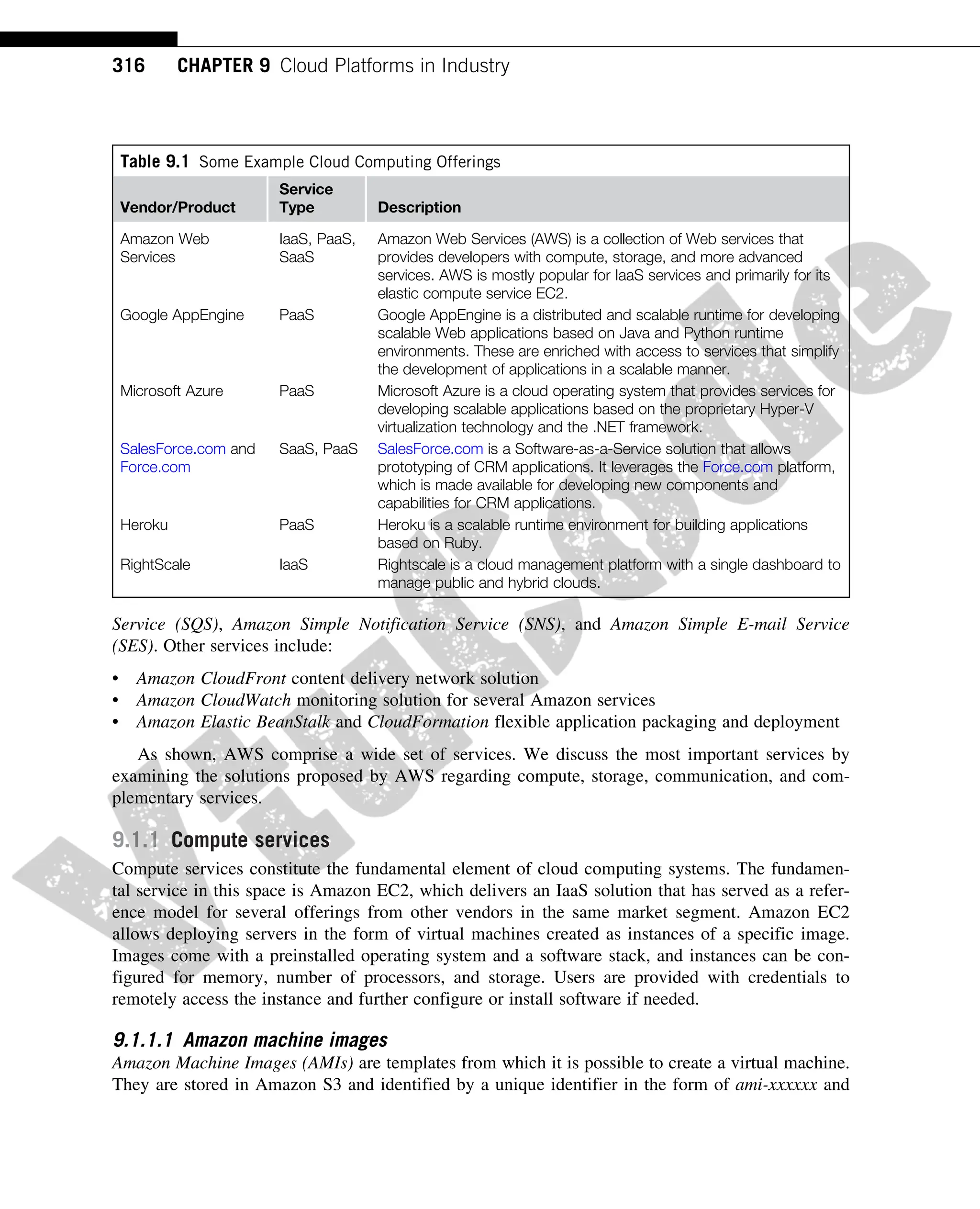
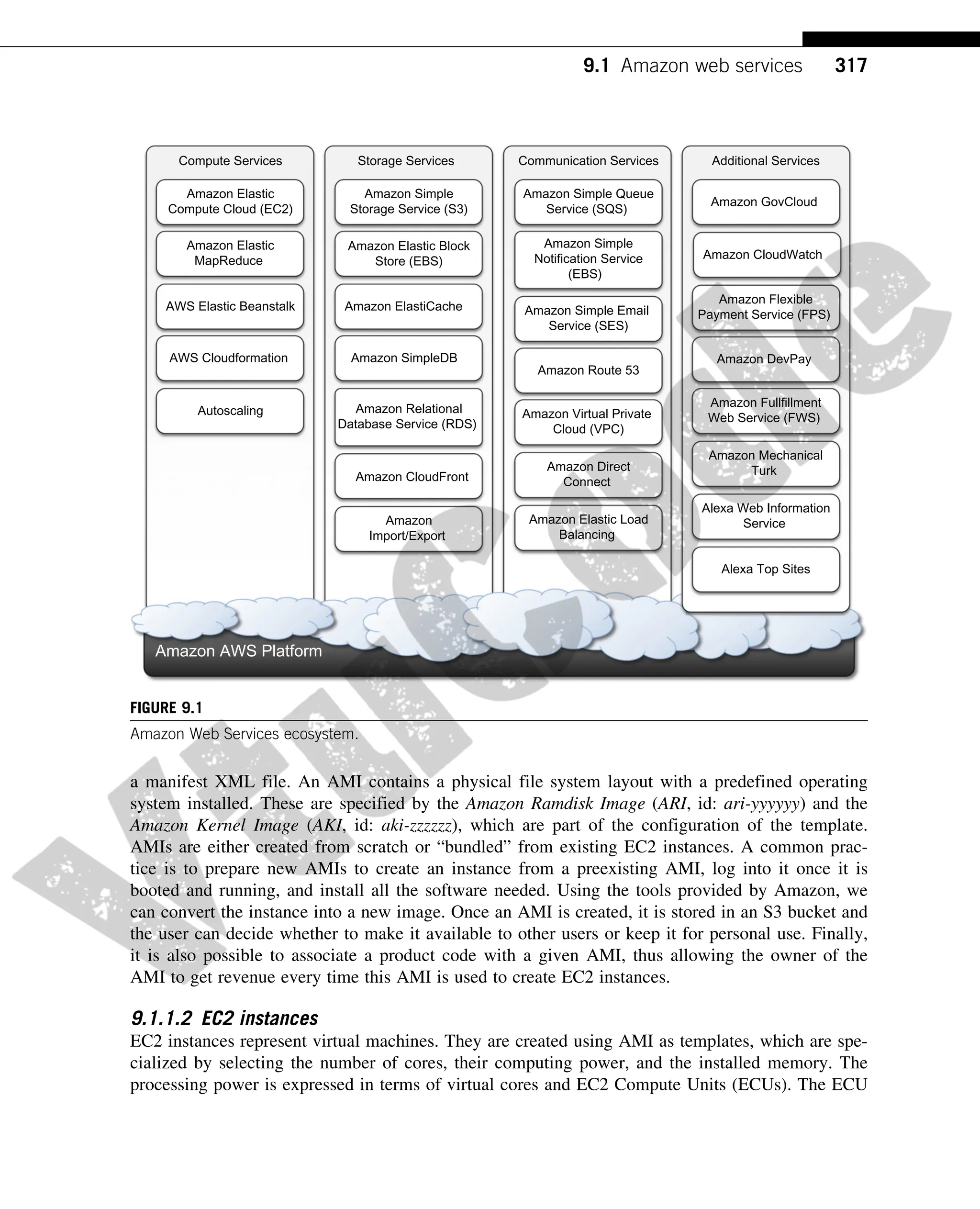
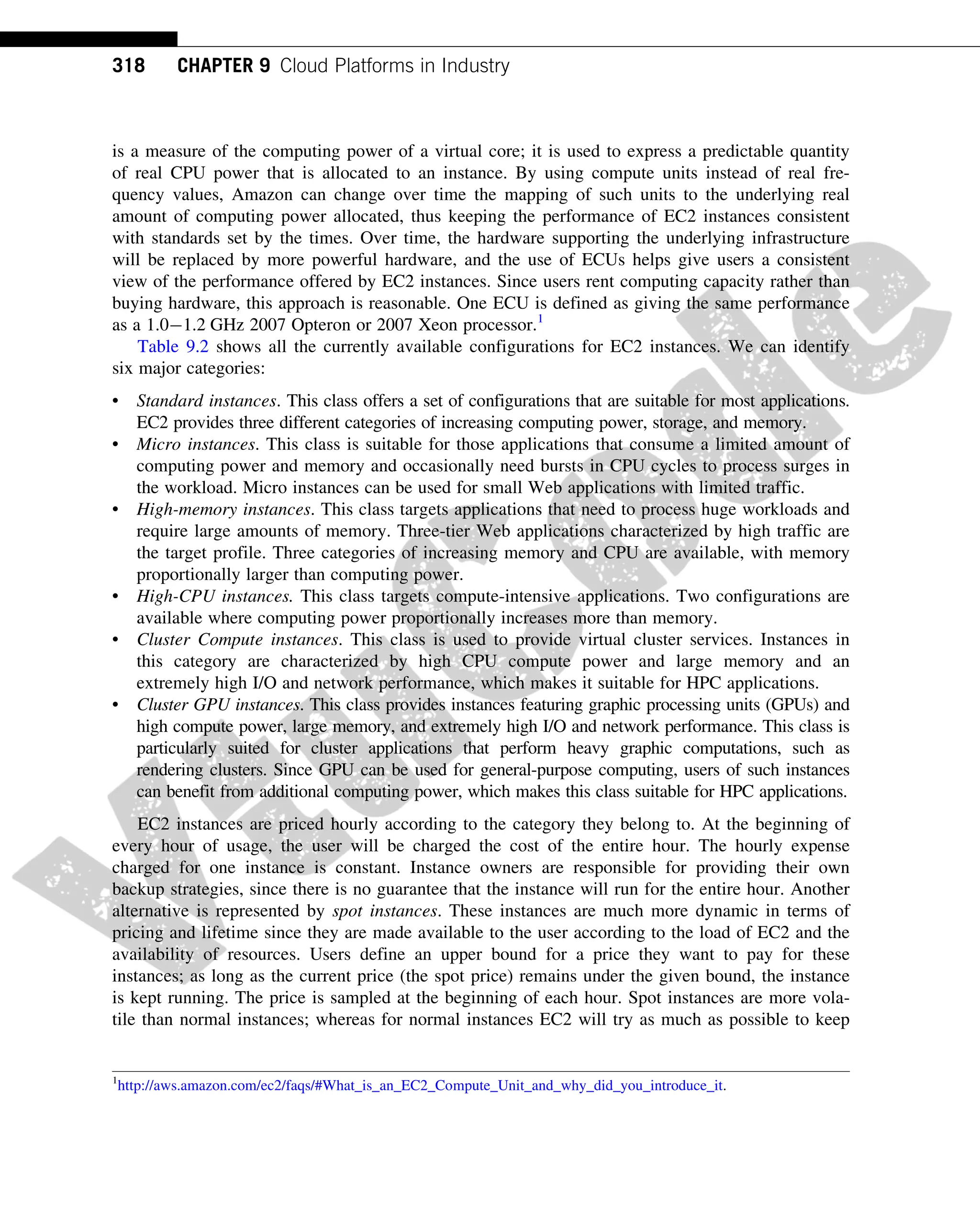


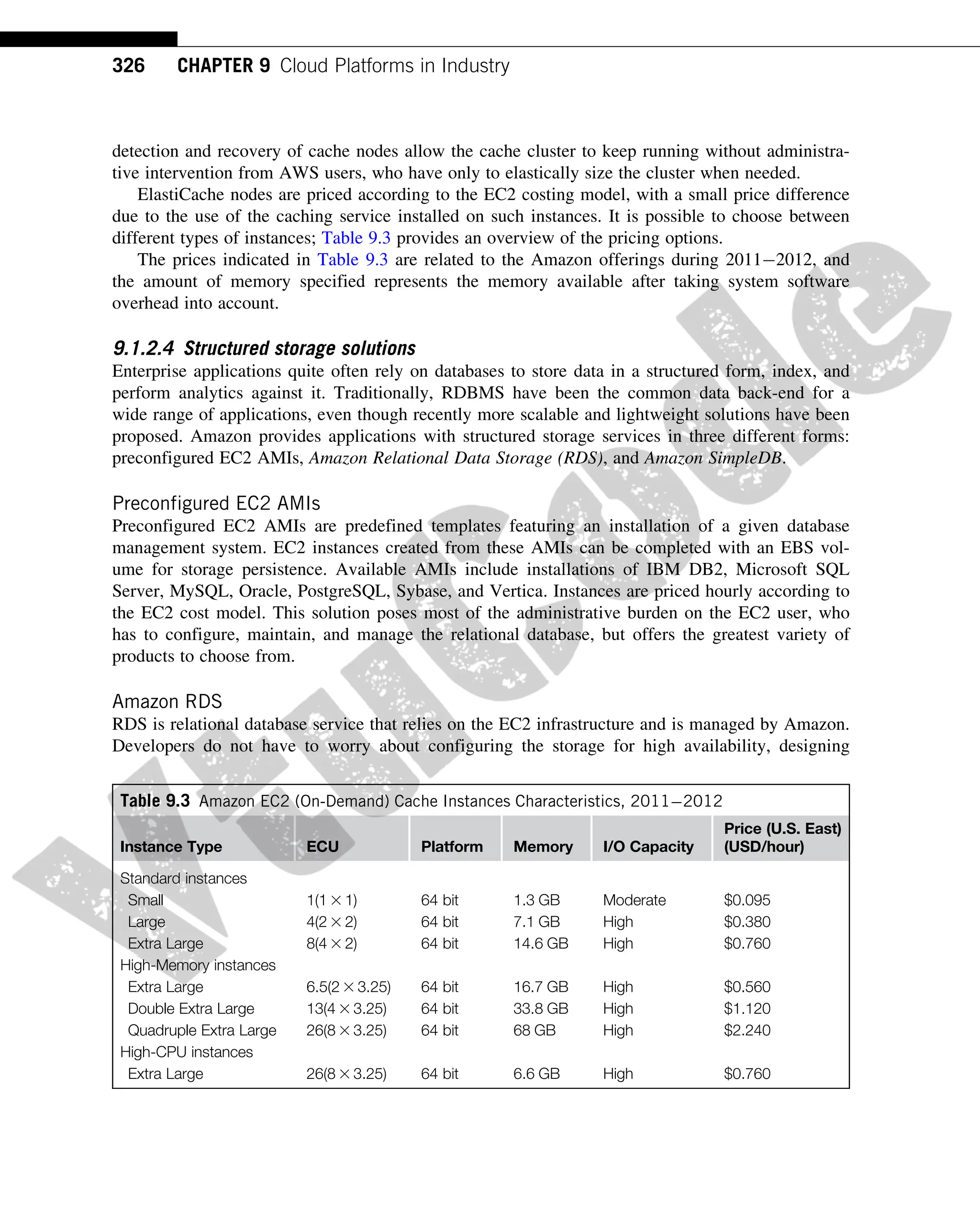
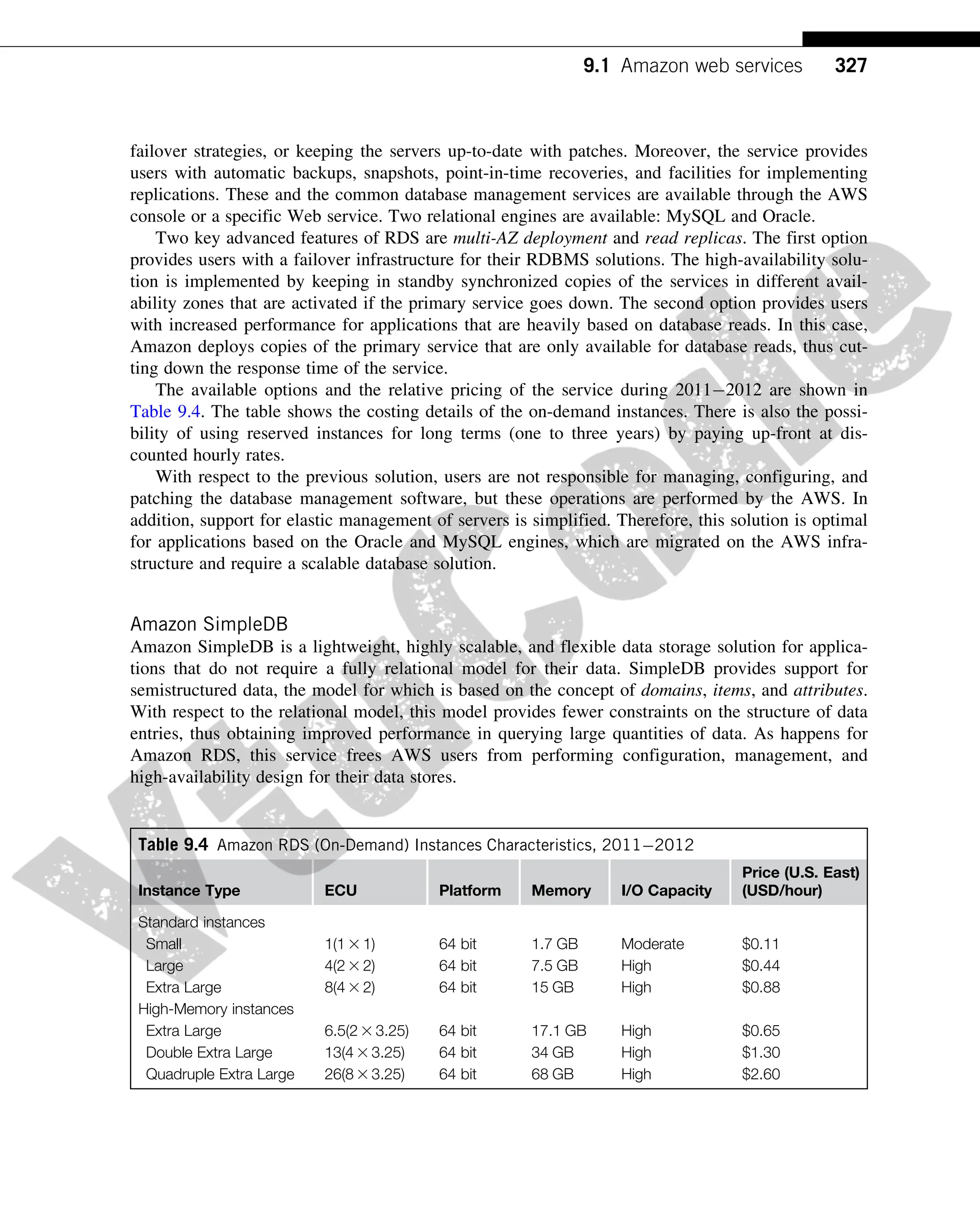
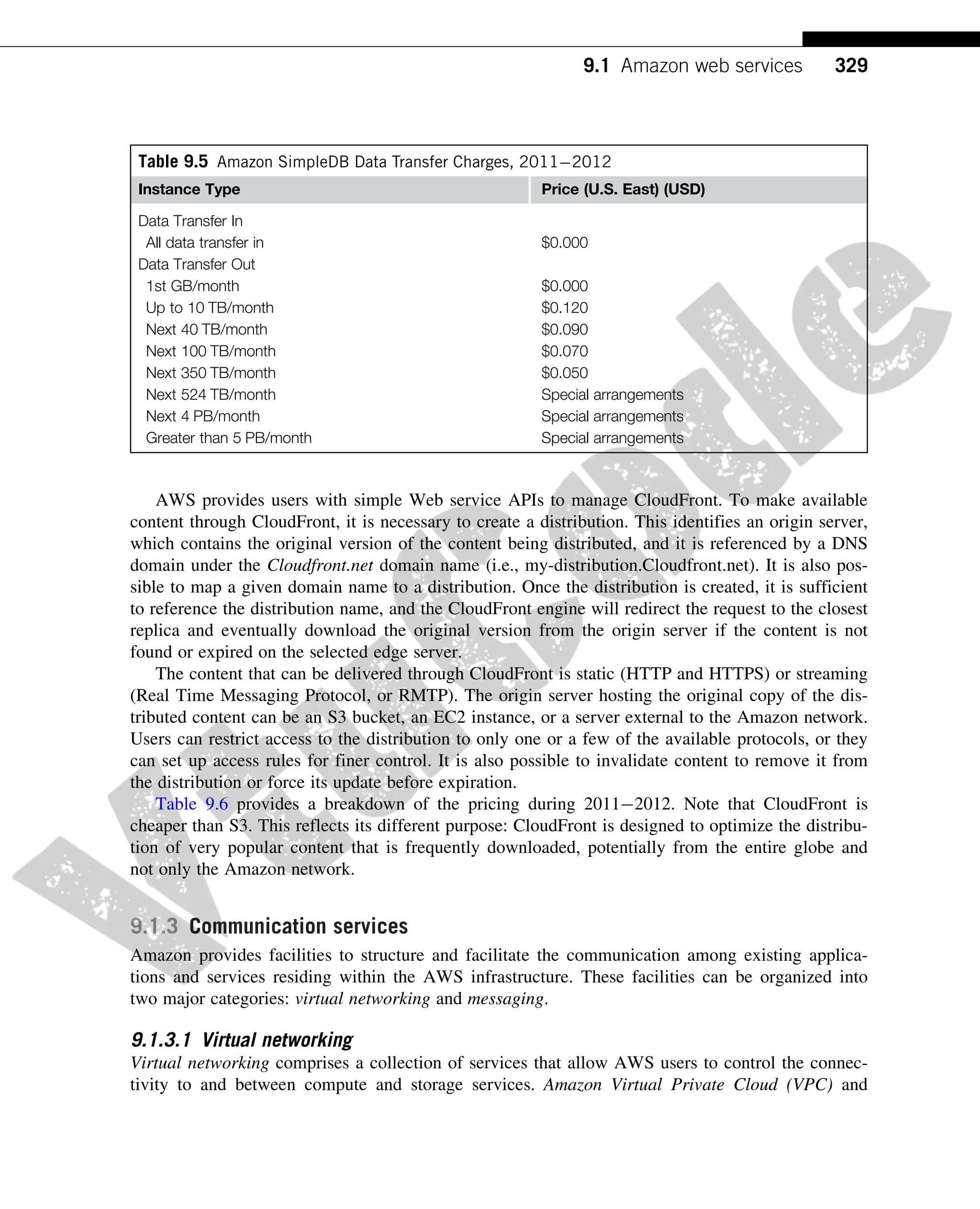
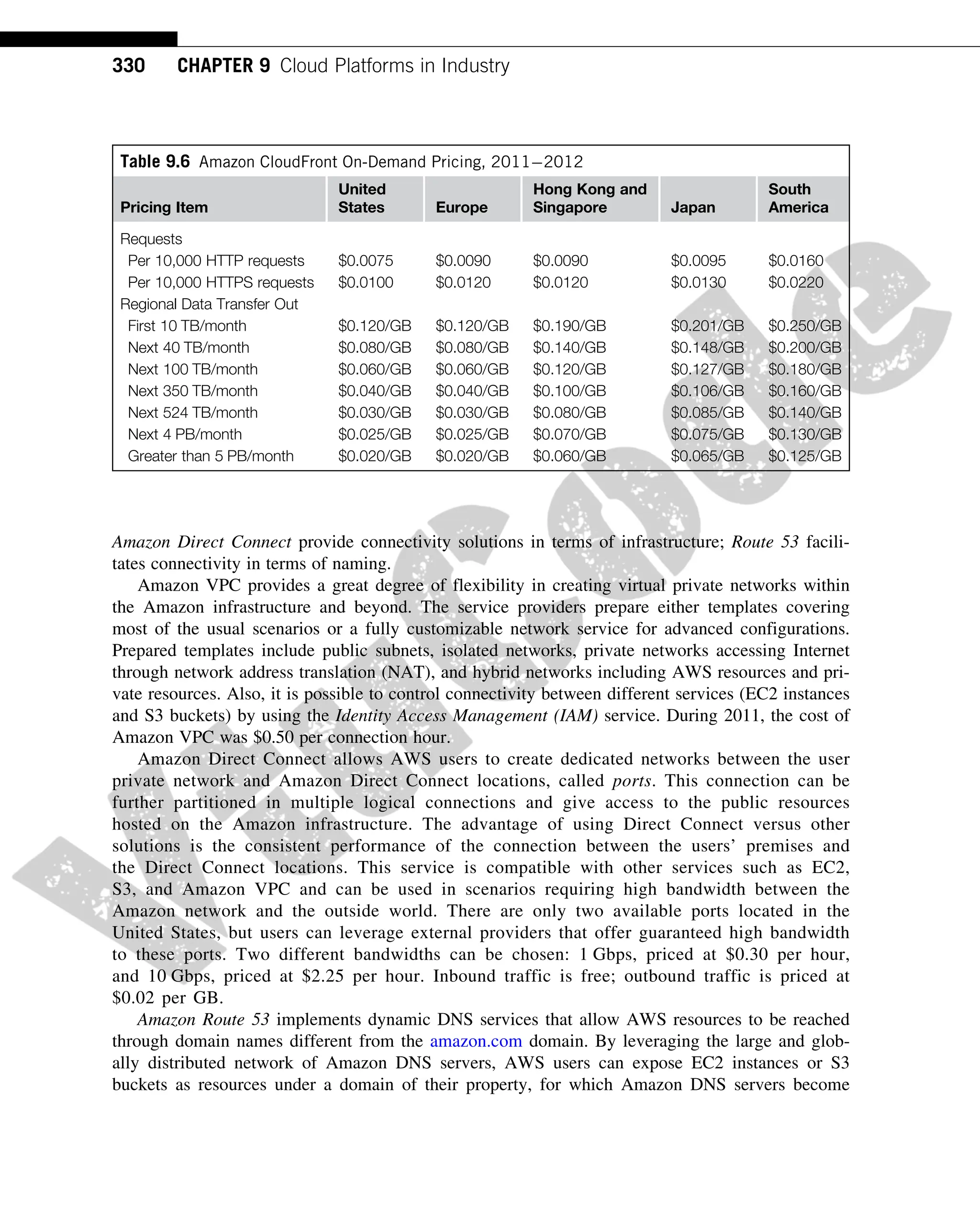
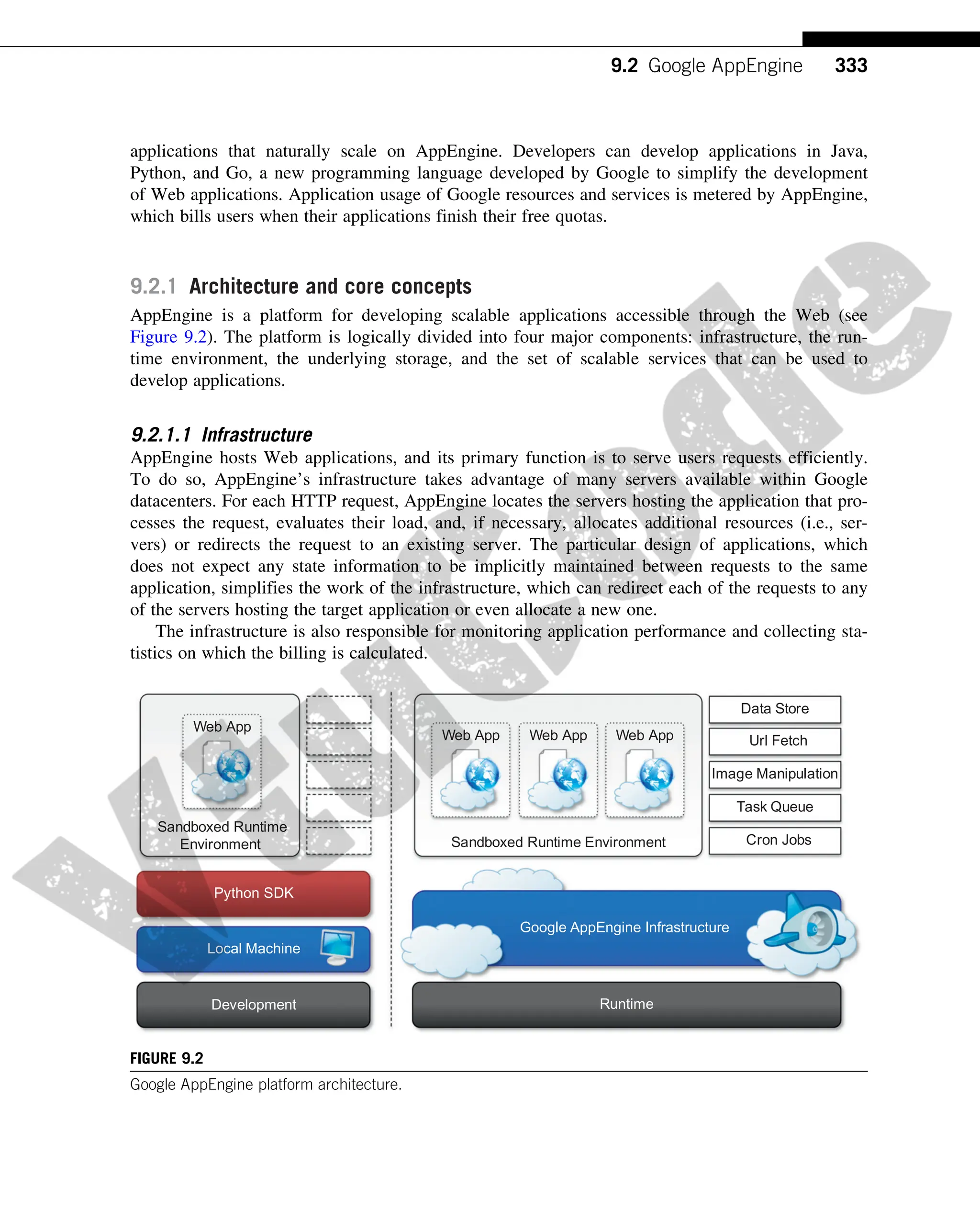
![9.2.1.3 Storage
AppEngine provides various types of storage, which operate differently depending on the volatility
of the data. There are three different levels of storage: in memory-cache, storage for semistructured
data, and long-term storage for static data. In this section, we describe DataStore and the use of
static file servers. We cover MemCache in the application services section.
Static file servers
Web applications are composed of dynamic and static data. Dynamic data are a result of the logic
of the application and the interaction with the user. Static data often are mostly constituted of the
components that define the graphical layout of the application (CSS files, plain HTML files,
JavaScript files, images, icons, and sound files) or data files. These files can be hosted on static file
servers, since they are not frequently modified. Such servers are optimized for serving static con-
tent, and users can specify how dynamic content should be served when uploading their applica-
tions to AppEngine.
DataStore
DataStore is a service that allows developers to store semistructured data. The service is designed
to scale and optimized to quickly access data. DataStore can be considered as a large object data-
base in which to store objects that can be retrieved by a specified key. Both the type of the key and
the structure of the object can vary.
With respect to the traditional Web applications backed by a relational database, DataStore
imposes less constraint on the regularity of the data but, at the same time, does not implement
some of the features of the relational model (such as reference constraints and join operations).
These design decisions originated from a careful analysis of data usage patterns for Web applica-
tions and were taken in order to obtain a more scalable and efficient data store. The underlying
infrastructure of DataStore is based on Bigtable [93], a redundant, distributed, and semistructured
data store that organizes data in the form of tables (see Section 8.2.1).
DataStore provides high-level abstractions that simplify interaction with Bigtable. Developers
define their data in terms of entity and properties, and these are persisted and maintained by the
service into tables in Bigtable. An entity constitutes the level of granularity for the storage, and it
identifies a collection of properties that define the data it stores. Properties are defined according to
one of the several primitive types supported by the service. Each entity is associated with a key,
which is either provided by the user or created automatically by AppEngine. An entity is associated
with a named kind that AppEngine uses to optimize its retrieval from Bigtable. Although entities
and properties seem to be similar to rows and tables in SQL, there are a few differences that have
to be taken into account. Entities of the same kind might not have the same properties, and proper-
ties of the same name might contain values of different types. Moreover, properties can store differ-
ent versions of the same values. Finally, keys are immutable elements and, once created, they
cannot be changed.
DataStore also provides facilities for creating indexes on data and to update data within the con-
text of a transaction. Indexes are used to support and speed up queries. A query can return zero or
more objects of the same kind or simply the corresponding keys. It is possible to query the data
store by specifying either the key or conditions on the values of the properties. Returned result sets
can be sorted by key value or properties value. Even though the queries are quite similar to SQL
335
9.2 Google AppEngine](https://image.slidesharecdn.com/21cs72-module-5-textbook-250505182953-2ea18632/75/21CS72-module-5-textbook-pdf-VTU-notes-for-Bachelors-of-engineering-21-2048.jpg)
![An important application is the use of cloud technologies to support doctors in providing more
effective diagnostic processes. In particular, here we discuss electrocardiogram (ECG) data analysis
on the cloud [160].
The capillary development of Internet connectivity and its accessibility from any device at any
time has made cloud technologies an attractive option for developing health-monitoring systems.
ECG data analysis and monitoring constitute a case that naturally fits into this scenario. ECG is the
electrical manifestation of the contractile activity of the heart’s myocardium. This activity produces
a specific waveform that is repeated over time and that represents the heartbeat. The analysis of the
shape of the ECG waveform is used to identify arrhythmias and is the most common way to detect
heart disease. Cloud computing technologies allow the remote monitoring of a patient’s heartbeat
data, data analysis in minimal time, and the notification of first-aid personnel and doctors should
these data reveal potentially dangerous conditions. This way a patient at risk can be constantly
monitored without going to a hospital for ECG analysis. At the same time, doctors and first-aid per-
sonnel can instantly be notified of cases that require their attention.
An illustration of the infrastructure and model for supporting remote ECG monitoring is shown
in Figure 10.1. Wearable computing devices equipped with ECG sensors constantly monitor the
patient’s heartbeat. Such information is transmitted to the patient’s mobile device, which will even-
tually forward it to the cloud-hosted Web service for analysis. The Web service forms the front-end
of a platform that is entirely hosted in the cloud and that leverages the three layers of the cloud
computing stack: SaaS, PaaS, and IaaS. The Web service constitute the SaaS application that will
store ECG data in the Amazon S3 service and issue a processing request to the scalable cloud plat-
form. The runtime platform is composed of a dynamically sizable number of instances running the
workflow engine and Aneka. The number of workflow engine instances is controlled according to
the number of requests in the queue of each instance, while Aneka controls the number of EC2
instances used to execute the single tasks defined by the workflow engine for a single ECG proces-
sing job. Each of these jobs consists of a set of operations involving the extraction of the waveform
from the heartbeat data and the comparison of the waveform with a reference waveform to detect
anomalies. If anomalies are found, doctors and first-aid personnel can be notified to act on a
specific patient.
Even though remote ECG monitoring does not necessarily require cloud technologies, cloud
computing introduces opportunities that would be otherwise hardly achievable. The first advantage
is the elasticity of the cloud infrastructure that can grow and shrink according to the requests
served. As a result, doctors and hospitals do not have to invest in large computing infrastructures
designed after capacity planning, thus making more effective use of budgets. The second advantage
is ubiquity. Cloud computing technologies have now become easily accessible and promise to
deliver systems with minimum or no downtime. Computing systems hosted in the cloud are acces-
sible from any Internet device through simple interfaces (such as SOAP and REST-based Web ser-
vices). This makes these systems not only ubiquitous, but they can also be easily integrated with
other systems maintained on the hospital’s premises. Finally, cost savings constitute another reason
for the use of cloud technology in healthcare. Cloud services are priced on a pay-per-use basis and
with volume prices for large numbers of service requests. These two models provide a set of flexi-
ble options that can be used to price the service, thus actually charging costs based on effective use
rather than capital costs.
354 CHAPTER 10 Cloud Applications](https://image.slidesharecdn.com/21cs72-module-5-textbook-250505182953-2ea18632/75/21CS72-module-5-textbook-pdf-VTU-notes-for-Bachelors-of-engineering-29-2048.jpg)
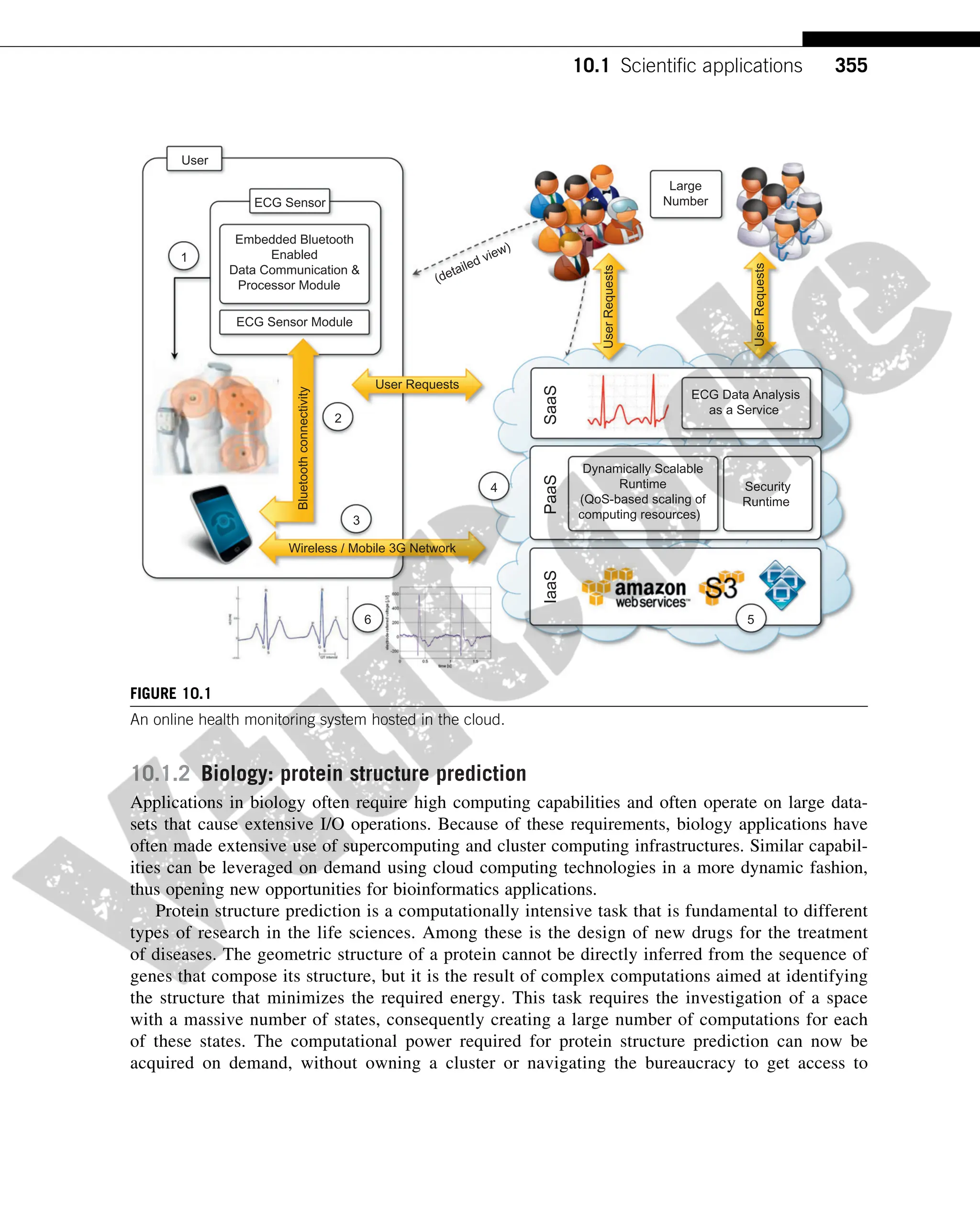
![parallel and distributed computing facilities. Cloud computing grants access to such capacity on a
pay-per-use basis.
One project that investigates the use of cloud technologies for protein structure prediction is
Jeeva [161]—an integrated Web portal that enables scientists to offload the prediction task to a
computing cloud based on Aneka (see Figure 10.2). The prediction task uses machine learning tech-
niques (support vector machines) for determining the secondary structure of proteins. These techni-
ques translate the problem into one of pattern recognition, where a sequence has to be classified
into one of three possible classes (E, H, and C). A popular implementation based on support vector
machines divides the pattern recognition problem into three phases: initialization, classification,
and a final phase. Even though these three phases have to be executed in sequence, it is possible to
take advantage of parallel execution in the classification phase, where multiple classifiers are exe-
cuted concurrently. This creates the opportunity to sensibly reduce the computational time of the
prediction. The prediction algorithm is then translated into a task graph that is submitted to Aneka.
Once the task is completed, the middleware makes the results available for visualization through
the portal.
The advantage of using cloud technologies (i.e., Aneka as scalable cloud middleware) versus
conventional grid infrastructures is the capability to leverage a scalable computing infrastructure
that can be grown and shrunk on demand. This concept is distinctive of cloud technologies and
constitutes a strategic advantage when applications are offered and delivered as a service.
Jeeva Portal
A
B
C D E F G H
I
A : BLAST
B : Create Data Vector
C : HH Classifier
D : SS Classifier
E : TT Classifier
F : HS Classifier
G : ST Classifier
H : TH Classifier
I : Predict Final Secondary
Structure
Initial Phase
Classification
Phase
Final Phase
Task Graph
Aneka
FIGURE 10.2
Architecture and overview of the Jeeva Portal.
356 CHAPTER 10 Cloud Applications](https://image.slidesharecdn.com/21cs72-module-5-textbook-250505182953-2ea18632/75/21CS72-module-5-textbook-pdf-VTU-notes-for-Bachelors-of-engineering-31-2048.jpg)
![10.1.3 Biology: gene expression data analysis for cancer diagnosis
Gene expression profiling is the measurement of the expression levels of thousands of genes at
once. It is used to understand the biological processes that are triggered by medical treatment at a
cellular level. Together with protein structure prediction, this activity is a fundamental component
of drug design, since it allows scientists to identify the effects of a specific treatment.
Another important application of gene expression profiling is cancer diagnosis and treatment.
Cancer is a disease characterized by uncontrolled cell growth and proliferation. This behavior
occurs because genes regulating the cell growth mutate. This means that all the cancerous cells
contain mutated genes. In this context, gene expression profiling is utilized to provide a more accu-
rate classification of tumors. The classification of gene expression data samples into distinct classes
is a challenging task. The dimensionality of typical gene expression datasets ranges from several
thousands to over tens of thousands of genes. However, only small sample sizes are typically avail-
able for analysis.
This problem is often approached with learning classifiers, which generate a population of
condition-action rules that guide the classification process. Among these, the eXtended Classifier
System (XCS) has been successfully utilized for classifying large datasets in the bioinformatics and
computer science domains. However, the effectiveness of XCS, when confronted with high dimen-
sional datasets (such as microarray gene expression data sets), has not been explored in detail.
A variation of this algorithm, CoXCS [162], has proven to be effective in these conditions. CoXCS
divides the entire search space into subdomains and employs the standard XCS algorithm in each
of these subdomains. Such a process is computationally intensive but can be easily parallelized
because the classifications problems on the subdomains can be solved concurrently. Cloud-CoXCS
(see Figure 10.3) is a cloud-based implementation of CoXCS that leverages Aneka to solve the
classification problems in parallel and compose their outcomes. The algorithm is controlled by
strategies, which define the way the outcomes are composed together and whether the process
needs to be iterated.
Aneka
Cloud-CoXCS
(Task orchestrator)
Elastic Sizing
(EC2,…, )
CoXCS Tasks
Datasets
FIGURE 10.3
Cloud-CoXCS: An environment for microarray data processing on the cloud.
357
10.1 Scientific applications](https://image.slidesharecdn.com/21cs72-module-5-textbook-250505182953-2ea18632/75/21CS72-module-5-textbook-pdf-VTU-notes-for-Bachelors-of-engineering-32-2048.jpg)
![Because of the dynamic nature of XCS, the number of required compute resources to execute it
can vary over time. Therefore, the use of scalable middleware such as Aneka offers a distinctive
advantage.
10.1.4 Geoscience: satellite image processing
Geoscience applications collect, produce, and analyze massive amounts of geospatial and nonspatial
data. As the technology progresses and our planet becomes more instrumented (i.e., through the
deployment of sensors and satellites for monitoring), the volume of data that needs to be processed
increases significantly. In particular, the geographic information system (GIS) is a major element
of geoscience applications. GIS applications capture, store, manipulate, analyze, manage, and pres-
ent all types of geographically referenced data. This type of information is now becoming increas-
ingly relevant to a wide variety of application domains: from advanced farming to civil security
and natural resources management. As a result, a considerable amount of geo-referenced data is
ingested into computer systems for further processing and analysis. Cloud computing is an attrac-
tive option for executing these demanding tasks and extracting meaningful information to support
decision makers.
Satellite remote sensing generates hundreds of gigabytes of raw images that need to be further
processed to become the basis of several different GIS products. This process requires both I/O and
compute-intensive tasks. Large images need to be moved from a ground station’s local storage to
compute facilities, where several transformations and corrections are applied. Cloud computing pro-
vides the appropriate infrastructure to support such application scenarios. A cloud-based implemen-
tation of such a workflow has been developed by the Department of Space, Government of India
[163]. The system shown in Figure 10.4 integrates several technologies across the entire computing
stack. A SaaS application provides a collection of services for such tasks as geocode generation
and data visualization. At the PaaS level, Aneka controls the importing of data into the virtualized
infrastructure and the execution of image-processing tasks that produce the desired outcome from
raw satellite images. The platform leverages a Xen private cloud and the Aneka technology to
dynamically provision the required resources (i.e., grow or shrink) on demand.
The project demonstrates how cloud computing technologies can be effectively employed to off-
load local computing facilities from excessive workloads and leverage more elastic computing
infrastructures.
10.2 Business and consumer applications
The business and consumer sector is the one that probably benefits the most from cloud computing
technologies. On one hand, the opportunity to transform capital costs into operational costs makes
clouds an attractive option for all enterprises that are IT-centric. On the other hand, the sense of
ubiquity that the cloud offers for accessing data and services makes it interesting for end users as
well. Moreover, the elastic nature of cloud technologies does not require huge up-front investments,
thus allowing new ideas to be quickly translated into products and services that can comfortably
grow with the demand. The combination of all these elements has made cloud computing the
358 CHAPTER 10 Cloud Applications](https://image.slidesharecdn.com/21cs72-module-5-textbook-250505182953-2ea18632/75/21CS72-module-5-textbook-pdf-VTU-notes-for-Bachelors-of-engineering-33-2048.jpg)