The Collins Writing Program: Providing Keys to Student Learning Promoting Writing and Thinking Across the Curriculum Wilmot Consortium Schools May 21, 2009 Christine Maefsky
Writing in All Content Areas Think Explain Compare and Contrast Reflect Critique Clarify Describe Define Develop comfort with technical terms Activate prior knowledge Predict Make connections Christine Maefsky
Christine Maefsky
Five Types of Writing   John Collins, Ed.D. , founder of Collins Education Associates (CEA) and author of the highly successful Collins Writing Program, is an acknowledged expert in converting research on writing and thinking into  practical  and  timesaving  teaching techniques .
Based his work on research that … Emphasized three “F” factors that have significant impact on student  learning  and  writing : FREQUENCY FOCUS FEEDBACK Christine Maefsky
Frequency  of Writing … Regular writing across the curriculum Makes  writing an extension of thinking Enhances  academic  engagement  Promotes  content-specific   vocabulary development   Promotes  content-specific   concept development Increases long term  retention  of  material  learned Builds  confidence  and  comfort Leads to  improved writing  performance Christine Maefsky
Focused  Writing Instruction … Five Types of Writing   Each Type targeted  at a different reason for writing Each Type has  distinct  and  clear expectations  and  upfront   goals Help to  manage  the  teaching  and   learning  process  in all classes Help make teaching  manageable Christine Maefsky
Strategic  Feedback  on Writing … Each Type  has specific strategies teachers use to provide strategic feedback Focus Correction Areas  –  targeted  and specific  content  and  writing  skills Clear criteria  that guides students’ thinking and writing Teacher provides descriptive  feedback on clear criteria Further  focuses instruction Christine Maefsky
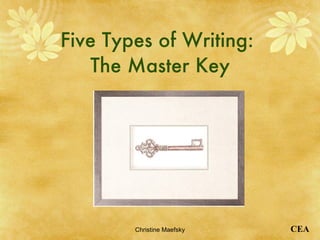
Five Types of Writing:  The Master Key Christine Maefsky
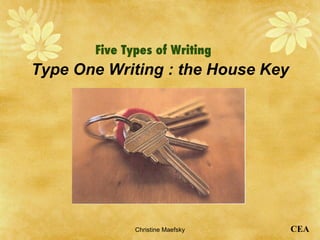
Five Types of Writing   Type One Writing : the House Key Christine Maefsky
Type One Writing - To Capture Ideas 1. No “right or wrong” - only “ what you think ” 2. Done  individually 3. Is  timed 4. Has a  quota 5. Always  evaluated One draft Christine Maefsky
Christine Maefsky
Christine Maefsky
Five Types of Writing Type Two Writing: the safety deposit box key Christine Maefsky
Type Two Writing … Writing that  shows  that  the writer knows  something about a topic  It is a  correct answer  to a  specific question   Graded as a  quiz One draft Christine Maefsky
Christine Maefsky
Christine Maefsky
Five Types of Writing Type Three Writing: the Car Key Christine Maefsky
Type Three Writing … Has  substantive content  and meets up to three specific standards called  Focus Correction Areas  (FCAs) Read out loud  and reviewed to see if the draft meets the following criteria: Completes the assignment Easy to read Meets standards set by the FCAs Revision  and  self-editing  done on the original first draft One Draft Christine Maefsky
Focus Correction Areas The Remote Entry Key Christine Maefsky
FOCUS CORRECTION AREAS  FCAS 1. The aspects of writing on which you are asking  students  to  focus 2. The  criteria  by which the writing will be  evaluated/graded 3. Based on: the writing  task , the  content  and  skills  taught,  needs  of students 4. No more than  three 5.  Mix  of content, organization, style, conventions Christine Maefsky
Potential Writing FCAs Sufficient, relevant detail Technical vocabulary used and spelled correctly Beginning and ending that establishes focus and purpose Clear sequence of detail or information Complete sentences Correct capitalization Sentence variety Powerful verbs Christine Maefsky
Christine Maefsky
Christine Maefsky
Five Types of Writing Type Four Writing:  the Double-Sided Key Christine Maefsky
Type Four Writing … Is a Type Three writing that is read out loud and critiqued by another  ( Peer Edit ) Has FCAs Reinforces the  processes  of writing  Develops  revising  and  editing  skills Two drafts Christine Maefsky
Peer Editing Christine Maefsky
Five Types of Writing Type Five Writing: the Key of Harmony Christine Maefsky
Type Five Writing.. Publishable  quality Writing that can go outside the classroom without explanation or qualification  Special projects Multiple drafts Christine Maefsky
Other Keys in the  Collins Writing Program The Key Cabinet = The Collins Writing Program The Keycard = Teacher Implementation   Folders The Control Key = Student Cumulative Writing  Folders The Skeleton Key = The Three Paper Review The Do Not Duplicate Key = Read Out Loud  The Keyboard = Seven Element Great Writing Assignments And more… Christine Maefsky
The Collins Writing Program Why it Works It’s practical It’s manageable It saves time It’s teacher friendly It embeds writing in all content areas It’s sustainable Christine Maefsky
Christine Maefsky
  The Collins Writing Program: Providing Keys to Student Learning  Write to Think - Write to Learn Christine Maefsky [email_address] Collins Writing Program www.collinsed.com Christine Maefsky

21 May09 Cea

  • 1.
    The Collins WritingProgram: Providing Keys to Student Learning Promoting Writing and Thinking Across the Curriculum Wilmot Consortium Schools May 21, 2009 Christine Maefsky
  • 2.
    Writing in AllContent Areas Think Explain Compare and Contrast Reflect Critique Clarify Describe Define Develop comfort with technical terms Activate prior knowledge Predict Make connections Christine Maefsky
  • 3.
  • 4.
    Five Types ofWriting John Collins, Ed.D. , founder of Collins Education Associates (CEA) and author of the highly successful Collins Writing Program, is an acknowledged expert in converting research on writing and thinking into practical and timesaving teaching techniques .
  • 5.
    Based his workon research that … Emphasized three “F” factors that have significant impact on student learning and writing : FREQUENCY FOCUS FEEDBACK Christine Maefsky
  • 6.
    Frequency ofWriting … Regular writing across the curriculum Makes writing an extension of thinking Enhances academic engagement Promotes content-specific vocabulary development Promotes content-specific concept development Increases long term retention of material learned Builds confidence and comfort Leads to improved writing performance Christine Maefsky
  • 7.
    Focused WritingInstruction … Five Types of Writing Each Type targeted at a different reason for writing Each Type has distinct and clear expectations and upfront goals Help to manage the teaching and learning process in all classes Help make teaching manageable Christine Maefsky
  • 8.
    Strategic Feedback on Writing … Each Type has specific strategies teachers use to provide strategic feedback Focus Correction Areas – targeted and specific content and writing skills Clear criteria that guides students’ thinking and writing Teacher provides descriptive feedback on clear criteria Further focuses instruction Christine Maefsky
  • 9.
    Five Types ofWriting: The Master Key Christine Maefsky
  • 10.
    Five Types ofWriting Type One Writing : the House Key Christine Maefsky
  • 11.
    Type One Writing- To Capture Ideas 1. No “right or wrong” - only “ what you think ” 2. Done individually 3. Is timed 4. Has a quota 5. Always evaluated One draft Christine Maefsky
  • 12.
  • 13.
  • 14.
    Five Types ofWriting Type Two Writing: the safety deposit box key Christine Maefsky
  • 15.
    Type Two Writing… Writing that shows that the writer knows something about a topic It is a correct answer to a specific question Graded as a quiz One draft Christine Maefsky
  • 16.
  • 17.
  • 18.
    Five Types ofWriting Type Three Writing: the Car Key Christine Maefsky
  • 19.
    Type Three Writing… Has substantive content and meets up to three specific standards called Focus Correction Areas (FCAs) Read out loud and reviewed to see if the draft meets the following criteria: Completes the assignment Easy to read Meets standards set by the FCAs Revision and self-editing done on the original first draft One Draft Christine Maefsky
  • 20.
    Focus Correction AreasThe Remote Entry Key Christine Maefsky
  • 21.
    FOCUS CORRECTION AREAS FCAS 1. The aspects of writing on which you are asking students to focus 2. The criteria by which the writing will be evaluated/graded 3. Based on: the writing task , the content and skills taught, needs of students 4. No more than three 5. Mix of content, organization, style, conventions Christine Maefsky
  • 22.
    Potential Writing FCAsSufficient, relevant detail Technical vocabulary used and spelled correctly Beginning and ending that establishes focus and purpose Clear sequence of detail or information Complete sentences Correct capitalization Sentence variety Powerful verbs Christine Maefsky
  • 23.
  • 24.
  • 25.
    Five Types ofWriting Type Four Writing: the Double-Sided Key Christine Maefsky
  • 26.
    Type Four Writing… Is a Type Three writing that is read out loud and critiqued by another ( Peer Edit ) Has FCAs Reinforces the processes of writing Develops revising and editing skills Two drafts Christine Maefsky
  • 27.
  • 28.
    Five Types ofWriting Type Five Writing: the Key of Harmony Christine Maefsky
  • 29.
    Type Five Writing..Publishable quality Writing that can go outside the classroom without explanation or qualification Special projects Multiple drafts Christine Maefsky
  • 30.
    Other Keys inthe Collins Writing Program The Key Cabinet = The Collins Writing Program The Keycard = Teacher Implementation Folders The Control Key = Student Cumulative Writing Folders The Skeleton Key = The Three Paper Review The Do Not Duplicate Key = Read Out Loud The Keyboard = Seven Element Great Writing Assignments And more… Christine Maefsky
  • 31.
    The Collins WritingProgram Why it Works It’s practical It’s manageable It saves time It’s teacher friendly It embeds writing in all content areas It’s sustainable Christine Maefsky
  • 32.
  • 33.
    TheCollins Writing Program: Providing Keys to Student Learning Write to Think - Write to Learn Christine Maefsky [email_address] Collins Writing Program www.collinsed.com Christine Maefsky