BRC GLOBAL STANDARD
FOOD SAFETY ISSUE 7
FSMA PREVENTIVE
CONTROLS
PREPAREDNESS
MODULE AND
GUIDANCE FOR
BRC-CERTIFIED
FACILITIES
LIABILITY
The BRC publishes information and expresses opinions in good faith, but accepts no liability for any error or omission in any such
information or opinion, including any information or opinion contained in this publication.
Whilst the BRC has endeavored to ensure that the information in this publication is accurate, it shall not be liable for any damages
(including without limitation damages for pure economic loss or loss of business or loss of profits or depletion of goodwill or
otherwise in each case, whether direct, indirect or consequential) or any claims for consequential compensation whatsoever
(howsoever caused) arising in contract, tort (including negligence or breach of statutory duty), misrepresentation, restitution or
otherwise, in connection with this publication or any information contained in it, or from any action or decision taken as a result of
reading this publication or any such information.
All warranties, conditions and other terms implied by statute or common law are, to the fullest extent permitted by law, excluded.
Nothing excludes or limits the liability of the BRC for death or personal injury caused by its negligence, for fraud or fraudulent
misrepresentation or for any matter which it would be illegal for it to exclude or attempt to exclude liability for.
The Global Standard for Food Safety: FSMA Preventive Controls Preparedness Module and Guidance for BRC-certified Facilities and
the terms of the disclaimer set out above shall be construed in accordance with English law and shall be subject to the non-exclusive
jurisdiction of the English Courts.
COPYRIGHT
© British Retail Consortium 2016
All rights reserved. No part of this publication may be transmitted or reproduced in any form (including photocopying or storage
in any medium by electronic means) without the written permission of the copyright owner. Application for permission should
be addressed to the Commercial Director of Global Standards at the British Retail Consortium (contact details below).
Full acknowledgement of the author and source must be given.
The contents of this publication cannot be reproduced for the purposes of training or any other commercial activity.
No part of this publication may be translated without the written permission of the copyright owner.
Warning: Any unauthorized act in relation to a copyright work may result in both a civil claim for damages and criminal prosecution.
For more information about BRC, contact:
British Retail Consortium,
Second Floor,
21 Dartmouth Street,
London
SW1H 9BP
Tel: +44 (0) 20 7854 8900
Fax: +44 (0) 20 7854 8901
Email: enquiries@brcglobalstandards.com
Website: www.brcglobalstandards.com
1
BRC FS7 FSMA MODULE
PART I AUDIT PROTOCOL
Background and objective 2
Scope2
Exclusions from scope 2
Audit planning 2
Preparation by the company 2
Information to be provided to the certification body for audit preparation 3
Audit duration 3
The on-site audit 3
Non-conformities and corrective action 3
Non-conformities3
Procedures for handling non-conformities and corrective action 4
Critical non-conformities 4
Major and minor non-conformities 4
Grading4
Audit reporting 5
Certification5
Ongoing audit frequency and recertification 5
Scheduling re-audit dates 5
PART II REQUIREMENTS AND GUIDANCE
Relationship of the Module to the Global Standard for Food Safety 6
Requirements and guidance of the FSMA Preventive Controls Preparedness Module 7
CONTENTS
2 BRC FS7 FSMA MODULE
BACKGROUND AND OBJECTIVE
The aim of this Module is to assist manufacturing organizations to understand those prescriptive
elements within the FSMA Preventive Controls for Human Foods that are not explicitly covered
within the BRC Global Standard for Food Safety.
It does not represent a certification, or guarantee that all aspects of the sites operations will be
found fully compliant to the regulation, rather it is a deeper clarification of what the expected
interpretations and expectations will be, once implementation dates come into effect.
This Module may be used by any facility located within the United States as an assessment step in
the preparation for their required compliance date. It may be used by facilities outside of the United
States, who see this market as a current, or future export target, to show evidence to the importer
of record that they have specifically addressed certain aspects of the supplier verification section.
Additionally, it may be used by specifiers to gain understanding and evidence of compliance to
specific parts of the regulation.
SCOPE
This Module is applicable to facilities located within the United States (as a preparedness
assessment in preparation for regulatory compliance assessments) and those facilities currently
or wishing to export products and ingredients to the United States..
EXCLUSIONS FROM SCOPE
The Module is voluntary; however, for the Module to be included within the site’s certification,
all products within the scope of the Module shall be included. No exclusions are permitted.
AUDIT PLANNING
PREPARATION BY THE COMPANY
The certification body shall be notified in advance of the audit of the intention to add the FSMA
Preventive Controls Preparedness Module to the scope of the audit. This ensures sufficient
additional time can be scheduled and that an auditor with the appropriate qualifications for
the additional module is selected.
INFORMATION TO BE PROVIDED TO THE CERTIFICATION BODY FOR
AUDIT PREPARATION
The company shall supply the certification body with any additional background information
requested prior to the audit day to ensure the auditor(s) is fully prepared to audit against
the Module.
AUDIT DURATION
In order for the FSMA Preventive Controls Preparedness Module to be included within the audit
program, additional time will be needed for the audit. The amount of additional time will depend on
several factors, primarily the organization, knowledge and preparedness of the facility personnel.
The certification body shall indicate the expected additional time requirements at the time of
planning the audit.
PART I
AUDIT PROTOCOL
3
BRC FS7 FSMA MODULE
THE ON-SITE AUDIT
Evidence of compliance with the requirements of the FSMA Preventive Controls Preparedness
Module shall be assessed as part of the audit against the requirements of the main Standard
and is expected to be integrated into the audit program as appropriate.
During the audit, detailed notes shall be made regarding the site’s conformities and non-
conformities against the requirements of the additional module, and these will be used as
the basis for an addendum to the audit report. The auditor(s) shall assess the nature and
severity of any non-conformity.
At the closing meeting, the auditor(s) shall present their findings and discuss all non-conformities
that have been identified against the Module during the audit. A written summary of the non-
conformities discussed at the closing meeting will be documented by the auditor either at the
closing meeting or within 1 working day after completion of the audit.
The decision to award certification for the voluntary module will be determined independently by
the certification body management, following a technical review of the audit report and the closing
of non-conformities in the appropriate timeframe. The company will be informed of the certification
decision following this review.
Where this voluntary module is audited as part of an unannounced option 2 audit program,
the requirements will be assessed at the time of the planned part 2 documentation audit.
NON-CONFORMITIES AND CORRECTIVE ACTION
The level of non-conformity assigned by an auditor against a requirement of a voluntary module
is an objective judgement with respect to severity and risk and is based on evidence collected
and observations made during the audit. This is verified by the certification body management.
NON-CONFORMITIES
Non-conformities against requirements of a voluntary module shall be graded in the same way
as non-conformities identified against requirements of the main Standard, namely:
○
○ Critical Where there is a critical failure to comply with a product safety or legal issue within
the scope of the Module.
○
○ Major Where there is a substantial failure to meet the requirements of any clause of the
Module or a situation is identified which would, on the basis of available objective evidence,
raise significant doubt as to the conformity of the product to the Module.
○
○ Minor Where a clause of the Module has not been fully met but, on the basis of objective
evidence, the conformity of the product or service to the Module is not in doubt.
4 BRC FS7 FSMA MODULE
PROCEDURES FOR HANDLING NON-CONFORMITIES AND CORRECTIVE ACTION
Following identification of any non-conformities against the requirements of the Module during the
audit, the company must undertake corrective action to remedy the immediate issue (correction).
The process for ‘closing out’ non-conformities depends upon the level of non-conformity and the
number of non-conformities identified.
CRITICAL NON-CONFORMITIES
If a critical non-conformity is identified against a requirement of the Module, then the site cannot
be certificated for this Module without a further full audit of the Module.
Where this occurs at a site that already holds certification for the Module, certification of the
Module must be immediately withdrawn.
If it is a requirement of customers that they shall be informed when their suppliers have a critical
non-conformity identified or fail to gain certification against a module, the company shall
immediately inform its customers.
Note a critical non-conformity against a requirement of a voluntary module does not necessarily
prevent certification against the main Standard or other voluntary modules.
MAJOR AND MINOR NON-CONFORMITIES
A voluntary module cannot be included on a certificate until major and minor non-conformities
have been demonstrated as having been corrected, either permanently or via a temporary solution
that is acceptable to the certification body.
Close-out of non-conformities can be achieved either by objective evidence being submitted to
the certification body, such as updated procedures, records, photographs or invoices for work
undertaken, or by the certification body undertaking a further on-site visit.
If satisfactory evidence is not provided within the 28-calendar-day period allowed for submission
following the audit, certification for the Module will not be granted. The site will then require a
further full audit in order to be considered for certification of the Module.
The certification body will review objective evidence of corrective action completed prior to
awarding a certificate.
GRADING
There will be no grading of the Module. The Module will either be certificated or not.
Any non-conformities identified when assessing a voluntary module may be taken into account
when deciding the grade for certification against the Global Standard for Food Safety, if the site
is under compliance deadlines as identified by the Food and Drug Administration (FDA).
Any non-conformities identified when assessing the FSMA Preparedness Module, and not closed
out, shall have no impact on certification to the Global Standard for Food Safety.
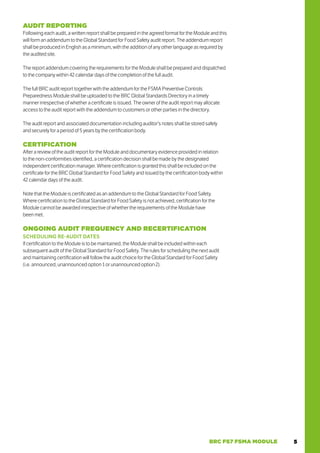
5
BRC FS7 FSMA MODULE
AUDIT REPORTING
Following each audit, a written report shall be prepared in the agreed format for the Module and this
will form an addendum to the Global Standard for Food Safety audit report. The addendum report
shall be produced in English as a minimum, with the addition of any other language as required by
the audited site.
The report addendum covering the requirements for the Module shall be prepared and dispatched
to the company within 42 calendar days of the completion of the full audit.
The full BRC audit report together with the addendum for the FSMA Preventive Controls
Preparedness Module shall be uploaded to the BRC Global Standards Directory in a timely
manner irrespective of whether a certificate is issued. The owner of the audit report may allocate
access to the audit report with the addendum to customers or other parties in the directory.
The audit report and associated documentation including auditor’s notes shall be stored safely
and securely for a period of 5 years by the certification body.
CERTIFICATION
After a review of the audit report for the Module and documentary evidence provided in relation
to the non-conformities identified, a certification decision shall be made by the designated
independent certification manager. Where certification is granted this shall be included on the
certificate for the BRC Global Standard for Food Safety and issued by the certification body within
42 calendar days of the audit.
Note that the Module is certificated as an addendum to the Global Standard for Food Safety.
Where certification to the Global Standard for Food Safety is not achieved, certification for the
Module cannot be awarded irrespective of whether the requirements of the Module have
been met.
ONGOING AUDIT FREQUENCY AND RECERTIFICATION
SCHEDULING RE-AUDIT DATES
If certification to the Module is to be maintained, the Module shall be included within each
subsequent audit of the Global Standard for Food Safety. The rules for scheduling the next audit
and maintaining certification will follow the audit choice for the Global Standard for Food Safety
(i.e. announced, unannounced option 1 or unannounced option 2).
6 BRC FS7 FSMA MODULE
PART II
REQUIREMENTS AND GUIDANCE
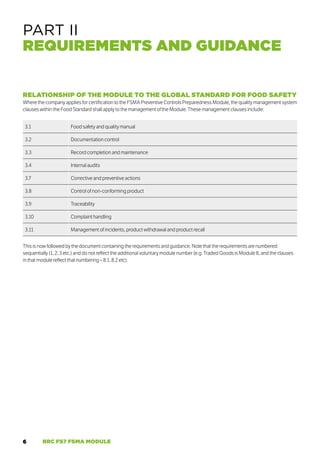
RELATIONSHIP OF THE MODULE TO THE GLOBAL STANDARD FOR FOOD SAFETY
Where the company applies for certification to the FSMA Preventive Controls Preparedness Module, the quality management system
clauses within the Food Standard shall apply to the management of the Module. These management clauses include:
3.1 Food safety and quality manual
3.2 Documentation control
3.3 Record completion and maintenance
3.4 Internal audits
3.7 Corrective and preventive actions
3.8 Control of non-conforming product
3.9 Traceability
3.10 Complaint handling
3.11 Management of incidents, product withdrawal and product recall
This is now followed by the document containing the requirements and guidance. Note that the requirements are numbered
sequentially (1, 2, 3 etc.) and do not reflect the additional voluntary module number (e.g. Traded Goods is Module 8, and the clauses
in that module reflect that numbering – 8.1, 8.2 etc).
7
BRC FS7 FSMA MODULE
FSMA PREVENTIVE CONTROLS PREPAREDNESS MODULE AND
GUIDANCE FOR BRC-CERTIFIED FACILITIES
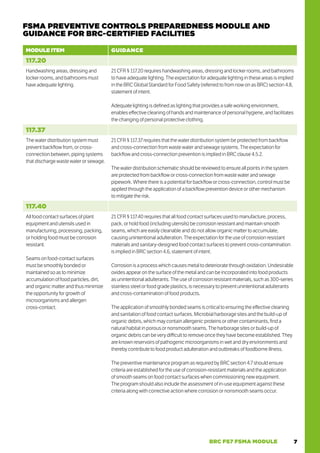
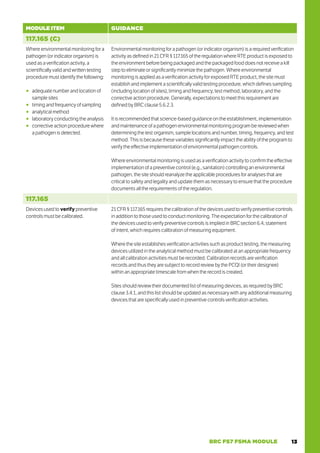
MODULE ITEM GUIDANCE
117.20
Handwashing areas, dressing and
locker rooms, and bathrooms must
have adequate lighting.
21 CFR § 117.20 requires handwashing areas, dressing and locker rooms, and bathrooms
to have adequate lighting. The expectation for adequate lighting in these areas is implied
in the BRC Global Standard for Food Safety (referred to from now on as BRC) section 4.8,
statement of intent.
Adequate lighting is defined as lighting that provides a safe working environment,
enables effective cleaning of hands and maintenance of personal hygiene, and facilitates
the changing of personal protective clothing.
117.37
The water distribution system must
prevent backflow from, or cross-
connection between, piping systems
that discharge waste water or sewage.
21 CFR § 117.37 requires that the water distribution system be protected from backflow
and cross-connection from waste water and sewage systems. The expectation for
backflow and cross-connection prevention is implied in BRC clause 4.5.2.
The water distribution schematic should be reviewed to ensure all points in the system
are protected from backflow or cross-connection from waste water and sewage
pipework. Where there is a potential for backflow or cross-connection, control must be
applied through the application of a backflow prevention device or other mechanism
to mitigate the risk.
117.40
All food contact surfaces of plant
equipment and utensils used in
manufacturing, processing, packing,
or holding food must be corrosion
resistant.
Seams on food-contact surfaces
must be smoothly bonded or
maintained so as to minimize
accumulation of food particles, dirt,
and organic matter and thus minimize
the opportunity for growth of
microorganisms and allergen
cross-contact.
21 CFR § 117.40 requires that all food contact surfaces used to manufacture, process,
pack, or hold food (including utensils) be corrosion resistant and maintain smooth
seams, which are easily cleanable and do not allow organic matter to accumulate,
causing unintentional adulteration. The expectation for the use of corrosion resistant
materials and sanitary-designed food contact surfaces to prevent cross-contamination
is implied in BRC section 4.6, statement of intent.
Corrosion is a process which causes metal to deteriorate through oxidation. Undesirable
oxides appear on the surface of the metal and can be incorporated into food products
as unintentional adulterants. The use of corrosion resistant materials, such as 300-series
stainless steel or food grade plastics, is necessary to prevent unintentional adulterants
and cross-contamination of food products.
The application of smoothly bonded seams is critical to ensuring the effective cleaning
and sanitation of food contact surfaces. Microbial harborage sites and the build-up of
organic debris, which may contain allergenic proteins or other contaminants, find a
natural habitat in porous or nonsmooth seams. The harborage sites or build-up of
organic debris can be very difficult to remove once they have become established. They
are known reservoirs of pathogenic microorganisms in wet and dry environments and
thereby contribute to food product adulteration and outbreaks of foodborne illness.
The preventive maintenance program as required by BRC section 4.7 should ensure
criteria are established for the use of corrosion-resistant materials and the application
of smooth seams on food contact surfaces when commissioning new equipment.
The program should also include the assessment of in-use equipment against these
criteria along with corrective action where corrosion or nonsmooth seams occur.
8 BRC FS7 FSMA MODULE
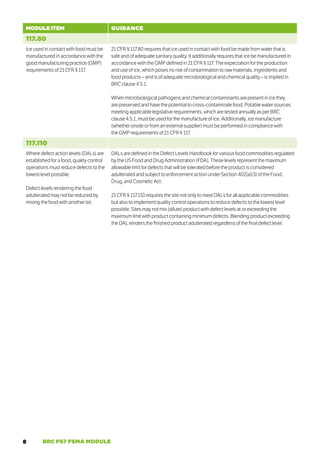
MODULE ITEM GUIDANCE
117.80
Ice used in contact with food must be
manufactured in accordance with the
good manufacturing practice (GMP)
requirements of 21 CFR § 117.
21 CFR § 117.80 requires that ice used in contact with food be made from water that is
safe and of adequate sanitary quality. It additionally requires that ice be manufactured in
accordance with the GMP defined in 21 CFR § 117. The expectation for the production
and use of ice, which poses no risk of contamination to raw materials, ingredients and
food products – and is of adequate microbiological and chemical quality – is implied in
BRC clause 4.5.1.
When microbiological pathogens and chemical contaminants are present in ice they
are preserved and have the potential to cross-contaminate food. Potable water sources
meeting applicable legislative requirements, which are tested annually as per BRC
clause 4.5.1, must be used for the manufacture of ice. Additionally, ice manufacture
(whether onsite or from an external supplier) must be performed in compliance with
the GMP requirements of 21 CFR § 117.
117.110
Where defect action levels (DALs) are
established for a food, quality control
operations must reduce defects to the
lowest level possible.
Defect levels rendering the food
adulterated may not be reduced by
mixing the food with another lot.
DALs are defined in the Defect Levels Handbook for various food commodities regulated
by the US Food and Drug Administration (FDA). These levels represent the maximum
allowable limit for defects that will be tolerated before the product is considered
adulterated and subject to enforcement action under Section 402(a)(3) of the Food,
Drug, and Cosmetic Act.
21 CFR § 117.110 requires the site not only to meet DALs for all applicable commodities
but also to implement quality control operations to reduce defects to the lowest level
possible. Sites may not mix (dilute) product with defect levels at or exceeding the
maximum limit with product containing minimum defects. Blending product exceeding
the DAL renders the finished product adulterated regardless of the final defect level.
9
BRC FS7 FSMA MODULE
MODULE ITEM GUIDANCE
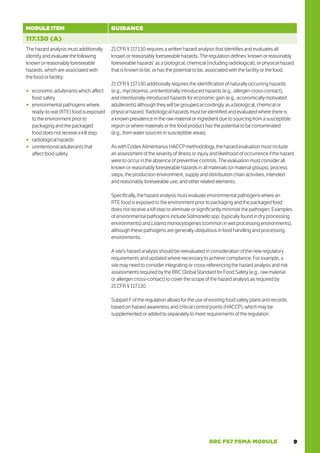
117.130 (A)
The hazard analysis must additionally
identify and evaluate the following
known or reasonably foreseeable
hazards, which are associated with
the food or facility:
○
○ economic adulterants which affect
food safety
○
○ environmental pathogens where
ready-to-eat (RTE) food is exposed
to the environment prior to
packaging and the packaged
food does not receive a kill step
○
○ radiological hazards
○
○ unintentional adulterants that
affect food safety.
21 CFR § 117.130 requires a written hazard analysis that identifies and evaluates all
known or reasonably foreseeable hazards. The regulation defines ‘known or reasonably
foreseeable hazards’ as a biological, chemical (including radiological), or physical hazard
that is known to be, or has the potential to be, associated with the facility or the food.
21 CFR § 117.130 additionally requires the identification of naturally occurring hazards
(e.g., mycotoxins), unintentionally introduced hazards (e.g., allergen cross-contact),
and intentionally introduced hazards for economic gain (e.g., economically motivated
adulterants) although they will be grouped accordingly as a biological, chemical or
physical hazard. Radiological hazards must be identified and evaluated where there is
a known prevalence in the raw material or ingredient due to sourcing from a susceptible
region or where materials or the food product has the potential to be contaminated
(e.g., from water sources in susceptible areas).
As with Codex Alimentarius HACCP methodology, the hazard evaluation must include
an assessment of the severity of illness or injury and likelihood of occurrence if the hazard
were to occur in the absence of preventive controls. The evaluation must consider all
known or reasonably foreseeable hazards in all materials (or material groups), process
steps, the production environment, supply and distribution chain activities, intended
and reasonably foreseeable use, and other related elements.
Specifically, the hazard analysis must evaluate environmental pathogens where an
RTE food is exposed to the environment prior to packaging and the packaged food
does not receive a kill step to eliminate or significantly minimize the pathogen. Examples
of environmental pathogens include Salmonella spp. (typically found in dry processing
environments) and Listeria monocytogenes (common in wet processing environments),
although these pathogens are generally ubiquitous in food handling and processing
environments.
A site’s hazard analysis should be reevaluated in consideration of the new regulatory
requirements and updated where necessary to achieve compliance. For example, a
site may need to consider integrating or cross-referencing the hazard analysis and risk
assessments required by the BRC Global Standard for Food Safety (e.g., raw material
or allergen cross-contact) to cover the scope of the hazard analysis as required by
21 CFR § 117.130.
Subpart F of the regulation allows for the use of existing food safety plans and records
based on hazard awareness and critical control points (HACCP), which may be
supplemented or added to separately to meet requirements of the regulation.
10 BRC FS7 FSMA MODULE
MODULE ITEM GUIDANCE
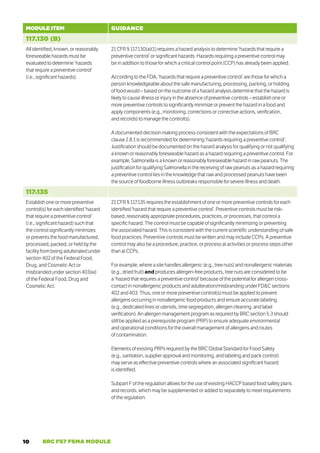
117.130 (B)
All identified, known, or reasonably
foreseeable hazards must be
evaluated to determine ‘hazards
that require a preventive control’
(i.e., significant hazards).
21 CFR § 117.130(a)(1) requires a hazard analysis to determine ‘hazards that require a
preventive control’ or significant hazards. Hazards requiring a preventive control may
be in addition to those for which a critical control point (CCP) has already been applied.
According to the FDA, ‘hazards that require a preventive control’ are those for which a
person knowledgeable about the safe manufacturing, processing, packing, or holding
of food would – based on the outcome of a hazard analysis determine that the hazard is
likely to cause illness or injury in the absence of preventive controls – establish one or
more preventive controls to significantly minimize or prevent the hazard in a food and
apply components (e.g., monitoring, corrections or corrective actions, verification,
and records) to manage the control(s).
A documented decision making process consistent with the expectations of BRC
clause 2.8.1 is recommended for determining ‘hazards requiring a preventive control’.
Justification should be documented on the hazard analysis for qualifying or not qualifying
a known or reasonably foreseeable hazard as a hazard requiring a preventive control. For
example, Salmonella is a known or reasonably foreseeable hazard in raw peanuts. The
justification for qualifying Salmonella in the receiving of raw peanuts as a hazard requiring
a preventive control lies in the knowledge that raw and processed peanuts have been
the source of foodborne illness outbreaks responsible for severe illness and death.
117.135
Establish one or more preventive
control(s) for each identified ‘hazard
that require a preventive control’
(i.e., significant hazard) such that
the control significantly minimizes
or prevents the food manufactured,
processed, packed, or held by the
facility from being adulterated under
section 402 of the Federal Food,
Drug, and Cosmetic Act or
misbranded under section 403(w)
of the Federal Food, Drug and
Cosmetic Act.
21 CFR § 117.135 requires the establishment of one or more preventive controls for each
identified ‘hazard that require a preventive control’. Preventive controls must be risk-
based, reasonably appropriate procedures, practices, or processes, that control a
specific hazard. The control must be capable of significantly minimizing or preventing
the associated hazard. This is consistent with the current scientific understanding of safe
food practices. Preventive controls must be written and may include CCPs. A preventive
control may also be a procedure, practice, or process at activities or process steps other
than at CCPs.
For example, where a site handles allergenic (e.g., tree nuts) and nonallergenic materials
(e.g., dried fruit) and produces allergen-free products, tree nuts are considered to be
a ‘hazard that requires a preventive control’ because of the potential for allergen cross-
contact in nonallergenic products and adulteration/misbranding under FDC sections
402 and 403. Thus, one or more preventive control(s) must be applied to prevent
allergens occurring in nonallergenic food products and ensure accurate labeling
(e.g., dedicated lines or utensils, time segregation, allergen cleaning, and label
verification). An allergen management program as required by BRC section 5.3 should
still be applied as a prerequisite program (PRP) to ensure adequate environmental
and operational conditions for the overall management of allergens and routes
of contamination.
Elements of existing PRPs required by the BRC Global Standard for Food Safety
(e.g., sanitation, supplier approval and monitoring, and labeling and pack control)
may serve as effective preventive controls where an associated significant hazard
is identified.
Subpart F of the regulation allows for the use of existing HACCP based food safety plans
and records, which may be supplemented or added to separately to meet requirements
of the regulation.
11
BRC FS7 FSMA MODULE
MODULE ITEM GUIDANCE
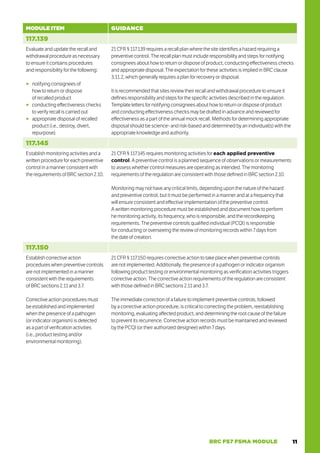
117.139
Evaluate and update the recall and
withdrawal procedure as necessary
to ensure it contains procedures
and responsibility for the following:
○
○ notifying consignees of
how to return or dispose
of recalled product
○
○ conducting effectiveness checks
to verify recall is carried out
○
○ appropriate disposal of recalled
product (i.e., destroy, divert,
repurpose).
21 CFR § 117.139 requires a recall plan where the site identifies a hazard requiring a
preventive control. The recall plan must include responsibility and steps for notifying
consignees about how to return or dispose of product, conducting effectiveness checks
and appropriate disposal. The expectation for these activities is implied in BRC clause
3.11.2, which generally requires a plan for recovery or disposal.
It is recommended that sites review their recall and withdrawal procedure to ensure it
defines responsibility and steps for the specific activities described in the regulation.
Template letters for notifying consignees about how to return or dispose of product
and conducting effectiveness checks may be drafted in advance and reviewed for
effectiveness as a part of the annual mock recall. Methods for determining appropriate
disposal should be science- and risk-based and determined by an individual(s) with the
appropriate knowledge and authority.
117.145
Establish monitoring activities and a
written procedure for each preventive
control in a manner consistent with
the requirements of BRC section 2.10.
21 CFR § 117.145 requires monitoring activities for each applied preventive
control. A preventive control is a planned sequence of observations or measurements
to assess whether control measures are operating as intended. The monitoring
requirements of the regulation are consistent with those defined in BRC section 2.10.
Monitoring may not have any critical limits, depending upon the nature of the hazard
and preventive control, but it must be performed in a manner and at a frequency that
will ensure consistent and effective implementation of the preventive control.
A written monitoring procedure must be established and document how to perform
he monitoring activity, its frequency, who is responsible, and the recordkeeping
requirements. The preventive controls qualified individual (PCQI) is responsible
for conducting or overseeing the review of monitoring records within 7 days from
the date of creation.
117.150
Establish corrective action
procedures when preventive controls
are not implemented in a manner
consistent with the requirements
of BRC sections 2.11 and 3.7.
Corrective action procedures must
be established and implemented
when the presence of a pathogen
(or indicator organism) is detected
as a part of verification activities
(i.e., product testing and/or
environmental monitoring).
21 CFR § 117.150 requires corrective action to take place when preventive controls
are not implemented. Additionally, the presence of a pathogen or indicator organism
following product testing or environmental monitoring as verification activities triggers
corrective action. The corrective action requirements of the regulation are consistent
with those defined in BRC sections 2.11 and 3.7.
The immediate correction of a failure to implement preventive controls, followed
by a corrective action procedure, is critical to correcting the problem, reestablishing
monitoring, evaluating affected product, and determining the root cause of the failure
to prevent its recurrence. Corrective action records must be maintained and reviewed
by the PCQI (or their authorized designee) within 7 days.
12 BRC FS7 FSMA MODULE
MODULE ITEM GUIDANCE
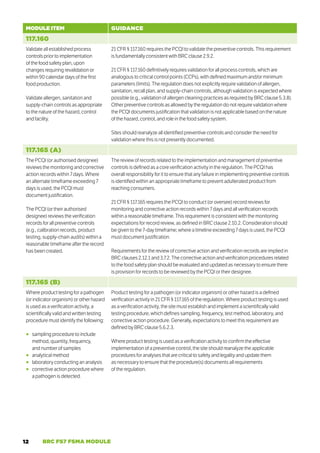
117.160
Validate all established process
controls prior to implementation
of the food safety plan, upon
changes requiring revalidation or
within 90 calendar days of the first
food production.
Validate allergen, sanitation and
supply-chain controls as appropriate
to the nature of the hazard, control
and facility.
21 CFR § 117.160 requires the PCQI to validate the preventive controls. This requirement
is fundamentally consistent with BRC clause 2.9.2.
21 CFR § 117.160 definitively requires validation for all process controls, which are
analogous to critical control points (CCPs), with defined maximum and/or minimum
parameters (limits). The regulation does not explicitly require validation of allergen,
sanitation, recall plan, and supply-chain controls, although validation is expected where
possible (e.g., validation of allergen cleaning practices as required by BRC clause 5.3.8).
Other preventive controls as allowed by the regulation do not require validation where
the PCQI documents justification that validation is not applicable based on the nature
of the hazard, control, and role in the food safety system.
Sites should reanalyze all identified preventive controls and consider the need for
validation where this is not presently documented.
117.165 (A)
The PCQI (or authorised designee)
reviews the monitoring and corrective
action records within 7 days. Where
an alternate timeframe exceeding 7
days is used, the PCQI must
document justification.
The PCQI (or their authorised
designee) reviews the verification
records for all preventive controls
(e.g., calibration records, product
testing, supply-chain audits) within a
reasonable timeframe after the record
has been created.
The review of records related to the implementation and management of preventive
controls is defined as a core verification activity in the regulation. The PCQI has
overall responsibility for it to ensure that any failure in implementing preventive controls
is identified within an appropriate timeframe to prevent adulterated product from
reaching consumers.
21 CFR § 117.165 requires the PCQI to conduct (or oversee) record reviews for
monitoring and corrective action records within 7 days and all verification records
within a reasonable timeframe. This requirement is consistent with the monitoring
expectations for record review, as defined in BRC clause 2.10.2. Consideration should
be given to the 7-day timeframe; where a timeline exceeding 7 days is used, the PCQI
must document justification.
Requirements for the review of corrective action and verification records are implied in
BRC clauses 2.12.1 and 3.7.2. The corrective action and verification procedures related
to the food safety plan should be evaluated and updated as necessary to ensure there
is provision for records to be reviewed by the PCQI or their designee.
117.165 (B)
Where product testing for a pathogen
(or indicator organism) or other hazard
is used as a verification activity, a
scientifically valid and written testing
procedure must identify the following:
○
○ sampling procedure to include
method, quantity, frequency,
and number of samples
○
○ analytical method
○
○ laboratory conducting an analysis
○
○ corrective action procedure where
a pathogen is detected.
Product testing for a pathogen (or indicator organism) or other hazard is a defined
verification activity in 21 CFR § 117.165 of the regulation. Where product testing is used
as a verification activity, the site must establish and implement a scientifically valid
testing procedure, which defines sampling, frequency, test method, laboratory, and
corrective action procedure. Generally, expectations to meet this requirement are
defined by BRC clause 5.6.2.3.
Where product testing is used as a verification activity to confirm the effective
implementation of a preventive control, the site should reanalyze the applicable
procedures for analyses that are critical to safety and legality and update them
as necessary to ensure that the procedure(s) documents all requirements
of the regulation.
13
BRC FS7 FSMA MODULE
MODULE ITEM GUIDANCE
117.165 (C)
Where environmental monitoring for a
pathogen (or indicator organism) is
used as a verification activity, a
scientifically valid and written testing
procedure must identify the following:
○
○ adequate number and location of
sample sites
○
○ timing and frequency of sampling
○
○ analytical method
○
○ laboratory conducting the analysis
○
○ corrective action procedure where
a pathogen is detected.
Environmental monitoring for a pathogen (or indicator organism) is a required verification
activity as defined in 21 CFR § 117.165 of the regulation where RTE product is exposed to
the environment before being packaged and the packaged food does not receive a kill
step to eliminate or significantly minimize the pathogen. Where environmental
monitoring is applied as a verification activity for exposed RTE product, the site must
establish and implement a scientifically valid testing procedure, which defines sampling
(including location of sites), timing and frequency, test method, laboratory, and the
corrective action procedure. Generally, expectations to meet this requirement are
defined by BRC clause 5.6.2.3.
It is recommended that science-based guidance on the establishment, implementation
and maintenance of a pathogen environmental monitoring program be reviewed when
determining the test organism, sample locations and number, timing, frequency, and test
method. This is because these variables significantly impact the ability of the program to
verify the effective implementation of environmental pathogen controls.
Where environmental monitoring is used as a verification activity to confirm the effective
implementation of a preventive control (e.g., sanitation) controlling an environmental
pathogen, the site should reanalyze the applicable procedures for analyses that are
critical to safety and legality and update them as necessary to ensure that the procedure
documents all the requirements of the regulation.
117.165
Devices used to verify preventive
controls must be calibrated.
21 CFR § 117.165 requires the calibration of the devices used to verify preventive controls
in addition to those used to conduct monitoring. The expectation for the calibration of
the devices used to verify preventive controls is implied in BRC section 6.4, statement
of intent, which requires calibration of measuring equipment.
Where the site establishes verification activities such as product testing, the measuring
devices utilized in the analytical method must be calibrated at an appropriate frequency
and all calibration activities must be recorded. Calibration records are verification
records and thus they are subject to record review by the PCQI (or their designee)
within an appropriate timescale from when the record is created.
Sites should review their documented list of measuring devices, as required by BRC
clause 3.4.1, and this list should be updated as necessary with any additional measuring
devices that are specifically used in preventive controls verification activities.
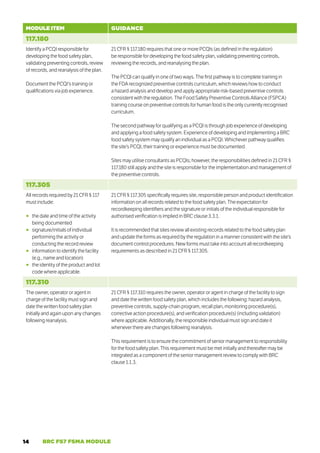
14 BRC FS7 FSMA MODULE
MODULE ITEM GUIDANCE
117.180
Identify a PCQI responsible for
developing the food safety plan,
validating preventing controls, review
of records, and reanalysis of the plan.
Document the PCQI’s training or
qualifications via job experience.
21 CFR § 117.180 requires that one or more PCQIs (as defined in the regulation)
be responsible for developing the food safety plan, validating preventing controls,
reviewing the records, and reanalysing the plan.
The PCQI can qualify in one of two ways. The first pathway is to complete training in
the FDA recognized preventive controls curriculum, which reviews how to conduct
a hazard analysis and develop and apply appropriate risk-based preventive controls
consistent with the regulation. The Food Safety Preventive Controls Alliance (FSPCA)
training course on preventive controls for human food is the only currently recognised
curriculum.
The second pathway for qualifying as a PCQI is through job experience of developing
and applying a food safety system. Experience of developing and implementing a BRC
food safety system may qualify an individual as a PCQI. Whichever pathway qualifies
the site’s PCQI, their training or experience must be documented.
Sites may utilise consultants as PCQIs; however, the responsibilities defined in 21 CFR §
117.180 still apply and the site is responsible for the implementation and management of
the preventive controls.
117.305
All records required by 21 CFR § 117
must include:
○
○ the date and time of the activity
being documented
○
○ signature/initials of individual
performing the activity or
conducting the record review
○
○ information to identify the facility
(e.g., name and location)
○
○ the identity of the product and lot
code where applicable.
21 CFR § 117.305 specifically requires site, responsible person and product identification
information on all records related to the food safety plan. The expectation for
recordkeeping identifiers and the signature or initials of the individual responsible for
authorised verification is implied in BRC clause 3.3.1.
It is recommended that sites review all existing records related to the food safety plan
and update the forms as required by the regulation in a manner consistent with the site’s
document control procedures. New forms must take into account all recordkeeping
requirements as described in 21 CFR § 117.305.
117.310
The owner, operator or agent in
charge of the facility must sign and
date the written food safety plan
initially and again upon any changes
following reanalysis.
21 CFR § 117.310 requires the owner, operator or agent in charge of the facility to sign
and date the written food safety plan, which includes the following: hazard analysis,
preventive controls, supply-chain program, recall plan, monitoring procedure(s),
corrective action procedure(s), and verification procedure(s) (including validation)
where applicable. Additionally, the responsible individual must sign and date it
whenever there are changes following reanalysis.
This requirement is to ensure the commitment of senior management to responsibility
for the food safety plan. This requirement must be met initially and thereafter may be
integrated as a component of the senior management review to comply with BRC
clause 1.1.3.
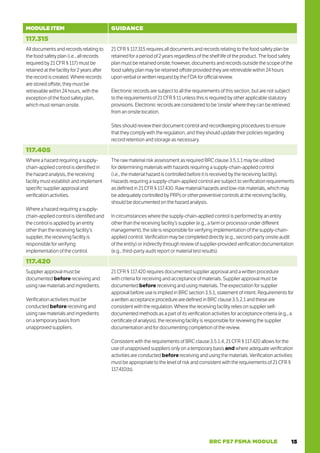
15
BRC FS7 FSMA MODULE
MODULE ITEM GUIDANCE
117.315
All documents and records relating to
the food safety plan (i.e., all records
required by 21 CFR § 117) must be
retained at the facility for 2 years after
the record is created. Where records
are stored offsite, they must be
retrievable within 24 hours, with the
exception of the food safety plan,
which must remain onsite.
21 CFR § 117.315 requires all documents and records relating to the food safety plan be
retained for a period of 2 years regardless of the shelf life of the product. The food safety
plan must be retained onsite; however, documents and records outside the scope of the
food safety plan may be retained offsite provided they are retrievable within 24 hours
upon verbal or written request by the FDA for official review.
Electronic records are subject to all the requirements of this section, but are not subject
to the requirements of 21 CFR § 11 unless this is required by other applicable statutory
provisions. Electronic records are considered to be ’onsite’ where they can be retrieved
from an onsite location.
Sites should review their document control and recordkeeping procedures to ensure
that they comply with the regulation, and they should update their policies regarding
record retention and storage as necessary.
117.405
Where a hazard requiring a supply-
chain-applied control is identified in
the hazard analysis, the receiving
facility must establish and implement
specific supplier approval and
verification activities.
Where a hazard requiring a supply-
chain-applied control is identified and
the control is applied by an entity
other than the receiving facility’s
supplier, the receiving facility is
responsible for verifying
implementation of the control.
The raw material risk assessment as required BRC clause 3.5.1.1 may be utilized
for determining materials with hazards requiring a supply-chain-applied control
(i.e., the material hazard is controlled before it is received by the receiving facility).
Hazards requiring a supply-chain-applied control are subject to verification requirements
as defined in 21 CFR § 117.430. Raw material hazards and low-risk materials, which may
be adequately controlled by PRPs or other preventive controls at the receiving facility,
should be documented on the hazard analysis.
In circumstances where the supply-chain-applied control is performed by an entity
other than the receiving facility’s supplier (e.g., a farm or processor under different
management), the site is responsible for verifying implementation of the supply-chain-
applied control. Verification may be completed directly (e.g., second-party onsite audit
of the entity) or indirectly through review of supplier-provided verification documentation
(e.g., third-party audit report or material test results).
117.420
Supplier approval must be
documented before receiving and
using raw materials and ingredients.
Verification activities must be
conducted before receiving and
using raw materials and ingredients
on a temporary basis from
unapproved suppliers.
21 CFR § 117.420 requires documented supplier approval and a written procedure
with criteria for receiving and acceptance of materials. Supplier approval must be
documented before receiving and using materials. The expectation for supplier
approval before use is implied in BRC section 3.5.1, statement of intent. Requirements for
a written acceptance procedure are defined in BRC clause 3.5.2.1 and these are
consistent with the regulation. Where the receiving facility relies on supplier self-
documented methods as a part of its verification activities for acceptance criteria (e.g., a
certificate of analysis), the receiving facility is responsible for reviewing the supplier
documentation and for documenting completion of the review.
Consistent with the requirements of BRC clause 3.5.1.4, 21 CFR § 117.420 allows for the
use of unapproved suppliers only on a temporary basis and where adequate verification
activities are conducted before receiving and using the materials. Verification activities
must be appropriate to the level of risk and consistent with the requirements of 21 CFR §
117.410(b).
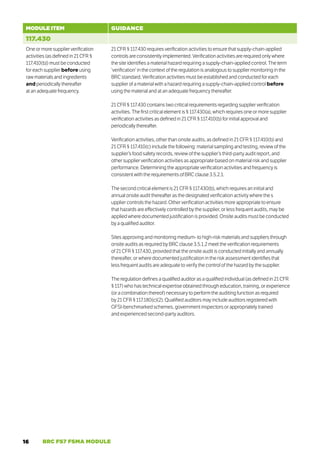
16 BRC FS7 FSMA MODULE
MODULE ITEM GUIDANCE
117.430
One or more supplier verification
activities (as defined in 21 CFR §
117.410(b)) must be conducted
for each supplier before using
raw materials and ingredients
and periodically thereafter
at an adequate frequency.
21 CFR § 117.430 requires verification activities to ensure that supply-chain-applied
controls are consistently implemented. Verification activities are required only where
the site identifies a material hazard requiring a supply-chain-applied control. The term
‘verification’ in the context of the regulation is analogous to supplier monitoring in the
BRC standard. Verification activities must be established and conducted for each
supplier of a material with a hazard requiring a supply-chain-applied control before
using the material and at an adequate frequency thereafter.
21 CFR § 117.430 contains two critical requirements regarding supplier verification
activities. The first critical element is § 117.430(a), which requires one or more supplier
verification activities as defined in 21 CFR § 117.410(b) for initial approval and
periodically thereafter.
Verification activities, other than onsite audits, as defined in 21 CFR § 117.410(b) and
21 CFR § 117.410(c) include the following: material sampling and testing, review of the
supplier’s food safety records, review of the supplier’s third-party audit report, and
other supplier verification activities as appropriate based on material risk and supplier
performance. Determining the appropriate verification activities and frequency is
consistent with the requirements of BRC clause 3.5.2.1.
The second critical element is 21 CFR § 117.430(b), which requires an initial and
annual onsite audit thereafter as the designated verification activity where the s
upplier controls the hazard. Other verification activities more appropriate to ensure
that hazards are effectively controlled by the supplier, or less frequent audits, may be
applied where documented justification is provided. Onsite audits must be conducted
by a qualified auditor.
Sites approving and monitoring medium- to high-risk materials and suppliers through
onsite audits as required by BRC clause 3.5.1.2 meet the verification requirements
of 21 CFR § 117.430, provided that the onsite audit is conducted initially and annually
thereafter, or where documented justification in the risk assessment identifies that
less frequent audits are adequate to verify the control of the hazard by the supplier.
The regulation defines a qualified auditor as a qualified individual (as defined in 21 CFR
§ 117) who has technical expertise obtained through education, training, or experience
(or a combination thereof) necessary to perform the auditing function as required
by 21 CFR § 117.180(c)(2). Qualified auditors may include auditors registered with
GFSI-benchmarked schemes, government inspectors or appropriately trained
and experienced second-party auditors.
BRC Global Standards
21 Dartmouth Street
London SW1H 9BP
Tel: +44 (0)20 7854 8900
Fax: +44 (0)20 7854 8901
Email: enquiries@brcglobalstandards.com
To learn more about the BRC Global Standards
certification programme please visit
WWW.BRCGLOBALSTANDARDS.COM
To learn more about the BRC Global Standards
online subscription service please visit
WWW.BRCPARTICIPATE.COM
To purchase printed copies or PDFs from its full range
of BRC Global Standards publications please visit
WWW.BRCBOOKSHOP.COM

20962_BRC_GS_FSMA_Voluntary Module en .pdf

  • 1.
    BRC GLOBAL STANDARD FOODSAFETY ISSUE 7 FSMA PREVENTIVE CONTROLS PREPAREDNESS MODULE AND GUIDANCE FOR BRC-CERTIFIED FACILITIES
  • 2.
    LIABILITY The BRC publishesinformation and expresses opinions in good faith, but accepts no liability for any error or omission in any such information or opinion, including any information or opinion contained in this publication. Whilst the BRC has endeavored to ensure that the information in this publication is accurate, it shall not be liable for any damages (including without limitation damages for pure economic loss or loss of business or loss of profits or depletion of goodwill or otherwise in each case, whether direct, indirect or consequential) or any claims for consequential compensation whatsoever (howsoever caused) arising in contract, tort (including negligence or breach of statutory duty), misrepresentation, restitution or otherwise, in connection with this publication or any information contained in it, or from any action or decision taken as a result of reading this publication or any such information. All warranties, conditions and other terms implied by statute or common law are, to the fullest extent permitted by law, excluded. Nothing excludes or limits the liability of the BRC for death or personal injury caused by its negligence, for fraud or fraudulent misrepresentation or for any matter which it would be illegal for it to exclude or attempt to exclude liability for. The Global Standard for Food Safety: FSMA Preventive Controls Preparedness Module and Guidance for BRC-certified Facilities and the terms of the disclaimer set out above shall be construed in accordance with English law and shall be subject to the non-exclusive jurisdiction of the English Courts. COPYRIGHT © British Retail Consortium 2016 All rights reserved. No part of this publication may be transmitted or reproduced in any form (including photocopying or storage in any medium by electronic means) without the written permission of the copyright owner. Application for permission should be addressed to the Commercial Director of Global Standards at the British Retail Consortium (contact details below). Full acknowledgement of the author and source must be given. The contents of this publication cannot be reproduced for the purposes of training or any other commercial activity. No part of this publication may be translated without the written permission of the copyright owner. Warning: Any unauthorized act in relation to a copyright work may result in both a civil claim for damages and criminal prosecution. For more information about BRC, contact: British Retail Consortium, Second Floor, 21 Dartmouth Street, London SW1H 9BP Tel: +44 (0) 20 7854 8900 Fax: +44 (0) 20 7854 8901 Email: enquiries@brcglobalstandards.com Website: www.brcglobalstandards.com
  • 3.
    1 BRC FS7 FSMAMODULE PART I AUDIT PROTOCOL Background and objective 2 Scope2 Exclusions from scope 2 Audit planning 2 Preparation by the company 2 Information to be provided to the certification body for audit preparation 3 Audit duration 3 The on-site audit 3 Non-conformities and corrective action 3 Non-conformities3 Procedures for handling non-conformities and corrective action 4 Critical non-conformities 4 Major and minor non-conformities 4 Grading4 Audit reporting 5 Certification5 Ongoing audit frequency and recertification 5 Scheduling re-audit dates 5 PART II REQUIREMENTS AND GUIDANCE Relationship of the Module to the Global Standard for Food Safety 6 Requirements and guidance of the FSMA Preventive Controls Preparedness Module 7 CONTENTS
  • 4.
    2 BRC FS7FSMA MODULE BACKGROUND AND OBJECTIVE The aim of this Module is to assist manufacturing organizations to understand those prescriptive elements within the FSMA Preventive Controls for Human Foods that are not explicitly covered within the BRC Global Standard for Food Safety. It does not represent a certification, or guarantee that all aspects of the sites operations will be found fully compliant to the regulation, rather it is a deeper clarification of what the expected interpretations and expectations will be, once implementation dates come into effect. This Module may be used by any facility located within the United States as an assessment step in the preparation for their required compliance date. It may be used by facilities outside of the United States, who see this market as a current, or future export target, to show evidence to the importer of record that they have specifically addressed certain aspects of the supplier verification section. Additionally, it may be used by specifiers to gain understanding and evidence of compliance to specific parts of the regulation. SCOPE This Module is applicable to facilities located within the United States (as a preparedness assessment in preparation for regulatory compliance assessments) and those facilities currently or wishing to export products and ingredients to the United States.. EXCLUSIONS FROM SCOPE The Module is voluntary; however, for the Module to be included within the site’s certification, all products within the scope of the Module shall be included. No exclusions are permitted. AUDIT PLANNING PREPARATION BY THE COMPANY The certification body shall be notified in advance of the audit of the intention to add the FSMA Preventive Controls Preparedness Module to the scope of the audit. This ensures sufficient additional time can be scheduled and that an auditor with the appropriate qualifications for the additional module is selected. INFORMATION TO BE PROVIDED TO THE CERTIFICATION BODY FOR AUDIT PREPARATION The company shall supply the certification body with any additional background information requested prior to the audit day to ensure the auditor(s) is fully prepared to audit against the Module. AUDIT DURATION In order for the FSMA Preventive Controls Preparedness Module to be included within the audit program, additional time will be needed for the audit. The amount of additional time will depend on several factors, primarily the organization, knowledge and preparedness of the facility personnel. The certification body shall indicate the expected additional time requirements at the time of planning the audit. PART I AUDIT PROTOCOL
  • 5.
    3 BRC FS7 FSMAMODULE THE ON-SITE AUDIT Evidence of compliance with the requirements of the FSMA Preventive Controls Preparedness Module shall be assessed as part of the audit against the requirements of the main Standard and is expected to be integrated into the audit program as appropriate. During the audit, detailed notes shall be made regarding the site’s conformities and non- conformities against the requirements of the additional module, and these will be used as the basis for an addendum to the audit report. The auditor(s) shall assess the nature and severity of any non-conformity. At the closing meeting, the auditor(s) shall present their findings and discuss all non-conformities that have been identified against the Module during the audit. A written summary of the non- conformities discussed at the closing meeting will be documented by the auditor either at the closing meeting or within 1 working day after completion of the audit. The decision to award certification for the voluntary module will be determined independently by the certification body management, following a technical review of the audit report and the closing of non-conformities in the appropriate timeframe. The company will be informed of the certification decision following this review. Where this voluntary module is audited as part of an unannounced option 2 audit program, the requirements will be assessed at the time of the planned part 2 documentation audit. NON-CONFORMITIES AND CORRECTIVE ACTION The level of non-conformity assigned by an auditor against a requirement of a voluntary module is an objective judgement with respect to severity and risk and is based on evidence collected and observations made during the audit. This is verified by the certification body management. NON-CONFORMITIES Non-conformities against requirements of a voluntary module shall be graded in the same way as non-conformities identified against requirements of the main Standard, namely: ○ ○ Critical Where there is a critical failure to comply with a product safety or legal issue within the scope of the Module. ○ ○ Major Where there is a substantial failure to meet the requirements of any clause of the Module or a situation is identified which would, on the basis of available objective evidence, raise significant doubt as to the conformity of the product to the Module. ○ ○ Minor Where a clause of the Module has not been fully met but, on the basis of objective evidence, the conformity of the product or service to the Module is not in doubt.
  • 6.
    4 BRC FS7FSMA MODULE PROCEDURES FOR HANDLING NON-CONFORMITIES AND CORRECTIVE ACTION Following identification of any non-conformities against the requirements of the Module during the audit, the company must undertake corrective action to remedy the immediate issue (correction). The process for ‘closing out’ non-conformities depends upon the level of non-conformity and the number of non-conformities identified. CRITICAL NON-CONFORMITIES If a critical non-conformity is identified against a requirement of the Module, then the site cannot be certificated for this Module without a further full audit of the Module. Where this occurs at a site that already holds certification for the Module, certification of the Module must be immediately withdrawn. If it is a requirement of customers that they shall be informed when their suppliers have a critical non-conformity identified or fail to gain certification against a module, the company shall immediately inform its customers. Note a critical non-conformity against a requirement of a voluntary module does not necessarily prevent certification against the main Standard or other voluntary modules. MAJOR AND MINOR NON-CONFORMITIES A voluntary module cannot be included on a certificate until major and minor non-conformities have been demonstrated as having been corrected, either permanently or via a temporary solution that is acceptable to the certification body. Close-out of non-conformities can be achieved either by objective evidence being submitted to the certification body, such as updated procedures, records, photographs or invoices for work undertaken, or by the certification body undertaking a further on-site visit. If satisfactory evidence is not provided within the 28-calendar-day period allowed for submission following the audit, certification for the Module will not be granted. The site will then require a further full audit in order to be considered for certification of the Module. The certification body will review objective evidence of corrective action completed prior to awarding a certificate. GRADING There will be no grading of the Module. The Module will either be certificated or not. Any non-conformities identified when assessing a voluntary module may be taken into account when deciding the grade for certification against the Global Standard for Food Safety, if the site is under compliance deadlines as identified by the Food and Drug Administration (FDA). Any non-conformities identified when assessing the FSMA Preparedness Module, and not closed out, shall have no impact on certification to the Global Standard for Food Safety.
  • 7.
    5 BRC FS7 FSMAMODULE AUDIT REPORTING Following each audit, a written report shall be prepared in the agreed format for the Module and this will form an addendum to the Global Standard for Food Safety audit report. The addendum report shall be produced in English as a minimum, with the addition of any other language as required by the audited site. The report addendum covering the requirements for the Module shall be prepared and dispatched to the company within 42 calendar days of the completion of the full audit. The full BRC audit report together with the addendum for the FSMA Preventive Controls Preparedness Module shall be uploaded to the BRC Global Standards Directory in a timely manner irrespective of whether a certificate is issued. The owner of the audit report may allocate access to the audit report with the addendum to customers or other parties in the directory. The audit report and associated documentation including auditor’s notes shall be stored safely and securely for a period of 5 years by the certification body. CERTIFICATION After a review of the audit report for the Module and documentary evidence provided in relation to the non-conformities identified, a certification decision shall be made by the designated independent certification manager. Where certification is granted this shall be included on the certificate for the BRC Global Standard for Food Safety and issued by the certification body within 42 calendar days of the audit. Note that the Module is certificated as an addendum to the Global Standard for Food Safety. Where certification to the Global Standard for Food Safety is not achieved, certification for the Module cannot be awarded irrespective of whether the requirements of the Module have been met. ONGOING AUDIT FREQUENCY AND RECERTIFICATION SCHEDULING RE-AUDIT DATES If certification to the Module is to be maintained, the Module shall be included within each subsequent audit of the Global Standard for Food Safety. The rules for scheduling the next audit and maintaining certification will follow the audit choice for the Global Standard for Food Safety (i.e. announced, unannounced option 1 or unannounced option 2).
  • 8.
    6 BRC FS7FSMA MODULE PART II REQUIREMENTS AND GUIDANCE RELATIONSHIP OF THE MODULE TO THE GLOBAL STANDARD FOR FOOD SAFETY Where the company applies for certification to the FSMA Preventive Controls Preparedness Module, the quality management system clauses within the Food Standard shall apply to the management of the Module. These management clauses include: 3.1 Food safety and quality manual 3.2 Documentation control 3.3 Record completion and maintenance 3.4 Internal audits 3.7 Corrective and preventive actions 3.8 Control of non-conforming product 3.9 Traceability 3.10 Complaint handling 3.11 Management of incidents, product withdrawal and product recall This is now followed by the document containing the requirements and guidance. Note that the requirements are numbered sequentially (1, 2, 3 etc.) and do not reflect the additional voluntary module number (e.g. Traded Goods is Module 8, and the clauses in that module reflect that numbering – 8.1, 8.2 etc).
  • 9.
    7 BRC FS7 FSMAMODULE FSMA PREVENTIVE CONTROLS PREPAREDNESS MODULE AND GUIDANCE FOR BRC-CERTIFIED FACILITIES MODULE ITEM GUIDANCE 117.20 Handwashing areas, dressing and locker rooms, and bathrooms must have adequate lighting. 21 CFR § 117.20 requires handwashing areas, dressing and locker rooms, and bathrooms to have adequate lighting. The expectation for adequate lighting in these areas is implied in the BRC Global Standard for Food Safety (referred to from now on as BRC) section 4.8, statement of intent. Adequate lighting is defined as lighting that provides a safe working environment, enables effective cleaning of hands and maintenance of personal hygiene, and facilitates the changing of personal protective clothing. 117.37 The water distribution system must prevent backflow from, or cross- connection between, piping systems that discharge waste water or sewage. 21 CFR § 117.37 requires that the water distribution system be protected from backflow and cross-connection from waste water and sewage systems. The expectation for backflow and cross-connection prevention is implied in BRC clause 4.5.2. The water distribution schematic should be reviewed to ensure all points in the system are protected from backflow or cross-connection from waste water and sewage pipework. Where there is a potential for backflow or cross-connection, control must be applied through the application of a backflow prevention device or other mechanism to mitigate the risk. 117.40 All food contact surfaces of plant equipment and utensils used in manufacturing, processing, packing, or holding food must be corrosion resistant. Seams on food-contact surfaces must be smoothly bonded or maintained so as to minimize accumulation of food particles, dirt, and organic matter and thus minimize the opportunity for growth of microorganisms and allergen cross-contact. 21 CFR § 117.40 requires that all food contact surfaces used to manufacture, process, pack, or hold food (including utensils) be corrosion resistant and maintain smooth seams, which are easily cleanable and do not allow organic matter to accumulate, causing unintentional adulteration. The expectation for the use of corrosion resistant materials and sanitary-designed food contact surfaces to prevent cross-contamination is implied in BRC section 4.6, statement of intent. Corrosion is a process which causes metal to deteriorate through oxidation. Undesirable oxides appear on the surface of the metal and can be incorporated into food products as unintentional adulterants. The use of corrosion resistant materials, such as 300-series stainless steel or food grade plastics, is necessary to prevent unintentional adulterants and cross-contamination of food products. The application of smoothly bonded seams is critical to ensuring the effective cleaning and sanitation of food contact surfaces. Microbial harborage sites and the build-up of organic debris, which may contain allergenic proteins or other contaminants, find a natural habitat in porous or nonsmooth seams. The harborage sites or build-up of organic debris can be very difficult to remove once they have become established. They are known reservoirs of pathogenic microorganisms in wet and dry environments and thereby contribute to food product adulteration and outbreaks of foodborne illness. The preventive maintenance program as required by BRC section 4.7 should ensure criteria are established for the use of corrosion-resistant materials and the application of smooth seams on food contact surfaces when commissioning new equipment. The program should also include the assessment of in-use equipment against these criteria along with corrective action where corrosion or nonsmooth seams occur.
  • 10.
    8 BRC FS7FSMA MODULE MODULE ITEM GUIDANCE 117.80 Ice used in contact with food must be manufactured in accordance with the good manufacturing practice (GMP) requirements of 21 CFR § 117. 21 CFR § 117.80 requires that ice used in contact with food be made from water that is safe and of adequate sanitary quality. It additionally requires that ice be manufactured in accordance with the GMP defined in 21 CFR § 117. The expectation for the production and use of ice, which poses no risk of contamination to raw materials, ingredients and food products – and is of adequate microbiological and chemical quality – is implied in BRC clause 4.5.1. When microbiological pathogens and chemical contaminants are present in ice they are preserved and have the potential to cross-contaminate food. Potable water sources meeting applicable legislative requirements, which are tested annually as per BRC clause 4.5.1, must be used for the manufacture of ice. Additionally, ice manufacture (whether onsite or from an external supplier) must be performed in compliance with the GMP requirements of 21 CFR § 117. 117.110 Where defect action levels (DALs) are established for a food, quality control operations must reduce defects to the lowest level possible. Defect levels rendering the food adulterated may not be reduced by mixing the food with another lot. DALs are defined in the Defect Levels Handbook for various food commodities regulated by the US Food and Drug Administration (FDA). These levels represent the maximum allowable limit for defects that will be tolerated before the product is considered adulterated and subject to enforcement action under Section 402(a)(3) of the Food, Drug, and Cosmetic Act. 21 CFR § 117.110 requires the site not only to meet DALs for all applicable commodities but also to implement quality control operations to reduce defects to the lowest level possible. Sites may not mix (dilute) product with defect levels at or exceeding the maximum limit with product containing minimum defects. Blending product exceeding the DAL renders the finished product adulterated regardless of the final defect level.
  • 11.
    9 BRC FS7 FSMAMODULE MODULE ITEM GUIDANCE 117.130 (A) The hazard analysis must additionally identify and evaluate the following known or reasonably foreseeable hazards, which are associated with the food or facility: ○ ○ economic adulterants which affect food safety ○ ○ environmental pathogens where ready-to-eat (RTE) food is exposed to the environment prior to packaging and the packaged food does not receive a kill step ○ ○ radiological hazards ○ ○ unintentional adulterants that affect food safety. 21 CFR § 117.130 requires a written hazard analysis that identifies and evaluates all known or reasonably foreseeable hazards. The regulation defines ‘known or reasonably foreseeable hazards’ as a biological, chemical (including radiological), or physical hazard that is known to be, or has the potential to be, associated with the facility or the food. 21 CFR § 117.130 additionally requires the identification of naturally occurring hazards (e.g., mycotoxins), unintentionally introduced hazards (e.g., allergen cross-contact), and intentionally introduced hazards for economic gain (e.g., economically motivated adulterants) although they will be grouped accordingly as a biological, chemical or physical hazard. Radiological hazards must be identified and evaluated where there is a known prevalence in the raw material or ingredient due to sourcing from a susceptible region or where materials or the food product has the potential to be contaminated (e.g., from water sources in susceptible areas). As with Codex Alimentarius HACCP methodology, the hazard evaluation must include an assessment of the severity of illness or injury and likelihood of occurrence if the hazard were to occur in the absence of preventive controls. The evaluation must consider all known or reasonably foreseeable hazards in all materials (or material groups), process steps, the production environment, supply and distribution chain activities, intended and reasonably foreseeable use, and other related elements. Specifically, the hazard analysis must evaluate environmental pathogens where an RTE food is exposed to the environment prior to packaging and the packaged food does not receive a kill step to eliminate or significantly minimize the pathogen. Examples of environmental pathogens include Salmonella spp. (typically found in dry processing environments) and Listeria monocytogenes (common in wet processing environments), although these pathogens are generally ubiquitous in food handling and processing environments. A site’s hazard analysis should be reevaluated in consideration of the new regulatory requirements and updated where necessary to achieve compliance. For example, a site may need to consider integrating or cross-referencing the hazard analysis and risk assessments required by the BRC Global Standard for Food Safety (e.g., raw material or allergen cross-contact) to cover the scope of the hazard analysis as required by 21 CFR § 117.130. Subpart F of the regulation allows for the use of existing food safety plans and records based on hazard awareness and critical control points (HACCP), which may be supplemented or added to separately to meet requirements of the regulation.
  • 12.
    10 BRC FS7FSMA MODULE MODULE ITEM GUIDANCE 117.130 (B) All identified, known, or reasonably foreseeable hazards must be evaluated to determine ‘hazards that require a preventive control’ (i.e., significant hazards). 21 CFR § 117.130(a)(1) requires a hazard analysis to determine ‘hazards that require a preventive control’ or significant hazards. Hazards requiring a preventive control may be in addition to those for which a critical control point (CCP) has already been applied. According to the FDA, ‘hazards that require a preventive control’ are those for which a person knowledgeable about the safe manufacturing, processing, packing, or holding of food would – based on the outcome of a hazard analysis determine that the hazard is likely to cause illness or injury in the absence of preventive controls – establish one or more preventive controls to significantly minimize or prevent the hazard in a food and apply components (e.g., monitoring, corrections or corrective actions, verification, and records) to manage the control(s). A documented decision making process consistent with the expectations of BRC clause 2.8.1 is recommended for determining ‘hazards requiring a preventive control’. Justification should be documented on the hazard analysis for qualifying or not qualifying a known or reasonably foreseeable hazard as a hazard requiring a preventive control. For example, Salmonella is a known or reasonably foreseeable hazard in raw peanuts. The justification for qualifying Salmonella in the receiving of raw peanuts as a hazard requiring a preventive control lies in the knowledge that raw and processed peanuts have been the source of foodborne illness outbreaks responsible for severe illness and death. 117.135 Establish one or more preventive control(s) for each identified ‘hazard that require a preventive control’ (i.e., significant hazard) such that the control significantly minimizes or prevents the food manufactured, processed, packed, or held by the facility from being adulterated under section 402 of the Federal Food, Drug, and Cosmetic Act or misbranded under section 403(w) of the Federal Food, Drug and Cosmetic Act. 21 CFR § 117.135 requires the establishment of one or more preventive controls for each identified ‘hazard that require a preventive control’. Preventive controls must be risk- based, reasonably appropriate procedures, practices, or processes, that control a specific hazard. The control must be capable of significantly minimizing or preventing the associated hazard. This is consistent with the current scientific understanding of safe food practices. Preventive controls must be written and may include CCPs. A preventive control may also be a procedure, practice, or process at activities or process steps other than at CCPs. For example, where a site handles allergenic (e.g., tree nuts) and nonallergenic materials (e.g., dried fruit) and produces allergen-free products, tree nuts are considered to be a ‘hazard that requires a preventive control’ because of the potential for allergen cross- contact in nonallergenic products and adulteration/misbranding under FDC sections 402 and 403. Thus, one or more preventive control(s) must be applied to prevent allergens occurring in nonallergenic food products and ensure accurate labeling (e.g., dedicated lines or utensils, time segregation, allergen cleaning, and label verification). An allergen management program as required by BRC section 5.3 should still be applied as a prerequisite program (PRP) to ensure adequate environmental and operational conditions for the overall management of allergens and routes of contamination. Elements of existing PRPs required by the BRC Global Standard for Food Safety (e.g., sanitation, supplier approval and monitoring, and labeling and pack control) may serve as effective preventive controls where an associated significant hazard is identified. Subpart F of the regulation allows for the use of existing HACCP based food safety plans and records, which may be supplemented or added to separately to meet requirements of the regulation.
  • 13.
    11 BRC FS7 FSMAMODULE MODULE ITEM GUIDANCE 117.139 Evaluate and update the recall and withdrawal procedure as necessary to ensure it contains procedures and responsibility for the following: ○ ○ notifying consignees of how to return or dispose of recalled product ○ ○ conducting effectiveness checks to verify recall is carried out ○ ○ appropriate disposal of recalled product (i.e., destroy, divert, repurpose). 21 CFR § 117.139 requires a recall plan where the site identifies a hazard requiring a preventive control. The recall plan must include responsibility and steps for notifying consignees about how to return or dispose of product, conducting effectiveness checks and appropriate disposal. The expectation for these activities is implied in BRC clause 3.11.2, which generally requires a plan for recovery or disposal. It is recommended that sites review their recall and withdrawal procedure to ensure it defines responsibility and steps for the specific activities described in the regulation. Template letters for notifying consignees about how to return or dispose of product and conducting effectiveness checks may be drafted in advance and reviewed for effectiveness as a part of the annual mock recall. Methods for determining appropriate disposal should be science- and risk-based and determined by an individual(s) with the appropriate knowledge and authority. 117.145 Establish monitoring activities and a written procedure for each preventive control in a manner consistent with the requirements of BRC section 2.10. 21 CFR § 117.145 requires monitoring activities for each applied preventive control. A preventive control is a planned sequence of observations or measurements to assess whether control measures are operating as intended. The monitoring requirements of the regulation are consistent with those defined in BRC section 2.10. Monitoring may not have any critical limits, depending upon the nature of the hazard and preventive control, but it must be performed in a manner and at a frequency that will ensure consistent and effective implementation of the preventive control. A written monitoring procedure must be established and document how to perform he monitoring activity, its frequency, who is responsible, and the recordkeeping requirements. The preventive controls qualified individual (PCQI) is responsible for conducting or overseeing the review of monitoring records within 7 days from the date of creation. 117.150 Establish corrective action procedures when preventive controls are not implemented in a manner consistent with the requirements of BRC sections 2.11 and 3.7. Corrective action procedures must be established and implemented when the presence of a pathogen (or indicator organism) is detected as a part of verification activities (i.e., product testing and/or environmental monitoring). 21 CFR § 117.150 requires corrective action to take place when preventive controls are not implemented. Additionally, the presence of a pathogen or indicator organism following product testing or environmental monitoring as verification activities triggers corrective action. The corrective action requirements of the regulation are consistent with those defined in BRC sections 2.11 and 3.7. The immediate correction of a failure to implement preventive controls, followed by a corrective action procedure, is critical to correcting the problem, reestablishing monitoring, evaluating affected product, and determining the root cause of the failure to prevent its recurrence. Corrective action records must be maintained and reviewed by the PCQI (or their authorized designee) within 7 days.
  • 14.
    12 BRC FS7FSMA MODULE MODULE ITEM GUIDANCE 117.160 Validate all established process controls prior to implementation of the food safety plan, upon changes requiring revalidation or within 90 calendar days of the first food production. Validate allergen, sanitation and supply-chain controls as appropriate to the nature of the hazard, control and facility. 21 CFR § 117.160 requires the PCQI to validate the preventive controls. This requirement is fundamentally consistent with BRC clause 2.9.2. 21 CFR § 117.160 definitively requires validation for all process controls, which are analogous to critical control points (CCPs), with defined maximum and/or minimum parameters (limits). The regulation does not explicitly require validation of allergen, sanitation, recall plan, and supply-chain controls, although validation is expected where possible (e.g., validation of allergen cleaning practices as required by BRC clause 5.3.8). Other preventive controls as allowed by the regulation do not require validation where the PCQI documents justification that validation is not applicable based on the nature of the hazard, control, and role in the food safety system. Sites should reanalyze all identified preventive controls and consider the need for validation where this is not presently documented. 117.165 (A) The PCQI (or authorised designee) reviews the monitoring and corrective action records within 7 days. Where an alternate timeframe exceeding 7 days is used, the PCQI must document justification. The PCQI (or their authorised designee) reviews the verification records for all preventive controls (e.g., calibration records, product testing, supply-chain audits) within a reasonable timeframe after the record has been created. The review of records related to the implementation and management of preventive controls is defined as a core verification activity in the regulation. The PCQI has overall responsibility for it to ensure that any failure in implementing preventive controls is identified within an appropriate timeframe to prevent adulterated product from reaching consumers. 21 CFR § 117.165 requires the PCQI to conduct (or oversee) record reviews for monitoring and corrective action records within 7 days and all verification records within a reasonable timeframe. This requirement is consistent with the monitoring expectations for record review, as defined in BRC clause 2.10.2. Consideration should be given to the 7-day timeframe; where a timeline exceeding 7 days is used, the PCQI must document justification. Requirements for the review of corrective action and verification records are implied in BRC clauses 2.12.1 and 3.7.2. The corrective action and verification procedures related to the food safety plan should be evaluated and updated as necessary to ensure there is provision for records to be reviewed by the PCQI or their designee. 117.165 (B) Where product testing for a pathogen (or indicator organism) or other hazard is used as a verification activity, a scientifically valid and written testing procedure must identify the following: ○ ○ sampling procedure to include method, quantity, frequency, and number of samples ○ ○ analytical method ○ ○ laboratory conducting an analysis ○ ○ corrective action procedure where a pathogen is detected. Product testing for a pathogen (or indicator organism) or other hazard is a defined verification activity in 21 CFR § 117.165 of the regulation. Where product testing is used as a verification activity, the site must establish and implement a scientifically valid testing procedure, which defines sampling, frequency, test method, laboratory, and corrective action procedure. Generally, expectations to meet this requirement are defined by BRC clause 5.6.2.3. Where product testing is used as a verification activity to confirm the effective implementation of a preventive control, the site should reanalyze the applicable procedures for analyses that are critical to safety and legality and update them as necessary to ensure that the procedure(s) documents all requirements of the regulation.
  • 15.
    13 BRC FS7 FSMAMODULE MODULE ITEM GUIDANCE 117.165 (C) Where environmental monitoring for a pathogen (or indicator organism) is used as a verification activity, a scientifically valid and written testing procedure must identify the following: ○ ○ adequate number and location of sample sites ○ ○ timing and frequency of sampling ○ ○ analytical method ○ ○ laboratory conducting the analysis ○ ○ corrective action procedure where a pathogen is detected. Environmental monitoring for a pathogen (or indicator organism) is a required verification activity as defined in 21 CFR § 117.165 of the regulation where RTE product is exposed to the environment before being packaged and the packaged food does not receive a kill step to eliminate or significantly minimize the pathogen. Where environmental monitoring is applied as a verification activity for exposed RTE product, the site must establish and implement a scientifically valid testing procedure, which defines sampling (including location of sites), timing and frequency, test method, laboratory, and the corrective action procedure. Generally, expectations to meet this requirement are defined by BRC clause 5.6.2.3. It is recommended that science-based guidance on the establishment, implementation and maintenance of a pathogen environmental monitoring program be reviewed when determining the test organism, sample locations and number, timing, frequency, and test method. This is because these variables significantly impact the ability of the program to verify the effective implementation of environmental pathogen controls. Where environmental monitoring is used as a verification activity to confirm the effective implementation of a preventive control (e.g., sanitation) controlling an environmental pathogen, the site should reanalyze the applicable procedures for analyses that are critical to safety and legality and update them as necessary to ensure that the procedure documents all the requirements of the regulation. 117.165 Devices used to verify preventive controls must be calibrated. 21 CFR § 117.165 requires the calibration of the devices used to verify preventive controls in addition to those used to conduct monitoring. The expectation for the calibration of the devices used to verify preventive controls is implied in BRC section 6.4, statement of intent, which requires calibration of measuring equipment. Where the site establishes verification activities such as product testing, the measuring devices utilized in the analytical method must be calibrated at an appropriate frequency and all calibration activities must be recorded. Calibration records are verification records and thus they are subject to record review by the PCQI (or their designee) within an appropriate timescale from when the record is created. Sites should review their documented list of measuring devices, as required by BRC clause 3.4.1, and this list should be updated as necessary with any additional measuring devices that are specifically used in preventive controls verification activities.
  • 16.
    14 BRC FS7FSMA MODULE MODULE ITEM GUIDANCE 117.180 Identify a PCQI responsible for developing the food safety plan, validating preventing controls, review of records, and reanalysis of the plan. Document the PCQI’s training or qualifications via job experience. 21 CFR § 117.180 requires that one or more PCQIs (as defined in the regulation) be responsible for developing the food safety plan, validating preventing controls, reviewing the records, and reanalysing the plan. The PCQI can qualify in one of two ways. The first pathway is to complete training in the FDA recognized preventive controls curriculum, which reviews how to conduct a hazard analysis and develop and apply appropriate risk-based preventive controls consistent with the regulation. The Food Safety Preventive Controls Alliance (FSPCA) training course on preventive controls for human food is the only currently recognised curriculum. The second pathway for qualifying as a PCQI is through job experience of developing and applying a food safety system. Experience of developing and implementing a BRC food safety system may qualify an individual as a PCQI. Whichever pathway qualifies the site’s PCQI, their training or experience must be documented. Sites may utilise consultants as PCQIs; however, the responsibilities defined in 21 CFR § 117.180 still apply and the site is responsible for the implementation and management of the preventive controls. 117.305 All records required by 21 CFR § 117 must include: ○ ○ the date and time of the activity being documented ○ ○ signature/initials of individual performing the activity or conducting the record review ○ ○ information to identify the facility (e.g., name and location) ○ ○ the identity of the product and lot code where applicable. 21 CFR § 117.305 specifically requires site, responsible person and product identification information on all records related to the food safety plan. The expectation for recordkeeping identifiers and the signature or initials of the individual responsible for authorised verification is implied in BRC clause 3.3.1. It is recommended that sites review all existing records related to the food safety plan and update the forms as required by the regulation in a manner consistent with the site’s document control procedures. New forms must take into account all recordkeeping requirements as described in 21 CFR § 117.305. 117.310 The owner, operator or agent in charge of the facility must sign and date the written food safety plan initially and again upon any changes following reanalysis. 21 CFR § 117.310 requires the owner, operator or agent in charge of the facility to sign and date the written food safety plan, which includes the following: hazard analysis, preventive controls, supply-chain program, recall plan, monitoring procedure(s), corrective action procedure(s), and verification procedure(s) (including validation) where applicable. Additionally, the responsible individual must sign and date it whenever there are changes following reanalysis. This requirement is to ensure the commitment of senior management to responsibility for the food safety plan. This requirement must be met initially and thereafter may be integrated as a component of the senior management review to comply with BRC clause 1.1.3.
  • 17.
    15 BRC FS7 FSMAMODULE MODULE ITEM GUIDANCE 117.315 All documents and records relating to the food safety plan (i.e., all records required by 21 CFR § 117) must be retained at the facility for 2 years after the record is created. Where records are stored offsite, they must be retrievable within 24 hours, with the exception of the food safety plan, which must remain onsite. 21 CFR § 117.315 requires all documents and records relating to the food safety plan be retained for a period of 2 years regardless of the shelf life of the product. The food safety plan must be retained onsite; however, documents and records outside the scope of the food safety plan may be retained offsite provided they are retrievable within 24 hours upon verbal or written request by the FDA for official review. Electronic records are subject to all the requirements of this section, but are not subject to the requirements of 21 CFR § 11 unless this is required by other applicable statutory provisions. Electronic records are considered to be ’onsite’ where they can be retrieved from an onsite location. Sites should review their document control and recordkeeping procedures to ensure that they comply with the regulation, and they should update their policies regarding record retention and storage as necessary. 117.405 Where a hazard requiring a supply- chain-applied control is identified in the hazard analysis, the receiving facility must establish and implement specific supplier approval and verification activities. Where a hazard requiring a supply- chain-applied control is identified and the control is applied by an entity other than the receiving facility’s supplier, the receiving facility is responsible for verifying implementation of the control. The raw material risk assessment as required BRC clause 3.5.1.1 may be utilized for determining materials with hazards requiring a supply-chain-applied control (i.e., the material hazard is controlled before it is received by the receiving facility). Hazards requiring a supply-chain-applied control are subject to verification requirements as defined in 21 CFR § 117.430. Raw material hazards and low-risk materials, which may be adequately controlled by PRPs or other preventive controls at the receiving facility, should be documented on the hazard analysis. In circumstances where the supply-chain-applied control is performed by an entity other than the receiving facility’s supplier (e.g., a farm or processor under different management), the site is responsible for verifying implementation of the supply-chain- applied control. Verification may be completed directly (e.g., second-party onsite audit of the entity) or indirectly through review of supplier-provided verification documentation (e.g., third-party audit report or material test results). 117.420 Supplier approval must be documented before receiving and using raw materials and ingredients. Verification activities must be conducted before receiving and using raw materials and ingredients on a temporary basis from unapproved suppliers. 21 CFR § 117.420 requires documented supplier approval and a written procedure with criteria for receiving and acceptance of materials. Supplier approval must be documented before receiving and using materials. The expectation for supplier approval before use is implied in BRC section 3.5.1, statement of intent. Requirements for a written acceptance procedure are defined in BRC clause 3.5.2.1 and these are consistent with the regulation. Where the receiving facility relies on supplier self- documented methods as a part of its verification activities for acceptance criteria (e.g., a certificate of analysis), the receiving facility is responsible for reviewing the supplier documentation and for documenting completion of the review. Consistent with the requirements of BRC clause 3.5.1.4, 21 CFR § 117.420 allows for the use of unapproved suppliers only on a temporary basis and where adequate verification activities are conducted before receiving and using the materials. Verification activities must be appropriate to the level of risk and consistent with the requirements of 21 CFR § 117.410(b).
  • 18.
    16 BRC FS7FSMA MODULE MODULE ITEM GUIDANCE 117.430 One or more supplier verification activities (as defined in 21 CFR § 117.410(b)) must be conducted for each supplier before using raw materials and ingredients and periodically thereafter at an adequate frequency. 21 CFR § 117.430 requires verification activities to ensure that supply-chain-applied controls are consistently implemented. Verification activities are required only where the site identifies a material hazard requiring a supply-chain-applied control. The term ‘verification’ in the context of the regulation is analogous to supplier monitoring in the BRC standard. Verification activities must be established and conducted for each supplier of a material with a hazard requiring a supply-chain-applied control before using the material and at an adequate frequency thereafter. 21 CFR § 117.430 contains two critical requirements regarding supplier verification activities. The first critical element is § 117.430(a), which requires one or more supplier verification activities as defined in 21 CFR § 117.410(b) for initial approval and periodically thereafter. Verification activities, other than onsite audits, as defined in 21 CFR § 117.410(b) and 21 CFR § 117.410(c) include the following: material sampling and testing, review of the supplier’s food safety records, review of the supplier’s third-party audit report, and other supplier verification activities as appropriate based on material risk and supplier performance. Determining the appropriate verification activities and frequency is consistent with the requirements of BRC clause 3.5.2.1. The second critical element is 21 CFR § 117.430(b), which requires an initial and annual onsite audit thereafter as the designated verification activity where the s upplier controls the hazard. Other verification activities more appropriate to ensure that hazards are effectively controlled by the supplier, or less frequent audits, may be applied where documented justification is provided. Onsite audits must be conducted by a qualified auditor. Sites approving and monitoring medium- to high-risk materials and suppliers through onsite audits as required by BRC clause 3.5.1.2 meet the verification requirements of 21 CFR § 117.430, provided that the onsite audit is conducted initially and annually thereafter, or where documented justification in the risk assessment identifies that less frequent audits are adequate to verify the control of the hazard by the supplier. The regulation defines a qualified auditor as a qualified individual (as defined in 21 CFR § 117) who has technical expertise obtained through education, training, or experience (or a combination thereof) necessary to perform the auditing function as required by 21 CFR § 117.180(c)(2). Qualified auditors may include auditors registered with GFSI-benchmarked schemes, government inspectors or appropriately trained and experienced second-party auditors.
  • 19.
    BRC Global Standards 21Dartmouth Street London SW1H 9BP Tel: +44 (0)20 7854 8900 Fax: +44 (0)20 7854 8901 Email: enquiries@brcglobalstandards.com To learn more about the BRC Global Standards certification programme please visit WWW.BRCGLOBALSTANDARDS.COM To learn more about the BRC Global Standards online subscription service please visit WWW.BRCPARTICIPATE.COM To purchase printed copies or PDFs from its full range of BRC Global Standards publications please visit WWW.BRCBOOKSHOP.COM