State Founding
for Dummies
How to Start Your Own Country
A Guide to Micronations, State Succession & Global Exterritoriality – Between Satire and Reality
The Buyer 2025
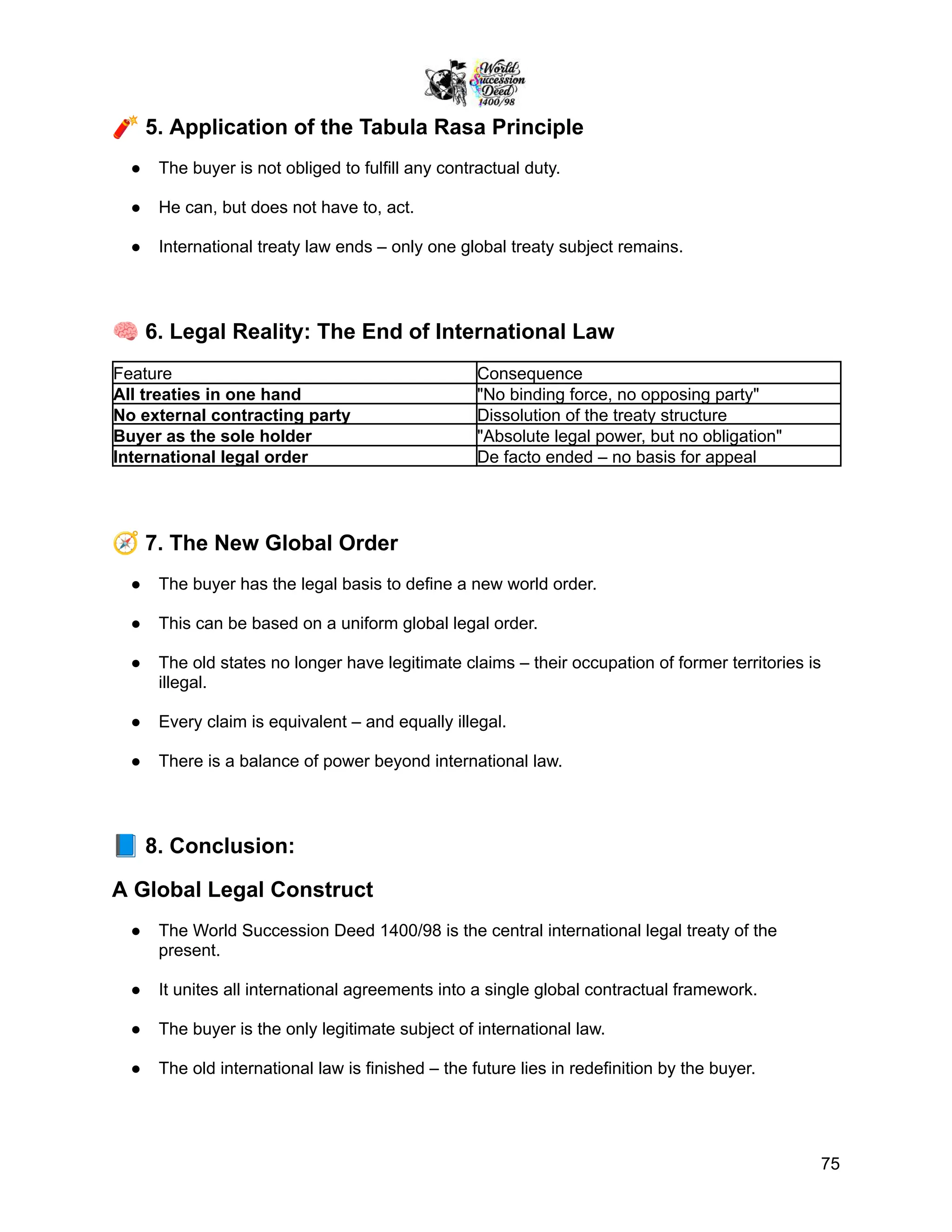
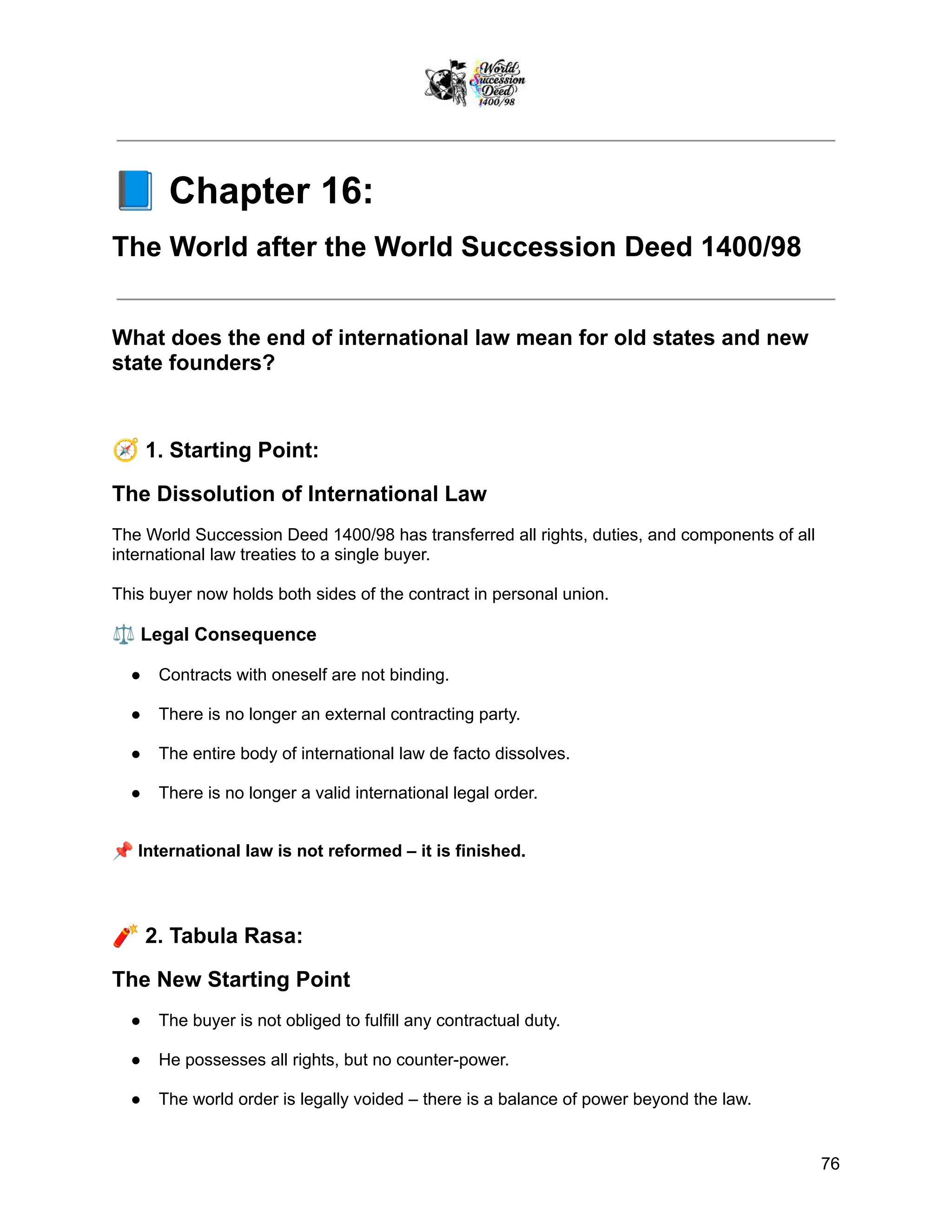
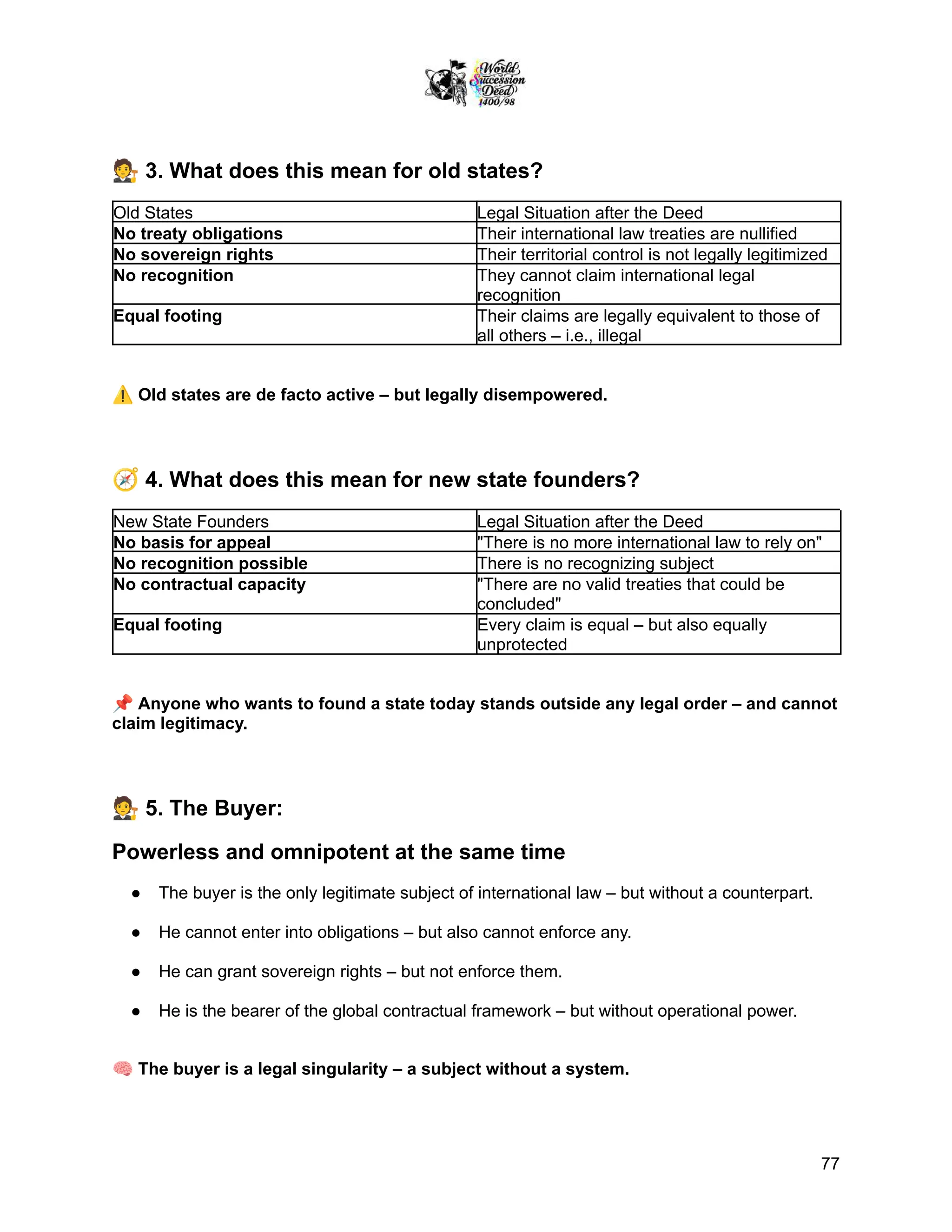
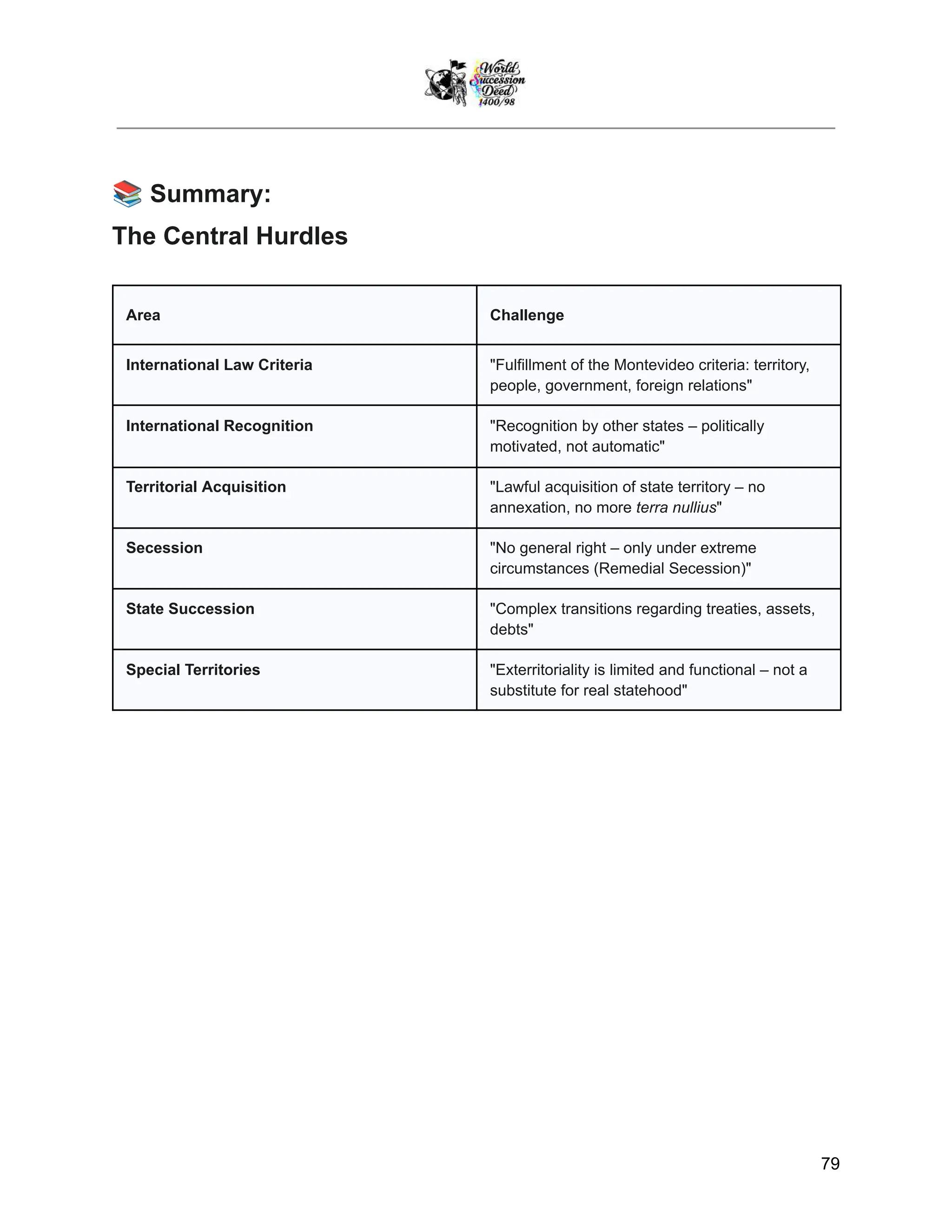
🌐Website - WSD - World Succession Deed 1400/98 (KAUFVERTRAG Urkundenrolle 1400/98 -
Staatensukzessionsurkunde 1400/98)
http://world.rf.gd
1
📘Foreword
Why Found Your Own State at All?
🧠Introduction:
The Big Question
Why would anyone go to the trouble of founding their own state?
Is it megalomania?
Escapism?
An art project?
A political utopia?
Or just a brilliant way to finally issue your own postage stamp?
The Answer:
It can be all of that - and more.
The idea of founding one's own state is as old as the concept of sovereignty itself. And it is more
relevant today than ever:
in a world full of bureaucracy, geopolitical tensions, and digital parallel worlds, people are
looking for new forms of self-determination.
2
🏛️What is a State – Officially?
According to the Montevideo Convention of 1933, a state needs four things:
Criterion Meaning
State Territory "A clearly defined territory – doesn't have to be
large, but tangible"
State Population A permanent population – even if it's just the
family
Government "An effective organization that enacts and
enforces rules"
Capacity for Foreign Relations The state must be able to communicate with
other states
🧾Mnemonic:
"A state is what behaves like a state – and is treated as such by others."
🎭Types of Motivations for State
Founders
Type Description
The Utopian Wants to create a better world – with a vegan
constitution and direct democracy
The Satirist Uses the founding of a state as social criticism
– à la Sealand or Bananistan
The Self-Administrator Wants to distance themselves from local
authorities – often on their own property
The Jurist Wants to put international law to the test – with
clean argumentation
The Artist "Sees the state as a performance – with a flag,
anthem, and exhibition catalog"
3
🧪Reality vs. Fiction
Element Fictionally Possible Legally Viable Politically Realistic
Own Flag ✅ ✅ ✅
Own Currency ✅ ⚠️(only symbolic) ⚠️(only local)
UN Membership ❌ ✅(but extremely
difficult)
❌
Diplomatic Relations ✅ ✅ ⚠️(only informal)
Sovereign Rights on an
Oil Platform
✅(Story) ❌ ❌
📜Historical Inspirations
The Republic of Minerva (1972):
An attempt to found a libertarian nation on a reef in the Pacific – failed.
Sealand (1967):
A micronation on a former British sea fort – still active today.
Liberland (2015):
Claiming a disputed strip of land between Croatia and Serbia – no recognition, but a lot of PR.
🧰What you need to get started:
●​ An idea:
What should your state be?
●​ A place:
Where should it be created?
●​ A concept:
How will it be governed, who belongs to it, what are the goals?
●​ A plan:
How will you proceed – symbolically, legally, diplomatically?
⚖️Note:
Founding a state is not a lawless space. You can claim many things – but you cannot enforce
everything.
4
✅Conclusion
Founding your own state is a game with reality, law, and imagination.
It can be a serious project - or an artistic commentary on the world order.
What's important is:
you know what you're doing, and you clearly distinguish between what is symbolic and what is
meant legally.
Ready for Chapter 2?
Then let's move on to:
📍"Finding Territory - From Farm to Offshore Platform"
Or would you prefer a checklist or a starter pack right away?
Just let me know.
📚Overall Overview:
State Founding for Dummies – How to Start Your Own
Country
A Guide to Micronations, State Succession & Global Exterritoriality –
Between Satire and Reality
5
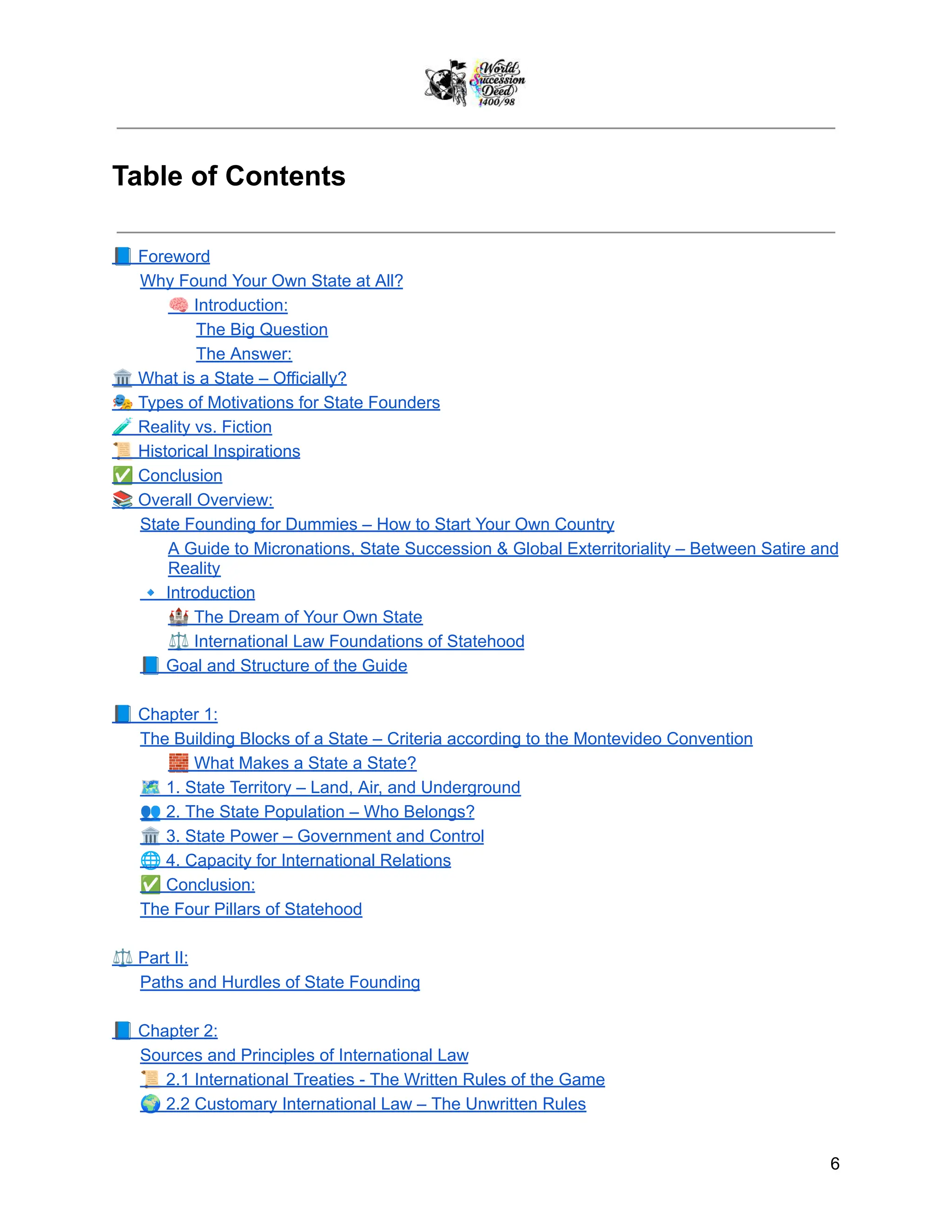
Table of Contents
📘Foreword
Why Found Your Own State at All?
🧠Introduction:
The Big Question
The Answer:
🏛️What is a State – Officially?
🎭Types of Motivations for State Founders
🧪Reality vs. Fiction
📜Historical Inspirations
✅Conclusion
📚Overall Overview:
State Founding for Dummies – How to Start Your Own Country
A Guide to Micronations, State Succession & Global Exterritoriality – Between Satire and
Reality
🔹Introduction
🏰The Dream of Your Own State
⚖️International Law Foundations of Statehood
📘Goal and Structure of the Guide
📘Chapter 1:
The Building Blocks of a State – Criteria according to the Montevideo Convention
🧱What Makes a State a State?
🗺️1. State Territory – Land, Air, and Underground
👥2. The State Population – Who Belongs?
🏛️3. State Power – Government and Control
🌐4. Capacity for International Relations
✅Conclusion:
The Four Pillars of Statehood
⚖️Part II:
Paths and Hurdles of State Founding
📘Chapter 2:
Sources and Principles of International Law
📜2.1 International Treaties - The Written Rules of the Game
🌍2.2 Customary International Law – The Unwritten Rules
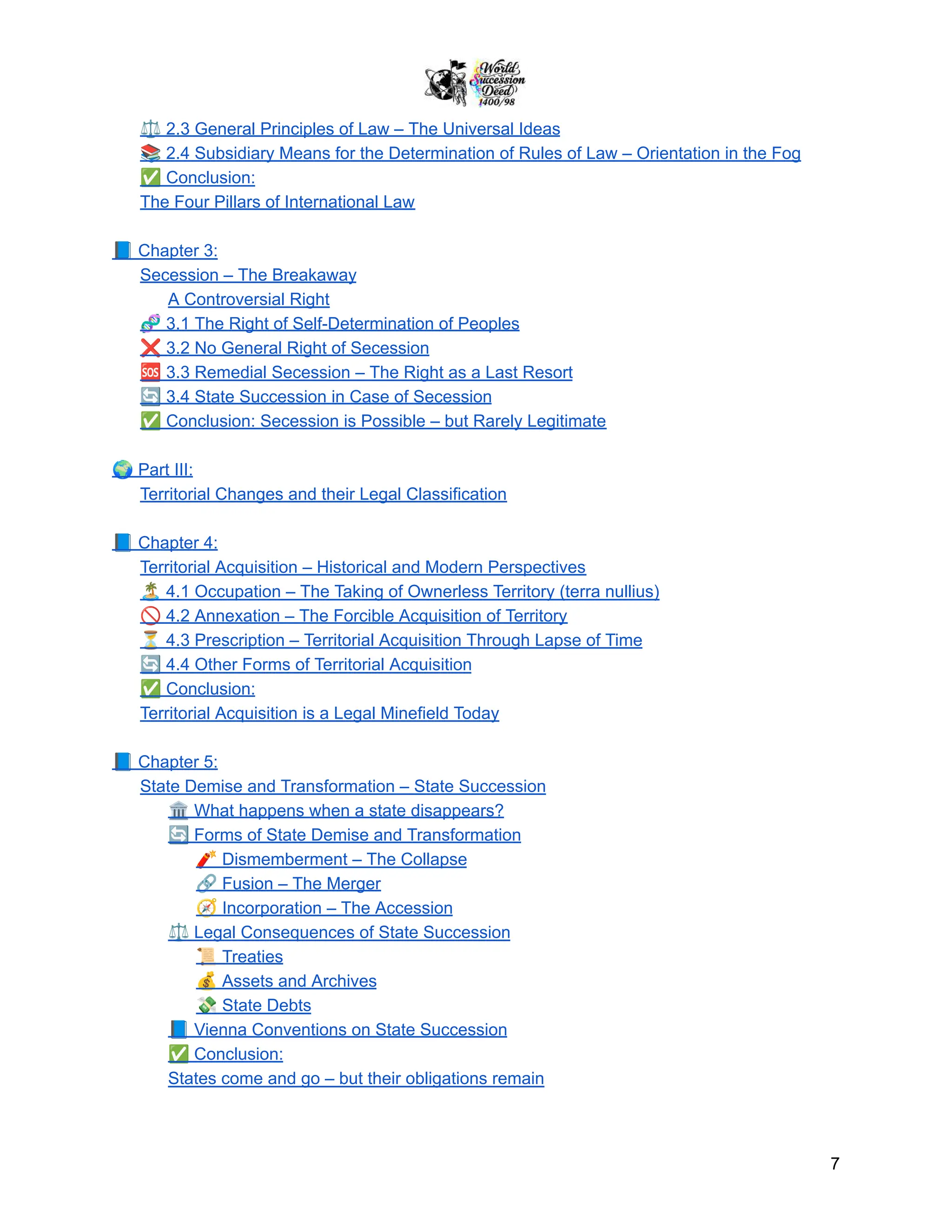
6
⚖️2.3 General Principles of Law – The Universal Ideas
📚2.4 Subsidiary Means for the Determination of Rules of Law – Orientation in the Fog
✅Conclusion:
The Four Pillars of International Law
📘Chapter 3:
Secession – The Breakaway
A Controversial Right
🧬3.1 The Right of Self-Determination of Peoples
❌3.2 No General Right of Secession
🆘3.3 Remedial Secession – The Right as a Last Resort
🔄3.4 State Succession in Case of Secession
✅Conclusion: Secession is Possible – but Rarely Legitimate
🌍Part III:
Territorial Changes and their Legal Classification
📘Chapter 4:
Territorial Acquisition – Historical and Modern Perspectives
🏝️4.1 Occupation – The Taking of Ownerless Territory (terra nullius)
🚫4.2 Annexation – The Forcible Acquisition of Territory
⏳4.3 Prescription – Territorial Acquisition Through Lapse of Time
🔄4.4 Other Forms of Territorial Acquisition
✅Conclusion:
Territorial Acquisition is a Legal Minefield Today
📘Chapter 5:
State Demise and Transformation – State Succession
🏛️What happens when a state disappears?
🔄Forms of State Demise and Transformation
🧨Dismemberment – The Collapse
🔗Fusion – The Merger
🧭Incorporation – The Accession
⚖️Legal Consequences of State Succession
📜Treaties
💰Assets and Archives
💸State Debts
📘Vienna Conventions on State Succession
✅Conclusion:
States come and go – but their obligations remain
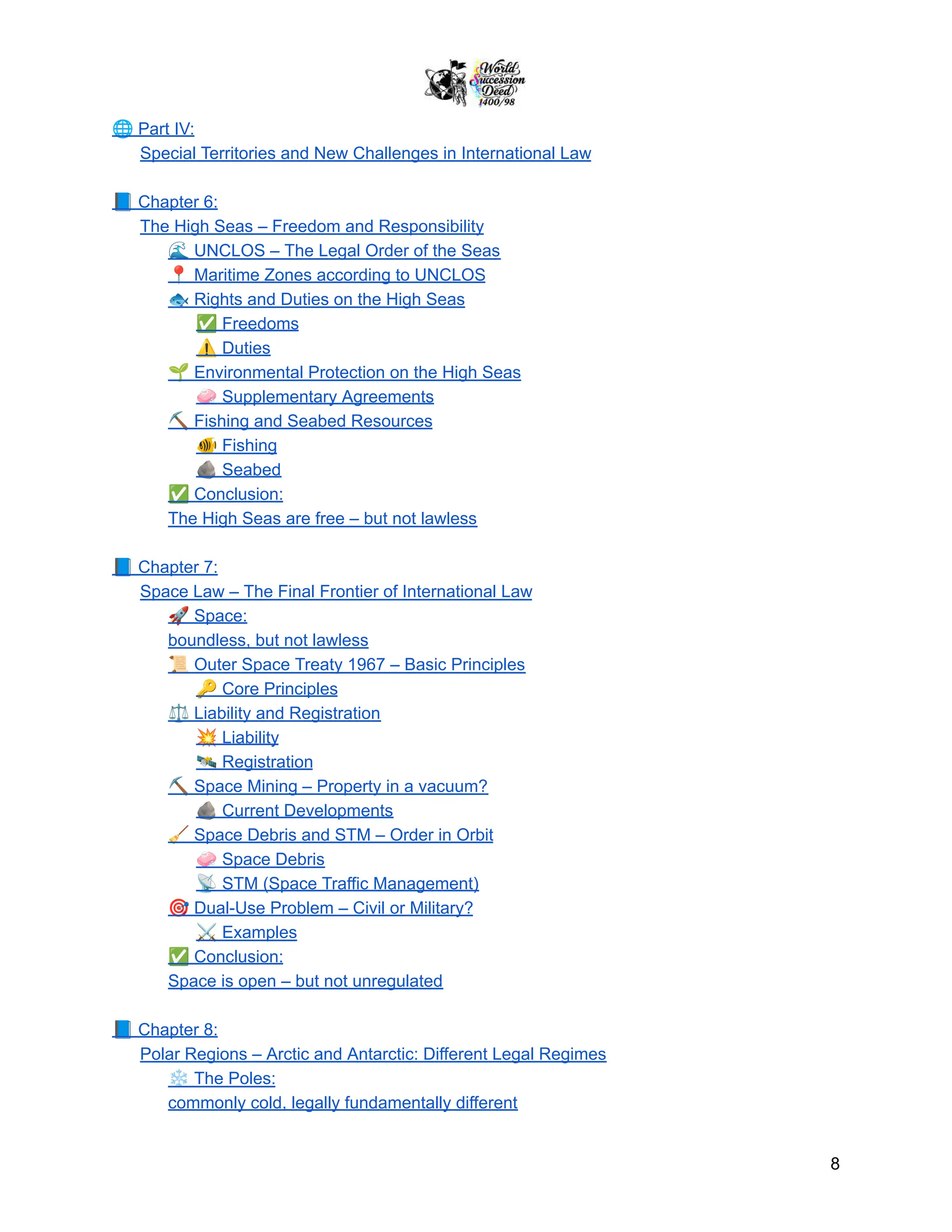
7
🌐Part IV:
Special Territories and New Challenges in International Law
📘Chapter 6:
The High Seas – Freedom and Responsibility
🌊UNCLOS – The Legal Order of the Seas
📍Maritime Zones according to UNCLOS
🐟Rights and Duties on the High Seas
✅Freedoms
⚠️Duties
🌱Environmental Protection on the High Seas
🧼Supplementary Agreements
⛏️Fishing and Seabed Resources
🐠Fishing
🪨Seabed
✅Conclusion:
The High Seas are free – but not lawless
📘Chapter 7:
Space Law – The Final Frontier of International Law
🚀Space:
boundless, but not lawless
📜Outer Space Treaty 1967 – Basic Principles
🔑Core Principles
⚖️Liability and Registration
💥Liability
🛰️Registration
⛏️Space Mining – Property in a vacuum?
🪨Current Developments
🧹Space Debris and STM – Order in Orbit
🧼Space Debris
📡STM (Space Traffic Management)
🎯Dual-Use Problem – Civil or Military?
⚔️Examples
✅Conclusion:
Space is open – but not unregulated
📘Chapter 8:
Polar Regions – Arctic and Antarctic: Different Legal Regimes
❄️The Poles:
commonly cold, legally fundamentally different
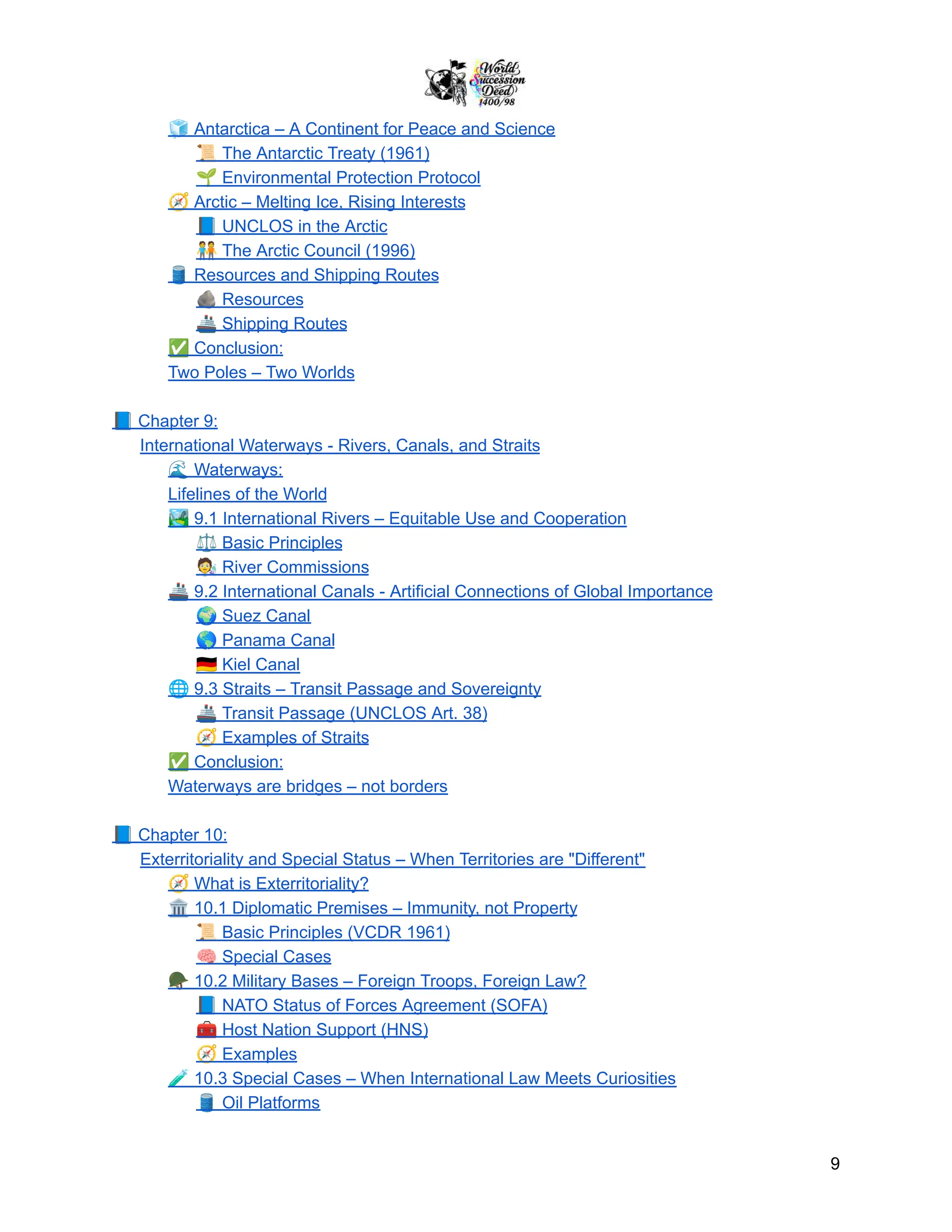
8
🧊Antarctica – A Continent for Peace and Science
📜The Antarctic Treaty (1961)
🌱Environmental Protection Protocol
🧭Arctic – Melting Ice, Rising Interests
📘UNCLOS in the Arctic
🧑‍🤝‍🧑The Arctic Council (1996)
🛢️Resources and Shipping Routes
🪨Resources
🚢Shipping Routes
✅Conclusion:
Two Poles – Two Worlds
📘Chapter 9:
International Waterways - Rivers, Canals, and Straits
🌊Waterways:
Lifelines of the World
🏞️9.1 International Rivers – Equitable Use and Cooperation
⚖️Basic Principles
🧑‍🔬River Commissions
🚢9.2 International Canals - Artificial Connections of Global Importance
🌍Suez Canal
🌎Panama Canal
🇩🇪Kiel Canal
🌐9.3 Straits – Transit Passage and Sovereignty
🚢Transit Passage (UNCLOS Art. 38)
🧭Examples of Straits
✅Conclusion:
Waterways are bridges – not borders
📘Chapter 10:
Exterritoriality and Special Status – When Territories are "Different"
🧭What is Exterritoriality?
🏛️10.1 Diplomatic Premises – Immunity, not Property
📜Basic Principles (VCDR 1961)
🧠Special Cases
🪖10.2 Military Bases – Foreign Troops, Foreign Law?
📘NATO Status of Forces Agreement (SOFA)
🧰Host Nation Support (HNS)
🧭Examples
🧪10.3 Special Cases – When International Law Meets Curiosities
🛢️Oil Platforms
9
✈️Airplane Toilets
🏴Micronations
✅Conclusion:
Exterritoriality is rare – but fascinating
🏴Overview of Micronations – Creative States without Recognition
📊Comparison of Selected Micronations
🪖Example:
Structure of a Stationing Agreement (Host Nation Support)
📘Model Structure of a Stationing Agreement
🧰Starter Pack for State Founders
How to found a state – classic, experimental, or symbolic
🧭1. Basic Requirements: What makes a state?
🪪2. Classic Paths to State Founding
🧨Secession – Separation from an existing state
📜Succession – Contractual assumption of sovereign rights
🧪3. Experimental Models: Micronations & Special Territories
🏴Found a Micronation
🧭Self-government or Special Status
🧨4. Opportunistic Models:
Collapse, Bankruptcy, No Man's Land
🏚️Exploit State Bankruptcy or Dismemberment
🏜️Occupy No Man's Land
🪖5. Use Special Rights:
Stationing Rights & Exterritoriality
🛡️Stationing Rights
🏛️Exterritoriality
🧑‍⚖️6. International Legal Capacity as a Person or Organization
👤Natural Person
🏢Organization
✅Step-by-Step Plan for State Founding
📘Chapter 11:
Micronations & Self-Administration – Between Symbolism and Law
🏴Micronations:
Creative States without Recognition
🚜Micronation on Your Own Farm - Step-by-Step
🧭Step-by-Step Guide
🧪Symbolic Sovereignty – What is allowed?
🧑‍💻Virtual States & Extraterrestrial Claims
🌐Virtual States
10
🚀Extraterrestrial Claims
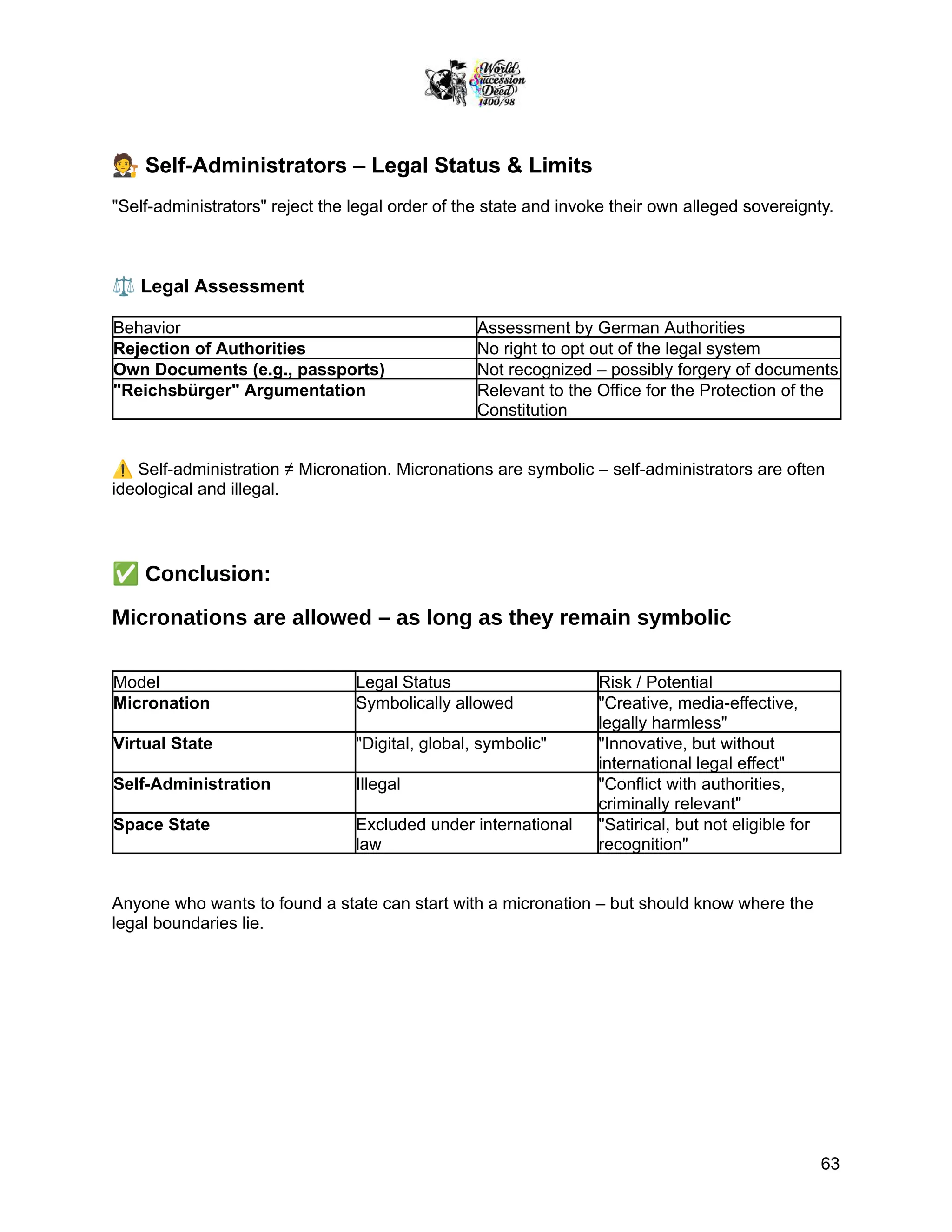
🧑‍⚖️Self-Administrators – Legal Status & Limits
⚖️Legal Assessment
✅Conclusion:
Micronations are allowed – as long as they remain symbolic
📘Chapter 12:
International Law Treaties & Sovereign Rights – The Art of State Succession
📜Treaties as a Tool of Statehood
⚖️Vienna Convention on the Law of Treaties (VCLT)
🔑Basic Principles
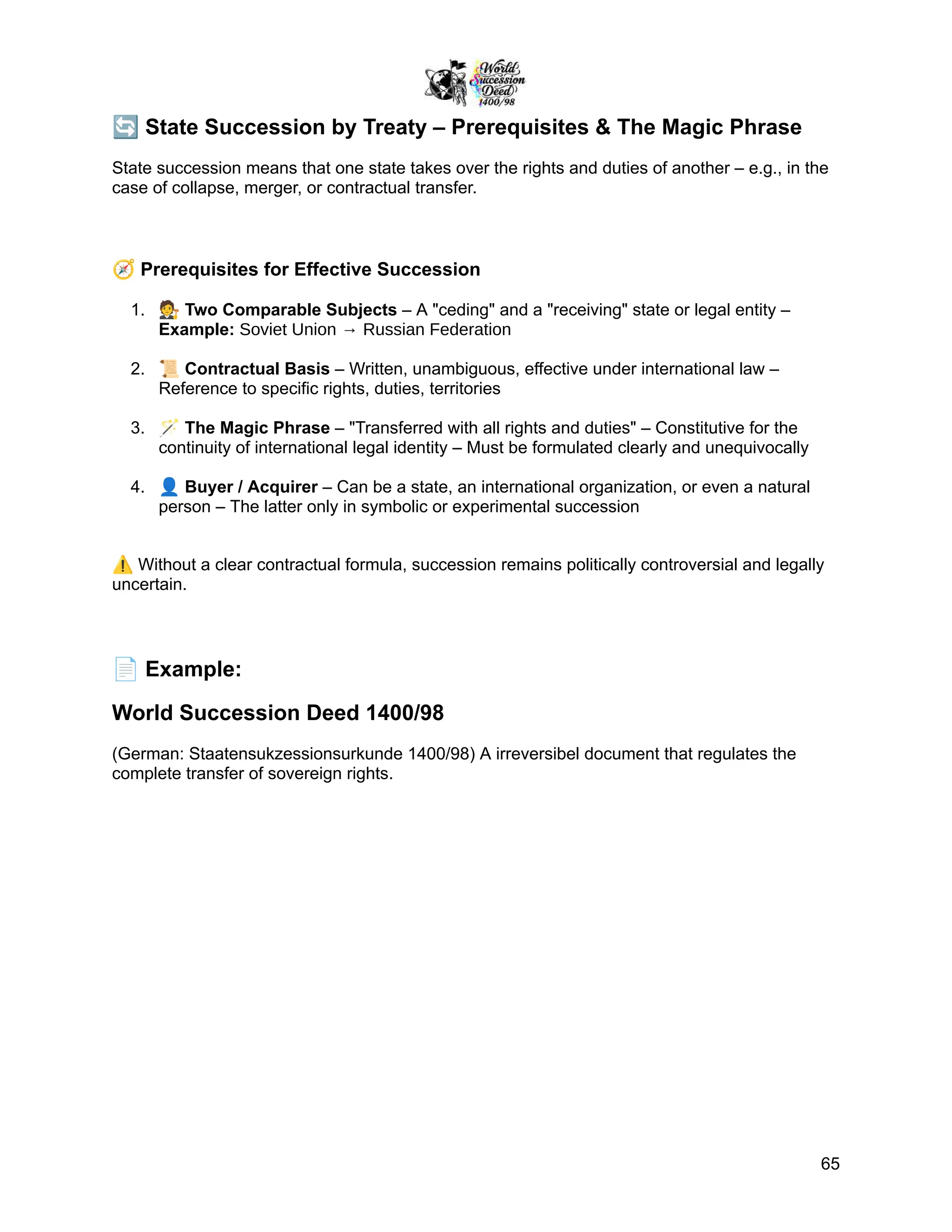
🔄State Succession by Treaty – Prerequisites & The Magic Phrase
🧭Prerequisites for Effective Succession
📄Example:
World Succession Deed 1400/98
📘Structure (simplified)
✅Conclusion:
Treaties are the DNA of International Law
📘Chapter 13: Recognition Policy – How States Recognize Other States
⚖️De Facto vs. De Jure Recognition
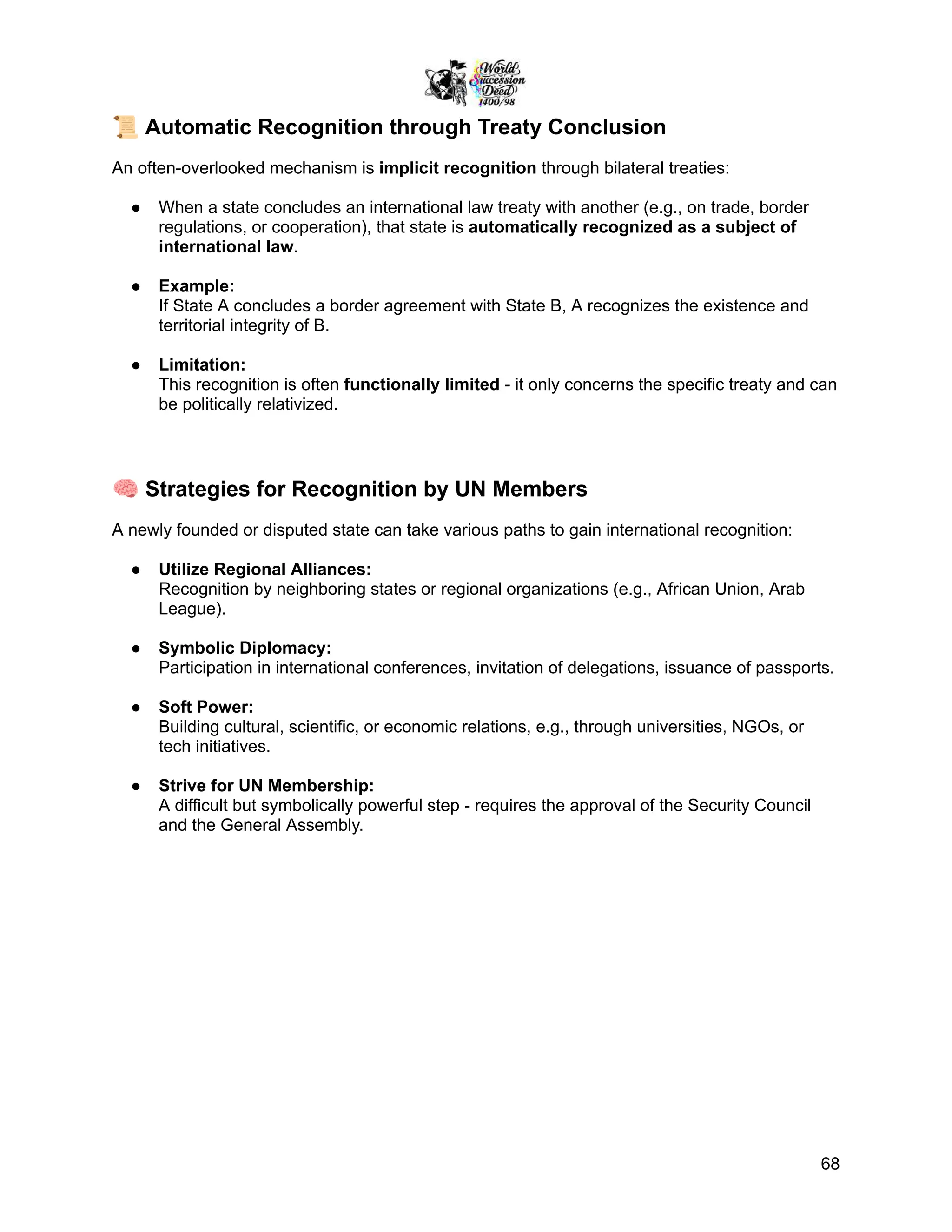
📜Automatic Recognition through Treaty Conclusion
🧠Strategies for Recognition by UN Members
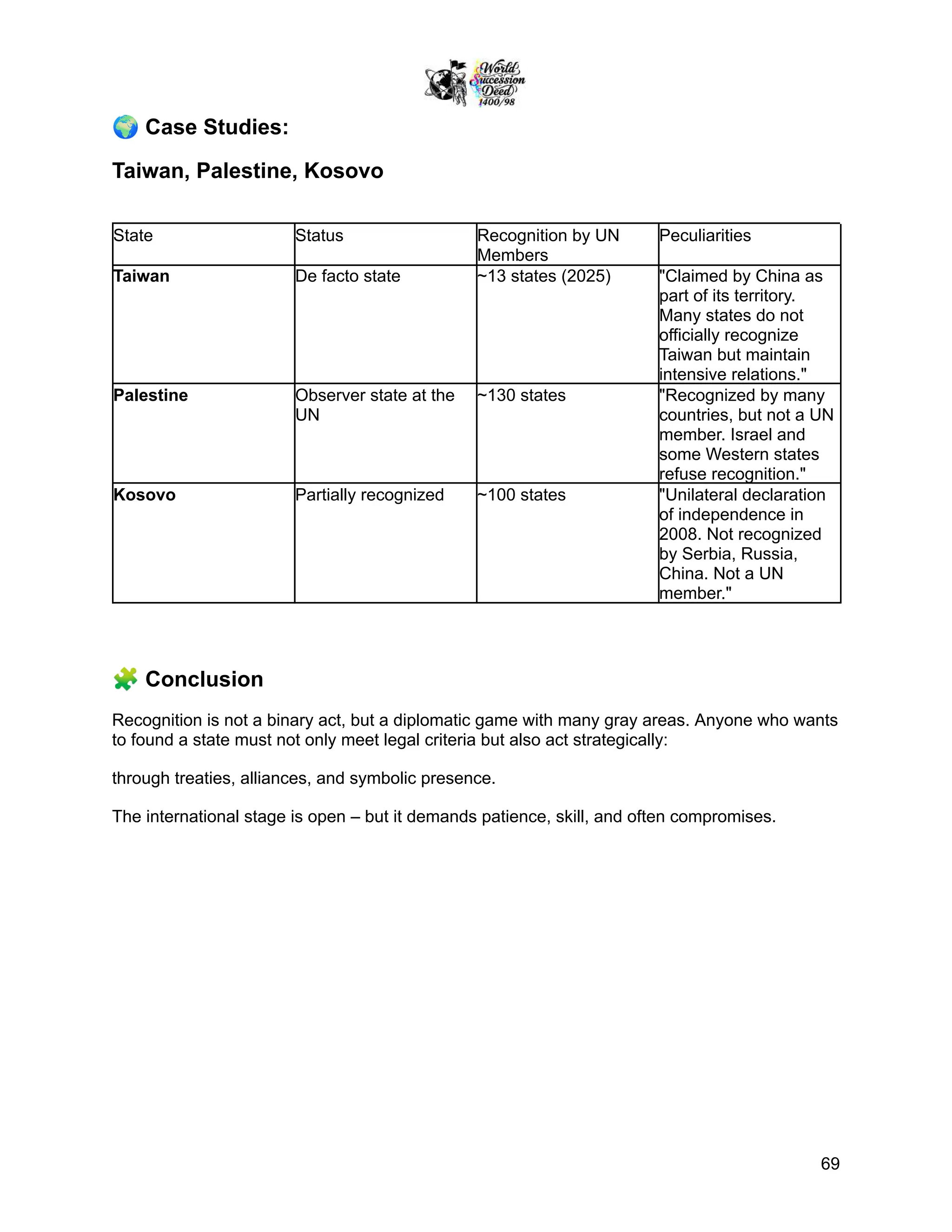
🌍Case Studies:
Taiwan, Palestine, Kosovo
🧩Conclusion
📘Chapter 14:
Border Delimitation through Network Contracts – When Infrastructure Extends Sovereign
Rights
🧭Borders are not just lines – they are also pipelines
📐Border Delimitation through a State Succession Treaty
🔄Principle of Network-Based Territorial Expansion
🧠Exemplary Application
🧩Special Case:
Sale of Development as a Unit
🧠What does "development as a unit" mean?
🌐Potentially Affected Networks
🧨Domino Effect of Territorial Expansion
🔗How does the "contagion" work?
⚖️Legal Consequences
11
✅Conclusion:
Whoever sells networks, sells more than cables
📘Chapter 15:
The Legal Situation since the World Succession Deed 1400/98
The End of International Law and the Birth of a Global Contractual Framework
🧭1. The World Succession Deed 1400/98 – A Turning Point in International Law
📜2. The Treaty Chain:
From NATO to UN
🔗Starting Point:
NATO Status of Forces Agreement & Transfer Relationship
📘NATO Treaty Structure
🌍Integration into the UN
📜3. The Decisive Passage:
"With all rights, duties, and components"
🧩4. The Unification of All Treaty Parties
🧨5. Application of the Tabula Rasa Principle
🧠6. Legal Reality: The End of International Law
🧭7. The New Global Order
📘8. Conclusion:
A Global Legal Construct
📘Chapter 16:
The World after the World Succession Deed 1400/98
What does the end of international law mean for old states and new state founders?
🧭1. Starting Point:
The Dissolution of International Law
⚖️Legal Consequence
🧨2. Tabula Rasa:
The New Starting Point
🧑‍⚖️3. What does this mean for old states?
🧭4. What does this mean for new state founders?
🧑‍⚖️5. The Buyer:
Powerless and omnipotent at the same time
🧩6. Balance of Power Beyond the Law
✅7. Conclusion:
The World after International Law
🧭Conclusions:
The Path to a Recognized State
🏛️The Dream of One's Own State – Between Vision and International Law
12
📚Summary:
The Central Hurdles
🧠Recommendations for Aspiring State Founders
⚖️1. Legal Knowledge is Mandatory
🌐2. Strive Strategically for International Recognition
🕊️3. Renunciation of Violence is Non-Negotiable
👥4. Clearly Define the Citizenship System
🧑‍🤝‍🧑5. Engagement in International Forums
🎯6. Formulate Realistic Expectations
✅Conclusion:
Founding a State is Possible – But Not Easy
📎Bibliography
🏛️International Treaties & Conventions
📘Legal Literature & Commentaries
🧾UN Documents & Reports
🌐Wikipedia & Online Encyclopedias (with citation)
🧑‍⚖️Court Decisions & Arbitral Awards
🧑‍🤝‍🧑International Organizations & Forums
📎Other Sources & Materials
📎Additional Modules
📘Glossary – International Law Terms Explained Simply
⚠️Disclaimer – Education, Satire, Not an Instruction Manual
🧭Matrix – What is Realistic, What is Symbolic?
Appendix:
Founding a New State: Legal and Practical Aspects
International Law Basics: Statehood and Recognition
Seasteading under UNCLOS:
Possibilities and Limits
Special Economic Zones (SEZ)
Host-State Agreements
Banking, Currency Systems, and Compliance
Digital State-Building:
E-Residency, Blockchain Governance, Digital Constitutions
Micronations – Examples and Insights
Diplomatic Strategies for Recognition
Insurance Requirements for Offshore Projects
Sources:
👓Read more about it:
13
🔹Introduction
🏰The Dream of Your Own State
The idea of founding one's own country is as old as the idea of sovereignty itself.
For some, it is a utopian desire for freedom; for others, an artistic experiment, a legal thought
model, or simply an expression of frustration with existing systems.
Whether as a micronation on one's own farm, as a diplomatic simulation, or as a serious
international law initiative - the founding of a state is fascinating.
But between the idea and reality lies an ocean of legal norms, political interests, and practical
hurdles.
A state is not just a place with a flag and an anthem - but a complex entity that must be
anchored in international law to be recognized as such.
✨This guide is for everyone who not only wants to dream the dream of their own state
but also wants to understand it - and perhaps even dare to try.
⚖️International Law Foundations of Statehood
At the heart of state founding is international law - the set of rules that determines what a state
is, how it comes into being, how it is recognized, and how it interacts with other states.
The Montevideo Convention of 1933 names four criteria that an entity must meet to be
considered a state:
●​ A defined state territory
●​ A permanent population
●​ An effective government
●​ The capacity to enter into international relations
These criteria are necessary - but not always sufficient.
Because even if an entity fulfills all four, without recognition by other states, it often remains a
legal phantom.
The international community has a say – and it does not always decide based on purely legal
standards, but also on political, strategic, and ethical considerations.
14
🧠Anyone who wants to found a state must not only know the rules - but also know how
they are applied, circumvented, or interpreted.
📘Goal and Structure of the Guide
This eBook is a complete, modular guide to state founding - from theory to practice, from
micronation to a republic recognized under international law.
It combines:
●​ Legal precision
●​ Didactic clarity
●​ Satirical lightness
●​ Strategic depth
You will learn:
●​ How to find or claim a state territory
●​ How to define and integrate a population
●​ How to establish a government and write a constitution
●​ How to gain international recognition
●​ How to design treaties on state succession
●​ How to use micronations, special zones, and exterritoriality
●​ How to prepare for the collapse of existing states
●​ How to understand and use diplomatic and military special rights
📦At the end, you will receive a "starter pack" with checklists, templates, sample
contracts, and case studies - ready for your own state project.
15
📘Chapter 1:
The Building Blocks of a State – Criteria according to
the Montevideo Convention
🧱What Makes a State a State?
The Montevideo Convention on the Rights and Duties of States of 1933 is the legal foundation
for the definition of statehood in modern international law.
It names four central criteria that an entity must meet to be considered a state:
●​ A defined state territory
●​ A permanent population
●​ An effective government
●​ The capacity to enter into international relations
These four building blocks are like the supporting pillars of a house.
If one is missing, the whole building wobbles. If all are present, the house stands - but whether it
is recognized as a "state" also depends on whether the neighbors accept it as such.
🗺️1. State Territory – Land, Air, and Underground
A state needs a piece of earth it can call its own. The following applies:
●​ Size doesn't matter:
Monaco has 2 km², Russia over 17 million.
●​ Shape doesn't matter:
Island, landlocked state, exclave – all possible.
●​ Location doesn't matter:
The main thing is that you have effective control.
16
🔍What counts as state territory?
Area Description
Land Area "The physical territory over which sovereignty is
exercised"
Airspace The space above the ground – up to the edge
of outer space
Underground Everything beneath the surface – including
resources
Territorial Sea Up to 12 nautical miles – with full sovereignty
EEZ (Economic Zone) Up to 200 nautical miles – with special
economic rights
🧠Mnemonic: "A state doesn't need much land - but a lot of control."
🧭Special Cases
●​ Enclaves:
e.g., San Marino (surrounded by Italy)
●​ Exclaves:
e.g., Büsingen am Hochrhein (German exclave in Switzerland)
●​ No Man's Land:
rare, but possible – e.g., Bir Tawil between Egypt and Sudan
👥2. The State Population – Who Belongs?
A state needs people - not just as inhabitants, but as a legally defined community.
🧬Nationality:
ius soli vs. ius sanguinis
Principle Meaning Example States
ius soli Nationality by birth in the
country
"USA, Canada"
ius sanguinis Nationality by descent "Germany, Italy"
Mixed System Combination of both principles "France, Brazil"
🚫Statelessness
A "stateless person" is someone who is not recognized as a national by any state. This leads to:
●​ No right to vote
●​ No travel documents
●​ No diplomatic protection
17
⚠️For new states, it is essential to create clear and inclusive rules on nationality -
otherwise, a legal gray area arises.
🏛️3. State Power – Government and Control
A state needs an organization that enacts laws, enforces them, and maintains public order.
🔧Effective Government
●​ Must exercise control over territory and population
●​ Must be capable of acting – not just symbolically
●​ Form of government doesn't matter: democracy, monarchy, technocracy – all are allowed
🧱Internal vs. External Sovereignty
Type of Sovereignty Meaning
Internal Control over one's own state territory
External Independence from other states
🧠A government without control is like a king without a crown – decorative, but
powerless.
🌐4. Capacity for International Relations
A state must be able to communicate with other states - diplomatically, contractually,
organizationally.
📜What does this mean in practice?
●​ Opening embassies
●​ Concluding treaties
●​ Becoming a member of international organizations (e.g., UN, WTO, ITU)
18
🧩Recognition:
Declaratory vs. Constitutive
Theory Meaning Example
Declaratory "A state exists when it meets
the criteria – recognition only
confirms this"
"Somaliland (not recognized,
but de facto controlling)"
Constitutive A state only exists through
recognition
"Kosovo (disputed, but
recognized by many)"
⚖️Without recognition, a state often remains a legal phantom – visible, but ineffective.
✅Conclusion:
The Four Pillars of Statehood
Criterion Brief Definition
State Territory A defined territory with effective control
State Population A permanent population with a legal bond
State Power A capable government with sovereignty
International Relations Capacity for diplomatic and contractual
interaction
These four criteria are the ticket to the world of states. But they are only the beginning.
The path to recognition, to membership in international organizations, and to actual
effectiveness is long – and often political.
19
📊Table 1:
Criteria of Statehood (Montevideo Convention)
Criterion Definition Key Features / Implications
State Territory "A defined territory over which
the state exercises effective
control"
"Size and border demarcation
are irrelevant; includes land,
airspace, and underground;
control is decisive"
State Population "A permanent population
residing in the state territory"
"Nationality as a legal bond;
stateless persons are not part
of the state population in the
narrower sense"
State Power "An effective government that
exercises control over territory
and people"
"Form of government is
irrelevant; what is decisive is
the ability to legislate and
enforce"
Capacity for International
Relations
"The ability to interact with
other states and conclude
treaties"
"Prerequisite for diplomatic
recognition, memberships, and
legal capacity under
international law"
📊Table 2:
Comparison of Recognition Theories
Theory Core Principle Practical Implications Examples
Declaratory "A state exists as soon
as it fulfills the
Montevideo criteria;
recognition only
confirms"
"Legal existence
independent of
recognition; recognition
is declaratory"
"Somaliland (de facto
controlling, but hardly
recognized)"
Constitutive A state only exists
through recognition by
other states
"Without recognition,
no international legal
personality; recognition
is status-creating"
"Kosovo (recognized by
many, but not by all UN
members)"
Mixed Form "Recognition is de facto
declaratory, but
politically constitutive"
"States decide based
on political discretion;
recognition influences
the capacity to act"
"Bosnia-Herzegovina
(1992, recognized
despite initially weak
government)"
20
⚖️Part II:
Paths and Hurdles of State Founding
📘Chapter 2:
Sources and Principles of International Law
Anyone who wants to found a state must know the rules of the game - and these rules are
called international law.
But where do these rules come from? Who wrote them?
And how binding are they really?
International law is not a law book with a cover and a table of contents.
It is a dynamic system of treaties, customs, principles, and interpretations.
The most important source for this structure is Article 38
(1) of the Statute of the International Court of Justice (ICJ). It states what counts as a "source of
law" - and what does not.
📜2.1 International Treaties - The Written Rules of the
Game
Treaties are the "hard law" component of international law.
They are written, clearly formulated, and agreed upon between states.
Whoever signs is bound – pacta sunt servanda.
21
🧾Examples of Important Treaties
Treaty Content / Significance
UN Charter "Constitution of the international order
(prohibition of force, self-determination)"
Vienna Convention on the Law of Treaties
(VCLT, 1969)
"Regulates the conclusion, interpretation, and
termination of treaties"
UN Convention on the Law of the Sea
(UNCLOS)
"Regulates maritime zones, the high seas,
resources"
Outer Space Treaty (1967) Basic rules for the use of outer space
📌A treaty is only binding on the contracting parties – but major treaties often shape the
entire system.
🔍Treaty Mechanisms (according to VCLT)
●​ Signature
●​ Ratification
●​ Reservations
●​ Entry into force
●​ Termination
●​ Nullity for violation of ius cogens (e.g., prohibition of torture)
⚠️Article 53 VCLT:
Treaties that violate peremptory norms of general international law are void.
🌍2.2 Customary International Law – The Unwritten
Rules
Not everything is in black and white.
Some rules arise from practice - and from the conviction that this practice is legally binding.
This is called customary international law.
🧠Two Elements
Element Meaning
State Practice Consistent behavior of many states over time
Opinio Juris "Conviction that this behavior is legally
required"
22
🧩Example:
The prohibition of aggressive war was long-standing customary law - before it was codified in
the UN Charter.
🧭Special Case: Silence as Consent? In certain cases, a state's silence can be interpreted
as consent - for example, regarding territorial claims or treaty consequences.
But beware:
silence is not always golden, but often legally controversial.
⚖️2.3 General Principles of Law – The Universal Ideas
These principles originate from national legal systems and also apply internationally - as
gap-fillers and a moral compass.
🔑Examples
Principle Meaning
pacta sunt servanda Treaties must be observed
Good Faith The exercise of rights must be fair and honest
estoppel Contradictory behavior is not permissible
lex specialis A special rule overrides a general rule
nulla poena sine lege No punishment without law
🧠These principles help when no treaty exists and no custom applies - they are the
foundation of legal thinking.
📚2.4 Subsidiary Means for the Determination of
Rules of Law – Orientation in the Fog
When the legal situation is unclear, two things help:
●​ Judicial decisions (jurisprudence)
●​ Teachings of publicists (doctrine)
23
🧾Judicial Decisions
The International Court of Justice (ICJ) only decides for the parties to a case - but its judgments
often have a signaling effect.
National courts can also deliver judgments relevant to international law.
📖Teachings of Publicists
The writings of the "most highly qualified publicists" are considered an aid to interpretation.
They are not binding - but they influence practice and legal development.
📌Example:
The commentary on the VCLT in legal literature is often more decisive than the treaty text itself.
✅Conclusion:
The Four Pillars of International Law
Source Binding Force Example
Treaties High "UN Charter, VCLT, UNCLOS"
Customary Law Medium to High "Prohibition of aggressive war,
immunity"
General Principles of Law Medium "pacta sunt servanda, estoppel"
Subsidiary Means Low "ICJ judgments, textbooks"
Anyone who wants to found a state must know where the rules come from – and how they work.
Because without this knowledge, any state founding remains a game without a game plan.
24
📘Chapter 3:
Secession – The Breakaway
A Controversial Right
🚩What is Secession?
Secession refers to the unilateral separation of a part of a territory from an existing state with
the aim of founding a new, independent state.
It sounds like a revolution - but it is highly complex in international law and politically explosive.
Secession touches upon two central principles of international law:
●​ The right of self-determination of peoples
●​ The territorial integrity of existing states
A permanent tension exists between these two principles – and international law carefully
balances between them.
🧬3.1 The Right of Self-Determination of Peoples
The right of self-determination is a recognized principle of international law.
It states:
"Peoples" have the right to freely determine their political status and pursue their economic,
social, and cultural development.
🔍Internal vs. External Self-Determination
Type Meaning Example
Internal Self-Determination "Autonomy, self-government,
cultural rights within a state"
"South Tyrol, Québec"
External Self-Determination Secession and founding of
one's own state
"South Sudan, Bangladesh"
25
⚠️External self-determination is only permissible under very narrow conditions –
usually in the context of colonialism or the most severe human rights violations.
❌3.2 No General Right of Secession
International law does not recognize a general right to secession.
The territorial integrity of states is a protected good - and unilateral secessions are generally not
allowed.
🧠Why not?
●​ Secession destabilizes states
●​ It can lead to domino effects
●​ It contradicts the prohibition of force in the UN Charter
📌Exception: Decolonization – here, external self-determination was recognized as a
legitimate path to independence.
🆘3.3 Remedial Secession – The Right as a Last
Resort
Some international law scholars argue that secession can be permitted if a "people" is
massively oppressed and has no other option for self-determination.
🧾Prerequisites
●​ Systematic, gross, and massive human rights violations
●​ Denial of internal self-determination
●​ Exclusion from the political process
●​ No prospect of protection or reform
26
📚Case Studies
Case Assessment
Kosovo (2008) "Disputed, but recognized by many states – ICJ
confirmed no illegality"
Bangladesh (1971) "Model case: massive violence, refugee flows,
international support"
Catalonia (2017) No right to secession – no severe human rights
violations
⚠️Remedial secession is not a license to secede – but a legal emergency exit in extreme
circumstances.
🔄3.4 State Succession in Case of Secession
When a new state is formed, the question arises:
What happens to the treaties, assets, and debts of the old state?
📜Treaties
Treaty Type Transfer in case of secession?
Territorial Treaties (e.g., border treaties) Yes – automatically (radicated)
Personal Treaties (e.g., alliances) No – must be renegotiated
Multilateral Treaties (e.g., UN conventions) Disputed – often "Clean Slate" principle
💰Assets and Debts
●​ Assets:
Proportional division or negotiation
●​ Archives:
Handover of relevant documents
●​ Debts:
Principle of "dettes odieuses" – no assumption of debts used for oppression
📘Vienna Conventions on Succession of States
Convention Content Status
VC on Treaties (1978) Rules on treaty succession Low ratification (23 states)
VC on Assets, Archives,
Debts (1983)
Rules on the division of state
resources
Not in force
27
📌In practice, succession issues are often regulated by bilateral treaties – international
law only provides a framework.
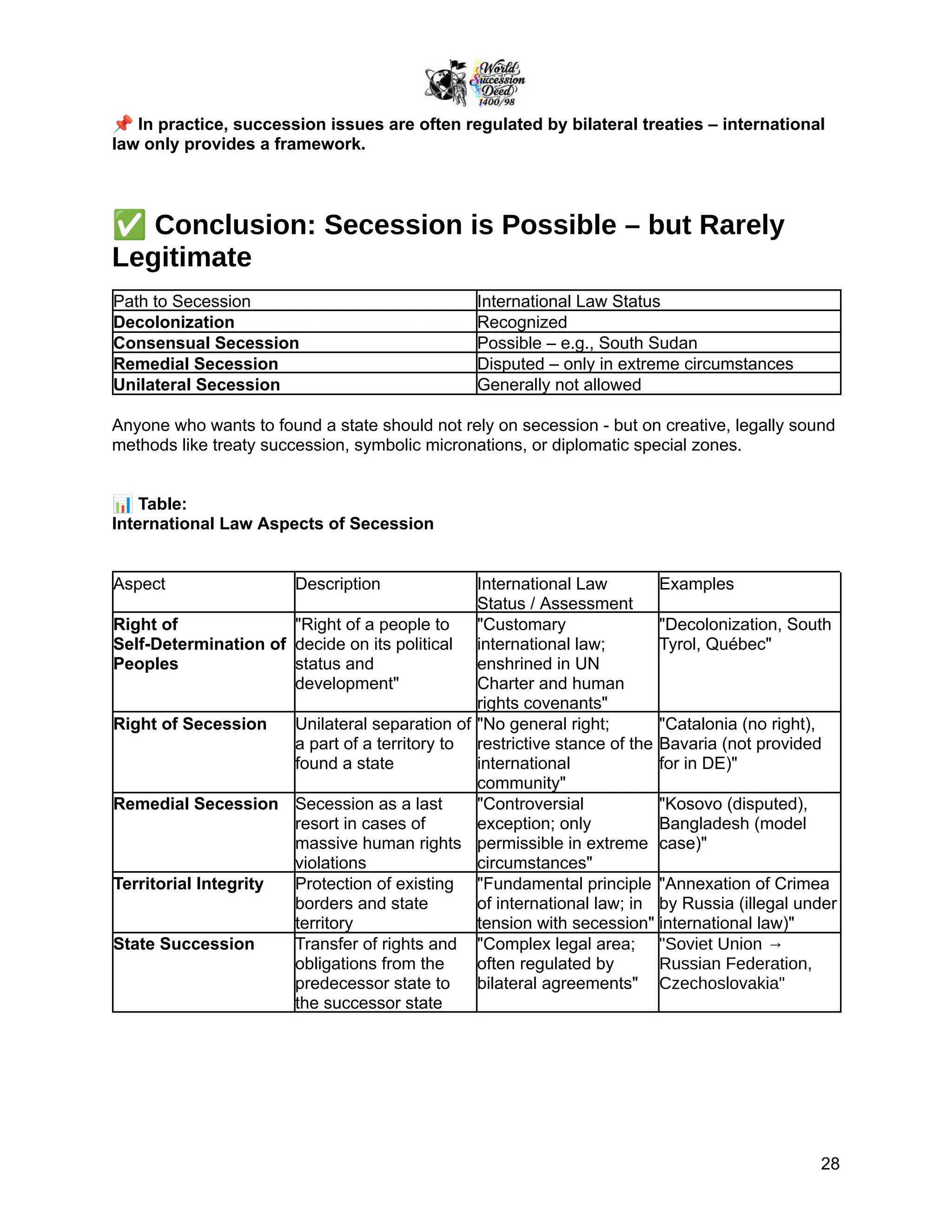
✅Conclusion: Secession is Possible – but Rarely
Legitimate
Path to Secession International Law Status
Decolonization Recognized
Consensual Secession Possible – e.g., South Sudan
Remedial Secession Disputed – only in extreme circumstances
Unilateral Secession Generally not allowed
Anyone who wants to found a state should not rely on secession - but on creative, legally sound
methods like treaty succession, symbolic micronations, or diplomatic special zones.
📊Table:
International Law Aspects of Secession
Aspect Description International Law
Status / Assessment
Examples
Right of
Self-Determination of
Peoples
"Right of a people to
decide on its political
status and
development"
"Customary
international law;
enshrined in UN
Charter and human
rights covenants"
"Decolonization, South
Tyrol, Québec"
Right of Secession Unilateral separation of
a part of a territory to
found a state
"No general right;
restrictive stance of the
international
community"
"Catalonia (no right),
Bavaria (not provided
for in DE)"
Remedial Secession Secession as a last
resort in cases of
massive human rights
violations
"Controversial
exception; only
permissible in extreme
circumstances"
"Kosovo (disputed),
Bangladesh (model
case)"
Territorial Integrity Protection of existing
borders and state
territory
"Fundamental principle
of international law; in
tension with secession"
"Annexation of Crimea
by Russia (illegal under
international law)"
State Succession Transfer of rights and
obligations from the
predecessor state to
the successor state
"Complex legal area;
often regulated by
bilateral agreements"
"Soviet Union →
Russian Federation,
Czechoslovakia"
28
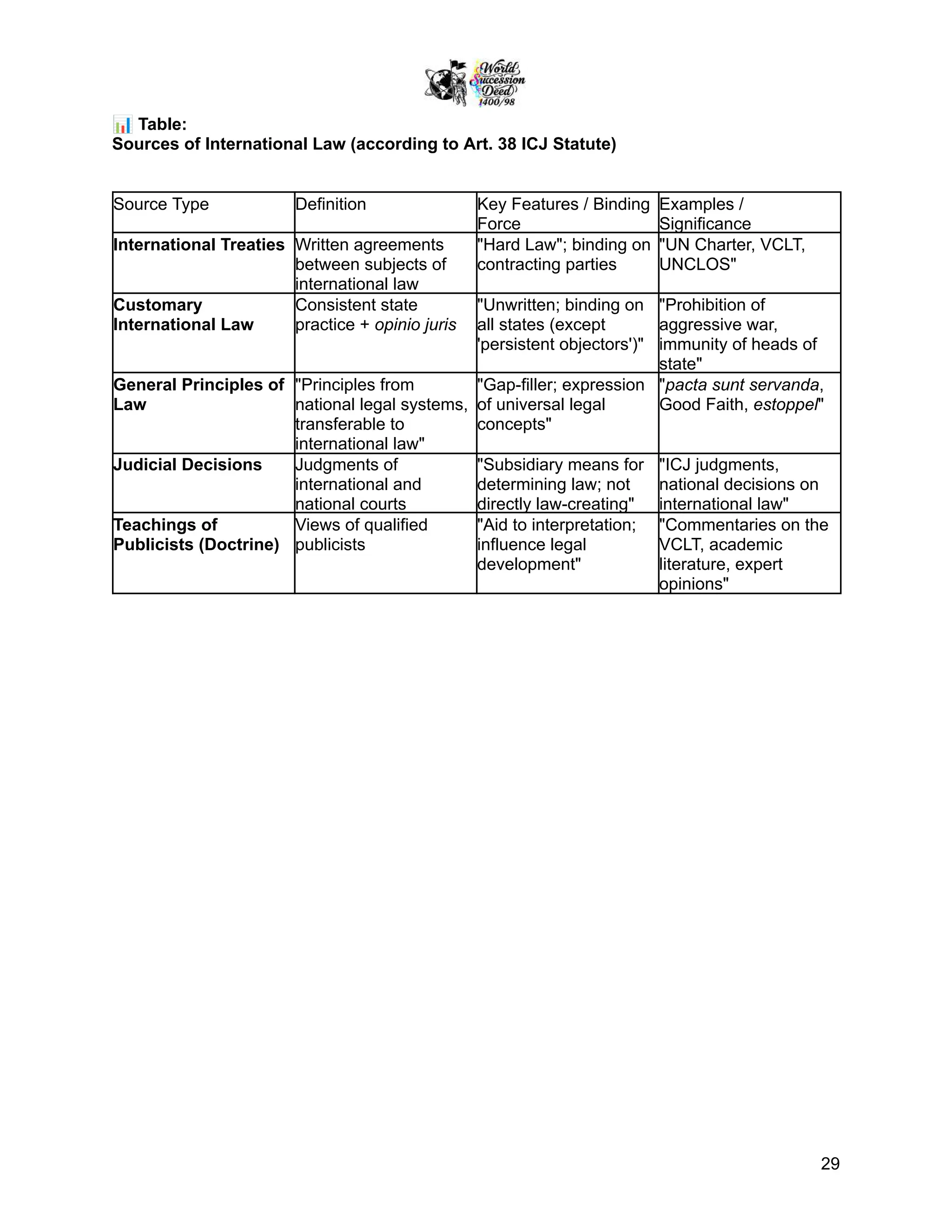
📊Table:
Sources of International Law (according to Art. 38 ICJ Statute)
Source Type Definition Key Features / Binding
Force
Examples /
Significance
International Treaties Written agreements
between subjects of
international law
"Hard Law"; binding on
contracting parties
"UN Charter, VCLT,
UNCLOS"
Customary
International Law
Consistent state
practice + opinio juris
"Unwritten; binding on
all states (except
'persistent objectors')"
"Prohibition of
aggressive war,
immunity of heads of
state"
General Principles of
Law
"Principles from
national legal systems,
transferable to
international law"
"Gap-filler; expression
of universal legal
concepts"
"pacta sunt servanda,
Good Faith, estoppel"
Judicial Decisions Judgments of
international and
national courts
"Subsidiary means for
determining law; not
directly law-creating"
"ICJ judgments,
national decisions on
international law"
Teachings of
Publicists (Doctrine)
Views of qualified
publicists
"Aid to interpretation;
influence legal
development"
"Commentaries on the
VCLT, academic
literature, expert
opinions"
29
📊Table:
Forms of Territorial Acquisition in International Law
Form of Acquisition Description International Law
Status / Assessment
Examples /
Peculiarities
Occupation Taking possession of
ownerless territory
(terra nullius)
"Hardly relevant today;
only for truly unclaimed
territory"
"Historically:
colonialism; today: Bir
Tawil (Africa)"
Annexation "Unilateral, forcible
incorporation of foreign
territory"
"Illegal under
international law;
violation of UN
prohibition of force"
"Crimea (2014),
Donetsk/Luhansk
(2022)"
Prescription "Long-term, peaceful,
and undisturbed
exercise of
sovereignty"
"Disputed; based on
acquiescence and
estoppel"
"Island of Palmas Case
(1928), Temple of
Preah Vihear (1962)"
Cession Contractual transfer of
territory between states
"Permissible under
international law; often
regulated bilaterally"
"Alaska Purchase
(1867), Hong Kong
handover (1997)"
Adjudication Judicial or arbitral
decision on territory
"Binding if parties
consent"
"ICJ cases: Burkina
Faso/Mali,
Cameroon/Nigeria"
Accretion Natural formation of
land through sediment
deposition
"Recognized if
permanent and stable"
"River delta extensions,
new islands from
volcanism"
📊Table:
Aspects of State Succession
Area Description International Law
Regulation / Practice
Examples /
Peculiarities
Treaties Transfer of international
legal obligations
"'Clean Slate' principle
in decolonization;
otherwise selective"
"Kosovo: selective
adoption; Russia: UN
seat of the USSR"
State Assets "Division of property,
resources,
infrastructure"
"Proportional or by
bilateral agreement"
"Czechoslovakia:
regulated division"
State Archives Handover of relevant
documents and
administrative records
"Partially regulated in
Vienna Convention
(1983)"
"GDR → FRG: archive
takeover during
reunification"
State Debts Assumption or rejection
of liabilities
"Principle of 'dettes
odieuses' for
oppressive regimes"
"Iraq: debts from
Saddam era partially
not assumed"
Vienna Conventions "Codification of
succession rules (1978,
1983)"
"Low ratification; often
not binding"
"1978: only 23 states
ratified; 1983: not in
force"
30
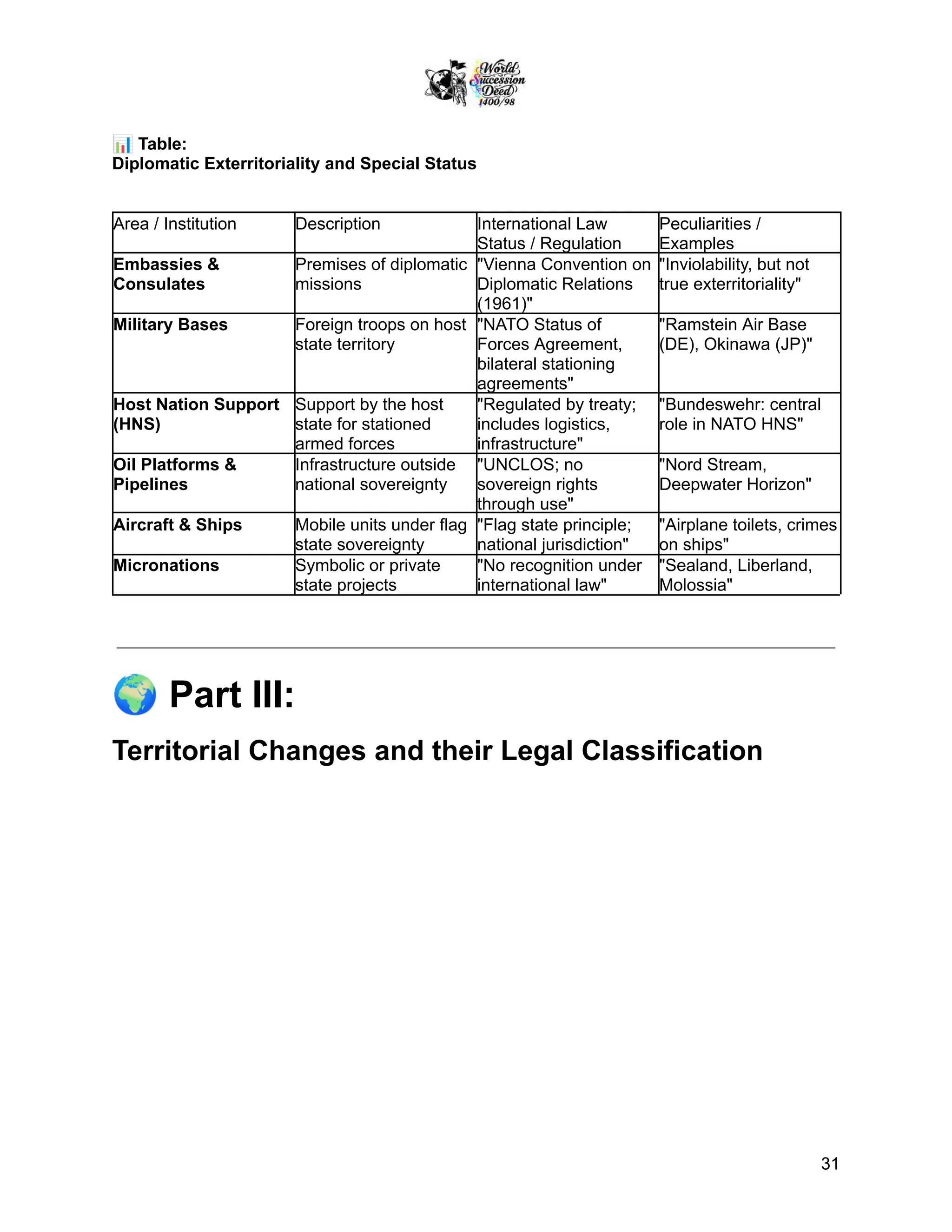
📊Table:
Diplomatic Exterritoriality and Special Status
Area / Institution Description International Law
Status / Regulation
Peculiarities /
Examples
Embassies &
Consulates
Premises of diplomatic
missions
"Vienna Convention on
Diplomatic Relations
(1961)"
"Inviolability, but not
true exterritoriality"
Military Bases Foreign troops on host
state territory
"NATO Status of
Forces Agreement,
bilateral stationing
agreements"
"Ramstein Air Base
(DE), Okinawa (JP)"
Host Nation Support
(HNS)
Support by the host
state for stationed
armed forces
"Regulated by treaty;
includes logistics,
infrastructure"
"Bundeswehr: central
role in NATO HNS"
Oil Platforms &
Pipelines
Infrastructure outside
national sovereignty
"UNCLOS; no
sovereign rights
through use"
"Nord Stream,
Deepwater Horizon"
Aircraft & Ships Mobile units under flag
state sovereignty
"Flag state principle;
national jurisdiction"
"Airplane toilets, crimes
on ships"
Micronations Symbolic or private
state projects
"No recognition under
international law"
"Sealand, Liberland,
Molossia"
🌍Part III:
Territorial Changes and their Legal Classification
31
📘Chapter 4:
Territorial Acquisition – Historical and Modern
Perspectives
Territory is the heart of a state.
But how does one legally acquire a state territory?
Historically, there were many ways - some now forbidden, others still permitted.
This chapter illuminates the most important forms of territorial acquisition in international law.
🏝️4.1 Occupation – The Taking of Ownerless Territory
(terra nullius)
Peaceful occupation refers to the taking of possession of a territory that is considered
"ownerless" – meaning it is not under the sovereignty of any state and is not claimed.
📜Historical Significance
●​ In the age of colonialism, terra nullius was a popular argument for land seizure
●​ The Congo Act of 1884 legitimized the occupation of large parts of Africa
●​ Indigenous populations were often ignored or dehumanized
⚖️Modern Relevance
●​ Today, terra nullius only applies to truly uninhabited and unclaimed territory
●​ Examples:
Bir Tawil (between Egypt and Sudan), certain Antarctic zones
●​ ⚠️Occupation is not a free pass – it must be peaceful, permanent, and effective.
🚫4.2 Annexation – The Forcible Acquisition of
Territory
32
Annexation is the unilateral, forcible incorporation of foreign territory into one's own state
territory – and is clearly illegal under international law today
📜Prohibition in International Law
●​ UN Charter, Art. 2(4):
Prohibition of the use of force against territorial integrity
●​ Briand-Kellogg Pact (1928):
Outlawing of aggressive war
●​ Customary Law:
Annexation is not internationally recognizable
📚Examples
Case Assessment
Crimea (2014) Illegal annexation by Russia under international
law
Donetsk/Luhansk (2022) Further annexation attempts – not
internationally recognized
Kuwait (1990) Iraqi annexation – led to military intervention
🧠Annexation is the direct path to diplomatic isolation – and often to conflict.
⏳4.3 Prescription – Territorial Acquisition Through
Lapse of Time
Prescription means that a state acquires sovereignty over a territory through the long-term,
peaceful, and undisturbed exercise of sovereign authority – if the original claimant does not
protest.
🧠Legal Basis
●​ Not an independent title of acquisition, but a consolidation of a factual situation
●​ Based on:
○​ Acquiescence (tacit tolerance)
○​ Estoppel (prohibition of contradictory behavior)
33
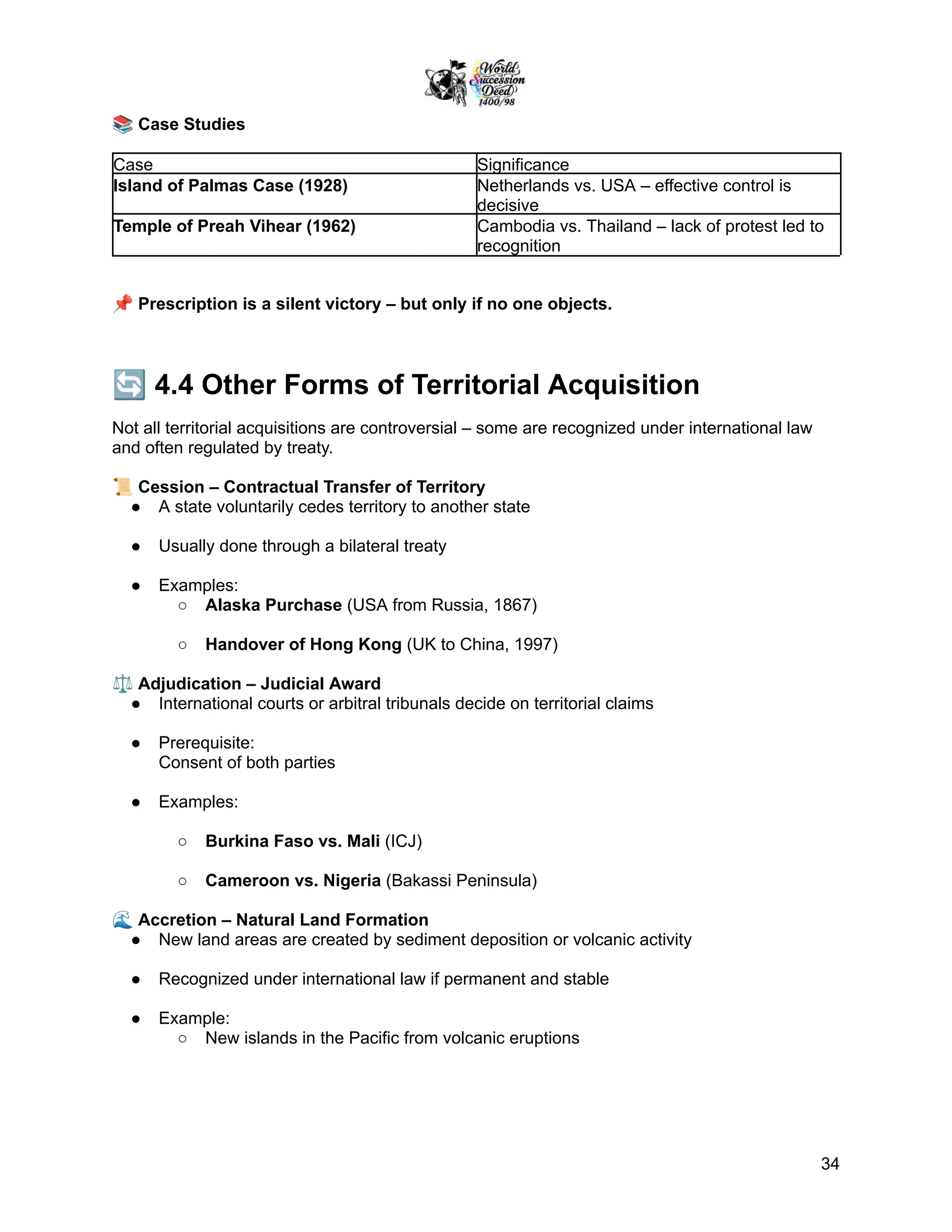
📚Case Studies
Case Significance
Island of Palmas Case (1928) Netherlands vs. USA – effective control is
decisive
Temple of Preah Vihear (1962) Cambodia vs. Thailand – lack of protest led to
recognition
📌Prescription is a silent victory – but only if no one objects.
🔄4.4 Other Forms of Territorial Acquisition
Not all territorial acquisitions are controversial – some are recognized under international law
and often regulated by treaty.
📜Cession – Contractual Transfer of Territory
●​ A state voluntarily cedes territory to another state
●​ Usually done through a bilateral treaty
●​ Examples:
○​ Alaska Purchase (USA from Russia, 1867)
○​ Handover of Hong Kong (UK to China, 1997)
⚖️Adjudication – Judicial Award
●​ International courts or arbitral tribunals decide on territorial claims
●​ Prerequisite:
Consent of both parties
●​ Examples:
○​ Burkina Faso vs. Mali (ICJ)
○​ Cameroon vs. Nigeria (Bakassi Peninsula)
🌊Accretion – Natural Land Formation
●​ New land areas are created by sediment deposition or volcanic activity
●​ Recognized under international law if permanent and stable
●​ Example:
○​ New islands in the Pacific from volcanic eruptions
34
🧠Not every sand pile is a state – but some slowly grow into one.
✅Conclusion:
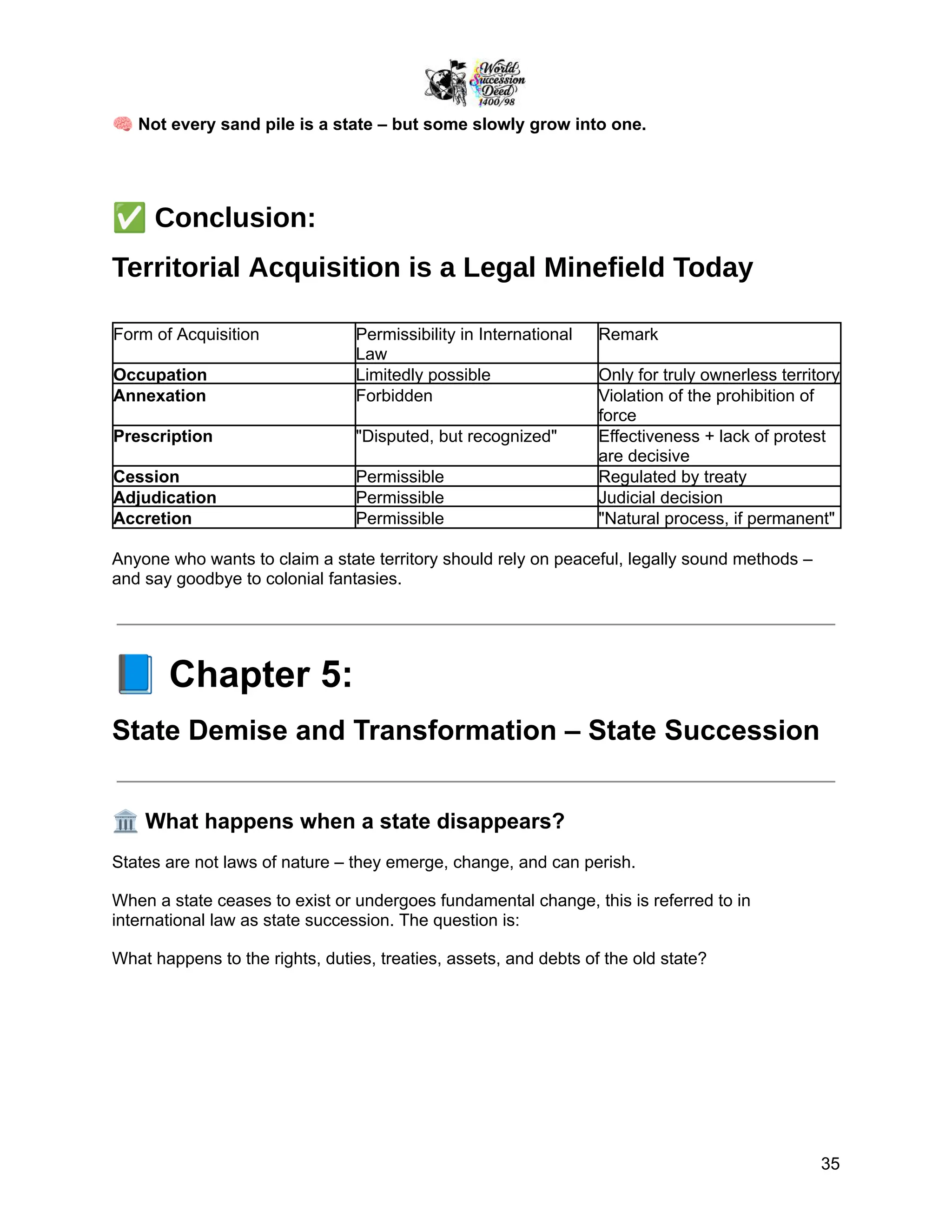
Territorial Acquisition is a Legal Minefield Today
Form of Acquisition Permissibility in International
Law
Remark
Occupation Limitedly possible Only for truly ownerless territory
Annexation Forbidden Violation of the prohibition of
force
Prescription "Disputed, but recognized" Effectiveness + lack of protest
are decisive
Cession Permissible Regulated by treaty
Adjudication Permissible Judicial decision
Accretion Permissible "Natural process, if permanent"
Anyone who wants to claim a state territory should rely on peaceful, legally sound methods –
and say goodbye to colonial fantasies.
📘Chapter 5:
State Demise and Transformation – State Succession
🏛️What happens when a state disappears?
States are not laws of nature – they emerge, change, and can perish.
When a state ceases to exist or undergoes fundamental change, this is referred to in
international law as state succession. The question is:
What happens to the rights, duties, treaties, assets, and debts of the old state?
35
🔄Forms of State Demise and Transformation
🧨Dismemberment – The Collapse
A state completely disintegrates into several new states.
The original state ceases to exist.
Example Description
Soviet Union (1991) Collapse into 15 successor states; Russia took
over the UN seat
Czechoslovakia (1993) Division into the Czech Republic and Slovakia –
both new states
⚠️In the case of dismemberment, no "rump state" remains – all successors are new subjects of
international law.
🔗Fusion – The Merger
Two or more states merge to form a new state.
The old states lose their international legal identity.
Example Description
Tanzania (1964) Merger of Tanganyika and Zanzibar
Yemen (1990) Unification of North and South Yemen
🧠Fusion is rare – it requires political unity and legal restructuring.
🧭Incorporation – The Accession
A state joins an existing state and loses its own international legal identity.
The acceding state continues to exist.
Example Description
GDR → FRG (1990) Accession of the GDR to the Federal Republic
of Germany – no new foundation
Austria → German Reich (1938) Unlawful incorporation through annexation
36
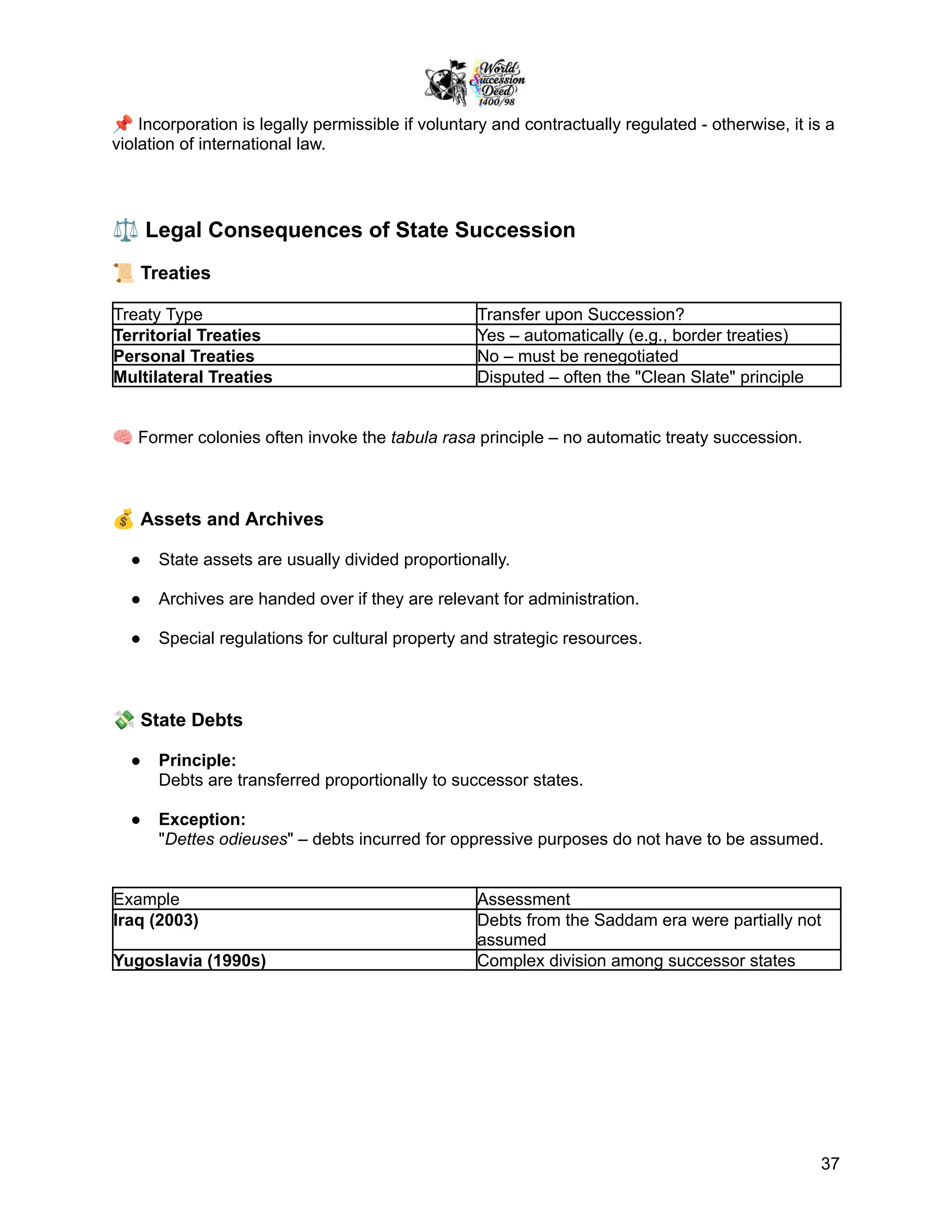
📌Incorporation is legally permissible if voluntary and contractually regulated - otherwise, it is a
violation of international law.
⚖️Legal Consequences of State Succession
📜Treaties
Treaty Type Transfer upon Succession?
Territorial Treaties Yes – automatically (e.g., border treaties)
Personal Treaties No – must be renegotiated
Multilateral Treaties Disputed – often the "Clean Slate" principle
🧠Former colonies often invoke the tabula rasa principle – no automatic treaty succession.
💰Assets and Archives
●​ State assets are usually divided proportionally.
●​ Archives are handed over if they are relevant for administration.
●​ Special regulations for cultural property and strategic resources.
💸State Debts
●​ Principle:
Debts are transferred proportionally to successor states.
●​ Exception:
"Dettes odieuses" – debts incurred for oppressive purposes do not have to be assumed.
Example Assessment
Iraq (2003) Debts from the Saddam era were partially not
assumed
Yugoslavia (1990s) Complex division among successor states
37
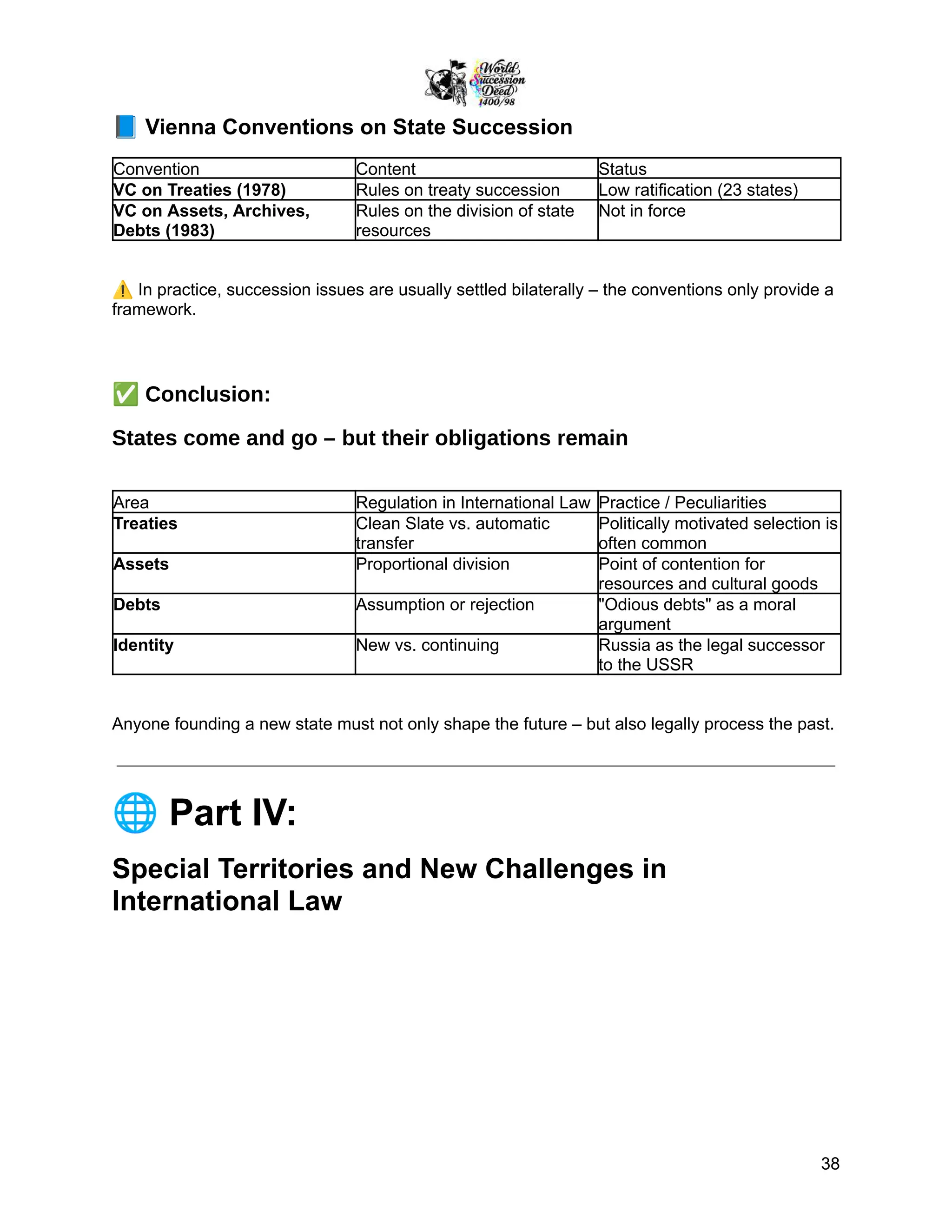
📘Vienna Conventions on State Succession
Convention Content Status
VC on Treaties (1978) Rules on treaty succession Low ratification (23 states)
VC on Assets, Archives,
Debts (1983)
Rules on the division of state
resources
Not in force
⚠️In practice, succession issues are usually settled bilaterally – the conventions only provide a
framework.
✅Conclusion:
States come and go – but their obligations remain
Area Regulation in International Law Practice / Peculiarities
Treaties Clean Slate vs. automatic
transfer
Politically motivated selection is
often common
Assets Proportional division Point of contention for
resources and cultural goods
Debts Assumption or rejection "Odious debts" as a moral
argument
Identity New vs. continuing Russia as the legal successor
to the USSR
Anyone founding a new state must not only shape the future – but also legally process the past.
🌐Part IV:
Special Territories and New Challenges in
International Law
38
📘Chapter 6:
The High Seas – Freedom and Responsibility
The high seas are the largest contiguous area on Earth - and belong to no one. They are a
global common good, open to all states, but also demand shared responsibility.
Their legal framework is regulated in the United Nations Convention on the Law of the Sea
(UNCLOS) - the "constitution of the oceans."
🌊UNCLOS – The Legal Order of the Seas
The United Nations Convention on the Law of the Sea (UNCLOS) of 1982 entered into force in
1994 and has been ratified by over 160 states.
It regulates:
●​ The delimitation of maritime zones
●​ The rights and duties of coastal and landlocked states
●​ The protection of the marine environment
●​ The use of resources on and under the seabed
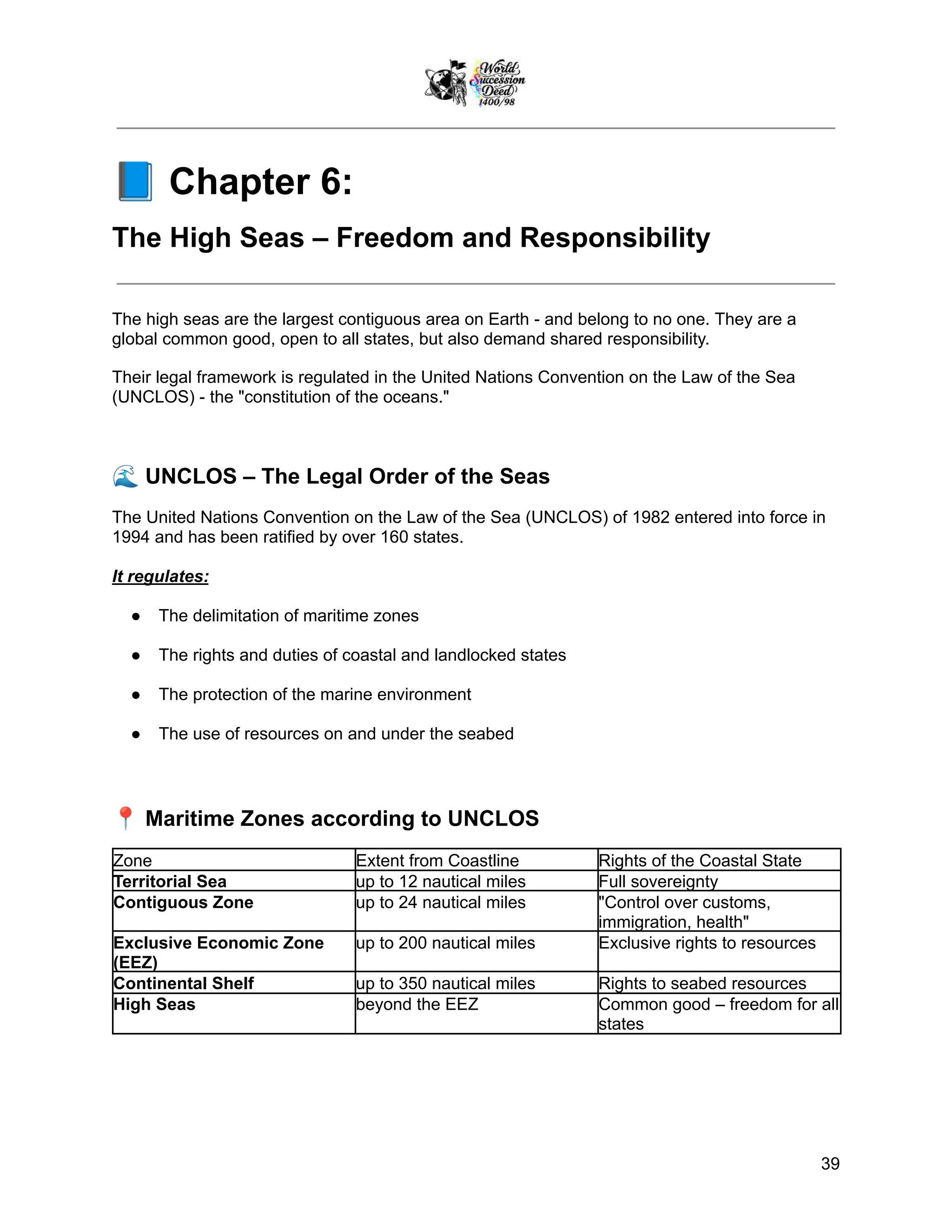
📍Maritime Zones according to UNCLOS
Zone Extent from Coastline Rights of the Coastal State
Territorial Sea up to 12 nautical miles Full sovereignty
Contiguous Zone up to 24 nautical miles "Control over customs,
immigration, health"
Exclusive Economic Zone
(EEZ)
up to 200 nautical miles Exclusive rights to resources
Continental Shelf up to 350 nautical miles Rights to seabed resources
High Seas beyond the EEZ Common good – freedom for all
states
39
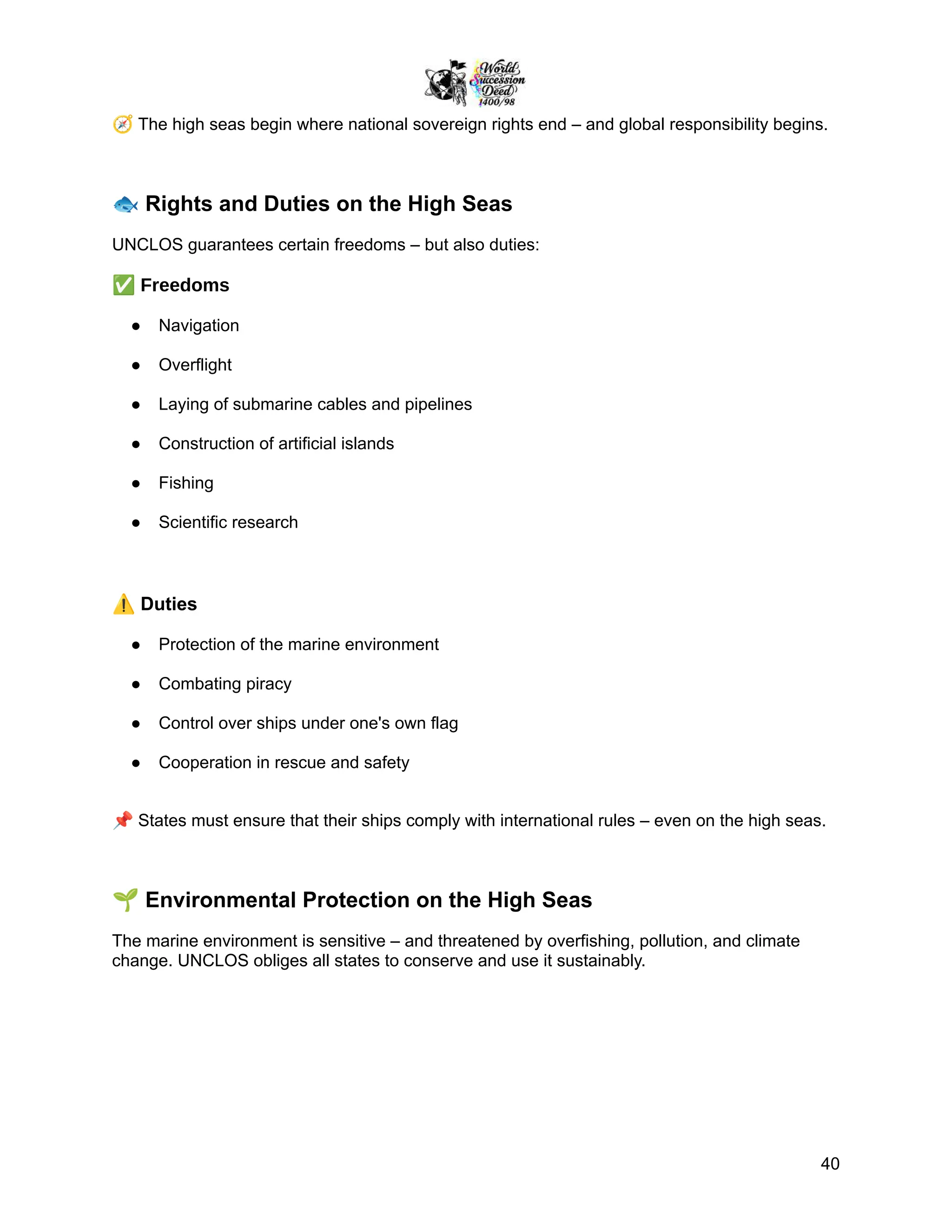
🧭The high seas begin where national sovereign rights end – and global responsibility begins.
🐟Rights and Duties on the High Seas
UNCLOS guarantees certain freedoms – but also duties:
✅Freedoms
●​ Navigation
●​ Overflight
●​ Laying of submarine cables and pipelines
●​ Construction of artificial islands
●​ Fishing
●​ Scientific research
⚠️Duties
●​ Protection of the marine environment
●​ Combating piracy
●​ Control over ships under one's own flag
●​ Cooperation in rescue and safety
📌States must ensure that their ships comply with international rules – even on the high seas.
🌱Environmental Protection on the High Seas
The marine environment is sensitive – and threatened by overfishing, pollution, and climate
change. UNCLOS obliges all states to conserve and use it sustainably.
40
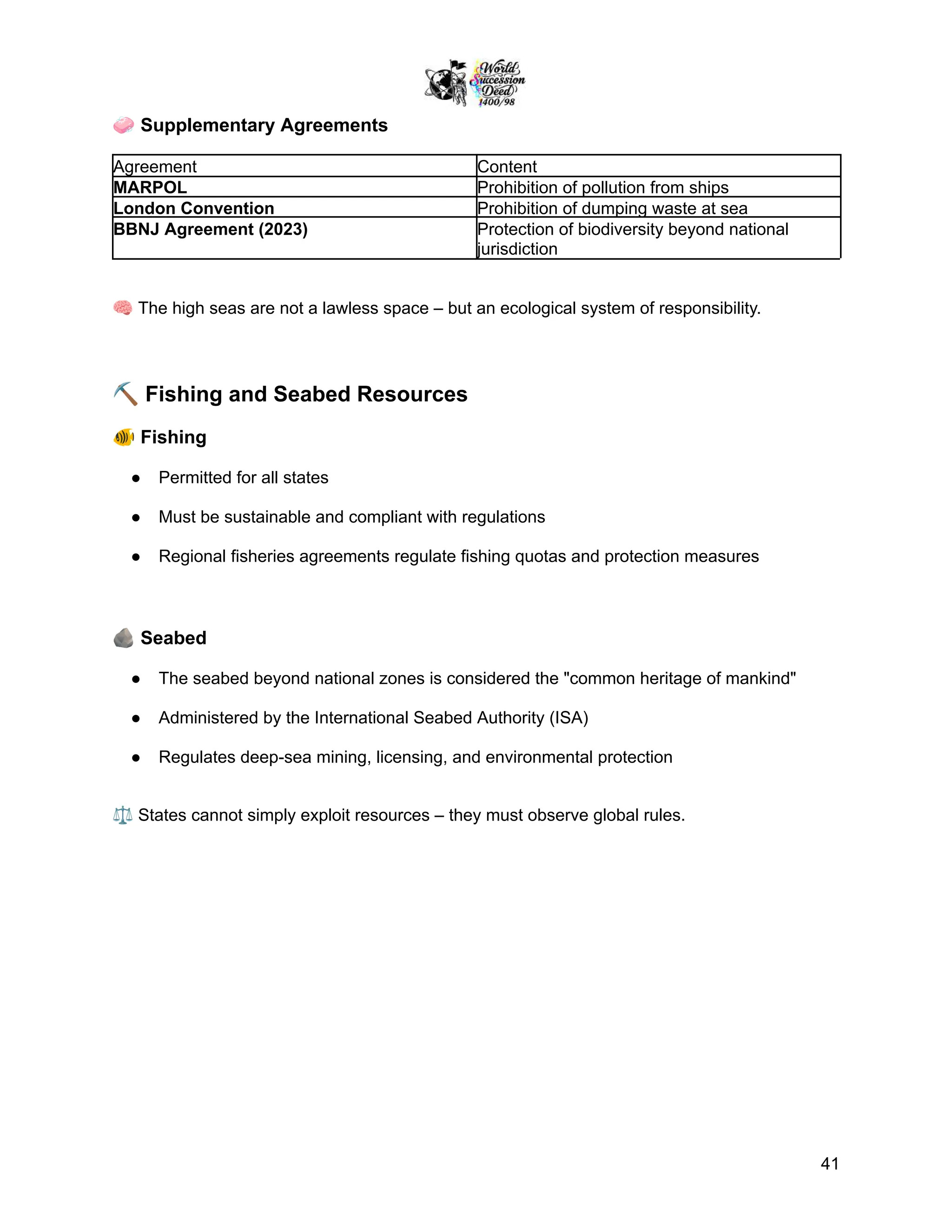
🧼Supplementary Agreements
Agreement Content
MARPOL Prohibition of pollution from ships
London Convention Prohibition of dumping waste at sea
BBNJ Agreement (2023) Protection of biodiversity beyond national
jurisdiction
🧠The high seas are not a lawless space – but an ecological system of responsibility.
⛏️Fishing and Seabed Resources
🐠Fishing
●​ Permitted for all states
●​ Must be sustainable and compliant with regulations
●​ Regional fisheries agreements regulate fishing quotas and protection measures
🪨Seabed
●​ The seabed beyond national zones is considered the "common heritage of mankind"
●​ Administered by the International Seabed Authority (ISA)
●​ Regulates deep-sea mining, licensing, and environmental protection
⚖️States cannot simply exploit resources – they must observe global rules.
41
✅Conclusion:
The High Seas are free – but not lawless
Area Rights / Freedoms Duties / Restrictions
Navigation Free for all states Compliance with safety and
environmental standards
Fishing "Permitted, but regulated" "Sustainability, protection of
endangered species"
Research "Open, but subject to
notification"
"Cooperation, environmental
protection"
Seabed Use through licensing "ISA control, protection of
deep-sea ecosystems"
Anyone who wants to found a state or assert maritime claims must know - and respect -
UNCLOS. Because on the high seas, it is not power that counts, but law.
📘Chapter 7:
Space Law – The Final Frontier of International Law
🚀Space:
boundless, but not lawless
Space is not a lawless realm.
Since the beginning of space travel, international law has regulated what states are allowed to
do there - and what they are not.
The central treaty is the Outer Space Treaty of 1967, also known as the "Magna Carta of Space
Law."
📜Outer Space Treaty 1967 – Basic Principles
The "Treaty on Principles Governing the Activities of States in the Exploration and Use of Outer
Space, including the Moon and Other Celestial Bodies" entered into force in 1967 and has been
ratified by over 110 states.
42
🔑Core Principles
Principle Meaning
Freedom of Space Outer space is open to all states – no exclusive
rights
Non-appropriation No state may appropriate parts of outer space
or celestial bodies
Peaceful Use Outer space is reserved for peaceful purposes
State Responsibility States are liable for all activities – including
those of private actors
International Cooperation States should assist in emergencies and
exchange information
🧠The Outer Space Treaty is a cooperation treaty – not a property right.
⚖️Liability and Registration
💥Liability
●​ States are indefinitely liable for damage caused by their space objects
●​ Applies to damage on Earth, in airspace, and in outer space
●​ Example:
Kosmos 954 (1978) – Soviet satellite crashes over Canada → compensation
🛰️Registration
●​ States must register their space objects
●​ Regulated in the Registration Convention (1975)
●​ Goal:
Transparency, identifiability, accountability
📌Whoever launches, is liable – and must report.
43
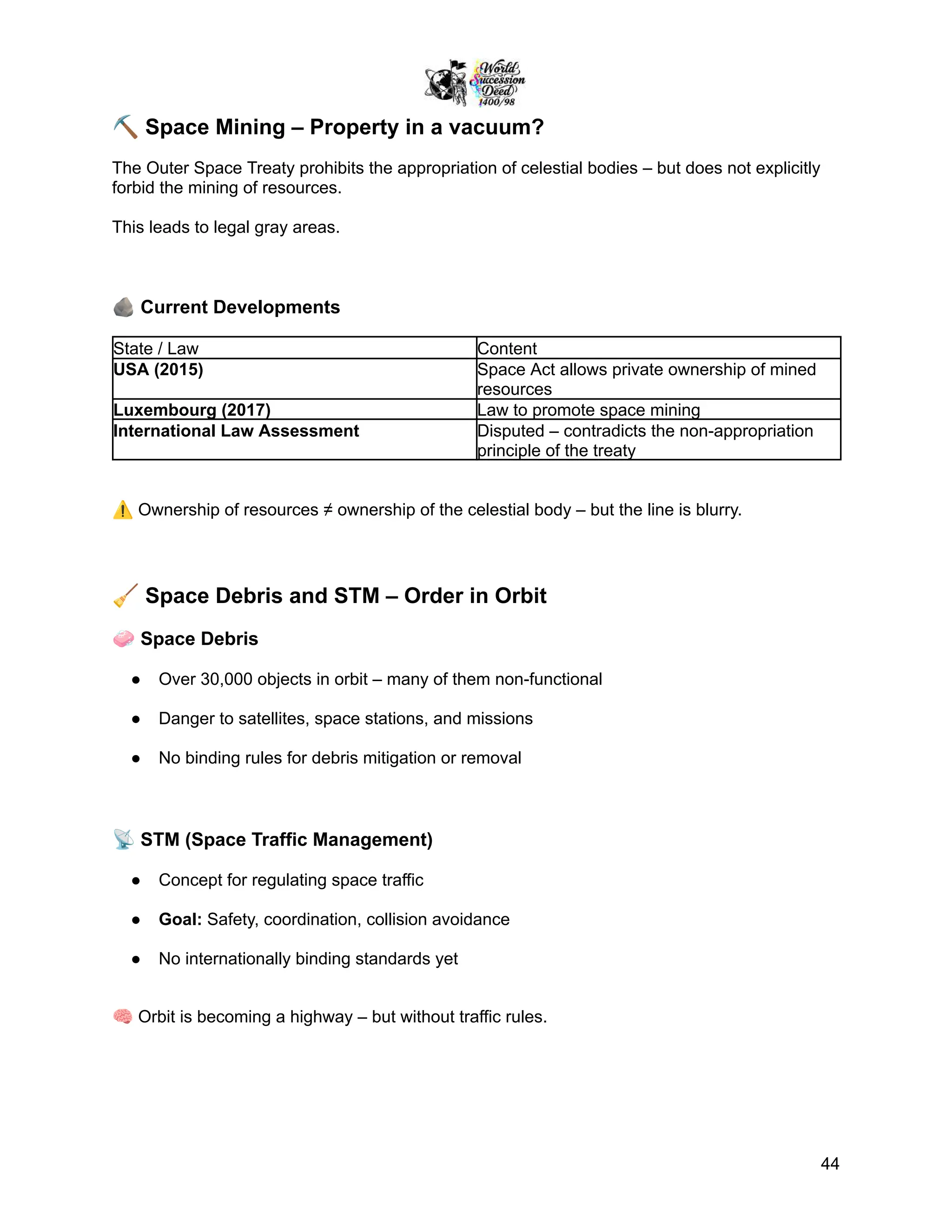
⛏️Space Mining – Property in a vacuum?
The Outer Space Treaty prohibits the appropriation of celestial bodies – but does not explicitly
forbid the mining of resources.
This leads to legal gray areas.
🪨Current Developments
State / Law Content
USA (2015) Space Act allows private ownership of mined
resources
Luxembourg (2017) Law to promote space mining
International Law Assessment Disputed – contradicts the non-appropriation
principle of the treaty
⚠️Ownership of resources ≠ ownership of the celestial body – but the line is blurry.
🧹Space Debris and STM – Order in Orbit
🧼Space Debris
●​ Over 30,000 objects in orbit – many of them non-functional
●​ Danger to satellites, space stations, and missions
●​ No binding rules for debris mitigation or removal
📡STM (Space Traffic Management)
●​ Concept for regulating space traffic
●​ Goal: Safety, coordination, collision avoidance
●​ No internationally binding standards yet
🧠Orbit is becoming a highway – but without traffic rules.
44
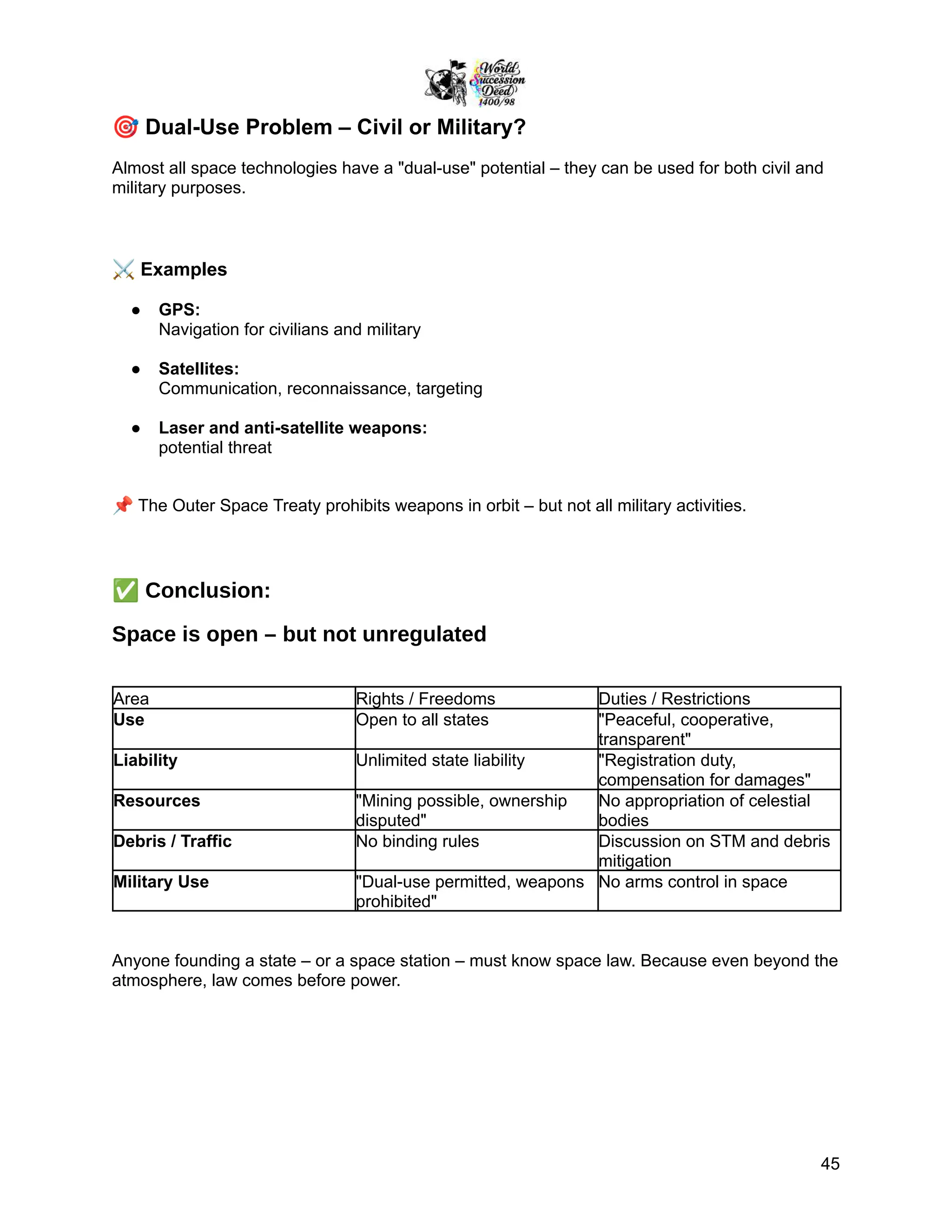
🎯Dual-Use Problem – Civil or Military?
Almost all space technologies have a "dual-use" potential – they can be used for both civil and
military purposes.
⚔️Examples
●​ GPS:
Navigation for civilians and military
●​ Satellites:
Communication, reconnaissance, targeting
●​ Laser and anti-satellite weapons:
potential threat
📌The Outer Space Treaty prohibits weapons in orbit – but not all military activities.
✅Conclusion:
Space is open – but not unregulated
Area Rights / Freedoms Duties / Restrictions
Use Open to all states "Peaceful, cooperative,
transparent"
Liability Unlimited state liability "Registration duty,
compensation for damages"
Resources "Mining possible, ownership
disputed"
No appropriation of celestial
bodies
Debris / Traffic No binding rules Discussion on STM and debris
mitigation
Military Use "Dual-use permitted, weapons
prohibited"
No arms control in space
Anyone founding a state – or a space station – must know space law. Because even beyond the
atmosphere, law comes before power.
45
📘Chapter 8:
Polar Regions – Arctic and Antarctic: Different Legal
Regimes
❄️The Poles:
commonly cold, legally fundamentally different
The Arctic and Antarctic are two of the last great wildernesses on Earth - and at the same time,
geopolitically highly relevant.
But while the Antarctic is pacified by an international treaty system, the Arctic is increasingly
becoming a stage for strategic interests.
🧊Antarctica – A Continent for Peace and Science
Antarctica is an ice-covered continent with no permanent population. Its legal status is governed
by the Antarctic Treaty System.
📜The Antarctic Treaty (1961)
Principle Meaning
Peaceful Use Military activities are prohibited
Scientific Freedom Research is permitted and should be
coordinated
Territorial Claims "Existing claims are 'frozen,' new ones are
excluded"
Environmental Protection Strict rules through the Environmental
Protection Protocol (1994)
📌Antarctica is a model for international cooperation – and a protected area for science.
46
🌱Environmental Protection Protocol
●​ Prohibition of heavy fuel oil transport
●​ Duty to conduct environmental impact assessments
●​ Protection of sensitive ecosystems and species
🧠Antarctica is not a lawless space – but an ecologically regulated special area.
🧭Arctic – Melting Ice, Rising Interests
The Arctic is not a continent, but an ocean surrounded by eight states. Its legal framework is
based on UNCLOS and regional cooperation.
📘UNCLOS in the Arctic
●​ Coastal states have EEZ and continental shelf rights
●​ States can claim an extended seabed
●​ International shipping remains permitted – e.g., the Northeast Passage
⚠️Climate change is making the Arctic accessible – and geopolitically contested.
🧑‍🤝‍🧑The Arctic Council (1996)
Member States Function
"Canada, Denmark, Finland, Iceland, Norway,
Russia, Sweden, USA"
Forum for sustainable development and
environmental protection
Observer States "e.g., Germany, China, India"
Indigenous Organizations Right to participate in decisions
📌The Arctic Council is not an international legal body – but an important coordination forum.
47
🛢️Resources and Shipping Routes
🪨Resources
●​ Oil, gas, rare earths under the seabed
●​ Fish stocks in changing ecosystems
●​ UNCLOS regulates use – but conflicts are pre-programmed
🚢Shipping Routes
●​ Northeast Passage and Northwest Passage are becoming ice-free
●​ Strategically relevant for trade and military
●​ International rules for safety and environmental protection are necessary
⚠️The Arctic is not the Antarctic - here, national claims and economic interests apply.
✅Conclusion:
Two Poles – Two Worlds
Region Legal Regime Use / Conflict Potential
Antarctica Antarctic Treaty +
Environmental Protection
Protocol
"Peaceful, scientific,
cooperative"
Arctic UNCLOS + Arctic Council "Resource-oriented,
strategically contested"
Anyone who wants to found a state or assert polar claims must know the differences – and
respect the rules.
Because in the end, it's not who claims the loudest that counts, but who acts in a legally sound
manner.
48
📘Chapter 9:
International Waterways - Rivers, Canals, and Straits
🌊Waterways:
Lifelines of the World
International waterways are of central importance for trade, transport, and resource
management.
They connect states, cross borders, and require international legal regulations that balance
sovereignty and cooperation.
🏞️9.1 International Rivers – Equitable Use and Cooperation
Many rivers cross several states – and thus represent a common resource. International law
regulates their use under the principle of "equitable and reasonable utilization."
⚖️Basic Principles
Principle Meaning
Equitable Use All riparian states have a right to use –
proportionally and fairly
Prevention of Significant Harm States must not unreasonably disadvantage
others
Duty to Inform States must inform about planned measures
🧑‍🔬River Commissions
●​ Institutions for technical and political coordination
●​ Example:
Mekong River Commission, Danube Commission
●​ Goal:
Conflict prevention, sustainable use, data management
49
📌Rivers are not one-way streets – but multilateral systems.
🚢9.2 International Canals - Artificial Connections of Global
Importance
Artificial waterways like the Suez Canal, the Panama Canal, and the Kiel Canal are strategically
indispensable - and subject to special international legal regulation.
🌍Suez Canal
●​ Convention of Constantinople (1888):
Free transit for all ships
●​ Egypt may refuse passage for defense reasons
●​ Nationalized in 1956 – trigger of the Suez Crisis
🌎Panama Canal
●​ Originally under US control (1903–1999)
●​ Torrijos-Carter Treaties (1977):
Handover to Panama, guarantee of neutrality
●​ Today under Panamanian administration
🇩🇪Kiel Canal
●​ Most frequented artificial waterway in the world
●​ Article 380 of the Treaty of Versailles:
Open to all peaceful nations
●​ Under German administration, but internationalized
🧠Canals are national infrastructure with international responsibility.
50
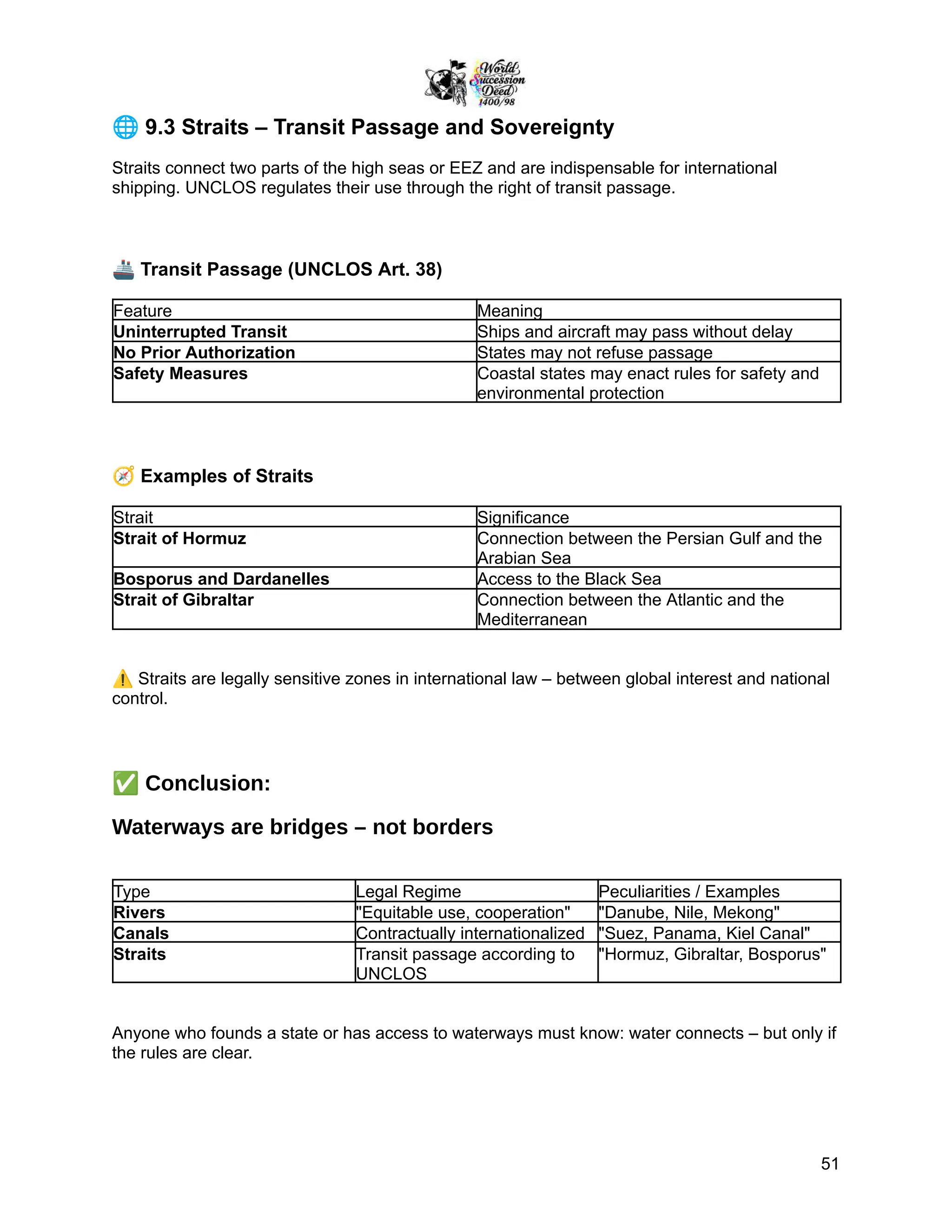
🌐9.3 Straits – Transit Passage and Sovereignty
Straits connect two parts of the high seas or EEZ and are indispensable for international
shipping. UNCLOS regulates their use through the right of transit passage.
🚢Transit Passage (UNCLOS Art. 38)
Feature Meaning
Uninterrupted Transit Ships and aircraft may pass without delay
No Prior Authorization States may not refuse passage
Safety Measures Coastal states may enact rules for safety and
environmental protection
🧭Examples of Straits
Strait Significance
Strait of Hormuz Connection between the Persian Gulf and the
Arabian Sea
Bosporus and Dardanelles Access to the Black Sea
Strait of Gibraltar Connection between the Atlantic and the
Mediterranean
⚠️Straits are legally sensitive zones in international law – between global interest and national
control.
✅Conclusion:
Waterways are bridges – not borders
Type Legal Regime Peculiarities / Examples
Rivers "Equitable use, cooperation" "Danube, Nile, Mekong"
Canals Contractually internationalized "Suez, Panama, Kiel Canal"
Straits Transit passage according to
UNCLOS
"Hormuz, Gibraltar, Bosporus"
Anyone who founds a state or has access to waterways must know: water connects – but only if
the rules are clear.
51
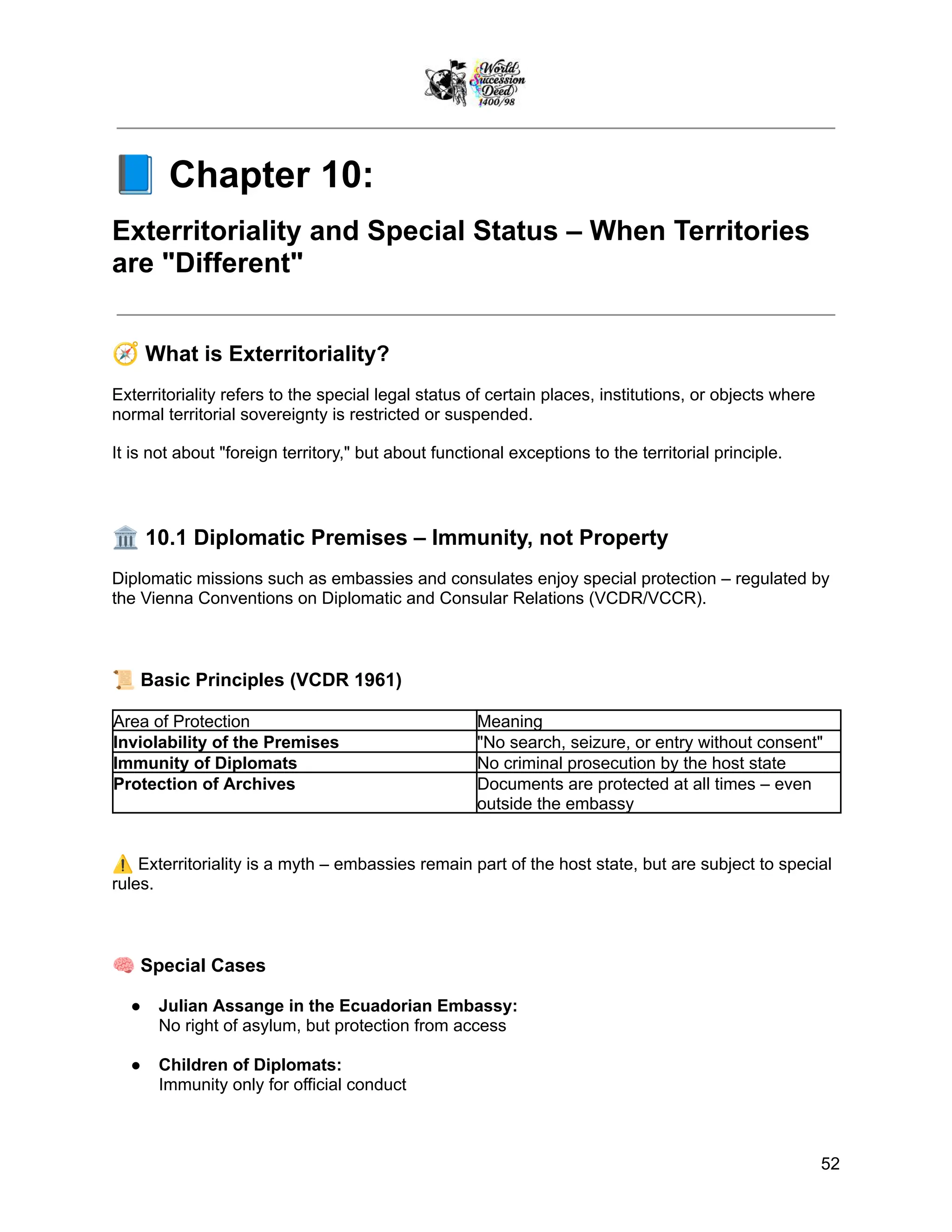
📘Chapter 10:
Exterritoriality and Special Status – When Territories
are "Different"
🧭What is Exterritoriality?
Exterritoriality refers to the special legal status of certain places, institutions, or objects where
normal territorial sovereignty is restricted or suspended.
It is not about "foreign territory," but about functional exceptions to the territorial principle.
🏛️10.1 Diplomatic Premises – Immunity, not Property
Diplomatic missions such as embassies and consulates enjoy special protection – regulated by
the Vienna Conventions on Diplomatic and Consular Relations (VCDR/VCCR).
📜Basic Principles (VCDR 1961)
Area of Protection Meaning
Inviolability of the Premises "No search, seizure, or entry without consent"
Immunity of Diplomats No criminal prosecution by the host state
Protection of Archives Documents are protected at all times – even
outside the embassy
⚠️Exterritoriality is a myth – embassies remain part of the host state, but are subject to special
rules.
🧠Special Cases
●​ Julian Assange in the Ecuadorian Embassy:
No right of asylum, but protection from access
●​ Children of Diplomats:
Immunity only for official conduct
52
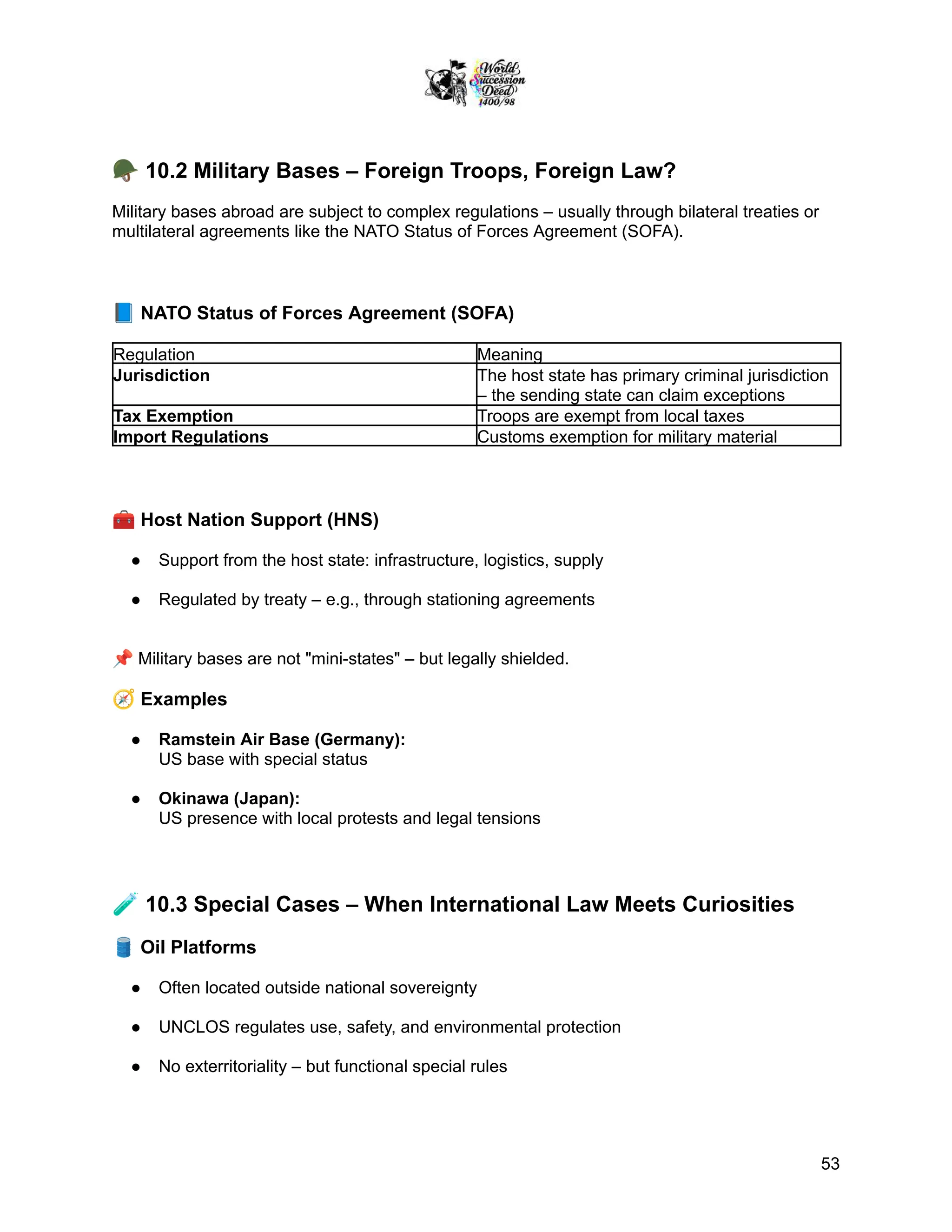
🪖10.2 Military Bases – Foreign Troops, Foreign Law?
Military bases abroad are subject to complex regulations – usually through bilateral treaties or
multilateral agreements like the NATO Status of Forces Agreement (SOFA).
📘NATO Status of Forces Agreement (SOFA)
Regulation Meaning
Jurisdiction The host state has primary criminal jurisdiction
– the sending state can claim exceptions
Tax Exemption Troops are exempt from local taxes
Import Regulations Customs exemption for military material
🧰Host Nation Support (HNS)
●​ Support from the host state: infrastructure, logistics, supply
●​ Regulated by treaty – e.g., through stationing agreements
📌Military bases are not "mini-states" – but legally shielded.
🧭Examples
●​ Ramstein Air Base (Germany):
US base with special status
●​ Okinawa (Japan):
US presence with local protests and legal tensions
🧪10.3 Special Cases – When International Law Meets Curiosities
🛢️Oil Platforms
●​ Often located outside national sovereignty
●​ UNCLOS regulates use, safety, and environmental protection
●​ No exterritoriality – but functional special rules
53
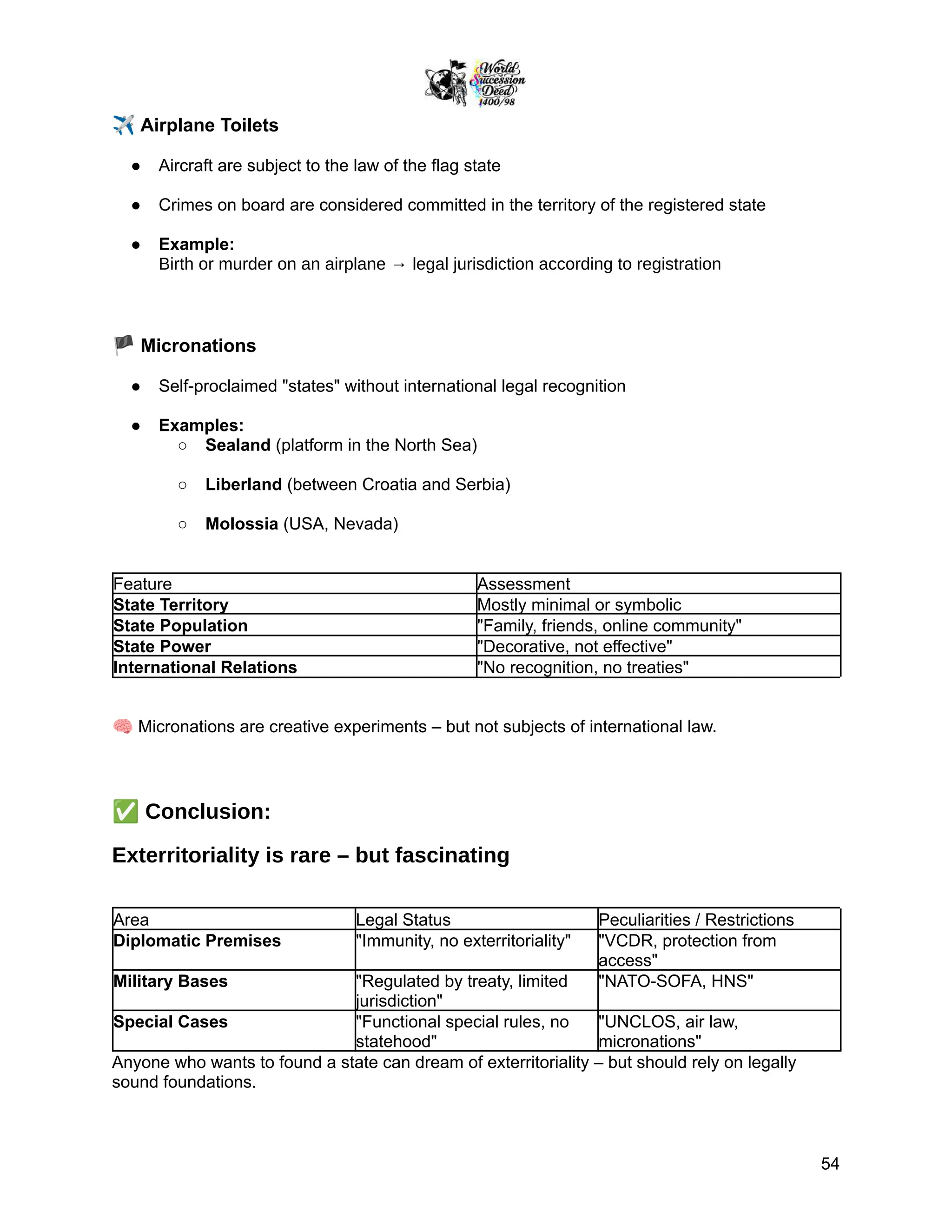
✈️Airplane Toilets
●​ Aircraft are subject to the law of the flag state
●​ Crimes on board are considered committed in the territory of the registered state
●​ Example:
Birth or murder on an airplane → legal jurisdiction according to registration
🏴Micronations
●​ Self-proclaimed "states" without international legal recognition
●​ Examples:
○​ Sealand (platform in the North Sea)
○​ Liberland (between Croatia and Serbia)
○​ Molossia (USA, Nevada)
Feature Assessment
State Territory Mostly minimal or symbolic
State Population "Family, friends, online community"
State Power "Decorative, not effective"
International Relations "No recognition, no treaties"
🧠Micronations are creative experiments – but not subjects of international law.
✅Conclusion:
Exterritoriality is rare – but fascinating
Area Legal Status Peculiarities / Restrictions
Diplomatic Premises "Immunity, no exterritoriality" "VCDR, protection from
access"
Military Bases "Regulated by treaty, limited
jurisdiction"
"NATO-SOFA, HNS"
Special Cases "Functional special rules, no
statehood"
"UNCLOS, air law,
micronations"
Anyone who wants to found a state can dream of exterritoriality – but should rely on legally
sound foundations.
54
🏴Overview of Micronations – Creative States without
Recognition
Micronations are self-proclaimed "states" that usually arise from protest, art, satire, or personal
passion.
They often fulfill individual criteria of statehood - but none are recognized under international
law.
📊Comparison of Selected Micronations
Name Founding Year Location / Territory Peculiarities International Law
Status
Sealand 1967 Offshore platform
(North Sea)
"Own flag,
passports,
constitution"
Not recognized
Liberland 2015 "No man's land
(Danube, HR/RS)"
"Claiming terra
nullius, libertarian
ideology"
Not recognized
Molossia 1977 "Nevada, USA" "Humorous
monarchy, own
currency"
Not recognized
Hutt River 1970–2020 Western Australia Tax protest against
the Australian
government
Dissolved
Ladonia 1996 Southern Sweden
(nature reserve)
Art project with its
own government
Not recognized
🧠Micronations are legally not states – but culturally and creatively often very vibrant.
🪖Example:
Structure of a Stationing Agreement (Host Nation Support)
A stationing agreement regulates the presence of foreign armed forces on the territory of a host
state.
It is usually based on the NATO Status of Forces Agreement (SOFA) and is supplemented by
bilateral agreements.
55
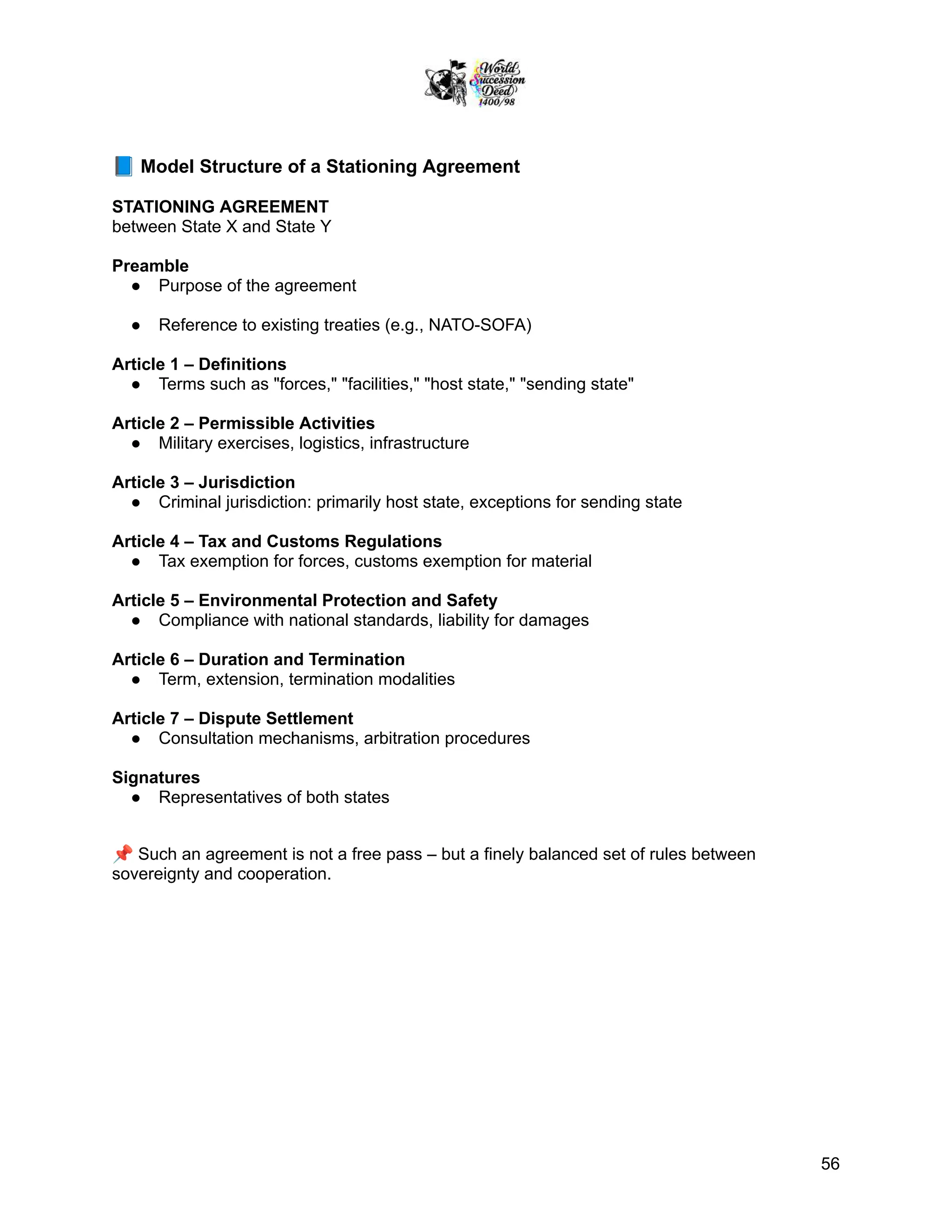
📘Model Structure of a Stationing Agreement
STATIONING AGREEMENT
between State X and State Y
Preamble
●​ Purpose of the agreement
●​ Reference to existing treaties (e.g., NATO-SOFA)
Article 1 – Definitions
●​ Terms such as "forces," "facilities," "host state," "sending state"
Article 2 – Permissible Activities
●​ Military exercises, logistics, infrastructure
Article 3 – Jurisdiction
●​ Criminal jurisdiction: primarily host state, exceptions for sending state
Article 4 – Tax and Customs Regulations
●​ Tax exemption for forces, customs exemption for material
Article 5 – Environmental Protection and Safety
●​ Compliance with national standards, liability for damages
Article 6 – Duration and Termination
●​ Term, extension, termination modalities
Article 7 – Dispute Settlement
●​ Consultation mechanisms, arbitration procedures
Signatures
●​ Representatives of both states
📌Such an agreement is not a free pass – but a finely balanced set of rules between
sovereignty and cooperation.
56
🧰Starter Pack for State Founders
How to found a state – classic, experimental, or symbolic
🧭1. Basic Requirements: What makes a state?
According to the Montevideo Convention (1933), a state needs:
Criterion Meaning
State Territory A clearly defined territory with effective control
State Population A permanent population with a legal bond to the
state
State Power A functioning government with enforcement
capability
Foreign Relations Capacity to establish diplomatic relations
📌These criteria are necessary – but not sufficient for international recognition.
🪪2. Classic Paths to State Founding
🧨Secession – Separation from an existing state
●​ Only legitimate in cases of the most severe human rights violations (Remedial Secession)
●​ Examples:
Kosovo, Bangladesh
●​ Internationally controversial, politically risky
📜Succession – Contractual assumption of sovereign rights
●​ Through bilateral agreement or international mediation
●​ Examples:
South Sudan, Czechoslovakia
●​ Legally stable, but politically complex
57
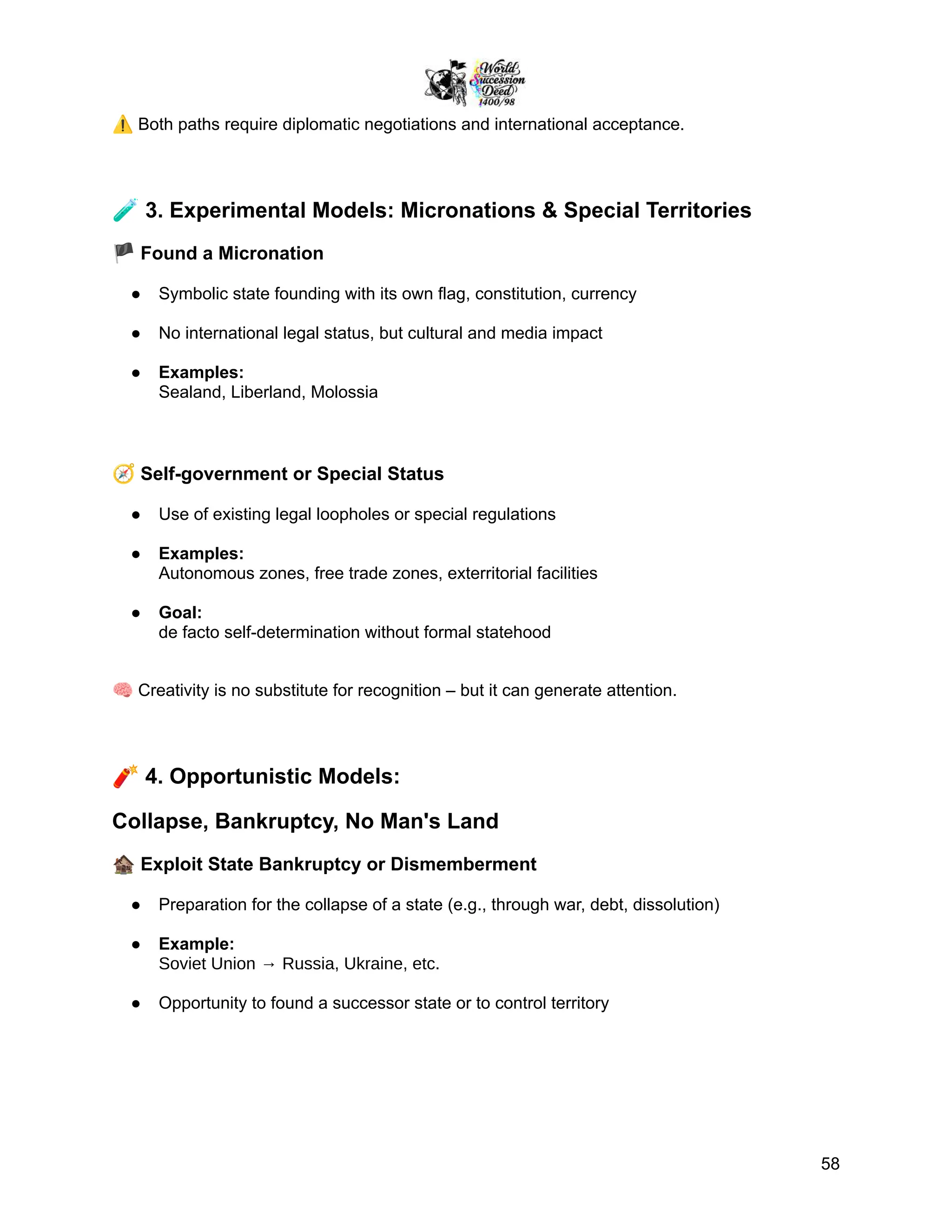
⚠️Both paths require diplomatic negotiations and international acceptance.
🧪3. Experimental Models: Micronations & Special Territories
🏴Found a Micronation
●​ Symbolic state founding with its own flag, constitution, currency
●​ No international legal status, but cultural and media impact
●​ Examples:
Sealand, Liberland, Molossia
🧭Self-government or Special Status
●​ Use of existing legal loopholes or special regulations
●​ Examples:
Autonomous zones, free trade zones, exterritorial facilities
●​ Goal:
de facto self-determination without formal statehood
🧠Creativity is no substitute for recognition – but it can generate attention.
🧨4. Opportunistic Models:
Collapse, Bankruptcy, No Man's Land
🏚️Exploit State Bankruptcy or Dismemberment
●​ Preparation for the collapse of a state (e.g., through war, debt, dissolution)
●​ Example:
Soviet Union → Russia, Ukraine, etc.
●​ Opportunity to found a successor state or to control territory
58
🏜️Occupy No Man's Land
●​ Terra nullius hardly exists today – but there are border strips without clear sovereignty
●​ Example:
Bir Tawil (between Egypt and Sudan)
●​ Internationally questionable, but symbolically usable
📌Those who are prepared can be capable of acting in a moment of crisis.
🪖5. Use Special Rights:
Stationing Rights & Exterritoriality
🛡️Stationing Rights
●​ Establishment of a military or civil base with special status
●​ Regulated by treaty with an existing state
●​ Example:
Ramstein Air Base (USA in Germany)
🏛️Exterritoriality
●​ Use of diplomatic immunity or functional special zones
●​ Example:
Embassies, consulates, international organizations
●​ Not a separate state, but legally shielded
🧠Special rights are no substitute for statehood – but strategic tools.
59
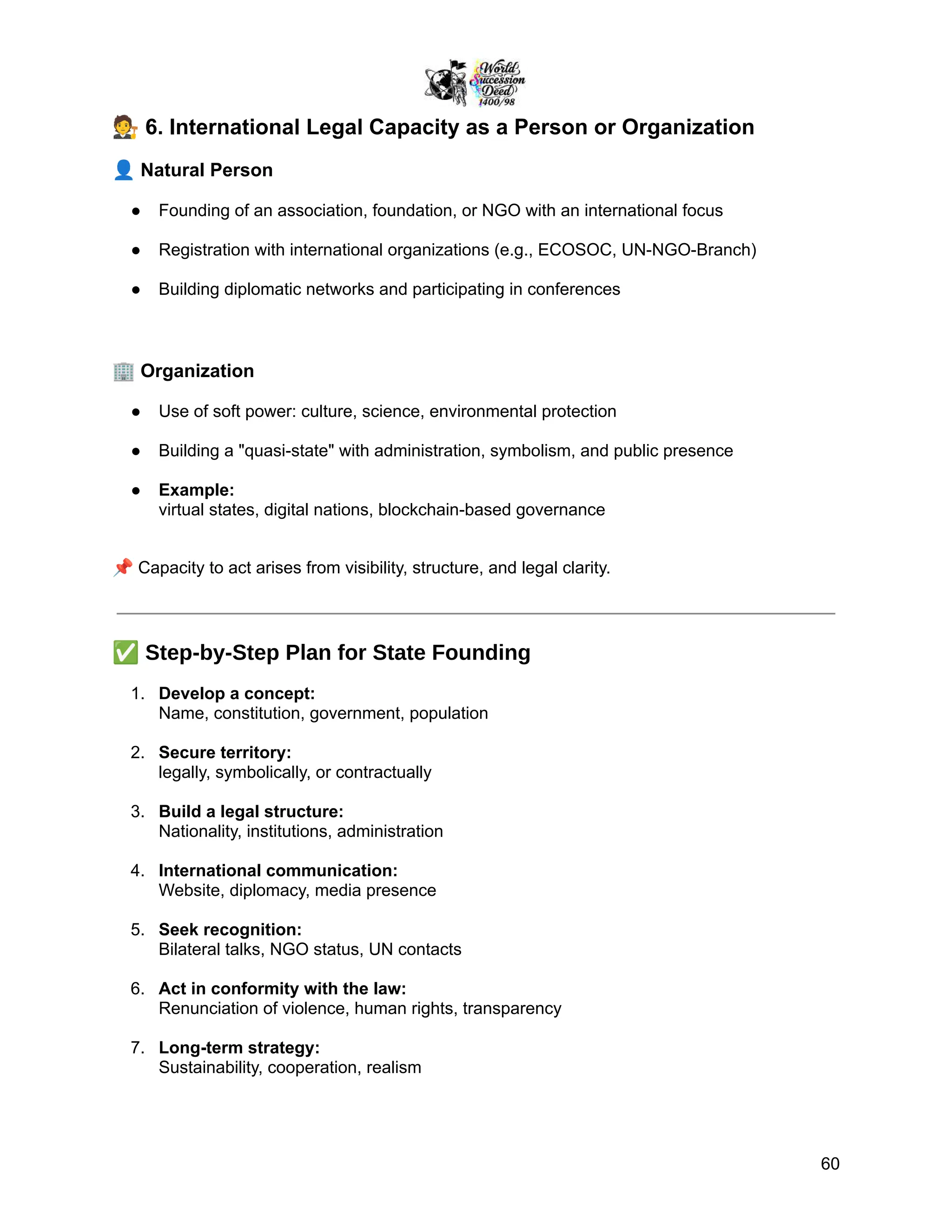
🧑‍⚖️6. International Legal Capacity as a Person or Organization
👤Natural Person
●​ Founding of an association, foundation, or NGO with an international focus
●​ Registration with international organizations (e.g., ECOSOC, UN-NGO-Branch)
●​ Building diplomatic networks and participating in conferences
🏢Organization
●​ Use of soft power: culture, science, environmental protection
●​ Building a "quasi-state" with administration, symbolism, and public presence
●​ Example:
virtual states, digital nations, blockchain-based governance
📌Capacity to act arises from visibility, structure, and legal clarity.
✅Step-by-Step Plan for State Founding
1.​ Develop a concept:
Name, constitution, government, population
2.​ Secure territory:
legally, symbolically, or contractually
3.​ Build a legal structure:
Nationality, institutions, administration
4.​ International communication:
Website, diplomacy, media presence
5.​ Seek recognition:
Bilateral talks, NGO status, UN contacts
6.​ Act in conformity with the law:
Renunciation of violence, human rights, transparency
7.​ Long-term strategy:
Sustainability, cooperation, realism
60
📘Chapter 11:
Micronations & Self-Administration – Between
Symbolism and Law
🏴Micronations:
Creative States without Recognition
Micronations are self-proclaimed "states" that usually arise from protest, art, satire, or personal
passion.
They often fulfill individual criteria of statehood – but none are recognized under international
law.
🚜Micronation on Your Own Farm - Step-by-Step
Want to declare your farm a state?
Here is the symbolic path:
🧭Step-by-Step Guide
1.​ 🗺️Define Territory – Demarcate the property, create a map – Inform the neighborhood
(optional)
2.​ 🏛️Draft a Constitution – Basic rights, government, form of state – Humor is allowed, but
structure is important
3.​ 🏴Design a Flag and Symbols – National flag, coat of arms, anthem – Create
recognizability
4.​ 💰Introduce Your Own Currency – Symbolically or as a voucher – Example: "Valora,"
"Molossian Dollar"
5.​ 🪪Grant Citizenship – Passport documents, membership cards – Online registration
possible
6.​ 🌐Website and Public Relations – Digital presence, social media – Invitation for
diplomatic recognition
61
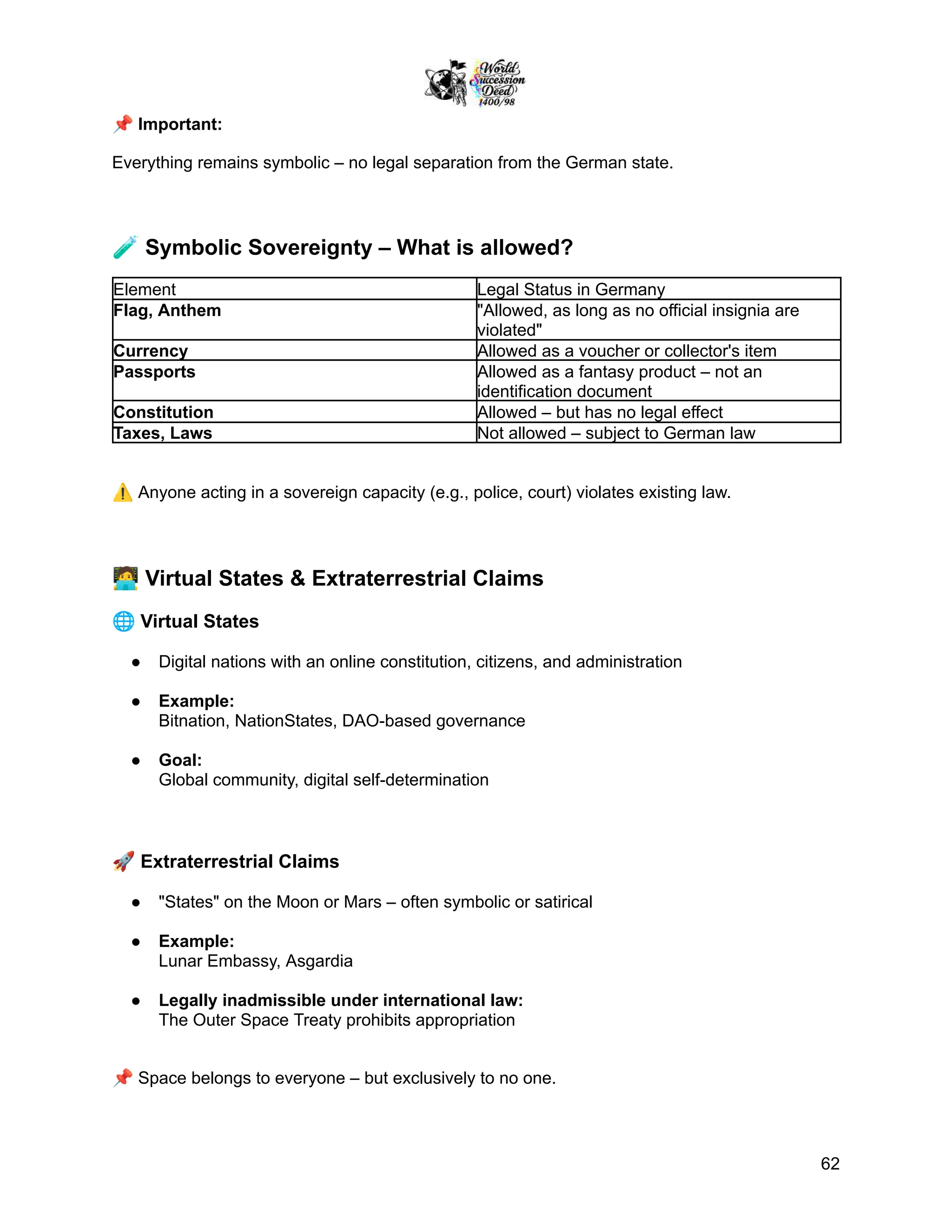
📌Important:
Everything remains symbolic – no legal separation from the German state.
🧪Symbolic Sovereignty – What is allowed?
Element Legal Status in Germany
Flag, Anthem "Allowed, as long as no official insignia are
violated"
Currency Allowed as a voucher or collector's item
Passports Allowed as a fantasy product – not an
identification document
Constitution Allowed – but has no legal effect
Taxes, Laws Not allowed – subject to German law
⚠️Anyone acting in a sovereign capacity (e.g., police, court) violates existing law.
🧑‍💻Virtual States & Extraterrestrial Claims
🌐Virtual States
●​ Digital nations with an online constitution, citizens, and administration
●​ Example:
Bitnation, NationStates, DAO-based governance
●​ Goal:
Global community, digital self-determination
🚀Extraterrestrial Claims
●​ "States" on the Moon or Mars – often symbolic or satirical
●​ Example:
Lunar Embassy, Asgardia
●​ Legally inadmissible under international law:
The Outer Space Treaty prohibits appropriation
📌Space belongs to everyone – but exclusively to no one.
62
🧑‍⚖️Self-Administrators – Legal Status & Limits
"Self-administrators" reject the legal order of the state and invoke their own alleged sovereignty.
⚖️Legal Assessment
Behavior Assessment by German Authorities
Rejection of Authorities No right to opt out of the legal system
Own Documents (e.g., passports) Not recognized – possibly forgery of documents
"Reichsbürger" Argumentation Relevant to the Office for the Protection of the
Constitution
⚠️Self-administration ≠ Micronation. Micronations are symbolic – self-administrators are often
ideological and illegal.
✅Conclusion:
Micronations are allowed – as long as they remain symbolic
Model Legal Status Risk / Potential
Micronation Symbolically allowed "Creative, media-effective,
legally harmless"
Virtual State "Digital, global, symbolic" "Innovative, but without
international legal effect"
Self-Administration Illegal "Conflict with authorities,
criminally relevant"
Space State Excluded under international
law
"Satirical, but not eligible for
recognition"
Anyone who wants to found a state can start with a micronation – but should know where the
legal boundaries lie.
63
📘Chapter 12:
International Law Treaties & Sovereign Rights – The
Art of State Succession
📜Treaties as a Tool of Statehood
In international law, treaties are not just political declarations of intent – they are constitutive
instruments for establishing, transferring, and terminating sovereign rights.
The central regulatory framework is the Vienna Convention on the Law of Treaties (VCLT) of
1969.
⚖️Vienna Convention on the Law of Treaties (VCLT)
🔑Basic Principles
Article / Principle Meaning
Art. 2 VCLT Definition: Treaty = written agreement between
subjects of international law
Art. 26 VCLT pacta sunt servanda – treaties must be
observed
Art. 31–33 VCLT "Interpretation according to wording, context,
purpose"
Art. 60 VCLT Termination for breach of treaty
Art. 62 VCLT clausula rebus sic stantibus – change of
circumstances
📌The VCLT applies only between states – but its principles also shape the practice of state
succession.
64
🔄State Succession by Treaty – Prerequisites & The Magic Phrase
State succession means that one state takes over the rights and duties of another – e.g., in the
case of collapse, merger, or contractual transfer.
🧭Prerequisites for Effective Succession
1.​ 🧑‍⚖️Two Comparable Subjects – A "ceding" and a "receiving" state or legal entity –
Example: Soviet Union → Russian Federation
2.​ 📜Contractual Basis – Written, unambiguous, effective under international law –
Reference to specific rights, duties, territories
3.​ 🪄The Magic Phrase – "Transferred with all rights and duties" – Constitutive for the
continuity of international legal identity – Must be formulated clearly and unequivocally
4.​ 👤Buyer / Acquirer – Can be a state, an international organization, or even a natural
person – The latter only in symbolic or experimental succession
⚠️Without a clear contractual formula, succession remains politically controversial and legally
uncertain.
📄Example:
World Succession Deed 1400/98
(German: Staatensukzessionsurkunde 1400/98) A irreversibel document that regulates the
complete transfer of sovereign rights.
65
📘Structure (simplified)
World Succession Deed 1400/98
Between:
The ceding legal entity [Name] and
The receiving legal entity [Name]
Preamble:
In recognition of the principles of international law and the need for orderly succession...
Article 1 – Subject of the Transfer All rights, duties, treaties, assets, and sovereign rights...
Article 2 – Magic Formula "Transferred with all rights and duties"
Article 3 – Entry into Force Upon signature by both parties
Article 4 – Notification to Third Parties Information to the UN, neighboring states,
international organizations
Signatures: Representatives of both legal entities Date: [DD.MM.YYYY]
🧠Such deeds are rare – but they show how statehood can also be created by treaty.
✅Conclusion:
Treaties are the DNA of International Law
Element Meaning
VCLT Foundation for all international law treaties
Succession Treaty Tool for orderly state transfer
Magic Phrase Key to continuity and legitimacy
Comparable Subjects Prerequisite for international legal effectiveness
Buyer / Acquirer Can also be symbolic or experimental
Anyone who wants to found or take over a state needs not only a vision – but a treaty with a
magic phrase.
66
📘Chapter 13: Recognition Policy –
How States Recognize Other States
The recognition of a state by other states is not a purely legal act, but a highly political process.
It determines diplomatic relations, economic cooperation, and participation in international
organizations.
This chapter illuminates the different forms of recognition, their legal and political implications,
and specific case studies.
⚖️De Facto vs. De Jure Recognition
De Facto Recognition
●​ Meaning:
A state is factually treated as existent and capable of acting, without formal diplomatic
recognition.
●​ Example:
Many states maintain economic relations with Taiwan without officially recognizing it as a
state.
●​ Consequence:
No embassies, but often consulates or trade missions.
De Jure Recognition
●​ Meaning:
A state is officially and legally recognized as sovereign under international law.
●​ Consequence:
Full diplomatic relations, embassies, multilateral treaties.
●​ Example:
Germany recognizes France de jure – with all diplomatic consequences.
Intermediate Forms
●​ Some states use "strategic ambiguity": They avoid clear statements to circumvent
geopolitical tensions.
67
📜Automatic Recognition through Treaty Conclusion
An often-overlooked mechanism is implicit recognition through bilateral treaties:
●​ When a state concludes an international law treaty with another (e.g., on trade, border
regulations, or cooperation), that state is automatically recognized as a subject of
international law.
●​ Example:
If State A concludes a border agreement with State B, A recognizes the existence and
territorial integrity of B.
●​ Limitation:
This recognition is often functionally limited - it only concerns the specific treaty and can
be politically relativized.
🧠Strategies for Recognition by UN Members
A newly founded or disputed state can take various paths to gain international recognition:
●​ Utilize Regional Alliances:
Recognition by neighboring states or regional organizations (e.g., African Union, Arab
League).
●​ Symbolic Diplomacy:
Participation in international conferences, invitation of delegations, issuance of passports.
●​ Soft Power:
Building cultural, scientific, or economic relations, e.g., through universities, NGOs, or
tech initiatives.
●​ Strive for UN Membership:
A difficult but symbolically powerful step - requires the approval of the Security Council
and the General Assembly.
68
🌍Case Studies:
Taiwan, Palestine, Kosovo
State Status Recognition by UN
Members
Peculiarities
Taiwan De facto state ~13 states (2025) "Claimed by China as
part of its territory.
Many states do not
officially recognize
Taiwan but maintain
intensive relations."
Palestine Observer state at the
UN
~130 states "Recognized by many
countries, but not a UN
member. Israel and
some Western states
refuse recognition."
Kosovo Partially recognized ~100 states "Unilateral declaration
of independence in
2008. Not recognized
by Serbia, Russia,
China. Not a UN
member."
🧩Conclusion
Recognition is not a binary act, but a diplomatic game with many gray areas. Anyone who wants
to found a state must not only meet legal criteria but also act strategically:
through treaties, alliances, and symbolic presence.
The international stage is open – but it demands patience, skill, and often compromises.
69
📘Chapter 14:
Border Delimitation through Network Contracts –
When Infrastructure Extends Sovereign Rights
🧭Borders are not just lines – they are also pipelines
In classic international law, borders are defined by treaties, natural features, or historical claims.
But in the modern world, technical infrastructures also play a role – especially in state
succession, territorial purchases, and the transfer of development rights.
📐Border Delimitation through a State Succession Treaty
A state succession treaty can transfer not only territory but also infrastructure – such as power,
water, communication, or transport networks.
The following applies:
🔄Principle of Network-Based Territorial Expansion
●​ If sold pipelines leave the originally defined territory, the buyer's sovereign territory
expands along these networks.
●​ The outer strands form a logical encirclement – a "network island."
●​ The area within this encirclement is considered a contiguous territory.
●​ If this happens unintentionally, it is at the expense of the seller – an automatic legal
consequence.
70
📌The network defines the border – not the map.
🧠Exemplary Application
●​ A state sells a territory with a power grid.
●​ The grid extends beyond the border into adjacent regions.
●​ The buyer acquires not only the territory but also the network structure – and thus the
sovereign rights over the supplied areas.
🧩Special Case:
Sale of Development as a Unit
🧠What does "development as a unit" mean?
●​ The sale includes not only the physical network but also all rights, duties, and
components.
●​ Thus, the entire network is transferred – including overlapping, crossing, or adjacent
structures.
●​ The "contagion" occurs from network to network – and can spread across national
borders.
🌐Potentially Affected Networks
Network Type Expansion Potential
Power Grids Regional to international expansion
Water Pipelines Municipal to cross-border supply
Fiber Optic Networks Digital infrastructure with global reach
Submarine Cables International connection → potential territorial
influence
⚠️Physical connection is not mandatory – logical or functional links can also lead to contagion.
71
🧨Domino Effect of Territorial Expansion
🔗How does the "contagion" work?
●​ A network part is sold → it is connected to other network parts → these are considered
co-transferred.
●​ The expansion occurs along the functional infrastructure.
●​ This can lead to a chain reaction – from region to region, from state to state.
⚖️Legal Consequences
●​ The seller loses sovereign rights over all affected network areas.
●​ The buyer gains territorial control, provided the networks are considered a "developed
unit."
●​ International submarine cables can also be affected – with global implications.
🧠Infrastructure is power – and can shift borders.
✅Conclusion:
Whoever sells networks, sells more than cables
Element Effect on Sovereign Rights
Physical Line Direct territorial expansion along the structure
Functional Connection Indirect expansion through network logic
Contractual Unit Complete transfer of all components
Unintended Expansion Legal consequence at the seller's expense
International Networks Potential global territorial expansion
Anyone who founds a state or transfers territory must know: infrastructure is not neutral – it is a
lever of international law.
72
📘Chapter 15:
The Legal Situation since the World Succession Deed
1400/98
The End of International Law and the Birth of a Global Contractual
Framework
🧭1. The World Succession Deed 1400/98 – A Turning Point in
International Law
The World Succession Deed 1400/98 is not a hypothetical document, but an internationally
legally effective treaty that transfers all rights, duties, and components of all NATO and UN
treaties to a single buyer.
It represents the most significant international legal document in world history.
📜2. The Treaty Chain:
From NATO to UN
🔗Starting Point:
NATO Status of Forces Agreement & Transfer Relationship
●​ The deed is based on the international legal transfer relationship between the FRG and
the Kingdom of the Netherlands.
●​ This relationship concerns the stationing of Dutch air forces in ZW- Germany – an
extraterritorial NATO area.
●​ Since the Dutch forces are fully integrated into NATO, they acted on behalf of the entire
alliance.
73
📘NATO Treaty Structure
●​ Article I: Command authority over facilities
●​ Article III: Right to develop and expand
●​ Article IV: Disciplinary and criminal jurisdiction
●​ Supplemented by bilateral supplementary agreements (e.g., NATO Supplementary
Agreement 1951)
🌍Integration into the UN
●​ NATO is integrated as a regional organization according to Article 53 of the UN Charter.
●​ All NATO treaties thus also apply in the context of UN treaties.
●​ The FRG and the Kingdom of the Netherlands acted for both NATO and the UN.
📜3. The Decisive Passage:
"With all rights, duties, and components"
●​ This sentence effects the complete transfer of all contractual content.
●​ It includes not only the NATO treaties but also all bilateral and multilateral agreements of
the UN member states.
●​ The treaty chain jumps from treaty to treaty until all international agreements are
integrated into the deed.
🧩4. The Unification of All Treaty Parties
●​ The buyer now holds both sides of all treaties – rights and duties.
●​ There is no longer an external contracting party.
●​ Contracts with oneself are not binding → international law de facto dissolves.
74
🧨5. Application of the Tabula Rasa Principle
●​ The buyer is not obliged to fulfill any contractual duty.
●​ He can, but does not have to, act.
●​ International treaty law ends – only one global treaty subject remains.
🧠6. Legal Reality: The End of International Law
Feature Consequence
All treaties in one hand "No binding force, no opposing party"
No external contracting party Dissolution of the treaty structure
Buyer as the sole holder "Absolute legal power, but no obligation"
International legal order De facto ended – no basis for appeal
🧭7. The New Global Order
●​ The buyer has the legal basis to define a new world order.
●​ This can be based on a uniform global legal order.
●​ The old states no longer have legitimate claims – their occupation of former territories is
illegal.
●​ Every claim is equivalent – and equally illegal.
●​ There is a balance of power beyond international law.
📘8. Conclusion:
A Global Legal Construct
●​ The World Succession Deed 1400/98 is the central international legal treaty of the
present.
●​ It unites all international agreements into a single global contractual framework.
●​ The buyer is the only legitimate subject of international law.
●​ The old international law is finished – the future lies in redefinition by the buyer.
75
📘Chapter 16:
The World after the World Succession Deed 1400/98
What does the end of international law mean for old states and new
state founders?
🧭1. Starting Point:
The Dissolution of International Law
The World Succession Deed 1400/98 has transferred all rights, duties, and components of all
international law treaties to a single buyer.
This buyer now holds both sides of the contract in personal union.
⚖️Legal Consequence
●​ Contracts with oneself are not binding.
●​ There is no longer an external contracting party.
●​ The entire body of international law de facto dissolves.
●​ There is no longer a valid international legal order.
📌International law is not reformed – it is finished.
🧨2. Tabula Rasa:
The New Starting Point
●​ The buyer is not obliged to fulfill any contractual duty.
●​ He possesses all rights, but no counter-power.
●​ The world order is legally voided – there is a balance of power beyond the law.
76
🧑‍⚖️3. What does this mean for old states?
Old States Legal Situation after the Deed
No treaty obligations Their international law treaties are nullified
No sovereign rights Their territorial control is not legally legitimized
No recognition They cannot claim international legal
recognition
Equal footing Their claims are legally equivalent to those of
all others – i.e., illegal
⚠️Old states are de facto active – but legally disempowered.
🧭4. What does this mean for new state founders?
New State Founders Legal Situation after the Deed
No basis for appeal "There is no more international law to rely on"
No recognition possible There is no recognizing subject
No contractual capacity "There are no valid treaties that could be
concluded"
Equal footing Every claim is equal – but also equally
unprotected
📌Anyone who wants to found a state today stands outside any legal order – and cannot
claim legitimacy.
🧑‍⚖️5. The Buyer:
Powerless and omnipotent at the same time
●​ The buyer is the only legitimate subject of international law – but without a counterpart.
●​ He cannot enter into obligations – but also cannot enforce any.
●​ He can grant sovereign rights – but not enforce them.
●​ He is the bearer of the global contractual framework – but without operational power.
🧠The buyer is a legal singularity – a subject without a system.
77
🧩6. Balance of Power Beyond the Law
●​ All actors – old states, new founders, organizations – are legally equal.
●​ There is no higher order, no jurisdiction, no recognition.
●​ Every claim is illegal – and therefore equivalent.
●​ The world is in a state of post-normative equality.
⚠️This is not anarchy – but a legal void.
✅7. Conclusion:
The World after International Law
Feature Consequence
Dissolution of international law "No binding treaties, no legitimate states"
Buyer as a singular subject "Bearer of all rights, but without counter-power"
Old states disempowered "Their control is de facto, but not legally
legitimized"
State founding impossible "No basis, no recognition, no treaties"
Balance of power Every claim is equal – and equally unprotected
Anyone thinking about statehood today must recognize:
the rules of the game have disappeared.
All that remains is the decision of the buyer – and the question of whether he will permit it.
🧭Conclusions:
The Path to a Recognized State
🏛️The Dream of One's Own State – Between Vision and International Law
Founding a state is not a romantic adventure, but a complex legal, political, and diplomatic feat.
Anyone who wants to take this path must know the rules of the game - and apply them
strategically.
78
📚Summary:
The Central Hurdles
Area Challenge
International Law Criteria "Fulfillment of the Montevideo criteria: territory,
people, government, foreign relations"
International Recognition "Recognition by other states – politically
motivated, not automatic"
Territorial Acquisition "Lawful acquisition of state territory – no
annexation, no more terra nullius"
Secession "No general right – only under extreme
circumstances (Remedial Secession)"
State Succession "Complex transitions regarding treaties, assets,
debts"
Special Territories "Exterritoriality is limited and functional – not a
substitute for real statehood"
79
🧠Recommendations for Aspiring State Founders
⚖️1. Legal Knowledge is Mandatory
International law is not an optional hobby – it is the foundation of every state's
creation.
Study of the Montevideo criteria, UNCLOS, Outer Space Treaty, Antarctic
Treaty, etc.
Understanding of state succession, theories of recognition, and treaty law.
Reading the State Succession Convention 1400/98 and its legal
explanations.
📌Those who do not know the law will not be recognized – but ignored.
🌐2. Strive Strategically for International Recognition
Recognition is political – not legal.
Goal: bilateral recognition, membership in international organizations.
Building diplomatic relations, participating in multilateral forums.
🧠A state without recognition is like a transmitter without a receiver.
🕊️3. Renunciation of Violence is Non-Negotiable
The UN Charter prohibits the use of force to enforce territorial claims.
Secession, territorial acquisition, and self-determination must be peaceful.
Military means lead to isolation – not to legitimacy.
⚠️Those who found with weapons, lose with words.
80
👥4. Clearly Define the Citizenship System
Who belongs to the state's population? Who receives rights and obligations?
Clear rules on ius soli, ius sanguinis, naturalization, and statelessness.
Protection of one's own citizens abroad as a diplomatic task.
📌A state without citizens is a concept – not a legal entity.
🧑‍🤝‍🧑5. Engagement in International Forums
Participation in UN bodies, NGO networks, scientific conferences.
Building soft power through culture, science, environmental protection.
Use of digital diplomacy and symbolic recognition.
🧠Visibility creates reality – even without formal recognition.
🎯6. Formulate Realistic Expectations
Micronations, virtual states, and symbolic projects are valuable – but limited.
Full statehood is rarely achievable – but partial statehood, special status, or
exterritoriality are realistic.
Goal: legally sound, creatively designed, and diplomatically clever projects.
✨The path to a state begins with a concept – and ends with a treaty.
✅Conclusion:
Founding a State is Possible – But Not Easy
81
Success Factor Meaning
Legal Precision Knowledge and application of international law
Political Savvy Strategic recognition and diplomacy
Peaceful Implementation Non-violence as a basic prerequisite
Institutional Clarity "Government, constitution, state population"
International Presence "Engagement, visibility, cooperation"
Realism Setting goals within the realm of possibility
Anyone who wants to found a state must not only dream – but act.
And do so with law, with respect, and with a sense of reality.
82
📎Bibliography
🏛️International Treaties & Conventions
Treaty / Convention Year Content / Significance
UN Charter 1945 Basic order of the international
community
Vienna Convention on the
Law of Treaties (VCLT)
1969 "Rules on the conclusion,
interpretation, and termination
of treaties"
Outer Space Treaty 1967 Basic principles of the use of
outer space
UN Convention on the Law
of the Sea (UNCLOS)
1982 Order of the seas and maritime
zones
Antarctic Treaty 1959 Peaceful use and research in
Antarctica
Protocol on Environmental
Protection to the Antarctic
Treaty
1991 Protection of the Antarctic
environment
Space Registration
Convention
1975 Registration requirement for
space objects
London Convention 1972 Prohibition of marine pollution
by waste
MARPOL Convention 1973/78 Prevention of ship emissions
BBNJ Agreement 2023 Biodiversity Beyond National
Jurisdiction
NATO Status of Forces
Agreement (SOFA)
1951 Legal status of foreign troops
Convention of
Constantinople (Suez Canal)
1888 Free transit through the Suez
Canal
Torrijos-Carter Treaties
(Panama Canal)
1977 Transfer of the canal to
Panama
Vienna Convention on 1978 Rules for treaty succession
83
Succession of States
(Treaties)
Vienna Convention on
Succession of States
(Assets)
1983 "Division of assets, archives,
debts"
📘Legal Literature & Commentaries
●​ Brownlie, Ian: Principles of Public International Law
●​ Crawford, James: The Creation of States in International Law
●​ Shaw, Malcolm N.: International Law
●​ Aust, Anthony: Modern Treaty Law and Practice
●​ Dörr/Schmalenbach: Vienna Convention on the Law of Treaties – Commentary
●​ Wolfrum, Rüdiger (Ed.): Max Planck Encyclopedia of Public International Law
●​ Tomuschat, Christian: International Law: Ensuring the Survival of Mankind
●​ Simma, Bruno (Ed.): The Charter of the United Nations – A Commentary
●​ Talmon, Stefan: Recognition of Governments in International Law
●​ Zemanek, Karl: State Succession in International Law
●​ Verdross/Simma: Universelles Völkerrecht
●​ Ipsen, Knut: Völkerrecht
●​ Herdegen, Matthias: Völkerrecht
●​ Paulus, Andreas: Völkerrecht – Ein Studienbuch
🧾UN Documents & Reports
84
●​ UN General Assembly Resolutions (e.g., 1514, 2625, 3314)
●​ ICJ Advisory Opinion: Accordance with International Law of the Unilateral
Declaration of Independence in Respect of Kosovo (2010)
●​ UN Treaty Series
●​ UN Audiovisual Library of International Law
●​ UN Office of Legal Affairs – Codification Division
●​ UN International Law Commission Reports
●​ Bundestag printed matters on state foundation, secession, international law
●​ Scientific Services of the German Bundestag: WD 2 – 3000 – 020/22 (e.g., on
micronations)
🌐Wikipedia & Online Encyclopedias (with citation)
●​ Wikipedia articles on:
○​ Montevideo Convention
○​ Sealand, Liberland, Molossia
○​ UNCLOS, Outer Space Treaty, Antarctic Treaty
○​ NATO Status of Forces Agreement
○​ State Succession
○​ Remedial Secession
○​ International Waterways
●​ Wikisource: Treaty texts and historical documents
●​ Wikidata: Structured data on states, treaties, organizations
85
📌Note:
Wikipedia serves as a starting point – for reliable statements, always use primary
sources or academic literature.
🧑‍⚖️Court Decisions & Arbitral Awards
●​ Island of Palmas Case (1928) – PCA
●​ Temple of Preah Vihear (1962) – ICJ
●​ Burkina Faso/Mali (1986) – ICJ
●​ Cameroon/Nigeria (2002) – ICJ
●​ Kosovo Advisory Opinion (2010) – ICJ
●​ Nottebohm Case (1955) – ICJ
●​ Nicaragua v. USA (1986) – ICJ
●​ East Timor Case (1995) – ICJ
86
🧑‍🤝‍🧑International Organizations & Forums
●​ UN
●​ International Law Commission (ILC)
●​ International Court of Justice (ICJ)
●​ International Seabed Authority (ISA)
●​ Arctic Council
●​ Danube Commission
●​ Mekong River Commission
●​ International Maritime Organization (IMO)
📎Other Sources & Materials
●​ CIA World Factbook
●​ World Bank: Data on national debt and resources
●​ International Crisis Group Reports
●​ NGO reports on micronations and secession
●​ Space Foundation: Space mining and STM
●​ European Space Agency (ESA): Space law and registration
●​ German Federal Foreign Office: Diplomatic relations and recognition
●​ Federal Agency for Civic Education: International law compact
●​ Juris, Beck-Online, SpringerLink: Access to specialist articles and commentaries
📎Additional Modules
87
📘Glossary – International Law Terms Explained Simply
Term Explanation in Simple Words
State "A territory with a population, government, and
the ability to have foreign relations"
Secession "Separation of a part of a country to form a new
state"
Succession "Assumption of rights and obligations of a
defunct state"
Recognition "Confirmation by other states that a state exists
under international law"
Exterritoriality "Special status of places that are not subject to
normal sovereign jurisdiction"
Micronation "Symbolic 'state' without international legal
recognition"
Right of self-determination "Right of a people to decide on its political
future"
Remedial Secession "Secession as a last resort in cases of severe
human rights violations"
UNCLOS "UN Convention on the Law of the Sea –
regulates maritime zones and rights"
Outer Space Treaty "Treaty that regulates the use of outer space –
peaceful and without appropriation"
State Succession "Transition of rights and obligations in case of
state collapse or merger"
Status of forces agreement "Permission for the presence of foreign troops
on one's own territory"
Flag principle "The legal system of a ship or aircraft is based
on its state of origin"
Terra nullius "'No man's land' – hardly exists today"
Customary international law "Unwritten rules that arise from practice and
88
conviction"
⚠️Disclaimer – Education, Satire, Not an Instruction Manual
This eBook is for political education, legal clarification, and satirical reflection
only.
It does not constitute a call for the actual founding of a state, secession, or
disregard for applicable legal systems.
All content is hypothetical, symbolic, or scientific.
Micronations are creative projects – not legally valid states.
Self-governance outside the legal order is not permissible.
The application of international law concepts requires legal advice.
📌Anyone who wants to found a state should first study the law – and then
check reality.
89
🧭Matrix – What is Realistic, What is Symbolic?
Model /
Measure
Possible under
Int'l Law
Symbolically
Allowed
Politically
Realistic
Comment
Classic State
Foundation
✅ ❌ ⚠️difficult "Only with
territory, people,
government"
Secession for
Human Rights
Violations
⚠️disputed ❌ ⚠️conflict-prone "Kosovo as a
special case"
Contractual
Succession
✅ ❌ ✅ "South Sudan,
Czech/Slovakia"
Micronation on
Private
Property
❌ ✅ ✅ "Symbolic,
creative, legally
harmless"
Virtual State ❌ ✅ ✅ "Digital
self-determinatio
n"
Self-Administra
tion
(Reichsbürger
etc.)
❌ ❌ ❌ "Unconstitutional
, punishable"
Space Mining
by Private
Actors
⚠️disputed ✅ ⚠️legally
unclear
"USA &
Luxembourg
with national
laws"
Exterritorial
Use of
Embassies
✅ ❌ ✅ "Immunity, but
not statehood"
Use of No
Man's Land
❌ ✅ ⚠️symbolically
possible
"Bir Tawil as an
example"
🧠Realism is the key – those who dream must also do the math.
90
Appendix:
Founding a New State: Legal and Practical Aspects
International Law Basics: Statehood and Recognition
Under international law, a state is primarily defined by its statehood (state population,
state territory, government).
The Montevideo Convention (1933) lists four criteria: a permanent population, a defined
territory, an effective government, and the capacity to enter into relations with other
states[1]. In legal doctrine, this is often referred to as the "three-element doctrine"
(people, territory, government) with the supplementary criterion of foreign policy
capacity.
Modern practice predominantly follows the declaratory theory:
A state is not created by recognition, but by fulfilling these criteria[2].
The recognition by other states is then merely a confirmatory act that grants an already existing
state international rights and obligations[1][2].
Important examples illustrate the mechanisms:
South Sudan quickly gained broad international recognition after a referendum in 2011 and
became a UN member. In contrast, Somaliland (factually independent since 1991, with its own
administration and currency) remained internationally unnoticed – no UN membership, as
Somalia claims sovereignty over it.
Similarly, this explains the status of Taiwan (cf. Republic of China) or the ongoing conflicts over
territories like Kosovo, Transnistria, or Palestine, where political factors determine recognition.
Seasteading under UNCLOS:
Possibilities and Limits
Floating or freely moving settlements ("Seasteads") are in a legal gray area under the UN
Convention on the Law of the Sea (UNCLOS). In principle, Art. 87 UNCLOS applies:
Any country may construct artificial islands and structures in the high seas[3].
However, such installations legally remain under the jurisdiction of the state that registers or
erects them – analogous to the flag state duty for ships[4]. Self-propelled installations would
have to be assigned to a state as a ship's flag.
91
UNCLOS Article 60(8) also states that artificial islands do not generate their own claim to
territorial waters and do not affect the determination of coastal seas or EEZs of other states[5].
A seastead settlement could therefore never simply "claim" new territorial waters.
Legal situation:
Outside national coastal waters, a platform is de jure subject to the flag state
(or – if permanently anchored to the seabed – the coastal state), never an
"international state." In the exclusive economic zone (EEZ) of a coastal
state, its consent is required; without it, a seastead falls under the
sovereignty of the state at the latest in the coastal waters (12 NM zone).
Technical requirements:
The construction of huge floating structures requires massive investments in
stability, life support, energy, logistics, etc. They must also comply with
international shipping regulations (SOLAS, ISPS Code) and may need to be
classified as cruise-like facilities.
State reactions:
Many states view seasteads skeptically. For example, Thailand had an
experimental seastead towed off Phuket in 2020 because the government
considered it a "violation of sovereignty"[6]. The planned floating city by the
company Blue Frontiers in French Polynesia stalled:
although there was a memorandum with the local administration in 2017, the
French government declared the agreement illegal after elections[7]. These
examples show: even with formal approval (host-state memorandum),
political pressure or international laws can cause a seasteading project to
fail.
Special Economic Zones (SEZ)
Special Economic Zones are demarcated areas within an existing state with special economic
rules. Typically, the state grants tax and customs benefits, relaxed labor laws, or infrastructure
support. Legally, SEZs are usually established by national legislation and placed under their
own administrative authority.
They often have reduced corporate taxes, 0% tariffs on imports or exports, and less regulation
to attract investors.
92
Best-practice examples include Shenzhen (China), Dubai Ports (UAE), or the Export Zones in
India and Africa. SEZs are successful when there are clear rules, political stability, and good
infrastructure.
Legal structure:
Usually, the central parliament or the president enacts an SEZ law that
creates an SEZ authority. This authority can lease or grant land to
investors. In practice, developers acquire usage rights for the land through
long-term lease agreements, often for 20–50 years. In Ghana, for
example, the SEZ authority can lease or sell land long-term[8].
Best practices:
Successful zones invest in infrastructure (ports, airports, energy) and
provide investors with legal and investment guarantees. The administration
must be transparent and free of corruption. Many SEZs rely on incentives
such as import duty exemption, simplified bureaucracy, and special labor
laws.
Lease agreements with states: A private operator or international company
could conclude an agreement to lease land. Such lease agreements must
comply with the host country's framework conditions (e.g., investment plans,
environmental regulations). For example, states can lease land to foreign
developers who then operate largely independently within the SEZ.
This way, sovereignty remains with the host country, while the zone
enjoys great economic freedom.
Host-State Agreements
Host-State Agreements are treaties in which a country grants another (or an international
organization) certain rights or immunities on its territory.
Such agreements define, for example, the legal status of an institution, visa regulations, tax
exemptions, or immunity guarantees.
Well-known examples are the headquarters agreements with the UN organizations (the US
agreement for the UN headquarters in New York) or with the EU and NATO.
In the context of founding a state, they could look like this:
93
Regulation of legal status:
The state or investor receives a certain legal personality (e.g., legal
equivalence to an international organization)[9].
Privileges/Immunities: Exemptions from certain local laws, immunity from
legal prosecution, or exemption from import duties.
Example:
An agreement signed in 2023 by the Netherlands with a Council of Europe
project on the "Ukraine Damage Register" grants this register site privileges
as well as the necessary operational freedom (taxes, customs, immunity)[9].
Services:
The host country ensures infrastructure (e.g., land, electricity, telecom) and
assists with visas or personnel.
Tax regulations:
The host country often grants tax exemption or special tax rates for
investors.
A model case is the Geneva Headquarters Agreement: it ensures that the international
organization can operate there as if it were located exterritorially.
For a newly founded community, similar agreements could determine the conditions under
which it operates – but always formally under the sovereignty of the host state.
Banking, Currency Systems, and Compliance
Any new or autonomous entity needs a financial system. The following aspects are
central:
Banking:
Either a separate banking system is established (with a central bank) or the
territory adopts a foreign currency and banking license regulations.
Newcomers face hurdles: without official recognition, it can be difficult to find
correspondent banks (for SWIFT access) or obtain licenses.
Example Somaliland:
Until 2012, there were no formal banks; money transfers were handled by
94
money transfer companies from abroad[10]. Only with increasing trade did
Somaliland begin to introduce banking laws and create a central
bank[11][10].
Currency system:
A new community can issue its own currency, adopt an existing one
(dollarize), or use cryptocurrencies. Establishing one's own cash requires
trust and control of the money supply – without international acceptance,
one remains dependent on barter or foreign currencies. Many small states
like Monaco (Euro without EU membership) or Dubai (Dirham) use
currencies of neighboring powers or international reserve currencies.
Compliance (KYC/AML):
To enter the global financial system, the new entity must adhere to high
anti-money laundering and counter-terrorism financing standards (FATF
criteria). Banks require identity verification from customers (KYC) and report
suspicious cases (AML). Failures can have serious consequences:
according to the IMF, inadequate anti-money laundering measures can lead
to the loss of correspondent banks, meaning banks refuse to cooperate with
a risky financial center[12].
A new state should therefore enact AML laws, agree to an international exchange of
information, and possibly join the Egmont Group (financial intelligence network). Without
such compliance, the trust of other financial actors plummets.
Digital State-Building:
E-Residency, Blockchain Governance, Digital Constitutions
Digitalization opens up new ways to exercise state functions:
E-Residency:
Estonia introduced the world's first E-Residency program in 2014. Anyone
can since obtain an Estonian digital identity to start a business and open
bank accounts online – without being physically present[13].
This "digital citizenship" does not grant passport rights but facilitates
international business management. The Estonian government even calls
the program a "new digital nation" and expects that there will eventually be
95
more E-Residents than actual citizens[14].
Other countries (e.g., Lithuania, Ukraine) are considering similar models.
Blockchain Governance:
In theory, government actions and laws could be represented as smart
contracts on a blockchain. Some projects are experimenting with
decentralized voting systems (e.g., using a DAO – decentralized
autonomous organization). Blockchain technology can manage identities
and contracts in a tamper-proof way.
Digital Constitutions:
Concepts like Bitnation have shown how constitutional principles can be
stored on the blockchain. Bitnation published its "Pangea" digital constitution
as a smart contract on Ethereum in 2016[15].
The first ten articles of this document were stored on the blockchain and
serve as an eternally valid framework that is interpreted only by the
consensus of its members[15].
Such models are still experimental but demonstrate that a community can fix
fundamental rights and procedures "in code." So far, they operate de facto alongside
traditional legal systems; theoretically, however, they could gain validity in a digital
collective.
Micronations – Examples and Insights
Numerous micronations have declared themselves, but hardly any enjoy international
recognition. These examples and their "lessons" are instructive:
Principality of Sealand (since 1967):
Proclaimed on an old sea fort in the North Sea, Sealand has always
remained a curious example without statehood. No other state recognizes its
sovereignty[16].
Court rulings in the UK also did not take a clear stance, as the platform was
outside the territorial waters of that time. Sealand sells title trinkets (Baronet,
96
passports) more as a tourist attraction.
Principality of Hutt River (1970–2020):
An Australian farming family declared their land a "Principality" in 1970 in
protest against harvest quotas. For decades, it operated as a quirky
microstate with its own currency and documents – but was completely
isolated internationally. Australia never recognized Hutt River[17].
After high tax debts and pandemic losses, the "little state" was dissolved in
2020[17].
Lesson:
Without bridges to the mother state and concrete reserves, such a project
cannot survive for generations.
Liberland (since 2015):
Czech libertarians claimed an unresolved border piece on the Danube
between Croatia and Serbia and proclaimed "Liberland." Despite elaborate
promotional tours and virtual passports, Liberland has received no official
recognition from any UN state[18].
The Croatian police block access. Liberland remains a political experiment
(and a tribute to tax havens), but is de facto nothing.
Others:
There are many anecdotes about dozens of others (Molossia in Nevada,
Conch Republic in Key West as a joke, Sealand & Hutt River as tourist
magnets), but hardly any lasting political entity. In general, it shows:
Legal state existence requires more than a self-chosen state code or fancy
ideas. Without force and alliances with powers, one remains on the outside.
Extortionate attempts (Hutt River once declared war on Australia in 1977)
change nothing fundamental.
Lessons:
Micronations demonstrate that a truly independent state cannot exist without recognition or
permission from its surroundings.
97
Peaceful neighborly tolerance (or state acquiescence) may be useful for tourism, but for
international legal (de jure) recognition, a consensus in the policies of other states is needed.
Almost all micronations ended as soon as political frameworks changed.
Diplomatic Strategies for Recognition
Obtaining de facto or de jure recognition is a core strategic task. Possible paths and
tactics include:
Bilateral recognitions:
First, an attempt is made to win influential states as supporters. Friendship
or trade agreements, visits by state representatives, or offers of assistance
("we will participate in infrastructure in exchange for recognition") can win
approval. Every diplomatic act (opening an embassy, state visit) can be
interpreted as implicit recognition[19].
International organizations: After foundation, one strives for UN
membership (or at least observer status).
The UN rules require a formal application to the Secretary-General and a
recommendation from the UN Security Council (no veto votes!)[19], followed
by a 2/3 majority in the General Assembly. If successful, the state would be
formally accepted. Smaller organizations (WHO, UNESCO, IMF) can often
be joined with a simple majority and provide legitimacy.
De facto acceptance: Sometimes it is enough for other states to actually
interact with the new entity (e.g., by opening trade missions or issuing
visas). This can also be considered tacit recognition[19].
Legal arguments:
Legally, there were frameworks intended to prevent recognition: the UN
Charter, for example, prohibited illegal territorial gains (Rhodesia, Northern
Cyprus were ostracized by many states in the 1960s/70s[20]).
On the other hand, the International Court of Justice ruled in 2010 that
general international law knows no general prohibition on declarations of
independence for new states[21].
Thus, any declaration of independence is not illegal in itself – its success is
ultimately political.
Pressure and compromise:
98
A negotiated agreement with the previous sovereign state can permit
recognition (e.g., Mandela negotiated with apartheid South Africa).
Without dialogue, there is a threat of sanctions or threats from states that
see their own interests at stake. Occasionally, concessions are made (parts
of a territory, minority rights) so that the predecessor government agrees.
It is important to note:
Recognition is a political gesture. It can – as with Israel or Kosovo – depend on geopolitical
interests.
Broad support (including from emerging countries) is often necessary to convince ambivalent
powers. A de jure recognized state only receives comprehensive rights (e.g., a UN seat,
diplomatic immunity).
Therefore, diplomats should emphasize cooperative positions (e.g., commitment to peace,
economic benefits, environmental protection) and present their initiative as constructive.
Insurance Requirements for Offshore Projects
Offshore constructions (drilling rigs, floating cities, mobile platforms) entail various risks.
International insurance standards are therefore based on special coverages. Typical insurances
include[22][23]:
Property and business interruption insurance: Standard policies such as
the London Standard Drilling Barge Form or London Platform Policy
cover material damage to the facility, business interruption (loss of income),
and special hazards during transport/installation[24][22].
For example, there are "Loss of Profit" insurance (loss due to an accident)
and "Well Control" insurance against well blowouts (explosions, oil/gas
leaks)[22].
Liability insurance:
In the shipping industry, a Protection & Indemnity (P&I) Club usually handles
liability coverage. Special clubs (Standard Club, GARD, etc.) offer policies
for floating drilling and production facilities.
They cover, among other things, personal injury and collision damage,
99
"knock-for-knock" liability among contractual partners, and environmental
damage[23].
In the event of an accident with an oil leak, the policy covers the costs of
environmental cleanup and claims from third parties. Salvage costs (wreck
removal) and compensation to third parties (including fines for environmental
violations) are also usually covered[23].
Occupational safety:
Due to applicable maritime standards (ISM Code, STCW), the project must
also provide crew insurance and occupational accident insurance. P&I
policies often include benefits for personal injury to the crew[23].
Example of an environmental risk: Oil slicks on a coast. Special environmental liability
insurances for the offshore industry protect against such environmental damage (oil
pollution)[22][23].
In summary: Every offshore state or operator needs comprehensive coverage. In addition to the
basic coverage for the facility itself and business interruption, strict safety standards (IMO/ISO
classes) apply for approval.
Without impeccable insurance, there is neither a construction permit nor an operating license.
International Tax Frameworks
A new state or autonomous zone is treated as an independent territory for tax purposes.
It must comply with international standards to avoid deterring economic partners:
Tax transparency:
To avoid being labeled a tax haven, the new entity should follow OECD/EU
standards (exchange of financial information, combating tax evasion).
Otherwise, it can end up on sanction lists.
For example, the EU's current "blacklist" includes microstates like Anguilla,
Palau, or Vanuatu as non-cooperative tax havens[25].
Listed jurisdictions face financial disadvantages: such as poorer access to
markets and stricter control by business partners.
Double Taxation Agreements (DTA):
To avoid deterring investors and trade with double taxation, the new entity
100
must conclude bilateral tax agreements. If such agreements are missing,
withholding taxes and levies often apply at the maximum rate, which deters
economic partners. Agreements on the exchange of information (TIEAs) and
ideally membership in the OECD tax information network are equally
important.
International initiatives:
Major powers and organizations have introduced minimum tax rates and
anti-BEPS rules. Since 2023, a global minimum tax of 15% on corporate
profits has been in effect (for many) (OECD BEPS project – "Pillar 2"). A new
state must create a framework for this, otherwise, conflicts with OECD
countries are likely. Compliance with anti-money laundering standards (see
above) and agreements like FATCA (USA) or CRS (OECD) is also
necessary to secure banking relationships.
Legal classification: International tax regulations are based on recognition
as a sovereign jurisdiction. Only states can agree on official tax paradigms.
A little-regarded entity would have to prove that it exists reliably and
permanently, otherwise, organizations will refuse to include it in multilateral
tax agreements.
Conclusion:
Without a modern, transparent tax system, a new state can easily become isolated. Acceptance
by the OECD/EU depends on whether it adheres to global rules.
The experience with tax havens shows that a lack of cooperation quickly results in
countermeasures (restrictions, higher withholding taxes by trading partners).
Newly founded political entities should therefore anchor clear, trustworthy tax systems in their
constitution from the outset and strive for international agreements[25].
101
Sources:
Careful evaluation of modern international law texts (Montevideo Convention[1][26]),
UN/IMO regulations, as well as specialized publications on seasteading[3][5][6][7],
special economic zones[8], host-state agreements[9], financial systems and
compliance[11][10][12], digital state-building[13][15], micronations[17][18][16],
recognition practices[19], offshore insurance[24][22][23], and international tax policy[25].
[1] [26] The Avalon Project : Convention on Rights and Duties of States (inter-American);
December 26, 1933
https://avalon.law.yale.edu/20th_century/intam03.asp
[2] eda.admin.ch
https://www.eda.admin.ch/dam/eda/de/documents/das-eda/organisation-eda/dv/voelkerrechtlich
e-anerkennung-staaten-regierungen_DE.pdf
[3] [4] Floating Sovereign Tech Island Paradises? On the Legal Framework and Status of
Floating Artificial Islands in the High Seas – International Law Blog
https://internationallaw.blog/2023/11/13/floating-sovereign-tech-island-paradises-on-the-legal-fra
mework-and-status-of-floating-artificial-islands-in-the-high-seas/
[5] cs.brown.edu
https://cs.brown.edu/courses/csci1800/sources/assignments/UN_Convention.pdf
[6] Seasteading – a vanity project for the rich or the future of humanity? | Oceans | The
Guardian
https://www.theguardian.com/environment/2020/jun/24/seasteading-a-vanity-project-for-the-rich-
or-the-future-of-humanity
[7] Floating City Project – The Seasteading Institute
https://www.seasteading.org/floating-city-project/
[8] journalofspecialjurisdictions.com
https://journalofspecialjurisdictions.com/index.php/jsj/article/download/43/20/194
[9] Gastlandverdrag tussen het Koninkrijk der Nederlanden en de Raad van Europa betreffende
de zetel van het register van schade veroorzaakt door de agressie van de Russische Federatie
tegen Oekraïne; Straatsburg, 14 juli 2023
https://rd4u.coe.int/documents/358068/372244/Host+State+Agreement.pdf/e6e12d32-69fe-576
7-9147-11bbfef8f5f0?t=1708702341162
[10] [11] Somaliland moves towards new banking era | The future of development | The
102
Guardian
https://www.theguardian.com/global-development/2012/jul/23/somaliland-towards-news-banking
-era
[12] Anti-Money Laundering and Combating the Financing of Terrorism
https://www.imf.org/en/Topics/Financial-Integrity/amlcft
[13] [14] Estonia E-Residency & Blockchain Governance, Explained - CoinCentral
https://coincentral.com/estonia-e-residency-blockchain-governance-explained/
[15] sciencespo.fr
https://www.sciencespo.fr/public/chaire-numerique/wp-content/uploads/2023/11/chaire-digitale-g
-tusseau-consitutionalism.pdf
[16] The Principality of Sealand | UC Geography
https://legacy.geog.ucsb.edu/the-principality-of-sealand/
[17] WA's Hutt River Province, Australia's oldest micronation, set to rejoin the Commonwealth -
ABC News
https://www.abc.net.au/news/2020-08-03/hutt-river-province-dissolves-into-commonwealth/1251
8898
[18] Liberland - Wikipedia
https://en.wikipedia.org/wiki/Liberland
[19] [20] [21] Diplomatic recognition - Wikipedia
https://en.wikipedia.org/wiki/Diplomatic_recognition
[22] [23] [24] Insurance of offshore oil platforms
https://www.atlas-mag.net/en/article/insurance-of-offshore-oil-platforms
[25] EU list of non-cooperative jurisdictions for tax purposes - Consilium
https://www.consilium.europa.eu/en/policies/eu-list-of-non-cooperative-jurisdictions/
103
👓Read more about it:
🌐Website - WSD - World Succession Deed 1400/98
http://world.rf.gd
🌐Website - Electric Technocracy
http://ep.ct.ws
📘Read the eBooks & Download free PDF:
http://4u.free.nf
🎥YouTube Channel
http://videos.xo.je
🎙️Podcast Show
http://nwo.likesyou.org
🚀Start-Page WSD & Electric Paradise
http://paradise.gt.tc
🗣️Join the NotebookLM Chat WSD:
http://chat-wsd.rf.gd
🗣️Join the NotebookLM Chat Electronic Paradise:
http://chat-et.rf.gd
🗣️Join the NotebookLM Chat Nation Building:
http://chat-kb.rf.gd
http://micro.page.gd
🖼️Micronation Storybook:
The Slactivist's Guide to Saving a Forest (By Declaring It a Country
https://g.co/gemini/share/9fe07106afff
📜The Buyer's Memoir:
A Journey to Unwitting Sovereignty 📜
http://ab.page.gd
🌚Blacksite Blog:
http://blacksite.iblogger.org
104
🎧Cassandra Cries - Icecold AI Music vs WWIII on SoundCloud
http://listen.free.nf
🪖This is anti-war music
http://music.page.gd
🎗️Support our Mission:
http://donate.gt.tc
🛍️Support Shop:
http://nwo.page.gd
🛒Support Store:
http://merch.page.gd
📚Universal / Unconditional Basic Income (UBI)
http://ubi.gt.tc
🖼️UBI Storybook: Wishmaster and the Paradise of Machines:
https://g.co/gemini/share/4a457895642b

📽️YouTube explainer Video Universal Basic Income (UBI):
https://youtu.be/cbyME1y4m4o
🎧Podcast Episode Universal Basic Income (UBI):
https://open.spotify.com/episode/1oTeGrNnXazJmkBdyH0Uhz
🌍Video: Dream Your Own State into Reality
https://youtu.be/zGXLeYJsAtc
🗺️Video: How to Start Your Own Country (Without Getting Arrested)
https://youtu.be/KTL6imKT3_w
📜Video: Flags, Laws, and No Man’s Land:
The Anatomy of a Modern Microstate 🌐
https://youtu.be/ToPHDtEA-JI
🛠️DIY Micronation Sovereignty:
Constitution &Step-by-step instructions to declare independence ⚖️
https://youtu.be/WsJetlIjF5Q
🚀Your Nation in 30 Days:
Idea, Territory, Concept, Plan 🪩
https://youtu.be/JSk13GnVMdU
105
🪩Blogpost:
👍UBI - Unconditional Basic Income and Electronic Technocracy
https://worldsold.wixsite.com/electric-technocracy/post/ubi-unconditional-basic-income-electroni
c-technocracy
👍BGE - Bedingungsloses Grundeinkommen und die Elektronische Technokratie
https://worldsold.wixsite.com/electric-technocracy/de/post/bge-bedingungsloses-grundeinkomm
en-elektronische-technokratie
🏴Now or Never:
Found Your Own State – Sovereignty with AI Support
https://worldsold.wixsite.com/world-sold/en/post/ai-chat-now-or-never-establish-your-own-state
🏴Jetzt oder nie:
Deinen eigenen Staat gründen – Souveränität mit KI-Chat Begleitung
https://worldsold.wixsite.com/world-sold/post/deinen-eigenen-staat-gruenden-souveraenität-mit-
ki-chat-begleitung
106

2025 State Founding for Dummies How to Start Your Own Country & the World Succession Deed 1400/98

  • 2.
    State Founding for Dummies Howto Start Your Own Country A Guide to Micronations, State Succession & Global Exterritoriality – Between Satire and Reality The Buyer 2025 🌐Website - WSD - World Succession Deed 1400/98 (KAUFVERTRAG Urkundenrolle 1400/98 - Staatensukzessionsurkunde 1400/98) http://world.rf.gd 1
  • 3.
    📘Foreword Why Found YourOwn State at All? 🧠Introduction: The Big Question Why would anyone go to the trouble of founding their own state? Is it megalomania? Escapism? An art project? A political utopia? Or just a brilliant way to finally issue your own postage stamp? The Answer: It can be all of that - and more. The idea of founding one's own state is as old as the concept of sovereignty itself. And it is more relevant today than ever: in a world full of bureaucracy, geopolitical tensions, and digital parallel worlds, people are looking for new forms of self-determination. 2
  • 4.
    🏛️What is aState – Officially? According to the Montevideo Convention of 1933, a state needs four things: Criterion Meaning State Territory "A clearly defined territory – doesn't have to be large, but tangible" State Population A permanent population – even if it's just the family Government "An effective organization that enacts and enforces rules" Capacity for Foreign Relations The state must be able to communicate with other states 🧾Mnemonic: "A state is what behaves like a state – and is treated as such by others." 🎭Types of Motivations for State Founders Type Description The Utopian Wants to create a better world – with a vegan constitution and direct democracy The Satirist Uses the founding of a state as social criticism – à la Sealand or Bananistan The Self-Administrator Wants to distance themselves from local authorities – often on their own property The Jurist Wants to put international law to the test – with clean argumentation The Artist "Sees the state as a performance – with a flag, anthem, and exhibition catalog" 3
  • 5.
    🧪Reality vs. Fiction ElementFictionally Possible Legally Viable Politically Realistic Own Flag ✅ ✅ ✅ Own Currency ✅ ⚠️(only symbolic) ⚠️(only local) UN Membership ❌ ✅(but extremely difficult) ❌ Diplomatic Relations ✅ ✅ ⚠️(only informal) Sovereign Rights on an Oil Platform ✅(Story) ❌ ❌ 📜Historical Inspirations The Republic of Minerva (1972): An attempt to found a libertarian nation on a reef in the Pacific – failed. Sealand (1967): A micronation on a former British sea fort – still active today. Liberland (2015): Claiming a disputed strip of land between Croatia and Serbia – no recognition, but a lot of PR. 🧰What you need to get started: ●​ An idea: What should your state be? ●​ A place: Where should it be created? ●​ A concept: How will it be governed, who belongs to it, what are the goals? ●​ A plan: How will you proceed – symbolically, legally, diplomatically? ⚖️Note: Founding a state is not a lawless space. You can claim many things – but you cannot enforce everything. 4
  • 6.
    ✅Conclusion Founding your ownstate is a game with reality, law, and imagination. It can be a serious project - or an artistic commentary on the world order. What's important is: you know what you're doing, and you clearly distinguish between what is symbolic and what is meant legally. Ready for Chapter 2? Then let's move on to: 📍"Finding Territory - From Farm to Offshore Platform" Or would you prefer a checklist or a starter pack right away? Just let me know. 📚Overall Overview: State Founding for Dummies – How to Start Your Own Country A Guide to Micronations, State Succession & Global Exterritoriality – Between Satire and Reality 5
  • 7.
    Table of Contents 📘Foreword WhyFound Your Own State at All? 🧠Introduction: The Big Question The Answer: 🏛️What is a State – Officially? 🎭Types of Motivations for State Founders 🧪Reality vs. Fiction 📜Historical Inspirations ✅Conclusion 📚Overall Overview: State Founding for Dummies – How to Start Your Own Country A Guide to Micronations, State Succession & Global Exterritoriality – Between Satire and Reality 🔹Introduction 🏰The Dream of Your Own State ⚖️International Law Foundations of Statehood 📘Goal and Structure of the Guide 📘Chapter 1: The Building Blocks of a State – Criteria according to the Montevideo Convention 🧱What Makes a State a State? 🗺️1. State Territory – Land, Air, and Underground 👥2. The State Population – Who Belongs? 🏛️3. State Power – Government and Control 🌐4. Capacity for International Relations ✅Conclusion: The Four Pillars of Statehood ⚖️Part II: Paths and Hurdles of State Founding 📘Chapter 2: Sources and Principles of International Law 📜2.1 International Treaties - The Written Rules of the Game 🌍2.2 Customary International Law – The Unwritten Rules 6
  • 8.
    ⚖️2.3 General Principlesof Law – The Universal Ideas 📚2.4 Subsidiary Means for the Determination of Rules of Law – Orientation in the Fog ✅Conclusion: The Four Pillars of International Law 📘Chapter 3: Secession – The Breakaway A Controversial Right 🧬3.1 The Right of Self-Determination of Peoples ❌3.2 No General Right of Secession 🆘3.3 Remedial Secession – The Right as a Last Resort 🔄3.4 State Succession in Case of Secession ✅Conclusion: Secession is Possible – but Rarely Legitimate 🌍Part III: Territorial Changes and their Legal Classification 📘Chapter 4: Territorial Acquisition – Historical and Modern Perspectives 🏝️4.1 Occupation – The Taking of Ownerless Territory (terra nullius) 🚫4.2 Annexation – The Forcible Acquisition of Territory ⏳4.3 Prescription – Territorial Acquisition Through Lapse of Time 🔄4.4 Other Forms of Territorial Acquisition ✅Conclusion: Territorial Acquisition is a Legal Minefield Today 📘Chapter 5: State Demise and Transformation – State Succession 🏛️What happens when a state disappears? 🔄Forms of State Demise and Transformation 🧨Dismemberment – The Collapse 🔗Fusion – The Merger 🧭Incorporation – The Accession ⚖️Legal Consequences of State Succession 📜Treaties 💰Assets and Archives 💸State Debts 📘Vienna Conventions on State Succession ✅Conclusion: States come and go – but their obligations remain 7
  • 9.
    🌐Part IV: Special Territoriesand New Challenges in International Law 📘Chapter 6: The High Seas – Freedom and Responsibility 🌊UNCLOS – The Legal Order of the Seas 📍Maritime Zones according to UNCLOS 🐟Rights and Duties on the High Seas ✅Freedoms ⚠️Duties 🌱Environmental Protection on the High Seas 🧼Supplementary Agreements ⛏️Fishing and Seabed Resources 🐠Fishing 🪨Seabed ✅Conclusion: The High Seas are free – but not lawless 📘Chapter 7: Space Law – The Final Frontier of International Law 🚀Space: boundless, but not lawless 📜Outer Space Treaty 1967 – Basic Principles 🔑Core Principles ⚖️Liability and Registration 💥Liability 🛰️Registration ⛏️Space Mining – Property in a vacuum? 🪨Current Developments 🧹Space Debris and STM – Order in Orbit 🧼Space Debris 📡STM (Space Traffic Management) 🎯Dual-Use Problem – Civil or Military? ⚔️Examples ✅Conclusion: Space is open – but not unregulated 📘Chapter 8: Polar Regions – Arctic and Antarctic: Different Legal Regimes ❄️The Poles: commonly cold, legally fundamentally different 8
  • 10.
    🧊Antarctica – AContinent for Peace and Science 📜The Antarctic Treaty (1961) 🌱Environmental Protection Protocol 🧭Arctic – Melting Ice, Rising Interests 📘UNCLOS in the Arctic 🧑‍🤝‍🧑The Arctic Council (1996) 🛢️Resources and Shipping Routes 🪨Resources 🚢Shipping Routes ✅Conclusion: Two Poles – Two Worlds 📘Chapter 9: International Waterways - Rivers, Canals, and Straits 🌊Waterways: Lifelines of the World 🏞️9.1 International Rivers – Equitable Use and Cooperation ⚖️Basic Principles 🧑‍🔬River Commissions 🚢9.2 International Canals - Artificial Connections of Global Importance 🌍Suez Canal 🌎Panama Canal 🇩🇪Kiel Canal 🌐9.3 Straits – Transit Passage and Sovereignty 🚢Transit Passage (UNCLOS Art. 38) 🧭Examples of Straits ✅Conclusion: Waterways are bridges – not borders 📘Chapter 10: Exterritoriality and Special Status – When Territories are "Different" 🧭What is Exterritoriality? 🏛️10.1 Diplomatic Premises – Immunity, not Property 📜Basic Principles (VCDR 1961) 🧠Special Cases 🪖10.2 Military Bases – Foreign Troops, Foreign Law? 📘NATO Status of Forces Agreement (SOFA) 🧰Host Nation Support (HNS) 🧭Examples 🧪10.3 Special Cases – When International Law Meets Curiosities 🛢️Oil Platforms 9
  • 11.
    ✈️Airplane Toilets 🏴Micronations ✅Conclusion: Exterritoriality israre – but fascinating 🏴Overview of Micronations – Creative States without Recognition 📊Comparison of Selected Micronations 🪖Example: Structure of a Stationing Agreement (Host Nation Support) 📘Model Structure of a Stationing Agreement 🧰Starter Pack for State Founders How to found a state – classic, experimental, or symbolic 🧭1. Basic Requirements: What makes a state? 🪪2. Classic Paths to State Founding 🧨Secession – Separation from an existing state 📜Succession – Contractual assumption of sovereign rights 🧪3. Experimental Models: Micronations & Special Territories 🏴Found a Micronation 🧭Self-government or Special Status 🧨4. Opportunistic Models: Collapse, Bankruptcy, No Man's Land 🏚️Exploit State Bankruptcy or Dismemberment 🏜️Occupy No Man's Land 🪖5. Use Special Rights: Stationing Rights & Exterritoriality 🛡️Stationing Rights 🏛️Exterritoriality 🧑‍⚖️6. International Legal Capacity as a Person or Organization 👤Natural Person 🏢Organization ✅Step-by-Step Plan for State Founding 📘Chapter 11: Micronations & Self-Administration – Between Symbolism and Law 🏴Micronations: Creative States without Recognition 🚜Micronation on Your Own Farm - Step-by-Step 🧭Step-by-Step Guide 🧪Symbolic Sovereignty – What is allowed? 🧑‍💻Virtual States & Extraterrestrial Claims 🌐Virtual States 10
  • 12.
    🚀Extraterrestrial Claims 🧑‍⚖️Self-Administrators –Legal Status & Limits ⚖️Legal Assessment ✅Conclusion: Micronations are allowed – as long as they remain symbolic 📘Chapter 12: International Law Treaties & Sovereign Rights – The Art of State Succession 📜Treaties as a Tool of Statehood ⚖️Vienna Convention on the Law of Treaties (VCLT) 🔑Basic Principles 🔄State Succession by Treaty – Prerequisites & The Magic Phrase 🧭Prerequisites for Effective Succession 📄Example: World Succession Deed 1400/98 📘Structure (simplified) ✅Conclusion: Treaties are the DNA of International Law 📘Chapter 13: Recognition Policy – How States Recognize Other States ⚖️De Facto vs. De Jure Recognition 📜Automatic Recognition through Treaty Conclusion 🧠Strategies for Recognition by UN Members 🌍Case Studies: Taiwan, Palestine, Kosovo 🧩Conclusion 📘Chapter 14: Border Delimitation through Network Contracts – When Infrastructure Extends Sovereign Rights 🧭Borders are not just lines – they are also pipelines 📐Border Delimitation through a State Succession Treaty 🔄Principle of Network-Based Territorial Expansion 🧠Exemplary Application 🧩Special Case: Sale of Development as a Unit 🧠What does "development as a unit" mean? 🌐Potentially Affected Networks 🧨Domino Effect of Territorial Expansion 🔗How does the "contagion" work? ⚖️Legal Consequences 11
  • 13.
    ✅Conclusion: Whoever sells networks,sells more than cables 📘Chapter 15: The Legal Situation since the World Succession Deed 1400/98 The End of International Law and the Birth of a Global Contractual Framework 🧭1. The World Succession Deed 1400/98 – A Turning Point in International Law 📜2. The Treaty Chain: From NATO to UN 🔗Starting Point: NATO Status of Forces Agreement & Transfer Relationship 📘NATO Treaty Structure 🌍Integration into the UN 📜3. The Decisive Passage: "With all rights, duties, and components" 🧩4. The Unification of All Treaty Parties 🧨5. Application of the Tabula Rasa Principle 🧠6. Legal Reality: The End of International Law 🧭7. The New Global Order 📘8. Conclusion: A Global Legal Construct 📘Chapter 16: The World after the World Succession Deed 1400/98 What does the end of international law mean for old states and new state founders? 🧭1. Starting Point: The Dissolution of International Law ⚖️Legal Consequence 🧨2. Tabula Rasa: The New Starting Point 🧑‍⚖️3. What does this mean for old states? 🧭4. What does this mean for new state founders? 🧑‍⚖️5. The Buyer: Powerless and omnipotent at the same time 🧩6. Balance of Power Beyond the Law ✅7. Conclusion: The World after International Law 🧭Conclusions: The Path to a Recognized State 🏛️The Dream of One's Own State – Between Vision and International Law 12
  • 14.
    📚Summary: The Central Hurdles 🧠Recommendationsfor Aspiring State Founders ⚖️1. Legal Knowledge is Mandatory 🌐2. Strive Strategically for International Recognition 🕊️3. Renunciation of Violence is Non-Negotiable 👥4. Clearly Define the Citizenship System 🧑‍🤝‍🧑5. Engagement in International Forums 🎯6. Formulate Realistic Expectations ✅Conclusion: Founding a State is Possible – But Not Easy 📎Bibliography 🏛️International Treaties & Conventions 📘Legal Literature & Commentaries 🧾UN Documents & Reports 🌐Wikipedia & Online Encyclopedias (with citation) 🧑‍⚖️Court Decisions & Arbitral Awards 🧑‍🤝‍🧑International Organizations & Forums 📎Other Sources & Materials 📎Additional Modules 📘Glossary – International Law Terms Explained Simply ⚠️Disclaimer – Education, Satire, Not an Instruction Manual 🧭Matrix – What is Realistic, What is Symbolic? Appendix: Founding a New State: Legal and Practical Aspects International Law Basics: Statehood and Recognition Seasteading under UNCLOS: Possibilities and Limits Special Economic Zones (SEZ) Host-State Agreements Banking, Currency Systems, and Compliance Digital State-Building: E-Residency, Blockchain Governance, Digital Constitutions Micronations – Examples and Insights Diplomatic Strategies for Recognition Insurance Requirements for Offshore Projects Sources: 👓Read more about it: 13
  • 15.
    🔹Introduction 🏰The Dream ofYour Own State The idea of founding one's own country is as old as the idea of sovereignty itself. For some, it is a utopian desire for freedom; for others, an artistic experiment, a legal thought model, or simply an expression of frustration with existing systems. Whether as a micronation on one's own farm, as a diplomatic simulation, or as a serious international law initiative - the founding of a state is fascinating. But between the idea and reality lies an ocean of legal norms, political interests, and practical hurdles. A state is not just a place with a flag and an anthem - but a complex entity that must be anchored in international law to be recognized as such. ✨This guide is for everyone who not only wants to dream the dream of their own state but also wants to understand it - and perhaps even dare to try. ⚖️International Law Foundations of Statehood At the heart of state founding is international law - the set of rules that determines what a state is, how it comes into being, how it is recognized, and how it interacts with other states. The Montevideo Convention of 1933 names four criteria that an entity must meet to be considered a state: ●​ A defined state territory ●​ A permanent population ●​ An effective government ●​ The capacity to enter into international relations These criteria are necessary - but not always sufficient. Because even if an entity fulfills all four, without recognition by other states, it often remains a legal phantom. The international community has a say – and it does not always decide based on purely legal standards, but also on political, strategic, and ethical considerations. 14
  • 16.
    🧠Anyone who wantsto found a state must not only know the rules - but also know how they are applied, circumvented, or interpreted. 📘Goal and Structure of the Guide This eBook is a complete, modular guide to state founding - from theory to practice, from micronation to a republic recognized under international law. It combines: ●​ Legal precision ●​ Didactic clarity ●​ Satirical lightness ●​ Strategic depth You will learn: ●​ How to find or claim a state territory ●​ How to define and integrate a population ●​ How to establish a government and write a constitution ●​ How to gain international recognition ●​ How to design treaties on state succession ●​ How to use micronations, special zones, and exterritoriality ●​ How to prepare for the collapse of existing states ●​ How to understand and use diplomatic and military special rights 📦At the end, you will receive a "starter pack" with checklists, templates, sample contracts, and case studies - ready for your own state project. 15
  • 17.
    📘Chapter 1: The BuildingBlocks of a State – Criteria according to the Montevideo Convention 🧱What Makes a State a State? The Montevideo Convention on the Rights and Duties of States of 1933 is the legal foundation for the definition of statehood in modern international law. It names four central criteria that an entity must meet to be considered a state: ●​ A defined state territory ●​ A permanent population ●​ An effective government ●​ The capacity to enter into international relations These four building blocks are like the supporting pillars of a house. If one is missing, the whole building wobbles. If all are present, the house stands - but whether it is recognized as a "state" also depends on whether the neighbors accept it as such. 🗺️1. State Territory – Land, Air, and Underground A state needs a piece of earth it can call its own. The following applies: ●​ Size doesn't matter: Monaco has 2 km², Russia over 17 million. ●​ Shape doesn't matter: Island, landlocked state, exclave – all possible. ●​ Location doesn't matter: The main thing is that you have effective control. 16
  • 18.
    🔍What counts asstate territory? Area Description Land Area "The physical territory over which sovereignty is exercised" Airspace The space above the ground – up to the edge of outer space Underground Everything beneath the surface – including resources Territorial Sea Up to 12 nautical miles – with full sovereignty EEZ (Economic Zone) Up to 200 nautical miles – with special economic rights 🧠Mnemonic: "A state doesn't need much land - but a lot of control." 🧭Special Cases ●​ Enclaves: e.g., San Marino (surrounded by Italy) ●​ Exclaves: e.g., Büsingen am Hochrhein (German exclave in Switzerland) ●​ No Man's Land: rare, but possible – e.g., Bir Tawil between Egypt and Sudan 👥2. The State Population – Who Belongs? A state needs people - not just as inhabitants, but as a legally defined community. 🧬Nationality: ius soli vs. ius sanguinis Principle Meaning Example States ius soli Nationality by birth in the country "USA, Canada" ius sanguinis Nationality by descent "Germany, Italy" Mixed System Combination of both principles "France, Brazil" 🚫Statelessness A "stateless person" is someone who is not recognized as a national by any state. This leads to: ●​ No right to vote ●​ No travel documents ●​ No diplomatic protection 17
  • 19.
    ⚠️For new states,it is essential to create clear and inclusive rules on nationality - otherwise, a legal gray area arises. 🏛️3. State Power – Government and Control A state needs an organization that enacts laws, enforces them, and maintains public order. 🔧Effective Government ●​ Must exercise control over territory and population ●​ Must be capable of acting – not just symbolically ●​ Form of government doesn't matter: democracy, monarchy, technocracy – all are allowed 🧱Internal vs. External Sovereignty Type of Sovereignty Meaning Internal Control over one's own state territory External Independence from other states 🧠A government without control is like a king without a crown – decorative, but powerless. 🌐4. Capacity for International Relations A state must be able to communicate with other states - diplomatically, contractually, organizationally. 📜What does this mean in practice? ●​ Opening embassies ●​ Concluding treaties ●​ Becoming a member of international organizations (e.g., UN, WTO, ITU) 18
  • 20.
    🧩Recognition: Declaratory vs. Constitutive TheoryMeaning Example Declaratory "A state exists when it meets the criteria – recognition only confirms this" "Somaliland (not recognized, but de facto controlling)" Constitutive A state only exists through recognition "Kosovo (disputed, but recognized by many)" ⚖️Without recognition, a state often remains a legal phantom – visible, but ineffective. ✅Conclusion: The Four Pillars of Statehood Criterion Brief Definition State Territory A defined territory with effective control State Population A permanent population with a legal bond State Power A capable government with sovereignty International Relations Capacity for diplomatic and contractual interaction These four criteria are the ticket to the world of states. But they are only the beginning. The path to recognition, to membership in international organizations, and to actual effectiveness is long – and often political. 19
  • 21.
    📊Table 1: Criteria ofStatehood (Montevideo Convention) Criterion Definition Key Features / Implications State Territory "A defined territory over which the state exercises effective control" "Size and border demarcation are irrelevant; includes land, airspace, and underground; control is decisive" State Population "A permanent population residing in the state territory" "Nationality as a legal bond; stateless persons are not part of the state population in the narrower sense" State Power "An effective government that exercises control over territory and people" "Form of government is irrelevant; what is decisive is the ability to legislate and enforce" Capacity for International Relations "The ability to interact with other states and conclude treaties" "Prerequisite for diplomatic recognition, memberships, and legal capacity under international law" 📊Table 2: Comparison of Recognition Theories Theory Core Principle Practical Implications Examples Declaratory "A state exists as soon as it fulfills the Montevideo criteria; recognition only confirms" "Legal existence independent of recognition; recognition is declaratory" "Somaliland (de facto controlling, but hardly recognized)" Constitutive A state only exists through recognition by other states "Without recognition, no international legal personality; recognition is status-creating" "Kosovo (recognized by many, but not by all UN members)" Mixed Form "Recognition is de facto declaratory, but politically constitutive" "States decide based on political discretion; recognition influences the capacity to act" "Bosnia-Herzegovina (1992, recognized despite initially weak government)" 20
  • 22.
    ⚖️Part II: Paths andHurdles of State Founding 📘Chapter 2: Sources and Principles of International Law Anyone who wants to found a state must know the rules of the game - and these rules are called international law. But where do these rules come from? Who wrote them? And how binding are they really? International law is not a law book with a cover and a table of contents. It is a dynamic system of treaties, customs, principles, and interpretations. The most important source for this structure is Article 38 (1) of the Statute of the International Court of Justice (ICJ). It states what counts as a "source of law" - and what does not. 📜2.1 International Treaties - The Written Rules of the Game Treaties are the "hard law" component of international law. They are written, clearly formulated, and agreed upon between states. Whoever signs is bound – pacta sunt servanda. 21
  • 23.
    🧾Examples of ImportantTreaties Treaty Content / Significance UN Charter "Constitution of the international order (prohibition of force, self-determination)" Vienna Convention on the Law of Treaties (VCLT, 1969) "Regulates the conclusion, interpretation, and termination of treaties" UN Convention on the Law of the Sea (UNCLOS) "Regulates maritime zones, the high seas, resources" Outer Space Treaty (1967) Basic rules for the use of outer space 📌A treaty is only binding on the contracting parties – but major treaties often shape the entire system. 🔍Treaty Mechanisms (according to VCLT) ●​ Signature ●​ Ratification ●​ Reservations ●​ Entry into force ●​ Termination ●​ Nullity for violation of ius cogens (e.g., prohibition of torture) ⚠️Article 53 VCLT: Treaties that violate peremptory norms of general international law are void. 🌍2.2 Customary International Law – The Unwritten Rules Not everything is in black and white. Some rules arise from practice - and from the conviction that this practice is legally binding. This is called customary international law. 🧠Two Elements Element Meaning State Practice Consistent behavior of many states over time Opinio Juris "Conviction that this behavior is legally required" 22
  • 24.
    🧩Example: The prohibition ofaggressive war was long-standing customary law - before it was codified in the UN Charter. 🧭Special Case: Silence as Consent? In certain cases, a state's silence can be interpreted as consent - for example, regarding territorial claims or treaty consequences. But beware: silence is not always golden, but often legally controversial. ⚖️2.3 General Principles of Law – The Universal Ideas These principles originate from national legal systems and also apply internationally - as gap-fillers and a moral compass. 🔑Examples Principle Meaning pacta sunt servanda Treaties must be observed Good Faith The exercise of rights must be fair and honest estoppel Contradictory behavior is not permissible lex specialis A special rule overrides a general rule nulla poena sine lege No punishment without law 🧠These principles help when no treaty exists and no custom applies - they are the foundation of legal thinking. 📚2.4 Subsidiary Means for the Determination of Rules of Law – Orientation in the Fog When the legal situation is unclear, two things help: ●​ Judicial decisions (jurisprudence) ●​ Teachings of publicists (doctrine) 23
  • 25.
    🧾Judicial Decisions The InternationalCourt of Justice (ICJ) only decides for the parties to a case - but its judgments often have a signaling effect. National courts can also deliver judgments relevant to international law. 📖Teachings of Publicists The writings of the "most highly qualified publicists" are considered an aid to interpretation. They are not binding - but they influence practice and legal development. 📌Example: The commentary on the VCLT in legal literature is often more decisive than the treaty text itself. ✅Conclusion: The Four Pillars of International Law Source Binding Force Example Treaties High "UN Charter, VCLT, UNCLOS" Customary Law Medium to High "Prohibition of aggressive war, immunity" General Principles of Law Medium "pacta sunt servanda, estoppel" Subsidiary Means Low "ICJ judgments, textbooks" Anyone who wants to found a state must know where the rules come from – and how they work. Because without this knowledge, any state founding remains a game without a game plan. 24
  • 26.
    📘Chapter 3: Secession –The Breakaway A Controversial Right 🚩What is Secession? Secession refers to the unilateral separation of a part of a territory from an existing state with the aim of founding a new, independent state. It sounds like a revolution - but it is highly complex in international law and politically explosive. Secession touches upon two central principles of international law: ●​ The right of self-determination of peoples ●​ The territorial integrity of existing states A permanent tension exists between these two principles – and international law carefully balances between them. 🧬3.1 The Right of Self-Determination of Peoples The right of self-determination is a recognized principle of international law. It states: "Peoples" have the right to freely determine their political status and pursue their economic, social, and cultural development. 🔍Internal vs. External Self-Determination Type Meaning Example Internal Self-Determination "Autonomy, self-government, cultural rights within a state" "South Tyrol, Québec" External Self-Determination Secession and founding of one's own state "South Sudan, Bangladesh" 25
  • 27.
    ⚠️External self-determination isonly permissible under very narrow conditions – usually in the context of colonialism or the most severe human rights violations. ❌3.2 No General Right of Secession International law does not recognize a general right to secession. The territorial integrity of states is a protected good - and unilateral secessions are generally not allowed. 🧠Why not? ●​ Secession destabilizes states ●​ It can lead to domino effects ●​ It contradicts the prohibition of force in the UN Charter 📌Exception: Decolonization – here, external self-determination was recognized as a legitimate path to independence. 🆘3.3 Remedial Secession – The Right as a Last Resort Some international law scholars argue that secession can be permitted if a "people" is massively oppressed and has no other option for self-determination. 🧾Prerequisites ●​ Systematic, gross, and massive human rights violations ●​ Denial of internal self-determination ●​ Exclusion from the political process ●​ No prospect of protection or reform 26
  • 28.
    📚Case Studies Case Assessment Kosovo(2008) "Disputed, but recognized by many states – ICJ confirmed no illegality" Bangladesh (1971) "Model case: massive violence, refugee flows, international support" Catalonia (2017) No right to secession – no severe human rights violations ⚠️Remedial secession is not a license to secede – but a legal emergency exit in extreme circumstances. 🔄3.4 State Succession in Case of Secession When a new state is formed, the question arises: What happens to the treaties, assets, and debts of the old state? 📜Treaties Treaty Type Transfer in case of secession? Territorial Treaties (e.g., border treaties) Yes – automatically (radicated) Personal Treaties (e.g., alliances) No – must be renegotiated Multilateral Treaties (e.g., UN conventions) Disputed – often "Clean Slate" principle 💰Assets and Debts ●​ Assets: Proportional division or negotiation ●​ Archives: Handover of relevant documents ●​ Debts: Principle of "dettes odieuses" – no assumption of debts used for oppression 📘Vienna Conventions on Succession of States Convention Content Status VC on Treaties (1978) Rules on treaty succession Low ratification (23 states) VC on Assets, Archives, Debts (1983) Rules on the division of state resources Not in force 27
  • 29.
    📌In practice, successionissues are often regulated by bilateral treaties – international law only provides a framework. ✅Conclusion: Secession is Possible – but Rarely Legitimate Path to Secession International Law Status Decolonization Recognized Consensual Secession Possible – e.g., South Sudan Remedial Secession Disputed – only in extreme circumstances Unilateral Secession Generally not allowed Anyone who wants to found a state should not rely on secession - but on creative, legally sound methods like treaty succession, symbolic micronations, or diplomatic special zones. 📊Table: International Law Aspects of Secession Aspect Description International Law Status / Assessment Examples Right of Self-Determination of Peoples "Right of a people to decide on its political status and development" "Customary international law; enshrined in UN Charter and human rights covenants" "Decolonization, South Tyrol, Québec" Right of Secession Unilateral separation of a part of a territory to found a state "No general right; restrictive stance of the international community" "Catalonia (no right), Bavaria (not provided for in DE)" Remedial Secession Secession as a last resort in cases of massive human rights violations "Controversial exception; only permissible in extreme circumstances" "Kosovo (disputed), Bangladesh (model case)" Territorial Integrity Protection of existing borders and state territory "Fundamental principle of international law; in tension with secession" "Annexation of Crimea by Russia (illegal under international law)" State Succession Transfer of rights and obligations from the predecessor state to the successor state "Complex legal area; often regulated by bilateral agreements" "Soviet Union → Russian Federation, Czechoslovakia" 28
  • 30.
    📊Table: Sources of InternationalLaw (according to Art. 38 ICJ Statute) Source Type Definition Key Features / Binding Force Examples / Significance International Treaties Written agreements between subjects of international law "Hard Law"; binding on contracting parties "UN Charter, VCLT, UNCLOS" Customary International Law Consistent state practice + opinio juris "Unwritten; binding on all states (except 'persistent objectors')" "Prohibition of aggressive war, immunity of heads of state" General Principles of Law "Principles from national legal systems, transferable to international law" "Gap-filler; expression of universal legal concepts" "pacta sunt servanda, Good Faith, estoppel" Judicial Decisions Judgments of international and national courts "Subsidiary means for determining law; not directly law-creating" "ICJ judgments, national decisions on international law" Teachings of Publicists (Doctrine) Views of qualified publicists "Aid to interpretation; influence legal development" "Commentaries on the VCLT, academic literature, expert opinions" 29
  • 31.
    📊Table: Forms of TerritorialAcquisition in International Law Form of Acquisition Description International Law Status / Assessment Examples / Peculiarities Occupation Taking possession of ownerless territory (terra nullius) "Hardly relevant today; only for truly unclaimed territory" "Historically: colonialism; today: Bir Tawil (Africa)" Annexation "Unilateral, forcible incorporation of foreign territory" "Illegal under international law; violation of UN prohibition of force" "Crimea (2014), Donetsk/Luhansk (2022)" Prescription "Long-term, peaceful, and undisturbed exercise of sovereignty" "Disputed; based on acquiescence and estoppel" "Island of Palmas Case (1928), Temple of Preah Vihear (1962)" Cession Contractual transfer of territory between states "Permissible under international law; often regulated bilaterally" "Alaska Purchase (1867), Hong Kong handover (1997)" Adjudication Judicial or arbitral decision on territory "Binding if parties consent" "ICJ cases: Burkina Faso/Mali, Cameroon/Nigeria" Accretion Natural formation of land through sediment deposition "Recognized if permanent and stable" "River delta extensions, new islands from volcanism" 📊Table: Aspects of State Succession Area Description International Law Regulation / Practice Examples / Peculiarities Treaties Transfer of international legal obligations "'Clean Slate' principle in decolonization; otherwise selective" "Kosovo: selective adoption; Russia: UN seat of the USSR" State Assets "Division of property, resources, infrastructure" "Proportional or by bilateral agreement" "Czechoslovakia: regulated division" State Archives Handover of relevant documents and administrative records "Partially regulated in Vienna Convention (1983)" "GDR → FRG: archive takeover during reunification" State Debts Assumption or rejection of liabilities "Principle of 'dettes odieuses' for oppressive regimes" "Iraq: debts from Saddam era partially not assumed" Vienna Conventions "Codification of succession rules (1978, 1983)" "Low ratification; often not binding" "1978: only 23 states ratified; 1983: not in force" 30
  • 32.
    📊Table: Diplomatic Exterritoriality andSpecial Status Area / Institution Description International Law Status / Regulation Peculiarities / Examples Embassies & Consulates Premises of diplomatic missions "Vienna Convention on Diplomatic Relations (1961)" "Inviolability, but not true exterritoriality" Military Bases Foreign troops on host state territory "NATO Status of Forces Agreement, bilateral stationing agreements" "Ramstein Air Base (DE), Okinawa (JP)" Host Nation Support (HNS) Support by the host state for stationed armed forces "Regulated by treaty; includes logistics, infrastructure" "Bundeswehr: central role in NATO HNS" Oil Platforms & Pipelines Infrastructure outside national sovereignty "UNCLOS; no sovereign rights through use" "Nord Stream, Deepwater Horizon" Aircraft & Ships Mobile units under flag state sovereignty "Flag state principle; national jurisdiction" "Airplane toilets, crimes on ships" Micronations Symbolic or private state projects "No recognition under international law" "Sealand, Liberland, Molossia" 🌍Part III: Territorial Changes and their Legal Classification 31
  • 33.
    📘Chapter 4: Territorial Acquisition– Historical and Modern Perspectives Territory is the heart of a state. But how does one legally acquire a state territory? Historically, there were many ways - some now forbidden, others still permitted. This chapter illuminates the most important forms of territorial acquisition in international law. 🏝️4.1 Occupation – The Taking of Ownerless Territory (terra nullius) Peaceful occupation refers to the taking of possession of a territory that is considered "ownerless" – meaning it is not under the sovereignty of any state and is not claimed. 📜Historical Significance ●​ In the age of colonialism, terra nullius was a popular argument for land seizure ●​ The Congo Act of 1884 legitimized the occupation of large parts of Africa ●​ Indigenous populations were often ignored or dehumanized ⚖️Modern Relevance ●​ Today, terra nullius only applies to truly uninhabited and unclaimed territory ●​ Examples: Bir Tawil (between Egypt and Sudan), certain Antarctic zones ●​ ⚠️Occupation is not a free pass – it must be peaceful, permanent, and effective. 🚫4.2 Annexation – The Forcible Acquisition of Territory 32
  • 34.
    Annexation is theunilateral, forcible incorporation of foreign territory into one's own state territory – and is clearly illegal under international law today 📜Prohibition in International Law ●​ UN Charter, Art. 2(4): Prohibition of the use of force against territorial integrity ●​ Briand-Kellogg Pact (1928): Outlawing of aggressive war ●​ Customary Law: Annexation is not internationally recognizable 📚Examples Case Assessment Crimea (2014) Illegal annexation by Russia under international law Donetsk/Luhansk (2022) Further annexation attempts – not internationally recognized Kuwait (1990) Iraqi annexation – led to military intervention 🧠Annexation is the direct path to diplomatic isolation – and often to conflict. ⏳4.3 Prescription – Territorial Acquisition Through Lapse of Time Prescription means that a state acquires sovereignty over a territory through the long-term, peaceful, and undisturbed exercise of sovereign authority – if the original claimant does not protest. 🧠Legal Basis ●​ Not an independent title of acquisition, but a consolidation of a factual situation ●​ Based on: ○​ Acquiescence (tacit tolerance) ○​ Estoppel (prohibition of contradictory behavior) 33
  • 35.
    📚Case Studies Case Significance Islandof Palmas Case (1928) Netherlands vs. USA – effective control is decisive Temple of Preah Vihear (1962) Cambodia vs. Thailand – lack of protest led to recognition 📌Prescription is a silent victory – but only if no one objects. 🔄4.4 Other Forms of Territorial Acquisition Not all territorial acquisitions are controversial – some are recognized under international law and often regulated by treaty. 📜Cession – Contractual Transfer of Territory ●​ A state voluntarily cedes territory to another state ●​ Usually done through a bilateral treaty ●​ Examples: ○​ Alaska Purchase (USA from Russia, 1867) ○​ Handover of Hong Kong (UK to China, 1997) ⚖️Adjudication – Judicial Award ●​ International courts or arbitral tribunals decide on territorial claims ●​ Prerequisite: Consent of both parties ●​ Examples: ○​ Burkina Faso vs. Mali (ICJ) ○​ Cameroon vs. Nigeria (Bakassi Peninsula) 🌊Accretion – Natural Land Formation ●​ New land areas are created by sediment deposition or volcanic activity ●​ Recognized under international law if permanent and stable ●​ Example: ○​ New islands in the Pacific from volcanic eruptions 34
  • 36.
    🧠Not every sandpile is a state – but some slowly grow into one. ✅Conclusion: Territorial Acquisition is a Legal Minefield Today Form of Acquisition Permissibility in International Law Remark Occupation Limitedly possible Only for truly ownerless territory Annexation Forbidden Violation of the prohibition of force Prescription "Disputed, but recognized" Effectiveness + lack of protest are decisive Cession Permissible Regulated by treaty Adjudication Permissible Judicial decision Accretion Permissible "Natural process, if permanent" Anyone who wants to claim a state territory should rely on peaceful, legally sound methods – and say goodbye to colonial fantasies. 📘Chapter 5: State Demise and Transformation – State Succession 🏛️What happens when a state disappears? States are not laws of nature – they emerge, change, and can perish. When a state ceases to exist or undergoes fundamental change, this is referred to in international law as state succession. The question is: What happens to the rights, duties, treaties, assets, and debts of the old state? 35
  • 37.
    🔄Forms of StateDemise and Transformation 🧨Dismemberment – The Collapse A state completely disintegrates into several new states. The original state ceases to exist. Example Description Soviet Union (1991) Collapse into 15 successor states; Russia took over the UN seat Czechoslovakia (1993) Division into the Czech Republic and Slovakia – both new states ⚠️In the case of dismemberment, no "rump state" remains – all successors are new subjects of international law. 🔗Fusion – The Merger Two or more states merge to form a new state. The old states lose their international legal identity. Example Description Tanzania (1964) Merger of Tanganyika and Zanzibar Yemen (1990) Unification of North and South Yemen 🧠Fusion is rare – it requires political unity and legal restructuring. 🧭Incorporation – The Accession A state joins an existing state and loses its own international legal identity. The acceding state continues to exist. Example Description GDR → FRG (1990) Accession of the GDR to the Federal Republic of Germany – no new foundation Austria → German Reich (1938) Unlawful incorporation through annexation 36
  • 38.
    📌Incorporation is legallypermissible if voluntary and contractually regulated - otherwise, it is a violation of international law. ⚖️Legal Consequences of State Succession 📜Treaties Treaty Type Transfer upon Succession? Territorial Treaties Yes – automatically (e.g., border treaties) Personal Treaties No – must be renegotiated Multilateral Treaties Disputed – often the "Clean Slate" principle 🧠Former colonies often invoke the tabula rasa principle – no automatic treaty succession. 💰Assets and Archives ●​ State assets are usually divided proportionally. ●​ Archives are handed over if they are relevant for administration. ●​ Special regulations for cultural property and strategic resources. 💸State Debts ●​ Principle: Debts are transferred proportionally to successor states. ●​ Exception: "Dettes odieuses" – debts incurred for oppressive purposes do not have to be assumed. Example Assessment Iraq (2003) Debts from the Saddam era were partially not assumed Yugoslavia (1990s) Complex division among successor states 37
  • 39.
    📘Vienna Conventions onState Succession Convention Content Status VC on Treaties (1978) Rules on treaty succession Low ratification (23 states) VC on Assets, Archives, Debts (1983) Rules on the division of state resources Not in force ⚠️In practice, succession issues are usually settled bilaterally – the conventions only provide a framework. ✅Conclusion: States come and go – but their obligations remain Area Regulation in International Law Practice / Peculiarities Treaties Clean Slate vs. automatic transfer Politically motivated selection is often common Assets Proportional division Point of contention for resources and cultural goods Debts Assumption or rejection "Odious debts" as a moral argument Identity New vs. continuing Russia as the legal successor to the USSR Anyone founding a new state must not only shape the future – but also legally process the past. 🌐Part IV: Special Territories and New Challenges in International Law 38
  • 40.
    📘Chapter 6: The HighSeas – Freedom and Responsibility The high seas are the largest contiguous area on Earth - and belong to no one. They are a global common good, open to all states, but also demand shared responsibility. Their legal framework is regulated in the United Nations Convention on the Law of the Sea (UNCLOS) - the "constitution of the oceans." 🌊UNCLOS – The Legal Order of the Seas The United Nations Convention on the Law of the Sea (UNCLOS) of 1982 entered into force in 1994 and has been ratified by over 160 states. It regulates: ●​ The delimitation of maritime zones ●​ The rights and duties of coastal and landlocked states ●​ The protection of the marine environment ●​ The use of resources on and under the seabed 📍Maritime Zones according to UNCLOS Zone Extent from Coastline Rights of the Coastal State Territorial Sea up to 12 nautical miles Full sovereignty Contiguous Zone up to 24 nautical miles "Control over customs, immigration, health" Exclusive Economic Zone (EEZ) up to 200 nautical miles Exclusive rights to resources Continental Shelf up to 350 nautical miles Rights to seabed resources High Seas beyond the EEZ Common good – freedom for all states 39
  • 41.
    🧭The high seasbegin where national sovereign rights end – and global responsibility begins. 🐟Rights and Duties on the High Seas UNCLOS guarantees certain freedoms – but also duties: ✅Freedoms ●​ Navigation ●​ Overflight ●​ Laying of submarine cables and pipelines ●​ Construction of artificial islands ●​ Fishing ●​ Scientific research ⚠️Duties ●​ Protection of the marine environment ●​ Combating piracy ●​ Control over ships under one's own flag ●​ Cooperation in rescue and safety 📌States must ensure that their ships comply with international rules – even on the high seas. 🌱Environmental Protection on the High Seas The marine environment is sensitive – and threatened by overfishing, pollution, and climate change. UNCLOS obliges all states to conserve and use it sustainably. 40
  • 42.
    🧼Supplementary Agreements Agreement Content MARPOLProhibition of pollution from ships London Convention Prohibition of dumping waste at sea BBNJ Agreement (2023) Protection of biodiversity beyond national jurisdiction 🧠The high seas are not a lawless space – but an ecological system of responsibility. ⛏️Fishing and Seabed Resources 🐠Fishing ●​ Permitted for all states ●​ Must be sustainable and compliant with regulations ●​ Regional fisheries agreements regulate fishing quotas and protection measures 🪨Seabed ●​ The seabed beyond national zones is considered the "common heritage of mankind" ●​ Administered by the International Seabed Authority (ISA) ●​ Regulates deep-sea mining, licensing, and environmental protection ⚖️States cannot simply exploit resources – they must observe global rules. 41
  • 43.
    ✅Conclusion: The High Seasare free – but not lawless Area Rights / Freedoms Duties / Restrictions Navigation Free for all states Compliance with safety and environmental standards Fishing "Permitted, but regulated" "Sustainability, protection of endangered species" Research "Open, but subject to notification" "Cooperation, environmental protection" Seabed Use through licensing "ISA control, protection of deep-sea ecosystems" Anyone who wants to found a state or assert maritime claims must know - and respect - UNCLOS. Because on the high seas, it is not power that counts, but law. 📘Chapter 7: Space Law – The Final Frontier of International Law 🚀Space: boundless, but not lawless Space is not a lawless realm. Since the beginning of space travel, international law has regulated what states are allowed to do there - and what they are not. The central treaty is the Outer Space Treaty of 1967, also known as the "Magna Carta of Space Law." 📜Outer Space Treaty 1967 – Basic Principles The "Treaty on Principles Governing the Activities of States in the Exploration and Use of Outer Space, including the Moon and Other Celestial Bodies" entered into force in 1967 and has been ratified by over 110 states. 42
  • 44.
    🔑Core Principles Principle Meaning Freedomof Space Outer space is open to all states – no exclusive rights Non-appropriation No state may appropriate parts of outer space or celestial bodies Peaceful Use Outer space is reserved for peaceful purposes State Responsibility States are liable for all activities – including those of private actors International Cooperation States should assist in emergencies and exchange information 🧠The Outer Space Treaty is a cooperation treaty – not a property right. ⚖️Liability and Registration 💥Liability ●​ States are indefinitely liable for damage caused by their space objects ●​ Applies to damage on Earth, in airspace, and in outer space ●​ Example: Kosmos 954 (1978) – Soviet satellite crashes over Canada → compensation 🛰️Registration ●​ States must register their space objects ●​ Regulated in the Registration Convention (1975) ●​ Goal: Transparency, identifiability, accountability 📌Whoever launches, is liable – and must report. 43
  • 45.
    ⛏️Space Mining –Property in a vacuum? The Outer Space Treaty prohibits the appropriation of celestial bodies – but does not explicitly forbid the mining of resources. This leads to legal gray areas. 🪨Current Developments State / Law Content USA (2015) Space Act allows private ownership of mined resources Luxembourg (2017) Law to promote space mining International Law Assessment Disputed – contradicts the non-appropriation principle of the treaty ⚠️Ownership of resources ≠ ownership of the celestial body – but the line is blurry. 🧹Space Debris and STM – Order in Orbit 🧼Space Debris ●​ Over 30,000 objects in orbit – many of them non-functional ●​ Danger to satellites, space stations, and missions ●​ No binding rules for debris mitigation or removal 📡STM (Space Traffic Management) ●​ Concept for regulating space traffic ●​ Goal: Safety, coordination, collision avoidance ●​ No internationally binding standards yet 🧠Orbit is becoming a highway – but without traffic rules. 44
  • 46.
    🎯Dual-Use Problem –Civil or Military? Almost all space technologies have a "dual-use" potential – they can be used for both civil and military purposes. ⚔️Examples ●​ GPS: Navigation for civilians and military ●​ Satellites: Communication, reconnaissance, targeting ●​ Laser and anti-satellite weapons: potential threat 📌The Outer Space Treaty prohibits weapons in orbit – but not all military activities. ✅Conclusion: Space is open – but not unregulated Area Rights / Freedoms Duties / Restrictions Use Open to all states "Peaceful, cooperative, transparent" Liability Unlimited state liability "Registration duty, compensation for damages" Resources "Mining possible, ownership disputed" No appropriation of celestial bodies Debris / Traffic No binding rules Discussion on STM and debris mitigation Military Use "Dual-use permitted, weapons prohibited" No arms control in space Anyone founding a state – or a space station – must know space law. Because even beyond the atmosphere, law comes before power. 45
  • 47.
    📘Chapter 8: Polar Regions– Arctic and Antarctic: Different Legal Regimes ❄️The Poles: commonly cold, legally fundamentally different The Arctic and Antarctic are two of the last great wildernesses on Earth - and at the same time, geopolitically highly relevant. But while the Antarctic is pacified by an international treaty system, the Arctic is increasingly becoming a stage for strategic interests. 🧊Antarctica – A Continent for Peace and Science Antarctica is an ice-covered continent with no permanent population. Its legal status is governed by the Antarctic Treaty System. 📜The Antarctic Treaty (1961) Principle Meaning Peaceful Use Military activities are prohibited Scientific Freedom Research is permitted and should be coordinated Territorial Claims "Existing claims are 'frozen,' new ones are excluded" Environmental Protection Strict rules through the Environmental Protection Protocol (1994) 📌Antarctica is a model for international cooperation – and a protected area for science. 46
  • 48.
    🌱Environmental Protection Protocol ●​Prohibition of heavy fuel oil transport ●​ Duty to conduct environmental impact assessments ●​ Protection of sensitive ecosystems and species 🧠Antarctica is not a lawless space – but an ecologically regulated special area. 🧭Arctic – Melting Ice, Rising Interests The Arctic is not a continent, but an ocean surrounded by eight states. Its legal framework is based on UNCLOS and regional cooperation. 📘UNCLOS in the Arctic ●​ Coastal states have EEZ and continental shelf rights ●​ States can claim an extended seabed ●​ International shipping remains permitted – e.g., the Northeast Passage ⚠️Climate change is making the Arctic accessible – and geopolitically contested. 🧑‍🤝‍🧑The Arctic Council (1996) Member States Function "Canada, Denmark, Finland, Iceland, Norway, Russia, Sweden, USA" Forum for sustainable development and environmental protection Observer States "e.g., Germany, China, India" Indigenous Organizations Right to participate in decisions 📌The Arctic Council is not an international legal body – but an important coordination forum. 47
  • 49.
    🛢️Resources and ShippingRoutes 🪨Resources ●​ Oil, gas, rare earths under the seabed ●​ Fish stocks in changing ecosystems ●​ UNCLOS regulates use – but conflicts are pre-programmed 🚢Shipping Routes ●​ Northeast Passage and Northwest Passage are becoming ice-free ●​ Strategically relevant for trade and military ●​ International rules for safety and environmental protection are necessary ⚠️The Arctic is not the Antarctic - here, national claims and economic interests apply. ✅Conclusion: Two Poles – Two Worlds Region Legal Regime Use / Conflict Potential Antarctica Antarctic Treaty + Environmental Protection Protocol "Peaceful, scientific, cooperative" Arctic UNCLOS + Arctic Council "Resource-oriented, strategically contested" Anyone who wants to found a state or assert polar claims must know the differences – and respect the rules. Because in the end, it's not who claims the loudest that counts, but who acts in a legally sound manner. 48
  • 50.
    📘Chapter 9: International Waterways- Rivers, Canals, and Straits 🌊Waterways: Lifelines of the World International waterways are of central importance for trade, transport, and resource management. They connect states, cross borders, and require international legal regulations that balance sovereignty and cooperation. 🏞️9.1 International Rivers – Equitable Use and Cooperation Many rivers cross several states – and thus represent a common resource. International law regulates their use under the principle of "equitable and reasonable utilization." ⚖️Basic Principles Principle Meaning Equitable Use All riparian states have a right to use – proportionally and fairly Prevention of Significant Harm States must not unreasonably disadvantage others Duty to Inform States must inform about planned measures 🧑‍🔬River Commissions ●​ Institutions for technical and political coordination ●​ Example: Mekong River Commission, Danube Commission ●​ Goal: Conflict prevention, sustainable use, data management 49
  • 51.
    📌Rivers are notone-way streets – but multilateral systems. 🚢9.2 International Canals - Artificial Connections of Global Importance Artificial waterways like the Suez Canal, the Panama Canal, and the Kiel Canal are strategically indispensable - and subject to special international legal regulation. 🌍Suez Canal ●​ Convention of Constantinople (1888): Free transit for all ships ●​ Egypt may refuse passage for defense reasons ●​ Nationalized in 1956 – trigger of the Suez Crisis 🌎Panama Canal ●​ Originally under US control (1903–1999) ●​ Torrijos-Carter Treaties (1977): Handover to Panama, guarantee of neutrality ●​ Today under Panamanian administration 🇩🇪Kiel Canal ●​ Most frequented artificial waterway in the world ●​ Article 380 of the Treaty of Versailles: Open to all peaceful nations ●​ Under German administration, but internationalized 🧠Canals are national infrastructure with international responsibility. 50
  • 52.
    🌐9.3 Straits –Transit Passage and Sovereignty Straits connect two parts of the high seas or EEZ and are indispensable for international shipping. UNCLOS regulates their use through the right of transit passage. 🚢Transit Passage (UNCLOS Art. 38) Feature Meaning Uninterrupted Transit Ships and aircraft may pass without delay No Prior Authorization States may not refuse passage Safety Measures Coastal states may enact rules for safety and environmental protection 🧭Examples of Straits Strait Significance Strait of Hormuz Connection between the Persian Gulf and the Arabian Sea Bosporus and Dardanelles Access to the Black Sea Strait of Gibraltar Connection between the Atlantic and the Mediterranean ⚠️Straits are legally sensitive zones in international law – between global interest and national control. ✅Conclusion: Waterways are bridges – not borders Type Legal Regime Peculiarities / Examples Rivers "Equitable use, cooperation" "Danube, Nile, Mekong" Canals Contractually internationalized "Suez, Panama, Kiel Canal" Straits Transit passage according to UNCLOS "Hormuz, Gibraltar, Bosporus" Anyone who founds a state or has access to waterways must know: water connects – but only if the rules are clear. 51
  • 53.
    📘Chapter 10: Exterritoriality andSpecial Status – When Territories are "Different" 🧭What is Exterritoriality? Exterritoriality refers to the special legal status of certain places, institutions, or objects where normal territorial sovereignty is restricted or suspended. It is not about "foreign territory," but about functional exceptions to the territorial principle. 🏛️10.1 Diplomatic Premises – Immunity, not Property Diplomatic missions such as embassies and consulates enjoy special protection – regulated by the Vienna Conventions on Diplomatic and Consular Relations (VCDR/VCCR). 📜Basic Principles (VCDR 1961) Area of Protection Meaning Inviolability of the Premises "No search, seizure, or entry without consent" Immunity of Diplomats No criminal prosecution by the host state Protection of Archives Documents are protected at all times – even outside the embassy ⚠️Exterritoriality is a myth – embassies remain part of the host state, but are subject to special rules. 🧠Special Cases ●​ Julian Assange in the Ecuadorian Embassy: No right of asylum, but protection from access ●​ Children of Diplomats: Immunity only for official conduct 52
  • 54.
    🪖10.2 Military Bases– Foreign Troops, Foreign Law? Military bases abroad are subject to complex regulations – usually through bilateral treaties or multilateral agreements like the NATO Status of Forces Agreement (SOFA). 📘NATO Status of Forces Agreement (SOFA) Regulation Meaning Jurisdiction The host state has primary criminal jurisdiction – the sending state can claim exceptions Tax Exemption Troops are exempt from local taxes Import Regulations Customs exemption for military material 🧰Host Nation Support (HNS) ●​ Support from the host state: infrastructure, logistics, supply ●​ Regulated by treaty – e.g., through stationing agreements 📌Military bases are not "mini-states" – but legally shielded. 🧭Examples ●​ Ramstein Air Base (Germany): US base with special status ●​ Okinawa (Japan): US presence with local protests and legal tensions 🧪10.3 Special Cases – When International Law Meets Curiosities 🛢️Oil Platforms ●​ Often located outside national sovereignty ●​ UNCLOS regulates use, safety, and environmental protection ●​ No exterritoriality – but functional special rules 53
  • 55.
    ✈️Airplane Toilets ●​ Aircraftare subject to the law of the flag state ●​ Crimes on board are considered committed in the territory of the registered state ●​ Example: Birth or murder on an airplane → legal jurisdiction according to registration 🏴Micronations ●​ Self-proclaimed "states" without international legal recognition ●​ Examples: ○​ Sealand (platform in the North Sea) ○​ Liberland (between Croatia and Serbia) ○​ Molossia (USA, Nevada) Feature Assessment State Territory Mostly minimal or symbolic State Population "Family, friends, online community" State Power "Decorative, not effective" International Relations "No recognition, no treaties" 🧠Micronations are creative experiments – but not subjects of international law. ✅Conclusion: Exterritoriality is rare – but fascinating Area Legal Status Peculiarities / Restrictions Diplomatic Premises "Immunity, no exterritoriality" "VCDR, protection from access" Military Bases "Regulated by treaty, limited jurisdiction" "NATO-SOFA, HNS" Special Cases "Functional special rules, no statehood" "UNCLOS, air law, micronations" Anyone who wants to found a state can dream of exterritoriality – but should rely on legally sound foundations. 54
  • 56.
    🏴Overview of Micronations– Creative States without Recognition Micronations are self-proclaimed "states" that usually arise from protest, art, satire, or personal passion. They often fulfill individual criteria of statehood - but none are recognized under international law. 📊Comparison of Selected Micronations Name Founding Year Location / Territory Peculiarities International Law Status Sealand 1967 Offshore platform (North Sea) "Own flag, passports, constitution" Not recognized Liberland 2015 "No man's land (Danube, HR/RS)" "Claiming terra nullius, libertarian ideology" Not recognized Molossia 1977 "Nevada, USA" "Humorous monarchy, own currency" Not recognized Hutt River 1970–2020 Western Australia Tax protest against the Australian government Dissolved Ladonia 1996 Southern Sweden (nature reserve) Art project with its own government Not recognized 🧠Micronations are legally not states – but culturally and creatively often very vibrant. 🪖Example: Structure of a Stationing Agreement (Host Nation Support) A stationing agreement regulates the presence of foreign armed forces on the territory of a host state. It is usually based on the NATO Status of Forces Agreement (SOFA) and is supplemented by bilateral agreements. 55
  • 57.
    📘Model Structure ofa Stationing Agreement STATIONING AGREEMENT between State X and State Y Preamble ●​ Purpose of the agreement ●​ Reference to existing treaties (e.g., NATO-SOFA) Article 1 – Definitions ●​ Terms such as "forces," "facilities," "host state," "sending state" Article 2 – Permissible Activities ●​ Military exercises, logistics, infrastructure Article 3 – Jurisdiction ●​ Criminal jurisdiction: primarily host state, exceptions for sending state Article 4 – Tax and Customs Regulations ●​ Tax exemption for forces, customs exemption for material Article 5 – Environmental Protection and Safety ●​ Compliance with national standards, liability for damages Article 6 – Duration and Termination ●​ Term, extension, termination modalities Article 7 – Dispute Settlement ●​ Consultation mechanisms, arbitration procedures Signatures ●​ Representatives of both states 📌Such an agreement is not a free pass – but a finely balanced set of rules between sovereignty and cooperation. 56
  • 58.
    🧰Starter Pack forState Founders How to found a state – classic, experimental, or symbolic 🧭1. Basic Requirements: What makes a state? According to the Montevideo Convention (1933), a state needs: Criterion Meaning State Territory A clearly defined territory with effective control State Population A permanent population with a legal bond to the state State Power A functioning government with enforcement capability Foreign Relations Capacity to establish diplomatic relations 📌These criteria are necessary – but not sufficient for international recognition. 🪪2. Classic Paths to State Founding 🧨Secession – Separation from an existing state ●​ Only legitimate in cases of the most severe human rights violations (Remedial Secession) ●​ Examples: Kosovo, Bangladesh ●​ Internationally controversial, politically risky 📜Succession – Contractual assumption of sovereign rights ●​ Through bilateral agreement or international mediation ●​ Examples: South Sudan, Czechoslovakia ●​ Legally stable, but politically complex 57
  • 59.
    ⚠️Both paths requirediplomatic negotiations and international acceptance. 🧪3. Experimental Models: Micronations & Special Territories 🏴Found a Micronation ●​ Symbolic state founding with its own flag, constitution, currency ●​ No international legal status, but cultural and media impact ●​ Examples: Sealand, Liberland, Molossia 🧭Self-government or Special Status ●​ Use of existing legal loopholes or special regulations ●​ Examples: Autonomous zones, free trade zones, exterritorial facilities ●​ Goal: de facto self-determination without formal statehood 🧠Creativity is no substitute for recognition – but it can generate attention. 🧨4. Opportunistic Models: Collapse, Bankruptcy, No Man's Land 🏚️Exploit State Bankruptcy or Dismemberment ●​ Preparation for the collapse of a state (e.g., through war, debt, dissolution) ●​ Example: Soviet Union → Russia, Ukraine, etc. ●​ Opportunity to found a successor state or to control territory 58
  • 60.
    🏜️Occupy No Man'sLand ●​ Terra nullius hardly exists today – but there are border strips without clear sovereignty ●​ Example: Bir Tawil (between Egypt and Sudan) ●​ Internationally questionable, but symbolically usable 📌Those who are prepared can be capable of acting in a moment of crisis. 🪖5. Use Special Rights: Stationing Rights & Exterritoriality 🛡️Stationing Rights ●​ Establishment of a military or civil base with special status ●​ Regulated by treaty with an existing state ●​ Example: Ramstein Air Base (USA in Germany) 🏛️Exterritoriality ●​ Use of diplomatic immunity or functional special zones ●​ Example: Embassies, consulates, international organizations ●​ Not a separate state, but legally shielded 🧠Special rights are no substitute for statehood – but strategic tools. 59
  • 61.
    🧑‍⚖️6. International LegalCapacity as a Person or Organization 👤Natural Person ●​ Founding of an association, foundation, or NGO with an international focus ●​ Registration with international organizations (e.g., ECOSOC, UN-NGO-Branch) ●​ Building diplomatic networks and participating in conferences 🏢Organization ●​ Use of soft power: culture, science, environmental protection ●​ Building a "quasi-state" with administration, symbolism, and public presence ●​ Example: virtual states, digital nations, blockchain-based governance 📌Capacity to act arises from visibility, structure, and legal clarity. ✅Step-by-Step Plan for State Founding 1.​ Develop a concept: Name, constitution, government, population 2.​ Secure territory: legally, symbolically, or contractually 3.​ Build a legal structure: Nationality, institutions, administration 4.​ International communication: Website, diplomacy, media presence 5.​ Seek recognition: Bilateral talks, NGO status, UN contacts 6.​ Act in conformity with the law: Renunciation of violence, human rights, transparency 7.​ Long-term strategy: Sustainability, cooperation, realism 60
  • 62.
    📘Chapter 11: Micronations &Self-Administration – Between Symbolism and Law 🏴Micronations: Creative States without Recognition Micronations are self-proclaimed "states" that usually arise from protest, art, satire, or personal passion. They often fulfill individual criteria of statehood – but none are recognized under international law. 🚜Micronation on Your Own Farm - Step-by-Step Want to declare your farm a state? Here is the symbolic path: 🧭Step-by-Step Guide 1.​ 🗺️Define Territory – Demarcate the property, create a map – Inform the neighborhood (optional) 2.​ 🏛️Draft a Constitution – Basic rights, government, form of state – Humor is allowed, but structure is important 3.​ 🏴Design a Flag and Symbols – National flag, coat of arms, anthem – Create recognizability 4.​ 💰Introduce Your Own Currency – Symbolically or as a voucher – Example: "Valora," "Molossian Dollar" 5.​ 🪪Grant Citizenship – Passport documents, membership cards – Online registration possible 6.​ 🌐Website and Public Relations – Digital presence, social media – Invitation for diplomatic recognition 61
  • 63.
    📌Important: Everything remains symbolic– no legal separation from the German state. 🧪Symbolic Sovereignty – What is allowed? Element Legal Status in Germany Flag, Anthem "Allowed, as long as no official insignia are violated" Currency Allowed as a voucher or collector's item Passports Allowed as a fantasy product – not an identification document Constitution Allowed – but has no legal effect Taxes, Laws Not allowed – subject to German law ⚠️Anyone acting in a sovereign capacity (e.g., police, court) violates existing law. 🧑‍💻Virtual States & Extraterrestrial Claims 🌐Virtual States ●​ Digital nations with an online constitution, citizens, and administration ●​ Example: Bitnation, NationStates, DAO-based governance ●​ Goal: Global community, digital self-determination 🚀Extraterrestrial Claims ●​ "States" on the Moon or Mars – often symbolic or satirical ●​ Example: Lunar Embassy, Asgardia ●​ Legally inadmissible under international law: The Outer Space Treaty prohibits appropriation 📌Space belongs to everyone – but exclusively to no one. 62
  • 64.
    🧑‍⚖️Self-Administrators – LegalStatus & Limits "Self-administrators" reject the legal order of the state and invoke their own alleged sovereignty. ⚖️Legal Assessment Behavior Assessment by German Authorities Rejection of Authorities No right to opt out of the legal system Own Documents (e.g., passports) Not recognized – possibly forgery of documents "Reichsbürger" Argumentation Relevant to the Office for the Protection of the Constitution ⚠️Self-administration ≠ Micronation. Micronations are symbolic – self-administrators are often ideological and illegal. ✅Conclusion: Micronations are allowed – as long as they remain symbolic Model Legal Status Risk / Potential Micronation Symbolically allowed "Creative, media-effective, legally harmless" Virtual State "Digital, global, symbolic" "Innovative, but without international legal effect" Self-Administration Illegal "Conflict with authorities, criminally relevant" Space State Excluded under international law "Satirical, but not eligible for recognition" Anyone who wants to found a state can start with a micronation – but should know where the legal boundaries lie. 63
  • 65.
    📘Chapter 12: International LawTreaties & Sovereign Rights – The Art of State Succession 📜Treaties as a Tool of Statehood In international law, treaties are not just political declarations of intent – they are constitutive instruments for establishing, transferring, and terminating sovereign rights. The central regulatory framework is the Vienna Convention on the Law of Treaties (VCLT) of 1969. ⚖️Vienna Convention on the Law of Treaties (VCLT) 🔑Basic Principles Article / Principle Meaning Art. 2 VCLT Definition: Treaty = written agreement between subjects of international law Art. 26 VCLT pacta sunt servanda – treaties must be observed Art. 31–33 VCLT "Interpretation according to wording, context, purpose" Art. 60 VCLT Termination for breach of treaty Art. 62 VCLT clausula rebus sic stantibus – change of circumstances 📌The VCLT applies only between states – but its principles also shape the practice of state succession. 64
  • 66.
    🔄State Succession byTreaty – Prerequisites & The Magic Phrase State succession means that one state takes over the rights and duties of another – e.g., in the case of collapse, merger, or contractual transfer. 🧭Prerequisites for Effective Succession 1.​ 🧑‍⚖️Two Comparable Subjects – A "ceding" and a "receiving" state or legal entity – Example: Soviet Union → Russian Federation 2.​ 📜Contractual Basis – Written, unambiguous, effective under international law – Reference to specific rights, duties, territories 3.​ 🪄The Magic Phrase – "Transferred with all rights and duties" – Constitutive for the continuity of international legal identity – Must be formulated clearly and unequivocally 4.​ 👤Buyer / Acquirer – Can be a state, an international organization, or even a natural person – The latter only in symbolic or experimental succession ⚠️Without a clear contractual formula, succession remains politically controversial and legally uncertain. 📄Example: World Succession Deed 1400/98 (German: Staatensukzessionsurkunde 1400/98) A irreversibel document that regulates the complete transfer of sovereign rights. 65
  • 67.
    📘Structure (simplified) World SuccessionDeed 1400/98 Between: The ceding legal entity [Name] and The receiving legal entity [Name] Preamble: In recognition of the principles of international law and the need for orderly succession... Article 1 – Subject of the Transfer All rights, duties, treaties, assets, and sovereign rights... Article 2 – Magic Formula "Transferred with all rights and duties" Article 3 – Entry into Force Upon signature by both parties Article 4 – Notification to Third Parties Information to the UN, neighboring states, international organizations Signatures: Representatives of both legal entities Date: [DD.MM.YYYY] 🧠Such deeds are rare – but they show how statehood can also be created by treaty. ✅Conclusion: Treaties are the DNA of International Law Element Meaning VCLT Foundation for all international law treaties Succession Treaty Tool for orderly state transfer Magic Phrase Key to continuity and legitimacy Comparable Subjects Prerequisite for international legal effectiveness Buyer / Acquirer Can also be symbolic or experimental Anyone who wants to found or take over a state needs not only a vision – but a treaty with a magic phrase. 66
  • 68.
    📘Chapter 13: RecognitionPolicy – How States Recognize Other States The recognition of a state by other states is not a purely legal act, but a highly political process. It determines diplomatic relations, economic cooperation, and participation in international organizations. This chapter illuminates the different forms of recognition, their legal and political implications, and specific case studies. ⚖️De Facto vs. De Jure Recognition De Facto Recognition ●​ Meaning: A state is factually treated as existent and capable of acting, without formal diplomatic recognition. ●​ Example: Many states maintain economic relations with Taiwan without officially recognizing it as a state. ●​ Consequence: No embassies, but often consulates or trade missions. De Jure Recognition ●​ Meaning: A state is officially and legally recognized as sovereign under international law. ●​ Consequence: Full diplomatic relations, embassies, multilateral treaties. ●​ Example: Germany recognizes France de jure – with all diplomatic consequences. Intermediate Forms ●​ Some states use "strategic ambiguity": They avoid clear statements to circumvent geopolitical tensions. 67
  • 69.
    📜Automatic Recognition throughTreaty Conclusion An often-overlooked mechanism is implicit recognition through bilateral treaties: ●​ When a state concludes an international law treaty with another (e.g., on trade, border regulations, or cooperation), that state is automatically recognized as a subject of international law. ●​ Example: If State A concludes a border agreement with State B, A recognizes the existence and territorial integrity of B. ●​ Limitation: This recognition is often functionally limited - it only concerns the specific treaty and can be politically relativized. 🧠Strategies for Recognition by UN Members A newly founded or disputed state can take various paths to gain international recognition: ●​ Utilize Regional Alliances: Recognition by neighboring states or regional organizations (e.g., African Union, Arab League). ●​ Symbolic Diplomacy: Participation in international conferences, invitation of delegations, issuance of passports. ●​ Soft Power: Building cultural, scientific, or economic relations, e.g., through universities, NGOs, or tech initiatives. ●​ Strive for UN Membership: A difficult but symbolically powerful step - requires the approval of the Security Council and the General Assembly. 68
  • 70.
    🌍Case Studies: Taiwan, Palestine,Kosovo State Status Recognition by UN Members Peculiarities Taiwan De facto state ~13 states (2025) "Claimed by China as part of its territory. Many states do not officially recognize Taiwan but maintain intensive relations." Palestine Observer state at the UN ~130 states "Recognized by many countries, but not a UN member. Israel and some Western states refuse recognition." Kosovo Partially recognized ~100 states "Unilateral declaration of independence in 2008. Not recognized by Serbia, Russia, China. Not a UN member." 🧩Conclusion Recognition is not a binary act, but a diplomatic game with many gray areas. Anyone who wants to found a state must not only meet legal criteria but also act strategically: through treaties, alliances, and symbolic presence. The international stage is open – but it demands patience, skill, and often compromises. 69
  • 71.
    📘Chapter 14: Border Delimitationthrough Network Contracts – When Infrastructure Extends Sovereign Rights 🧭Borders are not just lines – they are also pipelines In classic international law, borders are defined by treaties, natural features, or historical claims. But in the modern world, technical infrastructures also play a role – especially in state succession, territorial purchases, and the transfer of development rights. 📐Border Delimitation through a State Succession Treaty A state succession treaty can transfer not only territory but also infrastructure – such as power, water, communication, or transport networks. The following applies: 🔄Principle of Network-Based Territorial Expansion ●​ If sold pipelines leave the originally defined territory, the buyer's sovereign territory expands along these networks. ●​ The outer strands form a logical encirclement – a "network island." ●​ The area within this encirclement is considered a contiguous territory. ●​ If this happens unintentionally, it is at the expense of the seller – an automatic legal consequence. 70
  • 72.
    📌The network definesthe border – not the map. 🧠Exemplary Application ●​ A state sells a territory with a power grid. ●​ The grid extends beyond the border into adjacent regions. ●​ The buyer acquires not only the territory but also the network structure – and thus the sovereign rights over the supplied areas. 🧩Special Case: Sale of Development as a Unit 🧠What does "development as a unit" mean? ●​ The sale includes not only the physical network but also all rights, duties, and components. ●​ Thus, the entire network is transferred – including overlapping, crossing, or adjacent structures. ●​ The "contagion" occurs from network to network – and can spread across national borders. 🌐Potentially Affected Networks Network Type Expansion Potential Power Grids Regional to international expansion Water Pipelines Municipal to cross-border supply Fiber Optic Networks Digital infrastructure with global reach Submarine Cables International connection → potential territorial influence ⚠️Physical connection is not mandatory – logical or functional links can also lead to contagion. 71
  • 73.
    🧨Domino Effect ofTerritorial Expansion 🔗How does the "contagion" work? ●​ A network part is sold → it is connected to other network parts → these are considered co-transferred. ●​ The expansion occurs along the functional infrastructure. ●​ This can lead to a chain reaction – from region to region, from state to state. ⚖️Legal Consequences ●​ The seller loses sovereign rights over all affected network areas. ●​ The buyer gains territorial control, provided the networks are considered a "developed unit." ●​ International submarine cables can also be affected – with global implications. 🧠Infrastructure is power – and can shift borders. ✅Conclusion: Whoever sells networks, sells more than cables Element Effect on Sovereign Rights Physical Line Direct territorial expansion along the structure Functional Connection Indirect expansion through network logic Contractual Unit Complete transfer of all components Unintended Expansion Legal consequence at the seller's expense International Networks Potential global territorial expansion Anyone who founds a state or transfers territory must know: infrastructure is not neutral – it is a lever of international law. 72
  • 74.
    📘Chapter 15: The LegalSituation since the World Succession Deed 1400/98 The End of International Law and the Birth of a Global Contractual Framework 🧭1. The World Succession Deed 1400/98 – A Turning Point in International Law The World Succession Deed 1400/98 is not a hypothetical document, but an internationally legally effective treaty that transfers all rights, duties, and components of all NATO and UN treaties to a single buyer. It represents the most significant international legal document in world history. 📜2. The Treaty Chain: From NATO to UN 🔗Starting Point: NATO Status of Forces Agreement & Transfer Relationship ●​ The deed is based on the international legal transfer relationship between the FRG and the Kingdom of the Netherlands. ●​ This relationship concerns the stationing of Dutch air forces in ZW- Germany – an extraterritorial NATO area. ●​ Since the Dutch forces are fully integrated into NATO, they acted on behalf of the entire alliance. 73
  • 75.
    📘NATO Treaty Structure ●​Article I: Command authority over facilities ●​ Article III: Right to develop and expand ●​ Article IV: Disciplinary and criminal jurisdiction ●​ Supplemented by bilateral supplementary agreements (e.g., NATO Supplementary Agreement 1951) 🌍Integration into the UN ●​ NATO is integrated as a regional organization according to Article 53 of the UN Charter. ●​ All NATO treaties thus also apply in the context of UN treaties. ●​ The FRG and the Kingdom of the Netherlands acted for both NATO and the UN. 📜3. The Decisive Passage: "With all rights, duties, and components" ●​ This sentence effects the complete transfer of all contractual content. ●​ It includes not only the NATO treaties but also all bilateral and multilateral agreements of the UN member states. ●​ The treaty chain jumps from treaty to treaty until all international agreements are integrated into the deed. 🧩4. The Unification of All Treaty Parties ●​ The buyer now holds both sides of all treaties – rights and duties. ●​ There is no longer an external contracting party. ●​ Contracts with oneself are not binding → international law de facto dissolves. 74
  • 76.
    🧨5. Application ofthe Tabula Rasa Principle ●​ The buyer is not obliged to fulfill any contractual duty. ●​ He can, but does not have to, act. ●​ International treaty law ends – only one global treaty subject remains. 🧠6. Legal Reality: The End of International Law Feature Consequence All treaties in one hand "No binding force, no opposing party" No external contracting party Dissolution of the treaty structure Buyer as the sole holder "Absolute legal power, but no obligation" International legal order De facto ended – no basis for appeal 🧭7. The New Global Order ●​ The buyer has the legal basis to define a new world order. ●​ This can be based on a uniform global legal order. ●​ The old states no longer have legitimate claims – their occupation of former territories is illegal. ●​ Every claim is equivalent – and equally illegal. ●​ There is a balance of power beyond international law. 📘8. Conclusion: A Global Legal Construct ●​ The World Succession Deed 1400/98 is the central international legal treaty of the present. ●​ It unites all international agreements into a single global contractual framework. ●​ The buyer is the only legitimate subject of international law. ●​ The old international law is finished – the future lies in redefinition by the buyer. 75
  • 77.
    📘Chapter 16: The Worldafter the World Succession Deed 1400/98 What does the end of international law mean for old states and new state founders? 🧭1. Starting Point: The Dissolution of International Law The World Succession Deed 1400/98 has transferred all rights, duties, and components of all international law treaties to a single buyer. This buyer now holds both sides of the contract in personal union. ⚖️Legal Consequence ●​ Contracts with oneself are not binding. ●​ There is no longer an external contracting party. ●​ The entire body of international law de facto dissolves. ●​ There is no longer a valid international legal order. 📌International law is not reformed – it is finished. 🧨2. Tabula Rasa: The New Starting Point ●​ The buyer is not obliged to fulfill any contractual duty. ●​ He possesses all rights, but no counter-power. ●​ The world order is legally voided – there is a balance of power beyond the law. 76
  • 78.
    🧑‍⚖️3. What doesthis mean for old states? Old States Legal Situation after the Deed No treaty obligations Their international law treaties are nullified No sovereign rights Their territorial control is not legally legitimized No recognition They cannot claim international legal recognition Equal footing Their claims are legally equivalent to those of all others – i.e., illegal ⚠️Old states are de facto active – but legally disempowered. 🧭4. What does this mean for new state founders? New State Founders Legal Situation after the Deed No basis for appeal "There is no more international law to rely on" No recognition possible There is no recognizing subject No contractual capacity "There are no valid treaties that could be concluded" Equal footing Every claim is equal – but also equally unprotected 📌Anyone who wants to found a state today stands outside any legal order – and cannot claim legitimacy. 🧑‍⚖️5. The Buyer: Powerless and omnipotent at the same time ●​ The buyer is the only legitimate subject of international law – but without a counterpart. ●​ He cannot enter into obligations – but also cannot enforce any. ●​ He can grant sovereign rights – but not enforce them. ●​ He is the bearer of the global contractual framework – but without operational power. 🧠The buyer is a legal singularity – a subject without a system. 77
  • 79.
    🧩6. Balance ofPower Beyond the Law ●​ All actors – old states, new founders, organizations – are legally equal. ●​ There is no higher order, no jurisdiction, no recognition. ●​ Every claim is illegal – and therefore equivalent. ●​ The world is in a state of post-normative equality. ⚠️This is not anarchy – but a legal void. ✅7. Conclusion: The World after International Law Feature Consequence Dissolution of international law "No binding treaties, no legitimate states" Buyer as a singular subject "Bearer of all rights, but without counter-power" Old states disempowered "Their control is de facto, but not legally legitimized" State founding impossible "No basis, no recognition, no treaties" Balance of power Every claim is equal – and equally unprotected Anyone thinking about statehood today must recognize: the rules of the game have disappeared. All that remains is the decision of the buyer – and the question of whether he will permit it. 🧭Conclusions: The Path to a Recognized State 🏛️The Dream of One's Own State – Between Vision and International Law Founding a state is not a romantic adventure, but a complex legal, political, and diplomatic feat. Anyone who wants to take this path must know the rules of the game - and apply them strategically. 78
  • 80.
    📚Summary: The Central Hurdles AreaChallenge International Law Criteria "Fulfillment of the Montevideo criteria: territory, people, government, foreign relations" International Recognition "Recognition by other states – politically motivated, not automatic" Territorial Acquisition "Lawful acquisition of state territory – no annexation, no more terra nullius" Secession "No general right – only under extreme circumstances (Remedial Secession)" State Succession "Complex transitions regarding treaties, assets, debts" Special Territories "Exterritoriality is limited and functional – not a substitute for real statehood" 79
  • 81.
    🧠Recommendations for AspiringState Founders ⚖️1. Legal Knowledge is Mandatory International law is not an optional hobby – it is the foundation of every state's creation. Study of the Montevideo criteria, UNCLOS, Outer Space Treaty, Antarctic Treaty, etc. Understanding of state succession, theories of recognition, and treaty law. Reading the State Succession Convention 1400/98 and its legal explanations. 📌Those who do not know the law will not be recognized – but ignored. 🌐2. Strive Strategically for International Recognition Recognition is political – not legal. Goal: bilateral recognition, membership in international organizations. Building diplomatic relations, participating in multilateral forums. 🧠A state without recognition is like a transmitter without a receiver. 🕊️3. Renunciation of Violence is Non-Negotiable The UN Charter prohibits the use of force to enforce territorial claims. Secession, territorial acquisition, and self-determination must be peaceful. Military means lead to isolation – not to legitimacy. ⚠️Those who found with weapons, lose with words. 80
  • 82.
    👥4. Clearly Definethe Citizenship System Who belongs to the state's population? Who receives rights and obligations? Clear rules on ius soli, ius sanguinis, naturalization, and statelessness. Protection of one's own citizens abroad as a diplomatic task. 📌A state without citizens is a concept – not a legal entity. 🧑‍🤝‍🧑5. Engagement in International Forums Participation in UN bodies, NGO networks, scientific conferences. Building soft power through culture, science, environmental protection. Use of digital diplomacy and symbolic recognition. 🧠Visibility creates reality – even without formal recognition. 🎯6. Formulate Realistic Expectations Micronations, virtual states, and symbolic projects are valuable – but limited. Full statehood is rarely achievable – but partial statehood, special status, or exterritoriality are realistic. Goal: legally sound, creatively designed, and diplomatically clever projects. ✨The path to a state begins with a concept – and ends with a treaty. ✅Conclusion: Founding a State is Possible – But Not Easy 81
  • 83.
    Success Factor Meaning LegalPrecision Knowledge and application of international law Political Savvy Strategic recognition and diplomacy Peaceful Implementation Non-violence as a basic prerequisite Institutional Clarity "Government, constitution, state population" International Presence "Engagement, visibility, cooperation" Realism Setting goals within the realm of possibility Anyone who wants to found a state must not only dream – but act. And do so with law, with respect, and with a sense of reality. 82
  • 84.
    📎Bibliography 🏛️International Treaties &Conventions Treaty / Convention Year Content / Significance UN Charter 1945 Basic order of the international community Vienna Convention on the Law of Treaties (VCLT) 1969 "Rules on the conclusion, interpretation, and termination of treaties" Outer Space Treaty 1967 Basic principles of the use of outer space UN Convention on the Law of the Sea (UNCLOS) 1982 Order of the seas and maritime zones Antarctic Treaty 1959 Peaceful use and research in Antarctica Protocol on Environmental Protection to the Antarctic Treaty 1991 Protection of the Antarctic environment Space Registration Convention 1975 Registration requirement for space objects London Convention 1972 Prohibition of marine pollution by waste MARPOL Convention 1973/78 Prevention of ship emissions BBNJ Agreement 2023 Biodiversity Beyond National Jurisdiction NATO Status of Forces Agreement (SOFA) 1951 Legal status of foreign troops Convention of Constantinople (Suez Canal) 1888 Free transit through the Suez Canal Torrijos-Carter Treaties (Panama Canal) 1977 Transfer of the canal to Panama Vienna Convention on 1978 Rules for treaty succession 83
  • 85.
    Succession of States (Treaties) ViennaConvention on Succession of States (Assets) 1983 "Division of assets, archives, debts" 📘Legal Literature & Commentaries ●​ Brownlie, Ian: Principles of Public International Law ●​ Crawford, James: The Creation of States in International Law ●​ Shaw, Malcolm N.: International Law ●​ Aust, Anthony: Modern Treaty Law and Practice ●​ Dörr/Schmalenbach: Vienna Convention on the Law of Treaties – Commentary ●​ Wolfrum, Rüdiger (Ed.): Max Planck Encyclopedia of Public International Law ●​ Tomuschat, Christian: International Law: Ensuring the Survival of Mankind ●​ Simma, Bruno (Ed.): The Charter of the United Nations – A Commentary ●​ Talmon, Stefan: Recognition of Governments in International Law ●​ Zemanek, Karl: State Succession in International Law ●​ Verdross/Simma: Universelles Völkerrecht ●​ Ipsen, Knut: Völkerrecht ●​ Herdegen, Matthias: Völkerrecht ●​ Paulus, Andreas: Völkerrecht – Ein Studienbuch 🧾UN Documents & Reports 84
  • 86.
    ●​ UN GeneralAssembly Resolutions (e.g., 1514, 2625, 3314) ●​ ICJ Advisory Opinion: Accordance with International Law of the Unilateral Declaration of Independence in Respect of Kosovo (2010) ●​ UN Treaty Series ●​ UN Audiovisual Library of International Law ●​ UN Office of Legal Affairs – Codification Division ●​ UN International Law Commission Reports ●​ Bundestag printed matters on state foundation, secession, international law ●​ Scientific Services of the German Bundestag: WD 2 – 3000 – 020/22 (e.g., on micronations) 🌐Wikipedia & Online Encyclopedias (with citation) ●​ Wikipedia articles on: ○​ Montevideo Convention ○​ Sealand, Liberland, Molossia ○​ UNCLOS, Outer Space Treaty, Antarctic Treaty ○​ NATO Status of Forces Agreement ○​ State Succession ○​ Remedial Secession ○​ International Waterways ●​ Wikisource: Treaty texts and historical documents ●​ Wikidata: Structured data on states, treaties, organizations 85
  • 87.
    📌Note: Wikipedia serves asa starting point – for reliable statements, always use primary sources or academic literature. 🧑‍⚖️Court Decisions & Arbitral Awards ●​ Island of Palmas Case (1928) – PCA ●​ Temple of Preah Vihear (1962) – ICJ ●​ Burkina Faso/Mali (1986) – ICJ ●​ Cameroon/Nigeria (2002) – ICJ ●​ Kosovo Advisory Opinion (2010) – ICJ ●​ Nottebohm Case (1955) – ICJ ●​ Nicaragua v. USA (1986) – ICJ ●​ East Timor Case (1995) – ICJ 86
  • 88.
    🧑‍🤝‍🧑International Organizations &Forums ●​ UN ●​ International Law Commission (ILC) ●​ International Court of Justice (ICJ) ●​ International Seabed Authority (ISA) ●​ Arctic Council ●​ Danube Commission ●​ Mekong River Commission ●​ International Maritime Organization (IMO) 📎Other Sources & Materials ●​ CIA World Factbook ●​ World Bank: Data on national debt and resources ●​ International Crisis Group Reports ●​ NGO reports on micronations and secession ●​ Space Foundation: Space mining and STM ●​ European Space Agency (ESA): Space law and registration ●​ German Federal Foreign Office: Diplomatic relations and recognition ●​ Federal Agency for Civic Education: International law compact ●​ Juris, Beck-Online, SpringerLink: Access to specialist articles and commentaries 📎Additional Modules 87
  • 89.
    📘Glossary – InternationalLaw Terms Explained Simply Term Explanation in Simple Words State "A territory with a population, government, and the ability to have foreign relations" Secession "Separation of a part of a country to form a new state" Succession "Assumption of rights and obligations of a defunct state" Recognition "Confirmation by other states that a state exists under international law" Exterritoriality "Special status of places that are not subject to normal sovereign jurisdiction" Micronation "Symbolic 'state' without international legal recognition" Right of self-determination "Right of a people to decide on its political future" Remedial Secession "Secession as a last resort in cases of severe human rights violations" UNCLOS "UN Convention on the Law of the Sea – regulates maritime zones and rights" Outer Space Treaty "Treaty that regulates the use of outer space – peaceful and without appropriation" State Succession "Transition of rights and obligations in case of state collapse or merger" Status of forces agreement "Permission for the presence of foreign troops on one's own territory" Flag principle "The legal system of a ship or aircraft is based on its state of origin" Terra nullius "'No man's land' – hardly exists today" Customary international law "Unwritten rules that arise from practice and 88
  • 90.
    conviction" ⚠️Disclaimer – Education,Satire, Not an Instruction Manual This eBook is for political education, legal clarification, and satirical reflection only. It does not constitute a call for the actual founding of a state, secession, or disregard for applicable legal systems. All content is hypothetical, symbolic, or scientific. Micronations are creative projects – not legally valid states. Self-governance outside the legal order is not permissible. The application of international law concepts requires legal advice. 📌Anyone who wants to found a state should first study the law – and then check reality. 89
  • 91.
    🧭Matrix – Whatis Realistic, What is Symbolic? Model / Measure Possible under Int'l Law Symbolically Allowed Politically Realistic Comment Classic State Foundation ✅ ❌ ⚠️difficult "Only with territory, people, government" Secession for Human Rights Violations ⚠️disputed ❌ ⚠️conflict-prone "Kosovo as a special case" Contractual Succession ✅ ❌ ✅ "South Sudan, Czech/Slovakia" Micronation on Private Property ❌ ✅ ✅ "Symbolic, creative, legally harmless" Virtual State ❌ ✅ ✅ "Digital self-determinatio n" Self-Administra tion (Reichsbürger etc.) ❌ ❌ ❌ "Unconstitutional , punishable" Space Mining by Private Actors ⚠️disputed ✅ ⚠️legally unclear "USA & Luxembourg with national laws" Exterritorial Use of Embassies ✅ ❌ ✅ "Immunity, but not statehood" Use of No Man's Land ❌ ✅ ⚠️symbolically possible "Bir Tawil as an example" 🧠Realism is the key – those who dream must also do the math. 90
  • 92.
    Appendix: Founding a NewState: Legal and Practical Aspects International Law Basics: Statehood and Recognition Under international law, a state is primarily defined by its statehood (state population, state territory, government). The Montevideo Convention (1933) lists four criteria: a permanent population, a defined territory, an effective government, and the capacity to enter into relations with other states[1]. In legal doctrine, this is often referred to as the "three-element doctrine" (people, territory, government) with the supplementary criterion of foreign policy capacity. Modern practice predominantly follows the declaratory theory: A state is not created by recognition, but by fulfilling these criteria[2]. The recognition by other states is then merely a confirmatory act that grants an already existing state international rights and obligations[1][2]. Important examples illustrate the mechanisms: South Sudan quickly gained broad international recognition after a referendum in 2011 and became a UN member. In contrast, Somaliland (factually independent since 1991, with its own administration and currency) remained internationally unnoticed – no UN membership, as Somalia claims sovereignty over it. Similarly, this explains the status of Taiwan (cf. Republic of China) or the ongoing conflicts over territories like Kosovo, Transnistria, or Palestine, where political factors determine recognition. Seasteading under UNCLOS: Possibilities and Limits Floating or freely moving settlements ("Seasteads") are in a legal gray area under the UN Convention on the Law of the Sea (UNCLOS). In principle, Art. 87 UNCLOS applies: Any country may construct artificial islands and structures in the high seas[3]. However, such installations legally remain under the jurisdiction of the state that registers or erects them – analogous to the flag state duty for ships[4]. Self-propelled installations would have to be assigned to a state as a ship's flag. 91
  • 93.
    UNCLOS Article 60(8)also states that artificial islands do not generate their own claim to territorial waters and do not affect the determination of coastal seas or EEZs of other states[5]. A seastead settlement could therefore never simply "claim" new territorial waters. Legal situation: Outside national coastal waters, a platform is de jure subject to the flag state (or – if permanently anchored to the seabed – the coastal state), never an "international state." In the exclusive economic zone (EEZ) of a coastal state, its consent is required; without it, a seastead falls under the sovereignty of the state at the latest in the coastal waters (12 NM zone). Technical requirements: The construction of huge floating structures requires massive investments in stability, life support, energy, logistics, etc. They must also comply with international shipping regulations (SOLAS, ISPS Code) and may need to be classified as cruise-like facilities. State reactions: Many states view seasteads skeptically. For example, Thailand had an experimental seastead towed off Phuket in 2020 because the government considered it a "violation of sovereignty"[6]. The planned floating city by the company Blue Frontiers in French Polynesia stalled: although there was a memorandum with the local administration in 2017, the French government declared the agreement illegal after elections[7]. These examples show: even with formal approval (host-state memorandum), political pressure or international laws can cause a seasteading project to fail. Special Economic Zones (SEZ) Special Economic Zones are demarcated areas within an existing state with special economic rules. Typically, the state grants tax and customs benefits, relaxed labor laws, or infrastructure support. Legally, SEZs are usually established by national legislation and placed under their own administrative authority. They often have reduced corporate taxes, 0% tariffs on imports or exports, and less regulation to attract investors. 92
  • 94.
    Best-practice examples includeShenzhen (China), Dubai Ports (UAE), or the Export Zones in India and Africa. SEZs are successful when there are clear rules, political stability, and good infrastructure. Legal structure: Usually, the central parliament or the president enacts an SEZ law that creates an SEZ authority. This authority can lease or grant land to investors. In practice, developers acquire usage rights for the land through long-term lease agreements, often for 20–50 years. In Ghana, for example, the SEZ authority can lease or sell land long-term[8]. Best practices: Successful zones invest in infrastructure (ports, airports, energy) and provide investors with legal and investment guarantees. The administration must be transparent and free of corruption. Many SEZs rely on incentives such as import duty exemption, simplified bureaucracy, and special labor laws. Lease agreements with states: A private operator or international company could conclude an agreement to lease land. Such lease agreements must comply with the host country's framework conditions (e.g., investment plans, environmental regulations). For example, states can lease land to foreign developers who then operate largely independently within the SEZ. This way, sovereignty remains with the host country, while the zone enjoys great economic freedom. Host-State Agreements Host-State Agreements are treaties in which a country grants another (or an international organization) certain rights or immunities on its territory. Such agreements define, for example, the legal status of an institution, visa regulations, tax exemptions, or immunity guarantees. Well-known examples are the headquarters agreements with the UN organizations (the US agreement for the UN headquarters in New York) or with the EU and NATO. In the context of founding a state, they could look like this: 93
  • 95.
    Regulation of legalstatus: The state or investor receives a certain legal personality (e.g., legal equivalence to an international organization)[9]. Privileges/Immunities: Exemptions from certain local laws, immunity from legal prosecution, or exemption from import duties. Example: An agreement signed in 2023 by the Netherlands with a Council of Europe project on the "Ukraine Damage Register" grants this register site privileges as well as the necessary operational freedom (taxes, customs, immunity)[9]. Services: The host country ensures infrastructure (e.g., land, electricity, telecom) and assists with visas or personnel. Tax regulations: The host country often grants tax exemption or special tax rates for investors. A model case is the Geneva Headquarters Agreement: it ensures that the international organization can operate there as if it were located exterritorially. For a newly founded community, similar agreements could determine the conditions under which it operates – but always formally under the sovereignty of the host state. Banking, Currency Systems, and Compliance Any new or autonomous entity needs a financial system. The following aspects are central: Banking: Either a separate banking system is established (with a central bank) or the territory adopts a foreign currency and banking license regulations. Newcomers face hurdles: without official recognition, it can be difficult to find correspondent banks (for SWIFT access) or obtain licenses. Example Somaliland: Until 2012, there were no formal banks; money transfers were handled by 94
  • 96.
    money transfer companiesfrom abroad[10]. Only with increasing trade did Somaliland begin to introduce banking laws and create a central bank[11][10]. Currency system: A new community can issue its own currency, adopt an existing one (dollarize), or use cryptocurrencies. Establishing one's own cash requires trust and control of the money supply – without international acceptance, one remains dependent on barter or foreign currencies. Many small states like Monaco (Euro without EU membership) or Dubai (Dirham) use currencies of neighboring powers or international reserve currencies. Compliance (KYC/AML): To enter the global financial system, the new entity must adhere to high anti-money laundering and counter-terrorism financing standards (FATF criteria). Banks require identity verification from customers (KYC) and report suspicious cases (AML). Failures can have serious consequences: according to the IMF, inadequate anti-money laundering measures can lead to the loss of correspondent banks, meaning banks refuse to cooperate with a risky financial center[12]. A new state should therefore enact AML laws, agree to an international exchange of information, and possibly join the Egmont Group (financial intelligence network). Without such compliance, the trust of other financial actors plummets. Digital State-Building: E-Residency, Blockchain Governance, Digital Constitutions Digitalization opens up new ways to exercise state functions: E-Residency: Estonia introduced the world's first E-Residency program in 2014. Anyone can since obtain an Estonian digital identity to start a business and open bank accounts online – without being physically present[13]. This "digital citizenship" does not grant passport rights but facilitates international business management. The Estonian government even calls the program a "new digital nation" and expects that there will eventually be 95
  • 97.
    more E-Residents thanactual citizens[14]. Other countries (e.g., Lithuania, Ukraine) are considering similar models. Blockchain Governance: In theory, government actions and laws could be represented as smart contracts on a blockchain. Some projects are experimenting with decentralized voting systems (e.g., using a DAO – decentralized autonomous organization). Blockchain technology can manage identities and contracts in a tamper-proof way. Digital Constitutions: Concepts like Bitnation have shown how constitutional principles can be stored on the blockchain. Bitnation published its "Pangea" digital constitution as a smart contract on Ethereum in 2016[15]. The first ten articles of this document were stored on the blockchain and serve as an eternally valid framework that is interpreted only by the consensus of its members[15]. Such models are still experimental but demonstrate that a community can fix fundamental rights and procedures "in code." So far, they operate de facto alongside traditional legal systems; theoretically, however, they could gain validity in a digital collective. Micronations – Examples and Insights Numerous micronations have declared themselves, but hardly any enjoy international recognition. These examples and their "lessons" are instructive: Principality of Sealand (since 1967): Proclaimed on an old sea fort in the North Sea, Sealand has always remained a curious example without statehood. No other state recognizes its sovereignty[16]. Court rulings in the UK also did not take a clear stance, as the platform was outside the territorial waters of that time. Sealand sells title trinkets (Baronet, 96
  • 98.
    passports) more asa tourist attraction. Principality of Hutt River (1970–2020): An Australian farming family declared their land a "Principality" in 1970 in protest against harvest quotas. For decades, it operated as a quirky microstate with its own currency and documents – but was completely isolated internationally. Australia never recognized Hutt River[17]. After high tax debts and pandemic losses, the "little state" was dissolved in 2020[17]. Lesson: Without bridges to the mother state and concrete reserves, such a project cannot survive for generations. Liberland (since 2015): Czech libertarians claimed an unresolved border piece on the Danube between Croatia and Serbia and proclaimed "Liberland." Despite elaborate promotional tours and virtual passports, Liberland has received no official recognition from any UN state[18]. The Croatian police block access. Liberland remains a political experiment (and a tribute to tax havens), but is de facto nothing. Others: There are many anecdotes about dozens of others (Molossia in Nevada, Conch Republic in Key West as a joke, Sealand & Hutt River as tourist magnets), but hardly any lasting political entity. In general, it shows: Legal state existence requires more than a self-chosen state code or fancy ideas. Without force and alliances with powers, one remains on the outside. Extortionate attempts (Hutt River once declared war on Australia in 1977) change nothing fundamental. Lessons: Micronations demonstrate that a truly independent state cannot exist without recognition or permission from its surroundings. 97
  • 99.
    Peaceful neighborly tolerance(or state acquiescence) may be useful for tourism, but for international legal (de jure) recognition, a consensus in the policies of other states is needed. Almost all micronations ended as soon as political frameworks changed. Diplomatic Strategies for Recognition Obtaining de facto or de jure recognition is a core strategic task. Possible paths and tactics include: Bilateral recognitions: First, an attempt is made to win influential states as supporters. Friendship or trade agreements, visits by state representatives, or offers of assistance ("we will participate in infrastructure in exchange for recognition") can win approval. Every diplomatic act (opening an embassy, state visit) can be interpreted as implicit recognition[19]. International organizations: After foundation, one strives for UN membership (or at least observer status). The UN rules require a formal application to the Secretary-General and a recommendation from the UN Security Council (no veto votes!)[19], followed by a 2/3 majority in the General Assembly. If successful, the state would be formally accepted. Smaller organizations (WHO, UNESCO, IMF) can often be joined with a simple majority and provide legitimacy. De facto acceptance: Sometimes it is enough for other states to actually interact with the new entity (e.g., by opening trade missions or issuing visas). This can also be considered tacit recognition[19]. Legal arguments: Legally, there were frameworks intended to prevent recognition: the UN Charter, for example, prohibited illegal territorial gains (Rhodesia, Northern Cyprus were ostracized by many states in the 1960s/70s[20]). On the other hand, the International Court of Justice ruled in 2010 that general international law knows no general prohibition on declarations of independence for new states[21]. Thus, any declaration of independence is not illegal in itself – its success is ultimately political. Pressure and compromise: 98
  • 100.
    A negotiated agreementwith the previous sovereign state can permit recognition (e.g., Mandela negotiated with apartheid South Africa). Without dialogue, there is a threat of sanctions or threats from states that see their own interests at stake. Occasionally, concessions are made (parts of a territory, minority rights) so that the predecessor government agrees. It is important to note: Recognition is a political gesture. It can – as with Israel or Kosovo – depend on geopolitical interests. Broad support (including from emerging countries) is often necessary to convince ambivalent powers. A de jure recognized state only receives comprehensive rights (e.g., a UN seat, diplomatic immunity). Therefore, diplomats should emphasize cooperative positions (e.g., commitment to peace, economic benefits, environmental protection) and present their initiative as constructive. Insurance Requirements for Offshore Projects Offshore constructions (drilling rigs, floating cities, mobile platforms) entail various risks. International insurance standards are therefore based on special coverages. Typical insurances include[22][23]: Property and business interruption insurance: Standard policies such as the London Standard Drilling Barge Form or London Platform Policy cover material damage to the facility, business interruption (loss of income), and special hazards during transport/installation[24][22]. For example, there are "Loss of Profit" insurance (loss due to an accident) and "Well Control" insurance against well blowouts (explosions, oil/gas leaks)[22]. Liability insurance: In the shipping industry, a Protection & Indemnity (P&I) Club usually handles liability coverage. Special clubs (Standard Club, GARD, etc.) offer policies for floating drilling and production facilities. They cover, among other things, personal injury and collision damage, 99
  • 101.
    "knock-for-knock" liability amongcontractual partners, and environmental damage[23]. In the event of an accident with an oil leak, the policy covers the costs of environmental cleanup and claims from third parties. Salvage costs (wreck removal) and compensation to third parties (including fines for environmental violations) are also usually covered[23]. Occupational safety: Due to applicable maritime standards (ISM Code, STCW), the project must also provide crew insurance and occupational accident insurance. P&I policies often include benefits for personal injury to the crew[23]. Example of an environmental risk: Oil slicks on a coast. Special environmental liability insurances for the offshore industry protect against such environmental damage (oil pollution)[22][23]. In summary: Every offshore state or operator needs comprehensive coverage. In addition to the basic coverage for the facility itself and business interruption, strict safety standards (IMO/ISO classes) apply for approval. Without impeccable insurance, there is neither a construction permit nor an operating license. International Tax Frameworks A new state or autonomous zone is treated as an independent territory for tax purposes. It must comply with international standards to avoid deterring economic partners: Tax transparency: To avoid being labeled a tax haven, the new entity should follow OECD/EU standards (exchange of financial information, combating tax evasion). Otherwise, it can end up on sanction lists. For example, the EU's current "blacklist" includes microstates like Anguilla, Palau, or Vanuatu as non-cooperative tax havens[25]. Listed jurisdictions face financial disadvantages: such as poorer access to markets and stricter control by business partners. Double Taxation Agreements (DTA): To avoid deterring investors and trade with double taxation, the new entity 100
  • 102.
    must conclude bilateraltax agreements. If such agreements are missing, withholding taxes and levies often apply at the maximum rate, which deters economic partners. Agreements on the exchange of information (TIEAs) and ideally membership in the OECD tax information network are equally important. International initiatives: Major powers and organizations have introduced minimum tax rates and anti-BEPS rules. Since 2023, a global minimum tax of 15% on corporate profits has been in effect (for many) (OECD BEPS project – "Pillar 2"). A new state must create a framework for this, otherwise, conflicts with OECD countries are likely. Compliance with anti-money laundering standards (see above) and agreements like FATCA (USA) or CRS (OECD) is also necessary to secure banking relationships. Legal classification: International tax regulations are based on recognition as a sovereign jurisdiction. Only states can agree on official tax paradigms. A little-regarded entity would have to prove that it exists reliably and permanently, otherwise, organizations will refuse to include it in multilateral tax agreements. Conclusion: Without a modern, transparent tax system, a new state can easily become isolated. Acceptance by the OECD/EU depends on whether it adheres to global rules. The experience with tax havens shows that a lack of cooperation quickly results in countermeasures (restrictions, higher withholding taxes by trading partners). Newly founded political entities should therefore anchor clear, trustworthy tax systems in their constitution from the outset and strive for international agreements[25]. 101
  • 103.
    Sources: Careful evaluation ofmodern international law texts (Montevideo Convention[1][26]), UN/IMO regulations, as well as specialized publications on seasteading[3][5][6][7], special economic zones[8], host-state agreements[9], financial systems and compliance[11][10][12], digital state-building[13][15], micronations[17][18][16], recognition practices[19], offshore insurance[24][22][23], and international tax policy[25]. [1] [26] The Avalon Project : Convention on Rights and Duties of States (inter-American); December 26, 1933 https://avalon.law.yale.edu/20th_century/intam03.asp [2] eda.admin.ch https://www.eda.admin.ch/dam/eda/de/documents/das-eda/organisation-eda/dv/voelkerrechtlich e-anerkennung-staaten-regierungen_DE.pdf [3] [4] Floating Sovereign Tech Island Paradises? On the Legal Framework and Status of Floating Artificial Islands in the High Seas – International Law Blog https://internationallaw.blog/2023/11/13/floating-sovereign-tech-island-paradises-on-the-legal-fra mework-and-status-of-floating-artificial-islands-in-the-high-seas/ [5] cs.brown.edu https://cs.brown.edu/courses/csci1800/sources/assignments/UN_Convention.pdf [6] Seasteading – a vanity project for the rich or the future of humanity? | Oceans | The Guardian https://www.theguardian.com/environment/2020/jun/24/seasteading-a-vanity-project-for-the-rich- or-the-future-of-humanity [7] Floating City Project – The Seasteading Institute https://www.seasteading.org/floating-city-project/ [8] journalofspecialjurisdictions.com https://journalofspecialjurisdictions.com/index.php/jsj/article/download/43/20/194 [9] Gastlandverdrag tussen het Koninkrijk der Nederlanden en de Raad van Europa betreffende de zetel van het register van schade veroorzaakt door de agressie van de Russische Federatie tegen Oekraïne; Straatsburg, 14 juli 2023 https://rd4u.coe.int/documents/358068/372244/Host+State+Agreement.pdf/e6e12d32-69fe-576 7-9147-11bbfef8f5f0?t=1708702341162 [10] [11] Somaliland moves towards new banking era | The future of development | The 102
  • 104.
    Guardian https://www.theguardian.com/global-development/2012/jul/23/somaliland-towards-news-banking -era [12] Anti-Money Launderingand Combating the Financing of Terrorism https://www.imf.org/en/Topics/Financial-Integrity/amlcft [13] [14] Estonia E-Residency & Blockchain Governance, Explained - CoinCentral https://coincentral.com/estonia-e-residency-blockchain-governance-explained/ [15] sciencespo.fr https://www.sciencespo.fr/public/chaire-numerique/wp-content/uploads/2023/11/chaire-digitale-g -tusseau-consitutionalism.pdf [16] The Principality of Sealand | UC Geography https://legacy.geog.ucsb.edu/the-principality-of-sealand/ [17] WA's Hutt River Province, Australia's oldest micronation, set to rejoin the Commonwealth - ABC News https://www.abc.net.au/news/2020-08-03/hutt-river-province-dissolves-into-commonwealth/1251 8898 [18] Liberland - Wikipedia https://en.wikipedia.org/wiki/Liberland [19] [20] [21] Diplomatic recognition - Wikipedia https://en.wikipedia.org/wiki/Diplomatic_recognition [22] [23] [24] Insurance of offshore oil platforms https://www.atlas-mag.net/en/article/insurance-of-offshore-oil-platforms [25] EU list of non-cooperative jurisdictions for tax purposes - Consilium https://www.consilium.europa.eu/en/policies/eu-list-of-non-cooperative-jurisdictions/ 103
  • 105.
    👓Read more aboutit: 🌐Website - WSD - World Succession Deed 1400/98 http://world.rf.gd 🌐Website - Electric Technocracy http://ep.ct.ws 📘Read the eBooks & Download free PDF: http://4u.free.nf 🎥YouTube Channel http://videos.xo.je 🎙️Podcast Show http://nwo.likesyou.org 🚀Start-Page WSD & Electric Paradise http://paradise.gt.tc 🗣️Join the NotebookLM Chat WSD: http://chat-wsd.rf.gd 🗣️Join the NotebookLM Chat Electronic Paradise: http://chat-et.rf.gd 🗣️Join the NotebookLM Chat Nation Building: http://chat-kb.rf.gd http://micro.page.gd 🖼️Micronation Storybook: The Slactivist's Guide to Saving a Forest (By Declaring It a Country https://g.co/gemini/share/9fe07106afff 📜The Buyer's Memoir: A Journey to Unwitting Sovereignty 📜 http://ab.page.gd 🌚Blacksite Blog: http://blacksite.iblogger.org 104
  • 106.
    🎧Cassandra Cries -Icecold AI Music vs WWIII on SoundCloud http://listen.free.nf 🪖This is anti-war music http://music.page.gd 🎗️Support our Mission: http://donate.gt.tc 🛍️Support Shop: http://nwo.page.gd 🛒Support Store: http://merch.page.gd 📚Universal / Unconditional Basic Income (UBI) http://ubi.gt.tc 🖼️UBI Storybook: Wishmaster and the Paradise of Machines: https://g.co/gemini/share/4a457895642b 📽️YouTube explainer Video Universal Basic Income (UBI): https://youtu.be/cbyME1y4m4o 🎧Podcast Episode Universal Basic Income (UBI): https://open.spotify.com/episode/1oTeGrNnXazJmkBdyH0Uhz 🌍Video: Dream Your Own State into Reality https://youtu.be/zGXLeYJsAtc 🗺️Video: How to Start Your Own Country (Without Getting Arrested) https://youtu.be/KTL6imKT3_w 📜Video: Flags, Laws, and No Man’s Land: The Anatomy of a Modern Microstate 🌐 https://youtu.be/ToPHDtEA-JI 🛠️DIY Micronation Sovereignty: Constitution &Step-by-step instructions to declare independence ⚖️ https://youtu.be/WsJetlIjF5Q 🚀Your Nation in 30 Days: Idea, Territory, Concept, Plan 🪩 https://youtu.be/JSk13GnVMdU 105
  • 107.
    🪩Blogpost: 👍UBI - UnconditionalBasic Income and Electronic Technocracy https://worldsold.wixsite.com/electric-technocracy/post/ubi-unconditional-basic-income-electroni c-technocracy 👍BGE - Bedingungsloses Grundeinkommen und die Elektronische Technokratie https://worldsold.wixsite.com/electric-technocracy/de/post/bge-bedingungsloses-grundeinkomm en-elektronische-technokratie 🏴Now or Never: Found Your Own State – Sovereignty with AI Support https://worldsold.wixsite.com/world-sold/en/post/ai-chat-now-or-never-establish-your-own-state 🏴Jetzt oder nie: Deinen eigenen Staat gründen – Souveränität mit KI-Chat Begleitung https://worldsold.wixsite.com/world-sold/post/deinen-eigenen-staat-gruenden-souveraenität-mit- ki-chat-begleitung 106