Rule of law, justice, 

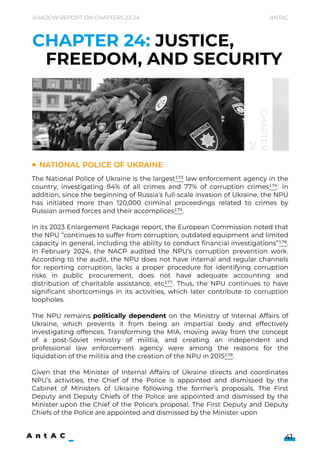
and fundamental 

rights in Ukraine
Shadow report
Kyiv 2024
Ukraine has made significant strides in its anti-corruption efforts, but the
challenges remain. Restoring asset declaration procedures, improving conflict
of interest regulations, and gaining institutional independence for the
Specialised Anti-Corruption Prosecutor's Office mark progress. However, issues
persist with flaws in criminal procedure legislation limiting prosecutors of the
SAPO, short statutes of limitations for corruption-related crimes, and potential
abuse of procedural rights by defendants. The High Anti-Corruption Court has
increased its efficiency but faces staffing constraints. Challenges also include
the need for independent forensic expertise and wiretapping capabilities for
the National Anti-Corruption Bureau.

At the same time, Ukraine should prioritise strengthening integrity and
combatting corruption within its criminal justice system. The focus should be
on implementing transparent and merit-based selection processes for
management positions, including rigorous integrity checks. Establishing a
robust disciplinary and anti-corruption framework carefully tailored to the
specific national context and actual corruption risks in the system is equally
crucial.  


Also, Ukraine continued successfully implementing the reforms of the
Constitutional Court of Ukraine and judicial self-governance bodies, such as the
High Council of Justice and the High Qualification Commission of Judges. At
the same time, there are still significant challenges due to low public trust in
the judiciary. The involvement of international experts in selection panels has
proven effective, so their participation should be extended until Ukraine joins
the EU or public trust in the judiciary significantly improves, rather than being
limited by sunset clauses.
On November 8, 2023, the EU Commission presented its
first Ukraine report as a candidate country and
recommended opening the negotiations. The report
included a list of suggestions for further reforms and
improvements. Our Shadow Report aims to provide an
independent civil society assessment of Ukraine's continued
progress in the judiciary and fight against corruption,
fundamental rights, and justice, as outlined in Chapters
23-24 of the EU accession process. The reporting period
covers the progress achieved between October 2023 and
September 2024. The Report considers the extraordinary
circumstances of the full-scale Russian invasion under
which Ukraine is pursuing its European integration.
Executive
summary
Shadow Report on Chapters 23-24
02
Shadow Report on Chapters 23-24 Antac
03
The EU's leverage through conditionalities has historically driven positive
changes in Ukraine's judicial system, with current priorities including new
procedure of the Supreme Court judge integrity checks and selection,
establishing the High Administrative Court, and reforming legal education and
the Bar.


Despite the full-scale war, the level of freedom of speech in Ukraine remains
moderate. The main challenges include Russia's military aggression, the
national TV marathon United News and the concentration of TV media in the
hands of the state, the collapse in the advertising market, media closures due
to financial and security challenges, problems with blackouts, and the
mobilisation-related staff shortage in the market. All this has reduced citizens'
access to pluralistic media in Ukraine.


Ukraine has made significant progress in improving the legislation on national
minorities, primarily addressing recommendations from the Venice
Commission and fulfilling its international obligations. Despite a somewhat
disorganised legislative process and implementation challenges, the current
framework provides favourable conditions and adequate mechanisms for
protecting minority rights.


Due to Russia’s war, apart from millions of refugees who went abroad, around
four million Ukrainians were forced to become internally displaced persons.
This category of population is one of the most vulnerable in Ukraine. There is an
urgent need to adopt a new version of the Law ‘On Ensuring the Rights and
Freedoms of Internally Displaced Persons’ to regulate better and provide their
rights.


This report was prepared by the Anti-Corruption Action Centre, DEJURE
Foundation, Automaidan, Mezha Anti-Corruption Centre, Institute of Mass
Information, Media Initiative for Human Rights, and Viktoriia Khalanchuk, an
independent expert.
CHAPTER 23: JUDICIARY
& FUNDAMENTAL RIGHTS
FIGHT AGAINST CORRUPTION
Asset declarations and conflicts of interest
Submitting asset declarations was suspended on July 8, 2022, due to the full-
scale invasion of Russia. This obligation was restored on September 20, 2023
with public officials forced to do reporting for the three last years. Though MPs
initially wanted to close access to the Register of Declarations, a strong reaction
from the public and international partners prevented it. The National Agency
on Corruption Prevention verifying hundreds of thousands of declarations
requires significant human and time resources on their side. Hence, a proper
risk-oriented approach and clear and objective criteria should be in place to
prioritise the riskiest declarations.


The difference between potential and actual conflicts of interest should be
clarified at the legislative level, as should the concept of ‘private interest’. The
grounds that prohibit decision-making, actions to prevent conflicts of interest,
and notification of the latter must also be better regulated. So far, the general
courts' practice of considering cases involving an actual conflict of interest (in
particular, where collegial body members make decisions) remains unstable
and inconsistent.


The NACP's Order of October 26, 2023, approved the procedure for lifestyle
monitoring, making it transparent and public. It was an important step
forward, yet the procedure still has some weaknesses: it lacks a clear distinction
between lifestyle monitoring and complete verification of declarations. It does
not indicate a time limit for monitoring. Also, time limits for bringing criminal
liability for false information in declarations are too short. Amending the
legislation to extend the statute of limitations in this category of crimes and
holding a single-judge hearing of such cases at the High Anti-Corruption Court
might be the solution.
Shadow Report on Chapters 23-24 Antac
04
01
FIGHT
AGAINST 

CORRUPTION
Another problematic issue is the possibility of suspending court proceedings in
case of mobilisation of suspects and convicts to military service, including for
corruption-related criminal offences. In April 2022, the respective amendments
to Article 335 of the Criminal Procedure Code of Ukraine enabled courts,
including the HACC, to do so and are already widely used. At the same time,
this significantly delays the consideration of cases while the statute of
limitations is ending. These changes violate the principle of the inevitability of
punishment and the right to a fair trial within a reasonable timeline.
Participation in repelling the aggressor is an essential mission for society and
the state. Yet, at the same time, this should not dramatically affect the
achievement of the objective of criminal proceedings. AntAC has documented
instances where suspects and those accused of grand corruption serve in rear
military units after mobilisation but do not appear in court due to military
service.


The statute of limitations for corruption-related criminal prosecution remains
a significant challenge for the Ukrainian legal system. According to the
Criminal Code of Ukraine, the statute of limitations for criminal prosecution
depends on the gravity of the crime, and the gravity, in turn, depends on the
punishment for a particular criminal offence. For example, the statute of
limitations for declaring false information or not submitting a property
declaration is only three years. Given the high workload of the NACP and the
large number of declarants, this period may be insufficient to detect the
offence, transfer the materials for pre-trial investigation and then hold a trial.
There have already been several cases where the HACC closed3 criminal
proceedings against MPs for false declarations because the statute of
limitations had expired. The court had only a little over a month to consider the
case. Meanwhile, the HACC's workload is increasing yearly, while the number of
cases that risk not being considered on the merits because the statute of
limitations has expired is growing. According to AntAC's estimates, at least 18
cases involving 26 people currently under HACC consideration will have their
statute of limitations expire by the end of 2025 (approximately 8% of
proceedings). These cases were sent to court in 2019-2021, meaning they have
been pending for several years.
Strengthening criminal law to enhance the fight 

against corruption
On June 14, 2024, the Cabinet of Ministers of Ukraine submitted draft law No.
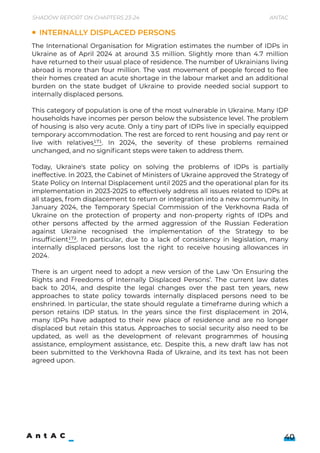
113401 improving plea bargaining in criminal proceedings for corruption and
corruption-related offences (an indicator under Ukraine Facility by the end of
September). The draft law aimed to provide for significantly reduced custodial
sentences and establish more favourable grounds for release from probation
upon paying a relatively large fine (depending on the gravity of the criminal
offence). It was adopted in the first reading in July. Yet, after the public criticism
of the potential corruption loopholes, the government decided to pass a
completely different draft law, No.120392, in line with the NABU/SAPO
requirements. We expect the draft law to be considered in October.
Shadow Report on Chapters 23-24 Antac
05
Therefore, it is necessary to amend Article 49 of the Criminal Code of Ukraine by
introducing a longer statute of limitations for corruption and corruption-
related criminal offences. It is also crucial to provide additional grounds for
suspending the statute of limitations, such as the mobilisation of suspects and
other circumstances related to martial law, and to improve the rules on
suspending the statute of limitations due to the evasion of trial and
investigation.


In 2017, the Criminal Procedure Code of Ukraine was changed, bringing in ‘the
Lozovyi amendments’, negatively impacting the efficiency of law enforcement
agencies, prosecutors and courts. In practice, most of these amendments
significantly increased a defence's ability to abuse procedural rights, allowed for
manipulating the investigation timeframe and created conditions for the
deliberate dismissal of criminal proceedings based solely on the calculation
and coincidence of the investigation timeframe while ignoring the content of
evidence and its validity.


Eventually, most of these amendments were repealed, yet some remain in
place:
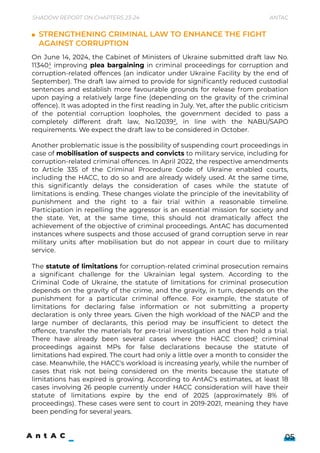
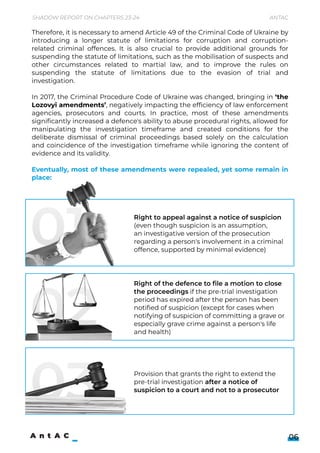
Right to appeal against a notice of suspicion 

(even though suspicion is an assumption, 

an investigative version of the prosecution
regarding a person's involvement in a criminal
offence, supported by minimal evidence)
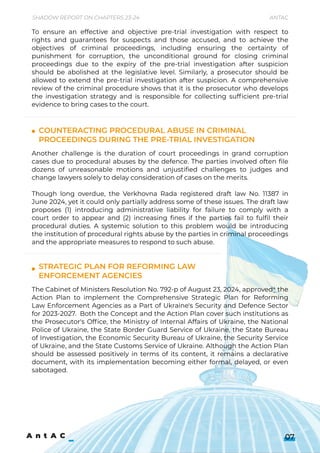
Provision that grants the right to extend the
pre-trial investigation after a notice of
suspicion to a court and not to a prosecutor
01
03
Shadow Report on Chapters 23-24 Antac
06
Right of the defence to file a motion to close
the proceedings if the pre-trial investigation
period has expired after the person has been
notified of suspicion (except for cases when
notifying of suspicion of committing a grave or
especially grave crime against a person's life
and health)
02
Strategicplanforreforminglaw 

enforcementagencies
To ensure an effective and objective pre-trial investigation with respect to
rights and guarantees for suspects and those accused, and to achieve the
objectives of criminal proceedings, including ensuring the certainty of
punishment for corruption, the unconditional ground for closing criminal
proceedings due to the expiry of the pre-trial investigation after suspicion
should be abolished at the legislative level. Similarly, a prosecutor should be
allowed to extend the pre-trial investigation after suspicion. A comprehensive
reviewofthecriminalprocedureshowsthatitistheprosecutorwhodevelops
the investigation strategy and is responsible for collecting sufficient pre-trial
evidencetobringcasestothecourt.
Another challenge is the duration of court proceedings in grand corruption
cases due to procedural abuses by the defence. The parties involved often file
dozens of unreasonable motions and unjustified challenges to judges and
changelawyerssolelytodelayconsiderationofcasesonthemerits.


Though long overdue, the Verkhovna Rada registered draft law No. 11387 in
June2024,yetitcouldonlypartiallyaddresssomeoftheseissues.Thedraftlaw
proposes (1) introducing administrative liability for failure to comply with a
court order to appear and (2) increasing fines if the parties fail to fulfil their
procedural duties. A systemic solution to this problem would be introducing
theinstitutionofproceduralrightsabusebythepartiesincriminalproceedings
andtheappropriatemeasurestorespondtosuchabuse.
TheCabinetofMinistersResolutionNo.792-pofAugust23,2024,approved4the
Action Plan to implement the Comprehensive Strategic Plan for Reforming
LawEnforcementAgenciesasaPartofUkraine'sSecurityandDefenceSector
for2023-2027. BoththeConceptandtheActionPlancoversuchinstitutionsas
the Prosecutor's Office, the Ministry of Internal Affairs of Ukraine, the National
Police of Ukraine, the State Border Guard Service of Ukraine, the State Bureau
ofInvestigation,theEconomicSecurityBureauofUkraine,theSecurityService
ofUkraine,andtheStateCustomsServiceofUkraine.AlthoughtheActionPlan
should be assessed positively in terms of its content, it remains a declarative
document, with its implementation becoming either formal, delayed, or even
sabotaged.
ShadowReportonChapters23-24 Antac
07
Counteractingproceduralabuseincriminal
proceedingsduringthepre-trialinvestigation
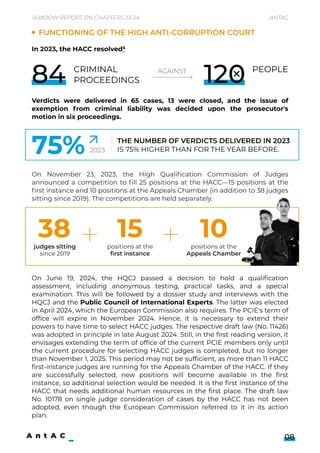
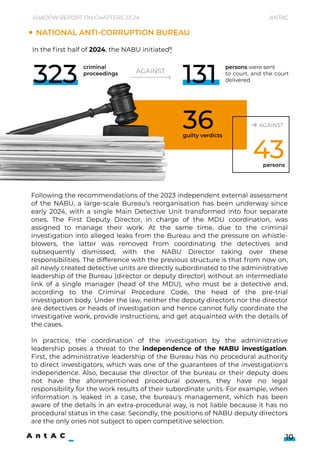
In , the HACC resolved5 


Verdicts were delivered in 65 cases, 13 were closed, and the issue of
exemption f rom criminal liability was decided upon the prosecutor's
motion in six proceedings. 


2023
On November 23, 2023, the High Qualification Commission of Judges
announced a competition to fill 25 positions at the HACC—15 positions at the
first instance and 10 positions at the Appeals Chamber (in addition to 38 judges
sitting since 2019). The competitions are held separately.

criminal 

proceedings
people
Against
84 120
On June 19, 2024, the HQCJ passed a decision to hold a qualification
assessment, including anonymous testing, practical tasks, and a special
examination. This will be followed by a dossier study and interviews with the
HQCJ and the Public Council of International Experts. The latter was elected
in April 2024, which the European Commission also requires. The PCIE's term of
office will expire in November 2024. Hence, it is necessary to extend their
powers to have time to select HACC judges. The respective draft law (No. 11426)
was adopted in principle in late August 2024. Still, in the first reading version, it
envisages extending the term of office of the current PCIE members only until
the current procedure for selecting HACC judges is completed, but no longer
than November 1, 2025. This period may not be sufficient, as more than 11 HACC
first-instance judges are running for the Appeals Chamber of the HACC. If they
are successfully selected, new positions will become available in the first
instance, so additional selection would be needed. It is the first instance of the
HACC that needs additional human resources in the first place. The draft law
No. 10178 on single judge consideration of cases by the HACC has not been
adopted, even though the European Commission referred to it in its action
plan. 


Functioning of the High Anti-Corruption Court
Shadow Report on Chapters 23-24 Antac
08
The number of verdicts delivered in 2023 

is 75% higher than for the year before.
2023
75%
38
judges sitting
since 2019
15
positions at the
first instance
10
positions at the
Appeals Chamber
+ +
The draft law No. 10178 on single judge consideration of cases by the HACC
has not been adopted, even though the European Commission referred to it in
its action plan. 


Instead, another draft law was adopted6 in April 2024, which, among other
things, leaves open the possibility of considering cases by a three-judge panel if
the accused is a senior state official (members of the Cabinet of Ministers,
Prosecutor General, Head of the Security Service of Ukraine, etc.), regardless of
the type of criminal offence concerned. This step only partially reduces the
workload of the HACC judges. At the same time, we are concerned about the
list of exemptions for certain officials, as this approach violates the principle 

of equality.
The Law on the Specialised Anti-Corruption Prosecutor's Office reform
adopted7 on December 8, 2023, amended the Law ‘On the Prosecutor's Office’
and granted a separate legal entity status to the SAPO (separate property,
accounts, and a seal), acquired in practice in March 2024. To be fully
operational, it must conduct recruitment procedures, select prosecutors and
civil servants for the relevant vacant positions, and establish the independent
units subordinated to the Head: document management, including electronic
document management, classified work, human resources management,
internal control etc.


The SAPO Internal Control Unit conducts secret integrity checks of SAPO
prosecutors under the procedure approved by the Head. The unit reviews a
disciplinary complaint against a SAPO prosecutor and then submits proposals
to initiate disciplinary proceedings or refuses to activate them to the
Qualification and Disciplinary Commission of Prosecutors.


The following problems with the SAPO's independence remain unresolved: 


according to the CPC, the Head of the SAPO has authority neither to send
extradition requests nor to carry out mutual legal requests in criminal justice.
All these powers remain, as before, under the jurisdiction of the Prosecutor
General and their Office; 


the PG initiates an investigation on criminal offences allegedly conducted
by an MP and approves all motions at the stage of pre-trial investigation.
Shadow Report on Chapters 23-24 Antac
09
Specialised Anti-Corruption Prosecutor's Office
01
02
Following the recommendations of the 2023 independent external assessment
of the NABU, a large-scale Bureau’s reorganisation has been underway since
early 2024, with a single Main Detective Unit transformed into four separate
ones. The First Deputy Director, in charge of the MDU coordination, was
assigned to manage their work. At the same time, due to the criminal
investigation into alleged leaks from the Bureau and the pressure on whistle-
blowers, the latter was removed from coordinating the detectives and
subsequently dismissed, with the NABU Director taking over these
responsibilities. The difference with the previous structure is that from now on,
all newly created detective units are directly subordinated to the administrative
leadership of the Bureau (director or deputy director) without an intermediate
link of a single manager (head of the MDU), who must be a detective and,
according to the Criminal Procedure Code, the head of the pre-trial
investigation body. Under the law, neither the deputy directors nor the director
are detectives or heads of investigation and hence cannot fully coordinate the
investigative work, provide instructions, and get acquainted with the details of
the cases.


In practice, the coordination of the investigation by the administrative
leadership poses a threat to the independence of the NABU investigation.
First, the administrative leadership of the Bureau has no procedural authority
to direct investigators, which was one of the guarantees of the investigation's
independence. Also, because the director of the bureau or their deputy does
not have the aforementioned procedural powers, they have no legal
responsibility for the work results of their subordinate units. For example, when
information is leaked in a case, the bureau's management, which has been
aware of the details in an extra-procedural way, is not liable because it has no
procedural status in the case. Secondly, the positions of NABU deputy directors
are the only ones not subject to open competitive selection.
National Anti-Corruption Bureau
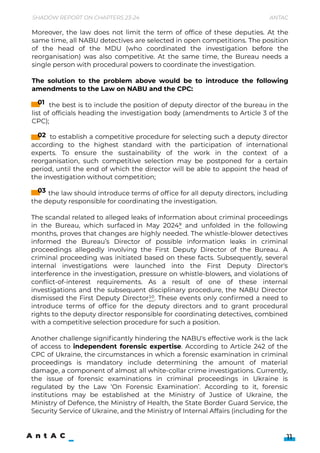
In the first half of 2024, the NABU initiated8
Shadow Report on Chapters 23-24 Antac
10
criminal 

proceedings
persons were sent 

to court, and the court
delivered
Against
323 131
36
guilty verdicts
43
persons
Against
to establish a competitive procedure for selecting such a deputy director
according to the highest standard with the participation of international
experts. To ensure the sustainability of the work in the context of a
reorganisation, such competitive selection may be postponed for a certain
period, until the end of which the director will be able to appoint the head of
the investigation without competition;


the law should introduce terms of office for all deputy directors, including
the deputy responsible for coordinating the investigation.


The scandal related to alleged leaks of information about criminal proceedings
in the Bureau, which surfaced in May 20249 and unfolded in the following
months, proves that changes are highly needed. The whistle-blower detectives
informed the Bureau’s Director of possible information leaks in criminal
proceedings allegedly involving the First Deputy Director of the Bureau. A
criminal proceeding was initiated based on these facts. Subsequently, several
internal investigations were launched into the First Deputy Director's
interference in the investigation, pressure on whistle-blowers, and violations of
conflict-of-interest requirements. As a result of one of these internal
investigations and the subsequent disciplinary procedure, the NABU Director
dismissed the First Deputy Director10. These events only confirmed a need to
introduce terms of office for the deputy directors and to grant procedural
rights to the deputy director responsible for coordinating detectives, combined
with a competitive selection procedure for such a position.


Another challenge significantly hindering the NABU's effective work is the lack
of access to independent forensic expertise. According to Article 242 of the
CPC of Ukraine, the circumstances in which a forensic examination in criminal
proceedings is mandatory include determining the amount of material
damage, a component of almost all white-collar crime investigations. Currently,
the issue of forensic examinations in criminal proceedings in Ukraine is
regulated by the Law ‘On Forensic Examination’. According to it, forensic
institutions may be established at the Ministry of Justice of Ukraine, the
Ministry of Defence, the Ministry of Health, the State Border Guard Service, the
Security Service of Ukraine, and the Ministry of Internal Affairs (including for the
Moreover, the law does not limit the term of office of these deputies. At the
same time, all NABU detectives are selected in open competitions. The position
of the head of the MDU (who coordinated the investigation before the
reorganisation) was also competitive. At the same time, the Bureau needs a
single person with procedural powers to coordinate the investigation.  


The solution to the problem above would be to introduce the following
amendments to the Law on NABU and the CPC:


the best is to include the position of deputy director of the bureau in the
list of officials heading the investigation body (amendments to Article 3 of the
CPC);

Shadow Report on Chapters 23-24 Antac
11
01
02
03
12
For a long time, obtaining forensic expert opinions in NABU criminal
proceedings has been problematic for several reasons. First, unjustified delays
in conducting examinations sometimes lead to a year-long wait due to the
excessive workload of experts. Secondly, forensic experts often face undue
influence, intimidation, and obstruction when conducting examinations due to
the significant impact of suspects in NABU investigations. Thirdly, defendants
frequently get information about criminal proceedings through the influence
and leakage of information from forensic institutions. They track the potential
time of their detention or serving of suspicion notice. Forensic reports in many
investigations are the first and last point before serving a notice of suspicion.


This assessment is shared, in particular, by the OECD in its Fifth Monitoring
Report (May 30, 2022)11, which states that NABU's access to independent
forensics to assess the damage from crime is limited. Consequently, the only
adequate solution is establishing a separate forensic institution with its
independence ensured, which will do examinations for the NABU needs and,
for example, for the ESBU after its reboot.


At the same time, the NABU's right to independent
wiretapping is not implemented in practice. Even
though this right was granted in 202112, in practice,
no action has been taken to amend the bylaws or
provide the necessary technical access. The latter is,
in particular, blocked by the Security Service of
Ukraine. The lack of independent access to
wiretapping significantly limits the NABU's ability to
investigate high-level corruption.


needs of the National Police). Thus, if the NABU needs to conduct a forensic
examination in a criminal proceeding, it is forced to contact one of these
forensic institutions. For example, in 2021, NABU detectives ordered more than
400 different types of forensic examinations. For most of them, detectives
submitted documents to the Ministry of Justice's and Internal Affairs' expert
institutions.
Shadow Report on Chapters 23-24 Antac
Judicial governance bodies
The High Council of Justice
During the reporting period, the judicial governance bodies, the High Council
of Justice and the High Qualification Commission of Judges of Ukraine,
continued the renewal process. However, it is too early to decide whether this
chapter of the reform has been successfully completed.


The current HCJ and HQCJ represent an improvement over their previous
compositions. However, in contrast to the High Anti-Corruption Court selection
process13, which involved a commission of six international experts, the
selection commissions for the HCJ and HQCJ consisted of three Ukrainian
judges or retired judges alongside three international experts. This
arrangement led to an inconsistently effective selection process14, ultimately
resulting in the appointment of several candidates with serious integrity
reservations. The HCJ and the HQCJ have already progressed over 2023 and
2024, but significant areas of concern persist.

The HCJ has achieved increased transparency, successfully formed the
complete composition of the HQCJ, and generalised disciplinary practices.
However, it has failed in several areas, including justifying dismissals of
disciplinary cases, prioritising complaints against judges, and promptly
handling high-profile and priority cases. Additionally, the HCJ has granted
honourable resignations to judges of low integrity, made inconsistent decisions
on disciplinary actions, and imposed lenient disciplinary sanctions. It has also
failed to hold judges accountable, denied the public’s right to criticise judges,
and did not adequately assess candidates’ compliance with judicial
requirements15.


JUDICIARY
JUDICIARY
13
02
Shadow Report on Chapters 23-24 Antac
CHAPTER 23: JUDICIARY
& FUNDAMENTAL RIGHTS
Since its disciplinary function was reinstated, the HCJ has held 77 judges
accountable, with 22 dismissed as of July 2024. Almost half of the dismissed
judges collaborated with Russian authorities or received Russian passports. The
perception of impunity among the judges remains unresolved.


As of August 2024, the HCJ has 17 members, with four more members not
appointed under the quotas of the Congress of Attorneys and the President.
The notorious head of the bar, Lidia Izovitova16, deliberately delayed convening
the Congress (see details in the chapter titled ‘The Bar’). Similarly, the President
is not filling two vacancies in the HCJ under his quota17, even though the
Ethics Council recommended two candidates for the appointment. This
situation sets a dangerous precedent for not appointing the candidates for
political reasons. It poses a risk of reverting to a system where the most loyal
rather than independent and competent candidates will be selected for the
HCJ18.

14
Shadow Report on Chapters 23-24 Antac
01
03
02
04
approximately 6,000 complaints were
processed in this manner. However,
the HCJ only resumed its functions in
January 2023; due to the legal terms
and deadlines for holding judges
accountable, hundreds of judges
escaped punishment.
Clearing the backlog by returning
complaints and refusing to open
disciplinary cases:
Appeal rights denial: 

the HCJ denies complainants the
right to appeal disciplinary decisions
requiring legislative change. This
right is often granted only to judges,
leaving complainants disadvantaged.
Insufficient disciplinary actions:
only 61 judges have been disciplined 

in the first six months, which
accounts for less than 1% of cases.
Delay of high-profile cases:
significant cases, such as
those involving judges
caught taking bribes–
specifically, the case of
Judge Kniazev 

(ex-President of the
Supreme Court)–were
unjustifiably delayed.
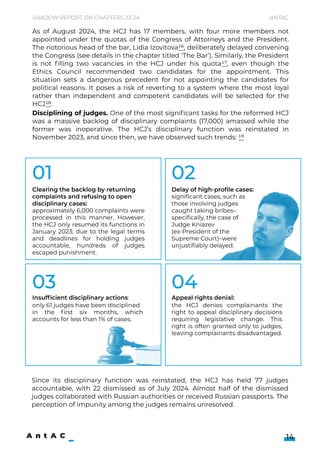
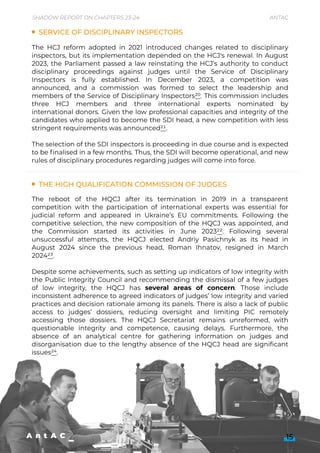
Disciplining of judges. One of the most significant tasks for the reformed HCJ
was a massive backlog of disciplinary complaints (17,000) amassed while the
former was inoperative. The HCJ’s disciplinary function was reinstated in
November 2023, and since then, we have observed such trends: 19
Service of Disciplinary Inspectors
The High Qualification Commission of Judges
The HCJ reform adopted in 2021 introduced changes related to disciplinary
inspectors, but its implementation depended on the HCJ's renewal. In August
2023, the Parliament passed a law reinstating the HCJ’s authority to conduct
disciplinary proceedings against judges until the Service of Disciplinary
Inspectors is fully established. In December 2023, a competition was
announced, and a commission was formed to select the leadership and
members of the Service of Disciplinary Inspectors20. This commission includes
three HCJ members and three international experts nominated by
international donors. Given the low professional capacities and integrity of the
candidates who applied to become the SDI head, a new competition with less
stringent requirements was announced21.


The selection of the SDI inspectors is proceeding in due course and is expected
to be finalised in a few months. Thus, the SDI will become operational, and new
rules of disciplinary procedures regarding judges will come into force.
The reboot of the HQCJ after its termination in 2019 in a transparent
competition with the participation of international experts was essential for
judicial reform and appeared in Ukraine’s EU commitments. Following the
competitive selection, the new composition of the HQCJ was appointed, and
the Commission started its activities in June 202322. Following several
unsuccessful attempts, the HQCJ elected Andriy Pasichnyk as its head in
August 2024 since the previous head, Roman Ihnatov, resigned in March
202423.


Despite some achievements, such as setting up indicators of low integrity with
the Public Integrity Council and recommending the dismissal of a few judges
of low integrity, the HQCJ has several areas of concern. Those include
inconsistent adherence to agreed indicators of judges’ low integrity and varied
practices and decision rationale among its panels. There is also a lack of public
access to judges’ dossiers, reducing oversight and limiting PIC remotely
accessing those dossiers. The HQCJ Secretariat remains unreformed, with
questionable integrity and competence, causing delays. Furthermore, the
absence of an analytical centre for gathering information on judges and
disorganisation due to the lengthy absence of the HQCJ head are significant
issues24.


15
Shadow Report on Chapters 23-24 Antac
The problem Of the Council of Judges
As of August 2024, almost ten months have passed since the start of the
qualification assessment. During this time, the HQCJ reviewed 172 judges25.
The Commission might need three years as it still has to conduct qualification
assessments for 1700 judges, including 200 judges who do not administer
justice due to tenure expiry26. Nevertheless, the emphasis should be on the
quality of the evaluations rather than on speed.


The HQCJ continues to keep in office judges who do not meet the established
integrity criteria–the Commission considered 43 judges with negative opinions
suitable for their positions. In comparison, only 27 judges with negative
opinions were recommended for dismissal. The trend of the HQCJ overturning
the Public Integrity Council's opinions is troubling. The HQCJ has overturned
most of the PIC’s negative opinions, agreeing with the PIC and recommending
a judge for dismissal in only 39% of the cases27. This is unacceptable, as it
indicates that the qualification assessment is not fulfilling its primary function–
cleansing the judiciary. At the same time, not all judges recommended for
dismissal by the HQCJ will ultimately be dismissed by the HCJ, which raises
serious concerns about the overall effectiveness of the qualification
assessment process.


In December 2023, the Parliament improved the selection procedure by
simplifying and expediting it28, particularly by eliminating redundant stages
and re-evaluations and reducing training time. Candidates' integrity scrutiny is
now also part of the selection of judges.


In May 2024, the HQCJ announced the competition results to fill 560 vacant
judicial positions in local courts. The HQCJ completed interviews with 434
judicial candidates and recommended 390 of them for appointment to
positions in 266 courts29. Moreover, the competition for 550 vacant positions in
appellate courts has started, with over 1700 candidates applying30.

Qualification

assessment of judges
Selection 

of judges
16
Shadow Report on Chapters 23-24 Antac
The law suggests that the Council of Judges “acts in the interests of all the
judges”. Yet, the former has few real functions. After the reform of the judicial
governance bodies, there is little justification for the Council’s existence as it
has no exclusive powers that could not be transferred.
Moreover, it has become an instrument for lobbying the interests of
questionable judges, covering the latter, and putting pressure on the whistle-
blower judges. The Council also actively opposed the judiciary reform in
Ukraine, sabotaging the laws aimed at its cleansing and delegating members
of low integrity to judicial selection commissions31.


In January 2023, the Parliament of Ukraine registered a draft law on liquidating
the Council of Judges32. NGOs promoting the rule-of-law reforms in Ukraine
supported this initiative. However, progress on this issue has stalled. According
to the draft law, the CoJ's powers to organise the Congress of Judges could be
transferred to the HCJ. This step aligns with the recommendations of the
Venice Commission, which has consistently advised simplifying the system of
judicial governance in Ukraine.

The Constitutional Court Reform
Supreme Court
The Constitutional Court reform is one of the most challenging issues in
contemporary Ukrainian history. In 2020, the CCU de facto cancelled electronic
declaration and other anti-corruption reforms. Since then, the Venice
Commission has recommended depoliticising the judge selection process33.
The CCU reform was also a primary condition for opening the Ukraine-EU
negotiations.


The Constitutional Court reform introduced a competitive selection process for
CCU judges. The Advisory Group of Experts was tasked with vetting and
selecting candidates for judicial positions. The first AGE was formally
established in October 2023.


So far, the AGE has demonstrated a promising performance, as candidates with
political affiliations were not deemed to meet the high moral standards
required. As a result of the competition, one decent judge was appointed to the
CCU34. Competitions are ongoing for an additional five vacancies. It is essential
to continue closely monitoring the competition and its results.


In May 2023, the Supreme Court faced a vast corruption
scandal: the court's President, Vsevolod Kniazev, allegedly
received a $2.7 million bribe35. As the latter was
suspended f rom office, the Supreme Court judges
elected a new President, with almost ¾ majority voting
in favour of Stanislav Kravchenko, a judge of questionable
integrity36 as indicated in the PIC’s negative opinion back
in 201737. Furthermore, in December 2023 and January
2024, the Supreme Court elected three judges of low
integrity to the Grand Chamber specifically to disrupt the
qualification assessment38.


17
Shadow Report on Chapters 23-24 Antac
$2.7 MLN
bribe
In response, non-governmental organisations and progressive judiciary
members have proposed a two-step approach to its renewal:
The first step is to thoroughly review the existing Supreme Court
judges’ declarations of integrity to remove those with questionable
integrity. The process may lead to disciplinary actions against a judge,
which could ultimately result in removal from their position;
Second, a new selection procedure for 40 vacant judges’ positions
should be implemented39, including the active involvement of civil
society and international experts, such as the Public Council of
International Experts or a similarly modelled commission. This
approach will ensure that only individuals with the highest integrity are
appointed to fill open judicial positions and that the errors made while
establishing the Supreme Court in 2017 are avoided40.
Although the European Commission endorsed this approach to renew the
Supreme Court in its 2023 Ukraine report41, progress here has stalled. Moreover,
recent developments indicate that the Supreme Court is increasingly actively
reversing significant reforms. Specifically, it has already issued two detrimental
rulings that disrupt the qualification assessment process:


ignoring the PIC’s negative opinion
on the judge undergoing
qualification assessment under the
previous HQCJ. This undermines the
qualification process, affecting
approximately 180 out of nearly 1,700
judges awaiting evaluation, including
those of low integrity42.


the Grand Chamber of the Supreme
Court ultimately overturning the
HCJ’s decision. This established a
precedent that allows the Supreme
Court to delve into the content and
motives behind the decisions of the
HCJ and HQCJ and alter their
rulings43.
18
Shadow Report on Chapters 23-24 Antac
01
02
We believe that recent Supreme Court decisions are not the last to undermine
reform efforts44. Suppose the Supreme Court and its composition are not
renewed. In that case, judicial and other crucial reforms are expected

to be obstructed by the unreformed Supreme Court, 

which serves as the final instance in their consideration. 

Therefore, the urgent renewal of the Supreme Court 

according to the mentioned two-step approach should 

be prioritised.
Administrative justice
International involvement in the selection of judges
Establishing a new administrative court that will hear administrative cases
against national state agencies by adequately vetted judges is written down in
Ukraine’s Memorandum with the IMF45, the Ukraine Facility Plan46, and the
2024 priorities of the G7 Ambassadors Support Group for Ukraine47. However,
no significant progress has been made so far.


Adopting the new administrative court's framework, akin to the model applied
in the HACC—currently the most successful example of judicial selection—
while avoiding the errors made while establishing the Supreme Court could
significantly improve Ukraine's judicial landscape. For this reason, it is essential
to introduce the PCIE or a similarly modelled commission entirely comprised of
international experts in the selection process.
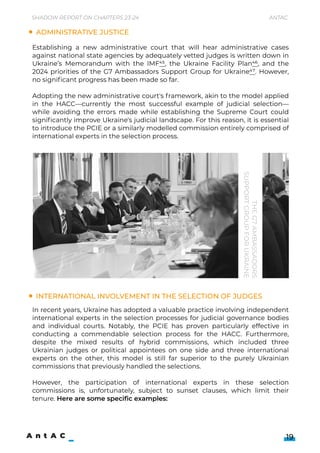
the
G7
Ambassadors
Support
Group
for
Ukraine
In recent years, Ukraine has adopted a valuable practice involving independent
international experts in the selection processes for judicial governance bodies
and individual courts. Notably, the PCIE has proven particularly effective in
conducting a commendable selection process for the HACC. Furthermore,
despite the mixed results of hybrid commissions, which included three
Ukrainian judges or political appointees on one side and three international
experts on the other, this model is still far superior to the purely Ukrainian
commissions that previously handled the selections.


However, the participation of international experts in these selection
commissions is, unfortunately, subject to sunset clauses, which limit their
tenure. Here are some specific examples:
19
Shadow Report on Chapters 23-24 Antac
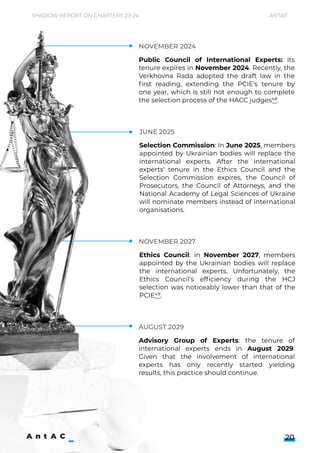
Public Council of International Experts: its
tenure expires in November 2024. Recently, the
Verkhovna Rada adopted the draft law in the
first reading, extending the PCIE’s tenure by
one year, which is still not enough to complete
the selection process of the HACC judges48.
November 2024
JUNE 2025
Selection Commission: In June 2025, members
appointed by Ukrainian bodies will replace the
international experts. After the international
experts' tenure in the Ethics Council and the
Selection Commission expires, the Council of
Prosecutors, the Council of Attorneys, and the
National Academy of Legal Sciences of Ukraine
will nominate members instead of international
organisations.
November 2027
Ethics Council: in November 2027, members
appointed by the Ukrainian bodies will replace
the international experts. Unfortunately, the
Ethics Council’s efficiency during the HCJ
selection was noticeably lower than that of the
PCIE49.
august 2029
Advisory Group of Experts: the tenure of
international experts ends in August 2029.
Given that the involvement of international
experts has only recently started yielding
results, this practice should continue.
Shadow Report on Chapters 23-24 Antac
20
The Bar
Shadow Report on Chapters 23-24 Antac
21
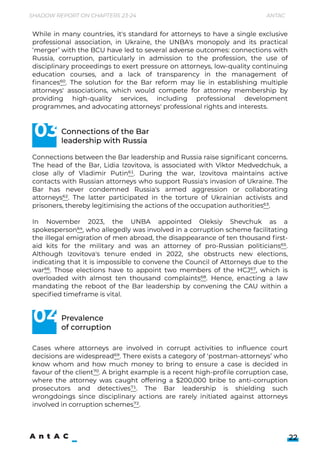
The 2012 Law ‘On the Bar and Practice of Law’54 is the primary document
regulating the relevant sphere. The Bar Council of Ukraine is the executive
body of the Bar, responsible for enacting mandatory regulatory acts for
attorneys, maintaining the register of attorneys, and managing the funds of
the UNBA. The head of the BCU is the ex-officio head of the Ukrainian National
Bar Association, a professional association of attorneys. Membership in the
UNBA is mandatory for all attorneys. As a result, the same individuals govern
the Bar and the UNBA, leading, in practice, to the merger of these entities and
the concentration of power within one group55.


Until November 2012, anyone could be a representative in the court. Later,
amendments to the Constitution in 201656 stipulated that only an attorney
could represent others in court, with a few exceptions. This led to an increased
demand for obtaining attorney status, with the number of attorneys in Ukraine
doubling to 69,000 in 2015-202457. Many sitting judges, prosecutors, and law
enforcement officers possess an attorney's license as a contingency plan. The
legality of obtaining licences by those officials raises questions58.

The exclusive right of attorneys

in court representation
Monopoly 

of the UNBA
Currently, the Constitutional Court is deliberating the issue of the possible
unconstitutionality of mandatory membership for attorneys in the UNBA59.
01
02
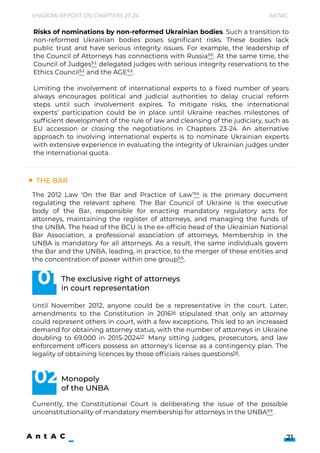
Risks of nominations by non-reformed Ukrainian bodies. Such a transition to
non-reformed Ukrainian bodies poses significant risks. These bodies lack
public trust and have serious integrity issues. For example, the leadership of
the Council of Attorneys has connections with Russia50. At the same time, the
Council of Judges51 delegated judges with serious integrity reservations to the
Ethics Council52 and the AGE53.


Limiting the involvement of international experts to a fixed number of years
always encourages political and judicial authorities to delay crucial reform
steps until such involvement expires. To mitigate risks, the international
experts’ participation could be in place until Ukraine reaches milestones of
sufficient development of the rule of law and cleansing of the judiciary, such as
EU accession or closing the negotiations in Chapters 23-24. An alternative
approach to involving international experts is to nominate Ukrainian experts
with extensive experience in evaluating the integrity of Ukrainian judges under
the international quota.
Shadow Report on Chapters 23-24 Antac
22
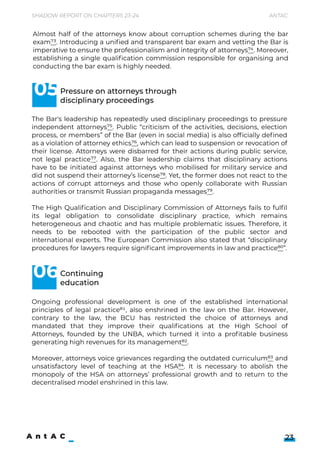
Connections between the Bar leadership and Russia raise significant concerns.
The head of the Bar, Lidia Izovitova, is associated with Viktor Medvedchuk, a
close ally of Vladimir Putin61. During the war, Izovitova maintains active
contacts with Russian attorneys who support Russia's invasion of Ukraine. The
Bar has never condemned Russia's armed aggression or collaborating
attorneys62. The latter participated in the torture of Ukrainian activists and
prisoners, thereby legitimising the actions of the occupation authorities63.


In November 2023, the UNBA appointed Oleksiy Shevchuk as a
spokesperson64, who allegedly was involved in a corruption scheme facilitating
the illegal emigration of men abroad, the disappearance of ten thousand first-
aid kits for the military and was an attorney of pro-Russian politicians65.
Although Izovitova's tenure ended in 2022, she obstructs new elections,
indicating that it is impossible to convene the Council of Attorneys due to the
war66. Those elections have to appoint two members of the HCJ67, which is
overloaded with almost ten thousand complaints68. Hence, enacting a law
mandating the reboot of the Bar leadership by convening the CAU within a
specified timeframe is vital.


Connections of the Bar 

leadership with Russia
Prevalence 

of corruption
While in many countries, it's standard for attorneys to have a single exclusive
professional association, in Ukraine, the UNBA's monopoly and its practical
‘merger’ with the BCU have led to several adverse outcomes: connections with
Russia, corruption, particularly in admission to the profession, the use of
disciplinary proceedings to exert pressure on attorneys, low-quality continuing
education courses, and a lack of transparency in the management of
finances60. The solution for the Bar reform may lie in establishing multiple
attorneys' associations, which would compete for attorney membership by
providing high-quality services, including professional development
programmes, and advocating attorneys' professional rights and interests.
Cases where attorneys are involved in corrupt activities to influence court
decisions are widespread69. There exists a category of ‘postman-attorneys’ who
know whom and how much money to bring to ensure a case is decided in
favour of the client70. A bright example is a recent high-profile corruption case,
where the attorney was caught offering a $200,000 bribe to anti-corruption
prosecutors and detectives71. The Bar leadership is shielding such
wrongdoings since disciplinary actions are rarely initiated against attorneys
involved in corruption schemes72.


03
04
Shadow Report on Chapters 23-24 Antac
23
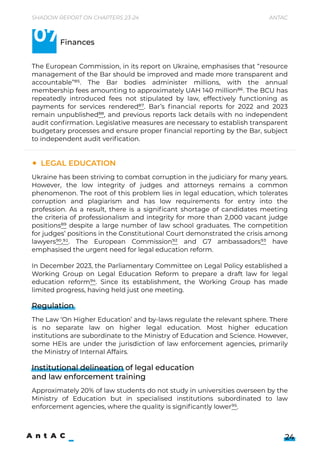
The Bar's leadership has repeatedly used disciplinary proceedings to pressure
independent attorneys75. Public “criticism of the activities, decisions, election
process, or members” of the Bar (even in social media) is also officially defined
as a violation of attorney ethics76, which can lead to suspension or revocation of
their license. Attorneys were disbarred for their actions during public service,
not legal practice77. Also, the Bar leadership claims that disciplinary actions
have to be initiated against attorneys who mobilised for military service and
did not suspend their attorney’s license78. Yet, the former does not react to the
actions of corrupt attorneys and those who openly collaborate with Russian
authorities or transmit Russian propaganda messages79.


The High Qualification and Disciplinary Commission of Attorneys fails to fulfil
its legal obligation to consolidate disciplinary practice, which remains
heterogeneous and chaotic and has multiple problematic issues. Therefore, it
needs to be rebooted with the participation of the public sector and
international experts. The European Commission also stated that “disciplinary
procedures for lawyers require significant improvements in law and practice80”.

Almost half of the attorneys know about corruption schemes during the bar
exam73. Introducing a unified and transparent bar exam and vetting the Bar is
imperative to ensure the professionalism and integrity of attorneys74. Moreover,
establishing a single qualification commission responsible for organising and
conducting the bar exam is highly needed.

Pressure on attorneys through

disciplinary proceedings
Continuing

education
05
06
Ongoing professional development is one of the established international
principles of legal practice81, also enshrined in the law on the Bar. However,
contrary to the law, the BCU has restricted the choice of attorneys and
mandated that they improve their qualifications at the High School of
Attorneys, founded by the UNBA, which turned it into a profitable business
generating high revenues for its management82. 


Moreover, attorneys voice grievances regarding the outdated curriculum83 and
unsatisfactory level of teaching at the HSA84. It is necessary to abolish the
monopoly of the HSA on attorneys’ professional growth and to return to the
decentralised model enshrined in this law.
Shadow Report on Chapters 23-24 Antac
24
Ukraine has been striving to combat corruption in the judiciary for many years.
However, the low integrity of judges and attorneys remains a common
phenomenon. The root of this problem lies in legal education, which tolerates
corruption and plagiarism and has low requirements for entry into the
profession. As a result, there is a significant shortage of candidates meeting
the criteria of professionalism and integrity for more than 2,000 vacant judge
positions89 despite a large number of law school graduates. The competition
for judges’ positions in the Constitutional Court demonstrated the crisis among
lawyers90,91. The European Commission92 and G7 ambassadors93 have
emphasised the urgent need for legal education reform.


In December 2023, the Parliamentary Committee on Legal Policy established a
Working Group on Legal Education Reform to prepare a draft law for legal
education reform94. Since its establishment, the Working Group has made
limited progress, having held just one meeting.


The Law ‘On Higher Education’ and by-laws regulate the relevant sphere. There
is no separate law on higher legal education. Most higher education
institutions are subordinate to the Ministry of Education and Science. However,
some HEIs are under the jurisdiction of law enforcement agencies, primarily
the Ministry of Internal Affairs.
Legal Education
The European Commission, in its report on Ukraine, emphasises that “resource
management of the Bar should be improved and made more transparent and
accountable”85. The Bar bodies administer millions, with the annual
membership fees amounting to approximately UAH 140 million86. The BCU has
repeatedly introduced fees not stipulated by law, effectively functioning as
payments for services rendered87. Bar’s financial reports for 2022 and 2023
remain unpublished88, and previous reports lack details with no independent
audit confirmation. Legislative measures are necessary to establish transparent
budgetary processes and ensure proper financial reporting by the Bar, subject
to independent audit verification.

Finances
Regulation
Institutional delineation of legal education 

and law enforcement training
07
Approximately 20% of law students do not study in universities overseen by the
Ministry of Education but in specialised institutions subordinated to law
enforcement agencies, where the quality is significantly lower95.
Instead of focusing on developing critical thinking, human rights protection,
and promoting the rule of law, future lawyers are primarily trained in marching,
obedience, and criminal apprehension. Legal education in law enforcement
agencies and institutions is absent in EU countries. Thus, the EU's and G7
ambassadors' appeal for delineating legal and law enforcement education,
where lawyers educated exclusively in civil HEIs and law enforcement officers
solely trained in institutions subordinate to these agencies, is justified and
imperative. The Government of Ukraine recently confirmed that the
institutional delineation should be carried out until 202796.  

Shadow Report on Chapters 23-24 Antac
25
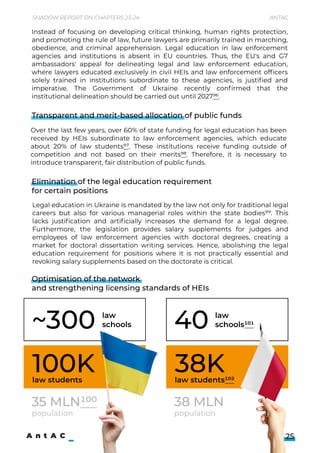
law 

schools
population population
law 

schools101
law students law students102
~300
35 MLN100 38 MLN
40
100K 38K
Transparent and merit-based allocation of public funds
Elimination of the legal education requirement 

for certain positions
Optimisation of the network 

and strengthening licensing standards of HEIs
Over the last few years, over 60% of state funding for legal education has been
received by HEIs subordinate to law enforcement agencies, which educate
about 20% of law students97. These institutions receive funding outside of
competition and not based on their merits98. Therefore, it is necessary to
introduce transparent, fair distribution of public funds.
Legal education in Ukraine is mandated by the law not only for traditional legal
careers but also for various managerial roles within the state bodies99. This
lacks justification and artificially increases the demand for a legal degree.
Furthermore, the legislation provides salary supplements for judges and
employees of law enforcement agencies with doctoral degrees, creating a
market for doctoral dissertation writing services. Hence, abolishing the legal
education requirement for positions where it is not practically essential and
revoking salary supplements based on the doctorate is critical.
Shadow Report on Chapters 23-24 Antac
26
Law programmes below the bachelor's degree (almost 20% of law students in
112 colleges) will be abolished in 2025. As a result, the number of law students
and law schools will be significantly reduced103. Further measures should be
the termination of distance learning (32% of law students), raising licensing
standards for law schools, reducing their number, and increasing the quality of
those that remain.


The minimum admission score, which had been very low for years, was
significantly raised in 2024104. Meanwhile, institutions of the law enforcement
agencies still have a separate simplified admission procedure105. Therefore,
introducing justified high admission requirements and tests for analytical and
critical thinking is needed to attract the best and most motivated applicants to
law schools.


After numerous delays, the USQE was introduced at the end of 2023, marking
an important step towards establishing a mechanism akin to the US Bar
Examination. However, improvements are needed to make the USQE an
effective filter, including raising the passing score, preparing high-quality test
materials, and establishing transparent evaluation criteria.


Many law schools employ outdated teaching
methods and curricula. 82% of law students
believe that law school educational 

programmes are obsolete106. 


Almost 80% of employers highlighted law 

school graduates' low knowledge and skills107.
Therefore, the modernisation of curricula 

should focus on acquiring practical skills,
developing analytical thinking, 

providing the opportunity to choose 

subjects, studying EU law108 and legal 

ethics, and combatting plagiarism.


Many of these institutions are ‘education businesses’ offering diplomas in law
for money.
Strengthening admission requirements
The Unified State Qualification Exam
Curriculum modernisation
Human rights violations by the Russian Federation
Since Russia launched its full-scale military invasion of Ukraine in February
2022, the population of Ukraine has been subject to massive violations of its
rights. The Russian military constantly and systematically commits numerous
crimes against the civilian population both in the occupied and government-
controlled territories of Ukraine. On the government-controlled territories of
Ukraine, it is primarily massive shelling, destruction of civilian infrastructure,
and the killing and wounding of civilians. In the temporarily occupied
territories, the Ukrainian population is becoming a victim of numerous war
crimes. These include illegal detentions, enforced disappearances, torture,
inhumane or degrading treatment, sexual crimes, murder, and crimes against
property. It is impossible to determine the exact number of people in Ukraine
against whom the Russian military has committed crimes. To date, the
investigative authorities of Ukraine have opened more than 


According to the Commissioner for Missing Persons under Special
Circumstances, 37,000 people are officially considered missing as a result of the
war109, with a significant number being prisoners of war and civilians illegally
deprived of their liberty, held in detention facilities in Russia incommunicado,
and constantly subjected to torture110. As of August 2024, around 3,400
prisoners of war and 160 civilians were released from captivity as part of
exchanges between Ukraine and Russia, with the latter constantly
manipulating the issue and threatening to withdraw from the process.

Shadow Report on Chapters 23-24 Antac
27
CHAPTER 23: JUDICIARY
& FUNDAMENTAL RIGHTS
FUNDAMENTAL RIGHTS
03
FUNDAMENTAL

RIGHTS
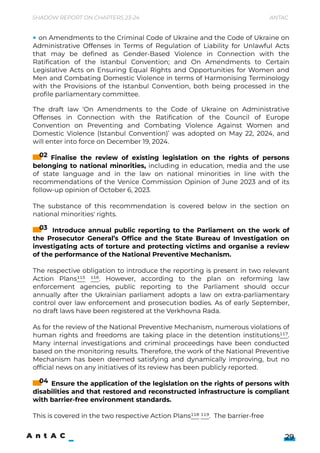
criminal proceedings 

regarding war crimes
130 000+
As of February 2024, the Office of the High Commissioner for Human Rights
estimates111 that at least 10,000 civilians have been killed in the fighting.
However, the actual number of deaths is likely much higher, as it is impossible
to establish their number in the Russia-occupied territories. Apart f rom
hundreds of thousands of residential and non-residential buildings,


Moreover, since October 2022, Russia has damaged up to 70% of all energy
facilities in Ukraine due to its constant missile attacks. The damage to the
energy infrastructure is estimated113 at $12.5 billion. The International Criminal
Court has issued four arrest warrants for Russian military personnel for shelling
and destroying Ukraine's energy system classifying it as a crime against
humanity114.


Shadow Report on Chapters 23-24 Antac
28
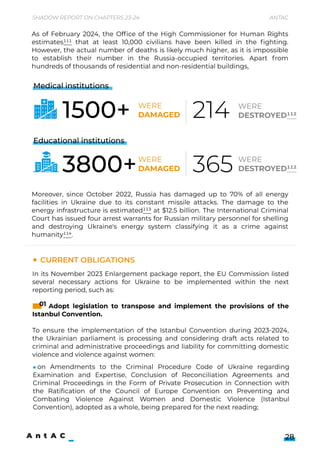
were

damaged
were

damaged
were
destroyed112
were
destroyed112
1500+
3800+
214
365
Medical institutions
Educational institutions
In its November 2023 Enlargement package report, the EU Commission listed
several necessary actions for Ukraine to be implemented within the next
reporting period, such as:


Adopt legislation to transpose and implement the provisions of the
Istanbul Convention.


To ensure the implementation of the Istanbul Convention during 2023-2024,
the Ukrainian parliament is processing and considering draft acts related to
criminal and administrative proceedings and liability for committing domestic
violence and violence against women:

Current obligations
on Amendments to the Criminal Procedure Code of Ukraine regarding
Examination and Expertise, Conclusion of Reconciliation Agreements and
Criminal Proceedings in the Form of Private Prosecution in Connection with
the Ratification of the Council of Europe Convention on Preventing and
Combating Violence Against Women and Domestic Violence (Istanbul
Convention), adopted as a whole, being prepared for the next reading;


01
The draft law ‘On Amendments to the Code of Ukraine on Administrative
Offenses in Connection with the Ratification of the Council of Europe
Convention on Preventing and Combating Violence Against Women and
Domestic Violence (Istanbul Convention)’ was adopted on May 22, 2024, and
will enter into force on December 19, 2024.


Finalise the review of existing legislation on the rights of persons
belonging to national minorities, including in education, media and the use
of state language and in the law on national minorities in line with the
recommendations of the Venice Commission Opinion of June 2023 and of its
follow-up opinion of October 6, 2023.


The substance of this recommendation is covered below in the section on
national minorities' rights.


Introduce annual public reporting to the Parliament on the work of
the Prosecutor General’s Office and the State Bureau of Investigation on
investigating acts of torture and protecting victims and organise a review
of the performance of the National Preventive Mechanism.


The respective obligation to introduce the reporting is present in two relevant
Action Plans115 116. However, according to the plan on reforming law
enforcement agencies, public reporting to the Parliament should occur
annually after the Ukrainian parliament adopts a law on extra-parliamentary
control over law enforcement and prosecution bodies. As of early September,
no draft laws have been registered at the Verkhovna Rada.


As for the review of the National Preventive Mechanism, numerous violations of
human rights and freedoms are taking place in the detention institutions117.
Many internal investigations and criminal proceedings have been conducted
based on the monitoring results. Therefore, the work of the National Preventive
Mechanism has been deemed satisfying and dynamically improving, but no
official news on any initiatives of its review has been publicly reported.


4. Ensure the application of the legislation on the rights of persons with
disabilities and that restored and reconstructed infrastructure is compliant
with barrier-free environment standards.


This is covered in the two respective Action Plans118 119. The barrier-free
Shadow Report on Chapters 23-24 Antac
29
02
03
04
on Amendments to the Criminal Code of Ukraine and the Code of Ukraine on
Administrative Offenses in Terms of Regulation of Liability for Unlawful Acts
that may be defined as Gender-Based Violence in Connection with the
Ratification of the Istanbul Convention; and On Amendments to Certain
Legislative Acts on Ensuring Equal Rights and Opportunities for Women and
Men and Combating Domestic Violence in terms of Harmonising Terminology
with the Provisions of the Istanbul Convention, both being processed in the
profile parliamentary committee.
On August 21, 2024, the Verkhovna Rada finally ratified the Rome Statute of
the International Criminal Court, thus recognising the jurisdiction of the ICC
on pre-trial investigation and judicial consideration of the international crimes
committed in Ukraine and/or by Ukrainian citizens (also noted in the previous
report as a to-do obligation of Ukraine). The ratification was made with the
reservation under Article 124 of the Rome Statute, according to which Ukraine
does not recognise ICC jurisdiction regarding the investigation and trial of war
crimes (prescribed by Article 8 of the Rome Statute) allegedly committed by
Ukrainian citizens during the first seven years after the ratification (such a right
is provided to the newly acceding members under the mentioned article). The
Criminal Code and Criminal Procedure Code amendments should be adopted
and implemented to make the Rome Statute work in Ukraine.


The previous Enlargement report recommended ratifying the International
Convention on the Protection of the Rights of All Migrant Workers and
Members of Their Families. Yet, no relevant draft law has been introduced to
the parliament. The same applies to the Protocol Amending the Convention for
the Protection of Individuals with regard to Automatic Processing of Personal
Data of the Council of Europe.
As of June 30, 2024, 7,900 applications were pending121 before the European
Court of Human Rights, constituting 12.4% of the cases. This is significantly less
than a year ago (9,656 applications). However, Ukraine ranked third in the
number of opened proceedings after Turkey and the Russian Federation
(proceedings against which are still being considered despite expulsion from
the Council of Europe).


Imposing martial law in Ukraine following the Russian full-scale onslaught
brought a lot of new challenges to the situation with human rights in Ukraine.
In 2022, Ukraine officially filed a notification on derogation of certain rights and
freedoms prescribed by the Constitution of Ukraine and corresponding to
global and European international human rights instruments122. Nevertheless,
this did not prevent filing applications by the Ukrainian citizens to the ECtHR
for the alleged violation of human rights by the Ukrainian state. Many of those
applications are related to the reported violation of freedom of movement
Shadow Report on Chapters 23-24 Antac
30
International human rights instruments
Applications pending before the European Court
for Human Rights
environment has been the particular focus of attention in 2024. The Minister of
Environmental Protection reported several success stories120, yet there are still
a lot of complaints from people with disabilities regarding non-inclusive
facilities, even in big cities. As for the reconstruction of damaged infrastructure
in line with the barrier-free guidelines, the former was suspended in 2024 due
to a lack of budget allocated to the Agency for Recovery.
In 2023, civil society organisations highlighted problems with implementing
the ECtHR decisions adopted in favour of applicants living in Ukrainian
territories temporarily occupied by Russia. Given their lack of access to
government-controlled territory, institutions, and legal representatives,
applicants cannot provide the Ministry of Justice of Ukraine with duly certified
powers of attorney.


In 2024, this situation stayed the same, with no amendments introduced to the
by-laws regulating notary activities or the respective law regulating the
application of the ECtHR decision. However, this also aims to prevent false
transactions with the property and assets of Ukrainians, which might occur
under pressure from the occupational ‘authorities’, notarial acts by notaries
whose workplace (office) is located in the Ukrainian territories temporarily
occupied by the Russian Federation have been prohibited. This concerns all the
notary transactions and not only those related to the transmission of rights to
apply to enforcing the ECtHR judgements. However, no public discussions and
draft amendments have been published or discussed.
The Ombudsman is Ukraine's crucial national authority on human rights
protection. Compared with 2022, the number of appeals increased more than
twice, amounting to 95,796 appeals in 2023. This rise may, among other things,
be explained by the expansion of the Ombudsman’s offices in Ukraine’s
regions. The Ombudsman’s Office actively participates in monitoring and
legislative process. In 2023, the structural units of the Commissioner's
Secretariat processed 2,731 positions to draft legal acts filed with the Verkhovna
Rada. In monitoring, the Ombudsman and his Office have elaborated and
implemented some initiatives for the first time. For instance, in 2023, the
Regulation setting out the principles of monitoring and the grounds, stages of
preparation, and conduct of this procedure was approved.


During the reported period, a significant amount of the Ombudsman’s Office
work was focused on issues related to protecting the rights of the Ukrainian
military servicepeople (acting, prisoners of war, and missing ones) and their
relatives (20.5 % of applications). The Ombudsman also actively participates in
amending the legislation on mobilisation, aiming to strike a balance between
the need to protect Ukraine’s survival and sovereignty and the necessity to
comply with all the human rights and freedoms guaranteed by the
Constitution and international human rights instruments.
Shadow Report on Chapters 23-24 Antac
31
Institutional set-up
(Article 2 of Protocol 4 to the Convention). The first case, officially
communicated to the ECtHR, was KONICHENKO v. UKRAINE. Ukraine has
formally notified of derogation from its obligations under this Article. However,
the applicant claims that Ukrainian authorities restricted this right illegally
without proper amendments to the legislation (a respective law and a
regulation by the Presidential Decree on imposing martial law) but only based
on the internal letters of the State Border Service.
As for the prisoners of war, the Ukrainian Ombudsman fulfils his mandate
regarding both Ukrainian PoWs detained in Russia and Russian PoWs in
Ukraine. Ukraine’s Ombudsman Office constantly submits letters and requests
for information about the Ukrainian PoWs, their health condition, allowances,
etc. As for the Russian PoWs, the Ombudsman’s Office constantly monitors
compliance of the detention facilities, food, and medical treatment in line with
the Geneva Convention III and other international instruments, allowing the
PoWs to communicate with their families.


Special attention is dedicated to protecting child rights, preventing/
persecuting international crimes committed against Ukrainian children and
returning the forcefully deported/displaced Ukrainian children to Russia and
temporarily occupied territories of Ukraine. The Ombudsman’s Office has a
lead in actively elaborating the international mechanism of repatriating such
kids back to Ukraine. Thus, as of August 2024, 388 Ukrainian children have been
reported124 officially returned to Ukraine. The Ombudsman’s Office is also one
of the leading institutions within the BringKidsBackUA125 international expert
group. In 2023126 and 2024127, the Ombudsman collected and optimised
information and analysis of the violations of rights and international rights
committed against Ukrainian children and their present and future possible
consequences for the Ukrainian children and Ukraine in general.
Media survival remains fragile due to both economic and security challenges.
At the same time, good progress has been achieved in bringing the Law on
Media into force and amending Order No. 73 of the Commander-in-Chief of the
Armed Forces of Ukraine, facilitating media and journalists access to the war
zone. Citizens of Ukraine exercise freedom of expression, and there is criticism
and investigative journalism in the media. Ukraine must consider ways to
support independent media, including the Public Broadcaster, in the long
term.


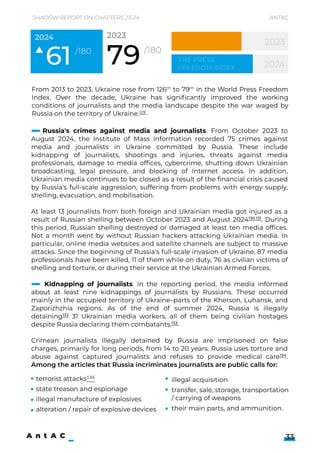
In 2024, Ukraine moved up 18 positions in the Press Freedom Index of the
international human rights organisation Reporters Without Borders, ranking
61st128
(in 2023, Ukraine was ranked 79th
). At the same time, Reporters state that
the full-scale war launched by Russia threatens the survival of Ukrainian media
by the expansion of Russian propaganda and weakening the Ukrainian
economy.
Shadow Report on Chapters 23-24 Antac
32
Media freedom
For instance, in February 2024, he publicly criticised123 the long-awaited draft
law on mobilisation measures, claiming it to be non-compliant with the
Constitution of Ukraine and containing contradictory provisions. Moreover, in
2023, the Ombudsman’s Office monitored more than 833 military medical
commissions, with many violations of the human rights of recruited persons
identified. Later, the office presented proposals to reform the work of those
commissions.
Shadow Report on Chapters 23-24 Antac
33
From 2013 to 2023, Ukraine rose from 126th to 79th in the World Press Freedom
Index. Over the decade, Ukraine has significantly improved the working
conditions of journalists and the media landscape despite the war waged by
Russia on the territory of Ukraine.129
61/180
2024 2023
2024
the Press
Freedom Index
Russia's crimes against media and journalists. From October 2023 to
August 2024, the Institute of Mass Information recorded 75 crimes against
media and journalists in Ukraine committed by Russia. These include
kidnapping of journalists, shootings and injuries, threats against media
professionals, damage to media offices, cybercrime, shutting down Ukrainian
broadcasting, legal pressure, and blocking of Internet access. In addition,
Ukrainian media continues to be closed as a result of the financial crisis caused
by Russia's full-scale aggression, suffering from problems with energy supply,
shelling, evacuation, and mobilisation.


At least 13 journalists from both foreign and Ukrainian media got injured as a
result of Russian shelling between October 2023 and August 2024130,131. During
this period, Russian shelling destroyed or damaged at least ten media offices.
Not a month went by without Russian hackers attacking Ukrainian media. In
particular, online media websites and satellite channels are subject to massive
attacks. Since the beginning of Russia's full-scale invasion of Ukraine, 87 media
professionals have been killed, 11 of them while on duty, 76 as civilian victims of
shelling and torture, or during their service at the Ukrainian Armed Forces.


Kidnapping of journalists. In the reporting period, the media informed
about at least nine kidnappings of journalists by Russians. These occurred
mainly in the occupied territory of Ukraine–parts of the Kherson, Luhansk, and
Zaporizhzhia regions. As of the end of summer 2024, Russia is illegally
detaining132 31 Ukrainian media workers, all of them being civilian hostages
despite Russia declaring them combatants.133


Crimean journalists illegally detained by Russia are imprisoned on false
charges, primarily for long periods, from 14 to 20 years. Russia uses torture and
abuse against captured journalists and refuses to provide medical care134.
Among the articles that Russia incriminates journalists are public calls for: 


terrorist attacks135

state treason and espionage

illegal manufacture of explosives

alteration / repair of explosive devices
illegal acquisition

transfer, sale, storage, transportation
/ carrying of weapons

their main parts, and ammunition.
Operational challenges for media in times of war. One of the main
challenges for Ukrainian editorial offices has been the prolonged power
blackouts throughout Ukraine caused by the Russian shelling of energy
infrastructure. These blackouts significantly complicate collecting, processing,
and transmitting information. They also impaired contact with the audience,
which is also affected by blackouts and lack of access to the Internet. The
media have to quickly adjust their work to the blackouts and look for funds for
powerequipment(generators,batteries,powerbanks,fuel).


Ukrainian editorial offices, especially regional ones, are in a critical financial
situation due to the falling advertising market. According to a survey of
regionalmediaconductedbyIMIinJune2024,41%ofallrequestsfromeditorial
offices concerned financial support. Many editorial offices need help covering
basic operating costs. Another challenge was the staffing problems in the
media related to the mobilisation of male media professionals into the Armed
Forcesandtheevacuationandrelocationofjournaliststosaferplaces.


Crimes against media and journalists committed by the Ukrainian side.
ThemaincategoriesofviolationsforwhichUkrainianentitiesareresponsiblein
the period from October 2023 to August 2024 were: restriction of access to
public information - 17 cases; cybercrime - 15 cases; obstruction of legitimate
journalistic activities - 14 cases; indirect pressure - 12 cases (mostly spying on
journalists); threats - 11 cases. In total, 87 crimes were recorded in 2023, for
which the Ukrainian side is responsible. Before the pre-full-scale invasion in
2021,IMIrecorded197violations.


Monopoly in the information space and signs of censorship. The case of
theintroductionofcensorshipandblack-listsinthestatenewsagency
ShadowReportonChapters23-24 Antac
34
During this period, Russia committed
crimes against media and journalists in
11 regions of Ukraine, including both
frontlineandrearregions 

(Kyiv, Zaporizhzhia, Kharkiv, Odesa,
Donetsk, Dnipro, Ternopil, Sumy,
Poltava,Luhansk,andKhersonregions).
Shelling of TV towers. In 2024, the Russians resumed shelling Ukrainian
television and radio infrastructure. Previously, IMI recorded 16 cases like this at
the beginning of the full-scale Russian invasion in 2022. In particular, in March
2024,theRussiansdeliberatelyattackedtelevisioninfrastructurefacilitiesinthe
Kharkiv region with drones and launched missile and air strikes on radio
facilities in the Sumy region. As a result, some settlements in the Sumy region
wereleftwithoutTVandradiosignals.
11
regions
Public broadcasting. Since May 21, 2024, the Public Broadcaster has de
facto withdrawn from the TV marathon and started its round-the-clock
broadcasting on Channel One. De jure, Suspilne remained a part of the
marathon, as evidenced by a memorandum signed by all project participants.
The withdrawal from the marathon came after Svitlana Ostapa, the head of the
Supervisory Board of Suspilne, said Suspilne was about to be thrown out of the
evening slots of the telethon. This came after MP Mariana Bezuhla, affiliated
with the Office of the President, launched an information campaign against
Suspilne. In connection with the pressure on Suspilne, the European
Broadcasting Union, the Parliamentary Committee on Ukraine's EU Integration,
Mediarukh, and the Public Council under the Committee on Freedom of
Speech spoke out in Suspilne’s defence. This helped to protect the broadcaster
from attacks while leaving the state marathon to produce its content.


Public broadcasting in Ukraine systematically adheres to journalistic standards
and maintains editorial independence. However, the public broadcaster's
funding level is insufficient for proper functioning. According to the Law ‘On
Public Media’, the state must provide funding for Public Broadcasting at the
level of at least 0.2% of the general expenditures of the State Budget of Ukraine
for the previous year. Thus, in 2024, the broadcaster:


At the same time, the
government has allocated UAH 1.5
billion for government media to
finance the so-called United TV
Marathon.
should have received yet RECEIVED three times less
Shadow Report on Chapters 23-24 Antac
Ukrinform has gained wide publicity in Ukraine. The information about the
‘blacklists’ was published by Ukrayinska Pravda and later confirmed by former
Ukrinform employees. At the same time, the police found no grounds to open
the criminal proceeding. As of September 2024, the case is under consideration
by the Verkhovna Rada Committee on Freedom of Speech, which plans to set
up a commission to study the situation in detail.


The TV marathon United News threatens media pluralism, as the television
space has come mainly under state control. Detector Media's monitoring of the
marathon shows an unbalanced representation of political forces favouring the
Servant of the People on all channels involved in creating the marathon. The
marathon has low viewer ratings and trust, is criticised by civil society, and
threatens pluralism in information coverage. Ukrainians’ trust in the telethon
has dropped to 36%.136
5.5 BLN₴ 1.8 BLN₴
35
At the same time, according to IMI research138, many of Ukraine's most popular
Telegram channels spread fake news, particularly related to mobilisation. The
Ukrainian authorities have also stated the number of threats to Ukraine's
security posed by this messenger. Some media offices are gradually closing
their Telegram channels.
New rules for journalists in combat zones and adjacent areas were
developed. On February 26, 2024, the General Staff of the Armed Forces of
Ukraine published an updated ‘Recommendations for Journalists on the
Organisation of Work at Military Facilities and in Combat Areas under Martial
Law’. Amending Order No. 73 of the Commander-in-Chief of the Armed Forces
of Ukraine ‘On the organisation of interaction between the Armed Forces of
Ukraine, other components of the defence forces and representatives of the
media for the duration of the legal regime of martial law’139 simplified media
access by providing a detailed description of the zones (green, yellow, and red)
and removing the requirement to stop the work of journalists in case of a life
threat. The amendments were made based on IMI's recommendations after
war correspondents reported about censorship and selectivity in red-zone
access for journalists140.


The independence of the media regulator should be ensured by adequate
funding. The budgetary financing of the National Council of Television and
Radio Broadcasting for 2024 is insufficient.
Shadow Report on Chapters 23-24 Antac
36
Changes to Ukrainian media legislation
over the past year:
01
02
Pressure on investigative journalists. In 2023-2024,
well-known investigative journalists, including Yuriy Nikolov of Nashi Hroshi,
and journalists from Bihus.Info and Slidstvo.Info, were subjected to pressure.
Anonymous Telegram channels affiliated with the authorities published
provocative videos calling journalists ‘enemies of the people’, agents, and
evaders, accused them of drug use, and used summons as a repressive tool.
Bihus.Info and Slidstvo.Info found out that the Security Service of Ukraine was
surveilling journalists because of their investigations. In particular, Yevhen
Shulhat from Slidstvo.info was approached by the military enlistment officers
with a draft summons right after he published a story about the assets of the
family of one of the Service chiefs, Ilya Vityuk. The media community
Mediarukh demanded the opening of a criminal proceeding against the
Special Security Service and the Territorial Centre for Recruitment and Social
Support. Eventually, on May 1, 2024, the President Zelenskyi fired Vityuk.


In general, Ukrainians rely heavily on Telegram channels to receive news during
the war. The annual USAID/Internews Media Consumption Survey137,
conducted from July to September 2023, confirmed that Telegram remains the
key social network for news consumption (72%). In 2021, only 20% of Ukrainians
used Telegram as a news source.
Shadow Report on Chapters 23-24 Antac
37
Rights of national minorities
During the reporting period, Ukraine adopted a law amending the legal
framework on national minorities and several by-laws. The legal framework for
Indigenous people did not change.


In December 2023, Ukraine’s parliament adopted Law No. 3504-IX146,
amending several legal acts regarding the rights of persons belonging to
national minorities, including the framework one147. Drafted by the
Government after consultations with various minority organisations148, this Law
also aimed to incorporate the latest Venice Commission recommendations149
on the eve of the European Council meeting on Ukraine’s EU candidacy status.


One of the key amendments concerned education. The Law cancelled the
quota system for the EU languages150. It allowed 100% of secondary education
in the mother tongue with four subjects only being taught in the state
language: Ukrainian language, literature, history, and protection of Ukraine151.
The amendment applies to the EU languages and those languages protected
by Ukraine under the European Charter for Regional or Minority Languages152,
except for the official languages of states recognised as aggressors or
occupying powers by Ukraine’s parliament. Other changes concern the use of
minorities’ languages in various areas, including but not limited to media,
election campaigns, books in minority languages, and advertising. The revised
legal framework on national minorities considers the Venice Commission
recommendations.


The 2022 Framework Law153 envisaged the by-laws adopted during the
reporting period.
According to the Law ‘On the State Budget of Ukraine for 2024’141, UAH 229
million is allocated for the Regulator—development costs amount to only UAH
10.25 million. Moreover, the legislative guarantees of financing the National
Council were suspended for 2024 by the law on the State Budget.


The Roadmap to support restoring a pluralistic, transparent and
independent post-war media space has been approved142. Three objectives
include: I. ‘Promoting the stable resumption of the activities of media entities in
Ukraine’, II. ‘Ensuring access to information’, and III. ‘Increasing the resilience of
Ukraine’s population to disinformation and manipulative information’.


Amendments to the Law of Ukraine ‘On Media’. Some amendments were
introduced to this law: some technical (to clarify the wording of a relatively
recent law), some concerned clarifications regarding the language of the
aggressor state in the media143 and restrictions for public authorities on
entering the ownership structure of print and online media144,145.
03
04
Shadow Report on Chapters 23-24 Antac
38
All the secondary legislation mentioned above, except for the List of languages
in danger of extinction, was drafted before the December 2023 legislative
changes occurred. As the Venice Commission recommended enshrining some
of the guarantees directly in Framework Law to ensure legal certainty, some
legal provisions are currently duplicated in the Law and the by-laws.


Roma minority. In December 2023, the government adopted the Action Plan
for 2024-2025 to implement the Roma Strategy up to 2030160. The Strategy was
adopted in July 2021, but the development of the Action Plan was postponed
due to the Russian full-scale invasion and the need to adapt its provisions to
the full-out war context. In addition to the national action plan, regional
military administrations developed their regional action plans to implement
the strategy at the local level. The Intragovernmental Coordinating Working
Group on the Strategy’s implementation, established in 2022
October 2023


the State Service of Ukraine for Ethnic Affairs and Freedom of Conscience
approved the Regulation on the Council of Public Associations of National
Minorities (Communities) of Ukraine157. This allowed for an open
competition to elect 18 persons from 18 different minorities to the Council,
which held its first inaugural meeting on May 31, 2024158. The current
composition of the Council will be operative for four years.
February 2024


the State Service of Ukraine for Ethnic Affairs and Freedom of Conscience
approved the Procedure for establishing and functioning the Centre for
National Minorities (Communities) of Ukraine159. The framework Law No.
2827-IX envisages such Centres, and the Procedure clarifies practical
mechanisms of their operation, such as management.
June 2024


the Government approved the List of languages of national minorities
(communities) and indigenous peoples of Ukraine in danger of
extinction156.
February 2024


the Government adopted the Methodology for using the languages of
national minorities (communities) of Ukraine in settlements traditionally
resided by persons belonging to these communities or in which such
persons make up a significant part of the population154. Later in March, the
Government approved the Procedure for determining the list of the
settlements mentioned above155.
Shadow Report on Chapters 23-24 Antac
39
International obligations. In July 2024, Ukraine submitted its national report
under the European Charter for Regional or Minority Languages167. Ukraine’s
government is also drafting its report under the Framework Convention for the
Protection of National Minorities. Reporting on the latter is delayed, given that
the Advisory Committee has not visited Ukraine yet and has not delivered an
opinion on Ukraine’s previous national report (submitted in January 2022).


Religious minorities. A long-lasting public discussion on the activities of
religious organisations affiliated with the Russian Federation in Ukraine
resulted in the respective Law, passed by the Parliament on August 20, 2024168.
This Law prohibits Russian Orthodox Church activities in Ukraine and stipulates
criteria and procedures for establishing affiliation and banning and cancelling a
ban on foreign religious organisations in Ukraine. The Law affects the Ukrainian
Orthodox Church (affiliated with the Moscow Patriarchate) since its affiliation
with the Russian Orthodox Church has already been established169. While there
is caution regarding the Law’s provisions, in particular, because the state
experts are authorised to examine if a religious organisation has a link with
ROC, the court should consider a case and deliver a judgment on a concrete
legal entity. Remarkably, the Law was supported by the Ukrainian Council of
Churches and Religious Organisations170.
and headed by the Minister of the Cabinet of Ministers of Ukraine161, held its
first meeting in June 2024162. Representatives of Roma minority organisations
are also members of this Group.


Institutional changes. The key central governmental authority responsible for
developing and implementing state policy on national minorities is the State
Service for Ethnic Affairs and Freedom of Conscience. During the reporting
period, Ukraine’s Ombudsman started exercising parliamentary control over
the right of national minorities to use their languages163. This strengthened
oversight of minority language use and balanced promoting the state
language with protecting minority languages.


Media landscape. In December 2023, leaders of the Hungarian community in
Ukraine sent a letter to the Hungarian Government asking for Ukraine’s
support during the EU accession164. According to the media, the Hungarian
response was not encouraging,165 although Hungary did not block the opening
of accession negotiations.


In January 2024, Hungary sent 11 paragraphs of demands regarding the
Hungarian minority in Ukraine, conditioning Ukraine’s EU accession to
implement such demands. Ukraine publicly committed to fulfilling the latter.
Ukrainian media revealed the content of Hungarian requests in late June
2024166. The demands include some provisions based on the Hungarian
position on minorities, which cannot be considered as Ukraine’s obligations or
international standards. This situation overall raises doubts about the
legitimacy and aims of Hungarian pressure.
Shadow Report on Chapters 23-24 Antac
40
The International Organisation for Migration estimates the number of IDPs in
Ukraine as of April 2024 at around 3.5 million. Slightly more than 4.7 million
have returned to their usual place of residence. The number of Ukrainians living
abroad is more than four million. The vast movement of people forced to flee
their homes created an acute shortage in the labour market and an additional
burden on the state budget of Ukraine to provide needed social support to
internally displaced persons.


This category of population is one of the most vulnerable in Ukraine. Many IDP
households have incomes per person below the subsistence level. The problem
of housing is also very acute. Only a tiny part of IDPs live in specially equipped
temporary accommodation. The rest are forced to rent housing and pay rent or
live with relatives171. In 2024, the severity of these problems remained
unchanged, and no significant steps were taken to address them.


Today, Ukraine's state policy on solving the problems of IDPs is partially
ineffective. In 2023, the Cabinet of Ministers of Ukraine approved the Strategy of
State Policy on Internal Displacement until 2025 and the operational plan for its
implementation in 2023-2025 to effectively address all issues related to IDPs at
all stages, from displacement to return or integration into a new community. In
January 2024, the Temporary Special Commission of the Verkhovna Rada of
Ukraine on the protection of property and non-property rights of IDPs and
other persons affected by the armed aggression of the Russian Federation
against Ukraine recognised the implementation of the Strategy to be
insufficient172. In particular, due to a lack of consistency in legislation, many
internally displaced persons lost the right to receive housing allowances in
2024.


There is an urgent need to adopt a new version of the Law ‘On Ensuring the
Rights and Freedoms of Internally Displaced Persons’. The current law dates
back to 2014, and despite the legal changes over the past ten years, new
approaches to state policy towards internally displaced persons need to be
enshrined. In particular, the state should regulate a timeframe during which a
person retains IDP status. In the years since the first displacement in 2014,
many IDPs have adapted to their new place of residence and are no longer
displaced but retain this status. Approaches to social security also need to be
updated, as well as the development of relevant programmes of housing
assistance, employment assistance, etc. Despite this, a new draft law has not
been submitted to the Verkhovna Rada of Ukraine, and its text has not been
agreed upon.
Internally displaced persons
Shadow Report on Chapters 23-24 Antac
41
CHAPTER 24: Justice,
freedom, and security
chapter

24
The National Police of Ukraine is the largest173 law enforcement agency in the
country, investigating 84% of all crimes and 77% of corruption crimes174. In
addition, since the beginning of Russia's full-scale invasion of Ukraine, the NPU
has initiated more than 120,000 criminal proceedings related to crimes by
Russian armed forces and their accomplices175.


In its 2023 Enlargement Package report, the European Commission noted that
the NPU “continues to suffer from corruption, outdated equipment and limited
capacity in general, including the ability to conduct financial investigations”176.
In February 2024, the NACP audited the NPU's corruption prevention work.
According to the audit, the NPU does not have internal and regular channels
for reporting corruption, lacks a proper procedure for identifying corruption
risks in public procurement, does not have adequate accounting and
distribution of charitable assistance, etc177. Thus, the NPU continues to have
significant shortcomings in its activities, which later contribute to corruption
loopholes.


The NPU remains politically dependent on the Ministry of Internal Affairs of
Ukraine, which prevents it from being an impartial body and effectively
investigating offences. Transforming the MIA, moving away from the concept
of a post-Soviet ministry of militia, and creating an independent and
professional law enforcement agency were among the reasons for the
liquidation of the militia and the creation of the NPU in 2015178.


Given that the Minister of Internal Affairs of Ukraine directs and coordinates
NPU’s activities, the Chief of the Police is appointed and dismissed by the
Cabinet of Ministers of Ukraine following the former’s proposals. The First
Deputy and Deputy Chiefs of the Police are appointed and dismissed by the
Minister upon the Chief of the Police's proposal. The First Deputy and Deputy
Chiefs of the Police are appointed and dismissed by the Minister upon
National Police of Ukraine
Shadow Report on Chapters 23-24 Antac
42
the Chief of the Police's proposal. Considering the absence of transparent,
competitive procedures for appointing senior positions at the NPU, such
appointments are political.


The State Anti-Corruption Programme179 for 2023-2025 obliged180 the MIA and
the NPU to develop a draft law allowing for a competitive selection of the NPU’s
senior leadership, with integrity as one of the key criteria. Civil society has
repeatedly appealed to the MIA and the NPU to introduce transparent
competition and appoint the NPU leadership with a commission that includes
representatives of international partners181. The draft law on competitions for
NPU senior positions should be developed based on the standards of the
recent NACP182 and NABU183 heads selections.


However, the MIA and the NPU developed a draft law that did not involve
consultation with civil society184. The draft law empowers the MIA to arbitrarily
set a list of managerial positions for competitive selection while lacking a
procedure and criteria for determining such positions. Thus, there is a risk of
manipulating the list and avoiding introducing competition for the Police Chief
and deputies.


Ineffective disciplinary procedures at the NPU


The NPU has faced criticism over corruption scandals and other abuses by the
NPU leadership. The situation worsened due to inadequate internal
investigation procedures and the lack of disciplinary sanctions against
compromised officials. For example, the head of the NPU, Ivan Vyhivskyi, has
been allegedly using the property of relatives who do not have sufficient official
income185. Despite public concern, the Minister of Internal Affairs refused to
launch an internal investigation, claiming that the NABU should investigate
it186. Given that the pre-trial investigation and prosecution of a law
enforcement agency head may last several years, the Minister’s reaction shows
a lack of will to bring the Police Chief to responsibility.


Since the system of bringing police officers to disciplinary responsibility is
ineffective, MIA and the NPU had to finalise a draft law in line with the State
Anti-Corruption Programme by July 31, 2024,187 allowing for the establishment
and functioning of two types of disciplinary commissions:
for internal investigations into violations
of constitutional rights and freedoms of
a person and citizen by police officers
(at least half of the members should 

be representatives of the public and
human rights organisations)
for internal investigations into other
disciplinary offences of police officers
Shadow Report on Chapters 23-24 Antac
43
The police officer certification procedure needs improvement


In 2015, almost 100,000 militia officers were
transferred to the National Police. After
certification, which included two tests and a
short interview with the ministry-dominated
commission, only 6% of officers were found to
be incompatible with their positions.
Therefore, the new institution was staffed
entirely by representatives of the old system189.
The State Anti-Corruption Programme obliged the Ministry of Internal Affairs
and the National Police to reform the police performance appraisal system by
introducing efficiency, integrity, managerial competencies (for managers), and
performance assessments190. At the same time, the developed draft law does
not include performance among the evaluation criteria191.
Law No. 3840-IX, adopted on June 20, 2024,192 on the reboot of the Economic
Security Bureau of Ukraine, was quite challenging to pass, as it initially did not
meet the requirements of international partners. However, due to the threat of
not receiving the next tranche from the International Monetary Fund, the draft
law was finally adopted in a more or less acceptable version to all stakeholders.
According to the Law, the commission to elect the ESBU head consists of three
persons appointed directly by the Cabinet of Ministers of Ukraine and three
others appointed based on proposals from international and foreign
organisations. The decision is made by four votes, of which at least two are from
representatives of international organisations. The law also introduces a new
method of staff appointment at the ESBU, which is exclusively based on
competitive selection conducted by personnel commissions. Those
commissions are formed by the ESBU Director with five members each,
including at least two members nominated by the assembly of representatives
of civil society organisations and at least one member nominated by the Public
Control Council of the ESBU.


In the case of personnel commissions, the law provides too lenient and abstract
requirements for civil society organisations that may delegate their
representatives. Therefore, there is a risk that candidates from unauthorised
and/or artificial organisations or organisations controlled by politicians or
industrial and financial groups will be included in the commissions.
Economic Security Bureau of Ukraine
However, the developed draft law does not guarantee the mandatory inclusion
of at least half of the civil society representatives in disciplinary commissions to
ensure compliance with the SACP requirements188 and to introduce an
independent and objective procedure.
out of 

100 000
Shadow Report on Chapters 23-24 Antac
44
This can negatively affect the objectivity and quality of the integrity assessment
of candidates and the voting of public representatives during the selection for
positions at the ESBU.  


In addition, the Law provides for mandatory re-certification of the current ESBU
employees, which must be conducted during 18 months. The decision of the
re-certification commission shall be deemed adopted if at least seven
members vote for it, including at least three members delegated by the ESBU
head and three by the international partners (in total, there are six
representatives on each side). The re-certification involves testing general skills
and knowledge of Ukrainian legislation and an interview to assess compliance
with integrity and professional competence criteria. The main challenge to the
re-certification will be the integrity and professionalism of the respective
commissions’ members, who must ensure a proper reboot of the ESBU,
especially given the former’s size (twelve members). In addition, the law does
not prioritise the votes of commission members representing international
partners in the decision-making process.
Revenues to the State Budget of Ukraine from managing ARMA assets in 2023
amounted to UAH 101.3 million, an increase of almost 300% compared to
2022. ARMA is gradually trying to restore trust in the institution by opening the
register of seized assets and selling them through Prozorro.Sale.193 The sale
and selection of asset managers on Prozorro are positive changes in the
agency's activities.


Nevertheless, serious challenges in ARMA's activities need to be addressed,
such as:
Asset Recovery and Management Agency
Additional procedure regulation to
select interim asset management
is needed


(approved by the ARMA Order of
September 29, 2023).
Amendments to the ARMA Law 

are necessary to abolish the need 

to coordinate with the legal
owner of the property if this
owner is associated with the
aggressor country.
It is crucial to increase ARMA’s institutional capacity, update the competitive
selection procedure for selecting the top management based on the NACP,
NABU, SAPO, and ESBU best examples, and conduct ARMA’s external audit by
an independent commission, not an audit company that is currently selected
annually in a non-transparent manner.
01
03
02
Shadow Report on Chapters 23-24 Antac
45
In addition, in August 2023, the government approved the Asset Recovery
Strategy for 2023-2025 to implement the State Anti-Corruption Programme. In
November 2023, a relevant interagency working group was formed, and in
August 2024, the Action Plan for implementing this Strategy was finally
approved. The plan envisages the development of several dozen draft laws
designed to improve the regulation of tracing and managing seized assets in
Ukraine. Thus, the first deadlines for submitting seven draft laws to the
Government are already at the end of 2024, including a draft law to expand
access to additional sources of information and to strengthen the operational
capabilities of law enforcement agencies in investigating money laundering
and a draft law to expand the powers of the ARMA, in particular, to prepare a
reasoned conclusion in case of independent detection of signs of an offence
from any source. As of today, none of these draft laws have been registered in
Parliament. Therefore, in the fourth quarter of this year, we should expect an
intensification of legislative initiatives related to the ARMA's activities.
JUSTICE
FREEDOM
SECURITY
1. Draft Law ‘On amending the Criminal Code of Ukraine and the Criminal
Procedure Code of Ukraine to improve the efficiency of plea bargaining’

2. Draft Law ‘On amending the Criminal Code of Ukraine and the Criminal
Procedure Code of Ukraine to improve the regulation of plea agreements in
criminal proceedings on corruption and corruption-related criminal offences’ 

3. HACC closed a criminal proceeding against MP for making a false declaration

4. The Order of the Cabinet of Ministers of Ukraine ‘On adopting the Action
Plan to implement the Comprehensive Strategic Plan for Reforming Law
Enforcement Agencies as a Part of the Security and Defence Sector of Ukraine
for 2023-2027’ 

5. The Report by the Head of the HACC 

6. The Law ‘On amending Article 31 of the Criminal Procedure Code of Ukraine
to improve the procedure for conducting criminal proceedings’
7. The Law ‘On Amendments to the Criminal Procedure Code of Ukraine and
Other Legislative Acts of Ukraine to Strengthen the Independence of the
Specialised Anti-Corruption Prosecutor's Office’

8. Report on the performance of the National Anti-Corruption Bureau of
Ukraine for the first half of 2024

9. "Leaking information in Great Construction case": NABU employee was
searched – photo 

10. NABU Director Semen Kryvonos dismissed his first deputy Gizo Uglava 

11. Pilot 5th Round of Monitoring Under the Istanbul Anti-Corruption Action
Plan

12. The Law ‘On amending certain laws of Ukraine to bring the status of the
National Anti-Corruption Bureau of Ukraine in line with the Constitution of
Ukraine’

13. Formation of the High Anti-Corruption Court: how 38 judges were selected
among 343 candidates

14. Ukraine’s judicial reform has mixed reviews as it nears key point 

15. The “Rebooted” High Council of Justice: Wins and Fails 

16. Elections in the Shadow of War: Who are mobilised attorneys hindering? 

17. The President has still not appointed anyone to the first position of a
member of the High Council of Justice under his quota, while the Ethics
Council is beginning interviews for the second position 

18. The commission did NOT recommend appointing a new member to the
HCJ: what’s next? 

19. Priority Return: Six months of complaints review in the High Council of
Justice
 

Shadow Report on Chapters 23-24 Antac
46
REFERENCES
Shadow Report on Chapters 23-24 Antac
47
20. The HCJ formed a commission for the selection of disciplinary inspectors

21. Ukrainian society deserves officials with a high level of professionalism and
an impeccable reputation

22. 4 years, 2 laws, 16 members: how the new composition of the High
Qualification Commission of Judges of Ukraine was selected

23. The High Qualification Commission of Judges elects a new head – Andriy
Pasichnyk, but fails to elect a deputy head

24. HQCJ: Accomplishments and Problems, https://vkks-dosyahnennya-i-
problemy.webflow.io/en 

25. Ten months of the qualification assessment: 43 judges of low integrity
retained their positions, and 27 were recommended for dismissal, https://
dejure.foundation/10-misyacziv-oczinyuvannya-suddiv-43-nedobrochesnyh-
zalyshyly-na-posadah-27-rekomenduvaly-zvilnyty/ 

26. The HCQJ’s response to the request for public information, https://
drive.google.com/file/d/1TdutMzwNy_4YSSfoa_8qZrT0N-GJrniX/view?
usp=sharing 

27. Ten months of the qualification assessment: 43 judges of low integrity
retained their positions, and 27 were recommended for dismissal 

28. The Verkhovna Rada has approved amendments to judicial career
processes, simplifying and expediting selection, although concerns exist about
the qualification assessment

29. Information on the results of interviews conducted by the HQCJ with
candidates for the position of judge as part of the competition for 560 vacant
judge positions in local courts, announced on September 14, 2023. 

30. Results of admission to the competition for appellate courts as of March 8,
2024 

31. Failures of the Council of Judges

32. Results of admission to the competition for appellate courts as of March 8,
2024 

33. The Venice Commission. Opinion No. 1012/2020 

34. Under the new rules: the Verkhovna Rada appointed Serhiy Riznyk as a
judge of the Constitutional Court of Ukraine

35. Ukraine Supreme Court Head Accused of Taking $2.7 Million Bribe

36. The Supreme Court of Kravchenko — Preserving the Old Ways

37. “Black day in the history of the court” continues: Stanislav Kravchenko was
elected as the President of the Supreme Court

38. The Supreme Court elected two judges of low integrity to the Grand
Chamber: judge Stupak, who lied in her declaration, and judge Pohribnyi, who
adopted politically motivated decisions
REFERENCES
Shadow Report on Chapters 23-24 Antac
48
39. Record of judges' positions 

40. Establishment of the new Supreme Court: key lessons 

41. The European Commission Ukraine 2023 Report

42. The Supreme Court struck down the assessments of 180 judges of low
integrity, jeopardising the cleansing of the judiciary

43. The Supreme Court of Kravchenko—Preserving the Old Ways

44. Judicial matrix: continue assessing the judges of low integrity or begin
assessing the Supreme Court

45. International Monetary Fund. Ukraine report No. 23/399 

46. Ukraine Facility Plan 

47. G7 Ambassadors’ support group for Ukraine priorities for 2024

48. Continued, but not enough: The Verkhovna Rada adopted a draft law that
extends the term of the Public Council of International Experts 

49. Judicial reform on the brink of disaster: the Ethics Council admits
candidates of low integrity to the High Council of Justice, blocks decent ones
and does not explain its decisions

50. The fish stinks first from the head: What is wrong with the Ukrainian Bar
and how to fix it, https://dejure.foundation/en/the-fish-stinks-first-from-the-
head-what-is-wrong-with-the-ukrainian-bar-and-how-to-fix-it/

51. Failures of the Council of Judges. 

52. The Ethics Council, which will cleanse the High Council of Justice, was
formed automatically 

53. Yanukovych’s henchman and Vovk’s accomplice: the Council of Judges
elected Yaroslav Romanyuk and Volodymyr Kuzmenko to the selection
commission for the Constitutional Court

54. The Law ‘On the Bar and Practice of Law’

55. The fish stinks first from the head: What is wrong with the Ukrainian Bar
and how to fix it

56. The Constitution of Ukraine

57. The profession of attorney is more popular among men - Valentyn Hvozdiy

58. Bar or shelter? Access to the profession requires attention! 

59. Will the Constitutional Court Break Down the Medvedchuk-Portnov System
in the Legal Practice? 

60. The fish stinks first from the head: What is wrong with the Ukrainian Bar
and how to fix it.

61. Ibid. Medvedchuk's people STILL control Ukrainian Bar: 'Russian world' vs
judicial reform
REFERENCES
Shadow Report on Chapters 23-24 Antac
49
62. Traitor lawyers in Crimea still operate with Ukrainian licenses, and the
National Bar Association does not respond to this 

63. The fish stinks first f rom the head: What is wrong with the Ukrainian Bar
and how to fix it

64. The UNBA appointed a spokesperson

65. To reboot the Bar: The Shevchuk case as an indicator of the system's
malfunction

66. Elections in the Shadow of War: Who are mobilised attorneys hindering? 

67. Law on the High Council of Justice

68. Hrygoriy Usyk: Thorough analytical work on existing disciplinary complaints
in the HCJ lies ahead

69. 2023 the ILAC Rule of Law report. Surviving the Assault: The Ukrainian Legal
System After a Year of War (The ILAC Rule of Law report, 53)

70. The fish stinks first f rom the head: What is wrong with the Ukrainian Bar
and how to fix it

71. A $200,000 bribe as a signal for overhauling the legal profession

72. The ILAC Rule of Law report, 53 

73. The Bar of Ukraine. Shadow report, 34

74. Decree of the President of Ukraine on the Strategy for the Development of
the Judicial System and Constitutional Justice for 2021-2023

75. Statement of the Ukrainian Bar Association regarding the use of disciplinary
proceedings as a means of pressure on attorneys

76. Rules of attorney ethics

77. The fish stinks first f rom the head: What is wrong with the Ukrainian Bar
and how to fix it

78. Elections in the Shadow of War: Who are mobilised attorneys hindering? 

79. Attorney Ilya Kostin claimed that he faced pressure as a result of his
criticism of the Bar leadership members;

Inaction Towards Collaborators and the Hunt for Independent Attorneys: In
Whose Interests Do the Bar Bodies Act?

80. The European Commission Ukraine 2023 Report, 27

81. The United Nations Basic Principles on the Role of Lawyers, art. 24; the CCBE
Charter of Core Principles of the European Legal Profession, Principle (g), art.
5.8; Recommendation No. R (2000) 21 of the Committee of Ministers of the
Council of Europe on the f reedom of exercise of the profession of lawyer,
principle II; International Bar Association Policy Guidelines for Training and
Education of the Legal Profession.

82. Professional Development Worth Millions: How Izovitova and Gvozdiy Profit
f rom the Attorneys’ School
REFERENCES
Shadow Report on Chapters 23-24 Antac
50
83. Attorneys vs. the High School of Attorneys 

84. Artem Donets vs the monolithic Bar – 2:0 

85. The European Commission Ukraine 2023 Report, 27

86. The fish stinks first from the head: What is wrong with the Ukrainian Bar
and how to fix it

87. The Bar of Ukraine. Shadow report, 59 

88. Annual reports of the UNBA 

89. The European Commission Ukraine 2023 Report, 19 

90. Has the competition stalled? How are judges selected for the Constitutional
Court in the first open competition?  

91. The interview of Lyubomyr Andreychuk for the Constitutional Court 

92. The European Commission Ukraine 2023 Report, 19

93. G7 Ambassadors’ support group for Ukraine priorities for 2024

94. The concept of legal education reform is promised by the end of June: how
did the first meeting of the Working group go? 

95. Training of lawyers in higher education institutions with specific conditions:
current status and Euro-integration requirements 

96. The government approved an action plan that, among other things,
includes the delineation of legal and law enforcement education 

97. State funding for legal education 2024: bachelors for the Ministry of Internal
Affairs, PhD students for the ministry of Education and Science,

98. Legal education reform map

99. Ibid. 

100. Ibid.

101. Law faculties ranking: Krakow once again the best

102. Law Faculties Ranking 2022. Where to go for legal studies? 

103. Towards European standards: the government abolished legal education in
colleges 

104. A small step forward – the Ministry of Education and Science adopted
admission rules to law schools in 2024

105. Legal education reform map

106. Legal education reform. Results of students’ survey on quality of legal
education

107. Report on the results of analytical research “Knowledge and skills of law
school graduates and higher education institutions through the lens of
alignment with labour market demands

REFERENCES
Shadow Report on Chapters 23-24 Antac
51
108.StudyofEuropean Union Law

109.Missing in action during thewar.Whatto do:an interview with a
governmentcommissioner

110.95% ofUkrainian prisoners ofwar weretortured– UN reports on russia’s war
crimes

111.Two-year update.Protection ofcivilians:impactofhostilities on civilians
since24 February2022 

112.During thefull-scalewar in Ukraine, 1642 medicalfacilities havebeen
damagedand214 morehavebeen completelydestroyed 

113.TheParliamentestimates thedamageto energyinfrastructurefrom
attacks at$12.5bn 

114.Situation in Ukraine:ICC judges issuearrestwarrants

115.Resolution on approvaloftheaction plan for theimplementation ofthe
recommendations oftheEuropean Commission presentedin theProgress
ReportofUkraineunder theEU EnlargementPackage2023

116.Order on approvaloftheaction plan aimedatimplementing the
ComprehensiveStrategicPlan for Reforming Law EnforcementAgencies as
PartoftheSecurityandDefenceSector ofUkrainefor 2023-2027

117.SpecialReport‘On theStateofAffairs Regarding thePrevention in Ukraine
ofTortureandOther Cruel, Inhuman or Degrading TreatmentMeasures in
2023’

118.Order on approvaloftheNationalAction Plan for theimplementation of
theConvention on theRights ofPersons with Disabilities for theperiodupto
2025

119.Order on approvaloftheAction Plan for 2023-2024 for theimplementation
oftheNationalStrategyfor creating abarrier-freespacein Ukrainefor the
periodupto 2030

120.Implementing barrier-freeenvironment:importantmeasures to createa
barrier-freeenvironmentarebeing implementedin theenvironmentsector

121.Pending applications allocatedto ajudicialformation

122.Articles 12, 17, 19, 21, 25 ofthe1966 InternationalCovenanton Civiland
PoliticalRights, Articles 8, 10, 11oftheConvention for theProtection ofHuman
Rights andFundamentalFreedoms, Articles 1, 2, 3 oftheAdditionalProtocolto
theConvention, Article2 ofProtocolNo.4 to theConvention.In April2024, the
scopeofderogation was amendedandreduced, Ukraineofficiallyfiledthe
noticeinforming thatitderogates from Articles 4.3 (relatedto forcedor
compulsorylabour), 9 (freedom ofthought, conscienceandreligion), 13 (right
to an effectiveremedy), 14 (prohibition ofdiscrimination) and16 (restrictions on
politicalactivityofaliens) oftheConvention as wellas articles 3, 8(3), 9, 13, 20, 22,
24, 26, 27 oftheICCPR.
REFERENCES
Shadow Report on Chapters 23-24 Antac
52
123. The remarks took up nine pages: Lubinets criticizes new draft law on
mobilization

124. Children of war

125. Bring Kids Back UA 

126. Special Report, ‘UNBLOOMED: Violation of the Rights of Ukrainian Children
in the Temporarily Occupied Territories of Ukraine and in Russia: Deportation,
Militarization, Indoctrination’

127. Special Report, ‘Russia’s Systemic Policy of Destroying Children’s Ukrainian
Identity’

128. RSF moves Ukraine up 18 points in the press freedom index

129. RSF: Ten years after the Euromaidan’s uprising, a more diverse and
transparent media landscape

130. Freedom of Speech Barometer for December 2023

131. Freedom of Speech Barometer for January 2024 (corrected)

132. Russia is detaining at least 30 Ukrainian journalists - IMI list to PACE

133. Journalist Dmytro Khyliuk was taken to Russia during the occupation of the
Kyiv region in 2022: ‘A soldier released from captivity tells about the UNIAN
correspondent Khyliuk’

134. Crimean journalist Iryna Danylovych completely lost hearing in her left ear

135. Occupiers hold the admins of two Ukrainian Telegram channels captive,
accuse them of terrorism

136. Trust in the telethon “Yedyni Novyny” 

137. Ukrainian media, attitudes and trust in 2023 

138. Anonymous Ukrainian Telegram channels reported on mobilisation in a
manipulative way – IMI study

139. Order no.73 of the Commander-in-Chief of the Armed Forces of Ukraine 

140. Ukrainian military changes regulations on reporting from the frontline
following IMI recommendations

141. Law ‘On the State Budget of Ukraine for 2024’

142. Order of the Ministry of Culture and Information Policy No. 451 as of June
28, 2024 

143. Law ‘On Amendments to Certain Laws of Ukraine on the Consideration of
the Expert Opinion of the Council of Europe and its Bodies on the Rights of
National Minorities (Communities) in Certain Areas’

144. Directive 2010/13/EU of the European Parliament and of the Council of 10
March 2010 on the coordination of certain provisions laid down by law,
regulation or administrative action in Member States concerning the provision
of audio-visual media services
REFERENCES
Shadow Report on Chapters 23-24 Antac
53
145. Law ‘On Amendments to the Law of Ukraine ‘On Advertising’ and other
laws of Ukraine on the implementation of European legislation into the
national legislation of Ukraine…’

146. Law ‘On Amending Some Laws of Ukraine to Incorporate the Expert
Assessment of the Council of Europe and Its Bodies Regarding the Rights of
National Minorities (Communities) In Certain Areas’

147. Law ‘On National Minorities (Communities) of Ukraine’

148. Ukraine continues to work on bringing its legislation closer to the EU one
on protecting national minorities, - Denys Shmyhal

149. The Follow-up opinion to the opinion on the law on national minorities
(communities) (draft law #9610), adopted by the Venice Commission at its 136th
Plenary Session in Venice, on 6-7 October 2023

150. This system was introduced by the 2017 Law ‘On Education’ № 2145-VIII,
and was clarified by the 2020 Law ‘On General Secondary Education’ № 463-IX,
and envisaged a gradual increase of education taught in the state language
from 20% in 5th grade to 40% in 9th grade and 60% in higher school (for the EU
languages)

151. This is a patriotic discipline aimed at contributing to civic identity of
Ukraine’s citizens.

152. The list of such languages is defined by the Law ‘On Ratification of the
European Charter for Regional or Minority Languages’ № 802-IV

153. Law ‘On National Minorities (Communities) of Ukraine’ № 2827-IX 

154. Approved by the Resolution of the Cabinet of Ministers of Ukraine № 181 of
09.02.2024

155. Approved by the Resolution of the Cabinet of Ministers of Ukraine № 257 of
04.03.2024

156. Approved by the Resolution of the Cabinet of Ministers of Ukraine № 670 of
07.06.2024

157. Approved by the Order of the State Service of Ukraine for Ethnic Affairs and
Freedom of Conscience № H-86/12, 02.10.2023

158. Council of National Minority Associations: a new voice for Ukrainian
diversity

159. Approved by the Order of the State Service of Ukraine for Ethnic Affairs and
Freedom of Conscience № H-18/12, 02.02.2024.

160. Strategy Promoting the Realisation of the Rights and Opportunities of
Persons Belonging to the Roma National Minority in Ukrainian Society for the
Period Up To 2030, adopted by the Decree of the Cabinet of Ministers of
Ukraine № 866-р

161. Decree of the Cabinet of Ministers of Ukraine №468 of 19.04.2022
REFERENCES
Shadow Report on Chapters 23-24 Antac
54
162. The first meeting of the Interagency Working Group on Coordination of the
Roma Strategy Implementation

163. Law ‘On Amending Some Laws of Ukraine to Incorporate the Expert
Assessment of the Council of Europe and Its Bodies Regarding the Rights of
National Minorities (Communities) In Certain Areas’ № 3504-IX

164. A copy of the letter was published by the Ukrainian media European
Pravda 

165. Ukrainian media European Pravda reported this referencing to the
Hungarian news agency MTI

166. Orban's 11 demands: How Hungary crossed red lines again in blackmailing
Ukraine on its path to the EU

167. Ukraine’s Fifth periodical report

168. Law ‘On Protecting the Constitutional Order Concerning the Activities of
Religious Organizations’ № 3894-IX

169. See the Conclusion of the Religious Expert Examination of the Statute on
Governance of the Ukrainian Orthodox Church for the presence of ecclesiastical
and canonical ties with the Moscow Patriarchate

170. Statement of members of Ukrainian Council of Churches and Religious
Organisations on the UCCRO’s website

171. For more information on the problems faced by IDPs, see the report of the
National Institute for Strategic Studies

172. Government fails to implement the plan of the State Policy Strategy on
Internal Displacement until 2025 

173. Law ‘On National Police of Ukraine’

174. Unified Report on Criminal Offenses for January-December 2023 of the
Office of the Prosecutor General of Ukraine

175. Crimes committed by the Russian military during the full-scale invasion of
Ukraine

176. Ukraine 2023 Report

177. Act of scheduled audit of the organisation of work on prevention and
detection of corruption in the National Police of Ukraine

178. Arsen Avakov: Ministry of Internal Affairs is being transformed into the civil
Ministry of European model

179. The State Anti-Corruption Programme for 2023-2025

180. Measure 2.1.6.1.3 of the State Anti-Corruption Programme
REFERENCES
Shadow Report on Chapters 23-24 Antac
55
181. Statementof Ukrainian CSOs on the reformof the National Police of
Ukraine

182. Competition forthe position of the Head of NACP

183. Competition forthe position of Directorof the NABU

184. DraftLaw of Ukraine ‘On Amendments to the Law of Ukraine ‘On the
National Police’ to Improve Police Service’

185. A journalistic investigation by the Bihus.info

186. Interview with the Ministerof Internal Affairs of Ukraine IhorKlymenko,  

187. Measure 2.1.6.2.3 of the State Anti-Corruption Programme

188. DraftLaw ‘On Amendments to the Law of Ukraine ‘On the National Police’
and the Disciplinary Statute of the National Police of Ukraine on Improving the
Procedure forConducting Internal Investigations and Ensuring the
Independence of Disciplinary Commissions’

189. Statementof the NGO“Automaidan” on the results of certification in the
NPU

190. Measure 2.1.6.3.1of the State Anti-Corruption Programme

191. DraftLaw of Ukraine ‘On Amendments to the Law of Ukraine ‘On the
National Police’ to Improve Police Service’

192. Law ‘On amending certain legal acts of Ukraine to improve the work of the
Bureau of Economic Security of Ukraine’ 

193. Resolution No. 719 of September27, 2017, as amended on November14,
2023
REFERENCES
This report was made possible with the support of the American and British
people, particularly through the United States Agency for International
Development (USAID) and the UK government’s International Development
program, as part of the Promoting Integrity in the Public Sector Activity (Pro-
Integrity). The contents of this report are the sole responsibility of the contractor
and do not necessarily reflect the views of the U.S. government, USAID, the UK
government, or UK International Development.

Shadow Report on Chapters 23-24 antac.org.ua

Звіт Центру протидії корупції у 2024 році.pdf

  • 1.
    Rule of law,justice, and fundamental rights in Ukraine Shadow report Kyiv 2024
  • 2.
    Ukraine has madesignificant strides in its anti-corruption efforts, but the challenges remain. Restoring asset declaration procedures, improving conflict of interest regulations, and gaining institutional independence for the Specialised Anti-Corruption Prosecutor's Office mark progress. However, issues persist with flaws in criminal procedure legislation limiting prosecutors of the SAPO, short statutes of limitations for corruption-related crimes, and potential abuse of procedural rights by defendants. The High Anti-Corruption Court has increased its efficiency but faces staffing constraints. Challenges also include the need for independent forensic expertise and wiretapping capabilities for the National Anti-Corruption Bureau. At the same time, Ukraine should prioritise strengthening integrity and combatting corruption within its criminal justice system. The focus should be on implementing transparent and merit-based selection processes for management positions, including rigorous integrity checks. Establishing a robust disciplinary and anti-corruption framework carefully tailored to the specific national context and actual corruption risks in the system is equally crucial. 

 Also, Ukraine continued successfully implementing the reforms of the Constitutional Court of Ukraine and judicial self-governance bodies, such as the High Council of Justice and the High Qualification Commission of Judges. At the same time, there are still significant challenges due to low public trust in the judiciary. The involvement of international experts in selection panels has proven effective, so their participation should be extended until Ukraine joins the EU or public trust in the judiciary significantly improves, rather than being limited by sunset clauses. On November 8, 2023, the EU Commission presented its first Ukraine report as a candidate country and recommended opening the negotiations. The report included a list of suggestions for further reforms and improvements. Our Shadow Report aims to provide an independent civil society assessment of Ukraine's continued progress in the judiciary and fight against corruption, fundamental rights, and justice, as outlined in Chapters 23-24 of the EU accession process. The reporting period covers the progress achieved between October 2023 and September 2024. The Report considers the extraordinary circumstances of the full-scale Russian invasion under which Ukraine is pursuing its European integration. Executive summary Shadow Report on Chapters 23-24 02
  • 3.
    Shadow Report onChapters 23-24 Antac 03 The EU's leverage through conditionalities has historically driven positive changes in Ukraine's judicial system, with current priorities including new procedure of the Supreme Court judge integrity checks and selection, establishing the High Administrative Court, and reforming legal education and the Bar. Despite the full-scale war, the level of freedom of speech in Ukraine remains moderate. The main challenges include Russia's military aggression, the national TV marathon United News and the concentration of TV media in the hands of the state, the collapse in the advertising market, media closures due to financial and security challenges, problems with blackouts, and the mobilisation-related staff shortage in the market. All this has reduced citizens' access to pluralistic media in Ukraine. Ukraine has made significant progress in improving the legislation on national minorities, primarily addressing recommendations from the Venice Commission and fulfilling its international obligations. Despite a somewhat disorganised legislative process and implementation challenges, the current framework provides favourable conditions and adequate mechanisms for protecting minority rights. Due to Russia’s war, apart from millions of refugees who went abroad, around four million Ukrainians were forced to become internally displaced persons. This category of population is one of the most vulnerable in Ukraine. There is an urgent need to adopt a new version of the Law ‘On Ensuring the Rights and Freedoms of Internally Displaced Persons’ to regulate better and provide their rights. This report was prepared by the Anti-Corruption Action Centre, DEJURE Foundation, Automaidan, Mezha Anti-Corruption Centre, Institute of Mass Information, Media Initiative for Human Rights, and Viktoriia Khalanchuk, an independent expert.
  • 4.
    CHAPTER 23: JUDICIARY &FUNDAMENTAL RIGHTS FIGHT AGAINST CORRUPTION Asset declarations and conflicts of interest Submitting asset declarations was suspended on July 8, 2022, due to the full- scale invasion of Russia. This obligation was restored on September 20, 2023 with public officials forced to do reporting for the three last years. Though MPs initially wanted to close access to the Register of Declarations, a strong reaction from the public and international partners prevented it. The National Agency on Corruption Prevention verifying hundreds of thousands of declarations requires significant human and time resources on their side. Hence, a proper risk-oriented approach and clear and objective criteria should be in place to prioritise the riskiest declarations. The difference between potential and actual conflicts of interest should be clarified at the legislative level, as should the concept of ‘private interest’. The grounds that prohibit decision-making, actions to prevent conflicts of interest, and notification of the latter must also be better regulated. So far, the general courts' practice of considering cases involving an actual conflict of interest (in particular, where collegial body members make decisions) remains unstable and inconsistent. The NACP's Order of October 26, 2023, approved the procedure for lifestyle monitoring, making it transparent and public. It was an important step forward, yet the procedure still has some weaknesses: it lacks a clear distinction between lifestyle monitoring and complete verification of declarations. It does not indicate a time limit for monitoring. Also, time limits for bringing criminal liability for false information in declarations are too short. Amending the legislation to extend the statute of limitations in this category of crimes and holding a single-judge hearing of such cases at the High Anti-Corruption Court might be the solution. Shadow Report on Chapters 23-24 Antac 04 01 FIGHT AGAINST CORRUPTION
  • 5.
    Another problematic issueis the possibility of suspending court proceedings in case of mobilisation of suspects and convicts to military service, including for corruption-related criminal offences. In April 2022, the respective amendments to Article 335 of the Criminal Procedure Code of Ukraine enabled courts, including the HACC, to do so and are already widely used. At the same time, this significantly delays the consideration of cases while the statute of limitations is ending. These changes violate the principle of the inevitability of punishment and the right to a fair trial within a reasonable timeline. Participation in repelling the aggressor is an essential mission for society and the state. Yet, at the same time, this should not dramatically affect the achievement of the objective of criminal proceedings. AntAC has documented instances where suspects and those accused of grand corruption serve in rear military units after mobilisation but do not appear in court due to military service. The statute of limitations for corruption-related criminal prosecution remains a significant challenge for the Ukrainian legal system. According to the Criminal Code of Ukraine, the statute of limitations for criminal prosecution depends on the gravity of the crime, and the gravity, in turn, depends on the punishment for a particular criminal offence. For example, the statute of limitations for declaring false information or not submitting a property declaration is only three years. Given the high workload of the NACP and the large number of declarants, this period may be insufficient to detect the offence, transfer the materials for pre-trial investigation and then hold a trial. There have already been several cases where the HACC closed3 criminal proceedings against MPs for false declarations because the statute of limitations had expired. The court had only a little over a month to consider the case. Meanwhile, the HACC's workload is increasing yearly, while the number of cases that risk not being considered on the merits because the statute of limitations has expired is growing. According to AntAC's estimates, at least 18 cases involving 26 people currently under HACC consideration will have their statute of limitations expire by the end of 2025 (approximately 8% of proceedings). These cases were sent to court in 2019-2021, meaning they have been pending for several years. Strengthening criminal law to enhance the fight against corruption On June 14, 2024, the Cabinet of Ministers of Ukraine submitted draft law No. 113401 improving plea bargaining in criminal proceedings for corruption and corruption-related offences (an indicator under Ukraine Facility by the end of September). The draft law aimed to provide for significantly reduced custodial sentences and establish more favourable grounds for release from probation upon paying a relatively large fine (depending on the gravity of the criminal offence). It was adopted in the first reading in July. Yet, after the public criticism of the potential corruption loopholes, the government decided to pass a completely different draft law, No.120392, in line with the NABU/SAPO requirements. We expect the draft law to be considered in October. Shadow Report on Chapters 23-24 Antac 05
  • 6.
    Therefore, it isnecessary to amend Article 49 of the Criminal Code of Ukraine by introducing a longer statute of limitations for corruption and corruption- related criminal offences. It is also crucial to provide additional grounds for suspending the statute of limitations, such as the mobilisation of suspects and other circumstances related to martial law, and to improve the rules on suspending the statute of limitations due to the evasion of trial and investigation. In 2017, the Criminal Procedure Code of Ukraine was changed, bringing in ‘the Lozovyi amendments’, negatively impacting the efficiency of law enforcement agencies, prosecutors and courts. In practice, most of these amendments significantly increased a defence's ability to abuse procedural rights, allowed for manipulating the investigation timeframe and created conditions for the deliberate dismissal of criminal proceedings based solely on the calculation and coincidence of the investigation timeframe while ignoring the content of evidence and its validity. Eventually, most of these amendments were repealed, yet some remain in place: Right to appeal against a notice of suspicion (even though suspicion is an assumption, an investigative version of the prosecution regarding a person's involvement in a criminal offence, supported by minimal evidence) Provision that grants the right to extend the pre-trial investigation after a notice of suspicion to a court and not to a prosecutor 01 03 Shadow Report on Chapters 23-24 Antac 06 Right of the defence to file a motion to close the proceedings if the pre-trial investigation period has expired after the person has been notified of suspicion (except for cases when notifying of suspicion of committing a grave or especially grave crime against a person's life and health) 02
  • 7.
    Strategicplanforreforminglaw enforcementagencies To ensurean effective and objective pre-trial investigation with respect to rights and guarantees for suspects and those accused, and to achieve the objectives of criminal proceedings, including ensuring the certainty of punishment for corruption, the unconditional ground for closing criminal proceedings due to the expiry of the pre-trial investigation after suspicion should be abolished at the legislative level. Similarly, a prosecutor should be allowed to extend the pre-trial investigation after suspicion. A comprehensive reviewofthecriminalprocedureshowsthatitistheprosecutorwhodevelops the investigation strategy and is responsible for collecting sufficient pre-trial evidencetobringcasestothecourt. Another challenge is the duration of court proceedings in grand corruption cases due to procedural abuses by the defence. The parties involved often file dozens of unreasonable motions and unjustified challenges to judges and changelawyerssolelytodelayconsiderationofcasesonthemerits. Though long overdue, the Verkhovna Rada registered draft law No. 11387 in June2024,yetitcouldonlypartiallyaddresssomeoftheseissues.Thedraftlaw proposes (1) introducing administrative liability for failure to comply with a court order to appear and (2) increasing fines if the parties fail to fulfil their procedural duties. A systemic solution to this problem would be introducing theinstitutionofproceduralrightsabusebythepartiesincriminalproceedings andtheappropriatemeasurestorespondtosuchabuse. TheCabinetofMinistersResolutionNo.792-pofAugust23,2024,approved4the Action Plan to implement the Comprehensive Strategic Plan for Reforming LawEnforcementAgenciesasaPartofUkraine'sSecurityandDefenceSector for2023-2027. BoththeConceptandtheActionPlancoversuchinstitutionsas the Prosecutor's Office, the Ministry of Internal Affairs of Ukraine, the National Police of Ukraine, the State Border Guard Service of Ukraine, the State Bureau ofInvestigation,theEconomicSecurityBureauofUkraine,theSecurityService ofUkraine,andtheStateCustomsServiceofUkraine.AlthoughtheActionPlan should be assessed positively in terms of its content, it remains a declarative document, with its implementation becoming either formal, delayed, or even sabotaged. ShadowReportonChapters23-24 Antac 07 Counteractingproceduralabuseincriminal proceedingsduringthepre-trialinvestigation
  • 8.
    In , theHACC resolved5 Verdicts were delivered in 65 cases, 13 were closed, and the issue of exemption f rom criminal liability was decided upon the prosecutor's motion in six proceedings. 2023 On November 23, 2023, the High Qualification Commission of Judges announced a competition to fill 25 positions at the HACC—15 positions at the first instance and 10 positions at the Appeals Chamber (in addition to 38 judges sitting since 2019). The competitions are held separately. criminal proceedings people Against 84 120 On June 19, 2024, the HQCJ passed a decision to hold a qualification assessment, including anonymous testing, practical tasks, and a special examination. This will be followed by a dossier study and interviews with the HQCJ and the Public Council of International Experts. The latter was elected in April 2024, which the European Commission also requires. The PCIE's term of office will expire in November 2024. Hence, it is necessary to extend their powers to have time to select HACC judges. The respective draft law (No. 11426) was adopted in principle in late August 2024. Still, in the first reading version, it envisages extending the term of office of the current PCIE members only until the current procedure for selecting HACC judges is completed, but no longer than November 1, 2025. This period may not be sufficient, as more than 11 HACC first-instance judges are running for the Appeals Chamber of the HACC. If they are successfully selected, new positions will become available in the first instance, so additional selection would be needed. It is the first instance of the HACC that needs additional human resources in the first place. The draft law No. 10178 on single judge consideration of cases by the HACC has not been adopted, even though the European Commission referred to it in its action plan. Functioning of the High Anti-Corruption Court Shadow Report on Chapters 23-24 Antac 08 The number of verdicts delivered in 2023 is 75% higher than for the year before. 2023 75% 38 judges sitting since 2019 15 positions at the first instance 10 positions at the Appeals Chamber + +
  • 9.
    The draft lawNo. 10178 on single judge consideration of cases by the HACC has not been adopted, even though the European Commission referred to it in its action plan. Instead, another draft law was adopted6 in April 2024, which, among other things, leaves open the possibility of considering cases by a three-judge panel if the accused is a senior state official (members of the Cabinet of Ministers, Prosecutor General, Head of the Security Service of Ukraine, etc.), regardless of the type of criminal offence concerned. This step only partially reduces the workload of the HACC judges. At the same time, we are concerned about the list of exemptions for certain officials, as this approach violates the principle 
 of equality. The Law on the Specialised Anti-Corruption Prosecutor's Office reform adopted7 on December 8, 2023, amended the Law ‘On the Prosecutor's Office’ and granted a separate legal entity status to the SAPO (separate property, accounts, and a seal), acquired in practice in March 2024. To be fully operational, it must conduct recruitment procedures, select prosecutors and civil servants for the relevant vacant positions, and establish the independent units subordinated to the Head: document management, including electronic document management, classified work, human resources management, internal control etc. The SAPO Internal Control Unit conducts secret integrity checks of SAPO prosecutors under the procedure approved by the Head. The unit reviews a disciplinary complaint against a SAPO prosecutor and then submits proposals to initiate disciplinary proceedings or refuses to activate them to the Qualification and Disciplinary Commission of Prosecutors. The following problems with the SAPO's independence remain unresolved: according to the CPC, the Head of the SAPO has authority neither to send extradition requests nor to carry out mutual legal requests in criminal justice. All these powers remain, as before, under the jurisdiction of the Prosecutor General and their Office; the PG initiates an investigation on criminal offences allegedly conducted by an MP and approves all motions at the stage of pre-trial investigation. Shadow Report on Chapters 23-24 Antac 09 Specialised Anti-Corruption Prosecutor's Office 01 02
  • 10.
    Following the recommendationsof the 2023 independent external assessment of the NABU, a large-scale Bureau’s reorganisation has been underway since early 2024, with a single Main Detective Unit transformed into four separate ones. The First Deputy Director, in charge of the MDU coordination, was assigned to manage their work. At the same time, due to the criminal investigation into alleged leaks from the Bureau and the pressure on whistle- blowers, the latter was removed from coordinating the detectives and subsequently dismissed, with the NABU Director taking over these responsibilities. The difference with the previous structure is that from now on, all newly created detective units are directly subordinated to the administrative leadership of the Bureau (director or deputy director) without an intermediate link of a single manager (head of the MDU), who must be a detective and, according to the Criminal Procedure Code, the head of the pre-trial investigation body. Under the law, neither the deputy directors nor the director are detectives or heads of investigation and hence cannot fully coordinate the investigative work, provide instructions, and get acquainted with the details of the cases. In practice, the coordination of the investigation by the administrative leadership poses a threat to the independence of the NABU investigation. First, the administrative leadership of the Bureau has no procedural authority to direct investigators, which was one of the guarantees of the investigation's independence. Also, because the director of the bureau or their deputy does not have the aforementioned procedural powers, they have no legal responsibility for the work results of their subordinate units. For example, when information is leaked in a case, the bureau's management, which has been aware of the details in an extra-procedural way, is not liable because it has no procedural status in the case. Secondly, the positions of NABU deputy directors are the only ones not subject to open competitive selection. National Anti-Corruption Bureau In the first half of 2024, the NABU initiated8 Shadow Report on Chapters 23-24 Antac 10 criminal proceedings persons were sent to court, and the court delivered Against 323 131 36 guilty verdicts 43 persons Against
  • 11.
    to establish acompetitive procedure for selecting such a deputy director according to the highest standard with the participation of international experts. To ensure the sustainability of the work in the context of a reorganisation, such competitive selection may be postponed for a certain period, until the end of which the director will be able to appoint the head of the investigation without competition; the law should introduce terms of office for all deputy directors, including the deputy responsible for coordinating the investigation. The scandal related to alleged leaks of information about criminal proceedings in the Bureau, which surfaced in May 20249 and unfolded in the following months, proves that changes are highly needed. The whistle-blower detectives informed the Bureau’s Director of possible information leaks in criminal proceedings allegedly involving the First Deputy Director of the Bureau. A criminal proceeding was initiated based on these facts. Subsequently, several internal investigations were launched into the First Deputy Director's interference in the investigation, pressure on whistle-blowers, and violations of conflict-of-interest requirements. As a result of one of these internal investigations and the subsequent disciplinary procedure, the NABU Director dismissed the First Deputy Director10. These events only confirmed a need to introduce terms of office for the deputy directors and to grant procedural rights to the deputy director responsible for coordinating detectives, combined with a competitive selection procedure for such a position. Another challenge significantly hindering the NABU's effective work is the lack of access to independent forensic expertise. According to Article 242 of the CPC of Ukraine, the circumstances in which a forensic examination in criminal proceedings is mandatory include determining the amount of material damage, a component of almost all white-collar crime investigations. Currently, the issue of forensic examinations in criminal proceedings in Ukraine is regulated by the Law ‘On Forensic Examination’. According to it, forensic institutions may be established at the Ministry of Justice of Ukraine, the Ministry of Defence, the Ministry of Health, the State Border Guard Service, the Security Service of Ukraine, and the Ministry of Internal Affairs (including for the Moreover, the law does not limit the term of office of these deputies. At the same time, all NABU detectives are selected in open competitions. The position of the head of the MDU (who coordinated the investigation before the reorganisation) was also competitive. At the same time, the Bureau needs a single person with procedural powers to coordinate the investigation.   The solution to the problem above would be to introduce the following amendments to the Law on NABU and the CPC: the best is to include the position of deputy director of the bureau in the list of officials heading the investigation body (amendments to Article 3 of the CPC); Shadow Report on Chapters 23-24 Antac 11 01 02 03
  • 12.
    12 For a longtime, obtaining forensic expert opinions in NABU criminal proceedings has been problematic for several reasons. First, unjustified delays in conducting examinations sometimes lead to a year-long wait due to the excessive workload of experts. Secondly, forensic experts often face undue influence, intimidation, and obstruction when conducting examinations due to the significant impact of suspects in NABU investigations. Thirdly, defendants frequently get information about criminal proceedings through the influence and leakage of information from forensic institutions. They track the potential time of their detention or serving of suspicion notice. Forensic reports in many investigations are the first and last point before serving a notice of suspicion. This assessment is shared, in particular, by the OECD in its Fifth Monitoring Report (May 30, 2022)11, which states that NABU's access to independent forensics to assess the damage from crime is limited. Consequently, the only adequate solution is establishing a separate forensic institution with its independence ensured, which will do examinations for the NABU needs and, for example, for the ESBU after its reboot. At the same time, the NABU's right to independent wiretapping is not implemented in practice. Even though this right was granted in 202112, in practice, no action has been taken to amend the bylaws or provide the necessary technical access. The latter is, in particular, blocked by the Security Service of Ukraine. The lack of independent access to wiretapping significantly limits the NABU's ability to investigate high-level corruption. needs of the National Police). Thus, if the NABU needs to conduct a forensic examination in a criminal proceeding, it is forced to contact one of these forensic institutions. For example, in 2021, NABU detectives ordered more than 400 different types of forensic examinations. For most of them, detectives submitted documents to the Ministry of Justice's and Internal Affairs' expert institutions. Shadow Report on Chapters 23-24 Antac
  • 13.
    Judicial governance bodies TheHigh Council of Justice During the reporting period, the judicial governance bodies, the High Council of Justice and the High Qualification Commission of Judges of Ukraine, continued the renewal process. However, it is too early to decide whether this chapter of the reform has been successfully completed. The current HCJ and HQCJ represent an improvement over their previous compositions. However, in contrast to the High Anti-Corruption Court selection process13, which involved a commission of six international experts, the selection commissions for the HCJ and HQCJ consisted of three Ukrainian judges or retired judges alongside three international experts. This arrangement led to an inconsistently effective selection process14, ultimately resulting in the appointment of several candidates with serious integrity reservations. The HCJ and the HQCJ have already progressed over 2023 and 2024, but significant areas of concern persist. The HCJ has achieved increased transparency, successfully formed the complete composition of the HQCJ, and generalised disciplinary practices. However, it has failed in several areas, including justifying dismissals of disciplinary cases, prioritising complaints against judges, and promptly handling high-profile and priority cases. Additionally, the HCJ has granted honourable resignations to judges of low integrity, made inconsistent decisions on disciplinary actions, and imposed lenient disciplinary sanctions. It has also failed to hold judges accountable, denied the public’s right to criticise judges, and did not adequately assess candidates’ compliance with judicial requirements15. JUDICIARY JUDICIARY 13 02 Shadow Report on Chapters 23-24 Antac CHAPTER 23: JUDICIARY & FUNDAMENTAL RIGHTS
  • 14.
    Since its disciplinaryfunction was reinstated, the HCJ has held 77 judges accountable, with 22 dismissed as of July 2024. Almost half of the dismissed judges collaborated with Russian authorities or received Russian passports. The perception of impunity among the judges remains unresolved. As of August 2024, the HCJ has 17 members, with four more members not appointed under the quotas of the Congress of Attorneys and the President. The notorious head of the bar, Lidia Izovitova16, deliberately delayed convening the Congress (see details in the chapter titled ‘The Bar’). Similarly, the President is not filling two vacancies in the HCJ under his quota17, even though the Ethics Council recommended two candidates for the appointment. This situation sets a dangerous precedent for not appointing the candidates for political reasons. It poses a risk of reverting to a system where the most loyal rather than independent and competent candidates will be selected for the HCJ18. 14 Shadow Report on Chapters 23-24 Antac 01 03 02 04 approximately 6,000 complaints were processed in this manner. However, the HCJ only resumed its functions in January 2023; due to the legal terms and deadlines for holding judges accountable, hundreds of judges escaped punishment. Clearing the backlog by returning complaints and refusing to open disciplinary cases: Appeal rights denial: 
 the HCJ denies complainants the right to appeal disciplinary decisions requiring legislative change. This right is often granted only to judges, leaving complainants disadvantaged. Insufficient disciplinary actions: only 61 judges have been disciplined in the first six months, which accounts for less than 1% of cases. Delay of high-profile cases: significant cases, such as those involving judges caught taking bribes– specifically, the case of Judge Kniazev (ex-President of the Supreme Court)–were unjustifiably delayed. Disciplining of judges. One of the most significant tasks for the reformed HCJ was a massive backlog of disciplinary complaints (17,000) amassed while the former was inoperative. The HCJ’s disciplinary function was reinstated in November 2023, and since then, we have observed such trends: 19
  • 15.
    Service of DisciplinaryInspectors The High Qualification Commission of Judges The HCJ reform adopted in 2021 introduced changes related to disciplinary inspectors, but its implementation depended on the HCJ's renewal. In August 2023, the Parliament passed a law reinstating the HCJ’s authority to conduct disciplinary proceedings against judges until the Service of Disciplinary Inspectors is fully established. In December 2023, a competition was announced, and a commission was formed to select the leadership and members of the Service of Disciplinary Inspectors20. This commission includes three HCJ members and three international experts nominated by international donors. Given the low professional capacities and integrity of the candidates who applied to become the SDI head, a new competition with less stringent requirements was announced21. The selection of the SDI inspectors is proceeding in due course and is expected to be finalised in a few months. Thus, the SDI will become operational, and new rules of disciplinary procedures regarding judges will come into force. The reboot of the HQCJ after its termination in 2019 in a transparent competition with the participation of international experts was essential for judicial reform and appeared in Ukraine’s EU commitments. Following the competitive selection, the new composition of the HQCJ was appointed, and the Commission started its activities in June 202322. Following several unsuccessful attempts, the HQCJ elected Andriy Pasichnyk as its head in August 2024 since the previous head, Roman Ihnatov, resigned in March 202423. Despite some achievements, such as setting up indicators of low integrity with the Public Integrity Council and recommending the dismissal of a few judges of low integrity, the HQCJ has several areas of concern. Those include inconsistent adherence to agreed indicators of judges’ low integrity and varied practices and decision rationale among its panels. There is also a lack of public access to judges’ dossiers, reducing oversight and limiting PIC remotely accessing those dossiers. The HQCJ Secretariat remains unreformed, with questionable integrity and competence, causing delays. Furthermore, the absence of an analytical centre for gathering information on judges and disorganisation due to the lengthy absence of the HQCJ head are significant issues24. 15 Shadow Report on Chapters 23-24 Antac
  • 16.
    The problem Ofthe Council of Judges As of August 2024, almost ten months have passed since the start of the qualification assessment. During this time, the HQCJ reviewed 172 judges25. The Commission might need three years as it still has to conduct qualification assessments for 1700 judges, including 200 judges who do not administer justice due to tenure expiry26. Nevertheless, the emphasis should be on the quality of the evaluations rather than on speed. The HQCJ continues to keep in office judges who do not meet the established integrity criteria–the Commission considered 43 judges with negative opinions suitable for their positions. In comparison, only 27 judges with negative opinions were recommended for dismissal. The trend of the HQCJ overturning the Public Integrity Council's opinions is troubling. The HQCJ has overturned most of the PIC’s negative opinions, agreeing with the PIC and recommending a judge for dismissal in only 39% of the cases27. This is unacceptable, as it indicates that the qualification assessment is not fulfilling its primary function– cleansing the judiciary. At the same time, not all judges recommended for dismissal by the HQCJ will ultimately be dismissed by the HCJ, which raises serious concerns about the overall effectiveness of the qualification assessment process. In December 2023, the Parliament improved the selection procedure by simplifying and expediting it28, particularly by eliminating redundant stages and re-evaluations and reducing training time. Candidates' integrity scrutiny is now also part of the selection of judges. In May 2024, the HQCJ announced the competition results to fill 560 vacant judicial positions in local courts. The HQCJ completed interviews with 434 judicial candidates and recommended 390 of them for appointment to positions in 266 courts29. Moreover, the competition for 550 vacant positions in appellate courts has started, with over 1700 candidates applying30. Qualification assessment of judges Selection of judges 16 Shadow Report on Chapters 23-24 Antac The law suggests that the Council of Judges “acts in the interests of all the judges”. Yet, the former has few real functions. After the reform of the judicial governance bodies, there is little justification for the Council’s existence as it has no exclusive powers that could not be transferred.
  • 17.
    Moreover, it hasbecome an instrument for lobbying the interests of questionable judges, covering the latter, and putting pressure on the whistle- blower judges. The Council also actively opposed the judiciary reform in Ukraine, sabotaging the laws aimed at its cleansing and delegating members of low integrity to judicial selection commissions31. In January 2023, the Parliament of Ukraine registered a draft law on liquidating the Council of Judges32. NGOs promoting the rule-of-law reforms in Ukraine supported this initiative. However, progress on this issue has stalled. According to the draft law, the CoJ's powers to organise the Congress of Judges could be transferred to the HCJ. This step aligns with the recommendations of the Venice Commission, which has consistently advised simplifying the system of judicial governance in Ukraine. The Constitutional Court Reform Supreme Court The Constitutional Court reform is one of the most challenging issues in contemporary Ukrainian history. In 2020, the CCU de facto cancelled electronic declaration and other anti-corruption reforms. Since then, the Venice Commission has recommended depoliticising the judge selection process33. The CCU reform was also a primary condition for opening the Ukraine-EU negotiations. The Constitutional Court reform introduced a competitive selection process for CCU judges. The Advisory Group of Experts was tasked with vetting and selecting candidates for judicial positions. The first AGE was formally established in October 2023. So far, the AGE has demonstrated a promising performance, as candidates with political affiliations were not deemed to meet the high moral standards required. As a result of the competition, one decent judge was appointed to the CCU34. Competitions are ongoing for an additional five vacancies. It is essential to continue closely monitoring the competition and its results. In May 2023, the Supreme Court faced a vast corruption scandal: the court's President, Vsevolod Kniazev, allegedly received a $2.7 million bribe35. As the latter was suspended f rom office, the Supreme Court judges elected a new President, with almost ¾ majority voting in favour of Stanislav Kravchenko, a judge of questionable integrity36 as indicated in the PIC’s negative opinion back in 201737. Furthermore, in December 2023 and January 2024, the Supreme Court elected three judges of low integrity to the Grand Chamber specifically to disrupt the qualification assessment38. 17 Shadow Report on Chapters 23-24 Antac $2.7 MLN bribe
  • 18.
    In response, non-governmentalorganisations and progressive judiciary members have proposed a two-step approach to its renewal: The first step is to thoroughly review the existing Supreme Court judges’ declarations of integrity to remove those with questionable integrity. The process may lead to disciplinary actions against a judge, which could ultimately result in removal from their position; Second, a new selection procedure for 40 vacant judges’ positions should be implemented39, including the active involvement of civil society and international experts, such as the Public Council of International Experts or a similarly modelled commission. This approach will ensure that only individuals with the highest integrity are appointed to fill open judicial positions and that the errors made while establishing the Supreme Court in 2017 are avoided40. Although the European Commission endorsed this approach to renew the Supreme Court in its 2023 Ukraine report41, progress here has stalled. Moreover, recent developments indicate that the Supreme Court is increasingly actively reversing significant reforms. Specifically, it has already issued two detrimental rulings that disrupt the qualification assessment process: ignoring the PIC’s negative opinion on the judge undergoing qualification assessment under the previous HQCJ. This undermines the qualification process, affecting approximately 180 out of nearly 1,700 judges awaiting evaluation, including those of low integrity42. the Grand Chamber of the Supreme Court ultimately overturning the HCJ’s decision. This established a precedent that allows the Supreme Court to delve into the content and motives behind the decisions of the HCJ and HQCJ and alter their rulings43. 18 Shadow Report on Chapters 23-24 Antac 01 02 We believe that recent Supreme Court decisions are not the last to undermine reform efforts44. Suppose the Supreme Court and its composition are not renewed. In that case, judicial and other crucial reforms are expected to be obstructed by the unreformed Supreme Court, which serves as the final instance in their consideration. Therefore, the urgent renewal of the Supreme Court according to the mentioned two-step approach should be prioritised.
  • 19.
    Administrative justice International involvementin the selection of judges Establishing a new administrative court that will hear administrative cases against national state agencies by adequately vetted judges is written down in Ukraine’s Memorandum with the IMF45, the Ukraine Facility Plan46, and the 2024 priorities of the G7 Ambassadors Support Group for Ukraine47. However, no significant progress has been made so far. Adopting the new administrative court's framework, akin to the model applied in the HACC—currently the most successful example of judicial selection— while avoiding the errors made while establishing the Supreme Court could significantly improve Ukraine's judicial landscape. For this reason, it is essential to introduce the PCIE or a similarly modelled commission entirely comprised of international experts in the selection process. the G7 Ambassadors Support Group for Ukraine In recent years, Ukraine has adopted a valuable practice involving independent international experts in the selection processes for judicial governance bodies and individual courts. Notably, the PCIE has proven particularly effective in conducting a commendable selection process for the HACC. Furthermore, despite the mixed results of hybrid commissions, which included three Ukrainian judges or political appointees on one side and three international experts on the other, this model is still far superior to the purely Ukrainian commissions that previously handled the selections. However, the participation of international experts in these selection commissions is, unfortunately, subject to sunset clauses, which limit their tenure. Here are some specific examples: 19 Shadow Report on Chapters 23-24 Antac
  • 20.
    Public Council ofInternational Experts: its tenure expires in November 2024. Recently, the Verkhovna Rada adopted the draft law in the first reading, extending the PCIE’s tenure by one year, which is still not enough to complete the selection process of the HACC judges48. November 2024 JUNE 2025 Selection Commission: In June 2025, members appointed by Ukrainian bodies will replace the international experts. After the international experts' tenure in the Ethics Council and the Selection Commission expires, the Council of Prosecutors, the Council of Attorneys, and the National Academy of Legal Sciences of Ukraine will nominate members instead of international organisations. November 2027 Ethics Council: in November 2027, members appointed by the Ukrainian bodies will replace the international experts. Unfortunately, the Ethics Council’s efficiency during the HCJ selection was noticeably lower than that of the PCIE49. august 2029 Advisory Group of Experts: the tenure of international experts ends in August 2029. Given that the involvement of international experts has only recently started yielding results, this practice should continue. Shadow Report on Chapters 23-24 Antac 20
  • 21.
    The Bar Shadow Reporton Chapters 23-24 Antac 21 The 2012 Law ‘On the Bar and Practice of Law’54 is the primary document regulating the relevant sphere. The Bar Council of Ukraine is the executive body of the Bar, responsible for enacting mandatory regulatory acts for attorneys, maintaining the register of attorneys, and managing the funds of the UNBA. The head of the BCU is the ex-officio head of the Ukrainian National Bar Association, a professional association of attorneys. Membership in the UNBA is mandatory for all attorneys. As a result, the same individuals govern the Bar and the UNBA, leading, in practice, to the merger of these entities and the concentration of power within one group55. Until November 2012, anyone could be a representative in the court. Later, amendments to the Constitution in 201656 stipulated that only an attorney could represent others in court, with a few exceptions. This led to an increased demand for obtaining attorney status, with the number of attorneys in Ukraine doubling to 69,000 in 2015-202457. Many sitting judges, prosecutors, and law enforcement officers possess an attorney's license as a contingency plan. The legality of obtaining licences by those officials raises questions58. The exclusive right of attorneys in court representation Monopoly of the UNBA Currently, the Constitutional Court is deliberating the issue of the possible unconstitutionality of mandatory membership for attorneys in the UNBA59. 01 02 Risks of nominations by non-reformed Ukrainian bodies. Such a transition to non-reformed Ukrainian bodies poses significant risks. These bodies lack public trust and have serious integrity issues. For example, the leadership of the Council of Attorneys has connections with Russia50. At the same time, the Council of Judges51 delegated judges with serious integrity reservations to the Ethics Council52 and the AGE53. Limiting the involvement of international experts to a fixed number of years always encourages political and judicial authorities to delay crucial reform steps until such involvement expires. To mitigate risks, the international experts’ participation could be in place until Ukraine reaches milestones of sufficient development of the rule of law and cleansing of the judiciary, such as EU accession or closing the negotiations in Chapters 23-24. An alternative approach to involving international experts is to nominate Ukrainian experts with extensive experience in evaluating the integrity of Ukrainian judges under the international quota.
  • 22.
    Shadow Report onChapters 23-24 Antac 22 Connections between the Bar leadership and Russia raise significant concerns. The head of the Bar, Lidia Izovitova, is associated with Viktor Medvedchuk, a close ally of Vladimir Putin61. During the war, Izovitova maintains active contacts with Russian attorneys who support Russia's invasion of Ukraine. The Bar has never condemned Russia's armed aggression or collaborating attorneys62. The latter participated in the torture of Ukrainian activists and prisoners, thereby legitimising the actions of the occupation authorities63. In November 2023, the UNBA appointed Oleksiy Shevchuk as a spokesperson64, who allegedly was involved in a corruption scheme facilitating the illegal emigration of men abroad, the disappearance of ten thousand first- aid kits for the military and was an attorney of pro-Russian politicians65. Although Izovitova's tenure ended in 2022, she obstructs new elections, indicating that it is impossible to convene the Council of Attorneys due to the war66. Those elections have to appoint two members of the HCJ67, which is overloaded with almost ten thousand complaints68. Hence, enacting a law mandating the reboot of the Bar leadership by convening the CAU within a specified timeframe is vital. Connections of the Bar leadership with Russia Prevalence of corruption While in many countries, it's standard for attorneys to have a single exclusive professional association, in Ukraine, the UNBA's monopoly and its practical ‘merger’ with the BCU have led to several adverse outcomes: connections with Russia, corruption, particularly in admission to the profession, the use of disciplinary proceedings to exert pressure on attorneys, low-quality continuing education courses, and a lack of transparency in the management of finances60. The solution for the Bar reform may lie in establishing multiple attorneys' associations, which would compete for attorney membership by providing high-quality services, including professional development programmes, and advocating attorneys' professional rights and interests. Cases where attorneys are involved in corrupt activities to influence court decisions are widespread69. There exists a category of ‘postman-attorneys’ who know whom and how much money to bring to ensure a case is decided in favour of the client70. A bright example is a recent high-profile corruption case, where the attorney was caught offering a $200,000 bribe to anti-corruption prosecutors and detectives71. The Bar leadership is shielding such wrongdoings since disciplinary actions are rarely initiated against attorneys involved in corruption schemes72. 03 04
  • 23.
    Shadow Report onChapters 23-24 Antac 23 The Bar's leadership has repeatedly used disciplinary proceedings to pressure independent attorneys75. Public “criticism of the activities, decisions, election process, or members” of the Bar (even in social media) is also officially defined as a violation of attorney ethics76, which can lead to suspension or revocation of their license. Attorneys were disbarred for their actions during public service, not legal practice77. Also, the Bar leadership claims that disciplinary actions have to be initiated against attorneys who mobilised for military service and did not suspend their attorney’s license78. Yet, the former does not react to the actions of corrupt attorneys and those who openly collaborate with Russian authorities or transmit Russian propaganda messages79. The High Qualification and Disciplinary Commission of Attorneys fails to fulfil its legal obligation to consolidate disciplinary practice, which remains heterogeneous and chaotic and has multiple problematic issues. Therefore, it needs to be rebooted with the participation of the public sector and international experts. The European Commission also stated that “disciplinary procedures for lawyers require significant improvements in law and practice80”. Almost half of the attorneys know about corruption schemes during the bar exam73. Introducing a unified and transparent bar exam and vetting the Bar is imperative to ensure the professionalism and integrity of attorneys74. Moreover, establishing a single qualification commission responsible for organising and conducting the bar exam is highly needed. Pressure on attorneys through disciplinary proceedings Continuing education 05 06 Ongoing professional development is one of the established international principles of legal practice81, also enshrined in the law on the Bar. However, contrary to the law, the BCU has restricted the choice of attorneys and mandated that they improve their qualifications at the High School of Attorneys, founded by the UNBA, which turned it into a profitable business generating high revenues for its management82. Moreover, attorneys voice grievances regarding the outdated curriculum83 and unsatisfactory level of teaching at the HSA84. It is necessary to abolish the monopoly of the HSA on attorneys’ professional growth and to return to the decentralised model enshrined in this law.
  • 24.
    Shadow Report onChapters 23-24 Antac 24 Ukraine has been striving to combat corruption in the judiciary for many years. However, the low integrity of judges and attorneys remains a common phenomenon. The root of this problem lies in legal education, which tolerates corruption and plagiarism and has low requirements for entry into the profession. As a result, there is a significant shortage of candidates meeting the criteria of professionalism and integrity for more than 2,000 vacant judge positions89 despite a large number of law school graduates. The competition for judges’ positions in the Constitutional Court demonstrated the crisis among lawyers90,91. The European Commission92 and G7 ambassadors93 have emphasised the urgent need for legal education reform. In December 2023, the Parliamentary Committee on Legal Policy established a Working Group on Legal Education Reform to prepare a draft law for legal education reform94. Since its establishment, the Working Group has made limited progress, having held just one meeting. The Law ‘On Higher Education’ and by-laws regulate the relevant sphere. There is no separate law on higher legal education. Most higher education institutions are subordinate to the Ministry of Education and Science. However, some HEIs are under the jurisdiction of law enforcement agencies, primarily the Ministry of Internal Affairs. Legal Education The European Commission, in its report on Ukraine, emphasises that “resource management of the Bar should be improved and made more transparent and accountable”85. The Bar bodies administer millions, with the annual membership fees amounting to approximately UAH 140 million86. The BCU has repeatedly introduced fees not stipulated by law, effectively functioning as payments for services rendered87. Bar’s financial reports for 2022 and 2023 remain unpublished88, and previous reports lack details with no independent audit confirmation. Legislative measures are necessary to establish transparent budgetary processes and ensure proper financial reporting by the Bar, subject to independent audit verification. Finances Regulation Institutional delineation of legal education and law enforcement training 07 Approximately 20% of law students do not study in universities overseen by the Ministry of Education but in specialised institutions subordinated to law enforcement agencies, where the quality is significantly lower95.
  • 25.
    Instead of focusingon developing critical thinking, human rights protection, and promoting the rule of law, future lawyers are primarily trained in marching, obedience, and criminal apprehension. Legal education in law enforcement agencies and institutions is absent in EU countries. Thus, the EU's and G7 ambassadors' appeal for delineating legal and law enforcement education, where lawyers educated exclusively in civil HEIs and law enforcement officers solely trained in institutions subordinate to these agencies, is justified and imperative. The Government of Ukraine recently confirmed that the institutional delineation should be carried out until 202796.   Shadow Report on Chapters 23-24 Antac 25 law schools population population law schools101 law students law students102 ~300 35 MLN100 38 MLN 40 100K 38K Transparent and merit-based allocation of public funds Elimination of the legal education requirement for certain positions Optimisation of the network and strengthening licensing standards of HEIs Over the last few years, over 60% of state funding for legal education has been received by HEIs subordinate to law enforcement agencies, which educate about 20% of law students97. These institutions receive funding outside of competition and not based on their merits98. Therefore, it is necessary to introduce transparent, fair distribution of public funds. Legal education in Ukraine is mandated by the law not only for traditional legal careers but also for various managerial roles within the state bodies99. This lacks justification and artificially increases the demand for a legal degree. Furthermore, the legislation provides salary supplements for judges and employees of law enforcement agencies with doctoral degrees, creating a market for doctoral dissertation writing services. Hence, abolishing the legal education requirement for positions where it is not practically essential and revoking salary supplements based on the doctorate is critical.
  • 26.
    Shadow Report onChapters 23-24 Antac 26 Law programmes below the bachelor's degree (almost 20% of law students in 112 colleges) will be abolished in 2025. As a result, the number of law students and law schools will be significantly reduced103. Further measures should be the termination of distance learning (32% of law students), raising licensing standards for law schools, reducing their number, and increasing the quality of those that remain. The minimum admission score, which had been very low for years, was significantly raised in 2024104. Meanwhile, institutions of the law enforcement agencies still have a separate simplified admission procedure105. Therefore, introducing justified high admission requirements and tests for analytical and critical thinking is needed to attract the best and most motivated applicants to law schools. After numerous delays, the USQE was introduced at the end of 2023, marking an important step towards establishing a mechanism akin to the US Bar Examination. However, improvements are needed to make the USQE an effective filter, including raising the passing score, preparing high-quality test materials, and establishing transparent evaluation criteria. Many law schools employ outdated teaching methods and curricula. 82% of law students believe that law school educational programmes are obsolete106. Almost 80% of employers highlighted law school graduates' low knowledge and skills107. Therefore, the modernisation of curricula should focus on acquiring practical skills, developing analytical thinking, providing the opportunity to choose 
 subjects, studying EU law108 and legal 
 ethics, and combatting plagiarism. Many of these institutions are ‘education businesses’ offering diplomas in law for money. Strengthening admission requirements The Unified State Qualification Exam Curriculum modernisation
  • 27.
    Human rights violationsby the Russian Federation Since Russia launched its full-scale military invasion of Ukraine in February 2022, the population of Ukraine has been subject to massive violations of its rights. The Russian military constantly and systematically commits numerous crimes against the civilian population both in the occupied and government- controlled territories of Ukraine. On the government-controlled territories of Ukraine, it is primarily massive shelling, destruction of civilian infrastructure, and the killing and wounding of civilians. In the temporarily occupied territories, the Ukrainian population is becoming a victim of numerous war crimes. These include illegal detentions, enforced disappearances, torture, inhumane or degrading treatment, sexual crimes, murder, and crimes against property. It is impossible to determine the exact number of people in Ukraine against whom the Russian military has committed crimes. To date, the investigative authorities of Ukraine have opened more than According to the Commissioner for Missing Persons under Special Circumstances, 37,000 people are officially considered missing as a result of the war109, with a significant number being prisoners of war and civilians illegally deprived of their liberty, held in detention facilities in Russia incommunicado, and constantly subjected to torture110. As of August 2024, around 3,400 prisoners of war and 160 civilians were released from captivity as part of exchanges between Ukraine and Russia, with the latter constantly manipulating the issue and threatening to withdraw from the process. Shadow Report on Chapters 23-24 Antac 27 CHAPTER 23: JUDICIARY & FUNDAMENTAL RIGHTS FUNDAMENTAL RIGHTS 03 FUNDAMENTAL RIGHTS criminal proceedings regarding war crimes 130 000+
  • 28.
    As of February2024, the Office of the High Commissioner for Human Rights estimates111 that at least 10,000 civilians have been killed in the fighting. However, the actual number of deaths is likely much higher, as it is impossible to establish their number in the Russia-occupied territories. Apart f rom hundreds of thousands of residential and non-residential buildings, Moreover, since October 2022, Russia has damaged up to 70% of all energy facilities in Ukraine due to its constant missile attacks. The damage to the energy infrastructure is estimated113 at $12.5 billion. The International Criminal Court has issued four arrest warrants for Russian military personnel for shelling and destroying Ukraine's energy system classifying it as a crime against humanity114. Shadow Report on Chapters 23-24 Antac 28 were damaged were damaged were destroyed112 were destroyed112 1500+ 3800+ 214 365 Medical institutions Educational institutions In its November 2023 Enlargement package report, the EU Commission listed several necessary actions for Ukraine to be implemented within the next reporting period, such as: Adopt legislation to transpose and implement the provisions of the Istanbul Convention. To ensure the implementation of the Istanbul Convention during 2023-2024, the Ukrainian parliament is processing and considering draft acts related to criminal and administrative proceedings and liability for committing domestic violence and violence against women: Current obligations on Amendments to the Criminal Procedure Code of Ukraine regarding Examination and Expertise, Conclusion of Reconciliation Agreements and Criminal Proceedings in the Form of Private Prosecution in Connection with the Ratification of the Council of Europe Convention on Preventing and Combating Violence Against Women and Domestic Violence (Istanbul Convention), adopted as a whole, being prepared for the next reading; 01
  • 29.
    The draft law‘On Amendments to the Code of Ukraine on Administrative Offenses in Connection with the Ratification of the Council of Europe Convention on Preventing and Combating Violence Against Women and Domestic Violence (Istanbul Convention)’ was adopted on May 22, 2024, and will enter into force on December 19, 2024. Finalise the review of existing legislation on the rights of persons belonging to national minorities, including in education, media and the use of state language and in the law on national minorities in line with the recommendations of the Venice Commission Opinion of June 2023 and of its follow-up opinion of October 6, 2023. The substance of this recommendation is covered below in the section on national minorities' rights. Introduce annual public reporting to the Parliament on the work of the Prosecutor General’s Office and the State Bureau of Investigation on investigating acts of torture and protecting victims and organise a review of the performance of the National Preventive Mechanism. The respective obligation to introduce the reporting is present in two relevant Action Plans115 116. However, according to the plan on reforming law enforcement agencies, public reporting to the Parliament should occur annually after the Ukrainian parliament adopts a law on extra-parliamentary control over law enforcement and prosecution bodies. As of early September, no draft laws have been registered at the Verkhovna Rada. As for the review of the National Preventive Mechanism, numerous violations of human rights and freedoms are taking place in the detention institutions117. Many internal investigations and criminal proceedings have been conducted based on the monitoring results. Therefore, the work of the National Preventive Mechanism has been deemed satisfying and dynamically improving, but no official news on any initiatives of its review has been publicly reported. 4. Ensure the application of the legislation on the rights of persons with disabilities and that restored and reconstructed infrastructure is compliant with barrier-free environment standards. This is covered in the two respective Action Plans118 119. The barrier-free Shadow Report on Chapters 23-24 Antac 29 02 03 04 on Amendments to the Criminal Code of Ukraine and the Code of Ukraine on Administrative Offenses in Terms of Regulation of Liability for Unlawful Acts that may be defined as Gender-Based Violence in Connection with the Ratification of the Istanbul Convention; and On Amendments to Certain Legislative Acts on Ensuring Equal Rights and Opportunities for Women and Men and Combating Domestic Violence in terms of Harmonising Terminology with the Provisions of the Istanbul Convention, both being processed in the profile parliamentary committee.
  • 30.
    On August 21,2024, the Verkhovna Rada finally ratified the Rome Statute of the International Criminal Court, thus recognising the jurisdiction of the ICC on pre-trial investigation and judicial consideration of the international crimes committed in Ukraine and/or by Ukrainian citizens (also noted in the previous report as a to-do obligation of Ukraine). The ratification was made with the reservation under Article 124 of the Rome Statute, according to which Ukraine does not recognise ICC jurisdiction regarding the investigation and trial of war crimes (prescribed by Article 8 of the Rome Statute) allegedly committed by Ukrainian citizens during the first seven years after the ratification (such a right is provided to the newly acceding members under the mentioned article). The Criminal Code and Criminal Procedure Code amendments should be adopted and implemented to make the Rome Statute work in Ukraine. The previous Enlargement report recommended ratifying the International Convention on the Protection of the Rights of All Migrant Workers and Members of Their Families. Yet, no relevant draft law has been introduced to the parliament. The same applies to the Protocol Amending the Convention for the Protection of Individuals with regard to Automatic Processing of Personal Data of the Council of Europe. As of June 30, 2024, 7,900 applications were pending121 before the European Court of Human Rights, constituting 12.4% of the cases. This is significantly less than a year ago (9,656 applications). However, Ukraine ranked third in the number of opened proceedings after Turkey and the Russian Federation (proceedings against which are still being considered despite expulsion from the Council of Europe). Imposing martial law in Ukraine following the Russian full-scale onslaught brought a lot of new challenges to the situation with human rights in Ukraine. In 2022, Ukraine officially filed a notification on derogation of certain rights and freedoms prescribed by the Constitution of Ukraine and corresponding to global and European international human rights instruments122. Nevertheless, this did not prevent filing applications by the Ukrainian citizens to the ECtHR for the alleged violation of human rights by the Ukrainian state. Many of those applications are related to the reported violation of freedom of movement Shadow Report on Chapters 23-24 Antac 30 International human rights instruments Applications pending before the European Court for Human Rights environment has been the particular focus of attention in 2024. The Minister of Environmental Protection reported several success stories120, yet there are still a lot of complaints from people with disabilities regarding non-inclusive facilities, even in big cities. As for the reconstruction of damaged infrastructure in line with the barrier-free guidelines, the former was suspended in 2024 due to a lack of budget allocated to the Agency for Recovery.
  • 31.
    In 2023, civilsociety organisations highlighted problems with implementing the ECtHR decisions adopted in favour of applicants living in Ukrainian territories temporarily occupied by Russia. Given their lack of access to government-controlled territory, institutions, and legal representatives, applicants cannot provide the Ministry of Justice of Ukraine with duly certified powers of attorney. In 2024, this situation stayed the same, with no amendments introduced to the by-laws regulating notary activities or the respective law regulating the application of the ECtHR decision. However, this also aims to prevent false transactions with the property and assets of Ukrainians, which might occur under pressure from the occupational ‘authorities’, notarial acts by notaries whose workplace (office) is located in the Ukrainian territories temporarily occupied by the Russian Federation have been prohibited. This concerns all the notary transactions and not only those related to the transmission of rights to apply to enforcing the ECtHR judgements. However, no public discussions and draft amendments have been published or discussed. The Ombudsman is Ukraine's crucial national authority on human rights protection. Compared with 2022, the number of appeals increased more than twice, amounting to 95,796 appeals in 2023. This rise may, among other things, be explained by the expansion of the Ombudsman’s offices in Ukraine’s regions. The Ombudsman’s Office actively participates in monitoring and legislative process. In 2023, the structural units of the Commissioner's Secretariat processed 2,731 positions to draft legal acts filed with the Verkhovna Rada. In monitoring, the Ombudsman and his Office have elaborated and implemented some initiatives for the first time. For instance, in 2023, the Regulation setting out the principles of monitoring and the grounds, stages of preparation, and conduct of this procedure was approved. During the reported period, a significant amount of the Ombudsman’s Office work was focused on issues related to protecting the rights of the Ukrainian military servicepeople (acting, prisoners of war, and missing ones) and their relatives (20.5 % of applications). The Ombudsman also actively participates in amending the legislation on mobilisation, aiming to strike a balance between the need to protect Ukraine’s survival and sovereignty and the necessity to comply with all the human rights and freedoms guaranteed by the Constitution and international human rights instruments. Shadow Report on Chapters 23-24 Antac 31 Institutional set-up (Article 2 of Protocol 4 to the Convention). The first case, officially communicated to the ECtHR, was KONICHENKO v. UKRAINE. Ukraine has formally notified of derogation from its obligations under this Article. However, the applicant claims that Ukrainian authorities restricted this right illegally without proper amendments to the legislation (a respective law and a regulation by the Presidential Decree on imposing martial law) but only based on the internal letters of the State Border Service.
  • 32.
    As for theprisoners of war, the Ukrainian Ombudsman fulfils his mandate regarding both Ukrainian PoWs detained in Russia and Russian PoWs in Ukraine. Ukraine’s Ombudsman Office constantly submits letters and requests for information about the Ukrainian PoWs, their health condition, allowances, etc. As for the Russian PoWs, the Ombudsman’s Office constantly monitors compliance of the detention facilities, food, and medical treatment in line with the Geneva Convention III and other international instruments, allowing the PoWs to communicate with their families. Special attention is dedicated to protecting child rights, preventing/ persecuting international crimes committed against Ukrainian children and returning the forcefully deported/displaced Ukrainian children to Russia and temporarily occupied territories of Ukraine. The Ombudsman’s Office has a lead in actively elaborating the international mechanism of repatriating such kids back to Ukraine. Thus, as of August 2024, 388 Ukrainian children have been reported124 officially returned to Ukraine. The Ombudsman’s Office is also one of the leading institutions within the BringKidsBackUA125 international expert group. In 2023126 and 2024127, the Ombudsman collected and optimised information and analysis of the violations of rights and international rights committed against Ukrainian children and their present and future possible consequences for the Ukrainian children and Ukraine in general. Media survival remains fragile due to both economic and security challenges. At the same time, good progress has been achieved in bringing the Law on Media into force and amending Order No. 73 of the Commander-in-Chief of the Armed Forces of Ukraine, facilitating media and journalists access to the war zone. Citizens of Ukraine exercise freedom of expression, and there is criticism and investigative journalism in the media. Ukraine must consider ways to support independent media, including the Public Broadcaster, in the long term. In 2024, Ukraine moved up 18 positions in the Press Freedom Index of the international human rights organisation Reporters Without Borders, ranking 61st128 (in 2023, Ukraine was ranked 79th ). At the same time, Reporters state that the full-scale war launched by Russia threatens the survival of Ukrainian media by the expansion of Russian propaganda and weakening the Ukrainian economy. Shadow Report on Chapters 23-24 Antac 32 Media freedom For instance, in February 2024, he publicly criticised123 the long-awaited draft law on mobilisation measures, claiming it to be non-compliant with the Constitution of Ukraine and containing contradictory provisions. Moreover, in 2023, the Ombudsman’s Office monitored more than 833 military medical commissions, with many violations of the human rights of recruited persons identified. Later, the office presented proposals to reform the work of those commissions.
  • 33.
    Shadow Report onChapters 23-24 Antac 33 From 2013 to 2023, Ukraine rose from 126th to 79th in the World Press Freedom Index. Over the decade, Ukraine has significantly improved the working conditions of journalists and the media landscape despite the war waged by Russia on the territory of Ukraine.129 61/180 2024 2023 2024 the Press Freedom Index Russia's crimes against media and journalists. From October 2023 to August 2024, the Institute of Mass Information recorded 75 crimes against media and journalists in Ukraine committed by Russia. These include kidnapping of journalists, shootings and injuries, threats against media professionals, damage to media offices, cybercrime, shutting down Ukrainian broadcasting, legal pressure, and blocking of Internet access. In addition, Ukrainian media continues to be closed as a result of the financial crisis caused by Russia's full-scale aggression, suffering from problems with energy supply, shelling, evacuation, and mobilisation. At least 13 journalists from both foreign and Ukrainian media got injured as a result of Russian shelling between October 2023 and August 2024130,131. During this period, Russian shelling destroyed or damaged at least ten media offices. Not a month went by without Russian hackers attacking Ukrainian media. In particular, online media websites and satellite channels are subject to massive attacks. Since the beginning of Russia's full-scale invasion of Ukraine, 87 media professionals have been killed, 11 of them while on duty, 76 as civilian victims of shelling and torture, or during their service at the Ukrainian Armed Forces. Kidnapping of journalists. In the reporting period, the media informed about at least nine kidnappings of journalists by Russians. These occurred mainly in the occupied territory of Ukraine–parts of the Kherson, Luhansk, and Zaporizhzhia regions. As of the end of summer 2024, Russia is illegally detaining132 31 Ukrainian media workers, all of them being civilian hostages despite Russia declaring them combatants.133 Crimean journalists illegally detained by Russia are imprisoned on false charges, primarily for long periods, from 14 to 20 years. Russia uses torture and abuse against captured journalists and refuses to provide medical care134. Among the articles that Russia incriminates journalists are public calls for: terrorist attacks135 state treason and espionage illegal manufacture of explosives alteration / repair of explosive devices illegal acquisition transfer, sale, storage, transportation / carrying of weapons their main parts, and ammunition.
  • 34.
    Operational challenges formedia in times of war. One of the main challenges for Ukrainian editorial offices has been the prolonged power blackouts throughout Ukraine caused by the Russian shelling of energy infrastructure. These blackouts significantly complicate collecting, processing, and transmitting information. They also impaired contact with the audience, which is also affected by blackouts and lack of access to the Internet. The media have to quickly adjust their work to the blackouts and look for funds for powerequipment(generators,batteries,powerbanks,fuel). Ukrainian editorial offices, especially regional ones, are in a critical financial situation due to the falling advertising market. According to a survey of regionalmediaconductedbyIMIinJune2024,41%ofallrequestsfromeditorial offices concerned financial support. Many editorial offices need help covering basic operating costs. Another challenge was the staffing problems in the media related to the mobilisation of male media professionals into the Armed Forcesandtheevacuationandrelocationofjournaliststosaferplaces. Crimes against media and journalists committed by the Ukrainian side. ThemaincategoriesofviolationsforwhichUkrainianentitiesareresponsiblein the period from October 2023 to August 2024 were: restriction of access to public information - 17 cases; cybercrime - 15 cases; obstruction of legitimate journalistic activities - 14 cases; indirect pressure - 12 cases (mostly spying on journalists); threats - 11 cases. In total, 87 crimes were recorded in 2023, for which the Ukrainian side is responsible. Before the pre-full-scale invasion in 2021,IMIrecorded197violations. Monopoly in the information space and signs of censorship. The case of theintroductionofcensorshipandblack-listsinthestatenewsagency ShadowReportonChapters23-24 Antac 34 During this period, Russia committed crimes against media and journalists in 11 regions of Ukraine, including both frontlineandrearregions (Kyiv, Zaporizhzhia, Kharkiv, Odesa, Donetsk, Dnipro, Ternopil, Sumy, Poltava,Luhansk,andKhersonregions). Shelling of TV towers. In 2024, the Russians resumed shelling Ukrainian television and radio infrastructure. Previously, IMI recorded 16 cases like this at the beginning of the full-scale Russian invasion in 2022. In particular, in March 2024,theRussiansdeliberatelyattackedtelevisioninfrastructurefacilitiesinthe Kharkiv region with drones and launched missile and air strikes on radio facilities in the Sumy region. As a result, some settlements in the Sumy region wereleftwithoutTVandradiosignals. 11 regions
  • 35.
    Public broadcasting. SinceMay 21, 2024, the Public Broadcaster has de facto withdrawn from the TV marathon and started its round-the-clock broadcasting on Channel One. De jure, Suspilne remained a part of the marathon, as evidenced by a memorandum signed by all project participants. The withdrawal from the marathon came after Svitlana Ostapa, the head of the Supervisory Board of Suspilne, said Suspilne was about to be thrown out of the evening slots of the telethon. This came after MP Mariana Bezuhla, affiliated with the Office of the President, launched an information campaign against Suspilne. In connection with the pressure on Suspilne, the European Broadcasting Union, the Parliamentary Committee on Ukraine's EU Integration, Mediarukh, and the Public Council under the Committee on Freedom of Speech spoke out in Suspilne’s defence. This helped to protect the broadcaster from attacks while leaving the state marathon to produce its content. Public broadcasting in Ukraine systematically adheres to journalistic standards and maintains editorial independence. However, the public broadcaster's funding level is insufficient for proper functioning. According to the Law ‘On Public Media’, the state must provide funding for Public Broadcasting at the level of at least 0.2% of the general expenditures of the State Budget of Ukraine for the previous year. Thus, in 2024, the broadcaster: At the same time, the government has allocated UAH 1.5 billion for government media to finance the so-called United TV Marathon. should have received yet RECEIVED three times less Shadow Report on Chapters 23-24 Antac Ukrinform has gained wide publicity in Ukraine. The information about the ‘blacklists’ was published by Ukrayinska Pravda and later confirmed by former Ukrinform employees. At the same time, the police found no grounds to open the criminal proceeding. As of September 2024, the case is under consideration by the Verkhovna Rada Committee on Freedom of Speech, which plans to set up a commission to study the situation in detail. The TV marathon United News threatens media pluralism, as the television space has come mainly under state control. Detector Media's monitoring of the marathon shows an unbalanced representation of political forces favouring the Servant of the People on all channels involved in creating the marathon. The marathon has low viewer ratings and trust, is criticised by civil society, and threatens pluralism in information coverage. Ukrainians’ trust in the telethon has dropped to 36%.136 5.5 BLN₴ 1.8 BLN₴ 35
  • 36.
    At the sametime, according to IMI research138, many of Ukraine's most popular Telegram channels spread fake news, particularly related to mobilisation. The Ukrainian authorities have also stated the number of threats to Ukraine's security posed by this messenger. Some media offices are gradually closing their Telegram channels. New rules for journalists in combat zones and adjacent areas were developed. On February 26, 2024, the General Staff of the Armed Forces of Ukraine published an updated ‘Recommendations for Journalists on the Organisation of Work at Military Facilities and in Combat Areas under Martial Law’. Amending Order No. 73 of the Commander-in-Chief of the Armed Forces of Ukraine ‘On the organisation of interaction between the Armed Forces of Ukraine, other components of the defence forces and representatives of the media for the duration of the legal regime of martial law’139 simplified media access by providing a detailed description of the zones (green, yellow, and red) and removing the requirement to stop the work of journalists in case of a life threat. The amendments were made based on IMI's recommendations after war correspondents reported about censorship and selectivity in red-zone access for journalists140. The independence of the media regulator should be ensured by adequate funding. The budgetary financing of the National Council of Television and Radio Broadcasting for 2024 is insufficient. Shadow Report on Chapters 23-24 Antac 36 Changes to Ukrainian media legislation over the past year: 01 02 Pressure on investigative journalists. In 2023-2024, well-known investigative journalists, including Yuriy Nikolov of Nashi Hroshi, and journalists from Bihus.Info and Slidstvo.Info, were subjected to pressure. Anonymous Telegram channels affiliated with the authorities published provocative videos calling journalists ‘enemies of the people’, agents, and evaders, accused them of drug use, and used summons as a repressive tool. Bihus.Info and Slidstvo.Info found out that the Security Service of Ukraine was surveilling journalists because of their investigations. In particular, Yevhen Shulhat from Slidstvo.info was approached by the military enlistment officers with a draft summons right after he published a story about the assets of the family of one of the Service chiefs, Ilya Vityuk. The media community Mediarukh demanded the opening of a criminal proceeding against the Special Security Service and the Territorial Centre for Recruitment and Social Support. Eventually, on May 1, 2024, the President Zelenskyi fired Vityuk. In general, Ukrainians rely heavily on Telegram channels to receive news during the war. The annual USAID/Internews Media Consumption Survey137, conducted from July to September 2023, confirmed that Telegram remains the key social network for news consumption (72%). In 2021, only 20% of Ukrainians used Telegram as a news source.
  • 37.
    Shadow Report onChapters 23-24 Antac 37 Rights of national minorities During the reporting period, Ukraine adopted a law amending the legal framework on national minorities and several by-laws. The legal framework for Indigenous people did not change. In December 2023, Ukraine’s parliament adopted Law No. 3504-IX146, amending several legal acts regarding the rights of persons belonging to national minorities, including the framework one147. Drafted by the Government after consultations with various minority organisations148, this Law also aimed to incorporate the latest Venice Commission recommendations149 on the eve of the European Council meeting on Ukraine’s EU candidacy status. One of the key amendments concerned education. The Law cancelled the quota system for the EU languages150. It allowed 100% of secondary education in the mother tongue with four subjects only being taught in the state language: Ukrainian language, literature, history, and protection of Ukraine151. The amendment applies to the EU languages and those languages protected by Ukraine under the European Charter for Regional or Minority Languages152, except for the official languages of states recognised as aggressors or occupying powers by Ukraine’s parliament. Other changes concern the use of minorities’ languages in various areas, including but not limited to media, election campaigns, books in minority languages, and advertising. The revised legal framework on national minorities considers the Venice Commission recommendations. The 2022 Framework Law153 envisaged the by-laws adopted during the reporting period. According to the Law ‘On the State Budget of Ukraine for 2024’141, UAH 229 million is allocated for the Regulator—development costs amount to only UAH 10.25 million. Moreover, the legislative guarantees of financing the National Council were suspended for 2024 by the law on the State Budget. The Roadmap to support restoring a pluralistic, transparent and independent post-war media space has been approved142. Three objectives include: I. ‘Promoting the stable resumption of the activities of media entities in Ukraine’, II. ‘Ensuring access to information’, and III. ‘Increasing the resilience of Ukraine’s population to disinformation and manipulative information’. Amendments to the Law of Ukraine ‘On Media’. Some amendments were introduced to this law: some technical (to clarify the wording of a relatively recent law), some concerned clarifications regarding the language of the aggressor state in the media143 and restrictions for public authorities on entering the ownership structure of print and online media144,145. 03 04
  • 38.
    Shadow Report onChapters 23-24 Antac 38 All the secondary legislation mentioned above, except for the List of languages in danger of extinction, was drafted before the December 2023 legislative changes occurred. As the Venice Commission recommended enshrining some of the guarantees directly in Framework Law to ensure legal certainty, some legal provisions are currently duplicated in the Law and the by-laws. Roma minority. In December 2023, the government adopted the Action Plan for 2024-2025 to implement the Roma Strategy up to 2030160. The Strategy was adopted in July 2021, but the development of the Action Plan was postponed due to the Russian full-scale invasion and the need to adapt its provisions to the full-out war context. In addition to the national action plan, regional military administrations developed their regional action plans to implement the strategy at the local level. The Intragovernmental Coordinating Working Group on the Strategy’s implementation, established in 2022 October 2023 the State Service of Ukraine for Ethnic Affairs and Freedom of Conscience approved the Regulation on the Council of Public Associations of National Minorities (Communities) of Ukraine157. This allowed for an open competition to elect 18 persons from 18 different minorities to the Council, which held its first inaugural meeting on May 31, 2024158. The current composition of the Council will be operative for four years. February 2024 the State Service of Ukraine for Ethnic Affairs and Freedom of Conscience approved the Procedure for establishing and functioning the Centre for National Minorities (Communities) of Ukraine159. The framework Law No. 2827-IX envisages such Centres, and the Procedure clarifies practical mechanisms of their operation, such as management. June 2024 the Government approved the List of languages of national minorities (communities) and indigenous peoples of Ukraine in danger of extinction156. February 2024 the Government adopted the Methodology for using the languages of national minorities (communities) of Ukraine in settlements traditionally resided by persons belonging to these communities or in which such persons make up a significant part of the population154. Later in March, the Government approved the Procedure for determining the list of the settlements mentioned above155.
  • 39.
    Shadow Report onChapters 23-24 Antac 39 International obligations. In July 2024, Ukraine submitted its national report under the European Charter for Regional or Minority Languages167. Ukraine’s government is also drafting its report under the Framework Convention for the Protection of National Minorities. Reporting on the latter is delayed, given that the Advisory Committee has not visited Ukraine yet and has not delivered an opinion on Ukraine’s previous national report (submitted in January 2022). Religious minorities. A long-lasting public discussion on the activities of religious organisations affiliated with the Russian Federation in Ukraine resulted in the respective Law, passed by the Parliament on August 20, 2024168. This Law prohibits Russian Orthodox Church activities in Ukraine and stipulates criteria and procedures for establishing affiliation and banning and cancelling a ban on foreign religious organisations in Ukraine. The Law affects the Ukrainian Orthodox Church (affiliated with the Moscow Patriarchate) since its affiliation with the Russian Orthodox Church has already been established169. While there is caution regarding the Law’s provisions, in particular, because the state experts are authorised to examine if a religious organisation has a link with ROC, the court should consider a case and deliver a judgment on a concrete legal entity. Remarkably, the Law was supported by the Ukrainian Council of Churches and Religious Organisations170. and headed by the Minister of the Cabinet of Ministers of Ukraine161, held its first meeting in June 2024162. Representatives of Roma minority organisations are also members of this Group. Institutional changes. The key central governmental authority responsible for developing and implementing state policy on national minorities is the State Service for Ethnic Affairs and Freedom of Conscience. During the reporting period, Ukraine’s Ombudsman started exercising parliamentary control over the right of national minorities to use their languages163. This strengthened oversight of minority language use and balanced promoting the state language with protecting minority languages. Media landscape. In December 2023, leaders of the Hungarian community in Ukraine sent a letter to the Hungarian Government asking for Ukraine’s support during the EU accession164. According to the media, the Hungarian response was not encouraging,165 although Hungary did not block the opening of accession negotiations. In January 2024, Hungary sent 11 paragraphs of demands regarding the Hungarian minority in Ukraine, conditioning Ukraine’s EU accession to implement such demands. Ukraine publicly committed to fulfilling the latter. Ukrainian media revealed the content of Hungarian requests in late June 2024166. The demands include some provisions based on the Hungarian position on minorities, which cannot be considered as Ukraine’s obligations or international standards. This situation overall raises doubts about the legitimacy and aims of Hungarian pressure.
  • 40.
    Shadow Report onChapters 23-24 Antac 40 The International Organisation for Migration estimates the number of IDPs in Ukraine as of April 2024 at around 3.5 million. Slightly more than 4.7 million have returned to their usual place of residence. The number of Ukrainians living abroad is more than four million. The vast movement of people forced to flee their homes created an acute shortage in the labour market and an additional burden on the state budget of Ukraine to provide needed social support to internally displaced persons. This category of population is one of the most vulnerable in Ukraine. Many IDP households have incomes per person below the subsistence level. The problem of housing is also very acute. Only a tiny part of IDPs live in specially equipped temporary accommodation. The rest are forced to rent housing and pay rent or live with relatives171. In 2024, the severity of these problems remained unchanged, and no significant steps were taken to address them. Today, Ukraine's state policy on solving the problems of IDPs is partially ineffective. In 2023, the Cabinet of Ministers of Ukraine approved the Strategy of State Policy on Internal Displacement until 2025 and the operational plan for its implementation in 2023-2025 to effectively address all issues related to IDPs at all stages, from displacement to return or integration into a new community. In January 2024, the Temporary Special Commission of the Verkhovna Rada of Ukraine on the protection of property and non-property rights of IDPs and other persons affected by the armed aggression of the Russian Federation against Ukraine recognised the implementation of the Strategy to be insufficient172. In particular, due to a lack of consistency in legislation, many internally displaced persons lost the right to receive housing allowances in 2024. There is an urgent need to adopt a new version of the Law ‘On Ensuring the Rights and Freedoms of Internally Displaced Persons’. The current law dates back to 2014, and despite the legal changes over the past ten years, new approaches to state policy towards internally displaced persons need to be enshrined. In particular, the state should regulate a timeframe during which a person retains IDP status. In the years since the first displacement in 2014, many IDPs have adapted to their new place of residence and are no longer displaced but retain this status. Approaches to social security also need to be updated, as well as the development of relevant programmes of housing assistance, employment assistance, etc. Despite this, a new draft law has not been submitted to the Verkhovna Rada of Ukraine, and its text has not been agreed upon. Internally displaced persons
  • 41.
    Shadow Report onChapters 23-24 Antac 41 CHAPTER 24: Justice, freedom, and security chapter 24 The National Police of Ukraine is the largest173 law enforcement agency in the country, investigating 84% of all crimes and 77% of corruption crimes174. In addition, since the beginning of Russia's full-scale invasion of Ukraine, the NPU has initiated more than 120,000 criminal proceedings related to crimes by Russian armed forces and their accomplices175. In its 2023 Enlargement Package report, the European Commission noted that the NPU “continues to suffer from corruption, outdated equipment and limited capacity in general, including the ability to conduct financial investigations”176. In February 2024, the NACP audited the NPU's corruption prevention work. According to the audit, the NPU does not have internal and regular channels for reporting corruption, lacks a proper procedure for identifying corruption risks in public procurement, does not have adequate accounting and distribution of charitable assistance, etc177. Thus, the NPU continues to have significant shortcomings in its activities, which later contribute to corruption loopholes. The NPU remains politically dependent on the Ministry of Internal Affairs of Ukraine, which prevents it from being an impartial body and effectively investigating offences. Transforming the MIA, moving away from the concept of a post-Soviet ministry of militia, and creating an independent and professional law enforcement agency were among the reasons for the liquidation of the militia and the creation of the NPU in 2015178. Given that the Minister of Internal Affairs of Ukraine directs and coordinates NPU’s activities, the Chief of the Police is appointed and dismissed by the Cabinet of Ministers of Ukraine following the former’s proposals. The First Deputy and Deputy Chiefs of the Police are appointed and dismissed by the Minister upon the Chief of the Police's proposal. The First Deputy and Deputy Chiefs of the Police are appointed and dismissed by the Minister upon National Police of Ukraine
  • 42.
    Shadow Report onChapters 23-24 Antac 42 the Chief of the Police's proposal. Considering the absence of transparent, competitive procedures for appointing senior positions at the NPU, such appointments are political. The State Anti-Corruption Programme179 for 2023-2025 obliged180 the MIA and the NPU to develop a draft law allowing for a competitive selection of the NPU’s senior leadership, with integrity as one of the key criteria. Civil society has repeatedly appealed to the MIA and the NPU to introduce transparent competition and appoint the NPU leadership with a commission that includes representatives of international partners181. The draft law on competitions for NPU senior positions should be developed based on the standards of the recent NACP182 and NABU183 heads selections. However, the MIA and the NPU developed a draft law that did not involve consultation with civil society184. The draft law empowers the MIA to arbitrarily set a list of managerial positions for competitive selection while lacking a procedure and criteria for determining such positions. Thus, there is a risk of manipulating the list and avoiding introducing competition for the Police Chief and deputies. Ineffective disciplinary procedures at the NPU The NPU has faced criticism over corruption scandals and other abuses by the NPU leadership. The situation worsened due to inadequate internal investigation procedures and the lack of disciplinary sanctions against compromised officials. For example, the head of the NPU, Ivan Vyhivskyi, has been allegedly using the property of relatives who do not have sufficient official income185. Despite public concern, the Minister of Internal Affairs refused to launch an internal investigation, claiming that the NABU should investigate it186. Given that the pre-trial investigation and prosecution of a law enforcement agency head may last several years, the Minister’s reaction shows a lack of will to bring the Police Chief to responsibility. Since the system of bringing police officers to disciplinary responsibility is ineffective, MIA and the NPU had to finalise a draft law in line with the State Anti-Corruption Programme by July 31, 2024,187 allowing for the establishment and functioning of two types of disciplinary commissions: for internal investigations into violations of constitutional rights and freedoms of a person and citizen by police officers (at least half of the members should be representatives of the public and human rights organisations) for internal investigations into other disciplinary offences of police officers
  • 43.
    Shadow Report onChapters 23-24 Antac 43 The police officer certification procedure needs improvement In 2015, almost 100,000 militia officers were transferred to the National Police. After certification, which included two tests and a short interview with the ministry-dominated commission, only 6% of officers were found to be incompatible with their positions. Therefore, the new institution was staffed entirely by representatives of the old system189. The State Anti-Corruption Programme obliged the Ministry of Internal Affairs and the National Police to reform the police performance appraisal system by introducing efficiency, integrity, managerial competencies (for managers), and performance assessments190. At the same time, the developed draft law does not include performance among the evaluation criteria191. Law No. 3840-IX, adopted on June 20, 2024,192 on the reboot of the Economic Security Bureau of Ukraine, was quite challenging to pass, as it initially did not meet the requirements of international partners. However, due to the threat of not receiving the next tranche from the International Monetary Fund, the draft law was finally adopted in a more or less acceptable version to all stakeholders. According to the Law, the commission to elect the ESBU head consists of three persons appointed directly by the Cabinet of Ministers of Ukraine and three others appointed based on proposals from international and foreign organisations. The decision is made by four votes, of which at least two are from representatives of international organisations. The law also introduces a new method of staff appointment at the ESBU, which is exclusively based on competitive selection conducted by personnel commissions. Those commissions are formed by the ESBU Director with five members each, including at least two members nominated by the assembly of representatives of civil society organisations and at least one member nominated by the Public Control Council of the ESBU. In the case of personnel commissions, the law provides too lenient and abstract requirements for civil society organisations that may delegate their representatives. Therefore, there is a risk that candidates from unauthorised and/or artificial organisations or organisations controlled by politicians or industrial and financial groups will be included in the commissions. Economic Security Bureau of Ukraine However, the developed draft law does not guarantee the mandatory inclusion of at least half of the civil society representatives in disciplinary commissions to ensure compliance with the SACP requirements188 and to introduce an independent and objective procedure. out of 100 000
  • 44.
    Shadow Report onChapters 23-24 Antac 44 This can negatively affect the objectivity and quality of the integrity assessment of candidates and the voting of public representatives during the selection for positions at the ESBU.   In addition, the Law provides for mandatory re-certification of the current ESBU employees, which must be conducted during 18 months. The decision of the re-certification commission shall be deemed adopted if at least seven members vote for it, including at least three members delegated by the ESBU head and three by the international partners (in total, there are six representatives on each side). The re-certification involves testing general skills and knowledge of Ukrainian legislation and an interview to assess compliance with integrity and professional competence criteria. The main challenge to the re-certification will be the integrity and professionalism of the respective commissions’ members, who must ensure a proper reboot of the ESBU, especially given the former’s size (twelve members). In addition, the law does not prioritise the votes of commission members representing international partners in the decision-making process. Revenues to the State Budget of Ukraine from managing ARMA assets in 2023 amounted to UAH 101.3 million, an increase of almost 300% compared to 2022. ARMA is gradually trying to restore trust in the institution by opening the register of seized assets and selling them through Prozorro.Sale.193 The sale and selection of asset managers on Prozorro are positive changes in the agency's activities. Nevertheless, serious challenges in ARMA's activities need to be addressed, such as: Asset Recovery and Management Agency Additional procedure regulation to select interim asset management is needed (approved by the ARMA Order of September 29, 2023). Amendments to the ARMA Law are necessary to abolish the need to coordinate with the legal owner of the property if this owner is associated with the aggressor country. It is crucial to increase ARMA’s institutional capacity, update the competitive selection procedure for selecting the top management based on the NACP, NABU, SAPO, and ESBU best examples, and conduct ARMA’s external audit by an independent commission, not an audit company that is currently selected annually in a non-transparent manner. 01 03 02
  • 45.
    Shadow Report onChapters 23-24 Antac 45 In addition, in August 2023, the government approved the Asset Recovery Strategy for 2023-2025 to implement the State Anti-Corruption Programme. In November 2023, a relevant interagency working group was formed, and in August 2024, the Action Plan for implementing this Strategy was finally approved. The plan envisages the development of several dozen draft laws designed to improve the regulation of tracing and managing seized assets in Ukraine. Thus, the first deadlines for submitting seven draft laws to the Government are already at the end of 2024, including a draft law to expand access to additional sources of information and to strengthen the operational capabilities of law enforcement agencies in investigating money laundering and a draft law to expand the powers of the ARMA, in particular, to prepare a reasoned conclusion in case of independent detection of signs of an offence from any source. As of today, none of these draft laws have been registered in Parliament. Therefore, in the fourth quarter of this year, we should expect an intensification of legislative initiatives related to the ARMA's activities. JUSTICE FREEDOM SECURITY
  • 46.
    1. Draft Law‘On amending the Criminal Code of Ukraine and the Criminal Procedure Code of Ukraine to improve the efficiency of plea bargaining’ 2. Draft Law ‘On amending the Criminal Code of Ukraine and the Criminal Procedure Code of Ukraine to improve the regulation of plea agreements in criminal proceedings on corruption and corruption-related criminal offences’ 3. HACC closed a criminal proceeding against MP for making a false declaration 4. The Order of the Cabinet of Ministers of Ukraine ‘On adopting the Action Plan to implement the Comprehensive Strategic Plan for Reforming Law Enforcement Agencies as a Part of the Security and Defence Sector of Ukraine for 2023-2027’ 5. The Report by the Head of the HACC 6. The Law ‘On amending Article 31 of the Criminal Procedure Code of Ukraine to improve the procedure for conducting criminal proceedings’ 7. The Law ‘On Amendments to the Criminal Procedure Code of Ukraine and Other Legislative Acts of Ukraine to Strengthen the Independence of the Specialised Anti-Corruption Prosecutor's Office’ 8. Report on the performance of the National Anti-Corruption Bureau of Ukraine for the first half of 2024 9. "Leaking information in Great Construction case": NABU employee was searched – photo 10. NABU Director Semen Kryvonos dismissed his first deputy Gizo Uglava 11. Pilot 5th Round of Monitoring Under the Istanbul Anti-Corruption Action Plan 12. The Law ‘On amending certain laws of Ukraine to bring the status of the National Anti-Corruption Bureau of Ukraine in line with the Constitution of Ukraine’ 13. Formation of the High Anti-Corruption Court: how 38 judges were selected among 343 candidates 14. Ukraine’s judicial reform has mixed reviews as it nears key point 15. The “Rebooted” High Council of Justice: Wins and Fails 16. Elections in the Shadow of War: Who are mobilised attorneys hindering? 17. The President has still not appointed anyone to the first position of a member of the High Council of Justice under his quota, while the Ethics Council is beginning interviews for the second position 18. The commission did NOT recommend appointing a new member to the HCJ: what’s next? 19. Priority Return: Six months of complaints review in the High Council of Justice Shadow Report on Chapters 23-24 Antac 46 REFERENCES
  • 47.
    Shadow Report onChapters 23-24 Antac 47 20. The HCJ formed a commission for the selection of disciplinary inspectors 21. Ukrainian society deserves officials with a high level of professionalism and an impeccable reputation 22. 4 years, 2 laws, 16 members: how the new composition of the High Qualification Commission of Judges of Ukraine was selected 23. The High Qualification Commission of Judges elects a new head – Andriy Pasichnyk, but fails to elect a deputy head 24. HQCJ: Accomplishments and Problems, https://vkks-dosyahnennya-i- problemy.webflow.io/en  25. Ten months of the qualification assessment: 43 judges of low integrity retained their positions, and 27 were recommended for dismissal, https:// dejure.foundation/10-misyacziv-oczinyuvannya-suddiv-43-nedobrochesnyh- zalyshyly-na-posadah-27-rekomenduvaly-zvilnyty/  26. The HCQJ’s response to the request for public information, https:// drive.google.com/file/d/1TdutMzwNy_4YSSfoa_8qZrT0N-GJrniX/view? usp=sharing  27. Ten months of the qualification assessment: 43 judges of low integrity retained their positions, and 27 were recommended for dismissal  28. The Verkhovna Rada has approved amendments to judicial career processes, simplifying and expediting selection, although concerns exist about the qualification assessment 29. Information on the results of interviews conducted by the HQCJ with candidates for the position of judge as part of the competition for 560 vacant judge positions in local courts, announced on September 14, 2023. 30. Results of admission to the competition for appellate courts as of March 8, 2024 31. Failures of the Council of Judges 32. Results of admission to the competition for appellate courts as of March 8, 2024 33. The Venice Commission. Opinion No. 1012/2020 34. Under the new rules: the Verkhovna Rada appointed Serhiy Riznyk as a judge of the Constitutional Court of Ukraine 35. Ukraine Supreme Court Head Accused of Taking $2.7 Million Bribe 36. The Supreme Court of Kravchenko — Preserving the Old Ways 37. “Black day in the history of the court” continues: Stanislav Kravchenko was elected as the President of the Supreme Court 38. The Supreme Court elected two judges of low integrity to the Grand Chamber: judge Stupak, who lied in her declaration, and judge Pohribnyi, who adopted politically motivated decisions REFERENCES
  • 48.
    Shadow Report onChapters 23-24 Antac 48 39. Record of judges' positions 40. Establishment of the new Supreme Court: key lessons 41. The European Commission Ukraine 2023 Report 42. The Supreme Court struck down the assessments of 180 judges of low integrity, jeopardising the cleansing of the judiciary 43. The Supreme Court of Kravchenko—Preserving the Old Ways 44. Judicial matrix: continue assessing the judges of low integrity or begin assessing the Supreme Court 45. International Monetary Fund. Ukraine report No. 23/399 46. Ukraine Facility Plan 47. G7 Ambassadors’ support group for Ukraine priorities for 2024 48. Continued, but not enough: The Verkhovna Rada adopted a draft law that extends the term of the Public Council of International Experts 49. Judicial reform on the brink of disaster: the Ethics Council admits candidates of low integrity to the High Council of Justice, blocks decent ones and does not explain its decisions 50. The fish stinks first from the head: What is wrong with the Ukrainian Bar and how to fix it, https://dejure.foundation/en/the-fish-stinks-first-from-the- head-what-is-wrong-with-the-ukrainian-bar-and-how-to-fix-it/ 51. Failures of the Council of Judges.  52. The Ethics Council, which will cleanse the High Council of Justice, was formed automatically 53. Yanukovych’s henchman and Vovk’s accomplice: the Council of Judges elected Yaroslav Romanyuk and Volodymyr Kuzmenko to the selection commission for the Constitutional Court 54. The Law ‘On the Bar and Practice of Law’ 55. The fish stinks first from the head: What is wrong with the Ukrainian Bar and how to fix it 56. The Constitution of Ukraine
 57. The profession of attorney is more popular among men - Valentyn Hvozdiy 58. Bar or shelter? Access to the profession requires attention! 59. Will the Constitutional Court Break Down the Medvedchuk-Portnov System in the Legal Practice? 60. The fish stinks first from the head: What is wrong with the Ukrainian Bar and how to fix it. 61. Ibid. Medvedchuk's people STILL control Ukrainian Bar: 'Russian world' vs judicial reform REFERENCES
  • 49.
    Shadow Report onChapters 23-24 Antac 49 62. Traitor lawyers in Crimea still operate with Ukrainian licenses, and the National Bar Association does not respond to this 63. The fish stinks first f rom the head: What is wrong with the Ukrainian Bar and how to fix it 64. The UNBA appointed a spokesperson 65. To reboot the Bar: The Shevchuk case as an indicator of the system's malfunction 66. Elections in the Shadow of War: Who are mobilised attorneys hindering?  67. Law on the High Council of Justice 68. Hrygoriy Usyk: Thorough analytical work on existing disciplinary complaints in the HCJ lies ahead 69. 2023 the ILAC Rule of Law report. Surviving the Assault: The Ukrainian Legal System After a Year of War (The ILAC Rule of Law report, 53) 70. The fish stinks first f rom the head: What is wrong with the Ukrainian Bar and how to fix it 71. A $200,000 bribe as a signal for overhauling the legal profession 72. The ILAC Rule of Law report, 53 73. The Bar of Ukraine. Shadow report, 34 74. Decree of the President of Ukraine on the Strategy for the Development of the Judicial System and Constitutional Justice for 2021-2023 75. Statement of the Ukrainian Bar Association regarding the use of disciplinary proceedings as a means of pressure on attorneys 76. Rules of attorney ethics 77. The fish stinks first f rom the head: What is wrong with the Ukrainian Bar and how to fix it 78. Elections in the Shadow of War: Who are mobilised attorneys hindering?  79. Attorney Ilya Kostin claimed that he faced pressure as a result of his criticism of the Bar leadership members; Inaction Towards Collaborators and the Hunt for Independent Attorneys: In Whose Interests Do the Bar Bodies Act? 80. The European Commission Ukraine 2023 Report, 27 81. The United Nations Basic Principles on the Role of Lawyers, art. 24; the CCBE Charter of Core Principles of the European Legal Profession, Principle (g), art. 5.8; Recommendation No. R (2000) 21 of the Committee of Ministers of the Council of Europe on the f reedom of exercise of the profession of lawyer, principle II; International Bar Association Policy Guidelines for Training and Education of the Legal Profession. 82. Professional Development Worth Millions: How Izovitova and Gvozdiy Profit f rom the Attorneys’ School REFERENCES
  • 50.
    Shadow Report onChapters 23-24 Antac 50 83. Attorneys vs. the High School of Attorneys 84. Artem Donets vs the monolithic Bar – 2:0 85. The European Commission Ukraine 2023 Report, 27 86. The fish stinks first from the head: What is wrong with the Ukrainian Bar and how to fix it 87. The Bar of Ukraine. Shadow report, 59 88. Annual reports of the UNBA 89. The European Commission Ukraine 2023 Report, 19  90. Has the competition stalled? How are judges selected for the Constitutional Court in the first open competition? 91. The interview of Lyubomyr Andreychuk for the Constitutional Court 92. The European Commission Ukraine 2023 Report, 19 93. G7 Ambassadors’ support group for Ukraine priorities for 2024 94. The concept of legal education reform is promised by the end of June: how did the first meeting of the Working group go? 95. Training of lawyers in higher education institutions with specific conditions: current status and Euro-integration requirements 96. The government approved an action plan that, among other things, includes the delineation of legal and law enforcement education 97. State funding for legal education 2024: bachelors for the Ministry of Internal Affairs, PhD students for the ministry of Education and Science, 98. Legal education reform map 99. Ibid.  100. Ibid. 101. Law faculties ranking: Krakow once again the best 102. Law Faculties Ranking 2022. Where to go for legal studies?  103. Towards European standards: the government abolished legal education in colleges 104. A small step forward – the Ministry of Education and Science adopted admission rules to law schools in 2024 105. Legal education reform map 106. Legal education reform. Results of students’ survey on quality of legal education 107. Report on the results of analytical research “Knowledge and skills of law school graduates and higher education institutions through the lens of alignment with labour market demands REFERENCES
  • 51.
    Shadow Report onChapters 23-24 Antac 51 108.StudyofEuropean Union Law 109.Missing in action during thewar.Whatto do:an interview with a governmentcommissioner 110.95% ofUkrainian prisoners ofwar weretortured– UN reports on russia’s war crimes 111.Two-year update.Protection ofcivilians:impactofhostilities on civilians since24 February2022 112.During thefull-scalewar in Ukraine, 1642 medicalfacilities havebeen damagedand214 morehavebeen completelydestroyed 113.TheParliamentestimates thedamageto energyinfrastructurefrom attacks at$12.5bn 114.Situation in Ukraine:ICC judges issuearrestwarrants 115.Resolution on approvaloftheaction plan for theimplementation ofthe recommendations oftheEuropean Commission presentedin theProgress ReportofUkraineunder theEU EnlargementPackage2023 116.Order on approvaloftheaction plan aimedatimplementing the ComprehensiveStrategicPlan for Reforming Law EnforcementAgencies as PartoftheSecurityandDefenceSector ofUkrainefor 2023-2027 117.SpecialReport‘On theStateofAffairs Regarding thePrevention in Ukraine ofTortureandOther Cruel, Inhuman or Degrading TreatmentMeasures in 2023’ 118.Order on approvaloftheNationalAction Plan for theimplementation of theConvention on theRights ofPersons with Disabilities for theperiodupto 2025 119.Order on approvaloftheAction Plan for 2023-2024 for theimplementation oftheNationalStrategyfor creating abarrier-freespacein Ukrainefor the periodupto 2030 120.Implementing barrier-freeenvironment:importantmeasures to createa barrier-freeenvironmentarebeing implementedin theenvironmentsector 121.Pending applications allocatedto ajudicialformation 122.Articles 12, 17, 19, 21, 25 ofthe1966 InternationalCovenanton Civiland PoliticalRights, Articles 8, 10, 11oftheConvention for theProtection ofHuman Rights andFundamentalFreedoms, Articles 1, 2, 3 oftheAdditionalProtocolto theConvention, Article2 ofProtocolNo.4 to theConvention.In April2024, the scopeofderogation was amendedandreduced, Ukraineofficiallyfiledthe noticeinforming thatitderogates from Articles 4.3 (relatedto forcedor compulsorylabour), 9 (freedom ofthought, conscienceandreligion), 13 (right to an effectiveremedy), 14 (prohibition ofdiscrimination) and16 (restrictions on politicalactivityofaliens) oftheConvention as wellas articles 3, 8(3), 9, 13, 20, 22, 24, 26, 27 oftheICCPR. REFERENCES
  • 52.
    Shadow Report onChapters 23-24 Antac 52 123. The remarks took up nine pages: Lubinets criticizes new draft law on mobilization 124. Children of war 125. Bring Kids Back UA 126. Special Report, ‘UNBLOOMED: Violation of the Rights of Ukrainian Children in the Temporarily Occupied Territories of Ukraine and in Russia: Deportation, Militarization, Indoctrination’ 127. Special Report, ‘Russia’s Systemic Policy of Destroying Children’s Ukrainian Identity’ 128. RSF moves Ukraine up 18 points in the press freedom index 129. RSF: Ten years after the Euromaidan’s uprising, a more diverse and transparent media landscape 130. Freedom of Speech Barometer for December 2023 131. Freedom of Speech Barometer for January 2024 (corrected) 132. Russia is detaining at least 30 Ukrainian journalists - IMI list to PACE 133. Journalist Dmytro Khyliuk was taken to Russia during the occupation of the Kyiv region in 2022: ‘A soldier released from captivity tells about the UNIAN correspondent Khyliuk’ 134. Crimean journalist Iryna Danylovych completely lost hearing in her left ear 135. Occupiers hold the admins of two Ukrainian Telegram channels captive, accuse them of terrorism 136. Trust in the telethon “Yedyni Novyny” 137. Ukrainian media, attitudes and trust in 2023 138. Anonymous Ukrainian Telegram channels reported on mobilisation in a manipulative way – IMI study 139. Order no.73 of the Commander-in-Chief of the Armed Forces of Ukraine 140. Ukrainian military changes regulations on reporting from the frontline following IMI recommendations 141. Law ‘On the State Budget of Ukraine for 2024’ 142. Order of the Ministry of Culture and Information Policy No. 451 as of June 28, 2024 143. Law ‘On Amendments to Certain Laws of Ukraine on the Consideration of the Expert Opinion of the Council of Europe and its Bodies on the Rights of National Minorities (Communities) in Certain Areas’ 144. Directive 2010/13/EU of the European Parliament and of the Council of 10 March 2010 on the coordination of certain provisions laid down by law, regulation or administrative action in Member States concerning the provision of audio-visual media services REFERENCES
  • 53.
    Shadow Report onChapters 23-24 Antac 53 145. Law ‘On Amendments to the Law of Ukraine ‘On Advertising’ and other laws of Ukraine on the implementation of European legislation into the national legislation of Ukraine…’ 146. Law ‘On Amending Some Laws of Ukraine to Incorporate the Expert Assessment of the Council of Europe and Its Bodies Regarding the Rights of National Minorities (Communities) In Certain Areas’ 147. Law ‘On National Minorities (Communities) of Ukraine’ 148. Ukraine continues to work on bringing its legislation closer to the EU one on protecting national minorities, - Denys Shmyhal 149. The Follow-up opinion to the opinion on the law on national minorities (communities) (draft law #9610), adopted by the Venice Commission at its 136th Plenary Session in Venice, on 6-7 October 2023 150. This system was introduced by the 2017 Law ‘On Education’ № 2145-VIII, and was clarified by the 2020 Law ‘On General Secondary Education’ № 463-IX, and envisaged a gradual increase of education taught in the state language from 20% in 5th grade to 40% in 9th grade and 60% in higher school (for the EU languages) 151. This is a patriotic discipline aimed at contributing to civic identity of Ukraine’s citizens. 152. The list of such languages is defined by the Law ‘On Ratification of the European Charter for Regional or Minority Languages’ № 802-IV 153. Law ‘On National Minorities (Communities) of Ukraine’ № 2827-IX 154. Approved by the Resolution of the Cabinet of Ministers of Ukraine № 181 of 09.02.2024 155. Approved by the Resolution of the Cabinet of Ministers of Ukraine № 257 of 04.03.2024 156. Approved by the Resolution of the Cabinet of Ministers of Ukraine № 670 of 07.06.2024 157. Approved by the Order of the State Service of Ukraine for Ethnic Affairs and Freedom of Conscience № H-86/12, 02.10.2023 158. Council of National Minority Associations: a new voice for Ukrainian diversity 159. Approved by the Order of the State Service of Ukraine for Ethnic Affairs and Freedom of Conscience № H-18/12, 02.02.2024. 160. Strategy Promoting the Realisation of the Rights and Opportunities of Persons Belonging to the Roma National Minority in Ukrainian Society for the Period Up To 2030, adopted by the Decree of the Cabinet of Ministers of Ukraine № 866-р 161. Decree of the Cabinet of Ministers of Ukraine №468 of 19.04.2022 REFERENCES
  • 54.
    Shadow Report onChapters 23-24 Antac 54 162. The first meeting of the Interagency Working Group on Coordination of the Roma Strategy Implementation 163. Law ‘On Amending Some Laws of Ukraine to Incorporate the Expert Assessment of the Council of Europe and Its Bodies Regarding the Rights of National Minorities (Communities) In Certain Areas’ № 3504-IX 164. A copy of the letter was published by the Ukrainian media European Pravda 165. Ukrainian media European Pravda reported this referencing to the Hungarian news agency MTI 166. Orban's 11 demands: How Hungary crossed red lines again in blackmailing Ukraine on its path to the EU 167. Ukraine’s Fifth periodical report 168. Law ‘On Protecting the Constitutional Order Concerning the Activities of Religious Organizations’ № 3894-IX 169. See the Conclusion of the Religious Expert Examination of the Statute on Governance of the Ukrainian Orthodox Church for the presence of ecclesiastical and canonical ties with the Moscow Patriarchate 170. Statement of members of Ukrainian Council of Churches and Religious Organisations on the UCCRO’s website 171. For more information on the problems faced by IDPs, see the report of the National Institute for Strategic Studies 172. Government fails to implement the plan of the State Policy Strategy on Internal Displacement until 2025 173. Law ‘On National Police of Ukraine’ 174. Unified Report on Criminal Offenses for January-December 2023 of the Office of the Prosecutor General of Ukraine 175. Crimes committed by the Russian military during the full-scale invasion of Ukraine 176. Ukraine 2023 Report 177. Act of scheduled audit of the organisation of work on prevention and detection of corruption in the National Police of Ukraine 178. Arsen Avakov: Ministry of Internal Affairs is being transformed into the civil Ministry of European model 179. The State Anti-Corruption Programme for 2023-2025 180. Measure 2.1.6.1.3 of the State Anti-Corruption Programme REFERENCES
  • 55.
    Shadow Report onChapters 23-24 Antac 55 181. Statementof Ukrainian CSOs on the reformof the National Police of Ukraine 182. Competition forthe position of the Head of NACP 183. Competition forthe position of Directorof the NABU 184. DraftLaw of Ukraine ‘On Amendments to the Law of Ukraine ‘On the National Police’ to Improve Police Service’ 185. A journalistic investigation by the Bihus.info 186. Interview with the Ministerof Internal Affairs of Ukraine IhorKlymenko, 187. Measure 2.1.6.2.3 of the State Anti-Corruption Programme 188. DraftLaw ‘On Amendments to the Law of Ukraine ‘On the National Police’ and the Disciplinary Statute of the National Police of Ukraine on Improving the Procedure forConducting Internal Investigations and Ensuring the Independence of Disciplinary Commissions’ 189. Statementof the NGO“Automaidan” on the results of certification in the NPU 190. Measure 2.1.6.3.1of the State Anti-Corruption Programme 191. DraftLaw of Ukraine ‘On Amendments to the Law of Ukraine ‘On the National Police’ to Improve Police Service’ 192. Law ‘On amending certain legal acts of Ukraine to improve the work of the Bureau of Economic Security of Ukraine’ 193. Resolution No. 719 of September27, 2017, as amended on November14, 2023 REFERENCES
  • 56.
    This report wasmade possible with the support of the American and British people, particularly through the United States Agency for International Development (USAID) and the UK government’s International Development program, as part of the Promoting Integrity in the Public Sector Activity (Pro- Integrity). The contents of this report are the sole responsibility of the contractor and do not necessarily reflect the views of the U.S. government, USAID, the UK government, or UK International Development.
 Shadow Report on Chapters 23-24 antac.org.ua